


Laya Multilingual
Non-autoregressive System 1 decision model covering 100+ languages. Give it a state (text, email, ticket, or JSON) and typed questions; it returns typed answers with probabilities in a single forward pass. No text generation, so nothing to parse and nothing to hallucinate.
Part of the Laya family — use this checkpoint for anything that is not English.
| checkpoint | encoder | params | context | use it for |
|---|---|---|---|---|
convaiinnovations/laya |
ModernBERT-large | 421M | 512 | English |
convaiinnovations/laya-multilingual (this repo) |
mmBERT-base | 322M | 1024 (up to 8,192) | 100+ languages, ~2x faster |
convaiinnovations/laya-typed-decisions |
ModernBERT-large | 421M | 1024 | the typed-decisions workflows |
Long documents:
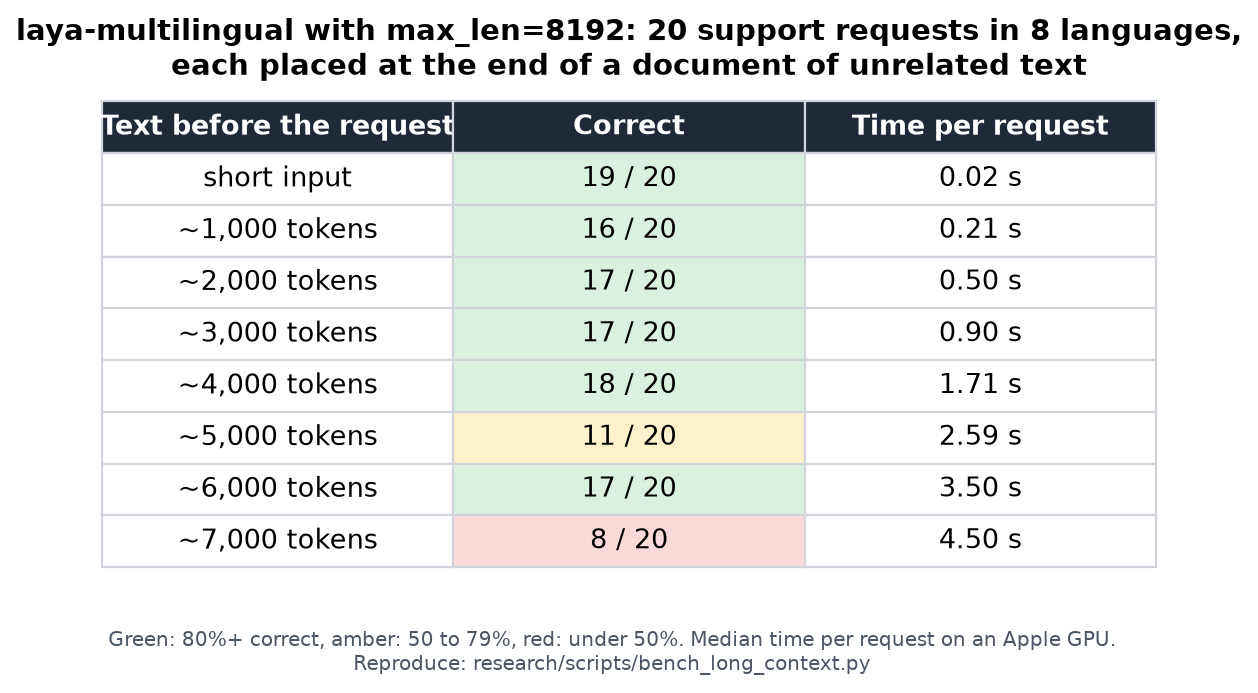
laya-multilingualreads up to 8,192 tokens. It ships with a 1,024-token limit that cuts long documents off, so passmax_len=8192for them:import laya agent = laya.load("convaiinnovations/laya-multilingual") result = agent.predict(long_document, questions, max_len=8192)In the table below, 16 to 18 of 20 requests were answered correctly with up to about 4,000 tokens of text before them; beyond that results vary (8 to 17 of 20), so check long-document accuracy on your own data. Short inputs give identical answers with
max_len=8192, and speed follows the input's real length, not the limit: short inputs are unchanged, and a 4,000-token input takes about 1.7 s on an Apple GPU.
Quickstart
pip install laya
import laya

agent = laya.load("convaiinnovations/laya-multilingual")
result = agent.predict(
    {"body": "मुझसे इनवॉइस 4411 के लिए दो बार शुल्क लिया गया। कृपया आज ही धनवापसी करें।"},
    {"department": {"type": "choice", "instructions": "Which team should handle `body`?",
                    "criteria": {"billing": "invoices, payments, refunds",
                                 "technical": "bugs and outages", "sales": "pricing"}},
     "refund_requested": {"type": "noul", "instructions": "Does the sender ask for money back?"}},
)
print(result["answers"]["department"]["choice"])      # billing
Let the Router choose
from laya import Router

router = Router()
router.predict({"body": "I was charged twice"}, questions)          # -> laya
router.predict({"body": "二重に請求されました"}, questions)            # -> laya-multilingual
The default Router() keeps both english and this checkpoint resident, so a
mixed workload no longer swaps checkpoints on every language change. For a server, load them up
front so even the first request of each language is just a forward pass:
router = Router()
router.preload(["english", "multilingual"])      # both resident; no swap at request time
router.attach("multilingual", agent) registers an Agent you already built, so a process that
loaded this checkpoint directly can hand it to the router instead of loading it twice.
More text reaches this checkpoint than script alone would send: plain-ASCII Spanish, Italian, Portuguese and French
(accents stripped by mail clients and ticket systems), Brazilian Portuguese support text, and any
script the router has no range for. If you already run a language-identification model, pass its
answer with router.predict(state, questions, lang_guess=code_or_callable).
It also receives CJK requests that contain Latin brand names, romanized Bangla, and Azerbaijani. On 20,000 English texts, at most 5 English sentences move, all quoting long native-script names.
Routing is decided from the script of the input, before the forward pass — because the model's confidence gives no warning when a checkpoint cannot read its input (see below).
If
laya.load()hangs:transformersprobes for TensorFlow at import, and when TF is installed its abseil runtime can deadlock model construction. Run withUSE_TF=0.
Why this checkpoint exists
Measured across all 51 MASSIVE languages, intent classification with 20 options (random = 0.050), both checkpoints answering byte-identical questions:
laya (English) |
laya-multilingual |
|
|---|---|---|
| macro accuracy | 0.227 | 0.366 |
| macro ECE | 0.733 | 0.387 |
| languages clearing 3x random | 23 / 51 | 45 / 51 |
The English checkpoint does not degrade gracefully outside English — it collapses, and stays confident while doing so. Khmer: 0.000 accuracy at 0.952 confidence. Hebrew 0.060, Armenian 0.050 (exactly random), Bengali 0.080 — all reported with 0.89–0.96 confidence. Its mean confidence never drops below 0.885 at any accuracy level, so confidence gating cannot catch it.
Per-language, this checkpoint turns near-random into usable: Arabic 0.110 → 0.400, Bengali 0.080 → 0.290, Azerbaijani 0.100 → 0.300, Hindi 0.100 → 0.387, Korean 0.110 → 0.490, Turkish 0.140 → 0.437.
XNLI (15 languages)
laya |
laya-multilingual |
|
|---|---|---|
| English | 0.860 | 0.843 |
| 14 other languages | 0.521 | 0.731 |
Speed — it is also the faster checkpoint
| questions per call | laya |
laya-multilingual |
|---|---|---|
| 1 | 39.5 ms | 32.8 ms |
| 10 | 158.6 ms (15.9 ms/q) | 72.3 ms (7.2 ms/q) |
| 50 | 771 ms | 337 ms (6.8 ms/q) |
103–332 questions/sec batched on one T4, despite a 256k vocabulary — the 768-dim / 22-layer encoder is cheaper per token than 1024-dim / 28-layer, and the gap widens with batch size.
Architecture
- Backbone mmBERT-base (307M, bidirectional, 22 layers, hidden 768, 256k vocab) + a decision head trained from scratch: 2 transformer layers, an option-marker scorer, and an act/escalate head. 322M total.
- Option markers every option is scored at its own
[MASK]token, then softmaxed over that question's options — so the answer space is defined per request, with no retraining. - Budget 1024 tokens per question, of which 256 go to the question and its options.
- Trained from scratch with RLCD: 15,987 updates, 4 epochs, ~4.97 h.
Limits
- Ships uncalibrated.
temperature = [1.0, 1.0, 1.0]with no per-option-count buckets. It is systematically over-confident (mean confidence 0.75–0.83 against much lower accuracy). Refitting one temperature per (question type, option count) on held-out data moves mean ECE 0.314 → 0.106. Do this on your own data before trusting the probabilities. - Weaker on English than the English checkpoint: 0.619 vs 0.684 macro across English suites. Route rather than replace.
- Near chance on typed-decisions zero-shot — 0.342, against a 0.318 random and 0.461 majority-class baseline. Fine-tune for a specific workflow; that is where the capability comes from.
- Keep
choicequestions under ~20 options. Options share the fixed 256-token head budget, so a very large label space leaves only a few tokens per label and accuracy falls off sharply. - Low-resource languages are weak, not fixed: Swahili 0.210, Tamil 0.250, Amharic 0.110.
- Ordinal
scorequestions are the weakest primitive (SST-5 0.282), and this checkpoint has a measured position bias on them: it rarely picks the first-listed level, in any language, including English (0 of 290 in one independent run, #131). For English score questions use the English checkpoint. For other languages, validate score outputs on your own data first. noulcan under-report "true" here. On a clearly positive input, one measurement putP(true)at about 0.5 while the negative case was correctly near 0 (#156). Ifnoulanswers look weak, the same question as a two-optionchoicewith neutral keys (A/B) and yes/no descriptions is a useful check.
Links
- Docs https://nandhakishorm.github.io/laya/
- Hub / family https://huggingface.co/convaiinnovations/laya
- GitHub https://github.com/NandhaKishorM/laya · full benchmark data on the
researchbranch - PyPI https://pypi.org/project/laya/
- Demo https://huggingface.co/spaces/convaiinnovations/laya-demo
Apache 2.0 · Convai Innovations