
problem stringlengths 15 4.7k | solution stringlengths 2 11.9k | answer stringclasses 51
values | problem_type stringclasses 8
values | question_type stringclasses 4
values | problem_is_valid stringclasses 1
value | solution_is_valid stringclasses 1
value | source stringclasses 6
values | synthetic bool 1
class |
|---|---|---|---|---|---|---|---|---|
For every positive integer $n$, let $S_{n}=\{1,2,3, \ldots, n\}$; that is, $S_{n}$ is the set of integers from 1 to $n$ inclusive. There are $2^{n}$ subsets of $S_{n}$. If each subset has the same likelihood of being chosen, let $p(n)$ be the probability that a chosen subset does not contain two integers with a sum of ... | Fix a positive integer $k$ and let $n=2 k$ (we are interested in even $n$ ).
The two-element subsets of $S_{2 k}$ consisting of two integers that have a sum of $2 k+1$ are $\{1,2 k\}$, $\{2,2 k-1\},\{3,2 k-2\}$, and so on up to $\{k, k+1\}$. There are $k$ subsets in the list.
A subset $X$ of $S_{2 k}$ contains two in... | 10 | Combinatorics | math-word-problem | Yes | Yes | olympiads | false |
Point $A$ has coordinates $(-13,-23)$ and point $B$ has coordinates $(-33,-43)$. What is the slope of a line that is perpendicular to the line segment $A B$ ? | The slope of $A B$ is $\frac{-43-(-23)}{-33-(-13)}=\frac{-20}{-20}=1$.
Since $A B$ is neither horizontal nor vertical, the slope of a line perpendicular to it is the negative of the reciprocal of 1 , or $\frac{-1}{1}=-1$.
ANSWER: -1 | -1 | Geometry | math-word-problem | Yes | Yes | olympiads | false |
What is the integer equal to $\sqrt{\frac{119^{2}-17^{2}}{119-17}-10^{2}}$ ? | Factoring $119^{2}-17^{2}$ as a difference of squares, we have $119^{2}-17^{2}=(119-17)(119+17)$.
Then
$$
\sqrt{\frac{119^{2}-17^{2}}{119-17}-10^{2}}=\sqrt{\frac{(119-17)(119+17)}{119-17}-10^{2}}=\sqrt{119+17-100}=\sqrt{36}=6
$$
ANSWER: 6
# | 6 | Algebra | math-word-problem | Yes | Yes | olympiads | false |
What is the integer equal to $2023^{4}-(2022)(2024)\left(1+2023^{2}\right)$ ? | If we set $x=2023$, then
$$
2023^{4}-(2022)(2024)\left(1+2023^{2}\right)=x^{4}-(x-1)(x+1)\left(1+x^{2}\right)
$$
Expanding, we have $(x-1)(x+1)\left(1+x^{2}\right)=\left(x^{2}-1\right)\left(x^{2}+1\right)=x^{4}-1$.
This means $x^{4}-(x-1)(x+1)\left(1+x^{2}\right)=x^{4}-\left(x^{4}-1\right)=1$, so the answer is 1 . | 1 | Algebra | math-word-problem | Yes | Yes | olympiads | false |
For how many integers $x$ is the expression $\frac{\sqrt{75-x}}{\sqrt{x-25}}$ equal to an integer? | For the square root in the numerator to be defined, we need $75-x \geq 0$ or $x \leq 75$, and for the square root in the denominator to be defined, we need $x-25 \geq 0$ or $25 \leq x$. Therefore, for the expression to be an integer, we must have $25 \leq x \leq 75$.
Suppose $\frac{\sqrt{75-x}}{\sqrt{x-25}}$ is equal ... | 5 | Algebra | math-word-problem | Yes | Yes | olympiads | false |
There are exactly three real numbers $x$ for which $\left(x-\frac{5}{x}\right)$ is the reciprocal of $(x-4)$. What is the sum of these three real numbers? | Two numbers are reciprocals if their product is 1 . Therefore, we are looking for real numbers $x$ for which $\left(x-\frac{5}{x}\right)(x-4)=1$.
Multiplying through by $x$ gives $\left(x^{2}-5\right)(x-4)=x$. Expanding gives $x^{3}-4 x^{2}-5 x+20=x$ which can be rearranged to get $x^{3}-4 x^{2}-6 x+20=0$.
Given that... | 4 | Algebra | math-word-problem | Yes | Yes | olympiads | false |
A square garden has an area of 9 square metres. The perimeter of the garden is $N$ metres. What is the value of $N$ ?
## | Since $9=3^{2}$, the area of the garden is $3^{2} \mathrm{~m}^{2}$ or $(3 \mathrm{~m}) \times(3 \mathrm{~m})$.
Therefore, the side-length of the garden is $3 \mathrm{~m}$.
The perimeter is $4 \times 3 \mathrm{~m}=12 \mathrm{~m}$, so $N=12$. | 12 | Geometry | math-word-problem | Yes | Yes | olympiads | false |
How many integers $n$ with $n>0$ satisfy $\frac{1}{n+1}>\frac{4}{29}$ ?
## | Multiplying through by $29(n+1)$ gives $29>4(n+1)$ which can be rearranged to get $25>4 n$ or $n<\frac{25}{4}=6.25$.
The positive integers that satisfy the inequality are $n=1, n=2, n=3, n=4, n=5$, and $n=6$, so the answer is 6 . | 6 | Inequalities | math-word-problem | Yes | Yes | olympiads | false |
Let $t$ be TNYWR.
A water tank initially contains $x$ litres of water. Pablo adds $\frac{t}{2}$ litres of water to the tank, making the tank $20 \%$ full. After Pablo adds water to the tank, Chloe then adds $\frac{t^{2}}{4}$ litres of water to the tank, making the tank $50 \%$ full. What is the value of $x$ ?
## | Let $V$ be the volume of the tank.
Using the second given piece of information, we know that when $\frac{t^{2}}{4}$ litres are added, the amount of water goes from $\frac{2 \mathrm{~V}}{10}$ to $\frac{5 \mathrm{~V}}{10}$, which means $\frac{t^{2}}{4}$ is the difference between these two amounts of water.
Therefore, $... | 3 | Algebra | math-word-problem | Yes | Yes | olympiads | false |
Let $t$ be TNYWR.
The parabola with equation $y=a x^{2}+b x+c$ passes through $(4,0),\left(\frac{t}{3}, 0\right)$, and $(0,60)$. What is the value of $a$ ? | Using that the parabola passes through $(0,60)$ gives $60=a(0)^{2}+b(0)+c$ or $c=60$.
The roots of $a x^{2}+b x+c$ are $x=4$ and $x=\frac{t}{3}$. [We are implicitly assuming that $t \neq 12$ since otherwise the question would not have a unique answer.]
The product of the roots of $a x^{2}+b x+c$ is $\frac{c}{a}=\frac... | 3 | Algebra | math-word-problem | Yes | Yes | olympiads | false |
Two positive integers are written on the blackboard. Initially, one of them is 2000 and the other is smaller than 2000. If the arithmetic mean \( m \) of the two numbers on the blackboard is an integer, the following operation is allowed: one of the two numbers is erased and replaced by \( m \). Prove that this operati... | Each time the operation is performed, the difference between the two numbers on the blackboard will become one half of its previous value (regardless of which number was erased). The mean value of two integers is an integer if and only if their difference is an even number. Suppose the initial numbers were \(a=2000\) a... | 10 | Number Theory | proof | Yes | Yes | olympiads_ref | false |
Let $f$ be a real-valued function defined on the positive integers satisfying the following condition: For all $n>1$ there exists a prime divisor $p$ of $n$ such that
$$
f(n)=f\left(\frac{n}{p}\right)-f(p)
$$
Given that $f(2001)=1$, what is the value of $f(2002)$? | Answer: 2.
For any prime $p$ we have $f(p)=f(1)-f(p)$ and thus $f(p)=\frac{f(1)}{2}$. If $n$ is a product of two primes $p$ and $q$, then $f(n)=f(p)-f(q)$ or $f(n)=f(q)-f(p)$, so $f(n)=0$. By the same reasoning we find that if $n$ is a product of three primes, then there is a prime $p$ such that
$$
f(n)=f\left(\frac{... | 2 | Number Theory | math-word-problem | Yes | Yes | olympiads_ref | false |
Let $N$ be a positive integer. Two persons play the following game. The first player writes a list of positive integers not greater than 25, not necessarily different, such that their sum is at least 200. The second player wins if he can select some of these numbers so that their sum $S$ satisfies the condition $200-N ... | If $N=11$, then the second player can simply remove numbers from the list, starting with the smallest number, until the sum of the remaining numbers is less than 212. If the last number removed was not 24 or 25, then the sum of the remaining numbers is at least $212-23=189$. If the last number removed was 24 or 25, the... | 11 | Combinatorics | math-word-problem | Yes | Yes | olympiads_ref | false |
A lattice point in the plane is a point whose coordinates are both integers. The centroid of four points $\left(x_{i}, y_{i}\right), i=1,2,3,4$, is the point $\left(\frac{x_{1}+x_{2}+x_{3}+x_{4}}{4}, \frac{y_{1}+y_{2}+y_{3}+y_{4}}{4}\right)$. Let $n$ be the largest natural number with the following property: There are ... | To prove \( n \geq 12 \), we have to show that there are 12 lattice points \(\left(x_{i}, y_{i}\right)\), \(i=1,2, \ldots, 12\), such that no four determine a lattice point centroid. This is guaranteed if we just choose the points such that \(x_{i} \equiv 0(\bmod 4)\) for \(i=1, \ldots, 6\), \(x_{i} \equiv 1(\bmod 4)\)... | 12 | Combinatorics | proof | Yes | Yes | olympiads_ref | false |
Consider the sequence \(a_{k}\) defined by \(a_{1}=1, a_{2}=\frac{1}{2}\),
\[
a_{k+2}=a_{k}+\frac{1}{2} a_{k+1}+\frac{1}{4 a_{k} a_{k+1}} \quad \text{for } k \geq 1
\]
Prove that
\[
\frac{1}{a_{1} a_{3}}+\frac{1}{a_{2} a_{4}}+\frac{1}{a_{3} a_{5}}+\cdots+\frac{1}{a_{98} a_{100}}<4
\] | Note that
$$
\frac{1}{a_{k} a_{k+2}}a_{k}+\frac{1}{2} a_{k+1}
$$
which is evident for the given sequence. Now we have
$$
\begin{aligned}
\frac{1}{a_{1} a_{3}}+\frac{1}{a_{2} a_{4}} & +\frac{1}{a_{3} a_{5}}+\cdots+\frac{1}{a_{98} a_{100}} \\
& <\frac{2}{a_{1} a_{2}}-\frac{2}{a_{2} a_{3}}+\frac{2}{a_{2} a_{3}}-\frac{2... | 4 | Algebra | proof | Yes | Yes | olympiads_ref | false |
What is the smallest number of circles of radius $\sqrt{2}$ that are needed to cover a rectangle
(a) of size $6 \times 3$?
(b) of size $5 \times 3$?
Answer: (a) Six circles, (b) five circles. | (a) Consider the four corners and the two midpoints of the sides of length 6. The distance between any two of these six points is 3 or more, so one circle cannot cover two of these points, and at least six circles are needed.
On the other hand one circle will cover a $2 \times 2$ square, and it is easy to see that six... | 6 | Geometry | math-word-problem | Yes | Yes | olympiads_ref | false |
Let $a, b, c, d, e, f$ be non-negative real numbers satisfying $a+b+c+d+e+f=6$. Find the maximal possible value of
$$
a b c+b c d+c d e+d e f+e f a+f a b
$$
and determine all 6-tuples $(a, b, c, d, e, f)$ for which this maximal value is achieved.
Answer: 8. | If we set $a=b=c=2, d=e=f=0$, then the given expression is equal to 8. We will show that this is the maximal value. Applying the inequality between arithmetic and geometric mean we obtain
$$
\begin{aligned}
8 & =\left(\frac{(a+d)+(b+e)+(c+f)}{3}\right)^{3} \geq(a+d)(b+e)(c+f) \\
& =(a b c+b c d+c d e+d e f+e f a+f a b... | 8 | Inequalities | math-word-problem | Yes | Yes | olympiads_ref | false |
How many pairs $(m, n)$ of positive integers with $m<n$ fulfill the equation
$$
\frac{3}{2008}=\frac{1}{m}+\frac{1}{n} ?
$$
## Answer: 5. | Let $d$ be the greatest common divisor of $m$ and $n$, and let $m=d x$ and $n=d y$. Then the equation is equivalent to
$$
3 d x y=2008(x+y) \text {. }
$$
The numbers $x$ and $y$ are relatively prime and have no common divisors with $x+y$ and hence they are both divisors of 2008. Notice that $2008=8 \cdot 251$ and 251... | 5 | Number Theory | math-word-problem | Yes | Yes | olympiads_ref | false |
In a club with 30 members, every member initially had a hat. One day each member sent his hat to a different member (a member could have received more than one hat). Prove that there exists a group of 10 members such that no one in the group has received a hat from another one in the group. | Let $S$ be the given group of 30 people. Consider all subsets $A \subset S$ such that no member of $A$ received a hat from a member of $A$. Among such subsets, let $T$ be a subset of maximal cardinality. The assertion of the problem is that $|T| \geq 10$.
Let $U \subset S$ consist of all people that have received a ha... | 10 | Combinatorics | proof | Yes | Yes | olympiads_ref | false |
For a positive integer $k$, let $d(k)$ denote the number of divisors of $k$ (e.g. $d(12)=6$) and let $s(k)$ denote the digit sum of $k$ (e.g. $s(12)=3$). A positive integer $n$ is said to be amusing if there exists a positive integer $k$ such that $d(k)=s(k)=n$. What is the smallest amusing odd integer greater than 1? | The answer is 9. For every $k$ we have $s(k) \equiv k(\bmod 9)$. Calculating remainders modulo 9 we have the following table
| $m$ | 0 | 1 | 2 | 3 | 4 | 5 | 6 | 7 | 8 |
| :---: | :---: | :---: | :---: | :---: | :---: | :---: | :---: | :---: | :---: |
| $m^{2}$ | 0 | 1 | 4 | 0 | 7 | 7 | 0 | 4 | 1 |
| $m^{6}$ | 0 | 1 | ... | 9 | Number Theory | math-word-problem | Yes | Yes | olympiads_ref | false |
For which $k$ do there exist $k$ pairwise distinct primes $p_{1}, p_{2}, \ldots, p_{k}$ such that
$$
p_{1}^{2}+p_{2}^{2}+\cdots+p_{k}^{2}=2010 ?
$$ | We show that it is possible only if $k=7$.
The 15 smallest prime squares are:
$$
4,9,25,49,121,169,289,361,529,841,961,1369,1681,1849,2209
$$
Since $2209>2010$ we see that $k \leq 14$.
Now we note that $p^{2} \equiv 1 \bmod 8$ if $p$ is an odd prime. We also have that $2010 \equiv 2 \bmod 8$. If all the primes are ... | 7 | Number Theory | math-word-problem | Yes | Yes | olympiads_ref | false |
Let $k$ and $n$ be positive integers and let $x_{1}, x_{2}, \ldots, x_{k}, y_{1}, y_{2}, \ldots, y_{n}$ be distinct integers. A polynomial $P$ with integer coefficients satisfies
$$
P\left(x_{1}\right)=P\left(x_{2}\right)=\ldots=P\left(x_{k}\right)=54
$$
and
$$
P\left(y_{1}\right)=P\left(y_{2}\right)=\ldots=P\left(y... | Letting \( Q(x) = P(x) - 54 \), we see that \( Q \) has \( k \) zeroes at \( x_1, \ldots, x_k \), while \( Q(y_i) = 1959 \) for \( i = 1, \ldots, n \). We notice that \( 1959 = 3 \cdot 653 \), and an easy check shows that 653 is a prime number. As
\[
Q(x) = \prod_{j=1}^{k} (x - x_j) S(x)
\]
and \( S(x) \) is a polyno... | 6 | Algebra | math-word-problem | Yes | Yes | olympiads_ref | false |
On a $16 \times 16$ torus as shown all 512 edges are colored red or blue. A coloring is good if every vertex is an endpoint of an even number of red edges. A move consists of switching the color of each of the 4 edges of an arbitrary cell. What is the largest number of good colorings such that none of them can be conve... | 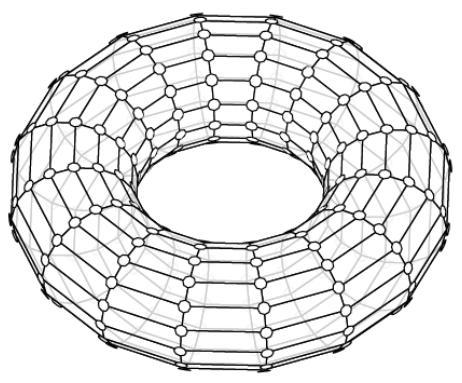
Answer: 4. Representatives of the equivalence classes are: all blue, all blue with one longitudinal red ring, all blue with one transversal red ring, all blue with one longitudinal and one ... | 4 | Combinatorics | math-word-problem | Yes | Yes | olympiads_ref | false |
Let $n>2$ be a given positive integer. There are $n$ guests at Georg's bachelor party and each guest is friends with at least one other guest. Georg organizes a party game among the guests. Each guest receives a jug of water such that there are no two guests with the same amount of water in their jugs. All guests now p... | Answer: 2.
If there are guests $1,2, \ldots, n$ and guest $i$ is friends with guest $i-1$ and $i+1$ modulo $n$ (e.g. guest 1 and guest $n$ are friends). Then if guest $i$ has $i$ amount of water in their jug at the start of the game, then only guest 1 and $n$ end up with a different amount of water than they started w... | 2 | Combinatorics | math-word-problem | Yes | Yes | olympiads_ref | false |
Let $\Gamma$ be a circle in the plane and $S$ be a point on $\Gamma$. Mario and Luigi drive around the circle $\Gamma$ with their go-karts. They both start at $S$ at the same time. They both drive for exactly 6 minutes at constant speed counterclockwise around the track. During these 6 minutes, Luigi makes exactly one ... | . Without loss of generality, we assume that $\Gamma$ is the unit circle and $S=(1,0)$. Three points are marked with bananas:
(i) After 45 seconds, Luigi has passed through an arc with a subtended angle of $45^{\circ}$ and is at the point $\left(\sqrt{2} / 2, \sqrt{2} / 2\right)$, whereas Mario has passed through an a... | 3 | Geometry | math-word-problem | Yes | Yes | olympiads_ref | false |
Distinct positive integers $a, b, c, d$ satisfy
$$
\left\{\begin{array}{l}
a \mid b^{2}+c^{2}+d^{2}, \\
b \mid a^{2}+c^{2}+d^{2}, \\
c \mid a^{2}+b^{2}+d^{2}, \\
d \mid a^{2}+b^{2}+c^{2},
\end{array}\right.
$$
and none of them is larger than the product of the three others. What is the largest possible number of prim... | At first we note that the given condition is equivalent to $a, b, c, d \mid a^{2}+b^{2}+c^{2}+d^{2}$.
It is possible that three of the given numbers are primes, for example for $a=2, b=3, c=13$ and $d=26$. In this case $2^{2}+3^{2}+13^{2}+26^{2}=13 \cdot 66$ which is divisible by all four given numbers. Furthermore we... | 3 | Number Theory | math-word-problem | Yes | Yes | olympiads_ref | false |
An equilateral triangle $A B C$ is divided into 100 congruent equilateral triangles. What is the greatest number of vertices of small triangles that can be chosen so that no two of them lie on a line that is parallel to any of the sides of the triangle $A B C$? | An example for 7 vertices is shown in Figure 2. Now assume we have chosen 8 vertices satisfying the conditions of the problem. Let the height of each small triangle be equal to 1 and denote by \(a_{i}, b_{i}, c_{i}\) the distance of the \(i\)th point from the three sides of the big triangle. For any \(i=1,2, \ldots, 8\... | 7 | Combinatorics | math-word-problem | Yes | Yes | olympiads_ref | false |
The graph of the function $f(x)=x^{n}+a_{n-1} x^{n-1}+\cdots+a_{1} x+a_{0}$ (where $n>1$), intersects the line $y=b$ at the points $B_{1}, B_{2}, \ldots, B_{n}$ (from left to right), and the line $y=c(c \neq b)$ at the points $C_{1}, C_{2}, \ldots, C_{n}$ (from left to right). Let $P$ be a point on the line $y=c$, to t... | Let the points $B_{i}$ and $C_{i}$ have the coordinates $\left(b_{i}, b\right)$ and $\left(c_{i}, c\right)$, respectively, for $i=1,2, \ldots, n$. Then we have
$$
\cot \angle B_{1} C_{1} P+\cdots+\cot \angle B_{n} C_{n} P=\frac{1}{b-c} \sum_{i=1}^{n}\left(b_{i}-c_{i}\right)
$$
The numbers $b_{i}$ and $c_{i}$ are the ... | 0 | Algebra | math-word-problem | Yes | Yes | olympiads_ref | false |
We say that an integer $m$ covers the number 1998 if $1,9,9,8$ appear in this order as digits of $m$. (For instance, 1998 is covered by 215993698 but not by 213326798 .) Let $k(n)$ be the number of positive integers that cover 1998 and have exactly $n$ digits $(n \geqslant 5)$, all different from 0 . What is the remain... | Answer: 1.
Let $1 \leqslant g<h<i<j \leqslant n$ be fixed integers. Consider all $n$-digit numbers $a=\overline{a_{1} a_{2} \ldots a_{n}}$ with all digits non-zero, such that $a_{g}=1, a_{h}=9, a_{i}=9$, $a_{j}=8$ and this quadruple 1998 is the leftmost one in $a$; that is,
$$
\begin{cases}a_{l} \neq 1 & \text { if }... | 1 | Combinatorics | math-word-problem | Yes | Yes | olympiads_ref | false |
A finite set of integers is called bad if its elements add up to 2010. A finite set of integers is a Benelux-set if none of its subsets is bad. Determine the smallest integer $n$ such that the set $\{502,503,504, \ldots, 2009\}$ can be partitioned into $n$ Benelux-sets.
(A partition of a set $S$ into $n$ subsets is a ... | As $502+1508=2010$, the set $S=\{502,503, \ldots, 2009\}$ is not a Benelux-set, so $n=1$ does not work. We will prove that $n=2$ does work, i.e. that $S$ can be partitioned into 2 Benelux-sets.
Define the following subsets of $S$:
$$
\begin{aligned}
A & =\{502,503, \ldots, 670\}, \\
B & =\{671,672, \ldots, 1005\}, \\... | 2 | Combinatorics | math-word-problem | Yes | Yes | olympiads_ref | false |
Find the smallest possible value of the expression
$$
\left\lfloor\frac{a+b+c}{d}\right\rfloor+\left\lfloor\frac{b+c+d}{a}\right\rfloor+\left\lfloor\frac{c+d+a}{b}\right\rfloor+\left\lfloor\frac{d+a+b}{c}\right\rfloor,
$$
where \(a, b, c\) and \(d\) vary over the set of positive integers.
(Here \(\lfloor x\rfloor\) ... | The answer is 9.
Notice that $\lfloor x\rfloor>x-1$ for all $x \in \mathbb{R}$. Therefore the given expression is strictly greater than
$$
\frac{a+b+c}{d}+\frac{b+c+d}{a}+\frac{c+d+a}{b}+\frac{d+a+b}{c}-4,
$$
which can be rewritten as
$$
\left(\frac{a}{b}+\frac{b}{a}\right)+\left(\frac{a}{c}+\frac{c}{a}\right)+\lef... | 9 | Number Theory | math-word-problem | Yes | Yes | olympiads_ref | false |
(a) Prove that for all \(a, b, c, d \in \mathbb{R}\) with \(a+b+c+d=0\),
\[
\max (a, b)+\max (a, c)+\max (a, d)+\max (b, c)+\max (b, d)+\max (c, d) \geqslant 0
\]
(b) Find the largest non-negative integer \(k\) such that it is possible to replace \(k\) of the six maxima in this inequality by minima in such a way that... | The left-hand-side of the inequality is invariant under permutations of $a, b, c, d$. We may therefore suppose that $a \geqslant b \geqslant c \geqslant d$, so that the inequality reduces to
$$
0 \leqslant 3 a+2 b+c=a+(a+b)+(a+b+c).
$$
We claim that each of the terms on the right-hand side is non-negative; this will ... | 2 | Inequalities | proof | Yes | Yes | olympiads_ref | false |
Assume that real numbers $a$ and $b$ satisfy
$$
a b+\sqrt{a b+1}+\sqrt{a^{2}+b} \cdot \sqrt{b^{2}+a}=0
$$
Find, with proof, the value of
$$
a \sqrt{b^{2}+a}+b \sqrt{a^{2}+b}
$$ | Let us rewrite the given equation as follows:
$$
a b+\sqrt{a^{2}+b} \sqrt{b^{2}+a}=-\sqrt{a b+1} .
$$
Squaring this gives us
$$
\begin{aligned}
a^{2} b^{2}+2 a b \sqrt{a^{2}+b} \sqrt{b^{2}+a}+\left(a^{2}+b\right)\left(b^{2}+a\right) & =a b+1 \\
\left(a^{2} b^{2}+a^{3}\right)+2 a b \sqrt{a^{2}+b} \sqrt{b^{2}+a}+\left... | 1 | Algebra | math-word-problem | Yes | Yes | olympiads_ref | false |
Let $S$ be a subset of $\{1,2, \ldots, 9\}$, such that the sums formed by adding each unordered pair of distinct numbers from $S$ are all different. For example, the subset $\{1,2,3,5\}$ has this property, but $\{1,2,3,4,5\}$ does not, since the pairs $\{1,4\}$ and $\{2,3\}$ have the same sum, namely 5.
What is the ma... | It can be checked that all the sums of pairs for the set $\{1,2,3,5,8\}$ are different.
Suppose, for a contradiction, that $S$ is a subset of $\{1, \ldots, 9\}$ containing 6 elements such that all the sums of pairs are different. Now the smallest possible sum for two numbers from $S$ is $1+2=3$ and the largest possibl... | 5 | Combinatorics | math-word-problem | Yes | Yes | olympiads_ref | false |
The sets $A$ and $B$ are subsets of the positive integers. The sum of any two different elements from $A$ is an element of $B$. The quotient of any two different elements from $B$ (where we divide the largest by the smallest) is an element of $A$. Determine the maximum number of elements in $A \cup B$. | Suppose $A$ contains at least three elements, say $a < b < c$, so $b - a$ is positive, thus it must hold that $a + c \leq b - a$. This gives $c \leq b - 2a$. Therefore, $A$ contains at most two elements.
Suppose $B$ contains at least four elements, say $a < b < c < d$. Then $A$ contains the three distinct elements $\fr... | 5 | Number Theory | math-word-problem | Yes | Yes | olympiads_ref | false |
Determine all positive integers $n$ for which there exist positive integers $a_{1}, a_{2}, \ldots, a_{n}$ such that
$$
a_{1}+2 a_{2}+3 a_{3}+\ldots+n a_{n}=6 n
$$
and
$$
\frac{1}{a_{1}}+\frac{2}{a_{2}}+\frac{3}{a_{3}}+\ldots+\frac{n}{a_{n}}=2+\frac{1}{n}
$$ | When we apply the inequality of the arithmetic and harmonic mean to $a_{1}$, twice $a_{2}$, three times $a_{3}, \ldots, n$ times $a_{n}$, we find
$$
\frac{6 n}{\frac{1}{2} n(n+1)}=\frac{a_{1}+2 a_{2}+3 a_{3}+\ldots+n a_{n}}{\frac{1}{2} n(n+1)} \geq \frac{\frac{1}{2} n(n+1)}{\frac{1}{a_{1}}+\frac{2}{a_{2}}+\frac{3}{a_{... | 3 | Number Theory | math-word-problem | Yes | Yes | olympiads_ref | false |
Find all positive integers $k$ for which the equation
$$
\operatorname{lcm}(m, n)-\operatorname{gcd}(m, n)=k(m-n)
$$
has no positive integer solutions $(m, n)$ with $m \neq n$. | Let $d=\operatorname{ggd}(m, n)$ and write $m=d a$ and $n=d b$. It holds that $\operatorname{kgv}(m, n) \cdot \operatorname{ggd}(m, n)=m n$, so we can write the given equation as
$$
\frac{d a \cdot d b}{d}-d=k(d a-d b)
$$
or equivalently
$$
a b-1=k(a-b) .
$$
From now on, we will look at the equivalent problem: find... | 2 | Number Theory | math-word-problem | Yes | Yes | olympiads_ref | false |
Let $n$ be an even positive integer. A sequence of $n$ real numbers is called complete if for every integer $m$ with $1 \leq m \leq n$, the sum of the first $m$ terms or the sum of the last $m$ terms of the sequence is an integer. Determine the minimum number of integers in a complete sequence of $n$ numbers. | We prove that the minimum number of integers in a complete sequence is equal to 2. First, consider the case $n=2$. Let $a_{1}$ and $a_{2}$ be the numbers in the sequence. Then $a_{1}$ or $a_{2}$ is an integer, say without loss of generality $a_{1}$. Furthermore, $a_{1}+a_{2}$ is an integer, but then $a_{2}$ is also an ... | 2 | Number Theory | math-word-problem | Yes | Yes | olympiads_ref | false |
On the ceiling of a room hang 15 lamps, numbered from 1 to 15. Initially, all the lamps are off. In another room are 15 switches: one switch for lamp 1 and 2, one switch for lamp 2 and 3, one switch for lamp 3 and 4, and so on, up to a switch for lamp 15 and 1. When the switch for such a pair of lamps is flipped, the s... | With three rounds of walking, Raymond can never be certain. After all, if you note for each switch whether it is in the initial position or the flipped position in the three rounds, you can get $2^{3}=8$ different patterns. However, there are 15 switches, so there are multiple switches with the same pattern, and Raymon... | 4 | Logic and Puzzles | math-word-problem | Yes | Yes | olympiads_ref | false |
Determine the largest real number $M$ such that for every infinite sequence $x_{0}, x_{1}, x_{2}, \ldots$ of real numbers that satisfies
a) $x_{0}=1$ and $x_{1}=3$,
b) $x_{0}+x_{1}+\cdots+x_{n-1} \geq 3 x_{n}-x_{n+1}$,
it holds that
$$
\frac{x_{n+1}}{x_{n}}>M
$$
for all $n \geq 0$. | Answer: the largest possible constant for which this holds is $M=2$.
This problem is a typical example where it pays to take a stronger induction hypothesis than you strictly need: we show by induction that $x_{n+1}>2 x_{n}>x_{n}+x_{n-1}+\ldots+x_{0}$. For $n=0$, this translates to $x_{1}>2 x_{0}>x_{0}$, which, with th... | 2 | Algebra | math-word-problem | Yes | Yes | olympiads_ref | false |
Find the smallest positive integer $k$ for which there exist a colouring of the positive integers $\mathbb{Z}_{>0}$ with $k$ colours and a function $f: \mathbb{Z}_{>0} \rightarrow \mathbb{Z}_{>0}$ with the following two properties:
(i) For all positive integers $m, n$ of the same colour, $f(m+n)=f(m)+f(n)$.
(ii) There ... | The answer is $k=3$.
First we show that there is such a function and coloring for $k=3$. Consider $f: \mathbb{Z}_{>0} \rightarrow \mathbb{Z}_{>0}$ given by $f(n)=n$ for all $n \equiv 1$ or 2 modulo 3, and $f(n)=2 n$ for $n \equiv 0$ modulo 3. Moreover, give a positive integer $n$ the $i$-th color if $n \equiv i$ (3).
B... | 3 | Combinatorics | math-word-problem | Yes | Yes | olympiads_ref | false |
In the plane, consider the set $S$ of points with coordinates $(x, y)$, where $x, y \in$ $\{1,2, \ldots, 2013\}$. Two points in $S$ are called neighbors if they are at a distance of 1 from each other. Every second, a fly and some spiders move on the points of $S$ as follows: first, the fly either stays still or moves t... | A single spider cannot catch the fly: indeed, the fly can wait until the spider is at a neighboring point to where it is located. From that moment on, it moves to a diagonally opposite point to the one the spider is on if the spider is at a neighboring point, and otherwise stays where it is.
We will now prove that, in... | 2 | Combinatorics | math-word-problem | Yes | Yes | olympiads_ref | false |
We want to color the three-element parts of $\{1,2,3,4,5,6,7\}$, such that if two of these parts have no element in common, then they must be of different colors. What is the minimum number of colors needed to achieve this goal? | Consider the sequence of sets $\{1,2,3\},\{4,5,6\},\{1,2,7\},\{3,4,6\},\{1,5,7\},\{2,3,6\},\{4,5,7\}$, $\{1,2,3\}$.
Each set must have a different color from the next, so there must be at least two colors. If there were exactly two colors, then the colors would have to alternate, which is impossible because the last se... | 3 | Combinatorics | math-word-problem | Yes | Yes | olympiads_ref | false |
Consider 2017 lines in the plane, which intersect pairwise at distinct points. Let $E$ be the set of these intersection points.
We want to assign a color to each point in $E$ such that any two points on the same line, whose segment connecting them contains no other point of $E$, are of different colors.
What is the min... | The sought minimum $m$ is $m=3$, and with what follows, it will be quite evident that the result remains true for $n \geq 3$ lines.
First, we note that, in the obtained configuration, there is at least one non-subdivided region that is a triangle. Indeed, three non-concurrent lines and two never parallel lines form a t... | 3 | Combinatorics | math-word-problem | Yes | Yes | olympiads_ref | false |
The integers $1,2, \ldots, 2018$ are written on the board. Then 2017 operations are performed as follows: choose two numbers $a$ and $b$, erase them, and write $a+b+2 a b$ in their place. At the end, only one integer remains on the board.
What are the possible values that its units digit can take? | Since there are 1009 odd numbers between 1 and 2018, we know that the sum of the integers initially written on the board is odd. Furthermore, one of these integers is congruent to $2(\bmod 5)$. An immediate induction then shows that, after each operation, the sum of the integers written on the board remains odd, and on... | 7 | Number Theory | math-word-problem | Yes | Yes | olympiads_ref | false |
Determine the maximum value of $\sqrt{x}+\sqrt{2 y+2}+\sqrt{3 z+6}$ when $x, y, z$ are strictly positive real numbers satisfying $x+y+z=3$. | According to the Cauchy-Schwarz inequality, we have
$$
\sqrt{x} \sqrt{1}+\sqrt{y+1} \sqrt{2}+\sqrt{z+2} \sqrt{3} \leqslant \sqrt{x+y+1+z+2} \sqrt{1+2+3}=6
$$
Equality is achieved when $x=y=z=1$. Therefore, the maximum value is 6. | 6 | Inequalities | math-word-problem | Yes | Yes | olympiads_ref | false |
Morgane and Bosphore are playing the following game. Morgane has written the integers from 1 to 8 on the vertices of a regular octagon: each integer is written on one of the eight vertices of the octagon. Bosphore then chooses a vertex and calculates the sum of the numbers written on that vertex and its two neighbors. ... | First, if Morgane distributes the integers from 1 to 8 as follows, we indeed observe that Bosphore will have to give her at least 12 candies; next to each vertex, we have indicated the sum $s$ that Bosphore would calculate if he chose this vertex.
^{2}+(y-z x)^{2}+(z-x y)^{2} .
$$
can take. | The quantity we wish to maximize can be rewritten as
$$
\begin{aligned}
\mathcal{S} & =\left(x^{2}+y^{2}+z^{2}\right)+\left((x y)^{2}+(y z)^{2}+(z x)^{2}\right)-6 x y z \\
& =(x+y+z)^{2}-2(x y+y z+z x)+(x y+y z+z x)^{2}-2 x y z(x+y+z)-6 x y z \\
& =1-2(x y+y z+z x)+(x y+y z+z x)^{2}-8 x y z \\
& =(x y+y z+z x-1)^{2}-8... | 1 | Algebra | math-word-problem | Yes | Yes | olympiads_ref | false |
We denote by $\mathbb{Z}[x, y, z]$ the set of polynomials with integer coefficients in the three variables $x, y$, and $z$. We then say that a polynomial $P \in \mathbb{Z}[x, y, z]$ is Olympic if $\mathbb{Z}[x, y, z]$ contains polynomials $A, B$, and $C$ such that
$$
P(x, y, z)=(x+y+z) A(x, y, z)+(x y+y z+z x) B(x, y,... | Let $s_{1}=x+y+z, s_{2}=x y+y z+z x$ and $s_{3}=x y z$. We observe that
$$
\begin{cases}x^{3} \equiv-x^{2}(y+z) \equiv-x(x y+x z) \equiv x y z \equiv 0 & \left(\bmod s_{1}, s_{2}, s_{3}\right) \\ x^{2} y^{2} \equiv x y(-x z-y z) \equiv-x y z(x+y) \equiv 0 & \left(\bmod s_{1}, s_{2}, s_{3}\right)\end{cases}
$$
which m... | 3 | Algebra | math-word-problem | Yes | Yes | olympiads_ref | false |
Maena and Théodore are playing a game. They play on a square grid consisting of $99 \times 99$ cells. Two cells are considered adjacent if they share a vertex or a side.
Initially, Maéna numbers the cells of the grid from 1 to $99^{2}$, in an arbitrary manner. Théodore then places a token on one of the cells of the squ... | First, Théodore can always manage to make at least three moves. To do this, he just needs to select a $2 \times 2$ square inside the $99 \times 99$ square, then traverse its four cells, which are necessarily adjacent since they share a vertex.
Conversely, here is how Maena can proceed to prevent Théodore from making mo... | 3 | Combinatorics | math-word-problem | Yes | Yes | olympiads_ref | false |
A permutation of the integers 1 to 2022 is a sequence $\sigma=\left(\sigma_{1}, \ldots, \sigma_{2022}\right)$ such that each element of the set $\{1, \ldots, 2022\}$ is equal to exactly one term $\sigma_{i}$. What is the smallest possible value that the sum
$$
\left\lfloor\frac{a_{1}}{1}\right\rfloor+\left\lfloor\frac... | In general, let $\mathcal{S}\left(a_{1}, a_{2}, \ldots, a_{n}\right)$ denote the sum
$$
\left\lfloor\frac{a_{1}}{1}\right\rfloor+\left\lfloor\frac{a_{2}}{2}\right\rfloor+\ldots+\left\lfloor\frac{a_{n}}{n}\right\rfloor,
$$
and let $\mathcal{S}_{n}$ be the smallest value that $\mathcal{S}\left(a_{1}, a_{2}, \ldots, a_{... | 11 | Combinatorics | math-word-problem | Yes | Yes | olympiads_ref | false |
Let $n \geqslant 3$ be an integer. For each pair of prime numbers $p$ and $q$ such that $p<q \leqslant n$, Morgane writes the sum $p+q$ on the board. She then notes $\mathcal{P}(n)$ as the product of all these sums. For example, $\mathcal{P}(5)=(2+3) \times(2+5) \times(3+5)=280$.
Find all values of $n \geqslant 3$ for ... | Let $n$ be a potential solution, and let $r$ be the largest prime number such that $r \leqslant n$. Since $r$ divides $n$!, it divides $\mathcal{P}(n)$, so there exist two prime numbers $p$ and $q$ such that $p<q \leqslant n$ and $r$ divides $p+q$. By the maximality of $r$, we know that $p+q<2 r$, so $p+q=r$. Since $q$... | 7 | Number Theory | math-word-problem | Yes | Yes | olympiads_ref | false |
We consider all positive real numbers $a, b, c, d$ for which $(a+c)(b+d)=a c+b d$ holds.
Determine the smallest value that $S=\frac{a}{b}+\frac{b}{c}+\frac{c}{d}+\frac{d}{a}$ can take. | The smallest possible value for $S$ is 8.
To show that $S \geq 8$ always holds, we apply the AM-GM inequality twice:
$\left(\frac{a}{b}+\frac{c}{d}\right)+\left(\frac{b}{c}+\frac{d}{a}\right) \geq 2 \sqrt{\frac{a c}{b d}}+2 \sqrt{\frac{b d}{a c}}=\frac{2(a c+b d)}{\sqrt{a b c d}}=\frac{2(a+c)(b+d)}{\sqrt{a b c d}} \geq... | 8 | Algebra | math-word-problem | Yes | Yes | olympiads_ref | false |
Determine ${ }^{1}$ the smallest value that the expression
$$
\left\lfloor\frac{a_{1}}{1}\right\rfloor+\left\lfloor\frac{a_{2}}{2}\right\rfloor+\cdots+\left\lfloor\frac{a_{2022}}{2022}\right\rfloor
$$
can take, where $a_{1}, a_{2}, \ldots, a_{2022} \geq 1$ are real numbers such that $\left|a_{i}-a_{j}\right| \geq 1$ ... | From the premise, it follows that the smallest of the numbers $a_{1}, a_{2}, \ldots, a_{2022}$ is at least 1, the second smallest is at least 2, and so on, up to the 2022nd, which must be at least 2022. If we now replace the numbers $a_{1}, \ldots, a_{2022}$ successively by $1,2, \ldots, 2022$ in order of size, the sum... | 11 | Number Theory | math-word-problem | Yes | Yes | olympiads_ref | false |
Determine all integers $n \geq 1$ for which there exists a pair $(a, b)$ of positive integers with the following properties:
i) No third power of a prime divides $a^{2}+b+3$.
ii) It holds that $\frac{a b+3 b+8}{a^{2}+b+3}=n$.
Answer: The only integer with these properties is $n=2$. | Let $p$ be any prime factor of $a^{2}+b+3$ (such a prime exists because $a^{2}+b+3 \geq 5$). Then $b \equiv -a^{2}-3 \bmod p$. Due to the integrality of $n$, $p$ must also be a prime factor of $a b+3 b+8$. Therefore, $0 \equiv a b+3 b+8 \equiv a\left(-a^{2}-3\right)+3\left(-a^{2}-3\right)+8 \equiv -a^{3}-3 a^{2}-3 a-1 ... | 2 | Number Theory | math-word-problem | Yes | Yes | olympiads_ref | false |
Find the largest possible integer $k$, such that the following statement is true: Let 2009 arbitrary non-degenerate triangles be given. In every triangle the three sides are colored, such that one is blue, one is red and one is white. Now, for every color separately, let us sort the lengths of the sides. We obtain
$$
\... | We will prove that the largest possible number $k$ of indices satisfying the given condition is one. Firstly we prove that $b_{2009}, r_{2009}, w_{2009}$ are always lengths of the sides of a triangle. Without loss of generality we may assume that $w_{2009} \geq r_{2009} \geq b_{2009}$. We show that the inequality $b_{2... | 1 | Combinatorics | math-word-problem | Yes | Yes | olympiads_ref | false |
Find the smallest number $n$ such that there exist polynomials $f_{1}, f_{2}, \ldots, f_{n}$ with rational coefficients satisfying
$$ x^{2}+7=f_{1}(x)^{2}+f_{2}(x)^{2}+\cdots+f_{n}(x)^{2} . $$
(Poland) Answer. The smallest $n$ is 5. | The equality $x^{2}+7=x^{2}+2^{2}+1^{2}+1^{2}+1^{2}$ shows that $n \leq 5$. It remains to show that $x^{2}+7$ is not a sum of four (or less) squares of polynomials with rational coefficients. Suppose by way of contradiction that $x^{2}+7=f_{1}(x)^{2}+f_{2}(x)^{2}+f_{3}(x)^{2}+f_{4}(x)^{2}$, where the coefficients of po... | 5 | Algebra | math-word-problem | Yes | Yes | olympiads_ref | false |
Let $A_{1} A_{2} A_{3} A_{4}$ be a non-cyclic quadrilateral. Let $O_{1}$ and $r_{1}$ be the circumcenter and the circumradius of the triangle $A_{2} A_{3} A_{4}$. Define $O_{2}, O_{3}, O_{4}$ and $r_{2}, r_{3}, r_{4}$ in a similar way. Prove that
$$ \frac{1}{O_{1} A_{1}^{2}-r_{1}^{2}}+\frac{1}{O_{2} A_{2}^{2}-r_{2}^{... | Let $M$ be the point of intersection of the diagonals $A_{1} A_{3}$ and $A_{2} A_{4}$. On each diagonal choose a direction and let $x, y, z$, and $w$ be the signed distances from $M$ to the points $A_{1}, A_{2}, A_{3}$, and $A_{4}$, respectively. Let $\omega_{1}$ be the circumcircle of the triangle $A_{2} A_{3} A_{4}$ ... | 0 | Geometry | proof | Yes | Yes | olympiads_ref | false |
For a sequence $x_{1}, x_{2}, \ldots, x_{n}$ of real numbers, we define its price as
$$ \max _{1 \leqslant i \leqslant n}\left|x_{1}+\cdots+x_{i}\right| $$
Given $n$ real numbers, Dave and George want to arrange them into a sequence with a low price. Diligent Dave checks all possible ways and finds the minimum possibl... | If the initial numbers are $1, -1, 2$, and $-2$, then Dave may arrange them as $1, -2, 2, -1$, while George may get the sequence $1, -1, 2, -2$, resulting in $D=1$ and $G=2$. So we obtain $c \geqslant 2$. Therefore, it remains to prove that $G \leqslant 2 D$. Let $x_{1}, x_{2}, \ldots, x_{n}$ be the numbers Dave and Ge... | 2 | Combinatorics | math-word-problem | Yes | Yes | olympiads_ref | false |
Let $\mathbb{Z}_{>0}$ denote the set of positive integers. For any positive integer $k$, a function $f: \mathbb{Z}_{>0} \rightarrow \mathbb{Z}_{>0}$ is called $k$-good if $\operatorname{gcd}(f(m)+n, f(n)+m) \leqslant k$ for all $m \neq n$. Find all $k$ such that there exists a $k$-good function. (Canada) | For any function $f: \mathbb{Z}_{>0} \rightarrow \mathbb{Z}_{>0}$, let $G_{f}(m, n)=\operatorname{gcd}(f(m)+n, f(n)+m)$. Note that a $k$-good function is also $(k+1)$-good for any positive integer $k$. Hence, it suffices to show that there does not exist a 1-good function and that there exists a 2-good function. We fir... | 2 | Number Theory | math-word-problem | Yes | Yes | olympiads_ref | false |
Let $B=(-1,0)$ and $C=(1,0)$ be fixed points on the coordinate plane. A nonempty, bounded subset $S$ of the plane is said to be nice if (i) there is a point $T$ in $S$ such that for every point $Q$ in $S$, the segment $T Q$ lies entirely in $S$; and (ii) for any triangle $P_{1} P_{2} P_{3}$, there exists a unique point... | If in the similarity of $\triangle A B C$ and $\triangle P_{\sigma(1)} P_{\sigma(2)} P_{\sigma(3)}, B C$ corresponds to the longest side of $\triangle P_{1} P_{2} P_{3}$, then we have $B C \geqslant A B \geqslant A C$. The condition $B C \geqslant A B$ is equivalent to $(x+1)^{2}+y^{2} \leqslant 4$, while $A B \geqslan... | 4 | Geometry | proof | Yes | Yes | olympiads_ref | false |
Define $P(n)=n^{2}+n+1$. For any positive integers $a$ and $b$, the set
$$ \{P(a), P(a+1), P(a+2), \ldots, P(a+b)\} $$
is said to be fragrant if none of its elements is relatively prime to the product of the other elements. Determine the smallest size of a fragrant set. | We have the following observations. (i) $(P(n), P(n+1))=1$ for any $n$. We have $(P(n), P(n+1))=\left(n^{2}+n+1, n^{2}+3 n+3\right)=\left(n^{2}+n+1,2 n+2\right)$. Noting that $n^{2}+n+1$ is odd and $\left(n^{2}+n+1, n+1\right)=(1, n+1)=1$, the claim follows. (ii) $(P(n), P(n+2))=1$ for $n \not \equiv 2(\bmod 7)$ and $(... | 6 | Number Theory | math-word-problem | Yes | Yes | olympiads_ref | false |
Define $P(n)=n^{2}+n+1$. For any positive integers $a$ and $b$, the set
$$ \{P(a), P(a+1), P(a+2), \ldots, P(a+b)\} $$
is said to be fragrant if none of its elements is relatively prime to the product of the other elements. Determine the smallest size of a fragrant set. Answer. 6. | We have the following observations. (i) $(P(n), P(n+1))=1$ for any $n$. We have $(P(n), P(n+1))=\left(n^{2}+n+1, n^{2}+3 n+3\right)=\left(n^{2}+n+1,2 n+2\right)$. Noting that $n^{2}+n+1$ is odd and $\left(n^{2}+n+1, n+1\right)=(1, n+1)=1$, the claim follows. (ii) $(P(n), P(n+2))=1$ for $n \not \equiv 2(\bmod 7)$ and $(... | 6 | Number Theory | math-word-problem | Yes | Yes | olympiads_ref | false |
Find the smallest positive integer $n$, or show that no such $n$ exists, with the following property: there are infinitely many distinct $n$-tuples of positive rational numbers ( $a_{1}, a_{2}, \ldots, a_{n}$ ) such that both
$$ a_{1}+a_{2}+\cdots+a_{n} \quad \text { and } \quad \frac{1}{a_{1}}+\frac{1}{a_{2}}+\cdots+... | For $n=1, a_{1} \in \mathbb{Z}_{>0}$ and $\frac{1}{a_{1}} \in \mathbb{Z}_{>0}$ if and only if $a_{1}=1$. Next we show that (i) There are finitely many $(x, y) \in \mathbb{Q}_{>0}^{2}$ satisfying $x+y \in \mathbb{Z}$ and $\frac{1}{x}+\frac{1}{y} \in \mathbb{Z}$. Write $x=\frac{a}{b}$ and $y=\frac{c}{d}$ with $a, b, c, d... | 3 | Number Theory | proof | Yes | Yes | olympiads_ref | false |
A circle $\omega$ of radius 1 is given. A collection $T$ of triangles is called good, if the following conditions hold: (i) each triangle from $T$ is inscribed in $\omega$; (ii) no two triangles from $T$ have a common interior point. Determine all positive real numbers $t$ such that, for each positive integer $n$, t... | First, we show how to construct a good collection of $n$ triangles, each of perimeter greater than 4. This will show that all $t \leqslant 4$ satisfy the required conditions. Construct inductively an $(n+2)$-gon $B A_{1} A_{2} \ldots A_{n} C$ inscribed in $\omega$ such that $B C$ is a diameter, and $B A_{1} A_{2}, B A_... | 4 | Geometry | math-word-problem | Yes | Yes | olympiads_ref | false |
Version 1. Let $n$ be a positive integer, and set $N=2^{n}$. Determine the smallest real number $a_{n}$ such that, for all real $x$,
$$ \sqrt[N]{\frac{x^{2 N}+1}{2}} \leqslant a_{n}(x-1)^{2}+x $$
Version 2. For every positive integer $N$, determine the smallest real number $b_{N}$ such that, for all real $x$,
$$ ... | 1 (for Version 2). Like in First of all, $\mathcal{I}(N, 0)$ is obvious. Further, if $x>0$, then the left hand sides of $\mathcal{I}(N,-x)$ and $\mathcal{I}(N, x)$ coincide, while the right hand side of $\mathcal{I}(N,-x)$ is larger than that of $\mathcal{I}(N, x)$ (their difference equals $2(N-1) x \geqslant 0)$. Th... | 1 | Inequalities | math-word-problem | Yes | Yes | olympiads_ref | false |
Let $\mathcal{A}$ denote the set of all polynomials in three variables $x, y, z$ with integer coefficients. Let $\mathcal{B}$ denote the subset of $\mathcal{A}$ formed by all polynomials which can be expressed as
$$ (x+y+z) P(x, y, z)+(x y+y z+z x) Q(x, y, z)+x y z R(x, y, z) $$
with $P, Q, R \in \mathcal{A}$. Find... | We start by showing that $n \leqslant 4$, i.e., any monomial $f=x^{i} y^{j} z^{k}$ with $i+j+k \geqslant 4$ belongs to $\mathcal{B}$. Assume that $i \geqslant j \geqslant k$, the other cases are analogous. Let $x+y+z=p, x y+y z+z x=q$ and $x y z=r$. Then
$$
0=(x-x)(x-y)(x-z)=x^{3}-p x^{2}+q x-r
$$
therefore $x^{3} \in... | 4 | Algebra | math-word-problem | Yes | Yes | olympiads_ref | false |
Suppose that $a, b, c, d$ are positive real numbers satisfying $(a+c)(b+d)=a c+b d$. Find the smallest possible value of
$$ \frac{a}{b}+\frac{b}{c}+\frac{c}{d}+\frac{d}{a} $$ | To show that \( S \geqslant 8 \), apply the AM-GM inequality twice as follows:
\[ \left(\frac{a}{b}+\frac{c}{d}\right)+\left(\frac{b}{c}+\frac{d}{a}\right) \geqslant 2 \sqrt{\frac{a c}{b d}}+2 \sqrt{\frac{b d}{a c}}=\frac{2(a c+b d)}{\sqrt{a b c d}}=\frac{2(a+c)(b+d)}{\sqrt{a b c d}} \geqslant 2 \cdot \frac{2 \sqrt{a... | 8 | Algebra | math-word-problem | Yes | Yes | olympiads_ref | false |
Let $\mathcal{A}$ denote the set of all polynomials in three variables $x, y, z$ with integer coefficients. Let $\mathcal{B}$ denote the subset of $\mathcal{A}$ formed by all polynomials which can be expressed as
$$ (x+y+z) P(x, y, z)+(x y+y z+z x) Q(x, y, z)+x y z R(x, y, z) $$
with $P, Q, R \in \mathcal{A}$. Find th... | We start by showing that $n \leqslant 4$, i.e., any monomial $f=x^{i} y^{j} z^{k}$ with $i+j+k \geqslant 4$ belongs to $\mathcal{B}$. Assume that $i \geqslant j \geqslant k$, the other cases are analogous. Let $x+y+z=p, x y+y z+z x=q$ and $x y z=r$. Then
$$
0=(x-x)(x-y)(x-z)=x^{3}-p x^{2}+q x-r
$$
therefore $x^{3} \in... | 4 | Algebra | math-word-problem | Yes | Yes | olympiads_ref | false |
Suppose that $a, b, c, d$ are positive real numbers satisfying $(a+c)(b+d)=a c+b d$. Find the smallest possible value of
$$ S=\frac{a}{b}+\frac{b}{c}+\frac{c}{d}+\frac{d}{a} $$
(Israel) Answer: The smallest possible value is 8. | To show that \( S \geqslant 8 \), apply the AM-GM inequality twice as follows:
\[ \left(\frac{a}{b}+\frac{c}{d}\right)+\left(\frac{b}{c}+\frac{d}{a}\right) \geqslant 2 \sqrt{\frac{a c}{b d}}+2 \sqrt{\frac{b d}{a c}}=\frac{2(a c+b d)}{\sqrt{a b c d}}=\frac{2(a+c)(b+d)}{\sqrt{a b c d}} \geqslant 2 \cdot \frac{2 \sqrt{a... | 8 | Algebra | math-word-problem | Yes | Yes | olympiads_ref | false |
Determine all integers $n \geqslant 1$ for which there exists a pair of positive integers $(a, b)$ such that no cube of a prime divides $a^{2}+b+3$ and
$$ \frac{a b+3 b+8}{a^{2}+b+3}=n $$ | As $b \equiv -a^{2}-3\left(\bmod a^{2}+b+3\right)$, the numerator of the given fraction satisfies
$$
a b+3 b+8 \equiv a\left(-a^{2}-3\right)+3\left(-a^{2}-3\right)+8 \equiv -(a+1)^{3} \quad\left(\bmod a^{2}+b+3\right)
$$
As $a^{2}+b+3$ is not divisible by $p^{3}$ for any prime $p$, if $a^{2}+b+3$ divides $(a+1)^{3}... | 2 | Number Theory | math-word-problem | Yes | Yes | olympiads_ref | false |
Determine all integers $n \geqslant 1$ for which there exists a pair of positive integers $(a, b)$ such that no cube of a prime divides $a^{2}+b+3$ and
$$ \frac{a b+3 b+8}{a^{2}+b+3}=n $$
Answer: The only integer with that property is $n=2$. | As $b \equiv -a^{2}-3\left(\bmod a^{2}+b+3\right)$, the numerator of the given fraction satisfies
$$
a b+3 b+8 \equiv a\left(-a^{2}-3\right)+3\left(-a^{2}-3\right)+8 \equiv -(a+1)^{3} \quad\left(\bmod a^{2}+b+3\right)
$$
As $a^{2}+b+3$ is not divisible by $p^{3}$ for any prime $p$, if $a^{2}+b+3$ divides $(a+1)^{3}... | 2 | Number Theory | math-word-problem | Yes | Yes | olympiads_ref | false |
1. (USS) Three problems $A, B$, and $C$ were given on a mathematics olympiad. All 25 students solved at least one of these problems. The number of students who solved $B$ and not $A$ is twice the number of students who solved $C$ and not $A$. The number of students who solved only $A$ is greater by 1 than the number of... | 1. Let $N_{a}, N_{b}, N_{c}, N_{a b}, N_{a c}, N_{b c}, N_{a b c}$ denote the number of students who solved exactly the problems whose letters are stated in the index of the variable. From the conditions of the problem we have
$$ \begin{gathered}
N_{a}+N_{b}+N_{c}+N_{a b}+N_{b c}+N_{a c}+N_{a b c}=25 \\
N_{b}+N_{b c... | 6 | Combinatorics | math-word-problem | Yes | Yes | olympiads_ref | false |
10. (CZS 4) The square $A B C D$ is to be decomposed into $n$ triangles (nonoverlapping) all of whose angles are acute. Find the smallest integer $n$ for which there exists a solution to this problem and construct at least one decomposition for this $n$. Answer whether it is possible to ask additionally that (at least)... | 10. Let $n$ be the number of triangles and let $b$ and $i$ be the numbers of vertices on the boundary and in the interior of the square, respectively. Since all the triangles are acute, each of the vertices of the square belongs to at least two triangles. Additionally, every vertex on the boundary belongs to at least t... | 8 | Geometry | math-word-problem | Yes | Yes | olympiads_ref | false |
46. (ROM 5) If $x, y, z$ are real numbers satisfying the relations $x+y+z=1$ and $\arctan x+\arctan y+\arctan z=\pi / 4$, prove that $$ x^{2 n+1}+y^{2 n+1}+z^{2 n+1}=1 $$ for all positive integers $n$. | 46. Let us set $\arctan x=a, \arctan y=b, \arctan z=c$. Then $\tan (a+b)=\frac{x+y}{1-x y}$ and $\tan (a+b+c)=\frac{x+y+z-x y z}{1-y z-z x-x y}=1$, which implies that $$ (x-1)(y-1)(z-1)=x y z-x y-y z-z x+x+y+z-1=0 . $$ One of $x, y, z$ is equal to 1, say $z=1$, and consequently $x+y=0$. Therefore $$ x^{2 n+1}+y^{2 n... | 1 | Algebra | proof | Yes | Yes | olympiads_ref | false |
59. (USS 6) On the circle with center $O$ and radius 1 the point $A_{0}$ is fixed and points $A_{1}, A_{2}, \ldots, A_{999}, A_{1000}$ are distributed in such a way that $\angle A_{0} O A_{k}=k$ (in radians). Cut the circle at points $A_{0}, A_{1}, \ldots, A_{1000}$. How many arcs with different lengths are obtained? ... | 59. By the $\operatorname{arc} A B$ we shall always mean the positive $\operatorname{arc} A B$. We denote by $|A B|$ the length of arc $A B$. Let a basic arc be one of the $n+1$ arcs into which the circle is partitioned by the points $A_{0}, A_{1}, \ldots, A_{n}$, where $n \in \mathbb{N}$. Suppose that $A_{p} A_{0}$ an... | 3 | Geometry | math-word-problem | Yes | Yes | olympiads_ref | false |
1. (SWE 2) Two ships sail on the sea with constant speeds and fixed directions. It is known that at 9:00 the distance between them was 20 miles; at 9:35, 15 miles; and at 9:55, 13 miles. At what moment were the ships the smallest distance from each other, and what was that distance? | 1. Since the ships are sailing with constant speeds and directions, the second ship is sailing at a constant speed and direction in reference to the first ship. Let $A$ be the constant position of the first ship in this frame. Let $B_{1}$, $B_{2}, B_{3}$, and $B$ on line $b$ defining the trajectory of the ship be posit... | 12 | Algebra | math-word-problem | Yes | Yes | olympiads_ref | false |
22. (CZS 3) ${ }^{\mathrm{IMO} 2}$ Find all positive integers $x$ for which $p(x)=x^{2}-10 x-22$, where $p(x)$ denotes the product of the digits of $x$. | 22. It can be shown by induction on the number of digits of $x$ that $p(x) \leq x$ for all $x \in \mathbb{N}$. It follows that $x^{2}-10 x-22 \leq x$, which implies $x \leq 12$. Since $0<x^{2}-10 x-22=(x-12)(x+2)+2$, one easily obtains $x \geq 12$. Now one can directly check that $x=12$ is indeed a solution, and thus ... | 12 | Number Theory | math-word-problem | Yes | Yes | olympiads_ref | false |
11. II 5 (BUL 1) ${ }^{\mathrm{IMO} 4}$ Consider a partition of an $8 \times 8$ chessboard into $p$ rectangles whose interiors are disjoint such that each of them has an equal number of white and black cells. Assume that $a_{1}<a_{2}<\cdots<a_{p}$, where $a_{i}$ denotes the number of white cells in the $i$ th rectangle... | 11. First, we notice that $a_{1}+a_{2}+\cdots+a_{p}=32$. The numbers $a_{i}$ are distinct, and consequently $a_{i} \geq i$ and $a_{1}+\cdots+a_{p} \geq p(p+1) / 2$. Therefore $p \leq 7$. The number 32 can be represented as a sum of 7 mutually distinct positive integers in the following ways: (1) $32=1+2+3+4+5+6+11$; (2... | 7 | Combinatorics | math-word-problem | Yes | Yes | olympiads_ref | false |
6. (USS) ${ }^{\mathrm{IMO} 04}$ Let $A$ be the sum of the digits of the number $16^{16}$ and $B$ the sum of the digits of the number $A$. Find the sum of the digits of the number $B$ without calculating $16^{16}$. | 6. Let us denote by $C$ the sum of digits of $B$. We know that $16^{16} \equiv A \equiv$ $B \equiv C(\bmod 9)$. Since $16^{16}=2^{64}=2^{6 \cdot 10+4} \equiv 2^{4} \equiv 7$, we get $C \equiv 7(\bmod$ 9). Moreover, $16^{16}<100^{16}=10^{32}$, hence $A$ cannot exceed $9 \cdot 32=288$; consequently, $B$ cannot exceed 19 ... | 7 | Number Theory | math-word-problem | Yes | Yes | olympiads_ref | false |
6. (CZS 2) Let $x_{1}, x_{2}, \ldots, x_{n}(n \geq 1)$ be real numbers such that $0 \leq x_{j} \leq \pi$, $j=1,2, \ldots, n$. Prove that if $\sum_{j=1}^{n}\left(\cos x_{j}+1\right)$ is an odd integer, then $\sum_{j=1}^{n} \sin x_{j} \geq 1$. | 6. Let $\langle y\rangle$ denote the distance from $y \in \mathbb{R}$ to the closest even integer. We claim that $$ \langle 1+\cos x\rangle \leq \sin x \quad \text { for all } x \in[0, \pi] $$ Indeed, if $\cos x \geq 0$, then $\langle 1+\cos x\rangle=1-\cos x \leq 1-\cos ^{2} x=\sin ^{2} x \leq$ $\sin x$; the proof i... | 1 | Inequalities | proof | Yes | Yes | olympiads_ref | false |
12. (GDR 3) Let $R$ be a set of exactly 6 elements. A set $F$ of subsets of $R$ is called an $S$-family over $R$ if and only if it satisfies the following three conditions: (i) For no two sets $X, Y$ in $F$ is $X \subseteq Y$; (ii) For any three sets $X, Y, Z$ in $F, X \cup Y \cup Z \neq R$, (iii) $\bigcup_{X \in F} X=... | 12. The first criterion ensures that all sets in an $S$-family are distinct. Since the number of different families of subsets is finite, $h$ has to exist. In fact, we will show that $h=11$. First of all, if there exists $X \in F$ such that $|X| \geq 5$, then by (3) there exists $Y \in F$ such that $X \cup Y=R$. In thi... | 11 | Combinatorics | math-word-problem | Yes | Yes | olympiads_ref | false |
23. (USA 4) Find all natural numbers $n$ for which $2^{8}+2^{11}+2^{n}$ is a perfect square. | 23. It is easily verified that no solutions exist for \( n \leq 8 \). Let us now assume that \( n > 8 \). We note that \( 2^{8} + 2^{11} + 2^{n} = 2^{8} \cdot (9 + 2^{n-8}) \). Hence \( 9 + 2^{n-8} \) must also be a square, say \( 9 + 2^{n-8} = x^{2}, x \in \mathbb{N} \), i.e., \( 2^{n-8} = x^{2} - 9 = (x-3)(x+3) \). T... | 12 | Number Theory | math-word-problem | Yes | Yes | olympiads_ref | false |
12. B6 (FIN 3) Four distinct circles \( C, C_{1}, C_{2}, C_{3} \) and a line \( L \) are given in the plane such that \( C \) and \( L \) are disjoint and each of the circles \( C_{1}, C_{2}, C_{3} \) touches the other two, as well as \( C \) and \( L \). Assuming the radius of \( C \) to be 1, determine the distance b... | 12. Let $y$ be the line perpendicular to $L$ passing through the center of $C$. It can be shown by a continuity argument that there exists a point $Y \in y$ such that an inversion $\Psi$ centered at $Y$ maps $C$ and $L$ onto two concentric circles $\widehat{C}$ and $\widehat{L}$. Let $\widehat{X}$ denote the image of a... | 7 | Geometry | math-word-problem | Yes | Yes | olympiads_ref | false |
18. (USA 5) Inside triangle \( A B C \) there are three circles \( k_{1}, k_{2}, k_{3} \) each of which is tangent to two sides of the triangle and to its incircle \( k \). The radii of \( k_{1}, k_{2}, k_{3} \) are 1, 4, and 9. Determine the radius of \( k \). | 18. Suppose that circles $k_{1}\left(O_{1}, r_{1}\right), k_{2}\left(O_{2}, r_{2}\right)$, and $k_{3}\left(O_{3}, r_{3}\right)$ touch the edges of the angles $\angle B A C, \angle A B C$, and $\angle A C B$, respectively. Denote also by $O$ and $r$ the center and radius of the incircle. Let $P$ be the point of tangency... | 11 | Geometry | math-word-problem | Yes | Yes | olympiads_ref | false |
3. (USA 3) Let $A, B$, and $C$ be three points on the edge of a circular chord such that $B$ is due west of $C$ and $A B C$ is an equilateral triangle whose side is 86 meters long. A boy swam from $A$ directly toward $B$. After covering a distance of $x$ meters, he turned and swam westward, reaching the shore after cov... | 3. Let $E$ be the point where the boy turned westward, reaching the shore at $D$. Let the ray $D E$ cut $A C$ at $F$ and the shore again at $G$. Then $E F=$ $A E=x$ (because $A E F$ is an equilateral triangle) and $F G=D E=y$. From $A E \cdot E B=D E \cdot E G$ we obtain $x(86-x)=y(x+y)$. If $x$ is odd, then $x(86-x)$ ... | 12 | Geometry | math-word-problem | Yes | Yes | olympiads_ref | false |
17. (MON 1) Given seven points in the plane, some of them are connected by segments so that: (i) among any three of the given points, two are connected by a segment; (ii) the number of segments is minimal. How many segments does a figure satisfying (i) and (ii) contain? Give an example of such a figure. | 17. A figure consisting of 9 lines is shown below. 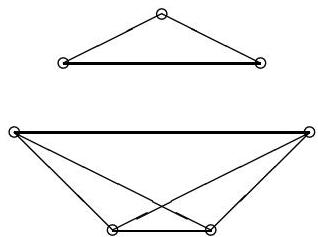 Now we show that 8 lines are not sufficient. Assume the opposite. By the pigeonhole principle, there is a vertex, say $A$, that is joined t... | 9 | Combinatorics | math-word-problem | Yes | Yes | olympiads_ref | false |
6. C1 (UKR) On a $5 \times 5$ board, two players alternately mark numbers on empty cells. The first player always marks 1's, the second 0's. One number is marked per turn, until the board is filled. For each of the nine $3 \times 3$ squares the sum of the nine numbers on its cells is computed. Denote by $A$ the maximum... | 6. Call the first and second player $M$ and $N$ respectively. $N$ can keep $A \leq 6$. Indeed, let 10 dominoes be placed as shown in the picture, and whenever $M$ marks a 1 in a cell of some domino, let $N$ mark 0 in the other cell of that domino if it is still empty. Since any $3 \times 3$ square contains at least thr... | 6 | Combinatorics | math-word-problem | Yes | Yes | olympiads_ref | false |
5. A5 (ROM) Let \( P(x) \) be the real polynomial function \( P(x) = a x^{3} + b x^{2} + c x + d \). Prove that if \( |P(x)| \leq 1 \) for all \( x \) such that \( |x| \leq 1 \), then
\[ |a| + |b| + |c| + |d| \leq 7 \] | 5. Considering the polynomials $\pm P( \pm x)$ we may assume w.l.o.g. that $a, b \geq$ 0. We have four cases: (1) $c \geq 0, d \geq 0$. Then $|a|+|b|+|c|+|d|=a+b+c+d=P(1) \leq 1$. (2) $c \geq 0, d<0$. Then $|a|+|b|+|c|+|d|=a+b+c-d=P(1)-2 P(0) \leq 3$. (3) $c<0, d \geq 0$. Then
$$ \begin{aligned} |a|+|b|+|c|+|d| & =a+b... | 7 | Algebra | proof | Yes | Yes | olympiads_ref | false |
16. (UKR) Determine the smallest integer \( n \geq 4 \) for which one can choose four different numbers \( a, b, c \), and \( d \) from any \( n \) distinct integers such that \( a+b-c-d \) is divisible by 20. | 16. Let $S$ be a set of integers such that for no four distinct elements $a, b, c, d \in S$, it holds that $20 \mid a+b-c-d$. It is easily seen that there cannot exist distinct elements $a, b, c, d$ with $a \equiv b$ and $c \equiv d \pmod{20}$. Consequently, if the elements of $S$ give $k$ different residues modulo 20,... | 9 | Number Theory | math-word-problem | Yes | Yes | olympiads_ref | false |
13. A7 (RUS) For a polynomial $P$ of degree 2000 with distinct real coefficients let $M(P)$ be the set of all polynomials that can be produced from $P$ by permutation of its coefficients. A polynomial $P$ will be called $n$-independent if $P(n)=0$ and we can get from any $Q$ in $M(P)$ a polynomial $Q_{1}$ such that $Q_... | 13. One can easily find $n$-independent polynomials for $n=0,1$. For example, $P_{0}(x)=2000 x^{2000}+\cdots+2 x^{2}+x+0$ is 0-independent (for $Q \in M\left(P_{0}\right)$ it suffices to exchange the coefficient 0 of $Q$ with the last term), and $P_{1}(x)=2000 x^{2000}+\cdots+2 x^{2}+x-(1+2+\cdots+2000)$ is 1-independe... | 01 | Algebra | math-word-problem | Yes | Yes | olympiads_ref | false |
19. G5 (GRE) Let \(ABC\) be an acute triangle. Let \(DAC\), \(EAB\), and \(FBC\) be isosceles triangles exterior to \(ABC\), with \(DA = DC\), \(EA = EB\), and \(FB = FC\) such that
\[ \angle ADC = 2 \angle BAC, \quad \angle BEA = 2 \angle ABC, \quad \angle CFB = 2 \angle ACB. \]
Let \(D'\) be the intersection of line... | 19. It is easy to see that the hexagon $A E B F C D$ is convex and $\angle A E B + \angle B F C + \angle C D A = 360^{\circ}$. Using this relation we obtain that the circles $\omega_{1}, \omega_{2}, \omega_{3}$ with centers at $D, E, F$ and radii $D A, E B, F C$ respectively all pass through a common point $O$. Indeed,... | 4 | Geometry | proof | Yes | Yes | olympiads_ref | false |
25. N3 (GBR) Let \( a_{1}=11^{11}, a_{2}=12^{12}, a_{3}=13^{13} \), and
\[ a_{n}=\left|a_{n-1}-a_{n-2}\right|+\left|a_{n-2}-a_{n-3}\right|, \quad n \geq 4 \]
Determine \( a_{14^{14}} \). | 25. Define $b_{n}=\left|a_{n+1}-a_{n}\right|$ for $n \geq 1$. From the equalities $a_{n+1}=b_{n-1}+b_{n-2}$, from $a_{n}=b_{n-2}+b_{n-3}$ we obtain $b_{n}=\left|b_{n-1}-b_{n-3}\right|$. From this relation we deduce that $b_{m} \leq \max \left(b_{n}, b_{n+1}, b_{n+2}\right)$ for all $m \geq n$, and consequently $b_{n}$ ... | 1 | Number Theory | math-word-problem | Yes | Yes | olympiads_ref | false |
1. N1 (UZB) What is the smallest positive integer \( t \) such that there exist integers \( x_{1}, x_{2}, \ldots, x_{t} \) with
\[ x_{1}^{3} + x_{2}^{3} + \cdots + x_{t}^{3} = 2002^{2002} ? \] | 1. Consider the given equation modulo 9. Since each cube is congruent to either $-1,0$ or 1, whereas $2002^{2002} \equiv 4^{2002}=4 \cdot 64^{667} \equiv 4(\bmod 9)$, we conclude that $t \geq 4$. On the other hand, $2002^{2002}=2002 \cdot\left(2002^{667}\right)^{3}=\left(10^{3}+10^{3}+1^{3}+1^{3}\right)\left(2002^{667}... | 4 | Number Theory | math-word-problem | Yes | Yes | olympiads_ref | false |
24. C4 (BUL) Let \( T \) be the set of ordered triples \((x, y, z)\), where \( x, y, z \) are integers with \( 0 \leq x, y, z \leq 9 \). Players \( A \) and \( B \) play the following guessing game: Player \( A \) chooses a triple \((x, y, z)\) in \( T \), and Player \( B \) has to discover \( A \)'s triple in as few m... | 24. Two moves are not sufficient. Indeed, the answer to each move is an even number between 0 and 54, so the answer takes at most 28 distinct values. Consequently, two moves give at most \(28^2 = 784\) distinct outcomes, which is less than \(10^3 = 1000\). We now show that three moves are sufficient. With the first mov... | 3 | Combinatorics | math-word-problem | Yes | Yes | olympiads_ref | false |
In a set of 20 elements there are $2 k+1$ different subsets of 7 elements such that each of these subsets intersects exactly $k$ other subsets. Find the maximum $k$ for which this is possible.
The answer is $k=2$. | Let $M$ be the set of residues mod20. An example is given by the sets $A_{i}=\{4 i+1,4 i+2,4 i+3,4 i+4,4 i+5,4 i+6,4 i+7\} \subset M, i=0,1,2,3,4$.
Let $k \geq 2$. Obviously among any three 7-element subsets there are two intersecting subsets.
Let $A$ be any of the $2 k+1$ subsets. It intersects $k$ other subsets $B_... | 2 | Combinatorics | math-word-problem | Yes | Yes | olympiads_ref | false |
The function $\mathrm{f}(\mathrm{n})$ is defined on the positive integers and takes non-negative integer values. It satisfies (1) $f(m n)=f(m)+f(n),(2) f(n)=0$ if the last digit of $n$ is 3, (3) $f(10)=0$. Find $\mathrm{f}(1985)$. | If $\mathrm{f}(\mathrm{mn})=0$, then $\mathrm{f}(\mathrm{m})+\mathrm{f}(\mathrm{n})=0$ (by $(1))$. But $\mathrm{f}(\mathrm{m})$ and $\mathrm{f}(\mathrm{n})$ are non-negative, so $\mathrm{f}(\mathrm{m})=\mathrm{f}(\mathrm{n})=0$. Thus $f(10)=0$ implies $f(5)=0$. Similarly $f(3573)=0$ by (2), so $f(397)=0$. Hence $f(1985... | 0 | Number Theory | math-word-problem | Yes | Yes | olympiads_ref | false |
$\mathrm{ABC}$ is an equilateral triangle. $\mathrm{D}$ is on the side $\mathrm{AB}$ and $\mathrm{E}$ is on the side $\mathrm{AC}$ such that $\mathrm{DE}$ touches the incircle. Show that $\mathrm{AD}/\mathrm{DB} + \mathrm{AE}/\mathrm{EC}=1$. | Put $\mathrm{BD}=\mathrm{x}, \mathrm{CE}=\mathrm{y}, \mathrm{BC}=\mathrm{a}$. Then since the two tangents from $\mathrm{B}$ to the incircle are of equal length, and similarly the two tangents from $\mathrm{D}$ and $\mathrm{E}$, we have $\mathrm{ED}+\mathrm{BC}=\mathrm{BD}+\mathrm{CE}$, or $\mathrm{ED}=$ $x+y-a$. By the... | 1 | Geometry | proof | Yes | Yes | olympiads_ref | false |
Subsets and Splits
No community queries yet
The top public SQL queries from the community will appear here once available.