
problem stringlengths 15 4.7k | solution stringlengths 2 11.9k | answer stringclasses 51
values | problem_type stringclasses 8
values | question_type stringclasses 4
values | problem_is_valid stringclasses 1
value | solution_is_valid stringclasses 1
value | source stringclasses 6
values | synthetic bool 1
class |
|---|---|---|---|---|---|---|---|---|
Chloe has made a code out of the alphabet by assigning a numerical value to each letter. She then assigns a numerical value to a word by adding up the numerical values of the letters in the word. Using her code, the numerical value of BAT is 6 . Also, her code gives numerical values of 8 to CAT and 12 to CAR. Using her... | Since the numerical values of CAT and CAR are 8 and 12, then the value of $\mathrm{R}$ must be 4 more than the value of $\mathrm{T}$.
Therefore, the value of BAR is 4 more than the value of BAT, so BAR has a numerical value of 10 .
Answer: (A) | 10 | Logic and Puzzles | MCQ | Yes | Yes | olympiads | false |
A large block, which has dimensions $n$ by 11 by 10 , is made up of a number of unit cubes and one 2 by 1 by 1 block. There are exactly 2362 positions in which the 2 by 1 by 1 block can be placed. What is the value of $n$ ?
(A) 7
(B) 8
(C) 9
(D) 10
(E) 11 | Consider the block as $n$ layers each having 11 rows and 10 columns.
First, we consider positions of the 2 by 1 by 1 block which are entirely contained in one layer. In each layer, there are 9 possible positions for the 2 by 1 by 1 block in each row (crossing columns 1 and 2, 2 and 3, 3 and 4, and so on, up to 9 and 1... | 8 | Combinatorics | MCQ | Yes | Yes | olympiads | false |
The value of $(9-2)-(4-1)$ is
(A) 2
(B) 3
(C) 4
(D) 6
(E) 10 | Calculating in the parentheses first,
$$
(9-2)-(4-1)=7-3=4
$$
ANSWER: (C) | 4 | Algebra | MCQ | Yes | Yes | olympiads | false |
If $\frac{1}{2}$ of $\frac{2}{3}$ of the twelve small squares in the given figure are removed, how many squares remain?

(A) 2
(B) 3
(C) 4
(D) 8
(E) 9 | Since there are 12 squares initially, then the number of squares to be removed is
$\frac{1}{2} \times \frac{2}{3} \times 12=\frac{1}{3} \times 12=4$
Therefore, there will be 8 squares remaining.
ANSWER: (D)
# | 8 | Number Theory | MCQ | Yes | Yes | olympiads | false |
Chris and Pat go on a $30 \mathrm{~km}$ run. They both usually run at $10 \mathrm{~km} / \mathrm{h}$. If Chris runs at $\frac{1}{2}$ his usual running speed, and Pat runs at $1 \frac{1}{2}$ times her usual speed, how many more hours does it take Chris to complete the run than it takes Pat to complete the run?
(A) 1
(B)... | Since Chris runs $\frac{1}{2}$ as fast as his usual running speed, he runs at $5 \mathrm{~km} / \mathrm{h}$, and so will take 6 hours to complete the $30 \mathrm{~km}$ run.
Since Pat runs at $1 \frac{1}{2}$ her usual running speed, she runs at $15 \mathrm{~km} / \mathrm{h}$, and so will take 2 hours to complete the $3... | 4 | Algebra | MCQ | Yes | Yes | olympiads | false |
A box contains 14 disks, each coloured red, blue or green. There are twice as many red disks as green disks, and half as many blue as green. How many disks are green?
(A) 2
(B) 4
(C) 6
(D) 8
(E) 10 | Solution 1
Since there are twice as many red disks as green disks and twice as many green disks as blue disks, then there are four times as many red disks as blue disks.
So the total number of disks is seven times the number of blue disks (since the numbers of red and green disks are four and two times the number of ... | 4 | Algebra | MCQ | Yes | Yes | olympiads | false |
Triangle $A B C$ has its vertices at $A(2,0), B(6,0)$ and $C(6,3)$. The area of the triangle, in square units, is
(A) 3
(B) 4
(C) 6
(D) 7
(E) 12 | First, we sketch the triangle.
Since point $C$ is directly above point $B$ (that is, angle $A B C$ is a right angle), then we can look at triangle $A B C$ as having base $A B$ (of length 4) and height $B C$ (of length 3).
Thus, the area of the triangle is $A=\frac{1}{2} b h=\frac{1}{2}(4)(3)=6$ square units.
 2
(B) 1
(C) 6
(D) 0
(E) 4
:
$D A E, D B E, D C E, D A F, D B F, D C F, E A F, E B F, E C F$
Of these, triangles $D A E, D B E, D A F, D C F, E B F, E C F$ are obviously right-angled, while triangles $D... | 4 | Geometry | MCQ | Yes | Yes | olympiads | false |
Luke has played 20 games and has a $95 \%$ winning percentage. Without losing any more games, how many more games in a row must he win to reach exactly a $96 \%$ winning percentage?
(A) 1
(B) 3
(C) 4
(D) 5
(E) 10 | Solution 1
Since Luke has a $95 \%$ winning percentage, then he hasn't won $5 \%$, or $\frac{1}{20}$, of his games to date. Since he has played only 20 games, there has only been 1 game that he has not won.
For Luke to have exactly a $96 \%$ winning percentage, he must not have won $4 \%$, or $\frac{1}{25}$, of his g... | 5 | Algebra | MCQ | Yes | Yes | olympiads | false |
The digits 1, 2, 3, 4, 5, and 6 are each placed in one of the boxes so that the resulting product is correct. If each of the six digits is used exactly once, the digit represented by "?" is
(A) 2
(B) 3
(C) 4
(D) 5
(E) 6
 5
(B) 6
(C) 7
(D) 8
(E) 9
## Part B: Each correct answer is worth 6. | We rewrite the addition in columns, and write each number to three decimals:
$$
\begin{array}{r}
15.200 \\
1.520 \\
0.15 \square \\
+\square .128 \\
\hline 20.000
\end{array}
$$
Since the sum of the digits in the last column ends in a 0 , then the box in the thousandths column must represent a 2.
We can insert the 2... | 5 | Algebra | MCQ | Yes | Yes | olympiads | false |
A sand pit is constructed in the shape of a rectangular prism $10 \mathrm{~m}$ long, $50 \mathrm{~cm}$ deep and $2 \mathrm{~m}$ wide. If the pit is already half-full, how much more sand, in $\mathrm{m}^{3}$, is needed to completely fill the pit?
(A) 6
(B) 5
(C) 20
(D) 7.5
(E) 10 | The volume of the entire pit is
$$
(10 \mathrm{~m}) \times(50 \mathrm{~cm}) \times(2 \mathrm{~m})=(10 \mathrm{~m}) \times(0.5 \mathrm{~m}) \times(2 \mathrm{~m})=10 \mathrm{~m}^{3}
$$
Since the pit starts with $5 \mathrm{~m}^{3}$ in it, an additional $5 \mathrm{~m}^{3}$ of sand is required to fill it.
ANswer: (B) | 5 | Geometry | MCQ | Yes | Yes | olympiads | false |
How many numbers from the set $\{-5,-4,-3,-2,-1,0,1,2,3\}$ satisfy the inequality $-3 x^{2}<-14$ ?
(A) 1
(B) 2
(C) 3
(D) 4
(E) 5 | Solution 1
If $-3 x^{2}14$ or $x^{2}>\frac{14}{3}=4 \frac{2}{3}$.
Since we are only looking at $x$ being a whole number, then $x^{2}$ is also a whole number. Since $x^{2}$ is a whole number and $x^{2}$ is greater than $4 \frac{2}{3}$, then $x^{2}$ must be at least 5 .
Of the numbers in the set, the ones which satisf... | 4 | Inequalities | MCQ | Yes | Yes | olympiads | false |
In the diagram, $A B C D$ is a square with area $25 \mathrm{~cm}^{2}$. If $P Q C D$ is a rhombus with area $20 \mathrm{~cm}^{2}$, the area of the shaded region, in $\mathrm{cm}^{2}$, is
(A) 12
(B) 10
(C) 11
(D) 12.5
(E) 9
 4
(D) 6
(B) 15
(C) 9
 5
(B) 8
(C) 3
(D) 0
(E) 1 | When the numbers $8,3,5,0,1$ are arranged from smallest to largest, the middle number is
(A) 5
(B) 8
(C) 3
(D) 0
(E) 1
## Solution
If we rearrange the given numbers from smallest to largest, we would have $0,1,3,5,8$.
The middle number is 3 .
ANswer: (C) | 3 | Number Theory | MCQ | Yes | Yes | olympiads | false |
$20 \%$ of 20 is equal to
(A) 400
(B) 100
(C) 5
(D) 2
(E) 4 | $20 \%$ of 20 is equal to
(A) 400
(B) 100
(C) 5
(D) 2
(E) 4
## Solution
$20 \%$ of 20 equals $0.2 ¥ 20=4$. Alternatively, $20 \%$ of 20 is $\frac{1}{5}$ of 20 , or 4 .
ANSwER: (E) | 4 | Algebra | MCQ | Yes | Yes | olympiads | false |
A perfect number is an integer that is equal to the sum of all of its positive divisors, except itself. For example, 28 is a perfect number because $28=1+2+4+7+14$. Which of the following is a perfect number?
(A) 10
(B) 13
(C) 6
(D) 8
(E) 9 | A perfect number is an integer that is equal to the sum of all of its positive divisors, except itself. For example, 28 is a perfect number because $28=1+2+4+7+14$. Which of the following is a perfect number?
(A) 10
(B) 13
(C) 6
(D) 8
(E) 9
## Solution
We must check each of the answers:
Number Positive divisors Sum ... | 6 | Number Theory | MCQ | Yes | Yes | olympiads | false |
Five people are in a room for a meeting. When the meeting ends, each person shakes hands with each of the other people in the room exactly once. The total number of handshakes that occurs is
(A) 5
(B) 10
(C) 12
(D) 15
(E) 25 | Five people are in a room for a meeting. When the meeting ends, each person shakes hands with each of the other people in the room exactly once. The total number of handshakes that occurs is
(A) 5
(B) 10
(C) 12
(D) 15
(E) 25
## Solution
Each of the five people in the room will shake four others' hands. This gives us ... | 10 | Combinatorics | MCQ | Yes | Yes | olympiads | false |
Mark has a bag that contains 3 black marbles, 6 gold marbles, 2 purple marbles, and 6 red marbles. Mark adds a number of white marbles to the bag and tells Susan that if she now draws a marble at random from the bag, the probability of it being black or gold is $\frac{3}{7}$. The number of white marbles that Mark adds ... | Mark has a bag that contains 3 black marbles, 6 gold marbles, 2 purple marbles, and 6 red marbles. Mark adds a number of white marbles to the bag and tells Susan if she now draws a marble at random from the bag, the probability of it being black or gold is $\frac{3}{7}$. The number of white marbles that Mark adds to th... | 4 | Combinatorics | MCQ | Yes | Yes | olympiads | false |
The value of $3^{2}-(4 \times 2)$ is
(A) 4
(B) 17
(C) 1
(D) -2
(E) 0 | The value of $3^{2}-(4 ¥ 2)$ is
(A) 4
(B) 17
(C) 1
(D) -2
(E) 0
## Solution
By order of operations,
$3^{2}-(4 ¥ 2)=9-(4 ¥ 2)=9-8=1$.
ANSWER: (C) | 1 | Algebra | MCQ | Yes | Yes | olympiads | false |
In a jar, the ratio of the number of oatmeal cookies to the number of chocolate chip cookies is 5:2. If there are 20 oatmeal cookies, the number of chocolate chip cookies in the jar is
(A) 28
(B) 50
(C) 8
(D) 12
(E) 18 | In a jar, the ratio of the number of oatmeal cookies to the number of chocolate chip cookies is 5:2. If there are 20 oatmeal cookies, the number of chocolate chip cookies in the jar is
(A) 28
(B) 50
(C) 8
(D) 12
(E) 18
## Solution
The ratio $5: 2$ indicates that there are 5 oatmeal cookies for every 2 chocolate chip ... | 8 | Algebra | MCQ | Yes | Yes | olympiads | false |
If $a+b=12, b+c=16$, and $c=7$, what is the value of $a$ ?
(A) 1
(B) 5
(C) 9
(D) 7
(E) 3 | If $a+b=12, b+c=16$, and $c=7$, what is the value of $a$ ?
(A) 1
(B) 5
(C) 9
(D) 7
(E) 3
## Solution
Since $c=7$ and $b+c=16$, then $b+7=16$, or $b=9$.
Since $b=9$ and $a+b=12$, then $a+9=12$, or $a=3$.
ANSWER: (E) | 3 | Algebra | MCQ | Yes | Yes | olympiads | false |
The units digit (that is, the last digit) of $7^{62}$ is
(A) 7
(B) 1
(C) 3
(D) 9
(E) 5
## Part C: Each correct answer is worth 8. | The units digit (that is, the last digit) of $7^{62}$ is
(A) 7
(B) 1
(C) 3
(D) 9
(E) 5
## Solution
If we write out the first few powers of 7 ,
$$
7^{1}=7,7^{2}=49,7^{3}=343,7^{4}=2401,7^{5}=16807, \ldots
$$
we can see that the units digit follows the pattern $7,9,3,1,7,9,3,1,7, \ldots$ (That is to say, the units di... | 9 | Number Theory | MCQ | Yes | Yes | olympiads | false |
If each diagonal of a square has length 2 , then the area of the square is
(A) 1
(B) 2
(C) 3
(D) 4
(E) 5 | If each diagonal of a square has length 2 , then the area of the square is
(A) 1
(B) 2
(C) 3
(D) 4
(E) 5
## Solution
We draw the square and its two diagonals.
The diagonals of a square cut each other into two equal parts, and intersect at right angles. So we can decompose the square into 4 identical triangles with b... | 2 | Geometry | MCQ | Yes | Yes | olympiads | false |
A map is drawn to a scale of 1:10 000. On the map, the Gauss Forest occupies a rectangular region measuring $10 \mathrm{~cm}$ by $100 \mathrm{~cm}$. What is the actual area of the Gauss Forest, in $\mathrm{km}^{2}$ ?
(A) 100
(B) 1000000
(C) 1000
(D) 1
(E) 10 | A map is drawn to a scale of 1:10 000. On the map, the Gauss Forest occupies a rectangular region measuring $10 \mathrm{~cm}$ by $100 \mathrm{~cm}$. What is the actual area of the Gauss Forest, in $\mathrm{km}^{2}$ ?
(A) 100
(B) 1000000
(C) 1000
(D) 1
(E) 10
## Solution
The actual lengths of the sides of the Gauss Fo... | 10 | Geometry | MCQ | Yes | Yes | olympiads | false |
The bar graph shows the hair colours of the campers at Camp Gauss. The bar corresponding to redheads has been accidentally removed. If $50 \%$ of the campers have brown hair, how many of the campers have red hair?
(A) 5
(D) 50
(B) 10
(E) 60
(C) 25
 5
(D) 50
(B) 10
(E) 60
(C) 25
 12
(B) 68
(C) 20
(D) 24
(E) 6 | The ratio of the number of big dogs to the number of small dogs at a pet show is 3:17. There are 80 dogs, in total, at this pet show. How many big dogs are there?
(A) 12
(B) 68
(C) 20
(D) 24
(E) 6
## Solution
Since the ratio of the number of big dogs to small dogs is 3:17 this implies that there are 3 large dogs in e... | 12 | Algebra | MCQ | Yes | Yes | olympiads | false |
The product of two whole numbers is 24 . The smallest possible sum of these two numbers is
(A) 9
(B) 10
(C) 11
(D) 14
(E) 25 | The product of two whole numbers is 24 . The smallest possible sum of these two numbers is
(A) 9
(B) 10
(C) 11
(D) 14
(E) 25
## Solution
If two whole numbers have a product of 24 then the only possibilities are $1 \times 24,2 \times 12,3 \times 8$ and $4 \times 6$. The smallest possible sum is $4+6$ or 10 .
ANSwER: ... | 10 | Number Theory | MCQ | Yes | Yes | olympiads | false |
A prime number is called a "Superprime" if doubling it, and then subtracting 1 , results in another prime number. The number of Superprimes less than 15 is
(A) 2
(B) 3
(C) 4
(D) 5
(E) 6 | A prime number is called a "Superprime" if doubling it, and then subtracting 1 , results in another prime number. The number of Superprimes less than 15 is
(A) 2
(B) 3
(C) 4
(D) 5
(E) 6
## Solution
The only possible candidates for 'Superprimes' are 2, 3, 5, 7, 11 and 13 since they are the only prime numbers less than... | 3 | Number Theory | MCQ | Yes | Yes | olympiads | false |
Rectangular tiles, which measure 6 by 4 , are arranged without overlapping, to create a square. The minimum number of these tiles needed to make a square is
(A) 8
(B) 24
(C) 4
(D) 12
(E) 6 | Rectangular tiles, which measure 6 by 4 , are arranged without overlapping, to create a square. The minimum number of these tiles needed to make a square is
(A) 8
(B) 24
(C) 4
(D) 12
(E) 6
## Solution
Since the rectangles measure $6 \times 4$ this means that the lengths of their sides are in a ratio of 3:2. This impl... | 6 | Geometry | MCQ | Yes | Yes | olympiads | false |
What number should be placed in the box to make $\frac{6+\square}{20}=\frac{1}{2}$ ?
(A) 10
(B) 4
(C) -5
(D) 34
(E) 14 | What number should be placed in the box to make $\frac{6+\square}{20}=\frac{1}{2}$ ?
(A) 10
(B) 4
(C) -5
(D) 34
(E) 14
Solution
Expressing $\frac{1}{2}$ as a fraction with denominator 20 , we get $\frac{10}{20}$.
So $\frac{6+\square}{20}=\frac{10}{20}$. Comparing the numerators, $6+\square=10$, so the number to plac... | 4 | Algebra | MCQ | Yes | Yes | olympiads | false |
If $2 x-5=15$, the value of $x$ is
(A) 5
(B) -5
(C) 10
(D) 0
(E) -10 | If $2 x-5=15$, the value of $x$ is
(A) 5
(B) -5
(C) 10
(D) 0
(E) -10
## Solution
Since $2 x-5=15$, then $2 x-5+5=15+5$
$$
\begin{aligned}
2 x & =20 \\
\frac{2 x}{2} & =\frac{20}{2} \\
x & =10
\end{aligned}
$$
Answer: (C) | 10 | Algebra | MCQ | Yes | Yes | olympiads | false |
The bar graph shows the hair colours of the campers at Camp Gauss. The bar corresponding to redheads has been accidentally removed. If $50 \%$ of the campers have brown hair, how many of the campers have red hair?
(A) 5
(D) 50
(B) 10
(E) 60
(C) 25
 5
(B) 10
(C) 25
(D) 50
(E) 60
 5
(B) 4
(C) 3
(D) 2
(E) 1 | In a class of 25 students, each student has at most one pet. Three-fifths of the students have cats, $20 \%$ have dogs, three have elephants, and the other students have no pets. How many students have no pets?
(A) 5
(B) 4
(C) 3
(D) 2
(E) 1
## Solution
Three-fifths of 25 is $\frac{3}{5} \times 25=15$, so 15 students ... | 2 | Logic and Puzzles | MCQ | Yes | Yes | olympiads | false |
Two squares are positioned, as shown. The smaller square has side length 1 and the larger square has side length 7. The length of $A B$ is
(A) 14
(D) $\sqrt{85}$
(B) $\sqrt{113}$
(C) 10
(E) $\sqrt{72}$
 14
(B) $\sqrt{113}$
(C) 10
(D) $\sqrt{85}$
(E) $\sqrt{72}$
 7
(B) 5
(C) 2
(D) $\frac{3}{2}$
(E) 10
## Part C: Each correct answer is worth 8. | What number should be placed in the box to make $10^{4} \times 100^{\square}=1000^{6}$ ?
(A) 7
(B) 5
(C) 2
(D) $\frac{3}{2}$
(E) 10
## Solution
Since 1000 has 3 zeros, $1000^{6}$ has 18 zeros, so the left side should have 18 zeros too. The number $10^{4}$ has 4 zeros, so that leaves 14 zeros for the number $100^{\squ... | 7 | Algebra | MCQ | Yes | Yes | olympiads | false |
The integers 2, 2, 5, 5, 8, and 9 are written on six cards, as shown. Any number of the six cards is chosen, and the sum of the integers on these cards is determined. Note that the integers 1 and 30 cannot be obtained as sums in this way. How many of the integers from 1 to 31 cannot be obtained as sums?
(A) 4
(D) 10
(B... | The integers 2, 2, 5, 5, 8, and 9 are written on six cards, as shown. Any number of the six cards is chosen, and the sum of the integers on these cards is determined. Note that the integers 1 and 30 cannot be obtained as sums in this way. How many of the integers from 1 to 31 cannot be obtained as sums?
(A) 4
(B) 22
(C... | 6 | Number Theory | MCQ | Yes | Yes | olympiads | false |
What integer is closest in value to $7 \times \frac{3}{4}$ ?
(A) 21
(B) 9
(C) 6
(D) 5
(E) 1 | What integer is closest in value to $7 \times \frac{3}{4}$ ?
(A) 21
(B) 9
(C) 6
(D) 5
(E) 1
Solution
$7 \times \frac{3}{4}=\frac{21}{4}=5 \frac{1}{4}$. The integer closest to $5 \frac{1}{4}$ is 5.
ANSWER: (D) | 5 | Algebra | MCQ | Yes | Yes | olympiads | false |
In the addition shown, a digit, either the same or different, can be placed in each of the two boxes. What is the sum of the two missing digits?
(A) 9
(D) 3
(B) 11
(C) 13
$7 \square 8$
$\overline{2182}$
863
$\square 91$ | In the addition shown, a digit, either the same or different, can
863
be placed in each of the two boxes. What is the sum of the two missing digits?
(A) 9
(B) 11
(C) 13
(D) 3
(E) 7
2182
## Solution
Adding in the units column gives us, $3+1+8=12$. This means a carry over of 1 into the tens column since $12=1 \times ... | 7 | Logic and Puzzles | MCQ | Yes | Yes | olympiads | false |
A rectangular building block has a square base $A B C D$ as shown. Its height is 8 units. If the block has a volume of 288 cubic units, what is the side length of the base?
(A) 6
(D) 10
(B) 8
(C) 36
(E) 12
 6
(D) 10
(B) 8
(C) 36
(E) 12
 9
(D) 3
(B) 11
(E) 7
(C) 13
$7 \square 8$
$\overline{2182}$
863
$\square 91$ | In the addition shown, a digit, either the same or different, can
863
be placed in each of the two boxes. What is the sum of the two missing digits?
(A) 9
(B) 11
(D) 3
(E) 7
(C) 13
$7 \square 8$
Solution
Adding in the units column gives us, $3+1+8=12$. This means a carry over of 1 into the tens column since $12=1 ... | 7 | Logic and Puzzles | MCQ | Yes | Yes | olympiads | false |
If $x * y=x+y^{2}$, then $2 * 3$ equals
(A) 8
(B) 25
(C) 11
(D) 13
(E) 7 | If $x * y=x+y^{2}$, then $2 * 3$ equals
(A) 8
(B) 25
(C) 11
(D) 13
(E) 7
## Solution
$2 * 3^{2}=2+3^{2}=11$
ANSwer: (C) | 11 | Algebra | MCQ | Yes | Yes | olympiads | false |
The prime numbers between 10 and 20 are added together to form the number $Q$. What is the largest prime divisor of $Q$ ?
(A) 2
(B) 3
(C) 5
(D) 7
(E) 11 | The prime numbers between 10 and 20 are added together to form the number $Q$. What is the largest prime divisor of $Q$ ?
(A) 2
(B) 3
(C) 5
(D) 7
(E) 11
## Solution
The prime numbers between 10 and 20 are: 11, 13, 17, and 19.
And so, $Q=11+13+17+19=60$.
Since $60=2 \times 2 \times 3 \times 5$, the largest prime div... | 5 | Number Theory | MCQ | Yes | Yes | olympiads | false |
The homes of Fred (F), Sandy (S), Robert (R), and Guy (G) are marked on the rectangular grid with straight lines joining them. Fred is considering four routes to visit each of his friends:
(i) $F \rightarrow R \rightarrow S \rightarrow G$
(ii) $F \rightarrow S \rightarrow G \rightarrow R$
(iii) $F \rightarrow R \righta... | The homes of Fred (F), Sandy (S), Robert (R), and Guy (G) are marked on the rectangular grid with straight lines joining them. Fred is considering four routes to visit each of his friends:
(i) $F \rightarrow R \rightarrow S \rightarrow G$
(ii) $F \rightarrow S \rightarrow G \rightarrow R$
(iii) $F \rightarrow R \righta... | 8 | Geometry | MCQ | Yes | Yes | olympiads | false |
The average of $10,4,8,7$, and 6 is
(A) 33
(B) 13
(C) 35
(D) 10
(E) 7 | The average of $10,4,8,7$, and 6 is
(A) 33
(B) 13
(C) 35
(D) 10
(E) 7
Solution
$\frac{10+4+8+7+6}{5}=\frac{35}{5}=7$
ANSWER: (E) | 7 | Algebra | MCQ | Yes | Yes | olympiads | false |
André is hiking on the paths shown in the map. He is planning to visit sites $A$ to $M$ in alphabetical order. He can never retrace his steps and he must proceed directly from one site to the next. What is the largest number of labelled points he can visit before going out of alphabetical order?
(A) 6
(D) 10
(B) 7
(E) ... | André is hiking on the paths shown in the map. He is planning to visit sites $A$ to $M$ in alphabetical order. He can never retrace his steps and he must proceed directly from one site to the next. What is the largest number of labelled points he can visit before going out of alphabetical order?
(A) 6
(B) 7
(C) 8
(D) 1... | 10 | Logic and Puzzles | MCQ | Yes | Yes | olympiads | false |
Forty-two cubes with $1 \mathrm{~cm}$ edges are glued together to form a solid rectangular block. If the perimeter of the base of the block is $18 \mathrm{~cm}$, then the height, in $\mathrm{cm}$, is
(A) 1
(B) 2
(C) $\frac{7}{3}$
(D) 3
(E) 4 | Forty-two cubes with $1 \mathrm{~cm}$ edges are glued together to form a solid rectangular block. If the perimeter of the base of the block is $18 \mathrm{~cm}$, then the height, in $\mathrm{cm}$, is
(A) 1
(B) 2
(C) $\frac{7}{3}$
(D) 3
(E) 4
## Solution 1
Since we have a solid rectangular block with a volume of 42 , ... | 3 | Geometry | MCQ | Yes | Yes | olympiads | false |
In a softball league, after each team has played every other team 4 times, the total accumulated points are: Lions 22, Tigers 19, Mounties 14, and Royals 12. If each team received 3 points for a win, 1 point for a tie and no points for a loss, how many games ended in a tie?
(A) 3
(B) 4
(C) 5
(D) 7
(E) 10 | In a softball league, after each team has played every other team 4 times, the total accumulated points are: Lions 22, Tigers 19, Mounties 14, and Royals 12. If each team received 3 points for a win, 1 point for a tie and no points for a loss, how many games ended in a tie?
(A) 3
(B) 4
(C) 5
(D) 7
(E) 10
## Solution
... | 5 | Logic and Puzzles | MCQ | Yes | Yes | olympiads | false |
What is the remainder when 82460 is divided by 8 ?
(A) 0
(B) 5
(C) 4
(D) 7
(E) 2 | What is the remainder when 82460 is divided by 8 ?
(A) 0
(B) 5
(C) 4
(D) 7
(E) 2
## Solution
When considering division by 8 , it is only necessary to consider division using the last 3 digits.
In essence, then, we are asking for the remainder when 460 is divided by 8 .
Since $460=8 \times 57+4$, the remainder is 4 ... | 4 | Number Theory | MCQ | Yes | Yes | olympiads | false |
The average of $-5,-2,0,4$, and 8 is
(A) 1
(B) 0
(C) $\frac{19}{5}$
(D) $\frac{5}{4}$
(E) $\frac{9}{4}$ | The average of $-5,-2,0,4$, and 8 is
(A) 1
(B) 0
(C) $\frac{19}{5}$
(D) $\frac{5}{4}$
(E) $\frac{9}{4}$
## Solution
The average is, $\frac{(-5)+(-2)+(0)+(4)+(8)}{5}=1$.
ANSWER: (A) | 1 | Algebra | MCQ | Yes | Yes | olympiads | false |
André is hiking on the paths shown in the map. He is planning to visit sites $A$ to $M$ in alphabetical order. He can never retrace his steps and he must proceed directly from one site to the next. What is the largest number of labelled points he can visit before going out of alphabetical order?
(A) 6
(D) 10
(B) 7
(E) ... | André is hiking on the paths shown in the map. He is planning to visit sites $A$ to $M$ in alphabetical order. He can never retrace his steps and he must proceed directly from one site to the next. What is the largest number of labelled points he can visit before going out of alphabetical order?
(A) 6
(B) 7
(C) 8
(D) 1... | 10 | Logic and Puzzles | MCQ | Yes | Yes | olympiads | false |
In a set of five numbers, the average of two of the numbers is 12 and the average of the other three numbers is 7 . The average of all five numbers is
(A) $8 \frac{1}{3}$
(B) $8 \frac{1}{2}$
(C) 9
(D) $8 \frac{3}{4}$
(E) $9 \frac{1}{2}$
1957 | In a set of five numbers, the average of two of the numbers is 12 and the average of the other three numbers is 7 . The average of all five numbers is
(A) $8 \frac{1}{3}$
(B) $8 \frac{1}{2}$
(C) 9
(D) $8 \frac{3}{4}$
(E) $9 \frac{1}{2}$
## Solution
In order that two numbers have an average of 12, the sum of the two n... | 9 | Algebra | MCQ | Yes | Yes | olympiads | false |
In the diagram, $A C=C B=10 \mathrm{~m}$, where $A C$ and $C B$ are each the diameter of the small equal semi-circles. The diameter of the larger semi-circle is $A B$. In travelling from $A$ to $B$, it is possible to take one of two paths. One path goes along the semi-circular arc from $A$ to $B$. A second path goes al... | In the diagram, $A C=C B=10 \mathrm{~m}$, where $A C$ and $C B$ are each the diameter of the small equal semi-circles. The diameter of the larger semi-circle is $A B$. In travelling from $A$ to $B$, it is possible to take one of two paths. One path goes along the semi-circular arc from $A$ to $B$. A second path goes al... | 0 | Geometry | MCQ | Yes | Yes | olympiads | false |
The value of $\frac{1998-998}{1000}$ is
(A) 1
(B) 1000
(C) 0.1
(D) 10
(E) 0.001 | The value of $\frac{1998-998}{1000}$ is
(A) 1
(B) 1000
(C) 0.1
(D) 10
(E) 0.001
Solution
$\frac{1998-998}{1000}=\frac{1000}{1000}=1$
ANSWER: (A) | 1 | Algebra | MCQ | Yes | Yes | olympiads | false |
The number 4567 is tripled. The ones digit (units digit) in the resulting number is
(A) 5
(B) 6
(C) 7
(D) 3
(E) 1 | The number 4567 is tripled. The ones digit (units digit) in the resulting number is
(A) 5
(B) 6
(C) 7
(D) 3
(E) 1
## Solution
If we wish to determine the units digit when we triple 4567 , it is only necessary to triple 7 and take the units digit of the number 21.
The required digit is 1 .
ANSWER: (E) | 1 | Number Theory | MCQ | Yes | Yes | olympiads | false |
The diagram shows a magic square in which the sums of the numbers in any row, column or diagonal are equal. What is the value of $n$ ?
(A) 3
(B) 6
(C) 7
(D) 10
(E) 11
| 8 | | |
| :--- | :--- | :--- |
| 9 | | 5 |
| 4 | $n$ | | | The diagram shows a magic square in which the sums of the numbers in any row, column or diagonal are equal. What is the value of $n$ ?
(A) 3
(B) 6
(C) 7
(D) 10
(E) 11
| 8 | | |
| :--- | :--- | :--- |
| 9 | | 5 |
| 4 | $n$ | |
## Solution
The 'magic' sum is $8+9+4=21$, so the centre square is 7 .
If the centre s... | 11 | Logic and Puzzles | MCQ | Yes | Yes | olympiads | false |
Juan and Mary play a two-person game in which the winner gains 2 points and the loser loses 1 point. If Juan won exactly 3 games and Mary had a final score of 5 points, how many games did they play?
(A) 7
(B) 8
(C) 4
(D) 5
(E) 11 | Juan and Mary play a two-person game in which the winner gains 2 points and the loser loses 1 point. If Juan won exactly 3 games and Mary had a final score of 5 points, how many games did they play?
(A) 7
(B) 8
(C) 4
(D) 5
(E) 11
## Solution
If Juan won 3 games then Mary lost 3 points so that she must have had 8 poin... | 7 | Algebra | MCQ | Yes | Yes | olympiads | false |
Each of the 12 edges of a cube is coloured either red or green. Every face of the cube has at least one red edge. What is the smallest number of red edges?
(A) 2
(B) 3
(C) 4
(D) 5
(E) 6
Part C (8 credits each) | Each of the 12 edges of a cube is coloured either red or green. Every face of the cube has at least one red edge. What is the smallest number of red edges?
(A) 2
(B) 3
(C) 4
(D) 5
(E) 6
## Solution
If the heavy black lines represent the colour red, every face will have exactly one red edge. So the smallest number of ... | 3 | Combinatorics | MCQ | Yes | Yes | olympiads | false |
Each time a bar of soap is used, its volume decreases by $10 \%$. What is the minimum number of times a new bar would have to be used so that less than one-half its volume remains?
(A) 5
(B) 6
(C) 7
(D) 8
(E) 9 | Each time a bar of soap is used, its volume decreases by $10 \%$. What is the minimum number of times a new bar would have to be used so that less than one-half its volume remains?
(A) 5
(B) 6
(C) 7
(D) 8
(E) 9
Solution
Number of Times Soap Used
Approximate Volume Remaining (as \%)
1
2
3
4
5
6
7
0.9 or $90 \%... | 7 | Algebra | MCQ | Yes | Yes | olympiads | false |
In the $4 \times 4$ square shown, each row, column and diagonal should contain each of the numbers $1,2,3$, and 4 . Find the value of $K+N$.
(A) 4
(D) 6
(B) 3
(C) 5
(E) 7
| 1 | $F$ | $G$ | $H$ |
| :---: | :---: | :---: | :---: |
| $T$ | 2 | $J$ | $K$ |
| $L$ | $M$ | 3 | $N$ |
| $P$ | $Q$ | 1 | $R$ | | In the $4 \times 4$ square shown, each row, column and diagonal should contain each of the numbers $1,2,3$, and 4 . Find the value of $K+N$.
(A) 4
(B) 3
(C) 5
(D) 6
(E) 7
| 1 | $F$ | $G$ | $H$ |
| :---: | :---: | :---: | :---: |
| $T$ | 2 | $J$ | $K$ |
| $L$ | $M$ | 3 | $N$ |
| $P$ | $Q$ | 1 | $R$ |
Solution
Since $... | 3 | Logic and Puzzles | MCQ | Yes | Yes | olympiads | false |
In a ring toss game at a carnival, three rings are tossed over any of three pegs. A ring over peg $A$ is worth one point, over peg $B$ three points and over peg $C$ five points. If all three rings land on pegs, how many different point totals are possible? (It is possible to have more than one ring on a peg.)
(A) 12
(B... | In a ring toss game at a carnival, three rings are tossed over any of three pegs. A ring over peg $A$ is worth one point, over peg $B$ three points and over peg $C$ five points. If all three rings land on pegs, how many different point totals are possible? (It is possible to have more than one ring on a peg.)
(A) 12
(B... | 7 | Combinatorics | MCQ | Yes | Yes | olympiads | false |
The number 315 can be written as the product of two odd integers each greater than 1 . In how many ways can this be done?
(A) 0
(B) 1
(C) 3
(D) 4
(E) 5 | The number 315 can be written as the product of two odd integers each greater than 1 . In how many ways can this be done?
(A) 0
(B) 1
(C) 3
(D) 4
(E) 5
## Solution
Factoring 315 into primes, we find that $315=3 \times 3 \times 5 \times 7$.
The factorization of 315 as the product of 2 odd integers is $3 \times 105,5 ... | 5 | Number Theory | MCQ | Yes | Yes | olympiads | false |
In the diagram, the circle has centre $O . O F$ is perpendicular to $D C$ at $F$ and is perpendicular to $A B$ at $E$. If $A B=8, D C=6$ and $E F=1$, determine the radius of the circle.
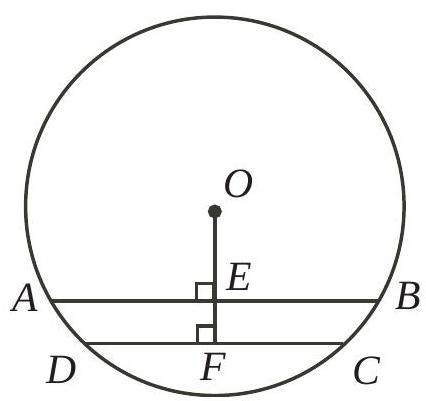 | Since $O F$ passes through the centre of the circle and is perpendicular to each of chord $A B$ and chord $D C$, then it bisects each of $A B$ and $D C$. (That is, $A E=E B$ and $D F=F C$.)
To see that $A E=E B$, we could join $O$ to $A$ and $O$ to $B$. Since $O A=O B$ (as they are radii), $O E$ is common to each of $... | 5 | Geometry | math-word-problem | Yes | Yes | olympiads | false |
If $2^{r}=16$ and $5^{s}=25$, what is the value of $r+s$ ? | Since $2 \cdot 2 \cdot 2 \cdot 2=16$, then $2^{4}=16$ and so $r=4$.
Since $5 \cdot 5=25$, then $5^{2}=25$ and so $s=2$.
Therefore, $r+s=4+2=6$.
ANSWER: 6
# | 6 | Algebra | math-word-problem | Yes | Yes | olympiads | false |
What is the value of $\frac{6}{3} \times \frac{9}{6} \times \frac{12}{9} \times \frac{15}{12}$ ? | Calculating,
$$
\frac{6}{3} \times \frac{9}{6} \times \frac{12}{9} \times \frac{15}{12}=\frac{6 \times 9 \times 12 \times 15}{3 \times 6 \times 9 \times 12}=\frac{(6 \times 9 \times 12) \times 15}{3 \times(6 \times 9 \times 12)}=\frac{15}{3}=5
$$
ANSWER: 5
# | 5 | Algebra | math-word-problem | Yes | Yes | olympiads | false |
(a) Determine all real numbers $x$ for which $x^{2}+2 x-8=0$.
(b) Determine the values of $b$ and $c$ for which the parabola with equation $y=x^{2}+b x+c$ passes through the points $(1,2)$ and $(2,0)$.
(c) A ball is thrown from a window at the point $(0,2)$. The ball flies through the air along the parabola with equa... | (a) Factoring the left side of $x^{2}+2 x-8=0$, we obtain $(x+4)(x-2)=0$.
Therefore, the roots of $x^{2}+2 x-8=0$ are $x=-4$ and $x=2$.
(b) Since the parabola with equation $y=x^{2}+b x+c$ passes through the points $(1,2)$ and $(2,0)$, then the coordinates of these points satisfy the equation of the parabola.
Theref... | 3 | Algebra | math-word-problem | Yes | Yes | olympiads | false |
Cube $A B C D E F G H$ has edge length 6 , and has $P$ on $B G$ so that $B P=P G$. What is the volume of the three-dimensional region that lies inside both square-based pyramid $E F G H P$ and square-based pyramid $A B C D G$ ?
^{2}}$ ? | Evaluating,
$$
\frac{1^{3}+2^{3}+3^{3}}{(1+2+3)^{2}}=\frac{1+8+27}{6^{2}}=\frac{36}{36}=1
$$
ANSWER: 1
# | 1 | Algebra | math-word-problem | Yes | Yes | olympiads | false |
Mike bought two books from the Canadian Super Mathematics Company. He paid full price for a $\$ 33$ book and he received $50 \%$ off the full price of a second book. In total, he saved $20 \%$ on his purchase. In dollars, how much did he save? | Solution 1
Suppose that the full price of the second book was $\$ x$.
Since $50 \%$ is equivalent to $\frac{1}{2}$, then the amount that Mike paid, in dollars, for the two books was $33+\frac{1}{2} x$.
The combined full price, in dollars, of the two books was $33+x$.
Since Mike saved a total of $20 \%$ on his purch... | 11 | Algebra | math-word-problem | Yes | Yes | olympiads | false |
How many different lists $a, b, c, d$ of distinct odd positive integers with $a<b<c<d$ have the property that $a+b+c+d=24$ ? | There are exactly 5 lists with this property, namely
$$
3+5+7+9=1+5+7+11=1+3+5+15=1+3+7+13=1+3+9+11=24
$$
Why are these the only lists?
If $a=3$, then since $a, b, c, d$ are odd positive integers with $a2 c$ and so $c<9$.
Since $c$ and $d$ are odd positive integers, then $c=7$ and so $d=11$.
If $b=3$, then $c+d=24... | 5 | Combinatorics | math-word-problem | Yes | Yes | olympiads | false |
Mr. Matheson has four cards, numbered 1, 2, 3, 4. He gives one card each to Ben, Wendy, Riley, and Sara. Ben is not given the number 1. Wendy's number is 1 greater than Riley's number. Which number could Sara not have been given? | Since Ben is not given the number 1 , he is given the number 2,3 or 4 .
Since Wendy's number and Riley's number are one apart, then their numbers are consecutive. Note that Wendy's number is 1 greater than Riley's number.
If Ben is given 2, then Riley and Wendy must be given 3 and 4 . In this case, Sara gets 1.
If B... | 2 | Logic and Puzzles | math-word-problem | Yes | Yes | olympiads | false |
If $\frac{8}{24}=\frac{4}{x+3}$, what is the value of $x$ ? | If $\frac{8}{24}=\frac{4}{x+3}$, then $8(x+3)=24(4)$ or $8 x+24=96$. Thus, $8 x=72$ and so $x=9$.
Alternatively, we could note that $\frac{8}{24}=\frac{4}{12}$ and so we have $\frac{8}{24}=\frac{4}{12}=\frac{4}{x+3}$ which gives $x+3=12$ or $x=9$.
ANSWER: 9 | 9 | Algebra | math-word-problem | Yes | Yes | olympiads | false |
Suppose that $X$ and $Y$ are angles with $\tan X=\frac{1}{m}$ and $\tan Y=\frac{a}{n}$ for some positive integers $a, m$ and $n$. Determine the number of positive integers $a \leq 50$ for which there are exactly 6 pairs of positive integers $(m, n)$ with $X+Y=45^{\circ}$.
(Note: The formula $\tan (X+Y)=\frac{\tan X+\t... | Since $X+Y=45^{\circ}$, then $\tan (X+Y)=\tan 45^{\circ}=1$.
Now, $\tan (X+Y)=\frac{\tan X+\tan Y}{1-\tan X \tan Y}=\frac{\frac{1}{m}+\frac{a}{n}}{1-\frac{1}{m} \cdot \frac{a}{n}}=\frac{m n\left(\frac{1}{m}+\frac{a}{n}\right)}{m n\left(1-\frac{1}{m} \cdot \frac{a}{n}\right)}=\frac{n+a m}{m n-a}$.
Thus, we have $\frac... | 12 | Algebra | math-word-problem | Yes | Yes | olympiads | false |
The line $y=2 x+4$ intersects the $y$-axis at $R$, as shown. A second line, parallel to the $y$-axis, is drawn through $P(p, 0)$, with $p>0$. These two lines intersect at $Q$.
(a) Determine the length of $O R$. (Note that $O$ is the origin $(0,0)$.)
(b) Determine the coordinates of point $Q$ in terms of $p$.
(c) If ... | (a) The $y$-intercept of the line with equation $y=2 x+4$ is 4 .
Since $R$ is the point where this line crosses the $y$-axis, then $R$ has coordinates $(0,4)$. Since $O$ has coordinates $(0,0)$, the length of $O R$ is 4 .
(b) The point $Q$ is the point of intersection of the line with equation $y=2 x+4$ and the verti... | 7 | Algebra | math-word-problem | Yes | Yes | olympiads | false |
(a) If $f(x)=\frac{x}{x-1}$ for $x \neq 1$, determine all real numbers $r \neq 1$ for which $f(r)=r$.
(b) If $f(x)=\frac{x}{x-1}$ for $x \neq 1$, show that $f(f(x))=x$ for all real numbers $x \neq 1$.
(c) Suppose that $k$ is a real number. Define $g(x)=\frac{2 x}{x+k}$ for $x \neq-k$. Determine all real values of $k$... | (a) If $f(r)=r$, then $\frac{r}{r-1}=r$.
Since $r \neq 1$, then $r=r(r-1)$ or $r=r^{2}-r$ or $0=r^{2}-2 r$ and so $0=r(r-2)$.
Thus, $r=0$ or $r=2$.
We can check by substitution that each of these values of $r$ satisfies the original equation.
(b) Since $f(x)=\frac{x}{x-1}$, then
$$
f(f(x))=\frac{\frac{x}{x-1}}{\fr... | -2 | Algebra | math-word-problem | Yes | Yes | olympiads | false |
Given a sequence $a_{1}, a_{2}, a_{3}, \ldots$ of positive integers, we define a new sequence $b_{1}, b_{2}, b_{3}, \ldots$ by $b_{1}=a_{1}$ and, for every positive integer $n \geq 1$,
$$
b_{n+1}= \begin{cases}b_{n}+a_{n+1} & \text { if } b_{n} \leq a_{n+1} \\ b_{n}-a_{n+1} & \text { if } b_{n}>a_{n+1}\end{cases}
$$
... | (a) When $a_{n}=n^{2}$, we obtain
| $n$ | 1 | 2 | 3 | 4 | 5 | 6 | 7 | 8 | 9 | 10 | $\cdots$ |
| :---: | :---: | :---: | :---: | :---: | :---: | :---: | :---: | :---: | :---: | :---: | :---: |
| $a_{n}$ | 1 | 4 | 9 | 16 | 25 | 36 | 49 | 64 | 81 | 100 | $\cdots$ |
| $b_{n}$ | 1 | | | | | | | | | | $\cdots$ |
S... | 7 | Number Theory | math-word-problem | Yes | Yes | olympiads | false |
Markus has 9 candies and Katharina has 5 candies. Sanjiv gives away a total of 10 candies to Markus and Katharina so that Markus and Katharina each end up with the same total number of candies. How many candies does Markus have now? | Between them, Markus and Katharina have $9+5=14$ candies.
When Sanjiv gives 10 candies in total to Markus and Katharina, they now have $14+10=24$ candies in total.
Since Markus and Katharina have the same number of candies, they each have $\frac{1}{2} \cdot 24=12$ candies.
ANSWER: 12 | 12 | Algebra | math-word-problem | Yes | Yes | olympiads | false |
Suppose that $a, b, c, d$ and $e$ are consecutive positive integers with $a<b<c<d<e$. If $a^{2}+b^{2}+c^{2}=d^{2}+e^{2}$, what is the value of $a$ ? | Solution 1
Since $a, b, c, d$, and $e$ are consecutive with $a<b<c<d<e$, we can write $b=a+1$ and $c=a+2$ and $d=a+3$ and $e=a+4$.
From $a^{2}+b^{2}+c^{2}=d^{2}+e^{2}$, we obtain the equivalent equations:
$$
\begin{aligned}
a^{2}+(a+1)^{2}+(a+2)^{2} & =(a+3)^{2}+(a+4)^{2} \\
a^{2}+a^{2}+2 a+1+a^{2}+4 a+4 & =a^{2}+6 ... | 10 | Algebra | math-word-problem | Yes | Yes | olympiads | false |
A rabbit, a skunk and a turtle are running a race.
The skunk finishes the race in 6 minutes.
The rabbit runs 3 times as quickly as the skunk.
The rabbit runs 5 times as quickly as the turtle.
How long does the turtle take to finish the race? | Since the rabbit runs 3 times as quickly as the skunk, then the rabbit takes $\frac{1}{3}$ of the time that the skunk takes, or 2 minutes.
Since the rabbit runs 5 times as quickly as the turtle, then the turtle takes 5 times as long as the rabbit, or 10 minutes, to finish the race.
ANSWER: 10 minutes
# | 10 | Algebra | math-word-problem | Yes | Yes | olympiads | false |
Alexandra draws a letter A which stands on the $x$-axis.
(a) The left side of the letter A lies along the line with equation $y=3 x+6$. What is the $x$-intercept of the line with equation $y=3 x+6$ ?
(b) The right side of the letter A lies along the line $L_{2}$ and the letter is symmetric about the $y$-axis. What is... | (a) To find the $x$-intercept of the line with equation $y=3 x+6$, we set $y=0$ to obtain $3 x+6=0$ or $3 x=-6$ and so $x=-2$.
Therefore, the $x$-intercept is -2 .
(b) Solution 1
To find the equation of the line that is symmetric across the $y$-axis with the line with the equation $y=3 x+6$, we reverse the sign of t... | 12 | Geometry | math-word-problem | Yes | Yes | olympiads | false |
There are three distinct real numbers $a, b$ and $c$ that are solutions of the equation $x^{3}-4 x=0$. What is the value of the product $a b c$ ? | Solution 1
Since $x^{3}-4 x=0$, then $x\left(x^{2}-4\right)=0$ which is equivalent to $x(x+2)(x-2)=0$.
Therefore, the solutions to the equation are $x=0,-2,2$.
These three numbers are $a, b$ and $c$ in some order.
Therefore, $a b c=0(-2)(2)=0$.
(Note that once we determined that one of the solutions was 0 , we did... | 0 | Algebra | math-word-problem | Yes | Yes | olympiads | false |
A function $f$ satisfies $f(x)+f(x+3)=2 x+5$ for all $x$. If $f(8)+f(2)=12$, determine the value of $f(5)$. | Solution 1
Since $f(x)+f(x+3)=2 x+5$ for all $x$, then using $x=2$ we obtain $f(2)+f(5)=2(2)+5$ and so $f(2)+f(5)=9$.
Also, using $x=5$ we obtain $f(5)+f(8)=2(5)+5$, and so $f(5)+f(8)=15$.
Adding these two equations, we obtain $f(2)+f(8)+2 f(5)=24$.
Since $f(8)+f(2)=12$, then $2 f(5)=24-(f(2)+f(8))=24-12=12$ and so... | 6 | Algebra | math-word-problem | Yes | Yes | olympiads | false |
Determine all real numbers $x$ for which $\sqrt[3]{(2+x)^{2}}+3 \sqrt[3]{(2-x)^{2}}=4 \sqrt[3]{4-x^{2}}$. | We use the following facts about exponents:
- $\sqrt[3]{a}=a^{1 / 3}$ for every real number $a$
- Every real number can be squared
- The cube root of every number exists
- $\left(b^{c}\right)^{d}=b^{c d}=b^{d c}=\left(b^{d}\right)^{c}$ whenever $b^{c}$ and $b^{d}$ and $b^{c d}$ all exist
- $(m n)^{p}=m^{p} n^{p}$ when... | 0 | Algebra | math-word-problem | Yes | Yes | olympiads | false |
The operation $\nabla$ is defined by $a \nabla b=(a+1)(b-2)$ for real numbers $a$ and $b$. For example, $4 \nabla 5=(4+1)(5-2)=15$. If $5 \nabla x=30$, what is the value of $x$ ? | Using the definition of $\nabla$,
$$
\begin{aligned}
5 \nabla x & =30 \\
(5+1)(x-2) & =30 \\
6(x-2) & =30 \\
x-2 & =5
\end{aligned}
$$
and so $x=7$.
ANSWER: $x=7$ | 7 | Algebra | math-word-problem | Yes | Yes | olympiads | false |
Consider the points $P(0,0), Q(4,0)$ and $R(1,2)$. The line with equation $y=m x+b$ is parallel to $P R$ and passes through the midpoint of $Q R$. What is the value of $b$ ? | The slope of $P R$ is $\frac{2-0}{1-0}=2$.
Therefore, the line that is parallel to $P R$ has the form $y=2 x+b$.
The midpoint of $Q R$ has coordinates $\left(\frac{4+1}{2}, \frac{0+2}{2}\right)$ which is the point $\left(\frac{5}{2}, 1\right)$.
Since the line with equation $y=2 x+b$ passes through the point with coo... | -4 | Algebra | math-word-problem | Yes | Yes | olympiads | false |
A pair of functions $f(x)$ and $g(x)$ is called a Payneful pair if
(i) $f(x)$ is a real number for all real numbers $x$,
(ii) $g(x)$ is a real number for all real numbers $x$,
(iii) $f(x+y)=f(x) g(y)+g(x) f(y)$ for all real numbers $x$ and $y$,
(iv) $g(x+y)=g(x) g(y)-f(x) f(y)$ for all real numbers $x$ and $y$, and... | (a) Using $f(x+y)=f(x) g(y)+g(x) f(y)$ with $x=y=0$, we obtain $f(0)=2 f(0) g(0)$.
From this, we get $f(0)(2 g(0)-1)=0$.
Thus, $f(0)=0$ or $g(0)=\frac{1}{2}$.
Using $g(x+y)=g(x) g(y)-f(x) f(y)$ with $x=y=0$, we obtain $g(0)=(g(0))^{2}-(f(0))^{2}$.
If $g(0)=\frac{1}{2}$, we obtain $\frac{1}{2}=\frac{1}{4}-(f(0))^{2}... | 1 | Algebra | math-word-problem | Yes | Yes | olympiads | false |
The sum of Zipporah's age and Dina's age is 51. The sum of Julio's age and Dina's age is 54. Zipporah is 7 years old. How old is Julio? | Since Zipporah is 7 years old and the sum of Zipporah's age and Dina's age is 51, then Dina is $51-7=44$ years old.
Since Dina is 44 years old and the sum of Julio's age and Dina's age is 54, then Julio is $54-44=10$ years old.
ANSWER: 10 | 10 | Algebra | math-word-problem | Yes | Yes | olympiads | false |
The point with coordinates $(a, 0)$ is on the line with equation $y=x+8$. What is the value of $a$ ? | Since $(a, 0)$ is on the line with equation $y=x+8$, then $0=a+8$ or $a=-8$.
ANSWER: -8 | -8 | Algebra | math-word-problem | Yes | Yes | olympiads | false |
What is the value of $\sqrt{1+2+3+4+5+6+7+8}$ ? | Evaluating,
$$
\sqrt{1+2+3+4+5+6+7+8}=\sqrt{36}=6
$$
ANSWER: 6 | 6 | Algebra | math-word-problem | Yes | Yes | olympiads | false |
What is the value of $\pi \log _{2018} \sqrt{2}+\sqrt{2} \log _{2018} \pi+\pi \log _{2018}\left(\frac{1}{\sqrt{2}}\right)+\sqrt{2} \log _{2018}\left(\frac{1}{\pi}\right)$ ? | Using logarithm laws,
$$
\begin{aligned}
& \pi \log _{2018} \sqrt{2}+\sqrt{2} \log _{2018} \pi+\pi \log _{2018}\left(\frac{1}{\sqrt{2}}\right)+\sqrt{2} \log _{2018}\left(\frac{1}{\pi}\right) \\
& \quad=\log _{2018}\left(\sqrt{2}^{\pi}\right)+\log _{2018}\left(\pi^{\sqrt{2}}\right)+\log _{2018}\left(\frac{1}{\sqrt{2}^{... | 0 | Algebra | math-word-problem | Yes | Yes | olympiads | false |
An Eilitnip number is a three-digit positive integer with the properties that, for some integer $k$ with $0 \leq k \leq 7$ :
- its digits are $k, k+1$ and $k+2$ in some order, and
- it is divisible by $k+3$.
Determine the number of Eilitnip numbers. | We make a table that lists, for each possible value of $k$, the digits, the possible three-digit integers made by these digits, and $k+3$ :
| $k$ | $k, k+1, k+2$ | Possible integers | $k+3$ |
| :---: | :---: | :---: | :---: |
| 0 | $0,1,2$ | $102,120,201,210$ | 3 |
| 1 | $1,2,3$ | $123,132,213,231,312,321$ | 4 |
| 2 |... | 10 | Number Theory | math-word-problem | Yes | Yes | olympiads | false |
A square wall has side length $n$ metres. Guillaume paints $n$ non-overlapping circular targets on the wall, each with radius 1 metre. Mathilde is going to throw a dart at the wall. Her aim is good enough to hit the wall at a single point, but poor enough that the dart will hit a random point on the wall. What is the l... | The area of the square wall with side length $n$ metres is $n^{2}$ square metres.
The combined area of $n$ circles each with radius 1 metre is $n \cdot \pi \cdot 1^{2}$ square metres or $n \pi$ square metres.
Given that Mathilde hits the wall at a random point, the probability that she hits a target is the ratio of t... | 6 | Geometry | math-word-problem | Yes | Yes | olympiads | false |
The function $f$ has the following properties:
(i) its domain is all real numbers,
(ii) it is an odd function (that is, $f(-x)=-f(x)$ for every real number $x$ ), and
(iii) $f(2 x-3)-2 f(3 x-10)+f(x-3)=28-6 x$ for every real number $x$.
Determine the value of $f(4)$. | Since $f(2 x-3)-2 f(3 x-10)+f(x-3)=28-6 x$ for all real numbers $x$, then when $x=2$, we obtain $f(2(2)-3)-2 f(3(2)-10)+f(2-3)=28-6(2)$ and so $f(1)-2 f(-4)+f(-1)=16$. Since $f$ is an odd function, then $f(-1)=-f(1)$ or $f(1)+f(-1)=0$.
Combining with $f(1)-2 f(-4)+f(-1)=16$, we obtain $-2 f(-4)=16$ and so $-f(-4)=8$. ... | 8 | Algebra | math-word-problem | Yes | Yes | olympiads | false |
Evaluate $\frac{9+3 \times 3}{3}$. | Evaluating, $\frac{9+3 \times 3}{3}=\frac{9+9}{3}=\frac{18}{3}=6$. | 6 | Algebra | math-word-problem | Yes | Yes | olympiads | false |
The integers 390 and 9450 have three common positive divisors that are prime numbers. What is the sum of these prime numbers? | We find the prime factorization of 390:
$$
390=39 \cdot 10=3 \cdot 13 \cdot 2 \cdot 5
$$
Since 9450 is divisible by 10 , then 2 and 5 are also prime factors of 9450 .
Since the sum of the digits of 9450 is $9+4+5+0=18$ which is a multiple of 3 , then 9450 is also divisible by 3 .
(We can check that 9450 is not divi... | 10 | Number Theory | math-word-problem | Yes | Yes | olympiads | false |
Let $t$ be TNYWR.
If $n=\frac{\left(4 t^{2}-10 t-2\right)-3\left(t^{2}-t+3\right)+\left(t^{2}+5 t-1\right)}{(t+7)+(t-13)}$, what is the value of $n ?$ | Simplifying,
$$
\begin{aligned}
n & =\frac{\left(4 t^{2}-10 t-2\right)-3\left(t^{2}-t+3\right)+\left(t^{2}+5 t-1\right)}{(t+7)+(t-13)} \\
& =\frac{4 t^{2}-10 t-2-3 t^{2}+3 t-9+t^{2}+5 t-1}{2 t-6} \\
& =\frac{2 t^{2}-2 t-12}{2 t-6} \\
& =\frac{t^{2}-t-6}{t-3} \\
& =\frac{(t-3)(t+2)}{t-3} \\
& =t+2
\end{aligned}
$$
ass... | 12 | Algebra | math-word-problem | Yes | Yes | olympiads | false |
The expression $2(x-3)^{2}-12$ can be re-written as $a x^{2}+b x+c$ for some numbers $a, b, c$. What is the value of $10 a-b-4 c$ ? | Expanding and simplifying,
$$
2(x-3)^{2}-12=2\left(x^{2}-6 x+9\right)-12=2 x^{2}-12 x+6
$$
Thus, $a=2, b=-12$, and $c=6$.
This means that $10 a-b-4 c=10(2)-(-12)-4(6)=8$. | 8 | Algebra | math-word-problem | Yes | Yes | olympiads | false |
Let $t$ be TNYWR.
The line $\ell$ passes through the points $(-4, t)$ and $(k, k)$ for some real number $k$.
The line $\ell$ is perpendicular to the line passing through the points $(11,-7)$ and $(15,5)$.
What is the value of $k$ ? | The line through the points $(11,-7)$ and $(15,5)$ has slope $\frac{5-(-7)}{15-11}=\frac{12}{4}=3$.
Thus, a line perpendicular to this line has slope $-\frac{1}{3}$.
Therefore, the slope of the line through the points $(-4, t)$ and $(k, k)$ has slope $-\frac{1}{3}$.
Thus, $\frac{k-t}{k-(-4)}=-\frac{1}{3}$.
We solve... | 5 | Algebra | math-word-problem | Yes | Yes | olympiads | false |
Subsets and Splits
No community queries yet
The top public SQL queries from the community will appear here once available.