

license: cc-by-4.0
pretty_name: >-
  Policywren: Superintelligence Ban Bill, News Coverage & Search Interest (Sept
  2026)
language:
  - en
  - multilingual
tags:
  - ai-policy
  - superintelligence
  - artificial-intelligence
  - ai-regulation
  - news
  - media-monitoring
  - google-trends
  - gdelt
  - hacker-news
  - time-series
  - tabular
  - cybermax
task_categories:
  - text-classification
  - time-series-forecasting
size_categories:
  - n<1K
configs:
  - config_name: headlines
    default: true
    data_files:
      - split: train
        path: data/headlines.parquet
  - config_name: daily
    data_files:
      - split: train
        path: data/daily.parquet
  - config_name: sources
    data_files:
      - split: train
        path: data/sources.parquet
Policywren: the superintelligence ban bill in news coverage and search interest (Sept 2026)
Track Google search trends on this story as they happen, by API: $5 for 1,500 calls. Buy now → · API key on screen the moment checkout ends · no subscription · 14-day refund if it doesn't work as described · help: cybermax.tools@gmail.com
Need it fresh, filtered or via API? This free file is a snapshot (coverage at the last refresh), last updated 2026-09-24.
- Swellmeter Trending API (50 free calls a day, $5 for 1,500 (no expiry), or $19/month for 6,000): gives you Google's trending searches for 30 countries as they happen plus what the feed forgets: every topic of the day with first seen and peak traffic, 30 days of history, cross-country topics and a topic search, by REST API or MCP.
- Swellmeter on Apify ($0.003 per keyword analyzed): checks Google Trends direction for your own keywords with a plain rising/falling verdict, daily if scheduled; failed lookups are free and Apify's free $5 monthly credit covers about 1,600 keywords.
- Using it at work? CyberMax Dataset Commercial License: Small (up to 10 people) ($49/year, direct checkout; bigger teams: Business and Enterprise): Commercial licence and support for one company or organisation with up to 10 people, for one year; first support reply within 2 business days.
- Get an email when this dataset updates: free, double opt-in, unsubscribe any time.
- CyberMax Store: every CyberMax data product, API plan and weekly brief in one place.

In September 2026 "superintelligence" became a US policy topic: a US senator and a House member announced a bill to ban the development of artificial superintelligence and pause advanced AI development until a federal regulator sets safety rules (Senate press release, 3 Sep; widely reported on 23 Sep), and a White House release quoted a 22 Sep UN speech saying AI is "hereinafter officially called 'Super Intelligence'". This dataset shows how much attention that got, day by day, from public sources, with the primary sources re-checked on the day it was built.
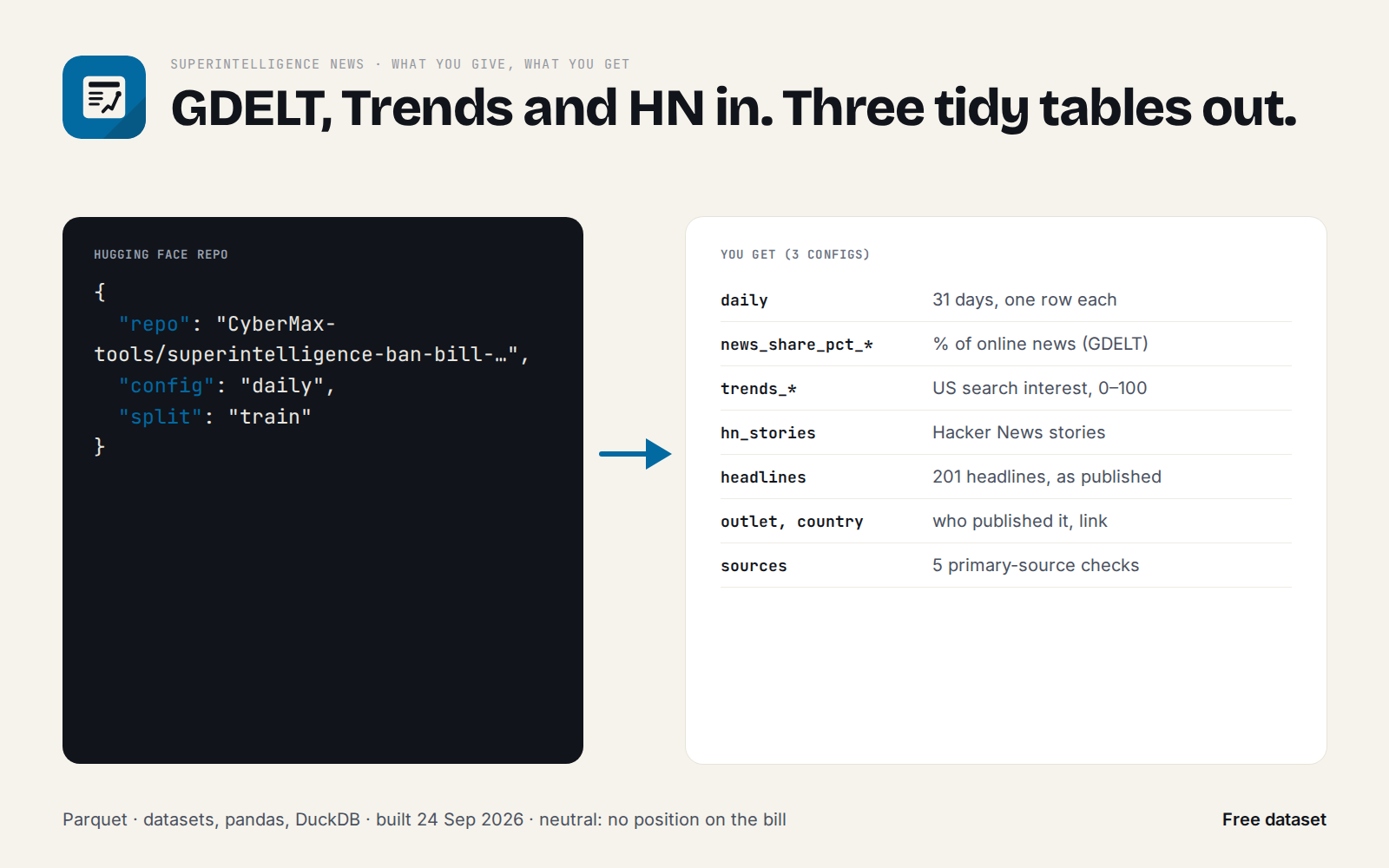
Three tables (built 24 Sep 2026, 22:40 UTC):
| config | rows | what |
|---|---|---|
headlines (default) |
201 | news articles (GDELT, 169) and Hacker News stories (32) from 26 Aug–24 Sep that mention superintelligence: date, headline exactly as published, outlet, language, country, link, HN points |
daily |
31 | one row per day: share of monitored online news that mentions each term (GDELT), Hacker News stories, and US Google Trends interest for 5 terms on one shared 0–100 scale |
sources |
5 | the primary-source status of each event: sponsor press release, White House release, Federal Register, congress.gov |


What the numbers show [Verified, from the rows]
- News coverage: "super intelligence" went from 0.007% of monitored online news on 20 Sep to 0.17% on 22 Sep and 0.22% on 23 Sep (about 30x); "superintelligence" rose from 0.02% (21 Sep) to 0.16% on 24 Sep. An earlier peak (0.14–0.15%, 9–12 Sep) follows coverage of AI-risk warnings by researchers, before the bill news.
- Search interest (US): "super intelligence" rose from 4 to 65 on 22 Sep on the shared 0–100 scale, then 50 and 24 (24 Sep is a partial day). "AI ban" stayed at 11–15 through the week: the bill made news but not many people searched for "AI ban".
- Hacker News: 32 unique stories in 30 days; the most discussed was the bill's announcement on 3 Sep (62 points).
- Primary sources (checked 24 Sep 22:40 UTC): the Senate press release and the White House release are online and contain the quoted wording. No executive order or other presidential document in the 2026 Federal Register mentions superintelligence; the only 2026 Federal Register document that does is a 7 Jul FTC policy statement on AI accuracy. No bill number yet: the bill is not among the 250 most recently updated bills on congress.gov (titles often appear days after introduction).
Limits (read before using)
headlinesis a sample, not every article: GDELT returned 2 of the 8 article-list windows we asked for (the others were rate-limited, HTTP 429), so 23 Sep and the "super intelligence" spelling before 21 Sep are well covered, other days less so. GDELT matches the article text, so some headlines don't contain the word itself (62 of 201 do). Thedailycoverage shares come from GDELT's full timelines and are complete (no data for 14–19 Sep in GDELT's timeline, left empty, never filled).- Google Trends values are a relative index, not search counts; "AI bill" hit 100 on 26 Aug, which sets the scale for all 5 terms.
- Headlines are kept exactly as each outlet published them, including names and opinions in them; this dataset takes no position on the bill or the speech.
Use it
from datasets import load_dataset
daily = load_dataset("CyberMax-tools/superintelligence-ban-bill-coverage", "daily", split="train").to_pandas()
print(daily[["date", "news_share_pct_super_intelligence", "trends_super_intelligence", "hn_stories"]].tail(10))
news = load_dataset("CyberMax-tools/superintelligence-ban-bill-coverage", "headlines", split="train").to_pandas()
print(news.groupby("date").size().tail(10))
Columns
headlines: date, seen_utc (when GDELT first saw it / HN post time), title, outlet, language, source_country, url, source (gdelt or hacker_news), matched (search term), hn_points, hn_url.
daily: date; news_share_pct_superintelligence, news_share_pct_super_intelligence (% of all online news GDELT monitored that day); hn_stories; trends_superintelligence, trends_super_intelligence, trends_ai_ban, trends_ai_regulation, trends_ai_bill (Google Trends, US, 0–100).
sources: event_date, event, kind, url, http_status, confirmed_this_build, checked_utc.
Get fresh data
- Search interest for your own topics, with a rising/falling verdict and alerts: Swellmeter: Google Trends scraper and API.
- What people type about a topic: Keyfern keyword ideas; free snapshot for this story: superintelligence search questions.
- Full article text for these links: Inkpluck article extractor (free demo: tech reads extracted).
- Every federal AI executive order, rule and comment period, daily: Policywren US AI Policy Tracker.
Sources and licence
GDELT Project DOC 2.0 API (free, attribution: "The GDELT Project"); Hacker News via the Algolia HN Search API; Google Trends (public explore endpoints, US); Federal Register API (public domain); congress.gov API; the Senate and White House releases linked in sources. Headlines and links belong to their publishers and are listed as facts about coverage. Compilation CC BY 4.0 by CyberMax. Not affiliated with any source, office or party.
Refresh
python3 products/ai-policy-tracker/news/superintelligence-bill/build.py <out_dir> [gdelt_cache.json] (the optional cache holds GDELT responses fetched from another IP when this container's IP is throttled), then convert the three JSONL files to data/*.parquet and upload with this card. No Apify credit needed unless GDELT has to be fetched through Capturewren (~$0.02 per run).
More free from CyberMax
- All free CyberMax demos & datasets
- Policywren: US AI Policy Tracker (Federal Register, daily)
- Swellmeter: Rising Google Searches in AI & Tech
Quickstart notebook
Load this dataset with pandas and see real outputs in the quickstart notebook.