
Datasets:

problem stringlengths 1 38k | solution stringlengths 0 26.8k | answer stringlengths 0 237 ⌀ | problem_type stringclasses 9
values | question_type stringclasses 5
values | problem_is_valid stringclasses 5
values | solution_is_valid stringclasses 5
values | source stringclasses 2
values | synthetic bool 1
class |
|---|---|---|---|---|---|---|---|---|
Problem 1. Find all prime numbers $p$ for which there exist positive integers $x, y$ and $z$ such that the number
$$
x^{p}+y^{p}+z^{p}-x-y-z
$$
is a product of exactly three distinct prime numbers.
|
Solution. Let $A=x^{p}+y^{p}+z^{p}-x-y-z$. For $p=2$, we take $x=y=4$ and $z=3$. Then $A=30=2 \cdot 3 \cdot 5$. For $p=3$ we can take $x=3$ and $y=2$ and $z=1$. Then again $A=30=2 \cdot 3 \cdot 5$. For $p=5$ we can take $x=2$ and $y=1$ and $z=1$. Again $A=30=2 \cdot 3 \cdot 5$.
Assume now that $p \geqslant 7$. Workin... | proof | Number Theory | math-word-problem | Yes | Yes | olympiads | false |
Problem 2. Let $a, b$ be two distinct real numbers and let $c$ be a positive real number such that
$$
a^{4}-2019 a=b^{4}-2019 b=c .
$$
Prove that $-\sqrt{c}<a b<0$.
|
Solution. Firstly, we see that
$$
2019(a-b)=a^{4}-b^{4}=(a-b)(a+b)\left(a^{2}+b^{2}\right)
$$
Since $a \neq b$, we get $(a+b)\left(a^{2}+b^{2}\right)=2019$, so $a+b \neq 0$. Thus
$$
\begin{aligned}
2 c & =a^{4}-2019 a+b^{4}-2019 b \\
& =a^{4}+b^{4}-2019(a+b) \\
& =a^{4}+b^{4}-(a+b)^{2}\left(a^{2}+b^{2}\right) \\
& ... | proof | Algebra | proof | Yes | Incomplete | olympiads | false |
Problem 3. Triangle $A B C$ is such that $A B<A C$. The perpendicular bisector of side $B C$ intersects lines $A B$ and $A C$ at points $P$ and $Q$, respectively. Let $H$ be the orthocentre of triangle $A B C$, and let $M$ and $N$ be the midpoints of segments $B C$ and $P Q$, respectively. Prove that lines $H M$ and $... |
Solution. We have
$$
\angle A P Q=\angle B P M=90^{\circ}-\angle M B P=90^{\circ}-\angle C B A=\angle H C B
$$
and
$$
\angle A Q P=\angle M Q C=90^{\circ}-\angle Q C M=90^{\circ}-\angle A C B=\angle C B H
$$
From these two equalities, we see that the triangles $A P Q$ and $H C B$ are similar. Moreover, since $M$ a... | proof | Geometry | proof | Yes | Yes | olympiads | false |
Problem 4. A $5 \times 100$ table is divided into 500 unit square cells, where $n$ of them are coloured black and the rest are coloured white. Two unit square cells are called adjacent if they share a common side. Each of the unit square cells has at most two adjacent black unit square cells. Find the largest possible... |
Solution. If we colour all the cells along all edges of the board together with the entire middle row except the second and the last-but-one cell, the condition is satisfied and there are 302 black cells. The figure below exhibits this colouring for the $5 \times 8$ case.
$ is circumscribed. The incircle of the triangle $A B C$ touches the lines $A B$ and $A C$ at the points $M$ and $N$, respectively. Prove that the incenter of the trapezoid $A B C D$ lies on the line $M N$.
=90^{\circ}-\frac{1}{2} m(\widehat{M A N}) \quad \text { and } \quad m(\widehat{B I C})=90^{\circ}+\frac{1}{2} m(\widehat{M A N})
$$
the quadrilateral $I R N C$ is ... | proof | Geometry | proof | Yes | Yes | olympiads | false |
Problem 2. Let $a, b$ and $c$ be positive real numbers. Prove that
$$
\frac{8}{(a+b)^{2}+4 a b c}+\frac{8}{(b+c)^{2}+4 a b c}+\frac{8}{(c+a)^{2}+4 a b c}+a^{2}+b^{2}+c^{2} \geq \frac{8}{a+3}+\frac{8}{b+3}+\frac{8}{c+3}
$$
|
Solution. Since $2 a b \leq a^{2}+b^{2}$, it follows that $(a+b)^{2} \leq 2\left(a^{2}+b^{2}\right)$
and $4 a b c \leq 2 c\left(a^{2}+b^{2}\right)$, for any positive reals $a, b, c$.
Adding these inequalities, we find
$$
(a+b)^{2}+4 a b c \leq 2\left(a^{2}+b^{2}\right)(c+1)
$$
so that
$$
\frac{8}{(a+b)^{2}+4 a b ... | proof | Inequalities | proof | Yes | Yes | olympiads | false |
Problem 3. Find all the triples of integers $(a, b, c)$ such that the number
$$
N=\frac{(a-b)(b-c)(c-a)}{2}+2
$$
is a power of 2016 .
(A power of 2016 is an integer of the form $2016^{n}$, where $n$ is a non-negative integer.)
|
Solution. Let $a, b, c$ be integers and $n$ be a positive integer such that
$$
(a-b)(b-c)(c-a)+4=2 \cdot 2016^{n}
$$
We set $a-b=-x, b-c=-y$ and we rewrite the equation as
$$
x y(x+y)+4=2 \cdot 2016^{n}
$$
If $n>0$, then the right hand side is divisible by 7 , so we have that
$$
x y(x+y)+4 \equiv 0 \quad(\bmod 7)... | (,b,)=(k+2,k+1,k),k\in\mathbb{Z} | Number Theory | math-word-problem | Yes | Yes | olympiads | false |
Problem 2. Let $n$ three-digit numbers satisfy the following properties:
(1) No number contains the digit 0 .
(2) The sum of the digits of each number is 9 .
(3) The units digits of any two numbers are different.
(4) The tens digits of any two numbers are different.
(5) The hundreds digits of any two numbers are ... |
Solution. Let $S$ denote the set of three-digit numbers that have digit sum equal to 9 and no digit equal to 0 . We will first find the cardinality of $S$. We start from the number 111 and each element of $S$ can be obtained from 111 by a string of 6 A's (which means that we add 1 to the current digit) and $2 G$ 's (w... | 5 | Combinatorics | math-word-problem | Yes | Yes | olympiads | false |
## Problem 2
Let the circles $k_{1}$ and $k_{2}$ intersect at two distinct points $A$ and $B$, and let $t$ be a common tangent of $k_{1}$ and $k_{2}$, that touches $k_{1}$ and $k_{2}$ at $M$ and $N$, respectively. If $t \perp A M$ and $M N=2 A M$, evaluate $\angle N M B$.
| ## Solution 1
Let $P$ be the symmetric of $A$ with respect to $M$ (Figure 1). Then $A M=M P$ and $t \perp A P$, hence the triangle $A P N$ is isosceles with $A P$ as its base, so $\angle N A P=\angle N P A$. We have $\angle B A P=\angle B A M=\angle B M N$ and $\angle B A N=\angle B N M$.
Thus we have
$$
180^{\circ}... | 45 | Geometry | math-word-problem | Yes | Yes | olympiads | false |
## Problem 3
On a board there are $n$ nails each two connected by a string. Each string is colored in one of $n$ given distinct colors. For each three distinct colors, there exist three nails connected with strings in these three colors. Can $n$ be
a) 6 ?
b) 7 ?
|
Solution. (a) The answer is no.
Suppose it is possible. Consider some color, say blue. Each blue string is the side of 4 triangles formed with vertices on the given points. As there exist $\binom{5}{2}=\frac{5 \cdot 4}{2}=10$ pairs of colors other than blue, and for any such pair of colors together with the blue colo... | proof | Combinatorics | math-word-problem | Yes | Yes | olympiads | false |
## Problem 4
Find all positive integers $x, y, z$ and $t$ such that
$$
2^{x} \cdot 3^{y}+5^{z}=7^{t}
$$
| ## Solution
Reducing modulo 3 we get $5^{z} \equiv 1$, therefore $z$ is even, $z=2 c, c \in \mathbb{N}$.
Next we prove that $t$ is even:
Obviously, $t \geq 2$. Let us suppose that $t$ is odd, say $t=2 d+1, d \in \mathbb{N}$. The equation becomes $2^{x} \cdot 3^{y}+25^{c}=7 \cdot 49^{d}$. If $x \geq 2$, reducing modu... | 3,1,=2 | Number Theory | math-word-problem | Yes | Yes | olympiads | false |
Problem 1. The real numbers $a, b, c, d$ satisfy simultaneously the equations
$$
a b c-d=1, b c d-a=2, c d a-b=3, d a b-c=-6
$$
Prove that $a+b+c+d \neq 0$.
|
Solution. Suppose that $a+b+c+d=0$. Then
$$
a b c+b c d+c d a+d a b=0
$$
If $a b c d=0$, then one of numbers, say $d$, must be 0 . In this case $a b c=0$, and so at least two of the numbers $a, b, c, d$ will be equal to 0 , making one of the given equations impossible. Hence $a b c d \neq 0$ and, from (1),
$$
\frac... | proof | Algebra | proof | Yes | Yes | olympiads | false |
Problem 3. Let $A L$ and $B K$ be angle bisectors in the non-isosceles triangle $A B C$ ( $L$ lies on the side $B C, K$ lies on the side $A C$ ). The perpendicular bisector of $B K$ intersects the line $A L$ at point $M$. Point $N$ lies on the line $B K$ such that $L N$ is parallel to $M K$. Prove that $L N=N A$.
|
Solution. The point $M$ lies on the circumcircle of $\triangle A B K$ (since both $A L$ and the perpendicular bisector of $B K$ bisect the arc $B K$ of this circle). Then $\angle C B K=$ $\angle A B K=\angle A M K=\angle N L A$. Thus $A B L N$ is cyclic, whence $\angle N A L=\angle N B L=$ $\angle C B K=\angle N L A$.... | LN=NA | Geometry | proof | Yes | Yes | olympiads | false |
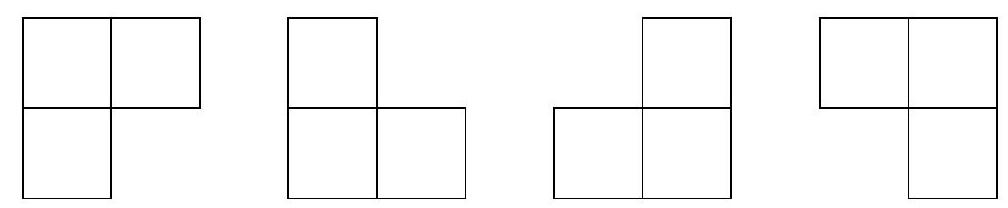
Problem 4. A $9 \times 7$ rectangle is tiled with tiles of the two types shown in the picture below (the tiles are composed by three, respectively four unit squares and the L-shaped tiles can be rotated repeatedly with $90^{\circ}$ ).
 $a, b, c$ of $M$ we have $|a+b-c|>10$. Determine the largest possible number of elements of $M$.
|
Solution. The set $M=\{1016,1017, \ldots, 2021\}$ has 1006 elements and satisfies the required property, since $a, b, c \in M$ implies that $a+b-c \geqslant 1016+1016-2021=11$. We will show that this is optimal.
Suppose $M$ satisfies the condition in the problem. Let $k$ be the minimal element of $M$. Then $k=|k+k-k|... | 1006 | Combinatorics | math-word-problem | Yes | Yes | olympiads | false |
Problem 1. Find all distinct prime numbers $p, q$ and $r$ such that
$$
3 p^{4}-5 q^{4}-4 r^{2}=26
$$
|
Solution. First notice that if both primes $q$ and $r$ differ from 3 , then $q^{2} \equiv r^{2} \equiv 1(\bmod 3)$, hence the left hand side of the given equation is congruent to zero modulo 3 , which is impossible since 26 is not divisible by 3 . Thus, $q=3$ or $r=3$. We consider two cases.
Case 1. $q=3$.
The equat... | p=5,q=3,r=19 | Number Theory | math-word-problem | Yes | Yes | olympiads | false |
Problem 2. Consider an acute triangle $A B C$ with area S. Let $C D \perp A B \quad(D \in A B)$, $D M \perp A C \quad(M \in A C)$ and $\quad D N \perp B C \quad(N \in B C)$. Denote by $H_{1}$ and $H_{2}$ the orthocentres of the triangles $M N C$ and $M N D$ respectively. Find the area of the quadrilateral $\mathrm{AH}... |
Solution 1. Let $O, P, K, R$ and $T$ be the mid-points of the segments $C D, M N$, $C N, C H_{1}$ and $M H_{1}$, respectively. From $\triangle M N C$ we have that $\overline{P K}=\frac{1}{2} \overline{M C}$ and $P K \| M C$. Analogously, from $\Delta M H_{1} C$ we have that $\overline{T R}=\frac{1}{2} \overline{M C}$ ... | S | Geometry | math-word-problem | Yes | Yes | olympiads | false |
Problem 4. For a positive integer $n$, two players A and B play the following game: Given a pile of $s$ stones, the players take turn alternatively with A going first. On each turn the player is allowed to take either one stone, or a prime number of stones, or a multiple of $n$ stones. The winner is the one who takes ... |
Solution. Denote by $k$ the sought number and let $\left\{s_{1}, \mathrm{~s}_{2}, \ldots, \mathrm{s}_{k}\right\}$ be the corresponding values for $s$. We call each $s_{i}$ a losing number and every other nonnegative integer a winning numbers.
## Clearly every multiple of $n$ is a winning number.
Suppose there are tw... | n-1 | Combinatorics | math-word-problem | Yes | Yes | olympiads | false |
Problem 1. Find all pairs $(a, b)$ of positive integers such that
$$
11 a b \leq a^{3}-b^{3} \leq 12 a b
$$
|
Solution 1. Let $a-b=t$. Due to $a^{3}-b^{3} \geq 11 a b$ we conclude that $a>b$ so $t$ is a positive integer and the condition can be written as
$$
11 b(b+t) \leq t\left[b^{2}+b(b+t)+(b+t)^{2}\right] \leq 12 b(b+t)
$$
Since
$$
t\left[b^{2}+b(b+t)+(b+t)^{2}\right]=t\left(b^{2}+b^{2}+b t+b^{2}+2 b t+t^{2}\right)=3 t... | (5,2) | Inequalities | math-word-problem | Yes | Yes | olympiads | false |
## Problem 1.
Find all pairs $(a, b)$ of positive integers such that $a!+b$ and $b!+a$ are both powers of 5 .
|
Solution. The condition is symmetric so we can assume that $b \leq a$.
The first case is when $a=b$. In this case, $a!+a=5^{m}$ for some positive integer $m$. We can rewrite this as $a \cdot((a-1)!+1)=5^{m}$. This means that $a=5^{k}$ for some integer $k \geq 0$. It is clear that $k$ cannot be 0 . If $k \geq 2$, then... | (1,4),(4,1),(5,5) | Number Theory | math-word-problem | Yes | Yes | olympiads | false |
## Problem 2.
Prove that for all non-negative real numbers $x, y, z$, not all equal to 0 , the following inequality holds
$$
\frac{2 x^{2}-x+y+z}{x+y^{2}+z^{2}}+\frac{2 y^{2}+x-y+z}{x^{2}+y+z^{2}}+\frac{2 z^{2}+x+y-z}{x^{2}+y^{2}+z} \geqslant 3
$$
Determine all the triples $(x, y, z)$ for which the equality holds.
|
Solution. Let us first write the expression $L$ on the left hand side in the following way
$$
\begin{aligned}
L & =\left(\frac{2 x^{2}-x+y+z}{x+y^{2}+z^{2}}+2\right)+\left(\frac{2 y^{2}+x-y+z}{x^{2}+y+z^{2}}+2\right)+\left(\frac{2 z^{2}+x+y-z}{x^{2}+y^{2}+z}+2\right)-6 \\
& =\left(2 x^{2}+2 y^{2}+2 z^{2}+x+y+z\right)... | proof | Inequalities | proof | Yes | Yes | olympiads | false |
Problem 3. Alice and Bob play the following game: Alice picks a set $A=\{1,2, \ldots, n\}$ for some natural number $n \geqslant 2$. Then starting with Bob, they alternatively choose one number from the set $A$, according to the following conditions: initially Bob chooses any number he wants, afterwards the number chos... |
Solution. To say that Alice has a winning strategy means that she can find a number $n$ to form the set A, so that she can respond appropriately to all choices of Bob and always get at the end a composite number for the sum of her choices. If such $n$ does not exist, this would mean that Bob has a winning strategy ins... | proof | Combinatorics | math-word-problem | Yes | Yes | olympiads | false |
Problem 4. Consider a regular $2 n$-gon $P, A_{1} A_{2} \ldots A_{2 n}$ in the plane, where $n$ is a positive integer. We say that a point $S$ on one of the sides of $P$ can be seen from a point $E$ that is external to $P$, if the line segment $S E$ contains no other points that lie on the sides of $P$ except $S$. We ... |
Solution Answer: For $n=2$, the answer is 36 ; for $n=3$, the answer is 30 and for $n \geq 4$, the answer is $6 n$.
Lemma 1. Given a regular $2 n$-gon in the plane and a sequence of $n$ consecutive sides $s_{1}, s_{2}, \ldots, s_{n}$ there is an external point $Q$ in the plane, such that the color of each $s_{i}$ can... | 6n | Combinatorics | math-word-problem | Yes | Yes | olympiads | false |
Problem 1. Find all prime numbers $a, b, c$ and positive integers $k$ which satisfy the equation
$$
a^{2}+b^{2}+16 \cdot c^{2}=9 \cdot k^{2}+1
$$
| # Solution:
The relation $9 \cdot k^{2}+1 \equiv 1(\bmod 3)$ implies
$$
a^{2}+b^{2}+16 \cdot c^{2} \equiv 1(\bmod 3) \Leftrightarrow a^{2}+b^{2}+c^{2} \equiv 1(\bmod 3)
$$
Since $a^{2} \equiv 0,1(\bmod 3), \quad b^{2} \equiv 0,1(\bmod 3), c^{2} \equiv 0,1(\bmod 3)$, we have:
| $a^{2}$ | 0 | 0 | 0 | 0 | 1 | 1 | 1 |... | (37,3,3,13),(17,3,3,7),(3,37,3,13),(3,17,3,7),(3,3,2,3) | Number Theory | math-word-problem | Yes | Yes | olympiads | false |
Problem 3. Let $\triangle A B C$ be an acute triangle. The lines $l_{1}, l_{2}$ are perpendicular to $A B$ at the points $A, B$ respectively. The perpendicular lines from the midpoint $M$ of $A B$ to the sides of the triangle $A C, B C$ intersect the lines $l_{1}, l_{2}$ at the points $E, F$, respectively. If $D$ is t... | ## Solution:
Let $H, G$ be the points of intersection of $M E, M F$ with $A C, B C$ respectively. From the similarity of triangles $\triangle M H A$ and $\triangle M A E$ we get $\frac{M H}{M A}=\frac{M A}{M E}$, thus
$$
M A^{2}=M H \cdot M E
$$
Similarly, from the similarity of triangles $\triangle M B G$ and $\tri... | proof | Geometry | proof | Yes | Yes | olympiads | false |
## Problem 4.
An $L$-figure is one of the following four pieces, each consisting of three unit squares:
A $5 \times 5$ board, consisting of 25 unit squares, a positive integer $k \leq 25$ a... | ## Solution:
We will show that player $\boldsymbol{A}$ wins if $k=1,2,3$, but player $\boldsymbol{B}$ wins if $k=4$. Thus the smallest $k$ for which $\boldsymbol{B}$ has a winning strategy exists and is equal to 4 .
If $k=1$, player $\boldsymbol{A}$ marks the upper left corner of the square and then fills it as follo... | 4 | Combinatorics | math-word-problem | Incomplete | Yes | olympiads | false |
A2. Let $a$ and $b$ be positive real numbers such that $3 a^{2}+2 b^{2}=3 a+2 b$. Find the minimum value of
$$
A=\sqrt{\frac{a}{b(3 a+2)}}+\sqrt{\frac{b}{a(2 b+3)}}
$$
|
Solution. By the Cauchy-Schwarz inequality we have that
$$
5\left(3 a^{2}+2 b^{2}\right)=5\left(a^{2}+a^{2}+a^{2}+b^{2}+b^{2}\right) \geq(3 a+2 b)^{2}
$$
(or use that the last inequality is equivalent to $(a-b)^{2} \geq 0$ ).
So, with the help of the given condition we get that $3 a+2 b \leq 5$. Now, by the AM-GM i... | \frac{2}{\sqrt{5}} | Algebra | math-word-problem | Yes | Yes | olympiads | false |
C1. Consider a regular $2 n+1$-gon $P$ in the plane, where $n$ is a positive integer. We say that a point $S$ on one of the sides of $P$ can be seen from a point $E$ that is external to $P$, if the line segment $S E$ contains no other points that lie on the sides of $P$ except $S$. We want to color the sides of $P$ in... |
Solution. Answer: $n=1$ is clearly a solution, we can just color each side of the equilateral triangle in a different color, and the conditions are satisfied. We prove there is no larger $n$ that fulfills the requirements.
Lemma 1. Given a regular $2 n+1$-gon in the plane, and a sequence of $n+1$ consecutive sides $s... | 1 | Combinatorics | math-word-problem | Yes | Yes | olympiads | false |
C2. Consider a regular $2 n$-gon $P$ in the plane, where $n$ is a positive integer. We say that a point $S$ on one of the sides of $P$ can be seen from a point $E$ that is external to $P$, if the line segment $S E$ contains no other points that lie on the sides of $P$ except $S$. We want to color the sides of $P$ in 3... |
Solution. Answer: For $n=2$, the answer is 36 ; for $n=3$, the answer is 30 and for $n \geq 4$, the answer is $6 n$.
Lemma 1. Given a regular $2 n$-gon in the plane and a sequence of $n$ consecutive sides $s_{1}, s_{2}, \ldots, s_{n}$ there is an external point $Q$ in the plane, such that the color of each $s_{i}$ ca... | 6n | Combinatorics | math-word-problem | Yes | Yes | olympiads | false |
C3. We have two piles with 2000 and 2017 coins respectively. Ann and Bob take alternate turns making the following moves: The player whose turn is to move picks a pile with at least two coins, removes from that pile $t$ coins for some $2 \leqslant t \leqslant 4$, and adds to the other pile 1 coin. The players can choo... |
Solution. Denote the number of coins in the two piles by $X$ and $Y$. We say that the pair $(X, Y)$ is losing if the player who begins the game loses and that the pair $(X, Y)$ is winning otherwise. We shall prove that $(X, Y)$ is loosing if $X-Y \equiv 0,1,7 \bmod 8$, and winning if $X-Y \equiv 2,3,4,5,6 \bmod 8$.
L... | proof | Combinatorics | math-word-problem | Yes | Yes | olympiads | false |
G1. Given a parallelogram $A B C D$. The line perpendicular to $A C$ passing through $C$ and the line perpendicular to $B D$ passing through $A$ intersect at point $P$. The circle centered at point $P$ and radius $P C$ intersects the line $B C$ at point $X,(X \neq C)$ and the line $D C$ at point $Y$, $(Y \neq C)$. Pro... |
Solution. Denote the feet of the perpendiculars from $P$ to the lines $B C$ and $D C$ by $M$ and $N$ respectively and let $O=A C \cap B D$. Since the points $O, M$ and $N$ are midpoints of $C A, C X$ and $C Y$ respectively it suffices to prove that $M, N$ and $O$ are collinear. According to Menelaus's theorem for $\tr... | proof | Geometry | proof | Yes | Yes | olympiads | false |
Problem G3. Consider triangle $A B C$ such that $A B \leq A C$. Point $D$ on the arc $B C$ of the circumcirle of $A B C$ not containing point $A$ and point $E$ on side $B C$ are such that
$$
\Varangle B A D=\Varangle C A E<\frac{1}{2} \Varangle B A C .
$$
Let $S$ be the midpoint of segment $A D$. If $\Varangle A D E... |
Solution. Let the tangent to the circumcircle of $\triangle A B C$ at point $A$ intersect line $B C$ at $T$. Since $A B \leq A C$ we get that $B$ lies between $T$ and $C$. Since $\Varangle B A T=\Varangle A C B$ and $\Varangle A B T=\Varangle 180^{\circ}-\Varangle A B C$ we get $\Varangle E T A=\Varangle B T A=\Varang... | 2\VarangleBAC=\VarangleBSC | Geometry | proof | Yes | Yes | olympiads | false |
Problem G5. A point $P$ lies in the interior of the triangle $A B C$. The lines $A P, B P$, and $C P$ intersect $B C, C A$, and $A B$ at points $D, E$, and $F$, respectively. Prove that if two of the quadrilaterals $A B D E, B C E F, C A F D, A E P F, B F P D$, and $C D P E$ are concyclic, then all six are concyclic.
|
Solution. We first prove the following lemma:
Lemma 1. Let $A B C D$ be a convex quadrilateral and let $A B \cap C D=E$ and $B C \cap D A=F$. Then the circumcircles of triangles $A B F, C D F, B C E$ and $D A E$ all pass through a common point $P$. This point lies on line $E F$ if and only if $A B C D$ in concyclic.
... | proof | Geometry | proof | Yes | Yes | olympiads | false |
NT1. Determine all sets of six consecutive positive integers such that the product of two of them, added to the the product of other two of them is equal to the product of the remaining two numbers.
|
Solution. Exactly two of the six numbers are multiples of 3 and these two need to be multiplied together, otherwise two of the three terms of the equality are multiples of 3 but the third one is not.
Let $n$ and $n+3$ denote these multiples of 3 . Two of the four remaining numbers give remainder 1 when divided by 3 ,... | 1\cdot2+3\cdot6=4\cdot5,\quad2\cdot5+3\cdot6=4\cdot7,\quad7\cdot8+6\cdot9=10\cdot11 | Number Theory | math-word-problem | Incomplete | Yes | olympiads | false |
NT4. Solve in nonnegative integers the equation $5^{t}+3^{x} 4^{y}=z^{2}$.
|
Solution. If $x=0$ we have
$$
z^{2}-2^{2 y}=5^{t} \Longleftrightarrow\left(z+2^{y}\right)\left(z-2^{y}\right)=5^{t}
$$
Putting $z+2^{y}=5^{a}$ and $z-2^{y}=5^{b}$ with $a+b=t$ we get $5^{a}-5^{b}=2^{y+1}$. This gives us $b=0$ and now we have $5^{t}-1=2^{y+1}$. If $y \geq 2$ then consideration by modulo 8 gives $2 \m... | (,x,y,z)=(1,0,1,3),(0,1,0,2),(2,2,2,13),(0,1,2,7) | Number Theory | math-word-problem | Yes | Yes | olympiads | false |
A3. Let $a . b$ c ce positue real numbers such that $a+b+c=a^{2}+b^{2}+c^{2}$. Shou that
$$
\frac{a^{2}}{a^{2}+a b}+\frac{b^{2}}{b^{2}+b c}+\frac{c^{2}}{c^{2}+c a} \geq \frac{a+b+c}{2}
$$
|
Solution. By the Cauchy-Schwarz inequality it is
$$
\begin{aligned}
& \left(\frac{a^{2}}{a^{2}+a b}+\frac{b^{2}}{b^{2}+b c}+\frac{c^{2}}{c^{2}+c a}\right)\left(\left(a^{2}+a b\right)+\left(b^{2}+b c\right)+\left(c^{2}+c a\right)\right) \geq(a+b+c)^{2} \\
\Rightarrow & \frac{a^{2}}{a^{2}+a b}+\frac{b^{2}}{b^{2}+b c}+\... | proof | Inequalities | proof | Yes | Yes | olympiads | false |
A4. Solve the following equation for $x, y, z \in \mathbb{N}$
$$
\left(1+\frac{x}{y+z}\right)^{2}+\left(1+\frac{y}{z+x}\right)^{2}+\left(1+\frac{z}{x+y}\right)^{2}=\frac{27}{4}
$$
|
Solution 1. Call $a=1+\frac{x}{y+z}, b=1+\frac{y}{z+x}, c=1+\frac{z}{x+y}$ to get
$$
a^{2}+b^{2}+c^{2}=\frac{27}{4}
$$
Since it is also true that
$$
\frac{1}{a}+\frac{1}{b}+\frac{1}{c}=2
$$
the quadratic-harmonic means inequality implies
$$
\frac{3}{2}=\sqrt{\frac{a^{2}+b^{2}+c^{2}}{3}} \geq \frac{3}{\frac{1}{a}+... | z | Algebra | math-word-problem | Yes | Yes | olympiads | false |
A5. Find the largest positive integer $n$ for which the inequality
$$
\frac{a+b+c}{a b c+1}+\sqrt[n]{a b c} \leq \frac{5}{2}
$$
holds for all $a, b, c \in[0,1]$. Here $\sqrt[1]{a b c}=a b c$.
|
Solution. Let $n_{\max }$ be the sought largest value of $n$, and let $E_{a, b, c}(n)=\frac{a+b+c}{a b c+1}+\sqrt[n]{a b c}$. Then $E_{a, b, c}(m)-E_{a, b, c}(n)=\sqrt[m]{a b c}-\sqrt[n]{a b c}$ and since $a . b c \leq 1$ we clearly have $E_{a, b, c}(m) \geq$ $E_{a, b, c}(n)$ for $m \geq n$. So if $E_{a, b, c}(n) \geq... | 3 | Inequalities | math-word-problem | Yes | Yes | olympiads | false |
C1. Along a round table are arranged 11 cards with the names (all distinct) of the 11 members of the $16^{\text {th }}$ JBMO Problem Selection Committee. The distances between each two consecutive cards are equal. Assume that in the first meeting of the Committee none of its 11 members sits in front of the card with h... |
Solution. Yes it is: Rotating the table by the angles $\frac{360^{\circ}}{11}, 2 \cdot \frac{360^{\circ}}{11}, 3 \cdot \frac{360^{\circ}}{11}, \ldots, 10 \cdot \frac{360^{\circ}}{11}$, we obtain 10 new positions of the table. By the assumption, it is obvious that every one of the 11 members of the Committee will be se... | proof | Combinatorics | math-word-problem | Yes | Yes | olympiads | false |
C2. $n$ nails nailed on a board are connected by two via a string. Each string is colored in one of $n$ given colors. For any three colors there exist three nails conne.cted by two with strings in these three colors. Can $n$ be: (a) 6, (b) 7?
|
Solution. (a) The answer is no:
Suppose it is possible. Consider some color, say blue. Each blue string is the side of 4 triangles formed with vertices on the given points. As there exist $\binom{5}{2}=\frac{5 \cdot 4}{2}=10$ pairs of colors other than blue, and for any such pair of colors together with the blue colo... | proof | Combinatorics | math-word-problem | Yes | Yes | olympiads | false |
C3. In a circle of diameter 1 consider 65 points no three of which are collinear. Prove that there exist 3 among these points which form a triangle with area less then or equal to $\frac{1}{72}$.
|
Solution. Lemma: If a triangle $A B C$ lies in a rectangle $K L M N$. with sides $K L=a$ and $L M=b$, then the area of the triangle is less then or equal to $\frac{a b}{2}$.
Proof of the lemma: Writhout any loss of generality assume that among the distance of $A, B, C$ from $K L$, that of $A$ is between the other two... | proof | Geometry | proof | Yes | Yes | olympiads | false |
NT5. Find all the positive integers $x, y, z, t$ such that $2^{x} \cdot 3^{y}+5^{z}=7^{t}$.
|
Solution. Reducing modulo 3 we get $5^{z} \equiv 1$, therefore $z$ is even, $z=2 c, c \in \mathbb{N}$. .
Next we prove that $t$ is even. Obviously, $t \geq 2$. Let us suppose that $t$ is odd, $t=2 d+1$, $d \in \mathbb{N}$. The equation becomes $2^{x} \cdot 3^{y}+25^{c}=7 \cdot 49^{d}$.
If $x \geq 2$, reducing modulo... | 3,1,=2 | Number Theory | math-word-problem | Yes | Yes | olympiads | false |
A2. Find the largest possible value of the expression $\left|\sqrt{x^{2}+4 x+8}-\sqrt{x^{2}+8 x+17}\right|$ where $x$ is a real number.
|
Solution. We observe that
$$
\left|\sqrt{x^{2}+4 x+8}-\sqrt{x^{2}+8 x+17}\right|=\left|\sqrt{(x-(-2))^{2}+(0-2)^{2}}-\sqrt{\left.(x-(-4))^{2}+(0-1)^{2}\right)}\right|
$$
is the absolute difference of the distances from the point $P(x, 0)$ in the $x y$-plane to the points $A(-2,2)$ and $B(-4,1)$.
By the Triangle Ine... | \sqrt{5} | Algebra | math-word-problem | Yes | Yes | olympiads | false |
A3. Show that
$$
\left(a+2 b+\frac{2}{a+1}\right)\left(b+2 a+\frac{2}{b+1}\right) \geq 16
$$
for all positive real numbers $a, b$ satisfying $a b \geq 1$.
|
Solution 1. By the AM-GM Inequality we have:
$$
\frac{a+1}{2}+\frac{2}{a+1} \geq 2
$$
Therefore
$$
a+2 b+\frac{2}{a+1} \geq \frac{a+3}{2}+2 b
$$
and, similarly,
$$
b+2 a+\frac{2}{b+1} \geq 2 a+\frac{b+3}{2}
$$
On the other hand,
$$
(a+4 b+3)(b+4 a+3) \geq(\sqrt{a b}+4 \sqrt{a b}+3)^{2} \geq 64
$$
by the Cauchy... | proof | Inequalities | proof | Yes | Yes | olympiads | false |
C3. All possible pairs of $n$ apples are weighed and the results are given to us in an arbitrary order. Can we determine the weights of the apples if a. $n=4$, b. $n=5$, c. $n=6$ ?
|
Solution. a. No. Four apples with weights $1,5,7,9$ and with weights $2,4,6,10$ both give the results $6,8,10,12,14,16$ when weighed in pairs.
b. Yes. Let $a \leq b \leq c \leq d \leq e$ be the weights of the apples. As each apple is weighed 4 times, by adding all 10 pairwise weights and dividing the sum by 4 , we ob... | proof | Combinatorics | math-word-problem | Yes | Yes | olympiads | false |
G1. Let $A B$ be a diameter of a circle $\omega$ with center $O$ and $O C$ be a radius of $\omega$ which is perpendicular to $A B$. Let $M$ be a point on the line segment $O C$. Let $N$ be the second point of intersection of the line $A M$ with $\omega$, and let $P$ be the point of intersection of the lines tangent to... |
Solution. Since the lines $P N$ and $B P$ are tangent to $\omega, N P=P B$ and $O P$ is the bisector of $\angle N O B$. Therefore the lines $O P$ and $N B$ are perpendicular. Since $\angle A N B=90^{\circ}$, it follows that the lines $A N$ and $O P$ are parallel. As $M O$ and $P B$ are also parallel and $A O=O B$, the... | proof | Geometry | proof | Yes | Yes | olympiads | false |
G3. Let $D$ be a point on the side $B C$ of an acute triangle $A B C$ such that $\angle B A D=\angle C A O$ where $O$ is the center of the circumcircle $\omega$ of the triangle $A B C$. Let $E$ be the second point of intersection of $\omega$ and the line $A D$. Let $M, N, P$ be the midpoints of the line segments $B E,... |
Solution. We will show that $M O P D$ is a parallelogram. From this it follows that $M, N$, $P$ are collinear.
Since $\angle B A D=\angle C A O=90^{\circ}-\angle A B C, D$ is the foot of the perpendicular from $A$ to side $B C$. Since $M$ is the midpoint of the line segment $B E$, we have $B M=M E=M D$ and hence $\an... | proof | Geometry | proof | Yes | Yes | olympiads | false |
G4. Let $I$ be the incenter and $A B$ the shortest side of a triangle $A B C$. The circle with center $I$ and passing through $C$ intersects the ray $A B$ at the point $P$ and the ray $B A$ at the point $Q$. Let $D$ be the point where the excircle of the triangle $A B C$ belonging to angle $A$ touches the side $B C$, ... |
Solution. First we will show that points $P$ and $Q$ are not on the line segment $A B$.
Assume that $Q$ is on the line segment $A B$. Since $C I=Q I$ and $\angle I B Q=\angle I B C$, either the triangles $C B I$ and $Q B I$ are congruent or $\angle I C B+\angle I Q B=180^{\circ}$. In the first case, we have $B C=B Q$... | proof | Geometry | proof | Yes | Yes | olympiads | false |
G5. A circle passing through the midpoint $M$ of the side $B C$ and the vertex $A$ of a triangle $A B C$ intersects the sides $A B$ and $A C$ for the second time at the points $P$ and $Q$, respectively. Show that if $\angle B A C=60^{\circ}$ then
$$
A P+A Q+P Q<A B+A C+\frac{1}{2} B C
$$
|
Solution. Since the quadrilateral $A P M Q$ is cyclic, we have $\angle P M Q=180^{\circ}-\angle P A Q=$ $180^{\circ}-\angle B A C=120^{\circ}$. Therefore $\angle P M B+\angle Q M C=180^{\circ}-\angle P M Q=60^{\circ}$.
Let the point $B^{\prime}$ be the symmetric of the point $B$ with respect to the line $P M$ and the... | proof | Geometry | proof | Yes | Yes | olympiads | false |
N1. Find all positive integere on for othich $1^{2}+2^{2}+\cdots+16^{2}+17$ is a perfort square
|
Solution. We bave $1^{3}+2^{5}+\cdots+16^{2}=(1+2+\cdots+16)^{2}=5^{2} \quad 17^{0}$ Herese. $11^{3}+2^{3}+$

meeger t then $1 T^{\prime}-(1+B)(t-3)$ A. $(1,5) \quad(t-3)=16$ this can coly ha... | Number Theory | math-word-problem | Incomplete | Incomplete | olympiads | false | |
N5. Find all ordered triples $(x, y, z)$ of positive integers satisfying the equation
$$
\frac{1}{x^{2}}+\frac{y}{x z}+\frac{1}{z^{2}}=\frac{1}{2013}
$$
|
Solution. We have $x^{2} z^{2}=2013\left(x^{2}+x y z+z^{2}\right)$. Let $d=\operatorname{gcd}(x, z)$ and $x=d a, z=d b$. Then $a^{2} b^{2} d^{2}=2013\left(a^{2}+a b y+b^{2}\right)$.
As $\operatorname{gcd}(a, b)=1$, we also have $\operatorname{gcd}\left(a^{2}, a^{2}+a b y+b^{2}\right)=1$ and $\operatorname{gcd}\left(b... | (x,y,z)=(2013n,2013n^{2}-2,2013n) | Number Theory | math-word-problem | Yes | Yes | olympiads | false |
## A2 ALB
3) If $x^{3}-3 \sqrt{3} x^{2}+9 x-3 \sqrt{3}-64=0$, find the value of $x^{6}-8 x^{5}+13 x^{4}-5 x^{3}+49 x^{2}-137 x+2015$.
|
Solution
$x^{3}-3 \sqrt{3} x^{2}+9 x-3 \sqrt{3}-64=0 \Leftrightarrow(x-\sqrt{3})^{3}=64 \Leftrightarrow(x-\sqrt{3})=4 \Leftrightarrow x-4=\sqrt{3} \Leftrightarrow x^{2}-8 x+16=3 \Leftrightarrow$ $x^{2}-8 x+13=0$
$x^{6}-8 x^{5}+13 x^{4}-5 x^{3}+49 x^{2}-137 x+2015=\left(x^{2}-8 x+13\right)\left(x^{4}-5 x+9\right)+189... | 1898 | Algebra | math-word-problem | Yes | Yes | olympiads | false |
## A5 MKCD
Let $x, y, z$ be positive real numbers that satisfy the equality $x^{2}+y^{2}+z^{2}=3$. Prove that
$$
\frac{x^{2}+y z}{x^{2}+y z+1}+\frac{y^{2}+z x}{y^{2}+z x+1}+\frac{z^{2}+x y}{z^{2}+x y+1} \leq 2
$$
| ## Solution:
We have
$$
\begin{aligned}
& \frac{x^{2}+y z}{x^{2}+y z+1}+\frac{y^{2}+z x}{y^{2}+z x+1}+\frac{z^{2}+x y}{z^{2}+x y+1} \leq 2 \Leftrightarrow \\
& \frac{x^{2}+y z+1}{x^{2}+y z+1}+\frac{y^{2}+z x+1}{y^{2}+z x+1}+\frac{z^{2}+x y+1}{z^{2}+x y+1} \leq 2+\frac{1}{x^{2}+y z+1}+\frac{1}{y^{2}+z x+1}+\frac{1}{z^... | proof | Inequalities | proof | Yes | Yes | olympiads | false |
## G1 MNE
Around the triangle $A B C$ the circle is circumscribed, and at the vertex $C$ tangent $t$ to this circle is drawn. The line $p$ which is parallel to this tangent intersects the lines $B C$ and $A C$ at the points $D$ and $E$, respectively. Prove that the points $A, B, D, E$ belong to the same circle.
| ## Solution:
Let $O$ be the center of a circumscribed circle $k$ of the triangle $A B C$, and let $F$ and $G$ be the points of intersection of the line $C O$ with the line $p$ and the circle $k$, respectively (see Figure). From $p \| t$ it follows that $p \perp C O$. Furthermore, $\angle A B C=\angle A G C$, because t... | proof | Geometry | proof | Yes | Yes | olympiads | false |
## G2 MLD
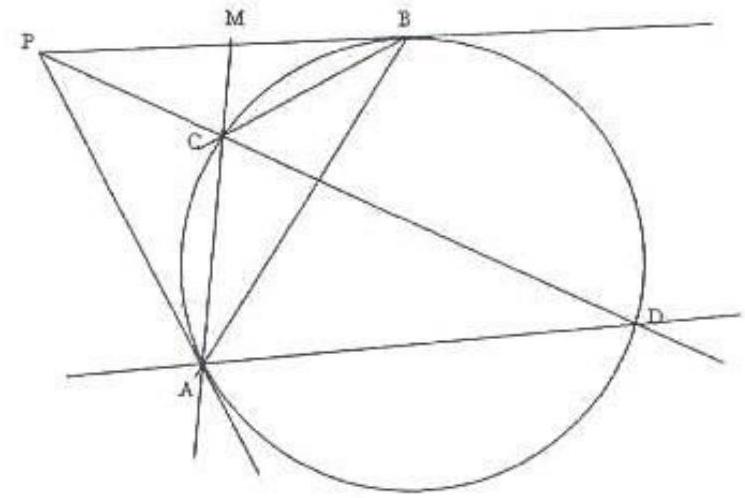
The point $P$ is outside of the circle $\Omega$. Two tangent lines, passing from the point $P$, touch the circle $\Omega$ at the points $A$ and $B$. The median $A M, M \in(B P)$, intersects the circle $\Omega$ at the point $C$ and the line $P C$ intersects again the circle $\Omega$ at the point $D$. Prove th... | ## Solution:
Since $\angle B A C=\angle B A M=\angle M B C$, we have $\triangle M A B \cong \triangle M B C$.
We obtain $\frac{M A}{M B}=\frac{M B}{M C}=\frac{A B}{B C}$. The equality $\qua... | proof | Geometry | proof | Yes | Yes | olympiads | false |
## G3 GRE
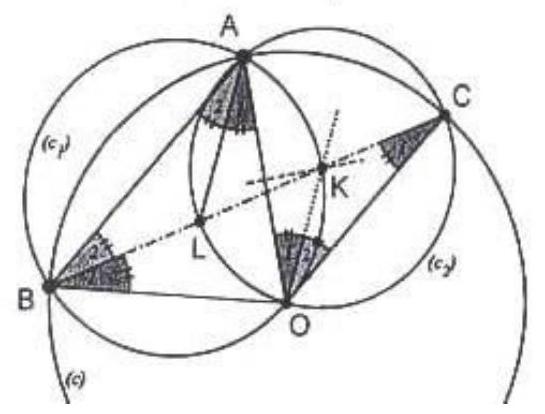
Let $c \equiv c(O, K)$ be a circle with center $O$ and radius $R$ and $A, B$ be two points on it, not belonging to the same diameter. The bisector of the angle $A \hat{B} O$ intersects the circle $c$ at point $C$, the circumcircle of the triangle $A O B$, say ${ }^{c_{1}}$ at point $K$ and the circumcircle o... | ## Solution:
The segments $O B, O C$ are equal, as radii of the circle ${ }^{c}$. Hence $O B C$ is an isosceles triangle and
$$
\hat{B}_{1}=\hat{C}_{1}=\hat{x}
$$
The chord $B C$ is the b... | proof | Geometry | proof | Yes | Yes | olympiads | false |
G4
CYP
Let $\triangle A B C$ be an acute triangle. The lines $\left(\varepsilon_{1}\right),\left(\varepsilon_{2}\right)$ are perpendicular to $A B$ at the points $A$, $B$, respectively. The perpendicular lines from the midpoint $M$ of $A B$ to the sides of the triangle $A C_{;} B C$ intersect the lines $\left(\varep... | ## Solution:
Let $H, G$ be the points of intersection of $M E, M F$, with $A C, B C$ respectively. From the similarity of triangles $\triangle M H A$ and $\triangle M A E$ we get
$$
\frac{M H}{M A}=\frac{M A}{M E}
$$
thus, $M A^{2}=M H \cdot M E$
Similarly, from the similarity of triangles $\triangle M B G$ and $\t... | proof | Geometry | proof | Yes | Yes | olympiads | false |
NT1 SAU
What is the greatest number of integers that can be selected from a set of 2015 consecutive numbers so that no sum of any two selected numbers is divisible by their difference?
| ## Solution:
We take any two chosen numbers. If their difference is 1 , it is clear that their sum is divisible by their difference. If their difference is 2 , they will be of the same parity, and their sum is divisible by their difference. Therefore, the difference between any chosen numbers will be at least 3 . In o... | 672 | Number Theory | math-word-problem | Yes | Yes | olympiads | false |
## NT3 ALB
a) Show that the product of all differences of possible couples of six given positive integers is divisible by 960 (original from Albania).
b) Show that the product of all differences of possible couples of six given positive integers. is divisible by 34560 (modified by problem selecting committee).
| ## Solution:
a) Since we have six numbers then at least two of them have a same residue when divided by 3 , so at least one of the differences in our product is divisible by 3 .
Since we have six numbers then at least two of them have a same residuc when divided by 5 , so at least one of the differences in our produc... | proof | Number Theory | proof | Yes | Yes | olympiads | false |
NT4 MLD
Find all prime numbers $a, b, c$ and integers $k$ which satisfy the equation $a^{2}+b^{2}+16 \cdot c^{2}=9 \cdot k^{2}+1$.
| ## Solution:
The relation $9 \cdot k^{2}+1 \equiv 1(\bmod 3)$ implies
$$
a^{2}+b^{2}+16 \cdot c^{2} \equiv 1(\bmod 3) \Leftrightarrow a^{2}+b^{2}+c^{2} \equiv 1(\bmod 3)
$$
Since $a^{2} \equiv 0,1(\bmod 3), b^{2} \equiv 0,1(\bmod 3), c^{2} \equiv 0,1(\bmod 3)$, we have:
| $a^{2}$ | 0 | 0 | 0 | 0 | 1 | 1 | 1 | 1 |
|... | (37,3,3,13),(17,3,3,7),(37,3,3,-13),(17,3,3,-7),(3,37,3,13),(3,17,3,7),(3,37,3,-13),(3,17,3,-7),(3,3,2,3),(3,3,2,-3) | Number Theory | math-word-problem | Incomplete | Yes | olympiads | false |
## NT5 MNE
Does there exist positive integers $a, b$ and a prime $p$ such that
$$
a^{3}-b^{3}=4 p^{2} ?
$$
| ## Solution:
The given equality may be written as
$$
(a-b)\left(a^{2}+a b+b^{2}\right)=4 p^{2}
$$
Since $a-b3$ and $3^{2} \equiv 0(\bmod 3)$, it follows that the congruence (5) is not satisfied for any odd prime $p$.
If $a-b=4$, then substituting $a=b+4$ in (1) we obtain
$$
3 b^{2}+12 b+16=p^{2}
$$
whence it foll... | proof | Number Theory | math-word-problem | Yes | Yes | olympiads | false |
## C1 BUL
A board $n \times n(n \geq 3)$ is divided into $n^{2}$ unit squares. Integers from 0 to $n$ included are written down: one integer in each unit square, in such a way that the sums of integers in each $2 \times 2$ square of the board are different. Find all $n$ for which such boards exist.
| ## Solution:
The number of the $2 \times 2$ squares in a board $n \times n$ is equal to $(n-1)^{2}$. All possible sums of the numbers in such squares are $0,1, \ldots, 4 n$. A necessary condition for the existence of a board with the required property is $4 n+1 \geq(n-1)^{2}$ and consequently $n(n-6) \leq 0$. Thus $n ... | 3\leqn\leq6 | Combinatorics | math-word-problem | Yes | Yes | olympiads | false |
## C3 ALB
Positive integers are put into the following table
| 1 | 3 | 6 | 10 | 15 | 21 | 28 | 36 | | |
| ---: | ---: | ---: | ---: | ---: | ---: | ---: | ---: | ---: | ---: |
| 2 | 5 | 9 | 14 | 20 | 27 | 35 | 44 | | |
| 4 | 8 | 13 | 19 | 26 | 34 | 43 | 53 | | |
| 7 | 12 | 18 | 25 | 33 | 42 | | | | |
| 11 |... | ## Solution 1:
We shall observe straights lines as on the next picture. We can call these lines diagonals.
| 1 | $\sqrt{3}$ | 6 | 10 | 15 | 21 | 28 | 36 | |
| :---: | :---: | :---: | :---: | :---: | :---: | :---: | :---: | :---: |
| 2 | 5 | 9 | 14 | 20 | 27 | 35 | 44 | |
| 4 | 8 | 13 | 19 | 26 | 34 | 43 | 53 | |
|... | 2015 | Number Theory | math-word-problem | Yes | Yes | olympiads | false |
C4
GRE
Let $n \geq 1$ be a positive integer. A square of side length $n$ is divided by lines parallel to each side into $n^{2}$ squares of side length 1 . Find the number of parallelograms which have vertices among the vertices of the $n^{2}$ squares of side length 1 , with both sides smaller or equal to 2 , and whi... |
Solution:
We can divide all these parallelograms into 7 classes (types I-VII), according to Figure.
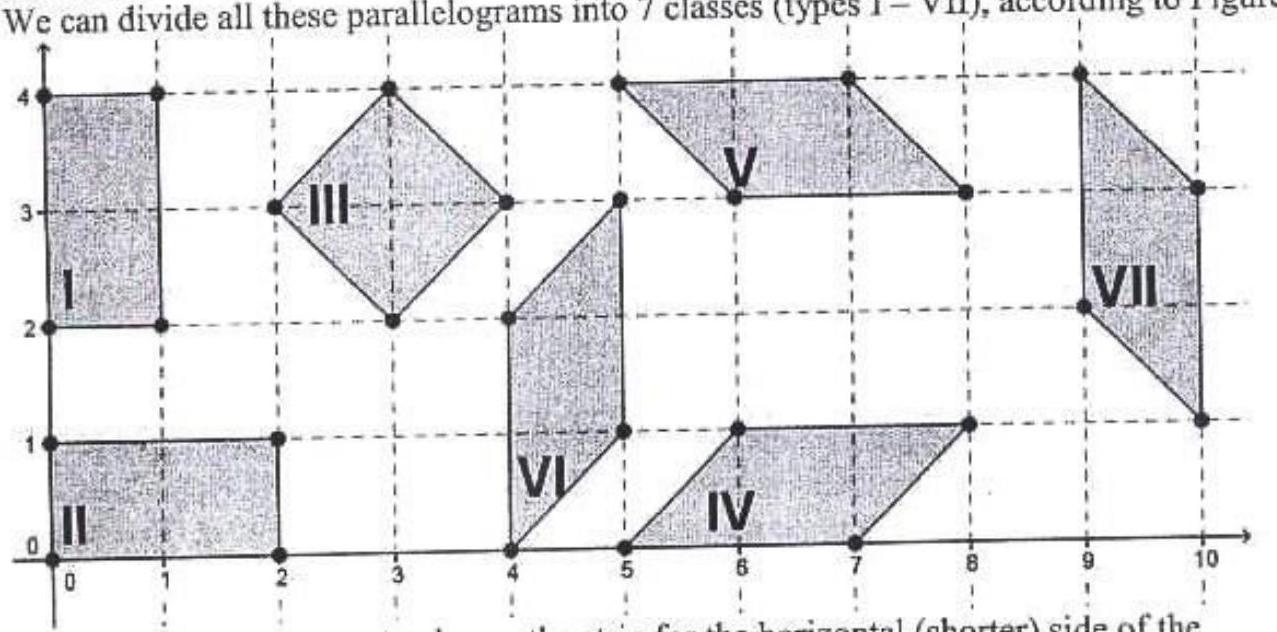
Type 1: There are $n$ ways to choose the strip for the horizontal (shorter) side of th... | 7n^{2}-12n+1 | Combinatorics | math-word-problem | Yes | Yes | olympiads | false |
A1 Let $a$ be a real positive number such that $a^{3}=6(a+1)$. Prove that the equation $x^{2}+a x+a^{2}-6=0$ has no solution in the set of the real number.
| ## Solution
The discriminant of the equation is $\Delta=3\left(8-a^{2}\right)$. If we accept that $\Delta \geq 0$, then $a \leq 2 \sqrt{2}$ and $\frac{1}{a} \geq \frac{\sqrt{2}}{4}$, from where $a^{2} \geq 6+6 \cdot \frac{\sqrt{2}}{4}=6+\frac{6}{a} \geq 6+\frac{3 \sqrt{2}}{2}>8$ (contradiction).
| proof | Algebra | proof | Yes | Yes | olympiads | false |
A2 Prove that $\frac{a^{2}-b c}{2 a^{2}+b c}+\frac{b^{2}-c a}{2 b^{2}+c a}+\frac{c^{2}-a b}{2 c^{2}+a b} \leq 0$ for any real positive numbers $a, b, c$.
| ## Solution
The inequality rewrites as $\sum \frac{2 a^{2}+b c-3 b c}{2 a^{2}+b c} \leq 0$, or $3-3 \sum \frac{b c}{2 a^{2}+b c} \leq 0$ in other words $\sum \frac{b c}{2 a^{2}+b c} \geq 1$.
Using Cauchy-Schwarz inequality we have
$$
\sum \frac{b c}{2 a^{2}+b c}=\sum \frac{b^{2} c^{2}}{2 a^{2} b c+b^{2} c^{2}} \geq ... | proof | Inequalities | proof | Yes | Yes | olympiads | false |
A3 Let $A$ be a set of positive integers containing the number 1 and at least one more element. Given that for any two different elements $m, n$ of $A$ the number $\frac{m+1}{(m+1, n+1)}$ is also an element of $A$, prove that $A$ coincides with the set of positive integers.
| ## Solution
Let $a>1$ be lowest number in $A \backslash\{1\}$. For $m=a, n=1$ one gets $y=\frac{a+1}{(2, a+1)} \in A$. Since $(2, a+1)$ is either 1 or 2 , then $y=a+1$ or $y=\frac{a+1}{2}$.
But $1<\frac{a+1}{2}<a$, hence $y=a+1$. Applying the given property for $m=a+1, n=a$ one has $\frac{a+2}{(a+2, a+1)}=a+2 \in A$,... | proof | Number Theory | proof | Yes | Yes | olympiads | false |
A4 Let $a$ and $b$ be positive integers bigger than 2. Prove that there exists a positive integer $k$ and a sequence $n_{1}, n_{2}, \ldots, n_{k}$ consisting of positive integers, such that $n_{1}=a$, $n_{k}=b$, and $\left(n_{i}+n_{i+1}\right) \mid n_{i} n_{i+1}$ for all $i=1,2, \ldots, k-1$.
| ## Solution
We write $a \Leftrightarrow b$ if the required sequence exists. It is clear that $\Leftrightarrow$ is equivalence relation, i.e. $a \Leftrightarrow a,(a \Leftrightarrow b$ implies $b \Rightarrow a)$ and $(a \Leftrightarrow b, b \Leftrightarrow c$ imply $a \Leftrightarrow c$ ).
We shall prove that for ever... | proof | Number Theory | proof | Yes | Yes | olympiads | false |
A5 The real numbers $x, y, z, m, n$ are positive, such that $m+n \geq 2$. Prove that
$$
\begin{gathered}
x \sqrt{y z(x+m y)(x+n z)}+y \sqrt{x z(y+m x)(y+n z)}+z \sqrt{x y(z+m x)(x+n y)} \leq \\
\frac{3(m+n)}{8}(x+y)(y+z)(z+x) .
\end{gathered}
$$
| ## Solution
Using the AM-GM inequality we have
$$
\begin{aligned}
& \sqrt{y z(x+m y)(x+n z)}=\sqrt{(x z+m y z)(x y+n y z)} \leq \frac{x y+x z+(m+n) y z}{2} \\
& \sqrt{x z(y+m x)(y+n z)}=\sqrt{(y z+m x z)(x y+n x z)} \leq \frac{x y+y z+(m+n) x z}{2} \\
& \sqrt{x y(z+m x)(z+n y)}=\sqrt{(y z+m x y)(x z+n x y)} \leq \fra... | proof | Inequalities | proof | Yes | Yes | olympiads | false |
C1 We call a tiling of an $m \times n$ rectangle with corners (see figure below) "regular" if there is no sub-rectangle which is tiled with corners. Prove that if for some $m$ and $n$ there exists a "regular" tiling of the $m \times n$ rectangular then there exists a "regular" tiling also for the $2 m \times 2 n$ rect... | ## Solution
A corner-shaped tile consists of 3 squares. Let us call "center of the tile" the square that has two neighboring squares. Notice that in a "regular" tiling, the squares situated in the corners of the rectangle have to be covered by the "center" of a tile, otherwise a $2 \times 3$ (or $3 \times 2$ ) rectang... | proof | Combinatorics | proof | Yes | Yes | olympiads | false |
C2 Consider 50 points in the plane, no three of them belonging to the same line. The points have been colored into four colors. Prove that there are at least 130 scalene triangles whose vertices are colored in the same color.
| ## Solution
Since $50=4 \cdot 12+2$, according to the pigeonhole principle we will have at least 13 points colored in the same color. We start with the:
Lemma. Given $n>8$ points in the plane, no three of them collinear, then there are at least $\frac{n(n-1)(n-8)}{6}$ scalene triangles with vertices among the given p... | 130 | Combinatorics | proof | Yes | Yes | olympiads | false |
C3 The nonnegative integer $n$ and $(2 n+1) \times(2 n+1)$ chessboard with squares colored alternatively black and white are given. For every natural number $m$ with $1<m<2 n+1$, an $m \times m$ square of the given chessboard that has more than half of its area colored in black, is called a $B$-square. If the given ch... | ## Solution
Every square with even side length will have an equal number of black and white $1 \times 1$ squares, so it isn't a $B$-square. In a square with odd side length, there is one more $1 \times 1$ black square than white squares, if it has black corner squares. So, a square with odd side length is a $B$-square... | \frac{(n+1)(2n^{2}+4n+3)}{3} | Combinatorics | math-word-problem | Yes | Yes | olympiads | false |
G1 Let $M$ be an interior point of the triangle $A B C$ with angles $\varangle B A C=70^{\circ}$ and $\varangle A B C=80^{\circ}$. If $\varangle A C M=10^{\circ}$ and $\varangle C B M=20^{\circ}$, prove that $A B=M C$.
| ## Solution
Let $O$ be the circumcenter of the triangle $A B C$. Because the triangle $A B C$ is acute, $O$ is in the interior of $\triangle A B C$. Now we have that $\varangle A O C=2 \varangle A B C=160^{\circ}$, so $\varangle A C O=10^{\circ}$ and $\varangle B O C=2 \varangle B A C=140^{\circ}$, so $\varangle C B O... | proof | Geometry | proof | Yes | Yes | olympiads | false |
G4 Let $S$ be a point inside $\varangle p O q$, and let $k$ be a circle which contains $S$ and touches the legs $O p$ and $O q$ in points $P$ and $Q$ respectively. Straight line $s$ parallel to $O p$ from $S$ intersects $O q$ in a point $R$. Let $T$ be the point of intersection of the ray $(P S$ and circumscribed circ... | ## Solution
Let $\varangle O P S=\varphi_{1}$ and $\varangle O Q S=\varphi_{2}$. We have that $\varangle O P S=\varangle P Q S=\varphi_{1}$ and $\varangle O Q S=$ $\varangle Q P S=\varphi_{2}$ (tangents to circle $k$ ).
Because $R S \| O P$ we have $\varangle O P S=\varangle R S T=\varphi_{1}$ and $\varangle R Q T=\v... | proof | Geometry | proof | Yes | Yes | olympiads | false |
NT1 Find all the pairs positive integers $(x, y)$ such that
$$
\frac{1}{x}+\frac{1}{y}+\frac{1}{[x, y]}+\frac{1}{(x, y)}=\frac{1}{2}
$$
where $(x, y)$ is the greatest common divisor of $x, y$ and $[x, y]$ is the least common multiple of $x, y$.
| ## Solution
We put $x=d u$ and $y=d v$ where $d=(x, y)$. So we have $(u, v)=1$. From the conclusion we obtain $2(u+1)(v+1)=d u v$. Because $(v, v+1)=1, v$ divides $2(u+1)$.
Case 1. $u=v$. Hence $x=y=[x, y]=(x, y)$, which leads to the solution $x=8$ and $y=8$.
Case 2. $uv$. Because of the symmetry of $u, v$ and $x, y... | (8,8),(9,24),(24,9),(5,20),(20,5),(12,15),(15,12),(8,12),(12,8),(6,12),(12,6) | Number Theory | math-word-problem | Yes | Yes | olympiads | false |
NT2 Prove that the equation $x^{2006}-4 y^{2006}-2006=4 y^{2007}+2007 y$ has no solution in the set of the positive integers.
| ## Solution
We assume the contrary is true. So there are $x$ and $y$ that satisfy the equation. Hence we have
$$
\begin{gathered}
x^{2006}=4 y^{2007}+4 y^{2006}+2007 y+2006 \\
x^{2006}+1=4 y^{2006}(y+1)+2007(y+1) \\
x^{2006}+1=\left(4 y^{2006}+2007\right)(y+1)
\end{gathered}
$$
But $4 y^{2006}+2007 \equiv 3(\bmod 4)... | proof | Number Theory | proof | Yes | Yes | olympiads | false |
NT3 Let $n>1$ be a positive integer and $p$ a prime number such that $n \mid(p-1)$ and $p \mid\left(n^{6}-1\right)$. Prove that at least one of the numbers $p-n$ and $p+n$ is a perfect square.
| ## Solution
Since $n \mid p-1$, then $p=1+n a$, where $a \geq 1$ is an integer. From the condition $p \mid n^{6}-1$, it follows that $p|n-1, p| n+1, p \mid n^{2}+n+1$ or $p \mid n^{2}-n+1$.
- Let $p \mid n-1$. Then $n \geq p+1>n$ which is impossible.
- Let $p \mid n+1$. Then $n+1 \geq p=1+n a$ which is possible only ... | proof | Number Theory | proof | Yes | Yes | olympiads | false |
NT5 Let $p$ be a prime number. Show that $7 p+3^{p}-4$ is not a perfect square.
| ## Solution
Assume that for a prime number $p$ greater than $3, m=7 p+3^{p}-4$ is a perfect square. Let $m=n^{2}$ for some $n \in \mathbb{Z}$. By Fermat's Little Theorem,
$$
m=7 p+3^{p}-4 \equiv 3-4 \equiv-1 \quad(\bmod p)
$$
If $p=4 k+3, k \in \mathbb{Z}$, then again by Fermat's Little Theorem
$$
-1 \equiv m^{2 k+... | proof | Number Theory | proof | Yes | Yes | olympiads | false |
## A2
Let $a, b$ and $c$ be positive real numbers such that abc $=\frac{1}{8}$. Prove the inequality
$$
a^{2}+b^{2}+c^{2}+a^{2} b^{2}+b^{2} c^{2}+c^{2} a^{2} \geq \frac{15}{16}
$$
When does equality hold?
|
Solution1. By using The Arithmetic-Geometric Mean Inequality for 15 positive numbers, we find that
$$
\begin{aligned}
& a^{2}+b^{2}+c^{2}+a^{2} b^{2}+b^{2} c^{2}+c^{2} a^{2}= \\
& \quad=\frac{a^{2}}{4}+\frac{a^{2}}{4}+\frac{a^{2}}{4}+\frac{a^{2}}{4}+\frac{b^{2}}{4}+\frac{b^{2}}{4}+\frac{b^{2}}{4}+\frac{b^{2}}{4}+\fra... | \frac{15}{16} | Inequalities | proof | Yes | Yes | olympiads | false |
## C1
Several (at least two) segments are drawn on a board. Select two of them, and let $a$ and $b$ be their lengths. Delete the selected segments and draw a segment of length $\frac{a b}{a+b}$. Continue this procedure until only one segment remains on the board. Prove:
a) the length of the last remaining segment doe... |
Solution. a) Observe that $\frac{1}{\frac{a b}{a+b}}=\frac{1}{a}+\frac{1}{b}$. Thus, if the lengths of the initial segments on the board were $a_{1}, a_{2}, \ldots, a_{n}$, and $c$ is the length of the last remaining segment, then $\frac{1}{c}=\frac{1}{a_{1}}+\frac{1}{a_{2}}+\ldots+\frac{1}{a_{n}}$ , proving a).
b) F... | proof | Algebra | proof | Yes | Yes | olympiads | false |
## C2
In a country with $n$ cities, all direct airlines are two-way. There are $r>2014$ routes between pairs of different cities that include no more than one intermediate stop (the direction of each route matters). Find the least possible $n$ and the least possible $r$ for that value of $n$.
|
Solution. Denote by $X_{1}, X_{2}, \ldots X_{n}$ the cities in the country and let $X_{i}$ be connected to exactly $m_{i}$ other cities by direct two-way airline. Then $X_{i}$ is a final destination of $m_{i}$ direct routes and an intermediate stop of $m_{i}\left(m_{i}-1\right)$ non-direct routes. Thus $r=m_{1}^{2}+\l... | 2016 | Combinatorics | math-word-problem | Yes | Yes | olympiads | false |
## C3
For a given positive integer n, two players $A$ and B play the following game: Given is pile of $\boldsymbol{\Omega}$ stones. The players take turn alternatively with A going first. On each turn the player is allowed to take one stone, a prime number of stones, or a multiple of $n$ stones. The winner is the one ... |
Solution. Denote by $k$ the sought number and let $\left\{a_{1}, a_{2}, \ldots, a_{k}\right\}$ be the corresponding values for $a$. We will call each $a_{i}$ a losing number and every other positive integer a winning numbers. Clearly every multiple of $n$ is a winning number.
Suppose there are two different losing nu... | n-1 | Combinatorics | math-word-problem | Yes | Yes | olympiads | false |
## C4
Let $A=1 \cdot 4 \cdot 7 \cdot \ldots \cdot 2014$ be the product of the numbers less or equal to 2014 that give remainder 1 when divided by 3 . Find the last non-zero digit of $A$.
|
Solution. Grouping the elements of the product by ten we get:
$$
\begin{aligned}
& (30 k+1)(30 k+4)(30 k+7)(30 k+10)(30 k+13)(30 k+16) \\
& (30 k+19)(30 k+22)(30 k+25)(30 k+28)= \\
& =(30 k+1)(15 k+2)(30 k+7)(120 k+40)(30 k+13)(15 k+8) \\
& (30 k+19)(15 k+11)(120 k+100)(15 k+14)
\end{aligned}
$$
(We divide all even ... | 2 | Number Theory | math-word-problem | Yes | Yes | olympiads | false |
## G3
Let $C D \perp A B(D \in A B), D M \perp A C(M \in A C)$ and $D N \perp B C(N \in B C)$ for an acute triangle ABC with area $S$. If $H_{1}$ and $H_{2}$ are the orthocentres of the triangles $M N C$ and MND respectively. Evaluate the area of the quadrilateral $\mathrm{AH}_{1} \mathrm{BH}_{2}$.
|
Solution1. Let $O, P, K, R$ and $T$ be the midpoints of the segments $C D, M N, C N, C H_{1}$ and $M H_{1}$, respectively. From $\triangle M N C$ we have that $\overline{P K}=\frac{1}{2} \overline{M C}$ and $P K \| M C$. Analogously, from $\Delta M H_{1} C$ we have that $\overline{T R}=\frac{1}{2} \overline{M C}$ and ... | S | Geometry | math-word-problem | Yes | Yes | olympiads | false |
## G6
Let $A B C D$ be a quadrilateral whose sides $A B$ and $C D$ are not parallel, and let $O$ be the intersection of its diagonals. Denote with $H_{1}$ and $H_{2}$ the orthocenters of the triangles $O A B$ and OCD, respectively. If $M$ and $N$ are the midpoints of the segments $\overline{A B}$ and $\overline{C D}$,... | ## Solution.
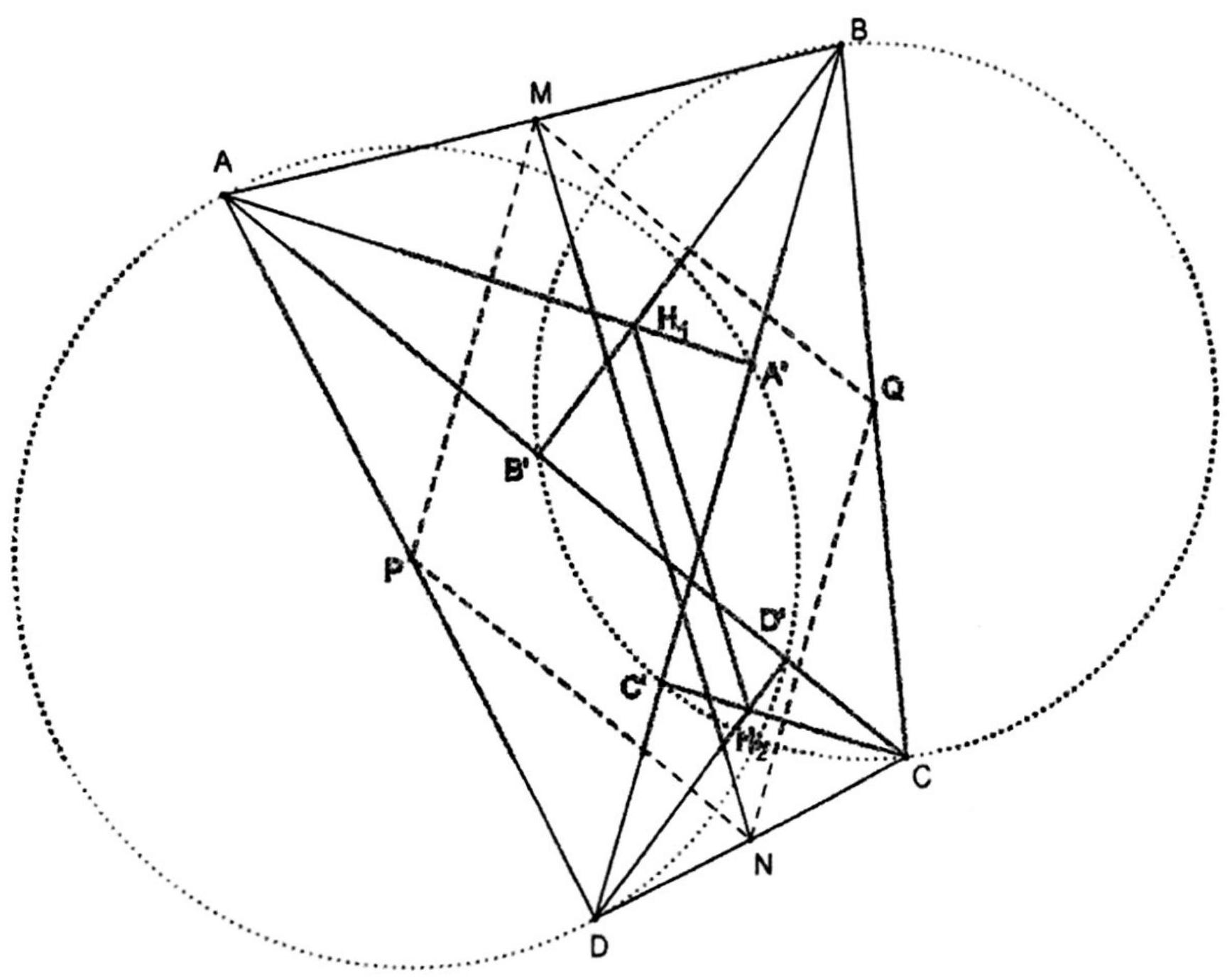
Let $A^{\prime}$ and $B^{\prime}$ be the feet of the altitudes drawn from $A$ and $B$ respectively in the triangle $A O B$, and $C^{\prime}$ and $D^{\prime}$ are the feet of ... | proof | Geometry | proof | Yes | Yes | olympiads | false |
## N1
Each letter of the word OHRID corresponds to a different digit belonging to the set $(1,2,3,4,5)$. Decipher the equality $(O+H+R+I+D)^{2}:(O-H-R+I+D)=O^{H^{R^{I_{D}^{D}}}}$.
|
Solution. Since $O, H, R, I$ and $D$ are distinct numbers from $\{1,2,3,4,5\}$, we have $O+H+R+I+D=15$ and $O-H-R+I+D=O+H+R+I+D-2(H+R)15$ and divides 225 , which is only possible for $O^{H^{R^{I^{D}}}}=25$ (must be a power of three or five). This implies that $O=5, H=2$ and $R=1$. It's easy to check that both $I=3, D=... | O=5,H=2,R=1,I=3,D=4orO=5,H=2,R=1 | Logic and Puzzles | math-word-problem | Yes | Yes | olympiads | false |
N3
Find the integer solutions of the equation
$$
x^{2}=y^{2}\left(x+y^{4}+2 y^{2}\right)
$$
|
Solution. If $x=0$, then $y=0$ and conversely, if $y=0$, then $x=0$. It follows that $(x, y)=(0,0)$ is a solution of the problem. Assume $x \neq 0$ and $y \neq 0$ satisfy the equation. The equation can be transformed in the form $x^{2}-x y^{2}=y^{6}+2 y^{4}$. Then $4 x^{2}-4 x y^{2}+y^{4}=4 y^{6}+9 y^{4}$ and conseque... | (x,y)=(0,0),(12,-2),(12,2),(-8,-2),(-8,2) | Algebra | math-word-problem | Yes | Yes | olympiads | false |
N4
Prove there are no integers $a$ and $b$ satisfying the following conditions:
i) $16 a-9 b$ is a prime number
ii) $\quad a b$ is a perfect square
iii) $a+b$ is a perfect square
|
Solution. Suppose $a$ and $b$ be integers satisfying the given conditions. Let $p$ be a prime number, $n$ and $m$ be integers. Then we can write the conditions as follows:
$$
\begin{aligned}
& 16 a-9 b=p \\
& a b=n^{2} \\
& a+b=m^{2}
\end{aligned}
$$
Moreover, let $d=g d c(a, b)$ and $a=d x, b=d y$ for some relative... | proof | Number Theory | proof | Yes | Yes | olympiads | false |
## N6
Vukasin, Dimitrije, Dusan, Stefan and Filip asked their professor to guess a three consecutive positive integer numbers after they had told him these (true) sentences:
Vukasin: "Sum of the digits of one of them is a prime number. Sum of the digits of some of the other two is an even perfect number ( $n$ is perf... |
Solution. Let the middle number be $n$, so the numbers are $n-1, n$ and $n+1$. Since 4 does not divide any of them, $n \equiv 2(\bmod 4)$. Furthermore, neither 3,5 nor 7 divides $n$. Also $n+1+11 \equiv 2(\bmod 4)$ cannot be a square. Then 3 must divide $n-1$ or $n+1$. If $n-1+11$ is a square, then $3 \mid n+1$ which ... | 2013,2014,2015 | Number Theory | math-word-problem | Yes | Yes | olympiads | false |
N7. Find all perfect squares $n$ such that if the positive integer $a \geqslant 15$ is some divisor of $n$ then $a+15$ is a prime power.
| ## SOLUTIONS
## ALGEBRA
| notfound | Number Theory | math-word-problem | Yes | Incomplete | olympiads | false |
A1. Real numbers $a$ and $b$ satisfy $a^{3}+b^{3}-6 a b=-11$. Prove that $-\frac{7}{3}<a+b<-2$.
|
Solution. Using the identity
$$
x^{3}+y^{3}+z^{3}-3 x y z=\frac{1}{2}(x+y+z)\left((x-y)^{2}+(y-z)^{2}+(z-x)^{2}\right)
$$
we get
$$
-3=a^{3}+b^{3}+2^{3}-6 a b=\frac{1}{2}(a+b+2)\left((a-b)^{2}+(a-2)^{2}+(b-2)^{2}\right)
$$
Since $S=(a-b)^{2}+(a-2)^{2}+(b-2)^{2}$ must be positive, we conclude that $a+b+218
$$
Here... | proof | Algebra | proof | Yes | Incomplete | olympiads | false |
A3. Let $A$ and $B$ be two non-empty subsets of $X=\{1,2, \ldots, 11\}$ with $A \cup B=X$. Let $P_{A}$ be the product of all elements of $A$ and let $P_{B}$ be the product of all elements of $B$. Find the minimum and maximum possible value of $P_{A}+P_{B}$ and find all possible equality cases.
|
Solution. For the maximum, we use the fact that $\left(P_{A}-1\right)\left(P_{B}-1\right) \geqslant 0$, to get that $P_{A}+P_{B} \leqslant P_{A} P_{B}+1=11!+1$. Equality holds if and only if $A=\{1\}$ or $B=\{1\}$.
For the minimum observe, first that $P_{A} \cdot P_{B}=11!=c$. Without loss of generality let $P_{A} \l... | 12636 | Combinatorics | math-word-problem | Yes | Yes | olympiads | false |
A4. Let $a, b$ be two distinct real numbers and let $c$ be a positive real number such that
$$
a^{4}-2019 a=b^{4}-2019 b=c
$$
Prove that $-\sqrt{c}<a b<0$.
|
Solution. Firstly, we see that
$$
2019(a-b)=a^{4}-b^{4}=(a-b)(a+b)\left(a^{2}+b^{2}\right)
$$
Since $a \neq b$, we get $(a+b)\left(a^{2}+b^{2}\right)=2019$, so $a+b \neq 0$. Thus
$$
\begin{aligned}
2 c & =a^{4}-2019 a+b^{4}-2019 b \\
& =a^{4}+b^{4}-2019(a+b) \\
& =a^{4}+b^{4}-(a+b)^{2}\left(a^{2}+b^{2}\right) \\
& ... | proof | Algebra | proof | Yes | Yes | olympiads | false |
C1. Let $S$ be a set of 100 positive integers having the following property:
"Among every four numbers of $S$, there is a number which divides each of the other three or there is a number which is equal to the sum of the other three."
Prove that the set $S$ contains a number which divides each of the other 99 number... |
Solution. Let $a<b$ be the two smallest numbers of $S$ and let $d$ be the largest number of $S$. Consider any two other numbers $x<y$ of $S$. For the quadruples $(a, b, x, d)$ and $(a, b, y, d)$ we cannot get both of $d=a+b+x$ and $d=a+b+y$, since $a+b+x<a+b+y$. From here, we get $a \mid b$ and $a \mid d$.
Consider a... | proof | Number Theory | proof | Yes | Yes | olympiads | false |
C2. In a certain city there are $n$ straight streets, such that every two streets intersect, and no three streets pass through the same intersection. The City Council wants to organize the city by designating the main and the side street on every intersection. Prove that this can be done in such way that if one goes a... |
Solution. Pick any street $s$ and organize the intersections along $s$ such that the intersections of the two types alternate, as in the statement of the problem.
On every other street $s_{1}$, exactly one intersection has been organized, namely the one where $s_{1}$ intersects $s$. Call this intersection $I_{1}$. We... | proof | Combinatorics | proof | Yes | Yes | olympiads | false |
C3. In a $5 \times 100$ table we have coloured black $n$ of its cells. Each of the 500 cells has at most two adjacent (by side) cells coloured black. Find the largest possible value of $n$.
|
Solution. If we colour all the cells along all edges of the board together with the entire middle row except the second and the last-but-one cell, the condition is satisfied and there are 302 black cells. The figure below exhibits this colouring for the $5 \times 8$ case.
}{2}=7 k$. This is possible only if $n \equiv 0,1 \bmod 7$.
- In order to obtain $n=7 m+1$, arrange the kids in a circ... | 26 | Combinatorics | math-word-problem | Yes | Yes | olympiads | false |
Olympiad mathematics training pool
Public olympiad and competition mathematics, four datasets gathered at pinned revisions, shipped
twice over. sources/ holds each dataset the way its publisher ships it, in its own file format
with its own fields and nothing renamed, 229052 rows across four folders. pool/ holds the union
of those same datasets in one format, one JSON object per line, deduplicated by problem text and
reduced to 225822 rows, every row labelled with the dataset it came from, that dataset's revision
and its provenance class.
Nothing here is filtered for quality, for difficulty or for how it was produced. Problems written by people, problems copied from competition papers, and solutions a language model rewrote all sit in the pool, labelled, and which of them to use is the reader's decision. Take the union if one format is what you want, take a source folder if you already know that dataset and want its own columns.
Layout
README.md
pool/pool-00000-of-00003.jsonl  ...  pool-00002-of-00003.jsonl   the union, 225822 rows
sources/deepscaler/              1 file,   36695 rows
sources/olympiadbench_other/    11 files,   5000 rows
sources/omni_math/               1 file,    2977 rows
sources/numinamath_olympiads/    3 files, 184380 rows
The union is shuffled with a fixed seed, so any prefix of any file is a sample of the whole pool rather than of one source. The pool is about 548 MB on disk, 365 MB of it the union and 184 MB the source folders.
The union under pool/
One JSON object per line, with these fields.
| Field | What it holds |
|---|---|
id |
olympiad_ and a seven digit number, unique across the whole union |
problem |
the problem text, exactly as the source publishes it, LaTeX and all |
answer |
the final answer alone, as a string, or null when the row has none |
solution |
the worked solution, or null when the row has none |
has_answer |
whether answer is not null |
has_solution |
whether solution is not null |
answer_from |
dataset when the source published the answer as its own field, boxed_in_solution when it was read from the last box of the solution, null when there is no answer |
source |
the folder under sources/ the row came from |
source_subset |
the value of that source's own subset column, where it has one, and the configuration name for the one source that splits by file |
source_repo |
the Hugging Face repository the source was taken from |
source_revision |
the commit of that repository, so every row is traceable to a pinned revision |
source_file |
the file under sources/ the row came from |
source_row |
the row's position in that file, counting from zero |
provenance |
how the PROBLEM was produced: human, collected or model-generated |
solution_provenance |
how the SOLUTION was produced, on the same three values, null when there is no solution |
language |
en or zh |
Counts over the 225822 rows: 151316 carry an answer and 195341 carry a solution. Of the answers, 151307 are the source's own answer field and 9 were read out of the last box of a solution. By provenance of the problem: 217623 collected, 8199 human, none model-generated. By language: 221281 English, 4541 Chinese.
By source: 184335 from numinamath_olympiads, 35809 from deepscaler, 4998 from olympiadbench_other
and 680 from omni_math. That last number is small because the union keeps one row per distinct
problem and prefers the copy that carries the most, an answer first, then a solution, and then the
earlier source in the list above. Most omni_math problems are also in deepscaler, which was built
in part from them, so they lose that comparison, and the full omni_math file sits under sources/.
The largest subsets are olympiads with 181814 rows and olympiads_ref with 2521, both from
numinamath_olympiads, then deepscaler with 35809, then the Chinese entrance-examination
configurations of olympiadbench_other with 3839 between them.
The sources under sources/
deepscaler, agentica-org/DeepScaleR-Preview-Dataset at b6ae8c60f5c1f2b594e2140b91c49c9ad0949e29,
36695 rows in one JSON file holding a list of objects with problem, answer and solution, the
answer being the final answer alone. MIT. Provenance collected, solutions collected. About forty
thousand competition problems with a single short answer, compiled from the AIME papers of 1984 to
2023, the AMC papers before 2023, an olympiad collection and the STILL collection. The problems
and the worked solutions are the ones the competitions and the archives published. A model was
used only to read the final answer out of each solution, and answers a symbolic checker could not
handle were dropped.
olympiadbench_other, Hothan/OlympiadBench at 91184b52131e7fc9455fef848035173aea8cc01a,
5000 rows across eleven parquet files, one per configuration, with question, solution (a list),
final_answer (a list), context, unit, answer_type, subfield, language and the image columns, which
carry data only in the MM configurations. Apache 2.0. Provenance human, solutions human. Olympiad
and Chinese college entrance examination mathematics, with expert step-by-step solutions written
for the collection. One file per configuration: the name says open-ended (OE) or theorem proof
(TP), text-only (TO) or with figures (MM), the language and whether the problems come from a
competition (COMP) or the entrance examination (CEE). The theorem-proof files carry a solution and
no final answer, and the figure files carry the figures themselves in their image columns, which
means their problems refer to pictures this pool does not reproduce. One configuration of the
twelve that repository publishes for mathematics is not here.
omni_math, KbsdJames/Omni-MATH at 40ba231d8f16e29ecd40e6407e2c8640145a8f62, 2977 rows, one
JSON object per line with problem, solution, answer, domain, difficulty and source, the source
naming the competition and the difficulty being a rating from 1 to 10. Apache 2.0. Provenance
human, solutions human. Olympiad problems collected from the official competition websites and the
Art of Problem Solving wiki, with the solutions those sites published and a difficulty rating and
a subject path added by hand. Problems and solutions are both written by people. AMC and AIME
problems were deliberately left out when it was built.
numinamath_olympiads, AI-MO/NuminaMath-1.5 at 1b05109f9e5c1ad06c0663519502416c30b300f8,
184380 rows across three parquet shards with problem, solution, answer, problem_type,
question_type, problem_is_valid, solution_is_valid, source and synthetic. An answer of proof or
notfound means the row has no short answer. Apache 2.0. Provenance collected, solutions
model-generated. This is the olympiad part of the largest compilation of competition mathematics
on the hub: the rows whose source column says olympiads, drawn from olympiad papers, and the
rows whose source column says olympiads_ref, which the compilers parsed and checked by hand
against the official websites of national olympiads. The other subsets of that compilation, its
school material and the problems a model wrote from seed problems, are not here, which is why
these shards are far smaller than the ones that repository publishes. The solutions were rewritten
into a uniform style by a large language model whatever the problem's origin, so the solution text
is model-generated across the file, and the short answers were extracted by the same model.
Provenance in plain words
- human: a person wrote the text, with no model in the loop.
- collected: the text is a real artefact of people doing something, a competition paper, an examination, a forum post, a textbook, gathered rather than written for a dataset.
- model-generated: a language model wrote it. No problem in this pool is in this class. Every solution in numinamath_olympiads is, because that compilation rewrote all of its solutions with a model.
- rule-generated: a program or a template produced it. Nothing in this pool is in this class.
Most of the pool is collected: real olympiad and competition problems, gathered at scale. The
human class is the two collections whose problems and solutions people wrote and checked. If you
want only problems people wrote or sat, every row here qualifies. If you also care that the
reasoning was written by a person rather than rewritten by a model, filter solution_provenance
to human and collected, which leaves the omni_math, olympiadbench_other and deepscaler rows.
Licences
Each source is redistributed here under the licence its publisher declares for it, and the licence of every row is the licence of its source folder.
| Source | Licence |
|---|---|
| deepscaler | MIT |
| olympiadbench_other | Apache 2.0 |
| omni_math | Apache 2.0 |
| numinamath_olympiads | Apache 2.0 |
Apache 2.0 is the more demanding of the two, so it governs the pool as a whole. No source here is NonCommercial and none is untagged. The compilations gather material from many places, and the licence above is the one their publisher applies to the compilation.
Three corpora that would otherwise belong here are deliberately absent. The MATH training split is not included: the original upload was disabled on a takedown notice from the rightsholder, which also asked for datasets branched off it to be removed, and of the mirrors that remain one declares no licence at all, so no clean copy exists to redistribute. The Art of Problem Solving forum instruction corpus is not included either: its authors disclaim the licence tag the upload carries, and the forum it was crawled from now publishes a machine-readable reservation of rights against training use. The reasoning-trace corpus built on the compilation above is not included because its problems are already here and everything it adds is model-written reasoning over them.
A note on the counts
The counts above are the counts in this pool. Rows were removed from every source while it was assembled, so they do not match the totals the source repositories publish.
- Downloads last month
- 938