
source stringclasses 7
values | problem stringlengths 19 6.18k | generation stringlengths 345 68.1k |
|---|---|---|
olympiads | 15. For any $n \in \mathbf{N}_{+}$, calculate the sum $S=\sum_{k=0}^{\infty}\left[\frac{n+2^{k}}{2^{k+1}}\right]$. | <think>
Okay, let's see. I have this problem where I need to calculate the sum S for any positive integer n. The sum is from k=0 to infinity of the floor of (n + 2^k) divided by 2^(k+1). Hmm, floor functions can be tricky, especially in infinite sums. Let me try to break this down.
First, let's write out the general t... |
cn_contest | Example 1. Let $k$ be a real number, discuss the real roots of the equation
$$
\left|x^{2}-1\right|-x-k=0
$$ | <think>
Okay, so I have this equation: |x² - 1| - x - k = 0. The problem is to discuss the real roots of this equation depending on the value of k. Hmm, let's see. I need to figure out for which values of k the equation has real solutions, how many solutions there are, and maybe how that changes as k varies.
First, s... |
olympiads | The 21st question, given a positive integer $\mathrm{n} \geq 3$, if the $\mathrm{n}$-order simple graph $\mathrm{G}(\mathrm{V}, \mathrm{E})$ is connected, and removing all edges on any cycle in $\mathrm{G}$ makes $\mathrm{G}$ no longer connected, try to find the maximum possible value of $|\mathrm{E}(\mathrm{G})|$. | <think>
Okay, let's try to tackle this problem. So, we have a connected graph G with n vertices (n ≥ 3), and the condition is that if we remove all edges of any cycle in G, the graph becomes disconnected. We need to find the maximum possible number of edges in such a graph. Hmm, interesting. Let me break this down.
Fi... |
aops_forum | Compute the number of subsets $S$ of $\{0,1,\dots,14\}$ with the property that for each $n=0,1,\dots,
6$, either $n$ is in $S$ or both of $2n+1$ and $2n+2$ are in $S$.
[i]Proposed by Evan Chen[/i] | <think>
Okay, let's see. I need to compute the number of subsets S of the set {0,1,...,14} such that for each n=0,1,...,6, either n is in S or both of 2n+1 and 2n+2 are in S. Hmm, interesting problem. Let me try to break it down step by step.
First, the set {0,1,...,14}. Let's note that this set includes numbers from ... |
olympiads_ref | Find all triples $(x, y, z)$ of real numbers that satisfy the system
$$
\left\{\begin{array}{l}
x+y+z=2008 \\
x^{2}+y^{2}+z^{2}=6024^{2} \\
\frac{1}{x}+\frac{1}{y}+\frac{1}{z}=\frac{1}{2008}
\end{array}\right.
$$ | <think>
Okay, so I need to solve this system of equations for real numbers x, y, z. Let's see... The equations are:
1. x + y + z = 2008
2. x² + y² + z² = 6024²
3. 1/x + 1/y + 1/z = 1/2008
Hmm. Alright, let's start by recalling some algebraic identities that might help here. For three variables, the square of the sum ... |
olympiads | ## Task A-2.1.
Determine all real numbers $x$ for which
$$
\sqrt{|x-1|+|x+4|}=|x|
$$ | <think>
Okay, so I need to solve the equation √(|x - 1| + |x + 4|) = |x|. Hmm, let me think. Alright, first, since there's a square root on the left side, the expression inside the square root must be non-negative. But actually, since absolute values are always non-negative, their sum is also non-negative. So, the left... |
olympiads | 2. In the Cartesian coordinate system $x O y$, points $A$ and $B$ lie on the parabola $y^{2}=4 x$, satisfying $\overrightarrow{O A} \cdot \overrightarrow{O B}=-4$, $F$ is the focus of the parabola. Then $S_{\triangle O F A} \cdot S_{\triangle O F B}=$ $\qquad$ . | <think>
Okay, let me try to solve this problem step by step. First, I need to understand what's being asked here. We have a parabola y² = 4x, points A and B on this parabola, and the vectors OA and OB have a dot product of -4. F is the focus of the parabola, and we need to find the product of the areas of triangles OFA... |
olympiads | 4. Determine for which natural numbers \( n \) the sum
$$
\frac{n}{1!}+\frac{n}{2!}+\ldots+\frac{n}{n!}
$$
is an integer.
(E. Kováč) | <think>
Alright, let's try to figure out for which natural numbers \( n \) the sum \( S(n) = \frac{n}{1!} + \frac{n}{2!} + \ldots + \frac{n}{n!} \) is an integer. Hmm, okay. So first, maybe I should write out the sum explicitly for some small values of \( n \) and see if I can spot a pattern or come up with a conjectur... |
olympiads | XXXIV OM - II - Problem 6
For a given number $ n $, let $ p_n $ denote the probability that when a pair of integers $ k, m $ satisfying the conditions $ 0 \leq k \leq m \leq 2^n $ is chosen at random (each pair is equally likely), the number $ \binom{m}{k} $ is even. Calculate $ \lim_{n\to \infty} p_n $. | <think>
Okay, so I need to find the limit as n approaches infinity of the probability p_n that the binomial coefficient C(m, k) is even when choosing a random pair (k, m) with 0 ≤ k ≤ m ≤ 2^n. Hmm, let me start by understanding the problem step by step.
First, the setup: we're choosing pairs (k, m) where both k and m ... |
olympiads | 10. Given positive integers $x_{1}, x_{2}, x_{3}, \cdots, x_{2020}$ satisfy $x_{1}+x_{2}+x_{3}+\cdots+x_{2020}=x_{1} x_{2} x_{3} \cdots x_{2020}$. Then among these 2020 positive integers, the maximum number of values that can be 1 is $\qquad$. | <think>
Okay, so I have this problem where there are 2020 positive integers, x₁, x₂, ..., x₂₀₂₀. Their sum is equal to their product. The question is asking for the maximum number of these integers that can be 1. Hmm, interesting. Let me try to figure this out step by step.
First, let's parse the problem. We have 2020... |
aops_forum | Determine all polynomials $P(x)$ with real coefficients and which satisfy the following properties:
i) $P(0) = 1$
ii) for any real numbers $x$ and $y,$
\[|y^2-P(x)|\le 2|x|\quad\text{if and only if}\quad |x^2-P(y)|\le 2|y|.\] | <think>
Okay, so I need to find all polynomials P(x) with real coefficients that satisfy two conditions: first, P(0) = 1, and second, for any real numbers x and y, the inequality |y² - P(x)| ≤ 2|x| holds if and only if |x² - P(y)| ≤ 2|y|. Hmm, this seems a bit abstract. Let me try to unpack it step by step.
Starting w... |
olympiads | [ Decimal number system ] [ Divisibility of numbers. General properties ]
Find the last two digits in the decimal representation of the number $1!+2!+\ldots+2001!+2002!$. | <think>
Okay, let's see. I need to find the last two digits of the sum 1! + 2! + ... + 2001! + 2002!. Hmm, so that means I need to compute this huge sum modulo 100, right? Because the last two digits of a number are equivalent to the number modulo 100.
First, I remember that factorials grow really quickly. So maybe a... |
olympiads | 6.2. Lines parallel to the sides of a square form a smaller square, the center of which coincides with the center of the original square. It is known that the area of the cross formed by the smaller square (see the figure on the right) is 17 times the area of the smaller square. How many times is the area of the origin... | <think>
Okay, let me try to work through this problem step by step. So, we have a square, and lines parallel to its sides form a smaller square inside it. The center of both squares coincides. The cross formed by the smaller square has an area that's 17 times the area of the smaller square. We need to find how many tim... |
olympiads | 5.4. Find the sum of all integer values of the argument $x$ for which the corresponding values of the function
$$
y=x^{2}+x\left(\log _{5} 2-\log _{2} 10\right)-\log _{2} 25-3 \log _{5} 2
$$
do not exceed 7. | <think>
Okay, let me try to figure out this problem step by step. So, the problem is asking for the sum of all integer values of x where the function y doesn't exceed 7. The function given is a quadratic in terms of x, but it has some logarithmic terms. Hmm, first, maybe I should simplify the logarithmic expressions to... |
cn_contest | Example 2 Fill the numbers $1,2, \cdots, 9$ into the squares of a $3 \times 3$ chessboard (as shown in Figure 1), so that the sum of the absolute values of the differences between numbers in adjacent (sharing a common edge) squares is maximized. Find this maximum value. | <think>
Alright, let's tackle this problem. So, the task is to fill a 3x3 grid with numbers 1 through 9 such that the sum of the absolute differences between adjacent numbers is maximized. Hmm, interesting. I need to figure out the best arrangement of numbers to make this sum as large as possible. Let me think step by ... |
cn_contest | 9. Let $\alpha, \beta, \gamma \in \left(0, \frac{\pi}{2}\right)$, and satisfy $\cos \alpha = \alpha, \cos (\sin \beta) = \beta, \sin (\cos \gamma) = \gamma$. Then the size relationship of $\alpha, \beta, \gamma$ is $\qquad$. | <think>
Okay, so I need to figure out the relationship between α, β, and γ, given these three equations: cos α = α, cos(sin β) = β, and sin(cos γ) = γ. All three angles are between 0 and π/2, which is good because that means they're all positive and less than 90 degrees. Hmm, let me start by understanding each equation... |
olympiads | Find all integers $x, y \in \mathbb{N}$ such that $y^{6}+2 y^{3}-y^{2}+1=x^{3}$. | <think>
Okay, so I need to find all natural numbers x and y such that y^6 + 2y^3 - y^2 + 1 equals x^3. Hmm, let's start by understanding the equation. It looks like a Diophantine equation because we're dealing with integers. The left-hand side is a polynomial in y, and the right-hand side is a cube. Maybe if I can expr... |
olympiads | 10. Given that $x, y, z$ are positive numbers, and satisfy $\left\{\begin{array}{l}x^{2}+y^{2}+x y=3, \\ y^{2}+z^{2}+y z=4, \\ z^{2}+x^{2}+z x=7,\end{array}\right.$ find $x+y+z$. | <think>
Okay, so I need to solve this system of equations where x, y, and z are positive numbers. The equations are:
1. \( x^2 + y^2 + xy = 3 \)
2. \( y^2 + z^2 + yz = 4 \)
3. \( z^2 + x^2 + zx = 7 \)
And I need to find the value of \( x + y + z \).
Hmm, let me think. These equations look similar, each involving the... |
olympiads | Task 1. For the natural numbers $a, b, c, d$ it is known that
$$
a c+a d+b c+d b=68 \text { and } c+d=4
$$
Calculate the value of the expression $a+b+c+d$. | <think>
Okay, let's see. I have this problem here: For natural numbers a, b, c, d, we know that ac + ad + bc + db = 68 and c + d = 4. We need to find the value of a + b + c + d. Hmm, let's break this down step by step.
First, let's look at the given equations. The first equation is ac + ad + bc + db = 68. The second e... |
olympiads | 11. The selling price of a commodity is an integer number of yuan. 100 yuan can buy at most 3 pieces. Person A and Person B each brought several hundred-yuan bills. The money A brought can buy at most 7 pieces of this commodity, and the money B brought can buy at most 14 pieces. When the two people's money is combined,... | <think>
Okay, let's try to figure out this problem step by step. First, let me make sure I understand the problem correctly.
We have a commodity whose selling price is an integer number of yuan. The problem states that 100 yuan can buy at most 3 pieces. So, if I take 100 yuan, the maximum number of this commodity I ca... |
number_theory | 3. Encipher the message SURRENDER IMMEDIATELY using the affine transformation $C \equiv 11 P+18(\bmod 26)$. | <think>
Okay, so I need to encipher the message "SURRENDER IMMEDIATELY" using the affine transformation C ≡ 11P + 18 mod 26. Hmm, affine cipher, right? That's a type of substitution cipher where each letter is mapped to another letter through a linear equation. Let me recall how that works.
First, I remember that each... |
aops_forum | Find the number of the subsets $B$ of the set $\{1,2,\cdots, 2005 \}$ such that the sum of the elements of $B$ is congruent to $2006$ modulo $2048$ | <think>
Okay, so I have this problem where I need to find the number of subsets B of the set {1, 2, ..., 2005} such that the sum of the elements in B is congruent to 2006 modulo 2048. Hmm, that's interesting. Let me try to think through this step by step.
First, I remember that when dealing with subsets and their sums... |
olympiads | 1. Determine all real numbers $s$ for which the equation
$$
4 x^{4}-20 x^{3}+s x^{2}+22 x-2=0
$$
has four distinct real roots, with the product of two of them being equal to -2. | <think>
Okay, so I need to find all real numbers s for which the equation 4x⁴ - 20x³ + s x² + 22x - 2 = 0 has four distinct real roots, and the product of two of them is -2. Hmm, let's break this down step by step.
First, since it's a quartic equation with four distinct real roots, I can denote the roots as a, b, c, d... |
olympiads | 9. Let the function $f(x)=\frac{a x}{2 x+3}$, if $f[f(x)]=x$ always holds, then the value of the real number $a$ is | <think>
Okay, so I need to find the value of 'a' such that when I compose the function f with itself, I get x. The function given is f(x) = (a x)/(2x + 3). Hmm, function composition... Right, composing f with itself means I plug f into itself, so f(f(x)) should equal x for all x. Let me write that down.
First, let me ... |
olympiads | The figure is a paper cutout formed by a square with sides measuring $10 \mathrm{~cm}$ and two isosceles triangles (isosceles triangles are triangles with two sides of the same length).
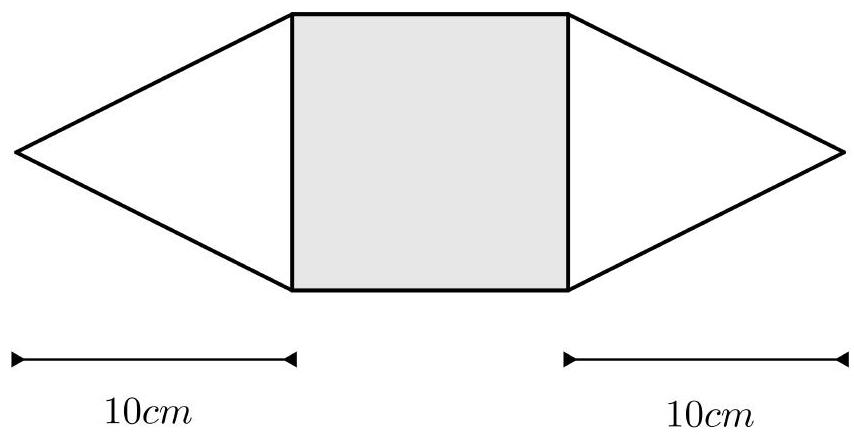
a) B... | <think>
Okay, let's see. I need to solve part a) and b) of this problem about folding triangles over a square. The square has sides of 10 cm each. The figure is made of a square and two isosceles triangles. But I don't have the images, so I need to visualize based on the description.
First, for part a: When folding on... |
olympiads | PROBLEM 4. Consider the sequence with the terms: $1,4,5,8,9,12,13,16,17,20, \ldots$
a) Write the next 2 terms of the sequence;
b) Determine the 2015th term of the sequence;
c) Calculate the sum of the terms less than or equal to 80 from the sequence.[^0]
## NATIONAL MATHEMATICS OLYMPIAD Local stage - 14.02. 2015 G... | <think>
Okay, let me try to figure out this sequence problem. So, the sequence given is 1, 4, 5, 8, 9, 12, 13, 16, 17, 20, ...
First, part a) asks for the next two terms. Let me see the pattern here. Let me list the terms with their positions to see if that helps.
Term 1: 1
Term 2: 4
Term 3: 5
Term 4: 8
Term 5: ... |
olympiads | ## Task 6
Multiply 8 by 4, subtract 15 from the product. | <think>
Okay, let's see. The problem is to multiply 8 by 4 and then subtract 15 from the product. Alright, step by step. First, I need to do the multiplication part. So 8 multiplied by 4. Hmm, 8 times 4... let me think. 8 times 4 is 32, right? Yeah, because 8 added four times: 8 + 8 is 16, plus another 8 is 24, and one... |
olympiads | 577. a) From a sample of size $n$, extracted from a normal general population with a known standard deviation $\sigma$, the sample mean $\bar{x}$ has been found. At a significance level $\alpha$, it is required to find the power function of the test criterion for testing the null hypothesis $H_{0}: a=a_{0}$ about the e... | <think>
Okay, so I need to find the power of the two-sided criterion for testing the hypothesis H₀: a = 20 against H₁: a ≠ 20 when the true mean a₁ is 24. The given information is sample size n=16, σ=5, significance level α=0.05.
First, I remember from part a) that the power function is given by π₂(a₁) = 1 - [Φ(u_cr ... |
aops_forum | For how many permutations $(a_1, a_2, \cdots, a_{2007})$ of the integers from $1$ to $2007$ is there exactly one $i$ between $1$ and $2006$ such that $a_i > a_{i+1}$? Express your answer as $a \** b^c + d \** e^f$ for integers $a$, $b$, $c$, $d$, $e$, and $f$ with $a \nmid b$ and $d \nmid e$. | <think>
Okay, so I need to figure out how many permutations of the numbers 1 through 2007 have exactly one descent. A descent is where a number is followed by a smaller number, right? So in other words, in the permutation (a1, a2, ..., a2007), there should be exactly one position i (between 1 and 2006) such that ai > a... |
olympiads |
C1. Consider a regular $2 n+1$-gon $P$ in the plane, where $n$ is a positive integer. We say that a point $S$ on one of the sides of $P$ can be seen from a point $E$ that is external to $P$, if the line segment $S E$ contains no other points that lie on the sides of $P$ except $S$. We want to color the sides of $P$ in... | <think>
Okay, let's try to tackle this problem. So, we have a regular polygon with an odd number of sides, specifically 2n+1 sides. We need to color its sides using three colors with some conditions: each side must be colored, all three colors must be used, and from any external point, you can see at most two different... |
olympiads | 4.2. A smooth sphere with a radius of 1 cm was dipped in blue paint and launched between two perfectly smooth concentric spheres with radii of 4 cm and 6 cm, respectively (this sphere ended up outside the smaller sphere but inside the larger one). Upon touching both spheres, the sphere leaves a blue trail. During its m... | <think>
Okay, let's see. I need to figure out the area bounded by the blue contour on the larger sphere. The problem involves a small sphere that's been dipped in paint and launched between two concentric spheres with radii 4 cm and 6 cm. When the small sphere touches either the inner or outer sphere, it leaves a blue ... |
aops_forum | A farmer buys a batch of trees, which he wishes to plant in a square grid. For example, if he had $25$ trees, then he could plant them as shown below.
[asy]
size(3cm,0);
dot((0,0));
dot((0,1));
dot((0,2));
dot((0,3));
dot((0,4));
dot((1,0));
dot((1,1));
dot((1,2));
dot((1,3));
dot((1,4));
dot((2,0));
dot((2,1));
dot((... | <think>
Okay, so the problem is about a farmer who wants to plant his trees in a square grid. He can't do that with the number of trees he currently has. But if he had 20 more trees, or if he had 39 fewer trees, then he could plant them in a square grid. We need to find out how many trees he originally bought.
Hmm. Le... |
olympiads | Determine all solutions of the equation $\sqrt{x}=x-2$.
untranslated text has been directly translated while preserving the original formatting and structure. | <think>
Okay, so I need to solve the equation √x = x - 2. Hmm, let's see. I remember that when solving equations with square roots, sometimes you have to square both sides to get rid of the radical. But I also recall that squaring both sides can sometimes introduce extraneous solutions, so I need to check my answers at... |
olympiads | [ Arithmetic. Mental arithmetic, etc.]
A hundred people answered the question "Will the new president be better than the previous one?". Of them, a people think it will be better, b - that it will be the same, and c - that it will be worse. Sociologists constructed two "optimism" indicators of the respondents: m=a+b/2... | <think>
Okay, let's see. There's a problem here about 100 people answering a question regarding whether the new president will be better, same, or worse than the previous one. The categories are a, b, and c respectively. Sociologists made two indicators: m = a + b/2 and n = a - c. They told us that m = 40, and we need ... |
olympiads | 2. Find all triples ( $p, q, r$ ) of prime numbers for which
$$
p^{2}-q r=2500
$$ | <think>
Okay, so I need to find all triples of prime numbers (p, q, r) such that p squared minus q times r equals 2500. Hmm, let's start by writing down the equation:
p² - qr = 2500
So, rearranging that, we get:
p² = qr + 2500
Since p is a prime number, p² must be a square of a prime. The right-hand side is the pro... |
olympiads | 3. Find all possible values of the perimeter of a rectangle, given that it can be cut into three rectangles, the perimeter of each of which is 10, and the side lengths are integers. | <think>
Okay, so I need to find all possible values of the perimeter of a rectangle that can be cut into three smaller rectangles, each with a perimeter of 10 and integer side lengths. Hmm, let me start by breaking down the problem step by step.
First, let's recall that the perimeter of a rectangle is calculated as 2*... |
olympiads | ## Task B-3.2.
How many solutions does the equation $\frac{1}{\cos ^{2} \frac{x}{2}}+\frac{1}{\sin ^{2} \frac{x}{2}}=\frac{16}{\operatorname{tg} x}$ have on the interval $\langle 0,2019 \pi\rangle$? | <think>
Okay, let's try to figure out how many solutions the equation \(\frac{1}{\cos^{2} \frac{x}{2}} + \frac{1}{\sin^{2} \frac{x}{2}} = \frac{16}{\tan x}\) has on the interval \(\langle 0, 2019\pi \rangle\). Hmm, this looks a bit complicated, but maybe if I simplify the left-hand side first, it'll make things clearer... |
olympiads | 6. Given the function $f(x)=2 \sin x-\sin 2 x+\sqrt{3}$, which of the following statements is incorrect?
A. $f(x)$ has two zeros in $[-\pi, \pi]$
C. The minimum value of $f(x)$ is $-\sqrt{3}$
B. The graph of $f(x)$ is symmetric about the point $(\pi, \sqrt{3})$
D. The maximum value of $f(x)$ is $\frac{5 \sqrt{3}}{2}$ | <think>
Okay, let me try to figure out which statement about the function \( f(x) = 2 \sin x - \sin 2x + \sqrt{3} \) is incorrect. The options are A, B, C, D. Let me go through each one step by step.
Starting with option C: The minimum value of \( f(x) \) is \( -\sqrt{3} \). Hmm, to check this, maybe I need to find th... |
olympiads | A6 (5-1, Czechoslovakia) Find all real solutions of the equation $\sqrt{x^{2}-p}+2 \sqrt{x^{2}-1}=x$, where $p$ is a real parameter. | <think>
Okay, let me try to solve this equation: √(x² - p) + 2√(x² - 1) = x, where p is a real parameter. Hmm, so we need to find all real x that satisfy this equation depending on p. Alright, let's start by understanding the domain of the equation because there are square roots involved.
First, the expressions under... |
olympiads_ref | Let $n$ be a positive integer. Determine, in terms of $n$, the greatest integer which divides every number of the form $p+1$, where $p \equiv 2 \bmod 3$ is a prime number which does not divide $n$.
## Proposed by Bulgaria | <think>
Okay, let me try to tackle this problem. So, the question is: Given a positive integer n, we need to determine the greatest integer that divides every number of the form p + 1, where p is a prime number congruent to 2 mod 3 and p does not divide n. We have to express this greatest integer in terms of n.
First,... |
olympiads | 11.4. We will call a natural number interesting if it is the product of exactly two (distinct or equal) prime numbers. What is the greatest number of consecutive numbers, all of which are interesting | <think>
Okay, so I need to figure out the greatest number of consecutive numbers where each one is a product of exactly two prime numbers. They can be distinct or the same, so squares of primes like 4 (2x2) or 9 (3x3) are also considered interesting. Hmm, interesting. Let me start by understanding the problem better.
... |
olympiads | 10.121. Calculate the area of a rectangular trapezoid if its acute angle is $60^{\circ}$, the smaller base is $a$, and the larger lateral side is $b$. | <think>
Okay, let's see. I need to calculate the area of a rectangular trapezoid. The problem states that the acute angle is 60 degrees, the smaller base is 'a', and the larger lateral side is 'b'. Hmm, rectangular trapezoid... I think that means it's a trapezoid with two right angles. Wait, actually, a rectangular tra... |
olympiads | 3. Round the difference between the largest and smallest five-digit numbers with distinct digits that are divisible by 15 to the nearest ten. | <think>
Okay, let's see. The problem is asking me to find the difference between the largest and smallest five-digit numbers with distinct digits that are divisible by 15, and then round that difference to the nearest ten. Hmm. Let me break this down step by step.
First, I need to recall that a number divisible by 15 ... |
aops_forum | In triangle $ABC$, $BC = 23$, $CA = 27$, and $AB = 30$. Points $V$ and $W$ are on $\overline{AC}$ with $V$ on $\overline{AW}$, points $X$ and $Y$ are on $\overline{BC}$ with $X$ on $\overline{CY}$, and points $Z$ and $U$ are on $\overline{AB}$ with $Z$ on $\overline{BU}$. In addition, the points are positioned so tha... | <think>
Okay, let me try to figure out this problem step by step. So, we have triangle ABC with sides BC = 23, CA = 27, and AB = 30. Points V and W are on AC, with V on AW. Similarly, X and Y are on BC with X on CY, and points Z and U are on AB with Z on BU. The lines UV, WX, and YZ are parallel to BC, AB, and CA respe... |
olympiads | 4. [5 points] Find the number of triples of natural numbers $(a ; b ; c)$ that satisfy the system of equations
$$
\left\{\begin{array}{l}
\operatorname{GCD}(a ; b ; c)=35 \\
\operatorname{LCM}(a ; b ; c)=5^{18} \cdot 7^{16}
\end{array}\right.
$$ | <think>
Okay, let's tackle this problem step by step. We need to find the number of triples of natural numbers (a, b, c) such that their greatest common divisor (GCD) is 35 and their least common multiple (LCM) is \(5^{18} \cdot 7^{16}\).
First, since the GCD of a, b, c is 35, which factors into prime powers as \(5^1... |
olympiads | Four, (50 points) On a roadside, there are $n$ parking spaces, and $n$ drivers each driving a car. Each driver parks their car in front of their favorite parking space. If that space is already occupied, they park in the nearest available space down the road. If that space and all the spaces below it are occupied, they... | <think>
Okay, let's see. The problem is about parking cars in n parking spaces with n drivers. Each driver has a favorite spot, and if it's taken, they go to the nearest available spot down the road. If they can't find one, they leave. We need to find how many favorite parking arrays (a1, a2, ..., an) result in all par... |
olympiads | 1. Given quadratic trinomials $f_{1}(x)=x^{2}-x+2 a, f_{2}(x)=x^{2}+2 b x+3, f_{3}(x)=4 x^{2}+(2 b-3) x+6 a+3$ and $f_{4}(x)=4 x^{2}+(6 b-1) x+9+2 a$. Let the differences of their roots be $A, B, C$ and $D$ respectively. It is known that $|A| \neq|B|$. Find the ratio $\frac{C^{2}-D^{2}}{A^{2}-B^{2}}$. The values of $A,... | <think>
Alright, so I need to find the ratio (C² - D²)/(A² - B²) given these four quadratic trinomials and knowing that |A| ≠ |B|. Hmm. Let me break this down step by step.
First, let's recall that for any quadratic equation of the form f(x) = x² + px + q, the roots can be found using the quadratic formula: [-p ± √(p²... |
olympiads | # Task № 4.2
## Condition:
Six friends live in a small town in southern France. One day they decided to go to Paris together for one day and see the sights - the Eiffel Tower, the Louvre, Notre-Dame Cathedral, the Rodin Museum, the Bois de Boulogne, and the Champs-Élysées. The friends agreed to split up and see them ... | <think>
Okay, let's try to figure out which two friends mixed up their lists. So, we have six friends, each of whom named three attractions. But two of them actually mentioned the ones they did NOT visit instead of the ones they did. The key point is that each attraction was visited by exactly three friends. That means... |
olympiads | 10.4. On the cells of an 8 by 8 board, chips are placed such that for each chip, the row or column of the board in which it lies contains only one chip. What is the maximum possible number of chips on the board? | <think>
Okay, so I have this problem here: On an 8 by 8 board, place chips such that for each chip, the row or column it's in contains only one chip. What's the maximum number of chips possible? Hmm, interesting. Let me try to figure this out step by step.
First, let me parse the problem again to make sure I understan... |
olympiads | 5. On the sides $B C$ and $C D$ of the square $A B C D$, points $E$ and $F$ are chosen such that the angle $E A F$ is $45^{\circ}$. The length of the side of the square is 1. Find the perimeter of triangle $C E F$. Justify your solution. | <think>
Okay, so I need to find the perimeter of triangle CEF in a square ABCD with side length 1. Points E and F are on sides BC and CD respectively, and the angle EAF is 45 degrees. Hmm, let me visualize this square first. Let's label the square ABCD with A at the top-left corner, B at the top-right, C at the bottom-... |
olympiads | I4.1 Let $\frac{k}{4}=\left(1+\frac{1}{2}+\frac{1}{3}\right) \times\left(\frac{1}{2}+\frac{1}{3}+\frac{1}{4}\right)-\left(1+\frac{1}{2}+\frac{1}{3}+\frac{1}{4}\right) \times\left(\frac{1}{2}+\frac{1}{3}\right)$, find the value of $k$. | <think>
Okay, so I need to find the value of k where k/4 equals this expression involving a bunch of fractions. Let me write it down again to make sure I have it right:
(1 + 1/2 + 1/3) multiplied by (1/2 + 1/3 + 1/4) minus (1 + 1/2 + 1/3 + 1/4) multiplied by (1/2 + 1/3), and all of that equals k/4. So, my job is to co... |
olympiads | 8. Let's form the equation of the common tangent to the graphs of the functions $y=1+x-x^{2}$ and $y=0.5\left(x^{2}+3\right)$. Let $y=a x+b-$ be the equation of the common tangent. Then,
$1+x-x^{2}=a x+b, x^{2}+(a-1) x+b-1=0$.
$D=(a-1)^{2}-4 b+4=0, a^{2}-2 a-4 b+5=0$.
$0.5\left(x^{2}+3\right)=a x+b, x^{2}-2 a x-2 b+... | <think>
Okay, so I need to find the equation of the common tangent to the two given functions: y = 1 + x - x² and y = 0.5(x² + 3). The problem mentions that the common tangent has the form y = ax + b. Let me try to work through this step by step.
First, I remember that a tangent line to a curve touches the curve at ex... |
olympiads_ref | Call a rational number short if it has finitely many digits in its decimal expansion. For a positive integer $m$, we say that a positive integer $t$ is $m$-tastic if there exists a number $c \in\{1,2,3, \ldots, 2017\}$ such that $\frac{10^{t}-1}{c \cdot m}$ is short, and such that $\frac{10^{k}-1}{c \cdot m}$ is not sh... | <think>
Okay, let's tackle this problem step by step. The problem is about finding the maximum number of elements in the set S(m), where each element t in S(m) is the minimal exponent such that (10^t - 1)/(c*m) is a "short" rational number (meaning it has a finite decimal expansion) for some c between 1 and 2017, and t... |
olympiads | The parabolas given by the equations $y=-x^{2}+6 x-10$ and $2 y=x^{2}+6 x+13$ are centrally similar. Find the center of similarity. | <think>
Okay, so I need to find the center of similarity between these two parabolas. Hmm, centrally similar means there's a center point from which one parabola can be scaled to get the other, right? I remember that similarity transformations involve scaling, rotation, and translation. But since it's central similarit... |
olympiads | 1. (8 points) Calculate $82-38+49-51=$ $\qquad$ | <think>
Okay, let's see. I need to calculate 82 minus 38 plus 49 minus 51. Hmm, where do I start? Well, subtraction and addition are from left to right, right? So I should do the operations in the order they appear. Let me write them down step by step.
First, start with 82 minus 38. Let me subtract those. 82 minus 30 ... |
olympiads | 10) (20 points) Let positive real numbers $x, y, z$ satisfy $xyz=1$. Try to find the maximum value of $f(x, y, z) = (1-yz+z)(1-zx+x)(1-xy+y)$ and the values of $x, y, z$ at that time. | <think>
Okay, so I have this problem here where I need to find the maximum value of the function f(x, y, z) = (1 - yz + z)(1 - zx + x)(1 - xy + y) given that x, y, z are positive real numbers and xyz = 1. Hmm, interesting. Let me try to figure this out step by step.
First, let me restate the problem to make sure I und... |
olympiads | 9. (10 points) From the ten digits $0, 1, 2, 3, 4, 5, 6, 7, 8, 9$, select nine digits to form a two-digit number, a three-digit number, and a four-digit number, such that the sum of these three numbers equals 2010. The digit that was not selected is . $\qquad$ | <think>
Okay, let me try to figure out this problem. So, we need to use nine out of the ten digits (0 through 9) to form a two-digit number, a three-digit number, and a four-digit number. When we add these three numbers together, the sum should be 2010. The question is asking which digit is not used, i.e., which digit ... |
olympiads | 3. The great commander, Marshal of the Soviet Union, Georgy Konstantinovich Zhukov, was born in the village of Strelkovka, Kaluga Governorate. He lived for 78 years. In the 20th century, he lived 70 years longer than in the 19th century. In what year was G.K. Zhukov born? | <think>
Okay, let's try to figure out when Marshal Zhukov was born. The problem says he lived for 78 years, and in the 20th century, he lived 70 years longer than in the 19th century. Hmm, so he was born in the 19th century and died in the 20th century. Let me break this down step by step.
First, let's recall that the... |
olympiads | 4. On the table, there are 150 different cards with numbers $2, 4, 6, \ldots 298, 300$ (each card has exactly one number, and each number appears exactly once). In how many ways can 2 cards be chosen so that the sum of the numbers on the selected cards is divisible by $5?$ | <think>
Okay, so there's this problem here where we have 150 different cards, each labeled with even numbers starting from 2 up to 300. That means the numbers are 2, 4, 6, ..., 298, 300. Each number is on exactly one card, and we need to find out how many ways we can choose two cards such that the sum of their numbers ... |
olympiads | ## Task B-4.3.
Points $A_{1}, B_{1}, C_{1}$ are on the sides $\overline{B C}, \overline{C A}, \overline{A B}$ of triangle $A B C$ respectively, such that:
$$
\frac{\left|B A_{1}\right|}{|B C|}=\frac{\left|C B_{1}\right|}{|C A|}=\frac{\left|A C_{1}\right|}{|A B|}=k
$$
Determine $k$ so that the area of triangle $A_{1}... | <think>
Alright, let's see. I need to find the value of k such that the area of triangle A1B1C1 is minimized. The points A1, B1, C1 are on the sides BC, CA, and AB respectively, and the ratios of the segments are given as k. So, |BA1|/|BC| = |CB1|/|CA| = |AC1|/|AB| = k. Hmm, okay.
First, maybe I should draw a diagram ... |
cn_contest | 13. Let $T=\left\{9^{4} \mid k\right.$ be an integer, $0 \leqslant k$ $\leqslant 4000\}$. It is known that $9^{1000}$ has 3817 digits, and its most significant digit is 9. How many elements in $T$ have 9 as their most significant digit? | <think>
Okay, so I need to figure out how many elements in the set T have 9 as their most significant digit. The set T is defined as {9^4k | k is an integer, 0 ≤ k ≤ 4000}. Wait, actually, hold on. The problem says "Let T={9^{4} | k be an integer, 0 ≤ k ≤ 4000}". Hmm, maybe there's a typo in the problem statement? Beca... |
olympiads | 25. Form a five-digit number without repeating digits using $1,3,5,7,9$, and form another five-digit number without repeating digits using $0,2,4,6,8$. Subtract the smaller number from the larger number among these two five-digit numbers, the smallest possible difference is $\qquad$ | <think>
Alright, so I need to figure out the smallest possible difference when subtracting two five-digit numbers. One number is formed using the digits 1, 3, 5, 7, 9 without repeating any digits, and the other is formed using 0, 2, 4, 6, 8, also without repeating digits. Then, subtract the smaller number from the larg... |
olympiads | 2. A three-digit number $\overline{a b c}$ satisfies $a \times b \times c$ is still a three-digit number. The smallest $\overline{a b c}$ that meets the condition is $\qquad$ . | <think>
Okay, so I need to find the smallest three-digit number, like abc, where when I multiply the digits a, b, and c together, the result is still a three-digit number. Hmm, let's see. The problem says "the smallest abc that meets the condition is..." So I need to start checking from the smallest three-digit numbers... |
olympiads | Bakayev E.V.
Petya places 500 kings on the cells of a $100 \times 50$ board so that they do not attack each other. And Vasya places 500 kings on the white cells (in a chessboard coloring) of a $100 \times 100$ board so that they do not attack each other. Who has more ways to do this? | <think>
Okay, let's see. The problem is comparing how many ways Petya and Vasya can place 500 kings on their respective chessboards without attacking each other. Petya is using a 100x50 board, while Vasya is using a 100x100 board but only the white cells. We need to figure out who has more possible configurations. Hmm,... |
olympiads | Suppose $x$ and $y$ are real numbers satisfying $x+y=5$. What is the largest possible value of $x^{2}+2 x y$ ? | <think>
Okay, let me try to figure out this problem. So, the question says: Suppose x and y are real numbers satisfying x + y = 5. What is the largest possible value of x² + 2xy? Hmm, let's see. I need to maximize the expression x² + 2xy given that x + y = 5.
First, maybe I can use the constraint x + y = 5 to express... |
olympiads | ## Problem Statement
Calculate the definite integral:
$$
\int_{-\frac{2 \pi}{3}}^{0} \frac{\cos x \, dx}{1+\cos x-\sin x}
$$ | <think>
Okay, so I need to calculate the definite integral of cos x divided by (1 + cos x - sin x) from -2π/3 to 0. Hmm, let me think about how to approach this. Integrals involving trigonometric functions can sometimes be tricky, but maybe I can simplify the denominator or use a substitution.
First, let me write down... |
olympiads | Example 4 Find the largest constant $k$, such that for $x, y, z \in \mathbf{R}^{+}$, we have
$$
\frac{x}{\sqrt{y+z}}+\frac{y}{\sqrt{z+x}}+\frac{z}{\sqrt{x+y}} \leqslant k \sqrt{x+y+z} .
$$ | <think>
Okay, so I need to find the largest constant k such that for any positive real numbers x, y, z, the inequality holds:
(x)/√(y+z) + (y)/√(z+x) + (z)/√(x+y) ≤ k√(x+y+z)
Hmm, alright. Let's see. The problem is asking for the maximum k where this inequality is always true, no matter what positive x, y, z we pick.... |
aops_forum | Circle $\omega_1$ with radius 3 is inscribed in a strip $S$ having border lines $a$ and $b$. Circle $\omega_2$ within $S$ with radius 2 is tangent externally to circle $\omega_1$ and is also tangent to line $a$. Circle $\omega_3$ within $S$ is tangent externally to both circles $\omega_1$ and $\omega_2$, and is also ... | <think>
Okay, so I need to find the radius of circle ω₃. Let me try to visualize the problem first. There's a strip S with two border lines, a and b. Circle ω₁ with radius 3 is inscribed in this strip, meaning it touches both lines a and b. Then there's another circle ω₂ inside the strip with radius 2; it's tangent ext... |
olympiads | ## Task 2 - 230812
Determine all three-digit natural numbers $n$ with the following properties:
(1) The cross sum of $n$ is 17.
(2) If you multiply the first digit (i.e., the hundreds digit) of $n$ by 4, you get a two-digit number, which is exactly the number formed by the last two digits of $n$. | <think>
Okay, let's tackle this problem step by step. So, we need to find all three-digit natural numbers, n, that satisfy two conditions. First, the sum of their digits (cross sum) is 17. Second, if we multiply the first digit (hundreds place) by 4, we get a two-digit number which is exactly the number formed by the l... |
olympiads | Khachaturyan A.v.
It is known that the Jackal always lies, the Lion tells the truth, the Parrot simply repeats the last heard answer (and if asked first, will answer randomly), and the Giraffe gives an honest answer but to the previous question asked to him (and on the first question, answers randomly). The wise Hedge... | <think>
Okay, let's try to figure out the order of the animals: Jackal, Lion, Parrot, and Giraffe. The Hedgehog asked each one three different questions in turn: "Are you the Jackal?", "Are you the Giraffe?", and "Are you the Parrot?". The key here is to use the information given after each set of questions to narrow d... |
cn_contest | 11. (20 points) If the subset $A$ of the set $M=\{1,2, \cdots, 200\}$ consists of elements each of which can be expressed as the sum of the squares of two natural numbers (allowing the same number), find the maximum number of elements in the set $A$.
| <think>
Okay, so I have this problem here where I need to find the maximum number of elements in a subset A of the set M = {1, 2, ..., 200}. The condition is that every element in A can be expressed as the sum of the squares of two natural numbers. Hmm, interesting. Let me try to figure out how to approach this.
First... |
aops_forum | Let $p(x)$ be a polynomial of degree strictly less than $100$ and such that it does not have $(x^3-x)$ as a factor. If $$\frac{d^{100}}{dx^{100}}\bigg(\frac{p(x)}{x^3-x}\bigg)=\frac{f(x)}{g(x)}$$ for some polynomials $f(x)$ and $g(x)$ then find the smallest possible degree of $f(x)$. | <think>
Okay, so I need to find the smallest possible degree of f(x) where the 100th derivative of p(x)/(x³ - x) is equal to f(x)/g(x), given that p(x) is a polynomial of degree less than 100 and doesn't have x³ - x as a factor. Hmm, let me try to break this down step by step.
First, let's recall that taking derivativ... |
olympiads | $29 \cdot 29$ When natural numbers $P$ and $P^{\prime}$ (where $P > P^{\prime}$) are divided by the natural number $D$, the remainders are $R$ and $R^{\prime}$, respectively. When $P P^{\prime}$ and $R R^{\prime}$ are divided by $D$, the remainders are $r$ and $r^{\prime}$, respectively. Then
(A) $r$ is always greater ... | <think>
Alright, so I have this problem here about remainders when numbers are divided by some natural number D. Let me try to parse through it step by step.
First, the setup: There are two natural numbers P and P', where P is greater than P'. When both of these are divided by D, they leave remainders R and R' respect... |
olympiads | 1. Let $x \in\left(-\frac{1}{2}, 0\right)$, the size relationship of the following three numbers $a=\cos (\sin x \pi), b=\sin (\cos x \pi), c=$ $\cos (x+1) \pi$ is ( ).
A. $c<b<a$
B. $a<c<b$
C. $c<a<b$
D. $b<c<a$ | <think>
Okay, so I need to figure out the size relationship between a, b, and c when x is between -1/2 and 0. Let me first write down what each of these expressions is.
Given:
- a = cos(sin(xπ))
- b = sin(cos(xπ))
- c = cos((x + 1)π)
And x is in the interval (-1/2, 0). The question is asking which of the options A, B... |
olympiads | 8. (15 points) The mass of a vessel completely filled with kerosene is 31 kg. If this vessel is completely filled with water, its mass will be 33 kg. Determine the mass of the empty vessel. The density of water $\rho_{W}=1000 \kappa g / \mathrm{m}^{3}$, the density of kerosene $\rho_{K}=800$ kg $/ \mathrm{m}^{3}$. | <think>
Okay, so I need to figure out the mass of the empty vessel. Let's see, the problem says that when the vessel is completely filled with kerosene, the total mass is 31 kg. When it's filled with water instead, the total mass is 33 kg. The densities are given: water is 1000 kg/m³ and kerosene is 800 kg/m³. Hmm, rig... |
aops_forum | Kalyn cut rectangle R from a sheet of paper and then cut figure S from R. All the cuts were made
parallel to the sides of the original rectangle. In comparing R to S
(A) the area and perimeter both decrease
(B) the area decreases and the perimeter increases
(C) the area and perimeter both increase
(D) the area increas... | <think>
Alright, so Kalyn has this rectangle R and cuts out a figure S from it. All the cuts are parallel to the sides of the original rectangle. Hmm, okay, so when you cut out a figure from a rectangle with all cuts parallel to the sides, the figure S must also be a rectangle, right? Because if all the cuts are straig... |
olympiads | For what value of the parameter $m$ is the sum of the squares of the roots of the equation $x^{2}-(m+1) x+m-1=0$ the smallest?
# | <think>
Okay, let's see. I need to find the value of the parameter m such that the sum of the squares of the roots of the equation x² - (m + 1)x + m - 1 = 0 is the smallest possible. Hmm, right. Let me try to recall how to approach this.
First, I remember that for a quadratic equation ax² + bx + c = 0, the sum of the ... |
olympiads | 5. Given the ellipse $\frac{x^{2}}{a^{2}}+\frac{y^{2}}{b^{2}}=1(a>b>0)$ intersects with the line $x+y=1$ at points $M, N$, and $O M \perp O N$ (where $O$ is the origin), when the eccentricity of the ellipse $e \in\left[-\frac{3}{3}, \overline{2}\right]$, the range of the length of the major axis of the ellipse is $\qqu... | <think>
Okay, let's try to tackle this problem step by step. The problem is about an ellipse intersecting a line at two points M and N, such that the vectors from the origin O to M and N are perpendicular. We need to find the range of the length of the major axis given that the eccentricity e is in a certain interval. ... |
olympiads | 3. The set of positive odd numbers $\{1,3,5, \cdots\}$ is grouped in ascending order such that the $n$-th group contains (2n-1) odd numbers:
$\{1\}$,
$\{3,5,7\}$,
$\{9,11,13,15,17\}, \cdots$
(First group)
(Second group)
(Third group)
Then 1991 is in the group. | <think>
Alright, let's see. The problem is about grouping positive odd numbers in ascending order, where each group n contains (2n - 1) numbers. The first group has 1 number, the second has 3, the third has 5, and so on. The question is asking which group the number 1991 falls into.
First, I need to understand the st... |
olympiads | II. (50 points)
Let $a, b, c \in \mathbf{R}^{+}$, and $a b c + a + c = b$. Determine the maximum value of $P = \frac{2}{a^{2}+1} - \frac{2}{b^{2}+1} + \frac{3}{c^{2}+1}$. | <think>
Alright, so I have this problem here where I need to find the maximum value of the expression \( P = \frac{2}{a^{2}+1} - \frac{2}{b^{2}+1} + \frac{3}{c^{2}+1} \), given that \( a, b, c \) are positive real numbers and they satisfy the equation \( abc + a + c = b \). Hmm, okay. Let me try to figure this out step... |
olympiads | 1. Let the set $M=\left\{y \left\lvert\, y=x^{\frac{1}{2}}\right., x \in[1,4]\right\}, N=\left\{x \mid y=\log _{2}(1-x)\right\}$, then $M \cap\left(\complement_{\mathbf{R}} N\right)=$
A. $\{x \mid 1 \leqslant x \leqslant 2\}$
B. $\{x \mid 1 \leqslant x \leqslant 4\}$
C. $\{x \mid 1 \leqslant x \leqslant \sqrt{2}\}$
D. ... | <think>
Okay, let's see. I need to find the intersection of set M and the complement of set N in real numbers. The answer choices are given, so I need to figure out what M and N are first, then determine their complement and intersection.
Starting with set M. The problem says M is the set of all y such that y equals x... |
olympiads | # Task 5.
Once upon a time, Baba Yaga and Koschei the Deathless tried to divide a magical powder that turns everything into gold equally. Baba Yaga took out a scale and weighed all the powder. The scales showed 6 zolotniks. Then she started removing the powder until the scales showed 3 zolotniks. However, Koschei susp... | <think>
Okay, let me try to figure out this problem. So, Baba Yaga and Koschei are trying to divide some magical powder equally. The story goes that Baba Yaga weighed all the powder and the scale showed 6 zolotniks. Then she removed some powder until the scale showed 3 zolotniks left. But Koschei didn't trust the scale... |
olympiads | Task B-3.1. Determine the value of the expression $\frac{\sin x}{2-3 \cos x}$ if ctg $\frac{x}{2}=\frac{1}{2}$. | <think>
Okay, so I need to find the value of the expression \(\frac{\sin x}{2 - 3 \cos x}\) given that \(\cot \frac{x}{2} = \frac{1}{2}\). Hmm, cotangent of half-angle... I remember there are some trigonometric identities related to half-angles. Let me recall them.
First, I know that \(\cot \frac{\theta}{2}\) can be e... |
cn_contest | 5. Given $a_{1}=2$,
$$
a_{n+1}=\frac{2^{n+1} a_{n}}{\left(n+\frac{1}{2}\right) a_{n}+2^{n}}\left(n \in \mathbf{Z}_{+}\right) \text {. }
$$
(1) Find the general term formula for the sequence $\left\{a_{n}\right\}$;
(2) Let $b_{n}=\frac{n^{3}+2 n^{2}+2 n+2}{n(n+1)\left(n^{2}+1\right) a_{n}}$, find the sum of the first $n... | <think>
Alright, so I need to find the general term formula for the sequence {a_n} given the recursive relation. Let me start by understanding the problem step by step.
We have a₁ = 2, and for each positive integer n, the next term a_{n+1} is given by:
a_{n+1} = (2^{n+1} * a_n) / [( (n + 1/2) a_n + 2^n )]
Hmm. The r... |
olympiads | Example 4 (1991 National High School League Question) Let complex numbers $z_{1}, z_{2}$ satisfy $\left|z_{1}\right|=$ $\left|z_{1}+z_{2}\right|=3,\left|z_{1}-z_{2}\right|=3 \sqrt{3}$, find $\log _{3}\left|\left(z_{1} \bar{z}_{2}\right)^{2000}+\left(\bar{z}_{1} z_{2}\right)^{2000}\right|$. | <think>
Okay, let's try to solve this problem. Hmm, we have two complex numbers z₁ and z₂. The given conditions are |z₁| = 3, |z₁ + z₂| = 3, and |z₁ - z₂| = 3√3. We need to find the logarithm base 3 of the absolute value of (z₁ times the conjugate of z₂) raised to 2000 plus (the conjugate of z₁ times z₂) raised to 2000... |
olympiads | 2. A square with a side of 49 cm is given. Divide the given square into 2009 smaller squares of two types, which have integer sides (the side lengths of the divided squares can have one of two different integer values). | <think>
Okay, let me try to figure out how to divide a square with a side of 49 cm into 2009 smaller squares, each with integer sides, and there are only two different sizes allowed. Hmm, this seems like a tiling problem. I remember that in order to tile a square with smaller squares, they need to fit perfectly without... |
olympiads | Example 6 Find the minimum value of the function
$$
\begin{array}{c}
f(x)=\sqrt{9(x-3)^{2}+\left(x^{2}-12\right)^{2}}+ \\
\sqrt{9 x^{2}+\left(x^{2}-\frac{9}{4}\right)^{2}}
\end{array}
$$ | <think>
Okay, so I need to find the minimum value of this function f(x). Let me first understand what the function looks like. It's the sum of two square roots, each involving expressions with x. Let me write it out again to make sure I have it right:
f(x) = √[9(x - 3)^2 + (x² - 12)^2] + √[9x² + (x² - 9/4)^2]
Hmm. Ea... |
cn_contest | 4. As shown in the figure, two national defense highways, each 40 m wide, intersect at an angle of $\alpha$. Then, the area of the common part (the shaded area in the figure) of the road surface at the intersection is ( ).
(A) $\frac{1600}{\sin \alpha}\left(\mathrm{m}^{2}\right)$
(B) $\frac{1600}{\cos \alpha}\left(\mat... | <think>
Okay, so I need to find the area of the common part where two national defense highways intersect at an angle α. Each highway is 40 meters wide. The answer choices are given, so maybe I can figure out the formula and see which one matches.
First, let me visualize the problem. Two highways intersecting at an an... |
olympiads_ref | Two players, Blake and Ruby, play the following game on an infinite grid of unit squares, all initially colored white. The players take turns starting with Blake. On Blake's turn, Blake selects one white unit square and colors it blue. On Ruby's turn, Ruby selects two white unit squares and colors them red. The players... | <think>
Okay, let's see. So Blake and Ruby are playing this game on an infinite grid. Blake colors one square blue each turn, and Ruby colors two squares red each turn. Blake can end the game whenever he wants, and his score is the area of the largest simple polygon made up of only blue squares. The question is, what's... |
olympiads | A castle has infinitely many rooms labeled $1,2,3, \ldots$, which are divided into several halls. Suppose room $n$ is on the same hall as rooms $3 n+1$ and $n+10$ for every $n$. Determine the maximum possible number of different halls in the castle. | <think>
Okay, so I need to figure out the maximum number of different halls in this castle with infinitely many rooms labeled 1, 2, 3, and so on. The rule is that for every room n, it has to be on the same hall as rooms 3n + 1 and n + 10. The goal is to determine the maximum possible number of different halls. Hmm, int... |
olympiads | Tokorev S.i.
In each cell of a $4 \times 4$ table, there is a sign "+" or "-". It is allowed to simultaneously change the signs to the opposite in any cell and in all cells that share a side with it. How many different tables can be obtained by repeatedly applying such operations? | <think>
Okay, so I have this problem about a 4x4 grid where each cell is either a plus or a minus sign. The allowed operation is to flip a cell and all its adjacent cells (sharing a side). The question is asking how many different tables can be obtained by doing these operations repeatedly. Hmm, interesting. I need to ... |
olympiads | What are the numbers that leave a remainder of 5 when dividing 2007? | <think>
Okay, so I have this problem here: "What are the numbers that leave a remainder of 5 when dividing 2007?" Hmm, let me try to figure this out. Alright, when they say "numbers that leave a remainder of 5 when dividing 2007," I think that means when you divide 2007 by these numbers, the remainder is 5. So, mathema... |
olympiads | 7. (10 points) $\left[x-\frac{1}{2}\right]=3 x-5$, here $[x]$ represents the greatest integer not exceeding $x$, then $x=$
Translate the above text into English, please retain the original text's line breaks and format, and output the translation result directly. | <think>
Alright, let's tackle this problem step by step. The equation given is [x - 1/2] = 3x - 5, where [x] represents the greatest integer not exceeding x, which is the floor function. So, I need to find the value of x that satisfies this equation.
First, I remember that the floor function [a] = n means that n is an... |
aops_forum | On an $n$ × $n$ board, the set of all squares that are located on or below the main diagonal of the board is called the$n-ladder$. For example, the following figure shows a $3-ladder$:
[asy]
draw((0,0)--(0,3));
draw((0,0)--(3,0));
draw((0,1)--(3,1));
draw((1,0)--(1,3));
draw((0,2)--(2,2));
draw((2,0)--(2,2));
draw((0,3... | <think>
Okay, so I need to figure out how many ways there are to divide a 99-ladder into rectangles with distinct areas. Each rectangle must have sides on the grid lines, and all their areas must be different. Let me start by understanding what a 99-ladder is. The problem says that an n-ladder is the set of all squares... |
olympiads | Carla wrote on the blackboard the integers from 1 to 21. Diana wants to erase some of them so that the product of the remaining numbers is a perfect square.
a) Show that Diana must necessarily erase the numbers 11, 13, 17, and 19 to achieve her goal.
b) What is the minimum number of numbers that Diana must erase to a... | <think>
Okay, so I have this problem where Carla wrote the numbers from 1 to 21 on the blackboard, and Diana wants to erase some numbers so that the product of the remaining numbers is a perfect square. Part (a) says we need to show that Diana must erase 11, 13, 17, and 19. Then part (b) asks for the minimum number of ... |
olympiads | 11. Given a plane that makes an angle of $\alpha$ with all 12 edges of a cube, then $\sin \alpha=$ $\qquad$ | <think>
Okay, so I have this problem here: Given a plane that makes an angle of α with all 12 edges of a cube, then sin α equals what? Hmm, interesting. Let me try to visualize this. A cube has 12 edges, right? Each edge is either along the x, y, or z-axis. So, if there's a plane that makes the same angle with all of t... |
olympiads | The rectangle has side lengths in the ratio $2: 5$. If we extend all its sides by $9 \mathrm{~cm}$, we get a rectangle whose side lengths are in the ratio $3: 7$.
In what ratio will the side lengths of the rectangle be if we extend all its sides by another $9 \mathrm{~cm}$?
(M. Petrová) | <think>
Okay, let's see. I need to solve this problem about a rectangle with sides in a certain ratio, then extending the sides twice and finding the new ratio after the second extension. Hmm, let me break it down step by step.
First, the original rectangle has side lengths in the ratio 2:5. Let me denote the original... |
olympiads | 60th Putnam 1999 Problem B1 The triangle ABC has AC = 1, angle ACB = 90 o , and angle BAC = φ. D is the point between A and B such that AD = 1. E is the point between B and C such that angle EDC = φ. The perpendicular to BC at E meets AB at F. Find lim φ→0 EF. | <think>
Okay, let's try to tackle this problem. So, we have triangle ABC with AC = 1, angle ACB = 90 degrees, and angle BAC = φ. Then there's a point D between A and B such that AD = 1. Point E is between B and C where angle EDC = φ. Then, the perpendicular to BC at E meets AB at F. We need to find the limit of EF as φ... |
olympiads | Example 1. A die is rolled. What is the probability that an even number of points will come up? | <think>
Alright, so I need to figure out the probability of rolling an even number on a die. Let me start by recalling what a standard die looks like. A typical die has six faces, numbered from 1 to 6. Each number represents the number of points, right? So the possible outcomes when rolling the die are 1, 2, 3, 4, 5, o... |
olympiads | G1.2 Let $x, y$ and $z$ be positive numbers. Given that $\frac{x+z}{2 z-x}=\frac{z+2 y}{2 x-z}=\frac{x}{y}$. Find the value of $\frac{x}{y}$. | <think>
Alright, so I have this problem here: given positive numbers x, y, and z, with the equations (x + z)/(2z - x) = (z + 2y)/(2x - z) = x/y. I need to find the value of x/y. Hmm, okay. Let me try to make sense of this step by step.
First, the problem states that two different ratios are equal to each other and als... |
Subsets and Splits
No community queries yet
The top public SQL queries from the community will appear here once available.