
source stringclasses 7
values | problem stringlengths 19 6.18k | generation stringlengths 345 68.1k |
|---|---|---|
olympiads | # 5. Option 1.
It is known that the equations $x^{2}+(2 a-5) x+a^{2}+1=0$ and $x^{3}+(2 a-5) x^{2}+\left(a^{2}+1\right) x+a^{2}-4=0$ have common roots. Find the sum of these roots. | <think>
Okay, so I need to solve this problem where two equations have common roots, and I need to find the sum of these common roots. The equations given are a quadratic and a cubic. Let me first write them down clearly:
1. Quadratic equation: \( x^2 + (2a - 5)x + a^2 + 1 = 0 \)
2. Cubic equation: \( x^3 + (2a - 5)x^... |
aops_forum | A triangle of numbers is constructed as follows. The first row consists of the numbers from $1$ to $2000$ in increasing order, and under any two consecutive numbers their sum is written. (See the example corresponding to $5$ instead of $2000$ below.) What is the number in the lowermost row?
1 2 3 4 5
3 5 7 9
8 12... | <think>
Okay, let me try to figure out this problem. So, we have a triangle where the first row is numbers from 1 to 2000. Then, each row below is constructed by writing the sum of two consecutive numbers from the row above. The example given has 5 instead of 2000, and the last number is 48. Hmm, wait, in the example t... |
olympiads | 44. Vasya placed numbers from 1 to $101^{2}$ once each in all the cells of a $101 \times 101$ board. Petya chooses a cell on the board, places a token on it, and wants to make as many moves as possible so that the number under the token keeps increasing. In one move, Petya can move the token to any cell within a $5 \ti... | <think>
Okay, let's try to tackle this problem. So, we have a 101x101 grid where each number from 1 to 101² is placed exactly once. Petya starts on any cell and wants to move the token such that each move goes to a cell with a higher number. The constraint is that each move can only be within a 5x5 square centered on t... |
olympiads | XXXVIII OM - III - Zadanie 5
Wyznaczyć najmniejszą liczbę naturalną $ n $, dla której liczba $ n^2-n+11 $ jest iloczynem czterech liczb pierwszych (niekoniecznie różnych).
| <think>
Okay, so I have this problem here where I need to find the smallest natural number n such that n squared minus n plus 11 is the product of four prime numbers. They don't have to be distinct, so repeats are allowed. Alright, let me start breaking this down.
First, I need to understand what exactly the question ... |
olympiads | 1. A mathematician left point A for point B. After some time, a physicist also left point A for point B. Catching up with the mathematician after 20 km, the physicist, without stopping, continued to point B and turned back. They met again 20 km from B. Then each continued in their respective directions. Upon reaching p... | <think>
Okay, so here's this problem about a mathematician and a physicist traveling between points A and B, which are 100 km apart. Let me try to parse through it step by step.
First, the mathematician leaves point A for point B. Then, after some time, the physicist also leaves A for B. The physicist catches up with... |
olympiads | 2. (3 points) Kittens $A, B, C, D, E, F$ line up to receive fish from their mother, each kitten receiving one fish at a time. After receiving a fish, they go to the end of the line to wait for their next turn, until all the fish are distributed. If the mother cat has 278 fish, the last kitten to receive a fish is $\qqu... | <think>
Okay, let's see. So there are six kittens: A, B, C, D, E, F. They line up to get fish from their mother. Each kitten gets one fish at a time, and after getting a fish, they go to the end of the line to wait for their next turn. The mom has 278 fish, and we need to figure out which kitten gets the last fish. Hmm... |
olympiads | [ Angles subtended by equal arcs and equal chords]
[ Auxiliary similar triangles $\quad]$
From the vertex of the obtuse angle $A$ of triangle $A B C$, a height $A D$ is dropped. From point $D$, a circle with radius equal to $A D$ is described, intersecting the sides of triangle $A B$ and $A C$ at points $M$ and $N$ r... | <think>
Okay, let me try to figure out this problem. So, we have triangle ABC with an obtuse angle at A. From vertex A, they drop a height AD. Then, from point D, they draw a circle with radius equal to AD. This circle intersects sides AB and AC at points M and N respectively. We need to find the length of AC given tha... |
olympiads | 2B. A four-digit number is a perfect square, such that if the same digit is subtracted from its digits, the resulting number is also a perfect square. Determine all such natural numbers. | <think>
Okay, so I need to find all four-digit natural numbers that are perfect squares. Additionally, if I subtract the same digit from each of its digits, the resulting number should also be a perfect square. Hmm, let me try to break this down step by step.
First, let's clarify the problem. A four-digit number, say ... |
olympiads | 12. There are five unequal non-zero natural numbers, the smallest of which is 7. If one of them is reduced by 20, and the other four numbers are all increased by 5, the resulting numbers are still these five numbers. The sum of these five numbers is $\qquad$ . | <think>
Okay, so let's try to figure out this problem. There are five unequal non-zero natural numbers. The smallest one is 7. Then, if we take one of them and reduce it by 20, and increase the other four by 5 each, the resulting numbers are still the same five numbers. We need to find the sum of these five numbers.
F... |
olympiads | Problem 3. If we divide the numbers 701 and 592 by the same natural number, we get remainders of 8 and 7, respectively. By which number did we divide the given numbers? | <think>
Okay, so I need to find a natural number that when we divide 701 and 592 by it, we get remainders 8 and 7 respectively. Hmm, let me think.
First, I remember that when a number is divided by some divisor and leaves a remainder, there's a relationship between the original number, the divisor, the quotient, and ... |
olympiads | The 100th problem: Given $n(n \geq 2)$ points $A_{1}, A_{2}, \ldots,$ $A_{n}$ on the sphere $\left\{(x, y, z) \mid x^{2}+y^{2}+z^{2}=1\right\}$, find the maximum possible value of $\sum_{1 \leq \mathrm{i}<\mathrm{j} \leq \mathrm{n}}\left|A_{\mathrm{i}} \mathrm{A}_{\mathrm{j}}\right|^{2}$. | <think>
Okay, so I need to find the maximum possible value of the sum of the squares of the distances between all pairs of n points on a unit sphere. Hmm, interesting. Let me start by recalling that all the points are on the surface of a unit sphere, which means each point has a distance of 1 from the origin. The probl... |
olympiads | 1. Dmitry is three times as old as Grigory was when Dmitry was as old as Grigory is now. When Grigory becomes as old as Dmitry is now, the sum of their ages will be 49 years. How old is Grigory? | <think>
Okay, let me try to figure this problem out. So, Dmitry is three times as old as Grigory was when Dmitry was as old as Grigory is now. And then, when Grigory becomes as old as Dmitry is now, their ages will add up to 49. Hmm, this seems a bit complicated, but I'll try to break it down step by step.
First, let ... |
olympiads | 1. What is the probability that in a random sequence of 8 ones and two zeros, there are exactly three ones between the two zeros? | <think>
Okay, let's see. The problem is asking for the probability that in a random sequence of 8 ones and two zeros, there are exactly three ones between the two zeros. Hmm, so first, I need to figure out how many total possible sequences there are with 8 ones and 2 zeros. Then, I need to find how many of those sequen... |
olympiads | 8. In a right-angled triangle $A B C$ (with right angle at $A$ ) the bisectors of the acute angles intersect at point $P$. The distance from $P$ to the hypotenuse is $\sqrt{80000}$. What is the distance from $P$ to $A$ ? | <think>
Okay, so I have this problem here about a right-angled triangle ABC with the right angle at A. The bisectors of the acute angles intersect at point P, and the distance from P to the hypotenuse is √80000. I need to find the distance from P to A. Hmm, let's see.
First, I need to visualize the triangle. Since it... |
olympiads | 7.2. Angles $A O B, B O C$ and $C O D$ are equal to each other, while angle $A O D$ is three times smaller than each of them. All rays $\mathrm{OA}, \mathrm{OB}, \mathrm{OC}$, OD are distinct. Find the measure of angle $A O D$ (list all possible options). | <think>
Okay, let me try to figure out this angle problem. So, we have angles AOB, BOC, and COD that are all equal to each other. And angle AOD is three times smaller than each of them. All the rays OA, OB, OC, OD are distinct. We need to find the measure of angle AOD, and list all possible options.
First, let me visu... |
olympiads | 9.3. Non-zero numbers $a, b$, and $c$ are such that the equalities $a^{2}(b+c-a)=b^{2}(a+c-b)=c^{2}(b+a-c)$ hold. What is the greatest value that the expression $\frac{2 b+3 c}{a}$ can take? | <think>
Okay, so I have this problem where non-zero numbers a, b, and c satisfy the equations a²(b + c - a) = b²(a + c - b) = c²(b + a - c). I need to find the greatest value that the expression (2b + 3c)/a can take. Hmm, let me try to figure this out step by step.
First, since all three expressions a²(b + c - a), b²(... |
olympiads | 5. A car left city A heading towards city B, covering $12 \mathrm{~km}$ in 10 minutes. At the same time, a truck left city B heading towards city A, covering 10 $\mathrm{km}$ in 12 minutes. How many kilometers apart will the car and the truck be after 2 hours and 30 minutes of driving if the distance between cities A a... | <think>
Okay, let me try to figure out this problem step by step. So, there's a car and a truck leaving cities A and B at the same time, heading towards each other. The distance between the cities is 300 km. We need to find out how far apart they'll be after 2 hours and 30 minutes. Hmm, okay. Let me start by understand... |
olympiads | [ List pairs of similar triangles
Point $D$ lies on side $B C$ of triangle $A B C$, and point $O$ is located on segment $A D$, such that $A O: O D=9: 4$. The line passing through vertex $B$ and point $O$ intersects side $A C$ at point $E$, and $B O: O E=5: 6$. Find the ratio in which point $E$ divides side $A C$.
# | <think>
Okay, so I need to find the ratio in which point E divides side AC in triangle ABC. Let me try to visualize the problem first. We have triangle ABC with point D on BC. Then there's a point O on AD such that the ratio of AO to OD is 9:4. The line BO intersects AC at point E, and the ratio of BO to OE is 5:6. The... |
olympiads | 1. Given the sequence $\left\{a_{n}\right\}$ is an arithmetic sequence, $\left\{b_{n}\right\}$ is a geometric sequence, and $a_{1}+2 b_{1} 、 a_{3}+4 b_{3} 、 a_{5}+8 b_{5}$ form an arithmetic sequence. Then $\frac{b_{3} b_{7}}{b_{4}^{2}}=$ . $\qquad$ | <think>
Okay, let's try to solve this problem step by step. First, let me make sure I understand what's being asked here.
We have two sequences: an arithmetic sequence {aₙ} and a geometric sequence {bₙ}. Then, three terms are formed by combining terms from these sequences: a₁ + 2b₁, a₃ + 4b₃, and a₅ + 8b₅. These three... |
olympiads | Task 2. (10 points) Calculate $\left(\frac{2}{3}-\frac{4}{9}+\frac{8}{27}-\frac{16}{81}+\ldots\right) \cdot\left(\frac{3}{5}-\frac{9}{25}+\frac{27}{125}-\frac{81}{625}+\ldots\right)$. | <think>
Okay, so I need to calculate this product of two infinite series. The first one is (2/3 - 4/9 + 8/27 - 16/81 + ...) and the second one is (3/5 - 9/25 + 27/125 - 81/625 + ...). Then I have to multiply them together. Hmm, both look like alternating series, maybe geometric series? Let me check.
Starting with the ... |
olympiads | ## Task $3 / 78$
The equation $x^{\lg x}=100 x$ is to be solved for real numbers $x$! | <think>
Okay, so I need to solve the equation \( x^{\lg x} = 100x \). Hmm, let's see. First, I remember that \(\lg x\) is the logarithm base 10 of \(x\). Maybe taking logarithms on both sides will help here? Let me try that.
Taking \(\lg\) of both sides, we get:
\[
\lg \left( x^{\lg x} \right) = \lg (100x)
\]
Using th... |
olympiads | 6. Given the function $f(x)=\frac{1}{3} x^{3}-(a-1) x^{2}+b^{2} x$, where $a \in\{1,2,3,4\}, b \in\{1,2,3\}$. Then the probability that the function $f(x)$ is increasing on $\mathbf{R}$ is | <think>
Okay, let me try to figure out this probability problem. So, we have the function f(x) = (1/3)x³ - (a - 1)x² + b²x, where a can be 1, 2, 3, or 4, and b can be 1, 2, or 3. We need to find the probability that this function is increasing on all real numbers.
First, I remember that for a function to be increasin... |
olympiads | 3. Calculate the sum of all natural numbers which, when divided by 27, give a quotient equal to twice the remainder.
Daniela Tilincă and Adriana Mihăilă, Brăila | <think>
Okay, let's see. I need to find all natural numbers that, when divided by 27, give a quotient equal to twice the remainder. Then sum them up. Hmm, how do I approach this?
First, let me recall that when a number is divided by a divisor, we can express it as: dividend = divisor × quotient + remainder. So, in mat... |
olympiads | [ Percentage and Ratio Problems ]
Karlson ate $40 \%$ of the cake for breakfast, and Little One ate 150 g. For lunch, Fräulein Bock ate $30 \%$ of the remainder and another 120 g, and Matilda licked the remaining 90 g of crumbs from the cake. What was the initial weight of the cake?
# | <think>
Okay, let's try to figure out the initial weight of the cake. Hmm, so there are different people eating parts of the cake at different times. Let me break it down step by step.
First, Karlson ate 40% of the cake for breakfast. So if the cake's initial weight is, say, X grams, then after Karlson eats, there's 6... |
olympiads | G5.4 In figure $3, \triangle A B C$ is a right-angled triangle and $B H \perp A C$. If $A B=15, H C=16$ and the area of $\triangle A B C$ is $S$, find the value of $S$. | <think>
Alright, so I need to find the area S of triangle ABC, which is a right-angled triangle. They mentioned that BH is perpendicular to AC, and we know AB is 15 units, HC is 16 units. Hmm, let me visualize this. Since it's a right-angled triangle, let me recall where the right angle is. The problem doesn't specify ... |
olympiads | 2. Let $x_{i} \in\{0,1\}(i=1,2, \cdots, n)$. If the function $f=f\left(x_{1}, x_{2}, \cdots, x_{n}\right)$ takes values only 0 or 1, then $f$ is called an $n$-ary Boolean function, and we denote
$$
D_{n}(f)=\left\{\left(x_{1}, x_{2}, \cdots, x_{n}\right) \mid f\left(x_{1}, x_{2}, \cdots, x_{n}\right)=0\right\} .
$$
(1)... | <think>
Okay, let's tackle these problems step by step. Both parts are about Boolean functions, which I know take binary inputs and output either 0 or 1. Let me start with the first part.
**Problem (1): Find the number of n-ary Boolean functions.**
Hmm, okay. So an n-ary Boolean function f takes n binary variables (e... |
olympiads | 5. In the geometric sequence $\left\{a_{n}\right\}$ with all terms being positive, $a_{1}=2, a_{8}+a_{10}=16\left(a_{4}+a_{6}\right)$. The sequence $\left\{b_{n}\right\}$ satisfies: for any positive integer $n$, $a_{1} b_{1}+a_{2} b_{2}+\cdots+a_{n} b_{n}=(n-1) \cdot 2^{n+1}+2$, then $\frac{b_{1}}{a_{1}}+\frac{b_{2}}{a... | <think>
Okay, let's tackle this problem step by step. So, first, we have a geometric sequence {a_n} where all terms are positive, and the first term a₁ is 2. Then, there's this equation involving the 8th, 10th, 4th, and 6th terms: a₈ + a₁₀ = 16(a₄ + a₆). We need to find another sequence {b_n} such that for any positive... |
olympiads | In a convex quadrilateral, two adjacent sides, $a=28.29 \mathrm{~cm}$ and $b=11.71 \mathrm{~cm}$, are perpendicular to each other. The other two sides are equal and also form right angles. Calculate the area of the quadrilateral. | <think>
Okay, let's try to tackle this problem step by step. So, we have a convex quadrilateral where two adjacent sides, a = 28.29 cm and b = 11.71 cm, are perpendicular to each other. The other two sides are equal in length and also form right angles. We need to find the area of this quadrilateral.
First, let me vis... |
olympiads | Example. Compute the limit
$$
\lim _{n \rightarrow \infty} \frac{n \sqrt[6]{n}+\sqrt[5]{32 n^{10}+1}}{(n+\sqrt[4]{n}) \sqrt[3]{n^{3}-1}}
$$ | <think>
Okay, so I need to compute this limit as n approaches infinity:
$$
\lim _{n \rightarrow \infty} \frac{n \sqrt[6]{n}+\sqrt[5]{32 n^{10}+1}}{(n+\sqrt[4]{n}) \sqrt[3]{n^{3}-1}}
$$
Hmm, limits at infinity often involve comparing the growth rates of the numerator and the denominator. Let me break down each part st... |
olympiads | 4. Let $F$ be the left focus of the ellipse $\frac{x^{2}}{a^{2}}+\frac{y^{2}}{b^{2}}=1(a>b>0)$, and $A$ be a point on the ellipse in the first quadrant. Draw a tangent line from point $A$ to the circle $x^{2}+y^{2}=b^{2}$, with the point of tangency being $P$. Then $|A F|-|A P|=$ | <think>
Okay, let's see. I need to find the value of |AF| - |AP| where F is the left focus of an ellipse, and A is a point on the ellipse in the first quadrant. AP is the length of the tangent from A to the circle x² + y² = b². Hmm, okay.
First, let me recall some properties of ellipses and circles. For an ellipse x²/... |
olympiads | 12.298. In a right-angled triangle, a plane is drawn through its hypotenuse, forming an angle $\alpha$ with the plane of the triangle, and an angle $\beta$ with one of the legs. Find the angle between this plane and the second leg. | <think>
Okay, so I have this problem here: In a right-angled triangle, a plane is drawn through its hypotenuse, forming an angle α with the plane of the triangle, and an angle β with one of the legs. I need to find the angle between this plane and the second leg. Hmm, right-angled triangle, so we have a triangle with a... |
olympiads | 5. A product that initially contained $98\%$ water dried over some time and began to contain $95\%$ water. By what factor did it shrink (i.e., reduce its weight)? | <think>
Okay, let's try to figure out this problem. So, there's a product that initially has 98% water, and after drying, it has 95% water. We need to find by what factor its weight shrunk. Hmm, alright. Let me think step by step.
First, let's parse the problem. We have a product, maybe something like fruits or vegeta... |
cn_contest | Problem 1 If $f(x)=|x-a|+|x-b|(a<b)$, find the minimum value of this function. | <think>
Okay, so I need to find the minimum value of the function f(x) = |x - a| + |x - b| where a is less than b. Hmm, let's see. I remember that absolute value functions have V-shapes, so adding two of them together might create a piecewise function with different segments. Since both terms are absolute values, the f... |
olympiads | 5. Based on the base $AC$ of the isosceles triangle $ABC$, a circle is constructed with $AC$ as its diameter, intersecting the side $BC$ at point $N$ such that $BN: NC = 7: 2$. Find the ratio of the lengths of the segments $AN$ and $BC$. | <think>
Okay, so I have this problem here about an isosceles triangle ABC with base AC. A circle is constructed with AC as its diameter, and this circle intersects side BC at point N, where the ratio BN to NC is 7:2. I need to find the ratio of the lengths of segments AN and BC. Hmm, let's break this down step by step.... |
olympiads | Problem 1. Let $a, b, c$ be numbers different from zero, such that $b(c+a)$ is the arithmetic mean of the numbers $a(b+c)$ and $c(a+b)$. If $b=\frac{2019}{2020}$, calculate the arithmetic mean of the numbers $\frac{1}{a}, \frac{1}{b}$ and $\frac{1}{c}$. | <think>
Okay, let's try to tackle this problem. So, we have three non-zero numbers a, b, and c. The key information given is that b(c + a) is the arithmetic mean of a(b + c) and c(a + b). Also, we know that b is 2019/2020, and we need to find the arithmetic mean of 1/a, 1/b, and 1/c.
First, let's write down what's giv... |
olympiads | 1. (17 points) Three cyclists, Dima, Misha, and Petya, started a 1 km race simultaneously. At the moment Misha finished, Dima still had to cover one tenth of the distance, and at the moment Dima finished, Petya still had to cover one tenth of the distance. How far apart (in meters) were Petya and Dima when Misha finish... | <think>
Okay, let's try to solve this problem. So we have three cyclists: Dima, Misha, and Petya. They all start a 1 km race at the same time. The key points given are:
1. When Misha finishes, Dima still has to cover one tenth of the distance.
2. When Dima finishes, Petya still has to cover one tenth of the distance.
... |
olympiads | 22. Given that $169(157-77 x)^{2}+100(201-100 x)^{2}=26(77 x-157)(1000 x-2010)$, find the value of $x$. | <think>
Okay, let's try to solve this equation. It looks a bit complicated, but maybe I can simplify it step by step. The equation is:
169(157 - 77x)^2 + 100(201 - 100x)^2 = 26(77x - 157)(1000x - 2010)
First, I notice that both sides have similar terms. Let me see if I can rewrite the right-hand side to make it look ... |
olympiads | Problem 10.8. A natural number $1 \leqslant n \leqslant 221$ is called lucky if the remainder of 221
divided by $n$ is divisible by the quotient (in this case, the remainder can be equal to 0). How many lucky numbers are there? | <think>
Okay, so I need to figure out how many lucky numbers there are between 1 and 221, where a number n is lucky if when you divide 221 by n, the remainder is divisible by the quotient. Let me try to break this down step by step.
First, let's recall that when you divide a number by n, you get a quotient q and a rem... |
olympiads | ## Task B-4.4.
In a mathematics team competition, 5 teams participate. Each team consists of 3 students, including the team leader. All 5 teams sit at the same round table, so that students from the same team sit together, one next to the other, and the team leader is always between the members of their team. How many... | <think>
Okay, so I need to figure out how many different seating arrangements there are for this math team competition. Let me try to break this down step by step.
First, there are 5 teams, each with 3 students: a team leader and two other members. All these teams are sitting around a round table. The conditions are:... |
olympiads | 2. Variant 1. At the intersection of perpendicular roads, a highway from Moscow to Kazan and a road from Vladimir to Ryazan intersect. Dima and Tolya set out with constant speeds from Moscow to Kazan and from Vladimir to Ryazan, respectively. When Dima passed the intersection, Tolya had 3500 meters left to reach it. Wh... | <think>
Okay, let's try to figure out this problem step by step. So, we have two roads intersecting perpendicularly: one is the highway from Moscow to Kazan, and the other is the road from Vladimir to Ryazan. Dima is going from Moscow to Kazan, and Tolya is going from Vladimir to Ryazan. They both start at the same tim... |
olympiads | 23. Form the equation of the line passing through two points $A\left(x_{1} ; y_{1}\right)$ and $B\left(x_{2} ; y_{2}\right)$ | <think>
Okay, so I need to figure out how to form the equation of a line that passes through two points, A(x₁, y₁) and B(x₂, y₂). Hmm, I remember there's a formula for the slope between two points. Let me recall. The slope, m, is calculated by the difference in y-coordinates divided by the difference in x-coordinates. ... |
olympiads | G9.1 If $S=a b-1+a-b$ and $a=101, b=9$, find $S$. | <think>
Okay, so I need to find the value of S when a is 101 and b is 9. The formula given is S = ab - 1 + a - b. Let me make sure I understand the problem correctly. They want me to substitute a = 101 and b = 9 into this expression and compute the result.
First, let me write down the expression again to avoid any mi... |
aops_forum | Let $ABCD$ be a trapezium in which $AB //CD$ and $AD \perp AB$. Suppose $ABCD$ has an incircle which touches $AB$ at $Q$ and $CD$ at $P$. Given that $PC = 36$ and $QB = 49$, find $PQ$. | <think>
Okay, so I have this trapezium ABCD where AB is parallel to CD, and AD is perpendicular to AB. Also, it has an incircle, which means it's a tangential trapezium. The circle touches AB at Q and CD at P. We know PC is 36 and QB is 49, and we need to find PQ.
First, let me visualize this trapezium. Since AD is pe... |
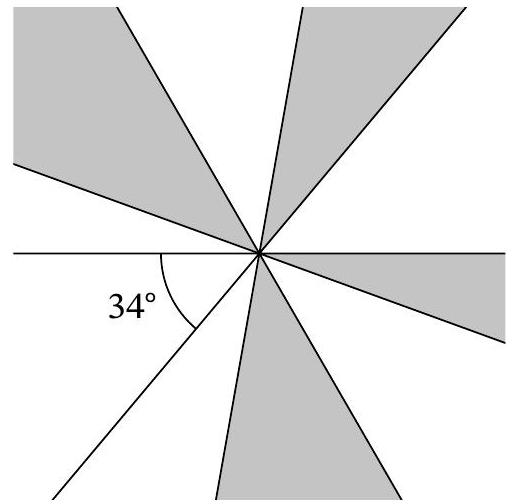
olympiads | Problem 7.4. The figure shows 5 lines intersecting at one point. One of the resulting angles is $34^{\circ}$. How many degrees is the sum of the four angles shaded in gray?
 | <think>
Okay, let's see here. The problem says there are 5 lines intersecting at one point, and one of the angles formed is 34 degrees. They want the sum of the four gray-shaded angles. Hmm. Alright, so first, when multiple lines intersect at a single point, they create a bunch of angles around that point. Since there ... |
olympiads | At least how many vertices does a graph have in which there is no cycle shorter than 6 and the degree of every vertex is 3? | <think>
Alright, so I need to figure out the minimum number of vertices a graph can have where there are no cycles shorter than 6 (meaning the girth is at least 6) and every vertex has degree 3. Hmm, okay. Let me start by recalling some basics about graph theory.
First, in a graph where every vertex has degree 3, we c... |
cn_contest | 6. If the parabola $C_{m}: y=x^{2}-m x+m+1$ intersects the line segment $A B$ (where $A(0,4), B(4,0)$) at exactly two points, then the range of values for $m$ is $\qquad$ | <think>
Okay, so I need to find the range of values for m such that the parabola y = x² - m x + m + 1 intersects the line segment AB at exactly two points. Points A and B are (0,4) and (4,0). Hmm, let's see.
First, maybe I should figure out the equation of the line segment AB. Since it's a line segment between two po... |
olympiads | 17. How many ordered pairs $(x, y)$ of positive integers, where $x<y$, satisfy the equation
$$
\frac{1}{x}+\frac{1}{y}=\frac{1}{2007} .
$$ | <think>
Okay, let's see. The problem is asking for the number of ordered pairs of positive integers (x, y) where x is less than y, and they satisfy the equation 1/x + 1/y = 1/2007. Hmm, right. So, I need to find all such pairs (x, y) with x < y.
First, I should probably start by manipulating the equation to get it in... |
olympiads_ref | Let $s(a)$ denote the sum of digits of a given positive integer $a$. The sequence $a_{1}, a_{2}, \ldots a_{n}, \ldots$ of positive integers is such that $a_{n+1}=a_{n}+s\left(a_{n}\right)$ for each positive integer $n$. Find the greatest possible $n$ for which it is possible to have $a_{n}=2008$.
Let $s(a)$ denote the... | <think>
Okay, so I have this problem here where I need to find the greatest possible n such that a_n = 2008 in a sequence where each term is the previous term plus the sum of its digits. Let me try to break this down step by step.
First, let me make sure I understand the sequence properly. The sequence is defined by a... |
olympiads | 10. The recurring decimal $0 . \dot{x} y \dot{z}$, where $x, y, z$ denote digits between 0 and 9 inclusive, is converted to a fraction in lowest term. How many different possible values may the numerator take?
(1 mark)
若把循環小數 $0 \dot{x} y \dot{z}$ (其中 $x 、 y 、 z$ 代表 0 至 9 之間的數字,包括 0 和 9)化戌最簡分數,分子有多少個不同的可能値? | <think>
Okay, let's tackle this problem step by step. The question is about converting a recurring decimal of the form 0.ẋyż into a fraction in its lowest terms and determining how many different possible values the numerator can take. The digits x, y, z are each between 0 and 9.
First, I need to recall how to conve... |
olympiads | (5) Try to find a proposition equivalent to the proposition "There is no smoke without fire" among the following four propositions ( ).
(A) If there is fire, there must be smoke
(B) Even without fire, there might be smoke
(C) Where there is smoke, there must be fire
(D) Even without smoke, there might be fire | <think>
Okay, so I need to figure out which of the four propositions (A, B, C, D) is equivalent to "There is no smoke without fire." Hmm, let's start by understanding what the original statement means. The phrase "no smoke without fire" is a common saying that suggests if there's smoke (visible evidence), there must ha... |
olympiads | ## 1. task
Find the smallest multi-digit number that starts with the digit 1 and has the property that, if we move this digit 1 from the beginning to the end, behind the units digit, we get a number three times larger than the original. | <think>
Okay, so I need to find a multi-digit number that starts with 1, and when I move that 1 from the beginning to the end, the new number is three times the original. Hmm, let's see how to approach this.
Let me start by understanding the problem. Let's say the original number is N. Since it starts with 1 and is mu... |
olympiads | (1) Solve the equation: $1+\log _{\frac{1}{4}}\left(4-2^{x}\right)=\log _{\frac{1}{2}}\left(2^{x}-1\right)$. | <think>
Okay, so I need to solve this equation: 1 + log base 1/4 of (4 - 2^x) equals log base 1/2 of (2^x - 1). Hmm, logarithms with different bases. Let me try to remember the logarithm rules.
First, maybe I can convert the logs to the same base so it's easier to handle. The bases here are 1/4 and 1/2. I know that 1... |
olympiads | 1. Given that $x+y-2$ is a factor of the polynomial $x^{2}+a x y+b y^{2}-5 x+y+6$ in terms of $x, y$. Then the value of $a-b$ is $\qquad$ . | <think>
Okay, so I need to find the value of a - b, given that x + y - 2 is a factor of the polynomial x² + a x y + b y² -5x + y +6. Hmm, let's start by recalling some algebra concepts. If a polynomial P(x, y) has a factor of the form L(x, y), then when L(x, y) = 0, the polynomial P(x, y) should also equal zero. So, in... |
olympiads | 9. Given the line $l: x=m y+q, m \neq 0$ intersects the ellipse $\Gamma: 3 x^{2}+4 y^{2}=12$ at two distinct points $\mathrm{A}$ and $\mathrm{B}$. Let $\mathrm{A}$'s reflection about the major axis of the ellipse be $A_{1}$, and $F$ be the right focus of the ellipse. Find the necessary and sufficient condition for $A_{... | <think>
Okay, let me try to figure out this problem step by step. First, let me understand what's given and what's being asked.
We have an ellipse Γ defined by the equation 3x² + 4y² = 12. There's a line l: x = my + q, where m ≠ 0, which intersects the ellipse at two distinct points A and B. Then, we need to reflect p... |
olympiads | # Problem №3 (15 points)
Raindrops fall vertically at a speed of 2 m/s. The mass of one drop is 5 mg. There are 400 drops in one cubic meter of air. How long will it take to completely fill a cylindrical vessel with a height of 20 cm and a base area of 10 cm $^{2}$ with water? The density of water $\rho_{B}=1000 \kapp... | <think>
Okay, so I have this problem about raindrops filling a cylindrical vessel. Let me try to figure it out step by step. First, let me parse the information given.
The raindrops are falling vertically at 2 m/s. Each drop has a mass of 5 mg. There are 400 drops in one cubic meter of air. The vessel is cylindrical w... |
olympiads | Karel drew a triangle $A D E$. On side $A D$, he marked points $B$ and $C$ such that:
- point $C$ is the midpoint of side $A D$,
- triangles $A B E$ and $B C E$ have the same area,
- triangle $B D E$ is isosceles with base $B E$,
- the perimeter of triangle $A B E$ is $6 \mathrm{~cm}$ greater than the length of the br... | <think>
Okay, let's try to tackle this geometry problem step by step. So Karel drew a triangle ADE, and there are several points and conditions given. Hmm, I need to find the perimeter of triangle ADE. Let me parse each condition carefully and see how they relate to each other.
First, triangle ADE. Points B and C are ... |
olympiads | 16-2 In the same plane, line $l_{2}$ intersects with line $l_{1}$, and line $l_{3}$ is parallel to line $l_{1}$. The number of points equidistant from these three lines is
(A) 0.
(B) 1.
(C) 2.
(D) 4.
(E) 8.
(16th American High School Mathematics Examination, 1965) | <think>
Okay, so I have this geometry problem here. Let me read it again to make sure I understand.
"In the same plane, line l₂ intersects with line l₁, and line l₃ is parallel to line l₁. The number of points equidistant from these three lines is (A) 0, (B) 1, (C) 2, (D) 4, (E) 8."
Hmm, interesting. So we have three... |
olympiads | Let $p$ be a prime number. Find a positive integer $a$ such that $k^{a} \equiv k^{-1}(\bmod p)$ for all integers $k$ not divisible by $p$. | <think>
Okay, so I need to find a positive integer a such that for any integer k not divisible by prime p, the congruence k^a ≡ k^{-1} mod p holds. Hmm, let me try to figure this out step by step.
First, I remember that when working modulo a prime p, the multiplicative group of integers modulo p (that is, the numbers ... |
olympiads | ## Task Condition
Find the derivative.
$$
y=(2 x+3)^{4} \cdot \arcsin \frac{1}{2 x+3}+\frac{2}{3} \cdot\left(4 x^{2}+12 x+11\right) \cdot \sqrt{x^{2}+3 x+2}, 2 x+3>0
$$ | <think>
Okay, so I need to find the derivative of this function y. Let me look at the problem again. The function is y = (2x + 3)^4 times arcsin(1/(2x + 3)) plus (2/3) times (4x² + 12x + 11) times the square root of (x² + 3x + 2), with the condition that 2x + 3 > 0. Alright, so first, this is a sum of two terms, each o... |
olympiads | One, (20 points) Given that $a$ and $b$ are positive integers. Find the smallest positive integer value that
$$
M=3 a^{2}-a b^{2}-2 b-4
$$
can take. | <think>
Okay, so I need to find the smallest positive integer value that M can take, where M is defined by the expression 3a² - a b² - 2b - 4. Both a and b are positive integers. Hmm, let's start by understanding the problem.
First, the goal is to minimize M while keeping it positive. That means I need to find the sma... |
olympiads | 4.76 Suppose the roads of a city form a $(n-1) \times(n-1)$ grid. The city plans to open several bus routes, with the requirement that each bus route turns at most once, and that from any of the $n^{2}$ intersections, one can reach any other intersection with at most one transfer. How many routes does the city need to ... | <think>
Okay, so I need to figure out the minimum number of bus routes required in a city with an (n-1)×(n-1) grid of roads. Each bus route can turn at most once, and from any intersection, you should be able to reach any other intersection with at most one transfer. Hmm, let me break this down step by step.
First, un... |
olympiads | 25 Given that
$$
x+(1+x)^{2}+(1+x)^{3}+\ldots+(1+x)^{n}=a_{0}+a_{1} x+a_{2} x^{2}+\ldots+a_{n} x^{n},
$$
where each $a$, is an integer, $r=0,1,2, \ldots, n$.
Find the value of $n$ such that $a_{0}+a_{2}+a_{3}+a_{4}+\ldots+a_{n-2}+a_{n-1}=60-\frac{n(n+1)}{2}$. | <think>
Okay, let's see. The problem is about finding the value of n such that the sum of certain coefficients in the expansion of this series equals 60 minus n(n+1)/2. Hmm. Let me parse the problem again.
We have the expression: x + (1+x)^2 + (1+x)^3 + ... + (1+x)^n, which is equal to a polynomial a0 + a1x + a2x^2 + ... |
olympiads_ref | 12. B6 (FIN 3) Four distinct circles \( C, C_{1}, C_{2}, C_{3} \) and a line \( L \) are given in the plane such that \( C \) and \( L \) are disjoint and each of the circles \( C_{1}, C_{2}, C_{3} \) touches the other two, as well as \( C \) and \( L \). Assuming the radius of \( C \) to be 1, determine the distance b... | <think>
Okay, let's try to figure out this geometry problem. So, we have four circles: C, C₁, C₂, C₃, and a line L. The main circle C has a radius of 1, and it doesn't intersect the line L. The other three circles each touch the other two, as well as touching both circle C and the line L. We need to find the distance f... |
olympiads | 8-8. A chess tournament is held according to the following system: each of the 15 students from the "White Rook" school must play one game with each of the 20 students from the "Black Bishop" school, i.e., a total of 300 games should be played. At any given time, no more than one game is played.
After $n$ games, a spe... | <think>
Alright, let's try to figure out the smallest number of games n after which Sasha can definitely name one of the participants of the next game. So, we have two schools: "White Rook" with 15 students and "Black Bishop" with 20 students. Each student from White Rook must play each student from Black Bishop, makin... |
olympiads | ## [
[ Quadrilateral Pyramid ]
Edge $P A$ of the pyramid $P A B C$ is perpendicular to the base plane $A B C$ and equals 1. In triangle $A B C$, the angle at vertex $A$ is a right angle, and each of the legs $A B$ and $A C$ equals 2. Points $M$ and $N$ are the midpoints of $A C$ and $B C$ respectively. Find the radiu... | <think>
Okay, let's try to figure out the radius of the inscribed sphere in the pyramid PMNC. Hmm, inscribed sphere... that's a sphere that touches all the faces of the pyramid, right? So, the radius would be the distance from the center of the sphere to each face.
First, I need to visualize the pyramid. The base is ... |
olympiads | 8. (6 points) If a natural number has an odd number of divisors, we call this natural number a "Hope Number". Then, the largest "Hope Number" within 1000 is
保留源文本的换行和格式,直接输出翻译结果。 | <think>
</think>
你将得到一个数学问题。请逐步思考,并将最终答案用\boxed{}包裹起来:
8. (6分)如果一个自然数有奇数个因数,我们称这个自然数为“希望数”。那么,1000以内最大的“希望数”是
保留源文本的换行和格式,直接输出翻译结果。
我们将解答这个问题:
**问题分析**
"希望数"是指有奇数个因数的自然数。根据数论知识,只有当某个数是**完全平方数**时,它的因数个数才是奇数(因为平方数有一个重复的平方根,导致因数成对出现时有一个单独存在)。因此,问题转化为**找出1000以内最大的完全平方数**。
**求解步骤**
1. 计算最接近1000的平方根:
\[
\sq... |
olympiads | Problem 8.7. Given an isosceles triangle $A B C$, where $A B=A C$ and $\angle A B C=53^{\circ}$. Point $K$ is such that $C$ is the midpoint of segment $A K$. Point $M$ is chosen such that:
- $B$ and $M$ are on the same side of line $A C$;
- $K M=A B$
- angle $M A K$ is the maximum possible.
How many degrees does angl... | <think>
Okay, so I need to solve this geometry problem about an isosceles triangle ABC where AB equals AC, and angle ABC is 53 degrees. There's a point K such that C is the midpoint of AK, and a point M with certain conditions. The goal is to find the measure of angle BAM. Hmm, let's try to visualize this first.
First... |
olympiads_ref | $A$ and $B$ are opposite corners of an $n \times n$ board, divided into $n^{2}$ squares by lines parallel to the sides. In each square the diagonal parallel to $\mathrm{AB}$ is drawn, so that the board is divided into $2 \mathrm{n}^{2}$ small triangles. The board has $(n+1)^{2}$ nodes and a large number of line segment... | <think>
Okay, let me try to figure out this problem. So, we have an n x n board divided into squares, and each square has a diagonal parallel to the diagonal connecting corners A and B. The piece moves from A to B along these line segments, never retracing a segment, and the path must include exactly two sides of every... |
olympiads | Example 8 Choose $k$ numbers from $1,2, \cdots, 2004$, such that among the chosen $k$ numbers, there are definitely three numbers that can form the side lengths of a triangle (here it is required that the three side lengths of the triangle are all different). Then the minimum value of $k$ that satisfies the condition i... | <think>
Okay, so the problem is asking for the minimum number k such that if we choose any k numbers from 1 to 2004, there must be three numbers among them that can form a triangle with all sides of different lengths. Hmm, let me think about how to approach this.
First, I remember that for three numbers to form a tria... |
olympiads | Example 5 In $\triangle ABC$, $AB = BC > AC$, $AH$ and $AM$ are the altitude and median from vertex $A$ to side $BC$, respectively. Given that $\frac{S_{\triangle MH}}{S_{\triangle ABC}} = \frac{3}{8}$. Determine the value of $\cos \angle BAC$. ${ }^{[5]}$
(2009, Beijing High School Mathematics Competition Preliminary ... | <think>
Alright, so I have this geometry problem here. Let me read it again carefully.
In triangle ABC, AB equals BC and is greater than AC. AH and AM are the altitude and median from vertex A to side BC, respectively. The ratio of the area of triangle MH to the area of triangle ABC is 3/8. We need to determine the v... |
olympiads | 8. In the sequence $\left\{a_{n}\right\}$, if $a_{i}+a_{i+1}+a_{i+2}$ is odd, then $\left(a_{i}, a_{i+1}, a_{i+2}\right)$ is called a "triple". For example, in 6, $4,2,1,3,5$, there are exactly two triples: $(4,2,1)$ and $(1,3,5)$. If $a_{1}, a_{2}, \cdots, a_{2021}$ is a permutation of $1,2, \cdots, 2021$, then the ma... | <think>
Okay, let's see. The problem is about finding the maximum number of "triples" in a permutation of the numbers 1 through 2021. A triple is defined as three consecutive numbers in the sequence where the sum of those three numbers is odd. For example, in the sequence 6, 4, 2, 1, 3, 5, there are two triples: (4, 2,... |
olympiads | 3. [4 points] Solve the inequality $\left(\sqrt{x^{3}+x-90}+7\right)\left|x^{3}-10 x^{2}+31 x-28\right| \leqslant 0$. | <think>
Okay, so I need to solve this inequality: (sqrt(x³ + x - 90) + 7) * |x³ - 10x² + 31x - 28| ≤ 0. Hmm, let's break this down step by step.
First, I remember that for a product of two terms to be less than or equal to zero, at least one of the terms has to be non-positive and the other non-negative, or one of th... |
olympiads_ref | Find all primes $p$ and $q$ such that $3 p^{q-1}+1$ divides $11^{p}+17^{p}$. | <think>
Alright, so I need to find all prime numbers p and q such that 3p^{q-1} + 1 divides 11^p + 17^p. Hmm, okay. Let's start by understanding what the problem is asking.
First, both p and q are primes. The expression 3p^{q-1} + 1 has to divide 11^p + 17^p. That means when we divide 11^p + 17^p by 3p^{q-1} + 1, the... |
olympiads | 17. Let the function $f(x)$ be monotonic on $(-\infty,+\infty)$, and satisfy $f(x+y)=f(x)+f(y)$ and $f(1)=$ -1. If for any positive number $t$ there is $f\left(k \log _{2} t\right)+f\left(\log _{2} t-\log _{2}^{2} t-2\right)>0$ always holds, find the range of $k$.
| <think>
Okay, so I need to solve this problem where I have a function f(x) that's monotonic on all real numbers, satisfies f(x + y) = f(x) + f(y), and f(1) = -1. Then, there's this inequality involving f with some logarithmic terms, and I need to find the range of k such that this inequality holds for any positive t. H... |
olympiads | Example 2.44. Investigate the conditional and absolute convergence of the improper integral
$$
I=\int_{0}^{2}\left[2 x \sin \left(\frac{\pi}{x^{2}}\right)-\frac{2 \pi}{x} \cos \left(\frac{\pi}{x^{2}}\right)\right] d x
$$ | <think>
Okay, so I need to investigate the conditional and absolute convergence of this integral:
$$
I = \int_{0}^{2} \left[2x \sin\left(\frac{\pi}{x^2}\right) - \frac{2\pi}{x} \cos\left(\frac{\pi}{x^2}\right)\right] dx
$$
Hmm, improper integrals. Right, because the integrand might have issues at certain points. Let ... |
olympiads | 13. $[\mathbf{9}]$ Find the smallest positive integer $n$ for which
$$
1!2!\cdots(n-1)!>n!^{2} .
$$ | <think>
Okay, so I need to find the smallest positive integer n such that the product of 1! times 2! times ... times (n-1)! is greater than (n!) squared. Hmm, let me start by understanding the problem better.
First, let's write down the inequality again to make sure I have it right:
1! * 2! * 3! * ... * (n-1)! > (n!)... |
olympiads | 1. If the function $f(x)=\frac{a^{x}}{a^{x}+\sqrt{a}}$, then the value of $\sum_{i=1}^{100} f\left(\frac{i}{101}\right)$ is | <think>
Okay, let's see. The problem is to find the sum of f(i/101) from i=1 to 100, where f(x) is given by a^x divided by (a^x + sqrt(a)). Hmm. Let me first write down the function properly.
So, f(x) = (a^x)/(a^x + sqrt(a)). The sum is from i=1 to 100 of f(i/101). I need to compute this sum. Maybe there's a pattern o... |
olympiads | 1. Given that $x=-2$ is a root of the equation $x^{2}+a x+2 b=0$. Then the minimum value of $a^{2}+b^{2}$ is $\qquad$ | <think>
Alright, let me try to figure out this problem. So, we have the equation x² + a x + 2b = 0, and they tell us that x = -2 is a root. We need to find the minimum value of a² + b². Hmm, okay. Let me start by recalling some algebra concepts.
First, if x = -2 is a root of the quadratic equation, then substituting x... |
olympiads | 4. The last two digits of the integer $\left[\frac{10^{93}}{10^{31}+3}\right]$ are $\qquad$ (write the tens digit first, then the units digit; where $[x]$ denotes the greatest integer not exceeding $x$). | <think>
Okay, so I need to find the last two digits of the integer part of 10^93 divided by (10^31 + 3). That is, compute the last two digits of floor(10^93 / (10^31 + 3)). Hmm, let's see how to approach this.
First, let me write down the problem again to make sure I understand it correctly. I need to calculate floor(... |
olympiads_ref | Find all functions $f: \mathbb{R} \rightarrow \mathbb{R}$ that satisfy
$$
f(x+y f(x))=f(x f(y))-x+f(y+f(x))
$$
for all $x, y \in \mathbb{R}$. | <think>
Okay, so I need to solve this functional equation: f(x + y f(x)) = f(x f(y)) - x + f(y + f(x)) for all real numbers x and y. Hmm, functional equations can be tricky, but let's try breaking it down step by step.
First, let me see if I can plug in some specific values for x or y to simplify the equation. Maybe s... |
aops_forum | Suppose that $a,b,c$ are real numbers such that $a < b < c$ and $a^3-3a+1=b^3-3b+1=c^3-3c+1=0$. Then $\frac1{a^2+b}+\frac1{b^2+c}+\frac1{c^2+a}$ can be written as $\frac pq$ for relatively prime positive integers $p$ and $q$. Find $100p+q$.
[i]Proposed by Michael Ren[/i] | <think>
Okay, so I have this problem where there are three real numbers a, b, c such that a < b < c, and each of them satisfies the equation x³ - 3x + 1 = 0. I need to find the value of the expression 1/(a² + b) + 1/(b² + c) + 1/(c² + a) and express it as a fraction p/q where p and q are coprime positive integers, then... |
olympiads | 7.2. Find the sum of all three-digit natural numbers that do not contain the digits 0 or 9 in their representation. | <think>
Okay, so I need to find the sum of all three-digit natural numbers that don't have any 0 or 9 in their digits. Let me start by understanding the problem better.
First, a three-digit number ranges from 100 to 999. But the condition is that none of the digits can be 0 or 9. That means each digit—hundreds, tens,... |
olympiads | 4 Calculate the sum of the inverses of the first two thousand thirteen terms of the sequence with the general term
$$
a_{n}=1-\frac{1}{4 n^{2}}
$$ | <think>
Okay, so I need to calculate the sum of the inverses of the first 2013 terms of the sequence defined by aₙ = 1 - 1/(4n²). Let me try to break this down step by step.
First, the problem is asking for the sum:
S = Σ (1 / aₙ) from n=1 to n=2013
Given that aₙ = 1 - 1/(4n²), so each term in the sum is 1 divided b... |
olympiads | # Problem 4.
In-1 The angle at the vertex in the axial section of a cone is $60^{\circ}$. Outside this cone, there are 11 spheres of radius 3, each touching two adjacent spheres, the lateral surface of the cone, and the plane of its base. Find the radius of the base of the cone. | <think>
Okay, let's try to figure out this cone problem. So, there's a cone with an axial section (which I think is like if you cut the cone along its axis, right?) and the angle at the vertex of this axial section is 60 degrees. Outside the cone, there are 11 spheres, each with radius 3. Each sphere touches two adjace... |
olympiads | 1. Find all natural numbers $m$ and $n$ that satisfy the equation $\frac{3}{m}+\frac{5}{n}=1$. | <think>
Okay, so I need to find all natural numbers m and n that satisfy the equation 3/m + 5/n = 1. Hmm, natural numbers, so m and n are positive integers. Let me think about how to approach this.
First, maybe I can rearrange the equation to express one variable in terms of the other. Let me try that. Starting with ... |
olympiads | 2. Solve the equation $\cos \left(\pi x^{2}\right)-\cos ^{2}\left(\frac{\pi x^{2}}{2}\right)+1+\cos \left(\pi x^{2}-4 \pi x\right)=\sin ^{2}\left(\frac{\pi x^{2}}{2}\right)$. In your answer, specify the third term of the increasing sequence of all positive roots of the equation. | <think>
Okay, let me try to solve this equation step by step. The equation given is:
cos(πx²) - cos²(πx²/2) + 1 + cos(πx² - 4πx) = sin²(πx²/2)
Hmm, that looks a bit complicated with all the trigonometric functions. Let me see if I can simplify it using some trigonometric identities. First, I remember that sin²θ = 1 -... |
olympiads | 4. Given the dihedral angle $\alpha-l-\beta$ is $60^{\circ}$, moving points $P, Q$ are in planes $\alpha, \beta$ respectively, the distance from $P$ to $\beta$ is $\sqrt{3}$, and the distance from $Q$ to $\alpha$ is $2 \sqrt{3}$, then the minimum distance between points $P, Q$ is $\qquad$ . | <think>
Okay, so I need to find the minimum distance between points P and Q. Let me see... The problem says that the dihedral angle between planes α and β is 60 degrees. Points P and Q are moving in planes α and β respectively. The distance from P to β is √3, and the distance from Q to α is 2√3. Hmm, dihedral angle... ... |
olympiads | 1. Find the number of points in the $x O y$ plane having natural coordinates $(x, y)$ and lying on the parabola $y=-\frac{x^{2}}{3}+20 x+63$. | <think>
Okay, let's see. The problem is asking for the number of points with natural coordinates (x, y) that lie on the parabola given by the equation y = -x²/3 + 20x + 63. So, natural coordinates mean that both x and y have to be positive integers, right? So, x is a natural number, and when we plug x into the equation... |
olympiads | Example 2-55 In the permutations of the numbers $1,2,3, \cdots, 9$, find the number of derangements where even numbers are in their original positions, and the rest are not in their original positions. | <think>
Okay, so I need to solve this derangement problem where even numbers stay in their original positions, and all the odd numbers are not in their original positions. Let me try to break this down step by step.
First, let's recall what a derangement is. A derangement is a permutation where none of the elements ap... |
olympiads | 8. Suppose that $\left\{a_{n}\right\}_{n \geq 1}$ is an increasing arithmetic sequence of integers such that $a_{a_{20}}=17$ (where the subscript is $a_{20}$ ). Determine the value of $a_{2017}$. | <think>
Okay, let's tackle this problem step by step. So, we have an increasing arithmetic sequence of integers, which is denoted by {aₙ} where n is greater than or equal to 1. The key piece of information given is that a_{a_{20}} = 17. We need to find the value of a_{2017}.
First, let me recall what an arithmetic se... |
olympiads | 2. Given two linear functions $f(x)$ and $g(x)$ such that the graphs $y=f(x)$ and $y=g(x)$ are parallel lines, not parallel to the coordinate axes. Find the minimum value of the function $(g(x))^{2}+$ $8 f(x)$, if the minimum value of the function $(f(x))^{2}+8 g(x)$ is -29. | <think>
Okay, so I have this problem here where there are two linear functions f(x) and g(x). Their graphs are parallel lines, but they're not parallel to the coordinate axes. I need to find the minimum value of the function (g(x))² + 8f(x), given that the minimum value of (f(x))² + 8g(x) is -29.
Hmm. Let me start by... |
olympiads | 2. At a cactus lovers' meeting, 80 cactus enthusiasts presented their collections, each consisting of cacti of different species. It turned out that no species of cactus is present in all collections at once, but any 15 people have cacti of the same species. What is the smallest total number of cactus species that can ... | <think>
Okay, so I need to figure out the smallest total number of cactus species that can be in all the collections, given that there are 80 cactus enthusiasts. The conditions are that no species is present in all 80 collections, but any 15 people have a common species. Hmm, this sounds like a problem from combinatori... |
aops_forum | $12$ knights are sitting at a round table. Every knight is an enemy with two of the adjacent knights but with none of the others.
$5$ knights are to be chosen to save the princess, with no enemies in the group. How many ways are there for the choice? | <think>
Okay, so there's this problem where 12 knights are sitting around a round table. Each knight is enemies with the two knights sitting right next to him. We need to choose 5 knights to save the princess, and none of the chosen knights can be enemies with each other. The question is asking how many ways there are ... |
olympiads | 1. Can five identical rectangles with a perimeter of 10 be arranged to form one rectangle with a perimeter of 22? | <think>
Okay, let's see. The problem is asking if five identical rectangles, each with a perimeter of 10, can be arranged to form one larger rectangle that has a perimeter of 22. Hmm, interesting. Let me try to figure this out step by step.
First, I need to understand the properties of the smaller rectangles. Since th... |
olympiads | The lateral edge of a regular quadrilateral pyramid is $b$, and the plane angle at the vertex is $\alpha$. Find the radius of the sphere circumscribed about the pyramid.
# | <think>
Okay, so I need to find the radius of the sphere that's circumscribed around a regular quadrilateral pyramid. The given information is that the lateral edge (which I think is the edge from the base to the apex, right?) is length b, and the plane angle at the vertex is alpha. Hmm, let me visualize this pyramid f... |
olympiads | 1.5.13 $\star \star$ Find the largest real number $k$, such that for any positive real numbers $a, b, c$, we have
$$
\begin{aligned}
& \frac{(b-c)^{2}(b+c)}{a}+\frac{(c-a)^{2}(c+a)}{b}+\frac{(a-b)^{2}(a+b)}{c} \\
\geqslant & k\left(a^{2}+b^{2}+c^{2}-a b-b c-c a\right)
\end{aligned}
$$ | <think>
Okay, so I need to find the largest real number k such that the given inequality holds for any positive real numbers a, b, c. The inequality is:
[(b - c)^2(b + c)/a + (c - a)^2(c + a)/b + (a - b)^2(a + b)/c] ≥ k(a² + b² + c² - ab - bc - ca)
First, let me parse this. The left side is a cyclic sum involving ter... |
olympiads | A cricket can jump two distances: 9 and 8 meters. It competes in a 100-meter race to the edge of a cliff. How many jumps must the cricket make to reach the end of the race without going past the finish line and falling off the cliff?
# | <think>
Okay, so there's this cricket that can jump either 8 meters or 9 meters. It's in a 100-meter race towards the edge of a cliff, and we need to figure out how many jumps the cricket needs to make to exactly reach the finish line without going over. If it goes past, it falls off the cliff, which is bad. So we need... |
olympiads | 2. Petya wrote down five consecutive terms of an arithmetic progression and encrypted them according to the principle: each digit was replaced with a letter, different digits with different letters, and vice versa. Here's what he got: A, BV, DS, EE, SD. What numbers did Petya write? | <think>
Okay, let's see. So, the problem is that Petya wrote five consecutive terms of an arithmetic progression and encrypted them. The encrypted terms are A, BV, DS, EE, SD. Each digit is replaced by a unique letter, different digits with different letters, and vice versa. So, my job is to figure out what the origina... |
amc_aime | Let $B$ be the set of all binary integers that can be written using exactly $5$ zeros and $8$ ones where leading zeros are allowed. If all possible subtractions are performed in which one element of $B$ is subtracted from another, find the number of times the answer $1$ is obtained. | <think>
Okay, let me try to figure out this problem. So, we have the set B, which consists of all binary integers that can be formed using exactly 5 zeros and 8 ones. Leading zeros are allowed, which is important. The question is asking how many times the answer 1 is obtained when we subtract one element of B from anot... |
olympiads | ## Problem Statement
Based on the definition of the derivative, find $f^{\prime}(0)$:
$$
f(x)=\left\{\begin{array}{c}
\frac{\ln (\cos x)}{x}, x \neq 0 \\
0, x=0
\end{array}\right.
$$ | <think>
Okay, so I need to find f'(0) using the definition of the derivative. The function f(x) is defined piecewise: it's (ln(cos x))/x when x isn't zero, and 0 when x is zero. Alright, so to find the derivative at x=0, I should use the limit definition of the derivative, right? Because the derivative at a point is th... |
Subsets and Splits
No community queries yet
The top public SQL queries from the community will appear here once available.