


AgMMU: A Comprehensive Agricultural Multimodal Understanding and Reasoning Benchmark
Paper • 2504.10568 • Published
Exception:    SplitsNotFoundError
Message:      The split names could not be parsed from the dataset config.
Traceback:    Traceback (most recent call last):
                File "/usr/local/lib/python3.14/site-packages/datasets/inspect.py", line 286, in get_dataset_config_info
                  for split_generator in builder._split_generators(
                                         ~~~~~~~~~~~~~~~~~~~~~~~~~^
                      StreamingDownloadManager(base_path=builder.base_path, download_config=download_config)
                      ^^^^^^^^^^^^^^^^^^^^^^^^^^^^^^^^^^^^^^^^^^^^^^^^^^^^^^^^^^^^^^^^^^^^^^^^^^^^^^^^^^^^^^
                  )
                  ^
                File "/usr/local/lib/python3.14/site-packages/datasets/packaged_modules/webdataset/webdataset.py", line 81, in _split_generators
                  first_examples = list(islice(pipeline, self.NUM_EXAMPLES_FOR_FEATURES_INFERENCE))
                File "/usr/local/lib/python3.14/site-packages/datasets/packaged_modules/webdataset/webdataset.py", line 32, in _get_pipeline_from_tar
                  fs: fsspec.AbstractFileSystem = fsspec.filesystem("memory")
                                                  ~~~~~~~~~~~~~~~~~^^^^^^^^^^
                File "/usr/local/lib/python3.14/site-packages/fsspec/registry.py", line 302, in filesystem
                  cls = get_filesystem_class(protocol)
                File "/usr/local/lib/python3.14/site-packages/fsspec/registry.py", line 239, in get_filesystem_class
                  raise ValueError(f"Protocol not known: {protocol}")
              ValueError: Protocol not known: memory

              The above exception was the direct cause of the following exception:

              Traceback (most recent call last):
                File "/src/services/worker/src/worker/job_runners/config/split_names.py", line 66, in compute_split_names_from_streaming_response
                  for split in get_dataset_split_names(
                               ~~~~~~~~~~~~~~~~~~~~~~~^
                      path=dataset,
                      ^^^^^^^^^^^^^
                      config_name=config,
                      ^^^^^^^^^^^^^^^^^^^
                      token=hf_token,
                      ^^^^^^^^^^^^^^^
                  )
                  ^
                File "/usr/local/lib/python3.14/site-packages/datasets/inspect.py", line 340, in get_dataset_split_names
                  info = get_dataset_config_info(
                      path,
                  ...<6 lines>...
                      **config_kwargs,
                  )
                File "/usr/local/lib/python3.14/site-packages/datasets/inspect.py", line 291, in get_dataset_config_info
                  raise SplitsNotFoundError("The split names could not be parsed from the dataset config.") from err
              datasets.inspect.SplitsNotFoundError: The split names could not be parsed from the dataset config.
Need help to make the dataset viewer work? Make sure to review how to configure the dataset viewer, and open a discussion for direct support.
1University of Illinois at Urbana-Champaign, 2Rice University, 3Carnegie Mellon University
4AIFARMS, 5Center for Digital Agriculture at UIUC
AgMMU is a challenging real‑world benchmark for evaluating and advancing vision-language models (VLMs) in the knowledge‑intensive domain of agriculture. Unlike prior datasets that rely on crowdsourced prompts, AgMMU is distilled from 116231 authentic dialogues between everyday growers and USDA-authorized Cooperative Extension experts. Through a three‑stage pipeline: automated knowledge extraction, QA generation, and human verification, we construct (i) AgMMU, an evaluation set of 746 multiple‑choice questions (MCQs) and 746 open‑ended questions (OEQs), and (ii) AgBase, a development corpus of 57,387 multimodal facts covering five high-stakes agricultural topics: insect identification, species identification, disease categorization, symptom description, and management instruction.
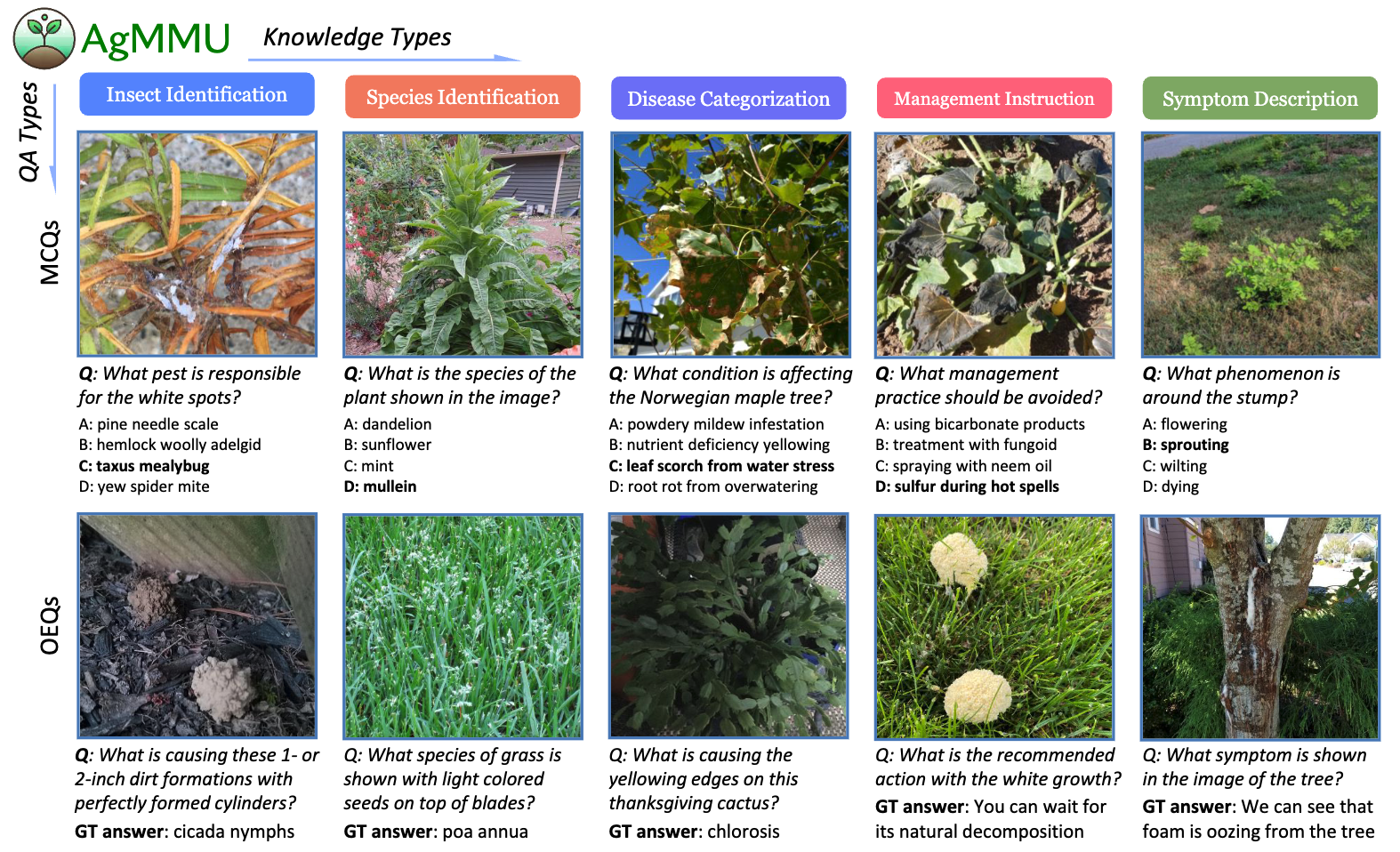
AgMMU is created to develop factually accurate VLMs following the principle of SimpleQA. For the research community, AgMMU uniquely features both close and open-ended questions, and a large-scale agricultural knowledge base for fine-tuning.

Please refer to our GitHub for detailed instructions. When downloading the dataset, we recommend using git-lfs to clone directly.
If you find our dataset useful, please cite by:
@article{gauba2025agmmu,
  title={AgMMU: A Comprehensive Agricultural Multimodal Understanding and Reasoning Benchmark},
  author={Gauba, Aruna and Pi, Irene and Man, Yunze and Pang, Ziqi and Adve, Vikram S and Wang, Yu-Xiong},
  journal={arXiv preprint arXiv:2504.10568},
  year={2025}
}
We appreciate the help from AskExtension for providing the raw images and user-expert conversations for building AgMMU, supporting AI research on the agricultural problems.