

license: gpl-3.0
pretty_name: BEPAD
task_categories:
  - other
tags:
  - seismology
  - earthquakes
  - phase-association
  - benchmark
configs:
  - config_name: windows
    default: true
    data_files:
      - split: train
        path: v0.2/train/windows/*.parquet
      - split: validation
        path: v0.2/val/windows/*.parquet
      - split: test
        path: v0.2/test/windows/*.parquet
  - config_name: events
    data_files:
      - split: train
        path: v0.2/train/events/*.parquet
      - split: validation
        path: v0.2/val/events/*.parquet
      - split: test
        path: v0.2/test/events/*.parquet
  - config_name: stations
    data_files: v0.2/stations.parquet
  - config_name: window_stations
    data_files:
      - split: train
        path: v0.2/train/window_stations/*.parquet
      - split: validation
        path: v0.2/val/window_stations/*.parquet
      - split: test
        path: v0.2/test/window_stations/*.parquet
  - config_name: picks
    data_files:
      - split: train
        path: v0.2/train/picks/*.parquet
      - split: validation
        path: v0.2/val/picks/*.parquet
      - split: test
        path: v0.2/test/picks/*.parquet
BEPAD — Benchmark Earthquake Phase Association Dataset




Thousands of phase-association problems built from real earthquakes and real picks of UTDQuake. Each window holds several overlapping earthquakes on one seismic network, with real, generated and noise picks, and the answer (earthquake) for every pick.
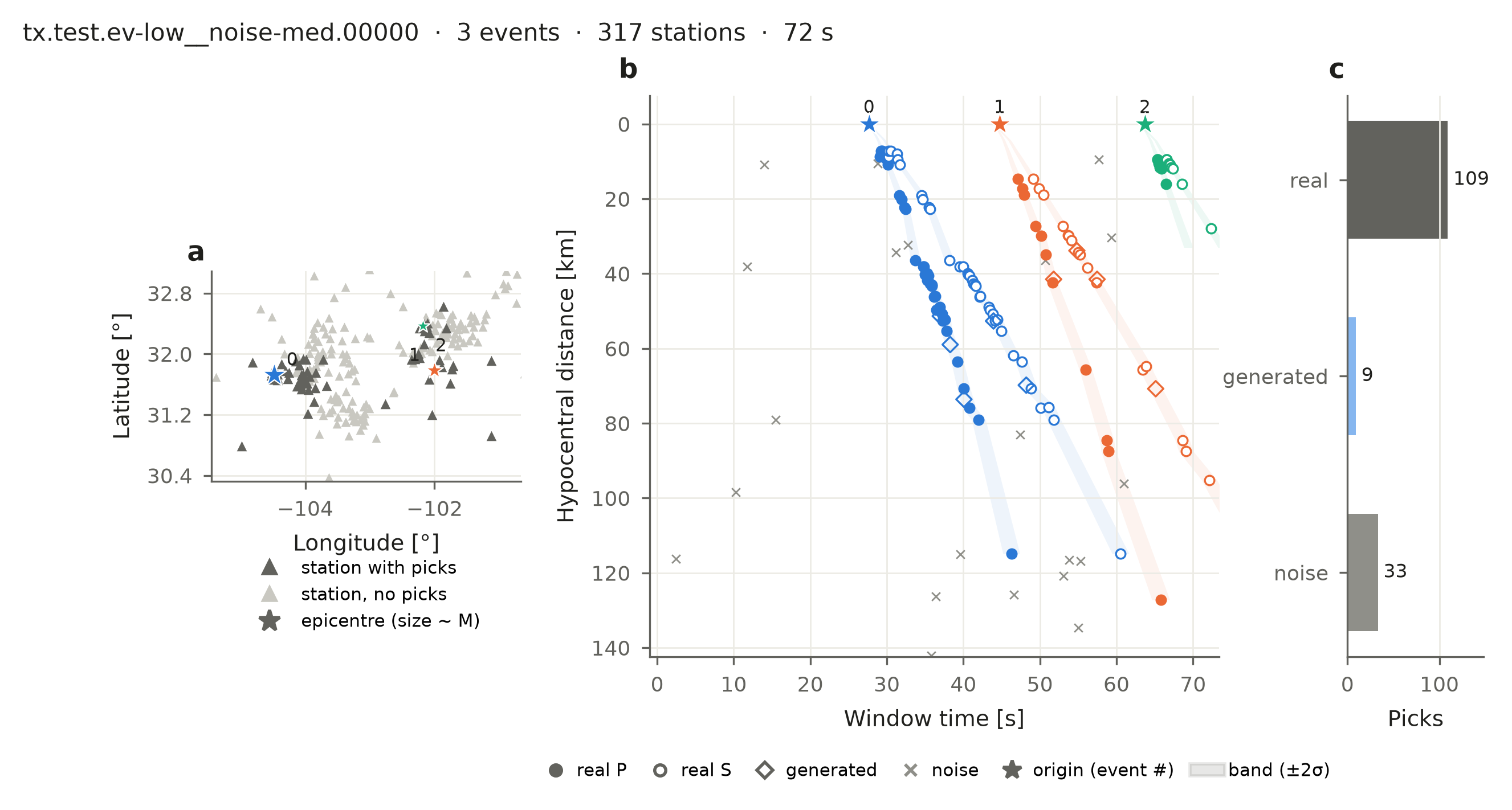
One window (Texas network): (a) earthquakes and stations, (b) every pick at its distance from its earthquake, (c) picks by type. The associator's job is to find which picks belong together.
v0.2 (current) is built from UTDQuake 1.0 (Hugging Face commit 8524c6f0): every seismic network, named by
its UTDQuake code (tx, CM, R08 ...). A station is NET.STA (FDSN network and station code).
Quick start
import bepad                                   # pip install bepad
test = bepad.load("test", networks=["tx"], max_windows=20, labels=False)   # 20 Texas test windows
for w in test:
    w.picks, w.stations                        # the inputs of one association problem
report = bepad.evaluate(predictions, test)     # score your associator
Without the package:
import pandas as pd
picks = pd.read_parquet("hf://datasets/ecastillot/BEPAD/v0.2/test/picks/network=tx.parquet")
Content
| Folder | What |
|---|---|
v0.2/<split>/windows |
one row per window: network, scenario (which earthquakes, how many, noise), counts, difficulty, seed |
v0.2/<split>/events |
the earthquakes of each window (origin, location, magnitude, sequence and role) |
v0.2/stations.parquet |
station coordinates; station = NET.STA, network = UTDQuake network |
v0.2/<split>/window_stations |
the stations available in each window (window_id, station); coordinates in stations.parquet |
v0.2/<split>/picks |
one row per pick: station, phase, time; labels event_idx (−1 noise), pick_type (real / generated / noise), real, prob (optional confidence for training, from detectability) |
v0.2/metadata/ |
window statistics as CSV |
v0.2/label_model.json |
predicted arrivals, timing uncertainty and prob model |
v0.1/ |
the previous release (23 scenarios, no sequences), same layout |
pool/ |
the quality-controlled earthquakes and picks (for generating new training windows) |
associators/<name>/ |
contributed associators (code + parameters), runnable with bepad run |
leaderboard/ |
submitted results (scores + predictions) and the tables in leaderboard/README.md |
Per network and scenario: 600 train, 120 val and 60 test windows; 38 scenarios: which earthquakes (at random, a sequence of aftershocks and foreshocks, or outside the network) × how many (1–20) × how much noise (Scenarios). Every earthquake in a window has ≥ 4 real P picks on ≥ 3 stations inside it.
| Split | Windows | Networks |
|---|---|---|
| train | 2,050,470 | 90 |
| val | 408,876 | 90 |
| test | 207,197 | 91 |
Networks with fewer than 200 earthquakes are test only (ESPOO, R06).
BEPAD-10
The main ranking uses the BEPAD-10 test: the test windows of 10 networks chosen for different
scales, geometries and depths, from a 4 km fracking array to national networks:
R05 ToC2ME, R07 LASSO, R01 COSEISMIQ, nc N. California, tx Texas, JMA Japan,
CM Colombia, R09 N. Chile (IPOC), ak Alaska, NOA Greece. Every leaderboard entry must run them:
bepad run associators/my-method --split test --networks core --out results/my-method
bepad submit results/my-method --code associators/my-method --dry-run    # your row, nothing is sent
Leaderboard
See leaderboard/README.md: the BEPAD-10 table first (mean over its networks), then all networks,
then one table per network. To add a method: bepad new, bepad run, bepad submit — the last
command opens a pull request on this repository that adds only your two folders.
Benchmark rules
- Report on the
testsplit. 2. Use onlypicks(without label columns) and stations as input. - Treat each window separately. 4. Tune only on
train/val; velocity models must be published or fitted ontrain/val. - Run at least the BEPAD-10 networks. 6. Submit your code with your results (
bepad submit --code): the test labels are public, so entries are re-run before they are merged.
License and citation
Data follow the terms of the original providers as distributed by UTDQuake; please cite UTDQuake
and the network operators. Code (the bepad package): GPL-3.0.