\\n\\nTo solve the differential equation \\\\( x y^3 \\\\, dx + (x^2 y^2 - 1) \\\\, dy = 0 \\\\), we start by checking if it is exact. The partial derivatives \\\\(\\\\frac{\\\\partial M}{\\\\partial y} = 3x y^2\\\\) and \\\\(\\\\frac{\\\\partial N}{\\\\partial x} = 2x y^2\\\\) are not equal, so the equation is not exact. \\n\\nNext, we consider transforming the equation into a Bernoulli equation. By treating \\\\(x\\\\) as a function of \\\\(y\\\\), we rewrite the equation as:\\n\\\\[\\n\\\\frac{dx}{dy} + \\\\frac{x}{y} = \\\\frac{1}{x y^3}\\n\\\\]\\nThis is recognized as a Bernoulli equation with \\\\(n = -1\\\\). Using the substitution \\\\(v = x^2\\\\), we transform the equation into a linear differential equation:\\n\\\\[\\n\\\\frac{dv}{dy} + \\\\frac{2}{y} v = \\\\frac{2}{y^3}\\n\\\\]\\nThe integrating factor for this linear equation is \\\\(\\\\mu(y) = y^2\\\\). Multiplying through by the integrating factor and integrating, we get:\\n\\\\[\\ny^2 v = 2 \\\\ln |y| + C\\n\\\\]\\nSubstituting back \\\\(v = x^2\\\\), we obtain:\\n\\\\[\\nx^2 y^2 = 2 \\\\ln |y| + C\\n\\\\]\\nRearranging gives the general solution:\\n\\\\[\\nx^2 y^2 - 2 \\\\ln |y| = C\\n\\\\]\\n\\nVerification by differentiating the solution implicitly confirms it satisfies the original equation. Thus, the general solution is:\\n\\\\[\\n\\\\boxed{x^2 y^2 - 2 \\\\ln |y| = C}\\n\\\\]\",\n \"<think>\\nOkay, so I have this differential equation to solve: \\\\( x y^{3} dx + (x^{2} y^{2} - 1) dy = 0 \\\\). Hmm, let me try to figure out how to approach this. First, I remember that differential equations can sometimes be classified into different types like separable, exact, linear, etc. Let me check if this one is exact.\\n\\nAn exact equation is one where the partial derivative of the term multiplying \\\\( dx \\\\) with respect to \\\\( y \\\\) equals the partial derivative of the term multiplying \\\\( dy \\\\) with respect to \\\\( x \\\\). So here, the term multiplying \\\\( dx \\\\) is \\\\( M(x, y) = x y^3 \\\\) and the term multiplying \\\\( dy \\\\) is \\\\( N(x, y) = x^2 y^2 - 1 \\\\). Let me compute the partial derivatives.\\n\\nFirst, \\\\( \\\\frac{\\\\partial M}{\\\\partial y} \\\\). Differentiating \\\\( x y^3 \\\\) with respect to \\\\( y \\\\), we get \\\\( 3 x y^2 \\\\). Now, \\\\( \\\\frac{\\\\partial N}{\\\\partial x} \\\\). Differentiating \\\\( x^2 y^2 - 1 \\\\) with respect to \\\\( x \\\\), we get \\\\( 2 x y^2 \\\\). Hmm, \\\\( 3 x y^2 \\\\) is not equal to \\\\( 2 x y^2 \\\\), so the equation isn't exact as it stands. That means I need to check if there's an integrating factor that can make it exact.\\n\\nIntegrating factors can sometimes depend on either \\\\( x \\\\) alone or \\\\( y \\\\) alone. Let me check if that's possible here. The formula for the integrating factor \\\\( \\\\mu \\\\) when it depends only on \\\\( x \\\\) is \\\\( \\\\mu(x) = \\\\exp\\\\left( \\\\int \\\\frac{ \\\\frac{\\\\partial M}{\\\\partial y} - \\\\frac{\\\\partial N}{\\\\partial x} }{N} dx \\\\right) \\\\). Let me compute \\\\( \\\\frac{\\\\partial M}{\\\\partial y} - \\\\frac{\\\\partial N}{\\\\partial x} = 3x y^2 - 2x y^2 = x y^2 \\\\). Then, divide by \\\\( N(x, y) = x^2 y^2 - 1 \\\\). So the expression becomes \\\\( \\\\frac{x y^2}{x^2 y^2 - 1} \\\\). Hmm, this seems to still depend on both \\\\( x \\\\) and \\\\( y \\\\), so integrating factor depending only on \\\\( x \\\\) might not work. Let me check for \\\\( \\\\mu(y) \\\\). The formula would be \\\\( \\\\mu(y) = \\\\exp\\\\left( \\\\int \\\\frac{ \\\\frac{\\\\partial N}{\\\\partial x} - \\\\frac{\\\\partial M}{\\\\partial y} }{M} dy \\\\right) \\\\). Plugging in the values: \\\\( \\\\frac{2x y^2 - 3x y^2}{x y^3} = \\\\frac{ -x y^2 }{x y^3 } = - \\\\frac{1}{y} \\\\). Oh, that simplifies nicely! It only depends on \\\\( y \\\\), which is good. So the integrating factor is \\\\( \\\\exp\\\\left( \\\\int - \\\\frac{1}{y} dy \\\\right) = \\\\exp( - \\\\ln y ) = \\\\frac{1}{y} \\\\).\\n\\nSo, let's multiply the entire equation by \\\\( \\\\mu(y) = \\\\frac{1}{y} \\\\). Then, the equation becomes:\\n\\n\\\\( x y^3 \\\\cdot \\\\frac{1}{y} dx + (x^2 y^2 - 1) \\\\cdot \\\\frac{1}{y} dy = 0 \\\\)\\n\\nSimplifying:\\n\\n\\\\( x y^2 dx + \\\\left( x^2 y - \\\\frac{1}{y} \\\\right) dy = 0 \\\\)\\n\\nNow, let's check if this new equation is exact. Let \\\\( M'(x, y) = x y^2 \\\\) and \\\\( N'(x, y) = x^2 y - \\\\frac{1}{y} \\\\).\\n\\nCompute \\\\( \\\\frac{\\\\partial M'}{\\\\partial y} = 2 x y \\\\) and \\\\( \\\\frac{\\\\partial N'}{\\\\partial x} = 2 x y \\\\). Perfect, they are equal! So now the equation is exact. That means there exists a potential function \\\\( \\\\psi(x, y) \\\\) such that:\\n\\n\\\\( \\\\frac{\\\\partial \\\\psi}{\\\\partial x} = M' = x y^2 \\\\)\\n\\n\\\\( \\\\frac{\\\\partial \\\\psi}{\\\\partial y} = N' = x^2 y - \\\\frac{1}{y} \\\\)\\n\\nNow, let's integrate \\\\( \\\\frac{\\\\partial \\\\psi}{\\\\partial x} = x y^2 \\\\) with respect to \\\\( x \\\\):\\n\\n\\\\( \\\\psi(x, y) = \\\\int x y^2 dx + h(y) \\\\)\\n\\nIntegrate term by term:\\n\\n\\\\( \\\\int x y^2 dx = y^2 \\\\cdot \\\\frac{x^2}{2} = \\\\frac{x^2 y^2}{2} \\\\)\\n\\nSo, \\\\( \\\\psi(x, y) = \\\\frac{x^2 y^2}{2} + h(y) \\\\)\\n\\nNow, differentiate this \\\\( \\\\psi \\\\) with respect to \\\\( y \\\\):\\n\\n\\\\( \\\\frac{\\\\partial \\\\psi}{\\\\partial y} = \\\\frac{x^2 \\\\cdot 2 y}{2} + h'(y) = x^2 y + h'(y) \\\\)\\n\\nBut from the exact equation, we have \\\\( \\\\frac{\\\\partial \\\\psi}{\\\\partial y} = x^2 y - \\\\frac{1}{y} \\\\). Therefore:\\n\\n\\\\( x^2 y + h'(y) = x^2 y - \\\\frac{1}{y} \\\\)\\n\\nSubtract \\\\( x^2 y \\\\) from both sides:\\n\\n\\\\( h'(y) = - \\\\frac{1}{y} \\\\)\\n\\nIntegrate \\\\( h'(y) \\\\):\\n\\n\\\\( h(y) = - \\\\ln |y| + C \\\\)\\n\\nSo, the potential function is:\\n\\n\\\\( \\\\psi(x, y) = \\\\frac{x^2 y^2}{2} - \\\\ln |y| + C \\\\)\\n\\nSince the differential equation is given by \\\\( d\\\\psi = 0 \\\\), the solution is \\\\( \\\\psi(x, y) = K \\\\), where \\\\( K \\\\) is a constant. Therefore, the general solution is:\\n\\n\\\\( \\\\frac{x^2 y^2}{2} - \\\\ln |y| = K \\\\)\\n\\nHmm, let me just check if this makes sense. If I take the total derivative of \\\\( \\\\frac{x^2 y^2}{2} - \\\\ln y \\\\), I should get back the exact equation. Let's compute:\\n\\n\\\\( d\\\\left( \\\\frac{x^2 y^2}{2} - \\\\ln y \\\\right) = x y^2 dx + x^2 y dy - \\\\frac{1}{y} dy \\\\)\\n\\nWhich is equal to \\\\( x y^2 dx + (x^2 y - \\\\frac{1}{y}) dy \\\\), which matches the equation after multiplying by the integrating factor. So that's correct. Therefore, the solution is correct. But we need to express it in terms of the original variables. Wait, the original equation was multiplied by \\\\( 1/y \\\\), so integrating factor changed the equation. But since we found the solution based on the exact equation after the integrating factor, that's the correct solution. So the general solution is \\\\( \\\\frac{x^2 y^2}{2} - \\\\ln |y| = C \\\\), where \\\\( C \\\\) is a constant. Alternatively, multiplying both sides by 2:\\n\\n\\\\( x^2 y^2 - 2 \\\\ln |y| = 2C \\\\), which can be written as \\\\( x^2 y^2 - 2 \\\\ln |y| = K \\\\), where \\\\( K = 2C \\\\), just another constant. So, this is the implicit solution.\\n\\nAlternatively, if we want to write it in a different form, we could also express it as:\\n\\n\\\\( x^2 y^2 = 2 \\\\ln |y| + K \\\\)\\n\\nBut depending on the convention, either form is acceptable. Since the problem asks for the general solution, this should suffice. Let me just check if there are any singular solutions or if something was missed. The integrating factor \\\\( 1/y \\\\) is valid when \\\\( y \\\\neq 0 \\\\). Also, when we divide by \\\\( y \\\\), we have to assume \\\\( y \\\\neq 0 \\\\). So the solution is valid for \\\\( y \\\\neq 0 \\\\). Also, during integration, we had \\\\( \\\\ln |y| \\\\), so \\\\( y \\\\) can be positive or negative. Alright, I think that's covered.\\n\\nTherefore, the general solution is \\\\( x^2 y^2 - 2 \\\\ln |y| = C \\\\), where \\\\( C \\\\) is an arbitrary constant.\\n\\n**Final Answer**\\nThe general solution is \\\\boxed{x^2 y^2 - 2 \\\\ln |y| = C}.\\n</think>\\n\\nTo solve the differential equation \\\\( x y^3 dx + (x^2 y^2 - 1) dy = 0 \\\\), we first check if it is exact. The terms are \\\\( M(x, y) = x y^3 \\\\) and \\\\( N(x, y) = x^2 y^2 - 1 \\\\). Computing the partial derivatives, we find:\\n\\n\\\\[\\n\\\\frac{\\\\partial M}{\\\\partial y} = 3x y^2 \\\\quad \\\\text{and} \\\\quad \\\\frac{\\\\partial N}{\\\\partial x} = 2x y^2\\n\\\\]\\n\\nSince these are not equal, the equation is not exact. We then check for an integrating factor. We find that the integrating factor depending on \\\\( y \\\\) is:\\n\\n\\\\[\\n\\\\mu(y) = \\\\exp\\\\left( \\\\int -\\\\frac{1}{y} dy \\\\right) = \\\\frac{1}{y}\\n\\\\]\\n\\nMultiplying the entire equation by \\\\( \\\\frac{1}{y} \\\\), we get:\\n\\n\\\\[\\nx y^2 dx + \\\\left( x^2 y - \\\\frac{1}{y} \\\\right) dy = 0\\n\\\\]\\n\\nNow, checking exactness again, we compute the partial derivatives of the new terms \\\\( M'(x, y) = x y^2 \\\\) and \\\\( N'(x, y) = x^2 y - \\\\frac{1}{y} \\\\):\\n\\n\\\\[\\n\\\\frac{\\\\partial M'}{\\\\partial y} = 2x y \\\\quad \\\\text{and} \\\\quad \\\\frac{\\\\partial N'}{\\\\partial x} = 2x y\\n\\\\]\\n\\nThese are equal, so the equation is now exact. We find the potential function \\\\( \\\\psi(x, y) \\\\) by integrating \\\\( M' \\\\) with respect to \\\\( x \\\\):\\n\\n\\\\[\\n\\\\psi(x, y) = \\\\int x y^2 dx + h(y) = \\\\frac{x^2 y^2}{2} + h(y)\\n\\\\]\\n\\nDifferentiating \\\\( \\\\psi \\\\) with respect to \\\\( y \\\\) and equating to \\\\( N' \\\\):\\n\\n\\\\[\\nx^2 y + h'(y) = x^2 y - \\\\frac{1}{y} \\\\implies h'(y) = -\\\\frac{1}{y}\\n\\\\]\\n\\nIntegrating \\\\( h'(y) \\\\):\\n\\n\\\\[\\nh(y) = -\\\\ln |y| + C\\n\\\\]\\n\\nThus, the potential function is:\\n\\n\\\\[\\n\\\\psi(x, y) = \\\\frac{x^2 y^2}{2} - \\\\ln |y| + C\\n\\\\]\\n\\nThe general solution is given by \\\\( \\\\psi(x, y) = K \\\\), leading to:\\n\\n\\\\[\\n\\\\boxed{x^2 y^2 - 2 \\\\ln |y| = C}\\n\\\\]\"\n]","isConversational":false},"correctness_math_verify":{"kind":"list like","value":[false,false],"string":"[\n false,\n false\n]","isConversational":false},"correctness_llama":{"kind":"list like","value":[false,true],"string":"[\n false,\n true\n]","isConversational":false},"finish_reasons":{"kind":"null"},"correctness_count":{"kind":"number","value":1,"string":"1"},"messages":{"kind":"list like","value":[{"content":"4.22. Obtain the general solution of the equation $x y^{3} d x+\\left(x^{2} y^{2}-\\right.$ $-1) d y=0$.","role":"user"},{"content":"<think>Hmm , let me try to figure out how to approach this. First, I remember that differential equations can sometimes be classified into different types like separable, exact, linear, etc. Let me check if this one is exact.\n\nAn exact equation is one where the partial derivative of the term multiplying \\( dx \\) with respect to \\( y \\) equals the partial derivative of the term multiplying \\( dy \\) with respect to \\( x \\). So here, the term multiplying \\( dx \\) is \\( M(x, y) = x y^3 \\) and the term multiplying \\( dy \\) is \\( N(x, y) = x^2 y^2 - 1 \\). Let me compute the partial derivatives.\n\nFirst, \\( \\frac{\\partial M}{\\partial y} \\). Differentiating \\( x y^3 \\) with respect to \\( y \\), we get \\( 3 x y^2 \\). Now, \\( \\frac{\\partial N}{\\partial x} \\). Differentiating \\( x^2 y^2 - 1 \\) with respect to \\( x \\), we get \\( 2 x y^2 \\). Hmm , \\( 3 x y^2 \\) is not equal to \\( 2 x y^2 \\), so the equation isn't exact as it stands. That means I need to check if there's an integrating factor that can make it exact.\n\nIntegrating factors can sometimes depend on either \\( x \\) alone or \\( y \\) alone. Let me check if that's possible here. The formula for the integrating factor \\( \\mu \\) when it depends only on \\( x \\) is \\( \\mu(x) = \\exp\\left( \\int \\frac{ \\frac{\\partial M}{\\partial y} - \\frac{\\partial N}{\\partial x} }{N} dx \\right) \\). Let me compute \\( \\frac{\\partial M}{\\partial y} - \\frac{\\partial N}{\\partial x} = 3x y^2 - 2x y^2 = x y^2 \\). Then, divide by \\( N(x, y) = x^2 y^2 - 1 \\). So the expression becomes \\( \\frac{x y^2}{x^2 y^2 - 1} \\). Hmm , this seems to still depend on both \\( x \\) and \\( y \\), so integrating factor depending only on \\( x \\) might not work. Let me check for \\( \\mu(y) \\). The formula would be \\( \\mu(y) = \\exp\\left( \\int \\frac{ \\frac{\\partial N}{\\partial x} - \\frac{\\partial M}{\\partial y} }{M} dy \\right) \\). Plugging in the values: \\( \\frac{2x y^2 - 3x y^2}{x y^3} = \\frac{ -x y^2 }{x y^3 } = - \\frac{1}{y} \\). Oh, that simplifies nicely! It only depends on \\( y \\), which is good. So the integrating factor is \\( \\exp\\left( \\int - \\frac{1}{y} dy \\right) = \\exp( - \\ln y ) = \\frac{1}{y} \\).\n\nSo, let's multiply the entire equation by \\( \\mu(y) = \\frac{1}{y} \\). Then, the equation becomes:\n\n\\( x y^3 \\cdot \\frac{1}{y} dx + (x^2 y^2 - 1) \\cdot \\frac{1}{y} dy = 0 \\)\n\nSimplifying:\n\n\\( x y^2 dx + \\left( x^2 y - \\frac{1}{y} \\right) dy = 0 \\)\n\nNow, let's check if this new equation is exact. Let \\( M'(x, y) = x y^2 \\) and \\( N'(x, y) = x^2 y - \\frac{1}{y} \\).\n\nCompute \\( \\frac{\\partial M'}{\\partial y} = 2 x y \\) and \\( \\frac{\\partial N'}{\\partial x} = 2 x y \\). Perfect, they are equal! So now the equation is exact. That means there exists a potential function \\( \\psi(x, y) \\) such that:\n\nIntegrate \\( h'(y) \\):\n\n\\( h(y) = - \\ln |y| + C \\)\n\nSo, the potential function is:\n\n\\( \\psi(x, y) = \\frac{x^2 y^2}{2} - \\ln |y| + C \\)\n\nSince the differential equation is given by \\( d\\psi = 0 \\), the solution is \\( \\psi(x, y) = K \\), where \\( K \\) is a constant. Therefore, the general solution is:\n\n\\( \\frac{x^2 y^2}{2} - \\ln |y| = K \\)\n\n Hmm , let me just check if this makes sense. If I take the total derivative of \\( \\frac{x^2 y^2}{2} - \\ln y \\), I should get back the exact equation. Let's compute:\n\n\\( d\\left( \\frac{x^2 y^2}{2} - \\ln y \\right) = x y^2 dx + x^2 y dy - \\frac{1}{y} dy \\)\n\nWhich is equal to \\( x y^2 dx + (x^2 y - \\frac{1}{y}) dy \\), which matches the equation after multiplying by the integrating factor. So that's correct. Therefore, the solution is correct. But we need to express it in terms of the original variables. Wait , the original equation was multiplied by \\( 1/y \\), so integrating factor changed the equation. But since we found the solution based on the exact equation after the integrating factor, that's the correct solution. So the general solution is \\( \\frac{x^2 y^2}{2} - \\ln |y| = C \\), where \\( C \\) is a constant. Alternatively, multiplying both sides by 2:\n\n\\( x^2 y^2 - 2 \\ln |y| = 2C \\), which can be written as \\( x^2 y^2 - 2 \\ln |y| = K \\), where \\( K = 2C \\), just another constant. So, this is the implicit solution.\n\nTherefore, the general solution is \\( x^2 y^2 - 2 \\ln |y| = C \\), where \\( C \\) is an arbitrary constant.\n\n**Final Answer**\nThe general solution is \\boxed{x^2 y^2 - 2 \\ln |y| = C}.\n</think>\n\nTo solve the differential equation \\( x y^3 dx + (x^2 y^2 - 1) dy = 0 \\), we first check if it is exact. The terms are \\( M(x, y) = x y^3 \\) and \\( N(x, y) = x^2 y^2 - 1 \\). Computing the partial derivatives, we find:\n\n\\[\n\\frac{\\partial M}{\\partial y} = 3x y^2 \\quad \\text{and} \\quad \\frac{\\partial N}{\\partial x} = 2x y^2\n\\]\n\nSince these are not equal, the equation is not exact. We then check for an integrating factor. We find that the integrating factor depending on \\( y \\) is:\n\n\\[\n\\mu(y) = \\exp\\left( \\int -\\frac{1}{y} dy \\right) = \\frac{1}{y}\n\\]\n\nMultiplying the entire equation by \\( \\frac{1}{y} \\), we get:\n\n\\[\nx y^2 dx + \\left( x^2 y - \\frac{1}{y} \\right) dy = 0\n\\]\n\nNow, checking exactness again, we compute the partial derivatives of the new terms \\( M'(x, y) = x y^2 \\) and \\( N'(x, y) = x^2 y - \\frac{1}{y} \\):\n\n\\[\n\\frac{\\partial M'}{\\partial y} = 2x y \\quad \\text{and} \\quad \\frac{\\partial N'}{\\partial x} = 2x y\n\\]\n\nThese are equal, so the equation is now exact. We find the potential function \\( \\psi(x, y) \\) by integrating \\( M' \\) with respect to \\( x \\):\n\n\\[\n\\psi(x, y) = \\int x y^2 dx + h(y) = \\frac{x^2 y^2}{2} + h(y)\n\\]\n\nDifferentiating \\( \\psi \\) with respect to \\( y \\) and equating to \\( N' \\):\n\n\\[\nx^2 y + h'(y) = x^2 y - \\frac{1}{y} \\implies h'(y) = -\\frac{1}{y}\n\\]\n\nIntegrating \\( h'(y) \\):\n\n\\[\nh(y) = -\\ln |y| + C\n\\]\n\nThus, the potential function is:\n\n\\[\n\\psi(x, y) = \\frac{x^2 y^2}{2} - \\ln |y| + C\n\\]\n\nThe general solution is given by \\( \\psi(x, y) = K \\), leading to:\n\n\\[\n\\boxed{x^2 y^2 - 2 \\ln |y| = C}\n\\]","role":"assistant"}],"string":"[\n {\n \"content\": \"4.22. Obtain the general solution of the equation $x y^{3} d x+\\\\left(x^{2} y^{2}-\\\\right.$ $-1) d y=0$.\",\n \"role\": \"user\"\n },\n {\n \"content\": \"<think>Hmm , let me try to figure out how to approach this. First, I remember that differential equations can sometimes be classified into different types like separable, exact, linear, etc. Let me check if this one is exact.\\n\\nAn exact equation is one where the partial derivative of the term multiplying \\\\( dx \\\\) with respect to \\\\( y \\\\) equals the partial derivative of the term multiplying \\\\( dy \\\\) with respect to \\\\( x \\\\). So here, the term multiplying \\\\( dx \\\\) is \\\\( M(x, y) = x y^3 \\\\) and the term multiplying \\\\( dy \\\\) is \\\\( N(x, y) = x^2 y^2 - 1 \\\\). Let me compute the partial derivatives.\\n\\nFirst, \\\\( \\\\frac{\\\\partial M}{\\\\partial y} \\\\). Differentiating \\\\( x y^3 \\\\) with respect to \\\\( y \\\\), we get \\\\( 3 x y^2 \\\\). Now, \\\\( \\\\frac{\\\\partial N}{\\\\partial x} \\\\). Differentiating \\\\( x^2 y^2 - 1 \\\\) with respect to \\\\( x \\\\), we get \\\\( 2 x y^2 \\\\). Hmm , \\\\( 3 x y^2 \\\\) is not equal to \\\\( 2 x y^2 \\\\), so the equation isn't exact as it stands. That means I need to check if there's an integrating factor that can make it exact.\\n\\nIntegrating factors can sometimes depend on either \\\\( x \\\\) alone or \\\\( y \\\\) alone. Let me check if that's possible here. The formula for the integrating factor \\\\( \\\\mu \\\\) when it depends only on \\\\( x \\\\) is \\\\( \\\\mu(x) = \\\\exp\\\\left( \\\\int \\\\frac{ \\\\frac{\\\\partial M}{\\\\partial y} - \\\\frac{\\\\partial N}{\\\\partial x} }{N} dx \\\\right) \\\\). Let me compute \\\\( \\\\frac{\\\\partial M}{\\\\partial y} - \\\\frac{\\\\partial N}{\\\\partial x} = 3x y^2 - 2x y^2 = x y^2 \\\\). Then, divide by \\\\( N(x, y) = x^2 y^2 - 1 \\\\). So the expression becomes \\\\( \\\\frac{x y^2}{x^2 y^2 - 1} \\\\). Hmm , this seems to still depend on both \\\\( x \\\\) and \\\\( y \\\\), so integrating factor depending only on \\\\( x \\\\) might not work. Let me check for \\\\( \\\\mu(y) \\\\). The formula would be \\\\( \\\\mu(y) = \\\\exp\\\\left( \\\\int \\\\frac{ \\\\frac{\\\\partial N}{\\\\partial x} - \\\\frac{\\\\partial M}{\\\\partial y} }{M} dy \\\\right) \\\\). Plugging in the values: \\\\( \\\\frac{2x y^2 - 3x y^2}{x y^3} = \\\\frac{ -x y^2 }{x y^3 } = - \\\\frac{1}{y} \\\\). Oh, that simplifies nicely! It only depends on \\\\( y \\\\), which is good. So the integrating factor is \\\\( \\\\exp\\\\left( \\\\int - \\\\frac{1}{y} dy \\\\right) = \\\\exp( - \\\\ln y ) = \\\\frac{1}{y} \\\\).\\n\\nSo, let's multiply the entire equation by \\\\( \\\\mu(y) = \\\\frac{1}{y} \\\\). Then, the equation becomes:\\n\\n\\\\( x y^3 \\\\cdot \\\\frac{1}{y} dx + (x^2 y^2 - 1) \\\\cdot \\\\frac{1}{y} dy = 0 \\\\)\\n\\nSimplifying:\\n\\n\\\\( x y^2 dx + \\\\left( x^2 y - \\\\frac{1}{y} \\\\right) dy = 0 \\\\)\\n\\nNow, let's check if this new equation is exact. Let \\\\( M'(x, y) = x y^2 \\\\) and \\\\( N'(x, y) = x^2 y - \\\\frac{1}{y} \\\\).\\n\\nCompute \\\\( \\\\frac{\\\\partial M'}{\\\\partial y} = 2 x y \\\\) and \\\\( \\\\frac{\\\\partial N'}{\\\\partial x} = 2 x y \\\\). Perfect, they are equal! So now the equation is exact. That means there exists a potential function \\\\( \\\\psi(x, y) \\\\) such that:\\n\\nIntegrate \\\\( h'(y) \\\\):\\n\\n\\\\( h(y) = - \\\\ln |y| + C \\\\)\\n\\nSo, the potential function is:\\n\\n\\\\( \\\\psi(x, y) = \\\\frac{x^2 y^2}{2} - \\\\ln |y| + C \\\\)\\n\\nSince the differential equation is given by \\\\( d\\\\psi = 0 \\\\), the solution is \\\\( \\\\psi(x, y) = K \\\\), where \\\\( K \\\\) is a constant. Therefore, the general solution is:\\n\\n\\\\( \\\\frac{x^2 y^2}{2} - \\\\ln |y| = K \\\\)\\n\\n Hmm , let me just check if this makes sense. If I take the total derivative of \\\\( \\\\frac{x^2 y^2}{2} - \\\\ln y \\\\), I should get back the exact equation. Let's compute:\\n\\n\\\\( d\\\\left( \\\\frac{x^2 y^2}{2} - \\\\ln y \\\\right) = x y^2 dx + x^2 y dy - \\\\frac{1}{y} dy \\\\)\\n\\nWhich is equal to \\\\( x y^2 dx + (x^2 y - \\\\frac{1}{y}) dy \\\\), which matches the equation after multiplying by the integrating factor. So that's correct. Therefore, the solution is correct. But we need to express it in terms of the original variables. Wait , the original equation was multiplied by \\\\( 1/y \\\\), so integrating factor changed the equation. But since we found the solution based on the exact equation after the integrating factor, that's the correct solution. So the general solution is \\\\( \\\\frac{x^2 y^2}{2} - \\\\ln |y| = C \\\\), where \\\\( C \\\\) is a constant. Alternatively, multiplying both sides by 2:\\n\\n\\\\( x^2 y^2 - 2 \\\\ln |y| = 2C \\\\), which can be written as \\\\( x^2 y^2 - 2 \\\\ln |y| = K \\\\), where \\\\( K = 2C \\\\), just another constant. So, this is the implicit solution.\\n\\nTherefore, the general solution is \\\\( x^2 y^2 - 2 \\\\ln |y| = C \\\\), where \\\\( C \\\\) is an arbitrary constant.\\n\\n**Final Answer**\\nThe general solution is \\\\boxed{x^2 y^2 - 2 \\\\ln |y| = C}.\\n</think>\\n\\nTo solve the differential equation \\\\( x y^3 dx + (x^2 y^2 - 1) dy = 0 \\\\), we first check if it is exact. The terms are \\\\( M(x, y) = x y^3 \\\\) and \\\\( N(x, y) = x^2 y^2 - 1 \\\\). Computing the partial derivatives, we find:\\n\\n\\\\[\\n\\\\frac{\\\\partial M}{\\\\partial y} = 3x y^2 \\\\quad \\\\text{and} \\\\quad \\\\frac{\\\\partial N}{\\\\partial x} = 2x y^2\\n\\\\]\\n\\nSince these are not equal, the equation is not exact. We then check for an integrating factor. We find that the integrating factor depending on \\\\( y \\\\) is:\\n\\n\\\\[\\n\\\\mu(y) = \\\\exp\\\\left( \\\\int -\\\\frac{1}{y} dy \\\\right) = \\\\frac{1}{y}\\n\\\\]\\n\\nMultiplying the entire equation by \\\\( \\\\frac{1}{y} \\\\), we get:\\n\\n\\\\[\\nx y^2 dx + \\\\left( x^2 y - \\\\frac{1}{y} \\\\right) dy = 0\\n\\\\]\\n\\nNow, checking exactness again, we compute the partial derivatives of the new terms \\\\( M'(x, y) = x y^2 \\\\) and \\\\( N'(x, y) = x^2 y - \\\\frac{1}{y} \\\\):\\n\\n\\\\[\\n\\\\frac{\\\\partial M'}{\\\\partial y} = 2x y \\\\quad \\\\text{and} \\\\quad \\\\frac{\\\\partial N'}{\\\\partial x} = 2x y\\n\\\\]\\n\\nThese are equal, so the equation is now exact. We find the potential function \\\\( \\\\psi(x, y) \\\\) by integrating \\\\( M' \\\\) with respect to \\\\( x \\\\):\\n\\n\\\\[\\n\\\\psi(x, y) = \\\\int x y^2 dx + h(y) = \\\\frac{x^2 y^2}{2} + h(y)\\n\\\\]\\n\\nDifferentiating \\\\( \\\\psi \\\\) with respect to \\\\( y \\\\) and equating to \\\\( N' \\\\):\\n\\n\\\\[\\nx^2 y + h'(y) = x^2 y - \\\\frac{1}{y} \\\\implies h'(y) = -\\\\frac{1}{y}\\n\\\\]\\n\\nIntegrating \\\\( h'(y) \\\\):\\n\\n\\\\[\\nh(y) = -\\\\ln |y| + C\\n\\\\]\\n\\nThus, the potential function is:\\n\\n\\\\[\\n\\\\psi(x, y) = \\\\frac{x^2 y^2}{2} - \\\\ln |y| + C\\n\\\\]\\n\\nThe general solution is given by \\\\( \\\\psi(x, y) = K \\\\), leading to:\\n\\n\\\\[\\n\\\\boxed{x^2 y^2 - 2 \\\\ln |y| = C}\\n\\\\]\",\n \"role\": \"assistant\"\n }\n]","isConversational":true}}}],"truncated":false,"partial":false},"paginationData":{"pageIndex":180,"numItemsPerPage":100,"numTotalItems":93733,"offset":18000,"length":100}},"jwt":"eyJhbGciOiJFZERTQSIsImtpZCI6IjVHZDBvd0g5MTM2eDZjc1FvbE1zcktNWUZoRVFoUm5PVVVybEpjOUhaUEEifQ.eyJyZWFkIjp0cnVlLCJwZXJtaXNzaW9ucyI6eyJyZXBvLmNvbnRlbnQucmVhZCI6dHJ1ZX0sInJlcG9JZHMiOlsiNjgxYzQ4MDFjODBjZjY0ZTYwMDkyNWEwIl0sImlhdCI6MTc5NTkyNDM0MiwianRpIjoiMmI3Y2VmMzYtOTNjOC00YzM0LTg3ZDQtNTM3YTU0NzgxMWQwIiwic3ViIjoiL2RhdGFzZXRzL2ZseWluZ2J1Z3MvT3BlblIxLU1hdGgtMjIway1wcnVuZWQtdGhpbmtfbWlkIiwiZXhwIjoxNzk1OTI3OTQyLCJpc3MiOiJodHRwczovL2h1Z2dpbmdmYWNlLmNvIn0.p3NRKC0eN3Clpu8r0i2cQI9bE0mjOwcg0JhEhXGfANltOHf0fIIKsdefno6AU9Ap4DQbi0k0Kt5trHnFyxl_Bg","displayUrls":true,"splitSizeSummaries":[{"config":"default","split":"train","numRows":93733,"numBytesParquet":1976837002}]},"discussionsStats":{"total":1,"hasOpen":true},"fullWidth":true,"hasGatedAccess":true,"hasFullAccess":true,"isEmbedded":false,"savedQueries":{"community":[],"user":[]}}">

problem string | solution string | answer string | problem_type string | question_type string | source string | uuid string | is_reasoning_complete list | generations list | correctness_math_verify list | correctness_llama list | finish_reasons list | correctness_count int64 | messages list |
|---|---|---|---|---|---|---|---|---|---|---|---|---|---|
9. Let $a$ and $b$ be two distinct real numbers. It is known that the two equations
$$
\begin{aligned}
& x^{2}+a x+3 b=0 \\
& x^{2}+b x+3 a=0
\end{aligned}
$$
have a common solution: what are the possible values for the sum $a+b$?
(A) 0 or -3
(B) 0 or 3
(C) Only 0
(D) Only -3
(E) There are infinitely many possible va... | 9. The answer is (D). Each solution of both equations must also be a solution of their difference, which is
$$
\left(x^{2}+a x+3 b\right)-\left(x^{2}+b x+3 a\right)=(a-b) x+3(b-a)=(a-b)(x-3)=0 .
$$
Since $a$ and $b$ are distinct, the only possibility is $x=3$, which is therefore the only possible common solution of t... | -3 | Algebra | MCQ | olympiads | caeb946d-5aa3-527a-a218-510eab2499d0 | [
true,
true
] | [
"<think>\nAlright, let's tackle this problem step by step. So, we have two quadratic equations:\n\n1. \\( x^{2} + a x + 3 b = 0 \\)\n2. \\( x^{2} + b x + 3 a = 0 \\)\n\nAnd they tell us that these two equations have a common solution. We need to find the possible values for the sum \\( a + b \\). The options are gi... | [
false,
false
] | [
true,
false
] | null | 1 | [
{
"content": "9. Let $a$ and $b$ be two distinct real numbers. It is known that the two equations\n\n$$\n\\begin{aligned}\n& x^{2}+a x+3 b=0 \\\\\n& x^{2}+b x+3 a=0\n\\end{aligned}\n$$\n\nhave a common solution: what are the possible values for the sum $a+b$?\n(A) 0 or -3\n(B) 0 or 3\n(C) Only 0\n(D) Only -3\n(... |
## Problem Statement
Calculate the lengths of the arcs of the curves given by the parametric equations.
$$
\begin{aligned}
& \left\{\begin{array}{l}
x=5(t-\sin t) \\
y=5(1-\cos t)
\end{array}\right. \\
& 0 \leq t \leq \pi
\end{aligned}
$$ | ## Solution
Let's find the derivatives with respect to $t$:
$$
\begin{aligned}
& x_{t}^{\prime}=5(1-\cos t) ; \quad y_{t}^{\prime}=5 \sin t \\
& L=5 \int_{0}^{\pi} \sqrt{(1-\cos t)^{2}+\sin ^{2} t} d t=5 \int_{0}^{\pi} \sqrt{1-2 \cos t+\cos ^{2} t+\sin ^{2} t} d t= \\
& =5 \int_{0}^{\pi} \sqrt{2-2 \cos t} d t=5 \int_... | 20 | Calculus | math-word-problem | olympiads | 3ff56ff3-9f5d-5bd5-b2b6-e07763bea356 | [
true,
true
] | [
"<think>\nOkay, so I need to find the length of the arc defined by these parametric equations from t = 0 to t = π. The parametric equations are x = 5(t - sin t) and y = 5(1 - cos t). Hmm, right. I remember that the formula for the arc length of a parametric curve from t=a to t=b is the integral from a to b of the s... | [
true,
true
] | null | null | 2 | [
{
"content": "## Problem Statement\n\nCalculate the lengths of the arcs of the curves given by the parametric equations.\n\n$$\n\\begin{aligned}\n& \\left\\{\\begin{array}{l}\nx=5(t-\\sin t) \\\\\ny=5(1-\\cos t)\n\\end{array}\\right. \\\\\n& 0 \\leq t \\leq \\pi\n\\end{aligned}\n$$",
"role": "user"
},
{... |
A round extendable table has a diameter of 1 meter. When extended, a $1 \mathrm{~m} \times 0.5 \mathrm{~m}$ rectangle fits between the two semicircular parts of the tabletop. Does the tabletop then have two points that are more than $150 \mathrm{~cm}$ apart? | Solution. When the table is in its extended state, let's complete the semicircles to form the circles $k$ and $\ell$, with centers $K$ and $L$.
The line $KL$ intersects the circles $k$ and $\ell$ at points $A$ and $B$ respectively. Enlarge the circle $k$ from point $A$ by a factor of $\frac{3}{2}$. The image of this t... | 1.5\, | Geometry | math-word-problem | olympiads | 6cc46b6d-4e86-5e6e-a151-819bb5f1a0df | [
true,
true
] | [
"<think>\nAlright, so here's this problem about a round extendable table. Let me try to visualize it first. The table normally has a diameter of 1 meter, which is 100 centimeters. When it's extended, a rectangle that's 1 meter by 0.5 meters fits between the two semicircular parts of the tabletop. The question is as... | [
false,
false
] | [
false,
true
] | null | 1 | [
{
"content": "A round extendable table has a diameter of 1 meter. When extended, a $1 \\mathrm{~m} \\times 0.5 \\mathrm{~m}$ rectangle fits between the two semicircular parts of the tabletop. Does the tabletop then have two points that are more than $150 \\mathrm{~cm}$ apart?",
"role": "user"
},
{
"... |
7. A line passing through the origin is tangent to the circle $x^{2}+y^{2}+4 x+3=0$. If the point of tangency is in the third quadrant, then the equation of the line is $\qquad$ . | 7. $y=\frac{\sqrt{3}}{3} x$ Hint: $(x+2)^{2}+y^{2}=1$, center $(-2,0)$, radius is 1, by plane geometry, the angle of inclination of the required tangent is $30^{\circ}$. | \frac{\sqrt{3}}{3}x | Geometry | math-word-problem | olympiads | e5d586e3-5fb1-5dec-a83f-8fcb10825e5d | [
true,
true
] | [
"<think>\nOkay, so I have this problem here: A line passing through the origin is tangent to the circle x² + y² + 4x + 3 = 0, and the point of tangency is in the third quadrant. I need to find the equation of that tangent line. Hmm, let me think step by step.\n\nFirst, I remember that the general equation of a circ... | [
true,
false
] | null | [
"stop",
"stop"
] | 1 | [
{
"content": "7. A line passing through the origin is tangent to the circle $x^{2}+y^{2}+4 x+3=0$. If the point of tangency is in the third quadrant, then the equation of the line is $\\qquad$ .",
"role": "user"
},
{
"content": "<think>Hmm , let me think step by step.\n\nFirst, I remember that the g... |
G4.2 Let $\alpha, \beta$ be the roots of $x^{2}+b x-2=0$. If $\alpha>1$ and $\beta<-1$, and $b$ is an integer, find the value of $b$. | $\begin{array}{l}\alpha-1>0 \text { and } \beta+1<0 \\ \Rightarrow(\alpha-1)(\beta+1)<0 \\ \Rightarrow \alpha \beta+\alpha-\beta-1<0 \\ \Rightarrow \alpha-\beta<3 \\ \Rightarrow(\alpha-\beta)^{2}<9 \\ \Rightarrow(\alpha+\beta)^{2}-4 \alpha \beta<9 \\ \Rightarrow b^{2}+8<9 \\ \Rightarrow-1<b<1 \\ \because b \text { is a... | 0 | Algebra | math-word-problem | olympiads | d50a3146-d860-52be-8d30-20e83d5e3719 | [
true,
true
] | [
"<think>\nOkay, so I have this problem here where I need to find the integer value of \\( b \\) such that the quadratic equation \\( x^2 + b x - 2 = 0 \\) has roots \\( \\alpha \\) and \\( \\beta \\), where \\( \\alpha > 1 \\) and \\( \\beta < -1 \\). Hmm, let me think about how to approach this step by step.\n\nFi... | [
true,
true
] | null | null | 2 | [
{
"content": "G4.2 Let $\\alpha, \\beta$ be the roots of $x^{2}+b x-2=0$. If $\\alpha>1$ and $\\beta<-1$, and $b$ is an integer, find the value of $b$.",
"role": "user"
},
{
"content": "<think>Hmm , let me think about how to approach this step by step.\n\nFirst, I remember that for a quadratic equat... |
Example 6 (1996 National High School League Question) If on the interval $[1,2]$, the function $f(x)=x^{2}+p x+q$ and $g(x)=x+\frac{1}{x^{2}}$ take the same minimum value at the same point, then the maximum value of $f(x)$ on this interval is ( ).
A. $4+\frac{11}{2} \sqrt[3]{2}+\sqrt[3]{4}$
B. $4-\frac{5}{2} \sqrt[3]{2... | Solution: Choose B. Reason: Since $1 \leqslant x \leqslant 2$, we know that
$g(x)=\frac{x}{2}+\frac{x}{2}+\frac{1}{x^{2}} \geqslant 3 \sqrt[3]{\frac{x}{2} \cdot \frac{x}{2} \cdot \frac{1}{x^{2}}}=\frac{3}{2} \sqrt[3]{2}$, with equality if and only if $\frac{x}{2}=\frac{1}{x^{2}}$, i.e., $x=\sqrt[3]{2}$, at which $g(x)$... | 4-\frac{5}{2}\sqrt[3]{2}+\sqrt[3]{4} | Algebra | MCQ | olympiads | 79ee899b-e19c-5d7a-8921-6649febe488d | [
true,
true
] | [
"<think>\nOkay, let's see. The problem is about two functions, f(x) = x² + px + q and g(x) = x + 1/x², both defined on the interval [1,2]. They take the same minimum value at the same point in this interval. We need to find the maximum value of f(x) on this interval, and the options are given. \n\nFirst, let me und... | [
false,
false
] | [
true,
true
] | null | 2 | [
{
"content": "Example 6 (1996 National High School League Question) If on the interval $[1,2]$, the function $f(x)=x^{2}+p x+q$ and $g(x)=x+\\frac{1}{x^{2}}$ take the same minimum value at the same point, then the maximum value of $f(x)$ on this interval is ( ).\nA. $4+\\frac{11}{2} \\sqrt[3]{2}+\\sqrt[3]{4}$\n... |
The height of a ramp is $1.2 \mathrm{~m}$, its length is $4.8 \mathrm{~m}$. At the center of the ramp, there is a $14.6 \mathrm{~kg}$ mass, to which a rope is attached. This rope passes over a pulley at the top of the ramp, so that its direction is parallel to the direction of the ramp. On the other end of the rope, a ... | To balance a body resting on an incline, a counterweight of $14.6 \cdot \frac{1.2}{4.8} = 3.65 \text{ kg}$ is required. Since only a $2.2 \text{ kg}$ weight is available, the entire system will move downward along the incline.
$$
\text{Acceleration} = \frac{\text{driving force}}{\text{moving mass}} = \frac{1.45 \cdot ... | 84.7\frac{ | Algebra | math-word-problem | olympiads | c5b68e53-0fb3-59c9-9567-4c68a67c69ed | [
true,
true
] | [
"<think>\nOkay, let's see. There's a ramp with a height of 1.2 meters and a length of 4.8 meters. So, first, maybe I should figure out the angle of the ramp. If the height is 1.2 m and the length along the ramp is 4.8 m, then the sine of the angle would be opposite over hypotenuse, which is height over length. So s... | [
false,
false
] | [
true,
false
] | null | 1 | [
{
"content": "The height of a ramp is $1.2 \\mathrm{~m}$, its length is $4.8 \\mathrm{~m}$. At the center of the ramp, there is a $14.6 \\mathrm{~kg}$ mass, to which a rope is attached. This rope passes over a pulley at the top of the ramp, so that its direction is parallel to the direction of the ramp. On the ... |
[ $\left.\frac{\text { Evenness and Oddness }}{\text { Case Enumeration }}\right]$
Find such a three-digit number $A^{2}$, which is a perfect square, that the product of its digits equals $A-1$.
# | Let $A^{2}=100 x+10 y+z$. Since $100 \leq A^{2} \leq 599$.
In the second case, we check the squares of the numbers 19 and 29; only 19 fits.
## Answer
361. | 361 | Number Theory | math-word-problem | olympiads | 090b5787-8d0c-53cc-8000-a2932dd1ad35 | [
true,
true
] | [
"<think>\nOkay, let's see. I need to find a three-digit number A² that's a perfect square. Wait, A² is already a perfect square by definition, right? So maybe they just mean a three-digit number which is a perfect square, and let's call that number N. Then, the product of its digits should equal A - 1, where A is t... | [
true,
true
] | null | null | 2 | [
{
"content": "[ $\\left.\\frac{\\text { Evenness and Oddness }}{\\text { Case Enumeration }}\\right]$\n\nFind such a three-digit number $A^{2}$, which is a perfect square, that the product of its digits equals $A-1$.\n\n#",
"role": "user"
},
{
"content": "<think>Wait , A² is already a perfect square... |
581. Two instruments measured six parts in the same order and the following measurement results were obtained (in hundredths of a millimeter):
\[
\begin{aligned}
& x_{1}=2, x_{2}=3, x_{3}=5, x_{4}=6, x_{5}=8, x_{6}=10 ; \\
& y_{1}=10, y_{2}=3, y_{3}=6, y_{4}=1, y_{5}=7, y_{6}=4
\end{aligned}
\]
At a significance leve... | Solution. Let's find the differences $d_{i}=x_{i}-y_{i}$; subtracting the numbers of the second row from the numbers of the first, we get:
$$
d_{1}=-8, d_{2}=0, d_{3}=-1, d_{4}=5, d_{5}=1, d_{6}=6
$$
Let's find the sample mean, considering that $\sum d_{i}=3$: $\bar{d}=$ $=3 / 6=0.5$.
Let's find the "corrected" stan... | 0.24<2.57 | Algebra | math-word-problem | olympiads | 0374a8e3-82de-58b7-b6dd-fffa2d6575af | [
true,
true
] | [
"<think>\nOkay, let me try to figure out how to solve this problem. So we have two instruments that measured six parts, and we need to determine if their measurements differ significantly at a 0.05 significance level. Both are normally distributed. Hmm, right. \n\nFirst, I need to recall what statistical test is ap... | [
false,
false
] | [
true,
true
] | null | 2 | [
{
"content": "581. Two instruments measured six parts in the same order and the following measurement results were obtained (in hundredths of a millimeter):\n\n\\[\n\\begin{aligned}\n& x_{1}=2, x_{2}=3, x_{3}=5, x_{4}=6, x_{5}=8, x_{6}=10 ; \\\\\n& y_{1}=10, y_{2}=3, y_{3}=6, y_{4}=1, y_{5}=7, y_{6}=4\n\\end{al... |
2. A clock takes 12 seconds to strike 7 times, how many seconds does it take to strike 4 times? | 2. $12 \div(7-1) \times(4-1)=6$ (seconds) | 6 | Logic and Puzzles | math-word-problem | olympiads | a43e58cc-b50b-5027-862d-ddeb38806101 | [
true,
true
] | [
"<think>\nOkay, so I have this problem here: A clock takes 12 seconds to strike 7 times. How many seconds does it take to strike 4 times? Hmm, let me think. \n\nFirst, I need to understand how the clock striking works. When a clock strikes, say, 7 times, it doesn't do it all at once. Each strike happens one after a... | [
true,
true
] | null | null | 2 | [
{
"content": "2. A clock takes 12 seconds to strike 7 times, how many seconds does it take to strike 4 times?",
"role": "user"
},
{
"content": "<think>Hmm , let me think. \n\nFirst, I need to understand how the clock striking works. When a clock strikes, say, 7 times, it doesn't do it all at once. E... |
21. In Carl's pencil case there are nine pencils. At least one of the pencils is blue. In any group of four pencils, at least two have the same colour. In any group of five pencils, at most three have the same colour. How many pencils are blue?
A 1
B 2
C 3
D 4
E More information needed | 21. C The information that in any group of four pencils, at least two have the same colour, tells us that there at most three different coloured pencils in Carl's pencil case. The information that in any group of five pencils, at most three have the same colour, tells us that there are at most three pencils of any sing... | 3 | Combinatorics | MCQ | olympiads | b33a1c47-c157-512e-84e0-408e1cfea5f2 | [
true,
true
] | [
"<think>\nOkay, so Carl has nine pencils in his case, and at least one is blue. The problem gives two conditions:\n\n1. In any group of four pencils, at least two have the same color.\n2. In any group of five pencils, at most three have the same color.\n\nWe need to figure out how many pencils are blue. The options... | [
false,
false
] | [
true,
true
] | null | 2 | [
{
"content": "21. In Carl's pencil case there are nine pencils. At least one of the pencils is blue. In any group of four pencils, at least two have the same colour. In any group of five pencils, at most three have the same colour. How many pencils are blue?\nA 1\nB 2\nC 3\nD 4\nE More information needed",
... |
12. For a real number $x$, it is defined that $[x]=n$ if and only if $n \leqslant x<n+1$ $\left(n \in \mathbf{N}_{+}\right)$. Then the solution set of the inequality
$$
4[x]^{2}-36[x]+45<0
$$
is . $\qquad$ | $12.2 \leqslant x<8$.
From $4[x]^{2}-36[x]+45<0$, we get $\frac{3}{2}<[x]<\frac{15}{2}$. Therefore, $2 \leqslant[x] \leqslant 7$. Hence, $2 \leqslant x<8$. | 2 \leqslant x<8 | Inequalities | math-word-problem | cn_contest | ba126670-92fe-5a44-a27a-0558adaf4352 | [
true,
true,
true,
true
] | [
"<think>\nOkay, let's see. I need to solve this inequality: 4[x]^2 - 36[x] + 45 < 0. Hmm, right. The problem mentions that [x] is defined as the floor function, where [x] = n if n ≤ x < n+1, and n is a positive integer. So [x] is the greatest integer less than or equal to x, right? But here n is specified as a posi... | [
true,
true,
true,
true
] | null | null | 4 | [
{
"content": "12. For a real number $x$, it is defined that $[x]=n$ if and only if $n \\leqslant x<n+1$ $\\left(n \\in \\mathbf{N}_{+}\\right)$. Then the solution set of the inequality\n$$\n4[x]^{2}-36[x]+45<0\n$$\n\nis . $\\qquad$",
"role": "user"
},
{
"content": "<think>Hmm , right. The problem me... |
Example 1. (1989, Jilin Provincial Competition Question) Simplify
$$
\frac{a^{2}\left(\frac{1}{b}-\frac{1}{c}\right)+b^{2}\left(\frac{1}{c}-\frac{1}{a}\right)+c^{2}\left(\frac{1}{a}-\frac{1}{b}\right)}{a\left(\frac{1}{b}-\frac{1}{c}\right)+b\left(\frac{1}{c}-\frac{1}{a}\right)+c\left(\frac{1}{a}-\frac{1}{b}\right)} .
$... | Let $c-b=x, a-c=y, b-a=z$, then $x$
$$
\begin{array}{l}
+y+z=0 . \\
\text { Original expression }=\frac{\frac{1}{a}\left(c^{2}-b^{2}\right)+\frac{1}{b}\left(a^{2}-c^{2}\right)+\frac{1}{c}\left(b^{2}-a^{2}\right)}{\frac{1}{a}(c-b)+\frac{1}{b}(a-c)+\frac{1}{c}(b-a)} \\
-\frac{\frac{x}{a}(c+b)+\frac{y}{b}(a+c)+\frac{z}{c}... | a+b+c | Algebra | math-word-problem | cn_contest | 28eb7acf-88b2-5d8a-a07e-b559f353f0b7 | [
true,
true
] | [
"<think>\nOkay, let's try to tackle this problem step by step. The question is to simplify a complex fraction. The numerator and denominator both have similar structures, with terms involving a², b², c² and a, b, c respectively, multiplied by differences of reciprocals. Hmm, so maybe there's a way to factor or mani... | [
true,
false
] | null | [
"stop",
"stop"
] | 1 | [
{
"content": "Example 1. (1989, Jilin Provincial Competition Question) Simplify\n$$\n\\frac{a^{2}\\left(\\frac{1}{b}-\\frac{1}{c}\\right)+b^{2}\\left(\\frac{1}{c}-\\frac{1}{a}\\right)+c^{2}\\left(\\frac{1}{a}-\\frac{1}{b}\\right)}{a\\left(\\frac{1}{b}-\\frac{1}{c}\\right)+b\\left(\\frac{1}{c}-\\frac{1}{a}\\righ... |
Let $m$ be a natural number. Calculate $\sum_{k=1}^{m} \frac{1}{\sin ^{2} \frac{k \pi}{2 m+1}}$ and $\sum_{k=1}^{m} \cot ^{2} \frac{k \pi}{2 m+1}$.
Deduce $\sum_{k=1}^{\infty} \frac{1}{k^{2}}=\frac{\pi^{2}}{6}$. (Use $\cot \theta \leqslant \frac{1}{\theta} \leqslant \frac{1}{\sin \theta}$ when $0<\theta<\frac{\pi}{2}$... | There exists a polynomial $P$ of degree $2m+1$ such that $P(\sin \theta) = \sin (2m+1) \theta$ for all $\theta$. To see this, we observe that $\sin (2m+1) \theta$ is the imaginary part of $(\cos \theta + i \sin \theta)^{2m+1}$, which is also
$$
\sum_{k=0}^{m}\binom{2m+1}{2k}(-1)^{m-k} \cos^{2k} \theta \sin^{2(m-k)+1} ... | \frac{\pi^2}{6} | Algebra | math-word-problem | olympiads | 07d72ce2-b8b1-5675-933e-db67e66c1565 | [
true,
true
] | [
"<think>\nOkay, so I need to calculate these two sums: the sum of 1 over sine squared of (k pi over 2m+1) from k=1 to m, and the sum of cotangent squared of the same angle. Then, using those results and the given inequalities involving cotangent, 1/theta, and 1/sine theta, I have to deduce that the sum of 1 over k ... | [
true,
true
] | null | null | 2 | [
{
"content": "Let $m$ be a natural number. Calculate $\\sum_{k=1}^{m} \\frac{1}{\\sin ^{2} \\frac{k \\pi}{2 m+1}}$ and $\\sum_{k=1}^{m} \\cot ^{2} \\frac{k \\pi}{2 m+1}$.\n\nDeduce $\\sum_{k=1}^{\\infty} \\frac{1}{k^{2}}=\\frac{\\pi^{2}}{6}$. (Use $\\cot \\theta \\leqslant \\frac{1}{\\theta} \\leqslant \\frac{1... |
1. The numbers $u, v, w$ are roots of the equation $x^{3}-3 x-1=0$. Find $u^{9}+v^{9}+w^{9}$. (12 points) | Solution. $\quad$ According to Vieta's theorem, $u+v+w=0, uv+vw+uw=-3, uvw=1$. Consider the sequence $S_{n}=u^{n}+v^{n}+w^{n}$. We have $S_{0}=3, S_{1}=0$. Let's find $S_{2}$: $S_{2}=u^{2}+v^{2}+w^{2}=(u+v+w)^{2}-2(uv+vw+uw)=6. \quad$ Since $\quad u^{3}=3u+1, v^{3}=$ $3v+1, w^{3}=3w+1, \quad$ then $S_{3}=u^{3}+v^{3}+w^... | 246 | Algebra | math-word-problem | olympiads | ee8fb6ad-f9af-5d2e-a22e-d1eb012ffac2 | [
true,
true
] | [
"<think>\nAlright, so I need to find the sum of the ninth powers of the roots u, v, w of the equation x³ - 3x - 1 = 0. Hmm, okay. Let me think about how to approach this. \n\nFirst, I remember that for polynomials, there are these things called Vieta's formulas that relate the sums and products of the roots to the ... | [
true,
true
] | null | null | 2 | [
{
"content": "1. The numbers $u, v, w$ are roots of the equation $x^{3}-3 x-1=0$. Find $u^{9}+v^{9}+w^{9}$. (12 points)",
"role": "user"
},
{
"content": "<think>Hmm , okay. Let me think about how to approach this. \n\nFirst, I remember that for polynomials, there are these things called Vieta's form... |
In the adjoining figure, CDE is an equilateral triangle and ABCD and DEFG are squares. The measure of $\angle GDA$ is
$\text{(A)} \ 90^\circ \qquad \text{(B)} \ 105^\circ \qquad \text{(C)} \ 120^\circ \qquad \text{(D)} \ 135^\circ \qquad \text{(E)} \ 150^\circ$ | $m\angle GDA=360^\circ-90^\circ-60^\circ-90^\circ=120^\circ\Rightarrow\boxed{C}$ | 120 | Geometry | MCQ | amc_aime | 1d7a3898-d4fb-5b5a-a803-ecdab6fd739e | [
true,
true
] | [
"<think>\nOkay, so I need to find the measure of angle GDA in this figure where CDE is an equilateral triangle and ABCD and DEFG are squares. The answer choices are from 90° to 150°, so it's probably not a very small angle. Let me try to visualize this first.\n\nFirst, let me sketch a rough diagram in my mind. Ther... | [
false,
false
] | [
true,
true
] | null | 2 | [
{
"content": "In the adjoining figure, CDE is an equilateral triangle and ABCD and DEFG are squares. The measure of $\\angle GDA$ is\n$\\text{(A)} \\ 90^\\circ \\qquad \\text{(B)} \\ 105^\\circ \\qquad \\text{(C)} \\ 120^\\circ \\qquad \\text{(D)} \\ 135^\\circ \\qquad \\text{(E)} \\ 150^\\circ$",
"role": "... |
14. (16 points) Let the sequence $\left\{a_{n}\right\}$ satisfy
$$
a_{1}=2, a_{2}+a_{4}=8,
$$
and for any $n \in \mathbf{Z}_{+}$, the function
$$
f(x)=\left(a_{n}-a_{n+1}+a_{n+2}\right) x+a_{n+1} \cos x-a_{n+2} \sin x
$$
satisfies $f^{\prime}\left(\frac{\pi}{2}\right)=0$.
(1) Find the general term formula of the sequ... | 14. (1) From the given, we have
$$
f^{\prime}(x)=a_{n}-a_{n+1}+a_{n+2}-a_{n+1} \sin x-a_{n+2} \cos x \text {. }
$$
Also, \( f^{\prime}\left(\frac{\pi}{2}\right)=0 \), so
$$
a_{n}-a_{n+1}+a_{n+2}-a_{n+1}=0 \text {. }
$$
Thus, \( a_{n+1}-a_{n}=a_{n+2}-a_{n+1} \).
Therefore, \( \left\{a_{n}\right\} \) is an arithmetic s... | b_{1}+b_{2}+\cdots+b_{2012}<2013 \times 2014 | Algebra | math-word-problem | cn_contest | 6a3d20a0-ac0a-5e84-b760-3f7391996449 | [
true,
true
] | [
"<think>\nOkay, let's try to tackle this problem step by step. First, part (1) asks for the general term formula of the sequence {a_n}. The given conditions are a₁ = 2, a₂ + a₄ = 8, and for any positive integer n, the derivative of the function f(x) at x = π/2 is zero. \n\nLet me start by understanding the function... | [
false,
false
] | [
true,
true
] | null | 2 | [
{
"content": "14. (16 points) Let the sequence $\\left\\{a_{n}\\right\\}$ satisfy\n$$\na_{1}=2, a_{2}+a_{4}=8,\n$$\n\nand for any $n \\in \\mathbf{Z}_{+}$, the function\n$$\nf(x)=\\left(a_{n}-a_{n+1}+a_{n+2}\\right) x+a_{n+1} \\cos x-a_{n+2} \\sin x\n$$\n\nsatisfies $f^{\\prime}\\left(\\frac{\\pi}{2}\\right)=0$... |
(2) Given that $\left\{a_{n}\right\}$ is a geometric sequence, $a_{2}=2, a_{5}=\frac{1}{4}$, then the range of $a_{1} a_{2}+a_{2} a_{3}+\cdots+$ $a_{n} a_{n+1}\left(n \in \mathbf{N}^{*}\right)$ is ( ).
(A) $[12,16$ )
(B) $[8,16)$
(C) $\left[8, \frac{32}{3}\right)$
(D) $\left[\frac{16}{3}, \frac{32}{3}\right)$ | (2) Let the common ratio of $\left\{a_{n}\right\}$ be $q$, then $q^{3}=\frac{a_{5}}{a_{2}}=\frac{\frac{1}{4}}{2}=\frac{1}{8}$, hence $q=\frac{1}{2}$. Therefore, the sequence $\left\{a_{n} a_{n+1}\right\}$ is a geometric sequence with the first term $a_{1} a_{2}=8$ and the common ratio $q^{2}=\frac{1}{4}$.
$$
a_{1} a_{2... | [8,\frac{32}{3}) | Algebra | MCQ | olympiads | 22014c75-7fb2-540a-96ae-b7389cd8d72a | [
true,
true
] | [
"<think>\nOkay, so I need to solve this problem about a geometric sequence. Let's see. The problem says that {a_n} is a geometric sequence, and we're given a_2 = 2 and a_5 = 1/4. Then we need to find the range of the sum S_n = a_1 a_2 + a_2 a_3 + ... + a_n a_{n+1} for all natural numbers n. The options are given, s... | [
false,
false
] | [
true,
false
] | null | 1 | [
{
"content": "(2) Given that $\\left\\{a_{n}\\right\\}$ is a geometric sequence, $a_{2}=2, a_{5}=\\frac{1}{4}$, then the range of $a_{1} a_{2}+a_{2} a_{3}+\\cdots+$ $a_{n} a_{n+1}\\left(n \\in \\mathbf{N}^{*}\\right)$ is ( ).\n(A) $[12,16$ )\n(B) $[8,16)$\n(C) $\\left[8, \\frac{32}{3}\\right)$\n(D) $\\left[\\fr... |
### 7.1.1. Optimal Production Task
For the production of two types of products I and II, three types of raw materials are used.
To produce one unit of product I, it is required to spend 13 kg of the first type of raw material, 32 kg of the second type of raw material, and 58 kg of the third type of raw material.
To ... | Solution. Let's consider the mathematical model of the problem. If we take $x_{1}$ as the number of items I planned for production and $x_{2}$ as the number of items II, we obtain a linear programming problem.
Subject to the constraints
$$
\begin{gathered}
13 x_{1}+24 x_{2} \leq 312 \\
32 x_{1}+32 x_{2} \leq 480 \\
5... | 54 | Algebra | math-word-problem | olympiads | 4ec718e3-e0d1-5f6c-887b-5dedae42a466 | [
true,
true
] | [
"<think>\nOkay, so I need to figure out the optimal production plan for products I and II to maximize profit. Let's start by understanding the problem step by step.\n\nFirst, the problem is about resource allocation. We have two products, I and II, each requiring different amounts of three types of raw materials. T... | [
true,
false
] | null | null | 1 | [
{
"content": "### 7.1.1. Optimal Production Task\n\nFor the production of two types of products I and II, three types of raw materials are used.\n\nTo produce one unit of product I, it is required to spend 13 kg of the first type of raw material, 32 kg of the second type of raw material, and 58 kg of the third ... |
3. Given complex numbers $z_{1}, z_{2}$ satisfy $\left(z_{1}-i\right)\left(z_{2}+i\right)=1$, if $\left|z_{1}\right|=\sqrt{2}$, then the range of $\left|z_{2}\right|$ is $\qquad$ | Answer: $[2-\sqrt{2}, 2+\sqrt{2}]$
Let $z_{2}=x+y i$ then $\sqrt{2}=\left|z_{1}\right|=\left|\frac{z_{2} i}{z_{2}+i}\right|=\frac{|-y+x i|}{|x+(y+1) i|}$
So $x^{2}+(y+2)^{2}=2$ | [2-\sqrt{2},2+\sqrt{2}] | Algebra | math-word-problem | olympiads | 697526fc-dba9-511f-8781-43c9017d3b80 | [
true,
true
] | [
"<think>\nOkay, let's see. I need to find the range of |z₂| given that (z₁ - i)(z₂ + i) = 1 and |z₁| = √2. Hmm, complex numbers can sometimes be tricky, but maybe if I break it down step by step, it'll make more sense.\n\nFirst, let's write down what's given. We have two complex numbers z₁ and z₂. Their product (z₁... | [
true,
true
] | null | null | 2 | [
{
"content": "3. Given complex numbers $z_{1}, z_{2}$ satisfy $\\left(z_{1}-i\\right)\\left(z_{2}+i\\right)=1$, if $\\left|z_{1}\\right|=\\sqrt{2}$, then the range of $\\left|z_{2}\\right|$ is $\\qquad$",
"role": "user"
},
{
"content": "<think>Hmm , complex numbers can sometimes be tricky, but maybe... |
2 and 5. The equality $2008=1111+444+222+99+77+55$ is an example of a decomposition of the number 2008 as a sum of distinct numbers with more than one digit, whose representation (in the decimal system) uses only one digit.
i) Find a decomposition of this type for the number 2009.
ii) Determine for the number 2009 al... | Solution:
Grouping the numbers with the same number of digits, we have the equation $2009=1111 a+111 b+11 c$
where $a, b$, and $c$ are integers less than or equal to $1+2+3+\cdots+9=45$, since the addends in the decomposition must be different.
We then have $2009=182 \cdot 11+7=11(101 a+10 b+c)+b$. Therefore, $182=1... | 2009=1111+777+66+55 | Number Theory | math-word-problem | olympiads | 1c7b74b4-05ea-5b6c-8e3f-b98d84673b99 | [
true,
true
] | [
"<think>\nAlright, let's tackle this problem step by step. First, part i) asks for a decomposition of 2009 into a sum of distinct numbers with more than one digit, each using only one digit in their decimal representation. The example given for 2008 uses numbers like 1111, 444, etc., which are all single-digit repe... | [
false,
false
] | [
true,
true
] | null | 2 | [
{
"content": "2 and 5. The equality $2008=1111+444+222+99+77+55$ is an example of a decomposition of the number 2008 as a sum of distinct numbers with more than one digit, whose representation (in the decimal system) uses only one digit.\n\ni) Find a decomposition of this type for the number 2009.\n\nii) Determ... |
Example 2 Given the equation of curve $c$ is
$$
(t+1) x^{2}+y^{2}-2\left(a^{2}+2 a t\right) x+3 a t+b=0 \text {. }
$$
For any real number $t$, curve $c$ always passes through the fixed point $P(1,0)$. Find the constants $a$ and $b$. | Strategy: Substitute $P(1,0)$ into the curve equation, isolate the parameter $t$, and then set the coefficients of the parameter to zero to determine $a$ and $b$.
Solution: Substituting $P(1,0)$ into the curve equation, we get
$$
t+1-2\left(a^{2}+2 a t\right)+3 a t+b=0 \text {. }
$$
Rearranging, we have
$$
\begin{arr... | a=1, b=1 | Algebra | math-word-problem | cn_contest | 9c7cc303-fd43-5650-afe0-cb4ad800e9fa | [
true,
true
] | [
"<think>\nOkay, so I need to find the constants \\( a \\) and \\( b \\) such that for any real number \\( t \\), the given equation of the curve \\( c \\) passes through the fixed point \\( P(1, 0) \\). Let me start by understanding the problem step by step.\n\nThe equation of the curve is:\n\\[\n(t + 1)x^2 + y^2 -... | [
true,
true
] | null | null | 2 | [
{
"content": "Example 2 Given the equation of curve $c$ is\n$$\n(t+1) x^{2}+y^{2}-2\\left(a^{2}+2 a t\\right) x+3 a t+b=0 \\text {. }\n$$\n\nFor any real number $t$, curve $c$ always passes through the fixed point $P(1,0)$. Find the constants $a$ and $b$.",
"role": "user"
},
{
"content": "<think>\nO... |
A scientist walking through a forest recorded as integers the heights of $5$ trees standing in a row. She observed that each tree was either twice as tall or half as tall as the one to its right. Unfortunately some of her data was lost when rain fell on her notebook. Her notes are shown below, with blanks indicating th... | We will show that $22$, $11$, $22$, $44$, and $22$ meters are the heights of the trees from left to right. We are given that all tree heights are integers, so since Tree 2 has height $11$ meters, we can deduce that Trees 1 and 3 both have a height of $22$ meters. There are now three possible cases for the heights of Tr... | 24.2 | Number Theory | MCQ | amc_aime | 48a7f779-3b42-5a8e-9815-93b543a0daed | [
true,
true
] | [
"<think>\nOkay, let's try to figure out the heights of these five trees. The problem says each tree is either twice as tall or half as tall as the one to its right. So starting from Tree 2, which is 11 meters, we need to figure out Tree 1, and then Trees 3, 4, and 5. Also, the average height is given as something e... | [
false,
false
] | [
false,
true
] | null | 1 | [
{
"content": "A scientist walking through a forest recorded as integers the heights of $5$ trees standing in a row. She observed that each tree was either twice as tall or half as tall as the one to its right. Unfortunately some of her data was lost when rain fell on her notebook. Her notes are shown below, wit... |
3. In the field of real numbers, solve the system of equations
$$
\begin{aligned}
& \log _{x}(y+z)=p \\
& \log _{y}(z+x)=p \\
& \log _{z}(x+y)=p
\end{aligned}
$$
with unknowns $x, y, z$ and a non-negative integer parameter $p$. | 3. The equations of the given system make sense only if the numbers $x, y, z$ are positive and different from 1. For such numbers $x, y, z$ (we will not consider any others), we obtain an equivalent system of equations by exponentiation:
$$
y+z=x^{p}, \quad z+x=y^{p}, \quad x+y=z^{p} .
$$
We will first show that in t... | \frac{1}{2}forp=0,nosolutionforp=1,2^{\frac{1}{p-1}}forp\geqq2 | Algebra | math-word-problem | olympiads | bed45498-be06-5faa-964d-4eb37242aa8e | [
true,
true
] | [
"<think>\nOkay, let me try to figure out this system of equations. So, we have three equations with logarithms, all equal to p. The variables are x, y, z, which are real numbers, and p is a non-negative integer parameter. The equations are:\n\nlog_x(y + z) = p\n\nlog_y(z + x) = p\n\nlog_z(x + y) = p\n\nHmm, logarit... | [
false,
false
] | [
true,
true
] | null | 2 | [
{
"content": "3. In the field of real numbers, solve the system of equations\n\n$$\n\\begin{aligned}\n& \\log _{x}(y+z)=p \\\\\n& \\log _{y}(z+x)=p \\\\\n& \\log _{z}(x+y)=p\n\\end{aligned}\n$$\n\nwith unknowns $x, y, z$ and a non-negative integer parameter $p$.",
"role": "user"
},
{
"content": "<th... |
Gorbachev A.N.
In a rectangular grid of size $m \times n$, each cell can be either alive or dead. Every minute, all living cells die simultaneously, and those dead cells that had an odd number of living neighbors (by side) come to life.
Indicate all pairs ($m, n$) for which there exists an initial arrangement of livi... | It is sufficient to consider the case $m \leq n$. Suppose for some $n$ there exists an eternal living arrangement in a $1 \times n$ rectangle. Then such an arrangement exists in all $m \times n$ rectangles: take the eternal living arrangement $1 \times n$ and copy it into all rows of the $m \times n$ rectangle. Indeed,... | (,n)forallpairsexcept(1,1),(1,3),(3,1) | Combinatorics | math-word-problem | olympiads | a3c95c79-4893-5d56-a7ea-5b58d19a848f | [
true
] | [
"<think>\nOkay, so I need to figure out which pairs (m, n) allow for an infinite cycle of life in this grid, where cells die every minute and dead cells revive if they had an odd number of living neighbors. Hmm, interesting. Let me start by understanding the rules better.\n\nFirst, the grid is m x n, each cell is e... | [
false
] | [
true
] | null | 1 | [
{
"content": "Gorbachev A.N.\n\nIn a rectangular grid of size $m \\times n$, each cell can be either alive or dead. Every minute, all living cells die simultaneously, and those dead cells that had an odd number of living neighbors (by side) come to life.\n\nIndicate all pairs ($m, n$) for which there exists an ... |
If the system of equations
$$
\begin{aligned}
& p x+q y=8 \\
& 3 x-q y=38
\end{aligned}
$$
has the solution $(x, y)=(2,-4)$, then $p$ is equal to
(A) -12
(B) 20
(C) 8
(D) 40
(E) 21.5 | Solution 1
Adding the two given equations, we get $p x+3 x=46$ or $(p+3) x=46$.
Since $(x, y)=(2,-4)$ is a solution to both equations, then $x=2$ satisfies the equation $(p+3) x=46$.
Thus, $2(p+3)=46$ or $p+3=23$ or $p=20$.
## Solution 2
Substituting $(x, y)=(2,-4)$ into the second equation, we obtain $3(2)-q(-4)=... | 20 | Algebra | MCQ | olympiads | dc993e28-2835-5f83-a28c-ddefa6be8f8e | [
true,
true
] | [
"<think>\nOkay, let's see. I need to find the value of p given that the system of equations:\n\npx + qy = 8\n\n3x - qy = 38\n\nhas the solution (x, y) = (2, -4). The answer choices are provided, so maybe I can plug in the values and solve for p and q? Let me try that.\n\nFirst, since x is 2 and y is -4, I can subst... | [
false,
false
] | [
false,
true
] | null | 1 | [
{
"content": "If the system of equations\n\n$$\n\\begin{aligned}\n& p x+q y=8 \\\\\n& 3 x-q y=38\n\\end{aligned}\n$$\n\nhas the solution $(x, y)=(2,-4)$, then $p$ is equal to\n(A) -12\n(B) 20\n(C) 8\n(D) 40\n(E) 21.5",
"role": "user"
},
{
"content": "<think>\nOkay, let's see. I have this system of e... |
2. A line $l$ is drawn through the right focus of the hyperbola $x^{2}-\frac{y^{2}}{2}=1$ intersecting the hyperbola at points $A$ and $B$. If a real number $\lambda$ makes $|A B|=\lambda$ such that there are exactly 3 lines $l$, then $\lambda=$ $\qquad$ . | 2. First, note the following conclusion: A chord passing through the right focus of the hyperbola $x^{2}-\frac{y^{2}}{2}=1$ and intersecting the right branch at two points attains its minimum length $\frac{2 b^{2}}{a}=4$ if and only if the chord is perpendicular to the $x$-axis. (In fact, the polar equation of this hyp... | 4 | Geometry | math-word-problem | olympiads | 9223da7b-79cb-5740-a306-36a3fe98d6de | [
true,
true
] | [
"<think>\nOkay, so I need to find the value of λ such that there are exactly three lines l passing through the right focus of the hyperbola x² - y²/2 = 1, intersecting the hyperbola at points A and B, with the distance between A and B equal to λ. Hmm, let me try to unpack this step by step.\n\nFirst, let me recall ... | [
true,
true
] | null | null | 2 | [
{
"content": "2. A line $l$ is drawn through the right focus of the hyperbola $x^{2}-\\frac{y^{2}}{2}=1$ intersecting the hyperbola at points $A$ and $B$. If a real number $\\lambda$ makes $|A B|=\\lambda$ such that there are exactly 3 lines $l$, then $\\lambda=$ $\\qquad$ .",
"role": "user"
},
{
"c... |
Example 1. Find the derivative of the function $y=4^{x}$. | Solution. We use formula (2.12). In this case $a=4$. We get
$$
\left(4^{x}\right)^{\prime}=4^{x} \ln 4=2 \ln 2 \cdot 4^{x}
$$ | 4^{x}\ln4 | Calculus | math-word-problem | olympiads | 97b9df80-fb6b-5c70-83d3-f391d143f3cc | [
true,
true
] | [
"<think>\nOkay, so I need to find the derivative of y equals 4 to the power of x. Hmm, derivatives of exponential functions. Let me remember. I think there's a specific rule for when the base is a constant and the exponent is a variable. Wait, isn't it something like the derivative of a^x is a^x times the natural l... | [
true,
true
] | null | null | 2 | [
{
"content": "Example 1. Find the derivative of the function $y=4^{x}$.",
"role": "user"
},
{
"content": "<think>Hmm , derivatives of exponential functions. Let me remember. I think there's a specific rule for when the base is a constant and the exponent is a variable. Wait , isn't it something lik... |
Camila creates a pattern to write the following numbers:
$2, 4$
$5, 7, 9, 11$
$12, 14, 16, 18, 20, 22$
$23, 25, 27, 29, 31, 33, 35, 37$
$…$
Following the same pattern, what is the sum of the numbers in the tenth row? | 1. **Identify the pattern in the sequence:**
- The first row has 2 numbers: \(2, 4\)
- The second row has 4 numbers: \(5, 7, 9, 11\)
- The third row has 6 numbers: \(12, 14, 16, 18, 20, 22\)
- The fourth row has 8 numbers: \(23, 25, 27, 29, 31, 33, 35, 37\)
- We observe that the \(n\)-th row has \(2n\) n... | 3840 | Number Theory | math-word-problem | aops_forum | 9fa96a06-2593-50d0-aed8-70ebcb23d650 | [
true,
true
] | [
"<think>\nOkay, let's try to figure out the pattern in Camila's number arrangement. The problem gives the first few rows:\n\n1st row: 2, 4\n\n2nd row: 5, 7, 9, 11\n\n3rd row: 12, 14, 16, 18, 20, 22\n\n4th row: 23, 25, 27, 29, 31, 33, 35, 37\n\n...\n\nWe need to find the sum of the numbers in the tenth row. Hmm, let... | [
true,
true
] | null | null | 2 | [
{
"content": "Camila creates a pattern to write the following numbers:\n$2, 4$\n$5, 7, 9, 11$\n$12, 14, 16, 18, 20, 22$\n$23, 25, 27, 29, 31, 33, 35, 37$\n$…$\nFollowing the same pattern, what is the sum of the numbers in the tenth row?",
"role": "user"
},
{
"content": "<think>\nOkay, let's try to f... |
12. As shown in Figure 1, two conical containers with their vertices pointing downwards are filled with solutions of the same mass. The radii of the liquid surfaces are $3$ and $6$, respectively. A small ball with a radius of 1 is placed in each container, and the balls are completely submerged in the liquid and sink t... | 12. E.
Let the rise height in the narrow container be $h_{1}$, and the rise height in the wide container be $h_{2}$. Then
$$
\begin{array}{l}
\frac{1}{3} \pi r_{1}^{2} h_{1}=V_{\text {ball }}=\frac{1}{3} \pi r_{2}^{2} h_{2} \\
\Rightarrow \frac{h_{1}}{h_{2}}=\frac{r_{2}^{2}}{r_{1}^{2}}=\frac{36}{9}=\frac{4}{1} .
\end{... | 4:1 | Geometry | MCQ | olympiads | 22fe41a2-0369-5b22-837b-23b3abdf2cb0 | [
true,
true
] | [
"<think>\nOkay, so we have two conical containers, both pointing downwards, filled with solutions of the same mass. The radii of the liquid surfaces are 3 and 6, respectively. Then, we place a small ball with a radius of 1 in each container, completely submerging them, which causes the liquid height to increase. We... | [
false,
false
] | [
true,
true
] | null | 2 | [
{
"content": "12. As shown in Figure 1, two conical containers with their vertices pointing downwards are filled with solutions of the same mass. The radii of the liquid surfaces are $3$ and $6$, respectively. A small ball with a radius of 1 is placed in each container, and the balls are completely submerged in... |
The average (mean) of the numbers $6,8,9,11$, and 16 is
(A) 8
(B) 9
(C) 10
(D) 11
(E) 7 | The mean of these five numbers is $\frac{6+8+9+11+16}{5}=\frac{50}{5}=10$.
ANSWER: (C) | 10 | Algebra | MCQ | olympiads | b1bfdf30-bd8c-5d74-8b12-6a3281bbc8c0 | [
true,
true
] | [
"<think>\nOkay, so I need to find the average of the numbers 6, 8, 9, 11, and 16. Hmm, let me recall how averages work. The average, or mean, is calculated by adding up all the numbers and then dividing by how many numbers there are. Right?\n\nFirst, let me write down the numbers again to make sure I have them all:... | [
false,
false
] | [
true,
false
] | null | 1 | [
{
"content": "The average (mean) of the numbers $6,8,9,11$, and 16 is\n(A) 8\n(B) 9\n(C) 10\n(D) 11\n(E) 7",
"role": "user"
},
{
"content": "<think>Hmm , let me recall how averages work. The average, or mean, is calculated by adding up all the numbers and then dividing by how many numbers there are.... |
9.043. $\sqrt{x^{2}-x-12}<x$. | ## Solution.
The given inequality is equivalent to the system of inequalities
$$
\left\{\begin{array} { l }
{ x ^ { 2 } - x - 12 \geq 0 , } \\
{ x > 0 , } \\
{ x ^ { 2 } - x - 12 > 0 } \\
{ x > -12 }
\end{array}\right.} \\
\text { is }
\end{array}\right.\right.
$$
Using the number line, we get $x \in [4 ; \infty)$.... | x\in[4;\infty) | Inequalities | math-word-problem | olympiads | 55bdbef7-a330-564d-a747-cb6b42b95d6f | [
true,
true
] | [
"<think>\nOkay, let's see. I need to solve the inequality √(x² - x - 12) < x. Hmm, first, I remember that when dealing with square roots, the expression inside has to be non-negative. So, I should start by figuring out the domain where x² - x - 12 is greater than or equal to zero. Let's solve that first.\n\nSo, x² ... | [
false,
false
] | [
true,
true
] | null | 2 | [
{
"content": "9.043. $\\sqrt{x^{2}-x-12}<x$.",
"role": "user"
},
{
"content": "<think>Hmm , first, I remember that when dealing with square roots, the expression inside has to be non-negative. So, I should start by figuring out the domain where x² - x - 12 is greater than or equal to zero. Let's sol... |
4. Find all three digit natural numbers of the form $(a b c)_{10}$ such that $(a b c)_{10},(b c a)_{10}$ and $(c a b)_{10}$ are in geometric progression. (Here $(a b c)_{10}$ is representation in base 10.)
| ## Solution
Let us write
$$
x=\left(a \times 10^{2}\right)+(b \times 10)+c, \quad y=\left(b \times 10^{2}\right)+(c \times 10)+a, \quad z=\left(c \times 10^{2}\right)+(a \times 10)+b
$$
We are given that $y^{2}=x z$. This means
$$
\left(\left(b \times 10^{2}\right)+(c \times 10)+a\right)^{2}=\left(\left(a \times 10... | ()_{10}=111,222,333,444,555,666,777,888,999,432,864 | Number Theory | math-word-problem | olympiads | 97911d43-ef96-56e4-a16b-0bf1134b9ed9 | [
true,
true
] | [
"<think>\nOkay, let's try to tackle this problem. So, we need to find all three-digit natural numbers of the form (abc)₁₀, which means a, b, and c are digits from 0 to 9, with a ≠ 0 since it's a three-digit number. The key condition here is that the number itself, along with the numbers formed by rotating its digit... | [
false,
false
] | [
true,
false
] | null | 1 | [
{
"content": "\n4. Find all three digit natural numbers of the form $(a b c)_{10}$ such that $(a b c)_{10},(b c a)_{10}$ and $(c a b)_{10}$ are in geometric progression. (Here $(a b c)_{10}$ is representation in base 10.)\n\n",
"role": "user"
},
{
"content": "<think>\nOkay, let's try to tackle this ... |
4. (7 points) The numbers $a, b, c, d$ belong to the interval $[-7 ; 7]$. Find the maximum value of the expression $a+2 b+c+2 d-a b-b c-c d-d a$. | Answer: 210
Solution: Note that $a+2 b+c+2 d-a b-b c-c d-d a=(a+c)+2(b+d)-(a+$ $c)(b+d)$. Let $x=a+c, y=b+d$, then we will find the maximum value of the expression $x+2 y-x y=(y-1)(2-x)+2$, where $-15 \leqslant y-1 \leqslant 13$ and $-12 \leqslant 2-x \leqslant 16$. Therefore, $(y-1)(2-x)+2 \leqslant 13 \cdot 16+2=210... | 210 | Algebra | math-word-problem | olympiads | 40918b74-eeaf-59eb-a035-992b358599a0 | [
true,
true
] | [
"<think>\nOkay, so I need to find the maximum value of this expression: a + 2b + c + 2d - ab - bc - cd - da, where each of the variables a, b, c, d are in the interval [-7, 7]. Hmm, let's break this down. \n\nFirst, I should probably write the expression out clearly:\n\nExpression = a + 2b + c + 2d - ab - bc - cd -... | [
true,
true
] | null | null | 2 | [
{
"content": "4. (7 points) The numbers $a, b, c, d$ belong to the interval $[-7 ; 7]$. Find the maximum value of the expression $a+2 b+c+2 d-a b-b c-c d-d a$.",
"role": "user"
},
{
"content": "<think>Hmm , let's break this down. \n\nFirst, I should probably write the expression out clearly:\n\n- Th... |
When was the person born, and how old are they this year (1988), if their age this year is equal to the product of the last two digits of their birth year? | The person in the task is at most $9 \cdot 9=81$ years old, so if the last two digits of their birth year are $x$ and $y$, we can write the following equation: $x \cdot y=88-10 x-y$. From this: $y=\frac{98}{x+1}-10$. Since $x$ and $y$ are digits, only $x=6, y=4$ is the solution, so the person was born in 1964, and is c... | 1964,24 | Number Theory | math-word-problem | olympiads | 8b3c2850-0271-52db-a15d-5f106c2042a5 | [
true,
true
] | [
"<think>\nOkay, let's see. I need to figure out someone's birth year and their age in 1988, given that their age that year is equal to the product of the last two digits of their birth year. Hmm. Alright, let's break this down step by step.\n\nFirst, let's denote the birth year as a four-digit number, like 19XY, wh... | [
false,
false
] | [
true,
true
] | null | 2 | [
{
"content": "When was the person born, and how old are they this year (1988), if their age this year is equal to the product of the last two digits of their birth year?",
"role": "user"
},
{
"content": "<think>Hmm . Alright, let's break this down step by step.\n\nFirst, let's denote the birth year ... |
18.25 For a convex quadrilateral $A B C D$, extend the sides $A B, B C, C D$, and $D A$ to points $B^{\prime}, C^{\prime}, D^{\prime}$, and $A^{\prime}$, respectively. Given that $A B=B B^{\prime}=6, B C=C C^{\prime}=7$, $C D=D D^{\prime}=8$, and $D A=A A^{\prime}=9$. If the area of $A B C D$ is 10, then the area of $A... | [Solution] Since the base $A A^{\prime}$ of $\triangle A A^{\prime} B^{\prime}$ is the same length as the base $A D$ of $\triangle A B D$, and the corresponding height of $\triangle A A^{\prime} B^{\prime}$ is twice that of $\triangle A B D$, then
$$
S_{\triangle A A^{\prime} B^{\prime}}=2 S_{\triangle A B D} .
$$
Sim... | 50 | Geometry | MCQ | olympiads | 330e1195-5db5-52fc-9019-d0ef81a93fa4 | [
true,
true
] | [
"<think>\nOkay, so I have this geometry problem here about a convex quadrilateral ABCD. The sides AB, BC, CD, and DA are each extended to points B', C', D', and A', respectively. The given information is that AB = BB' = 6, BC = CC' = 7, CD = DD' = 8, and DA = AA' = 9. Also, the area of quadrilateral ABCD is 10. I n... | [
false,
false
] | [
true,
false
] | null | 1 | [
{
"content": "18.25 For a convex quadrilateral $A B C D$, extend the sides $A B, B C, C D$, and $D A$ to points $B^{\\prime}, C^{\\prime}, D^{\\prime}$, and $A^{\\prime}$, respectively. Given that $A B=B B^{\\prime}=6, B C=C C^{\\prime}=7$, $C D=D D^{\\prime}=8$, and $D A=A A^{\\prime}=9$. If the area of $A B C... |
7. For each positive integer $n \leqslant m$, we have
$$
\frac{2 n+1}{3 n+8}<\frac{\sqrt{5}-1}{2}<\frac{n+7}{2 n+1} \text {. }
$$
Then the positive integer $m=$ | 7. 27
From the original inequality, we get
$$
\begin{array}{l}
\frac{7 n+10}{3 n+8}<\sqrt{5}<\frac{4 n+15}{2 n+1} \\
\Rightarrow \frac{49 n^{2}+140 n+100}{9 n^{2}+48 n+64}<5 \\
\quad<\frac{16 n^{2}+120 n+225}{4 n^{2}+4 n+1} \\
\Rightarrow n^{2}-25 n-55<0 \\
\Rightarrow n(n-25)<55 \\
\Rightarrow n(n-25) \leqslant 54 \R... | 27 | Inequalities | math-word-problem | olympiads | 22b6ae3f-1921-5d11-b6c2-a440f3a3204a | [
true,
true
] | [
"<think>\nOkay, so I need to find the positive integer m such that for every positive integer n ≤ m, the inequality (2n + 1)/(3n + 8) < (√5 - 1)/2 < (n + 7)/(2n + 1) holds. Hmm, let me break this down step by step.\n\nFirst, I recall that (√5 - 1)/2 is approximately equal to 0.618. Let me verify that: √5 is about 2... | [
true,
true
] | null | null | 2 | [
{
"content": "7. For each positive integer $n \\leqslant m$, we have\n$$\n\\frac{2 n+1}{3 n+8}<\\frac{\\sqrt{5}-1}{2}<\\frac{n+7}{2 n+1} \\text {. }\n$$\n\nThen the positive integer $m=$",
"role": "user"
},
{
"content": "<think>Hmm , let me break this down step by step.\n\nFirst, I recall that (√5 -... |
Problem 2. At an open evening at the conservatory, four quartets, five duets, and six trios were supposed to perform (a quartet consists of four musicians, a trio of three, and a duet of two; each musician is a member of only one musical group). However, one quartet and two duets unexpectedly went on tour, and a solois... | Answer: 35.
Solution. If no one was absent, then at the evening there would have been
$4 \cdot 4(4$ quartets $)+5 \cdot 2(5$ duets $)+6 \cdot 3$ ( 6 trios $)=44$ people.
But $4(1$ quartet) $+2 \cdot 2$ (2 duets) +1 (a soloist from one of the trios) $=9$ people were absent. Thus, at the evening, $44-9=35$ people perf... | 35 | Combinatorics | math-word-problem | olympiads | 1b06ae37-0c0d-502e-9458-1986e08c4b96 | [
true,
true
] | [
"<think>\nOkay, let's see. So, there's this problem about musicians performing at an open evening at a conservatory. Originally, there were supposed to be four quartets, five duets, and six trios. But then some groups couldn't make it, and one trio had a member get sick, so they had to become a duo. I need to figur... | [
true,
true
] | null | [
"stop",
"stop"
] | 2 | [
{
"content": "Problem 2. At an open evening at the conservatory, four quartets, five duets, and six trios were supposed to perform (a quartet consists of four musicians, a trio of three, and a duet of two; each musician is a member of only one musical group). However, one quartet and two duets unexpectedly went... |
Two congruent squares, $ABCD$ and $PQRS$, have side length $15$. They overlap to form the $15$ by $25$ rectangle $AQRD$ shown. What percent of the area of rectangle $AQRD$ is shaded?
$\textbf{(A)}\ 15\qquad\textbf{(B)}\ 18\qquad\textbf{(C)}\ 20\qquad\textbf{(D)}\ 24\qquad\textbf{(E)}\ 25$ | The overlap length is $2(15)-25=5$, so the shaded area is $5 \cdot 15 =75$. The area of the whole shape is $25 \cdot 15 = 375$. The fraction $\dfrac{75}{375}$ reduces to $\dfrac{1}{5}$ or 20%. Therefore, the answer is $\boxed{ \textbf{(C)}\ \text{20} }$ | 20 | Geometry | MCQ | amc_aime | 58cd9bb6-47da-5431-8a46-6c3caf82deeb | [
true,
true
] | [
"<think>\nOkay, let me try to figure out this problem. So we have two congruent squares, ABCD and PQRS, each with side length 15. They overlap to form a 15 by 25 rectangle called AQRD. The question is asking what percent of the area of this rectangle is shaded. The options are from 15% to 25%, in increments of 5% e... | [
false,
false
] | [
true,
false
] | null | 1 | [
{
"content": "Two congruent squares, $ABCD$ and $PQRS$, have side length $15$. They overlap to form the $15$ by $25$ rectangle $AQRD$ shown. What percent of the area of rectangle $AQRD$ is shaded? \n\n$\\textbf{(A)}\\ 15\\qquad\\textbf{(B)}\\ 18\\qquad\\textbf{(C)}\\ 20\\qquad\\textbf{(D)}\\ 24\\qquad\\textbf{(... |
A circle $ \Gamma$ is inscribed in a quadrilateral $ ABCD$. If $ \angle A\equal{}\angle B\equal{}120^{\circ}, \angle D\equal{}90^{\circ}$ and $ BC\equal{}1$, find, with proof, the length of $ AD$. | 1. **Identify the points of tangency and their properties:**
Let \( M, N, P, Q \) be the points where the sides \( AB, BC, CD, DA \) touch the circle \( \Gamma \). Since \( \Gamma \) is inscribed in the quadrilateral \( ABCD \), the tangents from a point to a circle are equal. Therefore, we have:
\[
AQ = AM = ... | \frac{\sqrt{3} - 1}{2} | Geometry | math-word-problem | aops_forum | bc0edf0c-37b8-5a71-aef4-d0249aa3f265 | [
false,
true,
true,
true
] | [
"<think>\nOkay, so I need to find the length of AD in a quadrilateral ABCD that has an inscribed circle. The given angles are angle A and angle B both 120 degrees, angle D is 90 degrees, and BC is 1 unit long. Hmm, let me start by recalling some properties of tangential quadrilaterals (quadrilaterals with an inscri... | [
false,
true,
true,
true
] | null | null | 3 | [
{
"content": "A circle $ \\Gamma$ is inscribed in a quadrilateral $ ABCD$. If $ \\angle A\\equal{}\\angle B\\equal{}120^{\\circ}, \\angle D\\equal{}90^{\\circ}$ and $ BC\\equal{}1$, find, with proof, the length of $ AD$.",
"role": "user"
},
{
"content": "<think>Hmm , okay. Let me start by recalling ... |
3. Let $m(a)$ and $M(a)$ be the minimum and maximum values of the function $f(x)=x^{2}+2 a x+ a+3$ on the interval $[-2; -1]$. Solve the equation $m(a)+M(a)=4 \frac{3}{4}$. | Answer: $1.5 \| 3 / 2$
Allowed for input are digits, minus, and division sign, a dot or comma as a decimal separator, a semicolon
# | 1.5;3/2 | Algebra | math-word-problem | olympiads | 3a27f949-383a-5064-bbd1-46ac4c58814e | [
true,
true
] | [
"<think>\nOkay, let's try to solve this problem step by step. So, we have the function f(x) = x² + 2a x + a + 3, and we need to find the minimum and maximum values of this function on the interval [-2, -1]. Then, we have to solve the equation m(a) + M(a) = 4 3/4, which is 4.75 in decimal form. Alright, let's start ... | [
true,
true
] | null | null | 2 | [
{
"content": "3. Let $m(a)$ and $M(a)$ be the minimum and maximum values of the function $f(x)=x^{2}+2 a x+ a+3$ on the interval $[-2; -1]$. Solve the equation $m(a)+M(a)=4 \\frac{3}{4}$.",
"role": "user"
},
{
"content": "<think>wait , hold on—since it's on a closed interval, both the minimum and ma... |
Carlos wrote consecutively all the numbers from 1 to 60, that is,
$$
1234567891011121314 \cdots 57585960
$$
Then he erased 100 digits in such a way that the number formed with the digits that were not erased was the largest possible, without changing the initial order in which the digits were written. What is this nu... | Answer: 99999585960. | 99999585960 | Number Theory | math-word-problem | olympiads | 858fd021-c127-569f-9403-e65670cdcb4c | [
false,
true
] | [
"<think>\nOkay, so Carlos wrote all the numbers from 1 to 60 consecutively, forming a long string of digits. Then he erased 100 digits to make the largest possible number while keeping the original order of the digits. Hmm, I need to figure out what that largest number is. Let me try to break this down step by step... | [
false,
true
] | null | [
"length",
"stop"
] | 1 | [
{
"content": "Carlos wrote consecutively all the numbers from 1 to 60, that is,\n\n$$\n1234567891011121314 \\cdots 57585960\n$$\n\nThen he erased 100 digits in such a way that the number formed with the digits that were not erased was the largest possible, without changing the initial order in which the digits ... |
2. Given are $n$ light bulbs ($n>13$), each with its own switch. It is allowed to change the state of exactly 13 light bulbs simultaneously. Initially, some of the light bulbs are on, and some are off.
a) Is it possible to turn off all the light bulbs?
b) What is the minimum number of steps to turn off all the light ... | Solution. a) It can. If the number of lit bulbs at the beginning is greater than 13, then by turning off 13 bulbs each time, we can always reach a state where we have fewer than 13 lit bulbs. Clearly, in this case, it is sufficient to solve the problem assuming that $n=14$. Let's first assume that only one bulb is lit.... | 9 | Combinatorics | math-word-problem | olympiads | 201d0264-564c-56e0-9593-02aa7f1790a7 | [
true,
true
] | [
"<think>\nOkay, let's tackle part a) first. The question is whether it's possible to turn off all the light bulbs when you can change the state of exactly 13 bulbs each time. The number of bulbs is n, which is greater than 13. Initially, some are on and some are off. \n\nHmm, so the key here is that each move consi... | [
true,
true
] | null | null | 2 | [
{
"content": "2. Given are $n$ light bulbs ($n>13$), each with its own switch. It is allowed to change the state of exactly 13 light bulbs simultaneously. Initially, some of the light bulbs are on, and some are off.\n\na) Is it possible to turn off all the light bulbs?\n\nb) What is the minimum number of steps ... |
Define an operation $\Diamond$ as $ a \Diamond b = 12a - 10b.$ Compute the value of $((((20 \Diamond 22) \Diamond 22) \Diamond 22) \Diamond22).$ | 1. First, we need to compute \( 20 \Diamond 22 \). By the definition of the operation \(\Diamond\), we have:
\[
20 \Diamond 22 = 12 \cdot 20 - 10 \cdot 22
\]
Calculating the values:
\[
12 \cdot 20 = 240
\]
\[
10 \cdot 22 = 220
\]
Therefore:
\[
20 \Diamond 22 = 240 - 220 = 20
\]... | 20 | Algebra | math-word-problem | aops_forum | f0aa1cde-762e-505c-9798-99080b6d2e8c | [
true
] | [
"<think>\nOkay, so I need to compute this expression: ((((20 Diamond 22) Diamond 22) Diamond 22) Diamond 22). The Diamond operation is defined as a Diamond b equals 12a minus 10b. Alright, let's break this down step by step. \n\nFirst, let me understand the operation. Whenever I see a Diamond b, I just have to plug... | [
false
] | [
true
] | null | 1 | [
{
"content": "Define an operation $\\Diamond$ as $ a \\Diamond b = 12a - 10b.$ Compute the value of $((((20 \t\\Diamond 22) \t\\Diamond 22) \t\\Diamond 22) \t\\Diamond22).$",
"role": "user"
},
{
"content": "<think>Wait , that's interesting. So 20 Diamond 22 equals 20? That's the same as the first nu... |
7. (6 points) Xiaopang needs 90 seconds to go from the first floor to the third floor. At this speed, it would take him $\qquad$ seconds to go from the second floor to the seventh floor. | 7. (6 points) Xiaopang needs 90 seconds to go from the first floor to the third floor. At this speed, it takes him 225 seconds to go from the second floor to the seventh floor.
【Solution】Solution:
The time to climb each floor is: $90 \div(3-1)=45$ (seconds);
The time for him to go from the second floor to the seventh f... | 225 | Algebra | math-word-problem | olympiads | 4d5650cd-8796-5920-8f45-8d38971b4124 | [
true,
true
] | [
"<think>\nAlright, let's see. So the problem says that Xiaopang needs 90 seconds to go from the first floor to the third floor. And the question is, at this speed, how many seconds would it take him to go from the second floor to the seventh floor? Hmm, okay. Let me try to figure this out step by step.\n\nFirst, I ... | [
true,
false
] | null | null | 1 | [
{
"content": "7. (6 points) Xiaopang needs 90 seconds to go from the first floor to the third floor. At this speed, it would take him $\\qquad$ seconds to go from the second floor to the seventh floor.",
"role": "user"
},
{
"content": "<think>Hmm , okay. Let me try to figure this out step by step.\n... |
Fifteen integers $a_1, a_2, a_3, \dots, a_{15}$ are arranged in order on a number line. The integers are equally spaced and have the property that
\[1 \le a_1 \le 10, \thickspace 13 \le a_2 \le 20, \thickspace \text{ and } \thickspace 241 \le a_{15}\le 250.\]
What is the sum of digits of $a_{14}?$
$\textbf{(A)}\ 8 \qqu... | We can find the possible values of the common difference by finding the numbers which satisfy the conditions. To do this, we find the minimum of the last two: $241-20=221$, and the maximum–$250-13=237$. There is a difference of $13$ between them, so only $17$ and $18$ work, as $17\cdot13=221$, so $17$ satisfies $221\le... | 8 | Number Theory | MCQ | amc_aime | c74df2ef-f5ef-53a7-a69a-e718fe4ca455 | [
true,
true
] | [
"<think>\nOkay, let's see. So, we have fifteen integers arranged in order on a number line, equally spaced. That means they form an arithmetic sequence, right? Each term after the first is the previous term plus a common difference, d. So, the sequence is a₁, a₂, a₃, ..., a₁₅. \n\nThe problem gives us some constrai... | [
false,
false
] | [
true,
false
] | null | 1 | [
{
"content": "Fifteen integers $a_1, a_2, a_3, \\dots, a_{15}$ are arranged in order on a number line. The integers are equally spaced and have the property that\n\\[1 \\le a_1 \\le 10, \\thickspace 13 \\le a_2 \\le 20, \\thickspace \\text{ and } \\thickspace 241 \\le a_{15}\\le 250.\\]\nWhat is the sum of digi... |
Mary typed a six-digit number, but the two $1$s she typed didn't show. What appeared was $2002$. How many different six-digit numbers could she have typed?
$\textbf{(A) }4\qquad\textbf{(B) }8\qquad\textbf{(C) }10\qquad\textbf{(D) }15\qquad\textbf{(E) }20$ | To solve this problem, we need to determine the number of different six-digit numbers Mary could have typed, given that the two $1$s she typed didn't show up in the displayed number $2002$.
1. **Identify the positions for the missing $1$s:**
The displayed number is $2002$, which has four digits. We need to place tw... | 15 | Combinatorics | MCQ | aops_forum | 853b1cd5-5ab3-50bd-9104-ea0b262f7c89 | [
true,
true
] | [
"<think>\nOkay, so Mary typed a six-digit number, but two of the 1s she typed didn't show up, and what appeared was \"2002\". We need to figure out how many different six-digit numbers she could have actually typed. The answer choices are from 4 to 20, so we need to calculate the possibilities here.\n\nFirst, let m... | [
false,
false
] | [
true,
false
] | null | 1 | [
{
"content": "Mary typed a six-digit number, but the two $1$s she typed didn't show. What appeared was $2002$. How many different six-digit numbers could she have typed?\n\n$\\textbf{(A) }4\\qquad\\textbf{(B) }8\\qquad\\textbf{(C) }10\\qquad\\textbf{(D) }15\\qquad\\textbf{(E) }20$",
"role": "user"
},
... |
## Problem Statement
Calculate the areas of figures bounded by lines given in polar coordinates.
$$
r=\sqrt{3} \cos \phi, r=\sin \phi,\left(0 \leq \phi \leq \frac{\pi}{2}\right)
$$ | ## Solution
$\sqrt{3} \cos \phi=\sin \phi ; \operatorname{tg} \phi=\sqrt{3} ; \phi=\frac{\pi}{3}$.
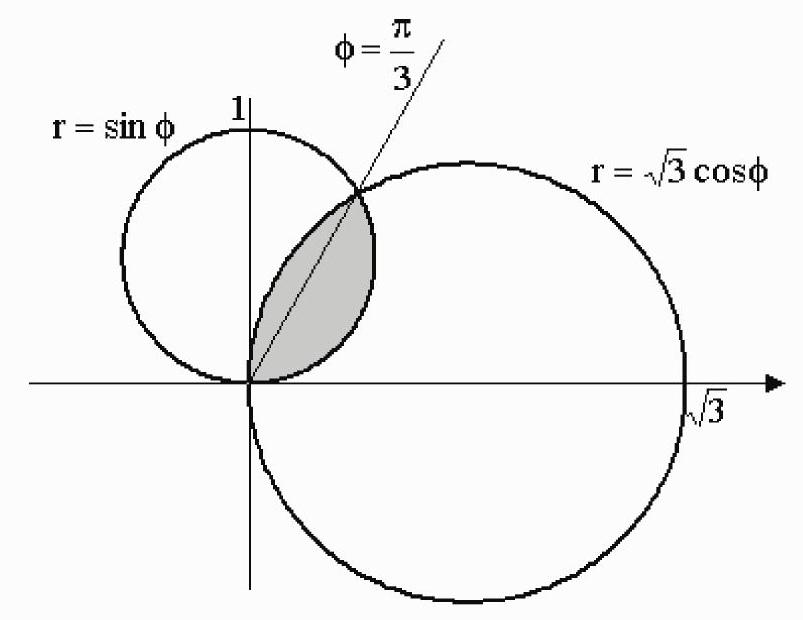
$\mathrm{S}=\frac{1}{2} \int_{0}^{\frac{\pi}{3}} \sin ^{2} \phi \mathrm{d} \phi+\frac{3}{2... | \frac{5\pi}{24}-\frac{\sqrt{3}}{4} | Calculus | math-word-problem | olympiads | 9c5f8c4e-a0cc-5f7f-ac7a-ea8e6165cdda | [
true,
true
] | [
"<think>\nOkay, so I need to find the area bounded by these two polar curves: r = √3 cos φ and r = sin φ, where φ is between 0 and π/2. Hmm, let me think. First, I remember that the area in polar coordinates is calculated using the formula (1/2) ∫[a to b] r² dφ. But since there are two curves here, I probably need ... | [
true,
false
] | null | null | 1 | [
{
"content": "## Problem Statement\n\nCalculate the areas of figures bounded by lines given in polar coordinates.\n\n$$\nr=\\sqrt{3} \\cos \\phi, r=\\sin \\phi,\\left(0 \\leq \\phi \\leq \\frac{\\pi}{2}\\right)\n$$",
"role": "user"
},
{
"content": "<think>Hmm , let me think. First, I remember that t... |
$33 \cdot 29$ The notation $[x]$ represents the greatest integer not exceeding $x$ (for example, $[\sqrt{5}]=2$). Let $n$ be a natural number, and
$I=(n+1)^{2}+n-\left[\sqrt{(n+1)^{2}+n+1}\right]^{2}$, then
(A) $I>0$.
(B) $I<0$.
(C) $I=0$.
(D) For different values of $n$, any of the above three cases may occur.
(China ... | [Solution] Since $n$ is a positive integer, the following equation holds:
$\left[\sqrt{(n+1)^{2}+(n+1)}\right]^{2}=[\sqrt{(n+1)(n+2)}]^{2}=(n+1)^{2}$, which only requires noting that $(n+1)^{2} > 0$.
$$
Therefore, the correct choice is $(A)$. | A | Algebra | MCQ | olympiads | 241205ea-ecd8-51d1-93a5-af458c6331b4 | [
true,
true
] | [
"<think>\nOkay, so I need to solve this problem where they define an expression I in terms of a natural number n, and then determine whether I is greater than zero, less than zero, equal to zero, or if it can vary. Let's break it down step by step.\n\nFirst, let's write out the expression again to make sure I have ... | [
true,
true
] | null | null | 2 | [
{
"content": "$33 \\cdot 29$ The notation $[x]$ represents the greatest integer not exceeding $x$ (for example, $[\\sqrt{5}]=2$). Let $n$ be a natural number, and\n$I=(n+1)^{2}+n-\\left[\\sqrt{(n+1)^{2}+n+1}\\right]^{2}$, then\n(A) $I>0$.\n(B) $I<0$.\n(C) $I=0$.\n(D) For different values of $n$, any of the abov... |
Given 100 real numbers, their sum is zero. How many pairs can be chosen from them at least, in which the sum of the numbers is non-negative? | I. solution. None of the 100 real numbers can be negative, because then their sum would also be negative, not 0. If 99 of the 100 real numbers are negative, then the 100th number must definitely be positive, since only then can the sum of the numbers be 0. In this case, among the two-term sums, there are exactly 99 pos... | 99 | Combinatorics | math-word-problem | olympiads | bf338b6a-3d62-56bf-a6b9-a0eadeb54f95 | [
true,
true
] | [
"<think>\nOkay, so I have this problem here: Given 100 real numbers whose sum is zero, what's the minimum number of pairs that can be chosen such that the sum of each pair is non-negative? Hmm, interesting. Let me try to figure this out step by step.\n\nFirst, let me restate the problem to make sure I understand it... | [
false,
true
] | null | null | 1 | [
{
"content": "Given 100 real numbers, their sum is zero. How many pairs can be chosen from them at least, in which the sum of the numbers is non-negative?",
"role": "user"
},
{
"content": "<think>Hmm . Let me start by understanding the problem again. We have 100 real numbers, their total sum is zero... |
Example 10 The real number $a$ makes the inequality
$$x_{1}^{2}+x_{2}^{2}+x_{3}^{2}+x_{4}^{2}+x_{5}^{2} \geqslant a\left(x_{1} x_{2}+x_{2} x_{3}+x_{3} x_{4}+x_{4} x_{5}\right)$$
hold for any real numbers $x_{1}, x_{2}, x_{3}, x_{4}, x_{5}$. Find the maximum value of $a$. (2010 Shanghai High School Mathematics Competiti... | Solve for the maximum value of $a$ which is $\frac{2 \sqrt{3}}{3}$.
Because when $x_{1}=1, x_{2}=\sqrt{3}, x_{3}=2, x_{4}=\sqrt{3}, x_{5}=1$, we get $a \leqslant \frac{2}{\sqrt{3}}$.
Furthermore, when $a=\frac{2}{\sqrt{3}}$, the inequality always holds.
In fact,
$$\begin{aligned}
x_{1}^{2}+x_{2}^{2}+x_{3}^{2}+x_{4}^{2}... | \frac{2 \sqrt{3}}{3} | Inequalities | math-word-problem | inequalities | d07a398c-fc96-5c51-b5e0-359d609a1b1d | [
true,
true
] | [
"<think>\nOkay, so I need to find the maximum value of 'a' such that the inequality\n\n$$x_{1}^{2} + x_{2}^{2} + x_{3}^{2} + x_{4}^{2} + x_{5}^{2} \\geqslant a\\left(x_{1} x_{2} + x_{2} x_{3} + x_{3} x_{4} + x_{4} x_{5}\\right)$$\n\nholds for any real numbers \\(x_1, x_2, x_3, x_4, x_5\\). \n\nFirst, I remember tha... | [
true,
true
] | null | null | 2 | [
{
"content": "Example 10 The real number $a$ makes the inequality\n$$x_{1}^{2}+x_{2}^{2}+x_{3}^{2}+x_{4}^{2}+x_{5}^{2} \\geqslant a\\left(x_{1} x_{2}+x_{2} x_{3}+x_{3} x_{4}+x_{4} x_{5}\\right)$$\nhold for any real numbers $x_{1}, x_{2}, x_{3}, x_{4}, x_{5}$. Find the maximum value of $a$. (2010 Shanghai High S... |
$30.11 \times 12 \times 13 \times 14 \times 15 \times 16 \times 17 \times 18$, the unit digit of the product is | Answer: 0 | 0 | Number Theory | math-word-problem | olympiads | 3f2f5379-0d35-550e-9743-ae38cf3953e0 | [
true,
true
] | [
"<think>\nOkay, so I need to find the units digit of this big product: 30.11 multiplied by 12, 13, 14, 15, 16, 17, and 18. Hmm, units digit... that's the last digit of the number, right? So instead of calculating the entire product, which would be a huge number, I can just track how each multiplication affects the ... | [
true,
false
] | null | [
"stop",
"stop"
] | 1 | [
{
"content": "$30.11 \\times 12 \\times 13 \\times 14 \\times 15 \\times 16 \\times 17 \\times 18$, the unit digit of the product is",
"role": "user"
},
{
"content": "<think>Hmm , units digit... that's the last digit of the number, right? So instead of calculating the entire product, which would be ... |
Example 11. Solve the equation
$$
\lg x=\frac{1}{2} \lg (x+1)
$$ | Solution. The equation is equivalent to the equation
$$
2 \lg x=\lg (x+1)
$$
which is equivalent to the system
$$
\begin{aligned}
& \left\{\begin{array} { l }
{ x > 0 , } \\
{ \operatorname { l g } x ^ { 2 } = \operatorname { l g } ( x + 1 ) }
\end{array} \Leftrightarrow \left\{\begin{array} { l }
{ x > 0 , } \\
{... | \frac{\sqrt{5}+1}{2} | Algebra | math-word-problem | olympiads | 203affe7-9db9-5be4-849b-3fd57d4a1203 | [
true,
true
] | [
"<think>\nOkay, let's see. I need to solve the equation lg x equals half of lg (x + 1). Hmm, so the equation is log base 10 of x equals one half log base 10 of (x + 1). Alright, first thing, maybe I can get rid of the logarithm by exponentiating both sides? Or maybe use logarithm properties to combine them. Let me ... | [
false,
true
] | null | null | 1 | [
{
"content": "Example 11. Solve the equation\n\n$$\n\\lg x=\\frac{1}{2} \\lg (x+1)\n$$",
"role": "user"
},
{
"content": "<think>Hmm , logarithms can sometimes be tricky, but maybe I can simplify this by using logarithm properties. \n\nSo now the equation becomes lg x = lg sqrt(x + 1). If two logarit... |
4. Given an equilateral $\triangle A B C$ with side length $6 \sqrt{3}, \odot O$ has a radius of $r$. When the center $O$ moves from point $A$ along the path $A B \rightarrow B C \rightarrow C A$ back to point $A$, $\odot O$ moves with point $O$. Let the area of the part of $\triangle A B C$ that $\odot O$ does not pas... | 4. $S=3 \sqrt{3}(3-r)^{2}(0<r<3)$ When $r>0$, inside $\triangle ABC$, the part not covered by $\odot O$ forms a regular $\triangle A_{0} B_{0} C_{0}$. The sides of this triangle are parallel to the sides of the original equilateral triangle, and the distance between the parallel lines is $r$.
Connecting $A A_{0}$ and... | S=3 \sqrt{3}(3-r)^{2}(0<r<3) | Geometry | math-word-problem | cn_contest | ae87a2b6-70ba-583a-b095-4b43e46e36f9 | [
true
] | [
"<think>\nAlright, let's try to tackle this problem. So, we have an equilateral triangle ABC with side length 6√3. There's a circle with radius r that moves along the path from A to B to C and back to A. We need to find the area S of the part of the triangle that the circle does not pass through when S is greater t... | [
false
] | [
true
] | null | 1 | [
{
"content": "4. Given an equilateral $\\triangle A B C$ with side length $6 \\sqrt{3}, \\odot O$ has a radius of $r$. When the center $O$ moves from point $A$ along the path $A B \\rightarrow B C \\rightarrow C A$ back to point $A$, $\\odot O$ moves with point $O$. Let the area of the part of $\\triangle A B C... |
1. (a) In the home for the elderly, they were celebrating the birthday of the oldest resident. They prepared 15 liters of a drink made from homemade pear juice, diluted with water, so that the drink contained $20\%$ water. As it was still too sweet, they added 5 liters of water. Calculate the percentage of natural juic... | 1.
(a) In 15 liters of juice, 20% of 15 liters is 3 liters of water. Therefore, there are 12 liters of natural juice in 20 liters of the drink, which means the proportion of natural juice is 60%.
(b) We determine that the total number of double and triple rooms is 141 - 70 = 71. We write \( D + T = 71 \). Together, ... | 60 | Algebra | math-word-problem | olympiads | 8fe7b473-e497-553e-a85c-b9d340fc44c5 | [
true,
true
] | [
"<think>\nOkay, let's tackle part (a) first. So, they made 15 liters of a drink that's 20% water. That means the rest is pear juice, right? So, if it's 20% water, then 80% is pear juice. Let me confirm that. Yeah, because 100% minus 20% water is 80% pear juice. \n\nSo, to find out how much pear juice is in the orig... | [
false,
false
] | [
false,
true
] | null | 1 | [
{
"content": "1. (a) In the home for the elderly, they were celebrating the birthday of the oldest resident. They prepared 15 liters of a drink made from homemade pear juice, diluted with water, so that the drink contained $20\\%$ water. As it was still too sweet, they added 5 liters of water. Calculate the per... |
8,9}
Side $A B$ of triangle $A B C$ is a chord of a certain circle. Sides $A C$ and $B C$ lie inside the circle, the extension of side $A C$ intersects the circle at point $D$, and the extension of side $B C$ at point $E$, with $A B=A C=C D=2, C E=\sqrt{2}$. Find the radius of the circle. | Prove that angle $A$ is a right angle.
## Solution
By the theorem of the product of chord segments $B C=A C \cdot C D / C E=2 \sqrt{2}$.
From triangle $A B C$, we find that angle $A$ is a right angle. Therefore, $D B$ is the diameter of the circle, and $B D^{2}=A B^{2}+A D^{2}=$ 20.
 ways to do this.
(A) $\mathrm{C}_{1 \infty}^{3}$
(B) $\mathrm{C}_{1 \infty}^{1} \cdot \mathrm{C}_{100}^{1} \cdot \mathrm{C}_{1 \infty}^{1}$
(C) $3 C_{1 \infty}^{3}$
(D) $3 C_{1 \infty}^{3}+\ma... | 5.D.
Classify the natural numbers from 1 to 300 by modulo 3. Taking one number from each class or taking three numbers from the same class can satisfy the condition. | D | Combinatorics | MCQ | cn_contest | bd9d7823-9cf9-520e-884f-cfb9d33bb44f | [
true,
true
] | [
"<think>\nOkay, so I need to figure out how many ways there are to choose three different numbers from 1 to 300 such that their sum is divisible by 3. The answer choices are given, but maybe I should work through it step by step.\n\nFirst, let's recall that for a number to be divisible by 3, the sum of its digits m... | [
true,
true
] | null | null | 2 | [
{
"content": "5. Among the natural numbers from 1 to 300, choose three different numbers such that their sum is divisible by 3. There are ( ) ways to do this.\n(A) $\\mathrm{C}_{1 \\infty}^{3}$\n(B) $\\mathrm{C}_{1 \\infty}^{1} \\cdot \\mathrm{C}_{100}^{1} \\cdot \\mathrm{C}_{1 \\infty}^{1}$\n(C) $3 C_{1 \\inft... |
19. After drawing a triangular scheme like the one next to it, Roberto writes the integers from 1 to 8 in the circles of the top row. Then, in each of the other circles, he writes the product of the numbers contained in the two circles above it that are connected to it with an arrow (thus he gets 2 $6, 12, \ldots$ and ... | (19) The correct answer is $(A)$.
The number of trailing zeros of a number is the minimum between the exponent of 2 and that of 5 in its prime factorization. Let's start by calculating the exponent of 5 present in the prime factorization of each number written, remembering that in a product the exponents add up. We kn... | 35 | Number Theory | MCQ | olympiads | f5e092be-aaa2-5d6f-8314-249f5265aa73 | [
true,
true
] | [
"<think>\nOkay, let's try to figure out this problem. So Roberto is writing numbers from 1 to 8 in the top row of a triangular scheme. Then, for each circle below, he writes the product of the two numbers connected above it. We need to find how many zeros the number at the bottom will end with. The options are from... | [
false,
false
] | [
false,
true
] | null | 1 | [
{
"content": "19. After drawing a triangular scheme like the one next to it, Roberto writes the integers from 1 to 8 in the circles of the top row. Then, in each of the other circles, he writes the product of the numbers contained in the two circles above it that are connected to it with an arrow (thus he gets ... |
## [ Trigonometric relationships in a right triangle ]
In triangle $A B C$, the height $A H$ is equal to $h, \angle B A C=\alpha, \angle B C A=\gamma$. Find the area of triangle $A B C$.
# | Apply the Law of Sines.
## Solution
From the right triangle $C H A$, we find that
$$
A C=\frac{A H}{\sin \gamma}=\frac{h}{\sin \gamma}
$$
By the Law of Sines,
$$
B C=\frac{A C \sin \alpha}{\sin (\alpha+\gamma)}=\frac{h \sin \alpha}{\sin \gamma \sin (\alpha+\gamma)}
$$
Therefore,
$$
S_{\triangle \mathrm{ABC}}=\fr... | \frac{^{2}\sin\alpha}{2\sin\gamma\sin(\alpha+\gamma)} | Geometry | math-word-problem | olympiads | 16f6f473-8777-5599-9ded-46e1fb1a0a85 | [
true,
true
] | [
"<think>\nOkay, so I need to find the area of triangle ABC where there's a height AH equal to h, angle BAC is alpha, and angle BCA is gamma. Hmm, let me visualize this. Triangle ABC is a right triangle? Wait, no, they didn't say it's a right triangle. But there's a height AH. So AH is the altitude from vertex A to ... | [
false,
false
] | [
true,
false
] | null | 1 | [
{
"content": "## [ Trigonometric relationships in a right triangle ]\n\nIn triangle $A B C$, the height $A H$ is equal to $h, \\angle B A C=\\alpha, \\angle B C A=\\gamma$. Find the area of triangle $A B C$.\n\n#",
"role": "user"
},
{
"content": "<think>Hmm , let me visualize this. Triangle ABC is a... |
The integer $ 9$ can be written as a sum of two consecutive integers: $ 9 \equal{} 4\plus{}5.$ Moreover, it can be written as a sum of (more than one) consecutive positive integers in exactly two ways: $ 9 \equal{} 4\plus{}5 \equal{} 2\plus{}3\plus{}4.$ Is there an integer that can be written as a sum of $ 1990$ consec... | To determine if there exists an integer \( n \) that can be written as a sum of \( 1990 \) consecutive integers and can be written as a sum of (more than one) consecutive positive integers in exactly \( 1990 \) ways, we need to analyze the conditions given.
1. **Sum of 1990 Consecutive Integers:**
Let \( n \) be th... | 5^9 \cdot 199^{198} | Number Theory | math-word-problem | aops_forum | 1737872f-4c05-53c4-91b3-4d3a48456a11 | [
true,
true
] | [
"<think>\nOkay, so I need to figure out if there's an integer that can be written both as a sum of 1990 consecutive integers and also has exactly 1990 different ways of being expressed as a sum of more than one consecutive positive integers. Hmm, this seems like a problem related to number theory, specifically the ... | [
false,
false
] | [
true,
false
] | null | 1 | [
{
"content": "The integer $ 9$ can be written as a sum of two consecutive integers: $ 9 \\equal{} 4\\plus{}5.$ Moreover, it can be written as a sum of (more than one) consecutive positive integers in exactly two ways: $ 9 \\equal{} 4\\plus{}5 \\equal{} 2\\plus{}3\\plus{}4.$ Is there an integer that can be writt... |
$2 \cdot 63$ Let the set $M=\{1,2, \cdots, 1000\}$. For any non-empty subset $X$ of $M$, let $\alpha_{X}$ denote the sum of the largest and smallest numbers in $X$. Find the arithmetic mean of all such $\alpha_{Y}$. | [Solution 1] Pair the non-empty subsets of set $M$: For each non-empty set $X \subset M$, let
$$
X^{\prime}=\{1001-x \mid x \in X\},
$$
then when $M \supset X_{1} \neq X$, $X^{\prime} \neq X^{\prime}$. Thus, all non-empty subsets can be divided into two categories: (1) $\left\{X \mid X \subset M, X^{\prime} \neq X\rig... | 1001 | Combinatorics | math-word-problem | olympiads | ab721218-9f3b-5e42-8024-c1f4f6f303e9 | [
true,
true
] | [
"<think>\nOkay, so I need to find the arithmetic mean of α_Y for all non-empty subsets Y of the set M = {1, 2, ..., 1000}. Each α_Y is the sum of the largest and smallest numbers in the subset Y. Hmm, arithmetic mean means I have to sum all these α_Y values and then divide by the total number of non-empty subsets, ... | [
true,
true
] | null | [
"stop",
"stop"
] | 2 | [
{
"content": "$2 \\cdot 63$ Let the set $M=\\{1,2, \\cdots, 1000\\}$. For any non-empty subset $X$ of $M$, let $\\alpha_{X}$ denote the sum of the largest and smallest numbers in $X$. Find the arithmetic mean of all such $\\alpha_{Y}$.",
"role": "user"
},
{
"content": "<think>Hmm , arithmetic mean m... |
A1. Sara and Klara together have 816 euros. If Sara spent $\frac{3}{5}$ of her money and Klara $\frac{3}{7}$ of her money, they would both have the same amount left. How much money does Sara have?
(A) 408 euros
(B) 366 euros
(C) 336 euros
(D) 480 euros
(E) 816 euros | A1. Let $x$ be the amount of Sara's money and $y$ be the amount of Clara's money. Then $x+y=816$ and $\frac{2}{5} x=\frac{4}{7} y$. From the second equation, we express $x=\frac{10}{7} y$ and substitute it into the first equation. This gives us $\frac{17}{7} y=816$. Therefore, $y=336$ and $x=480$. Sara has 480 euros. | 480 | Algebra | MCQ | olympiads | 1e622db5-6c09-595c-b97b-06a257d2e8a4 | [
true,
true
] | [
"<think>\nOkay, so Sara and Klara together have 816 euros. The problem says that if Sara spent 3/5 of her money and Klara spent 3/7 of her money, they would both have the same amount left. We need to find out how much Sara has. The options are given, which is helpful. Let me think through this step by step.\n\nFirs... | [
false,
false
] | [
false,
true
] | null | 1 | [
{
"content": "A1. Sara and Klara together have 816 euros. If Sara spent $\\frac{3}{5}$ of her money and Klara $\\frac{3}{7}$ of her money, they would both have the same amount left. How much money does Sara have?\n(A) 408 euros\n(B) 366 euros\n(C) 336 euros\n(D) 480 euros\n(E) 816 euros",
"role": "user"
}... |
6. The solution to the equation $\sqrt{3+\sqrt{3+\sqrt{3+x}}}=x$ is
$\qquad$ . | 6. $\frac{1+\sqrt{13}}{2}$.
Obviously, $x>0$.
First, prove: If $x>\sqrt{3+x}$, then the equation has no solution.
In fact, in this case, we have
$$
\begin{array}{l}
\sqrt{3+\sqrt{3+\sqrt{3+x}}}<\sqrt{3+\sqrt{3+x}} \\
<\sqrt{3+x}<x .
\end{array}
$$
Similarly, when $x<\sqrt{3+x}$, the equation also has no solution.
The... | \frac{1+\sqrt{13}}{2} | Algebra | math-word-problem | cn_contest | 57129816-c603-5f6b-94eb-149b73f22edc | [
true,
true
] | [
"<think>\nOkay, so I need to solve the equation \\(\\sqrt{3+\\sqrt{3+\\sqrt{3+x}}} = x\\). Hmm, nested square roots can be tricky. Let me think about how to approach this.\n\nFirst, since we have square roots, the right side \\(x\\) must be non-negative. So \\(x \\geq 0\\). Also, the expression inside each square r... | [
true,
true
] | null | null | 2 | [
{
"content": "6. The solution to the equation $\\sqrt{3+\\sqrt{3+\\sqrt{3+x}}}=x$ is\n$\\qquad$ .",
"role": "user"
},
{
"content": "<think>Hmm , nested square roots can be tricky. Let me think about how to approach this.\n\nFirst, since we have square roots, the right side \\(x\\) must be non-negati... |
5,6,7 |
| :---: | :---: | :---: |
| | [ Divisibility of numbers. General properties ] | |
| | [ Decimal number system ] | |
| | Case analysis | |
Which digits can stand in place of the letters in the example $A B \cdot C=D E$, if different letters represent different digits and the digits are written from left t... | Let's consider the largest possible values of the number $DE$. The numbers 89 and 79 are prime, so they do not fit. Next, let's consider the number 78, and check its single-digit divisors to get the answer. Further checking can confirm that this answer is unique.
## Answer
$13 \cdot 6=78$. | 13\cdot6=78 | Number Theory | math-word-problem | olympiads | d537d620-bd22-5222-9dbb-890b7ab64f8f | [
true,
true
] | [
"<think>\nOkay, so I need to figure out which digits can replace the letters in the equation AB · C = DE, where each letter represents a different digit. Also, the digits are written from left to right in ascending order. Hmm, let me start by understanding the problem step by step.\n\nFirst, let's parse the equatio... | [
true,
false
] | null | null | 1 | [
{
"content": "5,6,7 |\n| :---: | :---: | :---: |\n| | [ Divisibility of numbers. General properties ] | |\n| | [ Decimal number system ] | |\n| | Case analysis | |\n\nWhich digits can stand in place of the letters in the example $A B \\cdot C=D E$, if different letters represent different digits and the d... |
Example 9 Let $f(x)=\left\{\begin{array}{cc}1 & 1 \leqslant x \leqslant 2 \\ x-1 & 2<x \leqslant 3\end{array}\right.$, for any $a(a \in \mathrm{R})$, denote $v(a)=\max \{f(x)-a x \mid x \in[1,3]\}-\min \{f(x)-a x \mid x \in[1,3]\}$, try to draw the graph of $v(a)$, and find the minimum value of $v(a)$. | When $a \leqslant 0$, $y=-a x$ and $y=f(x)$ are not decreasing functions, in this case we have
$$
\begin{array}{l}
\max \{f(x)-a x \mid x \in[1,3]\}=2-3 a, \\
\min \{f(x)-a x \mid x \in[1,3]\}=1-a .
\end{array}
$$
For the case when $a>0$, since the graph of $f(x)$ undergoes a fundamental change at the point $(2,1)$, w... | \frac{1}{2} | Algebra | math-word-problem | olympiads | 843ba1f2-dff8-5b83-bc75-a7d148fe59f2 | [
true,
true
] | [
"<think>\nOkay, so I need to figure out how to draw the graph of v(a) and find its minimum value. Let me start by understanding the problem step by step. \n\nFirst, we have the function f(x) defined piecewise: it's 1 on the interval [1,2] and x-1 on (2,3]. For any real number a, v(a) is the difference between the m... | [
true,
true
] | null | [
"stop",
"stop"
] | 2 | [
{
"content": "Example 9 Let $f(x)=\\left\\{\\begin{array}{cc}1 & 1 \\leqslant x \\leqslant 2 \\\\ x-1 & 2<x \\leqslant 3\\end{array}\\right.$, for any $a(a \\in \\mathrm{R})$, denote $v(a)=\\max \\{f(x)-a x \\mid x \\in[1,3]\\}-\\min \\{f(x)-a x \\mid x \\in[1,3]\\}$, try to draw the graph of $v(a)$, and find t... |
Let $V$ be the set of all continuous functions $f\colon [0,1]\to \mathbb{R}$, differentiable on $(0,1)$, with the property that $f(0)=0$ and $f(1)=1$. Determine all $\alpha \in \mathbb{R}$ such that for every $f\in V$, there exists some $\xi \in (0,1)$ such that
\[f(\xi)+\alpha = f'(\xi)\] | 1. **Define the function $\chi_f$**:
We start by defining the function $\chi_f: [0,1] \to \mathbb{R}$ as follows:
\[
\chi_f(t) = (f(t) + \alpha)e^{-t}
\]
This function is continuous on $[0,1]$ and differentiable on $(0,1)$ because $f$ is continuous on $[0,1]$ and differentiable on $(0,1)$.
2. **Compute... | \frac{1}{e - 1} | Calculus | math-word-problem | aops_forum | 85e3e9b3-60f0-521b-9ee1-8b41f6de502b | [
true,
true
] | [
"<think>\nOkay, so I have this problem here. Let me read it again to make sure I understand. We have a set V of all continuous functions f from [0,1] to the real numbers, which are differentiable on (0,1). These functions satisfy f(0) = 0 and f(1) = 1. The question is asking to determine all real numbers α such tha... | [
true,
true
] | null | null | 2 | [
{
"content": "Let $V$ be the set of all continuous functions $f\\colon [0,1]\\to \\mathbb{R}$, differentiable on $(0,1)$, with the property that $f(0)=0$ and $f(1)=1$. Determine all $\\alpha \\in \\mathbb{R}$ such that for every $f\\in V$, there exists some $\\xi \\in (0,1)$ such that\n\\[f(\\xi)+\\alpha = f'(\... |
Let $m, n \geq 1$ be integers that are coprime. Determine the GCD of $5^{m}+7^{m}$ and $5^{n}+7^{n}$
## Order | Let $s_{n}=5^{n}+7^{n}$. If $n \geq 2 m$, we have
$$
s_{n}=s_{m} s_{n-m}-5^{m} 7^{m} s_{n-2 m}
$$
so that the GCD of $s_{m}$ and $s_{n}$ is equal to the GCD of $s_{m}$ and $s_{n-2 m}$. Similarly, if $m < n < 2 m$, we have
$$
s_{n}=s_{m} s_{n-m}-5^{n-m} 7^{n-m} s_{2 m-n}
$$
so that the GCD of $s_{m}$ and $s_{n}$ is ... | 12if+niseven,otherwise2 | Number Theory | math-word-problem | olympiads | 0ed24f2d-c24e-526a-97ee-5b089b05006c | [
true,
true
] | [
"<think>\nOkay, so I need to find the greatest common divisor (GCD) of \\(5^{m} + 7^{m}\\) and \\(5^{n} + 7^{n}\\) where \\(m\\) and \\(n\\) are coprime integers. Hmm, coprime means their GCD is 1, right? So they don't share any common factors besides 1. I wonder how that plays into finding the GCD of these exponen... | [
false,
false
] | [
false,
true
] | null | 1 | [
{
"content": "Let $m, n \\geq 1$ be integers that are coprime. Determine the GCD of $5^{m}+7^{m}$ and $5^{n}+7^{n}$\n\n## Order",
"role": "user"
},
{
"content": "<think>Hmm , let's start by recalling some properties of GCDs and exponents. I remember that when dealing with GCDs of numbers in the form... |
Which one statisfies $n^{29} \equiv 7 \pmod {65}$?
$ \textbf{(A)}\ 37 \qquad \textbf{(B)}\ 39 \qquad \textbf{(C)}\ 43 \qquad \textbf{(D)}\ 46 \qquad \textbf{(E)}\ 55$ | 1. **Apply the Chinese Remainder Theorem**: We need to solve \( n^{29} \equiv 7 \pmod{65} \). Since \( 65 = 5 \times 13 \), we can use the Chinese Remainder Theorem to break this into two congruences:
\[
n^{29} \equiv 7 \pmod{5} \quad \text{and} \quad n^{29} \equiv 7 \pmod{13}
\]
2. **Check modulo 5**: We nee... | 37 | Number Theory | MCQ | aops_forum | e7eb5bc0-88da-5970-a0c0-c10a69a4bcab | [
true,
true
] | [
"<think>\nOkay, so I need to find which of the options A through E satisfies the equation n^29 ≡ 7 mod 65. Hmm, let's break this down step by step.\n\nFirst, I remember that 65 is a composite number, specifically 5 multiplied by 13. Since 5 and 13 are coprime, maybe I can use the Chinese Remainder Theorem here. Tha... | [
false,
false
] | [
true,
true
] | null | 2 | [
{
"content": "Which one statisfies $n^{29} \\equiv 7 \\pmod {65}$?\n\n$ \\textbf{(A)}\\ 37 \\qquad \\textbf{(B)}\\ 39 \\qquad \\textbf{(C)}\\ 43 \\qquad \\textbf{(D)}\\ 46 \\qquad \\textbf{(E)}\\ 55$",
"role": "user"
},
{
"content": "<think>Hmm , let's break this down step by step.\n\nFirst, I remem... |
## Problem B3
$\mathrm{f}$ is a function defined on the positive integers with positive integer values. Use $\mathrm{f}^{\mathrm{m}}(\mathrm{n})$ to mean $\mathrm{f}(\mathrm{f}(\ldots \mathrm{f}(\mathrm{n}) \ldots))=.\mathrm{n}$ where $\mathrm{f}$ is taken $\mathrm{m}$ times, so that $\mathrm{f}^{2}(\mathrm{n})=\mathr... | ## Solution
The basic idea is to take a block of integers $m+1, m+2, \ldots, M$ and to define $f(m+1)=m+2$, $f(m+2)=m+3, \ldots, f(M-1)=M, f(M)=m+1$. Then for any integer $h$ in the block we have $f^{n}(h)$ $\neq \mathrm{h}$ for $\mathrm{n}=1,2, \ldots, \mathrm{M}-\mathrm{m}-1$ and $\mathrm{f}^{\mathrm{M}-\mathrm{m}}(... | 1-1/\mathrm{N} | Number Theory | math-word-problem | olympiads | c640b952-7771-5ff9-a18e-37afc8b3f00b | [
true,
true
] | [
"<think>\nAlright, let's try to tackle this problem. So, we need to find the largest possible k between 0 and 1 such that there exists a function f defined on positive integers with positive integer values. The conditions are that for any n, if we apply f repeatedly m times (where m is from 1 up to the floor of k*n... | [
false,
false
] | [
true,
true
] | null | 2 | [
{
"content": "## Problem B3\n\n$\\mathrm{f}$ is a function defined on the positive integers with positive integer values. Use $\\mathrm{f}^{\\mathrm{m}}(\\mathrm{n})$ to mean $\\mathrm{f}(\\mathrm{f}(\\ldots \\mathrm{f}(\\mathrm{n}) \\ldots))=.\\mathrm{n}$ where $\\mathrm{f}$ is taken $\\mathrm{m}$ times, so th... |
3. For a geometric sequence $\left\{a_{n}\right\}$, the first term $a_{1}=2^{-5}$, the geometric mean of its first 11 terms is $2^{5}$, and if one term is removed from the first 11 terms, the geometric mean of the remaining terms is $2^{4}$. The term removed is
A. $a_{8}$
B. $a_{9}$
C. $a_{10}$
D. $a_{11}$ | 3. Choose D.
Brief solution: From the given $2^{5}=\sqrt[11]{a_{1} \cdot a_{1} q \cdot a_{1} q^{2} \cdots \cdot a_{1} q^{10}}=\sqrt[11]{a_{1}^{11} q^{\frac{10(1)+1)}{2}}}=\sqrt[11]{a_{1}^{11} q^{55}}=a_{1} q^{5}$.
Since $a_{1}=2^{-5}$. Therefore, $q=2^{2}=4$. Let the term removed be $a_{n}=a_{1} q^{n-1}$, then $2^{4}=... | a_{11} | Algebra | MCQ | olympiads | da2b11af-6365-5118-953f-5f4b86c84e2e | [
true,
true
] | [
"<think>\nOkay, let's see. I need to solve this problem about a geometric sequence. Let me start by recalling what a geometric sequence is. It's a sequence where each term after the first is found by multiplying the previous term by a constant called the common ratio, denoted usually by r. So, if the first term is ... | [
false,
false
] | [
true,
false
] | null | 1 | [
{
"content": "3. For a geometric sequence $\\left\\{a_{n}\\right\\}$, the first term $a_{1}=2^{-5}$, the geometric mean of its first 11 terms is $2^{5}$, and if one term is removed from the first 11 terms, the geometric mean of the remaining terms is $2^{4}$. The term removed is\nA. $a_{8}$\nB. $a_{9}$\nC. $a_{... |
Let $f: [0,1]\rightarrow(0,+\infty)$ be a continuous function.
a) Show that for any integer $n\geq 1$, there is a unique division $0=a_{0}<a_{1}<\ldots<a_{n}=1$ such that $\int_{a_{k}}^{a_{k+1}}f(x)\, dx=\frac{1}{n}\int_{0}^{1}f(x)\, dx$ holds for all $k=0,1,\ldots,n-1$.
b) For each $n$, consider the $a_{i}$ abo... | ### Part (a)
1. **Define the cumulative distribution function:**
Let \(\Phi(t) = \int_{0}^{t} f(x) \, dx\). Since \(f(x)\) is continuous and positive on \([0,1]\), \(\Phi(t)\) is strictly increasing and continuous on \([0,1]\).
2. **Determine the total integral:**
Let \(I = \int_{0}^{1} f(x) \, dx\). Since \(f(... | \frac{\int_{0}^{1} x f(x) \, dx}{\int_{0}^{1} f(x) \, dx} | Calculus | math-word-problem | aops_forum | 0440db78-c3d3-5f6a-bb85-4234aa7fd513 | [
true,
true
] | [
"<think>\nOkay, so I need to solve part a) and part b) of this problem. Let's start with part a). \n\nFirst, the problem says that f is a continuous function from [0,1] to (0, +∞). So it's positive and continuous on the entire interval. For part a), we need to show that for any integer n ≥ 1, there exists a unique ... | [
true,
true
] | null | [
"stop",
"stop"
] | 2 | [
{
"content": "Let $f: [0,1]\\rightarrow(0,+\\infty)$ be a continuous function. \r\n\r\na) Show that for any integer $n\\geq 1$, there is a unique division $0=a_{0}<a_{1}<\\ldots<a_{n}=1$ such that $\\int_{a_{k}}^{a_{k+1}}f(x)\\, dx=\\frac{1}{n}\\int_{0}^{1}f(x)\\, dx$ holds for all $k=0,1,\\ldots,n-1$.\r\n\r\nb... |
5. The maximum volume of a regular tetrahedron inscribed in a sphere with radius $R$ is
保留了源文本的换行和格式。 | $\frac{8 \sqrt{3}}{27} R^{3} ;$ | \frac{8\sqrt{3}}{27}R^{3} | Geometry | math-word-problem | olympiads | 32f86cde-b572-51aa-a699-efa8d8ed29e3 | [
true,
true
] | [
"<think>\n嗯,我现在要解决的问题是:求一个内接于半径为R的球体的正四面体的最大体积。题目是说,这样的正四面体的最大体积是多少。首先,我需要理解题目的意思,正四面体就是四个面都是正三角形的四面体,也就是一个正三棱锥。内接于球体意味着这个正四面体的所有顶点都位于这个球体的表面上,而球体的半径是R。所以问题是要在这样的条件下,找到体积最大的那个正四面体的体积表达式。\n\n首先,我应该回忆一下正四面体的一些基本性质。比如正四面体的边长、高、体积公式,以及与它外接球半径的关系。或许,当正四面体内接于球体时,它的外接球半径就是题目中的R,这样可能可以直接利用一些现有的体积公式来计算最大体积。不过,题目问的是最大体积,可能需要... | [
true,
true
] | null | [
"stop",
"stop"
] | 2 | [
{
"content": "5. The maximum volume of a regular tetrahedron inscribed in a sphere with radius $R$ is\n\n保留了源文本的换行和格式。",
"role": "user"
},
{
"content": "<think>\n嗯,我现在要解决的问题是:求一个内接于半径为R的球体的正四面体的最大体积。题目是说,这样的正四面体的最大体积是多少。首先,我需要理解题目的意思,正四面体就是四个面都是正三角形的四面体,也就是一个正三棱锥。内接于球体意味着这个正四面体的所有顶点都位于这个球体的表面上,而球体的半... |
Ten consecutive positive integers have a sum that is a divisor of the sum of their squares. Which are these ten numbers? | Let the 10 consecutive positive integers be $n, n+1, n+2, \ldots, n+9$. Then the sum of these ten numbers is: $n+(n+1)+\cdots+(n+9)=$ $10 n+45$, and the sum of their squares is:
\[
\begin{gathered}
n^{2}+(n+1)^{2}+\cdots+(n+9)^{2}= \\
=10 n^{2}+2 n+4 n+6 n+\cdots+18 n+1^{2}+2^{2}+3^{2}+\cdots+9^{2}=10 n^{2}+90 n+285
\... | 1,2,3,\ldots,10or12,13,14,\ldots,21 | Number Theory | math-word-problem | olympiads | 6e060fb3-da4e-5894-8d1f-e1bca6b53b52 | [
true,
true
] | [
"<think>\nOkay, so I have this problem here: Ten consecutive positive integers have a sum that is a divisor of the sum of their squares. Which are these ten numbers?\n\nHmm, let me try to understand what's being asked. We need to find ten consecutive positive integers such that when you add them up, their total sum... | [
false,
false
] | [
false,
true
] | null | 1 | [
{
"content": "Ten consecutive positive integers have a sum that is a divisor of the sum of their squares. Which are these ten numbers?",
"role": "user"
},
{
"content": "<think>Hmm , let's start by understanding the problem better. Let me denote the ten consecutive numbers. If I let the first number ... |
N1. Let $\mathbb{Z}_{>0}$ be the set of positive integers. Find all functions $f: \mathbb{Z}_{>0} \rightarrow \mathbb{Z}_{>0}$ such that
$$
m^{2}+f(n) \mid m f(m)+n
$$
for all positive integers $m$ and $n$. | Answer. $f(n)=n$.
Solution 1. Setting $m=n=2$ tells us that $4+f(2) \mid 2 f(2)+2$. Since $2 f(2)+22 m^{2}$ be a prime number. Note that $p>m f(m)$ also. Plugging in $n=p-m f(m)$ we learn that $m^{2}+f(n)$ divides $p$. Since $m^{2}+f(n)$ cannot equal 1 , it must equal $p$. Therefore $p-m^{2}=f(n) \mid n=p-m f(m)$. But ... | f(n)=n | Number Theory | math-word-problem | olympiads | 6221a554-c914-58cb-8029-42e578bf8ef8 | [
true,
true
] | [
"<think>\nOkay, so I need to find all functions f from positive integers to positive integers such that for any positive integers m and n, m squared plus f(n) divides m times f(m) plus n. Hmm, that's the problem. Alright, let's break it down.\n\nFirst, let me restate the condition to make sure I understand it. For ... | [
true,
true
] | null | [
"stop",
"stop"
] | 2 | [
{
"content": "N1. Let $\\mathbb{Z}_{>0}$ be the set of positive integers. Find all functions $f: \\mathbb{Z}_{>0} \\rightarrow \\mathbb{Z}_{>0}$ such that\n$$\nm^{2}+f(n) \\mid m f(m)+n\n$$\nfor all positive integers $m$ and $n$.",
"role": "user"
},
{
"content": "<think>Hmm , that's the problem. Alr... |
1. [3 points] A coin is flipped 80 times (the probabilities of heads and tails in each flip are the same). Let $p$ be the probability that heads will appear more than 51 times, and $q$ be the probability that heads will appear no more than 29 times. Find $p-q$ | Answer: $-\frac{1}{2^{80}} \cdot C_{80}^{29}$.
Solution. Since the probability of getting heads or tails is equal, the probability of getting 80 heads is the same as the probability of getting 80 tails (i.e., 0 heads); the probability of getting 79 heads is the same as the probability of getting 79 tails (i.e., one he... | -\frac{1}{2^{80}}\cdotC_{80}^{29} | Combinatorics | math-word-problem | olympiads | 29d1384b-2fe1-53c6-92a3-96f59495fd08 | [
true,
true
] | [
"<think>\nAlright, so I have this problem here: a coin is flipped 80 times, and I need to find the difference between two probabilities. The first probability, p, is the chance that heads come up more than 51 times. The second probability, q, is the chance that heads come up no more than 29 times. Then I need to fi... | [
false,
false
] | [
true,
true
] | null | 2 | [
{
"content": "1. [3 points] A coin is flipped 80 times (the probabilities of heads and tails in each flip are the same). Let $p$ be the probability that heads will appear more than 51 times, and $q$ be the probability that heads will appear no more than 29 times. Find $p-q$",
"role": "user"
},
{
"co... |
1. Three travelers sat down to eat. The first one took out 3 loaves of bread, and the second one took out 4 loaves of bread. They divided the seven loaves into three equal parts and ate them. The third traveler took out 7 coins and said, "I had no bread, but here are 7 coins, and you should divide them fairly."
How ma... | Solution. Each traveler took $\frac{7}{3}$ of the loaves. The third traveler paid his $\frac{7}{3}$ with 7 coins, meaning he paid 1 coin for each third of a loaf.
The first traveler brought 3 loaves, i.e., $\frac{9}{3}$, and took $\frac{7}{3}$, which means he gave $\frac{2}{3}$ to the third traveler. Similarly, the se... | 2 | Logic and Puzzles | math-word-problem | olympiads | 41ff0c88-eeef-56dd-b9ad-8af3766e17d5 | [
true,
true
] | [
"<think>\nOkay, let's see. So there are three travelers. The first one brought 3 loaves of bread, the second one brought 4 loaves, and the third didn't bring any. They divided all the seven loaves equally among the three of them and ate them. Then the third traveler gave 7 coins to split fairly between the first tw... | [
false,
false
] | [
false,
true
] | null | 1 | [
{
"content": "1. Three travelers sat down to eat. The first one took out 3 loaves of bread, and the second one took out 4 loaves of bread. They divided the seven loaves into three equal parts and ate them. The third traveler took out 7 coins and said, \"I had no bread, but here are 7 coins, and you should divid... |
31. Let $x$ and $y$ be positive integers such that $27 x+35 y \leq 945$. Find the largest possible value of $x y$. | 31. Answer: 234
Since $27 x+35 y \leq 945$, we have $y \leq \frac{945-27 x}{35}$. It follows that
$$
x y \leq \frac{945 x-27 x^{2}}{35}=\frac{27}{35}\left(35 x-x^{2}\right)=\frac{27}{35}\left(\left(\frac{35}{2}\right)^{2}-\left(x-\frac{35}{2}\right)^{2}\right) .
$$
Therefore, if $\left|x-\frac{35}{2}\right| \geq \frac... | 234 | Algebra | math-word-problem | olympiads | cfb9252f-1ead-5f3b-a43f-52c0ad5c83c4 | [
true,
true
] | [
"<think>\nOkay, so I need to find the largest possible value of the product xy given that x and y are positive integers satisfying 27x + 35y ≤ 945. Hmm, this seems like an optimization problem with a constraint. Let me think about how to approach this.\n\nFirst, I remember that when dealing with maximizing a produc... | [
true,
true
] | null | null | 2 | [
{
"content": "31. Let $x$ and $y$ be positive integers such that $27 x+35 y \\leq 945$. Find the largest possible value of $x y$.",
"role": "user"
},
{
"content": "<think>Hmm , this seems like an optimization problem with a constraint. Let me think about how to approach this.\n\nFirst, I remember th... |
4. In $\triangle A B C$, if $\sin A=2 \sin C$, and the three sides $a, b, c$ form a geometric sequence, then the value of $\cos A$ is $\qquad$ . | Answer: $-\frac{\sqrt{2}}{4}$.
Solution: According to the Law of Sines, $\frac{a}{c}=\frac{\sin A}{\sin C}=2$, and $b^{2}=a c$, thus $a: b: c=2: \sqrt{2}: 1$. Therefore, by the Law of Cosines, $\cos A=\frac{b^{2}+c^{2}-a^{2}}{2 b c}=\frac{(\sqrt{2})^{2}+1^{2}-2^{2}}{2 \times \sqrt{2} \times 1}=-\frac{\sqrt{2}}{4}$. | -\frac{\sqrt{2}}{4} | Algebra | math-word-problem | olympiads | 7441415e-b93a-513a-81e7-f39434bbed79 | [
true,
true
] | [
"<think>\nAlright, let's tackle this geometry problem. It says in triangle ABC, if sin A = 2 sin C, and the three sides a, b, c form a geometric sequence, then find the value of cos A. Hmm, okay. Let me start by recalling some basic concepts.\n\nFirst, in any triangle, the Law of Sines relates the sides and angles:... | [
true,
true
] | null | null | 2 | [
{
"content": "4. In $\\triangle A B C$, if $\\sin A=2 \\sin C$, and the three sides $a, b, c$ form a geometric sequence, then the value of $\\cos A$ is $\\qquad$ .",
"role": "user"
},
{
"content": "<think>Hmm , okay. Let me start by recalling some basic concepts.\n\nFirst, in any triangle, the Law o... |
9. (16 points) Given the sequence $\left\{a_{n}\right\}$ satisfies:
$$
\begin{array}{l}
a_{1}=1, a_{2}=2, a_{3}=4, \\
a_{n}=a_{n-1}+a_{n-2}-a_{n-3}+1(n \geqslant 4) .
\end{array}
$$
(1) Find the general term formula for the sequence $\left\{a_{n}\right\}$;
(2) Prove: $\frac{1}{a_{1}}+\frac{1}{a_{2}}+\cdots+\frac{1}{a_{... | (1) For $n \geqslant 4$, summing up we get
$$
a_{n}-a_{n-2}=a_{3}-a_{1}+n-3=n \text {. }
$$
When $n=2 m\left(m \in \mathbf{Z}_{+}\right)$,
$$
\begin{aligned}
a_{n}= & a_{2}+\sum_{k=1}^{m-1}\left(a_{2 k+2}-a_{2 k}\right) \\
& =2+\sum_{k=1}^{m-1}(2 k+2)=\frac{1}{4} n(n+2) ;
\end{aligned}
$$
When $n=2 m+1\left(m \in \ma... | 3 | Algebra | math-word-problem | olympiads | f3c5218a-e8de-59dc-ad15-b64437d137f9 | [
true,
true
] | [
"<think>\nOkay, so I have this problem about a sequence where I need to find the general term formula and then prove that the sum of reciprocals up to 2016 terms is less than 3. Let me start with part (1). The sequence is defined by a recurrence relation: a₁ = 1, a₂ = 2, a₃ = 4, and for n ≥ 4, aₙ = aₙ₋₁ + aₙ₋₂ - aₙ... | [
false,
false
] | [
false,
true
] | null | 1 | [
{
"content": "9. (16 points) Given the sequence $\\left\\{a_{n}\\right\\}$ satisfies:\n$$\n\\begin{array}{l}\na_{1}=1, a_{2}=2, a_{3}=4, \\\\\na_{n}=a_{n-1}+a_{n-2}-a_{n-3}+1(n \\geqslant 4) .\n\\end{array}\n$$\n(1) Find the general term formula for the sequence $\\left\\{a_{n}\\right\\}$;\n(2) Prove: $\\frac{1... |
8 For the cube $A B C D-A^{\prime} B^{\prime} C^{\prime} D^{\prime}$, the centers of faces $A B C D$ and $A D D^{\prime} A^{\prime}$ are points $M$ and $N$, respectively. The size of the angle formed by the skew lines $M N$ and $B D^{\prime}$ is $\qquad$. | 8 Let the edge length of the cube be 1, and establish a spatial rectangular coordinate system with $\overrightarrow{D A}, \overrightarrow{D C}, \overrightarrow{D D^{\prime}}$ as the basis, as shown in the figure. Then we have $B(1,1,0), D^{\prime}(0,0,1)$, $M\left(\frac{1}{2}, \frac{1}{2}, 0\right), N\left(\frac{1}{2},... | \arccos\frac{\sqrt{6}}{3} | Geometry | math-word-problem | olympiads | e4934b6f-bf95-5076-95df-542c08cb81dd | [
true,
true
] | [
"<think>\nOkay, so I have this cube labeled ABCD-A'B'C'D'. I need to find the angle between the skew lines MN and BD'. First, let me visualize the cube. Let's recall that in a cube, all edges are equal, and all angles are right angles. The cube has 8 vertices, and the labels are such that ABCD is the base face, and... | [
true,
true
] | null | [
"stop",
"stop"
] | 2 | [
{
"content": "8 For the cube $A B C D-A^{\\prime} B^{\\prime} C^{\\prime} D^{\\prime}$, the centers of faces $A B C D$ and $A D D^{\\prime} A^{\\prime}$ are points $M$ and $N$, respectively. The size of the angle formed by the skew lines $M N$ and $B D^{\\prime}$ is $\\qquad$.",
"role": "user"
},
{
... |
The graph of $x^{2}-y^{2}=0$ is
(A) a straight line
(B) a parabola
(C) a circle
(D) a single point
(E) two straight lines | If $x^{2}-y^{2}=0$, then $(x-y)(x+y)=0$, so $y=x$ or $y=-x$. These are the equations of two straight lines (each of which passes through $(0,0)$ ).
Answer: (E) | E | Algebra | MCQ | olympiads | 76182593-abfe-57d4-9169-9c3bc9c4b51e | [
true,
true
] | [
"<think>\nOkay, let me try to figure out this problem. The equation given is x² - y² = 0, and we have to determine what its graph looks like. The options are a straight line, a parabola, a circle, a single point, or two straight lines. Hmm, let's break this down step by step.\n\nFirst, I remember that equations inv... | [
true,
true
] | null | [
"stop",
"stop"
] | 2 | [
{
"content": "The graph of $x^{2}-y^{2}=0$ is\n(A) a straight line\n(B) a parabola\n(C) a circle\n(D) a single point\n(E) two straight lines",
"role": "user"
},
{
"content": "<think>Hmm , let's break this down step by step.\n\nFirst, I remember that equations involving x² and y² often relate to coni... |
Let $A$ and $B$ be two fixed positive real numbers. The function $f$ is defined by
$$
f(x, y)=\min \left\{x, \frac{A}{y}, y+\frac{B}{x}\right\},
$$
for all pairs $(x, y)$ of positive real numbers.
Determine the largest possible value of $f(x, y)$. | We show that the largest possible value of $f(x, y)$ is $\sqrt{A+B}$.
Solution 1.
Let us first determine the pair $(x, y)$ for which $x=\frac{A}{y}=y+\frac{B}{x}$. Solving this gives $x=\sqrt{A+B}$ and $y=\frac{A}{\sqrt{A+B}}$. Clearly, in this case, $f(x, y)=\sqrt{A+B}$, and we claim that this is indeed also the maxim... | \sqrt{A+B} | Algebra | math-word-problem | olympiads | 0364128c-1d58-542b-b6b2-1e2181adb7b3 | [
true,
true
] | [
"<think>\nOkay, so I need to find the maximum value of the function f(x, y) which is defined as the minimum of three expressions: x, A/y, and y + B/x. Both A and B are fixed positive real numbers, and x and y are also positive real numbers. The goal is to determine the largest possible value that this minimum can t... | [
true,
true
] | null | [
"stop",
"stop"
] | 2 | [
{
"content": "Let $A$ and $B$ be two fixed positive real numbers. The function $f$ is defined by\n$$\nf(x, y)=\\min \\left\\{x, \\frac{A}{y}, y+\\frac{B}{x}\\right\\},\n$$\nfor all pairs $(x, y)$ of positive real numbers.\nDetermine the largest possible value of $f(x, y)$.",
"role": "user"
},
{
"con... |
Example 7 Find the minimum perimeter of a convex pentagon with vertices at lattice points in the Cartesian coordinate plane.
untranslated text retained the original line breaks and format. | Let the five vertices of this convex pentagon be $A_{1}, A_{2}, A_{3}, A_{4}$, and $A_{5}$. The coordinates are $A_{j}\left(x_{j}, y_{j}\right)$, and the vertices are represented by complex numbers: $A_{j}=x_{j}+i y_{j}, j=1,2,3,4,5$. Here, $\mathrm{i}$ is the imaginary unit.
Let $Z_{j}=A_{j+1}-A_{j}, j=1,2,3,4,5$. Le... | 2+3\sqrt{2} | Geometry | math-word-problem | olympiads | cd71a282-ae4e-5650-96b0-7ee46982e663 | [
true,
true
] | [
"<think>\nOkay, so I need to find the minimum perimeter of a convex pentagon with all vertices at lattice points on the Cartesian coordinate plane. Hmm, let's start by recalling what a convex pentagon is. It's a five-sided polygon where all interior angles are less than 180 degrees, and no sides bend inwards. Since... | [
true,
true
] | null | null | 2 | [
{
"content": "Example 7 Find the minimum perimeter of a convex pentagon with vertices at lattice points in the Cartesian coordinate plane.\n\n untranslated text retained the original line breaks and format.",
"role": "user"
},
{
"content": "<think>Hmm , let's start by recalling what a convex pentago... |
20 Anna randomly picked five integers from the following list
$$
53,62,66,68,71,82,89
$$
and discover that the average value of the five integers she picked is still an integer. If two of the integers she picked were 62 and 89 , find the sum of the remaining three integers. | 20. Answer: 219
If we take modulo 5 , the seven integers $53, \underline{\mathbf{2 2}}, 66,68,71,82, \underline{89}$ give $3, \underline{2}, 1,3,1$, 2,4 . Hence the remaining three integers can only be 66,71 and 82 . | 219 | Number Theory | math-word-problem | olympiads | c035c45d-f0d5-58b0-8be4-340b8735866a | [
true,
true
] | [
"<think>\nAlright, let's tackle this problem step by step. So, Anna picked five integers from the list: 53, 62, 66, 68, 71, 82, 89. Two of the integers she picked are 62 and 89. We need to find the sum of the remaining three integers she picked, given that the average of the five integers is an integer. \n\nFirst, ... | [
true,
true
] | null | null | 2 | [
{
"content": "20 Anna randomly picked five integers from the following list\n$$\n53,62,66,68,71,82,89\n$$\nand discover that the average value of the five integers she picked is still an integer. If two of the integers she picked were 62 and 89 , find the sum of the remaining three integers.",
"role": "user... |
1. Among the 2022 numbers $1,2^{2}, 3^{3}, 4^{4}, \cdots \cdots, 2022^{2022}$, there are $\qquad$ cubic numbers. | $682$ | 682 | Number Theory | math-word-problem | olympiads | f5334d9d-0414-5e34-b6b7-cf0916dc690a | [
true,
true
] | [
"<think>\nAlright, so I need to figure out how many cubic numbers are there in the sequence 1, 2², 3³, 4⁴, ..., up to 2022²⁰²². Let me start by recalling what a cubic number is. A cubic number is a number that can be written as n³ where n is an integer. So, essentially, I need to find how many numbers in the given ... | [
true,
true
] | null | null | 2 | [
{
"content": "1. Among the 2022 numbers $1,2^{2}, 3^{3}, 4^{4}, \\cdots \\cdots, 2022^{2022}$, there are $\\qquad$ cubic numbers.",
"role": "user"
},
{
"content": "<think>\nAlright, so I need to figure out how many cubic numbers are there in the sequence 1, 2², 3³, 4⁴, ..., up to 2022²⁰²². Let me st... |
13.194. The front wheel of a moving model makes 6 more revolutions than the rear wheel over a distance of 120 m. If the circumference of the front wheel is increased by $1 / 4$ of its length, and the circumference of the rear wheel is increased by $1 / 5$ of its length, then over the same distance, the front wheel will... | Solution.
The circumference of the wheel $C$, the number of revolutions $n$, and the distance $s$ are related by the formula $\mathrm{Cn}=s$. We will fill in the table of values for these quantities in the order indicated by the numbers (1), (2), ..., (12):
| Wheel | Before change | | | After change | | |
| :---:... | 4 | Algebra | math-word-problem | olympiads | 7198702f-4a6d-529f-ac87-70bf49cd9d8c | [
true,
true
] | [
"<think>\nOkay, so I need to solve this problem about the front and rear wheels of a model. Let me read it again carefully.\n\nThe problem states: The front wheel makes 6 more revolutions than the rear wheel over 120 meters. If the circumference of the front wheel is increased by 1/4 of its length, and the rear whe... | [
false,
false
] | [
false,
true
] | null | 1 | [
{
"content": "13.194. The front wheel of a moving model makes 6 more revolutions than the rear wheel over a distance of 120 m. If the circumference of the front wheel is increased by $1 / 4$ of its length, and the circumference of the rear wheel is increased by $1 / 5$ of its length, then over the same distance... |
A caretaker is giving candy to his two babies. Every minute, he gives a candy to one of his two babies at random. The five possible moods for the babies to be in, from saddest to happiest, are "upset," "sad," "okay," "happy," and "delighted." A baby gets happier by one mood when they get a candy and gets sadder by one ... | 1. **Understanding the Problem:**
- We have two babies, each starting in the "okay" state.
- Each minute, one baby randomly receives a candy.
- The babies' moods can change from "upset" to "delighted" in the order: "upset," "sad," "okay," "happy," "delighted."
- A baby will cry if they are "upset" and do no... | 337 | Combinatorics | math-word-problem | aops_forum | 11d0f6af-a879-5f0c-a88c-d69129b86e13 | [
true,
true
] | [
"<think>\nOkay, so here's this problem about a caretaker giving candies to two babies. Let me try to parse it step by step. \n\nEvery minute, the caretaker gives a candy to one of the two babies at random. The babies have five moods: upset, sad, okay, happy, delighted, ordered from saddest to happiest. When a baby ... | [
true,
true
] | null | null | 2 | [
{
"content": "A caretaker is giving candy to his two babies. Every minute, he gives a candy to one of his two babies at random. The five possible moods for the babies to be in, from saddest to happiest, are \"upset,\" \"sad,\" \"okay,\" \"happy,\" and \"delighted.\" A baby gets happier by one mood when they get... |
13. (6 points) From a square with a side length of 5, cut off four small rectangles from the four corners, as shown in the figure. The perimeter of the resulting shape is $\qquad$ . | 【Analysis】According to the figure, after cutting off four small rectangles from the four corners of the large square, although the area is reduced, its perimeter remains unchanged. Therefore, the perimeter formula of the square can be used to solve the problem.
【Solution】Solution: $5 \times 4=20$,
Answer: The perimete... | 20 | Geometry | math-word-problem | olympiads | b813b194-cedd-50b9-9692-3422f63ef818 | [
true,
true
] | [
"<think>\nOkay, let me try to figure out this problem. So, we have a square with side length 5, and we're cutting off four small rectangles from each of the four corners. The question is asking for the perimeter of the resulting shape. Hmm, okay. Let me visualize this. If you take a square and cut off rectangles fr... | [
true,
true
] | null | null | 2 | [
{
"content": "13. (6 points) From a square with a side length of 5, cut off four small rectangles from the four corners, as shown in the figure. The perimeter of the resulting shape is $\\qquad$ .",
"role": "user"
},
{
"content": "<think>Hmm , okay. Let me visualize this. If you take a square and cu... |
In the figure, $ABCD$ is a square whose side measures $1 \, \text{cm}$, $E$ is the midpoint of the diagonal $BD$, and $F$ is the midpoint of the segment $BE$. What is the area of the triangle $\triangle BCF$?

$$
1 \div 4=0.25 \mathrm{~cm}^{2}
$$
Since the length of $B ... | 0.125\mathrm{~}^{2} | Geometry | math-word-problem | olympiads | 13c29469-8e0b-5cd3-868a-e567bcdb4343 | [
true,
true
] | [
"<think>\nOkay, let me try to figure out the area of triangle BCF. The problem says ABCD is a square with each side measuring 1 cm. E is the midpoint of the diagonal BD, and F is the midpoint of segment BE. So, I need to visualize this square and the points mentioned. Maybe drawing a diagram would help, but since t... | [
true,
true
] | null | null | 2 | [
{
"content": "In the figure, $ABCD$ is a square whose side measures $1 \\, \\text{cm}$, $E$ is the midpoint of the diagonal $BD$, and $F$ is the midpoint of the segment $BE$. What is the area of the triangle $\\triangle BCF$?\n\n,(\sqrt{10};\sqrt{6}) | Algebra | math-word-problem | olympiads | 03ad0880-88aa-50ae-acb6-7e3b04002fb0 | [
true,
true
] | [
"<think>\nOkay, so I have this system of equations to solve:\n\nFirst equation: √(x² + y²) + √(x² - y²) = 6\n\nSecond equation: x y² = 6√10\n\nHmm, alright. Let me see how to approach this. Both equations involve x and y, and they look a bit complicated with the square roots and all. Let me start by trying to simpl... | [
true,
true
] | null | null | 2 | [
{
"content": "6.236. $\\left\\{\\begin{array}{l}\\sqrt{x^{2}+y^{2}}+\\sqrt{x^{2}-y^{2}}=6, \\\\ x y^{2}=6 \\sqrt{10} .\\end{array}\\right.$",
"role": "user"
},
{
"content": "<think>\nOkay, so I have this system of equations to solve:\n\nSecond equation: x y² = 6√10\n\n Hmm , alright. Let me see how ... |
(10 (20 points) Let $M$ be a point on the ellipse $C: \frac{x^{2}}{48}+\frac{y^{2}}{16}=1$, and let $P$, $Q$, and $T$ be the points symmetric to $M$ with respect to the $y$-axis, the origin, and the $x$-axis, respectively. Let $N$ be a point on the ellipse $C$ different from $M$, and suppose that $M N \perp M Q$. The i... | 10. Let \( M\left(x_{1}, y_{1}\right) \) be any point on the ellipse \( C \) \(\left(x_{1} y_{1} \neq 0\right)\), \( N\left(x_{2}, y_{2}\right) \), and the coordinates of the moving point \( E \) be \((x, y)\). Then \( P\left(-x_{1}, y_{1}\right) \), \( Q\left(-x_{1},-y_{1}\right) \), \( T\left(x_{1},-y_{1}\right) \). ... | \frac{x^{2}}{12}+\frac{y^{2}}{4}=1 | Geometry | math-word-problem | olympiads | d96c5645-8ae3-5a10-a11f-b1ae5b793311 | [
true,
true
] | [
"<think>\nOkay, let's try to tackle this problem step by step. First, I need to understand what's being asked. We have an ellipse C defined by the equation x²/48 + y²/16 = 1. There's a point M on this ellipse. Then, points P, Q, and T are the reflections of M over the y-axis, origin, and x-axis, respectively. Then ... | [
true,
true
] | null | null | 2 | [
{
"content": "(10 (20 points) Let $M$ be a point on the ellipse $C: \\frac{x^{2}}{48}+\\frac{y^{2}}{16}=1$, and let $P$, $Q$, and $T$ be the points symmetric to $M$ with respect to the $y$-axis, the origin, and the $x$-axis, respectively. Let $N$ be a point on the ellipse $C$ different from $M$, and suppose tha... |
Example 5. Find the derivative of the function $f(x)=\frac{x^{2}-2}{x^{2}+2}$. | Solution. By formula (2.5) we find
$$
\begin{gathered}
f^{\prime}(x)=\left(\frac{x^{2}-2}{x^{2}+2}\right)^{\prime}=\frac{\left(x^{2}-2\right)^{\prime}\left(x^{2}+2\right)-\left(x^{2}-2\right)\left(x^{2}+2\right)^{\prime}}{\left(x^{2}+2\right)^{2}}= \\
=\frac{2 x\left(x^{2}+2\right)-\left(x^{2}-2\right) 2 x}{\left(x^{2... | \frac{8x}{(x^{2}+2)^{2}} | Calculus | math-word-problem | olympiads | 2a7323f5-d09b-50a4-994c-82175dbd8879 | [
true,
true
] | [
"<think>\nOkay, so I need to find the derivative of the function f(x) = (x² - 2)/(x² + 2). Hmm, right. Let me think about how to approach this. I remember from my calculus class that when you have a function that's a fraction of two other functions, you should use the quotient rule. Yeah, the quotient rule. Let me ... | [
true,
true
] | null | null | 2 | [
{
"content": "Example 5. Find the derivative of the function $f(x)=\\frac{x^{2}-2}{x^{2}+2}$.",
"role": "user"
},
{
"content": "<think>Hmm , right. Let me think about how to approach this. I remember from my calculus class that when you have a function that's a fraction of two other functions, you s... |
18. (6 points) December 31, 2013, was a Tuesday, so, June 1, 2014, is $\qquad$. (Answer with a number: Monday is represented by 1, Tuesday by 2, Wednesday by 3, Thursday by 4, Friday by 5, Saturday by 6, and Sunday by 7.) | 【Analysis】First, calculate the number of days from December 31 to June 1, then determine how many weeks and extra days are in this period, and finally judge based on the remainder.
【Solution】Solution: $2014 \div 4=503 \cdots 2$
So this year is a common year, February has 28 days,
$1, 3, 5$ are large months with 31 day... | 7 | Other | math-word-problem | olympiads | f5acf5cb-42a7-51a9-80f5-e56bd692faf1 | [
true,
true
] | [
"<think>\nOkay, so I need to figure out what day of the week June 1, 2014, was, given that December 31, 2013, was a Tuesday. The answer needs to be a number where Monday is 1, Tuesday is 2, up to Sunday as 7. Let me start by breaking this down step by step.\n\nFirst, I know that December 31, 2013, is a Tuesday. Sin... | [
true,
true
] | null | [
"stop",
"stop"
] | 2 | [
{
"content": "18. (6 points) December 31, 2013, was a Tuesday, so, June 1, 2014, is $\\qquad$. (Answer with a number: Monday is represented by 1, Tuesday by 2, Wednesday by 3, Thursday by 4, Friday by 5, Saturday by 6, and Sunday by 7.)",
"role": "user"
},
{
"content": "<think>\nOkay, so I need to f... |
2. If a line segment of length 3 cm is randomly divided into three segments, the probability that these segments can form a triangle is $\qquad$ . | 2. $\frac{1}{4}$.
Let the lengths of two segments be $x$ and $y$. Then the length of the third segment is $3-x-y$. Represent the segments using the point $(x, y)$.
Thus, the region formed is
$$
\Omega=\{(x, y) \mid 03-x-y, \\
& x+3-x-y>y, y+3-x-y>x\},
\end{aligned}
$$
The area $S_{A}=\frac{9}{8}$.
Therefore, the prob... | \frac{1}{4} | Geometry | math-word-problem | cn_contest | 8e7ab943-8c7c-5e3f-a336-a955aaa0693b | [
true,
true
] | [
"<think>\nOkay, so I need to figure out the probability that if I randomly divide a 3 cm line segment into three parts, those parts can form a triangle. Hmm, let's start by recalling the triangle inequality theorem. To form a triangle, the sum of the lengths of any two sides must be greater than the length of the t... | [
true,
true
] | null | null | 2 | [
{
"content": "2. If a line segment of length 3 cm is randomly divided into three segments, the probability that these segments can form a triangle is $\\qquad$ .",
"role": "user"
},
{
"content": "<think>Hmm , let's start by recalling the triangle inequality theorem. To form a triangle, the sum of th... |
## Problem 4
Let $A B C D$ be a rectangle, with side lengths $A B=4 \mathrm{~cm}$ and $A D=3 \mathrm{~cm}$, and $\{O\}=A C \cap B D$.
Determine the length of the vector $\vec{v}=\overrightarrow{A B}+\overrightarrow{A O}+\overrightarrow{A D}$.
## Note
- Effective working time 3 hours.
- All problems are mandatory.
-... | ## Problem 4
We apply the Pythagorean theorem in $\triangle A B C \Rightarrow A C=5 \mathrm{~cm}$. $1 p$
We apply the parallelogram rule and $\overrightarrow{A B}+\overrightarrow{A D}=\overrightarrow{A C}$
$\vec{v}=\overrightarrow{A B}+\overrightarrow{A O}+\overrightarrow{A D}=\overrightarrow{A C}+\overrightarrow{A ... | \frac{15}{2}\mathrm{~} | Geometry | math-word-problem | olympiads | da388e26-cbfd-54fd-9c1d-b5b42efa4828 | [
true,
true
] | [
"<think>\nOkay, let's see. I need to find the length of the vector v, which is the sum of three vectors: AB, AO, and AD. The rectangle ABCD has sides AB = 4 cm and AD = 3 cm. O is the intersection point of the diagonals AC and BD. Hmm, so O is the midpoint of both diagonals, right?\n\nFirst, maybe I should draw the... | [
true,
true
] | null | [
"stop",
"stop"
] | 2 | [
{
"content": "## Problem 4\n\nLet $A B C D$ be a rectangle, with side lengths $A B=4 \\mathrm{~cm}$ and $A D=3 \\mathrm{~cm}$, and $\\{O\\}=A C \\cap B D$.\n\nDetermine the length of the vector $\\vec{v}=\\overrightarrow{A B}+\\overrightarrow{A O}+\\overrightarrow{A D}$.\n\n## Note\n\n- Effective working time 3... |
9. Let $0 \leqslant x_{1} \leqslant x_{2}$, and the sequence $\left\{x_{n}\right\}$ satisfies $x_{n+2}=x_{n+1}+x_{n}, n \geqslant 1$. If $1 \leqslant x_{7} \leqslant 2$, then the range of $x_{8}$ is
$\qquad$ . | $$
\begin{array}{l}
x_{3}=x_{2}+x_{1}, x_{4}=x_{2}+x_{3}=2 x_{2}+x_{1}, \\
x_{5}=x_{4}+x_{3}=3 x_{2}+2 x_{1}, x_{6}=x_{5}+x_{4}=5 x_{2}+3 x_{1}, \\
x_{7}=x_{6}+x_{5}=8 x_{2}+5 x_{1}, x_{8}=x_{7}+x_{6}=13 x_{2}+8 x_{1} .
\end{array}
$$
We can find $A\left(0, \frac{1}{4}\right), B\left(\frac{1}{13}, \frac{1}{13}\right)$... | [\frac{21}{13},\frac{13}{4}] | Algebra | math-word-problem | olympiads | 84bc34ff-b48f-5d33-9ccd-2bff6999ff37 | [
true,
true
] | [
"<think>\nAlright, so I need to figure out the range of \\( x_8 \\) given that \\( 1 \\leq x_7 \\leq 2 \\). The sequence is defined by the recurrence relation \\( x_{n+2} = x_{n+1} + x_n \\) for \\( n \\geq 1 \\), with the initial conditions \\( 0 \\leq x_1 \\leq x_2 \\). Hmm, okay, let's break this down step by st... | [
true,
true
] | null | null | 2 | [
{
"content": "9. Let $0 \\leqslant x_{1} \\leqslant x_{2}$, and the sequence $\\left\\{x_{n}\\right\\}$ satisfies $x_{n+2}=x_{n+1}+x_{n}, n \\geqslant 1$. If $1 \\leqslant x_{7} \\leqslant 2$, then the range of $x_{8}$ is\n$\\qquad$ .",
"role": "user"
},
{
"content": "<think>Hmm , okay, let's break ... |
13. Ring Line (from 8th grade. 3 points). On weekdays, the Absent-Minded Scientist travels to work on the ring line of the Moscow metro from the station "Taganskaya" to the station "Kievskaya", and back in the evening (see the diagram).
Upon entering the station, the Scientist boards the first train that arrives. It i... | Solution. If the Scientist boarded trains of different directions with equal probabilities, the average travel time in one direction and the average travel time in the other would be the same. Therefore, the probabilities are not equal.
Let $p$ be the probability that the Scientist boards a train going clockwise. Then... | 3 | Logic and Puzzles | math-word-problem | olympiads | 67b30473-03e3-5630-b5bc-982acda7cd16 | [
false,
true,
true,
true
] | [
"<think>\nOkay, let's try to tackle this problem step by step. It's about the Moscow metro ring line, right? The Absent-Minded Scientist travels from Taganskaya to Kievskaya in the morning and back in the evening. The key points are:\n\n1. Trains run in both directions (clockwise and counterclockwise) at approximat... | [
false,
false,
true,
true
] | null | null | 2 | [
{
"content": "13. Ring Line (from 8th grade. 3 points). On weekdays, the Absent-Minded Scientist travels to work on the ring line of the Moscow metro from the station \"Taganskaya\" to the station \"Kievskaya\", and back in the evening (see the diagram).\n\nUpon entering the station, the Scientist boards the fi... |
The Student Union of Taperoá is going to have a party, selling tickets for R$6.00 each. To encourage the early purchase of tickets, the directors of the Union decided that:
- the tickets will be numbered starting from number 1 and sold in ascending order of their numbering;
- at the end of the party, each participant ... | Solution
a) After the sale of ticket number 1, 100-1 = 99 tickets were sold. Therefore, the person who bought the first ticket will receive $99 \times 0.01 = 0.99$ reais. Similarly, after the sale of ticket number 70, $100-70=30$ tickets were sold, so the person who bought this ticket will receive $30 \times 0.01 = 0.... | 600or601 | Algebra | math-word-problem | olympiads | fd575049-58ff-5e3b-ab68-0d6f0665955e | [
true,
true
] | [
"<think>\nOkay, so I need to solve these three parts about the Student Union's party tickets. Let me start with part a). \n\nFirst, let me make sure I understand the problem. The tickets are numbered from 1 upwards and sold in order. At the end of the party, each person gets R$0.01 for each ticket sold that has a n... | [
false,
false
] | [
true,
false
] | null | 1 | [
{
"content": "The Student Union of Taperoá is going to have a party, selling tickets for R$6.00 each. To encourage the early purchase of tickets, the directors of the Union decided that:\n\n- the tickets will be numbered starting from number 1 and sold in ascending order of their numbering;\n- at the end of the... |
12. (5 points) Before New Year's Day, Xiaofang made greeting cards for her five classmates. When putting the cards into envelopes, she made a mistake, and none of the five classmates received the card Xiaofang made for them; instead, they received cards Xiaofang made for others. In total, there are $\qquad$ possible sc... | 【Analysis】(1) When all five greeting cards are given incorrectly, and there are no mutual wrongs between any two, then student No. 1 has four wrong ways. For example, if student No. 1 gets card No. 2, then student No. 2 cannot get card No. 1 or card No. 2, leaving only 3 wrong ways. Student No. 3, besides not getting c... | 44 | Combinatorics | math-word-problem | olympiads | a42f4bef-9b81-5837-9653-9d9e93610737 | [
true,
true
] | [
"<think>\nOkay, so I need to figure out how many possible scenarios there are where Xiaofang sends five greeting cards to her five classmates, but none of them get the card that was specifically made for them. Hmm, this sounds familiar. Isn't this a classic problem in combinatorics? Maybe something to do with permu... | [
true,
true
] | null | null | 2 | [
{
"content": "12. (5 points) Before New Year's Day, Xiaofang made greeting cards for her five classmates. When putting the cards into envelopes, she made a mistake, and none of the five classmates received the card Xiaofang made for them; instead, they received cards Xiaofang made for others. In total, there ar... |
4.22. Obtain the general solution of the equation $x y^{3} d x+\left(x^{2} y^{2}-\right.$ $-1) d y=0$. | Solution. Let's make the substitution $y=w^{\beta}$, where the parameter $\beta$ will be determined from the condition of equality of the sums of the degrees of each of the monomials standing in parentheses before $d x$ and $d w$: $x w^{3 \beta} d x+\left(x^{2} w^{3 \beta-1}-w^{\beta-1}\right) \beta d w=0$. We equate t... | \ln|\frac{1}{yx}|+\frac{y^{2}x^{2}}{2}=\ln\frac{C}{|x|} | Calculus | math-word-problem | olympiads | 7d971cd2-3d49-55a6-9523-af1d3966fba3 | [
true,
true
] | [
"<think>\nOkay, so I need to solve this differential equation: \\( x y^{3} dx + (x^{2} y^{2} - 1) dy = 0 \\). Hmm, let me recall what methods I know for solving such equations. It looks like a first-order ordinary differential equation. Maybe I can check if it's exact, or if it can be made exact with an integrating... | [
false,
false
] | [
false,
true
] | null | 1 | [
{
"content": "4.22. Obtain the general solution of the equation $x y^{3} d x+\\left(x^{2} y^{2}-\\right.$ $-1) d y=0$.",
"role": "user"
},
{
"content": "<think>Hmm , let me try to figure out how to approach this. First, I remember that differential equations can sometimes be classified into differen... |
Subsets and Splits
No community queries yet
The top public SQL queries from the community will appear here once available.