
problem string | solution string | answer string | problem_type string | question_type string | source string | uuid string | is_reasoning_complete list | generations list | correctness_math_verify list | correctness_llama list | finish_reasons list | correctness_count int64 | messages list |
|---|---|---|---|---|---|---|---|---|---|---|---|---|---|
(British MO) Determine the greatest value that the expression
$$
x^{2} y+y^{2} z+z^{2} x-x y^{2}-y z^{2}-z x^{2}
$$
can take for $0 \leqslant x, y, z \leqslant 1$. | Let $S(x, y, z)$ be the expression to maximize.
Note that the expression is homogeneous and the maximum is positive. Thus, if $x, y, z \leqslant 0$, then for $k>1$ such that $k x, k y, k z \leqslant 1$, we have $S(k x, k y, k z)>S(x, y, z)$. We deduce that the maximum value of $S$ is achieved when one of the variables... | \frac{1}{4} | Algebra | math-word-problem | olympiads | 42b5a33a-6e81-55e9-97e6-7c9fb8c3dee7 | [
true,
true
] | [
"<think>\nOkay, so I have this problem from the British Mathematical Olympiad, and I need to find the greatest value that the expression \\( x^{2} y + y^{2} z + z^{2} x - x y^{2} - y z^{2} - z x^{2} \\) can take when \\( x \\), \\( y \\), and \\( z \\) are all between 0 and 1 inclusive. Hmm, let's see how to approa... | [
true,
true
] | null | [
"stop",
"stop"
] | 2 | [
{
"content": "(British MO) Determine the greatest value that the expression\n\n$$\nx^{2} y+y^{2} z+z^{2} x-x y^{2}-y z^{2}-z x^{2}\n$$\n\ncan take for $0 \\leqslant x, y, z \\leqslant 1$.",
"role": "user"
},
{
"content": "<think>Hmm , let's see how to approach this.\n\nFirst, I need to understand th... |
In the class, there are $a_{1}$ students who received at least one two during the year, $a_{2}$ students who received at least two twos, ..., $a_{k}$ students who received at least $k$ twos. How many twos are there in total in this class?
(It is assumed that no one has more than $k$ twos.) | The number of students who received exactly one two is $a_{1}-a_{2}$, exactly two twos is $-a_{2}-a_{3}$, and so on.
Therefore, the total number of twos is
$\left(a_{1}-a_{2}\right)+2\left(a_{2}-a_{3}\right)+3\left(a_{3}-a_{4}\right)+\ldots+(k-1)\left(a_{k-1}-a_{k}\right)+k a_{k}=a_{1}+\left(2 a_{2}-a_{2}\right)+\lef... | a_{1}+a_{2}+\ldots+a_{k} | Combinatorics | math-word-problem | olympiads | 29346b1c-32fd-5c14-a9c1-d406bba65a17 | [
true,
true
] | [
"<think>\nOkay, so there's this problem here about figuring out the total number of twos in a class based on some given information. Let me try to parse it step by step. The problem states:\n\n\"In the class, there are \\( a_{1} \\) students who received at least one two during the year, \\( a_{2} \\) students who ... | [
false,
false
] | [
true,
true
] | null | 2 | [
{
"content": "In the class, there are $a_{1}$ students who received at least one two during the year, $a_{2}$ students who received at least two twos, ..., $a_{k}$ students who received at least $k$ twos. How many twos are there in total in this class?\n\n(It is assumed that no one has more than $k$ twos.)",
... |
Two people play the following game: there are $40$ cards numbered from $1$ to $10$ with $4$ different signs. At the beginning they are given $20$ cards each. Each turn one player either puts a card on the table or removes some cards from the table, whose sum is $15$. At the end of the game, one player has a $5$ and a $... | 1. **Calculate the total sum of all cards:**
The cards are numbered from 1 to 10, and there are 4 cards for each number. Therefore, the total sum of all cards is:
\[
4 \left( \sum_{i=1}^{10} i \right) = 4 \left( \frac{10 \cdot 11}{2} \right) = 4 \cdot 55 = 220
\]
2. **Set up the equation for the total sum ... | 8 | Logic and Puzzles | math-word-problem | aops_forum | ea4db47e-3e8b-51bd-974e-a04e4f179290 | [
true,
true
] | [
"<think>\nAlright, let me try to figure out this card game problem. So, two players each start with 20 cards numbered from 1 to 10, with four different signs each. I guess that means there are four suits or something, but maybe the signs don't matter here. The game involves taking turns where a player can either pu... | [
true,
true
] | null | null | 2 | [
{
"content": "Two people play the following game: there are $40$ cards numbered from $1$ to $10$ with $4$ different signs. At the beginning they are given $20$ cards each. Each turn one player either puts a card on the table or removes some cards from the table, whose sum is $15$. At the end of the game, one pl... |
Example 3. Given the function $z=\arcsin \frac{y}{x^{2}}$, point $A(-2,-1)$, and vector $\vec{a}=3 \vec{i}-4 \vec{j}$. Find:
1) $\overrightarrow{\operatorname{grad}} z$ at point $A$;
2) the derivative at point $A$ in the direction of vector $\vec{a}$. | Solution. 1) To find the coordinates of the vector $\overrightarrow{\operatorname{grad}} z$ (see point $3^{\circ}$), we will find the partial derivatives
$$
z_{x}^{\prime}=\frac{1}{\sqrt{1-\left(\frac{y}{x^{2}}\right)^{2}}}\left(-\frac{y}{x^{4}}\right) \cdot 2 x=-\frac{2 y}{x \sqrt{x^{4}-y^{2}}} \quad \text { and } \q... | -\frac{1}{\sqrt{15}}\vec{i}+\frac{1}{\sqrt{15}}\vec{j} | Calculus | math-word-problem | olympiads | 04f60eef-6333-5ff9-b649-1f868741e3c4 | [
true
] | [
"<think>\nOkay, so I need to find the gradient of the function z = arcsin(y/x²) at point A(-2, -1) and then the derivative in the direction of vector a = 3i - 4j. Hmm, let me start by recalling what the gradient is. The gradient of a scalar function is a vector that points in the direction of the greatest rate of i... | [
false
] | [
true
] | null | 1 | [
{
"content": "Example 3. Given the function $z=\\arcsin \\frac{y}{x^{2}}$, point $A(-2,-1)$, and vector $\\vec{a}=3 \\vec{i}-4 \\vec{j}$. Find:\n\n1) $\\overrightarrow{\\operatorname{grad}} z$ at point $A$;\n2) the derivative at point $A$ in the direction of vector $\\vec{a}$.",
"role": "user"
},
{
... |
7. (10 points) A and B are running a 10 km race. A completes the race in 50 minutes, at which point B is still 500 meters from the finish line. To give B a chance, they agree that in the second race, A will start 500 meters behind the starting line. Assuming both run at the same speed in both races, when the first pers... | 【Analysis】First, find the invariant, which is time. The time for the two people to run twice is the same, and the distances are in a proportional relationship.
【Solution】Solution: According to the problem, we know:
When Jia runs the full 10 kilometers, which is 10000 meters, Yi runs $10000-500=9500$ meters, and the tim... | 25 | Algebra | math-word-problem | olympiads | ebbda21a-efa3-5b69-aa94-e6d6fc1b7885 | [
true,
true
] | [
"<think>\nOkay, let's try to figure out this problem step by step. So, we have two runners, A and B, doing a 10 km race. In the first race, A finishes in 50 minutes, and when A finishes, B is still 500 meters behind. Now, in the second race, A starts 500 meters behind the starting line to give B a chance. We need t... | [
true,
true
] | null | null | 2 | [
{
"content": "7. (10 points) A and B are running a 10 km race. A completes the race in 50 minutes, at which point B is still 500 meters from the finish line. To give B a chance, they agree that in the second race, A will start 500 meters behind the starting line. Assuming both run at the same speed in both race... |
Example 1. Find the function $f(x)$, the sine Fourier transform of which is
$$
F(p)=\left[\begin{array}{ll}
1, & 0<p<1 \\
0, & 1<p<\infty
\end{array}\right.
$$ | ## Solution.
1. Check that condition (1) is satisfied:
$$
\int_{0}^{\infty}|F(p)|^{2} d p=\int_{0}^{1} d p=1<\infty
$$
2. Evaluating the integral on the right-hand side of (2), we get:
$$
f(x)=\sqrt{\frac{2}{\pi}} \int_{0}^{\infty} F(p) \sin p x d p=\sqrt{\frac{2}{\pi}} \int_{0}^{1} \sin p x d p=\sqrt{\frac{2}{\pi}... | f(x)=\sqrt{\frac{2}{\pi}}\frac{1-\cosx}{x} | Calculus | math-word-problem | olympiads | d46dec97-bd80-574f-873b-1c718ba13ce6 | [
true,
true
] | [
"<think>\nOkay, so I need to find the function f(x) whose sine Fourier transform is F(p), which is 1 for 0 < p < 1 and 0 otherwise. Hmm, I remember that the Fourier transform has an inverse, right? Since this is a sine Fourier transform, I should probably use the inverse sine Fourier transform formula. Let me recal... | [
true,
false
] | null | null | 1 | [
{
"content": "Example 1. Find the function $f(x)$, the sine Fourier transform of which is\n\n$$\nF(p)=\\left[\\begin{array}{ll}\n1, & 0<p<1 \\\\\n0, & 1<p<\\infty\n\\end{array}\\right.\n$$",
"role": "user"
},
{
"content": "<think>Hmm , I remember that the Fourier transform has an inverse, right? Sin... |
On planet Vegas, they calculate with symbols. The rules for arithmetic operations are the same as in Slovenia. The teacher wrote the expression $(\exists+U)^{2}$ on the board. Which result is correct?
(A) $\exists^{2}+\bigcup^{2}$
(B) $\exists^{2}-\cup^{2}$
(C) $\exists^{2}+2 \exists \cup-U^{2}$
(D) $\exists^{2}+2 \exi... | A4 $\operatorname{Expr}(\exists+U)^{2}$ we square according to the rule $(\exists+U)^{2}=\exists^{2}+2 \exists U+U^{2}$. | D | Algebra | MCQ | olympiads | 8c6967b3-f296-59e9-bf1a-dbeb97edfa01 | [
true,
true
] | [
"<think>\nOkay, so I have this problem here from planet Vegas, right? They use symbols for calculations, and the arithmetic rules are the same as in Slovenia. Hmm, okay, so even though they use different symbols, the actual math operations work the same way as here. So, I don't need to worry about different rules, ... | [
true,
true
] | null | null | 2 | [
{
"content": "On planet Vegas, they calculate with symbols. The rules for arithmetic operations are the same as in Slovenia. The teacher wrote the expression $(\\exists+U)^{2}$ on the board. Which result is correct?\n(A) $\\exists^{2}+\\bigcup^{2}$\n(B) $\\exists^{2}-\\cup^{2}$\n(C) $\\exists^{2}+2 \\exists \\c... |
## Task B-3.6.
Solve the inequality $\log _{|x-1|} 2 x \geqslant 1$ in the set of real numbers. | ## Solution.
Conditions: $2 x>0,|x-1|>0,|x-1| \neq 1$ so it must be $x>0, x \neq 1, x \neq 2$
1. case: $|x-1|>1$, i.e., $x>2$
$$
\begin{aligned}
\log _{|x-1|} 2 x & \geqslant 1 \\
2 x & \geqslant|x-1| \\
2 x & \geqslant x-1 \\
x & \geqslant-1
\end{aligned}
$$
Solution of the 1st case: $x \geqslant-1$ and $x>2$ give... | x\in\langle0,\frac{1}{3}]\cup\langle2,+\infty\rangle | Inequalities | math-word-problem | olympiads | 340bb289-6936-539f-bb6d-1867b29fa532 | [
true,
true
] | [
"<think>\nOkay, so I need to solve the inequality log base |x - 1| of (2x) is greater than or equal to 1. Hmm, logarithms with variable bases can be tricky because the base has certain restrictions. Let me recall the properties of logarithms here. \n\nFirst, the base of a logarithm must be positive and not equal to... | [
false,
false
] | [
true,
true
] | null | 2 | [
{
"content": "## Task B-3.6.\n\nSolve the inequality $\\log _{|x-1|} 2 x \\geqslant 1$ in the set of real numbers.",
"role": "user"
},
{
"content": "<think>Hmm , logarithms with variable bases can be tricky because the base has certain restrictions. Let me recall the properties of logarithms here. \... |
Let $M$ be the number of multiples of 5 between 1 to 2020 inclusive and $N$ be the number of multiples of 20 between 1 and 2020 inclusive. What is the value of $10 M \div N$.
## | Since $2020=5 \times 404$, the positive multiples of 5 less than or equal to 2020 are
$$
5 \times 1,5 \times 2,5 \times 3, \ldots, 5 \times 403,5 \times 404
$$
so there are 404 positive multiples of 5 less than or equal to 2020 . This means $M=404$.
Similarly, the number of multiples of 2020 between 1 and 2020 is $N... | 40 | Number Theory | math-word-problem | olympiads | d9bc8b1c-0e88-51a2-9774-b92594519057 | [
true,
true
] | [
"<think>\nOkay, let's see. The problem is asking for the value of 10 times M divided by N, where M is the number of multiples of 5 between 1 and 2020 inclusive, and N is the number of multiples of 20 between the same range. Hmm, I need to figure out M and N first.\n\nStarting with M, the number of multiples of 5 up... | [
true,
true
] | null | null | 2 | [
{
"content": "Let $M$ be the number of multiples of 5 between 1 to 2020 inclusive and $N$ be the number of multiples of 20 between 1 and 2020 inclusive. What is the value of $10 M \\div N$.\n\n##",
"role": "user"
},
{
"content": "<think>Hmm , I need to figure out M and N first.\n\nNow N is the numbe... |
$3 \cdot 2$ Find $1 \cdot 1!+2 \cdot 2!+3 \cdot 3!+\cdots+(n-1)(n-1)!+n \cdot n$ !, where $n!=n(n-1)(n-2) \cdots 2 \cdot 1$. | [Solution] Since $k \cdot k!=(k+1)!-k!\quad k=1,2,3, \cdots$
Therefore,
$$\begin{aligned}
& 1 \cdot 1!+2 \cdot 2!+3 \cdot 3!+\cdots+(n-1)(n-1)!+n \cdot n! \\
& =(2!-1!)+(3!-2!)+\cdots+[n!-(n-1)!]+[(n+1)!- \\
& n!] \\
= & (n+1)!-1 .
\end{aligned}$$ | (n+1)!-1 | Algebra | math-word-problem | inequalities | c793611b-b154-596a-b5f4-a34a2b021809 | [
true,
true
] | [
"<think>\nOkay, so I need to find the sum of this series: 1·1! + 2·2! + 3·3! + ... + (n-1)·(n-1)! + n·n!. Wait, hold on, the last term is written as n·n!? Let me double-check the problem statement. It says: \"Find 1·1! + 2·2! + 3·3! + ... + (n-1)(n-1)! + n·n!\". Hmm, but usually, such sums go up to n·n!, so maybe t... | [
true,
true
] | null | null | 2 | [
{
"content": "$3 \\cdot 2$ Find $1 \\cdot 1!+2 \\cdot 2!+3 \\cdot 3!+\\cdots+(n-1)(n-1)!+n \\cdot n$ !, where $n!=n(n-1)(n-2) \\cdots 2 \\cdot 1$.",
"role": "user"
},
{
"content": "<think>Wait , hold on, the last term is written as n·n!? Let me double-check the problem statement. It says: \"Find 1·1... |
Problem 5. Solve the system of equations $\left\{\begin{array}{l}\sqrt{2016 \frac{1}{2}+x}+\sqrt{2016 \frac{1}{2}+y}=114 \\ \sqrt{2016 \frac{1}{2}-x}+\sqrt{2016 \frac{1}{2}-y}=56\end{array}\right.$. | # Solution:
We will use the inequality $\sqrt{\frac{a^{2}+b^{2}}{2}} \geq \frac{a+b}{2}$ (the quadratic mean of two numbers is greater than or equal to their arithmetic mean). Note that the right-hand side of the inequality equals the left-hand side when $a$ and $b$ are equal.
By taking one of the roots of the equati... | (1232\frac{1}{2};1232\frac{1}{2}) | Algebra | math-word-problem | olympiads | f08f5785-45d0-5d55-901e-28c85b5c3799 | [
true,
true
] | [
"<think>\nAlright, let's see. I have this system of equations to solve:\n\n\\[\n\\begin{cases}\n\\sqrt{2016 \\frac{1}{2} + x} + \\sqrt{2016 \\frac{1}{2} + y} = 114 \\\\\n\\sqrt{2016 \\frac{1}{2} - x} + \\sqrt{2016 \\frac{1}{2} - y} = 56\n\\end{cases}\n\\]\n\nHmm, okay. First, I need to find x and y that satisfy bot... | [
true,
true
] | null | [
"stop",
"stop"
] | 2 | [
{
"content": "Problem 5. Solve the system of equations $\\left\\{\\begin{array}{l}\\sqrt{2016 \\frac{1}{2}+x}+\\sqrt{2016 \\frac{1}{2}+y}=114 \\\\ \\sqrt{2016 \\frac{1}{2}-x}+\\sqrt{2016 \\frac{1}{2}-y}=56\\end{array}\\right.$.",
"role": "user"
},
{
"content": "<think>Hmm , okay. First, I need to fi... |
9. (12 points) As shown in the figure, there is a $4 \times 8$ chessboard. Now, a chess piece is placed in the bottom-left corner cell $A$ of the chessboard. It is required that each step can only move one step to the upper right or lower right of the chessboard (for example, from $C$ one step can move to $D$ or $E$). ... | 【Solution】Solution: As shown in the figure,
Jumping to point $C$ has only 1 way,
Jumping to point $D$ has only 1 way, which is $A-C-D$,
Jumping to point $E$ has only 1 way, which is $A-C-E$,
Jumping to point $F$ has 2 ways, which are $A-C-D-F$ and $A-C-E-F$,
Jumping to point $G$ has only 1 way, which is $A-C-D-G$,
Jump... | 8 | Combinatorics | math-word-problem | olympiads | 8e297f17-edda-57b2-abcc-ffb916ed69b8 | [
true,
true
] | [
"<think>\nOkay, so I need to figure out how many different ways there are to move a chess piece from the bottom-left corner (A) to the top-right corner (B) on a 4x8 chessboard. The piece can only move one step to the upper right or lower right. Hmm, let me visualize the chessboard first. It's a 4-row by 8-column gr... | [
true,
true
] | null | [
"stop",
"stop"
] | 2 | [
{
"content": "9. (12 points) As shown in the figure, there is a $4 \\times 8$ chessboard. Now, a chess piece is placed in the bottom-left corner cell $A$ of the chessboard. It is required that each step can only move one step to the upper right or lower right of the chessboard (for example, from $C$ one step ca... |
Find the biggest real number $ k$ such that for each right-angled triangle with sides $ a$, $ b$, $ c$, we have
\[ a^{3}\plus{}b^{3}\plus{}c^{3}\geq k\left(a\plus{}b\plus{}c\right)^{3}.\] | To find the largest real number \( k \) such that for each right-angled triangle with sides \( a \), \( b \), and \( c \) (where \( c \) is the hypotenuse), the inequality
\[ a^3 + b^3 + c^3 \geq k(a + b + c)^3 \]
holds, we will proceed as follows:
1. **Express the sides in terms of the hypotenuse:**
Since \( \angl... | \frac{3\sqrt{2} - 4}{2} | Inequalities | math-word-problem | aops_forum | 3e989044-035b-5f3d-8632-d9e956f024a9 | [
true,
true
] | [
"<think>\nOkay, so I need to find the biggest real number \\( k \\) such that for every right-angled triangle with sides \\( a \\), \\( b \\), \\( c \\), the inequality \\( a^{3} + b^{3} + c^{3} \\geq k\\left(a + b + c\\right)^{3} \\) holds. Hmm, let's break this down step by step.\n\nFirst, since it's a right-angl... | [
true,
true
] | null | null | 2 | [
{
"content": "Find the biggest real number $ k$ such that for each right-angled triangle with sides $ a$, $ b$, $ c$, we have\r\n\\[ a^{3}\\plus{}b^{3}\\plus{}c^{3}\\geq k\\left(a\\plus{}b\\plus{}c\\right)^{3}.\\]",
"role": "user"
},
{
"content": "<think>Hmm , let's break this down step by step.\n\n... |
3. An integer $N<2024$ is divisible by 39 times the sum of its digits. Find all possibilities for $N$. | Solution
As $N$ is a multiple of 39 , it is also a multiple of 3 .
Hence, the sum of its digits is a multiple of 3 .
Hence, $N$ is a multiple of $39 \times 3=117$, and in particular also a multiple of 9 (as $117=9 \times 13$ ). Hence, the sum of its digits is a multiple of 9 .
Hence, $N$ is a multiple of $39 \times 9=3... | 351,702,1053,1404 | Number Theory | math-word-problem | olympiads | 0fa671ea-b38f-5562-b822-42293ebaa5a4 | [
true,
true
] | [
"<think>\nOkay, so I need to find all integers N less than 2024 such that N is divisible by 39 times the sum of its digits. Let me break this down step by step.\n\nFirst, let's parse the problem again to make sure I understand it correctly. The problem says: An integer N < 2024 is divisible by 39 times the sum of i... | [
false,
true
] | null | null | 1 | [
{
"content": "3. An integer $N<2024$ is divisible by 39 times the sum of its digits. Find all possibilities for $N$.",
"role": "user"
},
{
"content": "<think>\nAlright, so I need to find all integers N less than 2024 such that N is divisible by 39 times the sum of its digits. Let me start by breakin... |
9. Petya has as many sisters as brothers, while his sister Ira has twice as few sisters as brothers. How many boys and how many girls are there in this family? | 9. If there are $x$ girls, then there are $x+1$ boys. Without Irina, there will be $x-1$ girls, then from the condition we have
$$
2(x-1)=x+1
$$
from which $x=3$. Therefore, there are 3 girls and 4 boys in the family. | 3 | Logic and Puzzles | math-word-problem | olympiads | 02056a7c-e579-58a5-acdb-49fb40e4cdd7 | [
true,
true
] | [
"<think>\nAlright, let me try to figure out this problem. So, Petya has as many sisters as brothers. His sister Ira has twice as few sisters as brothers. We need to find how many boys and girls are in the family. Hmm, okay, let's break this down.\n\nFirst, let's denote the number of boys as B and the number of girl... | [
true,
true
] | null | null | 2 | [
{
"content": "9. Petya has as many sisters as brothers, while his sister Ira has twice as few sisters as brothers. How many boys and how many girls are there in this family?",
"role": "user"
},
{
"content": "<think>Hmm , okay, let's break this down.\n\nStarting with Petya. Since Petya is a boy, the ... |
XXIX OM - II - Problem 4
From the vertices of a regular $2n$-gon, 3 different points are chosen randomly. Let $p_n$ be the probability that the triangle with vertices at the chosen points is acute. Calculate $\lim_{n\to \infty} p_n$.
Note. We assume that all choices of three different points are equally probable. | Let $ A_1, A_2, \ldots , A_{2n} $ be the consecutive vertices of a regular $ 2n $-gon, and $ O $ - the center of the circle circumscribed around this polygon. We will investigate how many triangles $ A_1A_iA_j $, where $ i < j $, have the angle $ \measuredangle A_iA_1A_j $ not acute.
Since the inscribed angle in a circ... | \frac{1}{4} | Combinatorics | math-word-problem | olympiads | 1e721f0e-f9a0-558e-a0d2-174248d2be47 | [
true,
true
] | [
"<think>\nOkay, so I have this problem here: from the vertices of a regular 2n-gon, three different points are chosen randomly. We need to find the probability that the triangle formed by these three points is acute, and then calculate the limit of this probability as n approaches infinity. Alright, let's start bre... | [
true,
true
] | null | [
"stop",
"stop"
] | 2 | [
{
"content": "XXIX OM - II - Problem 4\n\nFrom the vertices of a regular $2n$-gon, 3 different points are chosen randomly. Let $p_n$ be the probability that the triangle with vertices at the chosen points is acute. Calculate $\\lim_{n\\to \\infty} p_n$.\nNote. We assume that all choices of three different point... |
12. Given the quadratic function $f(x)$ satisfies $f(-1)=0$, and $x \leqslant f(x) \leqslant \frac{1}{2}\left(x^{2}+1\right)$ for all real numbers $x$. Then, the analytical expression of the function $f(x)$ is $\qquad$ 1. | 12. $\frac{1}{4}(x+1)^{2}$.
Let $f(x)=a x^{2}+b x+c(a \neq 0)$.
From the given, when $x=1$, we have $f(1)=1$, that is,
$$
a+b+c=1 \text {. }
$$
Also, $f(-1)=0$, that is,
$$
a-b+c=0 \text {. }
$$
From equations (1) and (2), we get $a+c=b=\frac{1}{2}$.
Also, $f(x) \geqslant x$, that is, $a x^{2}+(b-1) x+c \geqslant 0$... | \frac{1}{4}(x+1)^{2} | Algebra | math-word-problem | cn_contest | 56cb1f5f-ad62-5f82-a703-c51d1a180503 | [
true,
true
] | [
"<think>\nOkay, let's see. I need to find the analytical expression of a quadratic function f(x) that satisfies two conditions: first, f(-1) = 0, and second, for all real numbers x, the inequality x ≤ f(x) ≤ ½(x² + 1) holds. Hmm, quadratic function, so it's a parabola. Let me think step by step.\n\nFirst, let's rec... | [
true,
true
] | null | null | 2 | [
{
"content": "12. Given the quadratic function $f(x)$ satisfies $f(-1)=0$, and $x \\leqslant f(x) \\leqslant \\frac{1}{2}\\left(x^{2}+1\\right)$ for all real numbers $x$. Then, the analytical expression of the function $f(x)$ is $\\qquad$ 1.",
"role": "user"
},
{
"content": "<think>Hmm , quadratic f... |
【Example 2】How many six-digit numbers can be formed using three odd numbers, two 2s, and one 8? | Solve for the total number of such six-digit numbers:
$$
\left(\begin{array}{lll}
6 & \\
3 & 2 & 1
\end{array}\right) \cdot 5^{3}=6!\cdot(3!\cdot 2!\cdot 1!)^{-1} \cdot 5^{3}=7500 \text { (numbers) }
$$ | 7500 | Combinatorics | math-word-problem | olympiads | a1e14510-c0fd-5a31-a640-f73bc237741a | [
true,
false
] | [
"<think>\nOkay, let's see. The problem is asking how many six-digit numbers can be formed using three odd numbers, two 2s, and one 8. Hmm, so first, I need to understand the components here. Let me break it down.\n\nWe need to form a six-digit number. The digits we can use are:\n\n- Three odd numbers: So each of th... | [
true,
false
] | null | null | 1 | [
{
"content": "【Example 2】How many six-digit numbers can be formed using three odd numbers, two 2s, and one 8?",
"role": "user"
},
{
"content": "<think>Hmm , so first, I need to understand the components here. Let me break it down.\n\nWe need to form a six-digit number. The digits we can use are:\n\n... |
10. (40 points) Let $P(n)$ denote the product of the digits of a natural number $n$. For what largest natural number $k$ does there exist a natural number $n>10$ such that
$$
P(n)<P(2 n)<\ldots<P(k n) ?
$$ | # Answer: 9.
Solution: First, let's show that $k<10$. Indeed, for $k \geqslant 10$, the set of numbers includes $P(10 n)$. It equals zero because the number $10 n$ ends in 0. Then $P(n)<0$, which is impossible.
Now let's provide an implementation for $k=9$. We can take $n$ as a number of the form $\underbrace{\overli... | 9 | Number Theory | math-word-problem | olympiads | 68bc7967-e086-5532-81ac-4840acf7136e | [
true,
true
] | [
"<think>\nOkay, so the problem is asking for the largest natural number k such that there exists a natural number n > 10 where the product of the digits of n, 2n, ..., kn is strictly increasing. That is, P(n) < P(2n) < ... < P(kn). Hmm, interesting. Let me break this down.\n\nFirst, I need to understand what P(n) m... | [
true,
true
] | null | null | 2 | [
{
"content": "10. (40 points) Let $P(n)$ denote the product of the digits of a natural number $n$. For what largest natural number $k$ does there exist a natural number $n>10$ such that\n\n$$\nP(n)<P(2 n)<\\ldots<P(k n) ?\n$$",
"role": "user"
},
{
"content": "<think>Hmm , interesting. Let me break t... |
6. As shown in Figure $1, P$ is a point on the arc $\overparen{A B}$ of the circumcircle of the equilateral $\triangle A B C$. Then the relationship between $B C$ and $P C$ is ( ).
(A) $B C \leqslant \frac{\sqrt{3}}{2} P C$
(B) $B C \leqslant \frac{\sqrt{3}}{3} P C$
(C) $B C \geqslant \frac{\sqrt{3}}{2} P C$
(D) $B C \... | 6. C.
First, prove that in $\triangle ABC$, if $\angle A=60^{\circ}$, then $BC^{2}=AB^{2}+AC^{2}-AB \cdot AC$.
As shown in Figure 6, draw $CD \perp AB$, then $AD=\frac{1}{2} AC$,
$$
CD=\frac{\sqrt{3}}{2} AC .
$$
Thus, $BC^{2}=BD^{2}+CD^{2}$
$=(AB-AD)^{2}+CD^{2}$
$=\left(AB-\frac{1}{2} AC\right)^{2}+\left(\frac{\sqrt... | C | Geometry | MCQ | cn_contest | 8c5c94b5-265c-5b3b-aaec-767c75e14c9e | [
true,
true
] | [
"<think>\nOkay, let's try to figure out this geometry problem. So, we have an equilateral triangle ABC, and point P is on the circumcircle's arc AB that doesn't include point C, I guess. The question is asking about the relationship between BC and PC. The options are inequalities involving BC and PC multiplied by s... | [
true,
true
] | null | null | 2 | [
{
"content": "6. As shown in Figure $1, P$ is a point on the arc $\\overparen{A B}$ of the circumcircle of the equilateral $\\triangle A B C$. Then the relationship between $B C$ and $P C$ is ( ).\n(A) $B C \\leqslant \\frac{\\sqrt{3}}{2} P C$\n(B) $B C \\leqslant \\frac{\\sqrt{3}}{3} P C$\n(C) $B C \\geqslant ... |
5. Point $A_{1}$ lies on side $B C$ of triangle $A B C$, point $B_{1}$ lies on side $A C$. Let $K$ be the intersection point of segments $A A_{1}$ and $B B_{1}$. Find the area of quadrilateral $A_{1} C B_{1} K$, given that the area of triangle $A_{1} B K$ is 5, the area of triangle $A B_{1} K$ is 8, and the area of tri... | 1.II.5. We will use the following consideration. If a line passes through the vertex of a triangle, then the ratio of the areas of the parts into which it divides the triangle is equal to the ratio of the lengths of the segments into which it divides the opposite side, $\frac{S_{1}}{S_{2}}=\frac{m}{n}$. Let's connect v... | 22 | Geometry | math-word-problem | olympiads | 9cde3977-59d0-5980-9359-668f48eea45d | [
true,
true
] | [
"<think>\nOkay, so I have this geometry problem here. Let me try to visualize it first. There's a triangle ABC. Point A₁ is on side BC, and point B₁ is on side AC. Then, the segments AA₁ and BB₁ intersect at point K. We need to find the area of quadrilateral A₁CB₁K. They give us some areas: triangle A₁BK is 5, tria... | [
false,
true
] | null | null | 1 | [
{
"content": "5. Point $A_{1}$ lies on side $B C$ of triangle $A B C$, point $B_{1}$ lies on side $A C$. Let $K$ be the intersection point of segments $A A_{1}$ and $B B_{1}$. Find the area of quadrilateral $A_{1} C B_{1} K$, given that the area of triangle $A_{1} B K$ is 5, the area of triangle $A B_{1} K$ is ... |
Davi goes to a warehouse that sells a bottle of orange juice for $R \$ 2.80$ and a box with six of these bottles for $R \$ 15.00$. He needs to buy 22 bottles for his birthday. What is the minimum amount he will spend? | If Davi buys 6 bottles individually, he will spend
$$
6 \times 2.80=16.80 \text { reais }
$$
which is more expensive than buying a box of six. Therefore, he should buy the largest possible number of boxes. In this case, he should buy 3 boxes and 4 bottles individually, in which case he will spend
$$
3 \times 15+4 \t... | 56.20 | Logic and Puzzles | math-word-problem | olympiads | 918ea16a-d305-5a90-b4cd-3f52e3f8e8ca | [
true,
true
] | [
"<think>\nOkay, let's see here. Davi needs to buy 22 bottles of orange juice. The warehouse sells individual bottles for R\\$2.80 each, but they also have a deal where you can buy a box of six bottles for R\\$15.00. The question is, what's the minimum amount he can spend to get exactly 22 bottles?\n\nHmm, so first,... | [
true,
false
] | null | null | 1 | [
{
"content": "Davi goes to a warehouse that sells a bottle of orange juice for $R \\$ 2.80$ and a box with six of these bottles for $R \\$ 15.00$. He needs to buy 22 bottles for his birthday. What is the minimum amount he will spend?",
"role": "user"
},
{
"content": "<think>Hmm , so first, I need to... |
## Task B-4.1.
Determine all natural numbers $n$ for which the fraction $\frac{2 n^{2}-40 n+175}{n-10}$ is a natural number. | ## Solution.
Notice that the following holds:
$$
\begin{array}{rlr}
\frac{2 n^{2}-40 n+175}{n-10}= & \frac{2 n^{2}-40 n+200-25}{n-10}=\frac{2(n-10)^{2}-25}{n-10} & 2 \text { points } \\
& =2 n-20-\frac{25}{n-10}
\end{array}
$$
The obtained expression will be a natural number if the fraction $\frac{25}{n-10}$ is an i... | n\in{9,15,35} | Number Theory | math-word-problem | olympiads | 6eb6e8bb-92f0-5597-b480-83419cd4eefe | [
true,
true
] | [
"<think>\nOkay, so I have this problem here where I need to find all natural numbers n such that the fraction (2n² - 40n + 175)/(n - 10) is a natural number. Hmm, let's see. First, I need to remember that natural numbers are positive integers, right? So n has to be a positive integer, and when we divide 2n² - 40n +... | [
false,
false
] | [
false,
true
] | null | 1 | [
{
"content": "## Task B-4.1.\n\nDetermine all natural numbers $n$ for which the fraction $\\frac{2 n^{2}-40 n+175}{n-10}$ is a natural number.",
"role": "user"
},
{
"content": "<think>Hmm , let's start by understanding what this problem is asking. We have a quadratic expression in the numerator and ... |
6. In an exam, Xiao Ming needs to calculate the value of $37+31 \times a$, but he calculated it as $37+31+a$. Fortunately, he still got the correct result. Then $a=$ $\qquad$ _. | 【Analysis】From the problem, $37+31 \times a=37+31+a \Rightarrow a=\frac{31}{30}$ | \frac{31}{30} | Algebra | math-word-problem | olympiads | 09c1419b-04f8-5b6e-b300-fb66ac62a9be | [
true,
true
] | [
"<think>\nOkay, let's see. The problem is about Xiao Ming calculating an expression incorrectly but still getting the correct result. Hmm. The original expression he was supposed to calculate is 37 plus 31 multiplied by a, which is 37 + 31 × a. But instead of following the correct order of operations (which would b... | [
true,
true
] | null | null | 2 | [
{
"content": "6. In an exam, Xiao Ming needs to calculate the value of $37+31 \\times a$, but he calculated it as $37+31+a$. Fortunately, he still got the correct result. Then $a=$ $\\qquad$ _.",
"role": "user"
},
{
"content": "<think>Hmm . The original expression he was supposed to calculate is 37 ... |
5. Find the maximum value of the expression $(\sin 3 x+\sin 2 y+\sin z)(\cos 3 x+\cos 2 y+\cos z)$. (15 points) | Solution. Note that for any $a, b$ and $c$, the following inequalities hold:
$$
a b \leq \frac{a^{2}+b^{2}}{2}
$$
(this inequality is equivalent to $2 a b \leq a^{2}+b^{2}$, or $0 \leq(a-b)^{2}$) and
$$
\begin{gathered}
(a+b+c)^{2} \leq 3\left(a^{2}+b^{2}+c^{2}\right): \\
(a+b+c)^{2}=a^{2}+b^{2}+c^{2}+2 a b+2 a c+2 ... | 4.5 | Algebra | math-word-problem | olympiads | bcca81aa-73df-59cf-9e85-2e1b2682cf1f | [
true,
true
] | [
"<think>\nOkay, so I have this problem here: find the maximum value of the expression (sin3x + sin2y + sinz)(cos3x + cos2y + cosz). Hmm, interesting. Let me try to figure this out step by step. First, I need to understand what's being asked. The expression is the product of two sums, each involving sine and cosine ... | [
true,
true
] | null | null | 2 | [
{
"content": "5. Find the maximum value of the expression $(\\sin 3 x+\\sin 2 y+\\sin z)(\\cos 3 x+\\cos 2 y+\\cos z)$. (15 points)",
"role": "user"
},
{
"content": "<think>Hmm , interesting. Let me try to figure this out step by step. First, I need to understand what's being asked. The expression i... |
6.21 Given two infinite geometric progressions with a common ratio $|q|<1$, differing only in the sign of their common ratios. Their sums are $S_{1}$ and $S_{2}$. Find the sum of the infinite geometric progression formed by the squares of the terms of any of the given progressions. | ### 6.21 We have:
$$
\begin{aligned}
& a_{1}+a_{1} q+a_{1} q^{2}+\ldots=S_{1}=\frac{a_{1}}{1-q} \\
& a_{1}-a_{1} q+a_{1} q^{2}-\ldots=S_{2}=\frac{a_{1}}{1+q} \\
& a_{1}^{2}+a_{1}^{2} q^{2}+a_{1}^{2} q^{4}+\ldots=S=\frac{a_{1}^{2}}{1-q^{2}}
\end{aligned}
$$
From this, it follows that
$$
S=\frac{a_{1}^{2}}{1-q^{2}}=\f... | S_{1}S_{2} | Algebra | math-word-problem | olympiads | 0830bbaa-490e-5ee9-a4b1-4496b5dc8ec1 | [
true,
true
] | [
"<think>\nOkay, let's see. The problem is about two infinite geometric progressions that have the same common ratio in absolute value, but one has a positive ratio and the other a negative ratio. Their sums are S₁ and S₂. We need to find the sum of the infinite geometric progression formed by squaring each term of ... | [
true,
true
] | null | [
"stop",
"stop"
] | 2 | [
{
"content": "6.21 Given two infinite geometric progressions with a common ratio $|q|<1$, differing only in the sign of their common ratios. Their sums are $S_{1}$ and $S_{2}$. Find the sum of the infinite geometric progression formed by the squares of the terms of any of the given progressions.",
"role": "... |
Find the largest possible value of $k$ for which $3^{11}$ is expressible as the sum of $k$ consecutive [positive integers](https://artofproblemsolving.com/wiki/index.php/Positive_integer). | Solution 1
Let us write down one such sum, with $m$ terms and first term $n + 1$:
$3^{11} = (n + 1) + (n + 2) + \ldots + (n + m) = \frac{1}{2} m(2n + m + 1)$.
Thus $m(2n + m + 1) = 2 \cdot 3^{11}$ so $m$ is a [divisor](https://artofproblemsolving.com/wiki/index.php/Divisor) of $2\cdot 3^{11}$. However, because $n \geq... | 486 | Number Theory | math-word-problem | amc_aime | 4253aca8-caa2-5627-9cfa-56f78dd0510d | [
true,
true
] | [
"<think>\nOkay, so I need to find the largest possible value of k for which 3^11 can be written as the sum of k consecutive positive integers. Hmm, let me think about how to approach this. \n\nFirst, I remember that the sum of consecutive integers can be calculated using the formula for an arithmetic series. If I h... | [
true,
true
] | null | null | 2 | [
{
"content": "Find the largest possible value of $k$ for which $3^{11}$ is expressible as the sum of $k$ consecutive [positive integers](https://artofproblemsolving.com/wiki/index.php/Positive_integer).",
"role": "user"
},
{
"content": "<think>Hmm , let me think about how to approach this. \n\nFirst... |
## Task 2
Calculate three times 8. Add 20 to the result. | $3 \cdot 8+20=44$ | 44 | Algebra | math-word-problem | olympiads | 1930fdce-3ce9-575d-8522-5c43638d2616 | [
true,
true
] | [
"<think>\nOkay, so I need to solve this math problem. Let me read it again to make sure I understand. The task says: \"Calculate three times 8. Add 20 to the result.\" Alright, so first I need to multiply 3 by 8, and then take that answer and add 20 to it. Let me break this down step by step.\n\nStarting with the f... | [
true,
true
] | null | null | 2 | [
{
"content": "## Task 2\n\nCalculate three times 8. Add 20 to the result.",
"role": "user"
},
{
"content": "<think>Hmm , 3 times 8 is a basic multiplication fact. Let me think... 3 times 8 is 24. Yeah, that's right. Because 3 multiplied by 8 is like adding three 8s together: 8 + 8 + 8. Let me check ... |
Let $p$ be a prime number and let $A$ be a set of positive integers that satisfies the following conditions:
(i) the set of prime divisors of the elements in $A$ consists of $p-1$ elements;
(ii) for any nonempty subset of $A$, the product of its elements is not a perfect $p$-th power.
What is the largest possible n... | 1. **Interpretation and Setup**:
- Let \( p \) be a prime number.
- Let \( A \) be a set of positive integers.
- The set of prime divisors of the elements in \( A \) consists of \( p-1 \) elements.
- For any nonempty subset of \( A \), the product of its elements is not a perfect \( p \)-th power.
2. **Vec... | (p-1)^2 | Number Theory | math-word-problem | aops_forum | 36fdd9ff-e4b7-5b1e-bf0b-895e0680e7e2 | [
true,
true
] | [
"<think>\nOkay, so I need to figure out the largest possible number of elements in set A given those two conditions. Let me try to parse the problem again to make sure I understand it correctly.\n\nFirst, p is a prime number. A is a set of positive integers. Condition (i) says that when we look at all the prime div... | [
false,
true
] | null | null | 1 | [
{
"content": "Let $p$ be a prime number and let $A$ be a set of positive integers that satisfies the following conditions:\n\n(i) the set of prime divisors of the elements in $A$ consists of $p-1$ elements;\n\n(ii) for any nonempty subset of $A$, the product of its elements is not a perfect $p$-th power. \n\nWh... |
Six distinct integers are picked at random from $\{1,2,3,\ldots,10\}$. What is the probability that, among those selected, the second smallest is $3$?
$ \textbf{(A)}\ \frac{1}{60}\qquad\textbf{(B)}\ \frac{1}{6}\qquad\textbf{(C)}\ \frac{1}{3}\qquad\textbf{(D)}\ \frac{1}{2}\qquad\textbf{(E)}\ \text{none of these} $ | 1. **Determine the total number of ways to pick 6 distinct integers from the set $\{1, 2, 3, \ldots, 10\}$:**
\[
\binom{10}{6} = \frac{10!}{6!(10-6)!} = \frac{10!}{6!4!} = 210
\]
2. **Identify the condition that the second smallest number among the selected integers is 3:**
- The smallest number must be ei... | \frac{1}{3} | Combinatorics | MCQ | aops_forum | a6d63298-f346-5c43-9d54-851f73bef79a | [
true,
true
] | [
"<think>\nOkay, so I need to figure out the probability that the second smallest number among six distinct integers chosen from 1 to 10 is 3. The answer choices are given, and I need to check which one is correct. Let me try to break this down step by step.\n\nFirst, let me recall that when dealing with probability... | [
false,
false
] | [
true,
true
] | null | 2 | [
{
"content": "Six distinct integers are picked at random from $\\{1,2,3,\\ldots,10\\}$. What is the probability that, among those selected, the second smallest is $3$?\n\n$ \\textbf{(A)}\\ \\frac{1}{60}\\qquad\\textbf{(B)}\\ \\frac{1}{6}\\qquad\\textbf{(C)}\\ \\frac{1}{3}\\qquad\\textbf{(D)}\\ \\frac{1}{2}\\qq... |
Find all natural numbers $k$ for which
$$
1^{k}+9^{k}+10^{k}=5^{k}+6^{k}+11^{k}
$$
holds. | First, we prove that if $k$ is greater than 4, then $11^{k}>10^{k}+9^{k}+1^{k}$. This is equivalent to
$$
1>\left(\frac{10}{11}\right)^{k}+\left(\frac{9}{11}\right)^{k}+\left(\frac{1}{11}\right)^{k}
$$
Using the fact that the function $x \mapsto a^{x}$ is strictly decreasing if $010^{k}+9^{k}+1$. Therefore, the only ... | 0,2,4 | Number Theory | math-word-problem | olympiads | c36e7453-2508-5266-afef-277f81cc91ff | [
true,
true
] | [
"<think>\nOkay, so I need to find all natural numbers k where 1^k + 9^k + 10^k equals 5^k + 6^k + 11^k. Hmm, natural numbers usually start from 1, right? So k is 1, 2, 3, and so on. Maybe I should start by testing small values of k to see if the equation holds. Let's see.\n\nFirst, let's try k=1. Plugging in 1:\n\n... | [
false,
false
] | [
true,
false
] | null | 1 | [
{
"content": "Find all natural numbers $k$ for which\n\n$$\n1^{k}+9^{k}+10^{k}=5^{k}+6^{k}+11^{k}\n$$\n\nholds.",
"role": "user"
},
{
"content": "<think>Hmm , natural numbers usually start from 1, right? So k is 1, 2, 3, and so on. Maybe I should start by testing small values of k to see if the equa... |
Example 5. Solve the inequality $2 \sqrt{x} \geq 3-\frac{1}{x}$. | The set of permissible values for the unknown $x$ is $x>0$.
Let $f(x)=2 \sqrt{x}-\left(3-\frac{1}{x}\right)$, then the inequality $f(x) \geqslant 0$ is equivalent to the original inequality.
$$
f^{\prime}(x)=x^{-\frac{1}{2}}-x^{-2}=x^{-2}\left(x^{-\frac{3}{2}}-1\right) \text {. }
$$
Solve the equation $f^{\prime}(x)=0... | x>0 | Inequalities | math-word-problem | cn_contest | 9b98eab1-38ae-51bf-b3f1-9d1a9421136a | [
true,
true
] | [
"<think>\nOkay, so I need to solve the inequality 2√x ≥ 3 - 1/x. Hmm, let's see. First, I should probably figure out the domain of this inequality. Since there's a square root of x, x has to be non-negative. Also, there's a 1/x term, so x can't be zero. Therefore, the domain is x > 0. Alright, that's a start.\n\nNo... | [
true,
true
] | null | null | 2 | [
{
"content": "Example 5. Solve the inequality $2 \\sqrt{x} \\geq 3-\\frac{1}{x}$.",
"role": "user"
},
{
"content": "<think>Hmm , let's see. First, I should probably figure out the domain of this inequality. Since there's a square root of x, x has to be non-negative. Also, there's a 1/x term, so x ca... |
Laura is putting together the following list: $a_0, a_1, a_2, a_3, a_4, ..., a_n$, where $a_0 = 3$ and $a_1 = 4$.
She knows that the following equality holds for any value of $n$ integer greater than or equal to $1$:
$$a_n^2-2a_{n-1}a_{n+1} =(-2)^n.$$Laura calculates the value of $a_4$. What value does it get? | 1. We start with the given sequence \(a_0, a_1, a_2, \ldots, a_n\) where \(a_0 = 3\) and \(a_1 = 4\). The recurrence relation is given by:
\[
a_n^2 - 2a_{n-1}a_{n+1} = (-2)^n
\]
2. To find \(a_2\), we use the recurrence relation for \(n = 1\):
\[
a_1^2 - 2a_0a_2 = (-2)^1
\]
Substituting the known ... | \frac{179}{128} | Algebra | math-word-problem | aops_forum | 901ebab2-4299-5de6-843d-62c134040ee5 | [
true,
true,
true,
true
] | [
"<think>\nOkay, so Laura has this list of numbers starting with a₀ = 3 and a₁ = 4. Then there's this equation involving aₙ, aₙ₋₁, and aₙ₊₁, along with (-2)^n. The goal is to find a₄. Hmm, let me try to unpack this step by step.\n\nFirst, let's restate the problem to make sure I understand. We have a sequence where ... | [
true,
true,
true,
true
] | null | null | 4 | [
{
"content": "Laura is putting together the following list: $a_0, a_1, a_2, a_3, a_4, ..., a_n$, where $a_0 = 3$ and $a_1 = 4$.\nShe knows that the following equality holds for any value of $n$ integer greater than or equal to $1$:\n$$a_n^2-2a_{n-1}a_{n+1} =(-2)^n.$$Laura calculates the value of $a_4$. What val... |
Svatoovsky M.
On a plane, there is a grasshopper Kolya and 2020 of his friends. Kolya is going to jump over each of the other grasshoppers (in any order) such that the starting and ending points of each jump are symmetric relative to the grasshopper being jumped over. We will call a point a finishing point if Kolya ca... | Evaluation. Method 1. Introduce a coordinate system on the plane so that Kolya is sitting at the point \$(0,0) \$. Let \(\mid \operatorname{vec}\{\mathrm{a}\}_1 \), \(\mid \operatorname{vec}\{\mathrm{a}\}_2 \), \(\ldots\), \(\mid \operatorname{vec}\{\mathrm{a}\}_{2020} \) be the radius vectors of the grasshoppers in th... | C_{2020}^{1010} | Combinatorics | math-word-problem | olympiads | 76c3ac0b-995a-577a-aa71-f575136e0954 | [
true,
true
] | [
"<think>\nOkay, let's try to figure out this problem. So, we have Kolya the grasshopper and 2020 of his friends on a plane. Kolya needs to jump over each of his friends in some order, and each jump has to be symmetric relative to the grasshopper he's jumping over. We need to find the largest number N such that ther... | [
false,
false
] | [
true,
true
] | null | 2 | [
{
"content": "Svatoovsky M.\n\nOn a plane, there is a grasshopper Kolya and 2020 of his friends. Kolya is going to jump over each of the other grasshoppers (in any order) such that the starting and ending points of each jump are symmetric relative to the grasshopper being jumped over. We will call a point a fin... |
Example 6 Let $t_{1}, t_{2}$ be the two distinct real roots of the equation $t^{2}-(5 a-2) t-3 a^{2}-7 a+1=0$. Find the value of the real number $a$ such that for any non-zero real number $m$, the function $f(x)=\cos (m \pi x) \cos \left[\left(t_{1}^{3}+t_{2}^{3}\right) \pi x\right]$ is a periodic function. | Let $T$ be the smallest positive period of the function $f(x)$, then we have $f(T)=f(0)$, i.e., $\cos (m \pi T) \cos \left[\left(t_{1}^{3}+t_{2}^{3}\right) \pi T\right] = 1$. By the boundedness of the cosine function, we get $\left\{\begin{array}{l}|\cos (m \pi T)|=1, \\ \left|\cos \left[\left(t_{1}^{3}+t_{2}^{3}\right... | \frac{2}{5} | Algebra | math-word-problem | olympiads | cca135da-71e0-5786-83dd-5161602eb5fe | [
true,
true
] | [
"<think>\nOkay, so I need to find the real number \\( a \\) such that for any non-zero real number \\( m \\), the function \\( f(x) = \\cos(m\\pi x) \\cos\\left[ (t_1^3 + t_2^3)\\pi x \\right] \\) is periodic. Hmm, let's start by recalling that a function is periodic if there exists a positive number \\( T \\) such... | [
true,
true
] | null | null | 2 | [
{
"content": "Example 6 Let $t_{1}, t_{2}$ be the two distinct real roots of the equation $t^{2}-(5 a-2) t-3 a^{2}-7 a+1=0$. Find the value of the real number $a$ such that for any non-zero real number $m$, the function $f(x)=\\cos (m \\pi x) \\cos \\left[\\left(t_{1}^{3}+t_{2}^{3}\\right) \\pi x\\right]$ is a ... |
## Task 6 - 130736
A train traveling at a constant speed took exactly 27 s to cross a 225 m long bridge (calculated from the moment the locomotive entered the bridge until the last car left the bridge).
The train passed a pedestrian walking in the opposite direction of the train in exactly 9 s. During this time, the ... | One could imagine that the pedestrian leaves the bridge at the same moment the locomotive enters the bridge, moving in the opposite direction to the train. If the pedestrian has covered 9 m after 9 s, the last car of the train passes by him. The last car still needs 18 s to leave the bridge because of \(27 - 9 = 18\). ... | 126\, | Algebra | math-word-problem | olympiads | 805c1221-bc52-5e2c-a9bb-4c3f77e7162e | [
true,
true
] | [
"<think>\nOkay, so I need to find the length of the train and its speed in kilometers per hour. Let me start by understanding the problem step by step.\n\nFirst, the train crosses a 225-meter-long bridge in 27 seconds. The key here is that the time is measured from when the locomotive enters the bridge until the la... | [
false,
false
] | [
true,
false
] | null | 1 | [
{
"content": "## Task 6 - 130736\n\nA train traveling at a constant speed took exactly 27 s to cross a 225 m long bridge (calculated from the moment the locomotive entered the bridge until the last car left the bridge).\n\nThe train passed a pedestrian walking in the opposite direction of the train in exactly 9... |
The value of $3 \times 2020+2 \times 2020-4 \times 2020$ is
(A) 6060
(B) 4040
(C) 8080
(D) 0
(E) 2020 | Calculating,
$$
3 \times 2020+2 \times 2020-4 \times 2020=2020 \times(3+2-4)=2020 \times 1=2020
$$
Alternatively,
$$
3 \times 2020+2 \times 2020-4 \times 2020=6060+4040-8080=10100-8080=2020
$$
ANsWER: (E) | 2020 | Algebra | MCQ | olympiads | 454a4736-baf2-5bed-b7fd-348b94ce9a07 | [
true,
true
] | [
"<think>\nOkay, let's see. The problem is to compute the value of 3 × 2020 + 2 × 2020 - 4 × 2020. The options are given from A to E. Hmm, I need to figure this out step by step. \n\nFirst, maybe I can break it down. Since all the terms have 2020 multiplied by different coefficients, maybe I can factor out the 2020 ... | [
false,
false
] | [
true,
true
] | null | 2 | [
{
"content": "The value of $3 \\times 2020+2 \\times 2020-4 \\times 2020$ is\n(A) 6060\n(B) 4040\n(C) 8080\n(D) 0\n(E) 2020",
"role": "user"
},
{
"content": "<think>Hmm , I need to figure this out step by step. \n\nFirst, maybe I can break it down. Since all the terms have 2020 multiplied by differe... |
748. Derive the formula $l_{3}^{*}=(b-a) c\left(n_{1} / n\right)$ for estimating the definite integral $I=\int_{a}^{b} \varphi(x) \mathrm{d} x$, where the integrand is non-negative and bounded ( $0 \leqslant \varphi(x) \leqslant c$ ), based on the interpretation of the integral as an area. | The problem is solved. Let's consider a two-dimensional random variable ( $X, Y$ ), uniformly distributed in a rectangle $D$ with base ( $b-a$ ) and height $c$, with probability density $f(x, y)=1 /(b-a) c$. The component $X$ is uniformly distributed in the interval ( $a, b$ ) with density $1 /(b-a)$; the component $Y$... | l_{3}^{*}=(b-)(n_{1}/n) | Calculus | math-word-problem | olympiads | be981273-5568-598f-9e2f-e299407d8f28 | [
true,
true
] | [
"<think>\nOkay, so I need to derive this formula \\( l_{3}^{*} = (b - a) c \\left( \\frac{n_1}{n} \\right) \\) for estimating the definite integral \\( I = \\int_{a}^{b} \\varphi(x) \\, dx \\). The integrand is non-negative and bounded between 0 and c. The problem mentions interpreting the integral as an area, so m... | [
false,
false
] | [
true,
false
] | null | 1 | [
{
"content": "748. Derive the formula $l_{3}^{*}=(b-a) c\\left(n_{1} / n\\right)$ for estimating the definite integral $I=\\int_{a}^{b} \\varphi(x) \\mathrm{d} x$, where the integrand is non-negative and bounded ( $0 \\leqslant \\varphi(x) \\leqslant c$ ), based on the interpretation of the integral as an area.... |
The sequence $\mathrm{Az}\left(a_{i}\right)$ is defined as follows:
$$
a_{1}=1, \quad a_{n}=\frac{n+1}{n-1}\left(a_{1}+\cdots+a_{n-1}\right)
$$
Determine the value of $a_{1998}$. | I. solution. According to the formula, each term of the sequence is greater than the previous one, so the sequence is positive and monotonically increasing.
Multiply the $k$-th term by $(k-1)$, and the $(k-1)$-th term by $(k-2)$ for $(k>2$ integer):
\[
\begin{gathered}
(k-1) a_{k}=(k+1)\left(a_{1}+\cdots+a_{k-1}\righ... | 1999\cdot2^{1996} | Algebra | math-word-problem | olympiads | d5556643-7c47-5e98-8ae1-24563a31f7f2 | [
true,
true
] | [
"<think>\nOkay, so I need to find the value of \\( a_{1998} \\) in this sequence defined by \\( a_1 = 1 \\) and for \\( n \\geq 2 \\), \\( a_n = \\frac{n+1}{n-1}(a_1 + \\cdots + a_{n-1}) \\). Hmm, let me try to understand the problem step by step.\n\nFirst, let me write down the definition again to make sure I got ... | [
true,
true
] | null | null | 2 | [
{
"content": "The sequence $\\mathrm{Az}\\left(a_{i}\\right)$ is defined as follows:\n\n$$\na_{1}=1, \\quad a_{n}=\\frac{n+1}{n-1}\\left(a_{1}+\\cdots+a_{n-1}\\right)\n$$\n\nDetermine the value of $a_{1998}$.",
"role": "user"
},
{
"content": "<think>Hmm , let me try to understand the problem step by... |
3. For the hyperbola $\frac{x^{2}}{a^{2}}-\frac{y^{2}}{b^{2}}=1(a>0, b>0)$, the focal distance is $2 c$. The line $l$ passes through the points $(a, 0)$ and $(0, b)$, and the sum of the distances from the point $(1,0)$ to the line $l$ and from the point $(-1,0)$ to the line $l$ is not less than $\frac{4}{5} c$. Then th... | 3. $\left[\frac{\sqrt{5}}{2}, \sqrt{5}\right]$ Detailed explanation: $l: b x+a y-a b=0$, from the problem we get: $\frac{b(a-1)}{\sqrt{a^{2}+b^{2}}}+\frac{b(a+1)}{\sqrt{a^{2}+b^{2}}} \geqslant \frac{4}{5} c$ which means $\frac{2 a b}{c} \geqslant \frac{4}{5} c \Rightarrow 5 a \sqrt{c^{2}-a^{2}} \geqslant 2 c^{2} \Right... | [\frac{\sqrt{5}}{2},\sqrt{5}] | Geometry | math-word-problem | olympiads | 1f2b25ef-8e7d-575b-82ab-5dc82a8a77ea | [
true,
true
] | [
"<think>\nOkay, let me try to solve this hyperbola problem. Hmm. So the hyperbola equation is given as x²/a² - y²/b² = 1, with a and b both positive. The focal distance is 2c, so I remember that for hyperbolas, c² = a² + b², and the eccentricity e is c/a. The question is about the range of the eccentricity e given ... | [
true,
true
] | null | null | 2 | [
{
"content": "3. For the hyperbola $\\frac{x^{2}}{a^{2}}-\\frac{y^{2}}{b^{2}}=1(a>0, b>0)$, the focal distance is $2 c$. The line $l$ passes through the points $(a, 0)$ and $(0, b)$, and the sum of the distances from the point $(1,0)$ to the line $l$ and from the point $(-1,0)$ to the line $l$ is not less than ... |
I2.1 In Figure $1, A B C D$ is a square, $M$ is the mid-point of $A D$ and $N$ is the mid-point of $M D$. If $\angle C B N: \angle M B A=P: 1$, find the value of $P$. | Let $\angle A B M=\theta, \angle C B M=P \theta$. Let $A B=4, A M=2, M N=1=N D$.
$$
\begin{array}{l}
\tan \theta=\frac{1}{2} \\
\tan 2 \theta=\frac{2 \tan \theta}{1-\tan ^{2} \theta}=\frac{2 \times \frac{1}{2}}{1-\left(\frac{1}{2}\right)^{2}}=\frac{4}{3}=\tan P \theta, P=2
\end{array}
$$ | 2 | Geometry | math-word-problem | olympiads | 8e5ee56b-e607-5f7d-83e0-299ebfd282a1 | [
true,
true
] | [
"<think>\nOkay, so I need to find the value of P where the ratio of angle CBN to angle MBA is P:1. The figure given is a square ABCD, with M being the midpoint of AD, and N being the midpoint of MD. Hmm, let me visualize this first. Let me try to draw it mentally.\n\nFirst, square ABCD. Let me label the square with... | [
true,
true
] | null | null | 2 | [
{
"content": "I2.1 In Figure $1, A B C D$ is a square, $M$ is the mid-point of $A D$ and $N$ is the mid-point of $M D$. If $\\angle C B N: \\angle M B A=P: 1$, find the value of $P$.",
"role": "user"
},
{
"content": "<think>Hmm , let me visualize this first. Let me try to draw it mentally.\n\nFirst,... |
## Task 1 - 240831
Determine all those natural numbers whose sixth power, in its decimal digit representation, contains exactly once the digits 2, 4, 5, exactly twice the digits 8, 9, and no other digits! | I. If a natural number $a$ has the required properties, then:
$a^{6}$ is a seven-digit number, so $1000000 \leq a^{6} \leq 9999999$.
Since $15^{6}=(225 \cdot 15)^{>} 3300^{2}>9999999$, it follows that $10 \leq a \leq 14$.
Because $10^{6}$ ends in the digit 0, $11^{6}$ in the digit 1, and $14^{2}$, and thus also $14^... | 12 | Number Theory | math-word-problem | olympiads | a7cd8069-3d68-5ee5-a3bc-5b0c55e41609 | [
true,
true
] | [
"<think>\nOkay, let's try to tackle this problem. So, I need to find all natural numbers n such that when you take n^6, the decimal digits of that number contain exactly once each of the digits 2, 4, 5; exactly twice each of the digits 8 and 9; and no other digits. That's pretty specific. Let me break it down step ... | [
true,
true
] | null | null | 2 | [
{
"content": "## Task 1 - 240831\n\nDetermine all those natural numbers whose sixth power, in its decimal digit representation, contains exactly once the digits 2, 4, 5, exactly twice the digits 8, 9, and no other digits!",
"role": "user"
},
{
"content": "<think>\nOkay, let's try to tackle this prob... |
11. [15] Find the largest positive integer $n$ such that $1!+2!+3!+\cdots+n$ ! is a perfect square. Prove that your answer is correct. | Answer: 3
Solution: Clearly $1!+2!+3!=9$ works. For $n \geq 4$, we have
$$
1!+2!+3!+\cdots+n!\equiv 1!+2!+3!+4!\equiv 3(\bmod 5),
$$
but there are no squares congruent to 3 modulo 5 . | 3 | Number Theory | math-word-problem | olympiads | acdd8f87-9b5c-58df-8de0-fdf9be223876 | [
true,
true
] | [
"<think>\nAlright, so I need to find the largest positive integer n such that the sum 1! + 2! + 3! + ... + n! is a perfect square. Hmm, okay. Let me start by understanding the problem step by step.\n\nFirst, I know that a perfect square is a number that can be expressed as some integer squared. For example, 1, 4, 9... | [
true,
true
] | null | null | 2 | [
{
"content": "11. [15] Find the largest positive integer $n$ such that $1!+2!+3!+\\cdots+n$ ! is a perfect square. Prove that your answer is correct.",
"role": "user"
},
{
"content": "<think>Hmm , okay. Let me start by understanding the problem step by step.\n\nn=1: 1! = 1. Is 1 a perfect square? Ye... |
14. Given real numbers $x, y$ satisfy $3 x+2 y-1 \geqslant 0$. Then the minimum value of $u=x^{2}+y^{2}+6 x-2 y$ is $\qquad$ . | 14. $-\frac{66}{13}$.
From $u=x^{2}+y^{2}+6 x-2 y$
$$
=(x+3)^{2}+(y-1)^{2}-10 \text {, }
$$
we know that the geometric meaning of the function $u$ is the square of the distance from any point in the feasible region to the point $(-3,1)$, minus 10. | -\frac{66}{13} | Algebra | math-word-problem | cn_contest | fa949e4a-fd71-5350-917b-32fb08c4840a | [
true,
true
] | [
"<think>\nOkay, let's see. The problem says that we have real numbers x and y satisfying the inequality 3x + 2y - 1 ≥ 0. We need to find the minimum value of u = x² + y² + 6x - 2y. Hmm, okay. So, the question is about minimizing a quadratic expression subject to a linear inequality constraint. \n\nFirst, maybe I sh... | [
true,
true
] | null | null | 2 | [
{
"content": "14. Given real numbers $x, y$ satisfy $3 x+2 y-1 \\geqslant 0$. Then the minimum value of $u=x^{2}+y^{2}+6 x-2 y$ is $\\qquad$ .",
"role": "user"
},
{
"content": "<think>Hmm , okay. So, the question is about minimizing a quadratic expression subject to a linear inequality constraint. \... |
2. In a cube $A B C D-A_{1} B_{1} C_{1} D_{1}$ with edge length 1, $E$ is the midpoint of $A B$, and $F$ is the midpoint of $C C_{1}$. Then the distance from $D$ to the plane passing through points $D_{1}, E, F$ is $\qquad$. | Consider the plane $D_{1} G E H F$, then $G E / / D_{1} F$
$$
\Rightarrow \triangle G A E \sim \triangle F C_{1} D_{1} \Rightarrow G A=\frac{1}{2} A E=\frac{1}{4} \text {, }
$$
Also, $D_{1} G / / F H \Rightarrow \triangle G A_{1} D_{1} \sim \triangle F C H$
$$
\Rightarrow \frac{C H}{F C}=\frac{A_{1} D_{1}}{G A_{1}}=\f... | \frac{4\sqrt{29}}{29} | Geometry | math-word-problem | olympiads | 9bc4f650-3b90-52dd-bd8b-0e67a77a6bae | [
true,
true
] | [
"<think>\nOkay, so I need to find the distance from point D to the plane that passes through points D₁, E, and F in a cube with edge length 1. Let me start by visualizing the cube and locating all the given points.\n\nFirst, let me recall that in a cube labeled ABCD-A₁B₁C₁D₁, the vertices can be thought of as follo... | [
true,
true
] | null | null | 2 | [
{
"content": "2. In a cube $A B C D-A_{1} B_{1} C_{1} D_{1}$ with edge length 1, $E$ is the midpoint of $A B$, and $F$ is the midpoint of $C C_{1}$. Then the distance from $D$ to the plane passing through points $D_{1}, E, F$ is $\\qquad$.",
"role": "user"
},
{
"content": "<think>\nOkay, so I need t... |
Three. (25 points) A total of no more than 30 football teams from the East and West participate in the Super League. The East has 1 more team than the West. Any two teams play exactly one match. Each team earns 3 points for a win, 1 point for a draw, and 0 points for a loss. After the league ends, the statistics show t... | Three, let there be $x$ teams participating in the West, and in the matches between the East and the West, the East wins $y$ games, the West wins $z$ games, and there are $a$ draws.
According to the problem, we have
$$
(y+z): a=2: 1 \text {, }
$$
and $y+z+a=x(x+1)$.
Thus, $a=\frac{1}{3} x(x+1)$,
$$
z=\frac{2}{3} x(x+1... | 7 | Combinatorics | math-word-problem | olympiads | 34594ad1-bef6-5963-9189-ca8c2e6635a1 | [
true,
true
] | [
"<think>\nOkay, let's try to solve this problem step by step. First, let me read the problem again to make sure I understand all the details.\n\nWe have a Super League with football teams from the East and West. The total number of teams is no more than 30. The East has 1 more team than the West. Each team plays ev... | [
false,
false
] | [
true,
false
] | null | 1 | [
{
"content": "Three. (25 points) A total of no more than 30 football teams from the East and West participate in the Super League. The East has 1 more team than the West. Any two teams play exactly one match. Each team earns 3 points for a win, 1 point for a draw, and 0 points for a loss. After the league ends,... |
The number $(2^{48}-1)$ is exactly divisible by two numbers between $60$ and $70$. These numbers are
$\textbf{(A) }61,63\qquad \textbf{(B) }61,65\qquad \textbf{(C) }63,65\qquad \textbf{(D) }63,67\qquad \textbf{(E) }67,69$ | Factor.
\[2^{48}-1 = (2^{24}+1)(2^{12}+1)(2^{6}+1)(2^{3}+1)(2^{3}-1)\]
We only care about two terms: $2^{6}+1$ and $(2^{3}+1)(2^{3}-1)$. These simplify to $65$ and $63.$
The answer is $\textbf{(C)}.$
-edited by coolmath34 | 63,65 | Number Theory | MCQ | amc_aime | 07860aa9-cb36-5f60-bbb7-ae013a2caeb6 | [
true,
true
] | [
"<think>\nOkay, so I have this problem here: The number \\(2^{48} - 1\\) is exactly divisible by two numbers between 60 and 70. I need to figure out which two numbers those are from the given options. Let me think about how to approach this.\n\nFirst, I remember that numbers of the form \\(2^n - 1\\) are called Mer... | [
false,
false
] | [
true,
false
] | null | 1 | [
{
"content": "The number $(2^{48}-1)$ is exactly divisible by two numbers between $60$ and $70$. These numbers are\n$\\textbf{(A) }61,63\\qquad \\textbf{(B) }61,65\\qquad \\textbf{(C) }63,65\\qquad \\textbf{(D) }63,67\\qquad \\textbf{(E) }67,69$",
"role": "user"
},
{
"content": "<think>\nOkay, so I... |
10.49 Find the modulus of the complex number $z^{3}+z^{5}$, if $z=\cos \alpha+i \sin \alpha, \alpha \in\left(\pi, \frac{3 \pi}{2}\right)$. | 10.49 We have
$$
\begin{aligned}
& \left|z^{3}+z^{5}\right|=|\cos 3 \alpha+i \sin 3 \alpha+\cos 5 \alpha+i \sin 5 \alpha|= \\
& =|\cos 3 \alpha+\cos 5 \alpha+i(\sin 3 \alpha+\sin 5 \alpha)|= \\
& =\sqrt{4 \cos ^{2} 4 \alpha \cos ^{2} \alpha+4 \sin ^{2} 4 \alpha \cos ^{2} \alpha}= \\
& =\sqrt{4 \cos ^{2} \alpha}=2|\cos... | 2|\cos\alpha| | Algebra | math-word-problem | olympiads | a0ed3bac-5748-5c66-9861-cf334a8100db | [
true,
true
] | [
"<think>\nOkay, so I need to find the modulus of the complex number \\( z^3 + z^5 \\), where \\( z = \\cos \\alpha + i \\sin \\alpha \\) and \\( \\alpha \\) is between \\( \\pi \\) and \\( 3\\pi/2 \\). Hmm, let me start by recalling some complex number properties. \n\nFirst, I remember that a complex number in the ... | [
false,
false
] | [
true,
true
] | null | 2 | [
{
"content": "10.49 Find the modulus of the complex number $z^{3}+z^{5}$, if $z=\\cos \\alpha+i \\sin \\alpha, \\alpha \\in\\left(\\pi, \\frac{3 \\pi}{2}\\right)$.",
"role": "user"
},
{
"content": "<think>Hmm , let me start by recalling some complex number properties. \n\nFirst, I remember that a co... |
3. (GDR 1) Knowing that the system
\[ \begin{aligned} x+y+z & =3, \\ x^{3}+y^{3}+z^{3} & =15, \\ x^{4}+y^{4}+z^{4} & =35, \end{aligned} \]
has a real solution \(x, y, z\) for which \(x^{2}+y^{2}+z^{2}<10\), find the value of \(x^{5}+y^{5}+z^{5}\) for that solution. | 3. Let $x, y, z$ be a solution of the given system with $x^{2}+y^{2}+z^{2}=\alpha<10$. Then
$$ x y+y z+z x=\frac{(x+y+z)^{2}-\left(x^{2}+y^{2}+z^{2}\right)}{2}=\frac{9-\alpha}{2} . $$
Furthermore, $3 x y z=x^{3}+y^{3}+z^{3}-(x+y+z)\left(x^{2}+y^{2}+z^{2}-x y-y z-z x\right)$, which gives us $x y z=3(9-\alpha) / 2-4$. ... | 83 | Algebra | math-word-problem | olympiads_ref | NaN | [
true,
true
] | [
"<think>\nOkay, so I need to find the value of \\(x^5 + y^5 + z^5\\) given the system of equations:\n\n\\[\n\\begin{aligned}\nx + y + z &= 3, \\\\\nx^3 + y^3 + z^3 &= 15, \\\\\nx^4 + y^4 + z^4 &= 35,\n\\end{aligned}\n\\]\n\nand the condition that \\(x^2 + y^2 + z^2 < 10\\). Hmm, let's see. I remember that for these... | [
true,
true
] | null | [
"stop",
"stop"
] | 2 | [
{
"content": "3. (GDR 1) Knowing that the system \n\\[ \\begin{aligned} x+y+z & =3, \\\\ x^{3}+y^{3}+z^{3} & =15, \\\\ x^{4}+y^{4}+z^{4} & =35, \\end{aligned} \\]\nhas a real solution \\(x, y, z\\) for which \\(x^{2}+y^{2}+z^{2}<10\\), find the value of \\(x^{5}+y^{5}+z^{5}\\) for that solution.",
"role": "... |
Two positive numbers $x$ and $y$ are in the ratio $a: b$ where $0 < a < b$. If $x+y = c$, then the smaller of $x$ and $y$ is
$\text{(A)} \ \frac{ac}{b} \qquad \text{(B)} \ \frac{bc-ac}{b} \qquad \text{(C)} \ \frac{ac}{a+b} \qquad \text{(D)}\ \frac{bc}{a+b}\qquad \text{(E)}\ \frac{ac}{b-a}$ | We can write 2 equations.
$\frac{x}{y}=\frac{a}{b}$
and
$x+y=c$
Solving for $x$ and $y$ in terms of $a, b, c$ we get :
$x=\frac{ac}{a+b}$ and $y=\frac{bc}{a+b}$
Since we know $a$ is less than $b$ and $\frac{x}{y}=\frac{bc}{a+b}$, the smaller of $x$ and $y$ must be $x$. Therefore the answer is $\boxed{\textbf{(C) }\frac... | \frac{ac}{+b} | Algebra | MCQ | amc_aime | e80288c2-3daa-57c3-9a36-2d62e14a3fc2 | [
true,
true
] | [
"<think>\nOkay, let's see. The problem says that two positive numbers x and y are in the ratio a:b, where 0 < a < b. Their sum is c, and we need to find the smaller of x and y. The answer choices are given, so maybe I can work through the problem step by step.\n\nFirst, since x and y are in the ratio a:b, that mean... | [
false,
false
] | [
true,
false
] | null | 1 | [
{
"content": "Two positive numbers $x$ and $y$ are in the ratio $a: b$ where $0 < a < b$. If $x+y = c$, then the smaller of $x$ and $y$ is\n$\\text{(A)} \\ \\frac{ac}{b} \\qquad \\text{(B)} \\ \\frac{bc-ac}{b} \\qquad \\text{(C)} \\ \\frac{ac}{a+b} \\qquad \\text{(D)}\\ \\frac{bc}{a+b}\\qquad \\text{(E)}\\ \... |
10. As shown in the figure, two squares $\mathrm{ABEG}, \mathrm{GECD}$, point $\mathrm{H}$ is the midpoint of $\mathrm{GE}$, $\frac{D F}{D C}=\frac{1}{3}$. Connect $\mathrm{DH}$, $\mathrm{CH}$, $\mathrm{AF}$, $\mathrm{BF}$. The area of square $\mathrm{ABEG}$ is $\mathrm{m}$ square centimeters, and the area of the shade... | 【Analysis】As shown in the figure, connect $\mathrm{HF}$. Let's assume the side length of the two squares is $\mathrm{a}$. From the given, $\mathrm{GH}=\mathrm{HE}=\frac{1}{2} \mathrm{a}, \mathrm{DF}=\frac{1}{3} \mathrm{a}, \mathrm{FC}=\frac{2}{3} \mathrm{a}$. Since $\mathrm{GM} / / \mathrm{DF}$, we have $\frac{G M}{D F... | 10 | Geometry | math-word-problem | olympiads | 3b64b8e3-3c10-5f12-956f-c54db64890cc | [
true,
true
] | [
"<think>\nOkay, let me try to figure out this problem step by step. So, there are two squares, ABEG and GECD. Point H is the midpoint of GE. The ratio DF/DC is 1/3. We need to connect DH, CH, AF, BF. The area of square ABEG is m square centimeters, and the area of the shaded part is n. Both m and n are positive int... | [
true,
true
] | null | [
"stop",
"stop"
] | 2 | [
{
"content": "10. As shown in the figure, two squares $\\mathrm{ABEG}, \\mathrm{GECD}$, point $\\mathrm{H}$ is the midpoint of $\\mathrm{GE}$, $\\frac{D F}{D C}=\\frac{1}{3}$. Connect $\\mathrm{DH}$, $\\mathrm{CH}$, $\\mathrm{AF}$, $\\mathrm{BF}$. The area of square $\\mathrm{ABEG}$ is $\\mathrm{m}$ square cent... |
4. A semicircle with diameter $A B=2$, a perpendicular line to the plane of the circle is drawn through point $A$, and a point $S$ is taken on this perpendicular line such that $A S=A B$. $C$ is a moving point on the semicircle, and $M, N$ are the projections of point $A$ on $S B, S C$ respectively. When the volume of ... | 4. $\frac{\sqrt{3}}{2}$.
It is easy to know that $B C \perp$ plane $S A C$
$\Rightarrow B C \perp A N \Rightarrow A N \perp$ plane $S B C$
$\Rightarrow A N \perp S M \Rightarrow S M \perp$ plane $A M N$.
Thus, $V_{S-A M N}=\frac{1}{3} S M \cdot S_{\triangle M N M}$.
Given $S A=A B=2$, we get $A M=S M=\sqrt{2}$.
And $A... | \frac{\sqrt{3}}{2} | Geometry | math-word-problem | cn_contest | 004ea774-5a65-5a3c-a5d1-8f5ff9bb8c02 | [
true,
true,
true,
true
] | [
"<think>\nOkay, let's try to tackle this problem. It seems a bit complicated at first, but I'll take it step by step. \n\nFirst, let me visualize the setup. There's a semicircle with diameter AB = 2. So, AB is 2 units long, and the semicircle lies in a plane. Then, there's a perpendicular line drawn through point A... | [
true,
true,
true,
true
] | null | null | 4 | [
{
"content": "4. A semicircle with diameter $A B=2$, a perpendicular line to the plane of the circle is drawn through point $A$, and a point $S$ is taken on this perpendicular line such that $A S=A B$. $C$ is a moving point on the semicircle, and $M, N$ are the projections of point $A$ on $S B, S C$ respectivel... |
11.4. In a semicircle with a radius of 18 cm, a semicircle with a radius of 9 cm is constructed on one of the halves of the diameter, and a circle is inscribed, touching the larger semicircle from the inside, the smaller semicircle from the outside, and the second half of the diameter. Find the radius of this circle.
... | # Answer: 8 cm.
Solution. Let O, O_1, O_2 be the centers of the large semicircle, the small semicircle, and the inscribed circle, respectively, and let P, Q, R be the points of tangency of the inscribed circle with the diameter of the large semicircle, the small semicircle, and the large semicircle, respectively. Then... | 8 | Geometry | math-word-problem | olympiads | dfb7ca5b-ff22-551a-9f04-5ce8119ffd66 | [
true,
true
] | [
"<think>\nOkay, so I need to find the radius of a circle that's inscribed in a specific configuration. Let me try to visualize the problem first. There's a semicircle with a radius of 18 cm. Then, on one of the halves of the diameter, another semicircle with a radius of 9 cm is constructed. So, the diameter of the ... | [
true,
true
] | null | null | 2 | [
{
"content": "11.4. In a semicircle with a radius of 18 cm, a semicircle with a radius of 9 cm is constructed on one of the halves of the diameter, and a circle is inscribed, touching the larger semicircle from the inside, the smaller semicircle from the outside, and the second half of the diameter. Find the ra... |
46. Calculate in the most rational way:
$$
333\left(\frac{71}{111111}+\frac{573}{222222}-\frac{2}{7 \cdot 37 \cdot 3}\right)
$$ | 46. $\frac{333 \cdot 71}{111 \cdot 1001}+\frac{333 \cdot 573}{222 \cdot 1001}-\frac{2 \cdot 333}{7 \cdot 111}=\frac{3 \cdot 71}{1001}+\frac{3 \cdot 573}{2 \cdot 1001}-\frac{2 \cdot 3}{7}=\frac{3 \cdot 71-3 \cdot 286}{1001}+$ $+\frac{3 \cdot 573}{2 \cdot 1001}=\frac{3 \cdot 573}{2 \cdot 1001}-\frac{3 \cdot 215}{1001}=\f... | \frac{3}{14} | Algebra | math-word-problem | olympiads | 125e3163-709f-5639-82a3-d78cdd18f571 | [
true,
true
] | [
"<think>\nOkay, let's see. I need to calculate this expression: 333 times the quantity (71 over 111111 plus 573 over 222222 minus 2 over (7*37*3)). The problem says to do it in the most rational way, which probably means simplifying the fractions first before multiplying by 333. Let me start by looking at each frac... | [
true,
true
] | null | null | 2 | [
{
"content": "46. Calculate in the most rational way:\n\n$$\n333\\left(\\frac{71}{111111}+\\frac{573}{222222}-\\frac{2}{7 \\cdot 37 \\cdot 3}\\right)\n$$",
"role": "user"
},
{
"content": "<think>Hmm , 111111 is a repeating number. I remember that numbers like 111, 1111, etc., can sometimes be factor... |
## Task 1
In 1949, there were 17 kindergartens in a city. Now the city has 31 kindergartens.
How many kindergartens have been newly built in this city since the founding of the GDR? | Since the founding of the GDR, 14 kindergartens have been newly built in this city. | 14 | Other | math-word-problem | olympiads | 82eda1d0-fde9-5165-9f3e-2ab59f5a952f | [
true,
true
] | [
"<think>\nOkay, let's see. The problem is about figuring out how many kindergartens were newly built in a city since the founding of the GDR, right? Alright, so first, I need to understand the timeline here. The GDR, which is the German Democratic Republic, was founded in 1949, right? So the starting point is 1949 ... | [
true,
true
] | null | null | 2 | [
{
"content": "## Task 1\n\nIn 1949, there were 17 kindergartens in a city. Now the city has 31 kindergartens.\n\nHow many kindergartens have been newly built in this city since the founding of the GDR?",
"role": "user"
},
{
"content": "<think>Wait , but the problem says \"since the founding of the G... |
Question 223, Find the largest positive integer $n$, such that there exists a set with $n$ elements, where the set contains exactly 1 element divisible by $n$, exactly 2 elements divisible by $\mathrm{n}-1$, $\cdots$, exactly $\mathrm{n}-1$ elements divisible by 2, and $\mathrm{n}$ elements divisible by 1. | When $\mathrm{n}=5$, the set $(1,2,6,12,60\}$ satisfies the conditions.
Assume $\mathrm{n} \geq 6$, there exists a set that satisfies the conditions. According to the conditions, $n-1$ elements are multiples of 2, which means there is only one element that is odd in the set. Also, exactly $n-2$ elements are multiples o... | 5 | Number Theory | math-word-problem | olympiads | 18713c29-a955-59ca-9a31-bb2a781985b9 | [
true,
true
] | [
"<think>\nOkay, let me try to figure out this problem. So, we need to find the largest positive integer n such that there exists a set with n elements. The set must satisfy specific divisibility conditions: exactly 1 element divisible by n, exactly 2 elements divisible by n-1, ..., exactly n-1 elements divisible by... | [
false,
true
] | null | null | 1 | [
{
"content": "Question 223, Find the largest positive integer $n$, such that there exists a set with $n$ elements, where the set contains exactly 1 element divisible by $n$, exactly 2 elements divisible by $\\mathrm{n}-1$, $\\cdots$, exactly $\\mathrm{n}-1$ elements divisible by 2, and $\\mathrm{n}$ elements di... |
For any positive integer $n$, let $f_{1}(n)$ denote the square of the sum of the digits of $n$ plus $r+1$, where $r$ is the integer such that $n=3q+r, 0 \leqslant r<3$. For $k \geqslant 2$, let $f_{k}(n)=f_{1}\left(f_{k-1}(n)\right)$. Therefore, $f_{1990}(2345)$ $=$ $\qquad$. | 55 3. It is easy to calculate $f_{1}(2345)=199, f_{2}(2345)=363, f_{3}(2345)=145$,
$$
\begin{array}{l}
f_{4}(2345)=102, f_{5}(2345)=10, f_{6}(2345)=3, f_{7}(2345)=10, \\
f_{8}(2345)=3, \cdots, f_{1990}(2345)=3 .
\end{array}
$$ | 3 | Number Theory | math-word-problem | olympiads | 1d138aed-bc01-5029-8f9e-9c88511b47c1 | [
true,
true
] | [
"<think>\nOkay, let me try to figure out this problem. So, we have this function f₁(n) defined as the square of the sum of the digits of n plus (r + 1), where r is the remainder when n is divided by 3. Then, for k ≥ 2, fₖ(n) is just applying f₁ to the result of fₖ₋₁(n). And we need to find f₁₉₉₀(2345). Hmm, that se... | [
true,
true
] | null | null | 2 | [
{
"content": "For any positive integer $n$, let $f_{1}(n)$ denote the square of the sum of the digits of $n$ plus $r+1$, where $r$ is the integer such that $n=3q+r, 0 \\leqslant r<3$. For $k \\geqslant 2$, let $f_{k}(n)=f_{1}\\left(f_{k-1}(n)\\right)$. Therefore, $f_{1990}(2345)$ $=$ $\\qquad$.",
"role": "u... |
Task B-3.2. Let the set $A=\{n: n \in \mathbb{N}, n<101\}$. How many four-element subsets of the set $A$ are there such that the difference between the largest and smallest element is 12? | Solution. We consider the four-element subsets of the given set.
The difference between the largest and smallest element will be 12 in the following cases:
1) If we choose the numbers 1 and 13, the remaining two numbers can be any two numbers between 1 and 13. We can choose them in $\frac{11 \cdot 10}{2}$ ways. We di... | 4840 | Combinatorics | math-word-problem | olympiads | 367a9196-c1ed-5531-92f5-fe09599fe674 | [
true,
true
] | [
"<think>\nOkay, so I have this problem here: Let the set A be {n: n ∈ ℕ, n < 101}. I need to find how many four-element subsets of A exist such that the difference between the largest and smallest element is 12. Hmm, alright. Let me try to figure this out step by step.\n\nFirst off, the set A is just the natural nu... | [
true,
true
] | null | null | 2 | [
{
"content": "Task B-3.2. Let the set $A=\\{n: n \\in \\mathbb{N}, n<101\\}$. How many four-element subsets of the set $A$ are there such that the difference between the largest and smallest element is 12?",
"role": "user"
},
{
"content": "<think>Hmm , alright. Let me try to figure this out step by ... |
\section*{Problem \(3-340943=341042\)}
On the side \(AB\) of the square \(ABCD\), a point \(X \neq A\) is chosen. The square is then divided into four regions by the segments \(AC\) and \(X D\).
Determine all possibilities for choosing \(X\) such that there exist natural numbers \(p, q\), and \(r\) for which the area... | }
We place a coordinate system in the plane of the square such that \(A\) is at the origin and \(C\) has coordinates (1,1). Then \(B\) is at \((1,0)\) and \(D\) is at \((0,1)\). Furthermore, let \(0 < a \leq 1\) be a real number and the point \(X\) have coordinates \((a,0)\). Then \(X\) lies on the segment \(A B\), bu... | |AX|=\frac{1}{r}\cdot|AB| | Geometry | math-word-problem | olympiads | ef587094-c01f-5cef-abb0-270cb561ce7f | [
true,
true
] | [
"<think>\nOkay, so I need to figure out where to place point X on side AB of square ABCD so that when we draw segments AC and XD, the four regions created have areas in the ratio 1:p:q:r where p, q, r are natural numbers. The problem says \"in some order,\" so the ratios don't have to be in a specific sequence, jus... | [
false,
false
] | [
true,
true
] | null | 2 | [
{
"content": "\\section*{Problem \\(3-340943=341042\\)}\n\nOn the side \\(AB\\) of the square \\(ABCD\\), a point \\(X \\neq A\\) is chosen. The square is then divided into four regions by the segments \\(AC\\) and \\(X D\\).\n\nDetermine all possibilities for choosing \\(X\\) such that there exist natural numb... |
98.1. Determine all functions $f$ defined in the set of rational numbers and taking their values in the same set such that the equation $f(x+y)+f(x-y)=2 f(x)+2 f(y)$ holds for all rational numbers $x$ and $y$.
|
Solution. Insert $x=y=0$ in the equation to obtain $2 f(0)=4 f(0)$, which implies $f(0)=0$. Setting $x=0$, one obtains $f(y)+f(-y)=2 f(y)$ of $f(-y)=f(y)$. Then assume $y=n x$, where $n$ is a positive integer. We obtain
$$
f((n+1) x)=2 f(x)+2 f(n x)-f((n-1) x)
$$
In particular, $f(2 x)=2 f(x)+2 f(x)-f(0)=4 f(x)$ and... | f(x)=^{2} | Algebra | math-word-problem | olympiads | f499f7aa-74ea-5034-a723-21ae02b10007 | [
true,
true
] | [
"<think>\nOkay, so I have this functional equation to solve: Find all functions f defined on the rational numbers, taking values in the rational numbers, such that for every rational x and y, the equation f(x + y) + f(x - y) = 2f(x) + 2f(y) holds. Hmm, interesting. Let me try to figure this out step by step.\n\nFir... | [
false,
false
] | [
false,
true
] | null | 1 | [
{
"content": "\n98.1. Determine all functions $f$ defined in the set of rational numbers and taking their values in the same set such that the equation $f(x+y)+f(x-y)=2 f(x)+2 f(y)$ holds for all rational numbers $x$ and $y$.\n",
"role": "user"
},
{
"content": "<think>Hmm , interesting. I've heard a... |
13.418 Two cyclists leave point $A$ simultaneously at different speeds and head for point $B$. Upon reaching it, they immediately turn back. The first cyclist, who was faster than the second, meets the second one on the return trip at a distance of $a$ km from $B$; then, after reaching $A$, he heads again towards $B$ a... | Solution. Let $z$ be the distance between $A$ and $B$, $x$ and $y$ be the speeds of the cyclists. By the time of the first meeting, the first cyclist has traveled a distance of $z+a$, and the second cyclist has traveled $z-a$, hence $\frac{z+a}{z-a}=\frac{x}{y}$. By the time of the second meeting, the first cyclist has... | 2ak | Algebra | math-word-problem | olympiads | c315e4df-014e-533a-aabf-fc0ecf96af71 | [
true,
false
] | [
"<think>\nOkay, so there are two cyclists starting from point A at the same time, heading to point B. The first cyclist is faster than the second. When they reach B, they immediately turn back. The problem says that the first cyclist meets the second one on the return trip at a distance of 'a' km from B. Then, afte... | [
true,
false
] | null | [
"stop",
"length"
] | 1 | [
{
"content": "13.418 Two cyclists leave point $A$ simultaneously at different speeds and head for point $B$. Upon reaching it, they immediately turn back. The first cyclist, who was faster than the second, meets the second one on the return trip at a distance of $a$ km from $B$; then, after reaching $A$, he hea... |
Example 7 Find the minimum value of the ratio of a three-digit number (in decimal representation) to the sum of its digits.
Keep the original text's line breaks and format, and output the translation result directly. | Let the three-digit number be $100x + 10y + z$, where $x, y, z$ are integers, and $1 \leqslant x \leqslant 9, 0 \leqslant y, z \leqslant 9$. Thus, the ratio of the number to the sum of its digits is
$$
f(x, y, z) = \frac{100x + 10y + z}{x + y + z} = 1 + \frac{99x + 9y}{x + y + z}.
$$
Since the expression on the right-... | \frac{199}{19} | Number Theory | math-word-problem | olympiads | cb5519f2-0525-5608-8696-eaa5304baab9 | [
true,
true
] | [
"<think>\nOkay, let's try to figure out how to find the minimum value of the ratio of a three-digit number to the sum of its digits. Hmm, the problem says we need to take a three-digit number, divide it by the sum of its digits, and find the smallest possible ratio. Alright, so first, let's make sure I understand t... | [
true,
true
] | null | null | 2 | [
{
"content": "Example 7 Find the minimum value of the ratio of a three-digit number (in decimal representation) to the sum of its digits.\n\n\n\nKeep the original text's line breaks and format, and output the translation result directly.",
"role": "user"
},
{
"content": "<think>Hmm , the problem say... |
4. We will call a number $\mathrm{X}$ "25-supporting" if for any 25 real numbers $a_{1}, \ldots, a_{25}$, the sum of which is an integer, there exists at least one for which $\left|a_{i}-\frac{1}{2}\right| \geq X$.
In your answer, specify the largest 25-supporting $X$, rounded to the hundredths according to standard m... | Answer $\frac{1}{50}=\mathbf{0 . 0 2}$. | 0.02 | Inequalities | math-word-problem | olympiads | 7ede27d1-3ab9-585a-9ff4-0bf347704e09 | [
true,
true
] | [
"<think>\nOkay, so I need to find the largest X such that for any 25 real numbers a₁, a₂, ..., a₂₅ whose sum is an integer, at least one of them satisfies |a_i - 1/2| ≥ X. Hmm, this seems like a problem related to the pigeonhole principle or maybe some kind of optimization. Let me try to break it down.\n\nFirst, th... | [
true,
true
] | null | null | 2 | [
{
"content": "4. We will call a number $\\mathrm{X}$ \"25-supporting\" if for any 25 real numbers $a_{1}, \\ldots, a_{25}$, the sum of which is an integer, there exists at least one for which $\\left|a_{i}-\\frac{1}{2}\\right| \\geq X$.\n\nIn your answer, specify the largest 25-supporting $X$, rounded to the hu... |
7. Problem: Let $a, b, c, d$ be integers such that $a>b>c>d \geq-2021$ and
$$
\frac{a+b}{b+c}=\frac{c+d}{d+a}
$$
(and $b+c \neq 0 \neq d+a)$. What is the maximum possible value of $a c$ ? | Solution: We claim that the maximum value of $a c$ is $2 \times 505^{2}=510050$, and this is uniquely achieved by $(a, b, c, d)=(1010,506,505,-2021)$.
To prove this we start by rearranging the expression $\frac{a+b}{b+c}=\frac{c+d}{d+a}$ to get $(c+b)(c+d)=$ $(a+b)(a+d)$. Now expand the brackets and move all the terms ... | 510050 | Algebra | math-word-problem | olympiads | 6a5b9414-6e13-54c8-a7d1-08d7a4f0b578 | [
true,
true
] | [
"<think>\nOkay, so I have this problem here: We need to find the maximum possible value of the product \\( ac \\) given four integers \\( a > b > c > d \\geq -2021 \\), and the equation \\( \\frac{a + b}{b + c} = \\frac{c + d}{d + a} \\) holds. Also, they mention that \\( b + c \\neq 0 \\) and \\( d + a \\neq 0 \\)... | [
true,
true
] | null | null | 2 | [
{
"content": "7. Problem: Let $a, b, c, d$ be integers such that $a>b>c>d \\geq-2021$ and\n$$\n\\frac{a+b}{b+c}=\\frac{c+d}{d+a}\n$$\n(and $b+c \\neq 0 \\neq d+a)$. What is the maximum possible value of $a c$ ?",
"role": "user"
},
{
"content": "<think>Hmm . So, since we want to maximize \\( ac \\), ... |
The shortest distances between an interior [diagonal](https://artofproblemsolving.com/wiki/index.php/Diagonal) of a rectangular [parallelepiped](https://artofproblemsolving.com/wiki/index.php/Parallelepiped), $P$, and the edges it does not meet are $2\sqrt{5}$, $\frac{30}{\sqrt{13}}$, and $\frac{15}{\sqrt{10}}$. Determ... | [AIME 1986 Problem 14 sol.png](https://artofproblemsolving.com/wiki/index.php/File:AIME_1986_Problem_14_sol.png)
In the above diagram, we focus on the line that appears closest and is parallel to $BC$. All the blue lines are perpendicular lines to $BC$ and their other points are on $AB$, the main diagonal. The green li... | 750 | Geometry | math-word-problem | amc_aime | e6df7288-c6e5-58d8-96bd-a93d659ba79d | [
true,
true
] | [
"<think>\nOkay, so I have this problem about a rectangular parallelepiped, which is basically a box shape with all sides at right angles. The problem says that the shortest distances between an interior diagonal of the box and the edges it doesn't meet are given as \\(2\\sqrt{5}\\), \\(\\frac{30}{\\sqrt{13}}\\), an... | [
true,
true
] | null | null | 2 | [
{
"content": "The shortest distances between an interior [diagonal](https://artofproblemsolving.com/wiki/index.php/Diagonal) of a rectangular [parallelepiped](https://artofproblemsolving.com/wiki/index.php/Parallelepiped), $P$, and the edges it does not meet are $2\\sqrt{5}$, $\\frac{30}{\\sqrt{13}}$, and $\\fr... |
6. Arrange all natural numbers that are coprime with 70 in ascending order, forming a sequence $\left\{a_{n}\right\}, n \geqslant 1$. Then $a_{200}$ equals ( ).
(A) 568
(B) 583
(C) 638
(D) 653 | 6. B
Translate the text above into English, please retain the original text's line breaks and format, and output the translation result directly. | B | Number Theory | MCQ | cn_contest | 793bc78b-8610-50e3-8ad9-1681d46d73bc | [
true,
true
] | [
"<think>\nOkay, so I need to figure out the 200th term in the sequence of all natural numbers that are coprime with 70, arranged in ascending order. The options given are A) 568, B) 583, C) 638, D) 653. Let me start by understanding the problem step by step.\n\nFirst, what does it mean for a number to be coprime wi... | [
true,
true
] | null | null | 2 | [
{
"content": "6. Arrange all natural numbers that are coprime with 70 in ascending order, forming a sequence $\\left\\{a_{n}\\right\\}, n \\geqslant 1$. Then $a_{200}$ equals ( ).\n(A) 568\n(B) 583\n(C) 638\n(D) 653",
"role": "user"
},
{
"content": "<think>Hmm , that means the sequence skips a lot o... |
11. (20 points) In the Cartesian coordinate system, points $A$, $B$, and $C$ lie on the hyperbola $x y=1$, satisfying that $\triangle ABC$ is an isosceles right triangle. Find the minimum value of the area of $\triangle ABC$. | 11. As shown in Figure 2, let's assume the vertices $A, B, C$ of the isosceles right triangle $\triangle ABC$ are arranged counterclockwise, with $A$ being the right-angle vertex.
Let $\overrightarrow{A B}=(s, t)$.
Then $\overrightarrow{A C}=(-t, s)$,
and the area of $\triangle ABC$ is
$$
\begin{array}{l}
S_{\triangle... | 3\sqrt{3} | Geometry | math-word-problem | olympiads | 1db664ee-c8b0-5d50-a281-3d1e23b50f4d | [
true,
true
] | [
"<think>\nOkay, so I have this problem here: points A, B, and C lie on the hyperbola xy = 1, forming an isosceles right triangle. I need to find the minimum area of such a triangle. Hmm, let me try to work through this step by step.\n\nFirst, let's recall what an isosceles right triangle is. It's a triangle with tw... | [
false,
true
] | null | null | 1 | [
{
"content": "11. (20 points) In the Cartesian coordinate system, points $A$, $B$, and $C$ lie on the hyperbola $x y=1$, satisfying that $\\triangle ABC$ is an isosceles right triangle. Find the minimum value of the area of $\\triangle ABC$.",
"role": "user"
},
{
"content": "<think>Hmm , let me star... |
3.076. $\frac{(1-\cos 2 \alpha) \cos \left(45^{\circ}+2 \alpha\right)}{2 \sin ^{2} 2 \alpha-\sin 4 \alpha}$. | ## Solution.
$$
\begin{aligned}
& \frac{(1-\cos 2 \alpha) \cos \left(45^{\circ}+2 \alpha\right)}{2 \sin ^{2} 2 \alpha-\sin 4 \alpha}=\frac{\left(1-1+2 \sin ^{2} \alpha\right) \cdot \frac{\sqrt{2}}{2}(\cos 2 \alpha-\sin 2 \alpha)}{2 \sin ^{2} 2 \alpha-2 \sin 2 \alpha \cos 2 \alpha}= \\
& =\frac{\sqrt{2} \sin ^{2} \alph... | -\frac{\sqrt{2}}{4}\tan\alpha | Algebra | math-word-problem | olympiads | 293aab9d-8297-5281-b1d3-85ee0c3d4617 | [
true,
true
] | [
"<think>\nOkay, let's see. I have to simplify this trigonometric expression: \n\n\\[\n\\frac{(1 - \\cos 2\\alpha) \\cos(45^\\circ + 2\\alpha)}{2 \\sin^2 2\\alpha - \\sin 4\\alpha}\n\\]\n\nHmm, trigonometric identities. Let me start by recalling some basic ones. The numerator has \\(1 - \\cos 2\\alpha\\), which I re... | [
true,
true
] | null | null | 2 | [
{
"content": "3.076. $\\frac{(1-\\cos 2 \\alpha) \\cos \\left(45^{\\circ}+2 \\alpha\\right)}{2 \\sin ^{2} 2 \\alpha-\\sin 4 \\alpha}$.",
"role": "user"
},
{
"content": "<think>Hmm , trigonometric identities. Let me start by recalling some basic ones. The numerator has \\(1 - \\cos 2\\alpha\\), which... |
3. Determine the largest positive integer $N$, such that there exists a $6 \times N$ table $T$ satisfying:
(1) Each column is a permutation of $1,2, \cdots, 6$;
(2) For any two columns $i \neq j$, there exists a row $r(r \in$ $\{1,2, \cdots, 6\}$ ) such that $t_{r i}=t_{r j}$;
(3) For any two columns $i \neq j$, there ... | 3. The largest positive integer $N=120$.
First, from any two columns being different, we know $N \leqslant 6$ !.
Also, from any two columns having at least one row with the same number, we know that among the six permutations $\left(a_{1}, a_{2}, \cdots, a_{6}\right),\left(a_{2}, \cdots, a_{6}, a_{1}\right), \cdots$, ... | 120 | Combinatorics | math-word-problem | olympiads | f0e99024-4871-5faa-bedc-1c2f3ef6f406 | [
true,
true
] | [
"<think>\nOkay, so I need to figure out the largest positive integer N for which there's a 6×N table T that meets three specific conditions. Let me go through each condition and try to understand what they mean and how they interact.\n\nFirst, each column is a permutation of 1 through 6. That means in every column,... | [
true,
true
] | null | null | 2 | [
{
"content": "3. Determine the largest positive integer $N$, such that there exists a $6 \\times N$ table $T$ satisfying:\n(1) Each column is a permutation of $1,2, \\cdots, 6$;\n(2) For any two columns $i \\neq j$, there exists a row $r(r \\in$ $\\{1,2, \\cdots, 6\\}$ ) such that $t_{r i}=t_{r j}$;\n(3) For an... |
10.35 Two people start walking towards each other from points $M$ and $N$, which are 72 miles apart. The first person walks at a speed of 4 miles per hour, while the second person walks 2 miles in the first hour, $2 \frac{1}{2}$ miles in the second hour, 3 miles in the third hour, and so on (forming an arithmetic seque... | [Solution]Let the two people meet after $t$ hours. According to the problem, we have:
$$
4 t+\left\{2+2 \frac{1}{2}+\cdots+\left[2+\frac{1}{2}(t-1)\right]\right\}=72 \text {, }
$$
or
$$
\begin{array}{c}
4 t+\frac{t}{2}\left[2 \cdot 2+\frac{1}{2}(t-1)\right]=72, \\
t^{2}+23 t-288=0,
\end{array}
$$
Solving this, we get... | E | Algebra | MCQ | olympiads | ac9b6ab4-9a9e-52c5-8d08-53a04bb8a85c | [
true,
true
] | [
"<think>\nOkay, so here's the problem: Two people start walking towards each other from points M and N, which are 72 miles apart. The first person walks at a constant speed of 4 miles per hour. The second person starts slow and increases their speed each hour, forming an arithmetic sequence: 2 miles in the first ho... | [
true,
true
] | null | null | 2 | [
{
"content": "10.35 Two people start walking towards each other from points $M$ and $N$, which are 72 miles apart. The first person walks at a speed of 4 miles per hour, while the second person walks 2 miles in the first hour, $2 \\frac{1}{2}$ miles in the second hour, 3 miles in the third hour, and so on (form... |
An artificial lake with a volume of $9900 \mathrm{~m}^{3}$ can be filled with water through two pipes. If the first pipe is open for 10 hours and the second for 14 hours, the lake fills up; it also fills up if the first pipe is open for 18 hours and the second for 12 hours. How long do both pipes need to be open equall... | To find the sought time, we do not need the specific amount of water. We denote this amount by $m$, then
$$
10 x+14 y=m
$$
$$
18 x+12 y=m
$$
$$
(x+y)=m
$$
Dividing (1) by (2), (2) by (3), and adding the resulting equations:
$$
\begin{gathered}
11 x+11 y=\frac{m}{2}+\frac{m}{3}=\frac{5 m}{6} \\
(x+y)=\frac{5 m}{66}... | 13 | Algebra | math-word-problem | olympiads | 300fbe17-715f-5511-a8a8-bc06916e28c1 | [
true,
true
] | [
"<think>\nOkay, let's see. I need to figure out how long both pipes need to be open equally to fill the lake. The lake's volume is 9900 cubic meters. There are two pipes, let's call them Pipe A and Pipe B. The problem gives me two scenarios about how long each pipe is open and that the lake fills up in both cases. ... | [
false,
false
] | [
true,
false
] | null | 1 | [
{
"content": "An artificial lake with a volume of $9900 \\mathrm{~m}^{3}$ can be filled with water through two pipes. If the first pipe is open for 10 hours and the second for 14 hours, the lake fills up; it also fills up if the first pipe is open for 18 hours and the second for 12 hours. How long do both pipes... |
3. The sequence $\lg 1000, \lg \left(1000 \cdot \cos \frac{\pi}{3}\right)$, $\lg \left(1000 \cdot \cos ^{2} \frac{\pi}{3}\right), \cdots, \lg \left(1000 \cdot \cos ^{n-1} \frac{\pi}{3}\right)$, $\cdots$, when the sum of the first $n$ terms is maximized, the value of $n$ is ( ).
(A) 9
(B) 10
(C) 11
(D) Does not exist | 3. (B).
Given $a_{n}=\lg \left(1000 \cdot \cos ^{n-1} \frac{\pi}{3}\right)=\lg \frac{1000}{2^{n-1}}$, we know that $\left\{a_{n}\right\}$ is a decreasing sequence.
Also, since $2^{9}=512,2^{10}=1024$, it follows that $a_{10}>0, a_{11}<0$, thus $S_{10}$ is the maximum. | B | Algebra | MCQ | cn_contest | 7a5984ec-b431-5b41-b4dc-cc77b95912ff | [
true,
true
] | [
"<think>\nAlright, let's see. The problem is about a sequence where each term is the logarithm (I assume base 10 unless specified otherwise) of 1000 multiplied by cosine to the power of (n-1) of π/3. We need to find when the sum of the first n terms is maximized, and choose between the options given.\n\nFirst, let ... | [
true,
true
] | null | null | 2 | [
{
"content": "3. The sequence $\\lg 1000, \\lg \\left(1000 \\cdot \\cos \\frac{\\pi}{3}\\right)$, $\\lg \\left(1000 \\cdot \\cos ^{2} \\frac{\\pi}{3}\\right), \\cdots, \\lg \\left(1000 \\cdot \\cos ^{n-1} \\frac{\\pi}{3}\\right)$, $\\cdots$, when the sum of the first $n$ terms is maximized, the value of $n$ is ... |
4. In the Cartesian coordinate system, point $A(1,2)$, $B(4,1)$, and a moving point $P(x, y)$ on the circle $x^{2}+y^{2}=25$ form a triangle. Then the maximum value of $S_{\triangle A B P}$ is $\qquad$ | 4. $\frac{1}{2}(7+5 \sqrt{10})$.
The length of segment $AB$ is
$$
\sqrt{(4-1)^{2}+(1-2)^{2}}=\sqrt{10} \text {. }
$$
The equation of the line on which segment $AB$ lies is $x+3 y-7=0$, and its distance from the origin is $\frac{|-7|}{\sqrt{1^{2}+3^{2}}}=\frac{7}{\sqrt{10}}$.
Since points $A$ and $B$ are both inside ... | \frac{1}{2}(7+5 \sqrt{10}) | Geometry | math-word-problem | cn_contest | bf91a6ea-c71c-5bde-8012-ef98074eced2 | [
true,
true
] | [
"<think>\nOkay, so I need to find the maximum area of triangle ABP where points A and B are fixed at (1,2) and (4,1) respectively, and point P is moving along the circle x² + y² = 25. Hmm, let me think about how to approach this.\n\nFirst, I remember that the area of a triangle given three points can be calculated ... | [
true,
true
] | null | null | 2 | [
{
"content": "4. In the Cartesian coordinate system, point $A(1,2)$, $B(4,1)$, and a moving point $P(x, y)$ on the circle $x^{2}+y^{2}=25$ form a triangle. Then the maximum value of $S_{\\triangle A B P}$ is $\\qquad$",
"role": "user"
},
{
"content": "<think>Hmm , let me think about how to approach ... |
3. In triangle $A B C$, points $D$ and $E$ lie on the interior of segments $A B$ and $A C$, respectively, such that $A D=1, D B=2, B C=4, C E=2$ and $E A=3$. Let $D E$ intersect $B C$ at $F$. Determine the length of $C F$. | Solution: First notice that the sidelengths of $\triangle A B C$ are 3,4 and 5. By Pythagoras this implies that triangle $A B C$ is right-angled at $B$. Now we can put the diagram on coordinate axes such that $B=(0,0)$ and $A=(0,3)$ and $C=(4,0)$. Furthermore we get $D=(0,2)$ and since $E$ divides $C A$ into the ratio ... | 2 | Geometry | math-word-problem | olympiads | ea423adb-8fe4-5ede-a67a-c5f981a960e0 | [
true,
true
] | [
"<think>\nOkay, let's tackle this geometry problem step by step. So, we have triangle ABC with points D and E on sides AB and AC respectively. The given lengths are AD = 1, DB = 2, BC = 4, CE = 2, and EA = 3. We need to find the length of CF where DE intersects BC at F.\n\nFirst, let me visualize the triangle. Let ... | [
true,
true
] | null | [
"stop",
"stop"
] | 2 | [
{
"content": "3. In triangle $A B C$, points $D$ and $E$ lie on the interior of segments $A B$ and $A C$, respectively, such that $A D=1, D B=2, B C=4, C E=2$ and $E A=3$. Let $D E$ intersect $B C$ at $F$. Determine the length of $C F$.",
"role": "user"
},
{
"content": "<think>Hmm , coordinates migh... |
For any positive integer $k, S(k)$ is the sum of the digits of $k$ in its decimal representation. Find all integer-coefficient polynomials $P(x)$ such that for any positive integer $n \geqslant 2$016, $P(n)$ is a positive integer, and
$$
S(P(n))=P(S(n)) \text {. }
$$ | 1. $P(x)=c$ (integer $c$ satisfies $1 \leqslant c \leqslant 9$) or $P(x)=x$.
Below, we discuss the degree of $P(x)$ in different cases.
(1) If $P(x)$ is a constant polynomial.
Let $P(x)=c$ ($c$ is an integer and a constant). Then equation (1) becomes $S(c)=c$.
Thus, the equation holds if and only if $1 \leqslant c \leq... | P(x)=(where1\leqslant\leqslant9)orP(x)=x | Number Theory | math-word-problem | olympiads | f2f45152-e85b-5567-8a02-9d2403900995 | [
true,
true
] | [
"<think>\nAlright, so I need to find all integer-coefficient polynomials P(x) such that for any positive integer n ≥ 2016, P(n) is a positive integer, and the sum of the digits of P(n) equals P applied to the sum of the digits of n. Hmm, okay. Let me break this down.\n\nFirst, the problem states that P(x) has integ... | [
false,
false
] | [
true,
true
] | null | 2 | [
{
"content": "For any positive integer $k, S(k)$ is the sum of the digits of $k$ in its decimal representation. Find all integer-coefficient polynomials $P(x)$ such that for any positive integer $n \\geqslant 2$016, $P(n)$ is a positive integer, and\n$$\nS(P(n))=P(S(n)) \\text {. }\n$$",
"role": "user"
},... |
69. Xiao Chao has 16 coins, consisting of 5-fen and 2-fen coins. The total value of these 16 coins is 5 jiao 3 fen. The number of 5-fen coins is less than the number of 2-fen coins by $\qquad$ coins. | answer: 2 | 2 | Algebra | math-word-problem | olympiads | 652abc17-dd1a-5050-b44e-4bad7d47f681 | [
true,
true
] | [
"<think>\nOkay, let's see. The problem is about Xiao Chao having 16 coins, which are a mix of 5-fen coins and 2-fen coins. The total value of all these coins is 5 jiao 3 fen. We need to find out how many fewer 5-fen coins there are compared to 2-fen coins. Hmm, okay. Let me break this down step by step.\n\nFirst, I... | [
true,
true
] | null | null | 2 | [
{
"content": "69. Xiao Chao has 16 coins, consisting of 5-fen and 2-fen coins. The total value of these 16 coins is 5 jiao 3 fen. The number of 5-fen coins is less than the number of 2-fen coins by $\\qquad$ coins.",
"role": "user"
},
{
"content": "<think>Hmm , okay. Let me break this down step by s... |
Problem 9.1. Let $f(x)=x^{2}+6 a x-a$ where $a$ is a real parameter.
a) Find all values of $a$ for which the equation $f(x)=0$ has at least one real root.
b) If $x_{1}$ and $x_{2}$ are the real roots of $f(x)=0$ (not necessarily distinct) find the least value of the expression
$$
A=\frac{9 a-4 a^{2}}{\left(1+x_{1}\... |
Solution: a) The discriminant of $f(x)$ is $D=4\left(9 a^{2}+a\right)$. Therefore the equation $f(x)=0$ has at least one real root iff $9 a^{2}+a \geq 0$, so giving $a \in\left(-\infty,-\frac{1}{9}\right] \cup[0,+\infty)$.
b) Since $f(x)=\left(x-x_{1}\right)\left(x-x_{2}\right)$ we obtain $f(-1)=(-1-$ $\left.x_{1}\ri... | -\frac{89}{81} | Algebra | math-word-problem | olympiads | 25c5783f-c814-5d30-933c-d31fbcc7e5a6 | [
true,
true
] | [
"<think>\nOkay, so I need to solve part a) and b) of this problem. Let's start with part a). The function is f(x) = x² + 6a x - a, and we need to find all values of a for which the equation f(x) = 0 has at least one real root. Hmm, right. For a quadratic equation to have at least one real root, the discriminant mus... | [
true,
true
] | null | null | 2 | [
{
"content": "\nProblem 9.1. Let $f(x)=x^{2}+6 a x-a$ where $a$ is a real parameter.\n\na) Find all values of $a$ for which the equation $f(x)=0$ has at least one real root.\n\nb) If $x_{1}$ and $x_{2}$ are the real roots of $f(x)=0$ (not necessarily distinct) find the least value of the expression\n\n$$\nA=\\f... |
9. Let $\alpha, \beta, \gamma$ satisfy $0<\alpha<\beta<\gamma<2 \pi$. If for any $x \in \mathbf{R}, \cos (x+\alpha)+\cos (x+$ $\beta)+\cos (x+\gamma)=0$, then $\gamma-\alpha=$ $\qquad$ . | Let $x=0, \frac{\pi}{2}$, we get $\left\{\begin{array}{l}\cos \alpha+\cos \beta+\cos \gamma=0, \\ \sin \alpha+\sin \beta+\sin \gamma=0\end{array} \Rightarrow\left\{\begin{array}{l}\cos \alpha+\cos \gamma=-\cos \beta, \\ \sin \alpha+\sin \gamma=-\sin \beta\end{array}\right.\right.$ $\Rightarrow 2+2 \cos (\gamma-\alpha)=... | \frac{4\pi}{3} | Algebra | math-word-problem | olympiads | 28b92e72-38b5-52a5-b141-a6abc6a58284 | [
true,
true
] | [
"<think>\nOkay, so I need to solve this problem where we have three angles α, β, γ such that 0 < α < β < γ < 2π. The condition given is that for any real number x, the sum of cos(x + α), cos(x + β), and cos(x + γ) is zero. We need to find the value of γ - α.\n\nFirst, let me try to understand what the problem is sa... | [
true,
true
] | null | null | 2 | [
{
"content": "9. Let $\\alpha, \\beta, \\gamma$ satisfy $0<\\alpha<\\beta<\\gamma<2 \\pi$. If for any $x \\in \\mathbf{R}, \\cos (x+\\alpha)+\\cos (x+$ $\\beta)+\\cos (x+\\gamma)=0$, then $\\gamma-\\alpha=$ $\\qquad$ .",
"role": "user"
},
{
"content": "<think>\nOkay, so I need to solve this problem ... |
1. (10 points) The value of the expression $\frac{46}{75} \div\left(\frac{5}{12}+\frac{11}{15}\right)-\frac{12}{55}$ is | 【Analysis】First calculate the addition inside the parentheses, then perform the division, and finally the subtraction.
【Solution】Solution:
$$
\begin{array}{l}
\frac{46}{75} \div\left(\frac{5}{12}+\frac{11}{15}\right)-\frac{12}{55} \\
=\frac{46}{75} \div \frac{23}{20}-\frac{12}{55} \\
=\frac{8}{15}-\frac{12}{55} \\
=\fr... | \frac{52}{165} | Algebra | math-word-problem | olympiads | 5dd9b6c8-c1d4-5999-bdb0-d8f999e8b0bb | [
true,
true
] | [
"<think>\nAlright, let me try to solve this problem step by step. The expression is 46/75 divided by (5/12 + 11/15) minus 12/55. Hmm, okay. So, first, I need to handle the operations inside the parentheses, right? That's the addition of 5/12 and 11/15. Then, after that, divide 46/75 by the result, and finally subtr... | [
true,
true
] | null | null | 2 | [
{
"content": "1. (10 points) The value of the expression $\\frac{46}{75} \\div\\left(\\frac{5}{12}+\\frac{11}{15}\\right)-\\frac{12}{55}$ is",
"role": "user"
},
{
"content": "<think>Hmm , okay. So, first, I need to handle the operations inside the parentheses, right? That's the addition of 5/12 and ... |
4. The area of the figure enclosed by the curve determined by the equation $|x-1|+|y-1|=1$ is
A. 1
B. 2
C. $\pi$
D. 4 | Answer
As shown in the figure, consider four points $A(1,0), B(0,1), C(1,2), D(2,1)$, then the curve sought is the square $A B C D$. It is easy to know that its side length is $\sqrt{2}$, and the area is 2. Therefore, the answer is $B$. | 2 | Geometry | MCQ | olympiads | 55032af5-25a5-5655-a023-6387f2d19d74 | [
true,
true
] | [
"<think>\nOkay, so I need to find the area of the figure formed by the equation |x - 1| + |y - 1| = 1. Hmm, absolute value equations often form shapes with straight edges, like diamonds or squares. Let me think. Maybe if I can figure out what kind of shape this equation represents, I can then calculate its area.\n\... | [
false,
false
] | [
true,
true
] | null | 2 | [
{
"content": "4. The area of the figure enclosed by the curve determined by the equation $|x-1|+|y-1|=1$ is\nA. 1\nB. 2\nC. $\\pi$\nD. 4",
"role": "user"
},
{
"content": "<think>Hmm , absolute value equations often form shapes with straight edges, like diamonds or squares. Let me think. Maybe if I c... |
On the side $A D$ of the inscribed quadrilateral $A B C D$, there is the center of the circle that touches the other three sides of the quadrilateral. Find $A D$, if $A B=2$ and $C D=3$.
# | Prove that $A D=A B+C D$.
## Answer
5.
Translate the text above into English, please keep the original text's line breaks and format, and output the translation result directly. | 5 | Geometry | math-word-problem | olympiads | 19c4e5ab-e69d-51e1-be3f-dc6447086240 | [
true,
true
] | [
"<think>\nOkay, so I need to find the length of AD in this inscribed quadrilateral ABCD where the center of the circle that touches the other three sides is on AD. Given AB is 2 and CD is 3. Hmm, let me start by recalling some properties of tangential quadrilaterals because the problem mentions a circle touching th... | [
true,
true
] | null | null | 2 | [
{
"content": "On the side $A D$ of the inscribed quadrilateral $A B C D$, there is the center of the circle that touches the other three sides of the quadrilateral. Find $A D$, if $A B=2$ and $C D=3$.\n\n#",
"role": "user"
},
{
"content": "<think>Hmm , let me start by recalling some properties of ta... |
17 Evaluate (in simplest form)
$$
\sqrt{2008+2007 \sqrt{2008+2007 \sqrt{2008+2007 \sqrt{\ldots}}}}
$$ | 17. Answer: 2008 positive. Now $x^{2}=2008+2007 x \Rightarrow(x-2008)(x+1)=0$. Hence the only solution is $x=2008$. | 2008 | Algebra | math-word-problem | olympiads | 7edd73b9-6ead-5b6e-ba64-7c75ddfd548d | [
true,
true
] | [
"<think>\nAlright, let's tackle this problem step by step. So, we have this nested radical expression: the square root of 2008 plus 2007 times another square root that starts the same pattern, and it goes on infinitely. The question is asking us to evaluate this expression and simplify it as much as possible. Hmm, ... | [
true,
true
] | null | null | 2 | [
{
"content": "17 Evaluate (in simplest form)\n$$\n\\sqrt{2008+2007 \\sqrt{2008+2007 \\sqrt{2008+2007 \\sqrt{\\ldots}}}}\n$$",
"role": "user"
},
{
"content": "<think>Hmm , okay. I remember that these kinds of infinite nested radicals can sometimes be solved by setting them equal to a variable and the... |
5. (10 points) Let $a, b, c, d, e$ all be natural numbers, and $a<b<c<d<e, a+2b+3c+4d+5e=300$, then the maximum value of $a+b$ is $\qquad$ . | 【Analysis】If $a, b, c, d, e$ are all consecutive natural numbers, it also fits the problem's context. Assume they are: $1, 2, 3, 4, 5$, then $a+2 b+3 c+4 d+5 e=55$. If each number increases by 1, then the sum of $a+2 b+3 c+4 d+5 e$ increases by 15; then look at $(300 - 55)$ to see how many 15s there are; and then deter... | 35 | Algebra | math-word-problem | olympiads | d12c68e9-139d-5288-8fe5-adb5bf1f0e00 | [
true,
true
] | [
"<think>\nOkay, so I need to find the maximum value of a + b given that a, b, c, d, e are natural numbers with a < b < c < d < e and the equation a + 2b + 3c + 4d + 5e = 300. Hmm, let's break this down step by step.\n\nFirst, since all numbers are natural and ordered a < b < c < d < e, each subsequent number has to... | [
true,
true
] | null | null | 2 | [
{
"content": "5. (10 points) Let $a, b, c, d, e$ all be natural numbers, and $a<b<c<d<e, a+2b+3c+4d+5e=300$, then the maximum value of $a+b$ is $\\qquad$ .",
"role": "user"
},
{
"content": "<think>Hmm , let's break this down step by step.\n\nFirst, since all numbers are natural and ordered a < b < c... |
Let $A, B, C$ be unique collinear points$ AB = BC =\frac13$. Let $P$ be a point that lies on the circle centered at $B$ with radius $\frac13$ and the circle centered at $C$ with radius $\frac13$ . Find the measure of angle $\angle PAC$ in degrees. | 1. **Identify the given points and distances:**
- Points \( A, B, C \) are collinear with \( AB = BC = \frac{1}{3} \).
- Point \( P \) lies on both the circle centered at \( B \) with radius \( \frac{1}{3} \) and the circle centered at \( C \) with radius \( \frac{1}{3} \).
2. **Determine the position of point \... | 30^\circ | Geometry | math-word-problem | aops_forum | 3b1e3369-6920-5dfa-b267-5fc5e84d26d9 | [
true,
true
] | [
"<think>\nOkay, let me try to figure out this geometry problem. So, we have three collinear points A, B, C with AB = BC = 1/3. Then there's a point P that lies on both the circle centered at B with radius 1/3 and the circle centered at C with radius 1/3. We need to find the measure of angle PAC. Hmm, let me break t... | [
true,
true
] | null | null | 2 | [
{
"content": "Let $A, B, C$ be unique collinear points$ AB = BC =\\frac13$. Let $P$ be a point that lies on the circle centered at $B$ with radius $\\frac13$ and the circle centered at $C$ with radius $\\frac13$ . Find the measure of angle $\\angle PAC$ in degrees.",
"role": "user"
},
{
"content": "... |
2. Given the positive sequence $\left\{a_{n}\right\}$ :
$$
a_{1}=\alpha<\frac{\sqrt{2}}{2}, a_{n+1}^{2}=\frac{2 a_{n}^{2}}{1+2 a_{n}^{2}} \text {. }
$$
Then $\left\{a_{n}\right\}$ ).
(A) increasing and bounded above
(B) increasing and unbounded above
(C) decreasing and bounded below
(D) decreasing and unbounded below | 2. A.
$$
a_{1}0,
$$
so, $a_{n+1}>a_{n}$, the sequence $\left\{a_{n}\right\}$ is increasing. | A | Algebra | MCQ | cn_contest | 6af2223d-4adb-5822-b965-e3641c2ff902 | [
true,
true
] | [
"<think>\nOkay, let's see. I need to figure out whether the sequence {a_n} is increasing or decreasing, and whether it's bounded or unbounded. The options are A through D. The sequence is defined with a_1 = α, which is less than sqrt(2)/2. Then each subsequent term is given by a_{n+1}^2 = (2a_n^2)/(1 + 2a_n^2). Hmm... | [
true,
true
] | null | null | 2 | [
{
"content": "2. Given the positive sequence $\\left\\{a_{n}\\right\\}$ :\n$$\na_{1}=\\alpha<\\frac{\\sqrt{2}}{2}, a_{n+1}^{2}=\\frac{2 a_{n}^{2}}{1+2 a_{n}^{2}} \\text {. }\n$$\n\nThen $\\left\\{a_{n}\\right\\}$ ).\n(A) increasing and bounded above\n(B) increasing and unbounded above\n(C) decreasing and bounde... |
Example 2 The remainder of the polynomial $x^{12}-x^{6}+1$ divided by $x^{2}-1$ is $\qquad$
(A) 1
(B) -1
(C) $x-1$
(D) $x+1$
(1993, National Junior High School Mathematics Competition) | Solution: Let the quotient be $g(x)$. Since the divisor is a quadratic polynomial, the remainder is at most a linear polynomial, so we can set
$$
x^{12}-x^{6}+1=\left(x^{2}-1\right) g(x)+a x+b \text {. }
$$
Taking $x=1$, we get $1=a+b$;
Taking $x=-1$, we get $1=-a+b$.
Solving these, we get $a=0, b=1$.
Therefore, the r... | A | Algebra | MCQ | cn_contest | a9998fa5-ab8e-57aa-adb9-56daddd98bb9 | [
true,
true
] | [
"<think>\nOkay, so I have this problem here: Find the remainder when the polynomial \\(x^{12} - x^{6} + 1\\) is divided by \\(x^{2} - 1\\). The options are A) 1, B) -1, C) \\(x - 1\\), D) \\(x + 1\\). Hmm, let me try to figure this out step by step.\n\nFirst, I remember that when you divide a polynomial by another ... | [
true,
true
] | null | null | 2 | [
{
"content": "Example 2 The remainder of the polynomial $x^{12}-x^{6}+1$ divided by $x^{2}-1$ is $\\qquad$\n(A) 1\n(B) -1\n(C) $x-1$\n(D) $x+1$\n(1993, National Junior High School Mathematics Competition)",
"role": "user"
},
{
"content": "<think>Hmm , let me try to figure this out step by step.\n\nF... |
Consider the following two number sequences:
$$
\begin{array}{cccccc}
1, & 2, & 3, & \ldots, & \mathrm{n}-1, & \mathrm{n}, \\
2 \mathrm{n}-1, & 2 \mathrm{n}-3, & 2 \mathrm{n}-5, & \ldots, & 3, & 1
\end{array}
$$
Calculate the sum of the products of the numbers that are directly above or below each other. | The sum of the products is as follows:
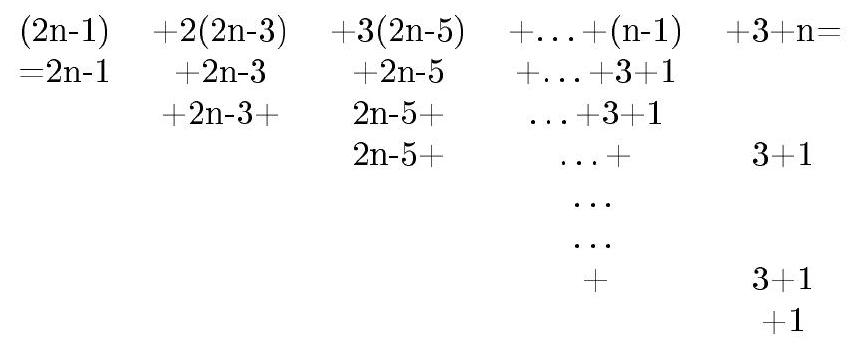
The 1st, 2nd, 3rd, ..., $(n-1)$th, $n$th row is the sum of the first $n, n-1, n-2, \ldots, 2, 1$ odd numbers, and thus the sum of the $n$ rows is:
$$
n... | \frac{n(n+1)(2n+1)}{6} | Algebra | math-word-problem | olympiads | 8351e6db-48b7-5c04-b4c9-735d2e5dfbc0 | [
true,
true
] | [
"<think>\nOkay, so I need to calculate the sum of the products of numbers that are directly above or below each other in these two sequences. Let me try to understand the problem first.\n\nThe first sequence is straightforward: it's just the numbers from 1 up to n. So that's 1, 2, 3, ..., n-1, n. The second sequenc... | [
true,
true
] | null | [
"stop",
"stop"
] | 2 | [
{
"content": "Consider the following two number sequences:\n\n$$\n\\begin{array}{cccccc}\n1, & 2, & 3, & \\ldots, & \\mathrm{n}-1, & \\mathrm{n}, \\\\\n2 \\mathrm{n}-1, & 2 \\mathrm{n}-3, & 2 \\mathrm{n}-5, & \\ldots, & 3, & 1\n\\end{array}\n$$\n\nCalculate the sum of the products of the numbers that are direct... |
Example 1. (Wenzhou Junior High School Math Competition Question, 1987) Let the natural number $n$ have the following property: from 1, 2, ..., $n$, any 51 different numbers chosen will definitely have two numbers whose sum is 101. The largest such $n$ is $\qquad$ | Consider $\{1,2, \cdots, n\}$ as the vertex set. When the sum of two numbers is 101, connect the corresponding two vertices to form a graph $G$. Clearly, the original problem is equivalent to finding the largest $n$ such that any selection of 51 vertices in $G$ must include two adjacent vertices.
i) When $51 \leqslant ... | 100 | Combinatorics | math-word-problem | cn_contest | eb26d5ad-7e94-53e3-a6f8-c573b04bf741 | [
true,
true,
true,
true
] | [
"<think>\nOkay, let's tackle this problem step by step. So, the question is about finding the largest natural number \\( n \\) such that if you choose any 51 different numbers from 1 to \\( n \\), there must be at least two numbers whose sum is 101. Hmm, interesting. Let me try to understand what's being asked here... | [
true,
true,
true,
true
] | null | null | 4 | [
{
"content": "Example 1. (Wenzhou Junior High School Math Competition Question, 1987) Let the natural number $n$ have the following property: from 1, 2, ..., $n$, any 51 different numbers chosen will definitely have two numbers whose sum is 101. The largest such $n$ is $\\qquad$",
"role": "user"
},
{
... |
4. Let's fix a point $O$ on the plane. Any other point $A$ is uniquely determined by its radius vector $\overrightarrow{O A}$, which we will simply denote as $\vec{A}$. We will use this concept and notation repeatedly in the following. The fixed point $O$ is conventionally called the initial point. We will also introdu... | 4. Since $(A B C)=k$, then $\frac{\overrightarrow{C A}}{\overrightarrow{C B}}=k$, or $\left(\frac{\overrightarrow{O A}-\overrightarrow{O C}}{\overrightarrow{O B}-\overrightarrow{O C}}=k\right) \Rightarrow(\overrightarrow{O A}-$ $-\overrightarrow{O C}=k \overrightarrow{O B}-k \overrightarrow{O C}) \Rightarrow((k-1) \ove... | \vec{C}=\frac{k\vec{B}-\vec{A}}{k-1} | Algebra | math-word-problem | olympiads | b4f988d4-2fc0-59a9-9e24-c197df50de60 | [
true,
true
] | [
"<think>\nAlright, so I need to figure out how to express the vector for point C in terms of vectors A and B, given that the simple ratio (ABC) is equal to k. Let me start by recalling the definition provided. The simple ratio (ABC) is defined by the equation:\n\n$$\n\\overrightarrow{CA} = (ABC) \\cdot \\overrighta... | [
true,
true
] | null | null | 2 | [
{
"content": "4. Let's fix a point $O$ on the plane. Any other point $A$ is uniquely determined by its radius vector $\\overrightarrow{O A}$, which we will simply denote as $\\vec{A}$. We will use this concept and notation repeatedly in the following. The fixed point $O$ is conventionally called the initial poi... |
13.133. A swimming pool has three pipes of different cross-sections for draining water using a uniformly pumping pump. The first and second pipes together, with the third pipe closed, empty a full pool in $a$ minutes; the first and third pipes together, with the second pipe closed, empty a full pool in $b$ minutes; and... | ## Solution.
Let the first pipe empty the pool in $x$ min; the second pipe in $y$ min; the third pipe in $z$ min. According to the problem:
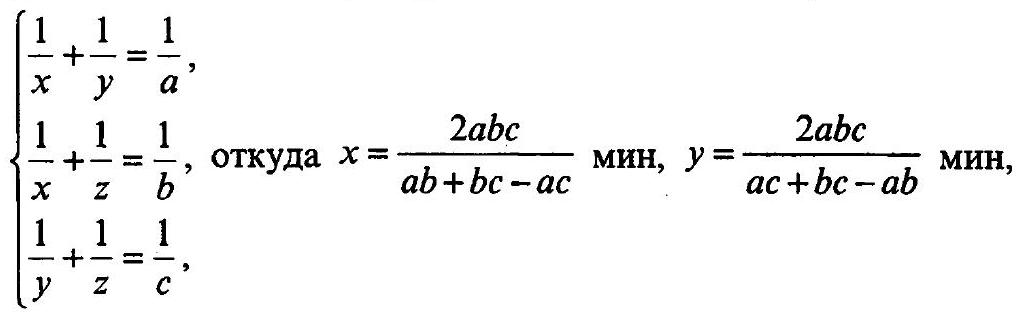
$$
\begin{aligned}
& z=\frac{2 a b c}{a b+a c-... | \frac{2}{+-},\frac{2}{+-},\frac{2}{+-} | Algebra | math-word-problem | olympiads | 8cd45588-cba4-5b49-a164-ec57265451ca | [
true,
true
] | [
"<think>\nOkay, so I need to figure out how long each pipe individually takes to empty the pool. Let me start by understanding the problem again.\n\nThere are three pipes with different cross-sections, which probably means they have different drainage rates. The pump is uniformly pumping, so maybe the pump's rate i... | [
false,
false
] | [
true,
true
] | null | 2 | [
{
"content": "13.133. A swimming pool has three pipes of different cross-sections for draining water using a uniformly pumping pump. The first and second pipes together, with the third pipe closed, empty a full pool in $a$ minutes; the first and third pipes together, with the second pipe closed, empty a full po... |
3. All seven-digit numbers consisting of different digits from 1 to 7 were listed in ascending order. What is the position of the number 3241765? | Answer: 1590
## Examples of how to write the answer:
1,7
# | 1590 | Combinatorics | math-word-problem | olympiads | 12cda167-c44e-596c-b7fc-5b53d26399ca | [
true,
true
] | [
"<think>\nOkay, so I need to figure out the position of the number 3241765 when all seven-digit numbers made from the digits 1 to 7, each used exactly once, are listed in ascending order. Hmm, let me think step by step.\n\nFirst, let me recall that when numbers are listed in ascending order, their order is determin... | [
true,
true
] | null | null | 2 | [
{
"content": "3. All seven-digit numbers consisting of different digits from 1 to 7 were listed in ascending order. What is the position of the number 3241765?",
"role": "user"
},
{
"content": "<think>Hmm , let me think step by step.\n\nFirst, let me recall that when numbers are listed in ascending ... |
10. (FRA) Determine the smallest natural number $n$ having the following property: For every integer $p, p \geq n$, it is possible to subdivide (partition) a given square into $p$ squares (not necessarily equal). | 10. It is easy to see that partitioning into $p=2 k$ squares is possible for $k \geq 2$ (Fig. 1). Furthermore, whenever it is possible to partition the square into $p$ squares, there is a partition of the square into $p+3$ squares: namely, in the partition into $p$ squares, divide one of them into four new squares.
Th... | 6 | Geometry | math-word-problem | olympiads | 8276f84d-bcd7-5ba9-bd85-a78ffc9f257a | [
true,
true
] | [
"<think>\nOkay, so I need to find the smallest natural number n such that for every integer p ≥ n, it's possible to partition a square into p smaller squares. These smaller squares don't have to be equal in size. Hmm, interesting problem. Let me start by understanding the problem better.\n\nFirst, the question is a... | [
true,
true
] | null | null | 2 | [
{
"content": "10. (FRA) Determine the smallest natural number $n$ having the following property: For every integer $p, p \\geq n$, it is possible to subdivide (partition) a given square into $p$ squares (not necessarily equal).",
"role": "user"
},
{
"content": "<think>Hmm , interesting problem. Let ... |
[Example 2.2.1] Simplify: $M=\frac{2}{\sqrt{4-3 \sqrt[4]{5}+2 \sqrt[4]{25}-\sqrt[4]{125}}}$. | This is a problem of simplifying an irrational expression. Such problems are usually cumbersome to compute, but observing the expression to be simplified, there are $\sqrt[4]{25}, \sqrt[4]{125}$, which have the relationship
$$
\sqrt[4]{25}=(\sqrt[4]{5})^{2}, \sqrt[4]{125}=(\sqrt[4]{5})^{3} .
$$
This inspires us to con... | \sqrt[4]{5}+1 | Algebra | math-word-problem | olympiads | b9202d02-6026-56eb-b886-9870332e488e | [
true,
true
] | [
"<think>\nOkay, let's try to simplify this expression: \\( M = \\frac{2}{\\sqrt{4 - 3 \\sqrt[4]{5} + 2 \\sqrt[4]{25} - \\sqrt[4]{125}}} \\). Hmm, that looks a bit complicated with all those fourth roots. I need to figure out if the denominator can be simplified somehow, maybe by expressing it as a square of some ex... | [
true,
true
] | null | null | 2 | [
{
"content": "[Example 2.2.1] Simplify: $M=\\frac{2}{\\sqrt{4-3 \\sqrt[4]{5}+2 \\sqrt[4]{25}-\\sqrt[4]{125}}}$.",
"role": "user"
},
{
"content": "<think>Hmm , that looks a bit complicated with all those fourth roots. I need to figure out if the denominator can be simplified somehow, maybe by express... |
13. For a given positive integer $n(n \geqslant 6)$, the set $A$ consists of the sums of 5 consecutive positive integers not greater than $n$, and the set $B$ consists of the sums of 6 consecutive positive integers not greater than $n$. If the number of elements in the set $A \cap B$ is 2016, determine the maximum valu... | Let the elements of set $A$ be $k+k+1+k+2+k+3+k+4=5 k+10$, and the elements of set $B$ be $l+l+1+l+2+l+3+l+4+l+5=6 l+15$,
Thus, $5 k+10=6 l+15 \Rightarrow 6 l=5(k-1) \Rightarrow 5 \mid l$. Let $l=5 m \Rightarrow k=6 m+1$, then $A \cap B=\{30 m+15 \mid m \geqslant 1,6 m+5 \leqslant n\} \Rightarrow A \cap B$ contains $\l... | 12106 | Number Theory | math-word-problem | olympiads | b5d4a755-da15-5bd0-aa0d-9c3d8c3818c8 | [
true,
true
] | [
"<think>\nOkay, so I need to figure out the maximum value of n where the number of common elements in sets A and B is 2016. Let me start by understanding what sets A and B are.\n\nSet A consists of the sums of 5 consecutive positive integers not greater than n. So, for example, if we take the first five numbers 1,2... | [
true,
true
] | null | null | 2 | [
{
"content": "13. For a given positive integer $n(n \\geqslant 6)$, the set $A$ consists of the sums of 5 consecutive positive integers not greater than $n$, and the set $B$ consists of the sums of 6 consecutive positive integers not greater than $n$. If the number of elements in the set $A \\cap B$ is 2016, de... |
2. Given $p+q=96$, and the quadratic equation $x^{2}+p x$ $+q=0$ has integer roots. Then its largest root is | 2. 98 .
Let the two roots be $x_{1}$ and $x_{2}$. Then $96=(x_{1}-1)(x_{2}-1)-1$, so $(x_{1}-1)(x_{2}-1)=97$. Since 97 is a prime number, then $x_{1}-1= \pm 1$, $x_{2}-1= \pm 97$, hence the largest root is 98. | 98 | Algebra | math-word-problem | cn_contest | 431e1f08-9573-53f1-a083-07e85e1955c6 | [
true,
true
] | [
"<think>\nOkay, so I have this problem here: given that p plus q equals 96, and the quadratic equation x squared plus p x plus q equals 0 has integer roots. Then I need to find the largest root. Hmm, let me try to figure this out step by step.\n\nFirst, let's recall that for a quadratic equation ax² + bx + c = 0, t... | [
true,
true
] | null | null | 2 | [
{
"content": "2. Given $p+q=96$, and the quadratic equation $x^{2}+p x$ $+q=0$ has integer roots. Then its largest root is",
"role": "user"
},
{
"content": "<think>Hmm , let me try to figure this out step by step.\n\nFirst, let's recall that for a quadratic equation ax² + bx + c = 0, the roots can b... |
8.2. Through the vertices $A$ and $C$ of triangle $ABC$, lines are drawn perpendicular to the bisector of angle $ABC$ and intersect the lines $CB$ and $BA$ at points $K$ and $M$ respectively. Find $AB$, if $BM=10, KC=2$. | Solution. Let point $K$ be located on side $BC$ of triangle $ABC$. Triangles $ABK$ and $MBC$ are isosceles (the bisector drawn from vertex $B$ is also an altitude), so $AB = BK = BC - CK = 10 - 2 = 8$.
If point $K$ is located on the extension of segment $BC$ beyond point $C$, then similarly we find that $AB = 12$.
An... | 8or12 | Geometry | math-word-problem | olympiads | 9d9e181d-5ad9-5a1a-a934-fb2c2122c0ef | [
true,
true
] | [
"<think>\nOkay, so I have this geometry problem here. Let me try to visualize it first. The problem says: Through the vertices A and C of triangle ABC, lines are drawn perpendicular to the bisector of angle ABC, and these lines intersect the lines CB and BA at points K and M respectively. We need to find AB, given ... | [
false,
false
] | [
false,
true
] | null | 1 | [
{
"content": "8.2. Through the vertices $A$ and $C$ of triangle $ABC$, lines are drawn perpendicular to the bisector of angle $ABC$ and intersect the lines $CB$ and $BA$ at points $K$ and $M$ respectively. Find $AB$, if $BM=10, KC=2$.",
"role": "user"
},
{
"content": "<think>Hmm , okay. Let me break... |
Example 1 Let $M=\{1,2, \cdots, 2005\}, A$ be a subset of $M$. If for any $a_{i}, a_{j} \in A$, $a_{i} \neq a_{j}$, an isosceles triangle can be uniquely determined with $a_{i}$ and $a_{j}$ as side lengths, find the maximum value of $|A|$. | When $a<b$, $a, b, b$ must form an isosceles triangle. Therefore, two numbers $a, b$ uniquely determine an isosceles triangle with $a, b$ as its two sides, which is equivalent to $a, a, b$ not forming an isosceles triangle, i.e., $2a \leqslant b$.
Let $A=\left\{a_{1}<a_{2}<\cdots<a_{n}\right\}$ be a subset of $M$ that... | 11 | Combinatorics | math-word-problem | inequalities | c36c8545-d561-5a74-9fe1-2967ddc45ea4 | [
true,
true
] | [
"<think>\nOkay, so I need to find the maximum size of a subset A of M = {1, 2, ..., 2005} such that for any two distinct elements a_i and a_j in A, there is a uniquely determined isosceles triangle with sides a_i and a_j. Hmm. Let me try to break this down.\n\nFirst, an isosceles triangle has two sides equal and on... | [
true,
true
] | null | null | 2 | [
{
"content": "Example 1 Let $M=\\{1,2, \\cdots, 2005\\}, A$ be a subset of $M$. If for any $a_{i}, a_{j} \\in A$, $a_{i} \\neq a_{j}$, an isosceles triangle can be uniquely determined with $a_{i}$ and $a_{j}$ as side lengths, find the maximum value of $|A|$.",
"role": "user"
},
{
"content": "<think>... |
Find all values of the parameter $a$ such that the equation:
$$
a x^{2}-(a+3) x+2=0
$$
admits two real roots of opposite signs.
Proposition 1.29 (Viète's Relations in the General Case). Let $P(x)=a_{n} x^{n}+a_{n-1} x^{n-1}+$ $\cdots+a_{1} x+a_{0} \in \mathbb{K}[X]$ with $a_{n} \neq 0$. If $\alpha_{1}, \ldots, \alph... | Suppose that $a x^{2}-(a+3) x+2=0$ has two roots of opposite sign, denoted by $z_{1}, z_{2}$. Then, according to Vieta's formulas, $z_{1} z_{2}=2 / a$. Now, $z_{1}$ and $z_{2}$ are of opposite sign if and only if $z_{1} z_{2}<0$. We deduce that $a<0$. Conversely, if $a<0$, then the discriminant of the equation is $a^{2... | <0 | Algebra | math-word-problem | olympiads | 28a03eec-e013-5443-97a7-fb94615efe7b | [
true,
true
] | [
"<think>\nOkay, so I need to find all values of the parameter \\( a \\) such that the quadratic equation \\( a x^{2} - (a + 3) x + 2 = 0 \\) has two real roots of opposite signs. Hmm, let's think about how to approach this step by step.\n\nFirst, I remember that for a quadratic equation \\( Ax^2 + Bx + C = 0 \\), t... | [
false,
false
] | [
true,
true
] | null | 2 | [
{
"content": "Find all values of the parameter $a$ such that the equation:\n\n$$\na x^{2}-(a+3) x+2=0\n$$\n\nadmits two real roots of opposite signs.\n\nProposition 1.29 (Viète's Relations in the General Case). Let $P(x)=a_{n} x^{n}+a_{n-1} x^{n-1}+$ $\\cdots+a_{1} x+a_{0} \\in \\mathbb{K}[X]$ with $a_{n} \\neq... |
Problem 3. Experimenters Glafira and Gavriil placed a triangle made of thin wire with sides of 30 mm, 40 mm, and 50 mm on a white flat surface. This wire is covered with millions of mysterious microorganisms. The scientists found that when an electric current is applied to the wire, these microorganisms begin to move c... | Solution. In one minute, the microorganism moves 10 mm. Since in a right triangle with sides $30, 40, 50$, the radius of the inscribed circle is 10, all points inside the triangle are no more than 10 mm away from the sides of the triangle. Therefore, the microorganisms will fill the entire interior of the triangle.
Wh... | 2114 | Geometry | math-word-problem | olympiads | 8ffeb478-9557-506d-b7c0-1ccaf7854c42 | [
true,
true
] | [
"<think>\nOkay, so let's see. Glafira and Gavriil have this triangle made of wire with sides 30 mm, 40 mm, and 50 mm. When they apply an electric current, microorganisms on the wire start moving along the surface at 1/6 mm per second, and wherever they go, they stain the surface red. We need to find the area of the... | [
false,
true
] | null | null | 1 | [
{
"content": "Problem 3. Experimenters Glafira and Gavriil placed a triangle made of thin wire with sides of 30 mm, 40 mm, and 50 mm on a white flat surface. This wire is covered with millions of mysterious microorganisms. The scientists found that when an electric current is applied to the wire, these microorg... |
2. A box contains 3 red balls and 3 white balls, all of the same size and shape. Now, a fair die is rolled, and the number of balls taken from the box is equal to the number rolled. What is the probability that the number of red balls taken is greater than the number of white balls taken? $\qquad$ . | Let the number rolled on the die be $X$. When the number of red balls and white balls drawn is equal, we have
$$
P(X=2)=\frac{1}{6} \cdot \frac{C_{3}^{1} \cdot C_{3}^{1}}{C_{6}^{2}}=\frac{1}{10}, P(X=4)=\frac{1}{6} \cdot \frac{C_{3}^{2} \cdot C_{3}^{2}}{C_{6}^{4}}=\frac{1}{10}, P(X=6)=\frac{1}{6}.
$$
When the number o... | \frac{19}{60} | Combinatorics | math-word-problem | olympiads | e1df7c0b-30cf-5a8c-8749-bfbde08160f7 | [
true,
true
] | [
"<think>\nOkay, so I need to figure out the probability that when I roll a fair die and take that many balls from a box with 3 red and 3 white balls, the number of red balls taken is greater than the white ones. Hmm, let me break this down step by step.\n\nFirst, the die is fair, so each number from 1 to 6 has an e... | [
true,
true
] | null | null | 2 | [
{
"content": "2. A box contains 3 red balls and 3 white balls, all of the same size and shape. Now, a fair die is rolled, and the number of balls taken from the box is equal to the number rolled. What is the probability that the number of red balls taken is greater than the number of white balls taken? $\\qquad... |
Subsets and Splits
No community queries yet
The top public SQL queries from the community will appear here once available.