
problem string | solution string | answer string | problem_type string | question_type string | source string | uuid string | is_reasoning_complete list | generations list | correctness_math_verify list | correctness_llama list | finish_reasons list | correctness_count int64 | messages list |
|---|---|---|---|---|---|---|---|---|---|---|---|---|---|
6. Let the set $\mathbf{A}=\{1,2.3,4,5,6\}$, and the one-to-one mapping $f: \mathbf{A} \rightarrow \mathbf{A}$ satisfies the condition: for any $x$ $\in \mathrm{A}$, $f(f(f(x)))=x$. Then the number of mappings $f$ that satisfy the above condition is ( ).
A. 40
B. 41
C. 80
D. 81 | 6. $\mathrm{D}$
First, we prove that there does not exist $x \in \mathbf{A}$ such that $f(f(x))=x$ and $f(x) \neq x$. Otherwise, since $f(x) \in \mathbf{A}$, we have $f(f(f(x)))=f(x) \neq x$, which contradicts the known condition. Therefore, for any $x \in \mathbf{A}$, either $f(x)=x$ or $f(x)=x_{1}, f\left(x_{1}\righ... | 81 | Combinatorics | MCQ | olympiads | ad1332c9-cbf1-5324-a17b-eb2f3314b6c7 | [
true,
true
] | [
"<think>\nOkay, so I need to find the number of one-to-one mappings (bijections) f from the set A = {1, 2, 3, 4, 5, 6} to itself such that applying f three times gives the identity function. In other words, for every element x in A, f(f(f(x))) = x. The answer choices are A. 40, B. 41, C. 80, D. 81.\n\nFirst, let me... | [
false,
false
] | [
true,
false
] | null | 1 | [
{
"content": "6. Let the set $\\mathbf{A}=\\{1,2.3,4,5,6\\}$, and the one-to-one mapping $f: \\mathbf{A} \\rightarrow \\mathbf{A}$ satisfies the condition: for any $x$ $\\in \\mathrm{A}$, $f(f(f(x)))=x$. Then the number of mappings $f$ that satisfy the above condition is ( ).\nA. 40\nB. 41\nC. 80\nD. 81",
"... |
19. A5 (JAP) ${ }^{\text {IMO6 }}$ Find all the functions $f: \mathbb{R} \rightarrow \mathbb{R}$ that satisfy
$$ f(x-f(y))=f(f(y))+x f(y)+f(x)-1 $$
for all $x, y \in \mathbb{R}$. | 19. Let \( A = \{ f(x) \mid x \in \mathbb{R} \} \) and \( f(0) = c \). Plugging in \( x = y = 0 \) we get \( f(-c) = f(c) + c - 1 \), hence \( c \neq 0 \). If \( x \in A \), then taking \( x = f(y) \) in the original functional equation we get \( f(x) = \frac{c+1}{2} - \frac{x^2}{2} \) for all \( x \in A \). We now sho... | f(x) = 1 - \frac{x^2}{2} | Algebra | math-word-problem | olympiads_ref | NaN | [
true,
true
] | [
"<think>\nOkay, so I need to find all functions f from the real numbers to the real numbers that satisfy the equation:\n\nf(x - f(y)) = f(f(y)) + x f(y) + f(x) - 1\n\nfor all real numbers x and y. Hmm, functional equations can be tricky, but let's take it step by step.\n\nFirst, maybe I can try to find some specifi... | [
true,
true
] | null | [
"stop",
"stop"
] | 2 | [
{
"content": "19. A5 (JAP) ${ }^{\\text {IMO6 }}$ Find all the functions $f: \\mathbb{R} \\rightarrow \\mathbb{R}$ that satisfy \n$$ f(x-f(y))=f(f(y))+x f(y)+f(x)-1 $$ \nfor all $x, y \\in \\mathbb{R}$.",
"role": "user"
},
{
"content": "<think>Hmm , functional equations can be tricky, but let's ta... |
8・3 If $4^{x}-4^{x-1}=24$, then $(2 x)^{x}$ equals
(A) $5 \sqrt{5}$.
(B) $\sqrt{5}$.
(C) $25 \sqrt{5}$.
(D) 125 .
(E) 25 .
(9th American High School Mathematics Examination, 1958) | [Solution] From $4^{x}-4^{x-1}=24$, we get $\quad 4^{x-1}(4-1)=24$, which means $4^{x-1}=8$, which can be transformed into $\quad 2^{2(x-1)}=2^{3}$, then $2(x-1)=3$, yielding $x=\frac{5}{2}$.
$$
\therefore \quad(2 x)^{x}=\left(2 \cdot \frac{5}{2}\right)^{\frac{5}{2}}=25 \sqrt{5} \text {. }
$$
Therefore, the answer is ... | 25\sqrt{5} | Algebra | MCQ | olympiads | 5b424834-2fca-562c-8b5b-44ded38fa9f2 | [
true,
true
] | [
"<think>\nOkay, let's see. I need to solve the equation 4^x - 4^{x-1} = 24 and then find the value of (2x)^x. Hmm, the options are given, so maybe after solving for x, I can plug it into (2x)^x and see which option matches. Alright, let me start by working on the equation.\n\nFirst, 4^x and 4^{x-1}. Maybe I can fac... | [
false,
false
] | [
true,
false
] | null | 1 | [
{
"content": "8・3 If $4^{x}-4^{x-1}=24$, then $(2 x)^{x}$ equals\n(A) $5 \\sqrt{5}$.\n(B) $\\sqrt{5}$.\n(C) $25 \\sqrt{5}$.\n(D) 125 .\n(E) 25 .\n(9th American High School Mathematics Examination, 1958)",
"role": "user"
},
{
"content": "<think>Hmm , the options are given, so maybe after solving for ... |
There are $n$ random vectors of the form ( $y_{1}, y_{2}, y_{3}$ ), where exactly one random coordinate is equal to 1, and the rest are equal to 0.
They are added together. The result is a random vector $\boldsymbol{a}$ with coordinates ( $Y_{1}, Y_{2}, Y_{3}$ ).
a) Find the expected value of the random variable $\bo... | a) The quantity $Y_{j}-$ the number of units among the numbers $y_{j}$ - is distributed according to the binomial law with probability $p=1 / 3$ and the number of trials . Therefore,
$\mathrm{E} Y_{j}=n / 3$ and $\mathrm{D}_{j}=n \cdot 1 / 3 \cdot 2 / 3=2 n / 9$.
Thus, $\mathrm{E}\left(\boldsymbol{a}^{2}\right)=\math... | \frac{2n+n^{2}}{3} | Algebra | math-word-problem | olympiads | 42d5dcc1-e45d-5c1a-a81c-ab7096bd6985 | [
true,
true
] | [
"<think>\nOkay, let's try to tackle part (a) of this problem. So, we have n random vectors, each of which has exactly one coordinate equal to 1 and the rest 0. When we add them all together, we get a vector a = (Y₁, Y₂, Y₃). We need to find the expected value of a². Hmm, wait, a² probably means the squared magnitud... | [
true,
true
] | null | null | 2 | [
{
"content": "There are $n$ random vectors of the form ( $y_{1}, y_{2}, y_{3}$ ), where exactly one random coordinate is equal to 1, and the rest are equal to 0.\n\nThey are added together. The result is a random vector $\\boldsymbol{a}$ with coordinates ( $Y_{1}, Y_{2}, Y_{3}$ ).\n\na) Find the expected value ... |
Define $ a \circledast b = a + b-2ab $. Calculate the value of
$$A=\left( ...\left(\left(\frac{1}{2014}\circledast \frac{2}{2014}\right)\circledast\frac{3}{2014}\right)...\right)\circledast\frac{2013}{2014}$$ | 1. We start with the operation defined as \( a \circledast b = a + b - 2ab \). We need to calculate the value of
\[
A = \left( ...\left(\left(\frac{1}{2014} \circledast \frac{2}{2014}\right) \circledast \frac{3}{2014}\right)...\right) \circledast \frac{2013}{2014}
\]
2. First, let's simplify the operation \(... | \frac{1}{2} | Algebra | math-word-problem | aops_forum | 87407db5-86b0-584a-b35d-c3353084e39f | [
true,
true
] | [
"<think>\nOkay, so I have this problem here where I need to compute a value A using this operation called \"circledast\". The operation is defined as a circledast b equals a plus b minus 2ab. Then, A is this big expression where you start with 1/2014 circledast 2/2014, then take that result and circledast 3/2014, a... | [
true,
false
] | null | [
"stop",
"stop"
] | 1 | [
{
"content": "Define $ a \\circledast b = a + b-2ab $. Calculate the value of\n$$A=\\left( ...\\left(\\left(\\frac{1}{2014}\\circledast \\frac{2}{2014}\\right)\\circledast\\frac{3}{2014}\\right)...\\right)\\circledast\\frac{2013}{2014}$$",
"role": "user"
},
{
"content": "<think>Hmm . Let me see if t... |
Find the number of sequences $(a_n)_{n=1}^\infty$ of integers satisfying $a_n \ne -1$ and
\[a_{n+2} =\frac{a_n + 2006}{a_{n+1} + 1}\]
for each $n \in \mathbb{N}$. | 1. We start with the given recurrence relation:
\[
a_{n+2} = \frac{a_n + 2006}{a_{n+1} + 1}
\]
for each \( n \in \mathbb{N} \).
2. We derive the expression:
\[
(a_{n+3} - a_{n+1})(a_{n+2} + 1) = a_{n+2} - a_n
\]
This can be obtained by manipulating the recurrence relation and considering the di... | a_i \in \{a, b\} \text{ where } ab = 2006 \text{ and } a_n = a_{n+2} \text{ for all } n | Logic and Puzzles | math-word-problem | aops_forum | 0f1a599b-5a81-5688-8ba4-bc64ffaf3887 | [
true,
true
] | [
"<think>\nOkay, so I need to find the number of sequences of integers (a_n) where each term is not equal to -1, and it satisfies the recurrence relation a_{n+2} = (a_n + 2006)/(a_{n+1} + 1) for every natural number n. Hmm, this seems like a recursive sequence problem, but with a twist because each term is defined i... | [
false,
false
] | [
true,
false
] | null | 1 | [
{
"content": "Find the number of sequences $(a_n)_{n=1}^\\infty$ of integers satisfying $a_n \\ne -1$ and\n\\[a_{n+2} =\\frac{a_n + 2006}{a_{n+1} + 1}\\]\nfor each $n \\in \\mathbb{N}$.",
"role": "user"
},
{
"content": "<think>Hmm , this seems like a recursive sequence problem, but with a twist beca... |
3. As shown in Figure 3, let $A B$ and $C D$ be two perpendicular chords of a circle with center $O$ and radius $r$, dividing the circle into four parts (each part may degenerate to a point) in clockwise order denoted as $X, Y, Z, W$. Then the maximum value of $\frac{S_{X}+S_{Z}}{S_{Y}+S_{W}}$ (where $S_{U}$ represents... | 3. $\frac{\pi+2}{\pi-2}$.
Let's assume the center of the circle falls in $Z$ as shown in Figure 7(a).
When the chord $AB$ moves upward, the shaded area in Figure 7(b) is greater than the unshaded area to its left, so $S_{X}+S_{Z}$ increases, while $S_{Y}+S_{W}$ decreases (note that the sum of the areas of $X$, $Y$, $Z... | \frac{\pi+2}{\pi-2} | Geometry | math-word-problem | cn_contest | 8ac13434-e1d3-5552-9859-a38c86d203ad | [
true,
false
] | [
"<think>\nOkay, so I need to find the maximum value of the ratio (S_X + S_Z)/(S_Y + S_W) where X, Y, Z, W are the four regions divided by two perpendicular chords AB and CD in a circle with center O and radius r. Hmm, let me visualize this. The circle is split into four parts by two perpendicular chords. Since the ... | [
true,
false
] | null | null | 1 | [
{
"content": "3. As shown in Figure 3, let $A B$ and $C D$ be two perpendicular chords of a circle with center $O$ and radius $r$, dividing the circle into four parts (each part may degenerate to a point) in clockwise order denoted as $X, Y, Z, W$. Then the maximum value of $\\frac{S_{X}+S_{Z}}{S_{Y}+S_{W}}$ (w... |
In a tetrahedron, at each vertex, edges of lengths $5$, $\sqrt{41}$, and $\sqrt{34}$ meet. What are the lengths of the segments connecting the midpoints of the opposite edges of the tetrahedron? | Let the tetrahedron be $D E G H$. Let $F_{1}, F_{2}, F_{3}, F_{4}, F_{5}$, and $F_{6}$ be the midpoints of the edges $D H, D E, E G, G H$, $E H$, and $D G$, respectively. The edges meeting at vertex $E$ are of lengths $5, \sqrt{34}$, and $\sqrt{41}$, for example, $E D=5, E H=\sqrt{41}$, and $E G=\sqrt{34}$. If $D G=5$,... | 3,4,5 | Geometry | math-word-problem | olympiads | d5448aa7-7fb9-51f4-86c0-8ac3b8df4142 | [
true,
true
] | [
"<think>\nOkay, so I have this problem about a tetrahedron where at each vertex, edges of lengths 5, √41, and √34 meet. I need to find the lengths of the segments connecting the midpoints of the opposite edges of the tetrahedron. Hmm, tetrahedrons can be a bit tricky, but let me try to visualize it first.\n\nA tetr... | [
false,
true
] | null | null | 1 | [
{
"content": "In a tetrahedron, at each vertex, edges of lengths $5$, $\\sqrt{41}$, and $\\sqrt{34}$ meet. What are the lengths of the segments connecting the midpoints of the opposite edges of the tetrahedron?",
"role": "user"
},
{
"content": "<think>Hmm , okay.\n\nFirst, let me recall that in a te... |
Problem 9.7. In front of a sweet-tooth lie five boxes of candies: the first box contains 11 candies, the second - 22 candies, the third - 33 candies, the fourth - 44 candies, the fifth - 55 candies. In one move, the sweet-tooth can take four candies from one box and distribute them, one candy to each of the remaining f... | Answer: 159.
Solution. Consider the number of candies in the boxes. Initially, these are 5 natural numbers that give different remainders when divided by 5. We will prove that as long as the sweet-tooth does not take candies from any box, these 5 numbers will always give different remainders when divided by 5. For thi... | 159 | Logic and Puzzles | math-word-problem | olympiads | 2c10f552-28b7-5a47-807d-06dfd7b5c3fb | [
true,
false
] | [
"<think>\nOkay, let's see. So there are five boxes with 11, 22, 33, 44, and 55 candies respectively. The goal is to figure out the maximum number of candies the sweet-tooth can take. The rules say that in one move, he can take four candies from one box and distribute one candy to each of the remaining four boxes. A... | [
true,
false
] | null | null | 1 | [
{
"content": "Problem 9.7. In front of a sweet-tooth lie five boxes of candies: the first box contains 11 candies, the second - 22 candies, the third - 33 candies, the fourth - 44 candies, the fifth - 55 candies. In one move, the sweet-tooth can take four candies from one box and distribute them, one candy to e... |
# Problem 1. (4 points)
In the run-up to the New Year, a fair is being held at the school where students exchange festive toys. As a result, the following exchange norms have been established:
1 Christmas tree ornament can be exchanged for 2 crackers, 5 sparklers can be exchanged for 2 garlands, and 4 Christmas tree ... | # Solution:
a) 10 sparklers $=4$ garlands = 16 ornaments = $\mathbf{32}$ crackers. (1 point)
b) Convert everything to crackers. In the first case, we have $\mathbf{11}$ crackers. In the second case, 2 sparklers $=4 / 5$ garlands $=16 / 5$ ornaments $=32 / 5$ crackers $=\mathbf{6.4}$ crackers. Answer: 5 ornaments and ... | 32 | Logic and Puzzles | math-word-problem | olympiads | cc15c126-a51d-5146-bcfb-340be5009981 | [
true,
true
] | [
"<think>\nOkay, let me try to figure out part a first. So, the question is asking how many crackers can be obtained for 10 sparklers. Hmm. Let me look back at the exchange rates given.\n\nThe problem states:\n\n1 Christmas tree ornament = 2 crackers.\n\n5 sparklers = 2 garlands.\n\n4 Christmas tree ornaments = 1 ga... | [
false,
false
] | [
true,
true
] | null | 2 | [
{
"content": "# Problem 1. (4 points)\n\nIn the run-up to the New Year, a fair is being held at the school where students exchange festive toys. As a result, the following exchange norms have been established:\n\n1 Christmas tree ornament can be exchanged for 2 crackers, 5 sparklers can be exchanged for 2 garla... |
3. Ophelia is paid $\$ 51$ for the first week of her part-time summer job. For each week after the first, she is paid $\$ 100$. How many weeks in total does she have to work for her average weekly pay to be $\$ 93$ ? | 3. Solution 1
Suppose that Ophelia works for a total of $n$ weeks.
Then she earns $\$ 51$ for 1 week and $\$ 100$ a week for $(n-1)$ weeks.
Since her average weekly pay is $\$ 93$, then $\frac{51+(n-1) \times 100}{n}=93$.
Therefore,
$$
\begin{aligned}
51+100(n-1) & =93 n \\
51+100 n-100 & =93 n \\
100 n-49 & =93 n \\
1... | 7 | Algebra | math-word-problem | olympiads | 5c87c6cb-85c1-5888-a1be-1952c03494fe | [
true,
true
] | [
"<think>\nOkay, let's see. The problem is about Ophelia's average weekly pay. She gets $51 for the first week and then $100 each week after that. We need to find out how many weeks in total she has to work so that her average weekly pay is $93. Hmm, average pay... that means total earnings divided by the number of ... | [
true,
true
] | null | null | 2 | [
{
"content": "3. Ophelia is paid $\\$ 51$ for the first week of her part-time summer job. For each week after the first, she is paid $\\$ 100$. How many weeks in total does she have to work for her average weekly pay to be $\\$ 93$ ?",
"role": "user"
},
{
"content": "<think>Hmm , average pay... that... |
A right triangle $ABC$ is inscribed in the circular base of a cone. If two of the side lengths of $ABC$ are $3$ and $4$, and the distance from the vertex of the cone to any point on the circumference of the base is $3$, then the minimum possible volume of the cone can be written as $\frac{m\pi\sqrt{n}}{p}$, where $m$, ... | 1. **Identify the sides of the right triangle:**
Given a right triangle \(ABC\) with side lengths \(3\) and \(4\), we can determine the hypotenuse using the Pythagorean theorem:
\[
c = \sqrt{3^2 + 4^2} = \sqrt{9 + 16} = \sqrt{25} = 5
\]
Therefore, the hypotenuse of the triangle is \(5\).
2. **Determine ... | 60 | Geometry | math-word-problem | aops_forum | 4461bcc4-8ff5-5e9a-9742-4ba748fe9612 | [
true,
true
] | [
"<think>\nOkay, so I need to find the minimum possible volume of a cone where a right triangle ABC with sides 3 and 4 is inscribed in the circular base of the cone. Also, the distance from the vertex of the cone to any point on the circumference of the base is 3. Hmm, let me try to break this down step by step.\n\n... | [
true,
true
] | null | null | 2 | [
{
"content": "A right triangle $ABC$ is inscribed in the circular base of a cone. If two of the side lengths of $ABC$ are $3$ and $4$, and the distance from the vertex of the cone to any point on the circumference of the base is $3$, then the minimum possible volume of the cone can be written as $\\frac{m\\pi\\... |
## Zadatak B-3.4.
Pravilna uspravna četverostrana piramida kojoj bočni bridovi s ravninom baze zatvaraju kut od $60^{\circ}$ i kocka imaju sukladne baze. Odredite omjer njihovih oplošja.
| ## Rješenje.
Neka je $a$ duljina stranice kocke i baze piramide.
Oplošje kocke je $O_{k}=6 a^{2}$.
Oplošje piramide je $O_{p}=a^{2}+4 \cdot \frac{a v}{2}=a^{2}+2 a v$ ( $v$ je visina pobočke).
Potrebno je visinu pobočke $v$ izraziti pomoću duljine brida $a$. Nasuprotni bočni bridovi i dijagonala baze tvore jednakos... | \frac{1+\sqrt{7}}{6} | Geometry | math-word-problem | olympiads | 12208905-52e1-5e6a-8d42-f105f4ec8479 | [
true,
true
] | [
"<think>\nOkay, let's see. The problem is about a regular quadrilateral pyramid and a cube that have congruent bases. We need to find the ratio of their surface areas. The pyramid has its lateral edges making a 60-degree angle with the base plane. Hmm, okay. Let me break this down step by step.\n\nFirst, let's unde... | [
true,
true
] | null | null | 2 | [
{
"content": "## Zadatak B-3.4.\n\nPravilna uspravna četverostrana piramida kojoj bočni bridovi s ravninom baze zatvaraju kut od $60^{\\circ}$ i kocka imaju sukladne baze. Odredite omjer njihovih oplošja.\n\n",
"role": "user"
},
{
"content": "<think>Hmm , okay. Let me break this down step by step.\n... |
12.253. A cylinder is inscribed in a cone; the lower base of the cylinder lies in the plane of the base of the cone. A line passing through the center of the upper base of the cylinder and a point on the circumference of the base of the cone makes an angle $\alpha$ with the plane of the base. Find the ratio of the volu... | ## Solution.
Let $O$ be the center of the bases of the given cone and the cylinder inscribed in it, $O_{1}$ be the center of the upper base of the cylinder, $SA$ be the generatrix of the cone, $CB$ be the generatrix of the cylinder, $\angle ASO=\beta, \angle O_{1}AO=\alpha$, (Fig. 12.119).
If the radius of the base o... | \frac{\cos^{3}\alpha\cos^{3}\beta}{3\sin\alpha\sin\beta\cos^{2}(\alpha+\beta)} | Geometry | math-word-problem | olympiads | 0b313566-8369-5e64-abd3-f4e29aba03a7 | [
true,
true
] | [
"<think>\nAlright, let's tackle this problem step by step. So, we have a cylinder inscribed in a cone. The lower base of the cylinder is on the same plane as the base of the cone. There's a line passing through the center of the upper base of the cylinder and a point on the circumference of the cone's base, and thi... | [
false,
false
] | [
false,
true
] | null | 1 | [
{
"content": "12.253. A cylinder is inscribed in a cone; the lower base of the cylinder lies in the plane of the base of the cone. A line passing through the center of the upper base of the cylinder and a point on the circumference of the base of the cone makes an angle $\\alpha$ with the plane of the base. Fin... |
4. Mom asked Xiaoming to boil water and make tea for the guests. It takes 1 minute to clean the kettle, 15 minutes to boil water, 1 minute to clean the teapot, 1 minute to clean the teacup, and 2 minutes to get the tea leaves. Xiaoming estimated that it would take 20 minutes to complete these tasks. To make the guests ... | 4.【Solution】In this problem, the most reasonable arrangement should save the most time. First, wash the kettle, then boil the water. After the water is on to boil, Xiao Ming needs to wait 15 minutes. During this time, he can wash the teapot, wash the teacup, and get the tea leaves. Once the water boils, he can brew the... | 16 | Logic and Puzzles | math-word-problem | olympiads | a282e65a-187d-5283-94f0-924d0e40e0d8 | [
true,
true
] | [
"<think>\nOkay, let me try to figure out how Xiaoming can make the tea as quickly as possible. So, the problem is that Mom asked him to boil water and make tea, and he estimated it would take 20 minutes. But maybe we can find a way to do it faster by overlapping some tasks. Let's break it down step by step.\n\nFirs... | [
true,
true
] | null | null | 2 | [
{
"content": "4. Mom asked Xiaoming to boil water and make tea for the guests. It takes 1 minute to clean the kettle, 15 minutes to boil water, 1 minute to clean the teapot, 1 minute to clean the teacup, and 2 minutes to get the tea leaves. Xiaoming estimated that it would take 20 minutes to complete these task... |
3. In the complex plane, the points corresponding to the complex numbers $z_{1}, z_{2}, z_{3}$ are $Z_{1}, Z_{2}, Z_{3}$, respectively. If $\left|z_{1}\right|=\left|z_{2}\right|=\sqrt{2}, \overrightarrow{O Z_{1}} \cdot \overrightarrow{O Z_{2}}=0,\left|z_{1}+z_{2}-z_{3}\right|=2$, then the range of $\left|z_{3}\right|$ ... | Answer $[0,4]$.
From $\overrightarrow{O Z_{1}} \cdot \overrightarrow{O Z_{2}}=0$, we know that $\overrightarrow{O Z_{1}} \perp \overrightarrow{O Z_{2}},\left|z_{1}+z_{2}\right|^{2}=\left|z_{1}\right|^{2}+\left|z_{2}\right|^{2}=4$, which means $\left|z_{1}+z_{2}\right|=2$. By the property of the modulus of complex numbe... | [0,4] | Algebra | math-word-problem | olympiads | 45892424-3889-5db4-a934-630f4c59f03a | [
true,
true
] | [
"<think>\nOkay, let me try to figure this problem out. So, we have three complex numbers z₁, z₂, z₃ with their corresponding points Z₁, Z₂, Z₃ in the complex plane. The given conditions are:\n\n1. |z₁| = |z₂| = √2\n2. The vectors OZ₁ and OZ₂ are perpendicular to each other (since their dot product is zero).\n3. |z₁... | [
true,
true
] | null | null | 2 | [
{
"content": "3. In the complex plane, the points corresponding to the complex numbers $z_{1}, z_{2}, z_{3}$ are $Z_{1}, Z_{2}, Z_{3}$, respectively. If $\\left|z_{1}\\right|=\\left|z_{2}\\right|=\\sqrt{2}, \\overrightarrow{O Z_{1}} \\cdot \\overrightarrow{O Z_{2}}=0,\\left|z_{1}+z_{2}-z_{3}\\right|=2$, then th... |
3. Let the areas of the four faces of a tetrahedron be $S_{1}, S_{2}, S_{3}, S_{4}$, and their maximum value be $S$. Let $\lambda=\frac{\sum_{i=1}^{4} S_{i}}{S}$, then $\lambda$ must satisfy
A. $2<\lambda \leqslant 4$
B. $3<\lambda<4$
C. $2.5<\lambda \leqslant 4.5$
D. $3.5<\lambda<5.5$ | Obviously, $\sum_{i=1}^{4} S_{i} \leqslant 4 S \Rightarrow \lambda \leqslant 4$; when the vertex is located within the base, the sum of the areas of the three side faces equals the area of the base, at this time $\sum_{i=1}^{4} S_{i} \rightarrow 2 S$. Therefore, $2<\lambda \leqslant 4$, so the answer is $A$. | 2<\lambda\leqslant4 | Geometry | MCQ | olympiads | 42a6c668-bac8-577a-bb85-c256f588cf25 | [
true,
true
] | [
"<think>\nOkay, so I have this problem about a tetrahedron and the areas of its four faces. The question is asking about the range of the value lambda, which is the sum of the four face areas divided by the maximum area among them. The options are given as A, B, C, D with different intervals. I need to figure out w... | [
false,
false
] | [
true,
true
] | null | 2 | [
{
"content": "3. Let the areas of the four faces of a tetrahedron be $S_{1}, S_{2}, S_{3}, S_{4}$, and their maximum value be $S$. Let $\\lambda=\\frac{\\sum_{i=1}^{4} S_{i}}{S}$, then $\\lambda$ must satisfy\nA. $2<\\lambda \\leqslant 4$\nB. $3<\\lambda<4$\nC. $2.5<\\lambda \\leqslant 4.5$\nD. $3.5<\\lambda<5.... |
The graphs of the functions $y=k x+b$ and $y=b x+k$ intersect. Find the abscissa of the point of intersection.
# | First method. The desired abscissa is the solution to the equation $k x + b = b x + k$. This equation can be simplified to: $(k - b) x = k - b$. Since the given graphs intersect (do not coincide), $k \neq b$, therefore $x = 1$.
Second method. Notice that $x = 1$ is a solution to the problem: when $x = 1$, both given l... | 1 | Algebra | math-word-problem | olympiads | 29ededb0-b4bc-583e-8c93-d0c2f965b143 | [
false,
true
] | [
"<think>\nOkay, let's see. The problem says that the graphs of the functions y = kx + b and y = bx + k intersect, and we need to find the abscissa (which is the x-coordinate) of the point of intersection. Alright, so first, I remember that when two lines intersect, their x and y values are the same at that point. S... | [
false,
true
] | null | null | 1 | [
{
"content": "The graphs of the functions $y=k x+b$ and $y=b x+k$ intersect. Find the abscissa of the point of intersection.\n\n#",
"role": "user"
},
{
"content": "<think>Hmm , intersection points happen where the two equations are equal, right? So I should set them equal to each other and solve for... |
2. The function $f(x)=-\log _{\frac{1}{2}}\left(x^{2}-a x-a\right)$ is decreasing on the interval $(-\infty, 1-\sqrt{3})$. Then the range of values for $a$ is ( ).
(A) $0 \leqslant a \leqslant 2$
(B) $2(1-\sqrt{3}) \leqslant a \leqslant 2$
(C) $0 \leqslant a \leqslant 2$ or $a \leqslant-4$
(D) $2(1-\sqrt{3}) \leqslant ... | 2. (B).
$$
y=-\log _{\frac{1}{2}}\left(x^{2}-a x-a\right)=\log _{2}\left(x^{2}-a x-a\right) .
$$
To make $y=\log _{2}\left(x^{2}-a x-a\right)$ a decreasing function on the interval $(-\infty, 1-\sqrt{3})$, it is sufficient that the domain of the function includes $(-\infty, 1-\sqrt{3})$, and that $y^{*}=x^{2}-a x-a$ i... | B | Algebra | MCQ | cn_contest | 1c21b812-0228-520d-86ee-72b6ef489ab8 | [
true,
true
] | [
"<think>\nOkay, let's tackle this problem step by step. The function given is \\( f(x) = -\\log_{\\frac{1}{2}}(x^2 - a x - a) \\), and we need to find the range of values for \\( a \\) such that \\( f(x) \\) is decreasing on the interval \\( (-\\infty, 1 - \\sqrt{3}) \\). The options are given, so eventually we hav... | [
true,
true
] | null | [
"stop",
"stop"
] | 2 | [
{
"content": "2. The function $f(x)=-\\log _{\\frac{1}{2}}\\left(x^{2}-a x-a\\right)$ is decreasing on the interval $(-\\infty, 1-\\sqrt{3})$. Then the range of values for $a$ is ( ).\n(A) $0 \\leqslant a \\leqslant 2$\n(B) $2(1-\\sqrt{3}) \\leqslant a \\leqslant 2$\n(C) $0 \\leqslant a \\leqslant 2$ or $a \\le... |
10 Let $f(x)=x^{2}+b x+c$, if the equation $f(x)=x$ has no real roots, then the equation $f(f(x))=x(\quad)$.
(A) has four distinct real roots
(B) has two distinct real roots
(C) has one real root
(D) has no real roots | (10) D Hint: $f(x)=x$ has no real roots, then the graph of the quadratic function $f(x)=x^{2}+b x+$ $c$ is above the line $y=x$, i.e., $f(x)>x$, so $f(f(x))>f(x)>x$. | D | Algebra | MCQ | olympiads | 63f90823-588a-510e-882b-8376846979d2 | [
true,
true
] | [
"<think>\nOkay, let's see. The problem is about a quadratic function f(x) = x² + bx + c. It says that the equation f(x) = x has no real roots. Then we need to figure out what happens with the equation f(f(x)) = x. The options are whether it has four, two, one, or no real roots. Hmm. Let me break this down step by s... | [
true,
true
] | null | [
"stop",
"stop"
] | 2 | [
{
"content": "10 Let $f(x)=x^{2}+b x+c$, if the equation $f(x)=x$ has no real roots, then the equation $f(f(x))=x(\\quad)$.\n(A) has four distinct real roots\n(B) has two distinct real roots\n(C) has one real root\n(D) has no real roots",
"role": "user"
},
{
"content": "<think>Hmm . Let me break thi... |
Example 6 Arrange $1,2, \cdots, n$ in a clockwise circle. First, cross out 2, then continue to cross out every other number in a clockwise direction until only one number remains. Denote the last remaining number as $f(n)$. Find $f(n)$. | Solution: List the values of $f(1), f(2), \cdots$ as follows:
$\begin{array}{llllllllll}n: & 1 & 2 & 3 & 4 & 5 & 6 & 7 & 8 & 9 \cdots \\ f(n): 1 & 1 & 3 & 1 & 3 & 5 & 7 & 1 & 3 \cdots\end{array}$
From the above table, we can conjecture that the rule for the values of $f(n)$ is:
When $n=2^{k}$, $f(n)=f\left(2^{k}\right)... | 2 t+1=2\left(n-2^{k}\right)+1 | Combinatorics | math-word-problem | cn_contest | 3eea80ae-6a80-53a7-9ed4-524a5a78224c | [
true,
true
] | [
"<think>\nOkay, so I need to figure out the last remaining number when arranging numbers 1 to n in a clockwise circle and then crossing out every other number starting with 2. This is similar to the Josephus problem, I think. Let me recall. The classic Josephus problem involves people standing in a circle and elimi... | [
false,
false
] | [
true,
true
] | null | 2 | [
{
"content": "Example 6 Arrange $1,2, \\cdots, n$ in a clockwise circle. First, cross out 2, then continue to cross out every other number in a clockwise direction until only one number remains. Denote the last remaining number as $f(n)$. Find $f(n)$.",
"role": "user"
},
{
"content": "<think>Hmm , s... |
32. For a random variable $\xi$, having a $\mathscr{N}(0,1)$-distribution,
$$
\mathrm{P}(\xi \geqslant x) \sim \frac{\varphi(x)}{x}, \quad x \rightarrow \infty, \quad \text { where } \varphi(x)=\frac{1}{\sqrt{2 \pi}} e^{-\frac{x^{2}}{2}} .
$$
Find the corresponding asymptotic for a random variable $\zeta$, having a g... | Solution. The desired asymptotic is
$$
\mathrm{P}(\zeta \geqslant x)=\frac{1}{\Gamma(\alpha)} \int_{x}^{\infty} z^{\alpha-1} e^{-z} d z \sim f(x)=\frac{x^{\alpha-1} e^{-x}}{\Gamma(\alpha)}, \quad x \rightarrow \infty
$$
Indeed, by L'Hôpital's rule
$$
\begin{aligned}
\lim _{x \rightarrow \infty} \frac{\int_{x}^{\inft... | \frac{x^{\alpha-1}e^{-x}}{\Gamma(\alpha)},\quadxarrow\infty | Calculus | math-word-problem | olympiads | 0bd3db80-e667-5575-a7a8-bfaae4ddbc0a | [
true,
true
] | [
"<think>\nOkay, let me try to figure out this problem. So, the question is about finding the asymptotic behavior of the tail probability P(ζ ≥ x) as x goes to infinity, where ζ has a gamma distribution with parameters α and rate 1. The gamma density is given by f(x) = (1/Γ(α)) x^{α-1} e^{-x} for x > 0. \n\nFirst, I... | [
false,
false
] | [
true,
true
] | null | 2 | [
{
"content": "32. For a random variable $\\xi$, having a $\\mathscr{N}(0,1)$-distribution,\n\n$$\n\\mathrm{P}(\\xi \\geqslant x) \\sim \\frac{\\varphi(x)}{x}, \\quad x \\rightarrow \\infty, \\quad \\text { where } \\varphi(x)=\\frac{1}{\\sqrt{2 \\pi}} e^{-\\frac{x^{2}}{2}} .\n$$\n\nFind the corresponding asympt... |
12. Let $x \in \mathbf{R}$, then the minimum value of the function $f(x)=|2 x-1|+|3 x-2|+|4 x-3|+|5 x-4|$ is | $f(x)=2\left|x-\frac{1}{2}\right|+3\left|x-\frac{2}{3}\right|+4\left|x-\frac{3}{4}\right|+5\left|x-\frac{4}{5}\right|$ consists of 15 terms, the middle term is $\left|x-\frac{3}{4}\right|$, so the minimum value of $f(x)$ is $f\left(\frac{3}{4}\right)=\frac{3}{2}-1+\frac{9}{4}-2+4-\frac{15}{4}=1$. | 1 | Algebra | math-word-problem | olympiads | 1e703e73-1e7a-5e8f-942c-1aed08b821c2 | [
true,
true
] | [
"<think>\nOkay, so I need to find the minimum value of the function f(x) = |2x - 1| + |3x - 2| + |4x - 3| + |5x - 4|. Hmm, this is a sum of absolute value functions. I remember that the sum of absolute values usually has its minimum at one of the \"corner\" points where the argument of an absolute value changes sig... | [
true,
true
] | null | null | 2 | [
{
"content": "12. Let $x \\in \\mathbf{R}$, then the minimum value of the function $f(x)=|2 x-1|+|3 x-2|+|4 x-3|+|5 x-4|$ is",
"role": "user"
},
{
"content": "<think>Hmm , this is a sum of absolute value functions. I remember that the sum of absolute values usually has its minimum at one of the \"co... |
Example 1 Find the smallest positive period $T$ of the function $f(x)=\frac{2 \sin x+1}{3 \sin x-5}$. | Solving: Since $\frac{2 \sin x+1}{3 \sin x-5}=\frac{2}{3}+\frac{13}{3(3 \sin x-5)}$,
thus $f(x+T)=f(x) \Leftrightarrow \frac{2}{3}+\frac{13}{3[3 \sin (x+T)-5]}=\frac{2}{3}+\frac{13}{3(3 \sin x-5)}$
$$
\Leftrightarrow \sin (x+T)=\sin x \text {. }
$$
From this, we know that the smallest positive period of $f(x)$ and $y=... | 2\pi | Algebra | math-word-problem | olympiads | 77fd07d5-f71e-578b-8c63-d5e1d1025b4a | [
true,
true
] | [
"<think>\nOkay, so I need to find the smallest positive period T of the function f(x) = (2 sin x + 1)/(3 sin x - 5). Hmm, let's see. The problem is asking for the period of a function that's a ratio of two linear expressions in sin x. Since the function is built using sine, which has a period of 2π, maybe the perio... | [
true,
true
] | null | [
"stop",
"stop"
] | 2 | [
{
"content": "Example 1 Find the smallest positive period $T$ of the function $f(x)=\\frac{2 \\sin x+1}{3 \\sin x-5}$.",
"role": "user"
},
{
"content": "<think>Hmm , let's see. The problem is asking for the period of a function that's a ratio of two linear expressions in sin x. Since the function is... |
2. Given that the surface area of a rectangular prism is $\frac{45}{2}$, and the sum of the lengths of all its edges is 24, then the maximum value of the angle formed between the body diagonal of the rectangular prism and its edges is
A. $\arccos \frac{1}{3}$
B. $\arccos \frac{\sqrt{2}}{3}$
C. $\arccos \frac{\sqrt{3}}{... | Let the three edge lengths of the rectangular prism be $a, b, c$, and the length of the diagonal be $l$, then $\left\{\begin{array}{l}2(a b+b c+c a)=\frac{45}{2}, \\ 4(a+b+c)=24\end{array}\right.$
$$
\Rightarrow\left\{\begin{array}{l}
b+c=6-a, \\
b^{2}+c^{2}=\frac{27}{2}-a^{2}
\end{array} \Rightarrow(6-a)^{2} \leqslant... | \arccos\frac{\sqrt{6}}{9} | Geometry | MCQ | olympiads | 37102a6b-ed46-581b-9f3d-db13a447366b | [
true,
true
] | [
"<think>\nOkay, let's see. The problem is about a rectangular prism with given surface area and the sum of all its edges. We need to find the maximum angle between the body diagonal and its edges. The answer choices are various arccos expressions, so probably we need to find the cosine of the angle and compare it w... | [
false,
false
] | [
true,
false
] | null | 1 | [
{
"content": "2. Given that the surface area of a rectangular prism is $\\frac{45}{2}$, and the sum of the lengths of all its edges is 24, then the maximum value of the angle formed between the body diagonal of the rectangular prism and its edges is\nA. $\\arccos \\frac{1}{3}$\nB. $\\arccos \\frac{\\sqrt{2}}{3}... |
1. (CZS) Determine all real solutions of the equation $\sqrt{x^{2}-p}+2 \sqrt{x^{2}-1}=$ $x$, where $p$ is a real number. | 1. Obviously, $x \geq 0$; hence squaring the given equation yields an equivalent equation $5 x^{2}-p-4+4 \sqrt{\left(x^{2}-1\right)\left(x^{2}-p\right)}=x^{2}$, i.e., $4 \sqrt{\left(x^{2}-1\right)\left(x^{2}-p\right)}=$ $(p+4)-4 x^{2}$. If $4 x^{2} \leq(p+4)$, we may square the equation once again to get $-16(p+1) x^{2... | \frac{4-p}{2\sqrt{4-2p}}for\frac{4}{3}<p<2 | Algebra | math-word-problem | olympiads | 2cda1ca6-ba7e-5e26-bd93-b122918d6c2b | [
true,
true
] | [
"<think>\nOkay, let me try to solve this equation: √(x² - p) + 2√(x² - 1) = x, where p is a real number. Hmm, first, I need to find all real solutions for x given this equation. Alright, let's start by understanding the domain of the equation because there are square roots involved. The expressions under the square... | [
false,
false
] | [
true,
false
] | null | 1 | [
{
"content": "1. (CZS) Determine all real solutions of the equation $\\sqrt{x^{2}-p}+2 \\sqrt{x^{2}-1}=$ $x$, where $p$ is a real number.",
"role": "user"
},
{
"content": "<think>Hmm , first, I need to find all real solutions for x given this equation. Alright, let's start by understanding the domai... |
ABCDEF - a six-digit number. All digits are different and are arranged from left to right in ascending order. The number is a perfect square.
Determine what this number is.
# | The number ABCDEF is the square of a three-digit number.
## Solution
Let $\mathrm{ABCDEF}=\mathrm{XYZ}^{2}$. Clearly, $\mathrm{F}$ is the units digit of $\mathrm{Z}^{2}$. Since the digits A, B, C, D, E, F are in ascending order, $\mathrm{A} \leq 4$,
$\mathrm{E} \geq 5$, and $\mathrm{F} \geq 6$.
If $A=4$, then $\mat... | 134689 | Number Theory | math-word-problem | olympiads | 4c8096e4-840a-5e1c-a0ad-1c2fd4d5c6c6 | [
true,
true
] | [
"<think>\nOkay, let's try to figure out this six-digit number ABCDEF where all digits are different and arranged in ascending order, and it's also a perfect square. Hmm, that sounds challenging, but let's break it down step by step.\n\nFirst, since all digits are different and in ascending order from left to right,... | [
true,
true
] | null | null | 2 | [
{
"content": "ABCDEF - a six-digit number. All digits are different and are arranged from left to right in ascending order. The number is a perfect square.\n\nDetermine what this number is.\n\n#",
"role": "user"
},
{
"content": "<think>Hmm , that sounds challenging, but let's break it down step by s... |
Find all pairs of positive integers $(a, b)$ such that $a^{2} b \mid\left(b^{2}+3 a\right)$ $\square$ | Solve: Let $b^{2}+3 a=a^{2} b k\left(k \in \mathbf{Z}_{+}\right)$, $(a, b)=d$.
Set $a=a_{1} d, b=b_{1} d,\left(a_{1}, b_{1}\right)=1$. Then $b_{1}^{2} d+3 a_{1}=a_{1}^{2} b_{1} d^{2} k$
$\Rightarrow d \mid 3 a_{1}$ and $a_{1} \mid d$.
Set $3 a_{1}=d m, d=n a_{1}\left(m, n \in \mathbf{Z}_{+}\right)$.
Then $m n=3$.
(1) W... | (1,1),(1,3) | Number Theory | math-word-problem | olympiads | cd9bd76a-da7d-5954-8eb8-3c296ab887c1 | [
true,
true
] | [
"<think>\nOkay, so I need to find all pairs of positive integers (a, b) such that a squared times b divides (b squared plus 3a). Hmm, let me write that down to make sure I understand. The problem is asking for positive integers a and b where a²b divides b² + 3a. So, mathematically, that means b² + 3a is divisible b... | [
true,
true
] | null | [
"stop",
"stop"
] | 2 | [
{
"content": "Find all pairs of positive integers $(a, b)$ such that $a^{2} b \\mid\\left(b^{2}+3 a\\right)$ $\\square$",
"role": "user"
},
{
"content": "<think>Hmm , let me write that down to make sure I understand. The problem is asking for positive integers a and b where a²b divides b² + 3a. So, ... |
7. There are $n$ ellipses centered at the origin with the coordinate axes as axes of symmetry, and the directrices of all ellipses are $x=1$. If the eccentricity of the $k$-th $(k=1,2, \cdots, n)$ ellipse is $e_{k}=2^{-k}$, then the sum of the major axes of these $n$ ellipses is $\qquad$ | $7.2-2^{1-n}$.
Let the semi-major axis of the $k$-th ellipse be $a_{k}$, and the focal distance be $c_{k}$. Then, by the problem statement, we have
$$
\frac{a_{k}^{2}}{c_{k}}=1, e_{k}=\frac{c_{k}}{a_{k}}=2^{-k} \text {. }
$$
Thus, $a_{k}=2^{-k}$.
Therefore, $a_{1}+a_{2}+\cdots+a_{n}$
$$
=2^{-1}+2^{-2}+\cdots+2^{-n}=1-... | 2-2^{1-n} | Geometry | math-word-problem | cn_contest | adf39bba-0aa9-5018-80d1-f6e133b4cbed | [
true,
true
] | [
"<think>\nOkay, let's tackle this problem step by step. So, we have n ellipses, all centered at the origin with their axes aligned along the coordinate axes. Each ellipse has directrices at x=1, and the eccentricity of the k-th ellipse is e_k = 2^{-k}. We need to find the sum of the major axes of these n ellipses.\... | [
true,
true
] | null | null | 2 | [
{
"content": "7. There are $n$ ellipses centered at the origin with the coordinate axes as axes of symmetry, and the directrices of all ellipses are $x=1$. If the eccentricity of the $k$-th $(k=1,2, \\cdots, n)$ ellipse is $e_{k}=2^{-k}$, then the sum of the major axes of these $n$ ellipses is $\\qquad$",
"... |
3. As shown in Figure $2, A B$ is the diameter of a semicircle, chords $A D$ and $B C$ intersect at point $P$, it is known that $\angle D P B=$ $60^{\circ}, D$ is the midpoint of $\overparen{B C}$. Then $\tan \angle A D C$ equals ( ).
(A) $\frac{1}{2}$
(B) 2
(C) $\sqrt{3}$
(D) $\frac{\sqrt{3}}{3}$ | 3. D.
Connect $A C$ (figure omitted). Let $\angle D A C=\angle D A B=\alpha, \angle A B C=\beta$. Then $\alpha+\beta=60^{\circ}, 2 \alpha+\beta=90^{\circ}$. Solving these, we get $\alpha=30^{\circ}$. Therefore, $\tan \angle D A C=\frac{\sqrt{3}}{3}$. | D | Geometry | MCQ | cn_contest | ccb35ebd-dfd6-53a7-b610-6aed25896b54 | [
true,
true
] | [
"<think>\nOkay, let me try to solve this geometry problem step by step. First, let's understand what's given and what's being asked.\n\nWe have a semicircle with diameter AB. Chords AD and BC intersect at point P. It's given that angle DPB is 60 degrees, and D is the midpoint of arc BC. We need to find the tangent ... | [
true,
true
] | null | null | 2 | [
{
"content": "3. As shown in Figure $2, A B$ is the diameter of a semicircle, chords $A D$ and $B C$ intersect at point $P$, it is known that $\\angle D P B=$ $60^{\\circ}, D$ is the midpoint of $\\overparen{B C}$. Then $\\tan \\angle A D C$ equals ( ).\n(A) $\\frac{1}{2}$\n(B) 2\n(C) $\\sqrt{3}$\n(D) $\\frac{\... |
4. In an acute-angled triangle $A B C$, the altitude $A A_{1}$ is drawn. $H$ is the orthocenter of triangle $A B C$. It is known that $A H=3, A_{1} H=2$, and the radius of the circumcircle of triangle $A B C$ is 4. Find the distance from the center of this circle to $H$. | Solution. Draw the altitudes $B B_{1}$ and $C C_{1}$ in the triangle. Then the quadrilateral $A C_{1} H B_{1}$ is cyclic, since its opposite angles $C_{1}$ and $B_{1}$ are right angles. Therefore: $\angle B H C=$ $\angle C_{1} H B_{1}=180^{\circ}-\angle C_{1} A B_{1}$. Reflect point $H$ symmetrically with respect to th... | 2 | Geometry | math-word-problem | olympiads | 136e8b3c-3308-5c98-9546-54a19a0a5f16 | [
true,
true
] | [
"<think>\nOkay, let's try to figure out this geometry problem step by step. So, we have an acute-angled triangle ABC. The altitude AA₁ is drawn, and H is the orthocenter. We know AH = 3, A₁H = 2, and the radius of the circumcircle (circumradius) is 4. We need to find the distance from the center of the circumcircle... | [
true,
true
] | null | null | 2 | [
{
"content": "4. In an acute-angled triangle $A B C$, the altitude $A A_{1}$ is drawn. $H$ is the orthocenter of triangle $A B C$. It is known that $A H=3, A_{1} H=2$, and the radius of the circumcircle of triangle $A B C$ is 4. Find the distance from the center of this circle to $H$.",
"role": "user"
},
... |
## Problem Statement
Write the decomposition of vector $x$ in terms of vectors $p, q, r$:
$x=\{3 ; 3 ;-1\}$
$p=\{3 ; 1 ; 0\}$
$q=\{-1 ; 2 ; 1\}$
$r=\{-1 ; 0 ; 2\}$ | ## Solution
The desired decomposition of vector $x$ is:
$x=\alpha \cdot p+\beta \cdot q+\gamma \cdot r$
Or in the form of a system:
$$
\left\{\begin{array}{l}
\alpha \cdot p_{1}+\beta \cdot q_{1}+\gamma \cdot r_{1}=x_{1} \\
\alpha \cdot p_{2}+\beta \cdot q_{2}+\gamma \cdot r_{2}=x_{2} \\
\alpha \cdot p_{3}+\beta \c... | p+q-r | Algebra | math-word-problem | olympiads | 80db7cf1-bd2e-50fc-b679-a0dc99c0f8a4 | [
true,
true
] | [
"<think>\nOkay, let me try to figure out how to decompose the vector x into a combination of vectors p, q, and r. Hmm, so basically, I need to find scalars a, b, and c such that:\n\na*p + b*q + c*r = x\n\nGiven that x is {3; 3; -1}, and p, q, r are the vectors provided. Let me write them out clearly:\n\np = {3; 1; ... | [
true,
true
] | null | [
"stop",
"stop"
] | 2 | [
{
"content": "## Problem Statement\n\nWrite the decomposition of vector $x$ in terms of vectors $p, q, r$:\n\n$x=\\{3 ; 3 ;-1\\}$\n\n$p=\\{3 ; 1 ; 0\\}$\n\n$q=\\{-1 ; 2 ; 1\\}$\n\n$r=\\{-1 ; 0 ; 2\\}$",
"role": "user"
},
{
"content": "<think>Hmm , so basically, I need to find scalars a, b, and c suc... |
4. One standard balloon can lift a basket with contents weighing not more than $80 \mathrm{~kg}$. Two standard balloons can lift the same basket with contents weighing not more than $180 \mathrm{~kg}$. What is the weight, in $\mathrm{kg}$, of the basket?
A 10
B 20
C 30
D 40
E 50 | Solution
B
Two balloons can lift one basket and $180 \mathrm{~kg}$. One balloon can lift one basket and $80 \mathrm{~kg}$. Therefore we can conclude that one balloon can lift a total of $100 \mathrm{~kg}$. Hence the weight, in $\mathrm{kg}$, of the basket is $(100-80)=20$. | 20 | Algebra | MCQ | olympiads | 874ffb04-d85c-5916-a166-6a5a14e5d6fa | [
true,
true
] | [
"<think>\nOkay, so I need to figure out the weight of the basket based on the information given about the balloons. Let me read the problem again carefully.\n\nThe problem says: One standard balloon can lift a basket with contents weighing not more than 80 kg. Two standard balloons can lift the same basket with con... | [
false,
false
] | [
true,
false
] | null | 1 | [
{
"content": "4. One standard balloon can lift a basket with contents weighing not more than $80 \\mathrm{~kg}$. Two standard balloons can lift the same basket with contents weighing not more than $180 \\mathrm{~kg}$. What is the weight, in $\\mathrm{kg}$, of the basket?\nA 10\nB 20\nC 30\nD 40\nE 50",
"rol... |
The nine delegates to the Economic Cooperation Conference include 2 officials from Mexico, 3 officials from Canada, and 4 officials from the United States. During the opening session, three of the delegates fall asleep. Assuming that the three sleepers were determined randomly, the probability that exactly two of the s... | To solve this problem, we need to calculate the probability that exactly two of the three delegates who fall asleep are from the same country. We will break this into cases based on the different combinations of countries the sleepers can be from.
1. **Total number of ways to choose 3 sleepers out of 9 delegates:**
... | 139 | Combinatorics | math-word-problem | aops_forum | e1d036df-85da-5011-9aa9-7a0e55a8467f | [
true,
true
] | [
"<think>\nOkay, so I need to find the probability that exactly two of the three sleepers are from the same country, and the third is from a different country. The delegates are from Mexico, Canada, and the United States, with 2, 3, and 4 officials respectively. Total delegates are 2 + 3 + 4 = 9.\n\nFirst, let me co... | [
true,
true
] | null | null | 2 | [
{
"content": "The nine delegates to the Economic Cooperation Conference include 2 officials from Mexico, 3 officials from Canada, and 4 officials from the United States. During the opening session, three of the delegates fall asleep. Assuming that the three sleepers were determined randomly, the probability tha... |
13.030. Three brigades of workers built an embankment. The entire work is valued at 325500 rubles. What salary will each brigade receive if the first one consisted of 15 people and worked for 21 days, the second one - of 14 people and worked for 25 days, and the number of workers in the third brigade, which worked for ... | ## Solution.
Let $x$ rubles be received by one person for one day of work. Then the first team will receive $x \cdot 15 \cdot 21$ rubles; the second - $x \cdot 14 \cdot 25$ rubles; the third $x \cdot 1.4 \cdot 15 \cdot 20$ rubles. According to the condition $15 \cdot 21 x + 14 \cdot 25 x + 1.4 \cdot 15 \cdot 20 x = 32... | 126000,105000,94500 | Algebra | math-word-problem | olympiads | 7a51662b-51a8-52df-bddb-704c6c2bad5b | [
true,
true
] | [
"<think>\nOkay, let's see. So, there are three brigades that built an embankment, and the total payment for the entire work is 325,500 rubles. The question is asking how much each brigade will receive as their salary. \n\nFirst, I need to figure out the basis on which the payment should be divided among the brigade... | [
true,
false
] | null | null | 1 | [
{
"content": "13.030. Three brigades of workers built an embankment. The entire work is valued at 325500 rubles. What salary will each brigade receive if the first one consisted of 15 people and worked for 21 days, the second one - of 14 people and worked for 25 days, and the number of workers in the third brig... |
2. Let $1 \leqslant r \leqslant n$. Then the arithmetic mean of the largest numbers in the $r$-element subsets of the set $M=\{1,2, \cdots, n\}$ is $\qquad$ . | 2. $\frac{r(n+1)}{r+1}$.
The number of subsets of $M$ containing $r$ elements is $\mathrm{C}_{n}^{r}$. The number of subsets of $M$ containing $r$ elements with the largest number being the positive integer $k$ is $\mathrm{C}_{k-1}^{r-1}$. Therefore, the arithmetic mean of the largest numbers in the subsets of $M$ con... | \frac{r(n+1)}{r+1} | Combinatorics | math-word-problem | cn_contest | cf308aa6-1403-5faf-8a57-fba0e24683c9 | [
true,
true
] | [
"<think>\nOkay, so I need to find the arithmetic mean of the largest numbers in all the r-element subsets of the set M = {1, 2, ..., n}. Hmm, let's try to break this down. \n\nFirst, let me understand the problem. We have a set of numbers from 1 to n, and we're looking at all possible subsets that have exactly r el... | [
true,
true
] | null | null | 2 | [
{
"content": "2. Let $1 \\leqslant r \\leqslant n$. Then the arithmetic mean of the largest numbers in the $r$-element subsets of the set $M=\\{1,2, \\cdots, n\\}$ is $\\qquad$ .",
"role": "user"
},
{
"content": "<think>Hmm , let's try to break this down. \n\nLet me start by considering an example w... |
5. As shown in Figure 1, the plane containing
square $A B C D$ and the plane containing
square $A B E F$ form a $45^{\circ}$ dihedral angle.
Then the angle formed by the skew lines $A C$ and
$B F$ is $\qquad$ | 5. $\arccos \frac{2-\sqrt{2}}{4}$.
Let's assume the side length of the square is 1. Then
$$
\begin{array}{l}
\cos \langle\overrightarrow{A C}, \overrightarrow{B F}\rangle=\frac{\overrightarrow{A C} \cdot \overrightarrow{B F}}{\sqrt{2} \cdot \sqrt{2}} \\
=\frac{(\overrightarrow{A D}+\overrightarrow{D C}) \cdot(\overrig... | \arccos \frac{2-\sqrt{2}}{4} | Geometry | math-word-problem | cn_contest | 4467060b-dd96-59a9-96e8-adab2c86e9fe | [
true,
true
] | [
"<think>\nOkay, so I need to find the angle between the skew lines AC and BF in this setup where there are two squares, ABCD and ABEF, and the planes they're on form a 45-degree dihedral angle. Hmm, let's start by visualizing the problem. \n\nFirst, both squares share the side AB. So AB is a common edge between the... | [
true,
false
] | null | [
"stop",
"stop"
] | 1 | [
{
"content": "5. As shown in Figure 1, the plane containing\nsquare $A B C D$ and the plane containing\nsquare $A B E F$ form a $45^{\\circ}$ dihedral angle.\nThen the angle formed by the skew lines $A C$ and\n$B F$ is $\\qquad$",
"role": "user"
},
{
"content": "<think>Hmm , let's start by visualizi... |
92 A cube, with edge length $n(n>2, n \in \mathbf{N})$, is entirely painted black. It is then divided into $n^{3}$ smaller cubes, each with an edge length of 1. If the number of smaller cubes that have exactly one face painted black is equal to the number of smaller cubes that have no faces painted black, then $n$ equa... | 92 D. The number of cubes with exactly one face painted black is $6(n-2)^{2}$. The number of cubes with no faces painted black is $(n-$ $2)^{3}$. From
$$
6(n-2)^{2}=(n-2)^{3}
$$
we get $n=8$. | 8 | Combinatorics | MCQ | olympiads | 2a1fc131-9658-5bbf-888a-cc730e923538 | [
true,
true
] | [
"<think>\nAlright, let me try to work through this cube problem step by step. So, we have a big cube with edge length n, where n is a natural number greater than 2. The cube is painted black on all its faces and then cut into n³ smaller cubes each of edge length 1. We need to find the value of n such that the numbe... | [
false,
false
] | [
false,
true
] | null | 1 | [
{
"content": "92 A cube, with edge length $n(n>2, n \\in \\mathbf{N})$, is entirely painted black. It is then divided into $n^{3}$ smaller cubes, each with an edge length of 1. If the number of smaller cubes that have exactly one face painted black is equal to the number of smaller cubes that have no faces pain... |
In the diagram, $A(2,2)$ and $C(8,4)$ are two of the vertices of an isosceles right-angled triangle $A B C$. If the vertex $B$ is located on the $x$-axis and $\angle A B C=90^{\circ}$, the $x$-coordinate of $B$ is
(A) 3
(B) 4
(C) 5
(D) 6
(E) 7
$ and $C$ has coordinates $(8,4)$, then the midpoint of $A C$ is $\left(\frac{1}{2}(2+8), \frac{1}{2}(4+2)\right)=(5,3)$ and the slope of $A C$ is $\frac{4-2}{8-2}=\frac{1}{3}$.
Therefore, the slope of t... | 6 | Geometry | MCQ | olympiads | 1fba6a48-4c0e-55bb-99b1-d7772b77145d | [
true,
true
] | [
"<think>\nOkay, so I have this problem here where points A(2,2) and C(8,4) are two vertices of an isosceles right-angled triangle ABC. Vertex B is on the x-axis, and the right angle is at B. I need to find the x-coordinate of B from the options given: 3, 4, 5, 6, or 7. Hmm, let me think through this step by step.\n... | [
false,
false
] | [
true,
false
] | null | 1 | [
{
"content": "In the diagram, $A(2,2)$ and $C(8,4)$ are two of the vertices of an isosceles right-angled triangle $A B C$. If the vertex $B$ is located on the $x$-axis and $\\angle A B C=90^{\\circ}$, the $x$-coordinate of $B$ is\n(A) 3\n(B) 4\n(C) 5\n(D) 6\n(E) 7\n\n.
(A) -1
(B) 0
(C) 1
(D) 2016 | 2. C.
From equations (1) and (2), we get
$$
\begin{array}{l}
2017=2017(x+y+z) \\
\Rightarrow x+y+z=1 .
\end{array}
$$ | C | Algebra | MCQ | cn_contest | b881960c-6dac-511c-b953-a486634386be | [
true,
true
] | [
"<think>\nOkay, so I have this problem here where I need to find the value of x + y + z given two equations. Let me see. The equations are:\n\n1. x + 2y + 3z = 0\n2. 2016x + 2015y + 2014z = 2017\n\nAnd the options are A) -1, B) 0, C) 1, D) 2016. Hmm, interesting. Let me try to figure this out step by step.\n\nFirst... | [
true,
true
] | null | null | 2 | [
{
"content": "2. If the real numbers $x, y, z$ satisfy\n$$\n\\begin{array}{l}\nx+2 y+3 z=0, \\\\\n2016 x+2015 y+2014 z=2017,\n\\end{array}\n$$\nthen $x+y+z=$ ( ).\n(A) -1\n(B) 0\n(C) 1\n(D) 2016",
"role": "user"
},
{
"content": "<think>Hmm , interesting. Let me try to figure this out step by step.\n... |
Let's determine the sign of the following numbers:
$$
\sqrt{2}+\sqrt{2-\sqrt{3}}-\sqrt{2+\sqrt{3}}, \quad \sqrt{6}-\sqrt{2-\sqrt{3}}-\sqrt{2+\sqrt{3}}
$$ | In both expressions, the 2nd and 3rd terms under the square root are so-called "related" expressions, whose product is rational, precisely equal to 1. Therefore, it is expected that if we write our expressions in the form
$$
\sqrt{2}-(\sqrt{2+\sqrt{3}}-\sqrt{2-\sqrt{3}}), \quad \sqrt{6}-(\sqrt{2+\sqrt{3}}+\sqrt{2-\sqr... | 0 | Algebra | math-word-problem | olympiads | 09141167-936f-549b-ac11-f4dfbf143037 | [
true,
true
] | [
"<think>\nOkay, let's see. I have to determine the sign of two expressions involving square roots. The first one is √2 + √(2 - √3) - √(2 + √3), and the second one is √6 - √(2 - √3) - √(2 + √3). Hmm, these look a bit complicated with nested square roots. Maybe I can simplify them somehow. \n\nStarting with the first... | [
true,
true
] | null | null | 2 | [
{
"content": "Let's determine the sign of the following numbers:\n\n$$\n\\sqrt{2}+\\sqrt{2-\\sqrt{3}}-\\sqrt{2+\\sqrt{3}}, \\quad \\sqrt{6}-\\sqrt{2-\\sqrt{3}}-\\sqrt{2+\\sqrt{3}}\n$$",
"role": "user"
},
{
"content": "<think>Hmm , these look a bit complicated with nested square roots. Maybe I can si... |
7. Car A and Car B start from locations A and B simultaneously and travel towards each other. Car A travels at 40 kilometers per hour, and Car B travels at 60 kilometers per hour. After reaching B and A respectively, they immediately return. On the return trip, Car A's speed increases by half, while Car B's speed remai... | Analysis: $V_{\text {Jia: }} V_{\mathrm{Z}}=40: 60=2: 3$, when the two cars meet, the time is equal, $S_{\text {Jia: }} S_{\mathrm{Z}}=2: 3$, assume the total distance is “1”, the first meeting point is $\frac{2}{5}$ of the total distance from point A.
When car Jia reaches point B, car Z has already reached point A and... | \frac{1000}{7} | Algebra | math-word-problem | olympiads | cb75a599-e483-5335-b694-0976dbb8331e | [
true,
true
] | [
"<think>\nOkay, so we have two cars, Car A and Car B, starting from points A and B at the same time, moving towards each other. Car A goes at 40 km/h, and Car B at 60 km/h. After they reach their destinations (B for A, A for B), they turn around immediately. On the way back, Car A's speed is increased by half, so t... | [
true,
true
] | null | null | 2 | [
{
"content": "7. Car A and Car B start from locations A and B simultaneously and travel towards each other. Car A travels at 40 kilometers per hour, and Car B travels at 60 kilometers per hour. After reaching B and A respectively, they immediately return. On the return trip, Car A's speed increases by half, whi... |
144. Form the equation of a parabola with its vertex at the origin, symmetric about the $O x$ axis, and passing through the point $A(-3; -6)$. | Solution. From the condition, we conclude that the equation of the parabola should be sought in the form $y^{2}=-2 p x$. Since point $A$ belongs to the parabola, its coordinates satisfy this equation:
$$
36=-2 p(-3) ; 36=3 \cdot 2 p ; 2 p=12
$$
Thus, the equation of the parabola has the form $y^{2}=-12 x$. | y^{2}=-12x | Algebra | math-word-problem | olympiads | 04278724-aba6-52be-af65-b86a4f8bad55 | [
true,
true
] | [
"<think>\nOkay, let's see. I need to form the equation of a parabola. The problem states that the vertex is at the origin, which is (0,0). It's symmetric about the Ox axis. Hmm, Ox axis is the x-axis, right? So, symmetry about the x-axis means that if I reflect any point of the parabola over the x-axis, it should s... | [
true,
true
] | null | null | 2 | [
{
"content": "144. Form the equation of a parabola with its vertex at the origin, symmetric about the $O x$ axis, and passing through the point $A(-3; -6)$.",
"role": "user"
},
{
"content": "<think>Hmm , Ox axis is the x-axis, right? So, symmetry about the x-axis means that if I reflect any point of... |
Andy and Harry are trying to make an O for the MOAA logo. Andy starts with a circular piece of leather with radius 3 feet and cuts out a circle with radius 2 feet from the middle. Harry starts with a square piece of leather with side length 3 feet and cuts out a square with side length 2 feet from the middle. In square... | 1. **Calculate the area of Andy's final product:**
- Andy starts with a circular piece of leather with radius 3 feet.
- The area of the initial circle is given by:
\[
A_{\text{initial}} = \pi \times (3)^2 = 9\pi \text{ square feet}
\]
- Andy cuts out a smaller circle with radius 2 feet from the ... | 11 | Geometry | math-word-problem | aops_forum | 6692d11f-14a8-5b35-8332-68425cff2753 | [
true,
true,
true,
true
] | [
"<think>\nOkay, so I need to figure out the positive difference in area between Andy's and Harry's final products after they cut out the middle parts. Let's break down each person's process step by step.\n\nStarting with Andy. He has a circular piece of leather with a radius of 3 feet. Then he cuts out a smaller ci... | [
true,
true,
true,
true
] | null | null | 4 | [
{
"content": "Andy and Harry are trying to make an O for the MOAA logo. Andy starts with a circular piece of leather with radius 3 feet and cuts out a circle with radius 2 feet from the middle. Harry starts with a square piece of leather with side length 3 feet and cuts out a square with side length 2 feet from... |
4. Let $f(x)=x^{4}+a x^{3}+b x^{2}+c x+d$, where $a, b, c, d$ are constants. If $f(1)=1, f(2)$ $=2, f(3)=3$, then the value of $\frac{1}{4}[f(4)+f(0)]$ is ( ).
(A) 1
(B) 4
(C) 7
(D) 8 | 4. (C).
Let $g(x)=f(x)-x$, then
$$
g(1)=g(2)=g(3)=0 \text {. }
$$
Thus, $g(x)=(x-1)(x-2)(x-3)(x-r)$ (where $r$ is a constant).
$$
\begin{array}{l}
\therefore \frac{1}{4}[f(4)+f(0)]=\frac{1}{4}[g(4)+4+g(0)] \\
=\frac{1}{4}[6(4-r)+4+6 r]=7 .
\end{array}
$$ | C | Algebra | MCQ | cn_contest | 87d43e19-ad3d-52df-bf66-69cce64e12ef | [
true,
true
] | [
"<think>\nOkay, let's see here. I need to find the value of (1/4)[f(4) + f(0)] for this quartic polynomial f(x) = x⁴ + a x³ + b x² + c x + d. They give me f(1)=1, f(2)=2, f(3)=3. The answer choices are numbers, so maybe there's a clever way to avoid solving for all the coefficients a, b, c, d. Hmm.\n\nFirst, let me... | [
true,
true
] | null | [
"stop",
"stop"
] | 2 | [
{
"content": "4. Let $f(x)=x^{4}+a x^{3}+b x^{2}+c x+d$, where $a, b, c, d$ are constants. If $f(1)=1, f(2)$ $=2, f(3)=3$, then the value of $\\frac{1}{4}[f(4)+f(0)]$ is ( ).\n(A) 1\n(B) 4\n(C) 7\n(D) 8",
"role": "user"
},
{
"content": "<think>Hmm .\n\nFirst, let me recall that sometimes when you ha... |
5. Let the function $f(x)=\frac{x+3}{\sqrt{x-a}}(a \in \mathbf{R})$. If $f(x)$ is an increasing function on $(1,+\infty)$, then the range of values for $a$ is $\qquad$ . | 5. $(-\infty,-1]$.
Let $t=\sqrt{x-a}$, then the original function becomes
$$
f(t)=\frac{t^{2}+3+a}{t}=t+\frac{3+a}{t} \text {. }
$$
Since $f(x)$ is an increasing function on $(1,+\infty)$, $f(t)$ is an increasing function on $(\sqrt{1-a},+\infty)$.
When $3+a \leqslant 0$, i.e., $a \leqslant-3$, it clearly meets the r... | (-\infty,-1] | Algebra | math-word-problem | cn_contest | b3624f6f-407d-57fd-a6fe-dee11a4779e6 | [
true,
true
] | [
"<think>\nOkay, so I need to find the range of values for 'a' such that the function f(x) = (x + 3)/√(x - a) is increasing on the interval (1, +∞). Hmm, let me start by recalling what it means for a function to be increasing. A function is increasing on an interval if its derivative is positive throughout that inte... | [
true,
true
] | null | null | 2 | [
{
"content": "5. Let the function $f(x)=\\frac{x+3}{\\sqrt{x-a}}(a \\in \\mathbf{R})$. If $f(x)$ is an increasing function on $(1,+\\infty)$, then the range of values for $a$ is $\\qquad$ .",
"role": "user"
},
{
"content": "<think>Hmm , let me start by recalling what it means for a function to be in... |
1. Determine all real solutions of the following equations:
a) $\sqrt[3]{x+1}+\sqrt{x+1}=2$;
b) $\frac{x^{2}+1}{x}=2^{x(2-x)}$. | 1. a) It is observed that $x=0$ is a solution and based on the monotonicity of the radical function, it is demonstrated that it is unique.
$3 p$
b) The hypothesis leads to the conclusion $x>0$.
$1 p$
We have $\frac{x^{2}+1}{x} \geq 2$ and $2^{x(2-x)} \leq 2$ for any $x>0$, from which $x=1$.
$3 p$ | )0,\,b)1 | Algebra | math-word-problem | olympiads | 3b18ca78-6874-5431-b190-2fa0e08d375f | [
true,
true
] | [
"<think>\nOkay, so I need to solve these two equations. Let me start with part a). \n\nThe equation is: cube root of (x + 1) plus square root of (x + 1) equals 2. \n\nHmm, let me write that down properly to make sure I understand:\n\na) ∛(x + 1) + √(x + 1) = 2\n\nAlright, so both terms on the left side involve expr... | [
false,
false
] | [
true,
true
] | null | 2 | [
{
"content": "1. Determine all real solutions of the following equations:\na) $\\sqrt[3]{x+1}+\\sqrt{x+1}=2$;\nb) $\\frac{x^{2}+1}{x}=2^{x(2-x)}$.",
"role": "user"
},
{
"content": "<think>Hmm , let me write that down properly to make sure I understand:\n\na) ∛(x + 1) + √(x + 1) = 2\n\nThat's a bit s... |
6. Four cars $A, B, C$, and $D$ start simultaneously from the same point on a circular track. $A$ and $B$ drive clockwise, while $C$ and $D$ drive counterclockwise. All cars move at constant (but pairwise different) speeds. Exactly 7 minutes after the start of the race, $A$ meets $C$ for the first time, and at the same... | Solution. Since $A$ with $C$ and $B$ with $D$ meet every 7 minutes, their approach speeds are equal: $V_{A}+V_{C}=V_{B}+V_{D}$. In other words, the speeds of separation of $A, B$ and $C, D$ are equal: $V_{A}-V_{B}=V_{D}-V_{C}$. Therefore, since $A$ and $B$ meet for the first time at the 53rd minute, $C$ and $D$ will al... | 53 | Algebra | math-word-problem | olympiads | 4524e653-abdb-5fef-b03c-02aca7407ee0 | [
true,
true
] | [
"<think>\nOkay, let's see. I need to figure out when cars C and D meet for the first time. The problem says that all four cars start from the same point on a circular track. Cars A and B are going clockwise, while C and D are going counterclockwise. They all have constant speeds, but each one is different. \n\nFirs... | [
true,
true
] | null | [
"stop",
"stop"
] | 2 | [
{
"content": "6. Four cars $A, B, C$, and $D$ start simultaneously from the same point on a circular track. $A$ and $B$ drive clockwise, while $C$ and $D$ drive counterclockwise. All cars move at constant (but pairwise different) speeds. Exactly 7 minutes after the start of the race, $A$ meets $C$ for the first... |
6. Point $M$ is the midpoint of side $A D$ of parallelogram $A B C D$. Line $C M$ is inclined to the base $A D$ at an angle of $45^{\circ}$. Vertex $B$ is equidistant from line $C M$ and vertex $A$. Find the angles of the parallelogram. Find the area of the parallelogram if the length of the base $A D$ is 1. | Answer: 1) $75^{0}, 105^{0}$; 2) $S_{\text {ABCD }}=\frac{\sqrt{3}+1}{4}$. | 75^{0},105^{0};S_{\text{ABCD}}=\frac{\sqrt{3}+1}{4} | Geometry | math-word-problem | olympiads | 55bb1531-7fdc-54b0-bca4-72a994070509 | [
true,
true
] | [
"<think>\nOkay, so I need to solve this geometry problem about a parallelogram. Let me read it again carefully to make sure I understand all the details.\n\nWe have a parallelogram ABCD. Point M is the midpoint of side AD. The line CM is inclined to the base AD at an angle of 45 degrees. Vertex B is equidistant fro... | [
false,
false
] | [
false,
true
] | null | 1 | [
{
"content": "6. Point $M$ is the midpoint of side $A D$ of parallelogram $A B C D$. Line $C M$ is inclined to the base $A D$ at an angle of $45^{\\circ}$. Vertex $B$ is equidistant from line $C M$ and vertex $A$. Find the angles of the parallelogram. Find the area of the parallelogram if the length of the base... |
Let $d_k$ be the greatest odd divisor of $k$ for $k = 1, 2, 3, \ldots$. Find $d_1 + d_2 + d_3 + \ldots + d_{1024}$. | 1. **Understanding the Problem:**
We need to find the sum of the greatest odd divisors of the numbers from 1 to 1024. Let \( d_k \) be the greatest odd divisor of \( k \).
2. **Odd Numbers:**
For any odd number \( k \), the greatest odd divisor is \( k \) itself. The odd numbers between 1 and 1024 are \( 1, 3, ... | 349526 | Number Theory | math-word-problem | aops_forum | 730cc6df-62aa-551b-9814-4e8f02a6b8ac | [
true,
true
] | [
"<think>\nOkay, so I need to find the sum of the greatest odd divisors for all numbers from 1 to 1024. Hmm, let me think about this. The problem says that d_k is the greatest odd divisor of k. For example, if k is odd, then its greatest odd divisor is itself, right? But if k is even, then we have to divide it by 2 ... | [
true,
true
] | null | null | 2 | [
{
"content": "Let $d_k$ be the greatest odd divisor of $k$ for $k = 1, 2, 3, \\ldots$. Find $d_1 + d_2 + d_3 + \\ldots + d_{1024}$.",
"role": "user"
},
{
"content": "<think>Hmm , let me think about this. The problem says that d_k is the greatest odd divisor of k. For example, if k is odd, then its g... |
A rectangular parallelepiped has three edges meeting at a vertex: $a, b, c$, and $a>b>c$. On each face of the body, we place a roof-shaped body whose 4 sides are inclined at a $45^{\circ}$ angle to the base. How many faces, edges, and vertices does the resulting body have? What shapes are the faces? What is the volume ... | It is evident that each roof-shaped body (excluding the base, its edges, and vertices) has 4 side faces, 5 edges, and 2 vertices. One of the edges is parallel to the base, called the ridge - its endpoints are the vertices. The two longer base edges are connected by a symmetrical trapezoid, and the shorter ones by isosc... | +\frac{1}{2}(^{2}+^{2}+^{2})-\frac{b^{3}}{6}-\frac{^{3}}{3} | Geometry | math-word-problem | olympiads | cc1ae1d4-ec88-566a-9a08-cdd7114d742e | [
true,
true
] | [
"<think>\nOkay, so I need to figure out the number of faces, edges, and vertices of this new body formed by adding roof-shaped structures to each face of a rectangular parallelepiped. Also, I need to determine the shapes of the faces and the volume of the resulting body. Let me start by visualizing the problem.\n\n... | [
false,
false
] | [
false,
true
] | null | 1 | [
{
"content": "A rectangular parallelepiped has three edges meeting at a vertex: $a, b, c$, and $a>b>c$. On each face of the body, we place a roof-shaped body whose 4 sides are inclined at a $45^{\\circ}$ angle to the base. How many faces, edges, and vertices does the resulting body have? What shapes are the fac... |
10.3. Find the greatest solution of the inequality
$$
\frac{-\log _{3}(100+2 x \sqrt{2 x+25})^{3}+\left|\log _{3} \frac{100+2 x \sqrt{2 x+25}}{\left(x^{2}+2 x+4\right)^{4}}\right|}{3 \log _{6}(50+2 x \sqrt{2 x+25})-2 \log _{3}(100+2 x \sqrt{2 x+25})} \geqslant 0
$$ | Answer. $12+4 \sqrt{3} \approx 18.93$. | 12+4\sqrt{3}\approx18.93 | Inequalities | math-word-problem | olympiads | fd74bd61-ff9b-5000-a031-5d1962ad272d | [
true,
true
] | [
"<think>\nAlright, so I have this inequality to solve, and I need to find the greatest solution. The expression looks pretty complicated with logarithms, absolute values, and square roots. Let me try to break it down step by step.\n\nFirst, let me write down the inequality again to make sure I have it right:\n\n$$\... | [
true,
true
] | null | [
"stop",
"stop"
] | 2 | [
{
"content": "10.3. Find the greatest solution of the inequality\n\n$$\n\\frac{-\\log _{3}(100+2 x \\sqrt{2 x+25})^{3}+\\left|\\log _{3} \\frac{100+2 x \\sqrt{2 x+25}}{\\left(x^{2}+2 x+4\\right)^{4}}\\right|}{3 \\log _{6}(50+2 x \\sqrt{2 x+25})-2 \\log _{3}(100+2 x \\sqrt{2 x+25})} \\geqslant 0\n$$",
"role"... |
In an isosceles triangle $ABC (AB = AC)$, the angle bisectors $AA_1$, $BB_1$, and $CC_1$ are drawn. The area of triangle $ABC$ is to the area of triangle $A_1B_1C_1$ as $\frac{9}{2}$. Find the ratio of the perimeter of triangle $A_1B_1C_1$ to the perimeter of triangle $ABC$. | Apply the property of the bisector of a triangle.
## Solution
Let $B C=a, A C=A B=b, S_{\Delta \mathrm{ABC}}=S$. By the property of the bisector of a triangle,
$$
\frac{A B_{1}}{A C}=\frac{b}{a+b}, \frac{C B_{1}}{C A}=\frac{a}{a+b}
$$
$$
\begin{aligned}
& S_{\Delta \mathrm{A}_{1} \mathrm{~B}_{1} \mathrm{C}_{1}}=S_{... | \frac{2+\sqrt{19}}{15} | Geometry | math-word-problem | olympiads | 8f74f51a-5670-5124-a22e-6c29b39ae4a3 | [
false,
true
] | [
"<think>\nAlright, let's tackle this problem step by step. So, we have an isosceles triangle ABC where AB equals AC. The angle bisectors AA₁, BB₁, and CC₁ are drawn. The ratio of the area of triangle ABC to the area of triangle A₁B₁C₁ is 9/2. We need to find the ratio of the perimeter of triangle A₁B₁C₁ to the peri... | [
false,
true
] | null | null | 1 | [
{
"content": "In an isosceles triangle $ABC (AB = AC)$, the angle bisectors $AA_1$, $BB_1$, and $CC_1$ are drawn. The area of triangle $ABC$ is to the area of triangle $A_1B_1C_1$ as $\\frac{9}{2}$. Find the ratio of the perimeter of triangle $A_1B_1C_1$ to the perimeter of triangle $ABC$.",
"role": "user"
... |
3. Find the reduced polynomial $P(x)$ (the coefficient of the highest degree of $x$ is 1), for which the identity $x P(x-1)=(x-4) P(x)$ holds for the variable $x$. | Answer: $P(x)=x(x-1)(x-2)(x-3)$. | P(x)=x(x-1)(x-2)(x-3) | Algebra | math-word-problem | olympiads | b5503a31-5624-5de9-9d1e-85b674b6c239 | [
true,
true
] | [
"<think>\nOkay, let's see. I need to find a reduced polynomial P(x) such that the identity x P(x - 1) = (x - 4) P(x) holds for all x. And the coefficient of the highest degree term in P(x) should be 1. Hmm. Alright, let's start by understanding what this equation is saying.\n\nSo, the equation relates P(x) and P(x ... | [
true,
true
] | null | [
"stop",
"stop"
] | 2 | [
{
"content": "3. Find the reduced polynomial $P(x)$ (the coefficient of the highest degree of $x$ is 1), for which the identity $x P(x-1)=(x-4) P(x)$ holds for the variable $x$.",
"role": "user"
},
{
"content": "<think>Hmm . Alright, let's start by understanding what this equation is saying.\n\nNow,... |
A triangle $A B C$ has side lengths $A B=50 \mathrm{~cm}, B C=20 \mathrm{~cm}$ and $A C=40 \mathrm{~cm}$. Let $M$ and $N$ be points on side $A B$ such that $C M$ is the angle bisector of $\angle A C B$ and $C N$ is the altitude to side $A B$. What is the measure, in centimeters, of $M N$? | Solution
By the Law of Cosines applied to the triangle $\triangle A B C$, we have
$$
\begin{aligned}
A C^{2} & =A B^{2}+B C^{2}-2 \cdot A B \cdot B C \cdot \cos \angle A B C \\
1600 & =2500+400-2 \cdot 50 \cdot 20 \cdot \cos \angle A B C \\
\cos \angle A B C & =\frac{13}{20}
\end{aligned}
$$
Moreover, by the Angle B... | \frac{11}{3} | Geometry | math-word-problem | olympiads | 395c0786-9e2a-5946-90f9-3dcf6e0e3999 | [
true,
true
] | [
"<think>\nOkay, let me try to figure out how to solve this geometry problem. So, we have triangle ABC with sides AB = 50 cm, BC = 20 cm, and AC = 40 cm. We need to find the distance between points M and N on side AB, where M is the point where the angle bisector of angle ACB meets AB, and N is the foot of the altit... | [
true,
true
] | null | null | 2 | [
{
"content": "A triangle $A B C$ has side lengths $A B=50 \\mathrm{~cm}, B C=20 \\mathrm{~cm}$ and $A C=40 \\mathrm{~cm}$. Let $M$ and $N$ be points on side $A B$ such that $C M$ is the angle bisector of $\\angle A C B$ and $C N$ is the altitude to side $A B$. What is the measure, in centimeters, of $M N$?",
... |
Example 4.2.10 Using $1 \times 2$ dominoes to cover a $2 \times n$ grid, how many covering schemes are there. | Solution: Let $F_{n}$ be the number of covering schemes. Since there are only two ways to cover a small square in one row and one column (Figure 4-29), the first covering method has a total of $F_{n-1}$ ways, and the second covering method has a total of $F_{n-2}$ ways, hence $F_{n}=F_{n-1}+F_{n-2}$.
It is also easy to... | F_{n}=F_{n-1}+F_{n-2},withF_{1}=1,F_{2}=2 | Combinatorics | math-word-problem | olympiads | 2f195999-5eb4-549e-839c-23cb15b7b31e | [
true,
true
] | [
"<think>\nOkay, so I need to figure out how many ways there are to cover a 2xN grid using 1x2 dominoes. Hmm, dominoes can be placed either vertically or horizontally, right? Let me start by visualizing smaller grids and see if I can find a pattern.\n\nLet's start with n=1. A 2x1 grid. Well, if I place a domino vert... | [
false,
false
] | [
true,
true
] | null | 2 | [
{
"content": "Example 4.2.10 Using $1 \\times 2$ dominoes to cover a $2 \\times n$ grid, how many covering schemes are there.",
"role": "user"
},
{
"content": "<think>Hmm , dominoes can be placed either vertically or horizontally, right? Let me start by visualizing smaller grids and see if I can fin... |
## Task A-1.4.
Determine the smallest natural number whose sum of digits is divisible by 7 and has the property that the sum of the digits of its successor is also divisible by 7. | ## Solution.
Let $n$ be the desired natural number. Assume that $n$ ends with $k$ digits 9, and let $A$ be the number obtained by deleting those $k$ digits 9.
The numbers $k$ and $A$ are non-negative integers, not both zero. The number $A$ does not end with the digit 9. Let $s_{A}$ be the sum of the digits of the num... | 69999 | Number Theory | math-word-problem | olympiads | 7943691a-9ff8-59de-bfd5-4599600e5d67 | [
true,
true
] | [
"<think>\nAlright, let's tackle this problem. So, we need to find the smallest natural number such that the sum of its digits is divisible by 7, and the sum of the digits of the next number (its successor) is also divisible by 7. Hmm, okay. Let me break this down step by step.\n\nFirst, let's understand the require... | [
true,
true
] | null | null | 2 | [
{
"content": "## Task A-1.4.\n\nDetermine the smallest natural number whose sum of digits is divisible by 7 and has the property that the sum of the digits of its successor is also divisible by 7.",
"role": "user"
},
{
"content": "<think>Hmm , okay. Let me break this down step by step.\n\nLet me sta... |
In a triangle $ABC$ the area is $18$, the length $AB$ is $5$, and the medians from $A$ and $B$ are orthogonal. Find the lengths of the sides $BC,AC$. | 1. **Identify the given information and setup the problem:**
- The area of triangle \(ABC\) is \(18\).
- The length of side \(AB\) is \(5\).
- The medians from \(A\) and \(B\) are orthogonal.
2. **Use the properties of medians:**
- Let \(G\) be the centroid of the triangle, and \(D\), \(E\), and \(F\) be t... | BC = 2\sqrt{13} | Geometry | math-word-problem | aops_forum | 506a17e2-076d-58dd-8ac0-d4c3a098ec67 | [
true,
true
] | [
"<think>\nOkay, so I need to solve this geometry problem. Let me read it again. In triangle ABC, the area is 18, the length AB is 5, and the medians from A and B are orthogonal. I have to find the lengths of sides BC and AC. Hmm, okay. Let me think.\n\nFirst, let's recall some properties of triangles and medians. A... | [
false,
false
] | [
true,
false
] | null | 1 | [
{
"content": "In a triangle $ABC$ the area is $18$, the length $AB$ is $5$, and the medians from $A$ and $B$ are orthogonal. Find the lengths of the sides $BC,AC$.",
"role": "user"
},
{
"content": "<think>Hmm , okay. Let me think.\n\nFirst, let's recall some properties of triangles and medians. A me... |
Example 1. Given $f\left(1-x^{2}\right)=\frac{1-x^{2}}{x^{2}}$. Find $f\left(\frac{1}{2}\right)$. | $\begin{array}{l}\text { Solve } f\left(1-x^{2}\right)=\frac{1-x^{2}}{1-\left(1-x^{2}\right)}, \\ \text { hence } f(x)=\frac{x}{1-x}, f\left(\frac{1}{2}\right)=1.\end{array}$ | 1 | Algebra | math-word-problem | cn_contest | 0dcaa34d-0915-5a17-ba97-1e41f55b80a4 | [
true,
true
] | [
"<think>\nOkay, so I have this problem here: Given that f(1 - x²) = (1 - x²)/x², find f(1/2). Hmm, interesting. Let me try to figure this out step by step. First, I need to understand what the function f is doing. The function f is defined in terms of another expression, 1 - x², and the output is (1 - x²)/x². So, i... | [
true,
true
] | null | null | 2 | [
{
"content": "Example 1. Given $f\\left(1-x^{2}\\right)=\\frac{1-x^{2}}{x^{2}}$. Find $f\\left(\\frac{1}{2}\\right)$.",
"role": "user"
},
{
"content": "<think>Hmm , interesting. Let me try to figure this out step by step. First, I need to understand what the function f is doing. The function f is de... |
3. Given the equalities $\log _{a} b+\log _{b} c+\log _{c} a=\log _{b} a+\log _{c} b+\log _{a} c=-1$. Find $\log _{a} b$.
If there are multiple answers, list them in ascending order separated by a semicolon. | Answer: $-1 ; 1$
## Examples of answer notation:
$1 / 4$
0,25 ; 0,5$
# | -1;1 | Algebra | math-word-problem | olympiads | 83bf8526-5b6b-5612-80dc-9a6510a6773d | [
true,
true
] | [
"<think>\nOkay, let's try to solve this problem. So, we have two equations involving logarithms with bases a, b, c. The equations are:\n\nlogₐb + log_b c + log_c a = -1 \nlog_b a + log_c b + log_a c = -1\n\nAnd we need to find logₐb. Hmm, this seems a bit complex with cyclic terms. Let me see.\n\nFirst, let me rec... | [
true,
true
] | null | null | 2 | [
{
"content": "3. Given the equalities $\\log _{a} b+\\log _{b} c+\\log _{c} a=\\log _{b} a+\\log _{c} b+\\log _{a} c=-1$. Find $\\log _{a} b$.\n\nIf there are multiple answers, list them in ascending order separated by a semicolon.",
"role": "user"
},
{
"content": "<think>Hmm , this seems a bit comp... |
An equilateral triangle and a regular hexagon have equal perimeters. If the triangle's area is 4, what is the area of the hexagon?
$\textbf{(A)}\hspace{.05in}4\qquad\textbf{(B)}\hspace{.05in}5\qquad\textbf{(C)}\hspace{.05in}6\qquad\textbf{(D)}\hspace{.05in}4\sqrt3\qquad\textbf{(E)}\hspace{.05in}6\sqrt3$ | Let the perimeter of the equilateral triangle be $3s$. The side length of the equilateral triangle would then be $s$ and the sidelength of the hexagon would be $\frac{s}{2}$.
A hexagon contains six equilateral triangles. One of these triangles would be similar to the large equilateral triangle in the ratio $1 : 4$, sin... | 6 | Geometry | MCQ | amc_aime | 90c3e002-00e5-5e0d-91f9-c4a1b1ec2a5a | [
true,
true
] | [
"<think>\nOkay, so I need to solve this problem where an equilateral triangle and a regular hexagon have equal perimeters. The area of the triangle is given as 4, and I need to find the area of the hexagon. The answer choices are A through E, with E being 6√3. Let's start by recalling some formulas related to perim... | [
false,
false
] | [
true,
false
] | null | 1 | [
{
"content": "An equilateral triangle and a regular hexagon have equal perimeters. If the triangle's area is 4, what is the area of the hexagon?\n$\\textbf{(A)}\\hspace{.05in}4\\qquad\\textbf{(B)}\\hspace{.05in}5\\qquad\\textbf{(C)}\\hspace{.05in}6\\qquad\\textbf{(D)}\\hspace{.05in}4\\sqrt3\\qquad\\textbf{(E)}\... |
234. Write the number $z=-5 i$ in trigonometric and exponential forms. | Solution. To represent the number $z$ in the form $z=r(\cos \varphi+$ $+i \sin \varphi$ ) and $z=r e^{i \varphi}$, we need to find the modulus and argument of the number $z$. Here $a=$ $=0, b=-5$; then $r=\sqrt{0+(-5)^{2}}=5$; $\varphi=3 \pi / 2$, since the point $z$ lies on the imaginary axis of the complex plane. Kno... | 5(\cos\frac{3\pi}{2}+i\sin\frac{3\pi}{2}) | Algebra | math-word-problem | olympiads | ac0b83f9-db8b-5d7d-93e7-f114745a8ad6 | [
true,
true
] | [
"<think>\nOkay, so I need to convert the complex number z = -5i into trigonometric form and exponential form. Hmm, let me recall how complex numbers are represented in different forms. \n\nFirst, the standard form of a complex number is a + bi, where a is the real part and b is the imaginary part. In this case, z =... | [
false,
false
] | [
true,
true
] | null | 2 | [
{
"content": "234. Write the number $z=-5 i$ in trigonometric and exponential forms.",
"role": "user"
},
{
"content": "<think>Hmm , let me recall how complex numbers are represented in different forms. \n\nFirst, the standard form of a complex number is a + bi, where a is the real part and b is the ... |
Melanie computes the mean $\mu$, the median $M$, and the modes of the $365$ values that are the dates in the months of $2019$. Thus her data consist of $12$ $1\text{s}$, $12$ $2\text{s}$, . . . , $12$ $28\text{s}$, $11$ $29\text{s}$, $11$ $30\text{s}$, and $7$ $31\text{s}$. Let $d$ be the median of the modes. Which of ... | First of all, $d$ obviously has to be smaller than $M$, since when calculating $M$, we must take into account the $29$s, $30$s, and $31$s. So we can eliminate choices $B$ and $C$. Since there are $365$ total entries, the median, $M$, must be the $183\text{rd}$ one, at which point we note that $12 \cdot 15$ is $180$, so... | \mu<M | Number Theory | MCQ | amc_aime | 19370d2c-1d76-52cb-9550-980607fe6641 | [
true,
true
] | [
"<think>\nAlright, let me try to work through this problem step by step. So, Melanie is computing the mean, median, and modes of the 365 values which represent the dates in the months of 2019. The data set has 12 occurrences of each date from 1 to 28, 11 occurrences of the 29th, 11 of the 30th, and 7 of the 31st. W... | [
false,
false
] | [
true,
true
] | null | 2 | [
{
"content": "Melanie computes the mean $\\mu$, the median $M$, and the modes of the $365$ values that are the dates in the months of $2019$. Thus her data consist of $12$ $1\\text{s}$, $12$ $2\\text{s}$, . . . , $12$ $28\\text{s}$, $11$ $29\\text{s}$, $11$ $30\\text{s}$, and $7$ $31\\text{s}$. Let $d$ be the m... |
3. $A B C D$ — a convex quadrilateral, where $A B=7, B C=4, A D=D C, \angle A B D=\angle D B C$. Point E is on segment $A B$ such that $\angle D E B=90^{\circ}$. Find the length of segment $A E$. (Spain, local phase, 2020-2021) | Answer: 1.5. Solution: From point $B$, on ray $B A$, we lay off segment $B F = B C$. Triangles $D B F$ and $D B C$ are congruent by two sides and the included angle. Therefore, $D F = D C = D A$, which means $D E$ is the height drawn from the vertex of isosceles triangle $A D F$. Since it is also the median, we have $A... | 1.5 | Geometry | math-word-problem | olympiads | dfd9398b-ad2b-55e5-b0d9-58ccb46fa9f9 | [
true,
true
] | [
"<think>\nOkay, so I need to solve this geometry problem. Let me first parse all the given information and try to visualize the quadrilateral ABCD. \n\nWe have a convex quadrilateral ABCD with AB = 7, BC = 4. Also, AD = DC, which tells me that triangle ADC is isosceles with AD = DC. Additionally, we're told that an... | [
true,
true
] | null | null | 2 | [
{
"content": "3. $A B C D$ — a convex quadrilateral, where $A B=7, B C=4, A D=D C, \\angle A B D=\\angle D B C$. Point E is on segment $A B$ such that $\\angle D E B=90^{\\circ}$. Find the length of segment $A E$. (Spain, local phase, 2020-2021)",
"role": "user"
},
{
"content": "<think>Hmm , let me ... |
11. Sides $A B$ and $C D$ of quadrilateral $A B C D$ are perpendicular and are diameters of two equal tangent circles with radius $r$. Find the area of quadrilateral $A B C D$, if $\frac{|B C|}{|A D|}=k$. | 11. Let $M$ be the point of intersection of the lines $A B$ and $C D$, and let $O_{1}$ and $O_{2}$ be the centers of the given circles. Suppose $|B M| = |x|$, $|M C| = |y|$, and choose the signs of $x$ and $y$ such that the following relations hold:
$$
\begin{aligned}
|B C|^{2}= & x^{2}+y^{2}, \quad|A D|^{2}=(x+2 r)^{... | 3r^{2}|\frac{1-k^{2}}{1+k^{2}}| | Geometry | math-word-problem | olympiads | 5354c54c-a496-5cb5-af6f-f6e1b059e1fa | [
true,
true
] | [
"<think>\nAlright, let's try to tackle this geometry problem. So, we have quadrilateral ABCD with sides AB and CD being perpendicular and diameters of two equal tangent circles, each with radius r. We need to find the area of ABCD given that the ratio of |BC| to |AD| is k. Hmm, okay, let me break this down step by ... | [
true,
true
] | null | null | 2 | [
{
"content": "11. Sides $A B$ and $C D$ of quadrilateral $A B C D$ are perpendicular and are diameters of two equal tangent circles with radius $r$. Find the area of quadrilateral $A B C D$, if $\\frac{|B C|}{|A D|}=k$.",
"role": "user"
},
{
"content": "<think>Hmm , okay, let me break this down step... |
13. If the expansion of $(a+b)^{n}$ has three consecutive terms whose binomial coefficients form an arithmetic sequence, then the largest three-digit positive integer $n=$ | $$
\begin{array}{l}
2 C_{n}^{k+1}=C_{n}^{k}+C_{n}^{k+2} \Rightarrow \frac{2 n!}{(k+1)!(n-k-1)!}=\frac{n!}{k!(n-k)!}+\frac{n!}{(k+2)!(n-k-2)!} \\
\Rightarrow 2(k+2)(n-k)=(k+1)(k+2)+(n-k-1)(n-k) \\
\Rightarrow n^{2}-(4 k+5) n+4 k^{2}+8 k+2=0 \Rightarrow n=\frac{4 k+5 \pm \sqrt{8 k+17}}{2} .
\end{array}
$$
Obviously, if ... | 959 | Combinatorics | math-word-problem | olympiads | f5a39334-99e9-5e26-834e-05518fa3f06c | [
true,
true
] | [
"<think>\nOkay, so the problem is: If the expansion of (a + b)^n has three consecutive terms whose binomial coefficients form an arithmetic sequence, then the largest three-digit positive integer n = ?\n\nHmm, let me try to figure this out step by step. First, I know that in the binomial expansion of (a + b)^n, the... | [
true,
true
] | null | null | 2 | [
{
"content": "13. If the expansion of $(a+b)^{n}$ has three consecutive terms whose binomial coefficients form an arithmetic sequence, then the largest three-digit positive integer $n=$",
"role": "user"
},
{
"content": "<think>Hmm , let me try to figure this out step by step. First, I know that in t... |
Example 7 (Derangement Problem) A permutation $\left\{a_{1}, a_{2}, \cdots, a_{n}\right\}$ of the set $\{1,2, \cdots, n\}$ is called a derangement if $a_{i} \neq i(i=1,2, \cdots, n)$. Find the number of derangements $D_{n}$. | Solution: Clearly, $D_{1}=0, D_{2}=1$.
For $n \geqslant 3$, let $\left\{a_{1}, a_{2}, \cdots, a_{n}\right\}$ be any derangement of $\{1,2, \cdots, n\}$. Then $a_{1}$ can take any of the other $n-1$ numbers except 1. Suppose $a_{1}=k(k \neq 1)$, then the derangements can be divided into two categories based on whether t... | D_{n}=n!(1-\frac{1}{1!}+\frac{1}{2!}-\cdots+(-1)^{n}\cdot\frac{1}{n!}) | Combinatorics | math-word-problem | olympiads | e683f09f-f756-5066-b66c-4e2ea8adb9ef | [
true,
true
] | [
"<think>\nOkay, so I need to figure out the number of derangements for a set of size n. A derangement is a permutation where no element ends up in its original position. Hmm, let's see. I remember that permutations are arrangements where order matters, and normally there are n! permutations for a set of size n. But... | [
false,
false
] | [
true,
true
] | null | 2 | [
{
"content": "Example 7 (Derangement Problem) A permutation $\\left\\{a_{1}, a_{2}, \\cdots, a_{n}\\right\\}$ of the set $\\{1,2, \\cdots, n\\}$ is called a derangement if $a_{i} \\neq i(i=1,2, \\cdots, n)$. Find the number of derangements $D_{n}$.",
"role": "user"
},
{
"content": "<think>Hmm , let'... |
12. Let the set $M=\{1,2,3,4,5,6,7,8,9,10\}, A=\left\{(x, y, z) \mid x, y, z \in M\right.$, and $\left.9 \mid\left(x^{3}+y^{3}+z^{3}\right)\right\}$, then the number of elements in set $A$ is | $243$ | 243 | Number Theory | math-word-problem | olympiads | 7c8333e6-7e72-5408-b514-e5b1047e81b5 | [
true,
true
] | [
"<think>\nOkay, so the problem is: We have the set M = {1,2,3,4,5,6,7,8,9,10}, and set A consists of all ordered triples (x, y, z) where x, y, z are elements of M, and 9 divides x³ + y³ + z³. We need to find the number of elements in set A.\n\nFirst, I need to recall how modular arithmetic works, especially with ex... | [
true,
true
] | null | null | 2 | [
{
"content": "12. Let the set $M=\\{1,2,3,4,5,6,7,8,9,10\\}, A=\\left\\{(x, y, z) \\mid x, y, z \\in M\\right.$, and $\\left.9 \\mid\\left(x^{3}+y^{3}+z^{3}\\right)\\right\\}$, then the number of elements in set $A$ is",
"role": "user"
},
{
"content": "<think>Wait , but in M, they are distinct numbe... |
## Problem Statement
Find the indefinite integral:
$$
\int \frac{\sqrt[4]{(1+\sqrt{x})^{3}}}{x \sqrt[8]{x^{7}}} d x
$$ | ## Solution
$$
\int \frac{\sqrt[4]{(1+\sqrt{x})^{3}}}{x \sqrt[8]{x^{7}}} d x=\int x^{-\frac{15}{8}}\left(1+x^{\frac{1}{2}}\right)^{\frac{3}{4}} d x=
$$
Under the integral is a binomial differential $x^{m}\left(a+b x^{n}\right)^{p}$, from which
$$
m=-\frac{15}{8} ; n=\frac{1}{2} ; p=\frac{3}{4}
$$
Since $\frac{m+1}{... | -\frac{8}{7}(\sqrt[4]{\frac{1+\sqrt{x}}{\sqrt{x}}})^{7}+C | Calculus | math-word-problem | olympiads | 01596f4b-04bf-596e-8047-0660f0c994f7 | [
true,
true
] | [
"<think>\nOkay, so I need to find the indefinite integral of this function: the fourth root of (1 + sqrt(x)) cubed, divided by x times the eighth root of x to the seventh power. Hmm, let me write that down properly to make sure I understand it.\n\nThe integral is ∫ [ (1 + √x)^(3/4) ] / [ x * x^(7/8) ] dx. Let me ch... | [
true,
false
] | null | null | 1 | [
{
"content": "## Problem Statement\n\nFind the indefinite integral:\n\n$$\n\\int \\frac{\\sqrt[4]{(1+\\sqrt{x})^{3}}}{x \\sqrt[8]{x^{7}}} d x\n$$",
"role": "user"
},
{
"content": "<think>Hmm , let me write that down properly to make sure I understand it.\n\nThe integral is ∫ [ (1 + √x)^(3/4) ] / [ x... |
Paul, Quincy, Rochelle, Surinder, and Tony are sitting around a table. Quincy sits in the chair between Paul and Surinder. Tony is not beside Surinder. Who is sitting on either side of Tony?
(A) Paul and Rochelle
(D) Surinder and Quincy
(B) Quincy and Rochelle
(E) Not possible to tell
(C) Paul and Quincy | Paul, Quincy, Rochelle, Surinder, and Tony are sitting around a table. Quincy sits in the chair between Paul and Surinder. Tony is not beside Surinder. Who is sitting on either side of Tony?
(A) Paul and Rochelle
(B) Quincy and Rochelle
(C) Paul and Quincy
(D) Surinder and Quincy
(E) Not possible to tell
## Solution
... | A | Logic and Puzzles | MCQ | olympiads | 3cbd9e15-b035-53b4-aae1-4735e05b2246 | [
true,
true
] | [
"<think>\nOkay, let's try to figure out this seating arrangement problem. So, there are five people: Paul, Quincy, Rochelle, Surinder, and Tony. They are sitting around a table. The problem gives us a couple of clues, and we need to determine who is sitting on either side of Tony. The answer choices are given, so m... | [
true,
true
] | null | null | 2 | [
{
"content": "Paul, Quincy, Rochelle, Surinder, and Tony are sitting around a table. Quincy sits in the chair between Paul and Surinder. Tony is not beside Surinder. Who is sitting on either side of Tony?\n(A) Paul and Rochelle\n(D) Surinder and Quincy\n(B) Quincy and Rochelle\n(E) Not possible to tell\n(C) Pau... |
Robots Robert and Hubert assemble and disassemble coffee grinders. Each of them assembles a coffee grinder four times faster than they can disassemble it. When they came to the workshop in the morning, several coffee grinders were already assembled there.
At 7:00, Hubert started assembling and Robert started disassemb... | In the five-hour morning shift, 70 coffee grinders were added, which corresponds to $70: 5=14$ coffee grinders per hour. In the nine-hour afternoon shift, 36 coffee grinders were added, which corresponds to $36: 9=4$ coffee grinders per hour. If the robots worked one hour in the morning mode and one hour in the afterno... | 15 | Algebra | math-word-problem | olympiads | cf56cdbe-e2e7-533e-9f0b-4af8f3a5e3eb | [
true,
true
] | [
"<think>\nOkay, let's try to figure this problem out. It seems a bit complicated with all the different shifts and rates, but let's break it down step by step. \n\nFirst, the problem is about two robots, Robert and Hubert, who can assemble and disassemble coffee grinders. The key information given is that each robo... | [
true,
true
] | null | null | 2 | [
{
"content": "Robots Robert and Hubert assemble and disassemble coffee grinders. Each of them assembles a coffee grinder four times faster than they can disassemble it. When they came to the workshop in the morning, several coffee grinders were already assembled there.\n\nAt 7:00, Hubert started assembling and ... |
Problem 3. Philip bought 100 candies at a price of 5 candies for 7 denars, and then sold them all at a price of 2 candies for 3 denars. How many denars did Philip earn? | Solution. Philip bought 100 candies for (100:5) $\cdot$7 = 140 denars, and for them, he received (100:2)$\cdot$3=150 denars. According to this, Philip earned $150-140=10$ denars. | 10 | Algebra | math-word-problem | olympiads | 886abb19-ca75-5805-9d2e-853426775460 | [
true,
true
] | [
"<think>\nOkay, let's see. Philip bought 100 candies. The price was 5 candies for 7 denars. Then he sold all of them at 2 candies for 3 denars. We need to find out how much he earned in denars. Hmm.\n\nFirst, let's figure out how much he spent buying the candies. If 5 candies cost 7 denars, then how much does 1 can... | [
true,
true
] | null | [
"stop",
"stop"
] | 2 | [
{
"content": "Problem 3. Philip bought 100 candies at a price of 5 candies for 7 denars, and then sold them all at a price of 2 candies for 3 denars. How many denars did Philip earn?",
"role": "user"
},
{
"content": "<think>Hmm .\n\nFirst, let's figure out how much he spent buying the candies. If 5 ... |
6. Given the equation $\sqrt{x}+3 \sqrt{y}=\sqrt{300}$. The number of positive integer solutions to this equation is ( ).
(A) 1
(B) 2
(C) 3
(D) 4 | 6.C.
Since $\sqrt{300}=10 \sqrt{3}, x, y$ are positive integers, thus $\sqrt{x}, \sqrt{y}$ when simplified to their simplest radical form should be of the same type as $\sqrt{3}$.
There can only be the following three cases: | C | Algebra | MCQ | cn_contest | b6d884a1-e532-5719-9c51-794a62ebb3c0 | [
true,
true
] | [
"<think>\nOkay, so I need to find the number of positive integer solutions to the equation √x + 3√y = √300. Hmm, let's start by trying to understand the equation better. \n\nFirst, maybe I should simplify √300. Let's see, 300 can be broken down into prime factors: 300 = 3 * 100 = 3 * 10^2. So √300 = √(3*10^2) = 10√... | [
true,
true
] | null | null | 2 | [
{
"content": "6. Given the equation $\\sqrt{x}+3 \\sqrt{y}=\\sqrt{300}$. The number of positive integer solutions to this equation is ( ).\n(A) 1\n(B) 2\n(C) 3\n(D) 4",
"role": "user"
},
{
"content": "<think>Hmm , let's start by trying to understand the equation better. \n\nFirst, maybe I should sim... |
44. Calculate: $[(3+5+7+\ldots+2017)(2+4+6+8+\ldots+2016)-$
$$
(1+3+5+7+\ldots+2017)(4+6+8+\ldots+2016)] \div 1010=
$$ | Reference answer: 1009 | 1009 | Algebra | math-word-problem | olympiads | d4df48cf-69c1-54a1-bf21-0169fcf5bc96 | [
true,
true
] | [
"<think>\nOkay, let me try to figure out this problem. It looks complicated with all those sums, but maybe if I break it down step by step, it'll make more sense. The problem is:\n\nCalculate: [(3 + 5 + 7 + … + 2017)(2 + 4 + 6 + … + 2016) - (1 + 3 + 5 + … + 2017)(4 + 6 + 8 + … + 2016)] ÷ 1010\n\nFirst, I need to un... | [
true,
true
] | null | null | 2 | [
{
"content": "44. Calculate: $[(3+5+7+\\ldots+2017)(2+4+6+8+\\ldots+2016)-$\n$$\n(1+3+5+7+\\ldots+2017)(4+6+8+\\ldots+2016)] \\div 1010=\n$$",
"role": "user"
},
{
"content": "<think>\nOkay, let me try to figure out this problem. It looks complicated with all those sums, but maybe if I break it down ... |
2. Given that the length, width, and height of a rectangular prism are all integers, and the volume equals the surface area. Then the maximum value of its volume is
| 2.882.
Lemma When the sum of the reciprocals of two integers is a constant, the larger their difference, the greater their product.
Let the length, width, and height be $a$, $b$, and $c$, respectively, then
$$
a b c=2(b c+c a+a b) \Leftrightarrow \frac{1}{a}+\frac{1}{b}+\frac{1}{c}=\frac{1}{2} .
$$
Assume without los... | 882 | Number Theory | math-word-problem | cn_contest | 4077c7ae-a6cb-5095-8217-a1e6a1c7e590 | [
true,
true
] | [
"<think>\nOkay, let's see. The problem is about a rectangular prism with integer length, width, and height. The volume has to equal the surface area, and we need to find the maximum possible volume. Hmm, interesting. So, first, let's recall the formulas for volume and surface area.\n\nVolume of a rectangular prism ... | [
false,
true
] | null | [
"stop",
"stop"
] | 1 | [
{
"content": "2. Given that the length, width, and height of a rectangular prism are all integers, and the volume equals the surface area. Then the maximum value of its volume is\n\n",
"role": "user"
},
{
"content": "<think>Hmm , interesting. So, volume is length × width × height, and surface area i... |
2. A city charges monthly gas fees according to the following rules: If the gas usage does not exceed 60 cubic meters, it is charged at 0.8 yuan per cubic meter; if it exceeds 60 cubic meters, the excess part is charged at 1.2 yuan per cubic meter. It is known that a user's average gas fee per cubic meter in April was ... | 2. (B).
Since $0.88>0.8$, the coal used this month exceeded 60 cubic meters. Let $x$ be the cubic meters used. Then, we have
$$
60 \div 0.8 + 1.2(x - 60) = 0.88x,
$$
Solving for $x$ gives $x = 75$.
$$
75 \times 0.88 = 66(\text{ yuan }).
$$ | B | Algebra | MCQ | cn_contest | 28070db9-db20-5cff-b88a-c7242c62b05d | [
true,
true,
true,
true
] | [
"<think>\nAlright, let's see. The problem is about calculating the gas fee for April based on the given pricing structure. The user's average gas fee per cubic meter was 0.88 yuan, and we need to find out the total fee they should pay. The options are A) 60, B) 66, C) 75, D) 78 yuan.\n\nFirst, let me parse the pric... | [
true,
true,
true,
true
] | null | null | 4 | [
{
"content": "2. A city charges monthly gas fees according to the following rules: If the gas usage does not exceed 60 cubic meters, it is charged at 0.8 yuan per cubic meter; if it exceeds 60 cubic meters, the excess part is charged at 1.2 yuan per cubic meter. It is known that a user's average gas fee per cub... |
872. Solve the equation in natural numbers
$$
\sqrt[3]{x}+\sqrt[3]{y}=\sqrt[3]{1998}
$$ | $\triangle$ Let's raise this equation to the third power:
$$
x+y+3 \sqrt[3]{x^{2} y}+3 \sqrt[3]{x y^{2}}=1998, \quad x+y+3 \sqrt[3]{x y}(\sqrt[3]{x}+\sqrt[3]{y})=1998
$$
What's next? Next, we replace the sum in the parentheses with $\sqrt[3]{1998}$:
$$
x+y+3 \sqrt[3]{1998 x y}=1998
$$
Factorize the number 1998 into... | (74;592),(592;74) | Algebra | math-word-problem | olympiads | def8823c-7a32-524e-9b4d-40493cefb0b9 | [
true,
true
] | [
"<think>\nOkay, so I need to solve the equation ∛x + ∛y = ∛1998 where x and y are natural numbers. Hmm, let's see. First, maybe I should try to get rid of the cube roots to make the equation easier to handle. If I cube both sides, that should help. Let me write that down:\n\n(∛x + ∛y)³ = (∛1998)³\n\nExpanding the l... | [
true,
false
] | null | null | 1 | [
{
"content": "872. Solve the equation in natural numbers\n\n$$\n\\sqrt[3]{x}+\\sqrt[3]{y}=\\sqrt[3]{1998}\n$$",
"role": "user"
},
{
"content": "<think>Hmm , let's see. First, maybe I should try to get rid of the cube roots to make the equation easier to handle. If I cube both sides, that should help... |
6.31 Try to find the domain of the function: $y=\lg \left(\sin \frac{x}{2}-\frac{1}{2}\right)+\sqrt{\frac{1}{x-2}}$. | [Solution] From the domain of $\lg \left(\sin \frac{x}{2}-\frac{1}{2}\right)$, we get $\sin \frac{x}{2}-\frac{1}{2}>0$, which means $\sin \frac{x}{2}>\frac{1}{2}$.
Therefore, $\quad \frac{\pi}{6}+2 k \pi < \frac{x}{2} < \frac{5 \pi}{6}+2 k \pi$, i.e., $\frac{\pi}{3}+4 k \pi < x < \frac{5 \pi}{3}+4 k \pi$.
And $x-2>0$, ... | 2<x<\frac{5 \pi}{3}, \frac{\pi}{3}+4 k \pi < x < \frac{5 \pi}{3}+4 k \pi \cdot(k=1,2, \cdots) | Algebra | math-word-problem | inequalities | 63e823fd-13e7-51d0-b2a0-483e6b56c593 | [
true,
true
] | [
"<think>\nOkay, so I need to find the domain of the function \\( y = \\lg \\left( \\sin \\frac{x}{2} - \\frac{1}{2} \\right) + \\sqrt{\\frac{1}{x - 2}} \\). Hmm, let me think. The domain is where the function is defined, right? So I need to consider the domains of both the logarithm and the square root parts separa... | [
false,
false
] | [
true,
true
] | null | 2 | [
{
"content": "6.31 Try to find the domain of the function: $y=\\lg \\left(\\sin \\frac{x}{2}-\\frac{1}{2}\\right)+\\sqrt{\\frac{1}{x-2}}$.",
"role": "user"
},
{
"content": "<think>Hmm , let me think. The domain is where the function is defined, right? So I need to consider the domains of both the lo... |
29. Let $m$ and $n$ be two positive integers that satisfy
$$
\frac{m}{n}=\frac{1}{10 \times 12}+\frac{1}{12 \times 14}+\frac{1}{14 \times 16}+\cdots+\frac{1}{2012 \times 2014}
$$
Find the smallest possible value of $m+n$. | 29. Answer: 10571
$$
\begin{aligned}
\frac{m}{n}=\frac{1}{4} \sum_{k=5}^{1006} \frac{1}{k(k+1)} & =\frac{1}{4} \sum_{k=5}^{1006} \frac{1}{k}-\frac{1}{k+1} \\
& =\frac{1}{4}\left(\frac{1}{5}-\frac{1}{1007}\right) \\
& =\frac{501}{10070} .
\end{aligned}
$$
Since $\operatorname{gcd}(501,10070)=1$, we have $m+n=10571$. | 10571 | Algebra | math-word-problem | olympiads | 1fee32e5-89cb-547e-b789-7391f66c4df4 | [
true,
true
] | [
"<think>\nAlright, let me try to figure out this problem step by step. So, we have two positive integers m and n such that m/n is equal to the sum of a series: 1/(10×12) + 1/(12×14) + 1/(14×16) + ... + 1/(2012×2014). We need to find the smallest possible value of m + n. Hmm, okay.\n\nFirst, let me understand the st... | [
true,
true
] | null | null | 2 | [
{
"content": "29. Let $m$ and $n$ be two positive integers that satisfy\n$$\n\\frac{m}{n}=\\frac{1}{10 \\times 12}+\\frac{1}{12 \\times 14}+\\frac{1}{14 \\times 16}+\\cdots+\\frac{1}{2012 \\times 2014}\n$$\n\nFind the smallest possible value of $m+n$.",
"role": "user"
},
{
"content": "<think>Hmm , o... |
1. Given that $x, y, z$ are all real numbers, $x>0, y>0$, and $a=\frac{(y-z)^{2}}{x}-\frac{(x-z)^{2}}{y}, b=x-y$. Then, among the following conclusions, the one that must be true is ( ).
(A) If $x<y$, then $a \geqslant b$
(B) $a \leqslant b$
(C) $a \geqslant b$
(D) If $x<y$, then $a<b$ | $$
\begin{array}{l}
=y(x-y)^{2}+2 \frac{y(y-x)(x-z)}{x y} \\
+\frac{y(x-z)^{2}-x(x-z)^{2}-x y(x-y)}{x y} \\
=\frac{(x-y)\left(x y-y^{2}-2 x y+2 y z-x y\right)-(x-y)(x-z)^{2}}{x y} \\
=\frac{-(x-y)\left[y^{2}+2 x y-2 y z+(x-z)^{2}\right]}{x y} \\
=\frac{-(x-y)[y+(x-z)]^{2}}{x y} \text {. } \\
\end{array}
$$
If $x > 0$,... | C | Algebra | MCQ | cn_contest | 1c8521aa-b589-5f48-8d22-c1357bfc4659 | [
true,
true
] | [
"<think>\nOkay, so I need to figure out which of the options A, B, C, or D must be true given the definitions of a and b. Let's start by understanding what's given:\n\nWe have real numbers x, y, z with x > 0 and y > 0. Then a is defined as [(y - z)^2 / x] - [(x - z)^2 / y], and b is simply x - y. The options are ab... | [
false,
false
] | [
true,
false
] | null | 1 | [
{
"content": "1. Given that $x, y, z$ are all real numbers, $x>0, y>0$, and $a=\\frac{(y-z)^{2}}{x}-\\frac{(x-z)^{2}}{y}, b=x-y$. Then, among the following conclusions, the one that must be true is ( ).\n(A) If $x<y$, then $a \\geqslant b$\n(B) $a \\leqslant b$\n(C) $a \\geqslant b$\n(D) If $x<y$, then $a<b$",
... |
If the radius of a circle is a rational number, its area is given by a number which is:
$\textbf{(A)\ } \text{rational} \qquad \textbf{(B)\ } \text{irrational} \qquad \textbf{(C)\ } \text{integral} \qquad \textbf{(D)\ } \text{a perfect square }\qquad \textbf{(E)\ } \text{none of these}$ | Let the radius of the circle be the common fraction $\frac{a}{b}.$ Then the area of the circle is $\pi \cdot \frac{a^2}{b^2}.$
Because $\pi$ is irrational and $\frac{a^2}{b^2}$ is rational, their product must be irrational. The answer is $\boxed{B}.$ | B | Number Theory | MCQ | amc_aime | 13de3d6e-d421-5e8a-9431-565395363eb5 | [
true,
true
] | [
"<think>\nOkay, let's see. The problem is about the area of a circle when the radius is a rational number. The options are whether the area is rational, irrational, integral, a perfect square, or none of these. Hmm. Alright, let's break this down step by step.\n\nFirst, I remember that the formula for the area of a... | [
false,
true
] | null | null | 1 | [
{
"content": "If the radius of a circle is a rational number, its area is given by a number which is:\n$\\textbf{(A)\\ } \\text{rational} \\qquad \\textbf{(B)\\ } \\text{irrational} \\qquad \\textbf{(C)\\ } \\text{integral} \\qquad \\textbf{(D)\\ } \\text{a perfect square }\\qquad \\textbf{(E)\\ } \\text{none ... |
8. The total distance from the school for Xiao Wang, Xiao Ding, Xiao Chen, and Xiao Zhang is 705 meters, among which, the distance Xiao Wang travels to school is 4 times that of Xiao Ding, the distance Xiao Chen travels to school is 20 meters more than half of Xiao Wang's distance, and the distance Xiao Zhang travels t... | 【Answer】Solution:
$$
(705-20-25) \div(1+4+2+4)=60
$$
Answer: Xiao Ding is 60 meters away from the school. | 60 | Algebra | math-word-problem | olympiads | 8bcca5fc-700f-561a-9443-a384e7517497 | [
true,
true
] | [
"<think>\nOkay, let's see. I need to figure out how far Xiao Ding is from the school. There are four people: Xiao Wang, Xiao Ding, Xiao Chen, and Xiao Zhang. The total distance for all of them combined is 705 meters. \n\nFirst, let's list out what information we have:\n\n1. Xiao Wang's distance is 4 times that of X... | [
true,
true
] | null | null | 2 | [
{
"content": "8. The total distance from the school for Xiao Wang, Xiao Ding, Xiao Chen, and Xiao Zhang is 705 meters, among which, the distance Xiao Wang travels to school is 4 times that of Xiao Ding, the distance Xiao Chen travels to school is 20 meters more than half of Xiao Wang's distance, and the distanc... |
## Task 3
Calculate $b$. $82-b=57$
Determine the predecessor and successor of $b$. Calculate the sum of the predecessor and successor of $b$. | $b=25$. The predecessor is 24, the successor is 26, and their sum is 50. | 50 | Algebra | math-word-problem | olympiads | 485fae4d-b5a4-59cd-b832-61818af469e0 | [
true,
true
] | [
"<think>\nOkay, let's see here. I need to find the value of b in the equation 82 minus b equals 57. Then, once I have b, I have to determine its predecessor and successor, which I think means the numbers that come right before and after b. After that, I need to add those two numbers together. Hmm, let's start with ... | [
true,
true
] | null | null | 2 | [
{
"content": "## Task 3\n\nCalculate $b$. $82-b=57$\n\nDetermine the predecessor and successor of $b$. Calculate the sum of the predecessor and successor of $b$.",
"role": "user"
},
{
"content": "<think>Hmm , let's start with solving for b first.\n\nSo the equation is 82 - b = 57. To solve for b, I ... |
In the diagram $\triangle PQR$ is isosceles. The value of $x$ is
(A) 40
(B) 70
(C) 60
(D) 30
(E) 110
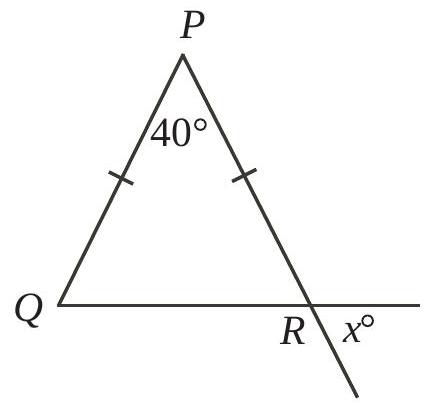 | Since $P Q=P R$, then $\angle P Q R=\angle P R Q$.
Since the angles in a triangle add up to $180^{\circ}$, then $40^{\circ}+\angle P Q R+\angle P R Q=180^{\circ}$,
so $\angle P Q R+\angle P R Q=140^{\circ}$.
Since $\angle P Q R=\angle P R Q$, then $\angle P Q R=\angle P R Q=70^{\circ}$.
Since the angle labelled as ... | 70 | Geometry | MCQ | olympiads | c846557b-6136-57f7-951b-d8d233b1c2b3 | [
true,
true
] | [
"<think>\nOkay, so I have this problem here about an isosceles triangle PQR, and I need to find the value of x. The options are 40, 70, 60, 30, and 110. Let me try to visualize the diagram first since I can't see it. Hmm, maybe it's like triangle PQR with PQ equal to PR or something? Wait, the problem says it's iso... | [
false,
false
] | [
true,
true
] | null | 2 | [
{
"content": "In the diagram $\\triangle PQR$ is isosceles. The value of $x$ is \n(A) 40\n(B) 70\n(C) 60\n(D) 30\n(E) 110\n\n",
"role": "user"
},
{
"content": "<think>Hmm ... |
12. How many parts should a worker produce to exceed the plan by 40 parts by no less than $47 \%$? | 12. Let's pay attention to the fact that $1 \%$ of the plan for 40 parts is 0.4 parts. Next, $47 \% - 18.8$ parts. But you can't make 0.8 of a part, so the worker must make no less than 59 parts. | 59 | Algebra | math-word-problem | olympiads | ec1798fe-75ed-516c-9b7c-4354dbb691a9 | [
true,
true
] | [
"<think>\nOkay, let me try to figure out this problem. So, the question is: How many parts should a worker produce to exceed the plan by 40 parts by no less than 47%? Hmm, that wording is a bit confusing. Let me parse it again.\n\n\"Exceed the plan by 40 parts by no less than 47%.\" So, maybe the worker is supposed... | [
false,
false
] | [
false,
true
] | null | 1 | [
{
"content": "12. How many parts should a worker produce to exceed the plan by 40 parts by no less than $47 \\%$?",
"role": "user"
},
{
"content": "<think>Hmm , that wording is a bit confusing. Let me try to parse it.\n\nFirst, \"exceed the plan by 40 parts by no less than 47%\". Maybe it means that... |
1. ( 4 p ) a) Calculate $\left[(2+\sqrt{3})^{2014}+\frac{1}{(2-\sqrt{3})^{2014}}\right] \cdot \frac{(4-2 \cdot \sqrt{3})^{2014}}{2^{2013}}$
( 3 p ) b) Determine the rational numbers $a$ and $b$ such that
$$
2 a \sqrt{2}-b=a+b \sqrt{2}-3
$$ | 1. a) $\frac{(2+\sqrt{3})^{2014} \cdot(2-\sqrt{3})^{2014}+1}{(2-\sqrt{3})^{2014}} \cdot \frac{(4-2 \sqrt{3})^{2014}}{2^{2013}}=\frac{\left(2^{2}-\sqrt{3}^{2}\right)^{2014}+1}{(2-\sqrt{3})^{2014}} \cdot \frac{2^{2014}(2-\sqrt{3})^{2014}}{2^{2013}}=$
$$
\left(1^{2014}+1\right) \cdot 2=4
$$
b) $(2 a-b) \sqrt{2}=a+b-3$
... | 4 | Algebra | math-word-problem | olympiads | 1d1afd05-6e10-52d3-bd9d-602bf0aaf0b9 | [
true,
true
] | [
"<think>\nOkay, so I need to solve part a) and part b) of this problem. Let's start with part a). \n\nPart a) says: Calculate [(2 + sqrt(3))^2014 + 1/(2 - sqrt(3))^2014] multiplied by (4 - 2*sqrt(3))^2014 divided by 2^2013.\n\nHmm, that's a mouthful. Let me break it down step by step.\n\nFirst, let's look at the ex... | [
false,
false
] | [
true,
true
] | null | 2 | [
{
"content": "1. ( 4 p ) a) Calculate $\\left[(2+\\sqrt{3})^{2014}+\\frac{1}{(2-\\sqrt{3})^{2014}}\\right] \\cdot \\frac{(4-2 \\cdot \\sqrt{3})^{2014}}{2^{2013}}$\n\n( 3 p ) b) Determine the rational numbers $a$ and $b$ such that\n\n$$\n2 a \\sqrt{2}-b=a+b \\sqrt{2}-3\n$$",
"role": "user"
},
{
"cont... |
$[$ Mathematical logic (other) $)]$
All inhabitants of the island are either knights who only tell the truth, or liars who always lie. A traveler met five islanders. In response to his question: "How many of you are knights?" the first answered: "None!", and two others answered: "One". What did the others answer? | The knight could not answer "None," as that would be a lie. Therefore, the first one is a liar. The next two answered the same, so they are either both knights or both liars. But if they were knights, there would be at least two knights on the island, and the answer "One" would be false. Therefore, both the second and ... | 2 | Logic and Puzzles | math-word-problem | olympiads | e9704d04-88ae-5efb-b5af-7728f8cf8779 | [
true,
true
] | [
"<think>\nOkay, let me try to work through this logic problem step by step. So, the setup is that we have five islanders. Each one is either a knight, who always tells the truth, or a liar, who always lies. The traveler asks them all, \"How many of you are knights?\" The first one says, \"None!\" and then two other... | [
false,
true
] | null | null | 1 | [
{
"content": "$[$ Mathematical logic (other) $)]$\n\nAll inhabitants of the island are either knights who only tell the truth, or liars who always lie. A traveler met five islanders. In response to his question: \"How many of you are knights?\" the first answered: \"None!\", and two others answered: \"One\". Wh... |
7. For a certain game activity,
the rewards are divided into first, second, and third prizes (all participants in the game activity will receive a prize), and the corresponding winning probabilities form a geometric sequence with the first term $a$ and a common ratio of 2. The corresponding prize money forms an arithm... | 7.500 .
From the problem, we know the probabilities of winning the first, second, and third prizes are
$$
P_{1}=a, P_{2}=2 a, P_{3}=4 a .
$$
From $P_{1}+P_{2}+P_{3}=1$, we get $a=\frac{1}{7}$.
Thus, $P_{1}=\frac{1}{7}, P_{2}=\frac{2}{7}, P_{3}=\frac{4}{7}$.
The prizes for winning the first, second, and third prizes a... | 500 | Algebra | math-word-problem | cn_contest | fbe1188e-691a-5fac-8e88-ec4ddb997d77 | [
true,
true,
true,
true
] | [
"<think>\nOkay, let's try to solve this problem step by step. So, the problem is about calculating the expected prize money for participating in a game activity where everyone gets a prize—either first, second, or third. The probabilities of winning each prize form a geometric sequence with the first term 'a' and a... | [
true,
true,
true,
true
] | null | null | 4 | [
{
"content": "7. For a certain game activity,\n\nthe rewards are divided into first, second, and third prizes (all participants in the game activity will receive a prize), and the corresponding winning probabilities form a geometric sequence with the first term $a$ and a common ratio of 2. The corresponding pri... |
$\left[\begin{array}{l}\text { Evenness and Oddness }\end{array}\right]$
Several consecutive natural numbers are written on the board. Exactly 52\% of them are even. How many even numbers are written on the board? | Since the recorded natural numbers are consecutive, even and odd numbers alternate. According to the condition, there are more even numbers, which means the recorded sequence starts and ends with even numbers.
There is one more even number, meaning one number constitutes (52 - 48)% of their total quantity.
Therefore,... | 13 | Number Theory | math-word-problem | olympiads | ec8ddc26-dd99-53c4-a90c-8322f3279f17 | [
true,
true
] | [
"<think>\nOkay, let's see. The problem says that several consecutive natural numbers are written on the board, and exactly 52% of them are even. We need to find how many even numbers are there. Hmm. Alright, let's break this down.\n\nFirst, consecutive natural numbers. So that would be like n, n+1, n+2, ..., n+k-1 ... | [
true,
true
] | null | null | 2 | [
{
"content": "$\\left[\\begin{array}{l}\\text { Evenness and Oddness }\\end{array}\\right]$\n\nSeveral consecutive natural numbers are written on the board. Exactly 52\\% of them are even. How many even numbers are written on the board?",
"role": "user"
},
{
"content": "<think>Hmm . Alright, let's b... |
Example 4 Determine all polynomials $f(x)$ that satisfy the following condition:
$$
f(x+1) \geqslant \frac{1}{2} f[f(x)]+\frac{3}{2}
$$ | If $f(x)$ is an $n$-degree polynomial function, then $f[f(x)]$ is an $n^{2}$-degree polynomial function. Given $n^{2} \leqslant n$, it follows that $f(x)$ is a first-degree polynomial function or a constant function.
Let $f(x)=a x+b$, substituting into (1) we get
$$
a(x+1)+b \geqslant \frac{1}{2}[a(a x+b)+b]+\frac{3}{2... | f(x)=b,\forallb\geqslant3orf(x)=2x+b,\forallb\leqslant1 | Algebra | math-word-problem | olympiads | a7eec29d-1537-564c-a1f0-7471e3a9df78 | [
true,
true
] | [
"<think>\nAlright, let's tackle this problem: Determine all polynomials \\( f(x) \\) that satisfy the inequality \\( f(x+1) \\geqslant \\frac{1}{2} f[f(x)] + \\frac{3}{2} \\).\n\nHmm, okay. So we need to find all polynomials \\( f(x) \\) such that for every real number \\( x \\), moving one step ahead in the functi... | [
false,
false
] | [
true,
true
] | null | 2 | [
{
"content": "Example 4 Determine all polynomials $f(x)$ that satisfy the following condition:\n$$\nf(x+1) \\geqslant \\frac{1}{2} f[f(x)]+\\frac{3}{2}\n$$",
"role": "user"
},
{
"content": "<think>Hmm , okay. So we need to find all polynomials \\( f(x) \\) such that for every real number \\( x \\), ... |
$20 \cdot 88$ As shown, the center of the circle is $O$, with a radius of $a$ inches. Chord $E F$ is parallel to chord $C D, O$, $G, H, J$ are on the same line, $G$ is the midpoint of $C D$, let the area of trapezoid $C D F E$ be $K$ square inches, and the area of rectangle $E L M F$ be $R$ square inches. Now, move $E ... | [Solution]From the area formulas of trapezoid and rectangle, we have
$$
\frac{K}{R}=\frac{\frac{1}{2} H G(E F+C D)}{H G \cdot E F}=\frac{1}{2}\left(1+\frac{C D}{E F}\right) .
$$
In $\mathrm{Rt} \triangle O G D$ and $\mathrm{Rt} \triangle O H F$, by the Pythagorean theorem, we have
$$
\frac{C D}{E F}=\frac{2 G D}{2 H F... | \frac{1}{\sqrt{2}}+\frac{1}{2} | Geometry | MCQ | olympiads | 82f47b8c-2f1e-591b-8289-30bf7d50ea79 | [
true,
true
] | [
"<think>\nAlright, let's tackle this geometry problem step by step. First, I need to visualize the setup. There's a circle with center O and radius a inches. Chord EF is parallel to chord CD, and points O, G, H, J are colinear. G is the midpoint of CD. The area of trapezoid CDEF is K, and the area of rectangle ELMF... | [
false,
false
] | [
true,
true
] | null | 2 | [
{
"content": "$20 \\cdot 88$ As shown, the center of the circle is $O$, with a radius of $a$ inches. Chord $E F$ is parallel to chord $C D, O$, $G, H, J$ are on the same line, $G$ is the midpoint of $C D$, let the area of trapezoid $C D F E$ be $K$ square inches, and the area of rectangle $E L M F$ be $R$ squar... |
## Problem Statement
Calculate the lengths of the arcs of the curves given by equations in a rectangular coordinate system.
$$
y=\ln \cos x+2, \quad 0 \leq x \leq \frac{\pi}{6}
$$ | ## Solution
The length of the arc of a curve given by the equation $y=f(x) ; a \leq x \leq b$, is determined by the formula
$$
L=\int_{a}^{b} \sqrt{1+\left(f^{\prime}(x)\right)^{2}} d x
$$
Let's find the derivative of the given function:
$$
f^{\prime}(x)=(\ln \cos x+2)^{\prime}=\frac{1}{\cos x} \cdot(\cos x)^{\prim... | \ln\sqrt{3} | Calculus | math-word-problem | olympiads | b6324f68-07ed-5a1c-905b-b3f28ca958e8 | [
true,
true
] | [
"<think>\nOkay, so I need to calculate the length of the arc for the curve given by y = ln(cos x) + 2 from x = 0 to x = π/6. Hmm, arc length. I remember there's a formula for that. Let me recall. I think it's something like integrating the square root of [1 + (dy/dx)^2] dx from a to b. Let me check if that's right.... | [
true,
true
] | null | null | 2 | [
{
"content": "## Problem Statement\n\nCalculate the lengths of the arcs of the curves given by equations in a rectangular coordinate system.\n\n$$\ny=\\ln \\cos x+2, \\quad 0 \\leq x \\leq \\frac{\\pi}{6}\n$$",
"role": "user"
},
{
"content": "<think>Hmm , arc length. I remember there's a formula for... |
Define a sequence $\{a_n\}$ by\[a_0=\frac{1}{2},\ a_{n+1}=a_{n}+\frac{a_{n}^2}{2012}, (n=0,\ 1,\ 2,\ \cdots),\] find integer $k$ such that $a_{k}<1<a_{k+1}.$
(September 29, 2012, Hohhot) | 1. We start with the given sequence \(\{a_n\}\) defined by:
\[
a_0 = \frac{1}{2}, \quad a_{n+1} = a_n + \frac{a_n^2}{2012} \quad \text{for} \quad n = 0, 1, 2, \ldots
\]
2. We can rewrite the recurrence relation as:
\[
a_{n+1} = a_n \left(1 + \frac{a_n}{2012}\right)
\]
3. To find the integer \(k\) su... | k = 2012 | Calculus | math-word-problem | aops_forum | d91c408a-cabb-5830-ab76-473f7c43f9a9 | [
true,
true,
true,
false
] | [
"<think>\nAlright, so I need to find the integer k such that a_k < 1 < a_{k+1} for this sequence defined by a_0 = 1/2 and a_{n+1} = a_n + (a_n)^2 / 2012. Hmm, okay. Let's see. The sequence starts at 1/2 and each term adds a term proportional to the square of the previous term divided by 2012. Since each term is pos... | [
true,
false,
true,
false
] | null | null | 2 | [
{
"content": "Define a sequence $\\{a_n\\}$ by\\[a_0=\\frac{1}{2},\\ a_{n+1}=a_{n}+\\frac{a_{n}^2}{2012}, (n=0,\\ 1,\\ 2,\\ \\cdots),\\] find integer $k$ such that $a_{k}<1<a_{k+1}.$\n\n(September 29, 2012, Hohhot)",
"role": "user"
},
{
"content": "<think>Hmm , okay. Let's see. The sequence sta... |
A3. In a class, $55 \%$ of students scored at least $55 \%$ on a test. $65 \%$ of students scored at most $65 \%$ on the same test. What percentage of students scored between $55 \%$ and $65 \%$ (inclusive) on the test? | SolUtion
$20 \%$
As $55 \%$ of students scored at least $55 \%$ on the test, $45 \%$ of the students scored less than $55 \%$. Also, $65 \%$ of students scored $65 \%$ or less on the test, so the percentage of students who scored between $55 \%$ and $65 \%$ (inclusive) is $65 \%-45 \%=20 \%$. | 20 | Logic and Puzzles | math-word-problem | olympiads | ccfe953e-6a49-5782-9475-26a3dbb512bc | [
true,
true
] | [
"<think>\nOkay, so I need to figure out the percentage of students who scored between 55% and 65% inclusive on the test. The problem says that 55% of students scored at least 55%, and 65% of students scored at most 65%. Hmm, let me try to break this down step by step.\n\nFirst, let's translate the given information... | [
true,
true
] | null | null | 2 | [
{
"content": "A3. In a class, $55 \\%$ of students scored at least $55 \\%$ on a test. $65 \\%$ of students scored at most $65 \\%$ on the same test. What percentage of students scored between $55 \\%$ and $65 \\%$ (inclusive) on the test?",
"role": "user"
},
{
"content": "<think>Hmm , let me try to... |
3. A positive integer $m$ has the property that when multiplied by 12 , the result is a four-digit number $n$ of the form $20 A 2$ for some digit $A$. What is the 4 digit number, $n ?$ | Solution 1: For a number to be divisible by 3 , the sum of the digits must be a multiple of 3 , so $3 \mid(A+4)$, which means $A \in\{2,5,8\}$.
For a number to be divisible by 4 , the number formed by the last two digits must be divisible by 4 , so $4 \mid(10 A+2)$. This gives $A \in\{1,3,5,7,9\}$.
The only number in c... | 2052 | Number Theory | math-word-problem | olympiads | 6e7d13e9-173c-57e1-aa7e-3536a3df0361 | [
true,
true
] | [
"<think>\nOkay, let's see. The problem says that there's a positive integer m, and when you multiply it by 12, you get a four-digit number n that's in the form 20A2, where A is some digit. We need to figure out what the four-digit number n is. Hmm, so n is 20A2, which means it's a number like 2002, 2012, 2022, up t... | [
true,
true
] | null | [
"stop",
"stop"
] | 2 | [
{
"content": "3. A positive integer $m$ has the property that when multiplied by 12 , the result is a four-digit number $n$ of the form $20 A 2$ for some digit $A$. What is the 4 digit number, $n ?$",
"role": "user"
},
{
"content": "<think>Hmm , so n is 20A2, which means it's a number like 2002, 201... |
39. Objects $A, B, C$ and $D$ need to be compared by weight using a two-pan balance. When $A$ and $B$ were placed on one pan and $C$ and $D$ on the other, equilibrium was established. However, when $C$ and $A$ were moved from one pan to the other, the pan with $D$ and $A$ sank. When $B$ was placed on one pan and $A$ an... | 39. In ascending order by weight, the items are arranged as follows: $C, A, B, D$.
40, 41. We should use the Pigeonhole Principle. Let's solve, for example, problem 41. Let $n_{1}, n_{2}, n_{3}, \ldots, n_{100}$ be arbitrary integers. Consider the following 100 numbers: $n_{1}, n_{1}+n_{2}, n_{1}+n_{2}+n_{3}, \ldots, ... | C,A,B,D | Logic and Puzzles | math-word-problem | olympiads | 81fc560d-9a56-5b62-a869-bb10f42045b6 | [
true,
true,
true,
true,
true,
true
] | [
"<think>\nOkay, let's see. There are four objects: A, B, C, and D. We need to compare their weights using the information from three different balance experiments. Hmm, let me parse each experiment one by one and see what information I can extract.\n\nFirst experiment: When A and B are placed on one pan, and C and ... | [
true,
false,
false,
true,
false,
false
] | null | [
"stop",
"stop",
"stop",
"stop",
"stop",
"stop"
] | 2 | [
{
"content": "39. Objects $A, B, C$ and $D$ need to be compared by weight using a two-pan balance. When $A$ and $B$ were placed on one pan and $C$ and $D$ on the other, equilibrium was established. However, when $C$ and $A$ were moved from one pan to the other, the pan with $D$ and $A$ sank. When $B$ was placed... |
An equilateral triangle of side length $10$ is completely filled in by non-overlapping equilateral triangles of side length $1$. How many small triangles are required?
$\mathrm{(A)}\ 10\qquad\mathrm{(B)}\ 25\qquad\mathrm{(C)}\ 100\qquad\mathrm{(D)}\ 250\qquad\mathrm{(E)}\ 1000$ | The area of the large triangle is $\frac{10^2\sqrt3}{4}$, while the area of each small triangle is $\frac{1^2\sqrt3}{4}$. Dividing these two quantities results in $100$, therefore $\boxed{100} \mathrm{(C)}$ small triangles can fill the large one without overlap. | 100 | Geometry | MCQ | amc_aime | 4fc4355d-facb-5840-8000-c29f889cdfbb | [
true,
true
] | [
"<think>\nOkay, so I have this problem here: an equilateral triangle with side length 10 is completely filled with non-overlapping equilateral triangles of side length 1. I need to figure out how many small triangles are required. The answer choices are 10, 25, 100, 250, and 1000. Let me try to work through this st... | [
false,
false
] | [
true,
true
] | null | 2 | [
{
"content": "An equilateral triangle of side length $10$ is completely filled in by non-overlapping equilateral triangles of side length $1$. How many small triangles are required?\n$\\mathrm{(A)}\\ 10\\qquad\\mathrm{(B)}\\ 25\\qquad\\mathrm{(C)}\\ 100\\qquad\\mathrm{(D)}\\ 250\\qquad\\mathrm{(E)}\\ 1000$",
... |
4. Let $O$ be the incenter of $\triangle A B C$, $A B=5, A C=6, B C=7, O P=x O A+y O B+z O C$, $0 \leq x, y, z \leq 1$, then the area of the plane region covered by the trajectory of the moving point $P$ is equal to | 4. $12 \sqrt{6}$.
Analysis: As shown in the right figure, according to the geometric meaning of vector addition, point $P$ moves within the three parallelograms and their interiors in the figure. Therefore, the area of the plane region covered by the trajectory of moving point $P$ is equal to twice the area of $\trian... | 12\sqrt{6} | Geometry | math-word-problem | olympiads | 0a8cc700-3eea-5fe0-aa6f-b5dd2e5b3114 | [
true,
true
] | [
"<think>\nOkay, so I need to solve this problem where O is the incenter of triangle ABC with sides AB=5, AC=6, and BC=7. The point P is given by OP = xOA + yOB + zOC, where x, y, z are between 0 and 1. I need to find the area of the plane region covered by the trajectory of P. Hmm, let's break this down step by ste... | [
true,
true
] | null | [
"stop",
"stop"
] | 2 | [
{
"content": "4. Let $O$ be the incenter of $\\triangle A B C$, $A B=5, A C=6, B C=7, O P=x O A+y O B+z O C$, $0 \\leq x, y, z \\leq 1$, then the area of the plane region covered by the trajectory of the moving point $P$ is equal to",
"role": "user"
},
{
"content": "<think>Hmm , let's break this dow... |
5.1. The sequence is defined by the relations $a_{1}=1$,
$$
a_{2 n}=\left\{\begin{array}{ll}
a_{n}, & \text { if } n \text { is even, } \\
2 a_{n}, & \text { if } n \text { is odd; }
\end{array} \quad a_{2 n+1}= \begin{cases}2 a_{n}+1, & \text { if } n \text { is even, } \\
a_{n}, & \text { if } n \text { is odd. }\en... | Answer: 5.
Solution: The given rules can be easily interpreted in terms of the binary system: if $n$ ends in 0 and 1 is appended to the right, then 1 is appended to the right of $a_{n}$. If $n$ ends in 1 and 0 is appended, then 0 is appended to the right of $a_{n}$. In all other cases, $a_{n}$ does not change (when 0 ... | 5 | Algebra | math-word-problem | olympiads | b9a2ca7e-e953-56e8-86c3-7873018acc98 | [
true,
true
] | [
"<think>\nOkay, so I need to find the smallest natural number n such that a_n equals a_{2017}. The sequence is defined with a_1 = 1, and then some recursive relations depending on whether n is even or odd. Let me try to parse the definitions first.\n\nThe problem says:\n\na_{2n} = { a_n if n is even, 2a_n if n is o... | [
true,
true
] | null | [
"stop",
"stop"
] | 2 | [
{
"content": "5.1. The sequence is defined by the relations $a_{1}=1$,\n\n$$\na_{2 n}=\\left\\{\\begin{array}{ll}\na_{n}, & \\text { if } n \\text { is even, } \\\\\n2 a_{n}, & \\text { if } n \\text { is odd; }\n\\end{array} \\quad a_{2 n+1}= \\begin{cases}2 a_{n}+1, & \\text { if } n \\text { is even, } \\\\\... |
Maddy and Lara see a list of numbers written on a blackboard. Maddy adds $3$ to each number in the list and finds that the sum of her new numbers is $45$. Lara multiplies each number in the list by $3$ and finds that the sum of her new numbers is also $45$. How many numbers are written on the blackboard?
$\textbf{(A) }... | Let there be $n$ numbers in the list of numbers, and let their sum be $S$. Then we have the following
\[S+3n=45\]
\[3S=45\]
From the second equation, $S=15$. So, $15+3n=45$ $\Rightarrow$ $n=\boxed{\textbf{(A) }10}.$
~Mintylemon66 (formatted atictacksh) | 10 | Algebra | MCQ | amc_aime | 763dbad6-1aeb-5e49-8151-02ed3b55890c | [
true,
true
] | [
"<think>\nAlright, let's see. The problem is about Maddy and Lara working with a list of numbers on a blackboard. Maddy adds 3 to each number and gets a total sum of 45. Lara multiplies each number by 3 and also gets a sum of 45. We need to find how many numbers are on the blackboard. The options are given from A t... | [
false,
false
] | [
true,
false
] | null | 1 | [
{
"content": "Maddy and Lara see a list of numbers written on a blackboard. Maddy adds $3$ to each number in the list and finds that the sum of her new numbers is $45$. Lara multiplies each number in the list by $3$ and finds that the sum of her new numbers is also $45$. How many numbers are written on the blac... |
Subsets and Splits
No community queries yet
The top public SQL queries from the community will appear here once available.