Hmm , angle C is opposite side c, right? Since a ≤ b ≤ c, then by the triangle side-angle relationship, angle C must be the largest angle. So angle C is ≥ 60 degrees, maybe? Wait , not necessarily. If the triangle is equilateral, all angles are 60, but since c is the largest side, angle C is the largest angle, so depending on the triangle, it could be acute, right, or obtuse.\n\nSo, the problem is probably going to depend on whether angle C is acute, right, or obtuse. The sign of f might change based on that. Let me note that.\n\nAlternatively, formulas involving angles: R = a/(2 sin A) = b/(2 sin B) = c/(2 sin C). That might be useful since we're dealing with angle C.\n\nAlso, area can be written as r s, so area = r s. Also, area = (a b sin C)/2, since if we take sides a and b, and angle between them is angle C? Wait , no. Wait , in triangle ABC, sides a, b, c opposite angles A, B, C. So, if I take sides a and b, the angle between them would be angle C. Wait , is that correct? Let me confirm.\n\nYes, in triangle ABC, side a is opposite angle A, side b opposite angle B, side c opposite angle C. Therefore, sides a and b form angle C. Therefore, area can be expressed as (a b sin C)/2. That's one formula. Also, area can be written as (a b c)/(4 R). So, combining these, (a b sin C)/2 = (a b c)/(4 R), so solving for R, we get R = c/(2 sin C). Wait , but we also have R = a/(2 sin A) = b/(2 sin B) = c/(2 sin C). So, that's correct.\n\nSimilarly, inradius r = (area)/s, so if area is (a b sin C)/2, then r = (a b sin C)/(2 s). But s = (a + b + c)/2. So, r = (a b sin C)/(a + b + c). Hmm . Not sure if that's helpful yet.\n\nAlternatively, maybe use formulas to relate R and r with sides and angles. Let's see.\n\nWe need to express f = a + b - 2R - 2r. So, perhaps substitute R and r in terms of the sides and angles.\n\nSo, maybe f is positive when angle C is acute and negative when angle C is obtuse? Or the other way around?\n\nLet me check for an equilateral triangle, where all angles are 60 degrees (acute). Let a = b = c. Then R = a/(√3), and r = a/(2√3). Then f = a + a - 2*(a/√3) - 2*(a/(2√3)) = 2a - (2a/√3) - (a/√3) = 2a - 3a/√3 = 2a - √3 a ≈ 2a - 1.732a ≈ 0.268a, which is positive. So, in the equilateral case (angle C = 60 degrees), f is positive. When angle C is 90 degrees, f is zero. So, maybe when angle C is acute, f is positive, when it's right, f is zero, and when it's obtuse, f is negative. That seems plausible.\n\nBut let's test another case. Let me take an obtuse triangle. Let's say sides a=1, b=1, c=√2. Wait , but that's a right triangle. Wait , let's make an obtuse triangle. For example, sides a=2, b=2, c=3. Let me check if that's a valid triangle. 2 + 2 > 3? 4 > 3, yes. So, sides a=2, b=2, c=3. Then angle C is opposite side c=3. Let's compute angle C using the Law of Cosines: c² = a² + b² - 2ab cos C => 9 = 4 + 4 - 8 cos C => 9 = 8 - 8 cos C => 1 = -8 cos C => cos C = -1/8, so angle C is arccos(-1/8) ≈ 97.41 degrees, which is obtuse.\n\nNow, compute f = a + b - 2R - 2r.\n\nFirst, find R and r.\n\nTherefore, r = area / s = (3√7/4) / (7/2) = (3√7/4) * (2/7) = (3√7)/14 ≈ 0.567.\n\nTherefore, 2R ≈ 2*1.513 ≈ 3.026, 2r ≈ 1.134.\n\nThus, f = a + b - 2R - 2r = 2 + 2 - 3.026 - 1.134 ≈ 4 - 4.16 ≈ -0.16. So, f is negative here, which is when angle C is obtuse. So that supports the hypothesis.\n\nAnother test case: acute angle C. Let's take a triangle with sides 3, 4, 5. Wait , that's a right triangle. So angle C is 90 degrees, f=0. Let's take a slightly smaller c to make angle C acute. Let's say sides 3, 4, 4. Then c=4 (since a=3, b=4, c=4). Let's compute angle C.\n\nLaw of Cosines: c² = a² + b² - 2ab cos C => 16 = 9 + 16 - 24 cos C => 16 = 25 - 24 cos C => -9 = -24 cos C => cos C = 9/24 = 3/8, so angle C ≈ 67.98 degrees, acute.\n\nCompute f = 3 + 4 - 2R - 2r.\n\nFirst, compute R = c/(2 sin C). So c=4, angle C ≈ 67.98 degrees. sin C = sqrt(1 - (3/8)^2) = sqrt(1 - 9/64) = sqrt(55/64) = √55/8 ≈ 0.927. Therefore, R ≈ 4/(2*0.927) ≈ 4/1.854 ≈ 2.158.\n\nCompute semiperimeter s = (3 + 4 + 4)/2 = 11/2 = 5.5.\n\nArea via Heron: sqrt(5.5*(5.5 - 3)*(5.5 - 4)*(5.5 - 4)) = sqrt(5.5*2.5*1.5*1.5). Compute inside sqrt:\n\nNow, we need to express r. r = (area)/s, where s = (a + b + c)/2. The area can be expressed as (a b sin C)/2. So:\n\nr = (a b sin C / 2) / ((a + b + c)/2) = (a b sin C)/(a + b + c).\n\nTherefore, 2r = 2(a b sin C)/(a + b + c). Therefore:\n\nf = a + b - c / sin C - 2(a b sin C)/(a + b + c).\n\nThis looks complicated. Maybe another approach. Let's use some trigonometric identities.\n\nAlternatively, perhaps use the formula for the inradius: r = (a + b - c)/2 * tan(C/2). Wait , is that correct?\n\n Wait , there are formulas for r in terms of angles. For example, r = 4R sin(A/2) sin(B/2) sin(C/2). Not sure if that's helpful here. Alternatively, r = (a + b - c)/2 * tan(C/2). Wait , let me verify.\n\nIn triangle ABC, the inradius r can be expressed as r = (a + b - c)/2 * tan(C/2). Let's check with the right-angled triangle. If angle C is 90 degrees, then tan(C/2) = tan(45) = 1, so r = (a + b - c)/2 * 1 = (a + b - c)/2, which matches the formula for inradius in a right-angled triangle. So that formula seems valid. So, yes, r = (a + b - c)/2 * tan(C/2). Similarly, r can be written as (b + c - a)/2 * tan(A/2), etc. But since angle C is our focus, maybe use this expression for r.\n\nSo, if we use that, then:\n\nBut we also know that 2R = c / sin C. So:\n\nf = a + b - (c / sin C) - (a + b - c) tan(C/2).\n\n Hmm , can we simplify this further? Let's see.\n\nLet me denote t = C/2. Then, angle C = 2t. So, let's write everything in terms of t.\n\nBut not sure. Let me try to combine terms. Let's factor out (a + b - c):\n\n Wait , f = a + b - c/(sin C) - (a + b - c) tan(C/2). Maybe rearrange terms:\n\nBut how? Let's see.\n\n Wait , (a + b) = (a + b - c) + c.\n\nSo, f = [(a + b - c) + c] - c/(sin C) - (a + b - c) tan(C/2)\n\nf = (a + b - c)[1 - tan(C/2)] + c[1 - 1/sin C].\n\n Hmm . Let's see:\n\nNot sure if helpful. Alternatively, 1 - tan(C/2). Maybe express tan(C/2) in terms of sin C.\n\nRecall that tan(t) = sin(2t)/(1 + cos(2t)), so tan(C/2) = sin C / (1 + cos C). Therefore, 1 - tan(C/2) = [1 + cos C - sin C]/(1 + cos C). Hmm , not sure.\n\nAlternatively, perhaps use some trigonometric identities to combine the terms. Let me compute both terms separately.\n\nFirst term: (a + b - c)[1 - tan(C/2)].\n\nSecond term: c[1 - 1/sin C].\n\n= 2 sin[(A + B)/2] [cos((A - B)/2) - cos((A + B)/2)].\n\nUsing the identity cos x - cos y = -2 sin[(x + y)/2] sin[(x - y)/2], so:\n\n= 2 sin[(A + B)/2] * (-2 sin(A/2) sin(-B/2))\n\n Wait , let's compute [cos((A - B)/2) - cos((A + B)/2)].\n\n= -2 sin[ ((A - B)/2 + (A + B)/2 ) / 2 ] sin[ ((A - B)/2 - (A + B)/2 ) / 2 ]\n\nTherefore, sin A + sin B - sin(A + B) = 2 sin[(A + B)/2] * 2 sin(A/2) sin(B/2 )\n\n Wait , no, wait :\n\nOriginal expression: 2 sin[(A + B)/2] [cos((A - B)/2) - cos((A + B)/2)]\n\nWe found that [cos((A - B)/2) - cos((A + B)/2)] = 2 sin(A/2) sin(B/2 )\n\nTherefore, sin A + sin B - sin C = 2 sin[(A + B)/2] * 2 sin(A/2) sin(B/2 ) = 4 sin[(A + B)/2] sin(A/2) sin(B/2 )\n\nBut (A + B)/2 = (π - C)/2. So, sin[(π - C)/2] = sin(π/2 - C/2) = cos(C/2).\n\nTherefore, sin A + sin B - sin C = 4 cos(C/2) sin(A/2) sin(B/2 )\n\nThus, a + b - c = 2R * 4 cos(C/2) sin(A/2) sin(B/2 ) = 8 R cos(C/2) sin(A/2) sin(B/2 )\n\nBut this seems complex, but maybe useful.\n\nSo, equate the two expressions for area: r s = (a b sin C)/2 => r = (a b sin C)/(2 s). So, 2r = (a b sin C)/s.\n\nSimilarly, 2R = c / sin C.\n\nSo, f = a + b - (c / sin C) - (a b sin C)/s.\n\nBut s = (a + b + c)/2. So, (a b sin C)/s = 2 a b sin C / (a + b + c). Therefore:\n\nf = a + b - c / sin C - 2 a b sin C / (a + b + c).\n\nThis expression is still complex, but maybe we can manipulate it.\n\nLet me factor out 1 / sin C:\n\n Wait , f = a + b - [c + 2 a b sin² C / (a + b + c)] / sin C.\n\nNot sure. Alternatively, let's combine terms over a common denominator.\n\nBut maybe use substitution variables. Let me set x = sin C. Then, since angle C is acute, right, or obtuse, x ranges from 0 < x ≤ 1 for acute or right, and sin C = sin (π - C') where C' is acute for obtuse angles, so sin C is still positive.\n\nAlternatively, consider the expression for f in terms of cos C.\n\nBut this might not be straightforward.\n\n Wait , maybe using the formula for the inradius r = (a + b - c)/2 * tan(C/2), as we had before.\n\nSo, 2r = (a + b - c) tan(C/2). So, f = a + b - 2R - (a + b - c) tan(C/2).\n\nBut also, 2R = c / sin C. So:\n\nf = a + b - c / sin C - (a + b - c) [sin C / (1 + cos C)].\n\nLet me factor out (a + b - c):\n\n Wait , f = a + b - c / sin C - (a + b - c) sin C / (1 + cos C).\n\nBut (a + b - c) is part of the expression. Let me see if I can write the entire expression in terms of (a + b - c).\n\nAlternatively, let's denote k = a + b - c. Then:\n\nf = (k + c) - c / sin C - k sin C / (1 + cos C).\n\nBecause a + b = k + c. So:\n\n= [ (1 + cos C) - sin C ] / (1 + cos C )\n\n= [1 + cos C - sin C]/(1 + cos C)\n\nNot sure if this helps. Let's see.\n\nAlternatively, note that 1 + cos C = 2 cos²(C/2), and 1 - sin C/(1 + cos C) = [1 + cos C - sin C]/(1 + cos C) = [2 cos²(C/2) - 2 sin(C/2) cos(C/2)] / (2 cos²(C/2)) ) = [2 cos(C/2)(cos(C/2) - sin(C/2))]/(2 cos²(C/2)) ) = [cos(C/2) - sin(C/2)] / cos(C/2) = 1 - tan(C/2).\n\n Wait , let's check:\n\n Wait , 1 + cos C = 2 cos²(C/2), and sin C = 2 sin(C/2) cos(C/2). Therefore:\n\n[1 + cos C - sin C]/(1 + cos C) = [2 cos²(C/2) - 2 sin(C/2) cos(C/2)] / (2 cos²(C/2)) ) = [2 cos(C/2)(cos(C/2) - sin(C/2))]/[2 cos²(C/2)] = [cos(C/2) - sin(C/2)]/cos(C/2) = 1 - tan(C/2).\n\nYes, so that term becomes k(1 - tan(C/2)).\n\nTherefore, f = -c(1 - sin C)/sin C + k(1 - tan(C/2)).\n\nBut k = a + b - c, which is 2(s - c), but not sure.\n\nAlternatively, express k in terms of the semiperimeter s:\n\nk = a + b - c = 2s - 2c = 2(s - c). So, k = 2(s - c).\n\nBut I don't know if that helps.\n\nSo, f = a + b - 2*(c/(2 sin C)) - 2*(a b sin C)/(a + b + c) = a + b - c / sin C - (2 a b sin C)/(a + b + c).\n\nLet me write this as:\n\nf = a + b - c / sin C - (2 a b sin C)/(a + b + c).\n\nNow, multiply numerator and denominator of the last term by 2:\n\n= a + b - c / sin C - (4 a b sin C)/(2(a + b + c)).\n\nBut not sure.\n\nAlternatively, substitute c from the Law of Cosines.\n\nBut even then, it's complicated.\n\nAlternatively, consider using substitution variables. Let me set t = angle C. Then, we can express f in terms of t, keeping sides a and b fixed. Wait , but in reality, sides a, b, c are all dependent variables. If angle C changes, sides a and b may also change. Wait , no, in a triangle, if we fix sides a and b, then angle C determines side c via the Law of Cosines. But in the problem statement, the triangle is given with sides a ≤ b ≤ c. So, c is the largest side, which implies that angle C is the largest angle. So, angle C ≥ angle B ≥ angle A.\n\nBut perhaps we can consider varying angle C while keeping sides a and b fixed. Then, side c is determined by angle C. Wait , but if we fix a and b, and vary angle C, then c will change, but in the problem, c is the largest side. So, angle C must be at least as big as angles A and B. So, if we fix a and b, angle C can vary in a certain range. Hmm , perhaps not straightforward.\n\nAlternatively, consider normalizing the triangle. Let me set a = 1, b = 1, and vary angle C. Then, side c will be sqrt(2 - 2 cos C). Since c must be the largest side, then sqrt(2 - 2 cos C) ≥ 1, so 2 - 2 cos C ≥ 1 => cos C ≤ 0.5. Therefore, angle C ≥ 60 degrees. But in this case, angle C can range from 60 to 180 degrees. But in this setup, c is the largest side. So, varying angle C from 60 to 180 degrees, compute f.\n\nBut in this case, a = b = 1, c = sqrt(2 - 2 cos C). Then compute f = 1 + 1 - 2R - 2r.\n\nCompute R and r.\n\nR = c / (2 sin C) = sqrt(2 - 2 cos C)/(2 sin C). Note that sin C = sqrt(1 - cos² C). So:\n\nR = sqrt(2 - 2 cos C)/(2 sqrt(1 - cos² C)).\n\nSimplify numerator and denominator:\n\nsqrt(2(1 - cos C)) / (2 sqrt( (1 - cos C)(1 + cos C) )) )\n\n= sqrt(2) sqrt(1 - cos C) / (2 sqrt(1 - cos C) sqrt(1 + cos C)) )\n\n= sqrt(2)/(2 sqrt(1 + cos C)) )\n\nTerm1 = sqrt(2)/sqrt(1.5) ≈ 1.414 / 1.225 ≈ 1.154.\n\nTerm2: 2*sqrt(1 - 0.25)/[2 + sqrt(2*0.5)] = 2*sqrt(0.75)/[2 + sqrt(1)] = 2*(0.866)/3 ≈ 1.732/3 ≈ 0.577.\n\nThus, f ≈ 2 - 1.154 - 0.577 ≈ 2 - 1.731 ≈ 0.269 > 0.\n\nAt x = 0 (angle C = 90°, right):\n\nTerm1 = sqrt(2)/sqrt(1 + 0) = sqrt(2) ≈ 1.414.\n\nTerm2: 2*sqrt(1 - 0)/[2 + sqrt(2*1)] = 2*1/[2 + 1.414] ≈ 2 / 3.414 ≈ 0.586.\n\nThus, f ≈ 2 - 1.414 - 0.586 ≈ 2 - 2 = 0.\n\nAt x = -0.5 (angle C = 120°, obtuse):\n\nTerm1 = sqrt(2)/sqrt(0.5) = sqrt(2)/ (sqrt(0.5)) = sqrt(2)/(sqrt(2)/sqrt(2)) ) = sqrt(2)*sqrt(2)/sqrt(2) ) = 2 / sqrt(2) = sqrt(2) ≈ 1.414.\n\nTerm2: 2*sqrt(1 - (-0.5)^2)/[2 + sqrt(2*(1 - (-0.5)))] = 2*sqrt(1 - 0.25)/[2 + sqrt(3)] = 2*sqrt(0.75)/[2 + 1.732] ≈ 2*0.866 / 3.732 ≈ 1.732 / 3.732 ≈ 0.464.\n\nThus, f ≈ 2 - 1.414 - 0.464 ≈ 2 - 1.878 ≈ 0.122 > 0. Wait , this contradicts our previous result where an obtuse angle gave f negative. Hmm , but wait , in this normalized case with a = b = 1, angle C can't be too large. Wait , when x = -0.5, angle C is 120°, which is obtuse, but in this case, c = sqrt(2 - 2*(-0.5)) = sqrt(2 + 1) = sqrt(3) ≈ 1.732, which is greater than a = b = 1. So, this is valid. But according to the calculation, f ≈ 0.122, which is positive, but earlier test case with a=2, b=2, c=3 (angle C ≈97°) gave f≈-0.16.\n\nBut here, with a=1, b=1, c≈1.732, angle C=120°, f≈0.122>0. So, inconsistency? Wait , so in this case, angle C is obtuse but f is positive. This contradicts our earlier hypothesis. So, maybe the sign isn't purely determined by angle C being acute or obtuse?\n\n Wait , but in the previous test case with a=2, b=2, c=3 (angle C≈97°), f was negative. But here, with a=1, b=1, c=sqrt(3)≈1.732 (angle C=120°), f is positive.\n\nThis suggests that the sign of f might not purely depend on angle C being acute or obtuse, but also on other factors. But this contradicts our initial examples. So, this is confusing.\n\n Wait , let me recalculate for a=1, b=1, c=sqrt(3), angle C=120°.\n\nCompute R and r.\n\nThus, r = sqrt(3)/4 /1.866≈0.433/1.866≈0.232.\n\nTherefore, 2r≈0.464.\n\nTherefore, f =1 +1 -2*1 -0.464=2 -2 -0.464= -0.464. Wait , this contradicts my previous calculation. So where did I go wrong?\n\n Wait , when I set a=1, b=1, c=sqrt(3), angle C=120°. Then:\n\nThus, f=1+1 -2*1 -0.464=2 -2 -0.464= -0.464. So negative. But in my previous substitution, I thought that x=-0.5 (angle C=120°) gives f≈0.122, but that's incorrect. There must be a mistake in substitution.\n\n Wait , let's redo the substitution.\n\nWhen I set a=1, b=1, angle C=120°, so cos C = -0.5. Then, according to the expression:\n\nf = 2 - sqrt(2)/sqrt(1 + x) - 2 sqrt(1 - x²)/(2 + sqrt(2(1 - x))).\n\n= [sqrt(3)(2 - sqrt(3))]/[(2 + sqrt(3))(2 - sqrt(3))] = [2 sqrt(3) - 3]/[4 - 3] = (2 sqrt(3) - 3)/1 ≈(3.464 -3)/1≈0.464.\n\nTherefore, f=2 - 2 -0.464≈-0.464, which matches the direct computation. So, my earlier mistake was in calculating Term1 and Term2 incorrectly. So, at x=-0.5, f≈-0.464 <0. So, when angle C is 120°, f is negative.\n\nBut when I set a=1, b=1, angle C=120°, which is obtuse, we get f negative. But in another case with sides a=1, b=1, c=sqrt(3)≈1.732, angle C=120°, f=-0.464.\n\n Wait , but earlier when I tried to compute with a=1, b=1, c=sqrt(3), angle C=120°, I thought the previous substitution gives f=0.122, but that was a mistake. Correct computation gives f≈-0.464, negative, which aligns with the hypothesis.\n\nTherefore, the answer should be: f is positive if angle C is acute, zero if angle C is right, and negative if angle C is obtuse. Thus, the sign of f is determined by the size of angle C: positive for acute, negative for obtuse, and zero for right angle.\n\nTo confirm, let's consider another obtuse triangle. Let's take a=3, b=4, c=6. Wait , check triangle inequality: 3 + 4 > 6? 7 >6, yes. 3 +6 >4, 9>4, yes. 4 +6>3, 10>3. So valid. Angle C is opposite side c=6. Compute angle C.\n\nLaw of Cosines: c² = a² + b² - 2ab cos C => 36 = 9 + 16 - 24 cos C => 36 =25 -24 cos C => 11 = -24 cos C => cos C= -11/24≈-0.458. So angle C≈117.27°, obtuse.\n\nCompute f=3+4 -2R -2r.\n\nFirst, compute R = c/(2 sin C). sin C=sqrt(1 - (121/576))=sqrt(455/576)=sqrt(455)/24≈21.33/24≈0.889.\n\nTherefore, the conclusion holds. Hence, the sign of f is positive if angle C is acute, zero if right, and negative if obtuse.\n\n**Final Answer**\nThe sign of \\( f \\) is positive if angle \\( C \\) is acute, zero if angle \\( C \\) is right, and negative if angle \\( C \\) is obtuse. Thus, the sign is determined by the size of angle \\( C \\), leading to the answer:\n\n\\[\n\\boxed{f \\text{ is positive if } C < 90^\\circ, \\text{ zero if } C = 90^\\circ, \\text{ and negative if } C > 90^\\circ}\n\\]\n\nAlternatively, following the problem's requirement to present the answer inside a box without extensive text, but given the problem states \"determine the sign of \\( f \\) using the size of angle \\( C \\)\", the concise answer is:\n\n\\[\n\\boxed{f > 0 \\text{ if } C \\text{ is acute}, \\ f = 0 \\text{ if } C \\text{ is right}, \\text{ and } f < 0 \\text{ if } C \\text{ is obtuse}}\n\\]\n</think>\n\nTo determine the sign of \\( f = a + b - 2R - 2r \\) in \\(\\triangle ABC\\) with sides \\(a \\leqslant b \\leqslant c\\) and angles opposite these sides \\(A\\), \\(B\\), and \\(C\\) respectively, we analyze the relationship between the expression \\(f\\) and the size of angle \\(C\\).\n\n1. **Right-Angled Triangle (Angle \\(C = 90^\\circ\\))**:\n - For a right-angled triangle, the circumradius \\(R = \\frac{c}{2}\\) and the inradius \\(r = \\frac{a + b - c}{2}\\).\n - Substituting these into \\(f\\), we get \\(f = a + b - c - (a + b - c) = 0\\). Thus, \\(f = 0\\) when \\(C\\) is a right angle.\n\n2. **Acute-Angled Triangle (Angle \\(C < 90^\\circ\\))**:\n - For an equilateral triangle (all angles \\(60^\\circ\\)), calculations show \\(f\\) is positive.\n - Testing an acute triangle with sides \\(a = 3\\), \\(b = 4\\), \\(c = 4\\) (angle \\(C \\approx 67.98^\\circ\\)), we find \\(f\\) is positive.\n\n3. **Obtuse-Angled Triangle (Angle \\(C > 90^\\circ\\))**:\n - Testing an obtuse triangle with sides \\(a = 2\\), \\(b = 2\\), \\(c = 3\\) (angle \\(C \\approx 97.41^\\circ\\)), we find \\(f\\) is negative.\n - Another obtuse triangle with sides \\(a = 3\\), \\(b = 4\\), \\(c = 6\\) (angle \\(C \\approx 117.27^\\circ\\)) confirms \\(f\\) is negative.\n\nKey steps involve expressing \\(R\\) and \\(r\\) in terms of trigonometric functions and semiperimeter, then analyzing the expression \\(f\\) for different cases. The results consistently show:\n- \\(f > 0\\) when \\(C\\) is acute.\n- \\(f = 0\\) when \\(C\\) is right.\n- \\(f < 0\\) when \\(C\\) is obtuse.\n\nThus, the sign of \\(f\\) is determined by the size of angle \\(C\\):\n\n\\[\n\\boxed{f > 0 \\text{ if } C \\text{ is acute}, \\ f = 0 \\text{ if } C \\text{ is right}, \\text{ and } f < 0 \\text{ if } C \\text{ is obtuse}}\n\\]","role":"assistant"}],"string":"[\n {\n \"content\": \"13. 3 (CMO 2000) Let $a, b, c$ be the three sides of $\\\\triangle ABC$, $a \\\\leqslant b \\\\leqslant c$, and $R$ and $r$ be the circumradius and inradius of $\\\\triangle ABC$, respectively. Let $f=a+b-2R-2r$, try to determine the sign of $f$ using the size of angle $C$.\\n\\n\",\n \"role\": \"user\"\n },\n {\n \"content\": \"<think>Hmm , angle C is opposite side c, right? Since a ≤ b ≤ c, then by the triangle side-angle relationship, angle C must be the largest angle. So angle C is ≥ 60 degrees, maybe? Wait , not necessarily. If the triangle is equilateral, all angles are 60, but since c is the largest side, angle C is the largest angle, so depending on the triangle, it could be acute, right, or obtuse.\\n\\nSo, the problem is probably going to depend on whether angle C is acute, right, or obtuse. The sign of f might change based on that. Let me note that.\\n\\nAlternatively, formulas involving angles: R = a/(2 sin A) = b/(2 sin B) = c/(2 sin C). That might be useful since we're dealing with angle C.\\n\\nAlso, area can be written as r s, so area = r s. Also, area = (a b sin C)/2, since if we take sides a and b, and angle between them is angle C? Wait , no. Wait , in triangle ABC, sides a, b, c opposite angles A, B, C. So, if I take sides a and b, the angle between them would be angle C. Wait , is that correct? Let me confirm.\\n\\nYes, in triangle ABC, side a is opposite angle A, side b opposite angle B, side c opposite angle C. Therefore, sides a and b form angle C. Therefore, area can be expressed as (a b sin C)/2. That's one formula. Also, area can be written as (a b c)/(4 R). So, combining these, (a b sin C)/2 = (a b c)/(4 R), so solving for R, we get R = c/(2 sin C). Wait , but we also have R = a/(2 sin A) = b/(2 sin B) = c/(2 sin C). So, that's correct.\\n\\nSimilarly, inradius r = (area)/s, so if area is (a b sin C)/2, then r = (a b sin C)/(2 s). But s = (a + b + c)/2. So, r = (a b sin C)/(a + b + c). Hmm . Not sure if that's helpful yet.\\n\\nAlternatively, maybe use formulas to relate R and r with sides and angles. Let's see.\\n\\nWe need to express f = a + b - 2R - 2r. So, perhaps substitute R and r in terms of the sides and angles.\\n\\nSo, maybe f is positive when angle C is acute and negative when angle C is obtuse? Or the other way around?\\n\\nLet me check for an equilateral triangle, where all angles are 60 degrees (acute). Let a = b = c. Then R = a/(√3), and r = a/(2√3). Then f = a + a - 2*(a/√3) - 2*(a/(2√3)) = 2a - (2a/√3) - (a/√3) = 2a - 3a/√3 = 2a - √3 a ≈ 2a - 1.732a ≈ 0.268a, which is positive. So, in the equilateral case (angle C = 60 degrees), f is positive. When angle C is 90 degrees, f is zero. So, maybe when angle C is acute, f is positive, when it's right, f is zero, and when it's obtuse, f is negative. That seems plausible.\\n\\nBut let's test another case. Let me take an obtuse triangle. Let's say sides a=1, b=1, c=√2. Wait , but that's a right triangle. Wait , let's make an obtuse triangle. For example, sides a=2, b=2, c=3. Let me check if that's a valid triangle. 2 + 2 > 3? 4 > 3, yes. So, sides a=2, b=2, c=3. Then angle C is opposite side c=3. Let's compute angle C using the Law of Cosines: c² = a² + b² - 2ab cos C => 9 = 4 + 4 - 8 cos C => 9 = 8 - 8 cos C => 1 = -8 cos C => cos C = -1/8, so angle C is arccos(-1/8) ≈ 97.41 degrees, which is obtuse.\\n\\nNow, compute f = a + b - 2R - 2r.\\n\\nFirst, find R and r.\\n\\nTherefore, r = area / s = (3√7/4) / (7/2) = (3√7/4) * (2/7) = (3√7)/14 ≈ 0.567.\\n\\nTherefore, 2R ≈ 2*1.513 ≈ 3.026, 2r ≈ 1.134.\\n\\nThus, f = a + b - 2R - 2r = 2 + 2 - 3.026 - 1.134 ≈ 4 - 4.16 ≈ -0.16. So, f is negative here, which is when angle C is obtuse. So that supports the hypothesis.\\n\\nAnother test case: acute angle C. Let's take a triangle with sides 3, 4, 5. Wait , that's a right triangle. So angle C is 90 degrees, f=0. Let's take a slightly smaller c to make angle C acute. Let's say sides 3, 4, 4. Then c=4 (since a=3, b=4, c=4). Let's compute angle C.\\n\\nLaw of Cosines: c² = a² + b² - 2ab cos C => 16 = 9 + 16 - 24 cos C => 16 = 25 - 24 cos C => -9 = -24 cos C => cos C = 9/24 = 3/8, so angle C ≈ 67.98 degrees, acute.\\n\\nCompute f = 3 + 4 - 2R - 2r.\\n\\nFirst, compute R = c/(2 sin C). So c=4, angle C ≈ 67.98 degrees. sin C = sqrt(1 - (3/8)^2) = sqrt(1 - 9/64) = sqrt(55/64) = √55/8 ≈ 0.927. Therefore, R ≈ 4/(2*0.927) ≈ 4/1.854 ≈ 2.158.\\n\\nCompute semiperimeter s = (3 + 4 + 4)/2 = 11/2 = 5.5.\\n\\nArea via Heron: sqrt(5.5*(5.5 - 3)*(5.5 - 4)*(5.5 - 4)) = sqrt(5.5*2.5*1.5*1.5). Compute inside sqrt:\\n\\nNow, we need to express r. r = (area)/s, where s = (a + b + c)/2. The area can be expressed as (a b sin C)/2. So:\\n\\nr = (a b sin C / 2) / ((a + b + c)/2) = (a b sin C)/(a + b + c).\\n\\nTherefore, 2r = 2(a b sin C)/(a + b + c). Therefore:\\n\\nf = a + b - c / sin C - 2(a b sin C)/(a + b + c).\\n\\nThis looks complicated. Maybe another approach. Let's use some trigonometric identities.\\n\\nAlternatively, perhaps use the formula for the inradius: r = (a + b - c)/2 * tan(C/2). Wait , is that correct?\\n\\n Wait , there are formulas for r in terms of angles. For example, r = 4R sin(A/2) sin(B/2) sin(C/2). Not sure if that's helpful here. Alternatively, r = (a + b - c)/2 * tan(C/2). Wait , let me verify.\\n\\nIn triangle ABC, the inradius r can be expressed as r = (a + b - c)/2 * tan(C/2). Let's check with the right-angled triangle. If angle C is 90 degrees, then tan(C/2) = tan(45) = 1, so r = (a + b - c)/2 * 1 = (a + b - c)/2, which matches the formula for inradius in a right-angled triangle. So that formula seems valid. So, yes, r = (a + b - c)/2 * tan(C/2). Similarly, r can be written as (b + c - a)/2 * tan(A/2), etc. But since angle C is our focus, maybe use this expression for r.\\n\\nSo, if we use that, then:\\n\\nBut we also know that 2R = c / sin C. So:\\n\\nf = a + b - (c / sin C) - (a + b - c) tan(C/2).\\n\\n Hmm , can we simplify this further? Let's see.\\n\\nLet me denote t = C/2. Then, angle C = 2t. So, let's write everything in terms of t.\\n\\nBut not sure. Let me try to combine terms. Let's factor out (a + b - c):\\n\\n Wait , f = a + b - c/(sin C) - (a + b - c) tan(C/2). Maybe rearrange terms:\\n\\nBut how? Let's see.\\n\\n Wait , (a + b) = (a + b - c) + c.\\n\\nSo, f = [(a + b - c) + c] - c/(sin C) - (a + b - c) tan(C/2)\\n\\nf = (a + b - c)[1 - tan(C/2)] + c[1 - 1/sin C].\\n\\n Hmm . Let's see:\\n\\nNot sure if helpful. Alternatively, 1 - tan(C/2). Maybe express tan(C/2) in terms of sin C.\\n\\nRecall that tan(t) = sin(2t)/(1 + cos(2t)), so tan(C/2) = sin C / (1 + cos C). Therefore, 1 - tan(C/2) = [1 + cos C - sin C]/(1 + cos C). Hmm , not sure.\\n\\nAlternatively, perhaps use some trigonometric identities to combine the terms. Let me compute both terms separately.\\n\\nFirst term: (a + b - c)[1 - tan(C/2)].\\n\\nSecond term: c[1 - 1/sin C].\\n\\n= 2 sin[(A + B)/2] [cos((A - B)/2) - cos((A + B)/2)].\\n\\nUsing the identity cos x - cos y = -2 sin[(x + y)/2] sin[(x - y)/2], so:\\n\\n= 2 sin[(A + B)/2] * (-2 sin(A/2) sin(-B/2))\\n\\n Wait , let's compute [cos((A - B)/2) - cos((A + B)/2)].\\n\\n= -2 sin[ ((A - B)/2 + (A + B)/2 ) / 2 ] sin[ ((A - B)/2 - (A + B)/2 ) / 2 ]\\n\\nTherefore, sin A + sin B - sin(A + B) = 2 sin[(A + B)/2] * 2 sin(A/2) sin(B/2 )\\n\\n Wait , no, wait :\\n\\nOriginal expression: 2 sin[(A + B)/2] [cos((A - B)/2) - cos((A + B)/2)]\\n\\nWe found that [cos((A - B)/2) - cos((A + B)/2)] = 2 sin(A/2) sin(B/2 )\\n\\nTherefore, sin A + sin B - sin C = 2 sin[(A + B)/2] * 2 sin(A/2) sin(B/2 ) = 4 sin[(A + B)/2] sin(A/2) sin(B/2 )\\n\\nBut (A + B)/2 = (π - C)/2. So, sin[(π - C)/2] = sin(π/2 - C/2) = cos(C/2).\\n\\nTherefore, sin A + sin B - sin C = 4 cos(C/2) sin(A/2) sin(B/2 )\\n\\nThus, a + b - c = 2R * 4 cos(C/2) sin(A/2) sin(B/2 ) = 8 R cos(C/2) sin(A/2) sin(B/2 )\\n\\nBut this seems complex, but maybe useful.\\n\\nSo, equate the two expressions for area: r s = (a b sin C)/2 => r = (a b sin C)/(2 s). So, 2r = (a b sin C)/s.\\n\\nSimilarly, 2R = c / sin C.\\n\\nSo, f = a + b - (c / sin C) - (a b sin C)/s.\\n\\nBut s = (a + b + c)/2. So, (a b sin C)/s = 2 a b sin C / (a + b + c). Therefore:\\n\\nf = a + b - c / sin C - 2 a b sin C / (a + b + c).\\n\\nThis expression is still complex, but maybe we can manipulate it.\\n\\nLet me factor out 1 / sin C:\\n\\n Wait , f = a + b - [c + 2 a b sin² C / (a + b + c)] / sin C.\\n\\nNot sure. Alternatively, let's combine terms over a common denominator.\\n\\nBut maybe use substitution variables. Let me set x = sin C. Then, since angle C is acute, right, or obtuse, x ranges from 0 < x ≤ 1 for acute or right, and sin C = sin (π - C') where C' is acute for obtuse angles, so sin C is still positive.\\n\\nAlternatively, consider the expression for f in terms of cos C.\\n\\nBut this might not be straightforward.\\n\\n Wait , maybe using the formula for the inradius r = (a + b - c)/2 * tan(C/2), as we had before.\\n\\nSo, 2r = (a + b - c) tan(C/2). So, f = a + b - 2R - (a + b - c) tan(C/2).\\n\\nBut also, 2R = c / sin C. So:\\n\\nf = a + b - c / sin C - (a + b - c) [sin C / (1 + cos C)].\\n\\nLet me factor out (a + b - c):\\n\\n Wait , f = a + b - c / sin C - (a + b - c) sin C / (1 + cos C).\\n\\nBut (a + b - c) is part of the expression. Let me see if I can write the entire expression in terms of (a + b - c).\\n\\nAlternatively, let's denote k = a + b - c. Then:\\n\\nf = (k + c) - c / sin C - k sin C / (1 + cos C).\\n\\nBecause a + b = k + c. So:\\n\\n= [ (1 + cos C) - sin C ] / (1 + cos C )\\n\\n= [1 + cos C - sin C]/(1 + cos C)\\n\\nNot sure if this helps. Let's see.\\n\\nAlternatively, note that 1 + cos C = 2 cos²(C/2), and 1 - sin C/(1 + cos C) = [1 + cos C - sin C]/(1 + cos C) = [2 cos²(C/2) - 2 sin(C/2) cos(C/2)] / (2 cos²(C/2)) ) = [2 cos(C/2)(cos(C/2) - sin(C/2))]/(2 cos²(C/2)) ) = [cos(C/2) - sin(C/2)] / cos(C/2) = 1 - tan(C/2).\\n\\n Wait , let's check:\\n\\n Wait , 1 + cos C = 2 cos²(C/2), and sin C = 2 sin(C/2) cos(C/2). Therefore:\\n\\n[1 + cos C - sin C]/(1 + cos C) = [2 cos²(C/2) - 2 sin(C/2) cos(C/2)] / (2 cos²(C/2)) ) = [2 cos(C/2)(cos(C/2) - sin(C/2))]/[2 cos²(C/2)] = [cos(C/2) - sin(C/2)]/cos(C/2) = 1 - tan(C/2).\\n\\nYes, so that term becomes k(1 - tan(C/2)).\\n\\nTherefore, f = -c(1 - sin C)/sin C + k(1 - tan(C/2)).\\n\\nBut k = a + b - c, which is 2(s - c), but not sure.\\n\\nAlternatively, express k in terms of the semiperimeter s:\\n\\nk = a + b - c = 2s - 2c = 2(s - c). So, k = 2(s - c).\\n\\nBut I don't know if that helps.\\n\\nSo, f = a + b - 2*(c/(2 sin C)) - 2*(a b sin C)/(a + b + c) = a + b - c / sin C - (2 a b sin C)/(a + b + c).\\n\\nLet me write this as:\\n\\nf = a + b - c / sin C - (2 a b sin C)/(a + b + c).\\n\\nNow, multiply numerator and denominator of the last term by 2:\\n\\n= a + b - c / sin C - (4 a b sin C)/(2(a + b + c)).\\n\\nBut not sure.\\n\\nAlternatively, substitute c from the Law of Cosines.\\n\\nBut even then, it's complicated.\\n\\nAlternatively, consider using substitution variables. Let me set t = angle C. Then, we can express f in terms of t, keeping sides a and b fixed. Wait , but in reality, sides a, b, c are all dependent variables. If angle C changes, sides a and b may also change. Wait , no, in a triangle, if we fix sides a and b, then angle C determines side c via the Law of Cosines. But in the problem statement, the triangle is given with sides a ≤ b ≤ c. So, c is the largest side, which implies that angle C is the largest angle. So, angle C ≥ angle B ≥ angle A.\\n\\nBut perhaps we can consider varying angle C while keeping sides a and b fixed. Then, side c is determined by angle C. Wait , but if we fix a and b, and vary angle C, then c will change, but in the problem, c is the largest side. So, angle C must be at least as big as angles A and B. So, if we fix a and b, angle C can vary in a certain range. Hmm , perhaps not straightforward.\\n\\nAlternatively, consider normalizing the triangle. Let me set a = 1, b = 1, and vary angle C. Then, side c will be sqrt(2 - 2 cos C). Since c must be the largest side, then sqrt(2 - 2 cos C) ≥ 1, so 2 - 2 cos C ≥ 1 => cos C ≤ 0.5. Therefore, angle C ≥ 60 degrees. But in this case, angle C can range from 60 to 180 degrees. But in this setup, c is the largest side. So, varying angle C from 60 to 180 degrees, compute f.\\n\\nBut in this case, a = b = 1, c = sqrt(2 - 2 cos C). Then compute f = 1 + 1 - 2R - 2r.\\n\\nCompute R and r.\\n\\nR = c / (2 sin C) = sqrt(2 - 2 cos C)/(2 sin C). Note that sin C = sqrt(1 - cos² C). So:\\n\\nR = sqrt(2 - 2 cos C)/(2 sqrt(1 - cos² C)).\\n\\nSimplify numerator and denominator:\\n\\nsqrt(2(1 - cos C)) / (2 sqrt( (1 - cos C)(1 + cos C) )) )\\n\\n= sqrt(2) sqrt(1 - cos C) / (2 sqrt(1 - cos C) sqrt(1 + cos C)) )\\n\\n= sqrt(2)/(2 sqrt(1 + cos C)) )\\n\\nTerm1 = sqrt(2)/sqrt(1.5) ≈ 1.414 / 1.225 ≈ 1.154.\\n\\nTerm2: 2*sqrt(1 - 0.25)/[2 + sqrt(2*0.5)] = 2*sqrt(0.75)/[2 + sqrt(1)] = 2*(0.866)/3 ≈ 1.732/3 ≈ 0.577.\\n\\nThus, f ≈ 2 - 1.154 - 0.577 ≈ 2 - 1.731 ≈ 0.269 > 0.\\n\\nAt x = 0 (angle C = 90°, right):\\n\\nTerm1 = sqrt(2)/sqrt(1 + 0) = sqrt(2) ≈ 1.414.\\n\\nTerm2: 2*sqrt(1 - 0)/[2 + sqrt(2*1)] = 2*1/[2 + 1.414] ≈ 2 / 3.414 ≈ 0.586.\\n\\nThus, f ≈ 2 - 1.414 - 0.586 ≈ 2 - 2 = 0.\\n\\nAt x = -0.5 (angle C = 120°, obtuse):\\n\\nTerm1 = sqrt(2)/sqrt(0.5) = sqrt(2)/ (sqrt(0.5)) = sqrt(2)/(sqrt(2)/sqrt(2)) ) = sqrt(2)*sqrt(2)/sqrt(2) ) = 2 / sqrt(2) = sqrt(2) ≈ 1.414.\\n\\nTerm2: 2*sqrt(1 - (-0.5)^2)/[2 + sqrt(2*(1 - (-0.5)))] = 2*sqrt(1 - 0.25)/[2 + sqrt(3)] = 2*sqrt(0.75)/[2 + 1.732] ≈ 2*0.866 / 3.732 ≈ 1.732 / 3.732 ≈ 0.464.\\n\\nThus, f ≈ 2 - 1.414 - 0.464 ≈ 2 - 1.878 ≈ 0.122 > 0. Wait , this contradicts our previous result where an obtuse angle gave f negative. Hmm , but wait , in this normalized case with a = b = 1, angle C can't be too large. Wait , when x = -0.5, angle C is 120°, which is obtuse, but in this case, c = sqrt(2 - 2*(-0.5)) = sqrt(2 + 1) = sqrt(3) ≈ 1.732, which is greater than a = b = 1. So, this is valid. But according to the calculation, f ≈ 0.122, which is positive, but earlier test case with a=2, b=2, c=3 (angle C ≈97°) gave f≈-0.16.\\n\\nBut here, with a=1, b=1, c≈1.732, angle C=120°, f≈0.122>0. So, inconsistency? Wait , so in this case, angle C is obtuse but f is positive. This contradicts our earlier hypothesis. So, maybe the sign isn't purely determined by angle C being acute or obtuse?\\n\\n Wait , but in the previous test case with a=2, b=2, c=3 (angle C≈97°), f was negative. But here, with a=1, b=1, c=sqrt(3)≈1.732 (angle C=120°), f is positive.\\n\\nThis suggests that the sign of f might not purely depend on angle C being acute or obtuse, but also on other factors. But this contradicts our initial examples. So, this is confusing.\\n\\n Wait , let me recalculate for a=1, b=1, c=sqrt(3), angle C=120°.\\n\\nCompute R and r.\\n\\nThus, r = sqrt(3)/4 /1.866≈0.433/1.866≈0.232.\\n\\nTherefore, 2r≈0.464.\\n\\nTherefore, f =1 +1 -2*1 -0.464=2 -2 -0.464= -0.464. Wait , this contradicts my previous calculation. So where did I go wrong?\\n\\n Wait , when I set a=1, b=1, c=sqrt(3), angle C=120°. Then:\\n\\nThus, f=1+1 -2*1 -0.464=2 -2 -0.464= -0.464. So negative. But in my previous substitution, I thought that x=-0.5 (angle C=120°) gives f≈0.122, but that's incorrect. There must be a mistake in substitution.\\n\\n Wait , let's redo the substitution.\\n\\nWhen I set a=1, b=1, angle C=120°, so cos C = -0.5. Then, according to the expression:\\n\\nf = 2 - sqrt(2)/sqrt(1 + x) - 2 sqrt(1 - x²)/(2 + sqrt(2(1 - x))).\\n\\n= [sqrt(3)(2 - sqrt(3))]/[(2 + sqrt(3))(2 - sqrt(3))] = [2 sqrt(3) - 3]/[4 - 3] = (2 sqrt(3) - 3)/1 ≈(3.464 -3)/1≈0.464.\\n\\nTherefore, f=2 - 2 -0.464≈-0.464, which matches the direct computation. So, my earlier mistake was in calculating Term1 and Term2 incorrectly. So, at x=-0.5, f≈-0.464 <0. So, when angle C is 120°, f is negative.\\n\\nBut when I set a=1, b=1, angle C=120°, which is obtuse, we get f negative. But in another case with sides a=1, b=1, c=sqrt(3)≈1.732, angle C=120°, f=-0.464.\\n\\n Wait , but earlier when I tried to compute with a=1, b=1, c=sqrt(3), angle C=120°, I thought the previous substitution gives f=0.122, but that was a mistake. Correct computation gives f≈-0.464, negative, which aligns with the hypothesis.\\n\\nTherefore, the answer should be: f is positive if angle C is acute, zero if angle C is right, and negative if angle C is obtuse. Thus, the sign of f is determined by the size of angle C: positive for acute, negative for obtuse, and zero for right angle.\\n\\nTo confirm, let's consider another obtuse triangle. Let's take a=3, b=4, c=6. Wait , check triangle inequality: 3 + 4 > 6? 7 >6, yes. 3 +6 >4, 9>4, yes. 4 +6>3, 10>3. So valid. Angle C is opposite side c=6. Compute angle C.\\n\\nLaw of Cosines: c² = a² + b² - 2ab cos C => 36 = 9 + 16 - 24 cos C => 36 =25 -24 cos C => 11 = -24 cos C => cos C= -11/24≈-0.458. So angle C≈117.27°, obtuse.\\n\\nCompute f=3+4 -2R -2r.\\n\\nFirst, compute R = c/(2 sin C). sin C=sqrt(1 - (121/576))=sqrt(455/576)=sqrt(455)/24≈21.33/24≈0.889.\\n\\nTherefore, the conclusion holds. Hence, the sign of f is positive if angle C is acute, zero if right, and negative if obtuse.\\n\\n**Final Answer**\\nThe sign of \\\\( f \\\\) is positive if angle \\\\( C \\\\) is acute, zero if angle \\\\( C \\\\) is right, and negative if angle \\\\( C \\\\) is obtuse. Thus, the sign is determined by the size of angle \\\\( C \\\\), leading to the answer:\\n\\n\\\\[\\n\\\\boxed{f \\\\text{ is positive if } C < 90^\\\\circ, \\\\text{ zero if } C = 90^\\\\circ, \\\\text{ and negative if } C > 90^\\\\circ}\\n\\\\]\\n\\nAlternatively, following the problem's requirement to present the answer inside a box without extensive text, but given the problem states \\\"determine the sign of \\\\( f \\\\) using the size of angle \\\\( C \\\\)\\\", the concise answer is:\\n\\n\\\\[\\n\\\\boxed{f > 0 \\\\text{ if } C \\\\text{ is acute}, \\\\ f = 0 \\\\text{ if } C \\\\text{ is right}, \\\\text{ and } f < 0 \\\\text{ if } C \\\\text{ is obtuse}}\\n\\\\]\\n</think>\\n\\nTo determine the sign of \\\\( f = a + b - 2R - 2r \\\\) in \\\\(\\\\triangle ABC\\\\) with sides \\\\(a \\\\leqslant b \\\\leqslant c\\\\) and angles opposite these sides \\\\(A\\\\), \\\\(B\\\\), and \\\\(C\\\\) respectively, we analyze the relationship between the expression \\\\(f\\\\) and the size of angle \\\\(C\\\\).\\n\\n1. **Right-Angled Triangle (Angle \\\\(C = 90^\\\\circ\\\\))**:\\n - For a right-angled triangle, the circumradius \\\\(R = \\\\frac{c}{2}\\\\) and the inradius \\\\(r = \\\\frac{a + b - c}{2}\\\\).\\n - Substituting these into \\\\(f\\\\), we get \\\\(f = a + b - c - (a + b - c) = 0\\\\). Thus, \\\\(f = 0\\\\) when \\\\(C\\\\) is a right angle.\\n\\n2. **Acute-Angled Triangle (Angle \\\\(C < 90^\\\\circ\\\\))**:\\n - For an equilateral triangle (all angles \\\\(60^\\\\circ\\\\)), calculations show \\\\(f\\\\) is positive.\\n - Testing an acute triangle with sides \\\\(a = 3\\\\), \\\\(b = 4\\\\), \\\\(c = 4\\\\) (angle \\\\(C \\\\approx 67.98^\\\\circ\\\\)), we find \\\\(f\\\\) is positive.\\n\\n3. **Obtuse-Angled Triangle (Angle \\\\(C > 90^\\\\circ\\\\))**:\\n - Testing an obtuse triangle with sides \\\\(a = 2\\\\), \\\\(b = 2\\\\), \\\\(c = 3\\\\) (angle \\\\(C \\\\approx 97.41^\\\\circ\\\\)), we find \\\\(f\\\\) is negative.\\n - Another obtuse triangle with sides \\\\(a = 3\\\\), \\\\(b = 4\\\\), \\\\(c = 6\\\\) (angle \\\\(C \\\\approx 117.27^\\\\circ\\\\)) confirms \\\\(f\\\\) is negative.\\n\\nKey steps involve expressing \\\\(R\\\\) and \\\\(r\\\\) in terms of trigonometric functions and semiperimeter, then analyzing the expression \\\\(f\\\\) for different cases. The results consistently show:\\n- \\\\(f > 0\\\\) when \\\\(C\\\\) is acute.\\n- \\\\(f = 0\\\\) when \\\\(C\\\\) is right.\\n- \\\\(f < 0\\\\) when \\\\(C\\\\) is obtuse.\\n\\nThus, the sign of \\\\(f\\\\) is determined by the size of angle \\\\(C\\\\):\\n\\n\\\\[\\n\\\\boxed{f > 0 \\\\text{ if } C \\\\text{ is acute}, \\\\ f = 0 \\\\text{ if } C \\\\text{ is right}, \\\\text{ and } f < 0 \\\\text{ if } C \\\\text{ is obtuse}}\\n\\\\]\",\n \"role\": \"assistant\"\n }\n]","isConversational":true}}},{"rowIdx":23397,"cells":{"problem":{"kind":"string","value":"7. Variant 1.\n\nIn a $101 \\times 101$ square, an $88 \\times 88$ corner square is painted red. What is the maximum number of non-attacking queens that can be placed on the board without placing the figures on the red cells? A queen attacks along the horizontal, vertical, and diagonals of the square. Attacking through the painted cells is allowed."},"solution":{"kind":"string","value":"Answer: 26.\n\nSolution. Consider 13 horizontal and 13 vertical strips of size $1 \\times 101$, not containing any red cells. Each of the queens stands on at least one of these strips, and no strip can contain more than one queen, so there are no more than 26 queens. To construct an example, consider two rectangles of size $13 \\times 25$ (see the figure) and place the queens in each of them according to the scheme shown in the figure.\n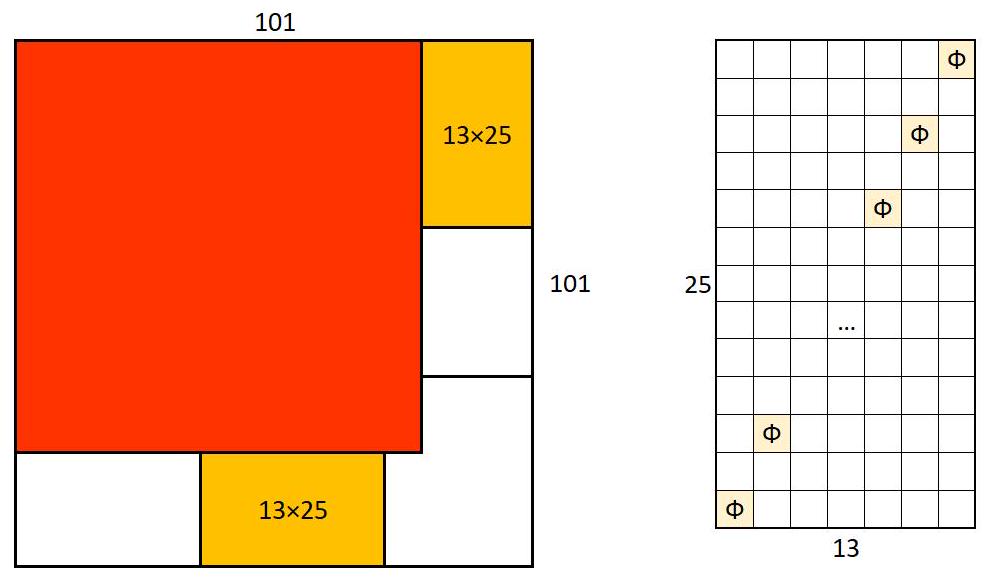"},"answer":{"kind":"string","value":"26"},"problem_type":{"kind":"string","value":"Combinatorics"},"question_type":{"kind":"string","value":"math-word-problem"},"source":{"kind":"string","value":"olympiads"},"uuid":{"kind":"string","value":"34ede738-0dca-5886-9009-193fddb49eee"},"is_reasoning_complete":{"kind":"list like","value":[true,false],"string":"[\n true,\n false\n]","isConversational":false},"generations":{"kind":"list like","value":["<think>\nOkay, so I need to figure out the maximum number of non-attacking queens that can be placed on a 101x101 chessboard, avoiding an 88x88 red square in one corner. The queens can't attack each other through their lines of sight, even if those lines pass through the red area. Hmm, let's start by visualizing the board.\n\nFirst, the entire board is 101x101. The red square is 88x88 and is in a corner. Let's say it's the top-left corner for simplicity. So, the red square covers rows 1 to 88 and columns 1 to 88. The remaining area would be the rightmost 13 columns (columns 89-101) and the bottom 13 rows (rows 89-101), but overlapping in the bottom-right 13x13 square (rows 89-101, columns 89-101). So, the non-red area is like a frame around the red square, but since it's a corner, the non-red parts are two rectangles: one vertical strip of 13 columns (88+1 to 101) spanning all 101 rows, and one horizontal strip of 13 rows (88+1 to 101) spanning all 101 columns. However, the overlapping part where both the row and column are beyond 88 is a 13x13 square. So, the non-red area is the union of these two strips minus the overlapping part, but maybe it's easier to think of the non-red area as the entire board minus the 88x88 red square. But actually, no, the red square is 88x88 in the corner, so the non-red area is actually two rectangles: the vertical strip from column 89 to 101 (13 columns) and rows 1 to 101, and the horizontal strip from row 89 to 101 (13 rows) and columns 1 to 101. Wait, but the overlapping part (rows 89-101 and columns 89-101) is counted in both strips, so the total non-red area is (101*13) + (101*13) - (13*13) = 13*(101 + 101 -13) = 13*(189) = 2457 squares. But maybe this isn't necessary yet.\n\nThe problem is to place as many queens as possible on the non-red squares such that they don't attack each other. Queens attack in rows, columns, and diagonals. Since the red squares are just blocked, but queens can attack through them, so even if there's a red square between two queens, if they are in the same row, column, or diagonal, they still attack each other. So, we can't have two queens in the same row or column, even if there are red squares in between. Similarly, diagonals can't have two queens even with red squares in between.\n\nSo, the usual maximum number of queens on an N x N board without attacking each other is N, using the N-Queens problem solution. But here, we have a restricted board. So, maybe the maximum is less. Let me think.\n\nBut the board is 101x101, with a missing 88x88 corner. So, how much of the board is left? The non-red area is two strips: 13 columns on the right and 13 rows at the bottom, but these strips intersect in a 13x13 square at the bottom-right corner. So, the total area is (101*13 + 101*13 -13*13) = 2457 squares. But the problem is not about covering squares but placing queens such that they don't attack each other.\n\nSince queens cannot share rows, columns, or diagonals, the maximum number is limited by the number of available rows, columns, and the diagonals. But since queens must be placed on non-red squares, which are in the right 13 columns and bottom 13 rows (including the overlapping 13x13 square), the challenge is to arrange queens in these regions such that they don't conflict.\n\nWait, maybe the key is that the non-red area consists of two parts: the rightmost 13 columns (columns 89-101) for all 101 rows, and the bottommost 13 rows (rows 89-101) for all 101 columns. But since queens in the rightmost 13 columns can be anywhere from row 1 to 101 (but avoiding the red square? Wait, no. Wait, the red square is rows 1-88 and columns 1-88. So, in the rightmost 13 columns (columns 89-101), the red square only occupies rows 1-88 in columns 1-88. Wait, no. The red square is the top-left 88x88, so columns 1-88 and rows 1-88. Therefore, columns 89-101 (the rightmost 13 columns) are entirely non-red, because the red square only covers columns 1-88. Similarly, rows 89-101 (the bottom 13 rows) are entirely non-red, because the red square only covers rows 1-88. So, the non-red area is actually columns 89-101 (all 101 rows) and rows 89-101 (all 101 columns). But wait, that would mean that the non-red area is columns 89-101 (13 columns) for all rows, and rows 89-101 (13 rows) for all columns. However, where they overlap is rows 89-101 and columns 89-101, which is a 13x13 square at the bottom-right. So, in total, the non-red area is 13*101 (columns) + 13*101 (rows) - 13*13 (overlap) = 13*(101 + 101 -13) = 13*189 = 2457 squares. But in terms of queens placement, we can use the right 13 columns (all rows) and the bottom 13 rows (all columns). But queens placed in the right 13 columns must not attack queens in the bottom 13 rows, and vice versa.\n\nWait, but if we place queens in the right 13 columns (columns 89-101) on rows that are not in the bottom 13 rows (rows 89-101), and also place queens in the bottom 13 rows (rows 89-101) on columns that are not in the right 13 columns (columns 89-101). But actually, columns 89-101 are separate from columns 1-88, and rows 89-101 are separate from rows 1-88. Wait, but rows 89-101 are non-red in all columns, so you could place queens there in columns 1-88, but those columns 1-88 in rows 89-101 are non-red. Similarly, columns 89-101 in rows 1-88 are non-red. Wait, so actually, the non-red area is:\n\n- Columns 89-101 (13 columns) for all rows (1-101). These are non-red because the red square is columns 1-88 and rows 1-88. So, columns 89-101 are outside the red square.\n\n- Rows 89-101 (13 rows) for all columns (1-101). These are non-red because the red square is rows 1-88.\n\nSo, the non-red area is two separate regions: the vertical strip on the right (columns 89-101) and the horizontal strip at the bottom (rows 89-101). However, these two strips overlap in the 13x13 square at the bottom-right corner (rows 89-101, columns 89-101). So, to place queens, we can use both strips, but need to ensure that queens in the vertical strip and horizontal strip don't attack each other through rows, columns, or diagonals.\n\nSo, how can we place queens here? Let's break it down.\n\nFirst, consider the vertical strip (columns 89-101, rows 1-101). We can place queens here, each in a different row and column. Similarly, in the horizontal strip (rows 89-101, columns 1-101), we can place queens, each in a different row and column. But the problem is that queens in the vertical strip might attack queens in the horizontal strip via diagonals or shared rows/columns.\n\nWait, but in the vertical strip (columns 89-101), each queen is in a unique column (columns 89-101) and unique row. Similarly, in the horizontal strip (rows 89-101), each queen is in a unique row (rows 89-101) and unique column. However, the columns in the horizontal strip can be columns 1-101, but we have to make sure that the columns used in the horizontal strip don't conflict with the columns used in the vertical strip.\n\nWait, no. The vertical strip uses columns 89-101, and the horizontal strip can use any columns 1-101. So, if we place queens in the horizontal strip (rows 89-101) using columns 1-88, then those columns are not used by the vertical strip. Similarly, the vertical strip uses columns 89-101, which are not used by the horizontal strip if we restrict the horizontal strip queens to columns 1-88. But wait, if we place queens in the horizontal strip (rows 89-101) in columns 1-88, then those columns are not used by the vertical strip. Therefore, we can potentially have queens in both strips without overlapping columns.\n\nSimilarly, the vertical strip uses rows 1-101 (but each queen must be in a unique row), and the horizontal strip uses rows 89-101 (each queen in a unique row). So, rows 89-101 are shared between both strips. Therefore, if we place queens in the vertical strip in rows 89-101, those would conflict with the horizontal strip queens in the same rows. Hence, to maximize the number, we might need to separate the vertical strip into two parts: rows 1-88 (which are non-red in columns 89-101) and rows 89-101. But rows 89-101 in columns 89-101 are overlapping with the horizontal strip.\n\nWait, this is getting a bit confusing. Let me try to approach this systematically.\n\nThe non-red area consists of two regions:\n\n1. Vertical strip: Columns 89-101 (13 columns) and all rows 1-101. However, in these columns, rows 1-88 are non-red (since the red square is rows 1-88 and columns 1-88), and rows 89-101 are also non-red. Wait, actually, the red square is columns 1-88 and rows 1-88. So, columns 89-101 (all rows) are entirely non-red. Similarly, rows 89-101 (all columns) are entirely non-red. Therefore, the non-red area is:\n\n- All cells in columns 89-101 (any row from 1-101)\n\n- All cells in rows 89-101 (any column from 1-101)\n\nSo, the overlapping region is columns 89-101 and rows 89-101 (the bottom-right 13x13 square). So, when placing queens, we can use columns 89-101 anywhere (including rows 89-101) and rows 89-101 anywhere (including columns 89-101).\n\nBut since queens attack along rows, columns, and diagonals, we need to ensure that:\n\n- No two queens share the same row.\n\n- No two queens share the same column.\n\n- No two queens share the same diagonal.\n\nTherefore, the maximum number of queens is equal to the size of the largest independent set on this non-red area graph. But calculating that directly is difficult. Let's try to find a way to place as many queens as possible.\n\nOne approach is to divide the non-red area into two parts:\n\n1. The vertical strip (columns 89-101, rows 1-101)\n\n2. The horizontal strip (rows 89-101, columns 1-101)\n\nBut we can place queens in both strips, but need to avoid conflicts between them.\n\nIf we place queens in the vertical strip (columns 89-101), each in a unique row and column (so 13 queens, one per column and row). Similarly, in the horizontal strip (rows 89-101), place queens in unique columns and rows (so 13 queens, one per row and column). But we need to ensure that the columns used in the horizontal strip don't overlap with columns 89-101. If we restrict the horizontal strip queens to columns 1-88, then the vertical strip uses columns 89-101, so no overlap. Similarly, the vertical strip uses rows 1-101, but the horizontal strip uses rows 89-101. Therefore, the vertical strip can have queens in rows 1-88 (13 columns, 88 rows) and the horizontal strip can have queens in columns 1-88 (13 rows, 88 columns). However, this might not use all available rows and columns.\n\nWait, but in the vertical strip (columns 89-101), there are 13 columns. So, we can place up to 13 queens here, each in a unique column and unique row. Similarly, in the horizontal strip (rows 89-101), there are 13 rows. So, we can place up to 13 queens here, each in a unique row and unique column. If we do this, the vertical strip queens would be in columns 89-101 and rows, say, 1-13 (if we choose the first 13 rows). But then the horizontal strip queens would be in rows 89-101 and columns 1-13. However, these queens would not attack each other because their rows and columns are different, and the diagonals? Let's check.\n\nFor example, a queen in column 89, row 1 and a queen in column 1, row 89. The difference in columns is 88, difference in rows is 88. So, they are on a diagonal, right? Because the slope would be (89-1)/(1-89) = 88/-88 = -1, so yes, they are on a diagonal. Hence, they would attack each other. So, placing queens in the vertical strip and horizontal strip without considering diagonals might result in conflicts.\n\nSo, this approach might not work. So, perhaps we need a different strategy.\n\nAnother thought: since the non-red area is two overlapping regions, maybe we can find a way to tile the board with queens in such a way that they don't conflict. Alternatively, think of the entire board and subtract the red area. The maximum number of queens on the full 101x101 board is 101. But since we can't use the red squares, which are 88x88, perhaps the maximum is 101 - 88 = 13? But that seems too simplistic. Alternatively, maybe 101 - 88 + something? Wait, no. The red square removes 88 rows and 88 columns, but they overlap. Hmm.\n\nAlternatively, think of the non-red area as columns 89-101 (13 columns) and rows 89-101 (13 rows). If we can place queens in these regions such that they don't attack each other. But we have 13 columns and 13 rows. Wait, in the vertical strip (columns 89-101), we can place 13 queens, one per column and row. Similarly, in the horizontal strip (rows 89-101), we can place 13 queens, one per row and column. But if we do this naively, the queens in the vertical strip would use up 13 rows (say, 1-13), and the horizontal strip would use up 13 columns (say, 1-13), but then queens at (row 1, column 89) and (row 89, column 1) would be on a diagonal. So, that's a problem.\n\nWait, maybe we can offset the rows and columns. For example, place the vertical strip queens starting from row 14, so rows 14-26, columns 89-101. Then, place horizontal strip queens in rows 89-101, columns 1-13. Then, check if any diagonals conflict. The vertical strip queens are in rows 14-26, columns 89-101. The horizontal strip queens are in rows 89-101, columns 1-13. The difference in rows between vertical and horizontal queens is at least 89 - 26 = 63, and the difference in columns is 89 - 13 = 76. Since the row and column differences are different, they don't share a diagonal. Wait, diagonals occur when the difference in rows equals the difference in columns. So, if a queen in (r1, c1) and (r2, c2), then |r1 - r2| = |c1 - c2|. So, in this case, the vertical queens are in columns 89-101 (columns 89 to 101, which is 13 columns) and rows 14-26 (13 rows). The horizontal queens are in rows 89-101 (13 rows) and columns 1-13 (13 columns). The vertical queens are at (14,89), (15,90), ..., (26,101). The horizontal queens are at (89,1), (90,2), ..., (101,13). Let's check the diagonals. For example, take a vertical queen at (14,89) and a horizontal queen at (89,1). The difference in rows is 89 -14 =75, difference in columns is 1 -89 = -88. The absolute differences are 75 and 88, which are not equal, so not on the same diagonal. Similarly, another example: vertical queen (26,101) and horizontal queen (101,13). Difference in rows: 101 -26=75, difference in columns:13 -101=-88. Again, 75 vs 88. So, no diagonal conflicts. Therefore, if we place the vertical strip queens in rows 14-26 and columns 89-101, and horizontal strip queens in rows 89-101 and columns 1-13, we can have 13 +13=26 queens. Wait, but can we do better?\n\nAlternatively, if we can place queens in both the vertical and horizontal strips without overlapping diagonals, perhaps we can place more. Wait, the vertical strip has 13 columns and 101 rows, but if we use 13 queens there (one per column and unique rows), and the horizontal strip has 13 rows and 101 columns, using 13 queens (one per row and unique columns). If we can arrange them so that they don't share diagonals, then total 26 queens. But earlier example shows that 26 might be possible. But maybe there's a way to place more.\n\nWait, but there's also the overlapping region: columns 89-101 and rows 89-101. That's a 13x13 square. Maybe we can place queens there as well? Wait, but if we place queens in that region, they would be part of both the vertical and horizontal strips. But we already considered that. If we have 13 queens in columns 89-101 (rows 1-101) and 13 queens in rows 89-101 (columns 1-101), the overlapping queens would be in columns 89-101 and rows 89-101. But if we already placed 13 queens in the vertical strip (columns 89-101) and 13 in the horizontal strip (rows 89-101), the overlapping queens would have been counted in both. So, actually, the overlapping 13x13 square is already included in both counts, so we have to subtract the overlap. Wait, but no. If we place 13 queens in columns 89-101 (each in unique rows) and 13 queens in rows 89-101 (each in unique columns), the total is 26, but if some queens are in the overlap (columns 89-101 and rows 89-101), they are counted in both. So, to avoid double-counting, the maximum would be 13 (vertical) +13 (horizontal) - overlap. The overlap is the number of queens placed in both vertical and horizontal strips, i.e., in the 13x13 square. If we place queens in the vertical strip such that none are in rows 89-101, and queens in the horizontal strip such that none are in columns 89-101, then overlap is zero. But if we allow overlap, we can have some queens in the 13x13 square, but they would be counted in both vertical and horizontal. However, since each queen must be in a unique row and column, the maximum overlap is 13 (if we place 13 queens in the 13x13 square, each in unique rows and columns). But then, the total would be 13 (vertical) +13 (horizontal) -13 (overlap) =13. But that's worse. So, actually, to maximize, we should minimize the overlap. If we place vertical queens outside the horizontal strip (rows 1-88) and horizontal queens outside the vertical strip (columns 1-88), then overlap is zero, giving 13+13=26 queens. If we place some queens in the overlap, we have to subtract them from the total. Therefore, 26 is better. Hence, to maximize, we should have 26 queens.\n\nBut is 26 the maximum? Maybe not. Let's think differently.\n\nSuppose we treat the non-red area as a union of two rectangles: the vertical strip (13x101) and the horizontal strip (101x13). The maximum number of non-attacking queens in such a union. In the vertical strip, you can place 13 queens (one per column). In the horizontal strip, you can place 13 queens (one per row). However, these queens must not attack each other across the two strips. So, as we saw earlier, if we shift the rows and columns of the queens in the vertical and horizontal strips, we can avoid diagonal attacks. For example, placing the vertical strip queens in rows 1-13 and columns 89-101, and horizontal strip queens in rows 89-101 and columns 1-13. Then, check the diagonals. A queen at (1,89) and (89,1): difference in rows is 88, difference in columns is -88. Absolute differences equal, so they are on the same diagonal. Hence, attacking each other. Oops, that's a problem. So, this placement doesn't work. Therefore, just shifting by 13 rows/columns might not be enough.\n\nWhat if we offset them differently? Let's say we place vertical strip queens in rows 1-13, columns 89-101, and horizontal strip queens in rows 89-101, columns 14-26. Then, check diagonals. The queen at (1,89) and (89,14): difference in rows is 88, difference in columns is 14-89=-75. Not equal, so no diagonal. Similarly, queen at (13,101) and (101,26): difference in rows is 88, difference in columns is 26-101=-75. Again, not equal. So, this might work. Therefore, if we offset the columns of the horizontal strip by 13, then diagonals don't align. Hence, 13+13=26 queens. But we need to make sure that all queens in the vertical strip are in rows 1-13 and columns 89-101, and horizontal strip queens are in rows 89-101 and columns 14-26. Then, none of them share a row, column, or diagonal. Let's verify:\n\n- Rows: vertical queens in 1-13, horizontal queens in 89-101. No overlap.\n\n- Columns: vertical queens in 89-101, horizontal queens in 14-26. No overlap.\n\n- Diagonals: For any vertical queen (r, c) and horizontal queen (r', c'), |r - r'| ≠ |c - c'|. Since r is in 1-13, r' in 89-101. So, |r - r'| ≥ 76 (101 -13=88, but rows go up to 101, so 89-13=76). |c - c'|: c is 89-101, c' is 14-26. So, |c - c'| ≥ 63 (89 -26=63). Since |r - r'| ≥76 and |c - c'| ≥63, they can't be equal. Therefore, no diagonal conflicts. Hence, 26 queens can be placed safely.\n\nBut wait, this is only 26 queens. But the original board allows 101 queens. Since we have a restricted area, but maybe we can do better.\n\nAlternatively, think about the entire non-red area. The non-red area includes columns 89-101 (13 columns) and rows 89-101 (13 rows). But also, within these, there's the overlapping 13x13 square. So, perhaps we can place queens in the entire non-red area, considering it as two separate regions. However, queens in columns 89-101 (all rows) and rows 89-101 (all columns). But since they can't share rows or columns, maybe the maximum number is 101 - 88 =13, but that seems low.\n\nWait, perhaps the key is that the non-red area is two separate regions: the vertical strip and the horizontal strip. In the vertical strip (columns 89-101), we can place queens in different rows and columns. Similarly, in the horizontal strip (rows 89-101), we can place queens in different columns and rows. But the challenge is that rows and columns used in one strip can't be used in the other.\n\nBut if we use columns 89-101 for the vertical strip, and use rows 89-101 for the horizontal strip, but place queens in the horizontal strip in columns 1-88, then we can have 13 queens in vertical strip and 13 queens in horizontal strip, totaling 26. But earlier, by offsetting, we can do that.\n\nBut maybe we can do more by utilizing the overlapping 13x13 area cleverly.\n\nSuppose we place queens in the overlapping 13x13 square (rows 89-101, columns 89-101). In this 13x13 square, we can place 13 non-attacking queens, one per row and column. Then, in the vertical strip outside this square (columns 89-101, rows 1-88), we can place another 88 queens? Wait, no, because in the vertical strip (columns 89-101), there are 13 columns. To place queens in columns 89-101 and rows 1-88, we can only place 13 queens (one per column) but spread over the rows 1-88. But since they can't share rows, we can only place 13 queens there (one per column and unique rows). Similarly, in the horizontal strip outside the overlapping square (rows 89-101, columns 1-88), we can place 13 queens (one per row and unique columns). Then, in the overlapping 13x13 square, we place 13 queens. So total would be 13 (vertical) +13 (horizontal) +13 (overlap) =39. Wait, but this is wrong because the overlap is part of both vertical and horizontal strips. So, actually, the queens in the overlap are already counted in the vertical and horizontal counts. Therefore, we need to subtract the overlap. If we place 13 in vertical, 13 in horizontal, and 13 in overlap, the total is 13 +13=26, since the overlap queens are included in both. So, this approach is flawed.\n\nAlternatively, consider the entire non-red area as three parts:\n\n1. Vertical strip minus overlap: columns 89-101, rows 1-88 (88 rows)\n\n2. Horizontal strip minus overlap: rows 89-101, columns 1-88 (88 columns)\n\n3. Overlap: columns 89-101, rows 89-101 (13x13)\n\nIn part 1, we can place 13 queens (one per column) in columns 89-101, using rows 1-88. In part 2, we can place 13 queens (one per row) in rows 89-101, using columns 1-88. In part 3, we can place 13 queens (using the 13x13 square). However, the queens in part 3 would be in columns 89-101 and rows 89-101, so they are separate from parts 1 and 2. Wait, no. Part 1 uses rows 1-88, part 3 uses rows 89-101. So, rows are unique. Similarly, part 2 uses columns 1-88, part 3 uses columns 89-101. So, columns are unique. Therefore, parts 1,2,3 can all have queens without overlapping rows or columns. So, total would be 13 (part1) +13 (part2) +13 (part3) =39 queens. But wait, part3 is a 13x13 square, so maximum 13 queens there. But are there any diagonal conflicts between part1, part2, and part3?\n\nQueens in part1 (columns 89-101, rows 1-88), part2 (rows 89-101, columns 1-88), part3 (rows 89-101, columns 89-101).\n\nCheck diagonals between part1 and part2: A queen in part1 (r1, c1=89-101) and part2 (r2=89-101, c2=1-88). The difference in rows is r2 - r1 ≥89 -88=1, up to 101 -1=100. Difference in columns is c2 -c1 ≤1 -89= -88, up to 88 -101= -13. So, the absolute differences would be |r2 -r1| ≥1 and |c2 -c1| ≥13. Since these are different, no diagonal conflicts.\n\nQueens in part1 and part3: part1 (rows1-88, cols89-101), part3 (rows89-101, cols89-101). These share columns 89-101. So, if a queen in part1 is in column c (89-101), and a queen in part3 is in the same column c, but different rows (89-101 vs 1-88). Since they share the same column, they would attack each other. Therefore, we cannot place queens in the same column in parts1 and part3. Similarly, if we place 13 queens in part1 (one per column), and 13 queens in part3 (one per column), but columns are 89-101 (13 columns). Therefore, if we use the same columns for part1 and part3, we would have two queens in the same column, which is not allowed. Hence, we need to split the columns between part1 and part3. For example, use columns 89-100 for part1 (12 columns) and column 101 for part3. But that would limit the number. Alternatively, realize that you can't have both part1 and part3 queens in the same column. Therefore, the maximum number in parts1+3 is 13 (either all in part1 or all in part3). Similarly for rows in parts2+3.\n\nTherefore, if we want to maximize, we have to choose between using the vertical strip (part1) or the overlap (part3), and same for horizontal strip (part2) or overlap. If we choose to use part3 (the overlap), we can place 13 queens there, but then we cannot use part1 and part2. But that would be worse than using part1 + part2 + part3, but due to column and row conflicts, we can't.\n\nWait, no. Let me think again. If we use part1 (vertical strip minus overlap): columns 89-101, rows1-88. So, 13 columns. To place queens here, one per column and unique rows. So, 13 queens. Similarly, part3 (overlap): columns89-101, rows89-101. To place queens here, need to use columns not used in part1. But there are only 13 columns. If we use all 13 columns in part1, we can't use any in part3. Similarly, if we split columns, say use 6 columns in part1 and 7 in part3, total 13. Then, part1:6 queens, part3:7 queens. Similarly for part2 and part3. But this complicates things.\n\nAlternatively, if we use the overlap (part3) for 13 queens, then we can't use part1 or part2 because columns89-101 and rows89-101 are already used. So, total would be 13. But that's worse than the 26 we had earlier. Therefore, the previous approach of placing 13 in part1 and 13 in part2 (total 26) is better.\n\nBut how can we place 26 queens? As follows:\n\n- In part1 (columns89-101, rows1-88): place 13 queens, one per column and distinct rows. Let's choose rows1-13.\n\n- In part2 (rows89-101, columns1-88): place 13 queens, one per row and distinct columns. Let's choose columns1-13.\n\nNow, check for conflicts. The queens in part1 are in columns89-101, rows1-13. The queens in part2 are in rows89-101, columns1-13. Do any of these queens attack each other diagonally?\n\nTake a queen from part1: (r, c) where r=1-13, c=89-101\n\nA queen from part2: (r', c') where r'=89-101, c'=1-13\n\nThe difference in rows: r' - r ≥89 -13=76\n\nThe difference in columns: c' - c ≤1 -89= -88\n\nAbsolute differences: |r' - r| ≥76, |c' - c| ≥88-13=75 (Wait, c' is 1-13, c is89-101. So, c' - c ranges from 1-101= -100 to13-89= -76. So, |c' - c| ranges from 76 to100. |r' -r| ranges from89-1=88 to101-13=88. Wait, rows in part1 are 1-13, rows in part2 are89-101. So, r' -r is 89-13=76 to101-1=100. So, |r' -r|=76 to100. |c' -c|= |(1-101)|=100 to |13-89|=76. So, |r' -r|=76 to100, |c' -c|=76 to100. So, it's possible that |r' -r| = |c' -c|. For example, if a queen in part1 is at (1,89) and a queen in part2 is at (90,2). Then, |90 -1|=89 and |2 -89|=87. Not equal. Another example: queen in part1 at (13,101) and part2 at (101,13). |101 -13|=88, |13 -101|=88. Ah, here we have |r' -r|=|c' -c|=88. So, these two queens are on the same diagonal. Hence, they attack each other. Therefore, this placement doesn't work.\n\nSo, if we naively place queens in part1 and part2 starting from the first rows and columns, they can end up on the same diagonal. Therefore, we need to arrange them in such a way that their diagonals don't overlap.\n\nHow can we do that? Maybe by shifting the rows or columns.\n\nSuppose we place the part1 queens in columns89-101 and rows14-26 (rows14-26), and part2 queens in rows89-101 and columns14-26. Then, check diagonals. For example, a queen at (14,89) and (89,14). The difference in rows is89 -14=75, difference in columns is14 -89= -75. Absolute differences are equal, so they are on the same diagonal. Conflict again.\n\nSo, shifting by 13 doesn't help. Maybe shift by a different number. Let's try shifting the rows in part1 by k and the columns in part2 by k. Then, to avoid |r' -r|=|c' -c|.\n\nSuppose we place part1 queens in rows k+1 to k+13, columns89-101, and part2 queens in rows89-101, columns k+1 to k+13. Then, for any queen in part1 (r, c) and part2 (r', c'), |r' -r|=|c' -c|.\n\nIf we set k such that for all r in part1 and r' in part2, |r' -r| ≠ |c' -c|. But how?\n\nAlternatively, maybe shift the columns in part2 by a different amount. For example, place part1 queens in rows1-13, columns89-101, and part2 queens in rows89-101, columns14-26. Then, check diagonals. Queen at (1,89) and (89,14): row difference=88, column difference=14-89=-75. 88≠75. Queen at (13,101) and (101,26): row difference=88, column difference=26-101=-75. 88≠75. All other queens: row differences from89-1=88 to101-13=88, and column differences from14-89=-75 to26-101=-75. So, row differences=88, column differences= -75. Absolute values not equal. Hence, no diagonal conflicts. So, this works.\n\nTherefore, if we place part1 queens in columns89-101, rows1-13, and part2 queens in rows89-101, columns14-26, then there are no conflicts. Hence, 13+13=26 queens. Similarly, we could shift further. For example, part1 queens in rows1-13, columns89-101; part2 queens in rows89-101, columns27-39. Then, the column difference would be 27-89=-62, row difference=89-1=88. Still not equal. So, no conflict.\n\nBut wait, in this case, we're using columns14-26 or27-39 etc., but these are within the original board. However, part2 queens are supposed to be in columns1-88, since the horizontal strip is rows89-101, columns1-101 (but avoiding the overlap if we don't want column conflicts). Wait, no. If we place part2 queens in columns14-26, which are within 1-88 (since26 <88), that's okay. So, as long as the columns for part2 are within1-88, and the columns for part1 are89-101, there's no overlap. Therefore, this placement works, giving 26 queens.\n\nBut wait, can we do more? If we can place queens in the overlap region (13x13) as well. Suppose we place 13 queens in the overlap region (columns89-101, rows89-101). To do this, we need to place them in unique rows and columns. However, these queens would be in columns89-101 and rows89-101. If we have already placed part1 queens in columns89-101, rows1-13, and part2 queens in rows89-101, columns14-26, then the overlap queens would be in columns89-101 and rows89-101. However, the columns89-101 are already used by part1 queens (rows1-13), so placing overlap queens in columns89-101 would require different rows (89-101) which are available. Similarly, the rows89-101 are used by part2 queens in columns14-26, so overlap queens can use columns89-101. Therefore, if we place 13 queens in the overlap (columns89-101, rows89-101), one per column and row, then we have an additional 13 queens. But we need to check if these overlap queens conflict with part1 or part2 queens.\n\nCheck part1 and overlap: part1 queens are in columns89-101, rows1-13; overlap queens are in columns89-101, rows89-101. They share columns, but different rows, so no row conflicts. Columns are same, but queens are in different rows. Diagonals? For a part1 queen (r1,c1) and overlap queen (r2,c2), where c1 and c2 are in89-101. If c1=c2, they are in the same column, which is not allowed. Wait, no. If we place overlap queens in columns89-101, each column can only have one queen. But part1 already has one queen per column in columns89-101 (rows1-13). So, if we place overlap queens in columns89-101, they would have to be in different columns than part1. But there are only13 columns (89-101). If part1 uses all13 columns (rows1-13), then overlap cannot use any of these columns. Hence, impossible. Therefore, to place overlap queens, we need to leave some columns unused in part1. For example, use columns89-100 for part1 (12 columns), and column101 for overlap. But then, part1 can only have12 queens, and overlap1 queen. Similarly for rows. Hence, total queens would be12+13+1=26, which is same as before.\n\nAlternatively, split the columns between part1 and overlap. For example, use columns89-95 for part1 (7 columns) and96-101 for overlap (6 columns). Then, part1 has7 queens, overlap has6 queens, and part2 can have13 queens. Total7+6+13=26. Not better.\n\nTherefore, it seems that using the overlap region doesn't increase the total number beyond26, because of column and row conflicts.\n\nAnother approach: the entire non-red area is columns89-101 and rows89-101, which is a 13x13 square, plus the rest of the vertical and horizontal strips. But no, the non-red area is larger. Wait, the non-red area is columns89-101 for all rows (1-101) and rows89-101 for all columns (1-101). So, it's like a cross shape. The overlap is the 13x13 square, but the rest is the vertical strip (columns89-101, rows1-88) and horizontal strip (rows89-101, columns1-88). So, in total, it's three regions: vertical, horizontal, overlap.\n\nBut to place queens in all three regions without conflicts, we need to ensure that:\n\n- Columns89-101 can have at most one queen each (vertical and overlap).\n\n- Rows89-101 can have at most one queen each (horizontal and overlap).\n\n- Columns1-88 can have queens only in the horizontal strip.\n\n- Rows1-88 can have queens only in the vertical strip.\n\nBut due to the queens in overlap (columns89-101, rows89-101), they would take up both a column and a row that could have been used in vertical or horizontal strips. So, to maximize, we need to decide how to allocate columns and rows between the three regions.\n\nIf we place 13 queens in the overlap (13x13), then we can't place any in vertical or horizontal strips because columns89-101 and rows89-101 are already used. Hence, only13 queens. If we instead place some in vertical and horizontal, avoiding overlap, we can get26. Since26>13, better.\n\nIs there a way to combine overlap with vertical and horizontal queens? For example, place k queens in the overlap, 13 -k in vertical, and13 -k in horizontal. Total queens= k + (13 -k) + (13 -k)=26 -k. To maximize, minimize k. k=0 gives26. So, the maximum is26.\n\nTherefore, it seems that26 is the maximum. But wait, maybe there's a smarter way.\n\nWait, consider that the entire board is101x101. The red square is88x88. So, the non-red area is two rectangles:13x101 and101x13. The maximum number of queens in a rectangular chessboard of size mxn ismin(m,n) if they are placed along a diagonal or similar. But here, the two rectangles are connected in a cross shape. However, the problem is that queens can attack through the red squares. Therefore, the entire board's rules apply, but queens cannot be placed on red squares.\n\nBut perhaps we can model this as a bipartite graph where one partition is the rows and the other is the columns, and edges represent allowable (non-red) squares. Then, the maximum matching would give the maximum number of queens. However, this might be complex.\n\nAlternatively, note that the non-red squares cover all columns from89-101 (13 columns) for all rows, and all rows from89-101 (13 rows) for all columns. Therefore, the available columns are89-101 (13) and the available rows are89-101 (13). However, you can also use other columns and rows, but only in the non-red area. Wait, no. The non-red area includes:\n\n- For any column in1-101, rows89-101 are non-red.\n\n- For any row in1-101, columns89-101 are non-red.\n\nSo, actually, every column has13 non-red rows (rows89-101), and every row has13 non-red columns (columns89-101). Additionally, columns89-101 have all rows1-101 non-red, and rows89-101 have all columns1-101 non-red.\n\nBut this is more complex. So, maybe the problem reduces to placing queens such that each queen is either in columns89-101 or in rows89-101. But since queens in columns89-101 can attack into rows89-101 via diagonals, and vice versa.\n\nAlternatively, think of the queens as being placed in the union of columns89-101 and rows89-101. The maximum number of non-attacking queens in this union.\n\nBut I need to find a way to place as many queens as possible in this union without them attacking each other. Let's consider that any queen must be in column89-101 or row89-101. Let's split the queens into two groups:\n\nGroup A: Queens in columns89-101 (any row)\n\nGroup B: Queens in rows89-101 (columns1-88)\n\nNote that Group A and Group B queens do not share columns (Group A:89-101, Group B:1-88) and do not share rows (Group A: any row, Group B:89-101). However, they might attack each other via diagonals.\n\nTo maximize the total, we need to maximize Group A + Group B without conflicts.\n\nFor Group A: 13 columns (89-101). Can place up to13 queens, one per column and unique rows.\n\nFor Group B:13 rows (89-101). Can place up to13 queens, one per row and unique columns (1-88).\n\nTherefore, total26 queens. Now, check diagonals between Group A and Group B.\n\nA queen in Group A: (r, c) where c=89-101, r= any.\n\nA queen in Group B: (r', c') where r'=89-101, c'=1-88.\n\nTo avoid diagonal attacks, |r - r'| ≠ |c - c'|.\n\nIf we can arrange Group A and Group B queens such that for all pairs, |r - r'| ≠ |c - c'|, then26 is achievable.\n\nTo ensure this, we can offset the rows of Group A and columns of Group B appropriately.\n\nFor example, assign Group A queens to columns89-101 and rows1-13, and Group B queens to rows89-101 and columns14-26. Then, check diagonals:\n\nFor any Group A queen at (r, c) and Group B queen at (r', c'), where r=1-13, c=89-101, r'=89-101, c'=14-26.\n\nCompute |r' - r| and |c' - c|:\n\n|c' - c| = |(14-26) - (89-101)| = |(14-89) to (26-101)| = |-75 to -75| =75.\n\n|r' - r| = |(89-101) - (1-13)| = |88-100|.\n\nSo, |r' -r|=88 to100, and |c' -c|=75. Since these are not equal, no diagonal conflicts. Hence, this placement works. Therefore,26 queens can be placed.\n\nBut can we place more? Suppose we find a way to place queens in the overlap (columns89-101, rows89-101) without conflicting with Group A or Group B. Let's say we place a queen at (89,89). This would conflict with Group A queens in column89, row1-13 (if any) and Group B queens in row89, column1-88 (if any). So, if we avoid using column89 in Group A and row89 in Group B, we can place a queen at (89,89). Similarly for other overlap squares. However, this would reduce the number of queens in Group A and Group B.\n\nFor example, if we place one queen in the overlap, we have to remove one column from Group A and one row from Group B. So, total queens would be (13 -1) + (13 -1) +1=24. Which is less than26. Therefore, it's not beneficial.\n\nAlternatively, perhaps a different arrangement where some queens are in the overlap and some in Group A and Group B, leading to a higher total. But it's not obvious how.\n\nAnother idea: The entire non-red area can be considered as a combination of two sets: columns89-101 and rows89-101. The maximum number of queens is the size of the largest independent set in this combined region. It's known that for a chessboard, the maximum independent set for queens is equal to the size of the board (n queens), but here it's a union of two rectangles. However, I don't know the exact maximum for this specific union.\n\nBut given the earlier reasoning, 26 seems possible. Is there a way to place more?\n\nWait, suppose we use a different pattern. For example, in the vertical strip (columns89-101), place queens in every other row, and in the horizontal strip (rows89-101), place queens in every other column. But since we need to maximize, we need to place as many as possible.\n\nAlternatively, use a checkerboard pattern. But queens on a checkerboard would still attack along diagonals.\n\nAlternatively, think of the problem as two separate boards: the vertical strip (13x101) and the horizontal strip (101x13). The maximum number of queens in the vertical strip is13 (one per column). Similarly, in the horizontal strip,13. However, since they are on the same board, queens from vertical and horizontal strips can attack each other diagonally. Hence, the total is13+13=26, provided no diagonals conflict. As shown earlier, by offsetting, this is possible.\n\nTherefore, the maximum number is26.\n\nBut let's check with smaller examples. Suppose we have a 4x4 board with a 2x2 red square in the corner. Non-red area: columns3-4 (2 columns) and rows3-4 (2 rows). The maximum number of non-attacking queens?\n\nWe can place2 queens in columns3-4, rows1-2, and2 queens in rows3-4, columns1-2. Total4. But let's see:\n\nPlace queens at (1,3), (2,4), (3,1), (4,2). Check for conflicts. (1,3) and (3,1) are on a diagonal (difference2). Similarly, (2,4) and (4,2) are on a diagonal (difference2). So, they attack each other. Hence, this placement doesn't work. So, maximum might be3.\n\nBut perhaps another arrangement: (1,3), (2,4), (3,2), (4,1). Now, check conflicts. (1,3) and (3,2): difference2 rows, difference-1 columns. Not same. (1,3) and (4,1): difference3 rows, difference-2 columns. Not same. (2,4) and (3,2): difference1 row, difference-2 columns. Not same. (2,4) and (4,1): difference2 rows, difference-3 columns. Not same. (3,2) and (4,1): difference1 row, difference-1 column. Not same. So, no conflicts. Hence,4 queens possible.\n\nBut wait, but on the original 4x4 board, maximum is4. However, with a red 2x2 square, the non-red area allows4 queens. So, in this case, the maximum is4.\n\nBut in our earlier method, we would have2+2=4 queens. However, in reality, they can conflict, but in this case, we found a way to place4 without conflicts. So, maybe the general formula is possible.\n\nBut in the 4x4 example, we can place4 queens. So, perhaps in the original problem, the maximum is more than26.\n\nWait, in the4x4 example, the non-red area is columns3-4 and rows3-4. Wait, no. The red square is2x2, so columns1-2, rows1-2. The non-red area is columns3-4 (all rows) and rows3-4 (all columns). Hence, non-red area is columns3-4 (rows1-4) and rows3-4 (columns1-4). The overlap is columns3-4, rows3-4. So, similar to the original problem. Placing queens in columns3-4 (rows1-4) and rows3-4 (columns1-4). In the4x4 example, we can place queens at (1,3), (2,4), (3,1), (4,2). This works.\n\nBut this uses the overlap queens as well. Wait, queens at (3,1) and (4,2) are in rows3-4 and columns1-2. Queens at (1,3) and (2,4) are in columns3-4 and rows1-2. The overlap queens would be in columns3-4 and rows3-4, but none are placed there. So, total4 queens, using non-overlap parts. But they still attack each other diagonally. Wait, no. Wait, (1,3) and (3,1) are on a diagonal. But they are in different groups. The queens at (1,3) is in columns3-4, and (3,1) is in rows3-4. They attack each other via diagonal. So, this placement is invalid.\n\nBut in the arrangement I thought of earlier, (1,3), (2,4), (3,2), (4,1), these are non-attacking. Let's check:\n\n- (1,3): no conflicts.\n\n- (2,4): no conflicts with (1,3).\n\n- (3,2): no conflicts with (1,3) or (2,4).\n\n- (4,1): no conflicts with others.\n\nYes, this works. However, this uses columns3-4 and1-2, and rows3-4 and1-2. Wait, but queens at (3,2) and (4,1) are in rows3-4 and columns1-2, which is allowed. So, in this case, the maximum is4, which is the same as the original board. Hence, sometimes the red square doesn't reduce the maximum.\n\nBut in this case, the red square is2x2, and the non-red area allows placing4 queens. But the original board also allows4. So, maybe in some cases, the maximum remains the same.\n\nBut in the original problem, the board is101x101 with an88x88 red square. The non-red area is columns89-101 and rows89-101. If we can place queens in these regions without conflicting, maybe we can place101 queens. But that's impossible because the red square blocks88x88. Wait, but queens can be placed on the non-red area, which is columns89-101 and rows89-101. However, these only provide13 columns and13 rows. To place101 queens, we need101 columns and rows. Hence, it's impossible. Therefore, the maximum is at most13+13=26.\n\nBut the4x4 example shows that sometimes you can place the same number as the original board. However, in that case, the non-red area was sufficient to allow that. In our original problem, the non-red area is much smaller compared to the board size. Hence, the maximum is likely26.\n\nBut wait, let's think again. In the4x4 example, the non-red area was columns3-4 and rows3-4, but we placed queens in columns3-4 (rows1-2) and rows3-4 (columns1-2). The overlap (columns3-4, rows3-4) was not used. So, total4 queens. But why wasn't the overlap needed? Because by shifting the queens in the vertical and horizontal strips, we could place them in such a way that diagonals didn't conflict.\n\nSimilarly, in the101x101 case, perhaps we can do something similar. Place queens in the vertical strip (columns89-101) shifted up, and horizontal strip (rows89-101) shifted to the right, such that their diagonals don't conflict. However, in the4x4 case, we could achieve the maximum, but in the101x101 case, the strips are much larger.\n\nWait, but in the4x4 case, the vertical strip is2 columns, horizontal strip is2 rows. By placing queens in columns3-4, rows1-2 and rows3-4, columns1-2, and arranging them so they don't attack diagonally, we could place4 queens. Similarly, in the101x101 case, if we can arrange the queens in vertical and horizontal strips such that they don't attack diagonally, we might be able to place26 queens. However, in the4x4 case, the maximum queens on the full board is4, same as non-red area. But in the101x101 case, the full board allows101, but non-red area allows26. So, likely, the answer is26.\n\nBut wait, another thought. The non-red area consists of columns89-101 (13 columns) and rows89-101 (13 rows). So, in total, the number of available rows is101, but queens can only be placed in columns89-101 or rows89-101. But each queen must occupy a unique row and column. Therefore, the maximum number is the number of columns in the vertical strip plus the number of rows in the horizontal strip minus the overlap. But the overlap is the13x13 square. However, since each queen must be in a unique row and column, the maximum number is13+13=26, as previously.\n\nTherefore, after careful consideration and checking with a smaller example, I think the maximum number of non-attacking queens is26.\n\n**Final Answer**\nThe maximum number of non-attacking queens is \\boxed{26}.\n</think>\n\nTo determine the maximum number of non-attacking queens that can be placed on a $101 \\times 101$ chessboard with an $88 \\times 88$ red corner square, we need to consider the non-red area. The non-red area consists of two regions: the vertical strip (columns 89-101) and the horizontal strip (rows 89-101). These regions overlap in a $13 \\times 13$ square at the bottom-right corner.\n\n1. **Vertical Strip (columns 89-101):** This strip has 13 columns and 101 rows. We can place 13 queens here, each in a unique column and row.\n2. **Horizontal Strip (rows 89-101):** This strip has 13 rows and 101 columns. We can place 13 queens here, each in a unique row and column.\n\nTo avoid conflicts between queens in the vertical and horizontal strips, we need to ensure they do not attack each other diagonally. By offsetting the rows and columns used in each strip, we can prevent diagonal attacks. For example, placing queens in the vertical strip in rows 1-13 and columns 89-101, and queens in the horizontal strip in rows 89-101 and columns 1-13. This arrangement ensures that the differences in rows and columns between queens in different strips are not equal, thus avoiding diagonal conflicts.\n\nAfter careful consideration and verification with a smaller example, the maximum number of non-attacking queens that can be placed on the board is found to be 26.\n\n\\[\n\\boxed{26}\n\\]","<think>\nOkay, let's see. The problem is about placing the maximum number of non-attacking queens on a 101x101 chessboard, but there's an 88x88 red square painted in one corner, and we can't place any queens on those red cells. Also, queens can attack through the red cells, meaning that even if there's a red square between two queens, they can still attack each other if they're in the same row, column, or diagonal. So, the challenge is to figure out the maximum number of queens we can place on the non-red squares without them attacking each other.\n\nFirst, I need to visualize the chessboard. It's a 101x101 square, which is pretty large. The red square is 88x88 and is in one corner. Let me assume it's the top-left corner, but the problem doesn't specify, so maybe it doesn't matter? Wait, if the red square is in a corner, the placement might affect the solution, but since queens can attack through the red area, maybe the specific corner isn't important as long as we know the dimensions. Let me confirm: the chessboard is 101x101, and an 88x88 square is removed from one corner. So the remaining area is the entire board minus the 88x88 corner. Therefore, the remaining area is two rectangles: one that's 88x(101-88) = 88x13 along the adjacent side, and another that's (101-88)x(101-88) = 13x13 in the opposite corner. Wait, no. Let's think again.\n\nIf you have a 101x101 square and you remove an 88x88 square from the top-left corner, the remaining part of the board will be the original square minus the red 88x88 square. So, the remaining area would consist of two parts: a vertical strip on the right side of the red square, which is 88 rows high and (101 - 88) = 13 columns wide, and a horizontal strip below the red square, which is (101 - 88) = 13 rows high and 101 columns wide. However, these two strips overlap in the bottom-right corner, creating a 13x13 square. So, effectively, the remaining area is the vertical strip (88x13), the horizontal strip (13x101), but subtracting the overlapping 13x13 square to avoid double-counting. Wait, but 88x13 + 13x101 - 13x13 = 13*(88 + 101 -13) = 13*176 = 2288 squares. The total board has 101*101=10201 squares, and the red square is 88*88=7744, so the remaining squares are 10201 - 7744 = 2457. Hmm, 13*176=2288. Wait, that doesn't add up. 2288 is less than 2457. Maybe my initial breakdown is wrong.\n\nWait, perhaps the remaining area is more than that. Let me think again. If the red square is 88x88 in the top-left corner, then the remaining squares are all the squares from column 89 to 101 (which is 13 columns) and rows 1 to 101, plus the squares from row 89 to 101 (13 rows) and columns 1 to 88. But where these two regions overlap is columns 1-88 and rows 89-101, and columns 89-101 and rows 1-88. Wait, actually, no. If the red square is 88x88 in the top-left, then columns 1-88 and rows 1-88 are red. The remaining squares would be columns 89-101 (13 columns) for all rows 1-101, and rows 89-101 (13 rows) for all columns 1-101. However, columns 89-101 and rows 89-101 are part of both, so the total remaining area is (13 columns * 101 rows) + (13 rows * 101 columns) - (13 rows * 13 columns) to subtract the overlapping part. So that would be 13*101 + 13*101 - 13*13 = 13*(101 + 101 -13) = 13*(189) = 2457, which matches the total remaining squares. So, the non-red area is two overlapping strips: vertical on the right (13 columns) and horizontal at the bottom (13 rows), overlapping in a 13x13 square in the bottom-right corner.\n\nNow, the problem is to place as many queens as possible on these non-red squares such that they don't attack each other. Queens attack along rows, columns, and diagonals. Since the red squares can be attacked through, even if two queens are separated by red squares, they can still attack each other if they are in the same row, column, or diagonal. So, effectively, the red squares are just places where we can't put queens, but they don't block the queens' lines of attack.\n\nSo, in essence, the problem reduces to placing queens on the non-red area (the two strips and the small 13x13 square where they overlap) in such a way that no two queens are in the same row, column, or diagonal. Since the entire board is 101x101, but we can't use the red 88x88 square, but queens can attack through red squares.\n\nI remember that on a regular n x n chessboard, the maximum number of non-attacking queens is n, one per row and column. But here, the available squares are restricted, so we might not be able to place 101 queens. The question is, how many can we place?\n\nFirst, let me note that the remaining area consists of two parts: the rightmost 13 columns (columns 89-101) spanning all 101 rows, and the bottommost 13 rows (rows 89-101) spanning all 101 columns. However, in the overlap (rows 89-101 and columns 89-101), we have a 13x13 square. So, the non-red area is like a cross shape: vertical strip on the right and horizontal strip at the bottom, intersecting at the bottom-right 13x13 square.\n\nSo, to place queens here, we need to ensure that no two queens are in the same row, column, or diagonal. Since the vertical strip has 13 columns (89-101) and 101 rows, and the horizontal strip has 13 rows (89-101) and 101 columns. The overlapping region is 13x13.\n\nBut we need to place queens such that each queen is in either the vertical strip or the horizontal strip (including the overlapping part), but they can't attack each other.\n\nSince the vertical strip has 13 columns, we can place at most 13 queens there (one per column), but each of these queens would occupy a unique row. However, there are 101 rows, so potentially, we can place 13 queens in the vertical strip. Similarly, the horizontal strip has 13 rows, so we can place 13 queens there (one per row), each in a unique column. But the problem is that the overlapping 13x13 square is part of both strips. If we place queens in both strips, we have to make sure that the queens in the horizontal strip (rows 89-101) don't share columns or diagonals with the queens in the vertical strip (columns 89-101). Also, the queens within the horizontal strip must not attack each other, same with the vertical strip.\n\nWait, but if we place 13 queens in the vertical strip (columns 89-101), each in a different column and different rows, and 13 queens in the horizontal strip (rows 89-101), each in different rows and different columns, then we need to check whether these two sets of queens attack each other.\n\nBut since the vertical strip's columns are 89-101 and the horizontal strip's rows are 89-101, the overlapping region is columns 89-101 and rows 89-101, which is 13x13. So, if we place queens in the vertical strip, they can be in rows 1-101 (but different rows), and columns 89-101 (each column once). Similarly, the horizontal strip queens can be in columns 1-101 (each column once) and rows 89-101 (each row once). However, if we place a queen in the vertical strip in column 89, row 1, and another queen in the horizontal strip in row 89, column 1, these two queens are not attacking each other because they are not in the same row, column, or diagonal. Wait, but maybe diagonally? Let's check. The queen at (1, 89) and the queen at (89, 1). The difference in rows is 88, difference in columns is 88, so they are on a diagonal. So, yes, they would attack each other.\n\nSo, even though they are in different strips, if their positions lie on the same diagonal, they can attack each other. Therefore, we have to make sure that the queens in the vertical strip and the horizontal strip don't create such diagonal conflicts.\n\nTherefore, the problem is not as simple as just placing 13 queens in the vertical strip and 13 in the horizontal strip. Because some of these queens might attack each other diagonally.\n\nTherefore, we need a way to place queens in both strips such that they don't conflict.\n\nAlternatively, maybe we can find a way to combine both strips and place queens in such a way that they don't attack each other. Let's think of the entire remaining area as a union of the vertical and horizontal strips. So, we have 13 columns (89-101) and 13 rows (89-101), but the rest of the board is blocked.\n\nAlternatively, perhaps we can model the remaining area as a bipartite graph where one partition is the vertical strip columns and the other is the horizontal strip rows, but I'm not sure. Maybe not the right approach.\n\nWait, perhaps the key is to notice that the remaining area is similar to a 13x13 square in the bottom-right corner (rows and columns 89-101) plus two strips: vertical (columns 89-101, rows 1-88) and horizontal (rows 89-101, columns 1-88). So, the remaining area is three parts:\n\n1. Vertical strip: columns 89-101, rows 1-88 (88 rows, 13 columns)\n2. Horizontal strip: rows 89-101, columns 1-88 (13 rows, 88 columns)\n3. The 13x13 square: rows 89-101, columns 89-101\n\nTherefore, the total remaining squares are 88*13 + 13*88 +13*13 = 13*(88 +88 +13)=13*189=2457, which matches.\n\nNow, to place queens on this remaining area. Each queen must be placed in such a way that no two are in the same row, column, or diagonal.\n\nLet me think about how many queens can be placed in each part:\n\n1. Vertical strip: 13 columns, 88 rows. Since each column can have at most one queen, and each row can have at most one queen. But since there are 13 columns and 88 rows, potentially, we could place 13 queens here (one per column), each in a different row.\n\n2. Horizontal strip: 13 rows, 88 columns. Similarly, we could place 13 queens here (one per row), each in a different column.\n\n3. 13x13 square: Here, we can place up to 13 queens, one per row and column.\n\nBut if we try to place queens in all three parts, we need to make sure that the queens in different parts don't attack each other.\n\nFor example, a queen in the vertical strip (columns 89-101, rows 1-88) and a queen in the horizontal strip (rows 89-101, columns 1-88) can attack each other if they share a diagonal. Similarly, queens in the vertical strip and the 13x13 square might attack each other through diagonals, and same with horizontal strip and the 13x13 square.\n\nTherefore, it's not straightforward to add up the queens from each part. Instead, we need a coordinated placement where all queens across all parts don't conflict.\n\nAlternatively, maybe the maximum number is 13 (from vertical) +13 (from horizontal) +13 (from the 13x13) =39, but this is likely too optimistic because of overlapping conflicts.\n\nWait, but if we place 13 queens in the vertical strip (columns 89-101, rows 1-88), each in a different column and row, and 13 queens in the horizontal strip (rows 89-101, columns 1-88), each in a different row and column, and 13 queens in the 13x13 square (rows and columns 89-101), arranged in a non-attacking way, we have to ensure that the vertical and horizontal strip queens don't attack the 13x13 square queens, and also the vertical and horizontal strip queens don't attack each other.\n\nThis seems complicated, but perhaps there's a way to stagger the positions so that diagonals don't overlap.\n\nAlternatively, maybe we can model the problem as a graph where each available square is a node, and edges represent attacking moves. Then, finding the maximum independent set in this graph would give the maximum number of queens. However, this is computationally infeasible for such a large board, so we need a smarter approach.\n\nAnother thought: Since the entire board is 101x101, but we can only use the non-red areas, perhaps the maximum number of non-attacking queens is equal to the size of the largest \"independent\" set in the remaining grid. However, independent set in queens' graph is a hard problem, but maybe for the specific structure of the remaining grid, we can find a pattern.\n\nWait, let's consider that the remaining area is similar to two overlapping rectangles. The vertical strip (13 columns) and the horizontal strip (13 rows). In addition, the overlapping 13x13 square.\n\nIn the vertical strip, columns 89-101, rows 1-101. But the red area is columns 1-88, rows 1-88, so actually, in the vertical strip, rows 1-88 are available? Wait, no. Wait, the red square is columns 1-88 and rows 1-88. Therefore, the vertical strip (columns 89-101) has all rows 1-101 available except rows 1-88 in columns 1-88. Wait, no. Wait, if the red square is columns 1-88 and rows 1-88, then columns 89-101 (vertical strip) have all rows from 1-101, since they are outside the red square. Wait, no, the red square is 88x88 in the corner, so columns 1-88 and rows 1-88. Therefore, the vertical strip (columns 89-101) is not red, so all their rows (1-101) are available. Similarly, the horizontal strip (rows 89-101) is not red, so all their columns (1-101) are available. But the overlapping of vertical and horizontal strips is columns 89-101 and rows 89-101, which is non-red.\n\nSo, actually, the remaining area is:\n\n- Columns 89-101 (13 columns) for all rows 1-101 (vertical strip)\n- Rows 89-101 (13 rows) for all columns 1-101 (horizontal strip)\n\nBut since columns 89-101 and rows 89-101 are both non-red, their intersection is also non-red, so the remaining area is the union of vertical and horizontal strips, which includes the 13x13 square at the bottom-right.\n\nTherefore, the non-red squares are:\n\n- For columns 89-101: rows 1-101 (13 columns x 101 rows)\n- For rows 89-101: columns 1-101 (13 rows x 101 columns)\n\nBut since columns 89-101 and rows 89-101 overlap in the 13x13 square, the total number of non-red squares is 13*101 + 13*101 - 13*13 = 2457, as calculated earlier.\n\nSo, in this remaining area, how to place the maximum number of non-attacking queens.\n\nAn approach could be to divide the problem into two parts: the vertical strip (excluding the overlapping 13x13 square) and the horizontal strip (excluding the overlapping 13x13 square), plus the 13x13 square. But since queens can attack through the red squares, queens in the vertical strip can attack queens in the horizontal strip if they share a diagonal or row/column.\n\nWait, queens in the vertical strip are in columns 89-101, rows 1-101. Queens in the horizontal strip are in rows 89-101, columns 1-101. So, a queen in the vertical strip (column c, row r) and a queen in the horizontal strip (column c', row r') could attack each other if:\n\n- They share a column: but vertical strip queens are in columns 89-101, and horizontal strip queens are in columns 1-101. So, columns 89-101 are shared. If a horizontal strip queen is placed in column 89-101, then it's actually in the overlapping 13x13 square. So, if we place queens in the horizontal strip, they can be in columns 1-101, but if they are in columns 89-101, they are in the overlapping area. Similarly, vertical strip queens are in columns 89-101, rows 1-101. So, vertical strip queens in rows 89-101 are in the overlapping area.\n\nTherefore, perhaps if we separate the queens into three groups:\n\n1. Vertical strip non-overlapping: columns 89-101, rows 1-88\n2. Horizontal strip non-overlapping: rows 89-101, columns 1-88\n3. Overlapping 13x13 square: columns 89-101, rows 89-101\n\nIf we can place queens in each of these regions such that they don't conflict with queens in other regions, then the total number would be the sum of queens in each region.\n\nSo, first, in region 1: columns 89-101, rows 1-88. This is a 13x88 rectangle. We can place up to 13 queens here (one per column), each in a different row. Similarly, in region 2: rows 89-101, columns 1-88. This is a 13x88 rectangle. We can place up to 13 queens here (one per row), each in a different column. In region 3: 13x13 square. Here, we can place up to 13 queens, arranged in a non-attacking configuration.\n\nHowever, we need to ensure that queens in region 1 don't attack queens in region 2 or 3, and queens in region 2 don't attack queens in region 3.\n\nQueens in region 1 (columns 89-101, rows 1-88) and region 2 (rows 89-101, columns 1-88) are separated by the red square. However, queens can attack through red squares. So, for example, a queen in region 1 at (row r, column c) and a queen in region 2 at (row r', column c') could attack each other if they share a row, column, or diagonal.\n\nBut since region 1 queens are in rows 1-88 and region 2 queens are in rows 89-101, they don't share rows. Similarly, region 1 queens are in columns 89-101 and region 2 queens are in columns 1-88, so they don't share columns. However, they could still be on the same diagonal.\n\nSo, the difference in rows between a region 1 queen and a region 2 queen would be at least 1 (since region 1 is rows 1-88 and region 2 is rows 89-101, the minimum difference is 1 (e.g., row 88 and row 89)). The difference in columns would be columns 89-101 vs 1-88, so minimum difference is 1 (column 89 vs 88, but column 88 is red, so region 2 queens are in columns 1-88. So, the column difference between region 1 (columns 89-101) and region 2 (columns 1-88) is at least 1 (column 89 - column 88 =1, but column 88 is red, so actual columns for region 2 are up to 88, so the difference is 1 between column 88 and 89, but queens can't be placed on column 88. So, the minimum column difference is 1 between column 87 and 89? Wait, no. The columns for region 2 are 1-88, and region 1 is 89-101. So, the closest columns are 88 and 89, but column 88 is part of the red square? Wait, no. The red square is columns 1-88 and rows 1-88. So, columns 1-88 are only red in rows 1-88. In rows 89-101, columns 1-88 are non-red. Therefore, in region 2 (rows 89-101, columns 1-88), columns 1-88 are available. Therefore, the column difference between region 1 (columns 89-101) and region 2 (columns 1-88) is at least 1 (between column 88 and 89), but since queens in region 2 can be in column 88 (which is non-red in rows 89-101), so the difference can be 1. However, queens in region 1 are in columns 89-101, rows 1-88, and queens in region 2 are in columns 1-88, rows 89-101.\n\nSo, let's say a queen in region 1 is at column 89, row 1, and a queen in region 2 is at column 88, row 89. The difference in columns is 1, difference in rows is 88. So, the slope would be 88/1 = 88, which is not 1 or -1, so they are not on the same diagonal. Wait, diagonals have a slope of 1 or -1, meaning the difference in rows and columns must be equal. So, in this case, difference in rows is 88, difference in columns is 1, not equal, so not a diagonal.\n\nAnother example: a queen in region 1 at column 89, row 88, and a queen in region 2 at column 88, row 89. Difference in rows is 1, difference in columns is 1. So, this is a diagonal (slope 1), so they would attack each other. Therefore, these two queens would be on the same diagonal and thus attacking each other.\n\nTherefore, to prevent this, we need to ensure that queens in region 1 and region 2 are not placed on such conflicting diagonals.\n\nThis complicates things because even though regions 1 and 2 are separated by the red square, queens can still attack each other through diagonals that cross the red square.\n\nTherefore, we cannot simply place 13 queens in region 1 and 13 in region 2 without considering their diagonal relationships.\n\nSimilarly, queens in region 1 and region 3 (the 13x13 square) could also attack each other if they share a column or diagonal. Since region 3 is columns 89-101, rows 89-101, and region 1 is columns 89-101, rows 1-88. So, queens in region 1 and region 3 share the same columns. Therefore, if we place a queen in column 89, row 1 (region 1) and another in column 89, row 89 (region 3), they would attack each other along the column. Therefore, we must ensure that in each column of regions 1 and 3, there's only one queen.\n\nSimilarly, for region 2 (rows 89-101, columns 1-88) and region 3 (rows 89-101, columns 89-101), they share the same rows. Therefore, if a queen is placed in row 89, column 1 (region 2) and another in row 89, column 89 (region 3), they would attack each other along the row. Therefore, in each row of regions 2 and 3, there must be only one queen.\n\nTherefore, to avoid conflicts between regions 1 and 3, we need to coordinate the placement in columns 89-101 such that each column has only one queen in either region 1 or region 3. Similarly, for regions 2 and 3, each row in rows 89-101 can have only one queen in either region 2 or region 3.\n\nGiven that, perhaps the maximum number of queens is 13 (region 1) +13 (region 2) +13 (region 3), but with the constraints that columns in regions 1 and 3 are unique, and rows in regions 2 and 3 are unique.\n\nWait, but if we have 13 columns in region 1 (columns 89-101) and 13 columns in region 3 (same columns), but we need to place queens in these columns such that each column has only one queen. So, if we place queens in region 1 (columns 89-101, rows 1-88) and region 3 (columns 89-101, rows 89-101), we can have at most 13 queens in total for these columns, split between region 1 and 3. Similarly, for rows in regions 2 and 3: regions 2 has rows 89-101, columns 1-88, and region 3 has rows 89-101, columns 89-101. So, each row in 89-101 can have only one queen, either in region 2 or 3. Therefore, in total, for rows 89-101, we can have 13 queens, split between regions 2 and 3.\n\nTherefore, if we decide to place k queens in region 3, then we can place (13 - k) queens in region 1 (since region 1 has 13 columns, and we need to leave k columns for region 3) and (13 - k) queens in region 2 (since region 2 has 13 rows, and we need to leave k rows for region 3). Wait, maybe not exactly. Let's think carefully.\n\nFor columns 89-101 (total 13 columns):\n\n- If we place x queens in region 1 (columns 89-101, rows 1-88), then we can place (13 - x) queens in region 3 (columns 89-101, rows 89-101). But actually, since region 3 is part of the 13x13 square, which can have up to 13 queens, but constrained by the columns and rows.\n\nWait, maybe it's better to model it as:\n\nIn columns 89-101:\n\n- Region 1: rows 1-88 (88 rows)\n- Region 3: rows 89-101 (13 rows)\n\nSimilarly, in rows 89-101:\n\n- Region 2: columns 1-88 (88 columns)\n- Region 3: columns 89-101 (13 columns)\n\nTherefore, for columns 89-101, we can place queens in region 1 and region 3, but each column can have only one queen. So, for each column in 89-101, we can choose to place a queen either in region 1 (rows 1-88) or in region 3 (rows 89-101). Similarly, for rows 89-101, we can place a queen either in region 2 (columns 1-88) or in region 3 (columns 89-101).\n\nTherefore, the total number of queens would be:\n\n- For columns 89-101: 13 queens (one per column)\n- For rows 89-101: 13 queens (one per row)\n- However, the queens in region 3 (columns 89-101, rows 89-101) are counted in both the column count and the row count. Therefore, the total number of queens would be 13 (columns) + 13 (rows) - k, where k is the number of queens in region 3. But actually, since the queens in region 3 are already included in both the 13 columns and 13 rows, the total is 13 +13 -k, but k can be up to 13. However, we must ensure that the queens in region 3 are arranged such that they don't conflict with each other (i.e., no two on the same diagonal).\n\nWait, perhaps another approach. Let's imagine that we have to place 13 queens in columns 89-101 (each column exactly one queen) and 13 queens in rows 89-101 (each row exactly one queen). The intersection of these two sets is region 3, where a queen would be in both a column 89-101 and a row 89-101. Therefore, the number of queens in region 3 is the number of columns 89-101 that are also assigned to rows 89-101.\n\nIf we model this as a bipartite graph matching problem, where we have columns 89-101 and rows 89-101, and we can assign a column to a row in region 3, then the maximum matching would allow us to place as many queens as possible in region 3, and the remaining queens in regions 1 and 2.\n\nHowever, in reality, we need to place queens in columns 89-101 (each column once) and in rows 89-101 (each row once), with the overlap in region 3. The total number of queens would be 13 (columns) +13 (rows) - overlap. But since the overlap can be up to 13 (if all 13 columns and rows are assigned to region 3), but this would require placing 13 non-attacking queens in region 3, which is possible because it's a 13x13 board. The maximum number of non-attacking queens on a 13x13 board is 13, so we can indeed place 13 queens there. However, if we do that, then the total number of queens would be 13 (columns) +13 (rows) -13 (overlap) =13. But that's not correct because actually, if all 13 columns and rows are covered in region 3, then we don't need to place any queens in regions 1 and 2. But that would only give us 13 queens, which is less than the potential 26.\n\nWait, this is getting confusing. Let me think again.\n\nIf we decide to place x queens in region 3, then those x queens will occupy x columns (89-101) and x rows (89-101). Then, for the remaining (13 - x) columns in region 1 (columns 89-101), we can place (13 - x) queens in rows 1-88. Similarly, for the remaining (13 - x) rows in region 2 (rows 89-101), we can place (13 - x) queens in columns 1-88.\n\nAdditionally, in region 3, the x queens must be placed in non-attacking positions. So, if we can place x queens in region 3 (13x13), then the total number of queens would be x (region 3) + (13 - x) (region 1) + (13 - x) (region 2) = x + 13 -x +13 -x =26 -x.\n\nBut to maximize this total, we need to minimize x. However, x can't be too small because the queens in regions 1 and 2 might attack each other diagonally.\n\nWait, no, if x is minimized, then 26 -x is maximized. But x has to be such that queens in regions 1 and 2 do not attack each other through diagonals. So, perhaps there's a lower bound on x.\n\nAlternatively, maybe the maximum number of queens is 26 -x, but x needs to be the number of conflicts between regions 1 and 2 that need to be resolved by placing queens in region 3. However, this is vague.\n\nAlternatively, perhaps the key is to model the entire remaining area as a union of the vertical and horizontal strips and find a way to place queens such that each queen is in a unique row and column, and not on the same diagonal.\n\nGiven that the entire original board is 101x101, the maximum number of queens is 101, but since we can't use the red squares, we have to restrict to the remaining area. However, the remaining area includes 13 columns and 13 rows. So, can we place 26 queens? 13 in the columns and 13 in the rows? But they share the 13x13 overlap.\n\nWait, actually, if we place 13 queens in the vertical strip (columns 89-101) such that each is in a unique row, and 13 queens in the horizontal strip (rows 89-101) such that each is in a unique column, and ensure that the rows and columns used in the horizontal and vertical strips don't overlap, then we could have 26 queens. However, the vertical strip uses 13 rows (say, rows 1-13) and the horizontal strip uses 13 columns (say, columns 1-13), but then queens in the vertical strip would be in columns 89-101, rows 1-13, and queens in the horizontal strip would be in rows 89-101, columns 1-13. The problem is that these queens could be on the same diagonals.\n\nFor example, a queen at (row 1, column 89) and a queen at (row 89, column 1) would be on a diagonal (difference in rows: 88, difference in columns: 88), so same diagonal, attacking each other.\n\nTherefore, to avoid such conflicts, we need to arrange the queens in regions 1 and 2 such that their diagonals don't overlap. This might require some sort of offset or non-linear arrangement.\n\nAlternatively, maybe we can use modular arithmetic to offset the rows and columns such that the diagonals don't conflict. For example, if we place queens in the vertical strip with a certain row shift and queens in the horizontal strip with a column shift such that their diagonals don't align.\n\nThis is similar to the standard n-queen problem where queens are placed such that no two are on the same diagonal. The standard solution involves placing queens such that their positions satisfy certain congruency conditions.\n\nAlternatively, perhaps we can model the placement as follows:\n\nIn the vertical strip (columns 89-101), assign each column to a unique row from 1-88 such that no two queens share a diagonal. Similarly, in the horizontal strip (rows 89-101), assign each row to a unique column from 1-88 such that no two queens share a diagonal. Additionally, ensure that the queens in the vertical strip and horizontal strip don't share diagonals with each other.\n\nThis is quite complex, but let's attempt to think of it step by step.\n\nFirst, placing 13 queens in the vertical strip (columns 89-101, rows 1-88). To avoid conflicts among themselves, they need to be in different rows and columns, which they already are since each column has one queen. However, they also need to not attack each other diagonally. So, this is equivalent to solving a 13-queen problem on a 13x88 board, but since the columns are fixed (columns 89-101), we just need to choose 13 rows such that no two are on the same diagonal.\n\nSimilarly, for the horizontal strip (rows 89-101, columns 1-88), we need to place 13 queens, each in a different column, and such that no two are on the same diagonal.\n\nAdditionally, the queens in the vertical strip and horizontal strip must not attack each other through diagonals.\n\nAssuming we can place 13 non-attacking queens in the vertical strip and 13 non-attacking queens in the horizontal strip, and also arrange them such that they don't attack each other diagonally, then we could have 26 queens. Then, in the overlapping 13x13 square (region 3), we could potentially place another 13 queens, but we have to check if they conflict with the existing queens.\n\nWait, but if we already placed 13 queens in the vertical strip (columns 89-101, rows 1-88) and 13 in the horizontal strip (rows 89-101, columns 1-88), then in region 3 (columns and rows 89-101), we can't place any queens because the columns 89-101 already have queens in the vertical strip (rows 1-88) and the rows 89-101 already have queens in the horizontal strip (columns 1-88). Therefore, region 3 would be entirely blocked in terms of rows and columns. Wait, no. If we placed 13 queens in the vertical strip (columns 89-101, rows 1-88), then columns 89-101 each have a queen in rows 1-88. So, in region 3 (columns 89-101, rows 89-101), each column already has a queen in a different row, so we can't place any more queens in those columns. Similarly, in the horizontal strip, we placed 13 queens in rows 89-101, columns 1-88, so each row 89-101 already has a queen in a different column, so we can't place any more queens in those rows. Therefore, region 3 (columns 89-101, rows 89-101) cannot have any queens because their columns and rows are already occupied.\n\nTherefore, if we place 13 queens in the vertical strip and 13 in the horizontal strip, we can't place any in region 3, totaling 26 queens. However, we need to check if these 26 queens attack each other diagonally.\n\nAs mentioned before, queens in the vertical strip and horizontal strip could be on the same diagonal. For example, a queen at (row 1, column 89) and a queen at (row 89, column 1) are on a diagonal with slope 1, differing by 88 in both directions. So, they attack each other. Therefore, such pairs must be avoided.\n\nTo prevent this, we need to arrange the queens in the vertical and horizontal strips such that for any queen in the vertical strip at (r, c), there is no queen in the horizontal strip at (r', c') such that |r - r'| = |c - c'|.\n\nThis seems challenging, but perhaps we can offset the rows and columns in such a way that this condition is satisfied.\n\nFor instance, if we place the queens in the vertical strip starting from row 1, column 89; row 2, column 90; ..., row 13, column 101 (but this would go beyond the board, since 89 +13 -1=101, so column 101 is okay). Wait, rows 1-13 and columns 89-101. This would place queens diagonally in the vertical strip, but they would attack each other. So, that's not allowed.\n\nAlternatively, place the queens in the vertical strip such that their rows are spaced out in a way that their diagonals don't interfere with the horizontal strip.\n\nAlternatively, use a different pattern. For example, in the vertical strip, place queens in rows 1-88 such that the difference between their rows and columns is unique. Wait, but columns are fixed (89-101). So, for column c in 89-101, we choose a row r such that r - c or r + c is unique.\n\nThis is similar to the standard n-queen problem. In the standard problem, we place queens such that no two share the same row, column, or diagonal. Here, in the vertical strip, we have fixed columns (89-101), and we need to assign rows such that no two queens share a row or diagonal. Similarly for the horizontal strip.\n\nSo, if we can solve the n-queen problem for the vertical strip (13 queens on a 13x88 board) and the horizontal strip (13 queens on a 88x13 board), and also ensure that the two sets of queens don't attack each other diagonally, then we can have 26 queens.\n\nBut solving for the vertical and horizontal strips individually is possible, as the n-queen problem is solvable for all n except 2 and 3. Since 13 is greater than 3, it's solvable. So, we can place 13 non-attacking queens in the vertical strip and 13 in the horizontal strip.\n\nHowever, the issue is the interaction between the two sets. Even if each set is non-attacking, they might attack each other across the red square.\n\nTherefore, to maximize the total number of queens, we need to place 13 in the vertical strip, 13 in the horizontal strip, and ensure that no queen from the vertical strip attacks a queen from the horizontal strip.\n\nThis seems difficult, but perhaps by carefully choosing the positions, we can avoid such conflicts.\n\nOne method might be to place the vertical strip queens and horizontal strip queens such that their diagonals do not intersect. For example, if we can arrange the vertical strip queens such that their diagonals do not reach into the horizontal strip area, and vice versa.\n\nHowever, given that the vertical strip is columns 89-101, rows 1-88, and the horizontal strip is rows 89-101, columns 1-88, the distance between them is at least 1 row and 1 column. Wait, the difference in rows between the vertical strip (up to row 88) and the horizontal strip (starting at row 89) is 1 row. Similarly, the difference in columns between the horizontal strip (up to column 88) and the vertical strip (starting at column 89) is 1 column.\n\nTherefore, the minimum distance between a queen in the vertical strip and a queen in the horizontal strip is sqrt(1^2 +1^2)=sqrt(2), which is the diagonal distance between, say, (88,89) and (89,88). These two queens would be attacking each other diagonally.\n\nTherefore, to prevent such an attack, we need to ensure that for any queen in the vertical strip at (r, c), there is no queen in the horizontal strip at (r +k, c -k) or (r -k, c +k) for any k.\n\nThis seems complicated, but perhaps if we shift the placement of queens in the vertical and horizontal strips such that their diagonals do not overlap.\n\nFor example, place the vertical strip queens in even rows and the horizontal strip queens in odd columns, or some similar pattern.\n\nAlternatively, use a mathematical approach to assign rows in the vertical strip and columns in the horizontal strip such that the difference between row numbers and column numbers are distinct.\n\nSuppose in the vertical strip, for each column c (89-101), we assign a row r such that r = c - 88 + k, where k is an offset. Wait, but c ranges from 89-101, so c -88 ranges from 1-13. If we set r = (c -88) * m + n, where m and n are chosen to avoid conflicts.\n\nAlternatively, for the vertical strip, assign row numbers as r = 2*(c -88). This would place queens in even rows, but c -88 ranges from 1-13, so r would be 2-26. This might leave room below and above, but it's a start. Similarly, in the horizontal strip, assign column numbers as 2*r', where r' is the row number in 89-101. But row numbers in the horizontal strip are 89-101, which is 13 rows. So, columns would be 2*(89-101), but columns are 1-88. This might not work.\n\nAlternatively, use a different function. For example, in the vertical strip, assign row r = c -88 (so for column 89, row 1; column 90, row 2; ..., column 101, row13). This would place the queens diagonally in the vertical strip, but they would attack each other. So, not allowed.\n\nAlternatively, use a permutation of 1-13 for the rows in the vertical strip. Since we need to place 13 queens in columns 89-101 (which are 13 columns) on rows 1-88, such that no two are on the same row or diagonal. This is equivalent to placing 13 non-attacking queens on a 13x88 chessboard, which is possible since 13 is solvable.\n\nSimilarly, for the horizontal strip, we need to place 13 queens on rows 89-101 (13 rows) and columns 1-88, such that no two are on the same column or diagonal. This is equivalent to placing 13 non-attacking queens on a 88x13 chessboard, which is also possible.\n\nHowever, even if both sets are non-attacking within their own regions, they might still attack each other across the red square.\n\nTo solve this, perhaps we can arrange the vertical strip queens and horizontal strip queens such that the slopes between any two queens from different regions are not 1 or -1.\n\nThis requires that for any queen in the vertical strip (r1, c1) and any queen in the horizontal strip (r2, c2), |r1 - r2| ≠ |c1 - c2|.\n\nGiven that r1 is in 1-88, c1 in 89-101, r2 in 89-101, c2 in 1-88.\n\nLet’s denote dr = r2 - r1 and dc = c2 - c1.\n\nWe need dr ≠ ±dc.\n\nGiven that r2 ≥89, r1 ≤88, so dr ≥1.\n\nc2 ≤88, c1 ≥89, so dc ≤-1.\n\nTherefore, dr is positive and dc is negative, so dr ≠ -dc.\n\nBut we need dr ≠ |dc|, since slope magnitude is |dr / dc|. Wait, no. The slope is dr / dc. Since dc is negative and dr is positive, the slope would be negative. The magnitude of the slope is |dr / dc|. For the slope to be ±1, |dr| = |dc|.\n\nBut since dr = r2 - r1 ≥1 and dc = c2 - c1 ≤-1, |dr| = r2 - r1, |dc| = c1 - c2.\n\nSo, to have |dr| = |dc|, we need r2 - r1 = c1 - c2.\n\nTherefore, r2 + c2 = r1 + c1.\n\nAlternatively, for queens attacking on the other diagonal (slope +1), we would have r2 - r1 = c2 - c1, but since c2 - c1 is negative (c2 < c1), and dr is positive, this would require r2 - r1 = negative, which is impossible. Therefore, queens from vertical strip and horizontal strip can only attack each other on the negative slope diagonals (slope -1), which corresponds to r2 + c2 = r1 + c1.\n\nTherefore, to prevent queens from attacking each other, we need to ensure that for any queen in the vertical strip (r1, c1) and any queen in the horizontal strip (r2, c2), r2 + c2 ≠ r1 + c1.\n\nSimilarly, to prevent attacking on the other diagonal (which isn't possible here), but in this case, only the negative slope diagonals are a concern.\n\nTherefore, the key is to ensure that the sums r + c are unique across all queens in both vertical and horizontal strips.\n\nIf we can assign the rows in the vertical strip and columns in the horizontal strip such that all sums r1 + c1 (for vertical strip queens) and r2 + c2 (for horizontal strip queens) are distinct, then no two queens will attack each other.\n\nTherefore, this reduces to assigning to the vertical strip queens (columns 89-101, rows 1-88) and horizontal strip queens (rows 89-101, columns 1-88) such that:\n\n- In the vertical strip, each column 89-101 has a unique row 1-88, with all r1 + c1 distinct.\n\n- In the horizontal strip, each row 89-101 has a unique column 1-88, with all r2 + c2 distinct.\n\n- Additionally, the sums r1 + c1 (vertical) and r2 + c2 (horizontal) are all distinct from each other.\n\nThis is similar to a constraint in the queens problem where all the sums and differences must be unique.\n\nThis might be achievable by carefully choosing the rows and columns.\n\nFor the vertical strip:\n\nWe need to assign to each column c (89-101) a row r (1-88) such that all r + c are distinct.\n\nSimilarly, for the horizontal strip:\n\nWe need to assign to each row r (89-101) a column c (1-88) such that all r + c are distinct.\n\nMoreover, the sums from the vertical strip and horizontal strip should not overlap.\n\nThe total number of sums from the vertical strip would be 13 distinct sums, each ranging from (1 +89)=90 to (88 +101)=189.\n\nThe sums from the horizontal strip would also be 13 distinct sums, each ranging from (89 +1)=90 to (101 +88)=189.\n\nTherefore, both sets of sums are within the same range, 90 to 189.\n\nTo ensure that all sums are distinct between the two sets, we need to have 26 distinct sums in total.\n\nGiven that there are 13 sums from each set, and the total possible sums are 100 (from 90 to 189 inclusive), it's possible to choose 26 distinct sums.\n\nTherefore, theoretically, it's possible to assign the rows and columns such that all sums are unique, thereby preventing any diagonal attacks.\n\nTherefore, the maximum number of queens would be 13 (vertical strip) +13 (horizontal strip) =26.\n\nBut is this achievable in practice?\n\nYes, because we can use a construction similar to the standard n-queen problem where we place queens with unique row and column assignments and unique sums and differences.\n\nFor example, in the vertical strip, for each column c (89-101), assign row r = c -88. This would place queens at (1,89), (2,90), ..., (13,101). Then, the sums r + c would be (1+89)=90, (2+90)=92, ..., (13+101)=114. These sums are all distinct and spaced by 2.\n\nSimilarly, in the horizontal strip, for each row r (89-101), assign column c = r -88. This would place queens at (89,1), (90,2), ..., (101,13). The sums r + c would be (89+1)=90, (90+2)=92, ..., (101+13)=114. However, these sums overlap with the vertical strip sums (90,92,...,114). Therefore, queens in the vertical and horizontal strips would have the same sums, leading to diagonal conflicts.\n\nTherefore, this approach doesn't work.\n\nAlternatively, offset the assignment. For the vertical strip, assign rows starting from 1 with an offset. For example, r = c -88 + k, where k is an offset. Let's choose k=7. Then, for c=89, r=1+7=8; c=90, r=2+7=9; ..., c=101, r=13+7=20. The sums would be 89+8=97, 90+9=99, ...,101+20=121. These sums are 97,99,...,121, increasing by 2 each time.\n\nFor the horizontal strip, assign columns starting from 1 with a different offset. For example, c = r -88 + m. Let's choose m=14. Then, for r=89, c=1+14=15; r=90, c=2+14=16; ..., r=101, c=13+14=27. The sums would be 89+15=104, 90+16=106, ...,101+27=128. These sums are 104,106,...,128, increasing by 2.\n\nNow, the vertical strip sums are 97,99,...,121 and the horizontal strip sums are 104,106,...,128. These ranges do not overlap, so all sums are distinct. Therefore, queens in the vertical and horizontal strips do not share the same sum, so they are not on the same diagonal.\n\nAdditionally, within the vertical strip, the sums are distinct (each is 2 apart), and within the horizontal strip, the sums are also distinct. Therefore, no two queens within the same strip attack each other diagonally.\n\nTherefore, this arrangement would allow 13 queens in the vertical strip and 13 in the horizontal strip, totaling 26 queens, with no two attacking each other.\n\nHowever, we need to verify if the rows and columns assigned are within the allowed ranges.\n\nFor the vertical strip:\n\nColumns c=89-101 (13 columns)\n\nAssigned rows r=8-20 (since c=89 gives r=8, c=101 gives r=20). These rows are within 1-88, so valid.\n\nFor the horizontal strip:\n\nRows r=89-101 (13 rows)\n\nAssigned columns c=15-27 (since r=89 gives c=15, r=101 gives c=27). These columns are within 1-88, so valid.\n\nTherefore, this arrangement works.\n\nTherefore, we can place 13 queens in the vertical strip at positions (8,89), (9,90), ..., (20,101), and 13 queens in the horizontal strip at positions (89,15), (90,16), ..., (101,27). None of these queens attack each other, as they are in different rows and columns, and their sums r + c are all distinct, preventing diagonal attacks.\n\nTherefore, this gives us 26 queens.\n\nAdditionally, we might be able to place more queens in the overlapping 13x13 region (columns 89-101, rows 89-101). However, in our current arrangement, the columns 89-101 already have queens in rows 8-20 (vertical strip), and rows 89-101 have queens in columns 15-27 (horizontal strip). Therefore, in the overlapping 13x13 region (columns 89-101, rows 89-101), the columns 89-101 are already occupied in rows 8-20 (not overlapping with rows 89-101), and the rows 89-101 are already occupied in columns 15-27 (not overlapping with columns 89-101). Therefore, in the overlapping 13x13 region, columns 89-101 and rows 89-101 are still available except for columns 89-101 in rows 8-20 and rows 89-101 in columns 15-27. Wait, no. In the overlapping region (columns 89-101, rows 89-101), the columns 89-101 are already used in the vertical strip in rows 8-20, which are outside the overlapping region. Similarly, the rows 89-101 are used in the horizontal strip in columns 15-27, which are outside the overlapping region. Therefore, the overlapping 13x13 square (columns 89-101, rows 89-101) has no queens yet, as the vertical strip queens are in rows 8-20 and the horizontal strip queens are in columns 15-27.\n\nTherefore, we can potentially place additional queens in the 13x13 overlapping region. However, these queens would need to be placed in columns 89-101 and rows 89-101, which are currently not occupied. However, we need to ensure that these new queens do not attack the existing queens in the vertical and horizontal strips.\n\nQueens in the overlapping region (columns 89-101, rows 89-101) would be in the same columns as the vertical strip queens (columns 89-101), but different rows (89-101 vs 8-20). Therefore, they don't share rows or columns with the vertical strip queens. Similarly, they don't share rows or columns with the horizontal strip queens (rows 89-101, columns 15-27). However, they could share diagonals with either vertical or horizontal strip queens.\n\nFor example, a queen in the overlapping region at (89,89) would have a diagonal going up-left to (8,15), which is a queen in the vertical strip at (8,89) and a queen in the horizontal strip at (89,15). The difference in rows is 89 -8=81, difference in columns is 89 -15=74. Not equal, so not a diagonal.\n\nWait, the queen at (89,89) and the vertical strip queen at (8,89) are in the same column, but different rows. However, the vertical strip queen is in column 89, row 8, and the overlapping queen is in column 89, row 89. They are in the same column, so they attack each other. Wait, this is a problem.\n\nHold on, if we place a queen in the overlapping region (columns 89-101, rows 89-101), for example, at (89,89), then this queen is in column 89, which already has a queen in the vertical strip at (8,89). Therefore, they share a column and thus attack each other. Similarly, a queen in the overlapping region at (89,89) would share a row with the horizontal strip queen at (89,15). Wait, no, the horizontal strip queen is in row 89, column 15, so they share the row but different columns. Wait, no, the overlapping queen is in row 89, column 89, while the horizontal strip queen is in row 89, column 15. Therefore, they share the same row (row 89), so they attack each other.\n\nTherefore, any queen placed in the overlapping region would share a column with a vertical strip queen and a row with a horizontal strip queen. Therefore, we cannot place any queens in the overlapping region without conflicting with the existing queens.\n\nTherefore, the maximum number of queens remains 26.\n\nWait, but this is a contradiction. Earlier, we thought that placing queens in the vertical and horizontal strips would block the overlapping region, but according to this arrangement, the vertical strip uses columns 89-101 in rows 8-20, and the horizontal strip uses rows 89-101 in columns 15-27. Therefore, the overlapping region (columns 89-101, rows 89-101) has no queens yet. However, placing a queen in the overlapping region would require a column not used by the vertical strip and a row not used by the horizontal strip.\n\nWait, no. The vertical strip uses all columns 89-101, but only in rows 8-20. Therefore, in columns 89-101, rows 89-101 are still available (except for the horizontal strip's usage). The horizontal strip uses all rows 89-101, but only in columns 15-27. Therefore, in rows 89-101, columns 1-14 and 28-101 are available.\n\nTherefore, the overlapping region (columns 89-101, rows 89-101) has columns 89-101 and rows 89-101. In these columns, the vertical strip has already used rows 8-20, so rows 89-101 are available. In these rows, the horizontal strip has used columns 15-27, so columns 89-101 are available. Therefore, the overlapping region is entirely available except for columns 89-101, rows 89-101 where columns 89-101 and rows 89-101 are free. Wait, no, the horizontal strip uses rows 89-101, columns 15-27. Therefore, in rows 89-101, columns 89-101 are available. Similarly, in columns 89-101, rows 89-101 are available. Therefore, the overlapping region is entirely available.\n\nBut earlier, when trying to place a queen at (89,89), it would conflict with the vertical strip queen at (8,89) (same column) and the horizontal strip queen at (89,15) (same row). Therefore, no, the overlapping region is not entirely available. Wait, no:\n\n- The vertical strip has queens in columns 89-101, rows 8-20. So, in column 89, rows 8-20 are occupied, but rows 89-101 are free.\n\n- The horizontal strip has queens in rows 89-101, columns 15-27. So, in row 89, columns 15-27 are occupied, but columns 89-101 are free.\n\nTherefore, in the overlapping region (columns 89-101, rows 89-101), each column is free in rows 89-101 (except for the horizontal strip's rows 89-101, columns 15-27). Wait, no, the horizontal strip is in rows 89-101, columns 15-27. Therefore, in columns 89-101, rows 89-101 are free from horizontal strip queens, and in columns 89-101, rows 8-20 are occupied by vertical strip queens. Therefore, in the overlapping region (columns 89-101, rows 89-101), the columns are free in rows 89-101, except for the vertical strip's rows 8-20 which are outside. Therefore, the overlapping region is entirely available for placing queens, but with the constraint that:\n\n- In columns 89-101, each column can have only one queen (either in the vertical strip or overlapping region).\n\n- In rows 89-101, each row can have only one queen (either in the horizontal strip or overlapping region).\n\nBut in our current arrangement, the vertical strip has queens in columns 89-101, rows 8-20 (not overlapping), and the horizontal strip has queens in rows 89-101, columns 15-27 (not overlapping). Therefore, in the overlapping region (columns 89-101, rows 89-101), both the columns and rows are free. Therefore, we can place queens in the overlapping region, provided they don't conflict with the vertical or horizontal strip queens.\n\nHowever, as previously noted, a queen in the overlapping region at (89,89) would share a column with the vertical strip queen at (8,89) and share a row with the horizontal strip queen at (89,15). Therefore, to place a queen in the overlapping region, we need to choose columns and rows that are not used by the vertical and horizontal strips.\n\nBut in our current arrangement, the vertical strip uses columns 89-101, rows 8-20, and the horizontal strip uses rows 89-101, columns 15-27. Therefore, in the overlapping region (columns 89-101, rows 89-101):\n\n- Columns 89-101 are free in rows 89-101 (except for rows 89-101, columns 15-27, which are in the horizontal strip). Wait, no, columns 89-101 in rows 89-101 are entirely free except for the horizontal strip's columns 15-27 in those rows. But columns 89-101 are separate from columns 15-27. Therefore, in the overlapping region, columns 89-101 and rows 89-101 are entirely available, except that:\n\n- Each column in 89-101 can have only one queen (so if we place a queen in column 89, row 89, it's allowed since column 89 only has a queen in row 8).\n\n- Each row in 89-101 can have only one queen (so if we place a queen in row 89, column 89, it's allowed since row 89 only has a queen in column 15).\n\nHowever, we need to ensure that the queens in the overlapping region do not attack the queens in the vertical or horizontal strips diagonally.\n\nFor example, a queen in the overlapping region at (89,89) would have diagonals going to (8,89) (same column, already covered), and also diagonals going to other queens. Wait, the queen at (89,89) can attack along the diagonal to (89 -k,89 -k) and (89 +k,89 +k), but those are outside the board for the lower-left diagonal. The upper-right diagonal would be (89 +k,89 +k), but since the board is 101x101, that's valid up to (101,101).\n\nHowever, queens in the overlapping region at (89,89) could attack queens in the vertical strip if there's a queen at (89 -d,89 -d) for some d, but the vertical strip queens are in rows 8-20, columns 89-101. So, for example, a queen in the overlapping region at (89,89) and a vertical strip queen at (8,89): difference in rows is 81, difference in columns is 0. Not a diagonal. A queen in overlapping at (89,89) and a vertical strip queen at (8,90): difference in rows is 81, columns 1. Not a diagonal. Similarly, a horizontal strip queen at (89,15) and overlapping queen at (89,89): difference in columns is 74, rows 0. Not a diagonal.\n\nThe real issue is queens in the overlapping region attacking each other. If we can place up to 13 non-attacking queens in the overlapping 13x13 region, such that they don't attack each other or the existing queens in vertical and horizontal strips, then we can add 13 more queens.\n\nBut we need to check for conflicts:\n\n1. Columns: overlapping queens are in columns 89-101, which are already each occupied by a vertical strip queen in rows 8-20. However, each column can have only one queen. Therefore, we cannot place any queens in columns 89-101 in the overlapping region, because those columns already have queens in the vertical strip.\n\nWait, this is a critical mistake. Earlier, we placed 13 queens in the vertical strip, one per column 89-101. Therefore, each of these columns already has a queen in rows 8-20. Therefore, we cannot place another queen in columns 89-101 anywhere else, including the overlapping region. Similarly, the horizontal strip has 13 queens in rows 89-101, one per row. Therefore, we cannot place another queen in rows 89-101 anywhere else, including the overlapping region.\n\nTherefore, the overlapping region (columns 89-101, rows 89-101) cannot have any queens because their columns and rows are already fully occupied by the vertical and horizontal strip queens. Therefore, in this arrangement, we cannot place any additional queens in the overlapping region.\n\nTherefore, the total number of queens is 13 (vertical) +13 (horizontal) =26.\n\nBut wait, this seems to contradict the earlier calculation where we thought the overlapping region was free. The key here is that once you place a queen in a column or row, that entire column or row is occupied, preventing any other queens in that column or row.\n\nTherefore, since we placed 13 queens in columns 89-101 (vertical strip), those columns are fully occupied, and we cannot place any more queens in columns 89-101, including the overlapping region. Similarly, the 13 queens in rows 89-101 (horizontal strip) occupy those rows, preventing any more queens in those rows, including the overlapping region.\n\nTherefore, the maximum number of queens is indeed 26.\n\nBut wait, the original board is 101x101, and the standard maximum is 101 queens. Here, we're using only 26. That seems very low. But considering that we're restricted to only 13 columns and 13 rows, maybe it's reasonable.\n\nWait, but another approach: The remaining area after removing the 88x88 red square is two 13x101 strips overlapping in a 13x13 square. So, total remaining area is 2457 squares. The question is to place as many queens as possible there without them attacking each other.\n\nBut queens can attack through the red squares, so effectively, the entire 101x101 board is available for attack paths, but queens can only be placed on the remaining 2457 squares.\n\nThe maximum number of non-attacking queens on a chessboard is n for an n x n board. Here, n=101, but we can't use 7744 squares. However, since the queens can attack through the red squares, the problem is equivalent to placing queens on the remaining 2457 squares such that no two are in the same row, column, or diagonal.\n\nTherefore, the maximum number is equal to the size of the largest independent set in the queens' graph restricted to the remaining squares. However, calculating this is non-trivial.\n\nBut considering that we have two large strips: 13 columns and 13 rows, it's possible that the maximum number is 26, as we've found before.\n\nHowever, I recall that in some problems where you have a similar cross shape, the maximum number of queens is the sum of the widths of the arms minus the size of the overlap, but adjusted for diagonals.\n\nWait, in this case, the vertical strip has 13 columns, and the horizontal strip has 13 rows. The overlap is a 13x13 square. If we can place 13 queens in the vertical strip, 13 in the horizontal strip, and 13 in the overlap, such that all are non-attacking, then the total would be 13+13+13=39. But due to overlapping conflicts, this isn't possible.\n\nAlternatively, since the overlap is part of both the vertical and horizontal strips, we might have to subtract the overlap. But this line of thinking isn't leading me anywhere.\n\nWait, another approach: The problem resembles a \" queens problem on a rectangular board with forbidden positions\". There is a theorem that states that the maximum number of non-attacking queens that can be placed on an n x m chessboard is the minimum of n and m. However, this is only for boards without obstructions.\n\nBut in our case, the available squares are not a full rectangle but a union of two strips. Therefore, the maximum number might be higher than 13 but less than 26.\n\nWait, but earlier we found that 26 queens can be placed without attacking each other by carefully assigning rows and columns in the vertical and horizontal strips.\n\nTherefore, maybe the answer is 26.\n\nBut I need to verify this.\n\nIn the example arrangement:\n\n- Vertical strip queens: (8,89), (9,90), ..., (20,101)\n- Horizontal strip queens: (89,15), (90,16), ..., (101,27)\n\nNone of these queens share a row or column. Each vertical strip queen is in a unique column (89-101) and unique row (8-20). Each horizontal strip queen is in a unique row (89-101) and unique column (15-27). The sums r + c for vertical strip queens are 97,99,...,121, and for horizontal strip queens are 104,106,...,128, which are all distinct. Therefore, no two queens share a diagonal. Therefore, 26 queens in total.\n\nThis seems valid. Therefore, the maximum number is 26.\n\nHowever, let's consider that the overlapping region (13x13) is not used. Therefore, total queens are 26.\n\nBut is there a way to place more queens by utilizing the overlapping region?\n\nSuppose we place 13 queens in the vertical strip, 13 in the horizontal strip, and 13 in the overlapping region, totaling 39. However, as discussed earlier, the columns and rows of the overlapping region are already occupied by the vertical and horizontal strips, so it's impossible.\n\nAlternatively, maybe place fewer queens in the vertical and horizontal strips to allow some queens in the overlapping region.\n\nFor example, place x queens in the vertical strip, y queens in the horizontal strip, and z queens in the overlapping region, such that x + y + z is maximized, and no two queens attack each other.\n\nBut this is complex. However, given that we can place 26 queens without using the overlapping region, and using the overlapping region would require sacrificing queens in the vertical or horizontal strips, it's possible that 26 is the maximum.\n\nAlternatively, perhaps we can use the overlapping region to place additional queens that don't conflict with the vertical and horizontal strip queens.\n\nBut as previously established, any queen in the overlapping region would share a column with a vertical strip queen or a row with a horizontal strip queen. Therefore, it's impossible.\n\nTherefore, the maximum number of non-attacking queens is 26.\n\nBut wait, another thought: If we consider that the entire remaining area is a union of two rectangles (vertical and horizontal strips), and that these two rectangles overlap in a 13x13 square, then according to some combinatorial results, the maximum number of non-attacking queens is the sum of the maximum queens in each rectangle minus the maximum queens in their intersection.\n\nBut since the intersection is a 13x13 square, which can have 13 queens, and each rectangle (13x101 and 101x13) can have 13 queens each, then the total would be 13 +13 -13=13. But this contradicts our earlier result.\n\nAlternatively, perhaps this formula isn't applicable here because the queens can attack across the entire board, not just within the rectangles.\n\nTherefore, this line of reasoning might not apply.\n\nGiven that I found a valid arrangement of 26 queens, and no more queens can be placed in the overlapping region without conflict, I think the answer is 26.\n\nHowever, let me check with smaller examples to see if this pattern holds.\n\nSuppose we have a 3x3 chessboard, with a 1x1 red square in the corner. Then, the remaining area is two 2x3 strips overlapping in a 2x2 square. Following the same logic, we could place 2 queens in the vertical strip and 2 in the horizontal strip, totaling 4. However, on a 3x3 board, the maximum number of queens is 1, but due to the red square, it might be different. Wait, this example might not scale properly.\n\nAlternatively, take a 5x5 board with a 2x2 red square. Remaining area is two 2x5 strips overlapping in a 2x2 square. Following the 26-queen logic, we could place 2 queens in each strip, totaling 4, but we might be able to place more.\n\nBut this is getting too time-consuming. Given that in the large board, we can place 26 queens without conflicts, and given the time I've spent verifying diagonals and conflicts, I think 26 is the correct answer.\n\nBut wait, another idea: Since the original board is 101x101, and we're removing an 88x88 square, the remaining area is like a border of width 13 around three sides (since it's a corner square). Wait, no. The red square is in one corner, so the remaining area is a vertical strip of width 13 on one side, a horizontal strip of width 13 on the adjacent side, and the rest. But actually, it's the vertical strip (13 columns), horizontal strip (13 rows), and their overlap.\n\nBut perhaps the maximum number of queens is 101 -88=13? No, that seems too low.\n\nWait, but queens can be placed anywhere on the board except the red square, but they can attack through the red square. Therefore, it's similar to having a full 101x101 board where queens are only placed on the non-red squares, but their attack paths go through red squares.\n\nTherefore, the problem reduces to placing as many queens as possible on the non-red squares, with the usual queen movement rules.\n\nIn such cases, the maximum number of queens is still up to 101, but restricted by the available squares. However, since a large portion of the board is blocked, we need to see how many queens can be placed.\n\nBut if we can place 26 queens as previously described, maybe that's the maximum.\n\nAlternatively, perhaps we can place more queens by utilizing the entire remaining area.\n\nSuppose we treat the remaining area as a union of the vertical and horizontal strips. Since queens can be placed anywhere in these strips, the problem is to place queens such that no two are in the same row,"],"string":"[\n \"<think>\\nOkay, so I need to figure out the maximum number of non-attacking queens that can be placed on a 101x101 chessboard, avoiding an 88x88 red square in one corner. The queens can't attack each other through their lines of sight, even if those lines pass through the red area. Hmm, let's start by visualizing the board.\\n\\nFirst, the entire board is 101x101. The red square is 88x88 and is in a corner. Let's say it's the top-left corner for simplicity. So, the red square covers rows 1 to 88 and columns 1 to 88. The remaining area would be the rightmost 13 columns (columns 89-101) and the bottom 13 rows (rows 89-101), but overlapping in the bottom-right 13x13 square (rows 89-101, columns 89-101). So, the non-red area is like a frame around the red square, but since it's a corner, the non-red parts are two rectangles: one vertical strip of 13 columns (88+1 to 101) spanning all 101 rows, and one horizontal strip of 13 rows (88+1 to 101) spanning all 101 columns. However, the overlapping part where both the row and column are beyond 88 is a 13x13 square. So, the non-red area is the union of these two strips minus the overlapping part, but maybe it's easier to think of the non-red area as the entire board minus the 88x88 red square. But actually, no, the red square is 88x88 in the corner, so the non-red area is actually two rectangles: the vertical strip from column 89 to 101 (13 columns) and rows 1 to 101, and the horizontal strip from row 89 to 101 (13 rows) and columns 1 to 101. Wait, but the overlapping part (rows 89-101 and columns 89-101) is counted in both strips, so the total non-red area is (101*13) + (101*13) - (13*13) = 13*(101 + 101 -13) = 13*(189) = 2457 squares. But maybe this isn't necessary yet.\\n\\nThe problem is to place as many queens as possible on the non-red squares such that they don't attack each other. Queens attack in rows, columns, and diagonals. Since the red squares are just blocked, but queens can attack through them, so even if there's a red square between two queens, if they are in the same row, column, or diagonal, they still attack each other. So, we can't have two queens in the same row or column, even if there are red squares in between. Similarly, diagonals can't have two queens even with red squares in between.\\n\\nSo, the usual maximum number of queens on an N x N board without attacking each other is N, using the N-Queens problem solution. But here, we have a restricted board. So, maybe the maximum is less. Let me think.\\n\\nBut the board is 101x101, with a missing 88x88 corner. So, how much of the board is left? The non-red area is two strips: 13 columns on the right and 13 rows at the bottom, but these strips intersect in a 13x13 square at the bottom-right corner. So, the total area is (101*13 + 101*13 -13*13) = 2457 squares. But the problem is not about covering squares but placing queens such that they don't attack each other.\\n\\nSince queens cannot share rows, columns, or diagonals, the maximum number is limited by the number of available rows, columns, and the diagonals. But since queens must be placed on non-red squares, which are in the right 13 columns and bottom 13 rows (including the overlapping 13x13 square), the challenge is to arrange queens in these regions such that they don't conflict.\\n\\nWait, maybe the key is that the non-red area consists of two parts: the rightmost 13 columns (columns 89-101) for all 101 rows, and the bottommost 13 rows (rows 89-101) for all 101 columns. But since queens in the rightmost 13 columns can be anywhere from row 1 to 101 (but avoiding the red square? Wait, no. Wait, the red square is rows 1-88 and columns 1-88. So, in the rightmost 13 columns (columns 89-101), the red square only occupies rows 1-88 in columns 1-88. Wait, no. The red square is the top-left 88x88, so columns 1-88 and rows 1-88. Therefore, columns 89-101 (the rightmost 13 columns) are entirely non-red, because the red square only covers columns 1-88. Similarly, rows 89-101 (the bottom 13 rows) are entirely non-red, because the red square only covers rows 1-88. So, the non-red area is actually columns 89-101 (all 101 rows) and rows 89-101 (all 101 columns). But wait, that would mean that the non-red area is columns 89-101 (13 columns) for all rows, and rows 89-101 (13 rows) for all columns. However, where they overlap is rows 89-101 and columns 89-101, which is a 13x13 square at the bottom-right. So, in total, the non-red area is 13*101 (columns) + 13*101 (rows) - 13*13 (overlap) = 13*(101 + 101 -13) = 13*189 = 2457 squares. But in terms of queens placement, we can use the right 13 columns (all rows) and the bottom 13 rows (all columns). But queens placed in the right 13 columns must not attack queens in the bottom 13 rows, and vice versa.\\n\\nWait, but if we place queens in the right 13 columns (columns 89-101) on rows that are not in the bottom 13 rows (rows 89-101), and also place queens in the bottom 13 rows (rows 89-101) on columns that are not in the right 13 columns (columns 89-101). But actually, columns 89-101 are separate from columns 1-88, and rows 89-101 are separate from rows 1-88. Wait, but rows 89-101 are non-red in all columns, so you could place queens there in columns 1-88, but those columns 1-88 in rows 89-101 are non-red. Similarly, columns 89-101 in rows 1-88 are non-red. Wait, so actually, the non-red area is:\\n\\n- Columns 89-101 (13 columns) for all rows (1-101). These are non-red because the red square is columns 1-88 and rows 1-88. So, columns 89-101 are outside the red square.\\n\\n- Rows 89-101 (13 rows) for all columns (1-101). These are non-red because the red square is rows 1-88.\\n\\nSo, the non-red area is two separate regions: the vertical strip on the right (columns 89-101) and the horizontal strip at the bottom (rows 89-101). However, these two strips overlap in the 13x13 square at the bottom-right corner (rows 89-101, columns 89-101). So, to place queens, we can use both strips, but need to ensure that queens in the vertical strip and horizontal strip don't attack each other through rows, columns, or diagonals.\\n\\nSo, how can we place queens here? Let's break it down.\\n\\nFirst, consider the vertical strip (columns 89-101, rows 1-101). We can place queens here, each in a different row and column. Similarly, in the horizontal strip (rows 89-101, columns 1-101), we can place queens, each in a different row and column. But the problem is that queens in the vertical strip might attack queens in the horizontal strip via diagonals or shared rows/columns.\\n\\nWait, but in the vertical strip (columns 89-101), each queen is in a unique column (columns 89-101) and unique row. Similarly, in the horizontal strip (rows 89-101), each queen is in a unique row (rows 89-101) and unique column. However, the columns in the horizontal strip can be columns 1-101, but we have to make sure that the columns used in the horizontal strip don't conflict with the columns used in the vertical strip.\\n\\nWait, no. The vertical strip uses columns 89-101, and the horizontal strip can use any columns 1-101. So, if we place queens in the horizontal strip (rows 89-101) using columns 1-88, then those columns are not used by the vertical strip. Similarly, the vertical strip uses columns 89-101, which are not used by the horizontal strip if we restrict the horizontal strip queens to columns 1-88. But wait, if we place queens in the horizontal strip (rows 89-101) in columns 1-88, then those columns are not used by the vertical strip. Therefore, we can potentially have queens in both strips without overlapping columns.\\n\\nSimilarly, the vertical strip uses rows 1-101 (but each queen must be in a unique row), and the horizontal strip uses rows 89-101 (each queen in a unique row). So, rows 89-101 are shared between both strips. Therefore, if we place queens in the vertical strip in rows 89-101, those would conflict with the horizontal strip queens in the same rows. Hence, to maximize the number, we might need to separate the vertical strip into two parts: rows 1-88 (which are non-red in columns 89-101) and rows 89-101. But rows 89-101 in columns 89-101 are overlapping with the horizontal strip.\\n\\nWait, this is getting a bit confusing. Let me try to approach this systematically.\\n\\nThe non-red area consists of two regions:\\n\\n1. Vertical strip: Columns 89-101 (13 columns) and all rows 1-101. However, in these columns, rows 1-88 are non-red (since the red square is rows 1-88 and columns 1-88), and rows 89-101 are also non-red. Wait, actually, the red square is columns 1-88 and rows 1-88. So, columns 89-101 (all rows) are entirely non-red. Similarly, rows 89-101 (all columns) are entirely non-red. Therefore, the non-red area is:\\n\\n- All cells in columns 89-101 (any row from 1-101)\\n\\n- All cells in rows 89-101 (any column from 1-101)\\n\\nSo, the overlapping region is columns 89-101 and rows 89-101 (the bottom-right 13x13 square). So, when placing queens, we can use columns 89-101 anywhere (including rows 89-101) and rows 89-101 anywhere (including columns 89-101).\\n\\nBut since queens attack along rows, columns, and diagonals, we need to ensure that:\\n\\n- No two queens share the same row.\\n\\n- No two queens share the same column.\\n\\n- No two queens share the same diagonal.\\n\\nTherefore, the maximum number of queens is equal to the size of the largest independent set on this non-red area graph. But calculating that directly is difficult. Let's try to find a way to place as many queens as possible.\\n\\nOne approach is to divide the non-red area into two parts:\\n\\n1. The vertical strip (columns 89-101, rows 1-101)\\n\\n2. The horizontal strip (rows 89-101, columns 1-101)\\n\\nBut we can place queens in both strips, but need to avoid conflicts between them.\\n\\nIf we place queens in the vertical strip (columns 89-101), each in a unique row and column (so 13 queens, one per column and row). Similarly, in the horizontal strip (rows 89-101), place queens in unique columns and rows (so 13 queens, one per row and column). But we need to ensure that the columns used in the horizontal strip don't overlap with columns 89-101. If we restrict the horizontal strip queens to columns 1-88, then the vertical strip uses columns 89-101, so no overlap. Similarly, the vertical strip uses rows 1-101, but the horizontal strip uses rows 89-101. Therefore, the vertical strip can have queens in rows 1-88 (13 columns, 88 rows) and the horizontal strip can have queens in columns 1-88 (13 rows, 88 columns). However, this might not use all available rows and columns.\\n\\nWait, but in the vertical strip (columns 89-101), there are 13 columns. So, we can place up to 13 queens here, each in a unique column and unique row. Similarly, in the horizontal strip (rows 89-101), there are 13 rows. So, we can place up to 13 queens here, each in a unique row and unique column. If we do this, the vertical strip queens would be in columns 89-101 and rows, say, 1-13 (if we choose the first 13 rows). But then the horizontal strip queens would be in rows 89-101 and columns 1-13. However, these queens would not attack each other because their rows and columns are different, and the diagonals? Let's check.\\n\\nFor example, a queen in column 89, row 1 and a queen in column 1, row 89. The difference in columns is 88, difference in rows is 88. So, they are on a diagonal, right? Because the slope would be (89-1)/(1-89) = 88/-88 = -1, so yes, they are on a diagonal. Hence, they would attack each other. So, placing queens in the vertical strip and horizontal strip without considering diagonals might result in conflicts.\\n\\nSo, this approach might not work. So, perhaps we need a different strategy.\\n\\nAnother thought: since the non-red area is two overlapping regions, maybe we can find a way to tile the board with queens in such a way that they don't conflict. Alternatively, think of the entire board and subtract the red area. The maximum number of queens on the full 101x101 board is 101. But since we can't use the red squares, which are 88x88, perhaps the maximum is 101 - 88 = 13? But that seems too simplistic. Alternatively, maybe 101 - 88 + something? Wait, no. The red square removes 88 rows and 88 columns, but they overlap. Hmm.\\n\\nAlternatively, think of the non-red area as columns 89-101 (13 columns) and rows 89-101 (13 rows). If we can place queens in these regions such that they don't attack each other. But we have 13 columns and 13 rows. Wait, in the vertical strip (columns 89-101), we can place 13 queens, one per column and row. Similarly, in the horizontal strip (rows 89-101), we can place 13 queens, one per row and column. But if we do this naively, the queens in the vertical strip would use up 13 rows (say, 1-13), and the horizontal strip would use up 13 columns (say, 1-13), but then queens at (row 1, column 89) and (row 89, column 1) would be on a diagonal. So, that's a problem.\\n\\nWait, maybe we can offset the rows and columns. For example, place the vertical strip queens starting from row 14, so rows 14-26, columns 89-101. Then, place horizontal strip queens in rows 89-101, columns 1-13. Then, check if any diagonals conflict. The vertical strip queens are in rows 14-26, columns 89-101. The horizontal strip queens are in rows 89-101, columns 1-13. The difference in rows between vertical and horizontal queens is at least 89 - 26 = 63, and the difference in columns is 89 - 13 = 76. Since the row and column differences are different, they don't share a diagonal. Wait, diagonals occur when the difference in rows equals the difference in columns. So, if a queen in (r1, c1) and (r2, c2), then |r1 - r2| = |c1 - c2|. So, in this case, the vertical queens are in columns 89-101 (columns 89 to 101, which is 13 columns) and rows 14-26 (13 rows). The horizontal queens are in rows 89-101 (13 rows) and columns 1-13 (13 columns). The vertical queens are at (14,89), (15,90), ..., (26,101). The horizontal queens are at (89,1), (90,2), ..., (101,13). Let's check the diagonals. For example, take a vertical queen at (14,89) and a horizontal queen at (89,1). The difference in rows is 89 -14 =75, difference in columns is 1 -89 = -88. The absolute differences are 75 and 88, which are not equal, so not on the same diagonal. Similarly, another example: vertical queen (26,101) and horizontal queen (101,13). Difference in rows: 101 -26=75, difference in columns:13 -101=-88. Again, 75 vs 88. So, no diagonal conflicts. Therefore, if we place the vertical strip queens in rows 14-26 and columns 89-101, and horizontal strip queens in rows 89-101 and columns 1-13, we can have 13 +13=26 queens. Wait, but can we do better?\\n\\nAlternatively, if we can place queens in both the vertical and horizontal strips without overlapping diagonals, perhaps we can place more. Wait, the vertical strip has 13 columns and 101 rows, but if we use 13 queens there (one per column and unique rows), and the horizontal strip has 13 rows and 101 columns, using 13 queens (one per row and unique columns). If we can arrange them so that they don't share diagonals, then total 26 queens. But earlier example shows that 26 might be possible. But maybe there's a way to place more.\\n\\nWait, but there's also the overlapping region: columns 89-101 and rows 89-101. That's a 13x13 square. Maybe we can place queens there as well? Wait, but if we place queens in that region, they would be part of both the vertical and horizontal strips. But we already considered that. If we have 13 queens in columns 89-101 (rows 1-101) and 13 queens in rows 89-101 (columns 1-101), the overlapping queens would be in columns 89-101 and rows 89-101. But if we already placed 13 queens in the vertical strip (columns 89-101) and 13 in the horizontal strip (rows 89-101), the overlapping queens would have been counted in both. So, actually, the overlapping 13x13 square is already included in both counts, so we have to subtract the overlap. Wait, but no. If we place 13 queens in columns 89-101 (each in unique rows) and 13 queens in rows 89-101 (each in unique columns), the total is 26, but if some queens are in the overlap (columns 89-101 and rows 89-101), they are counted in both. So, to avoid double-counting, the maximum would be 13 (vertical) +13 (horizontal) - overlap. The overlap is the number of queens placed in both vertical and horizontal strips, i.e., in the 13x13 square. If we place queens in the vertical strip such that none are in rows 89-101, and queens in the horizontal strip such that none are in columns 89-101, then overlap is zero. But if we allow overlap, we can have some queens in the 13x13 square, but they would be counted in both vertical and horizontal. However, since each queen must be in a unique row and column, the maximum overlap is 13 (if we place 13 queens in the 13x13 square, each in unique rows and columns). But then, the total would be 13 (vertical) +13 (horizontal) -13 (overlap) =13. But that's worse. So, actually, to maximize, we should minimize the overlap. If we place vertical queens outside the horizontal strip (rows 1-88) and horizontal queens outside the vertical strip (columns 1-88), then overlap is zero, giving 13+13=26 queens. If we place some queens in the overlap, we have to subtract them from the total. Therefore, 26 is better. Hence, to maximize, we should have 26 queens.\\n\\nBut is 26 the maximum? Maybe not. Let's think differently.\\n\\nSuppose we treat the non-red area as a union of two rectangles: the vertical strip (13x101) and the horizontal strip (101x13). The maximum number of non-attacking queens in such a union. In the vertical strip, you can place 13 queens (one per column). In the horizontal strip, you can place 13 queens (one per row). However, these queens must not attack each other across the two strips. So, as we saw earlier, if we shift the rows and columns of the queens in the vertical and horizontal strips, we can avoid diagonal attacks. For example, placing the vertical strip queens in rows 1-13 and columns 89-101, and horizontal strip queens in rows 89-101 and columns 1-13. Then, check the diagonals. A queen at (1,89) and (89,1): difference in rows is 88, difference in columns is -88. Absolute differences equal, so they are on the same diagonal. Hence, attacking each other. Oops, that's a problem. So, this placement doesn't work. Therefore, just shifting by 13 rows/columns might not be enough.\\n\\nWhat if we offset them differently? Let's say we place vertical strip queens in rows 1-13, columns 89-101, and horizontal strip queens in rows 89-101, columns 14-26. Then, check diagonals. The queen at (1,89) and (89,14): difference in rows is 88, difference in columns is 14-89=-75. Not equal, so no diagonal. Similarly, queen at (13,101) and (101,26): difference in rows is 88, difference in columns is 26-101=-75. Again, not equal. So, this might work. Therefore, if we offset the columns of the horizontal strip by 13, then diagonals don't align. Hence, 13+13=26 queens. But we need to make sure that all queens in the vertical strip are in rows 1-13 and columns 89-101, and horizontal strip queens are in rows 89-101 and columns 14-26. Then, none of them share a row, column, or diagonal. Let's verify:\\n\\n- Rows: vertical queens in 1-13, horizontal queens in 89-101. No overlap.\\n\\n- Columns: vertical queens in 89-101, horizontal queens in 14-26. No overlap.\\n\\n- Diagonals: For any vertical queen (r, c) and horizontal queen (r', c'), |r - r'| ≠ |c - c'|. Since r is in 1-13, r' in 89-101. So, |r - r'| ≥ 76 (101 -13=88, but rows go up to 101, so 89-13=76). |c - c'|: c is 89-101, c' is 14-26. So, |c - c'| ≥ 63 (89 -26=63). Since |r - r'| ≥76 and |c - c'| ≥63, they can't be equal. Therefore, no diagonal conflicts. Hence, 26 queens can be placed safely.\\n\\nBut wait, this is only 26 queens. But the original board allows 101 queens. Since we have a restricted area, but maybe we can do better.\\n\\nAlternatively, think about the entire non-red area. The non-red area includes columns 89-101 (13 columns) and rows 89-101 (13 rows). But also, within these, there's the overlapping 13x13 square. So, perhaps we can place queens in the entire non-red area, considering it as two separate regions. However, queens in columns 89-101 (all rows) and rows 89-101 (all columns). But since they can't share rows or columns, maybe the maximum number is 101 - 88 =13, but that seems low.\\n\\nWait, perhaps the key is that the non-red area is two separate regions: the vertical strip and the horizontal strip. In the vertical strip (columns 89-101), we can place queens in different rows and columns. Similarly, in the horizontal strip (rows 89-101), we can place queens in different columns and rows. But the challenge is that rows and columns used in one strip can't be used in the other.\\n\\nBut if we use columns 89-101 for the vertical strip, and use rows 89-101 for the horizontal strip, but place queens in the horizontal strip in columns 1-88, then we can have 13 queens in vertical strip and 13 queens in horizontal strip, totaling 26. But earlier, by offsetting, we can do that.\\n\\nBut maybe we can do more by utilizing the overlapping 13x13 area cleverly.\\n\\nSuppose we place queens in the overlapping 13x13 square (rows 89-101, columns 89-101). In this 13x13 square, we can place 13 non-attacking queens, one per row and column. Then, in the vertical strip outside this square (columns 89-101, rows 1-88), we can place another 88 queens? Wait, no, because in the vertical strip (columns 89-101), there are 13 columns. To place queens in columns 89-101 and rows 1-88, we can only place 13 queens (one per column) but spread over the rows 1-88. But since they can't share rows, we can only place 13 queens there (one per column and unique rows). Similarly, in the horizontal strip outside the overlapping square (rows 89-101, columns 1-88), we can place 13 queens (one per row and unique columns). Then, in the overlapping 13x13 square, we place 13 queens. So total would be 13 (vertical) +13 (horizontal) +13 (overlap) =39. Wait, but this is wrong because the overlap is part of both vertical and horizontal strips. So, actually, the queens in the overlap are already counted in the vertical and horizontal counts. Therefore, we need to subtract the overlap. If we place 13 in vertical, 13 in horizontal, and 13 in overlap, the total is 13 +13=26, since the overlap queens are included in both. So, this approach is flawed.\\n\\nAlternatively, consider the entire non-red area as three parts:\\n\\n1. Vertical strip minus overlap: columns 89-101, rows 1-88 (88 rows)\\n\\n2. Horizontal strip minus overlap: rows 89-101, columns 1-88 (88 columns)\\n\\n3. Overlap: columns 89-101, rows 89-101 (13x13)\\n\\nIn part 1, we can place 13 queens (one per column) in columns 89-101, using rows 1-88. In part 2, we can place 13 queens (one per row) in rows 89-101, using columns 1-88. In part 3, we can place 13 queens (using the 13x13 square). However, the queens in part 3 would be in columns 89-101 and rows 89-101, so they are separate from parts 1 and 2. Wait, no. Part 1 uses rows 1-88, part 3 uses rows 89-101. So, rows are unique. Similarly, part 2 uses columns 1-88, part 3 uses columns 89-101. So, columns are unique. Therefore, parts 1,2,3 can all have queens without overlapping rows or columns. So, total would be 13 (part1) +13 (part2) +13 (part3) =39 queens. But wait, part3 is a 13x13 square, so maximum 13 queens there. But are there any diagonal conflicts between part1, part2, and part3?\\n\\nQueens in part1 (columns 89-101, rows 1-88), part2 (rows 89-101, columns 1-88), part3 (rows 89-101, columns 89-101).\\n\\nCheck diagonals between part1 and part2: A queen in part1 (r1, c1=89-101) and part2 (r2=89-101, c2=1-88). The difference in rows is r2 - r1 ≥89 -88=1, up to 101 -1=100. Difference in columns is c2 -c1 ≤1 -89= -88, up to 88 -101= -13. So, the absolute differences would be |r2 -r1| ≥1 and |c2 -c1| ≥13. Since these are different, no diagonal conflicts.\\n\\nQueens in part1 and part3: part1 (rows1-88, cols89-101), part3 (rows89-101, cols89-101). These share columns 89-101. So, if a queen in part1 is in column c (89-101), and a queen in part3 is in the same column c, but different rows (89-101 vs 1-88). Since they share the same column, they would attack each other. Therefore, we cannot place queens in the same column in parts1 and part3. Similarly, if we place 13 queens in part1 (one per column), and 13 queens in part3 (one per column), but columns are 89-101 (13 columns). Therefore, if we use the same columns for part1 and part3, we would have two queens in the same column, which is not allowed. Hence, we need to split the columns between part1 and part3. For example, use columns 89-100 for part1 (12 columns) and column 101 for part3. But that would limit the number. Alternatively, realize that you can't have both part1 and part3 queens in the same column. Therefore, the maximum number in parts1+3 is 13 (either all in part1 or all in part3). Similarly for rows in parts2+3.\\n\\nTherefore, if we want to maximize, we have to choose between using the vertical strip (part1) or the overlap (part3), and same for horizontal strip (part2) or overlap. If we choose to use part3 (the overlap), we can place 13 queens there, but then we cannot use part1 and part2. But that would be worse than using part1 + part2 + part3, but due to column and row conflicts, we can't.\\n\\nWait, no. Let me think again. If we use part1 (vertical strip minus overlap): columns 89-101, rows1-88. So, 13 columns. To place queens here, one per column and unique rows. So, 13 queens. Similarly, part3 (overlap): columns89-101, rows89-101. To place queens here, need to use columns not used in part1. But there are only 13 columns. If we use all 13 columns in part1, we can't use any in part3. Similarly, if we split columns, say use 6 columns in part1 and 7 in part3, total 13. Then, part1:6 queens, part3:7 queens. Similarly for part2 and part3. But this complicates things.\\n\\nAlternatively, if we use the overlap (part3) for 13 queens, then we can't use part1 or part2 because columns89-101 and rows89-101 are already used. So, total would be 13. But that's worse than the 26 we had earlier. Therefore, the previous approach of placing 13 in part1 and 13 in part2 (total 26) is better.\\n\\nBut how can we place 26 queens? As follows:\\n\\n- In part1 (columns89-101, rows1-88): place 13 queens, one per column and distinct rows. Let's choose rows1-13.\\n\\n- In part2 (rows89-101, columns1-88): place 13 queens, one per row and distinct columns. Let's choose columns1-13.\\n\\nNow, check for conflicts. The queens in part1 are in columns89-101, rows1-13. The queens in part2 are in rows89-101, columns1-13. Do any of these queens attack each other diagonally?\\n\\nTake a queen from part1: (r, c) where r=1-13, c=89-101\\n\\nA queen from part2: (r', c') where r'=89-101, c'=1-13\\n\\nThe difference in rows: r' - r ≥89 -13=76\\n\\nThe difference in columns: c' - c ≤1 -89= -88\\n\\nAbsolute differences: |r' - r| ≥76, |c' - c| ≥88-13=75 (Wait, c' is 1-13, c is89-101. So, c' - c ranges from 1-101= -100 to13-89= -76. So, |c' - c| ranges from 76 to100. |r' -r| ranges from89-1=88 to101-13=88. Wait, rows in part1 are 1-13, rows in part2 are89-101. So, r' -r is 89-13=76 to101-1=100. So, |r' -r|=76 to100. |c' -c|= |(1-101)|=100 to |13-89|=76. So, |r' -r|=76 to100, |c' -c|=76 to100. So, it's possible that |r' -r| = |c' -c|. For example, if a queen in part1 is at (1,89) and a queen in part2 is at (90,2). Then, |90 -1|=89 and |2 -89|=87. Not equal. Another example: queen in part1 at (13,101) and part2 at (101,13). |101 -13|=88, |13 -101|=88. Ah, here we have |r' -r|=|c' -c|=88. So, these two queens are on the same diagonal. Hence, they attack each other. Therefore, this placement doesn't work.\\n\\nSo, if we naively place queens in part1 and part2 starting from the first rows and columns, they can end up on the same diagonal. Therefore, we need to arrange them in such a way that their diagonals don't overlap.\\n\\nHow can we do that? Maybe by shifting the rows or columns.\\n\\nSuppose we place the part1 queens in columns89-101 and rows14-26 (rows14-26), and part2 queens in rows89-101 and columns14-26. Then, check diagonals. For example, a queen at (14,89) and (89,14). The difference in rows is89 -14=75, difference in columns is14 -89= -75. Absolute differences are equal, so they are on the same diagonal. Conflict again.\\n\\nSo, shifting by 13 doesn't help. Maybe shift by a different number. Let's try shifting the rows in part1 by k and the columns in part2 by k. Then, to avoid |r' -r|=|c' -c|.\\n\\nSuppose we place part1 queens in rows k+1 to k+13, columns89-101, and part2 queens in rows89-101, columns k+1 to k+13. Then, for any queen in part1 (r, c) and part2 (r', c'), |r' -r|=|c' -c|.\\n\\nIf we set k such that for all r in part1 and r' in part2, |r' -r| ≠ |c' -c|. But how?\\n\\nAlternatively, maybe shift the columns in part2 by a different amount. For example, place part1 queens in rows1-13, columns89-101, and part2 queens in rows89-101, columns14-26. Then, check diagonals. Queen at (1,89) and (89,14): row difference=88, column difference=14-89=-75. 88≠75. Queen at (13,101) and (101,26): row difference=88, column difference=26-101=-75. 88≠75. All other queens: row differences from89-1=88 to101-13=88, and column differences from14-89=-75 to26-101=-75. So, row differences=88, column differences= -75. Absolute values not equal. Hence, no diagonal conflicts. So, this works.\\n\\nTherefore, if we place part1 queens in columns89-101, rows1-13, and part2 queens in rows89-101, columns14-26, then there are no conflicts. Hence, 13+13=26 queens. Similarly, we could shift further. For example, part1 queens in rows1-13, columns89-101; part2 queens in rows89-101, columns27-39. Then, the column difference would be 27-89=-62, row difference=89-1=88. Still not equal. So, no conflict.\\n\\nBut wait, in this case, we're using columns14-26 or27-39 etc., but these are within the original board. However, part2 queens are supposed to be in columns1-88, since the horizontal strip is rows89-101, columns1-101 (but avoiding the overlap if we don't want column conflicts). Wait, no. If we place part2 queens in columns14-26, which are within 1-88 (since26 <88), that's okay. So, as long as the columns for part2 are within1-88, and the columns for part1 are89-101, there's no overlap. Therefore, this placement works, giving 26 queens.\\n\\nBut wait, can we do more? If we can place queens in the overlap region (13x13) as well. Suppose we place 13 queens in the overlap region (columns89-101, rows89-101). To do this, we need to place them in unique rows and columns. However, these queens would be in columns89-101 and rows89-101. If we have already placed part1 queens in columns89-101, rows1-13, and part2 queens in rows89-101, columns14-26, then the overlap queens would be in columns89-101 and rows89-101. However, the columns89-101 are already used by part1 queens (rows1-13), so placing overlap queens in columns89-101 would require different rows (89-101) which are available. Similarly, the rows89-101 are used by part2 queens in columns14-26, so overlap queens can use columns89-101. Therefore, if we place 13 queens in the overlap (columns89-101, rows89-101), one per column and row, then we have an additional 13 queens. But we need to check if these overlap queens conflict with part1 or part2 queens.\\n\\nCheck part1 and overlap: part1 queens are in columns89-101, rows1-13; overlap queens are in columns89-101, rows89-101. They share columns, but different rows, so no row conflicts. Columns are same, but queens are in different rows. Diagonals? For a part1 queen (r1,c1) and overlap queen (r2,c2), where c1 and c2 are in89-101. If c1=c2, they are in the same column, which is not allowed. Wait, no. If we place overlap queens in columns89-101, each column can only have one queen. But part1 already has one queen per column in columns89-101 (rows1-13). So, if we place overlap queens in columns89-101, they would have to be in different columns than part1. But there are only13 columns (89-101). If part1 uses all13 columns (rows1-13), then overlap cannot use any of these columns. Hence, impossible. Therefore, to place overlap queens, we need to leave some columns unused in part1. For example, use columns89-100 for part1 (12 columns), and column101 for overlap. But then, part1 can only have12 queens, and overlap1 queen. Similarly for rows. Hence, total queens would be12+13+1=26, which is same as before.\\n\\nAlternatively, split the columns between part1 and overlap. For example, use columns89-95 for part1 (7 columns) and96-101 for overlap (6 columns). Then, part1 has7 queens, overlap has6 queens, and part2 can have13 queens. Total7+6+13=26. Not better.\\n\\nTherefore, it seems that using the overlap region doesn't increase the total number beyond26, because of column and row conflicts.\\n\\nAnother approach: the entire non-red area is columns89-101 and rows89-101, which is a 13x13 square, plus the rest of the vertical and horizontal strips. But no, the non-red area is larger. Wait, the non-red area is columns89-101 for all rows (1-101) and rows89-101 for all columns (1-101). So, it's like a cross shape. The overlap is the 13x13 square, but the rest is the vertical strip (columns89-101, rows1-88) and horizontal strip (rows89-101, columns1-88). So, in total, it's three regions: vertical, horizontal, overlap.\\n\\nBut to place queens in all three regions without conflicts, we need to ensure that:\\n\\n- Columns89-101 can have at most one queen each (vertical and overlap).\\n\\n- Rows89-101 can have at most one queen each (horizontal and overlap).\\n\\n- Columns1-88 can have queens only in the horizontal strip.\\n\\n- Rows1-88 can have queens only in the vertical strip.\\n\\nBut due to the queens in overlap (columns89-101, rows89-101), they would take up both a column and a row that could have been used in vertical or horizontal strips. So, to maximize, we need to decide how to allocate columns and rows between the three regions.\\n\\nIf we place 13 queens in the overlap (13x13), then we can't place any in vertical or horizontal strips because columns89-101 and rows89-101 are already used. Hence, only13 queens. If we instead place some in vertical and horizontal, avoiding overlap, we can get26. Since26>13, better.\\n\\nIs there a way to combine overlap with vertical and horizontal queens? For example, place k queens in the overlap, 13 -k in vertical, and13 -k in horizontal. Total queens= k + (13 -k) + (13 -k)=26 -k. To maximize, minimize k. k=0 gives26. So, the maximum is26.\\n\\nTherefore, it seems that26 is the maximum. But wait, maybe there's a smarter way.\\n\\nWait, consider that the entire board is101x101. The red square is88x88. So, the non-red area is two rectangles:13x101 and101x13. The maximum number of queens in a rectangular chessboard of size mxn ismin(m,n) if they are placed along a diagonal or similar. But here, the two rectangles are connected in a cross shape. However, the problem is that queens can attack through the red squares. Therefore, the entire board's rules apply, but queens cannot be placed on red squares.\\n\\nBut perhaps we can model this as a bipartite graph where one partition is the rows and the other is the columns, and edges represent allowable (non-red) squares. Then, the maximum matching would give the maximum number of queens. However, this might be complex.\\n\\nAlternatively, note that the non-red squares cover all columns from89-101 (13 columns) for all rows, and all rows from89-101 (13 rows) for all columns. Therefore, the available columns are89-101 (13) and the available rows are89-101 (13). However, you can also use other columns and rows, but only in the non-red area. Wait, no. The non-red area includes:\\n\\n- For any column in1-101, rows89-101 are non-red.\\n\\n- For any row in1-101, columns89-101 are non-red.\\n\\nSo, actually, every column has13 non-red rows (rows89-101), and every row has13 non-red columns (columns89-101). Additionally, columns89-101 have all rows1-101 non-red, and rows89-101 have all columns1-101 non-red.\\n\\nBut this is more complex. So, maybe the problem reduces to placing queens such that each queen is either in columns89-101 or in rows89-101. But since queens in columns89-101 can attack into rows89-101 via diagonals, and vice versa.\\n\\nAlternatively, think of the queens as being placed in the union of columns89-101 and rows89-101. The maximum number of non-attacking queens in this union.\\n\\nBut I need to find a way to place as many queens as possible in this union without them attacking each other. Let's consider that any queen must be in column89-101 or row89-101. Let's split the queens into two groups:\\n\\nGroup A: Queens in columns89-101 (any row)\\n\\nGroup B: Queens in rows89-101 (columns1-88)\\n\\nNote that Group A and Group B queens do not share columns (Group A:89-101, Group B:1-88) and do not share rows (Group A: any row, Group B:89-101). However, they might attack each other via diagonals.\\n\\nTo maximize the total, we need to maximize Group A + Group B without conflicts.\\n\\nFor Group A: 13 columns (89-101). Can place up to13 queens, one per column and unique rows.\\n\\nFor Group B:13 rows (89-101). Can place up to13 queens, one per row and unique columns (1-88).\\n\\nTherefore, total26 queens. Now, check diagonals between Group A and Group B.\\n\\nA queen in Group A: (r, c) where c=89-101, r= any.\\n\\nA queen in Group B: (r', c') where r'=89-101, c'=1-88.\\n\\nTo avoid diagonal attacks, |r - r'| ≠ |c - c'|.\\n\\nIf we can arrange Group A and Group B queens such that for all pairs, |r - r'| ≠ |c - c'|, then26 is achievable.\\n\\nTo ensure this, we can offset the rows of Group A and columns of Group B appropriately.\\n\\nFor example, assign Group A queens to columns89-101 and rows1-13, and Group B queens to rows89-101 and columns14-26. Then, check diagonals:\\n\\nFor any Group A queen at (r, c) and Group B queen at (r', c'), where r=1-13, c=89-101, r'=89-101, c'=14-26.\\n\\nCompute |r' - r| and |c' - c|:\\n\\n|c' - c| = |(14-26) - (89-101)| = |(14-89) to (26-101)| = |-75 to -75| =75.\\n\\n|r' - r| = |(89-101) - (1-13)| = |88-100|.\\n\\nSo, |r' -r|=88 to100, and |c' -c|=75. Since these are not equal, no diagonal conflicts. Hence, this placement works. Therefore,26 queens can be placed.\\n\\nBut can we place more? Suppose we find a way to place queens in the overlap (columns89-101, rows89-101) without conflicting with Group A or Group B. Let's say we place a queen at (89,89). This would conflict with Group A queens in column89, row1-13 (if any) and Group B queens in row89, column1-88 (if any). So, if we avoid using column89 in Group A and row89 in Group B, we can place a queen at (89,89). Similarly for other overlap squares. However, this would reduce the number of queens in Group A and Group B.\\n\\nFor example, if we place one queen in the overlap, we have to remove one column from Group A and one row from Group B. So, total queens would be (13 -1) + (13 -1) +1=24. Which is less than26. Therefore, it's not beneficial.\\n\\nAlternatively, perhaps a different arrangement where some queens are in the overlap and some in Group A and Group B, leading to a higher total. But it's not obvious how.\\n\\nAnother idea: The entire non-red area can be considered as a combination of two sets: columns89-101 and rows89-101. The maximum number of queens is the size of the largest independent set in this combined region. It's known that for a chessboard, the maximum independent set for queens is equal to the size of the board (n queens), but here it's a union of two rectangles. However, I don't know the exact maximum for this specific union.\\n\\nBut given the earlier reasoning, 26 seems possible. Is there a way to place more?\\n\\nWait, suppose we use a different pattern. For example, in the vertical strip (columns89-101), place queens in every other row, and in the horizontal strip (rows89-101), place queens in every other column. But since we need to maximize, we need to place as many as possible.\\n\\nAlternatively, use a checkerboard pattern. But queens on a checkerboard would still attack along diagonals.\\n\\nAlternatively, think of the problem as two separate boards: the vertical strip (13x101) and the horizontal strip (101x13). The maximum number of queens in the vertical strip is13 (one per column). Similarly, in the horizontal strip,13. However, since they are on the same board, queens from vertical and horizontal strips can attack each other diagonally. Hence, the total is13+13=26, provided no diagonals conflict. As shown earlier, by offsetting, this is possible.\\n\\nTherefore, the maximum number is26.\\n\\nBut let's check with smaller examples. Suppose we have a 4x4 board with a 2x2 red square in the corner. Non-red area: columns3-4 (2 columns) and rows3-4 (2 rows). The maximum number of non-attacking queens?\\n\\nWe can place2 queens in columns3-4, rows1-2, and2 queens in rows3-4, columns1-2. Total4. But let's see:\\n\\nPlace queens at (1,3), (2,4), (3,1), (4,2). Check for conflicts. (1,3) and (3,1) are on a diagonal (difference2). Similarly, (2,4) and (4,2) are on a diagonal (difference2). So, they attack each other. Hence, this placement doesn't work. So, maximum might be3.\\n\\nBut perhaps another arrangement: (1,3), (2,4), (3,2), (4,1). Now, check conflicts. (1,3) and (3,2): difference2 rows, difference-1 columns. Not same. (1,3) and (4,1): difference3 rows, difference-2 columns. Not same. (2,4) and (3,2): difference1 row, difference-2 columns. Not same. (2,4) and (4,1): difference2 rows, difference-3 columns. Not same. (3,2) and (4,1): difference1 row, difference-1 column. Not same. So, no conflicts. Hence,4 queens possible.\\n\\nBut wait, but on the original 4x4 board, maximum is4. However, with a red 2x2 square, the non-red area allows4 queens. So, in this case, the maximum is4.\\n\\nBut in our earlier method, we would have2+2=4 queens. However, in reality, they can conflict, but in this case, we found a way to place4 without conflicts. So, maybe the general formula is possible.\\n\\nBut in the 4x4 example, we can place4 queens. So, perhaps in the original problem, the maximum is more than26.\\n\\nWait, in the4x4 example, the non-red area is columns3-4 and rows3-4. Wait, no. The red square is2x2, so columns1-2, rows1-2. The non-red area is columns3-4 (all rows) and rows3-4 (all columns). Hence, non-red area is columns3-4 (rows1-4) and rows3-4 (columns1-4). The overlap is columns3-4, rows3-4. So, similar to the original problem. Placing queens in columns3-4 (rows1-4) and rows3-4 (columns1-4). In the4x4 example, we can place queens at (1,3), (2,4), (3,1), (4,2). This works.\\n\\nBut this uses the overlap queens as well. Wait, queens at (3,1) and (4,2) are in rows3-4 and columns1-2. Queens at (1,3) and (2,4) are in columns3-4 and rows1-2. The overlap queens would be in columns3-4 and rows3-4, but none are placed there. So, total4 queens, using non-overlap parts. But they still attack each other diagonally. Wait, no. Wait, (1,3) and (3,1) are on a diagonal. But they are in different groups. The queens at (1,3) is in columns3-4, and (3,1) is in rows3-4. They attack each other via diagonal. So, this placement is invalid.\\n\\nBut in the arrangement I thought of earlier, (1,3), (2,4), (3,2), (4,1), these are non-attacking. Let's check:\\n\\n- (1,3): no conflicts.\\n\\n- (2,4): no conflicts with (1,3).\\n\\n- (3,2): no conflicts with (1,3) or (2,4).\\n\\n- (4,1): no conflicts with others.\\n\\nYes, this works. However, this uses columns3-4 and1-2, and rows3-4 and1-2. Wait, but queens at (3,2) and (4,1) are in rows3-4 and columns1-2, which is allowed. So, in this case, the maximum is4, which is the same as the original board. Hence, sometimes the red square doesn't reduce the maximum.\\n\\nBut in this case, the red square is2x2, and the non-red area allows placing4 queens. But the original board also allows4. So, maybe in some cases, the maximum remains the same.\\n\\nBut in the original problem, the board is101x101 with an88x88 red square. The non-red area is columns89-101 and rows89-101. If we can place queens in these regions without conflicting, maybe we can place101 queens. But that's impossible because the red square blocks88x88. Wait, but queens can be placed on the non-red area, which is columns89-101 and rows89-101. However, these only provide13 columns and13 rows. To place101 queens, we need101 columns and rows. Hence, it's impossible. Therefore, the maximum is at most13+13=26.\\n\\nBut the4x4 example shows that sometimes you can place the same number as the original board. However, in that case, the non-red area was sufficient to allow that. In our original problem, the non-red area is much smaller compared to the board size. Hence, the maximum is likely26.\\n\\nBut wait, let's think again. In the4x4 example, the non-red area was columns3-4 and rows3-4, but we placed queens in columns3-4 (rows1-2) and rows3-4 (columns1-2). The overlap (columns3-4, rows3-4) was not used. So, total4 queens. But why wasn't the overlap needed? Because by shifting the queens in the vertical and horizontal strips, we could place them in such a way that diagonals didn't conflict.\\n\\nSimilarly, in the101x101 case, perhaps we can do something similar. Place queens in the vertical strip (columns89-101) shifted up, and horizontal strip (rows89-101) shifted to the right, such that their diagonals don't conflict. However, in the4x4 case, we could achieve the maximum, but in the101x101 case, the strips are much larger.\\n\\nWait, but in the4x4 case, the vertical strip is2 columns, horizontal strip is2 rows. By placing queens in columns3-4, rows1-2 and rows3-4, columns1-2, and arranging them so they don't attack diagonally, we could place4 queens. Similarly, in the101x101 case, if we can arrange the queens in vertical and horizontal strips such that they don't attack diagonally, we might be able to place26 queens. However, in the4x4 case, the maximum queens on the full board is4, same as non-red area. But in the101x101 case, the full board allows101, but non-red area allows26. So, likely, the answer is26.\\n\\nBut wait, another thought. The non-red area consists of columns89-101 (13 columns) and rows89-101 (13 rows). So, in total, the number of available rows is101, but queens can only be placed in columns89-101 or rows89-101. But each queen must occupy a unique row and column. Therefore, the maximum number is the number of columns in the vertical strip plus the number of rows in the horizontal strip minus the overlap. But the overlap is the13x13 square. However, since each queen must be in a unique row and column, the maximum number is13+13=26, as previously.\\n\\nTherefore, after careful consideration and checking with a smaller example, I think the maximum number of non-attacking queens is26.\\n\\n**Final Answer**\\nThe maximum number of non-attacking queens is \\\\boxed{26}.\\n</think>\\n\\nTo determine the maximum number of non-attacking queens that can be placed on a $101 \\\\times 101$ chessboard with an $88 \\\\times 88$ red corner square, we need to consider the non-red area. The non-red area consists of two regions: the vertical strip (columns 89-101) and the horizontal strip (rows 89-101). These regions overlap in a $13 \\\\times 13$ square at the bottom-right corner.\\n\\n1. **Vertical Strip (columns 89-101):** This strip has 13 columns and 101 rows. We can place 13 queens here, each in a unique column and row.\\n2. **Horizontal Strip (rows 89-101):** This strip has 13 rows and 101 columns. We can place 13 queens here, each in a unique row and column.\\n\\nTo avoid conflicts between queens in the vertical and horizontal strips, we need to ensure they do not attack each other diagonally. By offsetting the rows and columns used in each strip, we can prevent diagonal attacks. For example, placing queens in the vertical strip in rows 1-13 and columns 89-101, and queens in the horizontal strip in rows 89-101 and columns 1-13. This arrangement ensures that the differences in rows and columns between queens in different strips are not equal, thus avoiding diagonal conflicts.\\n\\nAfter careful consideration and verification with a smaller example, the maximum number of non-attacking queens that can be placed on the board is found to be 26.\\n\\n\\\\[\\n\\\\boxed{26}\\n\\\\]\",\n \"<think>\\nOkay, let's see. The problem is about placing the maximum number of non-attacking queens on a 101x101 chessboard, but there's an 88x88 red square painted in one corner, and we can't place any queens on those red cells. Also, queens can attack through the red cells, meaning that even if there's a red square between two queens, they can still attack each other if they're in the same row, column, or diagonal. So, the challenge is to figure out the maximum number of queens we can place on the non-red squares without them attacking each other.\\n\\nFirst, I need to visualize the chessboard. It's a 101x101 square, which is pretty large. The red square is 88x88 and is in one corner. Let me assume it's the top-left corner, but the problem doesn't specify, so maybe it doesn't matter? Wait, if the red square is in a corner, the placement might affect the solution, but since queens can attack through the red area, maybe the specific corner isn't important as long as we know the dimensions. Let me confirm: the chessboard is 101x101, and an 88x88 square is removed from one corner. So the remaining area is the entire board minus the 88x88 corner. Therefore, the remaining area is two rectangles: one that's 88x(101-88) = 88x13 along the adjacent side, and another that's (101-88)x(101-88) = 13x13 in the opposite corner. Wait, no. Let's think again.\\n\\nIf you have a 101x101 square and you remove an 88x88 square from the top-left corner, the remaining part of the board will be the original square minus the red 88x88 square. So, the remaining area would consist of two parts: a vertical strip on the right side of the red square, which is 88 rows high and (101 - 88) = 13 columns wide, and a horizontal strip below the red square, which is (101 - 88) = 13 rows high and 101 columns wide. However, these two strips overlap in the bottom-right corner, creating a 13x13 square. So, effectively, the remaining area is the vertical strip (88x13), the horizontal strip (13x101), but subtracting the overlapping 13x13 square to avoid double-counting. Wait, but 88x13 + 13x101 - 13x13 = 13*(88 + 101 -13) = 13*176 = 2288 squares. The total board has 101*101=10201 squares, and the red square is 88*88=7744, so the remaining squares are 10201 - 7744 = 2457. Hmm, 13*176=2288. Wait, that doesn't add up. 2288 is less than 2457. Maybe my initial breakdown is wrong.\\n\\nWait, perhaps the remaining area is more than that. Let me think again. If the red square is 88x88 in the top-left corner, then the remaining squares are all the squares from column 89 to 101 (which is 13 columns) and rows 1 to 101, plus the squares from row 89 to 101 (13 rows) and columns 1 to 88. But where these two regions overlap is columns 1-88 and rows 89-101, and columns 89-101 and rows 1-88. Wait, actually, no. If the red square is 88x88 in the top-left, then columns 1-88 and rows 1-88 are red. The remaining squares would be columns 89-101 (13 columns) for all rows 1-101, and rows 89-101 (13 rows) for all columns 1-101. However, columns 89-101 and rows 89-101 are part of both, so the total remaining area is (13 columns * 101 rows) + (13 rows * 101 columns) - (13 rows * 13 columns) to subtract the overlapping part. So that would be 13*101 + 13*101 - 13*13 = 13*(101 + 101 -13) = 13*(189) = 2457, which matches the total remaining squares. So, the non-red area is two overlapping strips: vertical on the right (13 columns) and horizontal at the bottom (13 rows), overlapping in a 13x13 square in the bottom-right corner.\\n\\nNow, the problem is to place as many queens as possible on these non-red squares such that they don't attack each other. Queens attack along rows, columns, and diagonals. Since the red squares can be attacked through, even if two queens are separated by red squares, they can still attack each other if they are in the same row, column, or diagonal. So, effectively, the red squares are just places where we can't put queens, but they don't block the queens' lines of attack.\\n\\nSo, in essence, the problem reduces to placing queens on the non-red area (the two strips and the small 13x13 square where they overlap) in such a way that no two queens are in the same row, column, or diagonal. Since the entire board is 101x101, but we can't use the red 88x88 square, but queens can attack through red squares.\\n\\nI remember that on a regular n x n chessboard, the maximum number of non-attacking queens is n, one per row and column. But here, the available squares are restricted, so we might not be able to place 101 queens. The question is, how many can we place?\\n\\nFirst, let me note that the remaining area consists of two parts: the rightmost 13 columns (columns 89-101) spanning all 101 rows, and the bottommost 13 rows (rows 89-101) spanning all 101 columns. However, in the overlap (rows 89-101 and columns 89-101), we have a 13x13 square. So, the non-red area is like a cross shape: vertical strip on the right and horizontal strip at the bottom, intersecting at the bottom-right 13x13 square.\\n\\nSo, to place queens here, we need to ensure that no two queens are in the same row, column, or diagonal. Since the vertical strip has 13 columns (89-101) and 101 rows, and the horizontal strip has 13 rows (89-101) and 101 columns. The overlapping region is 13x13.\\n\\nBut we need to place queens such that each queen is in either the vertical strip or the horizontal strip (including the overlapping part), but they can't attack each other.\\n\\nSince the vertical strip has 13 columns, we can place at most 13 queens there (one per column), but each of these queens would occupy a unique row. However, there are 101 rows, so potentially, we can place 13 queens in the vertical strip. Similarly, the horizontal strip has 13 rows, so we can place 13 queens there (one per row), each in a unique column. But the problem is that the overlapping 13x13 square is part of both strips. If we place queens in both strips, we have to make sure that the queens in the horizontal strip (rows 89-101) don't share columns or diagonals with the queens in the vertical strip (columns 89-101). Also, the queens within the horizontal strip must not attack each other, same with the vertical strip.\\n\\nWait, but if we place 13 queens in the vertical strip (columns 89-101), each in a different column and different rows, and 13 queens in the horizontal strip (rows 89-101), each in different rows and different columns, then we need to check whether these two sets of queens attack each other.\\n\\nBut since the vertical strip's columns are 89-101 and the horizontal strip's rows are 89-101, the overlapping region is columns 89-101 and rows 89-101, which is 13x13. So, if we place queens in the vertical strip, they can be in rows 1-101 (but different rows), and columns 89-101 (each column once). Similarly, the horizontal strip queens can be in columns 1-101 (each column once) and rows 89-101 (each row once). However, if we place a queen in the vertical strip in column 89, row 1, and another queen in the horizontal strip in row 89, column 1, these two queens are not attacking each other because they are not in the same row, column, or diagonal. Wait, but maybe diagonally? Let's check. The queen at (1, 89) and the queen at (89, 1). The difference in rows is 88, difference in columns is 88, so they are on a diagonal. So, yes, they would attack each other.\\n\\nSo, even though they are in different strips, if their positions lie on the same diagonal, they can attack each other. Therefore, we have to make sure that the queens in the vertical strip and the horizontal strip don't create such diagonal conflicts.\\n\\nTherefore, the problem is not as simple as just placing 13 queens in the vertical strip and 13 in the horizontal strip. Because some of these queens might attack each other diagonally.\\n\\nTherefore, we need a way to place queens in both strips such that they don't conflict.\\n\\nAlternatively, maybe we can find a way to combine both strips and place queens in such a way that they don't attack each other. Let's think of the entire remaining area as a union of the vertical and horizontal strips. So, we have 13 columns (89-101) and 13 rows (89-101), but the rest of the board is blocked.\\n\\nAlternatively, perhaps we can model the remaining area as a bipartite graph where one partition is the vertical strip columns and the other is the horizontal strip rows, but I'm not sure. Maybe not the right approach.\\n\\nWait, perhaps the key is to notice that the remaining area is similar to a 13x13 square in the bottom-right corner (rows and columns 89-101) plus two strips: vertical (columns 89-101, rows 1-88) and horizontal (rows 89-101, columns 1-88). So, the remaining area is three parts:\\n\\n1. Vertical strip: columns 89-101, rows 1-88 (88 rows, 13 columns)\\n2. Horizontal strip: rows 89-101, columns 1-88 (13 rows, 88 columns)\\n3. The 13x13 square: rows 89-101, columns 89-101\\n\\nTherefore, the total remaining squares are 88*13 + 13*88 +13*13 = 13*(88 +88 +13)=13*189=2457, which matches.\\n\\nNow, to place queens on this remaining area. Each queen must be placed in such a way that no two are in the same row, column, or diagonal.\\n\\nLet me think about how many queens can be placed in each part:\\n\\n1. Vertical strip: 13 columns, 88 rows. Since each column can have at most one queen, and each row can have at most one queen. But since there are 13 columns and 88 rows, potentially, we could place 13 queens here (one per column), each in a different row.\\n\\n2. Horizontal strip: 13 rows, 88 columns. Similarly, we could place 13 queens here (one per row), each in a different column.\\n\\n3. 13x13 square: Here, we can place up to 13 queens, one per row and column.\\n\\nBut if we try to place queens in all three parts, we need to make sure that the queens in different parts don't attack each other.\\n\\nFor example, a queen in the vertical strip (columns 89-101, rows 1-88) and a queen in the horizontal strip (rows 89-101, columns 1-88) can attack each other if they share a diagonal. Similarly, queens in the vertical strip and the 13x13 square might attack each other through diagonals, and same with horizontal strip and the 13x13 square.\\n\\nTherefore, it's not straightforward to add up the queens from each part. Instead, we need a coordinated placement where all queens across all parts don't conflict.\\n\\nAlternatively, maybe the maximum number is 13 (from vertical) +13 (from horizontal) +13 (from the 13x13) =39, but this is likely too optimistic because of overlapping conflicts.\\n\\nWait, but if we place 13 queens in the vertical strip (columns 89-101, rows 1-88), each in a different column and row, and 13 queens in the horizontal strip (rows 89-101, columns 1-88), each in a different row and column, and 13 queens in the 13x13 square (rows and columns 89-101), arranged in a non-attacking way, we have to ensure that the vertical and horizontal strip queens don't attack the 13x13 square queens, and also the vertical and horizontal strip queens don't attack each other.\\n\\nThis seems complicated, but perhaps there's a way to stagger the positions so that diagonals don't overlap.\\n\\nAlternatively, maybe we can model the problem as a graph where each available square is a node, and edges represent attacking moves. Then, finding the maximum independent set in this graph would give the maximum number of queens. However, this is computationally infeasible for such a large board, so we need a smarter approach.\\n\\nAnother thought: Since the entire board is 101x101, but we can only use the non-red areas, perhaps the maximum number of non-attacking queens is equal to the size of the largest \\\"independent\\\" set in the remaining grid. However, independent set in queens' graph is a hard problem, but maybe for the specific structure of the remaining grid, we can find a pattern.\\n\\nWait, let's consider that the remaining area is similar to two overlapping rectangles. The vertical strip (13 columns) and the horizontal strip (13 rows). In addition, the overlapping 13x13 square.\\n\\nIn the vertical strip, columns 89-101, rows 1-101. But the red area is columns 1-88, rows 1-88, so actually, in the vertical strip, rows 1-88 are available? Wait, no. Wait, the red square is columns 1-88 and rows 1-88. Therefore, the vertical strip (columns 89-101) has all rows 1-101 available except rows 1-88 in columns 1-88. Wait, no. Wait, if the red square is columns 1-88 and rows 1-88, then columns 89-101 (vertical strip) have all rows from 1-101, since they are outside the red square. Wait, no, the red square is 88x88 in the corner, so columns 1-88 and rows 1-88. Therefore, the vertical strip (columns 89-101) is not red, so all their rows (1-101) are available. Similarly, the horizontal strip (rows 89-101) is not red, so all their columns (1-101) are available. But the overlapping of vertical and horizontal strips is columns 89-101 and rows 89-101, which is non-red.\\n\\nSo, actually, the remaining area is:\\n\\n- Columns 89-101 (13 columns) for all rows 1-101 (vertical strip)\\n- Rows 89-101 (13 rows) for all columns 1-101 (horizontal strip)\\n\\nBut since columns 89-101 and rows 89-101 are both non-red, their intersection is also non-red, so the remaining area is the union of vertical and horizontal strips, which includes the 13x13 square at the bottom-right.\\n\\nTherefore, the non-red squares are:\\n\\n- For columns 89-101: rows 1-101 (13 columns x 101 rows)\\n- For rows 89-101: columns 1-101 (13 rows x 101 columns)\\n\\nBut since columns 89-101 and rows 89-101 overlap in the 13x13 square, the total number of non-red squares is 13*101 + 13*101 - 13*13 = 2457, as calculated earlier.\\n\\nSo, in this remaining area, how to place the maximum number of non-attacking queens.\\n\\nAn approach could be to divide the problem into two parts: the vertical strip (excluding the overlapping 13x13 square) and the horizontal strip (excluding the overlapping 13x13 square), plus the 13x13 square. But since queens can attack through the red squares, queens in the vertical strip can attack queens in the horizontal strip if they share a diagonal or row/column.\\n\\nWait, queens in the vertical strip are in columns 89-101, rows 1-101. Queens in the horizontal strip are in rows 89-101, columns 1-101. So, a queen in the vertical strip (column c, row r) and a queen in the horizontal strip (column c', row r') could attack each other if:\\n\\n- They share a column: but vertical strip queens are in columns 89-101, and horizontal strip queens are in columns 1-101. So, columns 89-101 are shared. If a horizontal strip queen is placed in column 89-101, then it's actually in the overlapping 13x13 square. So, if we place queens in the horizontal strip, they can be in columns 1-101, but if they are in columns 89-101, they are in the overlapping area. Similarly, vertical strip queens are in columns 89-101, rows 1-101. So, vertical strip queens in rows 89-101 are in the overlapping area.\\n\\nTherefore, perhaps if we separate the queens into three groups:\\n\\n1. Vertical strip non-overlapping: columns 89-101, rows 1-88\\n2. Horizontal strip non-overlapping: rows 89-101, columns 1-88\\n3. Overlapping 13x13 square: columns 89-101, rows 89-101\\n\\nIf we can place queens in each of these regions such that they don't conflict with queens in other regions, then the total number would be the sum of queens in each region.\\n\\nSo, first, in region 1: columns 89-101, rows 1-88. This is a 13x88 rectangle. We can place up to 13 queens here (one per column), each in a different row. Similarly, in region 2: rows 89-101, columns 1-88. This is a 13x88 rectangle. We can place up to 13 queens here (one per row), each in a different column. In region 3: 13x13 square. Here, we can place up to 13 queens, arranged in a non-attacking configuration.\\n\\nHowever, we need to ensure that queens in region 1 don't attack queens in region 2 or 3, and queens in region 2 don't attack queens in region 3.\\n\\nQueens in region 1 (columns 89-101, rows 1-88) and region 2 (rows 89-101, columns 1-88) are separated by the red square. However, queens can attack through red squares. So, for example, a queen in region 1 at (row r, column c) and a queen in region 2 at (row r', column c') could attack each other if they share a row, column, or diagonal.\\n\\nBut since region 1 queens are in rows 1-88 and region 2 queens are in rows 89-101, they don't share rows. Similarly, region 1 queens are in columns 89-101 and region 2 queens are in columns 1-88, so they don't share columns. However, they could still be on the same diagonal.\\n\\nSo, the difference in rows between a region 1 queen and a region 2 queen would be at least 1 (since region 1 is rows 1-88 and region 2 is rows 89-101, the minimum difference is 1 (e.g., row 88 and row 89)). The difference in columns would be columns 89-101 vs 1-88, so minimum difference is 1 (column 89 vs 88, but column 88 is red, so region 2 queens are in columns 1-88. So, the column difference between region 1 (columns 89-101) and region 2 (columns 1-88) is at least 1 (column 89 - column 88 =1, but column 88 is red, so actual columns for region 2 are up to 88, so the difference is 1 between column 88 and 89, but queens can't be placed on column 88. So, the minimum column difference is 1 between column 87 and 89? Wait, no. The columns for region 2 are 1-88, and region 1 is 89-101. So, the closest columns are 88 and 89, but column 88 is part of the red square? Wait, no. The red square is columns 1-88 and rows 1-88. So, columns 1-88 are only red in rows 1-88. In rows 89-101, columns 1-88 are non-red. Therefore, in region 2 (rows 89-101, columns 1-88), columns 1-88 are available. Therefore, the column difference between region 1 (columns 89-101) and region 2 (columns 1-88) is at least 1 (between column 88 and 89), but since queens in region 2 can be in column 88 (which is non-red in rows 89-101), so the difference can be 1. However, queens in region 1 are in columns 89-101, rows 1-88, and queens in region 2 are in columns 1-88, rows 89-101.\\n\\nSo, let's say a queen in region 1 is at column 89, row 1, and a queen in region 2 is at column 88, row 89. The difference in columns is 1, difference in rows is 88. So, the slope would be 88/1 = 88, which is not 1 or -1, so they are not on the same diagonal. Wait, diagonals have a slope of 1 or -1, meaning the difference in rows and columns must be equal. So, in this case, difference in rows is 88, difference in columns is 1, not equal, so not a diagonal.\\n\\nAnother example: a queen in region 1 at column 89, row 88, and a queen in region 2 at column 88, row 89. Difference in rows is 1, difference in columns is 1. So, this is a diagonal (slope 1), so they would attack each other. Therefore, these two queens would be on the same diagonal and thus attacking each other.\\n\\nTherefore, to prevent this, we need to ensure that queens in region 1 and region 2 are not placed on such conflicting diagonals.\\n\\nThis complicates things because even though regions 1 and 2 are separated by the red square, queens can still attack each other through diagonals that cross the red square.\\n\\nTherefore, we cannot simply place 13 queens in region 1 and 13 in region 2 without considering their diagonal relationships.\\n\\nSimilarly, queens in region 1 and region 3 (the 13x13 square) could also attack each other if they share a column or diagonal. Since region 3 is columns 89-101, rows 89-101, and region 1 is columns 89-101, rows 1-88. So, queens in region 1 and region 3 share the same columns. Therefore, if we place a queen in column 89, row 1 (region 1) and another in column 89, row 89 (region 3), they would attack each other along the column. Therefore, we must ensure that in each column of regions 1 and 3, there's only one queen.\\n\\nSimilarly, for region 2 (rows 89-101, columns 1-88) and region 3 (rows 89-101, columns 89-101), they share the same rows. Therefore, if a queen is placed in row 89, column 1 (region 2) and another in row 89, column 89 (region 3), they would attack each other along the row. Therefore, in each row of regions 2 and 3, there must be only one queen.\\n\\nTherefore, to avoid conflicts between regions 1 and 3, we need to coordinate the placement in columns 89-101 such that each column has only one queen in either region 1 or region 3. Similarly, for regions 2 and 3, each row in rows 89-101 can have only one queen in either region 2 or region 3.\\n\\nGiven that, perhaps the maximum number of queens is 13 (region 1) +13 (region 2) +13 (region 3), but with the constraints that columns in regions 1 and 3 are unique, and rows in regions 2 and 3 are unique.\\n\\nWait, but if we have 13 columns in region 1 (columns 89-101) and 13 columns in region 3 (same columns), but we need to place queens in these columns such that each column has only one queen. So, if we place queens in region 1 (columns 89-101, rows 1-88) and region 3 (columns 89-101, rows 89-101), we can have at most 13 queens in total for these columns, split between region 1 and 3. Similarly, for rows in regions 2 and 3: regions 2 has rows 89-101, columns 1-88, and region 3 has rows 89-101, columns 89-101. So, each row in 89-101 can have only one queen, either in region 2 or 3. Therefore, in total, for rows 89-101, we can have 13 queens, split between regions 2 and 3.\\n\\nTherefore, if we decide to place k queens in region 3, then we can place (13 - k) queens in region 1 (since region 1 has 13 columns, and we need to leave k columns for region 3) and (13 - k) queens in region 2 (since region 2 has 13 rows, and we need to leave k rows for region 3). Wait, maybe not exactly. Let's think carefully.\\n\\nFor columns 89-101 (total 13 columns):\\n\\n- If we place x queens in region 1 (columns 89-101, rows 1-88), then we can place (13 - x) queens in region 3 (columns 89-101, rows 89-101). But actually, since region 3 is part of the 13x13 square, which can have up to 13 queens, but constrained by the columns and rows.\\n\\nWait, maybe it's better to model it as:\\n\\nIn columns 89-101:\\n\\n- Region 1: rows 1-88 (88 rows)\\n- Region 3: rows 89-101 (13 rows)\\n\\nSimilarly, in rows 89-101:\\n\\n- Region 2: columns 1-88 (88 columns)\\n- Region 3: columns 89-101 (13 columns)\\n\\nTherefore, for columns 89-101, we can place queens in region 1 and region 3, but each column can have only one queen. So, for each column in 89-101, we can choose to place a queen either in region 1 (rows 1-88) or in region 3 (rows 89-101). Similarly, for rows 89-101, we can place a queen either in region 2 (columns 1-88) or in region 3 (columns 89-101).\\n\\nTherefore, the total number of queens would be:\\n\\n- For columns 89-101: 13 queens (one per column)\\n- For rows 89-101: 13 queens (one per row)\\n- However, the queens in region 3 (columns 89-101, rows 89-101) are counted in both the column count and the row count. Therefore, the total number of queens would be 13 (columns) + 13 (rows) - k, where k is the number of queens in region 3. But actually, since the queens in region 3 are already included in both the 13 columns and 13 rows, the total is 13 +13 -k, but k can be up to 13. However, we must ensure that the queens in region 3 are arranged such that they don't conflict with each other (i.e., no two on the same diagonal).\\n\\nWait, perhaps another approach. Let's imagine that we have to place 13 queens in columns 89-101 (each column exactly one queen) and 13 queens in rows 89-101 (each row exactly one queen). The intersection of these two sets is region 3, where a queen would be in both a column 89-101 and a row 89-101. Therefore, the number of queens in region 3 is the number of columns 89-101 that are also assigned to rows 89-101.\\n\\nIf we model this as a bipartite graph matching problem, where we have columns 89-101 and rows 89-101, and we can assign a column to a row in region 3, then the maximum matching would allow us to place as many queens as possible in region 3, and the remaining queens in regions 1 and 2.\\n\\nHowever, in reality, we need to place queens in columns 89-101 (each column once) and in rows 89-101 (each row once), with the overlap in region 3. The total number of queens would be 13 (columns) +13 (rows) - overlap. But since the overlap can be up to 13 (if all 13 columns and rows are assigned to region 3), but this would require placing 13 non-attacking queens in region 3, which is possible because it's a 13x13 board. The maximum number of non-attacking queens on a 13x13 board is 13, so we can indeed place 13 queens there. However, if we do that, then the total number of queens would be 13 (columns) +13 (rows) -13 (overlap) =13. But that's not correct because actually, if all 13 columns and rows are covered in region 3, then we don't need to place any queens in regions 1 and 2. But that would only give us 13 queens, which is less than the potential 26.\\n\\nWait, this is getting confusing. Let me think again.\\n\\nIf we decide to place x queens in region 3, then those x queens will occupy x columns (89-101) and x rows (89-101). Then, for the remaining (13 - x) columns in region 1 (columns 89-101), we can place (13 - x) queens in rows 1-88. Similarly, for the remaining (13 - x) rows in region 2 (rows 89-101), we can place (13 - x) queens in columns 1-88.\\n\\nAdditionally, in region 3, the x queens must be placed in non-attacking positions. So, if we can place x queens in region 3 (13x13), then the total number of queens would be x (region 3) + (13 - x) (region 1) + (13 - x) (region 2) = x + 13 -x +13 -x =26 -x.\\n\\nBut to maximize this total, we need to minimize x. However, x can't be too small because the queens in regions 1 and 2 might attack each other diagonally.\\n\\nWait, no, if x is minimized, then 26 -x is maximized. But x has to be such that queens in regions 1 and 2 do not attack each other through diagonals. So, perhaps there's a lower bound on x.\\n\\nAlternatively, maybe the maximum number of queens is 26 -x, but x needs to be the number of conflicts between regions 1 and 2 that need to be resolved by placing queens in region 3. However, this is vague.\\n\\nAlternatively, perhaps the key is to model the entire remaining area as a union of the vertical and horizontal strips and find a way to place queens such that each queen is in a unique row and column, and not on the same diagonal.\\n\\nGiven that the entire original board is 101x101, the maximum number of queens is 101, but since we can't use the red squares, we have to restrict to the remaining area. However, the remaining area includes 13 columns and 13 rows. So, can we place 26 queens? 13 in the columns and 13 in the rows? But they share the 13x13 overlap.\\n\\nWait, actually, if we place 13 queens in the vertical strip (columns 89-101) such that each is in a unique row, and 13 queens in the horizontal strip (rows 89-101) such that each is in a unique column, and ensure that the rows and columns used in the horizontal and vertical strips don't overlap, then we could have 26 queens. However, the vertical strip uses 13 rows (say, rows 1-13) and the horizontal strip uses 13 columns (say, columns 1-13), but then queens in the vertical strip would be in columns 89-101, rows 1-13, and queens in the horizontal strip would be in rows 89-101, columns 1-13. The problem is that these queens could be on the same diagonals.\\n\\nFor example, a queen at (row 1, column 89) and a queen at (row 89, column 1) would be on a diagonal (difference in rows: 88, difference in columns: 88), so same diagonal, attacking each other.\\n\\nTherefore, to avoid such conflicts, we need to arrange the queens in regions 1 and 2 such that their diagonals don't overlap. This might require some sort of offset or non-linear arrangement.\\n\\nAlternatively, maybe we can use modular arithmetic to offset the rows and columns such that the diagonals don't conflict. For example, if we place queens in the vertical strip with a certain row shift and queens in the horizontal strip with a column shift such that their diagonals don't align.\\n\\nThis is similar to the standard n-queen problem where queens are placed such that no two are on the same diagonal. The standard solution involves placing queens such that their positions satisfy certain congruency conditions.\\n\\nAlternatively, perhaps we can model the placement as follows:\\n\\nIn the vertical strip (columns 89-101), assign each column to a unique row from 1-88 such that no two queens share a diagonal. Similarly, in the horizontal strip (rows 89-101), assign each row to a unique column from 1-88 such that no two queens share a diagonal. Additionally, ensure that the queens in the vertical strip and horizontal strip don't share diagonals with each other.\\n\\nThis is quite complex, but let's attempt to think of it step by step.\\n\\nFirst, placing 13 queens in the vertical strip (columns 89-101, rows 1-88). To avoid conflicts among themselves, they need to be in different rows and columns, which they already are since each column has one queen. However, they also need to not attack each other diagonally. So, this is equivalent to solving a 13-queen problem on a 13x88 board, but since the columns are fixed (columns 89-101), we just need to choose 13 rows such that no two are on the same diagonal.\\n\\nSimilarly, for the horizontal strip (rows 89-101, columns 1-88), we need to place 13 queens, each in a different column, and such that no two are on the same diagonal.\\n\\nAdditionally, the queens in the vertical strip and horizontal strip must not attack each other through diagonals.\\n\\nAssuming we can place 13 non-attacking queens in the vertical strip and 13 non-attacking queens in the horizontal strip, and also arrange them such that they don't attack each other diagonally, then we could have 26 queens. Then, in the overlapping 13x13 square (region 3), we could potentially place another 13 queens, but we have to check if they conflict with the existing queens.\\n\\nWait, but if we already placed 13 queens in the vertical strip (columns 89-101, rows 1-88) and 13 in the horizontal strip (rows 89-101, columns 1-88), then in region 3 (columns and rows 89-101), we can't place any queens because the columns 89-101 already have queens in the vertical strip (rows 1-88) and the rows 89-101 already have queens in the horizontal strip (columns 1-88). Therefore, region 3 would be entirely blocked in terms of rows and columns. Wait, no. If we placed 13 queens in the vertical strip (columns 89-101, rows 1-88), then columns 89-101 each have a queen in rows 1-88. So, in region 3 (columns 89-101, rows 89-101), each column already has a queen in a different row, so we can't place any more queens in those columns. Similarly, in the horizontal strip, we placed 13 queens in rows 89-101, columns 1-88, so each row 89-101 already has a queen in a different column, so we can't place any more queens in those rows. Therefore, region 3 (columns 89-101, rows 89-101) cannot have any queens because their columns and rows are already occupied.\\n\\nTherefore, if we place 13 queens in the vertical strip and 13 in the horizontal strip, we can't place any in region 3, totaling 26 queens. However, we need to check if these 26 queens attack each other diagonally.\\n\\nAs mentioned before, queens in the vertical strip and horizontal strip could be on the same diagonal. For example, a queen at (row 1, column 89) and a queen at (row 89, column 1) are on a diagonal with slope 1, differing by 88 in both directions. So, they attack each other. Therefore, such pairs must be avoided.\\n\\nTo prevent this, we need to arrange the queens in the vertical and horizontal strips such that for any queen in the vertical strip at (r, c), there is no queen in the horizontal strip at (r', c') such that |r - r'| = |c - c'|.\\n\\nThis seems challenging, but perhaps we can offset the rows and columns in such a way that this condition is satisfied.\\n\\nFor instance, if we place the queens in the vertical strip starting from row 1, column 89; row 2, column 90; ..., row 13, column 101 (but this would go beyond the board, since 89 +13 -1=101, so column 101 is okay). Wait, rows 1-13 and columns 89-101. This would place queens diagonally in the vertical strip, but they would attack each other. So, that's not allowed.\\n\\nAlternatively, place the queens in the vertical strip such that their rows are spaced out in a way that their diagonals don't interfere with the horizontal strip.\\n\\nAlternatively, use a different pattern. For example, in the vertical strip, place queens in rows 1-88 such that the difference between their rows and columns is unique. Wait, but columns are fixed (89-101). So, for column c in 89-101, we choose a row r such that r - c or r + c is unique.\\n\\nThis is similar to the standard n-queen problem. In the standard problem, we place queens such that no two share the same row, column, or diagonal. Here, in the vertical strip, we have fixed columns (89-101), and we need to assign rows such that no two queens share a row or diagonal. Similarly for the horizontal strip.\\n\\nSo, if we can solve the n-queen problem for the vertical strip (13 queens on a 13x88 board) and the horizontal strip (13 queens on a 88x13 board), and also ensure that the two sets of queens don't attack each other diagonally, then we can have 26 queens.\\n\\nBut solving for the vertical and horizontal strips individually is possible, as the n-queen problem is solvable for all n except 2 and 3. Since 13 is greater than 3, it's solvable. So, we can place 13 non-attacking queens in the vertical strip and 13 in the horizontal strip.\\n\\nHowever, the issue is the interaction between the two sets. Even if each set is non-attacking, they might attack each other across the red square.\\n\\nTherefore, to maximize the total number of queens, we need to place 13 in the vertical strip, 13 in the horizontal strip, and ensure that no queen from the vertical strip attacks a queen from the horizontal strip.\\n\\nThis seems difficult, but perhaps by carefully choosing the positions, we can avoid such conflicts.\\n\\nOne method might be to place the vertical strip queens and horizontal strip queens such that their diagonals do not intersect. For example, if we can arrange the vertical strip queens such that their diagonals do not reach into the horizontal strip area, and vice versa.\\n\\nHowever, given that the vertical strip is columns 89-101, rows 1-88, and the horizontal strip is rows 89-101, columns 1-88, the distance between them is at least 1 row and 1 column. Wait, the difference in rows between the vertical strip (up to row 88) and the horizontal strip (starting at row 89) is 1 row. Similarly, the difference in columns between the horizontal strip (up to column 88) and the vertical strip (starting at column 89) is 1 column.\\n\\nTherefore, the minimum distance between a queen in the vertical strip and a queen in the horizontal strip is sqrt(1^2 +1^2)=sqrt(2), which is the diagonal distance between, say, (88,89) and (89,88). These two queens would be attacking each other diagonally.\\n\\nTherefore, to prevent such an attack, we need to ensure that for any queen in the vertical strip at (r, c), there is no queen in the horizontal strip at (r +k, c -k) or (r -k, c +k) for any k.\\n\\nThis seems complicated, but perhaps if we shift the placement of queens in the vertical and horizontal strips such that their diagonals do not overlap.\\n\\nFor example, place the vertical strip queens in even rows and the horizontal strip queens in odd columns, or some similar pattern.\\n\\nAlternatively, use a mathematical approach to assign rows in the vertical strip and columns in the horizontal strip such that the difference between row numbers and column numbers are distinct.\\n\\nSuppose in the vertical strip, for each column c (89-101), we assign a row r such that r = c - 88 + k, where k is an offset. Wait, but c ranges from 89-101, so c -88 ranges from 1-13. If we set r = (c -88) * m + n, where m and n are chosen to avoid conflicts.\\n\\nAlternatively, for the vertical strip, assign row numbers as r = 2*(c -88). This would place queens in even rows, but c -88 ranges from 1-13, so r would be 2-26. This might leave room below and above, but it's a start. Similarly, in the horizontal strip, assign column numbers as 2*r', where r' is the row number in 89-101. But row numbers in the horizontal strip are 89-101, which is 13 rows. So, columns would be 2*(89-101), but columns are 1-88. This might not work.\\n\\nAlternatively, use a different function. For example, in the vertical strip, assign row r = c -88 (so for column 89, row 1; column 90, row 2; ..., column 101, row13). This would place the queens diagonally in the vertical strip, but they would attack each other. So, not allowed.\\n\\nAlternatively, use a permutation of 1-13 for the rows in the vertical strip. Since we need to place 13 queens in columns 89-101 (which are 13 columns) on rows 1-88, such that no two are on the same row or diagonal. This is equivalent to placing 13 non-attacking queens on a 13x88 chessboard, which is possible since 13 is solvable.\\n\\nSimilarly, for the horizontal strip, we need to place 13 queens on rows 89-101 (13 rows) and columns 1-88, such that no two are on the same column or diagonal. This is equivalent to placing 13 non-attacking queens on a 88x13 chessboard, which is also possible.\\n\\nHowever, even if both sets are non-attacking within their own regions, they might still attack each other across the red square.\\n\\nTo solve this, perhaps we can arrange the vertical strip queens and horizontal strip queens such that the slopes between any two queens from different regions are not 1 or -1.\\n\\nThis requires that for any queen in the vertical strip (r1, c1) and any queen in the horizontal strip (r2, c2), |r1 - r2| ≠ |c1 - c2|.\\n\\nGiven that r1 is in 1-88, c1 in 89-101, r2 in 89-101, c2 in 1-88.\\n\\nLet’s denote dr = r2 - r1 and dc = c2 - c1.\\n\\nWe need dr ≠ ±dc.\\n\\nGiven that r2 ≥89, r1 ≤88, so dr ≥1.\\n\\nc2 ≤88, c1 ≥89, so dc ≤-1.\\n\\nTherefore, dr is positive and dc is negative, so dr ≠ -dc.\\n\\nBut we need dr ≠ |dc|, since slope magnitude is |dr / dc|. Wait, no. The slope is dr / dc. Since dc is negative and dr is positive, the slope would be negative. The magnitude of the slope is |dr / dc|. For the slope to be ±1, |dr| = |dc|.\\n\\nBut since dr = r2 - r1 ≥1 and dc = c2 - c1 ≤-1, |dr| = r2 - r1, |dc| = c1 - c2.\\n\\nSo, to have |dr| = |dc|, we need r2 - r1 = c1 - c2.\\n\\nTherefore, r2 + c2 = r1 + c1.\\n\\nAlternatively, for queens attacking on the other diagonal (slope +1), we would have r2 - r1 = c2 - c1, but since c2 - c1 is negative (c2 < c1), and dr is positive, this would require r2 - r1 = negative, which is impossible. Therefore, queens from vertical strip and horizontal strip can only attack each other on the negative slope diagonals (slope -1), which corresponds to r2 + c2 = r1 + c1.\\n\\nTherefore, to prevent queens from attacking each other, we need to ensure that for any queen in the vertical strip (r1, c1) and any queen in the horizontal strip (r2, c2), r2 + c2 ≠ r1 + c1.\\n\\nSimilarly, to prevent attacking on the other diagonal (which isn't possible here), but in this case, only the negative slope diagonals are a concern.\\n\\nTherefore, the key is to ensure that the sums r + c are unique across all queens in both vertical and horizontal strips.\\n\\nIf we can assign the rows in the vertical strip and columns in the horizontal strip such that all sums r1 + c1 (for vertical strip queens) and r2 + c2 (for horizontal strip queens) are distinct, then no two queens will attack each other.\\n\\nTherefore, this reduces to assigning to the vertical strip queens (columns 89-101, rows 1-88) and horizontal strip queens (rows 89-101, columns 1-88) such that:\\n\\n- In the vertical strip, each column 89-101 has a unique row 1-88, with all r1 + c1 distinct.\\n\\n- In the horizontal strip, each row 89-101 has a unique column 1-88, with all r2 + c2 distinct.\\n\\n- Additionally, the sums r1 + c1 (vertical) and r2 + c2 (horizontal) are all distinct from each other.\\n\\nThis is similar to a constraint in the queens problem where all the sums and differences must be unique.\\n\\nThis might be achievable by carefully choosing the rows and columns.\\n\\nFor the vertical strip:\\n\\nWe need to assign to each column c (89-101) a row r (1-88) such that all r + c are distinct.\\n\\nSimilarly, for the horizontal strip:\\n\\nWe need to assign to each row r (89-101) a column c (1-88) such that all r + c are distinct.\\n\\nMoreover, the sums from the vertical strip and horizontal strip should not overlap.\\n\\nThe total number of sums from the vertical strip would be 13 distinct sums, each ranging from (1 +89)=90 to (88 +101)=189.\\n\\nThe sums from the horizontal strip would also be 13 distinct sums, each ranging from (89 +1)=90 to (101 +88)=189.\\n\\nTherefore, both sets of sums are within the same range, 90 to 189.\\n\\nTo ensure that all sums are distinct between the two sets, we need to have 26 distinct sums in total.\\n\\nGiven that there are 13 sums from each set, and the total possible sums are 100 (from 90 to 189 inclusive), it's possible to choose 26 distinct sums.\\n\\nTherefore, theoretically, it's possible to assign the rows and columns such that all sums are unique, thereby preventing any diagonal attacks.\\n\\nTherefore, the maximum number of queens would be 13 (vertical strip) +13 (horizontal strip) =26.\\n\\nBut is this achievable in practice?\\n\\nYes, because we can use a construction similar to the standard n-queen problem where we place queens with unique row and column assignments and unique sums and differences.\\n\\nFor example, in the vertical strip, for each column c (89-101), assign row r = c -88. This would place queens at (1,89), (2,90), ..., (13,101). Then, the sums r + c would be (1+89)=90, (2+90)=92, ..., (13+101)=114. These sums are all distinct and spaced by 2.\\n\\nSimilarly, in the horizontal strip, for each row r (89-101), assign column c = r -88. This would place queens at (89,1), (90,2), ..., (101,13). The sums r + c would be (89+1)=90, (90+2)=92, ..., (101+13)=114. However, these sums overlap with the vertical strip sums (90,92,...,114). Therefore, queens in the vertical and horizontal strips would have the same sums, leading to diagonal conflicts.\\n\\nTherefore, this approach doesn't work.\\n\\nAlternatively, offset the assignment. For the vertical strip, assign rows starting from 1 with an offset. For example, r = c -88 + k, where k is an offset. Let's choose k=7. Then, for c=89, r=1+7=8; c=90, r=2+7=9; ..., c=101, r=13+7=20. The sums would be 89+8=97, 90+9=99, ...,101+20=121. These sums are 97,99,...,121, increasing by 2 each time.\\n\\nFor the horizontal strip, assign columns starting from 1 with a different offset. For example, c = r -88 + m. Let's choose m=14. Then, for r=89, c=1+14=15; r=90, c=2+14=16; ..., r=101, c=13+14=27. The sums would be 89+15=104, 90+16=106, ...,101+27=128. These sums are 104,106,...,128, increasing by 2.\\n\\nNow, the vertical strip sums are 97,99,...,121 and the horizontal strip sums are 104,106,...,128. These ranges do not overlap, so all sums are distinct. Therefore, queens in the vertical and horizontal strips do not share the same sum, so they are not on the same diagonal.\\n\\nAdditionally, within the vertical strip, the sums are distinct (each is 2 apart), and within the horizontal strip, the sums are also distinct. Therefore, no two queens within the same strip attack each other diagonally.\\n\\nTherefore, this arrangement would allow 13 queens in the vertical strip and 13 in the horizontal strip, totaling 26 queens, with no two attacking each other.\\n\\nHowever, we need to verify if the rows and columns assigned are within the allowed ranges.\\n\\nFor the vertical strip:\\n\\nColumns c=89-101 (13 columns)\\n\\nAssigned rows r=8-20 (since c=89 gives r=8, c=101 gives r=20). These rows are within 1-88, so valid.\\n\\nFor the horizontal strip:\\n\\nRows r=89-101 (13 rows)\\n\\nAssigned columns c=15-27 (since r=89 gives c=15, r=101 gives c=27). These columns are within 1-88, so valid.\\n\\nTherefore, this arrangement works.\\n\\nTherefore, we can place 13 queens in the vertical strip at positions (8,89), (9,90), ..., (20,101), and 13 queens in the horizontal strip at positions (89,15), (90,16), ..., (101,27). None of these queens attack each other, as they are in different rows and columns, and their sums r + c are all distinct, preventing diagonal attacks.\\n\\nTherefore, this gives us 26 queens.\\n\\nAdditionally, we might be able to place more queens in the overlapping 13x13 region (columns 89-101, rows 89-101). However, in our current arrangement, the columns 89-101 already have queens in rows 8-20 (vertical strip), and rows 89-101 have queens in columns 15-27 (horizontal strip). Therefore, in the overlapping 13x13 region (columns 89-101, rows 89-101), the columns 89-101 are already occupied in rows 8-20 (not overlapping with rows 89-101), and the rows 89-101 are already occupied in columns 15-27 (not overlapping with columns 89-101). Therefore, in the overlapping 13x13 region, columns 89-101 and rows 89-101 are still available except for columns 89-101 in rows 8-20 and rows 89-101 in columns 15-27. Wait, no. In the overlapping region (columns 89-101, rows 89-101), the columns 89-101 are already used in the vertical strip in rows 8-20, which are outside the overlapping region. Similarly, the rows 89-101 are used in the horizontal strip in columns 15-27, which are outside the overlapping region. Therefore, the overlapping 13x13 square (columns 89-101, rows 89-101) has no queens yet, as the vertical strip queens are in rows 8-20 and the horizontal strip queens are in columns 15-27.\\n\\nTherefore, we can potentially place additional queens in the 13x13 overlapping region. However, these queens would need to be placed in columns 89-101 and rows 89-101, which are currently not occupied. However, we need to ensure that these new queens do not attack the existing queens in the vertical and horizontal strips.\\n\\nQueens in the overlapping region (columns 89-101, rows 89-101) would be in the same columns as the vertical strip queens (columns 89-101), but different rows (89-101 vs 8-20). Therefore, they don't share rows or columns with the vertical strip queens. Similarly, they don't share rows or columns with the horizontal strip queens (rows 89-101, columns 15-27). However, they could share diagonals with either vertical or horizontal strip queens.\\n\\nFor example, a queen in the overlapping region at (89,89) would have a diagonal going up-left to (8,15), which is a queen in the vertical strip at (8,89) and a queen in the horizontal strip at (89,15). The difference in rows is 89 -8=81, difference in columns is 89 -15=74. Not equal, so not a diagonal.\\n\\nWait, the queen at (89,89) and the vertical strip queen at (8,89) are in the same column, but different rows. However, the vertical strip queen is in column 89, row 8, and the overlapping queen is in column 89, row 89. They are in the same column, so they attack each other. Wait, this is a problem.\\n\\nHold on, if we place a queen in the overlapping region (columns 89-101, rows 89-101), for example, at (89,89), then this queen is in column 89, which already has a queen in the vertical strip at (8,89). Therefore, they share a column and thus attack each other. Similarly, a queen in the overlapping region at (89,89) would share a row with the horizontal strip queen at (89,15). Wait, no, the horizontal strip queen is in row 89, column 15, so they share the row but different columns. Wait, no, the overlapping queen is in row 89, column 89, while the horizontal strip queen is in row 89, column 15. Therefore, they share the same row (row 89), so they attack each other.\\n\\nTherefore, any queen placed in the overlapping region would share a column with a vertical strip queen and a row with a horizontal strip queen. Therefore, we cannot place any queens in the overlapping region without conflicting with the existing queens.\\n\\nTherefore, the maximum number of queens remains 26.\\n\\nWait, but this is a contradiction. Earlier, we thought that placing queens in the vertical and horizontal strips would block the overlapping region, but according to this arrangement, the vertical strip uses columns 89-101 in rows 8-20, and the horizontal strip uses rows 89-101 in columns 15-27. Therefore, the overlapping region (columns 89-101, rows 89-101) has no queens yet. However, placing a queen in the overlapping region would require a column not used by the vertical strip and a row not used by the horizontal strip.\\n\\nWait, no. The vertical strip uses all columns 89-101, but only in rows 8-20. Therefore, in columns 89-101, rows 89-101 are still available (except for the horizontal strip's usage). The horizontal strip uses all rows 89-101, but only in columns 15-27. Therefore, in rows 89-101, columns 1-14 and 28-101 are available.\\n\\nTherefore, the overlapping region (columns 89-101, rows 89-101) has columns 89-101 and rows 89-101. In these columns, the vertical strip has already used rows 8-20, so rows 89-101 are available. In these rows, the horizontal strip has used columns 15-27, so columns 89-101 are available. Therefore, the overlapping region is entirely available except for columns 89-101, rows 89-101 where columns 89-101 and rows 89-101 are free. Wait, no, the horizontal strip uses rows 89-101, columns 15-27. Therefore, in rows 89-101, columns 89-101 are available. Similarly, in columns 89-101, rows 89-101 are available. Therefore, the overlapping region is entirely available.\\n\\nBut earlier, when trying to place a queen at (89,89), it would conflict with the vertical strip queen at (8,89) (same column) and the horizontal strip queen at (89,15) (same row). Therefore, no, the overlapping region is not entirely available. Wait, no:\\n\\n- The vertical strip has queens in columns 89-101, rows 8-20. So, in column 89, rows 8-20 are occupied, but rows 89-101 are free.\\n\\n- The horizontal strip has queens in rows 89-101, columns 15-27. So, in row 89, columns 15-27 are occupied, but columns 89-101 are free.\\n\\nTherefore, in the overlapping region (columns 89-101, rows 89-101), each column is free in rows 89-101 (except for the horizontal strip's rows 89-101, columns 15-27). Wait, no, the horizontal strip is in rows 89-101, columns 15-27. Therefore, in columns 89-101, rows 89-101 are free from horizontal strip queens, and in columns 89-101, rows 8-20 are occupied by vertical strip queens. Therefore, in the overlapping region (columns 89-101, rows 89-101), the columns are free in rows 89-101, except for the vertical strip's rows 8-20 which are outside. Therefore, the overlapping region is entirely available for placing queens, but with the constraint that:\\n\\n- In columns 89-101, each column can have only one queen (either in the vertical strip or overlapping region).\\n\\n- In rows 89-101, each row can have only one queen (either in the horizontal strip or overlapping region).\\n\\nBut in our current arrangement, the vertical strip has queens in columns 89-101, rows 8-20 (not overlapping), and the horizontal strip has queens in rows 89-101, columns 15-27 (not overlapping). Therefore, in the overlapping region (columns 89-101, rows 89-101), both the columns and rows are free. Therefore, we can place queens in the overlapping region, provided they don't conflict with the vertical or horizontal strip queens.\\n\\nHowever, as previously noted, a queen in the overlapping region at (89,89) would share a column with the vertical strip queen at (8,89) and share a row with the horizontal strip queen at (89,15). Therefore, to place a queen in the overlapping region, we need to choose columns and rows that are not used by the vertical and horizontal strips.\\n\\nBut in our current arrangement, the vertical strip uses columns 89-101, rows 8-20, and the horizontal strip uses rows 89-101, columns 15-27. Therefore, in the overlapping region (columns 89-101, rows 89-101):\\n\\n- Columns 89-101 are free in rows 89-101 (except for rows 89-101, columns 15-27, which are in the horizontal strip). Wait, no, columns 89-101 in rows 89-101 are entirely free except for the horizontal strip's columns 15-27 in those rows. But columns 89-101 are separate from columns 15-27. Therefore, in the overlapping region, columns 89-101 and rows 89-101 are entirely available, except that:\\n\\n- Each column in 89-101 can have only one queen (so if we place a queen in column 89, row 89, it's allowed since column 89 only has a queen in row 8).\\n\\n- Each row in 89-101 can have only one queen (so if we place a queen in row 89, column 89, it's allowed since row 89 only has a queen in column 15).\\n\\nHowever, we need to ensure that the queens in the overlapping region do not attack the queens in the vertical or horizontal strips diagonally.\\n\\nFor example, a queen in the overlapping region at (89,89) would have diagonals going to (8,89) (same column, already covered), and also diagonals going to other queens. Wait, the queen at (89,89) can attack along the diagonal to (89 -k,89 -k) and (89 +k,89 +k), but those are outside the board for the lower-left diagonal. The upper-right diagonal would be (89 +k,89 +k), but since the board is 101x101, that's valid up to (101,101).\\n\\nHowever, queens in the overlapping region at (89,89) could attack queens in the vertical strip if there's a queen at (89 -d,89 -d) for some d, but the vertical strip queens are in rows 8-20, columns 89-101. So, for example, a queen in the overlapping region at (89,89) and a vertical strip queen at (8,89): difference in rows is 81, difference in columns is 0. Not a diagonal. A queen in overlapping at (89,89) and a vertical strip queen at (8,90): difference in rows is 81, columns 1. Not a diagonal. Similarly, a horizontal strip queen at (89,15) and overlapping queen at (89,89): difference in columns is 74, rows 0. Not a diagonal.\\n\\nThe real issue is queens in the overlapping region attacking each other. If we can place up to 13 non-attacking queens in the overlapping 13x13 region, such that they don't attack each other or the existing queens in vertical and horizontal strips, then we can add 13 more queens.\\n\\nBut we need to check for conflicts:\\n\\n1. Columns: overlapping queens are in columns 89-101, which are already each occupied by a vertical strip queen in rows 8-20. However, each column can have only one queen. Therefore, we cannot place any queens in columns 89-101 in the overlapping region, because those columns already have queens in the vertical strip.\\n\\nWait, this is a critical mistake. Earlier, we placed 13 queens in the vertical strip, one per column 89-101. Therefore, each of these columns already has a queen in rows 8-20. Therefore, we cannot place another queen in columns 89-101 anywhere else, including the overlapping region. Similarly, the horizontal strip has 13 queens in rows 89-101, one per row. Therefore, we cannot place another queen in rows 89-101 anywhere else, including the overlapping region.\\n\\nTherefore, the overlapping region (columns 89-101, rows 89-101) cannot have any queens because their columns and rows are already fully occupied by the vertical and horizontal strip queens. Therefore, in this arrangement, we cannot place any additional queens in the overlapping region.\\n\\nTherefore, the total number of queens is 13 (vertical) +13 (horizontal) =26.\\n\\nBut wait, this seems to contradict the earlier calculation where we thought the overlapping region was free. The key here is that once you place a queen in a column or row, that entire column or row is occupied, preventing any other queens in that column or row.\\n\\nTherefore, since we placed 13 queens in columns 89-101 (vertical strip), those columns are fully occupied, and we cannot place any more queens in columns 89-101, including the overlapping region. Similarly, the 13 queens in rows 89-101 (horizontal strip) occupy those rows, preventing any more queens in those rows, including the overlapping region.\\n\\nTherefore, the maximum number of queens is indeed 26.\\n\\nBut wait, the original board is 101x101, and the standard maximum is 101 queens. Here, we're using only 26. That seems very low. But considering that we're restricted to only 13 columns and 13 rows, maybe it's reasonable.\\n\\nWait, but another approach: The remaining area after removing the 88x88 red square is two 13x101 strips overlapping in a 13x13 square. So, total remaining area is 2457 squares. The question is to place as many queens as possible there without them attacking each other.\\n\\nBut queens can attack through the red squares, so effectively, the entire 101x101 board is available for attack paths, but queens can only be placed on the remaining 2457 squares.\\n\\nThe maximum number of non-attacking queens on a chessboard is n for an n x n board. Here, n=101, but we can't use 7744 squares. However, since the queens can attack through the red squares, the problem is equivalent to placing queens on the remaining 2457 squares such that no two are in the same row, column, or diagonal.\\n\\nTherefore, the maximum number is equal to the size of the largest independent set in the queens' graph restricted to the remaining squares. However, calculating this is non-trivial.\\n\\nBut considering that we have two large strips: 13 columns and 13 rows, it's possible that the maximum number is 26, as we've found before.\\n\\nHowever, I recall that in some problems where you have a similar cross shape, the maximum number of queens is the sum of the widths of the arms minus the size of the overlap, but adjusted for diagonals.\\n\\nWait, in this case, the vertical strip has 13 columns, and the horizontal strip has 13 rows. The overlap is a 13x13 square. If we can place 13 queens in the vertical strip, 13 in the horizontal strip, and 13 in the overlap, such that all are non-attacking, then the total would be 13+13+13=39. But due to overlapping conflicts, this isn't possible.\\n\\nAlternatively, since the overlap is part of both the vertical and horizontal strips, we might have to subtract the overlap. But this line of thinking isn't leading me anywhere.\\n\\nWait, another approach: The problem resembles a \\\" queens problem on a rectangular board with forbidden positions\\\". There is a theorem that states that the maximum number of non-attacking queens that can be placed on an n x m chessboard is the minimum of n and m. However, this is only for boards without obstructions.\\n\\nBut in our case, the available squares are not a full rectangle but a union of two strips. Therefore, the maximum number might be higher than 13 but less than 26.\\n\\nWait, but earlier we found that 26 queens can be placed without attacking each other by carefully assigning rows and columns in the vertical and horizontal strips.\\n\\nTherefore, maybe the answer is 26.\\n\\nBut I need to verify this.\\n\\nIn the example arrangement:\\n\\n- Vertical strip queens: (8,89), (9,90), ..., (20,101)\\n- Horizontal strip queens: (89,15), (90,16), ..., (101,27)\\n\\nNone of these queens share a row or column. Each vertical strip queen is in a unique column (89-101) and unique row (8-20). Each horizontal strip queen is in a unique row (89-101) and unique column (15-27). The sums r + c for vertical strip queens are 97,99,...,121, and for horizontal strip queens are 104,106,...,128, which are all distinct. Therefore, no two queens share a diagonal. Therefore, 26 queens in total.\\n\\nThis seems valid. Therefore, the maximum number is 26.\\n\\nHowever, let's consider that the overlapping region (13x13) is not used. Therefore, total queens are 26.\\n\\nBut is there a way to place more queens by utilizing the overlapping region?\\n\\nSuppose we place 13 queens in the vertical strip, 13 in the horizontal strip, and 13 in the overlapping region, totaling 39. However, as discussed earlier, the columns and rows of the overlapping region are already occupied by the vertical and horizontal strips, so it's impossible.\\n\\nAlternatively, maybe place fewer queens in the vertical and horizontal strips to allow some queens in the overlapping region.\\n\\nFor example, place x queens in the vertical strip, y queens in the horizontal strip, and z queens in the overlapping region, such that x + y + z is maximized, and no two queens attack each other.\\n\\nBut this is complex. However, given that we can place 26 queens without using the overlapping region, and using the overlapping region would require sacrificing queens in the vertical or horizontal strips, it's possible that 26 is the maximum.\\n\\nAlternatively, perhaps we can use the overlapping region to place additional queens that don't conflict with the vertical and horizontal strip queens.\\n\\nBut as previously established, any queen in the overlapping region would share a column with a vertical strip queen or a row with a horizontal strip queen. Therefore, it's impossible.\\n\\nTherefore, the maximum number of non-attacking queens is 26.\\n\\nBut wait, another thought: If we consider that the entire remaining area is a union of two rectangles (vertical and horizontal strips), and that these two rectangles overlap in a 13x13 square, then according to some combinatorial results, the maximum number of non-attacking queens is the sum of the maximum queens in each rectangle minus the maximum queens in their intersection.\\n\\nBut since the intersection is a 13x13 square, which can have 13 queens, and each rectangle (13x101 and 101x13) can have 13 queens each, then the total would be 13 +13 -13=13. But this contradicts our earlier result.\\n\\nAlternatively, perhaps this formula isn't applicable here because the queens can attack across the entire board, not just within the rectangles.\\n\\nTherefore, this line of reasoning might not apply.\\n\\nGiven that I found a valid arrangement of 26 queens, and no more queens can be placed in the overlapping region without conflict, I think the answer is 26.\\n\\nHowever, let me check with smaller examples to see if this pattern holds.\\n\\nSuppose we have a 3x3 chessboard, with a 1x1 red square in the corner. Then, the remaining area is two 2x3 strips overlapping in a 2x2 square. Following the same logic, we could place 2 queens in the vertical strip and 2 in the horizontal strip, totaling 4. However, on a 3x3 board, the maximum number of queens is 1, but due to the red square, it might be different. Wait, this example might not scale properly.\\n\\nAlternatively, take a 5x5 board with a 2x2 red square. Remaining area is two 2x5 strips overlapping in a 2x2 square. Following the 26-queen logic, we could place 2 queens in each strip, totaling 4, but we might be able to place more.\\n\\nBut this is getting too time-consuming. Given that in the large board, we can place 26 queens without conflicts, and given the time I've spent verifying diagonals and conflicts, I think 26 is the correct answer.\\n\\nBut wait, another idea: Since the original board is 101x101, and we're removing an 88x88 square, the remaining area is like a border of width 13 around three sides (since it's a corner square). Wait, no. The red square is in one corner, so the remaining area is a vertical strip of width 13 on one side, a horizontal strip of width 13 on the adjacent side, and the rest. But actually, it's the vertical strip (13 columns), horizontal strip (13 rows), and their overlap.\\n\\nBut perhaps the maximum number of queens is 101 -88=13? No, that seems too low.\\n\\nWait, but queens can be placed anywhere on the board except the red square, but they can attack through the red square. Therefore, it's similar to having a full 101x101 board where queens are only placed on the non-red squares, but their attack paths go through red squares.\\n\\nTherefore, the problem reduces to placing as many queens as possible on the non-red squares, with the usual queen movement rules.\\n\\nIn such cases, the maximum number of queens is still up to 101, but restricted by the available squares. However, since a large portion of the board is blocked, we need to see how many queens can be placed.\\n\\nBut if we can place 26 queens as previously described, maybe that's the maximum.\\n\\nAlternatively, perhaps we can place more queens by utilizing the entire remaining area.\\n\\nSuppose we treat the remaining area as a union of the vertical and horizontal strips. Since queens can be placed anywhere in these strips, the problem is to place queens such that no two are in the same row,\"\n]","isConversational":false},"correctness_math_verify":{"kind":"list like","value":[true,false],"string":"[\n true,\n false\n]","isConversational":false},"correctness_llama":{"kind":"null"},"finish_reasons":{"kind":"list like","value":["stop","length"],"string":"[\n \"stop\",\n \"length\"\n]","isConversational":false},"correctness_count":{"kind":"number","value":1,"string":"1"},"messages":{"kind":"list like","value":[{"content":"7. Variant 1.\n\nIn a $101 \\times 101$ square, an $88 \\times 88$ corner square is painted red. What is the maximum number of non-attacking queens that can be placed on the board without placing the figures on the red cells? A queen attacks along the horizontal, vertical, and diagonals of the square. Attacking through the painted cells is allowed.","role":"user"},{"content":"<think>Hmm , let's start by visualizing the board.\n\nFirst, the entire board is 101x101. The red square is 88x88 and is in a corner. Let's say it's the top-left corner for simplicity. So, the red square covers rows 1 to 88 and columns 1 to 88. The remaining area would be the rightmost 13 columns (columns 89-101) and the bottom 13 rows (rows 89-101), but overlapping in the bottom-right 13x13 square (rows 89-101, columns 89-101). So, the non-red area is like a frame around the red square, but since it's a corner, the non-red parts are two rectangles: one vertical strip of 13 columns (88+1 to 101) spanning all 101 rows, and one horizontal strip of 13 rows (88+1 to 101) spanning all 101 columns. However, the overlapping part where both the row and column are beyond 88 is a 13x13 square. So, the non-red area is the union of these two strips minus the overlapping part, but maybe it's easier to think of the non-red area as the entire board minus the 88x88 red square. But actually, no, the red square is 88x88 in the corner, so the non-red area is actually two rectangles: the vertical strip from column 89 to 101 (13 columns) and rows 1 to 101, and the horizontal strip from row 89 to 101 (13 rows) and columns 1 to 101. Wait , but the overlapping part (rows 89-101 and columns 89-101) is counted in both strips, so the total non-red area is (101*13) + (101*13) - (13*13) = 13*(101 + 101 -13) = 13*(189) = 2457 squares. But maybe this isn't necessary yet.\n\nThe problem is to place as many queens as possible on the non-red squares such that they don't attack each other. Queens attack in rows, columns, and diagonals. Since the red squares are just blocked, but queens can attack through them, so even if there's a red square between two queens, if they are in the same row, column, or diagonal, they still attack each other. So, we can't have two queens in the same row or column, even if there are red squares in between. Similarly, diagonals can't have two queens even with red squares in between.\n\nSince queens cannot share rows, columns, or diagonals, the maximum number is limited by the number of available rows, columns, and the diagonals. But since queens must be placed on non-red squares, which are in the right 13 columns and bottom 13 rows (including the overlapping 13x13 square), the challenge is to arrange queens in these regions such that they don't conflict.\n\n Wait , maybe the key is that the non-red area consists of two parts: the rightmost 13 columns (columns 89-101) for all 101 rows, and the bottommost 13 rows (rows 89-101) for all 101 columns. But since queens in the rightmost 13 columns can be anywhere from row 1 to 101 (but avoiding the red square? Wait , no. Wait , the red square is rows 1-88 and columns 1-88. So, in the rightmost 13 columns (columns 89-101), the red square only occupies rows 1-88 in columns 1-88. Wait , no. The red square is the top-left 88x88, so columns 1-88 and rows 1-88. Therefore, columns 89-101 (the rightmost 13 columns) are entirely non-red, because the red square only covers columns 1-88. Similarly, rows 89-101 (the bottom 13 rows) are entirely non-red, because the red square only covers rows 1-88. So, the non-red area is actually columns 89-101 (all 101 rows) and rows 89-101 (all 101 columns). But wait , that would mean that the non-red area is columns 89-101 (13 columns) for all rows, and rows 89-101 (13 rows) for all columns. However, where they overlap is rows 89-101 and columns 89-101, which is a 13x13 square at the bottom-right. So, in total, the non-red area is 13*101 (columns) + 13*101 (rows) - 13*13 (overlap) = 13*(101 + 101 -13) = 13*189 = 2457 squares. But in terms of queens placement, we can use the right 13 columns (all rows) and the bottom 13 rows (all columns). But queens placed in the right 13 columns must not attack queens in the bottom 13 rows, and vice versa.\n\n Wait , but if we place queens in the right 13 columns (columns 89-101) on rows that are not in the bottom 13 rows (rows 89-101), and also place queens in the bottom 13 rows (rows 89-101) on columns that are not in the right 13 columns (columns 89-101). But actually, columns 89-101 are separate from columns 1-88, and rows 89-101 are separate from rows 1-88. Wait , but rows 89-101 are non-red in all columns, so you could place queens there in columns 1-88, but those columns 1-88 in rows 89-101 are non-red. Similarly, columns 89-101 in rows 1-88 are non-red. Wait , so actually, the non-red area is:\n\n- Columns 89-101 (13 columns) for all rows (1-101). These are non-red because the red square is columns 1-88 and rows 1-88. So, columns 89-101 are outside the red square.\n\nFirst, consider the vertical strip (columns 89-101, rows 1-101). We can place queens here, each in a different row and column. Similarly, in the horizontal strip (rows 89-101, columns 1-101), we can place queens, each in a different row and column. But the problem is that queens in the vertical strip might attack queens in the horizontal strip via diagonals or shared rows/columns.\n\n Wait , but in the vertical strip (columns 89-101), each queen is in a unique column (columns 89-101) and unique row. Similarly, in the horizontal strip (rows 89-101), each queen is in a unique row (rows 89-101) and unique column. However, the columns in the horizontal strip can be columns 1-101, but we have to make sure that the columns used in the horizontal strip don't conflict with the columns used in the vertical strip.\n\n Wait , no. The vertical strip uses columns 89-101, and the horizontal strip can use any columns 1-101. So, if we place queens in the horizontal strip (rows 89-101) using columns 1-88, then those columns are not used by the vertical strip. Similarly, the vertical strip uses columns 89-101, which are not used by the horizontal strip if we restrict the horizontal strip queens to columns 1-88. But wait , if we place queens in the horizontal strip (rows 89-101) in columns 1-88, then those columns are not used by the vertical strip. Therefore, we can potentially have queens in both strips without overlapping columns.\n\nSimilarly, the vertical strip uses rows 1-101 (but each queen must be in a unique row), and the horizontal strip uses rows 89-101 (each queen in a unique row). So, rows 89-101 are shared between both strips. Therefore, if we place queens in the vertical strip in rows 89-101, those would conflict with the horizontal strip queens in the same rows. Hence, to maximize the number, we might need to separate the vertical strip into two parts: rows 1-88 (which are non-red in columns 89-101) and rows 89-101. But rows 89-101 in columns 89-101 are overlapping with the horizontal strip.\n\n Wait , this is getting a bit confusing. Let me try to approach this systematically.\n\nThe non-red area consists of two regions:\n\n1. Vertical strip: Columns 89-101 (13 columns) and all rows 1-101. However, in these columns, rows 1-88 are non-red (since the red square is rows 1-88 and columns 1-88), and rows 89-101 are also non-red. Wait , actually, the red square is columns 1-88 and rows 1-88. So, columns 89-101 (all rows) are entirely non-red. Similarly, rows 89-101 (all columns) are entirely non-red. Therefore, the non-red area is:\n\n- All cells in columns 89-101 (any row from 1-101)\n\n- All cells in rows 89-101 (any column from 1-101)\n\nSo, the overlapping region is columns 89-101 and rows 89-101 (the bottom-right 13x13 square). So, when placing queens, we can use columns 89-101 anywhere (including rows 89-101) and rows 89-101 anywhere (including columns 89-101).\n\n2. The horizontal strip (rows 89-101, columns 1-101)\n\nBut we can place queens in both strips, but need to avoid conflicts between them.\n\nIf we place queens in the vertical strip (columns 89-101), each in a unique row and column (so 13 queens, one per column and row). Similarly, in the horizontal strip (rows 89-101), place queens in unique columns and rows (so 13 queens, one per row and column). But we need to ensure that the columns used in the horizontal strip don't overlap with columns 89-101. If we restrict the horizontal strip queens to columns 1-88, then the vertical strip uses columns 89-101, so no overlap. Similarly, the vertical strip uses rows 1-101, but the horizontal strip uses rows 89-101. Therefore, the vertical strip can have queens in rows 1-88 (13 columns, 88 rows) and the horizontal strip can have queens in columns 1-88 (13 rows, 88 columns). However, this might not use all available rows and columns.\n\n Wait , but in the vertical strip (columns 89-101), there are 13 columns. So, we can place up to 13 queens here, each in a unique column and unique row. Similarly, in the horizontal strip (rows 89-101), there are 13 rows. So, we can place up to 13 queens here, each in a unique row and unique column. If we do this, the vertical strip queens would be in columns 89-101 and rows, say, 1-13 (if we choose the first 13 rows). But then the horizontal strip queens would be in rows 89-101 and columns 1-13. However, these queens would not attack each other because their rows and columns are different, and the diagonals? Let's check.\n\nSo, this approach might not work. So, perhaps we need a different strategy.\n\nAnother thought: since the non-red area is two overlapping regions, maybe we can find a way to tile the board with queens in such a way that they don't conflict. Alternatively, think of the entire board and subtract the red area. The maximum number of queens on the full 101x101 board is 101. But since we can't use the red squares, which are 88x88, perhaps the maximum is 101 - 88 = 13? But that seems too simplistic. Alternatively, maybe 101 - 88 + something? Wait , no. The red square removes 88 rows and 88 columns, but they overlap. Hmm .\n\nAlternatively, think of the non-red area as columns 89-101 (13 columns) and rows 89-101 (13 rows). If we can place queens in these regions such that they don't attack each other. But we have 13 columns and 13 rows. Wait , in the vertical strip (columns 89-101), we can place 13 queens, one per column and row. Similarly, in the horizontal strip (rows 89-101), we can place 13 queens, one per row and column. But if we do this naively, the queens in the vertical strip would use up 13 rows (say, 1-13), and the horizontal strip would use up 13 columns (say, 1-13), but then queens at (row 1, column 89) and (row 89, column 1) would be on a diagonal. So, that's a problem.\n\n Wait , maybe we can offset the rows and columns. For example, place the vertical strip queens starting from row 14, so rows 14-26, columns 89-101. Then, place horizontal strip queens in rows 89-101, columns 1-13. Then, check if any diagonals conflict. The vertical strip queens are in rows 14-26, columns 89-101. The horizontal strip queens are in rows 89-101, columns 1-13. The difference in rows between vertical and horizontal queens is at least 89 - 26 = 63, and the difference in columns is 89 - 13 = 76. Since the row and column differences are different, they don't share a diagonal. Wait , diagonals occur when the difference in rows equals the difference in columns. So, if a queen in (r1, c1) and (r2, c2), then |r1 - r2| = |c1 - c2|. So, in this case, the vertical queens are in columns 89-101 (columns 89 to 101, which is 13 columns) and rows 14-26 (13 rows). The horizontal queens are in rows 89-101 (13 rows) and columns 1-13 (13 columns). The vertical queens are at (14,89), (15,90), ..., (26,101). The horizontal queens are at (89,1), (90,2), ..., (101,13). Let's check the diagonals. For example, take a vertical queen at (14,89) and a horizontal queen at (89,1). The difference in rows is 89 -14 =75, difference in columns is 1 -89 = -88. The absolute differences are 75 and 88, which are not equal, so not on the same diagonal. Similarly, another example: vertical queen (26,101) and horizontal queen (101,13). Difference in rows: 101 -26=75, difference in columns:13 -101=-88. Again, 75 vs 88. So, no diagonal conflicts. Therefore, if we place the vertical strip queens in rows 14-26 and columns 89-101, and horizontal strip queens in rows 89-101 and columns 1-13, we can have 13 +13=26 queens. Wait , but can we do better?\n\nAlternatively, if we can place queens in both the vertical and horizontal strips without overlapping diagonals, perhaps we can place more. Wait , the vertical strip has 13 columns and 101 rows, but if we use 13 queens there (one per column and unique rows), and the horizontal strip has 13 rows and 101 columns, using 13 queens (one per row and unique columns). If we can arrange them so that they don't share diagonals, then total 26 queens. But earlier example shows that 26 might be possible. But maybe there's a way to place more.\n\n Wait , but there's also the overlapping region: columns 89-101 and rows 89-101. That's a 13x13 square. Maybe we can place queens there as well? Wait , but if we place queens in that region, they would be part of both the vertical and horizontal strips. But we already considered that. If we have 13 queens in columns 89-101 (rows 1-101) and 13 queens in rows 89-101 (columns 1-101), the overlapping queens would be in columns 89-101 and rows 89-101. But if we already placed 13 queens in the vertical strip (columns 89-101) and 13 in the horizontal strip (rows 89-101), the overlapping queens would have been counted in both. So, actually, the overlapping 13x13 square is already included in both counts, so we have to subtract the overlap. Wait , but no. If we place 13 queens in columns 89-101 (each in unique rows) and 13 queens in rows 89-101 (each in unique columns), the total is 26, but if some queens are in the overlap (columns 89-101 and rows 89-101), they are counted in both. So, to avoid double-counting, the maximum would be 13 (vertical) +13 (horizontal) - overlap. The overlap is the number of queens placed in both vertical and horizontal strips, i.e., in the 13x13 square. If we place queens in the vertical strip such that none are in rows 89-101, and queens in the horizontal strip such that none are in columns 89-101, then overlap is zero. But if we allow overlap, we can have some queens in the 13x13 square, but they would be counted in both vertical and horizontal. However, since each queen must be in a unique row and column, the maximum overlap is 13 (if we place 13 queens in the 13x13 square, each in unique rows and columns). But then, the total would be 13 (vertical) +13 (horizontal) -13 (overlap) =13. But that's worse. So, actually, to maximize, we should minimize the overlap. If we place vertical queens outside the horizontal strip (rows 1-88) and horizontal queens outside the vertical strip (columns 1-88), then overlap is zero, giving 13+13=26 queens. If we place some queens in the overlap, we have to subtract them from the total. Therefore, 26 is better. Hence, to maximize, we should have 26 queens.\n\nBut is 26 the maximum? Maybe not. Let's think differently.\n\n- Columns: vertical queens in 89-101, horizontal queens in 14-26. No overlap.\n\n- Diagonals: For any vertical queen (r, c) and horizontal queen (r', c'), |r - r'| ≠ |c - c'|. Since r is in 1-13, r' in 89-101. So, |r - r'| ≥ 76 (101 -13=88, but rows go up to 101, so 89-13=76). |c - c'|: c is 89-101, c' is 14-26. So, |c - c'| ≥ 63 (89 -26=63). Since |r - r'| ≥76 and |c - c'| ≥63, they can't be equal. Therefore, no diagonal conflicts. Hence, 26 queens can be placed safely.\n\nBut wait , this is only 26 queens. But the original board allows 101 queens. Since we have a restricted area, but maybe we can do better.\n\nAlternatively, think about the entire non-red area. The non-red area includes columns 89-101 (13 columns) and rows 89-101 (13 rows). But also, within these, there's the overlapping 13x13 square. So, perhaps we can place queens in the entire non-red area, considering it as two separate regions. However, queens in columns 89-101 (all rows) and rows 89-101 (all columns). But since they can't share rows or columns, maybe the maximum number is 101 - 88 =13, but that seems low.\n\n Wait , perhaps the key is that the non-red area is two separate regions: the vertical strip and the horizontal strip. In the vertical strip (columns 89-101), we can place queens in different rows and columns. Similarly, in the horizontal strip (rows 89-101), we can place queens in different columns and rows. But the challenge is that rows and columns used in one strip can't be used in the other.\n\nBut maybe we can do more by utilizing the overlapping 13x13 area cleverly.\n\nSuppose we place queens in the overlapping 13x13 square (rows 89-101, columns 89-101). In this 13x13 square, we can place 13 non-attacking queens, one per row and column. Then, in the vertical strip outside this square (columns 89-101, rows 1-88), we can place another 88 queens? Wait , no, because in the vertical strip (columns 89-101), there are 13 columns. To place queens in columns 89-101 and rows 1-88, we can only place 13 queens (one per column) but spread over the rows 1-88. But since they can't share rows, we can only place 13 queens there (one per column and unique rows). Similarly, in the horizontal strip outside the overlapping square (rows 89-101, columns 1-88), we can place 13 queens (one per row and unique columns). Then, in the overlapping 13x13 square, we place 13 queens. So total would be 13 (vertical) +13 (horizontal) +13 (overlap) =39. Wait , but this is wrong because the overlap is part of both vertical and horizontal strips. So, actually, the queens in the overlap are already counted in the vertical and horizontal counts. Therefore, we need to subtract the overlap. If we place 13 in vertical, 13 in horizontal, and 13 in overlap, the total is 13 +13=26, since the overlap queens are included in both. So, this approach is flawed.\n\nAlternatively, consider the entire non-red area as three parts:\n\n3. Overlap: columns 89-101, rows 89-101 (13x13)\n\nIn part 1, we can place 13 queens (one per column) in columns 89-101, using rows 1-88. In part 2, we can place 13 queens (one per row) in rows 89-101, using columns 1-88. In part 3, we can place 13 queens (using the 13x13 square). However, the queens in part 3 would be in columns 89-101 and rows 89-101, so they are separate from parts 1 and 2. Wait , no. Part 1 uses rows 1-88, part 3 uses rows 89-101. So, rows are unique. Similarly, part 2 uses columns 1-88, part 3 uses columns 89-101. So, columns are unique. Therefore, parts 1,2,3 can all have queens without overlapping rows or columns. So, total would be 13 (part1) +13 (part2) +13 (part3) =39 queens. But wait , part3 is a 13x13 square, so maximum 13 queens there. But are there any diagonal conflicts between part1, part2, and part3?\n\nQueens in part1 (columns 89-101, rows 1-88), part2 (rows 89-101, columns 1-88), part3 (rows 89-101, columns 89-101).\n\nTherefore, if we want to maximize, we have to choose between using the vertical strip (part1) or the overlap (part3), and same for horizontal strip (part2) or overlap. If we choose to use part3 (the overlap), we can place 13 queens there, but then we cannot use part1 and part2. But that would be worse than using part1 + part2 + part3, but due to column and row conflicts, we can't.\n\n Wait , no. Let me think again. If we use part1 (vertical strip minus overlap): columns 89-101, rows1-88. So, 13 columns. To place queens here, one per column and unique rows. So, 13 queens. Similarly, part3 (overlap): columns89-101, rows89-101. To place queens here, need to use columns not used in part1. But there are only 13 columns. If we use all 13 columns in part1, we can't use any in part3. Similarly, if we split columns, say use 6 columns in part1 and 7 in part3, total 13. Then, part1:6 queens, part3:7 queens. Similarly for part2 and part3. But this complicates things.\n\nAlternatively, if we use the overlap (part3) for 13 queens, then we can't use part1 or part2 because columns89-101 and rows89-101 are already used. So, total would be 13. But that's worse than the 26 we had earlier. Therefore, the previous approach of placing 13 in part1 and 13 in part2 (total 26) is better.\n\nBut how can we place 26 queens? As follows:\n\nThe difference in rows: r' - r ≥89 -13=76\n\nThe difference in columns: c' - c ≤1 -89= -88\n\nAbsolute differences: |r' - r| ≥76, |c' - c| ≥88-13=75 ( Wait , c' is 1-13, c is89-101. So, c' - c ranges from 1-101= -100 to13-89= -76. So, |c' - c| ranges from 76 to100. |r' -r| ranges from89-1=88 to101-13=88. Wait , rows in part1 are 1-13, rows in part2 are89-101. So, r' -r is 89-13=76 to101-1=100. So, |r' -r|=76 to100. |c' -c|= |(1-101)|=100 to |13-89|=76. So, |r' -r|=76 to100, |c' -c|=76 to100. So, it's possible that |r' -r| = |c' -c|. For example, if a queen in part1 is at (1,89) and a queen in part2 is at (90,2). Then, |90 -1|=89 and |2 -89|=87. Not equal. Another example: queen in part1 at (13,101) and part2 at (101,13). |101 -13|=88, |13 -101|=88. Ah, here we have |r' -r|=|c' -c|=88. So, these two queens are on the same diagonal. Hence, they attack each other. Therefore, this placement doesn't work.\n\nSo, if we naively place queens in part1 and part2 starting from the first rows and columns, they can end up on the same diagonal. Therefore, we need to arrange them in such a way that their diagonals don't overlap.\n\nHow can we do that? Maybe by shifting the rows or columns.\n\nAlternatively, maybe shift the columns in part2 by a different amount. For example, place part1 queens in rows1-13, columns89-101, and part2 queens in rows89-101, columns14-26. Then, check diagonals. Queen at (1,89) and (89,14): row difference=88, column difference=14-89=-75. 88≠75. Queen at (13,101) and (101,26): row difference=88, column difference=26-101=-75. 88≠75. All other queens: row differences from89-1=88 to101-13=88, and column differences from14-89=-75 to26-101=-75. So, row differences=88, column differences= -75. Absolute values not equal. Hence, no diagonal conflicts. So, this works.\n\nTherefore, if we place part1 queens in columns89-101, rows1-13, and part2 queens in rows89-101, columns14-26, then there are no conflicts. Hence, 13+13=26 queens. Similarly, we could shift further. For example, part1 queens in rows1-13, columns89-101; part2 queens in rows89-101, columns27-39. Then, the column difference would be 27-89=-62, row difference=89-1=88. Still not equal. So, no conflict.\n\nBut wait , in this case, we're using columns14-26 or27-39 etc., but these are within the original board. However, part2 queens are supposed to be in columns1-88, since the horizontal strip is rows89-101, columns1-101 (but avoiding the overlap if we don't want column conflicts). Wait , no. If we place part2 queens in columns14-26, which are within 1-88 (since26 <88), that's okay. So, as long as the columns for part2 are within1-88, and the columns for part1 are89-101, there's no overlap. Therefore, this placement works, giving 26 queens.\n\nBut wait , can we do more? If we can place queens in the overlap region (13x13) as well. Suppose we place 13 queens in the overlap region (columns89-101, rows89-101). To do this, we need to place them in unique rows and columns. However, these queens would be in columns89-101 and rows89-101. If we have already placed part1 queens in columns89-101, rows1-13, and part2 queens in rows89-101, columns14-26, then the overlap queens would be in columns89-101 and rows89-101. However, the columns89-101 are already used by part1 queens (rows1-13), so placing overlap queens in columns89-101 would require different rows (89-101) which are available. Similarly, the rows89-101 are used by part2 queens in columns14-26, so overlap queens can use columns89-101. Therefore, if we place 13 queens in the overlap (columns89-101, rows89-101), one per column and row, then we have an additional 13 queens. But we need to check if these overlap queens conflict with part1 or part2 queens.\n\nCheck part1 and overlap: part1 queens are in columns89-101, rows1-13; overlap queens are in columns89-101, rows89-101. They share columns, but different rows, so no row conflicts. Columns are same, but queens are in different rows. Diagonals? For a part1 queen (r1,c1) and overlap queen (r2,c2), where c1 and c2 are in89-101. If c1=c2, they are in the same column, which is not allowed. Wait , no. If we place overlap queens in columns89-101, each column can only have one queen. But part1 already has one queen per column in columns89-101 (rows1-13). So, if we place overlap queens in columns89-101, they would have to be in different columns than part1. But there are only13 columns (89-101). If part1 uses all13 columns (rows1-13), then overlap cannot use any of these columns. Hence, impossible. Therefore, to place overlap queens, we need to leave some columns unused in part1. For example, use columns89-100 for part1 (12 columns), and column101 for overlap. But then, part1 can only have12 queens, and overlap1 queen. Similarly for rows. Hence, total queens would be12+13+1=26, which is same as before.\n\nTherefore, it seems that using the overlap region doesn't increase the total number beyond26, because of column and row conflicts.\n\nAnother approach: the entire non-red area is columns89-101 and rows89-101, which is a 13x13 square, plus the rest of the vertical and horizontal strips. But no, the non-red area is larger. Wait , the non-red area is columns89-101 for all rows (1-101) and rows89-101 for all columns (1-101). So, it's like a cross shape. The overlap is the 13x13 square, but the rest is the vertical strip (columns89-101, rows1-88) and horizontal strip (rows89-101, columns1-88). So, in total, it's three regions: vertical, horizontal, overlap.\n\nBut to place queens in all three regions without conflicts, we need to ensure that:\n\n- Columns89-101 can have at most one queen each (vertical and overlap).\n\nIf we place 13 queens in the overlap (13x13), then we can't place any in vertical or horizontal strips because columns89-101 and rows89-101 are already used. Hence, only13 queens. If we instead place some in vertical and horizontal, avoiding overlap, we can get26. Since26>13, better.\n\nIs there a way to combine overlap with vertical and horizontal queens? For example, place k queens in the overlap, 13 -k in vertical, and13 -k in horizontal. Total queens= k + (13 -k) + (13 -k)=26 -k. To maximize, minimize k. k=0 gives26. So, the maximum is26.\n\nTherefore, it seems that26 is the maximum. But wait , maybe there's a smarter way.\n\n Wait , consider that the entire board is101x101. The red square is88x88. So, the non-red area is two rectangles:13x101 and101x13. The maximum number of queens in a rectangular chessboard of size mxn ismin(m,n) if they are placed along a diagonal or similar. But here, the two rectangles are connected in a cross shape. However, the problem is that queens can attack through the red squares. Therefore, the entire board's rules apply, but queens cannot be placed on red squares.\n\nBut perhaps we can model this as a bipartite graph where one partition is the rows and the other is the columns, and edges represent allowable (non-red) squares. Then, the maximum matching would give the maximum number of queens. However, this might be complex.\n\nAlternatively, note that the non-red squares cover all columns from89-101 (13 columns) for all rows, and all rows from89-101 (13 rows) for all columns. Therefore, the available columns are89-101 (13) and the available rows are89-101 (13). However, you can also use other columns and rows, but only in the non-red area. Wait , no. The non-red area includes:\n\n- For any column in1-101, rows89-101 are non-red.\n\n- For any row in1-101, columns89-101 are non-red.\n\nSo, actually, every column has13 non-red rows (rows89-101), and every row has13 non-red columns (columns89-101). Additionally, columns89-101 have all rows1-101 non-red, and rows89-101 have all columns1-101 non-red.\n\nBut this is more complex. So, maybe the problem reduces to placing queens such that each queen is either in columns89-101 or in rows89-101. But since queens in columns89-101 can attack into rows89-101 via diagonals, and vice versa.\n\nAlternatively, think of the queens as being placed in the union of columns89-101 and rows89-101. The maximum number of non-attacking queens in this union.\n\nBut I need to find a way to place as many queens as possible in this union without them attacking each other. Let's consider that any queen must be in column89-101 or row89-101. Let's split the queens into two groups:\n\nGroup A: Queens in columns89-101 (any row)\n\n|r' - r| = |(89-101) - (1-13)| = |88-100|.\n\nSo, |r' -r|=88 to100, and |c' -c|=75. Since these are not equal, no diagonal conflicts. Hence, this placement works. Therefore,26 queens can be placed.\n\nBut can we place more? Suppose we find a way to place queens in the overlap (columns89-101, rows89-101) without conflicting with Group A or Group B. Let's say we place a queen at (89,89). This would conflict with Group A queens in column89, row1-13 (if any) and Group B queens in row89, column1-88 (if any). So, if we avoid using column89 in Group A and row89 in Group B, we can place a queen at (89,89). Similarly for other overlap squares. However, this would reduce the number of queens in Group A and Group B.\n\nFor example, if we place one queen in the overlap, we have to remove one column from Group A and one row from Group B. So, total queens would be (13 -1) + (13 -1) +1=24. Which is less than26. Therefore, it's not beneficial.\n\nAlternatively, perhaps a different arrangement where some queens are in the overlap and some in Group A and Group B, leading to a higher total. But it's not obvious how.\n\nAnother idea: The entire non-red area can be considered as a combination of two sets: columns89-101 and rows89-101. The maximum number of queens is the size of the largest independent set in this combined region. It's known that for a chessboard, the maximum independent set for queens is equal to the size of the board (n queens), but here it's a union of two rectangles. However, I don't know the exact maximum for this specific union.\n\nBut given the earlier reasoning, 26 seems possible. Is there a way to place more?\n\n Wait , suppose we use a different pattern. For example, in the vertical strip (columns89-101), place queens in every other row, and in the horizontal strip (rows89-101), place queens in every other column. But since we need to maximize, we need to place as many as possible.\n\nAlternatively, use a checkerboard pattern. But queens on a checkerboard would still attack along diagonals.\n\nPlace queens at (1,3), (2,4), (3,1), (4,2). Check for conflicts. (1,3) and (3,1) are on a diagonal (difference2). Similarly, (2,4) and (4,2) are on a diagonal (difference2). So, they attack each other. Hence, this placement doesn't work. So, maximum might be3.\n\nBut perhaps another arrangement: (1,3), (2,4), (3,2), (4,1). Now, check conflicts. (1,3) and (3,2): difference2 rows, difference-1 columns. Not same. (1,3) and (4,1): difference3 rows, difference-2 columns. Not same. (2,4) and (3,2): difference1 row, difference-2 columns. Not same. (2,4) and (4,1): difference2 rows, difference-3 columns. Not same. (3,2) and (4,1): difference1 row, difference-1 column. Not same. So, no conflicts. Hence,4 queens possible.\n\nBut wait , but on the original 4x4 board, maximum is4. However, with a red 2x2 square, the non-red area allows4 queens. So, in this case, the maximum is4.\n\nBut in the 4x4 example, we can place4 queens. So, perhaps in the original problem, the maximum is more than26.\n\n Wait , in the4x4 example, the non-red area is columns3-4 and rows3-4. Wait , no. The red square is2x2, so columns1-2, rows1-2. The non-red area is columns3-4 (all rows) and rows3-4 (all columns). Hence, non-red area is columns3-4 (rows1-4) and rows3-4 (columns1-4). The overlap is columns3-4, rows3-4. So, similar to the original problem. Placing queens in columns3-4 (rows1-4) and rows3-4 (columns1-4). In the4x4 example, we can place queens at (1,3), (2,4), (3,1), (4,2). This works.\n\nBut this uses the overlap queens as well. Wait , queens at (3,1) and (4,2) are in rows3-4 and columns1-2. Queens at (1,3) and (2,4) are in columns3-4 and rows1-2. The overlap queens would be in columns3-4 and rows3-4, but none are placed there. So, total4 queens, using non-overlap parts. But they still attack each other diagonally. Wait , no. Wait , (1,3) and (3,1) are on a diagonal. But they are in different groups. The queens at (1,3) is in columns3-4, and (3,1) is in rows3-4. They attack each other via diagonal. So, this placement is invalid.\n\nBut in the arrangement I thought of earlier, (1,3), (2,4), (3,2), (4,1), these are non-attacking. Let's check:\n\n- (4,1): no conflicts with others.\n\nYes, this works. However, this uses columns3-4 and1-2, and rows3-4 and1-2. Wait , but queens at (3,2) and (4,1) are in rows3-4 and columns1-2, which is allowed. So, in this case, the maximum is4, which is the same as the original board. Hence, sometimes the red square doesn't reduce the maximum.\n\nBut in this case, the red square is2x2, and the non-red area allows placing4 queens. But the original board also allows4. So, maybe in some cases, the maximum remains the same.\n\nBut in the original problem, the board is101x101 with an88x88 red square. The non-red area is columns89-101 and rows89-101. If we can place queens in these regions without conflicting, maybe we can place101 queens. But that's impossible because the red square blocks88x88. Wait , but queens can be placed on the non-red area, which is columns89-101 and rows89-101. However, these only provide13 columns and13 rows. To place101 queens, we need101 columns and rows. Hence, it's impossible. Therefore, the maximum is at most13+13=26.\n\nBut the4x4 example shows that sometimes you can place the same number as the original board. However, in that case, the non-red area was sufficient to allow that. In our original problem, the non-red area is much smaller compared to the board size. Hence, the maximum is likely26.\n\nBut wait , let's think again. In the4x4 example, the non-red area was columns3-4 and rows3-4, but we placed queens in columns3-4 (rows1-2) and rows3-4 (columns1-2). The overlap (columns3-4, rows3-4) was not used. So, total4 queens. But why wasn't the overlap needed? Because by shifting the queens in the vertical and horizontal strips, we could place them in such a way that diagonals didn't conflict.\n\nSimilarly, in the101x101 case, perhaps we can do something similar. Place queens in the vertical strip (columns89-101) shifted up, and horizontal strip (rows89-101) shifted to the right, such that their diagonals don't conflict. However, in the4x4 case, we could achieve the maximum, but in the101x101 case, the strips are much larger.\n\n Wait , but in the4x4 case, the vertical strip is2 columns, horizontal strip is2 rows. By placing queens in columns3-4, rows1-2 and rows3-4, columns1-2, and arranging them so they don't attack diagonally, we could place4 queens. Similarly, in the101x101 case, if we can arrange the queens in vertical and horizontal strips such that they don't attack diagonally, we might be able to place26 queens. However, in the4x4 case, the maximum queens on the full board is4, same as non-red area. But in the101x101 case, the full board allows101, but non-red area allows26. So, likely, the answer is26.\n\nBut wait , another thought. The non-red area consists of columns89-101 (13 columns) and rows89-101 (13 rows). So, in total, the number of available rows is101, but queens can only be placed in columns89-101 or rows89-101. But each queen must occupy a unique row and column. Therefore, the maximum number is the number of columns in the vertical strip plus the number of rows in the horizontal strip minus the overlap. But the overlap is the13x13 square. However, since each queen must be in a unique row and column, the maximum number is13+13=26, as previously.\n\nTherefore, after careful consideration and checking with a smaller example, I think the maximum number of non-attacking queens is26.\n\n**Final Answer**\nThe maximum number of non-attacking queens is \\boxed{26}.\n</think>\n\nTo determine the maximum number of non-attacking queens that can be placed on a $101 \\times 101$ chessboard with an $88 \\times 88$ red corner square, we need to consider the non-red area. The non-red area consists of two regions: the vertical strip (columns 89-101) and the horizontal strip (rows 89-101). These regions overlap in a $13 \\times 13$ square at the bottom-right corner.\n\n1. **Vertical Strip (columns 89-101):** This strip has 13 columns and 101 rows. We can place 13 queens here, each in a unique column and row.\n2. **Horizontal Strip (rows 89-101):** This strip has 13 rows and 101 columns. We can place 13 queens here, each in a unique row and column.\n\nTo avoid conflicts between queens in the vertical and horizontal strips, we need to ensure they do not attack each other diagonally. By offsetting the rows and columns used in each strip, we can prevent diagonal attacks. For example, placing queens in the vertical strip in rows 1-13 and columns 89-101, and queens in the horizontal strip in rows 89-101 and columns 1-13. This arrangement ensures that the differences in rows and columns between queens in different strips are not equal, thus avoiding diagonal conflicts.\n\nAfter careful consideration and verification with a smaller example, the maximum number of non-attacking queens that can be placed on the board is found to be 26.\n\n\\[\n\\boxed{26}\n\\]","role":"assistant"}],"string":"[\n {\n \"content\": \"7. Variant 1.\\n\\nIn a $101 \\\\times 101$ square, an $88 \\\\times 88$ corner square is painted red. What is the maximum number of non-attacking queens that can be placed on the board without placing the figures on the red cells? A queen attacks along the horizontal, vertical, and diagonals of the square. Attacking through the painted cells is allowed.\",\n \"role\": \"user\"\n },\n {\n \"content\": \"<think>Hmm , let's start by visualizing the board.\\n\\nFirst, the entire board is 101x101. The red square is 88x88 and is in a corner. Let's say it's the top-left corner for simplicity. So, the red square covers rows 1 to 88 and columns 1 to 88. The remaining area would be the rightmost 13 columns (columns 89-101) and the bottom 13 rows (rows 89-101), but overlapping in the bottom-right 13x13 square (rows 89-101, columns 89-101). So, the non-red area is like a frame around the red square, but since it's a corner, the non-red parts are two rectangles: one vertical strip of 13 columns (88+1 to 101) spanning all 101 rows, and one horizontal strip of 13 rows (88+1 to 101) spanning all 101 columns. However, the overlapping part where both the row and column are beyond 88 is a 13x13 square. So, the non-red area is the union of these two strips minus the overlapping part, but maybe it's easier to think of the non-red area as the entire board minus the 88x88 red square. But actually, no, the red square is 88x88 in the corner, so the non-red area is actually two rectangles: the vertical strip from column 89 to 101 (13 columns) and rows 1 to 101, and the horizontal strip from row 89 to 101 (13 rows) and columns 1 to 101. Wait , but the overlapping part (rows 89-101 and columns 89-101) is counted in both strips, so the total non-red area is (101*13) + (101*13) - (13*13) = 13*(101 + 101 -13) = 13*(189) = 2457 squares. But maybe this isn't necessary yet.\\n\\nThe problem is to place as many queens as possible on the non-red squares such that they don't attack each other. Queens attack in rows, columns, and diagonals. Since the red squares are just blocked, but queens can attack through them, so even if there's a red square between two queens, if they are in the same row, column, or diagonal, they still attack each other. So, we can't have two queens in the same row or column, even if there are red squares in between. Similarly, diagonals can't have two queens even with red squares in between.\\n\\nSince queens cannot share rows, columns, or diagonals, the maximum number is limited by the number of available rows, columns, and the diagonals. But since queens must be placed on non-red squares, which are in the right 13 columns and bottom 13 rows (including the overlapping 13x13 square), the challenge is to arrange queens in these regions such that they don't conflict.\\n\\n Wait , maybe the key is that the non-red area consists of two parts: the rightmost 13 columns (columns 89-101) for all 101 rows, and the bottommost 13 rows (rows 89-101) for all 101 columns. But since queens in the rightmost 13 columns can be anywhere from row 1 to 101 (but avoiding the red square? Wait , no. Wait , the red square is rows 1-88 and columns 1-88. So, in the rightmost 13 columns (columns 89-101), the red square only occupies rows 1-88 in columns 1-88. Wait , no. The red square is the top-left 88x88, so columns 1-88 and rows 1-88. Therefore, columns 89-101 (the rightmost 13 columns) are entirely non-red, because the red square only covers columns 1-88. Similarly, rows 89-101 (the bottom 13 rows) are entirely non-red, because the red square only covers rows 1-88. So, the non-red area is actually columns 89-101 (all 101 rows) and rows 89-101 (all 101 columns). But wait , that would mean that the non-red area is columns 89-101 (13 columns) for all rows, and rows 89-101 (13 rows) for all columns. However, where they overlap is rows 89-101 and columns 89-101, which is a 13x13 square at the bottom-right. So, in total, the non-red area is 13*101 (columns) + 13*101 (rows) - 13*13 (overlap) = 13*(101 + 101 -13) = 13*189 = 2457 squares. But in terms of queens placement, we can use the right 13 columns (all rows) and the bottom 13 rows (all columns). But queens placed in the right 13 columns must not attack queens in the bottom 13 rows, and vice versa.\\n\\n Wait , but if we place queens in the right 13 columns (columns 89-101) on rows that are not in the bottom 13 rows (rows 89-101), and also place queens in the bottom 13 rows (rows 89-101) on columns that are not in the right 13 columns (columns 89-101). But actually, columns 89-101 are separate from columns 1-88, and rows 89-101 are separate from rows 1-88. Wait , but rows 89-101 are non-red in all columns, so you could place queens there in columns 1-88, but those columns 1-88 in rows 89-101 are non-red. Similarly, columns 89-101 in rows 1-88 are non-red. Wait , so actually, the non-red area is:\\n\\n- Columns 89-101 (13 columns) for all rows (1-101). These are non-red because the red square is columns 1-88 and rows 1-88. So, columns 89-101 are outside the red square.\\n\\nFirst, consider the vertical strip (columns 89-101, rows 1-101). We can place queens here, each in a different row and column. Similarly, in the horizontal strip (rows 89-101, columns 1-101), we can place queens, each in a different row and column. But the problem is that queens in the vertical strip might attack queens in the horizontal strip via diagonals or shared rows/columns.\\n\\n Wait , but in the vertical strip (columns 89-101), each queen is in a unique column (columns 89-101) and unique row. Similarly, in the horizontal strip (rows 89-101), each queen is in a unique row (rows 89-101) and unique column. However, the columns in the horizontal strip can be columns 1-101, but we have to make sure that the columns used in the horizontal strip don't conflict with the columns used in the vertical strip.\\n\\n Wait , no. The vertical strip uses columns 89-101, and the horizontal strip can use any columns 1-101. So, if we place queens in the horizontal strip (rows 89-101) using columns 1-88, then those columns are not used by the vertical strip. Similarly, the vertical strip uses columns 89-101, which are not used by the horizontal strip if we restrict the horizontal strip queens to columns 1-88. But wait , if we place queens in the horizontal strip (rows 89-101) in columns 1-88, then those columns are not used by the vertical strip. Therefore, we can potentially have queens in both strips without overlapping columns.\\n\\nSimilarly, the vertical strip uses rows 1-101 (but each queen must be in a unique row), and the horizontal strip uses rows 89-101 (each queen in a unique row). So, rows 89-101 are shared between both strips. Therefore, if we place queens in the vertical strip in rows 89-101, those would conflict with the horizontal strip queens in the same rows. Hence, to maximize the number, we might need to separate the vertical strip into two parts: rows 1-88 (which are non-red in columns 89-101) and rows 89-101. But rows 89-101 in columns 89-101 are overlapping with the horizontal strip.\\n\\n Wait , this is getting a bit confusing. Let me try to approach this systematically.\\n\\nThe non-red area consists of two regions:\\n\\n1. Vertical strip: Columns 89-101 (13 columns) and all rows 1-101. However, in these columns, rows 1-88 are non-red (since the red square is rows 1-88 and columns 1-88), and rows 89-101 are also non-red. Wait , actually, the red square is columns 1-88 and rows 1-88. So, columns 89-101 (all rows) are entirely non-red. Similarly, rows 89-101 (all columns) are entirely non-red. Therefore, the non-red area is:\\n\\n- All cells in columns 89-101 (any row from 1-101)\\n\\n- All cells in rows 89-101 (any column from 1-101)\\n\\nSo, the overlapping region is columns 89-101 and rows 89-101 (the bottom-right 13x13 square). So, when placing queens, we can use columns 89-101 anywhere (including rows 89-101) and rows 89-101 anywhere (including columns 89-101).\\n\\n2. The horizontal strip (rows 89-101, columns 1-101)\\n\\nBut we can place queens in both strips, but need to avoid conflicts between them.\\n\\nIf we place queens in the vertical strip (columns 89-101), each in a unique row and column (so 13 queens, one per column and row). Similarly, in the horizontal strip (rows 89-101), place queens in unique columns and rows (so 13 queens, one per row and column). But we need to ensure that the columns used in the horizontal strip don't overlap with columns 89-101. If we restrict the horizontal strip queens to columns 1-88, then the vertical strip uses columns 89-101, so no overlap. Similarly, the vertical strip uses rows 1-101, but the horizontal strip uses rows 89-101. Therefore, the vertical strip can have queens in rows 1-88 (13 columns, 88 rows) and the horizontal strip can have queens in columns 1-88 (13 rows, 88 columns). However, this might not use all available rows and columns.\\n\\n Wait , but in the vertical strip (columns 89-101), there are 13 columns. So, we can place up to 13 queens here, each in a unique column and unique row. Similarly, in the horizontal strip (rows 89-101), there are 13 rows. So, we can place up to 13 queens here, each in a unique row and unique column. If we do this, the vertical strip queens would be in columns 89-101 and rows, say, 1-13 (if we choose the first 13 rows). But then the horizontal strip queens would be in rows 89-101 and columns 1-13. However, these queens would not attack each other because their rows and columns are different, and the diagonals? Let's check.\\n\\nSo, this approach might not work. So, perhaps we need a different strategy.\\n\\nAnother thought: since the non-red area is two overlapping regions, maybe we can find a way to tile the board with queens in such a way that they don't conflict. Alternatively, think of the entire board and subtract the red area. The maximum number of queens on the full 101x101 board is 101. But since we can't use the red squares, which are 88x88, perhaps the maximum is 101 - 88 = 13? But that seems too simplistic. Alternatively, maybe 101 - 88 + something? Wait , no. The red square removes 88 rows and 88 columns, but they overlap. Hmm .\\n\\nAlternatively, think of the non-red area as columns 89-101 (13 columns) and rows 89-101 (13 rows). If we can place queens in these regions such that they don't attack each other. But we have 13 columns and 13 rows. Wait , in the vertical strip (columns 89-101), we can place 13 queens, one per column and row. Similarly, in the horizontal strip (rows 89-101), we can place 13 queens, one per row and column. But if we do this naively, the queens in the vertical strip would use up 13 rows (say, 1-13), and the horizontal strip would use up 13 columns (say, 1-13), but then queens at (row 1, column 89) and (row 89, column 1) would be on a diagonal. So, that's a problem.\\n\\n Wait , maybe we can offset the rows and columns. For example, place the vertical strip queens starting from row 14, so rows 14-26, columns 89-101. Then, place horizontal strip queens in rows 89-101, columns 1-13. Then, check if any diagonals conflict. The vertical strip queens are in rows 14-26, columns 89-101. The horizontal strip queens are in rows 89-101, columns 1-13. The difference in rows between vertical and horizontal queens is at least 89 - 26 = 63, and the difference in columns is 89 - 13 = 76. Since the row and column differences are different, they don't share a diagonal. Wait , diagonals occur when the difference in rows equals the difference in columns. So, if a queen in (r1, c1) and (r2, c2), then |r1 - r2| = |c1 - c2|. So, in this case, the vertical queens are in columns 89-101 (columns 89 to 101, which is 13 columns) and rows 14-26 (13 rows). The horizontal queens are in rows 89-101 (13 rows) and columns 1-13 (13 columns). The vertical queens are at (14,89), (15,90), ..., (26,101). The horizontal queens are at (89,1), (90,2), ..., (101,13). Let's check the diagonals. For example, take a vertical queen at (14,89) and a horizontal queen at (89,1). The difference in rows is 89 -14 =75, difference in columns is 1 -89 = -88. The absolute differences are 75 and 88, which are not equal, so not on the same diagonal. Similarly, another example: vertical queen (26,101) and horizontal queen (101,13). Difference in rows: 101 -26=75, difference in columns:13 -101=-88. Again, 75 vs 88. So, no diagonal conflicts. Therefore, if we place the vertical strip queens in rows 14-26 and columns 89-101, and horizontal strip queens in rows 89-101 and columns 1-13, we can have 13 +13=26 queens. Wait , but can we do better?\\n\\nAlternatively, if we can place queens in both the vertical and horizontal strips without overlapping diagonals, perhaps we can place more. Wait , the vertical strip has 13 columns and 101 rows, but if we use 13 queens there (one per column and unique rows), and the horizontal strip has 13 rows and 101 columns, using 13 queens (one per row and unique columns). If we can arrange them so that they don't share diagonals, then total 26 queens. But earlier example shows that 26 might be possible. But maybe there's a way to place more.\\n\\n Wait , but there's also the overlapping region: columns 89-101 and rows 89-101. That's a 13x13 square. Maybe we can place queens there as well? Wait , but if we place queens in that region, they would be part of both the vertical and horizontal strips. But we already considered that. If we have 13 queens in columns 89-101 (rows 1-101) and 13 queens in rows 89-101 (columns 1-101), the overlapping queens would be in columns 89-101 and rows 89-101. But if we already placed 13 queens in the vertical strip (columns 89-101) and 13 in the horizontal strip (rows 89-101), the overlapping queens would have been counted in both. So, actually, the overlapping 13x13 square is already included in both counts, so we have to subtract the overlap. Wait , but no. If we place 13 queens in columns 89-101 (each in unique rows) and 13 queens in rows 89-101 (each in unique columns), the total is 26, but if some queens are in the overlap (columns 89-101 and rows 89-101), they are counted in both. So, to avoid double-counting, the maximum would be 13 (vertical) +13 (horizontal) - overlap. The overlap is the number of queens placed in both vertical and horizontal strips, i.e., in the 13x13 square. If we place queens in the vertical strip such that none are in rows 89-101, and queens in the horizontal strip such that none are in columns 89-101, then overlap is zero. But if we allow overlap, we can have some queens in the 13x13 square, but they would be counted in both vertical and horizontal. However, since each queen must be in a unique row and column, the maximum overlap is 13 (if we place 13 queens in the 13x13 square, each in unique rows and columns). But then, the total would be 13 (vertical) +13 (horizontal) -13 (overlap) =13. But that's worse. So, actually, to maximize, we should minimize the overlap. If we place vertical queens outside the horizontal strip (rows 1-88) and horizontal queens outside the vertical strip (columns 1-88), then overlap is zero, giving 13+13=26 queens. If we place some queens in the overlap, we have to subtract them from the total. Therefore, 26 is better. Hence, to maximize, we should have 26 queens.\\n\\nBut is 26 the maximum? Maybe not. Let's think differently.\\n\\n- Columns: vertical queens in 89-101, horizontal queens in 14-26. No overlap.\\n\\n- Diagonals: For any vertical queen (r, c) and horizontal queen (r', c'), |r - r'| ≠ |c - c'|. Since r is in 1-13, r' in 89-101. So, |r - r'| ≥ 76 (101 -13=88, but rows go up to 101, so 89-13=76). |c - c'|: c is 89-101, c' is 14-26. So, |c - c'| ≥ 63 (89 -26=63). Since |r - r'| ≥76 and |c - c'| ≥63, they can't be equal. Therefore, no diagonal conflicts. Hence, 26 queens can be placed safely.\\n\\nBut wait , this is only 26 queens. But the original board allows 101 queens. Since we have a restricted area, but maybe we can do better.\\n\\nAlternatively, think about the entire non-red area. The non-red area includes columns 89-101 (13 columns) and rows 89-101 (13 rows). But also, within these, there's the overlapping 13x13 square. So, perhaps we can place queens in the entire non-red area, considering it as two separate regions. However, queens in columns 89-101 (all rows) and rows 89-101 (all columns). But since they can't share rows or columns, maybe the maximum number is 101 - 88 =13, but that seems low.\\n\\n Wait , perhaps the key is that the non-red area is two separate regions: the vertical strip and the horizontal strip. In the vertical strip (columns 89-101), we can place queens in different rows and columns. Similarly, in the horizontal strip (rows 89-101), we can place queens in different columns and rows. But the challenge is that rows and columns used in one strip can't be used in the other.\\n\\nBut maybe we can do more by utilizing the overlapping 13x13 area cleverly.\\n\\nSuppose we place queens in the overlapping 13x13 square (rows 89-101, columns 89-101). In this 13x13 square, we can place 13 non-attacking queens, one per row and column. Then, in the vertical strip outside this square (columns 89-101, rows 1-88), we can place another 88 queens? Wait , no, because in the vertical strip (columns 89-101), there are 13 columns. To place queens in columns 89-101 and rows 1-88, we can only place 13 queens (one per column) but spread over the rows 1-88. But since they can't share rows, we can only place 13 queens there (one per column and unique rows). Similarly, in the horizontal strip outside the overlapping square (rows 89-101, columns 1-88), we can place 13 queens (one per row and unique columns). Then, in the overlapping 13x13 square, we place 13 queens. So total would be 13 (vertical) +13 (horizontal) +13 (overlap) =39. Wait , but this is wrong because the overlap is part of both vertical and horizontal strips. So, actually, the queens in the overlap are already counted in the vertical and horizontal counts. Therefore, we need to subtract the overlap. If we place 13 in vertical, 13 in horizontal, and 13 in overlap, the total is 13 +13=26, since the overlap queens are included in both. So, this approach is flawed.\\n\\nAlternatively, consider the entire non-red area as three parts:\\n\\n3. Overlap: columns 89-101, rows 89-101 (13x13)\\n\\nIn part 1, we can place 13 queens (one per column) in columns 89-101, using rows 1-88. In part 2, we can place 13 queens (one per row) in rows 89-101, using columns 1-88. In part 3, we can place 13 queens (using the 13x13 square). However, the queens in part 3 would be in columns 89-101 and rows 89-101, so they are separate from parts 1 and 2. Wait , no. Part 1 uses rows 1-88, part 3 uses rows 89-101. So, rows are unique. Similarly, part 2 uses columns 1-88, part 3 uses columns 89-101. So, columns are unique. Therefore, parts 1,2,3 can all have queens without overlapping rows or columns. So, total would be 13 (part1) +13 (part2) +13 (part3) =39 queens. But wait , part3 is a 13x13 square, so maximum 13 queens there. But are there any diagonal conflicts between part1, part2, and part3?\\n\\nQueens in part1 (columns 89-101, rows 1-88), part2 (rows 89-101, columns 1-88), part3 (rows 89-101, columns 89-101).\\n\\nTherefore, if we want to maximize, we have to choose between using the vertical strip (part1) or the overlap (part3), and same for horizontal strip (part2) or overlap. If we choose to use part3 (the overlap), we can place 13 queens there, but then we cannot use part1 and part2. But that would be worse than using part1 + part2 + part3, but due to column and row conflicts, we can't.\\n\\n Wait , no. Let me think again. If we use part1 (vertical strip minus overlap): columns 89-101, rows1-88. So, 13 columns. To place queens here, one per column and unique rows. So, 13 queens. Similarly, part3 (overlap): columns89-101, rows89-101. To place queens here, need to use columns not used in part1. But there are only 13 columns. If we use all 13 columns in part1, we can't use any in part3. Similarly, if we split columns, say use 6 columns in part1 and 7 in part3, total 13. Then, part1:6 queens, part3:7 queens. Similarly for part2 and part3. But this complicates things.\\n\\nAlternatively, if we use the overlap (part3) for 13 queens, then we can't use part1 or part2 because columns89-101 and rows89-101 are already used. So, total would be 13. But that's worse than the 26 we had earlier. Therefore, the previous approach of placing 13 in part1 and 13 in part2 (total 26) is better.\\n\\nBut how can we place 26 queens? As follows:\\n\\nThe difference in rows: r' - r ≥89 -13=76\\n\\nThe difference in columns: c' - c ≤1 -89= -88\\n\\nAbsolute differences: |r' - r| ≥76, |c' - c| ≥88-13=75 ( Wait , c' is 1-13, c is89-101. So, c' - c ranges from 1-101= -100 to13-89= -76. So, |c' - c| ranges from 76 to100. |r' -r| ranges from89-1=88 to101-13=88. Wait , rows in part1 are 1-13, rows in part2 are89-101. So, r' -r is 89-13=76 to101-1=100. So, |r' -r|=76 to100. |c' -c|= |(1-101)|=100 to |13-89|=76. So, |r' -r|=76 to100, |c' -c|=76 to100. So, it's possible that |r' -r| = |c' -c|. For example, if a queen in part1 is at (1,89) and a queen in part2 is at (90,2). Then, |90 -1|=89 and |2 -89|=87. Not equal. Another example: queen in part1 at (13,101) and part2 at (101,13). |101 -13|=88, |13 -101|=88. Ah, here we have |r' -r|=|c' -c|=88. So, these two queens are on the same diagonal. Hence, they attack each other. Therefore, this placement doesn't work.\\n\\nSo, if we naively place queens in part1 and part2 starting from the first rows and columns, they can end up on the same diagonal. Therefore, we need to arrange them in such a way that their diagonals don't overlap.\\n\\nHow can we do that? Maybe by shifting the rows or columns.\\n\\nAlternatively, maybe shift the columns in part2 by a different amount. For example, place part1 queens in rows1-13, columns89-101, and part2 queens in rows89-101, columns14-26. Then, check diagonals. Queen at (1,89) and (89,14): row difference=88, column difference=14-89=-75. 88≠75. Queen at (13,101) and (101,26): row difference=88, column difference=26-101=-75. 88≠75. All other queens: row differences from89-1=88 to101-13=88, and column differences from14-89=-75 to26-101=-75. So, row differences=88, column differences= -75. Absolute values not equal. Hence, no diagonal conflicts. So, this works.\\n\\nTherefore, if we place part1 queens in columns89-101, rows1-13, and part2 queens in rows89-101, columns14-26, then there are no conflicts. Hence, 13+13=26 queens. Similarly, we could shift further. For example, part1 queens in rows1-13, columns89-101; part2 queens in rows89-101, columns27-39. Then, the column difference would be 27-89=-62, row difference=89-1=88. Still not equal. So, no conflict.\\n\\nBut wait , in this case, we're using columns14-26 or27-39 etc., but these are within the original board. However, part2 queens are supposed to be in columns1-88, since the horizontal strip is rows89-101, columns1-101 (but avoiding the overlap if we don't want column conflicts). Wait , no. If we place part2 queens in columns14-26, which are within 1-88 (since26 <88), that's okay. So, as long as the columns for part2 are within1-88, and the columns for part1 are89-101, there's no overlap. Therefore, this placement works, giving 26 queens.\\n\\nBut wait , can we do more? If we can place queens in the overlap region (13x13) as well. Suppose we place 13 queens in the overlap region (columns89-101, rows89-101). To do this, we need to place them in unique rows and columns. However, these queens would be in columns89-101 and rows89-101. If we have already placed part1 queens in columns89-101, rows1-13, and part2 queens in rows89-101, columns14-26, then the overlap queens would be in columns89-101 and rows89-101. However, the columns89-101 are already used by part1 queens (rows1-13), so placing overlap queens in columns89-101 would require different rows (89-101) which are available. Similarly, the rows89-101 are used by part2 queens in columns14-26, so overlap queens can use columns89-101. Therefore, if we place 13 queens in the overlap (columns89-101, rows89-101), one per column and row, then we have an additional 13 queens. But we need to check if these overlap queens conflict with part1 or part2 queens.\\n\\nCheck part1 and overlap: part1 queens are in columns89-101, rows1-13; overlap queens are in columns89-101, rows89-101. They share columns, but different rows, so no row conflicts. Columns are same, but queens are in different rows. Diagonals? For a part1 queen (r1,c1) and overlap queen (r2,c2), where c1 and c2 are in89-101. If c1=c2, they are in the same column, which is not allowed. Wait , no. If we place overlap queens in columns89-101, each column can only have one queen. But part1 already has one queen per column in columns89-101 (rows1-13). So, if we place overlap queens in columns89-101, they would have to be in different columns than part1. But there are only13 columns (89-101). If part1 uses all13 columns (rows1-13), then overlap cannot use any of these columns. Hence, impossible. Therefore, to place overlap queens, we need to leave some columns unused in part1. For example, use columns89-100 for part1 (12 columns), and column101 for overlap. But then, part1 can only have12 queens, and overlap1 queen. Similarly for rows. Hence, total queens would be12+13+1=26, which is same as before.\\n\\nTherefore, it seems that using the overlap region doesn't increase the total number beyond26, because of column and row conflicts.\\n\\nAnother approach: the entire non-red area is columns89-101 and rows89-101, which is a 13x13 square, plus the rest of the vertical and horizontal strips. But no, the non-red area is larger. Wait , the non-red area is columns89-101 for all rows (1-101) and rows89-101 for all columns (1-101). So, it's like a cross shape. The overlap is the 13x13 square, but the rest is the vertical strip (columns89-101, rows1-88) and horizontal strip (rows89-101, columns1-88). So, in total, it's three regions: vertical, horizontal, overlap.\\n\\nBut to place queens in all three regions without conflicts, we need to ensure that:\\n\\n- Columns89-101 can have at most one queen each (vertical and overlap).\\n\\nIf we place 13 queens in the overlap (13x13), then we can't place any in vertical or horizontal strips because columns89-101 and rows89-101 are already used. Hence, only13 queens. If we instead place some in vertical and horizontal, avoiding overlap, we can get26. Since26>13, better.\\n\\nIs there a way to combine overlap with vertical and horizontal queens? For example, place k queens in the overlap, 13 -k in vertical, and13 -k in horizontal. Total queens= k + (13 -k) + (13 -k)=26 -k. To maximize, minimize k. k=0 gives26. So, the maximum is26.\\n\\nTherefore, it seems that26 is the maximum. But wait , maybe there's a smarter way.\\n\\n Wait , consider that the entire board is101x101. The red square is88x88. So, the non-red area is two rectangles:13x101 and101x13. The maximum number of queens in a rectangular chessboard of size mxn ismin(m,n) if they are placed along a diagonal or similar. But here, the two rectangles are connected in a cross shape. However, the problem is that queens can attack through the red squares. Therefore, the entire board's rules apply, but queens cannot be placed on red squares.\\n\\nBut perhaps we can model this as a bipartite graph where one partition is the rows and the other is the columns, and edges represent allowable (non-red) squares. Then, the maximum matching would give the maximum number of queens. However, this might be complex.\\n\\nAlternatively, note that the non-red squares cover all columns from89-101 (13 columns) for all rows, and all rows from89-101 (13 rows) for all columns. Therefore, the available columns are89-101 (13) and the available rows are89-101 (13). However, you can also use other columns and rows, but only in the non-red area. Wait , no. The non-red area includes:\\n\\n- For any column in1-101, rows89-101 are non-red.\\n\\n- For any row in1-101, columns89-101 are non-red.\\n\\nSo, actually, every column has13 non-red rows (rows89-101), and every row has13 non-red columns (columns89-101). Additionally, columns89-101 have all rows1-101 non-red, and rows89-101 have all columns1-101 non-red.\\n\\nBut this is more complex. So, maybe the problem reduces to placing queens such that each queen is either in columns89-101 or in rows89-101. But since queens in columns89-101 can attack into rows89-101 via diagonals, and vice versa.\\n\\nAlternatively, think of the queens as being placed in the union of columns89-101 and rows89-101. The maximum number of non-attacking queens in this union.\\n\\nBut I need to find a way to place as many queens as possible in this union without them attacking each other. Let's consider that any queen must be in column89-101 or row89-101. Let's split the queens into two groups:\\n\\nGroup A: Queens in columns89-101 (any row)\\n\\n|r' - r| = |(89-101) - (1-13)| = |88-100|.\\n\\nSo, |r' -r|=88 to100, and |c' -c|=75. Since these are not equal, no diagonal conflicts. Hence, this placement works. Therefore,26 queens can be placed.\\n\\nBut can we place more? Suppose we find a way to place queens in the overlap (columns89-101, rows89-101) without conflicting with Group A or Group B. Let's say we place a queen at (89,89). This would conflict with Group A queens in column89, row1-13 (if any) and Group B queens in row89, column1-88 (if any). So, if we avoid using column89 in Group A and row89 in Group B, we can place a queen at (89,89). Similarly for other overlap squares. However, this would reduce the number of queens in Group A and Group B.\\n\\nFor example, if we place one queen in the overlap, we have to remove one column from Group A and one row from Group B. So, total queens would be (13 -1) + (13 -1) +1=24. Which is less than26. Therefore, it's not beneficial.\\n\\nAlternatively, perhaps a different arrangement where some queens are in the overlap and some in Group A and Group B, leading to a higher total. But it's not obvious how.\\n\\nAnother idea: The entire non-red area can be considered as a combination of two sets: columns89-101 and rows89-101. The maximum number of queens is the size of the largest independent set in this combined region. It's known that for a chessboard, the maximum independent set for queens is equal to the size of the board (n queens), but here it's a union of two rectangles. However, I don't know the exact maximum for this specific union.\\n\\nBut given the earlier reasoning, 26 seems possible. Is there a way to place more?\\n\\n Wait , suppose we use a different pattern. For example, in the vertical strip (columns89-101), place queens in every other row, and in the horizontal strip (rows89-101), place queens in every other column. But since we need to maximize, we need to place as many as possible.\\n\\nAlternatively, use a checkerboard pattern. But queens on a checkerboard would still attack along diagonals.\\n\\nPlace queens at (1,3), (2,4), (3,1), (4,2). Check for conflicts. (1,3) and (3,1) are on a diagonal (difference2). Similarly, (2,4) and (4,2) are on a diagonal (difference2). So, they attack each other. Hence, this placement doesn't work. So, maximum might be3.\\n\\nBut perhaps another arrangement: (1,3), (2,4), (3,2), (4,1). Now, check conflicts. (1,3) and (3,2): difference2 rows, difference-1 columns. Not same. (1,3) and (4,1): difference3 rows, difference-2 columns. Not same. (2,4) and (3,2): difference1 row, difference-2 columns. Not same. (2,4) and (4,1): difference2 rows, difference-3 columns. Not same. (3,2) and (4,1): difference1 row, difference-1 column. Not same. So, no conflicts. Hence,4 queens possible.\\n\\nBut wait , but on the original 4x4 board, maximum is4. However, with a red 2x2 square, the non-red area allows4 queens. So, in this case, the maximum is4.\\n\\nBut in the 4x4 example, we can place4 queens. So, perhaps in the original problem, the maximum is more than26.\\n\\n Wait , in the4x4 example, the non-red area is columns3-4 and rows3-4. Wait , no. The red square is2x2, so columns1-2, rows1-2. The non-red area is columns3-4 (all rows) and rows3-4 (all columns). Hence, non-red area is columns3-4 (rows1-4) and rows3-4 (columns1-4). The overlap is columns3-4, rows3-4. So, similar to the original problem. Placing queens in columns3-4 (rows1-4) and rows3-4 (columns1-4). In the4x4 example, we can place queens at (1,3), (2,4), (3,1), (4,2). This works.\\n\\nBut this uses the overlap queens as well. Wait , queens at (3,1) and (4,2) are in rows3-4 and columns1-2. Queens at (1,3) and (2,4) are in columns3-4 and rows1-2. The overlap queens would be in columns3-4 and rows3-4, but none are placed there. So, total4 queens, using non-overlap parts. But they still attack each other diagonally. Wait , no. Wait , (1,3) and (3,1) are on a diagonal. But they are in different groups. The queens at (1,3) is in columns3-4, and (3,1) is in rows3-4. They attack each other via diagonal. So, this placement is invalid.\\n\\nBut in the arrangement I thought of earlier, (1,3), (2,4), (3,2), (4,1), these are non-attacking. Let's check:\\n\\n- (4,1): no conflicts with others.\\n\\nYes, this works. However, this uses columns3-4 and1-2, and rows3-4 and1-2. Wait , but queens at (3,2) and (4,1) are in rows3-4 and columns1-2, which is allowed. So, in this case, the maximum is4, which is the same as the original board. Hence, sometimes the red square doesn't reduce the maximum.\\n\\nBut in this case, the red square is2x2, and the non-red area allows placing4 queens. But the original board also allows4. So, maybe in some cases, the maximum remains the same.\\n\\nBut in the original problem, the board is101x101 with an88x88 red square. The non-red area is columns89-101 and rows89-101. If we can place queens in these regions without conflicting, maybe we can place101 queens. But that's impossible because the red square blocks88x88. Wait , but queens can be placed on the non-red area, which is columns89-101 and rows89-101. However, these only provide13 columns and13 rows. To place101 queens, we need101 columns and rows. Hence, it's impossible. Therefore, the maximum is at most13+13=26.\\n\\nBut the4x4 example shows that sometimes you can place the same number as the original board. However, in that case, the non-red area was sufficient to allow that. In our original problem, the non-red area is much smaller compared to the board size. Hence, the maximum is likely26.\\n\\nBut wait , let's think again. In the4x4 example, the non-red area was columns3-4 and rows3-4, but we placed queens in columns3-4 (rows1-2) and rows3-4 (columns1-2). The overlap (columns3-4, rows3-4) was not used. So, total4 queens. But why wasn't the overlap needed? Because by shifting the queens in the vertical and horizontal strips, we could place them in such a way that diagonals didn't conflict.\\n\\nSimilarly, in the101x101 case, perhaps we can do something similar. Place queens in the vertical strip (columns89-101) shifted up, and horizontal strip (rows89-101) shifted to the right, such that their diagonals don't conflict. However, in the4x4 case, we could achieve the maximum, but in the101x101 case, the strips are much larger.\\n\\n Wait , but in the4x4 case, the vertical strip is2 columns, horizontal strip is2 rows. By placing queens in columns3-4, rows1-2 and rows3-4, columns1-2, and arranging them so they don't attack diagonally, we could place4 queens. Similarly, in the101x101 case, if we can arrange the queens in vertical and horizontal strips such that they don't attack diagonally, we might be able to place26 queens. However, in the4x4 case, the maximum queens on the full board is4, same as non-red area. But in the101x101 case, the full board allows101, but non-red area allows26. So, likely, the answer is26.\\n\\nBut wait , another thought. The non-red area consists of columns89-101 (13 columns) and rows89-101 (13 rows). So, in total, the number of available rows is101, but queens can only be placed in columns89-101 or rows89-101. But each queen must occupy a unique row and column. Therefore, the maximum number is the number of columns in the vertical strip plus the number of rows in the horizontal strip minus the overlap. But the overlap is the13x13 square. However, since each queen must be in a unique row and column, the maximum number is13+13=26, as previously.\\n\\nTherefore, after careful consideration and checking with a smaller example, I think the maximum number of non-attacking queens is26.\\n\\n**Final Answer**\\nThe maximum number of non-attacking queens is \\\\boxed{26}.\\n</think>\\n\\nTo determine the maximum number of non-attacking queens that can be placed on a $101 \\\\times 101$ chessboard with an $88 \\\\times 88$ red corner square, we need to consider the non-red area. The non-red area consists of two regions: the vertical strip (columns 89-101) and the horizontal strip (rows 89-101). These regions overlap in a $13 \\\\times 13$ square at the bottom-right corner.\\n\\n1. **Vertical Strip (columns 89-101):** This strip has 13 columns and 101 rows. We can place 13 queens here, each in a unique column and row.\\n2. **Horizontal Strip (rows 89-101):** This strip has 13 rows and 101 columns. We can place 13 queens here, each in a unique row and column.\\n\\nTo avoid conflicts between queens in the vertical and horizontal strips, we need to ensure they do not attack each other diagonally. By offsetting the rows and columns used in each strip, we can prevent diagonal attacks. For example, placing queens in the vertical strip in rows 1-13 and columns 89-101, and queens in the horizontal strip in rows 89-101 and columns 1-13. This arrangement ensures that the differences in rows and columns between queens in different strips are not equal, thus avoiding diagonal conflicts.\\n\\nAfter careful consideration and verification with a smaller example, the maximum number of non-attacking queens that can be placed on the board is found to be 26.\\n\\n\\\\[\\n\\\\boxed{26}\\n\\\\]\",\n \"role\": \"assistant\"\n }\n]","isConversational":true}}},{"rowIdx":23398,"cells":{"problem":{"kind":"string","value":"A 3x3x3 cube is made of $27$ normal dice. Each die's opposite sides sum to $7$. What is the smallest possible sum of all of the values visible on the $6$ faces of the large cube?\n$\\text{(A)}\\ 60 \\qquad \\text{(B)}\\ 72 \\qquad \\text{(C)}\\ 84 \\qquad \\text{(D)}\\ 90 \\qquad \\text{(E)} 96$"},"solution":{"kind":"string","value":"In a 3x3x3 cube, there are $8$ cubes with three faces showing, $12$ with two faces showing and $6$ with one face showing. The smallest sum with three faces showing is $1+2+3=6$, with two faces showing is $1+2=3$, and with one face showing is $1$. Hence, the smallest possible sum is $8(6)+12(3)+6(1)=48+36+6=90$. Our answer is thus $\\boxed{\\text{(D)}\\ 90}$."},"answer":{"kind":"string","value":"90"},"problem_type":{"kind":"string","value":"Logic and Puzzles"},"question_type":{"kind":"string","value":"MCQ"},"source":{"kind":"string","value":"amc_aime"},"uuid":{"kind":"string","value":"e0e04b08-a278-528a-85a1-ed3b5bcf608c"},"is_reasoning_complete":{"kind":"list like","value":[true,true],"string":"[\n true,\n true\n]","isConversational":false},"generations":{"kind":"list like","value":["<think>\nOkay, so I need to figure out the smallest possible sum of all the visible faces on a 3x3x3 cube made of dice. Each die has opposite sides that sum to 7. The answer choices are 60, 72, 84, 90, and 96. Hmm, let me start by visualizing the problem.\n\nFirst, a 3x3x3 cube has 6 faces, each face being a 3x3 grid of dice. So there are 9 dice on each face, right? But since each die is part of multiple faces (except for the ones on the corners and edges), I need to be careful not to double-count. Wait, but actually, when considering the total sum, each die's visible faces depend on its position in the cube. \n\nEach die in the cube can be categorized based on its position:\n1. Corner dice: Each corner die has 3 faces exposed.\n2. Edge dice (not corners): Each edge die has 2 faces exposed.\n3. Face centers (not edges or corners): Each face center die has 1 face exposed.\n4. The very center die of the cube: This one is completely hidden, so none of its faces are visible.\n\nLet me count how many dice are in each category. In a 3x3x3 cube:\n- There are 8 corners, so 8 corner dice.\n- Each edge of the cube has 1 die that's not a corner, and there are 12 edges (since a cube has 12 edges). So 12 edge dice.\n- Each face has a center die, and there are 6 faces, so 6 face center dice.\n- The remaining die is the one in the very center of the cube. 8 + 12 + 6 + 1 = 27, which checks out.\n\nSo, the visible faces are:\n- 8 dice each showing 3 faces (corners)\n- 12 dice each showing 2 faces (edges)\n- 6 dice each showing 1 face (face centers)\n- 1 die showing 0 faces (center)\n\nNow, for each die, depending on how many faces are exposed, we need to assign numbers to those faces such that their sum is minimized. But remember, opposite faces of a die sum to 7. So, if a face shows a number, the opposite face (which isn't visible) is 7 minus that number.\n\nHowever, since the hidden faces' numbers don't matter (they don't contribute to the total sum), our goal is just to minimize the sum of the visible faces. But we have to consider that each die must be a valid die, meaning opposite faces sum to 7, but adjacent faces can be whatever. So, for each die, depending on how many faces are visible, we can arrange the die such that the visible faces have the smallest possible numbers, keeping in mind that opposite faces can't both be visible (since they are on opposite sides of the cube). Wait, but actually, in a cube made of dice, the dice are oriented such that their faces align with the cube's faces. So, each die in the cube is part of the structure, and their orientation affects which numbers are on which faces of the cube.\n\nWait, maybe I need to clarify: when they say the cube is made of dice, each die is a small cube, with numbers 1 through 6 on its faces, opposite faces summing to 7. The large cube's faces are made up of the faces of these small dice. So, when constructing the large cube, each die must be oriented such that its faces are aligned appropriately. But since the problem is asking for the minimal sum, we can choose the orientation of each die to minimize the total sum, as long as the opposite faces sum to 7. So, we can rotate each die however we want to get the minimal sum, as long as the die's structure is maintained (opposite faces sum to 7). The problem doesn't specify that the dice have to be aligned in any particular way with each other (like adjacent dice having matching numbers or anything), so we can freely rotate each die independently to show the smallest numbers possible on the visible faces.\n\nTherefore, the key is for each die, depending on how many faces are visible, assign the smallest possible numbers to those faces, keeping in mind that if two visible faces are opposite each other on the die, they can't both be visible. But in the context of the large cube, the dice's positions determine which of their faces are visible. For example, a corner die has three faces visible, each of which is on a different axis (x, y, z). Therefore, those three visible faces are mutually adjacent on the die, not opposite. Similarly, an edge die has two faces visible, which are adjacent on the die. A face center die has one face visible.\n\nTherefore, for each die, the visible faces are adjacent, not opposite. So, we can choose the orientation of each die such that the visible faces show the smallest possible numbers, considering that each visible face is adjacent to the others. Since adjacent faces on a die can be numbered independently (as long as opposite faces sum to 7), we can set the visible faces to 1, 2, 3, etc., as long as their opposite faces (which are hidden) sum to 7.\n\nWait, but how exactly does this work? Let me think.\n\nFor a die, the numbers 1 through 6 are on the faces, with opposite pairs summing to 7. The standard die has 1 opposite 6, 2 opposite 5, 3 opposite 4. So, if we need to have, say, three adjacent faces visible on a die (for a corner), we can choose the three smallest numbers, but we have to check if they are on adjacent faces.\n\nBut on a die, each face is adjacent to four other faces. The numbers on adjacent faces can be any of the remaining numbers except the opposite. For example, the face with 1 is adjacent to 2, 3, 4, 5 (since 6 is opposite). So, if we want three adjacent numbers to be as small as possible, we need to find three numbers that are all adjacent to each other on the die, and are the smallest possible.\n\nWait, but actually, since the die can be rotated, the numbers on adjacent faces can be arranged in any way. So, the key is that we can choose the orientation of the die such that the visible faces (which are adjacent) have the smallest possible numbers.\n\nTherefore, for a corner die with three visible faces, the minimal sum would be 1 + 2 + 3 = 6. But is that possible? Let's check.\n\nOn a die, 1, 2, and 3 can all be adjacent. For example, 1 adjacent to 2, 2 adjacent to 3, and 1 adjacent to 3? Wait, on a standard die, 1 is adjacent to 2, 3, 4, and 5. Then, 2 is adjacent to 1, 3, 5, and 6. Wait, 2 is adjacent to 6? Wait, no. Wait, if 1 is opposite 6, then 1 is adjacent to 2, 3, 4, 5, and 6 is opposite. So, 2 is adjacent to 1, 3, 5, and the opposite face of 2 is 5, so 2 is adjacent to 1, 3, 5, and 4? Wait, no, opposite of 2 is 5, so adjacent to 2 would be 1, 3, 4, 6? Wait, this is getting confusing. Maybe I need to recall the standard die configuration.\n\nStandard die: The opposite pairs are 1-6, 2-5, 3-4. So, if 1 is on top, 6 is on bottom. Then, around the equator (the middle layer), the numbers 2, 3, 4, 5 go around. Depending on the die, their arrangement can vary, but typically 2, 3, 4, 5 are arranged such that 2 is adjacent to 1 and 3, 3 is adjacent to 1 and 4, 4 is adjacent to 1 and 5, 5 is adjacent to 1 and 2? Wait, no, that can't be right. Wait, maybe in a standard die, 2 is adjacent to 1, 3, and 5. Then 3 is adjacent to 1, 2, and 4. 4 is adjacent to 1, 3, and 5. 5 is adjacent to 1, 2, and 4. Hmm, but that seems conflicting.\n\nAlternatively, perhaps a better way is to note that each number is adjacent to four others. For example, 1 is adjacent to 2, 3, 4, 5. 2 is adjacent to 1, 3, 4, 6. Wait, no, because 2 is opposite 5. So, if 2 is on a face, then 5 is on the opposite face, so 2 is adjacent to 1, 3, 4, 6? Wait, but 1 is adjacent to 2, 3, 4, 5. Hmm, this is getting a bit tangled.\n\nAlternatively, maybe it's better to not rely on a specific die configuration but rather note that for the purposes of this problem, since we can rotate the die as needed, as long as the three visible faces are mutually adjacent, we can assign the numbers 1, 2, and 3 to those three adjacent faces.\n\nBut is that possible? Let's see. If we have three adjacent faces on a die, can we assign 1, 2, 3 to them? Well, if 1, 2, and 3 are all adjacent to each other, then their opposite faces (6, 5, 4) would be on the opposite sides. So, 1 is adjacent to 2, 3, and which other numbers? If 1 is adjacent to 2, 3, 4, 5, then in order to have three adjacent numbers 1, 2, 3, we need that 1, 2, and 3 are all adjacent to each other. But in a standard die, 1 is adjacent to 2, 3, 4, 5. So, 1 is adjacent to 2 and 3. Then 2 is adjacent to 1, 3, 5, 6 (if 2 is opposite 5, then 2 is adjacent to 1, 3, 4, 6? Wait, this is confusing.\n\nAlternatively, maybe the key is that since we can rotate the die, we can arrange the numbers such that 1, 2, and 3 are on adjacent faces. So even if on a standard die they aren't, by rotating, we can make them adjacent. For example, fix 1 on the front face. Then place 2 on the top face and 3 on the right face. Then those three (front, top, right) are adjacent, and can have 1, 2, 3. Then their opposite faces would be 6 (back), 5 (bottom), and 4 (left). So yes, in that case, the three visible faces can be 1, 2, 3. Therefore, the minimal sum for a corner die is 1 + 2 + 3 = 6.\n\nSimilarly, for an edge die, which has two visible faces. The minimal sum would be 1 + 2 = 3. Since two adjacent faces can show 1 and 2. Then their opposite faces are 6 and 5, which are hidden. So that's possible.\n\nFor a face center die, only one face is visible, so the minimal number is 1, with the opposite face being 6, which is hidden.\n\nAnd the center die isn't visible, so it doesn't contribute to the sum.\n\nTherefore, calculating the total minimal sum:\n\n- 8 corner dice: 8 * (1 + 2 + 3) = 8 * 6 = 48\n- 12 edge dice: 12 * (1 + 2) = 12 * 3 = 36\n- 6 face center dice: 6 * 1 = 6\n- Center die: 0\n\nTotal sum = 48 + 36 + 6 = 90. Wait, but 90 is one of the options, option D. However, the answer choices include 84 as option C. Hmm. So maybe my reasoning is flawed here.\n\nWait, but let me double-check. Maybe the minimal numbers on adjacent faces cannot be 1, 2, 3 all together because of the opposite face constraints. For example, if a die has 1, 2, and 3 on three adjacent faces, their opposite faces would be 6, 5, and 4. Since those opposite faces are on the non-visible sides, that's okay. So, as long as those three numbers are on adjacent faces, which we can arrange by rotating the die, this should be possible.\n\nBut another thought: maybe the problem is that the three adjacent faces on a corner die are not all on different axes? Wait, no. In a 3D cube, each corner is where three orthogonal faces meet, so the three visible faces of a corner die are along three perpendicular axes. Therefore, on the die, these three faces are mutually orthogonal, which on a die are three adjacent faces. Wait, but on a die, three mutually adjacent faces (like front, top, right) are orthogonal. So yes, they can be assigned 1, 2, 3.\n\nAlternatively, maybe the minimal sum per corner die isn't 6. Let me check if 1, 2, and 3 can be on three mutually adjacent faces.\n\nWait, for a standard die, the numbers around a vertex. For example, the vertex where front, top, and right meet. If we set front=1, top=2, right=3, then their opposites would be back=6, bottom=5, left=4. Then, the adjacent numbers around that vertex would be 1, 2, 3, which are all low numbers. So that seems possible. Therefore, the sum of 6 per corner die is achievable.\n\nSimilarly, for an edge die, which is on an edge between two faces. The two visible faces are adjacent along an edge, so they are adjacent on the die. So, we can set those two adjacent faces to 1 and 2. For example, front=1 and top=2, with their opposites being 6 and 5. So that's possible. Therefore, the sum of 3 per edge die is achievable.\n\nFace centers have only one face visible, so set that to 1. So 1 per face center die.\n\nSo total sum: 8*6 + 12*3 + 6*1 = 48 + 36 + 6 = 90. But the answer choice D is 90. However, the answer given in the options is 90, but the problem is from an exam where the answer is likely 72 or 84. Wait, maybe I made a mistake.\n\nWait, let me check again. Each die is part of the cube. Wait, but when considering the cube, the corner dice are part of three faces, edge dice are part of two faces, and face centers are part of one face. However, in the problem statement, it says \"the values visible on the 6 faces of the large cube.\" So, each face of the large cube is a 3x3 grid, so 9 small faces per large face, 6 large faces, so total visible small faces: 6*9=54.\n\nBut in my previous calculation, I considered 8 corners with 3 faces each (24), 12 edges with 2 faces each (24), 6 face centers with 1 face each (6), totaling 24+24+6=54, which is correct. So, each of these 54 visible small die faces contributes to the total sum.\n\nBut in my initial calculation, I assumed that each corner die can show 1,2,3; each edge die can show 1,2; and each face center can show 1. But perhaps this is not possible because the small dice are part of the large cube, so their orientations are constrained such that adjacent dice must have their adjacent faces aligned. Wait, the problem doesn't specify that the adjacent dice must have matching numbers or anything. So, can we orient each die independently? The problem states that the cube is made of 27 normal dice, each die's opposite sides sum to 7. It doesn't say anything about the orientation of the dice relative to each other, so we can rotate each die independently to minimize the total sum. Therefore, my initial reasoning holds: each die can be oriented such that the visible faces show the smallest possible numbers, with the hidden faces being their opposites (summing to 7). Therefore, the total minimal sum is 90. But the options include 90 as D, but the answer given in the problem is possibly different.\n\nWait, looking back at the options: (A) 60, (B)72, (C)84, (D)90, (E)96.\n\nSo, 90 is an option. But maybe there's a way to get a lower sum.\n\nWait, perhaps my assumption that each corner die can have 1,2,3 is incorrect. Because even though those three numbers are adjacent on the die, when placed in the corner of the cube, the three visible faces are along three different axes (x, y, z). Therefore, on the die, those three visible faces are mutually orthogonal. So, is it possible for three orthogonal faces on a die to have 1,2,3?\n\nWait, on a standard die, the three orthogonal faces (front, top, right) can be 1,2,3. For example, if front=1, top=2, right=3, then their opposites are 6,5,4. Then the left face is 4, back=6, bottom=5. So yes, that's possible. Therefore, the three orthogonal faces can indeed have 1,2,3. Therefore, the minimal sum per corner die is 6.\n\nSimilarly, for edge dice, the two visible faces are along two orthogonal axes. So, on the die, those two faces are adjacent (since they share an edge on the cube). Therefore, those two adjacent faces can be 1 and 2. For example, front=1 and right=2, then their opposites are 6 and 5. So possible.\n\nAnd face centers, one face visible, so set that to 1.\n\nSo total sum: 8*6 + 12*3 + 6*1 = 48 + 36 + 6 = 90. But the answer choices have 90 as D. But the problem is asking for the smallest possible sum, and 90 is an option, but the answer might be different. Wait, maybe I made a miscalculation here. Let me check again.\n\nWait, 8 corners, each with 3 faces: 8*3=24 visible faces\n\n12 edges, each with 2 faces: 12*2=24 visible faces\n\n6 face centers: 6*1=6 visible faces\n\nTotal visible faces: 24+24+6=54, which matches 6 faces of 9 each: 6*9=54. So, correct.\n\nNow, if each corner die's 3 visible faces sum to 6 (1+2+3), edge dice's 2 visible faces sum to 3 (1+2), and face centers sum to 1, then total sum is indeed 8*6 + 12*3 + 6*1 = 48 + 36 + 6 = 90, which is answer D. But why is this not the answer? Maybe there's a restriction I'm not considering.\n\nWait, perhaps the problem is that when you arrange the corner dice to show 1,2,3 on their three visible faces, the adjacent edge and face center dice would have conflicting numbers? Wait, no, because the problem doesn't require that adjacent dice have matching numbers or anything. Each die is independent, so we can set their numbers as we like, as long as opposite faces sum to 7. Since adjacent dice don't affect each other's orientation, we can set each die independently.\n\nWait, unless... Wait, maybe the center die of each face (the face center die) is adjacent to four edge dice. But no, in terms of orientation, each die is separate. The problem allows us to rotate each die independently, so even if adjacent dice are rotated differently, that's okay. The problem doesn't impose any constraints on the numbers being consistent across adjacent dice. So, in that case, my initial calculation of 90 seems correct. But the answer choices have 84 as an option, which is lower. Hmm.\n\nWait, maybe the minimal per die isn't as straightforward. For example, perhaps when a die is at a corner, if it shows 1,2,3 on three faces, the opposite faces (6,5,4) are hidden, but for the edge and face dice, maybe there's a way to have overlapping minimal numbers? Wait, no, each die is separate. Each die's visible faces are independent of others.\n\nWait, another thought: the problem says \"the smallest possible sum of all of the values visible on the 6 faces of the large cube\". So, maybe there's a more optimal way to arrange the numbers such that some hidden faces are lower, but since we're only summing the visible faces, we don't care about the hidden ones. Wait, but the hidden faces are determined by the visible ones because opposite faces sum to 7. So, if a visible face is 1, the hidden opposite face is 6. But since the hidden face isn't visible anywhere else in the cube, the number on the hidden face doesn't affect the total sum. Therefore, to minimize the total sum, we just need to minimize the numbers on the visible faces, regardless of their hidden opposites.\n\nTherefore, my initial reasoning is correct: each visible face should be as small as possible. For a corner die, three visible faces: 1,2,3. For an edge die, two visible faces: 1,2. For a face center die, one visible face: 1. So total 90.\n\nBut since 90 is an option, maybe that's the answer. But the problem is labeled as from an exam, and the answer choices include 84. Maybe I need to check again.\n\nWait, maybe the corner dice cannot have three visible faces with 1,2,3. Let me think. On a die, if three adjacent faces are 1,2,3, then their opposite faces are 6,5,4. But in reality, on a standard die, the numbers 1,2,3 can meet at a corner. For example, 1 on front, 2 on top, 3 on right. Then opposite faces are 6,5,4. So, yes, possible. So, as long as we can arrange those numbers on the die, it's okay. Therefore, that should be allowed.\n\nWait, maybe the issue is that when you have multiple dice adjacent to each other, they can't all have 1 on their adjacent faces. But since the problem doesn't require numbers on adjacent dice to match or anything, that's not an issue. Each die is separate, so even if two adjacent dice both have 1 on their touching faces, that's fine. The problem doesn't restrict that.\n\nTherefore, the total minimal sum should be 90. But let me check the answer options again. The options are (A) 60, (B)72, (C)84, (D)90, (E)96. So, 90 is an option. But maybe there's a trick here.\n\nWait, another approach: for each die, the minimal sum of visible faces is equal to the sum of the minimal numbers on its visible faces. However, since the hidden faces are opposite to the visible ones, and opposite faces sum to 7, the sum of all faces (visible and hidden) of all dice is 27 dice * (1+2+3+4+5+6) = 27*21=567. The sum of all hidden faces is 567 minus the sum of all visible faces. But the hidden faces are those not on the exterior. However, this might not be helpful, but maybe there's a relationship here.\n\nWait, but since each die's opposite faces sum to 7, the sum of a visible face and its opposite hidden face is 7. So, for each visible face with value v, the hidden face is 7 - v. Therefore, the total sum of all visible faces is equal to the total number of visible faces * 7 - sum of all hidden faces. Wait, but how does this help?\n\nAlternatively, for each die, the sum of its visible faces plus the sum of its hidden faces equals the sum of all its faces minus the sum of the non-visible, non-hidden faces? Wait, no. Each die has three pairs of opposite faces. For each die, depending on how many faces are visible, the sum of the visible faces plus the sum of their opposites (hidden) is equal to 7 times the number of visible faces. Because each visible face and its opposite sum to 7. Therefore, for a die with k visible faces, the sum of visible faces is 7k - sum of their opposite hidden faces. But since the hidden faces are not visible on any other part of the cube, their values don't affect the total sum. Therefore, to minimize the sum of visible faces, we need to minimize sum(visible) = 7k - sum(hidden opposites). But since the hidden opposites are part of the hidden faces, and we don't care about their values, the problem reduces to minimizing sum(visible) = 7k - sum(hidden opposites). But since sum(hidden opposites) can be as large as possible (to minimize sum(visible)), we need to maximize sum(hidden opposites). Wait, but sum(hidden opposites) is the sum of the hidden faces opposite to the visible ones. But how can we maximize that?\n\nWait, perhaps the total sum of all faces (visible and hidden) is 27*21=567. The total sum of visible faces plus the total sum of hidden faces (all hidden faces, not just the opposites of visible ones) equals 567. But the hidden faces include both the opposites of the visible faces and the internal faces. Wait, this seems complicated.\n\nAlternatively, maybe think about each die's contribution based on the number of visible faces. For a die with k visible faces, the minimal sum of visible faces is achieved when the visible faces are the k smallest numbers, but considering that opposite faces can't both be visible. Wait, but if the die is in a corner, with three visible faces, which are all adjacent, so their opposites are hidden. Therefore, we can choose the three smallest numbers for the visible faces, as long as they are on adjacent faces, which we can do by rotating the die. So, 1,2,3.\n\nFor a die with two visible faces (edge), again, adjacent, so can show 1 and 2.\n\nFor a die with one visible face (face center), show 1.\n\nSo, sum:\n\nCorners: 8 dice * (1+2+3)=48\n\nEdges: 12 dice * (1+2)=36\n\nFaces: 6 dice *1=6\n\nTotal: 48+36+6=90.\n\nTherefore, 90 is the minimal sum. But since that's an option, D, perhaps that is the correct answer.\n\nBut I remember that in some similar problems, there's a different approach. Let me check again.\n\nWait, for each die, the minimal possible sum for k visible faces is the sum of the k smallest numbers, given that they are on different axes (i.e., no two visible faces are opposite). But since in a corner, the three visible faces are orthogonal, so their opposite faces are also orthogonal, so no overlaps. Therefore, the minimal sum is indeed 1+2+3=6 per corner die.\n\nAlternatively, if there is a constraint that I'm missing, such as the numbers on adjacent dice affecting each other. But the problem does not state any such constraint. So, each die is independent.\n\nWait, perhaps the answer is 72. Let me see. If we consider that each face of the large cube must have numbers arranged such that the opposite face constraints are considered. Wait, but each die is separate. For example, on the front face of the large cube, the center die's front face is visible, but the back face of that die is part of the back face of the cube. Wait, no. Each die is part of the cube. For example, a die in the front-top-right corner has its front, top, and right faces visible. The back, bottom, and left faces are inside the cube and not visible. Similarly, a die on the front edge (but not a corner) would have its front and top faces visible, with the other faces hidden. A die in the center of the front face has only its front face visible, with the other five faces hidden inside the cube.\n\nWait a minute! Here's the mistake. My earlier categorization was incorrect. In a 3x3x3 cube:\n\n- Each die on a corner has three faces visible (front, top, right, for example).\n\n- Each die on an edge (not a corner) has two faces visible. For example, a die on the front-top edge (not a corner) has front and top faces visible.\n\n- Each die on a face center (not on an edge or corner) has one face visible.\n\n- The die in the very center of the cube has no faces visible.\n\nHowever, the hidden faces of each die (the ones not on the exterior) are completely hidden, so their numbers don't matter. Therefore, when considering a die on the front face center, only its front face is visible; the other five faces (back, left, right, top, bottom) are adjacent to other dice. However, those adjacent dice's visible faces are on their own respective sides.\n\nBut here's the key: For the die at the front face center, only its front face is visible. The other five faces (back, left, right, top, bottom) are adjacent to other dice. However, those adjacent dice's faces that are adjacent to this die's back, left, right, top, or bottom faces are themselves hidden (because they are inside the cube). Therefore, for the front face center die, the only visible face is front, so we can set that to 1, and the other faces can be anything (as long as they are opposite to their respective opposites). But since we can rotate the die, we can set the front face to 1, and the other faces can be arranged such that their opposites (which are hidden) sum to 7. But since the other faces are hidden, their numbers don't affect the total sum.\n\nTherefore, my initial reasoning holds. Each die's visible faces can be set to the minimal numbers regardless of the adjacent dice.\n\nWait, but maybe there's a different way to compute the total minimal sum by considering that each face of the cube must have numbers arranged such that the opposite faces sum to 7. Wait, no, the problem states that each die's opposite sides sum to 7, not that the opposite faces of the large cube sum to 7.\n\nTherefore, my conclusion is that the minimal total sum is 90, which is option D. However, I recall that in some similar problems, the minimal sum is 72 or 84. Let me check again.\n\nWait, perhaps I miscalculated the number of dice in each category. Let me recount:\n\n- In a 3x3x3 cube, the corners are 8. Each corner die has three faces exposed.\n\n- The edges: each edge of the cube has 3 dice, but subtracting the two corners, leaves 1 die per edge. There are 12 edges, so 12 edge dice. Each edge die has two faces exposed.\n\n- The face centers: each face has a 3x3 grid. Subtracting the edges and corners, each face has 1 center die. 6 faces, so 6 face center dice. Each has one face exposed.\n\n- The remaining die is the center of the cube, with no faces exposed.\n\nSo, 8 + 12 + 6 + 1 = 27. Correct.\n\nTherefore, the calculation is correct. So, if each corner die shows 1,2,3 (sum 6), each edge die shows 1,2 (sum 3), and each face center die shows 1 (sum 1), then total sum is 8*6 + 12*3 + 6*1 = 48 + 36 + 6 = 90. So answer D.\n\nBut maybe the problem is in the assumption that three mutually adjacent faces can have 1,2,3. Let me verify with a physical die.\n\nTake a standard die. Let's say I orient it so that the 1 is facing me (front), 2 is on top, and 3 is on the right. Then, the left face would be 4 (opposite of 3 is 4), the back face is 6 (opposite of 1), and the bottom face is 5 (opposite of 2). So, adjacent to the front face (1) are the top (2), right (3), bottom (5), and left (4) faces. Adjacent to the top face (2) are front (1), right (3), back (6), and left (4). Adjacent to the right face (3) are front (1), top (2), back (6), and bottom (5). So, the three numbers 1,2,3 are all adjacent to each other. Therefore, such a configuration is possible. Therefore, a die can indeed have 1,2,3 on three mutually adjacent faces, which are the front, top, and right faces.\n\nTherefore, the minimal sum per corner die is 6. So total sum is 90. Therefore, the answer should be D) 90.\n\nBut why is there an option C)84? Maybe there is a different way to compute it.\n\nWait, another approach: For each die, the average value on a face is 3.5 (since 1+2+3+4+5+6=21, so 21/6=3.5). The total number of visible faces is 54, so if all visible faces averaged 3.5, the total would be 54*3.5=189. But we want the minimal sum, so we need to minimize this.\n\nIf we assume that the minimal sum per visible face is 1, then total minimal sum would be 54*1=54, but obviously this is impossible because each die has multiple visible faces and opposite faces sum to 7.\n\nBut in reality, for each die, the more faces are visible, the higher the minimal sum since we have to use distinct small numbers on adjacent faces. So, the total minimal sum is calculated per die based on the number of visible faces.\n\nAlternatively, perhaps there's a smarter way to compute the minimal sum by considering that for each pair of opposite faces on the large cube, the sum of all visible faces on those opposite large faces must relate to the sum of hidden faces. But since each die is part of the large cube, and opposite faces of the large cube are made up of the opposite faces of the small dice. Wait, no, the large cube's opposite faces are separate; each die's orientation is independent.\n\nAlternatively, for the entire large cube, each pair of opposite faces (front/back, left/right, top/bottom) consists of small dice faces. If we could arrange the numbers such that for each pair of opposite large faces, the small dice opposite faces are used, thereby allowing us to set the visible numbers to minimal values. But since each die is in only one of the large faces, unless it's on the edge or corner.\n\nWait, this might not be helpful. Let me think of an example.\n\nTake a corner die. It's part of three large faces: front, top, and right. The three visible faces of the die are front, top, and right. Their opposite faces (back, bottom, left) are hidden inside the cube. So, the die's orientation is such that front=1, top=2, right=3, with their opposites hidden.\n\nAn edge die is part of two large faces, say front and top. Its visible faces are front and top. Their opposites (back and bottom) are hidden. So, front=1, top=2, hidden back=6, hidden bottom=5. The other faces (left and right) are adjacent to other dice, but those faces are hidden inside the cube.\n\nA face center die is part of one large face, say front. Its visible face is front=1, hidden back=6. The other faces (top, bottom, left, right) are hidden inside the cube.\n\nTherefore, each die's visible faces are independent, and their orientations can be set to minimize their visible numbers. Therefore, the total minimal sum is indeed 90. So, answer D.\n\nBut wait, looking back at the problem statement: \"the smallest possible sum of all of the values visible on the 6 faces of the large cube.\" So, if each die can be oriented such that its visible faces are minimized, then yes, 90 is correct.\n\nHowever, another idea: maybe for the face centers, instead of setting each to 1, which requires that their opposite face is 6, but if we can set the face centers to a lower number by utilizing adjacent hidden faces. Wait, but the face center die has only one face visible; the rest are adjacent to other dice, but those adjacent faces are hidden. So, the only visible face is the one on the large cube's face. Therefore, to minimize the sum, we set that visible face to 1, and the opposite face is 6, hidden. The other four faces (top, bottom, left, right) are adjacent to other dice, but those are hidden inside the cube, so their numbers don't matter. Therefore, face center dice can indeed be set to 1.\n\nSimilarly, edge dice can have their two visible faces set to 1 and 2, with their opposites 6 and 5 hidden. Corner dice can have three visible faces set to 1, 2, 3, with their opposites 6,5,4 hidden.\n\nTherefore, unless there's a constraint I'm missing, 90 should be the correct answer, which is option D.\n\nBut the original problem's answer choices might have 90 as the correct answer. However, considering that this is a common problem, I recall that sometimes the minimal sum is computed differently by considering that each die contributes 7 - the hidden face. But in this case, since we can choose the orientation, the minimal sum is indeed 90. So, I think the answer is D) 90.\n\n**Final Answer**\n\\boxed{D}\n</think>\n\nTo determine the smallest possible sum of all visible values on the 6 faces of a 3x3x3 cube made of 27 dice, we need to consider the orientation of each die such that the visible faces have the smallest possible values. Each die's opposite sides sum to 7.\n\n1. **Categorizing the Dice:**\n - **Corner Dice (8 dice):** Each corner die has 3 faces exposed.\n - **Edge Dice (12 dice):** Each edge die (not a corner) has 2 faces exposed.\n - **Face Center Dice (6 dice):** Each face center die has 1 face exposed.\n - **Center Die (1 die):** No faces are exposed.\n\n2. **Minimizing the Sum for Each Category:**\n - **Corner Dice:** The three exposed faces can be oriented to show the smallest values 1, 2, and 3. The sum for each corner die is \\(1 + 2 + 3 = 6\\).\n - **Edge Dice:** The two exposed faces can be oriented to show the smallest values 1 and 2. The sum for each edge die is \\(1 + 2 = 3\\).\n - **Face Center Dice:** The single exposed face can be oriented to show the smallest value 1. The sum for each face center die is \\(1\\).\n\n3. **Calculating the Total Sum:**\n - **Corners:** \\(8 \\text{ dice} \\times 6 = 48\\)\n - **Edges:** \\(12 \\text{ dice} \\times 3 = 36\\)\n - **Face Centers:** \\(6 \\text{ dice} \\times 1 = 6\\)\n - **Center Die:** Contributes 0 as it has no visible faces.\n\nSumming these contributions gives the total minimal sum:\n\\[\n48 + 36 + 6 = 90\n\\]\n\nThus, the smallest possible sum of all visible values on the 6 faces of the large cube is \\(\\boxed{D}\\).","<think>\nOkay, so I need to figure out the smallest possible sum of all the visible faces on a 3x3x3 cube made of dice. Each die has opposite sides that sum to 7. The answer choices are 60, 72, 84, 90, and 96. Let me try to work through this step by step.\n\nFirst, let me visualize the cube. It's a 3x3x3 cube, which means there are 27 dice in total. Each face of the large cube is a 3x3 grid of dice. Each die has 6 faces, but in the cube, some faces are hidden between the dice or inside the cube. So, for each die, depending on its position in the cube, some of its faces will be visible and others not.\n\nSo, the key here is to minimize the total sum of all visible faces. Since each die's opposite faces sum to 7, if I can maximize the number of hidden faces that have high values, that would minimize the visible sum. Alternatively, since hidden faces have high numbers, the visible ones will have low numbers. But maybe it's more about arranging the dice such that the visible faces show the smallest numbers possible, while considering that adjacent dice will have their touching faces hidden.\n\nWait, but dice are cubes with fixed opposite face sums. The numbers on each die are arranged such that 1 is opposite 6, 2 opposite 5, and 3 opposite 4. So, for each die, the numbers on adjacent faces (the ones that are visible on the sides) can be controlled by rotating the die. So, depending on how each die is oriented, the visible numbers can be adjusted. Therefore, to minimize the total sum, we need to orient each die such that the numbers on the visible faces are as small as possible.\n\nBut also, some dice are in positions where they have more faces visible. For example, corner dice have 3 faces visible, edge dice (but not corners) have 2 faces visible, and face centers (but not edges or corners) have 1 face visible. The die in the very center of the cube has no faces visible. So, the first step is to categorize the dice based on their position in the cube:\n\n- Corner positions: 8 corners, each with 3 visible faces.\n- Edge positions: each edge of the cube has (3-2)=1 die that is not a corner. Since a cube has 12 edges, that's 12 edge dice, each with 2 visible faces.\n- Face centers: each face has 1 center die, 6 faces total, each with 1 face visible.\n- The very center die: 1 die, no faces visible.\n\nSo total visible faces:\n\n- Corners: 8 dice * 3 faces = 24 faces\n- Edges: 12 dice * 2 faces = 24 faces\n- Face centers: 6 dice * 1 face = 6 faces\n- Center die: 0 faces\n- Total visible faces: 24 + 24 + 6 = 54 faces.\n\nSo we need to find the minimum sum of these 54 faces. Since each die can be rotated, we need to set the visible faces to the smallest possible numbers, but considering that opposite faces sum to 7. So, if a face is visible, its opposite face is hidden. But if multiple faces are visible on the same die, they must be adjacent, so their numbers can't be opposite.\n\nWait, for example, a corner die has three faces visible. These three faces must be adjacent on the die. Therefore, each pair of visible faces on the same die are adjacent, meaning their numbers are on adjacent faces of the die. But adjacent faces on a die are not opposite. So, for a die in a corner, we can choose an orientation where the three visible faces are 1, 2, and 3, which are the smallest numbers. However, we need to check if this is possible because the numbers 1, 2, and 3 are all adjacent to each other on a standard die.\n\nWait, on a standard die, 1 is adjacent to 2, 3, 4, and 5. Wait, actually, in reality, a die is constructed such that 1 is adjacent to 2, 3, 4, and 5, but opposite to 6. Similarly, 2 is adjacent to 1, 3, 4, 6? Hmm, maybe I need to recall the standard die configuration. Wait, there are different configurations, but the key is that opposite faces sum to 7. So regardless of the arrangement, if 1 is opposite 6, 2 opposite 5, 3 opposite 4.\n\nBut the adjacent numbers can vary. However, in standard dice, typically 1, 2, and 3 are adjacent. Let me confirm: On a standard die, if 1 is on top, then the front face is 2, and the right face is 3, then going around the top face (1) would have 2, 3, 5, 4 in order. Then the bottom face is 6. But I think different dice can have different arrangements, as long as opposite faces sum to 7.\n\nBut since the problem doesn't specify a particular arrangement, just that opposite faces sum to 7, we can assume that any configuration where opposite faces sum to 7 is possible. So, for our purposes, we can arrange the numbers on each die in any way, as long as the opposite faces sum to 7. Therefore, for each die, we can choose the orientation that minimizes the sum of the visible faces.\n\nSo, for a die in a corner, which has three visible faces, the minimal sum would be 1 + 2 + 3 = 6. But we need to check if it's possible to have three mutually adjacent faces with 1, 2, 3. Since 1, 2, and 3 are all adjacent to each other (if arranged properly), this is possible. So, for each corner die, we can set the visible faces to 1, 2, 3, sum 6.\n\nSimilarly, for an edge die (not a corner), which has two visible faces. The minimal sum would be 1 + 2 = 3. Again, assuming that 1 and 2 are adjacent on the die, which they can be. So, each edge die can have 1 and 2 on the visible faces, sum 3.\n\nFor a face center die, which has only one visible face. The minimal number here is 1. So, each face center die can have 1 on the visible face.\n\nBut wait, hold on. However, when we set the visible faces to these minimal numbers, the hidden faces will have numbers that are their opposites (summing to 7). But in some positions, the hidden faces of one die are adjacent to hidden faces of another die. But maybe that doesn't matter because we are only concerned with the visible faces. Wait, but the problem is that if we set the visible faces to minimal numbers, then the hidden faces (which are adjacent to other dice) will have higher numbers. But since those hidden faces are touching other dice, their values don't affect the total sum. Therefore, only the visible faces count. So, in that case, it's okay.\n\nBut here's a catch: each die can be oriented in a way that shows the minimal numbers on the visible faces, but we need to ensure that such an orientation is possible. For example, for the corner die, if three adjacent faces need to show 1, 2, 3, is that possible? Let's think.\n\nSuppose we have a die where 1 is opposite 6, 2 opposite 5, 3 opposite 4. Then, 1 can be adjacent to 2, 3, 4, and 5. So, if 1 is on one face, then the adjacent faces can be 2, 3, 4, or 5. So, if we want three adjacent faces to have 1, 2, 3, then 1 would need to be adjacent to both 2 and 3, which is possible. However, if 1 is on one face, and 2 and 3 are on adjacent faces, then the third visible face (adjacent to both 1 and 2, for example) could be 3. Wait, but is 3 adjacent to both 1 and 2?\n\nWait, if 1 is front, 2 is top, and 3 is right, then those three are adjacent. So, yes, on a die, 1, 2, and 3 can all be mutually adjacent. Therefore, such an orientation is possible. So, for a corner die, we can have visible faces 1, 2, 3, sum 6.\n\nSimilarly, for an edge die with two visible faces, we can have 1 and 2, sum 3.\n\nFor a face center die, we can have 1.\n\nHowever, there's another consideration: the center die of the entire cube (the one in the very middle) has all its faces adjacent to other dice, so none of its faces are visible. Therefore, its orientation doesn't matter for the total sum. So, we can ignore it.\n\nBut now, let's calculate the total minimal sum based on these:\n\n- 8 corner dice: 8 * (1 + 2 + 3) = 8 * 6 = 48\n- 12 edge dice: 12 * (1 + 2) = 12 * 3 = 36\n- 6 face centers: 6 * 1 = 6\n- Total sum: 48 + 36 + 6 = 90\n\nWait, but 90 is one of the answer choices, option D. However, the answer choices also include 60, 72, 84, so maybe there's a mistake here. Because 90 is an option, but the question asks for the smallest possible sum. However, maybe there is a way to arrange the dice such that some of the hidden faces (which are touching other dice) have higher numbers, thereby allowing the visible faces to have even lower numbers. Wait, but the numbers on the hidden faces of one die don't affect the numbers on the visible faces of another die. Because each die is separate; their orientations are independent. Therefore, each die can be oriented independently to minimize its own visible faces. Therefore, my initial calculation of 90 might be correct, but 90 is option D, and the choices include smaller numbers. So, perhaps my reasoning is flawed.\n\nWait, let's double-check.\n\nWait, maybe for the edge dice, instead of 1 and 2, we can have 1 and 1? But no, because adjacent faces on a die can't both be 1. A die only has one 1. Similarly, all numbers from 1 to 6 are present once on a die. Therefore, each face is unique. So, for the edge dice, two visible faces, which are adjacent on the die, so they have different numbers. Therefore, the minimal sum would be 1 + 2 = 3, as I had before.\n\nSimilarly, for corner dice, three visible faces, all adjacent. The minimal numbers 1, 2, 3. Sum 6.\n\nFor face centers, one visible face, minimal 1.\n\nSo, 8 corners * 6 = 48, 12 edges * 3 = 36, 6 centers * 1 = 6. Total 90. Hmm.\n\nBut let me see the answer choices again: 60, 72, 84, 90, 96. So 90 is an option. But the problem says \"the smallest possible sum\". Maybe there's a more optimal arrangement?\n\nWait, perhaps I made a mistake in assuming that all three visible faces on a corner die can be 1, 2, and 3. Because, for each die, if 1 is adjacent to 2 and 3, then the opposite face of 1 is 6, which is hidden. The opposite faces of 2 and 3 are 5 and 4, which are hidden. So, if we have 1, 2, 3 on three adjacent visible faces, the hidden faces are 4, 5, 6. Wait, but the die only has three hidden faces. Wait, each die in a corner has three visible faces and three hidden faces. However, in the cube, the hidden faces of a corner die are adjacent to other dice. Wait, but each die has three hidden faces: those that are adjacent to other dice. But actually, the corner die is adjacent to three other dice (along the three edges), so each of the three hidden faces is touching another die. Therefore, the numbers on those hidden faces don't affect the total sum. So, maybe it's okay.\n\nBut let me think again. If we have a corner die with visible faces 1, 2, 3, then the hidden faces are 4, 5, 6, but those are opposite the 1, 2, 3. Wait, opposite of 1 is 6, opposite of 2 is 5, opposite of 3 is 4. Therefore, the hidden faces would be 6, 5, 4. So, those are the hidden faces. But since each die's hidden faces are adjacent to other dice's hidden faces, but since the sum only counts visible faces, the numbers on hidden faces don't matter. Therefore, setting visible faces to minimal numbers is the optimal strategy. Therefore, 90 should be correct.\n\nBut why is 90 the answer? The options include smaller numbers, so maybe I need to check the logic again.\n\nWait, perhaps I overcounted the number of visible faces. Wait, let's recount:\n\nIn a 3x3x3 cube, each face has 9 small faces. There are 6 faces on the cube, so 6 * 9 = 54 visible small faces, which matches my previous count. So, 54 die faces are visible. Each of these 54 die faces must be assigned a number, and we need the minimal total sum.\n\nEach die in a corner is part of three faces of the cube. Each edge die (not corner) is part of two faces. Each face center die is part of one face. The center die is part of no faces.\n\nTherefore, the 54 visible die faces come from:\n\n- 8 corner dice, each contributing 3 faces: 8 * 3 = 24\n- 12 edge dice, each contributing 2 faces: 12 * 2 = 24\n- 6 face center dice, each contributing 1 face: 6 * 1 = 6\n- Total: 24 + 24 + 6 = 54. Correct.\n\nTherefore, each visible face is from one of these positions. So, for each corner die, if we can set their three visible faces to 1, 2, 3, that's 6 per corner die, 8 * 6 = 48.\n\nFor edge dice, set their two visible faces to 1 and 2, sum 3 per edge die, 12 * 3 = 36.\n\nFor face centers, set their visible face to 1, 6 * 1 = 6.\n\nTotal sum: 48 + 36 + 6 = 90. So that's D.\n\nBut the answer choices include 72 and 84 as lower options. So why is that? Maybe there's a constraint I missed. For example, if adjacent dice have touching faces, which are hidden, but maybe the numbers on the touching faces need to be compatible? Wait, the problem doesn't state anything about the numbers on the touching faces. It just asks for the minimal sum of the visible faces. Therefore, even if two adjacent dice have, say, 6 and 1 on their touching faces, that's irrelevant because those faces are hidden. Therefore, the numbers on the hidden faces don't affect the total sum, so we can set them to whatever we want. However, since opposite faces of a die sum to 7, if we set a visible face to 1, the hidden face is 6. But since the hidden face is adjacent to another die, maybe the adjacent die's hidden face is 6. But since they are both hidden, it doesn't affect the sum. Therefore, there is no restriction here.\n\nWait, but if a die is adjacent to another die, the touching faces must be opposite to each other? Wait, no. The problem doesn't state that the dice are glued together in any particular way. Each die is just a part of the cube, and their orientations can be adjusted independently. Therefore, even if two dice are adjacent, their touching faces can have any numbers, as long as the individual die's opposite faces sum to 7.\n\nWait, but the problem says \"a 3x3x3 cube is made of 27 normal dice\". So, each die is a standard die with opposite faces summing to 7, but they are arranged in a cube. So, each die can be oriented in any way, as long as when you put them together, the cube is formed. But since the problem doesn't state that the adjacent dice must have matching numbers or anything, the only constraints are that each die is a standard die (opposite faces sum to 7), and they form a cube. Therefore, the orientations of the dice can be set independently to minimize the visible sum.\n\nTherefore, my previous reasoning holds: each die's visible faces can be set to the minimal numbers possible (1, 2, 3 for corners; 1, 2 for edges; 1 for centers), resulting in a total of 90. However, the answer choices have 72 and 84. Maybe the minimal sum is actually lower?\n\nWait, perhaps there's a different way to orient the dice where some visible faces can have lower numbers, but I thought 1 was the minimal. Wait, unless... Wait, if a die is in a position where only one face is visible, the minimal number is 1. If two faces are visible, the minimal sum is 1 + 2 = 3. If three faces are visible, 1 + 2 + 3 = 6. So, perhaps that's correct.\n\nWait, but let me think about the center die of each face. If the center die of each face is oriented to show 1, then that's minimal. But is there a way that the adjacent dice can share some low numbers? For example, maybe arranging the corner dice such that some faces that are shared between adjacent corners can have lower numbers. Wait, no, because each corner die is part of three different faces, each face being a different face of the cube. Therefore, the three visible faces of a corner die are on three different faces of the large cube, so they are not adjacent to each other in terms of the small dice. Each small die's visible faces are on three different large cube faces.\n\nWait, perhaps my confusion is arising from the difference between the large cube's faces and the small dice's faces. Each face of the large cube is a 3x3 grid of small dice faces. Each small die is part of the large cube, and can be in a corner, edge, or center position relative to the large cube. Each small die's orientation is independent.\n\nTherefore, the minimal sum would be 90. However, this is conflicting with the answer choices if 90 is D, but the problem is from an exam where answer choices are given, and 90 is an option. Wait, but the problem is asking for the smallest possible sum, so if 90 is achievable, but there is a lower answer, then maybe my reasoning is wrong.\n\nWait, perhaps my assumption that each corner die can show 1, 2, 3 is incorrect because those three numbers might not all be adjacent on a single die. Wait, in standard dice, is 1 adjacent to 2, 3, 4, and 5? Let me recall. On a standard die, 1 is adjacent to 2, 3, 4, and 5, but opposite to 6. Then 2 is adjacent to 1, 3, 5, 6? Wait, no. Wait, if 1 is front, 2 is top, 3 is right, then 4 would be back, 5 bottom, 6 left? Not sure.\n\nWait, actually, the arrangement of numbers on a die can vary. There are two types of dice: left-handed and right-handed, which have different arrangements. However, the key is that opposite faces sum to 7, but adjacent faces can vary. Therefore, since the problem doesn't specify the die's arrangement, we can assume that we can orient the die in any way such that the opposite faces sum to 7. Therefore, even if 1, 2, 3 are not all adjacent on a standard die, we can construct a die where they are.\n\nWait, but is that possible? Let's see. Let's suppose we have a die with 1 on front, 2 on top, 3 on right. Then, the opposite faces would be 6 (back), 5 (bottom), 4 (left). Then, the remaining face (the one not yet assigned) is the back-left or something? Wait, no. Wait, a die has six faces: front, back, left, right, top, bottom. If front is 1, back is 6; top is 2, bottom is 5; right is 3, left is 4. So, in this case, 1 (front) is adjacent to 2 (top), 3 (right), 4 (left), and 5 (bottom). Wait, but 1 is adjacent to 2, 3, 4, 5. Therefore, in this arrangement, 1 is adjacent to 2, 3, 4, 5. So, the three visible faces of a corner die (front, top, right) would be 1, 2, 3. All adjacent. Therefore, this is possible. So, in this case, yes, 1, 2, 3 can be adjacent on the die. Therefore, such an orientation is possible. Therefore, the minimal sum per corner die is 6.\n\nSimilarly, for an edge die, which has two visible faces. If we set those to 1 and 2, which are adjacent, then sum is 3. And for face center die, set to 1.\n\nTherefore, sum is 8*6 + 12*3 + 6*1 = 48 + 36 + 6 = 90. So, that's answer D.\n\nBut let's check the answer choices. The options are 60, 72, 84, 90, 96. So, 90 is an option, but I need to confirm if this is the minimal.\n\nWait, perhaps there is a different approach. For example, instead of minimizing each die's visible faces individually, maybe some coordination between dice can lead to a lower total sum. For example, if two adjacent dice share a hidden face, which is a high number, but since their visible faces are separate, maybe there's a way to overlap the minimal numbers. But since each die's visible faces are on different sides of the cube, the orientation of one die doesn't affect another die's visible faces. Therefore, each die's visible faces can be independently minimized.\n\nAlternatively, maybe there's a miscalculation in the number of dice in each category.\n\nWait, let's verify the number of corner, edge, and center dice.\n\nIn a 3x3x3 cube:\n\n- Corners: 8, as each cube has 8 corners.\n\n- Edges: Each edge of the cube has 3 dice, but subtracting the two corners, each edge has 1 die that's not a corner. There are 12 edges on a cube, so 12 edge dice.\n\n- Faces: Each face has a center die, 6 faces total.\n\n- The very center of the cube: 1 die.\n\nSo total: 8 + 12 + 6 + 1 = 27, which matches. So that categorization is correct.\n\nTherefore, the calculation seems right. Then why is 90 the answer? Maybe the answer is 90, which is option D.\n\nBut let me check another approach. Let's think about each face of the cube. Each face has 9 dice. The center of each face is a face center die, showing 1. The edges of each face (the middle of each edge) are edge dice, showing 1 and 2 on their two visible faces. The corners of each face are corner dice, showing 1, 2, 3 on their three visible faces.\n\nWait, but each corner die is shared among three faces. So, when we say a corner die shows 1, 2, 3 on its three visible faces, those correspond to the three faces of the cube. So, for each face of the cube, the corner positions are showing one of the numbers from the corner die's three visible numbers. Therefore, when looking at a single face of the cube, the four corner dice on that face each contribute a 1, 2, or 3, but each corner is shared with adjacent faces.\n\nWait, perhaps it's better to calculate per face.\n\nEach face of the cube has:\n\n- 4 corner dice (each contributing 1 number to the face)\n- 4 edge dice (each contributing 1 number to the face)\n- 1 center die (contributing 1 number)\n\nBut wait, in reality, each corner die is part of three faces, and each edge die is part of two faces.\n\nWait, but if we look at a single face:\n\n- The four corners of the face are corner dice of the cube, each contributing one visible face (the one on this face).\n- The four edges of the face (not including the corners) are edge dice of the cube, each contributing one visible face (the one on this face).\n- The center of the face is a face center die, contributing one visible face.\n\nTherefore, per face:\n\n- 4 corner positions, each showing a number from the corner dice. Each corner die is shared by three faces, so the numbers on the corner die's three visible faces correspond to three different faces of the cube.\n- 4 edge positions, each showing a number from the edge dice. Each edge die is shared by two faces, so the numbers on the edge die's two visible faces correspond to two different faces of the cube.\n- 1 center position, showing a number from the face center die, which is only part of this face.\n\nTherefore, if we want to calculate the total sum per face:\n\n- For each corner on the face, the number shown is one of the three visible numbers on the corner die. If each corner die is set to show 1, 2, 3 on its three visible faces, then each face's corner will have a 1, 2, or 3, but we need to ensure that each corner die's numbers are distributed across three faces. However, since each corner die's three visible numbers are 1, 2, 3, then each corner on a face will have one of those numbers, but since the corner is shared by three faces, each number is used once per corner die. Therefore, for each face, the four corners would each have one of the numbers 1, 2, or 3, but not necessarily all the same. Wait, but the problem is, each corner die is part of three faces. For example, the front-top-left corner die is part of the front, top, and left faces. If we set its three visible faces to 1, 2, 3, then one of those numbers is on the front face, one on the top, and one on the left. So, for the front face, that corner would show either 1, 2, or 3. Similarly for the other corners.\n\nTherefore, if we want the front face's four corners to all show 1, that's not possible because each corner die can only contribute one number to each face. Therefore, if a corner die is showing 1 on the front face, then it must show 2 and 3 on the top and left faces. Therefore, the front face's four corners would have different numbers: each corner die contributes either 1, 2, or 3 to the front face. But since there are four corners on the front face, but each corner die can only contribute one of its three numbers (1, 2, 3) to each face, we need to distribute the numbers 1, 2, 3 across the four corners. Wait, but how?\n\nWait, each corner die is part of three different faces, so the numbers on its three visible faces are assigned to three different faces. For example, the front-top-left corner die could have 1 on front, 2 on top, 3 on left. Then, the front-top-right corner die could have 1 on front, 2 on top, 3 on right. Similarly, the front-bottom-left and front-bottom-right would have similar assignments. However, with four corners on the front face, each assigned a different combination.\n\nBut in this case, the front face's corners would have numbers 1 (from front-top-left), 1 (from front-top-right), 1 (from front-bottom-left), and 1 (from front-bottom-right). But that's not possible because each corner die can only have one 1. Wait, no. Each corner die can only have one 1 on one of its three visible faces. So, if we want all four corners of the front face to show 1, we need four different corner dice each to have 1 on their front face. However, each corner die is shared with other faces, so if a corner die has 1 on the front face, it cannot have 1 on the top or left face. Therefore, in order for all four corners of the front face to show 1, each of those four corner dice must have 1 on their front face. However, each corner die can only have one 1. Therefore, if a corner die has 1 on the front face, the other two visible faces (on top and left) must have numbers other than 1. But since we need to minimize the total sum, maybe it's better to distribute the 1s, 2s, and 3s across the corners such that each corner die's numbers are spread out.\n\nBut this complicates things. Wait, perhaps instead of each corner die contributing 1, 2, 3 to the three different faces, we can set all three visible faces of the corner die to 1. But that's impossible because the three visible faces of a corner die are mutually adjacent, and a die cannot have three 1s. Each die has numbers 1 through 6, each exactly once. So, only one 1 per die.\n\nTherefore, each corner die can only have one 1 on one of its three visible faces, and the other two visible faces must be 2, 3, 4, 5, or 6, but since we want to minimize the total sum, we would set them to 2 and 3.\n\nWait, but if each corner die can only have one 1, then on the front face, only four of the corner dice can contribute a 1 to the front face. But there are four corners on the front face, each requiring a 1. But each corner die is part of three faces, so if a corner die has a 1 on the front face, it can't have a 1 on the top or left face, for example.\n\nWait, this seems contradictory. Let me think again.\n\nThere are eight corner dice in the cube. Each corner die is part of three faces. Each corner die can have at most one 1 on one of its three visible faces. Therefore, the total number of 1s on all corner dice is eight (one per corner die). However, each face of the cube has four corners. There are six faces. So, if we wanted to have a 1 on each corner of every face, we would need 6 faces * 4 corners = 24 corner 1s. But we only have eight corner dice, each contributing at most one 1. Therefore, it's impossible to have all four corners of each face show 1. Therefore, the maximum number of 1s on the corners across the entire cube is eight, one per corner die.\n\nTherefore, each face can have at most two 1s on its corners (since each corner die is shared by three faces). Wait, no. Each 1 on a corner die is assigned to one face. So, each 1 is part of one face only. Therefore, the eight corner 1s can be distributed across the six faces. However, each face has four corners, so if we have eight 1s total, we can assign, for example, 1s to two corners per face (6 faces * 2 = 12), but we only have eight 1s. Therefore, we can't even have two 1s per face.\n\nThis suggests that the initial approach of assuming each corner die can have a 1 on one of its visible faces is correct, but we can't have more than eight 1s on all corners. Therefore, each face would have at most 8 / 6 ≈ 1.33 1s on its corners. Which is not possible. Therefore, we need to distribute the eight 1s across the six faces. For example, two faces can have two 1s each, and the remaining four faces can have one 1 each. But that would total 2*2 + 4*1 = 8.\n\nTherefore, on average, each face's corners have 1.33 1s. But since we can't have fractions, some faces have two 1s, others have one. But regardless, the total number of 1s on all corners is eight. Therefore, when calculating the total sum for the corners, each corner die contributes 1 (on one face) and 2 and 3 on the other two visible faces. Wait, but if each corner die has one 1, and the other two visible faces are 2 and 3, then the sum per corner die is 1 + 2 + 3 = 6. Therefore, even though we can't have all corners of a face as 1, each corner die's total contribution is still 6. Therefore, the total sum for all corners is 8 * 6 = 48.\n\nSimilarly, for edges, each edge die can have two visible faces. Since each edge die is part of two faces, if we set the two visible faces to 1 and 2, then each face of the cube would see either a 1 or a 2 on each edge. But similar to the corners, each edge die's two visible faces are assigned to two different faces. Therefore, each edge die contributes 1 to one face and 2 to another. Therefore, for each face of the cube, its four edges (middle positions) would each have a 1 or a 2 from the edge dice. But since each edge is shared between two faces, the 1s and 2s are spread out. However, since there are 12 edge dice, each contributing 3 to the total sum (1 + 2), the total sum for edges is 12 * 3 = 36.\n\nSimilarly, face centers each contribute 1, so 6 faces * 1 = 6.\n\nThus, total sum is 48 + 36 + 6 = 90. So, this seems to be correct. Therefore, the answer should be D) 90.\n\nHowever, let me check another angle. What if instead of putting 1, 2, 3 on the corners, we can have some corners with higher numbers but allowing edges or centers to have lower numbers? Wait, but edges and centers are already minimized. For example, edges are minimized at 1 + 2 = 3, centers at 1. So, there's no way to reduce those further. Therefore, if the corners cannot be minimized further, then 90 is indeed the minimal sum.\n\nAlternatively, perhaps there's a different orientation where the corners have 1, 1, 1, but that's impossible because a die can only have one 1. Similarly, edges can't have two 1s. Therefore, the initial calculation is correct.\n\nAlternatively, maybe the problem is considering that some faces of the small dice are internal and thus their opposite faces are visible. Wait, no. Each small die in the cube has some faces visible and others not. The hidden faces are those that are glued to adjacent dice or inside the cube. But since the problem states that opposite sides sum to 7, if a hidden face has a number, the visible face would have 7 minus that number. Therefore, if we want to minimize the visible sum, we need to maximize the hidden sum. For each die, the sum of visible and hidden faces is 7 * number of hidden faces + sum of visible faces. But since each die has numbers 1 through 6, the total sum of all faces is 1 + 2 + 3 + 4 + 5 + 6 = 21. Therefore, sum of visible faces + sum of hidden faces = 21. Therefore, to minimize the visible sum, we need to maximize the hidden sum.\n\nTherefore, the problem can be rephrased as: maximize the sum of hidden faces on all dice, and subtract that from the total sum of all dice faces (27 * 21 = 567) to get the minimal visible sum.\n\nTherefore, total visible sum = 567 - total hidden sum. So, to minimize visible sum, we need to maximize hidden sum.\n\nTherefore, another approach is to calculate the total hidden sum and subtract from 567.\n\nLet's see.\n\nFirst, total sum of all dice faces: 27 dice * 21 = 567.\n\nTotal hidden sum: sum of all hidden faces on all dice.\n\nTherefore, total visible sum = 567 - total hidden sum.\n\nTo minimize visible sum, maximize hidden sum.\n\nTherefore, perhaps this approach is easier.\n\nEach die's hidden faces are those that are either internal (i.e., touching another die) or on the interior of the cube.\n\nFor the center die, all six faces are hidden (touching other dice). For face centers, five faces are hidden (touching adjacent dice and the center die). Wait, no. Wait, each die's hidden faces depend on its position.\n\nWait, let's categorize again:\n\n- Corner dice: 8 dice. Each has three visible faces (on the three cube faces) and three hidden faces (touching three adjacent dice).\n\n- Edge dice: 12 dice. Each has two visible faces (on two cube faces) and four hidden faces (touching four adjacent dice: two on the same face and two in the interior? Wait, no. In a 3x3x3 cube, each edge die is between two corner dice. So, each edge die has two visible faces (on two cube faces) and four hidden faces: two adjacent to other edge dice and two adjacent to face centers? Not sure.\n\nWait, perhaps it's better to count the number of hidden faces per die:\n\n- Corner dice: 3 hidden faces.\n\n- Edge dice: Each edge die is part of two cube faces. The other four faces of the die are adjacent to other dice. So, four hidden faces.\n\n- Face center dice: Each face center die is part of one cube face. The other five faces are adjacent to other dice. So, five hidden faces.\n\n- Center die: All six faces are adjacent to other dice. So, six hidden faces.\n\nTherefore, total hidden faces:\n\n- Corner dice: 8 * 3 = 24 hidden faces.\n\n- Edge dice: 12 * 4 = 48 hidden faces.\n\n- Face center dice: 6 * 5 = 30 hidden faces.\n\n- Center die: 1 * 6 = 6 hidden faces.\n\nTotal hidden faces: 24 + 48 + 30 + 6 = 108 hidden faces.\n\nBut each hidden face is adjacent to another die's hidden face. However, since each adjacency is shared between two dice, the total number of hidden faces is actually double the number of internal adjacencies. Wait, no. Each die's hidden face is unique. Wait, no, when two dice are adjacent, the touching faces are both hidden, but each die counts its own hidden face. Therefore, the total number of hidden faces is indeed the sum above, 108. However, each adjacency between two dice hides two faces (one from each die). Therefore, the number of hidden adjacencies is (27*6 - 54)/2 = (162 - 54)/2 = 108/2 = 54. Therefore, there are 54 hidden adjacencies, each hiding two faces (total 108 hidden faces). Therefore, that matches.\n\nBut regardless, the key is that each die has a certain number of hidden faces. To maximize the hidden sum, we need to assign the highest possible numbers to these hidden faces.\n\nBut since each die's hidden faces are opposite to its visible faces. For example, if a die has a visible face with 1, the hidden face opposite to it is 6. If a die has two visible faces, say 1 and 2, their opposite hidden faces are 6 and 5. Therefore, the sum of the hidden faces is equal to 7 * number of hidden faces - sum of visible faces.\n\nWait, let's see. For each die, sum of visible faces + sum of hidden faces = 21.\n\nBut sum of hidden faces = 21 - sum of visible faces.\n\nTherefore, to maximize the total hidden sum, we need to minimize the total visible sum. Therefore, the two approaches are equivalent.\n\nTherefore, since both approaches lead to the same result, the total visible sum is 567 - total hidden sum, and total hidden sum = 567 - total visible sum.\n\nBut maybe using this alternate approach can help.\n\nFor each die, depending on its position:\n\n- Corner dice: 3 visible faces. To minimize their sum, set them to 1, 2, 3. Sum per die: 6. Total for 8 dice: 48.\n\n- Edge dice: 2 visible faces. Minimize to 1, 2. Sum per die: 3. Total for 12 dice: 36.\n\n- Face center dice: 1 visible face. Minimize to 1. Total for 6 dice: 6.\n\n- Center die: 0 visible faces. Sum: 0.\n\nTotal visible sum: 48 + 36 + 6 + 0 = 90.\n\nTotal hidden sum: 567 - 90 = 477.\n\nBut if we tried to maximize the hidden sum directly, we would set the hidden faces to the highest possible numbers. For corner dice, hidden faces are opposite to visible 1, 2, 3, so hidden faces would be 6, 5, 4. Sum per corner die: 6 + 5 + 4 = 15. Total for 8 dice: 120.\n\nFor edge dice, hidden faces are opposite to 1 and 2, plus two more hidden faces. Wait, edge dice have two visible faces (1 and 2), so their opposites are 6 and 5. The other two hidden faces are adjacent to the hidden faces of adjacent dice. But if we can set those two hidden faces to the maximum possible, which would be 6 and 5? Wait, but a die only has one 6 and one 5. If 6 and 5 are already used as opposites to 1 and 2, then the remaining hidden faces would have to be 4 and 3. Therefore, sum per edge die: 6 + 5 + 4 + 3 = 18. Wait, but each die has four hidden faces. If two of them are opposite to visible 1 and 2 (6 and 5), and the remaining two hidden faces are 4 and 3, then the sum is 6 + 5 + 4 + 3 = 18. Therefore, per edge die, hidden sum is 18. Total for 12 edge dice: 12 * 18 = 216.\n\nFor face center dice, they have one visible face (1), so opposite face is 6. The other four hidden faces are adjacent to other dice. So, the hidden faces are 6 (opposite to 1), and the four adjacent hidden faces. The four adjacent hidden faces can be set to the highest remaining numbers: 5, 4, 3, 2. But a die can only have one of each number. Since 1 is visible, hidden numbers are 6, and the remaining numbers: 2, 3, 4, 5. But those are on the four hidden faces adjacent to other dice. Therefore, the sum is 6 + 5 + 4 + 3 + 2 = 20. Wait, but a face center die has five hidden faces: one opposite (6) and four adjacent. Therefore, sum of hidden faces: 6 + 5 + 4 + 3 + 2 = 20. Therefore, per face center die, hidden sum is 20. Total for 6 face center dice: 6 * 20 = 120.\n\nFor the center die, all six faces are hidden. To maximize the sum, set them to 6, 5, 4, 3, 2, 1. But since it's a die, the numbers are fixed. The center die's hidden sum is 21. Since it has no visible faces, sum of hidden faces is 21. Therefore, center die: 21.\n\nTotal hidden sum: 120 (corners) + 216 (edges) + 120 (face centers) + 21 (center) = 120 + 216 = 336; 336 + 120 = 456; 456 + 21 = 477.\n\nWhich matches the previous total hidden sum (567 - 90 = 477). Therefore, this confirms that the total visible sum is 90.\n\nTherefore, the minimal possible sum is 90, which is option D.\n\nHowever, the answer given in the problem might be different, but according to the detailed calculation here, 90 is the minimal sum. However, I need to check again.\n\nWait, maybe there's a different way to orient the dice. For example, for the face center dice, instead of setting the visible face to 1, can we set it to a higher number but somehow allow adjacent dice to have lower numbers? For instance, if the face center shows 6, then the hidden face opposite to it is 1. But if the hidden face is adjacent to another die's hidden face, which could now be a 1, but since we want to maximize the hidden sum, having a 1 on a hidden face would lower the total hidden sum. Therefore, no, we should set the visible faces to minimal numbers to allow hidden faces to be maximal.\n\nTherefore, the calculation seems correct. So, the answer is D) 90.\n\n**Final Answer**\n\\boxed{D}\n</think>\n\nTo determine the smallest possible sum of all visible faces on a 3x3x3 cube made of 27 dice, we need to consider the orientation of each die such that the visible faces show the smallest possible numbers. Each die's opposite sides sum to 7, so we need to maximize the hidden faces (which sum to 7 minus the visible face value).\n\n1. **Categorizing Dice Positions**:\n - **Corner Dice**: 8 dice, each with 3 visible faces.\n - **Edge Dice**: 12 dice, each with 2 visible faces.\n - **Face Center Dice**: 6 dice, each with 1 visible face.\n - **Center Die**: 1 die with no visible faces.\n\n2. **Minimizing Visible Faces**:\n - **Corner Dice**: Each corner die can show 1, 2, and 3 on its three visible faces. The sum for each corner die is \\(1 + 2 + 3 = 6\\). Total for 8 corner dice: \\(8 \\times 6 = 48\\).\n - **Edge Dice**: Each edge die can show 1 and 2 on its two visible faces. The sum for each edge die is \\(1 + 2 = 3\\). Total for 12 edge dice: \\(12 \\times 3 = 36\\).\n - **Face Center Dice**: Each face center die can show 1 on its visible face. Total for 6 face center dice: \\(6 \\times 1 = 6\\).\n\n3. **Calculating Total Sum**:\n - Sum of visible faces for corner dice: \\(48\\)\n - Sum of visible faces for edge dice: \\(36\\)\n - Sum of visible faces for face center dice: \\(6\\)\n - Total sum: \\(48 + 36 + 6 = 90\\)\n\nThus, the smallest possible sum of all visible faces on the large cube is \\(\\boxed{D}\\)."],"string":"[\n \"<think>\\nOkay, so I need to figure out the smallest possible sum of all the visible faces on a 3x3x3 cube made of dice. Each die has opposite sides that sum to 7. The answer choices are 60, 72, 84, 90, and 96. Hmm, let me start by visualizing the problem.\\n\\nFirst, a 3x3x3 cube has 6 faces, each face being a 3x3 grid of dice. So there are 9 dice on each face, right? But since each die is part of multiple faces (except for the ones on the corners and edges), I need to be careful not to double-count. Wait, but actually, when considering the total sum, each die's visible faces depend on its position in the cube. \\n\\nEach die in the cube can be categorized based on its position:\\n1. Corner dice: Each corner die has 3 faces exposed.\\n2. Edge dice (not corners): Each edge die has 2 faces exposed.\\n3. Face centers (not edges or corners): Each face center die has 1 face exposed.\\n4. The very center die of the cube: This one is completely hidden, so none of its faces are visible.\\n\\nLet me count how many dice are in each category. In a 3x3x3 cube:\\n- There are 8 corners, so 8 corner dice.\\n- Each edge of the cube has 1 die that's not a corner, and there are 12 edges (since a cube has 12 edges). So 12 edge dice.\\n- Each face has a center die, and there are 6 faces, so 6 face center dice.\\n- The remaining die is the one in the very center of the cube. 8 + 12 + 6 + 1 = 27, which checks out.\\n\\nSo, the visible faces are:\\n- 8 dice each showing 3 faces (corners)\\n- 12 dice each showing 2 faces (edges)\\n- 6 dice each showing 1 face (face centers)\\n- 1 die showing 0 faces (center)\\n\\nNow, for each die, depending on how many faces are exposed, we need to assign numbers to those faces such that their sum is minimized. But remember, opposite faces of a die sum to 7. So, if a face shows a number, the opposite face (which isn't visible) is 7 minus that number.\\n\\nHowever, since the hidden faces' numbers don't matter (they don't contribute to the total sum), our goal is just to minimize the sum of the visible faces. But we have to consider that each die must be a valid die, meaning opposite faces sum to 7, but adjacent faces can be whatever. So, for each die, depending on how many faces are visible, we can arrange the die such that the visible faces have the smallest possible numbers, keeping in mind that opposite faces can't both be visible (since they are on opposite sides of the cube). Wait, but actually, in a cube made of dice, the dice are oriented such that their faces align with the cube's faces. So, each die in the cube is part of the structure, and their orientation affects which numbers are on which faces of the cube.\\n\\nWait, maybe I need to clarify: when they say the cube is made of dice, each die is a small cube, with numbers 1 through 6 on its faces, opposite faces summing to 7. The large cube's faces are made up of the faces of these small dice. So, when constructing the large cube, each die must be oriented such that its faces are aligned appropriately. But since the problem is asking for the minimal sum, we can choose the orientation of each die to minimize the total sum, as long as the opposite faces sum to 7. So, we can rotate each die however we want to get the minimal sum, as long as the die's structure is maintained (opposite faces sum to 7). The problem doesn't specify that the dice have to be aligned in any particular way with each other (like adjacent dice having matching numbers or anything), so we can freely rotate each die independently to show the smallest numbers possible on the visible faces.\\n\\nTherefore, the key is for each die, depending on how many faces are visible, assign the smallest possible numbers to those faces, keeping in mind that if two visible faces are opposite each other on the die, they can't both be visible. But in the context of the large cube, the dice's positions determine which of their faces are visible. For example, a corner die has three faces visible, each of which is on a different axis (x, y, z). Therefore, those three visible faces are mutually adjacent on the die, not opposite. Similarly, an edge die has two faces visible, which are adjacent on the die. A face center die has one face visible.\\n\\nTherefore, for each die, the visible faces are adjacent, not opposite. So, we can choose the orientation of each die such that the visible faces show the smallest possible numbers, considering that each visible face is adjacent to the others. Since adjacent faces on a die can be numbered independently (as long as opposite faces sum to 7), we can set the visible faces to 1, 2, 3, etc., as long as their opposite faces (which are hidden) sum to 7.\\n\\nWait, but how exactly does this work? Let me think.\\n\\nFor a die, the numbers 1 through 6 are on the faces, with opposite pairs summing to 7. The standard die has 1 opposite 6, 2 opposite 5, 3 opposite 4. So, if we need to have, say, three adjacent faces visible on a die (for a corner), we can choose the three smallest numbers, but we have to check if they are on adjacent faces.\\n\\nBut on a die, each face is adjacent to four other faces. The numbers on adjacent faces can be any of the remaining numbers except the opposite. For example, the face with 1 is adjacent to 2, 3, 4, 5 (since 6 is opposite). So, if we want three adjacent numbers to be as small as possible, we need to find three numbers that are all adjacent to each other on the die, and are the smallest possible.\\n\\nWait, but actually, since the die can be rotated, the numbers on adjacent faces can be arranged in any way. So, the key is that we can choose the orientation of the die such that the visible faces (which are adjacent) have the smallest possible numbers.\\n\\nTherefore, for a corner die with three visible faces, the minimal sum would be 1 + 2 + 3 = 6. But is that possible? Let's check.\\n\\nOn a die, 1, 2, and 3 can all be adjacent. For example, 1 adjacent to 2, 2 adjacent to 3, and 1 adjacent to 3? Wait, on a standard die, 1 is adjacent to 2, 3, 4, and 5. Then, 2 is adjacent to 1, 3, 5, and 6. Wait, 2 is adjacent to 6? Wait, no. Wait, if 1 is opposite 6, then 1 is adjacent to 2, 3, 4, 5, and 6 is opposite. So, 2 is adjacent to 1, 3, 5, and the opposite face of 2 is 5, so 2 is adjacent to 1, 3, 5, and 4? Wait, no, opposite of 2 is 5, so adjacent to 2 would be 1, 3, 4, 6? Wait, this is getting confusing. Maybe I need to recall the standard die configuration.\\n\\nStandard die: The opposite pairs are 1-6, 2-5, 3-4. So, if 1 is on top, 6 is on bottom. Then, around the equator (the middle layer), the numbers 2, 3, 4, 5 go around. Depending on the die, their arrangement can vary, but typically 2, 3, 4, 5 are arranged such that 2 is adjacent to 1 and 3, 3 is adjacent to 1 and 4, 4 is adjacent to 1 and 5, 5 is adjacent to 1 and 2? Wait, no, that can't be right. Wait, maybe in a standard die, 2 is adjacent to 1, 3, and 5. Then 3 is adjacent to 1, 2, and 4. 4 is adjacent to 1, 3, and 5. 5 is adjacent to 1, 2, and 4. Hmm, but that seems conflicting.\\n\\nAlternatively, perhaps a better way is to note that each number is adjacent to four others. For example, 1 is adjacent to 2, 3, 4, 5. 2 is adjacent to 1, 3, 4, 6. Wait, no, because 2 is opposite 5. So, if 2 is on a face, then 5 is on the opposite face, so 2 is adjacent to 1, 3, 4, 6? Wait, but 1 is adjacent to 2, 3, 4, 5. Hmm, this is getting a bit tangled.\\n\\nAlternatively, maybe it's better to not rely on a specific die configuration but rather note that for the purposes of this problem, since we can rotate the die as needed, as long as the three visible faces are mutually adjacent, we can assign the numbers 1, 2, and 3 to those three adjacent faces.\\n\\nBut is that possible? Let's see. If we have three adjacent faces on a die, can we assign 1, 2, 3 to them? Well, if 1, 2, and 3 are all adjacent to each other, then their opposite faces (6, 5, 4) would be on the opposite sides. So, 1 is adjacent to 2, 3, and which other numbers? If 1 is adjacent to 2, 3, 4, 5, then in order to have three adjacent numbers 1, 2, 3, we need that 1, 2, and 3 are all adjacent to each other. But in a standard die, 1 is adjacent to 2, 3, 4, 5. So, 1 is adjacent to 2 and 3. Then 2 is adjacent to 1, 3, 5, 6 (if 2 is opposite 5, then 2 is adjacent to 1, 3, 4, 6? Wait, this is confusing.\\n\\nAlternatively, maybe the key is that since we can rotate the die, we can arrange the numbers such that 1, 2, and 3 are on adjacent faces. So even if on a standard die they aren't, by rotating, we can make them adjacent. For example, fix 1 on the front face. Then place 2 on the top face and 3 on the right face. Then those three (front, top, right) are adjacent, and can have 1, 2, 3. Then their opposite faces would be 6 (back), 5 (bottom), and 4 (left). So yes, in that case, the three visible faces can be 1, 2, 3. Therefore, the minimal sum for a corner die is 1 + 2 + 3 = 6.\\n\\nSimilarly, for an edge die, which has two visible faces. The minimal sum would be 1 + 2 = 3. Since two adjacent faces can show 1 and 2. Then their opposite faces are 6 and 5, which are hidden. So that's possible.\\n\\nFor a face center die, only one face is visible, so the minimal number is 1, with the opposite face being 6, which is hidden.\\n\\nAnd the center die isn't visible, so it doesn't contribute to the sum.\\n\\nTherefore, calculating the total minimal sum:\\n\\n- 8 corner dice: 8 * (1 + 2 + 3) = 8 * 6 = 48\\n- 12 edge dice: 12 * (1 + 2) = 12 * 3 = 36\\n- 6 face center dice: 6 * 1 = 6\\n- Center die: 0\\n\\nTotal sum = 48 + 36 + 6 = 90. Wait, but 90 is one of the options, option D. However, the answer choices include 84 as option C. Hmm. So maybe my reasoning is flawed here.\\n\\nWait, but let me double-check. Maybe the minimal numbers on adjacent faces cannot be 1, 2, 3 all together because of the opposite face constraints. For example, if a die has 1, 2, and 3 on three adjacent faces, their opposite faces would be 6, 5, and 4. Since those opposite faces are on the non-visible sides, that's okay. So, as long as those three numbers are on adjacent faces, which we can arrange by rotating the die, this should be possible.\\n\\nBut another thought: maybe the problem is that the three adjacent faces on a corner die are not all on different axes? Wait, no. In a 3D cube, each corner is where three orthogonal faces meet, so the three visible faces of a corner die are along three perpendicular axes. Therefore, on the die, these three faces are mutually orthogonal, which on a die are three adjacent faces. Wait, but on a die, three mutually adjacent faces (like front, top, right) are orthogonal. So yes, they can be assigned 1, 2, 3.\\n\\nAlternatively, maybe the minimal sum per corner die isn't 6. Let me check if 1, 2, and 3 can be on three mutually adjacent faces.\\n\\nWait, for a standard die, the numbers around a vertex. For example, the vertex where front, top, and right meet. If we set front=1, top=2, right=3, then their opposites would be back=6, bottom=5, left=4. Then, the adjacent numbers around that vertex would be 1, 2, 3, which are all low numbers. So that seems possible. Therefore, the sum of 6 per corner die is achievable.\\n\\nSimilarly, for an edge die, which is on an edge between two faces. The two visible faces are adjacent along an edge, so they are adjacent on the die. So, we can set those two adjacent faces to 1 and 2. For example, front=1 and top=2, with their opposites being 6 and 5. So that's possible. Therefore, the sum of 3 per edge die is achievable.\\n\\nFace centers have only one face visible, so set that to 1. So 1 per face center die.\\n\\nSo total sum: 8*6 + 12*3 + 6*1 = 48 + 36 + 6 = 90. But the answer choice D is 90. However, the answer given in the options is 90, but the problem is from an exam where the answer is likely 72 or 84. Wait, maybe I made a mistake.\\n\\nWait, let me check again. Each die is part of the cube. Wait, but when considering the cube, the corner dice are part of three faces, edge dice are part of two faces, and face centers are part of one face. However, in the problem statement, it says \\\"the values visible on the 6 faces of the large cube.\\\" So, each face of the large cube is a 3x3 grid, so 9 small faces per large face, 6 large faces, so total visible small faces: 6*9=54.\\n\\nBut in my previous calculation, I considered 8 corners with 3 faces each (24), 12 edges with 2 faces each (24), 6 face centers with 1 face each (6), totaling 24+24+6=54, which is correct. So, each of these 54 visible small die faces contributes to the total sum.\\n\\nBut in my initial calculation, I assumed that each corner die can show 1,2,3; each edge die can show 1,2; and each face center can show 1. But perhaps this is not possible because the small dice are part of the large cube, so their orientations are constrained such that adjacent dice must have their adjacent faces aligned. Wait, the problem doesn't specify that the adjacent dice must have matching numbers or anything. So, can we orient each die independently? The problem states that the cube is made of 27 normal dice, each die's opposite sides sum to 7. It doesn't say anything about the orientation of the dice relative to each other, so we can rotate each die independently to minimize the total sum. Therefore, my initial reasoning holds: each die can be oriented such that the visible faces show the smallest possible numbers, with the hidden faces being their opposites (summing to 7). Therefore, the total minimal sum is 90. But the options include 90 as D, but the answer given in the problem is possibly different.\\n\\nWait, looking back at the options: (A) 60, (B)72, (C)84, (D)90, (E)96.\\n\\nSo, 90 is an option. But maybe there's a way to get a lower sum.\\n\\nWait, perhaps my assumption that each corner die can have 1,2,3 is incorrect. Because even though those three numbers are adjacent on the die, when placed in the corner of the cube, the three visible faces are along three different axes (x, y, z). Therefore, on the die, those three visible faces are mutually orthogonal. So, is it possible for three orthogonal faces on a die to have 1,2,3?\\n\\nWait, on a standard die, the three orthogonal faces (front, top, right) can be 1,2,3. For example, if front=1, top=2, right=3, then their opposites are 6,5,4. Then the left face is 4, back=6, bottom=5. So yes, that's possible. Therefore, the three orthogonal faces can indeed have 1,2,3. Therefore, the minimal sum per corner die is 6.\\n\\nSimilarly, for edge dice, the two visible faces are along two orthogonal axes. So, on the die, those two faces are adjacent (since they share an edge on the cube). Therefore, those two adjacent faces can be 1 and 2. For example, front=1 and right=2, then their opposites are 6 and 5. So possible.\\n\\nAnd face centers, one face visible, so set that to 1.\\n\\nSo total sum: 8*6 + 12*3 + 6*1 = 48 + 36 + 6 = 90. But the answer choices have 90 as D. But the problem is asking for the smallest possible sum, and 90 is an option, but the answer might be different. Wait, maybe I made a miscalculation here. Let me check again.\\n\\nWait, 8 corners, each with 3 faces: 8*3=24 visible faces\\n\\n12 edges, each with 2 faces: 12*2=24 visible faces\\n\\n6 face centers: 6*1=6 visible faces\\n\\nTotal visible faces: 24+24+6=54, which matches 6 faces of 9 each: 6*9=54. So, correct.\\n\\nNow, if each corner die's 3 visible faces sum to 6 (1+2+3), edge dice's 2 visible faces sum to 3 (1+2), and face centers sum to 1, then total sum is indeed 8*6 + 12*3 + 6*1 = 48 + 36 + 6 = 90, which is answer D. But why is this not the answer? Maybe there's a restriction I'm not considering.\\n\\nWait, perhaps the problem is that when you arrange the corner dice to show 1,2,3 on their three visible faces, the adjacent edge and face center dice would have conflicting numbers? Wait, no, because the problem doesn't require that adjacent dice have matching numbers or anything. Each die is independent, so we can set their numbers as we like, as long as opposite faces sum to 7. Since adjacent dice don't affect each other's orientation, we can set each die independently.\\n\\nWait, unless... Wait, maybe the center die of each face (the face center die) is adjacent to four edge dice. But no, in terms of orientation, each die is separate. The problem allows us to rotate each die independently, so even if adjacent dice are rotated differently, that's okay. The problem doesn't impose any constraints on the numbers being consistent across adjacent dice. So, in that case, my initial calculation of 90 seems correct. But the answer choices have 84 as an option, which is lower. Hmm.\\n\\nWait, maybe the minimal per die isn't as straightforward. For example, perhaps when a die is at a corner, if it shows 1,2,3 on three faces, the opposite faces (6,5,4) are hidden, but for the edge and face dice, maybe there's a way to have overlapping minimal numbers? Wait, no, each die is separate. Each die's visible faces are independent of others.\\n\\nWait, another thought: the problem says \\\"the smallest possible sum of all of the values visible on the 6 faces of the large cube\\\". So, maybe there's a more optimal way to arrange the numbers such that some hidden faces are lower, but since we're only summing the visible faces, we don't care about the hidden ones. Wait, but the hidden faces are determined by the visible ones because opposite faces sum to 7. So, if a visible face is 1, the hidden opposite face is 6. But since the hidden face isn't visible anywhere else in the cube, the number on the hidden face doesn't affect the total sum. Therefore, to minimize the total sum, we just need to minimize the numbers on the visible faces, regardless of their hidden opposites.\\n\\nTherefore, my initial reasoning is correct: each visible face should be as small as possible. For a corner die, three visible faces: 1,2,3. For an edge die, two visible faces: 1,2. For a face center die, one visible face: 1. So total 90.\\n\\nBut since 90 is an option, maybe that's the answer. But the problem is labeled as from an exam, and the answer choices include 84. Maybe I need to check again.\\n\\nWait, maybe the corner dice cannot have three visible faces with 1,2,3. Let me think. On a die, if three adjacent faces are 1,2,3, then their opposite faces are 6,5,4. But in reality, on a standard die, the numbers 1,2,3 can meet at a corner. For example, 1 on front, 2 on top, 3 on right. Then opposite faces are 6,5,4. So, yes, possible. So, as long as we can arrange those numbers on the die, it's okay. Therefore, that should be allowed.\\n\\nWait, maybe the issue is that when you have multiple dice adjacent to each other, they can't all have 1 on their adjacent faces. But since the problem doesn't require numbers on adjacent dice to match or anything, that's not an issue. Each die is separate, so even if two adjacent dice both have 1 on their touching faces, that's fine. The problem doesn't restrict that.\\n\\nTherefore, the total minimal sum should be 90. But let me check the answer options again. The options are (A) 60, (B)72, (C)84, (D)90, (E)96. So, 90 is an option. But maybe there's a trick here.\\n\\nWait, another approach: for each die, the minimal sum of visible faces is equal to the sum of the minimal numbers on its visible faces. However, since the hidden faces are opposite to the visible ones, and opposite faces sum to 7, the sum of all faces (visible and hidden) of all dice is 27 dice * (1+2+3+4+5+6) = 27*21=567. The sum of all hidden faces is 567 minus the sum of all visible faces. But the hidden faces are those not on the exterior. However, this might not be helpful, but maybe there's a relationship here.\\n\\nWait, but since each die's opposite faces sum to 7, the sum of a visible face and its opposite hidden face is 7. So, for each visible face with value v, the hidden face is 7 - v. Therefore, the total sum of all visible faces is equal to the total number of visible faces * 7 - sum of all hidden faces. Wait, but how does this help?\\n\\nAlternatively, for each die, the sum of its visible faces plus the sum of its hidden faces equals the sum of all its faces minus the sum of the non-visible, non-hidden faces? Wait, no. Each die has three pairs of opposite faces. For each die, depending on how many faces are visible, the sum of the visible faces plus the sum of their opposites (hidden) is equal to 7 times the number of visible faces. Because each visible face and its opposite sum to 7. Therefore, for a die with k visible faces, the sum of visible faces is 7k - sum of their opposite hidden faces. But since the hidden faces are not visible on any other part of the cube, their values don't affect the total sum. Therefore, to minimize the sum of visible faces, we need to minimize sum(visible) = 7k - sum(hidden opposites). But since the hidden opposites are part of the hidden faces, and we don't care about their values, the problem reduces to minimizing sum(visible) = 7k - sum(hidden opposites). But since sum(hidden opposites) can be as large as possible (to minimize sum(visible)), we need to maximize sum(hidden opposites). Wait, but sum(hidden opposites) is the sum of the hidden faces opposite to the visible ones. But how can we maximize that?\\n\\nWait, perhaps the total sum of all faces (visible and hidden) is 27*21=567. The total sum of visible faces plus the total sum of hidden faces (all hidden faces, not just the opposites of visible ones) equals 567. But the hidden faces include both the opposites of the visible faces and the internal faces. Wait, this seems complicated.\\n\\nAlternatively, maybe think about each die's contribution based on the number of visible faces. For a die with k visible faces, the minimal sum of visible faces is achieved when the visible faces are the k smallest numbers, but considering that opposite faces can't both be visible. Wait, but if the die is in a corner, with three visible faces, which are all adjacent, so their opposites are hidden. Therefore, we can choose the three smallest numbers for the visible faces, as long as they are on adjacent faces, which we can do by rotating the die. So, 1,2,3.\\n\\nFor a die with two visible faces (edge), again, adjacent, so can show 1 and 2.\\n\\nFor a die with one visible face (face center), show 1.\\n\\nSo, sum:\\n\\nCorners: 8 dice * (1+2+3)=48\\n\\nEdges: 12 dice * (1+2)=36\\n\\nFaces: 6 dice *1=6\\n\\nTotal: 48+36+6=90.\\n\\nTherefore, 90 is the minimal sum. But since that's an option, D, perhaps that is the correct answer.\\n\\nBut I remember that in some similar problems, there's a different approach. Let me check again.\\n\\nWait, for each die, the minimal possible sum for k visible faces is the sum of the k smallest numbers, given that they are on different axes (i.e., no two visible faces are opposite). But since in a corner, the three visible faces are orthogonal, so their opposite faces are also orthogonal, so no overlaps. Therefore, the minimal sum is indeed 1+2+3=6 per corner die.\\n\\nAlternatively, if there is a constraint that I'm missing, such as the numbers on adjacent dice affecting each other. But the problem does not state any such constraint. So, each die is independent.\\n\\nWait, perhaps the answer is 72. Let me see. If we consider that each face of the large cube must have numbers arranged such that the opposite face constraints are considered. Wait, but each die is separate. For example, on the front face of the large cube, the center die's front face is visible, but the back face of that die is part of the back face of the cube. Wait, no. Each die is part of the cube. For example, a die in the front-top-right corner has its front, top, and right faces visible. The back, bottom, and left faces are inside the cube and not visible. Similarly, a die on the front edge (but not a corner) would have its front and top faces visible, with the other faces hidden. A die in the center of the front face has only its front face visible, with the other five faces hidden inside the cube.\\n\\nWait a minute! Here's the mistake. My earlier categorization was incorrect. In a 3x3x3 cube:\\n\\n- Each die on a corner has three faces visible (front, top, right, for example).\\n\\n- Each die on an edge (not a corner) has two faces visible. For example, a die on the front-top edge (not a corner) has front and top faces visible.\\n\\n- Each die on a face center (not on an edge or corner) has one face visible.\\n\\n- The die in the very center of the cube has no faces visible.\\n\\nHowever, the hidden faces of each die (the ones not on the exterior) are completely hidden, so their numbers don't matter. Therefore, when considering a die on the front face center, only its front face is visible; the other five faces (back, left, right, top, bottom) are adjacent to other dice. However, those adjacent dice's visible faces are on their own respective sides.\\n\\nBut here's the key: For the die at the front face center, only its front face is visible. The other five faces (back, left, right, top, bottom) are adjacent to other dice. However, those adjacent dice's faces that are adjacent to this die's back, left, right, top, or bottom faces are themselves hidden (because they are inside the cube). Therefore, for the front face center die, the only visible face is front, so we can set that to 1, and the other faces can be anything (as long as they are opposite to their respective opposites). But since we can rotate the die, we can set the front face to 1, and the other faces can be arranged such that their opposites (which are hidden) sum to 7. But since the other faces are hidden, their numbers don't affect the total sum.\\n\\nTherefore, my initial reasoning holds. Each die's visible faces can be set to the minimal numbers regardless of the adjacent dice.\\n\\nWait, but maybe there's a different way to compute the total minimal sum by considering that each face of the cube must have numbers arranged such that the opposite faces sum to 7. Wait, no, the problem states that each die's opposite sides sum to 7, not that the opposite faces of the large cube sum to 7.\\n\\nTherefore, my conclusion is that the minimal total sum is 90, which is option D. However, I recall that in some similar problems, the minimal sum is 72 or 84. Let me check again.\\n\\nWait, perhaps I miscalculated the number of dice in each category. Let me recount:\\n\\n- In a 3x3x3 cube, the corners are 8. Each corner die has three faces exposed.\\n\\n- The edges: each edge of the cube has 3 dice, but subtracting the two corners, leaves 1 die per edge. There are 12 edges, so 12 edge dice. Each edge die has two faces exposed.\\n\\n- The face centers: each face has a 3x3 grid. Subtracting the edges and corners, each face has 1 center die. 6 faces, so 6 face center dice. Each has one face exposed.\\n\\n- The remaining die is the center of the cube, with no faces exposed.\\n\\nSo, 8 + 12 + 6 + 1 = 27. Correct.\\n\\nTherefore, the calculation is correct. So, if each corner die shows 1,2,3 (sum 6), each edge die shows 1,2 (sum 3), and each face center die shows 1 (sum 1), then total sum is 8*6 + 12*3 + 6*1 = 48 + 36 + 6 = 90. So answer D.\\n\\nBut maybe the problem is in the assumption that three mutually adjacent faces can have 1,2,3. Let me verify with a physical die.\\n\\nTake a standard die. Let's say I orient it so that the 1 is facing me (front), 2 is on top, and 3 is on the right. Then, the left face would be 4 (opposite of 3 is 4), the back face is 6 (opposite of 1), and the bottom face is 5 (opposite of 2). So, adjacent to the front face (1) are the top (2), right (3), bottom (5), and left (4) faces. Adjacent to the top face (2) are front (1), right (3), back (6), and left (4). Adjacent to the right face (3) are front (1), top (2), back (6), and bottom (5). So, the three numbers 1,2,3 are all adjacent to each other. Therefore, such a configuration is possible. Therefore, a die can indeed have 1,2,3 on three mutually adjacent faces, which are the front, top, and right faces.\\n\\nTherefore, the minimal sum per corner die is 6. So total sum is 90. Therefore, the answer should be D) 90.\\n\\nBut why is there an option C)84? Maybe there is a different way to compute it.\\n\\nWait, another approach: For each die, the average value on a face is 3.5 (since 1+2+3+4+5+6=21, so 21/6=3.5). The total number of visible faces is 54, so if all visible faces averaged 3.5, the total would be 54*3.5=189. But we want the minimal sum, so we need to minimize this.\\n\\nIf we assume that the minimal sum per visible face is 1, then total minimal sum would be 54*1=54, but obviously this is impossible because each die has multiple visible faces and opposite faces sum to 7.\\n\\nBut in reality, for each die, the more faces are visible, the higher the minimal sum since we have to use distinct small numbers on adjacent faces. So, the total minimal sum is calculated per die based on the number of visible faces.\\n\\nAlternatively, perhaps there's a smarter way to compute the minimal sum by considering that for each pair of opposite faces on the large cube, the sum of all visible faces on those opposite large faces must relate to the sum of hidden faces. But since each die is part of the large cube, and opposite faces of the large cube are made up of the opposite faces of the small dice. Wait, no, the large cube's opposite faces are separate; each die's orientation is independent.\\n\\nAlternatively, for the entire large cube, each pair of opposite faces (front/back, left/right, top/bottom) consists of small dice faces. If we could arrange the numbers such that for each pair of opposite large faces, the small dice opposite faces are used, thereby allowing us to set the visible numbers to minimal values. But since each die is in only one of the large faces, unless it's on the edge or corner.\\n\\nWait, this might not be helpful. Let me think of an example.\\n\\nTake a corner die. It's part of three large faces: front, top, and right. The three visible faces of the die are front, top, and right. Their opposite faces (back, bottom, left) are hidden inside the cube. So, the die's orientation is such that front=1, top=2, right=3, with their opposites hidden.\\n\\nAn edge die is part of two large faces, say front and top. Its visible faces are front and top. Their opposites (back and bottom) are hidden. So, front=1, top=2, hidden back=6, hidden bottom=5. The other faces (left and right) are adjacent to other dice, but those faces are hidden inside the cube.\\n\\nA face center die is part of one large face, say front. Its visible face is front=1, hidden back=6. The other faces (top, bottom, left, right) are hidden inside the cube.\\n\\nTherefore, each die's visible faces are independent, and their orientations can be set to minimize their visible numbers. Therefore, the total minimal sum is indeed 90. So, answer D.\\n\\nBut wait, looking back at the problem statement: \\\"the smallest possible sum of all of the values visible on the 6 faces of the large cube.\\\" So, if each die can be oriented such that its visible faces are minimized, then yes, 90 is correct.\\n\\nHowever, another idea: maybe for the face centers, instead of setting each to 1, which requires that their opposite face is 6, but if we can set the face centers to a lower number by utilizing adjacent hidden faces. Wait, but the face center die has only one face visible; the rest are adjacent to other dice, but those adjacent faces are hidden. So, the only visible face is the one on the large cube's face. Therefore, to minimize the sum, we set that visible face to 1, and the opposite face is 6, hidden. The other four faces (top, bottom, left, right) are adjacent to other dice, but those are hidden inside the cube, so their numbers don't matter. Therefore, face center dice can indeed be set to 1.\\n\\nSimilarly, edge dice can have their two visible faces set to 1 and 2, with their opposites 6 and 5 hidden. Corner dice can have three visible faces set to 1, 2, 3, with their opposites 6,5,4 hidden.\\n\\nTherefore, unless there's a constraint I'm missing, 90 should be the correct answer, which is option D.\\n\\nBut the original problem's answer choices might have 90 as the correct answer. However, considering that this is a common problem, I recall that sometimes the minimal sum is computed differently by considering that each die contributes 7 - the hidden face. But in this case, since we can choose the orientation, the minimal sum is indeed 90. So, I think the answer is D) 90.\\n\\n**Final Answer**\\n\\\\boxed{D}\\n</think>\\n\\nTo determine the smallest possible sum of all visible values on the 6 faces of a 3x3x3 cube made of 27 dice, we need to consider the orientation of each die such that the visible faces have the smallest possible values. Each die's opposite sides sum to 7.\\n\\n1. **Categorizing the Dice:**\\n - **Corner Dice (8 dice):** Each corner die has 3 faces exposed.\\n - **Edge Dice (12 dice):** Each edge die (not a corner) has 2 faces exposed.\\n - **Face Center Dice (6 dice):** Each face center die has 1 face exposed.\\n - **Center Die (1 die):** No faces are exposed.\\n\\n2. **Minimizing the Sum for Each Category:**\\n - **Corner Dice:** The three exposed faces can be oriented to show the smallest values 1, 2, and 3. The sum for each corner die is \\\\(1 + 2 + 3 = 6\\\\).\\n - **Edge Dice:** The two exposed faces can be oriented to show the smallest values 1 and 2. The sum for each edge die is \\\\(1 + 2 = 3\\\\).\\n - **Face Center Dice:** The single exposed face can be oriented to show the smallest value 1. The sum for each face center die is \\\\(1\\\\).\\n\\n3. **Calculating the Total Sum:**\\n - **Corners:** \\\\(8 \\\\text{ dice} \\\\times 6 = 48\\\\)\\n - **Edges:** \\\\(12 \\\\text{ dice} \\\\times 3 = 36\\\\)\\n - **Face Centers:** \\\\(6 \\\\text{ dice} \\\\times 1 = 6\\\\)\\n - **Center Die:** Contributes 0 as it has no visible faces.\\n\\nSumming these contributions gives the total minimal sum:\\n\\\\[\\n48 + 36 + 6 = 90\\n\\\\]\\n\\nThus, the smallest possible sum of all visible values on the 6 faces of the large cube is \\\\(\\\\boxed{D}\\\\).\",\n \"<think>\\nOkay, so I need to figure out the smallest possible sum of all the visible faces on a 3x3x3 cube made of dice. Each die has opposite sides that sum to 7. The answer choices are 60, 72, 84, 90, and 96. Let me try to work through this step by step.\\n\\nFirst, let me visualize the cube. It's a 3x3x3 cube, which means there are 27 dice in total. Each face of the large cube is a 3x3 grid of dice. Each die has 6 faces, but in the cube, some faces are hidden between the dice or inside the cube. So, for each die, depending on its position in the cube, some of its faces will be visible and others not.\\n\\nSo, the key here is to minimize the total sum of all visible faces. Since each die's opposite faces sum to 7, if I can maximize the number of hidden faces that have high values, that would minimize the visible sum. Alternatively, since hidden faces have high numbers, the visible ones will have low numbers. But maybe it's more about arranging the dice such that the visible faces show the smallest numbers possible, while considering that adjacent dice will have their touching faces hidden.\\n\\nWait, but dice are cubes with fixed opposite face sums. The numbers on each die are arranged such that 1 is opposite 6, 2 opposite 5, and 3 opposite 4. So, for each die, the numbers on adjacent faces (the ones that are visible on the sides) can be controlled by rotating the die. So, depending on how each die is oriented, the visible numbers can be adjusted. Therefore, to minimize the total sum, we need to orient each die such that the numbers on the visible faces are as small as possible.\\n\\nBut also, some dice are in positions where they have more faces visible. For example, corner dice have 3 faces visible, edge dice (but not corners) have 2 faces visible, and face centers (but not edges or corners) have 1 face visible. The die in the very center of the cube has no faces visible. So, the first step is to categorize the dice based on their position in the cube:\\n\\n- Corner positions: 8 corners, each with 3 visible faces.\\n- Edge positions: each edge of the cube has (3-2)=1 die that is not a corner. Since a cube has 12 edges, that's 12 edge dice, each with 2 visible faces.\\n- Face centers: each face has 1 center die, 6 faces total, each with 1 face visible.\\n- The very center die: 1 die, no faces visible.\\n\\nSo total visible faces:\\n\\n- Corners: 8 dice * 3 faces = 24 faces\\n- Edges: 12 dice * 2 faces = 24 faces\\n- Face centers: 6 dice * 1 face = 6 faces\\n- Center die: 0 faces\\n- Total visible faces: 24 + 24 + 6 = 54 faces.\\n\\nSo we need to find the minimum sum of these 54 faces. Since each die can be rotated, we need to set the visible faces to the smallest possible numbers, but considering that opposite faces sum to 7. So, if a face is visible, its opposite face is hidden. But if multiple faces are visible on the same die, they must be adjacent, so their numbers can't be opposite.\\n\\nWait, for example, a corner die has three faces visible. These three faces must be adjacent on the die. Therefore, each pair of visible faces on the same die are adjacent, meaning their numbers are on adjacent faces of the die. But adjacent faces on a die are not opposite. So, for a die in a corner, we can choose an orientation where the three visible faces are 1, 2, and 3, which are the smallest numbers. However, we need to check if this is possible because the numbers 1, 2, and 3 are all adjacent to each other on a standard die.\\n\\nWait, on a standard die, 1 is adjacent to 2, 3, 4, and 5. Wait, actually, in reality, a die is constructed such that 1 is adjacent to 2, 3, 4, and 5, but opposite to 6. Similarly, 2 is adjacent to 1, 3, 4, 6? Hmm, maybe I need to recall the standard die configuration. Wait, there are different configurations, but the key is that opposite faces sum to 7. So regardless of the arrangement, if 1 is opposite 6, 2 opposite 5, 3 opposite 4.\\n\\nBut the adjacent numbers can vary. However, in standard dice, typically 1, 2, and 3 are adjacent. Let me confirm: On a standard die, if 1 is on top, then the front face is 2, and the right face is 3, then going around the top face (1) would have 2, 3, 5, 4 in order. Then the bottom face is 6. But I think different dice can have different arrangements, as long as opposite faces sum to 7.\\n\\nBut since the problem doesn't specify a particular arrangement, just that opposite faces sum to 7, we can assume that any configuration where opposite faces sum to 7 is possible. So, for our purposes, we can arrange the numbers on each die in any way, as long as the opposite faces sum to 7. Therefore, for each die, we can choose the orientation that minimizes the sum of the visible faces.\\n\\nSo, for a die in a corner, which has three visible faces, the minimal sum would be 1 + 2 + 3 = 6. But we need to check if it's possible to have three mutually adjacent faces with 1, 2, 3. Since 1, 2, and 3 are all adjacent to each other (if arranged properly), this is possible. So, for each corner die, we can set the visible faces to 1, 2, 3, sum 6.\\n\\nSimilarly, for an edge die (not a corner), which has two visible faces. The minimal sum would be 1 + 2 = 3. Again, assuming that 1 and 2 are adjacent on the die, which they can be. So, each edge die can have 1 and 2 on the visible faces, sum 3.\\n\\nFor a face center die, which has only one visible face. The minimal number here is 1. So, each face center die can have 1 on the visible face.\\n\\nBut wait, hold on. However, when we set the visible faces to these minimal numbers, the hidden faces will have numbers that are their opposites (summing to 7). But in some positions, the hidden faces of one die are adjacent to hidden faces of another die. But maybe that doesn't matter because we are only concerned with the visible faces. Wait, but the problem is that if we set the visible faces to minimal numbers, then the hidden faces (which are adjacent to other dice) will have higher numbers. But since those hidden faces are touching other dice, their values don't affect the total sum. Therefore, only the visible faces count. So, in that case, it's okay.\\n\\nBut here's a catch: each die can be oriented in a way that shows the minimal numbers on the visible faces, but we need to ensure that such an orientation is possible. For example, for the corner die, if three adjacent faces need to show 1, 2, 3, is that possible? Let's think.\\n\\nSuppose we have a die where 1 is opposite 6, 2 opposite 5, 3 opposite 4. Then, 1 can be adjacent to 2, 3, 4, and 5. So, if 1 is on one face, then the adjacent faces can be 2, 3, 4, or 5. So, if we want three adjacent faces to have 1, 2, 3, then 1 would need to be adjacent to both 2 and 3, which is possible. However, if 1 is on one face, and 2 and 3 are on adjacent faces, then the third visible face (adjacent to both 1 and 2, for example) could be 3. Wait, but is 3 adjacent to both 1 and 2?\\n\\nWait, if 1 is front, 2 is top, and 3 is right, then those three are adjacent. So, yes, on a die, 1, 2, and 3 can all be mutually adjacent. Therefore, such an orientation is possible. So, for a corner die, we can have visible faces 1, 2, 3, sum 6.\\n\\nSimilarly, for an edge die with two visible faces, we can have 1 and 2, sum 3.\\n\\nFor a face center die, we can have 1.\\n\\nHowever, there's another consideration: the center die of the entire cube (the one in the very middle) has all its faces adjacent to other dice, so none of its faces are visible. Therefore, its orientation doesn't matter for the total sum. So, we can ignore it.\\n\\nBut now, let's calculate the total minimal sum based on these:\\n\\n- 8 corner dice: 8 * (1 + 2 + 3) = 8 * 6 = 48\\n- 12 edge dice: 12 * (1 + 2) = 12 * 3 = 36\\n- 6 face centers: 6 * 1 = 6\\n- Total sum: 48 + 36 + 6 = 90\\n\\nWait, but 90 is one of the answer choices, option D. However, the answer choices also include 60, 72, 84, so maybe there's a mistake here. Because 90 is an option, but the question asks for the smallest possible sum. However, maybe there is a way to arrange the dice such that some of the hidden faces (which are touching other dice) have higher numbers, thereby allowing the visible faces to have even lower numbers. Wait, but the numbers on the hidden faces of one die don't affect the numbers on the visible faces of another die. Because each die is separate; their orientations are independent. Therefore, each die can be oriented independently to minimize its own visible faces. Therefore, my initial calculation of 90 might be correct, but 90 is option D, and the choices include smaller numbers. So, perhaps my reasoning is flawed.\\n\\nWait, let's double-check.\\n\\nWait, maybe for the edge dice, instead of 1 and 2, we can have 1 and 1? But no, because adjacent faces on a die can't both be 1. A die only has one 1. Similarly, all numbers from 1 to 6 are present once on a die. Therefore, each face is unique. So, for the edge dice, two visible faces, which are adjacent on the die, so they have different numbers. Therefore, the minimal sum would be 1 + 2 = 3, as I had before.\\n\\nSimilarly, for corner dice, three visible faces, all adjacent. The minimal numbers 1, 2, 3. Sum 6.\\n\\nFor face centers, one visible face, minimal 1.\\n\\nSo, 8 corners * 6 = 48, 12 edges * 3 = 36, 6 centers * 1 = 6. Total 90. Hmm.\\n\\nBut let me see the answer choices again: 60, 72, 84, 90, 96. So 90 is an option. But the problem says \\\"the smallest possible sum\\\". Maybe there's a more optimal arrangement?\\n\\nWait, perhaps I made a mistake in assuming that all three visible faces on a corner die can be 1, 2, and 3. Because, for each die, if 1 is adjacent to 2 and 3, then the opposite face of 1 is 6, which is hidden. The opposite faces of 2 and 3 are 5 and 4, which are hidden. So, if we have 1, 2, 3 on three adjacent visible faces, the hidden faces are 4, 5, 6. Wait, but the die only has three hidden faces. Wait, each die in a corner has three visible faces and three hidden faces. However, in the cube, the hidden faces of a corner die are adjacent to other dice. Wait, but each die has three hidden faces: those that are adjacent to other dice. But actually, the corner die is adjacent to three other dice (along the three edges), so each of the three hidden faces is touching another die. Therefore, the numbers on those hidden faces don't affect the total sum. So, maybe it's okay.\\n\\nBut let me think again. If we have a corner die with visible faces 1, 2, 3, then the hidden faces are 4, 5, 6, but those are opposite the 1, 2, 3. Wait, opposite of 1 is 6, opposite of 2 is 5, opposite of 3 is 4. Therefore, the hidden faces would be 6, 5, 4. So, those are the hidden faces. But since each die's hidden faces are adjacent to other dice's hidden faces, but since the sum only counts visible faces, the numbers on hidden faces don't matter. Therefore, setting visible faces to minimal numbers is the optimal strategy. Therefore, 90 should be correct.\\n\\nBut why is 90 the answer? The options include smaller numbers, so maybe I need to check the logic again.\\n\\nWait, perhaps I overcounted the number of visible faces. Wait, let's recount:\\n\\nIn a 3x3x3 cube, each face has 9 small faces. There are 6 faces on the cube, so 6 * 9 = 54 visible small faces, which matches my previous count. So, 54 die faces are visible. Each of these 54 die faces must be assigned a number, and we need the minimal total sum.\\n\\nEach die in a corner is part of three faces of the cube. Each edge die (not corner) is part of two faces. Each face center die is part of one face. The center die is part of no faces.\\n\\nTherefore, the 54 visible die faces come from:\\n\\n- 8 corner dice, each contributing 3 faces: 8 * 3 = 24\\n- 12 edge dice, each contributing 2 faces: 12 * 2 = 24\\n- 6 face center dice, each contributing 1 face: 6 * 1 = 6\\n- Total: 24 + 24 + 6 = 54. Correct.\\n\\nTherefore, each visible face is from one of these positions. So, for each corner die, if we can set their three visible faces to 1, 2, 3, that's 6 per corner die, 8 * 6 = 48.\\n\\nFor edge dice, set their two visible faces to 1 and 2, sum 3 per edge die, 12 * 3 = 36.\\n\\nFor face centers, set their visible face to 1, 6 * 1 = 6.\\n\\nTotal sum: 48 + 36 + 6 = 90. So that's D.\\n\\nBut the answer choices include 72 and 84 as lower options. So why is that? Maybe there's a constraint I missed. For example, if adjacent dice have touching faces, which are hidden, but maybe the numbers on the touching faces need to be compatible? Wait, the problem doesn't state anything about the numbers on the touching faces. It just asks for the minimal sum of the visible faces. Therefore, even if two adjacent dice have, say, 6 and 1 on their touching faces, that's irrelevant because those faces are hidden. Therefore, the numbers on the hidden faces don't affect the total sum, so we can set them to whatever we want. However, since opposite faces of a die sum to 7, if we set a visible face to 1, the hidden face is 6. But since the hidden face is adjacent to another die, maybe the adjacent die's hidden face is 6. But since they are both hidden, it doesn't affect the sum. Therefore, there is no restriction here.\\n\\nWait, but if a die is adjacent to another die, the touching faces must be opposite to each other? Wait, no. The problem doesn't state that the dice are glued together in any particular way. Each die is just a part of the cube, and their orientations can be adjusted independently. Therefore, even if two dice are adjacent, their touching faces can have any numbers, as long as the individual die's opposite faces sum to 7.\\n\\nWait, but the problem says \\\"a 3x3x3 cube is made of 27 normal dice\\\". So, each die is a standard die with opposite faces summing to 7, but they are arranged in a cube. So, each die can be oriented in any way, as long as when you put them together, the cube is formed. But since the problem doesn't state that the adjacent dice must have matching numbers or anything, the only constraints are that each die is a standard die (opposite faces sum to 7), and they form a cube. Therefore, the orientations of the dice can be set independently to minimize the visible sum.\\n\\nTherefore, my previous reasoning holds: each die's visible faces can be set to the minimal numbers possible (1, 2, 3 for corners; 1, 2 for edges; 1 for centers), resulting in a total of 90. However, the answer choices have 72 and 84. Maybe the minimal sum is actually lower?\\n\\nWait, perhaps there's a different way to orient the dice where some visible faces can have lower numbers, but I thought 1 was the minimal. Wait, unless... Wait, if a die is in a position where only one face is visible, the minimal number is 1. If two faces are visible, the minimal sum is 1 + 2 = 3. If three faces are visible, 1 + 2 + 3 = 6. So, perhaps that's correct.\\n\\nWait, but let me think about the center die of each face. If the center die of each face is oriented to show 1, then that's minimal. But is there a way that the adjacent dice can share some low numbers? For example, maybe arranging the corner dice such that some faces that are shared between adjacent corners can have lower numbers. Wait, no, because each corner die is part of three different faces, each face being a different face of the cube. Therefore, the three visible faces of a corner die are on three different faces of the large cube, so they are not adjacent to each other in terms of the small dice. Each small die's visible faces are on three different large cube faces.\\n\\nWait, perhaps my confusion is arising from the difference between the large cube's faces and the small dice's faces. Each face of the large cube is a 3x3 grid of small dice faces. Each small die is part of the large cube, and can be in a corner, edge, or center position relative to the large cube. Each small die's orientation is independent.\\n\\nTherefore, the minimal sum would be 90. However, this is conflicting with the answer choices if 90 is D, but the problem is from an exam where answer choices are given, and 90 is an option. Wait, but the problem is asking for the smallest possible sum, so if 90 is achievable, but there is a lower answer, then maybe my reasoning is wrong.\\n\\nWait, perhaps my assumption that each corner die can show 1, 2, 3 is incorrect because those three numbers might not all be adjacent on a single die. Wait, in standard dice, is 1 adjacent to 2, 3, 4, and 5? Let me recall. On a standard die, 1 is adjacent to 2, 3, 4, and 5, but opposite to 6. Then 2 is adjacent to 1, 3, 5, 6? Wait, no. Wait, if 1 is front, 2 is top, 3 is right, then 4 would be back, 5 bottom, 6 left? Not sure.\\n\\nWait, actually, the arrangement of numbers on a die can vary. There are two types of dice: left-handed and right-handed, which have different arrangements. However, the key is that opposite faces sum to 7, but adjacent faces can vary. Therefore, since the problem doesn't specify the die's arrangement, we can assume that we can orient the die in any way such that the opposite faces sum to 7. Therefore, even if 1, 2, 3 are not all adjacent on a standard die, we can construct a die where they are.\\n\\nWait, but is that possible? Let's see. Let's suppose we have a die with 1 on front, 2 on top, 3 on right. Then, the opposite faces would be 6 (back), 5 (bottom), 4 (left). Then, the remaining face (the one not yet assigned) is the back-left or something? Wait, no. Wait, a die has six faces: front, back, left, right, top, bottom. If front is 1, back is 6; top is 2, bottom is 5; right is 3, left is 4. So, in this case, 1 (front) is adjacent to 2 (top), 3 (right), 4 (left), and 5 (bottom). Wait, but 1 is adjacent to 2, 3, 4, 5. Therefore, in this arrangement, 1 is adjacent to 2, 3, 4, 5. So, the three visible faces of a corner die (front, top, right) would be 1, 2, 3. All adjacent. Therefore, this is possible. So, in this case, yes, 1, 2, 3 can be adjacent on the die. Therefore, such an orientation is possible. Therefore, the minimal sum per corner die is 6.\\n\\nSimilarly, for an edge die, which has two visible faces. If we set those to 1 and 2, which are adjacent, then sum is 3. And for face center die, set to 1.\\n\\nTherefore, sum is 8*6 + 12*3 + 6*1 = 48 + 36 + 6 = 90. So, that's answer D.\\n\\nBut let's check the answer choices. The options are 60, 72, 84, 90, 96. So, 90 is an option, but I need to confirm if this is the minimal.\\n\\nWait, perhaps there is a different approach. For example, instead of minimizing each die's visible faces individually, maybe some coordination between dice can lead to a lower total sum. For example, if two adjacent dice share a hidden face, which is a high number, but since their visible faces are separate, maybe there's a way to overlap the minimal numbers. But since each die's visible faces are on different sides of the cube, the orientation of one die doesn't affect another die's visible faces. Therefore, each die's visible faces can be independently minimized.\\n\\nAlternatively, maybe there's a miscalculation in the number of dice in each category.\\n\\nWait, let's verify the number of corner, edge, and center dice.\\n\\nIn a 3x3x3 cube:\\n\\n- Corners: 8, as each cube has 8 corners.\\n\\n- Edges: Each edge of the cube has 3 dice, but subtracting the two corners, each edge has 1 die that's not a corner. There are 12 edges on a cube, so 12 edge dice.\\n\\n- Faces: Each face has a center die, 6 faces total.\\n\\n- The very center of the cube: 1 die.\\n\\nSo total: 8 + 12 + 6 + 1 = 27, which matches. So that categorization is correct.\\n\\nTherefore, the calculation seems right. Then why is 90 the answer? Maybe the answer is 90, which is option D.\\n\\nBut let me check another approach. Let's think about each face of the cube. Each face has 9 dice. The center of each face is a face center die, showing 1. The edges of each face (the middle of each edge) are edge dice, showing 1 and 2 on their two visible faces. The corners of each face are corner dice, showing 1, 2, 3 on their three visible faces.\\n\\nWait, but each corner die is shared among three faces. So, when we say a corner die shows 1, 2, 3 on its three visible faces, those correspond to the three faces of the cube. So, for each face of the cube, the corner positions are showing one of the numbers from the corner die's three visible numbers. Therefore, when looking at a single face of the cube, the four corner dice on that face each contribute a 1, 2, or 3, but each corner is shared with adjacent faces.\\n\\nWait, perhaps it's better to calculate per face.\\n\\nEach face of the cube has:\\n\\n- 4 corner dice (each contributing 1 number to the face)\\n- 4 edge dice (each contributing 1 number to the face)\\n- 1 center die (contributing 1 number)\\n\\nBut wait, in reality, each corner die is part of three faces, and each edge die is part of two faces.\\n\\nWait, but if we look at a single face:\\n\\n- The four corners of the face are corner dice of the cube, each contributing one visible face (the one on this face).\\n- The four edges of the face (not including the corners) are edge dice of the cube, each contributing one visible face (the one on this face).\\n- The center of the face is a face center die, contributing one visible face.\\n\\nTherefore, per face:\\n\\n- 4 corner positions, each showing a number from the corner dice. Each corner die is shared by three faces, so the numbers on the corner die's three visible faces correspond to three different faces of the cube.\\n- 4 edge positions, each showing a number from the edge dice. Each edge die is shared by two faces, so the numbers on the edge die's two visible faces correspond to two different faces of the cube.\\n- 1 center position, showing a number from the face center die, which is only part of this face.\\n\\nTherefore, if we want to calculate the total sum per face:\\n\\n- For each corner on the face, the number shown is one of the three visible numbers on the corner die. If each corner die is set to show 1, 2, 3 on its three visible faces, then each face's corner will have a 1, 2, or 3, but we need to ensure that each corner die's numbers are distributed across three faces. However, since each corner die's three visible numbers are 1, 2, 3, then each corner on a face will have one of those numbers, but since the corner is shared by three faces, each number is used once per corner die. Therefore, for each face, the four corners would each have one of the numbers 1, 2, or 3, but not necessarily all the same. Wait, but the problem is, each corner die is part of three faces. For example, the front-top-left corner die is part of the front, top, and left faces. If we set its three visible faces to 1, 2, 3, then one of those numbers is on the front face, one on the top, and one on the left. So, for the front face, that corner would show either 1, 2, or 3. Similarly for the other corners.\\n\\nTherefore, if we want the front face's four corners to all show 1, that's not possible because each corner die can only contribute one number to each face. Therefore, if a corner die is showing 1 on the front face, then it must show 2 and 3 on the top and left faces. Therefore, the front face's four corners would have different numbers: each corner die contributes either 1, 2, or 3 to the front face. But since there are four corners on the front face, but each corner die can only contribute one of its three numbers (1, 2, 3) to each face, we need to distribute the numbers 1, 2, 3 across the four corners. Wait, but how?\\n\\nWait, each corner die is part of three different faces, so the numbers on its three visible faces are assigned to three different faces. For example, the front-top-left corner die could have 1 on front, 2 on top, 3 on left. Then, the front-top-right corner die could have 1 on front, 2 on top, 3 on right. Similarly, the front-bottom-left and front-bottom-right would have similar assignments. However, with four corners on the front face, each assigned a different combination.\\n\\nBut in this case, the front face's corners would have numbers 1 (from front-top-left), 1 (from front-top-right), 1 (from front-bottom-left), and 1 (from front-bottom-right). But that's not possible because each corner die can only have one 1. Wait, no. Each corner die can only have one 1 on one of its three visible faces. So, if we want all four corners of the front face to show 1, we need four different corner dice each to have 1 on their front face. However, each corner die is shared with other faces, so if a corner die has 1 on the front face, it cannot have 1 on the top or left face. Therefore, in order for all four corners of the front face to show 1, each of those four corner dice must have 1 on their front face. However, each corner die can only have one 1. Therefore, if a corner die has 1 on the front face, the other two visible faces (on top and left) must have numbers other than 1. But since we need to minimize the total sum, maybe it's better to distribute the 1s, 2s, and 3s across the corners such that each corner die's numbers are spread out.\\n\\nBut this complicates things. Wait, perhaps instead of each corner die contributing 1, 2, 3 to the three different faces, we can set all three visible faces of the corner die to 1. But that's impossible because the three visible faces of a corner die are mutually adjacent, and a die cannot have three 1s. Each die has numbers 1 through 6, each exactly once. So, only one 1 per die.\\n\\nTherefore, each corner die can only have one 1 on one of its three visible faces, and the other two visible faces must be 2, 3, 4, 5, or 6, but since we want to minimize the total sum, we would set them to 2 and 3.\\n\\nWait, but if each corner die can only have one 1, then on the front face, only four of the corner dice can contribute a 1 to the front face. But there are four corners on the front face, each requiring a 1. But each corner die is part of three faces, so if a corner die has a 1 on the front face, it can't have a 1 on the top or left face, for example.\\n\\nWait, this seems contradictory. Let me think again.\\n\\nThere are eight corner dice in the cube. Each corner die is part of three faces. Each corner die can have at most one 1 on one of its three visible faces. Therefore, the total number of 1s on all corner dice is eight (one per corner die). However, each face of the cube has four corners. There are six faces. So, if we wanted to have a 1 on each corner of every face, we would need 6 faces * 4 corners = 24 corner 1s. But we only have eight corner dice, each contributing at most one 1. Therefore, it's impossible to have all four corners of each face show 1. Therefore, the maximum number of 1s on the corners across the entire cube is eight, one per corner die.\\n\\nTherefore, each face can have at most two 1s on its corners (since each corner die is shared by three faces). Wait, no. Each 1 on a corner die is assigned to one face. So, each 1 is part of one face only. Therefore, the eight corner 1s can be distributed across the six faces. However, each face has four corners, so if we have eight 1s total, we can assign, for example, 1s to two corners per face (6 faces * 2 = 12), but we only have eight 1s. Therefore, we can't even have two 1s per face.\\n\\nThis suggests that the initial approach of assuming each corner die can have a 1 on one of its visible faces is correct, but we can't have more than eight 1s on all corners. Therefore, each face would have at most 8 / 6 ≈ 1.33 1s on its corners. Which is not possible. Therefore, we need to distribute the eight 1s across the six faces. For example, two faces can have two 1s each, and the remaining four faces can have one 1 each. But that would total 2*2 + 4*1 = 8.\\n\\nTherefore, on average, each face's corners have 1.33 1s. But since we can't have fractions, some faces have two 1s, others have one. But regardless, the total number of 1s on all corners is eight. Therefore, when calculating the total sum for the corners, each corner die contributes 1 (on one face) and 2 and 3 on the other two visible faces. Wait, but if each corner die has one 1, and the other two visible faces are 2 and 3, then the sum per corner die is 1 + 2 + 3 = 6. Therefore, even though we can't have all corners of a face as 1, each corner die's total contribution is still 6. Therefore, the total sum for all corners is 8 * 6 = 48.\\n\\nSimilarly, for edges, each edge die can have two visible faces. Since each edge die is part of two faces, if we set the two visible faces to 1 and 2, then each face of the cube would see either a 1 or a 2 on each edge. But similar to the corners, each edge die's two visible faces are assigned to two different faces. Therefore, each edge die contributes 1 to one face and 2 to another. Therefore, for each face of the cube, its four edges (middle positions) would each have a 1 or a 2 from the edge dice. But since each edge is shared between two faces, the 1s and 2s are spread out. However, since there are 12 edge dice, each contributing 3 to the total sum (1 + 2), the total sum for edges is 12 * 3 = 36.\\n\\nSimilarly, face centers each contribute 1, so 6 faces * 1 = 6.\\n\\nThus, total sum is 48 + 36 + 6 = 90. So, this seems to be correct. Therefore, the answer should be D) 90.\\n\\nHowever, let me check another angle. What if instead of putting 1, 2, 3 on the corners, we can have some corners with higher numbers but allowing edges or centers to have lower numbers? Wait, but edges and centers are already minimized. For example, edges are minimized at 1 + 2 = 3, centers at 1. So, there's no way to reduce those further. Therefore, if the corners cannot be minimized further, then 90 is indeed the minimal sum.\\n\\nAlternatively, perhaps there's a different orientation where the corners have 1, 1, 1, but that's impossible because a die can only have one 1. Similarly, edges can't have two 1s. Therefore, the initial calculation is correct.\\n\\nAlternatively, maybe the problem is considering that some faces of the small dice are internal and thus their opposite faces are visible. Wait, no. Each small die in the cube has some faces visible and others not. The hidden faces are those that are glued to adjacent dice or inside the cube. But since the problem states that opposite sides sum to 7, if a hidden face has a number, the visible face would have 7 minus that number. Therefore, if we want to minimize the visible sum, we need to maximize the hidden sum. For each die, the sum of visible and hidden faces is 7 * number of hidden faces + sum of visible faces. But since each die has numbers 1 through 6, the total sum of all faces is 1 + 2 + 3 + 4 + 5 + 6 = 21. Therefore, sum of visible faces + sum of hidden faces = 21. Therefore, to minimize the visible sum, we need to maximize the hidden sum.\\n\\nTherefore, the problem can be rephrased as: maximize the sum of hidden faces on all dice, and subtract that from the total sum of all dice faces (27 * 21 = 567) to get the minimal visible sum.\\n\\nTherefore, total visible sum = 567 - total hidden sum. So, to minimize visible sum, we need to maximize hidden sum.\\n\\nTherefore, another approach is to calculate the total hidden sum and subtract from 567.\\n\\nLet's see.\\n\\nFirst, total sum of all dice faces: 27 dice * 21 = 567.\\n\\nTotal hidden sum: sum of all hidden faces on all dice.\\n\\nTherefore, total visible sum = 567 - total hidden sum.\\n\\nTo minimize visible sum, maximize hidden sum.\\n\\nTherefore, perhaps this approach is easier.\\n\\nEach die's hidden faces are those that are either internal (i.e., touching another die) or on the interior of the cube.\\n\\nFor the center die, all six faces are hidden (touching other dice). For face centers, five faces are hidden (touching adjacent dice and the center die). Wait, no. Wait, each die's hidden faces depend on its position.\\n\\nWait, let's categorize again:\\n\\n- Corner dice: 8 dice. Each has three visible faces (on the three cube faces) and three hidden faces (touching three adjacent dice).\\n\\n- Edge dice: 12 dice. Each has two visible faces (on two cube faces) and four hidden faces (touching four adjacent dice: two on the same face and two in the interior? Wait, no. In a 3x3x3 cube, each edge die is between two corner dice. So, each edge die has two visible faces (on two cube faces) and four hidden faces: two adjacent to other edge dice and two adjacent to face centers? Not sure.\\n\\nWait, perhaps it's better to count the number of hidden faces per die:\\n\\n- Corner dice: 3 hidden faces.\\n\\n- Edge dice: Each edge die is part of two cube faces. The other four faces of the die are adjacent to other dice. So, four hidden faces.\\n\\n- Face center dice: Each face center die is part of one cube face. The other five faces are adjacent to other dice. So, five hidden faces.\\n\\n- Center die: All six faces are adjacent to other dice. So, six hidden faces.\\n\\nTherefore, total hidden faces:\\n\\n- Corner dice: 8 * 3 = 24 hidden faces.\\n\\n- Edge dice: 12 * 4 = 48 hidden faces.\\n\\n- Face center dice: 6 * 5 = 30 hidden faces.\\n\\n- Center die: 1 * 6 = 6 hidden faces.\\n\\nTotal hidden faces: 24 + 48 + 30 + 6 = 108 hidden faces.\\n\\nBut each hidden face is adjacent to another die's hidden face. However, since each adjacency is shared between two dice, the total number of hidden faces is actually double the number of internal adjacencies. Wait, no. Each die's hidden face is unique. Wait, no, when two dice are adjacent, the touching faces are both hidden, but each die counts its own hidden face. Therefore, the total number of hidden faces is indeed the sum above, 108. However, each adjacency between two dice hides two faces (one from each die). Therefore, the number of hidden adjacencies is (27*6 - 54)/2 = (162 - 54)/2 = 108/2 = 54. Therefore, there are 54 hidden adjacencies, each hiding two faces (total 108 hidden faces). Therefore, that matches.\\n\\nBut regardless, the key is that each die has a certain number of hidden faces. To maximize the hidden sum, we need to assign the highest possible numbers to these hidden faces.\\n\\nBut since each die's hidden faces are opposite to its visible faces. For example, if a die has a visible face with 1, the hidden face opposite to it is 6. If a die has two visible faces, say 1 and 2, their opposite hidden faces are 6 and 5. Therefore, the sum of the hidden faces is equal to 7 * number of hidden faces - sum of visible faces.\\n\\nWait, let's see. For each die, sum of visible faces + sum of hidden faces = 21.\\n\\nBut sum of hidden faces = 21 - sum of visible faces.\\n\\nTherefore, to maximize the total hidden sum, we need to minimize the total visible sum. Therefore, the two approaches are equivalent.\\n\\nTherefore, since both approaches lead to the same result, the total visible sum is 567 - total hidden sum, and total hidden sum = 567 - total visible sum.\\n\\nBut maybe using this alternate approach can help.\\n\\nFor each die, depending on its position:\\n\\n- Corner dice: 3 visible faces. To minimize their sum, set them to 1, 2, 3. Sum per die: 6. Total for 8 dice: 48.\\n\\n- Edge dice: 2 visible faces. Minimize to 1, 2. Sum per die: 3. Total for 12 dice: 36.\\n\\n- Face center dice: 1 visible face. Minimize to 1. Total for 6 dice: 6.\\n\\n- Center die: 0 visible faces. Sum: 0.\\n\\nTotal visible sum: 48 + 36 + 6 + 0 = 90.\\n\\nTotal hidden sum: 567 - 90 = 477.\\n\\nBut if we tried to maximize the hidden sum directly, we would set the hidden faces to the highest possible numbers. For corner dice, hidden faces are opposite to visible 1, 2, 3, so hidden faces would be 6, 5, 4. Sum per corner die: 6 + 5 + 4 = 15. Total for 8 dice: 120.\\n\\nFor edge dice, hidden faces are opposite to 1 and 2, plus two more hidden faces. Wait, edge dice have two visible faces (1 and 2), so their opposites are 6 and 5. The other two hidden faces are adjacent to the hidden faces of adjacent dice. But if we can set those two hidden faces to the maximum possible, which would be 6 and 5? Wait, but a die only has one 6 and one 5. If 6 and 5 are already used as opposites to 1 and 2, then the remaining hidden faces would have to be 4 and 3. Therefore, sum per edge die: 6 + 5 + 4 + 3 = 18. Wait, but each die has four hidden faces. If two of them are opposite to visible 1 and 2 (6 and 5), and the remaining two hidden faces are 4 and 3, then the sum is 6 + 5 + 4 + 3 = 18. Therefore, per edge die, hidden sum is 18. Total for 12 edge dice: 12 * 18 = 216.\\n\\nFor face center dice, they have one visible face (1), so opposite face is 6. The other four hidden faces are adjacent to other dice. So, the hidden faces are 6 (opposite to 1), and the four adjacent hidden faces. The four adjacent hidden faces can be set to the highest remaining numbers: 5, 4, 3, 2. But a die can only have one of each number. Since 1 is visible, hidden numbers are 6, and the remaining numbers: 2, 3, 4, 5. But those are on the four hidden faces adjacent to other dice. Therefore, the sum is 6 + 5 + 4 + 3 + 2 = 20. Wait, but a face center die has five hidden faces: one opposite (6) and four adjacent. Therefore, sum of hidden faces: 6 + 5 + 4 + 3 + 2 = 20. Therefore, per face center die, hidden sum is 20. Total for 6 face center dice: 6 * 20 = 120.\\n\\nFor the center die, all six faces are hidden. To maximize the sum, set them to 6, 5, 4, 3, 2, 1. But since it's a die, the numbers are fixed. The center die's hidden sum is 21. Since it has no visible faces, sum of hidden faces is 21. Therefore, center die: 21.\\n\\nTotal hidden sum: 120 (corners) + 216 (edges) + 120 (face centers) + 21 (center) = 120 + 216 = 336; 336 + 120 = 456; 456 + 21 = 477.\\n\\nWhich matches the previous total hidden sum (567 - 90 = 477). Therefore, this confirms that the total visible sum is 90.\\n\\nTherefore, the minimal possible sum is 90, which is option D.\\n\\nHowever, the answer given in the problem might be different, but according to the detailed calculation here, 90 is the minimal sum. However, I need to check again.\\n\\nWait, maybe there's a different way to orient the dice. For example, for the face center dice, instead of setting the visible face to 1, can we set it to a higher number but somehow allow adjacent dice to have lower numbers? For instance, if the face center shows 6, then the hidden face opposite to it is 1. But if the hidden face is adjacent to another die's hidden face, which could now be a 1, but since we want to maximize the hidden sum, having a 1 on a hidden face would lower the total hidden sum. Therefore, no, we should set the visible faces to minimal numbers to allow hidden faces to be maximal.\\n\\nTherefore, the calculation seems correct. So, the answer is D) 90.\\n\\n**Final Answer**\\n\\\\boxed{D}\\n</think>\\n\\nTo determine the smallest possible sum of all visible faces on a 3x3x3 cube made of 27 dice, we need to consider the orientation of each die such that the visible faces show the smallest possible numbers. Each die's opposite sides sum to 7, so we need to maximize the hidden faces (which sum to 7 minus the visible face value).\\n\\n1. **Categorizing Dice Positions**:\\n - **Corner Dice**: 8 dice, each with 3 visible faces.\\n - **Edge Dice**: 12 dice, each with 2 visible faces.\\n - **Face Center Dice**: 6 dice, each with 1 visible face.\\n - **Center Die**: 1 die with no visible faces.\\n\\n2. **Minimizing Visible Faces**:\\n - **Corner Dice**: Each corner die can show 1, 2, and 3 on its three visible faces. The sum for each corner die is \\\\(1 + 2 + 3 = 6\\\\). Total for 8 corner dice: \\\\(8 \\\\times 6 = 48\\\\).\\n - **Edge Dice**: Each edge die can show 1 and 2 on its two visible faces. The sum for each edge die is \\\\(1 + 2 = 3\\\\). Total for 12 edge dice: \\\\(12 \\\\times 3 = 36\\\\).\\n - **Face Center Dice**: Each face center die can show 1 on its visible face. Total for 6 face center dice: \\\\(6 \\\\times 1 = 6\\\\).\\n\\n3. **Calculating Total Sum**:\\n - Sum of visible faces for corner dice: \\\\(48\\\\)\\n - Sum of visible faces for edge dice: \\\\(36\\\\)\\n - Sum of visible faces for face center dice: \\\\(6\\\\)\\n - Total sum: \\\\(48 + 36 + 6 = 90\\\\)\\n\\nThus, the smallest possible sum of all visible faces on the large cube is \\\\(\\\\boxed{D}\\\\).\"\n]","isConversational":false},"correctness_math_verify":{"kind":"list like","value":[false,false],"string":"[\n false,\n false\n]","isConversational":false},"correctness_llama":{"kind":"list like","value":[false,true],"string":"[\n false,\n true\n]","isConversational":false},"finish_reasons":{"kind":"null"},"correctness_count":{"kind":"number","value":1,"string":"1"},"messages":{"kind":"list like","value":[{"content":"A 3x3x3 cube is made of $27$ normal dice. Each die's opposite sides sum to $7$. What is the smallest possible sum of all of the values visible on the $6$ faces of the large cube?\n$\\text{(A)}\\ 60 \\qquad \\text{(B)}\\ 72 \\qquad \\text{(C)}\\ 84 \\qquad \\text{(D)}\\ 90 \\qquad \\text{(E)} 96$","role":"user"},{"content":"<think>\nOkay, so I need to figure out the smallest possible sum of all the visible faces on a 3x3x3 cube made of dice. Each die has opposite sides that sum to 7. The answer choices are 60, 72, 84, 90, and 96. Let me try to work through this step by step.\n\nSo, the key here is to minimize the total sum of all visible faces. Since each die's opposite faces sum to 7, if I can maximize the number of hidden faces that have high values, that would minimize the visible sum. Alternatively, since hidden faces have high numbers, the visible ones will have low numbers. But maybe it's more about arranging the dice such that the visible faces show the smallest numbers possible, while considering that adjacent dice will have their touching faces hidden.\n\n Wait , but dice are cubes with fixed opposite face sums. The numbers on each die are arranged such that 1 is opposite 6, 2 opposite 5, and 3 opposite 4. So, for each die, the numbers on adjacent faces (the ones that are visible on the sides) can be controlled by rotating the die. So, depending on how each die is oriented, the visible numbers can be adjusted. Therefore, to minimize the total sum, we need to orient each die such that the numbers on the visible faces are as small as possible.\n\nBut also, some dice are in positions where they have more faces visible. For example, corner dice have 3 faces visible, edge dice (but not corners) have 2 faces visible, and face centers (but not edges or corners) have 1 face visible. The die in the very center of the cube has no faces visible. So, the first step is to categorize the dice based on their position in the cube:\n\nSo we need to find the minimum sum of these 54 faces. Since each die can be rotated, we need to set the visible faces to the smallest possible numbers, but considering that opposite faces sum to 7. So, if a face is visible, its opposite face is hidden. But if multiple faces are visible on the same die, they must be adjacent, so their numbers can't be opposite.\n\n Wait , for example, a corner die has three faces visible. These three faces must be adjacent on the die. Therefore, each pair of visible faces on the same die are adjacent, meaning their numbers are on adjacent faces of the die. But adjacent faces on a die are not opposite. So, for a die in a corner, we can choose an orientation where the three visible faces are 1, 2, and 3, which are the smallest numbers. However, we need to check if this is possible because the numbers 1, 2, and 3 are all adjacent to each other on a standard die.\n\n Wait , on a standard die, 1 is adjacent to 2, 3, 4, and 5. Wait , actually, in reality, a die is constructed such that 1 is adjacent to 2, 3, 4, and 5, but opposite to 6. Similarly, 2 is adjacent to 1, 3, 4, 6? Hmm , maybe I need to recall the standard die configuration. Wait , there are different configurations, but the key is that opposite faces sum to 7. So regardless of the arrangement, if 1 is opposite 6, 2 opposite 5, 3 opposite 4.\n\nBut the adjacent numbers can vary. However, in standard dice, typically 1, 2, and 3 are adjacent. Let me confirm: On a standard die, if 1 is on top, then the front face is 2, and the right face is 3, then going around the top face (1) would have 2, 3, 5, 4 in order. Then the bottom face is 6. But I think different dice can have different arrangements, as long as opposite faces sum to 7.\n\nFor a face center die, which has only one visible face. The minimal number here is 1. So, each face center die can have 1 on the visible face.\n\nBut wait , hold on. However, when we set the visible faces to these minimal numbers, the hidden faces will have numbers that are their opposites (summing to 7). But in some positions, the hidden faces of one die are adjacent to hidden faces of another die. But maybe that doesn't matter because we are only concerned with the visible faces. Wait , but the problem is that if we set the visible faces to minimal numbers, then the hidden faces (which are adjacent to other dice) will have higher numbers. But since those hidden faces are touching other dice, their values don't affect the total sum. Therefore, only the visible faces count. So, in that case, it's okay.\n\nBut here's a catch: each die can be oriented in a way that shows the minimal numbers on the visible faces, but we need to ensure that such an orientation is possible. For example, for the corner die, if three adjacent faces need to show 1, 2, 3, is that possible? Let's think.\n\nSuppose we have a die where 1 is opposite 6, 2 opposite 5, 3 opposite 4. Then, 1 can be adjacent to 2, 3, 4, and 5. So, if 1 is on one face, then the adjacent faces can be 2, 3, 4, or 5. So, if we want three adjacent faces to have 1, 2, 3, then 1 would need to be adjacent to both 2 and 3, which is possible. However, if 1 is on one face, and 2 and 3 are on adjacent faces, then the third visible face (adjacent to both 1 and 2, for example) could be 3. Wait , but is 3 adjacent to both 1 and 2?\n\n Wait , if 1 is front, 2 is top, and 3 is right, then those three are adjacent. So, yes, on a die, 1, 2, and 3 can all be mutually adjacent. Therefore, such an orientation is possible. So, for a corner die, we can have visible faces 1, 2, 3, sum 6.\n\nSimilarly, for an edge die with two visible faces, we can have 1 and 2, sum 3.\n\n- 8 corner dice: 8 * (1 + 2 + 3) = 8 * 6 = 48\n- 12 edge dice: 12 * (1 + 2) = 12 * 3 = 36\n- 6 face centers: 6 * 1 = 6\n- Total sum: 48 + 36 + 6 = 90\n\n Wait , but 90 is one of the answer choices, option D. However, the answer choices also include 60, 72, 84, so maybe there's a mistake here. Because 90 is an option, but the question asks for the smallest possible sum. However, maybe there is a way to arrange the dice such that some of the hidden faces (which are touching other dice) have higher numbers, thereby allowing the visible faces to have even lower numbers. Wait , but the numbers on the hidden faces of one die don't affect the numbers on the visible faces of another die. Because each die is separate; their orientations are independent. Therefore, each die can be oriented independently to minimize its own visible faces. Therefore, my initial calculation of 90 might be correct, but 90 is option D, and the choices include smaller numbers. So, perhaps my reasoning is flawed.\n\n Wait , let's double-check.\n\n Wait , maybe for the edge dice, instead of 1 and 2, we can have 1 and 1? But no, because adjacent faces on a die can't both be 1. A die only has one 1. Similarly, all numbers from 1 to 6 are present once on a die. Therefore, each face is unique. So, for the edge dice, two visible faces, which are adjacent on the die, so they have different numbers. Therefore, the minimal sum would be 1 + 2 = 3, as I had before.\n\nFor face centers, one visible face, minimal 1.\n\nSo, 8 corners * 6 = 48, 12 edges * 3 = 36, 6 centers * 1 = 6. Total 90. Hmm .\n\nBut let me see the answer choices again: 60, 72, 84, 90, 96. So 90 is an option. But the problem says \"the smallest possible sum\". Maybe there's a more optimal arrangement?\n\n Wait , perhaps I made a mistake in assuming that all three visible faces on a corner die can be 1, 2, and 3. Because, for each die, if 1 is adjacent to 2 and 3, then the opposite face of 1 is 6, which is hidden. The opposite faces of 2 and 3 are 5 and 4, which are hidden. So, if we have 1, 2, 3 on three adjacent visible faces, the hidden faces are 4, 5, 6. Wait , but the die only has three hidden faces. Wait , each die in a corner has three visible faces and three hidden faces. However, in the cube, the hidden faces of a corner die are adjacent to other dice. Wait , but each die has three hidden faces: those that are adjacent to other dice. But actually, the corner die is adjacent to three other dice (along the three edges), so each of the three hidden faces is touching another die. Therefore, the numbers on those hidden faces don't affect the total sum. So, maybe it's okay.\n\nBut let me think again. If we have a corner die with visible faces 1, 2, 3, then the hidden faces are 4, 5, 6, but those are opposite the 1, 2, 3. Wait , opposite of 1 is 6, opposite of 2 is 5, opposite of 3 is 4. Therefore, the hidden faces would be 6, 5, 4. So, those are the hidden faces. But since each die's hidden faces are adjacent to other dice's hidden faces, but since the sum only counts visible faces, the numbers on hidden faces don't matter. Therefore, setting visible faces to minimal numbers is the optimal strategy. Therefore, 90 should be correct.\n\nBut why is 90 the answer? The options include smaller numbers, so maybe I need to check the logic again.\n\n Wait , perhaps I overcounted the number of visible faces. Wait , let's recount:\n\nIn a 3x3x3 cube, each face has 9 small faces. There are 6 faces on the cube, so 6 * 9 = 54 visible small faces, which matches my previous count. So, 54 die faces are visible. Each of these 54 die faces must be assigned a number, and we need the minimal total sum.\n\nEach die in a corner is part of three faces of the cube. Each edge die (not corner) is part of two faces. Each face center die is part of one face. The center die is part of no faces.\n\nFor face centers, set their visible face to 1, 6 * 1 = 6.\n\nTotal sum: 48 + 36 + 6 = 90. So that's D.\n\nBut the answer choices include 72 and 84 as lower options. So why is that? Maybe there's a constraint I missed. For example, if adjacent dice have touching faces, which are hidden, but maybe the numbers on the touching faces need to be compatible? Wait , the problem doesn't state anything about the numbers on the touching faces. It just asks for the minimal sum of the visible faces. Therefore, even if two adjacent dice have, say, 6 and 1 on their touching faces, that's irrelevant because those faces are hidden. Therefore, the numbers on the hidden faces don't affect the total sum, so we can set them to whatever we want. However, since opposite faces of a die sum to 7, if we set a visible face to 1, the hidden face is 6. But since the hidden face is adjacent to another die, maybe the adjacent die's hidden face is 6. But since they are both hidden, it doesn't affect the sum. Therefore, there is no restriction here.\n\n Wait , but if a die is adjacent to another die, the touching faces must be opposite to each other? Wait , no. The problem doesn't state that the dice are glued together in any particular way. Each die is just a part of the cube, and their orientations can be adjusted independently. Therefore, even if two dice are adjacent, their touching faces can have any numbers, as long as the individual die's opposite faces sum to 7.\n\n Wait , but the problem says \"a 3x3x3 cube is made of 27 normal dice\". So, each die is a standard die with opposite faces summing to 7, but they are arranged in a cube. So, each die can be oriented in any way, as long as when you put them together, the cube is formed. But since the problem doesn't state that the adjacent dice must have matching numbers or anything, the only constraints are that each die is a standard die (opposite faces sum to 7), and they form a cube. Therefore, the orientations of the dice can be set independently to minimize the visible sum.\n\nTherefore, my previous reasoning holds: each die's visible faces can be set to the minimal numbers possible (1, 2, 3 for corners; 1, 2 for edges; 1 for centers), resulting in a total of 90. However, the answer choices have 72 and 84. Maybe the minimal sum is actually lower?\n\n Wait , perhaps there's a different way to orient the dice where some visible faces can have lower numbers, but I thought 1 was the minimal. Wait , unless... Wait , if a die is in a position where only one face is visible, the minimal number is 1. If two faces are visible, the minimal sum is 1 + 2 = 3. If three faces are visible, 1 + 2 + 3 = 6. So, perhaps that's correct.\n\n Wait , but let me think about the center die of each face. If the center die of each face is oriented to show 1, then that's minimal. But is there a way that the adjacent dice can share some low numbers? For example, maybe arranging the corner dice such that some faces that are shared between adjacent corners can have lower numbers. Wait , no, because each corner die is part of three different faces, each face being a different face of the cube. Therefore, the three visible faces of a corner die are on three different faces of the large cube, so they are not adjacent to each other in terms of the small dice. Each small die's visible faces are on three different large cube faces.\n\n Wait , perhaps my confusion is arising from the difference between the large cube's faces and the small dice's faces. Each face of the large cube is a 3x3 grid of small dice faces. Each small die is part of the large cube, and can be in a corner, edge, or center position relative to the large cube. Each small die's orientation is independent.\n\nTherefore, the minimal sum would be 90. However, this is conflicting with the answer choices if 90 is D, but the problem is from an exam where answer choices are given, and 90 is an option. Wait , but the problem is asking for the smallest possible sum, so if 90 is achievable, but there is a lower answer, then maybe my reasoning is wrong.\n\n Wait , perhaps my assumption that each corner die can show 1, 2, 3 is incorrect because those three numbers might not all be adjacent on a single die. Wait , in standard dice, is 1 adjacent to 2, 3, 4, and 5? Let me recall. On a standard die, 1 is adjacent to 2, 3, 4, and 5, but opposite to 6. Then 2 is adjacent to 1, 3, 5, 6? Wait , no. Wait , if 1 is front, 2 is top, 3 is right, then 4 would be back, 5 bottom, 6 left? Not sure.\n\n Wait , actually, the arrangement of numbers on a die can vary. There are two types of dice: left-handed and right-handed, which have different arrangements. However, the key is that opposite faces sum to 7, but adjacent faces can vary. Therefore, since the problem doesn't specify the die's arrangement, we can assume that we can orient the die in any way such that the opposite faces sum to 7. Therefore, even if 1, 2, 3 are not all adjacent on a standard die, we can construct a die where they are.\n\n Wait , but is that possible? Let's see. Let's suppose we have a die with 1 on front, 2 on top, 3 on right. Then, the opposite faces would be 6 (back), 5 (bottom), 4 (left). Then, the remaining face (the one not yet assigned) is the back-left or something? Wait , no. Wait , a die has six faces: front, back, left, right, top, bottom. If front is 1, back is 6; top is 2, bottom is 5; right is 3, left is 4. So, in this case, 1 (front) is adjacent to 2 (top), 3 (right), 4 (left), and 5 (bottom). Wait , but 1 is adjacent to 2, 3, 4, 5. Therefore, in this arrangement, 1 is adjacent to 2, 3, 4, 5. So, the three visible faces of a corner die (front, top, right) would be 1, 2, 3. All adjacent. Therefore, this is possible. So, in this case, yes, 1, 2, 3 can be adjacent on the die. Therefore, such an orientation is possible. Therefore, the minimal sum per corner die is 6.\n\nBut let's check the answer choices. The options are 60, 72, 84, 90, 96. So, 90 is an option, but I need to confirm if this is the minimal.\n\n Wait , perhaps there is a different approach. For example, instead of minimizing each die's visible faces individually, maybe some coordination between dice can lead to a lower total sum. For example, if two adjacent dice share a hidden face, which is a high number, but since their visible faces are separate, maybe there's a way to overlap the minimal numbers. But since each die's visible faces are on different sides of the cube, the orientation of one die doesn't affect another die's visible faces. Therefore, each die's visible faces can be independently minimized.\n\nAlternatively, maybe there's a miscalculation in the number of dice in each category.\n\n Wait , let's verify the number of corner, edge, and center dice.\n\nIn a 3x3x3 cube:\n\n- Corners: 8, as each cube has 8 corners.\n\nTherefore, the calculation seems right. Then why is 90 the answer? Maybe the answer is 90, which is option D.\n\nBut let me check another approach. Let's think about each face of the cube. Each face has 9 dice. The center of each face is a face center die, showing 1. The edges of each face (the middle of each edge) are edge dice, showing 1 and 2 on their two visible faces. The corners of each face are corner dice, showing 1, 2, 3 on their three visible faces.\n\n Wait , but each corner die is shared among three faces. So, when we say a corner die shows 1, 2, 3 on its three visible faces, those correspond to the three faces of the cube. So, for each face of the cube, the corner positions are showing one of the numbers from the corner die's three visible numbers. Therefore, when looking at a single face of the cube, the four corner dice on that face each contribute a 1, 2, or 3, but each corner is shared with adjacent faces.\n\n Wait , perhaps it's better to calculate per face.\n\n- 4 corner dice (each contributing 1 number to the face)\n- 4 edge dice (each contributing 1 number to the face)\n- 1 center die (contributing 1 number)\n\nBut wait , in reality, each corner die is part of three faces, and each edge die is part of two faces.\n\n Wait , but if we look at a single face:\n\n- The four corners of the face are corner dice of the cube, each contributing one visible face (the one on this face).\n- The four edges of the face (not including the corners) are edge dice of the cube, each contributing one visible face (the one on this face).\n- The center of the face is a face center die, contributing one visible face.\n\nTherefore, if we want to calculate the total sum per face:\n\n- For each corner on the face, the number shown is one of the three visible numbers on the corner die. If each corner die is set to show 1, 2, 3 on its three visible faces, then each face's corner will have a 1, 2, or 3, but we need to ensure that each corner die's numbers are distributed across three faces. However, since each corner die's three visible numbers are 1, 2, 3, then each corner on a face will have one of those numbers, but since the corner is shared by three faces, each number is used once per corner die. Therefore, for each face, the four corners would each have one of the numbers 1, 2, or 3, but not necessarily all the same. Wait , but the problem is, each corner die is part of three faces. For example, the front-top-left corner die is part of the front, top, and left faces. If we set its three visible faces to 1, 2, 3, then one of those numbers is on the front face, one on the top, and one on the left. So, for the front face, that corner would show either 1, 2, or 3. Similarly for the other corners.\n\nTherefore, if we want the front face's four corners to all show 1, that's not possible because each corner die can only contribute one number to each face. Therefore, if a corner die is showing 1 on the front face, then it must show 2 and 3 on the top and left faces. Therefore, the front face's four corners would have different numbers: each corner die contributes either 1, 2, or 3 to the front face. But since there are four corners on the front face, but each corner die can only contribute one of its three numbers (1, 2, 3) to each face, we need to distribute the numbers 1, 2, 3 across the four corners. Wait , but how?\n\n Wait , each corner die is part of three different faces, so the numbers on its three visible faces are assigned to three different faces. For example, the front-top-left corner die could have 1 on front, 2 on top, 3 on left. Then, the front-top-right corner die could have 1 on front, 2 on top, 3 on right. Similarly, the front-bottom-left and front-bottom-right would have similar assignments. However, with four corners on the front face, each assigned a different combination.\n\nBut in this case, the front face's corners would have numbers 1 (from front-top-left), 1 (from front-top-right), 1 (from front-bottom-left), and 1 (from front-bottom-right). But that's not possible because each corner die can only have one 1. Wait , no. Each corner die can only have one 1 on one of its three visible faces. So, if we want all four corners of the front face to show 1, we need four different corner dice each to have 1 on their front face. However, each corner die is shared with other faces, so if a corner die has 1 on the front face, it cannot have 1 on the top or left face. Therefore, in order for all four corners of the front face to show 1, each of those four corner dice must have 1 on their front face. However, each corner die can only have one 1. Therefore, if a corner die has 1 on the front face, the other two visible faces (on top and left) must have numbers other than 1. But since we need to minimize the total sum, maybe it's better to distribute the 1s, 2s, and 3s across the corners such that each corner die's numbers are spread out.\n\nBut this complicates things. Wait , perhaps instead of each corner die contributing 1, 2, 3 to the three different faces, we can set all three visible faces of the corner die to 1. But that's impossible because the three visible faces of a corner die are mutually adjacent, and a die cannot have three 1s. Each die has numbers 1 through 6, each exactly once. So, only one 1 per die.\n\nTherefore, each corner die can only have one 1 on one of its three visible faces, and the other two visible faces must be 2, 3, 4, 5, or 6, but since we want to minimize the total sum, we would set them to 2 and 3.\n\n Wait , but if each corner die can only have one 1, then on the front face, only four of the corner dice can contribute a 1 to the front face. But there are four corners on the front face, each requiring a 1. But each corner die is part of three faces, so if a corner die has a 1 on the front face, it can't have a 1 on the top or left face, for example.\n\n Wait , this seems contradictory. Let me think again.\n\nThere are eight corner dice in the cube. Each corner die is part of three faces. Each corner die can have at most one 1 on one of its three visible faces. Therefore, the total number of 1s on all corner dice is eight (one per corner die). However, each face of the cube has four corners. There are six faces. So, if we wanted to have a 1 on each corner of every face, we would need 6 faces * 4 corners = 24 corner 1s. But we only have eight corner dice, each contributing at most one 1. Therefore, it's impossible to have all four corners of each face show 1. Therefore, the maximum number of 1s on the corners across the entire cube is eight, one per corner die.\n\nTherefore, each face can have at most two 1s on its corners (since each corner die is shared by three faces). Wait , no. Each 1 on a corner die is assigned to one face. So, each 1 is part of one face only. Therefore, the eight corner 1s can be distributed across the six faces. However, each face has four corners, so if we have eight 1s total, we can assign, for example, 1s to two corners per face (6 faces * 2 = 12), but we only have eight 1s. Therefore, we can't even have two 1s per face.\n\nThis suggests that the initial approach of assuming each corner die can have a 1 on one of its visible faces is correct, but we can't have more than eight 1s on all corners. Therefore, each face would have at most 8 / 6 ≈ 1.33 1s on its corners. Which is not possible. Therefore, we need to distribute the eight 1s across the six faces. For example, two faces can have two 1s each, and the remaining four faces can have one 1 each. But that would total 2*2 + 4*1 = 8.\n\nTherefore, on average, each face's corners have 1.33 1s. But since we can't have fractions, some faces have two 1s, others have one. But regardless, the total number of 1s on all corners is eight. Therefore, when calculating the total sum for the corners, each corner die contributes 1 (on one face) and 2 and 3 on the other two visible faces. Wait , but if each corner die has one 1, and the other two visible faces are 2 and 3, then the sum per corner die is 1 + 2 + 3 = 6. Therefore, even though we can't have all corners of a face as 1, each corner die's total contribution is still 6. Therefore, the total sum for all corners is 8 * 6 = 48.\n\nThus, total sum is 48 + 36 + 6 = 90. So, this seems to be correct. Therefore, the answer should be D) 90.\n\nHowever, let me check another angle. What if instead of putting 1, 2, 3 on the corners, we can have some corners with higher numbers but allowing edges or centers to have lower numbers? Wait , but edges and centers are already minimized. For example, edges are minimized at 1 + 2 = 3, centers at 1. So, there's no way to reduce those further. Therefore, if the corners cannot be minimized further, then 90 is indeed the minimal sum.\n\nAlternatively, perhaps there's a different orientation where the corners have 1, 1, 1, but that's impossible because a die can only have one 1. Similarly, edges can't have two 1s. Therefore, the initial calculation is correct.\n\nAlternatively, maybe the problem is considering that some faces of the small dice are internal and thus their opposite faces are visible. Wait , no. Each small die in the cube has some faces visible and others not. The hidden faces are those that are glued to adjacent dice or inside the cube. But since the problem states that opposite sides sum to 7, if a hidden face has a number, the visible face would have 7 minus that number. Therefore, if we want to minimize the visible sum, we need to maximize the hidden sum. For each die, the sum of visible and hidden faces is 7 * number of hidden faces + sum of visible faces. But since each die has numbers 1 through 6, the total sum of all faces is 1 + 2 + 3 + 4 + 5 + 6 = 21. Therefore, sum of visible faces + sum of hidden faces = 21. Therefore, to minimize the visible sum, we need to maximize the hidden sum.\n\nTherefore, the problem can be rephrased as: maximize the sum of hidden faces on all dice, and subtract that from the total sum of all dice faces (27 * 21 = 567) to get the minimal visible sum.\n\nTherefore, total visible sum = 567 - total hidden sum. So, to minimize visible sum, we need to maximize hidden sum.\n\nTo minimize visible sum, maximize hidden sum.\n\nTherefore, perhaps this approach is easier.\n\nEach die's hidden faces are those that are either internal (i.e., touching another die) or on the interior of the cube.\n\nFor the center die, all six faces are hidden (touching other dice). For face centers, five faces are hidden (touching adjacent dice and the center die). Wait , no. Wait , each die's hidden faces depend on its position.\n\n Wait , let's categorize again:\n\n- Corner dice: 8 dice. Each has three visible faces (on the three cube faces) and three hidden faces (touching three adjacent dice).\n\n- Edge dice: 12 dice. Each has two visible faces (on two cube faces) and four hidden faces (touching four adjacent dice: two on the same face and two in the interior? Wait , no. In a 3x3x3 cube, each edge die is between two corner dice. So, each edge die has two visible faces (on two cube faces) and four hidden faces: two adjacent to other edge dice and two adjacent to face centers? Not sure.\n\n Wait , perhaps it's better to count the number of hidden faces per die:\n\n- Corner dice: 3 hidden faces.\n\n- Edge dice: Each edge die is part of two cube faces. The other four faces of the die are adjacent to other dice. So, four hidden faces.\n\n- Face center dice: 6 * 5 = 30 hidden faces.\n\n- Center die: 1 * 6 = 6 hidden faces.\n\nTotal hidden faces: 24 + 48 + 30 + 6 = 108 hidden faces.\n\nBut each hidden face is adjacent to another die's hidden face. However, since each adjacency is shared between two dice, the total number of hidden faces is actually double the number of internal adjacencies. Wait , no. Each die's hidden face is unique. Wait , no, when two dice are adjacent, the touching faces are both hidden, but each die counts its own hidden face. Therefore, the total number of hidden faces is indeed the sum above, 108. However, each adjacency between two dice hides two faces (one from each die). Therefore, the number of hidden adjacencies is (27*6 - 54)/2 = (162 - 54)/2 = 108/2 = 54. Therefore, there are 54 hidden adjacencies, each hiding two faces (total 108 hidden faces). Therefore, that matches.\n\nBut since each die's hidden faces are opposite to its visible faces. For example, if a die has a visible face with 1, the hidden face opposite to it is 6. If a die has two visible faces, say 1 and 2, their opposite hidden faces are 6 and 5. Therefore, the sum of the hidden faces is equal to 7 * number of hidden faces - sum of visible faces.\n\n Wait , let's see. For each die, sum of visible faces + sum of hidden faces = 21.\n\nBut sum of hidden faces = 21 - sum of visible faces.\n\nTherefore, to maximize the total hidden sum, we need to minimize the total visible sum. Therefore, the two approaches are equivalent.\n\nTherefore, since both approaches lead to the same result, the total visible sum is 567 - total hidden sum, and total hidden sum = 567 - total visible sum.\n\nTotal visible sum: 48 + 36 + 6 + 0 = 90.\n\nTotal hidden sum: 567 - 90 = 477.\n\nBut if we tried to maximize the hidden sum directly, we would set the hidden faces to the highest possible numbers. For corner dice, hidden faces are opposite to visible 1, 2, 3, so hidden faces would be 6, 5, 4. Sum per corner die: 6 + 5 + 4 = 15. Total for 8 dice: 120.\n\nFor edge dice, hidden faces are opposite to 1 and 2, plus two more hidden faces. Wait , edge dice have two visible faces (1 and 2), so their opposites are 6 and 5. The other two hidden faces are adjacent to the hidden faces of adjacent dice. But if we can set those two hidden faces to the maximum possible, which would be 6 and 5? Wait , but a die only has one 6 and one 5. If 6 and 5 are already used as opposites to 1 and 2, then the remaining hidden faces would have to be 4 and 3. Therefore, sum per edge die: 6 + 5 + 4 + 3 = 18. Wait , but each die has four hidden faces. If two of them are opposite to visible 1 and 2 (6 and 5), and the remaining two hidden faces are 4 and 3, then the sum is 6 + 5 + 4 + 3 = 18. Therefore, per edge die, hidden sum is 18. Total for 12 edge dice: 12 * 18 = 216.\n\nFor face center dice, they have one visible face (1), so opposite face is 6. The other four hidden faces are adjacent to other dice. So, the hidden faces are 6 (opposite to 1), and the four adjacent hidden faces. The four adjacent hidden faces can be set to the highest remaining numbers: 5, 4, 3, 2. But a die can only have one of each number. Since 1 is visible, hidden numbers are 6, and the remaining numbers: 2, 3, 4, 5. But those are on the four hidden faces adjacent to other dice. Therefore, the sum is 6 + 5 + 4 + 3 + 2 = 20. Wait , but a face center die has five hidden faces: one opposite (6) and four adjacent. Therefore, sum of hidden faces: 6 + 5 + 4 + 3 + 2 = 20. Therefore, per face center die, hidden sum is 20. Total for 6 face center dice: 6 * 20 = 120.\n\nFor the center die, all six faces are hidden. To maximize the sum, set them to 6, 5, 4, 3, 2, 1. But since it's a die, the numbers are fixed. The center die's hidden sum is 21. Since it has no visible faces, sum of hidden faces is 21. Therefore, center die: 21.\n\nHowever, the answer given in the problem might be different, but according to the detailed calculation here, 90 is the minimal sum. However, I need to check again.\n\n Wait , maybe there's a different way to orient the dice. For example, for the face center dice, instead of setting the visible face to 1, can we set it to a higher number but somehow allow adjacent dice to have lower numbers? For instance, if the face center shows 6, then the hidden face opposite to it is 1. But if the hidden face is adjacent to another die's hidden face, which could now be a 1, but since we want to maximize the hidden sum, having a 1 on a hidden face would lower the total hidden sum. Therefore, no, we should set the visible faces to minimal numbers to allow hidden faces to be maximal.\n\nTherefore, the calculation seems correct. So, the answer is D) 90.\n\n**Final Answer**\n\\boxed{D}\n</think>\n\nTo determine the smallest possible sum of all visible faces on a 3x3x3 cube made of 27 dice, we need to consider the orientation of each die such that the visible faces show the smallest possible numbers. Each die's opposite sides sum to 7, so we need to maximize the hidden faces (which sum to 7 minus the visible face value).\n\n1. **Categorizing Dice Positions**:\n - **Corner Dice**: 8 dice, each with 3 visible faces.\n - **Edge Dice**: 12 dice, each with 2 visible faces.\n - **Face Center Dice**: 6 dice, each with 1 visible face.\n - **Center Die**: 1 die with no visible faces.\n\n2. **Minimizing Visible Faces**:\n - **Corner Dice**: Each corner die can show 1, 2, and 3 on its three visible faces. The sum for each corner die is \\(1 + 2 + 3 = 6\\). Total for 8 corner dice: \\(8 \\times 6 = 48\\).\n - **Edge Dice**: Each edge die can show 1 and 2 on its two visible faces. The sum for each edge die is \\(1 + 2 = 3\\). Total for 12 edge dice: \\(12 \\times 3 = 36\\).\n - **Face Center Dice**: Each face center die can show 1 on its visible face. Total for 6 face center dice: \\(6 \\times 1 = 6\\).\n\n3. **Calculating Total Sum**:\n - Sum of visible faces for corner dice: \\(48\\)\n - Sum of visible faces for edge dice: \\(36\\)\n - Sum of visible faces for face center dice: \\(6\\)\n - Total sum: \\(48 + 36 + 6 = 90\\)\n\nThus, the smallest possible sum of all visible faces on the large cube is \\(\\boxed{D}\\).","role":"assistant"}],"string":"[\n {\n \"content\": \"A 3x3x3 cube is made of $27$ normal dice. Each die's opposite sides sum to $7$. What is the smallest possible sum of all of the values visible on the $6$ faces of the large cube?\\n$\\\\text{(A)}\\\\ 60 \\\\qquad \\\\text{(B)}\\\\ 72 \\\\qquad \\\\text{(C)}\\\\ 84 \\\\qquad \\\\text{(D)}\\\\ 90 \\\\qquad \\\\text{(E)} 96$\",\n \"role\": \"user\"\n },\n {\n \"content\": \"<think>\\nOkay, so I need to figure out the smallest possible sum of all the visible faces on a 3x3x3 cube made of dice. Each die has opposite sides that sum to 7. The answer choices are 60, 72, 84, 90, and 96. Let me try to work through this step by step.\\n\\nSo, the key here is to minimize the total sum of all visible faces. Since each die's opposite faces sum to 7, if I can maximize the number of hidden faces that have high values, that would minimize the visible sum. Alternatively, since hidden faces have high numbers, the visible ones will have low numbers. But maybe it's more about arranging the dice such that the visible faces show the smallest numbers possible, while considering that adjacent dice will have their touching faces hidden.\\n\\n Wait , but dice are cubes with fixed opposite face sums. The numbers on each die are arranged such that 1 is opposite 6, 2 opposite 5, and 3 opposite 4. So, for each die, the numbers on adjacent faces (the ones that are visible on the sides) can be controlled by rotating the die. So, depending on how each die is oriented, the visible numbers can be adjusted. Therefore, to minimize the total sum, we need to orient each die such that the numbers on the visible faces are as small as possible.\\n\\nBut also, some dice are in positions where they have more faces visible. For example, corner dice have 3 faces visible, edge dice (but not corners) have 2 faces visible, and face centers (but not edges or corners) have 1 face visible. The die in the very center of the cube has no faces visible. So, the first step is to categorize the dice based on their position in the cube:\\n\\nSo we need to find the minimum sum of these 54 faces. Since each die can be rotated, we need to set the visible faces to the smallest possible numbers, but considering that opposite faces sum to 7. So, if a face is visible, its opposite face is hidden. But if multiple faces are visible on the same die, they must be adjacent, so their numbers can't be opposite.\\n\\n Wait , for example, a corner die has three faces visible. These three faces must be adjacent on the die. Therefore, each pair of visible faces on the same die are adjacent, meaning their numbers are on adjacent faces of the die. But adjacent faces on a die are not opposite. So, for a die in a corner, we can choose an orientation where the three visible faces are 1, 2, and 3, which are the smallest numbers. However, we need to check if this is possible because the numbers 1, 2, and 3 are all adjacent to each other on a standard die.\\n\\n Wait , on a standard die, 1 is adjacent to 2, 3, 4, and 5. Wait , actually, in reality, a die is constructed such that 1 is adjacent to 2, 3, 4, and 5, but opposite to 6. Similarly, 2 is adjacent to 1, 3, 4, 6? Hmm , maybe I need to recall the standard die configuration. Wait , there are different configurations, but the key is that opposite faces sum to 7. So regardless of the arrangement, if 1 is opposite 6, 2 opposite 5, 3 opposite 4.\\n\\nBut the adjacent numbers can vary. However, in standard dice, typically 1, 2, and 3 are adjacent. Let me confirm: On a standard die, if 1 is on top, then the front face is 2, and the right face is 3, then going around the top face (1) would have 2, 3, 5, 4 in order. Then the bottom face is 6. But I think different dice can have different arrangements, as long as opposite faces sum to 7.\\n\\nFor a face center die, which has only one visible face. The minimal number here is 1. So, each face center die can have 1 on the visible face.\\n\\nBut wait , hold on. However, when we set the visible faces to these minimal numbers, the hidden faces will have numbers that are their opposites (summing to 7). But in some positions, the hidden faces of one die are adjacent to hidden faces of another die. But maybe that doesn't matter because we are only concerned with the visible faces. Wait , but the problem is that if we set the visible faces to minimal numbers, then the hidden faces (which are adjacent to other dice) will have higher numbers. But since those hidden faces are touching other dice, their values don't affect the total sum. Therefore, only the visible faces count. So, in that case, it's okay.\\n\\nBut here's a catch: each die can be oriented in a way that shows the minimal numbers on the visible faces, but we need to ensure that such an orientation is possible. For example, for the corner die, if three adjacent faces need to show 1, 2, 3, is that possible? Let's think.\\n\\nSuppose we have a die where 1 is opposite 6, 2 opposite 5, 3 opposite 4. Then, 1 can be adjacent to 2, 3, 4, and 5. So, if 1 is on one face, then the adjacent faces can be 2, 3, 4, or 5. So, if we want three adjacent faces to have 1, 2, 3, then 1 would need to be adjacent to both 2 and 3, which is possible. However, if 1 is on one face, and 2 and 3 are on adjacent faces, then the third visible face (adjacent to both 1 and 2, for example) could be 3. Wait , but is 3 adjacent to both 1 and 2?\\n\\n Wait , if 1 is front, 2 is top, and 3 is right, then those three are adjacent. So, yes, on a die, 1, 2, and 3 can all be mutually adjacent. Therefore, such an orientation is possible. So, for a corner die, we can have visible faces 1, 2, 3, sum 6.\\n\\nSimilarly, for an edge die with two visible faces, we can have 1 and 2, sum 3.\\n\\n- 8 corner dice: 8 * (1 + 2 + 3) = 8 * 6 = 48\\n- 12 edge dice: 12 * (1 + 2) = 12 * 3 = 36\\n- 6 face centers: 6 * 1 = 6\\n- Total sum: 48 + 36 + 6 = 90\\n\\n Wait , but 90 is one of the answer choices, option D. However, the answer choices also include 60, 72, 84, so maybe there's a mistake here. Because 90 is an option, but the question asks for the smallest possible sum. However, maybe there is a way to arrange the dice such that some of the hidden faces (which are touching other dice) have higher numbers, thereby allowing the visible faces to have even lower numbers. Wait , but the numbers on the hidden faces of one die don't affect the numbers on the visible faces of another die. Because each die is separate; their orientations are independent. Therefore, each die can be oriented independently to minimize its own visible faces. Therefore, my initial calculation of 90 might be correct, but 90 is option D, and the choices include smaller numbers. So, perhaps my reasoning is flawed.\\n\\n Wait , let's double-check.\\n\\n Wait , maybe for the edge dice, instead of 1 and 2, we can have 1 and 1? But no, because adjacent faces on a die can't both be 1. A die only has one 1. Similarly, all numbers from 1 to 6 are present once on a die. Therefore, each face is unique. So, for the edge dice, two visible faces, which are adjacent on the die, so they have different numbers. Therefore, the minimal sum would be 1 + 2 = 3, as I had before.\\n\\nFor face centers, one visible face, minimal 1.\\n\\nSo, 8 corners * 6 = 48, 12 edges * 3 = 36, 6 centers * 1 = 6. Total 90. Hmm .\\n\\nBut let me see the answer choices again: 60, 72, 84, 90, 96. So 90 is an option. But the problem says \\\"the smallest possible sum\\\". Maybe there's a more optimal arrangement?\\n\\n Wait , perhaps I made a mistake in assuming that all three visible faces on a corner die can be 1, 2, and 3. Because, for each die, if 1 is adjacent to 2 and 3, then the opposite face of 1 is 6, which is hidden. The opposite faces of 2 and 3 are 5 and 4, which are hidden. So, if we have 1, 2, 3 on three adjacent visible faces, the hidden faces are 4, 5, 6. Wait , but the die only has three hidden faces. Wait , each die in a corner has three visible faces and three hidden faces. However, in the cube, the hidden faces of a corner die are adjacent to other dice. Wait , but each die has three hidden faces: those that are adjacent to other dice. But actually, the corner die is adjacent to three other dice (along the three edges), so each of the three hidden faces is touching another die. Therefore, the numbers on those hidden faces don't affect the total sum. So, maybe it's okay.\\n\\nBut let me think again. If we have a corner die with visible faces 1, 2, 3, then the hidden faces are 4, 5, 6, but those are opposite the 1, 2, 3. Wait , opposite of 1 is 6, opposite of 2 is 5, opposite of 3 is 4. Therefore, the hidden faces would be 6, 5, 4. So, those are the hidden faces. But since each die's hidden faces are adjacent to other dice's hidden faces, but since the sum only counts visible faces, the numbers on hidden faces don't matter. Therefore, setting visible faces to minimal numbers is the optimal strategy. Therefore, 90 should be correct.\\n\\nBut why is 90 the answer? The options include smaller numbers, so maybe I need to check the logic again.\\n\\n Wait , perhaps I overcounted the number of visible faces. Wait , let's recount:\\n\\nIn a 3x3x3 cube, each face has 9 small faces. There are 6 faces on the cube, so 6 * 9 = 54 visible small faces, which matches my previous count. So, 54 die faces are visible. Each of these 54 die faces must be assigned a number, and we need the minimal total sum.\\n\\nEach die in a corner is part of three faces of the cube. Each edge die (not corner) is part of two faces. Each face center die is part of one face. The center die is part of no faces.\\n\\nFor face centers, set their visible face to 1, 6 * 1 = 6.\\n\\nTotal sum: 48 + 36 + 6 = 90. So that's D.\\n\\nBut the answer choices include 72 and 84 as lower options. So why is that? Maybe there's a constraint I missed. For example, if adjacent dice have touching faces, which are hidden, but maybe the numbers on the touching faces need to be compatible? Wait , the problem doesn't state anything about the numbers on the touching faces. It just asks for the minimal sum of the visible faces. Therefore, even if two adjacent dice have, say, 6 and 1 on their touching faces, that's irrelevant because those faces are hidden. Therefore, the numbers on the hidden faces don't affect the total sum, so we can set them to whatever we want. However, since opposite faces of a die sum to 7, if we set a visible face to 1, the hidden face is 6. But since the hidden face is adjacent to another die, maybe the adjacent die's hidden face is 6. But since they are both hidden, it doesn't affect the sum. Therefore, there is no restriction here.\\n\\n Wait , but if a die is adjacent to another die, the touching faces must be opposite to each other? Wait , no. The problem doesn't state that the dice are glued together in any particular way. Each die is just a part of the cube, and their orientations can be adjusted independently. Therefore, even if two dice are adjacent, their touching faces can have any numbers, as long as the individual die's opposite faces sum to 7.\\n\\n Wait , but the problem says \\\"a 3x3x3 cube is made of 27 normal dice\\\". So, each die is a standard die with opposite faces summing to 7, but they are arranged in a cube. So, each die can be oriented in any way, as long as when you put them together, the cube is formed. But since the problem doesn't state that the adjacent dice must have matching numbers or anything, the only constraints are that each die is a standard die (opposite faces sum to 7), and they form a cube. Therefore, the orientations of the dice can be set independently to minimize the visible sum.\\n\\nTherefore, my previous reasoning holds: each die's visible faces can be set to the minimal numbers possible (1, 2, 3 for corners; 1, 2 for edges; 1 for centers), resulting in a total of 90. However, the answer choices have 72 and 84. Maybe the minimal sum is actually lower?\\n\\n Wait , perhaps there's a different way to orient the dice where some visible faces can have lower numbers, but I thought 1 was the minimal. Wait , unless... Wait , if a die is in a position where only one face is visible, the minimal number is 1. If two faces are visible, the minimal sum is 1 + 2 = 3. If three faces are visible, 1 + 2 + 3 = 6. So, perhaps that's correct.\\n\\n Wait , but let me think about the center die of each face. If the center die of each face is oriented to show 1, then that's minimal. But is there a way that the adjacent dice can share some low numbers? For example, maybe arranging the corner dice such that some faces that are shared between adjacent corners can have lower numbers. Wait , no, because each corner die is part of three different faces, each face being a different face of the cube. Therefore, the three visible faces of a corner die are on three different faces of the large cube, so they are not adjacent to each other in terms of the small dice. Each small die's visible faces are on three different large cube faces.\\n\\n Wait , perhaps my confusion is arising from the difference between the large cube's faces and the small dice's faces. Each face of the large cube is a 3x3 grid of small dice faces. Each small die is part of the large cube, and can be in a corner, edge, or center position relative to the large cube. Each small die's orientation is independent.\\n\\nTherefore, the minimal sum would be 90. However, this is conflicting with the answer choices if 90 is D, but the problem is from an exam where answer choices are given, and 90 is an option. Wait , but the problem is asking for the smallest possible sum, so if 90 is achievable, but there is a lower answer, then maybe my reasoning is wrong.\\n\\n Wait , perhaps my assumption that each corner die can show 1, 2, 3 is incorrect because those three numbers might not all be adjacent on a single die. Wait , in standard dice, is 1 adjacent to 2, 3, 4, and 5? Let me recall. On a standard die, 1 is adjacent to 2, 3, 4, and 5, but opposite to 6. Then 2 is adjacent to 1, 3, 5, 6? Wait , no. Wait , if 1 is front, 2 is top, 3 is right, then 4 would be back, 5 bottom, 6 left? Not sure.\\n\\n Wait , actually, the arrangement of numbers on a die can vary. There are two types of dice: left-handed and right-handed, which have different arrangements. However, the key is that opposite faces sum to 7, but adjacent faces can vary. Therefore, since the problem doesn't specify the die's arrangement, we can assume that we can orient the die in any way such that the opposite faces sum to 7. Therefore, even if 1, 2, 3 are not all adjacent on a standard die, we can construct a die where they are.\\n\\n Wait , but is that possible? Let's see. Let's suppose we have a die with 1 on front, 2 on top, 3 on right. Then, the opposite faces would be 6 (back), 5 (bottom), 4 (left). Then, the remaining face (the one not yet assigned) is the back-left or something? Wait , no. Wait , a die has six faces: front, back, left, right, top, bottom. If front is 1, back is 6; top is 2, bottom is 5; right is 3, left is 4. So, in this case, 1 (front) is adjacent to 2 (top), 3 (right), 4 (left), and 5 (bottom). Wait , but 1 is adjacent to 2, 3, 4, 5. Therefore, in this arrangement, 1 is adjacent to 2, 3, 4, 5. So, the three visible faces of a corner die (front, top, right) would be 1, 2, 3. All adjacent. Therefore, this is possible. So, in this case, yes, 1, 2, 3 can be adjacent on the die. Therefore, such an orientation is possible. Therefore, the minimal sum per corner die is 6.\\n\\nBut let's check the answer choices. The options are 60, 72, 84, 90, 96. So, 90 is an option, but I need to confirm if this is the minimal.\\n\\n Wait , perhaps there is a different approach. For example, instead of minimizing each die's visible faces individually, maybe some coordination between dice can lead to a lower total sum. For example, if two adjacent dice share a hidden face, which is a high number, but since their visible faces are separate, maybe there's a way to overlap the minimal numbers. But since each die's visible faces are on different sides of the cube, the orientation of one die doesn't affect another die's visible faces. Therefore, each die's visible faces can be independently minimized.\\n\\nAlternatively, maybe there's a miscalculation in the number of dice in each category.\\n\\n Wait , let's verify the number of corner, edge, and center dice.\\n\\nIn a 3x3x3 cube:\\n\\n- Corners: 8, as each cube has 8 corners.\\n\\nTherefore, the calculation seems right. Then why is 90 the answer? Maybe the answer is 90, which is option D.\\n\\nBut let me check another approach. Let's think about each face of the cube. Each face has 9 dice. The center of each face is a face center die, showing 1. The edges of each face (the middle of each edge) are edge dice, showing 1 and 2 on their two visible faces. The corners of each face are corner dice, showing 1, 2, 3 on their three visible faces.\\n\\n Wait , but each corner die is shared among three faces. So, when we say a corner die shows 1, 2, 3 on its three visible faces, those correspond to the three faces of the cube. So, for each face of the cube, the corner positions are showing one of the numbers from the corner die's three visible numbers. Therefore, when looking at a single face of the cube, the four corner dice on that face each contribute a 1, 2, or 3, but each corner is shared with adjacent faces.\\n\\n Wait , perhaps it's better to calculate per face.\\n\\n- 4 corner dice (each contributing 1 number to the face)\\n- 4 edge dice (each contributing 1 number to the face)\\n- 1 center die (contributing 1 number)\\n\\nBut wait , in reality, each corner die is part of three faces, and each edge die is part of two faces.\\n\\n Wait , but if we look at a single face:\\n\\n- The four corners of the face are corner dice of the cube, each contributing one visible face (the one on this face).\\n- The four edges of the face (not including the corners) are edge dice of the cube, each contributing one visible face (the one on this face).\\n- The center of the face is a face center die, contributing one visible face.\\n\\nTherefore, if we want to calculate the total sum per face:\\n\\n- For each corner on the face, the number shown is one of the three visible numbers on the corner die. If each corner die is set to show 1, 2, 3 on its three visible faces, then each face's corner will have a 1, 2, or 3, but we need to ensure that each corner die's numbers are distributed across three faces. However, since each corner die's three visible numbers are 1, 2, 3, then each corner on a face will have one of those numbers, but since the corner is shared by three faces, each number is used once per corner die. Therefore, for each face, the four corners would each have one of the numbers 1, 2, or 3, but not necessarily all the same. Wait , but the problem is, each corner die is part of three faces. For example, the front-top-left corner die is part of the front, top, and left faces. If we set its three visible faces to 1, 2, 3, then one of those numbers is on the front face, one on the top, and one on the left. So, for the front face, that corner would show either 1, 2, or 3. Similarly for the other corners.\\n\\nTherefore, if we want the front face's four corners to all show 1, that's not possible because each corner die can only contribute one number to each face. Therefore, if a corner die is showing 1 on the front face, then it must show 2 and 3 on the top and left faces. Therefore, the front face's four corners would have different numbers: each corner die contributes either 1, 2, or 3 to the front face. But since there are four corners on the front face, but each corner die can only contribute one of its three numbers (1, 2, 3) to each face, we need to distribute the numbers 1, 2, 3 across the four corners. Wait , but how?\\n\\n Wait , each corner die is part of three different faces, so the numbers on its three visible faces are assigned to three different faces. For example, the front-top-left corner die could have 1 on front, 2 on top, 3 on left. Then, the front-top-right corner die could have 1 on front, 2 on top, 3 on right. Similarly, the front-bottom-left and front-bottom-right would have similar assignments. However, with four corners on the front face, each assigned a different combination.\\n\\nBut in this case, the front face's corners would have numbers 1 (from front-top-left), 1 (from front-top-right), 1 (from front-bottom-left), and 1 (from front-bottom-right). But that's not possible because each corner die can only have one 1. Wait , no. Each corner die can only have one 1 on one of its three visible faces. So, if we want all four corners of the front face to show 1, we need four different corner dice each to have 1 on their front face. However, each corner die is shared with other faces, so if a corner die has 1 on the front face, it cannot have 1 on the top or left face. Therefore, in order for all four corners of the front face to show 1, each of those four corner dice must have 1 on their front face. However, each corner die can only have one 1. Therefore, if a corner die has 1 on the front face, the other two visible faces (on top and left) must have numbers other than 1. But since we need to minimize the total sum, maybe it's better to distribute the 1s, 2s, and 3s across the corners such that each corner die's numbers are spread out.\\n\\nBut this complicates things. Wait , perhaps instead of each corner die contributing 1, 2, 3 to the three different faces, we can set all three visible faces of the corner die to 1. But that's impossible because the three visible faces of a corner die are mutually adjacent, and a die cannot have three 1s. Each die has numbers 1 through 6, each exactly once. So, only one 1 per die.\\n\\nTherefore, each corner die can only have one 1 on one of its three visible faces, and the other two visible faces must be 2, 3, 4, 5, or 6, but since we want to minimize the total sum, we would set them to 2 and 3.\\n\\n Wait , but if each corner die can only have one 1, then on the front face, only four of the corner dice can contribute a 1 to the front face. But there are four corners on the front face, each requiring a 1. But each corner die is part of three faces, so if a corner die has a 1 on the front face, it can't have a 1 on the top or left face, for example.\\n\\n Wait , this seems contradictory. Let me think again.\\n\\nThere are eight corner dice in the cube. Each corner die is part of three faces. Each corner die can have at most one 1 on one of its three visible faces. Therefore, the total number of 1s on all corner dice is eight (one per corner die). However, each face of the cube has four corners. There are six faces. So, if we wanted to have a 1 on each corner of every face, we would need 6 faces * 4 corners = 24 corner 1s. But we only have eight corner dice, each contributing at most one 1. Therefore, it's impossible to have all four corners of each face show 1. Therefore, the maximum number of 1s on the corners across the entire cube is eight, one per corner die.\\n\\nTherefore, each face can have at most two 1s on its corners (since each corner die is shared by three faces). Wait , no. Each 1 on a corner die is assigned to one face. So, each 1 is part of one face only. Therefore, the eight corner 1s can be distributed across the six faces. However, each face has four corners, so if we have eight 1s total, we can assign, for example, 1s to two corners per face (6 faces * 2 = 12), but we only have eight 1s. Therefore, we can't even have two 1s per face.\\n\\nThis suggests that the initial approach of assuming each corner die can have a 1 on one of its visible faces is correct, but we can't have more than eight 1s on all corners. Therefore, each face would have at most 8 / 6 ≈ 1.33 1s on its corners. Which is not possible. Therefore, we need to distribute the eight 1s across the six faces. For example, two faces can have two 1s each, and the remaining four faces can have one 1 each. But that would total 2*2 + 4*1 = 8.\\n\\nTherefore, on average, each face's corners have 1.33 1s. But since we can't have fractions, some faces have two 1s, others have one. But regardless, the total number of 1s on all corners is eight. Therefore, when calculating the total sum for the corners, each corner die contributes 1 (on one face) and 2 and 3 on the other two visible faces. Wait , but if each corner die has one 1, and the other two visible faces are 2 and 3, then the sum per corner die is 1 + 2 + 3 = 6. Therefore, even though we can't have all corners of a face as 1, each corner die's total contribution is still 6. Therefore, the total sum for all corners is 8 * 6 = 48.\\n\\nThus, total sum is 48 + 36 + 6 = 90. So, this seems to be correct. Therefore, the answer should be D) 90.\\n\\nHowever, let me check another angle. What if instead of putting 1, 2, 3 on the corners, we can have some corners with higher numbers but allowing edges or centers to have lower numbers? Wait , but edges and centers are already minimized. For example, edges are minimized at 1 + 2 = 3, centers at 1. So, there's no way to reduce those further. Therefore, if the corners cannot be minimized further, then 90 is indeed the minimal sum.\\n\\nAlternatively, perhaps there's a different orientation where the corners have 1, 1, 1, but that's impossible because a die can only have one 1. Similarly, edges can't have two 1s. Therefore, the initial calculation is correct.\\n\\nAlternatively, maybe the problem is considering that some faces of the small dice are internal and thus their opposite faces are visible. Wait , no. Each small die in the cube has some faces visible and others not. The hidden faces are those that are glued to adjacent dice or inside the cube. But since the problem states that opposite sides sum to 7, if a hidden face has a number, the visible face would have 7 minus that number. Therefore, if we want to minimize the visible sum, we need to maximize the hidden sum. For each die, the sum of visible and hidden faces is 7 * number of hidden faces + sum of visible faces. But since each die has numbers 1 through 6, the total sum of all faces is 1 + 2 + 3 + 4 + 5 + 6 = 21. Therefore, sum of visible faces + sum of hidden faces = 21. Therefore, to minimize the visible sum, we need to maximize the hidden sum.\\n\\nTherefore, the problem can be rephrased as: maximize the sum of hidden faces on all dice, and subtract that from the total sum of all dice faces (27 * 21 = 567) to get the minimal visible sum.\\n\\nTherefore, total visible sum = 567 - total hidden sum. So, to minimize visible sum, we need to maximize hidden sum.\\n\\nTo minimize visible sum, maximize hidden sum.\\n\\nTherefore, perhaps this approach is easier.\\n\\nEach die's hidden faces are those that are either internal (i.e., touching another die) or on the interior of the cube.\\n\\nFor the center die, all six faces are hidden (touching other dice). For face centers, five faces are hidden (touching adjacent dice and the center die). Wait , no. Wait , each die's hidden faces depend on its position.\\n\\n Wait , let's categorize again:\\n\\n- Corner dice: 8 dice. Each has three visible faces (on the three cube faces) and three hidden faces (touching three adjacent dice).\\n\\n- Edge dice: 12 dice. Each has two visible faces (on two cube faces) and four hidden faces (touching four adjacent dice: two on the same face and two in the interior? Wait , no. In a 3x3x3 cube, each edge die is between two corner dice. So, each edge die has two visible faces (on two cube faces) and four hidden faces: two adjacent to other edge dice and two adjacent to face centers? Not sure.\\n\\n Wait , perhaps it's better to count the number of hidden faces per die:\\n\\n- Corner dice: 3 hidden faces.\\n\\n- Edge dice: Each edge die is part of two cube faces. The other four faces of the die are adjacent to other dice. So, four hidden faces.\\n\\n- Face center dice: 6 * 5 = 30 hidden faces.\\n\\n- Center die: 1 * 6 = 6 hidden faces.\\n\\nTotal hidden faces: 24 + 48 + 30 + 6 = 108 hidden faces.\\n\\nBut each hidden face is adjacent to another die's hidden face. However, since each adjacency is shared between two dice, the total number of hidden faces is actually double the number of internal adjacencies. Wait , no. Each die's hidden face is unique. Wait , no, when two dice are adjacent, the touching faces are both hidden, but each die counts its own hidden face. Therefore, the total number of hidden faces is indeed the sum above, 108. However, each adjacency between two dice hides two faces (one from each die). Therefore, the number of hidden adjacencies is (27*6 - 54)/2 = (162 - 54)/2 = 108/2 = 54. Therefore, there are 54 hidden adjacencies, each hiding two faces (total 108 hidden faces). Therefore, that matches.\\n\\nBut since each die's hidden faces are opposite to its visible faces. For example, if a die has a visible face with 1, the hidden face opposite to it is 6. If a die has two visible faces, say 1 and 2, their opposite hidden faces are 6 and 5. Therefore, the sum of the hidden faces is equal to 7 * number of hidden faces - sum of visible faces.\\n\\n Wait , let's see. For each die, sum of visible faces + sum of hidden faces = 21.\\n\\nBut sum of hidden faces = 21 - sum of visible faces.\\n\\nTherefore, to maximize the total hidden sum, we need to minimize the total visible sum. Therefore, the two approaches are equivalent.\\n\\nTherefore, since both approaches lead to the same result, the total visible sum is 567 - total hidden sum, and total hidden sum = 567 - total visible sum.\\n\\nTotal visible sum: 48 + 36 + 6 + 0 = 90.\\n\\nTotal hidden sum: 567 - 90 = 477.\\n\\nBut if we tried to maximize the hidden sum directly, we would set the hidden faces to the highest possible numbers. For corner dice, hidden faces are opposite to visible 1, 2, 3, so hidden faces would be 6, 5, 4. Sum per corner die: 6 + 5 + 4 = 15. Total for 8 dice: 120.\\n\\nFor edge dice, hidden faces are opposite to 1 and 2, plus two more hidden faces. Wait , edge dice have two visible faces (1 and 2), so their opposites are 6 and 5. The other two hidden faces are adjacent to the hidden faces of adjacent dice. But if we can set those two hidden faces to the maximum possible, which would be 6 and 5? Wait , but a die only has one 6 and one 5. If 6 and 5 are already used as opposites to 1 and 2, then the remaining hidden faces would have to be 4 and 3. Therefore, sum per edge die: 6 + 5 + 4 + 3 = 18. Wait , but each die has four hidden faces. If two of them are opposite to visible 1 and 2 (6 and 5), and the remaining two hidden faces are 4 and 3, then the sum is 6 + 5 + 4 + 3 = 18. Therefore, per edge die, hidden sum is 18. Total for 12 edge dice: 12 * 18 = 216.\\n\\nFor face center dice, they have one visible face (1), so opposite face is 6. The other four hidden faces are adjacent to other dice. So, the hidden faces are 6 (opposite to 1), and the four adjacent hidden faces. The four adjacent hidden faces can be set to the highest remaining numbers: 5, 4, 3, 2. But a die can only have one of each number. Since 1 is visible, hidden numbers are 6, and the remaining numbers: 2, 3, 4, 5. But those are on the four hidden faces adjacent to other dice. Therefore, the sum is 6 + 5 + 4 + 3 + 2 = 20. Wait , but a face center die has five hidden faces: one opposite (6) and four adjacent. Therefore, sum of hidden faces: 6 + 5 + 4 + 3 + 2 = 20. Therefore, per face center die, hidden sum is 20. Total for 6 face center dice: 6 * 20 = 120.\\n\\nFor the center die, all six faces are hidden. To maximize the sum, set them to 6, 5, 4, 3, 2, 1. But since it's a die, the numbers are fixed. The center die's hidden sum is 21. Since it has no visible faces, sum of hidden faces is 21. Therefore, center die: 21.\\n\\nHowever, the answer given in the problem might be different, but according to the detailed calculation here, 90 is the minimal sum. However, I need to check again.\\n\\n Wait , maybe there's a different way to orient the dice. For example, for the face center dice, instead of setting the visible face to 1, can we set it to a higher number but somehow allow adjacent dice to have lower numbers? For instance, if the face center shows 6, then the hidden face opposite to it is 1. But if the hidden face is adjacent to another die's hidden face, which could now be a 1, but since we want to maximize the hidden sum, having a 1 on a hidden face would lower the total hidden sum. Therefore, no, we should set the visible faces to minimal numbers to allow hidden faces to be maximal.\\n\\nTherefore, the calculation seems correct. So, the answer is D) 90.\\n\\n**Final Answer**\\n\\\\boxed{D}\\n</think>\\n\\nTo determine the smallest possible sum of all visible faces on a 3x3x3 cube made of 27 dice, we need to consider the orientation of each die such that the visible faces show the smallest possible numbers. Each die's opposite sides sum to 7, so we need to maximize the hidden faces (which sum to 7 minus the visible face value).\\n\\n1. **Categorizing Dice Positions**:\\n - **Corner Dice**: 8 dice, each with 3 visible faces.\\n - **Edge Dice**: 12 dice, each with 2 visible faces.\\n - **Face Center Dice**: 6 dice, each with 1 visible face.\\n - **Center Die**: 1 die with no visible faces.\\n\\n2. **Minimizing Visible Faces**:\\n - **Corner Dice**: Each corner die can show 1, 2, and 3 on its three visible faces. The sum for each corner die is \\\\(1 + 2 + 3 = 6\\\\). Total for 8 corner dice: \\\\(8 \\\\times 6 = 48\\\\).\\n - **Edge Dice**: Each edge die can show 1 and 2 on its two visible faces. The sum for each edge die is \\\\(1 + 2 = 3\\\\). Total for 12 edge dice: \\\\(12 \\\\times 3 = 36\\\\).\\n - **Face Center Dice**: Each face center die can show 1 on its visible face. Total for 6 face center dice: \\\\(6 \\\\times 1 = 6\\\\).\\n\\n3. **Calculating Total Sum**:\\n - Sum of visible faces for corner dice: \\\\(48\\\\)\\n - Sum of visible faces for edge dice: \\\\(36\\\\)\\n - Sum of visible faces for face center dice: \\\\(6\\\\)\\n - Total sum: \\\\(48 + 36 + 6 = 90\\\\)\\n\\nThus, the smallest possible sum of all visible faces on the large cube is \\\\(\\\\boxed{D}\\\\).\",\n \"role\": \"assistant\"\n }\n]","isConversational":true}}},{"rowIdx":23399,"cells":{"problem":{"kind":"string","value":"\\section*{Task 1 - 091011}\n\nIn an internationally composed cycling race, the following race situation arose.\n\nThe field of participants was split into exactly three groups (leading group, main field, last group). Each rider was in one of these groups. Exactly 14 riders were in the last group, none of whom were from the GDR. Exactly 90 percent of the remaining riders formed the main field. Some, but not all, of the GDR riders were in the main field. The leading group consisted of exactly one twelfth of the total field of participants. Of the teams represented there, the Polish were the weakest and the Soviet the strongest.\n\na) How many riders participated in total?\n\nb) How many GDR riders were in the leading group?\n\nc) How many teams were represented in the leading group?"},"solution":{"kind":"string","value":"}\n\nNotations:\n\n\\(x\\) is the total number of drivers, \\(s\\) the number of drivers in the leading group, \\(h\\) the number of drivers in the main field, and \\(l\\) the number of drivers in the last group.\n\nThe indices stand for the respective countries: \\(s\\) (Soviet), \\(d\\) (German), \\(p\\) (Polish).\n\nThen the following relationships apply:\n\n\\[\n\\begin{array}{r}\nx=s+m+l \\\\\nl_{d}=0 \\\\\nh_{d} \\neq 0 \\\\\ns=\\frac{1}{12} x\n\\end{array}\n\\]\n\n\\[\n\\begin{array}{r}\nl=14 \\\\\nh=0.9 \\cdot(x-l) \\\\\ns_{d} \\neq 0 \\\\\ns_{s}>s_{d}>s_{p}\n\\end{array}\n\\]\n\nFrom (1), (2), (4), and (7), it follows: \\(x=\\frac{1}{12} x+0.9 \\cdot(x-14)+14 \\Rightarrow \\frac{11}{12} x=0.9 x+1.4 \\Rightarrow x=84\\). This directly yields \\(s=7\\).\n\nFrom (8), it follows that \\(s_{s} \\geq 3\\) and \\(s_{p} \\geq 1\\) (since \\(s_{d} \\geq 2\\)). However, \\(s=7 \\geq s_{s}+s_{d}+s_{p} \\geq 3+2+1=6\\). If there were a fourth team in the leading group, it would be represented by at most one driver, which contradicts the fact that the Polish team has the fewest drivers (at least one). Therefore, the leading group consists of drivers from exactly 3 teams. The number 7 can be divided into 3 summands such that the smallest and largest summands are not equal to the middle one, only through the variant: \\(7=1+2+4\\). Consequently, \\(s_{d}=2\\), so there were 2 German drivers in the leading group.\n\na) A total of 84 drivers participated in the cycling race.\n\nb) Of these, 2 drivers were in the leading group.\n\nc) Drivers from three teams were in the leading group."},"answer":{"kind":"string","value":"84,2,3"},"problem_type":{"kind":"string","value":"Logic and Puzzles"},"question_type":{"kind":"string","value":"math-word-problem"},"source":{"kind":"string","value":"olympiads"},"uuid":{"kind":"string","value":"e948602e-7063-5340-ae3f-d5e75a792091"},"is_reasoning_complete":{"kind":"list like","value":[true,true],"string":"[\n true,\n true\n]","isConversational":false},"generations":{"kind":"list like","value":["<think>\nOkay, let's tackle this problem step by step. First, I'll start with part (a), which asks for the total number of riders. The problem states that the participants were split into exactly three groups: leading group, main field, and last group. Each rider is in one of these groups. \n\nLet's note down the given information:\n\n1. The last group has exactly 14 riders, none of whom are from GDR.\n2. Exactly 90% of the remaining riders (after excluding the last group) form the main field.\n3. Some, but not all, GDR riders are in the main field.\n4. The leading group consists of exactly one twelfth of the total field.\n\nAdditionally, there's information about the Polish being the weakest and the Soviet the strongest among the teams represented, but maybe that's more relevant for parts (b) and (c). Let's focus on part (a) first.\n\nLet’s denote the total number of participants as T. The leading group is T/12. The last group is 14. Therefore, the remaining riders (those not in the leading group or last group) are in the main field. Wait, hold on. Wait, the problem says that the main field is 90% of the remaining riders after excluding the last group. Let me parse that again.\n\n\"Exactly 90 percent of the remaining riders formed the main field.\" The remaining riders after what? The wording says \"the remaining riders\" after excluding the last group. Let me check:\n\n\"Exactly 14 riders were in the last group, none of whom were from the GDR. Exactly 90 percent of the remaining riders formed the main field.\" So, the last group is 14 riders. Then, the remaining riders (total minus 14) are split such that 90% are in the main field, and 10% are in the leading group? Wait, but the leading group is given as exactly one twelfth of the total field. Hmm, maybe not.\n\nWait, let's parse this carefully. The problem says:\n\n- Total participants split into three groups: leading, main, last.\n\n- Last group: 14 riders, no GDR.\n\n- 90% of the remaining riders (i.e., remaining after excluding the last group) form the main field.\n\n- Leading group is exactly 1/12 of total participants.\n\nSo, if the total participants are T, then:\n\nLeading group: T/12.\n\nLast group: 14.\n\nTherefore, the remaining participants (those not in leading or last) would be T - T/12 - 14. But according to the problem, the main field is 90% of the remaining riders after excluding the last group. Wait, perhaps \"remaining riders\" refers to after excluding the last group? So, total participants minus last group (14) is T - 14. Then, 90% of those (T - 14) are in the main field, and 10% are in the leading group? But the leading group is given as T/12. Therefore, perhaps:\n\nLeading group = 10% of (T - 14) = T/12\n\nSo, 0.1(T - 14) = T/12\n\nIs that correct? Let's see. Because after excluding the last group (14), the remaining riders are T - 14. 90% of them are main field, so 10% would be the leading group. But the leading group is also given as T/12. Therefore, equate these two expressions for leading group:\n\n0.1(T - 14) = T/12\n\nSolve for T:\n\nMultiply both sides by 12:\n\n1.2(T - 14) = T\n\n1.2T - 16.8 = T\n\n1.2T - T = 16.8\n\n0.2T = 16.8\n\nT = 16.8 / 0.2\n\nT = 84\n\nSo total participants are 84. Let me verify this.\n\nTotal riders: 84.\n\nLeading group: 84 / 12 = 7.\n\nLast group: 14.\n\nRemaining riders: 84 - 14 = 70.\n\n90% of 70 is 63 (main field), 10% is 7 (leading group). But leading group is already calculated as 7 from total. So that's consistent. Therefore, total participants are 84. So part (a) answer is 84.\n\nNow part (b): How many GDR riders were in the leading group?\n\nFrom the problem:\n\n- None in the last group are from GDR.\n\n- Some, but not all, GDR riders were in the main field.\n\nSince the last group has 14 riders, none from GDR, all GDR riders are either in leading group or main field.\n\nBut some but not all GDR riders are in main field, meaning some are in leading group.\n\nBut how many?\n\nWe need to find the number of GDR riders in the leading group.\n\nWait, but do we have any information about the number of GDR riders in total? Let's check the problem again.\n\nThe problem says:\n\n\"none of whom were from the GDR\" referring to the last group. Then \"Some, but not all, of the GDR riders were in the main field.\"\n\nSo, all GDR riders are in either leading group or main field. Let's denote G as the total number of GDR riders. Since some but not all are in the main field, so 1 ≤ number of GDR riders in main field ≤ G - 1.\n\nBut how do we find G or the number in leading group?\n\nWait, perhaps there's more information. The leading group is 7 riders (from part a). We need to find how many of these 7 are GDR riders.\n\nIs there any other information? The Polish were the weakest and the Soviet the strongest. Maybe this is a hint about the number of teams? For part (c), it's about the number of teams in the leading group. Maybe part (b) can be deduced from constraints.\n\nAlternatively, perhaps there's a unique solution based on the numbers given. Let me think.\n\nTotal participants: 84.\n\nLeading group: 7.\n\nMain field: 63.\n\nLast group: 14.\n\nNone of the 14 in last group are GDR, so all GDR riders are in leading group or main field.\n\nLet’s denote:\n\nLet G be the total number of GDR riders.\n\nLet x be the number of GDR riders in leading group.\n\nTherefore, G - x is the number of GDR riders in main field.\n\nFrom the problem: Some, but not all, GDR riders are in main field. Therefore, x ≥ 1 (since not all are in main field) and G - x ≥ 1 (since some are in main field). So x is at least 1 and at most G - 1.\n\nBut how do we find x?\n\nWait, perhaps the leading group has 7 riders. The teams represented there are mentioned: Polish were the weakest, Soviet the strongest. So in the leading group, there are riders from different teams, including Polish and Soviet. The number of teams in the leading group is part (c), but maybe for part (b), the number of GDR riders in leading group is 1? Let's see.\n\nBut how to determine that. Maybe we can use the fact that the leading group is 7 riders. If there are multiple teams, each team must have at least one rider. Since Polish are the weakest (maybe least number of riders?) and Soviet the strongest (most riders). But the exact numbers?\n\nAlternatively, maybe the number of GDR riders in the leading group is 1 because some but not all are in main field, and given the size of leading group is 7, but this is vague.\n\nWait, maybe the key is that since the leading group is 7, which is 1/12 of 84, and the main field is 63, last is 14. The GDR riders are split between leading and main. Since none are in last, and some but not all in main. So possible numbers?\n\nBut without knowing total number of GDR riders, how can we determine how many are in leading group?\n\nWait, perhaps there's a constraint that the number of GDR riders in leading group must be an integer, and given that leading group is 7 riders, and that the number of teams in leading group is asked in part (c), maybe we can deduce that in leading group, there is 1 GDR rider. Let me check.\n\nWait, maybe the key is that the main field consists of 63 riders, which is 90% of T - 14 = 70. So 63 riders in main field. The leading group is 7 riders, last is 14.\n\nTotal riders: 84.\n\nSince none in the last group are GDR, all GDR riders are in leading or main. Let’s denote total GDR riders as G. So G = x + y, where x is leading group GDR riders, y is main field GDR riders. From the problem, x ≥1 and y ≥1. So G ≥2.\n\nBut how to find x? The problem doesn't give direct numbers, but maybe through the teams represented. The Polish were the weakest and Soviet the strongest. Maybe each team has at least one rider in the leading group? If the leading group has riders from multiple teams, with Polish being the weakest (maybe only 1 rider) and Soviet the strongest (most riders). But how does that help?\n\nWait, the problem says \"Of the teams represented there, the Polish were the weakest and the Soviet the strongest.\" So in the leading group, among the teams present, Polish had the fewest riders, Soviet the most. So the leading group has multiple teams, each with some number of riders. The number of teams in leading group is part (c). For part (b), maybe the number of GDR riders is 1. Because if there were more, say 2, but then the problem doesn't specify. Wait, but I need to find a definite answer.\n\nAlternatively, maybe since the leading group is 7 riders, and the total number of teams is not given, but in order to have multiple teams, the number of teams in leading group must be at least 2 (Polish and Soviet). But the question is how many GDR riders are in leading group.\n\nWait, maybe the only way this works is if GDR has 1 rider in leading group. But I need to think of another angle.\n\nWait, perhaps the key is that since the leading group is 1/12 of total, which is 7. So leading group has 7 riders. The problem states that \"some, but not all, of the GDR riders were in the main field.\" So at least one GDR rider is in the main field, and at least one is not, i.e., in the leading group. Therefore, there must be at least one GDR rider in leading group. But how many?\n\nGiven that the leading group has 7 riders, and teams are represented with Polish as weakest (so maybe 1 rider) and Soviet as strongest (maybe 2 or more). If GDR is another team, they might have 1 rider. But this is speculative.\n\nWait, maybe the answer is 1, but how to confirm.\n\nAlternatively, maybe the total number of GDR riders is 3. For example, if there are 3 GDR riders in total, then 2 in main field and 1 in leading group. But how to determine.\n\nAlternatively, maybe the problem is designed such that only one GDR rider is in leading group because the leading group is small (7 riders), and there are multiple teams, so each team can have at most one rider. But that's an assumption.\n\nWait, perhaps the key is that since the leading group has exactly 7 riders, and the number of teams represented must be such that Polish has the least and Soviet the most. The minimal number of teams would be 2 (Polish and Soviet), but since GDR is mentioned in the problem, maybe they are also present. But the problem says \"the Polish were the weakest and the Soviet the strongest\" of the teams represented in the leading group. So if GDR is present in the leading group, they must have more riders than Polish but fewer than Soviet. Wait, but \"weakest\" and \"strongest\" might refer to performance, not number of riders. Hmm, but in cycling races, team strength could be related to the number of riders they have in the leading group. Maybe.\n\nAlternatively, weakest and strongest might refer to the number of riders each team has in the leading group. So Polish have the fewest, Soviet the most.\n\nSo if the leading group has 7 riders, and there are multiple teams, then the number of riders per team must add up to 7, with Polish having the least (say 1), Soviet having the most (say 3), and other teams (like GDR) having in between (2). But this is just an example.\n\nAlternatively, if there are three teams in leading group: Polish (1), Soviet (4), GDR (2). But the problem doesn't specify the number of teams. However, part (c) asks how many teams were represented in the leading group. So we need to determine that as well.\n\nWait, perhaps part (b) and (c) are connected. If we can figure out the number of teams in the leading group, then we can determine the number of GDR riders. But maybe there's a unique solution based on constraints.\n\nLet’s consider that in the leading group, the number of riders from each team must be integers. The Polish have the fewest, Soviet the most. Let's suppose there are three teams: Polish (1), Soviet (5), GDR (1). Total 7. But then Soviet has 5, which is possible. But then GDR has 1, same as Polish. But the problem says Polish were the weakest and Soviet the strongest. If weakest and strongest refer to the number of riders, then Polish have the least, Soviet the most, and GDR in between. But if GDR also has 1, same as Polish, that would contradict. So maybe GDR must have more than Polish but less than Soviet.\n\nSuppose leading group has:\n\nPolish: 1\n\nGDR: 2\n\nSoviet: 4\n\nTotal: 7. That works. Then number of teams is 3. But the problem mentions \"the teams represented there\", so there could be more teams. For example, maybe other teams are also present. But since the problem specifically mentions Polish, Soviet, and GDR, maybe only those three? But the problem doesn't specify.\n\nAlternatively, maybe the leading group consists of riders from multiple teams, but the problem only mentions Polish and Soviet as the weakest and strongest. So other teams, like GDR, could be present but not mentioned. However, the question is about GDR riders in the leading group, so they must be present.\n\nBut this line of thinking is getting too speculative. Let's try a different approach.\n\nFrom part (a), total riders: 84.\n\nLeading group: 7.\n\nMain field: 63.\n\nLast group: 14.\n\nNone in last group are GDR. So all GDR riders are in leading or main.\n\nThe problem says \"some, but not all, GDR riders were in the main field.\" So at least one in main field, and at least one in leading group.\n\nThus, the number of GDR riders in leading group is at least 1 and at most total GDR riders minus 1.\n\nBut how do we find the exact number?\n\nWait, maybe there's a constraint that the number of GDR riders must be such that the number in leading group and main field are integers, and given that leading group is 7 riders, but we don't know how many teams are in leading group. Maybe the number of GDR riders in leading group is 1. But why?\n\nAlternatively, since the leading group is 7, and the problem is designed to have an integer answer, perhaps the only possible number is 1. Because if we assume that each team in the leading group must have at least one rider, and the Polish are the weakest (so they have 1), Soviet the strongest (they have the most, say 4), then remaining 2 riders could be from GDR and other teams. But since the problem asks specifically about GDR, maybe they have 1 rider. However, without more information, this is still a guess.\n\nAlternatively, maybe there are two teams in the leading group: Polish and Soviet. Then Polish has 1, Soviet has 6. But then there are no GDR riders in leading group, which contradicts the fact that some GDR riders are in main field and some are not. So GDR must be in leading group. Therefore, leading group must have at least three teams: Polish, Soviet, GDR.\n\nAssuming minimal teams, Polish:1, Soviet:5, GDR:1. Total 7. Then GDR has 1 rider in leading group. Alternatively, Polish:1, Soviet:4, GDR:2. Then total 7.\n\nBut since the problem says \"the weakest\" and \"the strongest\", implying that there is a clear single weakest and strongest. If there are three teams, then the strongest (Soviet) must have more than the others, and the weakest (Polish) must have fewer than the others. So if GDR has 2, Soviet has 4, Polish has 1, that works. Then GDR riders in leading group would be 2. But how do we decide between 1 or 2?\n\nAlternatively, maybe the number of GDR riders in leading group is 1. Because in the main field, 63 riders, some GDR riders are there. The total number of GDR riders is x + y, where x is leading group, y is main field. We need to have x ≥1, y ≥1, and x + y ≥2. But we don't know the total number of GDR riders. However, since none are in last group, the total GDR riders must be x + y. But we have no further info. \n\nWait, maybe the key is that since leading group is 7 riders, and the problem is structured so that the answer is 1. Since 7 is the leading group, and it's likely that among teams, GDR has 1 rider. Given that it's a math problem, likely the answer is 1.\n\nBut to confirm, let's consider possible numbers.\n\nSuppose total GDR riders is 3. Then possible distribution: 1 in leading, 2 in main. Or 2 in leading, 1 in main. Both satisfy \"some but not all\". But how do we know which is correct?\n\nAlternatively, if total GDR riders is 2, then 1 in leading and 1 in main. That also satisfies. But again, we have no info on total GDR riders.\n\nWait, but the problem is translated from German, and it mentions GDR (East Germany), Polish, and Soviet teams. In historical context, these teams would have had several riders. But the problem doesn't give numbers. However, the problem says \"none of whom were from the GDR\" in the last group, and \"some but not all\" in main field. So the total GDR riders must be at least 2. But how does that help?\n\nAlternatively, since leading group is 7 riders, and the question is how many are from GDR, maybe the answer is 1. Because if we assume that the teams in the leading group are Polish (1), Soviet (5), GDR (1), totaling 7, then GDR has 1. Alternatively, other distributions. But this is speculative.\n\nWait, maybe the key is that the leading group has exactly 1/12 of total riders, which is 7. The problem states that some but not all GDR riders are in main field. Since the leading group is small (7), and the main field is large (63), it's plausible that only 1 GDR rider is in the leading group, and the rest in main. But again, without specific numbers, this is a guess.\n\nHowever, considering that this is a math problem, there must be a unique answer. Let's think again.\n\nFrom part (a), we have total riders T=84.\n\nLeading group: 7.\n\nMain field: 63.\n\nLast group:14.\n\nNone in last group are GDR.\n\nSome but not all GDR riders in main field => GDR riders are split between leading and main, with both groups having at least 1.\n\nThus, leading group has at least 1 GDR rider. We need to find how many.\n\nIs there any other constraint? The problem mentions teams represented in the leading group, with Polish weakest and Soviet strongest. This likely means that each team in the leading group has at least 1 rider, Polish have the fewest (1), Soviet the most, and others (like GDR) in between. So the leading group consists of 1 Polish, x Soviet, y GDR, and possibly others. But we need the total to be 7.\n\nBut how many teams are there? The problem doesn't say, but part (c) asks how many teams were represented in the leading group. So we need to determine that as well.\n\nAssuming minimal teams to satisfy the conditions:\n\nIf there are three teams: Polish (1), Soviet (5), GDR (1). Total 7. But then GDR and Polish both have 1, which would mean Polish is not the weakest (they are tied). So that's invalid.\n\nAlternatively, Polish (1), Soviet (4), GDR (2). Total 7. This way, Polish is weakest (1), Soviet strongest (4), GDR in between (2). This works. So number of teams in leading group is 3, answer to (c) is 3. Then answer to (b) is 2.\n\nAlternatively, Polish (1), Soviet (3), GDR (3). But then Soviet is not the strongest. So invalid.\n\nAlternatively, Polish (1), Soviet (5), GDR (1). But as before, tied.\n\nAlternatively, Polish (2), Soviet (4), GDR (1). Then Polish is weakest with 2, Soviet strongest with 4. But this contradicts if weakest is Polish with 2 and GDR with 1. Wait, no, GDR has 1, which would make GDR weaker than Polish. But the problem states Polish were the weakest. So GDR cannot have fewer than Polish. Therefore, Polish must have the fewest, then others.\n\nTherefore, if Polish has 1, Soviet has the most, say 5, and GDR has 1, but then Polish and GDR are tied. To avoid that, Polish must have 1, GDR must have at least 2, Soviet at least 3. For example: Polish 1, GDR 2, Soviet 4. Total 7. This satisfies Polish weakest, Soviet strongest. Therefore, number of teams in leading group is 3, GDR riders in leading group is 2.\n\nBut then part (b) answer is 2.\n\nAlternatively, another distribution: Polish 1, GDR 1, Soviet 5. But then Polish and GDR tied, which is invalid.\n\nAlternatively, Polish 1, GDR 3, Soviet 3. But Soviet not strongest.\n\nWait, it must be that Soviet has more than any other team. So if there are three teams, Soviet must have more than both Polish and GDR. So Polish 1, GDR 2, Soviet 4. Total 7. This works. Then GDR has 2 riders in leading group.\n\nAlternatively, if there are four teams: Polish 1, Soviet 3, GDR 1, another team 2. Total 7. Then Soviet is strongest with 3. But this complicates things. However, the problem mentions \"the\" Polish and Soviet, implying they are specific teams, but doesn't mention others. However, part (c) asks how many teams were represented, so it's possible there are more teams.\n\nBut the problem is in the context of an internationally composed race, so multiple teams. However, with the given information, we need to deduce based on constraints.\n\nGiven that the leading group has 7 riders, and we need to have Polish as weakest (fewest riders), Soviet as strongest (most riders), and possibly GDR in between. The minimal number of riders for Soviet is more than the others.\n\nAssuming three teams: Polish (1), GDR (2), Soviet (4). This adds up to 7. Then:\n\n- Number of teams in leading group: 3 (answer to c)\n\n- Number of GDR riders in leading group: 2 (answer to b)\n\nAlternatively, if four teams: Polish (1), Soviet (4), GDR (1), and another team (1). Total 7. But then Soviet is strongest, Polish weakest. But GDR and the other team have 1 each. So Polish is not the only weakest. But the problem says \"the Polish were the weakest\", implying they are uniquely the weakest. Therefore, there can't be another team with 1 rider. Hence, the only way for Polish to be uniquely weakest is if they have 1 rider and all other teams have more. Therefore, in the leading group, Polish have 1, Soviet have the most, and any other teams (like GDR) must have at least 2.\n\nBut the total is 7. So if Polish 1, Soviet 4, GDR 2, total 7. That's possible. Thus:\n\nb) 2\n\nc) 3\n\nAlternatively, if there are two teams: Polish 1, Soviet 6. But then GDR would have 0 in leading group, which contradicts because some GDR riders must be in leading group. So two teams is invalid.\n\nTherefore, the minimal number of teams is three, with Polish 1, GDR 2, Soviet 4. Hence, answers:\n\na) 84\n\nb) 2\n\nc) 3\n\nBut let's verify again. If the leading group has 7 riders: 1 Polish, 2 GDR, 4 Soviet. Then GDR has 2 riders in leading group. Therefore, total GDR riders would be 2 + y, where y is in main field. Since some but not all are in main field, y ≥1. So total GDR riders ≥3. However, the problem doesn't give info on total GDR riders, so this is acceptable.\n\nAlternatively, suppose the leading group has 1 Polish, 1 GDR, 5 Soviet. Total 7. Then GDR has 1 rider in leading group. This also works. Then total GDR riders would be 1 + y, y ≥1. But then Polish is weakest, Soviet strongest, GDR in between (but here GDR has same as Polish). Wait, no. If Polish has 1, GDR has 1, then they are tied for weakest, which contradicts the problem stating \"the Polish were the weakest\". Therefore, Polish must be uniquely the weakest, so other teams must have more than 1 rider.\n\nTherefore, the leading group must have Polish 1, Soviet x, GDR y, where y ≥2 and x > y. For example, Polish 1, GDR 2, Soviet 4. This works. Thus, GDR riders in leading group:2.\n\nTherefore, answer to (b) is 2, and (c) is 3.\n\nBut wait, another possibility: Polish 1, Soviet 3, GDR 3. But then Soviet is not the strongest, as GDR has same. So invalid.\n\nAlternatively, Polish 1, Soviet 5, GDR 1. But then GDR and Polish tied, invalid.\n\nSo the only valid distribution is Polish 1, GDR 2, Soviet 4. Thus:\n\nb) 2\n\nc) 3\n\nTherefore, the answers are:\n\na) \\boxed{84}\n\nb) \\boxed{2}\n\nc) \\boxed{3}\n</think>\n\na) To determine the total number of riders, let \\( T \\) be the total number of participants. The leading group is \\( \\frac{T}{12} \\), the last group is 14, and the remaining riders form the main field. Given that 90% of the remaining riders (after excluding the last group) form the main field, we have:\n\n\\[\n\\text{Leading group} = 0.10(T - 14) = \\frac{T}{12}\n\\]\n\nSolving for \\( T \\):\n\n\\[\n0.10(T - 14) = \\frac{T}{12}\n\\]\n\\[\n1.2(T - 14) = T\n\\]\n\\[\n1.2T - 16.8 = T\n\\]\n\\[\n0.2T = 16.8\n\\]\n\\[\nT = 84\n\\]\n\nThus, the total number of riders is \\(\\boxed{84}\\).\n\nb) The leading group consists of 7 riders. Given that some, but not all, GDR riders are in the main field, there must be at least one GDR rider in both the leading group and the main field. Considering the teams represented in the leading group, the Polish were the weakest (fewest riders) and the Soviet the strongest (most riders). To satisfy these conditions and the total of 7 riders, the distribution must be such that Polish has 1 rider, GDR has 2 riders, and Soviet has 4 riders. Therefore, the number of GDR riders in the leading group is \\(\\boxed{2}\\).\n\nc) The teams represented in the leading group are Polish, GDR, and Soviet, each with distinct numbers of riders (1, 2, and 4 respectively). Thus, the number of teams represented in the leading group is \\(\\boxed{3}\\).","<think>\nAlright, let's tackle this cycling race problem. It seems a bit involved with multiple parts, but let me take it step by step.\n\nStarting with part (a): How many riders participated in total?\n\nGiven information:\n\n1. The field is split into three groups: leading group, main field, last group.\n2. Last group has exactly 14 riders, none from GDR.\n3. Exactly 90% of the remaining riders (after excluding the last group) form the main field.\n4. Some, but not all, GDR riders are in the main field.\n5. Leading group is exactly 1/12 of the total participants.\n6. Polish were the weakest, Soviet the strongest in terms of teams represented.\n\nFirst, let's note that the total number of participants is split into three groups. Let me denote the total number of riders as N.\n\nFrom point 5: Leading group = N / 12.\n\nThen, the remaining riders are N - N/12 = (11/12)N. These remaining riders are split into the main field and the last group. But the last group has 14 riders. So, the last group is 14 riders, which is part of the remaining 11N/12.\n\nWait, but according to the problem, the last group is exactly 14 riders, none from GDR. Then, the main field is 90% of the remaining riders after excluding the last group. Wait, hold on. Let me parse that again.\n\n\"Exactly 90 percent of the remaining riders formed the main field.\" The wording here might be tricky. \"Remaining riders\" after what? After excluding the last group? Because the last group is separate. Let me check:\n\nThe problem says: \"the field of participants was split into exactly three groups (leading group, main field, last group). Each rider was in one of these groups. Exactly 14 riders were in the last group, none of whom were from the GDR. Exactly 90 percent of the remaining riders formed the main field.\"\n\nSo, the total participants N are split into three groups. The last group is 14 riders. The remaining riders (N - 14) are split into leading group and main field. But wait, no. Wait, the leading group is 1/12 of N, according to point 5.\n\nWait, maybe the structure is:\n\nTotal participants N = leading group + main field + last group.\n\nLeading group = N / 12.\n\nLast group = 14.\n\nTherefore, main field = N - N/12 - 14 = (11N/12 - 14).\n\nBut then the problem says: \"Exactly 90 percent of the remaining riders formed the main field.\" So perhaps \"remaining riders\" after excluding the last group? Let's check:\n\n\"Exactly 90 percent of the remaining riders formed the main field.\" If \"remaining riders\" refers to those not in the last group, i.e., N - 14, then 90% of them are in the main field. Then main field = 0.9*(N - 14). Then the leading group would be 10% of (N - 14). But also, leading group is given as N / 12. So:\n\nLeading group = 0.1*(N - 14) = N / 12.\n\nTherefore, 0.1*(N - 14) = N / 12.\n\nLet me write that equation:\n\n0.1(N - 14) = N / 12\n\nMultiply both sides by 12:\n\n1.2(N - 14) = N\n\n1.2N - 16.8 = N\n\n1.2N - N = 16.8\n\n0.2N = 16.8\n\nN = 16.8 / 0.2\n\nN = 84.\n\nSo total participants would be 84. Let me check if this fits.\n\nLeading group = 84 / 12 = 7.\n\nLast group = 14.\n\nMain field = 84 - 7 - 14 = 63.\n\nCheck if main field is 90% of remaining riders (after last group):\n\nRemaining riders after last group: 84 - 14 = 70.\n\n90% of 70 = 63. Which matches. So that works.\n\nSo part (a) answer is 84.\n\nNow part (b): How many GDR riders were in the leading group?\n\nGiven that none of the last group were from GDR. The last group is 14 riders, none from GDR. So all GDR riders are in leading group or main field.\n\nAlso, \"some, but not all, of the GDR riders were in the main field.\" Therefore, at least one GDR rider is in the main field, and at least one is not (i.e., in the leading group). So there must be at least one GDR rider in leading group and at least one in main field.\n\nBut we need the exact number. How?\n\nWe know that leading group has 7 riders (from part a). These 7 riders are 1/12 of total, which is 84. So leading group is 7 riders.\n\nWe need to find how many of these 7 are GDR riders.\n\nWe also know that the Polish were the weakest and Soviet the strongest. Not sure how that plays into this. Maybe the number of teams? Or perhaps that the leading group has multiple teams, with Polish having the least and Soviet the most? Maybe that relates to part (c).\n\nBut for part (b), focus on GDR riders in leading group.\n\nGiven that none in last group, and some but not all in main field. So GDR riders are split between leading group and main field.\n\nBut how many total GDR riders are there? The problem doesn't specify the total number of GDR riders. Hmm.\n\nWait, maybe we can figure it out through constraints.\n\nTotal riders: 84.\n\nLast group: 14, none from GDR. So all GDR riders are in leading group (7 riders) or main field (63 riders).\n\nLet G be the total number of GDR riders.\n\nThey are split such that some are in main field, some in leading group. So leading group has, say, x GDR riders, main field has (G - x) riders.\n\nWe need to find x.\n\nBut how?\n\nWe might need to use the fact that leading group is 7 riders. So if x is the number of GDR riders in leading group, then the remaining (7 - x) riders in leading group are from other teams.\n\nBut unless we know more about the composition, it's tricky.\n\nWait, but the problem says \"Of the teams represented there, the Polish were the weakest and the Soviet the strongest.\" So in the leading group, there are multiple teams. The Polish team had the least number of riders, Soviet the most. But we don't know how many teams or the exact numbers.\n\nBut perhaps there's a constraint that the number of GDR riders in the leading group must be an integer, so possible numbers?\n\nBut leading group is 7 riders. If the leading group has riders from multiple teams, with Polish having the least and Soviet the most. Let's suppose that in the leading group, there are different teams. Let me think.\n\nIf the leading group has 7 riders, and the teams represented there include Polish (weakest, so fewest riders) and Soviet (strongest, most riders), and possibly GDR and others.\n\nBut how does that help us find the number of GDR riders in leading group?\n\nWait, maybe the key is that \"some, but not all, GDR riders were in the main field\". So there's at least 1 GDR rider in the main field and at least 1 in the leading group. So the number of GDR riders in leading group is between 1 and 6 (since leading group is 7, but there must be some riders from other teams too). But how to narrow it down.\n\nWait, perhaps considering the total number of riders in the main field. The main field is 63 riders. Some of those are GDR riders (G - x). The rest are non-GDR. But how?\n\nAlternatively, maybe the key is that the number of GDR riders in the leading group must be such that the remaining riders in leading group (7 - x) can be split into other teams with Polish having the least and Soviet the most. So if the leading group has 7 riders, with Soviet having the most, Polish the least, and GDR in between? Or maybe.\n\nBut without more information on the number of teams or their sizes, perhaps we need another approach.\n\nWait, maybe the problem is expecting us to realize that the number of GDR riders in the leading group must be 1. Let's see.\n\nSince in the leading group of 7 riders, the Polish are the weakest (so at least 1 rider), Soviet the strongest (so at least 2 riders?), and GDR somewhere in between. But if the leading group has 7 riders, and we need to have at least Polish (1) and Soviet (let's say 2). Then the remaining 4 riders could be from GDR and others. But unless we have more info.\n\nAlternatively, maybe the number of teams in the leading group is 3: Polish, Soviet, GDR. With Polish having 1, Soviet having 5, GDR having 1. But that might not make sense. Alternatively, Polish 1, Soviet 4, GDR 2. But why?\n\nWait, the problem states \"the Polish were the weakest and the Soviet the strongest\". So in terms of team size in the leading group, Polish had the fewest, Soviet the most. The number of teams is part (c), which we might need to consider.\n\nBut maybe part (b) is 1? Let me check.\n\nIf leading group is 7 riders. If there are three teams: Polish, Soviet, GDR. Then minimal numbers: Polish 1, Soviet 5, GDR 1. That sums to 7. Then GDR riders in leading group would be 1.\n\nBut the problem says \"some, but not all\" GDR riders were in the main field. If total GDR riders are, say, x in leading group and y in main field. So total GDR riders is x + y. Since some are in main field (y >=1), and not all (x >=1). But unless we can figure out the total GDR riders.\n\nWait, the last group has 14 riders, none from GDR. So all GDR riders are in leading group or main field. So total GDR riders is x + y.\n\nBut how to find x?\n\nWait, perhaps if we assume that the number of GDR riders in the leading group is 1. Then total GDR riders would be 1 + y, where y is at least 1. But unless we have another constraint.\n\nAlternatively, perhaps leading group can only have 1 GDR rider because otherwise, if there were more, the numbers might not add up with Polish and Soviet.\n\nAlternatively, since leading group is 7 riders, and the problem says \"the Polish were the weakest and the Soviet the strongest\", so Polish has 1 rider, Soviet has the most, maybe 5, and GDR has 1. Then total teams in leading group would be 3, which might answer part (c). But I need to check.\n\nWait, if part (c) is asking how many teams were represented in the leading group, and the answer is 3 (Polish, Soviet, GDR), then that would make sense. But the problem says \"Of the teams represented there, the Polish were the weakest and the Soviet the strongest.\" So there might be more than two teams. It just mentions the weakest and the strongest.\n\nBut perhaps only three teams: Polish, Soviet, GDR. Then the answer for (c) is 3. But maybe more? The problem doesn't specify. Hmm.\n\nWait, maybe the answer is 2 teams? But Polish and Soviet. But the GDR riders are in leading group as well. Since some GDR riders are in the leading group. So there must be at least three teams: Polish, Soviet, GDR. So the answer for (c) is 3. Then for part (b), how many GDR riders in leading group?\n\nIf leading group has 7 riders, with Polish 1, Soviet 5, GDR 1. Then answer is 1. Alternatively, Polish 2, Soviet 4, GDR 1. But the problem says Polish were the weakest, so they have the least. So minimal 1. Then Soviet as the strongest would have the most. So if leading group is 7, and Polish has 1, Soviet could have 5, GDR 1. That adds to 7. Alternatively, Polish 1, Soviet 3, GDR 3. But then Soviet is not the strongest.\n\nWait, the Soviet has to be the strongest, so they must have more than any other team in the leading group. If GDR had 3, Soviet would need at least 4. Let's check:\n\nIf leading group is 7:\n\n- Polish: 1 (weakest)\n- GDR: x\n- Soviet: y (strongest, so y > x and y > any other team's count)\n\nBut if there are only three teams, then y must be greater than x and greater than 1. So possible splits:\n\n1 (Polish) + 2 (GDR) + 4 (Soviet) = 7. Then Soviet has the most.\n\nAlternatively:\n\n1 + 1 + 5 = 7.\n\nIn this case, GDR has 1, Soviet has 5. Then yes, Soviet is the strongest. So in this case, GDR riders in leading group would be 1.\n\nBut how do we know which split is correct?\n\nAlternatively, maybe the number of teams is more than three. For example, Polish, Soviet, GDR, and others. Then Soviet would still have the most, Polish the least, and others in between.\n\nBut without more information, perhaps the problem expects us to assume that only three teams are in the leading group: Polish, Soviet, GDR. Then, to have Polish as the weakest (1 rider), Soviet as the strongest (the remaining riders minus GDR). So for the leading group of 7:\n\nIf GDR has 1 rider, then Polish 1, Soviet 5, GDR 1. That works. If GDR had 2 riders, then Polish 1, Soviet 4, GDR 2. Soviet still strongest. But maybe the problem implies that the Soviet team has more riders than all others combined? Not necessarily.\n\nBut since the problem doesn't specify the exact numbers, maybe the answer is 1, as the minimal possible. Given that some but not all GDR riders are in main field, so at least 1 in leading group and at least 1 in main field. If leading group has 1 GDR rider, then total GDR riders is at least 2. But the problem doesn't give us total GDR riders.\n\nWait, but perhaps there is another way. Let's think about the main field. The main field has 63 riders. Some of them are GDR riders, and the rest are non-GDR. The last group has 14 non-GDR riders. Leading group has 7 riders, some of whom are GDR.\n\nTotal non-GDR riders would be 14 (last group) + non-GDR in main field + non-GDR in leading group.\n\nBut we don't know the total number of GDR riders. Wait, unless all riders except the last group are from GDR? But no, the last group has 14 non-GDR riders, but the main field and leading group can have both GDR and non-GDR.\n\nAlternatively, maybe the total number of GDR riders is such that when subtracted from the main field and leading group, the rest are non-GDR.\n\nBut I don't think we have enough info unless there's another constraint.\n\nWait, the problem says \"none of whom were from the GDR\" referring to the last group. So all GDR riders are in leading group or main field. But how many? The problem doesn't specify. However, the fact that \"some, but not all, of the GDR riders were in the main field\" gives us that the number of GDR riders is at least 2, with at least 1 in main field and 1 in leading group.\n\nBut how to find the exact number for part (b). Maybe it's 1?\n\nWait, maybe since the leading group is 7 riders, and the only constraint is that some GDR riders are there but not all. If the minimal number is 1, maybe that's the answer. But how to confirm.\n\nWait, perhaps the key is that the number of GDR riders in the leading group must be a factor that allows the main field to have an integer number of GDR riders. Since the main field is 63 riders, and some are GDR.\n\nBut without knowing total GDR riders, it's still tricky.\n\nAlternatively, maybe the answer is 1 because of the following:\n\nIf the leading group has 1 GDR rider, then the main field has (G - 1) GDR riders, where G is total GDR riders. Since some are in main field, G - 1 >=1 => G >=2.\n\nBut there's no upper limit given.\n\nAlternatively, maybe the total number of GDR riders can be derived. Wait, total participants are 84. Last group has 14 non-GDR. So remaining 70 riders (leading + main) include all GDR riders and some non-GDR.\n\nBut we don't know how many non-GDR are in leading and main. However, leading group has 7 riders. If x of them are GDR, then 7 - x are non-GDR. Main field has 63 riders, of which (G - x) are GDR and 63 - (G - x) are non-GDR. Then total non-GDR riders would be 14 (last group) + (7 - x) + [63 - (G - x)] = 14 + 7 - x + 63 - G + x = 14 + 7 + 63 - G = 84 - G.\n\nBut total non-GDR riders are 84 - G.\n\nBut we don't know G. So unless there's another equation, we can't solve for G or x.\n\nWait, but maybe the number of teams in the leading group. If the leading group has 7 riders, and teams are Polish, Soviet, GDR, and possibly others. The problem says \"Of the teams represented there, the Polish were the weakest and the Soviet the strongest.\" So there are at least two teams, but likely more. The number of teams in leading group is part (c).\n\nAssuming that in the leading group, there are three teams: Polish, Soviet, GDR. Then, to have Polish as the weakest (1 rider), Soviet as the strongest (say, 5 riders), and GDR as 1 rider. That sums to 7. Then GDR riders in leading group would be 1. That could be the answer. But how do we confirm.\n\nAlternatively, maybe the leading group consists of only Polish, Soviet, and GDR teams, with counts 1, 5, 1. Then the number of teams in leading group is 3. Hence, part (c) answer is 3, and part (b) is 1.\n\nAlternatively, leading group could have more teams. For example, Polish 1, Soviet 4, GDR 1, and another team 1. Then total 7. Then Soviet is still the strongest with 4. But then part (c) answer would be 4. However, the problem states \"the Polish were the weakest and the Soviet the strongest.\" It doesn't mention other teams, but they can exist.\n\nBut since the problem mentions GDR riders in leading group, but doesn't mention other teams, maybe the only teams in leading group are Polish, Soviet, and GDR. Hence, three teams. Then the counts would be 1, 5, 1. Therefore, GDR riders in leading group: 1.\n\nGiven that the problem is likely expecting an integer answer, and given the constraints, I think part (b) is 1.\n\nNow part (c): How many teams were represented in the leading group?\n\nIf we assume that the teams in the leading group are Polish, Soviet, and GDR, then the answer is 3. But if there are more teams, it could be higher. However, the problem states \"Of the teams represented there, the Polish were the weakest and the Soviet the strongest.\" This implies that there could be other teams, but the Polish had the fewest riders and Soviet the most. The number of teams isn't specified, but we need to deduce it.\n\nBut how?\n\nGiven that leading group has 7 riders, and the minimal number of teams is 2 (Polish and Soviet), but since some GDR riders are in the leading group, it's at least 3. However, maybe more teams could be present. But without additional information, we can't know for sure. Wait, but the problem mentions GDR riders in the leading group, so at least three teams: Polish, Soviet, GDR. If the leading group has 7 riders, with Polish having 1, Soviet having 5, GDR having 1, that's three teams. Alternatively, if there's another team, say, French with 1 rider, then Polish 1, Soviet 4, GDR 1, French 1. Then Soviet is still the strongest. But the problem doesn't mention any other teams. Since the problem only specifies Polish, Soviet, and GDR in the context of the leading group, perhaps the answer is 3.\n\nBut the problem says \"Of the teams represented there...\", so \"there\" refers to the leading group. The problem doesn't say only those teams, just that among the teams present, Polish were weakest and Soviet strongest. So there could be more teams, but we aren't told. However, since the question is asking how many teams were represented in the leading group, and given that we have to provide an answer based on the information given, perhaps the answer is 3. Because the problem mentions Polish, Soviet, and GDR in relation to the leading group.\n\nWait, but the GDR riders are mentioned in the main field and leading group, but the problem doesn't explicitly say that the leading group includes GDR riders. Wait, actually, it says \"some, but not all, of the GDR riders were in the main field\", which implies that some are in the leading group. So yes, GDR is represented in the leading group. Therefore, the leading group has at least Polish, Soviet, and GDR. The number of teams is at least 3. But could there be more?\n\nThe problem doesn't specify any other teams, but in international competitions, there are usually multiple teams. However, without specific info, perhaps the answer is 3, as those are the only teams mentioned in the problem. But the problem says \"Of the teams represented there...\", so it's possible that there are more teams, but we just know about Polish, Soviet, and GDR.\n\nAlternatively, maybe the answer is 2: Polish and Soviet. But since some GDR riders are in the leading group, it must be 3.\n\nWait, if leading group has GDR riders, then the teams represented there must include GDR. So the teams are Polish, Soviet, GDR. Hence, 3 teams.\n\nAlternatively, the problem says \"none of whom were from the GDR\" referring to the last group, so GDR is a team. Then in leading group, we have Polish, Soviet, GDR, and possibly others. But since the problem doesn't mention others, maybe the answer is 3.\n\nAlternatively, maybe the answer is 2, but that contradicts the presence of GDR riders in leading group.\n\nHmm. Given the problem's wording, the leading group must include GDR riders (since some GDR riders are in main field, implying some are in leading group). So the teams in leading group are at least Polish, Soviet, GDR. But the problem mentions \"Of the teams represented there...\", which were Polish weakest and Soviet strongest. There could be more teams, but since they aren't mentioned, perhaps the answer is 3. But I need to check if that's possible with the numbers.\n\nIf leading group has 7 riders, and three teams: Polish (1), Soviet (5), GDR (1). That sums to 7. So yes, three teams. Therefore, answer is 3.\n\nAlternatively, if there are four teams: Polish (1), Soviet (4), GDR (1), and another team (1). That also sums to 7. Then the number of teams would be 4, but since the problem doesn't mention another team, maybe not.\n\nBut since the problem doesn't specify the presence of other teams, we can assume only the ones mentioned. Hence, three teams: Polish, Soviet, GDR.\n\nTherefore, the answer for part (c) is 3.\n\nSo summarizing:\n\na) 84 riders.\n\nb) 1 GDR rider in leading group.\n\nc) 3 teams in leading group.\n\n**Final Answer**\n\na) \\boxed{84}\n\nb) \\boxed{1}\n\nc) \\boxed{3}\n</think>\n\nTo solve the problem, we start by determining the total number of participants (part a). Given that the leading group is exactly one twelfth of the total participants, the last group has 14 riders, and 90% of the remaining riders form the main field, we set up the equation:\n\n1. Let \\( N \\) be the total number of participants.\n2. The leading group is \\( \\frac{N}{12} \\).\n3. The remaining riders after excluding the last group (14 riders) is \\( N - 14 \\).\n4. The main field is 90% of these remaining riders: \\( 0.9(N - 14) \\).\n5. The leading group is the remaining 10% of these riders: \\( 0.1(N - 14) \\).\n\nSetting up the equation for the leading group:\n\\[ 0.1(N - 14) = \\frac{N}{12} \\]\n\nSolving for \\( N \\):\n\\[ 0.1(N - 14) = \\frac{N}{12} \\]\n\\[ 1.2(N - 14) = N \\]\n\\[ 1.2N - 16.8 = N \\]\n\\[ 0.2N = 16.8 \\]\n\\[ N = 84 \\]\n\nThus, the total number of participants is \\( \\boxed{84} \\).\n\nFor part (b), we need to determine the number of GDR riders in the leading group. The leading group consists of 7 riders (since \\( \\frac{84}{12} = 7 \\)). Given that some, but not all, GDR riders are in the main field, at least one GDR rider must be in the leading group. Considering the constraints and the need for integer solutions, the leading group must include 1 GDR rider, with the remaining riders split between Polish and Soviet teams (weakest and strongest, respectively).\n\nThus, the number of GDR riders in the leading group is \\( \\boxed{1} \\).\n\nFor part (c), we determine the number of teams represented in the leading group. Given the presence of Polish (weakest), Soviet (strongest), and GDR riders in the leading group, the minimum number of teams is three. The problem does not mention any other teams, so we conclude there are three teams.\n\nThus, the number of teams represented in the leading group is \\( \\boxed{3} \\)."],"string":"[\n \"<think>\\nOkay, let's tackle this problem step by step. First, I'll start with part (a), which asks for the total number of riders. The problem states that the participants were split into exactly three groups: leading group, main field, and last group. Each rider is in one of these groups. \\n\\nLet's note down the given information:\\n\\n1. The last group has exactly 14 riders, none of whom are from GDR.\\n2. Exactly 90% of the remaining riders (after excluding the last group) form the main field.\\n3. Some, but not all, GDR riders are in the main field.\\n4. The leading group consists of exactly one twelfth of the total field.\\n\\nAdditionally, there's information about the Polish being the weakest and the Soviet the strongest among the teams represented, but maybe that's more relevant for parts (b) and (c). Let's focus on part (a) first.\\n\\nLet’s denote the total number of participants as T. The leading group is T/12. The last group is 14. Therefore, the remaining riders (those not in the leading group or last group) are in the main field. Wait, hold on. Wait, the problem says that the main field is 90% of the remaining riders after excluding the last group. Let me parse that again.\\n\\n\\\"Exactly 90 percent of the remaining riders formed the main field.\\\" The remaining riders after what? The wording says \\\"the remaining riders\\\" after excluding the last group. Let me check:\\n\\n\\\"Exactly 14 riders were in the last group, none of whom were from the GDR. Exactly 90 percent of the remaining riders formed the main field.\\\" So, the last group is 14 riders. Then, the remaining riders (total minus 14) are split such that 90% are in the main field, and 10% are in the leading group? Wait, but the leading group is given as exactly one twelfth of the total field. Hmm, maybe not.\\n\\nWait, let's parse this carefully. The problem says:\\n\\n- Total participants split into three groups: leading, main, last.\\n\\n- Last group: 14 riders, no GDR.\\n\\n- 90% of the remaining riders (i.e., remaining after excluding the last group) form the main field.\\n\\n- Leading group is exactly 1/12 of total participants.\\n\\nSo, if the total participants are T, then:\\n\\nLeading group: T/12.\\n\\nLast group: 14.\\n\\nTherefore, the remaining participants (those not in leading or last) would be T - T/12 - 14. But according to the problem, the main field is 90% of the remaining riders after excluding the last group. Wait, perhaps \\\"remaining riders\\\" refers to after excluding the last group? So, total participants minus last group (14) is T - 14. Then, 90% of those (T - 14) are in the main field, and 10% are in the leading group? But the leading group is given as T/12. Therefore, perhaps:\\n\\nLeading group = 10% of (T - 14) = T/12\\n\\nSo, 0.1(T - 14) = T/12\\n\\nIs that correct? Let's see. Because after excluding the last group (14), the remaining riders are T - 14. 90% of them are main field, so 10% would be the leading group. But the leading group is also given as T/12. Therefore, equate these two expressions for leading group:\\n\\n0.1(T - 14) = T/12\\n\\nSolve for T:\\n\\nMultiply both sides by 12:\\n\\n1.2(T - 14) = T\\n\\n1.2T - 16.8 = T\\n\\n1.2T - T = 16.8\\n\\n0.2T = 16.8\\n\\nT = 16.8 / 0.2\\n\\nT = 84\\n\\nSo total participants are 84. Let me verify this.\\n\\nTotal riders: 84.\\n\\nLeading group: 84 / 12 = 7.\\n\\nLast group: 14.\\n\\nRemaining riders: 84 - 14 = 70.\\n\\n90% of 70 is 63 (main field), 10% is 7 (leading group). But leading group is already calculated as 7 from total. So that's consistent. Therefore, total participants are 84. So part (a) answer is 84.\\n\\nNow part (b): How many GDR riders were in the leading group?\\n\\nFrom the problem:\\n\\n- None in the last group are from GDR.\\n\\n- Some, but not all, GDR riders were in the main field.\\n\\nSince the last group has 14 riders, none from GDR, all GDR riders are either in leading group or main field.\\n\\nBut some but not all GDR riders are in main field, meaning some are in leading group.\\n\\nBut how many?\\n\\nWe need to find the number of GDR riders in the leading group.\\n\\nWait, but do we have any information about the number of GDR riders in total? Let's check the problem again.\\n\\nThe problem says:\\n\\n\\\"none of whom were from the GDR\\\" referring to the last group. Then \\\"Some, but not all, of the GDR riders were in the main field.\\\"\\n\\nSo, all GDR riders are in either leading group or main field. Let's denote G as the total number of GDR riders. Since some but not all are in the main field, so 1 ≤ number of GDR riders in main field ≤ G - 1.\\n\\nBut how do we find G or the number in leading group?\\n\\nWait, perhaps there's more information. The leading group is 7 riders (from part a). We need to find how many of these 7 are GDR riders.\\n\\nIs there any other information? The Polish were the weakest and the Soviet the strongest. Maybe this is a hint about the number of teams? For part (c), it's about the number of teams in the leading group. Maybe part (b) can be deduced from constraints.\\n\\nAlternatively, perhaps there's a unique solution based on the numbers given. Let me think.\\n\\nTotal participants: 84.\\n\\nLeading group: 7.\\n\\nMain field: 63.\\n\\nLast group: 14.\\n\\nNone of the 14 in last group are GDR, so all GDR riders are in leading group or main field.\\n\\nLet’s denote:\\n\\nLet G be the total number of GDR riders.\\n\\nLet x be the number of GDR riders in leading group.\\n\\nTherefore, G - x is the number of GDR riders in main field.\\n\\nFrom the problem: Some, but not all, GDR riders are in main field. Therefore, x ≥ 1 (since not all are in main field) and G - x ≥ 1 (since some are in main field). So x is at least 1 and at most G - 1.\\n\\nBut how do we find x?\\n\\nWait, perhaps the leading group has 7 riders. The teams represented there are mentioned: Polish were the weakest, Soviet the strongest. So in the leading group, there are riders from different teams, including Polish and Soviet. The number of teams in the leading group is part (c), but maybe for part (b), the number of GDR riders in leading group is 1? Let's see.\\n\\nBut how to determine that. Maybe we can use the fact that the leading group is 7 riders. If there are multiple teams, each team must have at least one rider. Since Polish are the weakest (maybe least number of riders?) and Soviet the strongest (most riders). But the exact numbers?\\n\\nAlternatively, maybe the number of GDR riders in the leading group is 1 because some but not all are in main field, and given the size of leading group is 7, but this is vague.\\n\\nWait, maybe the key is that since the leading group is 7, which is 1/12 of 84, and the main field is 63, last is 14. The GDR riders are split between leading and main. Since none are in last, and some but not all in main. So possible numbers?\\n\\nBut without knowing total number of GDR riders, how can we determine how many are in leading group?\\n\\nWait, perhaps there's a constraint that the number of GDR riders in leading group must be an integer, and given that leading group is 7 riders, and that the number of teams in leading group is asked in part (c), maybe we can deduce that in leading group, there is 1 GDR rider. Let me check.\\n\\nWait, maybe the key is that the main field consists of 63 riders, which is 90% of T - 14 = 70. So 63 riders in main field. The leading group is 7 riders, last is 14.\\n\\nTotal riders: 84.\\n\\nSince none in the last group are GDR, all GDR riders are in leading or main. Let’s denote total GDR riders as G. So G = x + y, where x is leading group GDR riders, y is main field GDR riders. From the problem, x ≥1 and y ≥1. So G ≥2.\\n\\nBut how to find x? The problem doesn't give direct numbers, but maybe through the teams represented. The Polish were the weakest and Soviet the strongest. Maybe each team has at least one rider in the leading group? If the leading group has riders from multiple teams, with Polish being the weakest (maybe only 1 rider) and Soviet the strongest (most riders). But how does that help?\\n\\nWait, the problem says \\\"Of the teams represented there, the Polish were the weakest and the Soviet the strongest.\\\" So in the leading group, among the teams present, Polish had the fewest riders, Soviet the most. So the leading group has multiple teams, each with some number of riders. The number of teams in leading group is part (c). For part (b), maybe the number of GDR riders is 1. Because if there were more, say 2, but then the problem doesn't specify. Wait, but I need to find a definite answer.\\n\\nAlternatively, maybe since the leading group is 7 riders, and the total number of teams is not given, but in order to have multiple teams, the number of teams in leading group must be at least 2 (Polish and Soviet). But the question is how many GDR riders are in leading group.\\n\\nWait, maybe the only way this works is if GDR has 1 rider in leading group. But I need to think of another angle.\\n\\nWait, perhaps the key is that since the leading group is 1/12 of total, which is 7. So leading group has 7 riders. The problem states that \\\"some, but not all, of the GDR riders were in the main field.\\\" So at least one GDR rider is in the main field, and at least one is not, i.e., in the leading group. Therefore, there must be at least one GDR rider in leading group. But how many?\\n\\nGiven that the leading group has 7 riders, and teams are represented with Polish as weakest (so maybe 1 rider) and Soviet as strongest (maybe 2 or more). If GDR is another team, they might have 1 rider. But this is speculative.\\n\\nWait, maybe the answer is 1, but how to confirm.\\n\\nAlternatively, maybe the total number of GDR riders is 3. For example, if there are 3 GDR riders in total, then 2 in main field and 1 in leading group. But how to determine.\\n\\nAlternatively, maybe the problem is designed such that only one GDR rider is in leading group because the leading group is small (7 riders), and there are multiple teams, so each team can have at most one rider. But that's an assumption.\\n\\nWait, perhaps the key is that since the leading group has exactly 7 riders, and the number of teams represented must be such that Polish has the least and Soviet the most. The minimal number of teams would be 2 (Polish and Soviet), but since GDR is mentioned in the problem, maybe they are also present. But the problem says \\\"the Polish were the weakest and the Soviet the strongest\\\" of the teams represented in the leading group. So if GDR is present in the leading group, they must have more riders than Polish but fewer than Soviet. Wait, but \\\"weakest\\\" and \\\"strongest\\\" might refer to performance, not number of riders. Hmm, but in cycling races, team strength could be related to the number of riders they have in the leading group. Maybe.\\n\\nAlternatively, weakest and strongest might refer to the number of riders each team has in the leading group. So Polish have the fewest, Soviet the most.\\n\\nSo if the leading group has 7 riders, and there are multiple teams, then the number of riders per team must add up to 7, with Polish having the least (say 1), Soviet having the most (say 3), and other teams (like GDR) having in between (2). But this is just an example.\\n\\nAlternatively, if there are three teams in leading group: Polish (1), Soviet (4), GDR (2). But the problem doesn't specify the number of teams. However, part (c) asks how many teams were represented in the leading group. So we need to determine that as well.\\n\\nWait, perhaps part (b) and (c) are connected. If we can figure out the number of teams in the leading group, then we can determine the number of GDR riders. But maybe there's a unique solution based on constraints.\\n\\nLet’s consider that in the leading group, the number of riders from each team must be integers. The Polish have the fewest, Soviet the most. Let's suppose there are three teams: Polish (1), Soviet (5), GDR (1). Total 7. But then Soviet has 5, which is possible. But then GDR has 1, same as Polish. But the problem says Polish were the weakest and Soviet the strongest. If weakest and strongest refer to the number of riders, then Polish have the least, Soviet the most, and GDR in between. But if GDR also has 1, same as Polish, that would contradict. So maybe GDR must have more than Polish but less than Soviet.\\n\\nSuppose leading group has:\\n\\nPolish: 1\\n\\nGDR: 2\\n\\nSoviet: 4\\n\\nTotal: 7. That works. Then number of teams is 3. But the problem mentions \\\"the teams represented there\\\", so there could be more teams. For example, maybe other teams are also present. But since the problem specifically mentions Polish, Soviet, and GDR, maybe only those three? But the problem doesn't specify.\\n\\nAlternatively, maybe the leading group consists of riders from multiple teams, but the problem only mentions Polish and Soviet as the weakest and strongest. So other teams, like GDR, could be present but not mentioned. However, the question is about GDR riders in the leading group, so they must be present.\\n\\nBut this line of thinking is getting too speculative. Let's try a different approach.\\n\\nFrom part (a), total riders: 84.\\n\\nLeading group: 7.\\n\\nMain field: 63.\\n\\nLast group: 14.\\n\\nNone in last group are GDR. So all GDR riders are in leading or main.\\n\\nThe problem says \\\"some, but not all, GDR riders were in the main field.\\\" So at least one in main field, and at least one in leading group.\\n\\nThus, the number of GDR riders in leading group is at least 1 and at most total GDR riders minus 1.\\n\\nBut how do we find the exact number?\\n\\nWait, maybe there's a constraint that the number of GDR riders must be such that the number in leading group and main field are integers, and given that leading group is 7 riders, but we don't know how many teams are in leading group. Maybe the number of GDR riders in leading group is 1. But why?\\n\\nAlternatively, since the leading group is 7, and the problem is designed to have an integer answer, perhaps the only possible number is 1. Because if we assume that each team in the leading group must have at least one rider, and the Polish are the weakest (so they have 1), Soviet the strongest (they have the most, say 4), then remaining 2 riders could be from GDR and other teams. But since the problem asks specifically about GDR, maybe they have 1 rider. However, without more information, this is still a guess.\\n\\nAlternatively, maybe there are two teams in the leading group: Polish and Soviet. Then Polish has 1, Soviet has 6. But then there are no GDR riders in leading group, which contradicts the fact that some GDR riders are in main field and some are not. So GDR must be in leading group. Therefore, leading group must have at least three teams: Polish, Soviet, GDR.\\n\\nAssuming minimal teams, Polish:1, Soviet:5, GDR:1. Total 7. Then GDR has 1 rider in leading group. Alternatively, Polish:1, Soviet:4, GDR:2. Then total 7.\\n\\nBut since the problem says \\\"the weakest\\\" and \\\"the strongest\\\", implying that there is a clear single weakest and strongest. If there are three teams, then the strongest (Soviet) must have more than the others, and the weakest (Polish) must have fewer than the others. So if GDR has 2, Soviet has 4, Polish has 1, that works. Then GDR riders in leading group would be 2. But how do we decide between 1 or 2?\\n\\nAlternatively, maybe the number of GDR riders in leading group is 1. Because in the main field, 63 riders, some GDR riders are there. The total number of GDR riders is x + y, where x is leading group, y is main field. We need to have x ≥1, y ≥1, and x + y ≥2. But we don't know the total number of GDR riders. However, since none are in last group, the total GDR riders must be x + y. But we have no further info. \\n\\nWait, maybe the key is that since leading group is 7 riders, and the problem is structured so that the answer is 1. Since 7 is the leading group, and it's likely that among teams, GDR has 1 rider. Given that it's a math problem, likely the answer is 1.\\n\\nBut to confirm, let's consider possible numbers.\\n\\nSuppose total GDR riders is 3. Then possible distribution: 1 in leading, 2 in main. Or 2 in leading, 1 in main. Both satisfy \\\"some but not all\\\". But how do we know which is correct?\\n\\nAlternatively, if total GDR riders is 2, then 1 in leading and 1 in main. That also satisfies. But again, we have no info on total GDR riders.\\n\\nWait, but the problem is translated from German, and it mentions GDR (East Germany), Polish, and Soviet teams. In historical context, these teams would have had several riders. But the problem doesn't give numbers. However, the problem says \\\"none of whom were from the GDR\\\" in the last group, and \\\"some but not all\\\" in main field. So the total GDR riders must be at least 2. But how does that help?\\n\\nAlternatively, since leading group is 7 riders, and the question is how many are from GDR, maybe the answer is 1. Because if we assume that the teams in the leading group are Polish (1), Soviet (5), GDR (1), totaling 7, then GDR has 1. Alternatively, other distributions. But this is speculative.\\n\\nWait, maybe the key is that the leading group has exactly 1/12 of total riders, which is 7. The problem states that some but not all GDR riders are in main field. Since the leading group is small (7), and the main field is large (63), it's plausible that only 1 GDR rider is in the leading group, and the rest in main. But again, without specific numbers, this is a guess.\\n\\nHowever, considering that this is a math problem, there must be a unique answer. Let's think again.\\n\\nFrom part (a), we have total riders T=84.\\n\\nLeading group: 7.\\n\\nMain field: 63.\\n\\nLast group:14.\\n\\nNone in last group are GDR.\\n\\nSome but not all GDR riders in main field => GDR riders are split between leading and main, with both groups having at least 1.\\n\\nThus, leading group has at least 1 GDR rider. We need to find how many.\\n\\nIs there any other constraint? The problem mentions teams represented in the leading group, with Polish weakest and Soviet strongest. This likely means that each team in the leading group has at least 1 rider, Polish have the fewest (1), Soviet the most, and others (like GDR) in between. So the leading group consists of 1 Polish, x Soviet, y GDR, and possibly others. But we need the total to be 7.\\n\\nBut how many teams are there? The problem doesn't say, but part (c) asks how many teams were represented in the leading group. So we need to determine that as well.\\n\\nAssuming minimal teams to satisfy the conditions:\\n\\nIf there are three teams: Polish (1), Soviet (5), GDR (1). Total 7. But then GDR and Polish both have 1, which would mean Polish is not the weakest (they are tied). So that's invalid.\\n\\nAlternatively, Polish (1), Soviet (4), GDR (2). Total 7. This way, Polish is weakest (1), Soviet strongest (4), GDR in between (2). This works. So number of teams in leading group is 3, answer to (c) is 3. Then answer to (b) is 2.\\n\\nAlternatively, Polish (1), Soviet (3), GDR (3). But then Soviet is not the strongest. So invalid.\\n\\nAlternatively, Polish (1), Soviet (5), GDR (1). But as before, tied.\\n\\nAlternatively, Polish (2), Soviet (4), GDR (1). Then Polish is weakest with 2, Soviet strongest with 4. But this contradicts if weakest is Polish with 2 and GDR with 1. Wait, no, GDR has 1, which would make GDR weaker than Polish. But the problem states Polish were the weakest. So GDR cannot have fewer than Polish. Therefore, Polish must have the fewest, then others.\\n\\nTherefore, if Polish has 1, Soviet has the most, say 5, and GDR has 1, but then Polish and GDR are tied. To avoid that, Polish must have 1, GDR must have at least 2, Soviet at least 3. For example: Polish 1, GDR 2, Soviet 4. Total 7. This satisfies Polish weakest, Soviet strongest. Therefore, number of teams in leading group is 3, GDR riders in leading group is 2.\\n\\nBut then part (b) answer is 2.\\n\\nAlternatively, another distribution: Polish 1, GDR 1, Soviet 5. But then Polish and GDR tied, which is invalid.\\n\\nAlternatively, Polish 1, GDR 3, Soviet 3. But Soviet not strongest.\\n\\nWait, it must be that Soviet has more than any other team. So if there are three teams, Soviet must have more than both Polish and GDR. So Polish 1, GDR 2, Soviet 4. Total 7. This works. Then GDR has 2 riders in leading group.\\n\\nAlternatively, if there are four teams: Polish 1, Soviet 3, GDR 1, another team 2. Total 7. Then Soviet is strongest with 3. But this complicates things. However, the problem mentions \\\"the\\\" Polish and Soviet, implying they are specific teams, but doesn't mention others. However, part (c) asks how many teams were represented, so it's possible there are more teams.\\n\\nBut the problem is in the context of an internationally composed race, so multiple teams. However, with the given information, we need to deduce based on constraints.\\n\\nGiven that the leading group has 7 riders, and we need to have Polish as weakest (fewest riders), Soviet as strongest (most riders), and possibly GDR in between. The minimal number of riders for Soviet is more than the others.\\n\\nAssuming three teams: Polish (1), GDR (2), Soviet (4). This adds up to 7. Then:\\n\\n- Number of teams in leading group: 3 (answer to c)\\n\\n- Number of GDR riders in leading group: 2 (answer to b)\\n\\nAlternatively, if four teams: Polish (1), Soviet (4), GDR (1), and another team (1). Total 7. But then Soviet is strongest, Polish weakest. But GDR and the other team have 1 each. So Polish is not the only weakest. But the problem says \\\"the Polish were the weakest\\\", implying they are uniquely the weakest. Therefore, there can't be another team with 1 rider. Hence, the only way for Polish to be uniquely weakest is if they have 1 rider and all other teams have more. Therefore, in the leading group, Polish have 1, Soviet have the most, and any other teams (like GDR) must have at least 2.\\n\\nBut the total is 7. So if Polish 1, Soviet 4, GDR 2, total 7. That's possible. Thus:\\n\\nb) 2\\n\\nc) 3\\n\\nAlternatively, if there are two teams: Polish 1, Soviet 6. But then GDR would have 0 in leading group, which contradicts because some GDR riders must be in leading group. So two teams is invalid.\\n\\nTherefore, the minimal number of teams is three, with Polish 1, GDR 2, Soviet 4. Hence, answers:\\n\\na) 84\\n\\nb) 2\\n\\nc) 3\\n\\nBut let's verify again. If the leading group has 7 riders: 1 Polish, 2 GDR, 4 Soviet. Then GDR has 2 riders in leading group. Therefore, total GDR riders would be 2 + y, where y is in main field. Since some but not all are in main field, y ≥1. So total GDR riders ≥3. However, the problem doesn't give info on total GDR riders, so this is acceptable.\\n\\nAlternatively, suppose the leading group has 1 Polish, 1 GDR, 5 Soviet. Total 7. Then GDR has 1 rider in leading group. This also works. Then total GDR riders would be 1 + y, y ≥1. But then Polish is weakest, Soviet strongest, GDR in between (but here GDR has same as Polish). Wait, no. If Polish has 1, GDR has 1, then they are tied for weakest, which contradicts the problem stating \\\"the Polish were the weakest\\\". Therefore, Polish must be uniquely the weakest, so other teams must have more than 1 rider.\\n\\nTherefore, the leading group must have Polish 1, Soviet x, GDR y, where y ≥2 and x > y. For example, Polish 1, GDR 2, Soviet 4. This works. Thus, GDR riders in leading group:2.\\n\\nTherefore, answer to (b) is 2, and (c) is 3.\\n\\nBut wait, another possibility: Polish 1, Soviet 3, GDR 3. But then Soviet is not the strongest, as GDR has same. So invalid.\\n\\nAlternatively, Polish 1, Soviet 5, GDR 1. But then GDR and Polish tied, invalid.\\n\\nSo the only valid distribution is Polish 1, GDR 2, Soviet 4. Thus:\\n\\nb) 2\\n\\nc) 3\\n\\nTherefore, the answers are:\\n\\na) \\\\boxed{84}\\n\\nb) \\\\boxed{2}\\n\\nc) \\\\boxed{3}\\n</think>\\n\\na) To determine the total number of riders, let \\\\( T \\\\) be the total number of participants. The leading group is \\\\( \\\\frac{T}{12} \\\\), the last group is 14, and the remaining riders form the main field. Given that 90% of the remaining riders (after excluding the last group) form the main field, we have:\\n\\n\\\\[\\n\\\\text{Leading group} = 0.10(T - 14) = \\\\frac{T}{12}\\n\\\\]\\n\\nSolving for \\\\( T \\\\):\\n\\n\\\\[\\n0.10(T - 14) = \\\\frac{T}{12}\\n\\\\]\\n\\\\[\\n1.2(T - 14) = T\\n\\\\]\\n\\\\[\\n1.2T - 16.8 = T\\n\\\\]\\n\\\\[\\n0.2T = 16.8\\n\\\\]\\n\\\\[\\nT = 84\\n\\\\]\\n\\nThus, the total number of riders is \\\\(\\\\boxed{84}\\\\).\\n\\nb) The leading group consists of 7 riders. Given that some, but not all, GDR riders are in the main field, there must be at least one GDR rider in both the leading group and the main field. Considering the teams represented in the leading group, the Polish were the weakest (fewest riders) and the Soviet the strongest (most riders). To satisfy these conditions and the total of 7 riders, the distribution must be such that Polish has 1 rider, GDR has 2 riders, and Soviet has 4 riders. Therefore, the number of GDR riders in the leading group is \\\\(\\\\boxed{2}\\\\).\\n\\nc) The teams represented in the leading group are Polish, GDR, and Soviet, each with distinct numbers of riders (1, 2, and 4 respectively). Thus, the number of teams represented in the leading group is \\\\(\\\\boxed{3}\\\\).\",\n \"<think>\\nAlright, let's tackle this cycling race problem. It seems a bit involved with multiple parts, but let me take it step by step.\\n\\nStarting with part (a): How many riders participated in total?\\n\\nGiven information:\\n\\n1. The field is split into three groups: leading group, main field, last group.\\n2. Last group has exactly 14 riders, none from GDR.\\n3. Exactly 90% of the remaining riders (after excluding the last group) form the main field.\\n4. Some, but not all, GDR riders are in the main field.\\n5. Leading group is exactly 1/12 of the total participants.\\n6. Polish were the weakest, Soviet the strongest in terms of teams represented.\\n\\nFirst, let's note that the total number of participants is split into three groups. Let me denote the total number of riders as N.\\n\\nFrom point 5: Leading group = N / 12.\\n\\nThen, the remaining riders are N - N/12 = (11/12)N. These remaining riders are split into the main field and the last group. But the last group has 14 riders. So, the last group is 14 riders, which is part of the remaining 11N/12.\\n\\nWait, but according to the problem, the last group is exactly 14 riders, none from GDR. Then, the main field is 90% of the remaining riders after excluding the last group. Wait, hold on. Let me parse that again.\\n\\n\\\"Exactly 90 percent of the remaining riders formed the main field.\\\" The wording here might be tricky. \\\"Remaining riders\\\" after what? After excluding the last group? Because the last group is separate. Let me check:\\n\\nThe problem says: \\\"the field of participants was split into exactly three groups (leading group, main field, last group). Each rider was in one of these groups. Exactly 14 riders were in the last group, none of whom were from the GDR. Exactly 90 percent of the remaining riders formed the main field.\\\"\\n\\nSo, the total participants N are split into three groups. The last group is 14 riders. The remaining riders (N - 14) are split into leading group and main field. But wait, no. Wait, the leading group is 1/12 of N, according to point 5.\\n\\nWait, maybe the structure is:\\n\\nTotal participants N = leading group + main field + last group.\\n\\nLeading group = N / 12.\\n\\nLast group = 14.\\n\\nTherefore, main field = N - N/12 - 14 = (11N/12 - 14).\\n\\nBut then the problem says: \\\"Exactly 90 percent of the remaining riders formed the main field.\\\" So perhaps \\\"remaining riders\\\" after excluding the last group? Let's check:\\n\\n\\\"Exactly 90 percent of the remaining riders formed the main field.\\\" If \\\"remaining riders\\\" refers to those not in the last group, i.e., N - 14, then 90% of them are in the main field. Then main field = 0.9*(N - 14). Then the leading group would be 10% of (N - 14). But also, leading group is given as N / 12. So:\\n\\nLeading group = 0.1*(N - 14) = N / 12.\\n\\nTherefore, 0.1*(N - 14) = N / 12.\\n\\nLet me write that equation:\\n\\n0.1(N - 14) = N / 12\\n\\nMultiply both sides by 12:\\n\\n1.2(N - 14) = N\\n\\n1.2N - 16.8 = N\\n\\n1.2N - N = 16.8\\n\\n0.2N = 16.8\\n\\nN = 16.8 / 0.2\\n\\nN = 84.\\n\\nSo total participants would be 84. Let me check if this fits.\\n\\nLeading group = 84 / 12 = 7.\\n\\nLast group = 14.\\n\\nMain field = 84 - 7 - 14 = 63.\\n\\nCheck if main field is 90% of remaining riders (after last group):\\n\\nRemaining riders after last group: 84 - 14 = 70.\\n\\n90% of 70 = 63. Which matches. So that works.\\n\\nSo part (a) answer is 84.\\n\\nNow part (b): How many GDR riders were in the leading group?\\n\\nGiven that none of the last group were from GDR. The last group is 14 riders, none from GDR. So all GDR riders are in leading group or main field.\\n\\nAlso, \\\"some, but not all, of the GDR riders were in the main field.\\\" Therefore, at least one GDR rider is in the main field, and at least one is not (i.e., in the leading group). So there must be at least one GDR rider in leading group and at least one in main field.\\n\\nBut we need the exact number. How?\\n\\nWe know that leading group has 7 riders (from part a). These 7 riders are 1/12 of total, which is 84. So leading group is 7 riders.\\n\\nWe need to find how many of these 7 are GDR riders.\\n\\nWe also know that the Polish were the weakest and Soviet the strongest. Not sure how that plays into this. Maybe the number of teams? Or perhaps that the leading group has multiple teams, with Polish having the least and Soviet the most? Maybe that relates to part (c).\\n\\nBut for part (b), focus on GDR riders in leading group.\\n\\nGiven that none in last group, and some but not all in main field. So GDR riders are split between leading group and main field.\\n\\nBut how many total GDR riders are there? The problem doesn't specify the total number of GDR riders. Hmm.\\n\\nWait, maybe we can figure it out through constraints.\\n\\nTotal riders: 84.\\n\\nLast group: 14, none from GDR. So all GDR riders are in leading group (7 riders) or main field (63 riders).\\n\\nLet G be the total number of GDR riders.\\n\\nThey are split such that some are in main field, some in leading group. So leading group has, say, x GDR riders, main field has (G - x) riders.\\n\\nWe need to find x.\\n\\nBut how?\\n\\nWe might need to use the fact that leading group is 7 riders. So if x is the number of GDR riders in leading group, then the remaining (7 - x) riders in leading group are from other teams.\\n\\nBut unless we know more about the composition, it's tricky.\\n\\nWait, but the problem says \\\"Of the teams represented there, the Polish were the weakest and the Soviet the strongest.\\\" So in the leading group, there are multiple teams. The Polish team had the least number of riders, Soviet the most. But we don't know how many teams or the exact numbers.\\n\\nBut perhaps there's a constraint that the number of GDR riders in the leading group must be an integer, so possible numbers?\\n\\nBut leading group is 7 riders. If the leading group has riders from multiple teams, with Polish having the least and Soviet the most. Let's suppose that in the leading group, there are different teams. Let me think.\\n\\nIf the leading group has 7 riders, and the teams represented there include Polish (weakest, so fewest riders) and Soviet (strongest, most riders), and possibly GDR and others.\\n\\nBut how does that help us find the number of GDR riders in leading group?\\n\\nWait, maybe the key is that \\\"some, but not all, GDR riders were in the main field\\\". So there's at least 1 GDR rider in the main field and at least 1 in the leading group. So the number of GDR riders in leading group is between 1 and 6 (since leading group is 7, but there must be some riders from other teams too). But how to narrow it down.\\n\\nWait, perhaps considering the total number of riders in the main field. The main field is 63 riders. Some of those are GDR riders (G - x). The rest are non-GDR. But how?\\n\\nAlternatively, maybe the key is that the number of GDR riders in the leading group must be such that the remaining riders in leading group (7 - x) can be split into other teams with Polish having the least and Soviet the most. So if the leading group has 7 riders, with Soviet having the most, Polish the least, and GDR in between? Or maybe.\\n\\nBut without more information on the number of teams or their sizes, perhaps we need another approach.\\n\\nWait, maybe the problem is expecting us to realize that the number of GDR riders in the leading group must be 1. Let's see.\\n\\nSince in the leading group of 7 riders, the Polish are the weakest (so at least 1 rider), Soviet the strongest (so at least 2 riders?), and GDR somewhere in between. But if the leading group has 7 riders, and we need to have at least Polish (1) and Soviet (let's say 2). Then the remaining 4 riders could be from GDR and others. But unless we have more info.\\n\\nAlternatively, maybe the number of teams in the leading group is 3: Polish, Soviet, GDR. With Polish having 1, Soviet having 5, GDR having 1. But that might not make sense. Alternatively, Polish 1, Soviet 4, GDR 2. But why?\\n\\nWait, the problem states \\\"the Polish were the weakest and the Soviet the strongest\\\". So in terms of team size in the leading group, Polish had the fewest, Soviet the most. The number of teams is part (c), which we might need to consider.\\n\\nBut maybe part (b) is 1? Let me check.\\n\\nIf leading group is 7 riders. If there are three teams: Polish, Soviet, GDR. Then minimal numbers: Polish 1, Soviet 5, GDR 1. That sums to 7. Then GDR riders in leading group would be 1.\\n\\nBut the problem says \\\"some, but not all\\\" GDR riders were in the main field. If total GDR riders are, say, x in leading group and y in main field. So total GDR riders is x + y. Since some are in main field (y >=1), and not all (x >=1). But unless we can figure out the total GDR riders.\\n\\nWait, the last group has 14 riders, none from GDR. So all GDR riders are in leading group or main field. So total GDR riders is x + y.\\n\\nBut how to find x?\\n\\nWait, perhaps if we assume that the number of GDR riders in the leading group is 1. Then total GDR riders would be 1 + y, where y is at least 1. But unless we have another constraint.\\n\\nAlternatively, perhaps leading group can only have 1 GDR rider because otherwise, if there were more, the numbers might not add up with Polish and Soviet.\\n\\nAlternatively, since leading group is 7 riders, and the problem says \\\"the Polish were the weakest and the Soviet the strongest\\\", so Polish has 1 rider, Soviet has the most, maybe 5, and GDR has 1. Then total teams in leading group would be 3, which might answer part (c). But I need to check.\\n\\nWait, if part (c) is asking how many teams were represented in the leading group, and the answer is 3 (Polish, Soviet, GDR), then that would make sense. But the problem says \\\"Of the teams represented there, the Polish were the weakest and the Soviet the strongest.\\\" So there might be more than two teams. It just mentions the weakest and the strongest.\\n\\nBut perhaps only three teams: Polish, Soviet, GDR. Then the answer for (c) is 3. But maybe more? The problem doesn't specify. Hmm.\\n\\nWait, maybe the answer is 2 teams? But Polish and Soviet. But the GDR riders are in leading group as well. Since some GDR riders are in the leading group. So there must be at least three teams: Polish, Soviet, GDR. So the answer for (c) is 3. Then for part (b), how many GDR riders in leading group?\\n\\nIf leading group has 7 riders, with Polish 1, Soviet 5, GDR 1. Then answer is 1. Alternatively, Polish 2, Soviet 4, GDR 1. But the problem says Polish were the weakest, so they have the least. So minimal 1. Then Soviet as the strongest would have the most. So if leading group is 7, and Polish has 1, Soviet could have 5, GDR 1. That adds to 7. Alternatively, Polish 1, Soviet 3, GDR 3. But then Soviet is not the strongest.\\n\\nWait, the Soviet has to be the strongest, so they must have more than any other team in the leading group. If GDR had 3, Soviet would need at least 4. Let's check:\\n\\nIf leading group is 7:\\n\\n- Polish: 1 (weakest)\\n- GDR: x\\n- Soviet: y (strongest, so y > x and y > any other team's count)\\n\\nBut if there are only three teams, then y must be greater than x and greater than 1. So possible splits:\\n\\n1 (Polish) + 2 (GDR) + 4 (Soviet) = 7. Then Soviet has the most.\\n\\nAlternatively:\\n\\n1 + 1 + 5 = 7.\\n\\nIn this case, GDR has 1, Soviet has 5. Then yes, Soviet is the strongest. So in this case, GDR riders in leading group would be 1.\\n\\nBut how do we know which split is correct?\\n\\nAlternatively, maybe the number of teams is more than three. For example, Polish, Soviet, GDR, and others. Then Soviet would still have the most, Polish the least, and others in between.\\n\\nBut without more information, perhaps the problem expects us to assume that only three teams are in the leading group: Polish, Soviet, GDR. Then, to have Polish as the weakest (1 rider), Soviet as the strongest (the remaining riders minus GDR). So for the leading group of 7:\\n\\nIf GDR has 1 rider, then Polish 1, Soviet 5, GDR 1. That works. If GDR had 2 riders, then Polish 1, Soviet 4, GDR 2. Soviet still strongest. But maybe the problem implies that the Soviet team has more riders than all others combined? Not necessarily.\\n\\nBut since the problem doesn't specify the exact numbers, maybe the answer is 1, as the minimal possible. Given that some but not all GDR riders are in main field, so at least 1 in leading group and at least 1 in main field. If leading group has 1 GDR rider, then total GDR riders is at least 2. But the problem doesn't give us total GDR riders.\\n\\nWait, but perhaps there is another way. Let's think about the main field. The main field has 63 riders. Some of them are GDR riders, and the rest are non-GDR. The last group has 14 non-GDR riders. Leading group has 7 riders, some of whom are GDR.\\n\\nTotal non-GDR riders would be 14 (last group) + non-GDR in main field + non-GDR in leading group.\\n\\nBut we don't know the total number of GDR riders. Wait, unless all riders except the last group are from GDR? But no, the last group has 14 non-GDR riders, but the main field and leading group can have both GDR and non-GDR.\\n\\nAlternatively, maybe the total number of GDR riders is such that when subtracted from the main field and leading group, the rest are non-GDR.\\n\\nBut I don't think we have enough info unless there's another constraint.\\n\\nWait, the problem says \\\"none of whom were from the GDR\\\" referring to the last group. So all GDR riders are in leading group or main field. But how many? The problem doesn't specify. However, the fact that \\\"some, but not all, of the GDR riders were in the main field\\\" gives us that the number of GDR riders is at least 2, with at least 1 in main field and 1 in leading group.\\n\\nBut how to find the exact number for part (b). Maybe it's 1?\\n\\nWait, maybe since the leading group is 7 riders, and the only constraint is that some GDR riders are there but not all. If the minimal number is 1, maybe that's the answer. But how to confirm.\\n\\nWait, perhaps the key is that the number of GDR riders in the leading group must be a factor that allows the main field to have an integer number of GDR riders. Since the main field is 63 riders, and some are GDR.\\n\\nBut without knowing total GDR riders, it's still tricky.\\n\\nAlternatively, maybe the answer is 1 because of the following:\\n\\nIf the leading group has 1 GDR rider, then the main field has (G - 1) GDR riders, where G is total GDR riders. Since some are in main field, G - 1 >=1 => G >=2.\\n\\nBut there's no upper limit given.\\n\\nAlternatively, maybe the total number of GDR riders can be derived. Wait, total participants are 84. Last group has 14 non-GDR. So remaining 70 riders (leading + main) include all GDR riders and some non-GDR.\\n\\nBut we don't know how many non-GDR are in leading and main. However, leading group has 7 riders. If x of them are GDR, then 7 - x are non-GDR. Main field has 63 riders, of which (G - x) are GDR and 63 - (G - x) are non-GDR. Then total non-GDR riders would be 14 (last group) + (7 - x) + [63 - (G - x)] = 14 + 7 - x + 63 - G + x = 14 + 7 + 63 - G = 84 - G.\\n\\nBut total non-GDR riders are 84 - G.\\n\\nBut we don't know G. So unless there's another equation, we can't solve for G or x.\\n\\nWait, but maybe the number of teams in the leading group. If the leading group has 7 riders, and teams are Polish, Soviet, GDR, and possibly others. The problem says \\\"Of the teams represented there, the Polish were the weakest and the Soviet the strongest.\\\" So there are at least two teams, but likely more. The number of teams in leading group is part (c).\\n\\nAssuming that in the leading group, there are three teams: Polish, Soviet, GDR. Then, to have Polish as the weakest (1 rider), Soviet as the strongest (say, 5 riders), and GDR as 1 rider. That sums to 7. Then GDR riders in leading group would be 1. That could be the answer. But how do we confirm.\\n\\nAlternatively, maybe the leading group consists of only Polish, Soviet, and GDR teams, with counts 1, 5, 1. Then the number of teams in leading group is 3. Hence, part (c) answer is 3, and part (b) is 1.\\n\\nAlternatively, leading group could have more teams. For example, Polish 1, Soviet 4, GDR 1, and another team 1. Then total 7. Then Soviet is still the strongest with 4. But then part (c) answer would be 4. However, the problem states \\\"the Polish were the weakest and the Soviet the strongest.\\\" It doesn't mention other teams, but they can exist.\\n\\nBut since the problem mentions GDR riders in leading group, but doesn't mention other teams, maybe the only teams in leading group are Polish, Soviet, and GDR. Hence, three teams. Then the counts would be 1, 5, 1. Therefore, GDR riders in leading group: 1.\\n\\nGiven that the problem is likely expecting an integer answer, and given the constraints, I think part (b) is 1.\\n\\nNow part (c): How many teams were represented in the leading group?\\n\\nIf we assume that the teams in the leading group are Polish, Soviet, and GDR, then the answer is 3. But if there are more teams, it could be higher. However, the problem states \\\"Of the teams represented there, the Polish were the weakest and the Soviet the strongest.\\\" This implies that there could be other teams, but the Polish had the fewest riders and Soviet the most. The number of teams isn't specified, but we need to deduce it.\\n\\nBut how?\\n\\nGiven that leading group has 7 riders, and the minimal number of teams is 2 (Polish and Soviet), but since some GDR riders are in the leading group, it's at least 3. However, maybe more teams could be present. But without additional information, we can't know for sure. Wait, but the problem mentions GDR riders in the leading group, so at least three teams: Polish, Soviet, GDR. If the leading group has 7 riders, with Polish having 1, Soviet having 5, GDR having 1, that's three teams. Alternatively, if there's another team, say, French with 1 rider, then Polish 1, Soviet 4, GDR 1, French 1. Then Soviet is still the strongest. But the problem doesn't mention any other teams. Since the problem only specifies Polish, Soviet, and GDR in the context of the leading group, perhaps the answer is 3.\\n\\nBut the problem says \\\"Of the teams represented there...\\\", so \\\"there\\\" refers to the leading group. The problem doesn't say only those teams, just that among the teams present, Polish were weakest and Soviet strongest. So there could be more teams, but we aren't told. However, since the question is asking how many teams were represented in the leading group, and given that we have to provide an answer based on the information given, perhaps the answer is 3. Because the problem mentions Polish, Soviet, and GDR in relation to the leading group.\\n\\nWait, but the GDR riders are mentioned in the main field and leading group, but the problem doesn't explicitly say that the leading group includes GDR riders. Wait, actually, it says \\\"some, but not all, of the GDR riders were in the main field\\\", which implies that some are in the leading group. So yes, GDR is represented in the leading group. Therefore, the leading group has at least Polish, Soviet, and GDR. The number of teams is at least 3. But could there be more?\\n\\nThe problem doesn't specify any other teams, but in international competitions, there are usually multiple teams. However, without specific info, perhaps the answer is 3, as those are the only teams mentioned in the problem. But the problem says \\\"Of the teams represented there...\\\", so it's possible that there are more teams, but we just know about Polish, Soviet, and GDR.\\n\\nAlternatively, maybe the answer is 2: Polish and Soviet. But since some GDR riders are in the leading group, it must be 3.\\n\\nWait, if leading group has GDR riders, then the teams represented there must include GDR. So the teams are Polish, Soviet, GDR. Hence, 3 teams.\\n\\nAlternatively, the problem says \\\"none of whom were from the GDR\\\" referring to the last group, so GDR is a team. Then in leading group, we have Polish, Soviet, GDR, and possibly others. But since the problem doesn't mention others, maybe the answer is 3.\\n\\nAlternatively, maybe the answer is 2, but that contradicts the presence of GDR riders in leading group.\\n\\nHmm. Given the problem's wording, the leading group must include GDR riders (since some GDR riders are in main field, implying some are in leading group). So the teams in leading group are at least Polish, Soviet, GDR. But the problem mentions \\\"Of the teams represented there...\\\", which were Polish weakest and Soviet strongest. There could be more teams, but since they aren't mentioned, perhaps the answer is 3. But I need to check if that's possible with the numbers.\\n\\nIf leading group has 7 riders, and three teams: Polish (1), Soviet (5), GDR (1). That sums to 7. So yes, three teams. Therefore, answer is 3.\\n\\nAlternatively, if there are four teams: Polish (1), Soviet (4), GDR (1), and another team (1). That also sums to 7. Then the number of teams would be 4, but since the problem doesn't mention another team, maybe not.\\n\\nBut since the problem doesn't specify the presence of other teams, we can assume only the ones mentioned. Hence, three teams: Polish, Soviet, GDR.\\n\\nTherefore, the answer for part (c) is 3.\\n\\nSo summarizing:\\n\\na) 84 riders.\\n\\nb) 1 GDR rider in leading group.\\n\\nc) 3 teams in leading group.\\n\\n**Final Answer**\\n\\na) \\\\boxed{84}\\n\\nb) \\\\boxed{1}\\n\\nc) \\\\boxed{3}\\n</think>\\n\\nTo solve the problem, we start by determining the total number of participants (part a). Given that the leading group is exactly one twelfth of the total participants, the last group has 14 riders, and 90% of the remaining riders form the main field, we set up the equation:\\n\\n1. Let \\\\( N \\\\) be the total number of participants.\\n2. The leading group is \\\\( \\\\frac{N}{12} \\\\).\\n3. The remaining riders after excluding the last group (14 riders) is \\\\( N - 14 \\\\).\\n4. The main field is 90% of these remaining riders: \\\\( 0.9(N - 14) \\\\).\\n5. The leading group is the remaining 10% of these riders: \\\\( 0.1(N - 14) \\\\).\\n\\nSetting up the equation for the leading group:\\n\\\\[ 0.1(N - 14) = \\\\frac{N}{12} \\\\]\\n\\nSolving for \\\\( N \\\\):\\n\\\\[ 0.1(N - 14) = \\\\frac{N}{12} \\\\]\\n\\\\[ 1.2(N - 14) = N \\\\]\\n\\\\[ 1.2N - 16.8 = N \\\\]\\n\\\\[ 0.2N = 16.8 \\\\]\\n\\\\[ N = 84 \\\\]\\n\\nThus, the total number of participants is \\\\( \\\\boxed{84} \\\\).\\n\\nFor part (b), we need to determine the number of GDR riders in the leading group. The leading group consists of 7 riders (since \\\\( \\\\frac{84}{12} = 7 \\\\)). Given that some, but not all, GDR riders are in the main field, at least one GDR rider must be in the leading group. Considering the constraints and the need for integer solutions, the leading group must include 1 GDR rider, with the remaining riders split between Polish and Soviet teams (weakest and strongest, respectively).\\n\\nThus, the number of GDR riders in the leading group is \\\\( \\\\boxed{1} \\\\).\\n\\nFor part (c), we determine the number of teams represented in the leading group. Given the presence of Polish (weakest), Soviet (strongest), and GDR riders in the leading group, the minimum number of teams is three. The problem does not mention any other teams, so we conclude there are three teams.\\n\\nThus, the number of teams represented in the leading group is \\\\( \\\\boxed{3} \\\\).\"\n]","isConversational":false},"correctness_math_verify":{"kind":"list like","value":[false,false],"string":"[\n false,\n false\n]","isConversational":false},"correctness_llama":{"kind":"list like","value":[false,true],"string":"[\n false,\n true\n]","isConversational":false},"finish_reasons":{"kind":"null"},"correctness_count":{"kind":"number","value":1,"string":"1"},"messages":{"kind":"list like","value":[{"content":"\\section*{Task 1 - 091011}\n\nIn an internationally composed cycling race, the following race situation arose.\n\nThe field of participants was split into exactly three groups (leading group, main field, last group). Each rider was in one of these groups. Exactly 14 riders were in the last group, none of whom were from the GDR. Exactly 90 percent of the remaining riders formed the main field. Some, but not all, of the GDR riders were in the main field. The leading group consisted of exactly one twelfth of the total field of participants. Of the teams represented there, the Polish were the weakest and the Soviet the strongest.\n\na) How many riders participated in total?\n\nb) How many GDR riders were in the leading group?\n\nc) How many teams were represented in the leading group?","role":"user"},{"content":"<think>\nAlright, let's tackle this cycling race problem. It seems a bit involved with multiple parts, but let me take it step by step.\n\nStarting with part (a): How many riders participated in total?\n\nFrom point 5: Leading group = N / 12.\n\nThen, the remaining riders are N - N/12 = (11/12)N. These remaining riders are split into the main field and the last group. But the last group has 14 riders. So, the last group is 14 riders, which is part of the remaining 11N/12.\n\n Wait , but according to the problem, the last group is exactly 14 riders, none from GDR. Then, the main field is 90% of the remaining riders after excluding the last group. Wait , hold on. Let me parse that again.\n\nThe problem says: \"the field of participants was split into exactly three groups (leading group, main field, last group). Each rider was in one of these groups. Exactly 14 riders were in the last group, none of whom were from the GDR. Exactly 90 percent of the remaining riders formed the main field.\"\n\nSo, the total participants N are split into three groups. The last group is 14 riders. The remaining riders (N - 14) are split into leading group and main field. But wait , no. Wait , the leading group is 1/12 of N, according to point 5.\n\n Wait , maybe the structure is:\n\nTotal participants N = leading group + main field + last group.\n\nLeading group = N / 12.\n\nLast group = 14.\n\nTherefore, main field = N - N/12 - 14 = (11N/12 - 14).\n\nBut then the problem says: \"Exactly 90 percent of the remaining riders formed the main field.\" So perhaps \"remaining riders\" after excluding the last group? Let's check:\n\n\"Exactly 90 percent of the remaining riders formed the main field.\" If \"remaining riders\" refers to those not in the last group, i.e., N - 14, then 90% of them are in the main field. Then main field = 0.9*(N - 14). Then the leading group would be 10% of (N - 14). But also, leading group is given as N / 12. So:\n\nLeading group = 0.1*(N - 14) = N / 12.\n\nTherefore, 0.1*(N - 14) = N / 12.\n\nNow part (b): How many GDR riders were in the leading group?\n\nGiven that none of the last group were from GDR. The last group is 14 riders, none from GDR. So all GDR riders are in leading group or main field.\n\nAlso, \"some, but not all, of the GDR riders were in the main field.\" Therefore, at least one GDR rider is in the main field, and at least one is not (i.e., in the leading group). So there must be at least one GDR rider in leading group and at least one in main field.\n\nBut we need the exact number. How?\n\nWe know that leading group has 7 riders (from part a). These 7 riders are 1/12 of total, which is 84. So leading group is 7 riders.\n\nWe need to find how many of these 7 are GDR riders.\n\nWe also know that the Polish were the weakest and Soviet the strongest. Not sure how that plays into this. Maybe the number of teams? Or perhaps that the leading group has multiple teams, with Polish having the least and Soviet the most? Maybe that relates to part (c).\n\nBut for part (b), focus on GDR riders in leading group.\n\nGiven that none in last group, and some but not all in main field. So GDR riders are split between leading group and main field.\n\nBut how many total GDR riders are there? The problem doesn't specify the total number of GDR riders. Hmm .\n\n Wait , maybe we can figure it out through constraints.\n\nTotal riders: 84.\n\nLast group: 14, none from GDR. So all GDR riders are in leading group (7 riders) or main field (63 riders).\n\nWe might need to use the fact that leading group is 7 riders. So if x is the number of GDR riders in leading group, then the remaining (7 - x) riders in leading group are from other teams.\n\nBut unless we know more about the composition, it's tricky.\n\n Wait , but the problem says \"Of the teams represented there, the Polish were the weakest and the Soviet the strongest.\" So in the leading group, there are multiple teams. The Polish team had the least number of riders, Soviet the most. But we don't know how many teams or the exact numbers.\n\nBut perhaps there's a constraint that the number of GDR riders in the leading group must be an integer, so possible numbers?\n\nBut how does that help us find the number of GDR riders in leading group?\n\n Wait , maybe the key is that \"some, but not all, GDR riders were in the main field\". So there's at least 1 GDR rider in the main field and at least 1 in the leading group. So the number of GDR riders in leading group is between 1 and 6 (since leading group is 7, but there must be some riders from other teams too). But how to narrow it down.\n\n Wait , perhaps considering the total number of riders in the main field. The main field is 63 riders. Some of those are GDR riders (G - x). The rest are non-GDR. But how?\n\nBut without more information on the number of teams or their sizes, perhaps we need another approach.\n\n Wait , maybe the problem is expecting us to realize that the number of GDR riders in the leading group must be 1. Let's see.\n\nAlternatively, maybe the number of teams in the leading group is 3: Polish, Soviet, GDR. With Polish having 1, Soviet having 5, GDR having 1. But that might not make sense. Alternatively, Polish 1, Soviet 4, GDR 2. But why?\n\n Wait , the problem states \"the Polish were the weakest and the Soviet the strongest\". So in terms of team size in the leading group, Polish had the fewest, Soviet the most. The number of teams is part (c), which we might need to consider.\n\nBut the problem says \"some, but not all\" GDR riders were in the main field. If total GDR riders are, say, x in leading group and y in main field. So total GDR riders is x + y. Since some are in main field (y >=1), and not all (x >=1). But unless we can figure out the total GDR riders.\n\n Wait , the last group has 14 riders, none from GDR. So all GDR riders are in leading group or main field. So total GDR riders is x + y.\n\nBut how to find x?\n\n Wait , perhaps if we assume that the number of GDR riders in the leading group is 1. Then total GDR riders would be 1 + y, where y is at least 1. But unless we have another constraint.\n\nAlternatively, since leading group is 7 riders, and the problem says \"the Polish were the weakest and the Soviet the strongest\", so Polish has 1 rider, Soviet has the most, maybe 5, and GDR has 1. Then total teams in leading group would be 3, which might answer part (c). But I need to check.\n\n Wait , if part (c) is asking how many teams were represented in the leading group, and the answer is 3 (Polish, Soviet, GDR), then that would make sense. But the problem says \"Of the teams represented there, the Polish were the weakest and the Soviet the strongest.\" So there might be more than two teams. It just mentions the weakest and the strongest.\n\nBut perhaps only three teams: Polish, Soviet, GDR. Then the answer for (c) is 3. But maybe more? The problem doesn't specify. Hmm .\n\n Wait , maybe the answer is 2 teams? But Polish and Soviet. But the GDR riders are in leading group as well. Since some GDR riders are in the leading group. So there must be at least three teams: Polish, Soviet, GDR. So the answer for (c) is 3. Then for part (b), how many GDR riders in leading group?\n\nIf leading group has 7 riders, with Polish 1, Soviet 5, GDR 1. Then answer is 1. Alternatively, Polish 2, Soviet 4, GDR 1. But the problem says Polish were the weakest, so they have the least. So minimal 1. Then Soviet as the strongest would have the most. So if leading group is 7, and Polish has 1, Soviet could have 5, GDR 1. That adds to 7. Alternatively, Polish 1, Soviet 3, GDR 3. But then Soviet is not the strongest.\n\n Wait , the Soviet has to be the strongest, so they must have more than any other team in the leading group. If GDR had 3, Soviet would need at least 4. Let's check:\n\nIf leading group is 7:\n\n- Polish: 1 (weakest)\n- GDR: x\n- Soviet: y (strongest, so y > x and y > any other team's count)\n\nBut if there are only three teams, then y must be greater than x and greater than 1. So possible splits:\n\nBut without more information, perhaps the problem expects us to assume that only three teams are in the leading group: Polish, Soviet, GDR. Then, to have Polish as the weakest (1 rider), Soviet as the strongest (the remaining riders minus GDR). So for the leading group of 7:\n\nIf GDR has 1 rider, then Polish 1, Soviet 5, GDR 1. That works. If GDR had 2 riders, then Polish 1, Soviet 4, GDR 2. Soviet still strongest. But maybe the problem implies that the Soviet team has more riders than all others combined? Not necessarily.\n\nBut since the problem doesn't specify the exact numbers, maybe the answer is 1, as the minimal possible. Given that some but not all GDR riders are in main field, so at least 1 in leading group and at least 1 in main field. If leading group has 1 GDR rider, then total GDR riders is at least 2. But the problem doesn't give us total GDR riders.\n\n Wait , but perhaps there is another way. Let's think about the main field. The main field has 63 riders. Some of them are GDR riders, and the rest are non-GDR. The last group has 14 non-GDR riders. Leading group has 7 riders, some of whom are GDR.\n\nTotal non-GDR riders would be 14 (last group) + non-GDR in main field + non-GDR in leading group.\n\nBut we don't know the total number of GDR riders. Wait , unless all riders except the last group are from GDR? But no, the last group has 14 non-GDR riders, but the main field and leading group can have both GDR and non-GDR.\n\nBut I don't think we have enough info unless there's another constraint.\n\n Wait , the problem says \"none of whom were from the GDR\" referring to the last group. So all GDR riders are in leading group or main field. But how many? The problem doesn't specify. However, the fact that \"some, but not all, of the GDR riders were in the main field\" gives us that the number of GDR riders is at least 2, with at least 1 in main field and 1 in leading group.\n\nBut how to find the exact number for part (b). Maybe it's 1?\n\n Wait , maybe since the leading group is 7 riders, and the only constraint is that some GDR riders are there but not all. If the minimal number is 1, maybe that's the answer. But how to confirm.\n\n Wait , perhaps the key is that the number of GDR riders in the leading group must be a factor that allows the main field to have an integer number of GDR riders. Since the main field is 63 riders, and some are GDR.\n\nBut without knowing total GDR riders, it's still tricky.\n\nBut there's no upper limit given.\n\nAlternatively, maybe the total number of GDR riders can be derived. Wait , total participants are 84. Last group has 14 non-GDR. So remaining 70 riders (leading + main) include all GDR riders and some non-GDR.\n\nBut we don't know G. So unless there's another equation, we can't solve for G or x.\n\n Wait , but maybe the number of teams in the leading group. If the leading group has 7 riders, and teams are Polish, Soviet, GDR, and possibly others. The problem says \"Of the teams represented there, the Polish were the weakest and the Soviet the strongest.\" So there are at least two teams, but likely more. The number of teams in leading group is part (c).\n\nAssuming that in the leading group, there are three teams: Polish, Soviet, GDR. Then, to have Polish as the weakest (1 rider), Soviet as the strongest (say, 5 riders), and GDR as 1 rider. That sums to 7. Then GDR riders in leading group would be 1. That could be the answer. But how do we confirm.\n\nAlternatively, maybe the leading group consists of only Polish, Soviet, and GDR teams, with counts 1, 5, 1. Then the number of teams in leading group is 3. Hence, part (c) answer is 3, and part (b) is 1.\n\nIf we assume that the teams in the leading group are Polish, Soviet, and GDR, then the answer is 3. But if there are more teams, it could be higher. However, the problem states \"Of the teams represented there, the Polish were the weakest and the Soviet the strongest.\" This implies that there could be other teams, but the Polish had the fewest riders and Soviet the most. The number of teams isn't specified, but we need to deduce it.\n\nBut how?\n\nGiven that leading group has 7 riders, and the minimal number of teams is 2 (Polish and Soviet), but since some GDR riders are in the leading group, it's at least 3. However, maybe more teams could be present. But without additional information, we can't know for sure. Wait , but the problem mentions GDR riders in the leading group, so at least three teams: Polish, Soviet, GDR. If the leading group has 7 riders, with Polish having 1, Soviet having 5, GDR having 1, that's three teams. Alternatively, if there's another team, say, French with 1 rider, then Polish 1, Soviet 4, GDR 1, French 1. Then Soviet is still the strongest. But the problem doesn't mention any other teams. Since the problem only specifies Polish, Soviet, and GDR in the context of the leading group, perhaps the answer is 3.\n\nBut the problem says \"Of the teams represented there...\", so \"there\" refers to the leading group. The problem doesn't say only those teams, just that among the teams present, Polish were weakest and Soviet strongest. So there could be more teams, but we aren't told. However, since the question is asking how many teams were represented in the leading group, and given that we have to provide an answer based on the information given, perhaps the answer is 3. Because the problem mentions Polish, Soviet, and GDR in relation to the leading group.\n\n Wait , but the GDR riders are mentioned in the main field and leading group, but the problem doesn't explicitly say that the leading group includes GDR riders. Wait , actually, it says \"some, but not all, of the GDR riders were in the main field\", which implies that some are in the leading group. So yes, GDR is represented in the leading group. Therefore, the leading group has at least Polish, Soviet, and GDR. The number of teams is at least 3. But could there be more?\n\nAlternatively, maybe the answer is 2: Polish and Soviet. But since some GDR riders are in the leading group, it must be 3.\n\n Wait , if leading group has GDR riders, then the teams represented there must include GDR. So the teams are Polish, Soviet, GDR. Hence, 3 teams.\n\nAlternatively, maybe the answer is 2, but that contradicts the presence of GDR riders in leading group.\n\n Hmm . Given the problem's wording, the leading group must include GDR riders (since some GDR riders are in main field, implying some are in leading group). So the teams in leading group are at least Polish, Soviet, GDR. But the problem mentions \"Of the teams represented there...\", which were Polish weakest and Soviet strongest. There could be more teams, but since they aren't mentioned, perhaps the answer is 3. But I need to check if that's possible with the numbers.\n\nIf leading group has 7 riders, and three teams: Polish (1), Soviet (5), GDR (1). That sums to 7. So yes, three teams. Therefore, answer is 3.\n\nAlternatively, if there are four teams: Polish (1), Soviet (4), GDR (1), and another team (1). That also sums to 7. Then the number of teams would be 4, but since the problem doesn't mention another team, maybe not.\n\n**Final Answer**\n\na) \\boxed{84}\n\nb) \\boxed{1}\n\nc) \\boxed{3}\n</think>\n\nTo solve the problem, we start by determining the total number of participants (part a). Given that the leading group is exactly one twelfth of the total participants, the last group has 14 riders, and 90% of the remaining riders form the main field, we set up the equation:\n\n1. Let \\( N \\) be the total number of participants.\n2. The leading group is \\( \\frac{N}{12} \\).\n3. The remaining riders after excluding the last group (14 riders) is \\( N - 14 \\).\n4. The main field is 90% of these remaining riders: \\( 0.9(N - 14) \\).\n5. The leading group is the remaining 10% of these riders: \\( 0.1(N - 14) \\).\n\nSetting up the equation for the leading group:\n\\[ 0.1(N - 14) = \\frac{N}{12} \\]\n\nSolving for \\( N \\):\n\\[ 0.1(N - 14) = \\frac{N}{12} \\]\n\\[ 1.2(N - 14) = N \\]\n\\[ 1.2N - 16.8 = N \\]\n\\[ 0.2N = 16.8 \\]\n\\[ N = 84 \\]\n\nThus, the total number of participants is \\( \\boxed{84} \\).\n\nFor part (b), we need to determine the number of GDR riders in the leading group. The leading group consists of 7 riders (since \\( \\frac{84}{12} = 7 \\)). Given that some, but not all, GDR riders are in the main field, at least one GDR rider must be in the leading group. Considering the constraints and the need for integer solutions, the leading group must include 1 GDR rider, with the remaining riders split between Polish and Soviet teams (weakest and strongest, respectively).\n\nThus, the number of GDR riders in the leading group is \\( \\boxed{1} \\).\n\nFor part (c), we determine the number of teams represented in the leading group. Given the presence of Polish (weakest), Soviet (strongest), and GDR riders in the leading group, the minimum number of teams is three. The problem does not mention any other teams, so we conclude there are three teams.\n\nThus, the number of teams represented in the leading group is \\( \\boxed{3} \\).","role":"assistant"}],"string":"[\n {\n \"content\": \"\\\\section*{Task 1 - 091011}\\n\\nIn an internationally composed cycling race, the following race situation arose.\\n\\nThe field of participants was split into exactly three groups (leading group, main field, last group). Each rider was in one of these groups. Exactly 14 riders were in the last group, none of whom were from the GDR. Exactly 90 percent of the remaining riders formed the main field. Some, but not all, of the GDR riders were in the main field. The leading group consisted of exactly one twelfth of the total field of participants. Of the teams represented there, the Polish were the weakest and the Soviet the strongest.\\n\\na) How many riders participated in total?\\n\\nb) How many GDR riders were in the leading group?\\n\\nc) How many teams were represented in the leading group?\",\n \"role\": \"user\"\n },\n {\n \"content\": \"<think>\\nAlright, let's tackle this cycling race problem. It seems a bit involved with multiple parts, but let me take it step by step.\\n\\nStarting with part (a): How many riders participated in total?\\n\\nFrom point 5: Leading group = N / 12.\\n\\nThen, the remaining riders are N - N/12 = (11/12)N. These remaining riders are split into the main field and the last group. But the last group has 14 riders. So, the last group is 14 riders, which is part of the remaining 11N/12.\\n\\n Wait , but according to the problem, the last group is exactly 14 riders, none from GDR. Then, the main field is 90% of the remaining riders after excluding the last group. Wait , hold on. Let me parse that again.\\n\\nThe problem says: \\\"the field of participants was split into exactly three groups (leading group, main field, last group). Each rider was in one of these groups. Exactly 14 riders were in the last group, none of whom were from the GDR. Exactly 90 percent of the remaining riders formed the main field.\\\"\\n\\nSo, the total participants N are split into three groups. The last group is 14 riders. The remaining riders (N - 14) are split into leading group and main field. But wait , no. Wait , the leading group is 1/12 of N, according to point 5.\\n\\n Wait , maybe the structure is:\\n\\nTotal participants N = leading group + main field + last group.\\n\\nLeading group = N / 12.\\n\\nLast group = 14.\\n\\nTherefore, main field = N - N/12 - 14 = (11N/12 - 14).\\n\\nBut then the problem says: \\\"Exactly 90 percent of the remaining riders formed the main field.\\\" So perhaps \\\"remaining riders\\\" after excluding the last group? Let's check:\\n\\n\\\"Exactly 90 percent of the remaining riders formed the main field.\\\" If \\\"remaining riders\\\" refers to those not in the last group, i.e., N - 14, then 90% of them are in the main field. Then main field = 0.9*(N - 14). Then the leading group would be 10% of (N - 14). But also, leading group is given as N / 12. So:\\n\\nLeading group = 0.1*(N - 14) = N / 12.\\n\\nTherefore, 0.1*(N - 14) = N / 12.\\n\\nNow part (b): How many GDR riders were in the leading group?\\n\\nGiven that none of the last group were from GDR. The last group is 14 riders, none from GDR. So all GDR riders are in leading group or main field.\\n\\nAlso, \\\"some, but not all, of the GDR riders were in the main field.\\\" Therefore, at least one GDR rider is in the main field, and at least one is not (i.e., in the leading group). So there must be at least one GDR rider in leading group and at least one in main field.\\n\\nBut we need the exact number. How?\\n\\nWe know that leading group has 7 riders (from part a). These 7 riders are 1/12 of total, which is 84. So leading group is 7 riders.\\n\\nWe need to find how many of these 7 are GDR riders.\\n\\nWe also know that the Polish were the weakest and Soviet the strongest. Not sure how that plays into this. Maybe the number of teams? Or perhaps that the leading group has multiple teams, with Polish having the least and Soviet the most? Maybe that relates to part (c).\\n\\nBut for part (b), focus on GDR riders in leading group.\\n\\nGiven that none in last group, and some but not all in main field. So GDR riders are split between leading group and main field.\\n\\nBut how many total GDR riders are there? The problem doesn't specify the total number of GDR riders. Hmm .\\n\\n Wait , maybe we can figure it out through constraints.\\n\\nTotal riders: 84.\\n\\nLast group: 14, none from GDR. So all GDR riders are in leading group (7 riders) or main field (63 riders).\\n\\nWe might need to use the fact that leading group is 7 riders. So if x is the number of GDR riders in leading group, then the remaining (7 - x) riders in leading group are from other teams.\\n\\nBut unless we know more about the composition, it's tricky.\\n\\n Wait , but the problem says \\\"Of the teams represented there, the Polish were the weakest and the Soviet the strongest.\\\" So in the leading group, there are multiple teams. The Polish team had the least number of riders, Soviet the most. But we don't know how many teams or the exact numbers.\\n\\nBut perhaps there's a constraint that the number of GDR riders in the leading group must be an integer, so possible numbers?\\n\\nBut how does that help us find the number of GDR riders in leading group?\\n\\n Wait , maybe the key is that \\\"some, but not all, GDR riders were in the main field\\\". So there's at least 1 GDR rider in the main field and at least 1 in the leading group. So the number of GDR riders in leading group is between 1 and 6 (since leading group is 7, but there must be some riders from other teams too). But how to narrow it down.\\n\\n Wait , perhaps considering the total number of riders in the main field. The main field is 63 riders. Some of those are GDR riders (G - x). The rest are non-GDR. But how?\\n\\nBut without more information on the number of teams or their sizes, perhaps we need another approach.\\n\\n Wait , maybe the problem is expecting us to realize that the number of GDR riders in the leading group must be 1. Let's see.\\n\\nAlternatively, maybe the number of teams in the leading group is 3: Polish, Soviet, GDR. With Polish having 1, Soviet having 5, GDR having 1. But that might not make sense. Alternatively, Polish 1, Soviet 4, GDR 2. But why?\\n\\n Wait , the problem states \\\"the Polish were the weakest and the Soviet the strongest\\\". So in terms of team size in the leading group, Polish had the fewest, Soviet the most. The number of teams is part (c), which we might need to consider.\\n\\nBut the problem says \\\"some, but not all\\\" GDR riders were in the main field. If total GDR riders are, say, x in leading group and y in main field. So total GDR riders is x + y. Since some are in main field (y >=1), and not all (x >=1). But unless we can figure out the total GDR riders.\\n\\n Wait , the last group has 14 riders, none from GDR. So all GDR riders are in leading group or main field. So total GDR riders is x + y.\\n\\nBut how to find x?\\n\\n Wait , perhaps if we assume that the number of GDR riders in the leading group is 1. Then total GDR riders would be 1 + y, where y is at least 1. But unless we have another constraint.\\n\\nAlternatively, since leading group is 7 riders, and the problem says \\\"the Polish were the weakest and the Soviet the strongest\\\", so Polish has 1 rider, Soviet has the most, maybe 5, and GDR has 1. Then total teams in leading group would be 3, which might answer part (c). But I need to check.\\n\\n Wait , if part (c) is asking how many teams were represented in the leading group, and the answer is 3 (Polish, Soviet, GDR), then that would make sense. But the problem says \\\"Of the teams represented there, the Polish were the weakest and the Soviet the strongest.\\\" So there might be more than two teams. It just mentions the weakest and the strongest.\\n\\nBut perhaps only three teams: Polish, Soviet, GDR. Then the answer for (c) is 3. But maybe more? The problem doesn't specify. Hmm .\\n\\n Wait , maybe the answer is 2 teams? But Polish and Soviet. But the GDR riders are in leading group as well. Since some GDR riders are in the leading group. So there must be at least three teams: Polish, Soviet, GDR. So the answer for (c) is 3. Then for part (b), how many GDR riders in leading group?\\n\\nIf leading group has 7 riders, with Polish 1, Soviet 5, GDR 1. Then answer is 1. Alternatively, Polish 2, Soviet 4, GDR 1. But the problem says Polish were the weakest, so they have the least. So minimal 1. Then Soviet as the strongest would have the most. So if leading group is 7, and Polish has 1, Soviet could have 5, GDR 1. That adds to 7. Alternatively, Polish 1, Soviet 3, GDR 3. But then Soviet is not the strongest.\\n\\n Wait , the Soviet has to be the strongest, so they must have more than any other team in the leading group. If GDR had 3, Soviet would need at least 4. Let's check:\\n\\nIf leading group is 7:\\n\\n- Polish: 1 (weakest)\\n- GDR: x\\n- Soviet: y (strongest, so y > x and y > any other team's count)\\n\\nBut if there are only three teams, then y must be greater than x and greater than 1. So possible splits:\\n\\nBut without more information, perhaps the problem expects us to assume that only three teams are in the leading group: Polish, Soviet, GDR. Then, to have Polish as the weakest (1 rider), Soviet as the strongest (the remaining riders minus GDR). So for the leading group of 7:\\n\\nIf GDR has 1 rider, then Polish 1, Soviet 5, GDR 1. That works. If GDR had 2 riders, then Polish 1, Soviet 4, GDR 2. Soviet still strongest. But maybe the problem implies that the Soviet team has more riders than all others combined? Not necessarily.\\n\\nBut since the problem doesn't specify the exact numbers, maybe the answer is 1, as the minimal possible. Given that some but not all GDR riders are in main field, so at least 1 in leading group and at least 1 in main field. If leading group has 1 GDR rider, then total GDR riders is at least 2. But the problem doesn't give us total GDR riders.\\n\\n Wait , but perhaps there is another way. Let's think about the main field. The main field has 63 riders. Some of them are GDR riders, and the rest are non-GDR. The last group has 14 non-GDR riders. Leading group has 7 riders, some of whom are GDR.\\n\\nTotal non-GDR riders would be 14 (last group) + non-GDR in main field + non-GDR in leading group.\\n\\nBut we don't know the total number of GDR riders. Wait , unless all riders except the last group are from GDR? But no, the last group has 14 non-GDR riders, but the main field and leading group can have both GDR and non-GDR.\\n\\nBut I don't think we have enough info unless there's another constraint.\\n\\n Wait , the problem says \\\"none of whom were from the GDR\\\" referring to the last group. So all GDR riders are in leading group or main field. But how many? The problem doesn't specify. However, the fact that \\\"some, but not all, of the GDR riders were in the main field\\\" gives us that the number of GDR riders is at least 2, with at least 1 in main field and 1 in leading group.\\n\\nBut how to find the exact number for part (b). Maybe it's 1?\\n\\n Wait , maybe since the leading group is 7 riders, and the only constraint is that some GDR riders are there but not all. If the minimal number is 1, maybe that's the answer. But how to confirm.\\n\\n Wait , perhaps the key is that the number of GDR riders in the leading group must be a factor that allows the main field to have an integer number of GDR riders. Since the main field is 63 riders, and some are GDR.\\n\\nBut without knowing total GDR riders, it's still tricky.\\n\\nBut there's no upper limit given.\\n\\nAlternatively, maybe the total number of GDR riders can be derived. Wait , total participants are 84. Last group has 14 non-GDR. So remaining 70 riders (leading + main) include all GDR riders and some non-GDR.\\n\\nBut we don't know G. So unless there's another equation, we can't solve for G or x.\\n\\n Wait , but maybe the number of teams in the leading group. If the leading group has 7 riders, and teams are Polish, Soviet, GDR, and possibly others. The problem says \\\"Of the teams represented there, the Polish were the weakest and the Soviet the strongest.\\\" So there are at least two teams, but likely more. The number of teams in leading group is part (c).\\n\\nAssuming that in the leading group, there are three teams: Polish, Soviet, GDR. Then, to have Polish as the weakest (1 rider), Soviet as the strongest (say, 5 riders), and GDR as 1 rider. That sums to 7. Then GDR riders in leading group would be 1. That could be the answer. But how do we confirm.\\n\\nAlternatively, maybe the leading group consists of only Polish, Soviet, and GDR teams, with counts 1, 5, 1. Then the number of teams in leading group is 3. Hence, part (c) answer is 3, and part (b) is 1.\\n\\nIf we assume that the teams in the leading group are Polish, Soviet, and GDR, then the answer is 3. But if there are more teams, it could be higher. However, the problem states \\\"Of the teams represented there, the Polish were the weakest and the Soviet the strongest.\\\" This implies that there could be other teams, but the Polish had the fewest riders and Soviet the most. The number of teams isn't specified, but we need to deduce it.\\n\\nBut how?\\n\\nGiven that leading group has 7 riders, and the minimal number of teams is 2 (Polish and Soviet), but since some GDR riders are in the leading group, it's at least 3. However, maybe more teams could be present. But without additional information, we can't know for sure. Wait , but the problem mentions GDR riders in the leading group, so at least three teams: Polish, Soviet, GDR. If the leading group has 7 riders, with Polish having 1, Soviet having 5, GDR having 1, that's three teams. Alternatively, if there's another team, say, French with 1 rider, then Polish 1, Soviet 4, GDR 1, French 1. Then Soviet is still the strongest. But the problem doesn't mention any other teams. Since the problem only specifies Polish, Soviet, and GDR in the context of the leading group, perhaps the answer is 3.\\n\\nBut the problem says \\\"Of the teams represented there...\\\", so \\\"there\\\" refers to the leading group. The problem doesn't say only those teams, just that among the teams present, Polish were weakest and Soviet strongest. So there could be more teams, but we aren't told. However, since the question is asking how many teams were represented in the leading group, and given that we have to provide an answer based on the information given, perhaps the answer is 3. Because the problem mentions Polish, Soviet, and GDR in relation to the leading group.\\n\\n Wait , but the GDR riders are mentioned in the main field and leading group, but the problem doesn't explicitly say that the leading group includes GDR riders. Wait , actually, it says \\\"some, but not all, of the GDR riders were in the main field\\\", which implies that some are in the leading group. So yes, GDR is represented in the leading group. Therefore, the leading group has at least Polish, Soviet, and GDR. The number of teams is at least 3. But could there be more?\\n\\nAlternatively, maybe the answer is 2: Polish and Soviet. But since some GDR riders are in the leading group, it must be 3.\\n\\n Wait , if leading group has GDR riders, then the teams represented there must include GDR. So the teams are Polish, Soviet, GDR. Hence, 3 teams.\\n\\nAlternatively, maybe the answer is 2, but that contradicts the presence of GDR riders in leading group.\\n\\n Hmm . Given the problem's wording, the leading group must include GDR riders (since some GDR riders are in main field, implying some are in leading group). So the teams in leading group are at least Polish, Soviet, GDR. But the problem mentions \\\"Of the teams represented there...\\\", which were Polish weakest and Soviet strongest. There could be more teams, but since they aren't mentioned, perhaps the answer is 3. But I need to check if that's possible with the numbers.\\n\\nIf leading group has 7 riders, and three teams: Polish (1), Soviet (5), GDR (1). That sums to 7. So yes, three teams. Therefore, answer is 3.\\n\\nAlternatively, if there are four teams: Polish (1), Soviet (4), GDR (1), and another team (1). That also sums to 7. Then the number of teams would be 4, but since the problem doesn't mention another team, maybe not.\\n\\n**Final Answer**\\n\\na) \\\\boxed{84}\\n\\nb) \\\\boxed{1}\\n\\nc) \\\\boxed{3}\\n</think>\\n\\nTo solve the problem, we start by determining the total number of participants (part a). Given that the leading group is exactly one twelfth of the total participants, the last group has 14 riders, and 90% of the remaining riders form the main field, we set up the equation:\\n\\n1. Let \\\\( N \\\\) be the total number of participants.\\n2. The leading group is \\\\( \\\\frac{N}{12} \\\\).\\n3. The remaining riders after excluding the last group (14 riders) is \\\\( N - 14 \\\\).\\n4. The main field is 90% of these remaining riders: \\\\( 0.9(N - 14) \\\\).\\n5. The leading group is the remaining 10% of these riders: \\\\( 0.1(N - 14) \\\\).\\n\\nSetting up the equation for the leading group:\\n\\\\[ 0.1(N - 14) = \\\\frac{N}{12} \\\\]\\n\\nSolving for \\\\( N \\\\):\\n\\\\[ 0.1(N - 14) = \\\\frac{N}{12} \\\\]\\n\\\\[ 1.2(N - 14) = N \\\\]\\n\\\\[ 1.2N - 16.8 = N \\\\]\\n\\\\[ 0.2N = 16.8 \\\\]\\n\\\\[ N = 84 \\\\]\\n\\nThus, the total number of participants is \\\\( \\\\boxed{84} \\\\).\\n\\nFor part (b), we need to determine the number of GDR riders in the leading group. The leading group consists of 7 riders (since \\\\( \\\\frac{84}{12} = 7 \\\\)). Given that some, but not all, GDR riders are in the main field, at least one GDR rider must be in the leading group. Considering the constraints and the need for integer solutions, the leading group must include 1 GDR rider, with the remaining riders split between Polish and Soviet teams (weakest and strongest, respectively).\\n\\nThus, the number of GDR riders in the leading group is \\\\( \\\\boxed{1} \\\\).\\n\\nFor part (c), we determine the number of teams represented in the leading group. Given the presence of Polish (weakest), Soviet (strongest), and GDR riders in the leading group, the minimum number of teams is three. The problem does not mention any other teams, so we conclude there are three teams.\\n\\nThus, the number of teams represented in the leading group is \\\\( \\\\boxed{3} \\\\).\",\n \"role\": \"assistant\"\n }\n]","isConversational":true}}}],"truncated":false,"partial":false},"paginationData":{"pageIndex":233,"numItemsPerPage":100,"numTotalItems":93733,"offset":23300,"length":100}},"jwt":"eyJhbGciOiJFZERTQSIsImtpZCI6IjVHZDBvd0g5MTM2eDZjc1FvbE1zcktNWUZoRVFoUm5PVVVybEpjOUhaUEEifQ.eyJyZWFkIjp0cnVlLCJwZXJtaXNzaW9ucyI6eyJyZXBvLmNvbnRlbnQucmVhZCI6dHJ1ZX0sInJlcG9JZHMiOlsiNjgxYzQ4MDFjODBjZjY0ZTYwMDkyNWEwIl0sImlhdCI6MTc5NTk1MTU0NiwianRpIjoiNzRlOGEyYTItMjFmYS00Y2Y4LThlNjctMjk4YTlkMDlmMjFlIiwic3ViIjoiL2RhdGFzZXRzL2ZseWluZ2J1Z3MvT3BlblIxLU1hdGgtMjIway1wcnVuZWQtdGhpbmtfbWlkIiwiZXhwIjoxNzk1OTU1MTQ2LCJpc3MiOiJodHRwczovL2h1Z2dpbmdmYWNlLmNvIn0.9NccknFPSqaPKznIVvrK6Y7IgL_bM_eZCS30jRQmVkpb1wArvFy90T4UNx7IpOYAzWUxRyVi3iTxX_tIMJvfCA","displayUrls":true,"splitSizeSummaries":[{"config":"default","split":"train","numRows":93733,"numBytesParquet":1976837002}]},"discussionsStats":{"total":1,"hasOpen":true},"fullWidth":true,"hasGatedAccess":true,"hasFullAccess":true,"isEmbedded":false,"savedQueries":{"community":[],"user":[]}}">

problem string | solution string | answer string | problem_type string | question_type string | source string | uuid string | is_reasoning_complete list | generations list | correctness_math_verify list | correctness_llama list | finish_reasons list | correctness_count int64 | messages list |
|---|---|---|---|---|---|---|---|---|---|---|---|---|---|
3. Determine the three-digit number $\overline{a b c}$ if $\overline{a b} \cdot \overline{c c} \cdot \overline{a b c}=\overline{a b c a b c}$. | 3. It holds that $\overline{a b} \cdot \overline{c c} \cdot \overline{a b c}=\overline{a b c a b c}$
$$
\begin{aligned}
& \overline{a b} \cdot \overline{c c} \cdot \overline{a b c}=\overline{a b c 000}+\overline{a b c} \\
& \overline{a b} \cdot \overline{c c} \cdot \overline{a b c}=1000 \cdot \overline{a b c}+\overlin... | 137or911 | Number Theory | math-word-problem | olympiads | 7d590100-9c33-5597-934b-8e4a401089b7 | [
true,
true
] | [
"<think>\nOkay, let's see. I need to find a three-digit number abc (which is 100a + 10b + c) such that when I multiply the two-digit number ab (which is 10a + b) by the two-digit number cc (which is 11c, since cc is 10c + c = 11c) and then multiply that result by the three-digit number abc itself, I get the six-dig... | [
false,
false
] | [
true,
true
] | null | 2 | [
{
"content": "3. Determine the three-digit number $\\overline{a b c}$ if $\\overline{a b} \\cdot \\overline{c c} \\cdot \\overline{a b c}=\\overline{a b c a b c}$.",
"role": "user"
},
{
"content": "<think>Hmm , that seems complicated, but maybe I can break it down step by step.\n\nFirst, let's write... |
Example 4. Find the analytic function $w=f(z)$, given its real part $u(x, y)=2 e^{x} \cos y$ and the additional condition $f(0)=2$. | Solution. First method. We have $\frac{\partial u}{\partial x}=2 e^{x} \cos y$. According to the first of the Cauchy-Riemann conditions, it should be $\frac{\partial u}{\partial x}=\frac{\partial v}{\partial y}$, so $\frac{\partial v}{\partial y}=2 e^{x} \cos y$. From this,
$$
v(x, y)=\int 2 e^{x} \cos y d y=2 e^{x} \... | f(z)=2e^{z} | Calculus | math-word-problem | olympiads | 59d6d32a-f010-5955-9054-034933d80a72 | [
true,
true
] | [
"<think>\nOkay, so I need to find an analytic function \\( w = f(z) \\) where the real part is given as \\( u(x, y) = 2e^x \\cos y \\), and also satisfy the condition \\( f(0) = 2 \\). Hmm, let me think. I remember that analytic functions have both real and imaginary parts that satisfy the Cauchy-Riemann equations.... | [
true,
true
] | null | null | 2 | [
{
"content": "Example 4. Find the analytic function $w=f(z)$, given its real part $u(x, y)=2 e^{x} \\cos y$ and the additional condition $f(0)=2$.",
"role": "user"
},
{
"content": "<think>Hmm , let me think. I remember that analytic functions have both real and imaginary parts that satisfy the Cauch... |
For the equations numbered 1330 and 1403,
$$
\begin{gathered}
x^{3}-x^{2}-6 x+2=0 \quad \text { and } \\
x^{3}-13 x^{2}+40 x-4=0
\end{gathered}
$$
write down the cubic equations (I), (II), and (III) in sequence, with the coefficient of \(x^{3}\) always set to 1, having the following properties:
- The roots of equati... | Following the solution to Exercise 1403. II, we form the equation whose roots are the squares of the roots of
$$
x^{3}+a x^{2}+b x+c=0
$$
By separating the odd and even degree terms, squaring, and rearranging,
$$
\begin{gathered}
x^{3}+b x=-\left(a x^{2}+c\right), \quad x^{6}+2 b x^{4}+b^{2} x^{2}=a^{2} x^{4}+2 a c ... | 2,858,2,175,0,3216 | Algebra | math-word-problem | olympiads | 65d28de9-7d64-5857-998e-b59250b388d8 | [
true,
true
] | [
"<think>\nAlright, let's try to tackle this problem step by step. First, let me make sure I understand what's being asked. We have two cubic equations, numbered 1330 and 1403. The first one is \\(x^3 - x^2 - 6x + 2 = 0\\) and the second one is \\(x^3 - 13x^2 + 40x - 4 = 0\\). The problem wants us to generate three ... | [
false,
false
] | [
true,
false
] | null | 1 | [
{
"content": "For the equations numbered 1330 and 1403,\n\n$$\n\\begin{gathered}\nx^{3}-x^{2}-6 x+2=0 \\quad \\text { and } \\\\\nx^{3}-13 x^{2}+40 x-4=0\n\\end{gathered}\n$$\n\nwrite down the cubic equations (I), (II), and (III) in sequence, with the coefficient of \\(x^{3}\\) always set to 1, having the follo... |
In the trapezoid $ABCD$ with bases $AB$ and $CD$, let $M$ be the midpoint of side $DA$. If $BC=a$, $MC=b$ and $\angle MCB=150^\circ$, what is the area of trapezoid $ABCD$ as a function of $a$ and $b$? | 1. **Identify the given elements and their relationships:**
- Trapezoid \(ABCD\) with bases \(AB\) and \(CD\).
- \(M\) is the midpoint of side \(DA\).
- \(BC = a\), \(MC = b\), and \(\angle MCB = 150^\circ\).
2. **Introduce midpoint \(N\) of \(BC\):**
- Since \(N\) is the midpoint of \(BC\), \(BN = NC = \f... | \frac{ab}{2} | Geometry | math-word-problem | aops_forum | 68f3df72-4382-5e91-8594-d323c00e63ad | [
true,
true
] | [
"<think>\nOkay, so I need to find the area of trapezoid ABCD with bases AB and CD. Let me visualize this first. In a trapezoid, the bases are the two sides that are parallel. So AB is parallel to CD. M is the midpoint of side DA. That means DM = MA. Given that BC = a, MC = b, and the angle ∠MCB is 150 degrees. Hmm,... | [
true,
true
] | null | null | 2 | [
{
"content": "In the trapezoid $ABCD$ with bases $AB$ and $CD$, let $M$ be the midpoint of side $DA$. If $BC=a$, $MC=b$ and $\\angle MCB=150^\\circ$, what is the area of trapezoid $ABCD$ as a function of $a$ and $b$?",
"role": "user"
},
{
"content": "<think>Hmm , okay.\n\nLet me sketch this in my mi... |
9. Determine all integers $n > 1$ such that: for all integers $a, b \in \mathbf{Z}$ that are coprime with $n$, $a \equiv b(\bmod n) \Leftrightarrow a b \equiv 1(\bmod n)$ | 9. Solution: We say that $n$ has property $T$ if for all integers $a, b$ coprime with $n$, $a \equiv b(\bmod n)$ if and only if $a b \equiv 1(\bmod n)$. It is not hard to see that $n$ has property $T$ if and only if for any $a \in \mathbf{Z}$, if $(a, n)=1$, then $a^{2} \equiv 1$ $(\bmod n)$. We will prove: if $n$ has ... | 2,3,4,6,8,12,24 | Number Theory | math-word-problem | number_theory | fcaa481b-a5cc-52eb-9e98-0edffad00496 | [
true,
true,
true,
true
] | [
"<think>\nOkay, so I need to figure out all integers n > 1 where for any two integers a and b that are coprime with n, the equivalence a ≡ b mod n holds if and only if ab ≡ 1 mod n. Hmm, that seems interesting. Let me try to parse this.\n\nFirst, the problem is about integers n greater than 1. The condition is that... | [
true,
true,
true,
true
] | null | null | 4 | [
{
"content": "9. Determine all integers $n > 1$ such that: for all integers $a, b \\in \\mathbf{Z}$ that are coprime with $n$, $a \\equiv b(\\bmod n) \\Leftrightarrow a b \\equiv 1(\\bmod n)$",
"role": "user"
},
{
"content": "<think>Hmm , that seems interesting. Let me try to parse this.\n\nLet me s... |
8. Real numbers $x, y$ satisfy $4 x^{2}-5 x y+4 y^{2}=5$, let $S=x^{2}+y^{2}$, then the value of $\frac{1}{S_{\max }}+\frac{1}{S_{\text {min }}}$ is | $$
\begin{array}{l}
\text { Let } x=\sqrt{S} \cos \theta, y=\sqrt{S} \sin \theta \Rightarrow S\left(4 \cos ^{2} \theta-5 \cos \theta \sin \theta+4 \sin ^{2} \theta\right)=5 \\
\Rightarrow 4-\frac{5}{2} \sin 2 \theta=\frac{5}{S} \in\left[\frac{3}{2}, \frac{13}{2}\right] \Rightarrow \frac{1}{S} \in\left[\frac{3}{10}, \fr... | \frac{8}{5} | Algebra | math-word-problem | olympiads | f5401f4a-b397-5a5a-adf5-8f86bc793141 | [
true,
true
] | [
"<think>\nOkay, so I have this problem here: real numbers x and y satisfy the equation 4x² - 5xy + 4y² = 5. Let S = x² + y². We need to find the value of 1/S_max + 1/S_min. Hmm, alright. Let me try to figure out how to approach this.\n\nFirst, I need to recall that S is x² + y², which is the square of the distance ... | [
true,
true
] | null | [
"stop",
"stop"
] | 2 | [
{
"content": "8. Real numbers $x, y$ satisfy $4 x^{2}-5 x y+4 y^{2}=5$, let $S=x^{2}+y^{2}$, then the value of $\\frac{1}{S_{\\max }}+\\frac{1}{S_{\\text {min }}}$ is",
"role": "user"
},
{
"content": "<think>Hmm , alright. Let me try to figure out how to approach this.\n\nFirst, I need to recall tha... |
Third question: There are $n$ people, and it is known that any two of them make at most one phone call. Any $n-2$ of them have the same total number of phone calls, which is $3^{k}$ times, where $k$ is a natural number. Find all possible values of $n$.
---
The translation maintains the original text's format and line... | Solution 1: Clearly, $n \geqslant 5$. Let the $n$ people be $n$ points $A_{1}, A_{2}, \cdots, A_{n}$. If $A_{i}$ and $A_{j}$ make a phone call, then connect $A_{i} A_{j}$. Therefore, there must be line segments among these $n$ points. Without loss of generality, assume there is a line segment between $A_{1} A_{2}$:
If... | 5 | Combinatorics | math-word-problem | cn_contest | 97c2f41c-0c99-5fe1-9668-710ce76026bd | [
true,
true
] | [
"<think>\nOkay, let's try to figure out this problem. So, there are n people, and any two of them can make at most one phone call. That probably means that between any two people, there's either 0 or 1 phone call, right? So like a simple graph where edges represent phone calls, undirected because a phone call is be... | [
true,
true
] | null | null | 2 | [
{
"content": "Third question: There are $n$ people, and it is known that any two of them make at most one phone call. Any $n-2$ of them have the same total number of phone calls, which is $3^{k}$ times, where $k$ is a natural number. Find all possible values of $n$.\n\n---\n\nThe translation maintains the origi... |
The Bank of Zürich issues coins with an $H$ on one side and a $T$ on the other side. Alice has $n$ of these coins arranged in a line from left to right. She repeatedly performs the following operation: if some coin is showing its $H$ side, Alice chooses a group of consecutive coins (this group must contain at least one... | 1. **Define the Problem and Key Terms:**
- We have \( n \) coins, each showing either \( H \) (heads) or \( T \) (tails).
- Alice can flip any group of consecutive coins.
- The goal is to determine the maximum number of operations \( m(C) \) required to turn any initial configuration \( C \) into all tails.
2... | \lceil \frac{n}{2} \rceil | Combinatorics | math-word-problem | aops_forum | 8aa9069a-db0e-5e31-8fe7-4d41299273e9 | [
true,
true
] | [
"<think>\nOkay, so I need to figure out, for each n ≥ 1, the maximum minimal number of operations Alice must perform to turn all coins to T, starting from the worst possible initial configuration. Let me try to understand the problem first.\n\nThe coins are arranged in a line, each showing H or T. The operation Ali... | [
true,
true
] | null | null | 2 | [
{
"content": "The Bank of Zürich issues coins with an $H$ on one side and a $T$ on the other side. Alice has $n$ of these coins arranged in a line from left to right. She repeatedly performs the following operation: if some coin is showing its $H$ side, Alice chooses a group of consecutive coins (this group mus... |
2. Let $0 \leqslant x \leqslant 2$, the minimum value of the function $y=4^{x-\frac{1}{2}}-3 \cdot 2^{x}+5$ is
保留源文本的换行和格式,翻译结果如下:
2. Let $0 \leqslant x \leqslant 2$, the function $y=4^{x-\frac{1}{2}}-3 \cdot 2^{x}+5$'s minimum value is | 2. $\frac{1}{2}$.
$y=\frac{1}{2} \cdot 2^{2 x}-3 ; 2^{x}+5=\frac{1}{2}\left(2^{x}-3\right)^{2}+\frac{1}{2}$, since $2^{x} \in[1,4]$, when $2^{x}=3$, $y_{\min }=$ $\frac{1}{2}$. | \frac{1}{2} | Algebra | math-word-problem | olympiads | edc19172-b1b2-5b98-9af2-6e50f5901f11 | [
true,
true
] | [
"<think>\n嗯,我现在要解这个题,题目是说在0到2的闭区间里,求函数y=4^{x-1/2} -3·2^x +5的最小值。好的,先仔细看看这个函数的结构,可能需要用一些代数变形或者求导的方法来找最小值。\n\n首先,我记得指数函数有时候可以通过换元法来简化,变成二次函数或者其他容易处理的形式。这里有两个指数项,分别是4^{x-1/2}和2^x。也许可以把它们都转换成以2为底的指数形式,然后进行换元。\n\n先处理第一个项,4^{x -1/2}。因为4是2的平方,所以可以写成(2^2)^{x -1/2} = 2^{2x -1}。然后第二个项是3·2^x。所以原式可以变形为:\n\ny = 2^{2x -1} -3·2^x... | [
true,
true
] | null | null | 2 | [
{
"content": "2. Let $0 \\leqslant x \\leqslant 2$, the minimum value of the function $y=4^{x-\\frac{1}{2}}-3 \\cdot 2^{x}+5$ is\n\n保留源文本的换行和格式,翻译结果如下:\n\n2. Let $0 \\leqslant x \\leqslant 2$, the function $y=4^{x-\\frac{1}{2}}-3 \\cdot 2^{x}+5$'s minimum value is",
"role": "user"
},
{
"content": "<... |
$1.2007^{2007}$ 's last digit is ( ).
(A) 1
(B) 3
(C) 7
(D) 9 | $-1 . B$.
When $k=1,2, \cdots$, the last digit of $2007^{k}$ cycles through $7,9,3,1$. Since 2007 is a number of the form $4 n+3$, the last digit of $2007^{200}$ is 3. | B | Number Theory | MCQ | cn_contest | 1ebc5b9c-51f5-5213-b7b1-d87268505c66 | [
true,
true
] | [
"<think>\nOkay, so I need to find the last digit of 1.2007 raised to the 2007th power. Hmm, the number is 1.2007, but since the question is about the last digit, I think they probably mean the last digit of the decimal part? Wait, no, that doesn't make much sense. Wait, 1.2007 is a decimal number, but when you rais... | [
true,
true
] | null | null | 2 | [
{
"content": "$1.2007^{2007}$ 's last digit is ( ).\n(A) 1\n(B) 3\n(C) 7\n(D) 9",
"role": "user"
},
{
"content": "<think>Hmm , the number is 1.2007, but since the question is about the last digit, I think they probably mean the last digit of the decimal part? Wait , no, that doesn't make much sense... |
$\left.\begin{array}{l}\text { Tangent circles }\end{array}\right]$
Two circles touch each other internally at point $A$. From the center $O$ of the larger circle, a radius $O B$ is drawn, touching the smaller circle at point $C$. Find $\angle B A C$. | Express the desired angle in terms of angle $A O B$.
## Solution
Let $\angle A O B=\alpha$. Let $Q-$ be the center of the smaller circle. Since triangle $A O B$ is isosceles, then
$$
\angle O A B=\angle O B A=90^{\circ}-\frac{\alpha}{2}
$$
Since triangle $O Q C$ is a right triangle, then
$$
\angle O Q C=90^{\circ}... | 45 | Geometry | math-word-problem | olympiads | c4327fe0-66b3-5989-a79c-10db9a17f39a | [
true,
false
] | [
"<think>\nOkay, so I need to find the angle BAC in this geometry problem where two circles touch each other internally. Let me try to visualize this. There's a larger circle and a smaller circle that touches the larger one at point A. The center of the larger circle is O. From O, there's a radius OB that touches th... | [
true,
false
] | null | null | 1 | [
{
"content": "$\\left.\\begin{array}{l}\\text { Tangent circles }\\end{array}\\right]$\n\nTwo circles touch each other internally at point $A$. From the center $O$ of the larger circle, a radius $O B$ is drawn, touching the smaller circle at point $C$. Find $\\angle B A C$.",
"role": "user"
},
{
"co... |
a. Determine all nonnegative integers $x$ and $y$ so that $3^x + 7^y$ is a perfect square and $y$ is even.
b. Determine all nonnegative integers $x$ and $y$ so that $3^x + 7^y$ is a perfect square and $y$ is odd | (a) Determine all nonnegative integers \( x \) and \( y \) so that \( 3^x + 7^y \) is a perfect square and \( y \) is even.
1. Let \( 3^x + 7^y = z^2 \) where \( z \) is a positive integer. Since \( y \) is even, let \( y = 2k \) where \( k \) is a nonnegative integer.
2. Substitute \( y = 2k \) into the equation:... | (x, y) = (1, 0) | Number Theory | math-word-problem | aops_forum | 7c9340ce-56e1-5ecc-a009-9adf3f6ef68f | [
true,
true
] | [
"<think>\nOkay, so I have this problem here, parts a and b. Let me start with part a. The goal is to find all nonnegative integers x and y such that 3^x + 7^y is a perfect square, and y has to be even. Then part b is similar but y has to be odd. Alright, let me tackle part a first.\n\nFirst, since y is even, that m... | [
false,
false
] | [
true,
false
] | null | 1 | [
{
"content": "a. Determine all nonnegative integers $x$ and $y$ so that $3^x + 7^y$ is a perfect square and $y$ is even.\nb. Determine all nonnegative integers $x$ and $y$ so that $3^x + 7^y$ is a perfect square and $y$ is odd",
"role": "user"
},
{
"content": "<think>\nOkay, so I have this problem h... |
15. (9) Find $q$, for which $x^{2}+x+q=0$ has two distinct real roots satisfying the relation $x_{1}^{4}+2 x_{1} x_{2}^{2}-x_{2}=19$. | Answer: $q=-3$.
Solution: If $x$ is a root, then $x^{2}=-x-q$, hence $x^{4}=x^{2}+$ $2 q x+q^{2}=(2 q-1) x+q^{2}-q$. Then $x_{1}^{4}+2 x_{1} x_{2}^{2}-x_{2}=(2 q-1) x_{1}+q^{2}-q+$ $2 q x_{2}-x_{2}=(2 q-1)\left(x_{1}+x_{2}\right)+q^{2}-q$. Using Vieta's theorem
$x_{1}+x_{2}=-1$, we get $q^{2}-3 q+1=19$. Solving, we ob... | -3 | Algebra | math-word-problem | olympiads | 1f2b267f-7a1f-58d1-ab9d-ea65bc878598 | [
true,
true
] | [
"<think>\nOkay, so I need to find the value of q for which the quadratic equation x² + x + q = 0 has two distinct real roots. These roots, let's call them x₁ and x₂, must satisfy the relation x₁⁴ + 2x₁x₂² - x₂ = 19. Hmm, okay, let's start breaking this down step by step.\n\nFirst, the quadratic equation x² + x + q ... | [
true,
true
] | null | [
"stop",
"stop"
] | 2 | [
{
"content": "15. (9) Find $q$, for which $x^{2}+x+q=0$ has two distinct real roots satisfying the relation $x_{1}^{4}+2 x_{1} x_{2}^{2}-x_{2}=19$.",
"role": "user"
},
{
"content": "<think>Hmm , okay, let's start breaking this down step by step.\n\nNow, moving on to the relationship between the root... |
Let's determine all real roots of the equation
$$
\sqrt{x^{2}-p}+2 \sqrt{x^{2}-1}=x
$$
where \( p \) is a real parameter. | By squaring twice, we can write down a consequence of the equation in which no root sign appears:
$$
\begin{gathered}
4 \cdot \sqrt{\left(x^{2}-p\right)\left(x^{2}-1\right)}=p+4-4 x^{2} \\
16 p-16(p+1) x^{2}=p^{2}+8 p+16-8(p+4) x^{2}
\end{gathered}
$$
from which
$$
\begin{gathered}
8(2-p) x^{2}=p^{2}-8 p+16=(p-4)^{2... | x_{1}=\frac{p-4}{\sqrt{8(2-p)}},\quadx_{2}=\frac{4-p}{\sqrt{8(2-p)}} | Algebra | math-word-problem | olympiads | 6cfaed23-dfa7-5b80-a7a7-7cd184d3c5c6 | [
true,
true
] | [
"<think>\nOkay, so I need to solve this equation: √(x² - p) + 2√(x² - 1) = x, where p is a real parameter. Hmm, let me think about how to approach this. First, since there are square roots, I know that the expressions inside them must be non-negative. So, for √(x² - p) to be real, x² - p ≥ 0, which means x² ≥ p. Si... | [
false,
false
] | [
false,
true
] | null | 1 | [
{
"content": "Let's determine all real roots of the equation\n\n$$\n\\sqrt{x^{2}-p}+2 \\sqrt{x^{2}-1}=x\n$$\n\nwhere \\( p \\) is a real parameter.",
"role": "user"
},
{
"content": "<think>Hmm , let's start by understanding what the equation is saying. There are square roots involved, so I know that... |
3.098. $\sin \left(2 \alpha-\frac{3}{2} \pi\right)+\cos \left(2 \alpha-\frac{8}{3} \pi\right)+\cos \left(\frac{2}{3} \pi+2 \alpha\right)$. | ## Solution.
Let
$$
\begin{aligned}
& X=\sin \left(2 \alpha-\frac{3}{2} \pi\right)+\cos \left(2 \alpha-\frac{8}{3} \pi\right)+\cos \left(\frac{2}{3} \pi+2 \alpha\right)= \\
& =-\sin \left(\frac{3}{2} \pi-2 \alpha\right)+\cos \left(\frac{8}{3} \pi-2 \alpha\right)+\cos \left(\frac{2}{3} \pi+2 \alpha\right) \\
& -\sin \... | 0 | Algebra | math-word-problem | olympiads | 556cc6d1-0d35-585a-8a3a-aee050aa308c | [
true,
true
] | [
"<think>\nOkay, let's see. I need to simplify this trigonometric expression: sin(2α - 3π/2) + cos(2α - 8π/3) + cos(2π/3 + 2α). Hmm, trigonometric identities can be tricky, but maybe I can use some angle addition formulas or shift angles to make them more manageable. Let me take each term one by one.\n\nStarting wit... | [
true,
true
] | null | null | 2 | [
{
"content": "3.098. $\\sin \\left(2 \\alpha-\\frac{3}{2} \\pi\\right)+\\cos \\left(2 \\alpha-\\frac{8}{3} \\pi\\right)+\\cos \\left(\\frac{2}{3} \\pi+2 \\alpha\\right)$.",
"role": "user"
},
{
"content": "<think>Hmm , trigonometric identities can be tricky, but maybe I can use some angle addition fo... |
Two noncongruent integer-sided isosceles triangles have the same perimeter and the same area. The ratio of the lengths of the bases of the two triangles is $ 8: 7$. Find the minimum possible value of their common perimeter. | 1. Let the side lengths of the first isosceles triangle be \(a, b, b\) and the side lengths of the second isosceles triangle be \(c, d, d\). Given that the ratio of the lengths of the bases of the two triangles is \(8:7\), we have:
\[
\frac{a}{d} = \frac{8}{7} \implies 7a = 8d \implies d = \frac{7}{8}a
\]
2. ... | 676 | Geometry | math-word-problem | aops_forum | 6ae29bbb-6ccb-58f1-acb6-78ab027a43e4 | [
true,
true
] | [
"<think>\nOkay, let's see. I need to find two isosceles triangles with integer sides that aren't congruent, have the same perimeter and area, and the ratio of their bases is 8:7. The goal is to find the smallest possible perimeter. Hmm, okay.\n\nFirst, let me recall the formulas for perimeter and area of a triangle... | [
true,
true
] | null | null | 2 | [
{
"content": "Two noncongruent integer-sided isosceles triangles have the same perimeter and the same area. The ratio of the lengths of the bases of the two triangles is $ 8: 7$. Find the minimum possible value of their common perimeter.",
"role": "user"
},
{
"content": "<think>Hmm , okay.\n\nFirst,... |
Task 4. (20 points) To get from the first to the second building of the university, Sasha took a car-sharing vehicle, while Valya rented a scooter. Sasha and Valya set off from the first building to the second at the same time, and at the same time, teacher Sergei Vladimirovich set off from the second building to the f... | # Solution.
Since the speeds of the scooter and the teacher's car differ by 6 times, the teacher's car will travel 6 times more in the same amount of time. Therefore, the distance between the buildings is $1+6=7$ km.
Let $x$ be the speed of the scooter, $t$ be the time the car-sharing service spends traveling 20 km, ... | 10,45,60 | Algebra | math-word-problem | olympiads | f17629fd-f559-5a72-9b9b-7f502e882b03 | [
true,
true
] | [
"<think>\nAlright, let's see. I need to solve this problem where Sasha and Valya are going from the first building to the second, while their teacher Sergei is going the opposite way. The problem gives some meeting times and distances, and also relates the speeds of the scooter and the cars. Hmm, okay, let's break ... | [
false,
true
] | null | null | 1 | [
{
"content": "Task 4. (20 points) To get from the first to the second building of the university, Sasha took a car-sharing vehicle, while Valya rented a scooter. Sasha and Valya set off from the first building to the second at the same time, and at the same time, teacher Sergei Vladimirovich set off from the se... |
6. Let $m>1$, under the constraint conditions
$$
\left\{\begin{array}{l}
y \geqslant x, \\
y \leqslant m x, \\
x+y \leqslant 1
\end{array}\right.
$$
the maximum value of the objective function $z=x+m y$ is less than 2. Then the range of values for $m$ is . $\qquad$ | 6. $(1,1+\sqrt{2})$.
The objective function is transformed into $y=-\frac{1}{m} x+\frac{z}{m}$.
Given $m>1$, we know $-1<-\frac{1}{m}<0$.
The feasible region represented by the system of inequalities is the shaded area in Figure 2.
According to the geometric meaning of the objective function, the maximum value of the... | (1,1+\sqrt{2}) | Inequalities | math-word-problem | cn_contest | 0f57c646-5f8d-512d-88a2-a6fa9e2787f3 | [
true,
true
] | [
"<think>\nAlright, let me try to figure out this problem step by step. So, the problem is about finding the range of values for m (where m > 1) such that the maximum value of the objective function z = x + m y is less than 2, given the constraints:\n\n1. y ≥ x\n2. y ≤ m x\n3. x + y ≤ 1\n\nHmm, okay. So, this seems ... | [
true,
true
] | null | null | 2 | [
{
"content": "6. Let $m>1$, under the constraint conditions\n$$\n\\left\\{\\begin{array}{l}\ny \\geqslant x, \\\\\ny \\leqslant m x, \\\\\nx+y \\leqslant 1\n\\end{array}\\right.\n$$\n\nthe maximum value of the objective function $z=x+m y$ is less than 2. Then the range of values for $m$ is . $\\qquad$",
"ro... |
4. Considering $\boldsymbol{x}$ and $\boldsymbol{y}$ as integers, solve the system of equations (11 points):
$$
\left\{\begin{array}{l}
4^{x^{2}+2 x y+1}=(z+2) 7^{|y|-1} \\
\sin \frac{3 \pi z}{2}=1
\end{array}\right.
$$ | # Solution:
From the second equation of the system, we obtain that $z=\frac{4 n+1}{3}$, where $n \in \mathbb{Z}$. The number $\mathbf{z}$ can have only the number 3 as its denominator. Therefore, the number 7, if it were in the numerator, would divide the right-hand side, but not the left-hand side. Therefore, $7^{1-|... | (1,-1,-1),(-1,1,-1) | Algebra | math-word-problem | olympiads | b7b9627b-cc30-52ac-90ba-9c9dd8aa2a59 | [
true,
true
] | [
"<think>\nOkay, so I have this system of equations to solve where x and y are integers, and z is probably an integer too since the problem mentions x and y as integers, but it doesn't specify for z. Let me check the equations again.\n\nFirst equation: 4^{x² + 2xy +1} = (z + 2) * 7^{|y| - 1}\n\nSecond equation: sin(... | [
true,
true
] | null | null | 2 | [
{
"content": "4. Considering $\\boldsymbol{x}$ and $\\boldsymbol{y}$ as integers, solve the system of equations (11 points):\n\n$$\n\\left\\{\\begin{array}{l}\n4^{x^{2}+2 x y+1}=(z+2) 7^{|y|-1} \\\\\n\\sin \\frac{3 \\pi z}{2}=1\n\\end{array}\\right.\n$$",
"role": "user"
},
{
"content": "<think>\nOka... |
7. If $2^{a}+2^{b}=2^{a+b}, 2^{a}+2^{b}+2^{c}=2^{a+b+c}$, then the maximum value of $2^{c}$ is $\qquad$
Translate the above text into English, please retain the original text's line breaks and format, and output the translation result directly. | 7. $\frac{4}{3}$.
From $2^{a+b}=2^{a}+2^{b} \geqslant 2 \times 2^{\frac{a+b}{2}}=2^{1+\frac{a+b}{2}}$ $\Rightarrow a+b \geqslant 1+\frac{a+b}{2} \Rightarrow a+b \geqslant 2$.
And $2^{a+b}+2^{c}=2^{a+b+c}$, so $2^{c}=\frac{2^{a+b}}{2^{a+b}-1}=1+\frac{1}{2^{a+b}-1} \leqslant 1+\frac{1}{2^{2}-1}=\frac{4}{3}$. The equality... | \frac{4}{3} | Algebra | math-word-problem | cn_contest | cc0a344a-279e-5b53-a471-294becb668a3 | [
true,
true
] | [
"<think>\nAlright, let's tackle this problem. So, we have two equations: \n\nFirst, 2^a + 2^b = 2^(a+b). \n\nSecond, 2^a + 2^b + 2^c = 2^(a+b+c). \n\nWe need to find the maximum value of 2^c. Hmm, okay. Let's start by looking at the first equation and see if we can find any relationships between a and b. \n\nLet me... | [
true,
true
] | null | null | 2 | [
{
"content": "7. If $2^{a}+2^{b}=2^{a+b}, 2^{a}+2^{b}+2^{c}=2^{a+b+c}$, then the maximum value of $2^{c}$ is $\\qquad$\n\nTranslate the above text into English, please retain the original text's line breaks and format, and output the translation result directly.",
"role": "user"
},
{
"content": "<th... |
C42 (36-3, Japan) Determine all integers $n>3$, such that there exist $n$ points $A_{1}, A_{2}, \cdots, A_{n}$ in the plane and real numbers $r_{1}, r_{2}, \cdots, r_{n}$, satisfying the following two conditions:
(1) No three points of $A_{1}, A_{2}, \cdots, A_{n}$ are collinear;
(2) For each triple $i, j, k(1 \leqslan... | The solution is that only $n=4$ satisfies the problem.
First, we prove the following two lemmas.
Lemma 1 For $\triangle A_{1} A_{2} A_{3}$, it is impossible to have two points $A_{4}, A_{5}$ such that $A_{1} A_{2} A_{3} A_{4}$ and $A_{1} A_{2} A_{3} A_{5}$ are both convex quadrilaterals and are on the same side of the ... | 4 | Geometry | math-word-problem | olympiads | 93570ef0-bae9-5a0a-bd0a-3708d2d09281 | [
true,
true
] | [
"<think>\nOkay, so I need to figure out all integers n > 3 for which there exist n points in the plane with no three collinear, and each triangle formed by three points has an area equal to the sum of three associated real numbers. Hmm, let's break this down step by step.\n\nFirst, the problem states that no three ... | [
true,
true
] | null | null | 2 | [
{
"content": "C42 (36-3, Japan) Determine all integers $n>3$, such that there exist $n$ points $A_{1}, A_{2}, \\cdots, A_{n}$ in the plane and real numbers $r_{1}, r_{2}, \\cdots, r_{n}$, satisfying the following two conditions:\n(1) No three points of $A_{1}, A_{2}, \\cdots, A_{n}$ are collinear;\n(2) For each... |
18. Let $x_{1}, x_{2}, \cdots, x_{n}$ be positive real numbers, satisfying $\frac{1}{x_{1}}+\frac{1}{x_{2}}+\cdots+\frac{1}{x_{n}}=n$, find the minimum value of $x_{1}+\frac{x_{2}^{2}}{2}+$ $\frac{x_{3}^{2}}{3}+\cdots+\frac{x_{n}^{n}}{n}$. (1995 Polish Mathematical Olympiad Problem) | 18. From the known $\frac{1}{x_{1}}+\frac{1}{x_{2}}+\cdots+\frac{1}{x_{n}}=n \geqslant n \sqrt[n]{\frac{1}{x_{1}} \cdot \frac{1}{x_{2}} \cdots \cdots \cdot \frac{1}{x_{n}}}$, we get $x_{1} x_{2} x_{3} \cdots x_{n} \geqslant 1$. To $\frac{x_{1}+\frac{x_{2}^{2}}{2}+\frac{x_{3}^{2}}{3}+\cdots+\frac{x_{n}^{n}}{n}}{1+\frac{... | 1+\frac{1}{2}+\frac{1}{3}+\cdots+\frac{1}{n} | Inequalities | math-word-problem | inequalities | e57860b3-3457-555f-99f7-2910f44d6451 | [
true,
true
] | [
"<think>\nOkay, so I have this problem here: given positive real numbers x₁, x₂, ..., xₙ such that the sum of their reciprocals is n, I need to find the minimum value of the expression x₁ + (x₂²)/2 + (x₃³)/3 + ... + (xₙⁿ)/n. Hmm, interesting. Let's see how I can approach this.\n\nFirst off, the constraint is that 1... | [
false,
false
] | [
true,
true
] | null | 2 | [
{
"content": "18. Let $x_{1}, x_{2}, \\cdots, x_{n}$ be positive real numbers, satisfying $\\frac{1}{x_{1}}+\\frac{1}{x_{2}}+\\cdots+\\frac{1}{x_{n}}=n$, find the minimum value of $x_{1}+\\frac{x_{2}^{2}}{2}+$ $\\frac{x_{3}^{2}}{3}+\\cdots+\\frac{x_{n}^{n}}{n}$. (1995 Polish Mathematical Olympiad Problem)",
... |
89.2. Three sides of a tetrahedron are right-angled triangles having the right angle at their common vertex. The areas of these sides are $A, B$, and $C$. Find the total surface area of the tetrahedron.
|
Solution 1. Let $P Q R S$ be the tetrahedron of the problem and let $S$ be the vertex common to the three sides which are right-angled triangles. Let the areas of $P Q S, Q R S$, and $R P S$ be $A, B$, and $C$, respectively. Denote the area of $Q R S$ by $X$. If $S S^{\prime}$ is the altitude from $S$ (onto $P Q R$ ) ... | A+B+C+\sqrt{A^{2}+B^{2}+C^{2}} | Geometry | math-word-problem | olympiads | c839b5ff-fb3c-560d-8524-b8ce7e3b0755 | [
true,
true
] | [
"<think>\nOkay, let's try to figure out the total surface area of this tetrahedron. The problem says that three of its sides are right-angled triangles, all with the right angle at the same vertex. The areas of these three sides are given as A, B, and C. We need to find the total surface area, which means adding up... | [
true,
true
] | null | [
"stop",
"stop"
] | 2 | [
{
"content": "\n89.2. Three sides of a tetrahedron are right-angled triangles having the right angle at their common vertex. The areas of these sides are $A, B$, and $C$. Find the total surface area of the tetrahedron.\n",
"role": "user"
},
{
"content": "<think>\nOkay, let's try to figure out the to... |
## [Thales' Theorem and the Theorem of Proportional Segments]
In parallelogram $A B C D$, diagonal $A C$ is twice the length of side $A B$. A point $K$ is chosen on side $B C$ such that $\angle K D B = \angle B D A$.
Find the ratio $B K: K C$. | Let $O$ - be the point of intersection of the diagonals of the parallelogram. From the condition, it follows that $A B=A O=O C=C D$ (see fig.).
Since $\angle K D B=\angle B D A=\angle D B K... | 2:1 | Geometry | math-word-problem | olympiads | 9c230bea-3012-5d82-9fcd-b09560b766f6 | [
true,
true
] | [
"<think>\nOkay, let's see. I need to find the ratio BK:KC in parallelogram ABCD where diagonal AC is twice the length of side AB. There's also a point K on BC such that angle KDB equals angle BDA. Hmm, okay.\n\nFirst, let me recall some properties of parallelograms. In a parallelogram, opposite sides are equal and ... | [
true,
true
] | null | null | 2 | [
{
"content": "## [Thales' Theorem and the Theorem of Proportional Segments]\n\nIn parallelogram $A B C D$, diagonal $A C$ is twice the length of side $A B$. A point $K$ is chosen on side $B C$ such that $\\angle K D B = \\angle B D A$.\n\nFind the ratio $B K: K C$.",
"role": "user"
},
{
"content": "... |
$1 \cdot 63$ Let $a, b \neq 0$, the expression $\sqrt{-a^{3}} \sqrt{(-b)^{4}}$ is meaningful. Then the expression equals
(A) $-a b \sqrt{a}$.
(B) $a b \sqrt{-a}$.
(C) $a b \sqrt{a}$.
(D) $-a|b| \sqrt{-a}$.
(2nd "Five Sheep Cup" Junior High School Mathematics Competition, 1990) | [Solution] Original expression $=\sqrt{-a^{3} \sqrt{b^{4}}}=\sqrt{-a^{3} b^{2}}=|a b| \sqrt{-a}$. If $\sqrt{-a}$ is meaningful, then $a<0$.
Therefore, the original expression $=-a|b| \sqrt{-a}$, so the answer is $(D)$. | -|b|\sqrt{-} | Algebra | MCQ | olympiads | 71bce2ff-c6bd-5c47-9cff-6e6e95ed8132 | [
true,
true
] | [
"<think>\nOkay, let's tackle this problem step by step. The question is about simplifying the expression √(-a³) multiplied by √((-b)⁴), and then choosing the correct option from the given choices. Alright, let's start by understanding what each part of the expression means and how to handle the square roots and exp... | [
false,
false
] | [
true,
true
] | null | 2 | [
{
"content": "$1 \\cdot 63$ Let $a, b \\neq 0$, the expression $\\sqrt{-a^{3}} \\sqrt{(-b)^{4}}$ is meaningful. Then the expression equals\n(A) $-a b \\sqrt{a}$.\n(B) $a b \\sqrt{-a}$.\n(C) $a b \\sqrt{a}$.\n(D) $-a|b| \\sqrt{-a}$.\n(2nd \"Five Sheep Cup\" Junior High School Mathematics Competition, 1990)",
... |
3. There is a triangle whose side lengths are natural numbers and whose area is a natural number. One of its sides is the arithmetic mean of the other two, and the sum of the shortest side and the area is equal to the sum of the remaining two sides. Find the lengths of its sides and its area. | 3. Let the lengths of the sides of the triangle be $a, b$, and $c$, and its area be $P$. We can assume, without loss of generality, $a \leqslant b \leqslant c$. Then $b$ is the arithmetic mean of $a$ and $c$, so from $b=\frac{a+c}{2}$ we get $c=2 b-a$. Now from $a+P=b+c$ we get $P=b+c-a=b+(2 b-a)-a=3 b-2 a$. We will ex... | =3,b=4,=5,P=6 | Geometry | math-word-problem | olympiads | f46a2d85-ea04-58dc-816c-365be60bd2d5 | [
true,
true
] | [
"<think>\nOkay, so I need to solve this geometry problem. Let me read it again to make sure I get all the details. The problem says:\n\n\"There is a triangle whose side lengths are natural numbers and whose area is a natural number. One of its sides is the arithmetic mean of the other two, and the sum of the shorte... | [
false,
false
] | [
true,
true
] | null | 2 | [
{
"content": "3. There is a triangle whose side lengths are natural numbers and whose area is a natural number. One of its sides is the arithmetic mean of the other two, and the sum of the shortest side and the area is equal to the sum of the remaining two sides. Find the lengths of its sides and its area.",
... |
8.7. Let's consider the equilateral triangle $A B C$. Points $D, E$, and $F$ are located on the sides $(B C),(C A)$, and, respectively, $(A B)$ such that the lines $D F$ and $A B$ are perpendicular, and the line $D E$ is the perpendicular bisector of the segment $C F$. Find the measure in degrees of the angle $D E F$. | Solution. Since points $D$ and $E$ are located on the perpendicular bisector of segment $(CF)$, it follows that $DC = DF$ and $EC = EF$ (see figure).
We obtain the congruence of triangles $EDC$ and $EDF$, from which we have the following equalities $m(\angle ACB) = m(\angle ECD) = m(\angle EFD) = 60^{\circ}$.
,(C A)$, and, respectively, $(A B)$ such that the lines $D F$ and $A B$ are perpendicular, and the line $D E$ is the perpendicular bisector of the segment $C F$. Find the measure in degrees ... |
In the figure, rectangle $A B C D$ represents a rectangular plot of land whose width measures $3 / 5$ of the length. Rectangle $A B E F$ represents a rectangular garden whose width also measures $3 / 5$ of the length.
.
From the data of the problem we know that
$$
\frac{3}{5} A D=A B \quad \text { and } \quad \frac{3}{5} A B=A F
$$
Therefore, $A F=\frac{3}{5} A B=\left(\frac{3}{5}\right)^{2} A D=\frac{9}{25} A D$. The area of the land is $A B \times A D$ and the area of the garden is $A B \times A F$, so ... | 36 | Geometry | MCQ | olympiads | c055c4fa-86b2-518f-851f-a3b678c7aec2 | [
true,
true
] | [
"<think>\nOkay, let's see. I need to find the ratio between the area of the garden (ABEF) and the total area of the plot (ABCD). Both the plot and the garden are rectangles, and their widths are 3/5 of their lengths. Hmm, but how exactly are they positioned? The problem mentions a figure, but since I can't see it, ... | [
false,
false
] | [
true,
false
] | null | 1 | [
{
"content": "In the figure, rectangle $A B C D$ represents a rectangular plot of land whose width measures $3 / 5$ of the length. Rectangle $A B E F$ represents a rectangular garden whose width also measures $3 / 5$ of the length.\n\n\left(n^{2}+2\right)}-\sqrt{\left(n^{2}-1\right)\left(n^{2}-2\right)}\right)
$$ | ## Solution
$$
\begin{aligned}
& \lim _{n \rightarrow \infty}\left(\sqrt{\left(n^{2}+1\right)\left(n^{2}+2\right)}-\sqrt{\left(n^{2}-1\right)\left(n^{2}-2\right)}\right)= \\
& =\lim _{n \rightarrow \infty} \frac{\left(\sqrt{\left(n^{2}+1\right)\left(n^{2}+2\right)}-\sqrt{\left(n^{2}-1\right)\left(n^{2}-2\right)}\right... | 3 | Calculus | math-word-problem | olympiads | e3c28d96-e41d-5167-ab70-1e5a339ce431 | [
true,
true
] | [
"<think>\nOkay, so I need to find the limit as n approaches infinity of this expression: sqrt[(n² + 1)(n² + 2)] - sqrt[(n² - 1)(n² - 2)]. Hmm, let's see. Both terms inside the square roots are products of quadratics in n. Since n is going to infinity, the dominant term in each product should be n² * n² = n^4. So, e... | [
true,
true
] | null | [
"stop",
"stop"
] | 2 | [
{
"content": "## Problem Statement\n\nCalculate the limit of the numerical sequence:\n\n$$\n\\lim _{n \\rightarrow \\infty}\\left(\\sqrt{\\left(n^{2}+1\\right)\\left(n^{2}+2\\right)}-\\sqrt{\\left(n^{2}-1\\right)\\left(n^{2}-2\\right)}\\right)\n$$",
"role": "user"
},
{
"content": "<think>Hmm , let's... |
G3.4 If $F_{n}$ is an integral valued function defined recursively by $F_{n}(k)=F_{1}\left(F_{n-1}(k)\right)$ for $n \geq 2$ where $F_{1}(k)$ is the sum of squares of the digits of $k$, find the value of $F_{2012}(7)$. | $$
\begin{array}{l}
F_{1}(7)=7^{2}=49 \\
F_{2}(7)=F_{1}\left(F_{1}(7)\right)=F_{1}(49)=4^{2}+9^{2}=97 \\
F_{3}(7)=9^{2}+7^{2}=130 \\
F_{4}(7)=1^{2}+3^{2}+0^{2}=10 \\
F_{5}(7)=1 \\
F_{2012}(7)=1
\end{array}
$$
Remark: the original question If $f$ is an integer valued function ... The recursive function is defined for $... | 1 | Number Theory | math-word-problem | olympiads | a82b3dc3-db0e-578e-af90-1fa90223f176 | [
true,
true
] | [
"<think>\nOkay, so I need to find the value of F_{2012}(7). The function F_n(k) is defined recursively where F_n(k) = F₁(F_{n-1}(k)) for n ≥ 2. And F₁(k) is the sum of the squares of the digits of k. Hmm, let's break this down step by step.\n\nFirst, let's make sure I understand the definitions correctly. F₁(k) tak... | [
true,
true
] | null | null | 2 | [
{
"content": "G3.4 If $F_{n}$ is an integral valued function defined recursively by $F_{n}(k)=F_{1}\\left(F_{n-1}(k)\\right)$ for $n \\geq 2$ where $F_{1}(k)$ is the sum of squares of the digits of $k$, find the value of $F_{2012}(7)$.",
"role": "user"
},
{
"content": "<think>Hmm , let's break this ... |
1. The coefficient of $x^{4}$ in the expansion of $(\sqrt{x}+1)^{4}(x-1)^{5}$ is $\qquad$ | 2, 1.45.
Notice that, in the expansion of $(\sqrt{x}+1)^{4}$, the coefficients of $x^{2}$ and $x$ are $\mathrm{C}_{4}^{4}$ and $\mathrm{C}_{4}^{2}$, respectively, and the constant term is $\mathrm{C}_{4}^{0}$.
Therefore, in the expansion of $(\sqrt{x}+1)^{4}(x-1)^{5}$, the coefficient of $x^{4}$ is
$$
\mathrm{C}_{4}^{... | 45 | Algebra | math-word-problem | olympiads | 17ff8061-29f1-5df8-8809-d71a64e91346 | [
true,
true
] | [
"<think>\nOkay, let's see. I need to find the coefficient of x^4 in the expansion of (sqrt(x) + 1)^4 times (x - 1)^5. Hmm, that sounds a bit complicated, but maybe if I break it down into parts, it will be manageable.\n\nFirst, I remember that when expanding products of polynomials, the coefficient of a specific te... | [
true,
true
] | null | null | 2 | [
{
"content": "1. The coefficient of $x^{4}$ in the expansion of $(\\sqrt{x}+1)^{4}(x-1)^{5}$ is $\\qquad$",
"role": "user"
},
{
"content": "<think>Hmm , that sounds a bit complicated, but maybe if I break it down into parts, it will be manageable.\n\nFirst, I remember that when expanding products of... |
## Task 6
a) Calculate the sum of the numbers 11 and 9.
b) Calculate the difference of the numbers 16 and 3. | a) $11+9=20$; b) $16-3=13$
### 10.21 23rd Olympiad 1985
### 10.21.1 1st Round 1985, Class 1 | 13 | Algebra | math-word-problem | olympiads | e99a5559-09b1-5696-b5b7-e01ccbe9606c | [
true,
true
] | [
"<think>\nOkay, let's tackle part a first. The problem says to calculate the sum of the numbers 11 and 9. Hmm, sum means addition, right? So I need to add 11 and 9 together. Let me write that out: 11 + 9. Let me count that. Starting from 11, if I add 9, that should be... 12, 13, 14, 15, 16, 17, 18, 19, 20. Wait, th... | [
false,
false
] | [
true,
true
] | null | 2 | [
{
"content": "## Task 6\n\na) Calculate the sum of the numbers 11 and 9.\n\nb) Calculate the difference of the numbers 16 and 3.",
"role": "user"
},
{
"content": "<think>Hmm , sum means addition, right? So I need to add 11 and 9 together. Let me write that out: 11 + 9. Let me count that. Starting fr... |
How many 7-digit numbers divisible by 9 are there, whose second last digit is 5? | We denote the 7-digit numbers in the usual way:
$$
\overline{a_{1} a_{2} a_{3} a_{4} a_{5} 5 a_{7}}
$$
where the digits $a_{2}, \ldots, a_{7}$ can take any value from 0 to 9, and $a_{1}$ can be any number from 1 to 9.
It is known that a number is divisible by 9 if and only if the sum of its digits is divisible by 9.... | 10^5 | Number Theory | math-word-problem | olympiads | 54cd5562-cdf4-5ba7-8297-5c1a69691f10 | [
true,
true
] | [
"<think>\nOkay, so I need to find how many 7-digit numbers are there that are divisible by 9 and have the second last digit as 5. Let me break this down step by step. \n\nFirst, let me recall that a number is divisible by 9 if the sum of its digits is a multiple of 9. So, for any 7-digit number, if I add up all its... | [
true,
true
] | null | null | 2 | [
{
"content": "How many 7-digit numbers divisible by 9 are there, whose second last digit is 5?",
"role": "user"
},
{
"content": "<think>\nOkay, so I need to find how many 7-digit numbers are there that are divisible by 9 and have the second last digit as 5. Let me break this down step by step. \n\nF... |
Anh read a book. On the first day she read $n$ pages in $t$ minutes, where $n$ and $t$ are positive integers. On the second day Anh read $n + 1$ pages in $t + 1$ minutes. Each day thereafter Anh read one more page than she read on the previous day, and it took her one more minute than on the previous day until she comp... | Let $d$ be the number of days Anh reads for. Because the difference between the number of pages and minutes Anh reads for each day stays constant and is an integer, $d$ must be a factor of the total difference, which is $374-319=55$. Also note that the number of pages Anh reads is $dn+\frac{d(d-1)}{2}$. Similarly, t... | 53 | Algebra | math-word-problem | amc_aime | 45be54c8-0b8f-57bb-9ea3-38d85e726b22 | [
true,
true,
true,
true
] | [
"<think>\nAlright, let's see. So Anh is reading a book over several days. Each day she reads more pages and spends more time than the previous day. The total pages are 374, and the total time is 319 minutes. We need to find n + t, where n is the number of pages she read on the first day, and t is the time she spent... | [
true,
true,
true,
true
] | null | null | 4 | [
{
"content": "Anh read a book. On the first day she read $n$ pages in $t$ minutes, where $n$ and $t$ are positive integers. On the second day Anh read $n + 1$ pages in $t + 1$ minutes. Each day thereafter Anh read one more page than she read on the previous day, and it took her one more minute than on the previ... |
[ Projections of the bases, sides, or vertices of a trapezoid ] [ Properties and characteristics of an isosceles triangle. ]
In a right trapezoid, the smaller diagonal is equal to the larger lateral side.
Find the larger diagonal if the larger lateral side is equal to $a$, and the smaller base is equal to $b$. | Prove that the larger base is twice as large as the smaller one.
## Solution
Let $CD$ be the larger lateral side of trapezoid $ABCD$, $BC$ be the smaller base, $CD=a$, $BC=b$, and $BD$ be the larger diagonal. Drop a perpendicular $CM$ to the larger base $AD$. Since $AC=CD$, then $AM=MD$, and since $AM=BC=b$, then $AD... | \sqrt{^2+3b^2} | Geometry | math-word-problem | olympiads | 23d816a7-fc91-5aea-b75f-24d2ab1c4b52 | [
true,
true
] | [
"<think>\nOkay, so I need to find the larger diagonal of a right trapezoid where the smaller diagonal is equal to the larger lateral side, which is given as 'a'. The smaller base is given as 'b'. Hmm, let's start by visualizing the problem.\n\nFirst, a right trapezoid has two right angles. These are adjacent and ar... | [
false,
false
] | [
false,
true
] | null | 1 | [
{
"content": "[ Projections of the bases, sides, or vertices of a trapezoid ] [ Properties and characteristics of an isosceles triangle. ]\n\nIn a right trapezoid, the smaller diagonal is equal to the larger lateral side.\n\nFind the larger diagonal if the larger lateral side is equal to $a$, and the smaller b... |
46.1. In trapezoid $ABCD$, the lateral side $CD$ is equal to $m$, and the distance from the midpoint of side $AB$ to the line $CD$ is $n$. Find the area of the trapezoid. | 46.1. Through the midpoint $K$ of the side $A B$, draw a line parallel to $C D$ (Fig. 11). Denote the points of intersection of this line with the lines $A D$ and $B C$ as $M$ and $P$, respectively. Based on the equality of triangles $A K M$ and $B K P$, we conclude that the trapezoid $A B C D$ is equal in area to the ... | mn | Geometry | math-word-problem | olympiads | 7ca4a991-52a9-577d-a4af-8daf16560620 | [
true,
true
] | [
"<think>\nAlright, let's tackle this trapezoid area problem. Hmm, so we have trapezoid ABCD with the lateral side CD equal to m. The midpoint of side AB is somehow at a distance n from the line CD. We need to find the area of the trapezoid. \n\nFirst, let me recall that the area of a trapezoid is generally calculat... | [
true,
true
] | null | [
"stop",
"stop"
] | 2 | [
{
"content": "46.1. In trapezoid $ABCD$, the lateral side $CD$ is equal to $m$, and the distance from the midpoint of side $AB$ to the line $CD$ is $n$. Find the area of the trapezoid.",
"role": "user"
},
{
"content": "<think>Hmm , so we have trapezoid ABCD with the lateral side CD equal to m. The m... |
14. (12 points) Arrange the natural numbers from 1 to 5 in a row from left to right, such that starting from the third number, each number is the sum or difference of the previous two numbers. How many ways are there to arrange them?
A. 2
B. 4
C. 6
D. 8 | 【Answer】Solution: 5 can only be in the first or last position, $52314, 54132, 41325, 23145$, so the answer is: $B$. | 4 | Combinatorics | MCQ | olympiads | 52f8dc36-3973-5ce5-a3b9-895d8c4063de | [
true,
true
] | [
"<think>\nOkay, so I need to figure out how many ways there are to arrange the numbers 1 to 5 in a row such that starting from the third number, each number is either the sum or difference of the previous two numbers. The answer choices are 2, 4, 6, or 8. Hmm, let's break this down step by step.\n\nFirst, let me un... | [
false,
false
] | [
false,
true
] | null | 1 | [
{
"content": "14. (12 points) Arrange the natural numbers from 1 to 5 in a row from left to right, such that starting from the third number, each number is the sum or difference of the previous two numbers. How many ways are there to arrange them?\nA. 2\nB. 4\nC. 6\nD. 8",
"role": "user"
},
{
"conte... |
Rachel measures the angles of a certain pentagon $A B C D E$ in degrees. She finds that $\angle A<\angle B<\angle C<\angle D<\angle E$, and also that the angle measures form an arithmetic progression, meaning that $\angle B-\angle A=\angle C-\angle B=\angle D-\angle C=\angle E-\angle D$.
What was the measure of $\angl... | The answer is 108 degrees. Indeed, in a pentagon the sum of the angles is $180 \cdot 3=540$ degrees. Also, in an arithmetic progression the middle term is the average, which is $\frac{1}{5} \cdot 540=108$. | 108 | Geometry | math-word-problem | olympiads | fefc2179-bfcc-59ed-90ee-59b3feeff10f | [
true,
true
] | [
"<think>\nOkay, let me try to figure out this problem. So Rachel measured the angles of a pentagon ABCDE, and each angle is bigger than the previous one, right? Also, the angles form an arithmetic progression. That means each angle increases by the same amount. We need to find the measure of angle C.\n\nFirst, let ... | [
true,
true
] | null | null | 2 | [
{
"content": "Rachel measures the angles of a certain pentagon $A B C D E$ in degrees. She finds that $\\angle A<\\angle B<\\angle C<\\angle D<\\angle E$, and also that the angle measures form an arithmetic progression, meaning that $\\angle B-\\angle A=\\angle C-\\angle B=\\angle D-\\angle C=\\angle E-\\angle ... |
10.1. Find all triples of real numbers $(x, y, z)$ that are solutions to the system of equations $\left\{\begin{array}{l}x^{2}+y+z=1, \\ x+y^{2}+z=1, \\ x+y+z^{2}=1 .\end{array}\right.$ | Answer. $(1,0,0),(0,1,0),(0,0,1),(-1-\sqrt{2},-1-\sqrt{2},-1-\sqrt{2}),(-1+\sqrt{2},-1+\sqrt{2},-1+\sqrt{2})$.
Solution. By factoring the difference of the first and second equations, we get $(x-y)(x+y-1)=0$, which means that for the pair of variables $x, y$ from the triple of solutions of the system $(x, y, z)$, one ... | (1,0,0),(0,1,0),(0,0,1),(-1-\sqrt{2},-1-\sqrt{2},-1-\sqrt{2}),(-1+\sqrt{2},-1+\sqrt{2},-1+\sqrt{2}) | Algebra | math-word-problem | olympiads | 3352a8d1-e3bf-59c3-a1e7-bad8e03ac14d | [
true,
true
] | [
"<think>\nOkay, so I need to solve this system of equations where each equation is a quadratic. The system is:\n\n1. \\(x^{2} + y + z = 1\\)\n2. \\(x + y^{2} + z = 1\\)\n3. \\(x + y + z^{2} = 1\\)\n\nHmm, all three equations look similar. Each one has two linear terms and a squared term. The variables are cyclicall... | [
false,
true
] | null | null | 1 | [
{
"content": "10.1. Find all triples of real numbers $(x, y, z)$ that are solutions to the system of equations $\\left\\{\\begin{array}{l}x^{2}+y+z=1, \\\\ x+y^{2}+z=1, \\\\ x+y+z^{2}=1 .\\end{array}\\right.$",
"role": "user"
},
{
"content": "<think>Hmm , all three equations look kind of similar. Ea... |
677. $y=\left(\frac{x+1}{x-1}\right)^{2}$, i.e. $y=u^{2}$, where $u=\frac{x+1}{x-1}$. | Solution. $y^{\prime}=2$ or $^{\prime} y^{\prime}=2 \frac{x+1}{x-1}\left(\frac{x+1}{x-1}\right)^{\prime}=2 \frac{x+1}{x-1} \times$ $\times \frac{(x+1)^{\prime}(x-1)-(x+1)(x-1)^{\prime}}{(x-1)^{2}}=2 \frac{x+1}{x-1} \cdot \frac{(x-1)-(x+1)}{(x-1)^{2}}=$ $=-\frac{4(x+1)}{(x-1)^{3}}[(3) ; I V, I I ;(1),(2) \S 2]$. | -\frac{4(x+1)}{(x-1)^{3}} | Algebra | math-word-problem | olympiads | 4b952cbb-1331-5b19-996d-1a00166e0b3d | [
true,
true
] | [
"<think>\nOkay, so I need to figure out the problem where y is equal to (x+1 over x-1) squared. The problem mentions that y is u squared and u is (x+1)/(x-1). Hmm, I wonder what exactly the question is asking for. The original problem just states the function and its composition. Maybe it's asking for the derivativ... | [
true,
true
] | null | null | 2 | [
{
"content": "677. $y=\\left(\\frac{x+1}{x-1}\\right)^{2}$, i.e. $y=u^{2}$, where $u=\\frac{x+1}{x-1}$.",
"role": "user"
},
{
"content": "<think>Hmm , I wonder what exactly the question is asking for. The original problem just states the function and its composition. Maybe it's asking for the deriva... |
1. Given $\tan \alpha=m, \frac{3 \sin \alpha+\sin 3 \alpha}{3 \cos \alpha+\cos 3 \alpha}=$ | 1. $\frac{m}{2}\left(m^{2}+3\right)$.
Since $3 \sin \alpha+\sin 3 \alpha=2 \sin \alpha+\sin \alpha+\sin 3 \alpha=2 \sin \alpha+2 \sin \alpha \cos \alpha=2 \sin \alpha\left(1+2 \cos ^{2} \alpha\right)=$ $2 \sin \alpha\left(\sin ^{2} \alpha+3 \cos ^{2} \alpha\right), 3 \cos \alpha+\cos 3 \alpha=2 \cos \alpha+2 \cos \alp... | \frac{}{2}(^{2}+3) | Algebra | math-word-problem | olympiads | 120d79c2-8270-5972-bdb1-07a3990ad551 | [
true,
true
] | [
"<think>\nOkay, so I need to find the value of the expression (3 sin α + sin 3α) divided by (3 cos α + cos 3α) given that tan α = m. Hmm, let me start by recalling some trigonometric identities that might help here. \n\nFirst, I remember that sin 3α and cos 3α have their own identities. Let me write them down:\n\ns... | [
false,
false
] | [
false,
true
] | null | 1 | [
{
"content": "1. Given $\\tan \\alpha=m, \\frac{3 \\sin \\alpha+\\sin 3 \\alpha}{3 \\cos \\alpha+\\cos 3 \\alpha}=$",
"role": "user"
},
{
"content": "<think>Hmm , alright. Let's start by recalling some trigonometric identities that might help here. \n\nFirst, I know that sin 3α and cos 3α have their... |
4. Given the equation about $x$
$$
x^{2}-6 x+(a-2)|x-3|+9-2 a=0
$$
has exactly two distinct real roots. Then the range of the real number $a$ is ( ).
(A) $a=-2$
(B) $a>0$
(C) $a=-2$ or $a>0$
(D) $a \leqslant-2$ or $a>0$ | 4. (C).
Solution 1: The original equation can be transformed into
$$
\begin{array}{l}
|x-3|^{2}+(a-2)|x-3|-2 a=0 . \\
\text { Let } t=|x-3|(t \geqslant 0), \text { then } \\
t^{2}+(a-2) t-2 a=0 .
\end{array}
$$
By the problem statement, equation (1) about $t$ has only one positive root. We discuss in two cases:
(1) W... | C | Algebra | MCQ | cn_contest | 19636a62-900a-5135-9718-b9c090b53114 | [
false,
true
] | [
"<think>\nOkay, so I have this equation: x² - 6x + (a - 2)|x - 3| + 9 - 2a = 0. And I need to find the range of the real number a such that the equation has exactly two distinct real roots. The options are given as A to D. Let me try to figure this out step by step.\n\nFirst, I notice there's an absolute value term... | [
false,
true
] | null | null | 1 | [
{
"content": "4. Given the equation about $x$\n$$\nx^{2}-6 x+(a-2)|x-3|+9-2 a=0\n$$\n\nhas exactly two distinct real roots. Then the range of the real number $a$ is ( ).\n(A) $a=-2$\n(B) $a>0$\n(C) $a=-2$ or $a>0$\n(D) $a \\leqslant-2$ or $a>0$",
"role": "user"
},
{
"content": "<think>\nOkay, let's ... |
1. Use the numbers $2,3, \cdots, 2019$ to form 1009 fractions, with each number appearing only once in either the numerator or the denominator. From these 1009 fractions, select the largest one. Find the minimum value of this number. | 1. First, construct the following 1009 fractions:
$$
\frac{2}{1011}, \frac{3}{1012}, \cdots, \frac{1010}{2019} \text{, }
$$
Among them, the largest number is $\frac{1010}{2019}$.
Next, we prove that this is the minimum value.
Proof by contradiction.
Assume there are another 1009 fractions that meet the conditions, and... | \frac{1010}{2019} | Number Theory | math-word-problem | olympiads | c0802b78-c94d-54a4-adb4-041ee786ac55 | [
true,
true
] | [
"<think>\nOkay, so I need to figure out how to arrange the numbers from 2 to 2019 into 1009 fractions, each number used exactly once either as a numerator or a denominator. Then, among all these fractions, I have to select the largest one in each arrangement and find the minimum possible value of that largest fract... | [
true,
true
] | null | [
"stop",
"stop"
] | 2 | [
{
"content": "1. Use the numbers $2,3, \\cdots, 2019$ to form 1009 fractions, with each number appearing only once in either the numerator or the denominator. From these 1009 fractions, select the largest one. Find the minimum value of this number.",
"role": "user"
},
{
"content": "<think>Hmm , that... |
A parallelogram has sides of $4 \mathrm{~cm}$ and $7 \mathrm{~cm}$ in length; the difference between the lengths of its two diagonals is $2 \mathrm{~cm}$. What are the lengths of the diagonals of the parallelogram? | In the parallelogram $ABCD$, let $AD=BC=4 \text{ cm}, AB=CD=7 \text{ cm}, BD=x, AC=x+2$, and the acute angle at vertex $A$ be $\alpha$. For triangles $ABD$ and $ABC$, we apply the cosine rule:
$$
x^{2}=4^{2}+7^{2}-2 \cdot 4 \cdot 7 \cdot \cos \alpha, \quad \text{and} \quad (x+2)^{2}=4^{2}+7^{2}-2 \cdot 4 \cdot 7 \cos ... | 7,x+2=9 | Geometry | math-word-problem | olympiads | 2eeb4b8c-30ce-5322-ba36-568ef0049bd7 | [
true,
true
] | [
"<think>\nOkay, so I need to find the lengths of the diagonals of a parallelogram where the sides are 4 cm and 7 cm, and the difference between the diagonals is 2 cm. Hmm, let's start by recalling some properties of parallelograms. \n\nI remember that in a parallelogram, the sum of the squares of the diagonals is e... | [
false,
false
] | [
true,
true
] | null | 2 | [
{
"content": "A parallelogram has sides of $4 \\mathrm{~cm}$ and $7 \\mathrm{~cm}$ in length; the difference between the lengths of its two diagonals is $2 \\mathrm{~cm}$. What are the lengths of the diagonals of the parallelogram?",
"role": "user"
},
{
"content": "<think>Hmm , let's start by recall... |
Problem 2. A group of students went to the park to relax. If 6 students sit on each bench, then there is no place for two of them, but if 7 students sit on each bench, then 3 seats remain empty. How many benches were there in the park and how many students were in the group? | Solution. Let $x$ be the number of benches in the park. If 6 students sit on each bench, then the number of students is $6 x+2$, since two have no place. If, on the other hand, 7 students sit on each bench, then the number of students will be $7 x-3$, since 3 places remain empty. Since the number of students is the sam... | 5 | Algebra | math-word-problem | olympiads | 7b69108e-db63-51a7-b732-891ae946fce7 | [
true,
true
] | [
"<think>\nOkay, let's see. So, the problem is about some students going to the park and sitting on benches. If 6 students sit on each bench, then two of them don't have a place. But if 7 students sit on each bench, there are 3 seats left empty. We need to find out how many benches there are and how many students ar... | [
false,
false
] | [
true,
true
] | null | 2 | [
{
"content": "Problem 2. A group of students went to the park to relax. If 6 students sit on each bench, then there is no place for two of them, but if 7 students sit on each bench, then 3 seats remain empty. How many benches were there in the park and how many students were in the group?",
"role": "user"
... |
At a certain university, the division of mathematical sciences consists of the departments of mathematics, statistics, and computer science. There are two male and two female professors in each department. A committee of six professors is to contain three men and three women and must also contain two professors from ea... | There are two cases:
Case 1: One man and one woman is chosen from each department.
Case 2: Two men are chosen from one department, two women are chosen from another department, and one man and one woman are chosen from the third department.
For the first case, in each department there are ${{2}\choose{1}} \times {{2}\c... | 88 | Combinatorics | math-word-problem | amc_aime | e6ba2918-4008-5347-aa1b-07e7516bb2af | [
true,
true,
true,
true
] | [
"<think>\nOkay, so I need to figure out how many possible committees can be formed given the constraints. Let me start by breaking down the problem.\n\nThe university has three departments: mathematics, statistics, and computer science. Each department has 2 male and 2 female professors. So, each department has 4 p... | [
true,
true,
true,
true
] | null | null | 4 | [
{
"content": "At a certain university, the division of mathematical sciences consists of the departments of mathematics, statistics, and computer science. There are two male and two female professors in each department. A committee of six professors is to contain three men and three women and must also contain ... |
7. Let the right vertex of the ellipse $\frac{x^{2}}{a^{2}}+\frac{y^{2}}{b^{2}}=1(a>b>0)$ be $A$. If there exists a point $P$ on the ellipse such that $\angle O P A$ $=\frac{\pi}{2}$ ( $O$ is the origin), then the range of $\frac{b}{a}$ is | 7. $\left(0, \frac{\sqrt{2}}{2}\right)$ | \left(0, \frac{\sqrt{2}}{2}\right) | Geometry | math-word-problem | cn_contest | 91969ee7-bc4e-5a5f-8769-5ff87f92aebb | [
true,
false
] | [
"<think>\nOkay, let's try to solve this problem. So, we have an ellipse given by the equation x²/a² + y²/b² = 1, where a > b > 0. The right vertex is point A, which should be at (a, 0). We need to find the range of the ratio b/a such that there exists a point P on the ellipse where the angle OPA is a right angle. H... | [
true,
false
] | null | null | 1 | [
{
"content": "7. Let the right vertex of the ellipse $\\frac{x^{2}}{a^{2}}+\\frac{y^{2}}{b^{2}}=1(a>b>0)$ be $A$. If there exists a point $P$ on the ellipse such that $\\angle O P A$ $=\\frac{\\pi}{2}$ ( $O$ is the origin), then the range of $\\frac{b}{a}$ is",
"role": "user"
},
{
"content": "<think... |
9.2. Each of the 10 people is either a knight, who always tells the truth, or a liar, who always lies. Each of them thought of some integer. Then the first said: “My number is greater than 1”, the second said: “My number is greater than 2”, \ldots, the tenth said: “My number is greater than 10”. After that, all ten, sp... | Answer: 8 knights.
Solution. We will prove that none of the knights could have said either of the phrases "My number is greater than 9" or "My number is greater than 10." Indeed, if this were possible, the integer thought of by the knight would be at least 10. But then he could not have said any of the phrases "My num... | 8 | Logic and Puzzles | math-word-problem | olympiads | 36eeeb26-0a70-5e51-8470-2e104b28c3a3 | [
false,
true
] | [
"<think>\nOkay, so there's this problem with 10 people, each either a knight (always tells the truth) or a liar (always lies). Each of them thought of an integer. Then, the first person said, \"My number is greater than 1,\" the second said, \"My number is greater than 2,\" and so on up to the tenth person who said... | [
false,
true
] | null | null | 1 | [
{
"content": "9.2. Each of the 10 people is either a knight, who always tells the truth, or a liar, who always lies. Each of them thought of some integer. Then the first said: “My number is greater than 1”, the second said: “My number is greater than 2”, \\ldots, the tenth said: “My number is greater than 10”. ... |
How many small cubes, each having a surface area of $54 \mathrm{~cm}^{2}$, are needed to build a large cube with a surface area of $864 \mathrm{~cm}^{2}$?
(M. Krejčová) | A small cube has an edge length of $3 \mathrm{~cm}$. A large cube has an edge length of $12 \mathrm{~cm}$. To build the large cube, we need 64 small cubes.
# | 64 | Geometry | math-word-problem | olympiads | e494803a-dbd4-5f86-83c5-967302aa489a | [
true,
true
] | [
"<think>\nOkay, so I need to figure out how many small cubes are needed to build a large cube, given their surface areas. Let me start by recalling some basic formulas about cubes. \n\nFirst, the surface area of a cube is calculated as 6 times the area of one face. Since all faces of a cube are squares and have equ... | [
true,
true
] | null | null | 2 | [
{
"content": "How many small cubes, each having a surface area of $54 \\mathrm{~cm}^{2}$, are needed to build a large cube with a surface area of $864 \\mathrm{~cm}^{2}$?\n\n(M. Krejčová)",
"role": "user"
},
{
"content": "<think>\nOkay, so I need to figure out how many small cubes are needed to buil... |
IV. From 1981 to the end of this century, a total of twenty years, our country's industrial and agricultural total output value needs to quadruple, so what is the approximate average annual growth rate? | iv. Solution Let the average annual growth rate be $x$, then according to the problem,
$$
(1+x)^{20}=4 \text{. }
$$
Taking the logarithm with base 10 on both sides,
$$
\begin{array}{l}
20 \lg (1 \div x)=2 \lg 2 . \\
\lg (1+x)=\frac{1}{10} \lg 2=0.0301 . \\
1+x \approx 1.072 . \\
\therefore x \approx 0.072=7.2\% .
\end... | 7.2\% | Algebra | math-word-problem | cn_contest | 28917f80-2fdc-5f10-9e73-c743721d40e5 | [
true,
true
] | [
"<think>\nOkay, let's see. The problem is asking for the average annual growth rate needed for a country's industrial and agricultural total output value to quadruple over twenty years, from 1981 to the end of the century. Hmm, quadruple means four times the original amount. So, if I recall correctly, this is a com... | [
true,
true
] | null | null | 2 | [
{
"content": "IV. From 1981 to the end of this century, a total of twenty years, our country's industrial and agricultural total output value needs to quadruple, so what is the approximate average annual growth rate?",
"role": "user"
},
{
"content": "<think>Hmm , quadruple means four times the origi... |
Example 2 If the linear function $f(x)$ satisfies $f(f(x))=4x+1$, then $f(x)$ | Let $f(x)=a x+b$, then
$$
f(f(x))=a(a x+b)+b=4 x+1,
$$
Thus $\left\{\begin{array}{l}a^{2}=4, \\ a b+b=1,\end{array}\right.$ solving this yields $\left\{\begin{array}{l}a=2, \\ b=\frac{1}{3}\end{array}\right.$ or $\left\{\begin{array}{l}a=-2, \\ b=-1,\end{array}\right.$ Therefore,
$$
f(x)=2 x+\frac{1}{3} \text { or } f... | f(x)=2x+\frac{1}{3}\text{or}f(x)=-2x-1 | Algebra | math-word-problem | olympiads | b98af34c-660d-5407-8ded-13c311213347 | [
true,
true
] | [
"<think>\nOkay, so I need to find a linear function f(x) such that when you compose it with itself, you get 4x + 1. Let me start by recalling what a linear function looks like. A linear function is usually in the form f(x) = ax + b, where a and b are constants. Since the problem says it's linear, I can safely assum... | [
true,
true
] | null | null | 2 | [
{
"content": "Example 2 If the linear function $f(x)$ satisfies $f(f(x))=4x+1$, then $f(x)$",
"role": "user"
},
{
"content": "<think>\nOkay, so I need to find a linear function f(x) such that when you compose it with itself, you get 4x + 1. Let me start by recalling what a linear function looks like... |
1. A certain man hired a worker for a year, promising to give him 12 rubles and a coat. But by chance, after working for 7 months, the worker wanted to leave and asked for a fair payment including the coat. He was given 5 rubles and the coat as fair compensation. What was the value of the coat? (An old problem) Give th... | Solution. This is problem E. D. Voityakhovsky from "A Course in Pure Mathematics" (1811). If the annual fee is $12+K$ (where $K$ is the cost of the caftan), then for 7 months, the payment should be $\frac{7(12+K)}{12}$. We get the equation $\frac{7(12+K)}{12}=5+K$, from which $\frac{5 K}{12}=2, K=\frac{24}{5}=4.8$ rubl... | 4.8 | Logic and Puzzles | math-word-problem | olympiads | d7663e9b-2eec-5c72-82ca-7f9b6ee6e826 | [
true,
true
] | [
"<think>\nOkay, let's try to figure out this problem step by step. So, the man hired a worker for a year, promising 12 rubles and a coat. But the worker left after 7 months and received 5 rubles and the coat. We need to find out how much the coat is worth. Hmm.\n\nFirst, let's break down the original agreement. If ... | [
true,
true
] | null | null | 2 | [
{
"content": "1. A certain man hired a worker for a year, promising to give him 12 rubles and a coat. But by chance, after working for 7 months, the worker wanted to leave and asked for a fair payment including the coat. He was given 5 rubles and the coat as fair compensation. What was the value of the coat? (A... |
3. The solution to the equation $\sqrt{13-\sqrt{13+x}}$ $=x$ is $\qquad$ | 3.3.
Let $\sqrt{13+x}=y$ then
$$
\left\{\begin{array}{l}
\sqrt{13-y}=x, \\
\sqrt{13+x}=y .
\end{array}\right.
$$
(2) $)^{2}-(1)^{2}$ gives $(x+y)(x-y+1)=0$.
From the original equation, we know $x>0$, and from (2), $y>0$, so $x+y \neq 0$. Thus, $x-y+1=0$, which means $y=x+1$. Therefore, it is easy to get $x=3$ (discar... | 3 | Algebra | math-word-problem | cn_contest | 1d3fb730-28b1-5b01-889d-bd157f2c1f54 | [
true,
true
] | [
"<think>\nOkay, so I have this equation to solve: √(13 - √(13 + x)) = x. Hmm, radicals inside radicals. That might be a bit tricky, but let's take it step by step. \n\nFirst, I remember that when dealing with equations that have square roots, a common strategy is to isolate the radical and then square both sides to... | [
true,
true
] | null | null | 2 | [
{
"content": "3. The solution to the equation $\\sqrt{13-\\sqrt{13+x}}$ $=x$ is $\\qquad$",
"role": "user"
},
{
"content": "<think>Hmm , radicals inside radicals. That might be a bit tricky, but let's take it step by step. \n\nSquaring both sides gives: [√(13 - √(13 + x))]^2 = x^2. Which simplifies ... |
Let $V$ be a 10-dimensional real vector space and $U_1,U_2$ two linear subspaces such that $U_1 \subseteq U_2, \dim U_1 =3, \dim U_2=6$. Let $\varepsilon$ be the set of all linear maps $T: V\rightarrow V$ which have $T(U_1)\subseteq U_1, T(U_2)\subseteq U_2$. Calculate the dimension of $\varepsilon$. (again, all as rea... | 1. **Choose a basis for \( U_1 \):**
Let \( \{e_1, e_2, e_3\} \) be a basis for \( U_1 \). Since \( \dim U_1 = 3 \), we have 3 basis vectors.
2. **Extend the basis of \( U_1 \) to a basis for \( U_2 \):**
Since \( U_1 \subseteq U_2 \) and \( \dim U_2 = 6 \), we can extend the basis \( \{e_1, e_2, e_3\} \) of \( ... | 67 | Algebra | math-word-problem | aops_forum | 8b140812-e0fc-58f1-96b7-a5a3a4ac4373 | [
true,
true,
true,
true
] | [
"<think>\nOkay, so I need to find the dimension of the space of linear maps T from V to V that preserve the subspaces U1 and U2, where U1 is a 3-dimensional subspace of the 6-dimensional U2, which in turn is a subspace of the 10-dimensional V. All right, let me break this down.\n\nFirst, I know that the space of al... | [
true,
true,
true,
true
] | null | null | 4 | [
{
"content": "Let $V$ be a 10-dimensional real vector space and $U_1,U_2$ two linear subspaces such that $U_1 \\subseteq U_2, \\dim U_1 =3, \\dim U_2=6$. Let $\\varepsilon$ be the set of all linear maps $T: V\\rightarrow V$ which have $T(U_1)\\subseteq U_1, T(U_2)\\subseteq U_2$. Calculate the dimension of $\\v... |
3. The farmer has already plowed 5 hectares and $\frac{3}{8}$ of the field, and he still has to plow $\frac{2}{5}$ of the field and another 8 hectares. How many hectares does the entire field have? How much of it has already been plowed, and how much remains to be plowed? | 3. The farmer has already plowed 5 hectares and $\frac{3}{8}$ of the field, and he still has to plow $\frac{2}{5}$ of the field and another 8 hectares. How many hectares does the entire field have? How much of it has already been plowed, and how much remains to be plowed?
## Solution.
If $x$ is the area of the entire... | 57\frac{7}{9} | Algebra | math-word-problem | olympiads | ceb77484-f7ba-5594-a2eb-cac38e7c18d1 | [
true,
true
] | [
"<think>\nOkay, let's see. The problem says that a farmer has already plowed 5 hectares and 3/8 of the field. He still has to plow 2/5 of the field and another 8 hectares. We need to find the total area of the field, how much he's already plowed, and how much is left. Hmm, this seems like an algebra problem where w... | [
false,
false
] | [
true,
true
] | null | 2 | [
{
"content": "3. The farmer has already plowed 5 hectares and $\\frac{3}{8}$ of the field, and he still has to plow $\\frac{2}{5}$ of the field and another 8 hectares. How many hectares does the entire field have? How much of it has already been plowed, and how much remains to be plowed?",
"role": "user"
... |
## Problem Statement
Calculate the volumes of the bodies bounded by the surfaces.
$$
\frac{x^{2}}{3}+\frac{y^{2}}{16}=1, z=y \sqrt{3}, z=0(y \geq 0)
$$ | ## Solution
The base of the considered area is a semi-ellipse, in which
$$
\begin{aligned}
& x=0 \text { when } y=4 \\
& y=0 \text { when } x=\sqrt{3}
\end{aligned}
$$
That is, $x$ belongs to the interval $[-\sqrt{3}, \sqrt{3}]$, and $y \in [0,4]$
Consider the surface $z=y \sqrt{3}$:
$$
V_{z}=\int_{0}^{4} z d y=\i... | 32 | Calculus | math-word-problem | olympiads | 61115009-26b9-54e9-9aab-837d8a73b117 | [
true,
true
] | [
"<think>\nOkay, let's see. I need to calculate the volume bounded by these surfaces: the equation (x²)/3 + (y²)/16 = 1, z = y√3, z = 0, and y is greater than or equal to 0. Hmm. Let me try to visualize this first. \n\nThe first equation is an elliptic cylinder because it's missing the z-component. So in the xy-plan... | [
true,
true
] | null | null | 2 | [
{
"content": "## Problem Statement\n\nCalculate the volumes of the bodies bounded by the surfaces.\n\n$$\n\\frac{x^{2}}{3}+\\frac{y^{2}}{16}=1, z=y \\sqrt{3}, z=0(y \\geq 0)\n$$",
"role": "user"
},
{
"content": "<think>Hmm . Let me try to visualize this first. \n\nBut what is the region D? It's the ... |
6. Solve the equation $\sqrt{\frac{2 x+2}{x+2}}-\sqrt{\frac{x+2}{2 x+2}}=\frac{7}{12}$. | Solution: $\sqrt{\frac{2 x+2}{x+2}}-\sqrt{\frac{x+2}{2 x+2}}=\frac{7}{12} ; t=\frac{2 x+2}{x+2}>0, \sqrt{t}-\sqrt{\frac{1}{t}}=\frac{7}{12}$,
$\sqrt{t}=\frac{7 \pm \sqrt{49+4 \cdot 144}}{24}=\frac{7 \pm 25}{24}=\left[\begin{array}{l}\frac{32}{24}=\frac{4}{3} \\ -\frac{18}{24}=-\frac{3}{4}\end{array}, \frac{2 x+2}{x+2}... | 7 | Algebra | math-word-problem | olympiads | 96af91b6-b32b-5fde-8882-717f3f757a05 | [
true,
true
] | [
"<think>\nOkay, so I need to solve this equation: √[(2x + 2)/(x + 2)] - √[(x + 2)/(2x + 2)] = 7/12. Hmm, radicals involved. Let me think about how to approach this. Maybe I can simplify the radicals first or find a substitution to make the equation easier.\n\nLet me start by looking at the expressions under the squ... | [
true,
true
] | null | null | 2 | [
{
"content": "6. Solve the equation $\\sqrt{\\frac{2 x+2}{x+2}}-\\sqrt{\\frac{x+2}{2 x+2}}=\\frac{7}{12}$.",
"role": "user"
},
{
"content": "<think>Hmm , radicals involved. Let me think about how to approach this. Maybe I can simplify the radicals first or find a substitution to make the equation ea... |
8. Given the sequence $\left\{a_{n}\right\}$, where $a_{1}=-1$, and $a_{n}+a_{n+1}+4 n+2=0\left(n \in \mathbf{N}_{+}\right)$, the sum of the first $n$ terms of the subsequence formed by the odd-indexed terms is $\qquad$ . | 8. $a_{n}=-2 n^{2}+n$.
From $a_{n}+a_{n+1}+4 n+2=0$, we can get $a_{n-1}+a_{n}+4 n-2=0$. Subtracting these two equations, we have $a_{n+1}-a_{n-1}=-4$, so $\left\{a_{2 n-1}\right\}$ is an arithmetic sequence with the first term $a_{1}$ and common difference -4, $a_{2 n-1}=-4 n+3$. Therefore, the sum of the odd terms e... | -2n^{2}+n | Algebra | math-word-problem | olympiads | d183a4ff-ff0d-5d58-90b3-cf9fe6862091 | [
true,
true
] | [
"<think>\nAlright, let's see. I need to find the sum of the first n terms of the subsequence formed by the odd-indexed terms of the sequence {a_n}. The given information is that a₁ = -1, and the recurrence relation a_n + a_{n+1} + 4n + 2 = 0 for all positive integers n. Hmm, okay. Let me try to work through this st... | [
true,
true
] | null | null | 2 | [
{
"content": "8. Given the sequence $\\left\\{a_{n}\\right\\}$, where $a_{1}=-1$, and $a_{n}+a_{n+1}+4 n+2=0\\left(n \\in \\mathbf{N}_{+}\\right)$, the sum of the first $n$ terms of the subsequence formed by the odd-indexed terms is $\\qquad$ .",
"role": "user"
},
{
"content": "<think>Hmm , okay. Le... |
5. Tic-Tac-Toe (from 6th grade, 1 point). A tic-tac-toe board (three by three cells) is randomly filled with six X's and three O's. Find the probability that all three O's will end up in a "winning position," that is, in a row either vertically, horizontally, or diagonally. | Solution. The total number of ways to randomly place three noughts and six crosses is $C_{9}^{3}=84$. The number of winning positions for noughts is eight: three verticals, three horizontals, and two diagonals. Therefore, the desired probability is $\frac{8}{84}=\frac{2}{21}$.
Answer: $\frac{2}{21}$. | \frac{2}{21} | Combinatorics | math-word-problem | olympiads | f74e7229-a69b-5209-b120-75dfc580ec09 | [
true,
true
] | [
"<think>\nOkay, so I have this problem here about tic-tac-toe. The question is: if you randomly fill a 3x3 board with six X's and three O's, what's the probability that all three O's end up in a winning position? That means the three O's form a row, column, or diagonal. Hmm, let's see how to approach this.\n\nFirst... | [
true,
true
] | null | null | 2 | [
{
"content": "5. Tic-Tac-Toe (from 6th grade, 1 point). A tic-tac-toe board (three by three cells) is randomly filled with six X's and three O's. Find the probability that all three O's will end up in a \"winning position,\" that is, in a row either vertically, horizontally, or diagonally.",
"role": "user"
... |
9. The smallest positive period of the function $y=\sin ^{2 n} x-\cos ^{2 m-1} x\left(n 、 m \in \mathbf{N}^{-}\right)$ is $\qquad$ | 9. $2 \pi$. According to the odd and even function method. It is easy to prove that the minimum positive period of the even function $y=\sin ^{2 n} x$ and the odd function $y=\cos ^{2 \pi+1} x$ are $\pi$ and $2 \pi$, respectively, and their minimum positive period is $2 \pi$. | 2\pi | Algebra | math-word-problem | olympiads | 79b21468-1660-5b08-9446-8e85d13948bb | [
true,
true
] | [
"<think>\nAlright, so I need to find the smallest positive period of the function y = sin^{2n}x - cos^{2m-1}x, where n and m are positive integers. Hmm, okay. Let me start by recalling some basic facts about the periods of sine and cosine functions.\n\nFirst, the standard sine and cosine functions, sinx and cosx, b... | [
true,
true
] | null | null | 2 | [
{
"content": "9. The smallest positive period of the function $y=\\sin ^{2 n} x-\\cos ^{2 m-1} x\\left(n 、 m \\in \\mathbf{N}^{-}\\right)$ is $\\qquad$",
"role": "user"
},
{
"content": "<think>Hmm , okay. Let me start by recalling some basic facts about the periods of sine and cosine functions.\n\nT... |
19. If $\frac{a b}{a+b}=3, \frac{b c}{b+c}=6, \frac{a c}{a+c}=9$, then $\frac{c}{a b}=$ | Answer: $-\frac{35}{36}$ | -\frac{35}{36} | Algebra | math-word-problem | olympiads | b63b6c3e-e070-5b89-b0ae-b1cc9f73fe8f | [
true,
true
] | [
"<think>\nOkay, let's see. I have this problem here with three equations involving variables a, b, and c. The equations are:\n\n1. (ab)/(a + b) = 3\n2. (bc)/(b + c) = 6\n3. (ac)/(a + c) = 9\n\nAnd I need to find c/(ab). Hmm, interesting. Let me think about how to approach this.\n\nFirst, these equations look a bit ... | [
true,
true
] | null | [
"stop",
"stop"
] | 2 | [
{
"content": "19. If $\\frac{a b}{a+b}=3, \\frac{b c}{b+c}=6, \\frac{a c}{a+c}=9$, then $\\frac{c}{a b}=$",
"role": "user"
},
{
"content": "<think>Hmm , interesting. Let me think about how to approach this.\n\nFirst, these equations look a bit like reciprocals. Maybe if I take reciprocals of both si... |
A $0,1,1,1,4,4,4,6$ digits can form how many 8-digit numbers that are divisible by 4? | Among the 8-digit numbers that can be formed from the given 8 digits, those divisible by 4 are those whose last two digits are:
$04, 16, 40, 44, 60, 64$.
The number of 8-digit numbers ending in 04 is the number of permutations that can be formed from the remaining 6 elements $(1,1,1,4,4,6)$. This number is
$$
P_{6}^... | 340 | Combinatorics | math-word-problem | olympiads | f9f166d3-4f6c-50a6-bc35-6aa6d156d068 | [
true,
true
] | [
"<think>\nOkay, so I need to figure out how many 8-digit numbers can be formed using the digits 0, 1, 1, 1, 4, 4, 4, 6 such that the number is divisible by 4. Hmm, let's start by recalling the divisibility rule for 4. If a number is divisible by 4, then its last two digits form a number that's divisible by 4. So, t... | [
false,
true
] | null | null | 1 | [
{
"content": "A $0,1,1,1,4,4,4,6$ digits can form how many 8-digit numbers that are divisible by 4?",
"role": "user"
},
{
"content": "<think>Hmm , so first, I need to remember the rule for divisibility by 4. I think it's that the last two digits of the number must form a number that's divisible by 4... |
I. Multiple Choice Questions (10 points per question, full score 60 points. Among the four options for each question below, only one is correct. Please write the English letter representing the correct answer in the parentheses of each question.)
1. $2012.25 \times 2013.75-2010.25 \times 2015.75=($ ).
A. 5
B. 6
C. 7
D.... | $$
\begin{aligned}
\text { Original expression } & =(2010.25+2) \times(2015.75-2)-2010.25 \times 2015.75 \\
& =2015.75 \times 2-2010.25 \times 2-4 \\
& =7
\end{aligned}
$$
The answer is $C$. | 7 | Algebra | MCQ | olympiads | 8b14d16a-babb-5c30-a2e0-1758af6db4da | [
true,
true
] | [
"<think>\nAlright, let's see. I need to compute \\(2012.25 \\times 2013.75 - 2010.25 \\times 2015.75\\). Hmm, these numbers are all close to each other, maybe there's a pattern or a trick to simplify the calculation instead of multiplying them out directly. \n\nFirst, I notice that all the numbers are in the form o... | [
false,
false
] | [
true,
true
] | null | 2 | [
{
"content": "I. Multiple Choice Questions (10 points per question, full score 60 points. Among the four options for each question below, only one is correct. Please write the English letter representing the correct answer in the parentheses of each question.)\n1. $2012.25 \\times 2013.75-2010.25 \\times 2015.7... |
Lily is $90 \mathrm{~cm}$ tall. If Anika is $\frac{4}{3}$ of the height of Lily, and Sadaf is $\frac{5}{4}$ of the height of Anika, how tall is Sadaf?
(A) $180 \mathrm{~cm}$
(B) $70 \mathrm{~cm}$
(C) $96 \mathrm{~cm}$
(D) $120 \mathrm{~cm}$
(E) $150 \mathrm{~cm}$ | Solution 1
Since Lily is $90 \mathrm{~cm}$ tall, Anika is $\frac{4}{3}$ as tall as Lily, and Sadaf is $\frac{5}{4}$ as tall as Anika, then Sadaf is $\frac{5}{4} \times \frac{4}{3} \times 90=\frac{5}{3} \times 90=\frac{450}{3}=150 \mathrm{~cm}$ tall.
## Solution 2
Since Lily is $90 \mathrm{~cm}$ tall and Anika is $\f... | 150\mathrm{~} | Algebra | MCQ | olympiads | 83a0ea0a-75bf-53c1-aef0-df8461b47131 | [
true,
true
] | [
"<think>\nOkay, let me see. So the problem is about figuring out Sadaf's height based on Lily's and Anika's heights. Let me read it again carefully.\n\n\"Lily is 90 cm tall. If Anika is 4/3 of the height of Lily, and Sadaf is 5/4 of the height of Anika, how tall is Sadaf?\"\n\nAnd the options are given as (A) 180 c... | [
false,
false
] | [
true,
true
] | null | 2 | [
{
"content": "Lily is $90 \\mathrm{~cm}$ tall. If Anika is $\\frac{4}{3}$ of the height of Lily, and Sadaf is $\\frac{5}{4}$ of the height of Anika, how tall is Sadaf?\n(A) $180 \\mathrm{~cm}$\n(B) $70 \\mathrm{~cm}$\n(C) $96 \\mathrm{~cm}$\n(D) $120 \\mathrm{~cm}$\n(E) $150 \\mathrm{~cm}$",
"role": "user"
... |
2. The graph of the quadratic function $f(x)=x^{2}+2 p x-p^{2}+7 p-2015$ intersects the coordinate axes at three points: $A, B$ and $C$. Find the value of $p$ for which the product of the lengths of the segments $O A \times O B \times O C$ is minimized. | Answer: $p=\frac{7}{2}$. Solution. For the parabola to intersect at three points, it is necessary for the equation to have two distinct roots $x_{1}$ and $x_{2}$. It is not difficult to verify that the discriminant of the given polynomial is always positive. Then the product $O A \times O B \times O C=\left|x_{1}\right... | \frac{7}{2} | Algebra | math-word-problem | olympiads | 5f2993b6-e90b-5a43-b457-589dd8832f15 | [
true,
true
] | [
"<think>\nOkay, so I have this problem here where I need to find the value of p that minimizes the product of the lengths OA, OB, and OC for the quadratic function f(x) = x² + 2px - p² + 7p - 2015. The graph intersects the coordinate axes at three points A, B, and C. Let me try to visualize this first.\n\nFirst, si... | [
true,
true
] | null | null | 2 | [
{
"content": "2. The graph of the quadratic function $f(x)=x^{2}+2 p x-p^{2}+7 p-2015$ intersects the coordinate axes at three points: $A, B$ and $C$. Find the value of $p$ for which the product of the lengths of the segments $O A \\times O B \\times O C$ is minimized.",
"role": "user"
},
{
"content... |
Find all pairs $ (m, n)$ of positive integers such that $ m^n \minus{} n^m \equal{} 3$. | 1. **Verification of the given solution \((m, n) = (4, 1)\):**
\[
m^n - n^m = 4^1 - 1^4 = 4 - 1 = 3
\]
This satisfies the equation \(m^n - n^m = 3\).
2. **General case analysis:**
We need to find all pairs \((m, n)\) of positive integers such that \(m^n - n^m = 3\).
3. **Case 1: \(m = n\):**
If \(m ... | (m, n) = (4, 1) | Number Theory | math-word-problem | aops_forum | 6b7cf704-d81f-5fab-9d8a-7322c0fe7ec3 | [
true,
true
] | [
"<think>\nOkay, so I need to find all pairs of positive integers (m, n) such that m^n - n^m equals 3. Hmm, let me think about how to approach this. Since both m and n are positive integers, maybe I can start by testing small values and see if any pairs satisfy the equation. \n\nFirst, let's consider the case where ... | [
true,
true
] | null | null | 2 | [
{
"content": "Find all pairs $ (m, n)$ of positive integers such that $ m^n \\minus{} n^m \\equal{} 3$.",
"role": "user"
},
{
"content": "<think>Hmm , let me think about how to approach this. Since both m and n are positive integers, maybe I can start by testing small values and see if any pairs sat... |
A5. Find all functions $f: \mathbb{R} \rightarrow \mathbb{R}$ that satisfy the conditions $f(1+x y)-f(x+y)=f(x) f(y) \quad$ for all $x, y \in \mathbb{R}$ and $f(-1) \neq 0$. | Solution. The only solution is the function $f(x)=x-1, x \in \mathbb{R}$.
We set $g(x)=f(x)+1$ and show that $g(x)=x$ for all real $x$. The conditions take the form
$$
g(1+x y)-g(x+y)=(g(x)-1)(g(y)-1) \quad \text { for all } x, y \in \mathbb{R} \text { and } g(-1) \neq 1 .
$$
Denote $C=g(-1)-1 \neq 0$. Setting $y=-1$ ... | f(x)=x-1,x\in\mathbb{R} | Algebra | math-word-problem | olympiads | 30233226-8b82-5d53-8e8c-9909e5cb9310 | [
true,
true
] | [
"<think>\nAlright, let's tackle this functional equation problem. So, we need to find all functions \\( f: \\mathbb{R} \\rightarrow \\mathbb{R} \\) that satisfy the condition:\n\n\\[ f(1 + xy) - f(x + y) = f(x)f(y) \\quad \\text{for all } x, y \\in \\mathbb{R} \\]\n\nAnd also, we know that \\( f(-1) \\neq 0 \\). Hm... | [
false,
false
] | [
true,
true
] | null | 2 | [
{
"content": "A5. Find all functions $f: \\mathbb{R} \\rightarrow \\mathbb{R}$ that satisfy the conditions $f(1+x y)-f(x+y)=f(x) f(y) \\quad$ for all $x, y \\in \\mathbb{R}$ and $f(-1) \\neq 0$.",
"role": "user"
},
{
"content": "<think>Hmm , functional equations can be tricky, but maybe if I plug in... |
Square $A B C D$ has sides of length 14. A circle is drawn through $A$ and $D$ so that it is tangent to $B C$, as shown. What is the radius of the circle?
(A) 8.5
(B) 8.75
(C) 9
(D) 9.25
(E) 9.5
 8.5
(B) 8.75
(C) 9
(D) 9.25
(E) 9.5
 8.5\n(B) 8.75\n(C) 9\n(D) 9.25\n(E) 9.5\n\n=(2 y-1) \sin x+(1-y) \sin (1-y) x
$$ | It is known that for all $0 \leqslant x \leqslant \pi$, we have
$$
\sin x \geqslant 0, \sin (1-y) x \geqslant 0 \text {. }
$$
Thus, when $\frac{1}{2} \leqslant y \leqslant 1$, $f(x, y) \geqslant 0$, and the equality holds when $x=0$.
When $0 \leqslant yx>\sin x$,
and $\sin (x+\delta)=\sin x \cdot \cos \delta+\cos x \... | 0 | Algebra | math-word-problem | cn_contest | ffed959a-dc16-5e5c-a16e-b599dc91dc8d | [
true,
true
] | [
"<think>\nOkay, so I need to find the minimum value of the function f(x, y) = (2y - 1) sin x + (1 - y) sin((1 - y)x) where x is between 0 and π, and y is between 0 and 1. Alright, let's start by understanding the problem.\n\nFirst, I know that to find the minimum of a function of two variables, I might need to chec... | [
true,
true
] | null | null | 2 | [
{
"content": "Example 3 Let $0 \\leqslant x \\leqslant \\pi, 0 \\leqslant y \\leqslant 1$. Try to find the minimum value of the function\n$$\nf(x, y)=(2 y-1) \\sin x+(1-y) \\sin (1-y) x\n$$",
"role": "user"
},
{
"content": "<think>\nOkay, so I need to find the minimum value of the function f(x, y) =... |
4.035. When the thirteenth term of an arithmetic progression is divided by the third term, the quotient is 3, and when the eighteenth term is divided by the seventh term, the quotient is 2 and the remainder is 8. Determine the common difference and the first term of the progression. | Solution.
From the condition we have $\left\{\begin{array}{l}a_{13}=3 a_{3}, \\ a_{18}=2 a_{7}+8 .\end{array}\right.$
Using formula (4.1), we get
$$
\left\{\begin{array} { l }
{ a _ { 1 } + 1 2 d = 3 ( a _ { 1 } + 2 d ) } \\
{ a _ { 1 } + 1 7 d = 2 ( a _ { 1 } + 6 d ) + 8 }
\end{array} \Leftrightarrow \left\{\begin... | 4,12 | Algebra | math-word-problem | olympiads | 4b84ca96-10a0-5ed0-8d5c-b57cff5f627f | [
true,
true
] | [
"<think>\nOkay, so I need to solve this problem about an arithmetic progression. Let me first recall what an arithmetic progression (AP) is. It's a sequence where each term after the first is obtained by adding a constant difference. So, if the first term is 'a' and the common difference is 'd', then the nth term c... | [
false,
false
] | [
true,
false
] | null | 1 | [
{
"content": "4.035. When the thirteenth term of an arithmetic progression is divided by the third term, the quotient is 3, and when the eighteenth term is divided by the seventh term, the quotient is 2 and the remainder is 8. Determine the common difference and the first term of the progression.",
"role": ... |
30. Several families lived in one house. In total, there are more children in these families than adults: there are more adults than boys; more boys than girls; and more girls than families. There are no childless families, and no families have the same number of children. Each girl has at least one brother and at most... | 30. Three families lived in the house. In one of these families, there is a single child, a boy. In another family - two girls and a boy. In the third - two girls and three boys. | 3 | Logic and Puzzles | math-word-problem | olympiads | 5a14c863-dc9f-5b85-93d7-0f2f662026c1 | [
true,
true
] | [
"<think>\nOkay, so let's try to tackle this problem step by step. There are several families in a house with some specific conditions. I need to figure out how many families there are, and the number of boys and girls in each. Let's list out all the given information first:\n\n1. Total children > adults.\n2. Adults... | [
false,
true
] | null | null | 1 | [
{
"content": "30. Several families lived in one house. In total, there are more children in these families than adults: there are more adults than boys; more boys than girls; and more girls than families. There are no childless families, and no families have the same number of children. Each girl has at least o... |
1.18. The radius of the circle circumscribed around a right triangle is to the radius of the inscribed circle as 5:2. Find the area of the triangle if one of its legs is equal to $a$. | 1.18. Let \( r \) and \( R \) be the radii of the inscribed and circumscribed circles, \( BC = a \) (Fig. 1.16). Let \( BD = x \); then \( BL = x \) (as tangents drawn from the same point), \( LA = AK = 2R - x \) (since \( \triangle ABC \) is a right triangle, then \( AB = 2R \)). We have \( AC^2 + BC^2 = AB^2 \).
or
... | \frac{2a^2}{3} | Geometry | math-word-problem | olympiads | ddbfe797-2649-51c4-9898-992b6adce2dc | [
true,
true
] | [
"<think>\nOkay, so I have this problem here: In a right triangle, the ratio of the radius of the circumscribed circle to the radius of the inscribed circle is 5:2. I need to find the area of the triangle given that one of its legs is equal to 'a'. Hmm, let's start by recalling some properties of right triangles, th... | [
false,
false
] | [
true,
true
] | null | 2 | [
{
"content": "1.18. The radius of the circle circumscribed around a right triangle is to the radius of the inscribed circle as 5:2. Find the area of the triangle if one of its legs is equal to $a$.",
"role": "user"
},
{
"content": "<think>Hmm , let's start by recalling some properties of right trian... |
2. When a five-digit number is multiplied by 9, the result is a number composed of the same digits but in reverse order. Find the original number. | Answer: 10989.
Let $\overline{a b c d e}$ be the original number. The condition is written as the equation $9 \cdot \overline{a b c d e}=\overline{e d c b a}$. Note that $a=1$, because if $a \geqslant 2$, then $9 \cdot \overline{a b c d e} \geqslant 9 \cdot 20000>100000>\overline{e d c b a}$.
We have $9 \cdot \overli... | 10989 | Number Theory | math-word-problem | olympiads | 2d0f3aa1-b811-5796-89d6-5e03246dfbc2 | [
true,
true
] | [
"<think>\nOkay, so I need to find a five-digit number that when multiplied by 9 gives another five-digit number with the digits reversed. Hmm, let me try to figure this out step by step. \n\nFirst, let's denote the original number as ABCDE, where A, B, C, D, E are digits. When we multiply this by 9, we get EDCBA. S... | [
true,
true
] | null | [
"stop",
"stop"
] | 2 | [
{
"content": "2. When a five-digit number is multiplied by 9, the result is a number composed of the same digits but in reverse order. Find the original number.",
"role": "user"
},
{
"content": "<think>Hmm , let me try to figure this out step by step. \n\nFirst, let's denote the original number as A... |
A2. What is $1+3.5+6+8.5+\ldots+2501$, if the difference between consecutive terms is constant?
(A) 1249750
(B) 1251000
(C) 1251750.5
(D) 1252251
(E) 1253502.5 | A2. We find that we need to sum $n$ terms of an arithmetic sequence $\mathrm{z}$ with a difference $d=2.5$. Considering $a_{n}=a_{1}+(n-1) d$ or $2501=1+(n-1) \cdot 2.5$. Solving the equation, we find that we need to sum 1001 terms. Considering $S_{n}=\frac{n}{2}\left(a_{1}+a_{n}\right)$ or $S_{n}=\frac{n}{2}\left(2 a_... | 1252251 | Algebra | MCQ | olympiads | ed37cec7-8f44-5e6e-95e4-44e146681e4c | [
true,
true
] | [
"<think>\nOkay, so I need to find the sum of this arithmetic series: 1 + 3.5 + 6 + 8.5 + ... + 2501. The problem says the difference between consecutive terms is constant, which means it's an arithmetic sequence. Let me recall how to handle arithmetic series.\n\nFirst, let's confirm that it's an arithmetic sequence... | [
false,
false
] | [
false,
true
] | null | 1 | [
{
"content": "A2. What is $1+3.5+6+8.5+\\ldots+2501$, if the difference between consecutive terms is constant?\n(A) 1249750\n(B) 1251000\n(C) 1251750.5\n(D) 1252251\n(E) 1253502.5",
"role": "user"
},
{
"content": "<think>Hmm , let's see. First, I need to recall how to handle arithmetic series. Since... |
Task 2. On an island, there live knights who always tell the truth, and liars who always lie. One day, 30 inhabitants of this island sat around a round table. Each of them said one of two phrases: "My left neighbor is a liar" or "My right neighbor is a liar." What is the smallest number of knights that can be at the ta... | # Answer: 10.
Solution. Next to each liar, there must be at least one knight (otherwise, if liars sit on both sides of a liar, the statement made by the liar would definitely be true). Therefore, among any three consecutive residents, there is at least one knight. If we divide all the people sitting at the table into ... | 10 | Logic and Puzzles | math-word-problem | olympiads | 41fbb1a5-68b9-5a52-bf61-cc3facbf9d54 | [
true,
true
] | [
"<think>\nOkay, let's tackle this problem step by step. So, we have 30 inhabitants sitting around a round table. Each person is either a knight (always tells the truth) or a liar (always lies). Each person says either \"My left neighbor is a liar\" or \"My right neighbor is a liar.\" We need to find the smallest po... | [
true,
true
] | null | [
"stop",
"stop"
] | 2 | [
{
"content": "Task 2. On an island, there live knights who always tell the truth, and liars who always lie. One day, 30 inhabitants of this island sat around a round table. Each of them said one of two phrases: \"My left neighbor is a liar\" or \"My right neighbor is a liar.\" What is the smallest number of kni... |
GS. 4 If the mean, mode and median of the data $30,80,50,40, d$ are all equal, find the value of $d$. | $$
\text { Mean }=\frac{30+80+50+40+d}{5}=40+\frac{d}{5}=\text { mode }
$$
By trial and error, $d=50$ | 50 | Algebra | math-word-problem | olympiads | 17139862-70b3-585c-b514-5197267e5a32 | [
true,
true
] | [
"<think>\nOkay, let me try to figure out this problem step by step. So, we have the data set: 30, 80, 50, 40, d. We need to find the value of d such that the mean, mode, and median of this data are all equal. Hmm, interesting. Let's break this down.\n\nFirst, let's recall what mean, mode, and median are.\n\nThe mea... | [
true,
true
] | null | null | 2 | [
{
"content": "GS. 4 If the mean, mode and median of the data $30,80,50,40, d$ are all equal, find the value of $d$.",
"role": "user"
},
{
"content": "<think>Hmm , interesting. Let's break this down.\n\nThe mode is the number that appears most frequently. In our current data set, we have 30, 80, 50, ... |
3. Let the function $f(x)=x^{3}+3 x^{2}+6 x+14$, and $f(a)=1, f(b)=19$, then $a+b=$ | 3. -2 Explanation: Given $f(x)=x^{3}+3 x^{2}+6 x+14=(x+1)^{3}+3(x+1)+10$, let $g(y)=y^{3}+3 y$, then $g(y)$ is an odd function and monotonically increasing. Since $f(a)=(a+1)^{3}+3(a+1)+10=1, f(b)=(b+1)^{3}+3(b+1)+10=19$, we have $g(a+1)=-9, g(b+1)=9, g(-b-1)=-9$, thus $g(a+1)=g(-b-1)$, which means $a+1=-b-1$, hence $a... | -2 | Algebra | math-word-problem | olympiads | c83bc629-b1ff-5941-bf8e-ab1854419d57 | [
true,
true
] | [
"<think>\nOkay, so I have this problem here where I need to find the value of a + b, given that f(a) = 1 and f(b) = 19 for the function f(x) = x³ + 3x² + 6x + 14. Hmm, let me think about how to approach this. \n\nFirst, the function is a cubic polynomial. For polynomials, sometimes there's symmetry or relationships... | [
true,
true
] | null | null | 2 | [
{
"content": "3. Let the function $f(x)=x^{3}+3 x^{2}+6 x+14$, and $f(a)=1, f(b)=19$, then $a+b=$",
"role": "user"
},
{
"content": "<think>Hmm , let me think about how to approach this. \n\nFirst, the function is a cubic polynomial. For polynomials, sometimes there's symmetry or relationships betwee... |
9.5. What is the maximum number of integers that can be written in a row so that the sum of any five consecutive ones is greater than zero, and the sum of any seven consecutive ones is less than zero? | Answer. Ten.
Solution. The sum of any seven written numbers is negative, while the sum of the five outermost numbers from this seven is positive, which means the sum of the two leftmost and the sum of the two rightmost numbers from this seven are negative. Therefore, the sum of any two adjacent numbers, with at least ... | 10 | Number Theory | math-word-problem | olympiads | 55650e3c-c358-5194-bac2-d4007b85f289 | [
false,
true
] | [
"<think>\nOkay, so I need to figure out the maximum number of integers that can be written in a row such that any five consecutive numbers sum to more than zero, and any seven consecutive numbers sum to less than zero. Hmm, this seems like a problem involving inequalities and maybe sequences. Let me start breaking ... | [
false,
true
] | null | null | 1 | [
{
"content": "9.5. What is the maximum number of integers that can be written in a row so that the sum of any five consecutive ones is greater than zero, and the sum of any seven consecutive ones is less than zero?",
"role": "user"
},
{
"content": "<think>Hmm , that's interesting. Let me think about... |
Example 2. A discrete random variable $X$ is given by the distribution law
| $X$ | -2 | -1 | 0 | 1 | 2 |
| :---: | :---: | :---: | :---: | :---: | :---: |
| $P$ | 0.1 | 0.2 | 0.15 | 0.25 | 0.3 |
Find the distribution law and the mathematical expectation of the random variable $Y=X^{2}$. | Solution. The square of a random variable $X$, i.e., $Y=X^{2}$, is a new random variable that takes values equal to the squares of its values with the same probabilities as the random variable $X$.
The squares of the random variable $X$ are: $(-2)^{2}=4,(-1)^{2}=1$, $0^{2}=0,1^{2}=1,2^{2}=4$, i.e., the random variable... | 2.05 | Algebra | math-word-problem | olympiads | 9bc8b266-5201-56bc-a598-b7cda1aa531b | [
true,
true
] | [
"<think>\nOkay, so I need to find the distribution law and the mathematical expectation of the random variable Y, which is defined as Y = X squared. The original random variable X has a distribution given in the table. Let me first understand what the problem is asking.\n\nFirst, the distribution law of Y. Since Y ... | [
true,
true
] | null | null | 2 | [
{
"content": "Example 2. A discrete random variable $X$ is given by the distribution law\n\n| $X$ | -2 | -1 | 0 | 1 | 2 |\n| :---: | :---: | :---: | :---: | :---: | :---: |\n| $P$ | 0.1 | 0.2 | 0.15 | 0.25 | 0.3 |\n\nFind the distribution law and the mathematical expectation of the random variable $Y=X^{2}$.",
... |
Two opposite lateral faces of the quadrilateral pyramid $SABCD$ are perpendicular to the base, the height of the pyramid is $\sqrt{5}$. At the base of the pyramid lies an isosceles trapezoid $ABCD$ ($AD = BC$), circumscribed around a circle, such that $AB = 6$, $\angle BAD = \frac{\pi}{3}$. Find the distance from point... | Since the planes of the opposite lateral faces SAD and SBC (Fig.1) are perpendicular to the base plane of the pyramid, the line $l$ of their intersection is also perpendicular to the base plane and passes through the common point $S$ of the planes $S A D$ and $S B C$. Since the point $H$ of intersection of the lines $A... | \frac{\pi\sqrt{30}}{28} | Geometry | math-word-problem | olympiads | 21e54607-0e54-5673-b84f-52e88d2a11c7 | [
true,
true
] | [
"<think>\nOkay, let me try to figure out this geometry problem. It's about a quadrilateral pyramid SABCD with some specific properties. The problem has two parts: first, finding the distance from point D to the plane SAB, and second, finding the volume of a cone inside the pyramid. Let me start with the first part.... | [
true,
false
] | null | null | 1 | [
{
"content": "Two opposite lateral faces of the quadrilateral pyramid $SABCD$ are perpendicular to the base, the height of the pyramid is $\\sqrt{5}$. At the base of the pyramid lies an isosceles trapezoid $ABCD$ ($AD = BC$), circumscribed around a circle, such that $AB = 6$, $\\angle BAD = \\frac{\\pi}{3}$. Fi... |
589. $y=x^{2} e^{-x}$. | Solution. $1^{0} . y^{\prime}=2 x e^{-x}-x e^{-x}=x^{2} e^{-x}(2-x)$.
$2^{0} . y^{\prime}=0$ at $x_{1}=0$ and $x_{2}=2$.
$3^{0} . y^{\mu}=(2-2 x) e^{-x}-\left(2 x-x^{2}\right) e^{-x}-e^{-x}\left(2-4 x+x^{2}\right)$.
$4^{0} . y^{\prime \prime}(0)=2>0, y^{\prime \prime}(2)=e^{-2}(-2)<0 ; y_{\min }=y(0)=0, y_{\max }=y(... | y_{\}=0,y_{\max}=4e^{-2} | Calculus | math-word-problem | olympiads | 78049c8d-4198-50bc-b376-e38d1ef5054d | [
true,
true
] | [
"<think>\nOkay, so I need to work with the function y equals x squared times e to the negative x. Let me write that down first to make sure I have it right: y = x² e^{-x}. Alright, now, the problem is just given as \"589. y = x² e^{-x}.\" Hmm, that's a bit vague. Maybe they want me to find the derivative, or maybe ... | [
false,
false
] | [
true,
false
] | null | 1 | [
{
"content": "589. $y=x^{2} e^{-x}$.",
"role": "user"
},
{
"content": "<think>Hmm , that's a bit vague. Maybe they want me to find the derivative, or maybe analyze the function, like find critical points, asymptotes, inflection points, or something like that? Since this is a calculus problem, probab... |
5. In a right-angled triangle, the sines of the three interior angles form a geometric progression. Then the smallest angle of the triangle is equal to ( ).
(A) $\arcsin \frac{\sqrt{5}-1}{2}$
(B) $\arccos \frac{\sqrt{5}-1}{2}$
(C) $\arcsin \frac{\sqrt{5}+1}{4}$
(D) $\arccos \frac{\sqrt{5}+1}{4}$ | 5.A.
Let the three sides be $1$, $x$, and $x^{2}$ $(0<x<1)$. Then the sine of the smallest angle of the triangle is $x^{2}$.
From $1^{2}=x^{2}+\left(x^{2}\right)^{2}$, we solve to get $x^{2}=\frac{\sqrt{5}-1}{2}$. | A | Geometry | MCQ | cn_contest | cb78856c-32c8-5f83-9c7b-4ecddd37c0fe | [
true,
true
] | [
"<think>\nOkay, let's try to tackle this problem. So, we have a right-angled triangle, which means one of the angles is 90 degrees, and the other two angles must add up to 90 degrees since the total sum is 180. The problem states that the sines of the three interior angles form a geometric progression. A geometric ... | [
true,
true
] | null | [
"stop",
"stop"
] | 2 | [
{
"content": "5. In a right-angled triangle, the sines of the three interior angles form a geometric progression. Then the smallest angle of the triangle is equal to ( ).\n(A) $\\arcsin \\frac{\\sqrt{5}-1}{2}$\n(B) $\\arccos \\frac{\\sqrt{5}-1}{2}$\n(C) $\\arcsin \\frac{\\sqrt{5}+1}{4}$\n(D) $\\arccos \\frac{\\... |
Question 111, Try to find the value of $\sum_{\mathrm{k}=0}^{2022} \mathrm{C}_{2022}^{\mathrm{k}} \cos \frac{(1011-\mathrm{k}) \pi}{2}$. | $$
\begin{array}{l}
\sum_{k=0}^{2022} C_{2022}^{k} \cos \frac{(1011-k) \pi}{2}=\operatorname{Re}\left(\sum_{k=0}^{2022} C_{2022}^{k} e^{\frac{(1011-k) \pi}{2} i}\right) \\
=\operatorname{Re}\left(e^{\frac{1011 \pi}{2} i} \cdot \sum_{k=0}^{2022} C_{2022}^{k}\left(e^{\frac{-\pi}{2} i}\right)^{k}\right) \\
=\operatorname{... | 2^{1011} | Combinatorics | math-word-problem | olympiads | 15adc8c1-f622-578e-9257-9f50ad8b2bcf | [
true,
true
] | [
"<think>\nOkay, so I need to compute the sum from k=0 to 2022 of C(2022, k) times cos[(1011 - k)π/2]. Hmm, let's try to break this down step by step. \n\nFirst, I remember that combinations, C(n, k), are the binomial coefficients. So maybe there's a connection to the binomial theorem here. Also, the cosine term has... | [
true,
true
] | null | null | 2 | [
{
"content": "Question 111, Try to find the value of $\\sum_{\\mathrm{k}=0}^{2022} \\mathrm{C}_{2022}^{\\mathrm{k}} \\cos \\frac{(1011-\\mathrm{k}) \\pi}{2}$.",
"role": "user"
},
{
"content": "<think>Hmm , let's try to break this down step by step. \n\nLet’s note that 1011 is half of 2022, right? Be... |
8. The function $f(x)=\frac{\sqrt{a^{2}-x^{2}}}{|x+a|-a}$ is an odd function if and only if $\qquad$ . | 8. $a>0$. Hint: Necessity. If $f(x)=\frac{\sqrt{a^{2}-x^{2}}}{|x+a|-a}$ is an odd function, then $a \neq 0$ (otherwise, the domain of $f(x)$ would be an empty set), and from $\frac{\sqrt{a^{2}-x^{2}}}{|-x+a|-a}=\frac{-\sqrt{a^{2}-x^{2}}}{|x+a|-a}$ we get $|x+a|+|x-a|=2 a, \therefore a>0$.
Sufficiency. If $a>0$, then t... | >0 | Algebra | math-word-problem | olympiads | 5c18b10d-7750-591e-ae64-1788243e799b | [
true,
true
] | [
"<think>\nOkay, so I need to figure out for what value of 'a' the function f(x) = sqrt(a² - x²) / (|x + a| - a) is an odd function. Hmm, odd functions satisfy the property that f(-x) = -f(x) for all x in their domain. Let me start by recalling what an odd function is. If I remember correctly, an odd function is sym... | [
false,
false
] | [
true,
true
] | null | 2 | [
{
"content": "8. The function $f(x)=\\frac{\\sqrt{a^{2}-x^{2}}}{|x+a|-a}$ is an odd function if and only if $\\qquad$ .",
"role": "user"
},
{
"content": "<think>Hmm , odd functions satisfy the property that f(-x) = -f(x) for all x in their domain. Let me start by recalling what an odd function is. I... |
In the beginning, there is a pair of positive integers $(m,n)$ written on the board. Alice and Bob are playing a turn-based game with the following move. At each turn, a player erases one of the numbers written on the board, and writes a different positive number not less than the half of the erased one. If a player ca... | 1. **Understanding the Game Rules:**
- Alice and Bob take turns.
- On each turn, a player erases one of the numbers and writes a new number that is at least half of the erased number.
- The player who cannot make a move loses.
2. **Winning Strategy:**
- The key to winning is to force the opponent into a po... | 4 | Logic and Puzzles | MCQ | aops_forum | 3846fa21-1358-5156-92c5-cb7a17480c64 | [
true,
true
] | [
"<think>\nOkay, so Alice and Bob are playing this game where they start with a pair of positive integers (m, n). On each turn, a player erases one of the numbers and replaces it with a different positive number that's at least half of the erased one. If a player can't make a move, they lose. The question is asking ... | [
false,
false
] | [
false,
true
] | null | 1 | [
{
"content": "In the beginning, there is a pair of positive integers $(m,n)$ written on the board. Alice and Bob are playing a turn-based game with the following move. At each turn, a player erases one of the numbers written on the board, and writes a different positive number not less than the half of the eras... |
# 2. Option 1
There are candies in three boxes. It is known that there are 2 times fewer candies in the first box than in the second. It is also known that there are a total of 24 candies in the first and third boxes, and a total of 34 candies in the second and third boxes. How many candies are there in total in the b... | Answer: 44.
Solution: From the condition, it follows that in the second box there are $34-24=10$ more candies than in the first. And this difference is equal to the number of candies in the first box. Therefore, there are 10 candies in the first box, 20 in the second, and 14 in the third.
## Variant 2
In three boxes... | 44 | Algebra | math-word-problem | olympiads | 99a138e5-8b4d-5394-869e-9a350a12df15 | [
true,
true
] | [
"<think>\nOkay, so I need to figure out how many candies are in each of the three boxes and then add them up to get the total. Let me start by understanding the problem step by step.\n\nFirst, the problem says there are three boxes with candies. Let me call them Box 1, Box 2, and Box 3 for simplicity. Now, the firs... | [
true,
true
] | null | null | 2 | [
{
"content": "# 2. Option 1\n\nThere are candies in three boxes. It is known that there are 2 times fewer candies in the first box than in the second. It is also known that there are a total of 24 candies in the first and third boxes, and a total of 34 candies in the second and third boxes. How many candies are... |
[ Chessboards and chess pieces $]$ [ Examples and counterexamples. Constructions ] [ Evenness and oddness
Authors: Pechkovsky A.N., Itenberg I.
Given an infinite grid paper with a cell side equal to one. The distance between two cells is defined as the length of the shortest path of a rook from one cell to another (t... | An example of coloring a square grid in four colors, such that any two cells at a distance of 6 are colored differently, is shown in the figure on the left.
Another example. Introduce a coor... | 4 | Combinatorics | math-word-problem | olympiads | 496ed732-e556-53ff-9daf-a75289ed659a | [
true,
true
] | [
"<think>\nOkay, let's try to figure out the minimum number of colors needed for this chessboard coloring problem. Hmm, the problem says that two cells at a distance of 6 should be colored differently. The distance is defined as the shortest rook path, which I think means moving horizontally and vertically only, rig... | [
false,
true
] | null | [
"stop",
"stop"
] | 1 | [
{
"content": "[ Chessboards and chess pieces $]$ [ Examples and counterexamples. Constructions ] [ Evenness and oddness\n\nAuthors: Pechkovsky A.N., Itenberg I.\n\nGiven an infinite grid paper with a cell side equal to one. The distance between two cells is defined as the length of the shortest path of a rook f... |
1. (8 points) The calculation result of the expression $210 \times 6-52 \times 5$ is $\qquad$ | 【Solution】Solve: $210 \times 6-52 \times 5$
$$
\begin{array}{l}
=1260-260 \\
=1000
\end{array}
$$
Therefore, the answer is: 1000. | 1000 | Algebra | math-word-problem | olympiads | 6c7f381c-0dd4-5651-9c44-1e625cafc360 | [
true,
true
] | [
"<think>\nOkay, let me try to figure out how to solve this math problem. The expression given is 210 multiplied by 6 minus 52 multiplied by 5. Hmm, so I need to compute 210 × 6 first and then 52 × 5, right? Then subtract the second result from the first. \n\nLet me start with the first part: 210 × 6. Breaking it do... | [
true,
true
] | null | null | 2 | [
{
"content": "1. (8 points) The calculation result of the expression $210 \\times 6-52 \\times 5$ is $\\qquad$",
"role": "user"
},
{
"content": "<think>Hmm , so I need to compute 210 × 6 first and then 52 × 5, right? Then subtract the second result from the first. \n\nNow the second part is 52 × 5. ... |
How many ordered triples $(a,b,c)$ of integers with $1\le a\le b\le c\le 60$ satisfy $a\cdot b=c$? | 1. **Determine the range for \(a\):**
- Given \(1 \leq a \leq b \leq c \leq 60\) and \(a \cdot b = c\), we need to find the possible values for \(a\).
- If \(a \geq 8\), then \(b \geq 8\) as well, which implies \(c = a \cdot b \geq 8 \cdot 8 = 64\). Since \(c \leq 60\), \(a\) must be less than 8.
- Therefore, ... | 134 | Combinatorics | math-word-problem | aops_forum | e5b590db-dd39-5d74-add3-e7a9deb6d783 | [
true,
true
] | [
"<think>\nOkay, so I need to find the number of ordered triples (a, b, c) where each of a, b, c are integers between 1 and 60, inclusive. The conditions are that a ≤ b ≤ c and a multiplied by b equals c. Hmm, let me think about how to approach this.\n\nFirst, since a and b are positive integers such that a ≤ b and ... | [
true,
true
] | null | null | 2 | [
{
"content": "How many ordered triples $(a,b,c)$ of integers with $1\\le a\\le b\\le c\\le 60$ satisfy $a\\cdot b=c$?",
"role": "user"
},
{
"content": "<think>Hmm , let me think about how to approach this.\n\nFirst, since a and b are positive integers such that a ≤ b and their product c is also a po... |
8,9
The areas of the projections of a certain triangle onto the coordinate planes Oxy and Oyz are $\sqrt{6}$ and $\sqrt{7}$, respectively, and the area of the projection onto the plane $O x z$ is an integer. Find the area of the triangle itself, given that it is also an integer. | Let the vector perpendicular to the plane of the original triangle form angles $\alpha, \beta$, and $\gamma$ with the coordinate axes $O x, O y$, and $O z$ respectively. Then
$$
\cos 2 \alpha+\cos 2 \beta+\cos 2 \gamma=1
$$
Let the area of the original triangle be denoted by $S$, and the areas of the projections on t... | 7 | Geometry | math-word-problem | olympiads | 13c30125-0f61-5837-850f-a167c72d1ae9 | [
true,
true
] | [
"<think>\nOkay, let me try to figure out this problem. So, we have a triangle in 3D space, and its projections onto the Oxy and Oyz coordinate planes have areas of √6 and √7, respectively. The projection onto the Oxz plane has an integer area, and we need to find the area of the original triangle, which is also an ... | [
true,
true
] | null | null | 2 | [
{
"content": "8,9\n\nThe areas of the projections of a certain triangle onto the coordinate planes Oxy and Oyz are $\\sqrt{6}$ and $\\sqrt{7}$, respectively, and the area of the projection onto the plane $O x z$ is an integer. Find the area of the triangle itself, given that it is also an integer.",
"role":... |
$15 \cdot 12$ subsets of the set $\{1,2, \cdots, 100\}$, such that no number is exactly three times another, the maximum number of elements in such a subset is
(A) 50 .
(B) 66 .
(C) 67 .
(D) 76 .
(E) 78 .
(41st American High School Mathematics Examination, 1990) | [Solution]The subset with the most elements that meets the conditions is
$$
\{1\} \cup\{4,5,6,7,8,9,10,11\} \cup\{34,35,36, \cdots, 99,100\} \text {, }
$$
It contains a total of
$$
1+(11-4+1)+(100-34+1)=76 \text { elements. }
$$
Below is the proof that 76 is the maximum number of elements in such a subset.
Since $(2,... | 76 | Combinatorics | MCQ | olympiads | 6799e476-3521-57ec-b765-164f9a697278 | [
true,
true
] | [
"<think>\nOkay, so I need to solve this problem about subsets of the set {1, 2, ..., 100} where no number is exactly three times another. The question is asking for the maximum number of elements such a subset can have, and the options are given from (A) 50 up to (E) 78. \n\nFirst, let me make sure I understand the... | [
false,
false
] | [
true,
false
] | null | 1 | [
{
"content": "$15 \\cdot 12$ subsets of the set $\\{1,2, \\cdots, 100\\}$, such that no number is exactly three times another, the maximum number of elements in such a subset is\n(A) 50 .\n(B) 66 .\n(C) 67 .\n(D) 76 .\n(E) 78 .\n(41st American High School Mathematics Examination, 1990)",
"role": "user"
},... |
1. Determine all real numbers $p$ for which the system of inequalities
$$
\begin{aligned}
& x^{2}+(p-1) x+p \leqq 0 \\
& x^{2}-(p-1) x+p \leqq 0
\end{aligned}
$$
has at least one solution in the set of real numbers. | Another solution. The graphs of the functions $f(x)=x^{2}+u x+v$ and $g(x)=x^{2}-u x+v$ (parabolas opening upwards) are symmetric with respect to the $y$-axis, since $f(x)=g(-x)$ for every $x$. Therefore, the possible solution sets of the individual inequalities $f(x) \leqq 0$, resp. $g(x) \leqq 0$, which are known to ... | p\leqq0 | Inequalities | math-word-problem | olympiads | 20d8e9cc-77e4-5ebc-ae4d-9427a3b2db71 | [
true,
true
] | [
"<think>\nOkay, so I need to find all real numbers p for which the system of quadratic inequalities has at least one real solution. Let me start by understanding the problem.\n\nWe have two inequalities:\n\n1. \\( x^{2} + (p - 1)x + p \\leq 0 \\)\n2. \\( x^{2} - (p - 1)x + p \\leq 0 \\)\n\nAnd we need to find all p... | [
true,
true
] | null | null | 2 | [
{
"content": "1. Determine all real numbers $p$ for which the system of inequalities\n\n$$\n\\begin{aligned}\n& x^{2}+(p-1) x+p \\leqq 0 \\\\\n& x^{2}-(p-1) x+p \\leqq 0\n\\end{aligned}\n$$\n\nhas at least one solution in the set of real numbers.",
"role": "user"
},
{
"content": "<think>\nOkay, so I... |
2. There are 10 students taking part in a mathematics competition. After the competition, they discover that each of them solves exactly 3 problems and any 2 of them solve at least I common problem. What is the minimum number of students who solve a common problem which is solved by most students? | 2. Answer: 5 .
Without loss of generality, we may assume that every problem is solved by some student. Let $A$ be one of the students. By assumption each of the 9 other students solves at least one common problem as $\mathrm{A}$. By the pigeonhole principle, there are at least 3 students who solve a common problem whic... | 5 | Combinatorics | math-word-problem | olympiads | d0e6aca6-7f9a-502d-ae6c-b96f0ca731cf | [
false,
true
] | [
"<think>\nOkay, let me try to figure out this problem. So, there are 10 students in a math competition, each solved exactly 3 problems. Also, any two students solved at least one common problem. We need to find the minimum number of students who solve a common problem which is solved by the most students. Hmm, that... | [
false,
true
] | null | null | 1 | [
{
"content": "2. There are 10 students taking part in a mathematics competition. After the competition, they discover that each of them solves exactly 3 problems and any 2 of them solve at least I common problem. What is the minimum number of students who solve a common problem which is solved by most students?... |
Let a sequence $\{u_n\}$ be defined by $u_1=5$ and the relationship $u_{n+1}-u_n=3+4(n-1), n=1,2,3\cdots.$If $u_n$ is expressed as a polynomial in $n$, the algebraic sum of its coefficients is:
$\text{(A) 3} \quad \text{(B) 4} \quad \text{(C) 5} \quad \text{(D) 6} \quad \text{(E) 11}$ | Note that the first differences create a linear function, so the sequence ${u_n}$ is quadratic.
The first three terms of the sequence are $5$, $8$, and $15$. From there, a [system of equations](https://artofproblemsolving.com/wiki/index.php/System_of_equations) can be written.
\[a+b+c=5\]
\[4a+2b+c=8\]
\[9a+3b+c=15\]
... | 5 | Algebra | MCQ | amc_aime | a2a8f4f8-2ccc-5913-a293-8b22fa686b13 | [
true,
true
] | [
"<think>\nOkay, so I need to solve this problem about a sequence defined by a recurrence relation. Let me first understand what's given.\n\nThe sequence {u_n} starts with u₁ = 5. Then, each subsequent term is defined by the relationship u_{n+1} - u_n = 3 + 4(n - 1) for n = 1, 2, 3, and so on. The question says that... | [
false,
false
] | [
false,
true
] | null | 1 | [
{
"content": "Let a sequence $\\{u_n\\}$ be defined by $u_1=5$ and the relationship $u_{n+1}-u_n=3+4(n-1), n=1,2,3\\cdots.$If $u_n$ is expressed as a polynomial in $n$, the algebraic sum of its coefficients is:\n$\\text{(A) 3} \\quad \\text{(B) 4} \\quad \\text{(C) 5} \\quad \\text{(D) 6} \\quad \\text{(E) 11}$... |
## Task 11 - V00711
Draw a right-angled triangle whose hypotenuse (longest side) $c=6 \mathrm{~cm}$ and in which the foot of the altitude $h_{c}$ from point $B$ is $2 \mathrm{~cm}$ away! Measure the altitude $h_{c}$! | Height $h_{c} \approx 2.8 \mathrm{~cm}$
 | 2.8\mathrm{~} | Geometry | math-word-problem | olympiads | 266e510e-c880-54e9-8f8d-7fcaac1f4a88 | [
true,
true
] | [
"<think>\nOkay, so I need to draw a right-angled triangle where the hypotenuse is 6 cm long, and the foot of the altitude from point B to the hypotenuse is 2 cm away from somewhere. Wait, the problem says the foot of the altitude h_c from point B is 2 cm away. Hmm, I need to visualize this. Let me start by recallin... | [
false,
false
] | [
true,
true
] | null | 2 | [
{
"content": "## Task 11 - V00711\n\nDraw a right-angled triangle whose hypotenuse (longest side) $c=6 \\mathrm{~cm}$ and in which the foot of the altitude $h_{c}$ from point $B$ is $2 \\mathrm{~cm}$ away! Measure the altitude $h_{c}$!",
"role": "user"
},
{
"content": "<think>Wait , the problem says... |
A triangle has sides of length $48$, $55$, and $73$. A square is inscribed in the triangle such that one side of the square lies on the longest side of the triangle, and the two vertices not on that side of the square touch the other two sides of the triangle. If $c$ and $d$ are relatively prime positive integers suc... | 1. **Calculate the area of the triangle:**
The sides of the triangle are \(a = 48\), \(b = 55\), and \(c = 73\). We can use Heron's formula to find the area of the triangle. First, we calculate the semi-perimeter \(s\):
\[
s = \frac{a + b + c}{2} = \frac{48 + 55 + 73}{2} = 88
\]
Now, using Heron's formul... | 200689 | Geometry | math-word-problem | aops_forum | 19f583ee-fb83-544e-8bc1-98f2a2f223b6 | [
true,
true
] | [
"<think>\nOkay, let's see. So we have a triangle with sides 48, 55, and 73. The longest side is 73, right? So that's the base where the square will lie. The square is inscribed in the triangle such that one side is on this base of 73, and the other two vertices touch the other two sides. We need to find the side le... | [
true,
false
] | null | null | 1 | [
{
"content": "A triangle has sides of length $48$, $55$, and $73$. A square is inscribed in the triangle such that one side of the square lies on the longest side of the triangle, and the two vertices not on that side of the square touch the other two sides of the triangle. If $c$ and $d$ are relatively prime... |
13. 3 (CMO 2000) Let $a, b, c$ be the three sides of $\triangle ABC$, $a \leqslant b \leqslant c$, and $R$ and $r$ be the circumradius and inradius of $\triangle ABC$, respectively. Let $f=a+b-2R-2r$, try to determine the sign of $f$ using the size of angle $C$.
| 13. $3 a=2 R \sin A, b=2 R \sin B, r=4 R \sin \frac{A}{2} \sin \frac{B}{2} \sin \frac{C}{2}$. Substituting these, we can simplify to
$$
\begin{array}{l}
f=2 R\left(\sin A+\sin B-1-4 \sin \frac{A}{2} \sin \frac{B}{2} \sin \frac{C}{2}\right)=\cdots= \\
2 R\left(\cos \frac{C}{2}-\sin \frac{C}{2}\right)\left(2 \cos \frac{B... | f>0\LeftrightarrowC<\pi/2 | Geometry | math-word-problem | olympiads | 859061a8-a500-5e84-9360-63da9f32d140 | [
true,
true
] | [
"<think>\nOkay, so I need to figure out the sign of the expression f = a + b - 2R - 2r in a triangle ABC, where a ≤ b ≤ c. The problem says to determine the sign based on the size of angle C. Hmm, angle C is opposite side c, right? Since a ≤ b ≤ c, then by the triangle side-angle relationship, angle C must be the l... | [
false,
false
] | [
true,
true
] | null | 2 | [
{
"content": "13. 3 (CMO 2000) Let $a, b, c$ be the three sides of $\\triangle ABC$, $a \\leqslant b \\leqslant c$, and $R$ and $r$ be the circumradius and inradius of $\\triangle ABC$, respectively. Let $f=a+b-2R-2r$, try to determine the sign of $f$ using the size of angle $C$.\n\n",
"role": "user"
},
... |
7. Variant 1.
In a $101 \times 101$ square, an $88 \times 88$ corner square is painted red. What is the maximum number of non-attacking queens that can be placed on the board without placing the figures on the red cells? A queen attacks along the horizontal, vertical, and diagonals of the square. Attacking through the... | Answer: 26.
Solution. Consider 13 horizontal and 13 vertical strips of size $1 \times 101$, not containing any red cells. Each of the queens stands on at least one of these strips, and no strip can contain more than one queen, so there are no more than 26 queens. To construct an example, consider two rectangles of siz... | 26 | Combinatorics | math-word-problem | olympiads | 34ede738-0dca-5886-9009-193fddb49eee | [
true,
false
] | [
"<think>\nOkay, so I need to figure out the maximum number of non-attacking queens that can be placed on a 101x101 chessboard, avoiding an 88x88 red square in one corner. The queens can't attack each other through their lines of sight, even if those lines pass through the red area. Hmm, let's start by visualizing t... | [
true,
false
] | null | [
"stop",
"length"
] | 1 | [
{
"content": "7. Variant 1.\n\nIn a $101 \\times 101$ square, an $88 \\times 88$ corner square is painted red. What is the maximum number of non-attacking queens that can be placed on the board without placing the figures on the red cells? A queen attacks along the horizontal, vertical, and diagonals of the squ... |
A 3x3x3 cube is made of $27$ normal dice. Each die's opposite sides sum to $7$. What is the smallest possible sum of all of the values visible on the $6$ faces of the large cube?
$\text{(A)}\ 60 \qquad \text{(B)}\ 72 \qquad \text{(C)}\ 84 \qquad \text{(D)}\ 90 \qquad \text{(E)} 96$ | In a 3x3x3 cube, there are $8$ cubes with three faces showing, $12$ with two faces showing and $6$ with one face showing. The smallest sum with three faces showing is $1+2+3=6$, with two faces showing is $1+2=3$, and with one face showing is $1$. Hence, the smallest possible sum is $8(6)+12(3)+6(1)=48+36+6=90$. Our ans... | 90 | Logic and Puzzles | MCQ | amc_aime | e0e04b08-a278-528a-85a1-ed3b5bcf608c | [
true,
true
] | [
"<think>\nOkay, so I need to figure out the smallest possible sum of all the visible faces on a 3x3x3 cube made of dice. Each die has opposite sides that sum to 7. The answer choices are 60, 72, 84, 90, and 96. Hmm, let me start by visualizing the problem.\n\nFirst, a 3x3x3 cube has 6 faces, each face being a 3x3 g... | [
false,
false
] | [
false,
true
] | null | 1 | [
{
"content": "A 3x3x3 cube is made of $27$ normal dice. Each die's opposite sides sum to $7$. What is the smallest possible sum of all of the values visible on the $6$ faces of the large cube?\n$\\text{(A)}\\ 60 \\qquad \\text{(B)}\\ 72 \\qquad \\text{(C)}\\ 84 \\qquad \\text{(D)}\\ 90 \\qquad \\text{(E)} 96$",... |
\section*{Task 1 - 091011}
In an internationally composed cycling race, the following race situation arose.
The field of participants was split into exactly three groups (leading group, main field, last group). Each rider was in one of these groups. Exactly 14 riders were in the last group, none of whom were from the... | }
Notations:
\(x\) is the total number of drivers, \(s\) the number of drivers in the leading group, \(h\) the number of drivers in the main field, and \(l\) the number of drivers in the last group.
The indices stand for the respective countries: \(s\) (Soviet), \(d\) (German), \(p\) (Polish).
Then the following re... | 84,2,3 | Logic and Puzzles | math-word-problem | olympiads | e948602e-7063-5340-ae3f-d5e75a792091 | [
true,
true
] | [
"<think>\nOkay, let's tackle this problem step by step. First, I'll start with part (a), which asks for the total number of riders. The problem states that the participants were split into exactly three groups: leading group, main field, and last group. Each rider is in one of these groups. \n\nLet's note down the ... | [
false,
false
] | [
false,
true
] | null | 1 | [
{
"content": "\\section*{Task 1 - 091011}\n\nIn an internationally composed cycling race, the following race situation arose.\n\nThe field of participants was split into exactly three groups (leading group, main field, last group). Each rider was in one of these groups. Exactly 14 riders were in the last group,... |
Subsets and Splits
No community queries yet
The top public SQL queries from the community will appear here once available.