
problem string | solution string | answer string | problem_type string | question_type string | source string | uuid string | is_reasoning_complete list | generations list | correctness_math_verify list | correctness_llama list | finish_reasons list | correctness_count int64 | messages list |
|---|---|---|---|---|---|---|---|---|---|---|---|---|---|
Authors: Gooovanov A.S., Sokolov A.
Sasha writes down the numbers 1, 2, 3, 4, 5 in some order, places arithmetic operation signs "\$\$\$", "\$-\$", "\$|times\$", and parentheses, and looks at the result of the obtained expression. For example, he can get the number 8 using the expression $\$(4-3) \backslash t i m e s(... | For example, $\$ 3 \backslash$ times $(2 \backslash$ times 4 \times $5+1)=123 . \$$
## Answer
Yes, it can. | 123 | Logic and Puzzles | math-word-problem | olympiads | cee20d2f-66fe-59d9-a70d-90438de47b9f | [
true,
true
] | [
"<think>\nOkay, so Sasha is trying to arrange the numbers 1, 2, 3, 4, 5 in some order, and insert arithmetic operations (+, -, ×) along with parentheses to make the result 123. The problem also mentions that forming numbers from multiple digits isn't allowed, so each number has to stay single-digit. Hmm, let's see ... | [
false,
false
] | [
true,
true
] | null | 2 | [
{
"content": "Authors: Gooovanov A.S., Sokolov A.\n\nSasha writes down the numbers 1, 2, 3, 4, 5 in some order, places arithmetic operation signs \"\\$\\$\\$\", \"\\$-\\$\", \"\\$|times\\$\", and parentheses, and looks at the result of the obtained expression. For example, he can get the number 8 using the expr... |
Mark's teacher is randomly pairing his class of $16$ students into groups of $2$ for a project. What is the probability that Mark is paired up with his best friend, Mike? (There is only one Mike in the class)
[i]2015 CCA Math Bonanza Individual Round #3[/i] | 1. First, we need to determine the total number of ways to pair up Mark with any of the other students in the class. Since there are 16 students in total, and Mark is one of them, there are 15 other students who can be paired with Mark.
2. The probability of Mark being paired with any specific student (including Mi... | \frac{1}{15} | Combinatorics | math-word-problem | aops_forum | 04f8b1c2-b129-52c6-b0fb-6b03190fef04 | [
true,
true
] | [
"<think>\nOkay, so Mark's teacher is pairing up the class of 16 students into groups of 2 for a project. We need to find the probability that Mark ends up with his best friend Mike. Hmm, let's think about this step by step.\n\nFirst, there are 16 students in total. The teacher is pairing them randomly, so each stud... | [
true,
true
] | null | null | 2 | [
{
"content": "Mark's teacher is randomly pairing his class of $16$ students into groups of $2$ for a project. What is the probability that Mark is paired up with his best friend, Mike? (There is only one Mike in the class)\n\n[i]2015 CCA Math Bonanza Individual Round #3[/i]",
"role": "user"
},
{
"co... |
10.1. Find the smallest solution of the inequality
$$
\frac{-\log _{2}(120-2 x \sqrt{32-2 x})^{2}+\left|\log _{2} \frac{120-2 x \sqrt{32-2 x}}{\left(x^{2}-2 x+8\right)^{3}}\right|}{5 \log _{7}(71-2 x \sqrt{32-2 x})-2 \log _{2}(120-2 x \sqrt{32-2 x})} \geqslant 0
$$ | Answer: $-13-\sqrt{57} \approx-20.55$.
Solution. Let $f(x)=-\log _{2}(x+120)$. Then, taking into account the condition $71-2 x \sqrt{32-2 x}>0$, the original inequality can be rewritten as
$$
\frac{2 f(-2 x \sqrt{32-2 x})+\left|3 f\left(x^{2}-2 x-112\right)-f(-2 x \sqrt{32-2 x})\right|}{\left(2 \log _{2} 7\right) \cd... | -13-\sqrt{57}\approx-20.55 | Inequalities | math-word-problem | olympiads | 044abab2-997e-58b2-9c29-1fca20d22641 | [
false,
true
] | [
"<think>\nOkay, so I need to solve this inequality:\n\n$$\n\\frac{-\\log _{2}(120-2 x \\sqrt{32-2 x})^{2}+\\left|\\log _{2} \\frac{120-2 x \\sqrt{32-2 x}}{\\left(x^{2}-2 x+8\\right)^{3}}\\right|}{5 \\log _{7}(71-2 x \\sqrt{32-2 x})-2 \\log _{2}(120-2 x \\sqrt{32-2 x})} \\geqslant 0\n$$\n\nWow, that's a pretty compl... | [
false,
true
] | null | [
"length",
"stop"
] | 1 | [
{
"content": "10.1. Find the smallest solution of the inequality\n\n$$\n\\frac{-\\log _{2}(120-2 x \\sqrt{32-2 x})^{2}+\\left|\\log _{2} \\frac{120-2 x \\sqrt{32-2 x}}{\\left(x^{2}-2 x+8\\right)^{3}}\\right|}{5 \\log _{7}(71-2 x \\sqrt{32-2 x})-2 \\log _{2}(120-2 x \\sqrt{32-2 x})} \\geqslant 0\n$$",
"role"... |
3. Determine the smallest natural number $n$ for which each of the fractions
$$
\frac{7}{n+9}, \frac{8}{n+10}, \frac{9}{n+11}, \ldots, \frac{30}{n+32}, \frac{31}{n+33}
$$
is irreducible. | ## Solution.
The fractions are irreducible exactly when their reciprocal fractions are irreducible
$$
\frac{n+9}{7}, \frac{n+10}{8}, \frac{n+11}{9}, \ldots, \frac{n+32}{30}, \frac{n+33}{31}
$$
or (reduced by 1)
$$
\frac{n+2}{7}, \frac{n+2}{8}, \frac{n+2}{9}, \ldots, \frac{n+2}{30}, \frac{n+2}{31}
$$
All these frac... | 35 | Number Theory | math-word-problem | olympiads | 91d51b63-ec5d-5634-8220-38d5f8a8b2b6 | [
true,
true
] | [
"<think>\nOkay, so I need to find the smallest natural number n such that each of these fractions from 7/(n+9) up to 31/(n+33) is irreducible. Hmm, irreducible means that the numerator and denominator have no common factors other than 1, right? So for each fraction k/(n + (k + 2)), where k goes from 7 to 31, the nu... | [
true,
true
] | null | null | 2 | [
{
"content": "3. Determine the smallest natural number $n$ for which each of the fractions\n\n$$\n\\frac{7}{n+9}, \\frac{8}{n+10}, \\frac{9}{n+11}, \\ldots, \\frac{30}{n+32}, \\frac{31}{n+33}\n$$\n\nis irreducible.",
"role": "user"
},
{
"content": "<think>Hmm , irreducible means that the numerator a... |
5. Find all real numbers $x, y, z$ such that $x^{2}+y^{2}+z^{2}=x-z=2$. | SolUTION
First, we claim that $y=0$.
Proof: if $y \neq 0$ then $y^{2}>0$, so we have $x^{2}+z^{2}=2-y^{2}<2$.
Since $x=(2+z)$, we have:
$$
\begin{aligned}
(2+z)^{2}+z^{2} & <2 \\
4+4 z+2 z^{2} & <2 \\
z^{2}+2 z+1 & <0 \\
(z+1)^{2} & <0
\end{aligned}
$$
Which is not possible, so $\boldsymbol{y}=\mathbf{0}$.
Given that ... | (1,0,-1) | Algebra | math-word-problem | olympiads | 6777170b-f273-5792-b316-f62b4407f08f | [
true,
true
] | [
"<think>\nOkay, so I need to find all real numbers x, y, z that satisfy these two equations: x² + y² + z² = 2 and x - z = 2. Hmm, let me think. First, since there are two equations and three variables, I might need to express some variables in terms of others and substitute. Let me start with the second equation be... | [
true,
true
] | null | null | 2 | [
{
"content": "5. Find all real numbers $x, y, z$ such that $x^{2}+y^{2}+z^{2}=x-z=2$.",
"role": "user"
},
{
"content": "<think>Hmm , let me think. First, since there are two equations and three variables, I might need to express some variables in terms of others and substitute. Let me start with the... |
8. Let $I$ be the incenter of $\triangle A B C$, and $3 \overrightarrow{I A}+4 \overrightarrow{I B}+5 \overrightarrow{I C}=\mathbf{0}$. Then the size of angle $C$ is $\qquad$ | Consider $\triangle A B C$ with the inradius $r$, note that $I A=\frac{r}{\sin \frac{A}{2}}, I B=\frac{r}{\sin \frac{B}{2}}, I C=\frac{r}{\sin \frac{C}{2}}$,
$$
\begin{array}{l}
\Rightarrow\left\{\begin{array} { l }
{ 3 y z = x ( 4 z ^ { 2 } + 5 y ^ { 2 } ) , } \\
{ 4 x z = y ( 4 z ^ { 2 } + 5 x ^ { 2 } ) , } \\
{ 5 x... | 90 | Geometry | math-word-problem | olympiads | b565c1d2-3ffc-54e0-81cc-01a94757660f | [
true,
true
] | [
"<think>\nOkay, so I need to find the measure of angle C in triangle ABC where the incenter I satisfies the vector equation 3IA + 4IB + 5IC = 0. Hmm, let me recall what the incenter is. The incenter is the point where the angle bisectors of the triangle meet, and it's equidistant from all sides. But how does that r... | [
true,
true
] | null | [
"stop",
"stop"
] | 2 | [
{
"content": "8. Let $I$ be the incenter of $\\triangle A B C$, and $3 \\overrightarrow{I A}+4 \\overrightarrow{I B}+5 \\overrightarrow{I C}=\\mathbf{0}$. Then the size of angle $C$ is $\\qquad$",
"role": "user"
},
{
"content": "<think>Hmm , let me recall what the incenter is. The incenter is the po... |
2. By what natural number can the numerator and denominator of the ordinary fraction of the form $\frac{4 n+3}{5 n+2}$ be reduced? For which integers $n$ can this occur? | Answer: can be reduced by 7 when $n=7 k+1, k \in Z$. | 7 | Number Theory | math-word-problem | olympiads | 1834ec84-57df-5aec-8726-e1ea8eb6321a | [
true,
true
] | [
"<think>\nOkay, so I need to figure out by what natural number the numerator and denominator of the fraction (4n + 3)/(5n + 2) can be reduced, and for which integers n this is possible. Let me start by recalling that if a fraction can be reduced, that means the numerator and denominator share a common divisor great... | [
true,
true
] | null | [
"stop",
"stop"
] | 2 | [
{
"content": "2. By what natural number can the numerator and denominator of the ordinary fraction of the form $\\frac{4 n+3}{5 n+2}$ be reduced? For which integers $n$ can this occur?",
"role": "user"
},
{
"content": "<think>wait , a and b are linear expressions in terms of n. How do I compute a mo... |
8. For a function $f(x)$ defined on $\mathbf{R}$, for any $a, b \in \mathbf{R}$, it holds that $f(a \cdot f(b))=a b$, then $\sqrt{f^{2}(2009)}$ $=$ $\qquad$ . | 8. 2009 Detailed Explanation: Taking $a=1$ yields $f(f(b))=b \quad$ (1), taking $a=b$ yields $f(b \cdot f(b))=b^{2}$ (2), taking $a=f(b)$ yields $f\left(f^{2}(b)\right)=b \cdot f(b)$ (3), thus $f\left(f\left(f^{2}(b)\right)\right)=f(b \cdot f(b))$ (4), from (1) we get $f\left(f\left(f^{2}(b)\right)\right)=f^{2}(b)$, fr... | 2009 | Algebra | math-word-problem | olympiads | b1c88634-a80c-5e4c-b0bd-233ca843b46c | [
true,
true
] | [
"<think>\nOkay, let me try to figure out this problem. So, we have a function f(x) defined on all real numbers, and for any real numbers a and b, the equation f(a·f(b)) = a·b holds. We need to find the square root of f squared at 2009, which is basically the absolute value of f(2009). Hmm, interesting.\n\nFirst, le... | [
true,
true
] | null | null | 2 | [
{
"content": "8. For a function $f(x)$ defined on $\\mathbf{R}$, for any $a, b \\in \\mathbf{R}$, it holds that $f(a \\cdot f(b))=a b$, then $\\sqrt{f^{2}(2009)}$ $=$ $\\qquad$ .",
"role": "user"
},
{
"content": "<think>Hmm , interesting.\n\nFirst, let's parse the problem again. The function f is fr... |
Problem 10.1. Find all values of the real parameter $a$ for which the equation $x^{3}-3 x^{2}+\left(a^{2}+2\right) x-a^{2}=0$ has three distinct roots $x_{1}$, $x_{2}$ and $x_{3}$ such that $\sin \left(\frac{2 \pi}{3} x_{1}\right), \sin \left(\frac{2 \pi}{3} x_{2}\right)$ and $\sin \left(\frac{2 \pi}{3} x_{3}\right)$ ... |
Solution: Since $x^{3}-3 x^{2}+\left(a^{2}+2\right) x-a^{2}=(x-1)\left(x^{2}-2 x+a^{2}\right)$, in order for there to be three distinct real roots it is necessary that $D=1-a^{2}>0$. Therefore $a^{2}\sqrt{1-a^{2}}>0$. The roots of our equation are $x_{1}=1, x_{2}=1+\sqrt{1-a^{2}}, x_{3}=1-\sqrt{1-a^{2}}$. It follows n... | 0 | Algebra | math-word-problem | olympiads | 5feef563-3d3f-55bd-89cd-dd3516584f10 | [
true,
true
] | [
"<think>\nOkay, let's see. I need to find all real parameters a such that the cubic equation x³ - 3x² + (a² + 2)x - a² = 0 has three distinct roots x₁, x₂, x₃. Then, the sines of (2π/3)x₁, (2π/3)x₂, and (2π/3)x₃ should form an arithmetic progression in some order.\n\nFirst, let me start by analyzing the cubic equat... | [
true,
true
] | null | null | 2 | [
{
"content": "\nProblem 10.1. Find all values of the real parameter $a$ for which the equation $x^{3}-3 x^{2}+\\left(a^{2}+2\\right) x-a^{2}=0$ has three distinct roots $x_{1}$, $x_{2}$ and $x_{3}$ such that $\\sin \\left(\\frac{2 \\pi}{3} x_{1}\\right), \\sin \\left(\\frac{2 \\pi}{3} x_{2}\\right)$ and $\\sin ... |
9. (20 points) Find all values of $x$ and $y$ for which the following equality holds:
$$
(x-10)^{2}+(y-11)^{2}+(x-y)^{2}=\frac{1}{3}
$$ | Answer: $x=10 \frac{1}{3}, y=10 \frac{2}{3}$
Solution: We use the inequality between the quadratic mean and the arithmetic mean:
$$
\sqrt{\frac{(x-10)^{2}+(11-y)^{2}+(x-y)^{2}}{3}} \geqslant \frac{|x-10|+|11-y|+|x-y|}{3} \geqslant \frac{x-10+11-y+y-x}{3}=\frac{1}{3}
$$
That is, $(x-10)^{2}+(11-y)^{2}+(x-y)^{2} \geqs... | 10\frac{1}{3},10\frac{2}{3} | Algebra | math-word-problem | olympiads | 01baa779-7627-502c-8513-1e81d4dd40b0 | [
true,
true
] | [
"<think>\nOkay, so I have this equation to solve: (x - 10)^2 + (y - 11)^2 + (x - y)^2 = 1/3. Hmm, need to find all the values of x and y that satisfy this. Let me think about how to approach this. \n\nFirst, the equation is a sum of three squared terms equal to 1/3. Each squared term is non-negative, so the sum can... | [
true,
true
] | null | [
"stop",
"stop"
] | 2 | [
{
"content": "9. (20 points) Find all values of $x$ and $y$ for which the following equality holds:\n\n$$\n(x-10)^{2}+(y-11)^{2}+(x-y)^{2}=\\frac{1}{3}\n$$",
"role": "user"
},
{
"content": "<think>Hmm , need to find all the values of x and y that satisfy this. Let me think about how to approach this... |
We call an even positive integer $n$ nice if the set $\{1,2, \ldots, n\}$ can be partitioned into $\frac{n}{2}$ two-element subsets, such that the sum of the elements in each subset is a power of 3. For example, 6 is nice, because the set $\{1,2,3,4,5,6\}$ can be partitioned into subsets $\{1,2\},\{3,6\},\{4,5\}$. Find... | For a nice number $n$ and a given partition of the set $\{1,2, \ldots, n\}$ into two-element subsets such that the sum of the elements in each subset is a power of 3, we say that $a, b \in\{1,2, \ldots, n\}$ are paired if both of them belong to the same subset.
Let $x$ be a nice number and $k$ be a (unique) non-negati... | 2^{2022} - 1 | Number Theory | math-word-problem | olympiads_ref | NaN | [
true,
false
] | [
"<think>\nOkay, let me try to work through this problem step by step. The problem is about finding the number of \"nice\" even positive integers smaller than \\(3^{2022}\\). An even number \\(n\\) is nice if the set \\(\\{1, 2, \\ldots, n\\}\\) can be partitioned into \\(\\frac{n}{2}\\) pairs where each pair sums t... | [
true,
false
] | null | [
"stop",
"length"
] | 1 | [
{
"content": "We call an even positive integer $n$ nice if the set $\\{1,2, \\ldots, n\\}$ can be partitioned into $\\frac{n}{2}$ two-element subsets, such that the sum of the elements in each subset is a power of 3. For example, 6 is nice, because the set $\\{1,2,3,4,5,6\\}$ can be partitioned into subsets $\\... |
The area of the rectangle shown is 192 . What is the perimeter of the rectangle?
(A) 64
(B) 384
(C) 192
(D) 1728
(E) 32
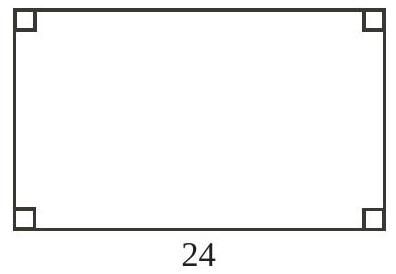 | Since the area of the rectangle is 192 and its length is 24 , then its width is $192 \div 24=8$.
Therefore, its perimeter is $2 \times 24+2 \times 8=64$.
ANSWER: (A) | 64 | Geometry | MCQ | olympiads | b7970391-7ae3-518a-a634-1c4efe2ec6bb | [
true,
true
] | [
"<think>\nOkay, let's see here. The problem says that the area of the rectangle is 192, and we need to find the perimeter. The options are given, but I need to figure out how to get from the area to the perimeter. Hmm. \n\nFirst, I remember that the area of a rectangle is calculated by multiplying its length by its... | [
false,
false
] | [
true,
true
] | null | 2 | [
{
"content": "The area of the rectangle shown is 192 . What is the perimeter of the rectangle?\n(A) 64\n(B) 384\n(C) 192\n(D) 1728\n(E) 32\n\n",
"role": "user"
},
{
"conte... |
1. Calculate:
$$
\operatorname{arcctg} 5+\operatorname{arctg} \frac{2}{3}
$$
(Solution should be presented in the form of an explicit numerical value expressed in degrees or radians.) | 1. We calculate:
$$
\begin{aligned}
\operatorname{tg}\left(\operatorname{arcctg} 5+\operatorname{arctg} \frac{2}{3}\right) & =\frac{\operatorname{tg}(\operatorname{arcctg} 5)+\operatorname{tg}\left(\operatorname{arctg} \frac{2}{3}\right)}{1-\operatorname{tg}(\operatorname{arcctg} 5) \operatorname{tg}\left(\operatornam... | \frac{\pi}{4} | Algebra | math-word-problem | olympiads | 221f14fd-2554-50b3-8f4c-cd3bfc94813d | [
true,
true
] | [
"<think>\nOkay, so I need to calculate the sum of arcctg 5 and arctg(2/3). Hmm, let me remember. I think arcctg is the inverse cotangent function, right? So, arcctg 5 is the angle whose cotangent is 5. Similarly, arctg(2/3) is the angle whose tangent is 2/3. I need to add these two angles together and find the resu... | [
true,
true
] | null | null | 2 | [
{
"content": "1. Calculate:\n\n$$\n\\operatorname{arcctg} 5+\\operatorname{arctg} \\frac{2}{3}\n$$\n\n(Solution should be presented in the form of an explicit numerical value expressed in degrees or radians.)",
"role": "user"
},
{
"content": "<think>Hmm , let me remember. I think arcctg is the inver... |
11. As shown in the figure, there are 10 cards, each card has a number from $0 \sim 9$, and there are no duplicates. Xiaoyu and Xiaomu each take 5 cards and start playing a card game. The rules of the game are as follows:
(1) Both players calculate the sum of the numbers on all 5 cards they have as their initial score.... | 匹答案】20
Match answer】20 | 20 | Algebra | math-word-problem | olympiads | 99262bd0-1637-5426-afd4-a74c4ddb7001 | [
true,
true
] | [
"<think>\nOkay, so here's this problem about Xiaoyu and Xiaomu each taking 5 cards from a set of 10 cards numbered 0 through 9. They play a game where they start with initial scores equal to the sum of their cards. Then each round they play a card, add their own card's number to their score, and subtract the oppone... | [
true,
true
] | null | null | 2 | [
{
"content": "11. As shown in the figure, there are 10 cards, each card has a number from $0 \\sim 9$, and there are no duplicates. Xiaoyu and Xiaomu each take 5 cards and start playing a card game. The rules of the game are as follows:\n(1) Both players calculate the sum of the numbers on all 5 cards they have... |
10.8. On a plane, a square is drawn, with its sides horizontal and vertical. Several segments parallel to the sides are drawn inside it, such that no two segments lie on the same line and do not intersect at a point that is internal for both segments. It turns out that the segments divide the square into rectangles, an... | Answer. $k \ell$.
First solution. Take a horizontal line $h$ passing through the top side of the square, and move it downwards. Consider the moment when it passes through some segment $I$ of the partition (by the condition, such a segment is unique at this moment; let $a$ rectangles be adjacent to it from above and $b... | k\ell | Combinatorics | math-word-problem | olympiads | 8bfb4d43-8822-5ad8-954f-87ff1713607c | [
true,
true
] | [
"<think>\nOkay, let me try to work through this problem step by step. So, we have a square with horizontal and vertical sides. Inside the square, there are several segments drawn parallel to the sides. The conditions are that no two segments lie on the same line and they don't intersect at an internal point for bot... | [
true,
true
] | null | [
"stop",
"stop"
] | 2 | [
{
"content": "10.8. On a plane, a square is drawn, with its sides horizontal and vertical. Several segments parallel to the sides are drawn inside it, such that no two segments lie on the same line and do not intersect at a point that is internal for both segments. It turns out that the segments divide the squa... |
Example 11 Let real numbers $x, y, z$ satisfy
$$
\left\{\begin{array}{l}
x+y=z-1, \\
x y=z^{2}-7 z+14 .
\end{array}\right.
$$
Question: What is the maximum value of $x^{2}+y^{2}$? For what value of $z$ does $x^{2}+y^{2}$ achieve its maximum value? | Solve: From $x+y=z-1$, we can set
$$
x=\frac{z-1}{2}+t, y=\frac{z-1}{2}-t \text {. }
$$
Substituting into $x y=z^{2}-7 z+14$ and simplifying, we get
$$
3 z^{2}-26 z-55=-4 t^{2} \text {. }
$$
Therefore, $3 z^{2}-26 z-55 \leqslant 0$.
Solving this, we get $\frac{11}{3} \leqslant z \leqslant 5$.
$$
\begin{array}{l}
\tex... | 8 | Algebra | math-word-problem | cn_contest | 7324a4c5-ea51-503e-81ce-0956df7e0093 | [
true,
true
] | [
"<think>\nOkay, so I have this problem where real numbers x, y, z satisfy two equations:\n\n1. x + y = z - 1\n2. xy = z² - 7z + 14\n\nAnd I need to find the maximum value of x² + y² and the value of z when this maximum occurs. Hmm, let's try to figure this out step by step.\n\nFirst, I remember that for any two num... | [
false,
false
] | [
false,
true
] | null | 1 | [
{
"content": "Example 11 Let real numbers $x, y, z$ satisfy\n$$\n\\left\\{\\begin{array}{l}\nx+y=z-1, \\\\\nx y=z^{2}-7 z+14 .\n\\end{array}\\right.\n$$\n\nQuestion: What is the maximum value of $x^{2}+y^{2}$? For what value of $z$ does $x^{2}+y^{2}$ achieve its maximum value?",
"role": "user"
},
{
... |
5. Solve the inequality $\frac{|x-2|-\left|x^{2}-4 x+2\right|}{2 \sqrt{2 x^{2}+7 x+3}-3 x-4} \geq 0$. | # Solution:
$\frac{|x-2|-\left|x^{2}-4 x+2\right|}{2 \sqrt{2 x^{2}+7 x+3}-3 x-4} \geq 0 . \quad$ Domain: $2 x^{2}+7 x+3 \geq 0, \Rightarrow x \in(-\infty ;-3] \cup[-0.5 ;+\infty)$.
The original inequality is equivalent to the following $\frac{(x-2)^{2}-\left(x^{2}-4 x+2\right)^{2}}{2 \sqrt{2 x^{2}+7 x+3}-3 x-4} \geq ... | x\in[-0.5;0]\cup[1;2)\cup(2;3]\cup[4;+\infty) | Inequalities | math-word-problem | olympiads | c6e9d3ff-9204-5a33-ae14-c15e4fe7f8c4 | [
true
] | [
"<think>\nOkay, so I need to solve this inequality: \n\n\\[\n\\frac{|x-2| - |x^2 - 4x + 2|}{2 \\sqrt{2x^2 + 7x + 3} - 3x - 4} \\geq 0\n\\]\n\nHmm, that's a bit complicated. Let me break it down step by step. First, I know that for a fraction to be greater than or equal to zero, the numerator and denominator must bo... | [
false
] | [
true
] | null | 1 | [
{
"content": "5. Solve the inequality $\\frac{|x-2|-\\left|x^{2}-4 x+2\\right|}{2 \\sqrt{2 x^{2}+7 x+3}-3 x-4} \\geq 0$.",
"role": "user"
},
{
"content": "<think>Hmm , that's a bit complicated. Let me break it down step by step. First, I know that for a fraction to be greater than or equal to zero, ... |
$\mathbf{5 . 2} 020$ balls are placed into 2020 different boxes, with each ball having an equal probability of landing in any box, and the probabilities of different balls landing in the boxes are independent of each other. The expected number of empty boxes is $\qquad$ | 5. $\frac{2019^{2020}}{2020^{2019}}$.
Define the random variable $x_{i}$: if the $i$-th box has a ball, then $x_{i}=0$, otherwise, $x_{i}=1$.
Thus, $P\left(x_{i}=1\right)=\frac{2019^{2020}}{2020^{2020}}$,
$P\left(x_{i}=0\right)=1-\frac{2019^{2020}}{2020^{2020}}$.
Therefore, $\mathrm{E}\left(x_{i}\right)=1 \times \frac... | \frac{2019^{2020}}{2020^{2019}} | Combinatorics | math-word-problem | olympiads | 4148ae3d-3e6f-5dfd-993b-776445447634 | [
true,
true
] | [
"<think>\nOkay, so I need to find the expected number of empty boxes when 2020 balls are placed into 2020 different boxes. Each ball has an equal chance of going into any box, and the placements are independent. Hmm, expectation problems can sometimes be tricky, but maybe I can use linearity of expectation here. Le... | [
true,
true
] | null | null | 2 | [
{
"content": "$\\mathbf{5 . 2} 020$ balls are placed into 2020 different boxes, with each ball having an equal probability of landing in any box, and the probabilities of different balls landing in the boxes are independent of each other. The expected number of empty boxes is $\\qquad$",
"role": "user"
},... |
I have $8$ unit cubes of different colors, which I want to glue together into a $2\times 2\times 2$ cube. How many distinct $2\times 2\times 2$ cubes can I make? Rotations of the same cube are not considered distinct, but reflections are. | 1. **Determine the number of rotational symmetries of a cube:**
- A cube has 6 faces. Any one of these faces can be chosen to be the "top" face, giving us 6 choices.
- Once a face is chosen as the top, there are 4 ways to rotate the cube around the vertical axis passing through the center of this face.
- There... | 1680 | Combinatorics | math-word-problem | aops_forum | e5e51e19-7768-5049-852c-e5df16cba8d3 | [
true,
true
] | [
"<think>\nOkay, so I need to figure out how many distinct 2x2x2 cubes I can make by gluing together 8 differently colored unit cubes. The problem says that rotations aren't considered different, but reflections are. Hmm, okay. Let me break this down.\n\nFirst, if all the colors were the same, the number of distinct... | [
true,
true
] | null | null | 2 | [
{
"content": "I have $8$ unit cubes of different colors, which I want to glue together into a $2\\times 2\\times 2$ cube. How many distinct $2\\times 2\\times 2$ cubes can I make? Rotations of the same cube are not considered distinct, but reflections are.",
"role": "user"
},
{
"content": "<think>... |
Let $n$ be a natural composite number. For each proper divisor $d$ of $n$ we write the number $d + 1$ on the board. Determine all natural numbers $n$ for which the numbers written on the board are all the proper divisors of a natural number $m$. (The proper divisors of a natural number $a> 1$ are the positive divisors... | 1. Suppose that $(n, m)$ satisfies the condition. We need to determine all natural composite numbers $n$ for which the numbers $d + 1$ (where $d$ is a proper divisor of $n$) are all the proper divisors of a natural number $m$.
2. Note that the least proper divisor of a composite number $n$ is always a prime number. Le... | 4, 8 | Number Theory | math-word-problem | aops_forum | 2f239759-05d3-52eb-9378-86ee037b9415 | [
true,
true
] | [
"<think>\nOkay, so I need to figure out all natural composite numbers n such that when I take each proper divisor d of n, add 1 to it, and write those numbers on the board, those resulting numbers are exactly all the proper divisors of some natural number m. Hmm. Let me parse this again.\n\nGiven n is composite, so... | [
true,
true
] | null | [
"stop",
"stop"
] | 2 | [
{
"content": "Let $n$ be a natural composite number. For each proper divisor $d$ of $n$ we write the number $d + 1$ on the board. Determine all natural numbers $n$ for which the numbers written on the board are all the proper divisors of a natural number $m$. (The proper divisors of a natural number $a> 1$ are... |
3.282. $\frac{\sin 8 \alpha+\sin 9 \alpha+\sin 10 \alpha+\sin 11 \alpha}{\cos 8 \alpha+\cos 9 \alpha+\cos 10 \alpha+\cos 11 \alpha} \times$
$\times \frac{\cos 8 \alpha-\cos 9 \alpha-\cos 10 \alpha+\cos 11 \alpha}{\sin 8 \alpha-\sin 9 \alpha-\sin 10 \alpha+\sin 11 \alpha}$. | Solution.
$$
\begin{aligned}
& \frac{\sin 8 \alpha + \sin 9 \alpha + \sin 10 \alpha + \sin 11 \alpha}{\cos 8 \alpha + \cos 9 \alpha + \cos 10 \alpha + \cos 11 \alpha} \cdot \frac{\cos 8 \alpha - \cos 9 \alpha - \cos 10 \alpha + \cos 11 \alpha}{\sin 8 \alpha - \sin 9 \alpha - \sin 10 \alpha + \sin 11 \alpha} = \\
& = \... | 1 | Algebra | math-word-problem | olympiads | 8a2501cc-835e-5ca4-b2f5-0384c8ee2364 | [
true,
true
] | [
"<think>\nOkay, let's see. I need to simplify this big trigonometric expression. The problem is:\n\n\\[\n\\frac{\\sin 8\\alpha + \\sin 9\\alpha + \\sin 10\\alpha + \\sin 11\\alpha}{\\cos 8\\alpha + \\cos 9\\alpha + \\cos 10\\alpha + \\cos 11\\alpha} \\times \\frac{\\cos 8\\alpha - \\cos 9\\alpha - \\cos 10\\alpha +... | [
true,
true
] | null | [
"stop",
"stop"
] | 2 | [
{
"content": "3.282. $\\frac{\\sin 8 \\alpha+\\sin 9 \\alpha+\\sin 10 \\alpha+\\sin 11 \\alpha}{\\cos 8 \\alpha+\\cos 9 \\alpha+\\cos 10 \\alpha+\\cos 11 \\alpha} \\times$\n\n$\\times \\frac{\\cos 8 \\alpha-\\cos 9 \\alpha-\\cos 10 \\alpha+\\cos 11 \\alpha}{\\sin 8 \\alpha-\\sin 9 \\alpha-\\sin 10 \\alpha+\\sin... |
9. Let $a_{1}=1$ and, for each $n \geq 2$,
$$
a_{n}=n\left(a_{1}+a_{2}+\cdots+a_{n-1}\right) .
$$
What is the smallest value of $n$ for which $a_{n}$ is divisible by 2022?
(A) 47
(B) 289
(C) 337
(D) 2022
(E) 2023 | 9. The answer is $(\mathbf{C})$. Consider the equations
$$
\left\{\begin{array}{l}
a_{n}=n\left(a_{1}+a_{2}+\cdots+a_{n-1}\right) \\
a_{n+1}=(n+1)\left(a_{1}+a_{2}+\cdots+a_{n-1}+a_{n}\right)
\end{array}\right.
$$
valid for every $n \geq 2$. We can rewrite the second equation as
$$
\begin{aligned}
a_{n+1} & =n\left(... | 337 | Number Theory | MCQ | olympiads | f6c567bc-e53f-5d81-9baf-f3da1369b7e6 | [
true,
true
] | [
"<think>\nOkay, let's try to tackle this problem step by step. So, we have a sequence defined by a₁ = 1, and for each n ≥ 2, aₙ = n times the sum of all previous terms. We need to find the smallest n such that aₙ is divisible by 2022. The options are given, but I need to figure out which one is correct.\n\nFirst, l... | [
false,
false
] | [
false,
true
] | null | 1 | [
{
"content": "9. Let $a_{1}=1$ and, for each $n \\geq 2$,\n\n$$\na_{n}=n\\left(a_{1}+a_{2}+\\cdots+a_{n-1}\\right) .\n$$\n\nWhat is the smallest value of $n$ for which $a_{n}$ is divisible by 2022?\n(A) 47\n(B) 289\n(C) 337\n(D) 2022\n(E) 2023",
"role": "user"
},
{
"content": "<think>Hmm .\n\nI need... |
8. (10 points) In the expression $(x+y+z)^{2034}+(x-y-z)^{2034}$, the brackets were expanded and like terms were combined. How many monomials $x^{a} y^{b} z^{c}$ with a non-zero coefficient were obtained? | Answer: 1036324
Solution: Let $t=y+z$, then the polynomial can be rewritten as $(x+t)^{2034}+(x-t)^{2034}$. We expand both brackets using the binomial theorem and get
$$
\begin{aligned}
& (x+t)^{2034}=x^{2034}+a_{1} x^{2033} t+\ldots+a_{2033} x t^{2033}+t^{2034} \\
& (x-t)^{2034}=x^{2034}-a_{1} x^{2033} t+\ldots-a_{2... | 1036324 | Algebra | math-word-problem | olympiads | 8bf94391-22ae-53ee-877b-afad64600bd7 | [
true,
true
] | [
"<think>\nOkay, let's see. The problem is about expanding the expression (x + y + z)^2034 + (x - y - z)^2034, and after expanding and combining like terms, we need to find the number of monomials x^a y^b z^c that have non-zero coefficients. Hmm, so first, I need to recall how expansions of such expressions work, es... | [
true,
true
] | null | null | 2 | [
{
"content": "8. (10 points) In the expression $(x+y+z)^{2034}+(x-y-z)^{2034}$, the brackets were expanded and like terms were combined. How many monomials $x^{a} y^{b} z^{c}$ with a non-zero coefficient were obtained?",
"role": "user"
},
{
"content": "<think>Hmm , so first, I need to recall how exp... |
When a number is divided by 7 , it gives a quotient of 4 with a remainder of 6 . What is the number?
(A) 17
(B) 168
(C) 34
(D) 31
(E) 46 | When a number is divided by 7 , it gives a quotient of 4 with a remainder of 6 . What is the number?
(A) 17
(B) 168
(C) 34
(D) 31
(E) 46
## Solution
The required number is $4 \times 7+6=34$. It is easy to verify this by dividing 34 by 7 which gives a quotient of 4 with remainder 6 .
ANswer: (C) | 34 | Number Theory | MCQ | olympiads | 18fc3f21-7440-5abb-8e66-1faf2c66a6ad | [
true,
true
] | [
"<think>\nOkay, let me try to figure out this problem. So the question is: When a number is divided by 7, it gives a quotient of 4 with a remainder of 6. What is the number? The options are A) 17, B) 168, C) 34, D) 31, E) 46. Hmm, let me think.\n\nFirst, I remember that when you divide a number by another number, y... | [
false,
false
] | [
true,
true
] | null | 2 | [
{
"content": "When a number is divided by 7 , it gives a quotient of 4 with a remainder of 6 . What is the number?\n(A) 17\n(B) 168\n(C) 34\n(D) 31\n(E) 46",
"role": "user"
},
{
"content": "<think>Hmm , let me think.\n\nDividend = 7 × 4 + 6. Let me do the math here. 7 multiplied by 4 is 28, and then... |
(1) Given $f(x+1)=x^{2}-3 x+2, x \in\left(-\infty, \frac{3}{2}\right)$, find $f^{-1}(x)$. | (1) $f^{-1}(x)=\frac{5}{2}-\sqrt{x+\frac{1}{4}}\left(x>-\frac{1}{4}\right)$ | f^{-1}(x)=\frac{5}{2}-\sqrt{x+\frac{1}{4}}(x>-\frac{1}{4}) | Algebra | math-word-problem | olympiads | 637d87fa-60a1-5416-a04e-76a6aa4b908d | [
true,
true
] | [
"<think>\nOkay, let's try to figure out how to find the inverse function of f(x+1) = x² - 3x + 2, where x is in the interval (-∞, 3/2). Hmm, inverse functions can be tricky, but let's take it step by step.\n\nFirst, I remember that to find an inverse function, you usually switch the roles of x and y and then solve ... | [
false,
false
] | [
true,
true
] | null | 2 | [
{
"content": "(1) Given $f(x+1)=x^{2}-3 x+2, x \\in\\left(-\\infty, \\frac{3}{2}\\right)$, find $f^{-1}(x)$.",
"role": "user"
},
{
"content": "<think>Hmm , inverse functions can be tricky, but let's take it step by step.\n\nFirst, I remember that to find an inverse function, you usually switch the r... |
Example 9. Given the dihedral angle $C-A B=D=120^{\circ}$, $\angle C B A=60^{\circ}, \angle D A B=30^{\circ}, A B=\sqrt{37} \mathrm{~cm}$ (Figure 17). Find the distance $d$ between the skew lines $B C, A D$. | Let the angle between $BC$ and $AD$ be $\theta$. By the triple product formula,
$$
\begin{aligned}
\cos \theta= & \cos 60^{\circ} \cos 150^{\circ} \\
& +\sin 60^{\circ} \sin 150^{\circ} \cos 120^{\circ} \\
= & -\frac{\sqrt{3}}{4}-\frac{\sqrt{3}}{8}=-\frac{3 \sqrt{3}}{8} .
\end{aligned}
$$
Thus, $\sin \theta=\frac{\sqr... | 3 | Geometry | math-word-problem | cn_contest | 4ad8a334-2937-5d7d-8ef3-e42d3c2a522b | [
false,
true,
false,
false
] | [
"<think>\nOkay, so I have this geometry problem here. Let me read it again carefully. The problem says: Given the dihedral angle C-AB-D is 120 degrees, angle CBA is 60 degrees, angle DAB is 30 degrees, and AB is √37 cm. We need to find the distance d between the skew lines BC and AD. Hmm, okay. Let me try to visual... | [
false,
true,
false,
false
] | null | null | 1 | [
{
"content": "Example 9. Given the dihedral angle $C-A B=D=120^{\\circ}$, $\\angle C B A=60^{\\circ}, \\angle D A B=30^{\\circ}, A B=\\sqrt{37} \\mathrm{~cm}$ (Figure 17). Find the distance $d$ between the skew lines $B C, A D$.",
"role": "user"
},
{
"content": "<think>Hmm , let's see. First, let me... |
Starting with a list of three numbers, the “[i]Make-My-Day[/i]” procedure creates a new list by replacing each number by the sum of the other two. For example, from $\{1, 3, 8\}$ “[i]Make-My-Day[/i]” gives $\{11, 9, 4\}$ and a new “[i]MakeMy-Day[/i]” leads to $\{13, 15, 20\}$. If we begin with $\{20, 1, 8\}$, what is t... | 1. Let's denote the initial list of numbers as $(a, b, c)$. The "Make-My-Day" procedure transforms this list into $(b+c, a+c, a+b)$.
2. We need to find the maximum difference between any two numbers in the list after applying the "Make-My-Day" procedure multiple times.
3. First, let's analyze the transformation:
\[... | 19 | Logic and Puzzles | math-word-problem | aops_forum | aac31e01-63de-55e7-858b-0f84818feb75 | [
true,
true
] | [
"<think>\nAlright, so I need to figure out the maximum difference between two numbers in the list after applying the \"Make-My-Day\" procedure 2018 times starting with {20, 1, 8}. Let me try to understand what this procedure does step by step.\n\nFirst, the example given: starting with {1, 3, 8}, applying the proce... | [
true,
true
] | null | null | 2 | [
{
"content": "Starting with a list of three numbers, the “[i]Make-My-Day[/i]” procedure creates a new list by replacing each number by the sum of the other two. For example, from $\\{1, 3, 8\\}$ “[i]Make-My-Day[/i]” gives $\\{11, 9, 4\\}$ and a new “[i]MakeMy-Day[/i]” leads to $\\{13, 15, 20\\}$. If we begin wi... |
38.3. Find a four-digit number that is 4 times less than the number written with the same digits but in reverse order.
$$
\text { (8-10 grades) }
$$ | 38.3. It is required to find the number $\overline{a b c e}$ such that $4 \cdot \overline{a b c e}=\overline{e c b a}$. Since the product $4 \cdot \overline{a b c e}$ is even, the number $\overline{e c b a}$ is also even, i.e., the digit $a$ is even. Then it is easy to see that $a=2$ (since for $a>2$ the product $4 \cd... | 2178 | Number Theory | math-word-problem | olympiads | c8b1b71e-7121-5a7a-993d-4428e1af1a6e | [
true,
true
] | [
"<think>\nOkay, so I need to find a four-digit number that is four times less than its reverse. Let me try to understand the problem first. If the original number is N, then when we reverse its digits, we get a new number, let's call it M. The problem states that N is four times less than M, which I think means tha... | [
true,
true
] | null | null | 2 | [
{
"content": "38.3. Find a four-digit number that is 4 times less than the number written with the same digits but in reverse order.\n\n$$\n\\text { (8-10 grades) }\n$$",
"role": "user"
},
{
"content": "<think>\nOkay, so I need to find a four-digit number that is four times less than its reverse. Le... |
What is the maximum number of angles less than $150^{\circ}$ that a non-crossing 2017-sided polygon can have, all of whose angles are strictly less than $180^{\circ}$?
## 3 High School Eliminators: Statements
Translate the text above into English, please keep the original text's line breaks and format, and output the... | Answer: 11. If the angles are $180-x_{i}$, then we have $x_{i}>0$ and $x_{1}+\cdots+x_{2017}=360$, so at most 11 of the $x_{i}$ can be greater than 30. We can verify that conversely there exists such a polygon.
## 5 High School Eliminatory: Solutions | 11 | Geometry | math-word-problem | olympiads | fc1fd4d6-220b-5d6b-945e-064e79023b99 | [
true,
true
] | [
"<think>\nAlright, let's tackle this problem step by step. So, we need to find the maximum number of angles less than 150 degrees in a non-crossing 2017-sided polygon where all angles are strictly less than 180 degrees. Hmm, okay.\n\nFirst, I remember that the sum of the interior angles of an n-sided polygon is (n-... | [
true,
false
] | null | null | 1 | [
{
"content": "What is the maximum number of angles less than $150^{\\circ}$ that a non-crossing 2017-sided polygon can have, all of whose angles are strictly less than $180^{\\circ}$?\n\n## 3 High School Eliminators: Statements\n\nTranslate the text above into English, please keep the original text's line break... |
Example 7 Find all non-zero polynomials $P(x)$ that satisfy $P\left(x^{2}\right)=[P(x)]^{2}(x \in \mathbf{R})$.
| When $P(x)$ is a non-zero constant $a$, i.e., $a=P\left(x^{2}\right)=[P(x)]^{2}=a^{2}$, thus $a=1$, i.e., $P(x)=1$ satisfies the condition. When $P(x)$ is an $n(\geqslant 1)$-degree polynomial, let the required polynomial be $P(x)=a_{n} x^{n}+$ $a_{n-1} x^{n-1}+\cdots+a_{1} x+a_{0}$, where $a_{n} \neq 0$, comparing the... | P(x)=x^{n}orP(x)=1 | Algebra | math-word-problem | olympiads | 0be13536-ef98-5914-832a-f78853581b43 | [
true,
true
] | [
"<think>\nAlright, let's see. I need to find all non-zero polynomials P(x) such that P(x²) = [P(x)]² for all real numbers x. Hmm, okay. So, the problem is asking for polynomials where if you plug in x squared into the polynomial, you get the square of the original polynomial evaluated at x. Interesting.\n\nFirst, l... | [
false,
false
] | [
true,
false
] | null | 1 | [
{
"content": "Example 7 Find all non-zero polynomials $P(x)$ that satisfy $P\\left(x^{2}\\right)=[P(x)]^{2}(x \\in \\mathbf{R})$.\n\n",
"role": "user"
},
{
"content": "<think>Hmm , okay. So, the problem is asking for polynomials where if you plug in x squared into the polynomial, you get the square ... |
## Task $9 / 64$
Let $p$ be an integer that is not divisible by 2, 3, or 5. What is the remainder when $p^{4}$ is divided by 240? | To investigate divisibility, the number $p^{4}-1$ is formed and factored as follows:
$$
p^{4}-1=\left(p^{2}-1\right)\left(p^{2}+1\right)=(p-1)(p+1)\left(p^{2}+1\right)
$$
1. Since $p$ is not divisible by 2, it follows that $p^{2}$ is also not divisible by 2, but $p-1, p+1$, and $p^{2}+1$ are. Since $p-1$ and $p+1$ ar... | 1 | Number Theory | math-word-problem | olympiads | 681d3713-12f1-50f7-94a5-6734f16875be | [
true,
true
] | [
"<think>\nOkay, let's try to figure out this problem. So, the question is: If p is an integer not divisible by 2, 3, or 5, what is the remainder when p⁴ is divided by 240? Hmm, alright. Let's break this down step by step.\n\nFirst, I need to recall some number theory concepts. The problem is asking about the remain... | [
true,
true
] | null | null | 2 | [
{
"content": "## Task $9 / 64$\n\nLet $p$ be an integer that is not divisible by 2, 3, or 5. What is the remainder when $p^{4}$ is divided by 240?",
"role": "user"
},
{
"content": "<think>Hmm , alright. Let's break this down step by step.\n\nFirst, I need to recall some number theory concepts. The p... |
- Four, (20 points) Given that $P$ and $Q$ are two moving points on the ellipse $C: \frac{x^{2}}{a^{2}}+\frac{y^{2}}{b^{2}}=1(a>b>0)$, $O$ is the origin, the slope of line $O P$ is $k$, the product of the slopes of lines $O P$ and $O Q$ is $m$, and $p=|O P|^{2}+|O Q|^{2}$ is a constant independent of $k$.
(1) Find the ... | (1) The equation of the line $O P$ is $y=k x$, and when combined with the equation of the ellipse $C$, we get
$$
x^{2}=\frac{a^{2} b^{2}}{b^{2}+a^{2} k^{2}} \text {. }
$$
Then $|O P|^{2}=x^{2}+y^{2}=\left(1+k^{2}\right) x^{2}=\frac{a^{2} b^{2}\left(1+k^{2}\right)}{b^{2}+a^{2} k^{2}}$.
Similarly, we have
$$
\begin{arra... | 0<e_{2}-e_{1}<\sqrt{2} | Algebra | math-word-problem | cn_contest | 258b1c7a-1edc-5cfd-a025-92d83cbc6bcc | [
true,
true
] | [
"<think>\nOkay, let's tackle this problem step by step. It's about an ellipse, moving points P and Q on it, and some conditions involving slopes and distances. Then there's a hyperbola involved in part (2). Hmm. Let's start with part (1).\n\nFirst, we have the ellipse C: x²/a² + y²/b² = 1, with a > b > 0. Points P ... | [
false,
false
] | [
false,
true
] | null | 1 | [
{
"content": "- Four, (20 points) Given that $P$ and $Q$ are two moving points on the ellipse $C: \\frac{x^{2}}{a^{2}}+\\frac{y^{2}}{b^{2}}=1(a>b>0)$, $O$ is the origin, the slope of line $O P$ is $k$, the product of the slopes of lines $O P$ and $O Q$ is $m$, and $p=|O P|^{2}+|O Q|^{2}$ is a constant independe... |
Example 2 For a finite set $A$, there exists a function $f: N \rightarrow$ $A$, with the following property: if $i, j \in N$, and $|i-j|$ is a prime number, then $f(i) \neq f(j)$. How many elements must the set $A$ have at least? | Solution: Since the absolute value of the difference between any two numbers among $1,3,6,8$ is a prime number, according to the problem, $f(1)$, $f(3)$, $f(6)$, and $f(8)$ are four distinct elements in $A$, thus $|A| \geqslant 4$.
On the other hand, if we let $A=\{0,1,2,3\}$, and the mapping $f: N \rightarrow A$ is d... | 4 | Combinatorics | math-word-problem | cn_contest | ce8a526c-fe4c-51dd-85ec-124db2ec3b79 | [
true,
true
] | [
"<think>\nOkay, let's see. The problem is about finding the minimum number of elements that set A must have, given that there's a function f from the natural numbers N to A such that if the difference between two natural numbers i and j is a prime number, then f(i) ≠ f(j). So, essentially, we need to color the natu... | [
true,
true
] | null | null | 2 | [
{
"content": "Example 2 For a finite set $A$, there exists a function $f: N \\rightarrow$ $A$, with the following property: if $i, j \\in N$, and $|i-j|$ is a prime number, then $f(i) \\neq f(j)$. How many elements must the set $A$ have at least?",
"role": "user"
},
{
"content": "<think>Hmm , this r... |
Example: Let $f(x)$ be a function defined on $\mathbf{R}$, for any $x, y \in \mathbf{R}$, we have
$$
f(x+3) \leqslant f(x)+3, f(x+2) \geqslant f(x)+2 .
$$
Let $g(x)=f(x)-x$.
(1) Prove: $g(x)$ is a periodic function;
(2) If $f(998)=1002$, find the value of $f(2000)$. | (1) Proof: From $g(x)=f(x)-x$, we get
$$
\begin{array}{l}
g(x+2)=f(x+2)-x-2, \\
g(x+3)=f(x+3)-x-3 .
\end{array}
$$
Substituting into the inequality in the problem, we get
$$
\begin{array}{l}
g(x+2) \geqslant f(x)+2-x-2=f(x)-x, \\
g(x+3) \leqslant f(x)+3-x-3=f(x)-x .
\end{array}
$$
From equation (1), we get
$$
\begin{... | 2004 | Algebra | math-word-problem | cn_contest | 7ef65d7a-6dbd-54ec-aadb-96f677b80f0c | [
true,
true,
true,
true
] | [
"<think>\nOkay, so I need to solve this problem about the function f(x) and its periodicity. Let me start by understanding what's given. The problem says that for any real numbers x and y, the function f satisfies two inequalities:\n\n1. f(x + 3) ≤ f(x) + 3\n2. f(x + 2) ≥ f(x) + 2\n\nThen, they define g(x) = f(x) -... | [
true,
true,
true,
true
] | null | null | 4 | [
{
"content": "Example: Let $f(x)$ be a function defined on $\\mathbf{R}$, for any $x, y \\in \\mathbf{R}$, we have\n$$\nf(x+3) \\leqslant f(x)+3, f(x+2) \\geqslant f(x)+2 .\n$$\n\nLet $g(x)=f(x)-x$.\n(1) Prove: $g(x)$ is a periodic function;\n(2) If $f(998)=1002$, find the value of $f(2000)$.",
"role": "use... |
Solve the systems:
a) $x+y+z=6, \frac{1}{x}+\frac{1}{y}+\frac{1}{z}=\frac{11}{6}, x y+y z+x z=11$
b) $x(y+z)=2, y(z+x)=2, z(x+y)=3$
c) $x^{2}+y^{2}+x+y=32, 12(x+y)=7 x y$
d) $\frac{x^{2}}{y}+\frac{y^{2}}{x}=\frac{7}{2}, \frac{1}{y}+\frac{1}{x}=\frac{1}{2}$
e) $x+y+z=1, x y+x z+y z=-4, x^{3}+y^{3}+z^{3}=1$;
f) $x^... | a) From the last two equations, it follows that $x y z=6$. Thus, $x, y, z$ are uniquely determined up to permutation. But one solution - $(1,2,3)$ - is obvious.
b) Subtracting the first two equations, we get $x z=y z$. Since $z \neq 0$ (this is evident from the last equation), then $x=y$. Then from the last equation, ... | ){1,2,3};b)(\\frac{\sqrt{2}}{2},\\frac{\sqrt{2}}{2},\\frac{3\sqrt{2}}{2});){3,4},{\frac{-16+8\sqrt{10}}{7},\frac{-16-8\sqrt{10}}} | Algebra | math-word-problem | olympiads | 5e033cb0-c8cb-5944-8779-36804fb95098 | [
true,
true
] | [
"<think>\nOkay, so I need to solve these six systems of equations. Let me take them one at a time. Let's start with part a.\n\n**Problem a)**\nEquations:\n1. \\( x + y + z = 6 \\)\n2. \\( \\frac{1}{x} + \\frac{1}{y} + \\frac{1}{z} = \\frac{11}{6} \\)\n3. \\( xy + yz + xz = 11 \\)\n\nHmm, this looks like a system in... | [
false,
false
] | [
true,
false
] | null | 1 | [
{
"content": "Solve the systems:\n\na) $x+y+z=6, \\frac{1}{x}+\\frac{1}{y}+\\frac{1}{z}=\\frac{11}{6}, x y+y z+x z=11$\n\nb) $x(y+z)=2, y(z+x)=2, z(x+y)=3$\n\nc) $x^{2}+y^{2}+x+y=32, 12(x+y)=7 x y$\n\nd) $\\frac{x^{2}}{y}+\\frac{y^{2}}{x}=\\frac{7}{2}, \\frac{1}{y}+\\frac{1}{x}=\\frac{1}{2}$\n\ne) $x+y+z=1, x y... |
3. Let $n \geqslant 3$ be a positive integer. Then
$$
\sum_{k=1}^{n} \arctan \frac{1}{k^{2}+k+1}=
$$
$\qquad$ | $\begin{array}{l}\text { 3. } \arctan (n+1)-\frac{\pi}{4} \text {. } \\ \text { From } \arctan \frac{1}{n^{2}+n+1} \\ =\arctan (n+1)-\arctan n \\ \Rightarrow \sum_{k=1}^{n} \arctan \frac{1}{k^{2}+k+1} \\ =\arctan (n+1)-\frac{\pi}{4} \text {. }\end{array}$ | \arctan(n+1)-\frac{\pi}{4} | Algebra | math-word-problem | olympiads | d454ce4d-e466-5414-9421-6afdd174a367 | [
true,
true
] | [
"<think>\nOkay, let's see. The problem is to find the sum from k=1 to n of arctan(1/(k² + k + 1)). Hmm, arctangent sums. I remember that sometimes these can telescope if there's a clever way to express each term as a difference of two arctangent terms. There's a formula for arctan(a) - arctan(b) or something like t... | [
true,
true
] | null | null | 2 | [
{
"content": "3. Let $n \\geqslant 3$ be a positive integer. Then\n$$\n\\sum_{k=1}^{n} \\arctan \\frac{1}{k^{2}+k+1}=\n$$\n$\\qquad$",
"role": "user"
},
{
"content": "<think>Hmm , arctangent sums. I remember that sometimes these can telescope if there's a clever way to express each term as a differe... |
Example 6 Find all pairs of primes $(p, q)$ such that
$$
p q \mid\left(5^{p}+5^{q}\right) .{ }^{[2]}
$$
(2009, China Mathematical Olympiad) | (1) If $\min \{p, q\}=2$, without loss of generality, let $p=2$, then to make $2 q l\left(5^{2}+5^{q}\right)=25+5^{q}$, it is necessary that
$$
q \mid\left(25+5^{q}\right) \text {. }
$$
Since $5^{q}+25=5^{q}-5+30$, by Fermat's Little Theorem, we have
$$
q\left|\left(5^{q}-5\right) \Rightarrow q\right| 30 \text {. }
$$... | (2,3),(3,2),(2,5),(5,2),(5,5),(5,313),(313,5) | Number Theory | math-word-problem | cn_contest | 9634e103-bcdb-50fc-9758-47259e2f7b26 | [
true,
true
] | [
"<think>\nOkay, so I need to find all prime pairs (p, q) such that the product pq divides (5^p + 5^q). Hmm, primes... divisibility... exponents. Let me start by recalling some number theory concepts that might help here.\n\nFirst, since p and q are primes, they can be 2, 3, 5, or other primes. Maybe I should check ... | [
true,
true
] | null | null | 2 | [
{
"content": "Example 6 Find all pairs of primes $(p, q)$ such that\n$$\np q \\mid\\left(5^{p}+5^{q}\\right) .{ }^{[2]}\n$$\n(2009, China Mathematical Olympiad)",
"role": "user"
},
{
"content": "<think>Hmm , primes... divisibility... exponents. Let me start by recalling some number theory concepts t... |
Example 7 Find the least common multiple of 108, 28, and 42. | Since
$$108=2^{2} \times 3^{3}, 28=2^{2} \times 7, 42=2 \times 3 \times 7$$
we get
$$\{108,28,42\}=2^{2} \times 3^{3} \times 7=756$$ | 756 | Number Theory | math-word-problem | number_theory | 36728c02-6406-50d2-b014-71cf9be7c64e | [
true,
true
] | [
"<think>\nAlright, let me try to figure out the least common multiple (LCM) of 108, 28, and 42. Hmm, LCMs can be a bit tricky when there are multiple numbers involved, but I remember that the LCM of several numbers is the smallest number that all of them can divide into without leaving a remainder. So, I need to fi... | [
true,
true
] | null | null | 2 | [
{
"content": "Example 7 Find the least common multiple of 108, 28, and 42.",
"role": "user"
},
{
"content": "<think>Hmm , LCMs can be a bit tricky when there are multiple numbers involved, but I remember that the LCM of several numbers is the smallest number that all of them can divide into without ... |
5. Given a fixed point $A(1,1)$, and $F$ is the left focus of the ellipse $\frac{x^{2}}{8}+\frac{y^{2}}{4}=1$. A moving point $P$ is on the ellipse. Try to find the maximum and minimum values of $|P F|+|P A|$, and the coordinates of point $P$ when these values are achieved. | 5. Let $F_{1}, F_{2}$ be the left and right foci, respectively. Since $\left|P F_{1}\right|+|P A|=\left(\left|P F_{1}\right|+\left|P F_{2}\right|\right)+\left(|P A|-\left|P F_{2}\right|\right)=4 \sqrt{2}+$ $\left(|P A|-\left|P F_{2}\right|\right)$, it is easy to see that $-\left|A F_{2}\right| \leqslant|P A|-\left|P F_... | 5\sqrt{2} | Geometry | math-word-problem | olympiads | 6fa30b6e-c911-55db-844e-2f3da878a44b | [
true,
true
] | [
"<think>\nOkay, let me try to solve this problem step by step. So, the problem is about an ellipse given by the equation x²/8 + y²/4 = 1. We have a fixed point A at (1,1), and F is the left focus of the ellipse. We need to find the maximum and minimum values of |PF| + |PA| as point P moves along the ellipse, and al... | [
false,
false
] | [
true,
true
] | null | 2 | [
{
"content": "5. Given a fixed point $A(1,1)$, and $F$ is the left focus of the ellipse $\\frac{x^{2}}{8}+\\frac{y^{2}}{4}=1$. A moving point $P$ is on the ellipse. Try to find the maximum and minimum values of $|P F|+|P A|$, and the coordinates of point $P$ when these values are achieved.",
"role": "user"
... |
Point $Q$ has coordinates $(a+1,4 a+1)$ for some $a>1$, and lies on the line with equation $y=a x+3$. If $O$ is the origin $(0,0)$, determine the coordinates of the points $P$ and $R$ so that $O P Q R$ is a square with diagonal $O Q$. | Since $Q(a+1,4 a+1)$ lies on the line with equation $y=a x+3$, then
$$
\begin{aligned}
4 a+1 & =a(a+1)+3 \\
0 & =a^{2}-3 a+2 \\
0 & =(a-1)(a-2)
\end{aligned}
$$
Since $a>1$, then we must have $a=2$.
Therefore, $Q$ has coordinates $(3,9)$.
We want to find the coordinates of points $P$ and $R$ so that, together with ... | (-3,6),(6,3) | Geometry | math-word-problem | olympiads | 874a1c0d-4651-5808-9d29-3730a5e5dcde | [
true,
true
] | [
"<think>\nOkay, so I have this problem here. Let me read it again. Point Q has coordinates (a + 1, 4a + 1) for some a > 1, and it lies on the line with equation y = ax + 3. We need to find the coordinates of points P and R such that OPQR is a square with diagonal OQ. O is the origin (0,0). Hmm, okay. Let me try to ... | [
true,
true
] | null | null | 2 | [
{
"content": "Point $Q$ has coordinates $(a+1,4 a+1)$ for some $a>1$, and lies on the line with equation $y=a x+3$. If $O$ is the origin $(0,0)$, determine the coordinates of the points $P$ and $R$ so that $O P Q R$ is a square with diagonal $O Q$.",
"role": "user"
},
{
"content": "<think>Hmm , okay... |
8. If the positive real numbers $a_{1}, a_{2}, a_{3}, a_{4}$ satisfy $a_{1} \geqslant a_{2} a_{3}^{2}, a_{2} \geqslant a_{3} a_{4}^{2}, a_{3} \geqslant a_{4} a_{1}^{2}, a_{4} \geqslant a_{1} a_{2}^{2}$. Then the maximum value of $a_{1} a_{2} a_{3} a_{4}\left(a_{1}-a_{2} a_{3}^{2}\right)\left(a_{2}-a_{3} a_{4}^{2}\right... | $$
\begin{array}{l}
a_{1} a_{2} a_{3} a_{4}\left(a_{1}-a_{2} a_{3}^{2}\right)\left(a_{2}-a_{3} a_{4}^{2}\right)\left(a_{3}-a_{4} a_{1}^{2}\right)\left(a_{4}-a_{1} a_{2}^{2}\right) \\
=a_{2}\left(a_{1}-a_{2} a_{3}^{2}\right) \cdot a_{3}\left(a_{2}-a_{3} a_{4}^{2}\right) \cdot a_{4}\left(a_{3}-a_{4} a_{1}^{2}\right) \cdo... | \frac{1}{256} | Inequalities | math-word-problem | olympiads | 6891b435-8d22-507f-9552-fe61866f7f57 | [
true,
true
] | [
"<think>\nOkay, so I have this problem here where I need to find the maximum value of the product \\( a_{1} a_{2} a_{3} a_{4} \\left(a_{1} - a_{2} a_{3}^{2}\\right)\\left(a_{2} - a_{3} a_{4}^{2}\\right)\\left(a_{3} - a_{4} a_{1}^{2}\\right)\\left(a_{4} - a_{1} a_{2}^{2}\\right) \\) given that all the \\( a_i \\) ar... | [
true,
true
] | null | null | 2 | [
{
"content": "8. If the positive real numbers $a_{1}, a_{2}, a_{3}, a_{4}$ satisfy $a_{1} \\geqslant a_{2} a_{3}^{2}, a_{2} \\geqslant a_{3} a_{4}^{2}, a_{3} \\geqslant a_{4} a_{1}^{2}, a_{4} \\geqslant a_{1} a_{2}^{2}$. Then the maximum value of $a_{1} a_{2} a_{3} a_{4}\\left(a_{1}-a_{2} a_{3}^{2}\\right)\\lef... |
A square-based (with base vertices $A, B, C, D$) equal-sided pyramid has its apex at $E$. Let $P$ be the point that divides the edge $AE$ in a 3:1 ratio, such that $EP:PA=3$, and let $Q$ be the midpoint of the edge $CE$! In what ratio does the plane passing through points $D, P$, and $Q$ divide the edge $BE$? | Let's denote the intersection point under investigation as $R$ and the center of the base as $T$. Since both $P$ and $Q$ lie in the diagonal plane $A C E$ of the pyramid, the line $P Q$ intersects the pyramid's $E T$ axis. Let's denote this intersection point as $S$. The segments $Q T$ and $P E$ are parallel; furthermo... | 4:3 | Geometry | math-word-problem | olympiads | 099f3ae5-f6e7-562a-9483-a03296061dbe | [
true,
true
] | [
"<think>\nOkay, so I need to figure out the ratio in which the plane passing through points D, P, and Q divides the edge BE of this square-based pyramid. Hmm. Let me try to visualize this pyramid first. The base is a square with vertices A, B, C, D. The apex is E, so all the edges from the base to E are equal in le... | [
true,
true
] | null | [
"stop",
"stop"
] | 2 | [
{
"content": "A square-based (with base vertices $A, B, C, D$) equal-sided pyramid has its apex at $E$. Let $P$ be the point that divides the edge $AE$ in a 3:1 ratio, such that $EP:PA=3$, and let $Q$ be the midpoint of the edge $CE$! In what ratio does the plane passing through points $D, P$, and $Q$ divide th... |
3. Given the sequences $\left\{a_{n}\right\}$ and $\left\{b_{n}\right\}$, for any $n \in \mathbf{Z}_{+}$, it holds that $a_{n}>b_{n}$. As $n \rightarrow+\infty$, the limits of the sequences $\left\{a_{n}\right\}$ and $\left\{b_{n}\right\}$ are $A$ and $B$ respectively. Then ( ).
(A) $A>B$
(B) $A \geqslant B$
(C) $A \ne... | 3. B.
If we take $a_{n}=\frac{1}{n}, b_{n}=\frac{1}{n+1}$, then $a_{n}>b_{n}$.
And $\lim _{n \rightarrow+\infty} a_{n}=\lim _{n \rightarrow+\infty} b_{n}=0$, so $A>B$ is not necessarily true, but it can ensure that $A \geqslant B$. | B | Calculus | MCQ | olympiads | 97bffc53-cf94-5a81-b21e-7314acb9387f | [
true,
true
] | [
"<think>\nOkay, so I have this problem here about two sequences, {aₙ} and {bₙ}, where for every positive integer n, aₙ is greater than bₙ. Then, as n approaches infinity, both sequences have limits: A for {aₙ} and B for {bₙ}. The question is asking which of the options (A) to (D) is correct regarding the relationsh... | [
true,
true
] | null | null | 2 | [
{
"content": "3. Given the sequences $\\left\\{a_{n}\\right\\}$ and $\\left\\{b_{n}\\right\\}$, for any $n \\in \\mathbf{Z}_{+}$, it holds that $a_{n}>b_{n}$. As $n \\rightarrow+\\infty$, the limits of the sequences $\\left\\{a_{n}\\right\\}$ and $\\left\\{b_{n}\\right\\}$ are $A$ and $B$ respectively. Then ( )... |
2.9. Solve the equation $\sqrt{2 x-6}+\sqrt{x+4}=5$.
### 2.10. Solve the equation
$$
\sqrt[m]{(1+x)^{2}}-\sqrt[m]{(1-x)^{2}}=\sqrt[m]{1-x^{2}}
$$ | 2.9. Let $y=\sqrt{x+4}$. Then $x=y^{2}-4$, so $2 x-6=2 y^{2}-$ -14. Therefore, we get the equation $\sqrt{2 y^{2}-14}+y=5$. Move $y$ to the right side and square both sides. As a result, we get the equation $y^{2}+10 y-39=0$. Its roots are 3 and -13. But $y \geqslant 0$, so only the root $y=3$ remains, which correspond... | 5 | Algebra | math-word-problem | olympiads | e3808529-731e-58ed-8cb5-4bead6a43dfa | [
true
] | [
"<think>\nOkay, so I have these two equations to solve. Let me start with problem 2.9: Solve the equation √(2x - 6) + √(x + 4) = 5. Alright, radicals can be tricky, but usually you can solve them by isolating one radical and squaring both sides. Let me try that.\n\nFirst, let's check the domains of the square roots... | [
false
] | [
true
] | null | 1 | [
{
"content": "2.9. Solve the equation $\\sqrt{2 x-6}+\\sqrt{x+4}=5$.\n\n### 2.10. Solve the equation\n\n$$\n\\sqrt[m]{(1+x)^{2}}-\\sqrt[m]{(1-x)^{2}}=\\sqrt[m]{1-x^{2}}\n$$",
"role": "user"
},
{
"content": "<think>\nOkay, so I have these two equations to solve. Let me start with problem 2.9: Solve t... |
6. Let the diagonals of convex quadrilateral $A B C D$ intersect at $O$, and $A D / / B C$. The following are four statements about it:
(1) Given $A B+B C=A D+D C$. Then $A B C D$ is a parallelogram,
(2) Given $D C+D O=A O+A B$. Then $A B C D$ is a parallelogram;
(3) Given $B C+B O+A O=A D+D O+C O$. Then $A B C D$ is n... | 6. (B).
(1) As shown in the figure, extend $CB$ to point $E$ such that $BE=AB$, and extend $AD$ to point $F$ such that $DF=DC$. Then $EC \parallel AF$, so $AECF$ is a parallelogram, $\angle E=\angle F$, $\angle ABE=\angle CDF$, $\angle ABC=\angle ADC$.
Since $AD \parallel BC$, $\angle ABC + \angle DAB = 180^{\circ}$.
$... | B | Geometry | MCQ | cn_contest | 4a51dd1e-9310-5bf2-88a6-3aceb0cb3056 | [
true,
true
] | [
"<think>\nAlright, let's try to figure out which of these four statements about the convex quadrilateral ABCD are true. The quadrilateral has diagonals intersecting at O, and AD is parallel to BC. We need to check each statement one by one to see if the given condition necessarily makes ABCD a parallelogram or not.... | [
true,
true
] | null | null | 2 | [
{
"content": "6. Let the diagonals of convex quadrilateral $A B C D$ intersect at $O$, and $A D / / B C$. The following are four statements about it:\n(1) Given $A B+B C=A D+D C$. Then $A B C D$ is a parallelogram,\n(2) Given $D C+D O=A O+A B$. Then $A B C D$ is a parallelogram;\n(3) Given $B C+B O+A O=A D+D O+... |
See the promotions of two supermarkets:
| Supermarket A | Supermarket B |
| :---: | :---: |
| 6 cans of 3 liters of QUOTE ice cream | QUOTE ice cream - can of 3 liters |
| $\mathrm{R} \$ 24.00$ | 4 cans - only $\mathrm{R} \$ 14.00$ |
Joana wants to buy 12 cans of ice cream for her birthday party. In which supermarket... | The correct option is (d).
If Joana buys at supermarket A, she will spend $2 \times 24=48$ reais. If she buys at supermarket B, she will spend $3 \times 14=42$ reais. Therefore, at supermarket B, she will save 6 reais compared to A. | 6 | Logic and Puzzles | MCQ | olympiads | b8adb724-137c-585d-b741-9361b2aef1f6 | [
true,
true
] | [
"<think>\nOkay, let's see. Joana wants to buy 12 cans of ice cream. She's looking at two supermarkets, A and B. I need to figure out which one is cheaper and by how much. Let me break down the information given for each supermarket.\n\nStarting with Supermarket A: Their promotion is 6 cans of 3 liters each of QUOTE... | [
false,
false
] | [
true,
true
] | null | 2 | [
{
"content": "See the promotions of two supermarkets:\n\n| Supermarket A | Supermarket B |\n| :---: | :---: |\n| 6 cans of 3 liters of QUOTE ice cream | QUOTE ice cream - can of 3 liters |\n| $\\mathrm{R} \\$ 24.00$ | 4 cans - only $\\mathrm{R} \\$ 14.00$ |\n\nJoana wants to buy 12 cans of ice cream for her bir... |
5. Find all pairs of positive numbers $(x, y)$ that satisfy the system of equations $\left\{\begin{array}{l}x-3 \sqrt{x y}-2 \sqrt{\frac{x}{y}}+6=0, \\ x^{2} y^{2}+x^{4}=82 .\end{array}\right.$ Answer: $\left(3 ; \frac{1}{3}\right),\left(\sqrt[4]{66} ; \frac{4}{\sqrt[4]{66}}\right)$ | Solution. Let $\sqrt{\frac{x}{y}}=u, \quad \sqrt{x y}=v \quad$ (with $\quad u>0, \quad v>0$ ). Then $\quad u v=\sqrt{\frac{x}{y}} \cdot \sqrt{x y}=\sqrt{x^{2}}=|x|=x$, $\frac{v}{u}=\sqrt{x y}: \sqrt{\frac{x}{y}}=\sqrt{y^{2}}=|y|=y$, since $x$ and $y$ are positive by condition. The system takes the form
$$
\left\{\begi... | (3;\frac{1}{3}),(\sqrt[4]{66};\frac{4}{\sqrt[4]{66}}) | Algebra | math-word-problem | olympiads | 6c7f8272-506d-5664-8ec8-8f6163fcb83b | [
true,
true
] | [
"<think>\nOkay, let's see. I need to solve this system of equations:\n\nFirst equation: \\( x - 3 \\sqrt{xy} - 2 \\sqrt{\\frac{x}{y}} + 6 = 0 \\)\n\nSecond equation: \\( x^2 y^2 + x^4 = 82 \\)\n\nHmm. Both equations involve \\( x \\) and \\( y \\), but the first one has square roots, which might complicate things. ... | [
true,
true
] | null | [
"stop",
"stop"
] | 2 | [
{
"content": "5. Find all pairs of positive numbers $(x, y)$ that satisfy the system of equations $\\left\\{\\begin{array}{l}x-3 \\sqrt{x y}-2 \\sqrt{\\frac{x}{y}}+6=0, \\\\ x^{2} y^{2}+x^{4}=82 .\\end{array}\\right.$ Answer: $\\left(3 ; \\frac{1}{3}\\right),\\left(\\sqrt[4]{66} ; \\frac{4}{\\sqrt[4]{66}}\\righ... |
3. If $\left(x^{2}-x-2\right)^{3}=a_{0}+a_{1} x+\cdots+a_{6} x^{6}$, then $a_{1}+a_{3}+a_{5}=$ | 3. -4 .
Let $x=0, x=1$, we get
$$
\begin{array}{l}
a_{0}=-8, \\
a_{0}+a_{1}+\cdots+a_{6}=\left(1^{2}-1-2\right)^{3}=-8 .
\end{array}
$$
Thus, $a_{1}+a_{2}+\cdots+a_{6}=0$.
Let $x=-1$, we get
$$
\begin{array}{l}
a_{0}-a_{1}+a_{2}-a_{3}+a_{4}-a_{5}+a_{6} \\
=\left[(-1)^{2}-(-1)-2\right]^{3}=0 .
\end{array}
$$
Thus, $-... | -4 | Algebra | math-word-problem | cn_contest | 8fad97b0-57a2-5764-8876-a21da120928f | [
true,
true
] | [
"<think>\nOkay, so I need to find the sum of the coefficients a₁ + a₃ + a₅ from the expansion of (x² - x - 2)³. Hmm, let me think about how to approach this. \n\nFirst, I remember that when you expand a polynomial raised to a power, the coefficients correspond to the terms in the expansion. But calculating each coe... | [
true,
true
] | null | null | 2 | [
{
"content": "3. If $\\left(x^{2}-x-2\\right)^{3}=a_{0}+a_{1} x+\\cdots+a_{6} x^{6}$, then $a_{1}+a_{3}+a_{5}=$",
"role": "user"
},
{
"content": "<think>Hmm , let me think about how to approach this. \n\nFirst, I remember that when you expand a polynomial raised to a power, the coefficients correspo... |
3. Given $\triangle A B C$ in which the lengths of the sides are consecutive natural numbers. The median from vertex $A$ is perpendicular to the angle bisector of the angle at vertex $B$. Calculate the perimeter of triangle $\triangle A B C$. | Solution. Let $D$ and $E$ be the intersection points of the median from $A$ and the angle bisector from $B$, with sides $BC$ and $AC$ respectively. From $\triangle ABD$ it follows that $\overline{AB} = \overline{BD}$, because $BE$ is the angle bisector of $\measuredangle B$, and it intersects $AD$ at a right angle. Thu... | 9 | Geometry | math-word-problem | olympiads | 75615df5-6dfb-593b-aaf7-20352d1e7f71 | [
false,
true
] | [
"<think>\nOkay, let me try to figure out this problem step by step. So, we have a triangle ABC where the side lengths are consecutive natural numbers. That means the sides are something like n, n+1, n+2, right? But I need to make sure which sides correspond to which vertices. Hmm, the problem mentions a median from... | [
false,
true
] | null | null | 1 | [
{
"content": "3. Given $\\triangle A B C$ in which the lengths of the sides are consecutive natural numbers. The median from vertex $A$ is perpendicular to the angle bisector of the angle at vertex $B$. Calculate the perimeter of triangle $\\triangle A B C$.",
"role": "user"
},
{
"content": "<think>... |
1. Regardless of the shape, the smallest positive integer $n$ that makes the total number of lattice points inside and on the boundary of a convex $n$-sided polygon $\geqslant n+1$ is ( )
A. 4
B. 5
C. 6
D. 7 | 1. B Consider the square $A B C D$ with vertices $A(0,0), B(0,1), C(1,1), D(1,0)$. There are no lattice points inside this square, so the required $n \geqslant 5$.
On the other hand, by classifying lattice points based on their parity, we can divide them into four categories: (odd, odd), (odd, even), (even, odd), (eve... | B | Geometry | MCQ | number_theory | 6779da9d-b0d1-5d41-a5c0-80afc9a7c114 | [
true,
true
] | [
"<think>\nOkay, so I need to figure out the smallest positive integer n such that the total number of lattice points inside and on the boundary of a convex n-sided polygon is at least n+1. The options are 4, 5, 6, or 7. Let me start by understanding the problem better.\n\nFirst, lattice points are points with integ... | [
false,
true
] | null | [
"stop",
"stop"
] | 1 | [
{
"content": "1. Regardless of the shape, the smallest positive integer $n$ that makes the total number of lattice points inside and on the boundary of a convex $n$-sided polygon $\\geqslant n+1$ is ( )\nA. 4\nB. 5\nC. 6\nD. 7",
"role": "user"
},
{
"content": "<think>Hmm . Let me start by considerin... |
3. The quadratic equation in $x$
$$
6 x^{2}-(2 m-1) x-(m+1)=0
$$
has a root $\alpha$, given that $\alpha$ satisfies $|\alpha| \leqslant 2000$, and makes $\frac{3}{5} \alpha$ an integer. Then the number of possible values for $m$ is $\qquad$. | 3.2 401 .
From the quadratic formula, we get
$$
x_{1,2}=\frac{(2 m-1) \pm(2 m+5)}{12},
$$
which gives the roots as $-\frac{1}{2}$ and $\frac{m+1}{3}$.
If $\alpha=-\frac{1}{2}$, then $\frac{3}{5} \alpha=-\frac{3}{10}$ is not an integer. Therefore,
$$
\alpha=\frac{m+1}{3} \text {. }
$$
Given $|\alpha| \leqslant 2000$,... | 2401 | Algebra | math-word-problem | cn_contest | 1373ca64-481c-5ad2-8994-de1e983c986a | [
true,
true
] | [
"<think>\nOkay, let's tackle this problem step by step. So, we have the quadratic equation:\n\n$$\n6x^2 - (2m - 1)x - (m + 1) = 0\n$$\n\nwith a root α such that |α| ≤ 2000 and 3/5 α is an integer. We need to find the number of possible values for m.\n\nFirst, let me parse the conditions. The root α must satisfy two... | [
true,
true
] | null | null | 2 | [
{
"content": "3. The quadratic equation in $x$\n$$\n6 x^{2}-(2 m-1) x-(m+1)=0\n$$\n\nhas a root $\\alpha$, given that $\\alpha$ satisfies $|\\alpha| \\leqslant 2000$, and makes $\\frac{3}{5} \\alpha$ an integer. Then the number of possible values for $m$ is $\\qquad$.",
"role": "user"
},
{
"content"... |
In the following equalities, each letter represents a digit, and different letters represent different digits. Under the line, in each column, the result of the operation indicated vertically is given. Determine the value of the letters so that both the horizontal and vertical operations appear with the correct result.... | We denote the operations of consecutive rows and columns as I, II, III, and IV, V, VI, respectively; and we refer to our further findings with the following consecutive numbers.
1. Except for $b$, every letter appears as the first digit of some number, so their value cannot be 0.
2. The value of $e$ and $f$ cannot be ... | 98-24=74 | Logic and Puzzles | math-word-problem | olympiads | 9f05d6a1-2e0b-556f-875d-825d07eaefbc | [
true,
true
] | [
"<think>\nAlright, so I have this cryptarithmetic puzzle here. Let me try to figure it out step by step. The problem is set up with both horizontal and vertical operations. Each letter represents a unique digit from 0 to 9. The goal is to find the digits corresponding to each letter such that all the equations hold... | [
false,
false
] | [
true,
true
] | null | 2 | [
{
"content": "In the following equalities, each letter represents a digit, and different letters represent different digits. Under the line, in each column, the result of the operation indicated vertically is given. Determine the value of the letters so that both the horizontal and vertical operations appear wi... |
3. Find the maximum number of rectangles of dimensions $1 \times 10 \sqrt{2}$ that can be obtained from a rectangle of dimensions $50 \times 90$, if cutting along lines parallel to the sides of the given rectangle is allowed.
(Yugoslavia) | 3. Let the vertices of the rectangle be $A(0,0), B(90,0), C(90,50)$, and $D(0,50)$. Draw the lines $x+y=10 n \sqrt{2}$ for $n=1,2, \ldots,\left[\frac{90+50}{10 \sqrt{2}}\right]=9$ and consider the segments that the rectangle $A B C D$ intercepts on them. It is easy to calculate that the total length of these segments i... | 315 | Combinatorics | math-word-problem | olympiads | e2110569-92ab-5cc9-a312-fa0e8a3e71aa | [
true,
true
] | [
"<think>\nOkay, let's see. I need to figure out how many 1 x 10√2 rectangles I can cut out from a 50 x 90 rectangle. Hmm, both the original rectangle and the smaller ones have specific dimensions, so I need to consider how to arrange them efficiently. Since cutting is only allowed along lines parallel to the sides,... | [
true,
true
] | null | null | 2 | [
{
"content": "3. Find the maximum number of rectangles of dimensions $1 \\times 10 \\sqrt{2}$ that can be obtained from a rectangle of dimensions $50 \\times 90$, if cutting along lines parallel to the sides of the given rectangle is allowed.\n\n(Yugoslavia)",
"role": "user"
},
{
"content": "<think>... |
IS. 1 If all the positive factors of 28 are $d_{1}, d_{2}, \ldots, d_{n}$ and $a=\frac{1}{d_{1}}+\frac{1}{d_{2}}+\cdots+\frac{1}{d_{n}}$, find the value of $a$. | Positive factors of 28 are $1,2,4,7,14,28 \cdot a=1+\frac{1}{2}+\frac{1}{4}+\frac{1}{7}+\frac{1}{14}+\frac{1}{28}=2$ | 2 | Number Theory | math-word-problem | olympiads | cb484360-8e24-5ddc-a445-742491603c91 | [
true,
true
] | [
"<think>\nOkay, let's see. I need to find the value of 'a' which is the sum of the reciprocals of all the positive factors of 28. Hmm, factors of 28... First, I should probably list all the positive divisors of 28. \n\nLet me start by recalling how to find factors of a number. Factors are numbers that divide 28 wit... | [
true,
true
] | null | [
"stop",
"stop"
] | 2 | [
{
"content": "IS. 1 If all the positive factors of 28 are $d_{1}, d_{2}, \\ldots, d_{n}$ and $a=\\frac{1}{d_{1}}+\\frac{1}{d_{2}}+\\cdots+\\frac{1}{d_{n}}$, find the value of $a$.",
"role": "user"
},
{
"content": "<think>Hmm , factors of 28... First, I should probably list all the positive divisors ... |
Let's select four vertices of a cube such that no two of them lie on the same edge. The distances from an internal point of the cube to these four vertices are $\sqrt{50}, \sqrt{70}, \sqrt{90}$, and $\sqrt{110}$. What is the length of the edge of the cube? | Let the edge of the cube be $a$, the internal point mentioned in the problem be $M$, and let's choose the labeling of the vertices such that $M A= \sqrt{50}, M B=\sqrt{70}, M C=\sqrt{90}, M D=\sqrt{110}$. Let the distances from the point $M$ to the three faces containing vertex $A$ be denoted by $x, y, z$ as shown in t... | 10 | Geometry | math-word-problem | olympiads | 433bbe03-2479-5294-a6df-fa033b37f9ad | [
true,
true
] | [
"<think>\nOkay, so I need to find the edge length of a cube where four of its vertices (selected such that no two share an edge) have distances from an internal point given as √50, √70, √90, and √110. Hmm, let's think.\n\nFirst, let me visualize the cube. A cube has 8 vertices. If we select four vertices such that ... | [
true,
true
] | null | [
"stop",
"stop"
] | 2 | [
{
"content": "Let's select four vertices of a cube such that no two of them lie on the same edge. The distances from an internal point of the cube to these four vertices are $\\sqrt{50}, \\sqrt{70}, \\sqrt{90}$, and $\\sqrt{110}$. What is the length of the edge of the cube?",
"role": "user"
},
{
"co... |
14. (15 points) The teacher gives fruits to students, preparing two types of fruits. The number of oranges is 3 more than 3 times the number of apples. If each student gets 2 apples, there will be 6 apples left; if each student gets 7 oranges, the last student can only get 1 orange. Find the number of students.
| 【Analysis】This problem can be solved using the method of equations. Expressing the quantitative relationships in the problem will allow us to set up the equations.
【Solution】Solution: According to the problem, we have:
Let the number of students be $x$ people. Then the number of apples is $2 x+6$ and the number of oran... | 27 | Algebra | math-word-problem | olympiads | 64011fc8-698e-5cef-86e1-552c09d4d0f2 | [
true,
true
] | [
"<think>\nOkay, let's see. The problem is about a teacher giving fruits to students. There are two types of fruits: apples and oranges. We need to find the number of students. Let me try to parse the information step by step.\n\nFirst, the number of oranges is 3 more than 3 times the number of apples. Let me write ... | [
true,
true
] | null | [
"stop",
"stop"
] | 2 | [
{
"content": "14. (15 points) The teacher gives fruits to students, preparing two types of fruits. The number of oranges is 3 more than 3 times the number of apples. If each student gets 2 apples, there will be 6 apples left; if each student gets 7 oranges, the last student can only get 1 orange. Find the numbe... |
For each [positive integer](https://artofproblemsolving.com/wiki/index.php/Positive_integer) $k$, let $S_k$ denote the [ increasing](https://artofproblemsolving.com/wiki/index.php/Increasing_sequence) [arithmetic sequence](https://artofproblemsolving.com/wiki/index.php/Arithmetic_sequence) of [integers](https://artofpr... | Suppose that the $n$th term of the sequence $S_k$ is $2005$. Then $1+(n-1)k=2005$ so $k(n-1)=2004=2^2\cdot 3\cdot 167$. The [ordered pairs](https://artofproblemsolving.com/wiki/index.php/Ordered_pair) $(k,n-1)$ of positive integers that satisfy the last equation are $(1,2004)$,$(2,1002)$, $(3,668)$, $(4,501)$, $(6,334... | 12 | Number Theory | math-word-problem | amc_aime | 68455911-ca48-5fb8-bdd0-130921e9d559 | [
true,
true
] | [
"<think>\nOkay, let's see. The problem is about arithmetic sequences. For each positive integer k, there's an arithmetic sequence S_k that starts with 1 and has a common difference of k. So, S_3 would be 1, 4, 7, 10, etc., right? The question is asking for how many values of k does the sequence S_k include the term... | [
true,
true
] | null | null | 2 | [
{
"content": "For each [positive integer](https://artofproblemsolving.com/wiki/index.php/Positive_integer) $k$, let $S_k$ denote the [ increasing](https://artofproblemsolving.com/wiki/index.php/Increasing_sequence) [arithmetic sequence](https://artofproblemsolving.com/wiki/index.php/Arithmetic_sequence) of [int... |
3. Find the positive integer solutions $(p, n, k)$ of the equation $3^{p}+4^{p}=n^{k}$, where $p$ is a prime number, $k>1$. | 3. Clearly, $3^{2}+4^{2}=5^{2}$, i.e., $p=2, n=5, k=2$ is a solution to the equation.
Assume henceforth that $p$ is an odd prime, $p=2 l+1$. Then
$$
\begin{aligned}
n^{k} & =3^{2 l+1}+4^{2 l+1} \\
& =(3+4)\left(3^{2 l}-3^{2 l-1} \times 4+3^{2 l-2} \times 4^{2}-\cdots+4^{2 l}\right) .
\end{aligned}
$$
Thus, $7\left|n^{... | (p,n,k)=(2,5,2) | Number Theory | math-word-problem | olympiads | 50c9ff2b-7d32-597b-a75f-df013365088c | [
true,
true
] | [
"<think>\nOkay, so I need to find all positive integer solutions (p, n, k) where p is a prime number, k > 1, and the equation 3^p + 4^p = n^k holds. Hmm, let's start by understanding the problem step by step.\n\nFirst, since p is a prime number, possible values for p are 2, 3, 5, 7, 11, etc. But maybe starting with... | [
true,
true
] | null | null | 2 | [
{
"content": "3. Find the positive integer solutions $(p, n, k)$ of the equation $3^{p}+4^{p}=n^{k}$, where $p$ is a prime number, $k>1$.",
"role": "user"
},
{
"content": "<think>Hmm , let's start by understanding the problem step by step.\n\nFirst, since p is a prime number, possible values for p a... |
1. Ali, Igor, and Vladimir jointly invested money in a sports betting round. Their individual investments were 600 denars, 900 denars, and 1500 denars, respectively. They won 17000 denars. How much should each of them receive to fairly divide the winnings? | Solution. We will convert the individual investments into percentages of the total investment. To ensure the profit is fairly distributed, the same percentages will apply to the profit distribution. Thus, Ali invested 600 denars out of a total of 3000 denars, which represents $\frac{600}{3000}=\frac{1}{5}$ $=\frac{20}{... | 3400,5100,8500 | Algebra | math-word-problem | olympiads | d5504a1c-bc79-54f9-b647-30ef5d57fe9b | [
true,
true
] | [
"<think>\nOkay, so Ali, Igor, and Vladimir invested different amounts of money into a sports betting round. Their investments were 600, 900, and 1500 denars respectively. Now they won 17000 denars and need to divide it fairly. Hmm, let's figure this out step by step.\n\nFirst, I think the key here is that they shou... | [
true,
false
] | null | null | 1 | [
{
"content": "1. Ali, Igor, and Vladimir jointly invested money in a sports betting round. Their individual investments were 600 denars, 900 denars, and 1500 denars, respectively. They won 17000 denars. How much should each of them receive to fairly divide the winnings?",
"role": "user"
},
{
"conten... |
23. In $\triangle A B C$, $\angle A$ is the smallest angle, $\angle B$ is the largest angle, and $2 \angle B=5 \angle A$. If the maximum value of $\angle B$ is $m^{\circ}$, and the minimum value of $\angle B$ is $n^{\circ}$, then $m+n=(\quad)$.
(A) 155
(B) 165
(C) 175
(D) 185 | Answer: $\mathrm{C}$
Solution: When $\angle A=\angle C$ are both the smallest angles, at this time $\angle B$ reaches the maximum value $m^{\circ}$ among the largest angles.
$$
\angle A+\angle B+\angle C=180^{\circ} \text {, }
$$
which means
$$
\begin{array}{c}
2 \angle A+\angle B=180^{\circ}, \\
2 \times \frac{2}{5} ... | 175 | Geometry | MCQ | olympiads | ae70fee0-15c8-514d-9b9a-c80c4cadd601 | [
true,
true
] | [
"<think>\nOkay, let's try to tackle this problem step by step. So, we have triangle ABC where angle A is the smallest angle, angle B is the largest angle, and it's given that 2 times angle B equals 5 times angle A. We need to find the maximum and minimum possible values of angle B, then add them together and choose... | [
false,
false
] | [
false,
true
] | null | 1 | [
{
"content": "23. In $\\triangle A B C$, $\\angle A$ is the smallest angle, $\\angle B$ is the largest angle, and $2 \\angle B=5 \\angle A$. If the maximum value of $\\angle B$ is $m^{\\circ}$, and the minimum value of $\\angle B$ is $n^{\\circ}$, then $m+n=(\\quad)$.\n(A) 155\n(B) 165\n(C) 175\n(D) 185",
"... |
Problem 4. The number 1 is written on the blackboard. After that a sequence of numbers is created as follows: at each step each number $a$ on the blackboard is replaced by the numbers $a-1$ and $a+1$; if the number 0 occurs, it is erased immediately; if a number occurs more than once, all its occurrences are left on t... |
Solution I. Let $S$ be a set of different numbers, all of them less than $2^{n-1}$, and create two new sets as follows: $S_{1}$, consisting of all the numbers in $S$ except
the smallest one, and $S_{2}$, with elements the smallest element of $S$ and all the numbers we get by adding $2^{n-1}$ to each number in $S$. Not... | \binom{n}{\lfloor\frac{n}{2}\rfloor} | Combinatorics | math-word-problem | olympiads | aaed1e84-0f82-518b-8d0a-f814c56b1845 | [
true,
true
] | [
"<think>\nOkay, so I need to figure out how many numbers will be on the blackboard after n steps. Let me start by understanding the problem step by step. \n\nThe problem says that we start with the number 1 written on the blackboard. Then, in each subsequent step, every number a on the board is replaced by a-1 and ... | [
true,
true
] | null | [
"stop",
"stop"
] | 2 | [
{
"content": "\nProblem 4. The number 1 is written on the blackboard. After that a sequence of numbers is created as follows: at each step each number $a$ on the blackboard is replaced by the numbers $a-1$ and $a+1$; if the number 0 occurs, it is erased immediately; if a number occurs more than once, all its oc... |
Example 3 In the right triangle $ABC$, $\angle C=90^{\circ}$, $BC=a$, $CA=b$, $AB=c$. If $\frac{b}{c+a}+\frac{a}{c+b}=\frac{13}{15}$, find: $a: b: c$. | Explanation: Using the Pythagorean theorem to transform the two ratios on the left side of the given equation, we have
$$
\begin{array}{l}
\frac{b}{c+a}=\frac{c-a}{b}, \frac{a}{c+b}=\frac{c-b}{a}. \\
\text { Therefore, } \frac{13}{15}=\frac{b}{c+a}+\frac{a}{c+b}=\frac{c-a}{b}+\frac{c-b}{a} \\
=\frac{a c-a^{2}+b c-b^{2}... | a: b: c=5: 12: 13 \text{ or } 12: 5: 13 | Geometry | math-word-problem | cn_contest | adfb6b9f-1a99-5502-b1b5-da64611be519 | [
true,
true
] | [
"<think>\nOkay, let's see. I need to find the ratio of a, b, and c in a right triangle where angle C is 90 degrees. The given equation is (b)/(c + a) + (a)/(c + b) = 13/15. Hmm, right triangle, so Pythagoras' theorem applies here: a² + b² = c². That might come in handy later.\n\nFirst, let me write down what's give... | [
false,
false
] | [
true,
true
] | null | 2 | [
{
"content": "Example 3 In the right triangle $ABC$, $\\angle C=90^{\\circ}$, $BC=a$, $CA=b$, $AB=c$. If $\\frac{b}{c+a}+\\frac{a}{c+b}=\\frac{13}{15}$, find: $a: b: c$.",
"role": "user"
},
{
"content": "<think>Hmm , right triangle, so Pythagoras' theorem applies here: a² + b² = c². That might come ... |
Example 4 Factorize $x^{5}+x+1$ over the integers.
| Analysis Let $f(x)=x^{3}+x+1, w$ be any imaginary cube root of 1. From $f(w)=w^{5}+w+1=$ $w^{2}+w+1=0$, we know that $f(x)$ must have a quadratic factor $x^{2}+x+1$. Therefore, factorization can be completed using either the method of splitting terms or long division.
Solution Using the method of splitting terms, we h... | (x^{2}+x+1)(x^{3}-x^{2}+1) | Algebra | math-word-problem | olympiads | 15168931-8b90-5b8b-b252-d3791aff5af5 | [
true,
true
] | [
"<think>\nOkay, so I need to factorize the polynomial \\( x^5 + x + 1 \\) over the integers. Hmm, let's see. I remember that factoring higher-degree polynomials can sometimes be tricky, but maybe there's a pattern or a substitution that can help here. Let me start by checking if there are any obvious roots or facto... | [
true,
true
] | null | [
"stop",
"stop"
] | 2 | [
{
"content": "Example 4 Factorize $x^{5}+x+1$ over the integers.\n\n",
"role": "user"
},
{
"content": "<think>Hmm , let's see. I remember that factoring higher-degree polynomials can sometimes be tricky, but maybe there's a pattern or a substitution that can help here. Let me start by checking if th... |
6. In a tetrahedron $ABCD$ with volume 12, points $E, F, G$ are on edges $AB, BC, AD$ respectively, and $AE = 2EB, BF = FC, AG = 2GD$. A section $EFHG$ is made through points $E, F, G$. The distance from point $C$ to this section is 1. Then the area of this section is $\qquad$ . | 6. 7 As shown in Figure (1), it is easy to know that $G E / / D B$, so $D B / /$ plane $F E H G$, then $H F / / B D$, thus, $H$ is the midpoint of $D C$.
Let the distances from points $A, B, C, D$ to the section $E F H G$ be $h_{A}, h_{B}, h_{C}, h_{D}$, respectively, with $h_{B}=h_{C}=h_{D}=\frac{1}{2} h_{A}$. Given $... | 7 | Geometry | math-word-problem | olympiads | 639768b9-ef38-5236-8acd-551c80dee626 | [
true,
true
] | [
"<think>\nOkay, so we have a tetrahedron ABCD with volume 12. Points E, F, G are on edges AB, BC, and AD respectively. The ratios given are AE = 2EB, BF = FC, AG = 2GD. A section EFHG is made through these points, and the distance from point C to this section is 1. We need to find the area of this section. Hmm, let... | [
false,
true
] | null | null | 1 | [
{
"content": "6. In a tetrahedron $ABCD$ with volume 12, points $E, F, G$ are on edges $AB, BC, AD$ respectively, and $AE = 2EB, BF = FC, AG = 2GD$. A section $EFHG$ is made through points $E, F, G$. The distance from point $C$ to this section is 1. Then the area of this section is $\\qquad$ .",
"role": "us... |
Problem 8.1. Let $F$ be the set of points with coordinates $(x, y)$ such that ||$x|-| y||+|x|+|y|=2$.
(a) Draw $F$.
(b) Find the number of points in $F$ such that $2 y=|2 x-1|-3$.
|
Solution: (a) If $|x| \geq|y|$, then ||$x|-| y||+|x|+|y|=|x|-|y|+$ $|x|+|y|=2|x|=2$, thus $|x|=1$ and therefore $1 \geq|y|$, so $-1 \leq y \leq 1$. We conclude that the segments $-1 \leq y \leq 1$ on the lines $x=1$ and $x=-1$ belong to $F$.
If $|x| \leq|y|$, then ||$x|-| y||+|x|+|y|=-|x|+|y|+|x|+|y|=$ $2|y|=2$, thus... | 3 | Geometry | math-word-problem | olympiads | 69336b59-d8e1-5243-a181-87385b88d11f | [
true,
true
] | [
"<think>\nOkay, so I have this problem here, part (a) says to draw the set F which consists of points (x, y) such that ||x| - |y|| + |x| + |y| = 2. Hmm, that seems a bit complicated with all the absolute values. Let me try to break it down step by step.\n\nFirst, I know that absolute value equations often result in... | [
true,
true
] | null | null | 2 | [
{
"content": "\nProblem 8.1. Let $F$ be the set of points with coordinates $(x, y)$ such that ||$x|-| y||+|x|+|y|=2$.\n\n(a) Draw $F$.\n\n(b) Find the number of points in $F$ such that $2 y=|2 x-1|-3$.\n",
"role": "user"
},
{
"content": "<think>Hmm , that seems a bit complicated with all the absolut... |
8.237. $4 \sin 2 x \sin 5 x \sin 7 x - \sin 4 x = 0$. | ## Solution.
Rewrite the equation as
$4 \sin 2 x \sin 5 x \sin 7 x - 2 \sin 2 x \cos 2 x = 0$,
$$
\begin{aligned}
& 2 \sin 2 x (2 \sin 5 x \sin 7 x - \cos 2 x) = 0 \Leftrightarrow \\
& \sin 2 x (\cos 2 x - \cos 12 x - \cos 2 x) = 0, \sin 2 x \cos 12 x = 0
\end{aligned}
$$
From this,
1) $\sin 2 x = 0, 2 x = \pi k, ... | x_{1}=\frac{\pik}{2};x_{2}=\frac{\pi}{24}(2n+1) | Algebra | math-word-problem | olympiads | 09972603-bff4-566d-8b0c-d335e0653c4b | [
true,
true
] | [
"<think>\nOkay, so I need to solve the equation 4 sin 2x sin 5x sin 7x - sin 4x = 0. Hmm, trigonometric equation. Let me think about how to approach this. Maybe use some trigonometric identities to simplify the left-hand side?\n\nFirst, looking at the terms: 4 sin 2x sin 5x sin 7x. That seems complicated. Maybe I c... | [
false,
false
] | [
true,
false
] | null | 1 | [
{
"content": "8.237. $4 \\sin 2 x \\sin 5 x \\sin 7 x - \\sin 4 x = 0$.",
"role": "user"
},
{
"content": "<think>Hmm , trigonometric equation. Let me think about how to approach this. Maybe use some trigonometric identities to simplify the left-hand side?\n\nFirst, looking at the terms: 4 sin 2x sin... |
14. From the 20 numbers 11, 12, 13, 14, ... 30, at least ( ) numbers must be taken to ensure that there are two numbers among the taken numbers whose sum is a multiple of ten. | (18, 22) (19, 21) (20, 30), there are 10 drawers. By the drawer principle, selecting 11 numbers, there must be 2 numbers falling into the same drawer, and the sum of the 2 numbers in the same drawer is a multiple of ten. If taking 10 numbers, one can take $11, 12, 13, 14, 15, 20, 21, 22, 23, 24$, in these ten numbers, ... | 11 | Combinatorics | math-word-problem | olympiads | 071b6890-08c6-578b-9010-8334eddde8f3 | [
true,
true
] | [
"<think>\nOkay, let's see. The problem is asking: From the numbers 11 to 30, how many do I need to take at least to ensure that there are two numbers among them whose sum is a multiple of ten? Hmm, interesting. So, I need to use the pigeonhole principle here, right? That's usually the case when the question is abou... | [
true,
true
] | null | null | 2 | [
{
"content": "14. From the 20 numbers 11, 12, 13, 14, ... 30, at least ( ) numbers must be taken to ensure that there are two numbers among the taken numbers whose sum is a multiple of ten.",
"role": "user"
},
{
"content": "<think>Hmm , interesting. So, I need to use the pigeonhole principle here, r... |
4. The average age of 5 basketball players currently on the court is 24 years and 6 months. If the coach's age is included in the calculation of the average, then the average age is 27 years. How old is the coach? | 4. The players together have $24.5 \cdot 5 = 122.5$ years.
$1 \text{ POINT}$
If the coach is $x$ years old, then $\frac{122.5 + x}{6} = 27$.
$1 \text{ POINT}$
It follows that $x = 39.5$.
The coach is 39.5 years old.
2 POINTS
TOTAL 4 POINTS | 39.5 | Algebra | math-word-problem | olympiads | ac7758c1-287c-576d-98c0-54f61b4266d2 | [
true,
true
] | [
"<think>\nOkay, let's see here. The problem is about averages, right? So we have five basketball players on the court, and their average age is 24 years and 6 months. Then, when the coach's age is included, the average age becomes 27 years. We need to find out how old the coach is. Hmm, okay, let's break this down.... | [
true,
true
] | null | null | 2 | [
{
"content": "4. The average age of 5 basketball players currently on the court is 24 years and 6 months. If the coach's age is included in the calculation of the average, then the average age is 27 years. How old is the coach?",
"role": "user"
},
{
"content": "<think>Hmm , okay, let's break this do... |
8. (2003 Hunan Province High School Mathematics Competition) Let $\min \{a, b\}$ be the minimum of two numbers $a, b$. When positive numbers $x, y$ vary, $t=\min \left\{x, \frac{y}{x^{2}+y^{2}}\right\}$ also varies. Then the maximum value of $t$ is $\qquad$. | 8. If $x \leqslant \frac{y}{x^{2}+y^{2}}$, then $t=x \cdot t^{2}=x^{2} \leqslant x \cdot \frac{y}{x^{2}+y^{2}} \leqslant \frac{x y}{2 x y}=\frac{1}{2}$, when $x \geqslant \frac{y}{x^{2}+y^{2}}$, then $t^{2}=\left(\frac{y}{x^{2}+y^{2}}\right)^{2}$ $\leqslant \frac{x y}{x^{2}+y^{2}} \leqslant \frac{1}{2}$, hence $t \leqs... | \frac{\sqrt{2}}{2} | Algebra | math-word-problem | olympiads | a4c0f450-1c30-5cef-8396-a6d7ea853599 | [
true,
true
] | [
"<think>\nOkay, so I need to find the maximum value of \\( t = \\min \\left\\{ x, \\frac{y}{x^2 + y^2} \\right\\} \\) where \\( x \\) and \\( y \\) are positive numbers. Hmm, let's think about how to approach this.\n\nFirst, since we're dealing with a minimum of two expressions, the maximum value of \\( t \\) would... | [
true,
true
] | null | null | 2 | [
{
"content": "8. (2003 Hunan Province High School Mathematics Competition) Let $\\min \\{a, b\\}$ be the minimum of two numbers $a, b$. When positive numbers $x, y$ vary, $t=\\min \\left\\{x, \\frac{y}{x^{2}+y^{2}}\\right\\}$ also varies. Then the maximum value of $t$ is $\\qquad$.",
"role": "user"
},
{... |
## Problem Statement
Find the coordinates of point $A$, which is equidistant from points $B$ and $C$.
$A(0 ; 0 ; z)$
$B(-18 ; 1 ; 0)$
$C(15 ;-10 ; 2)$ | ## Solution
Let's find the distances $A B$ and $A C$:
$$
\begin{aligned}
& A B=\sqrt{(-18-0)^{2}+(1-0)^{2}+(0-z)^{2}}=\sqrt{324+1+z^{2}}=\sqrt{z^{2}+325} \\
& A C=\sqrt{(15-0)^{2}+(-10-0)^{2}+(2-z)^{2}}=\sqrt{225+100+4-4 z+z^{2}}=\sqrt{z^{2}-4 z+329}
\end{aligned}
$$
Since according to the problem $A B=A C$, then
$... | A(0;0;1) | Geometry | math-word-problem | olympiads | e8d73310-b643-54b6-8a49-4f1a9d5f2efe | [
true,
true
] | [
"<think>\nAlright, let's see here. I need to find the coordinates of point A, which is equidistant from points B and C. Point A is given as (0, 0, z), so its x and y coordinates are both zero, and we just need to find the z-coordinate. \n\nFirst, I remember that the distance between two points in 3D space is calcul... | [
false,
false
] | [
false,
true
] | null | 1 | [
{
"content": "## Problem Statement\n\nFind the coordinates of point $A$, which is equidistant from points $B$ and $C$.\n\n$A(0 ; 0 ; z)$\n\n$B(-18 ; 1 ; 0)$\n\n$C(15 ;-10 ; 2)$",
"role": "user"
},
{
"content": "<think>Hmm , distances in 3D space. I remember the distance formula between two points (x... |
The pair $(x, y)=(2,5)$ is the solution of the system of equations
$$
\begin{aligned}
a x+2 y & =16 \\
3 x-y & =c
\end{aligned}
$$
Determine the value of $\frac{a}{c}$. | Since $(x, y)=(2,5)$ is the solution of the system of equations, then $(x, y)=(2,5)$ satisfies both equations.
Since $(x, y)=(2,5)$ satisfies $a x+2 y=16$, then $2 a+10=16$ or $2 a=6$ and so $a=3$.
Since $(x, y)=(2,5)$ satisfies $3 x-y=c$, then $6-5=c$ or $c=1$.
Therefore, $\frac{a}{c}=3$.
ANSWER: 3 | 3 | Algebra | math-word-problem | olympiads | 22ad9a8e-231e-5a8f-8078-f8ef981a036a | [
true,
true
] | [
"<think>\nOkay, so I need to find the value of a divided by c, which is a/c, given that the solution to the system of equations is (2,5). Let me write down the equations first so I can see them clearly.\n\nThe first equation is: a*x + 2*y = 16. The second equation is: 3*x - y = c. And we know that when x is 2 and y... | [
true,
true
] | null | null | 2 | [
{
"content": "The pair $(x, y)=(2,5)$ is the solution of the system of equations\n\n$$\n\\begin{aligned}\na x+2 y & =16 \\\\\n3 x-y & =c\n\\end{aligned}\n$$\n\nDetermine the value of $\\frac{a}{c}$.",
"role": "user"
},
{
"content": "<think>\nOkay, so I need to find the value of a divided by c, which... |
$33 \cdot 71$ in base $R_{1}$, the fractional expansion of $F_{1}$ is $0.373737 \cdots$, and the fractional expansion of $F_{2}$ is $0.737373 \cdots$. In base $R_{2}$, the expansion of $F_{1}$ is $0.252525 \cdots$, and the expansion of $F_{2}$ is $0.525252 \cdots$. The sum of $R_{1}$ and $R_{2}$ (both expressed in deci... | [Solution] First, write the given fractions as infinite geometric series with common ratios of $\frac{1}{R_{1}}$ and $\frac{1}{R_{2}}$:
And
$$
F_{1}=\frac{3 R_{1}+7}{R_{1}^{2}}+\frac{3 R_{1}+7}{R_{1}^{4}}+\cdots=\frac{3 R_{1}+7}{R_{1}^{2}-1} \text {, }
$$
Therefore,
Similarly,
$$
F_{1}=\frac{2 R_{2}+5}{R_{2}^{2}}+\fr... | 19 | Number Theory | MCQ | olympiads | 6cdaa7a7-3f91-5eac-8460-8ed79d8f6c22 | [
true,
true
] | [
"<think>\nOkay, let's try to tackle this problem step by step. Hmm, so we have two bases, R₁ and R₂. In base R₁, the fractions F₁ and F₂ have repeating decimals 0.373737... and 0.737373... respectively. In base R₂, those same fractions F₁ and F₂ have repeating decimals 0.252525... and 0.525252.... We need to find R... | [
false,
false
] | [
false,
true
] | null | 1 | [
{
"content": "$33 \\cdot 71$ in base $R_{1}$, the fractional expansion of $F_{1}$ is $0.373737 \\cdots$, and the fractional expansion of $F_{2}$ is $0.737373 \\cdots$. In base $R_{2}$, the expansion of $F_{1}$ is $0.252525 \\cdots$, and the expansion of $F_{2}$ is $0.525252 \\cdots$. The sum of $R_{1}$ and $R_{... |
Seven students shared the cost of a $\$ 26.00$ pizza. Each student paid either $\$ 3.71$ or $\$ 3.72$. How many students paid $\$ 3.72$ ?
(A) 1
(B) 3
(C) 5
(D) 4
(E) 2 | We can rephrase the given information by saying that each of the seven students paid $\$ 3.71$ and some of the students paid an extra $\$ 0.01$.
Since $7 \times \$ 3.71=\$ 25.97$ and the pizza cost $\$ 26.00$ in total, then the students who paid the extra $\$ 0.01$ each must make up the final $\$ 0.03$ of the cost of ... | 3 | Number Theory | MCQ | olympiads | 0bb8a6e7-62ab-5f24-818f-eafee79cc5ba | [
true,
true
] | [
"<think>\nOkay, so there's this problem here where seven students shared the cost of a $26.00 pizza. Each student paid either $3.71 or $3.72. The question is asking how many students paid $3.72. The options are from A to E, with the possible answers being 1, 3, 5, 4, or 2. Hmm, let me think through this step by ste... | [
false,
false
] | [
true,
true
] | null | 2 | [
{
"content": "Seven students shared the cost of a $\\$ 26.00$ pizza. Each student paid either $\\$ 3.71$ or $\\$ 3.72$. How many students paid $\\$ 3.72$ ?\n(A) 1\n(B) 3\n(C) 5\n(D) 4\n(E) 2",
"role": "user"
},
{
"content": "<think>Hmm , let me think through this step by step.\n\nFirst off, there ar... |
9. Pierre said, "Just one of us is telling the truth". Qadr said, "What Pierre says is not true".
Ratna said, "What Qadr says is not true".
Sven said, "What Ratna says is not true".
Tanya said, "What Sven says is not true".
How many of them were telling the truth?
A 0
B 1
C 2
D 3
E 4 | Solution: $\mathbf{C}$
If Pierre is telling the truth, everyone else is not telling the truth. But, also in this case, what Qadr said is not true, and hence Ratna is telling the truth. So we have a contradiction.
So we deduce that Pierre is not telling the truth. So Qadr is telling the truth. Hence Ratna is not tellin... | 2 | Logic and Puzzles | MCQ | olympiads | 4dfef094-0021-5c57-8c09-d8b3c321e13e | [
true,
true
] | [
"<think>\nOkay, let's try to figure out this logic puzzle step by step. So, we have five people: Pierre, Qadr, Ratna, Sven, and Tanya. Each of them makes a statement about whether someone else is telling the truth or not. The question is, how many of them are actually telling the truth? The options are from A to E,... | [
false,
false
] | [
true,
true
] | null | 2 | [
{
"content": "9. Pierre said, \"Just one of us is telling the truth\". Qadr said, \"What Pierre says is not true\".\nRatna said, \"What Qadr says is not true\".\nSven said, \"What Ratna says is not true\".\nTanya said, \"What Sven says is not true\".\nHow many of them were telling the truth?\nA 0\nB 1\nC 2\nD 3... |
Problem 4. Determine the family of primitives
$$
I=\int \frac{x \ln \left(1+\sqrt{1+x^{2}}\right)}{\sqrt{1+x^{2}}} d x
$$
## NOTE:
Working time 3 hours.
All subjects are mandatory.
Each problem will be graded from 1 to 7 points (1 point is given automatically).
## National Mathematics Olympiad Local stage, Febru... | Problem 4: Office $1 \mathrm{p}$.
a) $2 \mathrm{p}$.
We make the variable substitution $\sqrt{1+x^{2}}=y$ and thus $\frac{x}{\sqrt{1+x^{2}}} d x=d y$ and
$$
I=\int \ln (1+y) d y
$$
b) $4 \mathrm{p}$.
Using the integration by parts formula, we find
$$
\begin{aligned}
I & =y \ln (1+y)-\int \frac{y}{1+y} d y=y \ln (1... | (1+\sqrt{1+x^{2}})\ln(1+\sqrt{1+x^{2}})-\sqrt{1+x^{2}}+\mathcal{C} | Calculus | math-word-problem | olympiads | 665b9998-5521-596a-8b41-d250c8159c87 | [
true,
true
] | [
"<think>\nOkay, so I need to find the integral of [x times the natural log of (1 plus the square root of (1 plus x squared))] divided by the square root of (1 plus x squared) with respect to x. That sounds a bit complicated, but maybe I can break it down step by step.\n\nFirst, let me write the integral again to ma... | [
false,
false
] | [
true,
true
] | null | 2 | [
{
"content": "Problem 4. Determine the family of primitives\n\n$$\nI=\\int \\frac{x \\ln \\left(1+\\sqrt{1+x^{2}}\\right)}{\\sqrt{1+x^{2}}} d x\n$$\n\n## NOTE:\n\nWorking time 3 hours.\n\nAll subjects are mandatory.\n\nEach problem will be graded from 1 to 7 points (1 point is given automatically).\n\n## Nation... |
$26 \cdot 25$ Curve $C_{1}: x^{2}-y^{2}+4 y-3=0$, Curve $C_{2}: y=a x^{2}$ ( $a>0, a$ is a constant), the number of intersection points of $C_{1}$ and $C_{2}$ is
(A) 2.
(B) 4.
(C) 6.
(D) Uncertain.
(2nd "Hope Cup" National Mathematics Invitational Competition, 1991) | [Solution] Notice that $x^{2}-y^{2}+4 y-3=0$ is equivalent to $(y-2)^{2}-x^{2}=1$, which represents a hyperbola with the center at $(0,2)$ and the real axis along the $y$-axis.
Also, the graph of $y=a x^{2}(a>0)$ is a parabola with the vertex at the origin and opening upwards.
Thus, they intersect at 4 points.
Therefo... | 4 | Algebra | MCQ | olympiads | 31d82bcb-6a59-51ab-a5fd-e052e6badbf0 | [
true,
true
] | [
"<think>\nAlright, let me try to figure out how to solve this problem. So, we have two curves, C₁ and C₂. C₁ is given by the equation x² - y² + 4y - 3 = 0, and C₂ is y = a x² where a is a positive constant. We need to find how many intersection points they have, and the options are 2, 4, 6, or uncertain. Hmm. Let's... | [
false,
false
] | [
false,
true
] | null | 1 | [
{
"content": "$26 \\cdot 25$ Curve $C_{1}: x^{2}-y^{2}+4 y-3=0$, Curve $C_{2}: y=a x^{2}$ ( $a>0, a$ is a constant), the number of intersection points of $C_{1}$ and $C_{2}$ is\n(A) 2.\n(B) 4.\n(C) 6.\n(D) Uncertain.\n(2nd \"Hope Cup\" National Mathematics Invitational Competition, 1991)",
"role": "user"
... |
2. Determine the largest value of $x$ for which
$$
\left|x^{2}-4 x-39601\right| \geq\left|x^{2}+4 x-39601\right|
$$ | 2. Answer: 199
By direct computation,
$$
\begin{aligned}
& \left|x^{2}-4 x-39601\right| \geq\left|x^{2}+4 x-39601\right| \\
\Longleftrightarrow & \left(x^{2}-4 x-39601\right)^{2}-\left(x^{2}+4 x-39601\right)^{2} \geq 0 \\
\Longleftrightarrow & 2\left(x^{2}-39601\right)(-8 x) \geq 0 \\
\Longleftrightarrow & x(x+199)(x-1... | 199 | Algebra | math-word-problem | olympiads | 09e5475a-729e-5226-bf71-13990b67c695 | [
true,
true
] | [
"<think>\nAlright, so I need to find the largest value of x where the absolute value of (x² - 4x - 39601) is greater than or equal to the absolute value of (x² + 4x - 39601). Hmm, okay. Let's start by writing down the inequality:\n\n|x² - 4x - 39601| ≥ |x² + 4x - 39601|\n\nFirst, maybe I should simplify this inequa... | [
true,
true
] | null | null | 2 | [
{
"content": "2. Determine the largest value of $x$ for which\n$$\n\\left|x^{2}-4 x-39601\\right| \\geq\\left|x^{2}+4 x-39601\\right|\n$$",
"role": "user"
},
{
"content": "<think>Hmm , okay. Let's start by writing down the inequality:\n\n|x² - 4x - 39601| ≥ |x² + 4x - 39601|\n\nFirst, maybe I should... |
## Task Condition
Approximately calculate using the differential.
$y=x^{7}, x=2,002$ | ## Solution
If the increment $\Delta x = x - x_{0 \text{ of the argument }} x$ is small in absolute value, then
$f(x) = f\left(x_{0} + \Delta x\right) \approx f\left(x_{0}\right) + f^{\prime}\left(x_{0}\right) \cdot \Delta x$
Choose:
$x_{0} = 2$
Then:
$\Delta x = 0.002$
Calculate:
$y(2) = 2^{7} = 128$
$y^{\prim... | 128.896 | Calculus | math-word-problem | olympiads | dbc1631f-3f84-5ba0-8bac-08143b03ede4 | [
true,
true
] | [
"<think>\nOkay, so I need to approximate the value of y = x^7 when x is 2.002 using differentials. Hmm, let's recall how differentials work for approximation. From what I remember, the idea is to use the linear approximation of a function at a certain point. The formula for this is f(x + Δx) ≈ f(x) + f'(x) * Δx. Ri... | [
true,
true
] | null | null | 2 | [
{
"content": "## Task Condition\n\nApproximately calculate using the differential.\n\n$y=x^{7}, x=2,002$",
"role": "user"
},
{
"content": "<think>Hmm , let's recall how differentials work for approximation. From what I remember, the idea is to use the linear approximation of a function at a certain ... |
7. From the non-empty subsets of the set $\{1,2, \cdots, 2017\}$, the probability that the sum of the elements of a randomly chosen subset is odd is $\quad$ - $\qquad$. | 7. $\frac{2^{2016}}{2^{2017}-1}$.
The set $\{1,2, \cdots, 2017\}$ has a total of $2^{2017}-1$ non-empty subsets, and the number of subsets with an odd sum of elements is exactly the sum of the coefficients of the odd powers of $x$ in the expansion of the function
$$
f(x)=(1+x)\left(1+x^{2}\right) \cdots\left(1+x^{2017... | \frac{2^{2016}}{2^{2017}-1} | Combinatorics | math-word-problem | olympiads | eb69c353-1c82-5cb4-b673-c3d74c67e363 | [
true,
true
] | [
"<think>\nOkay, so I need to find the probability that a randomly chosen non-empty subset of the set {1, 2, ..., 2017} has an odd sum. Hmm, let's break this down step by step.\n\nFirst, the total number of non-empty subsets of a set with n elements is 2^n - 1. Here, n is 2017, so the total number of non-empty subse... | [
true,
true
] | null | null | 2 | [
{
"content": "7. From the non-empty subsets of the set $\\{1,2, \\cdots, 2017\\}$, the probability that the sum of the elements of a randomly chosen subset is odd is $\\quad$ - $\\qquad$.",
"role": "user"
},
{
"content": "<think>Hmm , let's break this down step by step.\n\nFirst, the total number of... |
8. Let $n \in \mathbf{N}^{\cdot}, n \geqslant 2$. The array of positive integers $\left(a_{1}, a_{2}, \cdots, a_{n}\right)$ satisfies:
$$a_{1}+a_{2}+\cdots+a_{n}=2 n$$
If it is not possible to divide $a_{1}, a_{2}, \cdots, a_{n}$ into two groups with equal sums, then $\left(a_{1}, a_{2}, \cdots, a_{n}\right)$ is calle... | 8. Let $\left(a_{1}, a_{2}, \cdots, a_{n}\right)$ be a "good" array. For $1 \leqslant i \leqslant n$, consider the following $n+1$ numbers:
$$a_{i}, a_{i+1}, a_{i}+a_{i+1}, \cdots, a_{i}+a_{i+1}+\cdots+a_{i+n-1},$$
where $a_{n+j}=a_{j}$.
Since $a_{1}, a_{2}, \cdots, a_{n}$ cannot be divided into two groups with equal ... | (1,1, \cdots, 1, n+1) \text{ or } (2,2, \cdots, 2) \text{ when } n \text{ is odd}; (1,1, \cdots, 1, n+1) \text{ when } n \text{ is even} | Number Theory | math-word-problem | number_theory | 4358db6b-3dd6-586f-bb31-3a04aeeef9ba | [
true,
true
] | [
"<think>\nAlright, let's try to figure out this problem. So, we need to find all \"good\" arrays of positive integers (a₁, a₂, ..., aₙ) where the sum of all elements is 2n, and it's not possible to divide them into two groups with equal sums. Hmm, okay. Let me start by understanding the problem better.\n\nFirst, n ... | [
false,
false
] | [
true,
true
] | null | 2 | [
{
"content": "8. Let $n \\in \\mathbf{N}^{\\cdot}, n \\geqslant 2$. The array of positive integers $\\left(a_{1}, a_{2}, \\cdots, a_{n}\\right)$ satisfies:\n$$a_{1}+a_{2}+\\cdots+a_{n}=2 n$$\n\nIf it is not possible to divide $a_{1}, a_{2}, \\cdots, a_{n}$ into two groups with equal sums, then $\\left(a_{1}, a_... |
11.200 Through a point dividing the edge of a regular tetrahedron in the ratio 1 : 4, a plane perpendicular to this edge is drawn. Find the ratio of the volumes of the resulting parts of the tetrahedron. | ## Solution.
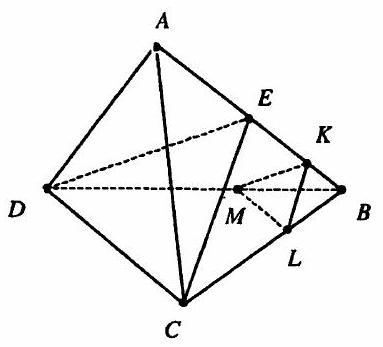
Let $A B C D$ be the given regular tetrahedron, $A K: K B=4: 1$ and the section $K L M \perp A B$. Let $E$ be the midpoint of $A B$. Then $K L M \| E C D$, as planes with paral... | \frac{4}{121} | Geometry | math-word-problem | olympiads | eb893d27-0288-582a-b051-94187b0e06e9 | [
true,
true
] | [
"<think>\nOkay, let's see. I need to solve this problem about a regular tetrahedron where a plane is drawn through a point that divides one of its edges in the ratio 1:4, and this plane is perpendicular to that edge. Then, I have to find the ratio of the volumes of the two resulting parts. Hmm, okay. Let me try to ... | [
true,
true
] | null | null | 2 | [
{
"content": "11.200 Through a point dividing the edge of a regular tetrahedron in the ratio 1 : 4, a plane perpendicular to this edge is drawn. Find the ratio of the volumes of the resulting parts of the tetrahedron.",
"role": "user"
},
{
"content": "<think>Hmm , okay. Let me try to visualize this.... |
18. There are several students, forming a rectangular array that is exactly eight columns wide. If 120 more students are added to or 120 students are removed from the array, a square array can be formed. How many students are there in the original rectangular array? | 【Analysis】Let the original rectangular formation have $x$ students,
and let $\left\{\begin{array}{l}x+120=a^{2} \\ x-120=b^{2}\end{array}\right.$
Then $a^{2}-b^{2}=240$
$$
(a+b)(a-b)=240
$$
And
$$
\begin{array}{l}
240=1 \times 240=2 \times 120=3 \times 80=4 \times 60=5 \times 48 \\
=6 \times 40=8 \times 30=10 \times 2... | 904or136 | Number Theory | math-word-problem | olympiads | c56064a5-a030-5a57-921d-9c22fe79bbdc | [
true,
true
] | [
"<think>\nAlright, let's tackle this problem step by step. So, we have a rectangular array of students that's exactly eight columns wide. That means the original number of students can be represented as 8 rows by some number of columns, right? Wait, actually, the problem says the array is eight columns wide. So, ma... | [
false,
false
] | [
true,
false
] | null | 1 | [
{
"content": "18. There are several students, forming a rectangular array that is exactly eight columns wide. If 120 more students are added to or 120 students are removed from the array, a square array can be formed. How many students are there in the original rectangular array?",
"role": "user"
},
{
... |
3.85. A plane is drawn through the diagonal of the base and the height of a regular quadrilateral pyramid. The ratio of the area of the section to the lateral surface area of the pyramid is $k$. Find the cosine of the angle between the apothems of opposite lateral faces and the permissible values of $k$. | 3.85. By the condition, $S A B C D$ is a regular pyramid, $S O \perp(A B C)$, $S_{\triangle S A C}: \mathrm{S}_{\text {bok }}=k, S F$ and $S E$ are the apothems of the pyramid (Fig. 3.85). Let $A B=$
$=a, \angle E S F=\alpha ;$ we have $S F=\frac{a}{2 \sin \frac{\alpha}{2}}$
(from $\triangle S O F), \quad S O=\frac{a... | \cos\alpha=16k^2-1 | Geometry | math-word-problem | olympiads | 70df31d2-dfde-5146-a710-1a77d8df621b | [
true,
true
] | [
"<think>\nOkay, so I have this geometry problem here about a regular quadrilateral pyramid. Let me start by understanding what's given and what's being asked. The problem says: \"A plane is drawn through the diagonal of the base and the height of a regular quadrilateral pyramid. The ratio of the area of the section... | [
false,
false
] | [
true,
false
] | null | 1 | [
{
"content": "3.85. A plane is drawn through the diagonal of the base and the height of a regular quadrilateral pyramid. The ratio of the area of the section to the lateral surface area of the pyramid is $k$. Find the cosine of the angle between the apothems of opposite lateral faces and the permissible values ... |
26. Let $p, q$ satisfy $\log _{4}(p)=\log _{12}(q)$ $=\log _{18}(p+q)$. Then $\frac{q}{p}$
(A) $\frac{4}{3}$
(B) $\frac{1}{2}(1+\sqrt{3})$.
(C) $\frac{8}{5}$.
(D) $\frac{1}{2}(1+\sqrt{5})$.
(E) $\frac{16}{y}$ | 26
D
26. Let the given equation be $t$, then we have $p=9^{t}$, $q=12^{t}$, and $16^{t}=p+q=9^{t}+12^{t}$. Dividing the last equation by $9^{t}$, we get $\frac{16^{\mathrm{t}}}{9^{\mathrm{t}}}=\left(\frac{4^{\mathrm{t}}}{3^{\mathrm{t}}}\right)^{2}=\left(\frac{12^{\mathrm{t}}}{9^{\mathrm{t}}}\right)^{2}=\left(\frac{q}{p... | D | Algebra | MCQ | cn_contest | 2b47adf0-b201-59b8-8d3e-ed8e68dee733 | [
true,
false,
true,
true
] | [
"<think>\nOkay, let's see. I have this problem here where I need to find the value of q/p given that log base 4 of p is equal to log base 12 of q, which is also equal to log base 18 of (p + q). The answer choices are given, so maybe I can use some logarithm properties to solve for the ratio q/p.\n\nFirst, let me wr... | [
true,
false,
true,
true
] | null | null | 3 | [
{
"content": "26. Let $p, q$ satisfy $\\log _{4}(p)=\\log _{12}(q)$ $=\\log _{18}(p+q)$. Then $\\frac{q}{p}$\n(A) $\\frac{4}{3}$\n(B) $\\frac{1}{2}(1+\\sqrt{3})$.\n(C) $\\frac{8}{5}$.\n(D) $\\frac{1}{2}(1+\\sqrt{5})$.\n(E) $\\frac{16}{y}$",
"role": "user"
},
{
"content": "<think>\nOkay, let's see. I... |
A pyramid with a parallelogram base has base edges of lengths $a$ and $2a$, and side edges of length $a \sqrt{3}$. The pyramid is intersected by a plane that cuts the base along one of its diagonals and is parallel to one of the side edges. What is the area of the plane section? | The vertices $A, B, C, D$ of the base lie on the opposite vertex $E$ (tetrahedral) on a sphere with radius $a \sqrt{3}$. This sphere intersects the base plane in a circle, so the base quadrilateral is a parallelogram circumscribed by a circle: a rectangle, and the center of the circle circumscribed around it is the int... | \frac{^{2}\sqrt{51}}{8} | Geometry | math-word-problem | olympiads | eb6b7604-615d-514e-a13d-fb7a81473dec | [
true
] | [
"<think>\nOkay, so I have this geometry problem here about a pyramid with a parallelogram base. The base edges are lengths a and 2a, and the side edges (which I assume are the edges from the base to the apex) are each a√3. The pyramid is intersected by a plane that cuts the base along one of its diagonals and is pa... | [
false
] | [
true
] | null | 1 | [
{
"content": "A pyramid with a parallelogram base has base edges of lengths $a$ and $2a$, and side edges of length $a \\sqrt{3}$. The pyramid is intersected by a plane that cuts the base along one of its diagonals and is parallel to one of the side edges. What is the area of the plane section?",
"role": "us... |
## Zadatak B-3.1.
Riješite nejednadžbu
$$
2 \log _{\frac{1}{5}}\left(49^{\sqrt{x^{2}-2}}-1\right)+\log _{5}\left(7^{\sqrt{4 x^{2}-8}}+\frac{1}{5}\right) \leqslant-1
$$
| ## Rješenje.
Zapišimo nejednadžbu u obliku:
$$
-2 \log _{5}\left(7^{2 \sqrt{x^{2}-2}}-1\right)+\log _{5}\left(7^{2 \sqrt{x^{2}-2}}+\frac{1}{5}\right) \leqslant-1
$$
Uvedimo supstituciju $t=7^{2 \sqrt{x^{2}-2}}, t>0$.
Uvjeti na rješenje zadatka su $t-1>0$ i $t+\frac{1}{5}>0 \Longrightarrow t>1 \quad(*)$.
Tada rješa... | x\in\langle-\infty,-\frac{3}{2}]\cup[\frac{3}{2},+\infty\rangle | Inequalities | math-word-problem | olympiads | 833f2873-1a03-55fd-94e2-b37b494bffe4 | [
true,
true
] | [
"<think>\nOkay, so I need to solve this inequality:\n\n$$\n2 \\log _{\\frac{1}{5}}\\left(49^{\\sqrt{x^{2}-2}}-1\\right)+\\log _{5}\\left(7^{\\sqrt{4 x^{2}-8}}+\\frac{1}{5}\\right) \\leqslant-1\n$$\n\nHmm, let's break this down step by step. First, I need to recall the properties of logarithms and exponents. The log... | [
false,
false
] | [
true,
false
] | null | 1 | [
{
"content": "## Zadatak B-3.1.\n\nRiješite nejednadžbu\n\n$$\n2 \\log _{\\frac{1}{5}}\\left(49^{\\sqrt{x^{2}-2}}-1\\right)+\\log _{5}\\left(7^{\\sqrt{4 x^{2}-8}}+\\frac{1}{5}\\right) \\leqslant-1\n$$\n\n",
"role": "user"
},
{
"content": "<think>Hmm , let's break this down step by step. First, I nee... |
The shape in the picture was created by cutting out a small cross from a large cross. Each of these crosses can be composed of five identical squares, with the sides of the small squares being half the length of the sides of the large squares. The area of the gray shape in the picture is $45 \mathrm{~cm}^{2}$.
What is... | The side length of the large square is twice the side length of the small square, so the area of the large square is four times the area of the small square, see the figure. If we remove the small square from the large square, the remaining shape has an area of $\frac{3}{4}$ of the large square. Therefore, the area of ... | 60(\mathrm{~}^{2}) | Geometry | math-word-problem | olympiads | ce3afd6b-a392-58ac-ae13-b0b98b156a2a | [
true,
true
] | [
"<think>\nOkay, let's try to figure out this problem. So, there's a gray shape made by cutting out a small cross from a large cross. Both crosses are made up of five identical squares. The sides of the small squares are half the length of the large squares. The area of the gray shape is 45 cm², and we need to find ... | [
false,
false
] | [
true,
true
] | null | 2 | [
{
"content": "The shape in the picture was created by cutting out a small cross from a large cross. Each of these crosses can be composed of five identical squares, with the sides of the small squares being half the length of the sides of the large squares. The area of the gray shape in the picture is $45 \\mat... |
13.010. A pump can extract $2 / 3$ of the water from a pool in 7.5 min. After working for 0.15 h, the pump stopped. Find the capacity of the pool, if after the pump stopped, there was still 25 m $^{3}$ of water left in the pool. | Solution.
Let $x$ m $^{3}$ be the capacity of the pool. In 7.5 minutes, the pump can extract $\frac{2}{3} x$ water. In $0.15 \text{ h} = 9$ minutes, the pump extracted $\frac{9 \cdot \frac{2}{3} x}{7.5}=0.8 x$ water. In the pool, $0.2 x$ water remained. According to the problem, $0.2 x=25$, from which $x=125$.
Answer... | 125 | Algebra | math-word-problem | olympiads | 065a0fb9-a1bb-5ab1-8733-97bd5df199cb | [
true,
true
] | [
"<think>\nOkay, let's try to solve this problem. So, we have a pump that can extract 2/3 of the water from a pool in 7.5 minutes. After working for 0.15 hours, the pump stopped, and there was still 25 cubic meters of water left. We need to find the capacity of the pool.\n\nFirst, let me make sure I understand the p... | [
true,
true
] | null | null | 2 | [
{
"content": "13.010. A pump can extract $2 / 3$ of the water from a pool in 7.5 min. After working for 0.15 h, the pump stopped. Find the capacity of the pool, if after the pump stopped, there was still 25 m $^{3}$ of water left in the pool.",
"role": "user"
},
{
"content": "<think>\nOkay, let's tr... |
40. Given numbers: one and nine zeros. It is allowed to choose two numbers and replace each with their arithmetic mean. What is the smallest number that can end up in the place of one after a series of such operations? | 84.40. Let's consider the smallest non-zero number $A$. Under the averaging operation, this value either does not decrease or is halved if the averaging is done with zero. From this, it follows that the value of $A$ will not decrease by more than $2^{9}=$ $=512$ times. Answer. $1 / 512$. | \frac{1}{512} | Number Theory | math-word-problem | olympiads | 353e9935-0946-56df-a6e9-5bbe77714756 | [
true,
true
] | [
"<think>\nOkay, let's see. The problem is: we have the numbers 1 followed by nine zeros. So that's 1, 0, 0, 0, 0, 0, 0, 0, 0, 0. We can choose any two numbers and replace each with their arithmetic mean. We need to find the smallest number that can end up in the place of the initial 1 after a series of such operati... | [
true,
false
] | null | null | 1 | [
{
"content": "40. Given numbers: one and nine zeros. It is allowed to choose two numbers and replace each with their arithmetic mean. What is the smallest number that can end up in the place of one after a series of such operations?",
"role": "user"
},
{
"content": "<think>Hmm .\n\nFirst, let me mak... |
Let $\mathbb{R}_{>0}$ be the set of positive real numbers. Find all functions $f: \mathbb{R}_{>0} \rightarrow \mathbb{R}_{>0}$ such that, for every $x \in \mathbb{R}_{>0}$, there exists a unique $y \in \mathbb{R}_{>0}$ satisfying
$$ x f(y)+y f(x) \leqslant 2 $$
(Netherlands) | First we prove that the function \( f(x) = \frac{1}{x} \) satisfies the condition of the problem statement. The AM-GM inequality gives
\[ \frac{x}{y} + \frac{y}{x} \geqslant 2 \]
for every \( x, y > 0 \), with equality if and only if \( x = y \). This means that, for every \( x > 0 \), there exists a unique \( y > 0 \)... | f(x) = \frac{1}{x} | Algebra | math-word-problem | olympiads_ref | NaN | [
true,
true
] | [
"<think>\nOkay, so I have this problem where I need to find all functions f from the positive real numbers to themselves such that for every positive real number x, there's a unique positive real number y that satisfies the inequality x f(y) + y f(x) ≤ 2. And this has to hold for every x > 0. Hmm, okay. Let me try ... | [
true,
true
] | null | [
"stop",
"stop"
] | 2 | [
{
"content": "Let $\\mathbb{R}_{>0}$ be the set of positive real numbers. Find all functions $f: \\mathbb{R}_{>0} \\rightarrow \\mathbb{R}_{>0}$ such that, for every $x \\in \\mathbb{R}_{>0}$, there exists a unique $y \\in \\mathbb{R}_{>0}$ satisfying \n$$ x f(y)+y f(x) \\leqslant 2 $$ \n(Netherlands)",
"... |
2. 2. $47{ }^{\star \star}$ Given acute angles $\alpha, \beta$ satisfy
$$
\sin \beta=m \cos (\alpha+\beta) \cdot \sin \alpha\left(m>0, \alpha+\beta \neq \frac{\pi}{2}\right) .
$$
If $x=\tan \alpha, y=\tan \beta$,
(1) Find the expression for $y=f(x)$;
(2) Under (1), when $\alpha \in\left[\frac{\pi}{4}, \frac{\pi}{2}\ri... | (1) From $\sin \beta=m \cos (\alpha+\beta) \cdot \sin \alpha\left(m>0, \alpha+\beta \neq \frac{\pi}{2}\right)$, we have $\sin [(\alpha+$ $\beta)-\alpha]=m \cos (\alpha+\beta) \cdot \sin \alpha$, which means
$$
\sin (\alpha+\beta) \cdot \cos \alpha=(m+1) \cos (\alpha+\beta) \cdot \sin \alpha .
$$
Since $\alpha, \beta$ ... | \frac{}{+2} | Algebra | math-word-problem | olympiads | 675d493e-e87e-5d6c-ac43-969becde16df | [
true,
true
] | [
"<think>\nOkay, let's tackle this problem step by step. It seems a bit tricky at first, but I'll try to break it down. The problem states:\n\nGiven acute angles α, β satisfy sin β = m cos(α + β) · sin α (with m > 0 and α + β ≠ π/2). We need to express y = tan β as a function of x = tan α, and then find the maximum ... | [
false,
false
] | [
false,
true
] | null | 1 | [
{
"content": "2. 2. $47{ }^{\\star \\star}$ Given acute angles $\\alpha, \\beta$ satisfy\n$$\n\\sin \\beta=m \\cos (\\alpha+\\beta) \\cdot \\sin \\alpha\\left(m>0, \\alpha+\\beta \\neq \\frac{\\pi}{2}\\right) .\n$$\n\nIf $x=\\tan \\alpha, y=\\tan \\beta$,\n(1) Find the expression for $y=f(x)$;\n(2) Under (1), w... |
Example 4 In a convex $n$-sided polygon, no three diagonals intersect at a single point inside the polygon. Questions: (1) How many regions do these diagonals divide the convex $n$-sided polygon into? (2) How many segments do these diagonals get divided into by their intersection points? | (1) Let the convex $n$-sided polygon be divided into regions by its diagonals, with the region having the most sides being an $m$-sided polygon. Among these, there are $n_{3}$ triangles, $n_{4}$ quadrilaterals, ..., and $n_{m}$ $m$-sided polygons. Thus, the number of regions into which the convex $n$-sided polygon is d... | \frac{1}{24}(n-1)(n-2)(n^{2}-3n+12),\quad\frac{1}{12}n(n-3)(n^{2}-3n+8) | Combinatorics | math-word-problem | olympiads | f8f7c8a8-0e24-5994-9304-f42793bd8730 | [
true,
true
] | [
"<think>\nAlright, so I've got this problem about convex polygons and the regions formed by their diagonals. Let me try to work through it step by step. The problem has two parts: first, figuring out how many regions the diagonals divide the polygon into, and second, determining how many segments the diagonals are ... | [
false,
false
] | [
false,
true
] | null | 1 | [
{
"content": "Example 4 In a convex $n$-sided polygon, no three diagonals intersect at a single point inside the polygon. Questions: (1) How many regions do these diagonals divide the convex $n$-sided polygon into? (2) How many segments do these diagonals get divided into by their intersection points?",
"ro... |
2. Which of the following numbers is closest to $2.015 \times 510.2$ ?
A 0.1
B 1
C 10
D 100
E 1000 | 2. E Round each number in the product to one significant figure to give $2 \times 500=1000$. Hence 1000 is closest to the given product. | 1000 | Algebra | MCQ | olympiads | 52fecfb4-9e77-55f8-96f4-8aaa57a2918a | [
true,
true
] | [
"<think>\nOkay, so I have this problem here: Which of the following numbers is closest to 2.015 multiplied by 510.2? The options are A 0.1, B 1, C 10, D 100, E 1000. Hmm, let me think about how to approach this.\n\nFirst, I need to calculate 2.015 times 510.2. But since the answer choices are orders of magnitude ap... | [
false,
false
] | [
true,
true
] | null | 2 | [
{
"content": "2. Which of the following numbers is closest to $2.015 \\times 510.2$ ?\nA 0.1\nB 1\nC 10\nD 100\nE 1000",
"role": "user"
},
{
"content": "<think>Hmm , let me think about how to approach this.\n\nFirst, I need to calculate 2.015 times 510.2. But since the answer choices are orders of m... |
2) Which of the following numbers is greater than one?
(A) $\left(\frac{3}{4}\right)^{\frac{3}{4}}$
(B) $(1.1)^{-1.1}$
(C) $\left(\frac{1}{\sqrt{2}}\right)^{-\frac{1}{\sqrt{2}}}$
(D) $(\sqrt{2}-1)^{\sqrt{2}-1}$
(E) $(2-\sqrt{3})^{2-\sqrt{3}}$. | 2) The answer is (C)
A number greater than 1 raised to a positive power is greater than 1, while raised to a negative power is less than 1: this eliminates answer (B). A positive number less than 1 raised to a positive power is less than 1 (and this eliminates answers (A), (D), and (E) while raised to a negative power... | C | Algebra | MCQ | olympiads | 26ec5a31-5e0a-5a61-a8d9-ba9d2ab647c2 | [
true,
true
] | [
"<think>\nOkay, so I need to figure out which of the given options (A) through (E) is greater than one. Let me take each one step by step. Hmm, let's start by recalling some exponent rules. If a number between 0 and 1 is raised to a positive power, the result is less than 1. Conversely, if a number greater than 1 i... | [
true,
true
] | null | [
"stop",
"stop"
] | 2 | [
{
"content": "2) Which of the following numbers is greater than one?\n(A) $\\left(\\frac{3}{4}\\right)^{\\frac{3}{4}}$\n(B) $(1.1)^{-1.1}$\n(C) $\\left(\\frac{1}{\\sqrt{2}}\\right)^{-\\frac{1}{\\sqrt{2}}}$\n(D) $(\\sqrt{2}-1)^{\\sqrt{2}-1}$\n(E) $(2-\\sqrt{3})^{2-\\sqrt{3}}$.",
"role": "user"
},
{
"... |
## Task A-1.5.
Marko drew a rectangle with dimensions $20 \times 15$ and divided it into unit squares with lines. How many squares are there in total on that picture? | ## First Solution.
We count the squares based on their dimension, i.e., the length of the side:
squares with side length 1: $20 \cdot 15$
squares with side length 2: $19 \cdot 14$
squares with side length 3: $18 \cdot 13$
$\vdots \quad \vdots$
squares with side length 15: $6 \cdot 1$
(12 points*)
The total numb... | 1840 | Geometry | math-word-problem | olympiads | 3e318c90-a20f-555a-8f61-a093de54660b | [
true,
true
] | [
"<think>\nOkay, so I need to find out how many squares there are in total in a 20x15 rectangle that's divided into unit squares. Hmm, let's think. I remember that when you have a grid like this, the number of squares isn't just the area, because squares can be of different sizes. For example, in a 2x2 grid, there a... | [
true,
true
] | null | null | 2 | [
{
"content": "## Task A-1.5.\n\nMarko drew a rectangle with dimensions $20 \\times 15$ and divided it into unit squares with lines. How many squares are there in total on that picture?",
"role": "user"
},
{
"content": "<think>Hmm , let's think. I remember that when you have a grid like this, the num... |
7.5. On a 5 by 5 grid, several cells are marked in such a way that every 3 by 3 square of cells contains exactly one marked cell. How many cells can be marked | Answer. Any number from 1 to 4.
Solution. It is clear that there must be at least one cell. On the other hand, four corner 3x3 squares completely cover the 5x5 square, and each of them contains exactly 1 marked cell, so the total number of marked cells is no more than 4. Examples for quantities from 1 to 4 are shown i... | 1to4 | Combinatorics | math-word-problem | olympiads | 866bd13f-6ac1-5421-8659-5fc48d60285a | [
true
] | [
"<think>\nOkay, so I need to figure out the maximum number of cells that can be marked on a 5x5 grid, with the condition that every 3x3 square within it contains exactly one marked cell. Hmm, let's start by visualizing the grid. A 5x5 grid has 25 cells, and the 3x3 squares can overlap each other. Since the grid is ... | [
false
] | [
true
] | null | 1 | [
{
"content": "7.5. On a 5 by 5 grid, several cells are marked in such a way that every 3 by 3 square of cells contains exactly one marked cell. How many cells can be marked",
"role": "user"
},
{
"content": "<think>Hmm , let's start by visualizing the grid. A 5x5 grid has 25 cells, and the 3x3 square... |
4. Consider the cards $A, 2, \cdots, J, Q, K$ as the numbers $1,2, \cdots, 11,12,13$. Now, place the 13 spades and 13 hearts together, and randomly draw 2 cards. The probability that the two cards have the same suit and their product is a perfect square is $\qquad$ | There are $C_{26}^{2}$ ways to randomly draw 2 cards from 26 cards. The cases where the product of two numbers is a perfect square are 1,4; 1,9; 2,8; 3,12; 4,9, totaling 5 cases. Since there are two suits, the number of ways to draw 2 cards of the same suit and whose product is a perfect square is $C_{2}^{1} \cdot 5$.
... | \frac{2}{65} | Combinatorics | math-word-problem | olympiads | 252fba4c-5c36-5a3e-8c25-0eb43bdd497c | [
true,
true
] | [
"<think>\nOkay, so I have this probability problem here. Let me read it again to make sure I understand. The problem says:\n\nConsider the cards A, 2, ..., J, Q, K as the numbers 1, 2, ..., 11, 12, 13. Now, place the 13 spades and 13 hearts together, and randomly draw 2 cards. The probability that the two cards hav... | [
true,
true
] | null | [
"stop",
"stop"
] | 2 | [
{
"content": "4. Consider the cards $A, 2, \\cdots, J, Q, K$ as the numbers $1,2, \\cdots, 11,12,13$. Now, place the 13 spades and 13 hearts together, and randomly draw 2 cards. The probability that the two cards have the same suit and their product is a perfect square is $\\qquad$",
"role": "user"
},
{... |
\section*{Problem 7}
A tangent to the inscribed circle of a triangle drawn parallel to one of the sides meets the other two sides at \(\mathrm{X}\) and \(\mathrm{Y}\). What is the maximum length \(\mathrm{XY}\), if the triangle has perimeter \(\mathrm{p}\) ?
| \section*{Solution}
Let \(\mathrm{BC}\) be the side parallel to \(\mathrm{XY}, \mathrm{h}\) the length of the altitude from \(\mathrm{A}\), and \(\mathrm{r}\) the radius of the in-circle. Then \(X Y / B C=(h-2 r) / h\). But r.p \(=\) h.BC. So \(X Y=(p-2 B C) B C / p=\left(p^{2} / 8-2(B C-\right.\) \(\left.\mathrm{p} /... | \frac{p}{8} | Geometry | math-word-problem | olympiads | 83afc7dc-a035-5712-a812-587cc9e2ef01 | [
true,
true
] | [
"<think>\nAlright, so I need to find the maximum length of XY, which is a tangent to the inscribed circle of a triangle drawn parallel to one of the sides. The triangle has a perimeter p. Hmm, okay. Let me try to visualize this. \n\nFirst, let's recall that the inscribed circle (incircle) of a triangle touches each... | [
true,
true
] | null | [
"stop",
"stop"
] | 2 | [
{
"content": "\\section*{Problem 7}\n\nA tangent to the inscribed circle of a triangle drawn parallel to one of the sides meets the other two sides at \\(\\mathrm{X}\\) and \\(\\mathrm{Y}\\). What is the maximum length \\(\\mathrm{XY}\\), if the triangle has perimeter \\(\\mathrm{p}\\) ?\n\n",
"role": "user... |
Problem 8. In triangle $A B C$, side $A C=42$. The bisector $C L$ is divided by the point of intersection of the bisectors of the triangle in the ratio $2: 1$, counting from the vertex. Find the length of side $A B$, if the radius of the circle inscribed in triangle $A B C$ is 14. | Answer: 56.
Answer: Let $I$ be the center of the inscribed circle in triangle $ABC$ (i.e., the point of intersection of the angle bisectors). Noting that $AI$ is the angle bisector in triangle $ALC$, by the angle bisector theorem, we have: $AC: AL = CI: IL = 2: 1$, from which $AL = AC / 2 = 21$.
Next, $AC \cdot AL \c... | 56 | Geometry | math-word-problem | olympiads | f7d40ac4-b1fe-5a91-8a11-af66cb8b3f00 | [
true,
true
] | [
"<think>\nOkay, so I have this geometry problem here. Let me try to parse it step by step. It's about triangle ABC. The given information is that side AC is 42 units long. There's a bisector CL, which I assume is the angle bisector from vertex C to side AB. Then, this bisector CL is divided by the point of intersec... | [
true,
true
] | null | null | 2 | [
{
"content": "Problem 8. In triangle $A B C$, side $A C=42$. The bisector $C L$ is divided by the point of intersection of the bisectors of the triangle in the ratio $2: 1$, counting from the vertex. Find the length of side $A B$, if the radius of the circle inscribed in triangle $A B C$ is 14.",
"role": "u... |
12. Using weights labeled $1 \mathrm{~g}, 2 \mathrm{~g}, 3 \mathrm{~g}, 15 \mathrm{~g}, 40 \mathrm{~g}$, each one of them, to weigh objects on a balance scale without graduations. If weights can be placed on both ends of the balance, then the maximum number of different gram weights (positive integer weights) that can ... | 12.55.
Using $1 \mathrm{~g}, 2 \mathrm{~g}, 3 \mathrm{~g}$ these three weights, all integer grams in the interval $A=$ $[1,6]$ can be measured; after adding a $15 \mathrm{~g}$ weight, the measurement range is expanded to the interval $B=[15-6,15+6]=[9,21]$. After adding a $40 \mathrm{~g}$ weight, the measurement range... | 55 | Combinatorics | math-word-problem | cn_contest | 0e68ddec-7581-5c04-b625-6d8499f4f020 | [
true,
true
] | [
"<think>\nOkay, so I need to figure out the maximum number of different gram weights that can be measured using the given weights: 1g, 2g, 3g, 15g, and 40g. The catch is that these weights can be placed on both ends of the balance scale. Hmm, balance scales without graduations... so basically, the way you measure s... | [
true,
true
] | null | null | 2 | [
{
"content": "12. Using weights labeled $1 \\mathrm{~g}, 2 \\mathrm{~g}, 3 \\mathrm{~g}, 15 \\mathrm{~g}, 40 \\mathrm{~g}$, each one of them, to weigh objects on a balance scale without graduations. If weights can be placed on both ends of the balance, then the maximum number of different gram weights (positive... |
Subsets and Splits
No community queries yet
The top public SQL queries from the community will appear here once available.