
problem string | solution string | answer string | problem_type string | question_type string | source string | uuid string | is_reasoning_complete list | generations list | correctness_math_verify list | correctness_llama list | finish_reasons list | correctness_count int64 | messages list |
|---|---|---|---|---|---|---|---|---|---|---|---|---|---|
Example 14 Find $\sum_{k=0}^{11} \frac{\mathrm{C}_{11}^{k}}{k+1}$. | Solution: From $(1+x)^{11}=\sum_{k=0}^{11} \mathrm{C}_{11}^{k} x^{k}$, we have
$$
\begin{array}{l}
\int_{0}^{1}(1+x)^{11} \mathrm{~d} x=\int_{0}^{1} \sum_{k=0}^{11} \mathrm{C}_{11}^{k} x^{k} \mathrm{~d} x . \\
\text { and } \int_{0}^{1} \sum_{k=0}^{11} \mathrm{C}_{11}^{k} x^{k} \mathrm{~d} x \\
=\left.\left(\sum_{k=0}^... | \frac{1365}{4} | Combinatorics | math-word-problem | cn_contest | 21a53033-e6b6-5030-9827-8c2d4b3bdbbb | [
true,
true,
true,
true
] | [
"<think>\nOkay, let me try to figure out this summation problem. So, the question is asking for the sum from k equals 0 to 11 of (C(11, k) divided by (k + 1)). Hmm, right. Let's see. I need to compute ∑_{k=0}^{11} [C(11, k)/(k+1)]. \n\nFirst, I remember that combinations, C(n, k), are the binomial coefficients. So ... | [
true,
true,
true,
true
] | null | null | 4 | [
{
"content": "Example 14 Find $\\sum_{k=0}^{11} \\frac{\\mathrm{C}_{11}^{k}}{k+1}$.",
"role": "user"
},
{
"content": "<think>Hmm , right. Let's see. I need to compute ∑_{k=0}^{11} [C(11, k)/(k+1)]. \n\nLet me recall that the binomial theorem says that (1 + x)^n = ∑_{k=0}^n C(n, k) x^k. Maybe if I in... |
161. $2^{x}+2^{x-1}-2^{x-3}=44$.
Translate the above text into English, keeping the original text's line breaks and format, and output the translation result directly.
161. $2^{x}+2^{x-1}-2^{x-3}=44$. | Solution. Since the smallest exponent is $x-3$, we factor out $2^{x-3}$:
$$
2^{x-3} \cdot\left(2^{3}+2^{2}-1\right)=44 ; 2^{x-3}(8+4-1)=44 ; 2^{x-3} \cdot 11=44
$$
Dividing both sides of the equation by 11, we get
$$
2^{x-3}=4 ; 2^{x-3}=2^{2} ; x-3=2 ; x=5
$$ | 5 | Algebra | math-word-problem | olympiads | 39f61ae1-685b-5eb4-9bdf-444b3bad2e4b | [
true,
true
] | [
"<think>\nOkay, let's see. I need to solve the equation 2^x + 2^{x-1} - 2^{x-3} = 44. Hmm, exponents can sometimes be tricky, but maybe I can factor out a common term here. All the terms have 2 raised to some power involving x. Let me check the exponents: x, x-1, and x-3. So each term is 2 to the x minus something.... | [
true,
true
] | null | null | 2 | [
{
"content": "161. $2^{x}+2^{x-1}-2^{x-3}=44$.\n\nTranslate the above text into English, keeping the original text's line breaks and format, and output the translation result directly.\n\n161. $2^{x}+2^{x-1}-2^{x-3}=44$.",
"role": "user"
},
{
"content": "<think>Hmm , exponents can sometimes be trick... |
4. The solution set of the equation $x^{2}+x-1=x \mathrm{e}^{x^{2}-1}+\left(x^{2}-1\right) \mathrm{e}^{x}$ is $\mathrm{A}$ (where $\mathrm{e}$ is an irrational number, $\mathrm{e}=2.71828 \cdots, x$ is a real number), then the sum of the squares of all elements in $\mathrm{A}$ is ( ).
A. 0
B. 1
C. 2
D. 4 | 4. C
Let $y=x^{2}-1$, the original equation becomes $x+y=x \mathrm{e}^{y}+y \mathrm{e}^{\prime}$, that is,
$$
x\left(\mathrm{e}^{y}-1\right)+y\left(\mathrm{e}^{x}-1\right)=0
$$
Since when $x>0$, $\mathrm{e}^{x}-1>0$, thus $x$ and $\mathrm{e}^{x}-1$ have the same sign, similarly $y$ and $\mathrm{e}^{y}-1$ have the sam... | 2 | Algebra | MCQ | olympiads | 2ab1bfe0-0673-53f9-99b6-3cc358adb5dc | [
true,
true
] | [
"<think>\nOkay, let's see. I need to solve the equation \\(x^{2} + x - 1 = x \\mathrm{e}^{x^{2} - 1} + (x^{2} - 1) \\mathrm{e}^{x}\\) and find the sum of the squares of all elements in the solution set A. The answer choices are 0, 1, 2, or 4. Hmm.\n\nFirst, maybe I should try to rearrange the equation to see if the... | [
false,
false
] | [
false,
true
] | null | 1 | [
{
"content": "4. The solution set of the equation $x^{2}+x-1=x \\mathrm{e}^{x^{2}-1}+\\left(x^{2}-1\\right) \\mathrm{e}^{x}$ is $\\mathrm{A}$ (where $\\mathrm{e}$ is an irrational number, $\\mathrm{e}=2.71828 \\cdots, x$ is a real number), then the sum of the squares of all elements in $\\mathrm{A}$ is ( ).\nA.... |
## problem statement
Find the point $M^{\prime}$ symmetric to the point $M$ with respect to the plane.
$M(3 ;-3 ;-1)$
$2 x-4 y-4 z-13=0$ | ## Solution
Let's find the equation of the line that is perpendicular to the given plane and passes through point $M$. Since the line is perpendicular to the given plane, we can take the normal vector of the plane as its direction vector:
$$
\vec{s}=\vec{n}=\{2 ;-4 ;-4\}
$$
Then the equation of the desired line is:
... | M^{\}(2;-1;1) | Geometry | math-word-problem | olympiads | bcee4fba-091c-5070-a664-bb640e69d000 | [
true,
true
] | [
"<think>\nOkay, so I need to find the point M' which is symmetric to M(3, -3, -1) with respect to the plane given by the equation 2x - 4y - 4z - 13 = 0. Hmm, symmetric with respect to a plane means that the plane is the perpendicular bisector of the segment joining M and M', right? So, essentially, M' is the mirror... | [
false,
false
] | [
true,
false
] | null | 1 | [
{
"content": "## problem statement\n\nFind the point $M^{\\prime}$ symmetric to the point $M$ with respect to the plane.\n\n$M(3 ;-3 ;-1)$\n\n$2 x-4 y-4 z-13=0$",
"role": "user"
},
{
"content": "<think>Hmm , symmetric with respect to a plane means that the plane is the perpendicular bisector of the ... |
921. Find the mass of a hemisphere if the surface density at each of its points is numerically equal to the distance of this point from the radius perpendicular to the base of the hemisphere. | Solution. Place the origin of the rectangular coordinate system at the center of the base of the hemisphere and direct the z-axis perpendicular to this base. Then the equation of the hemisphere will be $z=\sqrt{R^{2}-x^{2}-y^{2}}$, where $R$ is the radius of the hemisphere; the surface density at point $M(x, y, z)$ of ... | \frac{\pi^{2}R^{3}}{2} | Calculus | math-word-problem | olympiads | 7572e273-fd91-5cb4-9367-efd1b40828b0 | [
true,
true
] | [
"<think>\nOkay, let's see. I need to find the mass of a hemisphere where the surface density at each point is equal to the distance from that point to the radius that's perpendicular to the base. Hmm, first, I should make sure I understand the problem correctly.\n\nSo, a hemisphere. Let me visualize it. A hemispher... | [
true,
false
] | null | null | 1 | [
{
"content": "921. Find the mass of a hemisphere if the surface density at each of its points is numerically equal to the distance of this point from the radius perpendicular to the base of the hemisphere.",
"role": "user"
},
{
"content": "<think>Hmm , first, I should make sure I understand the prob... |
4. (10 points) In a cave, there is a pile of peaches, which is the common property of three monkeys. The first monkey comes to the cave, divides the peaches into two parts in a ratio of 5:4, and takes the larger part; the second monkey comes after, divides the remaining peaches into two parts in a ratio of 5:4, and tak... | 【Analysis】First, according to the problem, set the total amount of peaches as unit "1", calculate the proportion each of the three monkeys took, and then based on the fact that the first monkey took 29 more peaches than the third monkey, find out the total number of peaches, and then calculate how many peaches the seco... | 20 | Algebra | math-word-problem | olympiads | b5b5d897-abcf-5699-a679-d2c9115c344e | [
true,
true
] | [
"<think>\nOkay, let's try to solve this problem step by step. It's about three monkeys dividing peaches in a certain ratio each time, and we need to find out how many peaches the second monkey took. The key piece of information given is that the first monkey took 29 more peaches than the third one. \n\nFirst, let m... | [
true,
true
] | null | [
"stop",
"stop"
] | 2 | [
{
"content": "4. (10 points) In a cave, there is a pile of peaches, which is the common property of three monkeys. The first monkey comes to the cave, divides the peaches into two parts in a ratio of 5:4, and takes the larger part; the second monkey comes after, divides the remaining peaches into two parts in a... |
Task B-4.4. Determine the equation of the circle whose center is on the x-axis, the radius is $5 \sqrt{10}$, and which intercepts a chord of length 10 on the line $3 x-4 y+24=0$. | ## Solution.
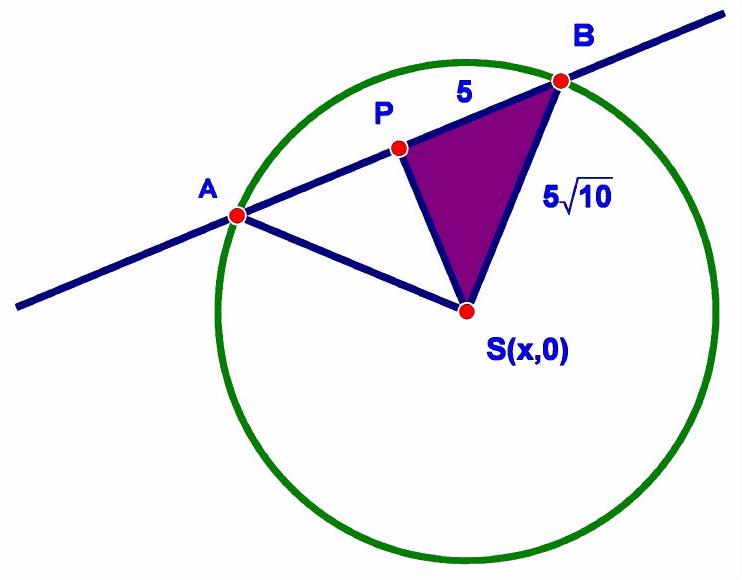
By the Pythagorean theorem in triangle $\triangle B P S$ we get $|P S|=15$.
(1 point)
The distance from the center of the circle to the line $3 x-4 y+24=0$ is 15. We write
$... | (x-17)^{2}+y^{2}=250(x+33)^{2}+y^{2}=250 | Geometry | math-word-problem | olympiads | f0fc703c-a69d-548a-a267-dbe698730178 | [
true,
true
] | [
"<think>\nOkay, let's tackle this problem step by step. So, the question is asking for the equation of a circle with its center on the x-axis, radius 5√10, and it intercepts a chord of length 10 on the line 3x - 4y + 24 = 0. Hmm, let's break this down.\n\nFirst, since the center is on the x-axis, its coordinates mu... | [
false,
false
] | [
false,
true
] | null | 1 | [
{
"content": "Task B-4.4. Determine the equation of the circle whose center is on the x-axis, the radius is $5 \\sqrt{10}$, and which intercepts a chord of length 10 on the line $3 x-4 y+24=0$.",
"role": "user"
},
{
"content": "<think>Hmm , so the line intersects the circle at two points, and the di... |
3. It is possible to write $15129=123^{2}$ as the sum of three distinct squares: $15129=$ $27^{2}+72^{2}+96^{2}$
(i) By using the identity $(a+b)^{2} \equiv a^{2}+2 a b+b^{2}$, or otherwise, find another way to write 15129 as the sum of three distinct squares.
(ii) Hence, or otherwise, show that $378225=615^{2}$ can be... | (i) Writing 123 as $121+2$, we can see that
$$
15129=123^{2}=(121+2)^{2}=121^{2}+2(121)(2)+2^{2} .
$$
Now,
$$
2 \times 121 \times 2=2 \times 2 \times 121=2^{2} \times 11^{2}=22^{2} \text {. }
$$
So
$$
15129=121^{2}+22^{2}+2^{2} .
$$
Comment
The above solution would earn all the marks, but doesn't really help see how... | 6^{2}+66^{2}+363^{2}+8^{2}+88^{2}+484^{2} | Number Theory | math-word-problem | olympiads | 4ca89570-b7eb-5ca7-8e39-94079c5b41b5 | [
false,
true
] | [
"<think>\nAlright, so I have this problem here where I need to write 15129, which is 123 squared, as the sum of three distinct squares in another way, different from the given 27² + 72² + 96². Then, using that result or otherwise, show that 378225 (which is 615²) can be written as the sum of six distinct squares. L... | [
false,
true
] | null | null | 1 | [
{
"content": "3. It is possible to write $15129=123^{2}$ as the sum of three distinct squares: $15129=$ $27^{2}+72^{2}+96^{2}$\n(i) By using the identity $(a+b)^{2} \\equiv a^{2}+2 a b+b^{2}$, or otherwise, find another way to write 15129 as the sum of three distinct squares.\n(ii) Hence, or otherwise, show tha... |
[ $[$ Dihedral Angle ]
Find the volume of a regular quadrilateral prism if its diagonal forms an angle of $30^{\circ}$ with the plane of a lateral face, and the side of the base is equal to $a$.
# | Let $A B C D A 1 B 1 C 1 D 1$ be a regular prism with base $A B C D$ and lateral edges $A A 1, B B 1, C C 1$, and $D D 1$, where $A B=a$. Since the line $A D$ is perpendicular to the plane of the face $C D D 1 C 1$, $D C 1$ is the orthogonal projection of the diagonal $A C 1$ onto this plane, and $A C 1 D$ is the angle... | ^3\sqrt{2} | Geometry | math-word-problem | olympiads | f584f4bc-18d4-59af-866e-d589c9601a14 | [
true,
true
] | [
"<think>\nOkay, so I need to find the volume of a regular quadrilateral prism. Let me recall what a regular quadrilateral prism is. A prism has two congruent bases connected by rectangular faces. A regular quadrilateral prism would have a square as its base since a regular quadrilateral is a square. So, both bases ... | [
false,
false
] | [
true,
false
] | null | 1 | [
{
"content": "[ $[$ Dihedral Angle ]\n\nFind the volume of a regular quadrilateral prism if its diagonal forms an angle of $30^{\\circ}$ with the plane of a lateral face, and the side of the base is equal to $a$.\n\n#",
"role": "user"
},
{
"content": "<think>\nOkay, so I need to find the volume of a... |
Example 1 Let $p$ be a prime number, and the number of distinct positive divisors of $p^{2}+71$ does not exceed 10. Find the value of $p$. | When $p=2,3$, it is verified that they satisfy the problem statement.
When $p>3$,
$$
p^{2}+71=(p+1)(p-1)+72 \text { . }
$$
If $p=3 k+1$ (where $k$ is even), then
$$
p^{2}+71=3 k(3 k+2)+72 \Rightarrow 24!\left(p^{2}+71\right) \text { . }
$$
Let $p^{2}+71=24 m=2^{3} \times 3 m(m \geqslant 4)$.
When $m$ contains a prime... | 2or3 | Number Theory | math-word-problem | olympiads | e94fdf7f-dcb1-5c1a-a154-c7a599ae5e1b | [
true,
true
] | [
"<think>\nOkay, let's try to solve this problem. So, we have a prime number p, and the number of distinct positive divisors of p² + 71 doesn't exceed 10. We need to find the value of p. Hmm, alright. Let's start by understanding what the problem is asking.\n\nFirst, the number of divisors of a number is related to ... | [
false,
false
] | [
true,
false
] | null | 1 | [
{
"content": "Example 1 Let $p$ be a prime number, and the number of distinct positive divisors of $p^{2}+71$ does not exceed 10. Find the value of $p$.",
"role": "user"
},
{
"content": "<think>Hmm , alright. Let's start by understanding what the problem is asking.\n\nFirst, the number of divisors o... |
7.3. The numbers $a, b$, and $c$ satisfy the relation $\frac{a+b}{c}=\frac{b+c}{a}=\frac{a+c}{b}$. Find $a+b+c$, given that $b \neq c$. | Answer: 0. Solution. From the equality $\frac{a+b}{c}=\frac{a+c}{b}$, we get $a(b-c)=(c-b)(c+b)$. Dividing this equality by $b-c \neq 0$, we obtain $b+c=-a$. Therefore, $a+b+c=0$. | 0 | Algebra | math-word-problem | olympiads | 35732a32-795e-59ae-b5e7-c23b11641ddb | [
true,
true
] | [
"<think>\nOkay, let's see. The problem says that the numbers a, b, and c satisfy the relation (a+b)/c = (b+c)/a = (a+c)/b. We need to find a + b + c, given that b is not equal to c. Hmm, interesting. \n\nFirst, I remember that when multiple ratios are equal, they can often be set equal to some common variable, like... | [
true,
true
] | null | [
"stop",
"stop"
] | 2 | [
{
"content": "7.3. The numbers $a, b$, and $c$ satisfy the relation $\\frac{a+b}{c}=\\frac{b+c}{a}=\\frac{a+c}{b}$. Find $a+b+c$, given that $b \\neq c$.",
"role": "user"
},
{
"content": "<think>Hmm , interesting. \n\nFirst, I remember that when multiple ratios are equal, they can often be set equal... |
## Problem Statement
Calculate the limit of the function:
$\lim _{x \rightarrow \frac{\pi}{2}} \frac{e^{\sin 2 x}-e^{\tan 2 x}}{\ln \left(\frac{2 x}{\pi}\right)}$ | ## Solution
$x=y+\frac{\pi}{2} \Rightarrow y=x-\frac{\pi}{2}$
$x \rightarrow \frac{\pi}{2} \Rightarrow y \rightarrow 0$
We obtain:
$$
\begin{aligned}
& \lim _{x \rightarrow \frac{\pi}{2}} \frac{e^{\sin 2 x}-e^{\tan 2 x}}{\ln \left(\frac{2 x}{\pi}\right)}=\lim _{y \rightarrow 0} \frac{e^{\sin 2\left(y+\frac{\pi}{2}\... | -2\pi | Calculus | math-word-problem | olympiads | 78f6a617-609a-5623-a9ca-cc3c8dd01b8f | [
true,
true
] | [
"<think>\nOkay, so I need to find the limit as x approaches π/2 of [e^(sin2x) - e^(tan2x)] divided by ln(2x/π). Hmm. Let me start by understanding what's going on here. The function involves exponentials and a logarithm, and we're taking the limit as x approaches π/2. First, I should check if plugging in x = π/2 di... | [
true,
true
] | null | [
"stop",
"stop"
] | 2 | [
{
"content": "## Problem Statement\n\nCalculate the limit of the function:\n\n$\\lim _{x \\rightarrow \\frac{\\pi}{2}} \\frac{e^{\\sin 2 x}-e^{\\tan 2 x}}{\\ln \\left(\\frac{2 x}{\\pi}\\right)}$",
"role": "user"
},
{
"content": "<think>Hmm . Let me start by understanding what's going on here. The fu... |
Problem 13. (8 points)
Dar'ya received a New Year's bonus of 60 thousand rubles, which she decided to save for a summer vacation. To prevent the money from losing value, the girl chose between two options for saving the money - to deposit the money at an interest rate of $8.6 \%$ annually for 6 months or to buy dollar... | Answer: the loss incurred from the second option for placing funds is (rounded to the nearest whole number) $\underline{3300 \text{ RUB}}$ | 3300 | Algebra | math-word-problem | olympiads | f4769bd7-4e85-567a-8f06-69a6b5c6b2d7 | [
true,
true
] | [
"<think>\nOkay, let me try to figure out this problem step by step. So, Dar'ya has 60,000 rubles and she wants to save it for 6 months. She has two options: either deposit it in a ruble account with 8.6% annual interest or buy dollars and deposit them in a foreign currency account with 1.5% annual interest. She cho... | [
false,
false
] | [
false,
true
] | null | 1 | [
{
"content": "Problem 13. (8 points)\n\nDar'ya received a New Year's bonus of 60 thousand rubles, which she decided to save for a summer vacation. To prevent the money from losing value, the girl chose between two options for saving the money - to deposit the money at an interest rate of $8.6 \\%$ annually for ... |
In the square $A B C D$, the point $P$ was taken inside such that $A P: B P: C P=1: 2: 3$. What is the measure of the angle $A P B$? | I. solution. Rotate the $B P C$ triangle $90^{\circ}$ around $B$ so that the image of $C$ is $A$. Let $P^{\prime}$ be the rotated image of $P$ (1st figure). Then the $P^{\prime} B P$ triangle is isosceles and the angle at $B$ is a right angle. Therefore, $P^{\prime} P B \varangle=45^{\circ}$, and by the Pythagorean the... | 135 | Geometry | math-word-problem | olympiads | f8b05d7d-b81b-518a-956e-50013c949eed | [
true,
true
] | [
"<think>\nOkay, so I need to find the measure of angle APB in square ABCD where point P is inside the square such that the ratios of the distances from P to points A, B, and C are 1:2:3. Hmm, let's start by visualizing the square. Let me sketch it out mentally. Let's assume square ABCD has vertices labeled clockwis... | [
true,
true
] | null | [
"stop",
"stop"
] | 2 | [
{
"content": "In the square $A B C D$, the point $P$ was taken inside such that $A P: B P: C P=1: 2: 3$. What is the measure of the angle $A P B$?",
"role": "user"
},
{
"content": "<think>Hmm , let's start by visualizing the square. Let me sketch it out mentally. Let's assume square ABCD has vertice... |
$13$ fractions are corrected by using each of the numbers $1,2,...,26$ once.[b]Example:[/b]$\frac{12}{5},\frac{18}{26}.... $
What is the maximum number of fractions which are integers? | To determine the maximum number of fractions that can be integers when using each of the numbers \(1, 2, \ldots, 26\) exactly once, we need to consider the conditions under which a fraction \(\frac{a}{b}\) is an integer. Specifically, \(\frac{a}{b}\) is an integer if and only if \(a\) is divisible by \(b\).
1. **Ident... | 12 | Combinatorics | math-word-problem | aops_forum | 214aaa6f-0b6f-5af9-bc2b-4f8c4c0ad599 | [
true,
false
] | [
"<think>\nOkay, let's try to figure out this problem. So, we have the numbers from 1 to 26, and we need to form 13 fractions using each number exactly once. The question is asking for the maximum number of these fractions that can be integers. Hmm, interesting. Let me break this down step by step.\n\nFirst, each fr... | [
true,
false
] | null | null | 1 | [
{
"content": "$13$ fractions are corrected by using each of the numbers $1,2,...,26$ once.[b]Example:[/b]$\\frac{12}{5},\\frac{18}{26}.... $\nWhat is the maximum number of fractions which are integers?",
"role": "user"
},
{
"content": "<think>Hmm , interesting. Let me break this down step by step.\n... |
Given a triangle $ABC$
$$
A=62^{\circ} 20^{\prime} 50^{\prime \prime}, \quad B=55^{\circ} 15^{\prime} 20^{\prime \prime}, \quad a^{2}+b^{2}+c^{2}=m^{2}=225,64 .
$$
Calculate the three sides of the triangle. [^0]
[^0]: 1*) The formulas should be reduced to a form suitable for logarithmic calculation. | Based on well-known trigonometric formulas:
$$
\begin{aligned}
& a=2 R \sin A \\
& b=2 R \sin B \\
& c=2 R \sin C
\end{aligned}
$$
from which
$$
m^{2}=4 R^{2}\left(\sin ^{2} A+\sin ^{2} B+\sin ^{2} C\right)
$$
and
$$
2 R=\frac{m}{\sqrt{\sin ^{2} A+\sin ^{2} B+\sin ^{2} C}}
$$
The latter formula can be transformed... | =9.11758,\;b=8.24330,\;=8.63472 | Geometry | math-word-problem | olympiads | 2e8f2413-e37f-5ae9-8e62-ac4456db2cfe | [
true,
true
] | [
"<think>\nOkay, let's see. I need to find the three sides of triangle ABC given angles A and B in degrees, minutes, and seconds, and the sum of the squares of the sides equals 225.64. Hmm. So, angles A and B are given, which means angle C can be found since the sum of angles in a triangle is 180 degrees. Then, mayb... | [
false,
false
] | [
false,
true
] | null | 1 | [
{
"content": "Given a triangle $ABC$\n\n$$\nA=62^{\\circ} 20^{\\prime} 50^{\\prime \\prime}, \\quad B=55^{\\circ} 15^{\\prime} 20^{\\prime \\prime}, \\quad a^{2}+b^{2}+c^{2}=m^{2}=225,64 .\n$$\n\nCalculate the three sides of the triangle. [^0]\n\n\n[^0]: 1*) The formulas should be reduced to a form suitable ... |
8. Find the least value of the expression $(x+y)(y+z)$, under the condition that $x, y, z$ are positive numbers satisfying the equation
$$
x y z(x+y+z)=1 \text {. }
$$ | Solution. For arbitrary positive $x, y, z$ satisfying the equation $x y z(x+$ $y+z)=1$, we have
$$
(x+y)(y+z)=(x+y+z) y+x z=\frac{1}{x z}+x z \geq 2 .
$$
This inequality becomes an equality, for example, when $x=z=1$ and $y=\sqrt{2}-1$. | 2 | Algebra | math-word-problem | olympiads | 70f9042b-55e7-50b1-ba42-929fb945547e | [
true,
true
] | [
"<think>\nOkay, so I need to find the least value of the expression (x + y)(y + z) given that x, y, z are positive numbers and they satisfy the equation xyz(x + y + z) = 1. Hmm, let's start by understanding what the problem is asking. \n\nFirst, the variables x, y, z are all positive, which is good because it might... | [
true,
true
] | null | null | 2 | [
{
"content": "8. Find the least value of the expression $(x+y)(y+z)$, under the condition that $x, y, z$ are positive numbers satisfying the equation\n$$\nx y z(x+y+z)=1 \\text {. }\n$$",
"role": "user"
},
{
"content": "<think>Hmm , let's start by understanding what the problem is asking. \n\nFirst,... |
5. There are 53 books of mathematics and physics on the bookshelf, where no two physics books are placed next to each other, but each mathematics book is adjacent to another mathematics book. Given the following four statements:
(1) There are at least 35 mathematics books;
(2) There are at most 18 physics books;
(3) Th... | 5. C.
The scenario with the fewest mathematics books $(S)$ occurs when the number of physics books (W) is at its maximum, as shown below:
$$
\underbrace{\text { WSSWS...WSSSW, }}_{\text {17 groups }}
$$
Three mathematics books SSS can also appear simultaneously in other positions, as indicated by arrangements (1), (2... | C | Combinatorics | MCQ | cn_contest | 4b07ef02-366a-5949-acdb-f23b82ac6dab | [
false,
true,
true,
true
] | [
"<think>\nOkay, let me try to figure out this problem. So, there are 53 books total on the shelf, math and physics. The conditions are: no two physics books are next to each other, but every math book has at least one math book adjacent to it. Then we have four statements, and we need to determine how many of them ... | [
false,
false,
false,
true
] | null | null | 1 | [
{
"content": "5. There are 53 books of mathematics and physics on the bookshelf, where no two physics books are placed next to each other, but each mathematics book is adjacent to another mathematics book. Given the following four statements:\n(1) There are at least 35 mathematics books;\n(2) There are at most ... |
4.33 Find all real numbers that satisfy the equation $|x+3|-|x-1|=x+1$.
Translate the above text into English, please retain the original text's line breaks and format, and output the translation result directly. | [Solution] When $x \leqslant -3$, the equation becomes
$$-(x+3)-(1-x)=x+1$$
which yields $\square$
$$x=-5 .$$
When $-3 < x \leqslant 1$, the equation becomes
$$-(x+3)+(x-1)=x+1$$
which yields $\square$
$$x=-1 .$$
When $x > 1$, the equation becomes
$$(x+3)-(x-1)=x+1$$
which yields $\square$
$$x=3 .$$
Therefore, th... | -5, -1, 3 | Logic and Puzzles | math-word-problem | inequalities | 7cfedf92-ce51-54fd-91c7-3ec1b0e85e20 | [
true,
true
] | [
"<think>\nOkay, let's see. I need to solve the equation |x + 3| - |x - 1| = x + 1. Hmm, absolute value equations can be tricky because of the different cases depending on the sign inside the absolute value. Alright, let's start by recalling that the absolute value function |a| is equal to a if a ≥ 0 and -a if a < 0... | [
true,
false
] | null | null | 1 | [
{
"content": "4.33 Find all real numbers that satisfy the equation $|x+3|-|x-1|=x+1$.\n\nTranslate the above text into English, please retain the original text's line breaks and format, and output the translation result directly.",
"role": "user"
},
{
"content": "<think>Hmm , absolute value equation... |
6.357 Solve the equation $3 x^{3}+2 \sqrt{3} x^{2}-21 x+6 \sqrt{3}=0$, given that the product of two of its roots is 1. | Solution. Let $x_{1}, x_{2}, x_{3}$ be the roots of the original equation, $x_{1} x_{2}=1$. By Vieta's theorem, we have:
$\left\{\begin{array}{l}x_{1}+x_{2}+x_{3}=-\frac{2 \sqrt{3}}{3}, \\ x_{1} x_{2} x_{3}=-2 \sqrt{3}\end{array} \Rightarrow\left\{\begin{array}{l}x_{1}+x_{2}=\frac{4 \sqrt{3}}{3}, \\ x_{1} x_{2}=1, \\ ... | x_{1}=\sqrt{3},x_{2}=\frac{\sqrt{3}}{3},x_{3}=-2\sqrt{3} | Algebra | math-word-problem | olympiads | 57f3d60b-f0ec-54df-9bb0-672f58d88e52 | [
true,
true
] | [
"<think>\nOkay, let me try to solve this equation. The equation is \\(3x^3 + 2\\sqrt{3}x^2 -21x + 6\\sqrt{3} = 0\\), and we're told that the product of two of its roots is 1. Hmm, okay. So, first, since it's a cubic equation, there are three roots. Let me denote them as \\( \\alpha \\), \\( \\beta \\), and \\( \\ga... | [
false,
false
] | [
true,
true
] | null | 2 | [
{
"content": "6.357 Solve the equation $3 x^{3}+2 \\sqrt{3} x^{2}-21 x+6 \\sqrt{3}=0$, given that the product of two of its roots is 1.",
"role": "user"
},
{
"content": "<think>Hmm , okay. So, first, since it's a cubic equation, there are three roots. Let me denote them as \\( \\alpha \\), \\( \\bet... |
$3+$ [ Midline of a trapezoid
The diagonal of an isosceles trapezoid is equal to $a$, and the midline is equal to $b$. Find the height of the trapezoid.
# | The projection of the diagonal of an isosceles trapezoid onto the larger base is equal to the midline of the trapezoid.
## Solution
Let $H$ be the projection of vertex $C$ of the smaller base of trapezoid $A B C D$ onto the larger base $A D$. Then $C H$ is the height of the trapezoid, and the segment $A H$ is equal t... | \sqrt{^{2}-b^{2}} | Geometry | math-word-problem | olympiads | 99ca6486-fe39-5e89-8ff6-0fa7aafa4537 | [
true,
true
] | [
"<think>\nOkay, so I need to find the height of an isosceles trapezoid where the diagonal is given as 'a' and the midline is 'b'. Hmm, let's start by recalling some properties of trapezoids. \n\nFirst, the midline (or median) of a trapezoid is the segment that connects the midpoints of the non-parallel sides (legs)... | [
false,
false
] | [
true,
true
] | null | 2 | [
{
"content": "$3+$ [ Midline of a trapezoid\n\nThe diagonal of an isosceles trapezoid is equal to $a$, and the midline is equal to $b$. Find the height of the trapezoid.\n\n#",
"role": "user"
},
{
"content": "<think>Hmm , let's start by recalling some properties of trapezoids. \n\nFirst, the midline... |
Example 7. Integrate the equation
$$
y^{\prime \prime}+4 y^{\prime}+4 y=2 \sin 2 x+3 \cos 2 x
$$ | Solution. The right-hand side of the given equation is a trigonometric polynomial of the form $f(x)=a \cos m x+b \sin m x$, where $a=3, b=2$, $m=2$. Since condition (10.28) is satisfied, according to formula (10.27), we seek a particular solution in the form
$$
\bar{y}=A \cos 2 x+B \sin 2 x
$$
Finding the derivatives... | (C_{1}+C_{2}x)e^{-2x}-\frac{1}{4}\cos2x+\frac{3}{8}\sin2x | Calculus | math-word-problem | olympiads | eb886eee-caa3-52fa-98d5-c981686c9c60 | [
true,
true
] | [
"<think>\nOkay, let's see. I need to solve this differential equation: y'' + 4y' + 4y = 2 sin 2x + 3 cos 2x. Hmm, it's a linear nonhomogeneous differential equation. Right, so the standard approach is to find the general solution to the homogeneous equation and then find a particular solution to the nonhomogeneous ... | [
true,
true
] | null | null | 2 | [
{
"content": "Example 7. Integrate the equation\n\n$$\ny^{\\prime \\prime}+4 y^{\\prime}+4 y=2 \\sin 2 x+3 \\cos 2 x\n$$",
"role": "user"
},
{
"content": "<think>Hmm , it's a linear nonhomogeneous differential equation. Right, so the standard approach is to find the general solution to the homogeneo... |
1614. 600 corn seeds are planted with a probability of 0.9 for each seed to germinate. Find the boundary of the absolute value of the deviation of the frequency of germinated seeds from the probability $p=0.9$, if this boundary is to be guaranteed with a probability $P=0.995$. | Solution. We know that if $n$ is the number of independent trials and $p$ is the probability of the event occurring in a single trial, then for any $\varepsilon>0$ the approximate equality holds:
$$
P\left(\left|\frac{m}{n}-p\right|<\varepsilon\right) \approx \Phi\left(\varepsilon \sqrt{\frac{n}{p q}}\right)
$$
where... | 0.034 | Algebra | math-word-problem | olympiads | 43824580-3de3-5de0-aded-8037739f5d75 | [
true,
true
] | [
"<think>\nOkay, so I need to solve this problem about corn seeds. Let me read it again. There are 600 seeds, each with a probability of 0.9 to germinate. I need to find the boundary of the absolute value of the deviation of the frequency of germinated seeds from the probability p=0.9, and this boundary needs to be ... | [
true,
true
] | null | [
"stop",
"stop"
] | 2 | [
{
"content": "1614. 600 corn seeds are planted with a probability of 0.9 for each seed to germinate. Find the boundary of the absolute value of the deviation of the frequency of germinated seeds from the probability $p=0.9$, if this boundary is to be guaranteed with a probability $P=0.995$.",
"role": "user"... |
## Task 3A - 241233A
Determine all functions $f$ with the following properties:
(1) $f$ is defined for all rational numbers.
(2) $f(1)=1$.
(3) For all rational numbers $x$ and $y$, $f(x+y)=f(x)+f(y)+xy(x+y)$. | It is $f(0)=f(0+0)=2 \cdot f(0)+0$, so $f(0)=0$ and for all rational numbers $x$ thus
$$
0=f(0)=f(x+(-x))=f(x)+f(-x)+x \cdot(-x) \cdot(x-x)=f(x)+f(-x)
$$
and thus $f(-x)=-f(x)$.
Furthermore, for all natural numbers $n$ the equation holds
$$
f(n+1)=f(n)+f(1)+n \cdot 1 \cdot(n+1)=f(n)+n^{2}+n+1
$$
so that for all na... | f(x)=\frac{2x+x^{3}}{3} | Algebra | math-word-problem | olympiads | 166d7e7c-0ddd-5bba-8cf8-c5988346f0ad | [
true,
true
] | [
"<think>\nOkay, so I need to find all functions f that satisfy these three conditions. Let me start by understanding each part.\n\nFirst, the function f is defined for all rational numbers. That means the domain is ℚ, the set of all rationals. Second, f(1) is equal to 1. Third, there's this functional equation: for... | [
true,
true
] | null | [
"stop",
"stop"
] | 2 | [
{
"content": "## Task 3A - 241233A\n\nDetermine all functions $f$ with the following properties:\n\n(1) $f$ is defined for all rational numbers.\n\n(2) $f(1)=1$.\n\n(3) For all rational numbers $x$ and $y$, $f(x+y)=f(x)+f(y)+xy(x+y)$.",
"role": "user"
},
{
"content": "<think>Hmm . Functional equatio... |
10. Given
$$
\sqrt{49-x^{2}}-\sqrt{25-x^{2}}=3(x \in \mathbf{R}) \text {. }
$$
Then the value of $\sqrt{49-x^{2}}+\sqrt{25-x^{2}}$ is ( ).
(A) 8
(B) $\sqrt{33}+8$
(C) 9
(D) 12
(E) $2 \sqrt{10}+4$ | 10. A.
$$
\begin{array}{l}
\sqrt{49-x^{2}}+\sqrt{25-x^{2}} \\
=\frac{\left(49-x^{2}\right)-\left(25-x^{2}\right)}{\sqrt{49-x^{2}}-\sqrt{25-x^{2}}}=8 .
\end{array}
$$ | 8 | Algebra | MCQ | olympiads | 85210b0b-2481-5182-bd66-384d98d27312 | [
true,
true
] | [
"<think>\nOkay, so I need to solve this problem where they give me the equation √(49 - x²) - √(25 - x²) = 3, and then ask for the value of √(49 - x²) + √(25 - x²). The answer choices are given from A to E. Hmm, let me think about how to approach this.\n\nFirst, maybe I can let a = √(49 - x²) and b = √(25 - x²). The... | [
false,
false
] | [
true,
true
] | null | 2 | [
{
"content": "10. Given\n$$\n\\sqrt{49-x^{2}}-\\sqrt{25-x^{2}}=3(x \\in \\mathbf{R}) \\text {. }\n$$\n\nThen the value of $\\sqrt{49-x^{2}}+\\sqrt{25-x^{2}}$ is ( ).\n(A) 8\n(B) $\\sqrt{33}+8$\n(C) 9\n(D) 12\n(E) $2 \\sqrt{10}+4$",
"role": "user"
},
{
"content": "<think>Hmm , let me think about how ... |
17-196 Given the lengths of five line segments are $3,5,7,9,11$. If each time three of these line segments are used as sides to form a triangle, then the maximum number of non-congruent triangles that can be formed is
(A) 10.
(B) 7.
(C) 3.
(D) 2.
(China Guangzhou, Wuhan, Fuzhou, etc. Five Cities Junior High School Math... | [Solution] According to the properties of the three sides of a triangle, the groups of line segments that can form the three sides of a triangle are
$$
\begin{array}{l}
3,5,7 ; \quad 3,7,9 ; \quad 3,9,11 ; \quad 5,7,9 \text {; } \\
5,7,11 ; \quad 5,9,11 ; \quad 7,9,11 . \\
\end{array}
$$
Therefore, the answer is $(B)$... | 7 | Geometry | MCQ | olympiads | cddb75f3-607e-52ff-9d12-c8b1c8395bbf | [
true,
true
] | [
"<think>\nOkay, so I need to figure out the maximum number of non-congruent triangles that can be formed using three out of the five given line segments: 3, 5, 7, 9, 11. Each time, we use three segments as sides of a triangle. The answer choices are 10, 7, 3, or 2. Hmm. Let me think step by step.\n\nFirst, I rememb... | [
false,
false
] | [
true,
false
] | null | 1 | [
{
"content": "17-196 Given the lengths of five line segments are $3,5,7,9,11$. If each time three of these line segments are used as sides to form a triangle, then the maximum number of non-congruent triangles that can be formed is\n(A) 10.\n(B) 7.\n(C) 3.\n(D) 2.\n(China Guangzhou, Wuhan, Fuzhou, etc. Five Cit... |
373. Find the condition under which the numbers $a, b, c$ represent the $k$-th, $n$-th, and $p$-th terms of the same geometric progression. | Given the problem,
$$
\frac{a}{b}=q^{k-n} ; \frac{a}{c}=q^{k-p}
$$
from which
$$
\begin{aligned}
& \left(\frac{a}{b}\right)^{k-p}=q^{(k-n)(k-p)} \\
& \left(\frac{a}{c}\right)^{k-n}=q^{(k-p)(k-n)}
\end{aligned}
$$
or
$$
\left(\frac{a}{b}\right)^{k-p}=\left(\frac{a}{c}\right)^{k-n}-\text { the desired condition. }
$... | (\frac{}{b})^{k-p}=(\frac{}{})^{k-n} | Algebra | math-word-problem | olympiads | db2d22e0-4822-559b-be65-f51d02476027 | [
true,
true
] | [
"<think>\nAlright, let's see. The problem is asking for the condition under which the numbers a, b, c form the k-th, n-th, and p-th terms of the same geometric progression. Hmm, okay, so we have three terms in a geometric progression (GP), each at different positions: k, n, and p. We need to find the relationship t... | [
false,
false
] | [
false,
true
] | null | 1 | [
{
"content": "373. Find the condition under which the numbers $a, b, c$ represent the $k$-th, $n$-th, and $p$-th terms of the same geometric progression.",
"role": "user"
},
{
"content": "<think>Hmm , geometric progression, right? So, in a geometric progression, each term is multiplied by a common r... |
Ten balls numbered $1$ to $10$ are in a jar. Jack reaches into the jar and randomly removes one of the balls. Then Jill reaches into the jar and randomly removes a different ball. The [probability](https://artofproblemsolving.com/wiki/index.php/Probability) that the [sum](https://artofproblemsolving.com/wiki/index.p... | For the sum of the two numbers removed to be even, they must be of the same [parity](https://artofproblemsolving.com/wiki/index.php/Parity). There are five even values and five [odd](https://artofproblemsolving.com/wiki/index.php/Odd) values.
No matter what Jack chooses, the number of numbers with the same parity is ... | \frac{4}{9} | Combinatorics | MCQ | amc_aime | 015362ab-89bc-55af-8bc1-a73bab079e7d | [
true,
true
] | [
"<think>\nOkay, so I need to find the probability that the sum of the two numbers Jack and Jill pick is even. The jar has balls numbered from 1 to 10. Jack takes one ball, then Jill takes another different ball. Hmm, let's think about how to approach this.\n\nFirst, when dealing with probability, it's often helpful... | [
false,
false
] | [
false,
true
] | null | 1 | [
{
"content": "Ten balls numbered $1$ to $10$ are in a jar. Jack reaches into the jar and randomly removes one of the balls. Then Jill reaches into the jar and randomly removes a different ball. The [probability](https://artofproblemsolving.com/wiki/index.php/Probability) that the [sum](https://artofproblemso... |
In the diagram, $R$ is on $Q S$ and $Q R=8$.
Also, $P R=12, \angle P R Q=120^{\circ}$, and $\angle R P S=90^{\circ}$.
What is the area of $\triangle Q P S$ ?
(A) $72 \sqrt{3}$
(B) 72
(C) 36
(D) $60 \sqrt{3}$
(E) $96 \sqrt{3}$
=24$.
Drop a perpendicular from $P$ to $T$ on $R S$.
 $72 \\sqrt{3}$\n(B) 72\n(C) 36\n(D) $60 \\sqrt{3}$\n(E) $96 \\sqrt{3}$\n\n On the hypotenuse $AB$ of the right triangle $\triangle ABC$, color the points $P$ that satisfy $PC^{2} = PA \cdot PB$ in red. How many red points are there at least, and at most, on the hypotenuse? | Six, as shown, let $B P=x$, then $A P=c-x$. Draw the altitude $C H$ on the hypotenuse, then $C H=\frac{a b}{c}, B H$ $=\frac{a^{2}}{b}$. Therefore,
$$
\left.A P=\frac{a^{2}}{c}-x \right| \, \text { ( } P \text { can be between } A \text { and } Y \text {, also please consider } H \text { and }
$$
$B$ points.
In the rig... | 2 | Geometry | math-word-problem | cn_contest | a0c2e3bd-4fc4-539a-a823-af3427b39f5f | [
true,
true
] | [
"<think>\nOkay, so I have this geometry problem here. Let me try to understand it step by step. The problem says:\n\n\"Six. (12 points) On the hypotenuse AB of the right triangle △ABC, color the points P that satisfy PC² = PA · PB in red. How many red points are there at least, and at most, on the hypotenuse?\"\n\n... | [
false,
false
] | [
false,
true
] | null | 1 | [
{
"content": "Six. (12 points) On the hypotenuse $AB$ of the right triangle $\\triangle ABC$, color the points $P$ that satisfy $PC^{2} = PA \\cdot PB$ in red. How many red points are there at least, and at most, on the hypotenuse?",
"role": "user"
},
{
"content": "<think>Hmm , let's start by visual... |
18. [10] For any positive integer $x$, define Accident $(x)$ to be the set of ordered pairs $(s, t)$ with $s \in$ $\{0,2,4,5,7,9,11\}$ and $t \in\{1,3,6,8,10\}$ such that $x+s-t$ is divisible by 12 . For any nonnegative integer $i$, let $a_{i}$ denote the number of $x \in\{0,1, \ldots, 11\}$ for which $|\operatorname{A... | Answer: 26 Modulo twelve, the first set turns out to be $\{-1 \cdot 7,0 \cdot 7, \ldots, 5 \cdot 7\}$ and the second set turns out to be be $\{6 \cdot 7, \ldots, 10 \cdot 7\}$. We can eliminate the factor of 7 and shift to reduce the problem to $s \in\{0,1, \ldots, 6\}$ and $t \in\{7, \ldots, 11\}$. With this we can ea... | 26 | Combinatorics | math-word-problem | olympiads | 82eda308-1207-52f6-acf4-593e39c9bcba | [
true,
true
] | [
"<think>\nOkay, let me try to figure out this problem. It's about finding the sum of the squares of the counts of numbers from 0 to 11 that have a certain number of ordered pairs (s, t) where x + s - t is divisible by 12. Hmm, that sounds a bit complicated, but let's break it down step by step.\n\nFirst, let me par... | [
true,
true
] | null | null | 2 | [
{
"content": "18. [10] For any positive integer $x$, define Accident $(x)$ to be the set of ordered pairs $(s, t)$ with $s \\in$ $\\{0,2,4,5,7,9,11\\}$ and $t \\in\\{1,3,6,8,10\\}$ such that $x+s-t$ is divisible by 12 . For any nonnegative integer $i$, let $a_{i}$ denote the number of $x \\in\\{0,1, \\ldots, 11... |
1. On the board, three quadratic equations are written:
$$
\begin{gathered}
2020 x^{2}+b x+2021=0 \\
2019 x^{2}+b x+2020=0 \\
x^{2}+b x+2019=0
\end{gathered}
$$
Find the product of the roots of all the equations written on the board, given that each of them has two real roots. | Solution. According to the theorem converse to Vieta's theorem, the product of the roots of the first equation is $-\frac{2021}{2020}$, the product of the roots of the second equation is $\frac{2020}{2019}$, and the third is 2019. Therefore, the product of the roots of all equations is $\frac{2021}{2020} \cdot \frac{20... | 2021 | Algebra | math-word-problem | olympiads | f6dc593b-9025-56b4-8c3e-be1c7c717f43 | [
true,
true
] | [
"<think>\nAlright, let me try to figure this out. So, there are three quadratic equations on the board, each with two real roots. I need to find the product of the roots of all the equations. Hmm, okay.\n\nFirst, I remember that for a quadratic equation of the form \\( ax^2 + bx + c = 0 \\), the product of its root... | [
true,
true
] | null | null | 2 | [
{
"content": "1. On the board, three quadratic equations are written:\n\n$$\n\\begin{gathered}\n2020 x^{2}+b x+2021=0 \\\\\n2019 x^{2}+b x+2020=0 \\\\\nx^{2}+b x+2019=0\n\\end{gathered}\n$$\n\nFind the product of the roots of all the equations written on the board, given that each of them has two real roots.",
... |
The probability of twins being born in Shvambria is $p$, and triplets are not born in Shvambria.
a) Estimate the probability that a Shvambrian met on the street is one of a pair of twins?
b) In a certain Shvambrian family, there are three children. What is the probability that there is a pair of twins among them?
c)... | a) Let $M$ pairs of twins and $N$ "singletons" walk the streets of the Shvambra cities and villages. Then $\frac{M}{M+N} \approx p$, from which $\frac{M}{N} \approx \frac{p}{1-p}$. If we meet a random Shvambra resident, the probability that they are one of the twins is
$$
\frac{2 M}{2 M+N}=\frac{2 \frac{M}{N}}{2 \frac... | \frac{Np}{p+1} | Combinatorics | math-word-problem | olympiads | 4a55cbdf-0610-565a-92cc-fabf3cf84505 | [
true,
true
] | [
"<think>\nOkay, so I have these three probability problems about twins in Shvambria. Let me try to work through each part step by step. I need to be careful with each question to make sure I understand what's being asked and how to model the probabilities correctly.\n\nStarting with part a: \"Estimate the probabili... | [
true,
true
] | null | null | 2 | [
{
"content": "The probability of twins being born in Shvambria is $p$, and triplets are not born in Shvambria.\n\na) Estimate the probability that a Shvambrian met on the street is one of a pair of twins?\n\nb) In a certain Shvambrian family, there are three children. What is the probability that there is a pai... |
9 (16 points) Given the function $f(x)=a \sin x-\frac{1}{2} \cos 2 x+a-\frac{3}{a}+\frac{1}{2}$, $a \in \mathbf{R}$ and $a \neq 0$.
(1) If for any $x \in \mathbf{R}$, $f(x) \leqslant 0$, find the range of values for $a$;
(2) If $a \geqslant 2$, and there exists $x \in \mathbf{R}$ such that $f(x) \leqslant 0$, find the ... | 9. (1) $f(x)=\sin ^{2} x+a \sin x+a-\frac{3}{a}$.
Let $t=\sin x(-1 \leqslant t \leqslant 1)$, then $g(t)=t^{2}+a t+a-\frac{3}{a}$. The necessary and sufficient condition for $f(x) \leqslant 0$ to hold for any $x \in \mathbf{R}$ is
$$
\left\{\begin{array}{l}
g(-1)=1-\frac{3}{a} \leqslant 0, \\
g(1)=1+2 a-\frac{3}{a} \le... | [2,3] | Algebra | math-word-problem | olympiads | 43097e9f-fd9e-5a89-996f-f962f97ad88e | [
true,
true
] | [
"<think>\nOkay, so I need to solve this problem about the function \\( f(x) = a \\sin x - \\frac{1}{2} \\cos 2x + a - \\frac{3}{a} + \\frac{1}{2} \\), where \\( a \\) is a real number and not zero. There are two parts: first, finding the range of \\( a \\) such that \\( f(x) \\leq 0 \\) for all real \\( x \\), and ... | [
true,
true
] | null | null | 2 | [
{
"content": "9 (16 points) Given the function $f(x)=a \\sin x-\\frac{1}{2} \\cos 2 x+a-\\frac{3}{a}+\\frac{1}{2}$, $a \\in \\mathbf{R}$ and $a \\neq 0$.\n(1) If for any $x \\in \\mathbf{R}$, $f(x) \\leqslant 0$, find the range of values for $a$;\n(2) If $a \\geqslant 2$, and there exists $x \\in \\mathbf{R}$ s... |
90. Several students went to take a math exam. One student calculated that even if none of them "fail," there could still be 59049 different exam outcomes. How many students were there? | 90. Let there be $n$ students. For each of them, there are three possible outcomes of the exam: "satisfactory", "good", and "excellent". Therefore, for $n$ students, we get $3^{n}$ outcomes. We have the equation: $3^{n}=59049$, from which $n=10$. | 10 | Combinatorics | math-word-problem | olympiads | e52ef8b5-bca4-5f0d-a41e-0fd864c0ec34 | [
true,
true
] | [
"<think>\nOkay, so I need to figure out how many students there are based on the information given. Let me read the problem again to make sure I understand it correctly. It says: \"Several students went to take a math exam. One student calculated that even if none of them 'fail,' there could still be 59049 differen... | [
true,
true
] | null | [
"stop",
"stop"
] | 2 | [
{
"content": "90. Several students went to take a math exam. One student calculated that even if none of them \"fail,\" there could still be 59049 different exam outcomes. How many students were there?",
"role": "user"
},
{
"content": "<think>Hmm , so the key points here are that there are several s... |
1. In the geometric sequence $\left\{a_{n}\right\}$, $a_{9}=13, a_{13}=1$, then the value of $\log _{a_{1}} 13$ is $\qquad$ . | Consider the geometric sequence: $a_{1}, a_{5}, a_{9}, a_{13}$, since $a_{13}=1, a_{9}=13$, then $a_{5}=13^{2}, a_{1}=13^{3}$. Therefore, $\log _{a_{1}} 13=\log _{13^{3}} 13=\frac{1}{3}$. | \frac{1}{3} | Algebra | math-word-problem | olympiads | 71440cbc-ec88-5788-9de5-382fc7cda0ad | [
true,
true
] | [
"<think>\nOkay, so I need to solve this problem about a geometric sequence. Let me read it again: In the geometric sequence {a_n}, a_9 = 13, a_13 = 1, then the value of log base a_1 of 13 is... Hmm, right. So they want me to find log_{a₁} 13. Alright, let's start breaking this down.\n\nFirst, I remember that in a g... | [
true,
true
] | null | null | 2 | [
{
"content": "1. In the geometric sequence $\\left\\{a_{n}\\right\\}$, $a_{9}=13, a_{13}=1$, then the value of $\\log _{a_{1}} 13$ is $\\qquad$ .",
"role": "user"
},
{
"content": "<think>Hmm , right. So they want me to find log_{a₁} 13. Alright, let's start breaking this down.\n\nFirst, I remember t... |
5. (10 points) At the National Day garden party, there is a 100-person square formation. In the formation, each person's left hand either holds a red flower or a yellow flower. Each person's right hand either holds a red balloon or a green balloon. It is known that 42 people hold red flowers, 63 people hold red balloon... | 【Answer】Solution: Green balloons: $100-63=37$ (people) hold red flowers and green balloons: $37-28=9$ (people) hold red flowers and red balloons: $42-9=33$ (people) Answer: There are 33 people who hold red flowers in their left hand and red balloons in their right hand. Therefore, the answer is: 33. | 33 | Combinatorics | math-word-problem | olympiads | ed6554b5-6062-52b0-a96e-56387d4057d6 | [
true,
true
] | [
"<think>\nOkay, let's try to figure out this problem step by step. So, there's a square formation of 100 people, which I assume is a 10x10 grid since 10*10=100. Each person has two hands: left and right. In the left hand, they can have either a red flower or a yellow flower. In the right hand, they can have either ... | [
true,
true
] | null | [
"stop",
"stop"
] | 2 | [
{
"content": "5. (10 points) At the National Day garden party, there is a 100-person square formation. In the formation, each person's left hand either holds a red flower or a yellow flower. Each person's right hand either holds a red balloon or a green balloon. It is known that 42 people hold red flowers, 63 p... |
$4 \cdot 200$ A dance party has 42 participants. Lady $A_{1}$ danced with 7 male partners, Lady $A_{2}$ danced with 8 male partners $\cdots \cdots$ Lady $A_{n}$ danced with all male partners. How many ladies and male partners are there at the dance party? | [Solution] Let there be $n$ ladies at the ball, so the number of male partners is $42-n$. The $k$-th lady $(1 \leqslant k \leqslant n)$ has danced with $k+6$ male partners. Therefore, the $n$-th lady has danced with $n+6$ male partners. According to the given condition, the number of male partners is $n+6$. Thus, $n+6=... | 18 \text{ ladies and } 24 \text{ male partners} | Combinatorics | math-word-problem | inequalities | 6a7c17c0-814b-5abd-b1c9-d1e7fbb5ec23 | [
true,
true
] | [
"<think>\nOkay, let's see. There's this dance party with 42 participants. These participants are ladies and male partners. The problem says that Lady A₁ danced with 7 male partners, Lady A₂ danced with 8, and so on, up to Lady Aₙ who danced with all male partners. The question is asking how many ladies and male par... | [
false,
false
] | [
true,
true
] | null | 2 | [
{
"content": "$4 \\cdot 200$ A dance party has 42 participants. Lady $A_{1}$ danced with 7 male partners, Lady $A_{2}$ danced with 8 male partners $\\cdots \\cdots$ Lady $A_{n}$ danced with all male partners. How many ladies and male partners are there at the dance party?",
"role": "user"
},
{
"cont... |
There are $N{}$ points marked on the plane. Any three of them form a triangle, the values of the angles of which in are expressed in natural numbers (in degrees). What is the maximum $N{}$ for which this is possible?
[i]Proposed by E. Bakaev[/i] | 1. **Understanding the problem**: We need to find the maximum number of points \( N \) on a plane such that any three points form a triangle with angles that are all natural numbers (in degrees).
2. **Analyzing the constraints**: For any triangle, the sum of the angles is \( 180^\circ \). Since the angles must be natu... | 180 | Geometry | math-word-problem | aops_forum | 5426ad46-2026-5498-afc2-9fa02b2244f7 | [
true,
true,
true,
true
] | [
"<think>\nOkay, so I need to figure out the maximum number N of points on a plane such that any three of them form a triangle with all angles measured in whole numbers of degrees. Hmm, interesting problem. Let me start by recalling some basics about triangles and angles.\n\nFirst, in any triangle, the sum of the an... | [
true,
true,
true,
true
] | null | null | 4 | [
{
"content": "There are $N{}$ points marked on the plane. Any three of them form a triangle, the values of the angles of which in are expressed in natural numbers (in degrees). What is the maximum $N{}$ for which this is possible?\n\n[i]Proposed by E. Bakaev[/i]",
"role": "user"
},
{
"content": "<th... |
5.1. Find the smallest natural number $n$ such that the natural number $n^{2}+14 n+13$ is divisible by 68. | Answer: 21
Solution. Note that $n^{2}+14 n+13=(n+1)(n+13)$, and $68=4 \cdot 17$. Therefore, one of the numbers $n+1$ and $n+13$ must be divisible by 17. Moreover, $n$ must be odd; otherwise, $n+1$ and $n+13$ would both be odd. The smallest such natural number $n$ is $2 \cdot 17-13=21$. Note that it works because $21^{... | 21 | Algebra | math-word-problem | olympiads | cdccdcfb-973e-50b6-a360-398ff042b78b | [
true,
true
] | [
"<think>\nOkay, so I need to find the smallest natural number n such that n² + 14n + 13 is divisible by 68. Let me start by understanding the problem. Divisibility by 68 means that 68 should divide n² + 14n + 13. Since 68 factors into 4 and 17 (because 4*17=68), maybe I can use the Chinese Remainder Theorem here. T... | [
true,
true
] | null | [
"stop",
"stop"
] | 2 | [
{
"content": "5.1. Find the smallest natural number $n$ such that the natural number $n^{2}+14 n+13$ is divisible by 68.",
"role": "user"
},
{
"content": "<think>\nOkay, so I need to find the smallest natural number n such that n² + 14n + 13 is divisible by 68. Let me start by understanding the prob... |
2. It is known that the sum of the reciprocals of three consecutive positive integers equals $\frac{191}{504}$. Then the sum of these three numbers is ( ).
(A) 27
(B) 24
(C) 21
(D) 18 | 2.B.
Let these three consecutive positive integers be $n-1, n, n+1$. Then
$$
\frac{191}{504}=\frac{1}{n-1}+\frac{1}{n}+\frac{1}{n+1}=\frac{3 n^{2}-1}{n\left(n^{2}-1\right)},
$$
which simplifies to $191 n^{3}-1512 n^{2}-191 n+504=0$.
Factoring gives $(n-8)\left(191 n^{2}+16 n-63\right)=0$.
When $n \geqslant 1$, $191 n... | B | Algebra | MCQ | cn_contest | 51fa190b-413f-5186-94ca-427190f8c548 | [
true,
true,
true,
true
] | [
"<think>\nOkay, so I have this problem here where the sum of the reciprocals of three consecutive positive integers is equal to 191/504. I need to find the sum of these three numbers. The options are 27, 24, 21, and 18. Hmm, let's see. Let me try to figure this out step by step.\n\nFirst, let's denote the three con... | [
true,
true,
true,
true
] | null | null | 4 | [
{
"content": "2. It is known that the sum of the reciprocals of three consecutive positive integers equals $\\frac{191}{504}$. Then the sum of these three numbers is ( ).\n(A) 27\n(B) 24\n(C) 21\n(D) 18",
"role": "user"
},
{
"content": "<think>Hmm , let's see. Let me try to figure this out step by s... |
# 5. Solution:
Let $x$ units of distance/hour be the speed of the bus, $y$ units of distance/hour be the speed of the tractor, and $S$ be the length of the path AB. Then the speed of the truck is $-2y$ units of distance/hour. We can set up a system of equations and inequalities:
$$
\left\{\begin{array}{c}
\frac{s}{x}... | Answer: 17 hours 45 minutes. | 17 | Algebra | math-word-problem | olympiads | 111b0341-c8f9-59a7-a2d7-51198b599c03 | [
true,
true
] | [
"<think>\nOkay, let's try to figure this problem out. So, we have a bus, a tractor, and a truck involved in traveling between points A and B. The problem gives some information about their speeds and the time they take, and we need to find out how long the tractor takes to go from A to B. Hmm, let me break it down ... | [
false,
false
] | [
true,
true
] | null | 2 | [
{
"content": "# 5. Solution:\n\nLet $x$ units of distance/hour be the speed of the bus, $y$ units of distance/hour be the speed of the tractor, and $S$ be the length of the path AB. Then the speed of the truck is $-2y$ units of distance/hour. We can set up a system of equations and inequalities:\n\n$$\n\\left\\... |
7. Let the dihedral angle between a lateral face and the base of a regular quadrilateral pyramid $P-ABCD$ be $\alpha$, and the dihedral angle between two adjacent lateral faces be $\beta$. Then $2 \cos \beta + \cos 2 \alpha =$ | 7. -1 As shown in the figure, draw $PO \perp$ plane $ABCD$, then $O$ is the center of the square $ABCD$.
Let the side length of the base $ABCD$ be $a$, and the side length of the lateral edge be $b$.
Since the projection of the lateral face $\triangle PCD$ on the base $ABCD$ is $\triangle OCD$,
by the projection area ... | -1 | Geometry | math-word-problem | olympiads | ab8600ac-543c-55f9-87d4-8f56bd78f0b6 | [
true,
true
] | [
"<think>\nOkay, so I have this problem about a regular quadrilateral pyramid, which is basically a pyramid with a square base ABCD and a apex point P right above the center of the base. The question is asking about the relationship between two dihedral angles: α, which is the dihedral angle between a lateral face a... | [
true,
true
] | null | null | 2 | [
{
"content": "7. Let the dihedral angle between a lateral face and the base of a regular quadrilateral pyramid $P-ABCD$ be $\\alpha$, and the dihedral angle between two adjacent lateral faces be $\\beta$. Then $2 \\cos \\beta + \\cos 2 \\alpha =$",
"role": "user"
},
{
"content": "<think>Hmm , not su... |
2. Each vertex of the right-angled triangle $A B C$ with legs $\overline{A B}=4 \sqrt{3}$ and $\overline{A C}=4$ is the center of a circle such that the three circles touch each other and no circle lies inside another circle. Calculate the area of the part of triangle $A B C$ that lies outside the three circles. | Solution. Since $\overline{B C}=\sqrt{4^{2}+(4 \sqrt{3})^{2}}=8=2 \overline{A C}$, the angles $\alpha, \beta$ and $\gamma$ at the vertices $A, B$ and $C$ will be $90^{\circ}, 30^{\circ}$ and $60^{\circ}$ respectively. Using the notations from the diagram, we will set
$$
x=\overline{A B_{1}}=\overline{A C_{1}}, y=\over... | 8\sqrt{3}-\frac{8\pi}{3}(5-2\sqrt{3}) | Geometry | math-word-problem | olympiads | 5993328a-8655-5f12-8177-e5c86e3f342d | [
true,
true
] | [
"<think>\nAlright, so I need to solve this geometry problem where each vertex of a right-angled triangle ABC is the center of a circle. The triangle has legs AB = 4√3 and AC = 4. The circles are arranged such that they touch each other and none of them lies inside another. The goal is to find the area of the part o... | [
true,
true
] | null | null | 2 | [
{
"content": "2. Each vertex of the right-angled triangle $A B C$ with legs $\\overline{A B}=4 \\sqrt{3}$ and $\\overline{A C}=4$ is the center of a circle such that the three circles touch each other and no circle lies inside another circle. Calculate the area of the part of triangle $A B C$ that lies outside ... |
4. Let $A B C$ be an acute triangle, $\mathcal{K}$ a circle with diameter $A B$, $E$ and $F$ the intersections of the circle with sides $A C$ and $B C$, and $P$ the intersection of the tangents to the circle $\mathcal{K}$ at points $E$ and $F$. Calculate the ratio of the radii of the circumcircles of triangles $A B C$ ... | IV/4. Let's denote the lengths of the sides and the sizes of the angles of the triangle as usual. The radius of the circumcircle of triangle $ABC$ is $\frac{c}{2 \sin \gamma}$, and the radius of the other circle is $\frac{|EF|}{2 \sin \angle EPF}$.
Triangle $AOE$ is isosceles with vertex $O$, so $\angle AEO = \alpha$,... | 2 | Geometry | math-word-problem | olympiads | 82c60006-a664-56fb-9769-bc528fee5a03 | [
true,
true
] | [
"<think>\nOkay, so I have this geometry problem here. Let me try to parse it step by step. The problem says:\n\n\"Let ABC be an acute triangle, K a circle with diameter AB, E and F the intersections of the circle with sides AC and BC, and P the intersection of the tangents to the circle K at points E and F. Calcula... | [
true,
true
] | null | null | 2 | [
{
"content": "4. Let $A B C$ be an acute triangle, $\\mathcal{K}$ a circle with diameter $A B$, $E$ and $F$ the intersections of the circle with sides $A C$ and $B C$, and $P$ the intersection of the tangents to the circle $\\mathcal{K}$ at points $E$ and $F$. Calculate the ratio of the radii of the circumcircl... |
29. Find all prime numbers $p$ such that there exist $m, n \in \mathbf{N}^{*}$, satisfying: $p=m^{2}+n^{2}$, and $p \mid\left(m^{3}+n^{3}-4\right)$. | 29. From the given conditions, we know that \( p \mid (2m^3 + 2n^3 - 8) \), and \( p = m^2 + n^2 \), thus,
\[ p \mid (2m^3 + 2n^3 - 8 - 3(m^2 + n^2)(m + n)) \]
which means \( p \mid (-(m+n)^3 - 8) \). Therefore,
\[ p \mid (m+n+2)((m+n)^2 - 2(m+n) + 4) \]
Since \( p \) is a prime, we have \( p \mid (m+n+2) \) or \( p ... | p = 2 \text{ or } 5 | Number Theory | math-word-problem | number_theory | 001bff57-4e82-58b5-ab9a-45c8659fb181 | [
true,
true
] | [
"<think>\nOkay, so I need to find all prime numbers p such that there exist positive integers m and n where p is equal to m squared plus n squared, and p divides m cubed plus n cubed minus 4. Hmm, that sounds like a number theory problem. Let me think about how to approach this.\n\nFirst, since p is a prime number ... | [
true,
true
] | null | null | 2 | [
{
"content": "29. Find all prime numbers $p$ such that there exist $m, n \\in \\mathbf{N}^{*}$, satisfying: $p=m^{2}+n^{2}$, and $p \\mid\\left(m^{3}+n^{3}-4\\right)$.",
"role": "user"
},
{
"content": "<think>Hmm , that sounds like a number theory problem. Let me think about how to approach this.\n\... |
7. In $\triangle A B C$, $A B+A C=7$, and the area of the triangle is 4. Then the minimum value of $\sin A$ is $\qquad$
Translate the above text into English, please retain the original text's line breaks and format, and output the translation result directly. | 7. $\frac{32}{49}$.
From $A B + A C = 7 \Rightarrow A B \cdot A C \leqslant \frac{49}{4}$,
From $\frac{1}{2} A B \cdot A C \sin A = 4 \Rightarrow \sin A \geqslant \frac{32}{49}$.
When $A B = A C = \frac{7}{2}$, the equality holds in both expressions.
Therefore, the minimum value of $\sin A$ is $\frac{32}{49}$. | \frac{32}{49} | Calculus | math-word-problem | olympiads | 9e8af91c-c1c6-5036-bd9f-a20ef424019d | [
true,
true
] | [
"<think>\nAlright, so I have this geometry problem here. Let me try to parse it step by step. The problem says:\n\n\"In triangle ABC, AB + AC = 7, and the area of the triangle is 4. Then the minimum value of sin A is ______.\"\n\nOkay, so I need to find the minimum value of the sine of angle A given those two condi... | [
true,
true
] | null | null | 2 | [
{
"content": "7. In $\\triangle A B C$, $A B+A C=7$, and the area of the triangle is 4. Then the minimum value of $\\sin A$ is $\\qquad$\n\nTranslate the above text into English, please retain the original text's line breaks and format, and output the translation result directly.",
"role": "user"
},
{
... |
## Task A-3.5.
Determine the smallest natural number $n$ such that in every set consisting of $n$ integers, there exist three distinct elements $a, b$, and $c$ such that $a b + b c + c a$ is divisible by 3. | ## Solution.
Consider the maximum number of elements a set can have in which there do not exist three distinct elements $a, b$, and $c$ such that $a b + b c + c a$ is divisible by 3. Let $S$ be such a set with the maximum number of elements.
If the set $S$ contained two numbers that are divisible by 3, let's call the... | 6 | Number Theory | math-word-problem | olympiads | 4fe6b183-f8b1-5740-94a5-7681bbc649e5 | [
true,
true
] | [
"<think>\nOkay, so I have this problem: Determine the smallest natural number n such that in every set consisting of n integers, there exist three distinct elements a, b, and c such that ab + bc + ca is divisible by 3. Hmm, interesting. Let me try to figure this out step by step.\n\nFirst, I need to understand what... | [
true,
true
] | null | null | 2 | [
{
"content": "## Task A-3.5.\n\nDetermine the smallest natural number $n$ such that in every set consisting of $n$ integers, there exist three distinct elements $a, b$, and $c$ such that $a b + b c + c a$ is divisible by 3.",
"role": "user"
},
{
"content": "<think>Hmm , interesting. Let me try to fi... |
## Task B-3.2.
Determine all values of the real parameter $a$ such that the equation $4^{x}-(a+3) 2^{x}+4(a-$ $1)=0$ has exactly one real solution. | ## Solution.
If we introduce the substitution $2^{x}=t$, we will get the quadratic equation
$$
t^{2}-(a+3) t+4 a-4=0
$$
This equation must have only one positive solution.
This can happen in two cases:
1. Equation (*) has only one solution, which must be positive, i.e., $D=0$ and $t>0$. It follows that
$$
\begin{... | \in(-\infty,1]\cup{5} | Algebra | math-word-problem | olympiads | 3ff3a337-5f20-5794-a2f1-393847bb8ecb | [
true,
true
] | [
"<think>\nOkay, so I need to find all real values of the parameter \\( a \\) such that the equation \\( 4^{x} - (a + 3)2^{x} + 4(a - 1) = 0 \\) has exactly one real solution. Hmm, let's see. I remember that equations involving exponents like this can sometimes be transformed by substitution. Maybe I can let \\( t =... | [
false,
false
] | [
false,
true
] | null | 1 | [
{
"content": "## Task B-3.2.\n\nDetermine all values of the real parameter $a$ such that the equation $4^{x}-(a+3) 2^{x}+4(a-$ $1)=0$ has exactly one real solution.",
"role": "user"
},
{
"content": "<think>Hmm . Let me start by thinking about how to approach this. \n\nFirst, I remember that equation... |
Example 1 As shown in Figure $1, M$ and $N$ are the internal division points of the diagonals $A C$ and $C E$ of the regular hexagon $A B C D E F$, and $\frac{A M}{A C}=$
$\frac{C N}{C E}=\lambda$. If points $B$, $M$, and $N$ are collinear, find the value of $\lambda$.
(23rd IMO) | Solution: Extend $E A$ and $C B$ to intersect at point $P$. Let the side length of the regular hexagon be 1, then $P B=2$, and $A$ is the midpoint of $E P$, so $E A=A P$ $=\sqrt{3}$.
Since $\boldsymbol{A M}=\lambda A C$, then $C M=(1-\lambda) C A$.
Since $C P=3 C B$, and $C A$ is the median of $\triangle P C E$ on side... | \frac{\sqrt{3}}{3} | Geometry | math-word-problem | cn_contest | c8f37dbc-f234-5115-9b6a-10bbaa1dd382 | [
true,
true
] | [
"<think>\nAlright, let's tackle this problem step by step. It's about a regular hexagon and some internal division points on its diagonals. The goal is to find the value of λ such that points B, M, and N are collinear. Hmm, okay. Let me try to visualize the regular hexagon first. \n\nSo, a regular hexagon ABCDEF, r... | [
true,
true
] | null | null | 2 | [
{
"content": "Example 1 As shown in Figure $1, M$ and $N$ are the internal division points of the diagonals $A C$ and $C E$ of the regular hexagon $A B C D E F$, and $\\frac{A M}{A C}=$\n$\\frac{C N}{C E}=\\lambda$. If points $B$, $M$, and $N$ are collinear, find the value of $\\lambda$.\n(23rd IMO)",
"role... |
There are $2022$ distinct integer points on the plane. Let $I$ be the number of pairs among these points with exactly $1$ unit apart. Find the maximum possible value of $I$.
([i]Note. An integer point is a point with integer coordinates.[/i])
[i]Proposed by CSJL.[/i] | 1. **Constructing the Example:**
To find the maximum number of pairs of points that are exactly 1 unit apart, we can consider a $45 \times 45$ grid of integer points. This grid has $45 \times 45 = 2025$ points. We need to remove 3 points to have exactly 2022 points.
Let's remove the points $(1,1)$, $(1,2)$, and ... | 3954 | Geometry | math-word-problem | aops_forum | 622dfc9d-24f7-5169-b28e-eea6292e7274 | [
true,
true
] | [
"<think>\nOkay, so I need to figure out the maximum number of pairs of points that are exactly 1 unit apart, given 2022 distinct integer points on a plane. All the points have integer coordinates, right? Hmm, let me start by recalling some basics.\n\nFirst, an integer point means both the x and y coordinates are in... | [
true,
true
] | null | null | 2 | [
{
"content": "There are $2022$ distinct integer points on the plane. Let $I$ be the number of pairs among these points with exactly $1$ unit apart. Find the maximum possible value of $I$. \n([i]Note. An integer point is a point with integer coordinates.[/i])\n\n[i]Proposed by CSJL.[/i]",
"role": "user"
},... |
## 168. Math Puzzle $5 / 79$
A poultry farm delivers 1320 eggs, a second farm delivers a third less.
a) How many eggs do both poultry farms deliver in total?
b) How many chickens does each farm have if each chicken lays 4 eggs? | a) Both poultry farms delivered a total of 2200 eggs, because 1320 eggs + 880 eggs = 2200 eggs.
b) The first farm has 330 chickens: 1320 : 4 = 330.
The second farm has 220 chickens: 880 : 4 = 220. | 2200,330,220 | Logic and Puzzles | math-word-problem | olympiads | c6c85406-4dfc-587d-9746-6d744eaefa93 | [
true,
true
] | [
"<think>\nOkay, let's tackle part a) first. So, we have two poultry farms delivering eggs. The first farm delivers 1320 eggs. The second farm delivers a third less than the first. Hmm, \"a third less\" means they deliver two-thirds of the first farm's eggs, right? Because if you take away a third, you're left with ... | [
false,
false
] | [
true,
true
] | null | 2 | [
{
"content": "## 168. Math Puzzle $5 / 79$\n\nA poultry farm delivers 1320 eggs, a second farm delivers a third less.\n\na) How many eggs do both poultry farms deliver in total?\n\nb) How many chickens does each farm have if each chicken lays 4 eggs?",
"role": "user"
},
{
"content": "<think>Hmm , \"... |
5. On the extension of side $A C$ of triangle $A B C$ beyond point $A$, point $T$ is marked such that $\angle B A C=2 \angle B T C$. Find the area of triangle $A B C$, given that $A B=A C, B T=42$, $A T=29$. | Answer: 420.
Solution. Let $\angle B T A=\alpha$, then by the condition $\angle B A C=2 \alpha$. Triangle $A B C$ is isosceles with base $B C$, so $\angle A B C=\angle A C B=\frac{1}{2}\left(180^{\circ}-2 \alpha\right)=90^{\circ}-\alpha$. By the sum of angles in triangle $T B C$, we get that $\angle T B C=180^{\circ}-... | 420 | Geometry | math-word-problem | olympiads | 8d81c4e0-7b8f-5d64-81ec-4e1c4de2b2a9 | [
true,
true
] | [
"<think>\nOkay, let me try to figure out this geometry problem. Hmm, so we have triangle ABC where AB equals AC, so it's an isosceles triangle with AB = AC. That means angles at B and C are equal, right? But the problem is talking about extending side AC beyond point A to a point T such that angle BAC is twice angl... | [
true,
true
] | null | [
"stop",
"stop"
] | 2 | [
{
"content": "5. On the extension of side $A C$ of triangle $A B C$ beyond point $A$, point $T$ is marked such that $\\angle B A C=2 \\angle B T C$. Find the area of triangle $A B C$, given that $A B=A C, B T=42$, $A T=29$.",
"role": "user"
},
{
"content": "<think>Hmm , so we have triangle ABC where... |
In a shooting match, eight clay targets are arranged in two hanging columns of three targets each and one column of two targets. A marksman is to break all the targets according to the following rules:
1) The marksman first chooses a column from which a target is to be broken.
2) The marksman must then break the ... | 1. **Define the problem in terms of sequences:**
- Let $X$ represent shooting a target from the first column.
- Let $Y$ represent shooting a target from the second column.
- Let $Z$ represent shooting a target from the third column.
2. **Understand the constraints:**
- Each column has a fixed number of tar... | 560 | Combinatorics | math-word-problem | aops_forum | 14e94c15-0faf-522f-baf1-0b7013456762 | [
true,
true
] | [
"<think>\nOkay, so there's this shooting match problem where there are eight clay targets arranged in columns. Two columns have three targets each, and one column has two targets. The rules say that the marksman has to choose a column and then break the lowest remaining target in that column. I need to figure out h... | [
true,
true
] | null | null | 2 | [
{
"content": "In a shooting match, eight clay targets are arranged in two hanging columns of three targets each and one column of two targets. A marksman is to break all the targets according to the following rules: \r\n\r\n1) The marksman first chooses a column from which a target is to be broken. \r\n2) The m... |
7. (10 points) On the Immortal Mountain, there are only two legendary divine creatures: the Nine-Headed Bird and the Nine-Tailed Fox; the Nine-Headed Bird has nine heads and one tail, the Nine-Tailed Fox has nine tails and one head. A Nine-Headed Bird notices that the total number of tails of all other divine creatures... | 【Solution】Solution: Let the number of nine-tailed foxes on the immortal mountain be $x$, and the number of nine-headed birds be $y$,
$$
\text { then }\left\{\begin{array}{l}
9 x+y-1=[9(y-1)+x] \times 4 \cdots(1) \\
9(x-1)+y=(9 y+x-1) \times 3 \cdots(2)
\end{array}\right.
$$
From (1), we get: $x-7 y+7=0$
From (2), we g... | 14 | Logic and Puzzles | math-word-problem | olympiads | f3bbbb62-fb21-5754-955c-f8012c70ec9d | [
true,
true
] | [
"<think>\nOkay, let me try to solve this problem step by step. So, we have two types of divine creatures on the Immortal Mountain: the Nine-Headed Bird and the Nine-Tailed Fox. Let me denote the number of Nine-Headed Birds as N and the number of Nine-Tailed Foxes as M. The question is asking for the total number of... | [
true,
true
] | null | [
"stop",
"stop"
] | 2 | [
{
"content": "7. (10 points) On the Immortal Mountain, there are only two legendary divine creatures: the Nine-Headed Bird and the Nine-Tailed Fox; the Nine-Headed Bird has nine heads and one tail, the Nine-Tailed Fox has nine tails and one head. A Nine-Headed Bird notices that the total number of tails of all ... |
1. Let $z$ be a complex number, $\alpha(z)$ denote the smallest positive integer $n$ such that $z^{n}=1$. Then for the imaginary unit $\mathrm{i}, \alpha$ (i) $=$ ( ).
(A) 8
(B) 6
(C) 4
(D) 2 | $-1, \mathrm{C}$.
Since $i^{1}=i, i^{2}=-1, i^{3}=-i, i^{4}=1$, therefore, the smallest positive integer $n$ that satisfies $z^{n}=1$ is $4$. | C | Algebra | MCQ | cn_contest | 67fa0e29-fc0c-58f3-8574-77ba8e8da212 | [
true,
true
] | [
"<think>\nOkay, so I need to figure out the value of α(i) where α(z) is defined as the smallest positive integer n such that zⁿ = 1. The options are 8, 6, 4, or 2. Let me think step by step.\n\nFirst, let me recall what the imaginary unit i is. The imaginary unit i is defined by the property that i² = -1. So, squar... | [
true,
true
] | null | null | 2 | [
{
"content": "1. Let $z$ be a complex number, $\\alpha(z)$ denote the smallest positive integer $n$ such that $z^{n}=1$. Then for the imaginary unit $\\mathrm{i}, \\alpha$ (i) $=$ ( ).\n(A) 8\n(B) 6\n(C) 4\n(D) 2",
"role": "user"
},
{
"content": "<think>Hmm , so when does iⁿ = 1?\n\nLet me compute t... |
15. Every book has an international book number:
ABCDEFGHIJ
where $A B C D E F G H I$ are composed of nine digits, and $J$ is the check digit.
$$
\text { Let } \begin{aligned}
S= & 10 A+9 B+8 C+7 D+6 E+5 F \\
& +4 G+3 H+2 I,
\end{aligned}
$$
$r$ is the remainder when $S$ is divided by 11. If $r$ is not 0 or 1, then $J... | $$
\text { 15. } \begin{aligned}
S=9 \times 10 & +6 \times 9+2 \times 8+y \times 7+7 \times 6 \\
& +0 \times 5+7 \times 4+0 \times 3+1 \times 2
\end{aligned}
$$
$\therefore S$ the remainder when divided by 11 is equal to the remainder when $7 y+1$ is divided by 11.
From the check digit, we know that the remainder when... | 7 | Number Theory | math-word-problem | cn_contest | 4618dfbc-9fb4-5d39-91ae-dadb50238a53 | [
true,
true
] | [
"<think>\nOkay, so I need to figure out the value of y in the ISBN number 962y707015. ISBNs have a check digit, which is the last digit, right? In this case, the check digit is J, which is 5 here. The formula given is S = 10A + 9B + 8C + 7D + 6E + 5F + 4G + 3H + 2I, and then you divide S by 11 to get the remainder ... | [
true,
true
] | null | null | 2 | [
{
"content": "15. Every book has an international book number:\n\nABCDEFGHIJ\nwhere $A B C D E F G H I$ are composed of nine digits, and $J$ is the check digit.\n$$\n\\text { Let } \\begin{aligned}\nS= & 10 A+9 B+8 C+7 D+6 E+5 F \\\\\n& +4 G+3 H+2 I,\n\\end{aligned}\n$$\n$r$ is the remainder when $S$ is divided... |
5. The image shows a rectangle with a square cut out. The area of the resulting shape is 369 $\mathrm{cm}^{2}$, and the lengths of the shortened sides are $21 \mathrm{~cm}$ and $9 \mathrm{~cm}$. What is the area of the cut-out square?
[^0]
[^0]: Th... | 36\mathrm{~}^{2} | Geometry | math-word-problem | olympiads | 864a3535-7139-5fdd-9f98-a2d9c2730813 | [
true,
true
] | [
"<think>\nOkay, let's try to figure out this problem. So, there's a rectangle with a square cut out, and the area of the resulting shape is 369 cm². The shortened sides are 21 cm and 9 cm. We need to find the area of the cut-out square. Hmm, okay. Let me visualize this. If there's a rectangle and a square is cut ou... | [
true,
true
] | null | [
"stop",
"stop"
] | 2 | [
{
"content": "5. The image shows a rectangle with a square cut out. The area of the resulting shape is 369 $\\mathrm{cm}^{2}$, and the lengths of the shortened sides are $21 \\mathrm{~cm}$ and $9 \\mathrm{~cm}$. What is the area of the cut-out square?\n\n)) with an accuracy of one-tenth. Hmm, that's a nested radical, right? I remember that sometimes these infinite nested radicals can be solved by setting them equal to a variable and then solving an equation.... | [
true,
true
] | null | null | 2 | [
{
"content": "3. Calculate with an accuracy of one-tenth the value of the expression $\\sqrt{86+41 \\sqrt{86+41 \\sqrt{86+\\ldots}}}$\n\n#",
"role": "user"
},
{
"content": "<think>Hmm , that's a nested radical, right? I remember that sometimes these infinite nested radicals can be solved by setting ... |
3.321. $\cos ^{2}\left(\frac{5}{8} \pi+\alpha\right)-\sin ^{2}\left(\frac{15}{8} \pi+\alpha\right)$. | Solution.
$$
\begin{aligned}
& \cos ^{2}\left(\frac{5}{8} \pi+\alpha\right)-\sin ^{2}\left(\frac{15}{8} \pi+\alpha\right)= \\
& =\left[\cos ^{2} \frac{x}{2}=\frac{1+\cos x}{2}, \sin ^{2} \frac{x}{2}=\frac{1-\cos x}{2}\right]= \\
& =\frac{1+\cos \left(\frac{5 \pi}{4}+2 \alpha\right)}{2}-\frac{1-\cos \left(\frac{15 \pi}... | \frac{\sqrt{2}}{2}\sin2\alpha | Algebra | math-word-problem | olympiads | 45118181-9631-526a-a6d3-776b26c58847 | [
true,
false
] | [
"<think>\nOkay, let's see. I need to simplify the expression cos²(5π/8 + α) - sin²(15π/8 + α). Hmm, trigonometric identities, right? I remember there are some identities for squaring sine and cosine. Let me recall... Oh yeah, the double angle formulas. Cos²θ can be written as (1 + cos2θ)/2 and sin²θ is (1 - cos2θ)/... | [
true,
false
] | null | null | 1 | [
{
"content": "3.321. $\\cos ^{2}\\left(\\frac{5}{8} \\pi+\\alpha\\right)-\\sin ^{2}\\left(\\frac{15}{8} \\pi+\\alpha\\right)$.",
"role": "user"
},
{
"content": "<think>Hmm , trigonometric identities, right? I remember there are some identities for squaring sine and cosine. Let me recall... Oh yeah, ... |
2. If 9 students are to be assigned to three different factories for social practice activities, with three students at each factory, then the number of different allocation schemes is ( ).
(A) $\mathrm{C}_{9}^{3} \mathrm{C}_{6}^{3} \mathrm{C}_{3}^{3}$
(B) $3 \mathrm{C}_{9}^{3} \mathrm{C}_{6}^{3} \mathrm{C}_{3}^{3}$
(C... | First, select three students from nine to go to the first factory, then select three students from the remaining six to go to the second factory, and the remaining three students will go to the third factory, there are $\mathrm{C}_{9}^{3} \mathrm{C}_{6}^{3} \mathrm{C}_{3}^{3}$ ways. | A | Combinatorics | MCQ | cn_contest | 8f6d1f26-e47e-52ce-91b7-528ad69c7017 | [
true,
true
] | [
"<think>\nOkay, so I have this problem here about assigning 9 students to three different factories, with three students each. The question is asking for the number of different allocation schemes, and there are four options given. Let me think about how to approach this.\n\nFirst, I know that when we have to divid... | [
true,
true
] | null | null | 2 | [
{
"content": "2. If 9 students are to be assigned to three different factories for social practice activities, with three students at each factory, then the number of different allocation schemes is ( ).\n(A) $\\mathrm{C}_{9}^{3} \\mathrm{C}_{6}^{3} \\mathrm{C}_{3}^{3}$\n(B) $3 \\mathrm{C}_{9}^{3} \\mathrm{C}_{... |
11.1. The ore contains $21 \%$ copper, enriched - $45 \%$ copper. It is known that during the enrichment process, $60 \%$ of the mined ore goes to waste. Determine the percentage content of ore in the waste. | Answer: $5 \%$.
Solution. In the extracted 100 kg of ore, there are 21 kg of copper. From these 100 kg of enriched ore, 40 kg will be obtained, containing 18 kg of copper. Therefore, the 60 kg of waste that went to the dump contain 3 kg of copper, that is, $5 \%$. | 5 | Algebra | math-word-problem | olympiads | 880fec0c-0032-5905-abe9-dd1b634b6fdd | [
true,
true,
true,
true
] | [
"<think>\nOkay, so I need to solve this problem about copper ore and enrichment. Let me read it again carefully.\n\nThe problem says: The ore contains 21% copper, and after enrichment, it's 45% copper. During the enrichment process, 60% of the mined ore goes to waste. I need to determine the percentage content of o... | [
true,
false,
true,
false
] | null | null | 2 | [
{
"content": "11.1. The ore contains $21 \\%$ copper, enriched - $45 \\%$ copper. It is known that during the enrichment process, $60 \\%$ of the mined ore goes to waste. Determine the percentage content of ore in the waste.",
"role": "user"
},
{
"content": "<think>Hmm . Let me parse this. So we sta... |
$1 \cdot 124$ Suppose two positive numbers $x$ and $y$ are inversely proportional. If $x$ increases by $p \%$, then $y$ decreases by
(A) $p \%$.
(B) $\frac{p}{1+p} \%$.
(C) $\frac{100}{p} \%$.
(D) $\frac{p}{100+p} \%$.
(E) $\frac{100 p}{100+p} \%$.
(37th American High School Mathematics Examination, 1986) | [Solution] Let $y$ decrease by $q \%$. According to the problem, we have
$$
(1+p \%) x \cdot(1-q \%) y=1 \text{. }
$$
Given $x y=1$, it follows that $1-q \%= \frac{1}{1+p \%}$, thus $q \%=1-\frac{1}{1+p \%}=\frac{p}{100+p}=\frac{100 p}{100+p} \%$. Therefore, the answer is $(E)$. | \frac{100p}{100+p} | Algebra | MCQ | olympiads | 90604015-14f8-5c5c-841d-76a901769822 | [
true,
true
] | [
"<think>\nOkay, so I need to figure out this problem where two inversely proportional numbers x and y are given, and if x increases by p%, then by what percentage does y decrease? The options are A through E. Hmm, inversely proportional... right, that means when one goes up, the other goes down proportionally. Let ... | [
false,
false
] | [
true,
false
] | null | 1 | [
{
"content": "$1 \\cdot 124$ Suppose two positive numbers $x$ and $y$ are inversely proportional. If $x$ increases by $p \\%$, then $y$ decreases by\n(A) $p \\%$.\n(B) $\\frac{p}{1+p} \\%$.\n(C) $\\frac{100}{p} \\%$.\n(D) $\\frac{p}{100+p} \\%$.\n(E) $\\frac{100 p}{100+p} \\%$.\n(37th American High School Mathe... |
Example 7 Let $M$ be a moving point on the unit circle $x^{2}+y^{2}=1$, and $N$ be a vertex of an equilateral triangle with fixed point $A(3,0)$ and $M$. Assume that $M \rightarrow N \rightarrow A \rightarrow M$ forms a counterclockwise direction. Find the equation of the trajectory of point $N$ as point $M$ moves. | 【Analysis】This problem is relatively difficult to solve using the analytical method. The following solution uses the geometric meaning of complex number multiplication.
Let the complex numbers corresponding to $M$, $N$, and $A$ be $x^{\prime}+\mathrm{i} y^{\prime}$, $x+\mathrm{i} y$, and $3$ respectively.
Then the ve... | (x-\frac{3}{2})^{2}+(y+\frac{3\sqrt{3}}{2})^{2}=1 | Geometry | math-word-problem | olympiads | e4c4478b-8907-5aba-8029-d7cc61b91a2a | [
true,
true
] | [
"<think>\nOkay, let's try to tackle this problem step by step. The problem is about finding the trajectory of point N, which is a vertex of an equilateral triangle with points A(3,0) and M, where M is moving on the unit circle x² + y² = 1. The direction M→N→A→M is counterclockwise. Hmm, so we need to figure out the... | [
false,
true
] | null | null | 1 | [
{
"content": "Example 7 Let $M$ be a moving point on the unit circle $x^{2}+y^{2}=1$, and $N$ be a vertex of an equilateral triangle with fixed point $A(3,0)$ and $M$. Assume that $M \\rightarrow N \\rightarrow A \\rightarrow M$ forms a counterclockwise direction. Find the equation of the trajectory of point $N... |
3. Find all prime numbers of the form 1010101...0101 (i.e., whose decimal representation consists of the digit 1 followed by a block "01" repeated an arbitrary number of times). | 3. The numbers in question are of the form $\frac{10^{2 k}-1}{99}$ for some natural number $k$. For $k=1$, we get the number 1, which is not a prime number. For $k=2$, we get the number 101, which is a prime number. For $k \geqslant 3$, we have
$$
\frac{10^{2 k}-1}{99}=\frac{\left(10^{k}-1\right)\left(10^{k}+1\right)}... | 101 | Number Theory | math-word-problem | olympiads | 5f9fbcc0-ee65-54cb-9437-5215129e3ebb | [
true,
true
] | [
"<think>\nOkay, so I need to find all prime numbers that have a decimal form like 1010101...0101. That is, starting with a 1 and then followed by the block \"01\" repeated multiple times. Let me try to understand how these numbers are structured.\n\nFirst, let me write out a few examples to see the pattern:\n\n- If... | [
true,
true
] | null | [
"stop",
"stop"
] | 2 | [
{
"content": "3. Find all prime numbers of the form 1010101...0101 (i.e., whose decimal representation consists of the digit 1 followed by a block \"01\" repeated an arbitrary number of times).",
"role": "user"
},
{
"content": "<think>\nOkay, so I need to find all prime numbers that have a decimal f... |
8. If the system of inequalities about $x$ $\left\{\begin{array}{l}2 x+1>\frac{a+3}{3} \\ 2 x-\frac{1}{3}<\frac{2 a}{3}+\frac{1}{3}\end{array}\right.$ has 5 integer solutions, then the number of different integer values of $a$ is
保留源文本的换行和格式,翻译结果如下:
8. If the system of inequalities about $x$ $\left\{\begin{array}{l}2... | $6$ | 6 | Inequalities | math-word-problem | olympiads | 686219e6-fefe-5c6c-b5fa-608adf599506 | [
true,
true
] | [
"<think>\nOkay, so I need to solve this system of inequalities where there are 5 integer solutions for x, and then find how many different integer values of a satisfy that. Let me start by understanding the problem step by step.\n\nFirst, the system is:\n\n\\[\n\\begin{cases}\n2x + 1 > \\dfrac{a + 3}{3} \\\\\n2x - ... | [
true,
true
] | null | null | 2 | [
{
"content": "8. If the system of inequalities about $x$ $\\left\\{\\begin{array}{l}2 x+1>\\frac{a+3}{3} \\\\ 2 x-\\frac{1}{3}<\\frac{2 a}{3}+\\frac{1}{3}\\end{array}\\right.$ has 5 integer solutions, then the number of different integer values of $a$ is\n\n保留源文本的换行和格式,翻译结果如下:\n\n8. If the system of inequalitie... |
Find the largest positive integer $n$ for which the inequality
$$
\frac{a+b+c}{a b c+1}+\sqrt[n]{a b c} \leq \frac{5}{2}
$$
holds for all $a, b, c \in[0,1]$. Here $\sqrt[1]{a b c}=a b c$. | Let $n_{\max }$ be the sought largest value of $n$, and let $E_{a, b, c}(n)=\frac{a+b+c}{a b c+1}+\sqrt[n]{a b c}$. Then $E_{a, b, c}(m)-E_{a, b, c}(n)=\sqrt[m]{a b c}-\sqrt[n]{a b c}$ and since $a b c \leq 1$ we clearly have $E_{a, b, c}(m) \geq E_{a, b, c}(n)$ for $m \geq n$. So if $E_{a, b, c}(n) \geq \frac{5}{2}$ f... | 3 | Inequalities | math-word-problem | olympiads_ref | NaN | [
true,
true
] | [
"<think>\nOkay, so I need to find the largest positive integer n such that the inequality (a + b + c)/(abc + 1) + nth root of abc ≤ 5/2 holds for all a, b, c in [0,1]. Hmm, let's start by understanding the problem.\n\nFirst, since a, b, c are all between 0 and 1, their product abc will also be between 0 and 1. The ... | [
true,
true
] | null | [
"stop",
"stop"
] | 2 | [
{
"content": "Find the largest positive integer $n$ for which the inequality\n\n$$\n\\frac{a+b+c}{a b c+1}+\\sqrt[n]{a b c} \\leq \\frac{5}{2}\n$$\n\nholds for all $a, b, c \\in[0,1]$. Here $\\sqrt[1]{a b c}=a b c$.",
"role": "user"
},
{
"content": "<think>Hmm , let's start by understanding the prob... |
Find the value of real parameter $ a$ such that $ 2$ is the smallest integer solution of \[ \frac{x\plus{}\log_2 (2^x\minus{}3a)}{1\plus{}\log_2 a} >2.\] | To find the value of the real parameter \( a \) such that \( 2 \) is the smallest integer solution of the inequality
\[
\frac{x + \log_2 (2^x - 3a)}{1 + \log_2 a} > 2,
\]
we need to analyze the inequality step by step.
1. **Identify the domain of the expression:**
- The expression \( \log_2 (2^x - 3a) \) is defined... | a \in \left( \frac{1}{2}, 1 \right) | Inequalities | math-word-problem | aops_forum | 5606d6b6-0f86-5172-adab-3e60bd54155f | [
true,
true
] | [
"<think>\nOkay, so I need to find the value of the real parameter \\( a \\) such that 2 is the smallest integer solution of the inequality:\n\n\\[\n\\frac{x + \\log_2 (2^x - 3a)}{1 + \\log_2 a} > 2.\n\\]\n\nHmm, let me start by understanding the problem. The inequality has \\( x \\) in both linear and logarithmic t... | [
false,
true
] | null | null | 1 | [
{
"content": "Find the value of real parameter $ a$ such that $ 2$ is the smallest integer solution of \\[ \\frac{x\\plus{}\\log_2 (2^x\\minus{}3a)}{1\\plus{}\\log_2 a} >2.\\]",
"role": "user"
},
{
"content": "<think>Hmm , okay. So we need to find \\( a \\) such that when we solve this inequality, t... |
5. Circles $K_{1}$ and $K_{2}$ with centers at points $O_{1}$ and $O_{2}$ have the same radius $r$ and touch the circle $K$ of radius $R$ with center at point $O$ internally. The angle $O_{1} O O_{2}$ is $120^{\circ}$. Find the radius $q$ of the circle that touches $K_{1}$ and $K_{2}$ externally and the circle $K$ inte... | 5. Solution. Let $Q$ be the center of the desired circle, and $q$ be its radius.
Case 1. The center $O$ does not lie inside the desired circle (Fig. 1).
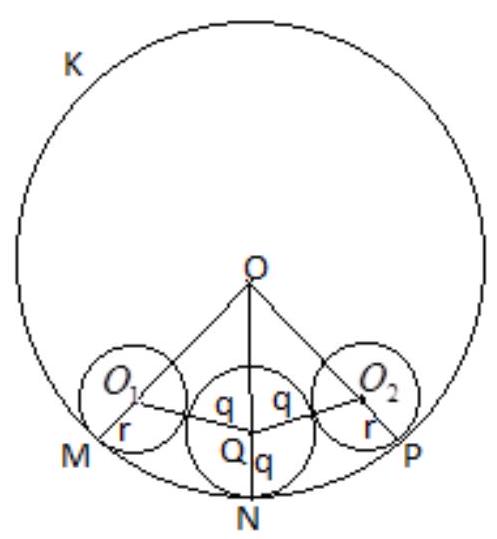
Fig 1
From the equality of triangles... | \frac{R(R-r)}{R+3r} | Geometry | math-word-problem | olympiads | 196e5ec5-019d-5cad-b7b7-b0804732c80d | [
true,
true
] | [
"<think>\nAlright, let's tackle this geometry problem. Let me first try to visualize it. There's a big circle K with center O and radius R. Inside it, there are two smaller circles, K₁ and K₂, each with radius r and centers at O₁ and O₂ respectively. These two smaller circles touch the big circle K internally. The ... | [
true,
true
] | null | [
"stop",
"stop"
] | 2 | [
{
"content": "5. Circles $K_{1}$ and $K_{2}$ with centers at points $O_{1}$ and $O_{2}$ have the same radius $r$ and touch the circle $K$ of radius $R$ with center at point $O$ internally. The angle $O_{1} O O_{2}$ is $120^{\\circ}$. Find the radius $q$ of the circle that touches $K_{1}$ and $K_{2}$ externally ... |
12.444 The base of the pyramid is an equilateral triangle. One of the lateral faces of the pyramid is perpendicular to the plane of the base. Find the cosine of the angle between the other two lateral faces, if they form an angle \(\alpha\) with the plane of the base. | Solution. Let $FABC$ be the given pyramid, $FAB \perp ABC$. Then the height $FK$ of the pyramid lies in the plane $FAB$. Let $FM$ be the height of $\triangle FBC$. Then $BC \perp KM$ (Theorem 12) $\Rightarrow$
 with the plane of the base.",
"role": "user"
},
... |
If $F(n)$ is a function such that $F(1)=F(2)=F(3)=1$, and such that $F(n+1)= \frac{F(n)\cdot F(n-1)+1}{F(n-2)}$ for $n\ge 3,$
then $F(6)=$
$\text{(A) } 2\quad \text{(B) } 3\quad \text{(C) } 7\quad \text{(D) } 11\quad \text{(E) } 26$
Solution
Plugging in $n=3$ gives $F(4) = \frac{F(3) \cdot F(2) + 1}{F(1)} = \frac{1 \... | empty | 7 | Algebra | MCQ | amc_aime | 898f5d0e-b9d0-5941-8e64-09bc4f24ec1b | [
true,
true
] | [
"<think>\nOkay, let's try to figure out the value of F(6) given the recursive function. The problem states that F(1), F(2), and F(3) are all 1. Then, for n ≥ 3, F(n+1) is equal to (F(n) * F(n-1) + 1) divided by F(n-2). Hmm, that's a bit complex, but let's take it step by step.\n\nFirst, let's make sure I understand... | [
false,
false
] | [
false,
true
] | null | 1 | [
{
"content": "If $F(n)$ is a function such that $F(1)=F(2)=F(3)=1$, and such that $F(n+1)= \\frac{F(n)\\cdot F(n-1)+1}{F(n-2)}$ for $n\\ge 3,$ \nthen $F(6)=$\n$\\text{(A) } 2\\quad \\text{(B) } 3\\quad \\text{(C) } 7\\quad \\text{(D) } 11\\quad \\text{(E) } 26$\n\nSolution\nPlugging in $n=3$ gives $F(4) = \\fra... |
9.36 Given the three sides of an obtuse triangle are $3, 4, x$, then the range of $x$ is
(A) $1<x<7$.
(B) $5<x<7$.
(C) $1<x<\sqrt{7}$.
(D) $5<x<7$ or $1<x<\sqrt{7}$.
(6th "Jinyun Cup" Junior High School Mathematics Invitational, 1989) | [Solution] Let $x$ be the longest side, and its opposite angle be $\alpha$, then $\cos \alpha25$, so $x>5$.
Also, $x4-3=1, \quad \therefore \quad 1<x<\sqrt{7}$.
Therefore, the answer is $(D)$. | D | Geometry | MCQ | olympiads | dc3d5be9-93ea-5a6b-9618-9652924076a4 | [
true,
true
] | [
"<think>\nOkay, so I need to find the range of x for an obtuse triangle with sides 3, 4, and x. The options are given as A to D, so I need to figure out which one is correct. Let me start by recalling some properties about triangles and obtuse triangles specifically.\n\nFirst, for any triangle, the sum of the lengt... | [
true,
true
] | null | null | 2 | [
{
"content": "9.36 Given the three sides of an obtuse triangle are $3, 4, x$, then the range of $x$ is \n(A) $1<x<7$.\n(B) $5<x<7$.\n(C) $1<x<\\sqrt{7}$.\n(D) $5<x<7$ or $1<x<\\sqrt{7}$.\n(6th \"Jinyun Cup\" Junior High School Mathematics Invitational, 1989)",
"role": "user"
},
{
"content": "<think>... |
Task A-1.5. (8 points)
In the figure, there is a regular hexagon $A B C D E F$ and a regular pentagon $E F G H I$.
Determine the angle $\varangle F A G$.
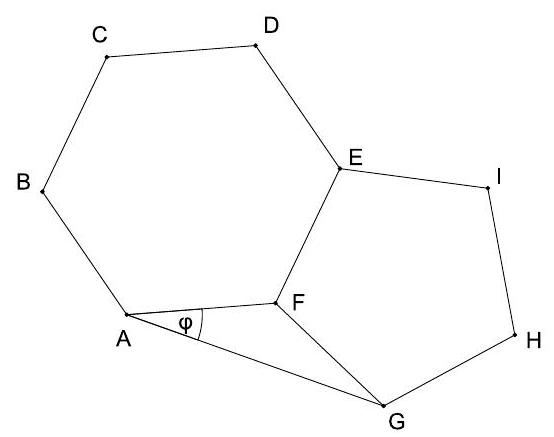 | ## Solution.
Let $S$ be the center of a regular hexagon, and $T$ be the center of a regular pentagon.
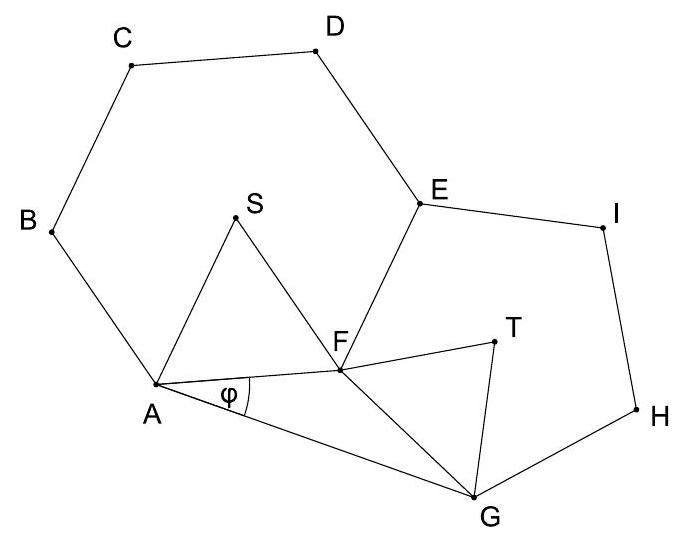
We have $\varangle A S F = 360^{\circ} / 6 = 60^{\circ}$, so $\varangle A F E = 120^{\... | 24 | Geometry | math-word-problem | olympiads | 9c4aa229-e2c9-5318-be80-ad3624905734 | [
true,
false
] | [
"<think>\nOkay, so I need to find the measure of angle FAG. Let me see. The figure has a regular hexagon ABCDEF and a regular pentagon EFGHI. So point E and F are shared between both shapes. The angle in question is at point A, connecting points F, A, and G. Hmm.\n\nFirst, let me visualize this. A regular hexagon h... | [
true,
false
] | null | null | 1 | [
{
"content": "Task A-1.5. (8 points)\n\nIn the figure, there is a regular hexagon $A B C D E F$ and a regular pentagon $E F G H I$.\n\nDetermine the angle $\\varangle F A G$.\n\n",
... |
2. Toss a coin and a die at the same time, if the coin shows heads it is recorded as 2, if it shows tails it is recorded as 1, this number multiplied by the die's number of dots is recorded as $x$ (for example, if the coin shows heads and the die shows 3 dots, then $x=2 \times 3=6$), then the mathematical expectation o... | $$
\begin{array}{l}
x=1,2,3,4,5,6,8,10,12, P(x=1)=\frac{1}{2} \times \frac{1}{6}=\frac{1}{12}, \\
P(x=2)=\frac{1}{2} \times \frac{1}{6}+\frac{1}{2} \times \frac{1}{6}=\frac{1}{6}, P(x=3)=\frac{1}{2} \times \frac{1}{6}=\frac{1}{12}, \\
P(x=4)=\frac{1}{2} \times \frac{1}{6}+\frac{1}{2} \times \frac{1}{6}=\frac{1}{6}, P(x... | \frac{21}{4} | Algebra | math-word-problem | olympiads | 513df20d-377a-5d7d-9881-df32f3f957ae | [
true,
true
] | [
"<think>\nOkay, so I need to find the mathematical expectation of x, where x is the product of the coin result and the die result. Let me think step by step. First, let's recall that the mathematical expectation, or expected value, is calculated by multiplying each possible outcome by its probability and then summi... | [
true,
true
] | null | [
"stop",
"stop"
] | 2 | [
{
"content": "2. Toss a coin and a die at the same time, if the coin shows heads it is recorded as 2, if it shows tails it is recorded as 1, this number multiplied by the die's number of dots is recorded as $x$ (for example, if the coin shows heads and the die shows 3 dots, then $x=2 \\times 3=6$), then the mat... |
1-36 Find all such four-digit numbers, when 400 is written to their left, the result is a perfect square.
Find all such four-digit numbers, when 400 is written to their left, the result is a perfect square. | [Solution] Let $\overline{a b c d}$ be the required four-digit number. Since $\overline{400 a b c d}$ is a seven-digit number and a perfect square, we have
$$\overline{400 a b c d}=(20 l m)^{2}$$
Rewriting (1) as
$$400 \times 10^{4}+\overline{a b c d}=\left(20 \times 10^{2}+10 l+m\right)^{2}$$
Expanding and simplifyi... | 4001 \text{ or } 8004 | Number Theory | math-word-problem | inequalities | b2bf4978-1c37-5b5e-bec8-781cedfda949 | [
true,
true
] | [
"<think>\nOkay, let's see. The problem is asking to find all four-digit numbers such that when we write 400 to their left, the resulting number is a perfect square. Hmm, so for example, if the four-digit number is ABCD, then putting 400 in front would make the number 400ABCD, and this should be a perfect square. Al... | [
true,
true
] | null | null | 2 | [
{
"content": "1-36 Find all such four-digit numbers, when 400 is written to their left, the result is a perfect square.\n\nFind all such four-digit numbers, when 400 is written to their left, the result is a perfect square.",
"role": "user"
},
{
"content": "<think>Hmm , so for example, if the four-d... |
7. The center of a unit square coincides with the center of a circle, and the square is inside the circle. If a point is randomly selected on the circle, the probability that this point can see two complete sides of the square is $\frac{1}{2}$, then the radius of the circle is . $\qquad$ | 7. $\frac{\sqrt{4+2 \sqrt{2}}}{2}$ Detailed explanation: On the minor arc between the adjacent sides of the square, you can see two complete sides. From the given condition “the probability of seeing two complete sides of the square is $\frac{1}{2}$”, we know that the 8 intersection points of the extensions of the squa... | \frac{\sqrt{4+2\sqrt{2}}}{2} | Geometry | math-word-problem | olympiads | 4200315f-9a3a-599d-bdf3-caecf0ef2fe1 | [
true,
true
] | [
"<think>\nOkay, so I have this problem here. Let me try to visualize it first. There's a unit square, which means each side is 1 unit long. The center of this square coincides with the center of a circle, and the square is entirely inside the circle. Then, if we randomly pick a point on the circle, the probability ... | [
false,
true
] | null | null | 1 | [
{
"content": "7. The center of a unit square coincides with the center of a circle, and the square is inside the circle. If a point is randomly selected on the circle, the probability that this point can see two complete sides of the square is $\\frac{1}{2}$, then the radius of the circle is . $\\qquad$",
"... |
17.3. (New York, 74). Let
$$
a_{n}=\frac{1 \cdot 3 \cdot 5 \ldots(2 n-1)}{2 \cdot 4 \cdot 6 \ldots 2 n}, n \in \mathrm{N}
$$
Find $\lim a_{n}$.
$$
n \rightarrow \infty
$$ | 17.3. Since
$$
\begin{aligned}
a_{n}^{2}=\frac{1^{2} \cdot 3^{2} \cdot \ldots \cdot(2 n-1)^{2}}{2^{2} \cdot 4^{2} \cdot \ldots \cdot(2 n)^{2}} & = \\
& =\frac{1 \cdot 3}{2^{2}} \cdot \frac{3 \cdot 5}{4^{2}} \cdots \frac{(2 n-1)(2 n+1)}{(2 n)^{2}} \cdot \frac{1}{2 n+1}<\frac{1}{2 n+1}
\end{aligned}
$$
for any $n \in \... | 0 | Algebra | math-word-problem | olympiads | 66f416f3-3ed5-505b-b966-3d0c67a5c774 | [
true,
false
] | [
"<think>\nOkay, so I need to find the limit of the sequence \\( a_n \\) as \\( n \\) approaches infinity. The sequence is given by the product of odd numbers divided by the product of even numbers up to \\( 2n \\). Let me write that down again to make sure I have it right:\n\n\\[\na_n = \\frac{1 \\cdot 3 \\cdot 5 \... | [
true,
false
] | null | null | 1 | [
{
"content": "17.3. (New York, 74). Let\n\n$$\na_{n}=\\frac{1 \\cdot 3 \\cdot 5 \\ldots(2 n-1)}{2 \\cdot 4 \\cdot 6 \\ldots 2 n}, n \\in \\mathrm{N}\n$$\n\nFind $\\lim a_{n}$.\n\n$$\nn \\rightarrow \\infty\n$$",
"role": "user"
},
{
"content": "<think>Hmm , okay. So the numerator is the product of th... |
7. It is known that there exists a natural number $N$ such that
$$
(\sqrt{3}-1)^{N}=4817152-2781184 \cdot \sqrt{3}
$$
Find $N$.
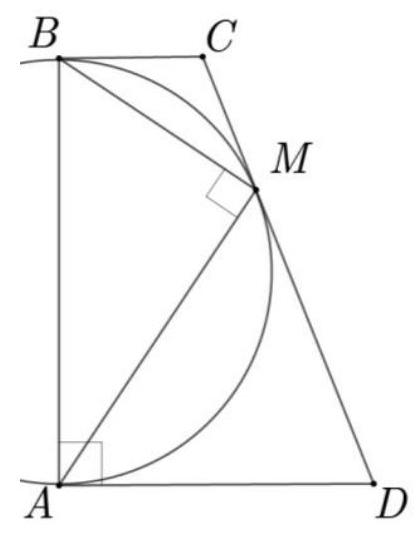 | Solution. Suppose that raising the number $a+b \sqrt{3}$ to the power $N$ results in the number $A+B \sqrt{3}$ (here $a, b, A, B$ are integers). Expanding the expression $(a+b \sqrt{3})^{N}$, we get a sum of monomials (with integer coefficients that are not important to us now) of the form $a^{N-n}(b \sqrt{3})^{n}$. Th... | 16 | Number Theory | math-word-problem | olympiads | 9522396c-d906-5412-ae2d-38491223916f | [
true,
true
] | [
"<think>\nAlright, so I need to find a natural number N such that (√3 - 1)^N equals 4817152 minus 2781184 times √3. Hmm, okay. Let me think about how to approach this.\n\nFirst, I remember that expressions of the form (a - b√3)^N can often be expanded using the binomial theorem, resulting in terms that have both ra... | [
true,
true
] | null | null | 2 | [
{
"content": "7. It is known that there exists a natural number $N$ such that\n\n$$\n(\\sqrt{3}-1)^{N}=4817152-2781184 \\cdot \\sqrt{3}\n$$\n\nFind $N$.\n\n",
"role": "user"
},
... |
13. Mother Pig takes her children for a picnic. If 4 piglets sit on each tablecloth, there will be 6 piglets without a seat; if one more piglet sits on each tablecloth, there will be 4 seats left. There are $\qquad$ piglets in total. | Answer: 46 | 46 | Algebra | math-word-problem | olympiads | 3efe966e-1806-5aa1-9b93-bee5997d50d0 | [
true,
true
] | [
"<think>\nOkay, let's try to figure out how many piglets there are in total. The problem says that if 4 piglets sit on each tablecloth, 6 will be left without a seat. But if one more piglet sits on each tablecloth (so that's 5 per tablecloth), then there will be 4 seats left. We need to find the total number of pig... | [
true,
true
] | null | null | 2 | [
{
"content": "13. Mother Pig takes her children for a picnic. If 4 piglets sit on each tablecloth, there will be 6 piglets without a seat; if one more piglet sits on each tablecloth, there will be 4 seats left. There are $\\qquad$ piglets in total.",
"role": "user"
},
{
"content": "<think>Hmm , so f... |
8. (FRG 3) For all rational $x$ satisfying $0 \leq x<1, f$ is defined by
$$
f(x)=\left\{\begin{array}{ll}
f(2 x) / 4, & \text { for } 0 \leq x<1 / 2, \\
3 / 4+f(2 x-1) / 4, & \text { for } 1 / 2 \leq x<1 .
\end{array}\right.
$$
Given that $x=0 . b_{1} b_{2} b_{3} \ldots$ is the binary representation of $x$, find $f(x)... | 8. By the definition of $f$, it holds that $f\left(0 . b_{1} b_{2} \ldots\right)=3 b_{1} / 4+f\left(0 . b_{2} b_{3} \ldots\right) / 4$ $=0 . b_{1} b_{1}+f\left(0 . b_{2} b_{3} \ldots\right) / 4$. Continuing this argument we obtain
$$
f\left(0 . b_{1} b_{2} b_{3} \ldots\right)=0 . b_{1} b_{1} \ldots b_{n} b_{n}+\frac{1}... | f(00b_{1}b_{2}\ldots)=00b_{1}b_{1}b_{2}b_{2}\ldots | Other | math-word-problem | olympiads | b033add9-d5f8-5035-a5dc-01fc63611544 | [
true,
true
] | [
"<think>\nOkay, let's see. I need to find an expression for f(x) given this recursive definition. The function f is defined differently depending on whether x is in the first half or the second half of the interval [0,1). And x is a rational number, which probably means its binary representation is terminating or r... | [
false,
false
] | [
false,
true
] | null | 1 | [
{
"content": "8. (FRG 3) For all rational $x$ satisfying $0 \\leq x<1, f$ is defined by\n$$\nf(x)=\\left\\{\\begin{array}{ll}\nf(2 x) / 4, & \\text { for } 0 \\leq x<1 / 2, \\\\\n3 / 4+f(2 x-1) / 4, & \\text { for } 1 / 2 \\leq x<1 .\n\\end{array}\\right.\n$$\n\nGiven that $x=0 . b_{1} b_{2} b_{3} \\ldots$ is t... |
8. Given the dihedral angle $\alpha-l-\beta$ is $60^{\circ}$, a point $P$ inside this dihedral angle is 3 units away from plane $\alpha$ and 5 units away from plane $\beta$. If $A \in \alpha, B \in \beta$, then the minimum perimeter of $\triangle P A B$ is $\qquad$ | 8. 14 .
Let $P_{1}$ and $P_{2}$ be the symmetric points of $P$ with respect to the planes $\alpha$ and $\beta$. Then the distance $P_{1} P_{2}$ is the minimum value of the perimeter of $\triangle P A B$, which is
$$
P_{1} P_{2}=\sqrt{6^{2}+10^{2}-2 \times 6 \times 10 \cos 120^{\circ}}=14 .
$$ | 14 | Geometry | math-word-problem | olympiads | f915d1ec-a46b-57d7-ae60-42651416ebd7 | [
true,
true
] | [
"<think>\nOkay, so I need to find the minimum perimeter of triangle PAB where P is a point inside a dihedral angle of 60 degrees, and it's 3 units away from plane α and 5 units away from plane β. Points A and B are on planes α and β respectively. Hmm, let me think about how to approach this.\n\nFirst, I remember th... | [
true,
false
] | null | null | 1 | [
{
"content": "8. Given the dihedral angle $\\alpha-l-\\beta$ is $60^{\\circ}$, a point $P$ inside this dihedral angle is 3 units away from plane $\\alpha$ and 5 units away from plane $\\beta$. If $A \\in \\alpha, B \\in \\beta$, then the minimum perimeter of $\\triangle P A B$ is $\\qquad$",
"role": "user"
... |
Find all integers $k$ with the following property: there exist infinitely many positive integers $n$ such that $(n+k) \nmid \mathrm{C}_{2 n}^{n}$.
保留了源文本的换行和格式。请注意,这里的 $\mathrm{C}_{2 n}^{n}$ 表示从 $2n$ 个不同元素中选取 $n$ 个元素的组合数,通常写作 $\binom{2n}{n}$。 | 【Analysis】Using the conclusion of Question 5, we know that $k=1$ does not satisfy the problem.
When $k=0$, take $n$ as an odd prime $p$.
Obviously, in base $p$
$$
p+p=(\overline{10})_{p}+(\overline{10})_{p}=(\overline{20})_{p}
$$
does not carry. By Kummer's theorem, we know $p \nmid \mathrm{C}_{2 p}^{p}$, i.e., $k=0$ ... | k\neq1 | Number Theory | math-word-problem | olympiads | 8611e06a-a433-58d3-9604-52345de6d60c | [
true,
true
] | [
"<think>\n嗯,我现在要解决的问题是:找到所有整数k,使得存在无限多个正整数n,满足(n + k)不整除组合数C(2n, n),也就是二项式系数binom{2n}{n}。题目要求找出所有这样的整数k。这个问题看起来有点挑战性,不过我觉得应该可以通过分析组合数的性质和一些数论的方法来解决。\n\n首先,我需要理解题目在问什么。题目说存在无限多的正整数n,使得(n + k)不整除C(2n, n)。也就是说,对于这样的k,不管n多大,总能找到更大的n使得(n + k)不整除中间的组合数。反过来,如果对于某个k,只有有限个n满足(n + k)不整除C(2n, n),那么这样的k就不符合题目的要求。所以我们的目标是找出所有这样... | [
true,
true
] | null | null | 2 | [
{
"content": "Find all integers $k$ with the following property: there exist infinitely many positive integers $n$ such that $(n+k) \\nmid \\mathrm{C}_{2 n}^{n}$.\n\n保留了源文本的换行和格式。请注意,这里的 $\\mathrm{C}_{2 n}^{n}$ 表示从 $2n$ 个不同元素中选取 $n$ 个元素的组合数,通常写作 $\\binom{2n}{n}$。",
"role": "user"
},
{
"content": "<t... |
(2) The number of roots of the equation $10 \sin \left(x+\frac{\pi}{6}\right)=x$ is $(\quad)$.
(A) 8
(B) 7
(C) 6
(D) 5 | (2) By the properties of the sine function, draw the graphs of $y=10 \sin \left(x+\frac{\pi}{6}\right)$ and $y=x$ simultaneously, noting that
$$
3 \pi-\frac{\pi}{6}<10<3 \pi+\frac{\pi}{2}
$$
and
$$
\left|-\frac{\pi}{6}-3 \pi\right|<10<\left|-\frac{\pi}{6}-3 \pi-\frac{\pi}{2}\right|,
$$
we can see that the two curves ... | 7 | Calculus | MCQ | olympiads | 13be14db-09ac-555f-a6cf-53eed2d5037b | [
true,
true
] | [
"<think>\nOkay, so I need to figure out how many roots the equation \\(10 \\sin \\left(x + \\frac{\\pi}{6}\\right) = x\\) has. The options are 8, 7, 6, or 5. Hmm. Let's start by understanding what this equation is asking. It's a transcendental equation because it involves both a trigonometric function and a linear ... | [
false,
false
] | [
true,
true
] | null | 2 | [
{
"content": "(2) The number of roots of the equation $10 \\sin \\left(x+\\frac{\\pi}{6}\\right)=x$ is $(\\quad)$.\n(A) 8\n(B) 7\n(C) 6\n(D) 5",
"role": "user"
},
{
"content": "<think>Hmm . Let's start by understanding what this equation is asking. It's a transcendental equation because it involves ... |
Problem 8.7. In an acute-angled triangle $A B C$, the altitude $B H$ is drawn. It turns out that $C H=A B+A H$. How many degrees does the angle $B A C$ measure if $\angle A B C=84^{\circ}$ ?
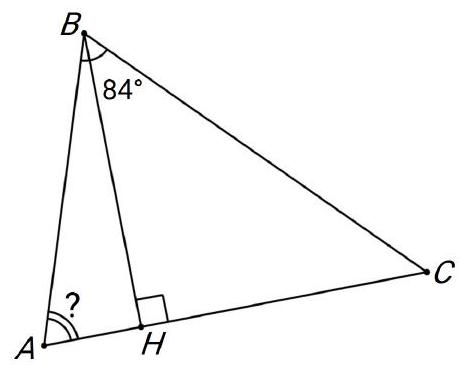 | Answer: 64.
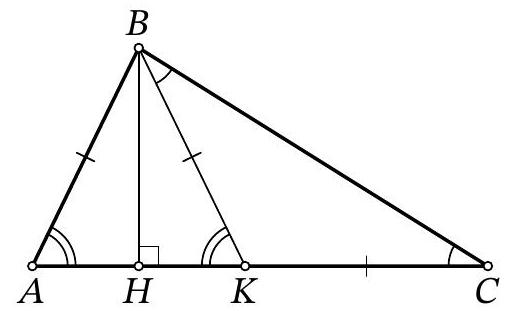
Fig. 8: to the solution of problem 8.7
Solution. Mark a point \( K \) on the segment \( CH \) such that \( AH = HK \). Then, from the condition, it follows that \( AB = CK \) (Fig... | 64 | Geometry | math-word-problem | olympiads | 9ecff588-ea7f-5803-8bb3-37cca3e8f186 | [
true,
true
] | [
"<think>\nOkay, let's see. We have an acute-angled triangle ABC. So all angles are less than 90 degrees. The altitude BH is drawn. An altitude is a perpendicular segment from a vertex to the opposite side. So BH is perpendicular to AC, right? Therefore, angle BHC and angle BHA are both 90 degrees. \n\nThe problem s... | [
true,
true
] | null | null | 2 | [
{
"content": "Problem 8.7. In an acute-angled triangle $A B C$, the altitude $B H$ is drawn. It turns out that $C H=A B+A H$. How many degrees does the angle $B A C$ measure if $\\angle A B C=84^{\\circ}$ ?\n\n$, let real numbers $a_{1}$, $a_{2}, \cdots, a_{n}$ satisfy
$$
\begin{array}{l}
a_{1}+a_{2}+\cdots+a_{n} \geqslant n, \\
a_{1}^{2}+a_{2}^{2}+\cdots+a_{n}^{2} \geqslant n^{2} .
\end{array}
$$
Find the minimum value of $\max \left\{a_{1}, a_{2}, \cdots, a_{n}\right\}$.
(28th Uni... | The above equation holds for $a \geqslant 2$.
Try taking $a=2$, at this point, $\max \left\{a_{1}, a_{2}, \cdots, a_{n}\right\}$ $=2$. From this, we can conjecture that the minimum value of $\max \left\{a_{1}, a_{2}, \cdots, a_{n}\right\}$ is 2.
Solution: First, we prove that for any real numbers $a_{1}, a_{2}, \cdots... | 2 | Inequalities | math-word-problem | cn_contest | 2ea974da-7bfb-5ada-8abc-1c47891c42c3 | [
true,
true
] | [
"<think>\nOkay, so I need to find the minimum value of the maximum among the real numbers a₁, a₂, ..., aₙ given two conditions: their sum is at least n, and the sum of their squares is at least n². The problem specifies that n is a positive integer greater than 3. Hmm, let me start by understanding what exactly is ... | [
true,
false
] | null | null | 1 | [
{
"content": "Example 1 Given a positive integer $n(n>3)$, let real numbers $a_{1}$, $a_{2}, \\cdots, a_{n}$ satisfy\n$$\n\\begin{array}{l}\na_{1}+a_{2}+\\cdots+a_{n} \\geqslant n, \\\\\na_{1}^{2}+a_{2}^{2}+\\cdots+a_{n}^{2} \\geqslant n^{2} .\n\\end{array}\n$$\n\nFind the minimum value of $\\max \\left\\{a_{1}... |
## Task B-3.1.
Determine all real numbers $a$ for which there exists a real number $x$ such that
$$
\cos ^{4} x \sin x + \cos ^{2} x \sin ^{3} x + \sin ^{3} x = a^{2} - 3
$$ | ## Solution.
We will write the expression on the left side of the equality in a more convenient form and apply the basic identity $\cos ^{2} x+\sin ^{2} x=1$. The steps are as follows:
$$
\begin{gathered}
\cos ^{4} x \sin x+\cos ^{2} x \sin ^{3} x+\sin ^{3} x= \\
\sin x\left(\cos ^{4} x+\cos ^{2} x \sin ^{2} x+\sin ^... | [-2,-\sqrt{2}]\cup[\sqrt{2},2] | Algebra | math-word-problem | olympiads | 879fb3ce-54f6-5d2e-a59e-7f468792e15f | [
true,
true
] | [
"<think>\nOkay, so I need to find all real numbers a such that there exists a real number x where the equation cos^4 x sin x + cos^2 x sin^3 x + sin^3 x = a² - 3 holds. Hmm. Let me start by trying to simplify the left side of the equation. Maybe I can factor some terms or use trigonometric identities to make it mor... | [
false,
false
] | [
true,
false
] | null | 1 | [
{
"content": "## Task B-3.1.\n\nDetermine all real numbers $a$ for which there exists a real number $x$ such that\n\n$$\n\\cos ^{4} x \\sin x + \\cos ^{2} x \\sin ^{3} x + \\sin ^{3} x = a^{2} - 3\n$$",
"role": "user"
},
{
"content": "<think>Hmm . Let me start by trying to simplify the left side of ... |
4. Take a random eight-digit number composed of 0s and 1s. The probability that the sum of the digits in the even positions is equal to the sum of the digits in the odd positions is $\qquad$ . | 4. $\frac{35}{128}$.
Let $n$ be the eight-digit number that satisfies the condition.
According to the problem, the number of 1s in the even positions of $n$ is the same as the number of 1s in the odd positions.
Thus, the number of 1s in the odd positions and even positions can be $1, 2, 3$ or 4.
Note that the first d... | \frac{35}{128} | Combinatorics | math-word-problem | olympiads | f3976d7c-adf5-5025-bb17-f2924ec12113 | [
true,
true
] | [
"<think>\nOkay, let's see. The problem is about finding the probability that in a random eight-digit number composed of 0s and 1s, the sum of the digits in the even positions equals the sum of the digits in the odd positions. Hmm, so first, I need to understand exactly what's being asked here. \n\nAn eight-digit nu... | [
true,
true
] | null | null | 2 | [
{
"content": "4. Take a random eight-digit number composed of 0s and 1s. The probability that the sum of the digits in the even positions is equal to the sum of the digits in the odd positions is $\\qquad$ .",
"role": "user"
},
{
"content": "<think>Hmm , so first, I need to understand exactly what's... |
Dona Lígia has a square plot of land. She decides to divide it into five regions, consisting of four rectangles and one square as illustrated in the figure below:
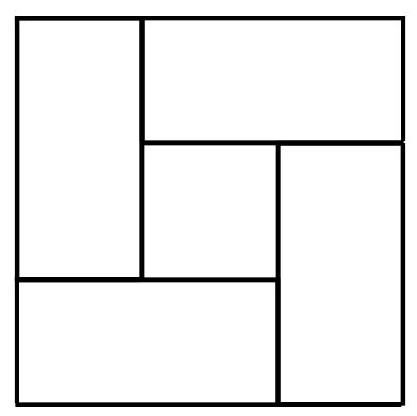
$\mathrm{In}$ the figure ab... | Solution
Since the area of the central square is equal to $64 \mathrm{~m}^{2}$, its side length is $8 \mathrm{~m}$. Since the perimeter of a square is four times the length of its side, we conclude that the perimeter of the central square is equal to $32 \mathrm{~m}$.
Since the five regions have the same perimeter, w... | 256\mathrm{~}^{2} | Geometry | math-word-problem | olympiads | 88b22d58-6dc9-5e8b-b557-a8e216a9faf2 | [
true,
true
] | [
"<think>\nOkay, let's try to solve this problem step by step. So, Dona Lígia has a square plot of land divided into five regions: four rectangles and a central square. The central square has an area of 64 m², the longer sides of the four rectangles are the same length, and all five regions have the same perimeter. ... | [
true,
false
] | null | null | 1 | [
{
"content": "Dona Lígia has a square plot of land. She decides to divide it into five regions, consisting of four rectangles and one square as illustrated in the figure below:\n\n\n\n$... |
3. Given the function $f(x)$ satisfies:
$$
\begin{array}{l}
f(1)=\frac{1}{4}, \\
4 f(x) f(y)=f(x+y)+f(x-y)(x, y \in \mathbf{R}) .
\end{array}
$$
Then $f(2019)=$.
(A) $\frac{1}{2}$
(B) $-\frac{1}{2}$
(C) $\frac{1}{4}$
(D) $-\frac{1}{4}$ | 3. B.
Let $x=1, y=0$, we get $f(0)=\frac{1}{2}$.
Let $x=1, y=1$, we get
$$
4 f^{2}(1)=f(2)+f(0) \text {. }
$$
Thus, $f(2)=-\frac{1}{4}$.
Let $x=2, y=1$, we get
$$
4 f(1) f(2)=f(3)+f(1) \text {. }
$$
Thus, $f(3)=-\frac{1}{2}$.
Let $x=n, y=1$, we get
$$
f(n)=f(n+1)+f(n-1) \text {. }
$$
Similarly, $f(n+1)=f(n+2)+f(n)$... | -\frac{1}{2} | Algebra | MCQ | olympiads | 6a843819-e516-5d64-babd-d4717676422d | [
true,
true
] | [
"<think>\nOkay, so I need to find f(2019) given that f(1) = 1/4 and the functional equation 4f(x)f(y) = f(x+y) + f(x-y) for all real numbers x and y. Hmm, functional equations can be tricky, but maybe I can figure out the pattern or figure out what kind of function f(x) is.\n\nFirst, let me recall that functional e... | [
false,
false
] | [
false,
true
] | null | 1 | [
{
"content": "3. Given the function $f(x)$ satisfies:\n$$\n\\begin{array}{l}\nf(1)=\\frac{1}{4}, \\\\\n4 f(x) f(y)=f(x+y)+f(x-y)(x, y \\in \\mathbf{R}) .\n\\end{array}\n$$\n\nThen $f(2019)=$.\n(A) $\\frac{1}{2}$\n(B) $-\\frac{1}{2}$\n(C) $\\frac{1}{4}$\n(D) $-\\frac{1}{4}$",
"role": "user"
},
{
"con... |
3. The remainder of the division of a natural number n by 2021 is 800 more than the remainder of the division of the number n by 2020. Find the smallest such n. (A. Gолованов) | Answer. 2020.1221 = 2466 420. Solution. Let for a natural number $m$ the condition of the problem is satisfied. Then for some $d_{1}, d_{2}, d_{3}$ and $r$ the equality $m=2020 d_{1}+r=2021 d_{2}+r+800$ holds. But in this case, the equality $m-r=2020 d_{1}=2021 d_{2}+800$ also holds, so the number $m-r$ also satisfies ... | 2466420 | Number Theory | math-word-problem | olympiads | c008e39b-1564-58aa-b99a-a37db9e791ba | [
true,
true
] | [
"<think>\nOkay, so I need to find the smallest natural number n such that when you divide n by 2021, the remainder is 800 more than the remainder when you divide n by 2020. Hmm, let me try to break this down.\n\nFirst, let's recall what division with remainder means. If I divide a number n by another number, say m,... | [
true,
true
] | null | null | 2 | [
{
"content": "3. The remainder of the division of a natural number n by 2021 is 800 more than the remainder of the division of the number n by 2020. Find the smallest such n. (A. Gолованов)",
"role": "user"
},
{
"content": "<think>Hmm , let me try to break this down.\n\nFirst, let's recall what divi... |
3. One of the angles of the trapezoid is $60^{\circ}$. Find the ratio of its bases, if it is known that a circle can be inscribed in this trapezoid and a circle can be circumscribed around this trapezoid. | Answer. $1: 3$
## Solution.
A
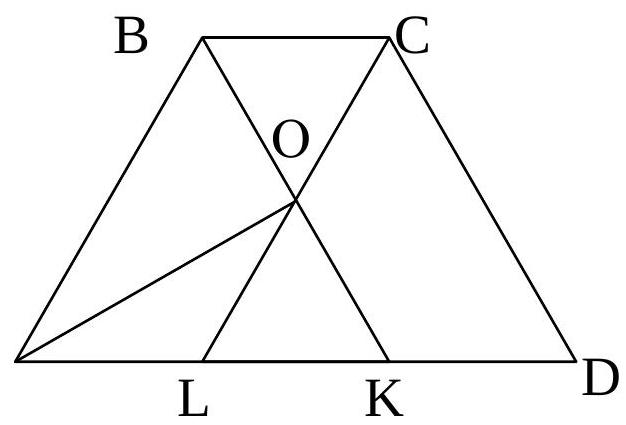
Since $ABCD$ is a cyclic quadrilateral, it is isosceles, i.e., $AB = CD$. Since $\angle BAD = 60^\circ$, then $\angle ABC = 120^\circ$. The center of the insc... | 1:3 | Geometry | math-word-problem | olympiads | 9e296c50-98bd-5ca1-b46e-ff8cc63abc19 | [
true,
true
] | [
"<think>\nAlright, so I have this trapezoid problem. Let me read it again: one of the angles is 60 degrees, and we need to find the ratio of its bases given that it's both inscribed in a circle (cyclic) and can have a circle inscribed in it (tangential). Hmm, okay.\n\nFirst, let me recall some properties of trapezo... | [
true,
false
] | null | [
"stop",
"stop"
] | 1 | [
{
"content": "3. One of the angles of the trapezoid is $60^{\\circ}$. Find the ratio of its bases, if it is known that a circle can be inscribed in this trapezoid and a circle can be circumscribed around this trapezoid.",
"role": "user"
},
{
"content": "<think>Hmm , okay.\n\nFirst, let me recall som... |
2. Given the complex number $z=\frac{-1+i \sqrt{3}}{2}$. Calculate the product:
$$
\left(z+\frac{1}{z}\right)\left(z^{2}+\frac{1}{z^{2}}\right) \ldots\left(z^{2012}+\frac{1}{z^{2012}}\right)
$$ | Solution. One
$$
z^{2}=\left(\frac{-1+i \sqrt{3}}{2}\right)^{2}=\frac{1-2 i \sqrt{3}-3}{4}=\frac{-1-i \sqrt{3}}{2} \text { and } z^{3}=\frac{-1+i \sqrt{3}}{2} \cdot \frac{-1-i \sqrt{3}}{2}=\frac{1+3}{4}=1
$$
it follows:
$$
\begin{aligned}
\left(z+\frac{1}{z}\right)\left(z^{2}+\frac{1}{z^{2}}\right) \ldots\left(z^{20... | 2^{670} | Algebra | math-word-problem | olympiads | 97b6587b-5378-5871-9552-631ed1109166 | [
true,
true
] | [
"<think>\nOkay, let's see. I have this complex number z, which is (-1 + i√3)/2. I need to calculate the product from k=1 to k=2012 of (z^k + 1/z^k). That is, multiply all these terms together where each term is z to some power plus its reciprocal. Hmm. That seems pretty intense. Let me start by understanding what z... | [
true,
true
] | null | null | 2 | [
{
"content": "2. Given the complex number $z=\\frac{-1+i \\sqrt{3}}{2}$. Calculate the product:\n\n$$\n\\left(z+\\frac{1}{z}\\right)\\left(z^{2}+\\frac{1}{z^{2}}\\right) \\ldots\\left(z^{2012}+\\frac{1}{z^{2012}}\\right)\n$$",
"role": "user"
},
{
"content": "<think>Hmm . That seems pretty intense. L... |
Let $n$ be an integer greater than 1, and its all positive divisors are $d_{1}, d_{2}, \cdots, d_{k}$, where $1=d_{1}<d_{2}<\cdots<d_{k}=n$. It is known that $d_{2}-d_{1}, d_{3}-d_{2}, \cdots, d_{k}-d_{k-1}$ are all the positive divisors of another positive integer (all distinct but not necessarily in increasing order)... | Let $d_{i}-d_{i-1}=\delta_{i}(i=2,3, \cdots, n)$. It is easy to see that the number with the set of positive divisors $D=\left\{\delta_{2}, \delta_{3}, \cdots, \delta_{k}\right\}$ is the largest element in $D$. Since $1 \in D$, we know that the set $\left\{d_{1}, d_{2}, \cdots, d_{k}\right\}$ contains both odd and even... | 2^{}(\in{N}^{*}) | Number Theory | math-word-problem | olympiads | 4bda074f-c766-5123-bbf7-b4adb4dd55e5 | [
true,
true
] | [
"<think>\nOkay, let me try to tackle this problem. So, we have an integer n > 1, and all its positive divisors are listed as d₁, d₂, ..., d_k, where 1 = d₁ < d₂ < ... < d_k = n. The key part here is that the differences between consecutive divisors, namely d₂ - d₁, d₃ - d₂, ..., d_k - d_{k-1}, are all the positive ... | [
false,
false
] | [
true,
true
] | null | 2 | [
{
"content": "Let $n$ be an integer greater than 1, and its all positive divisors are $d_{1}, d_{2}, \\cdots, d_{k}$, where $1=d_{1}<d_{2}<\\cdots<d_{k}=n$. It is known that $d_{2}-d_{1}, d_{3}-d_{2}, \\cdots, d_{k}-d_{k-1}$ are all the positive divisors of another positive integer (all distinct but not necessa... |
Problem 2. Solve in the set of real numbers the equation $x+\log _{2}\left(1+\sqrt{\frac{5^{x}}{3^{x}+4^{x}}}\right)=4+\log _{1 / 2}\left(1+\sqrt{\frac{25^{x}}{7^{x}+24^{x}}}\right)$. | Solution. Note that $x=2$ is a solution.
1 point
We will show that this solution is unique. For $x>2$ we have $(3 / 5)^{x}+(4 / 5)^{x}<1$, so the left-hand side is strictly greater than 3.
On the other hand, $(7 / 25)^{x}+(24 / 25)^{x}<1$ and $\log _{1 / 2}\left(1+\sqrt{25^{x} /\left(7^{x}+24^{x}\right)}\right)<\log... | 2 | Algebra | math-word-problem | olympiads | dd4ff826-1022-523f-8117-5bac3f164940 | [
true,
true
] | [
"<think>\nOkay, let's tackle this equation step by step. The equation is:\n\n\\( x + \\log _{2}\\left(1+\\sqrt{\\frac{5^{x}}{3^{x}+4^{x}}}\\right) = 4 + \\log _{1 / 2}\\left(1+\\sqrt{\\frac{25^{x}}{7^{x}+24^{x}}}\\right) \\)\n\nFirst, I need to simplify both sides of the equation. Let's start by looking at the loga... | [
true,
true
] | null | null | 2 | [
{
"content": "Problem 2. Solve in the set of real numbers the equation $x+\\log _{2}\\left(1+\\sqrt{\\frac{5^{x}}{3^{x}+4^{x}}}\\right)=4+\\log _{1 / 2}\\left(1+\\sqrt{\\frac{25^{x}}{7^{x}+24^{x}}}\\right)$.",
"role": "user"
},
{
"content": "<think>\nOkay, let's tackle this equation step by step. Th... |
Let $a,b$ be positive reals such that $\frac{1}{a}+\frac{1}{b}\leq2\sqrt2$ and $(a-b)^2=4(ab)^3$. Find $\log_a b$. | 1. Given the equations:
\[
\frac{1}{a} + \frac{1}{b} \leq 2\sqrt{2}
\]
and
\[
(a - b)^2 = 4(ab)^3
\]
2. We start by rewriting the second equation. Let \( a = x \) and \( b = y \). Then:
\[
(x - y)^2 = 4(xy)^3
\]
3. We introduce new variables \( s = x + y \) and \( p = xy \). Then:
\[
... | -1 | Inequalities | math-word-problem | aops_forum | 131e5a3e-9a5e-5e23-8b9d-af06e5d368c1 | [
true,
true
] | [
"<think>\nOkay, let's see. I need to find log base a of b, given these two conditions: 1/a + 1/b ≤ 2√2 and (a - b)^2 = 4(ab)^3. Hmm, alright. Let me start by writing down what's given.\n\nFirst, the two equations:\n\n1. 1/a + 1/b ≤ 2√2\n2. (a - b)^2 = 4(ab)^3\n\nAnd we need to find log_a b. Let's denote log_a b as ... | [
true,
true
] | null | null | 2 | [
{
"content": "Let $a,b$ be positive reals such that $\\frac{1}{a}+\\frac{1}{b}\\leq2\\sqrt2$ and $(a-b)^2=4(ab)^3$. Find $\\log_a b$.",
"role": "user"
},
{
"content": "<think>Hmm , alright. Let me start by writing down what's given.\n\nFirst, the two equations:\n\n1. 1/a + 1/b ≤ 2√2\n2. (a - b)^2 = ... |
125 (47-3, Ireland) Find the smallest real number $M$ such that for all real numbers $a, b$, and $c$, we have
$$
\begin{aligned}
& \left|a b\left(a^{2}-b^{2}\right)+b c\left(b^{2}-c^{2}\right)+c a\left(c^{2}-a^{2}\right)\right| \\
\leqslant & M\left(a^{2}+b^{2}+c^{2}\right)^{2} .
\end{aligned}
$$ | Let $a=2-3 \sqrt{2}, b=2, c=2+3 \sqrt{2}$, we get $M \geqslant \frac{9 \sqrt{2}}{32}$.
To prove the inequality
$$
\begin{array}{l}
\left|a b\left(a^{2}-b^{2}\right)+b c\left(b^{2}-c^{2}\right)+c a\left(c^{2}-a^{2}\right)\right| \\
\leqslant \frac{9 \sqrt{2}}{32}\left(a^{2}+b^{2}+c^{2}\right)^{2}
\end{array}
$$
for all... | \frac{9\sqrt{2}}{32} | Inequalities | math-word-problem | olympiads | 37e93fba-1732-5b4d-9ff7-59be52cf50f2 | [
false,
true
] | [
"<think>\nOkay, so I need to find the smallest real number M such that for all real numbers a, b, and c, the absolute value of this expression: ab(a² - b²) + bc(b² - c²) + ca(c² - a²) is less than or equal to M times (a² + b² + c²) squared. Hmm. Let me try to break this down.\n\nFirst, the expression inside the abs... | [
false,
true
] | null | [
"length",
"stop"
] | 1 | [
{
"content": "125 (47-3, Ireland) Find the smallest real number $M$ such that for all real numbers $a, b$, and $c$, we have\n$$\n\\begin{aligned}\n& \\left|a b\\left(a^{2}-b^{2}\\right)+b c\\left(b^{2}-c^{2}\\right)+c a\\left(c^{2}-a^{2}\\right)\\right| \\\\\n\\leqslant & M\\left(a^{2}+b^{2}+c^{2}\\right)^{2} .... |
14. Four problems were attempted by 100 contestants in a Mathematics competition. The first problem was solved by 90 contestants, the second by 85 contestants, the third by 80 contestants and the fourth by 75 contestants. What is the smallest possible number of contestants who solved all four problems? | 14. 30 The smallest number of contestants solving all four problems correctly occurs when the contestants who fail to solve individual problems are all distinct. In that case, the number failing to solve some question is $10+15+20+25=70$ and the number solving them all is $100-70=30$. | 30 | Combinatorics | math-word-problem | olympiads | e8f7dc25-9f6c-5df7-a779-d39542166096 | [
true,
true
] | [
"<think>\nOkay, so there's this math competition problem where 100 contestants tried four problems. Each problem was solved by a certain number of people: the first by 90, the second by 85, the third by 80, and the fourth by 75. The question is asking for the smallest possible number of contestants who solved all f... | [
true,
true
] | null | null | 2 | [
{
"content": "14. Four problems were attempted by 100 contestants in a Mathematics competition. The first problem was solved by 90 contestants, the second by 85 contestants, the third by 80 contestants and the fourth by 75 contestants. What is the smallest possible number of contestants who solved all four prob... |
A box contains $2$ pennies, $4$ nickels, and $6$ dimes. Six coins are drawn without replacement,
with each coin having an equal probability of being chosen. What is the probability that the value of coins drawn is at least $50$ cents?
$\text{(A)} \ \frac{37}{924} \qquad \text{(B)} \ \frac{91}{924} \qquad \text{(C)}... | We want the number of Successful Outcomes over the number of Total Outcomes. We want to calculate the total outcomes first. Since we have $12$ coins and we need to choose $6$, we have $\binom{12}{6}$ = $924$ Total outcomes. For our successful outcomes, we can have $(1) 1$ penny and $5$ dimes, $2$ nickels and $4$ dimes,... | \frac{127}{924} | Combinatorics | MCQ | amc_aime | 460ee8c1-2854-58c1-9051-5c195bcd1da8 | [
true,
true
] | [
"<think>\nOkay, let's try to tackle this probability problem. So, we have a box with 2 pennies, 4 nickels, and 6 dimes. We need to draw 6 coins without replacement, and we want the probability that their total value is at least 50 cents. The answer choices are given, so maybe after working through it, we can check ... | [
false,
false
] | [
false,
true
] | null | 1 | [
{
"content": "A box contains $2$ pennies, $4$ nickels, and $6$ dimes. Six coins are drawn without replacement, \nwith each coin having an equal probability of being chosen. What is the probability that the value of coins drawn is at least $50$ cents? \n$\\text{(A)} \\ \\frac{37}{924} \\qquad \\text{(B)} \\ \\f... |
Example 3 Given that $a, b, c$ are three distinct real numbers. Try to solve the system of equations about $x, y, z$
$$
\left\{\begin{array}{l}
\frac{x}{a^{3}}-\frac{y}{a^{2}}+\frac{z}{a}=1, \\
\frac{x}{b^{3}}-\frac{y}{b^{2}}+\frac{z}{b}=1, \\
\frac{x}{c^{3}}-\frac{y}{c^{2}}+\frac{z}{c}=1 .
\end{array}\right.
$$ | 【Analysis】This is a classic problem involving the application of Vieta's formulas to a univariate cubic equation. Solving the system of equations directly would involve a large amount of computation. Observing the characteristics of the three equations, we know that $a$, $b$, and $c$ are the roots of the equation $\fra... | x=abc, y=ab+bc+ca, z=a+b+c | Algebra | math-word-problem | cn_contest | a4e87510-a943-5a1b-975e-6990f1bcce28 | [
true,
true
] | [
"<think>\nOkay, let me try to figure out how to solve this system of equations. So, we have three equations with variables x, y, z, and the coefficients involve a, b, c which are distinct real numbers. The equations are:\n\n1. (x/a³) - (y/a²) + (z/a) = 1\n2. (x/b³) - (y/b²) + (z/b) = 1\n3. (x/c³) - (y/c²) + (z/c) =... | [
true,
true
] | null | [
"stop",
"stop"
] | 2 | [
{
"content": "Example 3 Given that $a, b, c$ are three distinct real numbers. Try to solve the system of equations about $x, y, z$\n$$\n\\left\\{\\begin{array}{l}\n\\frac{x}{a^{3}}-\\frac{y}{a^{2}}+\\frac{z}{a}=1, \\\\\n\\frac{x}{b^{3}}-\\frac{y}{b^{2}}+\\frac{z}{b}=1, \\\\\n\\frac{x}{c^{3}}-\\frac{y}{c^{2}}+\\... |
10. The graph of the function $y=a x^{2}+b x+c$ is a downward-opening parabola, with $a, b, c$ all distinct and taking values in the set $A=$ $\{n|| n \mid \leqslant 5, n \in \mathbf{Z}\}$. Then, the number of such parabolas passing through the point $(0,-1)$ is $\qquad$. | 10. 36 According to the problem, $c=-1$, $a$ can only take any one of $-5, -4, -3, -2$, and $b$ takes one from the remaining 9 integers. By the multiplication principle, we get the result. | 36 | Algebra | math-word-problem | olympiads | 224cf97f-cba8-574e-9ab3-e605e6d553d0 | [
true,
true
] | [
"<think>\nAlright, so I need to find the number of parabolas given by the function \\( y = ax^2 + bx + c \\) that pass through the point \\( (0, -1) \\), where \\( a \\), \\( b \\), and \\( c \\) are distinct integers from the set \\( A = \\{n \\mid |n| \\leq 5, n \\in \\mathbb{Z}\\} \\). Also, the parabola must be... | [
true,
true
] | null | null | 2 | [
{
"content": "10. The graph of the function $y=a x^{2}+b x+c$ is a downward-opening parabola, with $a, b, c$ all distinct and taking values in the set $A=$ $\\{n|| n \\mid \\leqslant 5, n \\in \\mathbf{Z}\\}$. Then, the number of such parabolas passing through the point $(0,-1)$ is $\\qquad$.",
"role": "use... |
Subsets and Splits
No community queries yet
The top public SQL queries from the community will appear here once available.