
problem string | solution string | answer string | problem_type string | question_type string | source string | uuid string | is_reasoning_complete list | generations list | correctness_math_verify list | correctness_llama list | finish_reasons list | correctness_count int64 | messages list |
|---|---|---|---|---|---|---|---|---|---|---|---|---|---|
B. For any real numbers $x, y, z$, the operation “*” is defined as
$$
x * y=\frac{3 x^{3} y+3 x^{2} y^{2}+x y^{3}+45}{(x+1)^{3}+(y+1)^{3}-60} \text {, }
$$
and $x * y * z=(x * y) * z$.
Then $2013 * 2012 * \cdots * 2=$ ( ).
(A) $\frac{607}{967}$
(B) $\frac{1821}{967}$
(C) $\frac{5463}{967}$
(D) $\frac{16389}{967}$ | B. C.
$$
\begin{array}{l}
\text { Let } 2013 * 2012 * \cdots * 4 = m \text {. Then } \\
(2013 * 2012 * \cdots * 4) * 3 = m * 3 \\
=\frac{3 m^{3} \times 3 + 3 m^{2} \times 9 + m \times 27 + 45}{m^{3} + 3 m^{2} + 3 m + 1 + 64 - 60} = 9 \text {. } \\
\text { Therefore, } (2013 * 2012 * \cdots * 3) * 2 \doteq 9 * 2 \\
=\fr... | C | Algebra | MCQ | cn_contest | d4453427-5f7c-5ab6-ac1a-fd949452e079 | [
true,
true
] | [
"<think>\nOkay, let's see. I need to figure out the value of 2013 * 2012 * ... * 2 using this operation \"*\" defined in the problem. The options are given, so maybe there's a pattern or simplification that can help me avoid calculating all those operations step by step. Let me start by understanding the operation ... | [
true,
true
] | null | null | 2 | [
{
"content": "B. For any real numbers $x, y, z$, the operation “*” is defined as\n$$\nx * y=\\frac{3 x^{3} y+3 x^{2} y^{2}+x y^{3}+45}{(x+1)^{3}+(y+1)^{3}-60} \\text {, }\n$$\n\nand $x * y * z=(x * y) * z$.\nThen $2013 * 2012 * \\cdots * 2=$ ( ).\n(A) $\\frac{607}{967}$\n(B) $\\frac{1821}{967}$\n(C) $\\frac{546... |
Let $S$ be the set of positive integer divisors of $20^9.$ Three numbers are chosen independently and at random with replacement from the set $S$ and labeled $a_1,a_2,$ and $a_3$ in the order they are chosen. The probability that both $a_1$ divides $a_2$ and $a_2$ divides $a_3$ is $\tfrac{m}{n},$ where $m$ and $n$ are ... | First, prime factorize $20^9$ as $2^{18} \cdot 5^9$. Denote $a_1$ as $2^{b_1} \cdot 5^{c_1}$, $a_2$ as $2^{b_2} \cdot 5^{c_2}$, and $a_3$ as $2^{b_3} \cdot 5^{c_3}$.
In order for $a_1$ to divide $a_2$, and for $a_2$ to divide $a_3$, $b_1\le b_2\le b_3$, and $c_1\le c_2\le c_3$. We will consider each case separately. No... | 77 | Number Theory | math-word-problem | amc_aime | b11d45c6-fa32-588e-bda5-b2ab2ec570e8 | [
true,
true
] | [
"<think>\nOkay, so I need to solve this probability problem involving divisors of 20^9. Let me start by understanding what the problem is asking.\n\nFirst, the set S is all positive integer divisors of 20^9. Then, we choose three elements a1, a2, a3 independently and at random from S with replacement. We need to fi... | [
true,
true
] | null | null | 2 | [
{
"content": "Let $S$ be the set of positive integer divisors of $20^9.$ Three numbers are chosen independently and at random with replacement from the set $S$ and labeled $a_1,a_2,$ and $a_3$ in the order they are chosen. The probability that both $a_1$ divides $a_2$ and $a_2$ divides $a_3$ is $\\tfrac{m}{n},$... |
[ Properties and characteristics of a parallelogram ]
One side of the parallelogram is three times larger than the other side. Find the sides of the parallelogram if its perimeter is 24.
# | Answer
$3,9,3,9$. | 3,9,3,9 | Geometry | math-word-problem | olympiads | d014e09c-9cbc-58c0-a668-96906190ea90 | [
true,
true
] | [
"<think>\nOkay, so I have this problem here about a parallelogram where one side is three times larger than the other, and the perimeter is 24. I need to find the lengths of the sides. Let me think about how to approach this.\n\nFirst, I remember that in a parallelogram, opposite sides are equal in length. That's o... | [
true,
true
] | null | [
"stop",
"stop"
] | 2 | [
{
"content": "[ Properties and characteristics of a parallelogram ]\n\nOne side of the parallelogram is three times larger than the other side. Find the sides of the parallelogram if its perimeter is 24.\n\n#",
"role": "user"
},
{
"content": "<think>Hmm , wait , does that mean one side is three tim... |
## Problem Statement
Calculate the lengths of the arcs of the curves given by the parametric equations.
$$
\begin{aligned}
& \left\{\begin{array}{l}
x=\left(t^{2}-2\right) \sin t+2 t \cos t \\
y=\left(2-t^{2}\right) \cos t+2 t \sin t
\end{array}\right. \\
& 0 \leq t \leq 2 \pi
\end{aligned}
$$ | ## Solution
The length of the arc of a curve defined by parametric equations is determined by the formula
$$
L=\int_{t_{1}}^{t_{2}} \sqrt{\left(x^{\prime}(t)\right)^{2}+\left(y^{\prime}(t)\right)^{2}} d t
$$
Let's find the derivatives with respect to $t$ for the given curve:
$$
\begin{aligned}
& x=\left(t^{2}-2\rig... | \frac{8\pi^{3}}{3} | Calculus | math-word-problem | olympiads | d1d32184-e828-5f27-999e-86810d3a8bc4 | [
true,
true
] | [
"<think>\nOkay, so I need to find the arc length of this parametric curve from t=0 to t=2π. The parametric equations are x(t) = (t² - 2) sin t + 2t cos t and y(t) = (2 - t²) cos t + 2t sin t. Hmm, arc length for parametric curves... I remember the formula is the integral from a to b of the square root of (dx/dt)² +... | [
true,
true
] | null | null | 2 | [
{
"content": "## Problem Statement\n\nCalculate the lengths of the arcs of the curves given by the parametric equations.\n\n$$\n\\begin{aligned}\n& \\left\\{\\begin{array}{l}\nx=\\left(t^{2}-2\\right) \\sin t+2 t \\cos t \\\\\ny=\\left(2-t^{2}\\right) \\cos t+2 t \\sin t\n\\end{array}\\right. \\\\\n& 0 \\leq t ... |
2.50 If $c$ is a real number, and the opposite of a solution of $x^{2}-3 x+c=0$ is a solution of $x^{2}+3 x-c=0$, then the solutions of $x^{2}-3 x+c=0$ are
(A) 1,2.
(B) $-1,-2$.
(C) 0,3.
(D) $0,-3$.
(E) $\frac{3}{2}, \frac{3}{2}$.
(27th American High School Mathematics Examination, 1976) | [Solution] Let $r$ be a solution of $x^{2}-3 x+c=0$, then $-r$ is a solution of $x^{2}+3 x-$ $c=0$, thus
$$
r^{2}-3 r+c=0, \quad r^{2}-3 r-c=0 .
$$
Solving these equations yields $c=0$. Therefore, the solutions of $x^{2}-3 x+c=0$ are 0 and 3. Hence, the correct choice is $(C)$. | 0,3 | Algebra | MCQ | olympiads | 5db01c63-9242-5937-91e4-11101716eb36 | [
true,
true
] | [
"<think>\nOkay, so I have this problem here. Let me read it again to make sure I understand what it's asking.\n\n\"If c is a real number, and the opposite of a solution of x² - 3x + c = 0 is a solution of x² + 3x - c = 0, then the solutions of x² - 3x + c = 0 are... with options given.\"\n\nHmm. Let me parse this s... | [
false,
false
] | [
true,
true
] | null | 2 | [
{
"content": "2.50 If $c$ is a real number, and the opposite of a solution of $x^{2}-3 x+c=0$ is a solution of $x^{2}+3 x-c=0$, then the solutions of $x^{2}-3 x+c=0$ are\n(A) 1,2.\n(B) $-1,-2$.\n(C) 0,3.\n(D) $0,-3$.\n(E) $\\frac{3}{2}, \\frac{3}{2}$.\n(27th American High School Mathematics Examination, 1976)",... |
1. If you open the cold water tap, the bathtub will fill up in 10 minutes, if you open the hot water tap, it will take 15 minutes. If you pull the plug, the bathtub will completely drain in 12 minutes. How long will it take to fill the bathtub if you open both taps and pull the plug?
# | # Answer: 12 min.
Solution: Let's take one bathtub as a unit of volume. The cold water tap flows at a rate of $1 / 10$ of a bathtub per minute, and the hot water tap flows at a rate of $1 / 15$ of a bathtub per minute. Water drains from the drain hole at a rate of $1 / 12$ of a bathtub per minute. Therefore, the total... | 12 | Algebra | math-word-problem | olympiads | d82ae93f-ede5-5526-a9ae-ced4861b66b0 | [
true,
true
] | [
"<think>\nOkay, let's see. The problem is about filling a bathtub with both cold and hot water taps open, but there's also a plug pulled, so water is draining at the same time. I need to figure out how long it takes to fill the bathtub under these conditions.\n\nFirst, I remember that these types of problems usuall... | [
true,
true
] | null | null | 2 | [
{
"content": "1. If you open the cold water tap, the bathtub will fill up in 10 minutes, if you open the hot water tap, it will take 15 minutes. If you pull the plug, the bathtub will completely drain in 12 minutes. How long will it take to fill the bathtub if you open both taps and pull the plug?\n\n#",
"r... |
3.18. Two touching circles with centers $O_{1}$ and $O_{2}$ touch internally a circle of radius $R$ with center $O$. Find the perimeter of triangle $O O_{1} O_{2}$. | 3.18. Let $A_{1}, A_{2}$ and $B$ be the points of tangency of the circles with centers $O$ and $O_{1}, O$ and $O_{2}, O_{1}$ and $O_{2}$. Then $O_{1} O_{2}=O_{1} B+B O_{2}=O_{1} A_{1}+O_{2} A_{2}$. Therefore, $O O_{1}+O O_{2}+$
$+O_{1} O_{2}=\left(O O_{1}+O_{1} A_{1}\right)+\left(O O_{2}+O_{2} A_{2}\right)=O A_{1}+O A_... | 2R | Geometry | math-word-problem | olympiads | 9d362011-14a9-5cf8-a2f6-94d679737b29 | [
true,
true
] | [
"<think>\nOkay, let's see. The problem is about three circles. There are two touching circles with centers O₁ and O₂, and they both touch internally a larger circle with radius R and center O. We need to find the perimeter of triangle OO₁O₂. Hmm, let me visualize this first. So, there's a big circle, and inside it,... | [
true,
true
] | null | [
"stop",
"stop"
] | 2 | [
{
"content": "3.18. Two touching circles with centers $O_{1}$ and $O_{2}$ touch internally a circle of radius $R$ with center $O$. Find the perimeter of triangle $O O_{1} O_{2}$.",
"role": "user"
},
{
"content": "<think>Hmm , let me visualize this first. So, there's a big circle, and inside it, two ... |
25. Xiao Ming uses chess pieces to form a hollow square with two layers (the figure below shows the upper left corner of the square). After he finishes the inner layer, he has 60 chess pieces left. After completing the outer layer, he has 32 chess pieces left. Xiao Ming has ___ chess pieces in total. | \begin{tabular}{l}
25 \\
\hline 80
\end{tabular} | 80 | Geometry | math-word-problem | olympiads | f25b7834-d233-5bac-9373-2e84b50238b6 | [
true,
true
] | [
"<think>\nOkay, let's see. So the problem is about Xiao Ming using chess pieces to form a hollow square with two layers. The figure shows the upper left corner, but since I can't see the figure, I need to visualize it based on the description. A hollow square with two layers probably means that there's an inner hol... | [
true,
true
] | null | null | 2 | [
{
"content": "25. Xiao Ming uses chess pieces to form a hollow square with two layers (the figure below shows the upper left corner of the square). After he finishes the inner layer, he has 60 chess pieces left. After completing the outer layer, he has 32 chess pieces left. Xiao Ming has ___ chess pieces in tot... |
2. For which natural numbers $n$ will there exist a natural number $k$ such that the number $2 k^{2}+k+2018$ is divisible by $n$ ! (as usual, $n$ ! denotes the product of all natural numbers not exceeding $n$, for example, $4!=1 \cdot 2 \cdot 3 \cdot 4) ?$ | Answer: $n=1,2,3,4$.
Solution. Consider the remainders of the number $2 k^{2}+k$ when divided by 5: $2 \cdot 0^{2}+0=0$ gives a remainder of $0, 2 \cdot 1^{2}+1=3$ gives a remainder of 3, $2 \cdot 2^{2}+2=10$ gives a remainder of $0, 2 \cdot 3^{2}+3=21$ gives a remainder of 1, and $2 \cdot 4^{2}+4=36$ gives a remainde... | 1,2,3,4 | Number Theory | math-word-problem | olympiads | 8f81f8c9-6d4f-5183-923b-153b810717c7 | [
true,
true
] | [
"<think>\nOkay, so I need to find all natural numbers \\( n \\) such that there exists a natural number \\( k \\) where \\( 2k^2 + k + 2018 \\) is divisible by \\( n! \\). Hmm, let's start by understanding the problem.\n\nFirst, \\( n! \\) is the factorial of \\( n \\), which is the product of all positive integers... | [
false,
false
] | [
true,
true
] | null | 2 | [
{
"content": "2. For which natural numbers $n$ will there exist a natural number $k$ such that the number $2 k^{2}+k+2018$ is divisible by $n$ ! (as usual, $n$ ! denotes the product of all natural numbers not exceeding $n$, for example, $4!=1 \\cdot 2 \\cdot 3 \\cdot 4) ?$",
"role": "user"
},
{
"con... |
Problem 16. Solve the equation
$$
\lg \left(x^{2}+9\right)-3 \cdot 2^{x}+5=0
$$ | Solution. The equation does not have negative roots because on $(-\infty ; 0)$ the function $P(x)=\lg \left(x^{2}+\right.$ $+9)+5$ is decreasing, the function $K(x)=3 \cdot 2^{x}$ is increasing, and $P(0)>K(0)$. To hypothesize about the number of roots of the given equation, we construct tables of the functions $P(x)$ ... | 1 | Algebra | math-word-problem | olympiads | 576459b8-c32e-5363-a33c-b6015f54baf5 | [
true,
true
] | [
"<think>\nOkay, so I need to solve the equation lg(x² + 9) - 3·2ˣ + 5 = 0. Hmm, let me first make sure I understand the problem correctly. The equation is a combination of a logarithmic term, an exponential term, and a constant. That seems a bit tricky because logarithmic and exponential functions can be tough to s... | [
true,
true
] | null | null | 2 | [
{
"content": "Problem 16. Solve the equation\n\n$$\n\\lg \\left(x^{2}+9\\right)-3 \\cdot 2^{x}+5=0\n$$",
"role": "user"
},
{
"content": "<think>Hmm , let me first make sure I understand the problem correctly. The equation is a combination of a logarithmic term, an exponential term, and a constant. T... |
The Bell Zoo has the same number of rhinoceroses as the Carlton Zoo has lions. The Bell Zoo has three more elephants than the Carlton Zoo has lions. The Bell Zoo has the same number of elephants as the Carlton Zoo has rhinoceroses. The Carlton Zoo has two more elephants than rhinoceroses. The Carlton Zoo has twice as m... | 1. Let \( L \) be the number of lions in the Carlton Zoo. According to the problem:
- The Bell Zoo has the same number of rhinoceroses as the Carlton Zoo has lions, so let the number of rhinoceroses in the Bell Zoo be \( L \).
- The Bell Zoo has three more elephants than the Carlton Zoo has lions, so the number o... | 57 | Logic and Puzzles | math-word-problem | aops_forum | c8440f43-3e0a-5f55-aa9a-dc13163281ca | [
true,
true
] | [
"<think>\nOkay, let's try to tackle this problem step by step. There's a lot going on here with two zoos and different animal counts. I need to set up variables and equations based on the given information. Let me start by listing out all the information provided and see how they relate the animals in Bell Zoo and ... | [
true,
true
] | null | null | 2 | [
{
"content": "The Bell Zoo has the same number of rhinoceroses as the Carlton Zoo has lions. The Bell Zoo has three more elephants than the Carlton Zoo has lions. The Bell Zoo has the same number of elephants as the Carlton Zoo has rhinoceroses. The Carlton Zoo has two more elephants than rhinoceroses. The Carl... |
5. Let $x, y, z \in \mathbf{R}^{+}$, satisfying $x+y+z=x y z$, then the minimum value of the function $f(x, y, z)=x^{2}(y z-1)+y^{2}(z x-1)+z^{2}(x y-1)$ is $\qquad$ . | Answer 18.
Analysis According to the conditions, we have $y+z=x(y z-1)$, so $y z-1=\frac{y+z}{x}$. Similarly, we have $z x-1=\frac{z+x}{y}, x y=1=\frac{x+y}{z}$. Also, since $x y z=x+y+z \geq 3 \sqrt[3]{x y z}$, we get $x y z \geq 3 \sqrt{3}$, thus
$$
f(x, y, z)=2(x y+y z+z x) \geq 2 \cdot 3 \sqrt[3]{(x y z)^{2}} \geq ... | 18 | Algebra | math-word-problem | olympiads | 78c2a167-79bd-5b74-81f9-81f87660196a | [
true,
true
] | [
"<think>\nOkay, so I need to find the minimum value of the function \\( f(x, y, z) = x^2(y z - 1) + y^2(z x - 1) + z^2(x y - 1) \\) given that \\( x, y, z \\) are positive real numbers satisfying \\( x + y + z = x y z \\). Hmm, this looks like an optimization problem with a constraint. Let me think about how to app... | [
true,
true
] | null | null | 2 | [
{
"content": "5. Let $x, y, z \\in \\mathbf{R}^{+}$, satisfying $x+y+z=x y z$, then the minimum value of the function $f(x, y, z)=x^{2}(y z-1)+y^{2}(z x-1)+z^{2}(x y-1)$ is $\\qquad$ .",
"role": "user"
},
{
"content": "<think>Hmm , this looks like an optimization problem with a constraint. Let me th... |
Shelby drives her scooter at a speed of $30$ miles per hour if it is not raining, and $20$ miles per hour if it is raining. Today she drove in the sun in the morning and in the rain in the evening, for a total of $16$ miles in $40$ minutes. How many minutes did she drive in the rain?
$\textbf{(A)}\ 18 \qquad \textbf{(B... | Let $x$ be the time it is not raining, and $y$ be the time it is raining, in hours.
We have the system: $30x+20y=16$ and $x+y=2/3$
Solving gives $x=\frac{4}{15}$ and $y=\frac{2}{5}$
We want $y$ in minutes, $\frac{2}{5} \cdot 60=24 \Rightarrow C$ | 24 | Algebra | MCQ | amc_aime | 002afc7f-0c69-5ca5-920e-d18ec508e450 | [
true,
true
] | [
"<think>\nOkay, let me try to figure out this problem. Shelby drives her scooter at different speeds depending on whether it's raining or not. In the morning, when it's sunny, she goes 30 mph, and in the evening when it's raining, she goes 20 mph. The total distance she covered today was 16 miles, and the total tim... | [
false,
false
] | [
true,
true
] | null | 2 | [
{
"content": "Shelby drives her scooter at a speed of $30$ miles per hour if it is not raining, and $20$ miles per hour if it is raining. Today she drove in the sun in the morning and in the rain in the evening, for a total of $16$ miles in $40$ minutes. How many minutes did she drive in the rain?\n$\\textbf{(A... |
22. A pharmacist needs to prepare a mixture from three components $A$, $B$, and $C$ with the following composition: $a \% \quad A, b \% B, c \% C$, but he does not have pure substances $A, B, C$. At his disposal are three different mixtures of these substances with the following compositions:
1) $a_{1} \% A, b_{1} \% \... | 22. Let the four considered mixtures be represented by points $K_{1}, K_{2}, K_{3}, K$ (Fig. 180). The problem reduces to representing the material point $(K, 1)$ as a combination of three material points with masses $K_{1}, K_{2}, K_{3}$. Let the masses (to be found) of these three material points be $m_{1}, m_{2}, m_... | m_{1}=\frac{3}{23}\approx0.13,m_{2}=\frac{8}{23}\approx0.35,m_{3}=\frac{12}{23}\approx0.52 | Algebra | math-word-problem | olympiads | 21b54aab-f8b6-5966-83ff-c57665505ba5 | [
true,
true
] | [
"<think>\nOkay, so I need to figure out how the pharmacist can mix the three given mixtures (1, 2, and 3) to get the desired mixture with 50% A, 30% B, and 20% C. The problem mentions using the Gibbs triangle, which I remember is a triangular coordinate system used for ternary mixtures. Each corner represents 100% ... | [
false,
false
] | [
true,
true
] | null | 2 | [
{
"content": "22. A pharmacist needs to prepare a mixture from three components $A$, $B$, and $C$ with the following composition: $a \\% \\quad A, b \\% B, c \\% C$, but he does not have pure substances $A, B, C$. At his disposal are three different mixtures of these substances with the following compositions:\... |
Let $a$ be a constant number such that $0<a<1$ and $V(a)$ be the volume formed by the revolution of the figure
which is enclosed by the curve $y=\ln (x-a)$, the $x$-axis and two lines $x=1,x=3$ about the $x$-axis.
If $a$ varies in the range of $0<a<1$, find the minimum value of $V(a)$. | 1. The volume \( V(a) \) formed by the revolution of the figure enclosed by the curve \( y = \ln(x-a) \), the \( x \)-axis, and the lines \( x = 1 \) and \( x = 3 \) about the \( x \)-axis can be given by:
\[
V(a) = \pi \int_1^3 \ln^2(x-a) \, dx
\]
2. To evaluate the integral \( \int \ln^2(x-a) \, dx \), we u... | V\left(2 - \sqrt{2}\right) | Calculus | math-word-problem | aops_forum | 734b7f8b-8ca4-58c3-b372-f417843b770d | [
true,
true
] | [
"<think>\nOkay, so I have this problem where I need to find the minimum value of V(a), which is the volume formed by revolving a certain area around the x-axis. The area is enclosed by the curve y = ln(x - a), the x-axis, and the lines x = 1 and x = 3. The parameter a is between 0 and 1, and I need to find the valu... | [
false,
false
] | [
true,
true
] | null | 2 | [
{
"content": "Let $a$ be a constant number such that $0<a<1$ and $V(a)$ be the volume formed by the revolution of the figure \r\n\r\nwhich is enclosed by the curve $y=\\ln (x-a)$, the $x$-axis and two lines $x=1,x=3$ about the $x$-axis.\r\n\r\nIf $a$ varies in the range of $0<a<1$, find the minimum value of $... |
10. A basketball player has a probability of making a two-point shot and a three-point shot of $50\%$ and $40\%$, respectively. The player scored a total of 54 points, and the number of two-point shots attempted was $50\%$ more than the number of three-point shots attempted. How many three-point shots did the player at... | 10. C.
$$
\begin{array}{l}
\text { Given }\left\{\begin{array}{l}
y=x(1+50 \%), \\
2 y \cdot 50 \%+3 x \cdot 40 \%=54
\end{array}\right. \\
\Rightarrow(x, y)=(20,30) .
\end{array}
$$ | C | Algebra | MCQ | cn_contest | 92081562-7ddd-5b74-8ab6-3649e4290a1b | [
true,
true
] | [
"<think>\nOkay, so I need to figure out how many three-point shots the basketball player attempted. Let me read the problem again to make sure I understand all the details.\n\nThe problem says: A basketball player has a 50% chance of making a two-point shot and a 40% chance of making a three-point shot. The player ... | [
true,
true
] | null | null | 2 | [
{
"content": "10. A basketball player has a probability of making a two-point shot and a three-point shot of $50\\%$ and $40\\%$, respectively. The player scored a total of 54 points, and the number of two-point shots attempted was $50\\%$ more than the number of three-point shots attempted. How many three-poin... |
4. The incident took place in 1968. A high school graduate returned from a written university entrance exam and told his family that he couldn't solve the following problem:
Several identical books and identical albums were bought. The books cost 10 rubles 56 kopecks, and the albums cost 56 kopecks. The number of book... | 4. S o l u t i o n. Since the book is more expensive than a ruble, no more than 10 books were bought. Moreover, it is clear that no fewer than 7 books were bought. By checking, we find that the number 1056 is divisible by 8 and not divisible by $7,9,10$. A n s w e r: 8 books. | 8 | Logic and Puzzles | math-word-problem | olympiads | 43ea8a44-f39a-54f5-9339-e68b5d8d836d | [
true,
true
] | [
"<think>\nOkay, so let me try to figure out how the fifth-grader solved this problem so quickly. Let's start by understanding the problem again. \n\nWe have several identical books and albums bought. The total cost for the books is 10 rubles 56 kopecks, and the total cost for the albums is 56 kopecks. The number of... | [
true,
true
] | null | null | 2 | [
{
"content": "4. The incident took place in 1968. A high school graduate returned from a written university entrance exam and told his family that he couldn't solve the following problem:\n\nSeveral identical books and identical albums were bought. The books cost 10 rubles 56 kopecks, and the albums cost 56 kop... |
3. (12 points) The sequence of functions is defined by the formulas
$$
f_{0}(x)=3 \sin x, f_{n+1}(x)=\frac{9}{3-f_{n}(x)}
$$
for any integer $n \geq 0$. Find $f_{2023}\left(\frac{\pi}{6}\right)$. | Answer: $f_{2023}\left(\frac{\pi}{6}\right)=6$.
Solution. It is easy to compute: $f_{3}(x)=f_{0}(x)$, therefore $f_{2023}(x)=f_{1}(x)=$ $\frac{9}{3-3 \sin x}$. Consequently, $f_{2023}\left(\frac{\pi}{6}\right)=6$.
Remark. One can immediately compute the values of the functions at the given point. This results in a cy... | 6 | Algebra | math-word-problem | olympiads | 874efa37-29cb-5339-b37a-92f3b72b6977 | [
true,
true
] | [
"<think>\nOkay, let's see. I need to find f_{2023}(π/6) where the sequence of functions is defined by f₀(x) = 3 sin x and each subsequent function f_{n+1}(x) is given by 9 divided by (3 - f_n(x)). Hmm, recursive functions. Maybe there's a pattern here that repeats after some period, so that f_{n} cycles through cer... | [
true,
true
] | null | [
"stop",
"stop"
] | 2 | [
{
"content": "3. (12 points) The sequence of functions is defined by the formulas\n\n$$\nf_{0}(x)=3 \\sin x, f_{n+1}(x)=\\frac{9}{3-f_{n}(x)}\n$$\n\nfor any integer $n \\geq 0$. Find $f_{2023}\\left(\\frac{\\pi}{6}\\right)$.",
"role": "user"
},
{
"content": "<think>Hmm , recursive functions. Maybe t... |
3. (20 points) Young marketer Masha was supposed to survey 50 customers in an electronics store throughout the day. However, there were fewer customers in the store that day. What is the maximum number of customers Masha could have surveyed, given that according to her data, 7 of the respondents made an impulse purchas... | Answer: 47.
Solution: Let the number of customers surveyed be $x$. Then, the number of customers who made a purchase under the influence of advertising is $(x-7) \cdot 3 / 4$, and the number of customers who made a purchase on the advice of a sales consultant is $(x-7)/4$. Since the number of customers can only be an ... | 47 | Algebra | math-word-problem | olympiads | 1e5035c7-b4e9-592f-b667-1c62025573d2 | [
true,
true
] | [
"<think>\nOkay, let's try to figure out this problem step by step. So, Masha was supposed to survey 50 customers, but there were fewer customers that day. We need to find the maximum number of customers she actually surveyed. The data she collected includes three categories: impulse purchases, advertising influence... | [
true,
true
] | null | [
"stop",
"stop"
] | 2 | [
{
"content": "3. (20 points) Young marketer Masha was supposed to survey 50 customers in an electronics store throughout the day. However, there were fewer customers in the store that day. What is the maximum number of customers Masha could have surveyed, given that according to her data, 7 of the respondents m... |
Example 6 Find the smallest positive integer $k$, such that for all $a$ satisfying $0 \leqslant a \leqslant 1$ and all positive integers $n$, the inequality
$$a^{k}(1-a)^{n} \leqslant \frac{1}{(n+1)^{3}}$$
holds. | Solve by first eliminating the parameter $a$, then find the minimum value of $k$.
By the AM-GM inequality, we have
Therefore $\square$
$$\sqrt[n+k]{a^{k}\left[\frac{k}{n}(1-a)\right]^{n}} \leqslant \frac{k a+n\left[\frac{k}{n}(1-a)\right]}{k+n}=\frac{k}{k+n}$$
$$a^{k}(1-a)^{n} \leqslant \frac{k^{k} n^{n}}{(n+k)^{n+k}}... | 4 | Inequalities | math-word-problem | inequalities | de0de60a-9da9-5525-bb16-0140c2c1a1cb | [
true,
true
] | [
"<think>\nOkay, so I need to find the smallest positive integer k such that for all a between 0 and 1, inclusive, and for all positive integers n, the inequality a^k(1 - a)^n ≤ 1/(n + 1)^3 holds. Hmm, let me start by understanding what this means.\n\nFirst, the variables here are a and n. a is in the interval [0, 1... | [
true,
true
] | null | null | 2 | [
{
"content": "Example 6 Find the smallest positive integer $k$, such that for all $a$ satisfying $0 \\leqslant a \\leqslant 1$ and all positive integers $n$, the inequality\n$$a^{k}(1-a)^{n} \\leqslant \\frac{1}{(n+1)^{3}}$$\nholds.",
"role": "user"
},
{
"content": "<think>Hmm , let me start by unde... |
How many prime numbers are there between 10 and 30 ?
(A) 4
(B) 7
(C) 6
(D) 3
(E) 5 | Each prime number is divisible by exactly two numbers, 1 and itself.
Each of the even numbers $\{12,14,16,18,20,22,24,26,28\}$ is divisible by 1 and itself and also
by 2 .
Therefore the numbers $\{12,14,16,18,20,22,24,26,28\}$ are not prime.
Each of the numbers $\{15,21,27\}$ is divisible by 1 and itself and also b... | 6 | Number Theory | MCQ | olympiads | 7b5693bc-47d4-594d-9893-fe2a66264b36 | [
true,
true
] | [
"<think>\nOkay, let's see. The problem is asking how many prime numbers there are between 10 and 30, and the options are from A to E. Alright, so first, I need to remember what a prime number is. A prime number is a number greater than 1 that has no positive divisors other than 1 and itself. So, numbers like 2, 3, ... | [
false,
false
] | [
true,
false
] | null | 1 | [
{
"content": "How many prime numbers are there between 10 and 30 ?\n(A) 4\n(B) 7\n(C) 6\n(D) 3\n(E) 5",
"role": "user"
},
{
"content": "<think>Wait , but the options given are up to 7, so maybe there are 7 primes here. Hmm , but I need to check each one.\n\nStarting with 11: Is 11 a prime? Yes, bec... |
Students Arn, Bob, Cyd, Dan, Eve, and Fon are arranged in that order in a circle. They start counting: Arn first, then Bob, and so forth. When the number contains a 7 as a digit (such as 47) or is a multiple of 7 that person leaves the circle and the counting continues. Who is the last one present in the circle?
$\text... | The five numbers which cause people to leave the circle are $7, 14, 17, 21,$ and $27.$
The most straightforward way to do this would be to draw out the circle with the people, and cross off people as you count.
Assuming the six people start with $1$, Arn counts $7$ so he leaves first. Then, Cyd counts $14$ as there are... | \textbf{(D)} | Logic and Puzzles | MCQ | amc_aime | 6eee19fc-8945-5056-8e12-b767b047ecb0 | [
true,
true
] | [
"<think>\nOkay, let's try to figure out this problem. So we have six students arranged in a circle: Arn, Bob, Cyd, Dan, Eve, and Fon. They start counting in order, beginning with Arn. The rule is that if the number they count contains a 7 as a digit (like 47) or is a multiple of 7, that person has to leave the circ... | [
true,
true
] | null | null | 2 | [
{
"content": "Students Arn, Bob, Cyd, Dan, Eve, and Fon are arranged in that order in a circle. They start counting: Arn first, then Bob, and so forth. When the number contains a 7 as a digit (such as 47) or is a multiple of 7 that person leaves the circle and the counting continues. Who is the last one present... |
13. If real numbers $x, y$ satisfy
$$
\left\{\begin{array}{l}
x y+x+y+7=0, \\
3 x+3 y=9+2 x y,
\end{array}\right.
$$
then $x^{2} y+x y^{2}=$ | 13.6.
From $\left\{\begin{array}{l}x y+x+y+7=0, \\ 3 x+3 y=9+2 x y,\end{array}\right.$ we get $x y=-6, x+y=-1$.
Therefore, $x^{2} y+x y^{2}=6$. | 6 | Algebra | math-word-problem | cn_contest | 9b820cb4-0a25-5cd9-9e88-8d22d1e07b2c | [
true,
true
] | [
"<think>\nOkay, let's see. I need to solve this system of equations where real numbers x and y satisfy both equations:\n\nFirst equation: xy + x + y + 7 = 0\n\nSecond equation: 3x + 3y = 9 + 2xy\n\nAnd the question is asking for x²y + xy². Hmm, that expression looks familiar. I remember that x²y + xy² can be factor... | [
true,
true
] | null | null | 2 | [
{
"content": "13. If real numbers $x, y$ satisfy\n$$\n\\left\\{\\begin{array}{l}\nx y+x+y+7=0, \\\\\n3 x+3 y=9+2 x y,\n\\end{array}\\right.\n$$\n\nthen $x^{2} y+x y^{2}=$",
"role": "user"
},
{
"content": "<think>\nOkay, let's see. I need to solve this system of equations where real numbers x and y s... |
(7) Let the function $f(x)=\left\{\begin{array}{l}\frac{1}{p}\left(x=\frac{q}{p}\right), \\ 0\left(x \neq \frac{q}{p}\right),\end{array}\right.$ where $p, q$ are coprime (prime), and $p \geqslant 2$. Then the number of $x$ values that satisfy $x \in[0,1]$, and $f(x)>\frac{1}{5}$ is $\qquad$ | (7) 5 Hint: Clearly, $x=\frac{q}{p}$ (otherwise $f(x)=0$). At this point, from $f(x)=\frac{1}{p}=\frac{1}{5}$, we get $p<5$, i.e., $p=2,3,4$.
When $p=2$, $x=\frac{1}{2}$; when $p=3$, $x=\frac{1}{3}, \frac{2}{3}$; when $p=4$, $x=\frac{1}{4}, \frac{3}{4}$. Therefore, there are 5 values of $x$ that satisfy the condition. | 5 | Number Theory | math-word-problem | olympiads | 2cfb56e1-a192-5554-b92e-8c2518111585 | [
true,
true
] | [
"<think>\nOkay, so I need to solve this problem about the function f(x) defined on the interval [0,1]. The function f(x) is given in two cases: if x is a rational number q/p where p and q are coprime integers with p ≥ 2, then f(x) = 1/p. Otherwise, f(x) = 0. The question is asking for the number of x values in [0,1... | [
true,
true
] | null | [
"stop",
"stop"
] | 2 | [
{
"content": "(7) Let the function $f(x)=\\left\\{\\begin{array}{l}\\frac{1}{p}\\left(x=\\frac{q}{p}\\right), \\\\ 0\\left(x \\neq \\frac{q}{p}\\right),\\end{array}\\right.$ where $p, q$ are coprime (prime), and $p \\geqslant 2$. Then the number of $x$ values that satisfy $x \\in[0,1]$, and $f(x)>\\frac{1}{5}$ ... |
7. Given
$$
(1+x)^{50}=a_{0}+a_{1} x+a_{2} x^{2}+\cdots+a_{50} x^{50} \text {. }
$$
then $a_{1}+2 a_{2}+\cdots+25 a_{25}=$ $\qquad$ | $7.50 \times 2^{48}$.
From the expanded form, it is easy to know
$$
\begin{array}{l}
a_{1}+2 a_{2}+\cdots+25 a_{25} \\
=\mathrm{C}_{50}^{1}+2 \mathrm{C}_{50}^{2}+\cdots+25 \mathrm{C}_{50}^{25} .
\end{array}
$$
By $k \mathrm{C}_{50}^{k}=50 \mathrm{C}_{49}^{k-1}$, we know
$$
\begin{array}{l}
\mathrm{C}_{50}^{1}+2 \mathr... | 50\times2^{48} | Algebra | math-word-problem | olympiads | f69dd560-39b3-5055-8f23-ee9c141cda58 | [
true,
true
] | [
"<think>\nOkay, let's see. The problem is to find the sum a₁ + 2a₂ + ... + 25a₂₅, where the coefficients aₖ come from the expansion of (1 + x)^50. So, (1 + x)^50 expands into a₀ + a₁x + a₂x² + ... + a₅₀x⁵⁰. Each coefficient aₖ is the binomial coefficient C(50, k), right? Because in the binomial expansion, the coeff... | [
true,
true
] | null | null | 2 | [
{
"content": "7. Given\n$$\n(1+x)^{50}=a_{0}+a_{1} x+a_{2} x^{2}+\\cdots+a_{50} x^{50} \\text {. }\n$$\n\nthen $a_{1}+2 a_{2}+\\cdots+25 a_{25}=$ $\\qquad$",
"role": "user"
},
{
"content": "<think>Hmm , interesting. I remember that there's a formula for the sum of k times binomial coefficients. Let ... |
Find all rational numbers $a$,for which there exist infinitely many positive rational numbers $q$ such that the equation
$[x^a].{x^a}=q$ has no solution in rational numbers.(A.Vasiliev) | 1. **Restate the problem in terms of function \( f_a(x) \):**
We need to find all rational numbers \( a \) such that the function \( f_a(x) = \lfloor x^a \rfloor \{ x^a \} \) does not cover infinitely many points of \( \mathbb{Q}^+ \).
2. **Simplify the problem:**
Since \( \{ x^a \} \in \mathbb{Q} \), it implies... | \mathbb{Q} \setminus \left\{ \frac{1}{n} \mid n \in \mathbb{Z}_{\ne 0} \right\} | Number Theory | math-word-problem | aops_forum | f044ee65-b6eb-5acf-aaa6-086c04c55271 | [
true,
true
] | [
"<think>\nOkay, so I need to find all rational numbers \\( a \\) for which there exist infinitely many positive rational numbers \\( q \\) such that the equation \\( [x^a].\\{x^a\\} = q \\) has no solution in rational numbers \\( x \\). Hmm, let me break this down.\n\nFirst, let's parse the equation. The notation \... | [
false,
false
] | [
true,
true
] | null | 2 | [
{
"content": "Find all rational numbers $a$,for which there exist infinitely many positive rational numbers $q$ such that the equation \n$[x^a].{x^a}=q$ has no solution in rational numbers.(A.Vasiliev)",
"role": "user"
},
{
"content": "<think>Hmm , let me break this down.\n\nSo, for a given \\( a \\... |
The number of revolutions of a wheel, with fixed center and with an outside diameter of $6$ feet, required to cause a point on the rim to go one mile is:
$\textbf{(A)}\ 880 \qquad\textbf{(B)}\ \frac{440}{\pi} \qquad\textbf{(C)}\ \frac{880}{\pi} \qquad\textbf{(D)}\ 440\pi\qquad\textbf{(E)}\ \text{none of these}$ | We know that the radius of the wheel is $3$ feet, so the total circumference of the wheel is $6\pi$ feet. We also know that one mile is equivalent to $5280$ feet. It takes $\frac{5280}{6\pi}$ revolutions for any one point on the wheel to travel a mile. Simplifying, we find that the answer is $\boxed{\textbf{(C) } \frac... | \frac{880}{\pi} | Geometry | MCQ | amc_aime | edbeae30-e427-528e-840c-50aae4f12db1 | [
true,
true
] | [
"<think>\nOkay, so I need to figure out how many revolutions a wheel with a diameter of 6 feet needs to make so that a point on the rim travels one mile. Hmm, let me start by recalling some basic formulas related to circles and motion.\n\nFirst, I know that the circumference of a circle is given by the formula C = ... | [
false,
false
] | [
true,
true
] | null | 2 | [
{
"content": "The number of revolutions of a wheel, with fixed center and with an outside diameter of $6$ feet, required to cause a point on the rim to go one mile is: \n$\\textbf{(A)}\\ 880 \\qquad\\textbf{(B)}\\ \\frac{440}{\\pi} \\qquad\\textbf{(C)}\\ \\frac{880}{\\pi} \\qquad\\textbf{(D)}\\ 440\\pi\\qquad\\... |
Find the sum of all positive integers $b < 1000$ such that the base-$b$ integer $36_{b}$ is a perfect square and the base-$b$ integer $27_{b}$ is a perfect cube. | The first step is to convert $36_{b}$ and $27_{b}$ into base-10 numbers. Then, we can write \[36_{b} = 3b + 6\] and \[27_{b} = 2b + 7\]. It should also be noted that $8 \leq b < 1000$.
Because there are less perfect cubes than perfect squares for the restriction we are given on $b$, it is best to list out all the perfe... | 371 | Number Theory | math-word-problem | amc_aime | 6c2bd92c-f5bb-58d1-aacc-2d2f3ea4df31 | [
true,
true
] | [
"<think>\nOkay, let's see. The problem is asking for the sum of all positive integers b less than 1000 such that the base-b number 36_b is a perfect square and the base-b number 27_b is a perfect cube. Hmm, okay. Let me break this down step by step.\n\nFirst, I need to understand what 36_b and 27_b represent in bas... | [
true,
true
] | null | null | 2 | [
{
"content": "Find the sum of all positive integers $b < 1000$ such that the base-$b$ integer $36_{b}$ is a perfect square and the base-$b$ integer $27_{b}$ is a perfect cube.",
"role": "user"
},
{
"content": "<think>Hmm , okay. Let me break this down step by step.\n\nFirst, I need to understand wha... |
1. Define the operation " $\odot$ " as $\mathrm{a} \odot \mathrm{b}=\mathrm{a} \times \mathrm{b}-(\mathrm{a}+\mathrm{b})$, please calculate: $6 \odot(5 \odot 4)=$ | ```
& 64=5 \times 4-(5+4)=11 \\
& 6 \bigcirc 11=6 \times 11-(6+11)=49
```
Translation:
```
& 64=5 \times 4-(5+4)=11 \\
& 6 \bigcirc 11=6 \times 11-(6+11)=49
``` | 49 | Algebra | math-word-problem | olympiads | 111618e6-b4e9-5b1c-8d1b-a59288f831cc | [
true,
true
] | [
"<think>\nOkay, so I need to calculate 6 ⊙ (5 ⊙ 4) where the operation ⊙ is defined as a ⊙ b = a × b - (a + b). Hmm, let's take this step by step. First, I remember that when there are parentheses in an operation like this, I should start by solving the inner parentheses first. So, maybe I should compute 5 ⊙ 4 befo... | [
true,
true
] | null | [
"stop",
"stop"
] | 2 | [
{
"content": "1. Define the operation \" $\\odot$ \" as $\\mathrm{a} \\odot \\mathrm{b}=\\mathrm{a} \\times \\mathrm{b}-(\\mathrm{a}+\\mathrm{b})$, please calculate: $6 \\odot(5 \\odot 4)=$",
"role": "user"
},
{
"content": "<think>Hmm , let's take this step by step. First, I remember that when there... |
4. Let the natural number $n \geqslant 5, n$ different natural numbers $a_{1}, a_{2}, \cdots$, $a_{n}$ have the following property: for any two different non-empty subsets $A, B$ of the set $S=\left\{a_{1}, a_{2}, \cdots, a_{n}\right\}$, the sum of the numbers in $A$ and the sum of the numbers in $B$ will not be equal.... | 4. Let's assume $a_{1}c_{2}>\cdots >c_{n}$, and $D_{k}=\sum_{i=1}^{t} a_{i}-\left(1+2+\cdots+2^{k-1}\right)=\sum_{i=1}^{k} a_{i}-\left(2^{k}-1\right) \geqslant 0$. Then,
$$
\begin{array}{l}
1+\frac{1}{2}+\cdots+\frac{1}{2^{n-1}}-\left(\frac{1}{a_{1}}+\cdots+\frac{1}{a_{n}}\right)=\sum_{i=1}^{n} c_{i} d_{i} \\
= c_{1} ... | 2-\frac{1}{2^{n-1}} | Combinatorics | math-word-problem | cn_contest | 29064f9e-d463-58b4-a753-532e23cd983c | [
true,
true
] | [
"<think>\nOkay, let's see. The problem is about finding the maximum value of the sum of reciprocals of a set of distinct natural numbers, given that any two different non-empty subsets have different sums. The number of elements is n, which is at least 5. Hmm, interesting. So we need to maximize 1/a1 + 1/a2 + ... +... | [
true,
true
] | null | null | 2 | [
{
"content": "4. Let the natural number $n \\geqslant 5, n$ different natural numbers $a_{1}, a_{2}, \\cdots$, $a_{n}$ have the following property: for any two different non-empty subsets $A, B$ of the set $S=\\left\\{a_{1}, a_{2}, \\cdots, a_{n}\\right\\}$, the sum of the numbers in $A$ and the sum of the numb... |
Given that
\begin{eqnarray*}&(1)& x\text{ and }y\text{ are both integers between 100 and 999, inclusive;}\qquad \qquad \qquad \qquad \qquad \\ &(2)& y\text{ is the number formed by reversing the digits of }x\text{; and}\\ &(3)& z=|x-y|. \end{eqnarray*}
How many distinct values of $z$ are possible? | We express the numbers as $x=100a+10b+c$ and $y=100c+10b+a$. From this, we have
\begin{eqnarray*}z&=&|100a+10b+c-100c-10b-a|\\&=&|99a-99c|\\&=&99|a-c|\\ \end{eqnarray*}
Because $a$ and $c$ are digits, and $a$ and $c$ are both between 1 and 9 (from condition 1), there are $\boxed{009}$ possible values (since all digit... | 9 | Number Theory | math-word-problem | amc_aime | 1442e76e-4531-5022-8800-d9dc540e2b44 | [
true,
true,
true,
true
] | [
"<think>\nAlright, so I need to figure out how many distinct values of z are possible when z is the absolute difference between a three-digit number x and its reversed counterpart y. Both x and y are integers between 100 and 999, inclusive. Let me break this down step by step.\n\nFirst, let's understand the structu... | [
true,
true,
true,
true
] | null | null | 4 | [
{
"content": "Given that\n\\begin{eqnarray*}&(1)& x\\text{ and }y\\text{ are both integers between 100 and 999, inclusive;}\\qquad \\qquad \\qquad \\qquad \\qquad \\\\ &(2)& y\\text{ is the number formed by reversing the digits of }x\\text{; and}\\\\ &(3)& z=|x-y|. \\end{eqnarray*}\nHow many distinct va... |
3. Given a regular tetrahedron $ABCD$, point $G$ is the centroid of the base $\triangle ABC$, and point $M$ lies on the line segment $DG$ such that the sine of the obtuse angle $AMB$ is $\frac{3 \sqrt{51}}{22}$. Then $\frac{DM}{MG}=$ $\qquad$. | 3. 2 Detailed Explanation: From the problem, we can set $A M=B M=x, A B=1$. By the cosine theorem, we get $x=\frac{\sqrt{33}}{9}$, and $A G=G B=\frac{\sqrt{3}}{3}$. Then, $G M=\sqrt{A M^{2}-A G^{2}}=\frac{\sqrt{6}}{9}$. And $D G=\frac{\sqrt{6}}{3}$. Therefore, $\frac{D M}{M G}=\frac{\frac{\sqrt{6}}{3}-\frac{\sqrt{6}}{9... | 2 | Geometry | math-word-problem | olympiads | 134961ce-46df-5b69-b809-e5e64ebe21a2 | [
true,
true
] | [
"<think>\nOkay, so I have this problem about a regular tetrahedron ABCD. Let me start by recalling what a regular tetrahedron is. All edges are equal, and each face is an equilateral triangle. So, every edge has the same length, and all the angles between edges are the same. \n\nThe problem says point G is the cent... | [
true,
true
] | null | null | 2 | [
{
"content": "3. Given a regular tetrahedron $ABCD$, point $G$ is the centroid of the base $\\triangle ABC$, and point $M$ lies on the line segment $DG$ such that the sine of the obtuse angle $AMB$ is $\\frac{3 \\sqrt{51}}{22}$. Then $\\frac{DM}{MG}=$ $\\qquad$.",
"role": "user"
},
{
"content": "<th... |
7. Let $P(x)=x^{4}+a x^{3}+b x^{2}+c x+d$, where
$a, b, c, d$ are real coefficients. Assume
$$
P(1)=7, P(2)=52, P(3)=97 \text {, }
$$
then $\frac{P(9)+P(-5)}{4}=$ $\qquad$ . (Vietnam) | 7. 1202.
Notice that, $52-7=97-52=45$,
$$
\begin{array}{l}
7=45 \times 1-38,52=45 \times 2-38, \\
97=45 \times 3-38 .
\end{array}
$$
Let $Q(x)=P(x)-45 x+38$. Then $Q(x)$ is a quartic polynomial with leading coefficient 1, and
$$
Q(1)=Q(2)=Q(3)=0 \text {. }
$$
Thus, for some $r$,
$$
\begin{array}{l}
Q(x)=(x-1)(x-2)(x... | 1202 | Algebra | math-word-problem | olympiads | 184147a1-4a41-56d1-a411-2e60cf7bd5f7 | [
true,
true
] | [
"<think>\nOkay, so I have this problem here where I need to find the value of [P(9) + P(-5)] divided by 4, given that P(x) is a quartic polynomial with real coefficients. The polynomial is given as P(x) = x⁴ + a x³ + b x² + c x + d. They also tell me that P(1) = 7, P(2) = 52, and P(3) = 97. Hmm, interesting. Let me... | [
true,
true
] | null | [
"stop",
"stop"
] | 2 | [
{
"content": "7. Let $P(x)=x^{4}+a x^{3}+b x^{2}+c x+d$, where\n$a, b, c, d$ are real coefficients. Assume\n$$\nP(1)=7, P(2)=52, P(3)=97 \\text {, }\n$$\n\nthen $\\frac{P(9)+P(-5)}{4}=$ $\\qquad$ . (Vietnam)",
"role": "user"
},
{
"content": "<think>Hmm , interesting. Let me try to figure out how to ... |
In a class with 35 students, a survey was conducted on preferences for mathematics and literature, and it was found that:
- 7 men like mathematics;
- 6 men like literature;
- 5 men and 8 women said they do not like either;
- there are 16 men in the class;
- 5 students like both; and
- 11 students like only mathematics... | Solution
Let $H$ be the set of men and $U$ the total set of people, so $U-H$ is the set of women. In addition, consider the sets Mat and $L$ of people who like mathematics and literature, respectively. If $x$ represents the number of men who like both mathematics and literature and $y$ the number of women who like onl... | 2 | Combinatorics | math-word-problem | olympiads | f027d173-6fa6-560d-a118-58428ae60ebf | [
true,
true
] | [
"<think>\nOkay, let's see. We have a class of 35 students, with 16 men and therefore 19 women (since 35 total minus 16 men equals 19 women). The survey asked about preferences for mathematics and literature. The goal is to answer parts (a) and (b). Let me start by listing all the given information to organize my th... | [
true,
true
] | null | null | 2 | [
{
"content": "In a class with 35 students, a survey was conducted on preferences for mathematics and literature, and it was found that:\n\n- 7 men like mathematics;\n- 6 men like literature;\n- 5 men and 8 women said they do not like either;\n- there are 16 men in the class;\n- 5 students like both; and\n- 11 s... |
Example 4 Inequality
$$
-2<\sqrt{x^{2}-2 x+4}-\sqrt{x^{2}-10 x+28}<2
$$
The solution set is $\qquad$ .
(2006, National High School Mathematics League, Heilongjiang Province Preliminary Contest) | Solve The original inequality can be transformed into
$\left|\sqrt{x^{2}-2 x+4}-\sqrt{x^{2}-10 x+28}\right|<2$.
Let $y=\sqrt{3}$. Then the inequality becomes
$\left|\sqrt{(x-1)^{2}+(y-0)^{2}}-\sqrt{(x-5)^{2}+(y-0)^{2}}\right|<2$
The above can be seen as the absolute value of the difference in distances from the point $... | 3-\sqrt{2}<x<3+\sqrt{2} | Inequalities | math-word-problem | cn_contest | ece21ec0-bbc3-5311-9a73-260513f448bc | [
true,
true
] | [
"<think>\nOkay, so I need to solve this inequality: -2 < sqrt(x² - 2x + 4) - sqrt(x² -10x +28) < 2. Hmm, that looks a bit intimidating at first, but let me break it down step by step. \n\nFirst, I notice there are two square roots being subtracted, and the whole expression is bounded between -2 and 2. Maybe I can s... | [
true,
true
] | null | [
"stop",
"stop"
] | 2 | [
{
"content": "Example 4 Inequality\n$$\n-2<\\sqrt{x^{2}-2 x+4}-\\sqrt{x^{2}-10 x+28}<2\n$$\n\nThe solution set is $\\qquad$ .\n(2006, National High School Mathematics League, Heilongjiang Province Preliminary Contest)",
"role": "user"
},
{
"content": "<think>Hmm , that looks a bit intimidating at fi... |
3. $\left(4^{-1}-3^{-1}\right)^{-1}=(\quad)$.
(A) -12 .
(B) -1 .
(C) $-\frac{1}{12}$.
(D) 1. (E) 12 . | A
Translate the text above into English, please retain the original text's line breaks and format, and output the translation result directly. | A | Algebra | MCQ | cn_contest | 9d7271ff-21a3-5327-8ecc-1866fe596976 | [
true,
true
] | [
"<think>\nOkay, so I have this problem here: (4⁻¹ - 3⁻¹)⁻¹, and I need to figure out which of the options A to E is the correct answer. Let me break it down step by step because exponents can sometimes be tricky, especially with negative exponents.\n\nFirst, let me recall what negative exponents mean. I remember th... | [
true,
true
] | null | null | 2 | [
{
"content": "3. $\\left(4^{-1}-3^{-1}\\right)^{-1}=(\\quad)$.\n(A) -12 .\n(B) -1 .\n(C) $-\\frac{1}{12}$.\n(D) 1. (E) 12 .",
"role": "user"
},
{
"content": "<think>\nOkay, so I have this problem here: (4⁻¹ - 3⁻¹)⁻¹, and I need to figure out which of the options A to E is the correct answer. Let me ... |
What is the [volume](https://artofproblemsolving.com/wiki/index.php/Volume) of a [cube](https://artofproblemsolving.com/wiki/index.php/Cube) whose [surface area](https://artofproblemsolving.com/wiki/index.php/Surface_area) is twice that of a cube with volume 1?
$\mathrm{(A)}\ \sqrt{2}\qquad\mathrm{(B)}\ 2\qquad\mathrm... | A cube with volume $1$ has a side of length $\sqrt[3]{1}=1$ and thus a surface area of $6 \cdot 1^2=6$.
A cube whose surface area is $6\cdot2=12$ has a side of length $\sqrt{\frac{12}{6}}=\sqrt{2}$ and a volume of $(\sqrt{2})^3=2\sqrt{2}\Rightarrow\mathrm{(C)}$.
Alternatively, we can use the fact that the surface are... | 2\sqrt{2} | Geometry | MCQ | amc_aime | eb50acef-883c-5d90-bcb4-a7f6cbe82e96 | [
true,
true
] | [
"<think>\nOkay, so I need to find the volume of a cube whose surface area is twice that of a cube with volume 1. Let me break this down step by step.\n\nFirst, let's recall some basic formulas about cubes. A cube has all sides equal, so its volume is side length cubed, and its surface area is 6 times the side lengt... | [
false,
false
] | [
true,
false
] | null | 1 | [
{
"content": "What is the [volume](https://artofproblemsolving.com/wiki/index.php/Volume) of a [cube](https://artofproblemsolving.com/wiki/index.php/Cube) whose [surface area](https://artofproblemsolving.com/wiki/index.php/Surface_area) is twice that of a cube with volume 1? \n$\\mathrm{(A)}\\ \\sqrt{2}\\qquad\... |
13. Given $n \in N, 2^{n}>n^{3}$. Then the range of values for $n$ is $\qquad$ - | 13. $n=1$ or $n \geqslant 10(n \in N)$. | n=1 \text{ or } n \geqslant 10(n \in N) | Inequalities | math-word-problem | cn_contest | 8de19c93-9d27-5a5f-bdbc-dbf40cdae0c6 | [
true,
true
] | [
"<think>\nAlright, so I need to figure out for which natural numbers n the inequality 2^n > n^3 holds true. Let me start by understanding the problem. The question is asking for the range of natural numbers n where 2 raised to the power of n is greater than n cubed. \n\nFirst, I should check what a natural number i... | [
false,
false
] | [
false,
true
] | null | 1 | [
{
"content": "13. Given $n \\in N, 2^{n}>n^{3}$. Then the range of values for $n$ is $\\qquad$ -",
"role": "user"
},
{
"content": "<think>Hmm , let me start by understanding the problem. We have 2 raised to the power of n on one side and n cubed on the other. The question is asking for the range of ... |
$21 \cdot 15$ As shown in the figure, an equilateral $\triangle ABC$ with side length 1, is folded along $EF$ so that $B$ lands on a point $B'$ on $AC$, and $FB' \perp AC$. Then the area of the quadrilateral $AEFC$ formed by the fold is
(A) $\frac{1}{6}(17 \sqrt{3}-27)$.
(B) $\frac{1}{6}(15 \sqrt{3}-27)$.
(C) $\frac{1}... | [Solution] Given $F B^{\prime} \perp A C$, and $\angle C=60^{\circ}$, then $\triangle F B^{\prime} C$ is a $30^{\circ}-60^{\circ}-90^{\circ}$ triangle.
Let $B^{\prime} C=x$, then $F C=2 x$, thus $F B^{\prime}=\sqrt{3} x$.
Also, $B F=B^{\prime} F=\sqrt{3} x$.
Construct $F D \perp A B$, then by $\angle B=60^{\circ}$, we... | \frac{1}{8}(17\sqrt{3}-27) | Geometry | MCQ | olympiads | 32daca59-c73f-5b53-9f49-b73b6ed26f1c | [
true,
true
] | [
"<think>\nOkay, so I need to solve this geometry problem about folding an equilateral triangle. Let me try to visualize it first. The triangle ABC is equilateral with side length 1. They mention folding along EF such that point B lands on B' on AC, and FB' is perpendicular to AC. Then I need to find the area of qua... | [
false,
false
] | [
true,
true
] | null | 2 | [
{
"content": "$21 \\cdot 15$ As shown in the figure, an equilateral $\\triangle ABC$ with side length 1, is folded along $EF$ so that $B$ lands on a point $B'$ on $AC$, and $FB' \\perp AC$. Then the area of the quadrilateral $AEFC$ formed by the fold is\n(A) $\\frac{1}{6}(17 \\sqrt{3}-27)$.\n(B) $\\frac{1}{6}(1... |
11. Given the sequence $\left\{a_{n}\right\}$ satisfies:
$$
\begin{array}{l}
a_{1}=\frac{9}{4}, \\
2 a_{n+1} a_{n}-7 a_{n+1}-3 a_{n}+12=0(n \geqslant 1) .
\end{array}
$$
(1) Let $c_{n}=a_{n}-2$, find the general term formula for the sequence $\left\{c_{n}\right\}$;
(2) Let $[x]$ denote the greatest integer not exceedin... | (1) From the given condition, we have $a_{n}=c_{n}+2$.
Substituting into the recursive formula, we get
$$
\begin{array}{l}
2\left(c_{n+1}+2\right)\left(c_{n}+2\right)-7\left(c_{n+1}+2\right)-3\left(c_{n}+2\right)+12 \\
=0 \\
\Rightarrow 2 c_{n+1} c_{n}-3 c_{n+1}+c_{n}=0 \\
\Rightarrow \frac{1}{c_{n+1}}-1=3\left(\frac{1... | 45 | Algebra | math-word-problem | olympiads | 01484017-b230-57db-804e-0efa334f7376 | [
true,
true
] | [
"<think>\nOkay, let's try to tackle this problem step by step. It's a two-part question about sequences. Let me start with part (1).\n\n**Problem (1):** Let \\( c_n = a_n - 2 \\). Find the general term formula for the sequence \\( \\{c_n\\} \\).\n\nFirst, let's recall the given information. The original sequence \\... | [
true,
true
] | null | null | 2 | [
{
"content": "11. Given the sequence $\\left\\{a_{n}\\right\\}$ satisfies:\n$$\n\\begin{array}{l}\na_{1}=\\frac{9}{4}, \\\\\n2 a_{n+1} a_{n}-7 a_{n+1}-3 a_{n}+12=0(n \\geqslant 1) .\n\\end{array}\n$$\n(1) Let $c_{n}=a_{n}-2$, find the general term formula for the sequence $\\left\\{c_{n}\\right\\}$;\n(2) Let $[... |
8.272. $\sin ^{3} 2 t+\cos ^{3} 2 t+\frac{1}{2} \sin 4 t=1$. | ## Solution.
Let's write the equation in the form
$$
(\sin 2 t+\cos 2 t)\left(\sin ^{2} 2 t-\sin 2 t \cos 2 t+\cos ^{2} 2 t\right)+\sin 2 t \cos 2 t-1=0 \Leftrightarrow
$$
$\Leftrightarrow(\sin 2 t+\cos 2 t)(1-\sin 2 t \cos 2 t)-(1-\sin 2 t \cos 2 t)=0 \Leftrightarrow$
$\Leftrightarrow(1-\sin 2 t \cos 2 t)(\sin 2 t... | t_{1}=\pik,t_{2}=\frac{\pi}{4}(4n+1) | Algebra | math-word-problem | olympiads | 9e423492-3b43-560e-9fae-70c1defb2f02 | [
true,
true
] | [
"<think>\nOkay, so I need to solve the equation: sin³(2t) + cos³(2t) + (1/2) sin(4t) = 1. Hmm, trigonometric equation with cubes. Let me think how to approach this. Maybe use some trigonometric identities to simplify it.\n\nFirst, let me recall that sin³x + cos³x can be factored using the formula for sum of cubes: ... | [
false,
false
] | [
true,
true
] | null | 2 | [
{
"content": "8.272. $\\sin ^{3} 2 t+\\cos ^{3} 2 t+\\frac{1}{2} \\sin 4 t=1$.",
"role": "user"
},
{
"content": "<think>Hmm , trigonometric equation with cubes. Let me think how to approach this. Maybe use some trigonometric identities to simplify it.\n\nFirst, let me recall that sin³x + cos³x can b... |
From a series of numbers $1, 4, 7, 10, 13, \cdots.$, select seven that are consecutively arranged, their sum is a multiple of 11, the smallest of the seven selected numbers is at least | 【Analysis and Solution】Arithmetic sequence.
Seven consecutive numbers form an arithmetic sequence with a common difference of 3; the sum of the seven numbers = the middle term $\times 7$;
Since the sum of these seven numbers is a multiple of 11;
Therefore, the middle term is a multiple of 11;
And these numbers are all... | 13 | Number Theory | math-word-problem | olympiads | 7e9447c9-fe9b-51af-930b-bea280a506ca | [
true,
true
] | [
"<think>\nOkay, so I need to solve this problem where there's a series of numbers: 1, 4, 7, 10, 13, and so on. It looks like an arithmetic sequence where each term increases by 3. The problem says to select seven numbers that are consecutive in this series, their sum should be a multiple of 11, and the smallest of ... | [
true,
true
] | null | [
"stop",
"stop"
] | 2 | [
{
"content": "From a series of numbers $1, 4, 7, 10, 13, \\cdots.$, select seven that are consecutively arranged, their sum is a multiple of 11, the smallest of the seven selected numbers is at least",
"role": "user"
},
{
"content": "<think>Wait , no, maybe the original problem was in Chinese and th... |
11 Let $f(x)$ be a function defined on $\mathbf{R}$, if $f(0)=2008$, and for any $x \in \mathbf{R}$, it satisfies $f(x+2)-f(x) \leqslant 3 \cdot 2^{x}, f(x+6)-f(x) \geqslant 63 \cdot 2^{x}$, then $f(2008)=$ $\qquad$ . | 11 Method 1: From the given conditions, we have
$$
\begin{aligned}
f(x+2)-f(x)= & -(f(x+4)-f(x+2))-(f(x+6) \\
& -f(x+4))+(f(x+6)-f(x)) \\
\geqslant & -3 \cdot 2^{x+2}-3 \cdot 2^{x+4}+63 \cdot 2^{x} \\
= & 3 \cdot 2^{x},
\end{aligned}
$$
Therefore, $f(x+2)-f(x)=3 \cdot 2^{x}$, so
$$
\begin{aligned}
f(2008)= & f(2008)-f... | 2^{2008}+2007 | Algebra | math-word-problem | olympiads | d2b39730-7db6-57bd-a8f7-4903e60b11af | [
true,
true
] | [
"<think>\nAlright, so I need to figure out the value of f(2008) given these conditions. Let me start by writing down all the information provided to make sure I have it clear.\n\nFirst, the function f(x) is defined on all real numbers, and we know that f(0) = 2008. Then, there are two inequalities given for any rea... | [
true,
true
] | null | null | 2 | [
{
"content": "11 Let $f(x)$ be a function defined on $\\mathbf{R}$, if $f(0)=2008$, and for any $x \\in \\mathbf{R}$, it satisfies $f(x+2)-f(x) \\leqslant 3 \\cdot 2^{x}, f(x+6)-f(x) \\geqslant 63 \\cdot 2^{x}$, then $f(2008)=$ $\\qquad$ .",
"role": "user"
},
{
"content": "<think>\nAlright, so I nee... |
## 237. Math Puzzle $2 / 85$
Karl and Walter are together 109 years old, Walter and Sven together 56 years, and Karl and Sven in total 85 years old.
How old is each? | Karl $=x$; Walter $=y$; Sven $=z$
1.) $x+y=109$; 2.) $y+z=56$; 3.) $x+z=85$
$z=56-y ; z=85-x ; 56-y=85-x ; x-y=29$
Rearranged for $x$ and substituted into equation 1.: $29+2 y=109 ; y=40$.
By substituting $y$ into the other two equations: Karl $=69$; Walter $=40$; Sven $=16$ | Karl=69,Walter=40,Sven=16 | Algebra | math-word-problem | olympiads | 656e7bff-7a11-528c-b7ec-a3b1cd3a0d02 | [
true,
true
] | [
"<think>\nAlright, let's see. I need to figure out the ages of Karl, Walter, and Sven based on the given information. Let me start by listing out what I know.\n\nFirst, Karl and Walter together are 109 years old. So, if I let K represent Karl's age and W represent Walter's age, then that translates to the equation:... | [
false,
false
] | [
true,
true
] | null | 2 | [
{
"content": "## 237. Math Puzzle $2 / 85$\n\nKarl and Walter are together 109 years old, Walter and Sven together 56 years, and Karl and Sven in total 85 years old.\n\nHow old is each?",
"role": "user"
},
{
"content": "<think>\nAlright, let's see. I need to figure out the ages of Karl, Walter, and ... |
64. To a circle of radius $R$ from an external point $M$, tangents $M A$ and $M B$ are drawn, forming an angle $\alpha$. Determine the area of the figure bounded by the tangents and the smaller arc of the circle. | 64. $R^{2}\left[\operatorname{ctg} \frac{\alpha}{2}-\frac{1}{2}(\pi-\alpha)\right]$. 65. $\frac{a}{4} \sqrt{10}$. 66. $\frac{a\left(4 \sin ^{2} \alpha+1\right)}{8 \sin \alpha}$. 67. $2 r^{2}(2 \sqrt{\overline{3}}+3)$. 68. $\frac{a^{2}+4 r^{2}}{4 r}$, 69. $\frac{3 a}{2(5+\sqrt{13})}$, 70. $\frac{a \sqrt[V]{10}}{4}$. 71.... | R^{2}[\operatorname{ctg}\frac{\alpha}{2}-\frac{1}{2}(\pi-\alpha)] | Geometry | math-word-problem | olympiads | 729b52b9-9e9b-5b06-9ebc-5b0b002952e4 | [
true,
true
] | [
"<think>\nOkay, so I have this geometry problem here. Let me read it again: \"To a circle of radius R from an external point M, tangents MA and MB are drawn, forming an angle α. Determine the area of the figure bounded by the tangents and the smaller arc of the circle.\" Hmm, so I need to find the area between the ... | [
false,
false
] | [
false,
true
] | null | 1 | [
{
"content": "64. To a circle of radius $R$ from an external point $M$, tangents $M A$ and $M B$ are drawn, forming an angle $\\alpha$. Determine the area of the figure bounded by the tangents and the smaller arc of the circle.",
"role": "user"
},
{
"content": "<think>Hmm , let me visualize this. Th... |
3. (4 points) Solve the equation $\frac{\sin ^{2} 3 x}{\sin ^{2} x}=8 \cos 4 x+\frac{\cos ^{2} 3 x}{\cos ^{2} x}$. | Solution: O.D.Z. $x \neq \frac{\pi}{2} k, k \in Z$.
$$
\begin{aligned}
& \frac{\sin ^{2} 3 x}{\sin ^{2} x}=8 \cos 4 x+\frac{\cos ^{2} 3 x}{\cos ^{2} x} \Leftrightarrow \\
& \frac{\sin ^{2} 3 x \cos ^{2} x-\sin ^{2} x \cos ^{2} 3 x}{\sin ^{2} x \cos ^{2} x}=8 \cos 4 x \Leftrightarrow \frac{\sin 2 x \sin 4 x}{\frac{1}{4... | \\frac{\pi}{3}+\pi,\inZ | Algebra | math-word-problem | olympiads | 6ca30d37-e3e1-547f-9893-e0ac701ab06d | [
true,
true
] | [
"<think>\nOkay, let's see. I need to solve this equation: (sin²3x)/(sin²x) = 8 cos4x + (cos²3x)/(cos²x). Hmm. Alright, so first, maybe I can simplify both sides of the equation. Let's start by looking at the left-hand side, which is sin²3x divided by sin²x. And the right-hand side is 8 cos4x plus cos²3x over cos²x.... | [
false,
false
] | [
true,
true
] | null | 2 | [
{
"content": "3. (4 points) Solve the equation $\\frac{\\sin ^{2} 3 x}{\\sin ^{2} x}=8 \\cos 4 x+\\frac{\\cos ^{2} 3 x}{\\cos ^{2} x}$.",
"role": "user"
},
{
"content": "<think>Hmm . Alright, so first, maybe I can simplify both sides of the equation. Let's start by looking at the left-hand side, whi... |
An arithmetic progression whose sum of $n$ terms, for any integer $n$: $n(3 n+1)$. Which is this progression? | I. solution. According to the problem:
$$
\frac{n}{2}\left[2 a_{1}+n d-d\right]=n(3 n+1)
$$
from which
$$
n(d-6)+\left(2 a_{1}-d-2\right)=0
$$
This equation can only be 0 for all values of $n$ if
$$
d-6=0 \text { and } 2 a_{1}-d-2=0 \text {. }
$$
From these two equations:
$$
d=6, a_{1}=4
$$
Thus, the arithmetic... | 4,10,16,\ldots,(6n-2) | Algebra | math-word-problem | olympiads | 3b418b4d-6a8b-5eb0-b8dc-1d83a938c4fd | [
true,
true
] | [
"<think>\nOkay, so I have this problem here: there's an arithmetic progression where the sum of the first n terms is given by the formula n(3n + 1). I need to figure out what the actual progression is. Hmm, arithmetic progression... right, that's a sequence where each term increases by a constant difference. The su... | [
false,
false
] | [
true,
true
] | null | 2 | [
{
"content": "An arithmetic progression whose sum of $n$ terms, for any integer $n$: $n(3 n+1)$. Which is this progression?",
"role": "user"
},
{
"content": "<think>Hmm , arithmetic progression... right, that's a sequence where each term increases by a constant difference. The sum formula is given, ... |
7. (5 points)
Grandma's eyesight is poor, and she accidentally put soy sauce in the vinegar bottle, put cooking wine in the soy sauce bottle, put oil in the cooking wine bottle, and put vinegar in the oil bottle. Xiao Fei used an empty bottle to help Grandma put these seasonings back into the correct bottles. Xiao Fei ... | $5$ | 5 | Logic and Puzzles | math-word-problem | olympiads | 8476b3a8-5898-5864-bea3-e3fbc7c46b67 | [
true,
true
] | [
"<think>\nOkay, let's see. Grandma mixed up the soy sauce, vinegar, cooking wine, and oil. Each one is in the wrong bottle. Xiao Fei needs to fix this using an empty bottle. The question is asking for the minimum number of pours needed to get everything back into the correct bottles. Hmm, so I need to figure out th... | [
true,
true
] | null | null | 2 | [
{
"content": "7. (5 points)\nGrandma's eyesight is poor, and she accidentally put soy sauce in the vinegar bottle, put cooking wine in the soy sauce bottle, put oil in the cooking wine bottle, and put vinegar in the oil bottle. Xiao Fei used an empty bottle to help Grandma put these seasonings back into the cor... |
Example 43 Let $T$ be the set of all positive divisors of $60^{100}$. $S$ is a subset of $T$ in which no number is a multiple of another. Find the maximum value of $|S|$.
| Assume that $a, b, c$ are all non-negative integers. Since $60=2^{2} \cdot 3 \cdot 5$,
$$
T=\left\{2^{a} 3^{b} 5^{c} \mid 0 \leqslant a \leqslant 200,0 \leqslant b, c \leqslant 100\right\},
$$
Let $\quad S=\left\{2^{200-b-c} 3^{b} 5^{c} \mid 0 \leqslant b, c \leqslant 100\right\}$,
For any $0 \leqslant b, c \leqslant ... | 10201 | Number Theory | math-word-problem | olympiads | 9542dcdd-1b34-51a7-bd85-43ca18b147c2 | [
true,
true
] | [
"<think>\nOkay, so I have this problem here: Let T be the set of all positive divisors of 60^{100}. S is a subset of T where no number is a multiple of another. I need to find the maximum value of |S|, which is the size of the largest possible such subset S. Hmm, okay, let's break this down.\n\nFirst, I need to und... | [
true,
true
] | null | [
"stop",
"stop"
] | 2 | [
{
"content": "Example 43 Let $T$ be the set of all positive divisors of $60^{100}$. $S$ is a subset of $T$ in which no number is a multiple of another. Find the maximum value of $|S|$.\n\n",
"role": "user"
},
{
"content": "<think>Hmm , okay, let's break this down.\n\nFirst, I need to understand the ... |
3. In $\triangle A B C$, $A B=B C, \angle A B C=$ $20^{\circ}$. Take a point $M$ on side $A B$ such that $B M=A C$. Then the degree measure of $\angle A M C$ is $\qquad$ | 3. $\left(30^{\circ}\right)$.
Construct an equilateral triangle $K B C$ outside $\triangle A B C$ with $B C$ as a side, and connect $M K$. It is easy to prove that $\triangle A B C \cong \triangle K B M$. Therefore, $K B=K M=K C . \angle B K M=20^{\circ}$.
With $K$ as the center and $K B$ as the radius, the circle pas... | 30^{\circ} | Geometry | math-word-problem | cn_contest | 2626b865-1400-5910-943e-f0aad86b5fd2 | [
true,
true
] | [
"<think>\nOkay, so I need to solve this geometry problem. Let me read it again carefully. \n\nIn triangle ABC, AB equals BC, angle ABC is 20 degrees. Take a point M on side AB such that BM equals AC. Then find the measure of angle AMC. Hmm, okay. Let me try to visualize this first.\n\nSince AB equals BC, triangle A... | [
true,
true
] | null | null | 2 | [
{
"content": "3. In $\\triangle A B C$, $A B=B C, \\angle A B C=$ $20^{\\circ}$. Take a point $M$ on side $A B$ such that $B M=A C$. Then the degree measure of $\\angle A M C$ is $\\qquad$",
"role": "user"
},
{
"content": "<think>Hmm , okay. Let me try to visualize this first.\n\nSince AB equals BC,... |
Let $ABCD$ be a [tetrahedron](https://artofproblemsolving.com/wiki/index.php/Tetrahedron) with $AB=41$, $AC=7$, $AD=18$, $BC=36$, $BD=27$, and $CD=13$, as shown in the figure. Let $d$ be the distance between the [midpoints](https://artofproblemsolving.com/wiki/index.php/Midpoint) of [edges](https://artofproblemsolving.... | Call the midpoint of $\overline{AB}$ $M$ and the midpoint of $\overline{CD}$ $N$. $d$ is the [median](https://artofproblemsolving.com/wiki/index.php/Median) of triangle $\triangle CDM$. The formula for the length of a median is $m=\sqrt{\frac{2a^2+2b^2-c^2}{4}}$, where $a$, $b$, and $c$ are the side lengths of triangle... | 137 | Geometry | math-word-problem | amc_aime | 495a0c5f-c2b6-5898-bb56-b83edc3435ee | [
true,
true
] | [
"<think>\nOkay, so I need to find the square of the distance between the midpoints of edges AB and CD in a tetrahedron ABCD with given edge lengths. Hmm, tetrahedrons can be tricky because they're 3D, but maybe I can use some coordinate geometry here. Let me think step by step.\n\nFirst, I remember that in 3D space... | [
true,
true
] | null | null | 2 | [
{
"content": "Let $ABCD$ be a [tetrahedron](https://artofproblemsolving.com/wiki/index.php/Tetrahedron) with $AB=41$, $AC=7$, $AD=18$, $BC=36$, $BD=27$, and $CD=13$, as shown in the figure. Let $d$ be the distance between the [midpoints](https://artofproblemsolving.com/wiki/index.php/Midpoint) of [edges](https:... |
## Problem Statement
Calculate the indefinite integral:
$$
\int \frac{x^{3}+6 x^{2}+18 x-4}{(x-2)(x+2)^{3}} d x
$$ | ## Solution
$$
\int \frac{x^{3}+6 x^{2}+18 x-4}{(x-2)(x+2)^{3}} d x=
$$
We decompose the proper rational fraction into partial fractions using the method of undetermined coefficients:
$$
\begin{aligned}
& \frac{x^{3}+6 x^{2}+18 x-4}{(x-2)(x+2)^{3}}=\frac{A}{x-2}+\frac{B_{1}}{x+2}+\frac{B_{2}}{(x+2)^{2}}+\frac{B_{3}}... | \ln|x-2|-\frac{3}{(x+2)^{2}}+C | Calculus | math-word-problem | olympiads | 9c304007-34d2-5e8d-a60a-e913c2145cdd | [
true,
true
] | [
"<think>\nOkay, so I need to find the indefinite integral of (x³ + 6x² + 18x - 4) divided by (x - 2)(x + 2)³. Hmm, this looks like a rational function, so probably I should use partial fraction decomposition. Let me recall how that works.\n\nFirst, the denominator factors are already given as (x - 2) and (x + 2)³. ... | [
false,
false
] | [
true,
true
] | null | 2 | [
{
"content": "## Problem Statement\n\nCalculate the indefinite integral:\n\n$$\n\\int \\frac{x^{3}+6 x^{2}+18 x-4}{(x-2)(x+2)^{3}} d x\n$$",
"role": "user"
},
{
"content": "<think>Hmm , this looks like a rational function, so probably I should use partial fraction decomposition. Let me recall how th... |
3. In a right rectangular parallelepiped, the sum of all edges is $76 \mathrm{~cm}$, and the length of the diagonal is $13 \mathrm{~cm}$.
Calculate $(a+b-c) \cdot(a-b+c)+(a+b-c) \cdot(-a+b+c)+(a-b+c) \cdot(-a+b+c)$, where $a, b$ and c are the dimensions of the parallelepiped. | 3.
Let S be the sum of all edges, then $S=4(a+b+c)=76$, from which $a+b+c=19$
From $d=\sqrt{a^{2}+b^{2}+c^{2}}=13$ we get $a^{2}+b^{2}+c^{2}=169$
$E=(a+b+c)^{2}-2\left(a^{2}+b^{2}+c^{2}\right)$
Finalization $E=19^{2}-2 \cdot 169=361-338=23$ | 23 | Geometry | math-word-problem | olympiads | ec8d7977-fb18-5902-ae21-7576b3074db3 | [
true,
true
] | [
"<think>\nOkay, let me see. The problem is about a right rectangular parallelepiped, which is just a fancy name for a rectangular box. The given information is that the sum of all edges is 76 cm, and the length of the space diagonal is 13 cm. We need to calculate this expression: (a+b−c)·(a−b+c) + (a+b−c)·(−a+b+c) ... | [
true,
true
] | null | null | 2 | [
{
"content": "3. In a right rectangular parallelepiped, the sum of all edges is $76 \\mathrm{~cm}$, and the length of the diagonal is $13 \\mathrm{~cm}$.\n\nCalculate $(a+b-c) \\cdot(a-b+c)+(a+b-c) \\cdot(-a+b+c)+(a-b+c) \\cdot(-a+b+c)$, where $a, b$ and c are the dimensions of the parallelepiped.",
"role":... |
The average value of all the pennies, nickels, dimes, and quarters in Paula's purse is $20$ cents. If she had one more quarter, the average value would be $21$ cents. How many dimes does she have in her purse?
$\text {(A)}\ 0 \qquad \text {(B)}\ 1 \qquad \text {(C)}\ 2 \qquad \text {(D)}\ 3\qquad \text {(E)}\ 4$ | Solution 1
Let the total value, in cents, of the coins Paula has originally be $v$, and the number of coins she has be $n$. Then $\frac{v}{n}=20\Longrightarrow v=20n$ and $\frac{v+25}{n+1}=21$. Substituting yields: $20n+25=21(n+1),$ so $n=4$, $v = 80.$ Then, we see that the only way Paula can satisfy this rule is if s... | 0 | Algebra | MCQ | amc_aime | 1245bee7-9e60-5106-8bf1-d7b4b1bf2038 | [
true,
true
] | [
"<think>\nOkay, so let's see. The problem is about Paula's purse containing pennies, nickels, dimes, and quarters. The average value of all these coins is 20 cents. Then, if she adds one more quarter, the average becomes 21 cents. We need to find how many dimes she has. The answer choices are from 0 to 4, so the nu... | [
false,
false
] | [
true,
true
] | null | 2 | [
{
"content": "The average value of all the pennies, nickels, dimes, and quarters in Paula's purse is $20$ cents. If she had one more quarter, the average value would be $21$ cents. How many dimes does she have in her purse?\n$\\text {(A)}\\ 0 \\qquad \\text {(B)}\\ 1 \\qquad \\text {(C)}\\ 2 \\qquad \\text {(D)... |
## Task 1 - 320611
$$
\begin{array}{cccc}
\mathrm{A} & \mathrm{A} & = & \mathrm{B} \\
\cdot & & - & - \\
\mathrm{C} & \mathrm{C} & = & \mathrm{D} \\
\hline \mathrm{E} & -\mathrm{F} & = & \mathrm{G}
\end{array}
$$
For the letters, basic digits $(0 ; 1 ; 2 ; \ldots ; 8 ; 9)$ are to be entered such that the same basic d... | The only natural numbers whose squares are different from the original number and are single-digit are Two and Three, so $A$ and $C$ are Two and Three, respectively.
$A=2$ and $C=3$ leads to a contradiction because of $A-C=F$, so it must be $A=3, C=2$, and thus $B=9$, $D=4, E=6, F=1$ and $G=5$, which is confirmed by t... | 6-1=5 | Logic and Puzzles | math-word-problem | olympiads | 8a2d267a-fef8-5827-b4c4-3472a435f72f | [
true,
true
] | [
"<think>\nOkay, let's try to figure out this cryptarithmetic puzzle. So, the problem is set up like this:\n\nA A = B \n· - - \nC C = D \n---------\nE - F = G\n\nEach letter represents a unique digit from 0 to 9, and the same letters represent the same digits. The arithmetic operations should hold true. Hmm, ... | [
false,
false
] | [
true,
false
] | null | 1 | [
{
"content": "## Task 1 - 320611\n\n$$\n\\begin{array}{cccc}\n\\mathrm{A} & \\mathrm{A} & = & \\mathrm{B} \\\\\n\\cdot & & - & - \\\\\n\\mathrm{C} & \\mathrm{C} & = & \\mathrm{D} \\\\\n\\hline \\mathrm{E} & -\\mathrm{F} & = & \\mathrm{G}\n\\end{array}\n$$\n\nFor the letters, basic digits $(0 ; 1 ; 2 ; \\ldots ;... |
4. The Little Fairy has the same number of magic balls and magic wands. If the number of magic balls doubles, and the number of magic wands is halved, the magic balls will be 9 more than the magic wands. The Little Fairy originally had $\qquad$ magic balls. | $6$ | 6 | Algebra | math-word-problem | olympiads | 4b5de8bd-4c3e-541d-b5ac-18412cfcffc1 | [
true,
true
] | [
"<think>\nOkay, let me try to figure out this problem. So, the Little Fairy has the same number of magic balls and magic wands originally. Let's call the original number of magic balls and wands both as x. That makes sense since they are equal. \n\nNow, the problem says if the number of magic balls doubles, and the... | [
true,
true
] | null | null | 2 | [
{
"content": "4. The Little Fairy has the same number of magic balls and magic wands. If the number of magic balls doubles, and the number of magic wands is halved, the magic balls will be 9 more than the magic wands. The Little Fairy originally had $\\qquad$ magic balls.",
"role": "user"
},
{
"cont... |
$1 \cdot 3$ Simplify $\frac{a^{2}-b^{2}}{a b}-\frac{a b-b^{2}}{a b-a^{2}}$ to the simplest term is
(A) $\frac{a}{b}$.
(B) $\frac{a^{2}-2 b^{2}}{a b}$.
(C) $a^{2}$.
(D) $a-2 b$.
(E) None of the above answers is correct.
(1st American High School Mathematics Examination, 1950) | $$
\begin{array}{l}
\text { [Solution] Original expression }=\frac{a^{2}-b^{2}}{a b}-\frac{b(a-b)}{a(b-a)}=\frac{a^{2}-b^{2}}{a b}+\frac{b}{a} \\
=\frac{a^{2}-b^{2}+b^{2}}{a b}=\frac{a^{2}}{a b}=\frac{a}{b}, \\
\end{array}
$$
Therefore, the correct choice is $(A)$. | \frac{}{b} | Algebra | MCQ | olympiads | 29408ca4-6a3b-5004-82a5-ddb833cb8118 | [
true,
true
] | [
"<think>\nOkay, so I need to simplify the expression \\(\\frac{a^{2}-b^{2}}{a b} - \\frac{a b - b^{2}}{a b - a^{2}}\\). Hmm, let me take it step by step. First, I should look at each fraction separately and see if I can factor anything or simplify them.\n\nStarting with the first fraction: \\(\\frac{a^{2}-b^{2}}{a ... | [
false,
false
] | [
true,
true
] | null | 2 | [
{
"content": "$1 \\cdot 3$ Simplify $\\frac{a^{2}-b^{2}}{a b}-\\frac{a b-b^{2}}{a b-a^{2}}$ to the simplest term is\n(A) $\\frac{a}{b}$.\n(B) $\\frac{a^{2}-2 b^{2}}{a b}$.\n(C) $a^{2}$.\n(D) $a-2 b$.\n(E) None of the above answers is correct.\n(1st American High School Mathematics Examination, 1950)",
"role... |
13. In the number 513879406, cross out 4 digits so that the remaining digits in the same order form: a) the largest number; b) the smallest number. | 13. a) $89406 ;$ б) 13406 . | 89406 | Number Theory | math-word-problem | olympiads | 32e10f57-615f-51af-91ca-6228bfd8ad29 | [
true,
true
] | [
"<think>\nOkay, let's see. The problem is to cross out 4 digits from the number 513879406 so that the remaining digits form the largest possible number, and then the smallest possible number. Hmm, so we need to remove four digits, keeping the order of the remaining digits the same. For part a) the largest number, a... | [
false,
false
] | [
true,
true
] | null | 2 | [
{
"content": "13. In the number 513879406, cross out 4 digits so that the remaining digits in the same order form: a) the largest number; b) the smallest number.",
"role": "user"
},
{
"content": "<think>Hmm , so we need to remove four digits, keeping the order of the remaining digits the same. For p... |
## Task 1.
Let $\alpha$ be a real number. Find all functions $f: \mathbb{R} \rightarrow \mathbb{R}$ such that for all $x, y \in \mathbb{R}$ the following holds:
$$
f(x+\alpha+f(y))=f(f(x))+f(\alpha)+y
$$ | ## Solution.
By substituting $x=y=-\alpha$ we get
$$
f(f(-\alpha))=f(f(-\alpha))+f(\alpha)-\alpha \quad \Longrightarrow \quad f(\alpha)=\alpha
$$
By substituting $x=-\alpha, y=\alpha$ we get
$$
\alpha=f(f(\alpha))=f(f(-\alpha))+\alpha+\alpha \quad \Longrightarrow \quad f(f(-\alpha))=-\alpha
$$
Let's denote $f(-\al... | f(x)=x | Algebra | math-word-problem | olympiads | 8f795f6c-e0e1-5c96-8234-107cdc4413d2 | [
true,
true
] | [
"<think>\nAlright, let's try to tackle this functional equation. The problem states that for a real number α, we need to find all functions f: ℝ → ℝ such that for all real numbers x and y, the equation f(x + α + f(y)) = f(f(x)) + f(α) + y holds. Hmm, functional equations can be tricky, but let's take it step by ste... | [
true,
true
] | null | null | 2 | [
{
"content": "## Task 1.\n\nLet $\\alpha$ be a real number. Find all functions $f: \\mathbb{R} \\rightarrow \\mathbb{R}$ such that for all $x, y \\in \\mathbb{R}$ the following holds:\n\n$$\nf(x+\\alpha+f(y))=f(f(x))+f(\\alpha)+y\n$$",
"role": "user"
},
{
"content": "<think>Hmm , functional equation... |
Problem 3. Let $A$ be a set with 8 elements. Find the maximal number of 3 -element subsets of $A$, such that the intersection of any two of them is not a 2-element set.
|
Solution. Let $B_{1}, B_{2}, \ldots, B_{n}$ be subsets of $A$ such that $\left|B_{i}\right|=3,\left|B_{i} \cap B_{j}\right| \neq 2(i, j=1, \ldots, n)$. Assume that there exists an element $a \in A$, which belongs to four of the subsets $B_{1}, B_{2}, \ldots, B_{n}$ (e.g. $\left.a \in B_{1}, B_{2}, B_{3}, B_{4}\right)$... | 8 | Combinatorics | math-word-problem | olympiads | 0ab3ecb3-5ab7-50ff-aca1-5b1e7776ff95 | [
true,
false
] | [
"<think>\nOkay, let's try to figure out this problem. So, we have a set A with 8 elements, and we need to find the maximum number of 3-element subsets of A such that any two of them don't intersect in exactly 2 elements. Hmm, okay. Let me break this down.\n\nFirst, the total number of 3-element subsets in an 8-elem... | [
true,
false
] | null | null | 1 | [
{
"content": "\nProblem 3. Let $A$ be a set with 8 elements. Find the maximal number of 3 -element subsets of $A$, such that the intersection of any two of them is not a 2-element set.\n",
"role": "user"
},
{
"content": "<think>Hmm , okay. Let me break this down.\n\nFirst, the total number of 3-elem... |
II. (50 points) Among the subsets of the set $S_{n}=\{1,2, \cdots, n\}$, those that do not contain two consecutive natural numbers are called "good subsets". How many good subsets are there in $S_{n}$? | Let $S_{n}$ have $a_{n}$ good subsets.
When $n=1$, $S_{n}$ has subsets $\varnothing,\{1\}$ which are good subsets, $a_{1}=2$. When $n=2$, $a_{2}=3$.
For $n \geqslant 3$, let $M$ be a good subset of $S_{n}$.
If $n \notin M$, then $M$ is also a good subset of $S_{n-1}$, and conversely, a good subset of $S_{n-1}$ is also ... | a_{n}=\frac{1}{\sqrt{5}}[(\frac{1+\sqrt{5}}{2})^{n+2}-(\frac{1-\sqrt{5}}{2})^{n+2}] | Combinatorics | math-word-problem | olympiads | bb59cdbe-83d3-5133-8015-e67623e1c6ec | [
true,
true
] | [
"<think>\nOkay, so I need to find the number of good subsets of the set S_n = {1, 2, ..., n}. A good subset is defined as one that doesn't contain two consecutive natural numbers. Hmm, let me start by understanding the problem better.\n\nFirst, let me consider small values of n to see if I can spot a pattern. Maybe... | [
false,
false
] | [
true,
true
] | null | 2 | [
{
"content": "II. (50 points) Among the subsets of the set $S_{n}=\\{1,2, \\cdots, n\\}$, those that do not contain two consecutive natural numbers are called \"good subsets\". How many good subsets are there in $S_{n}$?",
"role": "user"
},
{
"content": "<think>Hmm , let me start by understanding th... |
6. As shown in Figure $1, A B$ is the diameter of semicircle $O$, $A C$ and $A D$ are both chords, $\angle C A D=\angle D A B$. Then the size relationship between $A C+A B$ and $2 A D$ is ( ).
(A) $A C+A B>2 A D$
(B) $A C+A B=2 A D$
(C) $A C+A B<2 A D$
(D) None of the above, cannot compare the sizes | 6. (C).
As shown in Figure 4, draw $OM \perp AC$ at $M$, intersecting $AD$ at $N$, and connect $OD$. It is easy to see that $OD \parallel AC$, $OD \perp OM$. Therefore, $AM < AN$, $OD < ND$, which means $\frac{1}{2} AC < AN$, $\frac{1}{2} AB < ND$. Hence, $AC + AB < 2AD$. | C | Geometry | MCQ | cn_contest | 1bbfa37c-7093-5aec-80e1-375323891c55 | [
true,
true
] | [
"<think>\nAlright, let's tackle this geometry problem step by step. So, the problem says that AB is the diameter of semicircle O, and AC and AD are both chords. The angle CAD is equal to the angle DAB. We need to compare the sum of AC and AB with twice AD. The options are that AC + AB is greater than, equal to, les... | [
true,
true
] | null | null | 2 | [
{
"content": "6. As shown in Figure $1, A B$ is the diameter of semicircle $O$, $A C$ and $A D$ are both chords, $\\angle C A D=\\angle D A B$. Then the size relationship between $A C+A B$ and $2 A D$ is ( ).\n(A) $A C+A B>2 A D$\n(B) $A C+A B=2 A D$\n(C) $A C+A B<2 A D$\n(D) None of the above, cannot compare t... |
13) A massless rope passes over a frictionless pulley. Particles of mass $M$ and $M + m$ are suspended from the two different ends of the rope. If $m = 0$, the tension $T$ in the pulley rope is $Mg$. If instead the value m increases to infinity, the value of the tension does which of the following?
A) stays constant
B... | 1. **Identify the system and the forces involved:**
- We have a massless rope passing over a frictionless pulley.
- Two masses, \( M \) and \( M + m \), are suspended from the ends of the rope.
- The tension \( T \) in the rope is influenced by the masses on either side.
2. **Recall the formula for tension in... | D | Calculus | MCQ | aops_forum | 6f1939c0-d80c-5477-9c80-4db28997ae36 | [
true,
true
] | [
"<think>\nOkay, let's see. The problem is about a pulley system with two masses, M and M + m. The question is asking what happens to the tension in the rope as m increases to infinity. The options are various possibilities like staying constant, approaching a finite constant, going to infinity, etc. \n\nFirst, I ne... | [
true,
true
] | null | [
"stop",
"stop"
] | 2 | [
{
"content": "13) A massless rope passes over a frictionless pulley. Particles of mass $M$ and $M + m$ are suspended from the two different ends of the rope. If $m = 0$, the tension $T$ in the pulley rope is $Mg$. If instead the value m increases to infinity, the value of the tension does which of the following... |
5. Let $f(x)=a_{0}+a_{1} x+a_{2} x^{2}+a_{4} x^{3}+a_{4} x^{4}+a_{5} x^{5}$ be a polynomial in $x$ where $a_{0}, a_{1}, a_{2}, a_{3}, a_{4}$ are constants and $a_{5}=7$. When divided by $x-2004, x-2005, x-2006, x-2007$ and $x-2008$, $\mathrm{f}(x)$ leaves a remainder of $72,-30,32,-24$ and 24 respectively. Find the val... | 5. Answer: 1742.
We have
$$
\begin{array}{l}
f(x)=\frac{(x-2005)(x-2006)(x-2007)(x-2008)}{(-1)(-2)(-3)(-4)}(72)+\frac{(x-2004)(x-2006)(x-2007)(x-2008)}{(1)(-1)(-2)(-3)}(-30)+ \\
\frac{(x-2004)(x-2005)(x-2007)(x-2008)}{(2)(1)(-1)(-2)}(32)+\frac{(x-2004)(x-2005)(x-2006)(x-2008)}{(3)(2)(1)(-1)}(-24)+ \\
\frac{(x-2004)(x-2... | 1742 | Algebra | math-word-problem | olympiads | 95246ff3-08dd-597c-a1b3-83d4b3e3fa40 | [
true,
true
] | [
"<think>\nOkay, so I need to find the value of f(2009) for this polynomial f(x). Let's see. The problem says that f(x) is a fifth-degree polynomial with a leading coefficient a5 = 7. When f(x) is divided by (x - 2004), (x - 2005), (x - 2006), (x - 2007), and (x - 2008), the remainders are 72, -30, 32, -24, and 24 r... | [
true,
true
] | null | null | 2 | [
{
"content": "5. Let $f(x)=a_{0}+a_{1} x+a_{2} x^{2}+a_{4} x^{3}+a_{4} x^{4}+a_{5} x^{5}$ be a polynomial in $x$ where $a_{0}, a_{1}, a_{2}, a_{3}, a_{4}$ are constants and $a_{5}=7$. When divided by $x-2004, x-2005, x-2006, x-2007$ and $x-2008$, $\\mathrm{f}(x)$ leaves a remainder of $72,-30,32,-24$ and 24 res... |
2. Simplify the expression $\frac{2 \cos ^{2} x}{\sin x-\sin ^{-1} x}-\sin x$. For which values of $x$ does the expression have no meaning?
(6 points) | 2. We consider $\sin ^{-1} x=\frac{1}{\sin x}$ and rearrange the denominator $\sin x-\sin ^{-1} x=\sin x-\frac{1}{\sin x}=\frac{\sin ^{2} x-1}{\sin x}$. We use the relationship between sine and cosine $\sin ^{2} x+\cos ^{2} x=1$, from which we express $\sin ^{2} x-1=-\cos ^{2} x$. We transform the fraction into $\mathr... | -3\sinx | Algebra | math-word-problem | olympiads | 8fc7fbab-2c45-5973-8e59-7c5fd4284988 | [
true,
true
] | [
"<think>\nOkay, let me try to figure out how to simplify this expression and find where it's undefined. The problem is to simplify \\(\\frac{2 \\cos ^{2} x}{\\sin x - \\sin ^{-1} x} - \\sin x\\) and determine for which values of \\(x\\) the expression has no meaning. Hmm, let's take this step by step.\n\nFirst, let... | [
false,
true
] | null | null | 1 | [
{
"content": "2. Simplify the expression $\\frac{2 \\cos ^{2} x}{\\sin x-\\sin ^{-1} x}-\\sin x$. For which values of $x$ does the expression have no meaning?\n\n(6 points)",
"role": "user"
},
{
"content": "<think>Hmm , first, I need to simplify the expression. Let me start by looking at the compone... |
The measures of two angles of a triangle are $25^{\circ}$ and $70^{\circ}$. The measure of the third angle is
(A) $85^{\circ}$
(B) $105^{\circ}$
(C) $65^{\circ}$
(D) $95^{\circ}$
(E) $75^{\circ}$ | The measure of the three angles in any triangle add to $180^{\circ}$.
Since two of the angles measure $25^{\circ}$ and $70^{\circ}$, then the third angle in the triangle measures $180^{\circ}-25^{\circ}-70^{\circ}=85^{\circ}$.
The measure of the third angle in the triangle is $85^{\circ}$.
ANSwER: (A) | 85 | Geometry | MCQ | olympiads | 8104666b-0621-5f08-a9b4-fd2c5ea3e5dd | [
true,
true
] | [
"<think>\nOkay, let me try to figure out this problem. So, the question is about a triangle with two given angles, 25 degrees and 70 degrees, and we need to find the third angle. The options are A through E, with different degree measures. Hmm, I remember that in a triangle, the sum of all the angles is always 180 ... | [
false,
false
] | [
true,
false
] | null | 1 | [
{
"content": "The measures of two angles of a triangle are $25^{\\circ}$ and $70^{\\circ}$. The measure of the third angle is\n(A) $85^{\\circ}$\n(B) $105^{\\circ}$\n(C) $65^{\\circ}$\n(D) $95^{\\circ}$\n(E) $75^{\\circ}$",
"role": "user"
},
{
"content": "<think>Hmm , I remember that in a triangle, ... |
Question 42: A set of 4027 points on a plane is called a "Colombian point set" if no three points are collinear, and 2013 points are red, 2014 points are blue. A set of lines can divide the plane into several regions. If a set of lines for a Colombian point set satisfies the following two conditions, it is called a "go... | Question 42:
Solution: First, give an example to show that $\mathrm{k} \geq 2013$.
On a circle, alternately mark 2013 red points and 2013 blue points in sequence, and color another point in the plane blue. This circle is divided into 4026 arcs, each of which has endpoints of different colors. Thus, if the requirement o... | 2013 | Combinatorics | math-word-problem | olympiads | d497ab83-b44e-592d-b4bd-c520008ba441 | [
true,
true
] | [
"<think>\nAlright, so I have this problem about Colombian point sets and finding the minimum number of lines needed to separate the red and blue points without any region containing both colors. Let me try to unpack this step by step.\n\nFirst, let's restate the problem to make sure I understand. We have 4027 point... | [
true,
true
] | null | null | 2 | [
{
"content": "Question 42: A set of 4027 points on a plane is called a \"Colombian point set\" if no three points are collinear, and 2013 points are red, 2014 points are blue. A set of lines can divide the plane into several regions. If a set of lines for a Colombian point set satisfies the following two condit... |
3. Use the digits 1 to 9 to form three three-digit numbers $\mathbf{a}, \mathbf{b}, \mathbf{c}$ (each digit can only be used once), then the maximum value of $a+b-c$ is ( ).
| 【Analysis】 $(a+b)$ is maximum, $\mathrm{c}$ is minimum, 9 and 8 are both in the hundreds place, similarly 7 and 6 are both in the tens place, 4 and 5 are both in the units place, $\mathrm{c}$ is then $123,975+864-123=1716$. | 1716 | Combinatorics | math-word-problem | olympiads | 1b4f1e34-c32a-51db-a9f4-5622c989dd38 | [
true,
true
] | [
"<think>\nOkay, so I have this problem where I need to use the digits 1 through 9, each exactly once, to form three three-digit numbers a, b, and c. Then I have to find the maximum value of a + b - c. Hmm, interesting. Let me try to figure out how to approach this.\n\nFirst, I need to remember that each digit from ... | [
true,
true
] | null | [
"stop",
"stop"
] | 2 | [
{
"content": "3. Use the digits 1 to 9 to form three three-digit numbers $\\mathbf{a}, \\mathbf{b}, \\mathbf{c}$ (each digit can only be used once), then the maximum value of $a+b-c$ is ( ).\n\n",
"role": "user"
},
{
"content": "<think>Hmm , interesting. Let me try to figure out how to approach this... |
(2) (2006 - Hunan) “ $a=1$ ” is “the function $f(x)=|x-a|$ is increasing on the interval $[1,+\infty)$ ” ( ).
(A) a sufficient but not necessary condition
(B) a necessary but not sufficient condition
(C) a necessary and sufficient condition
(D) neither a sufficient nor a necessary condition | From the graph of the function $f(x)=|x-a|$, we can see that when $a \leqslant 1$, this function is monotonically increasing on $[1,+\infty)$. Therefore, “$a=1$” is a sufficient but not necessary condition for “the function $f(x)=|x-a|$ is increasing on the interval $[1,+\infty)$”. The answer is $\mathrm{A}$. | A | Algebra | MCQ | olympiads | 72cf5a36-2b21-5a5a-93de-0fceb1dcf564 | [
true,
true
] | [
"<think>\nOkay, so I need to figure out whether a=1 is a sufficient condition, necessary condition, both, or neither for the function f(x) = |x - a| to be increasing on the interval [1, +∞). The options are A, B, C, D. Let me start by understanding the problem step by step.\n\nFirst, let's recall what it means for ... | [
true,
true
] | null | [
"stop",
"stop"
] | 2 | [
{
"content": "(2) (2006 - Hunan) “ $a=1$ ” is “the function $f(x)=|x-a|$ is increasing on the interval $[1,+\\infty)$ ” ( ).\n(A) a sufficient but not necessary condition\n(B) a necessary but not sufficient condition\n(C) a necessary and sufficient condition\n(D) neither a sufficient nor a necessary condition",... |
3. As shown in the figure, $F_{1}, F_{2}$ are the foci of the ellipse, and the line segment $M N$ passing through $F_{2}$ has an inclination angle of $\theta$. The perimeter of $\triangle M N F_{1}$ is $P$, then ( ).
A. $P$ increases as $\theta$ increases
B. $P$ decreases as $\theta$ increases
C. $P=4\left|F_{1} F_{2}\... | 3. D. Let the major axis of the ellipse be $2 a$, then $p=4 a$, so the answer is D. | D | Geometry | MCQ | olympiads | f42d5613-be93-5466-88b6-f3704d0cba69 | [
true,
true
] | [
"<think>\nOkay, let's see. So there's this problem about an ellipse with foci F₁ and F₂. The line segment MN passes through F₂ and has an inclination angle of θ. The perimeter of triangle MNF₁ is P, and we need to determine which of the options A to D is correct.\n\nFirst, I need to recall some properties of an ell... | [
true,
true
] | null | [
"stop",
"stop"
] | 2 | [
{
"content": "3. As shown in the figure, $F_{1}, F_{2}$ are the foci of the ellipse, and the line segment $M N$ passing through $F_{2}$ has an inclination angle of $\\theta$. The perimeter of $\\triangle M N F_{1}$ is $P$, then ( ).\nA. $P$ increases as $\\theta$ increases\nB. $P$ decreases as $\\theta$ increas... |
$23$ frat brothers are sitting in a circle. One, call him Alex, starts with a gallon of water. On the first turn, Alex gives each person in the circle some rational fraction of his water. On each subsequent turn, every person with water uses the same scheme as Alex did to distribute his water, but in relation to themse... | 1. **Understanding the Problem:**
- Alex starts with 1 gallon of water.
- On the first turn, Alex distributes the water to his neighbors and keeps some for himself.
- On each subsequent turn, every person with water distributes it in the same manner.
- After 23 turns, Alex has exactly 1 gallon of water agai... | a = 0, b = 0, c = 1 | Logic and Puzzles | math-word-problem | aops_forum | c710a309-e7ac-5ef1-876a-6df443f44aab | [
true,
false
] | [
"<think>\nOkay, so I need to solve this problem where there are 23 frat brothers sitting in a circle, and Alex starts with a gallon of water. On each turn, everyone who has water distributes it according to the same scheme Alex used initially. After 23 turns, Alex ends up with a gallon again. The question is asking... | [
true,
false
] | null | null | 1 | [
{
"content": "$23$ frat brothers are sitting in a circle. One, call him Alex, starts with a gallon of water. On the first turn, Alex gives each person in the circle some rational fraction of his water. On each subsequent turn, every person with water uses the same scheme as Alex did to distribute his water, but... |
If the perimeter of a rectangle is $p$ and its diagonal is $d$, the difference between the length and width of the rectangle is:
$\textbf{(A)}\ \frac {\sqrt {8d^2 - p^2}}{2} \qquad \textbf{(B)}\ \frac {\sqrt {8d^2 + p^2}}{2} \qquad \textbf{(C)}\ \frac{\sqrt{6d^2-p^2}}{2}\qquad\\ \textbf{(D)}\ \frac {\sqrt {6d^2 + p^2}... | Let the sides of the rectangle be x and y. WLOG, assume x>y. Then, $2x+2y=p \Rightarrow x+y=\frac{p}{2}$.
By pythagorean theorem, $x^2 + y^2 =d^2$.
Since $x+y=\frac{p}{2}$, $(x+y)^2=\frac{p^2}{4} \Rightarrow x^2+2xy+y^2=\frac{p^2}{4}$.
Rearranging to solve for $2xy$ gives $2xy = \frac{p^2}{4}-d^2$.
Rearranging $(x-y)^2... | \frac{\sqrt{8d^2-p^2}}{2} | Geometry | MCQ | amc_aime | 31291d6c-5fbb-513e-b292-da7d22aa41ce | [
true,
true
] | [
"<think>\nOkay, let's see. I need to find the difference between the length and width of a rectangle when given the perimeter (p) and the diagonal (d). The options are all algebraic expressions involving d and p, so I guess I need to set up equations based on the given information and solve for the difference (l - ... | [
false,
false
] | [
true,
true
] | null | 2 | [
{
"content": "If the perimeter of a rectangle is $p$ and its diagonal is $d$, the difference between the length and width of the rectangle is: \n$\\textbf{(A)}\\ \\frac {\\sqrt {8d^2 - p^2}}{2} \\qquad \\textbf{(B)}\\ \\frac {\\sqrt {8d^2 + p^2}}{2} \\qquad \\textbf{(C)}\\ \\frac{\\sqrt{6d^2-p^2}}{2}\\qquad\\\\... |
At a national math contest, students are being housed in single rooms and double rooms; it is known that $75\%$ of the students are housed in double rooms. What percentage of the rooms occupied are double rooms?
[i]Proposed by Evan Chen[/i] | 1. Let the total number of students be \( S \). According to the problem, \( 75\% \) of the students are housed in double rooms. Therefore, the number of students in double rooms is:
\[
0.75S
\]
2. Since each double room houses 2 students, the number of double rooms \( D \) is:
\[
D = \frac{0.75S}{2} = 0... | 60\% | Combinatorics | math-word-problem | aops_forum | 9a77d51d-c47e-5522-b580-998974a9ddc0 | [
true,
true
] | [
"<think>\nOkay, let me try to figure out this problem. So, the question is about students staying in single rooms and double rooms at a math contest. We know that 75% of the students are in double rooms, and we need to find out what percentage of the rooms occupied are double rooms. Hmm, let me break this down step... | [
true,
true
] | null | null | 2 | [
{
"content": "At a national math contest, students are being housed in single rooms and double rooms; it is known that $75\\%$ of the students are housed in double rooms. What percentage of the rooms occupied are double rooms?\n\n[i]Proposed by Evan Chen[/i]",
"role": "user"
},
{
"content": "<think>... |
33. As shown in the figure, the side length of square $ABCD$ is 1, and there are points $P, Q$ on $AB, AD$ respectively. If the perimeter of $\triangle APQ$ is 2, then $\angle PCQ=$ $\qquad$ $\circ$. | Answer: 45 | 45 | Geometry | math-word-problem | olympiads | 04bf57b7-21e1-57c0-91cc-80f7ca7522c1 | [
true,
true
] | [
"<think>\nOkay, so I need to find the measure of angle PCQ in the square ABCD where the side length is 1. Points P and Q are on sides AB and AD respectively, and the perimeter of triangle APQ is 2. Hmm, let me start by visualizing the square. Let's label the square ABCD with A at the top-left corner, B at the top-r... | [
true,
true
] | null | [
"stop",
"stop"
] | 2 | [
{
"content": "33. As shown in the figure, the side length of square $ABCD$ is 1, and there are points $P, Q$ on $AB, AD$ respectively. If the perimeter of $\\triangle APQ$ is 2, then $\\angle PCQ=$ $\\qquad$ $\\circ$.",
"role": "user"
},
{
"content": "<think>Hmm , let me start by visualizing the squ... |
1. We are given a trapezoid with bases of lengths 1 and 4, respectively. We divide it into two trapezoids by a cut parallel to the bases, of length 3. We now want to further divide these two new trapezoids, always by cuts parallel to the bases, into $m$ and $n$ trapezoids, respectively, so that all $m+n$ trapezoids obt... | Solution: Let $ABCD$ be the trapezoid, with $AB$ as the larger base, and let $P$ and $Q$ be the endpoints of the cut already made, located on $AD$ and $BC$ respectively. Extend the oblique sides until they meet at a point we call $E$; the triangles $DCE$, $PQE$, and $ABE$ are similar (they all have congruent angles due... | 15 | Geometry | math-word-problem | olympiads | d3d59790-35c2-5ce8-b81c-58a29e7d950a | [
true,
true
] | [
"<think>\nOkay, so I need to solve this trapezoid problem. Let me try to visualize it first. We start with a trapezoid with bases of length 1 and 4. Then there's a cut parallel to the bases that divides it into two trapezoids, and the length of this cut is 3. Now, we have to further divide these two new trapezoids ... | [
true,
true
] | null | null | 2 | [
{
"content": "1. We are given a trapezoid with bases of lengths 1 and 4, respectively. We divide it into two trapezoids by a cut parallel to the bases, of length 3. We now want to further divide these two new trapezoids, always by cuts parallel to the bases, into $m$ and $n$ trapezoids, respectively, so that al... |
An Indian raga has two kinds of notes: a short note, which lasts for $1$ beat and a long note, which lasts for $2$ beats. For example, there are $3$ ragas which are $3$ beats long; $3$ short notes, a short note followed by a long note, and a long note followed by a short note. How many Indian ragas are 11 beats long? | To solve the problem of finding the number of Indian ragas that are 11 beats long, we need to consider the combinations of short notes (1 beat) and long notes (2 beats) that sum up to 11 beats.
1. **Formulate the equation:**
Let \( x \) be the number of short notes and \( y \) be the number of long notes. The equa... | 144 | Combinatorics | math-word-problem | aops_forum | 49cd7540-d91b-5bbd-8887-4a2158221cc5 | [
true,
true
] | [
"<think>\nOkay, so I need to figure out how many different Indian ragas there are that are 11 beats long. The problem says that a raga can have short notes (1 beat) and long notes (2 beats). The example given is for 3 beats, and there are 3 possibilities: three short notes, a short followed by a long, or a long fol... | [
true,
true
] | null | null | 2 | [
{
"content": "An Indian raga has two kinds of notes: a short note, which lasts for $1$ beat and a long note, which lasts for $2$ beats. For example, there are $3$ ragas which are $3$ beats long; $3$ short notes, a short note followed by a long note, and a long note followed by a short note. How many Indian raga... |
4. Given the ellipse $a^{2} x^{2}+b^{2} y^{2}=5 c^{2}$ intersects with the line $a x+$ $b y=c$ at points $A$ and $B$. If $a$, $b$, and $c$ form a geometric sequence, then $\frac{b}{a}\left(k_{O A}+k_{O B}\right)=$ $\qquad$. | 4. $-\frac{5}{2}$.
Let the common ratio be $q$. Combining the equations of the ellipse and the line, we get
$$
\begin{array}{l}
\left\{\begin{array}{l}
x^{2}+q^{2} y^{2}=5 q^{4}, \\
x+q y=q^{2}
\end{array}\right. \\
\Rightarrow(x, y)=\left(-q^{2}, 2 q\right),\left(2 q^{2},-q\right) . \\
\text { Then the original expre... | -\frac{5}{2} | Algebra | math-word-problem | olympiads | 1b7d5d90-afd6-5bf5-853f-1c7fe03c7ffa | [
true,
true
] | [
"<think>\nOkay, let me try to figure out this problem step by step. So, the problem is about an ellipse and a line intersecting at two points A and B. We need to find the value of (b/a)(k_OA + k_OB), where k_OA and k_OB are the slopes of the lines from the origin to points A and B, respectively. Also, it's given th... | [
true,
true
] | null | null | 2 | [
{
"content": "4. Given the ellipse $a^{2} x^{2}+b^{2} y^{2}=5 c^{2}$ intersects with the line $a x+$ $b y=c$ at points $A$ and $B$. If $a$, $b$, and $c$ form a geometric sequence, then $\\frac{b}{a}\\left(k_{O A}+k_{O B}\\right)=$ $\\qquad$.",
"role": "user"
},
{
"content": "<think>\nOkay, let me tr... |
1. Let the function $y=\sin x \cdot \cos x(\sin x+\cos x)$, where $x \in\left[-\frac{\pi}{4}, \frac{\pi}{2}\right]$. Then the range of the function $y$ is $\qquad$ | - 1. $\left[-\frac{\sqrt{3}}{9}, \frac{\sqrt{2}}{2}\right]$.
Let $t=\sin x+\cos x\left(x \in\left[-\frac{\pi}{4}, \frac{\pi}{2}\right]\right)$. Then $t=\sqrt{2} \sin \left(x+\frac{\pi}{4}\right) \in[0, \sqrt{2}]$.
By $\sin x \cdot \cos x=\frac{t^{2}-1}{2}$, we know $y=\frac{1}{2}\left(t^{3}-t\right)$.
By monotonicity,... | [-\frac{\sqrt{3}}{9},\frac{\sqrt{2}}{2}] | Algebra | math-word-problem | olympiads | d6deb1b7-089f-5920-964f-76ed12e65dea | [
true,
true
] | [
"<think>\nOkay, so I need to find the range of the function y = sinx * cosx (sinx + cosx) where x is between -π/4 and π/2. Hmm, let's start by understanding the function better. \n\nFirst, maybe expanding the function could simplify things. Let's see: y = sinx cosx (sinx + cosx). If I distribute the sinx cosx term,... | [
true,
true
] | null | [
"stop",
"stop"
] | 2 | [
{
"content": "1. Let the function $y=\\sin x \\cdot \\cos x(\\sin x+\\cos x)$, where $x \\in\\left[-\\frac{\\pi}{4}, \\frac{\\pi}{2}\\right]$. Then the range of the function $y$ is $\\qquad$",
"role": "user"
},
{
"content": "<think>Hmm , let's start by understanding the function better. \n\nFirst, m... |
A chessboard $1000 \times 1000$ is covered by dominoes $1 \times 10$ that can be rotated. We don't know which is the cover, but we are looking for it. For this reason, we choose a few $N$ cells of the chessboard, for which we know the position of the dominoes that cover them.
Which is the minimum $N$ such that after t... | 1. **Understanding the Problem:**
- We have a $1000 \times 1000$ chessboard.
- We are covering this chessboard with $1 \times 10$ dominoes.
- We need to determine the minimum number of cells, $N$, such that knowing the position of the dominoes covering these $N$ cells allows us to determine the entire covering... | 100,000 | Combinatorics | math-word-problem | aops_forum | 0163058e-1e15-52c8-ae16-ea61861f0a16 | [
true,
true
] | [
"<think>\nOkay, so I need to figure out the minimum number of cells N on a 1000x1000 chessboard covered with 1x10 dominoes (which can be rotated, so they can be either horizontal or vertical) such that if I know the positions of the dominoes covering these N cells, I can uniquely determine the entire tiling. The qu... | [
false,
true
] | null | null | 1 | [
{
"content": "A chessboard $1000 \\times 1000$ is covered by dominoes $1 \\times 10$ that can be rotated. We don't know which is the cover, but we are looking for it. For this reason, we choose a few $N$ cells of the chessboard, for which we know the position of the dominoes that cover them. \nWhich is the mini... |
G4.3 $A$ and $B$ ran around a circular path with constant speeds. They started from the same place and at the same time in opposite directions. After their first meeting, $B$ took 1 minute to go back to the starting place. If $A$ and $B$ need 6 minutes and $c$ minutes respectively to complete one round of the path, fin... | In one minute, $A$ and $B$ ran $\frac{1}{6}+\frac{1}{c}=\frac{c+6}{6 c}$ of the total distance.
They will meet at the first time after $\frac{6 c}{c+6}$ minutes.
After 1 more minute, (i.e. total time elapsed $=\frac{6 c}{c+6}+1$ minutes), $B$ retuned to the starting point. So $\left(\frac{6 c}{c+6}+1\right) \times \fra... | 3 | Algebra | math-word-problem | olympiads | 4db974c2-e29e-53ba-9c07-a3e3e3e04737 | [
true,
true
] | [
"<think>\nOkay, so let's see. There's this problem where A and B are running around a circular path in opposite directions. They start at the same place and time. After their first meeting, B takes 1 minute to get back to the starting place. We know A completes one round in 6 minutes, and B does it in c minutes. We... | [
true,
true
] | null | null | 2 | [
{
"content": "G4.3 $A$ and $B$ ran around a circular path with constant speeds. They started from the same place and at the same time in opposite directions. After their first meeting, $B$ took 1 minute to go back to the starting place. If $A$ and $B$ need 6 minutes and $c$ minutes respectively to complete one ... |
The last two digits of $33 \cdot 92025^{1989}$ are
(A) 15.
(B) 25.
(C) 45.
(D) 55.
(1st "Five Sheep Cup" Junior High School Mathematics Competition, 1989) | [Solution] The last two digits of any power of an integer ending in 25 are always 25. Therefore, the answer is (B). | 25 | Number Theory | MCQ | olympiads | 31af82ac-1414-5e77-9d52-8a46b566d02b | [
true,
true
] | [
"<think>\nAlright, so I need to find the last two digits of the number 33 multiplied by 92025 raised to the power of 1989. The options are 15, 25, 45, or 55. Hmm, okay. Let's break this down step by step.\n\nFirst, I remember that when we're looking for the last two digits of a number, we're essentially finding the... | [
false,
false
] | [
true,
false
] | null | 1 | [
{
"content": "The last two digits of $33 \\cdot 92025^{1989}$ are\n(A) 15.\n(B) 25.\n(C) 45.\n(D) 55.\n(1st \"Five Sheep Cup\" Junior High School Mathematics Competition, 1989)",
"role": "user"
},
{
"content": "<think>Hmm , okay. Let's break this down step by step.\n\nNow, let me tackle this in part... |
[ Formulas for abbreviated multiplication (other).]
Calculate: $\frac{(2001 \cdot 2021+100)(1991 \cdot 2031+400)}{2011^{4}}$ | $2001 \cdot 2021+100=(2011-10)(2011+10)+100=2011^{2}-10^{2}+100=2011^{2}, 1991 \cdot 2031=2011^{2}-20^{2}+400=$ 20112. Thus, the numerator is equal to the denominator.
## Answer
1. | 1 | Algebra | math-word-problem | olympiads | bd42a7b5-7588-520c-975f-db0ac44ea159 | [
true,
true
] | [
"<think>\nOkay, let's try to solve this problem: we need to calculate \\(\\frac{(2001 \\cdot 2021 + 100)(1991 \\cdot 2031 + 400)}{2011^4}\\). Hmm, that looks pretty complicated at first glance. Let me break it down step by step.\n\nFirst, let's look at the two products in the numerator: \\(2001 \\cdot 2021\\) and \... | [
true,
true
] | null | null | 2 | [
{
"content": "[ Formulas for abbreviated multiplication (other).]\n\nCalculate: $\\frac{(2001 \\cdot 2021+100)(1991 \\cdot 2031+400)}{2011^{4}}$",
"role": "user"
},
{
"content": "<think>Hmm , that looks pretty complicated at first glance. Let me break it down step by step.\n\nFirst, let's look at th... |
7. Given $O(0,0)$ and $Q(1,2)$, consider the set of points $P$ for which $O P: P Q=5: 4$. It is known that this set is a circle. Find its center. | Answer: $\left(\frac{25}{9}, \frac{50}{9}\right)$
Solution: Suppose we have $P(x, y)$. This implies in particular that $4 O P=5 P Q$, or $16 O P^{2}=25 P Q^{2}$. Hence, we have
$$
16\left(x^{2}+y^{2}\right)=25(x-1)^{2}+25(y-2)^{2} \text {. }
$$
This simplifies to
$$
9 x^{2}-50 x+25+9 y^{2}-100 y+100=0
$$
and, completi... | (\frac{25}{9},\frac{50}{9}) | Geometry | math-word-problem | olympiads | f3478ce6-63e7-5551-97d2-64d2a57bd87a | [
true,
true
] | [
"<think>\nOkay, so I need to find the center of the circle formed by all points P such that the ratio of OP to PQ is 5:4, where O is (0,0) and Q is (1,2). Hmm, ratios of distances... that sounds like the locus of points satisfying a particular distance condition. Maybe this is an Apollonius circle? Let me recall. T... | [
true,
true
] | null | null | 2 | [
{
"content": "7. Given $O(0,0)$ and $Q(1,2)$, consider the set of points $P$ for which $O P: P Q=5: 4$. It is known that this set is a circle. Find its center.",
"role": "user"
},
{
"content": "<think>Hmm , ratios of distances... that sounds like the locus of points satisfying a particular distance ... |
6. (15 points) A metal bar with a temperature of $20^{\circ} \mathrm{C}$ was submerged into water taken at a temperature of $100^{\circ} \mathrm{C}$. After thermal equilibrium was established, the temperature was found to be $80^{\circ} \mathrm{C}$. After this, without removing the first bar from the water, another ide... | Answer: $68^{\circ} \mathrm{C}$.
Solution. The heat balance equation in the first case is $c_{\mathrm{B}} m_{\mathrm{B}} 20=c_{\text {b }} m_{\text {b }} 60$. The heat balance equation in the second case:
$$
c_{\mathrm{B}} m_{\mathrm{B}}(80-t)+c_{6} m_{6}(80-t)=c_{6} m_{6}(t-20) .
$$
We get $c_{6} m_{6} \cdot 3 \cdo... | 68\mathrm{C} | Algebra | math-word-problem | olympiads | c0679cc3-ba71-55b0-8ba3-7a41db7e546b | [
true,
true
] | [
"<think>\nAlright, let me try to figure out this problem. So, we have a metal bar initially at 20°C submerged into water at 100°C. After they reach thermal equilibrium, the temperature is 80°C. Then, without removing the first bar, another identical bar at 20°C is submerged into the water. We need to find the new e... | [
true,
true
] | null | [
"stop",
"stop"
] | 2 | [
{
"content": "6. (15 points) A metal bar with a temperature of $20^{\\circ} \\mathrm{C}$ was submerged into water taken at a temperature of $100^{\\circ} \\mathrm{C}$. After thermal equilibrium was established, the temperature was found to be $80^{\\circ} \\mathrm{C}$. After this, without removing the first bar... |
32. As shown in the figure, $A B C D$ is a square, $B F / / A C, A E F C$ is a rhombus, then the ratio of the degree measures of $\angle A C F$ to $\angle F$ is . $\qquad$ | Answer: 5:1 | 5:1 | Geometry | math-word-problem | olympiads | e88dc2f8-3b84-5eb1-8d67-166eda80cb91 | [
true,
true
] | [
"<think>\nOkay, so I need to figure out the ratio of the degree measures of angle ACF to angle F in the given figure. Let me try to visualize the problem first since there's no diagram. The problem states that ABCD is a square, BF is parallel to AC, and AEFC is a rhombus. Hmm, okay.\n\nFirst, let me recall some pro... | [
false,
true
] | null | [
"stop",
"stop"
] | 1 | [
{
"content": "32. As shown in the figure, $A B C D$ is a square, $B F / / A C, A E F C$ is a rhombus, then the ratio of the degree measures of $\\angle A C F$ to $\\angle F$ is . $\\qquad$",
"role": "user"
},
{
"content": "<think>Hmm , AC is one of the diagonals of the square. So, if BF is parallel ... |
One, (20 points) As shown in Figure 3, goods are to be transported from a riverside city $A$ to a location $B$ 30 kilometers away from the riverbank. According to the distance along the river, the distance from $C$ to $A$, $AC$, is 40 kilometers.
If the waterway transportation cost is half of the highway transportation... | Let the waterway transportation cost per kilometer be 1, and let $AD$ be $x$ kilometers, then $DC$ is $40-\pi$ kilometers. Since the highway transportation cost per kilometer is twice that of the waterway per kilometer, according to the problem, the total cost is
$$
y=x+2 \sqrt{(40-x)^{2}+30^{2}} \text {. }
$$
Simplif... | x=40-10 \sqrt{3} \approx 23 | Algebra | math-word-problem | cn_contest | a83d48df-b0ab-5322-bf74-6c32f5d440ce | [
true,
true,
true,
true
] | [
"<think>\nOkay, let's see. I need to figure out how to minimize the total transportation cost from city A to location B. The problem says that the river goes by city A, and location B is 30 km away from the riverbank. The distance along the river from point C to A is 40 km. So, if I imagine the river as a straight ... | [
true,
true,
true,
true
] | null | null | 4 | [
{
"content": "One, (20 points) As shown in Figure 3, goods are to be transported from a riverside city $A$ to a location $B$ 30 kilometers away from the riverbank. According to the distance along the river, the distance from $C$ to $A$, $AC$, is 40 kilometers.\nIf the waterway transportation cost is half of the... |
Problem 7.7. In three of the six circles of the diagram, the numbers 4, 14, and 6 are recorded. In how many ways can natural numbers be placed in the remaining three circles so that the products of the triples of numbers along each of the three sides of the triangular diagram are the same?
, according to formula (10.34), we look for a particular solution in the form
$$
\bar{y}=x\left(A x^{2}+B x+C\right), \bar{y}=A x^{3}+B x^{2}+C x
$$
Substituting the expressions
$$
\bar{y}^{\prime}=3 A x^{2}+2 B x+C, \bar{y}^{\pri... | C_{1}+C_{2}e^{3x}-\frac{1}{9}x^{3}-\frac{1}{9}x^{2}-\frac{2}{27}x | Calculus | math-word-problem | olympiads | cba06691-bf17-5b12-899b-5ecad389f373 | [
true,
true
] | [
"<think>\nOkay, so I need to find the general solution to the differential equation y'' - 3y' = x². Hmm, let's start by recalling that the general solution to a nonhomogeneous linear differential equation is composed of the homogeneous solution plus a particular solution. So, first, I should solve the homogeneous e... | [
true,
true
] | null | null | 2 | [
{
"content": "Example 6. Find the general solution of the equation\n\n$$\ny^{\\prime \\prime}-3 y^{\\prime}=x^{2}\n$$",
"role": "user"
},
{
"content": "<think>Hmm , let's start by recalling that the general solution to a nonhomogeneous linear differential equation is composed of the homogeneous solu... |
Find the length of the curve expressed by the polar equation: $ r\equal{}1\plus{}\cos \theta \ (0\leq \theta \leq \pi)$. | To find the length of the curve given by the polar equation \( r = 1 + \cos \theta \) for \( 0 \leq \theta \leq \pi \), we use the formula for the length of a curve in polar coordinates:
\[
L = \int_{\alpha}^{\beta} \sqrt{ \left( \frac{dr}{d\theta} \right)^2 + r^2 } \, d\theta
\]
1. **Calculate \(\frac{dr}{d\theta}\)... | 4 | Calculus | math-word-problem | aops_forum | fcddc9ee-6670-5788-9082-091426f7c620 | [
true,
true
] | [
"<think>\nOkay, so I need to find the length of the curve given by the polar equation r = 1 + cosθ, where θ ranges from 0 to π. Hmm, polar coordinates, right? I remember that the formula for the length of a curve in polar coordinates isn't the same as in Cartesian coordinates. Let me recall... I think the formula i... | [
true,
true
] | null | null | 2 | [
{
"content": "Find the length of the curve expressed by the polar equation: $ r\\equal{}1\\plus{}\\cos \\theta \\ (0\\leq \\theta \\leq \\pi)$.",
"role": "user"
},
{
"content": "<think>Hmm , polar coordinates, right? I remember that the formula for the length of a curve in polar coordinates isn't th... |
7. In the expansion of $\left(x+\frac{4}{x}-4\right)^{5}$, the coefficient of $x^{3}$ is $\qquad$ (answer with a specific number). | $$
\begin{array}{l}
\text { II.7.180. } \\
\text { From }\left(x+\frac{4}{x}-4\right)^{5}=\frac{(x-2)^{10}}{x^{5}} \text {, we know that }\left(x+\frac{4}{x}-4\right)^{5}
\end{array}
$$
the coefficient of $x^{3}$ in the expansion is $\mathrm{C}_{10}^{2}(-2)^{2}=180$. | 180 | Algebra | math-word-problem | olympiads | 2550cf16-bb52-59ad-b62e-b68fae4da1b6 | [
true,
true
] | [
"<think>\nOkay, so I need to find the coefficient of \\( x^3 \\) in the expansion of \\( \\left(x + \\frac{4}{x} - 4\\right)^5 \\). Hmm, this seems a bit complicated with three terms inside the parentheses. Let me think about how to approach this. \n\nFirst, I remember that when expanding expressions raised to a po... | [
true,
true
] | null | null | 2 | [
{
"content": "7. In the expansion of $\\left(x+\\frac{4}{x}-4\\right)^{5}$, the coefficient of $x^{3}$ is $\\qquad$ (answer with a specific number).",
"role": "user"
},
{
"content": "<think>Hmm , this seems a bit complicated with three terms inside the parentheses. Let me think about how to approach... |
Example 4 Find all positive integer tuples $(a, b, c, d)$ such that
$$\left\{\begin{array}{l}
b d > a d + b c, \\
(9 a c + b d)(a d + b c) = a^{2} d^{2} + 10 a b c d + b^{2} c^{2}
\end{array}\right.$$ | Let $(a, b, c, d)$ be a set of positive integers that satisfy the conditions. Then, from (3), we have $b > a$, $d > \frac{bc}{b-a}$.
Consider the following quadratic function:
\[
\begin{aligned}
f(x) & = (9ac + bx)(ax + bc) - a^2x^2 - 10abcx - b^2c^2 \\
& = a(b-a)x^2 + c(9a-b)(a-b)x + bc^2(9a-b)
\end{aligned}
\]
The ... | (a, 3a, c, 3c) | Algebra | math-word-problem | number_theory | 986a9c6d-0867-530a-ada6-64611864347c | [
true,
true
] | [
"<think>\nAlright, so I need to find all positive integer tuples (a, b, c, d) that satisfy the given system of equations. Let me start by writing down the problem again to make sure I have it right:\n\nThe system is:\n1. bd > ad + bc\n2. (9ac + bd)(ad + bc) = a²d² + 10abcd + b²c²\n\nOkay, let's parse each equation ... | [
false,
true
] | null | null | 1 | [
{
"content": "Example 4 Find all positive integer tuples $(a, b, c, d)$ such that\n$$\\left\\{\\begin{array}{l}\nb d > a d + b c, \\\\\n(9 a c + b d)(a d + b c) = a^{2} d^{2} + 10 a b c d + b^{2} c^{2}\n\\end{array}\\right.$$",
"role": "user"
},
{
"content": "<think>Hmm . Let me start by trying to p... |
2. Given $0 \leqslant x \leqslant 1$, the inequality $x^{2}+a x+3-a$
$>0$ always holds. Then the range of the real number $a$ is $\qquad$ | 2. $\left\{\begin{array}{l}0 \leqslant -\frac{a}{2} \leqslant 1, \\ f\left(-\frac{a}{2}\right)=3-\frac{a^{2}}{4}-a>0\end{array}\right.$ or $\left\{\begin{array}{l}-\frac{a}{2}>1, \\ f(1)=4>0 .\end{array}\right.$
From this, we get $0<a<3$ or $-2 \leqslant a \leqslant 0$ or $a<-2$. In summary, we have $a<3$. | a<3 | Inequalities | math-word-problem | cn_contest | f6253c86-5ad4-5ca5-b678-08f0329440c8 | [
true,
true,
true,
true
] | [
"<think>\nOkay, let's see. I need to find the range of real numbers a such that the quadratic expression x² + a x + 3 - a is always greater than 0 for all x in the interval [0,1]. Hmm, quadratic inequalities. Alright, let me recall how these work.\n\nFirst, since it's a quadratic in x, the general shape is a parabo... | [
true,
true,
true,
true
] | null | null | 4 | [
{
"content": "2. Given $0 \\leqslant x \\leqslant 1$, the inequality $x^{2}+a x+3-a$\n$>0$ always holds. Then the range of the real number $a$ is $\\qquad$",
"role": "user"
},
{
"content": "<think>Hmm , quadratic inequalities. Alright, let me recall how these work.\n\nSo, maybe I should find the min... |
(6) As shown in the figure, the three vertices of the right triangle $\triangle ABC$ are all on the given parabola $x^{2}=2 p y(p>0)$, and the hypotenuse $AB \parallel$ $x$-axis, then the height from $C$ to the hypotenuse $|CD|=$ $\qquad$ | $62 p$ Hint: Let $A\left(2 p t_{1}, 2 p t_{1}^{2}\right) 、 C\left(2 p t_{2}, 2 p t_{2}^{2}\right)$, then $B\left(-2 p t_{1}\right.$, $2 p t_{1}^{2}$ ).
Since $A C \perp B C$, we have $\overrightarrow{A C} \cdot \overrightarrow{B C}=0$, which means
$$
4 p^{2}\left(t_{2}-t_{1}\right)\left(t_{2}+t_{1}\right)+4 p^{2}\left(... | 2p | Geometry | math-word-problem | olympiads | eac94aea-e796-5ba3-b952-ef1bbca95376 | [
true,
true
] | [
"<think>\nOkay, so I have this problem here where there's a right triangle ABC, and all three vertices are on the parabola x² = 2py, where p is positive. The hypotenuse AB is parallel to the x-axis, and I need to find the height from point C to the hypotenuse AB, which is |CD|. Hmm, let me visualize this. A right t... | [
true,
true
] | null | null | 2 | [
{
"content": "(6) As shown in the figure, the three vertices of the right triangle $\\triangle ABC$ are all on the given parabola $x^{2}=2 p y(p>0)$, and the hypotenuse $AB \\parallel$ $x$-axis, then the height from $C$ to the hypotenuse $|CD|=$ $\\qquad$",
"role": "user"
},
{
"content": "<think>Hmm... |
11. (10 points) On Qingming Festival, students take a bus to the martyrs' cemetery to pay respects. If the bus increases its speed by one-fifth after driving for 1 hour, it can arrive 10 minutes earlier than the scheduled time; if the bus first drives 60 kilometers at the original speed and then increases its speed by ... | 【Analysis】First, find the scheduled time after driving for 1 hour, the time used is the scheduled time's $1 \div\left(1+\frac{1}{5}\right)=$ $\frac{5}{6}$, so the scheduled time is $10 \div\left(1-\frac{5}{6}\right)=60$ minutes, thus the total scheduled time for the entire journey is 1 hour + 60 minutes $=$ 120 minutes... | 180 | Algebra | math-word-problem | olympiads | 8c634613-01b0-5088-85e4-2b280dc547be | [
true,
true
] | [
"<think>\nOkay, let's see. So there's this problem about the bus going to the martyrs' cemetery for Qingming Festival. The question is asking for the distance from the school to the cemetery. Hmm, alright. Let me try to parse the problem step by step.\n\nFirst scenario: The bus drives for 1 hour at its original spe... | [
false,
false
] | [
true,
false
] | null | 1 | [
{
"content": "11. (10 points) On Qingming Festival, students take a bus to the martyrs' cemetery to pay respects. If the bus increases its speed by one-fifth after driving for 1 hour, it can arrive 10 minutes earlier than the scheduled time; if the bus first drives 60 kilometers at the original speed and then i... |
3. If $k$ is an integer greater than 1, $\alpha$ is a root of $x^{2}-k x+1=0$, for any natural number $n$ greater than 10, the unit digit of $\alpha^{2^{n}}+\alpha^{-2^{n}}$ is always 7, then the unit digit of $k$ is $\qquad$ . | 3. Clearly $a \neq 0$, since $a$ is a root of $x^{2}-k x+1=0$, so
$$
\begin{array}{l}
a+\frac{1}{a}=k \quad\left(\frac{1}{a} \text { is the other root }\right) . \\
\therefore \quad a^{2}+a^{-2}=\left(a+\frac{1}{a}\right)^{2}-2=k^{2}-2, \\
a^{2^{2}}-a^{-2^{2}}=\left(k^{2}-2\right)^{2}-2, \\
a^{2^{3}}-a^{-2^{3}}=\left[... | 3,5,7 | Algebra | math-word-problem | olympiads | a140f760-695e-51c8-a4e6-ec75e4fbc841 | [
true,
true
] | [
"<think>\nOkay, let me try to work through this problem step by step. So, we're given that k is an integer greater than 1, and α is a root of the quadratic equation x² - kx + 1 = 0. The problem states that for any natural number n greater than 10, the unit digit of α^{2ⁿ} + α^{-2ⁿ} is always 7. We need to find the ... | [
false,
false
] | [
true,
false
] | null | 1 | [
{
"content": "3. If $k$ is an integer greater than 1, $\\alpha$ is a root of $x^{2}-k x+1=0$, for any natural number $n$ greater than 10, the unit digit of $\\alpha^{2^{n}}+\\alpha^{-2^{n}}$ is always 7, then the unit digit of $k$ is $\\qquad$ .",
"role": "user"
},
{
"content": "<think>\nOkay, let m... |
324. An interesting equation. Solve the equation
$$
x^{x+1}+x^{x}=1
$$ | 324. By taking the logarithm of both sides of the given equation, we obtain the equivalent equation
$$
f(x)=x \ln x+\ln (x+1)=0
$$
Since $\ln (1+x)>0$, then for $0<x<\frac{1}{e}$
$$
f^{\prime}(x)=\ln x+1+\frac{1}{1+x}=\ln x e+\frac{1}{1+x}>0
$$
and, therefore, $f(x)$ is monotonically increasing for $x>0$; hence, th... | x\approx0.43605 | Algebra | math-word-problem | olympiads | c51a5344-84cb-5b47-aafc-34ff32f39cb8 | [
true,
true
] | [
"<think>\nOkay, so I need to solve the equation x^{x+1} + x^x = 1. Hmm, that looks a bit tricky. Let me think about how to approach this. \n\nFirst, I notice that both terms have x^x in them. Maybe I can factor that out? Let me try that. \n\nSo, x^{x+1} is the same as x^x * x. So the equation becomes x^x * x + x^x ... | [
false,
false
] | [
true,
true
] | null | 2 | [
{
"content": "324. An interesting equation. Solve the equation\n\n$$\nx^{x+1}+x^{x}=1\n$$",
"role": "user"
},
{
"content": "<think>Hmm , that looks a bit tricky. Let me think about how to approach this. \n\nFirst, I notice that both terms have x^x in them. Maybe I can factor that out? Let me try tha... |
3. Find all the extrema of the function $y=2^{x^{2}-2 x+3}$. | Solution: $y=2^{x^{2}-2 x+3}, y^{\prime}=2^{x^{2}-2 x+3} \ln 2(2 x-2)=0 \Rightarrow x=1$
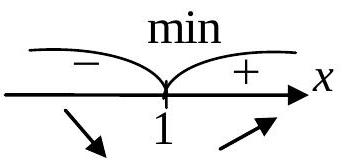
Answer: $y_{\min }(1)=2^{2}=4$. | y_{\}(1)=4 | Calculus | math-word-problem | olympiads | b5fc89f4-ae0c-5f92-b85c-66080b1ecfed | [
true,
true
] | [
"<think>\nOkay, so I need to find all the extrema of the function y = 2^(x² - 2x + 3). Hmm, extrema are the maximum or minimum points on the function, right? That means I need to find where the derivative of the function is zero or undefined. Since this is an exponential function, I should remember how to different... | [
false,
false
] | [
true,
true
] | null | 2 | [
{
"content": "3. Find all the extrema of the function $y=2^{x^{2}-2 x+3}$.",
"role": "user"
},
{
"content": "<think>Hmm , extrema are the maximum or minimum points on the function, right? That means I need to find where the derivative of the function is zero or undefined. Since this is an exponentia... |
The product of $10$ integers is $1024$. What is the greatest possible sum of these $10$ integers? | 1. We start by noting that the product of 10 integers is 1024. We need to find the greatest possible sum of these 10 integers.
2. Since 1024 is a power of 2, we can express it as \(1024 = 2^{10}\).
3. To maximize the sum of the integers, we should use the smallest possible integers that multiply to 1024. The smallest i... | 1033 | Number Theory | math-word-problem | aops_forum | dfbc523b-518b-5a32-979d-7d46100f2955 | [
true,
true
] | [
"<think>\nOkay, let's see. The problem says that the product of 10 integers is 1024, and we need to find the greatest possible sum of these 10 integers. Hmm, interesting. Alright, let's break this down.\n\nFirst, I know that 1024 is a power of 2. Specifically, 2 to the 10th power. So, 2^10 = 1024. That might be use... | [
true,
true
] | null | null | 2 | [
{
"content": "The product of $10$ integers is $1024$. What is the greatest possible sum of these $10$ integers?",
"role": "user"
},
{
"content": "<think>Hmm , interesting. Alright, let's break this down.\n\nFirst, I know that 1024 is a power of 2. Specifically, 2 to the 10th power. So, 2^10 = 1024. ... |
In triangle $ABC$, $\sin A \sin B \sin C = \frac{1}{1000}$ and $AB \cdot BC \cdot CA = 1000$. What is the area of triangle $ABC$?
[i]Proposed by Evan Chen[/i] | 1. **Given Information:**
- \(\sin A \sin B \sin C = \frac{1}{1000}\)
- \(AB \cdot BC \cdot CA = 1000\)
2. **Using the Extended Law of Sines:**
The extended law of sines states that for any triangle \(ABC\) with circumradius \(R\),
\[
\frac{a}{\sin A} = \frac{b}{\sin B} = \frac{c}{\sin C} = 2R
\]
... | 5 | Geometry | math-word-problem | aops_forum | 433a2c3f-b22c-55e7-bcd7-1ff0309b9b1a | [
true,
true
] | [
"<think>\nOkay, let me try to solve this problem. So, we have triangle ABC where the product of the sines of its angles is 1/1000, and the product of its sides is 1000. We need to find the area of the triangle. Hmm, interesting. Let me recall some formulas related to triangles.\n\nFirst, I know that the area of a t... | [
true,
true
] | null | null | 2 | [
{
"content": "In triangle $ABC$, $\\sin A \\sin B \\sin C = \\frac{1}{1000}$ and $AB \\cdot BC \\cdot CA = 1000$. What is the area of triangle $ABC$?\n\n[i]Proposed by Evan Chen[/i]",
"role": "user"
},
{
"content": "<think>Hmm , interesting. Let me recall some formulas related to triangles.\n\nFirs... |
Subsets and Splits
No community queries yet
The top public SQL queries from the community will appear here once available.