
problem string | solution string | answer string | problem_type string | question_type string | source string | uuid string | is_reasoning_complete list | generations list | correctness_math_verify list | correctness_llama list | finish_reasons list | correctness_count int64 | messages list |
|---|---|---|---|---|---|---|---|---|---|---|---|---|---|
## Task 4
A company has two cars of the type "Wartburg". One car drove 600 km in a week, and the other drove 900 km.
How many liters of gasoline did each car need, if the second car, which drove 900 km, used 27 liters more than the first? | The second car drives $300 \mathrm{~km}$ further and requires 27 liters for this. For $900 \mathrm{~km}$, this amounts to 81 liters. Thus, we have:
The first car consumed 54 l of gasoline. The second car consumed $81 \mathrm{l}$ of gasoline.
### 13.1.2 2. Round 1963, Class 4 | 54 | Algebra | math-word-problem | olympiads | ef76a3ea-a57b-5beb-89c4-c8003ad1197a | [
true,
true
] | [
"<think>\nOkay, let's see. So, there are two cars, both Wartburgs. The first one drove 600 km in a week, and the second one drove 900 km. The question is asking how many liters of gasoline each car needed, given that the second car used 27 liters more than the first. Hmm, alright.\n\nFirst, I need to figure out the... | [
false,
false
] | [
true,
true
] | null | 2 | [
{
"content": "## Task 4\n\nA company has two cars of the type \"Wartburg\". One car drove 600 km in a week, and the other drove 900 km.\n\nHow many liters of gasoline did each car need, if the second car, which drove 900 km, used 27 liters more than the first?",
"role": "user"
},
{
"content": "<thin... |
Example 1.6. Find: $\int \frac{x_{3}+2 x^{2}-4 x-1}{(x-2)^{2}\left(x^{2}+x+1\right)} d x$. | Solution. According to the theorem of decomposition into partial fractions, the decomposition of the integrand, representing a proper rational fraction, has the form:
$$
\frac{x^{3}+2 x^{2}-4 x-1}{(x-2)^{2}\left(x^{2}+x+1\right)}=\frac{A}{(x-2)^{2}}+\frac{B}{(x-2)}+\frac{M x+N}{x^{2}+x+1}
$$
We bring the expression o... | -\frac{1}{(x-2)}+\frac{11}{7}|\lnx-2|-\frac{2}{7}\ln(x^{2}+x+1)+\frac{8}{7\sqrt{3}}\operatorname{arctg}\frac{2x+1}{\sqrt{3}}+C | Calculus | math-word-problem | olympiads | 6cddddc7-98f0-5bda-9a81-4b3b412f5b2e | [
true
] | [
"<think>\nOkay, so I need to solve the integral of (x³ + 2x² - 4x - 1) divided by (x - 2)² times (x² + x + 1) dx. Hmm, this looks like a rational function, so partial fractions might be the way to go here. Let me recall how partial fractions work for higher degree denominators and irreducible quadratics.\n\nFirst, ... | [
false
] | [
true
] | null | 1 | [
{
"content": "Example 1.6. Find: $\\int \\frac{x_{3}+2 x^{2}-4 x-1}{(x-2)^{2}\\left(x^{2}+x+1\\right)} d x$.",
"role": "user"
},
{
"content": "<think>Hmm , this looks like a rational function, so partial fractions might be the way to go here. Let me recall how partial fractions work for higher degre... |
[ Equilateral (regular) triangle
What is the minimum width that an infinite strip of paper must have to be able to cut out any triangle with an area of 1?
# | Since the area of an equilateral triangle with side $a$ is $a^{2} \sqrt{3} / 4$, the side of an equilateral triangle with area 1 is $2 / \sqrt[4]{3}$, and its height is $\sqrt[4]{3}$. We will prove that an equilateral triangle with area 1 cannot be cut from a strip of width less than $\sqrt[4]{3}$. Let the equilateral ... | \sqrt[4]{3} | Geometry | math-word-problem | olympiads | 8a4742f2-bee5-5c4b-904e-f3e5a9a859b9 | [
true,
true
] | [
"<think>\nOkay, so the problem is asking for the minimum width of an infinite strip of paper that allows us to cut out any triangle with an area of 1. Hmm, interesting. Let me think step by step.\n\nFirst, let's parse the question. An infinite strip of paper has a certain width, W, and we need to determine the smal... | [
true,
true
] | null | [
"stop",
"stop"
] | 2 | [
{
"content": "[ Equilateral (regular) triangle\n\nWhat is the minimum width that an infinite strip of paper must have to be able to cut out any triangle with an area of 1?\n\n#",
"role": "user"
},
{
"content": "<think>Hmm , interesting. Let me think step by step.\n\nFirst, let's parse the question. ... |
3. 23 Given the numbers $1,2,2^{2}, \cdots, 2^{n-1}$, for any permutation $\sigma=\left(x_{1}\right.$, $\left.x_{2}, \cdots, x_{n}\right)$ of them, define $S_{1}(\sigma)=x_{1}, S_{2}(\sigma)=x_{1}+x_{2}, S_{3}(\sigma)=x_{1}+x_{2}+$ $x_{3}, \cdots, S_{n}(\sigma)=x_{1}+x_{2}+\cdots+x_{n}$, and let $Q(\sigma)=S_{1}(\sigma... | [Solution] We prove a more general conclusion:
For any $n$ positive numbers $a_{1}, a_{2}, \cdots, a_{n}$, the sum $\sum \frac{1}{Q(\sigma)}=$ $S\left(a_{1}, a_{2}, \cdots, a_{n}\right)=\frac{1}{a_{1} a_{2} \cdots a_{n}}$.
We use induction on $n$.
When $n=1$, $S\left(a_{1}\right)=\sum \frac{1}{Q(\sigma)}=\frac{1}{a_{1... | 2^{-\frac{n(n-1)}{2}} | Combinatorics | math-word-problem | inequalities | e0a1022a-7589-5774-a2bd-241064dd3af2 | [
true,
true
] | [
"<think>\nOkay, so I have this problem where I need to find the sum of 1/Q(σ) over all permutations σ of the numbers 1, 2, 2², ..., 2^{n-1}. Q(σ) is the product of the partial sums S₁(σ), S₂(σ), ..., Sₙ(σ), where each Sᵢ(σ) is the sum of the first i elements in the permutation σ. \n\nFirst, I need to understand exa... | [
true,
true
] | null | null | 2 | [
{
"content": "3. 23 Given the numbers $1,2,2^{2}, \\cdots, 2^{n-1}$, for any permutation $\\sigma=\\left(x_{1}\\right.$, $\\left.x_{2}, \\cdots, x_{n}\\right)$ of them, define $S_{1}(\\sigma)=x_{1}, S_{2}(\\sigma)=x_{1}+x_{2}, S_{3}(\\sigma)=x_{1}+x_{2}+$ $x_{3}, \\cdots, S_{n}(\\sigma)=x_{1}+x_{2}+\\cdots+x_{n... |
9.2. In triangle $A B C$, the median $B M$ is twice as small as the bisector $A N$. It is known that angle $C B M$ is three times larger than angle $C A N$. Find the angles of triangle $A B C$. | # Answer: $\angle A=\angle C=36^{\circ}, \angle B=108^{\circ}$. Solution.
Let $\alpha$ be the angle between the angle bisector $A N$ and the sides $A B$ and $A C$. Draw a line through point $M$ parallel to the angle bisector $A N$, and let $K$ be the point of intersection of this line with side $B C$. Since $M$ is the... | \angleA=\angleC=36,\angleB=108 | Geometry | math-word-problem | olympiads | 494f071c-da14-57df-b8ee-c8c983dd2d80 | [
true
] | [
"<think>\nOkay, so I need to find the angles of triangle ABC given two conditions: first, the median BM is twice as small as the bisector AN. Second, angle CBM is three times larger than angle CAN. Hmm, let me start by drawing a rough sketch of triangle ABC to visualize the problem.\n\nLet me denote the vertices as... | [
false
] | [
true
] | null | 1 | [
{
"content": "9.2. In triangle $A B C$, the median $B M$ is twice as small as the bisector $A N$. It is known that angle $C B M$ is three times larger than angle $C A N$. Find the angles of triangle $A B C$.",
"role": "user"
},
{
"content": "<think>Hmm , let me start by drawing a rough sketch of tri... |
4. In a pond, there are 25 hungry pikes. For one pike to be satiated, it needs to eat three other pikes. What is the maximum number of pikes that can remain in the pond, with all of them being full? | Solution. The smallest number of creatures that can be eaten by three hungry creatures is five. In this way, five small creatures and four hungry creatures remain. Of the four hungry creatures, if one eats another and is then eaten, one small creature will remain. Therefore, six small creatures remain: To have at least... | 6 | Logic and Puzzles | math-word-problem | olympiads | 44fb322b-f0a8-5aa1-bfdb-75fc87e8c361 | [
true,
true
] | [
"<think>\nOkay, let's see. The problem is about pikes in a pond. There are 25 hungry pikes. For one pike to be satiated, it needs to eat three other pikes. The question is asking for the maximum number of pikes that can remain in the pond, with all of them being full. Hmm. So, we need to figure out how many pikes c... | [
true,
true
] | null | [
"stop",
"stop"
] | 2 | [
{
"content": "4. In a pond, there are 25 hungry pikes. For one pike to be satiated, it needs to eat three other pikes. What is the maximum number of pikes that can remain in the pond, with all of them being full?",
"role": "user"
},
{
"content": "<think>Hmm . So, we need to figure out how many pikes... |
## Task 1 - 261211
Determine all triples $(x ; y ; z)$ of numbers with the following properties (1), (2):
(1) The numbers $x, y, z$ are consecutive integers in this order.
(2) It holds: $x \cdot(x+y+z)=x \cdot y \cdot z$. | I. If $(x ; y ; z)$ is a triple with properties (1) and (2), then according to (1)
$$
x=n-1 \quad, \quad y=n \quad, \quad z=n+1
$$
with an integer $n$, so $x+y+z=3 n$, and from (2) it follows
$$
\begin{aligned}
(n-1) \cdot 3 \cdot n & =(n-1) \cdot n \cdot(n+1) \\
n \cdot(n-1) \cdot(n-2) & =0
\end{aligned}
$$
Since ... | (-1;0;1),(0;1;2),(1;2;3) | Algebra | math-word-problem | olympiads | 9338aa93-4db7-570f-a0ae-f0e08a907b9b | [
true,
true
] | [
"<think>\nOkay, let's see. I need to find all triples (x, y, z) where x, y, z are consecutive integers in that order. So that means y is x + 1 and z is x + 2. Because consecutive integers mean each number is one more than the previous. So, if x is the first number, then y would naturally be x + 1, and z would be x ... | [
false,
true
] | null | null | 1 | [
{
"content": "## Task 1 - 261211\n\nDetermine all triples $(x ; y ; z)$ of numbers with the following properties (1), (2):\n\n(1) The numbers $x, y, z$ are consecutive integers in this order.\n\n(2) It holds: $x \\cdot(x+y+z)=x \\cdot y \\cdot z$.",
"role": "user"
},
{
"content": "<think>Hmm . First... |
$6 \cdot 156$ Find all continuous functions $f:(1,+\infty) \rightarrow R$ satisfying
$$
f(x y) \equiv x f(y)+y f(x), x, y>1
$$ | [Solution]First, prove that for any $k>0$, we have $f\left(x^{k}\right) \equiv k x^{k-1} f(x)$, where $x>1$.
The proof is divided into three steps:
(1) Let $k \in \mathbb{N}$. If $k=1$, then $f\left(x^{1}\right)=1 \cdot x^{0} \cdot f(x)$. Assume the identity holds for some $k \in \mathbb{N}$. Then,
$$
\begin{array}{r}... | f(x)=\lnx | Algebra | math-word-problem | olympiads | f8719e43-827d-5cfb-ae12-96ed09d5c8cb | [
true,
true
] | [
"<think>\nOkay, so I have this functional equation to solve: find all continuous functions \\( f: (1, +\\infty) \\rightarrow \\mathbb{R} \\) such that for all \\( x, y > 1 \\), the equation \\( f(xy) = x f(y) + y f(x) \\) holds. Alright, let me try to think step by step how to approach this.\n\nFirst, functional eq... | [
false,
false
] | [
true,
true
] | null | 2 | [
{
"content": "$6 \\cdot 156$ Find all continuous functions $f:(1,+\\infty) \\rightarrow R$ satisfying\n$$\nf(x y) \\equiv x f(y)+y f(x), x, y>1\n$$",
"role": "user"
},
{
"content": "<think>\nOkay, so I have this functional equation to solve: find all continuous functions \\( f: (1, +\\infty) \\right... |
12. (5 points) Write the five-digit number “12345” 403 times to form a 2015-digit number “$123451234512345 \cdots$”. From left to right, first delete all the digits in the odd positions of this number to get a new number, then delete all the digits in the odd positions of the new number; continue deleting according to ... | 12. (5 points) The five-digit number "12345" is repeated 403 times to form a 2015-digit number "123451234512345...". From left to right, first delete all the digits in the odd positions to get a new number, then delete all the digits in the odd positions of the new number; continue this process until only one digit rem... | 4 | Number Theory | math-word-problem | olympiads | b4868953-b0b2-50e7-9c16-a80c8a660915 | [
true,
true
] | [
"<think>\nAlright, so I need to figure out the last remaining digit when we repeatedly delete the digits in the odd positions of the number formed by writing \"12345\" 403 times. The original number has 2015 digits because 5 digits multiplied by 403 is 2015. Each time we delete the odd positions, the length of the ... | [
true,
true
] | null | null | 2 | [
{
"content": "12. (5 points) Write the five-digit number “12345” 403 times to form a 2015-digit number “$123451234512345 \\cdots$”. From left to right, first delete all the digits in the odd positions of this number to get a new number, then delete all the digits in the odd positions of the new number; continue... |
Example 1. Expand the function $f(x)=\frac{1}{1-x}$ into a Taylor series in powers of: a) $x-1$, b) $x$, c) $x+1$. | Solution. a) Expansion in a series of powers of $(x-1)$ is impossible, since $f(x)$ is not defined at the point $x=1$. In other words, a series of powers of $(x-1)$ for this function does not exist.
Cases b) and c) will be considered together. Expansion in powers of $x$ and $(x+1)$ is possible, because $f(x)$ is infin... | \begin{aligned}&b)\frac{1}{1-x}=1+x+x^{2}+x^{3}+\ldots+x^{n}+\ldots\quad(|x|<1)\\&)\frac{1}{1-x}=\frac{1}{2}+\frac{1}{2^{2}}(x+1)+\frac{1}{2^{3}}(x | Calculus | math-word-problem | olympiads | 93214f2e-c09a-5a5a-b67d-eabdb3ed9470 | [
true,
true
] | [
"<think>\nOkay, so I need to expand the function f(x) = 1/(1 - x) into a Taylor series around different points: x = 1, x = 0, and x = -1. Let me recall what a Taylor series is. The Taylor series of a function around a point a is the sum from n=0 to infinity of f^{(n)}(a)/n! * (x - a)^n. Right? So, depending on the ... | [
false,
false
] | [
false,
true
] | null | 1 | [
{
"content": "Example 1. Expand the function $f(x)=\\frac{1}{1-x}$ into a Taylor series in powers of: a) $x-1$, b) $x$, c) $x+1$.",
"role": "user"
},
{
"content": "<think>Hmm , okay, let me take each part step by step.\n\nStarting with part a: expanding around x = 1. Wait , the function f(x) = 1/(1... |
Example 1 (Fill in the blank Question 1) Given $\frac{1}{4}(b-c)^{2}=$ $(a-b)(c-a)$ and $a \neq 0$. Then $\frac{b+c}{a}=$ $\qquad$ . | Solution 1: From the given, we have
$$
\begin{aligned}
0 & =\frac{1}{4}[-(a-b)-(c-a)]^{2}-(a-b)(c-a) \\
& =\frac{1}{4}\left[(a-b)^{2}+(c-a)^{2}-2(a-b)(c-a)\right] \\
& =\frac{1}{4}[(a-b)-(c-a)]^{2} \\
& =\frac{1}{4}(2 a-b-c)^{2} .
\end{aligned}
$$
Thus, $\frac{b+c}{a}=2$.
Solution 2: The given condition indicates that... | 2 | Algebra | math-word-problem | cn_contest | b5c4043a-828a-5e5a-9aa9-549c3711f752 | [
true,
true,
true,
true
] | [
"<think>\nOkay, let's see. I have this equation: (1/4)(b - c)^2 = (a - b)(c - a), and I need to find (b + c)/a given that a is not zero. Hmm, where do I start? Maybe I can expand both sides and see if I can relate b and c to a somehow.\n\nFirst, let's work on the left side. (1/4)(b - c)^2. If I expand that, it beco... | [
true,
true,
true,
true
] | null | null | 4 | [
{
"content": "Example 1 (Fill in the blank Question 1) Given $\\frac{1}{4}(b-c)^{2}=$ $(a-b)(c-a)$ and $a \\neq 0$. Then $\\frac{b+c}{a}=$ $\\qquad$ .",
"role": "user"
},
{
"content": "<think>Hmm , where do I start? Maybe I can expand both sides and see if I can relate b and c to a somehow.\n\nFirst... |
In the diagram, $S$ lies on $R T, \angle Q T S=40^{\circ}, Q S=Q T$, and $\triangle P R S$ is equilateral. The value of $x$ is
(A) 50
(B) 60
(C) 80
(D) 90
(E) 100
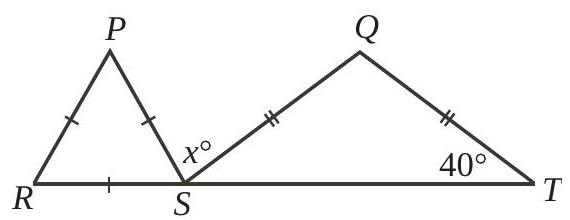 | Since $\triangle P R S$ is equilateral, then all three of its angles equal $60^{\circ}$.
In particular, $\angle R S P=60^{\circ}$.
Since $Q S=Q T$, then $\triangle Q S T$ is isosceles and so $\angle T S Q=\angle S T Q=40^{\circ}$.
Since $R S T$ is a straight line segment, then $\angle R S P+\angle P S Q+\angle T S Q... | 80 | Geometry | MCQ | olympiads | e12064d3-bf8b-5d0d-895d-f7f4947cfca8 | [
true,
true
] | [
"<think>\nOkay, let me try to figure out this geometry problem. So, first, let's parse the given information. We have a diagram where point S lies on RT. There's an angle QTS that's 40 degrees. Also, QS is equal to QT, and triangle PRS is equilateral. We need to find the value of x, which is probably one of the ang... | [
false,
false
] | [
true,
true
] | null | 2 | [
{
"content": "In the diagram, $S$ lies on $R T, \\angle Q T S=40^{\\circ}, Q S=Q T$, and $\\triangle P R S$ is equilateral. The value of $x$ is\n(A) 50\n(B) 60\n(C) 80\n(D) 90\n(E) 100\n\n x^{2}-$ $3(3 k-1) x+18=0$ has two distinct positive integer roots. Then $k=$ $\qquad$
(4th Hope Forest Junior High School Mathematics Competition) | (Solution: $k=2$ ) | 2 | Algebra | math-word-problem | cn_contest | bb89b7eb-4f7e-53c5-870d-3262dc5ea542 | [
true,
true
] | [
"<think>\nOkay, so I have this problem here where I need to find the integer value of k such that the quadratic equation (k² - 1)x² - 3(3k - 1)x + 18 = 0 has two distinct positive integer roots. Hmm, let me try to figure this out step by step.\n\nFirst, let me recall that for a quadratic equation ax² + bx + c = 0, ... | [
true,
true
] | null | null | 2 | [
{
"content": "2. Given that $k$ is an integer, and the equation $\\left(k^{2}-1\\right) x^{2}-$ $3(3 k-1) x+18=0$ has two distinct positive integer roots. Then $k=$ $\\qquad$\n(4th Hope Forest Junior High School Mathematics Competition)",
"role": "user"
},
{
"content": "<think>Hmm , let me try to fi... |
Find all positive integers that satisfy the following conditions: its first digit is 6, and removing this 6, the resulting integer is $\frac{1}{25}$ of the original integer;
Prove that there is no such integer: its first digit is 6, and removing its first digit results in $\frac{1}{35}$ of the original integer. | (1) Let the number sought be an $n$-digit number $m$, then $m=6 \times 10^{n-1}+\frac{m}{25}$. Thus, $m=\frac{25}{4} \times$ $10^{n-1}=625,6250,62500, \cdots$.
(2) The equation $m=6 \times 10^{n-1}+\frac{m}{35}$ is equivalent to $17 m=3 \times 10^{n-1}$, but $17 \nmid 3 \times 10^{n-1}$, so the equation has no solution... | 625,6250,62500,\cdots | Number Theory | math-word-problem | olympiads | 38eadbbd-95db-5b4e-9582-841a3ea9485f | [
true,
true
] | [
"<think>\nOkay, let's tackle these two problems. The first one is to find all positive integers where the first digit is 6, and when you remove that 6, the remaining number is 1/25 of the original number. The second part is to prove that there's no such integer where the first digit is 6, and removing it results in... | [
false,
false
] | [
false,
true
] | null | 1 | [
{
"content": "Find all positive integers that satisfy the following conditions: its first digit is 6, and removing this 6, the resulting integer is $\\frac{1}{25}$ of the original integer;\n\nProve that there is no such integer: its first digit is 6, and removing its first digit results in $\\frac{1}{35}$ of th... |
5. Fill three non-zero real numbers $a, b, c$ into the three boxes of $\square x^{2}+\square x+\square=0$ in any order, and the roots of the resulting equation are all rational numbers. Such real numbers $a, b, c$:
(A) do not exist.
(B) exist uniquely.
(C) exist in two pairs.
(D) exist, more than two pairs. | $\mathrm{D}$ | D | Algebra | MCQ | cn_contest | 3ee1de80-b45d-5fe8-9722-fd2a5b6ac922 | [
true,
true
] | [
"<think>\nAlright, let's tackle this problem. So, the question is about filling three non-zero real numbers a, b, c into the quadratic equation's coefficients in any order, such that the resulting equation has all rational roots. We need to determine if such numbers exist, and if so, how many such triples (a, b, c)... | [
true,
true
] | null | null | 2 | [
{
"content": "5. Fill three non-zero real numbers $a, b, c$ into the three boxes of $\\square x^{2}+\\square x+\\square=0$ in any order, and the roots of the resulting equation are all rational numbers. Such real numbers $a, b, c$:\n(A) do not exist.\n(B) exist uniquely.\n(C) exist in two pairs.\n(D) exist, mor... |
15. Find the value of $\sin \theta$ if the terminal side of $\theta$ lies on the line $5 y-3 x=0$ and $\theta$ is in the first quadrant.
(a) $\frac{3}{\sqrt{34}}$
(b) $\frac{3}{4}$
(c) $\frac{3}{5}$
(d) $\frac{4}{\sqrt{34}}$ | 15. $\mathrm{A}$ | \frac{3}{\sqrt{34}} | Algebra | MCQ | olympiads | 877791de-3333-5f31-a7e9-44b9c550c255 | [
true,
true
] | [
"<think>\nAlright, let's see. I need to find the value of sin θ when the terminal side of θ is on the line 5y - 3x = 0, and θ is in the first quadrant. Hmm. Okay, so first, I remember that the terminal side of an angle in standard position (which starts at the origin and goes out from there) lies on a line. So this... | [
false,
false
] | [
true,
true
] | null | 2 | [
{
"content": "15. Find the value of $\\sin \\theta$ if the terminal side of $\\theta$ lies on the line $5 y-3 x=0$ and $\\theta$ is in the first quadrant.\n(a) $\\frac{3}{\\sqrt{34}}$\n(b) $\\frac{3}{4}$\n(c) $\\frac{3}{5}$\n(d) $\\frac{4}{\\sqrt{34}}$",
"role": "user"
},
{
"content": "<think>Hmm . ... |
Let $t$ be TNYWR.
Suppose that
$$
\frac{1}{2^{12}}+\frac{1}{2^{11}}+\frac{1}{2^{10}}+\cdots+\frac{1}{2^{t+1}}+\frac{1}{2^{t}}=\frac{n}{2^{12}}
$$
(The sum on the left side consists of $13-t$ terms.)
What is the value of $n$ ? | Multiplying both sides of the given equation by $2^{12}$, we obtain
$$
1+2^{1}+2^{2}+\cdots+2^{12-(t+1)}+2^{12-t}=n
$$
Since the answer to (b) is 6 , then $t=6$ and so we have
$$
1+2^{1}+2^{2}+2^{3}+2^{4}+2^{5}+2^{6}=n
$$
Therefore, $n=1+2+4+8+16+32+64=127$.
ANSwer: $3,6,127$ | 127 | Algebra | math-word-problem | olympiads | 9a39fbd5-0b11-575a-9ff7-ba98b0b85a7e | [
true,
true
] | [
"<think>\nOkay, let's see. I need to find the value of n such that the sum from 1/(2^12) up to 1/(2^t) equals n/(2^12). The problem mentions that there are 13 - t terms in the sum. Hmm. Let me think step by step.\n\nFirst, the sum is a geometric series. Each term is 1 over 2 to some exponent, starting from 2^12 dow... | [
false,
false
] | [
false,
true
] | null | 1 | [
{
"content": "Let $t$ be TNYWR.\n\nSuppose that\n\n$$\n\\frac{1}{2^{12}}+\\frac{1}{2^{11}}+\\frac{1}{2^{10}}+\\cdots+\\frac{1}{2^{t+1}}+\\frac{1}{2^{t}}=\\frac{n}{2^{12}}\n$$\n\n(The sum on the left side consists of $13-t$ terms.)\n\nWhat is the value of $n$ ?",
"role": "user"
},
{
"content": "<thin... |
Example 2 Given a positive number $p$ and a parabola $C: y^{2}=2 p x$ $(p>0)$, $A\left(\frac{p}{6}, 0\right)$ is a point on the axis of symmetry of the parabola $C$, and $O$ is the vertex of the parabola $C$. $M$ is any point on the parabola $C$. Find the maximum value of $\frac{|O M|}{|A M|}$. ${ }^{[2]}$
(2013, Xin Z... | Let $M(x, y)$. Then
$$
\begin{array}{l}
x \geqslant 0, \text { and } y^{2}=2 p x(p>0). \\
\text { Hence }\left(\frac{|O M|}{|A M|}\right)^{2}=\frac{x^{2}+y^{2}}{\left(x-\frac{p}{6}\right)^{2}+y^{2}} \\
=\frac{x^{2}+2 p x}{x^{2}-\frac{p x}{3}+\frac{p^{2}}{36}+2 p x}=\frac{x^{2}+2 p x}{x^{2}+\frac{5 p x}{3}+\frac{p^{2}}{... | \frac{3 \sqrt{2}}{4} | Geometry | math-word-problem | cn_contest | 6d9707a8-97e5-5e35-a53d-842811961b29 | [
true,
true
] | [
"<think>\nOkay, so I need to find the maximum value of the ratio |OM| / |AM| where M is any point on the parabola C: y² = 2px, O is the vertex (which is at (0,0)), and A is the point (p/6, 0) on the axis of symmetry (the x-axis here). \n\nFirst, let me visualize the problem. The parabola opens to the right since th... | [
true,
true
] | null | null | 2 | [
{
"content": "Example 2 Given a positive number $p$ and a parabola $C: y^{2}=2 p x$ $(p>0)$, $A\\left(\\frac{p}{6}, 0\\right)$ is a point on the axis of symmetry of the parabola $C$, and $O$ is the vertex of the parabola $C$. $M$ is any point on the parabola $C$. Find the maximum value of $\\frac{|O M|}{|A M|}$... |
Problem 6. (Variant 2).
$C A K D$ is a square with a side length of 6. On side $C D$, a point $B(B D=2)$ is chosen, and on line $A D$, a point $E$ is chosen such that the perimeter of triangle $B E C$ is the smallest possible. Then, on line $D C$, a point $F$ is marked such that the perimeter of triangle $F E A$ is th... | # Solution:
$C D=A C=6, \quad B D=B_{1} D=2$. Since triangles $A C E$ and $\mathrm{B}_{1} \mathrm{ED}$ are similar ( $\angle A E C=\angle B_{1} E D$ - vertical, $\angle E A C=\angle B_{1} D E=45^{0}$ ),
then $E C: B_{1} E=A C: D B_{1}=A E: E D=6: 2=3: 1$.
Let $E H \perp D C \Rightarrow$ right triangles ACD and EHD a... | 0.3\sqrt{34} | Geometry | math-word-problem | olympiads | c346a2a2-c7d2-5644-b594-7101a1b57ac8 | [
true,
true
] | [
"<think>\nOkay, let me try to work through this problem step by step. So, we have a square CAKD with side length 6. Let me visualize that first. Since it's a square, all sides are equal, and all angles are 90 degrees. The vertices are labeled C, A, K, D. Let me note that in a square, the order of the vertices matte... | [
true,
true
] | null | [
"stop",
"stop"
] | 2 | [
{
"content": "Problem 6. (Variant 2).\n\n$C A K D$ is a square with a side length of 6. On side $C D$, a point $B(B D=2)$ is chosen, and on line $A D$, a point $E$ is chosen such that the perimeter of triangle $B E C$ is the smallest possible. Then, on line $D C$, a point $F$ is marked such that the perimeter o... |
B. Let $a=\sqrt[3]{2}+1$. Then $\frac{a^{3}+a^{4}}{a^{3}+1}=(\quad)$.
(A) 3
(B) 4
(C) $\sqrt[3]{2}+2$
(D) $\sqrt[3]{2}+\sqrt[3]{4}$ | B. A.
Notice,
$$
\begin{array}{l}
(a-1)^{3}=(\sqrt[3]{2})^{3}=2 \\
\Rightarrow a^{3}=2+3 a^{2}-3 a+1=3\left(a^{2}-a+1\right) \\
\Rightarrow \frac{a^{3}+a^{4}}{a^{3}+1}=\frac{a^{3}(1+a)}{(a+1)\left(a^{2}-a+1\right)} \\
\quad=\frac{a^{3}}{a^{2}-a+1}=3 .
\end{array}
$$ | 3 | Algebra | MCQ | olympiads | c4177edc-5fff-5c00-9022-44c7990dddc2 | [
true,
true
] | [
"<think>\nOkay, so I need to solve this problem where a is given as the cube root of 2 plus 1. The question is asking me to compute the expression (a³ + a⁴) divided by (a³ + 1). The answer choices are A through D, which include numbers and some cube root expressions. Let me start by understanding the problem step b... | [
false,
false
] | [
true,
false
] | null | 1 | [
{
"content": "B. Let $a=\\sqrt[3]{2}+1$. Then $\\frac{a^{3}+a^{4}}{a^{3}+1}=(\\quad)$.\n(A) 3\n(B) 4\n(C) $\\sqrt[3]{2}+2$\n(D) $\\sqrt[3]{2}+\\sqrt[3]{4}$",
"role": "user"
},
{
"content": "<think>\nOkay, so I need to solve this problem where a is given as the cube root of 2 plus 1. The question is ... |
16. Let
$$
f(x)=x^{3}+a x^{2}+b x+c(1<a<b<c) \text {, }
$$
$g(x)$ is a polynomial with the leading coefficient 1, and the three roots of $g(x)$ are the reciprocals of the three roots of $f(x)$. Then $g(1)$ expressed as an algebraic expression in terms of $a$, $b$, and $c$ is ( ).
(A) $\frac{1+a+b+c}{c}$
(B) $1+a+b+c$
(... | 16. A.
Let the three roots of $f(x)$ be $p$, $q$, and $r$. Then
$$
f(x)=(x-p)(x-q)(x-r) \text {. }
$$
According to the problem,
$$
\begin{array}{l}
g(x)=\left(x-\frac{1}{p}\right)\left(x-\frac{1}{q}\right)\left(x-\frac{1}{r}\right) . \\
\text { Therefore, } g(1)=\left(1-\frac{1}{p}\right)\left(1-\frac{1}{q}\right)\le... | \frac{1++b+}{} | Algebra | MCQ | olympiads | 975058e8-43cd-541c-87c4-357ff12d9df5 | [
true,
true
] | [
"<think>\nOkay, let me try to figure out this problem. So, we have a cubic polynomial f(x) = x³ + a x² + b x + c, where the coefficients satisfy 1 < a < b < c. Then there's another polynomial g(x) which has leading coefficient 1, and its three roots are the reciprocals of the roots of f(x). We need to find g(1) exp... | [
false,
false
] | [
false,
true
] | null | 1 | [
{
"content": "16. Let\n$$\nf(x)=x^{3}+a x^{2}+b x+c(1<a<b<c) \\text {, }\n$$\n$g(x)$ is a polynomial with the leading coefficient 1, and the three roots of $g(x)$ are the reciprocals of the three roots of $f(x)$. Then $g(1)$ expressed as an algebraic expression in terms of $a$, $b$, and $c$ is ( ).\n(A) $\\frac... |
Consider the sequence $ a_1\equal{}\frac{3}{2}, a_{n\plus{}1}\equal{}\frac{3a_n^2\plus{}4a_n\minus{}3}{4a_n^2}.$
$ (a)$ Prove that $ 1<a_n$ and $ a_{n\plus{}1}<a_n$ for all $ n$.
$ (b)$ From $ (a)$ it follows that $ \displaystyle\lim_{n\to\infty}a_n$ exists. Find this limit.
$ (c)$ Determine $ \displaystyle\lim_{n\t... | 1. **Prove that \(1 < a_n < 3\) for all positive integers \(n\)**:
- **Base Case**: For \(n = 1\), we have \(a_1 = \frac{3}{2}\). Clearly, \(1 < \frac{3}{2} < 3\).
- **Inductive Step**: Assume \(1 < a_n < 3\) for some \(n\). We need to show that \(1 < a_{n+1} < 3\).
- **Prove \(a_{n+1} > 1\)**:
\[
... | 1 | Calculus | math-word-problem | aops_forum | a2d27a09-2087-5e73-8349-5ef2f1a8618d | [
true
] | [
"<think>\nOkay, so I have this problem here about a sequence defined recursively. Let me see if I can tackle each part step by step. Let's start with part (a). \n\nThe problem says: Consider the sequence \\( a_1 = \\frac{3}{2} \\), and \\( a_{n+1} = \\frac{3a_n^2 + 4a_n - 3}{4a_n^2} \\). Part (a) asks me to prove t... | [
false
] | [
true
] | null | 1 | [
{
"content": "Consider the sequence $ a_1\\equal{}\\frac{3}{2}, a_{n\\plus{}1}\\equal{}\\frac{3a_n^2\\plus{}4a_n\\minus{}3}{4a_n^2}.$\r\n$ (a)$ Prove that $ 1<a_n$ and $ a_{n\\plus{}1}<a_n$ for all $ n$.\r\n$ (b)$ From $ (a)$ it follows that $ \\displaystyle\\lim_{n\\to\\infty}a_n$ exists. Find this limit.\r\n$... |
Let $\triangle A B C$ have sides $B C=a, C A=b, A B=c$, as shown in Figure 1. When $\angle A, \angle B, \angle C$ are all less than $120^{\circ}$, $F$ is the Fermat point of $\triangle A B C$, $F A=u, F B=v, F C=w$. Then
$$
u+v+w=\frac{\sqrt{2}}{2} \sqrt{a^{2}+b^{2}+c^{2}+4 \sqrt{3} S} .
$$ | Proof: As shown in Figure 2, construct a regular $\triangle MNL$, and let $P$ be a point inside it such that $PM = a$, $PN = b$, and $PL = c$.
Rotate $\triangle PML$ around $M$ by $60^\circ$ clockwise to get $\triangle P'MN$.
Then $\triangle PMP'$ is an equilateral triangle with side length $a$, and $\triangle PP'N$ is... | u + v + w = \frac{\sqrt{2}}{2} \sqrt{a^2 + b^2 + c^2 + 4\sqrt{3} S} | Geometry | math-word-problem | cn_contest | da4f3e18-8573-5292-9846-5c1ea26f358a | [
true,
true
] | [
"<think>\nOkay, so I need to prove that in a triangle ABC where all angles are less than 120 degrees, the sum of the distances from the Fermat point F to the vertices (u + v + w) is equal to that expression involving the sides and the area S. Hmm. Let me recall what the Fermat point is. The Fermat point, also calle... | [
false,
false
] | [
true,
false
] | null | 1 | [
{
"content": "Let $\\triangle A B C$ have sides $B C=a, C A=b, A B=c$, as shown in Figure 1. When $\\angle A, \\angle B, \\angle C$ are all less than $120^{\\circ}$, $F$ is the Fermat point of $\\triangle A B C$, $F A=u, F B=v, F C=w$. Then\n$$\nu+v+w=\\frac{\\sqrt{2}}{2} \\sqrt{a^{2}+b^{2}+c^{2}+4 \\sqrt{3} S}... |
5.4. Solve the inequality
$$
9 \cdot \frac{|x+4|-|x-2|}{|3 x+14|-|3 x-8|}+11 \cdot \frac{|x+4|+|x-2|}{|3 x+14|+|3 x-8|} \leqslant 6
$$
In the answer, write the sum of its integer solutions that satisfy the condition $|x|<110$. | Answer: -6 (solution of the inequality: $[-4 ;-1) \cup(-1 ; 2]$ ). | -6 | Inequalities | math-word-problem | olympiads | fc9d8c9b-548e-53f8-b960-7fae5622219d | [
true,
true
] | [
"<think>\nOkay, let's try to tackle this inequality problem. It looks a bit complicated with all those absolute values, but maybe if I break it down step by step, it will make more sense. The inequality is:\n\n$$\n9 \\cdot \\frac{|x+4|-|x-2|}{|3x+14|-|3x-8|} + 11 \\cdot \\frac{|x+4|+|x-2|}{|3x+14|+|3x-8|} \\leqslan... | [
true,
true
] | null | null | 2 | [
{
"content": "5.4. Solve the inequality\n\n$$\n9 \\cdot \\frac{|x+4|-|x-2|}{|3 x+14|-|3 x-8|}+11 \\cdot \\frac{|x+4|+|x-2|}{|3 x+14|+|3 x-8|} \\leqslant 6\n$$\n\nIn the answer, write the sum of its integer solutions that satisfy the condition $|x|<110$.",
"role": "user"
},
{
"content": "<think>\nOka... |
In one container, there is $80 \mathrm{~cm}^{3}$ of a salt solution with a density of $1.2 \mathrm{g} / \mathrm{cm}^{3}$, and in another container, there is $100 \mathrm{~cm}^{3}$ of an ammonia solution with a density of $0.8 \mathrm{g} / \mathrm{cm}^{3}$. From the first container, $x \mathrm{~cm}^{3}$ is poured into t... | I. Solution: In one of the containers, there is $80 \cdot 1.2 = 96$ g of salt solution, and in the other, there is $100 \cdot 0.8 = 80$ g of ammonia. After pouring $\mathrm{x} \mathrm{~cm}^{3}$ of salt solution and mixing, the specific gravity of the solution in the second container can be expressed using $x$ as the ra... | 25\mathrm{~}^{3} | Algebra | math-word-problem | olympiads | f12a7b6c-78c7-5e3c-80d4-29a74999fa3b | [
true,
true
] | [
"<think>\nOkay, let me try to figure out this problem. So, we have two containers. The first one has 80 cm³ of a salt solution with a density of 1.2 g/cm³, and the second one has 100 cm³ of an ammonia solution with a density of 0.8 g/cm³. The process is: take x cm³ from the first container, pour it into the second ... | [
true,
true
] | null | null | 2 | [
{
"content": "In one container, there is $80 \\mathrm{~cm}^{3}$ of a salt solution with a density of $1.2 \\mathrm{g} / \\mathrm{cm}^{3}$, and in another container, there is $100 \\mathrm{~cm}^{3}$ of an ammonia solution with a density of $0.8 \\mathrm{g} / \\mathrm{cm}^{3}$. From the first container, $x \\math... |
Three. (20 points) For the cube $A B C D-A_{1} B_{1} C_{1} D_{1}$ with edge length $2$, $M$ is the midpoint of edge $A A_{1}$. A circle $\Gamma$ is constructed through vertices $A$, $B_{1}$, and $C$. Let $P$ be any point on circle $\Gamma$. Find the range of values for the segment $P M$.
---
Translation:
Three. (20 ... | Three, since $\triangle A B_{1} C$ is an equilateral triangle, let the body diagonal $B D_{1}$ intersect the plane of $\triangle A B_{1} C$ at point $O_{1}$, then $O_{1}$ is the center of circle $\Gamma$. It can be calculated that $B O_{1}=\frac{1}{3} B D_{1}, D_{1} O_{1}=\frac{2}{3} B D_{1}$.
As shown in Figure 6, wit... | \left[\frac{\sqrt{45-24 \sqrt{3}}}{3}, \frac{\sqrt{45+24 \sqrt{3}}}{3}\right] | Geometry | math-word-problem | cn_contest | 9e8c3f77-0fce-5003-ac38-0d8979dbe5ca | [
true,
false
] | [
"<think>\nOkay, let's try to solve this geometry problem step by step. So we have a cube with edge length 2, labeled ABCD-A₁B₁C₁D₁. M is the midpoint of edge AA₁. We need to construct a circle Γ passing through points A, B₁, and C. Then, for any point P on this circle, find the range of possible lengths of the segm... | [
true,
false
] | null | null | 1 | [
{
"content": "Three. (20 points) For the cube $A B C D-A_{1} B_{1} C_{1} D_{1}$ with edge length $2$, $M$ is the midpoint of edge $A A_{1}$. A circle $\\Gamma$ is constructed through vertices $A$, $B_{1}$, and $C$. Let $P$ be any point on circle $\\Gamma$. Find the range of values for the segment $P M$.\n\n---\... |
3. If $a, b$ are two positive numbers, and $\frac{a-1}{b}+\frac{b-1}{a}+1=0$, then ( ).
(A) $0<a+b \leqslant \frac{1}{3}$
(B) $\frac{1}{3}<a+b \leqslant 1$
(C) $1<a+b \leqslant \frac{4}{3}$
(D) $\frac{4}{3}<a+b \leqslant 2$ | 3. C.
From the problem, we have $a^{2}+a b+b^{2}=a+b$.
Then $a b=(a+b)^{2}-(a+b)$
$$
=(a+b)(a+b-1) \text {. }
$$
Since $a, b$ are two positive numbers, then $a b>0, a+b>0$.
Therefore, $a+b-1>0 \Rightarrow a+b>1$.
By $a b \leqslant \frac{(a+b)^{2}}{4}$, and combining with equation (1), we get
$$
\frac{a+b}{4} \geqslan... | C | Algebra | MCQ | cn_contest | c62bef09-957b-5e94-8f70-4b464b3ad8be | [
true,
true
] | [
"<think>\nOkay, let's try to solve this problem step by step. The problem says that if \\( a \\) and \\( b \\) are two positive numbers, and they satisfy the equation:\n\n\\[\n\\frac{a - 1}{b} + \\frac{b - 1}{a} + 1 = 0\n\\]\n\nThen we have to determine which of the given options (A) through (D) correctly describes... | [
true,
true
] | null | null | 2 | [
{
"content": "3. If $a, b$ are two positive numbers, and $\\frac{a-1}{b}+\\frac{b-1}{a}+1=0$, then ( ).\n(A) $0<a+b \\leqslant \\frac{1}{3}$\n(B) $\\frac{1}{3}<a+b \\leqslant 1$\n(C) $1<a+b \\leqslant \\frac{4}{3}$\n(D) $\\frac{4}{3}<a+b \\leqslant 2$",
"role": "user"
},
{
"content": "<think>\nOkay,... |
As points $A, B, C, D$ move in the plane, $A D=B C=2$ and $A C=B D=4$ always hold, furthermore, segments $A C$ and $B D$ intersect. How does the distance $C D$ depend on the distance $A B$? | I. solution. The triangles $A B C$ and $A B D$ are congruent because their side $A B$ is common, and their other two sides are equal. Therefore, $\angle A C B = \angle A D B = \alpha$. Since $A C$ and $B D$ intersect, $C$ and $D$ are on the same side of the line $A B$. Because of the equality of the angles, $C$ and $D$... | CD=\frac{12}{AB} | Geometry | math-word-problem | olympiads | 3e2f2909-e400-5823-bd5d-b7b331b0a744 | [
true,
true
] | [
"<think>\nOkay, so I need to figure out how the distance CD depends on the distance AB, given the conditions AD = BC = 2, AC = BD = 4, and that segments AC and BD intersect. Let me try to visualize this first. There are four points moving in a plane, maintaining certain distances. AC and BD are both length 4 and th... | [
true,
false
] | null | [
"stop",
"stop"
] | 1 | [
{
"content": "As points $A, B, C, D$ move in the plane, $A D=B C=2$ and $A C=B D=4$ always hold, furthermore, segments $A C$ and $B D$ intersect. How does the distance $C D$ depend on the distance $A B$?",
"role": "user"
},
{
"content": "<think>Hmm , interesting.\n\nLet me start by drawing a rough s... |
Consider 2017 lines in the plane, which intersect pairwise at distinct points. Let $E$ be the set of these intersection points.
We want to assign a color to each point in $E$ such that any two points on the same line, whose segment connecting them contains no other point of $E$, are of different colors.
What is the min... | The sought minimum $m$ is $m=3$, and with what follows, it will be quite evident that the result remains true for $n \geq 3$ lines.
First, we note that, in the obtained configuration, there is at least one non-subdivided region that is a triangle. Indeed, three non-concurrent lines and two never parallel lines form a t... | 3 | Combinatorics | math-word-problem | olympiads_ref | NaN | [
true,
true
] | [
"<think>\nOkay, so I have this problem about coloring intersection points of 2017 lines in the plane. The lines intersect pairwise at distinct points, which means no two lines are parallel, and no three lines meet at the same point. The set E consists of all these intersection points. The goal is to assign colors t... | [
true,
true
] | null | [
"stop",
"stop"
] | 2 | [
{
"content": "Consider 2017 lines in the plane, which intersect pairwise at distinct points. Let $E$ be the set of these intersection points.\nWe want to assign a color to each point in $E$ such that any two points on the same line, whose segment connecting them contains no other point of $E$, are of different ... |
Example 3. Find the coordinates of point $Q$, symmetric to point $P(1,3,2)$ with respect to the line $A B$, where $A(1,2,-6), B(7,-7,6)$. | Solution. 1) We have $\overrightarrow{A B}=\{6,-9,12\}$. We take $\vec{l}=\{2,-3,4\}$;
$$
(AB): \frac{x-1}{2}=\frac{y-2}{-3}=\frac{z+6}{4}
$$
or
$$
x=1+2 t, \quad y=2-3 t, \quad z=-6+4 t
$$
2) The equation of the plane $\alpha$, passing through $P$ and perpendicular to $AB$, is (Fig. 4.14)
$(\alpha): 2(x-1)-3(y-3)... | Q(5,-5,-6) | Geometry | math-word-problem | olympiads | 1aa08222-4fd3-5120-9be9-6ec24ce6e840 | [
true,
true
] | [
"<think>\nOkay, so I need to find the coordinates of point Q, which is the symmetric point of P(1,3,2) with respect to the line AB. The line AB is defined by points A(1,2,-6) and B(7,-7,6). Hmm, symmetry with respect to a line in 3D space... I remember that the symmetric point is basically the reflection of P over ... | [
false,
false
] | [
true,
false
] | null | 1 | [
{
"content": "Example 3. Find the coordinates of point $Q$, symmetric to point $P(1,3,2)$ with respect to the line $A B$, where $A(1,2,-6), B(7,-7,6)$.",
"role": "user"
},
{
"content": "<think>Hmm , symmetry with respect to a line in 3D space... I remember that the symmetric point is basically the r... |
3. Given a fractional-linear (neither constant nor linear) function $f(x)=\frac{a x+b}{c x+d}$. It turns out that $f(f(x))=\frac{1}{2} f\left(\frac{1}{2} x\right)$ and $b c=-12$. Find $d$. If there are multiple possible values, list them in any order separated by a semicolon. | Answer: $-2 ; 2 | 2 ;-2$
Input allowed: digits, minus, division sign, period or comma as decimal separator, semicolon
# | -2;2 | Algebra | math-word-problem | olympiads | 06c1a162-d61c-5947-b987-ca5fb3233b05 | [
true,
true
] | [
"<think>\nAlright, let's tackle this problem step by step. So, we have a fractional-linear function \\( f(x) = \\frac{a x + b}{c x + d} \\). It's given that neither constant nor linear, which means both the numerator and denominator are linear, and the function isn't reducible to a constant or linear function. Also... | [
true,
false
] | null | [
"stop",
"stop"
] | 1 | [
{
"content": "3. Given a fractional-linear (neither constant nor linear) function $f(x)=\\frac{a x+b}{c x+d}$. It turns out that $f(f(x))=\\frac{1}{2} f\\left(\\frac{1}{2} x\\right)$ and $b c=-12$. Find $d$. If there are multiple possible values, list them in any order separated by a semicolon.",
"role": "u... |
A3. In the figure, there are nine grid points. How many triangles can you draw with the vertices at three of these nine points?
(A) 76
(B) 84
(C) 92
(D) 496
(E) 504 | A3. From the nine points, you can choose three points in $\frac{9 \times 8 \times 7}{3 \times 2 \times 1}=84$ ways. But if three points lie on the same line, that does not form a triangle. This happens eight times, three times horizontally, three times vertically, and twice diagonally. So $84-8=76$ possibilities. (A). | 76 | Combinatorics | MCQ | olympiads | 5883a2f7-a2af-58aa-8bed-b9f9c7c15973 | [
true,
true
] | [
"<think>\nOkay, so I need to figure out how many triangles can be formed with vertices at three of the nine grid points shown in the figure. The answer choices are given, so I have to calculate it step by step. Hmm, let's start by visualizing the grid. Since there are nine grid points, it's probably a 3x3 grid, rig... | [
false,
false
] | [
true,
false
] | null | 1 | [
{
"content": "A3. In the figure, there are nine grid points. How many triangles can you draw with the vertices at three of these nine points?\n(A) 76\n(B) 84\n(C) 92\n(D) 496\n(E) 504",
"role": "user"
},
{
"content": "<think>Hmm , let's start by visualizing the grid. Since there are nine grid points... |
21. As shown in the figure, in $\triangle \mathrm{ABC}$, $A B=A C=5, B C=8$, point $\mathrm{E}$ is the midpoint of $\mathrm{BC}$, $E F \perp A B$ at point $\mathrm{F}$, then the length of $\mathrm{EF}$ is ( )
(A) $\frac{12}{5}$
(B) $\frac{24}{5}$
(C) $\frac{6}{5}$
(D) $\frac{11}{5}$ | Answer: (A)
Solution: Connect $A E$.
Since $A B=A C$, point $E$ is the midpoint of $B C$, and $B C=8$,
Therefore,
$$
A E \perp B C, B E=4,
$$
In $\mathrm{Rt} A B E$, by the Pythagorean theorem, we have
$$
\begin{array}{l}
A E=\sqrt{A B^{2}-B E^{2}}=\sqrt{5^{2}-4^{2}}=3 . \\
S_{A B E}=\frac{1}{2} A E \cdot B E=\frac{1}... | \frac{12}{5} | Geometry | MCQ | olympiads | ce273e49-d0e0-52bb-ada0-ff7a73c72be9 | [
true,
true
] | [
"<think>\nOkay, so I need to solve this geometry problem. Let me read it again carefully.\n\nIn triangle ABC, AB equals AC equals 5, and BC equals 8. Point E is the midpoint of BC, and EF is perpendicular to AB at point F. We need to find the length of EF. The options are given as fractions, so the answer is likely... | [
false,
false
] | [
true,
true
] | null | 2 | [
{
"content": "21. As shown in the figure, in $\\triangle \\mathrm{ABC}$, $A B=A C=5, B C=8$, point $\\mathrm{E}$ is the midpoint of $\\mathrm{BC}$, $E F \\perp A B$ at point $\\mathrm{F}$, then the length of $\\mathrm{EF}$ is ( )\n(A) $\\frac{12}{5}$\n(B) $\\frac{24}{5}$\n(C) $\\frac{6}{5}$\n(D) $\\frac{11}{5}$... |
Problem 4. Find the natural numbers $x, y, z$ that satisfy the equation:
$$
2^{x}+3 \cdot 11^{y}=7^{z}
$$ | Solution. If $x=0,1+3 \cdot 11^{y}=7^{z}$, impossible due to parity.
Since $7^{z}=\mathcal{M} 3+1,3 \cdot 11^{y}=\mathcal{M} 3$ we deduce that $x$ is even. ................ 1p
If $z$ is odd then $x=2$, otherwise, if by contradiction $x \geq 4$ we obtain $2^{x}=\mathcal{M} 8$, and depending on the parity of $y, 3 \cdo... | 4,1,2 | Number Theory | math-word-problem | olympiads | cbb1994a-da11-5dce-a577-9443bd5abae4 | [
true,
true
] | [
"<think>\nOkay, let's try to figure out how to solve the equation \\(2^{x} + 3 \\cdot 11^{y} = 7^{z}\\) where \\(x\\), \\(y\\), and \\(z\\) are natural numbers. Hmm, natural numbers start from 1, right? So none of them can be zero. \n\nFirst, maybe I should start by plugging in small values for \\(y\\) and see if I... | [
true,
true
] | null | [
"stop",
"stop"
] | 2 | [
{
"content": "Problem 4. Find the natural numbers $x, y, z$ that satisfy the equation:\n\n$$\n2^{x}+3 \\cdot 11^{y}=7^{z}\n$$",
"role": "user"
},
{
"content": "<think>Hmm , natural numbers start from 1, right? So none of them can be zero. \n\nIf \\(y = 1\\), then the equation becomes \\(2^x + 3 \\cd... |
Consider a chess tournament involving humans and aliens where each player plays against all others exactly once. At the end of the tournament, each player obtained half of the points they scored playing against humans and half playing against aliens. Let \( t \) and \( a \) be the number of humans and aliens, respectiv... | Solution
a) Let $n=t+a$ be the total number of chess players present, with each pair facing off in unique matches, the tournament had
$$
\frac{n(n-1)}{2}=\frac{(t+a)(t+a-1)}{2} \text { matches. }
$$
b) If we sum the points each athlete received per game (regardless of the outcome), we will always get a sum of 1 per ... | (-)^2=n | Combinatorics | math-word-problem | olympiads | baea1ca1-316f-509b-b650-3a9d21a5abb6 | [
true,
true
] | [
"<think>\nOkay, let's tackle this chess tournament problem. There are three parts: a, b, and c. I need to think through each step carefully. Let's start with part a.\n\n**Problem a)**: *What is the total number of games in this tournament, in terms of \\( t \\) and \\( a \\)?*\n\nHmm. So, the tournament has humans ... | [
false,
false
] | [
false,
true
] | null | 1 | [
{
"content": "Consider a chess tournament involving humans and aliens where each player plays against all others exactly once. At the end of the tournament, each player obtained half of the points they scored playing against humans and half playing against aliens. Let \\( t \\) and \\( a \\) be the number of hu... |
The value of $\frac{2^{8}}{8^{2}}$ is
(A) $\frac{1}{16}$
(B) 8
(C) 4
(D) $\frac{1}{4}$
(E) 2 | Solution 1
Using exponent laws,
$$
\frac{2^{8}}{8^{2}}=\frac{2^{8}}{\left(2^{3}\right)^{2}}=\frac{2^{8}}{2^{6}}=2^{2}=4
$$
## Solution 2
Calculating directly,
$$
\frac{2^{8}}{8^{2}}=\frac{256}{64}=4
$$
ANSWER: (C) | 4 | Algebra | MCQ | olympiads | c20fa563-348e-5254-ad3e-df6a14a9f878 | [
true,
true
] | [
"<think>\nOkay, so I need to find the value of 2^8 divided by 8^2. Let me think about how to approach this. Hmm, both the numerator and the denominator are powers of numbers. Maybe I can express them with the same base so that it's easier to divide. \n\nFirst, let me recall what 2^8 is. 2^8 means 2 multiplied by it... | [
false,
false
] | [
true,
false
] | null | 1 | [
{
"content": "The value of $\\frac{2^{8}}{8^{2}}$ is\n(A) $\\frac{1}{16}$\n(B) 8\n(C) 4\n(D) $\\frac{1}{4}$\n(E) 2",
"role": "user"
},
{
"content": "<think>Hmm , both the numerator and the denominator are powers of numbers. Maybe I can express them with the same base so that it's easier to divide. \... |
3. A grid rectangle $4 \times 11$ is divided into $2 \times 2$ squares and strips of three cells. What is the maximum number of strips that can participate in this division? | Answer: 12
## Examples of answer notation:
100
90
# | 12 | Combinatorics | math-word-problem | olympiads | 2d1b4bc1-5f94-5cd9-9b96-caba4d3f8bd1 | [
true,
true
] | [
"<think>\nOkay, so I need to figure out the maximum number of strips of three cells (which I think are domino-like shapes but covering three squares instead of two) that can fit into a 4x11 grid rectangle, along with 2x2 squares. The goal is to maximize the number of these three-cell strips. Hmm, let me start by vi... | [
true,
true
] | null | [
"stop",
"stop"
] | 2 | [
{
"content": "3. A grid rectangle $4 \\times 11$ is divided into $2 \\times 2$ squares and strips of three cells. What is the maximum number of strips that can participate in this division?",
"role": "user"
},
{
"content": "<think>Hmm , let me start by visualizing the grid.\n\nFirst, the grid is 4 r... |
10. The base of the right prism $A B C A_{1} B_{1} C_{1}$ is a triangle $A B C$ with angle $B$ equal to $90^{\circ}$ and angle $C$ equal to $30^{\circ}$. Find the area of the section of the prism by a plane passing through the center of the lateral face $A A_{1} C_{1} C$ and vertex $B$ and parallel to the diagonal of t... | Solution: Construction of the section. Through point $O$ - the center of the lateral face $A A_{1} C_{1} C$ - draw $O S \| A B_{1}, S \in(A B C), O S=A B_{1} / 2$ and $O H \perp A A_{1}, H \in A C$. Then $S H \| A B, S H=A B / 2$. Connect points $B$ and $S, D=B S \cap A C$. Extend $D O$ until it intersects the extensio... | \frac{21}{8} | Geometry | math-word-problem | olympiads | 746483c1-0d47-5858-91f8-e96a85ea4f2c | [
true,
false
] | [
"<think>\nOkay, let me try to tackle this problem step by step. First, let's understand the given information and visualize the prism. The base is a right-angled triangle ABC with angle B = 90° and angle C = 30°. So, triangle ABC is a 30-60-90 triangle. The hypotenuse of the base is given as √14, which is side AC s... | [
true,
false
] | null | [
"stop",
"length"
] | 1 | [
{
"content": "10. The base of the right prism $A B C A_{1} B_{1} C_{1}$ is a triangle $A B C$ with angle $B$ equal to $90^{\\circ}$ and angle $C$ equal to $30^{\\circ}$. Find the area of the section of the prism by a plane passing through the center of the lateral face $A A_{1} C_{1} C$ and vertex $B$ and paral... |
3. Let the general term formula of the sequence $\left\{a_{n}\right\}$ be $a_{n}=n^{2}+\lambda n\left(n \in \mathbf{N}_{+}\right)$. If $\left\{a_{n}\right\}$ is a monotonically increasing sequence, then the range of the real number $\lambda$ is
A. $\lambda-3$
D. $\lambda>3$ | 3. $\mathrm{C}$ Since the sequence $\left\{a_{n}\right\}$ is a monotonically increasing sequence, $a_{n+1}-a_{n}>0\left(n \in \mathbf{N}_{+}\right)$ always holds.
Also, $a_{n}=n^{2}+\lambda n\left(n \in \mathbf{N}_{+}\right)$, so $(n+1)^{2}+\lambda(n+1)-\left(n^{2}+\lambda n\right)>0$ always holds, which means $2 n+1+... | \lambda>-3 | Algebra | MCQ | olympiads | 4861fc32-fc0b-5f13-b407-92dce22734e8 | [
true,
true
] | [
"<think>\nOkay, let's see. I need to find the range of the real number λ such that the sequence {a_n} defined by a_n = n² + λn is monotonically increasing. The options are given, but I need to work through it step by step.\n\nFirst, what does it mean for a sequence to be monotonically increasing? It means that each... | [
false,
false
] | [
true,
true
] | null | 2 | [
{
"content": "3. Let the general term formula of the sequence $\\left\\{a_{n}\\right\\}$ be $a_{n}=n^{2}+\\lambda n\\left(n \\in \\mathbf{N}_{+}\\right)$. If $\\left\\{a_{n}\\right\\}$ is a monotonically increasing sequence, then the range of the real number $\\lambda$ is\nA. $\\lambda-3$\nD. $\\lambda>3$",
... |
9.2 Find all real numbers $x$ that satisfy the inequality
$$\sqrt{3-x}-\sqrt{x+1}>\frac{1}{2}$$ | [Solution] From $3-x \geqslant 0, x+1 \geqslant 0, \sqrt{3-x}>\sqrt{x+1}$, we know
$$-1 \leqslant x<1+\frac{\sqrt{31}}{8}$$.
From (1) and (2), the solution to the original inequality is
$$-1 \leqslant x<1-\frac{\sqrt{31}}{8}$$ | -1 \leqslant x<1-\frac{\sqrt{31}}{8} | Inequalities | math-word-problem | inequalities | 2e7a2f08-e74f-551a-96e6-f3b952070a08 | [
true,
true
] | [
"<think>\nOkay, so I need to solve this inequality: √(3 - x) - √(x + 1) > 1/2. Hmm, let's see. First, I remember that when dealing with square roots, the expressions inside need to be non-negative. So, I should start by determining the domain of the inequality. That means setting the inside of each square root grea... | [
true,
true
] | null | [
"stop",
"stop"
] | 2 | [
{
"content": "9.2 Find all real numbers $x$ that satisfy the inequality\n$$\\sqrt{3-x}-\\sqrt{x+1}>\\frac{1}{2}$$",
"role": "user"
},
{
"content": "<think>Hmm , let's see. First, I remember that when dealing with square roots, the expressions inside need to be non-negative. So, I should start by det... |
Question 198: Place $\mathrm{n}$ distinct balls into $\mathrm{n}$ distinct boxes, assuming that each ball is equally likely to fall into any of the boxes. Find the mathematical expectation of the number of empty boxes.
| Question 198, Answer: Define the random variable $\mathrm{x}_{\mathrm{i}}(\mathrm{i}=1, 2, \ldots, \mathrm{n})$ as follows: when the $\mathrm{i}$-th box contains a ball, let $x_{1}=0$; when the $\mathrm{i}$-th box is empty, let $x_{i}=1$. Let $\xi=x_{1}+x_{2}+\ldots+x_{n}$, then $\xi$ is the number of empty boxes.
Sinc... | \frac{(n-1)^{n}}{n^{n-1}} | Combinatorics | math-word-problem | olympiads | 26919fc0-eb1a-5463-927b-6ba71ebf193b | [
true,
true
] | [
"<think>\nOkay, so I have this problem here where I need to find the mathematical expectation of the number of empty boxes when placing n distinct balls into n distinct boxes. Each ball is equally likely to go into any box. Hmm, expectation... that's like the average number of empty boxes we'd expect if we did this... | [
false,
false
] | [
true,
true
] | null | 2 | [
{
"content": "Question 198: Place $\\mathrm{n}$ distinct balls into $\\mathrm{n}$ distinct boxes, assuming that each ball is equally likely to fall into any of the boxes. Find the mathematical expectation of the number of empty boxes.\n\n",
"role": "user"
},
{
"content": "<think>Hmm , expectation...... |
6.2. Mathematicians Andrey, Boris, and Viktor were solving problems from an olympiad. First, Andrey solved several problems, then Boris solved a third of the remaining problems. After this, a third of the problems remained unsolved, which Viktor completed. What part of all the problems did Andrey solve? | Solution. When Andrey solved several problems, Boris then solved a third of the remainder, and Victor, accordingly, two-thirds of the remainder. If this, according to the condition, is a third of all the problems, multiplying Victor's problems by three we get that twice the remainder after Andrey is the total number of... | \frac{1}{2} | Logic and Puzzles | math-word-problem | olympiads | e9af42c5-c537-553a-aff5-bd383de77288 | [
true,
true
] | [
"<think>\nAlright, let's try to figure out this problem step by step. So, we have three mathematicians: Andrey, Boris, and Viktor. They were solving problems from an olympiad. The order is: first Andrey solved some problems, then Boris solved a third of the remaining problems. After that, a third of the problems re... | [
true,
true
] | null | null | 2 | [
{
"content": "6.2. Mathematicians Andrey, Boris, and Viktor were solving problems from an olympiad. First, Andrey solved several problems, then Boris solved a third of the remaining problems. After this, a third of the problems remained unsolved, which Viktor completed. What part of all the problems did Andrey ... |
Alice is counting up by fives, starting with the number $3$. Meanwhile, Bob is counting down by fours, starting with the number $2021$. How many numbers between $3$ and $2021$, inclusive, are counted by both Alice and Bob? | 1. **Identify the sequences generated by Alice and Bob:**
- Alice starts at 3 and counts up by 5. Therefore, the sequence generated by Alice is:
\[
a_n = 3 + 5n \quad \text{for} \quad n \in \mathbb{N}
\]
- Bob starts at 2021 and counts down by 4. Therefore, the sequence generated by Bob is:
\[... | 101 | Other | math-word-problem | aops_forum | 1bba6ea3-1564-55b3-90c2-d9e82ba13c48 | [
true,
true
] | [
"<think>\nOkay, so Alice is counting up by fives starting from 3, and Bob is counting down by fours starting from 2021. I need to find how many numbers between 3 and 2021, inclusive, are counted by both of them. Hmm, this sounds like a problem involving overlapping arithmetic sequences. Let me try to break it down.... | [
true,
true
] | null | null | 2 | [
{
"content": "Alice is counting up by fives, starting with the number $3$. Meanwhile, Bob is counting down by fours, starting with the number $2021$. How many numbers between $3$ and $2021$, inclusive, are counted by both Alice and Bob?",
"role": "user"
},
{
"content": "<think>Hmm , this sounds like... |
\section*{Problem 2 - 121242}
All pairs \((x, y)\) of integers are to be specified for which the equation is satisfied:
\[
x(x+1)(x+7)(x+8)=y^{2}
\] | }
With \(x=z-4\), the equation becomes more manageable:
\[
\begin{array}{r}
(z-4)(z-3)(z+3)(z+4)=y^{2} \\
\left(z^{2}-16\right)\left(z^{2}-9\right)=z^{4}-25 z^{2}+144=\left(z^{2}-12\right)^{2}-z^{2}=y^{2}
\end{array}
\]
From the last equation \(\left(z^{2}-12\right)^{2}-z^{2}=y^{2}\), it becomes clear that for a pai... | (x,y)\in{(-9,\12),(-8,0),(-7,0),(-4,\12),(-1,0),(0,0),(1,\12)} | Algebra | math-word-problem | olympiads | d9f1cc47-f714-5e86-ba38-5fcb93636cfb | [
true,
true
] | [
"<think>\nOkay, so I have this problem where I need to find all integer pairs (x, y) that satisfy the equation x(x+1)(x+7)(x+8) = y². Hmm, let me think about how to approach this. \n\nFirst, I notice that the left-hand side is a product of four consecutive terms: x, x+1, x+7, x+8. Wait, actually, they aren't consec... | [
false,
false
] | [
true,
false
] | null | 1 | [
{
"content": "\\section*{Problem 2 - 121242}\n\nAll pairs \\((x, y)\\) of integers are to be specified for which the equation is satisfied:\n\n\\[\nx(x+1)(x+7)(x+8)=y^{2}\n\\]",
"role": "user"
},
{
"content": "<think>Hmm , let me think about how to approach this. \n\nFirst, I notice that the left-ha... |
3. Given that the area of parallelogram $A B C D$ is $240, E, H$ are the midpoints of sides $A D, A B$ respectively, point $G$ is on side $B C$ such that $B G=2 G C$, point $F$ is on side $C D$ such that $D F=3 F C$, point $K$ is on side $A C$ such that the area of $\triangle E K F$ is 33. Find the area of $\triangle H... | 3. 32 .
Given that $AC$ is a diagonal of parallelogram $ABCD$,
$S_{\triangle ACD}=240 \times \frac{1}{2}=120$.
Assume $\frac{AK}{KC}=\frac{1}{b}$.
By the Angle Bisector Theorem,
$$
\begin{array}{l}
S_{\triangle DEF}=120 \times \frac{1}{2} \times \frac{3}{4}=45, \\
S_{\triangle AKE}=120 \times \frac{1}{2} \times \frac{... | 32 | Geometry | math-word-problem | olympiads | 5ce34206-1095-504f-a1b2-0eb9142a5657 | [
true,
true
] | [
"<think>\nOkay, let me try to solve this problem step by step. It's a geometry problem involving a parallelogram, midpoints, specific ratios of points on sides, and areas. The area of the parallelogram ABCD is given as 240. We need to find the area of triangle HKG, given that the area of triangle EKF is 33. \n\nFir... | [
true,
true
] | null | null | 2 | [
{
"content": "3. Given that the area of parallelogram $A B C D$ is $240, E, H$ are the midpoints of sides $A D, A B$ respectively, point $G$ is on side $B C$ such that $B G=2 G C$, point $F$ is on side $C D$ such that $D F=3 F C$, point $K$ is on side $A C$ such that the area of $\\triangle E K F$ is 33. Find t... |
Example. Find the area of the figure bounded by the given lines
$$
y^{2}-4 y+x^{2}=0, \quad y^{2}-8 y+x^{2}=0, \quad y=\frac{x}{\sqrt{3}}, \quad x=0
$$ | ## Solution.
1. Since the region $D$ is bounded by circles and lines passing through the origin, it is easier to solve the given problem by transitioning to polar coordinates
$$
\left\{\begin{array}{l}
x=\rho \cos \varphi \\
y=\rho \sin \varphi
\end{array}\right.
$$
In this case, the region $D$ will transform into t... | 4\pi+3\sqrt{3} | Geometry | math-word-problem | olympiads | 2dc783a0-7b6f-56ef-a270-64f4e5a044ed | [
true,
true
] | [
"<think>\nOkay, so I need to find the area of the figure bounded by these four curves: \\( y^{2} - 4y + x^{2} = 0 \\), \\( y^{2} - 8y + x^{2} = 0 \\), \\( y = \\frac{x}{\\sqrt{3}} \\), and \\( x = 0 \\). Hmm, let me start by understanding each of these equations and what shapes they represent.\n\nFirst, let's look ... | [
false,
true
] | null | null | 1 | [
{
"content": "Example. Find the area of the figure bounded by the given lines\n\n$$\ny^{2}-4 y+x^{2}=0, \\quad y^{2}-8 y+x^{2}=0, \\quad y=\\frac{x}{\\sqrt{3}}, \\quad x=0\n$$",
"role": "user"
},
{
"content": "<think>Hmm . Okay, let's start by trying to visualize what these curves look like.\n\nFirs... |
2. Given that the base of a right parallelepiped is a rhombus, and the areas of the two diagonal faces are $Q_{1}$ and $Q_{2}$, find the lateral surface area of this right parallelepiped. | 2. Let the side length of the rhombus base of the right parallelepiped $A_{1} C$ be $a$, and the side length of the lateral edge be $l$, then we have
$$
S_{\text {side }}=4 a l \text {. }
$$
According to the problem, we can obtain the system of equations
$$
\left\{\begin{array}{l}
Q_{1}=l \cdot A C, \\
Q_{2}=l \cdot B... | 2\sqrt{Q_{1}^{2}+Q_{2}^{2}} | Geometry | math-word-problem | olympiads | ab0063eb-1f31-5590-a19b-efb6913fc5d5 | [
true,
true
] | [
"<think>\nOkay, let's see. I need to find the lateral surface area of a right parallelepiped whose base is a rhombus, and the areas of the two diagonal faces are given as Q₁ and Q₂. Hmm, right parallelepiped... So that means it's like a 3D shape with six faces, all of which are parallelograms, and it's \"right,\" s... | [
true,
true
] | null | [
"stop",
"stop"
] | 2 | [
{
"content": "2. Given that the base of a right parallelepiped is a rhombus, and the areas of the two diagonal faces are $Q_{1}$ and $Q_{2}$, find the lateral surface area of this right parallelepiped.",
"role": "user"
},
{
"content": "<think>Hmm , right parallelepiped... So that means it's like a 3... |
10. An integer $n$ allows the polynomial $f(x)=3 x^{3}-n x-n-2$ to be expressed as the product of two non-constant polynomials with integer coefficients, then the sum of all possible values of $n$ is $\qquad$ . | Solve
Let $3 x^{3}-n x-n-2=\left(3 x^{2}+a x+b\right)(x-c)=3 x^{3}-(3 c-a) x^{2}-(a c-b) x-b c$
$\Rightarrow\left\{\begin{array}{l}3 c-a=0, \\ a c-b=n, \\ b c=n+2\end{array} \Rightarrow\left\{\begin{array}{l}3 c^{2}-b=n, \\ b c=n+2\end{array} \Rightarrow b(c+1)=3 c^{2}+2 \Rightarrow b=\frac{3 c^{2}+2}{c+1}=\frac{3 c^{2... | 192 | Algebra | math-word-problem | olympiads | 5e777ff4-8541-5d33-9867-59c3a6fa514f | [
true,
true
] | [
"<think>\nOkay, so I need to figure out the sum of all possible integer values of n such that the polynomial f(x) = 3x³ - nx - n - 2 can be factored into the product of two non-constant polynomials with integer coefficients. Hmm, factoring polynomials... I remember something about the Rational Root Theorem and mayb... | [
false,
true
] | null | null | 1 | [
{
"content": "10. An integer $n$ allows the polynomial $f(x)=3 x^{3}-n x-n-2$ to be expressed as the product of two non-constant polynomials with integer coefficients, then the sum of all possible values of $n$ is $\\qquad$ .",
"role": "user"
},
{
"content": "<think>Hmm , let's see. \n\nFirst, since... |
3. The difference in the perimeters of two squares is $8 \mathrm{~cm}$, and the difference in their areas is $16 \mathrm{~cm}^{2}$. What is the sum of their areas? Write down the answer. | 3. From the difference in the perimeters of the squares, we determine $a_{1}-a_{2}=2$. From the difference in the areas of the squares, we get $a_{1}^{2}-a_{2}^{2}=16$, which can be factored as $\left(a_{1}+a_{2}\right)\left(a_{1}-a_{2}\right)=16$. Since $a_{1}-a_{2}=2$, it follows that $a_{1}+a_{2}=8$. From the system... | 34\mathrm{~}^{2} | Algebra | math-word-problem | olympiads | 020a33d9-3ca1-5c65-afb9-3b8665caded1 | [
true,
true
] | [
"<think>\nOkay, so I have this problem here about two squares. The difference in their perimeters is 8 cm, and the difference in their areas is 16 cm². I need to find the sum of their areas. Hmm, let's think about how to approach this.\n\nFirst, let's recall some basics about squares. The perimeter of a square is 4... | [
true,
true
] | null | null | 2 | [
{
"content": "3. The difference in the perimeters of two squares is $8 \\mathrm{~cm}$, and the difference in their areas is $16 \\mathrm{~cm}^{2}$. What is the sum of their areas? Write down the answer.",
"role": "user"
},
{
"content": "<think>Hmm , let's think about how to approach this.\n\nFirst, ... |
165. Square Field. A square field is fenced with a wooden fence, which is made of 10-meter planks, placed horizontally. The height of the fence is equal to four planks. It is known that the number of planks in the fence is equal to the area of the field, expressed in hectares. Determine the dimensions of the field. [^7... | 165. Let's divide the square field into triangles, each of which is bounded by one section (i.e., a segment 10 m long) of the fence and two straight lines connecting the ends of this section with the center of the square. The areas of all such triangles are equal to each other, and their total height is $\frac{1}{2}$ o... | 16000\mathrm{}=16\mathrm{} | Geometry | math-word-problem | olympiads | 70d2e0a6-8379-5a68-964d-501cd2f3556f | [
true,
true
] | [
"<think>\nOkay, so I need to solve this problem about a square field with a wooden fence. The fence is made of 10-meter planks placed horizontally, and the height is four planks. The number of planks in the fence is equal to the area of the field in hectares. I need to find the dimensions of the field. Hmm, let's b... | [
true,
true
] | null | null | 2 | [
{
"content": "165. Square Field. A square field is fenced with a wooden fence, which is made of 10-meter planks, placed horizontally. The height of the fence is equal to four planks. It is known that the number of planks in the fence is equal to the area of the field, expressed in hectares. Determine the dimens... |
95.2. Messages are coded using sequences consisting of zeroes and ones only. Only sequences with at most two consecutive ones or zeroes are allowed. (For instance the sequence 011001 is allowed, but 011101 is not.) Determine the number of sequences consisting of exactly 12 numbers.
|
Solution 1. Let $S_{n}$ be the set of acceptable sequences consisting of $2 n$ digits. We partition $S_{n}$ in subsets $A_{n}, B_{n}, C_{n}$, and $D_{n}$, on the basis of the two last digits of the sequence. Sequences ending in 00 are in $A_{n}$, those ending in 01 are in $B_{n}$, those ending in 10 are in $C_{n}$, an... | 466 | Combinatorics | math-word-problem | olympiads | 887c1176-3196-5268-8688-68965422a446 | [
true,
true
] | [
"<think>\nOkay, so I need to figure out how many binary sequences of length 12 are allowed, where the rule is that there can be at most two consecutive ones or zeros. For example, 011001 is okay, but 011101 isn't because there are three ones in a row. Hmm, this seems like a problem that involves recursion or dynami... | [
true,
true
] | null | [
"stop",
"stop"
] | 2 | [
{
"content": "\n95.2. Messages are coded using sequences consisting of zeroes and ones only. Only sequences with at most two consecutive ones or zeroes are allowed. (For instance the sequence 011001 is allowed, but 011101 is not.) Determine the number of sequences consisting of exactly 12 numbers.\n",
"role... |
4. (5 points) The digits $1, 2, 3, 4$ can form many four-digit numbers. Arrange them in ascending order, 4123 is the $\qquad$th. | 【Answer】Solution: Starting with 1, we can get 6 four-digit numbers, which are $1234, 1243, 1324, 1342, 1423$, and 1432. The same applies when starting with each digit. Similarly, starting with $1, 2, 3$ we can get a total of 18 numbers. 4123 is the first three-digit number starting with 4, which means 4123 is the 19th ... | 19 | Combinatorics | math-word-problem | olympiads | e5731ec1-560e-5958-a61a-c9381f772f26 | [
true,
true
] | [
"<think>\nAlright, let's see. The problem is asking about the position of the number 4123 when all four-digit numbers formed by the digits 1, 2, 3, 4 are arranged in ascending order. Hmm, okay. So first, I need to figure out all the possible four-digit numbers using the digits 1, 2, 3, 4 without repetition, right? ... | [
true,
true
] | null | null | 2 | [
{
"content": "4. (5 points) The digits $1, 2, 3, 4$ can form many four-digit numbers. Arrange them in ascending order, 4123 is the $\\qquad$th.",
"role": "user"
},
{
"content": "<think>Hmm , okay. So first, I need to figure out all the possible four-digit numbers using the digits 1, 2, 3, 4 without ... |
II. (25 points) Let the three sides of $\triangle ABC$ be $a, b, c$, and $a+b+c=3$. Find the minimum value of
$$
f(a, b, c)=a^{2}+b^{2}+c^{2}+\frac{4}{3} a b c
$$
(Supplied by Jia Yinghong) | $$
\begin{array}{l}
=\left\{f(a, b, c)=a^{2}+b^{2}+c^{2}+\frac{4}{3} a b c\right. \\
=(a+b+c)^{2}-2(a b+b c+c a)+\frac{4}{3} a b c \\
=9-2\left(a b+b c+c a-\frac{2}{3} a b c\right) .
\end{array}
$$
Since $a, b, c$ are the side lengths of $\triangle ABC$, and $a+b+c=3$, we have $0<a, b, c<\frac{3}{2}$. Therefore,
$$
\b... | \frac{13}{3} | Algebra | math-word-problem | cn_contest | b350f531-d668-570e-ba65-f252789ff752 | [
true,
true
] | [
"<think>\nOkay, so I need to find the minimum value of the function \\( f(a, b, c) = a^2 + b^2 + c^2 + \\frac{4}{3}abc \\) given that the sides of triangle ABC, which are \\( a \\), \\( b \\), and \\( c \\), add up to 3. The perimeter is \\( a + b + c = 3 \\). \n\nFirst, since we're dealing with a triangle, the sid... | [
true,
true
] | null | null | 2 | [
{
"content": "II. (25 points) Let the three sides of $\\triangle ABC$ be $a, b, c$, and $a+b+c=3$. Find the minimum value of\n$$\nf(a, b, c)=a^{2}+b^{2}+c^{2}+\\frac{4}{3} a b c\n$$\n\n(Supplied by Jia Yinghong)",
"role": "user"
},
{
"content": "<think>\nOkay, so I need to find the minimum value of ... |
If $i^2=-1$, then $(i-i^{-1})^{-1}=$
$\textbf{(A)}\ 0 \qquad\textbf{(B)}\ -2i \qquad\textbf{(C)}\ 2i \qquad\textbf{(D)}\ -\frac{i}{2} \qquad\textbf{(E)}\ \frac{i}{2}$ | We simplify step by step as follows: \begin{align*}(i-i^{-1})^{-1}&=\frac{1}{i-i^{-1}}\\&=\frac{1}{i-\frac{1}{i}}\\&=\frac{1}{\left(\frac{i^2-1}{i}\right)}\\&=\frac{i}{i^2-1}\\&=\boxed{\textbf{(D) }-\frac{i}{2}.}\end{align*}
--Solution by [TheMaskedMagician](https://artofproblemsolving.comhttp://www.artofproblemsolving... | -\frac{i}{2} | Algebra | MCQ | amc_aime | 67d0077a-b274-5f31-a163-12b50a6cf69e | [
true,
true
] | [
"<think>\nOkay, let's see. I need to find the value of (i - i⁻¹)⁻¹. Hmm, complex numbers. Alright, let's start by recalling that i is the imaginary unit, defined by i² = -1. So, first, maybe I should figure out what i⁻¹ is. Because once I know that, I can subtract it from i and then take the inverse of the result. ... | [
false,
false
] | [
true,
true
] | null | 2 | [
{
"content": "If $i^2=-1$, then $(i-i^{-1})^{-1}=$\n$\\textbf{(A)}\\ 0 \\qquad\\textbf{(B)}\\ -2i \\qquad\\textbf{(C)}\\ 2i \\qquad\\textbf{(D)}\\ -\\frac{i}{2} \\qquad\\textbf{(E)}\\ \\frac{i}{2}$",
"role": "user"
},
{
"content": "<think>Hmm , complex numbers. Alright, let's start by recalling that... |
[ Algebraic equations in C. Root extraction ]
How does the formula for the roots of a biquadratic equation $x^{4}+p x^{2}+q=0$ look like, if $p^{2}-4 q<0$? | Use the result of problem $\underline{61079}$.
## Answer
$\pm\left(\sqrt{\frac{2 \sqrt{q}-p}{4}} \pm i \sqrt{\frac{2 \sqrt{q}+p}{4}}\right)$ | \(\sqrt{\frac{2\sqrt{q}-p}{4}}\i\sqrt{\frac{2\sqrt{q}+p}{4}}) | Algebra | math-word-problem | olympiads | 58a3b751-40d6-5bdc-85b9-89c5d17b2caf | [
true,
true
] | [
"<think>\nOkay, so I need to figure out the formula for the roots of the biquadratic equation \\( x^4 + p x^2 + q = 0 \\) when \\( p^2 - 4q < 0 \\). Hmm, let me start by recalling what a biquadratic equation is. It's a quartic equation where the terms are only even-powered, right? So, \\( x^4 \\), \\( x^2 \\), and ... | [
false,
false
] | [
true,
true
] | null | 2 | [
{
"content": "[ Algebraic equations in C. Root extraction ]\n\nHow does the formula for the roots of a biquadratic equation $x^{4}+p x^{2}+q=0$ look like, if $p^{2}-4 q<0$?",
"role": "user"
},
{
"content": "<think>Hmm , let me start by recalling what a biquadratic equation is. It's a quartic equatio... |
The sum of four numbers is $T$. Suppose that each of the four numbers is now increased by 1 . These four new numbers are added together and then the sum is tripled. What is the value of this final result?
(A) $3 T+3$
(B) $3 T+4$
(C) $3 T+12$
(D) $T+12$
(E) $12 T$ | If each of the four numbers is increased by 1 , then the increase in their sum is 4 .
That is, these four new numbers when added together have a sum that is 4 more than their previous sum $T$, or $T+4$.
This new sum $T+4$ is now tripled.
The result is $3 \times(T+4)=(T+4)+(T+4)+(T+4)$ or $3 T+12$.
ANswer: $(\mathrm... | 3T+12 | Algebra | MCQ | olympiads | d4012e74-d0bb-56a5-ad61-fbdcaf891f80 | [
true,
true
] | [
"<think>\nOkay, so I need to solve this problem here. Let me read it again and make sure I understand what's being asked.\n\n\"The sum of four numbers is T. Suppose that each of the four numbers is now increased by 1. These four new numbers are added together and then the sum is tripled. What is the value of this f... | [
false,
false
] | [
true,
true
] | null | 2 | [
{
"content": "The sum of four numbers is $T$. Suppose that each of the four numbers is now increased by 1 . These four new numbers are added together and then the sum is tripled. What is the value of this final result?\n(A) $3 T+3$\n(B) $3 T+4$\n(C) $3 T+12$\n(D) $T+12$\n(E) $12 T$",
"role": "user"
},
{... |
A person is waiting at the $A$ tram stop. Tired of waiting, they start walking towards the next $B$ tram stop. When they have covered $1 / 3$ of the distance between $A$ and $B$, they spot a train approaching the $A$ stop at $30 \mathrm{~km} /$ hour. If they start running at full speed towards either the $A$ or the $B$... | I. Solution. Let the sought speed be $v \mathrm{~km} /$ hour, the length of the $AB$ segment be $x \mathrm{~km}$, and let $C$ be the point from which the person spots the train. Then $CA = x / 3$, $CB = 2x / 3$, and the times required to travel these distances are $x / 3v$ hours and $2x / 3v$ hours, respectively. In th... | 10\mathrm{~}/ | Algebra | math-word-problem | olympiads | 422aac1e-27b2-5888-aad5-9787fc555960 | [
true,
true
] | [
"<think>\nOkay, let's see. So the problem is about someone waiting at tram stop A, then they start walking towards tram stop B. When they've covered 1/3 of the distance between A and B, they see a tram approaching A at 30 km/h. Now, if they start running at full speed towards either A or B, they will just catch the... | [
false,
false
] | [
true,
false
] | null | 1 | [
{
"content": "A person is waiting at the $A$ tram stop. Tired of waiting, they start walking towards the next $B$ tram stop. When they have covered $1 / 3$ of the distance between $A$ and $B$, they spot a train approaching the $A$ stop at $30 \\mathrm{~km} /$ hour. If they start running at full speed towards ei... |
2. Let $x, y \in \mathbf{R}$. If $2 x, 1, y-1$ form an arithmetic sequence, and $y+3,|x+1|+|x-1|, \cos (\arccos x)$ form a geometric sequence, then the value of $(x+1)(y+1)$ is $\qquad$ . | 2.4.
Given that $2 x, 1, y-1$ form an arithmetic sequence, we have
$$
y=3-2 x \text{. }
$$
From $\cos (\arccos x)=x$ and $-1 \leqslant x \leqslant 1$, it follows that
$$
|x+1|+|x-1|=2 \text{. }
$$
Thus, $y+3, 2, x$ form a geometric sequence, which gives
$$
x(y+3)=4 \text{. }
$$
Substituting (1) into (2), we get $2 ... | 4 | Algebra | math-word-problem | cn_contest | 1cc6d7d0-1f39-5186-aad0-b93290b369e6 | [
true,
true
] | [
"<think>\nAlright, let's tackle this problem step by step. It's about arithmetic and geometric sequences with some real numbers x and y. Hmm, okay, so first, let me restate the problem to make sure I understand it correctly.\n\nWe have two sequences here:\n\n1. The first sequence is given as 2x, 1, y−1, and these f... | [
true,
true
] | null | null | 2 | [
{
"content": "2. Let $x, y \\in \\mathbf{R}$. If $2 x, 1, y-1$ form an arithmetic sequence, and $y+3,|x+1|+|x-1|, \\cos (\\arccos x)$ form a geometric sequence, then the value of $(x+1)(y+1)$ is $\\qquad$ .",
"role": "user"
},
{
"content": "<think>Hmm , okay, so first, let me restate the problem to ... |
6. (10 points) For a certain project, if working alone, Team A needs 24 days, Team B needs 36 days, and Team C needs 60 days; it is known that all three teams worked for an integer number of days, and the task was completed within 18 days (including 18 days). How many days did Team A work at least? $\qquad$ days. | 【Solution】Solution: According to the problem, we know:
The efficiency of A, B, and C is: $\frac{1}{24}, \frac{1}{36}, \frac{1}{60}$. To minimize the number of days A works, B and C need to work more days. When B works exactly 18 days, the total work done is $18 \times \frac{1}{36}=\frac{1}{2}$.
When B works for 18 days... | 6 | Algebra | math-word-problem | olympiads | 2421a2d7-7a25-5ded-a196-5700b162b657 | [
true,
true
] | [
"<think>\nOkay, let me try to figure out this problem. So, we have three teams: A, B, and C. Each of them has a different time to complete the project alone. Team A takes 24 days, Team B takes 36 days, and Team C takes 60 days. They all worked together for some integer number of days, and the project was finished i... | [
true,
true
] | null | null | 2 | [
{
"content": "6. (10 points) For a certain project, if working alone, Team A needs 24 days, Team B needs 36 days, and Team C needs 60 days; it is known that all three teams worked for an integer number of days, and the task was completed within 18 days (including 18 days). How many days did Team A work at least... |
11. Given that $\alpha$ is an interior angle of a triangle, and satisfies $\frac{1}{\sin \alpha}+\frac{1}{\cos \alpha}=2$, then $\alpha=(\quad$.
A. $\pi+\frac{1}{2} \arcsin \frac{1-\sqrt{5}}{2}$
B. $\frac{\pi}{2}-\frac{1}{2} \arcsin \frac{1-\sqrt{5}}{2}$
C. $\frac{1}{2} \arcsin \frac{1-\sqrt{5}}{2}$
D. $\frac{\pi}{2}+\... | 11. A. The original equation can be transformed into $\sin \alpha+\cos \alpha=\sin 2 \alpha$, squaring gives $\sin ^{2} 2 \alpha-\sin 2 \alpha-1=0$, solving yields $\sin 2 \alpha=\frac{1-\sqrt{5}}{2}<0$. Given that $\alpha$ is an obtuse angle, the general solution is $\alpha=\frac{1}{2}\left[k \pi+(-1)^{k} \arcsin \fra... | \pi+\frac{1}{2}\arcsin\frac{1-\sqrt{5}}{2} | Algebra | MCQ | olympiads | 202adfc8-9068-5a0e-8d42-402b0e86c38b | [
true,
true
] | [
"<think>\nOkay, so I need to solve this problem where α is an interior angle of a triangle, and it satisfies 1/sin α + 1/cos α = 2. Then I have to choose the correct answer from the given options. Let me start by understanding what the problem is asking.\n\nFirst, since α is an interior angle of a triangle, it must... | [
false,
false
] | [
true,
true
] | null | 2 | [
{
"content": "11. Given that $\\alpha$ is an interior angle of a triangle, and satisfies $\\frac{1}{\\sin \\alpha}+\\frac{1}{\\cos \\alpha}=2$, then $\\alpha=(\\quad$.\nA. $\\pi+\\frac{1}{2} \\arcsin \\frac{1-\\sqrt{5}}{2}$\nB. $\\frac{\\pi}{2}-\\frac{1}{2} \\arcsin \\frac{1-\\sqrt{5}}{2}$\nC. $\\frac{1}{2} \\a... |
(a) Determine all pairs $(x, y)$ of (real) numbers with $0 < x < 1$ and $0 <y < 1$ for which $x + 3y$ and $3x + y$ are both integer. An example is $(x,y) =( \frac{8}{3}, \frac{7}{8}) $, because $ x+3y =\frac38 +\frac{21}{8} =\frac{24}{8} = 3$ and $ 3x+y = \frac98 + \frac78 =\frac{16}{8} = 2$.
(b) Determine the integ... | ### Part (a)
1. We need to find all pairs \((x, y)\) of real numbers such that \(0 < x < 1\) and \(0 < y < 1\) for which \(x + 3y\) and \(3x + y\) are both integers.
2. Let \(x + 3y = a\) and \(3x + y = b\) where \(a\) and \(b\) are integers.
3. We can solve these equations for \(x\) and \(y\):
\[
x + 3y = a \qua... | m = 11 | Number Theory | math-word-problem | aops_forum | 5f5b2074-a43d-5c40-b9ba-c4f5607d261d | [
true,
true
] | [
"<think>\nOkay, let's tackle part (a) first. The problem is asking to find all pairs (x, y) where both x and y are between 0 and 1, and both x + 3y and 3x + y are integers. The example given is (8/3, 7/8), but wait, 8/3 is actually greater than 2, which isn't between 0 and 1. Hmm, that might be a typo in the proble... | [
true,
true
] | null | null | 2 | [
{
"content": "(a) Determine all pairs $(x, y)$ of (real) numbers with $0 < x < 1$ and $0 <y < 1$ for which $x + 3y$ and $3x + y$ are both integer. An example is $(x,y) =( \\frac{8}{3}, \\frac{7}{8}) $, because $ x+3y =\\frac38 +\\frac{21}{8} =\\frac{24}{8} = 3$ and $ 3x+y = \\frac98 + \\frac78 =\\frac{16}{8} ... |
1. In an online store, two types of New Year's gifts are sold. The first type of gift contains a toy, 3 chocolate, and 15 caramel candies and costs 350 rubles. The second type of gift contains 20 chocolate and 5 caramel candies and costs 500 rubles. Eugene wants to buy an equal number of caramel and chocolate candies, ... | Answer: 3750 rubles.
Solution. Consider integer values $m$ and $n$ - the quantities of purchased gift sets of candies of the 1st and 2nd types, respectively. These quantities must satisfy the conditions of the problem: the total number of caramel and chocolate candies in them is the same, and this number is the smalle... | 3750 | Number Theory | math-word-problem | olympiads | a672d71e-2ca3-5de9-89a4-997a8c7d6ea8 | [
true,
true
] | [
"<think>\nOkay, let's try to figure out how Eugene can buy the candies he needs with the least amount of money. So, he wants an equal number of caramel and chocolate candies, and he can only buy these two types of gift sets. Let me start by understanding the problem step by step.\n\nFirst, let's list out what each ... | [
true,
true
] | null | null | 2 | [
{
"content": "1. In an online store, two types of New Year's gifts are sold. The first type of gift contains a toy, 3 chocolate, and 15 caramel candies and costs 350 rubles. The second type of gift contains 20 chocolate and 5 caramel candies and costs 500 rubles. Eugene wants to buy an equal number of caramel a... |
16. (1997 National High School Competition Question) Given a tetrahedron $S-ABC$ with the base being an isosceles right triangle with hypotenuse $AB$, $SA=SB=SC=2, AB=2$. Suppose points $S, A, B, C$ are all on a sphere with center $O$. Then the distance from point $O$ to the plane $ABC$ is | 16. Fill in $\frac{\sqrt{3}}{3}$. Reason: Let the midpoint of the hypotenuse $AB$ of the isosceles right $\triangle ABC$ be $D$, then $D$ is the circumcenter of $\triangle ABC$. Given $SA = SB = SC = 2$, it follows that the projection of $S$ on the base $ABC$ is $D$. Therefore, the center of the sphere $O$ lies on $SD$... | \frac{\sqrt{3}}{3} | Geometry | math-word-problem | olympiads | a447e0fd-7d09-5eda-a793-8b8597b51a4e | [
true,
true
] | [
"<think>\nAlright, so I have this geometry problem here about a tetrahedron S-ABC. The base is an isosceles right triangle with hypotenuse AB, and all the edges from S to the base vertices (SA, SB, SC) are 2 units long. Also, AB is given as 2 units. The question says that all four points S, A, B, C are on a sphere ... | [
true,
true
] | null | null | 2 | [
{
"content": "16. (1997 National High School Competition Question) Given a tetrahedron $S-ABC$ with the base being an isosceles right triangle with hypotenuse $AB$, $SA=SB=SC=2, AB=2$. Suppose points $S, A, B, C$ are all on a sphere with center $O$. Then the distance from point $O$ to the plane $ABC$ is",
"... |
5. Find the largest three-digit number that is divisible by the sum of its digits and in which the first digit matches the third, but does not match the second. | Answer: 828.
Solution: Let this number be $\overline{a b a}=100 a+10 b+a$, where $a \neq b$. It must be divisible by $2 a+b$, so $101 a+10 b-10(2 a+b)=81 a$ is also divisible by $2 a+b$.
Since we need to find the largest such number, consider $a=9$. Then $81 a=729=3^{6}$, i.e., all divisors are powers of three, so $1... | 828 | Number Theory | math-word-problem | olympiads | b0be9c7a-d8af-5459-8db9-79abb5507ce9 | [
true,
true
] | [
"<think>\nOkay, so I have this problem here: Find the largest three-digit number that is divisible by the sum of its digits and in which the first digit matches the third, but does not match the second. Hmm, let me try to break this down. \n\nFirst, the number is three digits. Let's denote the digits as A, B, and C... | [
true,
true
] | null | null | 2 | [
{
"content": "5. Find the largest three-digit number that is divisible by the sum of its digits and in which the first digit matches the third, but does not match the second.",
"role": "user"
},
{
"content": "<think>Hmm , let me try to break this down. \n\nFirst, the number is three digits. Let's de... |
If number $\overline{aaaa}$ is divided by $\overline{bb}$, the quotient is a number between $140$ and $160$ inclusively, and the remainder is equal to $\overline{(a-b)(a-b)}$. Find all pairs of positive integers $(a,b)$ that satisfy this. | 1. Given the number $\overline{aaaa}$, which can be written as $1111a$, and the number $\overline{bb}$, which can be written as $11b$, we are given that the quotient of $\frac{1111a}{11b}$ is between $140$ and $160$ inclusively. The remainder of this division is given by $\overline{(a-b)(a-b)} = 11(a-b)$.
2. The divis... | (3, 2), (6, 4), (7, 5), (9, 6) | Number Theory | math-word-problem | aops_forum | 3f00d128-7016-5c42-b967-24a961620171 | [
true,
true
] | [
"<think>\nAlright, let's tackle this problem step by step. So, we have a four-digit number represented as \\(\\overline{aaaa}\\), which is divided by a two-digit number \\(\\overline{bb}\\). The quotient when this division happens is between 140 and 160 inclusive, and the remainder is equal to \\(\\overline{(a-b)(a... | [
true,
true
] | null | null | 2 | [
{
"content": "If number $\\overline{aaaa}$ is divided by $\\overline{bb}$, the quotient is a number between $140$ and $160$ inclusively, and the remainder is equal to $\\overline{(a-b)(a-b)}$. Find all pairs of positive integers $(a,b)$ that satisfy this.",
"role": "user"
},
{
"content": "<think>\nA... |
13. Given that the area of quadrilateral $A B C D$ is $2021, E$ is a point on $A D$, and the centroids of $\triangle B C E, \triangle A B E$, $\triangle C D E$ are $G_{1}, G_{2}, G_{3}$, respectively, then the area of $\triangle G_{1} G_{2} G_{3}$ is $\qquad$ | Answer: $\frac{2021}{9}$ | \frac{2021}{9} | Geometry | math-word-problem | olympiads | f38b6f03-50cf-5d03-a14b-854f18e24cc0 | [
true,
true
] | [
"<think>\nOkay, so I need to find the area of triangle G1G2G3, where each Gi is the centroid of triangles BCE, ABE, and CDE respectively. The original quadrilateral ABCD has an area of 2021. Hmm, centroids... I remember that the centroid divides the medians in a 2:1 ratio and that the area of a triangle formed by c... | [
true,
true
] | null | null | 2 | [
{
"content": "13. Given that the area of quadrilateral $A B C D$ is $2021, E$ is a point on $A D$, and the centroids of $\\triangle B C E, \\triangle A B E$, $\\triangle C D E$ are $G_{1}, G_{2}, G_{3}$, respectively, then the area of $\\triangle G_{1} G_{2} G_{3}$ is $\\qquad$",
"role": "user"
},
{
... |
In parallelogram $A B C D$, angle $B A D$ is $60^{\circ}$, and side $A B$ is 3. The bisector of angle $A$ intersects side $B C$ at point $E$. Find the area of triangle $A B E$.
# | Prove that triangle $ABE$ is isosceles.
## Solution
Since
$$
\angle BEA = \angle DAE = \angle BAE,
$$
triangle $ABE$ is isosceles,
$$
BE = AB = 3, \angle ABE = 180^\circ - \angle BAD = 120^\circ.
$$
Therefore,
$$
S_{\triangle \mathrm{ABE}} = \frac{1}{2} AB \cdot BE \sin 120^\circ = \frac{9 \sqrt{3}}{4}
$$
 The founder of a noble family received a plot of land. Each man in the family, upon dying, divided the land he inherited equally among his sons. If he had no sons, the land went to the state. No other members of the family gained or lost any land in any other way. In total, there were 150 people in the fa... | Answer: $\frac{1}{2 \cdot 3^{49}}$
Solution: Consider the person with the smallest share. Let his father have $a_{1}$ sons, his grandfather $a_{2}$, and so on up to the founder of the lineage, who had $a_{n}$. Then the share of this person is $\frac{1}{a_{1} a_{2} \ldots a_{n}}$, and we know that $a_{1}+a_{2}+\ldots+a... | \frac{1}{2\cdot3^{49}} | Number Theory | math-word-problem | olympiads | a0768e2c-edbf-5c6f-b38b-71aef0ac4b15 | [
false,
true
] | [
"<think>\nOkay, so I need to figure out the smallest fraction of the original plot of land that any member of this noble family could have received, given that each man divides his land equally among his sons when he dies. If he has no sons, the land goes to the state. There were 150 people in total in the family. ... | [
false,
true
] | null | null | 1 | [
{
"content": "8. (5 points) The founder of a noble family received a plot of land. Each man in the family, upon dying, divided the land he inherited equally among his sons. If he had no sons, the land went to the state. No other members of the family gained or lost any land in any other way. In total, there wer... |
If the line $L$ in the $xy$-plane has half the slope and twice the $y$-intercept of the line $y = \frac{2}{3} x + 4$, then an equation for $L$ is:
$\textbf{(A)}\ y = \frac{1}{3} x + 8 \qquad \textbf{(B)}\ y = \frac{4}{3} x + 2 \qquad \textbf{(C)}\ y =\frac{1}{3}x+4\qquad\\ \textbf{(D)}\ y =\frac{4}{3}x+4\qquad \textbf... | The original slope and $y$-intercept are $\frac{2}{3}$ and $4$, so the new ones are $\frac{1}{3}$ and $8$ respectively. Thus, using the slope-intercept form ($y = mx+c$), the new equation is $y=\frac{1}{3}x + 8$, which is $\boxed{A}$. | A | Algebra | MCQ | amc_aime | 933b64f5-6921-52c0-86f2-a6c57c1263af | [
true,
true
] | [
"<think>\nOkay, let me try to figure out this problem. So, the question is about finding the equation of a line L in the xy-plane. They say that line L has half the slope and twice the y-intercept of the line given by the equation y = (2/3)x + 4. Then we have to choose the correct equation from options A to E.\n\nF... | [
true,
true
] | null | null | 2 | [
{
"content": "If the line $L$ in the $xy$-plane has half the slope and twice the $y$-intercept of the line $y = \\frac{2}{3} x + 4$, then an equation for $L$ is:\n$\\textbf{(A)}\\ y = \\frac{1}{3} x + 8 \\qquad \\textbf{(B)}\\ y = \\frac{4}{3} x + 2 \\qquad \\textbf{(C)}\\ y =\\frac{1}{3}x+4\\qquad\\\\ \\textb... |
Let $N$ be the number of functions $f:\{1,2,3,4,5,6,7,8,9,10\} \rightarrow \{1,2,3,4,5\}$ that have the property that for $1\leq x\leq 5$ it is true that $f(f(x))=x$. Given that $N$ can be written in the form $5^a\cdot b$ for positive integers $a$ and $b$ with $b$ not divisible by $5$, find $a+b$.
[i]Proposed by Nath... | To solve the problem, we need to count the number of functions \( f: \{1,2,3,4,5,6,7,8,9,10\} \rightarrow \{1,2,3,4,5\} \) that satisfy the condition \( f(f(x)) = x \) for \( 1 \leq x \leq 5 \).
1. **Mapping for \( \{6,7,8,9,10\} \):**
- The values \( 6, 7, 8, 9, 10 \) can map to any of \( 1, 2, 3, 4, 5 \) without ... | 31 | Combinatorics | math-word-problem | aops_forum | 0a2c499f-2312-59b5-aef4-ebb4293acfdd | [
true,
true
] | [
"<think>\nOkay, let's try to figure out this problem. So, we need to find the number of functions \\( f: \\{1,2,3,4,5,6,7,8,9,10\\} \\rightarrow \\{1,2,3,4,5\\} \\) such that for each \\( x \\) from 1 to 5, \\( f(f(x)) = x \\). Then express this number \\( N \\) as \\( 5^a \\cdot b \\) where \\( b \\) is not divisi... | [
true,
true
] | null | null | 2 | [
{
"content": "Let $N$ be the number of functions $f:\\{1,2,3,4,5,6,7,8,9,10\\} \\rightarrow \\{1,2,3,4,5\\}$ that have the property that for $1\\leq x\\leq 5$ it is true that $f(f(x))=x$. Given that $N$ can be written in the form $5^a\\cdot b$ for positive integers $a$ and $b$ with $b$ not divisible by $5$, fin... |
1. Calculate $\frac{1}{1-\sqrt[4]{3}}+\frac{1}{1+\sqrt[4]{3}}+\frac{2}{1+\sqrt{3}}$ is ( ).
(A) 1
(B) -1
(C) 2
(D) -2 | $-1 .(\mathrm{D})$
original expression $=\frac{2}{1-\sqrt{3}}+\frac{2}{1+\sqrt{3}}=\frac{4}{1-3}=-2$. | D | Algebra | MCQ | cn_contest | 8808c3c1-d04d-5ee9-8db8-1f446137263b | [
true,
true
] | [
"<think>\nOkay, so I have this problem here: I need to calculate the value of the expression \\(\\frac{1}{1-\\sqrt[4]{3}} + \\frac{1}{1+\\sqrt[4]{3}} + \\frac{2}{1+\\sqrt{3}}\\) and then choose the correct answer from the options given, which are A) 1, B) -1, C) 2, D) -2. Hmm, let's break this down step by step.\n\... | [
true,
true
] | null | null | 2 | [
{
"content": "1. Calculate $\\frac{1}{1-\\sqrt[4]{3}}+\\frac{1}{1+\\sqrt[4]{3}}+\\frac{2}{1+\\sqrt{3}}$ is ( ).\n(A) 1\n(B) -1\n(C) 2\n(D) -2",
"role": "user"
},
{
"content": "<think>Hmm , let's break this down step by step.\n\nNow, let's compute the numerators. The numerator of the first fraction w... |
Three. (25 points) Given that $a$ is a positive integer. If the roots of the equation
$$
x^{3}+(a+17) x^{2}+(38-a) x-56=0
$$
are all integers, find the value of $a$ and the integer roots of the equation. | Three, it is easy to observe that the equation has an integer root $x_{1}=1$.
The left side of the equation can be factored as
$$
(x-1)\left[x^{2}+(a+18) x+56\right]=0 \text {. }
$$
Since $a$ is a positive integer, the quadratic equation in $x$
$$
x^{2}+(a+18) x+56=0
$$
has a discriminant $\Delta=(a+18)^{2}-224>0$, s... | a=12, \text{ roots } 1, -2, -28 | Algebra | math-word-problem | cn_contest | 8e58c816-0e47-52c1-9cf1-61b8393ce19a | [
true,
true
] | [
"<think>\nOkay, so I need to find the value of 'a' which is a positive integer, and the integer roots of the cubic equation given: x³ + (a + 17)x² + (38 - a)x - 56 = 0. All the roots are integers, so I should use the fact that integer roots are divisors of the constant term. The constant term here is -56. So possib... | [
false,
false
] | [
false,
true
] | null | 1 | [
{
"content": "Three. (25 points) Given that $a$ is a positive integer. If the roots of the equation\n$$\nx^{3}+(a+17) x^{2}+(38-a) x-56=0\n$$\n\nare all integers, find the value of $a$ and the integer roots of the equation.",
"role": "user"
},
{
"content": "<think>Hmm , okay. Let me think about how ... |
2. In a math competition, 3 problems are proposed, each of which is scored with an integer between 0 and 7 (inclusive). It is known that, no matter which two participants are chosen, there is at most one problem on which these two have obtained the same score (for example, there are no two participants whose scores on ... | SOLUTION: The answer is 64. Let $p_{1}, p_{2}, p_{3}$ be the scores a contestant can obtain on problems $1, 2, 3$, respectively. First, we observe that the number of contestants cannot exceed 64. Indeed, considering only the first two problems, the possible pairs of scores $\left(p_{1}, p_{2}\right)$ relative to these ... | 64 | Combinatorics | math-word-problem | olympiads | 139b887e-5bb2-5719-895d-45c11af5faca | [
true,
true
] | [
"<think>\nOkay, so I need to figure out the maximum number of participants in this math competition where each participant scores between 0 and 7 (inclusive) on three problems, and the condition is that any two participants can have at most one problem where their scores are the same. Hmm, this seems like a combina... | [
true,
true
] | null | [
"stop",
"stop"
] | 2 | [
{
"content": "2. In a math competition, 3 problems are proposed, each of which is scored with an integer between 0 and 7 (inclusive). It is known that, no matter which two participants are chosen, there is at most one problem on which these two have obtained the same score (for example, there are no two partici... |
## Task A-2.2.
Solve the equation $\sqrt{9-5 x}-\sqrt{3-x}=\frac{6}{\sqrt{3-x}}$ in the set of real numbers. | ## Solution.
Let's group the expressions that include $\sqrt{3-x}$ on one side of the equation, then square it:
$$
\begin{array}{rlrl}
\sqrt{9-5 x} & =\sqrt{3-x}+\frac{6}{\sqrt{3-x}}, \quad /^{2} & \\
9-5 x & =3-x+12+\frac{36}{3-x}, & & 1 \text { point } \\
-6-4 x & =\frac{36}{3-x}, \quad / \cdot(3-x) & \\
(-6-4 x)(3... | -3 | Algebra | math-word-problem | olympiads | 3f5bfff8-306b-5aa1-b5cb-bcfe04204e27 | [
true,
true
] | [
"<think>\nOkay, so I need to solve the equation √(9 - 5x) - √(3 - x) = 6 / √(3 - x). Hmm, let me see. First, I should note the domain of the equation because there are square roots and denominators involved. The expressions inside the square roots must be non-negative, and the denominator can't be zero. \n\nStartin... | [
true,
true
] | null | null | 2 | [
{
"content": "## Task A-2.2.\n\nSolve the equation $\\sqrt{9-5 x}-\\sqrt{3-x}=\\frac{6}{\\sqrt{3-x}}$ in the set of real numbers.",
"role": "user"
},
{
"content": "<think>Hmm , let me see. First, I should note the domain of the equation because there are square roots and denominators involved. The e... |
19. Given positive real numbers $a$, $b$, $c$ satisfy the system of equations
$$
\left\{\begin{array}{l}
a+b^{2}+2 a c=29, \\
b+c^{2}+2 a b=18, \\
c+a^{2}+2 b c=25 .
\end{array}\right.
$$
Then the value of $a+b+c$ is ( )
(A)9
(B) 10
(C) 11
(D) 7
(E) 8 | 19.E.
Let $x=a+b+c$. By adding the three equations, we get $x+x^{2}=72$, which simplifies to $(x-8)(x+9)=0$. Since $a, b, c$ are all positive numbers, then $x>0$, hence $a+b+c=8$.
Note that $a=4, b=1, c=3$ satisfies this system of equations. | E | Algebra | MCQ | cn_contest | b9b523b9-fab8-533f-9f41-71d331535fce | [
true,
true
] | [
"<think>\nOkay, so I've got this system of equations with three variables: a, b, and c. All of them are positive real numbers. The equations are:\n\n1. \\( a + b^2 + 2ac = 29 \\)\n2. \\( b + c^2 + 2ab = 18 \\)\n3. \\( c + a^2 + 2bc = 25 \\)\n\nAnd I need to find the value of \\( a + b + c \\). The answer choices ar... | [
true,
true
] | null | null | 2 | [
{
"content": "19. Given positive real numbers $a$, $b$, $c$ satisfy the system of equations\n$$\n\\left\\{\\begin{array}{l}\na+b^{2}+2 a c=29, \\\\\nb+c^{2}+2 a b=18, \\\\\nc+a^{2}+2 b c=25 .\n\\end{array}\\right.\n$$\n\nThen the value of $a+b+c$ is ( )\n(A)9\n(B) 10\n(C) 11\n(D) 7\n(E) 8",
"role": "user"
... |
4. If the equations $x^{2}+2 a x+b^{2}=0$ and $x^{2}+2 c x-$ $b^{2}=0$ have a common root, and $a, b, c$ are exactly the three sides of a triangle, then this triangle is ( ).
(A) Acute triangle
(B) Obtuse triangle
(C) Right triangle with $a$ as the hypotenuse
(D) Right triangle with $c$ as the hypotenuse | 4. (C).
$x^{2}+2 a x+b^{2}=0, x^{2}+2 c x-b^{2}=0$ subtract to get $2 a x-2 c x+2 b^{2}=0$.
Obviously, $c \neq a$. (Otherwise, if $a=c$, then we have $b=0$, contradicting the assumption $b$
$>($ transition)
Thus $x=\frac{b^{2}}{c-a}$. This is the common root of the two equations.
Substitute $x=\frac{b^{2}}{c-a}$ into o... | C | Algebra | MCQ | cn_contest | 63fbc799-1af2-56d1-98eb-d1d0139e5bb7 | [
true,
true
] | [
"<think>\nOkay, let's see. The problem says that we have two quadratic equations: x² + 2a x + b² = 0 and x² + 2c x - b² = 0. They have a common root. Also, a, b, c are the sides of a triangle. We need to figure out what type of triangle it is, with options given.\n\nFirst, since the two equations have a common root... | [
true,
true
] | null | [
"stop",
"stop"
] | 2 | [
{
"content": "4. If the equations $x^{2}+2 a x+b^{2}=0$ and $x^{2}+2 c x-$ $b^{2}=0$ have a common root, and $a, b, c$ are exactly the three sides of a triangle, then this triangle is ( ).\n(A) Acute triangle\n(B) Obtuse triangle\n(C) Right triangle with $a$ as the hypotenuse\n(D) Right triangle with $c$ as the... |
4. Solve the equation $\left(x^{\log _{2} x}-1\right)^{2}=1$. | Solution. We have by row:
$$
\begin{aligned}
& x^{2 \log _{2} x}-2 x^{\log _{2} x}+1=1 \\
& x^{2 \log _{2} x}=2 x^{\log _{2} x} \\
& 2\left(\log _{2} x\right)^{2}=\log _{2} 2+\left(\log _{2} x\right)^{2} \\
& \left(\log _{2} x\right)^{2}=1 \\
& \log _{2} x= \pm 1 \\
& x_{1}=\frac{1}{2} \text { and } x_{2}=2
\end{align... | x_{1}=\frac{1}{2}x_{2}=2 | Algebra | math-word-problem | olympiads | d68188af-3cdd-55fa-8a18-5247c7b26b04 | [
true,
true
] | [
"<think>\nAlright, so I need to solve the equation \\((x^{\\log_{2} x} - 1)^2 = 1\\). Hmm, okay. Let me start by trying to break this down step by step. \n\nFirst, the equation is \\((x^{\\log_{2} x} - 1)^2 = 1\\). Since the left side is squared and equals 1, I know that the expression inside the square must be eit... | [
false,
false
] | [
true,
false
] | null | 1 | [
{
"content": "4. Solve the equation $\\left(x^{\\log _{2} x}-1\\right)^{2}=1$.",
"role": "user"
},
{
"content": "<think>Hmm , okay. Let me start by trying to break this down step by step. \n\nFirst, the equation is \\((x^{\\log_{2} x} - 1)^2 = 1\\). Since the left side is squared and equals 1, I kno... |
7. $[\mathbf{3}]$ Express -2013 in base -4 . | Answer: $200203-2013 \equiv 3(\bmod 4)$, so the last digit is $3 ;$ now $\frac{-2013-3}{-4}=504 \equiv 0$, so the next digit (to the left) is 0 ; then $\frac{504-0}{-4}=-126 \equiv 2 ; \frac{-126-2}{-4}=32 \equiv 0 ; \frac{32-0}{-4}=-8 \equiv 0 ; \frac{-8-0}{-4}=2$.
Thus $-2013_{10}=200203_{-4}$. | 200203_{-4} | Number Theory | math-word-problem | olympiads | 4bec026c-2dd0-500c-80d6-2cc773cc76c0 | [
true,
true
] | [
"<think>\nAlright, so I need to convert the decimal number -2013 into base -4. Hmm, base conversion can be tricky enough with positive bases, but a negative base? That adds another layer of complexity. Let me think about how negative bases work.\n\nFirst, I remember that in any base, whether positive or negative, t... | [
true,
true
] | null | [
"stop",
"stop"
] | 2 | [
{
"content": "7. $[\\mathbf{3}]$ Express -2013 in base -4 .",
"role": "user"
},
{
"content": "<think>Hmm , base conversion can be tricky enough with positive bases, but a negative base? That adds another layer of complexity. Let me think about how negative bases work.\n\nLet me recall the general me... |
Example 1.7. Find $\int \frac{6 d x}{x(x-1)(x-2)(x-3)}$. | Solution. The decomposition of the integrand into a sum of the simplest fractions has the form:
$$
\frac{6}{x(x-1)(x-2)(x-3)}=\frac{A}{x}+\frac{B}{(x-1)}+\frac{C}{(x-2)}+\frac{-D}{(x-3)}=
$$
The coefficients of the decomposition $A, B, C, D$ are found by equating the numerators in the right and left parts of the equa... | -\ln|x|+3\ln|x-1|-3\ln|x-2|+\ln|x-3|+C | Calculus | math-word-problem | olympiads | 06c959e1-d781-5e68-b78c-5dabc2f95e70 | [
true,
true
] | [
"<think>\nOkay, so I need to find the integral of 6 divided by x times (x-1) times (x-2) times (x-3) with respect to x. That seems like a rational function, so maybe partial fractions would work here. Let me recall how partial fractions decomposition works. \n\nFirst, the denominator is already factored into linear... | [
true,
true
] | null | [
"stop",
"stop"
] | 2 | [
{
"content": "Example 1.7. Find $\\int \\frac{6 d x}{x(x-1)(x-2)(x-3)}$.",
"role": "user"
},
{
"content": "<think>\nOkay, so I need to find the integral of 6 divided by x times (x-1) times (x-2) times (x-3) with respect to x. That seems like a rational function, so maybe partial fractions would work... |
2. Let $\alpha, \beta$ be the two real roots of the equation $2 x^{2}-3|x|-2=0$. Then the value of $\frac{\alpha \beta}{|\alpha|+|\beta|}$ is ( ).
(A) -1
(B) 1
(C) $-\frac{2}{3}$
(D) $\frac{2}{3}$ | 2. A.
The original equation is $(2|x|+1)(|x|-2)=0$.
Since $2|x|+1>0,|x|-2=0$, therefore, $x= \pm 2$. Hence, $\frac{a \beta}{|\alpha|+|\beta|}=\frac{2 \times(-2)}{|2|+|-2|}=-1$. | A | Algebra | MCQ | cn_contest | 35830347-23f5-5ab8-a4a8-a98750808e7c | [
true,
true
] | [
"<think>\nOkay, so I have this problem here: solve the equation 2x² - 3|x| - 2 = 0, find the two real roots α and β, and then compute the value of (αβ)/( |α| + |β| ). The answer choices are given. Let me try to work through this step by step.\n\nFirst, the equation is a quadratic in terms of |x|. Hmm, right. Becaus... | [
true,
true
] | null | null | 2 | [
{
"content": "2. Let $\\alpha, \\beta$ be the two real roots of the equation $2 x^{2}-3|x|-2=0$. Then the value of $\\frac{\\alpha \\beta}{|\\alpha|+|\\beta|}$ is ( ).\n(A) -1\n(B) 1\n(C) $-\\frac{2}{3}$\n(D) $\\frac{2}{3}$",
"role": "user"
},
{
"content": "<think>Hmm , right. Because |x| is involve... |
Let $n$ be a positive integer. There are $n$ lamps, each with a switch that changes the lamp from on to off, or from off to on, each time it is pressed. The lamps are initially all off.
You are going to press the switches in a series of rounds. In the first round, you are going to press exactly $1$ switch; in the secon... | To determine for which positive integers \( n \) it is possible to achieve the goal of having all lamps switched on after a series of rounds, we need to analyze the switching process in detail.
1. **Base Cases:**
- For \( n = 1 \):
- In the first round, we press the only switch, turning the lamp on. Thus, it i... | n = 2 | Combinatorics | math-word-problem | aops_forum | f1e7db9a-f952-5595-a7a6-426a3a082b6f | [
true,
true
] | [
"<think>\nOkay, let's see. The problem is about determining for which positive integers n we can turn all n lamps from off to on by pressing switches in a specific way. The process involves rounds: in the k-th round, we press exactly k switches, each at most once. The lamps start all off, and after some round, we w... | [
true,
false
] | null | null | 1 | [
{
"content": "Let $n$ be a positive integer. There are $n$ lamps, each with a switch that changes the lamp from on to off, or from off to on, each time it is pressed. The lamps are initially all off.\nYou are going to press the switches in a series of rounds. In the first round, you are going to press exactly $... |
13.024. A tractor team can plow 5/6 of a plot of land in 4 hours and 15 minutes. Before the lunch break, the team worked for 4.5 hours, after which 8 hectares remained unplowed. How large was the plot? | ## Solution.
Let $x$ ha be the entire plot. Before lunch, the team plowed $\frac{4.5 \cdot \frac{5}{6} x}{4.25}=\frac{15}{17} x$ ha. According to the condition, $\frac{15}{17} x + 8 = x$, from which $x = 68$ ha.
Answer: 68 ha. | 68 | Algebra | math-word-problem | olympiads | e755d16b-9bed-52c9-9cab-3aa56722eea1 | [
true,
true
] | [
"<think>\nOkay, let's see. So the problem is about a tractor team plowing a plot of land. They can plow 5/6 of the plot in 4 hours and 15 minutes. Then, before lunch, they worked for 4.5 hours, and after that, there were still 8 hectares left unplowed. The question is, how large was the plot?\n\nHmm, first, let's p... | [
true,
true
] | null | [
"stop",
"stop"
] | 2 | [
{
"content": "13.024. A tractor team can plow 5/6 of a plot of land in 4 hours and 15 minutes. Before the lunch break, the team worked for 4.5 hours, after which 8 hectares remained unplowed. How large was the plot?",
"role": "user"
},
{
"content": "<think>Hmm , first, let's parse the information st... |
2. Divide the sequence $2,6,10,14, \cdots$ into groups in order, the first group has 2 terms $(2,6)$, the second group has 6 terms $(10,14, \cdots, 30)$, $\cdots$ the $k$-th group has $4 k-2$ terms. Then 1994 belongs to the $\qquad$ group. | 2.16
1994 is the 499th term. The first $k$ groups have a total of $2+6+\cdots+(4 k-2)=2 k^{2}$ terms. From $2 k^{2}<499$, we have $k \leqslant 15$. Therefore, 1994 is in the 16th group. | 16 | Number Theory | math-word-problem | cn_contest | 4f925b45-b9df-547b-8a68-5e969f02d945 | [
true,
true
] | [
"<think>\nOkay, so I need to figure out which group the number 1994 falls into in this sequence. The sequence given starts with 2, 6, 10, 14, and so on. It looks like an arithmetic sequence where each term increases by 4. Let me confirm that first. The first term is 2, then 6 (which is 2 + 4), then 10 (6 + 4), then... | [
true,
true
] | null | null | 2 | [
{
"content": "2. Divide the sequence $2,6,10,14, \\cdots$ into groups in order, the first group has 2 terms $(2,6)$, the second group has 6 terms $(10,14, \\cdots, 30)$, $\\cdots$ the $k$-th group has $4 k-2$ terms. Then 1994 belongs to the $\\qquad$ group.",
"role": "user"
},
{
"content": "<think>W... |
In convex quadrilateral $A B C D$,
\[
\begin{array}{l}
\angle A B D=\angle C B D=45^{\circ}, \\
\angle A D B=30^{\circ}, \angle C D B=15^{\circ} .
\end{array}
\]
Find the ratio of the sides of quadrilateral $A B C D$. | Connect $A C$, take the incenter $I$ of $\triangle A B C$, connect $A I 、 C I$, and draw $A E \perp D C$ at point $E$.
From $\angle A B D=\angle C B D$ we know the incenter $I$ lies on $B D$.
According to the properties of the incenter of a triangle, we have
$$
\begin{array}{l}
\angle A I C=90^{\circ}+\frac{1}{2} \angl... | \sqrt{3}: 1:(1+\sqrt{3}): \sqrt{6} | Geometry | math-word-problem | cn_contest | 02e71a7c-31c1-596c-8724-2cdfc18b39d7 | [
true,
true
] | [
"<think>\nOkay, so I have this convex quadrilateral ABCD. The problem states that angles ABD and CBD are both 45 degrees. Also, angles ADB and CDB are 30 degrees and 15 degrees respectively. I need to find the ratio of the sides of quadrilateral ABCD. Hmm, let me try to visualize this first.\n\nFirst, let me draw q... | [
true,
false
] | null | null | 1 | [
{
"content": "In convex quadrilateral $A B C D$,\n\\[\n\\begin{array}{l}\n\\angle A B D=\\angle C B D=45^{\\circ}, \\\\\n\\angle A D B=30^{\\circ}, \\angle C D B=15^{\\circ} .\n\\end{array}\n\\]\n\nFind the ratio of the sides of quadrilateral $A B C D$.",
"role": "user"
},
{
"content": "<think>Hmm ,... |
Problem 12.1. Find all real numbers $a$ such that the graphs of the functions $x^{2}-2 a x$ and $-x^{2}-1$ have two common tangent lines and the perimeter of the quadrilateral with vertices at the tangent points is equal to 6 .
Oleg Mushkarov, Nikolai Nikolov | 12.1. The equation of a common tangent line to the graphs of $f(x)$ and $g(x)$ at points $\left(x_{1}, f\left(x_{1}\right)\right)$ and $\left(x_{2}, g\left(x_{2}\right)\right)$ has the form
$$
y=f\left(x_{1}\right)+f^{\prime}\left(x_{1}\right)\left(x-x_{1}\right)=g\left(x_{2}\right)+g^{\prime}\left(x_{2}\right)\left(x... | \\frac{\sqrt{2}}{2} | Algebra | math-word-problem | olympiads | c71b6f24-ed8c-5838-bd0a-c8b2b887c835 | [
true
] | [
"<think>\nOkay, so I have this problem here: Find all real numbers a such that the graphs of the functions x² - 2a x and -x² -1 have two common tangent lines, and the perimeter of the quadrilateral with vertices at the tangent points is equal to 6. Hmm, okay. Let me try to break this down step by step.\n\nFirst, I ... | [
false
] | [
true
] | null | 1 | [
{
"content": "Problem 12.1. Find all real numbers $a$ such that the graphs of the functions $x^{2}-2 a x$ and $-x^{2}-1$ have two common tangent lines and the perimeter of the quadrilateral with vertices at the tangent points is equal to 6 .\n\nOleg Mushkarov, Nikolai Nikolov",
"role": "user"
},
{
"... |
12. The parabola with its axis of symmetry parallel to the $y$-axis, passing through the points $(1,0)$ and $(4,0)$, and tangent to the line $y=2x$ is . $\qquad$ | 12. $y=-\frac{2}{9}(x-1)(x-4)$ or $y=-2(x-1)(x-4)$. Hint: We can set it as $y=a(x-1)(x-4)$ and combine with $y=$ $2 x$, eliminate $y$, and by $\Delta=0$, solve for $a=-\frac{2}{9}$ or -2. | -\frac{2}{9}(x-1)(x-4)or-2(x-1)(x-4) | Algebra | math-word-problem | olympiads | f01d2a63-d8fc-5b0e-9fd2-b6cd8b937e3e | [
true,
true
] | [
"<think>\nOkay, so I have this problem here about a parabola. Let me try to understand it step by step. The parabola has its axis of symmetry parallel to the y-axis, which means it opens either upward or downward, right? So, its equation should be in the form of y = ax² + bx + c. Because if the axis is parallel to ... | [
false,
false
] | [
false,
true
] | null | 1 | [
{
"content": "12. The parabola with its axis of symmetry parallel to the $y$-axis, passing through the points $(1,0)$ and $(4,0)$, and tangent to the line $y=2x$ is . $\\qquad$",
"role": "user"
},
{
"content": "<think>Hmm , those are the x-intercepts. So if a parabola passes through those points, th... |
Find all positive integers $n$ for which we can fill in the entries of an $n \times n$ table with the following properties: - each entry can be one of $I, M$ and $O$; - in each row and each column, the letters $I, M$ and $O$ occur the same number of times; and - in any diagonal whose number of entries is a multiple of... | We first show that such a table exists when $n$ is a multiple of 9. Consider the following $9 \times 9$ table.
$$ \left(\begin{array}{ccccccccc}
I & I & I & M & M & M & O & O & O \\
M & M & M & O & O & O & I & I & I \\
O & O & O & I & I & I & M & M & M \\
I & I & I & M & M & M & O & O & O \\
M & M & M & O & O & O... | n \text{ can be any multiple of 9} | Combinatorics | math-word-problem | olympiads_ref | NaN | [
true,
true
] | [
"<think>\nAlright, let's try to tackle this problem step by step. So, we need to find all positive integers n such that there's an n x n table where each cell is I, M, or O. The conditions are:\n\n1. In each row and each column, I, M, and O each appear the same number of times.\n2. In any diagonal (I assume both ma... | [
false,
false
] | [
false,
true
] | null | 1 | [
{
"content": "Find all positive integers $n$ for which we can fill in the entries of an $n \\times n$ table with the following properties: - each entry can be one of $I, M$ and $O$; - in each row and each column, the letters $I, M$ and $O$ occur the same number of times; and - in any diagonal whose number of e... |
Example 40 (1992 Canadian Mathematical Olympiad Training Problem) Find all integer solutions $x$ and $y$ that satisfy the equation $x^{2}=1+4 y^{3}(y+2)$. | (1) If $y=0$ or $y=-2$, then $x^{2}=1, x= \pm 1$.
(2) If $y=-1$, then $x^{2}=-3$, no integer solutions.
(3) If $y \geqslant 1$, then $4 y^{2}>1>1-4 y$.
$$
x^{2}=4 y^{4}+8 y^{3}+14 y^{4}+8 y^{3}-4 y+1=\left(2 y^{2}+2 y-1\right)^{2},
$$
which means $x^{2}$ lies between the squares of two consecutive integers, so $x$ cann... | (x,y)=(1,0),(1,-2),(-1,0),(-1,-2) | Number Theory | math-word-problem | olympiads | 79f2c4ce-9610-58af-a11c-b23ed03f01b8 | [
true,
true
] | [
"<think>\nAlright, let's see. I need to find all integer solutions x and y that satisfy the equation x² = 1 + 4y³(y + 2). Hmm, okay. Let me start by understanding the problem. So, we have an equation where x squared equals 1 plus four times y cubed times (y plus 2). Both x and y are integers, so I need to find pair... | [
false,
false
] | [
true,
true
] | null | 2 | [
{
"content": "Example 40 (1992 Canadian Mathematical Olympiad Training Problem) Find all integer solutions $x$ and $y$ that satisfy the equation $x^{2}=1+4 y^{3}(y+2)$.",
"role": "user"
},
{
"content": "<think>Hmm , okay. Let me start by understanding the problem. So, we have an equation where x squ... |
4.51 Find the sum of all roots of the following equation
$$\sqrt[4]{x}=\frac{12}{7-\sqrt[4]{x}}$$ | [Solution] Let $y=\sqrt[4]{x}$, then $y=\frac{12}{7-y}$, which gives $y^{2}-7 y+12=0$,
solving for
$$y_{1}=3, y_{2}=4$$
$$\text { hence } \quad x_{1}=3^{4}, x_{2}=4^{4} \text {. }$$
Therefore, the sum of all roots $x_{1}+x_{2}=3^{4}+4^{4}=337$. | 337 | Algebra | math-word-problem | inequalities | f8c968d1-7541-5972-b674-ba420ce590b2 | [
true,
true
] | [
"<think>\nOkay, so I need to find the sum of all roots of the equation \\(\\sqrt[4]{x} = \\frac{12}{7 - \\sqrt[4]{x}}\\). Hmm, let me think. First, maybe I should simplify this equation. It looks like a rational equation involving a fourth root. Maybe substitution would help here. \n\nLet me let \\(y = \\sqrt[4]{x}... | [
true,
true
] | null | null | 2 | [
{
"content": "4.51 Find the sum of all roots of the following equation\n$$\\sqrt[4]{x}=\\frac{12}{7-\\sqrt[4]{x}}$$",
"role": "user"
},
{
"content": "<think>Hmm , let me think. First, maybe I should simplify this equation. It looks like a rational equation involving a fourth root. Maybe substitution... |
Example 8. Solve the equation
$$
4^{x}-3^{x-1 / 2}=3^{x+1 / 2}-2^{2 x-1}
$$ | Solution. Group the terms containing powers with base 4 and base 3:
$$
4^{x}+(1 / 2) 4^{x}=3^{x+1 / 2}+3^{x-1 / 2}
$$
Factor out the common factors:
$$
4^{x}(1+1 / 2)=3^{x-1 / 2}(1+3)
$$
Divide this equation by the expression on its right side, we get $(4 / 3)^{x-3 / 2}=1$. From this, we find $x-3 / 2=0$; hence, $x... | \frac{3}{2} | Algebra | math-word-problem | olympiads | 7100e3f4-6790-5b5d-913c-5d87743d38d2 | [
true,
true
] | [
"<think>\nOkay, let's try to solve this equation: 4^x - 3^{x - 1/2} = 3^{x + 1/2} - 2^{2x - 1}. Hmm, first, I need to simplify both sides and see if I can manipulate the terms to make the equation easier to solve. Let me start by looking at the bases and exponents. \n\nFirst, notice that 4^x is the same as (2^2)^x,... | [
true,
false
] | null | null | 1 | [
{
"content": "Example 8. Solve the equation\n\n$$\n4^{x}-3^{x-1 / 2}=3^{x+1 / 2}-2^{2 x-1}\n$$",
"role": "user"
},
{
"content": "<think>Hmm , first, I need to simplify both sides and see if I can manipulate the terms to make the equation easier to solve. Let me start by looking at the bases and expo... |
Question 67, Given real numbers $x, y$ satisfy $x^{2}+(y-2)^{2} \leq 1$, find the range of $\frac{x+\sqrt{3} y}{\sqrt{x^{2}+y^{2}}}$. | Question 67, Solution: Notice that $\left(\frac{x}{\sqrt{x^{2}+y^{2}}}\right)^{2}+\left(\frac{y}{\sqrt{x^{2}+y^{2}}}\right)^{2}=1$. Let $\frac{x}{\sqrt{x^{2}+y^{2}}}=\cos \theta, \frac{y}{\sqrt{x^{2}+y^{2}}}=\sin \theta$, then $\frac{x+\sqrt{3} y}{\sqrt{x^{2}+y^{2}}}=\cos \theta+\sqrt{3} \cdot \sin \theta=2 \sin \left(... | [1,2] | Algebra | math-word-problem | olympiads | 68071db5-2854-554d-9bfc-e1192374c254 | [
true,
true
] | [
"<think>\nOkay, so I need to find the range of the expression (x + sqrt(3)y)/sqrt(x² + y²) given that x and y are real numbers satisfying x² + (y - 2)² ≤ 1. Hmm, let me break this down step by step. \n\nFirst, the condition x² + (y - 2)² ≤ 1 describes a disk in the xy-plane with center at (0, 2) and radius 1. So, a... | [
true,
false
] | null | [
"stop",
"stop"
] | 1 | [
{
"content": "Question 67, Given real numbers $x, y$ satisfy $x^{2}+(y-2)^{2} \\leq 1$, find the range of $\\frac{x+\\sqrt{3} y}{\\sqrt{x^{2}+y^{2}}}$.",
"role": "user"
},
{
"content": "<think>Hmm , let me break this down step by step. \n\nAlternatively, since the dot product formula is |a||b|cosθ, ... |
59. In a city with $n$ cinemas, $n$ tourists have arrived. In how many ways can they disperse among the cinemas so that each cinema has one tourist? | 59. A n s w e r. $n$ ! ways. | n! | Combinatorics | math-word-problem | olympiads | 7d854996-e460-5f6b-87ad-9329834a036d | [
true,
true
] | [
"<think>\nOkay, so I have this problem here: In a city with n cinemas, n tourists have arrived. The question is, in how many ways can they disperse among the cinemas so that each cinema has one tourist? Hmm, let me think. \n\nFirst, let me parse the problem. There are n cinemas and n tourists. Each tourist has to g... | [
true,
true
] | null | [
"stop",
"stop"
] | 2 | [
{
"content": "59. In a city with $n$ cinemas, $n$ tourists have arrived. In how many ways can they disperse among the cinemas so that each cinema has one tourist?",
"role": "user"
},
{
"content": "<think>Hmm , let me think. \n\nFirst, let me parse the problem. There are n cinemas and n tourists. Eac... |
14. A construction company
has contracted two projects, each to be constructed by two different teams. According to the progress of the projects, the construction company can adjust the number of people in the two teams at any time. If 70 people are transferred from Team A to Team B, then the number of people in Team ... | 14. Let team A have $x$ people, then team B has $[2(x-70)-70]$ people, which means team B has $(2 x-210)$ people. Suppose $y$ people are transferred from team B to team A, making the number of people in team A three times that of team B. Then
$$
3(2 x-210-y)=x+y,
$$
which simplifies to $x=126+\frac{4}{5} y$.
Given $y>... | 130 | Algebra | math-word-problem | cn_contest | 67336ea5-2fcf-5593-a533-6703e9abb553 | [
true,
true
] | [
"<think>\nOkay, so there's this problem about a construction company with two teams, Team A and Team B. They can adjust the number of people in each team. The problem gives two scenarios:\n\n1. If 70 people are transferred from Team A to Team B, then Team B will have twice as many people as Team A.\n2. If a certain... | [
true,
true
] | null | null | 2 | [
{
"content": "14. A construction company\n\nhas contracted two projects, each to be constructed by two different teams. According to the progress of the projects, the construction company can adjust the number of people in the two teams at any time. If 70 people are transferred from Team A to Team B, then the n... |
4. A box contains 28 red balls, 20 green balls,
19 yellow balls, 13 blue balls, 11 white balls, and 9 black balls. To ensure that at least 15 balls of the same color can be drawn from the box, the box must contain at least ( ) balls.
(A) 75
(B) 76
(C) 79
(D) 84
(E) 91 | 4. B.
Consider the extreme case: after taking away 25 balls, the box is left with 14 red balls, 14 green balls, 14 yellow balls, 13 blue balls, 11 white balls, and 9 black balls, totaling 75, which does not meet the requirement.
Then, by adding one more ball, the box will ensure that at least 15 balls of the same col... | 76 | Combinatorics | MCQ | olympiads | 579dbe62-17cd-51a3-8f4b-63c2266074e7 | [
true,
true
] | [
"<think>\nAlright, let's see. The problem is about drawing balls from a box to ensure that at least 15 balls of the same color can be drawn. The question is asking for the minimum number of balls the box must contain to guarantee this. The options are (A) 75, (B) 76, (C) 79, (D) 84, (E) 91.\n\nFirst, I remember tha... | [
false,
false
] | [
false,
true
] | null | 1 | [
{
"content": "4. A box contains 28 red balls, 20 green balls, \n19 yellow balls, 13 blue balls, 11 white balls, and 9 black balls. To ensure that at least 15 balls of the same color can be drawn from the box, the box must contain at least ( ) balls.\n(A) 75\n(B) 76\n(C) 79\n(D) 84\n(E) 91",
"role": "user"
... |
19. A smaller segment $\ell$ with a length of 15 cm is placed on a larger segment $L$ with a length of 40 cm. Find the probability that a point randomly placed on the larger segment will also fall on the smaller segment. It is assumed that the probability of the point falling on segment $\ell$ is proportional to the le... | Solution. Let event $A$ be the point randomly placed on segment $L$ also falls on segment $\ell$.
We will find the probability of event $A$ by applying formula (6):
$$
P(A)=\frac{15}{40}=\frac{3}{8} .
$$ | \frac{3}{8} | Geometry | math-word-problem | olympiads | 1fe38194-458f-5c77-b862-e615368a3146 | [
true,
true
] | [
"<think>\nOkay, so I have this problem here where there's a larger segment L that's 40 cm long, and a smaller segment ℓ that's 15 cm long placed on top of it. The question is asking for the probability that if I randomly place a point on the larger segment L, it will also land on the smaller segment ℓ. They mention... | [
true,
true
] | null | null | 2 | [
{
"content": "19. A smaller segment $\\ell$ with a length of 15 cm is placed on a larger segment $L$ with a length of 40 cm. Find the probability that a point randomly placed on the larger segment will also fall on the smaller segment. It is assumed that the probability of the point falling on segment $\\ell$ i... |
How many different ways are there to write 2004 as a sum of one or more positive integers which are all "aproximately equal" to each other? Two numbers are called aproximately equal if their difference is at most 1. The order of terms does not matter: two ways which only differ in the order of terms are not considered ... | 1. Let's denote the number of terms as \( K \). We need to write 2004 as a sum of \( K \) terms that are approximately equal. This means the terms can either be \( n \) or \( n+1 \) for some integer \( n \).
2. Suppose there are \( a \) terms equal to \( n+1 \) and \( K-a \) terms equal to \( n \). The sum of these te... | 2004 | Combinatorics | math-word-problem | aops_forum | 13c39c66-355f-5c7d-ae87-50f0796bf42a | [
true,
true
] | [
"<think>\nAlright, so I have this problem: How many different ways are there to write 2004 as a sum of one or more positive integers which are all \"approximately equal\" to each other? The definition here is that two numbers are approximately equal if their difference is at most 1. Also, the order doesn't matter, ... | [
true,
true
] | null | null | 2 | [
{
"content": "How many different ways are there to write 2004 as a sum of one or more positive integers which are all \"aproximately equal\" to each other? Two numbers are called aproximately equal if their difference is at most 1. The order of terms does not matter: two ways which only differ in the order of t... |
Two circles $\mathcal{C}_1$ and $\mathcal{C}_2$ with centers $(1, 1)$ and $(4, 5)$ and radii $r_1 < r_2$, respectively, are drawn on the coordinate plane. The product of the slopes of the two common external tangents of $\mathcal{C}_1$ and $\mathcal{C}_2$ is $3$. If the value of $(r_2 - r_1)^2$ can be expressed as a co... | 1. Let the centers of the circles $\mathcal{C}_1$ and $\mathcal{C}_2$ be $O_1$ and $O_2$ respectively, with coordinates $(1, 1)$ and $(4, 5)$. The radii of the circles are $r_1$ and $r_2$ respectively, with $r_1 < r_2$.
2. The distance between the centers $O_1$ and $O_2$ is calculated as:
\[
d = \sqrt{(4 - 1)^2 +... | 13 | Geometry | math-word-problem | aops_forum | 8583977d-61ae-58be-9432-8b9dc9d3c771 | [
true,
true,
true,
true
] | [
"<think>\nOkay, so here's this problem about two circles, C₁ and C₂. Their centers are at (1, 1) and (4, 5), and their radii are r₁ and r₂ with r₁ < r₂. The key piece of information is that the product of the slopes of the two common external tangents is 3. We need to find (r₂ - r₁)² expressed as a fraction m/n whe... | [
true,
true,
true,
true
] | null | null | 4 | [
{
"content": "Two circles $\\mathcal{C}_1$ and $\\mathcal{C}_2$ with centers $(1, 1)$ and $(4, 5)$ and radii $r_1 < r_2$, respectively, are drawn on the coordinate plane. The product of the slopes of the two common external tangents of $\\mathcal{C}_1$ and $\\mathcal{C}_2$ is $3$. If the value of $(r_2 - r_1)^2... |
5. Option 1.
Petya is the oldest child in the family. He has two sisters, Anya and Katya, and a brother Vasya. Petya calculated that Anya and Katya together are 19 years old, and Anya and Vasya together are 14 years old. Determine how old Katya is, if it is known that the two youngest children together are 7 years old... | Solution. Pete cannot be among the two younger children, and among the remaining children, the unconsidered pair is Katya and Vasya, so together they are 7 years old. If you add Katya's age to Anya's age, it will be 5 years more than if you add Vasya's age to Anya's age, so Anya is 5 years older than Vasya. But togethe... | 6 | Algebra | math-word-problem | olympiads | 72a6da20-2a98-55ce-b0f6-eac0a1355019 | [
true,
true
] | [
"<think>\nOkay, let's see here. So, the problem is about figuring out Katya's age based on the given information. Let me start by listing out all the details provided.\n\nFirst, Petya is the oldest child. There are four children in total: Petya, Anya, Katya, and Vasya. So the siblings from oldest to youngest are Pe... | [
true,
true
] | null | [
"stop",
"stop"
] | 2 | [
{
"content": "5. Option 1.\n\nPetya is the oldest child in the family. He has two sisters, Anya and Katya, and a brother Vasya. Petya calculated that Anya and Katya together are 19 years old, and Anya and Vasya together are 14 years old. Determine how old Katya is, if it is known that the two youngest children ... |
26. There are four piles of stones: One with 6 stones, two with 8 , and one with 9. Five players numbered $1,2,3,4$ and 5 take turns, in the order of their numbers, choosing one of the piles and dividing it into two smaller piles. The loser is the player who cannot do this. State the number of the player who loses. | 26. Ans: 3 .
Observe that we begin with 4 piles of stones and end up with $6+8+8+9=31$ piles of (one) stones. At the end of each turn, there is exactly one more pile of stones than the beginning of the tum. Thus, there can be exactly $31-4=27$ legal turns. Hence, Player 3 is the first player who cannot make a move. | 3 | Logic and Puzzles | math-word-problem | olympiads | a8017e84-a333-5e0f-bcfa-a7ceb239aa33 | [
true,
true
] | [
"<think>\nAlright, let's try to figure out this problem step by step. So, we have four piles of stones: one with 6 stones, two with 8 stones, and one with 9 stones. Five players take turns in order from 1 to 5, each time choosing a pile and splitting it into two smaller piles. The loser is the one who can't make a ... | [
true,
true
] | null | null | 2 | [
{
"content": "26. There are four piles of stones: One with 6 stones, two with 8 , and one with 9. Five players numbered $1,2,3,4$ and 5 take turns, in the order of their numbers, choosing one of the piles and dividing it into two smaller piles. The loser is the player who cannot do this. State the number of the... |
Subsets and Splits
No community queries yet
The top public SQL queries from the community will appear here once available.