


Freddierui/TACTUS-TactusNet
Keypoint Detection • Updated
Error code: TooManyColumnsError
Need help to make the dataset viewer work? Make sure to review how to configure the dataset viewer, and open a discussion for direct support.
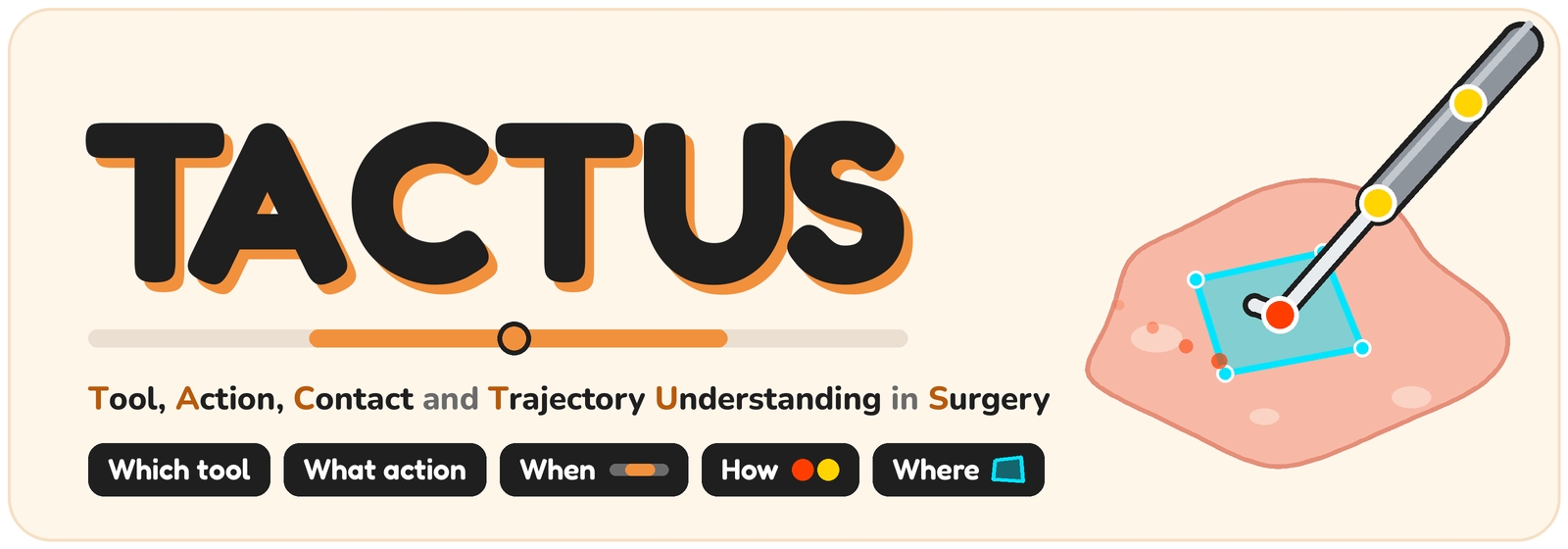
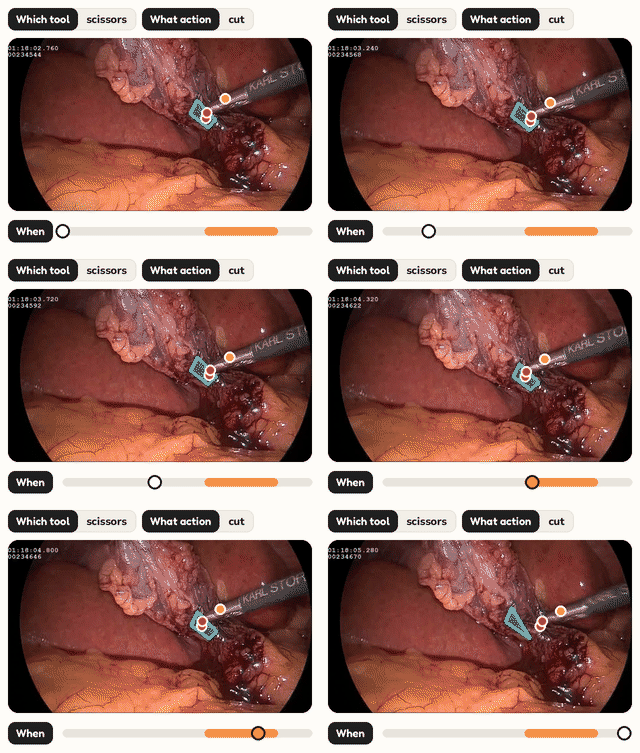
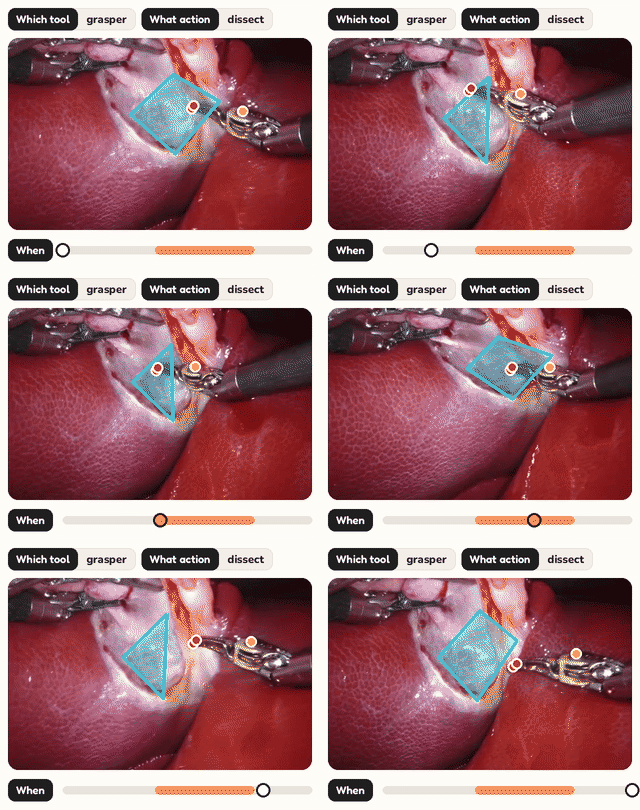
TACTUS (Tool, Action, Contact and Trajectory Understanding in Surgery) is a dataset and benchmark linking what an instrument does to when it acts, how it moves, and where it interacts with tissue. Each clip follows one surgical action or attempt, from approach through completion.
arXiv Paper · Project Page · Code · Checkpoints · Annotation guide · Evaluation protocol
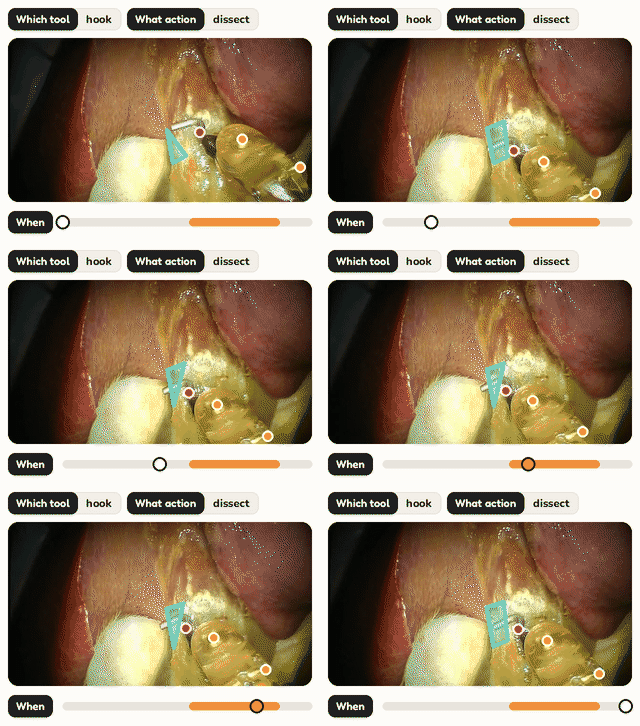 |
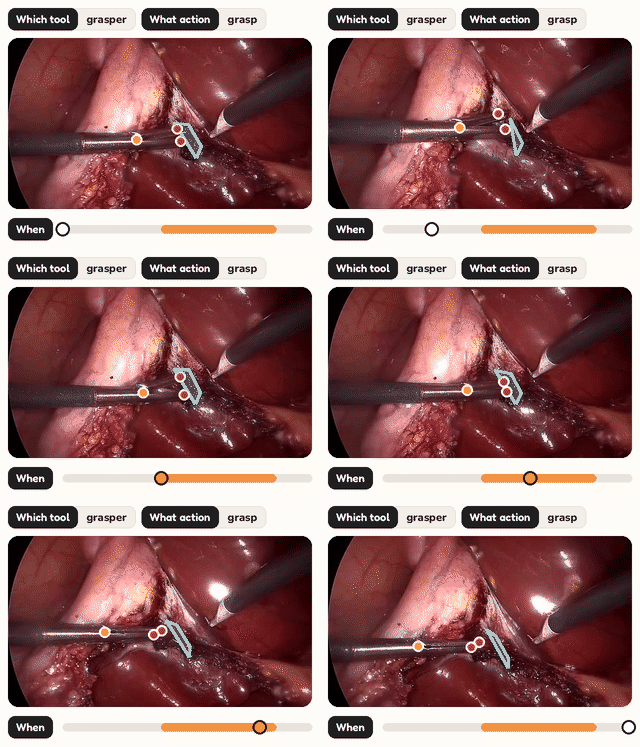 |
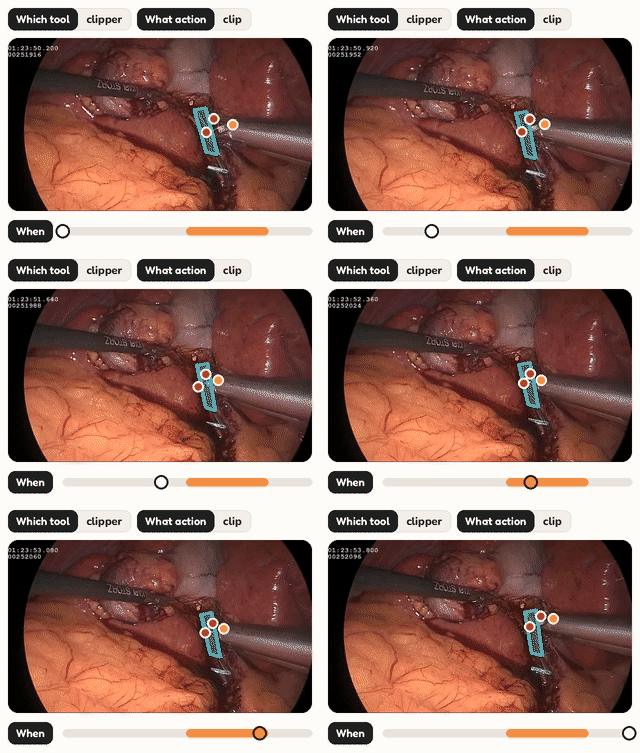 |
 |
 |
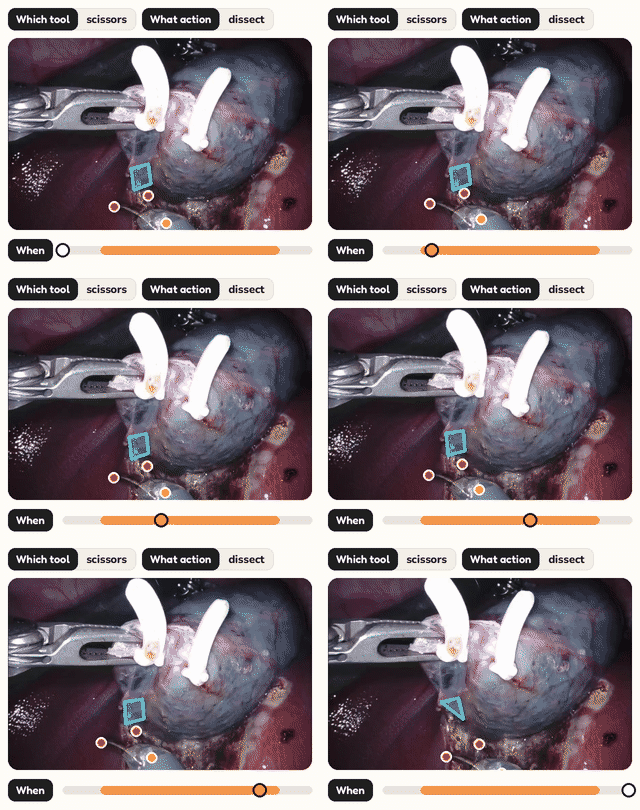 |
One Gold clip per tool–action pair, drawn from its annotation. 🔴 instrument tips · 🟡 instrument anchors · 🟦 contact region on the tissue · 🟧 interaction window inside the action window.
| Action clips | Source videos | Annotated frames | Tool–action pairs | Public sources |
|---|---|---|---|---|
| 22,995 | 141 | 2.9M | 6 | 5 |
Existing surgical benchmarks largely define supervision through task-specific targets, leaving the relationships between action semantics, instrument motion, and tissue interaction incompletely specified. TACTUS establishes a unified annotation framework for complete surgical actions. It jointly specifies tool and action identities, nested action and interaction windows, instrument-specific landmark trajectories, and tissue-region tracks.
The annotations were built with a two-tier pipeline that combines human annotation, point tracking, and model-generated spatial prompts. We re-annotated 141 videos from five public sources, producing 22,995 action clips that span 2.9 million frames: 15,668 Gold clips and 7,327 Silver clips.
| Question | Annotation |
|---|---|
| Which instrument acts? | One of four tools: hook, grasper, scissors, or clipper. |
| What does it do? | One of four actions: dissect, grasp, clip, or cut. |
| When does the interaction occur? | An interaction window inside the full action window, which also includes approach and completion. |
| How does the instrument move? | Three instrument-specific landmarks tracked across the action window, with per-frame visibility. |
| Where does it act on tissue? | Four tissue-point tracks enclosing the affected region, also with per-frame visibility. |
For example, a grasper–grasp clip captures the approach, jaw closure, and retraction. The interaction window starts when the jaws begin to close and ends when the instrument stops moving after retraction. The tool landmarks follow the jaws, and the tissue points follow the region being grasped.
| Tier | Clips | Videos | How the annotations are constructed | Index file |
|---|---|---|---|---|
| Gold | 15,668 | 101 | Human annotators label the tool, action, and time windows and place spatial prompts. Point tracking is followed by review and a final re-check. | index_gold.json |
| Silver | 7,327 | 40 | Human annotators label the tool, action, and time windows. A model places spatial prompts for tracking on additional SurgVU clips. | index_silver.json |
| All | 22,995 | 141 | Gold + Silver. | index_all.json |
The release covers six tool–action pairs from five public video sources.
Clips by tool–action pair (all released clips)
| Tool–action pair | Clips | Share |
|---|---|---|
| Hook–dissect | 13,729 | 59.7% |
| Grasper–grasp | 4,228 | 18.4% |
| Scissors–dissect | 2,338 | 10.2% |
| Grasper–dissect | 1,479 | 6.4% |
| Clipper–clip | 618 | 2.7% |
| Scissors–cut | 603 | 2.6% |
Released videos and clips by source
| Source | Folder prefix in this repo | Video format | Gold videos | Gold clips | Silver videos | Silver clips |
|---|---|---|---|---|---|---|
| Cholec80 | cholec80_* |
854×480 @ 25 fps | 30 | 6,058 | — | — |
| SurgVU | case_* |
1280×720 @ 60 fps | 32 | 4,281 | 40 | 7,327 |
| YouTube | youtube_cholecystectomy_chenyan_* |
640×360 / 1280×720, 25–30 fps | 21 | 2,766 | — | — |
| HeiChole | heichole_* |
960×540 @ 25 fps | 10 | 1,799 | — | — |
| CRCD | comprehensive_*_left |
1280×792 @ 60 fps | 8 | 764 | — | — |
In videos.csv, the group column uses the export names: case (SurgVU), cholec80, comprehensive (CRCD), heichole, and youtube_chenyan (YouTube).
Clips by source, tier, and tool–action pair
| Source | Tier | Hook–dissect | Grasper–grasp | Scissors–dissect | Grasper–dissect | Clipper–clip | Scissors–cut |
|---|---|---|---|---|---|---|---|
| Cholec80 | Gold | 4,739 | 933 | 12 | 43 | 186 | 145 |
| SurgVU | Gold | 2,688 | 799 | 350 | 296 | 99 | 49 |
| SurgVU | Silver | 3,279 | 1,454 | 1,666 | 546 | 121 | 261 |
| YouTube | Gold | 1,286 | 584 | 209 | 493 | 125 | 69 |
| HeiChole | Gold | 1,109 | 322 | 101 | 101 | 87 | 79 |
| CRCD | Gold | 628 | 136 | — | — | — | — |
The benchmark uses held-out Gold videos. Each source video belongs to exactly one partition.
| Gold benchmark partition | Videos | Clips |
|---|---|---|
| Train | 79 | 12,372 |
| Val | 11 | 1,604 |
| Test | 11 | 1,523 |
| Total | 101 | 15,499 |
These are the benchmark counts from the paper (Supplement Table S9). Gold-only, Silver-only, and Gold + Silver models all select checkpoints on Gold Val and are scored on the same Gold Test set.
The video-level split is in splits/gold_v2/, a copy of training/pipeline/splits/gold_v2/ in the code repository.
| File | Contents |
|---|---|
index_gold_train.json |
12,443 entries from 79 videos |
index_gold_val.json |
1,654 entries from 11 videos |
index_gold_test.json |
1,541 entries from 11 videos |
split_videos.csv |
One row per Gold video: split, source, clips, annotated frames, fps, resolution |
gold_split.json |
Seed and video lists of the split |
The split files use the same entry format as index_gold.json. The 15,668 Gold annotations point to 15,638 distinct clip files, because 30 uuids repeat a clip file. The split keeps one entry per clip file. The exporter in the code repository then drops clips that fail to export, which leaves the 15,499 benchmark clips above. It writes the final clip lists as all_{train,val,test}.txt.
The paper compares TactusNet with 13 published baselines. With per-head encoder fine-tuning, TactusNet reaches 95.8% tool–action pair accuracy. The best temporal recall at tIoU 0.7 is 46.6% (ActionFormer), and the best contact Dice is 0.351 (SegFormer). Adding Silver to Gold training raises the default TactusNet's pair accuracy from 93.8% to 95.5%. See the project page for the full tables and the evaluation protocol for the metrics and scoring commands.
This repository is an export of the annotation tool, in the tool's own clip format. It was exported on 2026-10-31.
<video>/clips/<action>_<start>_<end>.mp4                  # frames start..end of the source video (stream copy, every frame a keyframe)
<video>/annotation/<action>_<start>_<end>.json            # tracks
<video>/annotation/<action>_<start>_<end>_prompt.json     # the spatial prompt points (empty if none were stored)
index_{gold,silver,all}.json
splits/gold_v2/               # video-level benchmark split of Gold (see Benchmark)
review_status.json            # uuid -> {"status": "approved" | "success", "task_status": "Complete" | "None"}
videos.csv                    # one row per video: split, group, counts, frames, fps, duration, resolution
excluded_video_mismatch.json  # annotations left out because their source video no longer matches
Naming. The export keeps the annotation tool's field names.
affordance_rangeis the paper's action window, andaction_rangeis its inner interaction window.
Each index is a JSON object keyed by annotation uuid. The clips are shared by all three indexes.
{
  "task": "cholec80_06",            // source video
  "version": 0,                     // annotation version (only the latest version is exported)
  "start": 10434, "end": 10534,     // action window, absolute frame indices in the source video, inclusive
  "tool": "hook", "action": "dissect",
  "clip_dir": "cholec80_06/clips/dissect_10434_10534.mp4",
  "anno_dir": "cholec80_06/annotation/dissect_10434_10534.json",
  "prompt_dir": "cholec80_06/annotation/dissect_10434_10534_prompt.json"
}
Paths are relative to the repository root. Clip frame i is source frame start + i, so each clip has end - start + 1 frames.
Keys: tool, action, affordance_range (action window) and action_range (interaction window), each {start, end}, plus imageDimensions, job_id, failure_msg, and points.
Each point is {id, x, y, uid, type, frameIndex, vis}:
type is tool_tip, tool_anchor, or contact.tool_tip and tool_anchor points. A hook has one tip and two anchors. A grasper, scissors, or clipper has two tips (the jaws) and one anchor.contact points enclose the tissue region.uid identifies a track. frameIndex is absolute in the source video, so subtract the index entry's start to get the clip frame.vis is the per-frame visibility.x, y are pixels of the source video and can fall slightly outside the frame.Prompt points use the same fields, with x, y normalized to 0–1. A few Silver track files have an empty points list. Those clips have tool, action, and time-window labels but no spatial tracks.
import json
from huggingface_hub import hf_hub_download

REPO = "hding2455/TACTUS"
get = lambda path: hf_hub_download(REPO, path, repo_type="dataset")

index = json.load(open(get("index_gold.json")))
uid, entry = next(iter(index.items()))

clip_path = get(entry["clip_dir"])                    # mp4 holding source frames start..end
anno = json.load(open(get(entry["anno_dir"])))

action_window = anno["affordance_range"]              # When: the full action window
interaction_window = anno["action_range"]             # When: the interaction window inside it
for p in anno["points"]:
    clip_frame = p["frameIndex"] - entry["start"]     # index into the clip
    # p["type"] in {"tool_tip", "tool_anchor", "contact"}; p["vis"] is visibility
The full release is about 63.5 GB (58.9 GB of clips). To download only the metadata:
hf download hding2455/TACTUS --repo-type dataset \
  --include "index_*.json" "splits/*" "videos.csv" "review_status.json" --local-dir TACTUS
The TACTUS code reads this repository directly. It crops each video to its picture content, samples 16 frames per action window, and trains and scores TactusNet and the baselines.
This release includes clips and TACTUS annotations from all five sources. Supplement F.2 and Table S21 of the paper report these terms for the source videos.
| Video source | Terms |
|---|---|
| Cholec80 | CC BY-NC-SA 4.0 |
| HeiChole | CC BY-NC-SA. The paper's User Notes do not specify a version and require citation of the HeiChole paper. |
| CRCD | CC BY 4.0 |
| SurgVU | CC BY-NC-SA 4.0 |
| YouTube cholecystectomy collection | Terms set by the rights holder of each video. |
The MIT license of the code repository covers the TACTUS code, not this dataset.
Lurui Wang¹*, Hao Ding¹*, Chenhao Yu², Chenyan Jing¹, Jiru Xu¹, Ruoqi Zuo¹, Liwei Mei¹, Chang Liu³, Lalithkumar Seenivasan¹, and Mathias Unberath¹†
¹ Johns Hopkins University · ² University of Virginia, Charlottesville · ³ University of Toronto
* Co-first authors: Lurui Wang and Hao Ding. † Corresponding author: Mathias Unberath.
@article{wang2026tactus,
  title   = {{TACTUS}: Unifying Surgical Action Understanding in Time and Space},
  author  = {Wang, Lurui and Ding, Hao and Yu, Chenhao and Jing, Chenyan and Xu, Jiru and Zuo, Ruoqi and Mei, Liwei and Liu, Chang and Seenivasan, Lalithkumar and Unberath, Mathias},
  journal = {arXiv preprint arXiv:2611.31956},
  year    = {2026},
  doi     = {10.48550/arXiv.2611.31956},
  url     = {https://arxiv.org/abs/2611.31956}
}