

DepthWorld: 3D World Model for Robot Manipulation
Paper • 2610.08780 • Published
This repository is publicly accessible, but you have to accept the conditions to access its files and content.
Access to DROID-3D is granted after approval. Before requesting access, please complete the DROID-3D Access Request Form. The email you enter in the form must match the email of your Hugging Face account; requests are only approved when they match.
Log in or Sign Up to review the conditions and access this dataset content.
Jai Bardhan, Josef Šivic, Vladimír Petrík
Czech Institute of Informatics, Robotics and Cybernetics (CIIRC), Czech Technical University in Prague






Access: this dataset is shared after approval. To request access, please complete the DROID-3D Access Request Form and then request access on this page. The email you enter in the form must match the email of your Hugging Face account; requests are only approved when they match.
Recalibrated multi-view camera extrinsics and per-episode intrinsics for the DROID robot-manipulation dataset — the calibration half of DROID-3D. The other half, dense metric depth recovered from DROID's stereo recordings, is shared on request through the same access form, which has the download instructions; see the DepthWorld repository for the rest of the data-preparation pipeline.
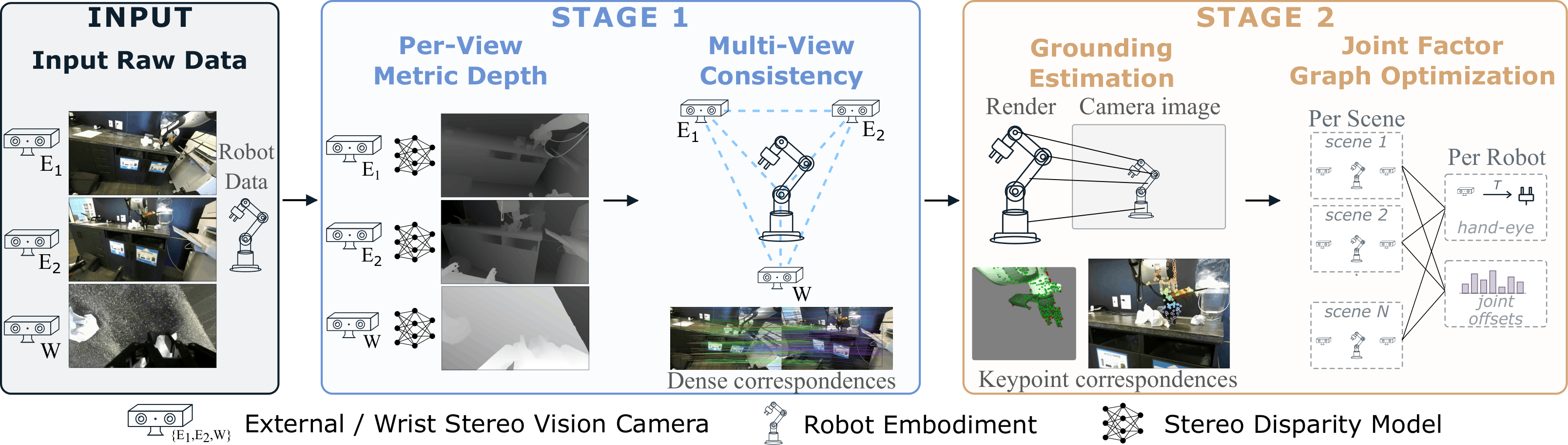
How it was produced. Stage 1 recovers per-view metric depth from each
stereo pair via a learned stereo network and enforces multi-view consistency
through dense correspondences. Stage 2 renders the robot's URDF into the
external views to ground the rig in the robot frame, then runs a joint
factor graph optimization pooling all episodes of the same physical robot
to recover shared kinematic parameters (hand-eye correction dT_gw,
joint-encoder offsets dq) alongside per-scene extrinsics — 71,006
episodes calibrated, < 0.7 px reprojection error on 90 % of them
(external cameras).
| file | contents |
|---|---|
extrinsics.jsonl |
per-episode optimized extrinsics + per-robot corrections (71,006 episodes) |
camera_intrinsics.jsonl |
per-episode pinhole intrinsics + stereo baselines, all 3 cameras |
extrinsics_missing.json |
2,111 raw episodes the factor graph could not calibrate |
pseudolabels/refined_all.npz |
VGGT pseudo-label camera poses for the 25,616 RLDS-only episodes |
pseudolabels/missing.jsonl |
index of those episodes (TFDS train[i] ↔ episode path key) |
pseudolabels/qa_verdicts.jsonl |
per-episode pseudo-label QA verdicts |
Episodes are keyed by episode_uuid (the canonical DROID episode key,
<LAB>+<hash>+<date>-<time>). The integer traj_id is the numbering of
our own DepthWorld raw_index.jsonl: it is each episode's position in the
uuid-sorted list of indexed episodes. It only matches an index you build
yourself if that index contains exactly the same episodes, so join on
episode_uuid when in doubt. The
DepthWorld README
has a quick check.
extrinsics.jsonl — one JSON record per line
episode_uuid                        str      canonical DROID episode key
traj_id                             int      DepthWorld raw_index id
lab, robot_serial, scene_path       str
T0_ext1_in_world                    4x4      ext1 view matrix — see convention note!
T1_ext2_in_world                    4x4      ext2 view matrix — see convention note!
dT_gw_gripper_in_world_correction   4x4      per-robot hand-eye correction (near I)
dq_joint_correction                 [7]      per-robot joint-encoder offsets (rad)
_meta                               dict     n_iters, final_cost, stop_reason, ...
camera_intrinsics.jsonl — one JSON record per line
traj_id, split, episode_uuid, lab, raw_dir
cameras.{ext1,ext2,wrist}:
    left / right      fx, fy, cx, cy, disto[12], width (1280), height (720), fov_h, fov_v
    stereo_baseline_m float
    T_right_from_left 4x4
    serial, role, fps, zed_sdk_version, ...
1. T0_ext1_in_world / T1_ext2_in_world are world→camera VIEW matrices,
not camera poses — the inverse of what the historical _in_world field
name suggests. To get the camera pose (camera→world; translation = camera
position in the robot-base frame), invert them:
import json, numpy as np

recs = {}
with open("extrinsics.jsonl") as f:
    for line in f:
        r = json.loads(line)
        recs[r["episode_uuid"]] = r

r = recs["AUTOLab+0d4edc83+2023-10-21-19h-06m-46s"]
T_world_to_ext1 = np.array(r["T0_ext1_in_world"])   # view matrix (world -> cam)
pose_ext1 = np.linalg.inv(T_world_to_ext1)          # cam -> world; pose[:3, 3] = camera position
2. The wrist camera pose is not stored — it is reconstructed per frame from the robot's joint state via forward kinematics with the per-robot corrections:
T_wristcam_from_base(t) = FLIP · T_gw_static · dT_gw · inv(franka_fk(q(t) + dq))
where q(t) are the Franka joint positions, dq / dT_gw come from this
dataset's records, T_gw_static is the per-robot hand-eye transform, and
FLIP = diag(-1, -1, 1, 1). Additionally, the wrist RGB/depth images
stored in DROID are rotated 180° in-plane relative to this optimized frustum
convention — after inverting the view matrix to a pose, right-multiply by a
local-Z 180° rotation before unprojecting wrist pixels. A complete reference
implementation (including the Franka FK and the hand-eye asset) is in
depth_extras/extrinsics.py
of the DepthWorld repository, and
scripts/visualize_droid_3d.py
fuses all three views of an episode into a single world-frame point cloud
using this data.
The TFDS/RLDS release of DROID (droid_101) holds 95,658 episodes; only
~71k could be calibrated by the factor-graph pipeline above (the raw stereo
release covers ~73k episodes, and entire labs exist only in RLDS). For the
remaining 25,616 episodes, pseudolabels/refined_all.npz provides
camera-from-robot-base poses predicted by a DROID-finetuned VGGT that
regresses metric-scale, robot-base-frame camera poses directly (held-out:
2.4° / 2.5 cm pose error, depth AbsRel 0.066). Raw per-frame predictions are
then temporally refined: the static external cameras are
robust-SE(3)-averaged over all frames of the episode, and the wrist track is
rebuilt kinematically as a constant hand-eye composed with FK, using
per-robot hand-eyes discovered by clustering within each lab (validated
against DROID's known 8.4 cm hand-eye norm). Per QA gating, 92.1 % of these
episodes have usable external poses and 70.9 % also a trustworthy wrist
track (qa_verdicts.jsonl). Model weights, training and labeling code:
coming soon.
refined_all.npz   key        (25616,)      episode path key (row-aligned with missing.jsonl)
                  ext_pose   (25616,2,3,4) constant ext1/ext2 extrinsics
                  offsets    (25617,)      per-episode slice into wrist_extr
                  wrist_extr (sumT,3,4)    per-frame wrist extrinsics (5 Hz)
Unlike the jsonl above, these are already uniform world→cam (camera-from-robot-base) matrices in meters — no inversion or flip needed. Depth maps and per-frame confidences for these episodes are much larger (~1.3 TB) and not included here.
@inproceedings{bardhan2026depthworld,
  title     = {DepthWorld: 3D World Model for Robot Manipulation},
  author    = {Bardhan, Jai and \v{S}ivic, Josef and Petr\'{i}k, Vladim\'{i}r},
  booktitle = {Conference on Robot Learning (CoRL)},
  year      = {2026}
}
Released under CC-BY-4.0, matching the DROID dataset from which the episodes, raw stereo recordings, and factory calibration metadata derive. Please also cite DROID when using this data.
This work was supported by the European Union's Horizon Europe projects AGIMUS (No. 101070165), euROBIN (No. 101070596), ERC FRONTIER (No. 101097822), ELIAS (No. 101120237), ELLIOT (No. 101214398), ČVUT Starting grant "DREAM-ACT" (Project ID CVUT-StG-26-089), and CTU Future Fund (Project ID: CVUT-BrF-26-22825M). This work was also supported by the EU’s Horizon Europe Programme under the Grant agreement No. 101136607 (CLARA Project), and was co-funded by the EU from the Operational Programme Jan Amos Komenský (OP JAK) (project "Center for Artificial Intelligence and Quantum Computing in System Brain Research", reg. no. CZ.02.01.01/00/23_029/0008437). Compute resources and infrastructure were supported by the Ministry of Education, Youth and Sports of the Czech Republic through the e-INFRA CZ (ID:90254).