

Cephalonauts One: A deep fMRI dataset for decoding naturalistic speech in the human brain
Paper • 2610.03558 • Published
Please review and accept the Cephalonauts One terms of use before requesting access.
Important note before you request access. The Cephalonauts One dataset contains brain data collected from human volunteers in accordance with applicable data protection laws. Human volunteers have explicitly consented to this sharing. It is your responsibility to comply with applicable data protection laws when you access, use or share them.
By requesting access to the data collected during the Cephalonauts One project, you agree to the following:
Log in or Sign Up to review the conditions and access this dataset content.
Demo · Code on GitHub · Paper · Discord
Cephalonauts One is a deep fMRI dataset for decoding naturalistic spoken language from the human brain.
It contains 89.31 hours of whole-brain 3T fMRI from three French-speaking participants listening to podcasts across 72 sessions and 358 runs, paired with aligned text and audio representations and ready-to-train train, val, and test splits.
The release is designed as both a neuroscience resource and a machine-learning benchmark: each example contains an fMRI response X, a transcript-derived embedding target Y_text, an audio-derived embedding target Y_audio, and metadata.
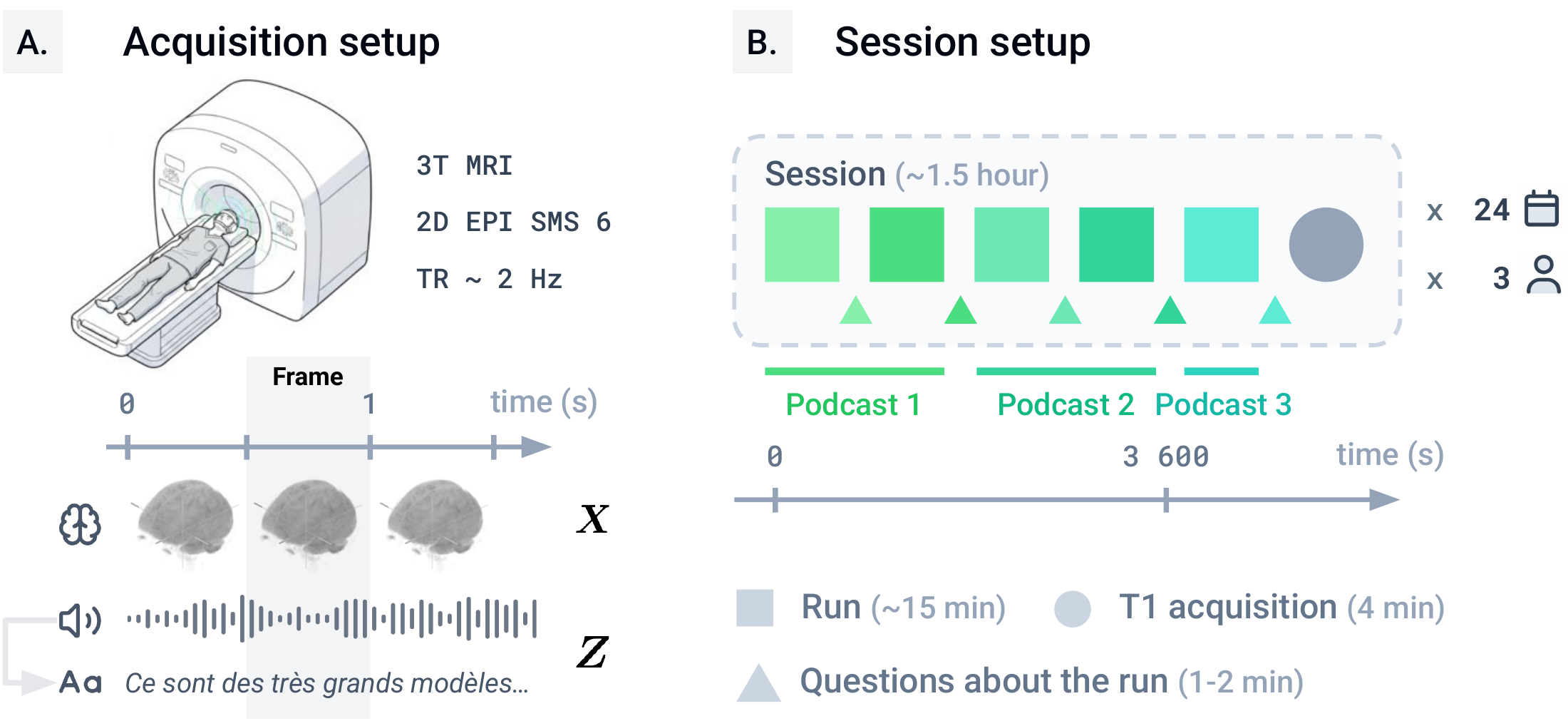
Overview of the acquisition protocol. Participants listened to naturalistic podcast episodes during fMRI sessions composed of five runs, with comprehension questions after each run.
When publicly presenting work that uses Cephalonauts One, please acknowledge the dataset as described in the access terms:
The data used were [in part] provided by the Cephalonauts One project, managed and funded by Karavela.
Please also cite our paper from the NeurIPS 2026 Evaluations & Datasets Track:
@inproceedings{collas2026cephalonauts,
  title = {{Cephalonauts One}: A deep {fMRI} dataset for decoding naturalistic speech in the human brain},
  author = {Collas, Antoine and Jalouzot, Louis and Ilinca, Géraud and Caris, Corentin and Valabrègue, Romain and Hassayoune, Ahmed and Goncalves, David and Hueber, Madeleine and Delebarre, Thaddée and Savatovsky, Julien and Fonteneau, Clara and Maussion, Charles and Thirion, Bertrand and Thual, Alexis},
  booktitle = {Advances in Neural Information Processing Systems},
  year = {2026},
  note = {Evaluations and Datasets Track},
  url = {https://arxiv.org/abs/2610.03558}
}
Most public spoken-language fMRI resources favor breadth: many participants, but relatively few hours per participant. Cephalonauts One favors depth. Participants listened to unique naturalistic podcast stimuli across many sessions, yielding 89.31 hours of functional recordings in total, with 29.94, 30.24, and 29.13 hours for the three participants.
This depth matters for decoding. Subject-specific brain responses are noisy and anatomically idiosyncratic, while modern text and audio embeddings are high-dimensional. Cephalonauts One makes it possible to train decoders on many hours from the same brain and evaluate them on held-out sessions containing unseen podcasts.
The release contains nine ready-to-train decoder configurations plus one lower-level timeseries metadata configuration:
| Configuration | Use this when | Contents | Approx. download |
|---|---|---|---|
sub-0_fsaverage5, sub-1_fsaverage5, sub-2_fsaverage5 |
You want the fastest baseline experiments or cortical surface data | Decoder-ready train, val, and test splits on fsaverage5 |
10.9–11.3 GB per subject |
sub-0_T1w, sub-1_T1w, sub-2_T1w |
You want native anatomical-space volumetric data | Decoder-ready train, val, and test splits in native T1w space |
23.6–25.3 GB per subject |
sub-0_MNI, sub-1_MNI, sub-2_MNI |
You want template-space volumetric data | Decoder-ready train, val, and test splits in MNI space |
29.2–30.2 GB per subject |
timeseries |
You want to inspect source-run metadata, regenerate decoder samples, or download timeseries data (see Advanced) | One metadata split with transcripts, source audio paths, per-space fMRI array paths, timing offsets, and run identifiers |
7.3 MB |
For decoder-ready configurations, the preprocessing space is encoded in the configuration name rather than stored in a separate row-level space column.
Each row is one aligned decoder sample:
| Column | Description |
|---|---|
timestamps |
Timestamp, in seconds, used to build the text and audio contexts |
text |
Transcript context used to compute Y_text, consisting of the last 20 completed words before timestamps |
X |
Preprocessed fMRI response aligned with timestamps after the hemodynamic lag correction |
Y_text |
Embedding of the preceding transcript context from Qwen/Qwen3-Embedding-8B |
Y_audio |
Embedding of the trailing audio segment from LCO-Embedding/LCO-Embedding-Omni-7B |
sub, ses, run |
Participant, session, and run identifiers |
tr, split |
Repetition time and benchmark split |
fmri |
Source fMRI array path inside the gated dataset repository, not a local filesystem path |
audio |
Source audio path inside the gated dataset repository, not a local filesystem path |
fmri_offset, audio_offset |
Timing metadata used to align fMRI samples, transcripts, and audio |
audio_duration |
Duration of the stimulus audio presented during fMRI data acquisition |
run_fmri_duration |
Duration of the source fMRI run, used by the baseline to report training hours |
The standardized splits hold out sessions, not random samples. The intended benchmark is therefore across-session and across-stimulus decoding: train on some sessions from a participant, select models on a validation session, and evaluate retrieval on a held-out test session.
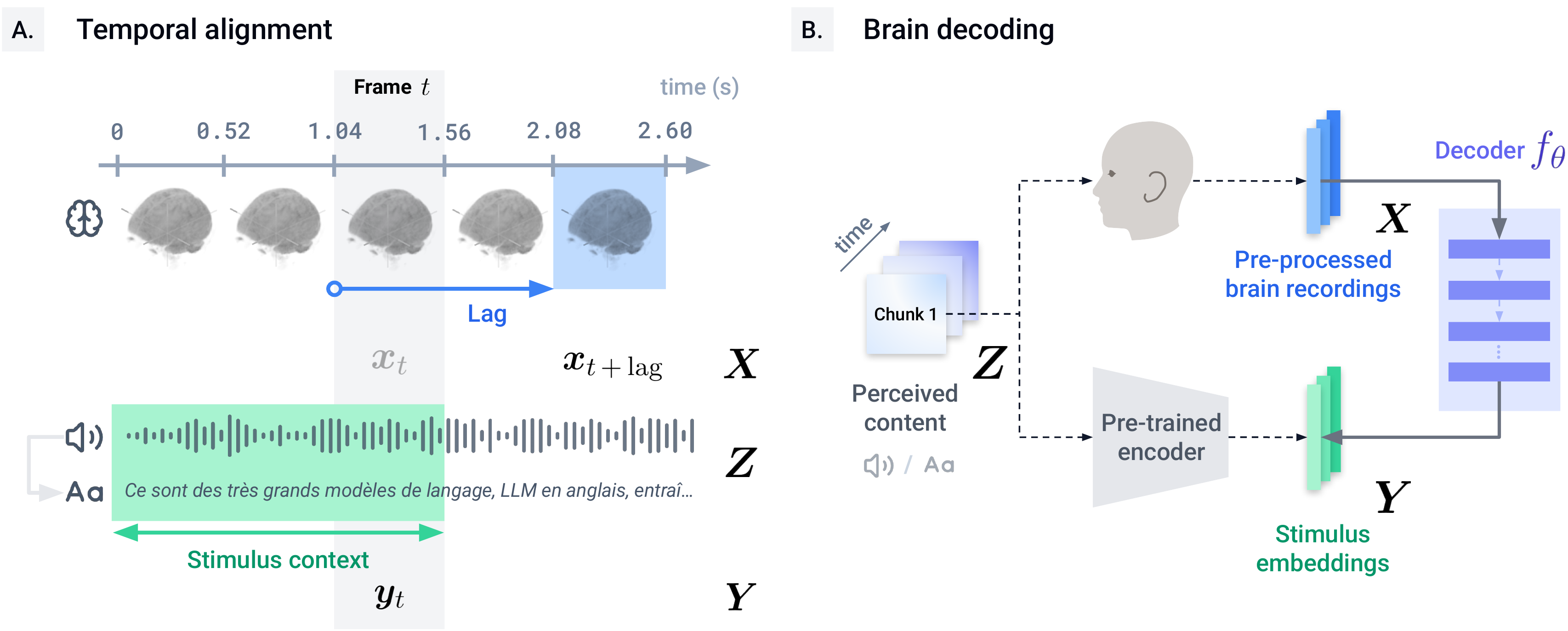
Decoding setup. A pretrained text or audio encoder defines the target embedding space, and a decoder is trained to predict those stimulus embeddings from aligned fMRI responses.
Participants listened to episodes of Les Pieds sur terre, a France Culture / Radio France documentary podcast produced by Sonia Kronlund, during whole-brain 3T fMRI acquisition.
Radio France describes the program as a weekday half-hour documentary show built around first-person true stories.
Acquired with a fast TR of 520 ms, the dataset includes preprocessed data aligned to the intra-subject T1w volumetric space, the MNI template space, and the fsaverage5 surface space.
A brain mask is applied to include only voxels within the cerebral volume, resulting in 2D arrays for the extracted time series. The exported examples are built by taking every fourth fMRI frame, yielding one sample every 2080 ms.
For decoder-ready samples, fMRI time series are detrended, z-scored over time within each voxel or vertex, and temporally smoothed with a 4-TR moving-average filter.
For each retained timestamp, the text target is computed from the last 20 completed words, while the audio target is computed from the trailing 10-second waveform segment ending at the same timestamp.
Both targets are paired with the corresponding delayed fMRI response using a 2.5-second hemodynamic lag, so text and audio decoding use the same examples, splits, and metadata.
The packaged splits use the last session (23) for testing, the penultimate session (22) for validation, and all earlier sessions (0–21) for training.
Recording duration by participant:
| Subject | TRs | Sessions | Runs | Duration (h) |
|---|---|---|---|---|
sub-0 |
207,283 | 24 | 120 | 29.94 |
sub-1 |
209,366 | 24 | 121 | 30.24 |
sub-2 |
201,647 | 24 | 117 | 29.13 |
| Total | 618,296 | 72 | 358 | 89.31 |
For installation instructions, see the GitHub requirements.
The dataset is gated, so request access on Hugging Face first and then authenticate locally:
hf auth login
Streaming a few examples without downloading the data:
from datasets import load_dataset

stream = load_dataset(
    "karavela/cephalonauts_one",
    name="sub-0_fsaverage5",
    split="train",
    streaming=True,
)

row = next(iter(stream))
print(row.keys())
# dict_keys(['timestamps', 'text', 'X', 'Y_text', 'Y_audio', 'sub', 'ses', 'run', 'tr', 'fmri_offset', 'audio', 'audio_offset', 'audio_duration', 'run_fmri_duration', 'fmri', 'split'])
print({key: len(row[key]) for key in ("X", "Y_text", "Y_audio")})
# {'X': 20484, 'Y_text': 4096, 'Y_audio': 3584}
Loading one subject/preprocessing configuration:
from datasets import load_dataset

ds_train = load_dataset("karavela/cephalonauts_one", name="sub-0_fsaverage5", split="train")
print(ds_train.column_names)
# ['timestamps', 'text', 'X', 'Y_text', 'Y_audio', 'sub', 'ses', 'run', 'tr', 'fmri_offset', 'audio', 'audio_offset', 'audio_duration', 'run_fmri_duration', 'fmri', 'split']
print(len(ds_train))
# 45482
with_format("torch") before passing data to a PyTorch dataloader.
from datasets import load_dataset
from torch.utils.data import DataLoader

ds = load_dataset("karavela/cephalonauts_one", name="sub-0_fsaverage5", split="train")
loader = DataLoader(ds.with_format("torch").shuffle(seed=0), batch_size=32)

batch = next(iter(loader))
print({key: tuple(batch[key].shape) for key in ("X", "Y_text", "Y_audio")})
# {'X': (32, 20484), 'Y_text': (32, 4096), 'Y_audio': (32, 3584)}
If you only need to load the metadata associated with the X and Y decoding pairs:
import pandas as pd

metadata_columns = [
    "timestamps",
    "text",
    "sub",
    "ses",
    "run",
    "tr",
    "fmri",
    "audio",
    "fmri_offset",
    "audio_offset",
    "audio_duration",
    "run_fmri_duration",
    "split",
]

# Loading the val split for a single subject
df = pd.read_parquet("hf://datasets/karavela/cephalonauts_one/derivatives/decoderprep/sub-0/fsaverage5", columns=metadata_columns, filters=[("split", "==", "val")])

# Loading all the splits for a single subject
df = pd.read_parquet("hf://datasets/karavela/cephalonauts_one/derivatives/decoderprep/sub-0/fsaverage5", columns=metadata_columns)
As detailed in the dataset construction section, the timeseries data is obtained from masking volume timeseries. We release both the original 4D data (.nii.gz files) and the flattened 2D data (.npy files), with the full repository totaling approximately 1.20 TB.
The timeseries subset provides lightweight metadata containing paths to the underlying fMRI arrays and extraction masks. You can use this metadata to download and load targeted subsets of the data on demand, bypassing the need to download the full dataset.
As an example, if you only need the fsaverage5 .npy data for subject 0's 4th session, the snippet below will download and load exactly that subset:
import datasets
import huggingface_hub as hf
import numpy as np

# Selecting relevant runs
ds = datasets.load_dataset("karavela/cephalonauts_one", "timeseries")["metadata"]
ds = ds.filter(lambda row: row["sub"] == 0 and row["ses"] == 4)

# Defining loading behavior (path to python object)
def download_and_load(batch):
    for col_name, col in batch.items():
        batch[col_name] = [np.load(hf.hf_hub_download("karavela/cephalonauts_one", p, repo_type="dataset"), mmap_mode="r") for p in col]
    return batch
ds.set_transform(download_and_load, columns=["fsaverage5_npy"], output_all_columns=True)

# Downloading and lazily loading the selected data
ds[:]
To download different .npy data, change fsaverage5_npy in the columns list to another column name (e.g., mni_npy). To load .nii.gz volumes instead, update the column name and replace the np.load call with nibabel.load in the download_and_load function.
For baseline training, evaluation, scaling experiments, and sample regeneration, see the GitHub repository.
Access to and use of Cephalonauts One are governed by the terms presented when requesting access. The dataset is therefore listed as license: other on Hugging Face.
Users may redistribute Cephalonauts One data and derived data only under the same access conditions.
Stimulus material comes from Les Pieds sur terre, published by France Culture / Radio France. The original podcast programs and associated Radio France materials remain the exclusive property of Radio France, and are not relicensed by Cephalonauts One.
Use this dataset for brain-to-embedding decoding, retrieval, representation learning, and split-aware evaluation on naturalistic spoken-language fMRI.