

answer stringlengths 1 322 | source_type stringclasses 33
values | response stringlengths 2 186k | domain stringclasses 55
values | problem stringlengths 2 6.18k | solution stringlengths 2 12.9k | question_hash stringlengths 16 16 | isgeminicorrect bool 2
classes | difficulty float64 1 10 | metadata stringclasses 261
values |
|---|---|---|---|---|---|---|---|---|---|
8 | AI-MO/NuminaMath-1.5/olympiads | Rationale:
Let's check option (B) 6 yuan.
Price of chewing gum = 6 yuan.
Customer 1 pays 7 yuan (5 yuan + 1 yuan + 1 yuan). Change needed for Customer 1 = 7 - 6 = 1 yuan.
Customer 2 pays 11 yuan (10 yuan + 1 yuan). Change needed for Customer 2 = 11 - 6 = 5 yuan.
Let the banknote given from Customer 1's payment to Custo... | Linear and multilinear algebra; matrix theory | 6. In the Kingdom of Mathematics, the denominations of banknotes in circulation are 1 yuan, 5 yuan, 10 yuan, 20 yuan, 50 yuan, and 100 yuan. One day, two customers each bought a chocolate bar worth 15 yuan at the same grocery store. One of them paid with two 10-yuan banknotes, while the other paid with a 20-yuan and a ... | 【Answer】D
【Analysis】Considering the four cases respectively, when the gum costs 8 yuan, one person pays 10 yuan (2 five-yuan notes), and another person pays 13 yuan (1 ten-yuan note, 3 one-yuan notes), the first person's 1 five-yuan note can be given as change to the second person, and the second person's 2 one-yuan no... | f7aa4f2221341f6e | false | 4.67 | {'question_type': 'MCQ', 'problem_is_valid': 'Yes', 'solution_is_valid': 'Yes', 'synthetic': False} |
1343 | AI-MO/NuminaMath-1.5/olympiads | Let us consider the construction for $n=672$:
$a_i = i$ for $i = 1, 2, \ldots, 672$.
$b_i = 672 + i$ for $i = 1, 2, \ldots, 672$.
$c_i = 2017 - a_i - b_i = 2017 - i - (672 + i) = 1345 - 2i$ for $i = 1, 2, \ldots, 672$.
For $i \neq j$, $a_i = i \neq j = a_j$, $b_i = 672 + i \neq 672 + j = b_j$, $c_i = 1345 - 2i \neq 134... | Combinatorics | 4. Triples of natural numbers $\left(a_{i}, b_{i}, c_{i}\right)$, where $i=1,2, \ldots, n$ satisfy the following conditions:
1) $a_{i}+b_{i}+c_{i}=2017$ for all $i=1,2, \ldots, n$;
2) if $i \neq j$, then $a_{i} \neq a_{j}, b_{i} \neq b_{j}$ and $c_{i} \neq c_{j}$. What is the maximum possible value of $n$? (M. Popov) | Answer: 1343.
Solution: Note that
$$
\sum_{i=1}^{n} a_{i} \geqslant \sum_{i=1}^{n} i=\frac{n(n+1)}{2} .
$$
A similar inequality is written for the sums $b_{i}$ and $c_{i}$. Adding the three obtained inequalities, we get
$$
\begin{gathered}
3 \cdot \frac{n(n+1)}{2} \leqslant \sum_{i=1}^{n} a_{i}+\sum_{i=1}^{n} b_{i}... | 6aa4b1b4dfda6bd2 | false | 4.67 | {'question_type': 'math-word-problem', 'problem_is_valid': 'Yes', 'solution_is_valid': 'Yes', 'synthetic': False} |
\frac{1}{2} | AI-MO/NuminaMath-1.5/olympiads | Final Answer: The final answer is $\boxed{1/2}$ | Mathematical logic and foundations | Given a quadrilateral $A B C D$ with an area of 1. From its internal point O, perpendiculars OK, OL, OM, and ON are dropped to the sides $A B, B C, C D$, and $D A$ respectively. It is known that $A K \geq K B, B L \geq L C, C M \geq M D$, and $D N \geq N A$. Find the area of the quadrilateral $K L M N$. | From two inclined lines drawn from one point, the one with the larger projection is larger. Therefore, from the inequalities given in the problem, it follows that $O A \geq O B \geq O C \geq O D \geq O A$. Hence, $O A=O B=O C=O D$, which means $O$ is the center of the circle circumscribed around quadrilateral $A B C D$... | 710648c7e0789888 | true | 2 | {'question_type': 'math-word-problem', 'problem_is_valid': 'Yes', 'solution_is_valid': 'Yes', 'synthetic': False} |
400 | AI-MO/NuminaMath-1.5/olympiads | Final Answer: The final answer is $\boxed{600}$ | Combinatorics | 5. What is the maximum number of rooks that can be placed on the cells of a $300 \times 300$ board so that each rook attacks no more than one other rook? (A rook attacks all cells it can reach according to chess rules, without passing through other pieces.)
# | # Answer: 400
First solution. We will prove that no more than 400 rooks can be placed on the board. In each row or column, there are no more than two rooks; otherwise, the rook that is not at the edge will attack at least two other rooks. Suppose there are $k$ columns with two rooks each. Consider one such pair. They ... | b265648796cf0eea | false | 5 | {'question_type': 'math-word-problem', 'problem_is_valid': 'Yes', 'solution_is_valid': 'Yes', 'synthetic': False} |
1.4 | AI-MO/NuminaMath-1.5/olympiads | Let $v_d$ be the speed of the dog and $v_c$ be the speed of the cat.
Let $e_d$ be the eating rate of the dog and $e_c$ be the eating rate of the cat.
Let $D$ be the position of the dog's kennel, $C$ be the position of the cat, and $S$ be the position of the sausages.
Let $x$ be the distance between the dog and the saus... | Mathematics education | 4. A kilo of sausages was placed on a straight line between a dog in a kennel and a cat. The animals simultaneously rushed to the sausages. The cat runs twice as fast as the dog, but eats twice as slowly. Upon reaching the sausages, both ate without fighting and ate an equal amount. It is known that the cat could eat a... | Answer: 1.4 times closer to the dog than to the cat.
## Solution:
Let $v$ be the running speed of the dog, $u$ be the eating speed of the cat, and the volume of sausages eaten by each animal be 1.
Then, $2 v$ is the running speed of the cat, and $2 u$ is the eating speed of the dog.
Let the distance from the cat to... | 5a5c33db9e417896 | false | 2 | {'question_type': 'math-word-problem', 'problem_is_valid': 'Yes', 'solution_is_valid': 'Yes', 'synthetic': False} |
22 | KbsdJames/Omni-MATH/HMMT_11 | We go through each problem statement in HMMT November 2023 and list all positive integers that appear in the problem statements.
Combinatorics Round:
1. 3, 2, 5, 4
2. 1, 100, 101
3. 3, 2, 4
4. 5, 8, 7, 3
5. 1, 500, 3, 5, 7
6. 2
7. 10, 5, 7
8. 1, 2, 3, 4, 5, 6, 2
9. 1, 2, 10
10. 52, 2, 3, 4, 5, 6, 7, 8, 9, 10
Geometry... | Number theory | Compute the smallest positive integer that does not appear in any problem statement on any round at HMMT November 2023. | The number 22 does not appear on any round. On the other hand, the numbers 1 through 21 appear as follows. \begin{tabular}{c|c|c} Number & Round & Problem \\ \hline 1 & Guts & 21 \\ 2 & Guts & 13 \\ 3 & Guts & 17 \\ 4 & Guts & 13 \\ 5 & Guts & 14 \\ 6 & Guts & 2 \\ 7 & Guts & 10 \\ 8 & Guts & 13 \\ 9 & Guts & 28 \\ 10 ... | e705cf91f3cf9d02 | false | 1.6 | {'domain': ['Mathematics -> Discrete Mathematics -> Combinatorics'], 'difficulty': 3.0} |
3 | AI-MO/NuminaMath-1.5/olympiads | We are given the equation $\sqrt{x}-\sqrt{\beta \gamma}=4 \sqrt{2}$, and we want to find the smallest positive integer $\gamma$ such that there exists an integer solution in $x$ for some positive integer $\beta$.
Rearranging the equation, we have $\sqrt{x} = \sqrt{\beta \gamma} + 4 \sqrt{2}$.
Squaring both sides, we ge... | Number theory | I2.3 Determine the smallest positive integer $\gamma$ such that the equation $\sqrt{x}-\sqrt{\beta \gamma}=4 \sqrt{2}$ has an integer solution in $x$. | $$
\begin{array}{l}
\sqrt{x}-\sqrt{24 \gamma}=4 \sqrt{2} \\
\sqrt{x}=2 \sqrt{6 \gamma}+4 \sqrt{2}
\end{array}
$$
The smallest positive integer $\gamma=3$ | 05f25b0f543ab45b | false | 1.6 | {'question_type': 'math-word-problem', 'problem_is_valid': 'Yes', 'solution_is_valid': 'Yes', 'synthetic': False} |
36 | AI-MO/NuminaMath-1.5/olympiads | Let $ABC$ be a triangle with sides $AB=26$, $BC=30$, and $AC=28$. Let $BH$ be the altitude from $B$ to $AC$, and $BD$ be the angle bisector of $\angle ABC$, where $H$ and $D$ are on $AC$. We want to find the area of triangle $BHD$.
First, we find the position of $H$ on $AC$. Let $AH = x$. Then $CH = 28-x$.
By Pythagor... | Geometry | [ [ Relationship,
In triangle $ABC$, the three sides are given: $AB=26$, $BC=30$, and $AC=28$. Find the part of the area of this triangle enclosed between the height and the bisector drawn from vertex $B$.
# | Apply Heron's formula and the property of the angle bisector of a triangle.
## Solution
Let $B P$ and $B Q$ be the height and the angle bisector of the given triangle $A B C$. By Heron's formula,
On the other hand, $S=1 / 2$ AC$\cdot$BP.
Therefore, $B P=\frac{2 S_{\triangle A B C}}{A C}=$
$\frac{2 \cdot 336}{28}=2... | c8ca584a8d928f91 | true | 3.75 | {'question_type': 'math-word-problem', 'problem_is_valid': 'Yes', 'solution_is_valid': 'Yes', 'synthetic': False} |
12 | AI-MO/NuminaMath-1.5/amc_aime | We are asked to find the sum of all integer solutions to the inequality $1 < (x-2)^2 < 25$.
We can split this compound inequality into two separate inequalities:
\begin{enumerate}
\item $(x-2)^2 > 1$
\item $(x-2)^2 < 25$
\end{enumerate}
For the first inequality, $(x-2)^2 > 1$, we take the square root of both s... | Number theory | What is the sum of all integer solutions to $1<(x-2)^2<25$?
$\textbf{(A)}\ 10\qquad\textbf{(B)}\ 12\qquad\textbf{(C)}\ 15\qquad\textbf{(D)}\ 19\qquad\textbf{(E)}\ 25$ | $(x-2)^2$ = perfect square.
1 < perfect square < 25
Perfect square can equal: 4, 9, or 16
Solve for $x$:
$(x-2)^2=4$
$x=4,0$
and
$(x-2)^2=9$
$x=5,-1$
and
$(x-2)^2=16$
$x=6,-2$
The sum of all integer solutions is
$4+5+6+0+(-1)+(-2)=\boxed{\textbf{(B)} 12}$ | 5bae26dcf0c3215d | true | 1.25 | {'question_type': 'MCQ', 'problem_is_valid': 'Yes', 'solution_is_valid': 'Yes', 'synthetic': False} |
6 | AI-MO/NuminaMath-1.5/olympiads | We are given $a^{2}+4 b^{2}+9 c^{2}=4 b+12 c-2$, which can be rewritten as $a^{2}+4 b^{2}-4 b+9 c^{2}-12 c+2=0$.
Completing the square, we have $a^{2}+(2 b-1)^{2}-1+(3 c-2)^{2}-4+2=0$, so $a^{2}+(2 b-1)^{2}+(3 c-2)^{2}=3$.
Let $x=a, y=2 b-1, z=3 c-2$. Then $a=x, b=\frac{y+1}{2}, c=\frac{z+2}{3}$.
The constraint becomes... | Real functions | 10. Let positive real numbers $a, b, c$ satisfy $a^{2}+4 b^{2}+9 c^{2}=4 b+12 c-2$, find the minimum value of $\frac{1}{a}+\frac{2}{b}+\frac{3}{c}$. | $$
a^{2}+4 b^{2}+9 c^{2}=4 b+12 c-2 \Rightarrow a^{2}+(2 b-1)^{2}+(3 c-2)^{2}=3,
$$
By the Cauchy-Schwarz inequality, we have
$$
\begin{array}{l}
(1+1+1)\left[a^{2}+(2 b-1)^{2}+(3 c-2)^{2}\right] \geqslant(a+2 b+3 c-3)^{2} \\
\Rightarrow(a+2 b+3 c-3)^{2} \leqslant 9 \Rightarrow 0<a+2 b+3 c \leqslant 6 .
\end{array}
$$... | bcc57c0c72d3fca2 | true | 6.5 | {'question_type': 'math-word-problem', 'problem_is_valid': 'Yes', 'solution_is_valid': 'Yes', 'synthetic': False} |
999 | AI-MO/NuminaMath-1.5/olympiads | Final Answer: The final answer is $\boxed{1000}$ | Number theory | ## Task 1.
If $a_{1}, a_{2}, \ldots, a_{2000}$ is a sequence of 2000 positive real numbers, for how many indices $i \in$ $\{1,2, \ldots, 2000\}$ can the equality
$$
a_{i} a_{i+3}=a_{i} a_{i+1}+a_{i+1} a_{i+2}+a_{i+2} a_{i+3} ?
$$
hold? We consider that $a_{j+2000}=a_{j}$ for $j \in\{1,2,3\}$. | ## Solution.
For an index $i$, we say it is good if it satisfies the equality in the problem statement.
Assume there exist two consecutive good indices $i, i+1$. Then we have
$$
\begin{aligned}
a_{i} a_{i+3} & =a_{i} a_{i+1}+a_{i+1} a_{i+2}+a_{i+2} a_{i+3} \\
a_{i+1} a_{i+4} & =a_{i+1} a_{i+2}+a_{i+2} a_{i+3}+a_{i+3... | 0169255893559f03 | false | 5.5 | {'question_type': 'math-word-problem', 'problem_is_valid': 'Yes', 'solution_is_valid': 'Yes', 'synthetic': False} |
66 | AI-MO/NuminaMath-1.5/amc_aime | We consider two types of equilateral triangles: those with exactly two vertices in $\{A_1, \dots, A_9\}$ and those with exactly three vertices in $\{A_1, \dots, A_9\}$.
Case 1: Equilateral triangles with exactly three vertices in $\{A_1, \dots, A_9\}$.
We found that there are 3 such triangles: $\{A_1, A_4, A_7\}, \{A_... | Combinatorics | Given the nine-sided regular polygon $A_1 A_2 A_3 A_4 A_5 A_6 A_7 A_8 A_9$, how many distinct equilateral triangles in the plane of the polygon have at least two vertices in the set $\{A_1,A_2,\dots,A_9\}$?
$\text{(A) }30 \qquad \text{(B) }36 \qquad \text{(C) }63 \qquad \text{(D) }66 \qquad \text{(E) }72$ | Each of the $\binom{9}{2} = 36$ pairs of vertices determines two equilateral triangles, for a total of 72 triangles. However, the three triangles $A_1A_4A_7$, $A_2A_5A_8$, and $A_3A_6A_9$ are each counted 3 times, resulting in an overcount of 6. Thus, there are $\boxed{66}$ distinct equilateral triangles. | ff388ce341b2c497 | true | 5.25 | {'question_type': 'MCQ', 'problem_is_valid': 'Yes', 'solution_is_valid': 'Yes', 'synthetic': False} |
20 | AI-MO/NuminaMath-1.5/olympiads | Let $v(s)$ be the score for sector $s$. The values are $v(0)=0, v(1)=1, 2, 3, 4, 5, 6, 7, v(8)=8, v(9)=7, 6, 5, 4, 3, 2, v(15)=1$.
So $v(s) = \begin{cases} s & 0 \le s \le 8 \\ 16-s & 9 \le s \le 15 \end{cases}$.
For player $p$, in rotation $k$, the sector is $(p-1+k) \pmod{16}$.
Total score for player $p$ after 13 rot... | Combinatorics | 13.1. [7-8.7 (20 points), 9.8 (15 points), 10.8 (20 points)] There is a rotating round table with 16 sectors, on which numbers $0,1,2, \ldots, 7,8,7,6, \ldots, 2,1$ are written in a circle. 16 players are sitting around the table, numbered in order. After each rotation of the table, each player receives as many points ... | Answer: 20.
Solution. Players No. 5 and No. 9 together scored $72+84=156=12 \cdot 13$ points. In one spin, they can together score no more than 12 points. Therefore, in each of the 13 spins, they together scored 12 points. Note that the 12 points they score can be one of the sums $8+4, 7+5$, $6+6, 5+7$ or $4+8$, when ... | 4016472c917547a3 | false | 5.75 | {'question_type': 'math-word-problem', 'problem_is_valid': 'Yes', 'solution_is_valid': 'Yes', 'synthetic': False} |
\frac{5}{7} | AI-MO/NuminaMath-1.5/olympiads | Let $A_0 = 1$ be the area of the initial square.
In the first step, we cut off 4 triangles, each with area $\frac{1}{18}$. Total area cut off is $C_1 = 4 \times \frac{1}{18} = \frac{2}{9}$.
Area of $P_1$ is $A_1 = A_0 - C_1 = 1 - \frac{2}{9} = \frac{7}{9}$.
In the second step, we cut off 8 triangles, each with area $\f... | Geometry | Konyagin S.V.
Given a square with side length 1. From it, four corners are cut off - four triangles, each of which has two sides along the sides of the square and these sides are $1 / 3$ of their lengths. With the resulting 8-sided polygon, the same operation is performed: from each vertex, a triangle is cut off, two ... | Let $M_{0}$ be the original square, and $M_{1}, M_{2}, M_{3}, \ldots$ be the polygons obtained from $M_{0}$ by sequentially cutting off corners. It is convenient to also consider the polygon $N_{k}$, whose vertices are the midpoints of the sides of $M_{k} (k=0,1,2, \ldots)$.
Let $A$ be an arbitrary vertex of the polyg... | e88a0f014bb545ff | true | 5 | {'question_type': 'math-word-problem', 'problem_is_valid': 'Yes', 'solution_is_valid': 'Yes', 'synthetic': False} |
105:44 | AI-MO/NuminaMath-1.5/olympiads | Let $A$ and $B$ be the areas of plot A and plot B, respectively. Let $g$ be the growth rate of grass per unit area per day, and let $G$ be the initial amount of grass per unit area. Let $C$ be the rate at which the herd eats grass.
The initial amount of grass on plot A is $AG$. In 7 days, the total grass grown on plot ... | Mathematical logic and foundations | 6. A uniformly growing uniform grassland is divided into two unequal parts, $\mathrm{A}$ and $\mathrm{B}$. A herd of cows first eats the grass on plot A, finishing it in exactly 7 days. Then the herd continues to eat the grass on plot B at the same speed, finishing it in 4 days, at which point plot A has just recovered... | 【Answer】105:44
【Analysis】A The grassland from being eaten clean to growing back to the original amount of grass takes 4 days. Assuming A grassland grows 1 unit of grass per day, then in 4 days it grows 4 units. The original amount of grass in A grassland is 4 units. The speed at which the cow eats grass is $(4+7) \div ... | fe6ad07e9fb9c823 | true | 7.6 | {'question_type': 'math-word-problem', 'problem_is_valid': 'Yes', 'solution_is_valid': 'Yes', 'synthetic': False} |
\text{85 kg} | AI-MO/NuminaMath-1.5/olympiads | Let $m_1$ be the mass of first-grade apples in kilograms, and $m_2$ be the mass of second-grade apples in kilograms.
Let $P_1$ be the price per kilogram of first-grade apples in rubles, and $P_2$ be the price per kilogram of second-grade apples in rubles.
We are given that the total cost of first-grade apples is 228 r... | General algebraic systems | 3.11 Apples of the first grade for a total of 228 rubles and apples of the second grade for a total of 180 rubles were delivered to the store. During unloading, the delivered apples were accidentally mixed. It was found that if all the apples are now sold at one price - 90 kopecks lower than the price per kilogram of f... | 3.11 Let's construct the following table:
| Apple Variety | Cost, rub | Quantity, tons | Price, rub/kg |
| :---: | :---: | :---: | :---: |
| First | 228 | $x$ | $\frac{228}{x}$ |
| Second | 180 | $x+5$ | $\frac{180}{x+5}$ |
According to the problem, we have the equation
$\left(\frac{228}{x}-0.9\right)(2 x+5)=408$,
... | f20bc40e5e1ede97 | true | 3 | {'question_type': 'math-word-problem', 'problem_is_valid': 'Yes', 'solution_is_valid': 'Yes', 'synthetic': False} |
87654321 | AI-MO/NuminaMath-1.5/olympiads | We want to find the last 8 digits of $11 \times 101 \times 1001 \times 10001 \times 1000001 \times 111$.
We compute the product modulo $10^8$.
$11 \times 101 = 1111 \pmod{10^8}$
$1111 \times 1001 = 1111000 + 1111 = 1112111 \pmod{10^8}$
$1112111 \times 10001 = 1112111 + 11121110000 = 11122222111 \equiv 22222111 \pmod{10... | Number theory | 7. (10 points) The last 8 digits of $11 \times 101 \times 1001 \times 10001 \times 1000001 \times 111$ are | 【Analysis】By applying the commutative and associative laws of multiplication to integrate $11 \times 101 \times 1001 \times 10001 \times 1000001 \times 111$, then organize it into $11111111 \times 111111111111$, we can derive that the last 8 digits of $11 \times 101 \times 1001 \times 10001 \times 1000001 \times 111$ a... | ac7dc930556d9820 | false | 4 | {'question_type': 'math-word-problem', 'problem_is_valid': 'Yes', 'solution_is_valid': 'Yes', 'synthetic': False} |
0.6 | AI-MO/NuminaMath-1.5/olympiads | Let the scale division value of the amperemeter be $d = 0.1 \mathrm{~A}$.
The readings of the amperemeter are rounded to the nearest whole division, which means the readings are rounded to the nearest multiple of $0.1 \mathrm{~A}$.
Let $I$ be the true value of the current.
Let $R$ be the reading of the amperemeter.
Wh... | Probability theory and stochastic processes | 308. The scale division value of the amperemeter is 0.1 A. The readings of the amperemeter are rounded to the nearest whole division. Find the probability that an error exceeding $0.02 \mathrm{~A}$ will be made during the reading. | Solution. The rounding error of the measurement can be considered as a random variable $X$, which is uniformly distributed in the interval between two adjacent integer divisions. The density of the uniform distribution $f(x)=1 /(b-a)$, where $(b-a)$ is the length of the interval in which the possible values of $X$ are ... | d0e773c9bc2f9a5b | true | 2 | {'question_type': 'math-word-problem', 'problem_is_valid': 'Yes', 'solution_is_valid': 'Yes', 'synthetic': False} |
252 \text{ cm}^2 | AI-MO/NuminaMath-1.5/olympiads | Given that $\triangle ABC$ is an isosceles right triangle and $AB=28 \mathrm{~cm}$. From the figure, it is clear that $\angle BAC = 90^\circ$. Thus, $AB = AC = 28 \mathrm{~cm}$.
By Pythagorean theorem, $BC^2 = AB^2 + AC^2 = 28^2 + 28^2 = 2 \times 28^2$. So $BC = 28\sqrt{2} \mathrm{~cm}$.
A semicircle is drawn with $BC$... | Combinatorics | As shown in the figure, $\triangle A B C$ is an isosceles right triangle, $A B=28 \mathrm{~cm}$. A semicircle is drawn with $B C$ as the diameter, and point $D$ is the midpoint of the semicircle arc. Try to find the area of the shaded part. (Take $\pi=\frac{22}{7}$.) | Geometry, cleverly finding area, cutting and supplementing.
(Method 1)
Take the midpoint $E$ of $B C$, connect $D E$; connect $B D$;
$S_{\triangle A B D}=A B \times B E \div 2=28 \times 14 \div 2=196$ square centimeters;
$S_{\text {sector } B E D}=\frac{1}{4} \times \pi \times B E^{2}=\frac{1}{4} \times \pi \times 14^{... | 53bece09deb38093 | false | 3 | {'question_type': 'math-word-problem', 'problem_is_valid': 'Yes', 'solution_is_valid': 'Yes', 'synthetic': False} |
\((2,4,4), (2,3,6), (3,3,3)\) | AI-MO/NuminaMath-1.5/olympiads | Let the three positive integers be x, y, and z.
We are given the equation:
$$ \frac{1}{x} + \frac{1}{y} + \frac{1}{z} = 1 $$
Without loss of generality, assume $x \le y \le z$.
Since x, y, z are positive integers, we must have $x > 1$, otherwise if $x=1$, then $\frac{1}{1} + \frac{1}{y} + \frac{1}{z} = 1$, which implie... | Number theory | 3-ча 1. The sum of the reciprocals of three positive integers is equal to 1. What are these numbers? Find all solutions. | Solve 1. Answer: \((2,4,4),(2,3,6)\) or \((3,3,3)\).
Let \(x \leqslant y \leqslant z\) be natural numbers, and \(\frac{1}{x}+\frac{1}{y}+\frac{1}{z}=1\). Then \(x1000^{10}\), so the number \(2^{100}\) has at least 31 digits. On the other hand,
\[
\frac{1024^{10}}{1000^{10}}<\left(\frac{1025}{1000}\right)^{10}=\left(\... | 5c5ca9d90e4ec4e6 | true | 2 | {'question_type': 'math-word-problem', 'problem_is_valid': 'Yes', 'solution_is_valid': 'Yes', 'synthetic': False} |
3323 | AI-MO/NuminaMath-1.5/olympiads | The length of a Gregorian year is, on average, $365 + \frac{97}{400} = \frac{146097}{400} = 365.2425$ days.
The length of the precise year is given as 365 days 5 hours 48 minutes 46 seconds.
Convert 5 hours 48 minutes 46 seconds to days:
5 hours = $5/24$ days
48 minutes = $48/60$ hours = $48/(60 \times 24)$ days = $48/... | Numerical analysis | According to the Gregorian calendar, 97 leap days must be inserted over 400 consecutive years. After how many years will there be a 1-day difference between the Gregorian calendar and the "precise" calendar, if the length of a year is 365 days 5 hours 48 minutes 46 seconds? | Regardless of the number of years, the Gregorian calendar offers 97 days every 400 years, which is $97 \cdot 24=2328$ hours, compared to 5 hours, 48 minutes, and 46 seconds 400 times over. It is reasonable to count the minutes as $\frac{4}{5}$ of an hour, thus in 400 years, $400 \cdot\left(5+\frac{4}{5}\right)=$ 2320 h... | 4c6ae5502cd56a0f | true | 5.25 | {'question_type': 'math-word-problem', 'problem_is_valid': 'Yes', 'solution_is_valid': 'Yes', 'synthetic': False} |
\frac{7}{8} | AI-MO/NuminaMath-1.5/olympiads | Final Answer:
We are given that $S_1 = \text{Area}(\triangle CDE) = 1$ and $DE = 2AE$.
Since $\triangle ACE$ and $\triangle CDE$ have the same altitude from $C$ to $AD$, the ratio of their areas is equal to the ratio of their bases $AE$ and $DE$.
$\frac{S_{ACE}}{S_{CDE}} = \frac{AE}{DE} = \frac{AE}{2AE} = \frac{1}{2}$.... | Geometry | Example 8 As shown in Figure 1.4.9, in trapezoid $A B C D$, $A B / / D C, C E$ is the bisector of $\angle B C D$, $C E \perp A D$ at $E, D E=2 A E, C E$ divides the trapezoid into two parts with areas $S_{1}$ and $S_{2}$, if $S_{1}=1$, find $S_{2}$. | Extend $C B$ and $D A$ to intersect at $F$, let $S_{\triangle A B F}=S_{3}$. Since $C E$ bisects $\angle B C D$ and $C E \perp A D$, we know that $\triangle C D F$ is an isosceles triangle, thus $S_{1} = S_{2} + S_{3}$.
Also, because $D E = 2 A E$ and $A B \parallel C D$, we know that $A F = \frac{1}{4} D F$. Therefore... | 47543e316b137c4a | true | 3.4 | {'question_type': 'math-word-problem', 'problem_is_valid': 'Yes', 'solution_is_valid': 'Yes', 'synthetic': False} |
320^{\circ} | AI-MO/NuminaMath-1.5/olympiads | We are asked to find the sum of all solutions to the equation $1+\frac{\sin x}{\sin 4 x}=\frac{\sin 3 x}{\sin 2 x}$ for $0^{\circ}<x<180^{\circ}$.
We rewrite the equation as $\cos \frac{9x}{2} (\cos \frac{5x}{2} - \cos \frac{3x}{2}) = 0$.
Case 1: $\cos \frac{9x}{2} = 0$.
$\frac{9x}{2} = 90^{\circ} + k \cdot 180^{\circ}... | General algebraic systems | 20. [10] There exist several solutions to the equation
$$
1+\frac{\sin x}{\sin 4 x}=\frac{\sin 3 x}{\sin 2 x},
$$
where $x$ is expressed in degrees and $0^{\circ}<x<180^{\circ}$. Find the sum of all such solutions. | Answer: $320^{\circ}$
Solution: We first apply sum-to-product and product-to-sum:
$$
\begin{array}{c}
\frac{\sin 4 x+\sin x}{\sin 4 x}=\frac{\sin 3 x}{\sin 2 x} \\
2 \sin (2.5 x) \cos (1.5 x) \sin (2 x)=\sin (4 x) \sin (3 x)
\end{array}
$$
Factoring out $\sin (2 x)=0$,
$$
\sin (2.5 x) \cos (1.5 x)=\cos (2 x) \sin (3 x... | 9cca75520f6d37fe | true | 10 | {'question_type': 'math-word-problem', 'problem_is_valid': 'Yes', 'solution_is_valid': 'Yes', 'synthetic': False} |
\frac{(x-2)^{2}}{2 x+2} | AI-MO/NuminaMath-1.5/olympiads | Rationale:
We analyze the given graph and compare it with the properties of the functions in the options.
The graph has a vertical asymptote at $x = -1$ and as $x \to -1^+$ the function tends to $-\infty$. The function is increasing.
Let's check each option:
(A) $f(x)=\log _{3}(x+1)-1$
Domain: $x+1 > 0 \Rightarrow x >... | Real functions | A2. The graph of the function on the image is:
(A) $f(x)=\log _{3}(x+1)-1$
(B) $f(x)=\frac{(x-2)^{2}}{2 x+2}$
(C) $f(x)=2^{x+1}+3$
(D) $f(x)=\frac{2}{3} x-1$
(E) None of the above. | A2. In the graph, there is a rational function with a pole at $x=-1$, a double zero at $x=2$, and an initial value of 2, that is, the function $f(x)=\frac{(x-2)^{2}}{2 x+2}$. | bcac71a51263e3e9 | true | 2 | {'question_type': 'MCQ', 'problem_is_valid': 'Yes', 'solution_is_valid': 'Yes', 'synthetic': False} |
\documentclass{article}
\usepackage{amsmath}
\usepackage{amssymb}
\begin{document}
31
\end{document} | AI-MO/NuminaMath-1.5/olympiads | Final Answer: We want to maximize the number of visible prisms from outside the large cube. This is equivalent to maximizing the number of prisms that are on the surface of the large cube. To maximize the number of prisms on the surface, we need to minimize the number of prisms in the interior of the large cube. The in... | Group theory and generalizations | 14. (12 points) Use 36 solid rectangular prisms of size $3 \times 2 \times 1$ to form a large cube of size $6 \times 6 \times 6$. Among all possible arrangements, the maximum number of small rectangular prisms that can be seen from a point outside the large cube is $\qquad$. | 【Answer】Solution: As shown in the figure,
To see the maximum number from the outside, it is necessary to make the rectangles seen from the outside as "deeply" inside the square as possible, the result is as follows: a total of $6 \times 3+3 \times 4+3 \times 1+1=31$ (pieces). Therefore, the answer is: 31. | 4f9fad8d1f0b5bf5 | false | 4 | {'question_type': 'math-word-problem', 'problem_is_valid': 'Yes', 'solution_is_valid': 'Yes', 'synthetic': False} |
3:1 | AI-MO/NuminaMath-1.5/olympiads | Let $O$ be the origin. Let $\vec{OE} = \mathbf{e}$ and $\vec{OG} = \mathbf{g}$. Since $O$ lies on side $EG$, $\mathbf{e}$ and $\mathbf{g}$ are collinear and in opposite directions. Let $OE = x$ and $OG = y$. Then $\mathbf{e} = -x \mathbf{u}$ and $\mathbf{g} = y \mathbf{u}$ for some unit vector $\mathbf{u}$.
Let $\vec{O... | Geometry | When triangle $E F G$ is rotated by an angle $\arccos _{1 / 3}$ around point $O$, which lies on side $E G$, vertex $F$ moves to vertex $E$, and vertex $G$ moves to point $H$, which lies on side $F G$. Find the ratio in which point $O$ divides side $E G$. | Isosceles triangles $E O F, G O H$ and $E F G$ are similar.
## Otвет
$3: 1$.
## Answer
$3: 1$. | d0c0cd67f88b221b | true | 3 | {'question_type': 'math-word-problem', 'problem_is_valid': 'Yes', 'solution_is_valid': 'Yes', 'synthetic': False} |
\frac{1}{5} | AI-MO/NuminaMath-1.5/amc_aime | Let $E$ be the event that team B wins the second game.
Let $F$ be the event that team A wins the series.
Let $G$ be the event that team B wins the first game.
We want to find $P(G | E \cap F) = \frac{P(G \cap E \cap F)}{P(E \cap F)}$.
We need to find the sequences of games where team B wins the second game and team A ... | Geometry | Team A and team B play a series. The first team to win three games wins the series. Each team is equally likely to win each game, there are no ties, and the outcomes of the individual games are independent. If team B wins the second game and team A wins the series, what is the probability that team B wins the first gam... | There are at most $5$ games played.
If team $B$ won the first two games, team $A$ would need to win the next three games. So the only possible order of wins is $BBAAA$.
If team $A$ won the first game, and team $B$ won the second game, the possible order of wins are: $ABBAA, ABABA,$ and $ABAAX$, where $X$ denotes that... | 3ace2f546c0e4578 | true | 3 | {'question_type': 'MCQ', 'problem_is_valid': 'Yes', 'solution_is_valid': 'Yes', 'synthetic': False} |
\frac{\sqrt{6}}{4} | AI-MO/NuminaMath-1.5/amc_aime | Let $H$ be the origin. Let $\vec{HD} = (0,0,z)$, $\vec{HG} = (x,0,x)$. Then $\cos(\angle DHG) = \frac{\vec{HD} \cdot \vec{HG}}{||\vec{HD}|| \cdot ||\vec{HG}||} = \frac{x z}{\sqrt{z^2} \sqrt{2x^2}} = \frac{1}{\sqrt{2}}$, so $\angle DHG = 45^\circ$.
Let $\vec{HE} = (0,y,0)$. Then $\vec{HF} = \vec{HG} + \vec{HE} = (x,y,x)... | Geometry | In the adjoining figure of a rectangular solid, $\angle DHG=45^\circ$ and $\angle FHB=60^\circ$. Find the cosine of $\angle BHD$.
$\text {(A)} \frac{\sqrt{3}}{6} \qquad \text {(B)} \frac{\sqrt{2}}{6} \qquad \text {(C)} \frac{\sqrt{6}}{3} \qquad \text{(D)}\frac{\sqrt{6}}{4}\qquad \text{(E)}\frac{\sqrt{6}-\sqrt{2}}{4... | WLOG, let $CD=1$.
Looking at square GHDC, we see that $\angle DHC=45$, which implies that $DC=CH=1$ and $DH=\sqrt{2}$
Taking each cross-section one at a time, we look at square DHFB. We obviously know that CHB is a $30$ degree angle, giving $BH=\frac{2\sqrt{3}}{3}$, and $BC=\frac{\sqrt{3}}{3}$.
Looking at square ABCD,... | 9f060aab2f7d7203 | true | 4 | {'question_type': 'MCQ', 'problem_is_valid': 'Yes', 'solution_is_valid': 'Yes', 'synthetic': False} |
\frac{2+\sqrt{2}}{4} | AI-MO/NuminaMath-1.5/olympiads | Let $A = (0, 0, 0)$, $B = (a, 0, 0)$, $C = (a, a, 0)$, $D = (0, a, 0)$.
The center of the square $ABCD$ is $O = (\frac{a}{2}, \frac{a}{2}, 0)$. The height of the pyramid is $PO = \frac{\sqrt{2}a}{2}$.
So $P = (\frac{a}{2}, \frac{a}{2}, \frac{\sqrt{2}a}{2})$.
The cube $ABCD-EFGH$ is constructed on the other side of the ... | Linear and multilinear algebra; matrix theory | 4. Given a regular quadrilateral pyramid $P-A B C D$ with all edges of equal length. Taking $A B C D$ as one face, construct a cube $A B C D-E F G H$ on the other side of the pyramid. Then, the cosine value of the angle formed by the skew lines $P A$ and $C F$ is | 4. $\frac{2+\sqrt{2}}{4}$.
Assume the edge lengths of the quadrilateral pyramid $P-ABCD$ are all 2. Taking the center $O$ of the square $ABCD$ as the origin, and the directions of $\overrightarrow{DA}$, $\overrightarrow{DC}$, and $\overrightarrow{OP}$ as the positive directions of the $x$-axis, $y$-axis, and $z$-axis,... | 8af90ab84c548e84 | true | 4 | {'question_type': 'math-word-problem', 'problem_is_valid': 'Yes', 'solution_is_valid': 'Yes', 'synthetic': False} |
20 | AI-MO/NuminaMath-1.5/olympiads | Final Answer: The final answer is $\boxed{28}$ | Combinatorics | 11. (3 points) There are 20 points below, with each adjacent pair of points being equidistant. By connecting four points with straight lines, you can form a square. Using this method, you can form $\qquad$ squares.
The text above has been translated into English, preserving the original text's line breaks and format... | 【Answer】Solution: The number of squares with a side length of 1 unit is 12;
The number of squares with a side length of 2 units is 6;
The number of squares with a side length of 3 units is 2;
The maximum side length is 3 units, any larger and it would not form a square;
In total, there are squares: $12+6+2=20$ (squares... | db7a4796fa14f972 | false | 1 | {'question_type': 'math-word-problem', 'problem_is_valid': 'Yes', 'solution_is_valid': 'Yes', 'synthetic': False} |
m \in (2,4) | AI-MO/NuminaMath-1.5/olympiads | Let $y = 2^{m-1}-5$. Then $x_{1}+x_{2} = y$ and $x_{1}x_{2} = 1$.
The inequality is $\left(\frac{x_{1}}{x_{2}}\right)^{2}+\left(\frac{x_{2}}{x_{1}}\right)^{2} < 47$, which is equivalent to $x_{1}^{4}+x_{2}^{4} < 47$.
We have $x_{1}^{4}+x_{2}^{4} = ((x_{1}+x_{2})^{2}-2x_{1}x_{2})^{2} - 2(x_{1}x_{2})^{2} = (y^{2}-2)^{2} ... | General algebraic systems | ## Task B-2.1.
For which values of the real parameter $m$ does the inequality $\left(\frac{x_{1}}{x_{2}}\right)^{2}+\left(\frac{x_{2}}{x_{1}}\right)^{2}<47$ hold if $x_{1}$ and $x_{2}$ are the solutions of the equation $x^{2}-\left(2^{m-1}-5\right) x+1=0$? | ## Solution.
For the solutions of the equation $x^{2}-\left(2^{m-1}-5\right) x+1=0$, we have
$$
x_{1}+x_{2}=2^{m-1}-5 \quad \text{and} \quad x_{1} x_{2}=1
$$
Therefore,
$$
\begin{aligned}
\left(\frac{x_{1}}{x_{2}}\right)^{2}+\left(\frac{x_{2}}{x_{1}}\right)^{2} & =\frac{x_{1}^{4}+x_{2}^{4}}{x_{1}^{2} x_{2}^{2}}=\fr... | 513935706e8b181f | false | 3.33 | {'question_type': 'math-word-problem', 'problem_is_valid': 'Yes', 'solution_is_valid': 'Yes', 'synthetic': False} |
13 | AI-MO/NuminaMath-1.5/olympiads | We are given the equation $3 x^{2}+5 y^{2}=345$ and we need to find the maximum value of $x+y$ where $x, y$ are integer solutions.
First, we can simplify the equation by dividing by the greatest common divisor if possible.
We can see that $345 = 3 \times 115 = 3 \times 5 \times 23$.
Divide the equation by 3: $x^{2} + ... | Number theory | 1. Find the maximum value of the expression $x+y$, where $x, y-$ are integer solutions of the equation $3 x^{2}+5 y^{2}=345$ | # Solution
Notice that 345 and $5 y^{2}$ are divisible by 5, so $3 x^{2}$ must also be divisible by 5. Therefore, $\quad x=5 t, t \in Z$. Similarly, $y=3 n, n \in Z$. After simplification, the equation becomes $5 t^{2}+3 n^{2}=23$. Therefore, $t^{2} \leq \frac{23}{5}$, $n^{2} \leq \frac{23}{3}$ or $|t| \leq 2,|n| \leq... | ca34d2811a28a389 | true | 3 | {'question_type': 'math-word-problem', 'problem_is_valid': 'Yes', 'solution_is_valid': 'Yes', 'synthetic': False} |
x_n = n | AI-MO/NuminaMath-1.5/olympiads | Final Answer: The elements of the sequence are given by $x_{n}=n$ for every positive integer $n$. We verify this solution.
Let $x_{k}=k$ for $k=1, 2, \ldots, n$. Then $x_{1}+x_{2}+\ldots+x_{n} = \sum_{k=1}^{n} k = \frac{n(n+1)}{2}$.
Also, $x_{k}^{5}=k^{5}$ and $x_{k}^{7}=k^{7}$.
We need to check if $2\left(\sum_{k=1}^{... | Sequences, series, summability | The elements of the sequence $\mathrm{Az}\left(x_{n}\right)$ are positive real numbers, and for every positive integer $n$,
$$
2\left(x_{1}+x_{2}+\ldots+x_{n}\right)^{4}=\left(x_{1}^{5}+x_{2}^{5}+\ldots+x_{n}^{5}\right)+\left(x_{1}^{7}+x_{2}^{7}+\ldots+x_{n}^{7}\right)
$$
Determine the elements of the sequence. | The elements of the sequence $\left(x_{n}\right)$ are positive real numbers, and for every positive integer $n$,
$$
2\left(x_{1}+x_{2}+\ldots+x_{n}\right)^{4}=\left(x_{1}^{5}+x_{2}^{5}+\ldots+x_{n}^{5}\right)+\left(x_{1}^{7}+x_{2}^{7}+\ldots+x_{n}^{7}\right)
$$
Determine the elements of the sequence.
Solution. We wi... | 17bf0ea5f2c59e84 | false | 5 | {'question_type': 'math-word-problem', 'problem_is_valid': 'Yes', 'solution_is_valid': 'Yes', 'synthetic': False} |
35 | KbsdJames/Omni-MATH/HMMT_2 | We want to find the minimum cost to reach a number of beans greater than 2008 and ending in 42. We use dynamic programming to find the minimum cost $C(n)$ to reach $n$ beans.
We have the recurrence relation:
$C(0) = 0$
$C(n) = C(n-1) + 5$ if $n$ is not divisible by 5, for $n > 0$
$C(n) = \min(C(n-1) + 5, C(n/5) + 1)$ i... | Number theory | Alice and the Cheshire Cat play a game. At each step, Alice either (1) gives the cat a penny, which causes the cat to change the number of (magic) beans that Alice has from $n$ to $5n$ or (2) gives the cat a nickel, which causes the cat to give Alice another bean. Alice wins (and the cat disappears) as soon as the numb... | Consider the number of beans Alice has in base 5. Note that $2008=31013_{5}, 42=132_{5}$, and $100=400_{5}$. Now, suppose Alice has $d_{k} \cdots d_{2} d_{1}$ beans when she wins; the conditions for winning mean that these digits must satisfy $d_{2} d_{1}=32, d_{k} \cdots d_{3} \geq 310$, and $d_{k} \cdots d_{3}=4i+1$ ... | 62467deed37ad3c8 | false | 5 | {'domain': ['Mathematics -> Number Theory -> Other', 'Mathematics -> Algebra -> Prealgebra -> Integers', 'Mathematics -> Algebra -> Algebra -> Equations and Inequalities'], 'difficulty': 4.5} |
287287 | AI-MO/NuminaMath-1.5/olympiads | Let $M=499$. Define $a_i = (i-1) \pmod{499} + 1$ for $i=1, 2, \cdots, 2002$.
We need to check that for any regular $k$-sided polygon $A_{j_1} A_{j_2} \cdots A_{j_k}$ with $k < 500$, the values $a_{j_1}, a_{j_2}, \cdots, a_{j_k}$ are distinct.
The vertices of a regular $k$-sided polygon are of the form $A_j, A_{j+m}, \c... | Commutative algebra | 18. (2 marks) Let $A_{1} A_{2} \cdots A_{2002}$ be a regular 2002-sided polygon. Each vertex $A_{i}$ is associated with a positive integer $a_{i}$ such that the following condition is satisfied: If $j_{1}, j_{2}, \cdots, j_{k}$ are positive integers such that $k<500$ and $A_{j_{1}} A_{j_{2}} \cdots A_{j_{k}}$ is a regu... | 18. Since $2002=2 \times 7 \times 11 \times 13$, we can choose certain vertices among the 2002 vertices to form regular 7-, 11-, 13-, $\cdots$ polygons (where the number of sides runs through divisors of 2002 greater than 2 and less than 1001). Since $2002=7 \times 286$, so there are at least 286 different positive int... | 455cd88acdb9b333 | false | 6.33 | {'question_type': 'math-word-problem', 'problem_is_valid': 'Yes', 'solution_is_valid': 'Yes', 'synthetic': False} |
6 | AI-MO/NuminaMath-1.5/olympiads | Final Answer: The final answer is $\boxed{3}$ | Number theory | 9.2. For what least natural $n$ do there exist integers $a_{1}, a_{2}, \ldots, a_{n}$ such that the quadratic trinomial
$$
x^{2}-2\left(a_{1}+a_{2}+\ldots+a_{n}\right)^{2} x+\left(a_{1}^{4}+a_{2}^{4}+\ldots+a_{n}^{4}+1\right)
$$
has at least one integer root?
(P. Kozlov) | Answer. For $n=6$.
Solution. For $n=6$, we can set $a_{1}=a_{2}=a_{3}=a_{4}=1$ and $a_{5}=a_{6}=-1$; then the quadratic trinomial from the condition becomes $x^{2}-8 x+7$ and has two integer roots: 1 and 7. It remains to show that this is the smallest possible value of $n$.
Suppose the numbers $a_{1}, a_{2}, \ldots, ... | 2516c006f24e5bcd | false | 6 | {'question_type': 'math-word-problem', 'problem_is_valid': 'Yes', 'solution_is_valid': 'Yes', 'synthetic': False} |
$n=7 \text{ or } n=14$ | AI-MO/NuminaMath-1.5/olympiads | Let $n+2$ be the number of students. Two students scored a total of 8, and the other $n$ students scored equal scores $x$. The sum of scores is $8+nx$. The total number of games played is $\binom{n+2}{2} = \frac{(n+2)(n+1)}{2}$.
Thus, $8+nx = \frac{(n+2)(n+1)}{2}$.
$16+2nx = (n+2)(n+1) = n^2+3n+2$.
$2nx = n^2+3n-14$.
$... | Combinatorics | 8th CanMO 1976 Problem 3 n+2 students played a tournament. Each pair played each other once. A player scored 1 for a win, 1/2 for a draw and nil for a loss. Two students scored a total of 8 and the other players all had equal total scores. Find n. | There are (n+2)(n+1)/2 matches, so the total score is (n+2)(n+1)/2. Let the other players score k each. Then 8 + nk = (n+2)(n+1)/2, so n 2 - (2k-3) - 14 = 0. We know this equation has one root which is a positive integer. The product of the roots is -14, so the possibilities for the roots are: 1, -14; 2, -7; 7, -2; 14,... | 84c0ad44e41a1698 | true | 6 | {'question_type': 'math-word-problem', 'problem_is_valid': 'Yes', 'solution_is_valid': 'Yes', 'synthetic': False} |
\left[0, \frac{\sqrt{6}}{6}\right] | AI-MO/NuminaMath-1.5/olympiads | The domain of the function $f(x)=\sqrt{\frac{x+1}{x^{2}+4 x+7}}$ is determined by the condition $\frac{x+1}{x^{2}+4 x+7} \ge 0$.
Since $x^2+4x+7 = (x+2)^2+3 > 0$ for all real $x$, we need $x+1 \ge 0$, which means $x \ge -1$.
Let $g(x) = \frac{x+1}{x^2+4x+7}$. We want to find the range of $f(x) = \sqrt{g(x)}$ for $x \ge... | Real functions | (1) The range of the function $f(x)=\sqrt{\frac{x+1}{x^{2}+4 x+7}}$ is $\qquad$ | (1) $\left[0, \frac{\sqrt{6}}{6}\right]$ | 2e3cd9da5d2f3982 | true | 3 | {'question_type': 'math-word-problem', 'problem_is_valid': 'Yes', 'solution_is_valid': 'Yes', 'synthetic': False} |
\frac{5}{2} | AI-MO/NuminaMath-1.5/amc_aime | Rationale:
Let $S$ be the number of students who preferred spaghetti and $M$ be the number of students who preferred manicotti. We are asked to find the ratio $\frac{S}{M}$. We need to read the number of students who preferred each type of pasta from the bar graph (which is not provided here). However, we can test each... | Mathematics education | $650$ students were surveyed about their pasta preferences. The choices were lasagna, manicotti, ravioli and spaghetti. The results of the survey are displayed in the bar graph. What is the ratio of the number of students who preferred spaghetti to the number of students who preferred manicotti?
$\mathrm{(A)} \frac{2}... | The answer is $\dfrac{\text{number of students who preferred spaghetti}}{\text{number of students who preferred manicotti}}$
So,
$\frac{250}{100}$
Simplify,
$\frac{5}{2}$
The answer is $\boxed{\textbf{(E)}\ \dfrac{5}{2}}$ | da4a7ae24e4bf1c0 | true | 3.2 | {'question_type': 'MCQ', 'problem_is_valid': 'Yes', 'solution_is_valid': 'Yes', 'synthetic': False} |
382 | AI-MO/NuminaMath-1.5/olympiads | Let the six odd numbers be $x_1, x_2, x_3, x_4, x_5, x_6$. We are given that $\sum_{i=1}^6 x_i = 42$. Since the sum of six odd numbers is even, this is possible.
Let $x_i = 7 + \delta_i$, where $\sum_{i=1}^6 \delta_i = 0$. Since $x_i$ are odd, $\delta_i = x_i - 7$ must be even integers. Let $\delta_i = 2k_i$, where $k_... | Number theory | $30 \cdot 35$ Six odd numbers, their sum is 42, their sum of squares can only be
(A) 280.
(B) 368.
(C) 382.
(D) 423.
(China Jiangxi Nanchang Junior High School Mathematics Competition, 1990) | [Solution] The sum of the squares of six odd numbers must be even, so we exclude $(D)$.
Let these six odd numbers be $2 k_{1}+1, 2 k_{2}+1, \cdots 2 k_{6}+1$. Note that
$$
\begin{aligned}
& \left(2 k_{1}+1\right)^{2}+\left(2 k_{2}+1\right)^{2}+\cdots+\left(2 k_{6}+1\right)^{2} \\
= & 4\left(k_{1}^{2}+k_{2}^{2}+\cdots+k... | 22098cad61a4eab0 | true | 2.67 | {'question_type': 'MCQ', 'problem_is_valid': 'Yes', 'solution_is_valid': 'Yes', 'synthetic': False} |
8 | AI-MO/NuminaMath-1.5/olympiads | Let the fifteen numbers be $a_1, a_2, \dots, a_{15}$ in a circle. We are given that the sum of any six consecutive numbers is 50, which implies that $a_{i+6} = a_i$ for all $i$. Let the covered number be $x$. Let the adjacent numbers be 7 and 10. So we have ..., 7, x, 10, ... or ..., 10, x, 7, ... in clockwise order.
L... | Combinatorics | 2. Fifteen numbers are arranged in a circle. The sum of any six consecutive numbers is 50. Petya covered one of the numbers with a card. The two numbers adjacent to the card are 7 and 10. What number is under the card? | Answer: 8.
Solution. Let the number at the $i$-th position be $a_{i}(i=1, \ldots, 15$.) Fix 5 consecutive numbers. The numbers to the left and right of this quintet must match. Therefore, $a_{i}=a_{i+6}$. Let's go in a circle, marking the same numbers:
$$
a_{1}=a_{7}=a_{13}=a_{4}=a_{10}=a_{1} .
$$
Now it is clear th... | 2eacb588aabb82c2 | false | 2.2 | {'question_type': 'math-word-problem', 'problem_is_valid': 'Yes', 'solution_is_valid': 'Yes', 'synthetic': False} |
9801 | AI-MO/NuminaMath-1.5/olympiads | Let H be the height of the pyramid, and A be the area of the base.
Let the lateral edge of the pyramid be divided into 100 equal parts by 99 division points.
Planes parallel to the base are drawn through these 99 division points. This results in 99 cross-sections.
Let the heights of the smaller pyramids formed by these... | Geometry | [ [ Cross-sectional area $]$
The lateral edge of the pyramid is divided into 100 equal parts, and planes parallel to the base are drawn through the points of division. Find the ratio of the areas of the largest and smallest of the resulting cross-sections.
# | Let $S$ be the area of the base of the pyramid, $S_1$ and $S_2$ be the areas of the largest and smallest sections, respectively. The largest and smallest sections are polygons similar to the polygon of the base of the pyramid with coefficients $\frac{99}{100}$ and $\frac{1}{100}$, respectively. Therefore,
$$
S_1 = \le... | 4e50a84d2fe4fa46 | true | 2 | {'question_type': 'math-word-problem', 'problem_is_valid': 'Yes', 'solution_is_valid': 'Yes', 'synthetic': False} |
5 | AI-MO/NuminaMath-1.5/olympiads | Final Answer: The final answer is $\boxed{4}$ | Combinatorics | 2. (10 points) Five pieces of paper are written with $1$, $2$, $3$, $4$, and $5$, facing up from smallest to largest, stacked in a pile. Now, the 1, 3, and 5 are flipped to their backs, and still placed in their original positions. If the entire stack of paper is split at any one piece of paper into two stacks, and the... | 2. (10 points) Five pieces of paper are written with $1, 2, 3, 4, 5$ respectively, facing upwards from smallest to largest, stacked into one pile. Now, the $1, 3,$ and $5$ are flipped to their backs and placed back in their original positions. If the entire stack is split at any one piece of paper into two stacks, and ... | 70eaf4e1e2a9f65c | false | 2.25 | {'question_type': 'math-word-problem', 'problem_is_valid': 'Yes', 'solution_is_valid': 'Yes', 'synthetic': False} |
1347 | AI-MO/NuminaMath-1.5/olympiads | We want to find the number of natural numbers $n$ in the range $1 \le n \le 2020$ that can be expressed in the form $n = [x] + [2x] + [3x]$ for some real number $x$.
Let $f(x) = [x] + [2x] + [3x]$. We analyzed the values of $f(x)$ for $x \in [k, k+1)$ for integer $k \ge 0$.
For $x \in [k, k+1)$, $f(x)$ takes values $6k... | Real functions | 7. Let $[a]$ denote the greatest integer not exceeding $a$, for example: $[8]=8, [3.6]=3$.
Some natural numbers can be expressed in the form $[x]+[2 x]+[3 x]$, such as 6 and 3:
$$
\begin{array}{c}
6=\left[\frac{5}{4}\right]+\left[2 \times \frac{5}{4}\right]+\left[3 \times \frac{5}{4}\right], \\
3=[0.8]+[2 \times 0.8]+[... | $1347$ | d283b9d7a2bbac85 | true | 6 | {'question_type': 'math-word-problem', 'problem_is_valid': 'Yes', 'solution_is_valid': 'Yes', 'synthetic': False} |
$30 \mathrm{~cm}^{2}$ | AI-MO/NuminaMath-1.5/olympiads | Let $Area(ABC)$ denote the area of triangle $A B C$. We are given $Area(ABC) = 60 \mathrm{~cm}^{2}$.
Let $s$ be the side length of equilateral triangle $A B C$. Then $Area(ABC) = \frac{\sqrt{3}}{4} s^2 = 60$.
Since $K, M, O$ are midpoints of sides $A B, B C, C A$, triangle $KMO$ is equilateral with side length $\frac{s... | Geometry | For an equilateral triangle $A B C$, a regular hexagon $K L M N O P$ is inscribed such that points $K, M, O$ lie sequentially at the midpoints of sides $A B, B C$, and $A C$. Calculate the area of the hexagon $K L M N O P$ if the area of triangle $A B C$ is $60 \mathrm{~cm}^{2}$. (K. Pazourek) | Let's inscribe a hexagon $K L M N O P$ into the triangle $A B C$ in the prescribed manner.
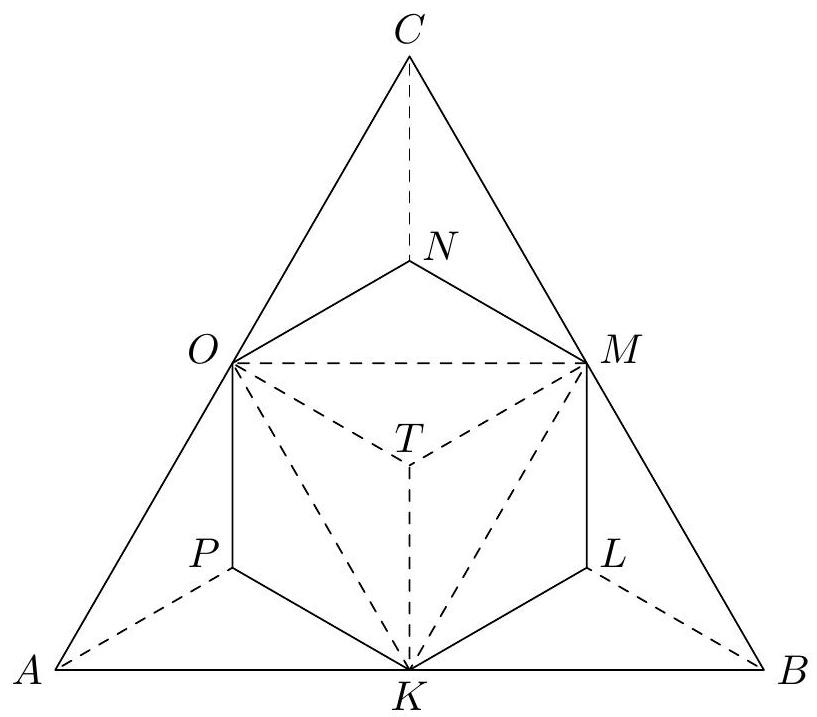
Given that both figures as a whole are symmetric with respect to three axes of symmetry, the centro... | d2a78d72e8bce47b | true | 3 | {'question_type': 'math-word-problem', 'problem_is_valid': 'Yes', 'solution_is_valid': 'Yes', 'synthetic': False} |
999 | AI-MO/NuminaMath-1.5/olympiads | Final Answer: The final answer is $\boxed{999}$ | Number theory | 5. Let $\Sigma(n)$ denote the sum of the digits of the number $n$. Find the smallest three-digit $n$ such that $\Sigma(n)=\Sigma(2 n)=\Sigma(3 n)=\ldots=\Sigma\left(n^{2}\right)$ | Answer: 999.
Solution: Let the desired number be $\overline{a b c}$. Note that this number is not less than 101 (since 100 does not work). Therefore, $101 \cdot \overline{a b c}=\overline{a b c 00}+\overline{a b c}$ also has the same sum of digits. But the last digits of this number are obviously $b$ and $c$, so the s... | ccc3ed17d9261dd9 | true | 6 | {'question_type': 'math-word-problem', 'problem_is_valid': 'Yes', 'solution_is_valid': 'Yes', 'synthetic': False} |
2 \leq k \leq n \leq 3 \text{ or } 3 \leq k \leq n | AI-MO/NuminaMath-1.5/olympiads_ref | Final Answer: The possible values of $n$ and $k$ are:
\begin{itemize}
\item If $n=2$, then $k=2$.
\item If $n \geq 3$, then $k=n-1$ or $k=n$.
\end{itemize}
In summary, for $n=2$, $k=2$. For $n \geq 3$, $k \in \{n-1, n\}$.
We have shown that for $n=2$, $k=2$ is possible. For $n=3$, $k=2$ and $k=3$ are possible.... | Combinatorics | Given two positive integers $n$ and $k$. In the plane, there are $n$ circles ($n \geq 2$) such that each circle intersects every other circle at two points, and all these intersection points are pairwise distinct.
Each intersection point is colored with one of $n$ colors such that each color is used at least once and o... | The answer is: $2 \leq k \leq n \leq 3$ or $3 \leq k \leq n$.
Obviously, $k \leq n$ according to the problem statement, and $k \geq 2$, because for $k=1$ all points would have the same color, while the number $n$ of colors should be $\geq 2$. We number the circles and the colors from 1 to n and denote by $F(i, j)$ the ... | 1fea467f6f754dd6 | false | 5 | {'question_type': 'math-word-problem', 'problem_is_valid': 'Yes', 'solution_is_valid': 'Yes', 'synthetic': False} |
58 | AI-MO/NuminaMath-1.5/amc_aime | Let $\widehat{AB} = \widehat{BC} = \widehat{CD} = \widehat{DE} = x$ and $\widehat{EF} = \widehat{FG} = \widehat{GH} = \widehat{HI} = \widehat{IA} = y$.
We are given that $\angle ABD$ exceeds $\angle AHG$ by $12^\circ$, so $\angle ABD - \angle AHG = 12^\circ$.
$\angle ABD = \frac{1}{2} \widehat{AD} = \frac{1}{2} (\wideh... | General algebraic systems | Point $A,B,C,D,$ and $E$ are equally spaced on a minor arc of a circle. Points $E,F,G,H,I$ and $A$ are equally spaced on a minor arc of a second circle with center $C$ as shown in the figure below. The angle $\angle ABD$ exceeds $\angle AHG$ by $12^\circ$. Find the degree measure of $\angle BAG$. | Let $O$ be the center of the circle with $ABCDE$ on it.
Let $x$ be the degree measurement of $\overarc{ED}=\overarc{DC}=\overarc{CB}=\overarc{BA}$ in circle $O$
and $y$ be the degree measurement of $\overarc{EF}=\overarc{FG}=\overarc{GH}=\overarc{HI}=\overarc{IA}$ in circle $C$.
$\angle ECA$ is, therefore, $5y$ by way... | 67f8fe346b09317f | true | 4.2 | {'question_type': 'math-word-problem', 'problem_is_valid': 'Yes', 'solution_is_valid': 'Yes', 'synthetic': False} |
4 | AI-MO/NuminaMath-1.5/olympiads | I2.1 Let $P$ be a two-digit number. The $50^{\text {th }}$ power of $P$, $P^{50}$, is a 69-digit number.
This means that $10^{68} \le P^{50} < 10^{69}$.
Taking logarithm base 10 on all sides, we get
$\log_{10}(10^{68}) \le \log_{10}(P^{50}) < \log_{10}(10^{69})$
$68 \le 50 \log_{10} P < 69$
Divide by 50:
$\frac{68}{50}... | Field theory and polynomials | I2.1 If the $50^{\text {th }}$ power of a two-digit number $P$ is a 69-digit number, find the value of $P$.
(Given that $\log 2=0.3010, \log 3=0.4771, \log 11=1.0414$.)
I2.2 The roots of the equation $x^{2}+a x-P+7=0$ are $\alpha$ and $\beta$, whereas the roots of the equation $x^{2}+b x-r=0$ are $-\alpha$ and $-\beta... | Reference: 1995 HG5 . . $37^{100} \ldots$ 157-digit number, $37^{15} \ldots n$-digit ....
$$
\begin{array}{l}
P^{50}=y, 10<P \leq 99,10^{68} \leq y<10^{69} \\
P=y^{\frac{1}{50}} ; 10^{68 \div 50}<P<10^{69 \div 50} \\
1.34<\log P<1.38 \\
\log 22=\log 2+\log 11=1.3424 ; \log 24=3 \log 2+\log 3=1.3801 \\
\log 22<\log P<\l... | 07fbf42f4e0b4aef | true | 3 | {'question_type': 'math-word-problem', 'problem_is_valid': 'Yes', 'solution_is_valid': 'Yes', 'synthetic': False} |
225 | AI-MO/NuminaMath-1.5/amc_aime | Let $k$ be the number of distinct values in the list.
Let one of these values be the unique mode, which occurs exactly $10$ times.
The remaining $k-1$ distinct values must each occur at most $9$ times, since the mode is unique.
To minimize $k$, we want to maximize the frequencies of these $k-1$ distinct values.
So we a... | Combinatorics | A list of $2018$ positive integers has a unique mode, which occurs exactly $10$ times. What is the least number of distinct values that can occur in the list?
$\textbf{(A)}\ 202\qquad\textbf{(B)}\ 223\qquad\textbf{(C)}\ 224\qquad\textbf{(D)}\ 225\qquad\textbf{(E)}\ 234$ | To minimize the number of distinct values, we want to maximize the number of times a number appears. So, we could have $223$ numbers appear $9$ times, $1$ number appear once, and the mode appear $10$ times, giving us a total of $223 + 1 + 1 = \boxed{\textbf{(D)}\ 225}.$ | 92778e98834aa268 | true | 4 | {'question_type': 'MCQ', 'problem_is_valid': 'Yes', 'solution_is_valid': 'Yes', 'synthetic': False} |
\frac{n}{\sqrt{2}} | AI-MO/NuminaMath-1.5/olympiads | We want to find the minimum value of the expression
$$ S = \sqrt{x_{1}^{2}+\left(1-x_{2}\right)^{2}}+\sqrt{x_{2}^{2}+\left(1-x_{3}\right)^{2}}+\ldots+\sqrt{x_{2 n}^{2}+\left(1-x_{1}\right)^{2}} $$
We can use Minkowski's inequality, which states that for real numbers $a_i, b_i$,
$$ \sum_{i=1}^{n} \sqrt{a_i^2 + b_i^2} \g... | Real functions | [ $\underline{\text { Classical Inequalities (Miscellaneous) })]}$
$$
\sqrt{x_{1}^{2}+\left(1-x_{2}\right)^{2}}+\sqrt{x_{2}^{2}+\left(1-x_{3}\right)^{2}}+\ldots+\sqrt{x_{2 n}^{2}+\left(1-x_{1}\right)^{2}}
$$ | According to the inequality between the quadratic mean and the arithmetic mean
$$
\begin{aligned}
& \sqrt{2}\left(\sqrt{x_{1}^{2}+\left(1-x_{2}\right)^{2}}+\sqrt{x_{2}^{2}+\left(1-x_{3}\right)^{2}}+\ldots+\sqrt{x_{n}^{2}+\left(1-x_{1}\right)^{2}}\right) \geq \\
& \geq\left|x_{1}\right|+\left|1-x_{2}\right|+\left|x_{2}... | 0ff6681cec174523 | false | 4.33 | {'question_type': 'math-word-problem', 'problem_is_valid': 'Yes', 'solution_is_valid': 'Yes', 'synthetic': False} |
59 | AI-MO/NuminaMath-1.5/amc_aime | Let $n_A, n_B, n_C$ be the number of rocks in piles $A, B, C$ respectively, and let $\mu_A, \mu_B, \mu_{AB}, \mu_{AC}$ be the mean weights given. We are given $\mu_A = 40$, $\mu_B = 50$, $\mu_{AB} = 43$, $\mu_{AC} = 44$. Let $\mu_{BC}$ be the mean weight of rocks in combined piles $B$ and $C$. We want to find the great... | Mathematical logic and foundations | $A$, $B$, $C$ are three piles of rocks. The mean weight of the rocks in $A$ is $40$ pounds, the mean weight of the rocks in $B$ is $50$ pounds, the mean weight of the rocks in the combined piles $A$ and $B$ is $43$ pounds, and the mean weight of the rocks in the combined piles $A$ and $C$ is $44$ pounds. What is the gr... | Let pile $A$ have $A$ rocks, and so on.
The total weight of $A$ and $C$ can be expressed as $44(A + C)$.
To get the total weight of $B$ and $C$, we add the weight of $B$ and subtract the weight of $A$: $44(A + C) + 50B - 40A = 4A + 44C + 50B$
Therefore, the mean of $B$ and $C$ is $\frac{4A + 44C + 50B}{B + C}$, which i... | 2280828ca5f9d7b3 | true | 3.4 | {'question_type': 'MCQ', 'problem_is_valid': 'Yes', 'solution_is_valid': 'Yes', 'synthetic': False} |
$f(x) = 0 \text{ or } f(x) = x$ | AI-MO/NuminaMath-1.5/olympiads | Final Answer: The solutions are $\boxed{f(x) = 0, f(x) = x}$ | Difference and functional equations | Find all functions $f: \mathbb{R} \rightarrow \mathbb{R}$ satisfying:
$$
f(x(1+y))=f(x)(1+f(y))
$$ | The zero constant function is a solution, but we exclude this case. By setting $x=0$, we get $f(0)=0$, and by setting $y=-1$, we get $f(-1)=-1$. By setting $x=-1$ and $y=-\frac{1}{2}$, we get $f\left(-\frac{1}{2}\right)=-\frac{1}{2}$. Finally, by setting $x=-\frac{1}{2}$ and $y=1$, we get $f(1)=1$. Then, by setting $x=... | 604c3458242cf84a | true | 5.75 | {'question_type': 'math-word-problem', 'problem_is_valid': 'Yes', 'solution_is_valid': 'Yes', 'synthetic': False} |
\text{4} | AI-MO/NuminaMath-1.5/olympiads | To form all weights from 1 g to 150 g, we need to find a set of weights such that any integer weight from 1 to 150 can be obtained by summing a subset of these weights. To minimize the number of broken links, we want to minimize the number of parts of the chain.
We can use the weights that are powers of 2: 1, 2, 4, 8,... | Combinatorics | 10,11
There is a piece of chain consisting of 150 links, each weighing 1 g. What is the smallest number of links that need to be broken so that from the resulting parts, all weights of 1 g, 2 g, 3 g, ..., 150 g can be formed (a broken link also weighs 1 g)? | Answer: 4 links. According to the solution of problem 5 for grades $7-8$, for a chain consisting of $n$ links, where $64 \leq n \leq 159$, it is sufficient to unfasten 4 links. | df5240ee1fb5c2fb | false | 4.2 | {'question_type': 'math-word-problem', 'problem_is_valid': 'Yes', 'solution_is_valid': 'Yes', 'synthetic': False} |
(e, e) | AI-MO/NuminaMath-1.5/olympiads | $12.23 y=\frac{x}{\ln x}$. | Real functions | $12.23 y=\frac{x}{\ln x}$.
The above text is translated into English, please retain the original text's line breaks and format, and output the translation result directly.
However, since the provided text is already in a mathematical format which is universal and does not require translation, the translation is as f... | 12.23 The function is defined for $x>0$ and $x \neq 1$. We have
$$
y^{\prime}=\frac{\ln x - x \cdot \frac{1}{x}}{\ln ^{2} x}=\frac{\ln x - 1}{\ln ^{2} x}
$$
Thus, $y^{\prime}=0$ when $\ln x - 1 = 0$, i.e., when $x=e$. Let's construct a table:
| Interval | $(0,1)$ | $(1, e)$ | $e$ | $(e, \infty)$ |
| :---: | :---: | ... | 3144a94842c24af9 | false | 3.5 | {'question_type': 'math-word-problem', 'problem_is_valid': 'Yes', 'solution_is_valid': 'Yes', 'synthetic': False} |
17 \text{ cm} | AI-MO/NuminaMath-1.5/olympiads | Let $A B C F$ be a rectangle with $A B=30 \mathrm{~cm}$ and $A F=14 \mathrm{~cm}$.
The area of rectangle $A B C F$ is $A B \times A F = 30 \times 14 = 420 \mathrm{~cm}^{2}$.
We are given that $F E=5 \mathrm{~cm}$ and points $E$ and $D$ are on $F C$. Let $D C = x$.
Since $F C = A B = 30 \mathrm{~cm}$, we have $F D = F C... | Game theory, economics, social and behavioral sciences | In the diagram, $A B C F$ is a rectangle with $A B=30 \mathrm{~cm}$ and $A F=14 \mathrm{~cm}$. Points $E$ and $D$ are on $F C$ so that $F E=5 \mathrm{~cm}$ and the area of quadrilateral $A B D E$ is $266 \mathrm{~cm}^{2}$. The length of $D C$ is
(A) $17 \mathrm{~cm}$
(B) $16 \mathrm{~cm}$
(C) $19 \mathrm{~cm}$
(D) $20 ... | Solution 1
Since $A B$ and $E D$ are parallel, quadrilateral $A B D E$ is a trapezoid.
We know that $A B=30 \mathrm{~cm}$.
Since $A B C F$ is a rectangle, then $F C=A B=30 \mathrm{~cm}$.
Suppose that $D C=x \mathrm{~cm}$.
Then $E D=F C-F E-D C=(30 \mathrm{~cm})-(5 \mathrm{~cm})-(x \mathrm{~cm})=(25-x) \mathrm{cm}$... | c54660382eb88b03 | true | 2.4 | {'question_type': 'MCQ', 'problem_is_valid': 'Yes', 'solution_is_valid': 'Yes', 'synthetic': False} |
$n=5$ | AI-MO/NuminaMath-1.5/olympiads | Final Answer: The final answer is $\boxed{4}$ | Combinatorics | 6. A factory produces sets of $n>2$ elephants of different sizes. According to the standard, the difference in mass between adjacent elephants within each set should be the same. The inspector checks the sets one by one using a balance scale without weights. For what smallest $n$ is this possible? | - Omвem: for $n=5$. Let's number the elephants in ascending order of their size, then it is enough to verify that $C_{1}+C_{4}=C_{2}+C_{3}, C_{1}+C_{5}=C_{2}+C_{4}$ and $C_{2}+$ $C_{5}=C_{3}+C_{4}$. These equalities are equivalent to $C_{4}-C_{3}=C_{2}-C_{1}$, $C_{2}-C_{1}=C_{5}-C_{4}$ and $C_{5}-C_{4}=C_{3}-C_{2}$, th... | 9451193ec2b4e611 | false | 5 | {'question_type': 'math-word-problem', 'problem_is_valid': 'Yes', 'solution_is_valid': 'Yes', 'synthetic': False} |
\frac{1}{3} | AI-MO/NuminaMath-1.5/olympiads | Let $B$ be the value of Ben's prize and $J$ be the value of Jamie's prize.
Ben's prize can be $\$ 5, \$ 10$ or $\$ 20$, each with probability $\frac{1}{3}$.
Jamie's prize can be $\$ 30$ or $\$ 40$, each with probability $\frac{1}{2}$.
We want to find the probability that $B+J = 50$.
We consider the possible values of $... | Probability theory and stochastic processes | Ben participates in a prize draw. He receives one prize that is equally likely to be worth $\$ 5, \$ 10$ or $\$ 20$. Jamie participates in a different prize draw. She receives one prize that is equally likely to be worth $\$ 30$ or $\$ 40$. What is the probability that the total value of their prizes is exactly $\$ 50$... | Since there are two possible prizes that Jamie can win and each is equally likely, then the probability that Jamie wins $\$ 30$ is $\frac{1}{2}$ and the probability that Jamie wins $\$ 40$ is $\frac{1}{2}$. If Jamie wins $\$ 30$, then for the total value of the prizes to $\$ 50$, Ben must win $\$ 20$. The probability t... | b87ec707839457ba | true | 1 | {'question_type': 'MCQ', 'problem_is_valid': 'Yes', 'solution_is_valid': 'Yes', 'synthetic': False} |
\sqrt{6} | AI-MO/NuminaMath-1.5/olympiads | Let the isosceles triangle be ABC, with AB = AC. Let CH be the height dropped from vertex C to the lateral side AB.
The height CH divides the side AB into segments AH and HB. We are given that these segments are of lengths 2 and 1, counting from the vertex of the triangle. Since CH is dropped to the lateral side AB, th... | Geometry | [Pythagorean Theorem (direct and inverse).]
The height of an isosceles triangle, dropped to the lateral side, divides it into segments of 2 and 1, counting from the vertex of the triangle. Find the base of the triangle. | Let $CH$ be the height of the isosceles triangle $ABC$ dropped to the lateral side $AB$, with $AH=2$, $BH=1$. Then $AC=AB=3$.
By the Pythagorean theorem from the right triangles $ACH$ and $BCH$, we find that
$$
CH^2=AC^2-AH^2=9-4=5, BC^2=BH^2+CH^2=1+5=6 \text{. }
$$
Therefore, $BC=\sqrt{6}$.
## Answer
$\sqrt{6}$. | c268418b704d8f8d | true | 2 | {'question_type': 'math-word-problem', 'problem_is_valid': 'Yes', 'solution_is_valid': 'Yes', 'synthetic': False} |
(43, 257), (100, 200), (98, 202), (125, 175) | AI-MO/NuminaMath-1.5/olympiads | To solve this task, we need to pair the given numbers so that the sum of each pair is the same.
First, let's calculate the sum of all the given numbers:
$43 + 202 + 100 + 175 + 98 + 257 + 125 + 200$
To make the addition easier, let's rearrange and group the numbers:
$(43 + 98) + (100 + 200) + (125 + 175) + (202 + 257... | Mathematical logic and foundations | ## Task 4
Pair the following numbers so that they always add up to the same sum.
$\begin{array}{llllllll}43 & 202 & 100 & 175 & 98 & 257 & 125 & 200\end{array}$ | The sum is always 300. Pairs are (43, 257), (100, 200), (98, 202), (125, 175) | 0da8ae73f72e3733 | true | 1.4 | {'question_type': 'math-word-problem', 'problem_is_valid': 'Yes', 'solution_is_valid': 'Yes', 'synthetic': False} |
0 | AI-MO/NuminaMath-1.5/olympiads | 7.214. $9^{x}+6^{x}=2^{2 x+1}$. | General algebraic systems | 7.214. $9^{x}+6^{x}=2^{2 x+1}$.
Translate the above text into English, keeping the original text's line breaks and format, and output the translation result directly.
7.214. $9^{x}+6^{x}=2^{2 x+1}$. | Solution.
Rewrite the equation as $3^{2 x}+2^{x} \cdot 3^{x}-2 \cdot 2^{2 x}=0$ and divide it by $2^{2 x} \neq 0$. Then $\left(\frac{3}{2}\right)^{2 x}+\left(\frac{3}{2}\right)^{x}-2=0 \Rightarrow\left(\left(\frac{3}{2}\right)^{x}\right)=-2$ (no solutions) or $\left(\left(\frac{3}{2}\right)^{x}\right)_{2}=1 \Rightarro... | 04666df1bdafca46 | false | 3 | {'question_type': 'math-word-problem', 'problem_is_valid': 'Yes', 'solution_is_valid': 'Yes', 'synthetic': False} |
x > 2 | KbsdJames/Omni-MATH/cayley | A fair die with faces numbered 1 to 6 is rolled.
The possible outcomes are {1, 2, 3, 4, 5, 6}.
Since the die is fair, each outcome has an equal probability of occurring.
The probability of each outcome is $1/6$.
Let $P(x=n)$ be the probability that the number on the top face is $n$, where $n \in \{1, 2, 3, 4, 5, 6\}$.
... | Probability theory and stochastic processes | After a fair die with faces numbered 1 to 6 is rolled, the number on the top face is $x$. What is the most likely outcome? | With a fair die that has faces numbered from 1 to 6, the probability of rolling each of 1 to 6 is $\frac{1}{6}$. We calculate the probability for each of the five choices. There are 4 values of $x$ that satisfy $x>2$, so the probability is $\frac{4}{6}=\frac{2}{3}$. There are 2 values of $x$ that satisfy $x=4$ or $x=5$... | 0d8dbc239d9ee68c | false | 1.2 | {'domain': ['Mathematics -> Applied Mathematics -> Statistics -> Probability -> Counting Methods -> Combinations'], 'difficulty': 1.0} |
\frac{1}{58} | KbsdJames/Omni-MATH/HMMT_2 | Let $N$ be the number of rolls that are 20 in five rolls of fair icosahedral dice.
We are given that at least half of the rolls are 20, which means $N \ge 3$. We want to find the probability that all three remaining concealed dice show 20. We interpret this as the probability that all five rolls are 20, given that at l... | Combinatorics | Your math friend Steven rolls five fair icosahedral dice (each of which is labelled $1,2, \ldots, 20$ on its sides). He conceals the results but tells you that at least half of the rolls are 20. Assuming that Steven is truthful, what is the probability that all three remaining concealed dice show $20 ?$ | The given information is equivalent to the first two dice being 20 and 19 and there being at least two 20's among the last three dice. Thus, we need to find the probability that given at least two of the last three dice are 20's, all three are. Since there is only one way to get all three 20's and $3 \cdot 19=57$ ways ... | a4457562dde4bba7 | true | 2 | {'domain': ['Mathematics -> Applied Mathematics -> Statistics -> Probability -> Counting Methods -> Combinations'], 'difficulty': 4.0} |
End of preview. Expand in Data Studio
README.md exists but content is empty.
- Downloads last month
- 10