

problem stringlengths 2 1.96k | answer stringlengths 1 168 | solution stringlengths 3 6.24k | difficulty float64 1 10 |
|---|---|---|---|
6. In the Kingdom of Mathematics, the denominations of banknotes in circulation are 1 yuan, 5 yuan, 10 yuan, 20 yuan, 50 yuan, and 100 yuan. One day, two customers each bought a chocolate bar worth 15 yuan at the same grocery store. One of them paid with two 10-yuan banknotes, while the other paid with a 20-yuan and a ... | D | 【Answer】D
【Analysis】Considering the four cases respectively, when the gum costs 8 yuan, one person pays 10 yuan (2 five-yuan notes), and another person pays 13 yuan (1 ten-yuan note, 3 one-yuan notes), the first person's 1 five-yuan note can be given as change to the second person, and the second person's 2 one-yuan no... | 4.67 |
14. (12 points) Use 36 solid rectangular prisms of size $3 \times 2 \times 1$ to form a large cube of size $6 \times 6 \times 6$. Among all possible arrangements, the maximum number of small rectangular prisms that can be seen from a point outside the large cube is $\qquad$. | 31 | 【Answer】Solution: As shown in the figure,
To see the maximum number from the outside, it is necessary to make the rectangles seen from the outside as "deeply" inside the square as possible, the result is as follows: a total of $6 \times 3+3 \times 4+3 \times 1+1=31$ (pieces). Therefore, the answer is: 31. | 4 |
18. (2 marks) Let $A_{1} A_{2} \cdots A_{2002}$ be a regular 2002-sided polygon. Each vertex $A_{i}$ is associated with a positive integer $a_{i}$ such that the following condition is satisfied: If $j_{1}, j_{2}, \cdots, j_{k}$ are positive integers such that $k<500$ and $A_{j_{1}} A_{j_{2}} \cdots A_{j_{k}}$ is a regu... | 287287 | 18. Since $2002=2 \times 7 \times 11 \times 13$, we can choose certain vertices among the 2002 vertices to form regular 7-, 11-, 13-, $\cdots$ polygons (where the number of sides runs through divisors of 2002 greater than 2 and less than 1001). Since $2002=7 \times 286$, so there are at least 286 different positive int... | 6.33 |
6. Find the greatest possible value of $\gcd(x+2015 y, y+2015 x)$, given that $x$ and $y$ are coprime numbers. | 4060224 | Answer: $2015^{2}-1=4060224$. Solution. Note that the common divisor will also divide $(x+2015 y)-2015(y+2015 x)=\left(1-2015^{2}\right) x$. Similarly, it divides $\left(1-2015^{2}\right) y$, and since $(x, y)=1$, it divides $\left(1-2015^{2}\right)$. On the other hand, if we take $x=1, y=2015^{2}-2016$, then we get $\... | 8 |
9. Let $a+b=1, b>0, a \neq 0$, then the minimum value of $\frac{1}{|a|}+\frac{2|a|}{b}$ is
Translate the above text into English, please retain the original text's line breaks and format, and output the translation result directly. | 2\sqrt{2}-1 | Solve $2 \sqrt{2}-1$.
Analysis $\frac{1}{|a|}+\frac{2|a|}{b}=\frac{a+b}{|a|}+\frac{2|a|}{b}=\frac{a}{|a|}+\left(\frac{b}{|a|}+\frac{2|a|}{b}\right) \geq \frac{a}{|a|}+2 \sqrt{\frac{b}{|a|} \cdot \frac{2|a|}{b}}=2 \sqrt{2}+\frac{a}{|a|}$, where the equality holds when $\frac{b}{|a|}=\frac{2|a|}{b}$, i.e., $b^{2}=2 a^{2}... | 9 |
Isosceles $\triangle ABC$ has equal side lengths $AB$ and $BC$. In the figure below, segments are drawn parallel to $\overline{AC}$ so that the shaded portions of $\triangle ABC$ have the same area. The heights of the two unshaded portions are 11 and 5 units, respectively. What is the height of $h$ of $\triangle ABC$?
... | 14.6 | First, we notice that the smaller isosceles triangles are similar to the larger isosceles triangles. We can find that the area of the gray area in the first triangle is $[ABC]\cdot\left(1-\left(\tfrac{11}{h}\right)^2\right)$. Similarly, we can find that the area of the gray part in the second triangle is $[ABC]\cdot\le... | 2.75 |
497. Shuffling Cards. An elementary method of shuffling cards consists of taking a deck face down in the left hand and transferring the cards one by one to the right hand; each successive card is placed on top of the previous one: the second on top of the first, the fourth on top of the third, and so on until all the c... | 14 | 497. To shuffle 14 cards in the manner described above and return them to their original order, it takes 14 shuffles, although in the case of 16 cards, only 5 are required. We cannot delve into the nature of this phenomenon here, but the reader may find it interesting to conduct an independent investigation of this que... | 4 |
16. Given the six-digit number $\overline{9786 \square}$ is a multiple of $\mathbf{99}$, the quotient when this six-digit number is divided by $\mathbf{99}$ is ( ). | 6039 | $\begin{array}{l}\text { [Analysis] Let } 99 \mid \overline{A 9786 B} \text {, sum of pairs from right to left } \\ 99 \mid \overline{A 9}+78+\overline{6 B} \text {, i.e., } 99|78+69+\overline{A B} \Rightarrow 99| 48+\overline{A B} \\ \overline{A B}=51 \text {, i.e., } \mathrm{A}=5, \mathrm{~B}=1 \\ 597861 \div 99=6039... | 1.5 |
The base of the right prism $A B C A_{1} B_{1} C_{1}$ is an isosceles triangle $A B C$, where $A B=B C=5$, $\angle A B C=2 \arcsin 3 / 5$. A plane perpendicular to the line $A_{1} C$ intersects the edges $A C$ and $A_{1} C_{1}$ at points $D$ and $E$ respectively, such that $A D=1 / 3 A C, E C_{1}=1 / 3 A_{1} C_{1}$. Fi... | \frac{40}{3} | Let $M$ be the midpoint of the base $AC$ of the isosceles triangle $ABC$ (Fig. 1). From the right triangle $AMB$ we find that
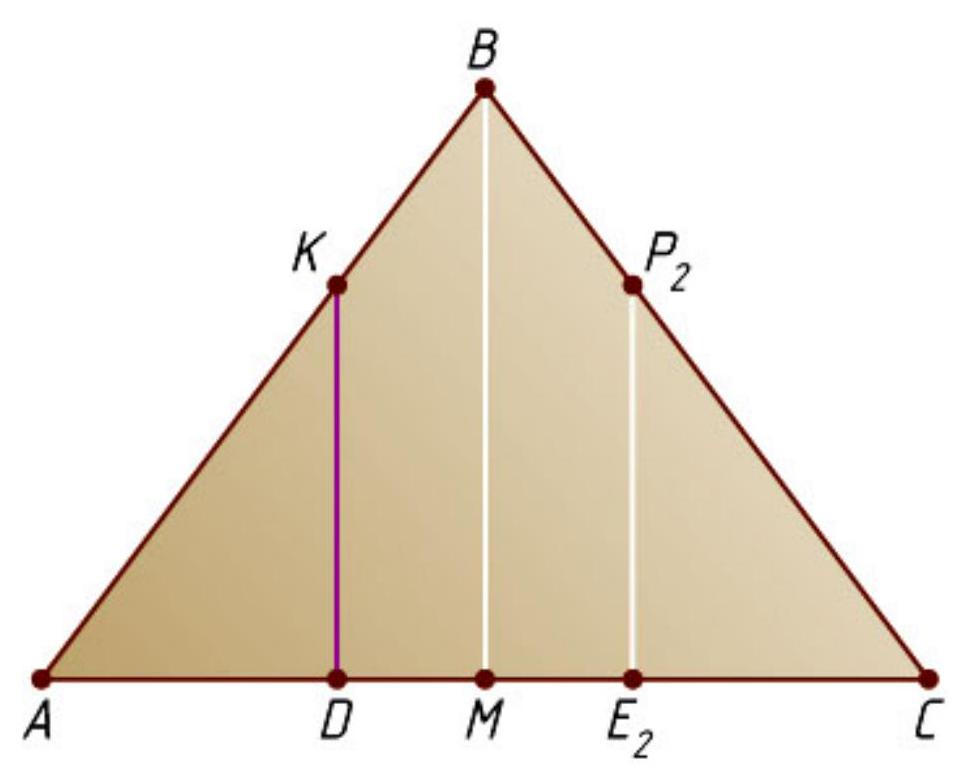
Fig. 1
$-th game be $p_{k}$. Then
$$
p_{1}=0, p_{2}=0, p_{3}=0, p_{4}=\frac{1}{2^{3}} \text {. }
$$
When $n \geqslant 6$,
$$
\begin{array}{l}
p_{n-1}=\frac{1}{2} p_{n-2}+\frac{1}{2^{2}} p_{n-3}+\frac{1}{2^{3}} p_{n-4} \\
p_{n}=\fra... | 5.5 |
372. Find the condition under which the numbers $a, b, c, d$, taken in any order, form consecutive terms of a geometric progression. | \b,\,\ | If the numbers $a, b, c, d$, taken in any order, form consecutive terms of a geometric progression, then $\frac{a}{b}=\frac{c}{d}$ and $\frac{a}{b}=\frac{d}{c}$, from which $\frac{a^{2}}{b^{2}}=1$ and $a= \pm b$. Similarly,
$b= \pm c, c= \pm d$, i.e., all four numbers must be equal in absolute value. | 3 |
Let $x_{1}=y_{1}=x_{2}=y_{2}=1$, then for $n \geq 3$ let $x_{n}=x_{n-1} y_{n-2}+x_{n-2} y_{n-1}$ and $y_{n}=y_{n-1} y_{n-2}- x_{n-1} x_{n-2}$. What are the last two digits of $\left|x_{2012}\right|$ ? | 84 | Let $z_{n}=y_{n}+x_{n} i$. Then the recursion implies that: $$\begin{aligned} & z_{1}=z_{2}=1+i \\ & z_{n}=z_{n-1} z_{n-2} \end{aligned}$$ This implies that $$z_{n}=\left(z_{1}\right)^{F_{n}}$$ where $F_{n}$ is the $n^{\text {th }}$ Fibonacci number $\left(F_{1}=F_{2}=1\right)$. So, $z_{2012}=(1+i)^{F_{2012}}$. Notice ... | 7.4 |
22. Let $x>1, y>1$ and $z>1$ be positive integers for which the following equation
$$
1!+2!+3!+\ldots+x!=y^{2}
$$
is satisfied. Find the largest possible value of $x+y+z$. | 8 | 22. Answer. 8
Solution. We first prove that if $x \geq 8$, then $z=2$. To this end, we observe that the left hand side of the equation $1!+2!+3!+\ldots+x!$ is divisible by 3 , and hence $3 \mid y^{2}$. Since 3 is a prime, $3 \mid y$. So, $3^{z} \mid y^{z}$ by elementary properties of divisibility.
On the other hand, wh... | 8 |
Example 14 Let $X=\left\{A_{1}, A_{2}, \cdots, A_{n}\right\}$ be a family of distinct three-element subsets of $I=\{1,2,3, \cdots, 36\}$, satisfying:
(1) For any $1 \leqslant i<j \leqslant n, A_{i} \cap A_{j} \neq \varnothing$,
(2) $A_{1} \cap A_{2} \cap \cdots \cap A_{n}=\varnothing$.
Find the maximum value of $n$, a... | 34C_{36}^{3} | Let $X$ satisfy the conditions of the problem, and without loss of generality, let $A_{1}=\{1,2,3\}$. By condition (2), there exists an element of $X$ that does not contain 1, and we can assume $A_{2}=\left\{a_{1}, a_{2}, a_{3}\right\}$, and $1 \notin A_{2}$. Similarly, we can set $A_{3}=\left\{b_{1}, b_{2}, b_{3}\righ... | 9 |
Task 2. What is $\frac{31}{71}$ of the number
$$
\frac{1-\frac{1}{3}:\left(2+\frac{1}{6}\right)}{3 \frac{2}{5}+\frac{10-\frac{1}{4}}{3}: \frac{5}{8}} \cdot 8 \frac{3}{5}-\frac{1.5 \cdot \frac{15}{4} \cdot 2.5+\frac{3}{5-\frac{2}{3}}}{1+\frac{1}{7}+\frac{6}{\frac{12}{11} \cdot\left(\frac{8}{3}-\frac{7}{4}\right) \cdot ... | 0 | Solution. Let's first calculate the value of the given expression. We have:
$$
\begin{aligned}
& \frac{1-\frac{1}{3}:\left(2+\frac{1}{6}\right)}{3 \frac{2}{5}+\frac{10-\frac{1}{4}}{3}: \frac{5}{8}} \cdot 8 \frac{3}{5}-\frac{1.5: \frac{15}{4} \cdot 2.5+\frac{3}{5-\frac{2}{3}}}{1+\frac{1}{7}+\frac{6}{\frac{12}{11} \cdot... | 2 |
1.3. A game of Jai Alai has eight players and starts with players $P_{1}$ and $P_{2}$ on court and the other players $P_{3}, P_{4}, P_{5}, P_{6}, P_{7}, P_{8}$ waiting in a queue. After each point is played, the loser goes to the end of the queue; the winner adds 1 point to his score and stays on the court; and the pla... | P_{4} | 1.3 Each time a player loses a match, he has to wait six games before his turn comes again. If $x$ is the number of games before his first turn, then the player will win if $x+7 r+7=37$, where $r \geq 0$ is an integer and $0 \leq x \leq 6$. Here $r$ counts the number of times he lost. From this, we obtain $x=2$ and $r=... | 2.67 |
4. Find the product of all roots of the equation $z^{3}+|z|^{2}=10 i$.
Translate the above text into English, please keep the original text's line breaks and format, and output the translation result directly. | -5+10i | 4. From $z^{3}=-|z|^{2}+10 i$ we get $z^{3}=-|z|^{2}-10 i$, then $|z|^{6}=|z|^{4}+100$, which means $|z|^{2}=$ 5 , so the original equation becomes $z^{3}+5-10 i=0$, thus the product of all roots is $-5+10 i$. | 4 |
The grid below is to be filled with integers in such a way that the sum of the numbers in each row and the sum of the numbers in each column are the same. Four numbers are missing. The number $x$ in the lower left corner is larger than the other three missing numbers. What is the smallest possible value of $x$?
$\text... | 8 | The sum of the numbers in each row is $12$. Consider the second row. In order for the sum of the numbers in this row to equal $12$, the two shaded numbers must add up to $13$:
If two numbers add up to $13$, one of them must be at least $7$: If both shaded numbers are no more than $6$, their sum can be at most $12$. Th... | 3.75 |
## 28. Fuel Tanks Full of Gasoline
Someone has two cars, a larger one and a small one. Their fuel tanks have a combined capacity of 70 liters. When both tanks are empty, the car owner must pay 45 francs to fill one tank and 68 francs to fill the other. Suppose this person uses regular gasoline for the small car and pr... | 30,X=40 | 28. Let $x$ be the capacity of the tank of a small car, and $X$ of a large car; let $p$ denote the price in francs of one liter of regular gasoline. We have the following system of equations:
$$
\begin{gathered}
x+X=70 \\
x p=45 \\
X(p+0.2)=68
\end{gathered}
$$
Multiplying the last equation by $x$ and eliminating $p$... | 2 |
5 Find all real numbers $a$ such that any positive integer solution of the inequality $x^{2}+y^{2}+z^{2} \leqslant a(x y+y z+z x)$ are the lengths of the sides of some triangle. | 1 \leqslant a < \frac{6}{5} | 5. Taking $x=2, y=z=1$, we have $a \geqslant \frac{6}{5}$. Therefore, when $a \geqslant \frac{6}{5}$, the original inequality has integer roots $(2,1,1)$, but $(x, y, z)$ cannot form a triangle, so $a<\frac{6}{5}$.
When $a<1$, $x^{2}+y^{2}+z^{2} \leqslant a(x y+y z+z x)<x y+y z+z x$, which is a contradiction! Hence, $... | 5 |
80. One day, Xiao Ben told a joke. Except for Xiao Ben himself, four-fifths of the classmates in the classroom heard it, but only three-quarters of the classmates laughed. It is known that one-sixth of the classmates who heard the joke did not laugh. Then, what fraction of the classmates who did not hear the joke laugh... | \frac{5}{12} | Reference answer: $5 / 12$ | 2.33 |
Dudeney, Amusements in Mathematics Problem 23 Some years ago a man told me he had spent one hundred English silver coins in Christmas-boxes, giving every person the same amount, and it cost him exactly £1, 10s 1d. Can you tell just how many persons received the present, and how he could have managed the distribution? ... | 19 | He spent a total of 361d. So he must have given 19 people 19d each. The only way to make that work is to assume that the 4d coin was current "some years ago". We have 19d = 3d + 4d + 4d + 4d + 4d (5 coins) or 3d + 3d + 3d + 3d + 3d + 4d (6 coins) or we can get less coins using 1s or 6d. We want a total of 100 coins. 5.... | 1.5 |
[ Systems of points and segments. Examples and counterexamples ] [ Classical combinatorics (miscellaneous). ]
On a plane, 10 equal segments were drawn, and all their points of intersection were marked. It turned out that each point of intersection divides any segment passing through it in the ratio $3: 4$. What is the... | 10 | On each segment, there are no more than two points. On the other hand, each intersection point belongs to at least two segments. Therefore, there are no more than $10 \cdot 2: 10=10$ points. An example with 10 points is shown in the figure.
, we obtain
$$
P\left(\left|\frac{m}{n}-p\right| \leq 0.01\right) \geq 1-\frac{p q}{n \varepsilon^{2}}=1-\frac{0.03 \cdot 0.97}{10000 \cdot(0.01)^{2}}=1-\frac{0.0291}{0.1}=... | 2.33 |
$2 \cdot 77$ In a $100 \times 25$ rectangular table, each cell is filled with a non-negative real number, the number in the $i$-th row and $j$-th column is $x_{i j}(i=1,2, \cdots, 100 ; j=1,2, \cdots, 25)$ (as shown in Table 1). However, the numbers in each column of Table 1 are rearranged in descending order from top ... | 97 | [Solution] The minimum value of $k$ is 97.
In fact, if we take
$$x_{i j}=\left\{\begin{array}{l}
0,4,(j-1)+1 \leqslant i \leqslant 4 j \\
\frac{1}{24} . \text { for the rest of } i
\end{array} \quad(j=1,2, \cdots, 25)\right.$$
Then, we have
$$\sum_{j=1}^{25} x_{i j}=0+24 \times \frac{1}{24}=1 \quad(i=1,2, \cdots, 100)... | 7.25 |
5.1. Insert parentheses and operation signs in the record 22222 so that the result is 24.
将上面的文本翻译成英文,请保留源文本的换行和格式,直接输出翻译结果。 | (2+2+2)\times(2+2) | Solution. One of the possible options: $(2+2+2) \times(2+2)$.
Comment. Any correct option is scored 7 points. | 4.22 |
## Task 3 - 020733
Hans has written a one and is in high spirits. When he gets home, he therefore runs up the 20 steps to his apartment on the 1st floor in such a way that he always climbs 3 steps up and 2 steps down again, without skipping any step.
Klaus, who lives in the same building on the 4th floor, says: "If y... | 18 | a) The number of steps Klaus needs is equal to the number of stairs, which is 80. Hans manages only $3-2=1$ stair in $3+2=5$ steps. However, it's important to note that Hans, starting from the 17th stair, can directly reach his stick (with three steps) without taking the two steps back.
So Hans needs $17 \cdot 5 + 3 =... | 1.5 |
Problem 20. (6 points)
Ivan Sergeyevich decided to raise quails. In a year, he sold 100 kg of poultry meat at a price of 500 rubles per kg, and also 20000 eggs at a price of 50 rubles per dozen. The expenses for the year amounted to 100000 rubles. What profit did Ivan Sergeyevich receive for this year? (Provide the an... | 50000 | Answer: 50000.
Comment:
Solution: revenue $=100 \times 500 + 50 \times 20000 / 10 = 150000$ rubles. Profit $=$ revenue costs $=150000-100000=50000$ rubles. | 3 |
5. A mouse lives in a circular cage with completely reflective walls. At the edge of this cage, a small flashlight with vertex on the circle whose beam forms an angle of $15^{\circ}$ is centered at an angle of $37.5^{\circ}$ away from the center. The mouse will die in the dark. What fraction of the total area of the ca... | \frac{3}{4} | Answer: $\frac{3}{4}$ We claim that the lit region is the entire cage except for a circle of half the radius of the cage in the center, along with some isolated points on the boundary of the circle and possibly minus a set of area 0 . Note that the region is the same except for a set of area 0 if we disallow the light ... | 4.2 |
8. Let the base edge length of the regular tetrahedron $P-ABC$ be $a$. A plane through $A$ parallel to $BC$ intersects the side face $PBC$ perpendicularly, and the angle between the intersecting plane and the base is $30^{\circ}$. Find the area of the intersecting plane. | \frac{3}{32}^2 | 8. As shown in the figure, let the section intersect $PB$ at $E$, $PC$ at $F$, the midpoint of $EF$ be $H$, and the midpoint of $BC$ be $D$.
Since $BC$ // section $AEF$, it follows that $BC \parallel EF$, thus $H$ lies on $PD$,
and since $EF \perp PD$ and $EF \perp AD$, we know that $EF \perp$ plane $PAD$.
Draw a line... | 7.6 |
403. Determine the force of water pressure on a vertical parabolic segment, the base of which is $4 \mathrm{m}$ and is located on the water surface, while the vertex is at a depth of $4 \mathrm{m}$ (Fig. 204). | 167424 | Solution. We have $|B A|=2 x=4$ (m). Point $A$ in the chosen coordinate system has coordinates $(2 ; 4)$. The equation of the parabola relative to this system is $y = a x^{2}$ or $4=a \cdot 2^{2}$, from which $a=1$, i.e., $y=x^{2}$.
Consider an elementary area $d S$ at a distance $y$ from the origin. The length of thi... | 5.5 |
1. The number $N$ has the smallest positive divisor 1, the second largest positive divisor $k$, and the third largest positive divisor $m$. Given that $k^{k}+m^{m}=N$. What is $N$? | 260 | Solution. Answer: $N=260$. If $N$ were odd, then both $k$ and $m$ would be odd, which means $k^{k}+m^{m}$ would be an even number. Therefore, the equation $N=k^{k}+m^{m}$ would be impossible in this case.
Now let $N$ be even. Then $k=2$ and $m$ is also even. Since $4=N-m^{m}$ is divisible by $m$, we have $m=4$ (since ... | 4 |
9.5. One hundred numbers are written in a circle with a total sum of 100. The sum of any 6 consecutive numbers does not exceed 6. One of the written numbers is 6.
Find the other numbers. | 6,-4 | Answer. Considering the first number mentioned in the condition is 6, all numbers with odd indices are equal to 6, and all numbers with even indices are equal to -4. Solution. Let's denote the numbers in order as $a_{1}, a_{2}, \ldots, a_{100}$. Adding all 100 inequalities $a_{i}+a_{i+1}+\ldots+a_{i+5} \leq 6, i=1,2, \... | 9.25 |
Problem 3. Senya cannot write some letters and always makes mistakes in them. In the word TETRAHEDRON he would make five mistakes, in the word DODECAHEDRON - six, and in the word ICOSAHEDRON - seven. How many mistakes would he make in the word OCTAHEDRON?
 .\right.
\end{array}
$$
Find all real numbers $a$ such that for any positive integer $n$, w... | 0,\\frac{\sqrt{2}}{2} | 2. Discuss in two cases.
(1) The sequence $\left\{a_{n}\right\}$ contains a term that is zero. Let $m$ be the smallest positive integer such that $a_{m}=0$.
If $m \geqslant 2$, then $a_{m-1} \neq 0$. Therefore,
$$
a_{m-1}-\frac{1}{a_{m-1}}=a_{m}=0 \Rightarrow a_{m-1}= \pm 1 \text {, }
$$
which contradicts the problem ... | 4.33 |
4. 20 balls of the same mass are moving along a chute towards a metal wall with the same speed. Coming towards them at the same speed are 16 balls of the same mass. When two balls collide, they fly apart with the same speed. After colliding with the wall, a ball bounces off it with the same speed. (The balls move only ... | 510 | # Answer: 510.
Solution. We will assume that initially, each ball moving towards the wall has a red flag, and the rest of the balls have blue flags. Imagine that when the balls collide, they exchange flags. Then each blue flag moves at a constant speed in one direction (away from the wall), and each red flag reaches t... | 4 |
7. Given real numbers $x, y$ satisfy:
$$
x>\max \{-3, y\},(x+3)\left(x^{2}-y^{2}\right)=8 \text {. }
$$
Then the minimum value of $3 x+y$ is $\qquad$ . | 4\sqrt{6}-6 | 7. $4 \sqrt{6}-6$.
From the problem, we know $x+3>0, x-y>0$.
Then $x+y=\frac{8}{(x+3)(x-y)}>0$.
Thus, $8=(x+3)(x+y)(x-y)$
$$
\begin{array}{l}
=\lambda(x+3) \mu(x+y)(x-y) \\
\leqslant\left(\frac{\lambda(x+3)+\mu(x+y)+(x-y)}{3}\right)^{3},
\end{array}
$$
where, $\lambda \mu=1, \lambda-2 \mu+4=0$.
Therefore, $\lambda=\s... | 7 |
4. Find all values of the parameter $b$, for each of which there exists a number $a$ such that the system
$$
\left\{\begin{array}{l}
y=b-x^{2}, \\
x^{2}+y^{2}+2 a^{2}=4-2 a(x+y)
\end{array}\right.
$$
has at least one solution $(x ; y)$. | b\geq-2\sqrt{2}-\frac{1}{4} | Answer. $b \geq-2 \sqrt{2}-\frac{1}{4}$.
Solution. The second equation of the system can be transformed into the form $(x+a)^{2}+(y+a)^{2}=2^{2}$, hence it represents a circle of radius 2 with center at $( -a ;-a )$. For all possible $a \in \mathrm{R}$, the graphs of these functions sweep out the strip $x-2 \sqrt{2} \... | 4.67 |
Points $X$ and $Y$ are inside a unit square. The score of a vertex of the square is the minimum distance from that vertex to $X$ or $Y$. What is the minimum possible sum of the scores of the vertices of the square? | \frac{\sqrt{6}+\sqrt{2}}{2} | Let the square be $A B C D$. First, suppose that all four vertices are closer to $X$ than $Y$. Then, by the triangle inequality, the sum of the scores is $A X+B X+C X+D X \geq A B+C D=2$. Similarly, suppose exactly two vertices are closer to $X$ than $Y$. Here, we have two distinct cases: the vertices closer to $X$ are... | 5.75 |
$$
\begin{array}{l}
16\left(\frac{1}{5}-\frac{1}{3} \times \frac{1}{5^{3}}+\frac{1}{5} \times \frac{1}{5^{5}}-\frac{1}{7} \times \frac{1}{5^{7}}+ \\
\frac{1}{9} \times \frac{1}{5^{9}}-\frac{1}{11} \times \frac{1}{5^{11}}\right)-4\left(\frac{1}{239}-\frac{1}{3} \times \frac{1}{239^{3}}\right) \\
=\quad(\text { (to } 8 \... | 1.314159265 | -、1.3.14159265
(No translation needed as the text is a number and a separator, which are universal and do not require translation.) | 2.4 |
10,11 On the edge $AC$ of a regular triangular prism $ABC A1B1C1$, a point $K$ is taken such that $AK=\frac{1}{4}, CK=\frac{3}{4}$. A plane is drawn through point $K$, forming an angle $\operatorname{arctg}^{\frac{7}{6}}$ with the plane $ABC$ and dividing the prism into two polyhedra with equal surface areas. Find the ... | \frac{3}{8} | Let $\phi 1$ and $\phi 2$ be polyhedra into which a plane $\alpha$ cuts a prism, such that a sphere can be circumscribed around $\phi 1$, but not around $\phi 2$. Let $S 1$ and $S 2$ be the areas of their surfaces, respectively. Each face of a polyhedron inscribed in a sphere is an inscribed polygon, since the intersec... | 8 |
Zaslavsky A.A.
In a non-isosceles triangle, two medians are equal to two altitudes. Find the ratio of the third median to the third altitude. | 7:2 | Let in triangle $ABC$ the inequality $1=AB<AC<BC$ holds. Then the median $AA'$ is equal to the height dropped from vertex $B$, and the median $BB'$ is equal to the height dropped from vertex $C$. Therefore, the distance from point $A'$ to the line $AC$ is half of $AA'$, which means $\angle A'AC=30^{\circ}$. Similarly, ... | 7 |
In the set $-5,-4,-3,-2,-1,0,1,2,3,4,5$ replace one number with two other integers so that the variance of the set and its mean do not change.
# | We\need\to\replace\-4\with\1\\-5\or\replace\4\with\-1\\5 | As is known, the variance of a set is the difference between the mean of the squares and the square of the mean. Therefore, the problem can be reformulated: we need to replace one number with two others so that the arithmetic mean and the mean of the squares of the numbers in the set do not change. The arithmetic mean ... | 3.8 |
9. If the equation $9^{-x^{x}}=4 \cdot 3^{-x^{x}}+m$ has real solutions for $x$, then the range of real values for $m$ is | \in[-3,0) | 9. $m \in[-3,0) \quad m=\left(3^{-x^{2}}\right)^{2}-4 \cdot 3^{-x^{2}}$, let $t=3^{-x^{2}}, m=t^{2}-4 t, t \in(0,1]$. It is easy to find that $m \in[-3,0)$ | 4.2 |
2. The cover of a vertical shaft 160 m deep periodically opens and closes instantly, so that the shaft is open for 4 seconds and closed for 4 seconds. From the bottom of the shaft, a pneumatic gun fires a bullet vertically upwards with an initial velocity $V$, exactly 2 seconds before the next opening of the cover. For... | (\frac{17}{12},\frac{33}{20})\cup(\frac{57}{28},\frac{9}{4}) | 2. Let $h$ be the depth of the well, $g$ be the acceleration due to gravity, and $\tau$ be the interval during which the lid is open. The data is chosen such that $h /\left(g \tau^{2}\right)=1$.
Note that the ball cannot take too long to rise from the well. The maximum time for the ball to rise is $\sqrt{2 h / g}=\tau... | 3.75 |
Problem 11.8. In each cell of a strip $1 \times N$ there is either a plus or a minus. Vanya can perform the following operation: choose any three cells (not necessarily consecutive), one of which is exactly in the middle between the other two cells, and change the three signs in these cells to their opposites. A number... | 1396 | Answer: 1396.
Solution. We will prove that all the numbers under consideration are positive, except for 4 and 5. Then the answer to the problem will be $1398-2=1396$.
For each $N$, we will number the cells of the strip $1 \times N$ from left to right with numbers from 1 to $N$.
- Let $N=3$. By applying the operation... | 5.2 |
Example 3 Find all values of $a$ such that the roots $x_{1}, x_{2}, x_{3}$ of the polynomial $x^{3}-6 x^{2}+a x+a$ satisfy
$$
\left(x_{1}-3\right)^{2}+
\left(x_{2}-3\right)^{3}+\left(x_{3}-3\right)^{3}=0 \text {. }
$$
(1983 Austrian Olympiad Problem) | -9 | Let $y=x-3$, then $y_{1}=x_{1}-3, y_{2}=x_{2}-3$ and $y_{3}=x_{3}-3$ are the roots of the polynomial
$$
(y+3)^{3}-6(y+3)^{2}+a(y+3)+a=y^{3}+3 y^{2}+(a-9) y+4 a-27
$$
By Vieta's formulas, we have
$$
\left\{\begin{array}{l}
y_{1}+y_{2}+y_{3}=-3, \\
y_{1} y_{2}+y_{1} y_{3}+y_{2} y_{3}=a-9, \\
y_{1} y_{2} y_{3}=27-4 a .
\... | 5 |
Given are regular pentagons with sides $a$ and $b$. If the pentagon with side $a$ is rotated around one of its sides, the volume of the resulting solid is equal to the volume of the solid obtained by rotating the pentagon with side $b$ around one of its diagonals. Determine the ratio $a: b$. | \sqrt[3]{\frac{3\sqrt{5}+5}{6\sqrt{5}+12}} | Solution. If we completely rotate a regular pentagon with side $b$ around its diagonal, the resulting solid of revolution is as if we were rotating a trapezoid consisting of three sides and one diagonal.
$ with $i < j$ is called increasing if $a_{i} < a_{j}$ and decreasing if $a_{i} > a_{j}$. Determine the largest positive integer $k$ with the property that in any sequence of 1000 dif... | 333 | Solution. We will prove that the largest $k$ is equal to 333. First, consider the sequence $1000, 999, 998, \ldots, 669, 668, 1, 2, 3, \ldots, 666, 667$. The first 333 numbers in the sequence are not usable in an increasing pair, because for each of these numbers, only larger numbers are to the left and only smaller nu... | 5.4 |
$A$ and $B$ are chess players who compete under the following conditions: The winner is the one who first reaches (at least) 2 points; if they both reach 2 points at the same time, the match is a draw. (A win is 1 point, a draw is $1 / 2$ point, a loss is 0 points) -
a) What is the expected number of games, if the pro... | 0.315 | a) If for a given game, the probability that $A$ wins is denoted by $V_{a}$, that $B$ wins by $V_{b}$, and that it ends in a draw by $V_{d}$, then according to the problem, $V_{a}=0.3$, $V_{d}=0.5$, and thus $V_{b}=1-0.3-0.5=0.2$.
Given the conditions, the match can conclude after at least 2 and at most 4 games. If th... | 5 |
36. The table below lists the time differences between several cities and Beijing, where positive numbers indicate the number of hours earlier than Beijing time at the same moment. If it is 10:00 on February 28, 2013, in Beijing, then the time difference between Moscow and Vancouver is $\qquad$ hours; at this moment, t... | 11,2,27,2 | Reference answer: $11,2,27,2$ | 1.25 |
Sindarov V.A.
Find all such natural $k$ that the product of the first $k$ prime numbers, decreased by 1, is a perfect power of a natural number (greater than the first power).
# | 1 | Let $n \geq 2$, and $2=p_{1}1$; then $k>1$. The number $a$ is odd, so it has an odd prime divisor $q$. Then $q>p_{k}$, otherwise the left side of the equation (*) would be divisible by $q$, which is not the case. Therefore, $a>p_{k}$.
Without loss of generality, we can assume that $n$ is a prime number (if $n=s t$, th... | 10 |
Mr. Garcia asked the members of his health class how many days last week they exercised for at least 30 minutes. The results are summarized in the following bar graph, where the heights of the bars represent the number of students.
What was the mean number of days of exercise last week, rounded to the nearest hundred... | 4.36 | The mean, or average number of days is the total number of days divided by the total number of students. The total number of days is $1\cdot 1+2\cdot 3+3\cdot 2+4\cdot 6+5\cdot 8+6\cdot 3+7\cdot 2=109$. The total number of students is $1+3+2+6+8+3+2=25$. Hence, $\frac{109}{25}=\boxed{\textbf{(C) } 4.36}$.
This problem ... | 2 |
7. The graph of $f(x)$ consists of two line segments (missing one endpoint), its domain is $[-1,0) \cup(0,1]$, then the solution set of the inequality $f(x)-f(-x)>-1$ is | [-1,-\frac{1}{2})\cup(0,1] | 7. $\left[-1,-\frac{1}{2}\right) \cup(0,1]$ From the graph, we know that $f(x)$ is an odd function, hence $f(x)-f(-x)=2 f(x)>-1$, so $f(x)>-\frac{1}{2}$. From the graph, we know that $-1 \leqslant x \leqslant-\frac{1}{2}, 0<x \leqslant 1$. Therefore, the answer is $\left[-1,-\frac{1}{2}\right) \cup(0,1]$. | 7 |
The eighth question, given a simple connected graph $\mathrm{G}(\mathrm{V}, \mathrm{E})$ of order 101, where each edge is contained in a cycle of length at most $\mathrm{c}(\mathrm{G})$, find the minimum possible value of $c(G)+|E(G)|$. | 121 | The eighth question, solution: We recursively define cycles $C_{1}, C_{2}, \ldots, C_{m}$: First, arbitrarily choose an edge $e_{1}$, and take a smallest cycle $C_{1}$ containing $e_{1}$; assuming $C_{1}, C_{2}, \ldots, C_{i-1}$ have been chosen, arbitrarily choose an edge $e_{i}$ not contained in any of the cycles $C_... | 9 |
In the diagram, $A B C D$ is rectangle with $A B=12$ and $B C=18$. Rectangle $A E F G$ is formed by rotating $A B C D$ about $A$ through an angle of $30^{\circ}$. The total area of the shaded regions is closest to
(A) 202.8
(B) 203.1
(C) 203.4
(D) 203.7
(E) 204.0
$ is unshaded inside each rectangle, then the two shaded regions have equal area, since the rectangles have equal area.
Thus, the total shaded area is twice the area of $A E H C B$.
Draw a horizontal line through $E$, meeting $A B$ at $X$ and $H C$ at $Y$.
, \cot \frac{x}{2}=$ $\qquad$ | \sqrt{2},3+2\sqrt{2} | 3. $\sqrt{2}, 3+2 \sqrt{2}$.
Given $\sin x-\cos x=\frac{1}{3}(1+2 \sqrt{2})$ and $\sin ^{2} x+\cos ^{2} x=1$, solve to get $\sin x=\frac{1}{3}, \cos x=-\frac{2 \sqrt{2}}{3}$ or $\cos x=-\frac{1}{3}, \sin x=\frac{2 \sqrt{2}}{3}$. Since $\cot \frac{x}{2}=\frac{1-\cos x}{\sin x}$, thus $\cot \frac{x}{2}=\frac{1+\frac{2 \... | 3 |
1. | 22 | $22$ | 6 |
(7) Let the ellipse $C_{1}: \frac{x^{2}}{16}+\frac{y^{2}}{12}=1$ and the parabola $C_{2}: y^{2}=8 x$ intersect at a point $P\left(x_{0}, y_{0}\right)$, and define
$$
f(x)=\left\{\begin{array}{ll}
2 \sqrt{2 x}, & 0<x \leq x_{0}, \\
\frac{12 \sqrt{2}}{\sqrt{x}}, & x>x_{0},
\end{array}\right.
$$
If the line $y=a$ interse... | (\frac{20}{3},8) | (7) $\left(\frac{20}{3}, 8\right)$ Hint: Given that one of the intersection points of the ellipse $C_{1}: \frac{x^{2}}{16}+\frac{y^{2}}{12}=1$ and the parabola $C_{2}: y^{2}=$ $8 x$ is $P\left(x_{0}, y_{0}\right)$, and $x_{0}>0$, we get $x_{0}=\frac{4}{3}$. Since $N(2,0)$ is exactly the common focus of the ellipse $C_{... | 7 |
17*. From the formula for the circumference: $C=2 \pi r$, we get: $\pi=$ $=\frac{C}{2 r}$ or $\frac{1}{\pi}=\frac{2 r}{C}$. Consider a square with a perimeter of 2 and sequentially find the values of $h_{p}$ and $r_{p}$ using the formulas from the previous problem. By repeatedly performing the calculations, achieve tha... | 0.3183098 | 17. We will start from a square with a perimeter equal to 2. Under these conditions, we get $h_{1}=\frac{1}{4}, r_{1}=h_{1} \sqrt{2}=\frac{\sqrt{2}}{4}$. Further calculations are conveniently recorded in the following table:
| $p$ | $h_{p}\left(h_{p+1}=\frac{h_{p}+r_{p}}{2}\right)$ | $r_{p}\left(r_{p+1}=\sqrt{\left.\o... | 3.5 |
In the circuit shown in the figure, the wiper of the potentiometer performs harmonic oscillatory motion between the two extreme positions. What is the effective value of the voltage measurable between points $A$ and $B$? The internal resistance of the power supply can be neglected. Data: $U=100 \mathrm{~V}, R=R_{1}=1 \... | 77.06\mathrm{~V} | The instantaneous value of the measurable voltage between points $A$ and $B$ is composed of the $U / 2$ voltage dropping across the $R_{1}$ resistor and the $(U / 4) + (U / 4) \sin \omega t$ voltage taken from the $R$ resistor, where $\omega$ is the angular frequency of the harmonic oscillation. Therefore, the voltage ... | 4.75 |
9. Compute the number of triples $(f, g, h)$ of permutations on $\{1,2,3,4,5\}$ such that
$$
\begin{array}{l}
f(g(h(x)))=h(g(f(x)))=g(x), \\
g(h(f(x)))=f(h(g(x)))=h(x), \text { and } \\
h(f(g(x)))=g(f(h(x)))=f(x)
\end{array}
$$
for all $x \in\{1,2,3,4,5\}$. | 146 | Answer: 146
Solution: Let $f g$ represent the composition of permutations $f$ and $g$, where $(f g)(x)=f(g(x))$ for all $x \in\{1,2,3,4,5\}$.
Evaluating fghfh in two ways, we get
$$
f=g f h=(f g h) f h=f g h f h=f(g h f) h=f h h,
$$
so $h h=1$. Similarly, we get $f, g$, and $h$ are all involutions. Then
$$
f g h=g \Lon... | 9.2 |
A square-based right pyramid has its lateral faces forming a $60^{\circ}$ angle with the base. The plane that bisects the angle between the base and one of the lateral faces divides the pyramid into two parts. Determine the ratio of the volumes of the two resulting solids. | \frac{3}{5} | Let the base of the pyramid be the square $ABCD$, and its fifth vertex be $E$. The side face $AED$ and the angle bisector of the base intersect the edges $EB$ and $EC$ at points $F$ and $G$, respectively. Let $H$ and $I$ be the midpoints of the edges $AD$ and $BC$, respectively, and $J$ be the intersection point of the... | 5 |
621 Find all real numbers $\lambda$ such that there does not exist an infinite positive sequence $\left\{a_{n}\right\}$ satisfying
$$
a_{n}+1 \leqslant \sqrt[n]{\lambda} a_{n-1}(n \geqslant 2)
$$
always holds. | (0,\mathrm{e}] | The set of all $\lambda$ that satisfy the problem is $(0, \mathrm{e}]$.
Let $s=\ln \lambda$. Then $\lambda=\mathrm{e}$.
We will solve the problem in two steps.
First, we provide an example to show that when $s>1$, there exists an infinite positive sequence $\left\{a_{n}\right\}$ that satisfies equation (1) always holds... | 5.33 |
Example 11 Find the value of $\sqrt{1989+1985 \sqrt{1990+1986 \sqrt{1991+1987 \sqrt{\cdots}}}}$. | 1987 | Let $f(x)=$
$$
\sqrt{x+(x-4) \sqrt{(x+1)+(x-3) \sqrt{(x+2)+(x-2) \sqrt{\cdots}}}} \text {, then }
$$
$f(x)$ satisfies the following functional equation:
$$
[f(x)]^{2}=x+(x-4) f(x+1) .
$$
From the identity $(x-2)^{2}=x+(x-4)(x-1)$, we know that $f(x)=x-2$ is one of its solutions.
Since $f(1989)$ is a uniquely determin... | 8.5 |
5. In a quiz, there are three doors. Behind one of the doors is a prize. You may ask the quizmaster if the prize is behind the left door. You may also ask if the prize is behind the right door. You can ask each of these two questions multiple times in an order that you can choose. Each time, the quizmaster answers with... | 32 | 5. The smallest number of questions needed is 32. First, we will show a strategy to find the location of the prize in 32 questions.
At the beginning, you keep asking the quizmaster if the prize is behind the left door until you are certain of the answer. You only know the answer with 100% certainty after receiving the... | 5 |
Given a game board consisting of $n \times n$ square fields, where $n \geq 2$. Fields that are directly horizontally or vertically adjacent to a field are called its neighbors. At the beginning, $k$ game pieces are distributed on the fields, with multiple or no game pieces possibly being on a single field.
In each mov... | 3n^{2}-4n+1 | (a) If on each field there is one stone less than the number of neighbors, then there is not even a first move. However, if there is one more stone in the game, it cannot be avoided by the pigeonhole principle that on some field there are enough stones for the next move.
The sought number is thus the sum of all neighb... | 6.2 |
11. Given the sequence $\left\{a_{n}\right\}$ satisfies
$$
a_{n+1}=-\frac{1}{2} a_{n}+\frac{1}{3^{n}}\left(n \in \mathbf{Z}_{+}\right) \text {. }
$$
Find all values of $a_{1}$ such that $\left\{a_{n}\right\}$ is a monotonic sequence, i.e., $\left\{a_{n}\right\}$ is either an increasing sequence or a decreasing sequenc... | a_{1}=\frac{2}{5} | 11. According to the problem, we have $a_{n+1}=-\frac{1}{2} a_{n}+\frac{1}{3^{n}}$.
Thus, $3^{n+1} a_{n+1}=-\frac{1}{2} \times 3^{n+1} a_{n}+3$.
Let $b_{n}=3^{n} a_{n}$.
Then $b_{n+1}=-\frac{3}{2} b_{n}+3$
$$
\begin{aligned}
\Rightarrow & b_{n}-\frac{6}{5}=-\frac{3}{2}\left(b_{n-1}-\frac{6}{5}\right) \\
& =\left(b_{1}... | 5 |
1. In the picture, several circles are drawn, connected by segments. Tanya chooses a natural number n and places different natural numbers in the circles so that for all these numbers the following property holds:
if numbers a and b are not connected by a segment, then the sum $a^{2}+b^{2}$ must be coprime with n; if ... | 65 | Answer: $n=65$.
Solution. First, let's make three observations.
1) $n$ is odd. Indeed, suppose $n$ is even. Among five numbers, there are always three numbers of the same parity, and by the condition, they must be pairwise connected. But there are no cycles of length 3 in the picture.
2) If $d$ is a divisor of $n$, t... | 7.75 |
Points $A, B, C, D$ lie on a straight line (in this order). $A B=123.4 \mathrm{~m}, C D=96.4 \mathrm{~m}$. The length of segment $B C$ cannot be measured. From a point $P$ lying on one side, the angles subtended by $A B, B C, C D$ are $25.7^{\circ}, 48.3^{\circ}, 32.9^{\circ}$, respectively. Calculate the length of seg... | 109.5\mathrm{~} | I. Solution. First, we calculate the angle $P A D=\varphi$. Introduce the following notations: $A B=a, B C=x$, $C D=c$; the angles of view from $P$ are $\alpha, \beta, \gamma, \alpha+\beta+\gamma=\delta$, and $P B=p$ and $P C=q$. Using the sine theorem in the triangles $P A B, P B C$, and $P C D$, we get:
$$
\frac{a}{... | 5 |
A polynomial $f \in \mathbb{Z}[x]$ is called splitty if and only if for every prime $p$, there exist polynomials $g_{p}, h_{p} \in \mathbb{Z}[x]$ with $\operatorname{deg} g_{p}, \operatorname{deg} h_{p}<\operatorname{deg} f$ and all coefficients of $f-g_{p} h_{p}$ are divisible by $p$. Compute the sum of all positive i... | \[ 693 \] | We claim that $x^{4}+a x^{2}+b$ is splitty if and only if either $b$ or $a^{2}-4 b$ is a perfect square. (The latter means that the polynomial splits into $(x^{2}-r)(x^{2}-s)$ ). Assuming the characterization, one can easily extract the answer. For $a=16$ and $b=n$, one of $n$ and $64-n$ has to be a perfect square. The... | 7.33 |
Find all functions $f: \mathbb{N}^{*} \rightarrow \mathbb{N}^{*}$ that satisfy:
$$
f^{a b c-a}(a b c)+f^{a b c-b}(a b c)+f^{a b c-c}(a b c)=a+b+c
$$
For all $a, b, c \geq 2$ where $f^{k}(n)$ denotes the $k$-th iterate of $f$. | f(n)=n-1 | The solution is $f(n)=n-1$ for all $n \geq 3$ with $f(1)$ and $f(2)$ arbitrary; and it is easy to verify that it works.
Lemma: We have $f^{t^{2}-t}\left(t^{2}\right)=t$ for all $t \geq 2$.
Proof: We say that $1 \leq k \leq 7$ is good if $f^{t^{9}}-t^{k}\left(t^{9}\right)=t^{k}$. We first note that:
$$
\begin{gathere... | 7 |
Let $n \geqslant 2$ be a positive integer, and let $x_{1}, x_{2}, \cdots, x_{n}$ be non-negative real numbers satisfying $\sum_{i=1}^{n} x_{i}^{2}=1, M=\max \left\{x_{1}, x_{2}, \cdots, x_{n}\right\}$. Try to find the maximum and minimum values of
$$
S=n M^{2}+2 \sum_{1 \leqslant i<j \leqslant n} x_{i} x_{j}
$$ | \frac{n}{}+-1 | Let $M=x_{1}$, then
$$
S=n x_{1}^{2}+\left(\sum_{i=1}^{n} x_{i}\right)^{2}-\sum_{i=1}^{n} x_{i}^{2}=n x_{1}^{2}+\left(\sum_{i=1}^{n} x_{i}\right)^{2}-1 .
$$
By the Cauchy-Schwarz inequality, we have
$$
\begin{aligned}
\left(\sum_{i=1}^{n} x_{i}\right)^{2} & \leqslant(1+\underbrace{\frac{1}{\sqrt{n}+1}+\cdots+\frac{1}{... | 5 |
3、In 2021 unit squares arranged in a row, the leftmost and rightmost squares are black, and the remaining 2019 squares are white. Randomly select two adjacent white squares, and randomly color one of the white squares black, repeat this process until there are no two adjacent white squares left. Let $E$ be the expected... | 743 | Analysis: Without loss of generality, generalize 2021 to $n+2$, with the corresponding mathematical expectation being $w(n)$. Note that when $n=1$, no operation can be performed, so $w(1)=1$; when $n=2$, only one operation can be performed, and a white square will inevitably remain, so $w(2)=1$; when $n=3$, the probabi... | 7 |
5. Find the area of the polygon, the coordinates of the vertices of which are the solutions of the system of equations $\left\{\begin{array}{l}x^{4}+\frac{7}{2} x^{2} y+2 y^{3}=0 \\ 4 x^{2}+7 x y+2 y^{3}=0\end{array}\right.$. | 16\frac{1}{2} | # Solution:
The system of equations has only three real solutions: $(0 ; 0),(2 ;-1),\left(-\frac{11}{2} ;-\frac{11}{2}\right)$. The area of the triangle with vertices at these coordinates is $16 \frac{1}{2}$.
Answer: $16 \frac{1}{2}$ | 10 |
5. (10 points) Five identical non-ideal ammeters are connected as shown in the figure. Ideal power supply is connected to points $A$ and $B$. Determine the sum of the readings of all ammeters, given that the reading of the first ammeter $I_{1}=2 \mathrm{MA}$.
=4 x-x^{2}$. Given $x_{0}$, consider the sequence defined by $x_{n}=f\left(x_{n-1}\right)$ for all $n \geqslant 1$, how many real numbers $x_{0}$ are there such that the sequence $x_{0}, x_{1}, x_{2}, \cdots$ takes only a finite number of different values?
(A) 0.
(B) 1 or 2.
(C) $3,4,5$ or 6.
(D)... | E | [Solution] Note that when $x_{0}=0$, we have $f(0)=4 \cdot 0-0^{2}=0$, and since $x_{n}=f\left(x_{n-1}\right)$, we get $\left\{x_{n}\right\}=\{0\}$.
Solving $4 x-x^{2}=0$, we get $x=0$ or $x=4$;
When $x_{0}=4$, we obtain the sequence $4,0,0,0,0, \cdots$
Solving $4 x-x^{2}=4$, we get $x=2$;
When $x_{0}=2$, we obtain the... | 10 |
9.3. The road from Kimovsk to Moscow consists of three sections: Kimovsk - Novomoskovsk (35 km), Novomoskovsk - Tula (60 km), and Tula - Moscow (200 km). A bus, whose speed nowhere exceeded 60 km/h, traveled from
Kimovsk to Tula in 2 hours, and from Novomoskovsk to Moscow in 5 hours. How long could the bus have been ... | 5\frac{7}{12} | Answer: From $5 \frac{7}{12}$ to 6 hours.
Solution. The total travel time is obtained by subtracting from the sum of $2+5$ the time spent on the segment Novomoskovsk - Tula. According to the condition, the bus spent no less than an hour on this segment (60 km). On the other hand, the journey from Kimovsk to Novomoskov... | 5 |
22. Dominoes are said to be arranged correctly if, for each pair of adjacent dominoes, the numbers of spots on the adjacent ends are equal. Paul laid six dominoes in a line as shown in the diagram.
He can make a move either by swapping the position of any two dominoes (without rotating either domino) or by rotating on... | 3 | 22. C The dominoes in the line contain three ends with four spots and three ends with six spots, as shown in diagram 1. Therefore, a correctly arranged set of these dominoes will have four spots at one end and six spots at the other, as is currently the case. Hence, Paul does not need to move either of the end dominoes... | 3 |
12. Jia statistically analyzed certain dates of some months in 2019, denoted as $121, 122, \cdots, 1228, 1129, 1130$ and 731, with the average being $\mu$, the median being $M$, and the median of the remainders of each number modulo 365 being $d$. Then ( ).
(A) $\mu<d<M$
(B) $M<d<\mu$
(C) $d=M=\mu$
(D) $d<M<\mu$
(E) $d... | E | 12. E.
13 data were calculated to be
$$
M=16, d=14.5, \mu \approx 15.7 .
$$ | 2 |
2. Given the vertices of a regular 100-gon $A_{1}, A_{2}, A_{3}, \ldots, A_{100}$. In how many ways can three vertices be chosen from them to form an obtuse triangle? (10 points) | 117600 | Solution. Let the vertices be numbered clockwise.
Denote the selected vertices clockwise as $K, L, M$, where angle $K L M$ is obtuse. If $K=A_{k}, L=A_{l}, M=A_{m}$, then $\alpha=\angle K L M=\frac{180^{\circ}}{100}(100-(m-k))>90^{\circ}, 0<m-k<50$.
The difference $m-k$ is taken modulo 100
(for example, $15-\left.70... | 4 |
In $\triangle ABC$, $AB = 3$, $BC = 4$, and $CA = 5$. Circle $\omega$ intersects $\overline{AB}$ at $E$ and $B$, $\overline{BC}$ at $B$ and $D$, and $\overline{AC}$ at $F$ and $G$. Given that $EF=DF$ and $\frac{DG}{EG} = \frac{3}{4}$, length $DE=\frac{a\sqrt{b}}{c}$, where $a$ and $c$ are relatively prime positive inte... | 41 | Since $\angle DBE = 90^\circ$, $DE$ is the diameter of $\omega$. Then $\angle DFE=\angle DGE=90^\circ$. But $DF=FE$, so $\triangle DEF$ is a 45-45-90 triangle. Letting $DG=3x$, we have that $EG=4x$, $DE=5x$, and $DF=EF=\frac{5x}{\sqrt{2}}$.
Note that $\triangle DGE \sim \triangle ABC$ by SAS similarity, so $\angle BAC... | 5 |
A deck of 100 cards is labeled $1,2, \ldots, 100$ from top to bottom. The top two cards are drawn; one of them is discarded at random, and the other is inserted back at the bottom of the deck. This process is repeated until only one card remains in the deck. Compute the expected value of the label of the remaining card... | \frac{467}{8} | Note that we can just take averages: every time you draw one of two cards, the EV of the resulting card is the average of the EVs of the two cards. This average must be of the form $$2^{\bullet} \cdot 1+2^{\bullet} \cdot 2+2^{\bullet} \cdot 3+\cdots+2^{\bullet} \cdot 100$$ where the $2^{\bullet}$ add up to 1. Clearly, ... | 4 |
5. A three-dimensional triangular pyramid has two of its three sides as isosceles right triangles, and the other is an equilateral triangle with a side length of 1. The volume of this triangular pyramid is ( ).
A. A uniquely determined value
B. Two different values
C. Three different values
D. More than three different... | C | 5. C
(1) If $S A=S B=S C=B C=1$.
$S A \perp S B, S A \perp S C$. Then $V_{S A L E}=V_{A-S D C}=\frac{\sqrt{3}}{12}$;
(2) If $S B=S C=B C=1, S A=\frac{\sqrt{2}}{2}$.
$S A \perp A B, S A \perp A C$, then $V_{S-A B}:=\frac{\sqrt{2}}{24}$;
(3) If $S A=S B=A B=A C=B C=1, S C=\sqrt{2}$,
$S A \perp A C, S B \perp B C$, then $... | 5 |
Let $m$ and $n$ be positive integers satisfying the conditions
$\quad\bullet\ \gcd(m+n,210)=1,$
$\quad\bullet\ m^m$ is a multiple of $n^n,$ and
$\quad\bullet\ m$ is not a multiple of $n.$
Find the least possible value of $m+n.$ | 407 | Taking inspiration from $4^4 \mid 10^{10}$ we are inspired to take $n$ to be $p^2$, the lowest prime not dividing $210$, or $11 \implies n = 121$. Now, there are $242$ factors of $11$, so $11^{242} \mid m^m$, and then $m = 11k$ for $k \geq 22$. Now, $\gcd(m+n, 210) = \gcd(11+k,210) = 1$. Noting $k = 26$ is the minimal ... | 6.8 |
I3.3 If $R$ is a positive integer and $R^{3}+4 R^{2}+(Q-93) R+14 Q+10$ is a prime number, find the value of $R$. (Reference: $\mathbf{2 0 0 4}$ FI4.2) | 5 | Let $f(R)=R^{3}+4 R^{2}-80 R+192$
$f(4)=64+64-320+192=0 \Rightarrow x-4$ is a factor
By division, $f(R)=(R-4)\left(R^{2}+8 R-48\right)=(R-4)^{2}(R+12)$
$\because f(R)$ is a prime number
$\therefore R-4=1 \Rightarrow R=5$ and $R+12=17$, which is a prime. | 4.67 |
Alice, Bob, and Charlie are playing a game with 6 cards numbered 1 through 6. Each player is dealt 2 cards uniformly at random. On each player's turn, they play one of their cards, and the winner is the person who plays the median of the three cards played. Charlie goes last, so Alice and Bob decide to tell their cards... | \frac{2}{15} | If Alice has a card that is adjacent to one of Bob's, then Alice and Bob will play those cards as one of them is guaranteed to win. If Alice and Bob do not have any adjacent cards, since Charlie goes last, Charlie can always choose a card that will win. Let $A$ denote a card that is held by Alice and $B$ denote a card ... | 3 |
2. Given a convex pentagon $A B C D E$. The diagonals of this pentagon form a pentagon $A_{1} B_{1} C_{1} D_{1} E_{1}$ and a five-pointed star.
a) Determine the sum of the angles of the five-pointed star at the vertices $A, B, C, D$ and E.
b) If the given pentagon $A B C D E$ is regular, determine the ratio of the ar... | 180 | Solution. a) The sum of the interior angles of the pentagon $A_{1} B_{1} C_{1} D_{1} E_{1}$ is equal to $3 \cdot 180^{\circ}$, and the sum of the interior angles of the decagon $A A_{1} B B_{1} C C_{1} D D_{1} E E_{1}$ is equal to $8 \cdot 180^{\circ}$. Each angle of the pentagon $A_{1} B_{1} C_{1} D_{1} E_{1}$, when a... | 3.67 |
Suppose $P(x)$ is a polynomial with real coefficients such that $P(t)=P(1) t^{2}+P(P(1)) t+P(P(P(1)))$ for all real numbers $t$. Compute the largest possible value of $P(P(P(P(1))))$. | \frac{1}{9} | Let $(a, b, c):=(P(1), P(P(1)), P(P(P(1))))$, so $P(t)=a t^{2}+b t+c$ and we wish to maximize $P(c)$. Then we have that $$\begin{aligned} a & =P(1)=a+b+c \\ b & =P(a)=a^{3}+a b+c \\ c & =P(b)=a b^{2}+b^{2}+c \end{aligned}$$ The first equation implies $c=-b$. The third equation implies $b^{2}(a+1)=0$, so $a=-1$ or $b=0$... | 5.5 |
19. Given a positive integer $n \geqslant 2$. Find the smallest positive number $\lambda$, such that for any positive numbers $a_{1}, a_{2}, \cdots, a_{n}$ and any $n$ positive numbers $b_{1}, b_{2}, \cdots, b_{n}$ in $[0, \left.\frac{1}{2}\right]$, if $a_{1}+a_{2}+\cdots+a_{n}=b_{1}+b_{2}+\cdots+b_{n}=1$, then $a_{1} ... | \frac{1}{2}\left(\frac{1}{n-1}\right)^{n-1} | 19. By Cauchy-Schwarz inequality,
$$1=\sum_{i=1}^{n} b_{i}=\sum_{i=1}^{n}\left(\frac{\sqrt{b_{i}}}{\sqrt{a_{i}}} \cdot \sqrt{a_{i} b_{i}}\right) \leqslant\left(\sum_{i=1}^{n} \frac{b_{i}}{a_{i}}\right)^{\frac{1}{2}}\left(\sum_{i=1}^{n} a_{i} b_{i}\right)^{\frac{1}{2}}$$
Thus,
$$\frac{1}{\sum_{i=1}^{n} a_{i} b_{i}} \le... | 7 |
Kevin starts with the vectors \((1,0)\) and \((0,1)\) and at each time step, he replaces one of the vectors with their sum. Find the cotangent of the minimum possible angle between the vectors after 8 time steps. | 987 | Say that the vectors Kevin has at some step are \((a, b)\) and \((c, d)\). Notice that regardless of which vector he replaces with \((a+c, b+d)\), the area of the triangle with vertices \((0,0),(a, b)\), and \((c, d)\) is preserved with the new coordinates. We can see this geometrically: the parallelogram with vertices... | 8.4 |
The price of an incandescent lamp is $8 \mathrm{Ft}$, its lifetime as a function of voltage is $E=2 \cdot 10^{6} \cdot 2^{-U /(10 \mathrm{~V})}$ hours. Its efficiency (candela/watt) depends on the voltage: $G=4 \cdot 10^{-5}(U / 1 \mathrm{~V})^{1.7}$ candela/watt. The price of $1 \mathrm{kWh}$ of energy is $2.1 \mathrm... | 138.5 | If the resistance of the light bulb is independent of the voltage, its power can be given by $U^{2} / R$. The operating cost of the light bulb over its entire lifetime is:
$$
E \cdot U^{2} /\left(R \cdot 10^{3}\right) \cdot a
$$
where $E\left(=E_{0} \cdot 2^{-0.1 U}\right)$ is the lifespan of the light bulb, $a(=2.1 ... | 6.5 |
Let $A B C D$ be a rectangle such that $A B=\sqrt{2} B C$. Let $E$ be a point on the semicircle with diameter $A B$, as indicated in the following figure. Let $K$ and $L$ be the intersections of $A B$ with $E D$ and $E C$, respectively. If $A K=2 \mathrm{~cm}$ and $B L=9 \mathrm{~cm}$, calculate, in $\mathrm{cm}$, the ... | 6 | Solution
Let $x$ and $y$ be the lengths of the orthogonal projections of segments $E K$ and $E L$ onto segment $A B$, and $P$ be the orthogonal projection of $E$ onto $A B$. Also, let $h = E P$. By the similarity of triangles, we have
$$
\frac{2}{x} = \frac{B C}{h} \text{ and } \frac{9}{y} = \frac{B C}{h}
$$
Therefo... | 3.75 |
12. As shown in the right figure, fill the numbers $1.2, 3.7, 6.5, 2.9, 4.6$ into five ○s respectively, then fill each $\square$ with the average of the three $\bigcirc$ numbers it is connected to, and fill the $\triangle$ with the average of the three $\square$ numbers. Find a way to fill the numbers so that the numbe... | 3.1 | 12. The number in $\triangle$ is 3.1
12.【Solution】To make the average as small as possible, we should use smaller numbers more often and larger numbers less often. For these five $\bigcirc$, the numbers in the $\bigcirc$ at the ends only participate in one operation, so they should be filled with 6.5 and 4.6; the numbe... | 1.8 |
1777. It is planned to conduct a selective survey of 5000 light bulbs to determine the average duration of their burning. What should be the volume of the non-repeated sample to ensure with a probability of 0.9802 that the general average differs from the sample average by less than 15 hours in absolute value, if the g... | 230 | Solution. According to the table (Appendix 2), we find that the argument $t=2.33$ corresponds to the given confidence probability of 0.9802. For sampling without replacement, the sample size is determined by the formula
$$
n \approx \frac{N t^{2} \sigma_{0}^{2}}{N \varepsilon^{2}+t^{2} \sigma_{0}^{2}}
$$
In our case ... | 3.6 |
12. (5 points)
Fairy has a magic wand that can turn “death” into “life” or “life” into “death” with one wave. One day, Fairy saw 4 trees, 2 of which were already withered, as shown in the figure below. She waved her magic wand, hoping all the trees would be in a “living” state, but unfortunately, the magic wand malfunc... | 4 | $4$ | 4 |
7) The graphic symbols in the grid “$\diamond$, “$\bigcirc$, “$\nabla$”, “公” represent numbers to be filled in the grid, with the same symbols indicating the same numbers. As shown in the figure. If the sums of the numbers in the first column, the third column, the second row, and the fourth row are $36, 50, 41, 37$ re... | 33 | 7) 33. | 2.75 |
Problem 10.7. A square board $30 \times 30$ was cut along the grid lines into 225 parts of equal area. Find the maximum possible value of the total length of the cuts. | 1065 | Answer: 1065.
Solution. The total length of the cuts is equal to the sum of the perimeters of all figures, minus the perimeter of the square, divided by 2 (each cut is adjacent to exactly two figures). Therefore, to get the maximum length of the cuts, the perimeters of the figures should be as large as possible.
The ... | 10 |
Problem 7.5. A store sells four types of nuts: hazelnuts, almonds, cashews, and pistachios. Stepan wants to buy 1 kilogram of nuts of one type and another 1 kilogram of nuts of a different type. He calculated how much such a purchase would cost him depending on which two types of nuts he chooses. Five out of six possib... | 2290 | Answer: 2290.
Solution. Let $a, b, c, d$ be the cost of 1 kilogram of hazelnuts, almonds, cashews, and pistachios, respectively. From the condition, it follows that the set $A=\{1900,2070,2110,2330,2500\}$ is contained in the set $B=\{a+b, b+c, c+d, d+a, a+c, b+d\}$.
Note that the 6 elements of set $B$ can be divided... | 7 |
8. (6th "Hope Cup" Invitational Competition Question) A regular tetrahedron with edge length $a$ and a regular octahedron with edge length $a$ are combined by overlapping one face. The number of faces of the new polyhedron is ( ).
A. 7
B. 8
C. 9
D. 10 | 7 | 8. A. Reason: The dihedral angle between two adjacent faces of a regular octahedron is $\arccos \left(-\frac{1}{3}\right)$, and the dihedral angle between two adjacent faces of a regular tetrahedron is $\arccos \frac{1}{3}$, which are complementary. When a regular tetrahedron and a regular octahedron (both with edge le... | 7 |
End of preview. Expand in Data Studio
README.md exists but content is empty.
- Downloads last month
- 11