

A Multi-Center Benchmark for Abdominal Disease Diagnosis and Report Generation from Non-Contrast CT
Paper • 2606.16991 • Published
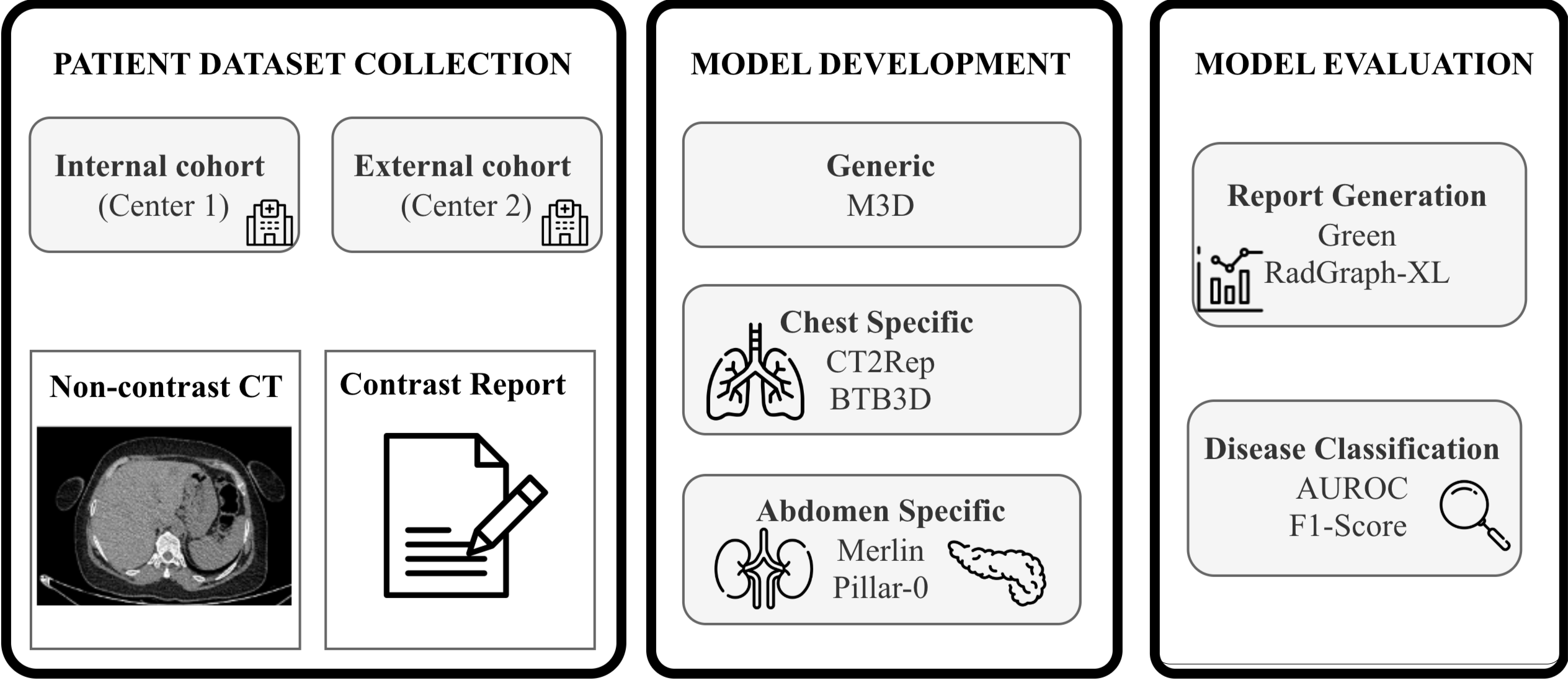
Study workflow. Non-contrast CT volumes are paired with the triphasic contrast-enhanced report of the same patient; findings are extracted from the report to form the label space, and models are evaluated on disease diagnosis and report generation.
TriALS-Report is a multi-centre benchmark for abdominal disease diagnosis from non-contrast CT (NCCT), where the ground truth is taken from the triphasic contrast-enhanced radiology report of the same patient. It covers 1,254 patients from two tertiary centres in an Egyptian population, split into an internal cohort and an external validation cohort.
| Patients / volumes | 1,254 (one non-contrast volume each) |
| Cohorts | Internal 1,085 (Center 1), external 169 (Center 2), two tertiary centres |
| Modality | Abdominal CT, NIfTI, native clinical resolution, Hounsfield units (no resampling) |
| Acquisition | 512 × 512 axial matrix, 0.875 × 0.875 mm in-plane, 1.07 mm mean slice thickness |
| Annotations | 232 findings per patient, extracted from the paired triphasic report |
Note on the labels. Labels describe what the radiologist stated in the triphasic report, not pixel-level annotation, so they carry the omissions and hedging of routine clinical reporting. Findings evaluated in the paper are the 53 diseases of the RATE taxonomy, grouped into 16 organ systems; the reported average covers the 15 organs excluding Multi-organ, i.e. 51 diseases.
TriALS-Report/
├── label_dictionary.csv
├── Center 1/
│   ├── labels.csv
│   └── ct/
│       ├── <patientID>.nii.gz
│       └── ...
└── Center 2/
    ├── labels.csv
    └── ct/
        ├── <patientID>.nii.gz
        └── ...
Each centre has its own labels.csv and ct/ folder, with one NIfTI per patient named by patient ID.
| Cohort | Split | n |
|---|---|---|
| Center 1 (internal) | train |
760 |
| Center 1 (internal) | val |
106 |
| Center 1 (internal) | test |
219 |
| Center 2 (external) | test |
169 |
Patient IDs are unique within a centre; the same ID in the two centres refers to different patients. The split of each patient is the split column of labels.csv.
| Value | Meaning |
|---|---|
1 |
Finding stated as present in the report |
0 |
Finding stated as absent, or not mentioned |
labels.csv holds patient_id, center, split, image followed by the 232 finding columns. label_dictionary.csv maps each column to its organ and to the question asked of the report.
from huggingface_hub import snapshot_download

path = snapshot_download(
    repo_id="marwankefah/TriALS-Report",
    repo_type="dataset",
    revision="v1",          # omit for the latest version
)
Choose CENTRE ∈ {"Center 1", "Center 2"} and SPLIT ∈ {"train", "val", "test"}:
import pandas as pd
from huggingface_hub import snapshot_download

# ---- Configure ----
CENTRE = "Center 1"   # "Center 1" (internal) or "Center 2" (external)
SPLIT   = "test"      # "train", "val" or "test"
# -------------------

meta = snapshot_download(
    repo_id="marwankefah/TriALS-Report",
    repo_type="dataset",
    allow_patterns=["label_dictionary.csv", f"{CENTRE}/labels.csv"],
)
labels = pd.read_csv(f"{meta}/{CENTRE}/labels.csv", dtype={"patient_id": str})
labels = labels[labels["split"] == SPLIT]

path = snapshot_download(
    repo_id="marwankefah/TriALS-Report",
    repo_type="dataset",
    allow_patterns=[f"{CENTRE}/{img}" for img in labels["image"]]
                   + ["label_dictionary.csv", f"{CENTRE}/labels.csv"],
)
print(f"Downloaded to: {path}")
import os, nibabel as nib, pandas as pd

centre = "Center 1"
labels = pd.read_csv(os.path.join(path, centre, "labels.csv"), dtype={"patient_id": str})
findings = pd.read_csv(os.path.join(path, "label_dictionary.csv"))

row = labels.iloc[0]
img = nib.load(os.path.join(path, centre, row["image"]))
present = [q for c, q in zip(findings["column"], findings["question"]) if row.get(c) == 1]
Findings were extracted from the triphasic radiology reports following RATE-Evals, using Qwen3-30B-A3B to answer one question per finding, grouped by organ: yes becomes 1 and any other answer 0, so a finding the report does not mention is coded absent. To mitigate generative hallucinations, a subset of the extracted labels was audited by board-certified radiologists, and the extraction reached an average clinical relevance score of 90% for disease extraction. Minor terminology variations and spelling discrepancies were normalised to keep the label space consistent.
This retrospective study was approved by the institutional Research Ethics Committee of the participating centres, with waiver of individual informed consent for retrospective de-identified use. All DICOM volumes and accompanying radiology reports were de-identified before model training and before release.
Released under CC BY-NC 4.0.
If you use TriALS-Report, please cite:
@misc{elbakry2026multicenterbenchmarkabdominaldisease,
      title={A Multi-Center Benchmark for Abdominal Disease Diagnosis and Report Generation from Non-Contrast CT},
      author={Mariam Elbakry and Aliaa Sayed Sheha and Salma Hassan Tantawy and Aya Yassin and Concetto Spampinato and Karim Lekadir and Xiaomeng Li and Marawan Elbatel},
      year={2026},
      eprint={2606.16991},
      archivePrefix={arXiv},
      primaryClass={cs.CV},
      url={https://arxiv.org/abs/2606.16991},
}