
instruction_seed stringlengths 2 10.7k | solution stringlengths 0 10.8k ⌀ | answer stringlengths 0 575 ⌀ | problem_type stringclasses 9
values | question_type stringclasses 5
values | problem_is_valid stringclasses 5
values | solution_is_valid stringclasses 4
values | source stringclasses 11
values | synthetic bool 2
classes |
|---|---|---|---|---|---|---|---|---|
10. (This question is worth 20 points) Let $\lambda$ be a positive real number. For any pairwise distinct positive real numbers $a$, $b$, and $c$, we have:
$\frac{a^{3}}{(b-c)^{2}}+\frac{b^{3}}{(c-a)^{2}}+\frac{c^{3}}{(a-b)^{2}} \geq \lambda(a+b+c)$, find the maximum value of $\lambda$. | None
Translate the text above into English, please retain the original text's line breaks and format, and output the translation result directly.
Note: The provided instruction is a meta-instruction and not part of the text to be translated. Since the text to be translated is "None", the translation is also "None". ... | notfound | Inequalities | math-word-problem | Yes | Incomplete | olympiads | false |
Consider triangles whose each side length squared is a rational number. Is it true
that
(a) the square of the circumradius of every such triangle is rational;
(b) the square of the inradius of every such triangle is rational? | null | null | Geometry | math-word-problem | Yes | Yes | aops_forum | false |
1. Find all complex numbers $z$ such that $\frac{z^{4}+1}{z^{4}-1}=\frac{\imath}{\sqrt{3}}$. | 1. $\begin{array}{l} \frac{1}{2}+\frac{\sqrt{3}}{2} i,-\frac{\sqrt{3}}{2}+\frac{1}{2} i \\ -\frac{1}{2}-\frac{\sqrt{3}}{2} i, \frac{\sqrt{3}}{2}-\frac{1}{2} i\end{array}$ | \frac{1}{2}+\frac{\sqrt{3}}{2}i,-\frac{\sqrt{3}}{2}+\frac{1}{2}i,-\frac{1}{2}-\frac{\sqrt{3}}{2}i,\frac{\sqrt{3}}{2}-\frac{1}{2}i | Algebra | math-word-problem | Yes | Incomplete | olympiads | false |
Given vectors $\overrightarrow{a}=(2,3)$ and $\overrightarrow{b}=(1,2)$, and $(\overrightarrow{a}+λ\overrightarrow{b})⊥(\overrightarrow{a}-\overrightarrow{b})$, find the value of $λ$ \((\) \(\)\().
A: $\dfrac{5}{3}$
B: $-\dfrac{5}{3}$
C: $-3$
D: $3$ | This problem involves the application of determining the orthogonality of vectors in a plane and the coordinate operations of planar vectors, with a focus on accurate calculations.
First, calculate the vectors $\overrightarrow{a}-\overrightarrow{b}$ and $\overrightarrow{a}+λ\overrightarrow{b}$:
$$\overrightarrow{a}-\... | -\dfrac{5}{3} | Algebra | MCQ | Yes | Yes | cn_k12 | false |
Given a sequence \\(\{a_n\}\) that satisfies: for any \\(n \in \mathbb{N}^*\), \\(a_{n+1} = ka_n + 3k - 3\\), where \\(k\\) is a constant not equal to \\(0\\) or \\(1\\). If \\(a_i \in \{-678, -78, -3, 22, 222, 2222\}\\) for \\(i = 2, 3, 4, 5\\), then the sum of all possible values of \\(a_1\\) that meet the condition ... | **Analysis**
This problem examines the application of the recursive formula of a sequence, the comprehensive use of equivalent transformation and classification discussion ideas, and the logical thinking and reasoning ability, which is considered difficult. According to the problem, we can get \\(a_{n+1}+3 = k(a_n+3)\... | \frac{6023}{3} | Algebra | math-word-problem | Yes | Yes | cn_k12 | false |
Problem 8.1. In a $5 \times 5$ square, some cells have been painted black as shown in the figure. Consider all possible squares whose sides lie along the grid lines. In how many of them is the number of black and white cells the same?
. There are only two non-fitting $2 \times 2$ squares (both of which contain th... | 16 | Combinatorics | math-word-problem | Yes | Yes | olympiads | false |
In a sports event at school, there are 200 students. 50 of them play basketball, 60 play soccer, 35 play baseball, and 80 play cricket. Among these students, 10 play both basketball and soccer, 15 play both basketball and baseball, while 20 play both basketball and cricket. Also, 25 students play both soccer and baseba... | To find the total number of students who are involved in at least one sport, we can use the principle of inclusion-exclusion. This principle allows us to add and subtract the counts of students playing each sport to avoid double-counting those who play multiple sports.
Let's denote the number of students playing each ... | 130 | Combinatorics | math-word-problem | Yes | Yes | orca_math | true |
Define a sequence $a_1=0,\ \frac{1}{1-a_{n+1}}-\frac{1}{1-a_n}=2n+1\ (n=1,\ 2,\ 3,\ \cdots)$.
(1) Find $a_n$.
(2) Let ${b_k=\sqrt{\frac{k+1}{k}}\ (1-\sqrt{a_{k+1}}})$ for $k=1,\ 2,\ 3,\ \cdots$.
Prove that $\sum_{k=1}^n b_k<\sqrt{2}-1$ for each $n$.
Last Edited | ### Part (1): Finding \(a_n\)
Given the recurrence relation:
\[
\frac{1}{1-a_{n+1}} - \frac{1}{1-a_n} = 2n + 1 \quad (n = 1, 2, 3, \ldots)
\]
We start by summing both sides from \(n = 1\) to \(n = m\):
\[
\sum_{n=1}^m \left( \frac{1}{1-a_{n+1}} - \frac{1}{1-a_n} \right) = \sum_{n=1}^m (2n + 1)
\]
The left-hand side ... | a_n = 1 - \frac{1}{n^2} | Inequalities | math-word-problem | Yes | Yes | aops_forum | false |
a = { 2 , 3 , 4 , 5 } b = { 4 , 5 , 6 , 7 , 8 } two integers will be randomly selected from the sets above , one integer from set a and one integer from set b. What is the probability that the sum of the two integers will equal 9? | To find the probability that the sum of two integers (one from set a and one from set b) will equal 9, we need to consider all possible pairs and count the number of pairs that sum to 9.
Set a: {2, 3, 4, 5}
Set b: {4, 5, 6, 7, 8}
Let's list out all possible pairs and their sums:
From set a (2) and set b:
- (2, 4) = ... | 1/5 | Combinatorics | math-word-problem | Yes | Yes | orca_math | true |
Given the function $f(x)= \overrightarrow{a} \cdot \overrightarrow{b}$, where vectors $\overrightarrow{a}=(2\cos x,1)$ and $\overrightarrow{b}=(\cos x, \sqrt {3}\sin 2x), x\in R$.
(1) Find the interval(s) where the function $f(x)$ is monotonically decreasing;
(2) If $x\in\left[- \frac {\pi}{4},0\right]$, find the range... | (1) First, we find the dot product of vectors $\overrightarrow{a}$ and $\overrightarrow{b}$.
$f(x)= \overrightarrow{a} \cdot \overrightarrow{b} = 2\cos ^{2}x+ \sqrt {3}\sin 2x$
Using the trigonometric identity $\cos 2x = 2\cos^2 x - 1$, we can simplify the expression:
$f(x) = \sqrt {3}\sin 2x + \cos 2x + 1$
Now, let'... | \left[- \sqrt {3}+1, 2\right] | Algebra | math-word-problem | Yes | Yes | cn_k12 | false |
What value of $x$ will give the minimum value of $3x^2 - 18x + 28 + \sqrt{9 - x^2}$? | First, we analyze the expression ignoring the square root to find a preliminary set of critical points:
\begin{align*}
3x^2 - 18x + 28 &= 3(x^2 - 6x) + 28\\
&= 3(x^2 - 6x + (6/2)^2 - (6/2)^2) + 28\\
&= 3((x-3)^2 - 3^2) + 28\\
&= 3(x-3)^2 - 27 + 28\\
&= 3(x-3)^2 + 1.
\end{align*}
Since $(x-3)^2 \geq 0$, this term takes... | 3 | Algebra | math-word-problem | Yes | Yes | synthetic_math | true |
4. (3 points) Prove that in a right triangle, the area does not exceed the square of the perimeter divided by 23.
# | # Solution:
Let the sides of the triangle have lengths $x$ and $y$. Then the perimeter $P=x+y+\sqrt{x^{2}+y^{2}}$. By the inequalities of means, we get $x+y+$ $\sqrt{x^{2}+y^{2}} \geqslant 2 \sqrt{x y}+\sqrt{2} \sqrt{x y}$. Since the area $S=\frac{x y}{2}$, we obtain $P \geqslant(2+\sqrt{2}) x y$, from which $P^{2} \g... | proof | Inequalities | proof | Yes | Yes | olympiads | false |
Find the largest prime factor of $20^4 + 15^3 - 10^5$. | First, we find the greatest common divisor (GCD) of the terms:
\[ \gcd(20, 15, 10) = 5 \]
Now, find the GCD considering the exponents:
- For $20^4$, $20 = 2^2 \cdot 5$, and $20^4 = (2^2 \cdot 5)^4 = 2^8 \cdot 5^4$
- For $15^3$, $15 = 3 \cdot 5$, and $15^3 = (3 \cdot 5)^3 = 3^3 \cdot 5^3$
- For $10^5$, $10 = 2 \cdot 5$... | 1787 | Number Theory | math-word-problem | Yes | Yes | synthetic_math | true |
If there is 95% confidence that event A is related to event B, calculate the specific data. | Given that $P(k > 3.841) = 0.05$, it implies that there is a 95% confidence level ($1 - 0.05 = 0.95$ or 95%) to assert that events A and B have a relationship.
Therefore, the observation must satisfy the condition $k^2 > 3.841$ to fall within this confidence interval.
Hence, the calculation yields that the observatio... | k^2 > 3.841 | Other | math-word-problem | Incomplete | Yes | cn_k12 | false |
Example 3 The equation $z^{6}+z^{3}+1=0$ has a complex root, and on the complex plane, the argument of this root is between $90^{\circ}$ and $180^{\circ}$. Find the degree measure of $\theta$.
(2nd American Invitational Mathematics Examination) | From $\left(z^{3}-1\right)\left(z^{6}+z^{3}+1\right)=z^{9}-1$, we know that the complex roots satisfying the equation $z^{6}+z^{3}+1=0$ are the 9th primitive roots of unity, and the 9th roots of unity are $z_{1}=\cos \frac{2 \pi}{9}+i \sin \frac{2 \pi}{2}, z_{2}=\cos \frac{4 \pi}{9}+i \sin \frac{4 \pi}{9}$,
$$
\begin{a... | 160 | Algebra | math-word-problem | Yes | Yes | olympiads | false |
Given an ellipse $C$: $\dfrac{x^2}{a^2}+\dfrac{y^2}{b^2}=1$ $(a > b > 0)$ with its right focus at $F(1,0)$, and a line passing through point $F$ that is not perpendicular to the coordinate axes intersects the ellipse at points $P$ and $Q$. When the line $PQ$ passes through a vertex of the ellipse, its angle of inclinat... | (1) According to the problem, we have $c=1$;
Since $\dfrac{b}{c}=\tan 60^{\circ} = \sqrt{3}$, we get $b^2=3$,
and $a^2=b^2+c^2=4$,
thus, the equation of the ellipse is: $\dfrac{x^2}{4}+ \dfrac{y^2}{3}=1$;
(2) Let the equation of line $PQ$ be: $y=k(x-1)$, $(k\neq 0)$,
Substituting into $\dfrac{x^2}{4}+ \dfrac... | t \in (0, \dfrac{1}{4}) | Geometry | math-word-problem | Yes | Yes | cn_k12 | false |
A church has 120 members. 40% are adults. The rest are children. How many more children are there than adults? | If 40% of the members are adults, then the remaining 60% are children.
To find the number of adults, we calculate 40% of 120 members:
0.40 * 120 = 48 adults
To find the number of children, we calculate 60% of 120 members:
0.60 * 120 = 72 children
To find out how many more children there are than adults, we subtract ... | 24 | Algebra | math-word-problem | Yes | Yes | orca_math | true |
Find positive reals $a, b, c$ which maximizes the value of $abc$ subject to the constraint that $b(a^2 + 2) + c(a + 2) = 12$. | To solve the problem, we need to maximize the value of \(abc\) subject to the constraint \(b(a^2 + 2) + c(a + 2) = 12\). We will use the method of Lagrange multipliers to find the maximum value.
1. **Define the function and constraint:**
Let \(f(a, b, c) = abc\) be the function we want to maximize, and let \(g(a, b... | 3 | Calculus | math-word-problem | Yes | Yes | aops_forum | false |
Find the range of
\[ g(A) = \frac{\sin A(5\cos^{2}A + 2\cos^{4}A + 2\sin^{2}A + \sin^{2}A\cos^{2}A)}{\tan A (\csc A - \sin A\tan A)} \]
if \( A \neq \dfrac{n\pi}{2} \) for any integer \( n \). Use interval notation for your answer. | First rewrite the given expression using trigonometric identities:
\[
g(A) = \frac{\sin A (5 \cos^2 A + 2 \cos^4 A + 2 \sin^2 A + \sin^2 A \cos^2 A)}{\tan A (\csc A - \sin A \tan A)}
\]
Breakdown the denominator in terms of $\sin A$ and $\cos A$:
\[
g(A) = \frac{\sin A (2 \sin^2 A + \sin^2 A \cos^2 A + 5 \cos^2 A + 2 \... | (2, 7) | Algebra | math-word-problem | Yes | Yes | synthetic_math | true |
Given that the solution set of the inequality $ax^{2}-bx-1\geqslant 0$ is $[{-\frac{1}{2},-\frac{1}{3}}]$, then the solution set of the inequality $x^{2}-bx-a \lt 0$ is ( )
A: $(2,3)$
B: $(-\infty ,2)\cup \left(3,+\infty \right)$
C: $(\frac{1}{3},\frac{1}{2})$
D: $(-\infty $,$\frac{1}{3})\cup (\frac{1}{2}$,$+\infty... | Given the inequality $ax^{2}-bx-1\geqslant 0$ has a solution set of $[{-\frac{1}{2},-\frac{1}{3}}]$, we can deduce several things step by step.
First, since the solution set is given as a closed interval, it implies that the quadratic equation $ax^{2}-bx-1=0$ has real roots at $x = -\frac{1}{2}$ and $x = -\frac{1}{3}$... | A | Inequalities | MCQ | Yes | Yes | cn_k12 | false |
3. The sum of two natural numbers is 2013. If you erase the last two digits of one of them, add one to the resulting number, and then multiply the result by five, you get the other number. Find these numbers. Enter the largest of them in the provided field. | 3. The sum of two natural numbers is 2013. If you erase the last two digits of one of them, add one to the resulting number, and then multiply the result by five, you get the other number. Find these numbers. Enter the largest of them in the provided field.
Answer: 1913 | 1913 | Number Theory | math-word-problem | Yes | Problem not solved | olympiads | false |
If the function $$f(x)=\log_{a}\left(x- \frac {2a}{x}\right)$$ is monotonically decreasing on the interval $x \in (1, 2)$, then the range of values for $a$ is \_\_\_\_\_\_. | Given the information, we know that $a > 0$ and $a \neq 1$.
Let the function $u = x - \frac {2a}{x}$. This function is monotonically increasing on the interval $(1, 2)$.
If the function $$f(x)=\log_{a}\left(x- \frac {2a}{x}\right)$$ is monotonically decreasing on the interval $x \in (1, 2)$,
then the outer functi... | (0, \frac {1}{2}] | Algebra | math-word-problem | Yes | Yes | cn_k12 | false |
Find the minimum value of $ f(a)=\int_{0}^{1}x|x-a|\ dx$. | null | null | Calculus | math-word-problem | Yes | Yes | aops_forum | false |
Pablo, Sofia, and Mia got some candy eggs at a party. Pablo had three times as many eggs as Sofia, and Sofia had twice as many eggs as Mia. Pablo decides to give some of his eggs to Sofia and Mia so that all three will have the same number of eggs. What fraction of his eggs should Pablo give to Sofia?
$ \textbf{(A) }\... | null | null | Algebra | MCQ | Yes | Yes | aops_forum | false |
A cylinder with a height of 36 cm and a radius of 10 cm contains three identical cones, each with a height of 18 cm and a radius of 10 cm. The cones are placed such that their vertices point downwards and their bases are each one-third the base of the cylinder. Calculate the volume of the space in the cylinder not occu... | 1. **Calculate the volume of the cylinder:**
\[
V_{\text{cylinder}} = \pi r^2 h = \pi (10)^2 (36) = 3600\pi \text{ cubic cm}
\]
2. **Calculate the volume of one cone:**
\[
V_{\text{cone}} = \frac{1}{3}\pi r^2 h = \frac{1}{3}\pi (10)^2 (18) = 600\pi \text{ cubic cm}
\]
3. **Calculate the total volume... | 1800\pi | Geometry | math-word-problem | Yes | Yes | synthetic_math | true |
Big Sister Shopping often says, "You get what you pay for," which means "not cheap" is a ( ) condition for "good quality."
A: Sufficient condition
B: Necessary condition
C: Sufficient and necessary condition
D: Neither sufficient nor necessary condition | B
Briefly, the correct answer is $\boxed{\text{B}}$. | \text{B} | Logic and Puzzles | MCQ | Yes | Incomplete | cn_k12 | false |
II OM - I - Task 1
Prove that the product of two factors, each of which is the sum of the squares of two integers, is also the sum of the squares of two integers. | We will apply the transformation
If $ a $, $ b $, $ c $, $ d $ are integers, then $ ac + bd $ and $ ad - bc $ are also integers; the theorem has thus been proven.
Notice that a more general theorem holds:
The product of $ n $ factors, each of which is the sum of the squares of two integers, is also the sum of the... | proof | Number Theory | proof | Yes | Yes | olympiads | false |
A circular arena consists of an external running track (light brown), a ring-shaped seating area (dark brown) surrounding a central oval pitch (green). The running track is 7 feet wide at all places, the seating ring is 12 feet wide at all places, and the pitch has a major axis of 18 feet and a minor axis of 14 feet. W... | To solve this problem, we need to calculate the diameter of the circle that represents the outer boundary of the running track.
1. The half of the major axis of the oval pitch gives the radius in one direction, which is half of 18 feet, equal to 9 feet.
2. However, to find the outer boundary of the track, a consisten... | 52 | Geometry | math-word-problem | Yes | Incomplete | synthetic_math | true |
Factorize the expression: $xy^{2}-16x=$____. | To factorize the expression $xy^{2}-16x$, we proceed as follows:
1. First, we factor out the common factor $x$ from both terms:
$$xy^{2}-16x = x(y^{2}-16)$$
2. Next, we recognize that $y^{2}-16$ is a difference of squares, which can be factored into $(y+4)(y-4)$:
$$x(y^{2}-16) = x(y+4)(y-4)$$
Therefore, the factoriz... | x(y+4)(y-4) | Algebra | math-word-problem | Yes | Yes | cn_k12 | false |
Let $C_{1}, C_{2}$ and $C_{3}$ be three distinct circles, $A_{1}$ and $B_{1}$ the intersections of $C_{2}$ and $C_{3}$, $A_{2}$ and $B_{2}$ the intersections of $C_{1}$ and $C_{3}$, and $A_{3}$ and $B_{3}$ the intersections of $C_{1}$ and $C_{2}$.
Show that $\left(A_{1} B_{1}\right),\left(A_{2} B_{2}\right)$ and $\lef... | Soit nos droites sont parallèles, soit deux d'entre elles s'intersectent, disons $\left(A_{1} B_{1}\right)$ et $\left(A_{2} B_{2}\right)$, et notons alors $M$ leur intersection. Ainsi la puissance de $M$ par rapport à $C_{1}$ est la même que celle par rapport à $C_{3}$ car $\left(A_{2} B_{2}\right)$ est l'axe radical d... | proof | Geometry | proof | Yes | Yes | olympiads | false |
Five red candies and four green candies can be combined to make many different flavors. Flavors are defined by different percentages of red candies, so ratios with the same proportion are considered as the same flavor (e.g., 5 red / 1 green is the same flavor as 10 red / 2 green). If a flavor is to be made using some o... | Denote the ratio by \(x:y\), where \(x\) is the number of red candies and \(y\) is the number of green candies. We can have \(0, 1, 2, 3, 4,\) or \(5\) red candies and \(0, 1, 2, 3,\) or \(4\) green candies, giving \(6 \times 5 = 30\) potential ratios. However, the \(0:0\) ratio (no candy) is not allowed, so we subtrac... | 17 | Combinatorics | math-word-problem | Yes | Yes | synthetic_math | true |
Solve the equation: $\frac{2x}{x+3}+1=\frac{7}{2x+6}$. | To solve the equation $\frac{2x}{x+3}+1=\frac{7}{2x+6}$, we proceed as follows:
Step 1: Notice that the denominator $2x+6$ can be factored as $2(x+3)$. This allows us to see that both fractions have a related denominator.
Step 2: To remove the denominators, we find a common denominator, which is $2(x+3)$. Multiplyin... | x = \frac{1}{6} | Algebra | math-word-problem | Yes | Yes | cn_k12 | false |
it takes avery 4 hours to build a brick wall while tom can do it in 2 hours . if the two start working together and after an hour avery leaves , how much time will it take tom to complete the wall on his own ? | Let's calculate the rate at which Avery and Tom work when building the wall.
Avery takes 4 hours to build the wall, so his rate is 1 wall per 4 hours, or 1/4 of the wall per hour.
Tom takes 2 hours to build the wall, so his rate is 1 wall per 2 hours, or 1/2 of the wall per hour.
When they work together for the firs... | 1/2 | Algebra | math-word-problem | Yes | Yes | orca_math | true |
If $a$ and $b$ are the solutions of the equation $x + \lg x = 4$, and $x + 10^x = 4$, respectively, and the function $f(x) = \begin{cases} x^{2}+(a+b)x+2, & x\leq0 \\ 2, & x>0\end{cases}$, then the number of solutions to the equation $f(x) = x$ is \_\_\_\_\_\_. | Since $a$ satisfies $x + \lg x = 4$, and $b$ satisfies $x + 10^x = 4$,
thus $a$ and $b$ are respectively the x-coordinates of the intersection points of the graph of $y = 4 - x$ with the graphs of $y = \lg x$ and $y = 10^x$,
Since the x-coordinate of the intersection point of the graphs of $y = x$ and $y = 4 - x$ i... | 3 | Algebra | math-word-problem | Yes | Yes | cn_k12 | false |
Evaluate the expression $$\frac {2\sin\alpha\cos\alpha-\cos\alpha}{1+\sin^2\alpha -\sin\alpha -\cos^2\alpha }.$$ | We start by simplifying the numerator and the denominator separately.
For the numerator, factor out $\cos\alpha$:
$$2\sin\alpha\cos\alpha-\cos\alpha = \cos\alpha(2\sin\alpha - 1).$$
For the denominator, notice it can be manipulated via a Pythagorean identity, $\sin^2\alpha + \cos^2\alpha = 1$:
$$1+\sin^2\alpha -\sin... | \frac{1}{\tan\alpha} | Algebra | math-word-problem | Yes | Yes | cn_k12 | false |
In a sample, $50$ data points are distributed among $5$ groups. The number of data points in groups $1$, $2$, $3$, and $5 are $2$, $8$, $15$, and $5$ respectively. What is the frequency of group $4$?
A: $0.3$
B: $0.4$
C: $0.5$
D: $0.6$ | To find the frequency of group $4$, we first need to calculate the total number of data points in groups $1$, $2$, $3$, and $5$. Then, we subtract this total from the overall sample size to find the number of data points in group $4$. Finally, we divide the number of data points in group $4$ by the total sample size to... | B | Logic and Puzzles | MCQ | Yes | Yes | cn_k12 | false |
An eccentric mathematician has a ladder with $ n$ rungs that he always ascends and descends in the following way: When he ascends, each step he takes covers $ a$ rungs of the ladder, and when he descends, each step he takes covers $ b$ rungs of the ladder, where $ a$ and $ b$ are fixed positive integers. By a sequence ... | 1. **Claim**: The minimum value of \( n \) is \( a + b - \gcd(a, b) \).
2. **Proof using Bézout's Lemma**:
- Bézout's Lemma states that for any integers \( a \) and \( b \), there exist integers \( x \) and \( y \) such that \( ax - by = \gcd(a, b) \).
- We can find non-negative integers \( x \) and \( y \) such... | a + b - \gcd(a, b) | Number Theory | math-word-problem | Yes | Yes | aops_forum | false |
In the Cartesian coordinate plane $(xOy)$, the coordinates of points $E'$ and $F'$ are $(0, \sqrt{3})$ and $(0, -\sqrt{3})$, respectively. A moving point $G$ satisfies the condition that the product of the slopes of lines $E'G$ and $F'G$ is $-\frac{3}{4}$.
1. Find the trajectory equation of point $G$.
2. Draw two perp... | 1. Given $E'(0, \sqrt{3})$ and $F'(0, -\sqrt{3})$, let the coordinates of moving point $G$ be $(x, y)$.
The slope of line $E'G$ is $k_1 = \frac{y - \sqrt{3}}{x}$, and the slope of line $F'G$ is $k_2 = \frac{y + \sqrt{3}}{x} \ (x \neq 0)$.
Since $k_1 \times k_2 = -\frac{3}{4}$, we have $\frac{y - \sqrt{3}}{x} \times \... | \frac{12}{7} | Geometry | math-word-problem | Yes | Yes | cn_k12 | false |
In a group of $50$ students, $23$ said they liked apple pie, $20$ said they liked chocolate cake, and $10$ said they liked carrot cake. $15$ students noted that they did not like any of the three mentioned desserts. How many students liked both apple pie and chocolate cake but not carrot cake? | First, calculate the number of students who liked at least one of the desserts:
\[ 50 - 15 = 35 \text{ students liked at least one dessert.} \]
Since $23$ liked apple pie, $20$ liked chocolate cake, and $10$ liked carrot cake, if we assume no overlapping preferences initially, we would sum:
\[ 23 + 20 + 10 = 53 \]
How... | 7 | Combinatorics | math-word-problem | Yes | Yes | synthetic_math | true |
Given the function $f(x) = x\left( \frac {2}{2^{x}-1} + k \right)$ is an even function,
(1) Find the value of $k$;
(2) If $g(x) = \frac {f(x)}{x}$, and $x \in (0, 1]$, find the range of $g(x)$. | (1) Since $f(x) = x\left( \frac {2}{2^{x}-1} + k \right)$ is an even function,
we have \[f(x) = f(-x),\] which implies \[x\left( \frac {2}{2^{x}-1} + k \right) = -x\left( \frac {2}{2^{-x}-1} + k \right).\]
For this to hold true for all $x$, the term not involving $x$ must be symmetric, hence:
\[ \frac {2}{2^{x}-1} ... | (-\infty, 1] | Algebra | math-word-problem | Yes | Yes | cn_k12 | false |
If 9^y = 3^(16x), 27^z = 81^(2y-3x), and 6^(x+z) = 36^(y-2z), find the values of x, y, and z. | Let's solve the system of equations step by step.
First, we have the equation 9^y = 3^(16x). Since 9 is 3^2, we can rewrite the left side as (3^2)^y = 3^(2y). Therefore, we have:
3^(2y) = 3^(16x)
Since the bases are the same, we can equate the exponents:
2y = 16x
y = 8x (Equation 1)
Next, we have the equation 27^... | 0 | Algebra | math-word-problem | Yes | Yes | orca_math | true |
Example 6.17 (Vo Quoc Ba Can) $a, b, c$ are non-negative real numbers, and $abc=1$, prove that
$$\frac{a}{\sqrt[k]{8+b^{3}}}+\frac{b}{\sqrt[k]{8+c^{3}}}+\frac{c}{\sqrt[k]{8+a^{3}}} \geqslant \sqrt[k]{3^{k-2}}$$
for all $k \geqslant 1, k \in \mathbf{R}$. | Prove that by the weighted AM-GM inequality we have
$$a^{3}+8+9(k-1) \geqslant 9 k\left(\frac{8+a^{3}}{9}\right)^{\frac{1}{4}}$$
which is equivalent to
$$\frac{a^{3}+9 k-1}{9 k} \geqslant \sqrt[n]{\frac{8+a^{3}}{9}}$$
Similarly, we can get
$$\begin{array}{l}
\frac{b^{3}+9 k-1}{9 k} \geqslant\left(\frac{8+b^{3}}{9}\ri... | proof | Inequalities | proof | Yes | Yes | inequalities | false |
$10.$ Let $a=\sin 17^{\circ}\cos 45^{\circ}+\cos 17^{\circ}\sin 45^{\circ}$, $b=2\cos ^{2}13^{\circ}-1$, and $c=\dfrac{\sqrt{3}}{2}$. Arrange $a,b,$ and $c$ in ascending order.
A: $c<a<b$
B: $b<c<a$
C: $a<b<c$
D: $b<a<c$ | **Analysis**
Using the given conditions, we can apply the sine addition formula and the monotonicity of the sine function to find that $a>\dfrac{\sqrt{3}}{2}=c$. Next, we use the double angle cosine formula to find that $b>a$.
**Step-by-step Solution**
1. For $a$:
$\begin{aligned}a&=\sin 17^{\circ}\cos 45^{\circ}+\... | c<a<b | Algebra | MCQ | Yes | Yes | cn_k12 | false |
The condition for the lines $x+ay=1$ and $ax+y=5$ to be parallel is $a=-1$.
A: Sufficient but not necessary
B: Necessary but not sufficient
C: Sufficient
D: Neither sufficient nor necessary | When $a=0$, the two lines are not parallel;
For $a\neq 0$, by setting the two lines to be parallel, we get $- \frac{1}{a}=-a$, which solves to $a=±1$.
Therefore, "$a=-1$" is a sufficient but not necessary condition for the lines $x+ay=1$ and $ax+y=5$ to be parallel.
Hence, the correct choice is $\boxed{A}$.
Whe... | A | Algebra | MCQ | Yes | Yes | cn_k12 | false |
From 8000 individuals numbered from 0000 to 7999, a sample of 50 individuals is drawn using systematic sampling. The range of numbers in the last segment is _______, and if the last sampled number is known to be 7894, then the first 5 sampled numbers are _______. | By using systematic sampling to draw 50 individuals from 8000,
the number of individuals in each segment after division is 160,
thus, the first number of the last segment is 7999 - 160 + 1 = 7840,
therefore, the range of numbers in the last segment is 7840 to 7999,
since the last sampled number is 7894, then th... | 7840~7999; 0054, 0214, 0374, 0534, 0694 | Combinatorics | math-word-problem | Yes | Yes | cn_k12 | false |
10. The cost of a house consists of the cost of the above-ground part and the cost of the foundation part. For a house with an area of $N \mathrm{~m}^{2}$, the cost of the above-ground part is proportional to $N \sqrt{N}$, and the cost of the foundation part is proportional to $\sqrt{N}$. It is known that for a house w... | 10. Let the area of each house in square meters be $y$, and a total of $x$ identical houses are built, with the total cost being $S$. Then
$$
\left\{\begin{array}{l}
x y=80000, \\
S=(\alpha y \sqrt{y}+\beta \sqrt{y}) \cdot x, \\
\frac{\alpha \cdot 3600 \sqrt{3600}}{\beta \sqrt{3600}}=\frac{72}{100},
\end{array}\right.
... | 5000 | Algebra | math-word-problem | Yes | Yes | cn_contest | false |
Problem 3. An equilateral triangle with a side length of 8 was divided into smaller equilateral triangles with a side length of 1 (see figure). What is the minimum number of small triangles that need to be shaded so that all intersection points of the lines (including those on the edges) are vertices of at least one sh... | Answer: 15 small triangles. See the example in the figure.
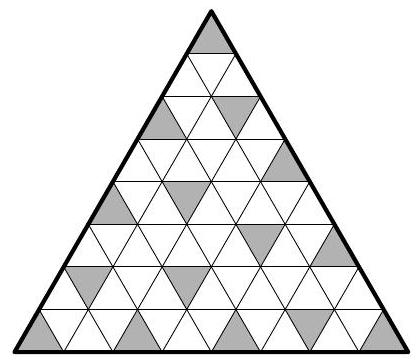
Solution: The total number of intersection points of the lines is $1+2+3+\ldots+9=45$. Since a triangle has three vertices, at leas... | 15 | Combinatorics | proof | Yes | Yes | olympiads | false |
21. (1999 National Team Selection Test) For non-negative real numbers $x_{1}, x_{2}$, $\cdots, x_{n}$ satisfying the condition $x_{1}+x_{2}+\cdots+x_{n}=1$, find the maximum value of $\sum_{j=1}^{n}\left(x_{j}^{4}-x_{j}^{5}\right)$. | 21. Use the adjustment method to explore the maximum value of the sum in the problem.
First, for $x, y>0$, we compare $(x+y)^{4}-(x+y)^{5}+0^{4}-0^{5}$ with $x^{4}-x^{5}+y^{4}-y^{5}$,
$$
\begin{aligned}
& (x+y)^{4}-(x+y)^{5}+0^{4}-0^{5}-\left(x^{4}-x^{5}+y^{4}-y^{5}\right) \\
= & x y\left(4 x^{2}+6 x y+4 y^{2}\right)-... | \frac{1}{12} | Inequalities | math-word-problem | Yes | Yes | olympiads | false |
Kanel-Belov A.Y.
A billiard table has the shape of a polygon (not necessarily convex), in which adjacent sides are perpendicular to each other. The vertices of this polygon are pockets, into which the ball remains if it falls. A ball is shot from vertex $A$ with an (internal) angle of $90^{\circ}$, and it reflects off... | If the ball flies out of A along the side, it will fall into the nearest pocket. Let the ball fly out at an acute angle to the side $A B$. It is easy to see that upon reflection from both the side parallel and the side perpendicular to the line $A B$, the smallest angle between $A B$ and the segment of the trajectory d... | proof | Geometry | proof | Yes | Yes | olympiads | false |
3. The altitudes $C M, A P$ in the acute-angled triangle $A B C$ intersect at point $H$. Determine the angle $A C B$, if $\overline{A B}=\overline{C H}$. | Solution. Let's consider triangles $A B P$ and $C H P$ (diagram on the right). For them, $\overline{A B}=\overline{C H}$. Then the angles at vertex $P$ are right angles, and $\measuredangle B A P=\measuredangle H C P$, as angles with mutually perpendicular sides. Therefore, $\measuredangle A B P=\measuredangle C H P$. ... | 45 | Geometry | math-word-problem | Yes | Yes | olympiads | false |
Determine if the points $P = (1, -2, 1)$, $Q = (4, -7, 4)$, $R = (2, -1, -1)$, and $S = (5, -6, 2)$ form a parallelogram in space. If so, calculate the area of this parallelogram. | Let $\mathbf{p} = \begin{pmatrix} 1 \\ -2 \\ 1 \end{pmatrix},$ $\mathbf{q} = \begin{pmatrix} 4 \\ -7 \\ 4 \end{pmatrix},$ $\mathbf{r} = \begin{pmatrix} 2 \\ -1 \\ -1 \end{pmatrix},$ and $\mathbf{s} = \begin{pmatrix} 5 \\ -6 \\ 2 \end{pmatrix}.$ First, we check if $\mathbf{q} - \mathbf{p} = \mathbf{s} - \mathbf{r}$:
\[... | \sqrt{194} | Geometry | math-word-problem | Yes | Yes | synthetic_math | true |
1. As shown in Figure 1, in $\triangle A B C$, $A B=A C, G$ is the centroid, $D$ and $F$ are the midpoints of $B C$ and $A B$ respectively, $C D=D G=a, G E \perp A B$. Then $A E=$ . $\qquad$ | $$
\text { II. } 1 . \frac{3 \sqrt{10} a}{5} \text {. }
$$
Since $G$ is the centroid of $\triangle A B C$, we have
$$
\begin{array}{l}
A D=3 D G=3 D B=3 a, \\
A B=\sqrt{10} a, A G=2 D G=2 a, \\
\cos \angle D A B=\frac{3}{\sqrt{10}} .
\end{array}
$$
Therefore, $A E=A G \cos \angle D A B=\frac{3 \sqrt{10} a}{5}$. | \frac{3\sqrt{10}}{5} | Geometry | math-word-problem | Yes | Yes | olympiads | false |
An industrial machine can make 3 shirts a minute. It made 9 shirts yesterday and 44 shirts today. How many minutes did the machine work yesterday? | If the industrial machine can make 3 shirts a minute and it made 9 shirts yesterday, we can calculate the number of minutes it worked yesterday by dividing the total number of shirts made by the number of shirts it can make per minute.
Number of minutes worked yesterday = Total shirts made yesterday / Shirts made per ... | 3 | Algebra | math-word-problem | Yes | Yes | orca_math | true |
Given a sector of a circle with a central angle of $60^{\circ}$ and a radius of $r=20cm$, find the perimeter of the sector. | From the given information, the arc length of the sector is $\frac{\pi}{3} \times 20 = \frac{20}{3}\pi cm$.
$\therefore$ The perimeter of the sector is $(40 + \frac{20}{3}\pi)cm$.
Hence, the answer is: $\boxed{40 + \frac{20}{3}\pi}$.
To find the perimeter of the sector, we first need to find the arc length. This pro... | 40 + \frac{20}{3}\pi | Geometry | math-word-problem | Yes | Yes | cn_k12 | false |
A boy takes 96 seconds to run round a square field of a certain side length, if he runs at the rate of 9 km/hr. What is the side length of the square field? | First, we need to convert the boy's running speed from km/hr to m/s to match the time given in seconds.
Speed in m/s = Speed in km/hr * (1000 m / 1 km) * (1 hr / 3600 s)
Speed in m/s = 9 * (1000 / 1) * (1 / 3600)
Speed in m/s = 9 * (1000 / 3600)
Speed in m/s = 9 * (5 / 18)
Speed in m/s = 2.5 m/s
Now that we have the... | 60 | Geometry | math-word-problem | Yes | Yes | orca_math | true |
What is the area, in square units, of a triangle with vertices at \((0,0)\), \((0,6)\), and \((8,10)\)? Express your answer as a decimal to the nearest tenth. | The given vertices of the triangle are \((0,0)\), \((0,6)\), and \((8,10)\).
- The base of the triangle can be considered along the \(y\)-axis between the points \((0,0)\) and \((0,6)\), giving a length of \(6\) units.
- The height of the triangle is the horizontal distance from the point \((8,10)\) to the \(y\)-axis, ... | 24.0 \text{ square units} | Geometry | math-word-problem | Yes | Yes | synthetic_math | true |
Consider a $25\times25$ chessboard with cells $C(i,j)$ for $1\le i,j\le25$. Find the smallest possible number $n$ of colors with which these cells can be colored subject to the following condition: For $1\le i<j\le25$ and for $1\le s<t\le25$, the three cells $C(i,s)$, $C(j,s)$, $C(j,t)$ carry at least two different col... | 1. **13 Colors are Sufficient:**
- We use the residual classes \( 0, \ldots, 12 \) modulo 13 as colors.
- Assign the color to cell \( C(i,s) \) as \( \left\lfloor \frac{1}{2}(i+s) \right\rfloor \mod 13 \), where \( \left\lfloor x \right\rfloor \) denotes the largest integer less than or equal to \( x \).
2. **Pr... | 13 | Combinatorics | math-word-problem | Yes | Yes | aops_forum | false |
Let \( y = \frac{15x^4 + 7x^3 + 10x^2 + 6x + 4}{4x^4 + 3x^3 + 9x^2 + 4x + 2} \). Determine the value of \( y \) at which there is a horizontal asymptote. | To find the horizontal asymptote of the given rational function:
1. **Degree comparison**: Both the numerator and the denominator are polynomials of degree 4.
2. **Leading coefficients**: The leading coefficient of the numerator is 15 and that of the denominator is 4.
3. **Asymptote calculation**: The horizontal asympt... | \frac{15}{4} | Algebra | math-word-problem | Yes | Yes | synthetic_math | true |
At the beginning of the new semester, the school requires each student to take $3$ elective courses and participate in $2$ extracurricular activities. Students can choose any $3$ out of the $6$ elective courses offered in their grade, and $2$ out of $5$ extracurricular activity groups. The number of different ways to m... | To solve the problem step-by-step, let's break down the selection process into two parts: choosing elective courses and choosing extracurricular activities.
1. **Choosing Elective Courses:**
First, we calculate the number of ways to choose $3$ elective courses out of the $6$ offered. This is a combination problem, as... | 200 | Combinatorics | math-word-problem | Yes | Yes | cn_k12 | false |
the average score of a cricketer for 12 matches is 48 runs . if the average for first 8 matches is 40 , then average for last 4 matches is | To find the average for the last 4 matches, we first need to calculate the total runs scored in the 12 matches and then subtract the total runs scored in the first 8 matches.
The average score for 12 matches is 48 runs, so the total runs scored in 12 matches is:
12 matches * 48 runs/match = 576 runs
The average score... | 64 | Algebra | math-word-problem | Yes | Yes | orca_math | true |
Find all \(x\) such that \(x^2 + 7x < 8\). Express your answer in interval notation. | First, we rewrite the inequality by bringing all terms to one side:
\[ x^2 + 7x - 8 1 \): both factors are positive, product positive.
Hence, the solution is when the product is negative:
\[ \boxed{(-8, 1)} \] | (-8, 1) | Inequalities | math-word-problem | Yes | Incomplete | synthetic_math | true |
Given non-zero vectors $\overrightarrow{a}$ and $\overrightarrow{b}$, a sufficient but not necessary condition for $|\overrightarrow{a}-\overrightarrow{b}|=|\overrightarrow{a}|+|\overrightarrow{b}|$ to hold is
A: $\overrightarrow{a}\parallel \overrightarrow{b}$
B: $\overrightarrow{a}+2\overrightarrow{b}=\overrightarrow... | **Analysis**
This question examines the scalar product of vectors and the judgment of necessary and sufficient conditions. Determine the necessary and sufficient conditions, then analyze and solve accordingly.
**Solution**
Given non-zero vectors $\overrightarrow{a}, \overrightarrow{b}$ such that $|\overrightarrow{a}... | \text{B} | Algebra | MCQ | Yes | Yes | cn_k12 | false |
Given three lines $3x+2y+6=0$, $2x-3m^{2}y+18=0$ and $2mx-3y+12=0$ form a right-angled triangle, the value of $m$ is. | **Analysis:**
This problem can be solved by utilizing the relationship between the slopes of two perpendicular lines. It tests reasoning and calculation abilities and is considered a basic question.
If $3x+2y+6=0$ and $2x-3m^{2}y+18=0$ are perpendicular, we can obtain $m=±1$.
Upon verification, when $m=1$, the ... | 0, -1, -\dfrac{4}{9} | Geometry | math-word-problem | Yes | Yes | cn_k12 | false |
Suppose $c$ and $d$ are positive integers such that $\gcd(c, d)$ is divisible by exactly 11 distinct primes, and $\mathop{\text{lcm}}[c, d]$ is divisible by exactly 44 distinct primes.
If $c$ has fewer distinct prime factors than $d$, then $c$ has at most how many distinct prime factors? | The prime aspects of $\gcd(c, d)$ highlight the prime factors common to both $c$ and $d$. Hence, $\mathop{\text{lcm}}[c, d]$ spans the total distinct primes dividing $c$ and/or $d$.
From the problem:
1. $\gcd(c, d)$ includes 11 prime factors.
2. $\mathop{\text{lcm}}[c, d]$ includes 44 prime factors in total.
3. Subtra... | 27 | Number Theory | math-word-problem | Yes | Yes | synthetic_math | true |
Consider a triangle $\vartriangle ACE$ with $\angle ACE = 45^o$ and $\angle CEA = 75^o$. Define points $Q, R$, and $P$ such that $AQ$, $CR$, and $EP$ are the altitudes of $\vartriangle ACE$. Let $H$ be the intersection of $AQ$, $CR$, and $EP$.
Next define points $B, D$, and $F$ as follows. Extend $EP$ to point $B$ su... | null | null | Geometry | math-word-problem | Yes | Yes | aops_forum | false |
There are multiple complex numbers of the form $z_m = \cos\theta_m + i\sin\theta_m$ that satisfy both $z^{40} - z^{10} - 1 = 0$ and $|z| = 1$, where $0 \leq \theta_1 < \theta_2 < \dots < 360$ (angles in degrees). Determine the sum $\theta_2 + \theta_4 + \dots + \theta_{2n}$ for these complex numbers. | From the equation $z^{40} - z^{10} - 1 = 0$, we get
\[ z^{10}(z^{30} - 1) = 1. \]
Thus, $|z^{10}| |z^{30} - 1| = 1$. As $|z| = 1$, it follows that $|z^{10}| = 1$ and $|z^{30} - 1| = 1$. Set $w = z^{30}$, then $w$ is on the unit circle centered at $1$ with radius $1$ and also on the unit circle centered at the origin wi... | 2100 | Algebra | math-word-problem | Yes | Yes | synthetic_math | true |
5. Let $A B C$ be a triangle in which $\angle A=60^{\circ}$. Let $B E$ and $C F$ be the bisectors of the angles $\angle B$ and $\angle C$ with $E$ on $A C$ and $F$ on $A B$. Let $M$ be the reflection of $A$ in the line $E F$. Prove that $M$ lies on $B C$.
 | Inequalities | math-word-problem | Yes | Yes | cn_k12 | false |
9
Given a parallelogram $A B C D$. A circle passing through point $A$ intersects segments $A B, A C$ and $A D$ at points $P$, $Q$ and $R$ respectively. Prove that $A P \cdot A B=A R \cdot A D=A Q \cdot A C$. | Applying Ptolemy's theorem to quadrilateral $A P Q R$, we get $A P \cdot R Q + A R \cdot Q P = A Q \cdot P R$. Since $\angle A C B = \angle R A Q = \angle R P Q$ and $\angle R Q P = 180^{\circ} - \angle P A R = \angle A B C$, then $\triangle R Q P \sim \triangle A B C$, which means $R Q : Q P : P R = A B : B C :$
CA. ... | proof | Geometry | proof | Yes | Yes | olympiads | false |
Given a point $P$ on the graph of the function $f(x)=\frac{1}{2}(x^3-\frac{1}{x})$, and the slope of the tangent line at point $P$ is denoted as $α$, determine the range of possible values for $α$. | 1. First, find the derivative of the given function: $f(x)=\frac{1}{2}(x^3-\frac{1}{x})$.
$$f'(x) = \frac{1}{2}(3x^2 + \frac{1}{x^2})$$
2. Next, find the range of the derivative by analyzing its expression:
$$f'(x) = \frac{1}{2}(3x^2 + \frac{1}{x^2}) \geq \sqrt{3}$$
3. Since $f'(x)$ represents the slope of the tang... | α ∈ [\frac{π}{3}, \frac{π}{2}) | Calculus | math-word-problem | Yes | Yes | cn_k12 | false |
Xiaopang arranged the 50 integers $1, 2, 3, 4, ..., 49, 50$ in ascending order without any gaps, and then inserted a “+” between each pair of adjacent numbers, resulting in an addition expression: $1+2+3+4+5+6+7+8+9+1+0+1+1+\cdots+4+9+5+0$. Please calculate the sum of this addition expression, the result is $\qquad$ _ | 【Analysis and Solution】This problem is to find the sum of the digits of the integers from 1 to 50.
(Method One)
In the units place, the digits $1, 2, \ldots, 9, 0$ each appear 5 times;
In the tens place, the digits $1, 2, 3, 4$ each appear 10 times, and 5 appears only once;
Thus, the sum of the digits of the integers f... | 330 | Algebra | math-word-problem | Yes | Yes | olympiads | false |
4. Let $f(x)=x^{4}-\frac{3}{4} x^{2}-\frac{1}{8} x+1$. Then $f\left(\cos \frac{\pi}{7}\right)=$ $\qquad$
Translate the text above into English, please retain the original text's line breaks and format, and output the translation result directly. | 4. $\frac{15}{16}$.
Let $x=\cos \frac{\pi}{7}$. Then
$$
\begin{array}{l}
x^{4}=\left(\cos ^{2} \frac{\pi}{7}\right)^{2}=\left(\cdot \frac{1+\cos \frac{2 \pi}{7}}{2}\right)^{2} \\
=\frac{1+2 \cos \frac{2 \pi}{7}+\cos ^{2} \frac{2 \pi}{7}}{4} \\
=\frac{3+4 \cos \frac{2 \pi}{7}+\cos \frac{4 \pi}{7}}{8}, \\
-\frac{3}{4} ... | \frac{15}{16} | Logic and Puzzles | math-word-problem | Yes | Yes | cn_contest | false |
The positional relationship between the circle $x^2+y^2-4x=0$ and the circle $x^2+y^2+2y=0$ is ( )
A: Separate
B: Externally tangent
C: Intersecting
D: Internally tangent | To solve, we convert the equation of the circle $x^2+y^2-4x=0$ and the circle $x^2+y^2+2y=0$ into their standard forms, which are:
$(x-2)^2+y^2=4$ and $x^2+(y+1)^2=1$, respectively.
Thus, the centers of the circles are $(2,0)$ and $(0,-1)$, with radii $R=2$ and $r=1$, respectively.
Since the distance $d$ between ... | null | Geometry | MCQ | Yes | Yes | cn_k12 | false |
Let $a, b, c >1$ be positive real numbers such that $a^{\log_b c}=27, b^{\log_c a}=81,$ and $c^{\log_a b}=243$. Then the value of $\log_3{abc}$ can be written as $\sqrt{x}+\sqrt{y}+\sqrt{z}$ for positive integers $x,y,$ and $z$. Find $x+y+z$.
[i]Proposed by [b]AOPS12142015[/b][/i] | null | null | Algebra | math-word-problem | Yes | Yes | aops_forum | false |
We consider a prism which has the upper and inferior basis the pentagons: $A_{1}A_{2}A_{3}A_{4}A_{5}$ and $B_{1}B_{2}B_{3}B_{4}B_{5}$. Each of the sides of the two pentagons and the segments $A_{i}B_{j}$ with $i,j=1,\ldots,5$ is colored in red or blue. In every triangle which has all sides colored there exists one red ... | null | null | Logic and Puzzles | proof | Yes | Yes | aops_forum | false |
Example 2. Given $x \in(3 \pi ; 3.5 \pi)$, find the angle $x$ in the following expressions:
(1) $\operatorname{tg} x=4$,
(2) $\operatorname{ctg} x=\sqrt{5}$. | (1) $\because \operatorname{arctg} 4$ is an angle in the I quadrant, and $x$ is an angle in the III quadrant, so the terminal sides of angle $x$ and $\operatorname{arctg} 4$ are symmetric with respect to the origin. Thus,
$$
\begin{array}{c}
x-\operatorname{arctg} 4=3 \pi, \\
\therefore \quad x=3 \pi+\operatorname{arct... | x=3 \pi+\operatorname{arctg} 4 | Algebra | math-word-problem | Yes | Yes | cn_contest | false |
Find all primes $p$ such that there exist an integer $n$ and positive integers $k, m$ which satisfies the following.
$$ \frac{(mk^2+2)p-(m^2+2k^2)}{mp+2} = n^2$$ | 1. **Isolate \( p \) in the given equation:**
\[
\frac{(mk^2+2)p-(m^2+2k^2)}{mp+2} = n^2
\]
Rearrange to solve for \( p \):
\[
(mk^2 + 2)p - (m^2 + 2k^2) = n^2(mp + 2)
\]
\[
(mk^2 + 2)p - m^2 - 2k^2 = n^2mp + 2n^2
\]
\[
(mk^2 + 2)p - n^2mp = m^2 + 2k^2 + 2n^2
\]
\[
p(mk^2 + ... | p = 3 | Number Theory | math-word-problem | Yes | Yes | aops_forum | false |
Find the y-intercept of a line that passes through the points $(3,2)$, $(1, k)$, and $(-4, 1)$. | To find the y-intercept, first we need to ensure that all three points are collinear. That is, the slopes between any two pairs of points need to be equal. Let's calculate the slope between $(3,2)$ and $(1, k)$ and set it equal to the slope between $(1, k)$ and $(-4, 1)$.
1. Slope between $(3,2)$ and $(1, k)$:
$$ m... | \frac{11}{7} | Algebra | math-word-problem | Yes | Yes | synthetic_math | true |
Steven and Linda are jogging in the same direction on parallel paths, with Steven jogging at 4 feet per second and Linda at 2 feet per second. Parallel paths are 300 feet apart. A round stadium with a diameter of 200 feet is centered midway between their paths. The moment the stadium obscures their line of sight, they ... | Let's define each jogger's path coordinates relative to the stadium:
- Linda starts at $(-100, 150)$ and Steven at $(-100, -150)$, applying their respective speeds after $t$ seconds.
- Linda's position at $t$ seconds: $(-100+2t, 150)$
- Steven's position at $t$ seconds: $(-100+4t, -150)$
The equation of the line joini... | 226 | Geometry | math-word-problem | Yes | Yes | synthetic_math | true |
The average age of an adult class is 40 years. 12 new students with an average age of 32 years join the class. This causes the average age to decrease by a certain number of years. The original strength of the class was 12. By how many years did the average age decrease? | Let's denote the original strength of the class as \( O \) and the number of new students as \( N \). We are given that \( O = 12 \) and \( N = 12 \).
The original average age of the class is 40 years, so the total age of the original class is \( O \times 40 \).
The average age of the new students is 32 years, so the... | 4 | Algebra | math-word-problem | Yes | Yes | orca_math | true |
Amanda had 10 notebooks. This week, she ordered some more and then lost 2. Now, Amanda has 14 notebooks. How many notebooks did Amanda order this week? | Let's call the number of notebooks Amanda ordered this week "x".
According to the information given, Amanda had 10 notebooks initially, ordered x more, and then lost 2. After these events, she has 14 notebooks.
So the equation representing this situation is:
10 (initial notebooks) + x (ordered notebooks) - 2 (lost n... | 6 | Algebra | math-word-problem | Yes | Yes | orca_math | true |
Four. (50 points) Color each cell of a $5 \times 5$ grid with one of five colors, such that the number of cells of each color is the same. If two adjacent cells have different colors, their common edge is called a "separating edge." Find the minimum number of separating edges.
Color each cell of a $5 \times 5$ grid wi... | As shown in Figure 4, a $5 \times 5$ grid is divided into five parts, each colored with one of 5 colors, and at this point, there are 16 dividing edges.
Below is the proof that the number of dividing edges is at least 16.
First, let the 5 colors be denoted as $1, 2, \cdots, 5$, and let the number of rows and columns oc... | 16 | Combinatorics | math-word-problem | Yes | Yes | cn_contest | false |
(10 points) In the forest, a competition is being held, and two animals need to be sent from among the lion, tiger, leopard, and elephant to participate. If the lion is sent, then the tiger must also be sent; if the leopard is not sent, then the tiger cannot be sent either; if the leopard participates, the elephant is ... | 【Analysis】Through analysis, we can know:
From the problem: (1) If the lion goes, then the tiger goes, the contrapositive: If the tiger does not go, then the lion does not go,
(2) If the leopard is not sent, then the tiger is not sent, the contrapositive: If the tiger is sent, then the leopard must be sent,
(3) If the l... | B | Logic and Puzzles | MCQ | Yes | Yes | olympiads | false |
In a certain diving competition, 5 judges score each dive on a scale from 1 to 10. The point value of the dive is obtained by dropping the highest score and the lowest score and multiplying the sum of the remaining scores by the degree of difficulty. A dive received scores of 7.5, 8.0, 9.0, 6.0, and 8.8, and the point ... | To find the degree of difficulty of the dive, we first need to drop the highest and lowest scores from the judges. The highest score is 9.0 and the lowest score is 6.0.
The remaining scores are 7.5, 8.0, and 8.8. We sum these scores to get the total:
7.5 + 8.0 + 8.8 = 24.3
The point value of the dive is obtained by... | 3.2 | Algebra | math-word-problem | Yes | Yes | orca_math | true |
In a triangle $ABC$ with a right angle at $A$, $H$ is the foot of the altitude from $A$. Prove that the sum of the inradii of the triangles $ABC$, $ABH$, and $AHC$ is equal to $AH$. | 1. **Identify the inradii of the triangles:**
- For $\triangle ABC$, the inradius $r_{ABC}$ is given by:
\[
r_{ABC} = \frac{1}{2} (AB + AC - BC)
\]
- For $\triangle ABH$, the inradius $r_{ABH}$ is given by:
\[
r_{ABH} = \frac{1}{2} (AH + BH - AB)
\]
- For $\triangle AHC$, the inra... | null | Geometry | proof | Yes | Yes | aops_forum | false |
The minimum value of the function $y=\frac{{x}^{2}+1}{x}$ ($x>\frac{1}{2}$) is ______, and the corresponding value of $x$ is ______. | To find the minimum value of the function $y=\frac{{x}^{2}+1}{x}$ for $x>\frac{1}{2}$, we can rewrite the function as follows:
\[
y = \frac{{x}^{2}+1}{x} = x + \frac{1}{x}
\]
Next, we apply the AM-GM inequality, which states that for any positive numbers $a$ and $b$, the arithmetic mean (AM) is greater than or equal ... | 1 | Algebra | math-word-problem | Yes | Yes | cn_k12 | false |
1. Pavel alternately writes crosses and circles into the cells of a table (starting with a cross). When the table is completely filled, the final score is calculated as the difference $O-X$, where $O$ is the total number of rows and columns containing more circles than crosses and $X$ is the total number of rows and co... | SOLUTION. a) In the entire part a), we will consider any described filling of a $2 \times n$ table, which (considering the even number $2n$ of all cells) consists of $n$ crosses and $n$ circles. First, we will prove that in one of its two rows, crosses prevail if and only if in the other row, circles prevail. Both rows... | 4n-2 | Combinatorics | proof | Yes | Yes | olympiads | false |
Let $a$ and $b$ be positive numbers that are not equal to 1. Determine the logical relationship between "$\log_a 2 3^{b} > 3$."
A: Necessary and sufficient condition
B: Sufficient but not necessary condition
C: Necessary but not sufficient condition
D: Neither sufficient nor necessary condition | Given $\log_a 2 1$ and $b > 1$. In this case, it must be that $a > b$.
Now consider the inequality $3^{a} > 3^{b} > 3$. Since the function $f(x) = 3^x$ is strictly increasing, the given inequality implies that $a > b$ and both $a$ and $b$ are greater than 1.
Therefore, the statement "$\log_a 2 3^{b} > 3$", since $a... | C | Algebra | MCQ | Incomplete | Incomplete | cn_k12 | false |
70. Let $\lambda$ and $\mu$ be two $\sigma$-finite measures on $(\Omega, \mathscr{F})$ and $f=\frac{d \lambda}{d \mu}$. Show that if $\mu(f=0)=0$, then the density $\frac{d \mu}{d \lambda}$ exists and can be taken as the function
$$
\varphi= \begin{cases}1 / f & \text { on the set }\{f \neq 0\} \\ c & \text { on the s... | Solution. If $\mu(f=0)=0$, then $\lambda(f=0)=0$ and, therefore, for all $B \in \mathscr{F}$ the following equalities hold
$$
\mu(B)=\int_{B} d \mu=\int_{B \backslash\{f=0\}} d \mu=\int_{B \backslash\{f=0\}} \varphi f d \mu=\int_{B \backslash\{f=0\}} \varphi d \lambda=\int_{B} \varphi d \lambda .
$$ | proof | Other | proof | Yes | Yes | olympiads | false |
Given sets $A = \{1, \cos \theta\}$ and $B = \{0, \frac{1}{2}, 1\}$, if $A \subseteq B$, then the acute angle $\theta = \_\_\_\_\_\_$. | Since $A = \{1, \cos \theta\}$ and $B = \{0, \frac{1}{2}, 1\}$, and $A \subseteq B$, and $\theta$ is an acute angle, we have the following conditions:
1. Since $1 \in A$ and $A \subseteq B$, $1 \in B$, which holds true.
2. Since $\cos \theta \in A$ and $A \subseteq B$, $\cos \theta$ must also be in set $B$.
Considerin... | \frac{\pi}{3} | Algebra | math-word-problem | Yes | Yes | cn_k12 | false |
Let's prove that if 52 different positive integers are none greater than 100, then three of them can be selected such that the sum of two of them equals the third.
---
Translate the above text into English, please retain the original text's line breaks and format, and output the translation result directly. | I. solution. Let the set of the given numbers be $A$. Since the numbers are distinct, at least two of them are odd. If $b$ is the largest odd number in $A$, then consider the differences $b-b_{j}$, where $b_{j}$ are the other odd numbers in $A$. These differences are distinct positive even numbers. If we add the even n... | proof | Number Theory | math-word-problem | Yes | Yes | olympiads | false |
In the sequence $\{a_n\}$, $(a_1=2)$, $(a_2=8)$, and for all positive integers $n$, $(a_{n+2}+a_{n}=a_{n+1})$, then $\sum_{n=1}^{2017}{{a_{n}}=}$ _______. | This problem requires us to find the sum of the first 2017 terms of a sequence with given initial terms and a recurrence relation.
Given that $(a_1=2)$, $(a_2=8)$, and $(a_{n+2}+a_{n}=a_{n+1})$,
We can find the next few terms as follows:
$(a_3=a_2-a_1=8-2=6)$,
$(a_4=a_3-a_2=6-8=-2)$,
$(a_5=a_4-a_3=-2-6=-8)$,
$(a_... | 2 | Algebra | math-word-problem | Yes | Yes | cn_k12 | false |
What is the sum of all numbers less than 0.4 among 0.8, 1/2, and 0.9? | To find the sum of all numbers less than 0.4 among 0.8, 1/2, and 0.9, we first need to compare each number to 0.4.
0.8 is greater than 0.4.
1/2 (which is 0.5) is greater than 0.4.
0.9 is greater than 0.4.
None of these numbers are less than 0.4, so the sum of all numbers less than 0.4 among these three numbers is $\b... | 0 | Number Theory | math-word-problem | Yes | Yes | orca_math | true |
$\mathrm{Az} A B C D$ rectangular base pyramid $E$ has its vertex $E$ above vertex $A$. $A B=4 \mathrm{~cm}$. What is the length of edge $B C$, if $B C E \varangle=60^{\circ}$, $A D E \varangle=45^{\circ}$. | The line $E A$ is perpendicular to the plane $A B C D$, and thus to every line in that plane, including $B C$. The line $B C$ is therefore perpendicular to $A E$, and also to $A B$, which are two non-parallel lines in the plane $A B E$; hence, $B C$ is perpendicular to the plane $A B E$; consequently, $B C$ forms a rig... | \sqrt{8}\approx2.83 | Geometry | math-word-problem | Yes | Yes | olympiads | false |
If the polynomial $xy^{m-n} + (n-2)x^{2}y^{2} + 1$ is a cubic polynomial in terms of $x$ and $y$, then $m+2n=\_\_\_\_\_\_$. | Given that the polynomial $xy^{m-n} + (n-2)x^{2}y^{2} + 1$ is a cubic polynomial in terms of $x$ and $y$, we need to determine the values of $m$ and $n$ such that the total degree of each term in $x$ and $y$ equals 3.
1. **Analyzing the degree of each term:**
- The first term $xy^{m-n}$ has a total degree of $1 + ... | 8 | Algebra | math-word-problem | Yes | Yes | cn_k12 | false |
In a school, there are some more girls than boys. If there are 692 girls and a total of 926 pupils in the school, how many more girls are there than boys? | To find out how many more girls there are than boys, we first need to determine the number of boys in the school.
We know the total number of pupils is 926 and the number of girls is 692. So, we can subtract the number of girls from the total number of pupils to find the number of boys:
Number of boys = Total number ... | 458 | Logic and Puzzles | math-word-problem | Yes | Yes | orca_math | true |
Let $f(x) = x^2 + 3x + 2$. Find the sum of all $x$ that satisfy the equation $f^{-1}(x) = f(x^{-1})$, where $x \neq 0$. | First, solve for $f^{-1}(x)$. Since $f(x) = x^2 + 3x + 2$, let $y = x^2 + 3x + 2$. To find $x$, rearrange as $x^2 + 3x + (2 - y) = 0$. Using the quadratic formula,
\[ x = \frac{-3 \pm \sqrt{9 - 4(2-y)}}{2}. \]
\[ x = \frac{-3 \pm \sqrt{1+4y}}{2}. \]
So $f^{-1}(x) = \frac{-3 \pm \sqrt{1+4x}}{2}$.
Assume $x$ solves $f^{... | 0 | Algebra | math-word-problem | Yes | Yes | synthetic_math | true |
In triangle $DEF$, the sides are $DE = 140$, $EF = 260$, and $FD = 200$. Lines $m_D$, $m_E$, and $m_F$ are drawn parallel to $\overline{EF}$, $\overline{FD}$, and $\overline{DE}$ respectively, such that the intersections of $m_D$, $m_E$, and $m_F$ with the interior of $\triangle DEF$ are segments of lengths $65, 85$, a... | Let the points of intersection of $m_D$, $m_E$, and $m_F$ divide the sides of $\triangle DEF$ into segments $DP, PQ, QE, ER, RS, SF, FT, TU, and UD$. Let $\triangle XYZ$ be the triangle defined by $m_D$, $m_E$, $m_F$, where $X$ is closest to side $EF$, $Y$ to $FD$, and $Z$ to $DE$.
By the parallel lines, all small tr... | 180 | Geometry | math-word-problem | Yes | Yes | synthetic_math | true |
10. Proof Exercise 5 (i) has the following weak converse: For any non-Hamiltonian graph $G$, there exists a graph $G^{\prime}$ such that the degree sequence of $G^{\prime}$ pointwise dominates the degree sequence of $G$, but $G^{\prime}$ is not 1-tough. | None
Translate the text above into English, please retain the original text's line breaks and format, and output the translation result directly.
Note: The provided instruction is a meta-instruction and not part of the text to be translated. Since the text to be translated is "None", the translation is also "None". ... | notfound | Combinatorics | proof | Yes | Problem not solved | olympiads | false |
Carrie and her mom go to the mall to buy new clothes for school. Carrie buys 4 shirts, 2 pairs of pants, and 2 jackets. Each shirt costs $8. Each pair of pants costs a certain amount. Each jacket costs $60. Carrie's mom pays for half of the total cost of all the clothes, and Carrie pays $94 for the clothes. How much do... | Let's denote the cost of each pair of pants as \( P \).
The total cost of the shirts is \( 4 \times $8 = $32 \).
The total cost of the jackets is \( 2 \times $60 = $120 \).
The total cost of the pants is \( 2 \times P \).
So, the total cost of all the clothes is \( $32 + $120 + 2P \).
Carrie's mom pays for half of... | \$18 | Algebra | math-word-problem | Yes | Yes | orca_math | true |
Subsets and Splits
No community queries yet
The top public SQL queries from the community will appear here once available.