
instruction_seed stringlengths 2 10.7k | solution stringlengths 0 10.8k ⌀ | answer stringlengths 0 575 ⌀ | problem_type stringclasses 9
values | question_type stringclasses 5
values | problem_is_valid stringclasses 5
values | solution_is_valid stringclasses 4
values | source stringclasses 11
values | synthetic bool 2
classes |
|---|---|---|---|---|---|---|---|---|
Gabriel is 3 years younger than Frank. The current total of their ages right now is 17. What is Frank's age? | Let's use algebra to solve this problem. Let F represent Frank's age and G represent Gabriel's age.
According to the information given:
1) Gabriel is 3 years younger than Frank: G = F - 3
2) The total of their ages right now is 17: F + G = 17
Now we can substitute the first equation into the second equation:
F + (F... | 10 | Algebra | math-word-problem | Yes | Yes | orca_math | true |
Find the number of positive integers $n$ not greater than 2017 such that $n$ divides $20^n + 17k$ for some positive integer $k$. | 1. **Understanding the problem**: We need to find the number of positive integers \( n \) not greater than 2017 such that \( n \) divides \( 20^n + 17k \) for some positive integer \( k \).
2. **Case 1: \( 17 \mid n \)**:
- If \( 17 \mid n \), then \( n = 17m \) for some integer \( m \).
- We need to check if \(... | 1899 | Number Theory | math-word-problem | Yes | Yes | aops_forum | false |
Gold is 10 times as heavy as water, copper is 6 times as heavy as water, and silver is 4 times as heavy as water. In what ratio should these metals be mixed to get an alloy that is 8 times as heavy as water, if at least one-third of the alloy is made up of silver? | Let's denote the weight of water as \( W \). Then, the weight of gold is \( 10W \), the weight of copper is \( 6W \), and the weight of silver is \( 4W \).
We want to create an alloy that is \( 8W \) and at least one-third of this alloy should be silver. Let's denote the amount of gold, copper, and silver in the alloy... | 2:1:0 | Algebra | math-word-problem | Yes | Yes | orca_math | true |
Example 7. $y=\ln \left(x+\sqrt{x^{2}+1}\right)$. | Solution. Let $y=\ln u, u=x+\sqrt{x^{2}+1}$, and apply rule 5). We get $y^{\prime}=\frac{1}{x+\sqrt{x^{2}+1}}\left(1+\frac{2 x}{2 \sqrt{x^{2}+1}}\right)=\frac{1}{\sqrt{x^{2}+1}}$. | \frac{1}{\sqrt{x^{2}+1}} | Calculus | math-word-problem | Yes | Yes | olympiads | false |
A sum is divided among x, y, and z in such a way that for each rupee x gets, y gets 45 paisa and z gets 50 paisa. The total amount is Rs. 156. What is the share of y? | Let's assume that x gets Rs. 1 for each rupee. According to the problem, y gets 45 paisa (which is Rs. 0.45) and z gets 50 paisa (which is Rs. 0.50) for each rupee x gets.
Let the number of rupees x gets be 'a'. Then, y would get 0.45a and z would get 0.50a.
The total amount is Rs. 156, so we can write the equation a... | 36 | Algebra | math-word-problem | Yes | Yes | orca_math | true |
[asy] draw((0,0)--(0,3)--(3,3)--(3,0)--cycle,dot); draw((3,3)--(0,0)--(0,1.5)--cycle,dot); draw((0,3)--(1,0),dot); MP("B",(0,0),SW);MP("A",(0,3),NW);MP("D",(3,3),NE);MP("C",(3,0),SE); MP("E",(0,1.5),W);MP("F",(1,0),S);MP("H",(3/4,3/4),E);MP("I",(3/7,9/7),N); dot((1,0));dot((0,1.5));dot((3/4,3/4));dot((3/7,9/7)); [/asy]... | 1. Assign coordinates based on the new dimensions and assumptions: $B(0,0)$, $A(0,3)$, $D(3,3)$, $C(3,0)$, $E(0,1.5)$, $F(1,0)$.
2. Find the equations of lines $AF$, $DE$, $BD$:
- $AF$ (Line from $A(0,3)$ to $F(1,0)$): $y = -3x + 3$.
- $DE$ (Line from $D(3,3)$ to $E(0,1.5)$): $y = -0.5x + 4.5$.
- $BD$ (Line fr... | \frac{27}{40} | Geometry | math-word-problem | Yes | Yes | synthetic_math | true |
Given complex number $z_{1}=\frac{2}{1+i}$ and $z_{2}$ is symmetric with respect to the line $y=x$ in the complex plane, then $z_{1}z_{2}=\left(\ \ \right)$
A: $-4i$
B: $-2i$
C: $2i$
D: $4i$ | To solve the given problem, we follow the steps closely related to the standard solution:
1. **Simplify $z_{1}$:**
Given $z_{1}=\frac{2}{1+i}$, we aim to remove the complex denominator. To do this, we multiply both the numerator and the denominator by the conjugate of the denominator:
\[
z_{1} = \frac{2}{1+i} \cdot ... | C | Algebra | MCQ | Yes | Yes | cn_k12 | false |
Fox jeans regularly sell for $15 a pair and pony jeans regularly sell for $18 a pair. During a sale these regular unit prices are discounted at different rates so that a total of $8.55 is saved by purchasing a certain number of pairs of jeans: 3 pairs of fox jeans and 2 pairs of pony jeans. The sum of the two discount ... | The total number of pairs of jeans purchased is given as 3 pairs of fox jeans and 2 pairs of pony jeans. To find the total number of pairs purchased, we simply add these two numbers together:
3 pairs of fox jeans + 2 pairs of pony jeans = $\boxed{5}$ pairs of jeans in total. | 5 | Algebra | math-word-problem | Yes | Yes | orca_math | true |
1. In a certain country, the alphabet consists of three letters: "M", "G", and "U". A word is any finite sequence of these letters, in which two consonants cannot stand next to each other and two vowels cannot stand next to each other. How many 200-letter words are there in this country that contain each of the three l... | Answer: $2^{101}-4$. Solution. After understanding the structure of the words, we consider three cases.
1) The first letter is M. Then the second is U, the third is G or M, the fourth is U, the fifth is G or M, ..., the 200th is U. There will be $2^{99}$ such words. 2) Similarly, if the first letter is G.
2) The first... | 2^{101}-4 | Combinatorics | math-word-problem | Yes | Yes | olympiads | false |
In a large desert, a patrol vehicle is stationed at the intersection of two perpendicular roads. The vehicle travels at $60$ miles per hour on the roads and at $10$ miles per hour across the desert. Consider the set of points that can be reached by the vehicle within six minutes. What is the area of this region? | Let's consider the intersection of the roads as the origin $(0,0)$, with the roads along the x-axis and y-axis. The vehicle can travel for $\frac{6}{60} = 0.1$ hours.
1. **On the roads**: The max distance along the roads is \(d_{roads} = 60 \times 0.1 = 6\) miles.
2. **Across the desert**: The max time on the desert i... | 4\pi + 12 | Geometry | math-word-problem | Yes | Yes | synthetic_math | true |
1.1. From the village to the station along one road, a dachnik A set off on foot and a motorcyclist with a passenger - dachnik B - at the same time. Not reaching the station, the motorcyclist dropped off the passenger and immediately headed back to the village, while dachnik B continued on foot to the station. Meeting ... | Answer: $\frac{5}{6}$.
Solution. Let the distance from the village to the station be 1. Since both cottagers spent the same amount of time traveling to the station and used the same motorcycle, the distance they walked is the same (this can also be seen on the graphs of their movement). Let this distance be $x$. Then ... | \frac{5}{6} | Logic and Puzzles | math-word-problem | Yes | Yes | olympiads | false |
Suppose a sequence of non-zero numbers, except for the first and last numbers, each number is equal to the sum of the two numbers adjacent to it. This sequence is said to have "oscillatory property". Given that a sequence has 2016 numbers and has an "oscillatory property", find the sum of these 2016 numbers. ( )
A: -64... | From the problem, we have:
$a_{n+1}=a_{n}+a_{n+2}$,
$a_{n+2}=a_{n+1}+a_{n+3}$,
$a_{n+3}=a_{n+2}+a_{n+4}$.
Adding these three equations, we get: $a_{n}+a_{n+2}+a_{n+4}=0$.
Similarly, we can derive: $a_{n+1}+a_{n+3}+a_{n+5}=0$.
Adding these two equations, we can conclude that the sum of any six consecutive numbers in t... | B | Algebra | MCQ | Yes | Yes | cn_k12 | false |
For dessert, Jane's mom prepared 12 pieces of bite-size cinnamon swirls. If the 3 of them ate an equal number of pieces of cinnamon swirls, how many pieces did Jane eat? | If there are 12 pieces of bite-size cinnamon swirls and 3 people ate an equal number, you would divide the total number of pieces by the number of people.
12 pieces ÷ 3 people = 4 pieces per person
So, Jane ate $\boxed{4}$ pieces of cinnamon swirls. | 4 | Logic and Puzzles | math-word-problem | Yes | Yes | orca_math | true |
Find $XY$ in the triangle below.
[asy]
unitsize(1inch);
pair P,Q,R;
P = (0,0);
Q= (1,0);
R = (0.5,0.866025); // $\cos(30^\circ)$ and $\sin(30^\circ)$ adjustments
draw (P--Q--R--P,linewidth(0.9));
draw(rightanglemark(Q,P,R,3));
label("$X$",P,S);
label("$Y$",Q,S);
label("$Z$",R,N);
label("$12$", (Q+R)/2, NE); // Adjuste... | In triangle $XYZ$, angle $XPY$ is $30^\circ$, indicating that this is a 30-60-90 triangle. The sides of a 30-60-90 triangle relate as 1:$\sqrt{3}$:2, where 1 corresponds to the shortest side opposite the 30° angle, $\sqrt{3}$ to the longer leg opposite the 60° angle, and 2 to the hypotenuse.
Given the hypotenuse $YZ =... | 6 | Geometry | math-word-problem | Yes | Yes | synthetic_math | true |
5. For a sequence of numbers in order, define the following operation rules:
Rule $A$: For three adjacent numbers $a, b, c$, their order changes to $c, b, a$, which is called one "transformation";
Rule $B$: For four adjacent numbers $a, b, c, d$, their order changes to $d, c, b, a$, which is called one "transformation... | 5. (1) Rule $A$ cannot achieve the goal.
For any number under rule $A$, its position's parity does not change. If the goal could be achieved, then “1” would move from an odd position to an even position, which is impossible.
(2) Rule $B$ can achieve the goal.
For any five adjacent elements 12345, the operations are as... | proof | Combinatorics | math-word-problem | Yes | Yes | cn_contest | false |
329. The number $a^{100}$ when divided by 73 gives a remainder of 2, and the number $a^{101}$ when divided by the same number gives a remainder of 69. Find the remainder of the number $a$ when divided by 73. | 329. $a^{100}=73 m+2$, from which $a^{101}=73 n+2 a$ (1). In addition, $a^{101}=73 q+69(2)$. From (1) and (2) we find $73 k+2 a=$ $=69(3)$.
Noting that equation (3) is satisfied by the values $k=1$ and $a=-2$, we get $a=73 t-2$, which can be written as: $a=73 t+71$. The required remainder is 71. | 71 | Number Theory | math-word-problem | Yes | Yes | olympiads | false |
(2014•Liaoning) Given $m$ and $n$ represent two different lines, and $\alpha$ represents a plane, the correct statement is ( )
A: If $m \parallel \alpha$, $n \parallel \alpha$, then $m \parallel n$
B: If $m \perp \alpha$, $n \subset \alpha$, then $m \perp n$
C: If $m \perp \alpha$, $m \perp n$, then $n \parallel \alp... | **Answer**: A. If $m \parallel \alpha$, $n \parallel \alpha$, then $m$, $n$ could intersect, be parallel, or be skew lines, hence A is incorrect;
B. If $m \perp \alpha$, $n \subset \alpha$, then $m \perp n$, hence B is correct;
C. If $m \perp \alpha$, $m \perp n$, then $n \parallel \alpha$ or $n \subset \alpha$, he... | B | Geometry | MCQ | Yes | Yes | cn_k12 | false |
Suppose Robin and Eddy walk along a circular path with radius $r$ in the same direction. Robin makes a revolution around the circular path every $3$ minutes and Eddy makes a revolution every minute. Jack stands still at a distance $R>r$ from the center of the circular path. At time $t=0$, Robin and Eddy are at the same... | null | null | Geometry | math-word-problem | Yes | Yes | aops_forum | false |
A circle C passes through points P(1, 2) and Q(-2, 3), and the lengths of the chords it cuts on the two coordinate axes are equal. Find the equation of the circle. | Since the lengths of the chords that circle C cuts on the two coordinate axes are equal, it follows that C lies on the line $y = x$ or $y = -x$.
1. When C is on the line $y = x$, let the center of C be $(m, m)$, and the radius be $R$. Then, we have $(m-1)^2 + (m-2)^2 = (m+2)^2 + (m-3)^2 = R^2$. Solving this, we get $m... | (x+1)^2 + (y-1)^2 = 5 | Geometry | math-word-problem | Yes | Yes | cn_k12 | false |
11.023. In a regular quadrilateral pyramid, the side of the base is 6 dm, and the height is 4 dm. Find the lateral surface area of the truncated pyramid cut off from the given one by a plane parallel to its base and at a distance of 1 dm from it. | Solution.
Let $A D=D C=B C=A B=a_{1}$ (6 dm), $S H$-height, $S H=4$ (dm) (Fig. 11.18). By the condition $H H_{1}=1$ (dm). From the similarity of $\triangle H E S$ and $\Delta H_{1} E_{1} S$ (where $E$ and $E_{1}$ are the midpoints of $C D$ and $C_{1} D_{1}$ respectively): $\frac{H E}{H_{1} E_{1}}=\frac{S H}{S H_{1}}$,... | 26.25 | Geometry | math-word-problem | Yes | Yes | olympiads | false |
If line $l$ passes through point $P(-4,6)$, and intersects the $x$-axis and $y$-axis at points $A$ and $B$ respectively, then when $P$ is the midpoint of $AB$, the equation of line $l$ is _______. | [Analysis]
By finding the coordinates of points $A$ and $B$ using the midpoint formula, and then writing the equation of line $l$ in intercept form, we can obtain the conclusion. This problem tests the application of the intercept form of a linear equation and the midpoint formula, making it a basic problem.
[Solutio... | 3x - 2y + 24 = 0 | Algebra | math-word-problem | Yes | Yes | cn_k12 | false |
In the grid shown, it is only possible to travel along an edge in the direction indicated by the arrow. The number of different paths from $A$ to $F$ is
(A) 9
(D) 6
(B) 5
(C) 3
(E) 4
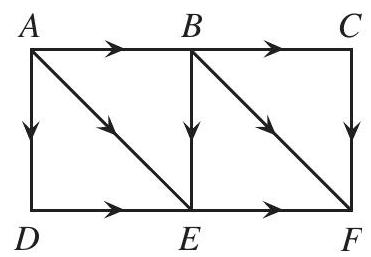 | From $A$, we can travel to $D, E$ or $B$.
If we travel $A \rightarrow D$, we must then go $D \rightarrow E \rightarrow F$, following the arrows.
If we travel $A \rightarrow E$, we must then go $E \rightarrow F$.
If we travel $A \rightarrow B$, we can then travel from $B$ to $E, C$ or $F$.
From $E$ or $C$, we must t... | 5 | Combinatorics | MCQ | Yes | Yes | olympiads | false |
Stretch the abscissa of all points on the graph of the function $y=f\left(x\right)$ to twice the original length, while keeping the ordinate unchanged. Then shift the resulting curve to the right by $\frac{π}{6}$ units, obtaining the graph of the function $y=cos(x+\frac{π}{4})$. The function $f\left(x\right)$ is:
A: $... | To solve this problem, we need to reverse the transformations given in the problem statement. The final function is given as $y=\cos(x+\frac{π}{4})$. The transformations applied to $f(x)$ to obtain this function are stretching the abscissa to twice its original length and then shifting the curve to the right by $\frac{... | \text{C: } \cos(2x+\frac{5π}{12}) | Algebra | MCQ | Yes | Yes | cn_k12 | false |
At each node of the checkboard $n\times n$ board, a beetle sat. At midnight, each beetle crawled into the center of a cell. It turned out that the distance between any two beetles sitting in the adjacent (along the side) nodes didn't increase.
Prove that at least one beetle crawled into the center of a cell at the vert... | 1. **Problem Restatement and Initial Setup:**
We are given an \( n \times n \) checkerboard with a beetle at each node. At midnight, each beetle crawls into the center of a cell. The distance between any two beetles sitting in adjacent nodes does not increase. We need to prove that at least one beetle crawled into t... | null | Logic and Puzzles | proof | Yes | Yes | aops_forum | false |
Elois needs 4 bananas to make 1 loaf of banana bread. On Monday, she makes 3 loaves of banana bread. On Tuesday, she makes twice as many loaves of banana bread as Monday. How many bananas did she use to make all the banana bread? | On Monday, Elois makes 3 loaves of banana bread. Since she needs 4 bananas for 1 loaf, she uses:
3 loaves * 4 bananas/loaf = 12 bananas on Monday.
On Tuesday, she makes twice as many loaves as on Monday, so she makes:
2 * 3 loaves = 6 loaves on Tuesday.
For these 6 loaves, she needs:
6 loaves * 4 bananas/loaf = 24... | 36 | Logic and Puzzles | math-word-problem | Yes | Yes | orca_math | true |
What is the integer part of the result of $10 \div \left(1 \div 1 + 1 \div 2 + \ldots + 1 \div 7\right)$? | We calculate $10 \div \left(1 \div 1 + 1 \div 2 + \ldots + 1 \div 7\right)$ as follows:
$$
= 10 \div \left(1 +
\frac{1}{2}
+
\frac{1}{3}
+ \ldots +
\frac{1}{7}
\right)
$$
$$
\approx 10 \div 2.5928571428571
$$
$$
= 3.86,
$$
Therefore, the integer part is 3.
Hence, the answer is $\boxed{3}$. | 3 | Algebra | math-word-problem | Yes | Yes | cn_k12 | false |
36. Given the lengths of the three sides of $\triangle A B C$ are $a$, $b$, and $c$ satisfying $\frac{4}{a}=\frac{1}{c}+\frac{3}{b}$, then $\angle A$ is $\qquad$ (fill in "acute angle", "right angle", "supplementary angle"). | answer: acute angle | acuteangle | Geometry | math-word-problem | Yes | Yes | olympiads | false |
On the unit circle $k$ with center $O$, points $A$ and $B$ with $AB=1$ are chosen and unit circles $k_1$ and $k_2$ with centers $A$ and $B$ are drawn. A sequence of circles $(l_n)$ is defined as follows: circle $l_1$ is tangent to $k$ internally at $D_1$ and to $k_1,k_2$ externally, and for $n>1$ circle $l_n$ is tangen... | null | null | Geometry | math-word-problem | Yes | Yes | aops_forum | false |
The solution set of the inequality $x^2-3x>0$ is ( )
A: $\{x|0\leq x\leq 3\}$
B: $\{x|x\leq 0, \text{ or } x\geq 3\}$
C: $\{x|03\}$ | The original inequality can be transformed into $x(x-3)>0$, which yields $x3$.
Therefore, the solution set of the original inequality is $\{x|x3\}$.
Hence, the correct choice is $\boxed{D}$. | D | Inequalities | MCQ | Yes | Incomplete | cn_k12 | false |
Given the function $f(x) = \frac{2}{x-2}$,
(I) Use the definition method to prove its monotonicity on the interval $(2,+\infty)$.
(II) Find the maximum and minimum values of $f(x)$ on the interval $[4,5]$. | Based on the proof in (I), we know that the function $f(x)$ is monotonically decreasing on the interval $[4,5]$. Therefore, the minimum value of $f(x)$ is obtained at the right endpoint of the interval and the maximum value at the left endpoint.
Hence, the minimum value of $f(x)$ is $f(5) = \frac{2}{5-2} = \frac{2}{3}... | f(x)_{max} = 1 | Algebra | math-word-problem | Yes | Yes | cn_k12 | false |
A train 250 m long running at 72 kmph crosses a platform in 15 sec. What is the length of the platform? | To find the length of the platform, we first need to calculate the distance the train covers while crossing the platform. Since the train takes 15 seconds to cross the platform, we can use the formula:
Distance = Speed × Time
First, we need to convert the speed from km/h to m/s by multiplying by (1000 m / 1 km) and d... | 50 | Algebra | math-word-problem | Yes | Yes | orca_math | true |
The average (mean) of $ 20$ numbers is $ 30$, and the average of $ 30$ other numbers is $ 20$. What is the average of all $ 50$ numbers?
$ \textbf{(A)}\ 23 \qquad
\textbf{(B)}\ 24 \qquad
\textbf{(C)}\ 25 \qquad
\textbf{(D)}\ 26 \qquad
\textbf{(E)}\ 27$ | null | null | Algebra | MCQ | Yes | Yes | aops_forum | false |
If in the arithmetic sequence $\{a_n\}$, $a_3 + a_5 = 12$, then $a_4 =$ ( )
A: 12
B: 24
C: 6
D: 4 | Since in the arithmetic sequence $\{a_n\}$, $a_3 + a_5 = 12$,
it follows that $2a_4 = a_3 + a_5 = 12$. Solving this equation gives $a_4 = 6$,
therefore, the correct choice is $\boxed{\text{C}}$. | \text{C} | Algebra | MCQ | Yes | Yes | cn_k12 | false |
Given an arithmetic sequence $\{a_n\}$ with the first term $a_1=20$ and common difference $d=-2$, find the value of $a_n$ and the maximum value of the sum of the first $n$ terms, $S_n$. | **Analysis**
This problem mainly examines the application of the general formula for an arithmetic sequence and the formula for the sum of the first $n$ terms, combined with the properties of quadratic functions to solve the problem. First, calculate the sum of the first $n$ terms of the arithmetic sequence, and then ... | 110 | Algebra | math-word-problem | Yes | Yes | cn_k12 | false |
In the arithmetic sequences $\{a_n\}$ and $\{b_n\}$, $a_1=25$, $b_1=15$, $a_{100}+b_{100}=139$, then the sum of the first $100$ terms of the sequence $\{a_n+b_n\}$ is $\boxed{\text{ }}$
A: $0$
B: $4475$
C: $8950$
D: $10,000$ | **Analysis**
This question comprehensively examines the properties of arithmetic sequences and the formula for the sum of the first $n$ terms. The key to solving the problem is to substitute the overall situation, which is a basic question.
By the properties of arithmetic sequences, it can be determined that $\{a_n+b... | C | Algebra | MCQ | Yes | Yes | cn_k12 | false |
The graph of $y = \frac{8x^2 - 7}{6x^2 + 11x + 4}$ has vertical asymptotes at points $x = p$ and $x = q$. Find the product $pq.$ | We determine the vertical asymptotes for the function $y = \frac{8x^2 - 7}{6x^2 + 11x + 4}$ by setting the denominator equal to zero and solving for $x$. This gives us:
\[ 6x^2 + 11x + 4 = 0. \]
This is a quadratic equation, and we can solve it by factoring:
\[ 6x^2 + 11x + 4 = (3x + 4)(2x + 1) = 0. \]
Therefore, the ... | \frac{2}{3} | Algebra | math-word-problem | Yes | Yes | synthetic_math | true |
The average of 10 numbers is 4.60. The average of 3 of them is 3.4, the average of 2 of them is 3.8, and the average of another 3 of them is 4.2. What is the average of the remaining 2 numbers? Additionally, what is the average of another new set of 3 numbers that would maintain the overall average? | Let's first find the sum of all 10 numbers by multiplying the average by the number of values:
Sum of 10 numbers = Average × Number of values
Sum of 10 numbers = 4.60 × 10
Sum of 10 numbers = 46
Now, let's find the sum of the groups for which we know the averages:
Sum of first 3 numbers = Average × Number of values
... | 4.60 | Algebra | math-word-problem | Yes | Yes | orca_math | true |
Real numbers $a$ and $b$ are opposite to each other, $c$ and $d$ are reciprocals, and the absolute value of $x$ is $\sqrt{7}$. Find the value of the algebraic expression $x^{2}+\left(a+b\right)cdx+\sqrt{a+b}+\sqrt[3]{cd}$. | Given the conditions that real numbers $a$ and $b$ are opposite to each other, $c$ and $d$ are reciprocals, and the absolute value of $x$ is $\sqrt{7}$, we can deduce the following:
1. Since $a$ and $b$ are opposite, $a = -b$, which implies $a + b = 0$.
2. Since $c$ and $d$ are reciprocals, $cd = 1$.
3. The absolute v... | 8 | Algebra | math-word-problem | Yes | Yes | cn_k12 | false |
In an election, candidate A got 75% of the total valid votes. If 15% of the total votes were declared invalid and the total number of votes is 560000, find the number of valid votes polled in favor of the candidate. | First, let's find the number of valid votes. Since 15% of the total votes were declared invalid, the remaining 85% were valid.
Total votes = 560000
Percentage of valid votes = 100% - 15% = 85%
Number of valid votes = (85/100) * Total votes
Number of valid votes = (85/100) * 560000
Number of valid votes = 0.85 * 5600... | 357000 | Algebra | math-word-problem | Yes | Yes | orca_math | true |
Suppose the function $f$ has all real numbers in its domain and range and is invertible. Some values of $f$ are given by the following table: $$\begin{array}{c || c | c | c | c | c}
x & 1 & 2 & 3 & 4 & X \\
\hline
f(x) & 2 & 3 & 5 & 7 & 8
\end{array}$$What is the value of $f(f(3)) + f(f^{-1}(4)) + f^{-1}(f^{-1}(5))?$ I... | To solve the problem, we need to determine the values of \( f(f(3)) + f(f^{-1}(4)) + f^{-1}(f^{-1}(5)) \) using the given table and the properties of the invertible function \( f \).
First, let's analyze each term separately:
1. **Finding \( f(f(3)) \):**
- From the table, we see that \( f(3) = 5 \).
- Therefor... | 6 | Algebra | math-word-problem | Yes | Yes | metamath | true |
The numbers 1, 2 and 3 are written on a board. Two friends are playing the following game. A player writes a number that doesn't exceed 2022 and isn't already on the board and is a sum or a product of two numbers that are written on the board. They take turns writing numbers and the winner is the player who writes 2022... | null | null | Logic and Puzzles | math-word-problem | Yes | Yes | aops_forum | false |
A certain number of men can build a wall 112 metres long in 6 days. If 35 men can build a wall 98 metres long in 3 days, how many men were in the first group? | Let's denote the number of men in the first group as M.
We know that 35 men can build a wall 98 meters long in 3 days. This means that in one day, 35 men can build 98/3 meters of the wall.
Now, let's find out how many meters of the wall one man can build in one day. We divide the length of the wall by the number of m... | 20 | Algebra | math-word-problem | Yes | Yes | orca_math | true |
Adam bought 3 types of nuts and 2 types of dried fruits at a store. He bought 1.5 kilograms of almonds, 1 kilogram of walnuts, and 0.5 kilogram of cashews. For the dried fruits, he bought 1 kilogram of raisins and 1.5 kilograms of apricots. One kilogram of almonds costs $12, walnuts are $10 per kilogram, cashews are $2... | To find the total cost of Adam's purchases, we need to calculate the cost of each type of nut and dried fruit and then sum them up.
For the nuts:
- Almonds: 1.5 kg * $12/kg = $18
- Walnuts: 1 kg * $10/kg = $10
- Cashews: 0.5 kg * $20/kg = $10
For the dried fruits:
- Raisins: 1 kg * $8/kg = $8
- Apricots: 1.5 kg * $6/... | \$55 | Algebra | math-word-problem | Yes | Yes | orca_math | true |
A batch of $200$ parts, with a worker making $10$ parts per hour. Express the relationship between the number of people $y$ (in parts) and the time $x$ (in hours) needed to complete the task as ____. | To express the relationship between the number of people $y$ (in parts) and the time $x$ (in hours) needed to complete the task, we start by understanding the given information:
- There are $200$ parts to be made.
- One worker can make $10$ parts per hour.
The total number of parts divided by the parts made per hour ... | y = \frac{20}{x} | Algebra | math-word-problem | Yes | Yes | cn_k12 | false |
Example 7 Convert $\sqrt{11}$ into a continued fraction, and find its first four convergents. | Explanation: Since the largest integer not exceeding $\sqrt{11}$ is 3, we set $\sqrt{11}=3+\frac{1}{a_{1}}\left(0<\frac{1}{a_{1}}<1\right)$. Then
$$
\begin{array}{l}
a_{1}=\frac{1}{\sqrt{11}-3}=\frac{\sqrt{11}+3}{2} \\
=3+\frac{1}{a_{2}}\left(0<\frac{1}{a_{2}}<1\right), \\
a_{2}=\frac{2}{\sqrt{11}-3}=\sqrt{11}+3 \\
=6+... | \frac{3}{1}, \frac{10}{3}, \frac{63}{19}, \frac{199}{60} | Number Theory | math-word-problem | Yes | Yes | cn_contest | false |
"ab < 0" is a ( ) condition for "the curve $ax^2 + by^2 = 1$ to be a hyperbola".
A: Sufficient but not necessary condition
B: Necessary but not sufficient condition
C: Both sufficient and necessary condition
D: Neither sufficient nor necessary condition | The correct answer is $\boxed{\text{C}}$: Both sufficient and necessary condition. | \text{C} | Algebra | MCQ | Yes | Yes | cn_k12 | false |
Define a new sequence \( (b_n) \) such that \( b_1 = 1 \), \( b_2 = \frac{1}{3} \), and for all \( n \geq 3 \),
\[ b_n = \frac{2 - b_{n-1}}{3b_{n-2} + 1}. \]
Find the value of \( b_{100} \). | Compute the first few terms:
- \( b_1 = 1 \),
- \( b_2 = \frac{1}{3} \),
- \( b_3 = \frac{1 - \frac{1}{3}}{3 \cdot 1 + 1} = \frac{2}{3}/4 = \frac{1}{6} \),
- \( b_4 = \frac{2 - \frac{1}{6}}{3 \cdot \frac{1}{3} + 1} = \frac{11}{6}/2 = \frac{11}{12} \),
- \( b_5 = \frac{2 - \frac{11}{12}}{3 \cdot \frac{1}{6} + 1} = \frac... | \frac{11}{12} | Algebra | math-word-problem | Yes | Yes | synthetic_math | true |
8,9
Angle $A$ at the vertex of isosceles triangle $A B C$ is $100^{\circ}$. On ray $A B$, segment $A M$ is laid off, equal to the base $B C$. Find angle $B C M$. | On the ray $B M$, we lay off the segment $B N$ equal to $A M$. Let $A C = A B = a, B N = A M = B C = b$. The angles at the base $C N$ of the isosceles triangle $C B N$ are each $20^{\circ}$. Then
$$
B M = A M - A B = b - a, \quad M N = B N - B M = b - (b - a) = a, \quad C N = 2 B C \cos 20^{\circ} = 2 b \cos 20^{\circ... | 10 | Geometry | math-word-problem | Yes | Yes | olympiads | false |
When a positive integer $N$ is divided by 60 , the remainder is 49 . When $N$ is divided by 15 , the remainder is
(A) 0
(B) 3
(C) 4
(D) 5
(E) 8
## Part B: Each correct answer is worth 6. | When a positive integer $N$ is divided by 60 , the remainder is 49 . When $N$ is divided by 15 , the remainder is
(A) 0
(B) 3
(C) 4
(D) 5
(E) 8
## Solution
This problem can be done in a number of ways. The easiest way is to consider that if $N$ is divided by 60 to achieve a remainder of 49 , it must be a number of th... | 4 | Number Theory | MCQ | Yes | Yes | olympiads | false |
Johnny saved $30 in September, $49 in October, $46 in November, and $55 in December. In January, he saved 15% more than he saved in December. He spent $58 on a video game, $25 on a book, and $40 on a birthday present for his friend. How much money does Johnny have left? | First, let's calculate how much Johnny saved in January. He saved 15% more than he saved in December, which was $55.
15% of $55 is calculated as follows:
(15/100) * $55 = $8.25
So, in January, Johnny saved:
$55 + $8.25 = $63.25
Now, let's add up all the money Johnny saved from September to January:
$30 (September) +... | \$120.25 | Algebra | math-word-problem | Yes | Yes | orca_math | true |
3.71 Can we fill each cell of a $100 \times 100$ grid with one of the numbers 0, 1, or 2, such that in any $3 \times 4$ rectangle there are 3 zeros, 4 ones, and 5 twos? | [Solution], assuming that numbers have been filled in a $100 \times 100$ grid such that in each $3 \times 4$ rectangle, there are 3 zeros, 4 ones, and 5 twos. We first introduce a term: if two shapes have the same number of 0s, 1s, and 2s, then their filling methods are considered the same. It can be seen that the thre... | proof | Combinatorics | math-word-problem | Yes | Yes | olympiads | false |
If k is a non-negative integer and 30^k is a divisor of 929,260, what is the result of the expression 3^k - k^3? | To find the value of k for which 30^k is a divisor of 929,260, we need to factorize 929,260 and see what powers of 30 it contains. Since 30 = 2 * 3 * 5, we need to find the powers of 2, 3, and 5 in the prime factorization of 929,260.
Let's factorize 929,260:
929,260 = 2 * 464,630
464,630 = 2 * 232,315
232,315 = 3 * 7... | 2 | Number Theory | math-word-problem | Yes | Yes | orca_math | true |
Solve the system
$$
\begin{aligned}
& y^{2}=4 x^{3}+x-4 \\
& z^{2}=4 y^{3}+y-4 \\
& x^{2}=4 z^{3}+z-4
\end{aligned}
$$ | The function $4 x^{3}+x-4$ is negative for $x \leq 0$, so all unknowns are positive. The function $4 x^{3}-x^{2}+x-4$ is increasing over the entire number line and equals zero at $x=1$. Therefore, if $x>1$, then $y^{2}=4 x^{3}+x-4>x^{2}$
> 1. Then, similarly, $z^{2}>x^{2}$ and
$x^{2}>z^{2}>y^{2}>x^{2}$, which is impo... | (1,1,1) | Algebra | math-word-problem | Yes | Yes | olympiads | false |
if m is a positive integer and m ^ 2 is divisible by 216, then the largest positive integer that must divide m is ? | To find the largest positive integer that must divide \( m \), we need to factorize 216 and find its prime factors.
\( 216 = 2^3 \times 3^3 \)
Since \( m^2 \) is divisible by 216, \( m \) must contain at least the square root of each prime factor of 216 to be divisible by 216 when squared.
The square root of \( 2^3 ... | 36 | Number Theory | math-word-problem | Yes | Yes | orca_math | true |
Mary tried to improve her health by changing her diet. At first, she dropped a dozen pounds. Then, she added back twice the weight that she initially lost. Then, she dropped three times more weight than she initially had lost. But finally, she gained back half of a dozen pounds. If her final weight was 81 pounds, what ... | Let's break down the changes in Mary's weight step by step:
1. Mary initially lost a dozen pounds. A dozen is 12, so she lost 12 pounds.
2. She then gained back twice the weight she initially lost. Twice 12 is 24, so she gained 24 pounds.
3. After that, she lost three times more weight than she initially had lost. T... | 99 | Algebra | math-word-problem | Yes | Yes | orca_math | true |
Two persons A and B can complete a piece of work in 20 days and some days respectively. If they work together, 0.375 of the work will be completed in 5 days. How many days does it take for person B to complete the work alone? | Let's denote the number of days it takes for person B to complete the work alone as \( x \) days.
Person A can complete the work in 20 days, so A's work rate is \( \frac{1}{20} \) of the work per day.
Person B can complete the work in \( x \) days, so B's work rate is \( \frac{1}{x} \) of the work per day.
When A an... | 40 | Algebra | math-word-problem | Yes | Yes | orca_math | true |
Given is an acute triangle $ ABC$ and the points $ A_1,B_1,C_1$, that are the feet of its altitudes from $ A,B,C$ respectively. A circle passes through $ A_1$ and $ B_1$ and touches the smaller arc $ AB$ of the circumcircle of $ ABC$ in point $ C_2$. Points $ A_2$ and $ B_2$ are defined analogously.
Prove that the ... | null | null | Geometry | proof | Yes | Yes | aops_forum | false |
Let $[x]$ denote the greatest integer not exceeding the real number $x$, and $(a, b)$ denote the greatest common divisor of integers $a$ and $b$. Prove:
(1) There are infinitely many positive integers $n$ such that
$$
(n,[\sqrt{2} n])=1 \text{; }
$$
(2) There are infinitely many positive integers $n$ such that
$$
(n,[\... | Prove that taking $n=2^{k}\left(k \in \mathbf{Z}_{+}\right)$.
Then when $\left[2^{k} \sqrt{2}\right]$ is odd, $\left(2^{k},\left[2^{k} \sqrt{2}\right]\right)=1$;
when $\left[2^{k} \sqrt{2}\right]$ is even, $\left(2^{k},\left[2^{k} \sqrt{2}\right]\right) \geqslant 2$.
Therefore, the original proposition is equivalent to... | proof | Number Theory | proof | Yes | Yes | olympiads | false |
Define the sequence $\left(a_{n}\right)$ as follows: $a_{1}=a_{2}=1, a_{3}=2$,
$$
a_{n+3}=\frac{a_{n+2} a_{n+1}+n!}{a_{n}} \quad(n \geq 1)
$$
Prove that every element of the sequence is an integer. | Solution. By calculating the first few values, it can be conjectured that if $n>1$, then $a_{n}=(n-1)(n-3) \ldots$ (i.e., $a_{2 k}=(2 k-1)(2 k-3) \cdot 5 \cdot 3 \cdot 1$, and $\left.a_{2 k+1}=2 k(2 k-2) \ldots \cdot 6 \cdot 4 \cdot 2\right)$. We will prove that this is indeed the case by complete induction.
i) For $n=... | proof | Algebra | proof | Yes | Yes | olympiads | false |
Let $M,N,P$ be midpoints of $BC,AC$ and $AB$ of triangle $\triangle ABC$ respectively. $E$ and $F$ are two points on the segment $\overline{BC}$ so that $\angle NEC = \frac{1}{2} \angle AMB$ and $\angle PFB = \frac{1}{2} \angle AMC$. Prove that $AE=AF$.
[i]Proposed by Alireza Dadgarnia[/i] | null | null | Geometry | proof | Yes | Yes | aops_forum | false |
If one-fourth of X is equal to $2^x$, $x$ is 28. What is the value of unknown variable X? | To find the value of the unknown variable \( X \), we start with the given equation:
\[
\frac{1}{4}X = 2^x
\]
We are given that \( x = 28 \). Substituting \( x = 28 \) into the equation, we get:
\[
\frac{1}{4}X = 2^{28}
\]
Next, we need to solve for \( X \). To do this, we will isolate \( X \) by multiplying both s... | 1073741824 | Algebra | math-word-problem | Incomplete | Yes | metamath | true |
19.6*. A convex polygon has the following property: if all its sides are moved outward by a distance of 1, the resulting lines form a polygon similar to the original. Prove that this polygon is circumscribed. | 19.6. Let $k$ be the similarity coefficient of polygons, with $k<1$. By shifting the sides of the original polygon inward sequentially by $k, k^{2}, k^{3}, \ldots$, we obtain a contracting system of nested convex polygons, similar to the original with coefficients $k, k^{2}, k^{3}, \ldots$ The unique common point of th... | proof | Geometry | proof | Yes | Yes | olympiads | false |
Two similar right triangles have areas of 10 square units and 250 square units, respectively. The length of the hypotenuse of the smaller triangle is 13 units. What is the sum of the lengths of the legs of the larger triangle? | We first confirm that the smaller triangle can indeed have a hypotenuse of 13 units and an area of 10 square units. Assuming that the smaller triangle might be a 5-12-13 triangle (since 5 and 12 are integers satisfying \(x^2 + y^2 = 13^2\)), then its area would be \(\frac{1}{2}\times 5 \times 12 = 30\) square units. Th... | 35 | Geometry | math-word-problem | Yes | Yes | synthetic_math | true |
$21$ bandits live in the city of Warmridge, each of them having some enemies among the others. Initially each bandit has $240$ bullets, and duels with all of his enemies. Every bandit distributes his bullets evenly between his enemies, this means that he takes the same number of bullets to each of his duels, and uses e... | null | null | Logic and Puzzles | math-word-problem | Yes | Yes | aops_forum | false |
andrea wants to fill in two sections of her backyard with sod that must be purchased in 2 - x - 2 - foot squares . if the two sections measure 30 x 40 feet and 60 x 80 feet , how many squares of sod does she need to buy ? | To find out how many squares of sod Andrea needs to buy, we need to calculate the area of each section of her backyard and then divide by the area of each sod square.
The area of the first section (30 x 40 feet):
Area = length x width
Area = 30 feet x 40 feet
Area = 1200 square feet
The area of the second section (60... | 1500 | Geometry | math-word-problem | Yes | Yes | orca_math | true |
23. [12] Let $d$ be a randomly chosen divisor of 2016 . Find the expected value of
$$
\frac{d^{2}}{d^{2}+2016}
$$ | Answer:
$\frac{1}{2}$
Let $a b=2016$. Then
$$
\frac{a^{2}}{a^{2}+2016}+\frac{b^{2}}{b^{2}+2016}=\frac{a^{2}}{a^{2}+2016}+\frac{\left(\frac{2016}{a}\right)^{2}}{\left(\frac{2016}{a}\right)^{2}+2016}=\frac{a^{2}}{a^{2}+2016}+\frac{2016}{a^{2}+2016}=1
$$
Thus, every divisor $d$ pairs up with $\frac{2016}{d}$ to get 1 , ... | \frac{1}{2} | Number Theory | math-word-problem | Yes | Yes | olympiads | false |
Let $a$ and $b$ be two consecutive integers, and $c = ab$. If $M^2 = a^2 + b^2 + c^2$, prove that $M^2$ is an odd number. | **Proof**: Since $a$ and $b$ are two consecutive integers, without loss of generality, let's assume $a = b + 1$. Then we have:
$$
M^2 = a^2 + b^2 + c^2 = (b + 1)^2 + b^2 + (b + 1)^2b^2
$$
$$
= b^2 + 2b + 1 + b^2 + (b^2 + 2b + 1)b^2
$$
$$
= b^4 + 2b^3 + 3b^2 + 1
$$
If $b$ is an even number, then $b^4$, $2b^3$, and $... | \text{Proven} | Algebra | proof | Yes | Yes | cn_k12 | false |
15 balls numbered from 1 to 15 are placed in a bin. In how many ways can 4 balls be drawn, where the order of drawing the balls does not matter, and each ball remains outside the bin after it is drawn? | Since the order in which balls are drawn does not matter, we need to use combinations instead of permutations. The formula for combinations is given by:
\[ \binom{n}{r} = \frac{n!}{r!(n-r)!} \]
In our problem:
- $n = 15$ (since there are 15 balls),
- $r = 4$ (since we are drawing 4 balls).
Thus, the number of ways to... | 1365 | Combinatorics | math-word-problem | Yes | Yes | synthetic_math | true |
In a plane, two chords that are equidistant from the center of the circle have equal lengths. Similarly, in space, two sections that are equidistant from the ________ have equal areas. | The correct completion for the blank is: $\boxed{\text{center of the sphere}}$. | \text{center of the sphere} | Geometry | math-word-problem | Incomplete | Yes | cn_k12 | false |
In $\triangle ABC$, the three sides $a$, $b$, and $c$ form an arithmetic sequence. What is the range of angle $B$?
A: $(0, \frac{\pi}{3}]$
B: $[\frac{\pi}{6}, \frac{\pi}{2})$
C: $[\frac{\pi}{4}, \frac{\pi}{2})$
D: $(0, \frac{\pi}{2})$ | Let the three sides of the triangle be $a$, $b$, and $c$.
Given that they form an arithmetic sequence, we know that $b = \frac{a + c}{2}$.
Applying the cosine rule, we get:
$$\cos B = \frac{a^2 + c^2 - b^2}{2ac} = \frac{a^2 + c^2 - (\frac{a + c}{2})^2}{2ac} = \frac{3(a^2 + c^2) - 2ac}{8ac} \geqslant \frac{6ac - 2ac}... | A | Geometry | MCQ | Yes | Yes | cn_k12 | false |
Given $$\frac {1}{a} ab$
B: $|a| > |b|$
C: $a 2$$ | Since $$\frac {1}{a} 2$$, and $ab > 0 > a+b$, $|a| < |b|$, which is incorrect.
Hence, the correct choice is: $\boxed{\text{D}}$.
This can be derived using the basic properties of inequalities.
This question tests the ability to solve and understand the properties of inequalities, reasoning, and computational ski... | \text{D} | Algebra | other | Incomplete | Yes | cn_k12 | false |
Rationalize the denominator:
$$\frac{1}{\sqrt[3]{3} + \sqrt[3]{81}}$$ | First, we simplify $\sqrt[3]{81}$:
$$\sqrt[3]{81} = \sqrt[3]{3^4} = 3 \sqrt[3]{3}$$
Substituting this, the fraction becomes:
$$\frac{1}{\sqrt[3]{3} + 3\sqrt[3]{3}} = \frac{1}{4\sqrt[3]{3}}$$
To rationalize the denominator, we must multiply numerator and denominator by $\sqrt[3]{9}$ to eventually eliminate the cube roo... | \frac{\sqrt[3]{9}}{12} | Algebra | math-word-problem | Yes | Yes | synthetic_math | true |
Given that the center of circle $M$ is $\left(a,0\right)$ with $\left(a\leqslant 0\right)$, it passes through point $P\left(0,-2\right)$, and is tangent to the line $x+y+2\sqrt{2}=0$.
$(1)$ Find the standard equation of circle $M$.
$(2)$ If a line $l$ passing through point $Q\left(0,1\right)$ with slope $k$ interse... | ### Step-by-Step Solution
#### Part (1): Finding the Standard Equation of Circle $M$
Let's start by considering the standard equation of a circle centered at $(a, 0)$ and passing through point $(0, -2)$, which is:
\[ (x-a)^{2} + y^{2} = r^{2} \]
Given that the circle is tangent to the line $x + y + 2\sqrt{2} = 0$, t... | y = \pm x + 1 | Geometry | math-word-problem | Yes | Yes | cn_k12 | false |
Given the function $f(x)=2\sin (x+\frac{π}{4})\cos (x+\frac{π}{4})+2\sqrt{3}\sin x\cos x$. Find:$(1)$ The interval where $f(x)$ is monotonically increasing;$(2)$ If $f({\frac{α}{2}})=\frac{8}{5}$, and $α∈({\frac{π}{2},π})$, find the value of $\sin \alpha$. | ### Solution:
#### Part (1): Finding the Interval Where $f(x)$ is Monotonically Increasing
Given the function $f(x)=2\sin (x+\frac{π}{4})\cos (x+\frac{π}{4})+2\sqrt{3}\sin x\cos x$, we can simplify it using trigonometric identities:
1. Use the double angle formula $\sin 2\theta = 2\sin \theta \cos \theta$:
$$f(x)... | \frac{4\sqrt{3} + 3}{10} | Algebra | math-word-problem | Yes | Yes | cn_k12 | false |
There were 1238 apples and 374 more pears than apples in the fruit shop. Of these, a few apples were sold, and 276 pears were bought, so the total of apples and pears was 2527. How many apples have been sold? | Let's start by calculating the total number of pears before any were bought. Since there were 374 more pears than apples, we can express the number of pears as:
Number of pears = Number of apples + 374
Number of pears = 1238 + 374
Number of pears = 1612
Now, we know that 276 pears were bought, so the new total number... | 599 | Algebra | math-word-problem | Yes | Yes | orca_math | true |
Example 4 As shown in Figure 6, in $\triangle ABC$, the excircle $\odot O$ opposite to point $A$ touches $AB$, $BC$, and $CA$ at points $D$, $E$, and $F$ respectively. $EZ$ is the diameter of $\odot O$. The perpendiculars from points $B$ and $C$ to $BC$ intersect $DF$ at points $B_1$ and $C_1$ respectively. $ZB_1$ and ... | Proof: Let $XH$ and $YH$ intersect the opposite sides at points $P$ and $Q$, and $DF$ intersects $BC$ at point $N$.
For the line $NDF$ and $\triangle ABC$, applying Menelaus' theorem, we get
\[ 1 = \frac{AD}{DB} \cdot \frac{BN}{NC} \cdot \frac{CF}{FA} = \frac{BN}{EB} \cdot \frac{CE}{NC} \]
\[ \Rightarrow N, B, E, C \t... | proof | Geometry | proof | Yes | Yes | olympiads | false |
In a factory, there are four different alloys with varying chromium percentages. The first alloy, A1, contains 12% chromium, the second alloy, A2, has 10% chromium, the third alloy, A3, has 8% chromium, and the fourth alloy, A4, has 15% chromium. The factory decides to melt a specific amount of each alloy, where the we... | To find the percentage of chromium in the newly formed alloy (A5), we need to calculate the total weight of chromium from each of the four alloys and then divide that by the total weight of the combined alloys.
First, let's calculate the weight of chromium in each alloy:
For A1 (12% of 15 kg):
Chromium in A1 = 12/100... | 10.35\% | Algebra | math-word-problem | Yes | Yes | orca_math | true |
The relationship between the displacement $h$ (in meters) and time $t$ (in seconds) during the motion of an object is given by the function $h=1.5t-0.1t^2$. Find the instantaneous velocity of the object at $t=3$ seconds (in meters per second). | To find the instantaneous velocity of the body at a given moment, we need to calculate the derivative of the displacement function with respect to time, since velocity is the rate of change of displacement.
The displacement of the body is given by $h=1.5t-0.1t^2$.
To find the derivative, we apply the power rule to e... | 0.9 \, \text{m/s} | Calculus | math-word-problem | Yes | Yes | cn_k12 | false |
The sum of the interior angles of a regular polygon with side length 2 is twice the sum of its exterior angles. What is the radius of this regular polygon?
A: 2
B:
C: 1
D: | Since the sum of the exterior angles of any convex polygon is always $360^\circ$, if the sum of the interior angles of the regular polygon is twice the sum of its exterior angles, then the sum of its interior angles is $720^\circ$. Therefore, this polygon is a regular hexagon. Consequently, the side length is equal to ... | A | Geometry | MCQ | Yes | Yes | cn_k12 | false |
A certain product costs $6$ per unit, sells for $x$ per unit $(x > 6)$, and has an annual sales volume of $u$ ten thousand units. It is known that $\frac{585}{8} - u$ is directly proportional to $(x - \frac{21}{4})^2$, and when the selling price is $10$ dollars, the annual sales volume is $28$ ten thousand units.
(1) ... | (1) Let's denote $\frac{585}{8} - u = k(x - \frac{21}{4})^2$. Given that when the selling price is $10$ dollars, the annual sales volume is $28$ ten thousand units, we can write the equation $\frac{585}{8} - 28 = k(10 - \frac{21}{4})^2$. Solving for $k$, we get $k = 2$.
So, $u = -2(x - \frac{21}{4})^2 + \frac{585}{8} ... | 135 | Algebra | math-word-problem | Yes | Yes | cn_k12 | false |
During the "National Day" golden week this year, Jishou city received a total of 388,800 tourists. Express 388,800 in scientific notation. | Solution: $388800 = 3.888 \times 10^{5}$.
Therefore, the answer is: $3.888 \times 10^{5}$.
The form of scientific notation is $a \times 10^{n}$, where $1 \leqslant |a| < 10$, and $n$ is an integer. To determine the value of $n$, we need to see how many places the decimal point has moved to turn the original number ... | 3.888 \times 10^{5} | Algebra | math-word-problem | Yes | Yes | cn_k12 | false |
John's new computer cost $1500. He needs to get a monitor, printer, and speakers which together cost 1/4 of the computer's price. He also wants to upgrade the $300 video card in the base computer with one that costs 2.5 times as much. A 12% discount is available on the video card and a 5% sales tax is applicable on the... | First, let's calculate the cost of the peripherals (monitor, printer, and speakers) which is 1/4 of the computer's price:
Cost of peripherals = 1/4 * $1500 = $375
Next, let's calculate the cost of the upgraded video card before the discount:
Cost of upgraded video card = 2.5 * $300 = $750
Now, let's apply the 12% d... | \$2553.75 | Algebra | math-word-problem | Yes | Yes | orca_math | true |
Let $\mathbf{m},$ $\mathbf{n},$ and $\mathbf{p}$ be unit vectors such that the angle between $\mathbf{m}$ and $\mathbf{n}$ is $\alpha,$ and the angle between $\mathbf{p}$ and $\mathbf{m} \times \mathbf{n}$ is also $\alpha.$ If $\mathbf{n} \cdot (\mathbf{p} \times \mathbf{m}) = \frac{1}{8},$ find the smallest possible v... | Using the scalar triple product, we have:
\[\mathbf{p} \cdot (\mathbf{m} \times \mathbf{n}) = \mathbf{n} \cdot (\mathbf{p} \times \mathbf{m}) = \frac{1}{8}.\]
Given that $\mathbf{m}, \mathbf{n}, \text{ and } \mathbf{p}$ are unit vectors, we use:
\[\|\mathbf{p}\| \|\mathbf{m} \times \mathbf{n}\| \cos \alpha = \frac{1}{8... | 7.5^\circ | Algebra | math-word-problem | Yes | Yes | synthetic_math | true |
The sequence $a_1 = 1$, $a_2, a_3, \cdots$ is defined as follows: if $a_n - 2$ is a natural number not already occurring on the board, then $a_{n+1} = a_n-2$; otherwise, $a_{n+1} = a_n + 3$. Prove that every nonzero perfect square occurs in the sequence as the previous term increased by $3$. | 1. **Define the sequence and the problem statement:**
The sequence \( \{a_n\} \) is defined as follows:
- \( a_1 = 1 \)
- For \( n \geq 1 \), if \( a_n - 2 \) is a natural number not already in the sequence, then \( a_{n+1} = a_n - 2 \); otherwise, \( a_{n+1} = a_n + 3 \).
We need to prove that every nonze... | null | Logic and Puzzles | proof | Yes | Yes | aops_forum | false |
The graph of the function $f(x)=a^{x-1}+3$ always passes through a fixed point $P$. The coordinates of point $P$ are \_\_\_\_\_. | The graph of $f(x)=a^{x-1}+3$ can be considered as the graph of $f(x)=a^{x}$ shifted one unit to the right and then three units up.
Since the graph of $f(x)=a^{x}$ always passes through the point $(0,1)$,
then the graph of $f(x)=a^{x-1}+3$ must pass through the point $(1,4)$.
Therefore, the answer is: $(1,4)$.
... | (1,4) | Algebra | math-word-problem | Yes | Yes | cn_k12 | false |
Zainab earns different hourly rates passing out flyers at the town square depending on the day. On Mondays, she works 3 hours and earns $2.50 per hour. On Wednesdays, she works 4 hours and earns $3 per hour. On Saturdays, she works for 5 hours and earns $3.50 per hour. Additionally, Zainab earns a $0.1 commission for e... | To calculate Zainab's total earnings after passing out flyers for 4 weeks, we need to calculate her earnings for each day of the week and then sum them up.
Mondays:
She works for 3 hours and earns $2.50 per hour.
Earnings for one Monday = 3 hours * $2.50/hour = $7.50
Wednesdays:
She works for 4 hours and earns $3 per... | \$228 | Algebra | math-word-problem | Yes | Yes | orca_math | true |
4. Through a point $A$ on the line $x=-4$, draw a tangent line $l$ to the parabola $C$: $y^{2}=2 p x(p>0)$, with the point of tangency being $B(1,2)$. Line $l$ intersects the $x$-axis at point $D$. $P$ is a moving point on the parabola $C$ different from point $B$. $\overrightarrow{P E}=\lambda_{1} \overrightarrow{P A}... | 4. $y^{2}=\frac{8}{3}\left(x+\frac{1}{3}\right)\left(y \neq \frac{4}{3}\right)$.
It is easy to know that the parabola $y^{2}=4 x$, and the tangent line $l_{A B}: y=x+1$.
Then $D(-1,0), A(-4,-3)$
$$
\Rightarrow \overrightarrow{A D}=\frac{3}{2} \overrightarrow{D B} \text {. }
$$
Thus, $\overrightarrow{P D}=\frac{2}{5} ... | y^{2}=\frac{8}{3}\left(x+\frac{1}{3}\right)\left(y \neq \frac{4}{3}\right) | Geometry | math-word-problem | Yes | Yes | cn_contest | false |
A company has some managers and 75 associates. The managers have an average salary of $90,000. The 75 associates have an average salary of $30,000. The average salary for the company is $40,000. How many managers are there in the company? | Let's denote the number of managers as M.
The total salary paid to the managers is M * $90,000.
The total salary paid to the associates is 75 * $30,000.
The average salary for the company is given as $40,000, and this is calculated by dividing the total salary paid to all employees by the total number of employees (m... | 15 | Algebra | math-word-problem | Yes | Yes | orca_math | true |
Yvonne brings a box of chocolates to school. Half have nuts and half do not. The students eat 80% of the ones with nuts and eat half of the ones without nuts. There were 80 chocolates in the box. How many chocolates are left after the students eat some? | Let's start by dividing the chocolates into two groups: those with nuts and those without nuts. Since half of the 80 chocolates have nuts and the other half do not, we can calculate the number in each group:
Number of chocolates with nuts = 80 chocolates * 1/2 = 40 chocolates
Number of chocolates without nuts = 80 cho... | 28 | Logic and Puzzles | math-word-problem | Yes | Yes | orca_math | true |
8. The tourists in a travel group are traveling by car, requiring an equal number of people in each car. If each car carries 30 people, one person will be left without a seat; if one car is removed, all tourists can be evenly distributed among the remaining cars. Given that each car can accommodate a maximum of 40 peop... | answer: 961 | 961 | Number Theory | math-word-problem | Yes | Yes | olympiads | false |
Akopyan E.
Malvina wrote the equality $\mathrm{MA} \cdot \mathrm{TE} \cdot \mathrm{MA} \cdot \mathrm{TИ} \cdot \mathrm{KA}=2016000$ and suggested to Buratino to replace the same letters with the same digits, different letters with different digits, so that the equality becomes true. Does Buratino have a chance to comp... | $2016000=2^{8} \cdot 3^{2 \cdot 5} \cdot 5^{3} \cdot 7$
## Solution
For example: $10 \cdot 24 \cdot 10 \cdot 28 \cdot 30=2016000$ or $10 \cdot 28 \cdot 10 \cdot 24 \cdot 30=2016000$.
## Answer
There is.
| Thereis | Logic and Puzzles | math-word-problem | Yes | Yes | olympiads | false |
There were 13 roses and some orchids in the vase. Jessica cut some more roses and orchids from her flower garden. There are now 91 orchids and 14 roses in the vase. How many orchids were initially in the vase before Jessica cut more? | Let's denote the initial number of orchids in the vase as O.
According to the information given, after Jessica cut more flowers, there are now 14 roses in the vase. Since there were initially 13 roses, this means Jessica added 14 - 13 = 1 more rose.
The total number of roses and orchids in the vase after Jessica adde... | 91 | Algebra | math-word-problem | Yes | Incomplete | orca_math | true |
Find the values of $a$ for which the quadratic equation $3x^2 + ax + 6x + 7 = 0$ has only one solution for $x$. What is the sum of those values of $a$? | Start with the equation:
\[ 3x^2 + ax + 6x + 7 = 0 \]
Combine like terms for $x$:
\[ 3x^2 + (a+6)x + 7 = 0 \]
For the equation $3x^2 + (a+6)x + 7 = 0$ to have exactly one solution, the discriminant must be zero:
\[ \Delta = b^2 - 4ac = (a+6)^2 - 4 \cdot 3 \cdot 7 = 0 \]
\[ (a+6)^2 = 84 \]
\[ a+6 = \pm \sqrt{84} = \pm 2... | -12 | Algebra | math-word-problem | Yes | Yes | synthetic_math | true |
1・184 (1) Given a set of positive numbers $(a, b, c, d)$, a new array $(a b, b c, c d, d a)$ can be obtained according to the following rule: each number is multiplied by the next one, and the 4th number is multiplied by the first one. According to this rule, a third array, a fourth array, etc., can also be obtained. P... | [Proof] (1) Suppose four positive numbers $(a, b, c, d)$ reappear.
First, we prove: In this case, $a b c d=1$.
Let $a b c d=p$, then the product of the second set of four positive numbers equals $p^{2}$, the third set is $p^{4}$, and the fourth set is $p^{8}, \cdots$ Clearly, when $p \neq 1$, there will be no two ident... | proof | Algebra | proof | Yes | Yes | inequalities | false |
Suppose the product of the greatest common divisor (GCD) and least common multiple (LCM) of two integers is 360. How many different values could be the GCD of these two integers? | Given $\gcd(a, b) \cdot \mathop{\text{lcm}}[a, b] = ab$ and $ab = 360$. The prime factorization of 360 is $2^3 \cdot 3^2 \cdot 5$. Letting $a = 2^p \cdot 3^q \cdot 5^r$ and $b = 2^s \cdot 3^t \cdot 5^u$, then $ab = 2^{p + s} \cdot 3^{q + t} \cdot 5^{r + u}$. Setting these equal to $360$ gives $p + s = 3$, $q + t = 2$, ... | 11 | Number Theory | math-word-problem | Yes | Yes | synthetic_math | true |
Given a sequence $\{a_{n}\}$ that satisfies: $a_{1}=1$, $a_{n+1}=2a_{n}+n-1$.
$(1)$ Prove that the sequence $\{a_{n}+n\}$ is a geometric sequence and find the general term formula for the sequence $\{a_{n}\}$.
$(2)$ If the sequence $\{b_{n}\}$ satisfies ${b}_{n}=\frac{2n-1}{{a}_{n}+n}$, find the sum of the first $n... | ### Solution:
#### Part (1): Proving the sequence $\{a_{n}+n\}$ is a geometric sequence and finding the general term formula for $\{a_{n}\}$.
Given: $a_{1}=1$, $a_{n+1}=2a_{n}+n-1$.
To prove $\{a_{n}+n\}$ is a geometric sequence, we calculate the ratio between consecutive terms:
\[
\frac{{a}_{n+1}+n+1}{{a}_{n}+n} =... | {S}_{n}=3-\frac{2n+3}{{2}^{n}} | Algebra | math-word-problem | Yes | Yes | cn_k12 | false |
Theorem 10 Let $m \mid\left(a_{1}, \cdots, a_{k}\right)$. We have
$$m\left(a_{1} / m, \cdots, a_{k} / m\right)=\left(a_{1}, \cdots, a_{k}\right)$$
In particular, we have
$$\left(\frac{a_{1}}{\left(a_{1}, \cdots, a_{k}\right)}, \cdots, \frac{a_{k}}{\left(a_{1}, \cdots, a_{k}\right)}\right)=1$$ | Let $D=\left(a_{1}, \cdots, a_{k}\right)$. From $m|D, D| a_{j}(1 \leqslant j \leqslant k)$ we know
$$m \mid a_{j} \quad(1 \leqslant j \leqslant k),$$
thus we have
$$(D / m) \mid\left(a_{j} / m\right), \quad j=1, \cdots, k,$$
which means $D / m$ is a common divisor of $a_{1} / m, \cdots, a_{k} / m$, and it is positive... | proof | Number Theory | proof | Yes | Yes | number_theory | false |
What is the sum of all of the solutions of the equation $\frac{3x}{15} = \frac{4}{x}$? | 1. Simplify the fraction on the left side: $\frac{3x}{15} = \frac{x}{5}$.
2. Multiply both sides by $5x$ to eliminate the denominator, resulting in $5x^2 = 20x$.
3. Simplify and rearrange to form a quadratic equation: $5x^2 - 20x = 0$.
4. Factor out the common term: $5x(x - 4) = 0$.
5. Set each factor to zero and solve... | 4 | Algebra | math-word-problem | Yes | Yes | synthetic_math | true |
If one person spends one minute waiting in a queue, we will say that one person-minute is wasted. In a bank queue, there are eight people, five of whom plan to perform simple operations taking 1 minute, while the rest plan to perform long operations taking 5 minutes. Find:
a) the minimum and maximum possible total num... | Let a short operation take $a$, and a long one - $b$ minutes $(a<b)$. A client planning a simple operation will be called a rusher, and one who intends to take a long time - a dawdler. Suppose there are $n$ rushers and $m = -2$ dawdlers.
Obviously, the number of wasted person-minutes depends on the order in which the ... | 40 | Combinatorics | math-word-problem | Yes | Yes | olympiads | false |
46. Let $a_{1}, a_{2}, \cdots, a_{n}$ be $n(n \geqslant 2)$ positive numbers that are not all equal, and satisfy $\sum_{k=1}^{n} a_{k}^{-2 n}=1$. Prove that: $\sum_{k=1}^{n} a_{k}^{2 n}-n^{2} \sum_{1 \leqslant i<j \leqslant n} a_{i}^{-2} a_{j}^{-2} > n^{2} .(2003$ National Training Team Exam Question) | 46. The original inequality is equivalent to
$$\sum_{k=1}^{n} a_{k} \sum_{k=1}^{n} \frac{1}{a_{k}}-n^{2} \sum_{-1 \leqslant in^{2}$$
We now prove (1).
Notice that for any $x>0$, by the arithmetic-geometric mean inequality, we have $\sum_{k=0}^{n-1} x^{n-1-2 k} \geqslant n$, with equality if and only if $x=1$. And $\le... | proof | Inequalities | proof | Yes | Yes | inequalities | false |
Subsets and Splits
No community queries yet
The top public SQL queries from the community will appear here once available.