
instruction_seed stringlengths 2 10.7k | solution stringlengths 0 10.8k ⌀ | answer stringlengths 0 575 ⌀ | problem_type stringclasses 9
values | question_type stringclasses 5
values | problem_is_valid stringclasses 5
values | solution_is_valid stringclasses 4
values | source stringclasses 11
values | synthetic bool 2
classes |
|---|---|---|---|---|---|---|---|---|
Example 12 (1990 Balkan Mathematical Olympiad) Let the sequence $\left\{a_{n}\right\}$ satisfy $a_{1}=1, a_{2}=3$, and for all $n \in \mathbf{N}$, $a_{n+2}=(n+3) a_{n+1}-(n+2) a_{n}$. Find all values of $n$ for which $a_{n}$ is divisible by 11. | Given $a_{n+2}-a_{n+1}=(n+2)\left(a_{n+1}-a_{n}\right)$, we construct a new sequence $\left\{b_{n}\right\}(n \geqslant 2), b_{n+1}=a_{n+1}-a_{n}(n \geqslant 1)$, then $b_{2}=2, b_{n+1}=(n+1)\left(a_{n}-a_{n-1}\right)=(n+1) b_{n}(n \geqslant 2)$,
$$
\therefore b_{n}=n b_{n-1}=n(n-1) b_{n-2}=\cdots=n(n-
$$
1) $\cdots 3 b... | 4,8allnaturaln\geqslant10 | Algebra | math-word-problem | Yes | Yes | olympiads | false |
For a real number $x$, let $\lceil x \rceil$ denote the smallest integer not less than $x$. The solution set of the inequality $\lceil x \rceil^2 - \lceil x \rceil - 12 \leq 0$ is \_\_\_\_\_\_. | Since $\lceil x \rceil^2 - \lceil x \rceil - 12 \leq 0$,
it is equivalent to $(\lceil x \rceil - 4)(\lceil x \rceil + 3) \leq 0$,
Therefore, $-3 \leq \lceil x \rceil \leq 4$,
Since $\lceil x \rceil$ denotes the smallest integer not less than $x$,
Therefore, $-3 \leq x < 5$,
Hence, the solution set of the ineq... | [-3, 5) | Inequalities | math-word-problem | Yes | Yes | cn_k12 | false |
Find the sum of the coefficients of all terms, excluding the constant term, in the expansion of the binomial ${(\frac{1}{x}-2{{x}^{2}})}^{9}$. | **Analysis:**
This problem involves the binomial theorem and its coefficients. By setting $x=1$, we can find the sum of all coefficients in the expansion. Then, we can determine the constant term and subtract it to find the sum of the non-constant term coefficients.
**Step 1:** Set $x = 1$
By setting $x = 1$, we find ... | 671 | Algebra | math-word-problem | Yes | Yes | cn_k12 | false |
Show that
$$
(x-a)^{2}(b-c)+(x-b)^{2}(c-a)+(x-c)^{2}(a-b)
$$
can be factored into a product of three linear factors independent of $x$. | # I. Solution.
$$
\begin{gathered}
(x-a)^{2}(b-c)+(x-b)^{2}(c-a)+(x-c)^{2}(a-b)= \\
=\left(x^{2}-2 a x+a^{2}\right)(b-c)+\left(x^{2}-2 b x+b^{2}\right)(c-a)+ \\
+\left(x^{2}-2 c x+c^{2}\right)(a-b)=x^{2}(b-c+c-a-b)- \\
-x(2 a b-2 a c+2 b c-2 a b+2 a c-2 b c)+a^{2}(b-c)+b^{2}(c-a)+ \\
+c^{2}(a-b)=a^{2}(b-c)+b^{2} c-a b... | -(-b)(b-)(-) | Algebra | proof | Yes | Yes | olympiads | false |
Given an arithmetic sequence $\{a_n\}$ with the sum of its first $n$ terms denoted as $S_n$, and $3a_3=a_6+4$, then "$a_2 < 1$" is a $(\quad)$ condition for "$S_5 < 10$".
A: Sufficient but not necessary condition
B: Necessary but not sufficient condition
C: Necessary and sufficient condition
D: Neither sufficient nor n... | Let the common difference be $d$. From $3a_3=a_6+4$, we get $3a_2+3d=a_2+4d+4$, which simplifies to $d=2a_2-4$.
Given $S_5 < 10$, we have $\frac{5(a_1+a_5)}{2} = \frac{5(a_2+a_4)}{2} = \frac{5(6a_2-8)}{2} < 10$, which implies $a_2 < 2$.
Therefore, "$a_2 < 1$" is a sufficient but not necessary condition for "$S_5 < 10... | \text{A} | Algebra | MCQ | Yes | Yes | cn_k12 | false |
In the three-dimensional Cartesian coordinate system, the coordinates of the point symmetric to point A(1, 1, 2) with respect to the x-axis are ____. | Given point A(1, 1, 2),
the coordinates of a point symmetric to another with respect to the x-axis only have the x-coordinate unchanged, while the y and z coordinates change their signs,
Therefore, the coordinates of the point symmetric to point A(1, 1, 2) with respect to the x-axis are (1, -1, -2).
Hence, the an... | (1, -1, -2) | Geometry | math-word-problem | Yes | Yes | cn_k12 | false |
13. Given the function $f(x)=ax\ln x$, where $x\in (0,+\infty )$ and $a$ is a real number, and $f'(x)$ is the derivative of $f(x)$. If $f'(1)=3$, then $a=\boxed{3}$. | **Analysis**
This question examines the rules of differentiation, which is a basic topic.
By applying the rules of differentiation and then substituting the values, we can find the solution.
**Solution**
Since $f'(x)=a(1+\ln x)$ and $f'(1)=3$,
we have $a(1+\ln 1)=3$.
Solving this equation, we get $a=3$.
Therefo... | 3 | Calculus | math-word-problem | Yes | Yes | cn_k12 | false |
Lucia is a dedicated dancer. She takes 3 hip-hop classes a week, 1 salsa class every two weeks, 2 ballet classes a week, 1 jazz class a week, and 1 contemporary dance class every three weeks. One hip-hop class costs $10.50, one salsa class costs $15, one ballet class costs $12.25, one jazz class costs $8.75, and one co... | To calculate the total cost of Lucia's dance classes for a four-week period, we need to determine how many times she attends each type of class within those four weeks and then multiply by the cost per class.
Hip-hop classes:
She takes 3 classes a week, so in four weeks, she would take 3 classes/week * 4 weeks = 12 cl... | \$299 | Algebra | math-word-problem | Yes | Yes | orca_math | true |
In a certain triangle, the difference between two sides: $b-c$ is twice the distance from the angle bisector $f_{\alpha}$, which starts from the common vertex $A$ of the two sides, to the foot $M$ of the altitude. What is the angle $\alpha$ formed by the two sides? | I. Solution: The labeling is shown in Figure 1.
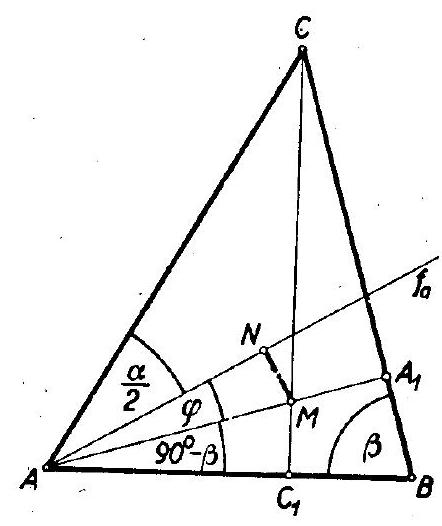
Figure 1
Starting from the equation
$$
2 \cdot M N=b-c
$$
we need to transform this equation so that we can calculate $\alpha$ from it, whic... | \alpha=60 | Geometry | math-word-problem | Yes | Yes | olympiads | false |
A circle is drawn through the left focus $F(-c,0)$ of the hyperbola $\frac{x^2}{a^2} - \frac{y^2}{b^2} = 1$ ($a > 0, b > 0$), with the equation ${x^2} + {y^2} = {a^2}$. The tangent to this circle at point $E$ is extended to intersect the parabola ${y^2} = 4cx$ at point $P$. Let $O$ be the origin. If $\vec{OE} = \frac{1... | **Analysis**
This problem mainly tests the standard equation of a hyperbola and the application of simple properties of hyperbolas, focusing on computational solving abilities and the idea of combining geometric shapes with algebraic transformations. It is considered a medium-level question.
**Solution**
Let's denot... | \text{B} | Geometry | MCQ | Yes | Yes | cn_k12 | false |
Lemma 1 Let $x, y \in \overline{\mathbf{R}}_{-}$, and $x y=1$, then
$$\frac{1}{\sqrt{2 x+1}}+\frac{1}{\sqrt{2 y+1}} \leqslant \frac{2}{\sqrt{3}}$$
Equality holds in (3) if and only if $x=y=1$. | Prove (3) $\Leftrightarrow \sqrt{3}(\sqrt{2 x+1}+$
$$\begin{array}{l}
\sqrt{2 y+1}) \leqslant 2 \sqrt{(2 x+1)(2 y+1)} \\
\Leftrightarrow \quad 3(\sqrt{2 x+1}+\sqrt{2 y+1})^{2} \\
\quad \leqslant 4(2 x+1)(2 y+1) \\
\Leftrightarrow \quad 3 \sqrt{(2 x+1)(2 y+1)} \leqslant x+y+7 \\
\Leftrightarrow \quad 9(2 x+1)(2 y+1) \le... | proof | Inequalities | proof | Yes | Yes | inequalities | false |
10. For the geometric sequence $\left\{a_{n}\right\}$ with the first term $a_{1}=1536$, common ratio $q=-\frac{1}{2}$, $\Pi_{n}$ represents the product of its first $n$ terms $\left(n \in \mathbf{N}^{*}\right)$, the value of $n$ that maximizes $\mathrm{II}_{n}$ is . $\qquad$ | 10. 12 The general term formula of the geometric sequence $\left\{a_{n}\right\}$ is $a_{n}=1536 \cdot\left(-\frac{1}{2}\right)^{n-1}$, to make the product of the first $n$ terms $\Pi_{n}$ maximum, $n$ must be an odd number or a multiple of 4. Let $\left|a_{n}\right| \geqslant 1$ get $1536 \cdot\left(\frac{1}{2}\right)^... | 12 | Algebra | math-word-problem | Yes | Yes | olympiads | false |
Point $(x,y)$ is randomly picked from the rectangular region with vertices at $(0,0)$, $(2016,0)$, $(2016,2016)$, and $(0,2016)$. What is the probability that $x > 8y$? Express your answer as a common fraction. | To determine which points in the rectangle satisfy $x > 8y$, rewrite the inequality as $y 8y$ is the ratio of the area of the triangle to the area of the rectangle:
\[
\text{Probability} = \frac{253008}{4064256}
\]
\[
\text{Probability} = \frac{127}{2032}
\]
Thus, the probability that $x > 8y$ is $\boxed{\frac{127}{20... | \frac{127}{2032} | Geometry | math-word-problem | Yes | Incomplete | synthetic_math | true |
Mohammad has 200 bags of chips. Two fifths of the bags of chips are Doritos. If Mohammad wants to split the bags of Doritos into 5 equal piles, how many bags of Doritos will be in each pile? | First, we need to find out how many bags of Doritos Mohammad has. Since two fifths of the bags are Doritos, we calculate:
2/5 * 200 = 80 bags of Doritos.
Now, Mohammad wants to split these 80 bags into 5 equal piles. To find out how many bags of Doritos will be in each pile, we divide the total number of Doritos bags... | 16 | Algebra | math-word-problem | Yes | Yes | orca_math | true |
I have two 20-sided dice. The first die has 5 maroon sides, 6 teal sides, 7 cyan sides, and 2 sparkly sides. The second die has 4 maroon sides, 7 teal sides, 8 cyan sides, and 1 sparkly side. If I roll both dice, what is the probability that they come up the same? | To solve the problem, we will calculate the probability of both dice showing the same color and then sum these probabilities.
1. **Maroon**:
- First die: $\frac{5}{20} = \frac{1}{4}$
- Second die: $\frac{4}{20} = \frac{1}{5}$
- Both show maroon: $\left(\frac{1}{4}\right)\left(\frac{1}{5}\right) = \frac{1}{20... | \frac{3}{10} | Combinatorics | math-word-problem | Yes | Yes | synthetic_math | true |
Sam is thinking of a positive integer less than 150. It is two less than a multiple of 9, and it is four more than a multiple of 5. What is the greatest possible integer Sam could be thinking of? | Let $m$ be the greatest possible integer Sam could be thinking of. We need to satisfy two conditions:
1. $m = 9a - 2$ for some integer $a$.
2. $m = 5b + 4$ for another integer $b$.
Equating the two expressions, we get:
\[ 9a - 2 = 5b + 4 \]
Rearranging and simplifying gives:
\[ 9a - 5b = 6 \]
We need to find values o... | 124 | Number Theory | math-word-problem | Yes | Yes | synthetic_math | true |
Given a finite nonempty set $X$ with real values, let $f(X) = \frac{1}{|X|} \displaystyle\sum\limits_{a\in X} a$, where $\left\lvert X \right\rvert$ denotes the cardinality of $X$. For ordered pairs of sets $(A,B)$ such that $A\cup B = \{1, 2, \dots , 100\}$ and $A\cap B = \emptyset$ where $1\leq |A| \leq 98$, select ... | 1. **Define the function \( f \) and the sets \( A_p \) and \( B_p \):**
Given a finite nonempty set \( X \) with real values, the function \( f \) is defined as:
\[
f(X) = \frac{1}{|X|} \sum_{a \in X} a
\]
where \( |X| \) denotes the cardinality of \( X \). For ordered pairs of sets \( (A, B) \) such th... | \frac{625}{196} | Combinatorics | math-word-problem | Yes | Yes | aops_forum | false |
## Task 3.
Let $ABC$ be a triangle with an obtuse angle at vertex $C$ and $k$ a circle with diameter $\overline{AB}$. The angle bisector of $\varangle CAB$ intersects the circle $k$ at point $D (D \neq A)$, and the angle bisector of $\varangle ABC$ intersects the circle at point $E (E \neq B)$. The incircle of triangl... | ## Solution.
The intersection of lines $A D$ and $B E$ is the incenter of triangle $A B C$. Let's denote this point by $I$. The angles $\varangle A E I = A E B$ and $\varangle A G I$ are right angles. Therefore, quadrilateral AIGE is cyclic. It follows that
$$
\varangle B E G = \varangle I E G = \varangle I A G = \va... | proof | Geometry | proof | Yes | Yes | olympiads | false |
8. (10 points) 6 small circles of equal radius and 1 large circle are arranged as shown in the figure. The area of the large circle in the figure is 120, then the area of a small circle is $\qquad$ . | 【Solution】Solution: According to the analysis, as shown in Figure 1, by symmetry, the areas of $\triangle A D E$ and $\triangle O B E$ are equal. Therefore, it can be known that the area of $\triangle A O D$ is equal to the area of $\triangle A O B$, both of which are one-third of the area of $\triangle A B C$. Since $... | 40 | Geometry | math-word-problem | Yes | Yes | olympiads | false |
What is the dividend if the divisor is 15, the quotient is 8, and the remainder is 5? | To find the dividend, we can use the formula:
Dividend = (Divisor × Quotient) + Remainder
Given that the divisor is 15, the quotient is 8, and the remainder is 5, we can plug these values into the formula:
Dividend = (15 × 8) + 5
Dividend = 120 + 5
Dividend = 125
Therefore, the dividend is $\boxed{125}$ . | 125 | Number Theory | math-word-problem | Yes | Yes | orca_math | true |
Kimberley, Ela, and Houston all are sent to collect firewood by their grammy. Kimberley collects ten pounds of firewood, and Houston collects 12 pounds of firewood. If the three of them managed to collect a total of 35 pounds of firewood, how many pounds were collected by Ela? | To find out how many pounds of firewood Ela collected, we need to subtract the amount collected by Kimberley and Houston from the total amount collected.
Kimberley collected 10 pounds, and Houston collected 12 pounds, so together they collected:
10 pounds + 12 pounds = 22 pounds
The total amount collected by all thr... | 13 | Algebra | math-word-problem | Yes | Yes | orca_math | true |
Evaluate the expression: \(0.\overline{6} + 0.\overline{2} - 0.\overline{4} \times 0.\overline{3}\). | First, we convert each repeating decimal into its fractional form using the formula \(0.\overline{n} = \frac{n}{9}\):
- \(0.\overline{6} = \frac{6}{9} = \frac{2}{3}\)
- \(0.\overline{2} = \frac{2}{9}\)
- \(0.\overline{4} = \frac{4}{9}\)
- \(0.\overline{3} = \frac{3}{9} = \frac{1}{3}\)
Next, perform the operations as i... | \frac{20}{27} | Algebra | math-word-problem | Yes | Yes | synthetic_math | true |
Example 1 When the family of sets $\mathscr{A}=\left\{A_{1}, A_{2}, \cdots, A_{t}\right\}$ is partitioned into mutually disjoint chains, the minimum number of chains $m$ required equals the number of elements $s$ in the largest family $S$ of $P$. | The $s$ elements of the $S$ family are mutually non-inclusive, and each chain contains at most one such element, so $m \geqslant s$.
To prove $s \geqslant m$, we use induction on $t$. When $t=1$, the conclusion is obvious. Assume the proposition holds for values less than $t$. Consider a $t$-element set $\mathscr{A}$.... | proof | Combinatorics | math-word-problem | Yes | Yes | olympiads | false |
6. Let $z \in \mathbf{C}, f(z)=a z^{2}+b z+c$ be a polynomial with complex coefficients, and suppose that when $|z| \leqslant 1$, $|f(z)| \leqslant 1$. Then, when $|z| \leqslant 1$, the range of $|a z+b|$ is $\qquad$ | $$
\text { 6. } 0 \leqslant|a z+b| \leqslant 2 \text {. }
$$
When $|z| \leqslant 1$, because
$$
\left|\frac{z+1}{2}\right| \leqslant 1, \left|\frac{z-1}{2}\right| \leqslant 1 \text {, }
$$
so, $\left|f\left(\frac{z+1}{2}\right)\right| \leqslant 1, \left|f\left(\frac{z-1}{2}\right)\right| \leqslant 1$.
Therefore, $|a ... | 0 \leqslant|a z+b| \leqslant 2 | Algebra | math-word-problem | Yes | Yes | cn_contest | false |
1. (8 points) The calculation result that equals 9 is ( )
A. $3 \times 3 \div 3+3$
B. $3 \div 3+3 \times 3$
C. $3 \times 3-3+3$
D. $3 \div 3+3 \div 3$ | 【Answer】Solution: $A 、 3 \times 3 \div 3+3$
$$
\begin{array}{l}
=3+3 \\
=6 ;
\end{array}
$$
$$
\begin{array}{l}
B 、 3 \div 3+3 \times 3 \\
=1+9 \\
=10 ;
\end{array}
$$
$$
\begin{array}{l}
\text { C. } 3 \times 3-3+3 \\
=9-3+3 \\
=9 ;
\end{array}
$$
$$
\begin{array}{l}
\text { D. } 3 \div 3+3 \div 3 \\
=1+1 \\
=2 ;
\end... | 9 | Algebra | MCQ | Yes | Yes | olympiads | false |
9.19 For what values of $x$ and $y$ is the equality possible
$$
C_{y}^{x}: C_{y+2}^{x}: A_{y}^{x}=1: 3: 24 ?
$$ | 9.19 Applying formula (9.4), we get
$$
\frac{y!}{x!(y-x)!}: \frac{(y+2)!}{x!(y-x+2)!}=\frac{1}{3} ; C_{y}^{x}:\left(x!C_{y}^{x}\right)=\frac{1}{24}
$$
From the second equation, we have $x!=24$, i.e., $x=4$ (since $24=1 \cdot 2 \cdot 3 \cdot 4$), and from the first equation, we find
$$
\frac{(y-x+1)(y-x+2)}{(y+1)(y+2... | (4;8) | Combinatorics | math-word-problem | Yes | Yes | olympiads | false |
Three years ago, X's age was double of Y's. Seven years hence, the sum of their ages will be some number of years. X's age today is 45. What is the sum of their ages seven years from now? | Let's denote X's current age as X_c and Y's current age as Y_c.
We are given that X_c = 45.
Three years ago, X's age was X_c - 3, and Y's age was Y_c - 3.
According to the information given, three years ago, X's age was double Y's age. Therefore, we can write the following equation:
X_c - 3 = 2 * (Y_c - 3)
Now, le... | 83 | Algebra | math-word-problem | Yes | Yes | orca_math | true |
Given $\overrightarrow{a}=(3,1)$, $\overrightarrow{b}=(x,-1)$, and $\overrightarrow{a}$ ∥ $\overrightarrow{b}$, then $x$ is equal to:
A: $\frac{1}{3}$
B: $-\frac{1}{3}$
C: $3$
D: $-3$ | Given that $\overrightarrow{a}$ is parallel to $\overrightarrow{b}$, which are $\overrightarrow{a} = (3,1)$ and $\overrightarrow{b} = (x,-1)$ respectively, we can infer that the slope of line generated by $\overrightarrow{a}$ must be the same as the slope of line generated by $\overrightarrow{b}$.
For two vectors to ... | D | Algebra | MCQ | Yes | Yes | cn_k12 | false |
There are 26 chickens, 40 piglets, and 34 goats at Stacy’s farm. A really bad storm hits and half of all the animals get sick. How many animals in total get sick? | First, we need to find the total number of animals on Stacy's farm by adding the number of chickens, piglets, and goats:
26 chickens + 40 piglets + 34 goats = 100 animals
Now, we need to find out how many animals get sick, which is half of the total number of animals:
100 animals / 2 = 50 animals
So, $\boxed{50}$ ... | 50 | Logic and Puzzles | math-word-problem | Yes | Yes | orca_math | true |
13. (IND) In town $A$, there are $n$ girls and $n$ boys, and each girl knows each boy. In town $B$, there are $n$ girls $g_{1}, g_{2}, \ldots, g_{n}$ and $2 n-1$ boys $b_{1}, b_{2}, \ldots$, $b_{2 n-1}$. The girl $g_{i}, i=1,2, \ldots, n$, knows the boys $b_{1}, b_{2}, \ldots, b_{2 i-1}$, and no others. For all $r=1,2,... | 13. Denote $A(r)$ and $B(r)$ by $A(n, r)$ and $B(n, r)$ respectively.
The numbers $A(n, r)$ can be found directly: one can choose $r$ girls and $r$ boys in $\binom{n}{r}^{2}$ ways, and pair them in $r$ ! ways. Hence
$$
A(n, r)=\binom{n}{r}^{2} \cdot r!=\frac{n!^{2}}{(n-r)!^{2} r!} .
$$
Now we establish a recurrence re... | proof | Combinatorics | proof | Yes | Yes | olympiads | false |
The following conclusions: ① If the equation $\frac{x^2}{k-5}+\frac{y^2}{8-k}=1$ represents an ellipse, then the range of real number $k$ is $(5,8)$; ② The hyperbola $y^{2}-15x^{2}=15$ shares the same foci with the ellipse $\frac{{y}^{2}}{9}+\frac{{x}^{2}}{25}=1$. ③ $M$ is a point on the hyperbola $\frac{{x}^{2}}{4}-\f... | Let's analyze each conclusion step by step:
**Conclusion ①:**
For the equation $\frac{x^2}{k-5}+\frac{y^2}{8-k}=1$ to represent an ellipse, we need both denominators to be positive and not equal to each other. Thus, we have the conditions:
- $k-5>0 \Rightarrow k>5$
- $8-k>0 \Rightarrow k<8$
However, there's no requir... | B | Algebra | MCQ | Yes | Yes | cn_k12 | false |
Given that $x^{2} \in \{1, 0, x\}$, find the value of $x$. | From $x^{2} \in \{1, 0, x\}$, we have $x^{2} = 1$ or $x^{2} = 0$ or $x^{2} = x$.
1. When $x^{2} = 1$, we get $x = \pm 1$. However, $x = 1$ does not satisfy the condition of distinct elements in the set, so we discard this solution, leaving us with $x = -1$.
2. When $x^{2} = 0$, we get $x = 0$. This also does not satis... | x = -1 | Algebra | math-word-problem | Yes | Yes | cn_k12 | false |
1st CIS 1992 Problem 4 Given an infinite sheet of square ruled paper. Some of the squares contain a piece. A move consists of a piece jumping over a piece on a neighbouring square (which shares a side) onto an empty square and removing the piece jumped over. Initially, there are no pieces except in an m x n rectangle (... | 2 if mn is a multiple of 3, 1 otherwise Solution Obviously 1 x 2 and 2 x 2 can be reduced to 1. Obviously 3 x 2 can be reduced to 2. Note that pieces on the four X squares can be reduced to a single X provided that the square Y is empty (call this the L move): . . Y . . X . . X . . . X X X X X . . . X . . . . . X . . .... | 2 | Combinatorics | math-word-problem | Yes | Yes | olympiads | false |
The y-intercept of the line $mx+ \frac {n}{2}y-1=0$ on the y-axis is -1, and its angle of inclination is twice the angle of inclination of the line $\sqrt {3}x-y-3 \sqrt {3}=0$. The correct option is ( )
A: $m=- \sqrt {3}$,$n=-2$
B: $m= \sqrt {3}$,$n=2$
C: $m= \sqrt {3}$,$n=-2$
D: $m=- \sqrt {3}$,$n=2$ | According to the problem, let the line $mx+ \frac {n}{2}y-1=0$ be line $l$,
The equation of the other line is $\sqrt {3}x-y-3 \sqrt {3}=0$,
which can be transformed into $y= \sqrt {3}(x-3)$, with a slope $k= \sqrt {3}$,
thus, its angle of inclination is 60°,
and the angle of inclination of line $l$ is twice the ang... | \text{A} | Algebra | MCQ | Yes | Yes | cn_k12 | false |
Let the universal set $U=\mathbb{R}$, if the set $A=\{x\,|\,|x-1|>1\}$, then $\complement_U A=$ ? | Since $|x-1|>1$,
$\therefore x-1>1$ or $x-12$ or $x<0$,
$\therefore A=(-\infty,0)\cup(2,+\infty)$,
$\therefore \complement_U A=[0,2]$,
Thus, the answer is: $\boxed{[0,2]}$.
**Analysis:** By determining the set $A$ and using the basic operations of sets, the conclusion can be easily reached. | [0,2] | Inequalities | math-word-problem | Yes | Yes | cn_k12 | false |
[ Proof by contradiction ] [ Quadratic inequalities and systems of inequalities ]
From a complete 100-vertex graph, 98 edges have been removed. Prove that it remains connected.
# | Suppose the obtained graph turned out to be disconnected, and one of the connected components has $n$ vertices. Then at least
$n(100-n)$ edges, connecting the vertices of this component with the vertices of other components, were removed. But $n(100-n)=50^{2}-$ $(n-50)^{2} \geq 50^{2}-49^{2}=1 \cdot 99>98$. Contradic... | proof | Combinatorics | proof | Yes | Yes | olympiads | false |
For the cubic function $f\left(x\right)=ax^{3}+bx^{2}+cx+d\left(a\neq 0\right)$, a definition is given: Let ${f'}\left(x\right)$ be the derivative of the function $y=f\left(x\right)$, and ${f'}'\left(x\right)$ be the derivative of the function ${f'}\left(x\right)$. If the equation ${f'}'\left(x\right)=0$ has a real num... | To analyze the given cubic function $f(x)=\frac{1}{3}x^3-\frac{1}{2}x^2+x+b$, we start by finding its first and second derivatives to understand its behavior, including monotonicity and inflection points.
**Step 1: Find the first derivative of $f(x)$.**
The first derivative $f'(x)$ represents the slope of the tangent... | BCD | Algebra | MCQ | Yes | Yes | cn_k12 | false |
Consider a cake in the shape of a circle. It's been divided to some inequal parts by its radii. Arash and Bahram want to eat this cake. At the very first, Arash takes one of the parts. In the next steps, they consecutively pick up a piece adjacent to another piece formerly removed. Suppose that the cake has been divide... | 1. **Understanding the Problem:**
- We have a circular cake divided into 5 unequal parts.
- Arash and Bahram take turns picking pieces, starting with Arash.
- Each player must pick a piece adjacent to a piece that has already been taken.
- We need to prove that Arash can always ensure he gets at least half ... | null | Combinatorics | proof | Yes | Yes | aops_forum | false |
For each integer $n \geq 0$, define $f(n)$ as the sum of the digits in the base-five representation of $n$ and let $g(n)$ be the sum of the digits in the base-seven representation of $f(n)$. Find the smallest integer $N$ such that the base-sixteen representation of $g(N)$ cannot be expressed using only the digits $0$ t... | We start by noting that the smallest base-sixteen value not representable using only digits $0$ to $9$ is $10_{10}$, which corresponds to $A_{16}$. Therefore, we want $g(N) = 10$.
To achieve $g(N) = 10$, we need to find a $f(N)$ whose digits sum to $10$ in base-seven. As $10_7 = 7 + 3 = 10$, we need $f(N) = 10$.
To ... | 610 | Number Theory | math-word-problem | Yes | Yes | synthetic_math | true |
Let's find the line passing through vertex $C$ in the plane of triangle $A B C$, from which the sum of the distances of points $A$ and $B$ is maximized.
---
Translate the above text into English, please retain the original text's line breaks and format, and output the translation result directly. | If the line $c$ passing through $C$ has a common point $T$ with the segment $AB$, then the distance of $A$ from $c$ is at most $AT$, the distance of $B$ from $c$ is at most $BT$, and the sum of the two is at most $AB$. This can be achieved if the projection of $C$ onto the line $AB$ lies on the segment $AB$, in which c... | proof | Geometry | math-word-problem | Yes | Yes | olympiads | false |
How many multiples of 7 are between 15 and 225? | The calculation follows similar steps as the original problem but adjusted for multiples of 7 and a different range:
1. Identify the first multiple of $7$ greater than $15$. It's $21$ (as $7 \times 3 = 21$).
2. Find the last multiple of $7$ that is less than $225$. It’s $224$ (as $7 \times 32 = 224$).
3. We form the se... | 30 | Number Theory | math-word-problem | Yes | Yes | synthetic_math | true |
Example 11. Independent trials are conducted, in each of which event $A$ can occur with a probability of 0.001. What is the probability that in 2000 trials, event $A$ will occur no less than two and no more than four times. | Solution. From the condition of the problem, it follows that $n=2000, p=0.001$, $a=n p=2000 \cdot 0.001=2, 2 \leq k \leq 4$. Therefore,
$$
P_{n}(2 \leq k \leq 4)=P_{n}(2)+P_{n}(3)+P_{n}(4)=\frac{2^{2}}{2!} e^{-2}+\frac{2^{3}}{3!} e^{-2}+\frac{2^{4}}{4!} e^{-2} \approx 0.541
$$ | 0.541 | Combinatorics | math-word-problem | Yes | Yes | olympiads | false |
Which of the following functions have inverses? Note that the domain of each function is also given.
A. $a(x) = \sqrt{3 - x},$ $x \in (-\infty,3].$
B. $b(x) = x^2 - 3x + 2,$ $x \in [0, 3].$
C. $c(x) = x^3 + x,$ $x \in \mathbb{R}.$
D. $d(x) = 3x^2 + 9x - 1,$ $x \in [0,\infty).$
E. $e(x) = |x - 3| + |x + 4|,$ $x \in... | A. The function $a(x) = \sqrt{3 - x}$ is decreasing, hence has an inverse.
B. Note that $b(1) = b(2) = 0,$ so the function $b(x)$ does not have an inverse.
C. Note that $c(-1) = c(1) = 0,$ so the function $c(x)$ does not have an inverse.
D. The function $d(x) = 3x^2 + 9x - 1$ is increasing for $x \in [0,\infty),$ so... | \text{A, D, F, G, H} | Algebra | MCQ | Yes | Yes | synthetic_math | true |
If $f(n)$ represents the sum of the digits of $n^2+1$ ($n \in \mathbb{N}^*$), for example, $14^2+1=197$, and $1+9+7=17$, then $f(14)=17$. Let $f_1(n)=f(n)$, $f_2(n)=f[f_1(n)]$, ..., $f_{k+1}(n)=f[f_k(n)]$, where $k \in \mathbb{N}^*$, then the value of $f_{2010}(8)$ is ( )
A: 3
B: 5
C: 8
D: 11 | Given $8^2+1=65$,
$\therefore f(8)=5+6=11$,
$11^2+1=122$
$\therefore f(11)=1+2+2=5$,
$5^2+1=26$
$\therefore f(5)=2+6=8$
...
$\therefore f_n(8)$ forms a cyclic sequence with a period of 3,
Since the remainder of $2010 \div 3$ is 0, thus $f_{2010}(8)=f_3(8)=f(5)=8$.
Therefore, the correct option is $\bo... | C | Number Theory | MCQ | Yes | Yes | cn_k12 | false |
Three watches were sold at a loss of 7.5%. If they were sold for Rs. 265 more each, there would have been a gain of 5.3% on the total transaction. What is the cost price of each watch? | Let's denote the cost price of each watch as \( C \).
The watches were sold at a loss of 7.5%, so the selling price of each watch is \( C - 0.075C = 0.925C \).
If they were sold for Rs. 265 more each, the selling price would be \( 0.925C + 265 \).
The total selling price for three watches with the additional Rs. 265... | 2070.31 | Algebra | math-word-problem | Yes | Yes | orca_math | true |
Let $S$ be the set of all n-tuples $(X_1,...,X_n)$ of subsets of the set $\{1,2,..,1000\}$, not necessarily different and not necessarily nonempty. For $a = (X_1,...,X_n)$ denote by $E(a)$ the number of elements of $X_1\cup ... \cup X_n$. Find an explicit formula for the sum $\sum_{a\in S} E(a)$ | null | null | Combinatorics | math-word-problem | Yes | Yes | aops_forum | false |
Let $f(x)=e^{x}(ae^{x}+1-x)+a$ where $a\in \mathbb{R}$.$(1)$ When $a=\frac{1}{2}$, find the monotonic interval of $g(x)={f'}(x)e^{-x}$;$(2)$ If $f(x)$ has two extreme points $x_{1}$, $x_{2}(x_{1} \lt x_{2})$, find the range of $a$. | ### Step-by-Step Solution
#### Part 1: Monotonic Interval of $g(x)$
Given $f(x)=e^{x}(ae^{x}+1-x)+a$ and $a=\frac{1}{2}$, we have:
1. Substitute $a=\frac{1}{2}$ into $f(x)$:
\[
f(x)=e^{x}\left(\frac{1}{2}e^{x}+1-x\right)+\frac{1}{2}
\]
2. Differentiate $f(x)$ to find $f'(x)$:
\[
f'(x)=e^{x}(e^{x}-x)
... | 0<a<\frac{1}{2e} | Calculus | math-word-problem | Yes | Yes | cn_k12 | false |
Xiangyang No. 3 Middle School recently held a new member election activity. It is known that the probability of outstanding students in Xiangyang No. 3 Middle School is about $10\%$. Among all students, $20\%$ are members of the group, and the probability of outstanding students among group members is about $40\%$. The... | To solve this problem, we start by understanding the given information and setting up the equation to find the probability of outstanding students among non-members, denoted as $x$.
Given:
- The probability of outstanding students in Xiangyang No. 3 Middle School is $10\%$.
- $20\%$ of all students are members of the ... | A | Algebra | MCQ | Yes | Yes | cn_k12 | false |
What is the largest positive integer with only even digits that is less than $10,000$ and is a multiple of $8$? | For an integer to be a multiple of $8$, it must divide evenly by $8$. For the largest integer with even digits that is less than $10,000$, the largest integer with only even digits could be $8888$.
We need to check if this number divides by $8$. The rule for divisibility by $8$ is that the number formed by the last th... | 8888 | Number Theory | math-word-problem | Yes | Yes | synthetic_math | true |
[Algorithm Theory (Miscellaneous).]
At the crossing of the Bosphorus Strait, a queue has formed: first is Ali-Baba, followed by 40 bandits. There is only one boat, which can carry two or three people (no one can travel alone). Among those in the boat, there should not be people who do not get along with each other. Ca... | ## Let's number all the robbers in the order of the queue.
The first method. First, Ali-Baba and the first two robbers cross, the 2nd stays, and Ali-Baba returns with the 1st. Then the 3rd robber crosses with the 4th and returns with the 2nd (a replacement of the 2nd with the 4th has occurred). Next, the 5th replaces ... | proof | Logic and Puzzles | math-word-problem | Yes | Yes | olympiads | false |
Stephanie is planning her meals for the week and needs to determine the quantity of each ingredient she needs to purchase from the grocery store. She is preparing three recipes that require lower sodium soy sauce as a primary ingredient. One bottle of lower sodium soy sauce contains 16 ounces, and there are 8 ounces in... | To determine how many bottles of lower sodium soy sauce Stephanie needs to buy, we will follow these steps:
1. **Convert the required soy sauce quantities from cups to ounces:**
- First recipe: \(2 \text{ cups} \times 8 \text{ ounces per cup} = 16 \text{ ounces}\)
- Second recipe: \(1 \text{ cup} \times 8 \text{... | 6 | Algebra | math-word-problem | Yes | Yes | metamath | true |
8 identical balls are to be placed into boxes labeled 1, 2, and 3, with at least one ball in each box. There are \_\_\_\_\_\_ different ways to do this. | To solve this problem, we first arrange the 8 balls in a row, creating 7 spaces between them.
We then insert 2 dividers into these 7 spaces to divide the 8 balls into groups corresponding to the boxes labeled 1, 2, and 3.
Therefore, the answer is: $\boxed{1}$.
Analyzing the problem according to the given conditio... | 1 | Combinatorics | math-word-problem | Yes | Problem not solved | cn_k12 | false |
Suppose that $n = 50$, and that the terms of the initial sequence $r_1, r_2, \dots, r_{50}$ are distinct from one another and are in random order. Let $p/q$, in lowest terms, be the probability that the number that begins as $r_{25}$ will end up, after one bubble pass, in the $35^{\mbox{th}}$ place. Find $p + q$. | 1. For $r_{25}$ to move to the 35th position, it must be the largest among $r_1, \ldots, r_{25}$ and larger than $r_{26}, \ldots, r_{34}$ but not larger than $r_{35}$.
2. The total number of ways to order the first 35 numbers is $35!$.
3. The favorable outcome is that $r_{25}$ is the second-largest (second only to $r_{... | 1191 | Combinatorics | math-word-problem | Yes | Yes | synthetic_math | true |
What is the value of the 15th term of the arithmetic sequence $3, 6, 9, \ldots$? | 1. Identify the common difference, $d$. Here, it is $6 - 3 = 3$.
2. Use the formula for the nth term of an arithmetic sequence, $a_n = a_1 + (n-1)d$, where $a_1$ is the first term, $n$ is the term number, and $d$ is the common difference.
3. Substitute the values: $a_1 = 3$, $n = 15$, and $d = 3$ into the formula:
\... | 45 | Algebra | math-word-problem | Yes | Yes | synthetic_math | true |
Bella has two times as many marbles as frisbees. She also has 20 more frisbees than deck cards. If she buys 2/5 times more of each item, what would be the total number of the items she will have if she currently has a certain number of marbles? (The answer is 140 when she has 60 marbles) | Let's denote the number of marbles Bella has as M, the number of frisbees as F, and the number of deck cards as D.
From the information given, we have the following relationships:
1. Bella has two times as many marbles as frisbees:
M = 2F
2. She also has 20 more frisbees than deck cards:
F = D + 20
If Bella ... | 140 | Algebra | math-word-problem | Yes | Yes | orca_math | true |
Suppose that $a,b$ are two odd positive integers such that $2ab+1 \mid a^2 + b^2 + 1$. Prove that $a=b$.
(15 points) | 1. Let \( a \) and \( b \) be two odd positive integers such that \( 2ab + 1 \mid a^2 + b^2 + 1 \).
2. Without loss of generality, assume \( a \geq b \). We can write \( a = bk + r \) where \( 0 \leq r < b \).
3. We need to show that \( a = b \).
First, consider the given condition:
\[ 2ab + 1 \mid a^2 + b^2 + 1. \]
... | null | Number Theory | proof | Yes | Yes | aops_forum | false |
8. A snail is crawling from one tree to another. In half a day, it crawled $l_{1}=4$ m. It realized it was all too much and turned back. It crawled $l_{2}=3$ m. It got tired. It fell asleep. The next day, everything repeated. And so every day. The distance between the trees is $s=40$ m. On which day of its journey will... | Answer: on the 37th day
Solution. In one day, the snail advances towards the other tree by:
$\Delta l=l_{1}-l_{2}=1$ m (3 points). At a distance of $l_{1}=4$ m (i.e., one transition) from its goal, it will be after 36 days of travel (4 points). Therefore, the goal will be reached on the 37th day of travel (3 points).... | 37 | Other | math-word-problem | Yes | Yes | olympiads | false |
## Task 7
All 2nd grade classes of the Ernst-Thälmann-Oberschule are participating in the ABC newspaper's call "Good morning, hometown!"
22 Young Pioneers help keep the green spaces in the city district clean, 19 Young Pioneers help design a wall newspaper in the residential area. 18 Young Pioneers explore what is pr... | 59 Young Pioneers have taken on assignments.
### 11.19.2 2nd Round 1982, Class 2 | 59 | Other | math-word-problem | Yes | Yes | olympiads | false |
Let $ P$ be a point in triangle $ ABC$, and define $ \alpha,\beta,\gamma$ as follows: \[ \alpha\equal{}\angle BPC\minus{}\angle BAC, \quad \beta\equal{}\angle CPA\minus{}\angle \angle CBA, \quad \gamma\equal{}\angle APB\minus{}\angle ACB.\] Prove that \[ PA\dfrac{\sin \angle BAC}{\sin \alpha}\equal{}PB\dfrac{\sin \angl... | 1. **Define the angles and points:**
Let \( A', B', C' \) be the second intersections of the rays \( AP, BP, CP \) with the circumcircle \( (O) \) of \( \triangle ABC \). We are given:
\[
\alpha = \angle BPC - \angle BAC, \quad \beta = \angle CPA - \angle CBA, \quad \gamma = \angle APB - \angle ACB.
\]
2. ... | null | Geometry | proof | Yes | Yes | aops_forum | false |
In $\triangle ABC$, $AB=AC=28$ and $BC=20$. Points $D,E,$ and $F$ are on sides $\overline{AB}$, $\overline{BC}$, and $\overline{AC}$, respectively, such that $\overline{DE}$ and $\overline{EF}$ are parallel to $\overline{AC}$ and $\overline{AB}$, respectively. What is the perimeter of parallelogram $ADEF$?
$\textbf{... | Note that because $\overline{DE}$ and $\overline{EF}$ are parallel to the sides of $\triangle ABC$, the internal triangles $\triangle BDE$ and $\triangle EFC$ are similar to $\triangle ABC$, and are therefore also isosceles triangles.
It follows that $BD = DE$. Thus, $AD + DE = AD + DB = AB = 28$.
The opposite sides of... | 56 | Geometry | MCQ | Yes | Yes | amc_aime | false |
15. Let the product of all positive divisors of a natural number $n$ be $2^{4} \cdot 3^{12}$. Then the value of $n$ is $\qquad$. | $15.54$ | 54 | Number Theory | math-word-problem | Yes | Problem not solved | cn_contest | false |
Given the function $f\left(x\right)=\sqrt{x}+1$, then $\underset{lim}{x→0}\frac{f(1+△x)-f(1)}{△x}=\left(\ \ \right)$
A: $\frac{3}{2}$
B: $1$
C: $\frac{1}{2}$
D: $2$ | Given the function $f\left(x\right)=\sqrt{x}+1$, we are tasked with finding the limit of the expression $\underset{x→0}{\lim}\frac{f(1+△x)-f(1)}{△x}$.
First, let's identify $f(x)$ and compute its derivative, $f'(x)$:
1. $f\left(x\right) = \sqrt{x} + 1$
To find $f'(x)$, we use the derivative rule for $x^{n}$, where ... | C | Calculus | MCQ | Yes | Yes | cn_k12 | false |
Example 18 (2008 National Training Team Test Question) Let the integer $n>1, n$ divides $2^{\alpha(n)}+3^{\kappa(n)}+\cdots+$
Olympic
$n^{\varphi(n)}$, where $p_{1}, p_{2}, \cdots, p_{k}$ are all distinct prime factors of $n$. Prove:
$$
\frac{1}{p_{1}}+\frac{1}{p_{2}}+\cdots+\frac{1}{p_{k}}+\frac{1}{p_{1} p_{2} \cdots ... | Let $s_{n}=2^{\varphi(n)}+3^{\varphi(n)}+\cdots+n^{\varphi(n)}$. If there exists a prime $p$, such that $p^{2} \mid n$, let $n=p^{2} m$, then
$$
\begin{aligned}
1+s_{n} & \equiv 0^{\varphi(n)}+1^{\phi(n)}+2^{\varphi(n)}+3^{\phi(n)}+\cdots+(n-1)^{\phi(n)} \\
& \equiv \sum_{j=0}^{m p-1} \sum_{k=0}^{p-1}(j p+k)^{\varphi(n... | proof | Number Theory | proof | Yes | Yes | olympiads | false |
12 chess players take part in a tournament. Every player plays twice with each of his opponents. How many games are to be played? | To calculate the total number of games played in the tournament, we can use the formula for the number of games in a round-robin tournament where each player plays every other player twice:
Number of games = n * (n - 1)
where n is the number of players. However, since each pair of players plays twice, we need to mult... | 264 | Combinatorics | math-word-problem | Yes | Yes | orca_math | true |
5. On the coordinate plane, squares are considered, all vertices of which have natural coordinates, and the center is located at the point $(35 ; 65)$. Find the number of such squares. | Answer: 1190.
Solution. Draw through the given point $(35 ; 65)$ vertical and horizontal lines $(x=35$ and $y=65)$. There are two possible cases.
a) The vertices of the square lie on these lines (and its diagonals are parallel to the coordinate axes). Then the "left" vertex of the square can be located in 34 ways: $(... | 1190 | Geometry | math-word-problem | Yes | Yes | olympiads | false |
Given the function $g(x)=x\sin \theta-\ln x-\sin \theta$ is monotonically increasing on $[1,+\infty)$, where $\theta\in(0,\pi)$.
$(1)$ Find the value of $\theta$;
$(2)$ If $f(x)=g(x)+ \frac{2x-1}{2x^{2}}$, when $x\in[1,2]$, compare the size relationship between $f(x)$ and $f'(x)+ \frac{1}{2}$ (where $f'(x)$ is the de... | Solution:
$(1)$ Since by the problem statement, $g'(x)=\sin \theta- \frac{1}{x}\geqslant 0$ always holds,
$\therefore \sin \theta\geqslant \frac{1}{x} (x\in[1,+\infty))$ always holds,
$\therefore \sin \theta\geqslant 1$,
$\therefore \sin \theta=1$,
Since $\theta\in(0,\pi)$,
$\therefore \theta= \frac{\pi}{2}$.
$(... | k\leqslant 1 | Calculus | math-word-problem | Yes | Yes | cn_k12 | false |
3. Given 2017 points distributed on a circle, each point is labeled with +1 or -1. If starting from a certain point and moving in any direction around the circle to any other point, the sum of all the numbers passed is positive, then that point is called "good." Prove: If the number of points labeled -1 is no more than... | 【Analysis】First estimate the upper bound of $\lambda$ from the limit perspective, then try to construct a recurrence relation to solve it.
First, prove that $\lambda \geqslant 2$.
In fact, start from simple and special cases.
Take $x_{1}=1, x_{n}=\sqrt{2^{n-2}}(n \geqslant 2)$. Then $y_{1}=1, y_{n}=0(n \geqslant 2)$.
S... | proof | Combinatorics | proof | Yes | Incomplete | olympiads | false |
Let $ABCD$ be a quadrilateral inscribed in circle $k$. Lines $AB$ and $CD$ intersect at point $E$ such that $AB=BE$. Let $F$ be the intersection point of tangents on circle $k$ in points $B$ and $D$, respectively. If the lines $AB$ and $DF$ are parallel, prove that $A$, $C$ and $F$ are collinear.
| null | null | Geometry | proof | Yes | Yes | aops_forum | false |
Square each integer \( n \) in the range \( 1 \leq n \leq 12 \) and find the remainders when the squares are divided by \( 13 \). Add up all the distinct results and calculate the quotient when the total is divided by \( 13 \). | We start by noting the symmetry \((13-n)^2 = 13^2 - 2\cdot13\cdot n + n^2 \equiv n^2 \pmod{13}\), thus only \( n = 1, 2, \ldots, 6 \) need to be squared. Calculating:
- \( 1^2 \equiv 1 \pmod{13} \)
- \( 2^2 \equiv 4 \pmod{13} \)
- \( 3^2 \equiv 9 \pmod{13} \)
- \( 4^2 \equiv 16 \equiv 3 \pmod{13} \)
- \( 5^2 \equiv 25 ... | 3 | Number Theory | math-word-problem | Yes | Yes | synthetic_math | true |
\section*{Problem 1 - 031011}
A coil, whose empty mass is \(235 \mathrm{~g}\), is wound with copper wire of 0.70 mm diameter and has a mass of \(4235 \mathrm{~g}\).
How many meters of wire are on the coil? (Density of copper \(\rho=8.93 \mathrm{~g} / \mathrm{cm}^{3}\).) | }
The following designations and formulas apply:
\(m_{D}\) mass of copper wire, \(V_{D}\) volume of copper wire, which is a circular cylinder of length \(l_{D}\) with diameter \(d_{D}\), \(\rho_{D}=8.93 \mathrm{~g} / \mathrm{cm}^{3}\) density of copper, \(m_{S}=4235 \mathrm{~g}\) mass of the coil including the wire, ... | 1.164\mathrm{~} | Algebra | math-word-problem | Yes | Yes | olympiads | false |
Solve the inequality
\[\left| \frac{3x + 2}{x - 3} \right| < 4.\] | To solve the inequality \(\left| \frac{3x + 2}{x - 3} \right| -4\)
For the first case:
\[\frac{3x + 2}{x - 3} - 4 0\]
\[\frac{3x + 2 + 4x - 12}{x - 3} > 0\]
\[\frac{7x - 10}{x - 3} > 0\]
The critical points are \(x = \frac{10}{7}\) and \(x = 3\). Testing intervals, we find the inequality holds for \(x \frac{10}{7}\... | \left(\frac{10}{7}, 3\right) \cup (3, 14) | Inequalities | math-word-problem | Yes | Incomplete | synthetic_math | true |
Example 16 As shown in Figure $18-16, \triangle A B C \sim \triangle L M N$, and $A C=B C, L N=$ $M N$, the vertices are arranged in a counterclockwise order, and are in the same plane, and $A L=$ $B M$. Prove: $C N$ is parallel to the line connecting the midpoints of $A B$ and $L M$.
(19th All-Russian 3rd Stage Compet... | Prove that translating segment $AB$ to $QM$, since $AL=BM, BM=AQ$, then $AL=AQ$, i.e., $\triangle ALQ$ is an isosceles triangle. If $F$ is the midpoint of $LQ$, then $AF \perp LQ$. Let $E$ be the midpoint of $LM$, and $D$ be the midpoint of $AB$, then $FE$ is the midline of $\triangle QLM$, $FE=\frac{1}{2}QM=\frac{1}{2... | proof | Geometry | proof | Yes | Yes | olympiads | false |
Example 1 Proof: A positive decimal integer with 3 digits being 1 and all other digits being 0 is not a perfect square. | We know that such positive integers are numerous, for example, 111, 101010, 106001, 19000011, ... etc. If we verify them, we can find that they are indeed not perfect squares. However, no matter how many such positive integers we verify, it cannot be considered a proof of the proposition, because there are still many s... | proof | Number Theory | proof | Yes | Yes | cn_contest | false |
In triangle $ABC$ the ratio $AC:CB$ is $3:4$. The bisector of the exterior angle at $C$ intersects $BA$ extended at $P$ ($A$ is between $P$ and $B$). The ratio $PA:AB$ is:
${{ \textbf{(A)}\ 1:3 \qquad\textbf{(B)}\ 3:4 \qquad\textbf{(C)}\ 4:3 \qquad\textbf{(D)}\ 3:1 }\qquad\textbf{(E)}\ 7:1 } $ | 1. **Given Information and Assumptions:**
- In triangle \(ABC\), the ratio \(AC:CB\) is \(3:4\).
- The bisector of the exterior angle at \(C\) intersects \(BA\) extended at \(P\) (with \(A\) between \(P\) and \(B\)).
- We need to find the ratio \(PA:AB\).
2. **Angle Definitions:**
- Let \(\angle CBA = b\) ... | 3:1 | Geometry | MCQ | Yes | Yes | aops_forum | false |
Example 11 If the sum of the two bases of a trapezoid equals one of the legs, then the angle bisectors of the angles formed by this leg and the two bases must pass through the midpoint of the opposite leg.
Given: In trapezoid $ABCD$, $AD \parallel BC, AB = AD + BC, E$ is the midpoint of $CD$, as shown in Figure 1.2.11... | Proof 1 Connect $A E$ and extend it to intersect the extension of $B C$ at $F$, then it is easy to prove $\triangle A E D \cong \triangle F C E$. Therefore, $A D=C F$. So
$$
B F=B C+C F=B C+A D=A B
$$
Therefore, $\angle 2=\angle 5$, and $\angle 1=\angle 5$, so $\angle 1=\angle 2$. This means that $A E$ is the bisector... | proof | Geometry | proof | Yes | Yes | olympiads | false |
Jen has 10 more ducks than four times the number of chickens. If Jen has 150 ducks, how many total birds does she have? | Let's denote the number of chickens as C and the number of ducks as D.
According to the information given, Jen has 10 more ducks than four times the number of chickens. This can be written as:
D = 4C + 10
We are also told that Jen has 150 ducks, so:
150 = 4C + 10
Now, we can solve for C (the number of chickens):
... | 185 | Algebra | math-word-problem | Yes | Yes | orca_math | true |
The center of a circle has coordinates \((9, -4)\). The circle is reflected about the line \(y = -x\). What are the \(x, y\) coordinates of the center of the image circle? State the \(x\) coordinate first. | To find the coordinates of the center of the image circle after reflection over the line \(y = -x\), we need to swap and negate the original coordinates. Specifically, for a point \((x, y)\), its reflection over \(y = -x\) results in the point \((-y, -x)\).
- Starting point is \((9, -4)\).
- Reflect over \(y = -x\): \(... | (4, -9) | Geometry | math-word-problem | Yes | Yes | synthetic_math | true |
There are 54 passengers on a bus. 18 of them are men, 26 of them are women and the rest are children. How many children are there on the bus? | To find out the number of children on the bus, we need to subtract the number of men and women from the total number of passengers.
Number of children = Total number of passengers - Number of men - Number of women
Number of children = 54 - 18 - 26
Number of children = 54 - 44
Number of children = 10
There are $\boxed... | 10 | Other | math-word-problem | Yes | Yes | orca_math | true |
Example 3. Given real numbers $\mathrm{a}, \mathrm{b}, \mathrm{c}, \mathrm{d}$, $\mathrm{e}$ satisfy the equations
$$
\begin{array}{l}
a+b+c+d+e=8 \\
a^{2}+b^{2}+c^{2}+d^{2}+e^{2}=16
\end{array}
$$
Prove that $0 \leqslant e \leqslant \frac{16}{5}$. | Proof of 3:
From the known equation, eliminate $a$ to get
$$
(8-b-c-d-e)^{2}+b^{2}+c^{2}+d^{2}+e^{2}=16 \text {. }
$$
Rearrange into a quadratic equation in $b$ to get
$$
\begin{array}{l}
2 b^{2}-2(8-c-d-e) b+(8-c-d-e)^{2} \\
+c^{2}+d^{2}+e^{2}-16=0 .
\end{array}
$$
Since $b$ is a real number, we have
$$
\begin{align... | 0 \leqslant e \leqslant \frac{16}{5} | Algebra | proof | Yes | Yes | cn_contest | false |
Given the function $f(x)=\frac{ax-b}{{x}^{2}-4}$ defined on $(-2,2)$ is an odd function, and $f(1)=-\frac{1}{3}$.
$(1)$ Find the values of $a$ and $b$;
$(2)$ Prove that $f(x)$ is monotonically decreasing on $(-2,2)$;
$(3)$ Solve the inequality $f(t-1)+f(t) \lt 0$. | Solution:
**(1)** To find the values of $a$ and $b$:
- Since $f(x)$ is an odd function and given that $f(0)=0$, we substitute $x=0$ in $f(x)=\frac{ax-b}{{x}^{2}-4}$, leading to $0 = \frac{-b}{-4}$, hence, $b = 0$.
- With $b=0$, the function simplifies to $f(x) = \frac{ax}{{x}^{2}-4}$. Given $f(1) = -\frac{1}{3}$, we s... | (\frac{1}{2},2) | Algebra | math-word-problem | Yes | Yes | cn_k12 | false |
Given vectors $\overrightarrow{a}=(2\cos \theta,2\sin \theta)$, $\overrightarrow{b}=(0,-2)$, and $\theta\in(\frac{\pi}{2},\pi)$, determine the angle between the vectors.
A: $\frac{3\pi}{2}-\theta$
B: $\theta-\frac{\pi}{2}$
C: $\frac{\pi}{2}+\theta$
D: $\theta$ | To find the angle between two vectors, we can use the formula for the cosine of the angle between two vectors:
$$\cos{\alpha} = \frac{\overrightarrow{a} \cdot \overrightarrow{b}}{|\overrightarrow{a}||\overrightarrow{b}|}$$
First, let's calculate the dot product of the given vectors:
$$\overrightarrow{a} \cdot \overrig... | \frac{3\pi}{2} - \theta | Geometry | MCQ | Yes | Yes | cn_k12 | false |
Given that $2\sin a=3\cos a$, find the value of $\frac {4\sin a+\cos a}{5\sin a-2\cos a}$ ( )
A: $\frac {14}{11}$
B: $2$
C: $- \frac {10}{9}$
D: $\frac {14}{11}$ or $\frac {10}{9}$ | Since $2\sin a=3\cos a$,
We have $\tan a= \frac {3}{2}$,
Then $\frac {4\sin a+\cos a}{5\sin a-2\cos a}= \frac {4\tan a+1}{5\tan a-2}= \frac {4\times \frac {3}{2}+1}{5\times \frac {3}{2}-2}= \frac {14}{11}$,
Therefore, the answer is: $\boxed{A}$.
According to the given information, we can find that $\tan a= \frac {3}{2}... | A | Algebra | MCQ | Yes | Yes | cn_k12 | false |
Given the parabola $C: y^{2}=4x$ with the directrix $l$, point $M$ is a point on the parabola. If the circle $M$ passes through the point $A(3,0)$ and is tangent to the line $l$, then the chord length obtained when the circle $M$ intersects the $y$-axis is ( ).
A: $2\sqrt{2}$
B: $2\sqrt{3}$
C: $4$
D: $2\sqrt{5}$ | Given the parabola $C: y^{2}=4x$, we know its directrix $l$ is at $x=-1$. Let's consider a point $M(x_{0}, y_{0})$ on the parabola. Since the circle centered at $M$ is tangent to the line $l$, the radius $r$ of this circle is equal to the distance from $M$ to the directrix, which is $r=x_{0}+1$. Thus, the equation of t... | D | Geometry | MCQ | Yes | Yes | cn_k12 | false |
When using the proof by contradiction to prove the proposition "A triangle can have at most one obtuse angle," the initial assumption should be:
A: There are no obtuse angles.
B: There are two obtuse angles.
C: There are three obtuse angles.
D: There are at least two obtuse angles. | To prove the proposition "A triangle can have at most one obtuse angle" using proof by contradiction, we should initially assume that there are at least two obtuse angles. Therefore, the correct option is $\boxed{\text{D}}$. | \text{D} | Geometry | MCQ | Yes | Yes | cn_k12 | false |
103. The same question for numbers written in the septenary (base-7) numeral system. | 103. In the septenary (base-7) numeral system, this divisibility rule is valid for divisors 2 and 3. Indeed:
$$
\begin{aligned}
& \text { 1) } 7=2 \cdot 3+1, \quad 7^{2}=2 \cdot 24+1 \text {, etc., } \\
& \text { 2) } 7=3 \cdot 2+1, \quad 7^{2}=3 \cdot 16+1
\end{aligned}
$$ | proof | Number Theory | math-word-problem | Incomplete | Yes | olympiads | false |
Given that the variance of a set of data is $S^{2}=\frac{1}{5}[\left(6-10\right)^{2}+\left(9-10\right)^{2}+\left(a-10\right)^{2}+\left(11-10\right)^{2}+\left(b-10\right)^{2}]=6.8$, then the value of $a^{2}+b^{2}$ is ____. | To solve for the value of $a^{2}+b^{2}$ given the variance $S^{2}=6.8$, we start by expanding and simplifying the given equation for variance:
\[
S^{2}=\frac{1}{5}\left[\left(6-10\right)^{2}+\left(9-10\right)^{2}+\left(a-10\right)^{2}+\left(11-10\right)^{2}+\left(b-10\right)^{2}\right]=6.8
\]
Expanding the squares an... | 296 | Algebra | math-word-problem | Yes | Yes | cn_k12 | false |
Maria had 14 bottles of water in her fridge. She drank some of them and then bought 45 more. She now has 51 bottles. How many bottles did she drink? | Let's call the number of bottles Maria drank "x".
Originally, Maria had 14 bottles.
She drank x bottles, so she had 14 - x bottles left.
Then she bought 45 more bottles, so she had (14 - x) + 45 bottles.
According to the information given, after all this, she has 51 bottles. So we can write the equation:
(14 - x) + ... | 8 | Algebra | math-word-problem | Yes | Yes | orca_math | true |
Let $x_{k}>0(k=1,2, \cdots, n), \sum_{k=1}^{n} x_{k}=1$, prove:
$$
\prod_{k=1}^{n} \frac{1+x_{k}}{x_{k}} \geqslant \prod_{k=1}^{n} \frac{n-x_{k}}{1-x_{k}}
$$ | Proof: Let $f(x)=\ln \left(1+\frac{1}{x}\right)$, for $x > 0$,
it can be shown that $f''(x) > 0$,
i.e., $f(x)$ is a convex function on $(0,1)$. By Jensen's inequality, we have
$$
\frac{\sum_{i=1, i \neq k}^{n} \ln \left(1+\frac{1}{x_{i}}\right)}{n-1} \geqslant \ln \left(1+\frac{n-1}{\sum_{i=1, i \neq k}^{n} x_{i}}\ri... | proof | Inequalities | proof | Yes | Yes | olympiads | false |
The function $f(x)=(kx+4)\ln x-x$ $(x > 1)$, if the solution set of $f(x) > 0$ is $(s, t)$, and there is only one integer in the interval $(s, t)$, then the range of the real number $k$ is ( )
A: $\left(\frac{1}{\ln 2}-2,\frac{1}{\ln 3}-\frac{4}{3}\right]$
B: $\left(\frac{1}{\ln 2}-2,\frac{1}{\ln 3}-\frac{4}{3}\right... | **Analysis**
This problem mainly examines the use of derivatives to study the existence of integer roots of a function. The key is parameter separation, constructing the function $g(x)$ and discussing its properties. It is a difficult problem.
**Solution**
Given $f(x) > 0$,
This means: $(kx+4)\ln x > x$,
Since $x ... | \text{A} | Algebra | MCQ | Yes | Yes | cn_k12 | false |
Maria needs 21 cartons of berries to make a berry cobbler. She already has some cartons of strawberries and 8 cartons of blueberries. Maria should buy 9 more cartons of berries. How many cartons of strawberries does she already have? | Let's denote the number of cartons of strawberries Maria already has as S.
According to the information given, Maria needs a total of 21 cartons of berries to make the berry cobbler. She already has 8 cartons of blueberries and needs to buy 9 more cartons of berries.
So, the total number of cartons she will have afte... | 4 | Algebra | math-word-problem | Yes | Yes | orca_math | true |
If the function $y=\left(m-3\right)x^{4-|m|}+m+7$ is a linear function, then $m=\_\_\_\_\_\_.$ | Given the function $y=\left(m-3\right)x^{4-|m|}+m+7$ is a linear function, we need to find the value of $m$.
For a function to be linear, its highest power of $x$ must be 1. Therefore, we have two conditions to satisfy for $y$ to be linear:
1. The coefficient of the $x$ term, which is $(m-3)$, must not be equal to ze... | -3 | Algebra | math-word-problem | Yes | Yes | cn_k12 | false |
Let $a, b, c$ denote the lengths of the sides $BC,CA,AB$, respectively, of a triangle $ABC$. If $P$ is any point on the circumference of the circle inscribed in the triangle, show that $aPA^2+bPB^2+cPC^2$ is constant. | null | null | Geometry | proof | Yes | Yes | aops_forum | false |
Let $ABCD$ be a convex quadrilateral with side lengths satisfying the equality:
$$ AB \cdot CD = AD \cdot BC = AC \cdot BD.$$
Determine the sum of the acute angles of quadrilateral $ABCD$.
[i]Proposed by Zaza Meliqidze, Georgia[/i] | 1. **Given Condition:**
We are given a convex quadrilateral \(ABCD\) with side lengths satisfying the equality:
\[
AB \cdot CD = AD \cdot BC = AC \cdot BD.
\]
We need to determine the sum of the acute angles of quadrilateral \(ABCD\).
2. **Initial Claim:**
We claim that the sum of the acute angles of... | 60^\circ | Geometry | math-word-problem | Yes | Yes | aops_forum | false |
A sphere is centered at a point with integer coordinates and passes through the three points $(2,0,0), (0,4,0), (0,0,6),$ but not the origin $(0,0,0)$. If $r$ is the smallest possible radius of the sphere, compute $r^2$. |
Given a sphere centered at \((a, b, c)\) with radius \(r\), the equation of the sphere is:
\[
(x - a)^2 + (y - b)^2 + (z - c)^2 = r^2
\]
The sphere passes through the points \((2,0,0)\), \((0,4,0)\), and \((0,0,6)\). Substituting these points into the equation of the sphere, we get the following system of equations:
\... | 51 | NaN | NaN | NaN | NaN | aops_forum | false |
Let the universal set $U=\mathbb{R}$, and define the sets $M=\{x|x>1\}$, $P=\{x|x^2>1\}$. Among the following relations, the correct one is ( )
A: $M=P$
B: $P \not\subseteq M$
C: $M \not\subseteq P$
D: $\complement_U(M \cup P) = \emptyset$ | For set $P$, we have $P=\{x|x>1 \text{ or } x1\}$. Therefore, $M$ is a proper subset of $P$. Hence, the correct option is $\boxed{C}$.
**Analysis:** By determining the set $P=\{x|x>1 \text{ or } x<-1\}$ and understanding the concept of a proper subset, we can conclude that $M$ is a proper subset of $P$. | C | Algebra | MCQ | Yes | Yes | cn_k12 | false |
Let $\omega$ be a circle with centre $O$, and let $\ell$ be a line that does not intersect $\omega$. Let $P$ be an arbitrary point on $\ell$. Let $A,B$ denote the tangent points of the tangent lines from $P$. Prove that $AB$ passes through a point being independent of choosing $P$. | 1. **Define the setup and notation:**
- Let $\omega$ be a circle with center $O$ and radius $r$.
- Let $\ell$ be a line that does not intersect $\omega$.
- Let $P$ be an arbitrary point on $\ell$.
- Let $A$ and $B$ be the points of tangency of the tangents from $P$ to $\omega$.
2. **Drop a perpendicular fr... | null | Geometry | proof | Yes | Yes | aops_forum | false |
Thirty percent of the members of a swim club have passed the lifesaving test. Among the members who have not passed the test, some have taken the preparatory course and 30 have not taken the course. There are 50 members in the swim club. How many members have taken the preparatory course but not passed the test? | Let's denote the total number of members in the swim club as T, which is given as 50.
Thirty percent of the members have passed the lifesaving test, so the number of members who have passed the test is 0.30 * T.
The number of members who have not passed the test is therefore T - (0.30 * T).
We are told that among th... | 5 | Algebra | math-word-problem | Yes | Yes | orca_math | true |
Example 2.30. Prove that for $m>0$ and for $a>0$ the integrals $\int_{a}^{\infty} \frac{\sin x d x}{x^{m}}$ and $\int_{a}^{\infty} \frac{\cos x d x}{x^{m}}$ converge. | Solution. We will use Dirichlet's test.
Let $f_{1}(x)=\sin x, f_{2}(x)=\cos x, v(x)=x^{-m}$. We have $\left|\int_{a}^{b} \sin x d x\right|=|\cos a-\cos b| \leqslant 2,\left|\int_{a}^{b} \cos x d x\right|=|\sin b-\sin a| \leqslant 2$.
Thus, the functions $\sin x$ and $\cos x$ have bounded primitives for any $b>a$, and... | proof | Calculus | proof | Yes | Yes | olympiads | false |
Let $A$ equal the number of six-digit odd numbers. Let $B$ equal the number of six-digit multiples of 3. Find $A+B$. | For an odd number, there are 5 choices for the units digit (from the set $\{1,3,5,7,9\}$). For a six-digit number, there are 10 choices for each of the ten, hundred, thousand, ten-thousand, and hundred-thousand digits, except the hundred-thousand digit which cannot be zero (9 choices). Therefore, the total number of si... | 750000 | Combinatorics | math-word-problem | Yes | Yes | synthetic_math | true |
In filling a lot with sand, that is 40 m * 20 m * 2 m, what is the volume of the sand filled? | To find the volume of the sand filled in the lot, you need to multiply the length, width, and height (depth) of the lot.
Volume = Length * Width * Height
Given the dimensions:
Length = 40 m
Width = 20 m
Height = 2 m
Volume = 40 m * 20 m * 2 m
Volume = 800 m^2 * 2 m
Volume = 1600 m^3
So, the volume of the sand fille... | 1600 | Geometry | math-word-problem | Yes | Yes | orca_math | true |
Subsets and Splits
No community queries yet
The top public SQL queries from the community will appear here once available.