
instruction_seed stringlengths 2 10.7k | solution stringlengths 0 10.8k ⌀ | answer stringlengths 0 575 ⌀ | problem_type stringclasses 9
values | question_type stringclasses 5
values | problem_is_valid stringclasses 5
values | solution_is_valid stringclasses 4
values | source stringclasses 11
values | synthetic bool 2
classes |
|---|---|---|---|---|---|---|---|---|
12. (FRA 4) Show that there do not exist more than 27 half-lines (or rays) emanating from the origin in 3-dimensional space such that the angle between each pair of rays is greater than of equal to $\pi / 4$. | None | proof | Geometry | proof | Yes | Problem not solved | olympiads | false |
Initially, the men and women in a room were in the ratio of 4 : 5. Then, 2 men entered the room and some women left the room. Then, the number of women doubled. Now there are 14 men in the room and 24 women. How many women left the room? | Let's denote the initial number of men as \( M \) and the initial number of women as \( W \). According to the problem, the initial ratio of men to women is 4:5, so we can write:
\[ \frac{M}{W} = \frac{4}{5} \]
This implies that:
\[ 5M = 4W \quad \text{(1)} \]
After 2 men entered the room and some women left, the n... | 3 | Algebra | math-word-problem | Yes | Yes | orca_math | true |
[ Inscribed Quadrilaterals (Miscellaneous) ]
[ Auxiliary Equal Triangles
On the sides $A B$ and $B C$ of triangle $A B C$, equal segments $A E$ and $C F$ are laid out, respectively. The circle passing through points $B, C, E$, and the circle passing through points $A, B, F$, intersect at points $B$ and $D$. Prove tha... | Quadrilateral $B C D E$ is inscribed, so $\angle F C D=\angle B C D=\angle A E D$.
Similarly, $\angle D A E=\angle C F D$. Therefore, triangles $C F D$ and $E A D$ are congruent by side and two adjacent angles. The heights $D P$ and $D Q$ of these triangles, drawn from the corresponding vertices, are equal, so point $... | proof | Geometry | proof | Yes | Yes | olympiads | false |
Let's prove that $3n+2$ cannot be a perfect square if $n$ is a natural number. | I. solution: Any natural number is either divisible by 3 or is a neighbor to a number divisible by 3, so it is either of the form $3k$ or $3k \pm 1$, where $k$ is a natural number.
The square of $3k$ is $9k^2 = 3p$, and $(3k \pm 1)^2 = 9k^2 \pm 6k + 1 = 3q + 1$, so indeed there is no natural number whose square is of ... | proof | Number Theory | proof | Yes | Yes | olympiads | false |
In the figure, there is a square $ABCD$ with a side length of $10 \, \text{cm}$ and a smaller square $EFGH$, whose vertices $E, F, G, H$ lie on the diagonals $AC, BD$ of square $ABCD$ (see figure). The area that lies inside square $ABCD$ and outside square $EFGH$ is shaded gray. The line $p$, which is parallel to $AB$ ... | Parallel lines $p$ and $D C$ are $3.5 \mathrm{~cm}$ apart. At a distance of $3.5 \mathrm{~cm}$ from line $A B$, draw line $q$, which passes through the square $E F G H$.
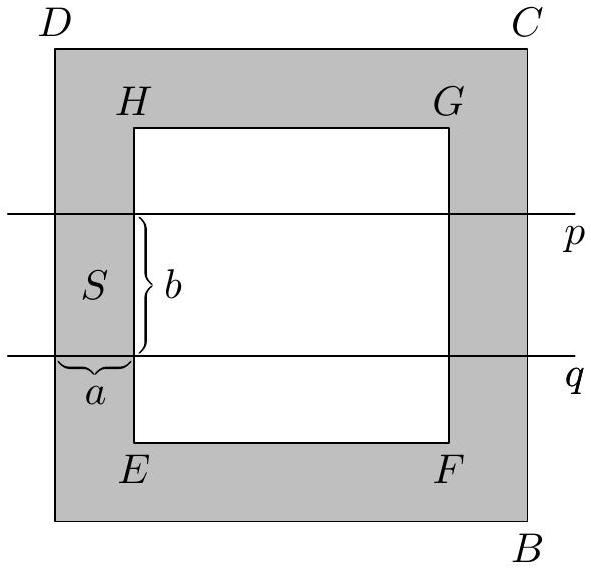
Lines $p$ and $q$ de... | 5.4\, | Geometry | math-word-problem | Yes | Yes | olympiads | false |
Round 5738291.4982 to the nearest integer. | Firstly, identify the integer and decimal parts of the number 5738291.4982, which are 5738291 and 0.4982, respectively. The decision to round up or down depends on whether the decimal part (0.4982) is closer to 0 or to 1.
Since 0.4982 is less than 0.5, the number is closer to 5738291 than it is to 5738292. Therefore, ... | 5738291 | Other | math-word-problem | Yes | Yes | synthetic_math | true |
Which of the following events is a certain event?
A: Buy a movie ticket, and the seat number is a multiple of $2$
B: Turn on the TV, and it is playing "The Reader"
C: Drop oil into water, and the oil will float on the water surface
D: The sun rises from the west in the morning | To analyze each option systematically:
- **Option A:** When you buy a movie ticket, the seat number could be any number assigned by the ticketing system. It might be a multiple of $2$, or it might not be. This outcome depends on the specific seat assignment process and the current availability of seats. Therefore, thi... | C | Logic and Puzzles | MCQ | Yes | Yes | cn_k12 | false |
Bill had to finish a main project from work that was to take him 4 days, during which he also had to complete two other smaller tasks.
1. The first task required 6 hours of work, which he completed on day 3.
2. The second task needed 3 hours of work, which he finished on day 2.
He worked for different hours each day:... | To calculate the time Bill spent working on the main project, we need to subtract the time he spent on naps, breaks, and the smaller tasks from the total working hours each day. Then, we'll sum up the remaining time for all four days.
Day 1:
- Total working hours: 10 hours
- Naps: 2 hours + 1 hour = 3 hours
- Breaks: ... | 8 | Logic and Puzzles | math-word-problem | Yes | Yes | orca_math | true |
Given the function $f(x)=\frac{1}{3}{x}^{3}-{x}^{2}+1$. Find:$(1)$ The equation of the tangent line to the curve $y=f\left(x\right)$ at the point $\left(1,f\left(1\right)\right)$;$(2)$ The extreme values of the function $y=f\left(x\right)$ on the interval $\left[-2,3\right]$. | ### Solution:
#### Part (1): Finding the Equation of the Tangent Line
First, we find the derivative of $f(x)$ to determine the slope of the tangent line at any point $x$:
$$f'(x) = \frac{d}{dx}\left(\frac{1}{3}x^3 - x^2 + 1\right) = x^2 - 2x.$$
At $x=1$, the slope of the tangent line is:
$$f'(1) = (1)^2 - 2(1) = 1 -... | f(-2) = -\frac{17}{3} | Calculus | math-word-problem | Yes | Yes | cn_k12 | false |
Four faucets fill a 150-gallon tub in 8 minutes. How long does it take eight faucets to fill a 50-gallon tub? | First, calculate the rate at which four faucets fill the 150-gallon tub.
\[ \text{Rate of 4 faucets} = \frac{150 \text{ gallons}}{8 \text{ minutes}} = 18.75 \text{ gallons per minute} \]
Next, determine the rate per faucet:
\[ \text{Rate per faucet} = \frac{18.75 \text{ gallons per minute}}{4 \text{ faucets}} = 4.687... | 80 \text{ seconds} | Algebra | math-word-problem | Yes | Yes | synthetic_math | true |
12.248. A right prism with a rhombus as its base is circumscribed around a sphere. The larger diagonal of the prism forms an angle $\alpha$ with the base plane. Find the acute angle of the rhombus. | Solution.
Let the rhombus $ABCD$ be the base of the given right prism $ABCD A_1 B_1 C_1 D_1$, circumscribed around a sphere (Fig. 12.114), and the radius of the sphere is $R$. Then the height of the prism $BB_1 = 2R$.
If $B_1 D$ is the major diagonal of the prism, then $\angle B_1 DB = \alpha$ and $BD$ is the major d... | 2\arcsin(\operatorname{tg}\alpha) | Geometry | math-word-problem | Yes | Yes | olympiads | false |
John used to go to the gym multiple times a weak but because of lockdowns he hasn't been able to go. He used to lift 700 for squat, 400 for bench, and 800 for deadlift. For squat he lost 30% of his lift. He didn't lose any weight on bench because he was able to train that at home and he lost 200 pounds on deadlift. ... | Let's calculate the new total for each lift:
For squat:
He used to lift 700 pounds, but he lost 30% of his lift.
30% of 700 is (30/100) * 700 = 210 pounds.
So, his new squat lift is 700 - 210 = 490 pounds.
For bench:
He didn't lose any weight on bench, so he still lifts 400 pounds.
For deadlift:
He lost 200 pounds o... | 1490 | Algebra | math-word-problem | Yes | Yes | orca_math | true |
5. On a certain island, the climate is unusually regular: it always rains on Mondays and Fridays, and there is fog on Saturdays, while the rest of the days are sunny. On which day of the week should a group of tourists start their vacation if they want to stay for 30 days and catch as many sunny days as possible? | Solution: Let's find out how many full weeks are in 30 days. We get 4 weeks. During these weeks, the number of sunny days does not depend on when the vacation starts. For the remaining two days, we choose Thursday and Friday - sunny days. Therefore, we send the tourists in the morning on Thursday.
Answer: on Thursday. | Thursday | Logic and Puzzles | math-word-problem | Yes | Yes | olympiads | false |
In $\triangle ABC$, if $\sin C = 2 \cos A \cos B$, find the maximum value of $\cos^2 A + \cos^2 B$. | Given $\sin C = 2 \cos A \cos B$,
We know that $\sin C = \sin (A + B)$,
So, $\sin (A + B) = 2 \cos A \cos B$,
Rearranging, we get $\sin A \cos B + \cos A \sin B = 2 \cos A \cos B$,
Hence, $\tan A + \tan B = 2$.
Now, $\cos^2 A + \cos^2 B = \frac{\cos^2 A}{\sin^2 A + \cos^2 A} + \frac{\cos^2 B}{\sin^2 B + \cos^2 B}$... | \frac{\sqrt{2} + 1}{2} | Algebra | math-word-problem | Yes | Yes | cn_k12 | false |
Given that the sum of the first $n$ terms of the arithmetic sequence ${a_n}$ is $S_n$, and $a_2=4$, $a_4=2$, find $S_5=$ ( )
A: 0
B: 10
C: 15
D: 30 | The sequence ${a_n}$ is an arithmetic sequence, with $a_2=4$ and $a_4=2$. Therefore, from $a_2 + a_4 = 2a_3$, we get $a_3=3$.
Hence, $S_5 = \frac{a_1 + a_5}{2} \times 5 = \frac{2a_3}{2} \times 5 = 5a_3 = 5 \times 3 = \boxed{15}$.
So, the answer is C.
From $a_2 + a_4 = 2a_3$, and the relationship between $S_5$ and $a... | 15 | Algebra | MCQ | Yes | Yes | cn_k12 | false |
21st CanMO 1989 Problem 3 Tranform a number by taking the sum of its digits. Start with 1989 1989 and make four transformations. What is the result? | Let f(n) be the sum of the digits of n. We have 1989 1989 0 if n > 0, so the result of the four tranformations must be 9. 21st CanMO 1989 © John Scholes jscholes@kalva.demon.co.uk 21 June 2002 | 9 | Number Theory | math-word-problem | Yes | Problem not solved | olympiads | false |
What is the smallest four-digit number that is divisible by $25$? | For a number to be divisible by $25$, its last two digits must be $00$, $25$, $50$, or $75$.
- For the smallest four-digit number, we aim to minimize the first two digits while ensuring divisibility by $25$.
- The smallest first two digits possible that lead to a four-digit number are $10$, so we check the combinations... | 1000 | Number Theory | math-word-problem | Yes | Yes | synthetic_math | true |
A rectangle has a perimeter of l and an area of S. Among the following four pairs of numbers, the serial number(s) that can be used as the pair (S, l) is/are ( ):
①(1, 4) ②(6, 8) ③(7, 12) ④(3, $\frac {1}{2}$)
A: ①③
B: ①③④
C: ②④
D: ②③④ | Let the lengths of the sides of the rectangle be x and y, respectively. Then, x + y = $\frac {1}{2}$l, and S = xy.
For ①(1, 4), we have x + y = 2 and xy = 1. According to the basic inequality, xy ≤ $(\frac{x + y}{2})^2$ is satisfied, which meets the requirements.
For ②(6, 8), we have x + y = 4 and xy = 6. According t... | \text{A} | Geometry | MCQ | Yes | Yes | cn_k12 | false |
The nine interior intersection points on a 4 by 4 grid of squares are shown. How many interior intersection points are there on a 12 by 12 grid of squares?
(A) 100
(B) 121
(C) 132
(D) 144
(E) 169
 Each of the 11 interior vertical lines intersects each of the 11 interior horizontal lines and creates an interior interse... | 121 | NaN | NaN | NaN | NaN | olympiads | false |
Given lines $C\_1$ and $C\_2$ with parameterized equations:
$C\_1$: $\begin{cases} x = 1 + t \cos \alpha \\ y = t \sin \alpha \end{cases} (t \text{ is the parameter})$,
$C\_2$: $\begin{cases} x = \cos \theta \\ y = \sin \theta \end{cases} (\theta \text{ is the parameter})$.
Find the coordinates of the intersection poin... | 1. First, we need to find the general equations for $C\_1$ and $C\_2$ when $\alpha = \frac{\pi}{3}$.
For $C\_1$, since $\alpha = \frac{\pi}{3}$, we have $\cos(\alpha) = \frac{1}{2}$ and $\sin(\alpha) = \frac{\sqrt{3}}{2}$. So, the general equation for $C\_1$ becomes:
$$y = \sqrt{3}(x - 1).$$
For $C\_2$, the general e... | (\frac{1}{2}, -\frac{\sqrt{3}}{2}) | Geometry | math-word-problem | Yes | Yes | cn_k12 | false |
A6. Find all functions $f: \mathbb{Z} \rightarrow \mathbb{Z}$ such that
$$
n^{2}+4 f(n)-f(f(n))^{2}
$$
for all $n \in \mathbb{Z}$. | None | Algebra | math-word-problem | Incomplete | Problem not solved | olympiads | false | |
$\sqrt[3]{-8}+|-6|-{2}^{2}=\_\_\_\_\_\_.$ | To solve the given expression step by step, we start by breaking down each component:
1. **Cube Root Calculation**:
- The cube root of $-8$ is calculated as $\sqrt[3]{-8} = -2$ because $(-2)^3 = -8$.
2. **Absolute Value Calculation**:
- The absolute value of $-6$ is $|-6| = 6$ because the distance of $-6$ from ... | 0 | Algebra | math-word-problem | Yes | Yes | cn_k12 | false |
Example 6 Given a regular tetrahedron $S-A B C$ with height $S O=3$, and the side length of the base is 6. Draw a perpendicular from point $A$ to the opposite face $S B C$, with the foot of the perpendicular being $O^{\prime}$. Take a point $P$ on $A O^{\prime}$ such that $A P: P O^{\prime}=8$. Find the area of the sec... | Solve As shown in Figure 17-10, since $S-A B C$ is a regular triangular pyramid, $O$ is the center of $\triangle A B C$. Connect $A O$ and extend it to intersect $B C$ at point $D$.
Since $D$ is the midpoint of $B C$, $B C \perp$ plane $S A D$.
Thus, plane $S A D \perp$ plane $S B C$, so $O^{\prime}$ must lie on $D S$... | \sqrt{3} | Geometry | math-word-problem | Yes | Yes | olympiads | false |
Given the function $$f(x)= \begin{cases} \log_{2}x,x>0\\10^{-x},x\leq 0\end{cases}$$, find the value of $$f(8)+f(\log \frac {1}{3})$$. | Since the function $$f(x)= \begin{cases} \log_{2}x,x>0\\10^{-x},x\leq 0\end{cases}$$,
We have $f(8) = \log_{2}8 = 3$, because $8>0$.
And $f(\log \frac {1}{3}) = 10^{-\log \frac {1}{3}} = 3$, because $\log \frac {1}{3} < 0$.
Thus, $f(8) + f(\log \frac {1}{3}) = 3 + 3 = \boxed{6}$.
We derive that $f(8) = \log_{2}8 = ... | 6 | Algebra | math-word-problem | Yes | Yes | cn_k12 | false |
Find the value for x from the equation: x + 1 = some number. The value of x is 4. What is the number that x + 1 equals to in the equation? | If the value of x is 4, then to find the number that x + 1 equals to, we simply substitute x with 4 in the equation:
x + 1 = some number
4 + 1 = some number
Therefore, the number that x + 1 equals to is $\boxed{5}$ . | 5 | Algebra | math-word-problem | Yes | Yes | orca_math | true |
Find all integers $x,y$ such that $x^3(y+1)+y^3(x+1)=19$.
[i]Proposed by Bulgaria[/i] | null | null | Number Theory | math-word-problem | Yes | Yes | aops_forum | false |
A rectangular tile measures 2 inches by 5 inches. What is the fewest number of these tiles needed to completely cover a rectangular region that measures 3 feet by 8 feet? | First, convert the dimensions of the larger region into inches. Since 1 foot equals 12 inches:
The large region is $3 \times 12$ inches by $8 \times 12$ inches, which is 36 inches by 96 inches.
Next, calculate the area of the large region:
\[ 36 \text{ inches} \times 96 \text{ inches} = 3456 \text{ square inches} \]
... | 346 | Geometry | math-word-problem | Yes | Yes | synthetic_math | true |
Simplify the following expression:
$$
\frac{\frac{a+b}{1-a b}+\frac{c-a}{1+c a}}{1-\frac{a+b}{1-a b} \cdot \frac{c-a}{1+c a}}
$$
Explain the result using trigonometric identities. | Let's expand the fraction by $(1-a b)(1+c a)$. (This product is non-zero, because if any of its factors were to vanish, the expression would lose its meaning.) Thus, after the anticipated simplifications, the remaining 4-4 terms can be transformed into the product of two binomials by simple factoring. The common factor... | \frac{b+}{1-} | Algebra | math-word-problem | Yes | Yes | olympiads | false |
Given that the center of circle $M$ is in the first quadrant, the chord intercepted by the $x$-axis through the origin $O$ has a length of $6$, and it is tangent to the line $3x+y=0$. Find the equation of circle $M$. | Since the center of circle $M$ is in the first quadrant and the chord intercepted by the $x$-axis through the origin $O$ has a length of $6$, we can denote the center of the circle as $(3, b)$.
As the circle is tangent to the line $3x+y=0$, the distance from the center of the circle to the line should be equal to the ... | (x - 3)^2 + (y - 1)^2 = 10 | Geometry | math-word-problem | Yes | Yes | cn_k12 | false |
value of $n$ is $B$, find the value of $B$. | The given number is divisible by 15 . Therefore it is divisible by 3 and 5 . The last 2 digits of the given number is 15 , which is divisible by 15 .
$n 2008$ 's
The necessary condition is: $\overbrace{20082008 \cdots 2008}$ must be divisible by 3 . $2+0+0+8=10$ which is not divisible by 3 .
The least possible $n$ is ... | 3 | Algebra | math-word-problem | Incomplete | Yes | olympiads | false |
If 9 ^ y = 3 ^ 12, what is y? | To solve for y in the equation 9^y = 3^12, we can express 9 as a power of 3, since 9 is 3 squared (3^2).
So, we rewrite the equation as:
(3^2)^y = 3^12
Now, we apply the power rule of exponents (a^(m*n) = (a^m)^n), which gives us:
3^(2y) = 3^12
Since the bases are the same (both are 3), we can set the exponents eq... | 6 | Algebra | math-word-problem | Yes | Yes | orca_math | true |
Among the applications of the digital Earth, the correct one is ( ).
A: Can control the occurrence of crimes
B: Can provide important reference data for national major project decisions
C: Can control the timing and location of precipitation
D: Can control the occurrence of geological disasters | **Analysis:** This question mainly examines the knowledge related to the digital Earth. The digital Earth helps people make the most of resources and allows them to conveniently obtain the information about the Earth they want to know in certain ways, such as option B, which provides important reference data for nation... | \text{B} | Other | MCQ | Incomplete | Yes | cn_k12 | false |
The imaginary part of the complex number $\dfrac {2+i}{1-i}- \dfrac {2-i}{1+i}$ is ( ).
A: $3i$
B: -$3i$
C: $3$
D: -$3$ | Since $\dfrac {2+i}{1-i}- \dfrac {2-i}{1+i}= \dfrac {(2+i)(1+i)}{(1-i)(1+i)}- \dfrac {(2-i)(1-i)}{(1+i)(1-i)}$
$= \dfrac {1+3i}{2}- \dfrac {1-3i}{2}=3i$.
Therefore, the imaginary part of the complex number $\dfrac {2+i}{1-i}- \dfrac {2-i}{1+i}$ is $3$.
Hence, the correct answer is $\boxed{C}$.
This problem is s... | C | Algebra | MCQ | Yes | Yes | cn_k12 | false |
In a frequency distribution histogram, the area of each small rectangle represents ( )
A: The frequency of data falling into the corresponding groups
B: The frequency of the corresponding groups
C: The number of groups the sample is divided into
D: The capacity of the sample | **Analysis**
The area of each small rectangle in a frequency distribution histogram represents the frequency of the corresponding groups. Therefore, the correct answer is $\boxed{\text{B}}$.
**Key Point**
This question mainly examines the basic concept of using a sample to estimate the population. | \text{B} | Other | MCQ | Yes | Yes | cn_k12 | false |
4. Given a regular hexagon with side 1. Inside the hexagon, take $m$ points such that no three points among the vertices and these $m$ points are collinear. The hexagon is divided into triangles, where each of the given $m$ points and each vertex of the hexagon is a vertex of a partitioning triangle. Two partitioning t... | Solution. Let's determine the total number of triangular subdivisions of the given hexagon. Let $A$ be an arbitrary point from the $m$ internal points. The sum of all angles at point $A$ is $360^{\circ}$ (the sum of all angles at $A$ of all triangles that have this point as a vertex). On the other hand, the sum of all ... | proof | Geometry | proof | Yes | Yes | olympiads | false |
In how many ways can four married couples sit around a round table so that two women do not sit next to each other? How many arrangements are possible if we want to ensure that neither married couples, nor two women (nor two men) sit next to each other? | Let the husbands be denoted by $A, B, C, D$, and their wives respectively by $a, b, c, d$.
a) Since we are talking about a round table, $A$ can sit anywhere, and $B, C, D$ can take their seats in $3!=6$ different ways after him. Since no two women can sit next to each other, the 4 women have 4 available seats determin... | 144 | Combinatorics | math-word-problem | Yes | Yes | olympiads | false |
Xiaochao is 1 meter and 36 centimeters tall, which, when written as a decimal, is ____ meters. | 1 meter and 36 centimeters equals $1.36$ meters.
Therefore, the answer is $\boxed{1.36}$. | 1.36 | Other | math-word-problem | Yes | Yes | cn_k12 | false |
In an examination, 25% of total students failed in Hindi, 48% failed in English, and a certain percentage failed in both. The percentage of students who passed in both the subjects is 54%. What is the percentage of students who failed in both the subjects? | Let's denote the percentage of students who failed in both subjects as x%.
According to the given information, the percentage of students who passed in both subjects is 54%. This means that the percentage of students who failed in at least one subject is 100% - 54% = 46%.
Now, we can use the principle of inclusion-ex... | 27\% | Algebra | math-word-problem | Yes | Yes | orca_math | true |
Amoli, Anayet, Bimal, and Chandni must travel 1,475 miles together to reach their destination. Amoli drives a car at 42 miles an hour for 3.5 hours, and then for the next 2 hours, he drives at 38 miles an hour due to bad weather. Anayet drives a van at 61 miles an hour for 2.5 hours, and then switches to a motorcycle, ... | Let's calculate the distance covered by each person.
Amoli:
First part: 42 miles/hour * 3.5 hours = 147 miles
Second part: 38 miles/hour * 2 hours = 76 miles
Total for Amoli: 147 + 76 = 223 miles
Anayet:
First part: 61 miles/hour * 2.5 hours = 152.5 miles
Second part: 75 miles/hour * 1.5 hours = 112.5 miles
Total for... | 672 | Algebra | math-word-problem | Yes | Yes | orca_math | true |
Can three segments of even length be placed on a number line so that the common parts of each pair of them are segments of odd length? | Let the segments be arranged according to the condition. Place the origin of the axis so that the ends of the first segment fall on points with integer coordinates.
Notice that the second segment intersects the first, but does not lie within it and does not contain it (otherwise the intersection would have an even len... | proof | Logic and Puzzles | math-word-problem | Yes | Yes | olympiads | false |
Example 5 As shown in Figure $17-7$, it is known that $ABCD$ is an isosceles trapezoid with upper and lower base lengths of 2 and 6, and height $\sqrt{3}$. It is folded along the axis of symmetry $OO_{1}$ to form a right dihedral angle, as shown in Figure $17-8$. Find the size of the dihedral angle $O-AC-O_{1}$. | Solution 1 As shown in Figure $17-8, O A \perp O O_{1}, O B \perp O O_{1}$.
Therefore, $\angle A O B$ is the plane angle of the right dihedral angle formed, i.e., $O A \perp O B$.
Taking $O$ as the origin, the lines $O A, O B, O O_{1}$ as the $x$-axis, $y$-axis, $z$-axis respectively to establish a spatial rectangular ... | Geometry | math-word-problem | Yes | Incomplete | olympiads | false | |
The USAMO is a $6$ question test. For each question, you submit a positive integer number $p$ of pages on which your solution is written. On the $i$th page of this question, you write the fraction $i/p$ to denote that this is the $i$th page out of $p$ for this question. When you turned in your submissions for the $2017... | 1. Let \( a_k \) be the number of pages submitted for the \( k \)-th question, where \( k = 1, 2, \ldots, 6 \).
2. For each question, the sum of the fractions written on the pages is given by:
\[
\sum_{i=1}^{a_k} \frac{i}{a_k}
\]
3. We can simplify this sum as follows:
\[
\sum_{i=1}^{a_k} \frac{i}{a_k} =... | 4028 | Algebra | math-word-problem | Yes | Yes | aops_forum | false |
In the geometric sequence ${a_n}$, $a_1=1$, $a_5=8a_2$, $S_n$ represents the sum of the first $n$ terms. If $S_n=1023$, find $n$. | Given that in the geometric sequence ${a_n}$, $a_1=1$, and $a_5=8a_2$, we can infer that:
$q^4 = 8q$
Solving for $q$, we find $q=2$.
Now, given that $S_n=1023$, we use the formula for the sum of a geometric series:
$$S_n = \frac{a_1(1-r^n)}{1-r}$$
Substituting the given values:
$$1023 = \frac{1(1-2^n)}{1-2}$$
Si... | 10 | Algebra | math-word-problem | Yes | Yes | cn_k12 | false |
A wizard is preparing a magical elixir. He needs to choose one of four magical herbs and one of six enchanted crystals. However, one of the crystals is incompatible with three of the herbs. How many valid combinations can the wizard use to prepare his elixir? | 1. Calculate the total number of initial combinations:
\[
4 \text{ herbs} \times 6 \text{ crystals} = 24 \text{ combinations}
\]
2. Subtract the number of incompatible combinations:
\[
3 \text{ incompatible herb-crystal pairs}
\]
3. Calculate the number of valid combinations:
\[
24 - 3 = 21
... | 21 | Combinatorics | math-word-problem | Yes | Yes | synthetic_math | true |
Alice can paint a fence in 40 minutes. It takes Charlie $\frac{3}{4}$ of the time it takes Alice to paint the same fence. How many minutes does it take Charlie to paint the fence? | Given that it takes Alice 40 minutes to paint a fence, and Charlie takes $\frac{3}{4}$ of the time it takes Alice, we calculate Charlie's painting time as follows:
\[ \text{Charlie's time} = \frac{3}{4} \times 40 \]
We simplify the multiplication of the fraction and the whole number:
\[ \frac{3}{4} \times 40 = \frac{40... | 30 | Algebra | math-word-problem | Yes | Yes | synthetic_math | true |
In a foreign language group, there are $9$ people, among whom $5$ can speak English and $4$ can speak Japanese. If one person who can speak English and one person who can speak Japanese are to be selected from the group, the number of different ways to do so is:
A: $16$ ways
B: $18$ ways
C: $20$ ways
D: $91$ ways | To solve the problem, we follow these steps:
1. **Selecting an English Speaker**: There are $5$ people who can speak English. The number of ways to select one person from these $5$ people is given by the combination formula ${C}_{n}^{r} = \frac{n!}{r!(n-r)!}$, where $n$ is the total number of items, and $r$ is the num... | C | Combinatorics | MCQ | Yes | Yes | cn_k12 | false |
## Problem 3
$\mathrm{S}_{1}, \mathrm{~S}_{2}, \ldots, \mathrm{S}_{\mathrm{n}}$ are subsets of the real line. Each $\mathrm{S}_{\mathrm{i}}$ is the union of two closed intervals. Any three $\mathrm{S}_{\mathrm{i}}$ have a point in common. Show that there is a point which belongs to at least half the $\mathrm{S}_{\math... | ## Solution
We can write $\mathrm{S}_{\mathrm{i}}=\left[\mathrm{a}_{\mathrm{i}}, \mathrm{b}_{\mathrm{i}}\right] \cup\left[\mathrm{c}_{\mathrm{i}}, \mathrm{d}_{\mathrm{i}}\right]$, where $\mathrm{a}_{\mathrm{i}} \leq \mathrm{b}_{\mathrm{i}} \leq \mathrm{c}_{\mathrm{i}}b$, so that any point in $S_{i}$ and $S_{k}$ does n... | proof | Combinatorics | proof | Yes | Incomplete | olympiads | false |
Given real numbers $x$ and $y$ satisfying $-1\leqslant x \lt 2$ and $0 \lt y\leqslant 1$, the range of $x-2y$ is ______. | To find the range of $x - 2y$, given $-1 \leqslant x < 2$ and $0 < y \leqslant 1$, we first consider the bounds on $y$ to understand how $-2y$ behaves:
1. Since $0 < y \leqslant 1$, multiplying by $-2$ to get $-2y$ reverses the inequality signs: $-2 \leqslant -2y < 0$. This step establishes the bounds for $-2y$.
Next... | [-3,2) | Inequalities | math-word-problem | Yes | Yes | cn_k12 | false |
2. Find all positive solutions of the equation
$$
x^{101} + 100^{99} = x^{99} + 100^{101}
$$
Do not forget to justify your answer. | Solution. The equation is reduced to the form
$$
x^{99}\left(x^{2}-1\right)=100^{99}\left(100^{2}-1\right)
$$
Obviously, the solution is $x=100$. For $0<x<1$, the left side is less than the right side. For $x>1$, the left side is an increasing function, so the required value is taken no more than once. Therefore, the... | 100 | Algebra | math-word-problem | Yes | Yes | olympiads | false |
Example 3. Draw the largest circle that contains exactly $n$ lattice points internally, and calculate the diameter of the circle.
Make the circle with the largest possible diameter that contains exactly $n$ lattice points inside it, and compute the diameter of this circle. | This is a rather difficult question. When $n$ is small, the problem can be illustrated intuitively with diagrams. The following five figures depict the largest circles that contain exactly 0, 1, 2, 3,
and 4 lattice points inside, with diameters of $\sqrt{2}$, 2, $\sqrt{5}$, $\frac{5 \sqrt{5}}{3}$, and $\sqrt{10}$, re... | not found | Geometry | math-word-problem | Yes | Yes | cn_contest | false |
Matt's five cousins are coming to visit. There are four rooms available for them to stay in. Two of the rooms have a view of the garden, and the other two do not. Any number of the cousins can stay in one room, and at least one cousin must stay in a room with a garden view. How many different ways are there to put the ... | We need to count the different ways to place five cousins into four rooms under the conditions given. Here, it's crucial that at least one cousin stays in a room with a garden view. The possible distributions are similar but modified to include the required condition.
- **(5,0,0,0)**: All in one room having a garden... | 30 | Combinatorics | math-word-problem | Yes | Yes | synthetic_math | true |
The probability of snowing tomorrow is \(\frac{1}{4}\). What is the probability that it will not snow tomorrow? Express your answer as a common fraction. | We apply the concept of complementary probability to find the probability that it will not snow tomorrow:
\[ \text{Probability of not snowing} = 1 - \text{Probability of snowing} = 1 - \frac{1}{4} = \frac{4}{4} - \frac{1}{4} = \frac{3}{4} \]
Hence, the probability that it will not snow tomorrow is \(\boxed{\frac{3}{4}}... | \frac{3}{4} | Algebra | math-word-problem | Yes | Yes | synthetic_math | true |
Show that in chess, a bishop that is initially on a white square will always be on a white square. | This is obvious when facing a chessboard, but we need to provide a mathematical framework that lends itself to formalization. We number the squares according to an orthonormal coordinate system whose origin is at the bottom left. The squares are thus numbered $(i, j)$ with $i, j \in\{0, \ldots, 8\}$. For example, the p... | proof | Logic and Puzzles | proof | Yes | Yes | olympiads | false |
If Mr. Johnson has a prescription with enough pills for 30 days and after four-fifths of the days he has 12 pills left, what is the daily dosage of pills that Mr. Johnson is supposed to take? | To determine the daily dosage of pills that Mr. Johnson is supposed to take, we can follow these steps:
1. Calculate the number of days that have passed after four-fifths of the 30 days.
2. Determine how many pills Mr. Johnson has taken by the time four-fifths of the days have passed.
3. Calculate the daily dosage bas... | 0.75 | Algebra | math-word-problem | Yes | Yes | metamath | true |
What is the value of $x$ in the equation $8^4 + 8^4 + 8^4 = 2^x$? | First, simplify the left-hand side:
\[ 8^4 + 8^4 + 8^4 = 3 \cdot 8^4 \]
Since \(8 = 2^3\), we can rewrite \(8^4\) using the property of exponents:
\[ 8^4 = (2^3)^4 = 2^{12} \]
Substitute back into the equation:
\[ 3 \cdot 2^{12} = 2^x \]
To simplify further, we use the property of exponents \(a \cdot b^c = b^{c+\log... | 12 + \log_2(3) | Algebra | math-word-problem | Yes | Yes | synthetic_math | true |
How many positive three-digit integers leave a remainder of 3 when divided by 8? | The integers in question should fit the equation \(8n + 3\) where \(n\) is an integer. We set up the inequality $$ 100 \leq 8n + 3 < 1000. $$
Subtracting 3 from all sides simplifies the inequality: $$ 97 \leq 8n < 997. $$
Dividing every term by 8 to solve for \(n\): $$ 12.125 \leq n < 124.625. $$
Since \(n\) must be an... | 112 | Number Theory | math-word-problem | Yes | Yes | synthetic_math | true |
To understand the favorite dishes of the students at the food festival, the statistical measure needed is:
A: Mean
B: Median
C: Mode
D: Variance | To understand the favorite dishes of the students at the food festival, we need to identify the dish that is liked by the highest number of students. This requires us to find the statistical measure that represents the most frequently occurring value in a data set. The correct measure for this purpose is the mode, as i... | C | Other | MCQ | Yes | Yes | cn_k12 | false |
Example 3 Given: As shown in Figure 3, $AB = BC = CA = AD$, $AH \perp CD$ at $H$, $CP \perp BC$, and $CP$ intersects $AH$ at $P$. Prove: The area $S$ of $\triangle ABC$ is $S = \frac{\sqrt{3}}{4} AP \cdot BD$.
$(1984$, National Junior High School Mathematics League $)$ | Analysis: Since $S_{\triangle A B C}=\frac{\sqrt{3}}{4} B C^{2}=\frac{\sqrt{3}}{4} A C \cdot B C$, it is sufficient to prove that $A C \cdot B C=A P \cdot B I$, which can be transformed into proving $\triangle A P C \sim \triangle B C D$. This implies that $A, B, C, Q$ are concyclic (where $Q$ is the intersection of $B... | proof | Geometry | proof | Yes | Yes | cn_contest | false |
9. For what values of the parameter $\boldsymbol{a}$ does the equation $|f(x)-5|=p(x)$, where $f(x)=\left|\frac{x^{2}-10 x+25}{x-5}-\frac{x^{2}-3 x}{3-x}\right|$, $p(x)=a \quad$ have three solutions? If there is more than one value of the parameter, indicate their product in the answer. | # Solution:
Simplify $f(x)=\left|\frac{x^{2}-10 x+25}{x-5}-\frac{x^{2}-3 x}{3-x}\right|$, we get $f(x)=$ $|2 x-5|$, where $x \neq 5, x \neq 3$.
Solve the equation || $2 x-5|-5|=a$, where $x \neq 5, x \neq 3$ graphically in the system $x O a$.
The equation has three solutions when $a=4, a=5$.
The product is 20.
Ans... | 20 | Algebra | math-word-problem | Yes | Yes | olympiads | false |
Given that
\[
\frac{1}{x} + \frac{1}{y} = 4 \quad \text{and} \quad xy + x + y = 5,
\]
compute $x^2y + xy^2 + x^2 + y^2$. | 1. From the first equation, manipulating it gives:
\[ \frac{x+y}{xy} = 4 \Rightarrow x+y = 4xy. \]
2. Substitute $x+y = 4xy$ into the second equation:
\[ xy + 4xy = 5 \Rightarrow 5xy = 5 \Rightarrow xy = 1. \]
3. Substituting $xy = 1$ back into $x+y = 4xy$, we get:
\[ x+y = 4. \]
4. To find $x^2y + xy^2 + x^2 + y^2$... | 18 | Algebra | math-word-problem | Yes | Yes | synthetic_math | true |
Given that the lengths of two adjacent sides of a rectangle are $8$ and $x$, the perimeter is $y$, and the area is $S$.
$(1)$ The relationship between $y$ and $x$ is: ______;
$(2)$ The relationship between $S$ and $x$ is: ______;
$(3)$ When $S=80$, find the value of $y$. | ### Solution:
#### Part (1): The relationship between $y$ and $x$
Given the formula for the perimeter of a rectangle, which is $2(\text{length} + \text{width})$, we can substitute the given values:
- Length = $8$
- Width = $x$
Thus, the perimeter $y$ can be calculated as follows:
\[
y = 2(8 + x) = 16 + 2x
\]
There... | y = 36 | Algebra | math-word-problem | Yes | Yes | cn_k12 | false |
Given that $x > 0$, $y > 0$, and ${\!\!}^{2x+2y}=2$, find the minimum value of $\frac{1}{x}+\frac{1}{y}$. | First, let's rewrite the given equation ${\!\!}^{2x+2y}=2$ in a more familiar form. We know that $\sqrt{2} \approx 1.414$ is a well-known irrational number, so we can express the equation as:
$${\!\!}^{2x+2y} = \sqrt{2}^{2x+2y} = 2$$
Now, we take the natural logarithm (ln) of both sides to simplify the equation furth... | 3 + 2\sqrt{2} | Algebra | math-word-problem | Yes | Problem not solved | cn_k12 | false |
Example 4 As shown in Figure 7, in the cube $A B C D-A_{1} B_{1} C_{1} D_{1}$, the degree of the dihedral angle $A-B D_{1}-A_{1}$ is | Solution: As shown in Figure 8, let the edge length of the cube be 1, then $B A_{1}=\sqrt{2}, B D_{1}=\sqrt{3}$.
By the theorem of three perpendiculars,
$B A_{1} \perp A_{1} D_{1}, \cos \alpha=\frac{\sqrt{2}}{\sqrt{3}}$.
Also, $B A \perp A D_{1}, \cos \beta=\frac{1}{\sqrt{3}}$, so,
$\sin \alpha=\frac{1}{\sqrt{3}}, \sin... | 60^{\circ} | Geometry | math-word-problem | Yes | Yes | cn_contest | false |
Sandy went to the mall on Saturday to buy clothes. She bought a pair of pants for $13.58, a shirt for $10.29, a sweater for $24.97, and a pair of shoes for $39.99. Sandy paid with a $100 bill. Sandy got $_____ in change. | To find out how much change Sandy got, we need to add up the cost of all the items she bought and then subtract that total from the $100 bill she paid with.
Cost of pants: $13.58
Cost of shirt: $10.29
Cost of sweater: $24.97
Cost of shoes: $39.99
Total cost of items: $13.58 + $10.29 + $24.97 + $39.99 = $88.83
Now, s... | \$11.17 | Other | math-word-problem | Yes | Yes | orca_math | true |
2. Let the sequence $\left\{a_{n}\right\}$ satisfy: $a_{1}=1,4 a_{n+1}-a_{n+1} a_{n}+4 a_{n}=9$, then $a_{2018}=$ | 荟事 $\frac{5}{3}$
Gather Matters $\frac{5}{3}$ | \frac{5}{3} | Algebra | math-word-problem | Yes | Problem not solved | olympiads | false |
Adnan is trying to remember his four-digit PIN. He is sure it contains the digits 5, 3, 7, and 0 but can't recall the order in which they appear. How many different arrangements are possible for his PIN? | To solve for the number of possible arrangements of Adnan's PIN, we can consider the digits 5, 3, 7, and 0. His PIN, being a four-digit number, allows each digit to be used exactly once.
1. The first digit can be any of the four digits (5, 3, 7, 0).
2. The second digit can be any of the remaining three digits.
3. The ... | 24 | Combinatorics | math-word-problem | Yes | Yes | synthetic_math | true |
Simplify the expression \[\sqrt{45 - 28\sqrt{2}}.\] | We consider that \(\sqrt{45 - 28\sqrt{2}} = x - y\sqrt{2}\) for some integers \(x\) and \(y\). Squaring both sides gives:
\[
45 - 28\sqrt{2} = (x - y\sqrt{2})^2 = x^2 + 2y^2 - 2xy\sqrt{2}.
\]
Then, we must have:
\[
\begin{aligned}
x^2 + 2y^2 &= 45, \\
-2xy &= -28.
\end{aligned}
\]
From the second equation, \(xy = 14\).... | 5 - 3\sqrt{2} | Algebra | math-word-problem | Yes | Yes | synthetic_math | true |
Given the function $f(x) = x + \frac{\alpha}{x} + \ln x$ ($\alpha \in \mathbb{R}$),
(1) Find the intervals of monotonicity and the extremum points of the function $f(x)$.
(2) If for all $\alpha \in \left[\frac{1}{e}, 2e^2\right]$, the function $f(x)$ satisfies $f(x) < m$ for all $x \in [l, e]$, find the range of th... | Solution:
(1) The derivative of $f(x)$ is $f'(x) = 1 - \frac{\alpha}{x^2} + \frac{1}{x} = \frac{x^2 + x - \alpha}{x^2}$ ($x > 0$),
① When $\alpha \leq 0$, $f'(x) \geq 0$, thus the function $f(x)$ is monotonically increasing on $(0, +\infty)$,
In this case, the function $f(x)$ has no extremum points;
② When $\al... | (1 + 2e^2, +\infty) | Calculus | math-word-problem | Yes | Yes | cn_k12 | false |
Let the non-empty set A be defined as $A=\{x \mid -3 \leq x \leq a\}$, set B as $B=\{y \mid y=3x+10, x \in A\}$, and set C as $C=\{z \mid z=5-x, x \in A\}$. Given $B \cap C = C$, find the range of real numbers for $a$. | To solve this problem, let's first explicitly define the sets B and C using the definition of set A:
For set B, since $x \in A$, and $A$ is the range from $-3$ to $a$, substituting $x$ into the expression for the elements of B, we get:
$$ B=\{3x+10 \mid -3 \leq x \leq a\} $$
The continuous transformation of $x$ from $... | a \in \left[-\frac{2}{3}, 4\right] | Algebra | math-word-problem | Yes | Yes | cn_k12 | false |
in a group of 100 people , 55 have visited iceland and 43 have visited norway . if 61 people have visited both iceland and norway , how many people have visited neither country ? | To find out how many people have visited neither country, we can use the principle of inclusion-exclusion.
First, we add the number of people who have visited Iceland and the number of people who have visited Norway:
55 (visited Iceland) + 43 (visited Norway) = 98
However, this count includes people who have visited... | 63 | Combinatorics | math-word-problem | Yes | Yes | orca_math | true |
Calculate $180\div \left(12+13\cdot 3\right)$. | We start by simplifying the expression inside the parentheses, following the order of operations. First, we handle the multiplication:
\[ 13 \cdot 3 = 39 \]
Next, we add this result to 12:
\[ 12 + 39 = 51 \]
Now, we substitute this result back into the original expression and perform the division:
\[ 180 \div 51 = \b... | \frac{60}{17} | Algebra | math-word-problem | Yes | Yes | synthetic_math | true |
Which of the following pairs of functions represent the same function?
A: $f(x)=\sqrt{x^2}\;\;,\;\;g(x)={({\sqrt{x}})^2}$
B: $f\left(x\right)=x$,$g\left(x\right)=\sqrt[3]{{x}^{3}}$
C: $f\left(x\right)=1$,$g\left(x\right)=x^{0}$
D: $f(x)=x+1\;\;,\;\;g(x)=\frac{{{x^2}-1}{x-1}$ | To evaluate which pairs of functions represent the same function, let's examine each option step by step.
**Option A:**
For $f(x)$, we have:
\[
f(x) = \sqrt{x^2} = |x|
\]
This means that $f(x)$ gives the absolute value of $x$, which behaves differently for $x \geq 0$ (where $f(x) = x$) and $x < 0$ (where $f(x) = -x$)... | B | Algebra | MCQ | Yes | Yes | cn_k12 | false |
Find the equation of a line \(l\) that passes through the point P(5, 0) and intersects circle C with equation \(x^2 + y^2 - 4x - 8y - 5 = 0\) in such a way that the chord AB cut by circle C has a length of 8. | To find the equation of line \(l\), we consider two cases.
**Case 1:** The line \(l\) is vertical and hence has an undefined slope.
The equation of such vertical line is \(x=5\).
We know that the distance from the center of the circle, \(C\), to the line \(x=5\) is equal to 3, since the center of the circle given by... | x-5=0 \text{ or } 7x+24y-35=0 | Geometry | math-word-problem | Yes | Yes | cn_k12 | false |
For how many real values of $x$ does the equation $\left| 1-xi \right| = 2$ hold true? | We start by expressing the magnitude of the complex number:
\[ \left| 1-xi \right| = \sqrt{(1)^2 + (-x)^2} = \sqrt{1 + x^2}. \]
Given that $\left| 1-xi \right| = 2$, we set up the equation:
\[ \sqrt{1 + x^2} = 2. \]
Squaring both sides yields:
\[ 1 + x^2 = 4. \]
Solving for $x^2$ we have:
\[ x^2 = 4 - 1 = 3. \]
Taking ... | 2 | Algebra | math-word-problem | Yes | Yes | synthetic_math | true |
Theorem 1 (i) $r \bmod m=\{r+k m: k \in \boldsymbol{Z}\}$;
(ii) $r \bmod m=s \bmod m$ if and only if $r \equiv s(\bmod m)$;
(iii) For any $r, s$, either $r \bmod m=s \bmod m$, or the intersection of $r \bmod m$ and $s \bmod m$ is an empty set. | None
Translate the text above into English, please retain the original text's line breaks and format, and output the translation result directly.
Note: The provided instruction is a meta-instruction and not part of the text to be translated. Since the text to be translated is "None", the translation is also "None". ... | not found | Number Theory | proof | Yes | Incomplete | number_theory | false |
4. In a regular quadrilateral pyramid $S A B C D$, the height is equal to the side of the base. Points $M$ and $N$ are marked on the lateral edges $S D$ and $S B$ of the pyramid, respectively, such that the lines $A M$ and $C N$ are perpendicular to each other. Prove that
$$
2 S A(S M+S N)=S A^{2}+S M \cdot S N
$$ | Solution. We will place the coordinate system such that the origin coincides with vertex $A$, and the axes are as shown in Figure 1.

Fig. 1:
We will assume that the length of the base side o... | proof | Geometry | proof | Yes | Yes | olympiads | false |
When any number is divided by 20, the quotient is 15 and the remainder is 6. What number is it? | To find the number, we can use the formula for division:
Number = Divisor * Quotient + Remainder
In this case, the divisor is 20, the quotient is 15, and the remainder is 6. Plugging these values into the formula, we get:
Number = 20 * 15 + 6
Number = 300 + 6
Number = 306
So the number is $\boxed{306}$ . | 306 | Number Theory | math-word-problem | Yes | Yes | orca_math | true |
Let $a = 0.4^3$, $b = \log_{0.4}3$, $c = 3^{0.4}$. Arrange $a$, $b$, and $c$ in increasing order. | We are given:
$$a = 0.4^3$$
$$b = \log_{0.4}3$$
$$c = 3^{0.4}$$
To determine the relationship between $a$, $b$, and $c$, we analyze them individually.
Since $0.4 1$ and $0.4$ is a positive number less than 1, raising 3 to the power of $0.4$ will result in a value greater than 1 but smaller than 3. This leads to
$$1... | B | Algebra | math-word-problem | Yes | Yes | cn_k12 | false |
Consider the solid $S'$ in the set of all points $(x, y, z)$ in the first octant such that $x + 2y \leq 1$, $2x + z \leq 1$, and $y + 2z \leq 1$. Determine the volume of $S'$. | Since we are looking at the first octant, all $x$, $y$, and $z$ are non-negative. Solving the inequalities simultaneously:
1. From $x+2y \leq 1$ and $y=0$, we have $x \leq 1$.
2. From $2x+z \leq 1$ and $z=0$, we have $x \leq \frac{1}{2}$.
3. From $y+2z \leq 1$ and $z=0$, we have $y \leq 1$.
When $x = \frac{1}{2}$ (as... | \frac{1}{48} | Calculus | math-word-problem | Yes | Yes | synthetic_math | true |
Given a fixed point $F(1,0)$ and a fixed line $l: x=4$, the ratio of the distance from a moving point $P$ to point $F$ and its distance to line $l$ is $\frac{1}{2}$.
$(1)$ Find the equation of the trajectory $E$ of the moving point $P$;
$(2)$ Suppose the trajectory $E$ intersects the negative half-axis of the $x$-axi... | Solution:
$(1)$ For $F(1,0)$, let $P(x,y)$ be any point on $E$,
According to the problem, $\frac{|\sqrt{(x-1)^2+y^2}|}{|x-4|} = \frac{1}{2}$,
We get $\frac{x^2}{4} + \frac{y^2}{3} = 1$, which is the equation of the trajectory $E$ of the moving point $P$.
$(2)$ According to the problem, we can assume the equation of... | (7,0) | Geometry | math-word-problem | Yes | Yes | cn_k12 | false |
What is the least real value of the expression $\sqrt{x^2-6x+13} + \sqrt{x^2-14x+58}$ where $x$ is a real number?
$
\textbf{(A)}\ \sqrt {39}
\qquad\textbf{(B)}\ 6
\qquad\textbf{(C)}\ \frac {43}6
\qquad\textbf{(D)}\ 2\sqrt 2 + \sqrt {13}
\qquad\textbf{(E)}\ \text{None of the above}
$ | 1. Rewrite the given expression in a more convenient form:
\[
\sqrt{x^2 - 6x + 13} + \sqrt{x^2 - 14x + 58}
\]
We can complete the square for each quadratic expression inside the square roots:
\[
x^2 - 6x + 13 = (x-3)^2 + 4
\]
\[
x^2 - 14x + 58 = (x-7)^2 + 9
\]
Thus, the expression becom... | \sqrt{41} | Calculus | MCQ | Yes | Yes | aops_forum | false |
How many subsets does the set $\{-1, 0, 1\}$ have? | To solve this, consider the set $\{-1, 0, 1\}$.
The subsets of the set $\{-1, 0, 1\}$ include: $\{-1\}$, $\{0\}$, $\{1\}$, $\{-1, 0\}$, $\{-1, 1\}$, $\{0, 1\}$, $\{-1, 0, 1\}$, and $\emptyset$, totaling 8 subsets.
Therefore, the answer is $\boxed{8}$.
For a set $P=\{1, 2, 3\}$, a subset refers to a set composed o... | 8 | Combinatorics | math-word-problem | Yes | Yes | cn_k12 | false |
Determine the nature of the statement "m > 0" when it pertains to "the function \( f(x) = |x(mx + 2)| \) is increasing on the interval \((0, +\infty)\)":
A. Sufficient but not necessary condition
B. Necessary but not sufficient condition
C. Necessary and sufficient condition
D. Neither sufficient nor necessary conditio... | Since \( m > 0 \), we can express the function as \( f(x) = |mx^2 + 2x| \). Evaluating the function at the origin gives us \( f(0) = 0 \).
For the function \( f(x) = |mx^2 + 2x| \) to be increasing on the interval \((0, +\infty)\), the inside of the absolute value, which is \( mx^2 + 2x \), must be increasing as well... | \text{The correct answer is A. Sufficient but not necessary condition} | Algebra | MCQ | Yes | Yes | cn_k12 | false |

The side of the base $ABC$ of a regular prism $ABC A1 B1 C1$ is equal to $a$. Points $M$ and $N$ are the midpoints of edges $AC$ and $A1 B1$, respectively. The projection of segment $MN$ ont... | Let $K$ and $F$ be the midpoints of $BC$ and $AB$ respectively. Then $MK$ and $MF$ are the midlines of triangle $ABC$. On the extension of segment $MK$ beyond point $M$, we lay off segment $ML = MK = \frac{\underline{2}}{2}$. Since $MLA1N$ is a parallelogram, $A1L = MN$ and $A1L \parallel MN$. Therefore, the angle betw... | \frac{}{\sqrt{2}},\frac{}{2\sqrt{6}} | Geometry | math-word-problem | Incomplete | Yes | olympiads | false |
Arthur removes 4 pencils from a jar. There were originally some pencils in the jar, and now there are 83 pencils left. How many pencils were there in the jar originally? | If Arthur removed 4 pencils from the jar and there are now 83 pencils left, we can find the original number of pencils by adding the 4 pencils he removed back to the current number of pencils.
Original number of pencils = Number of pencils left + Number of pencils removed
Original number of pencils = 83 + 4
Original n... | 87 | Algebra | math-word-problem | Yes | Yes | orca_math | true |
King Louis was suspicious of some of his courtiers. He made a complete list of each of his courtiers and told each of them to spy on another courtier. The first on the list was to spy on the courtier who was spying on the second on the list, the second on the list was to spy on the courtier who was spying on the third ... | Solution
Let $n$ be the number of courtiers on the list and suppose that $n$ is even. Place them around a circular table so that each one is spying on their left neighbor.

Courtier 1 spies ... | proof | Logic and Puzzles | proof | Yes | Yes | olympiads | false |
$10 \cdot 23$ has a four-digit number with thousands, hundreds, tens, and units digits being $a, b, c, d$ respectively, the sum of the digits is $26$, the tens digit of the product of $b, d$ equals $(a+c)$, and $(bd - c^2)$ is a power of 2. Find this four-digit number (explain the reasoning).
(Heilongjiang Province, Ch... | [Solution]From the problem, we have
$$
\left\{\begin{array}{l}
a+b+c+d=26, \\
b d=10(a+c)+e, \quad (e \text { is the unit digit of } b d) \\
b d-c^{2}=2^{m} \quad(m \in \mathbb{Z}) .
\end{array}\right.
$$
Since $\quad 0 \leqslant b \leqslant 9,0 \leqslant d \leqslant 9,0 \leqslant b d \leqslant 81$, we have
$$
\begin{... | 1979 | Number Theory | math-word-problem | Yes | Yes | olympiads | false |
Christine must buy at least $60$ fluid ounces of milk at the store. The store only sells milk in $250$ milliliter bottles. If there are $33.8$ fluid ounces in $1$ liter, then what is the smallest number of bottles that Christine could buy? | 1. **Convert fluid ounces to liters**:
Given that $1$ liter $= 33.8$ fluid ounces, to convert $60$ fluid ounces to liters:
\[
60\ \text{fl.oz} \cdot \frac{1\ \text{L}}{33.8\ \text{fl.oz}} = \frac{60}{33.8}\ \text{L}
\]
\[
\frac{60}{33.8}\ \text{L} \approx 1.775\ \text{L}
\]
2. **Convert liters to ... | 8 | Logic and Puzzles | math-word-problem | Yes | Yes | synthetic_math | true |
A baker has a pan of fudge that measures 18 inches on one side and some inches on another side. If the fudge is cut into square pieces 1 inch on each side, the pan holds 522 pieces of fudge. What is the length of the other side of the pan? | To find the length of the other side of the pan, we need to divide the total number of pieces of fudge by the length of one side of the pan.
The total number of pieces of fudge is 522, and we know that one side of the pan measures 18 inches. Since the fudge is cut into 1-inch squares, the area of the pan in square inc... | 29 | Geometry | math-word-problem | Yes | Yes | orca_math | true |
} & {\left[\begin{array}{l}\text { Order relation } \\ \text { Multiplication rule }\end{array}\right]}\end{array}\right] | Let the first position be occupied by the number $k$. Note that if $k>1$, then the numbers $k-1, k-2, \ldots, 1$ are in our permutation in descending order (if moving from left to right). Indeed, by the condition, to the left of the number 1 must be 2, to the left of $2-1$ or 3, that is, 3, to the left of $3-2$ or 4, t... | 2^{N-1} | Algebra | math-word-problem | Incomplete | Yes | olympiads | false |
Find the expenditure on digging a well 14 m deep and of a certain diameter at rs . 19 per cubic meter. The total cost is 1880.2432031734913. What is the diameter of the well? | To find the diameter of the well, we first need to calculate the volume of the well using the total cost and the cost per cubic meter.
Given:
Total cost = Rs. 1880.2432031734913
Cost per cubic meter = Rs. 19
Volume of the well (V) can be calculated by dividing the total cost by the cost per cubic meter:
V = Total cos... | 3.000666212 | Geometry | math-word-problem | Yes | Yes | orca_math | true |
Analysis method starts from the inequality that needs to be proved and seeks the ( ) that makes it valid.
A: Sufficient condition
B: Necessary condition
C: Necessary and sufficient condition
D: Neither sufficient nor necessary condition | **Answer**: This question examines the definitions of the analysis method and the synthesis method. According to the definition, the analysis method starts from the conclusion that needs to be proved, "seeking the cause from the effect," and reversely finds the sufficient conditions that need to be met for this inequal... | \text{A: Sufficient condition} | Inequalities | MCQ | Yes | Yes | cn_k12 | false |
Given that $f(x)=ax^{2}-bx+1$ is an even function defined on the domain $[a,a+1]$, find the value of $a+a^{b}$.
A: $0$
B: $\dfrac {3}{4}$
C: $- \dfrac {1}{2}$
D: $\dfrac {1}{2}$ | Since $f(x)$ is an even function on $[a,a+1]$,
$-a=a+1 \implies a=- \dfrac {1}{2}$.
Thus, the domain of $f(x)$ is $\[- \dfrac {1}{2}, \dfrac {1}{2}\]$.
Hence, $f(x)=- \dfrac {1}{2}x^{2}-bx+1$.
As $f(x)$ is an even function on the interval $\[- \dfrac {1}{2}, \dfrac {1}{2}\]$,
we have $f(- \dfrac {1}{2})=f( \dfrac {1... | \dfrac {1}{2} | Algebra | MCQ | Yes | Yes | cn_k12 | false |
In the convex quadrilateral $A B C D$, the intersection point of the diagonals is $O$. What is the minimum area of the quadrilateral if the area of triangle $A O B$ is $4 \mathrm{~cm}^{2}$ and the area of triangle $C O D$ is $9 \mathrm{~cm}^{2} ?$ | Let the areas of triangles $ABO, BCO, CDO, DAO$ be denoted by $T_{1}, T_{2}, T_{3}, T_{4}$ respectively.
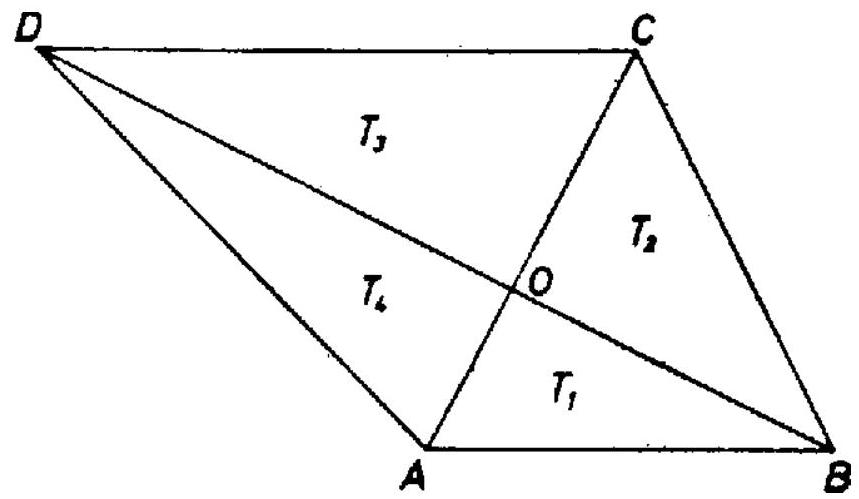
The first two triangles share the line segment $AO, OC$, so $T_{1}: T_{2}=AO: CO$. Sim... | 25\mathrm{~}^{2} | Geometry | math-word-problem | Yes | Yes | olympiads | false |
Nancy has 9 5-dollar bills. How much money does she have in total? | Nancy has 9 5-dollar bills. To find out how much money she has in total, you multiply the number of bills by the value of each bill:
9 (number of 5-dollar bills) × $5 (value of each bill) = $45
So, Nancy has $\boxed{\$45}$ in total. | \$45 | Other | math-word-problem | Yes | Yes | orca_math | true |
Mr. Fortchaud turns on his heater on the 1st of November, 2005. The fuel tank was then full and contained some amount of fuel. On January 1, 2006, the tank counter indicated that 180 L remained. Mr. Fortchaud again filled his tank completely. On 1 May 2006, Mr. Fortchaud decided to stop heating and he read 1,238 L on t... | To find the initial capacity of the fuel tank, we need to consider the fuel used and the refills done by Mr. Fortchaud.
From November 1, 2005, to January 1, 2006, Mr. Fortchaud used some amount of fuel, which we can call X liters. At this point, 180 L remained in the tank. So, the initial capacity of the tank (which w... | 3,000 | Algebra | math-word-problem | Yes | Yes | orca_math | true |
5. (Average) The figure shows a semicircle, where $B$ is a point on its diameter $A C$ so that $A B=6$ and $B C=12$. The line perpendicular to this diameter meets the semicircle at $D$. The semicircles with diameters $A B$ and $B C$, drawn as shown, meet $A D$ and $C D$ at $E$ and $F$, respectively. Find the distance b... | Answer: $6 \sqrt{2}$
Solution: Observe that $D E F B$ is a rectangle so $E F=D B$. However, $D B^{2}=A B \times B C=72$. Thus, $E F=6 \sqrt{2}$. | 6\sqrt{2} | Geometry | math-word-problem | Yes | Yes | olympiads | false |
Determine the domain of the function $z(x) = \sqrt[3]{x - 1} + \sqrt[3]{8 - x}$. | To determine the domain of the function \( z(x) = \sqrt[3]{x - 1} + \sqrt[3]{8 - x} \), we need to consider the properties of the cube root function. The cube root function, \(\sqrt[3]{y}\), is defined for all real numbers \( y \). This means that both \(\sqrt[3]{x - 1}\) and \(\sqrt[3]{8 - x}\) are defined for all rea... | \mathbb{R} | Algebra | math-word-problem | Yes | Yes | metamath | true |
Edward had $17.80 to spend at the toy store. He bought 4 toy cars that cost $0.95 each. These toy cars had a discount of 15%. He also bought a race track that cost $6.00, the race track had an additional tax of 8%. How much money does Edward have left to buy more toys? | First, let's calculate the total cost of the toy cars before the discount. Each toy car costs $0.95, and Edward bought 4 of them.
Cost of toy cars = 4 * $0.95 = $3.80
Now, let's calculate the discount on the toy cars. The discount is 15%.
Discount on toy cars = 15% of $3.80
Discount on toy cars = 0.15 * $3.80
Discou... | \$8.09 | Algebra | math-word-problem | Yes | Yes | orca_math | true |
The graph of the line $x-y=d$ is a perpendicular bisector of the line segment from $(2,5)$ to $(8,11)$. What is the value of $d$? | 1. **Find the Midpoint:**
The midpoint, $M$, of the segment from $(2,5)$ to $(8,11)$ is calculated as:
\[
M = \left(\frac{2+8}{2}, \frac{5+11}{2}\right) = (5,8)
\]
2. **Equation of Perpendicular Bisector:**
Since the line $x-y=d$ is the perpendicular bisector, it must pass through this midpoint $(5,8)$.... | d = -3 | Geometry | math-word-problem | Yes | Yes | synthetic_math | true |
Subsets and Splits
No community queries yet
The top public SQL queries from the community will appear here once available.