
instruction_seed stringlengths 2 10.7k | solution stringlengths 0 10.8k ⌀ | answer stringlengths 0 575 ⌀ | problem_type stringclasses 9
values | question_type stringclasses 5
values | problem_is_valid stringclasses 5
values | solution_is_valid stringclasses 4
values | source stringclasses 11
values | synthetic bool 2
classes |
|---|---|---|---|---|---|---|---|---|
Suppose that $f(x)$ is a linear function satisfying the equation $f(x) = 3f^{-1}(x) + 5$. Given that $f(0) = 3$, find $f(-1)$. | Since $f(x)$ is a linear function, it can be written as $f(x) = ax + b$. The inverse function, denoted by $g(x)$, satisfies $f(g(x)) = x$ for all $x$. Thus, we can express $g(x)$ from $f(x)$ as:
\[ g(x) = \frac{x - b}{a} \]
Substituting $f(x) = ax + b$ and $g(x) = \frac{x - b}{a}$ into the given functional equation yi... | \frac{2\sqrt{3}}{3} | Algebra | math-word-problem | Yes | Yes | synthetic_math | true |
Given the function $f(x)=|x-m|$ $(m > 0)$, and $g(x)=2f(x)-f(x+m)$, the minimum value of $g(x)$ is $-1$.
$(1)$ Find the value of the real number $m$;
$(2)$ If $|a| |a|f\left(\frac{b}{a}\right)$. | Solution:
$(1)$ Since $f(x)=|x-m|$ $(m > 0)$,
$\therefore g(x)=2f(x)-f(x+m)= \begin{cases} -x+2m, & x\leqslant 0 \\ -3x+2m, & 0 m \end{cases}$,
Therefore, when $x=m$, the function takes its minimum value $-m=-1$. Solving this gives: $\boxed{m=1}$;
$(2)$ To prove: $f(ab) > |a|f\left( \frac {b}{a}\right)$.
That is ... | m=1 | Algebra | math-word-problem | Yes | Yes | cn_k12 | false |
Edward had $ 18. He spent $ 16.. How much money does Edward have now? | Edward had $18 and spent $16. To find out how much money he has now, we subtract the amount he spent from the amount he had:
$18 - $16 = $2
Edward now has $\boxed{\$2}$ . | \$2 | Logic and Puzzles | math-word-problem | Incomplete | Yes | orca_math | true |
In a school there are 706 girls and some boys. 418 more girls joined the school. There are now 1346 pupils in the school. How many boys are there in the school? | Let's denote the number of boys in the school as B.
Initially, there were 706 girls in the school. After 418 more girls joined, the total number of girls became:
706 girls + 418 girls = 1124 girls
Now, we know that the total number of pupils in the school after the new girls joined is 1346. This total includes both ... | 222 | Algebra | math-word-problem | Yes | Yes | orca_math | true |
Ceasar needs to read a book for school. He has already read 147 pages and has 416 pages left to read. How many pages are in the book? | To find the total number of pages in the book, we need to add the number of pages Ceasar has already read to the number of pages he has left to read.
Pages already read: 147
Pages left to read: 416
Total pages in the book = Pages already read + Pages left to read
Total pages in the book = 147 + 416
Total pages in the... | 563 | Algebra | math-word-problem | Yes | Yes | orca_math | true |
## Task 5 - 140735
The perimeter of a triangle with side lengths $a, b, c$ is $34 \mathrm{~cm}$. Furthermore, $a: b=3: 8$ and $b: c=4: 3$.
Determine the side lengths! | It is given that $a: b=3: 8, b: c=8: 6$ (extension of $4: 3$ by 2), from which it follows that $a: b: c=3: 8: 6$, i.e., $a, b$ and $c$ are, in sequence, the 3-, 8-, and 6-fold of the same length.
Since $3+8+6=17$ and given the perimeter of $34 \mathrm{~cm}$, this length is $2 \mathrm{~cm}$. Therefore, the sought side ... | =6\mathrm{~},b=16\mathrm{~},=12\mathrm{~} | Geometry | math-word-problem | Yes | Yes | olympiads | false |
Example 13. Let $x, y, z$ be any real numbers. Prove:
$$
\begin{array}{l}
\sqrt{x^{2}+x y+y^{2}}+\sqrt{x^{2}+x z+z^{2}} \\
\geqslant \sqrt{y^{2}+y z+z^{2}} .
\end{array}
$$ | Prove that in the plane, establish a coordinate system $x o y$, and take $\exists$ point $A(x, 0), B\left(-\frac{y}{2},-\frac{\sqrt{3}}{2} y\right) \cdot C\left(-\frac{z}{2}\right.$, $\left.\frac{\sqrt{3}}{2} z\right)$, then
$$
\begin{array}{l}
|A B|=\sqrt{\left(x+\frac{y}{2}\right)^{2}+\left(0+\frac{\sqrt{3}}{2} y\rig... | proof | Inequalities | proof | Yes | Yes | cn_contest | false |
On the sides of triangle $A B C$, we take arbitrary points $A_{1}, B_{1}, C_{1}$ and draw three circles through the points $A, B_{1}, C_{1}$, $B, A_{1}, C_{1}$, and $C, A_{1}, B_{1}$. Furthermore, let us take an arbitrary point $D$ in the plane of the triangle and connect it with the vertices $A, B$, and $C$. If the li... | The circles passing through the points $A, B_{1}, C_{1}$; $B, C_{1}, A_{1}$; $C, A_{1}, B_{1}$ and whose centers are denoted by $O_{1}, O_{2}, O_{3}$ respectively, intersect at a single point $(M)$. (K. M. L. Vol. VI, p. 87.) If $D A$ intersects the circle $O_{1}$ at $P$; $D B$ intersects the circle $O_{2}$ at $Q$; and... | proof | Geometry | proof | Yes | Yes | olympiads | false |
In a triangle, for $\angle B$ to be the largest angle of the triangle, it must be that $p < y < q$. The side lengths of the triangle are given as follows: $BC = y + 7$, $AC = y + 3$, and $AB = 2y + 1$. What is the least possible value of $q - p$, expressed as a common fraction? | The sides of the triangle must satisfy the triangle inequality, so we have the inequalities:
\[
BC + AC > AB, \\
BC + AB > AC, \\
AC + AB > BC.
\]
Plugging in the side lengths:
\[
(y + 7) + (y + 3) > 2y + 1, \\
(y + 7) + (2y + 1) > y + 3, \\
(y + 3) + (2y + 1) > y + 7,
\]
which simplify to
\[
y + 9 > 2y + 1 \Rightarrow... | 2 | Geometry | math-word-problem | Yes | Yes | synthetic_math | true |
Tohatnicov A.A.
Given a convex quadrilateral $ABCD$ such that $AB=BC$ and $AD=DC$. Points $K, L$, and $M$ are the midpoints of segments $AB, CD$, and $AC$ respectively. The perpendicular from point $A$ to line $BC$ intersects with the perpendicular from point $C$ to line $AD$ at point $H$. Prove that lines $KL$ and $H... | Let the foot of the perpendicular dropped from point $A$ to $B C$ be denoted by $S$, and the foot of the perpendicular dropped from point $C$ to $A D$ be denoted by $P$ (see the figure).

No... | proof | Geometry | proof | Yes | Yes | olympiads | false |
An ellipse has the optical property that a ray of light emanating from one focus of the ellipse, after being reflected by the ellipse, will pass through the other focus. Now, there is a horizontally placed elliptical billiard table, with points A and B as its foci, the major axis length as $2a$, and the focal distance ... | Assuming the major axis is along the x-axis and the minor axis is along the y-axis, let A be the left focus and B be the right focus. There are three cases to consider:
1. If the ball moves from A along the x-axis to the left in a straight line, it will hit the left vertex and bounce back on the same path. In this case... | 4a \text{ or } 2(a-c) \text{ or } 2(a+c) | Geometry | math-word-problem | Yes | Yes | cn_k12 | false |
There are 34 kids signed up to compete in the talent show. There are 22 more girls than boys signed up to compete. How many girls are signed up to compete in the talent show? | Let's denote the number of boys signed up as B and the number of girls as G. According to the information given:
G = B + 22
We also know that the total number of kids signed up is 34, so:
B + G = 34
Now we can substitute the first equation into the second equation:
B + (B + 22) = 34
Combine like terms:
2B + 22 =... | 28 | Algebra | math-word-problem | Yes | Yes | orca_math | true |
Laticia knitted 4 pairs of socks for her nephew. She did such a good job that everyone asked her to start selling them. In the first week, she knitted 12 pairs of socks. In the second week, she knitted 4 more pairs than the week before. On the third week, she only knitted half of the total of the first two weeks. In th... | Let's calculate the number of pairs of socks Laticia knitted each week.
First week: 12 pairs
Second week: 12 pairs + 4 pairs = 16 pairs
Total for first two weeks: 12 pairs + 16 pairs = 28 pairs
Third week: Half of the total of the first two weeks = 28 pairs / 2 = 14 pairs
Now, let's find out the total number of pairs... | 1 | Algebra | math-word-problem | Yes | Yes | orca_math | true |
The imaginary part of the complex number $\frac{5+i}{2-i}$ ($i$ is the imaginary unit) is $\_\_\_\_\_\_$. | Solution: According to the problem, $\frac{5+i}{2-i} = \frac{(5+i)(2+i)}{(2-i)(2+i)} = \frac{9+7i}{5} = \frac{9}{5} + \frac{7}{5}i$.
Therefore, the complex number $\frac{5+i}{2-i}$ is an imaginary number, and its imaginary part is $\frac{7}{5}$.
Using the rule for dividing two complex numbers, simplify the complex nu... | \frac{7}{5} | Algebra | math-word-problem | Yes | Yes | cn_k12 | false |
A baker bought cooking ingredients in the supermarket. She bought 3 boxes of flour that cost $3 each box, 3 trays of eggs that cost $10 for each tray, 7 liters of milk that cost a certain amount each liter, and 2 boxes of baking soda that cost $3 each box. She had to pay $80 for everything. How much did each liter of m... | Let's calculate the total cost of the items for which we have prices:
Cost of flour = 3 boxes * $3/box = $9
Cost of eggs = 3 trays * $10/tray = $30
Cost of baking soda = 2 boxes * $3/box = $6
Now, let's add up the cost of these items:
Total cost of flour, eggs, and baking soda = $9 + $30 + $6 = $45
The baker had to... | \$5 | Algebra | math-word-problem | Yes | Yes | orca_math | true |
A shopkeeper takes some profit on his goods. He lost 20% goods during theft. His loss percent is 12%. What is the profit percent he takes on his goods? | Let's assume the shopkeeper has goods worth $100 (for ease of calculation).
He lost 20% of his goods during theft, which means he lost goods worth $20 (20% of $100).
Now, he is left with goods worth $80 ($100 - $20).
He also faced an overall loss of 12%, which means he lost $12 on the entire value of the goods ($100... | 10\% | Algebra | math-word-problem | Yes | Yes | orca_math | true |
XI OM - III - Task 4
Prove that if the equation
has two equal roots, then
Note: The equation and the condition to prove are not provided in the text. If you have the specific equation and condition, please provide them for a complete translation. | Suppose that equation (1) has two roots equal to $ \alpha $; then $ \alpha^4 + a\alpha + b = 0 $, hence
where
the number $ \alpha $, as a double root of the polynomial $ x^4 + ax + b $, is a root of the polynomial $ Q (x) $, hence
By eliminating $ \alpha $ from the equations
we obtain condition (2):
Note. Conditio... | proof | Algebra | proof | Incomplete | Yes | olympiads | false |
Given \(a, b, c\) such that \(a+b+c = 7\), \(ab+ac+bc = 11\), and \(abc = -6\), determine \(a^3 + b^3 + c^3\). | Start by using the identity:
\[ a^3 + b^3 + c^3 - 3abc = (a+b+c)(a^2 + b^2 + c^2 - ab - ac - bc) \]
Plug in the values we know:
\[ a+b+c = 7, \]
\[ ab+ac+bc = 11, \]
\[ abc = -6. \]
We need to find \(a^2 + b^2 + c^2\) which can be calculated as:
\[ a^2 + b^2 + c^2 = (a+b+c)^2 - 2(ab+ac+bc) = 7^2 - 2 \cdot 11 = 49 - 22... | 94 | Algebra | math-word-problem | Yes | Yes | synthetic_math | true |
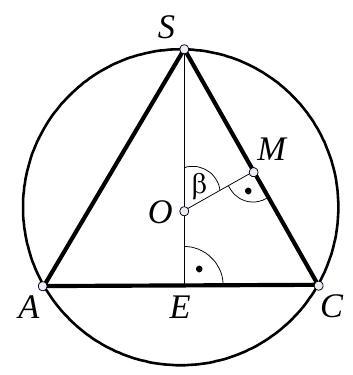
17. (6 points) The shaded part in the figure consists of two circular arcs with centers at points $A$ and $C$, $A E=4 m$, point $B$ is the midpoint of $A E$, then the perimeter of the shaded part is $\qquad$ $m$, and the area is $\qquad$ $m^{2}$
(Circle ratio $\pi$ is taken as 3 ). | 17. (6 points) The shaded part in the figure consists of two circular arcs with centers at points $A$ and $C$, respectively. $A E=4 m$, and point $B$ is the midpoint of $A E$. The perimeter of the shaded part is $13 m$, and the area is $\quad 7 m^{2}$ (take $\pi$ as 3).
【Solution】Solution: The perimeter of the shaded ... | 13,7 | Geometry | math-word-problem | Yes | Yes | olympiads | false |
The sequences of positive integers $1,a_2, a_3, \dots$ and $1, b_2, b_3, \dots$ are an increasing arithmetic sequence and an increasing geometric sequence, respectively. Let $c_n = a_n + b_n$. There is an integer $k$ such that $c_{k-1} = 50$ and $c_{k+1} = 200$. Find $c_k$. | Let $d$ be the common difference for the arithmetic sequence, and let $r$ be the common ratio for the geometric sequence. Therefore, we have:
$$ a_n = 1 + (n - 1)d $$
$$ b_n = r^{n-1} $$
Then for $k - 1$ and $k + 1$, we have:
$$ 1 + (k-2)d + r^{k-2} = 50 $$
$$ 1 + kd + r^k = 200 $$
Simplifying these:
$$ (k-2)d + r^{k-... | 90 | Algebra | math-word-problem | Yes | Yes | synthetic_math | true |
13. Points $M$ and $N$ are on sides $A B$ and $B C$ of $\triangle A B C$, respectively, and $\frac{A M}{B M}=m, \frac{C N}{B N}=n$. Line $M N$ intersects the median $B D$ of the triangle at point $O$. Find $\frac{\mathrm{DO}}{\mathrm{BO}}$. | 13. For definiteness, let $m>n$. When $m<n$, the positions of vertices $\mathrm{A}$ and $\mathrm{C}$ need to be exchanged in the following discussion.
The lines $\mathrm{CE}$ and $\mathrm{DF}$ through points $\mathrm{C}$ and $\mathrm{D}$ are parallel to $\mathrm{MN}$ (Figure 15). At this time, $\frac{E M}{B M}=\frac{C... | \frac{1}{2}(m+n) | Geometry | math-word-problem | Yes | Yes | cn_contest | false |
The machining of a certain part consists of two processes. The scrap rate of the first process is $a$, and the scrap rate of the second process is $b$. Assuming the occurrence of scrap in these processes is independent of each other, then the pass rate of the product is ( )
A: $ab-a-b+1$
B: $1-a-b$
C: $1-ab$
D: ... | Since the occurrence of scrap in these processes is independent, the pass rate for the first process is $1-a$, and for the second process is $1-b$. Therefore, the overall pass rate is the product of the two, which is $(1-a)(1-b) = 1-a-b+ab$. Thus, the correct answer is $\boxed{\text{A: } ab-a-b+1}$. | \text{A: } ab-a-b+1 | Algebra | MCQ | Yes | Yes | cn_k12 | false |
4. Determine all polynomials $P$ with real coefficients such that for all $x \in \mathbb{R}$:
$$
(x+2014) P(x)=x P(x+1)
$$ | P(x)=(x+2014)forsomeconstant | Algebra | math-word-problem | Yes | Yes | olympiads | false | |
John left home and drove at the rate of 45 mph for 2 hours. He stopped for lunch then drove for some hours at the rate of 45 mph to reach his destination. John drove 225 miles. How many hours did he drive after lunch? | John drove at the rate of 45 mph for 2 hours before stopping for lunch. The distance he covered before lunch can be calculated as:
Distance = Speed × Time
Distance before lunch = 45 mph × 2 hours = 90 miles
The total distance John drove was 225 miles. To find the distance he covered after lunch, we subtract the dista... | 3 | Algebra | math-word-problem | Yes | Yes | orca_math | true |
Given two vectors $\overrightarrow{a}$ and $\overrightarrow{b}$ satisfying $| \overrightarrow{a} + \overrightarrow{b}| = | \overrightarrow{a} - \overrightarrow{b}| = 5$, find the range of possible values for $|\overrightarrow{a}| + |\overrightarrow{b}|$. | Since the vectors $\overrightarrow{a}$ and $\overrightarrow{b}$ satisfy $|\overrightarrow{a} + \overrightarrow{b}| = |\overrightarrow{a} - \overrightarrow{b}| = 5$, we have
\[
|\overrightarrow{a}| + |\overrightarrow{b}| \geq |\overrightarrow{a} \pm \overrightarrow{b}| = 5.
\]
This lower bound is reached when vectors $\... | B | Algebra | math-word-problem | Yes | Yes | cn_k12 | false |
A school organizes a math competition, and the students' scores $\xi$ follow a normal distribution $N(100, \sigma^2)$. Given $P(\xi \geq 120) = a$ and $P(80 < \xi \leq 100) = b$, then $a+b= \boxed{0.5}$. | Since the students' scores $\xi$ follow a normal distribution $N(100, \sigma^2)$, the distribution curve is symmetric about the line $x=100$.
Given $P(80 < \xi \leq 100) = b$, it follows that $P(100 \leq \xi < 120) = b$ due to the symmetry of the distribution curve about $x=100$.
Additionally, given $P(\xi \geq 120) ... | 0.5 | Algebra | math-word-problem | Yes | Yes | cn_k12 | false |
Mona and Donald fly to Rome for the weekend. They take cash only in notes of $10 and notes of €10. Mona carries 3 times the amount of euros Donald carries. She also carries as many dollars as Donald carries. The number of €10 notes they take is double the number of $10 notes they take. If Donald carries a total of 39 n... | Let's denote the number of €10 notes Donald carries as D_e and the number of $10 notes Donald carries as D_d. Similarly, let's denote the number of €10 notes Mona carries as M_e and the number of $10 notes Mona carries as M_d.
According to the problem, Mona carries 3 times the amount of euros Donald carries, so M_e = ... | 118 | Algebra | math-word-problem | Yes | Yes | orca_math | true |
the cost of an article is decreased by 50 % . if the original cost is $ 200 , find the decrease cost . | If the original cost of the article is $200 and it is decreased by 50%, we can calculate the decreased cost as follows:
Decrease in cost = Original cost × Percentage decrease
Decrease in cost = $200 × 50%
Decrease in cost = $200 × 0.50 (since 50% is the same as 0.50)
Decrease in cost = $100
Now, to find the decreased... | \$100 | Algebra | math-word-problem | Yes | Yes | orca_math | true |
313. Find the scalar product of the vectors
$$
\bar{p}=\bar{i}-3 \bar{j}+\bar{k}, \bar{q}=\bar{i}+\bar{j}-4 \bar{k}
$$ | Solution. The scalar product of the vectors will be found using formula (12):
$$
\bar{p} \bar{q}=1 \cdot 1+(-3) \cdot 1+1 \cdot (-4)=-6
$$ | -6 | Algebra | math-word-problem | Yes | Yes | olympiads | false |
Let $P(x)$ be a polynomial with real coefficients. Prove that not all roots of $x^3P(x)+1$ are real. | 1. Let \( P(x) \) be a polynomial with real coefficients. We need to prove that not all roots of \( x^3P(x) + 1 = 0 \) are real.
2. Suppose, for the sake of contradiction, that all roots of \( x^3P(x) + 1 = 0 \) are real. Let these roots be \( r_1, r_2, \ldots, r_n \).
3. Consider the polynomial \( Q(x) = x^3P(x) + 1... | null | Algebra | proof | Yes | Yes | aops_forum | false |
Factorization: $2m^{2}-12m+18=$____. | To factorize the given expression $2m^{2}-12m+18$, we follow these steps:
1. Factor out the greatest common factor (GCF) from each term, which is $2$:
\[2m^{2}-12m+18 = 2(m^{2}-6m+9)\]
2. Observe the expression inside the parentheses, $m^{2}-6m+9$. This is a perfect square trinomial, which can be factored into $(m-3)... | 2\left(m-3\right)^{2} | Algebra | math-word-problem | Yes | Yes | cn_k12 | false |
12.64 Prove that any non-self-intersecting pentagon lies on the same side of one of its edges.
保留源文本的换行和格式,翻译结果如下:
12.64 Prove that any non-self-intersecting pentagon lies on the same side of one of its edges. | [Proof] The convex hull of a pentagon is a convex pentagon, a convex quadrilateral, or a triangle, and at least 3 of the vertices of the convex hull are vertices of the original pentagon. A pentagon has 5 vertices, so among these 3 vertices, there must be two adjacent vertices. The edge connecting these two points is t... | proof | Geometry | proof | Yes | Yes | olympiads | false |
In the expansion of $(3x-1)^{6}$, the coefficient of $x^{2}$ is ________ (use numbers to answer). | To find the coefficient of $x^{2}$ in the expansion of $(3x-1)^{6}$, we can use the binomial theorem, which states that the general term in the expansion of $(a+b)^{n}$ is given by:
$$ T_{r+1} = \binom{n}{r}a^{n-r}b^r $$
For our problem, $a = 3x$, $b = -1$, and $n = 6$. Thus, the general term $T_{r+1}$ of the expansi... | 135 | Algebra | math-word-problem | Yes | Yes | cn_k12 | false |
In the figure below, segments $A B$ and $C D$ are parallel. If $\angle C I J=10 \beta, \angle A G J=10 \alpha$, $\angle C E J=6 \alpha$ and $\angle J F G=6 \beta$, determine the value of the angle $\angle I J K$.

Since $\angle C E J$ and $\angle J F A$ are consecutive interior angles, $6 \alpha + 6 \beta = 180^{\circ}$, which means $\alpha + \beta = 30^{\circ}$. From point $J$, consider the... | 120 | Geometry | math-word-problem | Yes | Yes | olympiads | false |
Given $z=1+i$ and $a, b \in \mathbb{R}$, if $$\frac {z^{2}+az+b}{z^{2}-z+1}=1-i,$$ find the values of $a$ and $b$. | Since $z=1+i$, we calculate $z^2$ as follows:
\begin{align*}
z^2 & = (1+i)^2 \\
& = 1^2 + 2 \cdot 1 \cdot i + i^2 \\
& = 1 + 2i - 1 \quad \text{(since $i^2=-1$)} \\
& = 2i.
\end{align*}
Substituting $z^2$ with $2i$ in the given fraction, we have:
\begin{align*}
\frac {z^{2}+az+b}{z^{2}-z+1} & = \frac {2i + ... | b = 2 | Algebra | math-word-problem | Yes | Yes | cn_k12 | false |
The general form equation of the line passing through point A(1, 1) with a slope of -3 is ( )
(A) $3x+y-4=0$
(B) $3x-y-2=0$
(C) $x+3y-4=0$
(D) $x-3y+2=0$ | To find the equation of a line given a point and a slope, we use the point-slope form of a line equation, which is $y - y_1 = m(x - x_1)$, where $(x_1, y_1)$ is a point on the line and $m$ is the slope of the line.
Given point A(1, 1) and slope $m = -3$, we substitute these values into the point-slope form:
$y - 1 = ... | \text{(A) } 3x+y-4=0 | Algebra | MCQ | Yes | Yes | cn_k12 | false |
Let $\{a_n\}$ be an arithmetic sequence, and $\{b_n\}$ be a geometric sequence with all positive terms, and $a_1=b_1=1$, $a_3+b_5=21$, $a_5+b_3=13$.
(I) Find the general formula for $\{a_n\}$ and $\{b_n\}$.
(II) Calculate the sum of the first $n$ terms $S_n$ of the sequence $\left\{ \frac{a_n}{b_n} \right\}$. | Solution:
(I) Let the common difference of $\{a_n\}$ be $d$, and the common ratio of $\{b_n\}$ be $q$, then according to the problem, we have $q > 0$ and $\begin{cases} 1+2d+q^4=21 \\ 1+4d+q^2=13 \end{cases}$
Solving these, we get $d=2$, $q=2$.
Therefore, $a_n=1+(n-1)d=2n-1$, $b_n=q^{n-1}=2^{n-1}$.
(II) $\frac... | 6- \frac{2n+3}{2^{n-1}} | Algebra | math-word-problem | Yes | Yes | cn_k12 | false |
If the average (arithmetic mean) of a and b is 45 and the average of b and c is 50, what is the value of c - a? | Let's use the definition of the average (arithmetic mean) to set up equations for the given information.
The average of a and b is 45:
(a + b) / 2 = 45
Multiply both sides by 2 to get rid of the denominator:
a + b = 90 (Equation 1)
The average of b and c is 50:
(b + c) / 2 = 50
Multiply both sides by 2 to get rid of ... | 10 | Algebra | math-word-problem | Yes | Yes | orca_math | true |
$2 \cdot 95$ The number of real roots of the equation $x|x|-3|x|+2=0$ is
(A) 1.
(B) 2.
(C) 3.
(D) 4.
(Tianjin City, China Junior High School Mathematics Competition, 1983;
2nd "Jinyun Cup" Junior High School Mathematics Invitational Competition, 1985) | [Solution] Consider two cases:
(1) When $x \geqslant 0$, the equation can be simplified to $x^{2}-3 x+2=0$, solving for $x$ gives
$$
x=\frac{3 \pm \sqrt{3^{2}-4 \cdot 2}}{2}=\frac{3 \pm 1}{2},
$$
both roots are valid.
(2) When $x \leqslant 0$, the equation can be simplified to $-x^{2}+3 x+2=0$, which is
$$
x^{2}-3 x-2... | 3 | Algebra | MCQ | Yes | Yes | olympiads | false |
Given vectors $a=(k,3)$, $b=(1,4)$, $c=(2,1)$, and $(2a-3b) \perp c$, find the value of the real number $k$.
A: $-\frac{9}{2}$
B: $0$
C: $3$
D: $\frac{15}{2}$ | **Analysis**:
This problem involves coordinate operations of vectors and properties of orthogonal vectors. Using the coordinates of the given vectors, write out the result of the scalar multiplication and addition operations. Based on the orthogonal relationship between the two vectors, write out the dot product of the... | k=3 | Algebra | MCQ | Yes | Yes | cn_k12 | false |
Given the function $f(x) = a^{2x-1} + 2$ (where $a$ is a constant, and $a > 0$, $a \neq 1$), regardless of the value of $a$, the function $f(x)$ always passes through a fixed point $P$. The coordinates of $P$ are ( )
A: $(0,1)$
B: $(1,2)$
C: $(1,3)$
D: $\left( \frac{1}{2}, 3 \right)$ | Since $f(x) = a^{2x-1} + 2 = a^{2(x- \frac{1}{2})} + 2 = (a^2)^{x- \frac{1}{2}} + 2$,
and the function $y = (a^2)^x$ always passes through the fixed point $(0,1)$,
therefore, $f(x) = (a^2)^{x- \frac{1}{2}} + 2$ always passes through the fixed point $\left( \frac{1}{2}, 3 \right)$.
Hence, the correct choice is: $\... | D | Algebra | MCQ | Yes | Yes | cn_k12 | false |
Given two skew lines $a$ and $b$ forming an angle of $80^\circ$, and a fixed point $P$ not on lines $a$ or $b$. If there are exactly two lines passing through $P$ that form equal angles with lines $a$ and $b$, and these angles are equal to $\alpha$, then the set to which angle $\alpha$ belongs is ( )
A: $\{ \alpha | 4... | The solution is omitted.
The correct answer is $\boxed{\text{D: } \{ \alpha | 50^\circ < \alpha < 90^\circ \}}$. | \text{D: } \{ \alpha | 50^\circ < \alpha < 90^\circ \} | Geometry | MCQ | Yes | Problem not solved | cn_k12 | false |
To sample a group of 5 students from a class of 60 using systematic sampling, students are randomly assigned numbers from 01 to 60. They are then grouped sequentially into 5 equal groups (1-12, 13-24, ..., 49-60). If student number 16 is selected from the second group, what would be the number of the student selected f... | Firstly, we arrange the 60 students into 5 equal groups based on their assigned numbers:
- Group 1: 01-12,
- Group 2: 13-24,
- Group 3: 25-36,
- Group 4: 37-48,
- Group 5: 49-60.
Since the number 16 is drawn from the second group, we recognize it as the 4th number in that group (since 16 - 12 = 4).
To find the corres... | 40 | Combinatorics | math-word-problem | Yes | Yes | cn_k12 | false |
k is faster than l by a certain percentage. If l starts at 9 a.m. and k starts at 10 a.m., l travels at a speed of 50 km/hr. If l and k are 300 kms apart, they meet when they travel in opposite directions at 12. What is the percentage by which k is faster than l? | Let's denote the speed of k as \( v_k \) and the speed of l as \( v_l \). We are given that \( v_l = 50 \) km/hr.
Since l starts at 9 a.m. and they meet at 12 p.m., l has been traveling for 3 hours. In that time, l would have covered a distance of \( 3 \times v_l = 3 \times 50 = 150 \) km.
k starts at 10 a.m. and the... | 50\% | Algebra | math-word-problem | Yes | Yes | orca_math | true |
Given the corresponding data between the advertising expenses $x$ (in units of 10,000 yuan) and the sales amount $y$ (in units of 10,000 yuan) of a certain product as shown below:
|x|2|4|5|6|8|
|-|-|-|-|-|-|
|y|30|40|50|60|70|
It is known that the regression equation between them is $\hat{y}=bx+\hat{a}$. Given that $... | To solve this problem, we first need to calculate the mean of the advertising expenses ($\overline{x}$) and the mean of the sales amount ($\overline{y}$) using the given data.
Step 1: Calculate the mean of $x$ (advertising expenses):
\[
\overline{x} = \frac{1}{5}(2 + 4 + 5 + 6 + 8) = \frac{25}{5} = 5
\]
Step 2: Calcu... | \text{B: 85,000 yuan} | Algebra | MCQ | Yes | Yes | cn_k12 | false |
21. On the plane, there are $2 n$ vectors leading from the center of a regular $2 n$-gon to its vertices. How many of them need to be taken so that their sum has the maximum length? | 79.21. Answer. You need to take $n$ consecutive vectors. | n | Geometry | math-word-problem | Yes | Incomplete | olympiads | false |
B2. A cylindrical container with a radius of $4 \mathrm{~cm}$ and a height of $9 \mathrm{~cm}$ is filled with water to $\frac{2}{9}$ of its height. Mark decided to pour all the water into a conical container with a radius of $5 \mathrm{~cm}$ and a height of $6 \mathrm{~cm}$ (see figure). During the pouring, $5 \%$ of t... | B2.
Calculation of the amount of water $\mathrm{v}$ in a cylindrical container $V=\frac{2}{9} \pi \cdot r^{2} \cdot v=100.53 \mathrm{~cm}^{3}$ ..... 1 point
Calculation of the amount of water $\mathrm{v}$ in a conical container $0.95 \cdot V=95.5 \mathrm{~cm}^{3}$ ..... 1 point
Answer ..... 1 point
Writing the relation... | 95.5 | Algebra | math-word-problem | Yes | Yes | olympiads | false |
20 liters of chemical x are added to 80 liters of a mixture that has a certain percentage of chemical x and the rest is chemical y. The resulting mixture is 44% chemical x. What was the initial percentage of chemical x in the mixture? | Let's denote the initial percentage of chemical x in the 80-liter mixture as P (in decimal form, so for example, 50% would be 0.5).
The amount of chemical x in the initial 80-liter mixture would then be 80 * P liters.
When we add 20 liters of chemical x to this mixture, the total amount of chemical x becomes (80 * P)... | 30\% | Algebra | math-word-problem | Yes | Yes | orca_math | true |
There are four receiving stations on the ground in Russia, named A, B, C, and D, that are responsible for receiving information sent back from the International Space Station. They can all communicate with each other pairwise, but for security reasons, the space station can only randomly send information to one of them... | Let's analyze the possible methods of relaying the information:
- **First Category**: Station A sends the message directly to stations B, C, and D. There is $\boxed{1}$ way to do this since there is only one group of three stations to send to.
- **Second Category**: Station A sends the message directly to two out of ... | 16 | Combinatorics | MCQ | Yes | Yes | cn_k12 | false |
Find the divisor when 8^3 is multiplied by 9^3, and then divided by this divisor to get the result 549.7025036818851. | Let's first calculate the product of 8^3 and 9^3:
8^3 = 8 * 8 * 8 = 512
9^3 = 9 * 9 * 9 = 729
Now, multiply these two results together:
512 * 729 = 373248
We are told that when this product is divided by a certain divisor, the result is 549.7025036818851. To find the divisor, we can use the following equation:
373... | 679 | Algebra | math-word-problem | Incomplete | Yes | orca_math | true |
In triangle $ABC$, if $\sin A > \sin B$, then the relationship between angles $A$ and $B$ is \_\_\_\_\_\_. | Given that $\sin A > \sin B$, we can express the difference of sines using the sum-to-product identity:
$$\sin A - \sin B = 2 \cos \left( \frac{A + B}{2} \right) \sin \left( \frac{A - B}{2} \right) > 0.$$
Since $0 0$ because cosine is positive in the first quadrant.
Also, given that $0 0$, it follows that $\frac{A ... | A > B | Geometry | math-word-problem | Yes | Yes | cn_k12 | false |
The weight of a hollow sphere is directly dependent on its surface area. The surface area of a sphere is 4π · r^2, where r is the radius of the sphere. If a hollow sphere of radius 0.15 cm made of a certain metal weighs 8 grams, a hollow sphere of radius 0.3 cm made of the same metal would weigh how many grams e? If th... | First, let's calculate the surface area of the first hollow sphere with a radius of 0.15 cm:
Surface area = 4π · r^2
Surface area = 4π · (0.15 cm)^2
Surface area = 4π · 0.0225 cm^2
Surface area = 0.09π cm^2
Since the weight of the sphere is directly dependent on its surface area, we can set up a proportion to find th... | 1:4:16 | Geometry | math-word-problem | Yes | Yes | orca_math | true |
What is the result of subtracting $5.3567 - 2.1456 - 1.0211$? | We start by aligning the decimal points and subtract the numbers:
\[ 5.3567 - 2.1456 = 5.3567 - 2.1456 = 3.2111 \]
Next, subtract $1.0211$ from the result:
\[ 3.2111 - 1.0211 = 2.1900 \]
So, the final answer is
\[ \boxed{2.1900} \] | 2.1900 | Algebra | math-word-problem | Yes | Yes | synthetic_math | true |
515. Keys and Ring. Once Colonel Crackham made a ring with two keys out of thick cardboard, as shown in the figure, without tearing or gluing anything anywhere. Perhaps this will

puzzle the... | 515. First, cut out the keys and ring in one piece as shown in the figure. Now, score the cardboard to half its thickness along the eight small black lines and similarly score the cardboard on the opposite side along the dotted lines. Then slide a pocket knife under each of the four small squares formed by these lines,... | notfound | Logic and Puzzles | math-word-problem | Incomplete | Yes | olympiads | false |
In the two-dimensional rectangular coordinate system, determine the graph of the following equations after undergoing the stretching transformation $\begin{cases} x'=\frac{1}{2}x \\ y'=\frac{1}{3}y \end{cases}$.
$(1) \quad 5x+2y=0$
$(2) \quad x^2+y^2=1$. | Given the stretching transformation $\begin{cases} x'=\frac{1}{2}x \\ y'=\frac{1}{3}y \end{cases}$, we can rewrite it as $\begin{cases} x=2x' \\ y=3y' \end{cases}$.
$(1)$ If $5x+2y=0$, then substituting the expressions for $x$ and $y$ from the stretching transformation, we get $5(2x')+2(3y')=0$, which simplifies to $\... | 4x'^2+9y'^2=1 | Algebra | math-word-problem | Yes | Yes | cn_k12 | false |
Let $f(x) = x \ln x - ax^2 + (2a - 1)x$, where $a \in \mathbb{R}$.
(Ⅰ) Let $g(x) = f'(x)$, find the intervals of monotonicity for $g(x)$;
(Ⅱ) When $a \leq 0$, the line $y = t$ ($-1 2$. | Solution:
(Ⅰ) Since $f'(x) = \ln x - 2ax + 2a$,
we have $g(x) = \ln x - 2ax + 2a$, for $x \in (0, +\infty)$,
then $g'(x) = \frac{1}{x} - 2a = \frac{1 - 2ax}{x}$,
when $a \leq 0$, for $x \in (0, +\infty)$, $g'(x) > 0$, the function $g(x)$ is increasing;
when $a > 0$, for $x \in (0, \frac{1}{2a})$, $g'(x) > 0$, the ... | x_1 + x_2 > 2 | Calculus | math-word-problem | Yes | Yes | cn_k12 | false |
How many hours are in a leap year, considering the extra day? | A regular year has 365 days, and a leap year has an extra day, making it 366 days. There are 24 hours in a day. To find the number of hours in a leap year, you multiply the number of days by the number of hours in a day:
366 days * 24 hours/day = 8,784 hours
So, a leap year has $\boxed{8,784}$ hours. | 8,784 | Other | math-word-problem | Yes | Yes | orca_math | true |
Compute $9^{ \frac {1}{2}}+ \log _{2}4 =$ _______ . | Solution: $9^{ \frac {1}{2}}+ \log _{2}4$
$=3+2=5$.
Hence, the answer is: $\boxed{5}$.
This is obtained by using the properties and rules of exponents and logarithms.
This question tests your ability to simplify and evaluate logarithmic and exponential expressions. It is a basic question, and when solving it, you sh... | 5 | Algebra | math-word-problem | Yes | Yes | cn_k12 | false |
John writes 3 stories every week. Each short story is 50 pages. He also writes a novel that is 1200 pages each year. Each sheet of paper can hold 2 pages. Over a certain number of weeks, he needs to buy 3 reams of paper, with each ream containing 500 sheets. How many weeks is he buying paper for? | First, let's calculate the number of pages John writes for his short stories each week. Since he writes 3 stories and each story is 50 pages, he writes:
3 stories/week * 50 pages/story = 150 pages/week
Now, let's calculate the number of pages he writes for his novel each year. Since he writes one novel of 1200 pages e... | 18 | Algebra | math-word-problem | Yes | Yes | orca_math | true |
"Zhang Qiu Jian Suan Jing" is a famous ancient Chinese mathematical classic with rich content. It contains the following problem: "There is a woman who is not good at weaving. Her daily output decreases by the same amount each day. On the first day, she weaves 5 feet of cloth, and on the last day, she weaves 1 foot. If... | **Analysis**
This question examines the method of finding the sum of the first $n$ terms of an arithmetic sequence. When solving the problem, it is important to pay attention to the reasonable application of sequence knowledge in production and daily life. It is a basic question.
**Solution**
Given that the amount o... | \text{B} | Algebra | MCQ | Yes | Yes | cn_k12 | false |
Darwin takes an $11\times 11$ grid of lattice points and connects every pair of points that are 1 unit apart, creating a $10\times 10$ grid of unit squares. If he never retraced any segment, what is the total length of all segments that he drew?
[i]Ray Li.[/i]
[hide="Clarifications"][list=1][*]The problem asks for th... | 1. **Understanding the Grid**:
- The grid is an \(11 \times 11\) grid of lattice points.
- Each pair of points that are 1 unit apart is connected, forming a \(10 \times 10\) grid of unit squares.
2. **Counting Horizontal Segments**:
- Each row of the grid has 10 horizontal segments.
- There are 11 rows in ... | 220 | Geometry | math-word-problem | Yes | Yes | aops_forum | false |
On the occasion of the 30th anniversary of the establishment of the province of Hainan, the central government decided to create the Hainan Free Trade Zone (Port), attracting global attention. According to statistics, the word "Hainan" was mentioned approximately 48,500,000 times in internet information in April. The n... | To convert the number $48,500,000$ into scientific notation, we follow the steps below:
1. Place the decimal point after the first non-zero digit, which gives us $4.85$.
2. Count the number of places the decimal has moved from its original position to its new position. In this case, the decimal has moved $7$ places.
3... | C | Algebra | MCQ | Yes | Yes | cn_k12 | false |
A person spends 1/3 of the money with him on clothes, 1/5 of the remaining on food, and 1/4 of the remaining on travel. Now, he is left with Rs 600. How much did he have with him in the beginning? | Let's denote the initial amount of money the person had as \( M \).
After spending \( \frac{1}{3} \) of his money on clothes, he is left with \( \frac{2}{3} \) of \( M \):
\[ \text{Remaining after clothes} = \frac{2}{3}M \]
Then, he spends \( \frac{1}{5} \) of the remaining amount on food, so he is left with \( \frac... | 1500 | Algebra | math-word-problem | Yes | Yes | orca_math | true |
A notebook and a pencil together cost $\; \$2.40$. The notebook costs $\; \$2$ more than the pencil. What is the cost of the notebook in dollars? | Let $n$ represent the cost of the notebook and $p$ represent the cost of the pencil. We are given the following equations based on the problem statement:
\[
n + p = 2.40,
\]
\[
n = 2 + p.
\]
Substitute the second equation into the first equation to eliminate $n$:
\[
2 + p + p = 2.40.
\]
This simplifies to:
\[
2p + 2 = ... | 2.20 | Algebra | math-word-problem | Yes | Yes | synthetic_math | true |
2. $[\mathbf{1 5}]$ Let $a_{1}, a_{2}, \ldots$ be an infinite sequence of integers such that $a_{i}$ divides $a_{i+1}$ for all $i \geq 1$, and let $b_{i}$ be the remainder when $a_{i}$ is divided by 210 . What is the maximal number of distinct terms in the sequence $b_{1}, b_{2}, \ldots$ ? | Answer: $\quad 127$ It is clear that the sequence $\left\{a_{i}\right\}$ will be a concatenation of sequences of the form $\left\{v_{i}\right\}_{i=1}^{N_{0}},\left\{w_{i} \cdot p_{1}\right\}_{i=1}^{N_{1}},\left\{x_{i} \cdot p_{1} p_{2}\right\}_{i=1}^{N_{2}},\left\{y_{i} \cdot p_{1} p_{2} p_{3}\right\}_{i=1}^{N_{3}}$, a... | 127 | Number Theory | math-word-problem | Yes | Yes | olympiads | false |
If the graph of the function $f(x)=\sin 2x+\cos 2x$ is shifted to the left by $\phi$ units and the resulting graph is symmetric about the $y$-axis, find the smallest positive value of $\phi$ $(\ \ \ )$.
A: $\dfrac {π}{8}$
B: $\dfrac {π}{4}$
C: $\dfrac {3π}{8}$
D: $\dfrac {3π}{4}$ | Analysis:
To find the smallest positive value of $\phi$, we simplify the function $f(x)$ to have a single trigonometric function. By establishing a relationship through the transformation of the graph symmetric about the $y$-axis, we can determine the minimum value of $\phi$. This problem primarily assesses the underst... | \dfrac{\pi}{8} | Algebra | MCQ | Yes | Yes | cn_k12 | false |
2. Find all primes $p$ such that $a^{3} b-a b^{3}$ is divisible by $p$ for any integers $a$ and $b$. | Answer: 2 and 3.
Solution. Let \( a = 2 \) and \( b = 1 \), then \( a^3 b - a b^3 = 8 - 2 = 6 = 2 \cdot 3 \).
Therefore, there can be no other prime divisors besides 2 and 3.
We will prove that 2 and 3 are suitable.
Factorize this expression:
\( a^3 b - a b^3 = a b (a^2 - b^2) = a b (a - b)(a + b) \).
We will prov... | 23 | Number Theory | math-word-problem | Yes | Yes | olympiads | false |
Given the parabola $y^{2}=4x$ with focus $F$, and a line $l$ passing through point $M(4,0)$.
(1) If the distance from point $F$ to line $l$ is $\sqrt{3}$, find the slope of line $l$;
(2) Let $A$ and $B$ be two points on the parabola, and $AB$ is not perpendicular to the $x$-axis. If the perpendicular bisector o... | Solution:
(1) Given the information, $x=4$ is not relevant to the problem. Assume the equation of line $l$ is $y=k(x-4)$,
Given that the coordinates of the focus of parabola $C$ are $(1,0)$,
Since the distance from point $F$ to line $l$ is $\sqrt{3}$,
we have $\frac{|3k|}{\sqrt{1+k^{2}}}=\sqrt{3}$,
solving th... | 2 | Geometry | math-word-problem | Yes | Yes | cn_k12 | false |
Let $f : R \to R$, and let $P$ be a nonzero polynomial with degree no more than $2015$. For any nonnegative integer $n$, $f^{(n)}(x)$ denotes the function defined as $f$ composed with itself $n$ times. For example, $f^{(0)}(x) = x$, $f^{(1)}(x) = f(x)$, $f^{(2)}(x) = f(f(x))$, etc. Show that there always exists a real ... | null | null | Logic and Puzzles | proof | Yes | Yes | aops_forum | false |
Let $p_1,p_2,p_3,p_4$ be four distinct primes, and let $1=d_1<d_2<\ldots<d_{16}=n$ be the divisors of $n=p_1p_2p_3p_4$. Determine all $n<2001$ with the property that
$d_9-d_8=22$. | 1. We are given four distinct primes \( p_1, p_2, p_3, p_4 \) such that \( p_1 < p_2 < p_3 < p_4 \) and \( n = p_1 p_2 p_3 p_4 \). We need to find all \( n < 2001 \) such that \( d_9 - d_8 = 22 \), where \( 1 = d_1 < d_2 < \cdots < d_{16} = n \) are the divisors of \( n \).
2. Since \( d_i \cdot d_{17-i} = n \) for al... | n = 1995 | Number Theory | math-word-problem | Yes | Yes | aops_forum | false |
the radius of a semi circle is 35 cm then its perimeter is ? | To calculate the perimeter of a semicircle, we need to add the length of the straight edge (the diameter) to the length of the curved edge (half the circumference of a full circle).
First, let's calculate the diameter of the semicircle, which is twice the radius:
Diameter = 2 * Radius = 2 * 35 cm = 70 cm
Next, let's ... | 179.96 | Geometry | math-word-problem | Yes | Yes | orca_math | true |
A circle of radius $1$ is [tangent](https://artofproblemsolving.com/wiki/index.php/Tangent) to a circle of radius $2$. The sides of $\triangle ABC$ are tangent to the circles as shown, and the sides $\overline{AB}$ and $\overline{AC}$ are congruent. What is the area of $\triangle ABC$?
[asy] size(200); pathpen = linew... | Let the centers of the smaller and larger circles be $O_1$ and $O_2$ , respectively.
Let their tangent points to $\triangle ABC$ be $D$ and $E$, respectively.
We can then draw the following diagram:
[asy] size(200); pathpen = linewidth(0.7); pointpen = black; pointfontpen = fontsize(10); real t=2^0.5; D((0,0)--(4*t,0)-... | 16\sqrt{2} | Geometry | MCQ | Yes | Yes | amc_aime | false |
If $\alpha =45^{\circ}$, then the value of $2\sin \alpha$ is:
A: $1$
B: $\sqrt{2}$
C: $\sqrt{3}$
D: $2$ | Given that $\alpha = 45^{\circ}$, we want to find the value of $2\sin \alpha$.
Starting with the given value of $\alpha$, we have:
\[
\alpha = 45^{\circ}
\]
We know that $\sin 45^{\circ} = \frac{\sqrt{2}}{2}$. Therefore, we can substitute $\alpha$ with $45^{\circ}$ in the expression $2\sin \alpha$:
\[
2\sin \alpha... | B | Algebra | MCQ | Yes | Yes | cn_k12 | false |
In $\triangle ABC$, $B=60^\circ$, $b^2=ac$, then the shape of $\triangle ABC$ is $\_\_\_\_\_\_$. | By the cosine theorem, we have $b^2=a^2+c^2-2accosB=a^2+c^2-ac$. Given that $b^2=ac$,
$\therefore a^2+c^2-ac=ac$, $\therefore (a-c)^2=0$, $\therefore a=c$, $\therefore A=B=C=60^\circ$,
$\therefore$ The shape of $\triangle ABC$ is an equilateral triangle.
So the answer is: $\boxed{\text{Equilateral triangle}}$.
By a... | \text{Equilateral triangle} | Geometry | math-word-problem | Yes | Yes | cn_k12 | false |
An article costing Rs. 47.50 must be marked at a certain price so that after deducting 7% from the list price, it may be sold at a certain profit percentage on the cost price. The price must be Rs. 63.84 (approximately). What is the profit percentage on the cost price? | To find the profit percentage on the cost price, we first need to determine the selling price after the 7% discount from the marked price and then compare it to the cost price.
Let's denote the marked price as MP.
After a 7% discount, the selling price (SP) will be 93% of the marked price, since 100% - 7% = 93%.
So,... | 34.4\% | Algebra | math-word-problem | Yes | Yes | orca_math | true |
9・21 Let real numbers $a_{1}, a_{2}, \cdots, a_{100}$ satisfy
$$\left\{\begin{array}{l}
a_{1}-3 a_{2}+2 a_{3} \geqslant 0 \\
a_{2}-3 a_{3}+2 a_{4} \geqslant 0 \\
\cdots \cdots \cdots \cdots \\
a_{99}-3 a_{100}+2 a_{1} \geqslant 0 \\
a_{100}-3 a_{1}+2 a_{2} \geqslant 0
\end{array}\right.$$
Prove that $a_{1}=a_{2}=\cdot... | [Proof] Let $s_{1}=a_{1}-3 a_{2}+2 a_{3}, s_{2}=a_{2}-3 a_{3}+2 a_{4}, \cdots, s_{99}=a_{99}$ $-3 a_{100}+2 a_{1}, s_{100}=a_{100}-3 a_{1}+2 a_{2}$. Clearly, we have
$$s_{1}+s_{2}+\cdots+s_{99}+s_{100}=0$$
Also, $s_{i} \geqslant 0, i=1,2, \cdots, 100$, so $s_{i}=0, i=1,2, \cdots, 100$, from which we can derive $a_{1}-... | proof | Algebra | proof | Yes | Yes | inequalities | false |
Kim sold some boxes on Tuesday, Wednesday, and Thursday. She sold twice as many boxes on Tuesday as she did on Wednesday, and she sold twice as many boxes on Wednesday as she did on Thursday. If Kim sold 1200 boxes of cupcakes on Thursday, what is the ratio of the number of boxes sold on Tuesday to the number of boxes ... | Let's denote the number of boxes sold on Thursday as T, on Wednesday as W, and on Tuesday as Tu.
According to the problem, Kim sold twice as many boxes on Wednesday as she did on Thursday, so we can write that as:
W = 2 * T
And she sold twice as many boxes on Tuesday as she did on Wednesday, so we can write that as:
... | 2:1 | Algebra | math-word-problem | Yes | Yes | orca_math | true |
In the geometric sequence $\{a_n\}$, if $a_3a_5a_7=1$, then the value of $\log a_1 + \log a_9$ is equal to ____. | Since $a_3a_5a_7 = a_5^3 = 1$, we get $a_5 = 1$.
Then, $\log a_1 + \log a_9 = \log(a_1 \cdot a_9) = \log(a_5^2) = \log 1 = 0$.
Therefore, the answer is $\boxed{0}$. | 0 | Algebra | math-word-problem | Yes | Yes | cn_k12 | false |
Given that the left vertex, upper vertex, and right focus of the ellipse $C: \frac{x^2}{4} + \frac{y^2}{3} = 1$ are $A$, $B$, and $F$ respectively, find the dot product of $\overset{→}{AB}$ and $\overset{→}{AF}$. | **Analysis**
This problem primarily tests the application of ellipses and familiarity with the formula for the dot product of vectors, which is key to solving this problem. This question is a common type seen in high school exams and is considered a basic question.
**Step-by-Step Solution**
1. From the given informa... | 6 | Geometry | math-word-problem | Yes | Yes | cn_k12 | false |
30. Let the increasing function $f:(0 ; \infty) \rightarrow(0 ; \infty)$ satisfy the inequality $f(2 x) \leqslant 4 f(x+1)$ for any $x>0$. Prove that for any $x>1$,
$$
f(x) \leqslant f(4) x^{2}
$$ | According to the problem statement
\[
\begin{gathered}
f(x) \leqslant 4^{1} f\left(\frac{x}{2}+1\right) \leqslant 4^{2} f\left(\frac{x^{2}}{2^{2}}+\frac{1}{2}+1\right) \leqslant \ldots \\
\ldots \leqslant 4^{k} f\left(\frac{x^{k}}{2^{k}}+\frac{1}{2^{k-1}}+\ldots+\frac{1}{2}+1\right) \leqslant 4^{k} f\left(\frac{x^{k}}... | f(x)\leqslantf(4)x^{2} | Inequalities | proof | Yes | Yes | olympiads | false |
The owner of a small store divided the sugar into 12 packs. Each pack weighs 250 grams and has 20 grams of sugar left. How many grams of sugar did he start with? | If each pack weighs 250 grams and there are 12 packs, then the total weight of the sugar in the packs is:
12 packs * 250 grams/pack = 3000 grams
Additionally, there are 20 grams of sugar left over. So, the total amount of sugar the owner started with is:
3000 grams (from the packs) + 20 grams (left over) = 3020 gram... | 3020 | Algebra | math-word-problem | Yes | Yes | orca_math | true |
Which of the following is an inequality?
A: $-x \gt 1$
B: $x=3$
C: $x-1$
D: $2x$ | To identify which of the given options is an inequality, we need to understand what an inequality is. An inequality shows a relationship where one value is not equal to another, and it includes symbols such as $>$ (greater than), $$ symbol, indicating that the value of $-x$ is greater than $1$. This fits the definition... | A | Inequalities | MCQ | Yes | Yes | cn_k12 | false |
Example 7 The roots of the equation $x^{2}+p x+q=0$ are both positive integers, and $p+q=1992$. Then the ratio of the larger root to the smaller root is $\qquad$. | Given: $\because x_{1}+x_{2}=-p, x_{1} x_{2}=q$,
$$
\begin{array}{l}
\therefore x_{1} x_{2}-x_{1}-x_{2}=q+p=1992, \\
\left(x_{1}-1\right)\left(x_{2}-1\right)=1993 .
\end{array}
$$
$\because 1993$ is a prime number,
$$
\therefore\left\{\begin{array}{l}
x_{1}-1=1, \\
x_{2}-1=1993 .
\end{array}\right.
$$
Solving, we get ... | 997 | Algebra | math-word-problem | Yes | Yes | cn_contest | false |
Can we fill the cells of an $n \times n$ table with the numbers $-1,0,1$ in such a way that the sums of the numbers written in each row, each column, and each of the two main diagonals are different? | Each row, each column, each main diagonal contains exactly $n$ numbers, each being between -1 and 1. Therefore, the sums of the numbers written in each row, each column, each main diagonal are between $-n$ and $n$. Moreover, these are sums of integers, and thus they themselves are integers. Therefore, there are $2n+1$ ... | proof | Combinatorics | math-word-problem | Yes | Yes | olympiads | false |
Among the following numbers, the smallest one is (....)
A. $85_{(9)}$..........B. $210_{(6)}$..........C. $1000_{(4)}$.........D. $111111_{(2)}$ | To find the smallest number among the given options, we need to convert each number to its decimal equivalent.
- For A, $85_{(9)} = 8 \times 9^1 + 5 \times 9^0 = 72 + 5 = 77$.
- For B, $210_{(6)} = 2 \times 6^2 + 1 \times 6^1 + 0 \times 6^0 = 72 + 6 + 0 = 78$.
- For C, $1000_{(4)} = 1 \times 4^3 + 0 \times 4^2 + 0 \ti... | \text{D} | Number Theory | MCQ | Yes | Yes | cn_k12 | false |
Given the parametric equation of curve $C_{1}$ is $\begin{cases} x=-2+2\cos \theta \\ y=2\sin \theta \end{cases}$ (with $\theta$ as the parameter), and establishing a coordinate system with the origin as the pole and the positive half-axis of $x$ as the polar axis, the polar equation of curve $C_{2}$ is $\rho=4\sin \th... | Solution:
(Ⅰ) From $\begin{cases} x=-2+2\cos \theta \\ y=2\sin \theta \end{cases}$ (with $\theta$ as the parameter), we get the standard equation of curve $C_{1}$ as $(x+2)^{2}+y^{2}=4$;
From the polar equation of curve $C_{2}$, $\rho=4\sin \theta$, we get the Cartesian equation of curve $C_{2}$ as $x^{2}+y^{2}=4y$... | 2+2\sqrt{2} | Geometry | math-word-problem | Yes | Yes | cn_k12 | false |
Ben has two brothers who each have different dietary restrictions. One brother can only eat pizzas with gluten-free crust, and the other brother requires dairy-free pizza. They can each eat 15 slices of pizza. They are ordering pizza for the night and want to make sure they get enough. The large pizzas have 14 slices, ... | First, let's calculate how many slices each brother will get from the pizzas they've already decided to order:
For the brother who needs gluten-free crust:
- 1 small gluten-free pizza = 8 slices
For the brother who needs dairy-free pizza:
- 2 medium dairy-free pizzas = 2 * 10 slices = 20 slices
Now, let's see how ma... | 1 | Logic and Puzzles | math-word-problem | Yes | Yes | orca_math | true |
A point P is taken on the circle $x^2+y^2=1$. A perpendicular line segment PD is drawn from point P to the x-axis, with D as the foot of the perpendicular. M is a point on the line segment PD such that PM = $\frac {1}{3}$PD. As point P moves along the circle, the trajectory equation of point M is ( )
A: $\frac {4x^{... | Let M($x$, $y$), then P($x$, $\frac {3y}{2}$).
Substitute P into the equation of the circle to get $x^2$+$\frac {9y^{2}}{4}$=1.
Hence, the answer is $\boxed{\text{D}}$.
Let M($x$, $y$), use $x$, $y$ to express the coordinates of point P, substitute into the equation of the circle to get the trajectory equation of M.
... | \text{D} | Geometry | MCQ | Yes | Yes | cn_k12 | false |
4. A sphere is inscribed in a pyramid whose base is a rectangle with diagonal $d$. The lateral edges of the pyramid are inclined to the base plane at an angle $\beta$. Find the radius of the sphere. | Solution. Let $O$ be the center of the sphere circumscribed around the pyramid $S A B C D$ with base rectangle $A B C D$, let $R$ be the radius of the sphere, let $E$ be the intersection
of... | \frac{}{2\sin2\beta} | Geometry | math-word-problem | Yes | Yes | olympiads | false |
Given the sequence $\{a\_n\}$ satisfies $a\_1= \frac {1}{2}$, $a\_{n+1}=a\_n+ \frac {1}{n^{2}+n}$, find $a\_n=$ \_\_\_\_\_\_. | We have $a\_1= \frac {1}{2}$, $a\_{n+1}=a\_n+ \frac {1}{n(1+n)}=a\_n+ \frac {1}{n}- \frac {1}{n+1}$.
For $a\_2$, we have $a\_2=a\_1+1- \frac {1}{2}$.
For $a\_3$, we have $a\_3=a\_2+ \frac {1}{2}- \frac {1}{3}$.
For $a\_4$, we have $a\_4=a\_3+ \frac {1}{3}- \frac {1}{4}$.
This pattern continues, and for $a\_n$, we h... | a\_n = \frac {3}{2}- \frac {1}{n} | Algebra | math-word-problem | Yes | Yes | cn_k12 | false |
Let $a, b, c$ be the side lengths of a triangle. Prove that $2 (a^3 + b^3 + c^3) < (a + b + c) (a^2 + b^2 + c^2) \le 3 (a^3 + b^3 + c^3)$ | null | null | Inequalities | proof | Yes | Yes | aops_forum | false |
A square encloses an octagon in such a way that its vertices divide each side of the square into three equal parts. If the perimeter of the square is 72 centimeters, what is the area of the octagon? | 1. Calculate the length of each side of the square using the given perimeter:
\[
\text{Side length of square} = \frac{\text{Perimeter}}{4} = \frac{72}{4} = 18 \text{ cm}
\]
2. Since each side of the square is divided into three equal parts to form the octagon, the length of each segment is:
\[
\text{Segm... | 252 \text{ cm}^2 | Geometry | math-word-problem | Yes | Yes | synthetic_math | true |
Calculate:$(1)\sqrt{6}\times \sqrt{\frac{2}{3}}\div \sqrt{2}$;$(2)(\sqrt{2}+\sqrt{5})^{2}-(\sqrt{2}+\sqrt{5})(\sqrt{2}-\sqrt{5})$. | For the given problems, let's break them down into detailed steps:
### Problem 1: Calculate $\sqrt{6}\times \sqrt{\frac{2}{3}}\div \sqrt{2}$.
**Step-by-Step Solution:**
1. Start with the given expression: $\sqrt{6}\times \sqrt{\frac{2}{3}}\div \sqrt{2}$.
2. Combine the square roots and the division into a single squ... | 10+2\sqrt{10} | Algebra | math-word-problem | Yes | Yes | cn_k12 | false |
Given two arithmetic sequences $\{a\_n\}$ and $\{b\_n\}$ with respective sums of the first $n$ terms $S_n$ and $T_n$, if $\frac{S_n}{T_n} = \frac{2n-3}{4n-3}$ holds for any natural number $n$, find the value of $\frac{a_9}{b_5+b_7} + \frac{a_3}{b_8+b_4}$. | This problem involves the application of arithmetic sequence formulas, properties of arithmetic sequences, and the use of middle terms in arithmetic sequences. Choosing the appropriate arithmetic sequence formula is the key to solving this problem.
First, recall that for an arithmetic sequence $\{a\_n\}$ and $\{b\_n\}... | \frac{19}{41} | Algebra | math-word-problem | Yes | Yes | cn_k12 | false |
Praveen starts a business with Rs. 3500 and after 5 months, Hari joins with Praveen as his partner. After a year, the profit is divided in the ratio 2:3. What is Hari's contribution in the capital? | Let's assume Hari's contribution to the capital is Rs. H.
Praveen invested Rs. 3500 for 12 months, while Hari invested Rs. H for 12 - 5 = 7 months (since Hari joined after 5 months).
The profit is divided in the ratio of 2:3, which means for every 2 parts that Praveen gets, Hari gets 3 parts. This ratio should be the... | 9000 | Algebra | math-word-problem | Yes | Yes | orca_math | true |
For each sequence of $n$ zeros and $n$ units, we assign a number that is a number sections of the same digits in it. (For example, sequence $00111001$ has $4$ such sections $00, 111,00, 1$.) For a given $n$ we sum up all the numbers assigned to each such sequence. Prove that the sum total is equal to $(n+1){2n \choose ... | 1. **Define the Problem and Variables:**
We need to prove that the sum of the number of sections for all sequences of $n$ zeros and $n$ ones is equal to $(n+1) \binom{2n}{n}$. Each sequence is a binary string of length $2n$ with exactly $n$ zeros and $n$ ones. A section is defined as a maximal contiguous subsequence... | null | Combinatorics | proof | Yes | Yes | aops_forum | false |
Find the derivative of the solution of the equation $\ddot{x} =x + A\dot{x}^2$, with initial conditions $x(0) = 1$, $\dot{x}(0) = 0$, with respect to the parameter $A$ for $A = 0$. | 1. **Solve the differential equation for \( A = 0 \):**
The given differential equation is:
\[
\ddot{x} = x + A\dot{x}^2
\]
When \( A = 0 \), the equation simplifies to:
\[
\ddot{x} = x
\]
This is a standard second-order linear differential equation with constant coefficients. The characteris... | g(t) = -\frac{1}{3} e^t - \frac{1}{3} e^{-t} + \frac{1}{6} \cosh(2t) + \frac{1}{2} | Calculus | math-word-problem | Yes | Yes | aops_forum | false |
On Tuesday last week, Leo dropped off 10 pairs of trousers, some shirts, and 5 jackets at Sudsy Laundry. The base price for washing is $5 per shirt, $9 per pair of trousers, and $11 per jacket. Being a regular customer, he was given a 10% discount on the shirts and a $2 surcharge on jackets due to some difficult stains... | Let's calculate the total cost of the items Leo dropped off, including the discounts and surcharges.
First, we calculate the cost of the trousers:
10 pairs of trousers at $9 each = 10 * $9 = $90
Next, we calculate the cost of the jackets, including the surcharge:
5 jackets at $11 each = 5 * $11 = $55
Surcharge on jac... | 7 | Algebra | math-word-problem | Yes | Yes | orca_math | true |
In a certain pond, 50 fish were caught, tagged, and returned to the pond. A few days later, some fish were caught again, of which 2 were found to have been tagged. The percent of tagged fish in the second catch approximates the percent of tagged fish in the pond. The approximate number of fish in the pond is 1250. How ... | Let's denote the total number of fish in the pond as N and the number of fish caught in the second catch as x.
From the problem, we know that 50 fish were tagged and released back into the pond. When a second catch was made, 2 of those fish were tagged. The ratio of tagged fish in the second catch (2 out of x) should ... | 50 | Algebra | math-word-problem | Yes | Yes | orca_math | true |
Adam could fit nine action figures on each shelf in his room. His room has three shelves. How many action figures total could his shelves hold? | If Adam can fit nine action figures on each shelf and he has three shelves, then the total number of action figures the shelves could hold would be:
9 action figures/shelf × 3 shelves = $\boxed{27}$ action figures. | 27 | Logic and Puzzles | math-word-problem | Yes | Yes | orca_math | true |
Subsets and Splits
No community queries yet
The top public SQL queries from the community will appear here once available.