
instruction_seed stringlengths 2 10.7k | solution stringlengths 0 10.8k ⌀ | answer stringlengths 0 575 ⌀ | problem_type stringclasses 9
values | question_type stringclasses 5
values | problem_is_valid stringclasses 5
values | solution_is_valid stringclasses 4
values | source stringclasses 11
values | synthetic bool 2
classes |
|---|---|---|---|---|---|---|---|---|
Given that $i$ is the imaginary unit, find the conjugate of the complex number $\frac{2i}{1+i}$. | To find the conjugate of a complex number, we first need to simplify the given expression and then take the conjugate. We can simplify the given complex number by multiplying the numerator and the denominator by the conjugate of the denominator to remove the imaginary unit from the denominator.
Starting with $\frac{2i... | 1 - i | Algebra | math-word-problem | Yes | Yes | cn_k12 | false |
If $(x^2 - k)(x + k) = x^3 + k(x^2 - x - 5)$ and $k\neq X$, The value of $k$ is 5. What is the value of unknown variable X? | We start with the given equation:
\[
(x^2 - k)(x + k) = x^3 + k(x^2 - x - 5)
\]
First, we expand both sides of the equation.
**Expanding the left-hand side:**
\[
(x^2 - k)(x + k) = x^2(x + k) - k(x + k)
\]
Distribute \(x^2\) and \(-k\):
\[
= x^3 + kx^2 - kx - k^2
\]
So, the left-hand side becomes:
\[
x^3 + kx^2... | 5 | Algebra | math-word-problem | Yes | Yes | metamath | true |
Two acute angles can form an ___ angle, ___ angle, or ___ angle, while an acute angle and a right angle can only form a ___ angle. | **Analysis:** Based on the definitions of obtuse, right, and acute angles, we know: an acute angle is greater than $0^\circ$ and less than $90^\circ$; an obtuse angle is greater than $90^\circ$ and less than $180^\circ$; the sum of two acute angles can be an acute angle, a right angle, or an obtuse angle, with a right ... | \text{obtuse} | Geometry | math-word-problem | Yes | Yes | cn_k12 | false |
The diagonals of an isosceles trapezoid divide it into four triangles. Prove that the circumcenter of any of these triangles lies on one of the perpendiculars dropped from the intersection of the diagonals to the sides of the trapezoid. | Let the center of the circle circumscribed around the trapezoid be $O$, the intersection of the diagonals be $M$, and the centers of the circles circumscribed around triangles $A M D$ and $B M C$ be $O_{1}$ and $O_{2}$, respectively. The other notations can be found in the diagram. For triangles $A B M$ and $C D M$, th... | proof | Geometry | proof | Yes | Yes | olympiads | false |
1. Positive integers $a, b$, and $c$ are all powers of $k$ for some positive integer $k$. It is known that the equation $a x^{2}-b x+c=0$ has exactly one real solution $r$, and this value $r$ is less than 100. Compute the maximum possible value of $r$. | Answer: $\square$
Solution: Note that for there to be exactly one solution, the discriminant must be 0 , so $b^{2}-4 a c=0$. Thus, $b$ is even, so $k=2$. Since $r=\frac{b}{2 a}$, then $r$ is also a power of 2 , and the largest power of 2 less than 100 is 64 . This is achieved by $(x-64)^{2}=x^{2}-128 x+4096$. | 64 | Algebra | math-word-problem | Yes | Yes | olympiads | false |
The area of the shape formed by the tangent line at point $(1,1)$ of the function $f(x)=x^{3}-x^{2}+1$ and the curve $g(x)=-x^{2}$ is equal to \_\_\_\_\_\_. | Solution: $f'(x)=3x^{2}-2x$, $f'(1)=1$, $f(1)=1$,
Therefore, the equation of the tangent line at point $(1,1)$ is $y-1=x-1$, which simplifies to $y=x$,
By solving $\begin{cases} y=x \\ y=-x^{2} \end{cases}$, we find the intersection points to be $(0,0)$ and $(-1,-1)$,
Thus, the area of the shape formed is: $S= \i... | \dfrac{1}{6} | Calculus | math-word-problem | Yes | Yes | cn_k12 | false |
Example 36 (1992 Japan Mathematical Olympiad) Let the points dividing the sides $BC$, $CA$, $AB$ of $\triangle ABC$ internally in the ratio $t:(1-t)$ be $P$, $Q$, $R$, respectively. Let the area of the triangle formed by the segments $AP$, $BQ$, $CR$ be $K$, and the area of $\triangle ABC$ be $L$. Find $\frac{K}{L}$ (e... | From the problem, it is felt that line segments $AP$, $BQ$, and $CR$ can be moved to form a triangle whose area can be calculated, thus allowing us to find the ratio $\frac{K}{L}$.
As shown in Figure 1-13, translate line segment $CR$ to $C'A$, forming parallelogram $ARCC'$. If we connect $PC'$ and have $PC' = BQ$, the... | ^2-+1 | Geometry | math-word-problem | Yes | Yes | olympiads | false |
What is the area of a square when one diagonal is 12 meters (m) long? | The diagonal of a square divides it into two right-angled triangles. Each triangle has two sides that are equal in length (since they are sides of the square), and the diagonal is the hypotenuse of the triangle.
Let's denote the side of the square as "s". According to the Pythagorean theorem, the sum of the squares of... | 72 | Geometry | math-word-problem | Yes | Yes | orca_math | true |
105. All plane angles of the trihedral angle $N K L M (N-$ vertex) are right angles. On the face $L N M$, a point $P$ is taken at a distance of 2 from the vertex $N$ and at a distance of 1 from the edge $M N$. A light ray is directed from some point $S$, located inside the trihedral angle $N K L M$, to the point $P$. T... | 105. The solution of the problem is based on the fact that the continuation of the falling ray is symmetric to the reflected ray relative to the edge from which the ray is reflected. We will introduce a coordinate system naturally, taking its origin at point $N$, and as the $x, y$ and $z$ axes, the edges $N K, N L$ and... | 2\sqrt{3} | Geometry | math-word-problem | Yes | Yes | olympiads | false |
G3. Let $A B C D$ be a convex quadrilateral and let $P$ and $Q$ be points in $A B C D$ such that $P Q D A$ and $Q P B C$ are cyclic quadrilaterals. Suppose that there exists a point $E$ on the line segment $P Q$ such that $\angle P A E=\angle Q D E$ and $\angle P B E=\angle Q C E$. Show that the quadrilateral $A B C D$... | Solution 1. Let $F$ be the point on the line $A D$ such that $E F \| P A$. By hypothesis, the quadrilateral $P Q D A$ is cyclic. So if $F$ lies between $A$ and $D$ then $\angle E F D=\angle P A D=180^{\circ}-\angle E Q D$; the points $F$ and $Q$ are on distinct sides of the line $D E$ and we infer that $E F D Q$ is a c... | proof | Geometry | proof | Yes | Yes | olympiads | false |
Paying attention... 😄
Ivan Ivanovich built a log house, square in its base, and is going to cover it with a roof. He is choosing between two roofs of the same height: a gable roof and a hip roof (see figures). Which of these roofs will require more sheet metal?
. Let $E$ be the midpoint of $A B$, then $E$ is the vertex of a four-slope roof.
"Cut off" from the slope of the gable roof the right triangles $A E D$ and $B E C$. From them, we can form a triangle equal to triangle $C D E$ and equal to one slope of... | proof | Geometry | math-word-problem | Incomplete | Yes | olympiads | false |
There are $6$ yellow and $4$ white ping pong balls in a bag. Balls are drawn without replacement, with one ball drawn each time, for a total of $2$ draws. Find the probability that a yellow ball is obtained on the second draw ( ). | To find the probability that a yellow ball is obtained on the second draw, we need to consider the probability that a white ball is drawn on the first draw and a yellow ball is drawn on the second draw.
1. The probability of drawing a white ball on the first draw is $\frac{4}{10}$ since there are $4$ white balls and a... | \frac{4}{15} | Combinatorics | math-word-problem | Yes | Yes | cn_k12 | false |
Let \\(f(x)=x^{2}-x+c\\), where \\(a\\) is a real number satisfying \\(|x-a| < 1\\). Prove that: \\(|f(x)-f(a)| < 2(|a|+1)\\). | Proof: \\(|f(x)-f(a)|=|x^{2}-a^{2}-(x-a)|=|x-a||x+a-1| < |x+a-1| < |x|+|a|+1\\),
Since \\(|x-a| < 1\\) implies \\(|x|-|a| \leqslant |x-a| < 1\\), we have \\(|x| < |a|+1\\) and thus \\(|x|+|a|+1 < 2(|a|+1)\\).
Therefore, \\(\boxed{|f(x)-f(a)| < 2(|a|+1)}\\) holds true. | |f(x)-f(a)| < 2(|a|+1) | Algebra | proof | Yes | Yes | cn_k12 | false |
A cricket player has played 10 innings with a certain average of runs. He needs to make 76 runs in his next innings to increase his average of runs by 4. What is his current average of runs per innings? | Let's denote the current average of runs per innings as A. The total runs scored in the 10 innings would then be 10A.
To increase his average by 4 runs, the new average would be A + 4.
After playing the next innings, the player would have played a total of 11 innings, and to have an average of A + 4, the total runs s... | 32 | Algebra | math-word-problem | Yes | Yes | orca_math | true |
If the one-variable quadratic equation $x^{2}-6x+k=0$ has two equal real roots with respect to $x$, then $k=\_\_\_\_\_\_.$ | Given that the quadratic equation $x^{2}-6x+k=0$ has two equal real roots, we use the discriminant formula for a quadratic equation $ax^{2}+bx+c=0$, which is $\Delta = b^{2}-4ac$. For two equal real roots, $\Delta = 0$.
Starting with the given equation:
$$x^{2}-6x+k=0$$
We identify $a=1$, $b=-6$, and $c=k$. Plugging ... | 9 | Algebra | math-word-problem | Yes | Yes | cn_k12 | false |
When $\frac{1}{2222}$ is expressed as a decimal, what is the sum of the first 50 digits after the decimal point? | To find the decimal expansion of $\frac{1}{2222}$, we can start by observing that $2222 = 2 \times 1111$. Therefore,
\[
\frac{1}{2222} = \frac{1}{2 \times 1111} = \frac{1}{2} \times \frac{1}{1111} = \frac{1}{2} \times .\overline{0009}
\]
Since $\frac{1}{1111} = .\overline{0009}$, dividing this by 2 gives:
\[
\frac{1}{... | 90 | Number Theory | math-word-problem | Yes | Yes | synthetic_math | true |
Calculate $a\cdot a^{2}-2a^{3}=$____. | To solve the given expression $a\cdot a^{2}-2a^{3}$, we follow these steps:
1. First, we recognize that $a\cdot a^{2}$ can be simplified using the rule of exponents which states that when multiplying powers with the same base, we add the exponents. Thus, $a\cdot a^{2} = a^{1+2} = a^{3}$.
2. Next, we have the expressi... | -a^{3} | Algebra | math-word-problem | Yes | Yes | cn_k12 | false |
A box contains 4 blue, 3 orange, and 5 green marbles. If the 12 marbles are randomly drawn from the box, one at a time and without replacement, what is the probability that the marbles are drawn in such a way that the 4 blue marbles are drawn consecutively, the 3 orange marbles are drawn consecutively, and the 5 green ... | First, treat each set of colored marbles as a single unit when considering their consecutive arrangement. The total ways to arrange these units (blue, orange, green) is $3! = 6$ ways.
For each color group:
- The 4 blue marbles can be arranged among themselves in $4!$ ways.
- The 3 orange marbles can be arranged among ... | \frac{1}{4620} | Combinatorics | math-word-problem | Yes | Yes | synthetic_math | true |
3. For $x<0$ there are no solutions, since the function on the right is negative, while the one on the left is non-negative. For $x \geqslant 0$ we have $\arccos \left(\frac{1-x^{2}}{1+x^{2}}\right)=2 \operatorname{arctg} x$, therefore the original inequality is equivalent to
$$
(x-a)^{2} \leqslant 0
$$
From which $x... | Answer: When $a<0$, there are no solutions; when $a \geqslant 0$, there is one solution $x=a$. | for\geqslant0 | Inequalities | math-word-problem | Yes | Yes | olympiads | false |
Tim owns rental properties and decides to replace all the locks. He needs to get 3 keys per lock. He owns two apartment complexes which each have a certain number of apartments. He needs to make 72 keys. How many apartments are in each complex? | Let's denote the number of apartments in each complex as A. Since Tim owns two apartment complexes with the same number of apartments, we have 2A as the total number of apartments.
For each lock, Tim needs 3 keys. Therefore, the total number of keys needed for all apartments is 3 keys per apartment times the total num... | 12 | Algebra | math-word-problem | Yes | Yes | orca_math | true |
Solve the equation some constant minus x = 2b - 2ax, where a and b are real parameters. For which values of a does the equation have a natural number solution if b = 7? | Let's denote the constant as \( C \). So we have the equation:
\[ C - x = 2b - 2ax \]
We want to solve for \( x \). First, let's move all terms involving \( x \) to one side and the constant terms to the other side:
\[ C - 2b = -x + 2ax \]
\[ C - 2b = x(2a - 1) \]
Now, we can solve for \( x \):
\[ x = \frac{C - 2... | 7 | Algebra | math-word-problem | Yes | Yes | orca_math | true |
29. (Finland) We call a subset $S$ of the set of real numbers $\mathbb{R}$ super-invariant if for any $a>0, x_{0} \in \mathbb{R}$, there exists $b \in \mathbb{R}$ such that
$$
\begin{array}{ll}
\left\{x_{0}+a\left(x-x_{0}\right),\right. & x \in S\} \\
=\{y+b, y \in S\} .
\end{array}
$$
Find all super-invariant sets. | Let's solve the problem. $S$ is a super-invariant set $\Leftrightarrow$ the complement of $S$ is a super-invariant set. It is easy to see that the following three types of sets are super-invariant sets:
(1) $R$ and its complement $\varnothing_{3}$
(2) Single-point set $\{x\}$ and its complement $\{y \in R; y \neq x\}$
... | proof | Algebra | proof | Yes | Yes | cn_contest | false |
49. Let $x, y, z$ be positive real numbers, and $x+y+z=1$, prove: $x y+y z+z x \geqslant 4\left(x^{2} y^{2}+\right.$ $\left.y^{2} z^{2}+z^{2} x^{2}\right)+5 x y z$. And determine the condition for equality. (2006 Serbia Mathematical Olympiad Problem) | 49. Homogenization on both sides
$$\begin{array}{l}
x y+y z+z x \geqslant 4\left(x^{2} y^{2}+y^{2} z^{2}+z^{2} x^{2}\right)+5 x y z \Leftrightarrow \\
(x+y+z)^{2}(x y+y z+z x)-4\left(x^{2} y^{2}+y^{2} z^{2}+z^{2} x^{2}\right)-5 x y(x+y+z) \geqslant 0 \Leftrightarrow \\
\left.x^{3} y+x y^{3}+y^{3} z+y z^{3}+z x+z x^{3}\... | proof | Inequalities | proof | Yes | Yes | inequalities | false |
68. (9) Prove that in an acute-angled triangle, the sum of the lengths of the medians does not exceed the sum of the radii of the excircles.
untranslated text:
(9) Докажите, что в остроугольном треугольнике сумма длин медиан не превосходит суммы радиусов вневписанных окружностей.
translated text:
(9) Prove that in ... | - Fig. 16. Let the vertices of the original triangle be denoted as $A, B, C$. Let $M$ be the midpoint of side $A C$, and $I_{A}$ and $I_{C}$ be the centers of the excircles opposite to angles $A$ and $C$, respectively. Also, let $A^{\prime}$ and $C^{\prime}$ be the points of tangency of the excircles opposite to angles... | proof | Geometry | proof | Yes | Yes | olympiads | false |
2.- Directly deduce the case $k=2$ (but $c$ arbitrary) of Theorem 9.1.3 from Theorem 9.1.1. | None
Translate the text above into English, please retain the original text's line breaks and format, and output the translation result directly.
Note: The provided instruction is a meta-instruction and not part of the text to be translated. Since the text to be translated is "None", the translation is also "None". ... | notfound | Number Theory | proof | Incomplete | Problem not solved | olympiads | false |
Cooper is building a brick fence around all x sides of his property. Each of the four walls of his fence is 20 bricks long, 5 bricks high, and 2 bricks deep. Cooper needs 800 bricks to complete his fence. What is the value of unknown variable x? | To determine the value of \( x \), we need to calculate the total number of bricks required for building the fence and then find out how many sides \( x \) corresponds to.
First, let's calculate the number of bricks needed for one wall of the fence. Each wall is described as being 20 bricks long, 5 bricks high, and 2 ... | 8 | Geometry | math-word-problem | Yes | Yes | metamath | true |
The difference between the ages of two persons is 20 years. Fifteen years ago, the elder one was some multiple of the younger one's age. The present age of the younger person is 35 years. What is the ratio of the elder one's age to the younger one's age fifteen years ago? | Let's denote the present age of the younger person as Y and the present age of the elder person as E.
According to the information given, we have:
Y = 35 years (present age of the younger person)
The difference between their ages is 20 years, so:
E - Y = 20
Substituting the value of Y, we get:
E - 35 = 20
E = 20 ... | 2:1 | Algebra | math-word-problem | Yes | Yes | orca_math | true |
There are 3 boys, 3 girls, and 1 teacher taking a photo together. The teacher must be in the middle, and those adjacent to the teacher cannot be boys or girls at the same time. How many possible arrangements are there? | There are 3 boys, 3 girls, and 1 teacher taking a photo together, with the teacher in the middle and those adjacent to the teacher not being boys or girls simultaneously.
Firstly, we have two possibilities for the positions adjacent to the teacher: Boy-Teacher-Girl or Girl-Teacher-Boy. We can choose 1 boy from 3 boys ... | 432 | Combinatorics | math-word-problem | Yes | Yes | cn_k12 | false |
【Question 28】
Place five cards $A, K, Q, J, 10$ randomly into five envelopes labeled $A, K, Q, J, 10$, with one card in each envelope. How many ways are there to place the cards so that each card ends up in the wrong envelope? | 【Analysis and Solution】
(Method One)
Consider card $A$ being placed in envelope $K$:
(1) If card $K$ is placed in envelope $A$, there are 2 scenarios:
(1) Card $Q$ is placed in envelope $J$, card $J$ is placed in envelope 10, and card 10 is placed in envelope $Q$;
(2) Card $Q$ is placed in envelope 10, card 10 is place... | 44 | Combinatorics | math-word-problem | Yes | Yes | olympiads | false |
A batsman scored an average of 40 runs in 20 matches. In the next 10 matches, the batsman scored an average of 13 runs. His average in all the matches is 31. How many matches were played in total? | To find the total number of matches played, we first need to calculate the total number of runs scored by the batsman in all the matches.
From the given information, the batsman scored an average of 40 runs in the first 20 matches. So, the total runs scored in the first 20 matches is:
Total runs in first 20 matches = ... | 30 | Algebra | math-word-problem | Yes | Yes | orca_math | true |
While out for a stroll, you encounter a vicious velociraptor. You start running away to the northeast at $ 10 \text{m/s}$, and you manage a three-second head start over the raptor. If the raptor runs at $ 15\sqrt{2} \text{m/s}$, but only runs either north or east at any given time, how many seconds do you have until it... | 1. **Determine the head start distance:**
You start running at \(10 \text{ m/s}\) and have a \(3\) second head start. Therefore, the distance you cover in those \(3\) seconds is:
\[
\text{Head start distance} = 10 \text{ m/s} \times 3 \text{ s} = 30 \text{ m}
\]
2. **Calculate the velociraptor's effective ... | 6 \text{ seconds} | Geometry | math-word-problem | Yes | Yes | aops_forum | false |
Mike buys 6 rose bushes at 75 dollars each, 2 of them are for his friend and the rest are for him. He also buys 2 tiger tooth aloes at a certain price each. He spent 500 dollars on plants for himself. How much did each tiger tooth aloe cost? | First, let's calculate the total cost of the rose bushes Mike bought for himself. Since he bought 6 rose bushes at 75 dollars each, the total cost for the rose bushes is:
6 rose bushes * $75/rose bush = $450
However, 2 of these rose bushes are for his friend, so we need to subtract the cost of those 2 rose bushes fro... | \$100 | Algebra | math-word-problem | Yes | Yes | orca_math | true |
Given that positive numbers $x$ and $y$ satisfy $x^{2}y\left(4x+3y\right)=3$, then the minimum value of $2x+3y$ is ______. | To find the minimum value of $2x+3y$ given the condition $x^{2}y\left(4x+3y\right)=3$, where $x > 0$ and $y > 0$, we proceed as follows:
1. Let $t = 2x+3y$, which implies $t > 0$ since both $x$ and $y$ are positive.
2. Express $y$ in terms of $t$ and $x$: $y=\frac{t-2x}{3}$.
3. Substitute $y$ in the given equation and... | 2\sqrt{3} | Algebra | math-word-problem | Yes | Yes | cn_k12 | false |
The lines with equations $x=4$ and $y=3 x$ form a triangle with the positive $x$-axis, as shown. The area of the triangle is
(A) 12
(B) 24
(C) 36
(D) 48
(E) 60
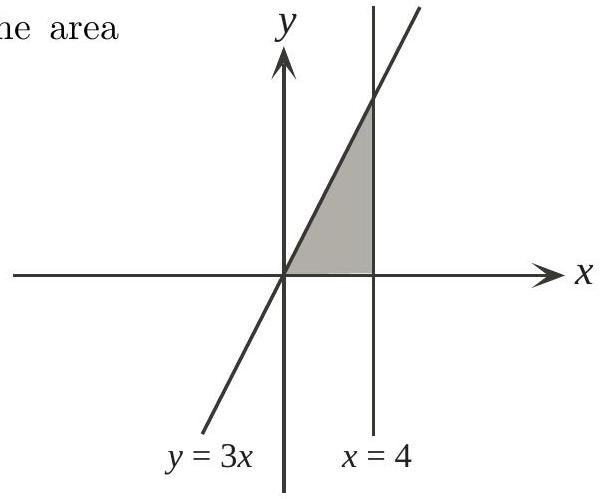 | Let $O$ be the origin (where the line with equation $y=3 x$ intersects the $x$-axis).
Let $P$ be the point where the line with equation $x=4$ intersects the $x$-axis, and let $Q$ be the point where the lines with equations $x=4$ and $y=3 x$ intersect.
 = 2x^3 - 3(k+1)x^2 + 1$ ($x \in \mathbb{R}$),
(1) If the function has an extremum at $x = -1$, find the value of the real number $k$;
(2) Determine the intervals of monotonicity for $f(x)$;
(3) Find the minimum value of $f(x)$ on the interval $[0, 1]$. | (1) Since $f(x) = 2x^3 - 3(k+1)x^2 + 1$,
then $f'(x) = 6x^2 - 6(k+1)x$.
Since the function has an extremum at $x = -1$,
then $f'(-1) = 6 + 6(k+1) = 0$.
Solving this, we get: $k = -2$.
So, the value of $k$ is $\boxed{-2}$.
(2) (i) When $k = -1$, $f'(x) = 6x^2 \geq 0$ always holds, $f(x)$ is increasing on $\ma... | -3k | Calculus | math-word-problem | Yes | Yes | cn_k12 | false |
Find the smallest positive integer that is divisible by $10$, $11$, and $18$. | To solve the problem, first, factor all three numbers:
- $10 = 2 \cdot 5$
- $11 = 11$
- $18 = 2 \cdot 3^2$
The least common multiple (LCM) of a set of numbers is given by the highest power of all prime factors present in those numbers:
- Take highest power of 2: $2^1$
- Take highest power of 3: $3^2$
- Include 5 and 1... | 990 | Number Theory | math-word-problem | Yes | Yes | synthetic_math | true |
Given the sets $A=\{x\,|\,|x|<2\}$ and $B=\{x\,|\,x^2-4x+3<0\}$, then $A\cap B$ equals to ( )
A: $\{x\,|\,-2<x<1\}$
B: $\{x\,|\,1<x<2\}$
C: $\{x\,|\,2<x<3\}$
D: $\{x\,|\,-2<x<3\}$ | Since $B=\{x\,|\,x^2-4x+3<0\}$,
we have $B=\{x\,|\,1<x<3\}$,
Given $A=\{x\,|\,|x|<2\}$,
we have $A=\{x\,|\,-2<x<2\}$,
Therefore, $A\cap B=\{x\,|\,1<x<2\}$;
Hence, the correct option is $\boxed{\text{B}}$. | \text{B} | Inequalities | MCQ | Yes | Yes | cn_k12 | false |
Given $x > 0$, $y > 0$, and $\log 2^{x}+\log 8^{y}=\log 2$, find the minimum value of $\frac {x+y}{xy}$. | Since $x > 0$ and $y > 0$, the equation $\log 2^{x}+\log 8^{y}=\log 2$ can be simplified by using the properties of logarithms. Observe that $8$ is $2^3$, so we can rewrite the equation as:
$$
\log 2^{x}+\log (2^3)^{y}=\log 2.
$$
Using the power rule for logarithms, we have:
$$
\log 2^{x}+3\log 2^{y}=\log 2.
$$
Since t... | 2\sqrt{3}+4 | Algebra | math-word-problem | Yes | Yes | cn_k12 | false |
Given real numbers $x$ and $y$ satisfy $\sqrt{x-3}+{(y+2)}^{2}=0$, then $x-y=$______ | Given real numbers $x$ and $y$ satisfy the equation $\sqrt{x-3}+{(y+2)}^{2}=0$, we aim to find the value of $x-y$.
First, we observe that both terms on the left-hand side of the equation are always non-negative. This is because the square root of a real number and the square of any real number are both non-negative. T... | 5 | Algebra | math-word-problem | Yes | Yes | cn_k12 | false |
1. Given that $a \geq b > 0$, prove that $2a^3 - b^3 \geq 2ab^2 - a^2b$.
2. Given that non-zero real numbers $a$, $b$, and $c$ form an arithmetic sequence with a non-zero common difference, prove that $\frac{1}{a} + \frac{1}{c} \neq \frac{2}{b}$. | Proof:
1. We have $(2a^3 - b^3) - (2ab^2 - a^2b) = 2a(a^2 - b^2) + b(a^2 - b^2) = (2a + b)(a + b)(a - b) \ldots (4 \text{ points})$
Since $a \geq b > 0$, we have $2a + b > 0$, $a + b > 0$, and $a - b \geq 0$.
Therefore, $2a^3 - b^3 \geq 2ab^2 - a^2b \ldots (7 \text{ points})$
2. (Proof by contradiction) Assume ... | \frac{1}{a} + \frac{1}{c} \neq \frac{2}{b} | Inequalities | proof | Yes | Yes | cn_k12 | false |
Given that the vectors $\overset{→}{BA}=(3,-2)$ and $\overset{→}{AC}=(0,6)$, find the value of $|\overset{→}{BC}|$.
A) $2 \sqrt{6}$
B) $5$
C) $\sqrt{26}$
D) $6$ | **Analysis**
This problem involves finding the magnitude of a vector using coordinate operations. First, we need to determine the coordinates of the vector $\overset{→}{BC}$ and then apply the formula for the magnitude of a vector to solve the problem.
**Step-by-step Solution**
1. Find the coordinates of vector $\ov... | 5 | Geometry | MCQ | Yes | Yes | cn_k12 | false |
Given $a=\sqrt{17}-1$, then the value of $a^{5}+2a^{4}-17a^{3}-a^{2}+18a-17$ is ______. | Given $a=\sqrt{17}-1$, we aim to find the value of $a^{5}+2a^{4}-17a^{3}-a^{2}+18a-17$.
First, let's simplify the expression based on the given value of $a$:
\begin{align*}
\because a &= \sqrt{17}-1, \\
\therefore (a+1)^{2} &= (\sqrt{17})^{2} = 17.
\end{align*}
This implies that:
\begin{align*}
a^{2} + 2a + 1 &= 17 \\... | -1 | Algebra | math-word-problem | Yes | Yes | cn_k12 | false |
Let $z_{1}=2+3i$, $z_{2}=m-i$ ($m\in R$). If $\frac{{z}_{1}}{{z}_{2}}<0$, then $m=\left(\ \ \right)$
A: $-\frac{2}{3}$
B: $\frac{2}{3}$
C: $-\frac{3}{2}$
D: $\frac{3}{2}$ | To solve the problem, we start by calculating the division of $z_{1}$ by $z_{2}$:
\[
\frac{{z}_{1}}{{z}_{2}} = \frac{2+3i}{m-i}
\]
We multiply both the numerator and the denominator by the conjugate of the denominator to simplify the fraction:
\[
= \frac{(2+3i)(m+i)}{(m-i)(m+i)}
\]
Expanding both the numerator and ... | A | Algebra | MCQ | Yes | Yes | cn_k12 | false |
12. Let $\alpha, \beta, \gamma$ be the three interior angles of the acute $\triangle A B C$, and $a\sin 2 \gamma$. | None
Translate the text above into English, please retain the original text's line breaks and format, and output the translation result directly.
Note: The provided instruction is a meta-instruction and not part of the text to be translated. Since the text to be translated is "None", the translation is also "None". ... | notfound | Geometry | math-word-problem | Incomplete | Incomplete | olympiads | false |
Determine the number of vertical asymptotes for the function $y = \frac{x+3}{x^2 - 4x + 3}$. | First, factorize the denominator of the function. The equation for the denominator can be written as $(x-1)(x-3) = 0$. Thus, the roots are $x = 1$ and $x = 3$.
The numerator does not factor in a way that would cancel out either of these roots, as it is simply $x + 3$. Substituting the roots of the denominator into the... | 2 | Algebra | math-word-problem | Yes | Yes | synthetic_math | true |
Given the ellipse $C: \frac{x^2}{a^2} + \frac{y^2}{b^2} = 1 (a > b > 0)$ passes through the point $M(\sqrt{2}, 1)$, and its eccentricity is $\frac{\sqrt{2}}{2}$.
$(1)$ Find the equation of the ellipse $C$.
$(2)$ A line $l$ passing through the point $Q(1, 0)$ intersects the ellipse $C$ at points $A$ and $B$. For point... | Solution:
$(1)$ Since the eccentricity is $\frac{\sqrt{2}}{2}$,
$\therefore \frac{c^2}{a^2} = \frac{a^2 - b^2}{a^2} = \frac{1}{2}$,
$\therefore a^2 = 2b^2$, $(1)$
Since the ellipse $C: \frac{x^2}{a^2} + \frac{y^2}{b^2} = 1 (a > b > 0)$ passes through the point $M(\sqrt{2}, 1)$,
$\therefore \frac{2}{a^2} + \frac{1}... | x - y - 1 = 0 | Geometry | math-word-problem | Yes | Yes | cn_k12 | false |
If $\tan x = \frac{2ab}{a^2 - b^2}$, where $a > b > 0$ and $0^\circ < x < 90^\circ$, what is $\sin x$ in terms of $a$ and $b$? | Given that \(\tan x = \frac{2ab}{a^2 - b^2}\) with \(a > b > 0\) and \(0^\circ < x < 90^\circ\), we need to find \(\sin x\) in terms of \(a\) and \(b\).
First, recall the identity relating \(\tan x\) to \(\sin x\) and \(\cos x\):
\[
\tan x = \frac{\sin x}{\cos x}
\]
Given:
\[
\tan x = \frac{2ab}{a^2 - b^2}
\]
we can w... | \frac{2ab}{^2+b^2} | Algebra | math-word-problem | Yes | Yes | metamath | true |
Find $x^2 + y^2$ if $x$ and $y$ are positive integers such that:
\[\begin{aligned}
xy + x + y &= 117, \\
x^2y + xy^2 &= 1512.
\end{aligned}\] | Let $s = x + y$ and $p = xy$. The first equation rewrites to $s + p = 117$. The second equation can be expressed as:
\[ x^2y + xy^2 = (x+y)xy = sp = 1512. \]
Therefore, $s$ and $p$ are the roots of the quadratic equation:
\[ t^2 - 117t + 1512 = 0. \]
Factoring the quadratic:
\[ t^2 - 117t + 1512 = (t - 27)(t - 90) = ... | 549 | Algebra | math-word-problem | Yes | Yes | synthetic_math | true |
[ $\underline{\text { Induction (other) }} \quad]$
Authors: Mezhiriv I.V., Spivak A.V., Chernov A.A.
In a country, there are several cities connected by roads with one-way and two-way traffic. It is known that from any city to any other city, there is exactly one way to travel without passing through the same city tw... | Let inside a country, not yet divided into provinces, an autonomous region has emerged, consisting of a single city. This region, firstly, can be divided into three provinces (two of which are empty), and secondly, it satisfies the condition of being an independent country, that is, if all other cities are removed. We ... | proof | Combinatorics | proof | Yes | Yes | olympiads | false |
Evaluate $(x-2a+4)$ if the value of $x$ is $(2a + 6)$. | 1. Substitute $x = 2a + 6$ into the expression $(x - 2a + 4)$.
2. Compute the expression: $(2a + 6 - 2a + 4)$.
3. Simplify the expression by cancelling terms: $2a - 2a + 6 + 4 = 0a + 10 = 10$.
Thus, the value of the expression $(x-2a+4)$ when $x = 2a + 6$ is $\boxed{10}$. | 10 | Algebra | math-word-problem | Yes | Yes | synthetic_math | true |
A seafood wholesaler purchased 1000 kg of crucian carp at a price of 10 yuan/kg and cultured them in a lake (assuming that the weight of each crucian carp remains unchanged during the culture period). According to market estimates, the market price of crucian carp after lake culture will increase by 1 yuan/kg for each ... | (1) Let x be the number of days the crucian carp needs to be cultured. According to the problem, we have:
$$10x \times (5 - 10) + (1000 - 10x)x = 8500$$
Solving for x, we get $x_1 = 10$ and $x_2 = 85$ (which is not within the given range and should be discarded).
So, the answer is: The crucian carp should be cultured ... | 6000 | Algebra | math-word-problem | Yes | Yes | cn_k12 | false |
You are given that $3^{200} \equiv 1 \pmod{500}$. What are the last three digits of $3^{1000}$? | The last three digits can be found by finding $3^{1000} \mod 500$.
Since $3^{200} \equiv 1 \pmod{500}$, we can simplify $3^{1000}$ as follows:
\[ 3^{1000} = (3^{200})^5 \]
Using the given congruence:
\[ (3^{200})^5 \equiv 1^5 = 1 \pmod{500} \]
Thus, the last three digits of $3^{1000}$ are $\boxed{001}$. | 001 | Number Theory | math-word-problem | Yes | Yes | synthetic_math | true |
62. Arrange 7 small cubes to form a "T" shape, then paint the surface red, and finally separate the small cubes. The number of small cubes with 3 faces painted red is $\qquad$.
Arrange 7 small cubes to form a "T" shape, then paint the surface red, and finally separate the small cubes. The number of small cubes with 3 ... | Answer: 1 | 1 | Geometry | math-word-problem | Yes | Yes | olympiads | false |
Example 6 Let $x_{1}, x_{2}, \cdots, x_{n}$ be real numbers $(n \geqslant 3)$, and let $p=\sum_{i=1}^{n} x_{i}, q=\sum_{1 \leqslant i<j \leqslant n} x_{i} x_{j}$. Prove:
(i) $\frac{(n-1) p^{2}}{n}-2 q \geqslant 0$;
(1986 Chinese National Training Team Selection Test) | Proof
$$
\text { (i) Since } \begin{aligned}
(n-1) p^{2}-2 n q & =(n-1)\left(\sum_{i=1}^{n} x_{i}\right)^{2}-2 n \sum_{1 \leqslant i<j \leqslant n} x_{i} x_{j} \\
& =(n-1) \sum_{i=1}^{n} x_{i}^{2}-2 \sum_{1 \leqslant i<j \leqslant n} x_{i} x_{j}=\sum_{1 \leqslant i<j \leqslant n}\left(x_{i}-x_{j}\right)^{2},
\end{align... | proof | Inequalities | proof | Yes | Yes | olympiads | false |
A sphere with a surface area of $4\pi$ has a point M on its surface. From point M, three chords MA, MB, and MC are drawn, which are mutually perpendicular to each other. Then, the value of $MA^2 + MB^2 + MC^2$ is ( ).
A: 1
B: 2
C: 3
D: 4 | Given that MA, MB, and MC are mutually perpendicular, these three segments can be considered as the edges of a rectangular box that share a common vertex. The space diagonal of this rectangular box is exactly the diameter of the circumscribed sphere.
Since A, B, C, and M are four points on the surface of a sphere with... | \text{D} | Geometry | MCQ | Yes | Yes | cn_k12 | false |
3. Two trains leave from two cities at the same time. The first one travels at 40 km/h, while the second one travels at 48 km/h. How far apart will these trains be from each other after 8 hours, if they are moving in the same direction and the distance between the cities is 892 km? | 3. The trains are moving in the same direction, so they can move in the direction of $A B$ or $B A$. Let's consider each of these cases.
The trains are moving in the direction of $A B$.
1) $40 \times 8=320$ km - the first train traveled;
2) $48 \times 8=384$ km - the second train traveled;
3) $384-320=64$ km - by thi... | 956 | Algebra | math-word-problem | Yes | Yes | olympiads | false |
What is the second-to-last number in the row of Pascal's triangle that has 57 numbers? | The relationship between the row number and the number of elements in that row of Pascal's triangle is that the nth row of Pascal's triangle contains n entries. To find the row number with 57 numbers, we consider the 56th row, since the 56th row contains 56 + 1 = 57 numbers.
The entries in the 56th row of Pascal's tri... | 56 | Combinatorics | math-word-problem | Yes | Yes | synthetic_math | true |
A hobby group has 3 instructors and 7 students taking a photo in two rows, with the 3 instructors standing in the front row and the 7 students standing in the back row.
(1) If two students, A and B, want to stand at the two ends of the back row, how many different arrangements are there?
(2) If students A and B can... | (1) For the two students (A and B) to stand at the ends of the back row, they can be arranged in $2!$ ways. The other 5 students can be arranged in $5!$ ways in the remaining spots of the back row. The 3 instructors in the front row can be arranged in $3!$ ways.
Therefore, the total number of arrangements is $$2! \time... | 420 | Combinatorics | math-word-problem | Yes | Yes | cn_k12 | false |
In the binomial expansion of $\left(x-\frac{a}{3x}\right)^{8}$, the constant term is $28$. Find the value of the real number $a$. | According to the general term formula of the binomial expansion $\left(x-\frac{a}{3x}\right)^{8}$, $T_{r+1}=C_{8}\cdot x^{8-r}\cdot \left(-\frac{a}{3x}\right)^{r}=(-a)^{r}\cdot C_{8}^{r}\cdot x^{8-\frac{4}{3}r}$,
Let $8-\frac{4}{3}r=0$, we get $r=6$,
Since the constant term is $28$, we have $(-a)^{6}\cdot C_{8}^{6}=2... | \pm 1 | Algebra | math-word-problem | Yes | Yes | cn_k12 | false |
Suppose $a$, $b$, and $c$ are positive real numbers such that $a(b+c) = 198$, $b(c+a) = 210$, and $c(a+b) = 222$. Find the value of $abc$. | Adding the given equations:
- $a(b+c) + b(c+a) + c(a+b) = 198 + 210 + 222$
- This simplifies to $2(ab + ac + bc) = 630 \Longrightarrow ab + ac + bc = 315$.
Now, subtract the given values from $315$ to isolate $bc$, $ca$, and $ab$:
- $bc = 315 - 198 = 117$,
- $ca = 315 - 210 = 105$,
- $ab = 315 - 222 = 93$.
Compute th... | 1069 | Algebra | math-word-problem | Yes | Incomplete | synthetic_math | true |
$(1)$ Calculate: $2a\left(a-2b\right)-\left(2a-b\right)^{2}$;
$(2)$ Solve the equation: $(x-1)^3-3=\frac{3}{8}$. | For the given problems, let's break down the solutions step by step:
### Problem 1: Calculate $2a(a-2b)-(2a-b)^2$
Starting with the given expression:
$$
2a(a-2b)-(2a-b)^2
$$
Expanding both parts:
\begin{align*}
&= 2a^2 - 4ab - (4a^2 - 4ab + b^2) \\
&= 2a^2 - 4ab - 4a^2 + 4ab - b^2 \\
&= -2a^2 - b^2
\end{align*}
Thu... | x = \frac{5}{2} | Algebra | math-word-problem | Yes | Yes | cn_k12 | false |
9. A rectangle is composed of 5 rows and 3 columns of small squares, with each small square having a side length of $1 \mathrm{~cm}$. This rectangle has 24 vertices. Choose 3 of these vertices to form a triangle with an area of 2.5 square centimeters. The number of such triangles in the rectangle is $\qquad$ | [Answer] 124
[Solution] The shape formed by the points marked by Teacher Li is a triangle. Since the side length of this triangle is an integer, there is one more point on this side:
Categorization and discussion
(1) The three points are in three adjacent rows, with the following shapes:
(2) The three points are not in... | 124 | Geometry | math-word-problem | Yes | Yes | olympiads | false |
The average weight of 29 students is 28 kg. By the admission of a new student weighing 4 kg, the average weight is reduced to a certain value. What is the new average weight of the students? | To find the new average weight of the students after the admission of the new student, we first need to calculate the total weight of the 29 students before the new student was admitted.
The total weight of the 29 students is:
29 students * 28 kg/student = 812 kg
Now, we add the weight of the new student to the total... | 27.2 | Algebra | math-word-problem | Yes | Yes | orca_math | true |
For Bianca's birthday, 5 of her friends gave her 6 dollars each. How much money did she get for her birthday? | If each of Bianca's 5 friends gave her 6 dollars, then the total amount of money she received is:
5 friends * 6 dollars/friend = 30 dollars
Bianca received $\boxed{30}$ dollars for her birthday. | 30 | Logic and Puzzles | math-word-problem | Yes | Yes | orca_math | true |
Example. Find the modulus of the circulation of the vector field
$$
\vec{a}=y \vec{i}-x z \vec{j}+x y \vec{k}
$$
along the closed contour
$$
\Gamma=\left\{(x, y, z): \begin{array}{l}
x^{2}+y^{2}+z^{2}=9 \\
x^{2}+y^{2}=9
\end{array}\right\}
$$ | SOLUTION.
1. In this case, it is obvious that $\Gamma$ is the circle $x^{2}+y^{2}=9$ lying in the plane $z=0$. We choose the direction of traversal of the contour $\Gamma$ counterclockwise when viewed from the end of the vector $\vec{k}$.
2. We choose the surface $\Sigma$ stretched over the contour $\Gamma$.
Naturall... | 9\pi | Calculus | math-word-problem | Yes | Yes | olympiads | false |
For a convex polygon (i.e. all angles less than $180^\circ$) call a diagonal [i]bisector[/i] if its bisects both area and perimeter of the polygon. What is the maximum number of bisector diagonals for a convex pentagon?
[i]Proposed by Morteza Saghafian[/i] | null | null | Geometry | math-word-problem | Yes | Yes | aops_forum | false |
Sally needs to make a tablecloth that measures 102 inches by 54 inches. She also needs to make a certain number of napkins that are 6 by 7 inches. Sally will need 5844 square inches of material to make the tablecloth and the napkins. How many napkins does she need to make? | First, let's calculate the area of the tablecloth that Sally needs to make. The area of a rectangle is found by multiplying its length by its width.
Area of tablecloth = length × width
Area of tablecloth = 102 inches × 54 inches
Area of tablecloth = 5508 square inches
Now, let's calculate the area of one napkin.
Are... | 8 | Algebra | math-word-problem | Yes | Yes | orca_math | true |
An electric car is charged 3 times per week for 52 weeks. The cost to charge the car each time is $\$ 0.78$. What is the total cost to charge the car over these 52 weeks?
(A) $\$ 104.00$
(B) $\$ 81.12$
(C) $\$ 202.80$
(D) $\$ 162.24$
(E) $\$ 121.68$ | Since the car is charged 3 times per week for 52 weeks, it is charged $3 \times 52=156$ times. Since the cost per charge is $\$ 0.78$, then the total cost is $156 \times \$ 0.78=\$ 121.68$.
ANSWER: (E) | 121.68 | NaN | NaN | NaN | NaN | olympiads | false |
Three congruent isosceles triangles are constructed with their bases on the sides of an equilateral triangle of side length $1$. The sum of the areas of the three isosceles triangles is the same as the area of the equilateral triangle. What is the length of one of the two congruent sides of one of the isosceles trian... | null | null | Geometry | MCQ | Yes | Yes | aops_forum | false |
Let $\triangle ABC$ have sides $a$, $b$, $c$ opposite to angles $A$, $B$, $C$ respectively, and $bcosA+\frac{1}{2}a=c$.
$(1)$ Find angle $B$.
$(2)$ If $c=2a$ and $b=3\sqrt{3}$, find the area of $\triangle ABC$. | ### Step-by-Step Solution
#### Part 1: Finding angle $B$
Given $\triangle ABC$ with sides $a$, $b$, $c$ opposite to angles $A$, $B$, $C$ respectively, and the equation $bcosA+\frac{1}{2}a=c$.
**Step 1:** Use the Law of Sines
\[
\frac{a}{\sin A} = \frac{b}{\sin B} = \frac{c}{\sin C}
\]
Given $bcosA+\frac{1}{2}a=c$, w... | \frac{9\sqrt{3}}{2} | Geometry | math-word-problem | Yes | Yes | cn_k12 | false |
A player is playing the following game. In each turn he flips a coin and guesses the outcome. If his guess is correct, he gains $ 1$ point; otherwise he loses all his points. Initially the player has no points, and plays the game
until he has $ 2$ points.
(a) Find the probability $ p_{n}$ that the game ends after ex... | ### Part (a): Finding the probability \( p_n \) that the game ends after exactly \( n \) flips
1. **Understanding the Game Dynamics**:
- The player starts with 0 points.
- The player gains 1 point for each correct guess.
- If the player guesses incorrectly, they lose all points and start over.
- The game e... | 4 | Combinatorics | math-word-problem | Yes | Yes | aops_forum | false |
If $(a-2)^2+\sqrt{b+3}=0$, then the value of $ab$ is ( )
A: $-6$
B: $-5$
C: $-1$
D: $1$ | Given the equation $(a-2)^2+\sqrt{b+3}=0$, we want to find the value of $ab$.
First, we observe that the equation is a sum of two terms: $(a-2)^2$ and $\sqrt{b+3}$. Both of these terms are non-negative because:
1. A square of any real number is non-negative, so $(a-2)^2 \geq 0$.
2. The square root of a number is non... | A | Algebra | MCQ | Yes | Yes | cn_k12 | false |
7. Does there exist a function $f(n)$ that maps the set of natural numbers to itself, and for every natural number $n>1$ satisfies the formula $f(n)=f(f(n-1))+f(f(n \div 1))$? | 7. Assuming that for $n \geqslant 2$ we are minimizing $f(n)$, then because $f\left(n_{0}+1\right) \geqslant f\left(n_{0}\right) \geqslant 2$, we have
$$
\begin{aligned}
f\left(n_{n}\right) & -f\left(f\left(n_{n}-1\right)\right)+f\left(f\left(n_{n}+1\right)\right) \\
& \geqslant 1+f\left(n_{0}\right), \text { etc. }
\e... | not found | Number Theory | proof | Yes | Problem not solved | cn_contest | false |
A certain factory is now producing an average of $50$ more machines per day than originally planned. The time required to produce $400$ machines now is $1$ day less than the time required to produce $450$ machines as originally planned. Let $x$ be the average number of machines produced per day now. Then according to t... | Let's break down the solution step by step, following the given information and adhering to the rules:
1. **Define the variables:**
- Let $x$ be the average number of machines produced per day now.
- Consequently, the average number of machines produced per day according to the original plan would be $x - 50$.
... | \frac{450}{x-50} - \frac{400}{x} = 1 | Algebra | math-word-problem | Yes | Yes | cn_k12 | false |
A man labels the squares of a very large chessboard $1$ through $64$. On each square $k$, the man places $2^k$ grains of rice. How many more grains of rice are placed on the $12^{th}$ square than on the first $10$ squares combined? | The $12^{th}$ square receives $2^{12} = 4096$ grains of rice.
The first $10$ squares receive $2 + 2^2 + \dots + 2^{10}$ grains. The sum of a geometric series is given by $S_n = a(r^n - 1)/(r - 1)$, where $a$ is the first term, $r$ is the common ratio, and $n$ is the number of terms. Here, $a = 2$, $r = 2$, and $n = 10... | 2050 | Algebra | math-word-problem | Yes | Yes | synthetic_math | true |
There are 3 calories in a candy bar. There are _____ calories in 5 candy bars . |
There are 15 calories in 5 candy bars. (3 calories per candy bar x 5 candy bars = $\boxed{15}$ calories) | 15 | Algebra | math-word-problem | Yes | Yes | orca_math | true |
In $\triangle ABC$, the sides opposite to angles $A$, $B$, and $C$ are denoted as $a$, $b$, and $c$ respectively. It is given that $a-b=2$, $c=4$, and $\sin A=2\sin B$.
(I) Find the area of $\triangle ABC$;
(II) Find $\sin (2A-B)$. | Solution 1:
(I) Since $\sin A=2\sin B \Rightarrow a=2b$.
Also, because $a-b=2$,
$\therefore a=4$, $b=2$.
$\cos B= \dfrac {a^{2}+c^{2}-b^{2}}{2ac}= \dfrac {4^{2}+4^{2}-2^{2}}{2\times 4\times 4}= \dfrac {7}{8}$.
$\sin B= \sqrt {1-\cos ^{2}B}= \sqrt {1-( \dfrac {7}{8})^{2}}= \dfrac { \sqrt {15}}{8}$.
$\therefo... | \dfrac {7 \sqrt {15}}{32} | Geometry | math-word-problem | Yes | Yes | cn_k12 | false |
10.403 In a right triangle $A B C$ ( $\angle C=90^{\circ}$ ), the altitude $CD$ is drawn. The radii of the circles inscribed in triangles $ACD$ and $BCD$ are 0.6 and 0.8 cm, respectively. Find the radius of the circle inscribed in triangle $\boldsymbol{A} \boldsymbol{\text { B }}$. | Solution. Let $x, r_{1}, r_{2}$ be the radii of the circles inscribed in $\triangle A B C$, $\triangle A C D, \triangle B C D$ respectively. $\triangle A C D \sim \triangle B C D \Rightarrow \frac{A C}{B C}=\frac{r_{1}}{r_{2}}=\frac{0.6}{0.8}$ (the radii of the circles inscribed in similar triangles are proportional to... | 1 | Geometry | math-word-problem | Yes | Yes | olympiads | false |
In the Cartesian coordinate plane, the line $l$ passes through the point $P(1,1)$, and its inclination angle $\alpha= \frac{\pi}{4}$. Taking the origin $O$ as the pole and the non-negative half-axis of the $x$-axis as the polar axis, a polar coordinate system is established. The polar equation of circle $C$ is given by... | Solution:
(1) From the polar equation of circle $C$, $\rho=4\sin\theta$, we have $\rho^2=4\rho\sin\theta$,
which gives the Cartesian equation $x^2+(y-2)^2=4$,
representing a circle with center at $(0,2)$ and radius equal to $2$.
(2) Since line $l$ passes through point $P(1,1)$, and its inclination angle $\alpha= \f... | 2 | Geometry | math-word-problem | Yes | Yes | cn_k12 | false |
Given that $\sin \alpha \cdot \cos \alpha = \frac{1}{8}$ and $0 < \alpha < \frac{\pi}{4}$, find the value of $\sin \alpha - \cos \alpha$. The options are:
A: $\frac{\sqrt{3}}{2}$
B: $-\frac{\sqrt{3}}{2}$
C: $\frac{3}{4}$
D: $-17$ | Since $0 < \alpha < \frac{\pi}{4}$, we know that $\sin \alpha$ and $\cos \alpha$ are both positive, but $\sin \alpha$ is less than $\cos \alpha$. Therefore, $\sin \alpha - \cos \alpha < 0$.
Given that $\sin \alpha \cdot \cos \alpha = \frac{1}{8}$, we can use the difference of squares identity to find $\sin \alpha - \c... | -\frac{\sqrt{3}}{2} | Algebra | MCQ | Yes | Yes | cn_k12 | false |
If both $x$ and $y$ are both integers, how many pairs of solutions are there of the equation $(x-8)(x-10) = 2^y$?
$\textbf{(A)}\ 0\qquad\textbf{(B)}\ 1\qquad\textbf{(C)}\ 2\qquad\textbf{(D)}\ 3\qquad\textbf{(E)}\ \text{more than 3}$ | The equality implies $x-8$ and $x-10$ are both powers of two; since they differ by two, it must be the case that $(x-8,x-10) = (4,2)$ or $(x-8,x-10) = (-2,-4)$. (Note that $(1,-1)$ is not allowed because then the product is negative.) These yield $(x,y) = (12,3)$ or $(x,y) = (6,3)$, for a total of $\boxed{2\textbf{ (C... | 2 | Algebra | MCQ | Yes | Yes | amc_aime | false |
Given the function f(x) = -3x + 2sin(x), if a = f(3$^{ \sqrt {2}}$), b = -f(-2), and c = f(log$_{
m 2}$7), what is the relationship among a, b, and c? ( )
A: a < b < c
B: a < c < b
C: c < a < b
D: b < c < a | According to the problem, the function f(x) = -3x + 2sin(x), we have f(-x) = -f(x), thus function f(x) is an odd function.
Then, b = -f(-2) = f(2),
The derivative of the function is f'(x) = -3 + 2cos(x), and since -1 ≤ cos(x) ≤ 1, then f'(x) < 0. Therefore, the function f(x) is decreasing on R.
Also, 2 = log$_{
m 2}$... | C | Algebra | MCQ | Yes | Yes | cn_k12 | false |
Robin has 25 packages of gum. There are 42 pieces in each package. How many pieces of gum does Robin have? | To find the total number of pieces of gum Robin has, we need to multiply the number of packages by the number of pieces in each package.
25 packages × 42 pieces/package = 1050 pieces
Robin has $\boxed{1050}$ pieces of gum. | 1050 | Logic and Puzzles | math-word-problem | Yes | Yes | orca_math | true |
Given $z\_1=1+i$ and $z\_2=1-i$ ($i$ is the imaginary unit), find the value of $\frac{z\_1}{z\_2} + \frac{z\_2}{z\_1}$ \_\_\_\_\_\_. | We have $z\_1=1+i$ and $z\_2=1-i$.
First, let's compute the given expression step by step:
$$
\begin{align}
\frac{z\_1}{z\_2} + \frac{z\_2}{z\_1} &= \frac{1+i}{1-i} + \frac{1-i}{1+i} \\
&= \frac{(1+i)^2}{(1-i)(1+i)} + \frac{(1-i)^2}{(1+i)(1-i)} \\
&= \frac{(1^2 + 2i + i^2)}{1^2-i^2} + \frac{(1^2 - 2i + i^2)}{1^2-i^2}... | 0 | Algebra | math-word-problem | Yes | Yes | cn_k12 | false |
Uncle Ben has 440 chickens on his farm. 39 are roosters and the rest are hens. 15 of his hens do not lay eggs, and the rest do. Each egg-laying hen lays a certain number of eggs. Uncle Ben will have 1158 eggs. How many eggs does each egg-laying hen lay? | First, let's find out how many hens Uncle Ben has. Since he has 440 chickens in total and 39 of them are roosters, we subtract the number of roosters from the total number of chickens to find the number of hens:
440 chickens - 39 roosters = 401 hens
Now, we know that 15 of these hens do not lay eggs. So, let's find o... | 3 | Algebra | math-word-problem | Yes | Yes | orca_math | true |
There are 6 different books to be distributed among three people: A, B, and C.
(1) If each person gets two books, how many different distribution methods are there?
(2) If one person gets 1 book, another gets 2 books, and the last one gets 3 books, how many different distribution methods are there?
(3) If these 6 bo... | Solution:
(1) According to the problem,
Assuming A picks first, then A can choose 2 out of 6 different books in $C_{6}^{2}=15$ ways,
Regardless of which two books A takes, B can then choose in $C_{4}^{2}=6$ ways, and the remaining two books naturally go to C,
By the principle of multiplication for counting steps, t... | \dfrac{C_{6}^{2}C_{4}^{2}C_{2}^{2}}{A_{3}^{3}} | Combinatorics | math-word-problem | Yes | Yes | cn_k12 | false |
You are somewhere on a ladder with 5 rungs. You have a fair coin and an envelope that contains either a double-headed coin or a double-tailed coin, each with probability $1 / 2$. Every minute you flip a coin. If it lands heads you go up a rung, if it lands tails you go down a rung. If you move up from the top rung you ... | Solution: First consider the probability of winning if you never open the envelope. Let $q(n)$ be the probability of winning from the $n$th rung with just the fair coin, then $q(n)=\frac{q(n-1)+q(n+1)}{2}$, so it is not hard to calculate that $q(n)=n / 6$. If we open the envelope, then there's a $1 / 2$ chance that it ... | open\the\envelope\iff\we\\on\the\bottom\rung | Logic and Puzzles | math-word-problem | Yes | Yes | olympiads | false |
Find the matrix $\mathbf{X}$ such that
\[
\mathbf{X} \begin{pmatrix} 2 & -1 & 0 \\ -3 & 5 & 0 \\ 0 & 0 & 2 \end{pmatrix} = \mathbf{I}.
\] | Let $\mathbf{X} = \begin{pmatrix} p & q & r \\ s & t & u \\ v & w & x \end{pmatrix}$. We want
\[
\begin{pmatrix} p & q & r \\ s & t & u \\ v & w & x \end{pmatrix}
\begin{pmatrix} 2 & -1 & 0 \\ -3 & 5 & 0 \\ 0 & 0 & 2 \end{pmatrix}
= \mathbf{I} = \begin{pmatrix} 1 & 0 & 0 \\ 0 & 1 & 0 \\ 0 & 0 & 1 \end{pmatrix}.
\]
Thi... | \begin{pmatrix} \frac{5}{7} & \frac{1}{7} & 0 \\ \frac{3}{7} & \frac{2}{7} & 0 \\ 0 & 0 & \frac{1}{2} \end{pmatrix} | Algebra | math-word-problem | Yes | Yes | synthetic_math | true |
In a fundraising event for students in need within a certain district, a total of 250,000 yuan was donated. Express 250,000 yuan in scientific notation as ( ).
A: $2.5×10^4$
B: $2.5×10^5$
C: $25×10^4$
D: $0.25×10^6$ | To express a number in scientific notation, we use the format $a \times 10^n$, where $1 \leq |a| < 10$ and $n$ is an integer. One common mistake is determining the value of $n$ incorrectly. Since 250,000 has six digits, to convert the number into the required form, we move the decimal point five places to the left, whi... | 2.5 \times 10^5 | Algebra | MCQ | Yes | Yes | cn_k12 | false |
(4) Solve the equation $\frac{1}{2}\left(a^{x}+a^{-x}\right)=m(a>0, a \neq 1)$. | (4) (1) When $m>1$, the original equation has two solutions
$x=\log _{a}\left(m \pm \sqrt{m^{2}-1}\right)$; (2) When $m<1$, the original equation has no solution; (3) When $m=1$, the original equation has the solution $x=0$ | \log_{}(\\sqrt{^{2}-1})when>1,nosolutionwhen<1,0when=1 | Algebra | math-word-problem | Yes | Yes | olympiads | false |
Among the following expressions, the one that must be a quadratic radical is:
A: $\sqrt{-x}$
B: $\sqrt{x}$
C: $\sqrt{x^{2}+1}$
D: $\sqrt{x^{2}-1}$ | To determine which expression must be a quadratic radical, we analyze each option step by step:
- **Option A: $\sqrt{-x}$**
For $x > 0$, the expression becomes $\sqrt{-x}$, which is not defined in the real number system because the square root of a negative number is not a real number. Thus, this option is not always... | C | Algebra | MCQ | Yes | Yes | cn_k12 | false |
Janice bought 60 items each priced at 15 cents, 4 dollars, or 5 dollars. If her total purchase price was $60.00, how many 15-cent items did she purchase? | Let \(a\), \(b\), and \(c\) be the number of 15-cent items, 4-dollar items, and 5-dollar items that Janice bought, respectively. The total number of items is 60, so:
\[ a + b + c = 60 \]
The total cost in cents is 6000, hence:
\[ 15a + 400b + 500c = 6000 \]
We can simplify this to:
\[ 3a + 80b + 100c = 1200 \]
Substitu... | 50 | Algebra | math-word-problem | Yes | Yes | synthetic_math | true |
In a sports club with 28 members, 17 play badminton and 19 play tennis. There are 10 members who play both badminton and tennis. How many members do not play either badminton or tennis? | To find out how many members do not play either badminton or tennis, we can use the principle of inclusion-exclusion.
First, we add the number of badminton players and tennis players:
17 (badminton players) + 19 (tennis players) = 36
However, this number includes the members who play both sports twice, so we need to ... | 2 | Combinatorics | math-word-problem | Yes | Yes | orca_math | true |
-、(Full score: 40 points)
As shown in the figure, circle $I$ is internally tangent to circle $O$ at point $P$. Chord $AB$ of circle $O$ is tangent to circle $I$ at point $Q$. The extension of $PQ$ intersects circle $O$ at point $M$, and $MN$ is a diameter of circle $O$. A perpendicular line from point $P$ to $PA$ inter... | Prove: Draw the common tangent $PD$ of circle $O$ and circle $I$, then $\angle M P D = \angle A Q P$.
Therefore, $\overparen{P A M} = \overparen{P A} + \overparen{M B}$.
So $\overparen{A M} = \overparen{M B}$ 10 points
Hence $M N \perp A B$.
Connect $Q I$ and extend it to intersect $A N$ at $C_{1}$, then $C_{1} Q \per... | proof | Geometry | proof | Yes | Yes | olympiads | false |
Given that $a > 0$, suppose the function $f(x)= \frac {2016^{x+1}+2011}{2016^{x}+1}+x^{3} (x \in \[-a,a\]) $ has a maximum value of $M$ and a minimum value of $N$. What is the value of $M + N$?
A: $2016$
B: $4026$
C: $4027$
D: $4028$ | The function $f(x)= \frac {2016^{x+1}+2011}{2016^{x}+1}+x^{3} = 2016 + \frac {-5}{2016^{x}+1}+x^{3}$ is an increasing function on $[-a,a]$. Therefore, the maximum value of $f(x)$ is $M = f(a)$ and the minimum value is $N = f(-a)$.
$M + N = f(a) + f(-a) = 2016 \times 2 + \frac {-5}{2016^{x}+1} + \frac {-5}{2016^{-x}+1}... | 4027 | Algebra | MCQ | Yes | Yes | cn_k12 | false |
Sandy plans to cover the shaded exterior wall of her daughter's playhouse, as well as the two rectangular faces of the roof, with a special siding. The siding is sold in 8-foot by 12-foot sections that cost $\$27.30$ each. Sandy can cut the siding when she gets home. How much will Sandy need to spend to purchase the re... | To determine how much Sandy needs to spend on the siding, we need to calculate the total area of the surfaces she plans to cover and then determine how many sections of siding are required.
### Step 1: Calculate the area of the shaded exterior wall
The dimensions of the shaded exterior wall are given as \(8\) feet by ... | 81.90 | Geometry | math-word-problem | Yes | Yes | metamath | true |
Given points A(1, -1) and B(2, 2), and point P lies on the line y = x. Find the coordinates of point P for which the value of $|PA|^2 + |PB|^2$ is minimized. | Let $P(t, t)$ be the point on the line $y = x$. Then, we have:
$$
\begin{align*}
|PA|^2 &= (t - 1)^2 + (t + 1)^2, \\
|PB|^2 &= (t - 2)^2 + (t - 2)^2.
\end{align*}
$$
The sum of squares of the distances is:
$$
\begin{align*}
|PA|^2 + |PB|^2 &= [(t - 1)^2 + (t + 1)^2] + [(t - 2)^2 + (t - 2)^2] \\
&= (t - 1)^2 + (t + 1... | P(1, 1) | Algebra | math-word-problem | Yes | Yes | cn_k12 | false |
Example 1. For any natural number $n$, prove the inequality $\frac{n^{2}}{3}+n>(n!)^{\frac{2}{n}}$.
(1977, Kyiv Mathematical Olympiad) | $\begin{array}{l} \text { Prove }(n!)^{\frac{2}{n}} \\ = \sqrt[n]{(n \cdot 1)[(n-1) \cdot 2] \cdots(1 \cdot n)}< \\ \sqrt[n]{\left(\frac{(n+1)+[(n-1)+2]+\cdots+(1+n)}{2 n}\right)^{2 n}} \\ = \frac{n^{2}(n+1)^{2}}{2^{2} n^{2}}=\frac{(n+1)^{2}}{4} \\ <n+\frac{n^{2}}{3} .\end{array}$ | proof | Inequalities | proof | Yes | Yes | cn_contest | false |
Evaluate $|\omega^2 + 6\omega + 73|$ if $\omega = 8 + 3i$. | First, substitute $\omega = 8 + 3i$ in the expression $\omega^2 + 6\omega + 73$:
- Compute $\omega^2$:
\[
\omega^2 = (8 + 3i)^2 = 64 + 24i - 9 = 55 + 24i
\]
- Compute $6\omega$:
\[
6\omega = 6(8 + 3i) = 48 + 18i
\]
- Summing these:
\[
55 + 24i + 48 + 18i + 73 = 176 + 42i
\]
We need $|\omega^2 + 6\ome... | 181 | Algebra | math-word-problem | Yes | Yes | synthetic_math | true |
Subsets and Splits
No community queries yet
The top public SQL queries from the community will appear here once available.