
instruction_seed stringlengths 2 10.7k | solution stringlengths 0 10.8k ⌀ | answer stringlengths 0 575 ⌀ | problem_type stringclasses 9
values | question_type stringclasses 5
values | problem_is_valid stringclasses 5
values | solution_is_valid stringclasses 4
values | source stringclasses 11
values | synthetic bool 2
classes |
|---|---|---|---|---|---|---|---|---|
Grace is looking to plant a variety of vegetables in her raised bed garden. Her raised bed consists of 2 large beds on top, 2 medium beds on the bottom, and an additional small bed on one side. The following are the planting requirements for different vegetables:
1. Lettuce: 25 seeds per row with 4 inches between seed... | To calculate the total number of seeds Grace can plant, we need to consider the number of seeds per row for each vegetable and the number of rows per bed type.
First, let's calculate the number of seeds for each vegetable per bed type:
Large Beds:
- Lettuce: 3 rows with 25 seeds per row = 3 * 25 = 75 seeds
- Carrots:... | 430 | Logic and Puzzles | math-word-problem | Yes | Yes | orca_math | true |
Let $b_1$ be a uniform random number on the interval $[0,1]$, and let $b = (b_1 - 2) \times 3$. Then, $b$ is a uniform random number on the interval \_\_\_\_\_\_\_\_. | When $b_1 = 0$, $b = -6$,
When $b_1 = 1$, $b = (1 - 2) \times 3 = -3$,
Therefore, $b \in [-6, -3]$.
So, the final answer is $\boxed{[-6, -3]}$. | [-6, -3] | Algebra | math-word-problem | Yes | Yes | cn_k12 | false |
Given that a ray passes through the intersection point $M$ of the known lines $l_{1}:3x-y+7=0$ and $l_{2}:2x+y+3=0$, and after hitting a point $N(1,0)$ on the $x$-axis, it is reflected by the $x$-axis.
(1) Find the coordinates of the point $P$, which is the symmetric point of $M$ with respect to the $x$-axis.
(2) Fin... | ### Step-by-Step Solution
#### Part 1: Finding the Coordinates of Point $P$
1. To find the intersection point $M$ of lines $l_{1}$ and $l_{2}$, we solve the system of equations:
\[
\left\{
\begin{array}{l}
3x-y+7=0 \\
2x+y+3=0
\end{array}
\right.
\]
Adding the two equations gives $5x+10=0 \... | y = \frac{1}{3}x + 3 \quad \text{and} \quad y = \frac{1}{3}x - \frac{11}{3} | Geometry | math-word-problem | Yes | Yes | cn_k12 | false |
The domain of the function y = $$\sqrt { \frac {2+x}{1-x}}$$+ $$\sqrt {x^{2}-x-2}$$ is ( )
A: \[-2,-1\]
B: \[-2,1\]
C: \[2,+∞)
D: (-∞,1)∪(1,+∞) | From $$\begin{cases} \frac {2+x}{1-x}≥0① \\ x^{2}-x-2≥0②\end{cases}$$,
Solving ① gives: -2≤x<1.
Solving ② gives: x≤-1 or x≥2.
Therefore, the domain of the function y = $$\sqrt { \frac {2+x}{1-x}}$$+ $$\sqrt {x^{2}-x-2}$$ is $ \boxed{[-2,-1]}$.
Hence, the answer is A.
The solution is obtained by solving the inequal... | [-2,-1] | Algebra | MCQ | Yes | Yes | cn_k12 | false |
Given a real number $c$ and an integer $m, m \ge 2$. Real numbers $x_1, x_2,... , x_m$ satisfy the conditions $x_1 + x_2 +...+ x_m = 0$ and $\frac{x^2_1 + x^2_2 + ...+ x^2_m}{m}= c$. Find max $(x_1, x_2,..., x_m)$ if it is known to be as small as possible. | null | null | Inequalities | math-word-problem | Yes | Yes | aops_forum | false |
Task B-2.6. Let point $C$ be the vertex of the right angle in the right triangle $A B C$. On side $\overline{A C}$, a point $D$ is chosen such that $\angle A B D=\angle B A D=\alpha$. The length of side $\overline{A B}$ is $8 \mathrm{~cm}$, and the length of segment $\overline{A D}$ is $5 \mathrm{~cm}$. Determine the l... | ## Solution.

Triangle $ABD$ is an isosceles triangle, and let $\overline{DE}$ be its altitude to the base $\overline{AB}$. The angle $\angle BDC$ is an exterior angle of triangle $ABD$ and i... | \sin(2\alpha)=\frac{24}{25}=2\sin\alpha\cos\alpha | Geometry | math-word-problem | Yes | Yes | olympiads | false |
If the function $f(x)=x^{3}+2x^{2}+mx-5$ is a monotonically increasing function on $\mathbb{R}$, then the range of values for $m$ is _____. | Since the function $f(x)=x^{3}+2x^{2}+mx-5$ is monotonically increasing on $(-\infty, +\infty)$,
we have $f'(x)=3x^{2}+4x+m \geqslant 0$ always holds true.
This implies that $\Delta = 16 - 4 \times 3m \leqslant 0$.
Solving for $m$, we get $m \geqslant \frac{4}{3}$.
Thus, the range of values for $m$ is $m \geqslant \... | [\frac{4}{3}, +\infty) | Calculus | math-word-problem | Yes | Yes | cn_k12 | false |
一、(50 分)
$\odot O, \odot I$ are the circumcircle and incircle of $\triangle A B C$, respectively. The radius of $\odot O$ is $6$, and the radius of $\odot I$ is $2$.
$\left(I\right.$ is tangent to $A B, A C, B C$ at points $F, E, D$, and $M$ is the centroid of $\triangle I E F$. Find the value of $\frac{M}{O M}$. | Construct the orthocenter $H$ of $\triangle D E F$, and let $D H, E H, F H$ intersect $\odot I$ at $A^{\prime}, B^{\prime}, C^{\prime}$ (as shown in the figure).
Then $\angle H A^{\prime} C^{\prime}=\angle D C^{\prime}=\angle D E B^{\prime}=$ $\angle D A^{\prime} B^{\prime}$.
Similarly, $\angle H C^{\prime} A^{\prime... | \frac{1}{10} | Geometry | math-word-problem | Incomplete | Yes | olympiads | false |
197. Prove that the theorem of Lobachevsky's non-Euclidean geometry: the bisectors of a triangle intersect at one point - is equivalent to Brianchon's theorem in Euclidean geometry (see problem 146 from § 3, p. 80). | 197. Let $P Q, \quad R S$ and $T U$ be straight lines forming triangle $A B C, E F G H I J$ - a hexagon inscribed around $U$, the sides of which touch $U$ at points $P, R, T, Q, S$ and $U$ (see Fig. 365). In this case, the non-Euclidean bisectors of the angles of the triangle will be the lines $E H, F I$ and $G J$ (see... | proof | Geometry | proof | Incomplete | Yes | olympiads | false |
Given the line $l$: $kx+y+1+2k=0$ ($k\in\mathbb{R}$).
1. Prove that line $l$ passes through a fixed point.
2. If line $l$ intersects the negative half of the $x$-axis at point $A$ and the negative half of the $y$-axis at point $B$, let the area of $\triangle AOB$ be $S$. Find the minimum value of $S$ and the equation o... | Solution:
1. To prove: The equation of line $l$ is $k(x+2)+(1+y)=0$. By setting
\[
\begin{cases}
x+2=0 \\
1+y=0
\end{cases}
\]
we get
\[
\begin{cases}
x=-2 \\
y=-1
\end{cases}
\]
Therefore, regardless of the value of $k$, line $l$ passes through the fixed point $(-2,-1)$.
2. S... | x+2y+4=0 | Geometry | math-word-problem | Yes | Yes | cn_k12 | false |
On each of the first three days of January, there is a $\frac{1}{2}$ chance that it will snow where Claire lives. On each of the next four days, there is a $\frac{1}{3}$ chance that it will snow. What is the probability that it snows at least once during the first week of January? | - Probability of no snow on each of the first three days: $1 - \frac{1}{2} = \frac{1}{2}$
- Probability of no snow on each of the next four days: $1 - \frac{1}{3} = \frac{2}{3}$
- Probability of no snow at all during the seven days: $\left(\frac{1}{2}\right)^3 \times \left(\frac{2}{3}\right)^4 = \frac{1}{8} \times \fra... | \frac{79}{81} | Combinatorics | math-word-problem | Yes | Yes | synthetic_math | true |
## Problem Statement
Calculate the definite integral:
$$
\int_{0}^{\pi} 2^{4} \cdot \sin ^{8}\left(\frac{x}{2}\right) d x
$$ | ## Solution
$$
\begin{aligned}
& \int_{0}^{\pi} 2^{4} \cdot \sin ^{8}\left(\frac{x}{2}\right) d x=\left|\sin ^{2}\left(\frac{x}{2}\right)=\frac{1}{2}(1-\cos x)\right|=\int_{0}^{\pi} 2^{4} \cdot \frac{1}{2^{4}}(1-\cos x)^{4} d x= \\
& =\int_{0}^{\pi}\left(1-4 \cos x+6 \cos ^{2} x-4 \cos ^{3} x+\cos ^{4} x\right) d x= \... | \frac{35\pi}{8} | Calculus | math-word-problem | Yes | Yes | olympiads | false |
\section*{Task 1 - 111011}
A room is to be equipped with 32 light bulbs such that a total power of 1800 W is achieved. There are sufficient numbers of light bulbs available in \(40 \mathrm{~W}, 60 \mathrm{~W}\) and \(75 \mathrm{~W}\), but no others.
List all possible ways to achieve this configuration. | }
Let the number of 40, 60, and 75-watt light bulbs be denoted by \(x, y, z\) respectively. Then an equipment meets the conditions of the problem if \(x, y, z\) are natural numbers such that
\[
x+y+z=32 \quad(1) \quad ; \quad 40 x+60 y+75 z=1800
\]
Assuming \(x, y, z\) are three such natural numbers, it follows from... | \begin{pmatrix}x&y&z&x&y&z&x&y&z&x&y&z\\\hline6&26&0&9&19&4&12&12&8&15&5&12\end{pmatrix} | Combinatorics | math-word-problem | Yes | Yes | olympiads | false |
A group of students decided to collect as many paise from each member of the group as there are members. If the total collection amounts to Rs. 79.553, find the number of members in the group. | Let's denote the number of members in the group as "n". According to the problem, each member contributes as many paise as there are members in the group. Therefore, each member contributes "n" paise.
Since there are "n" members, the total collection in paise would be n * n, which is n^2 paise.
We are given that the ... | 79.553, | Number Theory | math-word-problem | Yes | Yes | orca_math | true |
$(BEL 1)$ A parabola $P_1$ with equation $x^2 - 2py = 0$ and parabola $P_2$ with equation $x^2 + 2py = 0, p > 0$, are given. A line $t$ is tangent to $P_2.$ Find the locus of pole $M$ of the line $t$ with respect to $P_1.$ | 1. **Identify the given parabolas and their equations:**
- Parabola \( P_1 \) has the equation \( x^2 - 2py = 0 \).
- Parabola \( P_2 \) has the equation \( x^2 + 2py = 0 \), where \( p > 0 \).
2. **Determine the equation of the tangent line to \( P_2 \):**
- The general form of the tangent line to the parabo... | x^2 + 2py = 0 | Geometry | math-word-problem | Yes | Yes | aops_forum | false |
The positive integers $a$ and $b$ are such that $a+k$ is divisible by $b+k$ for all positive integers numbers $k<b$. Prove that $a-k$ is divisible by $b-k$ for all positive integers $k<b$. | 1. Given that \( a + k \) is divisible by \( b + k \) for all positive integers \( k < b \), we can write this condition as:
\[
b + k \mid a + k \quad \text{for} \quad 1 \leq k \leq b-1
\]
This implies that there exists an integer \( m \) such that:
\[
a + k = m(b + k)
\]
Rearranging this, we ge... | null | Number Theory | proof | Yes | Yes | aops_forum | false |
2.54. A parallelogram with a perimeter of $2 p$ rotates around an axis perpendicular to a diagonal of length $d$ and passing through its end. Find the surface area of the solid of revolution. | 2.54. The surface $S$ of the body of revolution consists of the lateral surfaces of two truncated cones obtained by rotating segments $B C$ and $C D$ (Fig. $2.44$), and two cones obtained by rotating segments $A B$ and $A D$. Thus,
$$
\begin{gathered}
S=\pi(K B+A C) B C+ \\
+\pi(M D+A C) C D+ \\
+\pi K B \cdot A B+\pi... | 2\pi | Geometry | math-word-problem | Yes | Yes | olympiads | false |
Let's construct an isosceles trapezoid, given the length of the longer parallel side and the side adjacent to it, and knowing that the obtuse angle formed by the diagonals is half the trapezoid's acute angle. | Let's first clarify the angle in question! In the isosceles trapezoid \(ABCD\), one of the angles at the intersection point \(O\) of the diagonals, which is twice the size of the trapezoid's acute angles, cannot be the angle \(AOD\). Indeed, the bisector of \(AOD\) is parallel to the bases of the trapezoid due to \(AD ... | notfound | Geometry | math-word-problem | Yes | Yes | olympiads | false |
118***. Let $a$ be the reciprocal of an integer: $a=\frac{1}{n}$, where $n$ is a positive integer. Prove that every continuous curve connecting points $A$ and $B$, the distance between which is 1, must have a chord parallel to $AB$ of length $a$. If the number $a$ is not the reciprocal of an integer, then there probabl... | 118. Let $K$ be some continuous curve connecting points $A$ and $B$. We will prove that if the curve $K$ does not have a chord parallel to $AB$ of length $a$ and does not have a chord parallel to $AB$ of length $b$, then this curve cannot have a chord parallel to $AB$ of length $a+b$. From this, it will follow that the... | proof | Geometry | proof | More than one problem | Incomplete | olympiads | false |
Let $ABCD$ be an isosceles trapezoid with $AD=BC$ and $AB<CD.$ Suppose that the distances from $A$ to the lines $BC,CD,$ and $BD$ are $15,18,$ and $10,$ respectively. Let $K$ be the area of $ABCD.$ Find $\sqrt2 \cdot K.$ | Let $\overline{AE}, \overline{AF},$ and $\overline{AG}$ be the perpendiculars from $A$ to $\overleftrightarrow{BC}, \overleftrightarrow{CD},$ and $\overleftrightarrow{BD},$ respectively. Next, let $H$ be the intersection of $\overline{AF}$ and $\overline{BD}.$
We set $AB=x$ and $AH=y,$ as shown below.
From here, we ob... | 567 | Geometry | math-word-problem | Yes | Yes | amc_aime | false |
Given points A (1, 2, 3) and B (2, -1, 4), point P lies on the y-axis, and $|PA| = |PB|$, find the coordinates of point P. | As point P is on the y-axis, let P be $(0, y, 0)$.
Since points A and B are given as A(1, 2, 3) and B(2, -1, 4), and $|PA| = |PB|$, we have:
\[
\sqrt{(0 - 1)^2 + (y - 2)^2 + (0 - 3)^2} = \sqrt{(0 - 2)^2 + (y + 1)^2 + (0 - 4)^2}
\]
Expanding both sides:
\[
\sqrt{1^2 + (y - 2)^2 + 3^2} = \sqrt{2^2 + (y + 1)^2 + 4^2}
... | (0, -\frac{7}{6}, 0) | Geometry | math-word-problem | Yes | Yes | cn_k12 | false |
14.2.11 ** Find two coprime four-digit positive integers $A$ and $B$, such that for any positive integers $m$ and $n$, the numbers $A^{m}$ and $B^{n}$ differ by at least 4000, | Take $A=8001, B=4001$. For any positive integers $m$ and $n, A^{m}, B^{n}$ when divided by 4000 both leave a remainder of 1, so $A^{m}-B^{n}$ are all multiples of 4000. Since $A^{m} \neq B^{n}$, it follows that $\left|A^{m}-B^{n}\right| \geqslant 4000$. | A=8001,B=4001 | Number Theory | math-word-problem | Yes | Yes | olympiads | false |
Theorem 1 Let $f(n)$ be a given number-theoretic function, and $F(n)$ its Möbius transform. Then
(i) $F(1)=f(1)$, and for $n>1$ given by equation (4) in Section 1,
$$F(n)=\sum_{e_{1}=0}^{a_{1}} \cdots \sum_{e_{r}=0}^{a_{r}} f\left(p_{1}^{q_{1}} \cdots p_{r}^{e_{r}}\right)$$
(ii) If $f(n)$ is a multiplicative function, ... | None
Translate the text above into English, please retain the original text's line breaks and format, and output the translation result directly.
Note: The provided instruction is a meta-instruction and not part of the text to be translated. Since the text to be translated is "None", the translation is also "None". ... | not found | Number Theory | proof | Yes | Incomplete | number_theory | false |
the ages of patrick and michael are in the ratio of 3 : 5, and that of michael and monica are in the ratio of 3 : 5. Additionally, the ages of monica and nathan are in the ratio of 4 : 7. If the sum of their ages is 142, what is the difference between the ages of patrick and nathan? | Let's denote the ages of Patrick, Michael, Monica, and Nathan as P, M, Mo, and N, respectively.
From the given information, we have the following ratios:
1) Patrick to Michael: P/M = 3/5
2) Michael to Monica: M/Mo = 3/5
3) Monica to Nathan: Mo/N = 4/7
We can express the ages of Patrick, Michael, Monica, and Nathan i... | 1.46 | Algebra | math-word-problem | Yes | Yes | orca_math | true |
A man purchased an earphone on Friday, but he forgot how much it cost. The data he has are the mean expenditure of all 7 days is 500. Expenditure on Mon, Tue, Wed, Thurs, Sat, Sun are 450, 600, 400, 500, 550, and 300. On Friday, he purchased 3 things: one earphone, one pen, and one notebook. The pen cost 30 and the not... | To find the cost of the earphone, we first need to calculate the total expenditure for the week and then subtract the known expenditures for the other six days. This will give us the total expenditure for Friday. From there, we can subtract the cost of the pen and the notebook to find the cost of the earphone.
The mea... | 620 | Algebra | math-word-problem | Yes | Yes | orca_math | true |
The 5 a.m. temperatures for seven consecutive days were recorded as $-3^\circ$, $0^\circ$, $2^\circ$, $-1^\circ$, $4^\circ$, $5^\circ$, and $3^\circ$ Celsius. What is the mean 5 a.m. temperature for this week in degrees Celsius? | To find the mean temperature:
1. First, add together the daily temperatures:
\[ -3 + 0 + 2 + (-1) + 4 + 5 + 3 \]
2. Calculate the sum:
\[ -3 + 0 + 2 - 1 + 4 + 5 + 3 = 10 \]
3. Divide the total by the number of days (7 days):
\[ \frac{10}{7} \approx 1.429 \]
4. Since the problem does not ask for a rounde... | \frac{10}{7} | Algebra | math-word-problem | Yes | Yes | synthetic_math | true |
Harry Hound had a terrible earache yesterday. When I peered into his ears, I discovered a mix of fleas at different life-cycle stages wreaking havoc. In his right ear, there were 42 adult Flea-A, 80 adult Flea-B, 37 nymph Flea-A, and 67 nymph Flea-B. In his left ear, I saw 29 adult Flea-A, 64 adult Flea-B, 71 nymph Fle... | To calculate the number of fleas that perished, we first need to determine the number of fleas that survived based on the given survival rates, and then subtract that number from the total number of fleas initially present.
**Right Ear:**
- Adult Flea-A: 42 * 75% = 31.5 survived (meaning 42 - 31.5 = 10.5 perished)
- A... | 190 | Algebra | math-word-problem | Yes | Yes | orca_math | true |
A ship full of grain crashes into a coral reef . By the time the ship is fixed , 49952 tons of grain have spilled into the water . Only 918 tons of grain remain onboard. Originally , The ship contained _____ tons of grain . | To find the original amount of grain on the ship, we need to add the amount of grain that spilled into the water to the amount of grain that remained onboard after the accident.
Amount of grain spilled = 49952 tons
Amount of grain remaining onboard = 918 tons
Original amount of grain = Amount of grain spilled + Amoun... | 50870 | Algebra | math-word-problem | Yes | Yes | orca_math | true |
Let the function $f(x)= \frac{ \sqrt{3}}{2}- \sqrt{3}\sin^2 \omega x-\sin \omega x\cos \omega x$ ($\omega > 0$) and the graph of $y=f(x)$ has a symmetry center whose distance to the nearest axis of symmetry is $\frac{\pi}{4}$.
$(1)$ Find the value of $\omega$; $(2)$ Find the maximum and minimum values of $f(x)$ in the... | Solution: $(1)$ The function $f(x)= \frac{ \sqrt{3}}{2}- \sqrt{3}\sin^2 \omega x-\sin \omega x\cos \omega x$
$= \frac{ \sqrt{3}}{2}- \sqrt{3}\cdot \frac{1-\cos 2\omega x}{2}- \frac{1}{2}\sin 2\omega x$
$= \frac{ \sqrt{3}}{2}\cos 2\omega x- \frac{1}{2}\sin 2\omega x$
$=-\sin (2\omega x- \frac{\pi}{3})$.
Since th... | -1 | Algebra | math-word-problem | Yes | Yes | cn_k12 | false |
Let $f(x)=a^{x}$ $(a>0$, and $a\neq 1)$ be an increasing function. If $\frac{{f(1)-f(-1)}}{{f(2)-f(-2)}}=\frac{3}{10}$, then $a=$____. | Given $f(x) = a^x$ where $a > 0$ and $a \neq 1$, and $f(x)$ is an increasing function. We are given that $\frac{{f(1)-f(-1)}}{{f(2)-f(-2)}}=\frac{3}{10}$. Let's solve this step by step:
1. **Substitute $f(x)$ into the equation:**
We know that $f(x) = a^x$, so we substitute this into our given equation:
\[
\f... | 3 | Algebra | math-word-problem | Yes | Yes | cn_k12 | false |
What is the coefficient of $a^3b^3$ in $(a+b)^6\left(c + \dfrac{1}{c}\right)^8$? | To find the coefficient of $a^3b^3$ in $(a+b)^6\left(c + \dfrac{1}{c}\right)^8$, we first find the coefficient of $a^3b^3$ in $(a+b)^6$ and the constant term in $\left(c + \dfrac{1}{c}\right)^8$.
1. **Coefficient in $(a+b)^6$:**
Using the Binomial Theorem, the coefficient of $a^3b^3$ in $(a+b)^6$ is given by \(\bin... | 1400 | Algebra | math-word-problem | Yes | Yes | synthetic_math | true |
Solve for $x$ if $\sqrt{\frac{3}{x} + 5} = \frac{5}{2}$. | 1. **Square both sides**:
\[
\left(\sqrt{\frac{3}{x} + 5}\right)^2 = \left(\frac{5}{2}\right)^2
\]
\[
\frac{3}{x} + 5 = \frac{25}{4}
\]
2. **Simplify and solve for \( \frac{3}{x} \)**:
\[
\frac{3}{x} = \frac{25}{4} - 5 = \frac{25}{4} - \frac{20}{4} = \frac{5}{4}
\]
3. **Solve for x**:
\... | 2.4 | Algebra | math-word-problem | Yes | Yes | synthetic_math | true |
Let $n = 8^{2022}$. Which of the following is equal to $\frac{n}{4}$?
$\textbf{(A) }4^{1010}\qquad\textbf{(B) }2^{2022}\qquad\textbf{(C) }8^{2018}\qquad\textbf{(D) }4^{3031}\qquad\textbf{(E) }4^{3032}$
| null | null | Algebra | MCQ | Yes | Yes | aops_forum | false |
Example 7 Prove: $\frac{1}{m+1} C_{n}^{0}-\frac{1}{m+2} C_{n}^{1}+\frac{1}{m+3} C_{n}^{2}-\cdots+$ $(-1)^{n} \frac{1}{m+n+1} C_{n}^{n}=\frac{1}{(m+n+1) C_{m+n}^{n}}$, where $n \in \mathrm{N}$. | Proof: Let $a_{n}=\frac{1}{m+1} C_{n}^{0}-\frac{1}{m+2} C_{n}^{1}+\frac{1}{m+3} C_{n}^{2}-\cdots+$ $(-1)^{n} \frac{1}{m+n+1} C_{n}^{n}$, then by the basic identity $C_{n}^{r}=C_{n-1}^{r}+C_{n-1}^{r-1}$ and $C_{n}^{r-1}=\frac{r}{n} C_{n}^{r}$ we get
$$
\begin{array}{l}
\quad a_{n}=\frac{1}{m+1} C_{n-1}^{0}-\frac{1}{m+2}... | \frac{1}{(+n+1)C_{+n}^{n}} | Combinatorics | proof | Yes | Yes | olympiads | false |
Find all polinomials $ P(x)$ with real coefficients, such that
$ P(\sqrt {3}(a \minus{} b)) \plus{} P(\sqrt {3}(b \minus{} c)) \plus{} P(\sqrt {3}(c \minus{} a)) \equal{} P(2a \minus{} b \minus{} c) \plus{} P( \minus{} a \plus{} 2b \minus{} c) \plus{} P( \minus{} a \minus{} b \plus{} 2c)$
for any $ a$,$ b$ and $ c... | 1. Given the problem, we need to find all polynomials \( P(x) \) with real coefficients such that:
\[
P(\sqrt{3}(a - b)) + P(\sqrt{3}(b - c)) + P(\sqrt{3}(c - a)) = P(2a - b - c) + P(-a + 2b - c) + P(-a - b + 2c)
\]
for any real numbers \( a, b, \) and \( c \).
2. Denote \( x = a - c \), \( y = b - a \), a... | P(x) = C | Algebra | math-word-problem | Yes | Yes | aops_forum | false |
30.13*. Prove that if, along with ordinary points and lines, we consider infinitely distant ones, then
a) through any two points there passes a unique line;
b) any two lines lying in the same plane intersect at a unique point;
c) the central projection of one plane onto another is a one-to-one mapping.
Definition. ... | 30.13. This task is a direct consequence of the axioms of geometry and the definition. | proof | Geometry | proof | Yes | Problem not solved | olympiads | false |
Alice wants to compare the percentage increase in area when her pizza size increases first from an 8-inch pizza to a 10-inch pizza, and then from the 10-inch pizza to a 14-inch pizza. Calculate the percent increase in area for both size changes. | 1. **Calculate the area of the 8-inch pizza**:
The radius is \( \frac{8}{2} = 4 \) inches.
Area \( A_8 = 4^2\pi = 16\pi \) square inches.
2. **Calculate the area of the 10-inch pizza**:
The radius is \( \frac{10}{2} = 5 \) inches.
Area \( A_{10} = 5^2\pi = 25\pi \) square inches.
3. **Calculate the area o... | 96\% | Geometry | math-word-problem | Yes | Yes | synthetic_math | true |
Let $m,\ n$ be positive integer such that $2\leq m<n$.
(1) Prove the inequality as follows.
\[\frac{n+1-m}{m(n+1)}<\frac{1}{m^2}+\frac{1}{(m+1)^2}+\cdots +\frac{1}{(n-1)^2}+\frac{1}{n^2}<\frac{n+1-m}{n(m-1)}\]
(2) Prove the inequality as follows.
\[\frac 32\leq \lim_{n\to\infty} \left(1+\frac{1}{2^2}+\cdots+\frac{1... | ### Part (1)
We need to prove the following inequality:
\[
\frac{n+1-m}{m(n+1)} < \sum_{k=m}^n \frac{1}{k^2} < \frac{n+1-m}{n(m-1)}
\]
1. **Lower Bound:**
Consider the left-hand side of the inequality. We can use the fact that for \( k \geq m \), \( \frac{1}{k^2} \) is bounded above by \( \frac{1}{m^2} \):
\... | null | Inequalities | proof | Yes | Yes | aops_forum | false |
When using the method of contradiction to prove the statement "at least one of $a$, $b$, $c$ is positive", the assumption should be ______. | According to the steps of the method of contradiction, the assumption is the negation of the original statement's conclusion. The negation of "at least one" is "none";
that is, "none of $a$, $b$, $c$ are positive".
Therefore, the answer is: none of $a$, $b$, $c$ are positive.
Following the steps of the method of ... | \text{none of } a, b, c \text{ are positive} | Algebra | math-word-problem | Yes | Yes | cn_k12 | false |
In the arithmetic sequence $\{a_n\}$, $S_7 - S_2 = 450$, then $a_2 + a_8 =$ ( )
A: 45
B: 75
C: 180
D: 300 | Given that $S_7 - S_2 = a_3 + a_4 + a_5 + a_6 + a_7 = 450$, by the properties of an arithmetic sequence, we have $a_3 + a_4 + a_5 + a_6 + a_7 = 5a_5 = 450$. Therefore, $a_5 = 90$.
Then, $a_2 + a_8 = 2a_5 = 180$.
Hence, the correct option is $\boxed{C}$. | C | Algebra | MCQ | Yes | Yes | cn_k12 | false |
11.3. Does there exist a natural number $n$ such that the number $n^{2}+6 n+2019$ is divisible by 100? | Answer: does not exist. Solution. See problem 10.3 | doesnotexist | Number Theory | math-word-problem | Yes | Problem not solved | olympiads | false |
In a geometric series with positive terms $\{a_n\}$, if $a_3 \cdot a_8 = 9$, then $\log_3 a_1 + \log_3 a_{10} = \ $ | Given that $\{a_n\}$ is a geometric series with positive terms, and $a_3 \cdot a_8 = 9$.
By the properties of a geometric series, we know that:
$$a_n = a_1 \cdot r^{n-1}$$
where $r$ is the common ratio. Therefore:
$$a_3 = a_1 \cdot r^{2}$$
$$a_8 = a_1 \cdot r^{7}$$
Given that $a_3 \cdot a_8 = 9$, we can substitute th... | 2 | Algebra | math-word-problem | Yes | Yes | cn_k12 | false |
A picnic attracts 200 persons. There are 20 more men than women, and 20 more adults than children. How many men are at this picnic? | Let's use algebra to solve this problem. Let's denote the number of men as M, the number of women as W, the number of adults as A, and the number of children as C.
From the information given, we have the following equations:
1) M + W + C = 200 (total number of persons at the picnic)
2) M = W + 20 (there are 20 more m... | 65 | Algebra | math-word-problem | Yes | Yes | orca_math | true |
|  | |
| :---: | :---: |
| | |
In triangle $ABC$, the angle bisector of $\angle A$ intersects side $BC$ at point $D$; the line through point $D$ parallel to $CA$ intersects side $AB$ at po... | Prove that triangle $A E D$ is isosceles.
## Solution
Since $E D \| A C$, then $\angle E D A = \angle C A D$, therefore triangle $A E D$ is isosceles, $E A = E D$. Since the opposite sides of quadrilateral $C D E F$ are parallel, $C D E F$ is a parallelogram.
Therefore, $F C = E D = E A$.
 such that
\[
\frac{x^3 - 3x^2}{x^2 - 4x + 3} + 2x = 0.
\] | Firstly, we simplify the fraction:
\[
\frac{x^3 - 3x^2}{x^2 - 4x + 3} = \frac{x^2(x - 3)}{(x - 1)(x - 3)}.
\]
This simplification holds provided \( x \neq 3 \), which allows cancellation of the \( (x - 3) \) terms. The expression simplifies to
\[
\frac{x^2}{x - 1},
\]
for \( x \neq 3 \). The equation becomes:
\[
\frac... | 0, \frac{2}{3} | Algebra | math-word-problem | Yes | Yes | synthetic_math | true |
In a Pythagorean triangle all sides are longer than 5. Is it possible that (a) all three sides are prime numbers, (b) exactly two sides are prime numbers. (Note: We call a triangle "Pythagorean", if it is a right-angled triangle where all sides are positive integers.) | (a) To determine if all three sides of a Pythagorean triangle can be prime numbers, we start with the Pythagorean theorem:
\[ a^2 + b^2 = c^2 \]
For a Pythagorean triangle, we can assume without loss of generality that \(a \leq b < c\). Since \(a\), \(b\), and \(c\) are all prime numbers, we need to check if this is p... | null | Number Theory | other | Yes | Yes | aops_forum | false |
There are three different types of fruit tree seedlings $A$, $B$, $C$. After the introduction experiment, it was found that the natural survival rate of seedling $A$ is $0.6$, and the natural survival rate of seedlings $B$ and $C$ is both $p$ $(0.6 \leq p \leq 0.8)$.
$(1)$ Take one seedling each of $A$, $B$, and $C$.... | **(1) Probability Distribution and $E(X)$ Calculation**
Given the survival rates, we can calculate the probability distribution of $X$, the number of seedlings that survive naturally, and subsequently find $E(X)$.
- **Probability Distribution:**
- $P(X=0)$ corresponds to the scenario where all seedlings die. The p... | 859 | Algebra | math-word-problem | Yes | Yes | cn_k12 | false |
If two circles $x^2+y^2=r^2$ ($r>0$) and $(x-3)^2+(y+4)^2=49$ have a common point, then the range of $r$ is. | According to the problem, one circle is centered at $(0,0)$ with radius $r$, and the other is centered at $(3,-4)$ with radius $7$. The distance between the centers is $5$.
For the two circles to have a common point, the following condition must be met: $|7-r| \leq 5 \leq 7+r$.
Therefore, $2 \leq r \leq 12$.
Hence,... | 2 \leq r \leq 12 | Geometry | math-word-problem | Yes | Yes | cn_k12 | false |
Given $2018$ ones in a row: $$\underbrace{1\,\,\,1\,\,\,1\,\,\,1 \,\,\, ... \,\,\,1 \,\,\,1 \,\,\,1 \,\,\,1}_{2018 \,\,\, ones}$$
in which plus symbols $(+)$ are allowed to be inserted in between the ones. What is the maximum number of plus symbols $(+)$ that need to be inserted so that the resulting sum is 8102? | null | null | Combinatorics | math-word-problem | Yes | Yes | aops_forum | false |
Emily is making bead necklaces for her friends where each necklace takes 5 beads. She made 4 necklaces.. How many beads did Emily have? | If Emily made 4 necklaces and each necklace takes 5 beads, then the total number of beads she used is:
4 necklaces * 5 beads per necklace = 20 beads
So, Emily used $\boxed{20}$ beads to make the necklaces. | 20 | Logic and Puzzles | math-word-problem | Yes | Yes | orca_math | true |
7. $2(2004 \mathrm{CMO})$ In the convex quadrilateral $E F G H$, the vertices $E, F, G, H$ are on the sides $A B, B C, C D, D A$ of the convex quadrilateral $A B C D$, respectively, and satisfy $\frac{A E}{E B} \cdot \frac{B F}{F C} \cdot \frac{C G}{G D} \cdot \frac{D H}{H A}=1$. The points $A, B, C, D$ are on the side... | 7.2 (1) If $E F / / A C$, then $H G / / A C$. The value sought is still $\lambda$.
(2) If $E F$ is not parallel to $A C$, let $F E \cap C A=T$, apply Menelaus' theorem to $\triangle A B C$ and the transversal $T E F$. Combining with the given conditions, we have $\frac{O G}{G D} \cdot \frac{D H}{H A} \cdot \frac{A T}{T... | \lambda | Geometry | math-word-problem | Yes | Yes | olympiads | false |
Given $$f(x)= \begin{cases} x+2,x≤-1 \\ x^{2}-5,-1<x<3 \\ log_{2}x,x≥3\end{cases}$$, find the value of $f{f[f(4)]}$ ( ).
A: 1
B: -1
C: 2
D: -2 | Solution: $f{f[f(4)]}=f[f(2)]=f(-1)=-1+2=1$.
Hence, the answer is: $\boxed{A}$.
According to the analytical expression of $f(x)$, we can find that $f(4)=2$, $f(2)=-1$, $f(-1)=1$, and thus obtain the value of $f{f[f(4)]}$.
This question examines the understanding of the definition of piecewise functions and the method o... | A | Algebra | MCQ | Yes | Yes | cn_k12 | false |
Let \( \star (x) \) denote the sum of the digits of a positive integer \( x \). Define \( \mathcal{S} \) as the set of positive integers where for all elements \( n \) in \( \mathcal{S} \), \( \star (n) = 15 \) and \( 100 \le n < 10^{5} \). Compute \( \star(m) \), where \( m \) is the number of elements in \( \mathcal{... | To find \( m \), we need to determine how many ways we can distribute 15 indistinguishable "units of digit-sum" across the 5 digits of \( n \) such that each digit can hold at most \( 9 \) units and \( n \) is at least \( 100 \).
1. **Suppose \( n \) has \( k \) digits (3 to 5, since \( 100 \le n < 10^{5} \)):**
- F... | 22 | Combinatorics | math-word-problem | Yes | Yes | synthetic_math | true |
A truncated cone has horizontal bases with radii 24 and 6. The vertical height between the bases is 15. A sphere is tangent to the top, bottom, and lateral surface of the truncated cone. What is the radius of the sphere? | Let $\overline{AB}$ and $\overline{DC}$ be the diameters of the bottom and top bases, respectively. The sphere is tangent to all four sides of trapezoid $ABCD$. Points $E$, $F$, and $G$ on $\overline{AB}$, $\overline{BC}$, and $\overline{CD}$ respectively are where the sphere touches the truncated cone. We have:
\[ EB ... | 4.5 | Geometry | math-word-problem | Yes | Yes | synthetic_math | true |
The least common multiple of two numbers is 19 more than their greatest common divisor. What could these two numbers be? | Let's find the positive integer solutions. Denote the least common multiple of the two numbers we are looking for by $t$, and their greatest common divisor by $d$. The least common multiple is divisible by each of the numbers, and thus by their greatest common divisor as well, so the difference $t-d$, which according t... | (1,20),(4,5),(19,38) | Number Theory | math-word-problem | Yes | Yes | olympiads | false |
441 Given that $a$ and $b$ are both positive numbers. Prove:
$$
\prod_{k=1}^{2015}\left(a^{k}+b^{k}\right) \geqslant \prod_{m=1}^{403}\left(a^{m+806}+b^{m+806}\right)^{5} .
$$ | Prove that since $a, b$ are both positive numbers, we have:
$$
\begin{array}{l}
a^{m} b^{m+4 \times 403} + a^{m+4 \times 403} b^{m} \geqslant 2 a^{m+806} b^{m+806}. \\
\text { Then } \left(a^{m} + b^{m}\right)\left(a^{m+4 \times 403} + b^{m+4 \times 403}\right) \\
= a^{2 m+4 \times 403} + a^{m} b^{m+4 \times 403} + a^{... | proof | Inequalities | proof | Yes | Yes | cn_contest | false |
Example 4 As shown in Figure 4, connect the midpoints of each side of a square with side length 1, and connect the diagonals of the square. Then the total number of isosceles right triangles in the figure is ( ).
(A) 16
(B) 32
(C) 22
(D) 44
(2009, National Junior High School Mathematics League, Nanchang City Competitio... | Explanation: Obviously, the number is large, so the exhaustive method cannot be used. If we classify and count the shapes of isosceles right triangles based on the "hypotenuse length" or "leg length," it is easy to obtain the correct result.
Notice that, there are 4 isosceles right triangles with a hypotenuse of $\sqr... | D | Geometry | MCQ | Yes | Yes | cn_contest | false |
5. Can there exist 24 points and 2019 planes in space such that:
(1) no three points are collinear;
(2) each plane passes through at least three of the selected points;
(3) every three points lie on one of the selected planes? | 5. The conclusion is negative.
Assume there exists a selection method that satisfies the conditions.
Let $n_{1}, n_{2}, \cdots, n_{2019}$ represent the number of points contained in each plane.
From the given conditions, we have $n_{j} \geqslant 3(1 \leqslant j \leqslant 2019)$.
It is easy to see that $2024=\mathrm{C}... | proof | Combinatorics | proof | Yes | Yes | olympiads | false |
Cara is in a group photo with her seven friends. If Cara must stand between two of her friends, how many different possible pairs of friends could she be standing between? | Cara has 7 friends with her. To find out how many different pairs of friends she could stand between, we choose 2 friends out of the 7. Using the combination formula $\binom{n}{k}$ where $n$ is the total number of items (friends) to choose from, and $k$ is the number of items to choose, we have:
\[ \binom{7}{2} = \frac... | 21 | Combinatorics | math-word-problem | Yes | Yes | synthetic_math | true |
Of 300 players on a cricket team, 165 are throwers. The remaining players consist of two categories: hitters and runners. The rest of the team is divided so that half are hitters and the other half are runners. Among the hitters, two-fifths are left-handed and the rest are right-handed. Among the runners, three-seventh... | First, let's find out how many players are not throwers. Since there are 300 players in total and 165 are throwers, the remaining players are:
300 - 165 = 135 players
These 135 players are divided equally into hitters and runners. So, the number of hitters is:
135 / 2 = 67.5
Since we can't have half a player, let's... | 243 | Algebra | math-word-problem | Yes | Incomplete | orca_math | true |
Let $x$ be a positive integer such that $7x \equiv 1 \pmod{26}$.
What is the remainder when $13 + 3x$ is divided by $26$? | First, find $x$ that satisfies $7x \equiv 1 \pmod{26}$. We are looking for the multiplicative inverse of $7$ modulo $26$. Testing values, $7 \cdot 15 = 105 \equiv 1 \pmod{26}$. Therefore, $x \equiv 15 \pmod{26}$.
Now, calculate $13 + 3x$. Substituting in $x = 15$,
$$
13 + 3 \times 15 = 13 + 45 = 58.
$$
Taking $58$ mod... | 6 | Number Theory | math-word-problem | Yes | Yes | synthetic_math | true |
Three bags of jelly beans contain 26, 28, and 30 beans. The ratios of yellow beans to all beans in each of these bags are $50\%$, $25\%$, and $20\%$, respectively. All three bags of candy are dumped into one bowl. Which of the following is closest to the ratio of yellow jelly beans to all beans in the bowl?
$\textb... | null | null | Combinatorics | MCQ | Yes | Yes | aops_forum | false |
\section*{Task 4 - 300914}
Ansgar, Bernd, and Christoph see the chimneys of a power plant from exactly a southern direction and later from exactly a western direction during a hike. Ansgar made a scale sketch in both cases. In neither case was a smaller chimney ever completely hidden behind a larger one (see illustrat... | }
Let's denote the chimneys, starting from the smallest, as 1 to 7, and the possible locations according to the diagram with letter pairs (Aa) to (Ef). From the diagrams in the problem statement, the locations for (2), 6, and 7 are immediately clear.
, we need to break down the entire process of making the cookies and account for all the given times.
1. **Time to make the batter and bake the cookies:**
- Making the batter and baking the cookies takes 15 minutes.
- Let's denote this time as \( T_1 = 15 \) ... | 45 | Algebra | math-word-problem | Yes | Yes | metamath | true |
Let $(a_n)_{n\ge 1}$ be a sequence of positive integers defined as $a_1,a_2>0$ and $a_{n+1}$ is the least prime divisor of $a_{n-1}+a_{n}$, for all $n\ge 2$.
Prove that a real number $x$ whose decimals are digits of the numbers $a_1,a_2,\ldots a_n,\ldots $ written in order, is a rational number.
[i]Laurentiu Panaitop... | 1. **Initial Conditions and Sequence Definition**:
We start with the sequence \((a_n)_{n \ge 1}\) of positive integers defined by \(a_1, a_2 > 0\) and \(a_{n+1}\) being the least prime divisor of \(a_{n-1} + a_n\) for all \(n \ge 2\).
2. **Prime Nature of \(a_i\) for \(i \ge 3\)**:
Since \(a_{n+1}\) is defined a... | null | Number Theory | proof | Yes | Yes | aops_forum | false |
Given that $\overrightarrow{a}$ and $\overrightarrow{b}$ are non-zero vectors, and the function $f(x) = (x\overrightarrow{a} + \overrightarrow{b}) \cdot (\overrightarrow{a} - x\overrightarrow{b})$, then a necessary but not sufficient condition for the graph of $f(x)$ to be symmetric about the y-axis is ( )
A: $\overr... | Solution: $f(x) = (x\overrightarrow{a} + \overrightarrow{b}) \cdot (\overrightarrow{a} - x\overrightarrow{b}) = -\overrightarrow{a} \cdot \overrightarrow{b} \cdot x^2 + (\overrightarrow{a}^2 - \overrightarrow{b}^2) \cdot x + \overrightarrow{a} \cdot \overrightarrow{b}$,
For the graph of $f(x)$ to be symmetric about th... | \text{C} | Algebra | MCQ | Yes | Yes | cn_k12 | false |
437. Prove that if the two-dimensional probability density function of the system of random variables $(X, Y)$ can be represented as the product of two functions, one of which depends only on $x$, and the other only on $y$, then the variables $X$ and $Y$ are independent. | Solution. By condition,
$$
f(x, y)=\varphi(x) \cdot \psi(y)
$$
Let's find the density distributions of the components:
$$
\begin{aligned}
& f_{1}(x)=\int_{-\infty}^{\infty} f(x, y) \mathrm{d} y=\varphi(x) \int_{-\infty}^{\infty} \psi(y) \mathrm{d} y \\
& f_{2}(y)=\int_{-\infty}^{\infty} f(x, y) \mathrm{d} x=\psi(y) ... | proof | Algebra | proof | Yes | Yes | olympiads | false |
Which of the following calculations is correct?
A: $-\sqrt[3]{8}=-2$
B: $-|-3|=3$
C: $\sqrt{16}=±4$
D: $-2^{2}=4$ | To solve this problem, let's evaluate each option step-by-step:
**Option A: $-\sqrt[3]{8}=-2$**
We know that $\sqrt[3]{8} = 2$ because $2^3 = 8$. Therefore, when we apply the negative sign, we get $-\sqrt[3]{8} = -2$. This calculation is correct.
**Option B: $-|-3|=3$**
The absolute value of $-3$ is $3$, i.e., $|-3... | A | Algebra | MCQ | Yes | Yes | cn_k12 | false |
Modify Zan's iterative rules for generating sequences and define a new "sweet number" condition:
1) If a number is 30 or less, triple the number.
2) If a number is more than 30, subtract 15 from it.
A number $G$ is a "sweet number" if 18 is not a term in the sequence that starts with $G$. How many of the whole number... | Consider the behavior of these sequences modulo 15. The first step triples the remainder, and the second step subtracts 15, which doesn't change the remainder modulo 15. So, if repeatedly tripling a number modulo 15 does not give $18 \equiv 3$, then the number 18 cannot be a term in the sequence. Conversely, if there i... | 44 | Number Theory | math-word-problem | Yes | Yes | synthetic_math | true |
The numbers from $1$ to $50$ are printed on cards. The cards are shuffled and then laid out face up in $5$ rows of $10$ cards each. The cards in each row are rearranged to make them increase from left to right. The cards in each column are then rearranged to make them increase from top to bottom. In the final arrangeme... | null | null | Logic and Puzzles | math-word-problem | Yes | Yes | aops_forum | false |
2. The intersection point of the medians $A A_{1}, B B_{1}$ and $C C_{1}$ of $\triangle A B C$ is the center of the inscribed circle of $\triangle A_{1} B_{1} C_{1}$. Prove that $\triangle A B C$ is equilateral. | Solution. Since $A_{1} B_{1}, A_{1} C_{1}$, and $B_{1} C_{1}$ are midlines of $\triangle A B C$, it follows that $A B_{1} A_{1} C$ is a parallelogram. Since the center of the inscribed circle lies at the intersection of the angle bisectors, it follows that $A A_{1}$ is the bisector of $\measuredangle B_{1} A_{1} C_{1}$... | proof | Geometry | proof | Yes | Yes | olympiads | false |
a ’ s speed is 20 / 15 times that of b . if a and b run a race , what part of the length of the race should a give b as a head start , so that the race ends in a dead heat ? | Let's denote the speed of A as \( V_a \) and the speed of B as \( V_b \). According to the given information, \( V_a = \frac{20}{15} V_b \), which simplifies to \( V_a = \frac{4}{3} V_b \).
In a race where both A and B start at the same time and A gives B a head start, we want them to finish at the same time (a dead h... | \frac{1}{4} | Algebra | math-word-problem | Yes | Yes | orca_math | true |
A train covered x km at 40 kmph and another 2x km at 20 kmph. Find the average speed of the train in covering the entire 6x km. | To find the average speed of the train over the entire 6x km, we need to calculate the total time taken to cover the distance and then divide the total distance by the total time.
First, let's find the time taken to cover the first x km at 40 kmph:
Time = Distance / Speed
Time_1 = x / 40 hours
Next, let's find the ti... | 48 | Algebra | math-word-problem | Yes | Yes | orca_math | true |
A polynomial with integer coefficients is of the form
\[x^3 + a_2 x^2 - 7x - 18 = 0.\]
Enter all the possible integer roots of this polynomial, separated by commas. | To find the possible integer roots of this polynomial, we apply the Integer Root Theorem. This theorem states that any possible integer root must be a divisor of the constant term at the end of the polynomial, which in this case is -18.
The divisors of -18 are $\pm 1, \pm 2, \pm 3, \pm 6, \pm 9, \pm 18$. Thus, the po... | -18, -9, -6, -3, -2, -1, 1, 2, 3, 6, 9, 18 | Algebra | math-word-problem | Yes | Yes | synthetic_math | true |
Given the function $f(x) = \ln x - ax + \frac{1-a}{x} - 1$,
(1) When $a=1$, find the equation of the tangent line to the curve $f(x)$ at $x=1$;
(2) When $a=\frac{1}{3}$, determine the intervals on which the function $f(x)$ is monotonic;
(3) Under the condition of (2), let $g(x) = x^2 - 2bx - \frac{5}{12}$. If for every... | The domain of the function $f(x)$ is $(0, +\infty)$.
The derivative of $f(x)$ is given by
$$f'(x) = \frac{1}{x} - a + \frac{a-1}{x^2}.$$
(1) When $a=1$, the function $f(x)$ is $f(x) = \ln x - x - 1$. Therefore, we have
$$f(1) = \ln 1 - 1 - 1 = -2.$$
The derivative at $x=1$ is
$$f'(x) = \frac{1}{x} - 1,$$
so $f'(1... | [\frac{1}{2}, +\infty) | Calculus | math-word-problem | Yes | Yes | cn_k12 | false |
Let $ABC$ be triangle with circumcircle $(O)$ of fixed $BC$, $AB \ne AC$ and $BC$ not a diameter. Let $I$ be the incenter of the triangle $ABC$ and $D = AI \cap BC, E = BI \cap CA, F = CI \cap AB$. The circle passing through $D$ and tangent to $OA$ cuts for second time $(O)$ at $G$ ($G \ne A$). $GE, GF$ cut $(O)$ also... | null | null | Geometry | proof | Yes | Yes | aops_forum | false |
John and Ingrid pay 30% and 40% tax annually, respectively. John makes a certain amount of money and Ingrid makes $74,000. Their combined tax rate is 35.69%. How much money does John make? | Let's denote the amount of money John makes as \( J \).
John pays 30% tax, so his tax amount is \( 0.30 \times J \).
Ingrid makes $74,000 and pays 40% tax, so her tax amount is \( 0.40 \times 74,000 \).
Their combined tax amount is the sum of their individual taxes, which is \( 0.30 \times J + 0.40 \times 74,000 \).... | \$56,067.31 | Algebra | math-word-problem | Yes | Yes | orca_math | true |
Alexis went to a department store with a certain budget to buy a new set of business clothes. She spent $30 on a button-up shirt, $46 on suit pants, $38 on a suit coat, $11 on socks, $18 on a belt, and $41 on shoes. She has $16 left from her budget. What was her initial budget? | To find out Alexis's initial budget, we need to add up all the expenses and then add the amount she has left.
Expenses:
- Button-up shirt: $30
- Suit pants: $46
- Suit coat: $38
- Socks: $11
- Belt: $18
- Shoes: $41
Total expenses = $30 + $46 + $38 + $11 + $18 + $41
Total expenses = $184
Now, we add the amount left ... | \$200 | Algebra | math-word-problem | Yes | Yes | orca_math | true |
What is the tenth term in the geometric sequence starting at $27$ where each term is $\frac{1}{2}$ of its predecessor? | 1. **Identify the first term**:
The first term \( a_1 \) is given as 27.
2. **Determine the ratio between terms**:
Each term is $\frac{1}{2}$ of the previous term, which sets the ratio \( r \) of the sequence to $\frac{1}{2}$.
3. **Write the formula for the $n$th term**:
The general term of a geometric seque... | \frac{27}{512} | Algebra | math-word-problem | Yes | Yes | synthetic_math | true |
How many more digits does the base-5 representation of $1234_{10}$ have than the base-9 representation of $1234_{10}$? | We first need to determine the number of digits for $1234_{10}$ in base-5. We find the smallest power of 5 that is greater than 1234:
- $5^4 = 625$
- $5^5 = 3125$
Since $3125 > 1234 > 625$, the base-5 representation of $1234_{10}$ has 5 digits.
Next, we calculate the number of digits for $1234_{10}$ in base-9:
- $9^3 ... | 1 | Number Theory | math-word-problem | Yes | Yes | synthetic_math | true |
Calculate the value of $5 \cdot \frac{9}{3} + 7 \cdot 4 - 36 \div 4$. | Following the order of operations, we first handle the multiplication and division from left to right before carrying out addition and subtraction.
\[ 5 \cdot \frac{9}{3} + 7 \cdot 4 - 36 \div 4 = 5 \cdot 3 + 28 - 9 \]
\[ = 15 + 28 - 9 \]
Now, reorganize to simplify the calculation:
\[ 15 + 28 - 9 = (15 - 9) + 28 \]
\... | 34 | Algebra | math-word-problem | Yes | Yes | synthetic_math | true |
after decreasing 24 % in the price of an article costs rs . 760 . find the actual cost of an article ? | Let the actual cost of the article be \( x \) rupees.
After a decrease of 24% in the price, the new price is 76% of the actual cost (since 100% - 24% = 76%).
So, 76% of \( x \) is equal to Rs. 760.
We can write this as:
\[ 0.76x = 760 \]
Now, to find the actual cost \( x \), we divide both sides of the equation by ... | 1000 | Algebra | math-word-problem | Yes | Yes | orca_math | true |
(a) First, determine two positive integers $x$ and $y$ with $\frac{2 x+11 y}{3 x+4 y}=1$.
Now, let $u$ and $v$ be two positive rational numbers with $u<v$.
If we write $u$ and $v$ as fractions $u=\frac{a}{b}$ and $v=\frac{c}{d}$, not necessarily in lowest terms and with $a, b, c, d$ positive integers, then the fracti... | (a) If $x$ and $y$ are positive integers with $\frac{2 x+11 y}{3 x+4 y}=1$, then $2 x+11 y=3 x+4 y$ or $7 y=x$.
We try $x=7$ and $y=1$.
In this case, $\frac{2 x+11 y}{3 x+4 y}=\frac{2(7)+11(1)}{3(7)+4(1)}=\frac{25}{25}=1$, as required.
Therefore, the integers $x=7$ and $y=1$ have the required property.
(In fact, an... | proof | Algebra | proof | Yes | Yes | olympiads | false |
1. Determine all real solutions of the following equations:
a) $\sqrt[3]{x+1}+\sqrt{x+1}=2$;
b) $\frac{x^{2}+1}{x}=2^{x(2-x)}$. | 1. a) It is observed that $x=0$ is a solution and based on the monotonicity of the radical function, it is demonstrated that it is unique.
$3 p$
b) The hypothesis leads to the conclusion $x>0$.
$1 p$
We have $\frac{x^{2}+1}{x} \geq 2$ and $2^{x(2-x)} \leq 2$ for any $x>0$, from which $x=1$.
$3 p$ | )0,\,b)1 | Algebra | math-word-problem | Yes | Yes | olympiads | false |
$\left[\begin{array}{l}{[\text { Area of a triangle (using two sides and the angle between them). }} \\ {[\quad \text { Sum of the angles of a triangle. Theorem about the exterior angle. }}\end{array}\right]$
The sides of the triangle do not exceed 1. Prove that its area does not exceed $\frac{\sqrt{3}}{4}$. | The smallest angle of a triangle does not exceed $60^{\circ}$.
## Solution
Let $\alpha$ be the smallest angle of the triangle. Then $\alpha \leq 60^{\circ}$. If this angle is included between sides $a$ and $b$, and $S$ is the area of the triangle, then
$S=1 / 2 a b \sin \alpha \leq \sin 60^{\circ}=\frac{\sqrt{3}}{4}... | \frac{\sqrt{3}}{4} | Geometry | proof | Yes | Yes | olympiads | false |
A2. We have assembled a shape from identical cubes (see the picture). How many cubic decimeters does its volume measure?
(A) 1.12
(B) 0.112
(C) 96
(D) 120
(E) None of the above.
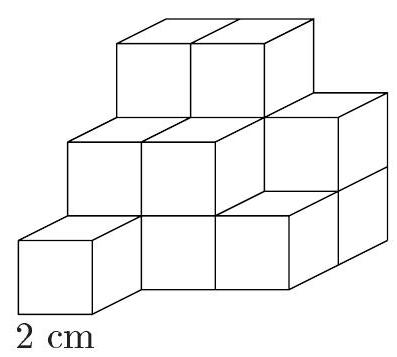 | A2. The body is composed of 14 cubes. The volume of one cube is $2^{3} \mathrm{~cm}^{3}$, the volume of the body is $14 \cdot 2^{3}=112 \mathrm{~cm}^{3}$ or $0.112 \mathrm{dm}^{3}$. | 0.112 | Geometry | MCQ | Yes | Yes | olympiads | false |
1. It is known that the numbers $a+b$ and $\frac{a b}{a+b}$ are integers. Prove that the number $\frac{a^{2}+b^{2}}{a+b}$ is also an integer. | 1. $\frac{a^{2}+b^{2}}{a+b}=\frac{(a+b)^{2}-2 a b}{a+b}=(a+b)-2 \cdot \frac{a b}{a+b}$ - an integer. | proof | Algebra | proof | Yes | Yes | olympiads | false |
Definition: The minimum value of the distance from a point on curve $C$ to line $l$ is called the distance from curve $C$ to line $l$. Given that the distance from curve $C\_1$: $y=x^{2}+a$ to line $l$: $y=x$ is equal to the distance from curve $C\_2$: $x^{2}+(y+4)^{2}=2$ to line $l$: $y=x$, find the value of the real ... | The center of the circle $x^{2}+(y+4)^{2}=2$ is $(0,-4)$, with a radius of $\sqrt{2}$.
The distance from the center of the circle to the line $y=x$ is $\frac{4}{\sqrt{2}} = 2\sqrt{2}$.
Therefore, the distance from curve $C\_2$: $x^{2}+(y+4)^{2}=2$ to line $l$: $y=x$ is $2\sqrt{2} - \sqrt{2} = \sqrt{2}$.
So, the dista... | a = \frac{9}{4} | Algebra | math-word-problem | Yes | Yes | cn_k12 | false |
5 . Which shape cannot be formed? ()
The translation maintains the original text's line breaks and format. | \begin{tabular}{|l|}
\hline 5 \\
\hline$D$
\end{tabular} | D | Geometry | math-word-problem | Incomplete | Yes | olympiads | false |
Victor gets 95% marks in examinations. If he scored 285 marks, what are the maximum marks in the examinations? | To find the maximum marks in the examinations, we can set up a proportion where 95% (or 0.95 as a decimal) of the maximum marks is equal to the 285 marks that Victor scored.
Let's call the maximum marks M. The equation would be:
0.95 * M = 285
To find M, we divide both sides of the equation by 0.95:
M = 285 / 0.95
... | 300 | Algebra | math-word-problem | Yes | Yes | orca_math | true |
Example 2: When A was B's current age, B was 10 years old; when B was A's current age, A was 25 years old. Who is older, A or B? How many years older? | Solution: Let the age difference between A and B be $k$ years, which is an undetermined constant. When $k>0$, A is older than B; when $k<0$, A is younger than B. Then, A's age $y$ and B's age $x$ have a linear relationship:
$$
y=x+k \text {. }
$$
After designing this dynamic process, the given conditions become 3 "mom... | 5 | Algebra | math-word-problem | Yes | Yes | cn_contest | false |
You want to create a five-digit number using 7, 2, 5, 0, and 1 only once. Write the smallest number in this case. | To create the smallest possible five-digit number using the digits 7, 2, 5, 0, and 1, you should arrange the digits in ascending order while ensuring that the first digit is not zero (as that would make it a four-digit number).
So, the smallest number you can create is: $\boxed{10257}$ | 10257 | Combinatorics | math-word-problem | Yes | Yes | orca_math | true |
Example 2. Given that $a, b$ are two unequal positive numbers, among the following three algebraic expressions:
甲. $\left(a+\frac{1}{a}\right)\left(b+\frac{1}{b}\right)$,
乙. $\left(\sqrt{a b}+\frac{1}{\sqrt{a b}}\right)^{2}$,
丙. $\left(\frac{a+b}{2}+\frac{2}{a+b}\right)^{2}$,
the one with the largest value is
(A) Expr... | If we take $a=1, b=2$, then the value of expression 甲 is the largest. If we then take $a=1, b=\frac{1}{3}$, the value of expression 甲 is still the largest. If we conclude that the answer is (A) based on this, it would be incorrect. In fact, if we take $a=3, b=2$, then the value of expression 丙 is the largest, so the co... | D | Algebra | MCQ | Yes | Yes | cn_contest | false |
Given the function f(x) = |2x - m|.
(1) If the solution set of the inequality f(x) ≤ 6 is {x | -2 ≤ x ≤ 4}, find the value of the real number m.
(2) Under the condition of (1), if the inequality f(x) + f($$\frac{1}{2}$$x + 3) $$≤ \frac{8}{a} + \frac{2}{b}$$ holds true for all positive real numbers a and b that satisfy ... | (1) From f(x) ≤ 6, we get |2x - m| ≤ 6, which implies m - 6 ≤ 2x ≤ m + 6. This can be rewritten as $$\frac{m}{2}$$ - 3 ≤ x ≤ $$\frac{m}{2}$$ + 3.
Therefore, we have the system of equations $$\begin{cases} \frac{m}{2} - 3 = -2 \\ \frac{m}{2} + 3 = 4 \end{cases}$$, which gives us m = 2.
(2) When m = 2, f(x) + f($$\frac{... | \frac{7}{3} | Inequalities | math-word-problem | Yes | Yes | cn_k12 | false |
Determine the projection of the vector $\begin{pmatrix} 2 \\ -1 \\ 4 \end{pmatrix}$ onto the plane given by the equation $x + 2y - z = 0.$ | Let $Q$ be the defined plane with equation $x + 2y - z = 0$. The normal vector to this plane, $\mathbf{n}$, is $\begin{pmatrix}1 \\ 2 \\ -1\end{pmatrix}$.
Let $\mathbf{v} = \begin{pmatrix} 2 \\ -1 \\ 4 \end{pmatrix}$. We seek the projection $\mathbf{q}$ of $\mathbf{v}$ onto plane $Q$. The vector component $\mathbf{v} ... | \begin{pmatrix} 8/3 \\ 1/3 \\ 10/3 \end{pmatrix} | Algebra | math-word-problem | Yes | Yes | synthetic_math | true |
110. 7 In a convex polyhedron, the degree of vertex $A$ is 5, and the degree of all other vertices is 3 (the number of edges extending from a vertex is called the degree of that vertex). Each edge is colored blue, red, or purple. If the 3 edges extending from any 3-degree vertex are exactly colored with 3 different col... | Consider any "good" coloring method. We draw attention to the fact that the total number of endpoints of edges of any color is even. In every "good" coloring method, the number of edges of 3 different colors converging at each 3-degree vertex is 1 (thus, the parity of the total number of edges of each color converging ... | proof | Combinatorics | proof | Yes | Yes | olympiads | false |
Given $a(5\pi+\alpha)=m$, then the value of $$\frac {\sin(\alpha-3\pi)+\cos(-)}{\sin(\alpha)-\cos(\pi+\alpha)}$$ is ( )
A: $$\frac {m-1}{m+1}$$
B: \-1
C: $$\frac {m+1}{m-1}$$
D: 1 | Since $\tan(5\pi+\alpha)=m$,
it follows that $\tan\alpha=m$,
thus, the expression simplifies to $$\frac {m+1}{m-1}$$.
This is equivalent to $$\frac {-\sin\alpha-\cos\alpha}{-\sin\alpha+\cos\alpha}$$
which further simplifies to $$\frac {\tan\alpha+1}{\tan\alpha-1}$$
Therefore, the correct choice is $\boxe... | C | Algebra | MCQ | Incomplete | Yes | cn_k12 | false |
A finite set $S$ of unit squares is chosen out of a large grid of unit squares. The squares of $S$ are tiled with isosceles right triangles of hypotenuse $2$ so that the triangles do not overlap each other, do not extend past $S$, and all of $S$ is fully covered by the triangles. Additionally, the hypotenuse of each tr... | 1. **Labeling the Grid:**
We start by labeling the grid with a repeating pattern of numbers from 1 to 4. Each unit square in the grid is labeled with one of these numbers in a specific pattern. This labeling helps us track the arrangement of the triangles.
2. **Splitting Each Square:**
Each unit square is split ... | null | Geometry | proof | Yes | Yes | aops_forum | false |
All three vertices of $\bigtriangleup ABC$ lie on the parabola defined by $y=x^2$, with $A$ at the origin and $\overline{BC}$ parallel to the $x$-axis. The area of the triangle is $64$. What is the length of $BC$?
$\textbf{(A)}\ 4\qquad\textbf{(B)}\ 6\qquad\textbf{(C)}\ 8\qquad\textbf{(D)}\ 10\qquad\textbf{(E)}\ 16$ | By: Albert471
Plotting points $B$ and $C$ on the graph shows that they are at $\left( -x,x^2\right)$ and $\left( x,x^2\right)$, which is isosceles. By setting up the triangle area formula you get: $64=\frac{1}{2}*2x*x^2 = 64=x^3$ Making x=4, and the length of $BC$ is $2x$, so the answer is $\boxed{\textbf{(C)}\ 8}$. | 8 | Geometry | MCQ | Yes | Yes | amc_aime | false |
1. The given polynomials $p_{1}(x)$ and $p_{2}(x)$ of degrees 2 and 3, respectively, are such that the polynomial $p(x)=p_{1}(x)+p_{2}(x)$ has three roots $x_{1}=-1, x_{2}=2, x_{3}=-3$. It is known that all roots of the polynomial $p_{1}(x)$ are also roots of the polynomial $p_{2}(x)$. Find the polynomial product $p_{1... | 1. Solution. Let $p_{1}(x)=x^{2}+a x+b$. Since the roots of the polynomial $p_{1}(x)$ are contained among the roots of the polynomial $p_{2}(x)$, the latter is divisible by $p_{1}(x)$ without a remainder, that is, $p_{2}(x)=(x+c)\left(x^{2}+a x+b\right)$. Then
$p_{1}(x)+p_{2}(x)=(x+c+1)\left(x^{2}+a x+b\right)$.
On t... | notfound | Algebra | math-word-problem | Yes | Yes | olympiads | false |
Subsets and Splits
No community queries yet
The top public SQL queries from the community will appear here once available.