
instruction_seed stringlengths 2 10.7k | solution stringlengths 0 10.8k ⌀ | answer stringlengths 0 575 ⌀ | problem_type stringclasses 9
values | question_type stringclasses 5
values | problem_is_valid stringclasses 5
values | solution_is_valid stringclasses 4
values | source stringclasses 11
values | synthetic bool 2
classes |
|---|---|---|---|---|---|---|---|---|
1. For which digits $x, y, z$ is the equality
$$
\overline{x y} \sqrt{y x}+\overline{y z} \sqrt{z y}=\overline{(x+z) x y} ?
$$ | Solution. Since $\overline{y x}$ and $\overline{z y}$ must be perfect squares, we conclude that they are among the numbers $16, 25, 36, 49, 64$ or $81$. However, $y$ must simultaneously appear as both the first and second digit of some of the given two-digit numbers, so $y \in\{1,4,6\}$. Now it is easily obtained that ... | 46\sqrt{64}+63\sqrt{36}=746 | Number Theory | math-word-problem | Yes | Yes | olympiads | false |
3. It is known that the function $f(x)$ satisfies the equality for any $x$:
$3 \sin x+f(x)=f(x+2)$
Find the value of $\mathrm{f}(2017) \sin 1$, given that $f(1)=\frac{3 \cos ^{2} 1008}{\sin 1}$. | Answer: 3
## Examples of answer notations:
17
$1 / 7$
1.7 | 3 | Algebra | math-word-problem | Yes | Yes | olympiads | false |
Let $ABC$ be a triangle, $M$ the midpoint of $BC$, and $N$ one-third of the way along $AC$ from $C$. The line $(MN)$ intersects $(AB)$ at $P$. Determine the position of $P$ relative to $A$ and $B$. | 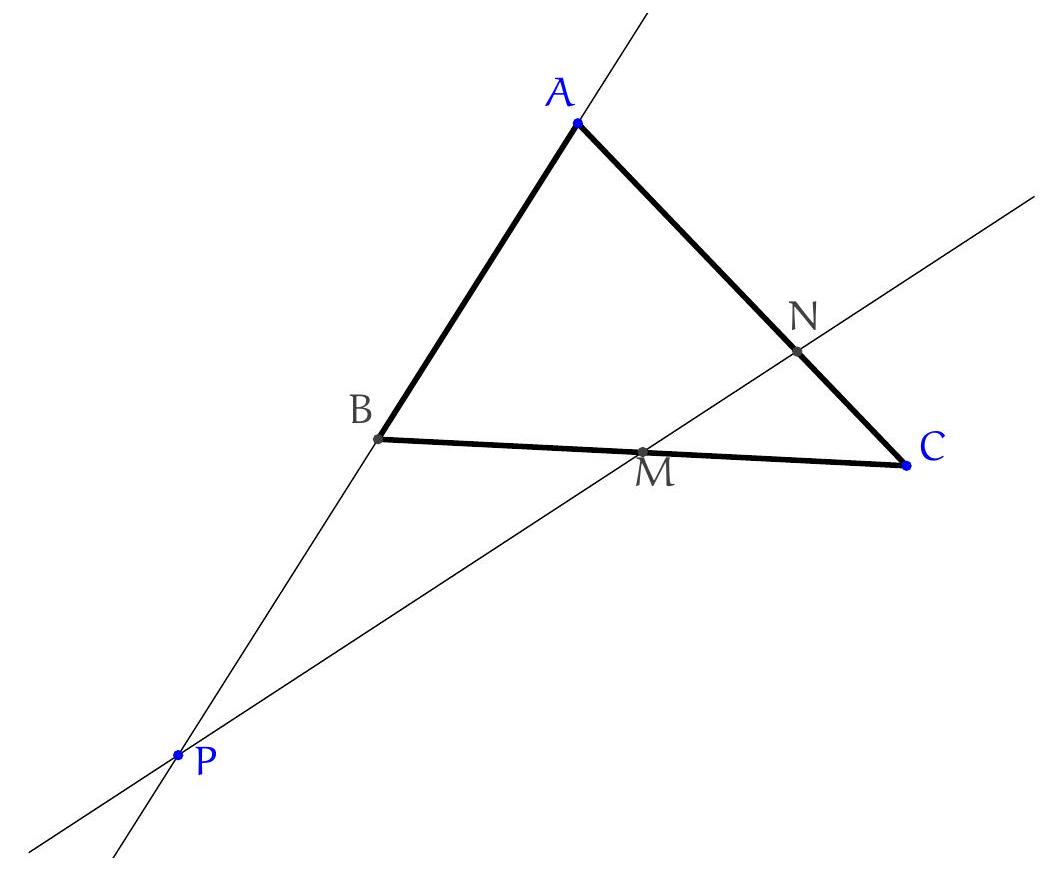
The relation $\frac{M B}{M C} \cdot \frac{N C}{N A} \cdot \frac{P A}{P B}=1$ gives $\frac{P A}{P B}=2$, and $P$ is the symmetric point of $A$ with respect to $B$.
To generalize the concep... | \frac{PA}{PB}=2 | Geometry | math-word-problem | Yes | Yes | olympiads | false |
Let $A = \{x | x^2 - 4x + 3 \leq 0\}$, $B = \{x | x^2 - ax < x - a\}$, if $A$ is a necessary but not sufficient condition for $B$, then the range of the real number $a$ is. | The range of $a$ is $\boxed{[1, 3]}$.
(Solution is omitted) | [1, 3] | Inequalities | math-word-problem | Yes | Incomplete | cn_k12 | false |
If $$\frac {x^{2}}{1+m}+ \frac {y^{2}}{1-m}=1$$ represents a hyperbola, then the range of values for $m$ is __________. | Since the given equation $$\frac {x^{2}}{1+m}+ \frac {y^{2}}{1-m}=1$$ describes a hyperbola, we know that the coefficients of $x^{2}$ and $y^{2}$ must have opposite signs. This is because for any hyperbola in standard form, one term is subtracted from the other.
Thus, we have two conditions for the denominators:
1. $1... | (-\infty, -1) \cup (1, +\infty) | Algebra | math-word-problem | Yes | Incomplete | cn_k12 | false |
A circular piece of metal of maximum size is cut out of a square piece and then a square piece of maximum size is cut out of the circular piece. The total amount of metal wasted is:
$\textbf{(A)}\ \frac{1}{4} \text{ the area of the original square}\\ \textbf{(B)}\ \frac{1}{2}\text{ the area of the original square}\\ ... | The maximum diameter of the circular piece is the same as the side length of the square piece, so the circle is tangent to the square on all four sides. The maximum size a square piece that you can cut from the circle now has 4 edges that are the same as the square created by connecting the four midpoints of the origin... | \frac{1}{2} | Geometry | MCQ | Yes | Incomplete | amc_aime | false |
If the function $f(x)=\ln x+ax^{2}-2$ has an increasing interval in the range $\left( \frac{1}{2},2 \right)$, then the range of the real number $\alpha$ is $\left( \right.$ $\left. \right)$
A: $(-\infty ,-2]$
B: $\left(-\frac{1}{8},+\infty \right)$
C: $\left(-2,-\frac{1}{8}\right)$
D: $\left(-2,+\infty \right)$ | **Analysis**
This question examines the use of derivatives to determine the monotonicity of a function.
According to the problem, the function $f(x)=\ln x+ax^{2}-2$ has an increasing interval in the range $\left( \frac{1}{2},2 \right)$,
which is equivalent to the inequality $f'(x)= \frac{1}{x}+2ax > 0$, $x\in \left(... | \text{D} | Calculus | MCQ | Yes | Yes | cn_k12 | false |
48. (POL 1) (SL87-11). | None | notfound | Other | math-word-problem | Incomplete | Problem not solved | olympiads | false |
If $r$ is positive and the line whose equation is $x + y = r$ is tangent to the circle whose equation is $x^2 + y ^2 = r$, then $r$ equals
$\textbf{(A) }\frac{1}{2}\qquad \textbf{(B) }1\qquad \textbf{(C) }2\qquad \textbf{(D) }\sqrt{2}\qquad \textbf{(E) }2\sqrt{2}$ | The circle $x^2 + y^2 = r$ has center $(0,0)$ and radius $\sqrt{r}$. Therefore, if the line $x + y = r$ is tangent to the circle $x^2 + y^2 = r$, then the distance between $(0,0)$ and the line $x + y = r$ is $\sqrt{r}$.
The distance between $(0,0)$ and the line $x + y = r$ is
\[\frac{|0 + 0 - r|}{\sqrt{1^2 + 1^2}} = \f... | 2 | Geometry | MCQ | Yes | Yes | amc_aime | false |
Find all positive integers such that $3^{2n}+3n^2+7$ is a perfect square. | null | null | Number Theory | math-word-problem | Yes | Yes | aops_forum | false |
Example 1.3.6 (IMO 32) Let $P$ be a point inside $\triangle A B C$. Prove that among $\angle P A B$, $\angle P B C$, and $\angle P C A$, at least one angle is less than or equal to $30^{\circ}$. | To prove that "Among $\angle P A B, \angle P B C, \angle P C A$, at least one angle is less than or equal to $30^{\circ}$, by constructing $P H_{1} \perp B C$ at $H_{1}, P H_{2} \perp C A$ at $H_{2}, P H_{3} \perp A B$ at $H_{3}$, it is sufficient to prove that at least one of $A P \geqslant 2 P H_{3}, B P \geqslant 2 ... | proof | Geometry | proof | Yes | Incomplete | olympiads | false |
$2 \cdot 67$ has 1000 tickets numbered $000, 001, \cdots, 999$ and 100 boxes numbered $00, 01, \cdots, 99$. If the number of a box can be obtained by deleting one digit from the number of a ticket, then the ticket can be placed in this box. Prove:
(1) All tickets can be distributed into 50 boxes.
(2) It is impossible t... | [Proof] (1) We divide the 10 digits $0,1,2, \cdots, 9$ into two groups of 5 digits each, with the digits from 0 to 4 forming one group and the digits from 5 to 9 forming the other group. Since in a three-digit number, at least two digits must come from the same group, we only need to use the boxes with numbers formed b... | proof | Combinatorics | proof | Yes | Yes | olympiads | false |
In a workshop, there are 90 workers. Each worker can produce either 15 bolts or 24 nuts per day on average. If one bolt needs to be matched with two nuts, how should the workers be allocated to ensure that the bolts and nuts are exactly matched? | To solve this problem, we start by setting up equations based on the given information. Let $x$ represent the number of workers producing bolts and $y$ represent the number of workers producing nuts. We are given two pieces of information:
1. The total number of workers in the workshop is 90.
2. Each bolt needs to be ... | x = 40, y = 50 | Algebra | math-word-problem | Yes | Yes | cn_k12 | false |
Jasmine bought 4 pounds of coffee beans and 2 gallons of milk. A pound of coffee beans costs $2.50 and a gallon of milk costs $3.50. There is a 10% discount on the combined price of coffee beans and milk. After applying the initial discount, Jasmine gets an additional 5% discount on the milk. Taxes are then applied to ... | First, let's calculate the total cost of the coffee beans and milk before any discounts:
Cost of coffee beans = 4 pounds * $2.50/pound = $10.00
Cost of milk = 2 gallons * $3.50/gallon = $7.00
Total cost before discounts = Cost of coffee beans + Cost of milk
Total cost before discounts = $10.00 + $7.00 = $17.00
Now, ... | \$17.98 | Algebra | math-word-problem | Yes | Yes | orca_math | true |

Authors: Ourovsh V.M., Frennkin B.R.
Does there exist a convex polygon in which each side is equal to some diagonal, and each diagonal is equal to some side? | Answer: No. Suppose the opposite, and let $AB$ be the largest side of the polygon, $CD$ be the smallest diagonal ( $AB$ and $CD$ may have one common end), $E$ be the vertex lying on the opposite side of $CD$ from $A$ and $B$ (Fig. 8.5). Then, since $AE \leq AB$ and $BE \leq AB, \angle AEB \geq 60^{\circ}$. On the other... | proof | Geometry | proof | Incomplete | Yes | olympiads | false |
Proposition 3.1. If $a$ and $b$ are integers, then $a \equiv b(\bmod m)$ if and only if there is an integer $k$ such that $a=b+k m$. | Proof. If $a \equiv b(\bmod m)$, then $m \mid(a-b)$. This means that there is an integer $k$ with $k m=a-b$, so that $a=b+k m$.
Conversely, if there is an integer $k$ with $a=b+k m$, then $k m=a-b$. Hence $m \mid(a-b)$, and consequently, $a \equiv b(\bmod m)$. | proof | Number Theory | proof | Yes | Yes | number_theory | false |
In a school of 850 boys, 40% are Muslims, 28% are Hindus, a certain percentage are Sikhs, and 187 boys belong to other communities. What percentage of the boys are Sikhs? | First, let's find out the number of Muslim and Hindu boys in the school.
Muslim boys:
40% of 850 = 0.40 * 850 = 340 boys
Hindu boys:
28% of 850 = 0.28 * 850 = 238 boys
Now, let's find out the total number of boys who are Muslims, Hindus, or belong to other communities.
Total (Muslims + Hindus + Other communities) =... | 10\% | Algebra | math-word-problem | Yes | Yes | orca_math | true |
In an acute triangle $ABC$, the incircle $\omega$ touches $BC$ at $D$. Let $I_a$ be the excenter of $ABC$ opposite to $A$, and let $M$ be the midpoint of $DI_a$. Prove that the circumcircle of triangle $BMC$ is tangent to $\omega$.
[i]Patrik Bak (Slovakia)[/i] | null | null | Geometry | proof | Yes | Yes | aops_forum | false |
Given vectors $\overrightarrow {a}$=(2, 6) and $\overrightarrow {b}$=(-3, λ), find the value of λ such that $\overrightarrow {a}$ is parallel to $\overrightarrow {b}$. | Since $\overrightarrow {a}$ is parallel to $\overrightarrow {b}$:
- 2λ + 18 = 0
- λ = -9
Thus, the answer is $\boxed{\lambda = -9}$.
We can obtain the equation 2λ + 18 = 0 from the given condition that $\overrightarrow {a}$ is parallel to $\overrightarrow {b}$. Solving for λ will give us the answer.
This problem te... | \lambda = -9 | Algebra | math-word-problem | Yes | Yes | cn_k12 | false |
Let $ l,d,k$ be natural numbers. We want to prove that for large numbers $ n$, for each $ k$-coloring of the $ n$-dimensional cube with side length $ l$, there is a $ d$-dimensional subspace that all of its vertices have the same color. Let $ H(l,d,k)$ be the least number such that for $ n\geq H(l,d,k)$ the previus sta... | null | null | Combinatorics | proof | Yes | Yes | aops_forum | false |
Veronica's flashlight was bright enough to be seen at night from a certain distance. Freddie's flashlight could be seen at night for a distance three times farther than Veronica's flashlight, and Velma's flashlight could be seen at night from a distance 2000 feet less than 5 times farther than Freddie's flashlight. If ... | Let's denote the distance Veronica's flashlight can be seen at night as V feet. According to the problem, Freddie's flashlight can be seen at night for a distance three times farther than Veronica's flashlight, so Freddie's flashlight can be seen for 3V feet.
Velma's flashlight can be seen from a distance 2000 feet le... | 1,000 | Algebra | math-word-problem | Yes | Yes | orca_math | true |
Let $Q$ be the plane passing through the origin with normal vector $\begin{pmatrix} 2 \\ -1 \\ 1 \end{pmatrix}.$ Find the matrix $\mathbf{S}$ such that for any vector $\mathbf{v},$ $\mathbf{S} \mathbf{v}$ is the reflection of $\mathbf{v}$ through plane $Q.$ | Let $\mathbf{v} = \begin{pmatrix} x \\ y \\ z \end{pmatrix},$ and let $\mathbf{q}$ be the projection of $\mathbf{v}$ onto the normal vector $\mathbf{n} = \begin{pmatrix} 2 \\ -1 \\ 1 \end{pmatrix}$ of plane $Q$.
The projection $\mathbf{q}$ onto $\mathbf{n}$ is given by:
\[
\mathbf{q} = \frac{\mathbf{v} \cdot \mathbf{... | \begin{pmatrix} -\frac{1}{3} & -\frac{1}{3} & \frac{1}{3} \\ -\frac{1}{3} & -\frac{5}{6} & -\frac{1}{6} \\ \frac{1}{3} & -\frac{1}{6} & -\frac{5}{6} \end{pmatrix} | Algebra | math-word-problem | Yes | Yes | synthetic_math | true |
In the arithmetic sequence $\{a_n\}$, if $\frac{a_{1010}}{a_{1009}} 0$ is ______. | Since $\frac{a_{1010}}{a_{1009}} 0$, and $a_{1010} + a_{1009} > 0$,
Therefore, $S_{2018} = \frac{2018(a_{1} + a_{2018})}{2} = 1009(a_{1010} + a_{1009}) > 0$,
and $S_{2019} = \frac{2019(a_{1} + a_{2019})}{2} = 2019a_{1010} 0$ is $\boxed{2018}$.
The answer is: $2018$.
Given $\frac{a_{1010}}{a_{1009}} 0$, and $... | 2018 | Algebra | math-word-problem | Incomplete | Yes | cn_k12 | false |
1. In $\triangle A B C$, prove:
$$
\frac{1}{a}+\frac{1}{b}=\frac{1}{t_{a}} \Leftrightarrow C=\frac{2 \pi}{3} .
$$ | 1. Use $t_{a}=\frac{2 b c}{b+c} \cos \frac{A}{2}$. | proof | Geometry | proof | Yes | Yes | olympiads | false |
## Problem Statement
Derive the equations of the tangent and normal lines to the curve at the point corresponding to the parameter value $t=t_{0}$.
\[
\left\{\begin{array}{l}
x=\arcsin \frac{t}{\sqrt{1+t^{2}}} \\
y=\arccos \frac{1}{\sqrt{1+t^{2}}}
\end{array}\right.
\]
$t_{0}=1$ | ## Solution
Since $t_{0}=1$, then
$x_{0}=\arcsin \frac{1}{\sqrt{1+1^{2}}}=\arcsin \frac{1}{\sqrt{2}}=\frac{\pi}{4}$
$y_{0}=\arccos \frac{1}{\sqrt{1+1^{2}}}=\arccos \frac{1}{\sqrt{2}}=\frac{\pi}{4}$
Let's find the derivatives:
$x_{t}^{\prime}=\left(\arcsin \frac{t}{\sqrt{1+t^{2}}}\right)^{\prime}=\frac{1}{\sqrt{1-\l... | 2x-\frac{\pi}{4} | Calculus | math-word-problem | Yes | Yes | olympiads | false |
For a positive integer $n$ write down all its positive divisors in increasing order: $1=d_1<d_2<\ldots<d_k=n$.
Find all positive integers $n$ divisible by $2019$ such that $n=d_{19}\cdot d_{20}$.
[i](I. Gorodnin)[/i] | 1. Given that \( n \) is a positive integer divisible by \( 2019 \), we start by factoring \( 2019 \):
\[
2019 = 673 \times 3
\]
Therefore, \( n \) must be divisible by both \( 673 \) and \( 3 \).
2. We are given that \( n = d_{19} \cdot d_{20} \), where \( d_1, d_2, \ldots, d_k \) are the divisors of \( n... | n = 3^{18} \times 673 | Number Theory | math-word-problem | Yes | Yes | aops_forum | false |
Your friend sitting to your left (or right?) is unable to solve any of the eight problems on his or her Combinatorics $B$ test, and decides to guess random answers to each of them. To your astonishment, your friend manages to get two of the answers correct. Assuming your friend has equal probability of guessing each of... | 1. Let's denote the total number of questions as \( n = 8 \).
2. Each question has an equal probability of being guessed correctly, which is \( p = \frac{1}{2} \).
3. The number of correct answers is given as \( k = 2 \).
We need to find the expected score of your friend. Each question has a different point value, and... | 9 | Combinatorics | math-word-problem | Yes | Yes | aops_forum | false |
Person A and person B start at the same time from location A to location B, which is 25.5 kilometers away. Person A rides a bicycle, and person B walks. The speed of person A is 2 kilometers per hour faster than twice the speed of person B. After person A reaches location B, he immediately returns from location B and m... | Let's denote the speed of person B as $x$ kilometers per hour. Therefore, we have the equation:
$3x + 3(2x + 2) = 25.5 \times 2$,
Solving this equation, we get $x = 5$,
$2x + 2 = 12$.
Hence, the speed of person A is $\boxed{12}$ kilometers per hour, and the speed of person B is $\boxed{5}$ kilometers per hour. | 5 | Algebra | math-word-problem | Yes | Yes | cn_k12 | false |
Suppose $x, y,$ and $z$ are positive integers satisfying $(x+y+z)^3 - x^3 - y^3 - z^3 = 378$. Find $x+y+z$. | Consider the expression $Q(x) = (x+y+z)^3 - x^3 - y^3 - z^3$. By similar reasoning as the original problem, we can factor this expression as:
$$(x+y+z)^3 - x^3 - y^3 - z^3 = 3(x+y)(y+z)(z+x).$$
Given that the expression equals 378, we have:
$$3(x+y)(y+z)(z+x) = 378.$$
Dividing both sides by 3, we get:
$$(x+y)(y+z)(z+x)... | 9 | Algebra | math-word-problem | Yes | Yes | synthetic_math | true |
2. Solve the equation $\left(1-\left(1+x^{-2}\right)^{-1}\right)^{-1}=3.25$.
| 2. We organize the inner parenthesis $\left(1-\left(1+\frac{1}{x^{2}}\right)^{-1}\right)^{-1}=3.25$, expand to a common denominator $\left(1-\left(\frac{x^{2}+1}{x^{2}}\right)^{-1}\right)^{-1}=3.25$. We consider the negative exponent $\left(1-\frac{x^{2}}{x^{2}+1}\right)^{-1}=3.25$ and expand again to a common denomina... | x_{1}=1.5x_{2}=-1.5 | Algebra | math-word-problem | Yes | Yes | olympiads | false |
Two pipes can separately fill a tank in some minutes and 20 minutes respectively. A third pipe can drain off 45 liters of water per minute. If all the pipes are opened, the tank can be filled in 15 minutes. The capacity of the tank is 675 liters. How many minutes does it take for the first pipe to fill the tank? | Let's denote the time it takes for the first pipe to fill the tank as \( T \) minutes.
The rate at which the first pipe fills the tank is \( \frac{1}{T} \) of the tank per minute.
The rate at which the second pipe fills the tank is \( \frac{1}{20} \) of the tank per minute.
The rate at which the third pipe drains the... | 4 | Algebra | math-word-problem | Yes | Yes | orca_math | true |
9. (16 points) Given the function
$$
f_{n}(x)=\frac{n x^{2}-x}{x^{2}+1}\left(n \in \mathbf{Z}_{+}\right) \text {. }
$$
Let $x_{1}, x_{2}, \cdots, x_{n}$ be positive real numbers, and $\sum_{i=1}^{n} x_{i}=1$. Prove: $\sum_{i=1}^{n} f_{n}\left(x_{i}\right) \geqslant 0$. | Given $f_{n}^{\prime}(x)=\frac{x^{2}+2 n x-1}{\left(x^{2}+1\right)^{2}}$.
Then $f_{n}\left(\frac{1}{n}\right)=0, f_{n}^{\prime}\left(\frac{1}{n}\right)=\frac{n^{2}}{1+n^{2}}$.
Thus, the equation of the tangent line to the curve $y=f_{n}(x)$ at the point $\left(\frac{1}{n}, f_{n}\left(\frac{1}{n}\right)\right)$ is
$$
y=... | proof | Inequalities | proof | Yes | Yes | olympiads | false |
(Pacific Asian Mathematical Olympiad - 1996) Let $m$ and $n$ be positive integers with $m \geq n$. Show that:
$$
2^{n} n!\leq \frac{(m+n)!}{(m-n)!} \leq\left(m^{2}+m\right)^{n}
$$
## corrected exercise
The text above has been translated into English, preserving the original text's line breaks and format. | For the first inequality, we have:
$$
\begin{aligned}
\frac{(m+n)!}{(m-n)!} & =(m+n)(m+n-1) \ldots(m-n+1) \\
& \geq 2 n(2 n-1) \ldots 1 \\
& \geq 2 n(2 n-2) \ldots 2 \\
& =2^{n} n!
\end{aligned}
$$
We prove the second inequality by induction. It is true for $n=1$, and if we assume it is true for $n$,
$$
\begin{align... | proof | Inequalities | proof | Yes | Yes | olympiads | false |
Find the equation of the line that passes through the point P(-2, 1) and is perpendicular to the line $2x - y + 4 = 0$. | Since the line we are seeking is perpendicular to the line $2x - y + 4 = 0$, the slope of the new line must be the negative reciprocal of the slope of the given line. The slope of the given line is 2, so the slope of the sought line is $-\frac{1}{2}$. Thus, we can set up the line equation in the slope-intercept form:
... | x + 2y = 0 | Algebra | math-word-problem | Yes | Yes | cn_k12 | false |
Example 3.31. Compute the volume of the body bounded by the surfaces $z=0, x=0, y=x, z=1-y \sqrt{y}$. | Solution. We will construct a drawing showing the body bounded by the specified surfaces (Fig. 51a). The volume of the body \( V = \iint_{D} z \, dx \, dy \), where \( z = 1 - y \sqrt{y} \) is the equation of the surface bounding the body from above, and \( D \) is the region of integration, representing a triangle in ... | \frac{3}{14} | Calculus | math-word-problem | Yes | Yes | olympiads | false |
Compute $\cos(-30^\circ)$. | Rotating $30^\circ$ clockwise is equivalent to rotating $360^\circ - 30^\circ = 330^\circ$ counterclockwise, so $\cos(-30^\circ) = \cos(360^\circ - 30^\circ) = \cos(330^\circ)$.
Let $Q$ be the point on the unit circle that corresponds to $330^\circ$ counterclockwise from the point $(1,0)$. Here, the $x$-coordinate of ... | \frac{\sqrt{3}}{2} | Algebra | math-word-problem | Yes | Yes | synthetic_math | true |
Hershel has 10 betta fish and 15 goldfish in a bowl. His friend Bexley brings him 2/5 times as many betta fish and 1/3 times as many goldfish. Hershel gifts his sister a portion of the fish and has 17 fish remaining in the bowl. What is the ratio of the number of fish Hershel gifted to his sister to the total number of... | Let's first calculate how many betta fish and goldfish Bexley brings to Hershel.
Bexley brings Hershel 2/5 times as many betta fish as Hershel already has. Hershel has 10 betta fish, so Bexley brings him:
2/5 * 10 = 4 betta fish
Bexley brings Hershel 1/3 times as many goldfish as Hershel already has. Hershel has 15 g... | 1:2 | Algebra | math-word-problem | Yes | Yes | orca_math | true |
Compute $\displaystyle \frac{3-6+12-24+48-96}{6-12+24-48+96-192}$. | First, factor out the common terms from both the numerator and the denominator:
The numerator, $\displaystyle 3-6+12-24+48-96$, can be factored as $\displaystyle 3(1-2+4-8+16-32)$.
The denominator, $\displaystyle 6-12+24-48+96-192$, can be factored as $\displaystyle 6(1-2+4-8+16-32)$.
Since both the numerator and deno... | \frac{1}{2} | Algebra | math-word-problem | Yes | Yes | synthetic_math | true |
II. (20 points) As shown in the figure, in trapezoid $ABCD$, $AD = DC = CB = \frac{1}{2} AB$, $M$ is the midpoint of $AB$, $\overparen{DC}$ is part of the circumcircle of $\triangle DCM$, and point $P$ is any point on $\overparen{DC}$. Connecting $PA$ and $PB$, they intersect $DC$ at points $E$ and $F$ respectively. Pr... | II. As shown in the figure, connect $PD, PC$ and extend them to intersect line $AB$ at points $H, N$ respectively.
Given $\angle DAB = \angle CBA = 60^{\circ}, \angle DAH = \angle C1$ $\angle ADC = \angle DCB = 120^{\circ}$. $\triangle DCM$ is an equilateral triangle.
$\therefore \angle DPC = 120^{\circ}, \angle PDC +... | DE \cdot FC = \left(\frac{1}{2} EF\right)^2 | Geometry | proof | Yes | Yes | cn_contest | false |
4. As shown in Figure 2, given that $A B$ and $C D (A B > C D)$ are two chords of $\odot O$, and satisfy
$$
\begin{array}{l}
O A=\sqrt{A B \cdot C D} \\
=A B-C D . \\
\text { Then } \angle A O B+\angle C O D \\
=
\end{array}
$$ | 4. $144^{\circ}$.
In Figure 2, on side $AB$, take $AE = CD$, and connect $OE$. Clearly,
$$
OA = \sqrt{AB \cdot AE} = AB - AE = BE = OB.
$$
Thus, $\angle BOE = \angle BEO$.
From $OA = \sqrt{AB \cdot AE}, \angle EAO = \angle OAB$
$\Rightarrow \triangle EAO \sim \triangle OAB$.
Then $\angle AOE = \angle ABO = \angle EAO... | 144^{\circ} | Geometry | math-word-problem | Incomplete | Yes | cn_contest | false |
Three. (Full marks 12 points) Solve the equation:
$$
\frac{13 x-x^{2}}{x+1}\left(x+\frac{13-x}{x+1}\right)=42 \text {. }
$$ | Three, let $y=\frac{13-x}{x+1}$. The original equation becomes
$x y(x+y)=42$.
$\quad x y+(x+y)=\frac{13 x-x^{2}}{x+1}+\frac{x^{2}+13}{x+1}=13$.
From (1), (2), and Vieta's formulas, we know that $x y$ and $x+y$ are the roots of the equation $z^{2}-13 z+42=0$. Solving this, we get $z_{1}=6, z_{2}=7$.
Thus, we have $\left... | x_{1}=1, x_{2}=6, x_{3}=3+\sqrt{2}, x_{4}=3-\sqrt{2} | Algebra | math-word-problem | Yes | Yes | cn_contest | false |
What is the smallest number which when increased by 3 is divisible by 9, 35, 25, and 21? | To find the smallest number that satisfies the given conditions, we need to find the least common multiple (LCM) of the divisors (9, 35, 25, and 21) and then subtract 3 from it.
First, let's find the prime factorization of each divisor:
- 9 = 3^2
- 35 = 5 x 7
- 25 = 5^2
- 21 = 3 x 7
Now, we find the LCM by taking the... | 1572 | Number Theory | math-word-problem | Yes | Yes | orca_math | true |
Given that 0.75 liters is approximately 1.575 pints, how many pints are in two liters? Express your answer as a decimal to the nearest tenth. | 1. Determine the conversion factor from the given information: If 0.75 liters is 1.575 pints, then one liter is \( \frac{1.575}{0.75} = 2.1 \) pints.
2. Multiply the conversion factor by the number of liters to find the pints in two liters: \( 2 \times 2.1 = 4.2 \) pints.
3. Thus, two liters is equivalent to \( \boxed{... | 4.2 | Algebra | math-word-problem | Yes | Yes | synthetic_math | true |
How many positive integers less than $500$ are either a perfect cube or a perfect square? | 1. Identify the perfect squares less than $500$: The largest perfect square less than $500$ is $22^2 = 484$. Therefore, there are $22$ perfect squares less than $500$.
2. Identify the perfect cubes less than $500$: The largest perfect cube less than $500$ is $7^3 = 343$. Therefore, there are $7$ perfect cubes less ... | 28 | Number Theory | math-word-problem | Yes | Yes | synthetic_math | true |
Compute the sum and difference of the following repeating decimals: $0.\overline{6} + 0.\overline{2} - 0.\overline{9} + 0.\overline{3}$. | First, we convert each repeating decimal to its fractional form:
1. $0.\overline{6}$ can be expressed as $x = 0.\overline{6}$; then $10x = 6.\overline{6}$, and subtracting gives $9x = 6$. Hence, $x = \frac{6}{9} = \frac{2}{3}$.
2. $0.\overline{2}$ becomes $y = 0.\overline{2}$; then $10y = 2.\overline{2}$, leading to $9... | \frac{2}{9} | Algebra | math-word-problem | Yes | Yes | synthetic_math | true |
Given an ellipse $E$ with the equation $\frac{x^2}{t} + \frac{y^2}{3} = 1$, its foci are on the x-axis, $A$ is the left vertex of $E$, and a line with slope $k(k > 0)$ intersects $E$ at points $A$ and $M$. Point $N$ is on $E$, and $MA \perp NA$.
(i) When $t=4$ and $|AM| = |AN|$, find the area of $\triangle AMN$;
(i... | (i) Method 1: When $t=4$, the equation of ellipse $E$ is $\frac{x^2}{4} + \frac{y^2}{3} = 1$, and $A$ is at $(-2,0)$.
The equation of line $AM$ is $y = k(x + 2)$. Substituting into the ellipse's equation and rearranging gives $(3 + 4k^2)x^2 + 16k^2x + 16k^2 - 12 = 0$, which has solutions $x = -2$ or $x = -\frac{8k^2 -... | \left(\sqrt[3]{2}, 2\right) | Geometry | math-word-problem | Yes | Yes | cn_k12 | false |
Joe saves $6,000 USD for his trip to Australia. The current exchange rate is 1 USD = 1.35 AUD (Australian dollars). If he spends $1,200 USD on the flight, $800 USD on a hotel, $3,000 USD on food, $500 USD on local transportation, $850 USD on entertainment, and $350 USD on miscellaneous purchases, determine the total co... | First, let's convert Joe's total savings to Australian dollars (AUD):
$6,000 USD * 1.35 AUD/USD = $8,100 AUD
Now, let's convert each of his expenses to AUD and sum them up to find the total cost of his trip:
Flight: $1,200 USD * 1.35 AUD/USD = $1,620 AUD
Hotel: $800 USD * 1.35 AUD/USD = $1,080 AUD
Food: $3,000 USD *... | \$945 | Other | math-word-problem | Yes | Yes | orca_math | true |
Given that the sequence {an} is a geometric sequence, a7 = 4, a5 + a9 = 10, find the value of a3 + a11 = ( )
A: 32
B: 17
C: 10
D: 8 | The sequence {an} is a geometric sequence, a7 = 4, a5 + a9 = 10,
∴ $$\frac {4}{q^{2}}$$ + 4q2 = 10,
Solving for q2, we get q2 = 2 or q2 = $$\frac {1}{2}$$,
∴ a3 + a11 = $$\frac {a_{7}}{q^{4}}$$ + a7q4 = 4 × ( $$\frac {1}{4}$$ + 4) = 17,
Hence, the answer is: $\boxed{\text{B}}$.
According to the problem, we can get... | \text{B} | Algebra | MCQ | Yes | Yes | cn_k12 | false |
Given that the function $y = f(2^x)$ has a domain of $[1, 2]$, find the domain of the function $y = f(\log_2 x)$. | The function $y = f(2^x)$ has the domain $[1, 2]$. This means $2^x$ takes on values within the range of $1$ to $2$ when $x$ is within its domain. The input to the function $f$ is thus between $2^1$ and $2^2$, which simplifies to the interval $[2, 4]$.
When we consider the function $y = f(\log_2 x)$, we want to find th... | [4, 16] | Algebra | math-word-problem | Yes | Yes | cn_k12 | false |
Given that p is a positive even integer with a certain characteristic, the units digit of p^3 minus the units digit of p^2 is equal to 0. The units digit of p + 2 is 8. What characteristic does the units digit of p have? | Let's first determine the units digit of p. We are told that the units digit of p + 2 is 8. Therefore, the units digit of p must be 6, because when you add 2 to 6, you get 8.
Now, let's check the characteristic that the units digit of p^3 minus the units digit of p^2 is equal to 0. We already determined that the units... | 6 | Number Theory | math-word-problem | Yes | Yes | orca_math | true |
Given vectors $\overrightarrow{a}=(-\sin x,2)$ and $\overrightarrow{b}=(1,\cos x)$, and the function $f(x)= \overrightarrow{a}\cdot \overrightarrow{b}$
$(1)$ Calculate the value of $f\left( \frac {\pi}{6}\right)$
$(2)$ If $\overrightarrow{a} \perp \overrightarrow{b}$, find the value of $g(x)= \frac {\sin (\pi+x)+4\... | Solution:
$(1)$ Since $\overrightarrow{a}=(-\sin x,2)$ and $\overrightarrow{b}=(1,\cos x)$,
then the function $f(x)= \overrightarrow{a}\cdot \overrightarrow{b}=-\sin x+2\cos x$,
thus $f\left( \frac {\pi}{6}\right)= \sqrt {3}- \frac {1}{2}$;
$(2)$ Since $\overrightarrow{a} \perp \overrightarrow{b}$,
then $f(x)... | \frac {2}{9} | Algebra | math-word-problem | Yes | Yes | cn_k12 | false |
the simple interest on a sum of money will be rs . 600 after 10 years . if the principal is trebled after 5 years what will be the total interest at the end of the tenth year ? | Let's denote the principal amount as P and the rate of interest as R (in percentage per annum).
Given that the simple interest on the principal P for 10 years is Rs. 600, we can use the simple interest formula to find the rate of interest:
Simple Interest (SI) = (Principal (P) * Rate (R) * Time (T)) / 100
We know th... | 1200 | Algebra | math-word-problem | Yes | Yes | orca_math | true |
What is the units digit of the product of all even integers between 10 and 100? | - **Understanding the problem**: We need to find the units digit of the product of all even integers between 10 and 100. Even integers between 10 and 100 are those that end with 0, 2, 4, 6, and 8.
- **Identifying key observations**: Any number ending in 0, when multiplied with another number, will result in a product t... | 0 | Number Theory | math-word-problem | Yes | Yes | synthetic_math | true |
4 Touching Circles $\quad]$
On the side $A C$ of triangle $A B C$, a point $X$ is chosen. Prove that if the inscribed circles of triangles $A B X$ and $B C X$ touch each other, then the point $X$ lies on the incircle of triangle $A B C$. | Let the inscribed circle of triangle $A B X$ touch its sides $A B$ and $A X$ at points $L$ and $K$ respectively, the inscribed circle of triangle $B C X$ touch its sides $B C$ and $C X$ at points $M$ and $N$ respectively, $Y$ be the point of tangency of these circles, and $p$ be the semiperimeter of triangle $A B C$. T... | proof | Geometry | proof | Yes | Yes | olympiads | false |
A can do a work in 15 days, B in 20 days, and C in 25 days. If all three work together for 4 days, and then B stops working, what is the fraction of the work that is left after 9 days, when only A and C continue working on the task? | First, let's find out how much work each person can do in a day.
A can do the work in 15 days, so A's work rate is 1/15 of the work per day.
B can do the work in 20 days, so B's work rate is 1/20 of the work per day.
C can do the work in 25 days, so C's work rate is 1/25 of the work per day.
When all three work toge... | 0 | Algebra | math-word-problem | Yes | Yes | orca_math | true |
Let's replace all numbers in the product $100 \cdot 101 \cdot 102 \cdot \ldots \cdot 200$ with 150. Will the product increase or decrease? The same question for the sum.
# | Consider the product of numbers equidistant from the ends, that is, $(150+k)(150-k)=150^{2}-k^{2}<150^{2}$. This inequality is true for any natural $k$ from 1 to 50. Therefore, by replacing the numbers $150-k$ and $150+k$ with 150, we increase the product.
For the sum of numbers equidistant from the ends, $(150+k)+(15... | proof | Algebra | math-word-problem | Yes | Yes | olympiads | false |
Given that $x^{2}-4x+m$ is a perfect square trinomial, the value of $m$ is:
A: $2$
B: $\pm 2$
C: $4$
D: $\pm 4$ | To solve the given problem, we start by acknowledging that a perfect square trinomial takes the form $(ax+b)^2 = a^2x^2 + 2abx + b^2$. In our case, the given trinomial is $x^2 - 4x + m$. Comparing this with the standard form, we can see that $a^2 = 1$, and $2ab = -4$.
From the standard form, we know that $a = 1$ (sin... | C | Algebra | MCQ | Yes | Yes | cn_k12 | false |
14. The numbers on the train are arranged according to a pattern, “?”= $\qquad$ . | $554$ | 554 | Logic and Puzzles | math-word-problem | Incomplete | Yes | olympiads | false |
John purchased a grinder for some amount and a mobile for Rs. 8000. He sold the grinder at a loss of 4% and the mobile phone at a profit of 10%. Overall, he made a profit of Rs. 200. How much did he purchase the grinder for? | Let's denote the purchase price of the grinder as \( G \) rupees.
John sold the grinder at a 4% loss, so he sold it for \( 0.96G \) rupees.
He sold the mobile phone, which he bought for Rs. 8000, at a 10% profit, so he sold it for \( 8000 + 0.10 \times 8000 = 8000 + 800 = 8800 \) rupees.
The total amount he got from... | 15000 | Algebra | math-word-problem | Yes | Yes | orca_math | true |
a man walking at the rate of 5 km / hr crosses a bridge in 15 minutes . the length of the bridge ( in metres ) is | To find the length of the bridge, we need to calculate the distance the man covers in 15 minutes at a speed of 5 km/hr.
First, we convert the speed from km/hr to m/min:
5 km/hr = 5000 m/hr (since 1 km = 1000 m)
Now, we convert the hourly rate to a per-minute rate:
5000 m/hr ÷ 60 min/hr = 83.33 m/min
Next, we calcula... | 1250 | Algebra | math-word-problem | Yes | Yes | orca_math | true |
Peyton puts $30 \mathrm{~L}$ of oil and $15 \mathrm{~L}$ of vinegar into a large empty can. He then adds $15 \mathrm{~L}$ of oil to create a new mixture. What percentage of the new mixture is oil?
(A) 75
(B) 25
(C) 45
(D) 50
(E) 60 | After Peyton has added $15 \mathrm{~L}$ of oil, the new mixture contains $30+15=45 \mathrm{~L}$ of oil and $15 \mathrm{~L}$ of vinegar.
Thus, the total volume of the new mixture is $45+15=60 \mathrm{~L}$.
Of this, the percentage that is oil is $\frac{45}{60} \times 100 \%=\frac{3}{4} \times 100 \%=75 \%$.
ANSWER: (A... | 75 | NaN | NaN | NaN | NaN | olympiads | false |
What is the value of $(2(2(2(2(2(2+1)+1)+1)+1)+1)+1)$?
$\textbf{(A)}\ 70\qquad\textbf{(B)}\ 97\qquad\textbf{(C)}\ 127\qquad\textbf{(D)}\ 159\qquad\textbf{(E)}\ 729$ | Notice this is the term $a_6$ in a recursive sequence, defined recursively as $a_1 = 3, a_n = 2a_{n-1} + 1.$ Thus:
\[\begin{split} a_2 = 3 \cdot 2 + 1 = 7.\\ a_3 = 7 \cdot 2 + 1 = 15.\\ a_4 = 15 \cdot 2 + 1 = 31.\\ a_5 = 31 \cdot 2 + 1 = 63.\\ a_6 = 63 \cdot 2 + 1 = \boxed{\textbf{(C)}\ 127} \end{split}\]
Minor LaTeX e... | 127 | Algebra | MCQ | Yes | Yes | amc_aime | false |
Find all integer triples $(p,m,n)$ that satisfy:
$p^m-n^3=27$ where $p$ is a prime number. | null | null | Number Theory | math-word-problem | Yes | Yes | aops_forum | false |
5. [4] Compute
$$
\lim _{h \rightarrow 0} \frac{\sin \left(\frac{\pi}{3}+4 h\right)-4 \sin \left(\frac{\pi}{3}+3 h\right)+6 \sin \left(\frac{\pi}{3}+2 h\right)-4 \sin \left(\frac{\pi}{3}+h\right)+\sin \left(\frac{\pi}{3}\right)}{h^{4}}
$$ | Answer:
$\frac{\sqrt{3}}{2}$
Solution: The derivative of a function is defined as $f^{\prime}(x)=\lim _{h \rightarrow 0} \frac{f(x+h)-f(x)}{h}$. Iterating this formula four times yields
$$
f^{(4)}(x)=\lim _{h \rightarrow 0} \frac{f(x+4 h)-4 f(x+3 h)+6 f(x+2 h)-4 f(x+h)+f(x)}{h^{4}} .
$$
Substituting $f=\sin$ and $x=\p... | \frac{\sqrt{3}}{2} | Calculus | math-word-problem | Yes | Yes | olympiads | false |
If Jon earns $0.10 for every person who visits his website and he receives 50 visits per hour, with his website operating 24 hours a day, how much money does he make in a 30-day month? | To determine how much money Jon makes in a 30-day month, we need to break down the problem into smaller, manageable steps.
1. **Calculate the number of visits per hour:**
Jon receives 50 visits per hour.
2. **Calculate the number of visits per day:**
Since there are 24 hours in a day, we multiply the number of ... | 360 | Algebra | math-word-problem | Yes | Yes | metamath | true |
A unit square is filled with a white circle, inside which another dark square is drawn, continuing this pattern to infinity according to the figure. What is the sum of the areas of the dark parts?
 If $\cos C= \frac{\sqrt{6}}{3}$, find $AB$;
(2) Find the maximum area of $\triangle ABC$. | (1) Since $A$, $B$, $C$ form an arithmetic sequence,
we have $2B=A+C$.
Also, $A+B+C=\pi$,
thus $B= \frac{\pi}{3}$.
Since $\cos C= \frac{\sqrt{6}}{3}$,
then $\sin C= \sqrt{1-\cos^{2}C}= \frac{\sqrt{3}}{3}$.
By the Sine Rule $\frac{AB}{\sin C}= \frac{AC}{\sin B}$, we get: $AB= \frac{3\times \frac{\sqrt{3}}{3}... | \frac{9\sqrt{3}}{4} | Geometry | math-word-problem | Yes | Yes | cn_k12 | false |
What is the modulo 5 remainder of the sum $2 + 4 + 6 + \ldots + 198 + 200$? | To solve this problem efficiently, we can break it down into simpler steps using modular arithmetic:
1. **Identify the sequence and its properties**: The sequence $2, 4, 6, \ldots, 200$ is an arithmetic sequence of even numbers, starting from 2 and increasing by 2 each time. The $n$-th term of this sequence is given b... | 0 | Number Theory | math-word-problem | Yes | Yes | synthetic_math | true |
A triangle with side lengths in the ratio 2:3:4 is inscribed in a circle of radius 4. What is the area of the triangle? | Let the sides of the triangle have lengths $2x$, $3x$, and $4x$. Since the longest side must be the diameter of the circle for an inscribed triangle, we set $4x = 2 \cdot 4 = 8$, so $x = 2$.
The triangle is not a right triangle, but we can use Heron's formula to find the area. The semi-perimeter, $s$, is:
\[
s = \frac... | 3\sqrt{15} | Geometry | math-word-problem | Yes | Yes | synthetic_math | true |
Bakayev E.B. On the side $AB$ of the square $ABCD$, a point $K$ is marked, and on the side $BC$ - a point $L$ such that $KB=LC$. Segments $AL$ and $CK$ intersect at point $P$. Prove that segments $DP$ and $KL$ are perpendicular. | Segment $D K$ when rotated by $90^{\circ}$ around the center of the square transforms into segment $A L$, so these segments are perpendicular. Similarly, $D L \perp C K$. Therefore, lines $A L$ and $C K$ contain the altitudes of triangle $D K L$. Thus, $P$ is its orthocenter, and $D P \perp K L$.
 ... | 3 | Number Theory | math-word-problem | Yes | Yes | synthetic_math | true |
Let $a,b,c$ be three positive integers such that $a<b<c$. Consider the the sets $A,B,C$ and $X$, defined as follows: $A=\{ 1,2,\ldots ,a \}$, $B=\{a+1,a+2,\ldots,b\}$, $C=\{b+1,b+2,\ldots ,c\}$ and $X=A\cup B\cup C$.
Determine, in terms of $a,b$ and $c$, the number of ways of placing the elements of $X$ in three boxes ... | null | null | Combinatorics | math-word-problem | Yes | Yes | aops_forum | false |
The function $f(x)= \frac{1}{3} ax^{3}-x^{2}+5$ ($a > 0$) is not monotonic on the interval $(0,2)$, then the range of $a$ is $(\quad)$
A: $0 1$ | To determine the monotonicity of the function $f(x)= \frac{1}{3} ax^{3}-x^{2}+5$, we need to analyze its first derivative, $f'(x) = ax^{2} - 2x$. Setting $f'(x) = 0$ gives us the critical points of the function, which are $x = 0$ and $x = \frac{2}{a}$. For the function to be not monotonic on the interval $(0,2)$, there... | \text{D} | Calculus | math-word-problem | Yes | Yes | cn_k12 | false |
H3. The diagram shows squares $A B C D$ and $E F G D$. The length of $B F$ is $10 \mathrm{~cm}$. The area of trapezium $B C G F$ is $35 \mathrm{~cm}^{2}$.
What is the length of $A B$ ? | Solution
The point $F$ lies on the diagonal $B D$ of the square $A B C D$, so that $\angle F B C$ is equal to $45^{\circ}$. Let point $X$ lie on $B C$ so that $\angle F X B=90^{\circ}$, as shown in the diagram alongside. Then $\angle X F B=45^{\circ}$ from the angle sum of triangle $B X F$; it follows from 'sides oppos... | 6\sqrt{2}\mathrm{~} | Geometry | math-word-problem | Yes | Yes | olympiads | false |
9. let $k$ and $k^{\prime}$ be two concentric circles with center $O$. Let the circle $k^{\prime}$ be larger than the circle $k$. A straight line through $O$ intersects $k$ in $A$ and $k^{\prime}$ in $B$ so that $O$ lies between $A$ and $B$. Another straight line through $O$ intersects $k$ in $E$ and $k^{\prime}$ in $F... | Let $S \neq O$ be the second intersection of the circumcircles of $O A E$ and $O B F$. We now show that $S$ lies on the circles with diameter $A B$ and $E F$. Let $\angle A E O=\alpha$. Since the triangles $A O E$ and $B O F$ are isosceles, $\angle E A O=\alpha$ and
$$
\angle O B F=\angle O F B=\frac{180^{\circ}-\angl... | proof | Geometry | proof | Yes | Yes | olympiads | false |
Find the length of the major axis of the ellipse $\dfrac {x^{2}}{4}+ \dfrac {y^{2}}{9}=1$.
A: $2$
B: $4$
C: $3$
D: $6$ | The general form of an ellipse is given by $\frac{x^2}{a^2} + \frac{y^2}{b^2} = 1$, where $a$ is the length of the semi-major axis and $b$ is the length of the semi-minor axis.
In our case, the equation of the ellipse is $\dfrac {x^{2}}{4}+ \dfrac {y^{2}}{9}=1$. Here, $a^2 = 9$ and $b^2 = 4$. Therefore, $a = 3$ and $b... | D: 6 | Geometry | MCQ | Yes | Yes | cn_k12 | false |
3. In $\triangle A B C$, $M$, $N$, $K$ are the midpoints of sides $B C$, $C A$, $A B$ respectively, $\Gamma_{B}$, $\Gamma_{C}$ are the semicircles with diameters $A C$, $A B$ respectively, constructed outside the triangle. $M K$ intersects the semicircle $\Gamma_{C}$ at point $X$, and $M N$ intersects the semicircle $\... | 3. As shown in Figure 10, draw $A H \perp B C$, with the foot of the perpendicular being $H$. Then $H$ is also the intersection point of the two circles.
By $K M / / A C, M N / / A B$
$$
\begin{array}{l}
\Rightarrow \angle A K X=\angle A N Y=\angle B A C \\
\Rightarrow \angle A B X=\angle A C Y=\frac{1}{2} \angle B A ... | proof | Geometry | proof | Yes | Yes | cn_contest | false |
Find the solution set for the inequality $(x^2 - 2x - 3)(x^2+1) < 0$. | To find the solution set for the given inequality $(x^2 - 2x - 3)(x^2+1) 0$ for all real numbers (as the sum of a square and a positive number is always positive), it will not affect the sign of the inequality.
These zeros divide the real number line into intervals. We test each interval to find where the inequality ... | \{x \mid -1 < x < 3\} | Inequalities | math-word-problem | Yes | Yes | cn_k12 | false |
Two trains left the station at the same time, but took different tracks to their destination. One took a track that was 200 miles long and it went 50 MPH. The other train went 80 MPH on a certain track. It took them an average of 4 hours (rounded to the nearest integer). How long was the second train's track? | To find the length of the second train's track, we first need to determine how long it took for each train to reach their destination.
For the first train:
Distance = 200 miles
Speed = 50 MPH
Time = Distance / Speed
Time = 200 miles / 50 MPH
Time = 4 hours
Since the average time for both trains is 4 hours, and the f... | 320 | Algebra | math-word-problem | Yes | Yes | orca_math | true |
Find the domain of the function $f(x)=\log_{2}(x^{2}-3x+2)$.
A: $(0,1) \cup (2,+\infty)$
B: $(-\infty,1) \cup (2,+\infty)$
C: $(0,+\infty)$
D: $(1,2)$ | First, we need to find the values of $x$ that make the argument of the logarithm positive, i.e., $x^{2}-3x+2 > 0$.
To solve the quadratic inequality, we first find its roots by setting the quadratic expression to zero:
$$x^{2}-3x+2 = 0$$
The roots are $x_1=1$ and $x_2=2$. Now, we can determine the intervals where the... | B | Algebra | MCQ | Yes | Yes | cn_k12 | false |
Example 3 Proof: $C_{n}^{1}-\frac{1}{2} C_{n}^{2}+\frac{1}{3} C_{n}^{2}-\cdots+(-1)^{n-1} \frac{1}{n} C_{n}^{n}=1+\frac{1}{2}+\cdots+\frac{1}{n}$. | Let $a_{n}=\sum_{k=1}^{n}(-1)^{k} \frac{1}{k} C_{n}^{k}$, then because $\frac{1}{k} C_{n}^{k}=\frac{1}{k}\left(C_{n-1}^{k}+C_{n-1}^{k+1}\right)=\frac{1}{k} C_{n-1}^{k}+\frac{1}{k} C_{n-1}^{k-1}=$ $\frac{1}{k} C_{n-1}^{k}+\frac{1}{n} C_{n}^{k}(k=1,2, \cdots, n-1), \frac{1}{n} C_{n}^{n}=\frac{1}{n} C_{n}^{n}$, so
$$
\beg... | 1+\frac{1}{2}+\frac{1}{3}+\cdots+\frac{1}{n} | Combinatorics | proof | Yes | Yes | olympiads | false |
Solve the equation:
\[\sqrt{1 + \sqrt{4 + \sqrt{2x + 3}}} = \sqrt[4]{1 + \sqrt{2x + 3}}.\] | Let $y = \sqrt[4]{1 + \sqrt{2x + 3}}$. Then $y^4 = 1 + \sqrt{2x + 3}$, so we rewrite the equation as:
\[\sqrt{1 + \sqrt{4 + y^4}} = y.\]
Squaring both sides yields:
\[1 + \sqrt{4 + y^4} = y^2,\]
implying:
\[\sqrt{4 + y^4} = y^2 - 1.\]
Squaring this equation results in:
\[4 + y^4 = y^4 - 2y^2 + 1,\]
simplifying to:
\[2y... | -\frac{23}{32} | Algebra | math-word-problem | Yes | Yes | synthetic_math | true |
Let $a$ and $b$ be natural numbers greater than $1$, and the functions $f(x)=a(b+\sin x)$, $g(x)=b+\cos x$. If there exists a real number $m$ such that $f(m)=g(m)$, then $a+b=$ ______. | From $f(m)=g(m)$,
we have $a(b+\sin m)=b+\cos m$
$a\sin m-\cos m=b-ab$
$\sqrt{a^2+1} \cdot \sin(m-\theta)=b(1-a)$ (Note: $\sin \theta= \frac{1}{\sqrt{a^2+1}}$)
Since $-1 \leqslant \sin(m-\theta) \leqslant 1$,
we get $-\sqrt{a^2+1} \leqslant b(1-a) \leqslant \sqrt{a^2+1}$
Given $a$ and $b$ are natural number... | 4 | Algebra | math-word-problem | Yes | Yes | cn_k12 | false |
$6 \cdot 109$ Given the family of curves
$$
2(2 \sin \theta-\cos \theta+3) x^{2}-(8 \sin \theta+\cos \theta+1) y=0,
$$
where $\theta$ is a parameter. Find the maximum length of the chord intercepted by the line $y=2 x$ on this family of curves. | [Solution] Clearly, the family of curves always passes through the origin, and the line $y=2 x$ also passes through the origin. Therefore, the length of the chord intercepted by the family of curves on $y=2 x$ depends on the coordinates of the other intersection point of the family of curves with $y=2 x$.
Substituting ... | 8\sqrt{5} | Algebra | math-word-problem | Yes | Yes | olympiads | false |
A man performs 3/5 of the total journey by rail, 17/20 by bus, and the remaining distance on foot. His total journey is 130 km. How many kilometers did he travel on foot? | To find out how many kilometers the man traveled on foot, we first need to calculate the distance he traveled by rail and by bus, and then subtract those distances from the total journey.
The man travels 3/5 of the journey by rail. So, the distance traveled by rail is:
(3/5) * 130 km = 78 km
The man travels 17/20 of ... | 7.8 | Algebra | math-word-problem | Yes | Yes | orca_math | true |
What is the greatest common factor of 40, 120, and 80? | We factor the numbers:
- \(40 = 2^3 \cdot 5\)
- \(120 = 2^3 \cdot 3 \cdot 5\)
- \(80 = 2^4 \cdot 5\)
Taking the highest factors that occur in all of the numbers:
- The common prime factors are 2 and 5.
- The lowest power of 2 common in all factorizations is \(2^3\).
- The power of 5 is 1 in all factorizations.
Thus, ... | 40 | Number Theory | math-word-problem | Yes | Yes | synthetic_math | true |
In a fruit basket, there are 2 red peaches, 6 yellow peaches, 14 green peaches, 4 blue apples, 8 purple bananas, and 12 orange kiwis. If you want to find out the difference between the number of green peaches and yellow peaches compared to blue apples and purple bananas, how would you calculate this? | To find the difference between the number of green peaches and yellow peaches compared to blue apples and purple bananas, you would first add the number of green peaches and yellow peaches together, and then add the number of blue apples and purple bananas together. After that, you would subtract the sum of blue apples... | 8 | Logic and Puzzles | math-word-problem | Yes | Yes | orca_math | true |
[Example 2.2.3] In a $7 \times 7$ grid, select $k$ small squares such that the centers of any 4 points do not form the vertices of a rectangle.
Find the maximum value of $k$ that satisfies the above requirement. | A $7 \times 7$ grid is a specific grid, but our thinking does not have to be limited to the specific number $7 \times 7$. Instead, we can consider a general case, i.e., an $n \times n$ grid.
Suppose we have already chosen $k$ small squares, and the centers of any 4 points are not the vertices of a rectangle.
We study ... | 21 | Combinatorics | math-word-problem | Yes | Yes | olympiads | false |
If $|a+1|+(b-2)^{2}=0$.
$(1)$ Find the values of $a$ and $b$;
$(2)$ Find the value of $(a+b)^{2020}+a^{2019}$. | ### Step-by-Step Solution
#### Part 1: Finding the values of $a$ and $b$
Given that $|a+1|+(b-2)^{2}=0$, we can analyze this equation in steps:
1. For the sum of a modulus and a square to be zero, both terms must individually be zero because both are always non-negative. Therefore, we have two separate equations:
... | 0 | Algebra | math-word-problem | Yes | Yes | cn_k12 | false |
Alice writes differents real numbers in the board, if $a,b,c$ are three numbers in this board, least one of this numbers $a + b, b + c, a + c$ also is a number in the board. What's the largest quantity of numbers written in the board??? | 1. **Assume there are at least 4 different real numbers on the board. Let the largest four numbers be \(a > b > c > d > 0\).**
2. **Consider the sums \(a + b\), \(a + c\), and \(a + d\):**
- Since \(a + b > a\) and \(a + c > a\), these sums are greater than \(a\).
- Therefore, \(b + c\) must be on the board. Let... | 7 | Logic and Puzzles | math-word-problem | Yes | Yes | aops_forum | false |
Let the elements of the sequence $a_{k}$ be natural numbers, and suppose that every natural number occurs exactly once in the sequence. Show that there exist numbers $k<n$ such that $a_{n}$ lies between $a_{n-k}$ and $a_{n+k}$. | Let's find the 1 in the sequence, let's say $a_{j}=1$. Consider the
$$
b_{m}=a_{j+2^{m}} \quad(m=0,1,2, \ldots)
$$
sequence. This also consists of different natural numbers, so it cannot be monotonically decreasing. Therefore, there is some $m$ for which $b_{m}<b_{m+1}$, then with the choice
$$
k=2^{m}, \quad n=j+2^... | proof | Number Theory | proof | Yes | Yes | olympiads | false |
Given point P is a moving point on the parabola $C: y = \frac{1}{2}x^2$, and the line $l: y = x - 2$, the shortest distance from point P to the line $l$ is ( ).
A: $\frac{\sqrt{2}}{4}$
B: $\frac{\sqrt{2}}{2}$
C: $\frac{3\sqrt{2}}{4}$
D: $\frac{5\sqrt{2}}{4}$ | Let's consider a point $(x, y)$ on the parabola $y = \frac{1}{2}x^2$.
Using the distance formula for a point to a line, the distance $d$ from point $(x, y)$ to the line $l: y = x - 2$ is given by
$$
d = \frac{|x - y - 2|}{\sqrt{2}}
$$
Substituting $y = \frac{1}{2}x^2$ into the distance formula, we obtain
$$
d = \fr... | \frac{3\sqrt{2}}{4} | Geometry | MCQ | Yes | Yes | cn_k12 | false |
Example 4. Let $G$ be a simple graph of order 10 and does not contain a cycle of length 4, $C_{4}$. Then the maximum number of edges in $G$ is 16. | Proof: Let $f(n)$ be the maximum number of edges in an $n$-order simple graph without $C_{4}$. Clearly, $f(n)=4$. Now we prove that $f(5)=6$. First, if $G$ is two triangles sharing exactly one common vertex, then $G$ is a 5-order graph with 6 edges and no $C_{4}$. Second, if a 5-order graph $G$ has 7 edges, then there ... | 16 | Combinatorics | math-word-problem | Yes | Yes | cn_contest | false |
$[$ Properties of Sections $]$ $[$ Tetrahedron and Pyramid $]$
The base of a quadrilateral pyramid $S A B C D$ is a parallelogram $A B C D$. 1) Construct the section of the pyramid by a plane passing through the midpoint of edge $A B$ and parallel to the plane $S A D$. 2) Find the area of the resulting section if the ... | 1) Let $M$ be the midpoint of edge $A B$. According to the theorem of the intersection of two parallel planes by a third intersecting plane, the intersecting plane intersects the plane of face $A S B$ along a line parallel to $A S$, i.e., along the midline $M N$ of triangle $A S B$. Similarly, the intersecting plane in... | 12 | Geometry | math-word-problem | Yes | Yes | olympiads | false |
Chris is trying to sell his car for a certain amount and has gotten two price offers. One buyer offered to pay the full price if Chris would pay for the car maintenance inspection, which cost a tenth of Chris’s asking price. The other buyer agreed to pay the price if Chris replaced the headlights for $80 and the tires ... | Let's denote Chris's asking price for the car as P.
From the first buyer, Chris will receive the full asking price but has to pay for the car maintenance inspection, which costs a tenth of the asking price. So, Chris will earn:
P - (1/10)P = (9/10)P
From the second buyer, Chris has to replace the headlights for $80 a... | \$1200 | Algebra | math-word-problem | Yes | Yes | orca_math | true |
If $a, b$ and $c$ are distinct positive integers such that $a b c=16$, then the largest possible value of $a^{b}-b^{c}+c^{a}$ is
(A) 253
(B) 63
(C) 249
(D) 263
(E) 259 | If $a, b$ and $c$ are distinct positive integers such that $a b c=16$, then the largest possible value of $a^{b}-b^{c}+c^{a}$ is
(A) 253
(B) 63
(C) 249
(D) 263
(E) 259
## Solution
If $a, b$ and $c$ are distinct then the correct factorization is $16=1 \times 2 \times 8$. Since $a, b$ and $c$ must be some permutation o... | 263 | Algebra | MCQ | Yes | Yes | olympiads | false |
7,8,9,10 [}
A relay race of 2004 km consists of several stages of the same length, expressed in whole kilometers. The team from City Ensk ran for several days, completing each stage in exactly one hour. How many hours did they run if it is known that they completed the race within a week? | According to the condition, 2004 is divisible by the number of hours. On the other hand, this number does not exceed the number of hours in a week, that is, 168. All divisors of the number
$2004=2 \cdot 2 \cdot 3 \cdot 167$, not exceeding 168, are $1,2,3,4,6,12$ and 167. If the runners ran no more than 12 hours, then ... | 167 | Other | math-word-problem | Incomplete | Yes | olympiads | false |
11. (This question is worth 20 points) As shown in the figure, in the Cartesian coordinate system $x O y$, $F$ is a moving point on the positive half-axis of the $x$-axis. A parabola $C$ is constructed with $F$ as the focus and $O$ as the vertex. Let $P$ be a point on $C$ in the first quadrant, and $Q$ be a point on th... | Let the equation of the parabola $C$ be $y^{2}=2 p x (p>0)$, the coordinates of point $Q$ be $(-a, 0) (a>0)$, and the centers of $C_{1}, C_{2}$ be $O_{1}(x_{1}, y_{1}), O_{2}(x_{2}, y_{2})$ respectively.
Assume the equation of the line $P Q$ is $x=m y-a (m>0)$. By combining this with the equation of $C$ and eliminating... | (\frac{1}{\sqrt{3-\sqrt{3}}},0) | Geometry | math-word-problem | Yes | Yes | olympiads | false |
2.064. $\frac{2 b+a-\frac{4 a^{2}-b^{2}}{a}}{b^{3}+2 a b^{2}-3 a^{2} b} \cdot \frac{a^{3} b-2 a^{2} b^{2}+a b^{3}}{a^{2}-b^{2}}$. | ## Solution.
Domain of definition: $\left\{\begin{array}{l}b \neq 0, \\ b \neq-3 a, \\ b \neq \pm a .\end{array}\right.$
$$
\begin{aligned}
& \frac{2 b+a-\frac{4 a^{2}-b^{2}}{a}}{b^{3}+2 a b^{2}-3 a^{2} b} \cdot \frac{a^{3} b-2 a^{2} b^{2}+a b^{3}}{a^{2}-b^{2}}=\frac{\frac{2 a b-a^{2}-4 a^{2}+b^{2}}{a}}{b\left(b^{2}+... | \frac{-b}{+b} | Algebra | math-word-problem | Yes | Yes | olympiads | false |
A [i]word[/i] is defined as any finite string of letters. A word is a [i]palindrome[/i] if it reads the same backwards and forwards. Let a sequence of words $W_0, W_1, W_2,...$ be defined as follows: $W_0 = a, W_1 = b$, and for $n \ge 2$, $W_n$ is the word formed by writing $W_{n-2}$ followed by $W_{n-1}$. Prove that f... | null | null | Logic and Puzzles | proof | Yes | Yes | aops_forum | false |
Subsets and Splits
No community queries yet
The top public SQL queries from the community will appear here once available.