
instruction_seed stringlengths 2 10.7k | solution stringlengths 0 10.8k ⌀ | answer stringlengths 0 575 ⌀ | problem_type stringclasses 9
values | question_type stringclasses 5
values | problem_is_valid stringclasses 5
values | solution_is_valid stringclasses 4
values | source stringclasses 11
values | synthetic bool 2
classes |
|---|---|---|---|---|---|---|---|---|
The solution set of the inequality $\dfrac{x-2}{x+3} \gt 0$ is:
A: $\left(-3,2\right)$
B: $\left(2,+\infty \right)$
C: $\left(-\infty ,-3\right)\cup \left(2,+\infty \right)$
D: $\left(-\infty ,-2\right)\cup \left(3,+\infty \right)$ | To solve the inequality $\dfrac{x-2}{x+3} > 0$, we need to find the values of $x$ for which the fraction is positive. This fraction changes sign at the zeros of the numerator and the denominator, which are $x=2$ and $x=-3$, respectively.
1. **Identify critical points**: The critical points are $x=2$ and $x=-3$, where... | C | Inequalities | MCQ | Yes | Yes | cn_k12 | false |
A certain development company invested 10 billion yuan in research funds in 2021. In order to enhance the competitiveness of its products, the company continues to increase its research investment. It plans to invest 40 billion yuan in research funds in 2023. If the average growth rate of research funds invested in 202... | To solve this problem, we need to understand that the average growth rate of research funds invested over two years (from 2021 to 2023) is given by $x$. The investment grows from 10 billion yuan to 40 billion yuan over these two years. To express this growth mathematically, we consider the initial investment of 10 bill... | C | Algebra | MCQ | Yes | Yes | cn_k12 | false |
## Task Condition
Calculate the areas of figures bounded by lines given in polar coordinates.
$$
r=\frac{3}{2} \cos \phi, r=\frac{5}{2} \cos \phi
$$ | ## Solution

$$
S=\frac{1}{2} \int_{\alpha}^{\beta}\left(r_{2}^{2}(\varphi)-r_{1}^{2}(\varphi)\right) d \varphi
$$
| $\varphi$ | $\frac{3 \pi}{2}$ | $\frac{5 \pi}{3}$ | $\frac{11 \pi}{6}$ ... | \pi | Geometry | math-word-problem | Incomplete | Yes | olympiads | false |
Adam bought 3 kilograms of nuts and 2.5 kilograms of dried fruits at a store. One kilogram of nuts costs $12 and one kilogram of dried fruit costs $8. How much did his purchases cost? | To find the total cost of Adam's purchases, we need to calculate the cost of the nuts and the dried fruits separately and then add them together.
The cost of the nuts is:
3 kilograms * $12 per kilogram = $36
The cost of the dried fruits is:
2.5 kilograms * $8 per kilogram = $20
Now, we add the cost of the nuts and t... | \$56 | Algebra | math-word-problem | Yes | Yes | orca_math | true |
A train 108 m long is moving at a speed of 50 km/hr. It crosses a train of certain length coming from the opposite direction in 6 seconds. The speed of the second train is 81.996 km/hr. What is the length of the second train? | First, let's convert the speeds of both trains from km/hr to m/s, because the time given for the crossing is in seconds and the length of the trains is in meters.
To convert km/hr to m/s, we use the conversion factor: 1 km/hr = 1000 m / 3600 s
Speed of the first train in m/s:
50 km/hr * (1000 m / 3600 s) = (50 * 1000... | 112.02 | Algebra | math-word-problem | Yes | Yes | orca_math | true |
Simplify the expression: ( 4 + 3 ) + ( 8 - some number - 1 ). The answer is 11. What is the missing number? | Let's call the missing number "x". We can simplify the expression step by step:
(4 + 3) + (8 - x - 1)
First, simplify the terms inside the parentheses:
4 + 3 = 7
8 - 1 = 7
Now the expression looks like this:
7 + (7 - x)
Next, simplify the expression by combining the constants:
7 + 7 = 14
Now the expression is:
... | 3 | Algebra | math-word-problem | Yes | Yes | orca_math | true |
Given the function $f(x) = |kx-1|$.
(I) If the solution set of $f(x) \leq 3$ is $[-2, 1]$, find the value of the real number $k$;
(II) When $k=1$, if for any $x \in \mathbb{R}$, the inequality $f(x+2) - f(2x+1) \leq 3-2m$ always holds, find the range of the real number $m$. | Solution:
(I) It is clear that $k \neq 0$,
When $k > 0$, the solution set of $f(x) \leq 3$ is $\left[-\frac{2}{k}, \frac{4}{k}\right]$,
Therefore, $-\frac{2}{k} = -2$ and $\frac{4}{k} = 1$, but there is no solution for $k$,
When $k < 0$, the solution set of $f(x) \leq 3$ is $\left[\frac{4}{k}, -\frac{2}{k}\righ... | (-\infty, 1] | Algebra | math-word-problem | Yes | Yes | cn_k12 | false |
Some of the cats in the village have spots. A quarter of the spotted cats in the village are fluffy. There are 120 cats in the village, and 10 of the cats are spotted and fluffy. What is the ratio of spotted cats to the total number of cats in the village? | Let's denote the number of spotted cats in the village as S.
We are told that a quarter of the spotted cats are fluffy, which means \( \frac{1}{4}S \) are both spotted and fluffy.
We are also told that there are 10 cats that are both spotted and fluffy. So we can set up the equation:
\[ \frac{1}{4}S = 10 \]
To find... | 1:3 | Logic and Puzzles | math-word-problem | Yes | Yes | orca_math | true |
If the function $f(x)$ is differentiable on $R$ and $f(x) = x^3 + x^2 f'(1)$, then $\int_0^2 f(x) dx =$ \_\_\_\_\_\_. | Given that $f(x) = x^3 + x^2 f'(1)$,
Take the derivative of both sides with respect to $x$:
$f'(x) = 3x^2 + 2x f'(1)$
Then evaluate $f'(x)$ at $x = 1$:
$f'(1) = 3 + 2 f'(1)$
Solve for $f'(1)$:
$f'(1) = -3$
So we have $f(x) = x^3 - 3x^2$.
Now evaluate the definite integral $\int_0^2 f(x) dx$:
$\int_0^2 f(x) dx ... | -4 | Calculus | math-word-problem | Yes | Yes | cn_k12 | false |
A number $z$ satisfies the equation $3z^2 + 2z = 5z + 11$. Find the value of $(6z - 5)^2$. | Begin by arranging all terms on one side of the equation:
\[ 3z^2 + 2z - 5z - 11 = 0 \]
\[ 3z^2 - 3z - 11 = 0 \]
Applying the quadratic formula, $z$ can be calculated as follows:
\[
z = \frac{-b \pm \sqrt{b^2 - 4ac}}{2a} = \frac{-(-3) \pm \sqrt{(-3)^2 - 4 \cdot 3 \cdot (-11)}}{2 \cdot 3}
\]
\[
z = \frac{3 \pm \sqrt{9 ... | 141 | Algebra | math-word-problem | Yes | Incomplete | synthetic_math | true |
If $f(x) = \frac{x-5}{x-6}$, find the value of $x$ for which $f^{-1}(x)$ is undefined. | To find the inverse of $f$, start with the equation $f(f^{-1}(x)) = x$, so:
$$\frac{f^{-1}(x)-5}{f^{-1}(x)-6} = x.$$
Multiplying by $(f^{-1}(x)-6)$:
$$f^{-1}(x)-5 = x(f^{-1}(x)-6).$$
Expanding and rearranging:
$$f^{-1}(x) - x f^{-1}(x) = -5 + 6x.$$
Factoring out $f^{-1}(x)$:
$$f^{-1}(x)(1-x) = -5 + 6x.$$
Then, isolatin... | 1 | Algebra | math-word-problem | Yes | Yes | synthetic_math | true |
two pipes a and b can separately fill a cistern in 60 minutes and 75 minutes respectively . there is a third pipe in the bottom of the cistern to empty it . if all the three pipes are simultaneously opened , then the cistern is full in 50 minutes . in how much time , the third pipe alone can empty the cistern ? | Let's denote the rate at which pipe A fills the cistern as A, the rate at which pipe B fills the cistern as B, and the rate at which the third pipe (let's call it C) empties the cistern as C.
Since pipe A can fill the cistern in 60 minutes, its rate is 1/60 of the cistern per minute. Similarly, since pipe B can fill ... | 100 | Algebra | math-word-problem | Yes | Yes | orca_math | true |
4-249 Prove: The equation $x-y+z=1$ has infinitely many sets of positive integer solutions that satisfy the following conditions: where $x, y, z$ are all distinct, and the product of any two of them is divisible by the third.
---
The translation is provided as requested, maintaining the original format and line break... | [Proof] Let $x, y, z$ be positive integer solutions of the original equation that meet the problem's requirements. Then $x, y, z$ are pairwise distinct, and there exist positive integers $u, v, w$ such that
$$
\left\{\begin{array}{l}
x y=z u, \\
y z=x v, \\
z x=y w .
\end{array}\right.
$$
(1) $\times$ (2) $\times$ (3) ... | proof | Number Theory | proof | Yes | Yes | olympiads | false |
Let $M$ be the midpoint of the internal bisector $AD$ of $\triangle ABC$.Circle $\omega_1$ with diameter $AC$ intersects $BM$ at $E$ and circle $\omega_2$ with diameter $AB$ intersects $CM$ at $F$.Show that $B,E,F,C$ are concyclic. | To show that $B, E, F, C$ are concyclic, we need to prove that these four points lie on the same circle. We will use the properties of the circles $\omega_1$ and $\omega_2$ and the fact that $M$ is the midpoint of the internal bisector $AD$ of $\triangle ABC$.
1. **Identify the properties of circles $\omega_1$ and $\o... | B, E, F, C \text{ are concyclic} | Geometry | proof | Yes | Yes | aops_forum | false |
In a series of 10 cricket matches, a cricketer has an average score of 38.9 runs. The average score for the first 6 matches is 41 runs. The sum of the last 4 matches' scores falls within the range of 120 to 200 runs. If the lowest score in the last 4 matches is 20 runs, find the average score for the last 4 matches wit... | Let's denote the total score for the first 6 matches as S1 and the total score for the last 4 matches as S2.
From the given information, we have:
1. The average score for the first 6 matches is 41 runs. Therefore, the total score for the first 6 matches (S1) is:
S1 = 41 runs/match * 6 matches = 246 runs
2. The crick... | 35.75 | Algebra | math-word-problem | Yes | Yes | orca_math | true |
Given proposition $p$: "The equation $x^2+mx+1=0$ has two distinct negative roots", and proposition $q$: "The domain of the function $f(x)=\log_2(4x^2+4(m-2)x+1)$ is $\mathbb{R}$", if "$p \vee q$" is true and "$p \wedge q$" is false, find the range of the real number $m$. | Let $f(x)=x^2+mx+1$,
If proposition $p$ is true, then we have $\begin{cases}\Delta=m^2-4 > 0 \\ -\frac{m}{2} 0\end{cases}$, solving this gives $m > 2$,
If proposition $q$ is true, then the discriminant $\triangle'=[4(m-2)]^2-16 < 0$, solving this gives $1 < m < 3$,
According to the fact that $p \vee q$ is a true ... | [3,+\infty) \cup (1,2] | Algebra | math-word-problem | Yes | Yes | cn_k12 | false |
If $a,b,c$ are the sides of a triangle whose perimeter is equal to 2 then prove that:
a) $abc+\frac{28}{27}\geq ab+bc+ac$;
b) $abc+1<ab+bc+ac$
See also [url]http://www.mathlinks.ro/Forum/viewtopic.php?t=47939&view=next[/url] (problem 1)
:) | Given that \(a, b, c\) are the sides of a triangle with a perimeter equal to 2, we need to prove the following inequalities:
### Part (a)
\[ abc + \frac{28}{27} \geq ab + bc + ac \]
### Part (b)
\[ abc + 1 < ab + bc + ac \]
We start by noting that the perimeter condition implies:
\[ a + b + c = 2 \]
### Proof for P... | null | Inequalities | math-word-problem | Yes | Yes | aops_forum | false |
3.11. (Austria, 73; SFRY, 77; GDR, 79). For a given value \( n \in \mathbf{N} \), greater than 1, it is denoted
\[
m_{k}=n l+k, \quad k \in \mathbf{N}
\]
Prove that for any value \( k \in \{1; \ldots; n\} \) there exists a prime number \( p \) that divides the number \( m_{k} \) and does not divide any of the other n... | 3.11. Let
$$
l_{k}=\frac{m_{k}}{k}=\frac{n!}{k}+1 \quad(k=1, \ldots, n)
$$
We will prove that if $p$ is a prime divisor of the number $l_{k}$, then the number $p$ does not divide any of the numbers $m_{j}, i \neq k$. Since in this case the number $p$ divides the number $m_{k}=l_{k} k$, it will be the desired one. Sup... | proof | Number Theory | proof | Yes | Yes | olympiads | false |
A point mass moves in a straight line according to the equation $s=t^{2}+1$, where $s$ represents the displacement and $t$ represents time. What is the average speed during the time interval $[1,2]$?
A) $1$
B) $2$
C) $3$
D) $4$ | First, calculate the displacement of the object at $t=1$ and $t=2$.
At $t=1$, the displacement is $s_1=1^{2}+1=2$.
At $t=2$, the displacement is $s_2=2^{2}+1=5$.
Next, calculate the change in displacement ($\triangle s$) and the change in time ($\triangle t$):
$\triangle s=s_2-s_1=5-2=3$,
$\triangle t=2-1=1$.
Fin... | 3 | Calculus | MCQ | Yes | Yes | cn_k12 | false |
In an agricultural experiment, 500 seeds were planted in the first plot, 200 in the second plot, 150 in the third plot, 350 in the fourth plot, and 100 in the fifth plot. The germination percentage for each plot was initially 30% for the first plot, 50% for the second plot, 40% for the third plot, 35% for the fourth pl... | First, let's calculate the initial number of seeds that germinated in each plot before the growth factors were introduced:
1. First plot: 30% of 500 seeds = 0.30 * 500 = 150 seeds
2. Second plot: 50% of 200 seeds = 0.50 * 200 = 100 seeds
3. Third plot: 40% of 150 seeds = 0.40 * 150 = 60 seeds
4. Fourth plot: 35% of 35... | 39.31\% | Algebra | math-word-problem | Yes | Yes | orca_math | true |
The breadth of a rectangular landscape is 6 times its length. There is a playground in it whose area is 4200 square meters, which is 1/7th of the total landscape. What is the breadth of the landscape? | Let's denote the length of the landscape as \( L \) and the breadth as \( B \). According to the problem, the breadth is 6 times the length, so we can write:
\[ B = 6L \]
The area of the playground is 4200 square meters, which is 1/7th of the total area of the landscape. Therefore, the total area of the landscape is ... | 420 | Algebra | math-word-problem | Yes | Yes | orca_math | true |
Woo-gyeong is 9 centimeters (cm) shorter than Eun-mi. If Woo-gyeong's height is 1 meter (m) and 35 centimeters (cm), how many meters (m) is Eun-mi's height expressed as a decimal number? | First, let's convert Woo-gyeong's height to centimeters to make it easier to calculate. Since 1 meter is equal to 100 centimeters, Woo-gyeong's height in centimeters is:
1 meter * 100 centimeters/meter + 35 centimeters = 100 centimeters + 35 centimeters = 135 centimeters
Now, since Woo-gyeong is 9 centimeters shorter... | 1.44 | Algebra | math-word-problem | Yes | Yes | orca_math | true |
matt and peter can do together a piece of work in 20 days . after they have worked together for 12 days matt stops and peter completes the remaining work in 8 days . in how many days peter complete the work separately . | Let's denote the amount of work as W, and the rates at which Matt and Peter work as M and P, respectively. The total work done is the sum of the work done by Matt and Peter together.
When Matt and Peter work together, they can complete the work in 20 days, so their combined rate is W/20.
For the first 12 days, they w... | 20 | Algebra | math-word-problem | Yes | Yes | orca_math | true |
If Patrick buys a season pass for each of his sons to visit the local amusement park as often as they want, and the passes cost $100.00 each, what is the cost per trip to the park if the oldest son went 35 times over the summer and the youngest went 15 times? | To determine the cost per trip to the park for each son, we need to follow these steps:
1. Identify the cost of each season pass.
2. Determine how many trips each son made.
3. Calculate the cost per trip by dividing the cost of the season pass by the number of trips each son made.
Let's start with the oldest son:
1.... | 6.67 | Algebra | math-word-problem | Yes | Yes | metamath | true |
20. N6 (POL) ${ }^{\mathrm{IMO} 06}$ Let $p$ be an odd prime. Find the number of $p$-element subsets $A$ of $\{1,2, \ldots, 2 p\}$ such that the sum of all elements of $A$ is divisible by $p$. | 20. We shall consider the set $M=\{0,1, \ldots, 2 p-1\}$ instead. Let $M_{1}=\{0,1, \ldots, p-1\}$ and $M_{2}=\{p, p+1, \ldots, 2 p-1\}$. We shall denote by $|A|$ and $\sigma(A)$ the number of elements and the sum of elements of the set $A$; also, let $C_{p}$ be the family of all $p$-element subsets of $M$. Define the ... | \frac{1}{p}\left(\binom{2 p}{p}-2\right)+2 | Combinatorics | math-word-problem | Yes | Yes | olympiads_ref | false |
Find all solutions to the equation
\[\frac{1}{x^2 + 10x - 8} + \frac{1}{x^2 + 3x - 8} + \frac{1}{x^2 - 12x - 8} = 0.\] | Let \( y = x^2 - 12x - 8 \). Then, the given equation can be rewritten as:
\[\frac{1}{y + 22x} + \frac{1}{y + 15x} + \frac{1}{y} = 0.\]
Multiplying through by the common denominator \((y + 22x)(y + 15x)y\), we obtain:
\[(y + 15x)y + y(y + 22x) + (y + 22x)(y + 15x) = 0.\]
Expanding and simplifying gives:
\[y^2 + 37xy + ... | 1, -19, \frac{5 + \sqrt{57}}{2}, \frac{5 - \sqrt{57}}{2} | Algebra | math-word-problem | Yes | Yes | synthetic_math | true |
Given the line $l: 2x-y-2=0$ intersects the circle $C: x^{2}+y^{2}-2x+4y+m=0$ and forms a line segment of length $\frac{{2\sqrt{5}}}{5}$, find the value of $m$.
A: $2$
B: $4$
C: $\sqrt{5}$
D: $5$ | To solve the problem, we follow these steps closely aligned with the given solution:
1. **Identify the Center and Radius of the Circle**:
The equation of the circle $C$ is given by $x^{2}+y^{2}-2x+4y+m=0$. From this, we can deduce the center $C(1,-2)$ by completing the square or directly using the formula for the c... | B | Geometry | MCQ | Yes | Yes | cn_k12 | false |
Jessica has a collection of quarters representing the first 30 states in the order they were admitted to the union. She needs to find out what fraction of her collection came from states admitted during the decades of 1790 through 1799. Assume a similar graphic representation of state admissions per decade and the foll... | Jessica has 30 quarters representing the first 30 states in order of their admission. According to the data, 16 of these states joined from 1790 to 1799.
To find the fraction of states admitted during this decade represented in her collection, we set up the fraction of the number of states from this decade over the to... | \frac{8}{15} | Number Theory | math-word-problem | Yes | Yes | synthetic_math | true |
Given points A(3, 5, -7) and B(-2, 4, -6), find the length of the projection of segment AB on the yOz coordinate plane. | Since A(3, 5, -7) and B(-2, 4, -6) are given,
the projections of points A and B onto the yOz coordinate plane would be A′(0, 5, -7) and B′(0, 4, -6), respectively. This is because the x-coordinates become 0 in the projection onto the yOz plane, while the y and z coordinates remain unchanged.
Next, we calculate the dis... | \sqrt{2} | Geometry | math-word-problem | Yes | Yes | cn_k12 | false |
If $x+y>0$, $a0$, then the value of $x-y$ is ( )
A: Greater than 0
B: Equal to 0
C: Less than 0
D: The sign cannot be determined | Method 1: Since $a0$, it follows that $y0$, it implies that $x>-y>0$, which means $x-y>0$.
Method 2: Given $a0$, let's take $a=-2$ as an example:
$-2y>0$, and since $x+y>0$, adding the two inequalities gives $x-y>0$.
Therefore, the correct choice is $\boxed{\text{A}}$. | \text{A} | Inequalities | MCQ | Incomplete | Yes | cn_k12 | false |
In the Cartesian coordinate system $xOy$, the curve C is defined by the equation $x^2+y^2=4$. After undergoing a transformation $\phi$ defined by the system of equations $$\begin{cases} x′=x \\ y′= \frac {1}{2}y\end{cases}$$, we obtain the curve C'. Establish a polar coordinate system $Ox$ with $O$ as the pole and the ... | (I) From the given transformation $\phi$, we have $$\begin{cases} x=x' \\ y=2y'\end{cases}$$. Substituting these into the equation of curve C, $x^2+y^2=4$, we obtain $(x')^2+(2y')^2=4$, which is the Cartesian equation of curve C', given by $x^2+4y^2=4$.
Using the conversion formulas $x=\rho\cos\theta$ and $y=\rho\sin\... | \frac{2\sqrt{5}}{5} | Geometry | proof | Yes | Yes | cn_k12 | false |
Xiao Wang and Xiao Li were both born in January of the same year, on different days, but both were born on a Sunday, and Xiao Wang was born earlier than Xiao Li. The sum of their birth dates is 30. What is the birth date of Xiao Li in January? | Let's denote Xiao Li's birth date as the $x^{th}$ day. Then, Xiao Wang's birth date would be the $(x-7k)^{th}$ day, where $k=1, 2, 3, 4$, and both $x$ and $x-7k$ are positive integers not greater than 31.
According to the problem, we have $(x-7k) + x = 30$, which simplifies to $x = 15 + \frac{7}{2}k$.
Since $x$ must ... | 22 \text{ or } 29 | Logic and Puzzles | math-word-problem | Yes | Yes | cn_k12 | false |
In the arithmetic sequence $\{a_n\}$, $a_1=-2012$, and the sum of the first $n$ terms is $S_n$. If $\frac{S_{2012}}{2012} - \frac{S_{10}}{10} = 2002$, then $S_{2017}$ equals to ( )
A: 8068
B: 2017
C: -8027
D: -2013 | Since $\{a_n\}$ is an arithmetic sequence, let's assume the common difference is $d$. Then the sum of the first $n$ terms, $S_n$, is given by $S_n = na_1 + \frac{n(n-1)}{2}d$.
Therefore, we have $\frac{S_n}{n} = a_1 + \frac{n-1}{2}d$.
It follows that $\frac{S_{n+1}}{n+1} - \frac{S_n}{n} = \frac{d}{2}$.
Thus, $\le... | 2017 | Algebra | MCQ | Yes | Yes | cn_k12 | false |
14 birds were sitting in a tree. 21 more birds flew up to the tree. Altogether, how many birds were in the tree? | If there were originally 14 birds in the tree and 21 more birds flew up to the tree, you would add the two numbers together to find the total number of birds in the tree.
14 birds + 21 birds = 35 birds
Altogether, there were $\boxed{35}$ birds in the tree. | 35 | Other | math-word-problem | Yes | Yes | orca_math | true |
5 people each have 8 tickets in the shape of a square which is 30 centimeters (cm) wide and 30 centimeters (cm) long. Find how many square meters (m2) of space the tickets occupy when they are spread out on the floor without overlapping each other. | First, let's find the area of one ticket in square centimeters. Since the ticket is a square with sides of 30 cm, the area of one ticket is:
Area of one ticket = side length × side length
Area of one ticket = 30 cm × 30 cm
Area of one ticket = 900 cm²
Now, let's find the total area occupied by all the tickets. There ... | 3.6 | Geometry | math-word-problem | Yes | Yes | orca_math | true |
[Cauchy's Inequality]
Prove that for $a, b, c > 0$, the inequality $ab/c + ac/b + bc/a \geq a + b + c$ holds.
# | After replacing ${ }^{a b / c}=x^{2},{ }^{a c} / b=y^{2}, \quad{ }^{b c} / a=z^{2}$ we get the inequality from problem $\underline{30865}$. | proof | Inequalities | proof | Yes | Incomplete | olympiads | false |

Authors: Berimaynm.A., Gavrienkop.
We will call an arrangement of $n$ ones and $m$ zeros in a circle good if it is possible to swap a neighboring zero and one so that the resulting arrangemen... | Number the positions around the circle with numbers from 0 to $m+n-1$ clockwise.
Construction of the arrangement for coprime $\boldsymbol{m}$ and $\boldsymbol{n}$. Since $n$ and $m$ are coprime, $n$ and $m+n$ are also coprime. Then for $k=0,1, \ldots, m+n-1$, the numbers $n k$ give pairwise distinct remainders when di... | proof | Combinatorics | math-word-problem | Incomplete | Yes | olympiads | false |
Find the radius of the circle with equation $4x^2 - 8x + 4y^2 + 16y + 17 = 0.$ | First, factor out the constants of the squared terms:
$$ 4(x^2 - 2x) + 4(y^2 + 4y) = -17. $$
We complete the square by adding $\left(\frac{2}{2}\right)^2 = 1$ for the $x$ term and $\left(\frac{4}{2}\right)^2 = 4$ for the $y$ term:
$$ 4(x^2 - 2x + 1) + 4(y^2 + 4y + 4) = -17 + 4 + 16. $$
$$ 4(x-1)^2 + 4(y+2)^2 = 3. $$
... | \frac{\sqrt{3}}{2} | Geometry | math-word-problem | Yes | Yes | synthetic_math | true |
The number of books read by each member of a book club is recorded as follows. Determine the average number of books read by each member, rounding to the nearest whole number.
[asy]
size(150);
draw((0,7)--(0,0)--(10,0));
for(int i = 1; i <= 5; ++i){
label((string)i,(2*i,0),S);
}
label("Books Read",(0,-1)--(10,-1),S);
... | - **Calculating total books read**:
- $3(1) + 4(2) + 1(3) + 6(4) + 2(5) = 3 + 8 + 3 + 24 + 10 = 48$ books.
- **Calculating total members**:
- $3 + 4 + 1 + 6 + 2 = 16$ members.
- **Computing the average**:
- $\frac{48}{16} = 3$ books per member.
- The average, rounded to the nearest whole number, is $\bo... | 3 | Logic and Puzzles | math-word-problem | Yes | Yes | synthetic_math | true |
Let $\zeta_1, \zeta_2,$ and $\zeta_3$ be complex numbers such that
\[
\zeta_1 + \zeta_2 + \zeta_3 = 2, \quad \zeta_1^2 + \zeta_2^2 + \zeta_3^2 = 6, \quad \zeta_1^3 + \zeta_2^3 + \zeta_3^3 = 8.
\]
Compute $\zeta_1^5 + \zeta_2^5 + \zeta_3^5$. | Let $e_1 = \zeta_1 + \zeta_2 + \zeta_3, e_2 = \zeta_1\zeta_2 + \zeta_2\zeta_3 + \zeta_3\zeta_1, e_3 = \zeta_1\zeta_2\zeta_3$. We have:
- $e_1 = 2$
- $e_1^2 - 2e_2 = \zeta_1^2 + \zeta_2^2 + \zeta_3^2 = 6 \implies 4 - 2e_2 = 6 \implies e_2 = -1.$
- $\zeta_1^3 + \zeta_2^3 + \zeta_3^3 = e_1^3 - 3e_1e_2 + 3e_3 = 8 \implies ... | 30 | Algebra | math-word-problem | Yes | Yes | synthetic_math | true |
Let $k_{1}$ and $k_{2}$ be two circles with the same center, with $k_{2}$ inside $k_{1}$. Let $A$ be a point on $k_{1}$ and $B$ a point on $k_{2}$ such that $(A B)$ is tangent to $k_{2}$. Let $C$ be the second intersection of $(A B)$ and $k_{1}$ and let $D$ be the midpoint of $[A B]$. A line passing through $A$ interse... | On a $A E \cdot A F=A B^{2}=4 A D^{2}=A D \cdot A C$ so $E, F, C$ and $D$ are concyclic. The perpendicular bisectors of $[B E]$ and $[C F]$ intersect on $(C D)$ so $M$ is the center of the circumcircle of $E F C D$. We deduce $\frac{A M}{M C}=\frac{A C-M C}{M C}=\frac{2 \cdot A C}{D C}-1=\frac{8}{3}-1=\frac{5}{3}$. | \frac{5}{3} | Geometry | math-word-problem | Yes | Yes | olympiads | false |
Given \\(a = \log_{0.6}2, b = \log_{2}0.6, c = {0.6}^{2}\\), then ( )
A: \\(a > b > c\\)
B: \\(b > c > a\\)
C: \\(c > b > a\\)
D: \\(c > a > b\\) | **Analysis**
This question examines the properties of logarithmic functions, the change of base formula, and tests reasoning and computational skills. \\(a = \log_{0.6}2 0\\), from which the relationship in size can be determined.
**Solution**
Solution: \\(a = \log_{0.6}2 0\\),
then \\(c > b > a\\).
Therefore,... | \text{C} | Algebra | MCQ | Yes | Incomplete | cn_k12 | false |
A piece of clothing costs $80$ yuan to purchase and is sold for $120$ yuan. When sold at this price, 20 pieces can be sold each day. In order to increase sales volume and profit, a market survey found that if the price of each piece of clothing is reduced by $1$ yuan, then an additional $2$ pieces can be sold on averag... | ### Step-by-Step Solution
#### Part 1: Daily Sales Volume and Profit per Piece
Let's denote the price reduction per piece by $x$ yuan.
- **Daily Sales Volume Increase:** Initially, reducing the price by $1$ yuan increases sales by $2$ pieces. Therefore, reducing the price by $x$ yuan will increase sales by $2x$ pie... | \text{No, it's not possible} | Algebra | math-word-problem | Yes | Yes | cn_k12 | false |
Show that the product of every $k$ consecutive members of the Fibonacci sequence is divisible by $f_1f_2\ldots f_k$ (where $f_0=0$ and $f_1=1$). | 1. **Understanding the Problem:**
We need to show that the product of every $k$ consecutive members of the Fibonacci sequence is divisible by $f_1 f_2 \ldots f_k$. Here, $f_0 = 0$ and $f_1 = 1$.
2. **Generalization to Mersenne Sequences:**
We are given a generalization involving Mersenne sequences. A Mersenne se... | \text{True} | Number Theory | proof | Yes | Yes | aops_forum | false |
Show that $n-1$ divides $2 n^{n}+3 n-5$.
Translate the text above into English, please keep the original text's line breaks and format, and output the translation result directly. | Working modulo $n-1$: since $n \equiv 1(\bmod n-1)$, we can substitute occurrences of the integer $n$ by putting 1 in their place (except for the $n$ in the exponent, of course). We then find directly
$$
2 \times n^{n}+3 n-5 \equiv 2 \times 1^{n}+3 \times 1-5 \equiv 0 \quad(\bmod n-1)
$$
which concludes the proof. | proof | Number Theory | math-word-problem | Yes | Yes | olympiads | false |
Determine the smallest digit that cannot be found in the units place of an odd number. | - Odd numbers can only have certain digits in their units place, generally the set of all odd integers less than 10 which are: 1, 3, 5, 7, 9.
- Thus, the digits that do not appear in the units place of odd numbers are: 0, 2, 4, 6, 8, all of which are even.
- The smallest among them is $\boxed{0}$. | 0 | Number Theory | math-word-problem | Yes | Yes | synthetic_math | true |
Karen is planning writing assignments for her fifth grade class. She knows each short-answer question takes 3 minutes to answer, each paragraph takes some time to write, and each essay takes an hour to write. Karen assigns 2 essays, 5 paragraphs, and 15 short-answer questions to make 4 hours of homework total. How many... | Let's calculate the total time in minutes that Karen has planned for the homework. Since 1 hour equals 60 minutes, 4 hours equals 4 * 60 = 240 minutes.
We know that each essay takes an hour to write, so 2 essays take 2 * 60 = 120 minutes.
We also know that each short-answer question takes 3 minutes to answer, so 15 s... | 15 | Algebra | math-word-problem | Yes | Yes | orca_math | true |
Lemma 3.1. If $a$ and $b$ are positive integers, then the least positive residue of $2^{a}-1$ modulo $2^{b}-1$ is $2^{r}-1$, where $r$ is the least positive residue of $a$ modulo $b$. | Proof. From the division algorithm, $a=b q+r$ where $r$ is the least positive residue of $a$ modulo $b$. We have $\left(2^{a}-1\right)=\left(2^{b q+r}-1\right)=$ $\left(2^{b}-1\right)\left(2^{b(q-1)+r}+\cdots+2^{b+r}+2^{r}\right)+\left(2^{r}-1\right)$, which shows that the remainder when $2^{a}-1$ is divided by $2^{b}-... | proof | Number Theory | proof | Yes | Yes | number_theory | false |
Karen is packing her backpack for a long-distance hike. She packs some pounds of water, 10 pounds of food, and 20 pounds of gear. During her hike, she drinks 2 pounds of water per hour and eats 1/3rd the weight of food per hour as water per hour. After six hours, she is carrying 34 pounds of weight. How many pounds of ... | Let's denote the initial weight of the water as W pounds.
During the hike, Karen drinks water and eats food, which reduces the weight she is carrying. After six hours, she has consumed:
- Water: 2 pounds/hour * 6 hours = 12 pounds of water
- Food: (1/3) * 2 pounds/hour * 6 hours = 2/3 * 12 pounds = 4 pounds of food
... | 20 | Algebra | math-word-problem | Yes | Yes | orca_math | true |
\begin{align*}
3a + 2b + 4c + 6d &= 42 \\
4d + 2c &= b \\
4b - 2c &= a \\
d + 2 &= c \\
\end{align*}
Given this system of equations, find the product $a \cdot b \cdot c \cdot d$. | Start by substituting for $c$ in terms of $d$ in the fourth equation:
\[ c = d + 2. \]
Substitute this in the second equation to express $b$ in terms of $d$:
\[ b = 4d + 2(d+2) = 6d + 4. \]
Substitute $b$ in terms of $d$ in the third equation to get $a$:
\[ a = 4(6d+4) - 2(d+2) = 24d + 16 - 2d - 4 = 22d + 12. \]
Now su... | -\frac{5 \cdot 83 \cdot 46 \cdot 121}{44 \cdot 44 \cdot 11 \cdot 11} | Algebra | math-word-problem | Yes | Yes | synthetic_math | true |
Example 2. Is the function $w=z \bar{z}$ analytic at least at one point | Solution. We have $z \bar{z}=x^{2}+y^{2}$, so
$$
u(x, y)=x^{2}+y^{2}, \quad v(x, y) \equiv 0
$$
The Cauchy-Riemann conditions in this case are
$$
\left\{\begin{array}{l}
2 x=0 \\
2 y=0
\end{array}\right.
$$
and are satisfied only at the point $(0,0)$.
Therefore, the function $w=z \bar{z}$ is differentiable only at... | proof | Algebra | math-word-problem | Yes | Yes | olympiads | false |
A paper bag can hold some cookies. If Edgar buys 292 cookies and needs 19 paper bags, how many cookies can one paper bag hold? | To find out how many cookies one paper bag can hold, we need to divide the total number of cookies by the number of paper bags.
292 cookies ÷ 19 paper bags = 15.3684210526 cookies per paper bag
Since we can't have a fraction of a cookie in a paper bag, we'll round down to the nearest whole number.
So, one paper bag ... | 15 | Algebra | math-word-problem | Yes | Problem not solved | orca_math | true |
Let $P(x)$ be any polynomial of degree at most $3.$ It can be shown that there are numbers $x_1$ and $x_2$ such that $\textstyle\int_{-1}^1 P(x) \ dx = P(x_1) + P(x_2),$ where $x_1$ and $x_2$ are independent of the polynomial $P.$
(a) Show that $x_1=-x_2.$
(b) Find $x_1$ and $x_2.$ | null | null | Calculus | math-word-problem | Yes | Yes | aops_forum | false |
If the inverse function of $f(x) = 2x + 1$ is denoted as $f^{-1}(x)$, then $f^{-1}(-2) = \_\_\_\_\_\_\_\_\_\_\_\_$. | Let $f(x_0) = -2$, which means we need to solve for $x_0$ from the equation $2x_0 + 1 = -2$. Simplifying this equation gives us:
$$
2x_0 + 1 = -2 \\
2x_0 = -2 - 1 \\
2x_0 = -3 \\
x_0 = -\frac{3}{2}
$$
Since $f(x_0) = -2$ and we have found that $x_0 = -\frac{3}{2}$, according to the definition of the inverse function,... | -\frac{3}{2} | Algebra | math-word-problem | Yes | Yes | cn_k12 | false |
Let \(a,\) \(b,\) and \(c\) be nonnegative real numbers such that \(a + b + c = 7.\) Find the maximum value of
\[
\sqrt{3a + 2} + \sqrt{3b + 2} + \sqrt{3c + 2}.
\] | Apply the QM-AM inequality:
\[
\sqrt{\frac{(3a + 2) + (3b + 2) + (3c + 2)}{3}} \ge \frac{\sqrt{3a + 2} + \sqrt{3b + 2} + \sqrt{3c + 2}}{3}.
\]
This simplifies to:
\[
\sqrt{\frac{9a + 9b + 9c + 6}{3}} \ge \frac{\sqrt{3a + 2} + \sqrt{3b + 2} + \sqrt{3c + 2}}{3}.
\]
Given \(a + b + c = 7,\) we find:
\[
\sqrt{\frac{9 \time... | 3\sqrt{23} | Algebra | math-word-problem | Yes | Yes | synthetic_math | true |
罒 (Full marks 20 points) Let the function $f(x)$ have the domain $\mathbf{R}$. For any $x_{1}, x_{2} \in \mathbf{R}, x_{1} \neq x_{2}$, it holds that $\left|f\left(x_{1}\right)-f\left(x_{2}\right)\right| < \left|x_{1}-x_{2}\right|$. Given that there exists a real number $\alpha$ such that $f(\alpha)=\alpha$. If the seq... | $$
\begin{array}{l}
\text{(i) When } n=1, \because a_{1}a_{k} .
\end{array}\right.
\end{array}
$$
From (1) we get $2 a_{k+1}-a_{k}+a_{k}a_{n}$, then $2 a_{n+1}-a_{n}>a_{n}$. Therefore, $a_{n+1}>a_{n}$, which means the sequence $\left\{a_{n}\right\}$ is an increasing sequence.
$$ | proof | Algebra | proof | Yes | Incomplete | cn_contest | false |
Given that $0 < x < \frac{\pi}{2}$, and $\tan (x- \frac{\pi}{4})=-\frac{1}{7}$, find the value of $\sin x+\cos x$. | Since $\tan (x- \frac{\pi}{4})=-\frac{1}{7}$,
We have $\frac{\tan x-1}{1+\tan x}=-\frac{1}{7}$, which simplifies to $\tan x= \frac{3}{4}$.
Given that $0 < x < \frac{\pi}{2}$,
We have the system of equations:
$\begin{cases}
\frac{\sin x}{\cos x}= \frac{3}{4} \\
\sin ^{2}x+\cos ^{2}x=1
\end{cases}$
Solving this syste... | \frac{7}{5} | Algebra | math-word-problem | Yes | Yes | cn_k12 | false |
If \(x^2 + y^2 + z^2 = 1\), what is the largest possible value of \(|x| + |y| + |z|\)? | Since \((x, y, z)\) lies on the sphere defined by \(x^2 + y^2 + z^2 = 1\), we can assume \(x, y, z \geq 0\) by symmetry, which implies \(|x| + |y| + |z| = x + y + z\).
Squaring \(x + y + z\), we get:
\[
(x + y + z)^2 = x^2 + y^2 + z^2 + 2(xy + yz + zx) = 1 + 2(xy + yz + zx).
\]
Using the fact that the square of any re... | \sqrt{2} | Algebra | math-word-problem | Yes | Yes | synthetic_math | true |
My car gets a certain number of miles per gallon of gas. I can drive 100 miles on 5 gallons of gas. How many miles per gallon does my car get? | To find out how many miles per gallon your car gets, you can use the following formula:
Miles per gallon (MPG) = Total miles driven / Total gallons of gas used
In your case, you've driven 100 miles on 5 gallons of gas. So, using the formula:
MPG = 100 miles / 5 gallons
MPG = 20 miles per gallon
Your car gets $\boxe... | 20 | Algebra | math-word-problem | Yes | Yes | orca_math | true |
In the complex plane, the complex number $z$ satisfies the condition $z(1-i)=(1+2i)(i)$, which is an imaginary unit. Determine the quadrant in which the point corresponding to $z$ is located.
A: First quadrant
B: Second quadrant
C: Third quadrant
D: Fourth quadrant | From the given condition $z(1-i)=(1+2i)$, we have:
$$z=\frac{1+2i}{1-i}=\frac{(1+2i)(1+i)}{(1-i)(1+i)}=\frac{-1+3i}{2}$$
The coordinates of the point corresponding to $z$ are $(-\frac{1}{2}, \frac{3}{2})$. Since this point lies in the second quadrant, the answer is $\boxed{B}$.
To solve this problem, we manipulated ... | B | Algebra | MCQ | Yes | Yes | cn_k12 | false |
A coin is flipped ten times, and the sequence of heads and tails occurring is recorded. Additionally, it is known that the first two outcomes must be heads. How many distinct sequences are possible for the remaining flips? | - Each flip results in either heads or tails, giving two choices per flip.
- Since the first two flips are fixed as heads, only the remaining eight flips are variable.
- The number of distinct sequences for the eight variable flips is $2^8$.
Calculating $2^8$:
\[ 2^8 = 256 \]
Thus, there are $\boxed{256}$ distinct se... | 256 | Combinatorics | math-word-problem | Yes | Yes | synthetic_math | true |
7.2. Anya drew a picture: circles, some of which are connected to each other (see fig.). Gриsha came and placed natural numbers in the circles. Anya noticed that the ratio of any two numbers in connected circles is either 3 or 9. And Gриsha said that the ratio of any two numbers in unconnected circles is neither 3 nor ... | Solution: for example, like this:

Criterion: other arrangements are possible! | Number Theory | math-word-problem | Incomplete | Incomplete | olympiads | false | |
Gumballs come in packages of some number. Nathan ate 20.0 packages and ate 100 gumballs. How many gumballs are in each package? | If Nathan ate 20.0 packages and consumed a total of 100 gumballs, we can find out how many gumballs are in each package by dividing the total number of gumballs by the number of packages he ate.
Number of gumballs in each package = Total number of gumballs / Number of packages
Number of gumballs in each package = 100 ... | 5 | Algebra | math-word-problem | Yes | Yes | orca_math | true |
Let $D$, $E$, and $F$ be constants such that the equation \[\frac{(x+E)(Dx+36)}{(x+F)(x+9)} = 3\] has infinitely many solutions for $x$. For these values of $D$, $E$, and $F$, it turns out that there are only finitely many values of $x$ which are not solutions to the equation. Find the sum of these values of $x$. | Given the equation, clearing the denominator:
\[(x+E)(Dx+36) = 3(x+F)(x+9).\]
Assuming the equation holds for infinitely many $x$, the polynomials must be identical:
\[(x+E)(Dx+36) = 3(x+F)(x+9).\]
Expanding and equating coefficients:
\[Dx^2 + (ED+36)x + 36E = 3x^2 + (3F+27)x + 27F.\]
From the coefficients, we have:... | -21 | Algebra | math-word-problem | Yes | Yes | synthetic_math | true |
Given two lines l₁: (a-1)x + 2y + 1 = 0, l₂: x + ay + 3 = 0.
(1) If l₁ is parallel to l₂, find the value of the real number a;
(2) If l₁ is perpendicular to l₂, find the value of the real number a. | (1) If l₁ is parallel to l₂, then a(a-1) - 2×1 = 0. Solving for a, we get a = 2 or -1. Thus, we can find the value of the real number a;
(2) If l₁ is perpendicular to l₂, then (a-1) × 1 + 2a = 0. Thus, we can find the value of the real number a.
This problem tests the application of the relationships between two para... | a = 2 \text{ or } -1 | Algebra | math-word-problem | Yes | Yes | cn_k12 | false |
Four. (20 points) The hyperbola with $BC$ as its real axis intersects the extensions of the other two sides $AB$ and $AC$ of the triangle at $E$ and $F$. Tangents to the hyperbola at points $E$ and $F$ intersect at point $P$. Prove that $AP \perp BC$. | Four, taking the line $BC$ as the $x$-axis and the perpendicular bisector of $BC$ as the $y$-axis to establish a rectangular coordinate system, as shown in Figure 4. Suppose the equation of the hyperbola is $\frac{x^{2}}{a^{2}}-\frac{y^{2}}{b^{2}}=1(a>0, b>$
$0)$, then $B(-a, 0)$. $C(a, 0)$.
Using the parametric equat... | proof | Geometry | proof | Yes | Yes | cn_contest | false |
There were 5 storks and 3 birds sitting on the fence. Some more birds came to join them. Now, there are 2 more birds than storks sitting on the fence. How many birds came to join them? | Let's call the number of birds that came to join them B.
Initially, there were 5 storks and 3 birds on the fence. After B more birds joined them, the total number of birds became 3 + B.
According to the information given, there are now 2 more birds than storks on the fence. This can be written as:
3 + B = 5 + 2
Now... | 4 | Logic and Puzzles | math-word-problem | Yes | Yes | orca_math | true |
Find all polynomials $P(x)$ satisfying $P(x+1)-2P(x)+P(x-1)= x$ for all $x$ | null | null | Algebra | math-word-problem | Yes | Yes | aops_forum | false |
The edges of a cube increased by a certain percentage, resulting in a 33.1% increase in surface area. What is the percentage increase in the length of each edge? | Let's denote the original length of an edge of the cube as \( L \), and the new length of an edge after the increase as \( L' \).
The surface area of the original cube is \( 6L^2 \), since a cube has 6 faces and the area of each face is \( L^2 \).
The surface area of the new cube is \( 6(L')^2 \).
According to the p... | 15.3\% | Geometry | math-word-problem | Yes | Yes | orca_math | true |
P r o b l e m 25. Let 30 sets of furniture arrive at two city stations $\boldsymbol{A}$ and $\boldsymbol{\text { B }}$, 15 sets to each station. All the furniture needs to be delivered to two furniture stores C and D, with 10 sets to store C and 20 sets to store D. It is known that the cost of delivering one set from s... | S o l u t i o n.
In Table 1, all conditions of the problem are compactly presented:
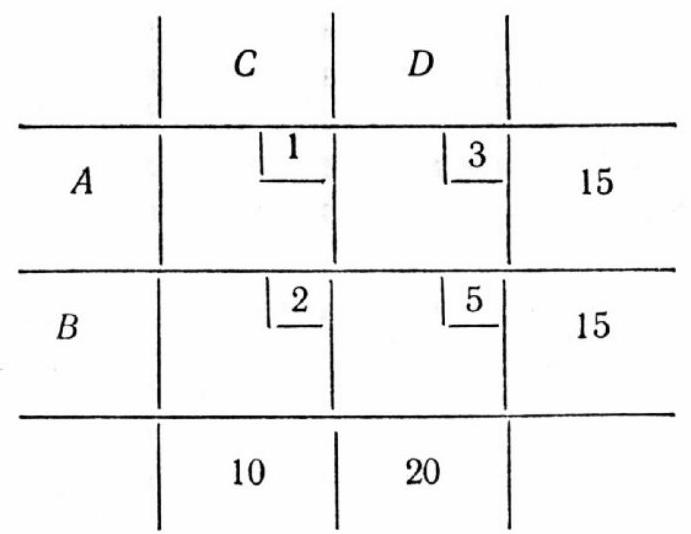
Table 1
In this table, the numbers 15 and 15 in the last column indicate the number of furniture sets a... | 90 | Logic and Puzzles | math-word-problem | Yes | Incomplete | olympiads | false |
Let $\pi$ be a permutation of the numbers from $1$ through $2012$. What is the maximum possible number of integers $n$ with $1 \le n \le 2011$ such that $\pi (n)$ divides $\pi (n + 1)$? | null | null | Combinatorics | math-word-problem | Yes | Yes | aops_forum | false |
In right triangle $ABC$, where $\angle C = 90^{\circ}$, if $\cos B = \frac{1}{2}$, then the value of $\sin A$ is ____. | Given that in right triangle $ABC$, where $\angle C = 90^{\circ}$, and $\cos B = \frac{1}{2}$, we aim to find the value of $\sin A$.
First, we recognize that if $\cos B = \frac{1}{2}$, then we can deduce the measure of angle $B$ based on the known cosine values for standard angles. Specifically,
$$\cos B = \frac{1}{2... | \frac{1}{2} | Geometry | math-word-problem | Yes | Yes | cn_k12 | false |
11.2. Let $P(x)$ and $Q(x)$ be reduced quadratic trinomials, each having two distinct roots. It turns out that the sum of two numbers obtained by substituting the roots of the trinomial $P(x)$ into the trinomial $Q(x)$ is equal to the sum of two numbers obtained by substituting the roots of the trinomial $Q(x)$ into th... | Solution. Let $a_{1}$ and $a_{2}$ be the roots of the quadratic polynomial $P(x)$, and $b_{1}$ and $b_{2}$ be the roots of the quadratic polynomial $Q(x)$; then $P(x)=\left(x-a_{1}\right)\left(x-a_{2}\right)$ and $Q(x)=$ $=\left(x-b_{1}\right)\left(x-b_{2}\right)$. Therefore, the condition of the problem takes the form... | proof | Algebra | proof | Yes | Yes | olympiads | false |
Given that $α∈{-2,-1,- \frac {1}{2}, \frac {1}{2},1,2}$, the number of values of $α$ that make $f(x)=x^{α}$ an odd function and monotonically decreasing on $(0,+∞)$ is $( \ )$.
A: $1$
B: $2$
C: $3$
D: $4$ | $f(x)=x^{α}$. When $α > 0$, the function $f(x)$ is monotonically increasing on the interval $(0,+∞)$, so $\frac {1}{2}$, $1$, $2$ do not meet the requirements.
When $α=-1$, $f(x)= \frac {1}{x}$, the domain is ${x|x≠ 0}$, $f(-x)=- \frac {1}{x}=-f(x)$, it is monotonically decreasing on the interval $(0,+∞)$, so it is co... | 1 | Algebra | MCQ | Yes | Yes | cn_k12 | false |
In the fourth-grade Olympiad math class, during the break, students learn about traditional Chinese culture. Teacher Tan tells a "Moral Education Story" every week. It takes 7 minutes to tell a "Moral Education Story". So, how many minutes will it take to tell "Moral Education Stories" over 20 weeks? How many hours and... | According to the meaning of integer multiplication, to find the sum of several identical addends, we use multiplication. To tell "Moral Education Stories" over 20 weeks, it will take $20 \times 7$ minutes. Based on this, we can further solve the problem.
This question mainly tests the understanding and flexible appli... | 2 \text{ hours and 20 minutes} | Logic and Puzzles | math-word-problem | Yes | Yes | cn_k12 | false |
The rate of increase of the price of sugar is observed to be 3 percent more than the inflation rate expressed in percentage. The price of sugar, on January 1, 1994, is Rs. 25 per kg. The inflation rate for the years 1994 and 1995 are expected to be some percentage each. The expected price of sugar on January 1, 1996, i... | Let's denote the inflation rate for both years as "i" (expressed as a decimal, so 5% would be 0.05).
The price of sugar increases by the inflation rate plus an additional 3 percent. So the rate of increase for sugar is (i + 0.03).
The price of sugar on January 1, 1994, is Rs. 25. After one year (1994), the price will... | 12\% | Algebra | math-word-problem | Yes | Yes | orca_math | true |
If x > 0, x / 5 + x / 25 is what percent of x? | To find what percent \( \frac{x}{5} + \frac{x}{25} \) is of \( x \), we first need to simplify the expression:
\( \frac{x}{5} + \frac{x}{25} = \frac{5x}{25} + \frac{x}{25} = \frac{6x}{25} \)
Now, to express this as a percentage of \( x \), we divide \( \frac{6x}{25} \) by \( x \) and multiply by 100:
\( \frac{\frac{... | 24\% | Algebra | math-word-problem | Yes | Yes | orca_math | true |
Triangle $ABC$ is an isosceles triangle with side lengths of 13, 13, and 24 centimeters. What is the area of triangle $ABC$, in square centimeters? | Since triangle $ABC$ is isosceles with $AB = AC = 13$ cm and $BC = 24$ cm, the altitude $AD$ from $A$ to $BC$ will bisect $BC$. Therefore, $BD = DC = \frac{24}{2} = 12$ cm.
To find the length of $AD$, we recognize that $\triangle ABD$ is a right triangle (since $AD$ is perpendicular to $BC$), and we use the Pythagorea... | 60 | Geometry | math-word-problem | Yes | Yes | synthetic_math | true |
In an isosceles triangle, if one of the interior angles is $100^{\circ}$, then the base angle of the isosceles triangle is ( ).
A: $50^{\circ}$
B: $40^{\circ}$
C: $50^{\circ}$ or $40^{\circ}$
D: $100^{\circ}$ | To solve this problem, we need to consider two cases based on the given information about the isosceles triangle:
**Case 1:** The $100^{\circ}$ angle is the vertex angle.
In an isosceles triangle, the two base angles are equal. The sum of the interior angles in any triangle is $180^{\circ}$. Therefore, if the vertex ... | B | Geometry | MCQ | Yes | Yes | cn_k12 | false |
11.4. Prove that the set of rational numbers $x$ for which the number $\sqrt{x-1}+\sqrt{4 x+1}$ is rational, is infinite. | Solution. We will prove that there exists an infinite set of numbers $x$ for which $x-1=a^{2}$ and $4 x+1=b^{2}$ for some rational numbers $a, b$. From these equations, we have $b^{2}-4 a^{2}=5 \Leftrightarrow (b-2 a)(b+2 a)=5$. Let $b-2 a=t$ and $b+2 a=\frac{5}{t}$, where $t$ is a rational number. Then $a=\frac{5-t^{2... | proof | Number Theory | proof | Yes | Yes | olympiads | false |
103. Prove the inequalities:
a) $|x+y| \leqslant|x|+|y|$,
b) $|x-y| \geqslant|x|-|y|$,
c) $|x-y| \geqslant\|x|-| y\|$.
Determine in each of these cases when the inequality becomes an equality.
*) The quantity $|x|$ (read as "the modulus of x" or "the absolute value of x") is defined as follows:
 Let the numbers \(x\) and \(y\) be positive. Then \(|x| = x\), \(|y| = y\), and \(|x + y| = x + y\). The inequality under consideration turns into an equality.
If \(x\) is positive and \(y\) is negative, we need to consider separately the case \(x + y \geqslant 0\) and the case \(x + y < 0\). In the first case... | proof | Inequalities | proof | Incomplete | Yes | olympiads | false |
200. $\int \frac{d x}{\sqrt{a^{2}-x^{2}}}$.
200. $\int \frac{d x}{\sqrt{a^{2}-x^{2}}}$.
(Note: The original text and the translation are identical as the text was already in English.) | Solution. Let's bring this integral to the standard form IX:
$$
\int \frac{d x}{\sqrt{a^{2}-x^{2}}}=\frac{1}{a} \int \frac{d x}{\sqrt{1-\left(\frac{x}{a}\right)^{2}}}
$$
Using the substitution $x=a t ; d x=a d t$. Therefore,
$$
\int \frac{d x}{\sqrt{a^{2}-x^{2}}}=\frac{1}{a} \int \frac{a d t}{\sqrt{1-t^{2}}}=\int \f... | \arcsin\frac{x}{}+C | Calculus | math-word-problem | Yes | Yes | olympiads | false |
a water tank is one - fifth full . pipe a can fill a tank in 15 minutes and pipe b can empty it in 6 minutes . if both the pipes are open , how many minutes will it take to empty or fill the tank completely ? | To solve this problem, we need to determine the rates at which Pipe A fills the tank and Pipe B empties the tank, and then combine these rates to find out how long it will take for the tank to be filled or emptied when both pipes are open.
Pipe A can fill the tank in 15 minutes, which means its rate is 1/15 of the tan... | 2 | Algebra | math-word-problem | Yes | Yes | orca_math | true |
The altitude drawn to the base of an isosceles triangle is $8$, and the perimeter $32$. The area of the triangle is:
$\textbf{(A)}\ 56\qquad \textbf{(B)}\ 48\qquad \textbf{(C)}\ 40\qquad \textbf{(D)}\ 32\qquad \textbf{(E)}\ 24$ | Consider the half of the triangle that is left of the altitude. Using the information given in the problem, we can determine that this is a right triangle with one leg of length 8 whose other two sides sum to 16. Through either setting the other leg as $x$ and the hypotenuse as $16-x$ and using the Pythagorean Theorem,... | 48 | Geometry | MCQ | Yes | Incomplete | amc_aime | false |
Among the following groups of functions, which are the same function?
(A) \\(①f(x)= \sqrt{-2x^{3}}\\) and \\(g(x)=x \sqrt{-2x}\\);
(B) \\(②f(x)=|x|\\) and \\(g(x)=(\sqrt{x})^{2}\\);
(C) \\(③f(x)=x^{0}\\) and \\(g(x)= \dfrac{1}{x^{0}}\\);
(D) \\(④f(x)=x^{2}-2x-1\\) and \\(g(t)=t^{2}-2t-1\\).
Options:
A: \\(①②... | For \\(①\\), \\(f(x)= \sqrt{-2x^{3}}=|x| \sqrt{-2x}=-x \sqrt{-2x}\\), which does not match the relationship of \\(g(x)=x \sqrt{-2x}\\), so they are not the same function;
For \\(②\\), \\(f(x)=|x| (x∈R)\\), \\(g(x)=(\sqrt{x})^{2}=x (x≥0)\\), their domains are different, and so are their relationships, indicating they ... | C | Algebra | MCQ | Yes | Yes | cn_k12 | false |
Given $k=\sqrt{2}(\sqrt{5}+\sqrt{3})\cdot (\sqrt{5}-\sqrt{3})$, the integer closest to $k$ is:
A: $2$
B: $3$
C: $4$
D: $5$ | To solve for the value of $k$ and find the integer closest to it, we start with the given expression:
$$k = \sqrt{2}(\sqrt{5}+\sqrt{3})\cdot (\sqrt{5}-\sqrt{3}).$$
First, we simplify the expression inside the parentheses using the difference of squares formula, $a^2 - b^2 = (a+b)(a-b)$, where $a = \sqrt{5}$ and $b = ... | B | Algebra | MCQ | Yes | Yes | cn_k12 | false |
A train of a certain length is travelling at 45 km/hr and can cross a bridge in 30 seconds. The bridge is 255 meters long. What is the length of the train? | To find the length of the train, we first need to determine the distance the train travels while crossing the bridge. This distance is the length of the train plus the length of the bridge.
The train crosses the bridge in 30 seconds, and its speed is 45 km/hr. We need to convert the speed to meters per second to match... | 120 | Algebra | math-word-problem | Yes | Yes | orca_math | true |
Example 12. Let $a, b, c$ be the side lengths of $\triangle ABC$, and $s$ be the semi-perimeter. Find all real numbers $k_{1}$ such that the following inequality holds:
$$
\begin{array}{l}
\frac{b+c-a}{a^{k} A}+\frac{c+a-b}{b^{k} B}+\frac{a+b-c}{c^{k} C} \\
\geqslant \frac{3^{k+1}}{\pi(2 s)^{A-1}} .
\end{array}
$$ | Prove that from $\left(\frac{1}{A}+\frac{1}{B}+\frac{1}{C}\right)(A+B+C) \geqslant 3^{2}$ and $A+B+C=\pi$, we have
$$
\frac{1}{A}+\frac{1}{B}+\frac{1}{C} \geqslant \frac{3^{2}}{\pi} \text {. }
$$
Also, for $\left(\frac{1}{a^{k}}+\frac{1}{b^{k}}+\frac{1}{c^{k}}\right)(a+b+c)^{k}$
$$
\begin{array}{l}
\geqslant 3 \cdot \... | \frac{3^{k+1}}{\pi(2 s)^{k-1}} | Inequalities | math-word-problem | Incomplete | Yes | cn_contest | false |
Matilda has half as many jellybeans as Matt. Matt has ten times as many jellybeans as Steve. If Steve has 84 jellybeans, how many jellybeans does Matilda have? | If Steve has 84 jellybeans, and Matt has ten times as many jellybeans as Steve, then Matt has:
10 * 84 = 840 jellybeans.
Since Matilda has half as many jellybeans as Matt, Matilda has:
840 / 2 = $\boxed{420}$ jellybeans. | 420 | Algebra | math-word-problem | Yes | Yes | orca_math | true |
If $3a^{2}b^{n-1}$ and $-\frac{1}{2}a^{m+3}b^2$ are like terms, then the value of $m^{n}$ is ( ).
A: $2$
B: $1$
C: $0$
D: $-1$ | For two terms to be considered like terms, their variables and their corresponding exponents must match. Given the terms $3a^{2}b^{n-1}$ and $-\frac{1}{2}a^{m+3}b^2$, we compare the exponents of $a$ and $b$ in both terms.
1. For the exponents of $a$ to match, we set their exponents equal to each other:
\[m + 3 = 2.\]
... | \text{D} | Algebra | MCQ | Yes | Yes | cn_k12 | false |
A man swims downstream some distance and upstream 18 km taking 3 hours each time. The speed of the man in still water is 9 km/h. How far did the man swim downstream? | Let's denote the speed of the man in still water as \( V_m \) and the speed of the stream as \( V_s \). We are given that \( V_m = 9 \) km/h.
When the man swims downstream, his effective speed is the sum of his own speed and the speed of the stream, so \( V_{downstream} = V_m + V_s \).
When the man swims upstream, hi... | 36 | Algebra | math-word-problem | Yes | Yes | orca_math | true |
6. Use straight lines to divide all the shapes below into triangles, draw at least $\qquad$ lines. (Do not fold the shapes)
Translate the text above into English, please keep the original text's line breaks and format, and output the translation result directly. | $2$ | 2 | Inequalities | math-word-problem | Yes | Incomplete | olympiads | false |
5. . Find all values of the parameter $a$ for which the equation
$$
\left(\left|\frac{a x^{2}-a x-12 a+x^{2}+x+12}{a x+3 a-x-3}\right|-a\right) \cdot|4 a-3 x-19|=0
$$
has one solution. In your answer, write the largest value of the parameter $a$ | Solution:
Simplify $\frac{a x^{2}-a x-12 a+x^{2}+x+12}{a x+3 a-x-3}=\frac{a x^{2}-x^{2}+(-a x+x)+(-12 a+12)}{a(x+3)-(x+3)}=$
$=\frac{x^{2}(a-1)-x(a-1)-12(a-1)}{(x+3)(a-1)}=\frac{(a-1)\left(x^{2}-x-12\right)}{(x+3)(a-1)}=$
Preliminary (correspondence) online stage of the "Step into the Future" School Students' Olympi... | 7 | Algebra | math-word-problem | Yes | Yes | olympiads | false |
## Task B-1.1.
Let $x$ be the greatest common divisor of the numbers $2^{2023}$ and $2^{2024}$, and $y$ their least common multiple. Calculate $3 y - x - 2 \cdot \frac{x^{2}}{y}$ and express the result as a power of 2. | ## Solution.
Obviously, $x=2^{2023}$, and $y=2^{2024}$.
Thus, we obtain the following sequence of equalities:
$$
\begin{aligned}
3 y-x-2 \cdot \frac{x^{2}}{y} & =3 \cdot 2^{2024}-2^{2023}-2 \cdot \frac{\left(2^{2023}\right)^{2}}{2^{2024}} & & \\
& =6 \cdot 2^{2023}-2^{2023}-2 \cdot \frac{2^{4046}}{2^{2024}} & & 1 \t... | 2^{2025} | Number Theory | math-word-problem | Yes | Yes | olympiads | false |
Let's construct a triangle, given its perimeter, and the radii of two of its excircles. | I. Solution. Consider the problem as solved. The excircle of triangle $ABC$ opposite to side $BC$ touches the sides of the triangle at points $D, F, E$, and the excircle opposite to side $AC$ touches this side at point $G$ (Figure 1).
 is divisible by 4. Thus, $5 n$ is divisible by 4; hence, $... | n | Combinatorics | math-word-problem | Yes | Yes | olympiads | false |
Given that the sum of the first $n$ terms of the sequence ${a_n}$ is $S_n=n^2$,
(1) Find the general term formula of the sequence ${a_n}$;
(2) Given that the sequence ${b_n}$ satisfies $b_n= \frac {1}{a_n a_{n+1}}$, find the sum of the first $n$ terms of the sequence ${b_n}$, denoted as $T_n$. | (1) Since $S_n=n^2$,
When $n\geqslant 2$, $a_n=S_n-S_{n-1}=n^2-(n-1)^2=2n-1$,
And when $n=1$, $a_1=1$ fits the above formula,
Hence, $a_n=2n-1$.
(2) Since $b_n= \frac {1}{a_n a_{n+1}}= \frac {1}{(2n-1)(2n+1)}= \frac {1}{2}( \frac {1}{2n-1}- \frac {1}{2n+1})$,
Hence, $T_n=b_1+b_2+...+b_n= \frac {1}{2}(1- \frac {1}{3})+... | \frac {n}{2n+1} | Algebra | math-word-problem | Yes | Yes | cn_k12 | false |
Find all triples $(m,p,q)$ such that
\begin{align*}
2^mp^2 +1=q^7,
\end{align*}
where $p$ and $q$ are ptimes and $m$ is a positive integer. | We are given the Diophantine equation
\[
2^m p^2 + 1 = q^7,
\]
where \( p \) and \( q \) are prime numbers and \( m \) is a positive integer.
1. **Initial Observations:**
Since \( m > 0 \), \( 2^m p^2 \) is even, and thus \( 2^m p^2 + 1 \) is odd. Therefore, \( q \) must be an odd prime.
2. **Rewriting the Equati... | null | Number Theory | math-word-problem | Yes | Yes | aops_forum | false |
The first four terms in an arithmetic sequence are $x+2y$, $x-2y$, $x+2y^2$, and $\frac{x}{2y}$, in that order. What is the fifth term? Express your answer as a common fraction. | Since this is an arithmetic sequence, the difference between consecutive terms is constant. The difference between the first two terms is $-4y$. Applying this constant difference to subsequent terms, we have:
1. From second to third term: \(x-2y + (-4y) = x - 6y\). But the third term is given as \(x + 2y^2\). Setting t... | -\frac{x}{6} - 12 | Algebra | math-word-problem | Yes | Yes | synthetic_math | true |
Subsets and Splits
No community queries yet
The top public SQL queries from the community will appear here once available.