
instruction_seed stringlengths 2 10.7k | solution stringlengths 0 10.8k ⌀ | answer stringlengths 0 575 ⌀ | problem_type stringclasses 9
values | question_type stringclasses 5
values | problem_is_valid stringclasses 5
values | solution_is_valid stringclasses 4
values | source stringclasses 11
values | synthetic bool 2
classes |
|---|---|---|---|---|---|---|---|---|
14. A. $n$ positive integers $a_{1}, a_{2}, \cdots, a_{n}$ satisfy the following conditions:
$$
1=a_{1}<a_{2}<\cdots<a_{n}=2009,
$$
and the arithmetic mean of any $n-1$ different numbers among $a_{1}, a_{2}, \cdots, a_{n}$ is a positive integer. Find the maximum value of $n$. | 14. A. Let in $a_{1}, a_{2}, \cdots, a_{n}$, after removing $a_{i}(i=1$, $2, \cdots, n)$, the arithmetic mean of the remaining $n-1$ numbers is a positive integer $b_{i}$, i.e.,
$$
b_{i}=\frac{\left(a_{1}+a_{2}+\cdots+a_{n}\right)-a_{i}}{n-1} .
$$
Therefore, for any $i, j(1 \leqslant i<j \leqslant n)$, we have
$$
b_{i... | 9 | Number Theory | math-word-problem | Yes | Yes | cn_contest | false |
Example 5. Find the flux of the vector field $\mathbf{a} = \boldsymbol{y}^{2} \mathbf{j} + z \mathbf{k}$ through the part of the surface $z = x^{2} + y^{2}$, cut off by the plane $z = 2$. The normal is taken outward with respect to the region bounded by the paraboloid.
 is projected one-to-one onto the plane $x O y$ as a circle $D_{x y}$ (Fig. 19). We find the unit normal $\boldsymbol{n}^{0}$ to the surface $S$:
$$
n^{\prime \prime}=\frac{\operatorname{grad}\left(z-x^{2}-y^{2}\right)}{\left|\operatorname{grad}\left(z-x^{2}-y^{2... | -2\pi | Calculus | math-word-problem | Yes | Yes | olympiads | false |
A quadrilateral has two adjacent sides of lengths 2 and 1 units, respectively, and the included angle between them is $60^{\circ}$. The quadrilateral is both a cyclic and a tangential quadrilateral. What are the lengths of the other two sides of the quadrilateral? | Solution. In the quadrilateral $A B C D$, $A B=2, B C=1$ and $\angle A B C=60^{\circ}$. Let the side $A D$ be $x$; let $C D=y$ and $A C=d$.
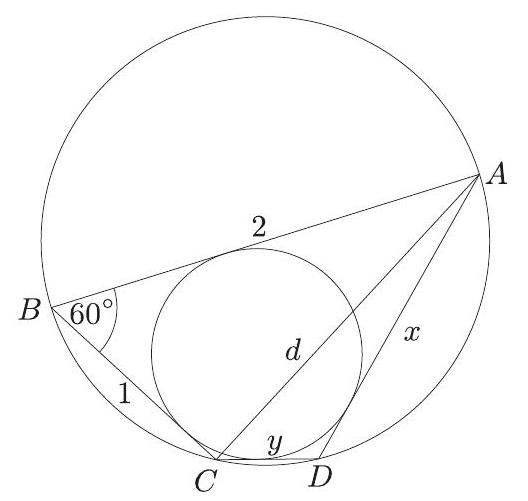
Since the quadrilateral is a tangential quadrilater... | \frac{\sqrt{33}+3}{6},\frac{\sqrt{33}-3}{6} | Geometry | math-word-problem | Yes | Yes | olympiads | false |
In the Cartesian coordinate system, point $A(-1,2)$ is translated $4$ units to the right and $2$ units down to obtain point $A_{1}$. The coordinates of $A_{1}$ are ______. | To solve for the coordinates of point $A_1$ after the translation of point $A(-1,2)$, we follow the steps of translation in the Cartesian coordinate system:
1. **Translation to the Right:** When a point is translated $4$ units to the right, its $x$-coordinate increases by $4$. Therefore, the new $x$-coordinate of poin... | (3,0) | Geometry | math-word-problem | Yes | Yes | cn_k12 | false |
In the arithmetic sequence $\{a\_n\}$, it is known that $a\_1+a\_2=5$, $a\_4+a\_5=23$. Find the sum of the first 10 terms, $S\_{10}=$ _____. | Given that in the arithmetic sequence $\{a\_n\}$, $a\_1+a\_2=5$, $a\_4+a\_5=23$,
We have the system of equations:
$$\begin{cases} a\_1+a\_1+d=5 \\\\ a\_1+3d+a\_1+4d=23 \end{cases}$$
Solving the system, we get $a\_1=1$, $d=3$.
Thus, the sum of the first 10 terms is:
$$S\_{10}=10 \times 1 + \frac{10 \times 9}{2} \ti... | 145 | Algebra | math-word-problem | Yes | Yes | cn_k12 | false |
27. Xiao Xi plays video games, each game consumes one gold coin, but if he wins, he will receive a reward of 3 gold coins. Xiao Xi initially has 3 gold coins, after playing 5 games, he has 4 gold coins. Xiao Xi won $\qquad$ times.
将上面的文本翻译成英文,请保留源文本的换行和格式,直接输出翻译结果。
---
27. Xiao Xi plays video games, each game consum... | answer: 2 | 2 | Logic and Puzzles | math-word-problem | Yes | Yes | olympiads | false |
Two cyclists start on a circular track from a given point but in opposite directions. One cyclist has a speed of 7 m/s, and the other has a speed of 8 m/s. If the circumference of the circle is 180 meters, after 12 seconds, they meet at the starting point. What is the speed of the second cyclist? | The problem statement seems to have a contradiction. It states that one cyclist has a speed of 7 m/s and asks for the speed of the second cyclist, but it also states that the second cyclist has a speed of 8 m/s.
However, let's assume that we need to verify whether the given speeds and time allow the cyclists to meet ... | 8 | Algebra | math-word-problem | Yes | Yes | orca_math | true |
Given the function f(x) = xlnx,
1. Find the equation of the tangent line to the curve y = f(x) at point P(1, f(1));
2. Prove that when a > 1, there exists a c ∈ (0, $\frac{1}{a}$) such that for any x ∈ (c, 1), it always holds that f(x) > ax(x - 1). | 1. **Answer:**
The derivative of f(x) is f'(x) = lnx + 1.
Hence, f(1) = 0 and f'(1) = 1.
Therefore, the equation of the tangent line is y - 0 = 1 * (x - 1), which simplifies to $\boxed{x - y - 1 = 0}$.
2. **Proof:**
From f(x) > ax(x - 1), we get xlnx > ax(x - 1).
Considering x > 0, we can derive ln... | f(x) > ax(x - 1) | Calculus | math-word-problem | Yes | Yes | cn_k12 | false |
[b]p1[/b]. Bob wants to build a bridge. This bridge has to be an arch bridge which reaches down on each side $10$ feet and crosses a $20$ foot gap. If the arch is shown by a semi circle with radius $9$, and the bridge is $5$ feet wide, how many cubic feet of material does Bob need?
[b]p2.[/b] Evan constructs a "poly-... | null | null | Geometry | math-word-problem | Yes | Yes | aops_forum | false |
13. (2004 National College Entrance Examination - Jiangsu Paper) Given: $0<\alpha<\frac{\pi}{2}, \tan \frac{\alpha}{2}+\cot \frac{\alpha}{2}=\frac{5}{2}$. Find the value of $\sin \left(\alpha-\frac{\pi}{3}\right)$. | 13. $\frac{1}{10}(4-3 \sqrt{3})$ From $\tan \frac{\alpha}{2}+\cot \frac{\alpha}{2}=\frac{5}{2}$ we get $\sin \alpha=\frac{4}{5}$, so $\cos \alpha=\frac{3}{5}, \sin \left(\alpha-\frac{\pi}{3}\right)=\sin \alpha \cos \frac{\pi}{3}-$ $\cos \alpha \sin \frac{\pi}{3}=\frac{1}{10}(4-3 \sqrt{3})$. | \frac{1}{10}(4-3\sqrt{3}) | Algebra | math-word-problem | Yes | Yes | olympiads | false |
Heather weighs 87.5 pounds, Emily weighs 45.3 pounds, Elizabeth weighs 38.7 pounds, and George weighs 56.9 pounds. How much heavier is Heather than Emily, Elizabeth, and George combined? | To find out how much heavier Heather is than Emily, Elizabeth, and George combined, we first need to find the total weight of Emily, Elizabeth, and George.
Emily's weight: 45.3 pounds
Elizabeth's weight: 38.7 pounds
George's weight: 56.9 pounds
Combined weight of Emily, Elizabeth, and George:
45.3 + 38.7 + 56.9 = 14... | 53.4 | Algebra | math-word-problem | Yes | Problem not solved | orca_math | true |
Find the range of the function
\[ f(x) = \frac{3(x + 5)(x - 4)}{x + 5} \] | First, we determine where $f(x)$ is defined by checking that the denominator is non-zero:
\[ x + 5 \neq 0 \implies x \neq -5 \]
Since $x + 5$ can be canceled provided $x \neq -5$, the function simplifies to:
\[ f(x) = 3(x - 4) \text{ for } x \neq -5 \]
Next, we express $f(x)$ after cancellation:
\[ f(x) = 3x - 12 \]
... | (-\infty, -27) \cup (-27, \infty) | Algebra | math-word-problem | Yes | Yes | synthetic_math | true |
the average of 10 numbers is calculated as 21 . it is discovered later on that while calculating the average , one number namely 36 was wrongly read as 26 . the correct average is ? | The incorrect average was calculated as 21 with the wrong number 26 included instead of the correct number 36.
The incorrect total sum of the 10 numbers would be:
Incorrect average * number of values = 21 * 10 = 210
Since the number 36 was read as 26, the incorrect sum is 10 less than it should be. To correct this, w... | 22 | Algebra | math-word-problem | Yes | Yes | orca_math | true |
If Allison, a YouTuber, uploads 10 one-hour videos of food reviews each day, starting from the middle of June, and then doubles the number of video hours she uploads for the remaining days of the month, what is the total number of video hours she has uploaded by the end of the month? | To determine the total number of video hours Allison uploads by the end of June, we need to break down the problem into smaller steps.
1. **Identify the number of days in June:**
June has 30 days.
2. **Determine the midpoint of June:**
The middle of June is the 15th.
3. **Calculate the number of days from June... | 460 | Algebra | math-word-problem | Yes | Yes | metamath | true |
B4. Calculate the integer solution of the equation $\log _{2}\left(x^{2}+7\right)=\frac{\log _{2}(x+1)}{\log _{8} 2}-\log _{2} x$. (7 points)
Space for solving problems in set $B$.
## dIFA
12th Mathematics Knowledge Competition for Students of Secondary Technical and Vocational Schools
Regional Competition, March 2... | B4. We use the rules for calculating with logarithms: $\log _{8} 2=\frac{1}{3}$, so the right side of the equation is equal to $3 \log _{2}(x+1)-\log _{2} x$. On the right side, we also use the rule for the logarithm of a power, so the right side of the equation is equal to: $\log _{2}(x+1)^{3}-\log _{2} x$. We transfo... | 1 | Algebra | math-word-problem | Yes | Yes | olympiads | false |
(1) Given that $i$ is the imaginary unit, and the complex number $z=\frac{m^2-4+(m+2)i}{\phantom{m^2-4+(m+2)i}}(m\in \mathbb{R})$ is a pure imaginary number, find $m=\_\_\_\_\_\_\_\_\_\_\_\_$
(2) Find the size of the angle of inclination of the line given by the parametric equations: $\begin{cases} x=1+t \\ y=1-t \end... | (1)
**Analysis**
This problem tests the understanding of the algebraic form of complex numbers, which is a basic concept.
**Solution**
The complex number $z=\frac{m^2-4+(m+2)i}{\phantom{m^2-4+(m+2)i}}(m\in \mathbb{R})$ is a pure imaginary number. Therefore, we have the system of equations: $\begin{cases}m^2-4=0 \\ ... | \text{Upper bound} = \frac{4029}{2015} | Algebra | math-word-problem | Yes | Yes | cn_k12 | false |
95. Let $M$ be an arbitrary point inside triangle $ABC$. Prove that at least one of the angles $MAB, MBC, MCA$ and at least one of the angles $MAC, MCB, MBA$ is not greater than $30^{\circ}$.
In conclusion of this paragraph, we will consider some properties of three similar figures $F_{1}, F_{2}, F_{3}$. The centers o... | 95. Connect the first rotation center $O_{1}$ of triangle $A B C$ with all the vertices of the triangle (Fig. 210). Point $M$ lies in one of the 113 triangles

${ }^{1}$ Fig. 210. $A B O_{1}... | proof | Geometry | proof | More than one problem | Yes | olympiads | false |
On a scale of a map, 0.4 cm represents 5.3 km. If the distance between the points on the map is some cm, the actual distance between these points is 848 km. What is the distance between the points on the map in cm? | First, let's determine the scale factor of the map. According to the given scale, 0.4 cm on the map represents 5.3 km in reality. To find out how many kilometers 1 cm on the map represents, we divide 5.3 km by 0.4 cm:
5.3 km / 0.4 cm = 13.25 km/cm
This means that 1 cm on the map represents 13.25 km in reality.
Now, ... | 64 | Algebra | math-word-problem | Yes | Yes | orca_math | true |
A circular garden has ten paths radiating outwards from its center, forming ten congruent central angles. One of these paths points directly towards the North. Determine the measure in degrees of the smaller angle formed between the path pointing East and the path pointing Northwest. | - Since there are ten paths, and they form congruent central angles in a complete circle, the total of these angles equals 360 degrees. Therefore, each central angle measures:
\[
\frac{360}{10} = 36 \text{ degrees}
\]
- To find the angle between the East path and the Northwest path, we must count the number of ce... | 144 | Geometry | math-word-problem | Yes | Yes | synthetic_math | true |
If the axial section of a cylinder is a square with an area of 4, then the surface area of the cylinder is ( )
A: 4π
B: 5π
C: $$\frac {7π}{2}$$
D: 6π | Given that the axial section of a cylinder is a square with an area of 4,
it follows that the radius of the cylinder's base is 1, and its height is 2.
Therefore, the surface area of the cylinder is $2\pi \cdot 1^2 + 2\pi \cdot 1 \cdot 2 = 6\pi$.
Hence, the correct choice is $\boxed{D}$.
By utilizing the fact th... | D | Geometry | MCQ | Yes | Yes | cn_k12 | false |
$9.4^{10} 5^{25}$ 的位数(用十进位制)是 (A) 31: (B) 30; (C) 29; (D) 28; (E) 27.
The number of digits (in decimal notation) of $9.4^{10} 5^{25}$ is (A) 31: (B) 30; (C) 29; (D) 28; (E) 27. | D
Translate the text above into English, please retain the original text's line breaks and format, and output the translation result directly. | D | Algebra | MCQ | Yes | Yes | cn_contest | false |
If the algebraic expressions $2a^3b^{n+2}$ and $-3a^{m-2}b$ are like terms, then $mn=$ __ . | To solve this, since $2a^3b^{n+2}$ and $-3a^{m-2}b$ are like terms, we have:
- For the powers of $a$, $m-2=3$,
- For the powers of $b$, $n+2=1$,
From these, we find:
- $m=5$,
- $n=-1$,
Therefore, $mn=5\times(-1)=-5$,
Hence, the answer is $\boxed{-5}$. | -5 | Algebra | math-word-problem | Yes | Yes | cn_k12 | false |
The income and expenditure of a person are in a certain ratio. If the income of the person is Rs. 15000 and his savings are Rs. 7000, what is the ratio of his income to expenditure? | Let's denote the income of the person as I and the expenditure as E. We are given that the income I is Rs. 15000 and the savings S are Rs. 7000.
We know that savings can be calculated by subtracting expenditure from income:
S = I - E
Using the given values:
7000 = 15000 - E
Now, we can solve for E:
E = 15000 - 7000
... | 15:8 | Algebra | math-word-problem | Yes | Yes | orca_math | true |
Which of the following pairs of quantities have opposite meanings?
A: A student jogged $500m$ on the playground and then sprinted $200m$.
B: A supermarket lost $3000$ yuan last week and made a profit of $12000$ yuan this week.
C: Student A is $1.5cm$ taller than student B, and student B is $2.4kg$ lighter than stude... | To determine which of the given pairs of quantities have opposite meanings, we analyze each option step by step:
- **Option A:** A student jogged $500m$ on the playground and then sprinted $200m$. Both actions involve moving forward, so they do not represent opposite meanings. Therefore, option A is not correct.
- **... | B | Logic and Puzzles | MCQ | Yes | Yes | cn_k12 | false |
Sharygin I.F.
A rectangle is composed of six squares (see the right figure). Find the side of the largest square if the side of the smallest one is 1.
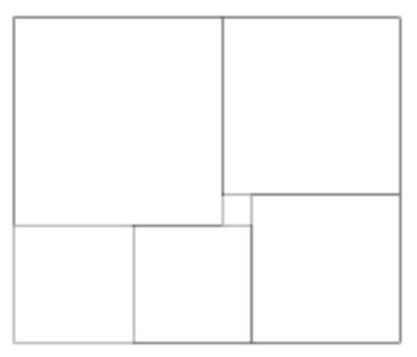 | The side of the largest square is equal to the sum of the sides of two squares: the next one in the clockwise direction and the smallest one.
## Solution
Note that the side of the largest square is equal to the sum of the sides of two squares: the next one in the clockwise direction and the smallest one. Denoting the... | 7 | Geometry | math-word-problem | Yes | Yes | olympiads | false |
5. Let $a, b, c$ be positive real numbers such that $a \leq b \leq c \leq 2 a$. Find the maximum possible value of $\frac{b}{a}+\frac{c}{b}+\frac{a}{c}$. | Answer: $\frac{7}{2}$
Fix the values of $b, c$. By inspecting the graph of
$$
f(x)=\frac{b}{x}+\frac{x}{c}
$$
we see that on any interval the graph attains its maximum at an endpoint. This argument applies when we fix any two variables, so it suffices to check boundary cases in which $b=a$ or $b=c$, and $c=b$ or $c=2 a... | \frac{7}{2} | NaN | NaN | NaN | NaN | olympiads | false |
2.19. The lateral surface of a cone is unfolded on a plane into a sector with a central angle of $120^{\circ}$ and an area of $S$. Find the volume of the cone. | 2.19. Let $r$ be the radius of the base of the cone, and $l$ be its slant height. Then the area of the lateral surface $S=\frac{1}{2} l^{2} \cdot \frac{2 \pi}{3}=\frac{\pi l^{2}}{3}$, from which $l=\sqrt{\frac{3 S}{\pi}}$. But $S=\pi r l=\pi r \sqrt{\frac{3 S}{\pi}}$ and, therefore, $r=\sqrt{\frac{S}{3 \pi}}$. The volu... | \frac{2S\sqrt{6\piS}}{27\pi} | Geometry | math-word-problem | Yes | Yes | olympiads | false |
There are 3 math teams in the area, with 6, 9, and 10 students respectively. The first team has 3 co-captains, the second team has 2 co-captains, and the third team has 4 co-captains. If I randomly select a team, and then randomly select two members of that team to give a copy of $\emph{Introduction to Geometry}$, what... | To find the probability that both selected members are co-captains, calculate the probability for each team, then average them using the probability of selecting any team.
1. **Probability for Team 1 (6 students, 3 co-captains)**:
- Ways to choose 2 co-captains from 3: $\binom{3}{2} = 3$
- Ways to choose any 2 m... | \frac{65}{540} | Combinatorics | math-word-problem | Yes | Yes | synthetic_math | true |

Find all natural numbers, when divided by 7, the quotient is the same as the remainder.
When dividing a number by 7, there can only be 7 different remainders.
# | The remainder when dividing by 7 cannot exceed 6, so the numbers of interest can be represented as $7a + a = 8a$, where $a=1,2, \ldots, 6$. Therefore, these numbers are: $8,16,24,32,40,48$.
## Answer
$8,16,24,32,40,48$. | 8,16,24,32,40,48 | Number Theory | math-word-problem | Incomplete | Yes | olympiads | false |
Given that $-\frac{\pi}{2} < x < 0$ and $\sin x + \cos x = \frac{1}{5}$.
(I) Find the value of $\sin x - \cos x$.
(II) Find the value of $\frac{3\sin^2{\frac{x}{2}} - 2\sin{\frac{x}{2}}\cos{\frac{x}{2}} + \cos^2{\frac{x}{2}}}{\tan x + \cot x}$. | (I) Since $-\frac{\pi}{2} 0$, which implies that $\sin x - \cos x < 0$.
We are given that $\sin x + \cos x = \frac{1}{5}$. Squaring both sides, we get:
$$(\sin x + \cos x)^2 = \left(\frac{1}{5}\right)^2$$
$$1 + \sin(2x) = \frac{1}{25}$$
This means that $\sin(2x) = -\frac{24}{25}$. Now, we can find the value of $(\s... | -\frac{108}{125} | Algebra | math-word-problem | Yes | Yes | cn_k12 | false |
Example 15 (2005 Brazilian Mathematical Olympiad) Given positive integers $a, c$ and integer $b$. Prove: there exists a positive integer $x$, satisfying $a^{x}+x \equiv b(\bmod c)$, i.e., there exists a positive integer $x$, such that $c$ is a divisor of the number $a^{x}+x-b$. | Proof: Let $l$ be the period of the sequence $a, a^{2}, a^{3}, a^{4}, \cdots, \bmod c$, then for any positive integer $k$ and sufficiently large positive integer $i$, we have
$$
a^{i+\mu} \equiv a^{i}(\bmod c) \text {. }
$$
Let $d=\operatorname{gcd}(l, c)$ denote the greatest common divisor of $l, c$, then there exist... | proof | Number Theory | proof | Yes | Yes | olympiads | false |
A train of a certain length is travelling at 45 km/h and can cross a bridge in 30 seconds. The bridge is 235.03 meters long. What is the length of the train? | To find the length of the train, we first need to determine the distance the train travels while crossing the bridge. Since the train takes 30 seconds to cross the bridge and is traveling at a speed of 45 km/h, we can convert the speed to meters per second and then multiply by the time in seconds to find the distance.
... | 139.97 | Algebra | math-word-problem | Yes | Yes | orca_math | true |
Take number 1000 and then add some number to it. Now add 1000 one more time. Now add 30. Now add 1000 one more time. Now add 40. Now add 1000 one more time. Now add 10. The total is 4100. What is the first number added to 1000? | Let's break down the steps and calculate the total step by step:
1. Start with 1000.
2. Add an unknown number (let's call it X).
3. Add 1000 again.
4. Add 30.
5. Add 1000 again.
6. Add 40.
7. Add 1000 again.
8. Add 10.
The total is said to be 4100.
So the equation based on the steps is:
1000 + X + 1000 + 30 + 1000 ... | 20 | Algebra | math-word-problem | Yes | Yes | orca_math | true |
Given the set $U=\{0,1,2,3,4\}$, $A=\{0,1,3\}$, $B=\{2,3\}$, find $A$⋂$(\complement _{U}B)$.
A: $\{0,1\}$
B: $\{0,1,3,4\}$
C: $\{1,3\}$
D: $\{0,1,3\}$ | To solve for $A$⋂$(\complement _{U}B)$ given the sets $U=\{0,1,2,3,4\}$, $A=\{0,1,3\}$, and $B=\{2,3\}$, we follow these steps:
1. First, we find the complement of $B$ in $U$, denoted as $\complement _{U}B$. Since $U=\{0,1,2,3,4\}$ and $B=\{2,3\}$, the elements not in $B$ but in $U$ are $\{0,1,4\}$. Therefore, $\compl... | \text{A} | Logic and Puzzles | MCQ | Yes | Yes | cn_k12 | false |
Compute without using a calculator: $12!/11!$ | Given the expression $\frac{12!}{11!}$, we can simplify it similarly to the original problem:
$$ \frac{12!}{11!} = \frac{12 \times 11 \times 10 \times \cdots \times 1}{11 \times 10 \times \cdots \times 1} $$
The $11 \times 10 \times \cdots \times 1$ terms in the numerator and the denominator cancel out, leaving:
$$ \fr... | 12 | Combinatorics | math-word-problem | Yes | Yes | synthetic_math | true |
Two employees X and Y are paid a certain amount per week by their employer. X is paid 120 percent of the sum paid to Y. Y is paid Rs. 290 per week. What is the total amount paid to X and Y per week? | First, let's calculate the amount paid to X based on the information given:
X is paid 120 percent of the sum paid to Y. Since Y is paid Rs. 290 per week, we can calculate X's pay as follows:
X's pay = 120% of Y's pay
X's pay = 120/100 * Y's pay
X's pay = 1.2 * Rs. 290
X's pay = Rs. 348
Now, we can calculate the tota... | 638 | Algebra | math-word-problem | Yes | Yes | orca_math | true |
[ Recurrence relations ] $[\quad \underline{\text { C }}$ mean values $]$
Thirteen turkey chicks pecked at grains. The first turkey chick pecked 40 grains; the second - 60, each subsequent chick pecked the average number of grains pecked by all previous chicks. How many grains did the 10th turkey chick peck? | Recall the properties of the arithmetic mean.
## Solution
The third turkey chick pecked $(40+60): 2=50$ points. Each subsequent one also pecked 50 grains: if you add a number equal to the arithmetic mean of a group of numbers to that group, the arithmetic mean of the new group will be equal to the arithmetic mean of ... | 50 | Algebra | math-word-problem | Yes | Yes | olympiads | false |
Among the options below, which one has sets M and N representing the same set?
A: $M=\{(3,2)\}, N=\{(2,3)\}$
B: $M=\{4,5\}, N=\{5,4\}$
C: $M=\{1,2\}, N=\{(1,2)\}$
D: $M=\{(x,y)|x+y=1\}, N=\{y|x+y=1\}$ | In option A, since $M=\{(3,2)\}$ and $N=\{(2,3)\}$ represent different points,
the sets M and N do not represent the same set.
In option B, since the elements in a set are unordered,
$M=\{4,5\}$ and $N=\{5,4\}$,
thus, the sets M and N represent the same set.
In option C, since $M=\{1,2\}$ is a number set comp... | \text{B} | Algebra | MCQ | Yes | Yes | cn_k12 | false |
If the one-variable quadratic equation $kx^{2}-2x+2=0$ has two distinct real roots with respect to $x$, then the range of values for $k$ is ______. | To determine the range of values for $k$ such that the quadratic equation $kx^{2}-2x+2=0$ has two distinct real roots, we use the discriminant condition for real roots, which is $\Delta > 0$. The discriminant $\Delta$ of a quadratic equation $ax^{2}+bx+c=0$ is given by $\Delta = b^{2}-4ac$.
For the given equation, $a... | k < \frac{1}{2} \text{ and } k \neq 0 | Algebra | math-word-problem | Yes | Yes | cn_k12 | false |
At the town carnival Oliver rode the ferris wheel 7 times and the bumper cars 3 times. If each ride cost 3 tickets, how many tickets did he use? | Oliver rode the ferris wheel 7 times and the bumper cars 3 times, so he went on a total of 7 + 3 = 10 rides.
Each ride cost 3 tickets, so for 10 rides, he would have used 10 * 3 = $\boxed{30}$ tickets. | 30 | Algebra | math-word-problem | Yes | Yes | orca_math | true |
## Zadatak B-2.3.
Na stranici $\overline{A B}$ trokuta $A B C$ dana je točka $E$ takva da je $|A E|=1$ i $|E B|=2$. Neka je točka $D$ na stranici $\overline{A C}$ takva da je dužina $\overline{D E}$ paralelna $\mathrm{s}$ dužinom $\overline{B C}$, a točka $F$ na stranici $\overline{B C}$ takva da je dužina $\overline{... | ## Prvo rješenje.

Kako je dužina $\overline{D E}$ paralelna s dužinom $\overline{B C}$, trokuti $A E D$ i $A B C$ imaju iste kutove pa su slični. Koeficijent sličnosti je $k=\frac{|A E|}{|A... | \frac{4}{9} | Geometry | math-word-problem | Yes | Yes | olympiads | false |
The projection of point (0,0) on line $l$ is (2,3). Find the equation of line $l$. | Let's denote the origin as $O(0,0)$ and the projection point on line $l$ as $P(2,3)$.
1. First, we compute the slope of the line segment $OP$ which connects the origin and point $P$. Since $P$ has coordinates $(2,3)$, the slope is determined by the ratio of the rise (change in $y$) over the run (change in $x$):
$$ ... | 2x + 3y - 13 = 0 | Geometry | math-word-problem | Yes | Yes | cn_k12 | false |
Given $\tan \alpha =-\dfrac{2}{3}$, find the value of $\dfrac{\cos \left( -\alpha \right)+3\sin \left( \pi +\alpha \right)}{\cos \left( \pi -\alpha \right)+9\sin \alpha }$. | 1. First, let's simplify the given trigonometric expression step by step.
2. We know that $\cos(-\alpha) = \cos(\alpha)$ and $\sin(\pi + \alpha) = -\sin(\alpha)$.
3. Applying these identities, we can simplify the numerator: $\cos(-\alpha) + 3\sin(\pi + \alpha) = \cos(\alpha) - 3\sin(\alpha)$.
4. For the denominator, we... | -\dfrac{3}{7} | Algebra | math-word-problem | Yes | Yes | cn_k12 | false |
The sequence $\left\{a_n\right\}$ is an arithmetic sequence with a non-zero common difference, and $a_2+a_6=a_8$, then $\dfrac{S_5}{a_5}$. | **Analysis**
This question examines the general formula for an arithmetic sequence and the formula for the sum of the first $n$ terms, testing the student's computational ability. This is a basic question.
First, set the first term and the common difference of the arithmetic sequence, then use $a_2+a_6=a_8$ to derive... | 3 | Algebra | math-word-problem | Yes | Yes | cn_k12 | false |
If the solution set of the inequality $|2x-a|+a\leq 4$ is $\{x|-1\leq x\leq 2\}$, then the real number $a=$ . | We start from the given inequality:
$$ |2x-a|+a\leq 4 $$
This implies that
$$ |2x-a|\leq 4-a $$
Considering the absolute value, we split the inequality into two cases:
$$ -(4-a) \leq 2x-a \leq 4-a $$
Simplifying each part:
$$ -4+a \leq 2x-a \leq 4-a $$
Adding $a$ to each part of the inequality:
$$ a-4+2a \leq 2x \l... | 1 | Inequalities | math-word-problem | Yes | Yes | cn_k12 | false |
$(1)$ Calculate: $\sqrt{12}+{(\pi-203)^0}+{(\frac{1}{2})^{-1}}-6\tan30°$;
$(2)$ Solve the system of equations: $\left\{\begin{array}{l}{x+2y=4}\\{x+3y=5}\end{array}\right.$. | ### Problem 1: Calculation
To calculate $\sqrt{12}+{(\pi-203)^0}+{(\frac{1}{2})^{-1}}-6\tan30°$, we proceed as follows:
- $\sqrt{12}$ can be simplified to $2\sqrt{3}$ because $\sqrt{12} = \sqrt{4 \cdot 3} = \sqrt{4}\sqrt{3} = 2\sqrt{3}$.
- $(\pi-203)^0$ is equal to $1$ because any non-zero number raised to the power ... | null | Algebra | math-word-problem | Yes | Yes | cn_k12 | false |
the sum of the present ages of a , b , c is 57 years . 3 years ago their ages were in the ratio 1 : 2 : 3 . what is the present age of a ? | Let's denote the present ages of A, B, and C as A, B, and C respectively. According to the problem, the sum of their present ages is 57 years:
A + B + C = 57 (Equation 1)
Three years ago, their ages were in the ratio 1:2:3. So, we can write their ages three years ago as:
A - 3 for A
B - 3 for B
C - 3 for C
And the... | 11 | Algebra | math-word-problem | Yes | Yes | orca_math | true |
Consider an ordinary 8-sided die with numbers from 1 to 8 on its faces. How many ways can you paint two faces of this die red, so that the numbers on the red faces neither add up to 7 nor result in an odd sum? | For an 8-sided die, consider which pairs of numbers would add up to 7:
- 1 and 6
- 2 and 5
- 3 and 4
Since we are also ensuring that the sum is not odd, we need to consider pairs that add up to an even number and avoid pairs that add up to 7. The full list of combinations of numbers from 1 to 8 taken two at a time is:... | 13 | Combinatorics | math-word-problem | Yes | Yes | synthetic_math | true |
Given that $S_n$ denotes the sum of the first $n$ terms of the sequence $\{a_n\}$ and $S_n=2a_n-2$, determine the value of $S_5-S_4$.
A. 8
B. 10
C. 16
D. 32 | To find the value of $S_5-S_4$, we'll use the given relation and properties of sequences.
Since $S_n = 2a_n - 2$, we can use this relationship to express $S_{n-1}$ similarly:
$$S_{n-1} = 2a_{n-1} - 2.$$
Now, consider the difference between $S_n$ and $S_{n-1}$:
$$S_n - S_{n-1} = (2a_n - 2) - (2a_{n-1} - 2).$$
Simplif... | 32 | Algebra | MCQ | Yes | Yes | cn_k12 | false |
Calculate the number of distinct diagonals that can be drawn in a convex nonagon (9-sided polygon). | 1. **Identify vertices and their connections**: In a nonagon, there are 9 vertices.
2. **Possible diagonals from one vertex**: Each vertex can connect to \( 9 - 3 = 6 \) other vertices because it cannot connect to itself or the two adjacent vertices.
3. **Total possible connections**: Multiply the number of vertices by... | 27 | Combinatorics | math-word-problem | Yes | Yes | synthetic_math | true |
Fold a piece of coordinate paper once so that the point $(10,0)$ coincides with $(-6,8)$. What are the coordinates of the point that coincides with $(-4,2)$? | **Analysis**
This problem mainly examines the symmetry of points about a line.
**Solution**
Let's denote the points $(10,0)$ and $(-6,8)$ as $A$ and $B$, respectively. Thus, the slope $k_{AB} = -\frac{1}{2}$. Since the midpoint of segment $AB$ has coordinates $(2,4)$, the axis of symmetry for segment $AB$ is $y = 2(... | (4,-2) | Geometry | math-word-problem | Yes | Yes | cn_k12 | false |
[ Congruent Triangles. Criteria for Congruence ]
Through the midpoint of segment $AB$, a line is drawn perpendicular to line $AB$. Prove that each point on this line is equidistant from points $A$ and $B$.
# | Let $O$ be the midpoint of segment $A B$, and $M$ be an arbitrary point on the line passing through point $O$ and perpendicular to line $A B$.
If point $M$ coincides with $O$, then everything is proven. If point $M$ is different from $O$, then triangles $M O A$ and $M O B$ are congruent by two sides and the angle betw... | proof | Geometry | proof | Yes | Yes | olympiads | false |
To fold colored paper with friends, Jimin gave 11 pieces of it to each of 2 friends and bought 27 new ones. If the number of colored papers Jimin currently has is 63, how many pieces of colored paper did Jimin initially have? | Jimin gave away 11 pieces of colored paper to each of his 2 friends, so he gave away a total of:
11 pieces/friend × 2 friends = 22 pieces
After giving away the colored paper, Jimin bought 27 new ones. So, the change in the number of colored papers he has after these transactions is:
27 pieces bought - 22 pieces give... | 58 | Algebra | math-word-problem | Yes | Yes | orca_math | true |
Suppose that a sequence $(a_n)_{n=1}^{\infty}$ of integers has the following property: For all $n$ large enough (i.e. $n \ge N$ for some $N$ ), $a_n$ equals the number of indices $i$, $1 \le i < n$, such that $a_i + i \ge n$. Find the maximum possible number of integers which occur infinitely many times in the sequence... | 1. **Define the Set \( S_n \)**:
We start by defining the set \( S_n \) as follows:
\[
S_n = \{ i : 1 \leq i < n, a_i + i \geq n \}
\]
By the problem's condition, we have:
\[
a_n = |S_n|
\]
2. **Boundedness of the Sequence**:
We claim that the sequence \( (a_n) \) is bounded. To prove this, ... | 2 | Logic and Puzzles | math-word-problem | Yes | Yes | aops_forum | false |
If two numbers are randomly chosen without replacement from the set $\{4, 6, 8, 9\}$, what is the probability that their product will be a multiple of 12 and at least one of the numbers is even? Express your answer as a common fraction. | To solve this, we first find the total number of ways to select two numbers from the set $\{4, 6, 8, 9\}$, which is:
\[
\binom{4}{2} = 6
\]
The pairs are (4, 6), (4, 8), (4, 9), (6, 8), (6, 9), (8, 9).
Next, check for pairs whose product is a multiple of 12 and includes at least one even number:
- (4, 6): $4 \times 6 ... | \frac{4}{6} = \frac{2}{3} | Combinatorics | math-word-problem | Yes | Yes | synthetic_math | true |
In the arithmetic sequence $\{a_n\}$, it is known that $a_5 = 15$. The value of $a_2 + a_4 + a_6 + a_8$ is ( )
A: 30
B: 45
C: 60
D: 120 | In the arithmetic sequence $\{a_n\}$, if $m + n = p + q$, then $a_m + a_n = a_p + a_q$.
Therefore, $a_2 + a_4 + a_6 + a_8 = (a_2 + a_8) + (a_4 + a_6) = 2a_5 + 2a_5 = 4a_5 = 4 \times 15 = 60$.
Hence, the correct choice is $\boxed{C}$.
**Analysis:** The solution can be found by applying the properties of an arithm... | C | Algebra | MCQ | Yes | Yes | cn_k12 | false |
Let the function $f(x)= \begin{cases} \log_{9}x, & x > 0 \\ 4^{-x}+ \frac {3}{2}, & x\leqslant 0\end{cases}$. Then, the value of $f(27)+f(-\log_{4}3)$ is ( ).
A: $6$
B: $9$
C: $10$
D: $12$ | Solution: $f(27)=\log_{9}27= \frac {\log_{3}27}{\log_{3}9}= \frac {3}{2}$,
$f(-\log_{4}3)=4^{-(-\log_{4}3)}+ \frac {3}{2}=3+ \frac {3}{2}$,
Therefore, $f(27)+f(-\log_{4}3)= \frac {3}{2}+3+ \frac {3}{2}=6$,
Hence, the correct choice is: $\boxed{A}$
To solve this problem, substitute the values into the piecewise func... | A | Algebra | MCQ | Yes | Yes | cn_k12 | false |
The graph of the function $f(x)= \frac {4^{x}+1}{2^{x}}$ is
A: Symmetric about the origin
B: Symmetric about the line $y=x$
C: Symmetric about the $x$-axis
D: Symmetric about the $y$-axis | Solution: $f(-x)= \frac {4^{-x}+1}{2^{-x}}= \frac {1+4^{x}}{2^{x}}=f(x)$,
Therefore, $f(x)$ is an even function, and its graph is symmetric about the $y$-axis.
Hence, the correct choice is $\boxed{\text{D}}$.
The intention behind the given condition is not obvious. The method to solve this problem should break th... | \text{D} | Algebra | MCQ | Yes | Yes | cn_k12 | false |
1*海 *夫 Given $a, b, c, d$ are integers, and $a c, b c+a d, b d$ are all divisible by the integer $u$. Prove: $u|b c, u| \dot{a} d$. | Analysis one: Starting from the identity $(b c-a d)^{2}=(b c+a d)^{2}-4 a b c d$, dividing both sides by $u^{2}$, we get $\left(\frac{b c-a d}{u}\right)^{2} = \left(\frac{b c+a d}{u}\right)^{2} - 4 \frac{a c}{u} \cdot \frac{b d}{u}$. Given that $u|a c, u| b c+a d, u \mid b d$, it follows that $u \mid b c-a d$. Therefor... | proof | Number Theory | proof | Incomplete | Yes | olympiads | false |
1. A container has 100 small balls, of which $36 \%$ are red balls, and the rest are blue balls. Then, after removing ( ) blue balls, the red balls account for $72 \%$ of the remaining balls.
(A) 28
(B) 32
(C) 36
(D) 50
(E) 64 | 1. D.
Let $x$ be the number of blue balls taken away. Then
$$
\frac{100 \times 36 \%}{100-x} \times 100 \% = 72 \% \Rightarrow x=50 \text {. }
$$ | 50 | Algebra | MCQ | Yes | Yes | olympiads | false |
Let $S$ be the square one of whose diagonals has endpoints $(0.1,0.7)$ and $(-0.1,-0.7)$. A point $v=(x,y)$ is chosen uniformly at random over all pairs of real numbers $x$ and $y$ such that $0\le x \le 2012$ and $0 \le y \le 2012$. Let $T(v)$ be a translated copy of $S$ centered at $v$. What is the probability that th... | null | null | Geometry | MCQ | Yes | Yes | aops_forum | false |
In a trapezoid $WXYZ$ with $WX \parallel ZY$ and $WY \perp ZY$, given that $YZ = 15$, $\tan Z = 2$, and $\tan X = 1.5$, find the length of $XY$. | - **Given:** $YZ = 15$, $\tan Z = 2$, $\tan X = 1.5$.
- **Step 1: Calculate $WY$:**
\[ WY = ZY \cdot \tan Z = 15 \cdot 2 = 30. \]
- **Step 2: Calculate $WX$:**
\[ WX = \frac{WY}{\tan X} = \frac{30}{1.5} = 20. \]
- **Step 3: Apply the Pythagorean Theorem in triangle $WXY$:**
\[
XY = \sqrt{WY^2 + WX^2} = \sqrt{30... | 10\sqrt{13} | Geometry | math-word-problem | Yes | Yes | synthetic_math | true |
Factorize the following expressions:
(1) $x^{2}-9$
(2) $2x^{2}-20x+50$. | To factorize the given expressions, we proceed as follows:
(1) For the expression $x^{2}-9$, we recognize it as a difference of squares. This can be factorized using the formula $a^{2} - b^{2} = (a+b)(a-b)$, where $a = x$ and $b = 3$. Thus, we have:
\[x^{2}-9 = (x)^{2}-(3)^{2} = (x+3)(x-3).\]
So, the factorized form o... | 2(x-5)^{2} | Algebra | math-word-problem | Yes | Yes | cn_k12 | false |
Which of the following statements is correct? ( )
① The function relationship is a deterministic relationship;
② In regression analysis, the vertical coordinate in the residual plot represents the residual;
③ Regression analysis is a method of statistical analysis for two variables with a functional relationship... | **Answer Explanation:**
① According to the definition of a function, a function relationship is a deterministic relationship; correct,
② In regression analysis, the vertical coordinate in the residual plot represents the residual; correct,
③ Regression analysis is a method of statistical analysis for two variable... | C | Algebra | MCQ | Yes | Yes | cn_k12 | false |
$(1)$ Given two congruent triangles, where the lengths of one triangle's sides are $6$, $8$, $10$, and the lengths of the other triangle's sides are $6$, $2m-2$, $n+1$. Find the values of $m$ and $n$;$(2)$ Given an isosceles triangle with a perimeter of $16$, where one side is $5$, find the lengths of the legs and the ... | ### Solution:
#### Part 1:
Given two congruent triangles, we know their corresponding sides must be equal. Therefore, we have two sets of possible equations based on the given side lengths:
- First Set: $\left\{\begin{array}{l}2m-2=8\\n+1=10\end{array}\right.$
- Second Set: $\left\{\begin{array}{l}2m-2=10\\n+1=8\end... | 5.5, 5 | Geometry | math-word-problem | Yes | Yes | cn_k12 | false |
Find the tangent line(s) of the curve $y=x^{3}$ at the origin $(\ \ )$.
A: Does not exist
B: There is one, with equation $y=0$
C: There is one, with equation $x=0$
D: There are two, with equations $y=0$ and $x=0$ | First, find the derivative of the function $y=x^{3}$. The derivative is given by $f'(x)=(x^{3})'=3x^{2}$.
Next, find the slope of the tangent line at the point $x=0$. The slope is given by $k=f'(0)=0$. Furthermore, $f(0)=0$.
Using the point-slope form of a linear equation, the equation of the tangent line is $y-0=0(x... | y=0 | Calculus | MCQ | Yes | Yes | cn_k12 | false |
The equation $\frac{x^2}{10-m} + \frac{y^2}{m-2} = 1$ represents an ellipse with foci on the $x$-axis. The range of values for $m$ is ( ).
A: $(2,+\infty)$
B: $(2,6)\cup(6,10)$
C: $(2,10)$
D: $(2,6)$ | According to the problem, the equation $\frac{x^2}{10-m} + \frac{y^2}{m-2} = 1$ represents an ellipse with foci on the $x$-axis. Therefore, we have the conditions:
$$
\begin{cases}
10-m > 0 \\
m-2 > 0 \\
10-m > m-2
\end{cases}
$$
Solving these conditions, we get $2 0 \\
m-2 > 0 \\
10-m > m-2
\end{cases}
$$
Solving the... | null | Geometry | MCQ | Yes | Yes | cn_k12 | false |
[Pairing and grouping; bijections] [Number and sum of divisors of a number]
Prove that a composite number $n$ always has a divisor greater than 1 but not greater than $\sqrt{n}$. | Each proper divisor $a$ of the number $n$ corresponds to a divisor $n / a$. One of these two numbers does not exceed $\sqrt{n}$. | proof | Number Theory | proof | Yes | Yes | olympiads | false |
What is the greatest four-digit number which is a multiple of 17? | - **Identify the largest four-digit number**: The largest four-digit number is 9999.
- **Find the next greatest multiple of 17**: We need to determine if 9999 is a multiple of 17. If not, find the largest multiple of 17 below it.
- **Calculation**:
1. Compute $9999 \div 17 \approx 588.176$.
2. The greatest inte... | 9996 | Number Theory | math-word-problem | Yes | Yes | synthetic_math | true |
John is writing an article limited to 48,000 words. He decides to use two types of font: large font with a certain number of words per page and small font with 2,400 words per page. He is allowed 21 pages for this article and has 4 pages in large font. How many words per page are in the large font? | Let's denote the number of words per page in the large font as W.
John has 4 pages in large font, so the total number of words in large font is 4W.
Since he is allowed 21 pages in total and has used 4 for the large font, he has 21 - 4 = 17 pages for the small font.
We know that each page in the small font contains 2... | 1,800 | Algebra | math-word-problem | Yes | Yes | orca_math | true |
8. Let the general term of the sequence $\left\{a_{n}\right\}$ be $a_{n}=n^{2}+\lambda n\left(n \in \mathbf{N}_{+}\right)$, if $\left\{a_{n}\right\}$ is a monotonically increasing sequence, then the range of the real number $\lambda$ is $\qquad$. | \begin{array}{l}\text { 8. } \lambda>-3 \text {. } \\ a_{n+1}-a_{n}=(n+1)^{2}+\lambda(n+1)-n^{2}-\lambda n=2 n+1+\lambda>0 \text {, so } \lambda>-(2 n+1)(n \in \\ \mathbf{N}_{+})(2 n+1)_{\max }=-3 \text {. Therefore, } \lambda>-3 .\end{array} | \lambda>-3 | Algebra | math-word-problem | Yes | Yes | olympiads | false |
6.57 If $\left(\log _{3} x\right)\left(\log _{x} 2 x\right)\left(\log _{2 x} y\right)=\log _{x} x^{2}$, then $y$ equals
(A) $\frac{9}{2}$.
(B) 9 .
(C) 18 .
(D) 27 .
(E) 81 .
(10th American High School Mathematics Examination, 1959) | [Solution] By the properties of logarithms, the given equation can be transformed as
$$
\frac{\lg x}{\lg 3} \cdot \frac{\lg 2 x}{\lg x} \cdot \frac{\lg y}{\lg 2 x}=\frac{\lg x^{2}}{\lg x},
$$
which simplifies to $\frac{\lg y}{\lg 3}=2$ or $\log _{3} y=2$, yielding $y=3^{2}=9$. Therefore, the correct choice is (B). | 9 | Algebra | MCQ | Yes | Yes | olympiads | false |
Simplify:
(1) $|3x-2|+|2x+3|$; (2) $||x-1|-3|+|3x+1|$. | **Solution**:
(1) When $3x-20$, this occurs when $x-\frac{1}{3}$, but $x$ does not exist in this case;
When $|x-1|-3>0$ and $3x+10$, then $|x-1|-3=x-1-3\geq0$, $x>4$ and $x0$, $x-2$ and $x<-\frac{1}{3}$, thus $-2\leq x<-\frac{1}{3}$, and the original expression becomes $-2x+1$;
When $|x-1|-3\leq0$ and $3x+1\geq0$... | 4x-3 \, (x\geq4) | Algebra | math-word-problem | Yes | Yes | cn_k12 | false |
Given that P(m, 2) is a point on the terminal side of angle α, and tan(α + $\frac{π}{4}$) = 3, find cosα = ( )
A: $\frac{\sqrt{5}}{5}$
B: $\frac{2\sqrt{5}}{5}$
C: ±$\frac{\sqrt{5}}{5}$
D: ±$\frac{2\sqrt{5}}{5}$ | Since P(m, 2) is a point on the terminal side of angle α,
∴ tanα = $\frac{2}{m}$
According to tan(α + $\frac{π}{4}$) = 3 = $\frac{tanα + 1}{1 - tanα}$ = $\frac{\frac{2}{m} + 1}{1 - \frac{2}{m}}$,
∴ m = 4,
∴ x = 4, y = 2, r = |OP| = $\sqrt{4^2 + 2^2}$ = $2\sqrt{5}$,
Hence, cosα = $\frac{x}{r}$ = $\frac{4}{2\sqrt{5}... | \text{B} | Algebra | MCQ | Yes | Yes | cn_k12 | false |
A box contains tiles numbered 1 through 70. Only tiles which are marked with a number congruent to $3 \pmod{7}$ are blue. One tile is chosen randomly from the box. What is the probability that the tile is blue? | Positive integers congruent to $3\pmod{7}$ can be expressed as $$\{3 + 7k : k \in \mathbb{Z}, 3+7k \leq 70\}.$$
To find the largest element of this set less than or equal to 70, consider the largest integer $k$ such that $$3 + 7k \leq 70.$$
Rearranging gives $7k \leq 67$, so $$k \leq \frac{67}{7}.$$
Taking the floor of... | \frac{1}{7} | Number Theory | math-word-problem | Yes | Yes | synthetic_math | true |
In the geometric sequence $\{a_n\}$, the common ratio $q<0$, and $a_2=1-a_1$, $a_4=4-a_3$. Then, $a_4+a_5$ equals to ( )
A: 8
B: -8
C: 16
D: -16 | Given that the sequence is a geometric sequence with a common ratio $q<0$, we have:
1. $a_2 = a_1q = 1-a_1$
2. $a_4 = a_3q = a_1q^3 = 4-a_3$
From 1, we can solve for $q$:
$$q = 1-a_1$$
Substituting $q$ into the equation from 2, we get:
$$a_1(1-a_1)^3 = 4 - a_1(1-a_1)^2$$
Simplifying, we find that $a_1$ and $q$ sa... | \text{B: -8} | Algebra | MCQ | Yes | Yes | cn_k12 | false |
Given that the odd function $f(x)$ is an increasing function on $\mathbb{R}$, and $g(x)=xf(x)$. If $b=g(2^{0.8})$ and $c=g(3)$, then the relationship among $a$, $b$, $c$ is ( )
A: $a < b < c$
B: $c < b < a$
C: $b < a < c$
D: $b < c < a$ | Since $f(x)$ is an odd and increasing function on $\mathbb{R}$, for any $x_1 0$, since $f(x)$ is increasing, $xf(x)$ is also increasing. Therefore, as $2^{0.8} 0$, $f(x)$ is positive and increases as $x$ increases. Thus, for $x 0$ and $x < 0$, and considering the continuity of $g(x)$, we conclude that $g(x)$ is incr... | \text{C} | Algebra | MCQ | Yes | Yes | cn_k12 | false |
Given an ellipse C: $$\frac {x^{2}}{a^{2}}+ \frac {y^{2}}{b^{2}}=1(a>b>0)$$ with a focal length of $$2 \sqrt {3}$$, and C passes through the point $$( \sqrt {3}, \frac {1}{2})$$.
(I) Find the equation of ellipse C;
(II) Let B₁, B₂ be the lower and upper vertices of ellipse C, respectively. P is any point on the ellipse... | (I) According to the problem, the focal length is $$2 \sqrt {3}$$, so $$c= \sqrt {3}$$.
Since the ellipse passes through the point $$( \sqrt {3}, \frac {1}{2})$$, substituting into the ellipse equation yields $$\frac {3}{a^{2}}+ \frac { \frac {1}{4}}{b^{2}}=1$$.
Given that a² = b² + c², we solve for a = 2 and b = 1.
Th... | \overrightarrow {ON}\cdot \overrightarrow {EN} = 0 | Geometry | math-word-problem | Yes | Yes | cn_k12 | false |
8. Given $x, y, z \in \mathbf{R}$, and $x+y+2z=5, xy+yz+zx=3$, then the range of values for $z$ is $\qquad$
Translate the text above into English, please retain the original text's line breaks and format, and output the translation result directly. | 8. $\left[-\frac{\sqrt{13}}{2}, \frac{\sqrt{13}}{2}\right]$
From the given, we have $x+y=5-2z, xy=3-z(x+y)=3-z(5-2z)$.
By using $(x+y)^2 \geqslant 4xy$, we can derive an inequality for $z$: $(5-2z)^2 \geqslant 12-4z(5-2z)$, and solve for the range of $x$. | Other | math-word-problem | Yes | Yes | olympiads | false | |
Let $ABCD$, $AEFD$, and $ABGF$ be three adjacent square faces of a cube, where $AB = 12$, and $H$ is the eighth vertex of the cube. Let $I$, $J$, and $K$ be the points on $\overline{AB}$, $\overline{AF}$, and $\overline{AD}$, respectively, such that $AI = AF = AD = 3$. A solid $T$ is obtained by drilling a tunnel throu... | 1. **Geometry Setup**: Assume vertex $D$ of the cube is at the origin $(0,0,0)$, and hence $H = (12,12,12)$. Points $I$, $J$, and $K$ are at $(3,0,0)$, $(0,12,0)$, and $(0,0,3)$, respectively.
2. **Visualizing the Tunnel**:
- The tunnel intersects the bottom face $(x = 0)$ in the triangle with vertices $(3,0,0)$, $... | 864 | Geometry | math-word-problem | Yes | Yes | synthetic_math | true |
Given that $f(x)$ is a function defined on $(0,+∞)$, and for any positive numbers $x$ and $y$, $f(x+y)=f(x)f(y)$, and when $x > 1$, $f(x) > 2$, $f(2)=4$. Solve for $f(x^{2}) > 2f(x+1)$. | Since $f(x+y)=f(x)f(y)$ and $f(2)=4$,
We have $f(2)=f(1)f(1)=4$,
And since $f(1)=f( \frac {1}{2})f( \frac {1}{2})\geqslant 0$,
We have $f(1)=2$,
And when $x > 1$, $f(x) > 2$,
So when $x > 1$, $f(x) > f(1)$,
Thus, $f(x)$ is an increasing function defined on $(1,+∞)$,
Since $f(x^{2}) > 2f(x+1)$,
We have $f(x^{2})... | \{x|x > 2\} | Algebra | math-word-problem | Yes | Yes | cn_k12 | false |
Find isosceles trapezoids that are divided by a diagonal into two isosceles triangles.
# | Let trapezoid $ABCD$ be divided by diagonal $AC$ into two isosceles triangles, with $AB = CD$. It is easy to see that the equal sides of the isosceles triangles must be: $AB = BC$ and $AC = AD$ (see the figure). $\angle BAC = \angle ACB$ (as the base angles of an isosceles triangle), and $\angle BCA = \angle CAD$ (as a... | 72 | Geometry | math-word-problem | Yes | Yes | olympiads | false |
In $\triangle ABC$, the lengths of the sides corresponding to the internal angles $A$, $B$, and $C$ are $a$, $b$, and $c$ respectively. Given that $a\cos B - \frac{1}{2}b = \frac{a^2}{c} - \frac{b\sin B}{\sin C}$.
(1) Find angle $A$;
(2) If $a = \sqrt{3}$, find the range of values for $b + c$. | (The full mark for this question is 12)
Solution:
(1) In $\triangle ABC$, since $a\cos B - \frac{1}{2}b = \frac{a^2}{c} - \frac{b\sin B}{\sin C}$, by the sine law, we have $a\cos B - \frac{1}{2}b = \frac{a^2}{c} - \frac{b^2}{c}$.
By the cosine law, we have $a \times \frac{a^2 + c^2 - b^2}{2ac} - \frac{1}{2}b = \frac... | b + c \in (\sqrt{3}, 2\sqrt{3}] | Geometry | math-word-problem | Yes | Yes | cn_k12 | false |
Find all pairs of integers $(m, n)$ such that $(m - n)^2 =\frac{4mn}{m + n - 1}$ | 1. Let \( m - n = a \) and \( m + n = b \). Then, we have:
\[
(m - n)^2 = a^2 \quad \text{and} \quad m + n = b
\]
The given equation is:
\[
(m - n)^2 = \frac{4mn}{m + n - 1}
\]
Substituting \( a \) and \( b \) into the equation, we get:
\[
a^2 = \frac{4mn}{b - 1}
\]
2. We know that:
... | (m, n) = \left( \frac{k^2 + k}{2}, \frac{k^2 - k}{2} \right), \left( \frac{k^2 - k}{2}, \frac{k^2 + k}{2} \right) \text{ for non-negative integer } k \neq 1 | Algebra | math-word-problem | Yes | Yes | aops_forum | false |
Determine all infinite strings of letters with the following properties:
(a) Each letter is either $T$ or $S$,
(b) If position $i$ and $j$ both have the letter $T$, then position $i+j$ has the letter $S$,
(c) There are infinitely many integers $k$ such that position $2 k-1$ has the $k$ th $T$. | We wish to find all infinite sequences $a_{1}, a_{2}, \ldots$ of positive integers satisfying the following properties:
(a) $a_{1}1$, let $A_{k}=\left\{a_{1}, a_{2}, \ldots, a_{k}\right\}$. By (b) and symmetry, we have
$$
2 k-1 \geq \frac{\left|A_{k}-A_{k}\right|-1}{2}+\left|A_{k}\right| \geq \frac{2\left|A_{k}\right|-... | a_{n}=2n-1 | Combinatorics | math-word-problem | Yes | Incomplete | olympiads | false |
Marketing executives for a certain chewing gum company projected a 20 percent increase in revenue this year over that of last year, but revenue this year actually changed by a certain percent. The actual revenue was 75% of the projected revenue. What was the actual percent change in revenue? | Let's assume the revenue last year was R dollars.
The projected revenue for this year was expected to be a 20% increase over last year, so the projected revenue would be:
Projected Revenue = R + 0.20R = 1.20R
However, the actual revenue turned out to be only 75% of the projected revenue, so:
Actual Revenue = 0.75 *... | 10\% | Algebra | math-word-problem | Yes | Yes | orca_math | true |
Calculate \(\left(\frac{5}{3}\right)^4 - 1\). | 1. First, apply the power rule to the fraction:
\[
\left(\frac{5}{3}\right)^4 = \frac{5^4}{3^4}
\]
2. Next, compute the powers:
\[
5^4 = 625 \quad \text{and} \quad 3^4 = 81
\]
3. Form the fraction:
\[
\frac{625}{81}
\]
4. Subtract 1 from the fraction:
\[
\frac{625}{81} - 1 = \frac{6... | \frac{544}{81} | Algebra | math-word-problem | Yes | Yes | synthetic_math | true |
Find $\tan P$ in the right triangle shown below.
[asy]
pair P,Q,R;
P = (0,0);
Q = (30,0);
R = (0,18);
draw(P--Q--R--P);
draw(rightanglemark(Q,P,R,23));
label("$P$",P,SW);
label("$Q$",Q,SE);
label("$R$",R,N);
label("$54$", (Q + R)/2, NE);
label("$30$", Q/2, S);
[/asy] | First, use the Pythagorean Theorem to find the length of the third side, PR:
\[ PR = \sqrt{QR^2 - PQ^2} = \sqrt{2916 - 900} = \sqrt{2016} = 6\sqrt{56} \]
Now, calculate $\tan P$, which is the tangent of the angle at P:
\[ \tan P = \frac{PR}{PQ} = \frac{6\sqrt{56}}{30} = \frac{\sqrt{56}}{5} \]
Expressing $\sqrt{56}$ a... | \frac{2\sqrt{14}}{5} | Geometry | math-word-problem | Yes | Yes | synthetic_math | true |
Example 7 Let $a=\lg z+\lg \left[x(y z)^{-1}+1\right]$, $b=\lg x^{-1}+\lg (x y z+1), c=\lg y+$ $\lg \left[(x y z)^{-1}+1\right]$. Let $M$ be the maximum of $a$, $b$, and $c$. Then the minimum value of $M$ is $\qquad$
(1997, National High School Mathematics Competition) | Given the conditions, we have
$$
\begin{array}{l}
a=\lg \left(x y^{-1}+z\right), b=\lg \left(y z+x^{-1}\right), \\
c=\lg \left[(x z)^{-1}+y\right] .
\end{array}
$$
Let the maximum of \(x y^{-1}+z, y z+x^{-1}, (x z)^{-1}+y\) be \(u\), then \(M=\lg u\).
From the given conditions, \(x, y, z \in \mathbf{R}^{+}\), thus
$$
... | \lg 2 | Algebra | math-word-problem | Yes | Yes | cn_contest | false |
4. In an acute triangle $\triangle A B C$, the three altitudes $A D, B E$, and $C F$ intersect at point $H$. Then $H D: H E: H F=(\quad)$.
(A) $a: b: c$
(B) $\cos A: \cos B: \cos C$
(C) $\frac{1}{a}: \frac{1}{b}: \frac{1}{c}$
(D) $\frac{1}{\cos A}: \frac{1}{\cos B}: \frac{1}{\cos C}$ | 4. D.
As shown in Figure 2, it is easy to see that
$$
\begin{array}{l}
H D: H E \\
=\cos \angle C H D: \\
\quad \cos \angle C H E \\
=\cos B: \cos A .
\end{array}
$$
Similarly,
$$
H E: H F=\cos C: \cos B \text {. }
$$
From equations (1) and (2), we get
$$
H D: H E: H F=\frac{1}{\cos A}: \frac{1}{\cos B}: \frac{1}{\c... | D | Geometry | MCQ | Yes | Yes | cn_contest | false |
Example 4. Let the opposite edges of tetrahedron $ABCD$ be pairwise perpendicular. Try to prove: the midpoints of the six edges of tetrahedron $ABCD$ lie on the same sphere. | Proof: As shown in the figure, let the midpoints of $AB, BC, CD, DA, AC$, and $BD$ be $E, F, G, H, K, L$ respectively, and $AC \perp BD, AB \perp CD, AD \perp BC$.
Since $EF \parallel AC, GH \parallel AC$, we have $EF \parallel GH$.
Similarly,
$EH \parallel \tilde{F} G$.
Therefore, $EFGH$ is a parallelogram.
$$
\begin... | proof | Geometry | proof | Yes | Yes | cn_contest | false |
## Task 4 - 340634
Vera tells her friend Ute that she measured the edge lengths of a cuboid and noticed the following:
(1) One of the edges is twice as long as another of the edges.
(2) The sum of the lengths of all twelve edges of the cuboid is $320 \mathrm{~cm}$.
(3) Exactly two of the six faces of the cuboid are... | I. If $a, b, c$ are the numerical values of the lengths of three edges of a cuboid meeting at a corner, measured in cm, and Vera's statements (1), (2), (3) apply to them, then:
From (3), exactly two of $a, b, c$ are equal; the labels can be chosen such that $b=c$.
From (2) and because each of the edge lengths $a, b, ... | 40\mathrm{~},20\mathrm{~},20\mathrm{~} | Geometry | math-word-problem | Yes | Yes | olympiads | false |
Find the product of all positive integral values of $n$ such that $n^2-31n+240= p$ for some prime number $p$. Note that there is at least one such $n$. | Since $n^2-31n= n(n-31)$ and one of $n$ and $n-31$ is always even, $n^2 - 31n$ is even. Thus, $n^2 - 31n + 240$ is also even. The only even prime number is 2, so $p = 2$. We need to find the product of the positive integral solutions to $n^2 - 31n + 240 = 2$, which simplifies to $n^2 - 31n + 238 = 0$.
We find the prod... | 238 | Algebra | math-word-problem | Yes | Yes | synthetic_math | true |
In triangle $\triangle ABC$, the sides opposite angles $A$, $B$, and $C$ are $a$, $b$, and $c$ respectively, with $\angle A = 60^{\circ}$, and the area of $\triangle ABC$ is $\sqrt{3}$. If $b+c=6$, then $a=\_\_\_\_\_\_$. | Given that in $\triangle ABC$, $\angle A = 60^{\circ}$ and the area of $\triangle ABC$ is $\sqrt{3}$, with sides opposite to angles $A$, $B$, and $C$ being $a$, $b$, and $c$ respectively. Also, we are given that $b+c=6$. We need to find the value of $a$.
First, let's use the formula for the area of a triangle, $S_{\tr... | 2\sqrt{6} | Geometry | math-word-problem | Yes | Yes | cn_k12 | false |
Palindromic primes are three-digit prime numbers such that the number formed when the digits are reversed is also prime. What is the sum of all palindromic primes where the hundreds digit is odd and less than 200? | The three-digit primes where the hundreds digit is odd are 101, 103, 107, 109, 113, 127, 131, 137, 139, 149, 151, 157, 163, 167, 173, 179, 181, 191, 193, and 197. We check each one to see if reversing the digits yields another prime:
- 101 → 101 (palindromic prime)
- 103 → 301 (not prime)
- 107 → 701 (prime, but does n... | 868 | Number Theory | math-word-problem | Yes | Yes | synthetic_math | true |
2. Find the area of an isosceles trapezoid with bases 2 and 8, into which a circle can be inscribed. | Answer: 20.
## Main Task | 20 | Geometry | math-word-problem | Yes | Incomplete | olympiads | false |
Variant 10.6.2. A pair of natural numbers $(a, p)$ is called good if the number $a^{3}+p^{3}$ is divisible by $a^{2}-p^{2}$, and $a>p$.
(a) (1 point) Indicate any possible value of $a$ for which the pair $(a, 17)$ is good.
(b) (3 points) Find the number of good pairs for which $p$ is a prime number less than 18. | Answer: (a) any of the numbers $18,34,306$. (b) 21. | 21 | Number Theory | math-word-problem | Yes | Yes | olympiads | false |
In rectangle $ABCD,$ $P$ is a point on side $\overline{BC}$ such that $BP = 12$ and $CP = 4.$ If $\tan \angle APD = 2,$ then find $AB.$ | Let $Q$ be the projection of $P$ onto $\overline{AD},$ and let $x = AB = PQ.$
In the right triangle $APQ,$
\[\tan \angle APQ = \frac{12}{x}.\]
In the right triangle $DPQ,$
\[\tan \angle DPQ = \frac{4}{x}.\]
Then,
\[\tan \angle APD = \tan (\angle APQ + \angle DPQ) = \frac{\tan \angle APQ + \tan \angle DPQ}{1 - \tan \an... | 12 | Geometry | math-word-problem | Yes | Yes | synthetic_math | true |
Factor $x^6 - 64$ as far as possible, where the factors are monic polynomials with real coefficients. | 1. Identify the expression as a difference of squares:
\[x^6 - 64 = (x^3)^2 - 8^2.\]
2. Apply the difference of squares formula:
\[x^6 - 64 = (x^3 - 8)(x^3 + 8).\]
3. Factorize $x^3 - 8$ and $x^3 + 8$ further using difference and sum of cubes, since $8 = 2^3$:
\[x^3 - 8 = (x - 2)(x^2 + 2x + 4)\]
\[x^3 + 8... | (x - 2)(x + 2)(x^2 + 2x + 4)(x^2 - 2x + 4) | Algebra | math-word-problem | Yes | Yes | synthetic_math | true |
Let $P(x)$ be a polynomial with integer coefficients such that $P(0)=1$, and let $c > 1$ be an integer. Define $x_0=0$ and $x_{i+1} = P(x_i)$ for all integers $i \ge 0$. Show that there are infinitely many positive integers $n$ such that $\gcd (x_n, n+c)=1$.
[i]Proposed by Milan Haiman and Carl Schildkraut[/i] | 1. **Define the problem and the sequence:**
Let \( P(x) \) be a polynomial with integer coefficients such that \( P(0) = 1 \). Define the sequence \( \{x_n\} \) recursively by \( x_0 = 0 \) and \( x_{i+1} = P(x_i) \) for all integers \( i \geq 0 \). We need to show that there are infinitely many positive integers \(... | null | Number Theory | proof | Yes | Yes | aops_forum | false |
Subsets and Splits
No community queries yet
The top public SQL queries from the community will appear here once available.