
instruction_seed stringlengths 2 10.7k | solution stringlengths 0 10.8k ⌀ | answer stringlengths 0 575 ⌀ | problem_type stringclasses 9
values | question_type stringclasses 5
values | problem_is_valid stringclasses 5
values | solution_is_valid stringclasses 4
values | source stringclasses 11
values | synthetic bool 2
classes |
|---|---|---|---|---|---|---|---|---|
In the diagram, $A(2,2)$ and $C(8,4)$ are two of the vertices of an isosceles right-angled triangle $A B C$. If the vertex $B$ is located on the $x$-axis and $\angle A B C=90^{\circ}$, the $x$-coordinate of $B$ is
(A) 3
(B) 4
(C) 5
(D) 6
(E) 7
$ and $C$ has coordinates $(8,4)$, then the midpoint of $A C$ is $\left(\frac{1}{2}(2+8), \frac{1}{2}(4+2)\right)=(5,3)$ and the slope of $A C$ is $\frac{4-2}{8-2}=\frac{1}{3}$.
Therefore, the slope of t... | 6 | Geometry | MCQ | Yes | Yes | olympiads | false |
a van takes 6 hours to cover a distance of 252 km . how much should the speed in kmph be maintained to cover the same direction in 3 / 2 th of the previous time ? | First, let's find the original speed of the van. The van covers a distance of 252 km in 6 hours. The speed (S) can be calculated using the formula:
S = Distance / Time
So, the original speed of the van is:
S = 252 km / 6 hours = 42 km/h
Now, we want to find the new speed to cover the same distance in 3/2 times less... | 3/2 | Algebra | math-word-problem | Yes | Incomplete | orca_math | true |
5. (5 points) There are some natural numbers (excluding 0) that are both square numbers and cube numbers. (Note: A square number can be written as the product of two identical natural numbers, and a cube number can be written as the product of three identical natural numbers). For example: $1=1 \times 1=1 \times 1 \tim... | 【Answer】Solution: A number that is both a square and a cube must be a perfect sixth power, so: $1^{6}=1, 2^{6}=64, 3^{6}=729, 4^{6}=4096 \cdots$ and $4^{6}=4096$ exceeds 1000, so there are 3 in total. Therefore, the answer is: 3. | 3 | Number Theory | math-word-problem | Yes | Yes | olympiads | false |
43. In isosceles $\triangle A B C$, $A B=B C=b, r$ is the inradius of $\triangle A B C$, prove: $b>\pi r$. | 43. As shown in the figure, $\frac{b}{r}=\frac{b}{\frac{c}{2}} \cdot \frac{\frac{c}{2}}{r}=\frac{1}{\cos A}\left(\frac{1}{\tan \frac{A}{2}}=\right.$
$$\begin{array}{l}
\frac{1+\tan ^{2} \frac{A}{2}}{\tan \frac{A}{2}\left(1-\tan ^{2} \frac{A}{2}\right)} \\
\text { Let } f(x)=\frac{1+x^{2}}{x\left(1-x^{2}\right)}, x \in(... | proof | Geometry | proof | Yes | Incomplete | inequalities | false |
## Problem Statement
Calculate the limit of the numerical sequence:
$\lim _{n \rightarrow \infty} \frac{\sqrt{n+6}-\sqrt{n^{2}-5}}{\sqrt[3]{n^{3}+3}+\sqrt[4]{n^{3}+1}}$ | ## Solution
$$
\begin{aligned}
& \lim _{n \rightarrow \infty} \frac{\sqrt{n+6}-\sqrt{n^{2}-5}}{\sqrt[3]{n^{3}+3}+\sqrt[4]{n^{3}+1}}=\lim _{n \rightarrow \infty} \frac{\frac{1}{n}\left(\sqrt{n+6}-\sqrt{n^{2}-5}\right)}{\frac{1}{n}\left(\sqrt[3]{n^{3}+3}+\sqrt[4]{n^{3}+1}\right)}= \\
& =\lim _{n \rightarrow \infty} \fra... | -1 | Calculus | math-word-problem | Yes | Yes | olympiads | false |
The length of the shortest trip from $A$ to $B$ along the edges of the cube shown is the length of 4 edges. How many different 4-edge trips are there from $A$ to $B$? | 1. **First Move Choices**: Starting from $A$, there are 3 edges to choose from. Let's label these edges as $e_1$, $e_2$, and $e_3$.
2. **Second Move Choices**: After taking the first edge, there are still 2 choices for the second move because the cube has 3 dimensions, and one dimension/edge is already used. Let's say... | 12 | Combinatorics | math-word-problem | Yes | Yes | synthetic_math | true |
In the $25$ squares of a $5 \times 5$ square, zeros are initially written. in the every minute Ionel chooses two squares with a common side. If they are written in them the numbers $a$ and $b$, then he writes instead the numbers $a + 1$ and $b + 1$ or $a - 1$ and $b - 1$. Over time he noticed that the sums of the numbe... | null | null | Logic and Puzzles | proof | Yes | Yes | aops_forum | false |
In a small city there are $n$ bus routes, with $n > 1$, and each route has exactly $4$ stops. If any two routes have exactly one common stop, and each pair of stops belongs to exactly one route, find all possible values of $n$. | null | null | Combinatorics | math-word-problem | Yes | Yes | aops_forum | false |
In a bag, there are 6 balls, each with a number from 1 to 6 written on it. Assuming the ball with the number $n$ weighs $n^2 - 6n + 12$ grams, and the balls are taken out of the bag with equal probability (unaffected by weight or number). If one ball is randomly withdrawn, what is the probability that its weight is gre... | Given the problem, there are 6 equally probable ways to draw out 1 ball.
To find when the weight of the ball is greater than its number, we need to solve the inequality $n^2 - 6n + 12 > n$. We can rearrange and simplify this to $n^2 - 7n + 12 > 0$. This factors to $(n - 4)(n - 3) > 0$, which gives us two sets of solut... | \frac{2}{3} | Algebra | MCQ | Yes | Yes | cn_k12 | false |
7. If the complex numbers $\left|z_{i}\right|=1,(i=1,2,3)$, then $\left|\frac{z_{1} z_{2}+z_{2} z_{3}+z_{3} z_{1}}{z_{1}+z_{2}+z_{3}}\right|=$ | 7. $1 \quad\left|\frac{z_{1} z_{2}+z_{2} z_{3}+z_{3} z_{1}}{z_{1}+z_{2}+z_{3}}\right|=\left|\frac{\overline{z_{1}}+\overline{z_{2}}+\overline{z_{3}}}{z_{1}+z_{2}+z_{3}}\right|=1$. | 1 | Algebra | math-word-problem | Yes | Yes | olympiads | false |
The graphs of four functions, labelled (2) through (5), are shown below. Note that the domain of function (4) is $$\{-6,-4,-2,0,2,4,6\}.$$ Find the product of the labels of the functions which are invertible. Among these functions:
- Function (2) is represented by a cubic polynomial $y = x^3 - 3x$.
- Function (3) consi... | - **Function (2) ($y = x^3 - 3x$)**: This is a one-to-one function as its derivative $y' = 3x^2 - 3$ does not change sign, indicating a monotonic function. Thus, it is invertible.
- **Function (3) (Discrete Points)**: As all x-values are unique and map to unique y-values, this function is also invertible.
- **Function ... | 30 | Algebra | math-word-problem | Yes | Yes | synthetic_math | true |
In trapezoid $EFGH$, leg $FG$ is perpendicular to bases $EF$ and $GH$, and diagonals $EG$ and $FH$ are perpendicular. Given that $EF=\sqrt{13}$ and $EH=\sqrt{2002}$, calculate $FG^2$. | Let $x = FG$ be the height of the trapezoid, and let $z = GH$. Since $EG \perp FH$, it follows that $\triangle EFG \sim \triangle FGH$, so $\frac{x}{\sqrt{13}} = \frac{z}{x} \Longrightarrow x^2 = z\sqrt{13}$.
Let $I$ be the foot of the altitude from $E$ to $\overline{GH}$. Then $EI = x$, and $EIH$ is a right triangle.... | x^2 | Geometry | math-word-problem | Yes | Yes | synthetic_math | true |
Sandy gets 3 marks for each correct sum and loses 2 marks for each incorrect sum. Sandy attempts 30 sums and gets 23 sums correct. How many marks did Sandy obtain in total? | Sandy gets 3 marks for each correct sum and loses 2 marks for each incorrect sum.
Sandy got 23 sums correct, so the marks obtained from correct sums are:
23 correct sums * 3 marks per correct sum = 69 marks
Sandy attempted 30 sums and got 23 correct, so the number of incorrect sums is:
30 total sums - 23 correct sums... | 55 | Algebra | math-word-problem | Yes | Yes | orca_math | true |
Let \(x^2 - mx + 36\) be a quadratic with roots \(x_1\) and \(x_2\). If \(x_1\) and \(x_2\) are integers, how many different values of \(m\) are possible? | Given the quadratic \(x^2 - mx + 36\), the roots \(x_1\) and \(x_2\) should satisfy:
1. \(x_1 x_2 = 36\) (based on the formula for the product of roots \(\frac{c}{a}\) where \(c = 36\) and \(a = 1\)).
2. \(x_1 + x_2 = m\) (based on the formula for the sum of roots \(-\frac{b}{a}\) where \(b = -m\) and \(a = 1\)).
By ... | 10 | Algebra | math-word-problem | Yes | Yes | synthetic_math | true |
The lengths of the sides of a triangle with positive area are $\ln 20$, $\ln 150$, and $\ln(n!)$, where $n$ is a positive integer. Find the number of possible values for $n$. | By the triangle inequality, we require:
1. $\ln 150 + \ln(n!) > \ln 20$
2. $\ln 20 + \ln 150 > \ln(n!)$
3. $\ln 20 + \ln(n!) > \ln 150$
First inequality simplifies to $\ln(150 \cdot n!) > \ln 20$, thus \(150 \cdot n! > 20\). Since \( n! \) grows very rapidly, this is always satisfied for \( n \geq 1 \).
Second inequa... | 3 | Geometry | math-word-problem | Yes | Yes | synthetic_math | true |
In $\triangle ABC$, the sides opposite to angles $A$, $B$, $C$ are $a$, $b$, $c$ respectively. Given that the area of $\triangle ABC$ is $2 \sqrt{3}$, $a+b=6$, and $\frac{a\cos B+b\cos A}{c} =2\cos C$, find the value of $c$.
A: $2 \sqrt{7}$
B: $4$
C: $2 \sqrt{3}$
D: $3 \sqrt{3}$ | **Analysis**
This problem examines the application of the sine and cosine theorems, as well as the formula for the area of a triangle. By using the sine theorem, we find that $C=60^{\circ}$. Applying the formula for the area of a triangle, we get $ab=8$. Combining this with the cosine theorem, we can determine the val... | \text{C} | Geometry | MCQ | Yes | Yes | cn_k12 | false |
Example 1. Given that $x, y, z$ are all in $(0,1)$. Prove:
$$
x(1-y)+y(1-z)+z(1-x)<1 .
$$ | $$
\begin{array}{l}
\because x, y, z \text{ are all in } (0,1), \text{ we think of taking points } D, E, F \text{ on the sides of an equilateral } \triangle ABC \text{ with side length 1, such that } AD=x, BE=y, CF=z. \text{ Then } x(1-y), y(1-z), z(1-x) \text{ are related to the areas of the triangles, as shown in the... | proof | Inequalities | proof | Yes | Yes | cn_contest | false |
23. The sides of a regular hexagon are trisected, resulting in 18 points, including vertices. These points, starting with a vertex, are numbered clockwise as $A_{1}, A_{2}, \ldots, A_{18}$. The line segment $A_{k} A_{k+4}$ is drawn for $k=1,4,7,10,13,16$, where indices are taken modulo 18. These segments define a regio... | Solution:
$9 / 13$
Let us assume all sides are of side length 3 . Consider the triangle $A_{1} A_{4} A_{5}$. Let $P$ be the point of intersection of $A_{1} A_{5}$ with $A_{4} A_{8}$. This is a vertex of the inner hexagon. Then $\angle A_{4} A_{1} A_{5}=\angle A_{5} A_{4} P$, by symmetry. It follows that $A_{1} A_{4} A... | \frac{9}{13} | NaN | NaN | NaN | NaN | olympiads | false |
In the arithmetic sequence {an}, it is known that a2 = 2 and the sum of the first 7 terms S7 = 56. Determine the common difference d = ( )
A: 2
B: 3
C: -2
D: -3 | Solution: In the arithmetic sequence {an}, we know that a2 = 2 and S7 = 56.
Hence, we have the following system of equations:
$$\left\{\begin{array}{l}{a}_{1}+d=2 \\ 7{a}_{1}+21d=56\end{array}\right.$$
Solving these equations, we obtain a1 = -1 and d = 3.
Therefore, the answer is: $\boxed{\text{B}}$.
By using the g... | \text{B} | Algebra | MCQ | Yes | Yes | cn_k12 | false |
Let the function $f(x)=|x-a|$ where $a\in \mathbb{R}$.
(I) When $a=3$, solve the inequality $f(x) \geqslant 4-|x+1|$;
(II) If the solution set of the inequality $f(x) \leqslant 1$ is $[1,3]$, and $\dfrac{1}{m} + \dfrac{1}{2n} = a$ where $m > 0, n > 0$, find the minimum value of $m+2n$. | Solution:
(I) When $a=3$, the inequality becomes $f(x) \geqslant 4-|x-1|$, which is equivalent to $|x-3|+|x-1| \geqslant |x-3-x+1| = 4$.
By the definition of absolute value, the inequality always holds, so the solution set of $|x-3|+|x-1| \geqslant 4$ is $\mathbb{R}$.
(II) From $f(x) \leqslant 1$, we get $-1 \leqsla... | 2 | Algebra | math-word-problem | Yes | Yes | cn_k12 | false |
Among the transformations from left to right below, the one that represents factorization is
A: $$(a+1)(a-1)=a^{2}-1$$
B: $$(x-y)(m-n)=(y-x)(m-n)$$
C: $$ab-a-b+1=(a-1)(b-1)$$
D: $$m^{2}-2m-3=m(m-2)-3$$ | **Analysis**
Factorization is the process of expressing a polynomial as the product of several polynomials. Therefore, to determine whether the transformation from left to right is factorization, one only needs to refer to the definition.
This question examines the concept of factorization. The key to such problems ... | C | Algebra | MCQ | Yes | Yes | cn_k12 | false |
The colonizers of a spherical planet have decided to build $N$ towns, each having area $1/1000$ of the total area of the planet. They also decided that any two points belonging to different towns will have different latitude and different longitude. What is the maximal value of $N$? | 1. **Understanding the Problem:**
We need to determine the maximum number of towns, \( N \), that can be built on a spherical planet such that each town occupies \( \frac{1}{1000} \) of the total surface area of the planet. Additionally, any two points belonging to different towns must have different latitudes and l... | 31 | Geometry | math-word-problem | Yes | Yes | aops_forum | false |
Given two vectors in the plane, $\overrightarrow{a}$ and $\overrightarrow{b}$, satisfying $|\overrightarrow{a}|=2$, $|\overrightarrow{b}|=1$, and the angle between $\overrightarrow{a}$ and $\overrightarrow{b}$ is $120^{\circ}$. Additionally, $(\overrightarrow{a}+\lambda \overrightarrow{b})\perp(2\overrightarrow{a}-\ove... | Since $(\overrightarrow{a}+\lambda \overrightarrow{b})\perp(2\overrightarrow{a}-\overrightarrow{b})$, we have:
$$(\overrightarrow{a}+\lambda \overrightarrow{b})\cdot(2\overrightarrow{a}-\overrightarrow{b})=2\overrightarrow{a}^2-\lambda \overrightarrow{b}^2+(2\lambda-1)\overrightarrow{a}\cdot \overrightarrow{b}=0,$$
Giv... | 3 | Algebra | math-word-problem | Yes | Yes | cn_k12 | false |
Let $f$ be a quadratic polynomial with integer coefficients. Also $f (k)$ is divisible by $5$ for every integer $k$. Show that coefficients of the polynomial $f$ are all divisible by $5$. | null | null | Number Theory | proof | Yes | Yes | aops_forum | false |
In a mixture of 80 litres, the ratio of milk to water is 7 : 3. After evaporating 8 litres of water from the mixture, an additional 'x' litres of water is added to reach a new ratio of 5 : 4 for milk to water. Determine the value of 'x'. | Let's start by determining the initial quantities of milk and water in the mixture.
The total volume of the mixture is 80 litres, with a milk to water ratio of 7:3. This means that there are 7 parts milk and 3 parts water, for a total of 10 parts.
The quantity of milk in the mixture is:
(7/10) * 80 litres = 56 litres... | 28.8 | Algebra | math-word-problem | Yes | Yes | orca_math | true |
2. $[\mathbf{1 0}]$ In the following figure, a regular hexagon of side length 1 is attached to a semicircle of diameter 1. What is the longest distance between any two points in the figure? | Answer: $\frac{1+\sqrt{13}}{2}$ Inspection shows that one point must be on the semicircle and the other must be on the side of the hexagon directly opposite the edge with the semicircle, the bottom edge of the hexagon in the above diagram. Let $O$ be the center of the semicircle and let $M$ be the midpoint of the botto... | \frac{1+\sqrt{13}}{2} | Geometry | math-word-problem | Incomplete | Yes | olympiads | false |
3. (4 points) In an ideal monatomic gas, a process occurs where the pressure is directly proportional to the volume. Determine the work done by the gas if the change in internal energy $\Delta U$ of the gas in this process is known.
## Possible solution.
According to the first law of thermodynamics, the amount of hea... | Answer: $A=\frac{\Delta U}{3}$.
## Grading Criteria
| Completion | Score |
| :---: | :---: |
| The participant did not start the task or performed it incorrectly from the beginning | 0 |
| The expression for the first law of thermodynamics is written | 1 |
| The expression for the work of the gas is written | 1 |
| T... | \frac{\DeltaU}{3} | Algebra | math-word-problem | Yes | Yes | olympiads | false |
In the Cartesian coordinate system $xOy$, with the origin as the pole and the positive $x$-axis as the polar axis, the polar coordinate equation of curve $C$ is $\rho =2\sqrt{2}\cos \theta $.$(1)$ Convert the polar coordinate equation of $C$ into a rectangular coordinate equation;$(2)$ Let the coordinates of point $A$ ... | ### Solution:
#### Part (1): Convert the Polar Coordinate Equation to Rectangular Coordinate Equation
Given the polar coordinate equation $\rho = 2\sqrt{2}\cos \theta$, we can convert this into rectangular coordinates using the relations $\rho^2 = x^2 + y^2$ and $\rho\cos\theta = x$. Thus,
\[
\rho^2 = 2\sqrt{2}\rho\... | \begin{cases}
x = 3-\sqrt{2} + 2\cos\theta \\
y = 2\sin\theta
\end{cases} | Geometry | math-word-problem | Yes | Yes | cn_k12 | false |
The state of Virginia had 3.79 inches of rain in March, 4.5 inches of rain in April, 3.95 inches of rain in May, 3.09 inches of rain in June, and some inches of rain in July. The average rainfall amount, in inches, in Virginia is 4. How many inches of rain did Virginia have in July? | To find out how many inches of rain Virginia had in July, we need to calculate the average rainfall for the months we have data for and then use the overall average to find the missing value for July.
First, let's add up the rainfall for March, April, May, and June:
March: 3.79 inches
April: 4.5 inches
May: 3.95 inch... | 4.67 | Algebra | math-word-problem | Yes | Yes | orca_math | true |
Which of the following survey methods is reasonable?
A: To understand the vision status of middle school students nationwide, choose a comprehensive survey.
B: To determine if a batch of bagged food contains preservatives, choose a comprehensive survey.
C: To test the air quality of a city, choose a sampling survey.... | To evaluate the reasonableness of each survey method, let's consider each option step by step:
- For option $A$: The goal is to understand the vision status of middle school students nationwide. Given the large population involved, conducting a comprehensive survey would be impractical and resource-intensive. Instead,... | C | Logic and Puzzles | MCQ | Yes | Yes | cn_k12 | false |
Christian’s mother prepared lemonade. Every pitcher of lemonade can serve 5 glasses. She prepared 6 pitchers of lemonade. How many glasses of lemonade was she able to serve? | If every pitcher of lemonade can serve 5 glasses and Christian's mother prepared 6 pitchers, then the total number of glasses she was able to serve is:
5 glasses/pitcher * 6 pitchers = 30 glasses
So, she was able to serve $\boxed{30}$ glasses of lemonade. | 30 | Logic and Puzzles | math-word-problem | Yes | Yes | orca_math | true |
In trapezoid $A B C D$ with side $C D=30^{\circ}$, the diagonals intersect at point $E$, and angles $A E D$ and $B C D$ are equal. A circle with radius 17, passing through points $C, D$, and $E$, intersects the base $A D$ at point $F$ and is tangent to line $B F$. Find the height of the trapezoid and its bases. | Prove that triangle $F C D$ is isosceles, $B C$ is tangent to the given circle, triangles $B F C$ and $C F D$ are similar, as are triangles $A C F$ and $D B C$.
## Solution
Let $\angle C F D = \angle C E D = \alpha$ (these angles subtend the same arc), then $\angle C D F = 180^{\circ} - \angle B C D = 180^{\circ} - \... | \frac{450}{17},\frac{255}{8},\frac{960}{17} | Geometry | math-word-problem | Incomplete | Yes | olympiads | false |
Given that $m$ is any real number, the intersection point of the line $y = x + m$ with $y = -x - 4$ cannot possibly lie in the
A. first quadrant
B. second quadrant
C. third quadrant
D. fourth quadrant | To determine in which quadrant the intersection point of the two lines cannot lie, we need to find the coordinates of the intersection point and analyze its position with respect to the axes.
The two lines are given by the equations:
$$
y = x + m \quad (1)
$$
$$
y = -x - 4 \quad (2)
$$
To find the intersection point,... | \text{A. first quadrant} | Algebra | MCQ | Yes | Yes | cn_k12 | false |
## Subject IV. (30 points)
In the isosceles trapezoid \(ABCD\), \(AB \parallel CD\), a line parallel to \(AC\) is drawn through the midpoint \(M\) of the diagonal \([BD]\), intersecting the base \(AB\) at \(E\). Let \(O\) be the intersection of the diagonals of the trapezoid, and \(OC \cap DE = \{F\}\). Show that: a) ... | ## Subject IV.
correct drawing
(5p)
$$
\text { a) } \left.\begin{array}{l}
\Varangle M E B \equiv \Varangle C A B \text { (corresponding) } \\
\Varangle C A B \equiv \Varangle M B E
\end{array}\right\} \Rightarrow \Varangle M E B \equiv \Varangle M B E \Rightarrow \triangle M B E \text { - isosceles triangle } \Righ... | proof | Geometry | proof | Yes | Yes | olympiads | false |
How many of the first $2000$ positive integers can be expressed in the form
\[\lfloor 3x \rfloor + \lfloor 6x \rfloor + \lfloor 9x \rfloor + \lfloor 12x \rfloor\] where $x$ is a real number? | Let $g(x) = \lfloor 3x \rfloor + \lfloor 6x \rfloor + \lfloor 9x \rfloor + \lfloor 12x \rfloor$. We analyze $g(x)$ for $x$ in the interval $(0, 1]$.
1. **Initial and final values:** $g(0) = 0$ and $g(1) = 3 + 6 + 9 + 12 = 30$.
2. **Increment points:** Each $\lfloor kx \rfloor$ jumps at $x = \frac{m}{k}$ for $m = 1, ... | 800 | Number Theory | math-word-problem | Yes | Yes | synthetic_math | true |
How many of the first 250 smallest positive integers are congruent to 3 (mod 8)? | An integer congruent to 3 (mod 8) can be expressed as \(8n + 3\) for some integer \(n\). We need to find how many integers \(n\) make \(8n + 3\) fall between 1 and 250 inclusive. We solve the inequality:
\[ 1 \leq 8n + 3 \leq 250 \]
Subtracting 3 from all parts of the inequality:
\[ -2 \leq 8n \leq 247 \]
Now, dividing... | 31 | Number Theory | math-word-problem | Yes | Yes | synthetic_math | true |
5. How many ways are there to color the cells of a $10 \times 10$ board in blue and green so that in each $2 \times 2$ square there are two blue and two green cells? | Answer: $2^{11}-2=2046$.
Solution. Note that if the colors of three cells in a $2 \times 2$ square are known, the color of the remaining cell is uniquely determined. Also, the colors of the two remaining cells are uniquely determined if there are two adjacent cells of the same color in a $2 \times 2$ square.
Consider... | 2046 | Combinatorics | math-word-problem | Yes | Yes | olympiads | false |
X OM - I - Problem 11
On the same side of the line $ AB $, three semicircles were constructed with diameters $ AB = a + b $, $ AC = a $, $ CB = b $. Calculate the radius of the circle inscribed in the figure bounded by these semicircles, given $ a $ and $ b $. | Let $ O $, $ S $, $ T $ denote the centers of semicircles with diameters $ AB $, $ AC $ and $ CB $, $ U $ - the center of the circle inscribed in the figure bounded by these semicircles, and $ x $ - its diameter (Fig. 17).
The lengths of all segments in Fig. 17 can easily be expressed in terms of $ a $, $ b $, $ x $. U... | notfound | Geometry | math-word-problem | Yes | Yes | olympiads | false |
Given $a \gt 0$, $b \gt 0$, find the minimum value of $\frac{1}{a}+\frac{a}{{b}^{2}}+b$. | ### Method 1: AM-GM Inequality
Given $a > 0$ and $b > 0$, we apply the AM-GM inequality to the terms $\frac{1}{a}$ and $\frac{a}{{b}^{2}}$:
$$\frac{1}{a}+\frac{a}{{b}^{2}} \geq 2\sqrt{\frac{1}{a} \cdot \frac{a}{{b}^{2}}} = 2\sqrt{\frac{1}{{b}^{2}}} = \frac{2}{b}$$
Next, we add $b$ to both sides of the inequality:
$... | 2\sqrt{2} | Algebra | math-word-problem | Yes | Yes | cn_k12 | false |
5. Find the area of the shaded figure described by a semicircle rotated about one of its ends by an angle \(\alpha=45^{\circ} .(15\) points \)
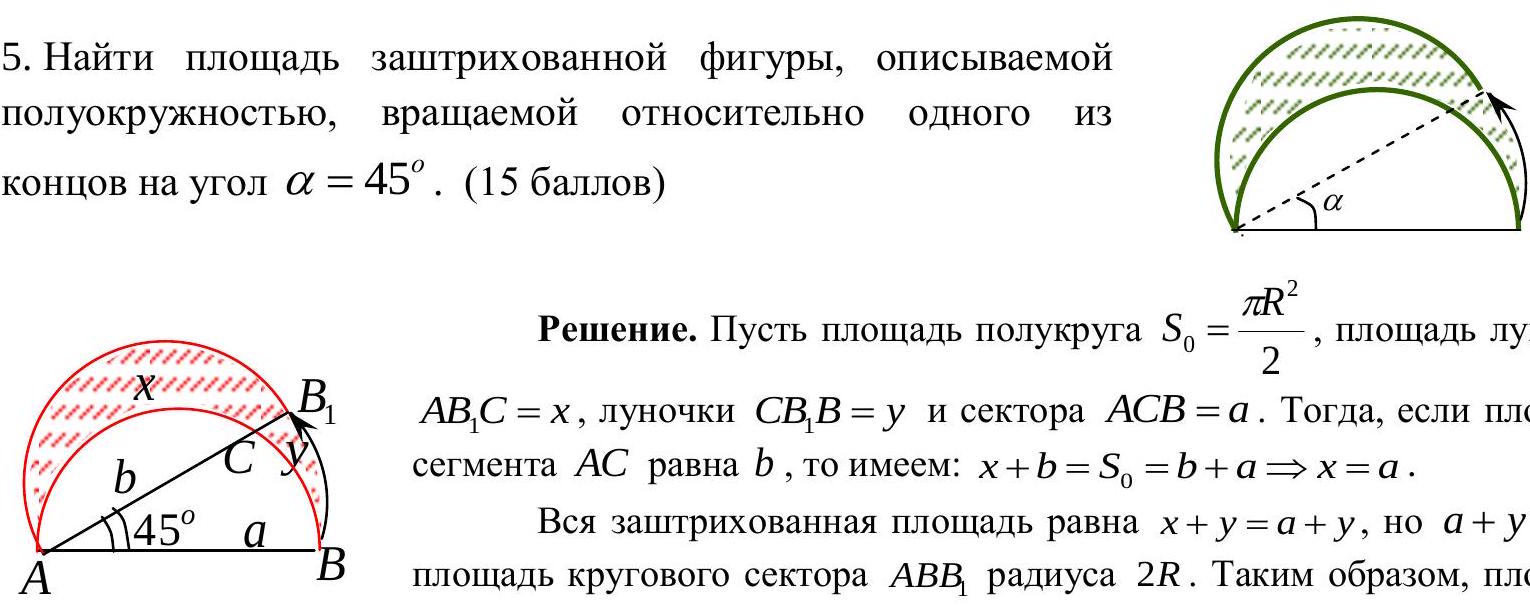 | Solution. Let the area of the semicircle $S_{0}=\frac{\pi R^{2}}{2}$, the area of the lune $A B_{1} C=x$, the lune $C B_{1} B=y$ and the sector $A C B=a$. Then, if the area of the segment $A C$ is $b$, we have: $x+b=S_{0}=b+a \Rightarrow x=a$.
The entire shaded area is equal to $x+y=a+y$, but $a+y$ is the area of the ... | \frac{\piR^{2}}{2} | Geometry | math-word-problem | Incomplete | Yes | olympiads | false |
A cylinder with a radius of $8$ and a height of $10$ is painted red. Points $P$ and $Q$ are marked on the edge of one circular face such that the arc $\overarc{PQ}$ measures $150^\text{o}$. The cylinder is sliced along a plane passing through points $P$, $Q$, and the cylinder's center, revealing a new, unpainted face. ... | - Define points $R$ and $S$ on the top face, and the center of the cylinder as $O$. $P$, $O$, and $R$ are collinear. Let $U$ be the center of the bottom face, and $N$ the midpoint of $\overline{PQ}$. We have $OU=5$ (half the height), and $UN=4$ (because the 150-degree angle implies a 30-degree reference in the 30-60-90... | 149 | Geometry | math-word-problem | Yes | Incomplete | synthetic_math | true |
A parking garage near Nora's house is 4 stories tall. There are some spots per level. There are 58 open parking spots on the first level, 2 more open parking spots on the second level than on the first level, 5 more open parking spots on the third level than on the second level, and 31 open parking spots on the fourth ... | Let's start by calculating the number of open parking spots on each level.
First level: 58 open spots
Second level: 58 + 2 = 60 open spots
Third level: 60 + 5 = 65 open spots
Fourth level: 31 open spots
Now, let's add up all the open parking spots across all levels:
58 (first level) + 60 (second level) + 65 (third le... | 100 | Algebra | math-word-problem | Yes | Yes | orca_math | true |
Mark has 30 candies, Peter has 25 candies, and John has some candies. They decided to combine their candies together and share them equally. Each one of them will have 30 candies. How many candies does John have? | If Mark, Peter, and John are going to share their candies equally and each end up with 30 candies, we can calculate the total number of candies they will have together by multiplying 30 candies by 3 people:
30 candies/person * 3 people = 90 candies
Now we know the total number of candies they will have after combinin... | 35 | Algebra | math-word-problem | Yes | Yes | orca_math | true |
A heptagon with all interior angles less than 180 degrees has at least ( ) obtuse angles.
(A) 6
(B) 5
(C) 4
(D) 3 | Solution: The following solution tries to use elementary school level thinking as much as possible:
The sum of the interior angles of a heptagon is $180 \times(7-2)=900^{\circ}$
Try to have as many angles as possible be $90^{\circ}$,
1) If 6 angles are $90^{\circ}$, then the last 1 angle is greater than $180^{\circ}$
... | 4 | Geometry | MCQ | Yes | Yes | olympiads | false |
7. Let $x, y, z$ be positive real numbers, and $x y z=1$, prove $\frac{x^{3}}{(1+y) \cdot(1+z)}+\frac{y^{3}}{(1+z)(1+x)}+$ $(1+x)(1+y) \geqslant \frac{3}{4}$ | 7. The original inequality is equivalent to $\sum x^{3}(1+x) \geqslant \frac{3}{4}(1+x)(1+y)(1+z)$
That is,
$$\sum x^{3}+\sum x^{4} \geqslant \frac{3}{2}+\frac{3}{4}(x+y+z)+\frac{3}{4}(x y+y z+z x)$$
Because
$$\begin{array}{c}
\sum x^{3} \geqslant 3\left(\frac{x+y+z}{3}\right)^{3}=\frac{1}{9}(x+y+z)^{3} \geqslant \fr... | proof | Inequalities | proof | Incomplete | Yes | inequalities | false |
The science and technology books in the school library account for 30% of the total number of books, while storybooks account for 50% of the total number of books. Science and technology books are 600 less than storybooks. How many books are there in total in the school library? | Let's calculate: $600 \div (50\% - 30\%)$
$= 600 \div 0.1$
$= 6000$ books.
Answer: The school library has a total of $\boxed{6000}$ books. | 6000 | Algebra | math-word-problem | Yes | Yes | cn_k12 | false |
In triangle $ABC$, $AB = 1$ and $AC = 2$. Suppose there exists a point $P$ in the interior of triangle $ABC$ such that $\angle PBC = 70^{\circ}$, and that there are points $E$ and $D$ on segments $AB$ and $AC$, such that $\angle BPE = \angle EPA = 75^{\circ}$ and $\angle APD = \angle DPC = 60^{\circ}$. Let $BD$ meet $C... | 1. **Given Information and Setup:**
- In triangle \(ABC\), \(AB = 1\) and \(AC = 2\).
- Point \(P\) is inside triangle \(ABC\) such that \(\angle PBC = 70^\circ\).
- Points \(E\) and \(D\) are on segments \(AB\) and \(AC\) respectively.
- \(\angle BPE = \angle EPA = 75^\circ\) and \(\angle APD = \angle DPC ... | 15^\circ | Geometry | math-word-problem | Yes | Yes | aops_forum | false |
\section*{Problem 2 - 231032}
For a triangle \(A B C\) and a point \(D\) on the side \(A C\), it is assumed that
\[
\angle B A C=\angle C B D=45^{\circ} \quad \text { and } \quad \angle A B D=\frac{1}{3} \angle B A C
\]
holds. Prove that then \(A D=\frac{1}{3} A C\) holds! | }
By assumption, \(\angle A B D=15^{\circ}\). By the interior angle theorem, it follows that \(\angle A C B=75^{\circ}, \angle A D B=120^{\circ}\), and therefore, as adjacent angles, \(\angle B D C=60^{\circ}\).
$. | Solution. Let $\mathrm{P}(A)=p$. By the condition, $\mathrm{P}(B)=\mathrm{P}(C)=p$, $\mathrm{P}(A B)=\mathrm{P}(B C)=\mathrm{P}(A C)=p^{2}$.
Consider the probability
$$
\begin{aligned}
& \mathrm{P}(A \backslash(B \cup C))=\mathrm{P}(A \backslash(A(B \cup C)))= \\
& =\mathrm{P}(A)-\mathrm{P}(A(B \cup C))=\mathrm{P}(A)... | \frac{1}{2} | Combinatorics | math-word-problem | Yes | Yes | olympiads | false |
Find the value of $\tan 15^{\circ}+\tan 30^{\circ}+\tan 15^{\circ}\tan 30^{\circ}$. | We will use the trigonometric identity for the tangent of the sum of two angles: $$\tan(A+B) = \frac{\tan A + \tan B}{1 - \tan A \tan B}$$.
Step 1: Apply the trigonometric identity for the tangent of the sum of two angles:
$$\tan 15^{\circ}+\tan 30^{\circ}+\tan 15^{\circ}\tan 30^{\circ} = \tan (15^{\circ}+30^{\circ})(... | 1 | Algebra | math-word-problem | Yes | Yes | cn_k12 | false |
\section*{Problem 3}
A circle is circumscribed about the triangle \(\mathrm{ABC}\). \(\mathrm{X}\) is the midpoint of the arc \(\mathrm{BC}\) (on the opposite side of \(\mathrm{BC}\) to \(\mathrm{A}\) ), \(\mathrm{Y}\) is the midpoint of the \(\operatorname{arc} \mathrm{AC}\), and \(\mathrm{Z}\) is the midpoint of the... | \section*{Solution}
ZY bisects the angle AYB, so AD/BD = AY/BY. Similarly, XY bisects angle BYC, so \(\mathrm{CE} / \mathrm{BE}=\mathrm{CY} / \mathrm{BY}\). But \(\mathrm{AY}=\mathrm{CY}\). Hence \(\mathrm{AD} / \mathrm{BD}=\mathrm{CE} / \mathrm{BE}\). Hence triangles BDE and BAC are similar and DE is parallel to AC.
... | proof | Geometry | proof | Yes | Yes | olympiads | false |
When Lucy was born, her aunt gave her a gift of $\$1500$, which was invested at an interest rate of $4\%$ per year, compounded yearly. How much money will Lucy have when she collects the money at the age of $21$? | To find the future value of Lucy's investment, we use the compound interest formula:
\[ A = P(1 + r)^n \]
where:
- \( P = \$1500 \) is the principal amount (initial investment),
- \( r = 0.04 \) (4% annual interest rate),
- \( n = 21 \) years (the period of investment).
Plugging in the values:
\[ A = 1500(1 + 0.04)^{2... | \$3046.28 | Algebra | math-word-problem | Yes | Yes | synthetic_math | true |
Given that $i$ is the imaginary unit and the complex number $z=\frac{i}{1+i}$, then the imaginary part of $z$ is ( ).
A: $\frac{1}{2}i$
B: $-\frac{1}{2}i$
C: $\frac{1}{2}$
D: $-\frac{1}{2}$ | To find the imaginary part of the complex number $z = \frac{i}{1+i}$, we need to simplify this fraction into its standard form $a + bi$, where $a$ is the real part and $b$ is the imaginary part.
First, let's multiply the numerator and the denominator by the complex conjugate of the denominator to remove the imaginary ... | \frac{1}{2} | Algebra | MCQ | Yes | Yes | cn_k12 | false |
When the positive integer y is divided by a certain number, the remainder is 5. The remainder when 3y is divided by the same number is 6. What is the divisor? | Let's call the certain number \( x \). When \( y \) is divided by \( x \), the remainder is 5. This can be written as:
\[ y = qx + 5 \]
where \( q \) is the quotient when \( y \) is divided by \( x \).
Now, when \( 3y \) is divided by \( x \), the remainder is 6. This can be written as:
\[ 3y = px + 6 \]
where \( ... | 9 | Number Theory | math-word-problem | Yes | Yes | orca_math | true |
The mean of numbers 28, x, 42, 78, and 104 is 90. The mean of a certain number, 255, 511, 1023, and x is 423. What is the first number in the second set of numbers? | To find the first number in the second set of numbers, we first need to find the value of x from the first set of numbers.
The mean of the first set of numbers is given as 90. The mean is calculated by adding all the numbers together and then dividing by the number of numbers. There are 5 numbers in the first set, so ... | 128 | Algebra | math-word-problem | Yes | Yes | orca_math | true |
"Angle $α$ is an obtuse angle" is the $(\quad)$ condition for "$\sin α > 0$ and $\cos α < 0$".
A: Necessary and sufficient
B: Necessary but not sufficient
C: Sufficient but not necessary
D: Neither sufficient nor necessary | Solution: If angle $α$ is an obtuse angle, then it can be concluded that: $\sin α > 0$ and $\cos α 0$ and $\cos α 0$ and $\cos α < 0$. However, the converse does not hold, as demonstrated by the example $α=2π+ \dfrac {2π}{3}$.
This question tests the ability to evaluate trigonometric functions and simple logical re... | null | Geometry | MCQ | Yes | Yes | cn_k12 | false |
Fill in the blanks with appropriate numbers.
216+35+84=35+(\_\_\_\_\_\_+\_\_\_\_\_\_)
298-35-165=298-(\_\_\_\_\_\_+\_\_\_\_\_\_)
400÷25÷4=400÷(\_\_\_\_\_\_×\_\_\_\_\_\_)
a×6+6×15=\_\_\_\_\_\_×(\_\_\_\_\_\_+\_\_\_\_\_\_) | Solution:
(1) 216+35+84=35+(216+84),
(2) 298-35-165=298-(35+165),
(3) 400÷25÷4=400÷(25×4),
(4) a×6+6×15=6×(a+15),
Therefore, the answers in order are: 216, 84, 35, 165, 25, 4, a, 15.
(1) This is solved based on the associative property of addition,
(2) This is solved using a simplified method for subtract... | 216, 84, 35, 165, 25, 4, a, 15 | Algebra | math-word-problem | Yes | Yes | cn_k12 | false |
33. (GBR 3) (SL86-1). | None | notfound | Other | math-word-problem | Incomplete | Problem not solved | olympiads | false |
Convert the point $(\rho,\theta,\phi) = \left( 3, \frac{3\pi}{2}, \frac{\pi}{3} \right)$ in spherical coordinates to rectangular coordinates. | Given $\rho = 3$, $\theta = \frac{3\pi}{2}$, and $\phi = \frac{\pi}{3}$, we use the conversion formulas:
\[
x = \rho \sin \phi \cos \theta = 3 \sin \frac{\pi}{3} \cos \frac{3\pi}{2} = 3 \cdot \frac{\sqrt{3}}{2} \cdot 0 = 0,
\]
\[
y = \rho \sin \phi \sin \theta = 3 \sin \frac{\pi}{3} \sin \frac{3\pi}{2} = 3 \cdot \frac{... | (0, -\frac{3\sqrt{3}}{2}, \frac{3}{2}) | Algebra | math-word-problem | Yes | Yes | synthetic_math | true |
In the construction of the new city in Baodi District, a triangular area is being transformed into a park. After measurement, the lengths of the three sides of this triangular area are found to be 2 kilometers, 3 kilometers, and 4 kilometers respectively. Calculate the area of this region in square kilometers. | First, let's translate the given Chinese solution into English and apply LaTeX formatting for better readability:
According to Heron's formula,
$P = \frac{a + b + c}{2} = \frac{2 + 3 + 4}{2} = \frac{9}{2}$ (semi-perimeter)
$S = \sqrt{P(P - a)(P - b)(P - c)}$
$S = \sqrt{\frac{9}{2} \times \left(\frac{9}{2} - 2\right)... | \frac{3\sqrt{15}}{4} | Geometry | math-word-problem | Yes | Yes | cn_k12 | false |
6. Fangfang's piggy bank contains many 1 yuan, 5 jiao, and 1 jiao coins. She wants to take out 2 yuan at once from the bank, there are $\qquad$ different ways to do so. | $9$ | 9 | Combinatorics | math-word-problem | Yes | Yes | olympiads | false |
If a random variable $X$ follows the normal distribution $X \sim N(\mu, \sigma^2)$, and $P(X > 5) = P(X < -1) = 0.2$, then find $P(2 < X < 5)$. | Given that the random variable $X$ follows a normal distribution $X \sim N(\mu, \sigma^2)$, and that $P(X > 5) = P(X 5) = 1 - 0.2 - 0.2 = 0.6. $$
Since the interval $(-1, 5)$ is made up of two equal halves split by the mean $\mu = 2$, and the probability for each half is the same by symmetry, we can conclude that:
$$... | 0.3 | Algebra | math-word-problem | Yes | Yes | cn_k12 | false |
Tim won a $100 raffle. He gave away 20% to his friend. How much did he keep? | If Tim gave away 20% of his $100 raffle win, he gave away:
20% of $100 = (20/100) * $100 = $20
So, Tim kept the remaining amount, which is:
$100 - $20 = $80
Tim kept $\boxed{\$80}$ . | \$80 | Algebra | math-word-problem | Yes | Yes | orca_math | true |
Let $A,$ $B,$ $C$ be the angles of a non-right triangle. Compute
\[\begin{vmatrix} \cot A & 1 & 1 \\ 1 & \cot B & 1 \\ 1 & 1 & \cot C \end{vmatrix}.\] | Expanding the determinant, we have
\[
\begin{vmatrix} \cot A & 1 & 1 \\ 1 & \cot B & 1 \\ 1 & 1 & \cot C \end{vmatrix} = \cot A \begin{vmatrix} \cot B & 1 \\ 1 & \cot C \end{vmatrix} - \begin{vmatrix} 1 & 1 \\ 1 & \cot C \end{vmatrix} + \begin{vmatrix} 1 & \cot B \\ 1 & 1 \end{vmatrix}
\]
\[
= \cot A (\cot B \cot C - 1... | 2 | Algebra | math-word-problem | Yes | Yes | synthetic_math | true |
In an geometric sequence, given that $a_{2}a_{5}=-32$, $a_{3}+a_{4}=4$, and the common ratio is an integer, find $a_{10}$. | Since in a geometric sequence, $a_{2}a_{5}=a_{3}a_{4}$,
We can consider $a_{3}$ and $a_{4}$ as the two roots of the equation $x^{2}-4x-32=0$,
Hence, $a_{3}=8$, $a_{4}=-4$, or $a_{3}=-4$, $a_{4}=8$,
Thus, the common ratio of this sequence is $q=- \frac {1}{2}$ (discarded) or $q=-2$.
Hence, $a_{10}=a_{3}q^{7}=8×(-2)^... | -512 | Algebra | math-word-problem | Yes | Yes | cn_k12 | false |
The domain of the function $f(x)=\ln (x+1)+(x-2)^{0}$ is __________. | Solution: Since $\begin{cases} x+1 > 0 \\ x-2 \neq 0 \end{cases}$, we find $x > -1$ and $x \neq 2$.
Therefore, the domain of the function $f(x)=\ln (x+1)+(x-2)^{0}$ is $(-1,2) \cup (2,+\infty)$.
Hence, the answer is $\boxed{(-1,2) \cup (2,+\infty)}$.
This solution is derived by combining the inequality that the a... | (-1,2) \cup (2,+\infty) | Algebra | math-word-problem | Yes | Yes | cn_k12 | false |
Given $x-y=\frac{1}{2}$ and $xy=\frac{4}{3}$, the value of $xy^{2}-x^{2}y$ is ( )
A: $-\frac{2}{3}$
B: $1$
C: $\frac{11}{6}$
D: $\frac{2}{3}$ | Given the equations $x-y=\frac{1}{2}$ and $xy=\frac{4}{3}$, we are asked to find the value of $xy^{2}-x^{2}y$.
First, we notice that $xy^{2}-x^{2}y$ can be factored as follows:
\[xy^{2}-x^{2}y = xy(y-x).\]
Given that $x-y=\frac{1}{2}$, we can rewrite $y-x$ as $-(x-y)$, which gives us:
\[xy(y-x) = -xy(x-y).\]
Substit... | A | Algebra | MCQ | Yes | Yes | cn_k12 | false |
Person A and person B are trying to independently crack a code. The probability of each person succeeding is respectively $\frac{1}{3}$ and $\frac{1}{4}$. Calculate:
(1) The probability that exactly one person cracks the code;
(2) The minimum number of people with the same ability as person B required to achieve a prob... | Let event A be "person A cracks the code" and event B be "person B cracks the code". We have:
P(A) = $\frac{1}{3}$, P(B) = $\frac{1}{4}$.
(1) The probability of exactly one person succeeding is given by P(A and not B) + P(not A and B):
\begin{align*}
\text{P(A and not B)} + \text{P(not A and B)} &= P(A) \times (1 - P... | 17 | Combinatorics | math-word-problem | Yes | Yes | cn_k12 | false |
Find the equation of the line that passes through the point P(1,1) and is perpendicular to the line 2x - y = 0. Represent the answer in the general form of the equation of a line. | Since we are looking for the equation of a line that is perpendicular to the line $2x - y = 0$, we start by determining the slope of the given line. For the equation $2x - y = 0$, which can be rewritten as $y = 2x$, the slope is 2. The slope of a line perpendicular to this one will be the negative reciprocal of 2, whic... | x + 2y - 3 = 0 | Algebra | math-word-problem | Yes | Yes | cn_k12 | false |
6. The system of equations
$$
\left\{\begin{array}{l}
(1+x)\left(1+x^{2}\right)\left(1+x^{4}\right)=1+y^{\prime} \\
(1+y)\left(1+y^{2}\right)\left(1+y^{1}\right)=1+x^{7}
\end{array}\right.
$$
has ( ) solutions for $(x, y)$.
(A) 4
(B) 2
(C) 1
(D) 0 | 6. (B).
Given the equations can be transformed into
$$
\left\{\begin{array}{l}
1-x^{8}=(1-x)\left(1+y^{7}\right), \\
1-y^{8}=(1-y)\left(1+x^{7}\right) .
\end{array}\right.
$$
When $x=y$, it is clear that $x=1$. This can be solved to get
$$
(x, y)=(C, 0),(-1, \cdots 1) \text {. }
$$
When $x \neq y$,
if $x>0, y>0$, th... | B | Algebra | MCQ | Yes | Yes | cn_contest | false |
In the Cartesian coordinate system $xOy$, the parametric equation of curve $M$ is
$$
\begin{cases}
x= \frac {2 \sqrt {3}}{ \sqrt {3}-t} \\
y= \frac {2 \sqrt {3}t}{ \sqrt {3}-t}
\end{cases}
(t \text{ is the parameter, and } t > 0),
$$
with the origin as the pole and the positive $x$-axis as the polar axis, a polar co... | Solution:
1. Since the parametric equation of curve $M$ is
$$
\begin{cases}
x= \frac {2 \sqrt {3}}{ \sqrt {3}-t} \\
y= \frac {2 \sqrt {3}t}{ \sqrt {3}-t}
\end{cases}
(t \text{ is the parameter, and } t > 0),
$$
we have $\frac {y}{x}=t$. Therefore, $x= \frac {2 \sqrt {3}}{ \sqrt {3}- \frac {y}{x}}$, which simplifies ... | (2 \sqrt {3}, \frac {\pi}{6}) | Algebra | math-word-problem | Yes | Yes | cn_k12 | false |
22. (12 points) Function
$$
f(x)=a \ln x+1(a>0) \text {. }
$$
(1) Prove: $f(x)-1 \geqslant a\left(1-\frac{1}{x}\right)$;
(2) On the interval $(1, \mathrm{e})$, $f(x)>x$ always holds, find the range of the real number $a$;
(3) When $a=\frac{1}{2}$, prove:
$$
\sum_{k=2}^{n+1} f(k)>2(n+1-\sqrt{n+1}) .
$$ | 22. (1) Let $g(x)=\ln x-1+\frac{1}{x}$. Then
$$
g^{\prime}(x)=\frac{1}{x}-\frac{1}{x^{2}} \text {. }
$$
By $g^{\prime}(x)=0$, we get $x=1$.
Thus, $g(x)$ is decreasing on $(0,1)$ and increasing on $(1,+\infty)$.
(Continued from page 32)
Therefore, the minimum value of $g(x)$ is $g(1)=0$.
Hence, $f(x)-1 \geqslant a\left... | proof | Inequalities | proof | Yes | Yes | cn_contest | false |
Solve the equations:
(1) $2x^2+4x-1=0$;
(2) $4(2x-1)^2=9(x+4)^2$. | To solve these equations, we will use basic algebraic methods:
**(1)** For the equation $2x^2+4x-1=0$, let's use the quadratic formula $x=\frac{-b\pm\sqrt{b^2-4ac}}{2a}$. Here, $a=2$, $b=4$, and $c=-1$.
First, we calculate the discriminant:
$$\Delta=b^2-4ac=4^2-4\cdot2\cdot(-1)=16+8=24$$
Since $\Delta>0$, we have... | \frac{16}{5} | Algebra | math-word-problem | Yes | Yes | cn_k12 | false |
115 Let the set $A=\left\{n \mid 2^{n}+3^{n}\right.$ is a multiple of 5. $\left.n \in \mathbf{N}\right\} \quad B=\left\{m \mid m=u^{2}-v^{2}, u\right.$, $v \in \mathbf{Z}\}$, then which of the following relations is correct?
A. $A \cap B=\emptyset$
B. $A \cup B=A$
C. $A \cup B=B$
D. $A=B$ | $115 \mathrm{C}$.
$$
2^{n}+3^{n}=(5-3)^{n}+3^{n}=5 M+(-3)^{n}+3^{n}
$$
If $5 \mid 2^{n}+3^{n}$, then $5 \mid\left[(-3)^{n}+3^{n}\right]$.
When $n=2 k, k \in \mathbf{N}$, $(-3)^{n}+3^{n}=2 \cdot 3^{n} \quad 5 \mid 2 \cdot 3^{n}$,
i.e., $5 \mid \left[(-3)^{n}+3^{n}\right]$.
When $n=2 k-1, k \in \mathbf{N}$, $(-3)^{n}+3^... | C | Number Theory | MCQ | Yes | Yes | olympiads | false |
Given the function $$f(x)= \sqrt {x^{2}+1}-ax$$, where $a>0$.
(1) If $2f(1)=f(-1)$, find the value of $a$;
(2) When $a\geq1$, determine the monotonicity of the function $f(x)$ on the interval $[0,+\infty)$;
(3) If the function $f(x)$ is increasing on the interval $[1,+\infty)$, find the range of values for $a$. | (1) From $2f(1)=f(-1)$, we get: $$2\sqrt{2}-2a=\sqrt{2}+a$$ $$3a=\sqrt{2}$$, thus $$a=\frac{\sqrt{2}}{3}$$…(4 points)
(2) If $a\geq1$, for any $0\leq x_10$, $f(x)$ is monotonically decreasing on $[0,+\infty)$ …(10 points)
(3) For any $1\leq x_10$$ always holds (12 points) $$\frac{\sqrt{2}}{2}<\frac{x_{1}+x_{2}}... | 0<a\leq\frac{\sqrt{2}}{2} | Algebra | math-word-problem | Yes | Yes | cn_k12 | false |
37. Prove that the angle at which a diameter of a circle is seen from a point on the circle is not greater than $90^{\circ}$. | 37. Let $A B$ be the diameter of circle $O$, and $C$ be a point on the circle. Consider two isosceles triangles $A O C$ and $B O C$ and note that the sum of the angles in a triangle does not exceed $180^{\circ}$. | proof | Geometry | proof | Yes | Yes | olympiads | false |
Circles \( \omega_1 \), \( \omega_2 \), and \( \omega_3 \) each have radius 5 and are placed in the plane such that each circle is externally tangent to the other two. Points \( P_1 \), \( P_2 \), and \( P_3 \) lie on \( \omega_1 \), \( \omega_2 \), and \( \omega_3 \) respectively such that \( P_1P_2 = P_2P_3 = P_3P_1 ... | Let \( O_i \) be the center of circle \( \omega_i \) for \( i=1,2,3 \), and \( K \) be the intersection of lines \( O_1P_1 \) and \( O_2P_2 \). Since \( \angle P_1P_2P_3 = 60^\circ \), triangle \( P_2KP_1 \) is a \( 30-60-90^\circ \) triangle. Let \( d = P_1K \); then \( P_2K = 2d \) and \( P_1P_2 = \sqrt{3}d \). The L... | 1365 | Geometry | math-word-problem | Yes | Yes | synthetic_math | true |
4. As shown in Figure 3, in the kite $ABCD$, $AB=AD$, $CB=CD$, the angle bisector of $\angle BDC$ intersects $BC$ at point $L$. Given that points $A$, $L$, $C$, and $D$ are concyclic. Then $2 \angle BAD + 3 \angle BCD$ = . $\qquad$ | $4.540^{\circ}$.
As shown in Figure 8, connect
$A L$ intersecting $B D$ at point $M$.
Let $A C$ and $B D$ intersect at point
$O$, and construct the symmetric point $L^{\prime}$ of $L$ with respect to $A C$. It is easy to see that $L^{\prime}$
lies on segment $C D$. Connect $A L^{\prime}$ and $M L^{\{\prime}$.
Since $A,... | 540^{\circ} | Geometry | math-word-problem | Yes | Yes | cn_contest | false |
3. In a square $A B C D$ with side length 2, $E$ is the midpoint of $A B$. Now, fold the figure along segments $E C, E D$ so that segments $E A, E B$ coincide. This results in a tetrahedron $C D E A$ (point $B$ has coincided with point $A$). The volume of this tetrahedron is | Since $A C=A D=C D \Rightarrow \triangle A C D$ is an equilateral triangle. Let the midpoint of $C D$ be $F$, then $A F=\sqrt{3}, A E=1, E F=2$. Also, $A E \perp$ plane $A C D \Rightarrow C D \perp$ plane $A E F$, thus the height $h=\frac{\sqrt{3}}{2}$ of tetrahedron $C D E A$, and $S_{\triangle E C D}=2 \Rightarrow V_... | \frac{\sqrt{3}}{3} | Geometry | math-word-problem | Yes | Yes | olympiads | false |
The range of the function $y=1+\log_{3}x$ (where $x>9$) is
A: $[2,+\infty)$
B: $[3,+\infty)$
C: $(3,+\infty)$
D: $\mathbb{R}$ | Since $x>9$,
we have $\log_{3}x>2$,
thus, the range of the function $y=1+\log_{3}x$ (where $x>9$) is $(3,+\infty)$.
Therefore, the correct option is $\boxed{C}$.
**Analysis:** This conclusion can be drawn by utilizing the monotonicity of the logarithmic function. | C | Algebra | MCQ | Yes | Yes | cn_k12 | false |
The function $f(x) = x^3 - 3x^2 - 9x + 3$, if the function $g(x) = f(x) - m$ has 3 zeros on $\mathbb{R}$, then the range of values for $m$ is \_\_\_\_\_\_. | Since $f(x) = x^3 - 3x^2 - 9x + 3$, we have $f'(x) = 3x^2 - 6x - 9 = 3(x - 3)(x + 1)$. Therefore, the function $f(x)$ has critical points at $x = 3$ and $x = -1$.
In the intervals $(-\infty, -1)$ and $(3, +\infty)$, $f'(x) > 0$, indicating that $f(x)$ is monotonically increasing; in the interval $(-1, 3)$, $f'(x) > 0... | (-24, 8) | Algebra | math-word-problem | Yes | Yes | cn_k12 | false |
A woman goes to work and has an average speed of 45 mph. She takes the same route home and has an average speed of some mph. Her commute to and from work took an hour. She travels 18 miles to work. What is her average speed coming back from work? | To find the average speed on the way back from work, we first need to determine how long it took the woman to get to work with an average speed of 45 mph.
The time it takes to travel a certain distance can be found using the formula:
\[ \text{Time} = \frac{\text{Distance}}{\text{Speed}} \]
For the trip to work:
\[ \t... | 30 | Algebra | math-word-problem | Yes | Yes | orca_math | true |
A merchant marks his goods up by 20% and then offers a discount of some percentage on the marked price. The merchant makes a profit of 8% after the discount. What percentage discount did the merchant offer? | Let's assume the cost price (CP) of the goods is $100.
The merchant marks up the goods by 20%, so the marked price (MP) is:
MP = CP + (20% of CP)
MP = $100 + (0.20 × $100)
MP = $100 + $20
MP = $120
The merchant makes a profit of 8% after offering a discount. This means the selling price (SP) is 8% more than the cost ... | 10\% | Algebra | math-word-problem | Yes | Yes | orca_math | true |
Given that the sequence \\(\{a_n\}\) is an arithmetic sequence, and \\(a_2 + a_5 = 19\), \\(a_3 + a_6 = 25\).
\\((1)\\) Find the general formula for the sequence \\(\{a_n\}\).
\\((2)\\) If the sequence \\(\{a_n - b_n\}\) is a geometric sequence with the first term being \\(2\\) and the common ratio being \\(2\\), fin... | Solution:
\\((1)\\) From \\(\begin{cases}a_2 + a_5 = 19 \\ a_3 + a_6 = 25\end{cases}\\), we can rearrange to get \\(\begin{cases}2a_1 + 5d = 19 \\ 2a_1 + 7d = 25\end{cases}\\),
Solving this, we get \\(\begin{cases}a_1 = 2 \\ d = 3\end{cases}\\),
Therefore, \\(a_n = 3n - 1\\).
\\((2)\\) Since the sequence \\(\{a_n -... | S_n = \dfrac{3n^2 + n + 4}{2} - 2^{n + 1} | Algebra | math-word-problem | Yes | Yes | cn_k12 | false |
1.2. There are 9 weights, the mass of the smallest of which is 3 kg, and the mass of the others increases from weight to weight by 1 kg. Can all the weights be divided into three piles of equal mass?
$$
\text { (4-5 grades) }
$$ | 1.2. The total mass of all weights is $3+4+5+6+7+8+9+$ $+10+11=63$ kg. It is required to distribute all the weights into three piles, each weighing 21 kg. The problem allows for several solutions:
1) $3+7+11=21, \quad 4+8+9=21, \quad 5+6+10=21$
2) $3+5+6+7=21, \quad 4+8+9=21, \quad 10+11=21$.
Other solutions are also... | notfound | Logic and Puzzles | math-word-problem | Yes | Yes | olympiads | false |
In $\triangle ABC$, the sides opposite to angles $A$, $B$, $C$ are $a$, $b$, $c$ respectively, and $c=2$, $C=60^{\circ}$.
(1) Find the value of $\frac{a+b}{\sin A + \sin B}$;
(2) If $a+b=ab$, find the area of $\triangle ABC$, denoted as $S_{\triangle ABC}$. | (1) By the Law of Sines, we have $\frac{a}{\sin A} = \frac{b}{\sin B} = \frac{c}{\sin C} = \frac{2}{\sin 60^{\circ}} = \frac{2}{\frac{\sqrt{3}}{2}} = \frac{4\sqrt{3}}{3}$.
Thus, $a = \frac{4\sqrt{3}}{3} \sin A$ and $b = \frac{4\sqrt{3}}{3} \sin B$.
Therefore, $\frac{a+b}{\sin A + \sin B} = \frac{\frac{4\sqrt{3}}{3}(\si... | \sqrt{3} | Geometry | math-word-problem | Yes | Yes | cn_k12 | false |
Example 1 Let $S$ be a finite set, and $S \subseteq \mathbf{Q}$. For any positive integer $k$, if we can find $k$ numbers in $S$ (repetition allowed) whose sum is 0, then $b_{k}=0$; otherwise, $b_{k}=1$. Prove: the real number $0 . \overline{b_{1} b_{2} \cdots}$ is a rational number. | 【Analysis】It is only necessary to prove: the sequence $\left\{b_{n}\right\}$ becomes a periodic sequence from a certain term onwards.
It is only necessary to consider the case where $0 \notin S$, and $S$ contains both positive and negative numbers.
$$
\text { Let } S=\left\{\frac{p_{1}}{q_{1}}\cdots>-\frac{u_{l}}{v_{l... | proof | Number Theory | proof | Yes | Yes | olympiads | false |
Example 2. In $\triangle A B C$, $\angle A=60^{\circ}$. Prove that:
$$
2 B C \geqslant A B+A C
$$ | $$
\begin{array}{l}
=\frac{1}{\cos \frac{B-C}{2}} \geqslant 1 \text {. } \\
\therefore 2 B C \geqslant A B+A C \text {. } \\
\end{array}
$$
Let $\triangle ABC$ have a circumradius $R$, then
$$
\begin{array}{l}
=\frac{1}{\cos \frac{B-C}{2}} \geqslant 1 \text{. } \\
\therefore 2 B C \geqslant A B+A C \text{. } \\
\end{a... | proof | Inequalities | proof | Yes | Incomplete | cn_contest | false |
A valid license plate in New Xanadu consists of two letters followed by three digits and then one letter again. How many valid license plates are possible? | 1. There are 26 choices of letters for each of the three letter spots (the first, second, and last positions).
2. There are 10 choices of digits for each of the three digit spots in the middle.
3. Multiply the number of choices together to get the total number of license plates:
\[
26 \times 26 \times 10 \times 1... | 17,576,000 | Combinatorics | math-word-problem | Yes | Yes | synthetic_math | true |
9.4. The lines containing the altitudes of the non-isosceles triangle \(ABC\) intersect at point \(H\). \(I\) is the incenter of triangle \(ABC\), \(O\) is the circumcenter of triangle \(BHC\). It is known that point \(I\) lies on the segment \(OA\). Find the angle \(BAC\). | Answer: $60^{\circ}$
Solution. Note that point $O$ lies on the bisector (perpendicular through the midpoint) of segment $B C$. On the other hand, point $O$ lies on the bisector of angle $A$. However, these two lines intersect at a point lying on the circumcircle of triangle $B A C$, and dividing the arc $B C$ in half.... | 60 | Geometry | math-word-problem | Yes | Yes | olympiads | false |
Solve the inequality about $x$: $αx^{2}-2 \geqslant 2x-αx$ $(α∈R)$. | The original inequality can be rewritten as $αx^{2}+(α-2)x-2 \geqslant 0$.
1. When $α=0$, we have $x \leqslant -1$.
2. When $α \neq 0$, the inequality becomes $(αx-2)(x+1) \geqslant 0$.
- If $α>0$, then $x \geqslant \frac{2}{α}$ or $x \leqslant -1$.
- Since $\frac{2}{α} - (-1) = \frac{α+2}{α}$,
- If $-2 0$,... | -1 \leqslant x \leqslant \frac{2}{α} | Inequalities | math-word-problem | Yes | Yes | cn_k12 | false |
Let $y$ be a positive real number. Find the maximum possible value of $$\frac{y^2+3-\sqrt{y^4+9}}{y}.$$ | First, rationalize the numerator:
\[
\frac{y^2+3-\sqrt{y^4+9}}{y} \cdot \frac{y^2+3+\sqrt{y^4+9}}{y^2+3+\sqrt{y^4+9}} = \frac{(y^2+3)^2 - (y^4 + 9)}{y(y^2+3+\sqrt{y^4+9})}
\]
\[
= \frac{y^4 + 6y^2 + 9 - y^4 - 9}{y(y^2+3+\sqrt{y^4+9})} = \frac{6y^2}{y(y^2+3+\sqrt{y^4+9})}
\]
\[
= \frac{6}{y+\frac{3}{y}+\sqrt{y^2+\frac{... | \frac{6}{2\sqrt{3}+\sqrt{6}} | Algebra | math-word-problem | Yes | Yes | synthetic_math | true |
Non-negative integers are placed on the vertices of a $100$-gon, the sum of the numbers is $99$. Every minute at one of the vertices that is equal to $0$ will be replaced by $2$ and both its neighboring numbers are subtracted by $1$. Prove that after a while a negative number will appear on the board. | null | null | Logic and Puzzles | proof | Yes | Yes | aops_forum | false |
If $a$, $b$, and $c$ are real numbers, then the correct statement is:
A: If $a \gt b$, then $ac^{2} \gt bc^{2}$
B: If $a \lt b \lt 0$, then $\frac{1}{a}<\frac{1}{b}$
C: If $a \lt b \lt 0$, then $a^{2} \gt ab \gt b^{2}$
D: If $a \lt b \lt 0$, then $\frac{b}{a}>\frac{a}{b}$ | For each statement, let's analyze them step by step following the given rules and the provided solution:
**Statement A: If $a > b$, then $ac^2 > bc^2$**
When we consider $c = 0$, we have:
- $ac^2 = a(0)^2 = 0$
- $bc^2 = b(0)^2 = 0$
Therefore,
$$
ac^2 = bc^2
$$
This contradicts the statement that $ac^2 > bc^2$ whene... | C | Inequalities | MCQ | Yes | Yes | cn_k12 | false |
Connor is taking his date to the movies in 3D. The 3D tickets cost $14.00 each, but he has a coupon for "buy one, get one 50% off" for the movie tickets. They decided to get the large popcorn & 2 drink combo meal for $11.00. Each of them grabs a box of candy worth $2.50 each, and Connor has a 20% off coupon for the can... | First, let's calculate the cost of the 3D movie tickets with the coupon. One ticket is $14.00, and the second ticket will be 50% off:
Second ticket cost = $14.00 * 50% = $14.00 * 0.5 = $7.00
Total cost for tickets = $14.00 (first ticket) + $7.00 (second ticket) = $21.00
Next, let's add the cost of the large popcorn ... | \$40.00 | Logic and Puzzles | math-word-problem | Yes | Yes | orca_math | true |
How many positive multiples of $5$ that are less than $500$ end with the digit $2$? | To find the multiples of $5$ that end in $2$, we recognize they must be of the form $5k$ where $k$ is an integer, and the last digit of $5k$ must be $2$. The full number could appear as $...2$ for the last digit. However, there are no pure multiples of $5$ that end in $2$ because multiplying 5 by any integer either end... | 0 | Number Theory | math-word-problem | Yes | Yes | synthetic_math | true |
The graph of \[y^4 - 16x^4 = 8y^2 - 4\] is the union of the graphs of two different conic sections. Which two types of conic sections are they? | Rewrite the given equation as:
\[ y^4 - 8y^2 + 4 = 16x^4 \]
The equation can be rewritten by factoring the left-hand side as a perfect square of a binomial:
\[ (y^2 - 4)^2 = 16x^4 \]
By taking the square root of both sides, we have:
\[ y^2 - 4 = \pm 4x^2 \]
Rearranging these gives two separate equations:
1. \( y^2 - 4x... | \text{H, E} | Algebra | math-word-problem | Yes | Yes | synthetic_math | true |
Ruby was going to order pizza for dinner. Her son would only eat pepperoni pizza. Her daughter would only eat sausage and onions. Ruby and her husband wanted black olive, mushroom, and green peppers pizza. Ruby's cousin, who was visiting, was a vegetarian and wanted a pizza with spinach, tomatoes, and extra cheese.
T... | Let's calculate the cost of each pizza first:
1. Pepperoni pizza for her son: $10.00 + $1.50 (pepperoni) = $11.50
2. Sausage and onions pizza for her daughter: $10.00 + $1.50 (sausage) + $1.00 (onions) = $12.50
3. Black olive, mushroom, and green peppers pizza for Ruby and her husband: $10.00 + $1.00 (black olives) + ... | \$56.00 | Logic and Puzzles | math-word-problem | Yes | Yes | orca_math | true |
Subsets and Splits
No community queries yet
The top public SQL queries from the community will appear here once available.