
instruction_seed stringlengths 2 10.7k | solution stringlengths 0 10.8k ⌀ | answer stringlengths 0 575 ⌀ | problem_type stringclasses 9
values | question_type stringclasses 5
values | problem_is_valid stringclasses 5
values | solution_is_valid stringclasses 4
values | source stringclasses 11
values | synthetic bool 2
classes |
|---|---|---|---|---|---|---|---|---|
Example 2 Let $n$ be a positive integer. Prove:
$$
n\left(n^{2}-1\right)\left(n^{2}-5 n+26\right)
$$
is divisible by 120. | Analysis: Since $120=5 \times 3 \times 2^{3}$, and $3, 5, 8$ are pairwise coprime, it follows from Property 6 that we only need to prove
$$
n\left(n^{2}-1\right)\left(n^{2}-5 n+26\right)
$$
is divisible by $3$, $5$, and $8$.
Now consider the target expression (1), where $n\left(n^{2}-1\right)$ can be factored into the... | proof | Number Theory | proof | Yes | Yes | cn_contest | false |
Find the positive value of $x$ that satisfies $cd = x-3i$ given $|c|=3$ and $|d|=5$. | From the given information, we know that $|c| |d| = |cd| = 3 \times 5 = 15$. We can also write $|cd| = |x-3i| = \sqrt{x^2 + 9}$. Setting these equal, we have:
$$ \sqrt{x^2 + 9} = 15 \Rightarrow x^2 + 9 = 225. $$
Thus,
$$ x^2 = 225 - 9 = 216 \Rightarrow x = \sqrt{216} = 6\sqrt{6}. $$
The positive answer is $x = \boxed{6... | 6\sqrt{6} | Algebra | math-word-problem | Yes | Yes | synthetic_math | true |
Find the sum of the coefficients in the polynomial $-3(x^8 - 2x^5 + 4x^3 - 6) + 5(x^4 + 3x^2) - 4(x^6 - 5)$. | The given polynomial is $-3(x^8 - 2x^5 + 4x^3 - 6) + 5(x^4 + 3x^2) - 4(x^6 - 5)$. To find the sum of the coefficients, set $x = 1$:
\[
-3((1)^8 - 2(1)^5 + 4(1)^3 - 6) + 5((1)^4 + 3(1)^2) - 4((1)^6 - 5)
\]
\[
-3(1 - 2 + 4 - 6) + 5(1 + 3) - 4(1 - 5)
\]
\[
-3(-3) + 5(4) - 4(-4)
\]
\[
9 + 20 + 16 = \boxed{45}
\] | 45 | Algebra | math-word-problem | Yes | Yes | synthetic_math | true |
(3) Example 3-40 In fact, the conclusion of the above problem only requires 9 people. The problem is equivalent to a complete graph with 9 vertices arbitrarily colored with red and blue, where either a red triangle or a blue complete quadrilateral must exist. Similarly, either a red complete quadrilateral or a blue tri... | Proof: Let the 9 vertices be $\left(v_{1}, v_{2}, \cdots, v_{9}\right)$. For the complete graph with 9 vertices, if the edges are arbitrarily colored with red and blue, it is impossible for each vertex to have exactly 3 edges colored red or blue. This is because if otherwise, each vertex would have exactly 3 edges colo... | proof | Combinatorics | proof | Yes | Yes | olympiads | false |
Calculate the average distance between the following two sets of numbers, taking into account the decimals and negative numbers. Determine which set has the closest average distance to the other set.
Set A: {-4.2, 1.3, 10.7, -3.1, 5.6, 7.2, 12.4, -2.6, 6.1, 8.3}
Set B: {9.3, -5.4, 12.5, 3.8, 4.6, 0.2, -3.7, -4.1, 5.9... | To calculate the average distance between the two sets, we first need to find the average (mean) of each set and then calculate the distance between these two averages.
For Set A:
(-4.2 + 1.3 + 10.7 + (-3.1) + 5.6 + 7.2 + 12.4 + (-2.6) + 6.1 + 8.3) / 10
= (41.7) / 10
= 4.17
For Set B:
(9.3 + (-5.4) + 12.5 + 3.8 + 4.6... | 0.13 | Algebra | math-word-problem | Yes | Yes | orca_math | true |
Several weights are given, each of which is not heavier than $1 \mathrm{lb}$. It is known that they cannot be divided into two groups such that the weight of each group is greater than $1 \mathrm{lb}$. Find the maximum possible total weight of these weights. | Suppose you start putting weights into two pans of a scale and stop when you cannot add another weight to either pan without it exceeding $1 \mathrm{lb}$. At this point, you have put at most $2 \mathrm{lb}$ of weight on the scale, and there can only be one weight left, otherwise you could add a weight to each pan and b... | 3\mathrm{} | Number Theory | math-word-problem | Yes | Yes | olympiads | false |
IMO 1959 Problem B1 Given the length |AC|, construct a triangle ABC with ∠ABC = 90 o , and the median BM satisfying BM 2 = AB·BC. | Area = AB·BC/2 (because ∠ABC = 90 o = BM 2 /2 (required) = AC 2 /8 (because BM = AM = MC), so B lies a distance AC/4 from AC. Take B as the intersection of a circle diameter AC with a line parallel to AC distance AC/4. s are also available in: Samuel L Greitzer, International Mathematical Olympiads 1959-1977, MAA 1978,... | Bliesdistance\frac{AC}{4}fromAC | Geometry | math-word-problem | Yes | Yes | olympiads | false |
10.3. Can two digits be appended to the number 277 so that the resulting number is divisible by any number from 2 to 12? | 10.3. For a number to be divisible by 10, it must end in zero. Let's choose the second-to-last digit so that the resulting number is divisible by 9. In this case, the sum of the digits of this number should be equal to 18. Therefore, we get the number 27720. The problem has a solution only if the found number is divisi... | 27720 | Number Theory | math-word-problem | Yes | Yes | olympiads | false |
Observe the following equation: $3^{1}=3$, $3^{2}=9$, $3^{3}=27$, $3^{4}=81$, $3^{5}=243$, $3^{6}=729$, $3^{7}=2187$, $\ldots$, according to the above pattern, the unit digit of $3+3^{2}+3^{3}+3^{4}+\ldots +3^{2023}$ is ______. | To solve for the unit digit of the sum $3+3^{2}+3^{3}+3^{4}+\ldots+3^{2023}$, we observe the pattern of unit digits in powers of $3$:
- The unit digit of $3^{1}=3$
- The unit digit of $3^{2}=9$
- The unit digit of $3^{3}=27$, which is $7$
- The unit digit of $3^{4}=81$, which is $1$
We notice that every four powers o... | 9 | Number Theory | math-word-problem | Yes | Yes | cn_k12 | false |
Bob ordered 80 packs of Greek yogurt from Costco to use for the month. However, when the delivery arrived, he realized a certain percentage of the packs were expired. He decided to return those packs. If each pack was $12, and Bob was refunded $384 for the expired product, what percentage of the packs were expired? | To find out the percentage of packs that were expired, we first need to determine how many packs were expired based on the refund amount.
Since Bob was refunded $384 and each pack costs $12, we can calculate the number of expired packs by dividing the total refund amount by the cost per pack:
Number of expired packs ... | 40\% | Algebra | math-word-problem | Yes | Yes | orca_math | true |
Evaluate or simplify:
1. $\log_2 \sqrt{2}+\log_9 27+3^{\log_3 16}$;
2. $0.25^{-2}+\left( \frac{8}{27} \right)^{-\frac{1}{3}}-\frac{1}{2}\lg 16-2\lg 5+\left( \frac{1}{2} \right)^{0}$. | For (1), the original expression can be rewritten as $\frac{1}{2}\log_2 2+ \frac{\lg 3^3}{\lg 3^2}+16= \frac{1}{2}+ \frac{3}{2}+16=\boxed{18}$.
For (2), the original expression can be rewritten as $=\left( \frac{1}{2} \right)^{2\times(-2)}+\left( \frac{3}{2} \right)^{-3\times(-\frac{1}{3})}-\lg (4\times5^2)+1=2^4+ \fr... | \frac{33}{2} | Algebra | math-word-problem | Yes | Yes | cn_k12 | false |
In how many ways can the numbers $1, 2, . . . , 2002$ be placed at the vertices of a regular $2002$-gon so that no two adjacent numbers differ by more than $2$? (Rotations and reflections are considered distinct.) | null | null | Combinatorics | math-word-problem | Yes | Yes | aops_forum | false |
Let $N$ be the positive integer $7777\ldots777$, a $313$-digit number where each digit is a $7$. Let $f(r)$ be the leading digit of the $r{ }$th root of $N$. What is$$f(2) + f(3) + f(4) + f(5)+ f(6)?$$
$(\textbf{A})\: 8\qquad(\textbf{B}) \: 9\qquad(\textbf{C}) \: 11\qquad(\textbf{D}) \: 22\qquad(\textbf{E}) \: 29$
| null | null | Number Theory | MCQ | Yes | Yes | aops_forum | false |
Regular hexagon $ABCDEF$ has vertices $A$ and $C$ at $(0,0)$ and $(8,2)$. What is the area of this hexagon? | 1. **Finding Diagonal $AC$ and Identifying Equilateral $\triangle ACE$:**
Hexagon $ABCDEF$ can be divided into equilateral triangles. Let's consider $\triangle ACE$.
The new coordinates of $C$ are $(8,2)$. Calculate length $AC$:
\[
AC = \sqrt{(8-0)^2 + (2-0)^2} = \sqrt{64 + 4} = \sqrt{68}
\]
2. **Calcul... | 34\sqrt{3} | Geometry | math-word-problem | Yes | Yes | synthetic_math | true |
60. The diameter of the circle inscribed in triangle $ABC$ is 1. What can the side $d$ of the square inscribed in the triangle be, with two vertices lying on the base $AB$ of the triangle (not on its extensions!); and the other two on sides $AC$ and $BC?$ | 60. Since angles \( A \) and \( C \) at the base of the triangle must be acute (otherwise one of the vertices of the square would fall on the extension of the base), the points \( D \) and \( E \) of tangency of the sides \( AB \) and \( BC \) with the inscribed circle \( s \) are located on the "upper" semicircle (Fig... | \frac{4}{5}\leq1 | Geometry | math-word-problem | Yes | Yes | olympiads | false |
Calculate: $0-\left(-3\right)=0+\_\_\_\_\_\_.$ | To calculate $0-\left(-3\right)$, we follow these steps:
1. Recognize that subtracting a negative number is the same as adding its positive counterpart. So, we rewrite the expression as:
$$0-\left(-3\right) = 0+3$$
2. Adding $0$ to any number does not change the value of that number. Therefore, we simplify the expres... | 3 | Algebra | math-word-problem | Yes | Yes | cn_k12 | false |
Charlie's father decided to tie the corner posts of the treehouse to the tree itself. He used some inches of rope for the first post, 20 inches on the second, 14 inches on the third, and 12 inches on the fourth. In total, he used 70 inches of rope. How many inches of rope did he use for the first post? | Let's call the number of inches of rope used for the first post X.
According to the information given, the total inches of rope used for all four posts is 70 inches. We can write an equation to represent this:
X (first post) + 20 (second post) + 14 (third post) + 12 (fourth post) = 70 (total inches of rope)
Now, we ... | 24 | Algebra | math-word-problem | Yes | Yes | orca_math | true |
The equation of the line with a slope of -1 and a y-intercept of -1 is ( )
A: x-y+1=0
B: x-y-1=0
C: x+y-1=0
D: x+y+1=0 | Based on the given conditions and the slope-intercept form of a line equation, we can derive that
$y = -x - 1$, which can be rearranged into the standard form as $x + y + 1 = 0$,
therefore, the correct choice is $\boxed{D}$. | D | Algebra | MCQ | Yes | Yes | cn_k12 | false |
Given that the simplest quadratic radicals $2x \sqrt{3y}$ and $3y \sqrt{x+2y+2}$ are of the same type, find the value of $x-y$. | From the given problem, we have:
$3y = x + 2y + 2$,
Subtract $2y$ from both sides:
$3y - 2y = x + 2y + 2 - 2y$,
This simplifies to:
$y = x + 2$,
Now, subtract $y$ from both sides:
$y - y = x + 2 - y$,
This simplifies to:
$x - y = 2 - y$,
To find the value of $x - y$, we substitute $y = x + 2$ into the equation:
$x... | x - y = -2 | Algebra | math-word-problem | Yes | Yes | cn_k12 | false |
Solve the inequality
\[\frac{(x - 1)(x - 3)(x - 4)}{(x - 2)(x - 5)(x - 6)} > 0.\] | First, identify the critical points where the numerator or denominator is zero: \(x = 1, 2, 3, 4, 5, 6\).
Next, examine the sign of the expression in the intervals determined by these points:
- For \(x 0\).
- For \(1 0\).
- For \(4 0\).
- For \(5 0\).
- For \(x > 6\), choose \(x = 7\): \((6)(4)(3)/((5)(2)(1)) = 72... | (-\infty, 1) \cup (3, 4) \cup (4, 5) \cup (5, 6) \cup (6, \infty) | Inequalities | math-word-problem | Yes | Yes | synthetic_math | true |
An organization trying to save endangered species of turtles has taken twice more hawksbill turtles than the number of green turtles into a conservation center. If the number of green turtles is 800, calculate the number of turtles that have been taken into the conservation center. | If the number of green turtles is 800, and the organization has taken twice more hawksbill turtles than green turtles, then the number of hawksbill turtles is twice the number of green turtles.
Number of hawksbill turtles = 2 * Number of green turtles
Number of hawksbill turtles = 2 * 800
Number of hawksbill turtles =... | 2400 | Algebra | math-word-problem | Yes | Yes | orca_math | true |
In a new research experiment, a colony of bacteria triples each day instead of doubling. The experiment starts with 5 bacteria. Determine the first day on which the number of bacteria exceeds 200. | The number of bacteria is multiplied by 3 at the end of each day, so the number of bacteria at the end of day $n$ is given by $N = 5 \cdot 3^n$. We need to find the smallest integer $n$ for which $N > 200$.
The equation to solve is:
\[ 5 \cdot 3^n > 200 \]
Divide both sides by 5:
\[ 3^n > 40 \]
Calculate the smalles... | 4 | Algebra | math-word-problem | Yes | Yes | synthetic_math | true |
The graph of the function $y=4(x+3)^2-4$ can be obtained from the graph of the function $y=4(x-3)^2+4$ through the following translations:
A: Move right by 6, then move down by 8
B: Move left by 6, then move down by 8
C: Move right by 6, then move up by 8
D: Move left by 6, then move up by 8 | Since moving the graph of the function $y=4(x-3)^2+4$ to the left by 6 units can yield the graph of $y=4(x+6-3)^2+4=4(x+3)^2+4$,
and then moving it down by 8 units, we can obtain the graph of $y=4(x+3)^2+4-8=4(x+3)^2-4$,
therefore, the correct answer is $\boxed{\text{B}}$. | \text{B} | Algebra | MCQ | Yes | Yes | cn_k12 | false |
Determine the smallest positive integer $n$ such that $6^n \equiv n^6 \pmod 5$. | 1. Observe that since $6 \equiv 1 \pmod{5}$, we have $6^n \equiv 1^n \equiv 1 \pmod{5}$ for any integer $n$.
2. Evaluate $n^6 \pmod{5}$. We need to find the smallest $n$ for which $n^6 \equiv 1 \pmod{5}$:
- $n = 1$ gives $1^6 \equiv 1 \pmod{5}$
- $n = 2$ gives $2^6 = 64 \equiv 4 \pmod{5}$
- $n = 3$ gives $... | 1 | Number Theory | math-word-problem | Yes | Yes | synthetic_math | true |
51. (POL 4) The function $F$ is a one-to-one transformation of the plane into itself that maps rectangles into rectangles (rectangles are closed; continuity is not assumed). Prove that $F$ maps squares into squares. | None | proof | Geometry | proof | Yes | Problem not solved | olympiads | false |
Find the area of a trapezium whose one parallel side is 24 cm long, the other parallel side is 18 cm long, and the distance between them is 15 cm. What is the length of the shorter parallel side? | The area of a trapezium (trapezoid) can be calculated using the formula:
Area = 1/2 * (sum of the lengths of the parallel sides) * (distance between the parallel sides)
Given:
- One parallel side (a) = 24 cm
- The other parallel side (b) = 18 cm
- Distance between the parallel sides (h) = 15 cm
Plugging these values... | 18 | Geometry | math-word-problem | Yes | Yes | orca_math | true |
What is the molecular weight of a compound that consists of one ammonium ion and one bromide ion? | The molecular weight of a compound is the sum of the atomic weights of all the atoms in the compound.
The ammonium ion (NH4+) consists of one nitrogen atom and four hydrogen atoms. The atomic weight of nitrogen is approximately 14.01 g/mol, and the atomic weight of hydrogen is approximately 1.01 g/mol.
The bromide ... | 97.95 | Other | math-word-problem | Yes | Yes | orca_math | true |
Find the percentage by which a number is less than 60 if the result is 30. | To find the percentage by which a number is less than another number, you can use the following formula:
Percentage Difference = [(Original Number - New Number) / Original Number] * 100
In this case, the original number is 60, and the new number (the result) is 30.
Percentage Difference = [(60 - 30) / 60] * 100
Perc... | 50\% | Algebra | math-word-problem | Yes | Yes | orca_math | true |
If for all $\theta \in \mathbb{R}$, the complex number $z = (a + \cos\theta) + (2a - \sin\theta)i$ has a modulus not exceeding 2, then the range of values for the real number $a$ is **.** | Fill in $[-\frac{1}{2}, \frac{1}{2}]$.
Solution: According to the problem, we have $|z| \leq 2 \Leftrightarrow (a + \cos\theta)^2 + (2a - \sin\theta)^2 \leq 4 \Leftrightarrow 2a(\cos\theta - 2\sin\theta) \leq 3 - 5a^2$.
$\Leftrightarrow -2a\sin(\theta - \phi) \leq 3 - 5a^2$ (where $\phi = \arcsin$) holds for any real... | [-\frac{1}{2}, \frac{1}{2}] | Algebra | math-word-problem | Yes | Yes | cn_k12 | false |
A certain characteristic in a large population has a distribution that is symmetric about the mean m. If 68 percent of the distribution lies within a certain range of the mean, and 84 percent of the distribution is less than m + this range, what is the standard deviation of the distribution? | The description given matches the properties of a normal distribution, which is symmetric about the mean and characterized by the empirical rule (68-95-99.7 rule). According to this rule:
- Approximately 68% of the data falls within one standard deviation (σ) of the mean (m). This means that 34% of the data lies betwe... | 68\% | Algebra | math-word-problem | Yes | Yes | orca_math | true |
Given an infinite geometric series $ \{a_n\} $ with a common ratio $ q $, if $ a_1 = \lim_{n \to \infty} (a_3 + a_4 + \ldots) $, then find the value of $ q $. | Since $ \{a_n\} $ is an infinite geometric series with a common ratio $ q $ and $ a_1 = \lim_{n \to \infty} (a_3 + a_4 + \ldots) $, we can use the formula for the sum of an infinite geometric series, which is $ S = \frac{a}{1 - r} $, where $ a $ is the first term and $ r $ is the common ratio.
For the series starting ... | \frac{-1 + \sqrt{5}}{2} | Algebra | math-word-problem | Yes | Yes | cn_k12 | false |
17. Let non-negative real numbers $x, y, z$ satisfy $x+y+z=1$. Prove:
$$\frac{1}{1+x^{2}}+\frac{1}{1+y^{2}}+\frac{1}{1+z^{2}} \geqslant \frac{5}{2},$$
with equality when $x=1, y=z=0$. | $\begin{array}{l}\text { 17. } \frac{(x+y+z)^{2}}{(x+y+z)^{2}+x^{2}}-\frac{x+2 y+2 z}{2(x+y+z)} \\ =\frac{x(y+z)}{2(x+y+z)\left((x+y+z)^{2}+x^{2}\right)} \geqslant 0 \Rightarrow \\ \sum_{\text{cyc}} \frac{1}{1+x^{2}}=\sum_{\text{cyc}} \frac{(x+y+z)^{2}}{(x+y+z)^{2}+x^{2}} \geqslant \sum_{\text{cyc}} \frac{x+2 y+2 z}{2(... | \frac{5}{2} | Inequalities | proof | Yes | Yes | inequalities | false |
Determine the value of $y$ in the equation $\frac{2}{y} + \frac{3}{y} \div \frac{6}{y} = 1.5$. | First, transform the division into multiplication:
\[
\frac{2}{y} + \frac{3}{y} \cdot \frac{y}{6} = 1.5
\]
Simplify the expression:
\[
\frac{2}{y} + \frac{1}{2} = 1.5
\]
Isolate $\frac{2}{y}$:
\[
\frac{2}{y} = 1.5 - \frac{1}{2} = 1
\]
Solving for $y$:
\[
\frac{2}{y} = 1 \Rightarrow y = 2
\]
Thus, the solution is:
\... | y = 2 | Algebra | math-word-problem | Yes | Yes | synthetic_math | true |
Given $\overrightarrow{a}=(4,4)$, $\overrightarrow{b}=(3,4)$
$(1)$ Find the value of $|3 \overrightarrow{a}-2 \overrightarrow{b}|$
$(2)$ If $(k \overrightarrow{a}+ \overrightarrow{b})$ is perpendicular to $( \overrightarrow{a}- \overrightarrow{b})$, find the value of $k$. | Solution:
$(1)$ Since $\overrightarrow{a}=(4,4)$, $\overrightarrow{b}=(3,4)$,
then $3 \overrightarrow{a}-2 \overrightarrow{b}=(12-6,12-8)=(6,4)$
Therefore, $|3 \overrightarrow{a}-2 \overrightarrow{b}|= \sqrt {6^{2}+4^{2}}=2 \sqrt {13}$
So, the answer is $\boxed{2 \sqrt {13}}$ for part $(1)$.
$(2)$ Since $(k \... | - \dfrac {3}{4} | Algebra | math-word-problem | Yes | Yes | cn_k12 | false |
Find all real solutions to $x^4 + (3-x)^4 = 130$. | Let $y = x - 1.5$. Then, $x = y + 1.5$, and substituting into the equation gives:
\[
(y + 1.5)^4 + (1.5 - y)^4 = 130.
\]
Expanding and simplifying, we get:
\[
2y^4 + 12y^2 \cdot 1.5^2 + 6 \cdot 1.5^4 = 130.
\]
Calculating the constants:
\[
12 \cdot 1.5^2 = 27, \quad 6 \cdot 1.5^4 = 81.375.
\]
Thus, the equation becomes... | 1.5 + \sqrt{1.5}, 1.5 - \sqrt{1.5} | Algebra | math-word-problem | Yes | Incomplete | synthetic_math | true |
A box of 30 chocolate candies costs \$8. A discount of 10% is offered for purchases of over 500 candies. How much does it cost to buy 780 chocolate candies? | 1. **Calculate the number of boxes needed for 780 candies**:
\[
\text{Number of boxes} = \frac{780}{30} = 26 \text{ boxes}
\]
2. **Calculate the cost without discount**:
\[
\text{Total cost without discount} = 26 \times 8 = \$208
\]
3. **Check if the discount applies and calculate the discounted pr... | 187.2 | Algebra | math-word-problem | Yes | Yes | synthetic_math | true |
5. Let $\left\{a_{n}\right\}$ be a positive geometric sequence with the sum of the first $n$ terms denoted as $S_{n}$, and
$$
2^{10} S_{30}+S_{10}=\left(2^{10}+1\right) S_{20} .
$$
Then the common ratio of the sequence $\left\{a_{n}\right\}$ is ( ).
(A) $\frac{1}{8}$
(B) $\frac{1}{4}$
(C) $\frac{1}{2}$
(D) 1 | 5. C.
From the given information,
$$
\begin{array}{l}
S_{20}-S_{10}=2^{10}\left(S_{30}-S_{20}\right) \\
\Rightarrow \frac{S_{30}-S_{20}}{S_{20}-S_{10}}=2^{-10}=q^{10} .
\end{array}
$$
Since $a_{n}>0$, we have $q=\frac{1}{2}$. | \frac{1}{2} | Algebra | MCQ | Yes | Yes | olympiads | false |
Problem 3. (3 points)
Can a square be divided into 14 equal-area triangles, with a common vertex $O$ and the other vertices on the boundary of the square? | Answer: Yes
Solution:

Place point $O$ inside the square such that the distances from it to the left and right sides are in the ratio $3:2$, and the distances to the bottom and top sides are ... | proof | Geometry | proof | Yes | Yes | olympiads | false |
In a qualification football round there are six teams and each two play one versus another exactly once. No two matches are played at the same time. At every moment the difference between the number of already played matches for any two teams is $0$ or $1$. A win is worth $3$ points, a draw is worth $1$ point and a los... | To solve this problem, we need to determine the smallest positive integer \( n \) for which it is possible that after the \( n \)-th match, all teams have a different number of points and each team has a non-zero number of points.
1. **Initial Setup and Matches:**
- There are 6 teams, and each team plays every oth... | 9 | Combinatorics | math-word-problem | Yes | Yes | aops_forum | false |
Given that $F$ is the right focus of the hyperbola $\frac{x^2}{a^2} - \frac{y^2}{b^2} = 1 \ (a > 0, b > 0)$, and a line $l$ passing through the origin intersects the hyperbola at points $M$ and $N$, with $\overrightarrow{MF} \cdot \overrightarrow{NF} = 0$, and the area of $\triangle MNF$ is $ab$. Then, the eccentricity... | Let $M(m,n)$, $(n > 0)$, then
since $\overrightarrow{MF} \cdot \overrightarrow{NF} = 0$ and the area of $\triangle MNF$ is $ab$,
we have $2 \times \frac{1}{2}cn = ab$, and $m^2 + n^2 = c^2$,
thus $n = \frac{ab}{c}$, and $m^2 = c^2 - \frac{a^2b^2}{c^2}$,
therefore $\frac{c^2 - \frac{a^2b^2}{c^2}}{a^2} - \frac{\f... | \sqrt{2} | Geometry | math-word-problem | Yes | Yes | cn_k12 | false |
Given the equation of a circle is \(x^{2}+y^{2}=4\), if a parabola passes through points \(A(-1,0)\), \(B(1,0)\) and uses the tangent line of the circle as the directrix, then the equation of the locus of the focus of the parabola is __________. | **Analysis**
The application of parabolas and circles in solving the equation of a locus of points is a medium-level problem. Let the focus of the parabola be \(F\), and draw perpendicular lines from \(A\), \(B\), and \(O\) to the directrix, denoted as \(AA_{1}\), \(BB_{1}\), and \(OO_{1}\), respectively. According to... | \dfrac{x^{2}}{4}+ \dfrac{y^{2}}{3}=1 (y\neq 0) | Geometry | math-word-problem | Yes | Yes | cn_k12 | false |
A tank is filled in sixteen hours by 3 pipes A, B, and C. Pipe A is twice as fast as pipe B, and B is twice as fast as C. How much time will pipe B alone take to fill the tank? | Let's denote the rate at which pipe C fills the tank as \( C \) tanks per hour. Since pipe B is twice as fast as pipe C, its rate is \( 2C \). Similarly, pipe A is twice as fast as pipe B, so its rate is \( 2 \times 2C = 4C \).
When all three pipes are working together, their combined rate is the sum of their individu... | 56 | Algebra | math-word-problem | Yes | Yes | orca_math | true |
A student interest group randomly surveyed the air quality level of each day in a city for 100 days and the number of people exercising in a park on that day. The data is summarized in the table below (unit: days):
| Exercise Times | Air Quality Level |
|----------------|-------------------|
| $[0,200]$ | $(200,4... | ### Solution:
#### Part 1: Estimating Probabilities of Air Quality Levels
- For air quality level $1$ (Excellent), the probability is calculated as follows:
\[
P(1) = \frac{2 + 16 + 25}{100} = \frac{43}{100} = 0.43
\]
So, the probability of air quality level being $1$ is $\boxed{0.43}$.
- For air quality lev... | 95\% | Other | math-word-problem | Yes | Yes | cn_k12 | false |
Allan and Jake brought 3 balloons to the park. If Jake brought 1 balloon, how many balloons did Allan bring to the park? |
Allan brought 2 balloons to the park. (3 balloons in total - 1 balloon brought by Jake = $\boxed{2}$ balloons brought by Allan) | 2 | Logic and Puzzles | math-word-problem | Yes | Yes | orca_math | true |
# Problem 3. (3 points)
All residents of the island are either blondes or brunettes with green or blue eyes. The proportion of brunettes among blue-eyed residents is $65 \%$. The proportion of blue-eyed residents among blondes is $70 \%$. Finally, the proportion of blondes among green-eyed residents is 10\%. What perc... | Answer: 54
## Solution:
Let the number of blue-eyed brunettes be $a$, blue-eyed blondes be $b$, green-eyed blondes be $c$, and green-eyed brunettes be $d$.
Then $\frac{a}{a+b}=0.65$, from which $\frac{a+b}{a}=\frac{20}{13}$ and $\frac{b}{a}=\frac{20}{13}-1=\frac{7}{13}$.
Similarly, $\frac{b}{b+c}=0.7$, from which $... | 54 | Logic and Puzzles | math-word-problem | Yes | Yes | olympiads | false |
Text [1] proposes to use the properties of convex functions and Jensen's inequality:
$$-\ln \left(\sum_{j=1}^{n} \frac{a_{j}}{\sum_{i=1}^{n} a_{i}} \cdot \frac{x_{j}}{a_{j}}\right) \leqslant-\sum_{j=1}^{n} \frac{a_{j}}{\sum_{i=1}^{n} a_{i}} \cdot \ln \frac{x_{j}}{a_{j}}$$ | Construct the following problem: Find the maximum value of the function $u=\sum_{i=1}^{n} a_{i} \ln y_{i}$ on the sphere $\sum_{i=1}^{n} y_{i}^{2}=m r^{2}$, where $a_{i} \in \mathbb{R}^{+}, y_{i} \in \mathbb{R}^{+}$, and $m=\sum_{i=1}^{n} a_{i}$. Construct the Lagrangian function
$$L=\sum_{i=1}^{n} a_{i} \ln y_{i}+\lam... | null | Inequalities | proof | Yes | Yes | inequalities | false |
Emily wants to know how much it rained last week. She sees that it rained some inches on Monday morning and 1 more inch later that day. It rained twice that much on Tuesday. It did not rain on Wednesday but on Thursday it rained 1 inch. The biggest storm was on Friday when the total was equal to Monday through Thursday... | Let's denote the amount of rain on Monday morning as x inches. According to the information given:
- Monday morning: x inches
- Monday later: 1 inch
- Tuesday: 2 times the total of Monday, which is 2(x + 1) inches
- Wednesday: 0 inches
- Thursday: 1 inch
- Friday: The total of Monday through Thursday, which is x + 1 +... | 3.33 | Algebra | math-word-problem | Yes | Yes | orca_math | true |
\section*{Task 2 - 091032}
A regular octahedron is to be cut by planes in such a way that a convex residual body is formed, whose surface consists of exactly one triangular face, exactly three square faces, exactly three non-square trapezoidal faces, exactly three pentagonal faces, and exactly one hexagonal face.
Giv... | }
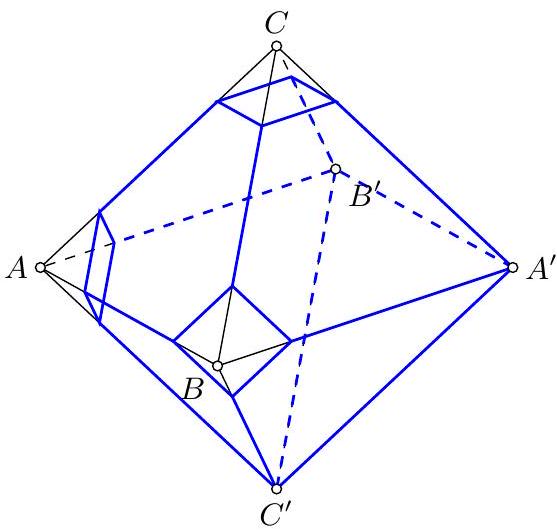
Since the number of planar boundary surfaces after the cuts should be 11, and since an octahedron is a convex body, at least 3 cuts must be made. The given octahedron has vertices \(A, ... | proof | Geometry | math-word-problem | Yes | Yes | olympiads | false |
Let $f(x)=|\log _{2}x+ax+b|$ where $(a > 0)$. Let $M_{t}(a,b)$ denote the maximum value of the function $y=f(x)$ on the interval $\left[t,t+1\right]$ where $(t > 0)$. If for any $b\in R$, $M_{t}(a,b)\geqslant a+1$, then the maximum value of the real number $t$ is ______. | Given that $f(x)=|\log _{2}x+ax+b|$ where $a > 0$, we are tasked with finding the maximum value of $t$ such that for any $b \in \mathbb{R}$, $M_{t}(a,b) \geqslant a+1$. Let's break down the solution step by step:
1. **Monotonicity of Functions**: Since $a > 0$, both $y=\log _{2}x$ and $y=ax+b$ are monotonically increa... | \frac{1}{2^{a+2}-1} | Algebra | math-word-problem | Yes | Yes | cn_k12 | false |
$30 、 \mathrm{~A}, \mathrm{~B}$ There is a tunnel between the two places. A car left from $\mathrm{B}$ heading towards $\mathrm{A}$ at 08:16, and a truck left from $\mathrm{A}$ heading towards $\mathrm{B}$ at 09:00. It is known that the truck and the car arrived at the two ends of the tunnel simultaneously, but the tru... | Analysis: The truck takes 200 minutes to complete the entire journey, while the car takes 160 minutes. The time ratio for the truck to the car to complete the entire journey $\mathrm{AB}$ is 5:4. Since both vehicles pass through the tunnel (with equal distance), the time ratio for passing through the tunnel is also 5:4... | 10:00 | Algebra | math-word-problem | Yes | Yes | olympiads | false |
In the faculty of reverse-engineering, 250 second-year students study numeric methods, 423 second-year students study automatic control of airborne vehicles, and 134 second-year students study them both. There are 673 students in the faculty. What percentage of the total students are second-year students? | To find the percentage of second-year students in the faculty, we first need to determine the total number of second-year students. Since some students study both numeric methods and automatic control of airborne vehicles, we cannot simply add the two numbers together. Instead, we use the principle of inclusion-exclusi... | 80.09\% | Combinatorics | math-word-problem | Yes | Yes | orca_math | true |
7. Given that the ellipse $C$ passes through the point $M(1,2)$, with two foci at $(0, \pm \sqrt{6})$, and $O$ is the origin, a line $l$ parallel to $OM$ intersects the ellipse $C$ at points $A$ and $B$. Then the maximum value of the area of $\triangle OAB$ is $\qquad$ | 7. 2 .
According to the problem, let $l_{A B}: y=2 x+m$.
The ellipse equation is $\frac{y^{2}}{8}+\frac{x^{2}}{2}=1$. By solving the system and eliminating $y$, we get $16 x^{2}+8 m x+2\left(m^{2}-8\right)=0$.
Let $A\left(x_{1}, y_{1}\right), B\left(x_{2}, y_{2}\right)$.
By Vieta's formulas, we have
$x_{1}+x_{2}=-\fra... | 2 | Geometry | math-word-problem | Yes | Yes | cn_contest | false |
In triangle $\triangle ABC$, the sides opposite to angles $A$, $B$, and $C$ are $a$, $b$, $c$ respectively, and $b=a(\sin C+\cos C)$.
$(1)$ Find angle $A$.
$(2)$ Among the three conditions: $\left(1\right)a=2$, $\left(2\right)B=\frac{π}{3}$, $\left(3\right)c=\sqrt{2}b$, choose two conditions that uniquely determine... | ### Solution:
#### Part (1): Finding angle $A$
Given $b=a(\sin C+\cos C)$, and by the Law of Sines, we have:
$$\frac{a}{\sin A}=\frac{b}{\sin B}=\frac{c}{\sin C}$$
This implies:
$$\sin B = \frac{b}{a} \sin A = (\sin C + \cos C) \sin A$$
Also, from the angle sum identity, we know:
$$\sin B = \sin (A + C) = \sin A... | S = 2 | Geometry | math-word-problem | Yes | Yes | cn_k12 | false |
Four, (20 points)
Let a parabola be intersected by a line with a fixed slope at $M_{1}, M_{2}$, and a point $P$ on the plane satisfies $2 \left|P M_{1}\right|^{2}+2\left|P M_{2}\right|^{2}-\left|M_{1} M_{2}\right|^{2}$ being a constant $a(a \geqslant 0)$. Find the locus of point $P$. | Let the midpoint of $M_{1} M_{2}$ be $O$.
Let $\angle M_{1} O P=\theta$.
Then $2\left|P M_{1}\right|^{2}+2\left|P M_{2}\right|^{2}-\left|M_{1} M_{2}\right|^{2}$
$$
\begin{aligned}
= & 2\left(|P O|^{2}+\left|O M_{1}\right|^{2}-2|P O| \cdot\left|O M_{1}\right| \cos \theta+|P O|^{2}+\left|O M_{2}\right|^{2}+2\right. \\
& ... | |PO|=\frac{\sqrt{}}{2} | Geometry | math-word-problem | Yes | Yes | olympiads | false |
A flagpole 18 meters high casts a shadow of certain length. If a building under similar conditions casts a shadow of length 70 meters and its height is 28 meters, what is the length of the shadow cast by the flagpole? | To solve this problem, we can use the concept of similar triangles. The flagpole and its shadow form a right triangle, as do the building and its shadow. Since the conditions are similar for both the flagpole and the building, the ratios of their corresponding sides (height to shadow length) will be equal.
Let's denot... | 45 | Geometry | math-word-problem | Yes | Yes | orca_math | true |
12. Prove: If $x^{2}-d y^{2}=c$ has one solution, then it must have infinitely many solutions, where $d>1$ is a non-square number, and $c$ is an integer. | 12. Let $x_{1}+y_{1} \sqrt{d}$ be a positive solution of $x^{2}-d y^{2}=1$, and $u_{1}, v_{1}$ be solutions of the original indeterminate equation. Then $\left(x_{1}+y_{1} \sqrt{d}\right)^{n}(u+v \sqrt{d})=\left(u_{n}+v_{n} \sqrt{d}\right)(n=1,2, \cdots)$ gives $u_{n}, v_{n}$ which are all solutions of the original equ... | proof | Number Theory | proof | Yes | Yes | number_theory | false |
Given $a$ is an integer, and point $A(a+1, 2a+6)$ is in the second quadrant, then the coordinates of point $A$ are. | Since point $A(a+1, 2a+6)$ is in the second quadrant,
we have the following conditions:
- $a+1 0$
Solving these inequalities, we get $-3 < a < -1$.
Since $a$ is an integer, we have $a = -2$.
Therefore, $a+1 = -2 + 1 = -1$ and $2a+6 = 2 \times (-2) + 6 = 2$.
Thus, the coordinates of point $A$ are $\boxed{(-1, 2)}... | (-1, 2) | Algebra | math-word-problem | Yes | Yes | cn_k12 | false |
There are 3 numbers such that the second is as much lesser than the third as the first is lesser than the second. The product of the two smaller numbers is 85, and the product of the two larger numbers is 115. The middle number is 10. What is the relationship between the first and second numbers, and the second and thi... | Let's denote the three numbers as A (the smallest), B (the middle), and C (the largest). We are given that B = 10.
We are told that the second number is as much lesser than the third as the first is lesser than the second. This can be written as:
B - A = C - B
We also know the product of the two smaller numbers (A a... | 1.5 | Algebra | math-word-problem | Yes | Yes | orca_math | true |
Which of the following operations is correct?
A: $(2\sqrt{3})^{2}=6$
B: $\sqrt{32}÷\sqrt{8}=2$
C: $\sqrt{2}+\sqrt{5}=\sqrt{7}$
D: $\sqrt{2}×2\sqrt{3}=2\sqrt{5}$ | To solve this problem, let's evaluate each option step by step:
**Option A:**
\[
(2\sqrt{3})^{2} = 2^2 \cdot (\sqrt{3})^2 = 4 \cdot 3 = 12
\]
Therefore, option A is incorrect because $(2\sqrt{3})^{2} = 12$, not $6$.
**Option B:**
\[
\sqrt{32} \div \sqrt{8} = \sqrt{\frac{32}{8}} = \sqrt{4} = 2
\]
Option B is correct b... | B | Algebra | MCQ | Yes | Yes | cn_k12 | false |
If triangle $DEF$ has sides of length $DE = 7,$ $DF = 9,$ and $EF = 8,$ calculate
\[
\frac{\cos \frac{D - E}{2}}{\sin \frac{F}{2}} - \frac{\sin \frac{D - E}{2}}{\cos \frac{F}{2}}.
\] | **Step 1:** Rewrite the expression using trigonometric identity:
\[
\frac{\cos \frac{D - E}{2} \cos \frac{F}{2} - \sin \frac{D - E}{2} \sin \frac{F}{2}}{\sin \frac{F}{2} \cos \frac{F}{2}} = \frac{\cos \left(\frac{D - E}{2} + \frac{F}{2}\right)}{\frac{1}{2} \sin F} = \frac{2 \cos \left(\frac{D - E + F}{2}\right)}{\sin F... | \frac{81}{28} | Geometry | math-word-problem | Yes | Yes | synthetic_math | true |
For a positive integer $n$ let $\sigma (n)$ be the sum of all its positive divisors.
Find all positive integers $n$ such that the number $\frac{\sigma (n)}{n + 1}$ is an integer. | null | null | Number Theory | math-word-problem | Yes | Yes | aops_forum | false |
A particle is moving randomly around a plane. It starts at $(0,0)$. Every second, it moves one unit randomly in a direction parallel to the $x$ or $y$ axis. At some time in the first hour, the particle was at the point $(2023,23)$. After $4092$ seconds, the particle is at $(x,y)$. Find the expected value of $x+y$.
[i]... | null | null | Combinatorics | math-word-problem | Yes | Yes | aops_forum | false |
Given the function $f(x)=\sin^2x+2\sqrt{3}\sin x\cos x+3\cos^2x-2$, where $x\in\mathbb{R}$, find:
$(1)$ The smallest positive period of the function $f(x)$ and its intervals of increase;
$(2)$ The range of the function $f(x)$ on the interval $\left[-\frac{\pi}{6}, \frac{\pi}{3}\right]$. | Solution:
$(1)$ We have $f(x)= \frac{1-\cos 2x}{2}+ \sqrt{3}\sin 2x+ \frac{3(1+\cos 2x)}{2}-2$
$= \sqrt{3}\sin 2x+\cos 2x=2\sin \left(2x+ \frac{\pi}{6}\right)$,
$\therefore T= \frac{2\pi}{2}=\pi$,
Let $-\frac{\pi}{2}+2k\pi \leqslant 2x+ \frac{\pi}{6} \leqslant \frac{\pi}{2}+2k\pi$, where $k\in\mathbb{Z}$,
Sol... | [-1,2] | Algebra | math-word-problem | Yes | Yes | cn_k12 | false |
A box with 6 billiard balls of equal weight weighs 1.82 kilograms (kg). Find the weight in kilograms (kg) of one billiard ball if the empty box weighs 0.5 kilograms (kg). | To find the weight of one billiard ball, we first need to find the total weight of all six billiard balls together. We do this by subtracting the weight of the empty box from the total weight of the box with the billiard balls.
Total weight of the box with billiard balls = 1.82 kg
Weight of the empty box = 0.5 kg
Tot... | 0.22 | Algebra | math-word-problem | Yes | Yes | orca_math | true |
[ Symmetric Strategy ]
20 points are arranged on a circle. On a turn, it is allowed to connect any two of them with a segment, without intersecting the segments previously drawn. The player who cannot make a move loses.
# | The first one wins. On the first move, he draws a chord, with 9 vertices on each side.
After that, for each move of the second, he responds with a similar move on the other side of this chord. | proof | Combinatorics | math-word-problem | Yes | Yes | olympiads | false |
Example 2 Let $a, b, c$ be non-negative real numbers, prove that:
$$
a^{4}+b^{4}+c^{4}-2\left(a^{2} b^{2}+a^{2} c^{2}+b^{2} c^{2}\right)+a^{2} b c+b^{2} a c+c^{2} a b \geqslant 0 .
$$ | Prove that after calculation, the left side of the original inequality is
$$
(a+b+c)[a b c-(a+b-c)(b+c-a)(c+a-b)] .
$$
Since $a, b, c \geqslant 0$, at most one of the three numbers $a+b-c, b+c-a, c+a-b$ can be negative (otherwise a contradiction arises). If one of the above three numbers is negative, then the original... | proof | Inequalities | proof | Yes | Yes | olympiads | false |
10.6. In the cells of a $9 \times 9$ table, all natural numbers from 1 to 81 were placed. The products of the numbers in each row of the table were calculated, resulting in a set of nine numbers. Then, the products of the numbers in each column of the table were calculated, also resulting in a set of nine numbers. Coul... | Answer: No, they could not.
Solution. Each of the products of the numbers in the nine rows of the table can be represented as a product of prime factors. Let's list all prime numbers greater than 40 but less than 81: 41, 43, 47, 53, 59, 61, 67, 71, 73, 79. Note that each of these ten numbers can only appear in one of ... | proof | Combinatorics | math-word-problem | Yes | Yes | olympiads | false |
Given $b \frac {b}{d}$
C: $a+c > b+d$
D: $a-c > b-d$ | A: Since $b 0$, $ac ac$, so option A is incorrect.
B: Given $d 0$,
thus $\frac {a}{c} b+d$, so option C is correct.
D: Since $d -c$, and since $a > b$,
we have $a-d > b-c$, so option D is incorrect.
Therefore, the correct answer is $\boxed{\text{C}}$.
This problem tests the understanding of the properties of i... | \text{C} | Inequalities | MCQ | Incomplete | Yes | cn_k12 | false |
Given circle $C$: $(x-a)^2+(y-a)^2=1$ $(a > 0)$ intersects with line $y=3x$ at points $P$ and $Q$. Find the value of the real number $a$ when the area of $\triangle CPQ$ is maximized. | The center of circle $C$: $(x-a)^2+(y-a)^2=1$ $(a > 0)$ is $(a,a)$, and its radius is $\sqrt{2}$.
The distance $d$ from the center to the line $y=3x$ is given by $d=\frac{|2-a|}{\sqrt{5}}=\frac{a}{\sqrt{5}}$.
The length of the chord is given by $\sqrt{({\sqrt{2}})^2-(\frac{a}{\sqrt{5}})^2}=\sqrt{2-\frac{a^2}{5}}$.
T... | \sqrt{5} | Geometry | math-word-problem | Yes | Yes | cn_k12 | false |
If the parabola $y=x^{2}-1$ is shifted $3$ units upwards, the resulting parabola is denoted as $G$. The functional relationship between $y$ and $x$ for the parabola $G$ is:
A: $y=\left(x-3\right)^{2}-1$
B: $y=\left(x+3\right)^{2}-1$
C: $y=x^{2}-4$
D: $y=x^{2}+2$ | To solve this problem, let's start with the given equation of the parabola, which is $y = x^2 - 1$. When a graph is shifted vertically, the $y$-coordinate of every point on the graph is increased or decreased by the amount of the shift. Since we're shifting the parabola $3$ units upwards, we add $3$ to the $y$-value of... | D | Algebra | MCQ | Yes | Yes | cn_k12 | false |
If the line $\frac{x}{a} + \frac{y}{b} =1 (a > 0, b > 0)$ passes through the point $(1,1)$, what is the minimum value of $(a+b)$?
A: $3$
B: $4$
C: $5$
D: $6$ | This problem involves the properties of basic inequalities. The key to solving it is to find $\frac{1}{a} + \frac{1}{b}=1$, which leads to $a+b = (\frac{1}{a} + \frac{1}{b})(a+b)$.
Substitute the point $(1,1)$ into the line equation to get: $\frac{1}{a} + \frac{1}{b}=1$. Thus, $a+b = (\frac{1}{a} + \frac{1}{b})(a+b)$.... | 4 | Algebra | MCQ | Yes | Yes | cn_k12 | false |
Every day Daniel drives 120 miles back from work. On Sunday, Daniel drove all the way back from work at a constant speed of x miles per hour. On Monday, Daniel drove the first 32 miles back from work at a certain speed, and the rest of the way at (x/2) miles per hour. The time it took Daniel to drive back from work on ... | Let's denote the speed Daniel drove the first 32 miles on Monday as y miles per hour.
On Sunday, Daniel drove 120 miles at a constant speed of x miles per hour. The time it took him to drive back from work on Sunday (T_sunday) can be calculated as:
\[ T_{sunday} = \frac{120}{x} \]
On Monday, Daniel drove the first 32... | 2:1 | Algebra | math-word-problem | Yes | Yes | orca_math | true |
Jillian had 80 oranges which she had bought to give to her friends. She divided each orange into equal pieces for each friend to get four pieces. There were 200 friends. Into how many pieces did Jillian divide each orange? | If Jillian had 80 oranges and each friend was to get 4 pieces, we need to find out the total number of pieces that all the friends would get.
Since there were 200 friends and each was to get 4 pieces, the total number of pieces needed would be:
200 friends * 4 pieces/friend = 800 pieces
Now, we need to divide these 8... | 10 | Logic and Puzzles | math-word-problem | Yes | Yes | orca_math | true |
Given the function $f(x)=|2x-a|+|2x+3|$, $g(x)=|2x-3|+2$.
(Ⅰ) Solve the inequality $|g(x)| < 5$;
(Ⅱ) If for any $x_{1} \in \mathbb{R}$, there exists $x_{2} \in \mathbb{R}$ such that $f(x_{1})=g(x_{2})$ holds, find the range of the real number $a$. | Solution:
(Ⅰ) From $|2x-3|+2 < 5$, we get: $|2x-3| < 3$,
Thus, $-3 < 2x-3 < 3$, solving this yields: $0 < x < 3$;
(Ⅱ) According to the problem, we know $\{y|y=f(x)\} \subseteq \{y|y=g(x)\}$
Also, $f(x)=|2x-a|+|2x+3| \geqslant |(2x-a)-(2x+3)|=|a+3|$,
$g(x)=|2x-3|+2 \geqslant 2$,
Therefore, $|a+3| \geqslant 2 \Righ... | a \geqslant -1 \text{ or } a \leqslant -5 | Algebra | math-word-problem | Yes | Yes | cn_k12 | false |
3. The number of positive integer solutions to the equation $a b c=2(a+b+c)$ is ( ).
(A) 3
(B) 6
(C) 12
(D) 15 | 3. D.
Notice that the original equation is symmetric with respect to $a$, $b$, and $c$.
Without loss of generality, assume $a \leqslant b \leqslant c$. Then $a+b \leqslant 2 c$.
Substituting into the original equation, we get $2 < a b \leqslant 6$.
When $a b=3$, we get
$$
(a, b, c)=(1,3,8) \text {; }
$$
When $a b=4$,... | D | Number Theory | MCQ | Yes | Yes | cn_contest | false |
(Gregory Galperin) A [square](https://artofproblemsolving.com/wiki/index.php/Square) grid on the [Euclidean plane](https://artofproblemsolving.com/wiki/index.php/Cartesian_plane) consists of all [points](https://artofproblemsolving.com/wiki/index.php/Point) $(m,n)$, where $m$ and $n$ are [integers](https://artofproblem... | Solution 1
Lemma. Among 3 [tangent](https://artofproblemsolving.com/wiki/index.php/Tangent) circles with radius greater than or equal to 5, one can always fit a circle with radius greater than $\frac{1}{\sqrt{2}}$ between those 3 circles.
Proof. [Descartes' Circle Theorem](https://artofproblemsolving.com/wiki/index.ph... | proof | Geometry | proof | Yes | Incomplete | amc_aime | false |
Given the function $f(x)=a^{x}$ where $a>0$ and $a\neq 1$ passes through the point $(2, \frac{1}{9})$.
$(1)$ Find the value of $a$.
$(2)$ Compare $f(2)$ and $f(b^{2}+2)$.
$(3)$ Find the range of the function $f(x)={a}^{{x}^{2}-2x}$ for $x\geqslant 0$. | ### Step-by-step Solution:
**Part (1): Finding the value of $a$**
Given the function $f(x) = a^x$ and it passes through the point $(2, \frac{1}{9})$, we can substitute $x=2$ and $f(x)=\frac{1}{9}$ into the function. This gives us:
\[
a^2 = \frac{1}{9}
\]
Taking the square root of both sides (and noting $a > 0$), we f... | (0,3] | Algebra | math-word-problem | Yes | Yes | cn_k12 | false |
Arrange 3 boys and 4 girls in a row. Calculate the number of different arrangements under the following conditions:
(1) Person A and Person B must stand at the two ends;
(2) All boys must stand together;
(3) No two boys stand next to each other;
(4) Exactly one person stands between Person A and Person B. | (1) If Person A and Person B must stand at the two ends, we first arrange Person A and Person B at the ends, which can be done in $A_2^2=2$ ways.
The remaining 5 people are arranged in the 5 positions in the middle, which can be done in $A_5^5=120$ ways.
By the multiplication principle, the total number of differen... | 1200 | Combinatorics | math-word-problem | Yes | Yes | cn_k12 | false |
# 9. Problem 9
Thirty-nine students from seven classes came up with 60 problems, and students from the same class came up with the same number of problems (not equal to zero), while students from different classes came up with different numbers of problems. How many students came up with one problem? | # 9. Problem 9
Thirty-nine students from seven classes came up with 60 problems, and students from the same class came up with the same number of problems (not equal to zero), while students from different classes came up with different numbers of problems. How many students came up with one problem?
## Answer:
33 | 33 | Number Theory | math-word-problem | Yes | Problem not solved | olympiads | false |
2. For the quadratic equation $x^{2} + p x + q = 0$, the coefficients $p$ and $q$ were increased by one. This operation was repeated nine times. Could it be that each of the ten resulting equations has integer roots? | 2. For example, the equation $x^{2}+3 x+2=0$ works. Indeed, using the converse of Vieta's theorem, it is easy to understand that the roots of the equation $x^{2}+(q+1) x+q=0$ are the numbers -1 and $-q$. See also the solution to problem 1 for grade 8 and the comments on it. | notfound | Algebra | math-word-problem | Yes | Yes | olympiads | false |
Given $$\overrightarrow{a} = (2, 1)$$, and $$\overrightarrow{b} = (1, -3)$$, then $$\overrightarrow{a} + 2\overrightarrow{b} = \_\_\_\_\_\_$$. | Since $$\overrightarrow{a} = (2, 1)$$, and $$\overrightarrow{b} = (1, -3)$$,
then $$\overrightarrow{a} + 2\overrightarrow{b} = (2, 1) + 2(1, -3)$$
$$= (2 + 2, 1 - 6)$$
$$= (4, -5)$$.
Therefore, the answer is: $(4, -5)$.
This problem is solved by applying the rules for the arithmetic operations of plane vectors.... | (4, -5) | Algebra | math-word-problem | Yes | Yes | cn_k12 | false |
If the solution set of the inequality $ax^{2}+5x-2 > 0$ is $\left\{ x|\dfrac{1}{2} 0$. | (1) Since the solution set of $ax^{2}+5x-2 > 0$ is $\left\{x \left| \dfrac{1}{2} 0$ can be rewritten as $-2x^{2}-5x+4-1 > 0$,
Which simplifies to $2x^{2}+5x-3 < 0$. Factoring, we get $(x+3)(2x-1) < 0$.
Solving this inequality, we find that the solution set is $\left\{x | -3 < x < \dfrac{1}{2} \right\}$.
So, the sol... | \left\{x | -3 < x < \dfrac{1}{2} \right\} | Inequalities | math-word-problem | Incomplete | Yes | cn_k12 | false |
The stem-and-leaf plot below shows the scores given by seven judges to a teacher in the 2010 "Best Teacher" selection event in our city. After removing the highest and the lowest scores, the average and variance of the remaining data are respectively ( )
A: 84, 4.84
B: 84, 1.6
C: 85, 1.6
D: 85, 4 | Since the specific stem-and-leaf plot is not provided, we proceed directly to the calculation based on the typical process of handling such a problem.
1. **Identify the Scores**: Normally, the stem-and-leaf plot would list scores in a compact form. Assume the scores, after removing the highest and lowest, are $x_1, x_... | \text{The correct answer cannot be determined without the specific stem-and-leaf plot data.} | Algebra | MCQ | Yes | Incomplete | cn_k12 | false |
the age of somu is one - third his father ' s . 5 years back he was one - fifth of his father ' s age . what is his persent age ? | Let's denote Somu's current age as S and his father's current age as F.
According to the first statement, Somu's age is one-third of his father's age. So we can write the equation:
S = (1/3) * F (Equation 1)
According to the second statement, 5 years ago, Somu was one-fifth of his father's age. So we can write the ... | 30 | Algebra | math-word-problem | Yes | Yes | orca_math | true |
Calculate the greatest common divisor of $7654321$ and $6789012$. | To find the gcd of $7654321$ and $6789012$, we can apply the Euclidean algorithm:
\[
\text{gcd}(7654321,6789012) = \text{gcd}(7654321 - 6789012, 6789012) = \text{gcd}(865309, 6789012)
\]
Now we proceed by successively applying the Euclidean algorithm steps:
\[
\text{gcd}(865309, 6789012) = \text{gcd}(6789012 \mod 86530... | 3 | Number Theory | math-word-problem | Yes | Yes | synthetic_math | true |
There are 10 different products, among which 4 are defective and 6 are non-defective. Each time one product is tested until all 4 defective products are identified. If the last defective product is discovered exactly on the fifth test, the probability of this situation occurring is \_\_\_\_\_\_. | Given there are 10 different products, including 4 defective and 6 non-defective ones. Each product is tested one by one until all 4 defective products are identified. The event where the last defective product is exactly discovered on the fifth test is considered.
The total number of basic events is $n= A_{10}^{5}$.
... | \dfrac{2}{105} | Combinatorics | math-word-problem | Yes | Yes | cn_k12 | false |
Bryan has some 3 cent stamps and some 4 cent stamps. What is the least number of stamps he can combine so the value of the stamps is 30 cents? | Let $c$ and $f$ be the number of 3 cent stamps and 4 cent stamps that Bryan can use, respectively. We need to solve $3c + 4f = 30$.
1. **Finding integer solutions**: We start by checking if $f$ can be a whole number when $c$ takes on various values.
2. **Minimizing $c + f$**: We test different values for $c$ and find... | 8 | Number Theory | math-word-problem | Yes | Yes | synthetic_math | true |
In a competition, the probabilities of athlete A winning against athletes B and C are 0.8 and 0.7, respectively, with no ties in the matches. If athlete A competes against athletes B and C in separate matches, the probability of athlete A achieving one win and one loss is. | According to the problem, there are two scenarios in which athlete A achieves one win and one loss:
- A wins against B and loses against C, with a probability of: $0.8 \times 0.3 = 0.24$;
- A wins against C and loses against B, with a probability of: $0.2 \times 0.7 = 0.14$;
Therefore, the probability of athlete A ach... | 0.38 | Combinatorics | math-word-problem | Yes | Yes | cn_k12 | false |
In a 50-question test with two marks for each question, Meghan scored some marks less than her friend Jose, who scored 40 more marks than their friend Alisson. Jose got 5 questions wrong. The total score for the three in the test combined is 210. How many marks less did Meghan score compared to Jose? | Let's denote Meghan's score as M, Jose's score as J, and Alisson's score as A.
From the information given, we know that:
1. J = A + 40 (Jose scored 40 more marks than Alisson)
2. M + J + A = 210 (The total score for the three combined is 210)
3. Each question is worth 2 marks, so the maximum score for the test is 50 *... | 20 | Algebra | math-word-problem | Yes | Yes | orca_math | true |
In the plane rectangular coordinate system $xOy$, the parabola $y=x^{2}+ax+b$ passes through points $A(-2,0)$ and $B(-1,3)$.
$(1)$ Find the analytical expression of the parabola.
$(2)$ Find the coordinates of the vertex $C$ of the parabola. | To solve this problem, we will proceed in a step-by-step manner, closely following the solution provided.
### Part 1: Finding the Analytical Expression of the Parabola
Given that the parabola $y = x^2 + ax + b$ passes through points $A(-2, 0)$ and $B(-1, 3)$, we can substitute these points into the equation to form a... | (-3, -1) | Algebra | math-word-problem | Yes | Yes | cn_k12 | false |
6.28. A line passing through the center of mass of a tetrahedron and the center of its inscribed sphere intersects the edges $A B$ and $C D$. Prove that $A C = B D$ and $A D = B C$. | 6.28. Let $K$ and $L$ be the midpoints of the edges $AB$ and $CD$. The center of mass of the tetrahedron lies on the line $KL$, so the center of the inscribed sphere also lies on the line $KL$. Consequently, when projecting onto a plane perpendicular to $CD$, the segment $KL$ transforms into the bisector of the triangl... | proof | Geometry | proof | Yes | Yes | olympiads | false |
Determine the range of the function $g(x) = \frac{1}{x^2} + 5$. | The function $g(x) = \frac{1}{x^2} + 5$ is defined for all $x \neq 0$. Note that $\frac{1}{x^2} > 0$ for all nonzero $x$, which implies $g(x) = \frac{1}{x^2} + 5 > 5$. Now, consider any number $a > 5$. We set
\[
\frac{1}{x^2} + 5 = a,
\]
which simplifies to
\[
\frac{1}{x^2} = a - 5.
\]
Since $a > 5$, $a - 5 > 0$. Let ... | (5, \infty) | Algebra | math-word-problem | Yes | Yes | synthetic_math | true |
Two trains of equal length are running on parallel lines in the same direction at some speed and 36 km/hr. The faster train passes the slower train in 36 seconds. The length of each train is 65 meters. What is the speed of the faster train? | Let's denote the speed of the faster train as V km/hr. Since the trains are of equal length (65 meters each), the faster train needs to cover the length of both trains to completely pass the slower train.
The relative speed at which the faster train is overtaking the slower train is the difference in their speeds, whi... | 49 | Algebra | math-word-problem | Yes | Yes | orca_math | true |
5. Find all possible triples of positive integers, $a, b, c$ so that $\frac{a+1}{b}, \frac{b+1}{c}$, and $\frac{c+1}{a}$ are also integers. | so $a$ in $\{c-2, c-1, c, c+1\}$. Now a case bash yields 10 solutions:
$$
(1,2,3),(3,1,2),(2,3,1),(3,4,5),(5,3,4),(4,5,3),(2,1,1),(1,2,1),(1,1,2),(1,1,1) \text {. }
$$ | (1,2,3),(3,1,2),(2,3,1),(3,4,5),(5,3,4),(4,5,3),(2,1,1),(1,2,1),(1,1,2),(1,1,1) | Number Theory | math-word-problem | Yes | Yes | olympiads | false |
Brady and Dwayne have varied monthly incomes due to the nature of their jobs. The table below shows their monthly incomes:
Month | Brady's Income($) | Dwayne's Income($)
----------------------------------------------
January | 150 | 100
February| 200 | 150
March | ... | To calculate their combined annual income after deducting the expenses, we first need to calculate their individual annual incomes and then subtract their respective expenses.
Brady's annual income before expenses:
= (150 + 200 + 250 + 300 + 200 + 150 + 180 + 220 + 240 + 270 + 300 + 350) dollars
= 2510 dollars
Dwayne... | 3930 | Algebra | math-word-problem | Yes | Yes | orca_math | true |
$8.1949^{1999}$ The last two digits are $(\quad)$.
(A) 49
(B) 81
(C) 01
(D) 69 | 8. A | A | Number Theory | MCQ | Yes | Problem not solved | cn_contest | false |
If circle C is symmetric to circle D: $(x+2)^2+(y-6)^2=1$ with respect to line $l: x-y+5=0$, then the equation of circle C is ( )
A: $(x+2)^2+(y-6)^2=1$
B: $(x-6)^2+(y+2)^2=1$
C: $(x-1)^2+(y-3)^2=1$
D: $(x+1)^2+(y+3)^2=1$ | Let's assume the center of circle D, $(-2, 6)$, is symmetric to the point $(m, n)$ with respect to the line $x-y+5=0$,
Then, by solving the system of equations $$\begin{cases} \frac {n-6}{m+2} \cdot 1 = -1 \\ \frac {m+2}{2} - \frac {n-6}{2} + 5 = 0 \end{cases}$$ we find $m=1$ and $n=3$. Therefore, the center of the sy... | C | Geometry | MCQ | Yes | Yes | cn_k12 | false |
Given that the sequence \\(\{a_n\}\) is a geometric sequence.
\\((1)\\) If \\(a_1+a_2+a_3=21\\) and \\(a_1a_2a_3=216\\), find \\(a_n\\);
\\((2)\\) If \\(a_3a_5=18\\) and \\(a_4a_8=72\\), find the common ratio \\(q\\). | Solution:
(1) Since \\(a_1a_2a_3 = a_2^3 = 216\\),
it follows that \\(a_2 = 6\\),
and thus \\(a_1a_3 = 36\\).
Also, since \\(a_1 + a_3 = 21 - a_2 = 15\\),
\\(a_1\\) and \\(a_3\\) are the roots of the equation \\(x^2 - 15x + 36 = 0\\), which are 3 and 12,
When \\(a_1 = 3\\), \\(q = \frac{a_2}{a_1} = 2\\), \\(a_n ... | q = \pm \sqrt{2} | Algebra | math-word-problem | Yes | Yes | cn_k12 | false |
Let $f:\mathbb{Q}\rightarrow \mathbb{Q}$ a monotonic bijective function.
a)Prove that there exist a unique continuous function $F:\mathbb{R}\rightarrow \mathbb{R}$ such that $F(x)=f(x),\ (\forall)x\in \mathbb{Q}$.
b)Give an example of a non-injective polynomial function $G:\mathbb{R}\rightarrow \mathbb{R}$ such that ... | ### Part (a)
1. **Assume \( f \) is increasing**: Let \( f: \mathbb{Q} \rightarrow \mathbb{Q} \) be a monotonic bijective function. Without loss of generality, assume \( f \) is increasing.
2. **Define \( F \) for irrational numbers**: For an irrational number \( a \in \mathbb{R} \setminus \mathbb{Q} \), define:
... | G(x) = x^3 - x | Other | proof | Yes | Yes | aops_forum | false |
The average of 10 numbers is a certain value. In those 10, at least 1 number may be greater than or equal to zero. What is the average of these 10 numbers? | The average of 10 numbers is calculated by summing all the numbers and then dividing by 10. If the average is a certain value, let's call it "A", then the sum of all 10 numbers is 10 * A.
The condition that at least 1 number may be greater than or equal to zero does not change the average. The average remains "A" rega... | 10 | Algebra | math-word-problem | Incomplete | Yes | orca_math | true |
Subsets and Splits
No community queries yet
The top public SQL queries from the community will appear here once available.