
instruction_seed stringlengths 2 10.7k | solution stringlengths 0 10.8k ⌀ | answer stringlengths 0 575 ⌀ | problem_type stringclasses 9
values | question_type stringclasses 5
values | problem_is_valid stringclasses 5
values | solution_is_valid stringclasses 4
values | source stringclasses 11
values | synthetic bool 2
classes |
|---|---|---|---|---|---|---|---|---|
A certain city is planning to organize a basketball league in a round-robin format (each pair of teams plays one game). They plan to arrange $45$ games. If there are $x$ teams participating in the league, which of the following equations is correct?
A: $x(x-1)=45$
B: $\frac{1}{2}x(x-1)=45$
C: $x(x+1)=45$
D: $\frac{... | In a round-robin format, each team plays every other team exactly once. If there are $x$ teams, then each team will play $x-1$ games (since it doesn't play against itself). However, since this counts each game twice (once for each team involved), the total number of games is half of $x(x-1)$. Therefore, the equation re... | B | Combinatorics | MCQ | Yes | Yes | cn_k12 | false |
A right square pyramid with base edges of length $12$ units each and slant edges of length $15$ units each is cut by a plane that is parallel to its base and $4$ units above its base. What is the volume, in cubic units, of the new pyramid that is cut off by this plane? | Let the original pyramid be $OABCD$ with $O$ as the apex and $ABCD$ as the base.
1. **Finding the height of the original pyramid, $OH$:**
Since $ABCD$ is a square with side $12$, the diagonal $AC = 12\sqrt{2}$.
By Pythagorean theorem in $\triangle OAC$, where $OC$ is the slant height (15 units):
\[
OC^2 = ... | \frac{2000}{27} \text{ cubic units} | Geometry | math-word-problem | Yes | Yes | synthetic_math | true |
Ben decides to mix paint so that the ratio of yellow paint to green paint is 4 to 3. If he wants to make 42 cans of this mixture and all cans contain the same volume, how many cans of yellow paint will he need? | - The ratio of yellow paint to green paint is 4 to 3. The total parts of paint in the mixture are $4+3=7$ parts.
- Given that the amount of yellow paint is 4 parts out of 7, the fraction of yellow paint in the mixture is $\frac{4}{7}$.
- The total number of cans is 42. Therefore, the number of cans of yellow paint Ben ... | 24 | Algebra | math-word-problem | Yes | Yes | synthetic_math | true |
A domino is a rectangular tile composed of two squares. Each square has an integer from 0-12, and each integer from 0-12 is paired with every integer from 0-12 exactly once in a complete set. A $\textit{double}$ is a domino that has the same integer on both squares. What is the probability that a domino randomly select... | To calculate this probability, we need to count the total number of pairings and the number of double pairings:
- Each integer from 0 to 12 (13 integers in total) can pair with every other integer including itself. For each integer, there are 13 possible pairings.
- Since each pair (e.g., 0 and 1, or 1 and 0) is unique... | \frac{13}{91} | Combinatorics | math-word-problem | Yes | Yes | synthetic_math | true |
The ratio of butter:flour:sugar in a recipe is 1:6:4. If 10 cups of sugar are used in this recipe, how many total cups of these three ingredients will be used? | Given the ratio of butter:flour:sugar = 1:6:4, the total number of parts in the ratio is 1 + 6 + 4 = 11 parts.
If 10 cups of sugar are used, corresponding to 4 parts, then each part represents:
\[ \text{Cups per part} = \frac{10 \text{ cups of sugar}}{4} = 2.5 \text{ cups per part} \]
Calculating for butter and flour... | 27.5 | Algebra | math-word-problem | Yes | Yes | synthetic_math | true |
Given a trapezoid's two legs' lines, one diagonal's endpoints, and the direction of the other diagonal. Construct the trapezoid. | Suppose the lines of the two non-parallel sides of the trapezoid intersect, and we denote their intersection point by $O$, and the endpoints of the given diagonal by $E$ and $F$.
Draw a line through point $E$ parallel to the given direction, and let this line intersect the line $O F$ at point $P$. The two vertices of ... | OG=\sqrt{OP\cdotOF} | Geometry | math-word-problem | Incomplete | Yes | olympiads | false |
Let the sequence $\{a_n\}$ be a monotonically increasing arithmetic sequence. The sum of the first three terms is 12, and the product of the first three terms is 48. Then $a_1$ = ( )
A: 1
B: 2
C: ±2
D: 4 | Since $\{a_n\}$ is a monotonically increasing arithmetic sequence, and the sum of the first three terms is 12,
we have $3a_2=12$, solving this gives $a_2=4$. Let the common difference be $d$, then $d>0$.
Therefore, $a_1=4-d$, $a_3=4+d$,
Since the product of the first three terms is 48,
we have $4(4-d)(4+d)=48$,... | \text{B} | Algebra | MCQ | Yes | Yes | cn_k12 | false |
24. Define $\operatorname{gcd}(a, b)$ as the greatest common divisor of integers $a$ and $b$. Given that $n$ is the smallest positive integer greater than 1000 and satisfies:
$$
\begin{array}{l}
\operatorname{gcd}(63, n+120)=21, \\
\operatorname{gcd}(n+63,120)=60 .
\end{array}
$$
Then the sum of the digits of $n$ is (... | 24. C.
$$
\begin{array}{l}
\text { Given } \operatorname{gcd}(63, n+120)=21 \\
\Rightarrow 21 \text { divides } (n+120), 63 \text { does not divide } (n+120) \\
\Rightarrow n \equiv 6(\bmod 21) .
\end{array}
$$
Given $\operatorname{gcd}(n+63,120)=60$
$$
\begin{array}{l}
\Rightarrow 60 \text { divides } (n+63), 120 \te... | 18 | Number Theory | MCQ | Yes | Yes | olympiads | false |
Find $t$ and $p$ knowing that $C_{n+1}^{m+1}: C_{n+1}^{m}: C_{n+1}^{m-1}=5: 5: 3$.
# | From the condition, it is clear that $C_{n+1}^{m+1}=C_{n+1}^{m}$, therefore, $m+1=n+1-m$, which means $n=2 m$.
In addition, $\frac{C_{n+1}^{m}}{C_{n+1}^{m-1}}=\frac{n-m+2}{m}=\frac{m+2}{m}=\frac{5}{3}$, so $m=3$.
## Answer
$m=3, n=6$. | =3,n=6 | Combinatorics | math-word-problem | Yes | Yes | olympiads | false |
Before getting to work, Jess has several errands to run. Jess has to walk 24 blocks to the post office. From there, she will walk 18 blocks to the store, 15 blocks to the gallery, and another 14 blocks to the library. After completing all her errands, Jess will walk the final 22 blocks to arrive at work. If Jess has al... | Jess has already walked 9 blocks, so we need to calculate the total number of blocks she has to walk for all her errands and then subtract the 9 blocks she has already walked.
The total number of blocks for all her errands is:
24 (to the post office) + 18 (to the store) + 15 (to the gallery) + 14 (to the library) + 22... | 84 | Logic and Puzzles | math-word-problem | Yes | Yes | orca_math | true |
Compute
\[
\sum_{j = 0}^\infty \sum_{k = 0}^\infty 2^{-2k - j - (k + j)^2}.
\] | Expanding the expression within the exponent, we get:
\begin{align*}
2k + j + (k + j)^2 &= 2k + j + k^2 + 2kj + j^2 \\
&= k^2 + 2k(1 + j) + j^2 + j \\
&= k^2 + 2kj + 2k + j^2 + j.
\end{align*}
We analyze the parity (even or odd nature) of this expression:
- \(k^2\) and \(j^2\) are always even.
- \(2kj\) and \(2k\) are ... | \frac{4}{3} | Algebra | math-word-problem | Yes | Yes | synthetic_math | true |
Find the equation of the directrix of the parabola $x = -\frac{1}{4} y^2$. | Firstly, identify that the parabola $x = -\frac{1}{4} y^2$ opens leftward and is symmetric about the y-axis. Assume the focus lies on the x-axis at some point $(f, 0)$, and let the equation of the directrix be $x = d$.
For any point $(x, y)$ on the parabola, set its coordinates to $\left(-\frac{1}{4}y^2, y\right)$.
Th... | x = 1 | Algebra | math-word-problem | Yes | Yes | synthetic_math | true |
The swimming club went to a swim meet in another town. They took 2 cars and some vans. There were 5 people in each car and 3 people in each van. Each car can hold a maximum of 6 people and each van can hold a maximum of 8 people. They could have taken 17 more people with the swim team. How many vans did they take? | Let's denote the number of vans they took as \( v \).
Each car had 5 people, and there were 2 cars, so that's \( 5 \times 2 = 10 \) people in cars.
Each van had 3 people, and there were \( v \) vans, so that's \( 3 \times v = 3v \) people in vans.
The total number of people they took is the sum of the people in cars... | 3 | Algebra | math-word-problem | Yes | Yes | orca_math | true |
There are 3 numbers such that the second is as much lesser than the third as the first is lesser than the second. The product of the two smaller numbers is 85, and the product of the two larger numbers is 115. What is the middle number? | Let's denote the three numbers as A, B, and C, where A < B < C.
From the given information, we have:
1. B - C = A - B
2. A * B = 85
3. B * C = 115
From equation 1, we can express A and C in terms of B:
A = 2B - C
Now, let's substitute A from equation 2 into the expression we just found:
(2B - C) * B = 85
We can ... | 10 | Algebra | math-word-problem | Yes | Yes | orca_math | true |
For the set of data \(3, x, 4, 5, 8\), the mean is \(5\). What are the mode and the median of this data set?
A: \(4, 5\)
B: \(5, 5\)
C: \(5, 6\)
D: \(5, 8\) | Since the average (mean) of the data set \(3, x, 4, 5, 8\) is given as \(5\), we have:
\[
\frac{3+x+4+5+8}{5} = 5
\]
Solving for \(x\), we get:
\[
3 + x + 4 + 5 + 8 = 25
\]
\[
x + 20 = 25
\]
\[
x = 5
\]
Now, arranging the data set in ascending order, we have:
\[
3, 4, 5, 5, 8
\]
The median, which is the middle ... | \text{The correct answer is B: } (5, 5) | Algebra | MCQ | Yes | Yes | cn_k12 | false |
Given the function $f(x) = 3 - 2a - 2a\cos x - 2\sin^2x$,
(1) Find the expression for the minimum value $g(a)$ of the function $f(x)$;
(2) Find the value(s) of $a$ that make $g(a) = \frac{5}{2}$, and find the range of $k$ that makes $f(x) - k \leq 0$ hold true for all $x \in \mathbb{R}$ when $a$ takes these values. | (1) $f(x) = 3 - 2a - 2a\cos x - 2(1 - \cos^2x) = 2\cos^2x - 2a\cos x - 2a + 1 = 2(\cos x - \frac{a}{2})^2 - (\frac{1}{2}a^2 + 2a - 1)$.
Let $t = \cos x$, then $h(t) = 2(t - \frac{a}{2})^2 - (\frac{1}{2}a^2 + 2a - 1)$.
When $\frac{a}{2} \leq -1$, i.e., $a \leq -2$, $g(a) = h(-1) = 3$;
When $-1 < \frac{a}{2} < 1$, i.e... | k \geq 7 | Algebra | math-word-problem | Yes | Yes | cn_k12 | false |
James has 20 years of experience. 8 years ago John had twice as much experience as James. Mike started when John had 16 years of experience. What is their combined experience? | Let's break it down step by step:
1. James currently has 20 years of experience.
2. 8 years ago, James would have had 20 - 8 = 12 years of experience.
3. At that time, John had twice as much experience as James, so John had 2 * 12 = 24 years of experience 8 years ago.
4. Therefore, John's current experience would b... | 68 | Algebra | math-word-problem | Yes | Yes | orca_math | true |
Given that the graph of the power function $f(x)$ passes through the point $(2, 4)$, the expression for $f(x)$ is ( )
A: $f(x) = 2$
B: $f(x) = x^2$
C: $f(x) = 2^x$
D: $f(x) = x + 2$ | Let $f(x) = x^\alpha$, thus $f(2) = 2^\alpha = 4$, so $\alpha = 2$
Therefore, $f(x) = x^2$. Hence, the correct choice is $\boxed{B}$. | B | Algebra | MCQ | Yes | Yes | cn_k12 | false |
Shanna planted 6 tomato plants, 2 eggplant plants, and 4 pepper plants in her summer garden. Half of her tomato plants and one pepper plant died. The remaining plants each gave her 7 vegetables. How many vegetables did she have in all to harvest? | Shanna started with 6 tomato plants, but half of them died, so she has 6 / 2 = 3 tomato plants left.
She also had 4 pepper plants, but one died, so she has 4 - 1 = 3 pepper plants left.
She had 2 eggplant plants, and none of them died, so she still has 2 eggplant plants.
Now, we add up the remaining plants: 3 tomato... | 56 | Logic and Puzzles | math-word-problem | Yes | Yes | orca_math | true |
If $128^3 = 16^y$, what is the value of $2^{-3y}$? Express your answer as a common fraction. | Noticing that both 128 and 16 are powers of 2, we can rewrite the expression as $\left(2^7\right)^3 = \left(2^4\right)^y$. Simplifying, we get
\begin{align*}
\left(2^7\right)^3 &= \left(2^4\right)^y \\
2^{7 \cdot 3} &= 2^{4y} \\
2^{21} &= 2^{4y}.
\end{align*}
Equating the exponents gives $21 = 4y$. Solving for $y$, we... | \frac{1}{2^{15.75}} | Algebra | math-word-problem | Yes | Incomplete | synthetic_math | true |

In triangle $ABC$, the angles are known: $\angle A=45^{\circ}, \angle B=15^{\circ}$. On the extension of side $AC$ beyond point $C$, point $M$ is taken such that $CM=2AC$. Find $\angle AMB$. | Mark off on segment $C B$ a segment $C K$ equal to segment $A C$.
## Solution
Let $P$ be the midpoint of segment $C M$. Then $\quad A C=C P=P M$. Mark a point $K$ on side $C B$ such that $C K=C A$. By the external angle theorem of a triangle,
$\angle P C K=\angle C A B+\angle A B C=45^{\circ}+15^{\circ}=60^{\circ}$.... | 75 | Geometry | math-word-problem | Yes | Yes | olympiads | false |
The negation of the proposition "For any $x \in \mathbb{R}, x^2 + 1 > 0$" is ( )
A: There does not exist $x \in \mathbb{R}$ such that $x^2 + 1 > 0$
B: There exists $x \in \mathbb{R}$ such that $x^2 + 1 > 0$
C: There exists $x \in \mathbb{R}$ such that $x^2 + 1 \leq 0$
D: For any $x \in \mathbb{R}, x^2 + 1 \leq 0$ | The assertion "For any $x \in \mathbb{R}, x^2 + 1 > 0$" is a universal proposition. The negation of a universal proposition is an existential proposition. Therefore, the negation of the given proposition is "There exists $x \in \mathbb{R}$ such that $x^2 + 1 \leq 0$."
So, the correct choice is:
$$ \boxed{\text{C}} $$ | \text{C} | Algebra | MCQ | Yes | Yes | cn_k12 | false |
Find the number of positive integers $n$ less than $2017$ such that \[1+n+\frac{n^2}{2!}+\frac{n^3}{3!}+\frac{n^4}{4!}+\frac{n^5}{5!}+\frac{n^6}{6!}\] is an integer. | We start with the last two terms of the polynomial $1+n+\frac{n^2}{2!}+\frac{n^3}{3!}+\frac{n^4}{4!}+\frac{n^5}{5!}+\frac{n^6}{6!}$, which are $\frac{n^5}{5!}+\frac{n^6}{6!}$. This can simplify to $\frac{6n^5+n^6}{720}$, which can further simplify to $\frac{n^5(6+n)}{720}$. Notice that the prime factorization of $720$ ... | 134 | Algebra | math-word-problem | Yes | Yes | amc_aime | false |
Example 1 (Adapted from the 2000 National High School Mathematics League, First Test) Given that $f(x)$ is a function defined on $\mathbf{R}$. $f(1)=1$ and for any $x \in \mathbf{R}$, there are $f(x+5) \geqslant f(x)+5, f(x+1) \leqslant f(x)+1$. If $g(x)=f(x)+$ $1-x$, then $g(2009)=$ $\qquad$ | Given $g(x)=f(x)+1-x$, we get $f(x)=g(x)+x-1$, so
$$
\begin{array}{l}
g(x+5)+(x+5)-1 \geqslant g(x)+(x-1)+5, \\
g(x+1)+(x+1)-1 \leqslant g(x)+(x-1)+1,
\end{array}
$$
which means $g(x+5) \geqslant g(x), g(x+1) \leqslant g(x)$.
Therefore, $g(x) \leqslant g(x+5) \leqslant g(x+4) \leqslant g(x+2) \leqslant g(x+1) \leqslan... | 1 | Algebra | math-word-problem | Yes | Yes | olympiads | false |
The three friends Seunga, Kyunghwan, and Doyun each have 20,000 won in pocket money. Looking at the remaining pocket money of the three people, if Seunga is 1/4 of the total, Kyunghwan is 1/8 of the total, and Doyun is 1/5 of the total, find out who spent the most pocket money. | Let's denote the remaining pocket money of Seunga, Kyunghwan, and Doyun as S, K, and D respectively. According to the problem, we have the following equations:
S = 1/4 * (S + K + D)
K = 1/8 * (S + K + D)
D = 1/5 * (S + K + D)
We also know that each of them started with 20,000 won, so the total amount they spent is:
... | 17,500 | Algebra | math-word-problem | Yes | Yes | orca_math | true |
what is the dividend . divisor 20 , the quotient is 8 and the remainder is 6 | To find the dividend, we can use the formula:
Dividend = (Divisor × Quotient) + Remainder
Given:
Divisor = 20
Quotient = 8
Remainder = 6
Plugging these values into the formula:
Dividend = (20 × 8) + 6
Dividend = 160 + 6
Dividend = 166
So, the dividend is $\boxed{166}$ . | 166 | Number Theory | math-word-problem | Yes | Yes | orca_math | true |
Given that the function $f(x)$ is an even function on $(-\infty,+\infty)$, and for $x\geqslant 0$, we have $f(x+2)=f(x)$. When $x\in[0,2)$, $f(x)=\log _{2}(x+1)$. Find the value of $f(-2010)+f(2011)$. | Since for $x\geqslant 0$, we have $f(x+2)=f(x)$,
$\therefore$ The period of the function is $T=2$
$\because$ The function $f(x)$ is an even function on $(-\infty,+\infty)$, and when $x\in[0,2)$, $f(x)=\log _{2}(x+1)$
$\therefore f(-2010)+f(2011)=f(2010)+f(2011)$
$=f(0)+f(1)=\log _{2}1+\log _{2}(1+1)=1$
Hence, the ... | 1 | Algebra | math-word-problem | Yes | Yes | cn_k12 | false |
There are 16 different cards, including 4 red, 4 yellow, 4 blue, and 4 green cards. If 3 cards are drawn at random, the requirement is that these 3 cards cannot be all of the same color, and at most 1 red card is allowed. There are $\boxed{\text{different ways}}$ to draw the cards. | **Analysis**
This problem mainly examines the application of permutations and combinations. Without considering special conditions, there are a total of $C_{16}^{3}$ ways to draw. For drawing three cards of each color, there are $4C_{4}^{3}$ ways. For drawing two red cards, there are $C_{4}^{2}C_{12}^{1}$ ways. From t... | 472 | Combinatorics | math-word-problem | Yes | Yes | cn_k12 | false |
Mabel is counting sharks in the ocean. She knows that of the fish that she sees, 25% will be sharks and 75% will be another type of fish. On day one she counts 15 fish. On day 2 she counts three times as many. How many sharks did she count over those two days? | On day one, Mabel counts 15 fish. Since 25% of the fish she sees are sharks, she counts 25/100 * 15 = 3.75 sharks. Since she can't count a fraction of a shark, we'll assume she counts 3 sharks on day one.
On day two, she counts three times as many fish as on day one, so she counts 3 * 15 = 45 fish. Again, 25% of these... | 14 | Algebra | math-word-problem | Yes | Yes | orca_math | true |
The Delacroix marching band has $30n$ members. When they line up in rows of 28, there are 6 members left over. If $n$ is a whole number and there are fewer than 1200 band members, what is the highest possible number of people that could be in the Delacroix marching band? | Given that lining up the band members in rows of 28 leaves 6 members, we have the congruence:
\[ 30n \equiv 6 \pmod{28} \]
First, simplify the congruence by dividing both sides by 2 (the greatest common divisor of 6 and 28):
\[ 15n \equiv 3 \pmod{14} \]
To solve for $n$, we seek an inverse of 15 modulo 14. Since 15 is ... | 930 | Number Theory | math-word-problem | Yes | Yes | synthetic_math | true |
29. Let $a, b$ and $c$ be integers with $a>b>c>0$. If $b$ and $c$ are relatively prime, $b+c$ is a multiple of $a$, and $a+c$ is a multiple of $b$, determine the value of $a b c$. | 29. Answer: 6
We shall show that $a=3, b=2$ and $c=1$.
Note that $2 a>b+c$. As $b+c$ is a multiple of $a$, it follows that $a=b+c$.
Let $a+c=k b$. Then $k b=a+c=b+c+c$, so $2 c=(k-1) b$. Since $c<b$, we must have $k=2$ and therefore $b=2 c$. Since $b$ and $c$ are relatively prime, this implies that $c=1$ and $b=2$. Thu... | 6 | Number Theory | math-word-problem | Yes | Yes | olympiads | false |
VI-1 A car traveled $150 \mathrm{~km}$ in 4 hours. In the first hour, it traveled $\frac{4}{15}$ of the distance, in the second hour, it traveled $\frac{5}{8}$ of the distance it covered in the first hour, and in the third hour, it traveled $\frac{2}{3}$ of the distance it covered in the first and second hours combined... | Solution. The path traveled by the car in kilometers is:
- first hour: $\frac{4}{5} \cdot 150=40 \mathrm{~km}$; second hour: $\frac{5}{8} \cdot 40=25 \mathrm{~km}$;
- third hour: $\frac{2}{3} \cdot(40+25)=\frac{2}{3} \cdot 65=43 \frac{1}{3} \mathrm{~km}$;
In the fourth hour, it traveled $150-\left(40+25+43 \frac{1}{3... | 41\frac{2}{3} | Algebra | math-word-problem | Yes | Yes | olympiads | false |
A man can row his boat with the stream at 12 km/h and against the stream at some speed. The man's rate is 4 km/h. What is his speed against the stream? | The man's rate in still water is 4 km/h. When he rows with the stream, the speed of the stream adds to his own speed, and when he rows against the stream, the speed of the stream subtracts from his own speed.
Let's denote the speed of the stream as \( v \) km/h.
When the man rows with the stream, his effective speed ... | 4 | Algebra | math-word-problem | Yes | Problem not solved | orca_math | true |
A standard deck of cards has 52 cards divided into 4 suits, each of which has 13 cards. Two of the suits ($\heartsuit$ and $\diamondsuit$) are red, and the other two ($\spadesuit$ and $\clubsuit$) are black. The cards in the deck are shuffled. What is the probability that the first card drawn is a heart and the second ... | \begin{align*}
P(\text{first card is a heart}) &= \frac{\text{Number of hearts}}{\text{Total cards}} = \frac{13}{52}\\
P(\text{second card is a diamond | first card is a heart}) &= \frac{\text{Number of diamonds}}{\text{Remaining cards}} = \frac{13}{51}\\
P(\text{first card is a heart and second card is a diamond}) &= ... | \frac{169}{2652} | Combinatorics | math-word-problem | Yes | Yes | synthetic_math | true |
Given matrices $A= \begin{bmatrix} 1 & 0 \\ 0 & -1\end{bmatrix}$ and $B= \begin{bmatrix} 4 & 1 \\ 2 & 3\end{bmatrix}$, if matrix $M=BA$, find the inverse matrix $M^{-1}$. | First, let's calculate the matrix $M=BA$:
$$
M = BA = \begin{bmatrix} 4 & 1 \\ 2 & 3\end{bmatrix} \begin{bmatrix} 1 & 0 \\ 0 & -1\end{bmatrix}
= \begin{bmatrix} 4\cdot 1 + 1\cdot 0 & 4\cdot 0 + 1\cdot(-1) \\ 2\cdot 1 + 3\cdot 0 & 2\cdot 0 + 3\cdot(-1)\end{bmatrix}
= \begin{bmatrix} 4 & -1 \\ 2 & -3\end{bmatrix}.
$$
Ne... | M^{-1} = \begin{bmatrix} \frac{3}{10} & -\frac{1}{10} \\ \frac{1}{5} & -\frac{2}{5}\end{bmatrix} | Algebra | math-word-problem | Yes | Yes | cn_k12 | false |
Given the function $f(x)=a\sin x-b\cos x$ where $a$ and $b$ are constants, $a\neq 0$, $x\in R$, the function takes its minimum value at $x=\frac{3\pi }{4}$. Then the function $y=f(\frac{\pi}{4}-x)$ is $\text{( }\text{ })$
A: an even function and its graph is symmetric about the point $(\pi,0)$
B: an even function and ... | **Analysis**
This problem primarily tests the understanding of cofunction identities, even and odd properties of trigonometric functions, and symmetry. According to the given information, the function $f(x)$ attains its minimum value at $x=\frac{3\pi }{4}$, we can deduce that $a=b$, and thus $f(x)=\sqrt{2}a\sin(x-\fra... | D | Algebra | MCQ | Yes | Yes | cn_k12 | false |
The graph of \( y = h(x) \) is shown below. The graph undergoes a vertical reflection across the x-axis, and afterwards it's shifted 3 units to the left. What is \( h(x) \) in terms of \( f(x) \)? | First, we reflect the graph vertically across the x-axis. The corresponding function transformation is \( y = -f(x) \). The graph of this transformation is displayed as:
\[ h(x)_{\text{reflected}} = -f(x) \]
Second, we shift this reflected graph 3 units to the left. To achieve this shift, the function transformation i... | h(x) = -f(x+3) | Algebra | math-word-problem | Incomplete | Yes | synthetic_math | true |
Given $a=0.2^{3.5}$, $b=0.2^{4.1}$, $c=e^{1.1}$, and $d=\log_{0.2}3$, the order of these four numbers is ( )
A: $ab>c>d$
C: $da>c>d$ | **Solution**: Since $y=0.2^x$ is a decreasing function, and $3.5a>b>0$,
$c=e^{1.1}>e^0=1$,
$d=\log_{0.2}3<\log_{0.2}1=0$,
therefore, $d<b<a<c$.
Hence, the correct option is $\boxed{C}$.
**Analysis**: This problem is solved by utilizing the monotonicity of exponential and logarithmic functions. | C | Algebra | MCQ | Yes | Yes | cn_k12 | false |
Example 5 Find all integer arrays $(a, b, c, x, y, z)$, such that
$$\left\{\begin{array}{l}
a+b+c=x y z, \\
x+y+z=a b c,
\end{array}\right.$$
where $a \geqslant b \geqslant c \geqslant 1, x \geqslant y \geqslant z \geqslant 1$. | By symmetry, we only need to consider the case $x \geqslant a$. At this time, $x y z=a+b+c \leqslant 3 a \leqslant 3 x$, so $y z \leqslant 3$. Thus, $(y, z)=(1,1),(2,1),(3,1)$.
When $(y, z)=(1,1)$, $a+b+c=x$ and $x+2=a b c$, thus $a b c=a+b+c+2$. If $c \geqslant 2$, then
$$a+b+c+2 \leqslant 3 a+2 \leqslant 4 a \leqsla... | (2,2,2,6,1,1),(5,2,1,8,1,1),(3,3,1,7,1,1),(3,2,1,3,2,1),(6,1,1,2,2,2),(8,1,1,5,2,1),(7,1,1,3,3,1) | Algebra | math-word-problem | Yes | Yes | number_theory | false |
marcella has 24 pairs of shoes . if she loses 9 individual shoes , what is the greatest number of matching pairs she could have left ? | Marcella starts with 24 pairs of shoes, which means she has 24 * 2 = 48 individual shoes.
If she loses 9 individual shoes, she will have 48 - 9 = 39 individual shoes left.
In the worst-case scenario, each of the 9 shoes she loses is from a different pair, which would mean she loses 9 pairs. However, she would still h... | 20 | Number Theory | math-word-problem | Yes | Yes | orca_math | true |
$\underline{\text { Khramiov }}$ D:
Can natural numbers be written at all integer coordinate points on the plane in such a way that three points with integer coordinates lie on the same line if and only if the numbers written in them have a common divisor greater than one? | Suppose this is possible. Consider some point A with integer coordinates, let the number written in it be a. Let a have n different prime divisors. Take a point $A_{1}$ on the plane with integer coordinates. On the line $A A_{1}$, there is a point $B_{1}$ also with integer coordinates (for example, the point symmetric ... | proof | Number Theory | proof | Incomplete | Yes | olympiads | false |
For the function $f(x)=|x-a|$, where $a 2$
(Ⅱ) If the solution set of the inequality $f(x)+f(2x) < \frac{1}{2}$ is non-empty, find the range of values for $a$. | Solution:
(Ⅰ) When $a=-2$, $f(x)=|x+2|$,
$f(x)+f(2x)=|x+2|+|2x+2| > 2$,
The inequality can be transformed into $\begin{cases} \overset{x\leqslant -2}{-x-2-2x-2 > 2}\end{cases}$ or $\begin{cases} \overset{-2 2}\end{cases}$ or $\begin{cases} \overset{x\geqslant -1}{x+2+2x+2 > 2}\end{cases}$
Solving these, we get... | (-1,0) | Inequalities | math-word-problem | Yes | Yes | cn_k12 | false |
In $\triangle ABC$, $AB= \sqrt {6}$, $\angle A=75^{\circ}$, $\angle B=45^{\circ}$, find $AC$. | Given $\angle A=75^{\circ}$ and $\angle B=45^{\circ}$, we can determine $\angle C$ using the angle sum property of a triangle:
$$ \angle C=180^{\circ}-75^{\circ}-45^{\circ}=60^{\circ} $$
Next, we apply the Law of Sines to find the length of $AC$:
$$ \frac {AB}{\sin 60^{\circ} }= \frac {AC}{\sin 45^{\circ} } $$
Subs... | 2 | Geometry | math-word-problem | Yes | Yes | cn_k12 | false |
Given the line $l_1$ with parametric equations $ \begin{cases} x=-2t \\ y=2+kt \end{cases} $ (where $t$ is a parameter) and the line $l_2$ with parametric equations $ \begin{cases} x=2+s \\ y=1-2s \end{cases} $ (where $s$ is a parameter) are perpendicular to each other, find the value of the real number $k$. | First, let's determine the standard form of the equation for line $l_1$ from its parametric equations:
\[
\begin{align*}
x &= -2t \\
y &= 2 + kt
\end{align*}
\]
We can eliminate the parameter $t$ by rewriting the equations. Since $x = -2t$, we can write $t = -\frac{x}{2}$ and substitute it into the equation for $y$ to ... | -1 | Algebra | math-word-problem | Yes | Yes | cn_k12 | false |
Find all triples of real numbers $(x, y,z)$ such that
$x^4 + y^2 + 4 = 5yz$
$y^4 + z^2 + 4 = 5zx$
$z^4 + x^2 + 4 = 5xy$ | null | null | Algebra | math-word-problem | Yes | Yes | aops_forum | false |
One night a certain hotel rented 3/4 of its rooms, including 2/3 of their air-conditioned rooms. If 80% of the rooms that were not rented were air-conditioned, what fraction of the hotel's rooms were air-conditioned? | Let's denote the total number of rooms in the hotel as R and the number of air-conditioned rooms as A.
According to the information given, 3/4 of the rooms were rented, so the number of rooms not rented is 1/4 of R, which we can write as (1/4)R.
We also know that 2/3 of the air-conditioned rooms were rented, so the n... | 0.6, | Algebra | math-word-problem | Yes | Yes | orca_math | true |
4. Given that $f(x), g(x)$ are functions defined on $\mathbf{R}$, the graph of $f(x)$ is symmetric about the line $x=1$, the graph of $g(x)$ is symmetric about the point $(1,-2)$, and $f(x)+g(x)=9^{x}+x^{3}+1$, then the value of $f(2) g(2)$ is $\qquad$ . | According to the problem, $\left\{\begin{array}{l}f(x)=f(2-x), \\ g(x)+g(2-x)=-4\end{array} \Rightarrow\left\{\begin{array}{l}f(2)=f(0), \\ g(2)+g(0)=-4 .\end{array}\right.\right.$
And $\left\{\begin{array}{l}f(2)+g(2)=9^{2}+2^{3}+1=90, \\ f(0)+g(0)=9^{0}+1=2\end{array} \Rightarrow\left\{\begin{array}{l}f(2)+g(2)=90, \... | 2016 | Algebra | math-word-problem | Yes | Yes | olympiads | false |
Given an ellipse $C$: $\frac{x^2}{a^2} + y^2 = 1 \; (a > 0)$, where $F_1$ and $F_2$ are its left and right foci, respectively. A circle with diameter $F_1F_2$ intersects with ellipse $C$ at exactly two points.
$(1)$ Find the equation of ellipse $C$;
$(2)$ Suppose a line $l$ passing through point $F_1$ and not perpendic... | Solution:
$(1)$ According to the problem, since the circle with diameter $F_1F_2$ intersects with ellipse $C$ at exactly two points, we have $b = c = 1$,
thus $a = \sqrt{b^2 + c^2} = \sqrt{2}$,
so the equation of ellipse $C$ is $\frac{x^2}{2} + y^2 = 1$.
$(2)$ According to the problem, a line $l$ passing through point... | \left(\frac{3\sqrt{2}}{2}, 2\sqrt{2}\right) | Geometry | math-word-problem | Yes | Yes | cn_k12 | false |
Problem 4. A circle is inscribed in a circular sector (the circle touches both radii and the arc of the sector). The radius of the sector is 3 times the radius of the circle. Find the ratio of the areas of the sector and the circle. | Solution. The circle $k(S, r)$ is inscribed in the circular segment $A O B$, and therefore $S$ lies on the angle bisector of $\angle A O B$. Let $C$ be the point where $k(S, r)$ touches the radius $O A$. Then triangle $OCS$ is a right triangle, and from the condition in the problem, we have $\overline{O S}=2 r$. Since ... | \frac{3}{2} | Geometry | math-word-problem | Yes | Yes | olympiads | false |
Example 3. Given $2 n(n \geqslant 2)$ points in space, where no four points are coplanar. Try to prove that any $n^{2}+1$ segments connecting these points must form two triangles with a common edge. (1987, China Mathematical Olympiad Training Team Selection Competition) | Prove that when $n=2$, $n^{2}+1=5$, 4 points are connected by 5 line segments, which naturally form two triangles with one common side, i.e., the proposition holds when $n=2$.
Assume the proposition holds for $n=k \geqslant 2$. When $n=k+1$, $2 k+2$ points are connected by $(k+1)^{2}+1=k^{2}+2 k+2$ line segments, and ... | proof | Combinatorics | proof | Yes | Yes | cn_contest | false |
In a geometric sequence where the first term is $5$ and the second term is $-20$, determine the $178^{th}$ term. | 1. **Find the common ratio**: Given the first term $a = 5$ and the second term $ar = -20$, solve for $r$:
\[ r = \frac{-20}{5} = -4. \]
2. **Recognize the pattern**: The sequence commences with $5$, and since the common ratio is $-4$, we multiply the previous term by $-4$ to get the next:
\[ 5, -20, 80, -320, 128... | -5 \times 4^{177} | Algebra | math-word-problem | Yes | Yes | synthetic_math | true |
23. The metro of city $\mathrm{N}$ consists of three lines, its scheme is shown in the figure. In one minute, each train travels exactly one section between stations. Upon arriving at a terminal station, the train instantly turns around and begins moving in the opposite direction, and at each transfer station, it neces... | 23. Assume the opposite. Then, if we completely exclude the marked station and its right neighbor with the sections leading to them from the metro,
the train route will not change (since if it entered any of the removed sections, it would have passed through the marked station). The remaining stations can be uniquely p... | proof | Combinatorics | proof | Incomplete | Yes | olympiads | false |
Find the length of the diagonal of a square whose area is 7.22 square meters. | To find the length of the diagonal of a square, we first need to find the length of one side of the square. Since the area of the square is given as 7.22 square meters, we can find the side length by taking the square root of the area.
Let's denote the side length of the square as "s". The area of a square is calculat... | 3.8 | Geometry | math-word-problem | Yes | Yes | orca_math | true |
Shapovalov A.V.
The price of a standard lunch at the "Buratino" tavern depends only on the day of the week. Anya dined for 10 consecutive days starting from July 10 and paid 70 soldo. Vanya also paid 70 soldo for 12 meals starting from July 12. Tanya paid 100 soldo for 20 meals starting from July 20. How much will San... | Let's create a calendar from July 10 to August 16, conditionally considering August 10 as the first day of the week. Each row of the calendar corresponds to the same day of the week (see Fig. a). Let the cost of lunch on the first day of the week be $a_{1}$ soldo, on the second day $-a_{2}$ soldo, ..., on the seventh d... | 150 | Algebra | math-word-problem | Yes | Yes | olympiads | false |
3. The lengths of the sides of a parallelogram are 3 and 5. The bisectors of all its internal angles limit a polygon on the plane. Find the ratio of its area to the area of the parallelogram.
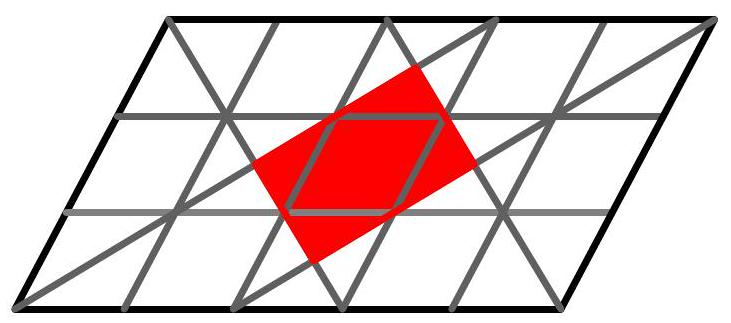 | Solution. The bisectors of the internal angles of a parallelogram intersect to form a rectangle. Divide the parallelogram into rhombuses with a side length of 1 by lines parallel to the sides of the parallelogram. It is clear that the area of the red rectangle is twice the area of a rhombus with a side length of 1. And... | \frac{2}{15} | Geometry | math-word-problem | Yes | Yes | olympiads | false |
Which of the following calculations is correct?
A: $5\sqrt{7}-2\sqrt{7}=2$
B: $2+\sqrt{2}=2\sqrt{2}$
C: $\sqrt{3}\times \sqrt{6}=3\sqrt{2}$
D: $\sqrt{15}\div \sqrt{5}=3$ | To evaluate each option step-by-step:
**Option A:**
\[
5\sqrt{7}-2\sqrt{7} = (5-2)\sqrt{7} = 3\sqrt{7}
\]
Since the question suggests the result should be $2$, but we found $3\sqrt{7}$, option A is incorrect.
**Option B:**
\[
2+\sqrt{2} \neq 2\sqrt{2}
\]
The left side cannot be simplified to match the right side,... | \text{C} | Algebra | MCQ | Yes | Yes | cn_k12 | false |
Let's construct a triangle, given the angle $\alpha$, the length of the height $m_{a}$ starting from the vertex of this angle, and the difference $\beta$ between the two angles into which $m_{a}$ divides the angle $\alpha$. | Consider the task as solved.

Let the foot of $m_{a}$ be $M_{1}$, and let $m_{a}$ divide the side $a$ into two segments: $B M_{1}$ and $M_{1} C$. Let $B M_{1} = \beta$, and $\frac{\alpha + \be... | notfound | Geometry | math-word-problem | Yes | Yes | olympiads | false |
2nd grade - high school - A category, May 3, 2007.
## Solutions
Problem 2A-1. Solve the equation in the set of complex numbers
$$
\left(x^{2}-a^{2}\right)^{2}-4 a x-1=0
$$
where $a$ is a real number. | Solution. We have in order:
$$
\begin{aligned}
& \left(x^{2}-a^{2}\right)^{2}-4 a x-1=0 \\
& \left(x^{2}+a^{2}\right)^{2}-4 a^{2} x^{2}-4 a x-1=0 \\
& \left(x^{2}+a^{2}\right)^{2}-(2 a x+1)^{2}=0 \\
& \left(x^{2}+a^{2}-2 a x-1\right)\left(x^{2}+a^{2}+2 a x+1\right)=0 \\
& {\left[(x-a)^{2}-1\right]\left[(x+a)^{2}+1\rig... | notfound | Algebra | math-word-problem | Yes | Yes | olympiads | false |
6.4. A circle cuts equal chords on all four sides of a quadrilateral. Prove that a circle can be inscribed in this quadrilateral. | 6.4. Let $O$ be the center of the given circle, $R$ its radius, and $a$ the length of the chords cut by the circle on the sides of the quadrilateral. Then the distances from point $O$ to the sides of the quadrilateral are $\sqrt{R^{2}-a^{2} / 4}$, i.e., it is equidistant from the sides of the quadrilateral and is the c... | proof | Geometry | proof | Yes | Yes | olympiads | false |
In a certain city, among 16 traffic sections, 7 are more congested during the peak morning hours. Now, if 10 sections are randomly selected, and X represents the number of sections among these 10 that are more congested, then $P(X=4)=$ ( )
A: $$\boxed{\frac { C_{ 7 }^{ 4 } \cdot C_{ 9 }^{ 6 }}{ C_{ 16 }^{ 10 }}}$$
B:... | Solution: According to the problem, $P(X=4) = \boxed{\frac { C_{ 7 }^{ 4 } \cdot C_{ 9 }^{ 6 }}{ C_{ 16 }^{ 10 }}}$,
Therefore, the correct answer is: A.
This problem is an example of a hypergeometric distribution. $P(X=4)$ represents the probability that among the 10 selected sections, 4 are more congested. The prob... | \frac { C_{ 7 }^{ 4 } \cdot C_{ 9 }^{ 6 }}{ C_{ 16 }^{ 10 }} | Combinatorics | MCQ | Yes | Yes | cn_k12 | false |
A car travels 30 kph for 15 kilometers, 60 kph for 35 kilometers, accelerates uniformly from 40 kph to 80 kph over 10 kilometers, and travels at 36 kph for 30 minutes. Calculate the average speed of the car for the entire journey, in kph. | To compute the average speed, we need to determine the total distance and total time of the journey.
1. **Segment 1:**
Speed = 30 kph, Distance = 15 km
Time = Distance / Speed = \( \frac{15}{30} = 0.5 \) hours
2. **Segment 2:**
Speed = 60 kph, Distance = 35 km
Time = \( \frac{35}{60} \approx 0.58333 \) ho... | 44.57 \text{ kph} | Algebra | math-word-problem | Yes | Yes | synthetic_math | true |
Let $\mathbf{A} = \begin{pmatrix} a & 2 \\ -3 & d \end{pmatrix}$ for some real numbers $a$ and $d.$ If
\[\mathbf{A} - \mathbf{A}^{-1} = \mathbf{0},\] then find $\text{tr}(\mathbf{A})$, where $\text{tr}(\mathbf{A})$ is the trace of matrix $\mathbf{A}$. | The inverse of $\mathbf{A}$ can be calculated as:
\[\mathbf{A}^{-1} = \frac{1}{ad + 6} \begin{pmatrix} d & -2 \\ 3 & a \end{pmatrix}.\]
Given $\mathbf{A} - \mathbf{A}^{-1} = \mathbf{0}$, the matrix equation becomes:
\[\begin{pmatrix} a & 2 \\ -3 & d \end{pmatrix} - \begin{pmatrix} \frac{d}{ad + 6} & -\frac{2}{ad + 6} \... | a+d | Algebra | math-word-problem | Yes | Yes | synthetic_math | true |
5. In the division problem below, fill in each box with a digit, the quotient is $\qquad$
Will the above text be translated into English, please retain the original text's line breaks and format, and output the translation result directly. | Answer: 13 | 13 | Algebra | math-word-problem | Yes | Incomplete | olympiads | false |
8.3. A natural number is called a palindrome if it remains unchanged when its digits are written in reverse order (for example, the numbers 4, 55, 626 are palindromes, while 20, 201, 2016 are not). Prove that any number of the form 2016... 2016 (the digit group 2016 is repeated several times) can be represented as the ... | Solution. $2016 \ldots . .2016=2016 \cdot 100010001 \ldots 01$, where ones are interspersed with triple zeros, and the number of ones equals the number of 2016 groups in the original number. The right number is a palindrome, while the left one is not. However, 2016=252*8 — the product of two palindromes. Multiplying th... | proof | Number Theory | proof | Yes | Yes | olympiads | false |
Given the parabola $E: y^2 = 2px$ ($p > 0$) whose directrix intersects the x-axis at point $K$. Two tangents are drawn from point $K$ to the circle $(x-5)^2 + y^2 = 9$, with the points of tangency being $M$ and $N$, and $|MN| = 3\sqrt{3}$.
(1) Find the equation of the parabola $E$;
(2) Let $A$ and $B$ be two points... | (1) Solution: From the given information, we can determine that $K$ has coordinates $(-\frac{p}{2}, 0)$. The circle $C: (x-5)^2 + y^2 = 9$ has its center at $C(5, 0)$ with a radius $r = 3$.
Let the intersection of $MN$ with the x-axis be $R$. Due to the symmetry of the circle, we have $|MR| = \frac{3\sqrt{3}}{2}$.
... | 88 | Geometry | math-word-problem | Yes | Yes | cn_k12 | false |
Let $n \ge 2$ be an integer and let $T = \{2,3,4,\ldots,n\}$. Find the smallest value of $n$ such that for every partition of $T$ into two subsets, at least one of the subsets contains integers $a$, $b$, and $c$ (not necessarily distinct) such that $ab = c$. | We claim that $64$ is the minimal value of $n$. Let the two partitioned sets be $C$ and $D$. Consider the powers of 2: $2, 4, 8, 16, 32, 64$.
1. Place $2$ in $C$; then place $4$ in $D$ to avoid $2*2=4$ in $C$.
2. Place $8$ in $C$ as placing in $D$ would make $2*4=8$ accessible.
3. Consequently, $16$ goes to $D$ to avo... | 64 | Combinatorics | math-word-problem | Yes | Yes | synthetic_math | true |
The maximum value of the function $f(x) = \cos(x + 2\varphi) + 2\sin\varphi\sin(x + \varphi)$. | To find the maximum value of the function $f(x) = \cos(x + 2\varphi) + 2\sin\varphi\sin(x + \varphi)$, we can first simplify the expression using trigonometric identities.
The given function can be rewritten by using the sum-to-product identities:
$$
f(x) = \cos(x + 2\varphi) + 2\sin\varphi\sin(x + \varphi) = \cos(x ... | 1 | Algebra | math-word-problem | Yes | Yes | cn_k12 | false |
At a restaurant each adult meal costs $8 and kids eat free. A group of some people came in and 2 were kids. It cost the group $72 to eat. How many people were in the group? | Let's denote the number of adults in the group as A and the number of kids as K. We know that K = 2 (since 2 were kids) and each adult meal costs $8.
The total cost for the group is the number of adults multiplied by the cost per adult meal, which is $72. So we can set up the equation:
8A + 0K = 72
Since kids eat fr... | 11 | Algebra | math-word-problem | Yes | Yes | orca_math | true |
The center of the equilateral hyperbola $\Sigma$ is at the origin, and its foci are on the $x$-axis. $\Sigma$ intersects the directrix of the parabola $y=\dfrac{1}{4}x^{2}$ at points $P$ and $Q$. If $|PQ|=4$, then the length of the real axis of $\Sigma$ is ( )
A: $2\sqrt{3}$
B: $3$
C: $2$
D: $\sqrt{3}$ | **Analysis**
This question examines the geometric properties of parabolas and hyperbolas, testing the student's computational ability. It is a basic question.
Set the equation of the hyperbola $\Sigma$, find the equation of the directrix of the parabola, and use $|PQ|=4$ to reach the conclusion.
**Solution**
Let th... | A | Geometry | MCQ | Yes | Yes | cn_k12 | false |
The coefficient of the $x^3$ term in the expansion of $(1-2x)^5$ is \_\_\_\_\_\_ (express in numbers). | The general term in the expansion of $(1-2x)^5$ is $T_{r+1} = C^r_5(-2x)^r$. Let $r=3$, we get the coefficient of the $x^3$ term as $C^3_5(-2)^3 = -80$.
Therefore, the answer is $\boxed{-80}$.
In the expansion of $(1-2x)^5$, by setting the exponent of $x$ in the general term equal to 3, we find $r$, and then calculat... | -80 | Algebra | math-word-problem | Yes | Yes | cn_k12 | false |
if a rectangle have length 16 cm and diagonal 20 cm . calculate its area . | To calculate the area of the rectangle, we need to find its width. We can use the Pythagorean theorem to find the width since the diagonal of a rectangle forms a right triangle with the length and width.
The Pythagorean theorem states that in a right-angled triangle, the square of the length of the hypotenuse (the sid... | 192 | Geometry | math-word-problem | Yes | Yes | orca_math | true |
Let $A B C$ be a triangle with $A B=A C$, and let $M$ be the midpoint of $B C$. Let $P$ be a point such that $P B<P C$ and $P A$ is parallel to $B C$. Let $X$ and $Y$ be points on the lines $P B$ and $P C$, respectively, so that $B$ lies on the segment $P X, C$ lies on the segment $P Y$, and $\angle P X M=\angle P Y M$... | Since $A B=A C, A M$ is the perpendicular bisector of $B C$, hence $\angle P A M=$ $\angle A M C=90^{\circ}$. 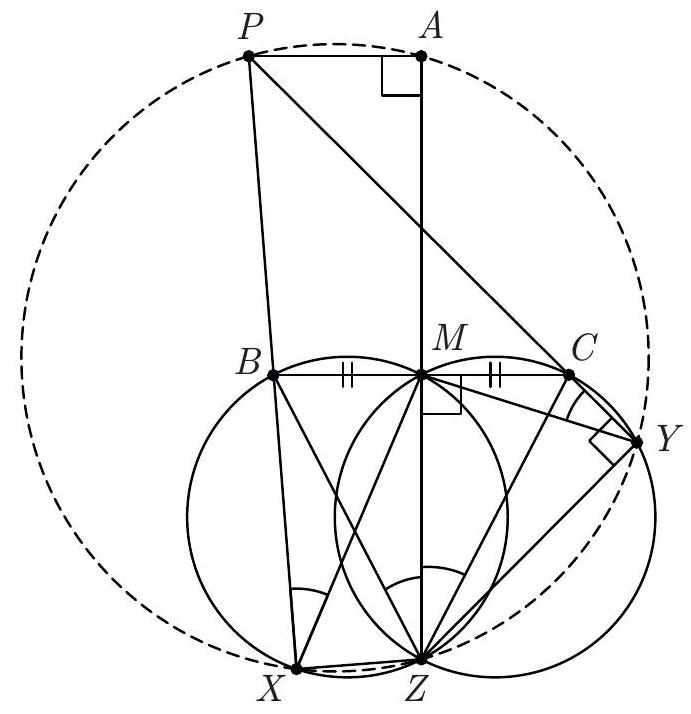 Now let $Z$ be the common point of $A M$ and the perpendicular through $Y$ to $P... | proof | Geometry | proof | Yes | Yes | olympiads_ref | false |
100. Find the largest positive number $\lambda$, such that for any real numbers $x, y, z$ satisfying $x^{2}+y^{2}+z^{2}=1$, the inequality $|\lambda x y+y z| \leqslant \frac{\sqrt{5}}{2}$ holds. (2008 China Southeast Mathematical Olympiad) | None
Translate the text above into English, please retain the original text's line breaks and format, and output the translation result directly.
Note: The provided instruction is a meta-instruction and not part of the text to be translated. Since the text to be translated is "None", the translation is also "None". ... | not found | Inequalities | math-word-problem | Yes | Incomplete | inequalities | false |
A triangular array of squares has one square in the first row, two in the second, and in general, $k$ squares in the $k$th row for $1 \leq k \leq 15$. Each square, except those in the bottom row, rests on two squares in the row immediately below. In each square of the fifteenth row, a $0$ or a $1$ is placed. Numbers ar... | Label the squares in the bottom row as \( x_0, x_1, \ldots, x_{14} \).
The top square is given by \( {14 \choose 0}x_0 + {14 \choose 1}x_1 + {14 \choose 2}x_2 + \ldots + {14 \choose 14}x_{14} \).
Considering modulo 5, we notice that from \( {14 \choose 2} \) onward, all coefficients are multiples of 5 (since the factor... | 8192 | Combinatorics | math-word-problem | Yes | Yes | synthetic_math | true |
NT 1. Find all the integers pairs $(x, y)$ which satisfy the equation
$$
x^{5}-y^{5}=16 x y
$$
|
Solution. If one of $x, y$ is 0 , the other has to be 0 too, and $(x, y)=(0,0)$ is one solution. If $x y \neq 0$, let $d=\operatorname{gcd}(x, y)$ and we write $x=d a, y=d b, a, b \in \mathbb{Z}$ with $(a, b)=1$. Then, the given equation is transformed into
$$
d^{3} a^{5}-d^{3} b^{5}=16 a b
$$
So, by the above equat... | (x,y)=(0,0)or(-2,2) | Number Theory | math-word-problem | Yes | Yes | olympiads | false |
If the price of a stamp is 45 cents, what is the maximum number of stamps that could be purchased with $36? | First, convert $36 to cents: $36 = 3600$ cents.
We need to determine the maximum number \( n \) of 45-cent stamps that can be bought with 3600 cents. Set up the inequality:
\[ 45n \leq 3600. \]
Solve for \( n \):
\[ n \leq \frac{3600}{45} = 80. \]
Therefore, the largest integer \( n \) satisfying this inequality is ... | 80 | Logic and Puzzles | math-word-problem | Yes | Yes | synthetic_math | true |
Problem 23. For angles $A, B$, and $C$ of an arbitrary triangle, prove the formula:
$$
\operatorname{ctg} \frac{A}{2}+\operatorname{ctg} \frac{B}{2}+\operatorname{ctg} \frac{C}{2}=\operatorname{ctg} \frac{A}{2} \cdot \operatorname{ctg} \frac{B}{2} \cdot \operatorname{ctg} \frac{C}{2}
$$
## Drawings in the sand | Proof. It is not difficult to show that $\operatorname{ctg} \frac{A}{2}=\frac{p-a}{r}$. Similarly, $\operatorname{ctg} \frac{B}{2}=\frac{p-b}{r}, \operatorname{ctg} \frac{C}{2}=\frac{p-c}{r}$. Substitute these values into the formula that needs to be proved. We have:
$$
\frac{p-a}{r}+\frac{p-b}{r}+\frac{p-c}{r}=\frac{... | proof | Algebra | proof | Yes | Yes | olympiads | false |
A couple spent $158.40 in total while dining out and paid this amount using a credit card. The total amount included a tip which was paid on top of the price which already included a sales tax of 10 percent on top of the price of the food. The actual price of the food before tax and tip was $120. What was the percentag... | First, let's calculate the amount of sales tax paid on the food. Since the sales tax is 10 percent of the price of the food, we can calculate it as follows:
Sales tax = 10% of $120
Sales tax = 0.10 * $120
Sales tax = $12
Now, let's add the sales tax to the price of the food to find out the total cost before the tip:
... | 20\% | Algebra | math-word-problem | Yes | Yes | orca_math | true |
7. Given the equation of circle $\odot C$ is
$$
x^{2}+y^{2}-4 x-2 y+1=0 \text {, }
$$
the line $y=\left(\tan 10^{\circ}\right) x+\sqrt{2}$ intersects $\odot C$ at points
$A$ and $B$. The sum of the inclination angles of lines $A C$ and $B C$ is
$\qquad$ | 7. $200^{\circ}$.
The equation of $\odot C$ is $(x-2)^{2}+(y-1)^{2}=4$, the distance from the center $(2,1)$ to the line $y=\left(\tan 10^{\circ}\right) x+\sqrt{2}$ is
$$
d=\frac{\left|2 \tan 10^{\circ}-1+\sqrt{2}\right|}{\sqrt{1+\tan ^{2} 10^{\circ}}}<2,
$$
which means the given line intersects $\odot C$ at points $A... | 200^{\circ} | Geometry | math-word-problem | Yes | Yes | cn_contest | false |
Tony has to run several errands in a day. He needs to drive some miles to get groceries, 15 miles to get a haircut, and 5 miles to go to a doctor's appointment. Tony will have driven 15 miles when he is halfway through driving around for his errands. How many miles does Tony need to drive to get groceries? | If Tony will have driven 15 miles when he is halfway through his errands, this means that the total distance for all his errands is twice that, so 15 miles * 2 = 30 miles.
We know that he needs to drive 15 miles to get a haircut and 5 miles to go to the doctor's appointment. So, the total distance for these two errand... | 10 | Algebra | math-word-problem | Yes | Yes | orca_math | true |
For example, let $a_{1}, a_{2}, \cdots$ be an infinite sequence of real numbers. For all positive integers $i$, there exists a real number $c$ such that $0 \leqslant$ $a_{i} \leqslant c$ and $\left|a_{i}-a_{j}\right| \geqslant \frac{1}{i+j}$ for all positive integers $i, j(i \neq j)$. Prove: $c \geqslant 1$.
(43rd IMO ... | Analysis: The key to solving this problem successfully is to organize and process it using the Cauchy-Schwarz inequality.
Proof: For \( n \geqslant 2 \), let \( \varphi(1), \varphi(2), \cdots, \varphi(n) \) be a permutation of \( 1, 2, \cdots, n \) such that:
\[ 0 \leqslant a_{\varphi(1)} < a_{\varphi(2)} < \cdots < a... | \geqslant1 | Inequalities | proof | Yes | Yes | olympiads | false |
Problem 3. Factorize
$$
M(x ; y ; z)=x^{3}(y-z)+y^{3}(z-x)+z^{3}(x-y) .
$$ | Solution. Let's assign some values to the variables $x$ and $y$. Let $x=y=1$. Then $M(1 ; 1 ; z)=$ $=(1-z)+(z-1)=0$. Let $x=y=2$. Then $M(2,2, z)=8(2-z)+8(z-2)=0$. This suggests that $M(x, y, z)$ is divisible by $(x-y)$ or $(y-x)$. Thus, we come to the hypothesis that $M(x, y, z)$ is divisible by $(x-z)$ and $(y-z)$.
... | M(x,y,z)=(x+y+z)(x-y)(y-z)(z-x) | Algebra | math-word-problem | Yes | Yes | olympiads | false |
How many integers $n$ satisfy the inequality $-15\pi \le n \le 12\pi$? | First, we estimate the bounds:
$\pi$ is approximately between $3.14$ and $3.15$. Therefore,
- $-15\pi$ is between $-15(3.15) = 47.25$ and $-15(3.14) = 47.1$, implying that the lowest integer $n$ can be $-47$.
- $12\pi$ is between $12(3.14) = 37.68$ and $12(3.15) = 37.8$, implying that the highest integer $n$ can be $37... | 85 | Inequalities | math-word-problem | Yes | Yes | synthetic_math | true |
Given $f(z)= \overline {z}$, and $z_{1}=1+5i$, $z_{2}=-3+2i$, find the value of $f( \overline {z_{1}-z_{2}})$. | First, we find $z_{1}-z_{2}$:
$$z_{1}-z_{2}=(1+5i)-(-3+2i)=4+3i.$$
Then, we find the conjugate of $z_{1}-z_{2}$:
$$\overline {z_{1}-z_{2}}=4-3i.$$
Given that $f(z)= \overline {z}$, we can find $f(4-3i)$:
$$f(4-3i)= \overline {4-3i}=4+3i.$$
Therefore, the answer is: $\boxed{4+3i}$.
This solution uses the rules of comple... | 4+3i | Algebra | math-word-problem | Yes | Yes | cn_k12 | false |
Find all positive integers $n$ such that $7^n+147$ is a perfect square. | null | null | Number Theory | math-word-problem | Yes | Yes | aops_forum | false |
## Task Condition
Find the derivative $y_{x}^{\prime}$
$$
\left\{\begin{array}{l}
x=\ln (\operatorname{ctg} t) \\
y=\frac{1}{\cos ^{2} t}
\end{array}\right.
$$ | ## Solution
$x_{t}^{\prime}=(\ln (\operatorname{ctg} t))^{\prime}=\frac{1}{\operatorname{ctg} t} \cdot \frac{-1}{\sin ^{2} t}=-\frac{1}{\cos t \cdot \sin t}$
$y_{t}^{\prime}=\left(\frac{1}{\cos ^{2} t}\right)^{\prime}=\frac{-2}{\cos ^{3} t} \cdot(-\sin t)=\frac{2 \sin t}{\cos ^{3} t}$
We obtain:
$$
y_{x}^{\prime}=\... | -2\operatorname{tg}^{2} | Calculus | math-word-problem | Yes | Yes | olympiads | false |
Let $S_n$ be the sum of the first $n$ terms of the arithmetic sequence $\{a_n\}$, where $a_{12}=-8$ and $S_9=-9$. Find $S_{16}$. | Let $a_1$ and $d$ be the first term and common difference of the arithmetic sequence $\{a_n\}$, respectively.
We have the following system of equations:
$$\begin{cases}a_1+11d=-8 \\ 9a_1+\frac{9\times 8}{2}d=-9\end{cases}$$
Solving this system, we obtain:
$$\begin{cases}a_1=3 \\ d=-1\end{cases}$$
Thus, $S_{16}=16a_1... | -72 | Algebra | math-word-problem | Yes | Yes | cn_k12 | false |
[1 Problem](https://artofproblemsolving.com#Problem)
[2 Solution 1](https://artofproblemsolving.com#Solution_1)
[3 Solution 2](https://artofproblemsolving.com#Solution_2)
[4 Solution 3](https://artofproblemsolving.com#Solution_3)
[5 See Also](https://artofproblemsolving.com#See_Also) | Case 1: All three attributes are the same. This is impossible since sets contain distinct cards.
Case 2: Two of the three attributes are the same. There are ${3\choose 2}$ ways to pick the two attributes in question. Then there are $3$ ways to pick the value of the first attribute, $3$ ways to pick the value of the sec... | 117 | Other | math-word-problem | Incomplete | Yes | amc_aime | false |
8. Let $a_{0}, b_{0}$ be natural numbers, and define the sequences $a_{0}, a_{1}, a_{2} \cdots$ and $b_{0}, b_{1}, b_{2}, \cdots$ as follows: $a_{k+1}=\left[\frac{a_{k}}{2}\right], b_{k+1}=2 b_{k}, k=0,1,2, \cdots$. If $p$ is the number such that $a_{p}=1$, prove: for all $j$ such that $a_{j}$ is odd, the sum of the co... | 8. Let $n>p$, since $a_{p}=1$, hence $a_{n}=0$, if $a_{0}, a_{1}, a_{2}, \cdots, a_{p}$ are represented in binary, then we have
$$
\begin{array}{l}
a_{0}=\left(A_{p} A_{p-1} \cdots A_{0}\right)_{2}=A_{p} \cdot 2^{p}+A_{p-1} \cdot 2^{p-1}+\cdots+A_{0} 2^{0} ; \\
a_{1}=\left(A_{p} A_{p-1} \cdots A_{1}\right)_{2}=A_{p} \c... | proof | Number Theory | proof | Yes | Yes | olympiads | false |
The result of the expression [ ( some number x 14 ) / 100 ] is 0.045374000000000005. What is the number? | To find the number, we can set up the equation based on the expression given:
\[ \frac{(x \times 14)}{100} = 0.045374000000000005 \]
Now, we can solve for \( x \):
\[ x \times 14 = 0.045374000000000005 \times 100 \]
\[ x \times 14 = 4.5374 \]
\[ x = \frac{4.5374}{14} \]
\[ x = 0.3241 \]
So, the number is \( $\bo... | 0.3241 | Algebra | math-word-problem | Yes | Yes | orca_math | true |
The geometric sequence $\{a_n\}$ satisfies $a_1= 3$ and $a_1+a_3 + a_5 = 21$. Then, $a_3+a_5 + a_7 =$ ?
A: $21$
B: $42$
C: $63$
D: $84$ | **Analysis**
Given $a_1=3$ and $a_1+a_3+a_5=21$, we can use the formula for the general term of a geometric sequence to find $q$, and then substitute it back into the formula for the general term of a geometric sequence to find the answer.
**Solution**
Since $a_1=3$ and $a_1+a_3+a_5=21$, we have:
$$a_1(1+q^2+q^4)=21... | B | Algebra | MCQ | Yes | Yes | cn_k12 | false |
Given that $x$ is real and $x^3 + \frac{1}{x^3} = 110$, find $x + \frac{1}{x}$ under the condition that $(x + \frac{1}{x})^2 - 2x - \frac{2}{x} = 38$. | First, notice that $\left(x + \frac{1}{x}\right)^3 = x^3 + \frac{1}{x^3} + 3\left(x + \frac{1}{x}\right)$. Let $x + \frac{1}{x} = a$. Therefore, the equation becomes
$$a^3 = x^3 + \frac{1}{x^3} + 3a = 110 + 3a.$$
Thus, we have:
$$a^3 - 3a - 110 = 0.$$
Testing possible rational roots $\pm1, \pm2, \pm5, \pm10, \pm11, \pm... | 5 | Algebra | math-word-problem | Yes | Yes | synthetic_math | true |
In the diagram, each of the three identical circles touch the other two. The circumference of each circle is 48. What is the perimeter of the shaded region, if each arc forming the shaded region now subtends an angle of 90° at the center of its respective circle? | 1. **Configuration**: The three identical circles are arranged so each circle touches the other two. By joining the centers of each circle, since they touch, these lines are each equal to twice the radius of the circles.
2. **Triangle Formation**: Since the circles are identical and each touches two others, the center... | 36 | Geometry | math-word-problem | Yes | Yes | synthetic_math | true |
You collect pens. You start out with 20 pens. Mike gives you another 22 pens. Cindy, whose father makes pens, decides to double your pens. You give Sharon 19 pens. How many pens do you have at the end? | You start with 20 pens.
Mike gives you 22 pens, so you now have 20 + 22 = 42 pens.
Cindy doubles your pens, so you now have 42 * 2 = 84 pens.
You give Sharon 19 pens, so you have 84 - 19 = 65 pens left.
At the end, you have $\boxed{65}$ pens. | 65 | Logic and Puzzles | math-word-problem | Yes | Yes | orca_math | true |
B6. As shown in the figure, $\triangle \mathrm{ABC}$ is divided into six smaller triangles by three lines passing through its three vertices and an interior point. The areas of four of the smaller triangles are marked in the figure. Find the area of $\triangle \mathrm{ABC}$.
untranslated part:
The areas of four o... | If the heights of two triangles are the same, then the ratio of their areas is equal to the ratio of their corresponding base lengths. Therefore, from the figure, we get
$$
\frac{40}{30}=\frac{40+y+84}{30+35+x}, \quad \frac{35}{x}=\frac{35+30+40}{x+84+y},
$$
$\frac{84}{y}=\frac{84+x+35}{y+40+30}$. Solving the first two... | 315 | Geometry | math-word-problem | Yes | Yes | cn_contest | false |
Find the positive integers $n$ such that $n^{2}+1 \mid n+1$.
untranslated text has been translated while preserving the original formatting and structure. | If $n^{2}+1 \mid n+1$, we have $n+1 \geq n^{2}+1$ (according to Proposition 8), hence $n=0$ or $n=1$. We verify that these solutions work.
Definition 114. An integer $p>1$ is said to be prime if its only positive divisors are 1 and itself.
## Examples
7 is prime
1 is not prime
The only even prime number is 2.
## ... | n=0orn=1 | Number Theory | math-word-problem | Yes | Yes | olympiads | false |
A certain type of meal is mixed with cornmeal (7% protein) to create a 280 lb mixture that is 13% protein. If 240 pounds of the first meal is used, what is the percentage of protein in that meal? | Let's denote the percentage of protein in the first meal as P%. We know that the mixture is 280 lb and is 13% protein, so the total amount of protein in the mixture is:
Total protein in mixture = 280 lb * 13% = 36.4 lb
We also know that 240 lb of the first meal is used, and the rest is cornmeal. Since the total weigh... | 14\% | Algebra | math-word-problem | Yes | Yes | orca_math | true |
A convex polyhedron $Q$ has vertices $V_1,V_2,\ldots,V_n$, and $100$ edges. The polyhedron is cut by planes $P_1,P_2,\ldots,P_n$ in such a way that plane $P_k$ cuts only those edges that meet at vertex $V_k$. In addition, no two planes intersect inside or on $Q$. The cuts produce $n$ pyramids and a new polyhedron $R$. ... | Solution 1
Each edge of $Q$ is cut by two planes, so $R$ has $200$ vertices. Three edges of $R$ meet at each vertex, so $R$ has $\frac 12 \cdot 3 \cdot 200 = \boxed {300}$ edges.
Solution 2
At each vertex, as many new edges are created by this process as there are original edges meeting at that vertex. Thus the total... | 300 | Geometry | MCQ | Yes | Yes | amc_aime | false |
In a right triangle $PQR$, medians are drawn from $P$ and $Q$ to divide segments $\overline{QR}$ and $\overline{PR}$ in half, respectively. If the length of the median from $P$ to the midpoint of $QR$ is $8$ units, and the median from $Q$ to the midpoint of $PR$ is $4\sqrt{5}$ units, find the length of segment $\overli... | Let's denote the midpoint of $\overline{QR}$ as $M$ and the midpoint of $\overline{PR}$ as $N$. Since $PM$ is a median, it divides $QR$ into two equal halves, and similarly for $QN$ and $PR$.
From the triangle $PMR$ and $QNR$, we have:
\[
PR^2 + \frac{1}{4}QR^2 = 64, \quad and \quad QR^2 + \frac{1}{4}PR^2 = (4\sqrt{5}... | 16 | Geometry | math-word-problem | Yes | Yes | synthetic_math | true |
What is the total sum of positive integer values that $b$ can take in the quadratic equation $2x^2 + 5x + b = 0$ in order for the equation to have rational roots? | To determine the total sum of positive integer values of \( b \) for which the quadratic equation \( 2x^2 + 5x + b = 0 \) has rational roots, we need to ensure that its discriminant is a perfect square. The general form of a quadratic equation is \( ax^2 + bx + c = 0 \), and its discriminant \(\Delta\) is given by:
\[... | 2 | Algebra | math-word-problem | Yes | Yes | metamath | true |
Subsets and Splits
No community queries yet
The top public SQL queries from the community will appear here once available.