
instruction_seed stringlengths 2 10.7k | solution stringlengths 0 10.8k ⌀ | answer stringlengths 0 575 ⌀ | problem_type stringclasses 9
values | question_type stringclasses 5
values | problem_is_valid stringclasses 5
values | solution_is_valid stringclasses 4
values | source stringclasses 11
values | synthetic bool 2
classes |
|---|---|---|---|---|---|---|---|---|
Let $\overrightarrow{a} =(4,3)$, the projection of $\overrightarrow{b}$ on $\overrightarrow{a}$ is $4$, and the projection of $\overrightarrow{b}$ on the $x$-axis is $2$. Then $\overrightarrow{b}$ is $(\ )$
A: $(2,14)$
B: $\left(2,- \dfrac{2}{7}\right)$
C: $(2,4)$
D: $\left(-2, \dfrac{2}{7}\right)$ | **Analysis**
Let $\overrightarrow{b}=\left(x,y\right)$. According to the projection of $\overrightarrow{b}$ on the $x$-axis being $2$, we can get $x=2$; then, since the projection of $\overrightarrow{b}$ on $\overrightarrow{a}$ is $4$, we get $|\overrightarrow{b}|\cos \theta= \dfrac{\overrightarrow{a} \cdot \overright... | C | Algebra | MCQ | Yes | Yes | cn_k12 | false |
Given the function $$f(x)=(ax+1)\ln x- \frac {1}{2}ax^{2}-bx+ \frac {b}{e^{x}} \quad (a, b \in \mathbb{R})$$.
(1) If $$a=b= \frac {1}{2}$$, find the intervals of monotonicity for the function $$F(x)=f(x)-ax\ln x- \frac {b}{e^{x}}$$;
(2) If $$a=1, b=-1$$, prove that: $$f(x)+ \frac {1}{2}ax^{2}+bx>\ln x-1-2e^{-2}$$. | From the problem, we know the domain of function $f(x)$ is $(0, +\infty)$.
(1) When $$a=b= \frac {1}{2}$$, we have $$F(x)=f(x)-ax\ln x- \frac {b}{e^{x}}=\ln x- \frac {1}{4}x^{2}- \frac {1}{2}x$$,
$$F'(x)= \frac {1}{x}- \frac {1}{2}x- \frac {1}{2}= \frac {-(x+2)(x-1)}{2x}$$.
Let $F'(x)=0$, we get $x=1$.
When $00$, in t... | f(x)+ \frac {1}{2}ax^{2}+bx> \ln x-1-2e^{-2} | Calculus | math-word-problem | Yes | Yes | cn_k12 | false |
The average mark of the students of a class in a particular exam is 90. If 2 students whose average mark in that exam is 45 are excluded, the average mark of the remaining will be some value. There were 20 students who wrote the exam. What is the new average mark of the class after excluding the 2 students? | Let's calculate the total marks of the 20 students first. If the average mark is 90, then the total marks for the class can be calculated as:
Total marks = Average mark × Number of students
Total marks = 90 × 20
Total marks = 1800
Now, let's find out the total marks of the 2 students who are to be excluded. Since the... | 95 | Algebra | math-word-problem | Yes | Yes | orca_math | true |
Wendy just started working at an Italian restaurant. She polished 50 small glasses and some more large glasses than small glasses. She polished 110 glasses. How many more large glasses did she polish than small glasses? | Let's call the number of large glasses Wendy polished L.
We know that Wendy polished 50 small glasses and a total of 110 glasses. So the total number of glasses polished is the sum of the small and large glasses:
50 small glasses + L large glasses = 110 total glasses
To find out how many large glasses Wendy polished... | 10 | Algebra | math-word-problem | Yes | Yes | orca_math | true |
Calculate \( 3a - 4b \), where \( a = 3 + 2i \) and \( b = 2 - 2i \). | Start by substituting the values of \( a \) and \( b \) into the expression \( 3a - 4b \):
\[ 3(3+2i) - 4(2-2i) \]
Expanding each term:
\[ 9 + 6i - 8 + 8i \]
Combining like terms:
\[ 9 - 8 + 6i + 8i = 1 + 14i \]
Thus, the solution is:
\[ \boxed{1 + 14i} \] | 1 + 14i | Algebra | math-word-problem | Yes | Yes | synthetic_math | true |
Given a complex number $z$ that satisfies $z(1-i) = 2$ (where $i$ is the imaginary unit), then $z =$ ( )
A: $1+i$
B: $-1+i$
C: $-1-i$
D: $1-i$ | Let's start by using the given equation:
$$ z(1-i) = 2. $$
To solve for $z$, we multiply both sides of the equation by the conjugate of $(1-i)$, which is $(1+i)$. This will help us eliminate the imaginary parts and simplify the equation to find the value of $z$:
$$ z(1-i)(1+i) = 2(1+i). $$
When we multiply complex ... | A: 1+i | Algebra | MCQ | Yes | Yes | cn_k12 | false |
If the sequence $\{t_{n}\}$ satisfies ${t_{n+1}}={t_n}-\frac{{f({{t_n}})}}{{{f'}({{t_n}})}}$, then the sequence is called the "tangent line - zero sequence". Given that the function $f\left(x\right)=x^{2}+px+q$ has two zeros at $1$ and $2$, the sequence $\{x_{n}\}$ is a "tangent line - zero sequence". Let the sequence ... | To solve the problem, we first need to understand the given conditions and apply them step by step.
1. **Given Function and Its Zeros**:
The function is $f\left(x\right)=x^{2}+px+q$, and it has zeros at $x=1$ and $x=2$.
2. **Applying Vieta's Formulas**:
From Vieta's formulas, we know that the sum of the roo... | 2^{2024} - 2 | Algebra | math-word-problem | Yes | Yes | cn_k12 | false |
Given $\cos(\alpha - \frac{\pi}{3}) = \frac{4}{5}$, find the value of $\sin(\alpha + \frac{7\pi}{6})$. | First, let's simplify the expression by using the trigonometric identity $\sin(\theta + \frac{\pi}{2}) = \cos(\theta)$ and the fact that $\sin(\theta + \pi) = -\sin(\theta)$:
$$
\begin{align*}
\sin\left(\alpha + \frac{7\pi}{6}\right) &= \sin\left(\alpha + \frac{\pi}{6} + \pi\right) \\
&= -\sin\left(\alpha + \frac{\pi}... | -\frac{4}{5} | Algebra | math-word-problem | Yes | Yes | cn_k12 | false |
Let the function $f(x) = \begin{cases} -x, & x<1 \\ (x-1)^{2}, & x\geq 1 \end{cases}$. If $f(a) = 1$, then the value of the real number $a$ is ( )
A: $-1$ or $0$
B: $2$ or $-1$
C: $0$ or $2$
D: $2$ | Solution: For the function $f(x) = \begin{cases} -x, & x<1 \\ (x-1)^{2}, & x\geq 1 \end{cases}$, if $f(a) = 1$,
When $a < 1$, $-a = 1$, which gives $a = -1$, and this is valid.
When $a \geq 1$, $(a-1)^2 = 1$, solving this gives $a = 2$.
In summary, the value of $a$ can be $2$ or $-1$.
Therefore, the correct choice ... | \text{B} | Algebra | MCQ | Yes | Yes | cn_k12 | false |
Given the line $x-y+1=0$ and the curve $y=\ln x-a$ are tangent, the value of $a$ is \_\_\_\_\_\_. | Let's assume the coordinates of the tangent point are $(m,n)$.
The derivative of $y$ with respect to $x$ at $x=m$ is $y'|_{x=m}= \dfrac {1}{m}=1$.
Solving this, we get $m=1$.
Since the tangent point $(1,n)$ lies on the line $x-y+1=0$,
$\therefore n=2$,
and since the tangent point $(1,2)$ also lies on the curv... | -2 | Calculus | math-word-problem | Yes | Yes | cn_k12 | false |
(1) Find the equation of the line that passes through point A(2, 3) and is perpendicular to the line $3x + 2y - 1 = 0$;
(2) Given that line $l$ passes through the origin and the distance from point M(5, 0) to line $l$ is 3, find the equation of line $l$. | (1) Since the slope of the line $3x + 2y - 1 = 0$ is $-\frac{3}{2}$,
by the perpendicular relationship, the slope $k$ of the line we are looking for is $\frac{2}{3}$,
and since the line passes through point A(2, 3), the equation is $y - 3 = \frac{2}{3}(x - 2)$
Converting to the general form, we get $2x - 3y + 5 =... | 3x \pm 4y = 0 | Algebra | math-word-problem | Yes | Yes | cn_k12 | false |
He wanted to make sure that he is protected from the cold evenings in the forest so he decided to build a fireplace made of cement. If he bought 215 lbs of cement and his son brought another 137 lbs, how much cement did he have originally if he now has 450 lbs? | To find out how much cement he had originally, we need to subtract the total amount of cement he bought and his son brought from the current total amount of cement he has.
He bought 215 lbs of cement, and his son brought 137 lbs, so together they added:
215 lbs + 137 lbs = 352 lbs
Now, if he currently has 450 lbs of... | 98 | Algebra | math-word-problem | Yes | Yes | orca_math | true |
Let $a, b \in \mathbb{R}$. Then "$a > b$" is a ( ) condition for "$a^3 > b^3$".
A: Sufficient but not necessary condition
B: Necessary but not sufficient condition
C: Necessary and sufficient condition
D: Neither sufficient nor necessary condition | Since $a, b \in \mathbb{R}$,
- When $a > b > 0$, we have $a^3 > b^3$;
- When $0 > a > b$, we also have $a^3 > b^3$;
- When $a > 0 > b$, it follows that $a^3 > b^3$.
In summary, "$a > b$" $\Rightarrow$ "$a^3 > b^3$",
Conversely, "$a^3 > b^3$" $\Rightarrow$ "$a > b$",
Therefore, "$a > b$" is a necessary and sufficien... | \text{C} | Algebra | MCQ | Yes | Yes | cn_k12 | false |
Which of the following statements is incorrect? ( )
A: In the regression line $y=0.5x-85$, when the variable $x=200$, the value of variable $y$ is definitely $15$.
B: Based on the data in a $2\times2$ contingency table, it is calculated that $k^2\geq6.635$, and $P(k\geq6.635)\approx0.01$, thus there is a $99\%$ confide... | Option A states that when the variable equals $200$ in the regression line equation, the average value of $y$ is $15$, but it cannot be said to definitely be $15$, hence A is incorrect.
Option B examines the application of the independence test, and the probability obtained is correct.
In regression analysis, the l... | \text{A} | Algebra | MCQ | Yes | Yes | cn_k12 | false |
Example 4.2.2 Prove Desargues' Theorem using projective geometry: If the lines connecting the corresponding vertices of $\triangle A B C$ and $\triangle A^{\prime} B^{\prime} C^{\prime}$, $A A^{\prime}, B B^{\prime}, C C^{\prime}$, intersect at a point $O$, then the points of intersection of the corresponding sides $B ... | Proof Method 1 Let $P C \cap A A^{\prime}=D, P C^{\prime} \cap A A^{\prime}=D^{\prime}$, then $A\left(A^{\prime} P Q R\right) \overline{\bar{\Lambda}}(D P C B) \bar{\Lambda} O(D P C B) \overline{\bar{\Lambda}}\left(D^{\prime} P C^{\prime} B^{\prime}\right)$ $\overline{\bar{\Lambda}} A^{\prime}\left(D^{\prime} P C^{\pri... | proof | Geometry | proof | Yes | Yes | olympiads | false |
5. Five students $A, B, C, \ldots D, E$ participate in a competition. Someone guessed the result of the competition to be $A B C D E$, but did not guess any of the ranks correctly, nor did they guess any student's rank immediately following another's.
Another person guessed the competition result to be $D A E C B$, an... | (Answer: $E D A C B$. ) | E D A C B | Logic and Puzzles | math-word-problem | Yes | Yes | cn_contest | false |
Consider an arithmetic sequence $\{{a_n}\}$ that satisfies ${a_2}=9$, and ${a_1}, {a_5}$ are the two roots of the equation ${x^2}-16x+60=0$.
(1) Find the general term formula for $\{{a_n}\}$;
(2) Find the maximum sum of the first $n$ terms and the number of terms in this sum. | (1) Given ${a_2}=9$, and ${a_1}, {a_5}$ are the two roots of the equation ${x^2}-16x+60=0$.
We know that ${a_1}+{a_5}=2{a_3}=16$, solving for the common difference $d$, we get $d=-1$.
Thus, the general term formula for the arithmetic sequence is ${a_n}=-n+11$.
(2) Let ${S_n}$ be the sum of the first $n$ terms of the s... | 55 | Algebra | math-word-problem | Yes | Yes | cn_k12 | false |
The following relationships are given:
① The relationship between apple production and climate;
② The relationship between a student and his/her student ID;
③ The relationship between the diameter at breast height and the height of the same species of trees in a forest;
④ The relationship between a point on a curve and... | **Answer**: For ①, there indeed exists a certain relationship between apple production and climate, which is an uncertain relationship and belongs to a correlation relationship;
For ②, the relationship between a student and his/her student ID is a definite correspondence, which is a mapping and not a correlation rela... | ①③ | Other | math-word-problem | Yes | Yes | cn_k12 | false |
6. (20 points) Do there exist five pairwise distinct integers such that the sum of any four of them is a square of a natural number? | Solution. We will show a way to construct the desired sequence. Consider the first five squares: $1, 4, 9, 16, 25$ (any five different ones can be taken).
Then the first number is $1 + 4 + 9 + 16 + 25 - 4 \cdot 25 = -45$, the second is $1 + 4 + 9 + 16 + 25 - 4 \cdot 16 = -9$, the third is $1 + 4 + 9 + 16 + 25 - 4 \cdo... | -45,-9,19,39,51 | Number Theory | math-word-problem | Yes | Yes | olympiads | false |
Haley's favorite band was holding a concert where tickets were 4 dollars each. Haley bought 3 tickets for herself and her friends and some extra tickets in case anyone else wanted to go. She spent $32. How many extra tickets did she buy? | Haley spent $32 on tickets, and each ticket costs $4.
First, we need to find out how many tickets she could buy with $32. We do this by dividing the total amount spent by the cost of each ticket:
$32 / $4 = 8 tickets
Haley bought 3 tickets for herself and her friends, so we subtract those from the total number of ti... | 5 | Algebra | math-word-problem | Yes | Yes | orca_math | true |
Is there a positive integer $n$ such that \(57^6 + 95^6 + 109^6 = n^6\)? | 1. Calculate \(57^6\), \(95^6\), and \(109^6\).
\[
57^6 = 33698267, \quad 95^6 = 735091890625, \quad 109^6 = 17715690625
\]
2. Sum these results to find \(n^6\).
\[
n^6 = 33698267 + 735091890625 + 17715690625 = 752872124517
\]
3. Take the sixth root to find \(n\).
\[
n = \sqrt[6]{752872124517} \... | 228 | Number Theory | math-word-problem | Yes | Yes | synthetic_math | true |
We say that a set $\displaystyle A$ of non-zero vectors from the plane has the property $\displaystyle \left( \mathcal S \right)$ iff it has at least three elements and for all $\displaystyle \overrightarrow u \in A$ there are $\displaystyle \overrightarrow v, \overrightarrow w \in A$ such that $\displaystyle \overrigh... | ### Part (a)
To prove that for all \( n \geq 6 \) there is a set of \( n \) non-zero vectors which has the property \( (\mathcal{S}) \), we can construct such sets explicitly.
1. **Case 1: \( n = 2m \) (even number of vectors)**
Consider the set of vectors:
\[
A = \{ (-m, 0), (-m+1, 0), \ldots, (-1, 0), (1,... | null | Combinatorics | proof | Yes | Yes | aops_forum | false |
Given the function $f(x)=\ln (x+ \sqrt {x^{2}+1})$, if positive real numbers $a$ and $b$ satisfy $f(2a)+f(b-1)=0$, then the minimum value of $\frac {1}{a}+ \frac {1}{b}$ is _______. | Since $f(x)=\ln (x+ \sqrt {x^{2}+1})$,
$f(-x)=\ln (-x+ \sqrt {x^{2}+1})$,
Thus, $f(x)+f(-x)$
$=\ln [(x+ \sqrt {x^{2}+1})(-x+ \sqrt {x^{2}+1})]$
$=\ln 1=0$,
So, the function $f(x)=\ln (x+ \sqrt {x^{2}+1})$ is an odd function on $\mathbb{R}$,
Also, $y=x+ \sqrt {x^{2}+1}$ is an increasing function on its domain,
He... | 2 \sqrt {2}+3 | Algebra | math-word-problem | Yes | Yes | cn_k12 | false |
a particular library has 75 books in a special collection , all of which were in the library at the beginning of the month . these book are occasionally loaned out through an inter - library program . if , by the end of the month , 70 percent of books that were loaned out are returned and there are 60 books in the spec... | Let's denote the number of books loaned out during the month as \( x \).
According to the information given, 70% of the books loaned out were returned by the end of the month. This means that 30% of the books loaned out were not returned by the end of the month.
So, the number of books not returned is \( 0.30x \).
A... | 50 | Algebra | math-word-problem | Yes | Yes | orca_math | true |
James opens up a flower shop. He needs to pay rent of $1200 a week with an additional 20% of rent to pay for utilities and he has 2 employees per shift with the store open 16 hours a day for 5 days a week. He pays each employee a certain amount per hour. His weekly expenses to run the store are $3440. How much does he ... | First, let's calculate the total cost of rent and utilities for the week.
Rent: $1200
Utilities: 20% of $1200 = 0.20 * $1200 = $240
Total rent and utilities: $1200 + $240 = $1440
Now, let's subtract the total rent and utilities from the weekly expenses to find out how much is left for employee wages.
Weekly expense... | \$12.50 | Algebra | math-word-problem | Yes | Yes | orca_math | true |
(2) In $\triangle A B C$, the three interior angles $A, B, C$ form an arithmetic sequence, and $\sin A, \sin B, \sin C$ form a geometric sequence, then $\triangle A B C($.
(A) is a right triangle, but not an isosceles triangle
(B) is neither an isosceles triangle nor a right triangle
(C) is an isosceles right triangle
... | 2. Since $B=60^{\circ}, \sin ^{2} B=\sin A \sin C$, we have
$$
\sin ^{2} 60^{\circ}=\sin A \sin \left(120^{\circ}-A\right),
$$
Therefore,
$$
\begin{aligned}
\frac{3}{4} & =\sin A\left(\frac{\sqrt{3}}{2} \cos A+\frac{1}{2} \sin A\right) \\
& =\frac{\sqrt{3}}{2} \sin A \cos A+\frac{1}{2} \sin ^{2} A \\
& =\frac{\sqrt{3}... | D | Geometry | MCQ | Yes | Yes | olympiads | false |
During the 9th China Four-Part Investment Conference held on November 3, 2016, a total of 116 projects were signed on-site, with an investment amount of 130,944,000,000 yuan. Express 130,944,000,000 in scientific notation as ( ).
A: $1.30944×10^{12}$
B: $1.30944×10^{11}$
C: $1.30944×10^{10}$
D: $1.30944×10^9$ | To express 130,944,000,000 in scientific notation, we write it as $1.30944×10^{11}$.
Therefore, the correct choice is $\boxed{\text{B}}$.
The form of scientific notation is $a×10^{n}$, where $1\leqslant |a| 1$, $n$ is positive; when the absolute value of the original number is $< 1$, $n$ is negative.
This questi... | \text{B} | Algebra | MCQ | Yes | Yes | cn_k12 | false |
Solve the inequality system: $\left\{\begin{array}{l}{x+2<3x}\\{\frac{5-x}{2}+1<0}\end{array}\right.$. | To solve the given system of inequalities, we proceed as follows:
1. **Solve the first inequality** $x + 2 1$.
2. **Solve the second inequality** $\frac{5-x}{2} + 1 7
\end{align*}
\]
From inequality ②, we find $x > 7$.
Combining the results from both inequalities, the solution to the system is the intersection of... | x > 7 | Inequalities | math-word-problem | Yes | Yes | cn_k12 | false |
Let $\Gamma$ be the circumcircle of triangle $ABC.$ Denote the circle which touches to the sides $AB, \ AC$ and touches to $\Gamma$ internally at $P$ by $\Gamma_{A},$ and the circle which touches to the sides $AB, \ BC$ and touches to $\Gamma$ internally at $Q$ by $\Gamma_{B},$ and the circle which touches to the sides... | null | null | Geometry | proof | Yes | Yes | aops_forum | false |
Place 2 'a's and 2 'b's into the 16 squares shown in the diagram, with at most one letter per square. If the same letters are neither in the same row nor in the same column, the total number of different filling methods is $\boxed{3960}$. | The number of ways to place 2 'a's such that they are neither in the same row nor in the same column is $C_4^2A_4^2=72$. Similarly, the number of ways to place 2 'b's under the same condition is also $C_4^2A_4^2=72$. Therefore, by the multiplication principle, there are a total of $72^2$ ways to place them. However, th... | 3960 | Combinatorics | math-word-problem | Yes | Yes | cn_k12 | false |
Given circle $C$: $x^{2}+y^{2}=1$, point $P(x_{0},y_{0})$ is on line $x-y-2=0$, $O$ is the coordinate origin. If there exists a point $Q$ on circle $C$ such that $\angle OPQ=30^{\circ}$, then the range of $x_{0}$ is _____. | From the analysis, we have $PO^{2}=x_{0}^{2}+y_{0}^{2}$. Since point $P$ is on the line $x-y-2=0$, we have $x_{0}=y_{0}+2$. We know that $PO\leqslant 2$, so $PO^{2}\leqslant 4$, that is, $2y_{0}^{2}+4y_{0}+4\leqslant 4$, which can be simplified to $y_{0}(y_{0}+2)\leqslant 0$. Solving this inequality, we get $-2\leqslan... | [0,2] | Geometry | math-word-problem | Yes | Yes | cn_k12 | false |
Let $n$ be a two-digit number written in the decimal system, and let $s$ be the sum of the squares of its digits. What is the smallest and largest value of $n-s$? | We use the conventional notation for two-digit numbers: $n=10 a+b, s=a^{2}+b^{2}$, where $1 \leq a \leq 9,0 \leq b \leq 9$, and we seek the
$$
n-s=10 a+b-\left(a^{2}+b^{2}\right)=a(10-a)-b(b-1)
$$
expression's maximum and minimum values.
The maximum value of $n-s$ is clearly achieved when $a(10-a)$ is the largest an... | 25-63 | Number Theory | math-word-problem | Yes | Yes | olympiads | false |
The cafeteria had 50 apples. For lunch they handed out 5 to students and decided to use the rest to make pies. If each pie takes 5 apples, how many pies could they make? | The cafeteria started with 50 apples. They handed out 5 apples to students, so they had 50 - 5 = 45 apples left.
Each pie requires 5 apples, so with 45 apples, they could make 45 / 5 = $\boxed{9}$ pies. | 9 | Logic and Puzzles | math-word-problem | Yes | Yes | orca_math | true |
Given that $\frac{6-bi}{1+2i}=2-2i$ ($i$ is the imaginary unit), find the real number $b=$ ($\ $).
A: $3\sqrt{2}$
B: $-6$
C: $-2$
D: $2$ | Since $\frac{6-bi}{1+2i}=2-2i$,
We can cross-multiply and apply the distributive property to get $6 - bi = (2 - 2i)(1 + 2i)$.
Expanding the right-hand side, we get $6 - bi = 2 \cdot 1 + 2 \cdot 2i - 2i \cdot 1 - 2i \cdot 2i = 6 + 2i$.
Equating the imaginary parts, we get $-b = 2$.
Solving for $b$, we find $\boxed{b... | b = -2 | Algebra | MCQ | Yes | Yes | cn_k12 | false |
$\underline{\text { Khribov A. }}$
Prove that for any natural $n$ the inequality $\sum_{k=1}^{n^{2}}\{\sqrt{k}\} \leq \frac{n^{2}-1}{2}$ holds. | For $n=1$ the inequality turns into the equality $0=0$. For $n>1$ we will prove that the sum of the fractional parts on each interval between two consecutive squares satisfies the inequality
$\sum_{k=m^{2}}^{m^{2}+2 m}\{\sqrt{k}\} \leq \frac{2 m+1}{2}$
From the inequality between the arithmetic mean and the quadratic... | proof | Inequalities | proof | Yes | Yes | olympiads | false |
Two cars start at the same time from opposite ends of a highway that is 333 miles long. One car is riding at a certain speed and the second car is riding at 57 mph. They will meet 3 hours after they begin. What is the speed of the first car? | Let's denote the speed of the first car as \( v \) mph.
Since they meet after 3 hours, we can set up the following equation based on the fact that the sum of the distances they travel will equal the total length of the highway:
\[ \text{Distance traveled by first car} + \text{Distance traveled by second car} = \text{... | 54 | Algebra | math-word-problem | Yes | Yes | orca_math | true |
If $|x+2y|+(y-3)^{2}=0$, then $x^{y}=$ $\boxed{\text{answer}}$. | From the given equation, we have $x+2y=0$ and $y-3=0$.
Solving these equations, we get $x=-6$ and $y=3$.
Substituting these values into $x^{y}$, we get $x^{y}=-216$.
Therefore, the answer is $\boxed{-216}$.
This problem is based on the property of non-negative numbers: if the sum of several non-negative numbers is ... | -216 | Algebra | math-word-problem | Yes | Yes | cn_k12 | false |
If the sum of the first 5 terms of a geometric sequence equals 10, and the sum of the first 10 terms equals 50, what is the sum of the first 15 terms? | Given that $S_5 = 10$ and $S_{10} = 50$, we have $S_{10} - S_5 = 40$ and $S_{15} - S_{10} = S_{15} - 50$.
Since $S_5$, $S_{10} - S_5$, and $S_{15} - S_{10}$ form a geometric sequence, we have $40^2 = 10(S_{15} - 50)$.
Therefore, $S_{15} = \boxed{210}$. | 210 | Algebra | math-word-problem | Yes | Yes | cn_k12 | false |
Given the function $f(x)=(x^{2}+x+m)e^{x}$ (where $m\in R$, $e$ is the base of the natural logarithm), if the function $f(x)$ has a maximum value at $x=-3$, then the minimum value of the function $f(x)$ is _______. | We have $f(x)=(x^{2}+x+m)e^{x}$.
Taking the derivative, we get $f'(x)=(x^{2}+3x+m+1)e^{x}$.
Given that $f(x)$ has a maximum value at $x=-3$, we have $f'(-3)=0$. Solving for $m$, we get $m=-1$.
So, $f(x)=(x^{2}+x-1)e^{x}$.
Taking the derivative again, we get $f'(x)=(x^{2}+3x)e^{x}$.
Setting $f'(x) > 0$, we solve fo... | -1 | Calculus | math-word-problem | Yes | Yes | cn_k12 | false |
Find the base of a parallelogram with a certain height and an area of 384 square cm. The height of the parallelogram is 16 cm. What is the base length? | The area of a parallelogram can be calculated using the formula:
Area = Base × Height
Given that the area is 384 square cm and the height is 16 cm, we can rearrange the formula to solve for the base:
Base = Area / Height
Substituting the given values:
Base = 384 cm² / 16 cm
Base = 24 cm
Therefore, the base lengt... | 24 | Geometry | math-word-problem | Yes | Yes | orca_math | true |
The height of a cone is $2\sqrt{2}$, and the slant height is $3$. When the lateral surface of the cone is unfolded along a slant height, the central angle of the unfolded figure (a sector) is ______ degrees, and the lateral surface area of the cone is ______ (express the result in terms of $\pi$). | Given the height of the cone is $2\sqrt{2}$ and the slant height is $3$, we can find the radius of the base circle of the cone using the Pythagorean theorem in the right triangle formed by the radius, height, and slant height of the cone. The calculation goes as follows:
\[r = \sqrt{{3}^{2}-(2\sqrt{2})^{2}} = \sqrt{9-8... | 3\pi | Geometry | math-word-problem | Yes | Yes | cn_k12 | false |
Let $\{a_n\}$ be an arithmetic sequence, and $\{b_n\}$ be a geometric sequence, with $a_1=b_1=1$, $a_2+a_4=b_3$, and $b_2b_4=a_3$. Find the sum of the first 10 terms of $\{a_n\}$ and $\{b_n\}$, denoted as $S_{10}$ and $T_{10}$, respectively. | Since $\{a_n\}$ is an arithmetic sequence and $\{b_n\}$ is a geometric sequence,
we have $a_2+a_4=2a_3$ and $b_2b_4=b_3^2$.
Given $a_2+a_4=b_3$ and $b_2b_4=a_3$,
we get $b_3=2a_3$ and $a_3=b_3^2$.
Thus, $b_3=2b_3^2$.
Since $b_3 \neq 0$, we have $b_{3}= \frac {1}{2}$ and $a_{3}= \frac {1}{4}$.
From $a_1=1$ a... | \frac {31}{32}(2- \sqrt {2}) | Algebra | math-word-problem | Yes | Yes | cn_k12 | false |
## Problem Statement
Calculate the definite integral:
$$
\int_{-\pi}^{0} 2^{8} \sin ^{6} x \cos ^{2} x d x
$$ | ## Solution
$$
\begin{aligned}
& \int_{-\pi}^{0} 2^{8} \sin ^{6} x \cos ^{2} x d x=2^{8} \int_{-\pi}^{0} \frac{(1-\cos 2 x)^{3}}{2^{3}} \cdot \frac{(1+\cos 2 x)}{2} d x= \\
& =2^{4} \int_{-\pi}^{0}(1+\cos 2 x)(1-\cos 2 x)(1-\cos 2 x)^{2} d x=2^{4} \int_{-\pi}^{0}\left(1-\cos ^{2} 2 x\right)\left(1-2 \cos 2 x+\cos ^{2}... | 10\pi | Calculus | math-word-problem | Yes | Yes | olympiads | false |
337. For what values of $x$ is the number $7 x-3$ divisible by 12? | 337. $x=12 t+3 \cdot 7^{\varphi(12)-1}=12 t+1029 ; x=12 t_{1}+9$.
337. $x=12 t+3 \cdot 7^{\varphi(12)-1}=12 t+1029 ; x=12 t_{1}+9$. | Number Theory | math-word-problem | Yes | Yes | olympiads | false | |
25. 证明: (i) $2^{10} \equiv \equiv 1\left(\bmod 11^{2}\right), 3^{10} \equiv 1\left(\bmod 11^{2}\right)$ ;
(ii) $2^{1092} \equiv 1\left(\bmod 1093^{2}\right), 3^{1092} \not \equiv 1\left(\bmod 1093^{2}\right)$. | None | proof | Number Theory | proof | Yes | Problem not solved | number_theory | false |
38 *. A chip floated along both sections of the river, having the shape shown in Fig. 6. Prove that a raft of such a shape can be nailed to the chip so that when the chip repeats the same path, the raft will float down the river, touching the banks with all points of its edge. | 71.38. Let's attach a raft-plane to the chip and make the chip repeat its path one more time. At the same time, we will assume that the parts of the raft that touch the shore at any moment burn. It is clear that the raft that remains from the original plane by the end of the chip's repeated journey meets the specified ... | proof | Geometry | proof | Incomplete | Yes | olympiads | false |
Define the operation: $a*b = \begin{cases}
a, & \text{if } a \leq b \\
b, & \text{if } a > b
\end{cases}$. For example, $1*2 = 1$. Then, the range of the function $f(x) = \cos{x} * \sin{x}$ is
A. $[-1, \frac{\sqrt{2}}{2}]$
B. $[-1, 1]$
C. $[\frac{\sqrt{2}}{2}, 1]$
D. $[-\frac{\sqrt{2}}{2}, \frac{\sqrt{2}}{2}]$ | First, we need to understand how the given operation works within the context of the sine and cosine functions. According to the definition of the asterisk operation $*$, for two values $a$ and $b$, the result of $a*b$ is the smaller value between $a$ and $b$. When applied to the trigonometric functions $\sin{x}$ and $... | A | Algebra | MCQ | Yes | Yes | cn_k12 | false |
Two players in turn put two or three coins into their own hats (before the game starts, the hats are empty). Each time, after both players made five moves, they exchange hats.The player wins, if after his move his hat contains one hundred or more coins. Which player has a winning strategy? | null | null | Logic and Puzzles | math-word-problem | Yes | Yes | aops_forum | false |
A [i]regular spatial pentagon[/i] consists of five points $P_1,P_2,P_3,P_4$ and $P_5$ in $\mathbb{R}^3$ such that $|P_iP_{i+1}|=|P_jP_{j+1}|$ and $\angle P_{i-1}P_iP_{i+1}=\angle P_{j-1}P_jP_{j+1}$ for all $1\leq i,\leq 5$, where $P_0=P_5$ and $P_{6}=P_{1}$. A regular spatial pentagon is [i]planar[/i] if there is a pla... | null | null | Geometry | proof | Yes | Yes | aops_forum | false |
If the function $y = (k-1)x^2 - 4x + 5 - k$ has neither a maximum nor a minimum value, then we have ( )
A: $k > 1$
B: $k < 1$
C: $k = 1$
D: $k = 0$ | Since the function $y = (k-1)x^2 - 4x + 5 - k$ has neither a maximum nor a minimum value,
it follows that $k-1 = 0$,
solving this gives $k = 1$.
Therefore, the correct choice is $\boxed{C}$. | C | Algebra | MCQ | Yes | Yes | cn_k12 | false |
For the arithmetic sequence $\{a_n\}$, $S_n$ is the sum of its first $n$ terms, and it is given that $S_5 S_8$, then which of the following statements is incorrect?
A: $d S_5$
C: $a_7=0$
D: $S_6$ and $S_7$ are the maximum values of $S_n$ | Let the common difference of the arithmetic sequence $\{a_n\}$ be $d$.
For option A, since $S_5 S_8$, it follows that $S_6-S_5=a_6 > 0$ and $S_8-S_7=a_8 S_8$, it follows that both $S_6$ and $S_7$ are the maximum values of $S_n$. Therefore, option D is correct.
Thus, the answer is $\boxed{\text{B}}$.
Using the conc... | \text{B} | Algebra | MCQ | Incomplete | Yes | cn_k12 | false |
67. There are $\qquad$ rectangles in the figure below. (including squares) | answer: 30 | 30 | Combinatorics | math-word-problem | Incomplete | Problem not solved | olympiads | false |
## Problem Statement
Calculate the areas of figures bounded by lines given in polar coordinates.
$$
r=2 \cos \phi, r=3 \cos \phi
$$ | ## Solution
Integrals $16-24$
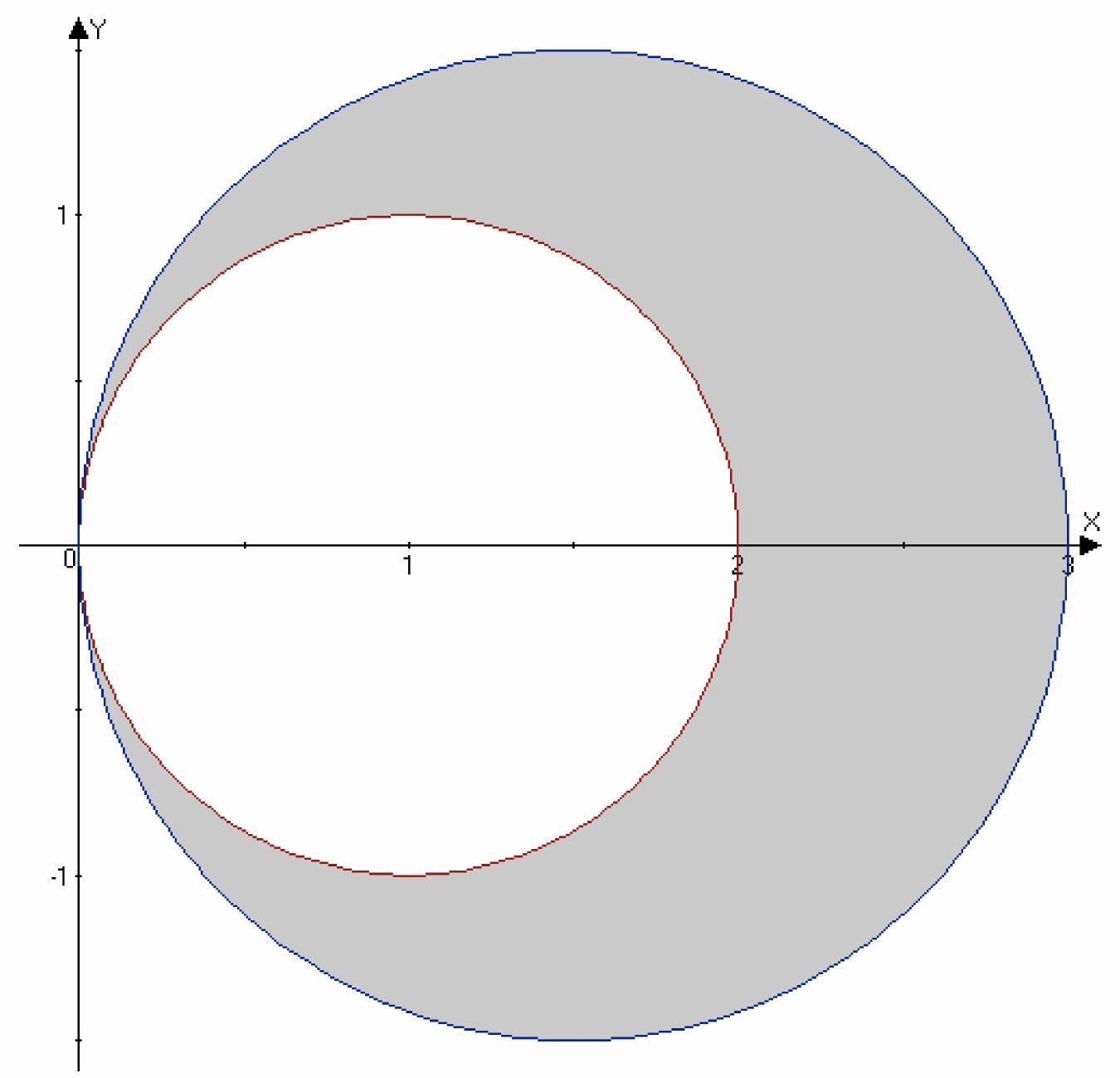
$$
S=\frac{1}{2} \int_{\alpha}^{\beta}\left(r_{2}^{2}(\varphi)-r_{1}^{2}(\varphi)\right) d \varphi
$$
| $\varphi$ | $\frac{3 \pi}{2}$ | $\frac{5 \pi}{3}$ |... | \frac{5\pi}{4} | Geometry | math-word-problem | Yes | Yes | olympiads | false |
5. Determination of the mass of magnesium nitrate - 2 points
Total: 10 points.
## TASK 4
## SOLUTION:
According to the law of mass action, the rate of the forward reaction is expressed by the equation:
$$
\mathrm{v}=\mathrm{k} \cdot \mathrm{C}_{\mathrm{CO}}{ }^{2} \cdot \mathrm{C}_{\mathrm{O} 2}
$$
When the react... | Answer: The reaction speed increased by 27 times.
## Evaluation system: | 27 | Algebra | math-word-problem | Incomplete | Yes | olympiads | false |
Patrick has been saving money to buy a bicycle. He saved half the price but he then lent $50 to his friend. Now, Patrick has $25. What is the cost of the bicycle? | Let's call the cost of the bicycle X.
Patrick saved half the price of the bicycle, so he saved X/2.
He then lent $50 to his friend, so he had X/2 - $50 left.
After lending the money, Patrick has $25, so we can set up the equation:
X/2 - $50 = $25
Now, let's solve for X:
X/2 = $25 + $50
X/2 = $75
To find the full... | \$150 | Algebra | math-word-problem | Yes | Yes | orca_math | true |
2. An inflated lifebuoy (as shown in the right figure). The large circle indicated by the dotted line has a radius of 33 cm. The small circle indicated by the solid line has a radius of 9 cm. Two ants start from point $A$ at the same time and move along the large circle and the small circle, respectively, at the same s... | 11
2.【Solution】Since the two ants have the same speed, the ratio of the time it takes for the ants on the large and small circles to crawl one lap should be equal to the ratio of the circumference of the circles. And the ratio of the circumferences is equal to the ratio of the radii, which is: $33: 9$.
To find out how... | 11 | Number Theory | math-word-problem | Incomplete | Yes | olympiads | false |
all the faces of a cube are painted with blue colour . then it is cut into 125 small equal cubes . how many small cubes will be formed having only one face coloured ? | To determine the number of small cubes with only one face colored, we need to consider the structure of the larger cube before it was cut.
Since the larger cube was painted blue on all faces and then cut into 125 smaller equal cubes, we know that the larger cube was cut into 5 smaller cubes along each edge (because 5 ... | 54 | Geometry | math-word-problem | Yes | Yes | orca_math | true |
Let $a_1,a_2,a_3, \cdots ,a_n$ be positive real numbers. For the integers $n\ge 2$, prove that\[ \left (\frac{\sum_{j=1}^{n} \left (\prod_{k=1}^{j}a_k \right )^{\frac{1}{j}}}{\sum_{j=1}^{n}a_j} \right )^{\frac{1}{n}}+\frac{\left (\prod_{i=1}^{n}a_i \right )^{\frac{1}{n}}}{\sum_{j=1}^{n} \left (\prod_{k=1}^{j}a_k \r... | null | null | Inequalities | proof | Yes | Yes | aops_forum | false |
In the Cartesian coordinate system, the system of inequalities
$$
\left\{\begin{array}{l}
\sqrt{3} x-y \leqslant 0, \\
x-\sqrt{3} y+2 \geqslant 0 \\
y \geqslant 0
\end{array}\right.
$$
represents a planar region whose area is equal to ( ).
(A) $\frac{\sqrt{3}}{2}$
(B) $\sqrt{3}$
(C) 2
(D) $2 \sqrt{3}$ | 2. B.
The system of inequalities represents the interior (including the boundary) of a triangular plane region, with the coordinates of the three vertices being $A(-2,0), O(0,0), B(1, \sqrt{3})$.
It is easy to see that, $S_{\triangle A O B}=\frac{1}{2} \times 2 \times \sqrt{3}=\sqrt{3}$. | B | Geometry | MCQ | Yes | Yes | cn_contest | false |
Find the principle on a certain sum of money at 11 % per annum for some years if the amount being rs. 1120. The principle is rs. 886.0759493670886. What is the duration in years? | To find the duration in years, we can use the formula for compound interest, which is:
A = P(1 + r/n)^(nt)
Where:
A = the amount of money accumulated after n years, including interest.
P = the principal amount (the initial amount of money)
r = the annual interest rate (in decimal)
n = the number of times that interes... | 2.237 | Algebra | math-word-problem | Incomplete | Yes | orca_math | true |
if 90 percent of 600 is 50 percent of x , then x = ? | To solve for x, we can set up the equation:
90% of 600 = 50% of x
First, we convert the percentages to decimals:
0.90 * 600 = 0.50 * x
Now, we can solve for x:
540 = 0.50 * x
To isolate x, we divide both sides by 0.50:
x = 540 / 0.50
x = 1080
Therefore, x = $\boxed{1080}$ . | 1080 | Algebra | math-word-problem | Yes | Yes | orca_math | true |
Consider an acute angled triangle $PQR$ such that $C,I$ and $O$ are the circumcentre, incentre and orthocentre respectively. Suppose $\angle QCR, \angle QIR$ and $\angle QOR$, measured in degrees, are $\alpha, \beta$ and $\gamma$ respectively. Show that \[\frac{1}{\alpha}+\frac{1}{\beta}+\frac{1}{\gamma}>\frac{1}{45}\... | 1. Given an acute-angled triangle \( \triangle PQR \) with circumcenter \( C \), incenter \( I \), and orthocenter \( O \). We need to show that:
\[
\frac{1}{\alpha} + \frac{1}{\beta} + \frac{1}{\gamma} > \frac{1}{45}
\]
where \( \alpha = \angle QCR \), \( \beta = \angle QIR \), and \( \gamma = \angle QOR \... | null | Geometry | proof | Yes | Yes | aops_forum | false |
Question 3. Let $Z_{1}$ and $Z_{2}$ correspond to the complex numbers $y_{1}$,
$z_{2}$, then the necessary and sufficient condition for $O Z_{1} \perp O Z_{2}$ is
$$
z_{1} \bar{z}_{2}+\bar{z}_{1} z_{2}=0
$$ | Prove $\overrightarrow{O Z_{1}} \perp \overrightarrow{O Z_{2}} \Leftrightarrow z_{1}=k i \cdot z_{2}(k \neq 0$ is a real number). If $z_{1}=k i \cdot z_{2}$, then $z_{1} z_{2}+\bar{z}_{1} z_{2}$
$$
\begin{array}{l}
=k i \cdot z_{2} \cdot \bar{z}_{2}+k i z_{2} \cdot z_{2}=k i \bar{z}_{2} \bar{z}_{2} \\
-k i \bar{z}_{2} ... | proof | Algebra | proof | Yes | Yes | cn_contest | false |
15. (7 points) Two baskets, A and B, together contain 75 kilograms of apples. If 5 kilograms of apples are moved from basket A to basket B, basket A still has 7 kilograms more apples than basket B. How many kilograms of apples did baskets A and B originally have each?
将上面的文本翻译成英文,请保留源文本的换行和格式,直接输出翻译结果。 | 【Solution】Solution: $(75-5 \times 2-7) \div 2$,
$$
\begin{array}{l}
=58 \div 2, \\
=29 \text { (kg), } \\
75-29=46 \text { (kg), }
\end{array}
$$
Answer: Basket A originally had 46 kg, Basket B originally had 29 kg. | Geometry | math-word-problem | Yes | Yes | olympiads | false | |
Given the function $f(x)= \frac {1}{2}x^{2}-2ax-a\ln x$ for any $x_{1}$, $x_{2}$ ($x_{1}\neq x_{2}$) in the interval $(1,2)$, it holds that $\frac {f(x_{2})-f(x_{1})}{x_{2}-x_{1}} < 0$. The range of $a$ is ( ).
A: $( \frac {4}{5},+\infty)$
B: $[ \frac {4}{5},+\infty)$
C: $[ \frac {1}{3},+\infty)$
D: $(-\infty,1)\cup(0... | Solution: $f′(x)=x-2a- \frac {a}{x}$,
Therefore, $f′(x)\leqslant 0$ holds for $x\in(1,2)$,
which means $x-2a- \frac {a}{x}\leqslant 0$ holds for $x\in(1,2)$,
i.e., $x^{2}-2ax-a\leqslant 0$,
Let $g(x)=x^{2}-2ax-a$,
then $\begin{cases}g(1)\leqslant 0 \\ g(2)\leqslant 0\end{cases}$, i.e., $\begin{cases}1-3a\leqs... | B | Calculus | MCQ | Yes | Yes | cn_k12 | false |
A pen costs $11$ € and a notebook costs $13$ €. Find the number of ways in which a person can spend exactly $1000$ € to buy pens and notebooks. | To solve the problem, we need to find the number of non-negative integer solutions \((x, y)\) to the equation:
\[ 11x + 13y = 1000 \]
1. **Express \(x\) in terms of \(y\):**
\[ x = \frac{1000 - 13y}{11} \]
For \(x\) to be an integer, \(1000 - 13y\) must be divisible by 11.
2. **Determine the values of \(y\) for... | 7 | Combinatorics | math-word-problem | Yes | Yes | aops_forum | false |
A person crosses a 300 m long street in 4 minutes. What is his speed in km per hour? | To calculate the speed in km per hour, we need to convert the distance from meters to kilometers and the time from minutes to hours.
First, convert the distance from meters to kilometers:
300 meters = 0.3 kilometers
Next, convert the time from minutes to hours:
4 minutes = 4/60 hours = 1/15 hours
Now, calculate the ... | 4.5 | Other | math-word-problem | Yes | Yes | orca_math | true |
The volume of a cube is 8. What is the surface area of the sphere inscribed in this cube?
A: $8\pi$
B: $6\pi$
C: $4\pi$
D: $\pi$ | Since the volume of the cube is 8, its side length is 2. The radius of the inscribed sphere is 1. Therefore, the surface area $S = 4\pi R^2 = 4\pi$.
Hence, the correct option is $\boxed{\text{C}}$. | \text{C} | Geometry | MCQ | Yes | Yes | cn_k12 | false |
17.16. On the bisector of the exterior angle $C$ of triangle $ABC$, a point $M$ is taken, different from $C$. Prove that $MA + MB > CA + CB$. | 17.16. Let points $A^{\prime}$ and $B^{\prime}$ be symmetric to $A$ and $B$ with respect to the line $C M$. Then $A M+M B=A^{\prime} M+M B>A^{\prime} B=A^{\prime} C+C B=A C+C B$. | proof | Geometry | proof | Yes | Yes | olympiads | false |
11. A non-zero natural number, the sum of its digits multiplied by 12, equals the number itself. This natural number is $\qquad$ . | $108$ | 108 | Number Theory | math-word-problem | Yes | Incomplete | olympiads | false |
$4 \cdot 36$ Try to find the $n$ $n$-th roots of 1, and find the sum of their $n$-th powers.
untranslated part:
试求 1 的 $n$ 个 $n$ 次方根,并求它们 $n$ 次幕的和.
translated part:
Try to find the $n$ $n$-th roots of 1, and find the sum of their $n$-th powers. | [Solution] $x^{n}=1$, that is, $x^{n}=\cos 2 k \pi+i \sin 2 k \pi \cdot(k=0, \pm 1, \pm 2, \cdots)$, so by De Moivre's theorem, the $n$ roots are:
$$x_{k}=\cos \frac{2 k \pi}{n}+i \sin \frac{2 k \pi}{n} \cdot(k=0,1,2, \cdots, n-1)$$
Since $\quad x_{k}^{n}=1 .(k=0,1,2, \cdots, n-1)$
Therefore, $x_{0}^{n}+x_{1}^{n}+\cdo... | n | Algebra | math-word-problem | Yes | Yes | inequalities | false |
Sam has 30 nickels and dimes worth 2.40 dollars. How many nickels does he have? | Let's use algebra to solve this problem. Let's call the number of nickels Sam has "n" and the number of dimes "d". We know that the total number of coins is 30, so we can write the first equation as:
n + d = 30
We also know that the total value of the coins is $2.40, which is 240 cents. Since each nickel is worth 5 c... | 12 | Algebra | math-word-problem | Yes | Yes | orca_math | true |
A sector paper with a radius of $30cm$ and a central angle of $120^{\circ}$ is used to form the lateral surface of a cone. The radius of the base of this cone is ____ $cm$. | To solve this problem, we start by understanding that the lateral surface of a cone, when unfolded, forms a sector of a circle. The given sector has a radius of $30cm$ and a central angle of $120^{\circ}$. We are tasked with finding the radius of the base of the cone, which we'll denote as $r$.
**Step 1: Relate the ci... | 10 \text{ cm} | Geometry | math-word-problem | Yes | Yes | cn_k12 | false |
Julia played tag with some kids on Monday, 18 kids on Tuesday, and 97 kids on Wednesday. She played with 33 kids on Monday and Tuesday. How many kids did she play with on Monday? | If Julia played with 33 kids on Monday and Tuesday combined, and we know she played with 18 kids on Tuesday, we can find out how many kids she played with on Monday by subtracting the number of kids she played with on Tuesday from the total number of kids she played with on both days.
So, the calculation would be:
33... | 15 | Logic and Puzzles | math-word-problem | Yes | Yes | orca_math | true |
A basket contains 4 red, 9 green, 5 yellow, and 10 blue marbles. A marble is selected at random. What is the probability that it is green? | 1. **Calculate the total number of marbles**:
\[
4 \text{ (red)} + 9 \text{ (green)} + 5 \text{ (yellow)} + 10 \text{ (blue)} = 28 \text{ marbles}
\]
2. **Count the number of green marbles**:
There are 9 green marbles.
3. **Compute the probability of selecting a green marble**:
\[
\text{Probability}... | \frac{9}{28} | Combinatorics | math-word-problem | Yes | Yes | synthetic_math | true |
In the polar coordinate system with the origin \\(O\\) as the pole and the positive half of the \\(x\\)-axis as the polar axis, given two points \\(A(2,\dfrac{2}{3}\pi), B(3,\dfrac{\pi}{6})\\), the area of \\(\triangle AOB\\) is \_\_\_\_\_\_. | **Analysis**
This question examines the application of polar coordinates.
Since \\(∠AOB= \dfrac{2π}{3} - \dfrac{π}{6} = \dfrac{π}{2}\\), the result can be obtained by using the formula for the area of a right triangle.
**Solution**
Given \\(∠AOB= \dfrac{2π}{3} - \dfrac{π}{6} = \dfrac{π}{2}\\),
Therefore, \\(S_{\tr... | 3 | Geometry | math-word-problem | Yes | Yes | cn_k12 | false |
A Senior Center is hosting a bingo night with a certain amount of prize money. The first winner of the night will receive a third of the money. The next ten winners will each receive a 10th of the remaining amount, and each of them will receive $160. How much is the total prize money for the bingo night? | Let's denote the total prize money for the bingo night as P.
The first winner receives a third of the total prize money, so they receive (1/3)P.
The remaining amount after the first winner is then P - (1/3)P = (2/3)P.
The next ten winners each receive a 10th of the remaining amount, which is (1/10) of (2/3)P. Each o... | \$2400 | Algebra | math-word-problem | Yes | Yes | orca_math | true |
In the Cartesian coordinate system xOy, point P $(x_P, y_P)$ and point Q $(x_Q, y_Q)$ satisfy the following system of equations:
$$
\begin{cases}
x_Q = y_P + x_P \\
y_Q = y_P - x_P
\end{cases}
$$
Based on this rule, the transformation from point P to point Q is referred to as a "point transformation" in the Cartesian p... | Given that the ratio of the lengths from the origin to Q and from the origin to P is squared, we have:
$$
\left(\frac{OQ}{OP}\right)^2 = \frac{x_Q^2 + y_Q^2}{x_P^2 + y_P^2} = m^2
$$
Since
$$
\begin{cases}
x_Q = y_P + x_P \\
y_Q = y_P - x_P
\end{cases}
$$
we get
$$
\frac{(x_P + y_P)^2 + (y_P - x_P)^2}{x_P^2 + y_P^2} = m... | \left(\frac{\pi}{4}, \sqrt{2}\right) | Algebra | math-word-problem | Yes | Yes | cn_k12 | false |
Which of the following events is a certain event?
A: The temperature in Aojiang on June 1st this year is 30 degrees.
B: There are 10 red balls in a box, and any ball taken out must be a white ball.
C: Throwing a stone, the stone will eventually fall.
D: In this math competition, every participating student will score f... | **Answer**: Since options A and D are uncertain events, i.e., random events, and option B is an impossible event, they do not meet the requirements of the question.
Therefore, the only event that will certainly happen is option C, where throwing a stone will eventually lead to it falling, which is a certain event and... | C | Logic and Puzzles | MCQ | Yes | Yes | cn_k12 | false |
Let's modify the line that cuts off a cyclic quadrilateral with $\frac{2}{3}$ the area of a given triangle. Is the problem always solvable?
---
Translate the above text into English, please retain the line breaks and format of the source text, and output the translation result directly. | Among the quadrilaterals with the desired properties, let's try to construct the one whose one side is $a$, the side opposite to this $a$ is $d$, and the segment of the $AB$ side adjacent to $A$ forms an angle $\gamma$ (consequently, the corresponding segment of the $AC$ side forms an angle $\beta$). Draw such a line a... | proof | Geometry | math-word-problem | Yes | Yes | olympiads | false |
In triangle $ABC$, $AB = 8$, $BC = 13$, and $AC = 15$. If $D$ and $E$ are selected on $\overline{AB}$ and $\overline{AC}$ respectively, such that $AD = 3$ and $AE = 10$, find the area of triangle $ADE$. | 1. First, calculate the area of triangle $ABC$ using Heron's formula:
Let $AB = a = 8, BC = c = 13, AC = b = 15$.
\[
s = \frac{a+b+c}{2} = \frac{8+13+15}{2} = 18
\]
Using Heron's formula, Area=$\sqrt{s(s-a)(s-b)(s-c)}$:
\[
\text{Area of } \triangle ABC = \sqrt{18(18-8)(18-13)(18-15)} = ... | \frac{15\sqrt{3}}{2} | Geometry | math-word-problem | Yes | Yes | synthetic_math | true |
Three, (25 points) Find the smallest positive integer $k$, such that there exists a positive integer $n$, satisfying $10^{n}=29 k+2$.
---
The translation maintains the original text's format and line breaks. | $$
\begin{array}{l}
\text { Given } \frac{1}{29}=0.0334482758620689655172413793 \text { i, } \\
\frac{2}{29}=0.0068965517241379310344827586 \text { 2e, }
\end{array}
$$
we know that when $n=11$, $k$ takes the minimum value 3448275862.
Explanation: By appending the 28-digit repeating cycle of $\frac{1}{29}$ to 34482758... | 3448275862 | Number Theory | math-word-problem | Yes | Yes | cn_contest | false |
Mr. Wang wants to use 80 yuan to buy some stationery. He first spent 45.6 yuan to buy 8 albums and plans to use the remaining money to buy some pens, each costing 2.5 yuan. How many pens can he buy? | First, subtract the amount spent on albums from the total amount to find out how much money is left. Then, use the formula quantity = total price ÷ unit price to calculate the number of pens that can still be bought.
The key to this problem is to first find out the remaining amount of money, and then use the formula t... | 13.76 \approx 13 | Algebra | math-word-problem | Yes | Yes | cn_k12 | false |
Determine the smallest possible degree of the polynomial $q(x)$ such that the rational function $\frac{5x^5 + 4x^3 - x^2 - 2}{q(x)}$ has a horizontal asymptote. | For the rational function $\frac{5x^5 + 4x^3 - x^2 - 2}{q(x)}$ to have a horizontal asymptote, the degree of $q(x)$ must be at least equal to the degree of the polynomial in the numerator, as $x \to \infty$ or $x \to -\infty$. The asymptotic behavior of the function is dictated by the highest degree terms in both the n... | 5 | Algebra | math-word-problem | Yes | Yes | synthetic_math | true |
In an examination, 35% of the students passed and a certain number of students failed. A total of 800 students appeared for the examination. How many students failed the examination? | If 35% of the students passed the examination, then 100% - 35% = 65% of the students failed the examination.
To find out how many students failed, we need to calculate 65% of the total number of students who appeared for the examination.
Total number of students = 800
Percentage of students who failed = 65%
Number ... | 520 | Algebra | math-word-problem | Yes | Yes | orca_math | true |
3. $a>1, b=$
rational number, $1 . \mathrm{a}^{b}+\mathrm{a}^{-4}=2 \sqrt{ } 2$, then $\mathrm{a}^{b}-\mathrm{a}^{-b}$ equals:
(A) $\sqrt{6}$;
(B) 2 or -2 ;
(C) -2 ;
(D) 2 . | Answer: (D).
From $a^{b}+a^{-b}=2 \sqrt{2}$, we get $a^{2 b}+2+a^{-2 b}=8$.
$\therefore\left(a^{b}-a^{-b}\right)^{2}=4, a^{b}-a^{-b}= \pm 2$.
Given $a>1, b>0$, we have $a^{a}>1, a^{-4}a^{-b}, \therefore a^{b}-a^{-b}=2$. | D | Algebra | MCQ | Yes | Yes | cn_contest | false |
In a chess tournament, each participant plays exactly one game with each of the remaining participants. There are 20 participants in the tournament. How many games will be played during the tournament? | The number of games played in a tournament where each participant plays exactly one game with each of the remaining participants can be calculated using the formula for combinations:
Number of games = C(n, 2) = n! / (2! * (n - 2)!)
Where n is the number of participants and C(n, 2) represents the number of combination... | 190 | Combinatorics | math-word-problem | Yes | Yes | orca_math | true |
(1) In the polar coordinate system, a curve $C$ intersects with the rays $\theta = \frac{\pi}{3}$ and $\theta = \frac{2\pi}{3}$ at points $A$ and $B$, respectively. Calculate the area of the triangle $\Delta AOB$.
(2) In the rectangular coordinate system, the parametric equations of a line $l$ are given by $\begin{cas... | (1) From the parametric equation of the curve $C$, we can derive its polar coordinate equation as ${{\rho }^{2}}=\dfrac{4}{3{{\sin }^{2}}\theta +1}$.
By substituting $\theta = \frac{\pi}{3}$ and $\theta = \frac{2\pi}{3}$, we can obtain the values of ${{\rho }_{1}}$ and ${{\rho }_{2}}$ corresponding to points $A$ and $... | \dfrac{{4}\sqrt{2}}{5} | Geometry | math-word-problem | More than one problem | Yes | cn_k12 | false |
Bobby had 22 pieces of candy. He ate 9 pieces of candy at the start and then ate 5 more. How many pieces of candy does he have left? | Bobby started with 22 pieces of candy. He ate 9 pieces, so he had:
22 - 9 = 13 pieces left.
Then he ate 5 more pieces, so he had:
13 - 5 = 8 pieces left.
Bobby has $\boxed{8}$ pieces of candy left. | 8 | Other | math-word-problem | Yes | Yes | orca_math | true |
Problem 6.6. Several oranges (not necessarily of equal weight) were picked from a tree. When they were weighed, it turned out that the weight of any three oranges taken together is less than $5 \%$ of the total weight of the remaining oranges. What is the smallest number of oranges that could have been picked? | Answer: 64.
Solution. 64 oranges could have been, for example, if all of them had the same mass $m$, since $\frac{3 m}{61 m}<0.05$.
Suppose there were no more than 63 oranges. Consider the three heaviest oranges with a total mass of $M$. All the other oranges (no more than 60) can be divided into no more than 20 grou... | 64 | Inequalities | math-word-problem | Yes | Yes | olympiads | false |
Given the function $f(x)=\sin(\omega x+\varphi)$ is monotonically increasing on the interval ($\frac{π}{6}$,$\frac{{2π}}{3}$), and the lines $x=\frac{π}{6}$ and $x=\frac{{2π}}{3}$ are the two symmetric axes of the graph of the function $y=f(x)$, then $f(-\frac{{5π}}{{12}})=\left(\ \ \right)$
A: $-\frac{{\sqrt{3}}}{2}$... | Given the function $f(x)=\sin(\omega x+\varphi)$ is monotonically increasing on the interval $\left(\frac{π}{6},\frac{2π}{3}\right)$, and the lines $x=\frac{π}{6}$ and $x=\frac{2π}{3}$ are the two symmetric axes of the graph of the function $y=f(x)$. We need to find $f\left(-\frac{5π}{12}\right)$.
Step 1: Determine th... | D | Algebra | MCQ | Yes | Yes | cn_k12 | false |
[ Volume of a Tetrahedron and Pyramid
Prove that from the lateral faces of a quadrilateral pyramid, the base of which is a parallelogram, a triangular pyramid can be formed, and its volume is half the volume of the original quadrilateral pyramid.
# | Let $P A B C D$ be a quadrilateral pyramid, the base of which is a parallelogram $A B C D$. Through the vertex $P$, draw a line parallel to $A D$, and lay off a segment $P Q$ on it, equal to $A D$. Consider the triangular pyramid $Q P C D$. Since $A P Q D$ and $B P Q C$ are parallelograms, triangle $C P Q$ is equal to ... | proof | Geometry | proof | Yes | Yes | olympiads | false |
The random variable $X$ follows a normal distribution with mean 1 and variance 4, i.e., $X\sim N(1,4)$. If $P(x\geqslant 2)=0.2$, what is $P(0\leqslant x\leqslant 1)$?
A: $0.2$
B: $0.6$
C: $0.4$
D: $0.3$ | Since $X$ is a normal random variable with mean 1 and variance 4, we have $Z=\frac{X-\mu}{\sigma}=\frac{X-1}{2}\sim N(0,1)$. Now, let's find the probabilities in terms of the standard normal distribution.
1. $P(X\geqslant 2)=P(Z\geqslant \frac{2-1}{2})=P(Z\geqslant 0.5)=0.2$
To find the corresponding $z$-score for th... | 0.3 | Algebra | MCQ | Yes | Incomplete | cn_k12 | false |
James binges on Cheezits and eats 3 bags that are a certain weight in ounces. There are 150 calories in an ounce of Cheezits. He then goes for a 40-minute run and burns 12 calories per minute. He ate 420 excess calories. How many ounces is each bag of Cheezits? | Let's denote the weight of each bag of Cheezits in ounces as \( x \).
James eats 3 bags, so the total weight of the Cheezits he consumes is \( 3x \) ounces.
Since there are 150 calories in an ounce of Cheezits, the total calories consumed from the 3 bags of Cheezits is \( 150 \times 3x \).
James goes for a 40-minute... | 2 | Algebra | math-word-problem | Yes | Yes | orca_math | true |
[ Law of Sines ] [ Law of Cosines ] In triangle $A B C$, medians $A N$ and $C M$ are drawn, $\angle A B C=120^{\circ}$. The circle passing through points $A, M$ and $N$ also passes through point $C$. The radius of this circle is 7. Find the area of triangle $A B C$. | Prove that the given triangle is isosceles, find $A N$, and to find the sides of the given triangle, apply the Law of Cosines to triangle $A B N$.
## Solution
By the theorem of the midline of a triangle, $M N \| A C$, so $A M N C$ is a trapezoid. Since the trapezoid is inscribed in a circle, it is isosceles. Since $A... | 7\sqrt{3} | Geometry | math-word-problem | Yes | Yes | olympiads | false |
Example 19: A and B agree to meet at a certain place between 0 and 1 o'clock. The one who arrives earlier should wait for 20 minutes before leaving. If the times of their arrivals are independent and any moment between 0 and 1 o'clock is equally probable, what is the probability that they will meet? | Let the times at which the two people arrive at the meeting place be $x$ and $y$. According to the problem, they must satisfy $|x-y| \leqslant \frac{1}{3}$ to meet.
We use their arrival times as the horizontal and vertical coordinates, respectively. Thus, the times at which the two people arrive are uniformly distribu... | \frac{5}{9} | Logic and Puzzles | math-word-problem | Yes | Yes | olympiads | false |
Example 7 In the right triangle $\triangle ABC$, $\angle A=90^{\circ}, \angle B > \angle C, O$ is the circumcenter of $\triangle ABC$, $l_{A}$ and $l_{B}$ are two tangent lines of $\odot O$, touching at points $A$ and $B$ respectively. Let $BC$ intersect $l_{A}$ at point $S$, $AC$ intersect $l_{B}$ at point $D$, $AB$ i... | Prove as shown in Figure 10, let the extension of $BA$ intersect the tangent to $\odot O$ at point $C$ at point $E'$.
Applying Pascal's theorem to $\triangle ABC$, we know that points $S$, $D$, and $E'$ are collinear. Therefore, point $E'$ coincides with point $E$.
Thus, the positions of points $R$ and $Q$ are as show... | proof | Geometry | proof | Yes | Yes | cn_contest | false |
In the figure, $ \angle EAB$ and $ \angle ABC$ are right angles. $ AB \equal{} 4, BC \equal{} 6, AE \equal{} 8$, and $ \overline{AC}$ and $ \overline{BE}$ intersect at $ D$. What is the difference between the areas of $ \triangle ADE$ and $ \triangle BDC$?
[asy]unitsize(4mm);
defaultpen(linewidth(.8pt)+fontsize(10pt))... | 1. **Calculate the area of $\triangle ABE$:**
\[
[ABE] = \frac{1}{2} \times AB \times AE = \frac{1}{2} \times 4 \times 8 = 16
\]
Let the area of $\triangle ADE$ be \( x \) and the area of $\triangle ABD$ be \( z \). Therefore,
\[
x + z = 16
\]
2. **Calculate the area of $\triangle ABC$:**
\[
... | 4 | Geometry | math-word-problem | Yes | Yes | aops_forum | false |
Suppose $8 = 2^{3r + 2}$. Find the value of $r$, expressed as a common fraction. | First, express $8$ as a power of $2$. We know $8 = 2^3$. Therefore, we rewrite the equation as:
$$2^3 = 2^{3r+2}.$$
Since the bases are equal, the exponents must also be equal:
$$3 = 3r + 2.$$
Now, solve for $r$:
\begin{align*}
3 - 2 &= 3r \\
1 &= 3r \\
r &= \frac{1}{3}.
\end{align*}
Hence, the value of $r$ is $\box... | \frac{1}{3} | Algebra | math-word-problem | Yes | Yes | synthetic_math | true |
Find the integer \(n\), \(0 \le n \le 180\), such that \(\cos n^\circ = \cos 317^\circ.\) | Since the cosine function has a period of \(360^\circ\),
\[
\cos 317^\circ = \cos (317^\circ - 360^\circ) = \cos (-43^\circ).
\]
The cosine function is even, thus \(\cos (-43^\circ) = \cos 43^\circ\). Therefore, the value of \(n\) that satisfies the condition \(\cos n^\circ = \cos 317^\circ\) within the given range \(0... | 43 | Algebra | math-word-problem | Yes | Yes | synthetic_math | true |
Subsets and Splits
No community queries yet
The top public SQL queries from the community will appear here once available.