
instruction_seed stringlengths 2 10.7k | solution stringlengths 0 10.8k ⌀ | answer stringlengths 0 575 ⌀ | problem_type stringclasses 9
values | question_type stringclasses 5
values | problem_is_valid stringclasses 5
values | solution_is_valid stringclasses 4
values | source stringclasses 11
values | synthetic bool 2
classes |
|---|---|---|---|---|---|---|---|---|
The points $K$ and $L$ on the side $BC$ of a triangle $\triangle{ABC}$ are such that $\widehat{BAK}=\widehat{CAL}=90^\circ$. Prove that the midpoint of the altitude drawn from $A$, the midpoint of $KL$ and the circumcentre of $\triangle{ABC}$ are collinear.
[i](A. Akopyan, S. Boev, P. Kozhevnikov)[/i] | 1. **Lemma Statement and Setup**:
Consider $\triangle ABC$ with points $E$ and $F$ on $AB$ and $AC$ respectively, and points $G$ and $H$ on $BC$ such that quadrilateral $EFGH$ is a rectangle. Let $P$ be the center of this rectangle. We need to prove that the locus of point $P$ is the line $MN$, where $M$ and $N$ are... | null | Geometry | proof | Yes | Yes | aops_forum | false |
16. In $\triangle A B C$, the three interior angles are $\angle A$, $\angle B$, and $\angle C$, and $2 \angle C - \angle B = 180^{\circ}$. Additionally, the ratio of the perimeter of $\triangle A B C$ to its longest side is $m$. Therefore, the maximum value of $m$ is | 16. $\frac{9}{4}$.
From $2 \angle C-\angle B=180^{\circ}$, we know $120^{\circ}>\angle C>90^{\circ}$, so $\angle C$ is the largest. Its longest side is $c$, and we have $-\frac{1}{2}<\cos C<0$.
$$
\begin{array}{l}
\text { Also, } \angle A=180^{\circ}-\angle B-\angle C=360^{\circ}-3 \angle C, \text { then } \\
m=\frac{... | \frac{9}{4} | Geometry | math-word-problem | Yes | Yes | cn_contest | false |
The expression \[(x+y+z)^{2008} + (x-y-z)^{2008}\] is simplified by expanding it and combining like terms. How many terms are in the simplified expression? | We need to count the number of terms in the simplified expression for every monomial of the form \(x^a y^b z^c\), where \(a\), \(b\), and \(c\) are non-negative integers, \(a\) is even, and \(a+b+c = 2008\). There are 1005 even values of \(a\) with \(0 \leq a \leq 2008\). For each such value, \(b\) can assume any of th... | 1,010,025 | Algebra | math-word-problem | Yes | Yes | synthetic_math | true |
Lemma 1 If $a, b, c$ are all real numbers, and $b+c, c+a, a+b$ are all non-zero, then
$$\frac{a}{b+c}+\frac{b}{c+a}+\frac{c}{a+b}-\frac{3}{2}=\frac{1}{2}\left[\frac{(c-a)^{2}}{(a+b)(b+c)}+\frac{(a-b)^{2}}{(b+c)(c+a)}+\frac{(b-c)^{2}}{(c+a)(a+b)}\right]$$ | $\begin{array}{l} \text { Prove: } \frac{a}{b+c}+\frac{b}{c+a}+\frac{c}{a+b}-\frac{3}{2}=\frac{1}{2}\left[\frac{2 a}{b+c}+\frac{2 b}{c+a}+\frac{2 c}{a+b}-3\right] \\ = \frac{1}{2}\left[\left(\frac{a}{b+c}+\frac{b}{c+a}-1\right)+\left(\frac{b}{c+a}+\frac{c}{a+b}-1\right)+\left(\frac{c}{a+b}+\frac{a}{b+c}-1\right)\right]... | proof | Algebra | proof | Yes | Yes | inequalities | false |
In the poem "五月榴花妖艳烘,绿杨带雨垂垂重,五色新丝缠角粽" by Ouyang Xiu, he describes the Dragon Boat Festival. A certain business plans to sell zongzi in "Zongqing Zongyi" gift boxes to celebrate the Dragon Boat Festival. They randomly sampled $10$ zongzi from $72$ meat zongzi, $18$ alkaline zongzi, $36$ red bean paste zongzi, and $54$ l... | To solve this problem, we first need to calculate the total number of zongzi available for the gift boxes. The total number of zongzi is the sum of meat zongzi, alkaline zongzi, red bean paste zongzi, and lotus seed zongzi.
So, the total number of zongzi is $72 + 18 + 36 + 54$.
Calculating this gives us:
\[72 + 18 ... | 3 | Combinatorics | MCQ | Yes | Yes | cn_k12 | false |
The six-member math team at Maplewood High School is selected from the math club, which consists of four girls and six boys. How many different teams made up of three girls and two boys could be chosen? | To form a team of 3 girls and 2 boys, we must know how many ways to choose 3 girls from 4, and separately, 2 boys from 6. Using the combination formula, we can compute these as follows:
- Number of ways to choose 3 girls from 4: ${4 \choose 3} = 4$
- Number of ways to choose 2 boys from 6: ${6 \choose 2} = 15$
The tot... | 60 | Combinatorics | math-word-problem | Yes | Yes | synthetic_math | true |
Find the value of a constant 'd' such that x / 2y = d / 2 when (7x + 4y) / (x - 2y) = 13. | To find the value of the constant 'd' such that \( \frac{x}{2y} = \frac{d}{2} \), we first need to solve the given equation:
\[ \frac{7x + 4y}{x - 2y} = 13 \]
Let's solve for \( x \) in terms of \( y \):
\[ 7x + 4y = 13(x - 2y) \]
\[ 7x + 4y = 13x - 26y \]
\[ 13x - 7x = 26y + 4y \]
\[ 6x = 30y \]
\[ x = 5y \]
Now w... | 5 | Algebra | math-word-problem | Yes | Yes | orca_math | true |
6. Four people, A, B, C, and D, pass a ball. Initially, A passes the ball to one of B, C, or D. Then, the person who receives the ball passes it to one of the other three people, and this continues for a total of 4 passes, finally returning to A. The number of different ways this can be done is
将上面的文本翻译成英文,请保留源文本的换行和格... | 6. 21 Cases Detailed: According to the problem, the passing process can be divided into the following two categories:
In summary, there are a total of $9+12=21$ different passing processes. | Inequalities | math-word-problem | Yes | Yes | olympiads | false | |
4. As shown in Figure 20, divide the three sides of any $\triangle ABC$ into four equal parts. The division points on sides $BC$, $CA$, and $AB$ are $A_{1}$, $A_{2}$, $A_{3}$, $B_{1}$, $B_{2}$, $B_{3}$, $C_{1}$, $C_{2}$, $C_{3}$, respectively. Let the perimeters of $\triangle ABC$ and $\triangle A_{1} B_{1} C_{1}$ be $... | (It is known that $C_{1} B_{3}=\frac{1}{4} B C$. In $\triangle B_{1} B_{3} C_{1}$, we have $C_{1} B_{3}+B_{3} B_{1}>B_{1} C_{1}$, i.e., $\frac{1}{4} B C+\frac{1}{2} C A>B_{1} C_{1}$. Similarly, $\frac{1}{4} C A+\frac{1}{2} A B>C_{1} A_{1}, \frac{1}{4} A B+\frac{1}{2} B C>A_{1} B_{1}$. Adding the three inequalities yiel... | proof | Geometry | proof | Yes | Yes | cn_contest | false |
152 If $x$ varies in the solution set obtained in the previous problem, then the maximum value of $f(x)=\left(\log _{2} \frac{x}{3}\right)\left(\log _{2} \frac{x}{4}\right)$ is equal to | $$
1523-\log _{2} 3. \text{ For the } x \text{ in the above problem, we have } \frac{3}{2} \leqslant \log _{2} x \leqslant 3. \text{ Let } \log _{2} x=u, \text{ then }
$$
$$
\begin{array}{c}
f(x)=\left(\log _{2} \frac{x}{3}\right)\left(\log _{2} \frac{x}{4}\right)=\left(u-\log _{2} 3\right)(u-2) \\
=u^{2}-\left(2+\log ... | 3-\log_{2}3 | Algebra | math-word-problem | Yes | Yes | olympiads | false |
37th Swedish 1997 Problem 5 Let s(n) be the sum of the digits of n. Show that for n > 1 and ≠ 10, there is a unique integer f(n) ≥ 2 such that s(k) + s(f(n) - k) = n for each 0 < k < f(n). | f(n) = r99...9, where there are q 9s and n = 9q + r Solution Let n = 9q + r. Put f(n) = r9...9, where there are q 9s. Then for any 0 s(N) = n. Contradiction. So we must have N = f(n) 37th Swedish 1997 © John Scholes jscholes@kalva.demon.co.uk 19 January 2004 Last corrected/updated 19 Jan 04 | f(n)=r99..9,wherethereq9sn=9q+r | Number Theory | proof | Yes | Yes | olympiads | false |
Simplify $((-3-2i)-(1+4i)) \cdot (2 - 3i)$. | 1. Simplify the subtraction inside the parentheses:
\[
(-3-2i)-(1+4i) = -3 - 2i - 1 - 4i = -4 - 6i
\]
2. Multiply the result by $(2 - 3i)$:
\[
(-4 - 6i) \cdot (2 - 3i) = (-4 \cdot 2 - 4 \cdot -3i - 6i \cdot 2 - 6i \cdot -3i)
\]
\[
= -8 + 12i - 12i + 18 = 10
\]
3. Combine the results:
\[
... | 10 | Algebra | math-word-problem | Yes | Incomplete | synthetic_math | true |
a train is 357 meter long is running at a speed of 42 km / hour . in what time will it pass a bridge of 137 meter length ? | To calculate the time it takes for the train to pass the bridge, we first need to find the total distance the train needs to cover. This is the length of the train plus the length of the bridge:
Total distance = Length of train + Length of bridge
Total distance = 357 meters + 137 meters
Total distance = 494 meters
Ne... | 42.33 | Algebra | math-word-problem | Yes | Yes | orca_math | true |
Given that $m$ is a three-digit natural number where each digit is not zero. By selecting any two digits from the digits of $m$ to form a two-digit number, we can obtain six two-digit numbers. We call these six two-digit numbers the "associated numbers" of the number $m$. The sum of all "associated numbers" of $m$ divi... | ### Solution:
#### Part (1)
For $m=234$, we calculate $P(234)$ as follows:
\[
P(234) = \frac{23 + 32 + 24 + 42 + 34 + 43}{22}
\]
Breaking down the calculation:
\[
= \frac{23 + 32 + 24 + 42 + 34 + 43}{22} = \frac{198}{22} = 9
\]
Therefore, $P(234) = 9$. So, the answer is $\boxed{9}$.
#### Part (2)
Given $x=100a+... | 1028 | Number Theory | math-word-problem | Yes | Yes | cn_k12 | false |
Let $S_n$ be the sum of the first $n$ terms of an arithmetic sequence $\{a_n\}$. If $\dfrac{a_5}{a_3} = \dfrac{5}{9}$, then the value of $\dfrac{S_9}{S_5}$ is ( ).
A: $1$
B: $-1$
C: $2$
D: $\dfrac{1}{2}$ | **Analysis**
Fully utilize the relationship between the sum of the first $n$ terms of an arithmetic sequence and some specific terms to solve the problem.
This question mainly tests the properties of arithmetic sequences, the formula for the sum of the first $n$ terms of an arithmetic sequence, and the comprehensive... | A | Algebra | MCQ | Yes | Yes | cn_k12 | false |
On a rectangular sheet of paper, there is a circle (with center O) and a fixed point F (F is outside the circle). Take any point M on the circle, fold the paper to make point M coincide with point F, and create a fold line CD. If line CD intersects line OM at point P, then the locus of point P is
A. Hyperbola B... | Let's consider the geometric situation described in the problem. When the paper is folded such that point M on the circle coincides with the external point F, the fold line CD forms. The line CD intersects the line OM at point P.
Now, according to the properties of a fold, the distance from point P to point M (which i... | A. \text{Hyperbola} | Geometry | MCQ | Yes | Yes | cn_k12 | false |
If point P is in the fourth quadrant and the distance to both coordinate axes is 4, then the coordinates of point P are ( )
A: (-4, 4)
B: (-4, -4)
C: (4, -4)
D: (4, 4) | Since point P is located in the fourth quadrant and its distance to both the x-axis and y-axis is 4, we need to select the coordinates with positive x-value and negative y-value, each with an absolute value of 4.
1. Determine the sign of the coordinates based on the quadrant:
- In the fourth quadrant, the x-coordi... | C: (4, -4) | Geometry | MCQ | Yes | Yes | cn_k12 | false |
Given $a>0$, $b>0$, then "x>a$ and $y>b$" is a condition for "$x+y>a+b$ and $xy>ab$" to be ( )
A: A sufficient but not necessary condition
B: A necessary but not sufficient condition
C: A necessary and sufficient condition
D: Neither sufficient nor necessary condition | From $a>0$, $b>0$, $x>a$ and $y>b$, we can derive that $x+y>a+b$ and $xy>ab$. However, the converse is not true, for example, when $x>b$, $y>a$.
Therefore, "x>a and y>b" is a sufficient but not necessary condition for "$x+y>a+b$ and $xy>ab$".
Hence, the correct option is $\boxed{\text{A}}$.
This problem tests the pr... | \text{A} | Inequalities | MCQ | Yes | Yes | cn_k12 | false |
3. Let $a, b, c \in \mathbf{R}^{+}$, prove:
$$
\sqrt{a b(a+b)}+\sqrt{b c(b+c)}+\sqrt{c a(c+a)}>\sqrt{(a+b)(b+c)(c+a)} .
$$ | 3. Hint: Use the analytical method, square both sides of the inequality.
| proof | Inequalities | proof | Yes | Yes | olympiads | false |
Exercise 3. Let $A B C D$ be a square and $E$ a point on the segment $[B D]$ such that $E B=A B$. We define the point $F$ as the intersection of the lines $(C E)$ and $(A D)$. Find the value of the angle $\widehat{F E A}$. | ## Solution to Exercise 3
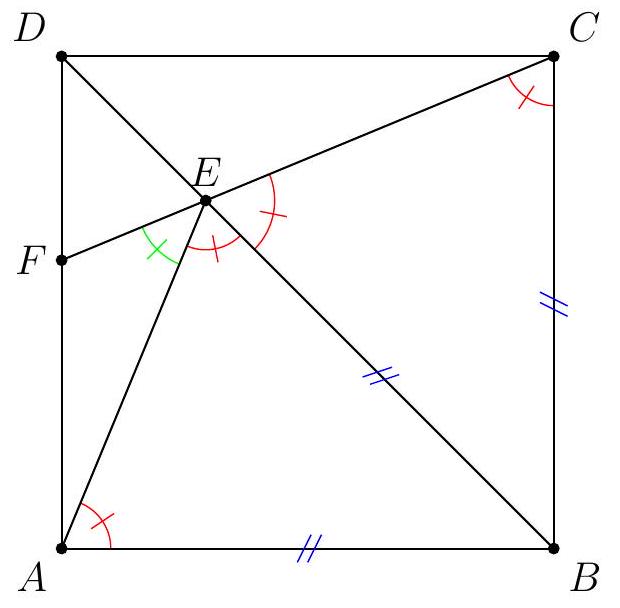
We will use the following central property multiple times: in a triangle, the sum of the angles is $180^{\circ}$.
Since the quadrilateral $A B C D$ is a square, we... | 45 | Geometry | math-word-problem | Yes | Yes | olympiads | false |
Given the planar vectors $\overrightarrow{a}$ and $\overrightarrow{b}$ that satisfy the conditions $|\overrightarrow{a}| = 3|\overrightarrow{b}| = |\overrightarrow{a} - 3\overrightarrow{b}| = 3$, determine the angle between $\overrightarrow{a}$ and $\overrightarrow{b}$, denoted as $(\quad)$.
A: $\frac{\pi}{4}$
B: $\fr... | From the given conditions, we have $|\overrightarrow{a}| = 3$ and $|\overrightarrow{b}| = 1$. Additionally, $|\overrightarrow{a} - 3\overrightarrow{b}| = 3$. We can square both sides of the last equation:
$$|\overrightarrow{a} - 3\overrightarrow{b}|^2 = (\overrightarrow{a} - 3\overrightarrow{b}) \cdot (\overrightarrow... | \frac{\pi}{3} | Algebra | MCQ | Yes | Yes | cn_k12 | false |
7.3. As shown in Figure 2, extend the sides of $\triangle ABC$ such that $BC_{1} = AC, AB_{1} = AB, CA_{1} = AB$. It is known that $\triangle A_{1}B_{1}C_{1}$ is an equilateral triangle. Prove: $\triangle ABC$ is also an equilateral triangle. | 7.3. Clearly, $\triangle A B_{1} C_{1} \cong \triangle C A_{1} B_{1}$, so,
$$
\angle C B_{1} A_{1}=\angle B_{1} C_{1} A, \angle C_{1} B_{1} A=\angle B_{1} A_{1} C \text {. }
$$
Since $\triangle A_{1} B_{1} C_{1}$ is an equilateral triangle, then $\angle C_{1} A_{1} B=$ $\angle C B_{1} A_{1}, \angle A_{1} C_{1} B=\angl... | proof | Geometry | proof | Yes | Yes | cn_contest | false |
Example $5.16$ a, b, c are positive numbers, prove that
$$\frac{a}{b+c}+\frac{b}{c+a}+\frac{c}{a+b}+\frac{3 \sqrt[3]{a b c}}{2(a+b+c)} \geqslant 2$$ | Proof: Let $a+b+c=1, ab+bc+ca=x$, using the Cauchy inequality, we need to prove
$$\frac{1}{2(ab+bc+ca)}+\frac{3}{2} \sqrt[3]{abc} \geqslant 2$$
In fact, we easily get $ab+bc+ca \leqslant \frac{1}{3}$.
Thus, if $ab+bc+ca \leqslant \frac{1}{4}$, the original inequality is obviously true.
And if $ab+bc+ca \geqslant \frac... | proof | Inequalities | proof | Yes | Yes | inequalities | false |
What is the slope of a line perpendicular to the line containing the points $(2, 3)$ and $(7, 8)$? Express your answer as a common fraction. | 1. First, find the slope of the line passing through the points $(2, 3)$ and $(7, 8)$. The slope formula is:
\[
m = \frac{y_2 - y_1}{x_2 - x_1}
\]
Plugging in the values:
\[
m = \frac{8 - 3}{7 - 2} = \frac{5}{5} = 1
\]
2. The slope of a line perpendicular to another is the negative reciprocal of t... | -1 | Algebra | math-word-problem | Yes | Yes | synthetic_math | true |
Determine the number of convex polygons all of whose sides are the square roots of positive integers which can be inscribed in a unit circle. Polygons that are rotations or reflections of each other are considered the same. | Any chord in a unit circle has length at most 2 (if it is a diameter), so all side lengths must be $1, \sqrt{2}, \sqrt{3}$, or 2 . We can do casework based on the number of sides:
- Triangles: The possible combinations of side lengths are $(\sqrt{2}, \sqrt{2}, 2),(1,1, \sqrt{3})$, $(1, \sqrt{3}, 2)$, and $(\sqrt{3}, \... | 14 | Geometry | math-word-problem | Yes | Yes | olympiads | false |
Ray climbs a flight of stairs of $n$ steps in two ways. When he does it $6$ steps at a time, there are $4$ steps left at the top. When he does it $7$ steps at a time, there are $3$ steps left at the top. What is the smallest possible value of $n$ that is greater than $15$? | The problem translates to the following congruences:
\[
n \equiv 4 \pmod{6}, \quad n \equiv 3 \pmod{7}.
\]
From $n \equiv 4 \pmod{6}$, we have $n = 6k + 4$ for some integer $k$. Substituting this into the second congruence:
\[
6k + 4 \equiv 3 \pmod{7} \Rightarrow 6k \equiv -1 \equiv 6 \pmod{7}.
\]
Since $6 \cdot 1 \equ... | 52 | Number Theory | math-word-problem | Yes | Yes | synthetic_math | true |
Given the parabola $C: y^2 = 4x$ with focus $F$, and a point $M$ on the parabola $C$, where $MQ$ is perpendicular to the directrix $l$ at point $Q$. If $\triangle MQF$ is an equilateral triangle, then the value of $\overrightarrow {FQ} \cdot \overrightarrow {FM}$ is \_\_\_\_\_\_. | Since the focus of the parabola $y^2 = 4x$ is $F$, we have $F(1,0)$.
Let $M(x, 2\sqrt{x})$, then $Q(-1, 2\sqrt{x})$ (where $x > 0$).
$\overrightarrow {MQ} = (x+1, 0)$, $\overrightarrow {FQ} = (-2, 2\sqrt{x})$, $\overrightarrow {FM} = (x-1, 2\sqrt{x})$.
If $\triangle MQF$ is an equilateral triangle, then $|MQ| = |FQ|... | 8 | Geometry | math-word-problem | Yes | Yes | cn_k12 | false |
Sally is saving up for a trip to Sea World. She already has $28 saved. It costs her $10 to park, a certain amount to get into the park, and $25 for a meal pass. Sea World is 165 miles away and her car gets 30 miles per gallon of gas. If gas costs $3 a gallon, and she needs to save up $95 more, how much does it cost to ... | First, let's calculate the cost of gas for the trip to Sea World. Sally's car gets 30 miles per gallon, and the trip is 165 miles one way. So, for a round trip, she will travel 165 miles * 2 = 330 miles.
At 30 miles per gallon, she will need 330 miles / 30 miles per gallon = 11 gallons of gas for the round trip.
If g... | \$55 | Algebra | math-word-problem | Yes | Yes | orca_math | true |
5. There are $n$ different items and 9 numbered boxes. How many ways are there to distribute these items into the boxes so that the first box contains as many items as the sum of the items in the boxes from the second to the fifth? | 5. Solution. Let there be exactly $k$ items in the first box. Then the number of ways to distribute the items is $C_{n}^{k}$. $C_{n-k}^{k} \cdot 4^{k} \cdot 4^{n-2 k}=C_{n}^{k} \cdot C_{n-k}^{k} \cdot 4^{n-k}$. Now we need to sum such numbers over all permissible $k$. This sum will be the free coefficient in the expres... | 2^{n}C_{2n}^{n} | Combinatorics | math-word-problem | Yes | Yes | olympiads | false |
Example 3: Party A ranks $n(n \geqslant 3)$ players by strength but does not disclose the ranking to Party B. Party B arbitrarily selects three players to ask Party A, and then Party A can selectively tell Party B which of the three players is the weakest or the strongest. Party B can repeatedly ask questions. If Party... | 【Analysis】First, conduct a mathematical experiment.
When $n=3$, there are only three players $A, B, C$, and a sequence of two players can be arranged, so $N=2$.
When $n=4$, let's assume the players asked are $A, B, C$, and assume player $A$ is the strongest. Then ask players $A, C, D$.
(1) If player $A$ is the stronge... | \lceil\frac{n}{2}\rceil | Logic and Puzzles | math-word-problem | Yes | Yes | olympiads | false |
Given the sequence $\{a_n\}$ with the general term $a_n = n^2 - 8n + 5$, the smallest term in this sequence is $\boxed{-11}$. | Since $a_n = (n - 4)^2 - 11$, it is known that when $n = 4$, $a_n$ reaches its minimum value of $\boxed{-11}$. | -11 | Algebra | math-word-problem | Yes | Yes | cn_k12 | false |
Participation in the local basketball league is 15% higher this year than it was last year. From last year to this year, the number of males increased by 10% and the number of females increased by 25%. There were 30 males participating in the league last year. What fraction of the league's participants is female this y... | Since there were 30 males last year, the number of males this year is:
\[ 1.10 \times 30 = 33 \] males.
Let $y$ be the number of females last year. This year, there are:
\[ 1.25y \] females.
The total number of participants last year was:
\[ 30 + y \]
This year, the total number of participants is:
\[ 1.15 \times (3... | \frac{19}{52} | Algebra | math-word-problem | Yes | Incomplete | synthetic_math | true |
2. Move only one matchstick to get the correct equality:
 | Sure, here is the translation while preserving the original formatting:
```
Let f(x) be a function defined on the interval [a, b]. If f(x) is continuous on [a, b] and differentiable on (a, b), and if f(a) = f(b), then there exists at least one point c in (a, b) such that f'(c) = 0.
``` | Logic and Puzzles | math-word-problem | Incomplete | Incomplete | olympiads | false | |
Given that $x \in (-\frac{\pi}{2}, 0)$, and $\cos 2x = a$, find the value of $\sin x = (\ \ \ )$.
A: $\sqrt{\frac{1 - a}{2}}$
B: $-\sqrt{\frac{1 - a}{2}}$
C: $\sqrt{\frac{1 + a}{2}}$
D: $-\sqrt{\frac{1 + a}{2}}$ | Since $\cos 2x = a$,
We have $1 - 2\sin^2 x = a$,
Which leads to $\sin^2 x = \frac{1 - a}{2}$,
And given that $x \in (-\frac{\pi}{2}, 0)$, we have $\sin x < 0$,
Hence, $\sin x = -\sqrt{\frac{1 - a}{2}}$.
So, the answer is $\boxed{B}$.
Using the cosine double angle formula and the given conditions, we calculate $\... | B | Algebra | MCQ | Yes | Yes | cn_k12 | false |
Freddy writes down numbers $1, 2,\ldots ,n$ in some order. Then he makes a list of all pairs $(i, j)$ such that $1\le i<j\le n$ and the $i$-th number is bigger than the $j$-th number in his permutation. After that, Freddy repeats the following action while possible: choose a pair $(i, j)$ from the current list, interch... | 1. **Base Case:**
- For \( n = 1 \), the permutation is trivially sorted since there is only one number. Thus, the statement holds for \( n = 1 \).
2. **Inductive Step:**
- Assume that the statement is true for any permutation of \( 1, 2, \ldots, n-1 \). We need to prove that it holds for any permutation of \( 1... | null | Logic and Puzzles | proof | Yes | Yes | aops_forum | false |
Determine the area of the circle given by the equation \( 3x^2 + 3y^2 - 12x + 18y + 27 = 0 \). | 1. **Simplify the equation:**
Divide the entire equation by 3:
\[ x^2 + y^2 - 4x + 6y + 9 = 0. \]
2. **Complete the square:**
For \( x \) and \( y \):
\[ x^2 - 4x \rightarrow (x - 2)^2 - 4 \]
\[ y^2 + 6y \rightarrow (y + 3)^2 - 9 \]
Substituting back, we get:
\[ (x - 2)^2 - 4 + (y + 3)^2 - 9 + 9 =... | 4\pi | Geometry | math-word-problem | Yes | Yes | synthetic_math | true |
John adopts a dog from a shelter and decides to take care of all the dog's necessities. The dog ends up having health problems, which requires 3 vet appointments, costing $400 each. In addition, John spends $250 on medication for the dog's health issues, $120 on grooming services, and $300 on pet food. After the first ... | First, let's calculate the total cost of the vet appointments. There are 3 appointments at $400 each:
3 appointments * $400/appointment = $1200
John pays for the first vet appointment in full, which is $400. For the subsequent two appointments, he has insurance that covers 80% of the cost. So he pays 20% of the cost ... | \$1205 | Algebra | math-word-problem | Yes | Yes | orca_math | true |
Linda has 8 daughters and no sons. Some of her daughters have 5 daughters each, and the rest have none. Linda has a total of 43 daughters and granddaughters, and no great-granddaughters. How many of Linda's daughters and granddaughters have no daughters? | First, calculate the total number of granddaughters Linda has:
\[ 43 \text{ (total daughters and granddaughters)} - 8 \text{ (Linda’s daughters)} = 35 \text{ granddaughters} \]
Next, determine how many daughters have their own daughters:
Let's say \(x\) daughters have 5 daughters each:
\[ 5x \text{ daughters} = 35 \te... | 36 | Logic and Puzzles | math-word-problem | Yes | Yes | synthetic_math | true |
Example 2. For any given positive integer $m$, prove that there must exist a positive integer composed entirely of 0s and 1s, which is exactly a multiple of $m$.
| 〔Prompt〕Construct a sequence consisting entirely of 11 with $m+1$ terms:
$$
1,11,111,1111, \cdots, \frac{11 \cdots 1}{m+1 \uparrow}
$$
In this sequence, there must be two terms that are congruent modulo $m$. The product of these two terms is the desired result. | proof | Number Theory | proof | Yes | Incomplete | cn_contest | false |
Lansing has some elementary schools. There are 247.0 new elementary students altogether in Lansing this year. On average, there will be 9.88 students at each school. How many elementary schools are there in Lansing? | To find the number of elementary schools in Lansing, we can divide the total number of new elementary students by the average number of students at each school.
Number of schools = Total number of students / Average number of students per school
Number of schools = 247.0 / 9.88
Number of schools ≈ 25
So, there are... | 25 | Algebra | math-word-problem | Yes | Yes | orca_math | true |
If the price of gasoline increases by 78 % and a driver intends to spend only 32 % more on gasoline , by how much percent should the driver reduce the quantity of gasoline that he buys ? | Let's assume the original price of gasoline is $1 per unit (for simplicity), and the driver originally buys 100 units of gasoline.
With a 78% increase, the new price of gasoline would be:
$1 + ($1 * 0.78) = $1 + $0.78 = $1.78 per unit.
If the driver intends to spend only 32% more on gasoline, the new amount the drive... | 25.84\% | Algebra | math-word-problem | Yes | Yes | orca_math | true |
(For students from key high schools) A moving circle is externally tangent to the fixed circle $F: (x+2)^2+y^2=1$ and is tangent to the fixed line $L: x=1$. The equation of the trajectory of the center $M$ of the moving circle is ( )
A: $y^2=4$
B: $y^2=-2$
C: $y^2=-4$
D: $y^2=-8$ | Let the radius of the moving circle $M$ be $r$. According to the problem: $|MF|=r+1$, the distance $d$ from point $M$ to the fixed line $x=2$ is $d=r+1$.
Therefore, the distance from the moving point $M$ to the fixed point $F(-2,0)$ is equal to the distance to the fixed line $x=2$.
Therefore, the trajectory of $M$ ... | D | Geometry | MCQ | Yes | Yes | cn_k12 | false |
What is the volume in cubic feet of 5 cubic yards? | First, recognize the conversion ratio between yards and feet:
\[ 1 \text{ yard} = 3 \text{ feet} \]
Cubing both sides:
\[ (1 \text{ yard})^3 = (3 \text{ feet})^3 \]
\[ 1 \text{ cubic yard} = 27 \text{ cubic feet} \]
Given 5 cubic yards, the volume in cubic feet is calculated by multiplying the number of cubic yards b... | 135 | Algebra | math-word-problem | Yes | Yes | synthetic_math | true |
Which of the following can form a proportion with $\frac {1}{2}$ : $\frac {1}{3}$? ( )
A: 3 : 2
B: 5 : 4
C: $\frac {1}{3}$ : $\frac {1}{4}$
D: $\frac {1}{3}$ : $\frac {1}{2}$ | Solution: The ratio of $\frac {1}{2}$ : $\frac {1}{3}$ is $\frac {1}{2}$ ÷ $\frac {1}{3}$ = $\frac {3}{2}$.
A, 3 : 2 = 3 ÷ 2 = $\frac {3}{2}$, can form a proportion;
B, 5 : 4 = 5 ÷ 4 = $\frac {5}{4}$, cannot form a proportion;
C, $\frac {1}{3}$ : $\frac {1}{4}$ = $\frac {1}{3}$ ÷ $\frac {1}{4}$ = $\frac {4}{3}$, ... | A | Algebra | MCQ | Yes | Yes | cn_k12 | false |
In arithmetic, the result of the expression (some number squared + the same number squared) / 28^2 is 8. What is that number? | Let's denote the unknown number as x. According to the expression given, we have:
(x^2 + x^2) / 28^2 = 8
Simplifying the expression, we get:
2x^2 / 28^2 = 8
Now, we can solve for x^2:
2x^2 = 8 * 28^2
x^2 = 4 * 28^2
x^2 = 4 * (28 * 28)
x^2 = 4 * 784
x^2 = 3136
Now, we take the square root of both sides to solv... | 56 | Algebra | math-word-problem | Yes | Yes | orca_math | true |
Which of the following inequalities is true?
A: ${(\frac{12}{11})}^{11}>{(\frac{11}{10})}^{10}$
B: ${(\frac{12}{11})}^{12}>{(\frac{11}{10})}^{11}$
C: ${(\frac{12}{11})}^{10}>{(\frac{11}{10})}^{9}$
D: ${(\frac{11}{10})}^{12}>{(\frac{12}{11})}^{13}$ | To solve the problem, we first analyze the function $f(x)=\frac{\ln(x+1)}{x}$ for $x > -1$ and $x \neq 0$. We find the derivative of $f(x)$ to determine its monotonicity.
1. **Finding the derivative of $f(x)$**:
- $f'(x)=\frac{\frac{x}{1+x}-\ln(x+1)}{x^2}$
2. **Analyzing the derivative**:
- Let $g(x)=\frac{x}{1... | ACD | Inequalities | MCQ | Yes | Yes | cn_k12 | false |
How long does a train 110 m long running at the speed of 72 km/hr take to cross a bridge 132 m in length? | First, we need to calculate the total distance the train needs to cover to completely cross the bridge. This is the length of the train plus the length of the bridge:
Total distance = Length of train + Length of bridge
Total distance = 110 m + 132 m
Total distance = 242 m
Next, we need to convert the speed of the tra... | 12.1 | Algebra | math-word-problem | Yes | Yes | orca_math | true |
Consider a right triangle with sides 8, 15, and 17. Find the length of the shortest altitude. | The given triangle has sides of lengths 8, 15, and 17. By the Pythagorean theorem, \(8^2 + 15^2 = 64 + 225 = 289 = 17^2\), confirming it is a right triangle with 17 as the hypotenuse.
The two legs, 8 and 15, also serve as altitudes to each other, with their lengths being the altitudes to the opposite sides. To find th... | \frac{120}{17} | Geometry | math-word-problem | Yes | Yes | synthetic_math | true |
2. (2 points) In a class, 12 people gathered, each of whom is either a knight, who always tells the truth, or a liar, who always lies. Each of them was asked to first name the number of knights in the room, and then the number of liars. It turned out that each number from 1 to 12 was named exactly twice. How many knigh... | Answer: from 0 to 2.
Solution: Since knights give the same answer to all questions, there cannot be more of them than the maximum number of identical answers, i.e., 2. It is easy to construct examples of all cases. If there are two knights, they tell the truth, and each liar chooses a number other than 2 and 10, and m... | from0to2 | Logic and Puzzles | math-word-problem | Yes | Yes | olympiads | false |
We say that a subset $A$ of $\mathbb N$ is good if for some positive integer $n$, the equation $x-y=n$ admits infinitely many solutions with $x,y\in A$. If $A_1,A_2,\ldots,A_{100}$ are sets whose union is $\mathbb N$, prove that at least one of the $A_i$s is good. | 1. **Define the Problem and Setup:**
We need to prove that among the sets \(A_1, A_2, \ldots, A_{100}\) whose union is \(\mathbb{N}\), at least one of these sets is "good". A set \(A\) is defined as "good" if there exists a positive integer \(n\) such that the equation \(x - y = n\) has infinitely many solutions wit... | null | Logic and Puzzles | proof | Yes | Yes | aops_forum | false |
Given that the ellipse $C\_1$: $\frac{x^{2}}{m+2} - \frac{y^{2}}{n} = 1$ and the hyperbola $C\_2$: $\frac{x^{2}}{m} + \frac{y^{2}}{n} = 1$ share the same foci, determine the range of values for the eccentricity $e\_1$ of the ellipse $C\_1$. | From the ellipse $C\_1$: $\frac{x^{2}}{m+2} - \frac{y^{2}}{n} = 1$, we have $a\_1^{2}=m+2$, $b\_1^{2}=-n$, and $c\_1^{2}=m+2+n$. Thus, $e\_1^{2}=\frac{m+2+n}{m+2}=1+\frac{n}{m+2}$.
Given the hyperbola $C\_2$: $\frac{x^{2}}{m} + \frac{y^{2}}{n} = 1$, we have $a\_2^{2}=m$, $b\_2^{2}=-n$, and $c\_2^{2}=m-n$. Since both c... | \frac{\sqrt{2}}{2} < e\_1 < 1 | Geometry | math-word-problem | Incomplete | Yes | cn_k12 | false |
If
\[(1 + \tan 1^\circ)(1 + \tan 2^\circ)(1 + \tan 3^\circ) \dotsm (1 + \tan 60^\circ) = 2^n,\]
find \( n \). | Note that for any angle \( x \), using the trigonometric identity for angle addition formula, we have:
\[
(1 + \tan x)(1 + \tan (60^\circ - x)) = (1 + \tan x) \left( 1 + \frac{\tan 60^\circ - \tan x}{1 + \tan 60^\circ \tan x} \right).
\]
Using \( \tan 60^\circ = \sqrt{3} \), the equation simplifies to:
\[
(1 + \tan x) ... | 30 | Algebra | math-word-problem | Yes | Yes | synthetic_math | true |
Let f, o, g, and h represent distinct digits in a 4-digit prime number, and the following equation holds true:
(10^3 * f + 10^2 * o + 10 * g + h) * (f * o * g * h) = FOGH
where FOGH is the 4-digit prime number formed by the digits f, o, g, and h. Determine the possible values of f, o, g, and h and calculate the sum o... | Let's analyze the given equation:
(10^3 * f + 10^2 * o + 10 * g + h) * (f * o * g * h) = FOGH
This equation implies that the 4-digit number FOGH is a product of two factors: the number itself (10^3 * f + 10^2 * o + 10 * g + h) and the product of its digits (f * o * g * h). Since FOGH is a prime number, it can only ha... | 4-digit | Number Theory | math-word-problem | Yes | Yes | orca_math | true |
A survey was conducted on the annual income ($x$, in ten thousand yuan) and annual food expenditure ($y$, in ten thousand yuan) of several households in a certain area. The survey shows that there is a linear relationship between annual income $x$ and annual food expenditure $y$, and the regression line equation of $y$... | Given the regression line equation $\hat{y} = 0.254x + 0.321$,
Let's calculate the predicted increase in food expenditure, $\Delta\hat{y}$, when the annual income increases by 1 (ten thousand yuan):
$$\Delta\hat{y} = \hat{y}_{x+1} - \hat{y}_x $$
Considering the new income $x+1$, the predicted food expenditure is:
$$\... | 0.254 | Algebra | math-word-problem | Yes | Yes | cn_k12 | false |
The average age of 16 students of a class is 16 years. Out of these, the average age of 5 students is 14 years and that of the other 9 students is a certain age. The age of the 12th student is 42 years. What is the average age of the other 9 students? | Let's denote the average age of the other 9 students as A.
The total age of the 16 students is 16 years * 16 students = 256 years.
The total age of the 5 students with an average age of 14 years is 14 years * 5 students = 70 years.
The age of the 12th student is 42 years.
Now, we need to find the total age of the o... | 16 | Algebra | math-word-problem | Yes | Yes | orca_math | true |
If a positive integer $a$ is divided by the natural numbers 2, 3, ..., 9, and the remainders are all 1, then the smallest value of $a$ is , and the general form of $a$ is . | Since $a$ divided by the natural numbers 2, 3, ..., 9 all have a remainder of 1,
this means we need to find the least common multiple (LCM) of these eight natural numbers.
Therefore, it ultimately comes down to finding the LCM of 5, 6, 7, 8, 9,
which is the LCM of $35 \times 72 = 2520$. Thus, the smallest $a$ is ... | 2521, 2520n + 1 | Number Theory | math-word-problem | Yes | Yes | cn_k12 | false |
Let $A$ be an $n\times n$ complex matrix such that $A \ne \lambda I_{n}$ for all $\lambda \in \mathbb{C}$. Prove that $A$ is similar to a matrix having at most one non-zero entry on the maindiagonal. | 1. **Base Case: \( n = 1 \)**
- For \( n = 1 \), the matrix \( A \) is a \( 1 \times 1 \) matrix. Since \( A \neq \lambda I_1 \) for all \( \lambda \in \mathbb{C} \), \( A \) cannot be a scalar multiple of the identity matrix. This case is trivial and does not need further proof.
2. **Existence of Linearly Independ... | null | Algebra | proof | Yes | Yes | aops_forum | false |
What is the smallest integer x for which a certain number ^ x > 3 ^ 24, if that certain number is 27? | To find the smallest integer \( x \) for which \( 27^x > 3^{24} \), we can use the fact that \( 27 \) is a power of \( 3 \) since \( 27 = 3^3 \).
So, we can rewrite \( 27^x \) as \( (3^3)^x \), which simplifies to \( 3^{3x} \).
Now we want to find the smallest integer \( x \) such that \( 3^{3x} > 3^{24} \).
Since t... | 9 | Algebra | math-word-problem | Yes | Yes | orca_math | true |
Gary had some stickers. He gave 42 stickers to Lucy and 26 stickers to Alex. If he had 31 stickers left, how many stickers did Gary have at first? | To find out how many stickers Gary had at first, we need to add the stickers he gave away to the stickers he had left.
He gave 42 stickers to Lucy and 26 stickers to Alex, so he gave away a total of:
42 + 26 = 68 stickers
He had 31 stickers left, so the total number of stickers he had at first is:
68 (stickers given ... | 99 | Algebra | math-word-problem | Yes | Yes | orca_math | true |
Find all real solutions to the equation
\[
\frac{1}{(x - 2)(x - 3)} + \frac{1}{(x - 3)(x - 4)} + \frac{1}{(x - 4)(x - 5)} + \frac{1}{(x - 5)(x - 6)} = \frac{1}{12}.
\] | We start by expressing each term of the equation using partial fractions:
\[
\frac{1}{(x - 2)(x - 3)} = \frac{1}{x - 3} - \frac{1}{x - 2},
\]
\[
\frac{1}{(x - 3)(x - 4)} = \frac{1}{x - 4} - \frac{1}{x - 3},
\]
\[
\frac{1}{(x - 4)(x - 5)} = \frac{1}{x - 5} - \frac{1}{x - 4},
\]
\[
\frac{1}{(x - 5)(x - 6)} = \frac{1}{x -... | 12, -4 | Algebra | math-word-problem | Yes | Yes | synthetic_math | true |
In the decimal expression of a $ 2009$-digit natural number there are only the digits $ 5$ and $ 8$. Prove that we can get a $ 2008$-digit number divisible by $ 11$ if we remove just one digit from the number. | We need to prove that for any 2009-digit natural number composed only of the digits 5 and 8, we can remove one digit to obtain a 2008-digit number that is divisible by 11. We will use mathematical induction and the divisibility rule for 11, which states that a number is divisible by 11 if the difference between the sum... | null | Number Theory | proof | Yes | Yes | aops_forum | false |
6. Given an isosceles triangle $A B C$ with base $A C$. The angle $B A C$ is 37 degrees. $X$ is the point of intersection of the altitude from vertex $A$ with the line passing through $B$ parallel to the base, $M$ is a point on the line $A C$ such that $B M=M X$. Find the degree measure of angle $M X B$. | 6. In opposite corners of a chessboard stand knights. Two players take turns cutting out free squares from the board. The player who, after their move, leaves one knight unable to reach the other across the board loses. Which player can win regardless of the other's moves? | notfound | Geometry | math-word-problem | Yes | Problem not solved | olympiads | false |
Given the function $f(x) = \frac{x-2}{x-1}$ and $g(x) = mx + 1 - m$, their graphs intersect at points A and B. If a moving point P satisfies $|\overrightarrow{PA} + \overrightarrow{PB}| = 2$, then the equation of the trajectory of P is \_\_\_\_\_\_. | Solution: By solving the equations $f(x) = \frac{x-2}{x-1}$ and $g(x) = mx + 1 - m$ simultaneously, we get $x = 1 \pm \sqrt{-\frac{1}{m}}$.
When $x = 1 - \sqrt{-\frac{1}{m}}$, $y = 1 - m\sqrt{-\frac{1}{m}}$,
When $x = 1 + \sqrt{-\frac{1}{m}}$, $y = 1 + m\sqrt{-\frac{1}{m}}$,
Let the moving point P be $(x, y)$,
Then... | (x - 1)^2 + (y - 1)^2 = 1 | Algebra | math-word-problem | Yes | Yes | cn_k12 | false |
In acute triangle $\triangle ABC$, $BC=3$, $AB= \sqrt {6}$, $\angle C= \dfrac {\pi}{4}$, find the measure of $\angle A$. | Given: $BC=3$, $AB= \sqrt {6}$, and $\angle C= \dfrac {\pi}{4}$,
We can apply the sine law (law of sines) to find $\angle A$. The sine law states that the ratio of the length of a side of a triangle to the sine of the angle opposite that side is constant for any given triangle.
Thus, $\dfrac {AB}{\sin C}= \dfrac {BC}... | A= \dfrac {\pi}{3} | Geometry | math-word-problem | Yes | Yes | cn_k12 | false |
Ryan has three distinct eggs, one of which is made of rubber and thus cannot break; unfortunately, he doesn't know which egg is the rubber one. Further, in some 100-story building there exists a floor such that all normal eggs dropped from below that floor will not break, while those dropped from at or above that floor... | null | null | Logic and Puzzles | math-word-problem | Yes | Yes | aops_forum | false |
There are some pretzels in a bowl. John ate 28 pretzels, Alan ate 9 fewer pretzels than John, and Marcus ate 12 more pretzels than John. Marcus ate 40 pretzels. How many pretzels were there in the bowl initially? | If Marcus ate 40 pretzels, which is 12 more than John, then John ate:
40 pretzels - 12 pretzels = 28 pretzels
This confirms the information given that John ate 28 pretzels.
Alan ate 9 fewer pretzels than John, so Alan ate:
28 pretzels - 9 pretzels = 19 pretzels
To find the total number of pretzels in the bowl init... | 87 | Algebra | math-word-problem | Yes | Yes | orca_math | true |
Grant has four times as many vacations as Kelvin has classes. They have altogether 450 vacations and classes. How many classes does Kelvin have? | Let's use algebra to solve this problem. Let the number of classes Kelvin has be represented by \( c \). Since Grant has four times as many vacations as Kelvin has classes, Grant has \( 4c \) vacations.
The total number of vacations and classes they have together is 450. So we can write the equation:
\[ c + 4c = 450 ... | 90 | Algebra | math-word-problem | Yes | Yes | orca_math | true |
13. (6 points) $a, b, c$ are three distinct natural numbers, and $a+b+c=48$, then the maximum product of $a, b, c$ is | 【Solution】Solution: $48 \div 3=16$,
$$
\begin{array}{l}
16-1=15, \\
16+1=17,
\end{array}
$$
Therefore, the maximum product of $a, b, c$ is: $15 \times 16 \times 17=4080$. The answer is: 4080. | 4080 | Number Theory | math-word-problem | Yes | Yes | olympiads | false |
Given that the binomial coefficients of the 4th and 8th terms in the expansion of $(1-x)^n$ are equal.
(I) Find the value of $n$;
(II) Find the sum of the coefficients of the 4th and 8th terms. | The general term of the expansion is given by:
$$T_{r+1} = C_n^r(-x)^r = (-1)^r C_n^r x^r$$
(I) Since the binomial coefficients of the 4th and 8th terms are equal, we have
$$C_n^3 = C_n^7$$
This implies that $n = 10$.
(II) The coefficient of the 4th term is given by:
$$(-1)^3 C_{10}^3 = -120$$
The coefficient of the ... | -240 | Combinatorics | math-word-problem | Yes | Yes | cn_k12 | false |
For every $n\in\mathbb{N}$, define the [i]power sum[/i] of $n$ as follows. For every prime divisor $p$ of $n$, consider the largest positive integer $k$ for which $p^k\le n$, and sum up all the $p^k$'s. (For instance, the power sum of $100$ is $2^6+5^2=89$.) Prove that the [i]power sum[/i] of $n$ is larger than $n$ for... | 1. **Define the power sum**: For a given \( n \in \mathbb{N} \), the power sum of \( n \) is defined by summing the largest powers of each prime divisor \( p \) of \( n \) that are less than or equal to \( n \). Specifically, for each prime divisor \( p \) of \( n \), find the largest \( k \) such that \( p^k \leq n \)... | null | Number Theory | proof | Yes | Yes | aops_forum | false |
How many four-digit numbers $N = \underline{a}\,\underline{b}\,\underline{c}\,\underline{d}$ satisfy all of the following conditions?
1. $3000 \le N < 7000.$
2. $N$ is a multiple of $5$ and $N$ is a multiple of $7.$
3. $2 \le b < c \le 7.$ | - From the first condition, $a$ can be either $3, 4, 5,$ or $6$ since the four-digit number must be between $3000$ and $6999$.
- For $N$ to be a multiple of both $5$ and $7$, it means $N$ is a multiple of their least common multiple, which is $35$. Therefore, $d$ must be $0$ as $35$ ends in $0$.
- For the third conditi... | 60 | Number Theory | math-word-problem | Yes | Yes | synthetic_math | true |
Given the function $f(x)= \begin{cases} \log_2 x, & x\geqslant 1 \\ -\log_2 x, & 0 < x < 1 \end{cases}$, if $f(a)=f(b)$ ($0 < a < b$), find the minimum value of $\frac{1}{a}+\frac{4}{b}$ and the value of $f(a+b)$. | From $f(a)=f(b)$, we have $\log_2 b=-\log_2 a$, which implies $\log_2 ab=0$, thus $ab=1$.
Then, $\frac{1}{a}+\frac{4}{b}=\frac{4a+b}{ab}=4a+b\geqslant 2\sqrt{4ab}=4$, with equality if and only if $b=4a$.
By solving $\begin{cases} ab=1 \\ b=4a \end{cases}$, we get $a=\frac{1}{2}$ and $b=2$.
Hence, $f(a+b)=f(\frac{5}{2})... | 1-2\log_2 2 | Algebra | math-word-problem | Yes | Yes | cn_k12 | false |
Let $ABC$ be a triangle such that $|AB|=13 , |BC|=12$ and $|CA|=5$. Let the angle bisectors of $A$ and $B$ intersect at $I$ and meet the opposing sides at $D$ and $E$, respectively. The line passing through $I$ and the midpoint of $[DE]$ meets $[AB]$ at $F$. What is $|AF|$?
$
\textbf{(A)}\ \dfrac{3}{2}
\qquad\tex... | null | null | Geometry | MCQ | Yes | Yes | aops_forum | false |
When the quadratic function $y=x^2+2x-5$ takes its minimum value, the value of the independent variable $x$ is. | Since the quadratic function $y=x^2+2x-5$ can be rewritten as $y=(x+1)^2-6$,
therefore, when the quadratic function $y=x^2+2x-5$ takes its minimum value, the value of the independent variable $x$ is given by
$$x = -\frac{b}{2a} = -\frac{2}{2} = -1.$$
Thus, the value of $x$ when $y$ is minimized is $\boxed{-1}$. | -1 | Algebra | math-word-problem | Yes | Yes | cn_k12 | false |
If the complex number $z= \frac{-2+3i}{i}$, where $i$ is the imaginary unit, then the point corresponding to $z$ in the complex plane is located in the
A: First quadrant
B: Second quadrant
C: Third quadrant
D: Fourth quadrant | Since $z= \frac{-2+3i}{i}= \frac{(-2+3i)(-i)}{-i^{2}}=3+2i$,
the coordinates of the point corresponding to $z$ in the complex plane are $(3,2)$, which is in the first quadrant.
Therefore, the correct choice is $\boxed{A}$.
This problem is solved directly by simplifying the multiplication and division of complex n... | A | Algebra | MCQ | Yes | Yes | cn_k12 | false |
The number of flowers planted in each column is the same. When a rose is planted in the 9th column from the left, the 7th row from the front, the 16th row from the back, and the 13th column from the right, how many flowers are planted? | To find the total number of flowers planted, we need to determine the number of rows and columns in the garden.
From the information given, we know that the rose is planted in the 9th column from the left and the 13th column from the right. This means there are 8 columns to the left of the rose and 12 columns to the r... | 462 | Logic and Puzzles | math-word-problem | Yes | Yes | orca_math | true |
If
$$
f(x)=\sum_{i=1}^{n} N_{i}\left|x-a_{i}\right|\left(N_{i} \in \mathbf{N}_{+}, a_{1}<a_{2}<\cdots<a_{n}\right) \text {, }
$$
then the minimum value of $f(x)$ is attained at some segment point in the middle or between two adjacent segment points. | Solve: From the problem, we have
$$
\begin{array}{l}
f(x)=\sum_{k=1}^{2011} k\left|x-\frac{1}{k}\right| \\
=|x-1|+\left(\left|x-\frac{1}{2}\right|+\left|x-\frac{1}{2}\right|\right)+\cdots+ \\
(\left\lvert\, \underbrace{\left|x-\frac{1}{2011}\right|+\cdots+\left|x-\frac{1}{2011}\right|}_{\text {2011 }} .\right.
\end{arr... | \frac{592043}{711} | Algebra | math-word-problem | Yes | Yes | cn_contest | false |
(2) Find a sequence such that the inequality $\frac{x_{0}^{2}}{x_{1}}+\frac{x_{1}^{2}}{x_{2}}+\cdots+\frac{x_{n-1}^{2}}{x_{n}}<4$ holds for any n. (23rd IMO problem) | (2) Take the infinitely decreasing geometric sequence $x_{n}=\left(\frac{1}{2}\right)^{n}, n=0,1,2, \cdots$, then
$$\frac{x_{0}^{2}}{x_{1}}+\frac{x_{1}^{2}}{x_{2}}+\cdots+\frac{x_{n-1}^{2}}{x_{n}}=2+1+\frac{1}{2}+\cdots+\left(\frac{1}{2}\right)^{n-2}<4$$ | 2+1+\frac{1}{2}+\cdots+\left(\frac{1}{2}\right)^{n-2}<4 | Inequalities | math-word-problem | Yes | Yes | inequalities | false |
Given $f(x) = 10^x + \log_{10} x$, find the value of $f'(1)$, which is equal to $(\quad)$.
A: $10$
B: $10 \ln 10 + \log_{10} e$
C: $\frac{10}{\ln 10} + \ln 10$
D: $11 \ln 10$ | Analysis:
This problem primarily tests the application of derivatives and is a common type of basic question found in high school exams.
Solution Steps:
1. Find the derivative of $f(x)$. Recall that the derivative of $a^x$ is $a^x \ln a$, and the derivative of $\log_{10} x$ is $\frac{1}{x \ln 10}$. Thus, the derivat... | 10 \ln 10 + \log_{10} e | Calculus | MCQ | Yes | Yes | cn_k12 | false |
The average weight of some persons increases by 3.5 kg when a new person comes in place of one of them weighing 65 kg. The weight of the new person is 93 kg. How many persons were there initially? | Let's denote the number of persons initially as \( n \).
The total weight increase for the group is \( 3.5 \times n \) kg because each person's weight is considered to have increased by 3.5 kg on average.
The weight of the new person is 93 kg, and they are replacing someone who weighed 65 kg. The difference in weight... | 8 | Algebra | math-word-problem | Yes | Yes | orca_math | true |
Matt has four pieces of cord, one with a length of √20 feet, another with a length of π feet, the third one with a length of e feet, and the last one with a length of √98 feet. He wants to cut them up to produce many pieces of cord that are all of the same length, with no cord left over. What is the greatest length, in... | To find the greatest length that Matt can cut the cords into without any leftover, we need to find the greatest common divisor (GCD) of the lengths of the cords. However, since the lengths involve irrational numbers (√20, π, e, √98), we cannot directly calculate the GCD as we would with integers.
Instead, we can look ... | 1 | Number Theory | math-word-problem | Yes | Yes | orca_math | true |
Piravena must make a trip from $A$ to $B,$ then from $B$ to $C,$ then from $C$ to $A.$ Each of these three parts of the trip is made entirely by bus or entirely by airplane. The cities form a scalene triangle as shown, with $C$ a distance of $4000\text{ km}$ from $A$, and $B$ a distance of $3500\text{ km}$ from $A$. Th... | The cost to fly from $A$ to $B$ includes a booking fee and a per kilometer rate. The rate is $\$0.12$ per kilometer and the booking fee is $\$120$. The distance from $A$ to $B$ is $3500\text{ km}$.
- **Cost Calculation:**
\[
\text{Cost} = 3500 \times 0.12 + 120 = 420 + 120 = \boxed{\$540}
\] | \$540 | Algebra | math-word-problem | Yes | Yes | synthetic_math | true |
A fruit drink is made of orange, watermelon, and grape juice, where 25 percent of the drink is orange juice and 40 percent is watermelon juice. If the drink is made with a certain amount of grape juice and the total drink is 200 ounces, how many ounces of grape juice is used in the drink? | To find out how many ounces of grape juice are in the drink, we first need to calculate the percentages of orange juice and watermelon juice in ounces, then subtract that from the total amount of the drink to find the grape juice amount.
The drink is 25% orange juice, so:
25% of 200 ounces = 0.25 * 200 = 50 ounces of ... | 70 | Algebra | math-word-problem | Yes | Yes | orca_math | true |
Andy and Bob went to the canteen to buy snacks. They spent the same amount. Andy bought a can of soda at $1 and x hamburgers at $2 each. Bob ordered two sandwiches for $3 and a can of fruit drink. Bob's fruit drink cost 2. What is the value of unknown variable x? What is the value of unknown variable x? | To determine the value of the unknown variable \( x \), we need to set up equations based on the information given about Andy and Bob's purchases.
First, let's calculate the total amount Andy spent:
- Andy bought a can of soda for $1.
- Andy bought \( x \) hamburgers at $2 each.
The total cost for Andy is:
\[
1 + 2x
... | 3.5 | Algebra | math-word-problem | Yes | Yes | metamath | true |
Given $0 < \theta < \frac{\pi}{2}$, vectors $a=(\sin 2\theta, \cos \theta)$, $b=(1, -\cos \theta)$, if $a \cdot b = 0$, find $\tan \theta = \_\_\_\_\_\_\_\_\_.$ | **Step 1**: Recall that the dot product of two vectors $a = (a_1, a_2)$ and $b = (b_1, b_2)$ is given by $a \cdot b = a_1b_1 + a_2b_2$.
**Step 2**: Given $a \cdot b = 0$, we have $(\sin 2\theta)(1) + (\cos \theta)(-\cos \theta) = 0$.
**Step 3**: Simplify the equation to get $\sin 2\theta = \cos^2 \theta$.
**Step 4**... | \tan\theta = \frac{1}{2} | Algebra | math-word-problem | Yes | Yes | cn_k12 | false |
Given the sets $$A=\{x|-10\}$$, if an element $x$ is randomly chosen from set $A$, the probability that the event "$x\in A\cap B$" occurs is _____. | First, let's simplify the given inequality in set $B$:
$$\frac {x-2}{3-x}>0$$
By cross-multiplication, we get
$$(x-2)(x-3)<0$$
Solving this inequality gives us the range $2<x<3$.
So, the intersection of sets $A$ and $B$ is $(2, 3)$. Since $x$ is randomly chosen from $A$, which has a length of $5-(-1)=6$, and the inter... | \frac{1}{6} | Algebra | math-word-problem | Incomplete | Yes | cn_k12 | false |
Compute the sum of the geometric series $3 - 6 + 12 - 24 + \cdots + 768$. | 1. **Identify the series components**: The first term of the series \( a = 3 \), the common ratio \( r = -2 \) since each term changes sign and doubles, similar to the original problem, and the terms stop doubling at 768.
2. **Determine the number of terms (n)**:
- Start with the first term 3 and apply the common r... | 513 | Algebra | math-word-problem | Yes | Yes | synthetic_math | true |
The incircle of the triangle $ABC$ touches the sides $BC$, $CA$, and $AB$ in the points $D$, $E$ and $F$, respectively. Let $K$ be the point symmetric to $D$ with respect to the incenter. The lines $DE$ and $FK$ intersect at $S$. Prove that $AS$ is parallel to $BC$.
[i](4th Middle European Mathematical Olympiad, Team ... | 1. **Definitions and Initial Setup:**
- Let \( k \) be the incircle of \( \triangle ABC \).
- The incircle touches \( BC \), \( CA \), and \( AB \) at points \( D \), \( E \), and \( F \) respectively.
- Let \( K \) be the point symmetric to \( D \) with respect to the incenter \( I \).
- Let \( l \parallel... | null | Geometry | proof | Yes | Yes | aops_forum | false |
If Andy and Bob spent the same amount on snacks, and Andy bought a can of soda for $1 and two hamburgers for $2 each, while Bob ordered two sandwiches for $3 and a can of fruit drink, what is the cost of Bob's fruit drink? | To determine the cost of Bob's fruit drink, we need to follow these steps:
1. Calculate the total amount Andy spent.
2. Since Andy and Bob spent the same amount, use the total amount Andy spent to find out how much Bob spent.
3. Subtract the cost of Bob's sandwiches from the total amount Bob spent to find the cost of ... | 1 | Algebra | math-word-problem | Yes | Problem not solved | metamath | true |
Determine the smallest positive integer that fulfills the congruence \(5x \equiv 18 \pmod{31}\). | - First, we find the inverse of 5 modulo 31. We need a number \(y\) such that \(5y \equiv 1 \pmod{31}\). Testing small values, we find \(5 \cdot 25 = 125 \equiv 1 \pmod{31}\), so the modular inverse of 5 is 25.
- We multiply the given congruence \(5x \equiv 18 \pmod{31}\) by 25:
\[
25 \cdot 5x \equiv 25 \cdot 18 \... | 14 | Number Theory | math-word-problem | Yes | Yes | synthetic_math | true |
How many moles of Hydrogen are formed when 1 mole of Ethane reacts with 2 moles of Oxygen to form 2 moles of Carbon dioxide? | The balanced chemical equation for the combustion of ethane (C2H6) with oxygen (O2) to form carbon dioxide (CO2) and water (H2O) is:
2 C2H6 + 7 O2 → 4 CO2 + 6 H2O
From the balanced equation, we can see that 2 moles of ethane react with 7 moles of oxygen to produce 4 moles of carbon dioxide and 6 moles of water. Each ... | (H2O), | Other | math-word-problem | Yes | Yes | orca_math | true |
Given non-zero vectors $\overrightarrow{m}$ and $\overrightarrow{n}$, the statement “There exists a negative number $\lambda$ such that $\overrightarrow{m}=\lambda \overrightarrow{n}$” is a ( ) for “$\overrightarrow{m} \cdot \overrightarrow{n} < 0$”.
A: Sufficient but not necessary condition
B: Necessary but not suff... | Since $\overrightarrow{m}$ and $\overrightarrow{n}$ are non-zero vectors, and there exists a negative number $\lambda$ such that $\overrightarrow{m}=\lambda \overrightarrow{n}$, the vectors $\overrightarrow{m}$ and $\overrightarrow{n}$ are collinear with opposite directions. It follows that $\overrightarrow{m} \cdot \o... | A | Algebra | MCQ | Yes | Yes | cn_k12 | false |
In isosceles triangle $ABC$, it is known that $\sin A : \sin B = 1 : 2$ and the base $BC = 10$. What is the perimeter of $\triangle ABC$? | Let $BC = a$, $AB = c$, and $AC = b$.
Given that $\sin A : \sin B = 1 : 2$, by the Sine Law, we have:
$$
\frac{a}{\sin A} = \frac{b}{\sin B} \quad \Rightarrow \quad \frac{a}{b} = \frac{\sin A}{\sin B} = \frac{1}{2}
$$
Since the base $BC = 10$, we have $a = 10$, and thus $b = 2a = 20$.
As $\triangle ABC$ is an isosc... | 50 | Geometry | math-word-problem | Yes | Yes | cn_k12 | false |
A man started driving at a constant speed, from the site of a blast, the moment he heard the blast. He heard a second blast after a time of 30 mins and 25 seconds. The second blast occurred exactly 30 mins after the first. He was 8250 meters from the site when he heard the second blast. What is the speed of sound in th... | To find the speed of sound in this scenario, we need to calculate the distance the sound traveled in the time between the two blasts and then divide that distance by the time it took for the sound to reach the man.
The man heard the second blast 30 minutes and 25 seconds after he started driving. Since the second blas... | 330 | Algebra | math-word-problem | Yes | Yes | orca_math | true |
Consider a regular hexagon with an incircle. What is the ratio of the area inside the incircle to the area of the hexagon?
| 1. **Assume the side length of the regular hexagon is 1.**
- Let the side length of the hexagon be \( s = 1 \).
2. **Calculate the area of the regular hexagon.**
- The formula for the area of a regular hexagon with side length \( s \) is:
\[
A_{\text{hexagon}} = \frac{3\sqrt{3}}{2} s^2
\]
- Sub... | \frac{\pi \sqrt{3}}{6} | Geometry | math-word-problem | Yes | Yes | aops_forum | false |
10. For $0<s \leqslant t \leqslant n$, consider bipartite graphs with two parts of order $n$ that do not contain $K_{s, t}$, and let $z(n, s, t)$ denote the maximum number of edges in such graphs. Prove: $2 \operatorname{ex}\left(n, K_{s, t}\right) \leqslant z(n, s, t) \leqslant \operatorname{ex}\left(2 n, K_{s, t}\rig... | None
Translate the text above into English, please retain the original text's line breaks and format, and output the translation result directly.
Note: The provided instruction is a meta-instruction and not part of the text to be translated. Since the text to be translated is "None", the translation is also "None". ... | notfound | Combinatorics | proof | Yes | Incomplete | olympiads | false |
A bulk warehouse is offering 48 cans of sparkling water for $12.00 a case. The local grocery store is offering the same sparkling water for $6.00 and it has a certain number of cans. The deal at the grocery store is 25 cents more expensive per can. How many cans are in the deal at the grocery store? | First, let's determine the price per can at the bulk warehouse.
$12.00 for 48 cans means each can costs:
$12.00 / 48 cans = $0.25 per can
Now, we know that the local grocery store is selling each can for $0.25 more than the bulk warehouse. So, the price per can at the grocery store is:
$0.25 (bulk warehouse price) +... | 12 | Algebra | math-word-problem | Yes | Yes | orca_math | true |
Given $f(x)=\sin^2x+2\cos x$, find the maximum value of $f(x)$.
A: $-1$
B: $0$
C: $1$
D: $2$ | We have
$$
f(x)=\sin^2x+2\cos x.
$$
Using the Pythagorean identity for sine and cosine, we can rewrite the function as
$$
f(x)=1-\cos^2x+2\cos x.
$$
Let's express this in a form resembling a quadratic in terms of $\cos x$. To make it easier to find the maximum, we complete the square:
$$
f(x)=-(\cos x-1)^2+2.
$$
Now, c... | 2 | Algebra | MCQ | Yes | Yes | cn_k12 | false |
You want to build an apartment complex on a rectangular piece of empty land that is 262 kilometers (km) wide and 185 km long, divided into squares. If one side of the apartment complex is 18 kilometers (km), find how many apartment complexes can be built. | To find out how many apartment complexes can be built on the piece of land, we need to calculate how many 18 km x 18 km squares can fit into the 262 km x 185 km rectangle.
First, we'll calculate how many complexes can fit along the width of the land:
Number of complexes along the width = Width of land / Side of one co... | 140 | Geometry | math-word-problem | Yes | Yes | orca_math | true |
Calculate the sum $12 e^{3 \pi i/13} + 12 e^{20 \pi i/26}$ and express it as $re^{i \theta}$. Enter the ordered pair $(r, \theta)$. | First, notice that $\frac{20 \pi}{26}$ simplifies to $\frac{10 \pi}{13}$. Thus, the problem reduces to finding the sum $12 e^{3 \pi i/13} + 12 e^{10 \pi i/13}$.
Calculate the average of the angles:
\[
\frac{3 \pi / 13 + 10 \pi / 13}{2} = \frac{13 \pi / 13}{2} = \frac{13 \pi}{26} = \frac{\pi}{2}.
\]
Express the sum:
\... | \left(24 \left|\cos\left(\frac{4 \pi}{13}\right)\right|, \frac{\pi}{2}\right) | Algebra | math-word-problem | Yes | Yes | synthetic_math | true |
Subsets and Splits
No community queries yet
The top public SQL queries from the community will appear here once available.