
instruction_seed stringlengths 2 10.7k | solution stringlengths 0 10.8k ⌀ | answer stringlengths 0 575 ⌀ | problem_type stringclasses 9
values | question_type stringclasses 5
values | problem_is_valid stringclasses 5
values | solution_is_valid stringclasses 4
values | source stringclasses 11
values | synthetic bool 2
classes |
|---|---|---|---|---|---|---|---|---|
In a store, an Uno Giant Family Card costs $12. When Ivan bought ten pieces, he was given a discount of $2 each. How much did Ivan pay in all? | If Ivan was given a discount of $2 for each Uno Giant Family Card, then the price of each card after the discount would be $12 - $2 = $10.
Since Ivan bought ten pieces, the total cost would be 10 cards * $10 per card = $100.
Therefore, Ivan paid $\boxed{\$100}$ in all. | \$100 | Algebra | math-word-problem | Yes | Yes | orca_math | true |
Let $a$ be the smallest positive integer, $b$ be the largest negative integer, and $c$ be the rational number with the smallest absolute value. The value of $a-b-c$ is:
A: $0$
B: $-1$
C: $2$
D: $1$ | Given that $a$ is the smallest positive integer, $b$ is the largest negative integer, and $c$ is the rational number with the smallest absolute value, we can deduce the following:
- Since $a$ is the smallest positive integer, we have $a = 1$.
- Since $b$ is the largest negative integer, we have $b = -1$.
- Since $c$ i... | C | Number Theory | MCQ | Yes | Yes | cn_k12 | false |
(Exploring with a counter) Write any multiple of 3, cube each of its digits and add them together, then cube each digit of the new number obtained and add them together to get another new number, and keep repeating this process...
(1) Write out the calculation formulas;
(2) Describe your findings. | **Answer:**
(1) Solution: Assume the number is 24, we can get:
$2^3 + 4^3 = 72$, $7^3 + 2^3 = 351$, $3^3 + 5^3 + 1^3 = 153$, $1^3 + 5^3 + 3^3 = 153$...
(2) For a multiple of 3, when performing the cube operation on its digits, it is found that their values converge to a constant value of $\boxed{153}$. | 153 | Number Theory | math-word-problem | Yes | Yes | cn_k12 | false |
Evaluate the following expression:
$$\left(d^d - d(d-1)^d \right)^d$$
for $d = 4$. | Substitute $d = 4$ into the given expression:
$$\left(4^4 - 4(4-1)^4 \right)^4$$
Start with computing $(4-1)^4 = 3^4$. Calculating $3^4$, we get 81. Hence the expression updates to:
$$\left(4^4 - 4 \cdot 81\right)^4$$
Now compute $4^4$, which is 256, thus the expression becomes:
$$\left(256 - 4 \cdot 81\right)^4$$
Eval... | 21381376 | Algebra | math-word-problem | Yes | Yes | synthetic_math | true |
Given an arithmetic sequence $\{a\_n\}$, the sum of its first 9 terms is equal to the sum of its first 4 terms. If $a\_4 + a\_k = 0$, find the value of $k$. | Since the sum of the first 9 terms of the arithmetic sequence $\{a\_n\}$ is equal to the sum of its first 4 terms,
$$9a\_1 + 36d = 4a\_1 + 6d,$$
where $a\_1$ is the first term and $d$ is the common difference of the arithmetic sequence.
Thus, $a\_1 = -6d$.
Also, since $a\_k + a\_4 = 0$,
$$a\_1 + (k-1)d + a\_1 + 3d... | 10 | Algebra | math-word-problem | Yes | Yes | cn_k12 | false |
A train of a certain length, travelling at 45 km/hr, can cross a bridge in 30 seconds. The length of the bridge is 275 metres. What is the length of the train? | To find the length of the train, we first need to determine the distance covered by the train while crossing the bridge. Since the train takes 30 seconds to cross the bridge and is traveling at a speed of 45 km/hr, we can calculate the distance covered as follows:
First, convert the speed from km/hr to m/s:
\[ 45 \tex... | 475 | Algebra | math-word-problem | Yes | Yes | orca_math | true |
Find two consecutive integers $a$ and $b$ such that $\log_{10}{50}$ lies between $a$ and $b$. What is $a+b$? | First, we know the values of the logarithms for powers of 10:
- $\log_{10}10 = 1$
- $\log_{10}100 = 2$
Since logarithmic functions are increasing:
- $\log_{10}10 < \log_{10}50 < \log_{10}100$
Thus, it follows that:
- $1 < \log_{10}50 < 2$
Therefore, the consecutive integers $a$ and $b$ between which $\log_{10}50$ l... | 3 | Number Theory | math-word-problem | Yes | Yes | synthetic_math | true |
a sells a cricket bat to b at a profit of 20 % . b sells it to c at a profit of 25 % . if c pays $ 231 for it , the cost price of the cricket bat for a is : | Let's denote the cost price of the cricket bat for A as \( CP_A \).
A sells the cricket bat to B at a profit of 20%. Therefore, the selling price for B (\( SP_B \)) is:
\[ SP_B = CP_A + 0.20 \times CP_A \]
\[ SP_B = 1.20 \times CP_A \]
Now, B sells the cricket bat to C at a profit of 25%. So, the selling price for C ... | \$154 | Algebra | math-word-problem | Yes | Yes | orca_math | true |
The graph below shows the number of home runs in May for the top hitters in the league. What is the mean (average) number of home runs hit by these players?
[asy]
draw((0,0)--(0,7)--(24,7)--(24,0)--cycle);
label("KEY:",(3,5));
fill((3,2.5)..(3.5,2)..(3,1.5)..(2.5,2)..cycle);
label("- one(1) baseball player",(14,2));
[... | To calculate the mean number of home runs hit by these players, we first determine the total number of home runs and the number of players from the graph:
- Players with 5 home runs: 3 players
- Players with 8 home runs: 5 players
- Players with 9 home runs: 3 players
- Players with 11 home runs: 1 player
The total nu... | 7.75 | Other | math-word-problem | Yes | Yes | synthetic_math | true |
Jeongmin saves 300 won every day and Siwoo saves 500 won every day. Currently, there are 12,000 won in Jeongmin's bank account and 4,000 won in Siwoo's bank account. How many days have to pass so that the amounts in Jung-min's and Siwoo's bank accounts be the same? | Let's denote the number of days it will take for Jeongmin and Siwoo to have the same amount in their bank accounts as \( d \).
Jeongmin saves 300 won every day, so after \( d \) days, Jeongmin will have saved an additional \( 300d \) won. Siwoo saves 500 won every day, so after \( d \) days, Siwoo will have saved an a... | 40 | Algebra | math-word-problem | Yes | Yes | orca_math | true |
In convex quadrilateral $EFGH$, $\angle E \cong \angle G$, $EF = GH = 200$, and $EH \neq FG$. The perimeter of $EFGH$ is $800$. Find $\lfloor 1000 \cos E \rfloor.$ | Consider convex quadrilateral $EFGH$ where $\angle E \cong \angle G$, $EF = GH = 200$, and $EH \neq FG$. The perimeter is given as $800$.
Using the Law of Cosines on $\triangle EHF$ and $\triangle FGH$ at angles $E$ and $G$ respectively:
\[ 200^2 + EH^2 - 400 \cdot EH \cos E = 200^2 + FG^2 - 400 \cdot FG \cos E \]
\[ ... | 1000 | Geometry | math-word-problem | Yes | Yes | synthetic_math | true |
John has to pay taxes. He earned some amount for the year. He has $30,000 in deductions. The first $20,000 of taxable income is taxed at 10%. The rest is taxed at 20%. He pays $12,000 in taxes. How much did he earn for the year? | Let's denote John's earnings for the year as E.
First, we subtract the deductions from his earnings to find his taxable income:
Taxable Income = E - $30,000
Next, we calculate the taxes on the first $20,000 and the remaining taxable income.
For the first $20,000, the tax is 10%, so:
Tax on first $20,000 = $20,000 * ... | \$100,000 | Algebra | math-word-problem | Yes | Yes | orca_math | true |
Calculate: $\left(\pi -1\right)^{0}+4\sin 45^{\circ}-\sqrt{8}+|-3|$. | To calculate the expression $\left(\pi -1\right)^{0}+4\sin 45^{\circ}-\sqrt{8}+|-3|$, we follow the steps below:
1. Evaluate the exponent: $\left(\pi -1\right)^{0} = 1$ because any number to the power of 0 is 1.
2. Calculate the sine function: $\sin 45^{\circ} = \frac{\sqrt{2}}{2}$.
3. Multiply the result of the sine ... | 4 | Algebra | math-word-problem | Yes | Yes | cn_k12 | false |
15. (MEX 2) Determine for which positive integers $k$ the set $$ X=\{1990,1990+1,1990+2, \ldots, 1990+k\} $$ can be partitioned into two disjoint subsets $A$ and $B$ such that the sum of the elements of $A$ is equal to the sum of the elements of $B$. | 15. Let \( S(Z) \) denote the sum of all the elements of a set \( Z \). We have \( S(X) = (k+1) \cdot 1990 + \frac{k(k+1)}{2} \). To partition the set into two parts with equal sums, \( S(X) \) must be even and hence \( \frac{k(k+1)}{2} \) must be even. Hence \( k \) is of the form \( 4r \) or \( 4r+3 \), where \( r \)... | k = 4r + 3, r \geq 0 \text{ and } k = 4r, r \geq 23 | Combinatorics | math-word-problem | Yes | Yes | olympiads_ref | false |
Let $f:\mathbb N\rightarrow\mathbb N$ be a non-decreasing function and let $n$ be an arbitrary natural number. Suppose that there are prime numbers $p_1,p_2,\dots,p_n$ and natural numbers $s_1,s_2,\dots,s_n$ such that for each $1\leq i\leq n$ the set $\{f(p_ir+s_i)|r=1,2,\dots\}$ is an infinite arithmetic progression. ... | 1. **Denote the sets and common differences:**
Let \( S_i = \{ f(p_i r + s_i) \mid r = 1, 2, \dots \} \) be the infinite arithmetic progression for each \( i \) with common difference \( d_i \).
2. **Prove the existence of a constant \( k \) such that \( d_i = k p_i \) for all \( i \):**
- By the Chinese Remaind... | null | Number Theory | proof | Yes | Yes | aops_forum | false |
25. For a real number $x$, let $\lfloor x\rfloor$ denote the greatest integer not exceeding $x$. Consider the function
$$
f(x, y)=\sqrt{M(M+1)}(|x-m|+|y-m|),
$$
where $M=\max (\lfloor x\rfloor,\lfloor y\rfloor)$ and $m=\min (\lfloor x\rfloor,\lfloor y\rfloor)$. The set of all real numbers $(x, y)$ such that $2 \leq x, ... | 25. 2021
Fix $m \geq 2$. First note that $x, y \geq m$, and that $M \geq 2$, implying $\sqrt{M(M+1)} \geq 2$. Thus, $f(x, y) \leq 2$ necessarily implies $|x-m|+|y-m| \leq 1$, and so $|x-m|,|y-m| \leq 1$. This implies $x \in[m-1, m+1]$, and so $x \in[m, m+1]$. Similarly, $y \in[m, m+1]$. Now if $x=m+1$, then $1 \leq|x-m... | 2021 | Algebra | math-word-problem | Yes | Yes | olympiads | false |
What is the result of $3.79 - 2.15$? | We begin by setting up the subtraction problem:
\[ 3.79 - 2.15.\]
First, subtract the whole numbers:
\[ 3 - 2 = 1.\]
Next, subtract the decimal parts:
\[ 0.79 - 0.15.\]
To do this, align the decimals vertically for clarity:
\[
\begin{array}{c}
0.79 \\
- 0.15 \\
\hline
\end{array}
\]
From the hundredths place:
\[ 9... | 1.64 | Logic and Puzzles | math-word-problem | Yes | Yes | synthetic_math | true |
In a $4\times 4$ square array of dots, how many distinct rectangles with sides parallel to the grid can be formed by connecting any four dots? Note that two rectangles are considered different if they do not share all four vertices. | To determine the number of distinct rectangles that can be formed in a \(4 \times 4\) square array of dots, we need to consider the following steps:
1. **Identify the total number of dots**: A \(4 \times 4\) square array has \(5\) rows and \(5\) columns of dots (since the grid itself is \(4 \times 4\)).
2. **Choose t... | 100 | Combinatorics | math-word-problem | Yes | Yes | metamath | true |
Example 3 Try to find a positive integer $k$ other than 1, such that $k$ and $k^{4}$ can both be expressed as the sum of squares of two consecutive integers, and prove that such a $k$ is unique.
Translate the above text into English, please retain the original text's line breaks and format, and output the translation ... | $$
\begin{array}{l}
\text { Solution: Let } k=n^{2}+(n+1)^{2} . \\
\text { By }\left(a^{2}+b^{2}\right)^{2}=\left(a^{2}-b^{2}\right)^{2}+(2 a b)^{2}, \text { we have } \\
k^{2}=(2 n+1)^{2}+[2 n(n+1)]^{2}, \\
k^{4}=\left(4 n^{4}+8 n^{3}-4 n-1\right)^{2}+ \\
\quad\left(8 n^{3}+12 n^{2}+4 n\right)^{2} . \\
\text { Let }\l... | 13 | Number Theory | math-word-problem | Yes | Yes | cn_contest | false |
Given the function $f(x)=x-\ln x+k$, where $a,b,c$ are any three numbers in the interval $[\frac{1}{e},e]$. If a triangle exists with sides of length $f(a)$, $f(b)$, and $f(c)$, find the range of $k$.
A: $\left(-1,+\infty\right)$
B: $(-\infty ,-1)$
C: $(-\infty ,e-3)$
D: $\left(e-3,+\infty\right)$ | This question mainly assesses the understanding of monotonicity of functions using derivatives, and finding the minimum value of a function. It is an intermediate level question.
From the given conditions, we can derive that $2f(x)_{\min} > f(x)_{\max}$ and $f(x)_{\min} > 0$. We will use derivatives to find the minimu... | \left(e-3,+\infty\right) | Algebra | MCQ | Yes | Yes | cn_k12 | false |
Find the large number from the below question: The difference between two numbers is 50,000. On dividing the larger number by the smaller, we get 13 as quotient and 317 as remainder. | Let's denote the smaller number as S and the larger number as L.
According to the problem, the difference between the two numbers is 50,000:
L - S = 50,000 (1)
When the larger number L is divided by the smaller number S, we get a quotient of 13 and a remainder of 317:
L = 13S + 317 (2)
Now we have two equations wi... | 54,140 | Number Theory | math-word-problem | Yes | Incomplete | orca_math | true |
Given the function $f(x) = \frac{\sqrt{x-2}}{x-1}$, determine the domain of the function. | The function $f(x) = \frac{\sqrt{x-2}}{x-1}$ is defined if and only if the following conditions are met:
1. The radicand (the expression inside the square root) is non-negative, i.e., $x - 2 \geq 0$.
2. The denominator is not equal to zero, i.e., $x - 1 \neq 0$.
Let's solve each condition separately:
1. $x - 2 \geq 0$... | [2, +\infty) | Algebra | math-word-problem | Yes | Yes | cn_k12 | false |
Given two vectors in the plane, $\overrightarrow {a}=(\cos\alpha,(\lambda-1)\sin\alpha)$ and $\overrightarrow {b}=(\cos\beta,\sin\beta)$, where $\lambda>0$ and $0<\alpha<\beta<\frac{\pi}{2}$, if the vector $\overrightarrow {a}+ \overrightarrow {b}$ is perpendicular to $\overrightarrow {a}- \overrightarrow {b}$,
(1) f... | Solution:
(1) According to the problem, we have $(\overrightarrow {a}+ \overrightarrow {b})\cdot(\overrightarrow {a}- \overrightarrow {b})=0$,
which means $|\overrightarrow {a}|^{2}-|\overrightarrow {b}|^{2}=0$,
thus, $(\lambda-1)^{2}\sin^{2}\alpha-\sin^{2}\alpha=0$,
which simplifies to $\lambda(\lambda-2)\sin^... | \arctan\frac{7}{24} | Algebra | math-word-problem | Yes | Yes | cn_k12 | false |
1. If $\log _{a} \sqrt{2}<1$, then the range of values for $a$ is | 1. $0\sqrt{2}$. | 0<\sqrt{2} | Algebra | math-word-problem | Yes | Incomplete | olympiads | false |
Solve the inequality with respect to $x$: $(1-ax)^2<1$. | To solve the inequality $(1-ax)^20$, which simplifies to $x(x-\frac{2}{a})0$, the original inequality simplifies to $x(ax-2)0$,
the solution set of the inequality is $\boxed{\{x|00$, the solution set is $\boxed{\{x|0<x<\frac{2}{a}\}}$. | \{x|0<x<\frac{2}{a}\} | Inequalities | math-word-problem | Yes | Incomplete | cn_k12 | false |
The age of the daughter is the same as the digit in the mother's age, but in reverse order. In thirteen years, the mother will be twice as old as the daughter will be then. What is the difference in their current age? | Let's denote the daughter's age as D and the mother's age as M. We are given that the daughter's age is the same as the digit in the mother's age, but in reverse order. This means that if the daughter is D years old, the mother is 10D + D years old, or (10 + 1)D = 11D years old.
In thirteen years, the mother will be M... | 40 | Algebra | math-word-problem | Yes | Incomplete | orca_math | true |
4. Let $x_{i}>0, x_{i} y_{i}-z_{i}^{2}>0(i=1,2, \cdots, n)$, then
$$\frac{n^{3}}{\sum_{i=1}^{n} x_{i} \cdot \sum_{i=1}^{n} y_{i}-\left(\sum_{i=1}^{n} z_{i}\right)^{2}} \leqslant \sum_{i=1}^{n} \frac{1}{x_{i} y_{i}-z_{i}^{2}}$$
holds, and determine the necessary and sufficient conditions for equality. (A generalization... | 4. Let $a_{i} b_{i}-c_{i}^{2}=d_{i}^{2}, d_{i}>0(i=1,2, \cdots, n)$, we first prove
$$\left(\sum_{i=1}^{n} c_{i}\right)^{2}+\left(\sum_{i=1}^{n} d_{i}\right)^{2} \leqslant\left(\sum_{i=1}^{n} a_{i}\right)\left(\sum_{i=1}^{n} b_{i}\right)$$
In fact, by the Cauchy-Schwarz inequality, the left side of the above equation ... | proof | Inequalities | proof | Yes | Yes | inequalities | false |
Determine all sets of real numbers $(x,y,z)$ which fulfills
$$\begin{cases} x + y =2 \\ xy -z^2= 1\end{cases}$$ | null | null | Algebra | math-word-problem | Yes | Yes | aops_forum | false |
(1) If the equation $x^{2}+(1-2 \mathrm{i}) x+3 m-\mathrm{i}=0(m \in \mathbf{R})$ has one real root, then its other root is ( ).
(A) $-\frac{3}{2}+2 \mathrm{i}$
(B) $\frac{3}{2}-2 \mathrm{i}$
(C) $-\frac{1}{2}+2 \mathrm{i}$
(D) $\frac{1}{2}-2 \mathrm{i}$ | (1) Method 1: Let the real root of the equation be $\alpha$, and the other root be $a+b \mathrm{i}(a, b \in \mathbf{R})$, then
$$
\begin{aligned}
x^{2}+(1-2 \mathrm{i}) x+3 m-\mathrm{i} & =(x-\alpha)[x-(a+b \mathrm{i})] \\
& =x^{2}-(\alpha+a+b \mathrm{i}) x+\alpha(a+b \mathrm{i}) \\
& =0 .
\end{aligned}
$$
By comparin... | -\frac{1}{2}+2\mathrm{i} | Algebra | MCQ | Yes | Yes | olympiads | false |
Find all solutions $y$ of the inequality $$\frac{7}{36} + \left|y - \frac{13}{72}\right| < \frac{11}{24}.$$
Express your answer in interval notation, simplifying all fractions in your answer. | First, convert all fractions to a common denominator, which in this case is $72$:
$$\frac{14}{72} + \left|y - \frac{13}{72}\right| < \frac{33}{72}.$$
Next, simplify the inequality by subtracting $\frac{14}{72}$ from both sides:
$$\left|y - \frac{13}{72}\right| < \frac{19}{72}.$$
The absolute value inequality $\left|y... | \left(-\frac{1}{12}, \frac{4}{9}\right) | Inequalities | math-word-problem | Yes | Yes | synthetic_math | true |
How many numbers from 10 to a certain number are exactly divisible by 9 if the total count is 1110? | To find the numbers exactly divisible by 9 from 10 to a certain number, we need to find the first and last numbers in that range that are divisible by 9.
The first number greater than 10 that is divisible by 9 is 18 (since 10 divided by 9 gives a remainder, and the next multiple of 9 is 18).
Let's denote the certain ... | 9989 | Number Theory | math-word-problem | Yes | Yes | orca_math | true |
A point whose coordinates are both integers is called a lattice point. How many lattice points are present on the hyperbola $x^2 - 2y^2 = 2000^2$? | Given the equation $x^2 - 2y^2 = 2000^2$, we can rewrite it as:
\[ x^2 - 2y^2 = (2^8 \cdot 5^6)^2 \]
Now, $x$ and $y$ must be integers, and this rearranges to:
\[ x^2 - 2y^2 = 2^{16} \cdot 5^{12} \]
This hyperbola is different in that the factors of $(x^2 - 2y^2)$ combination are determined differently due to the fac... | 2 | Number Theory | math-word-problem | Yes | Yes | synthetic_math | true |
A section is cut out of a circular piece of paper having a radius of six inches, forming a 180° sector. The points at the ends of the sector, A and B, are then glued together to form a right circular cone. What is the circumference of the base of the resulting cone? Express your answer in terms of $\pi$. | - Calculate the total circumference of the original circle with a radius of 6 inches. The formula for the circumference of a circle is given by $C = 2\pi r$.
\[
C = 2\pi \cdot 6 = 12 \pi
\]
- Determine the proportion of the circumference that makes up the 180° sector. Since 180° corresponds to half a circle, the ... | 6\pi | Geometry | math-word-problem | Yes | Yes | synthetic_math | true |
Let $\ell_1, \ell_2$ be two non-parallel lines and $d_1, d_2$ be positive reals. The set of points $X$, such that $dist(X, \ell_i)$ is a multiple of $d_i$ is called a $\textit{grid}$. Let $A$ be finite set of points, not all collinear. A triangle with vertices in $A$ is called $\textit{empty}$ if no points from $A$ lie... | null | null | Geometry | proof | Yes | Yes | aops_forum | false |
The dividend is increased by 10 times, and the divisor is also increased by 10 times, the quotient remains unchanged. \_\_\_\_\_\_. (Judge right or wrong) | According to the property that the quotient remains unchanged,
if the dividend is increased by 10 times, and the divisor is also increased by 10 times, which means the divisor is actually increased by 11 times, then the quotient will change.
Therefore, the statement in the problem is incorrect.
Hence, the answer ... | \times | Algebra | math-word-problem | Yes | Incomplete | cn_k12 | false |
Given that $f(x)=2\sin ωx (ω > 0)$ is monotonically increasing in $\[0, \dfrac {π}{3}\]$, find the maximum value of the real number $ω$. | Since $f(x)=2\sin ωx (ω > 0)$ is monotonically increasing in $\[0, \dfrac {π}{3}\]$, we have $ω \cdot \dfrac {π}{3} \leqslant \dfrac {π}{2}$.
Solving for $ω$, we get $ω \leqslant \dfrac {3}{2}$. Therefore, the maximum value of the real number $ω$ is $\boxed{\dfrac{3}{2}}$.
By using the monotonicity of the sine functi... | \dfrac{3}{2} | Calculus | math-word-problem | Yes | Yes | cn_k12 | false |
In a circle with a radius of 2, the length of the arc corresponding to a central angle of $\frac{\pi}{3}$ is ( )
A: $\frac{\pi}{3}$
B: $\frac{2\pi}{3}$
C: $\frac{3\pi}{2}$
D: $\frac{2}{3\pi}$ | According to the problem, we have:
The length of the sector's arc, $l_{\text{sector}} = 2 \times \frac{\pi}{3} = \frac{2\pi}{3}$.
Therefore, the correct answer is $\boxed{B}$.
This problem can be directly solved using the formula for the length of a sector's arc. The key to solving this problem is to master the form... | B | Geometry | MCQ | Yes | Yes | cn_k12 | false |
A point $M$ on the ellipse $\frac{x^2}{25} + \frac{y^2}{9} = 1$ is at a distance of $2$ from the left focus $F_1$. If $N$ is the midpoint of $MF_1$, then the value of $|ON|$ is $\boxed{\text{ }}$.
A: $\frac{3}{2}$
B: $2$
C: $4$
D: $8$ | **Analysis**
This problem examines the definition of an ellipse and the theorem of the median in a triangle. First, according to the definition of an ellipse, we find the value of $MF_2 = 8$, and then we can obtain the result by using the theorem of the median in a triangle.
**Solution**
According to the definition ... | C | Geometry | MCQ | Yes | Yes | cn_k12 | false |
Let $a$, $b$, and $c$ be positive real numbers. Find the minimum value of
\[
\frac{a^2}{b^2} + \frac{b^2}{c^2} + \frac{c^2}{a^2}.
\] | Using the AM-GM inequality on the squares of the variables, we get:
\[
\frac{a^2}{b^2} + \frac{b^2}{c^2} + \frac{c^2}{a^2} \geq 3 \sqrt[3]{\frac{a^2}{b^2} \cdot \frac{b^2}{c^2} \cdot \frac{c^2}{a^2}} = 3 \sqrt[3]{1} = 3.
\]
Equality holds if and only if each term in the inequality is equal, i.e., $\frac{a^2}{b^2} = \fr... | 3 | Inequalities | math-word-problem | Yes | Yes | synthetic_math | true |
Calculate the definite integral $∫_{\;1}^{\;2}{4xdx}=\left(\ \ \right)$
A: $2$
B: $4$
C: $6$
D: $8$ | To solve the definite integral $∫_{1}^{2}{4xdx}$, we follow the steps of integration and evaluation at the bounds:
1. **Integrate** $4x$ with respect to $x$:
The integral of $4x$ is $2x^2$, since the general rule for integration states that $\int x^n dx = \frac{x^{n+1}}{n+1} + C$ for any real number $n \neq -1$. App... | C | Calculus | MCQ | Yes | Yes | cn_k12 | false |
16. Determine all positive integers $m$ that satisfy the following condition: there exists a prime $p$ such that for any positive integer $n, n^{\prime \prime}-m$ is never a multiple of $p$.
Note: The notation $n^{\prime \prime}$ is used here, which might be a typographical error or a specific notation in the context.... | When $m=1$, for any prime $p, (p+1)^{1}-1$ is a multiple of $p$. Therefore, $m=1$ does not meet the requirement. Let $m \geqslant 2$. Take a prime $q \mid m$. Let $q^{\alpha} \| m, \alpha>0$. Then $\frac{m^{q}-1}{m-1}=1+m+m^{2}+\cdots+m^{q-1}$ $\equiv 1+m\left(\bmod q^{\alpha+1}\right) \neq 1\left(\bmod q^{\alpha+1}\ri... | proof | Number Theory | math-word-problem | Incomplete | Yes | olympiads | false |
[ Median perpendicular to a segment (GMT). ]
[ Equilateral (equiangular) triangle ]
In triangle $P Q R$, angle $Q P R$ is $60^{\circ}$. Perpendiculars are drawn from vertices $P$ and $R$ to sides $Q R$ and $P Q$ respectively. The point of intersection of these perpendiculars is at a distance of 1 from vertices $P$ an... | Use the property of the perpendicular bisector of a segment.
## Solution
Let $M$ be the point of intersection of the specified perpendiculars, and $A$ and $B$ be their points of intersection with the lines $Q R$ and $P Q$. Since the altitudes of a triangle intersect at one point, the line $Q M$ is perpendicular to th... | PQ=QR=PR=\sqrt{3} | Geometry | math-word-problem | Yes | Yes | olympiads | false |
Let $N=\overline{abc}$ be a three-digit number. It is known that we can construct an isoceles triangle with $a,b$ and $c$ as the length of sides. Determine how many possible three-digit number $N$ there are.
($N=\overline{abc}$ means that $a,b$ and $c$ are digits of $N$, and not $N=a\times b\times c$.) | To determine how many possible three-digit numbers \( N = \overline{abc} \) can form an isosceles triangle with sides \( a, b, \) and \( c \), we need to consider the properties of isosceles triangles and the constraints on the digits.
1. **Constraints on Digits**:
- \( a, b, c \) are digits, so \( 1 \leq a, b, c \... | 90 | Geometry | math-word-problem | Yes | Yes | aops_forum | false |
Determine if a drawing on a whiteboard given by the equation $x^2+y^2 + 1 = 2x + 4y$ can serve as a target for a game. Find the radius of this circle. | Start with the given equation:
\[ x^2+y^2 + 1 = 2x + 4y \]
Rearrange to prepare for completing the square:
\[ x^2 - 2x + y^2 - 4y = -1 \]
Completing the square for both `x` and `y`:
\[ (x-1)^2 - 1^2 + (y-2)^2 - 2^2 = -1 \]
\[ (x-1)^2 + (y-2)^2 - 1 - 4 = -1 \]
\[ (x-1)^2 + (y-2)^2 = 4 \]
This is the equation of a circ... | 2 | Geometry | math-word-problem | Yes | Yes | synthetic_math | true |
A particular library has 150 books in a special collection, all of which were in the library at the beginning of the month. These books are occasionally loaned out through an inter-library program. If, by the end of the month, 85 percent of the books that were loaned out are returned, and there are 135 books in the spe... | Let's denote the number of books loaned out during the month as \( L \).
At the end of the month, 85% of the loaned books were returned. This means that 15% of the loaned books were not returned. The number of books not returned is therefore \( 0.15L \).
We also know that 5 books were damaged or lost and needed to be... | 133 | Algebra | math-word-problem | Yes | Yes | orca_math | true |
James has 5 hives that each produce 20 liters of honey. Each jar can hold 0.5 liters. James needs to buy a certain number of jars if his friend is bringing his own jars for a portion of the honey. If James needs to buy 100 jars, what is the ratio of the honey his friend is bringing jars for to the total honey produced? | First, let's calculate the total amount of honey produced by the 5 hives:
5 hives * 20 liters/hive = 100 liters of honey
Now, let's find out how many jars are needed for the total honey produced:
100 liters / 0.5 liters/jar = 200 jars
James needs to buy 100 jars, which means his friend is bringing jars for the rema... | 1:2 | Algebra | math-word-problem | Yes | Yes | orca_math | true |
Let $Oxy$ be a fixed rectangular coordinate system in the plane.
Each ordered pair of points $A_1, A_2$ from the same plane which are different from O and have coordinates $x_1, y_1$ and $x_2, y_2$ respectively is associated with real number $f(A_1,A_2)$ in such a way that the following conditions are satisfied:
(a) ... | null | null | Geometry | proof | Yes | Yes | aops_forum | false |
A book has 180 pages. Each page has the same number of words, and each page has no more than 150 words on it. The total number of words in the book is congruent to 203 modulo 229. How many words are on each page? | Let $p$ be the number of words on each page. We are then given the equation for the total number of words in the book as a congruence modulo 229: $180p \equiv 203 \pmod{229}$.
First, check if there is a common divisor for 180 and 229 that could simplify the expression. Since 229 is a prime number and does not divide 1... | 94 | Number Theory | math-word-problem | Yes | Yes | synthetic_math | true |
2. For a sequence of non-negative numbers $a_{1}, a_{2}, \cdots, a_{k}$, if there exist $x_{0}$, $x_{1}, \cdots, x_{k} \in [b, c]$ such that
$$
\left|x_{i}-x_{i-1}\right|=a_{i} \quad (i=1,2, \cdots, k),
$$
then the sequence $a_{1}, a_{2}, \cdots, a_{k}$ is said to be embeddable in the interval $[b, c]$. Furthermore, i... | 2. (1) Induction on $n$.
When $n=0$, the conclusion is obviously true.
Now assume $n \geqslant 1$.
By the induction hypothesis, there exists a sequence $x_{0}, x_{1}, \cdots, x_{2 n-1} \in \left[0,2-\frac{1}{2^{n-1}}\right]$, such that
$$
\left|x_{i}-x_{i-1}\right|=a_{i} \quad (i=1,2, \cdots, 2 n-1).
$$
Without loss o... | proof | Combinatorics | proof | Yes | Yes | olympiads | false |
If the sum of the binomial coefficients in the expansion of $\left(2-x\right)^{10}$ is $A$, the sum of the coefficients is $B$, and the coefficient of the linear term is $C$, then $A+B+C=\left(\ \ \right)$
A: $4095$
B: $4097$
C: $-4095$
D: $-4097$ | To solve for $A$, $B$, and $C$ in the expansion of $\left(2-x\right)^{10}$, we proceed as follows:
1. **Finding the General Term ($T_{r+1}$):**
The general term in the expansion of $\left(2-x\right)^{10}$ can be expressed as:
\[
T_{r+1} = C_{10}^{r} \cdot 2^{10-r} \cdot (-x)^{r} = (-1)^{r} \cdot 2^{10-r} \cdo... | \text{C: } -4095 | Algebra | MCQ | Yes | Yes | cn_k12 | false |
For natural numbers \(m\) greater than \(1\), the cube of \(m\), \(m^3\), can be "split" into odd numbers in the following structure: \(2^3\) can be "split" as \(\{3, 5\}\), \(3^3\) can be "split" as \(\{\{7, 9\}, 11\}\), \(4^3\) can be "split" as \(\{\{\{13, 15\}, 17\}, 19\}\), and so on. Following this pattern, if on... | We observe a pattern in which the split numbers for each cube are consecutive odd numbers, starting from a certain odd number. For \(2^3\), the split begins with \(3\), and for \(3^3\), it begins with \(7\). Each subsequent split starts with the next odd number after the last odd number used for the previous cube split... | D: 47 | Number Theory | MCQ | Yes | Yes | cn_k12 | false |
The value $2^{10} - 1$ is divisible by several prime numbers. What is the sum of all the distinct prime numbers that divide $2^{10} - 1$? | First, let's factorize $2^{10} - 1$:
\[
2^{10} - 1 = 1023 = (2^5 + 1)(2^5 - 1)
\]
Now, factorize each term:
\[
2^5 + 1 = 33 = 3 \times 11
\]
\[
2^5 - 1 = 31
\]
Thus, the prime factors of $1023$ are $3, 11,$ and $31$.
Adding these primes gives:
\[
3 + 11 + 31 = \boxed{45}
\] | 45 | Number Theory | math-word-problem | Yes | Yes | synthetic_math | true |
How many three-digit whole numbers contain at least one digit 6 or at least one digit 8? | The total number of three-digit numbers ranges from 100 to 999, which is $999 - 100 + 1 = 900$.
Rather than directly figuring out how many have a 6 or an 8, we calculate the complement: numbers that have neither 6 nor 8 as any digit. This way, we avoid complex casework:
- The first digit (hundreds place) can be 1-5 or... | 452 | Combinatorics | math-word-problem | Yes | Yes | synthetic_math | true |
Find the sum of the positive divisors of 24. | First, we list the divisors of 24 by finding them in pairs, starting from 1 and 24:
\[ 1 \quad \underline{\hphantom{10}} \quad \ldots \quad \underline{\hphantom{10}} \quad 24. \]
Next, we check 2, finding that $2 \times 12 = 24$. Our list becomes:
\[ 1 \quad 2 \quad \underline{\hphantom{10}} \quad \ldots \quad 12 \quad... | 60 | Number Theory | math-word-problem | Yes | Yes | synthetic_math | true |
Given an arithmetic-geometric sequence $\{a\_n\}$ where all terms are positive, the sum of the first $n$ terms is denoted as $S\_n$. If $S\_n=2$, $S_{3n}=14$, find the value of $S_{4n}$ ( ).
A: $16$
B: $26$
C: $30$
D: $80$ | **Analysis**
This problem primarily tests the understanding of the properties of geometric sequences and the concept of geometric sequences. By utilizing the properties of geometric sequences, we can directly calculate the answer. The key is careful computation, making this problem a basic one.
**Step-by-Step Solutio... | S_{4n} = 30 | Algebra | MCQ | Yes | Yes | cn_k12 | false |
Given that the domain of the function $f(x)$ is $(-1,0)$, then the domain of the function $f(2x+1)$ is ___.
A: $(-1,1)$
B: $\left(-1,-\frac{1}{2}\right)$
C: $(-1,0)$
D: $\left(\frac{1}{2},1\right)$ | Since the domain of the original function $f(x)$ is $(-1,0)$, we can set up the inequality for $2x+1$ that must also fall within this interval:
$$-1 < 2x+1 < 0.$$
To find the domain of $x$, we solve the inequalities:
First, subtract 1 from all parts of the inequality to get:
$$-2 < 2x < -1.$$
Next, divide all parts by ... | \text{The correct answer is B.} | Algebra | MCQ | Yes | Yes | cn_k12 | false |
2. Student Xiao Ming randomly selects an arithmetic sequence $\left\{a_{n}\right\}$ with all terms being non-zero integers, and then lists 2020 quadratic equations in one variable $x$: $E_{i}: a_{i} x^{2}+a_{i+1} x+a_{i+2}=0(i=1,2, \cdots, 2020)$, and writes all the roots of each equation on the blackboard. Find the ma... | Let's assume the common difference of the arithmetic sequence $\left\{a_{n}\right\}$ is $d$, clearly $d \neq 0$, otherwise $x^{2}+x+1=0$ has no solution.
Thus, $\left(a_{i+1}-d\right) x^{2}+a_{i+1} x+\left(a_{i+1}+d\right)=0$
$$
\begin{array}{l}
\Rightarrow \Delta=a_{i+1}^{2}-4\left(a_{i+1}-d\right)\left(a_{i+1}-d\righ... | 6 | Algebra | math-word-problem | Yes | Yes | olympiads | false |
Evaluate the expression \((33 + 12)^2 - (12^2 + 33^2)\). | First, recognize that the expression can be simplified using the identity \( a^2 - b^2 = (a+b)(a-b) \). Let \( a = 33+12\) and \( b = 12^2 + 33^2 \).
1. Calculate \( a \) and \( b \):
- \( a = 33 + 12 = 45 \)
- \( b = 12^2 + 33^2 = 144 + 1089 = 1233 \)
2. Substitute into the expression and simplify:
- \((45... | 792 | Algebra | math-word-problem | Yes | Yes | synthetic_math | true |
Find the positive value of $x$ such that $x \cdot \lfloor x \rfloor = 50$. Express your answer as a decimal. | To solve this, we start by recognizing the relationship: $\lfloor x \rfloor \leq x < \lfloor x \rfloor + 1$. Thus, $\lfloor x \rfloor^2 \leq x \cdot \lfloor x \rfloor < (\lfloor x \rfloor + 1)^2$. Given that $x \cdot \lfloor x \rfloor = 50$, we look for $\lfloor x \rfloor$ such that $\lfloor x \rfloor^2 < 50 < (\lfloor... | 7.142857 | Number Theory | math-word-problem | Yes | Yes | synthetic_math | true |
In the expansion of $({x-1}){({\frac{1}{{{x^{2022}}}}+\sqrt{x}+1})^8}$, the coefficient of $x^{2}$ is _____. (Provide your answer as a number). | To find the coefficient of $x^2$ in the expansion of $({x-1})({\frac{1}{{x^{2022}}}+\sqrt{x}+1})^8$, we first express the given expression as a difference of two terms:
\[x\left(\frac{1}{{x^{2022}}}+\sqrt{x}+1\right)^{8}-\left(\frac{1}{{x^{2022}}}+\sqrt{x}+1\right)^{8}\]
Next, we identify the terms that will yield $... | -42 | Algebra | math-word-problem | Yes | Yes | cn_k12 | false |
Find constants $A$, $B$, and $C$ such that
\[\frac{8x + 1}{(x - 4)(x - 2)^2} = \frac{A}{x - 4} + \frac{B}{x - 2} + \frac{C}{(x - 2)^2}.\] | Multiply both sides by $(x - 4)(x - 2)^2$:
\[8x + 1 = A(x - 2)^2 + B(x - 4)(x - 2) + C(x - 4).\]
To solve for $A$, let $x = 4$:
\[8(4) + 1 = A(4 - 2)^2,\]
\[33 = 4A,\]
\[A = \frac{33}{4}.\]
To solve for $C$, let $x = 2$:
\[8(2) + 1 = C(2 - 4),\]
\[17 = -2C,\]
\[C = -\frac{17}{2}.\]
Substitute these values back and s... | \left(\frac{33}{4}, -\frac{19}{4}, -\frac{17}{2}\right) | Algebra | math-word-problem | Yes | Yes | synthetic_math | true |
850 students are going to the zoo. They have to be divided into groups so that each teacher has 1 group. There are 23 teachers. There will be _____ students in each group. | To find out how many students will be in each group, you need to divide the total number of students by the number of teachers.
850 students ÷ 23 teachers = approximately 36.9565 students per teacher.
Since you can't have a fraction of a student, you would typically round to the nearest whole number. However, in thi... | 36 | Logic and Puzzles | math-word-problem | Yes | Incomplete | orca_math | true |
5. Petya marks four points on a plane so that all of them cannot be crossed out by two parallel lines. From the lines passing through pairs of points, Vasya chooses two, measures the angle between them, and pays Petya an amount equal to the degree measure of the angle. What is the largest sum Petya can guarantee for hi... | Answer: 30. Solution: Estimation. There are 6 pairs of points, that is, 6 possible lines. According to the condition, there are no parallel pairs among them. Draw six lines parallel to them through one point. They will divide the plane into 12 angles, so there is an angle no more than 30 degrees. Example. Take an arbit... | 30 | Geometry | math-word-problem | Yes | Yes | olympiads | false |
We consider the set
\begin{align*} \mathbb{C}^{\nu} = \{ (z_1,z_2, \ldots , z_{\nu}) \in \mathbb{C} \},\qquad \nu \geq 2 \end{align*}
and the function $\phi : \mathbb{C}^{\nu} \longrightarrow \mathbb{C}^{\nu}$ mapping every element $(z_1,z_2, \ldots , z_{\nu}) \in \mathbb{C}^{\nu}$ to
\begin{align*}\phi ( z_1,z_2, \ld... | null | null | Calculus | math-word-problem | Yes | Yes | aops_forum | false |
For how many positive integers $n$ between 101 and 1000 does $\frac{1}{n}$ yield a terminating decimal with a non-zero thousandths digit? | 1. **Decimal Termination Criteria:** Recall that for $\frac{1}{n}$ to be a terminating decimal, $n$ must be of the form $2^m5^n$. We'll consider $n$ values in the range from 101 to 1000.
2. **List Appropriate $n$ Values:** Generate a list of $n$ values where $n = 2^a5^b$ and $101 \leq n \leq 1000$. We need to find comb... | 10 | Number Theory | math-word-problem | Yes | Yes | synthetic_math | true |
The real number $x$ satisfies $x^2 - 3x + 2 < 0.$ Find all possible values of $x^2 - 3x + 2.$ | First, solve the inequality $x^2 - 3x + 2 < 0$ by factoring:
\[
x^2 - 3x + 2 = (x - 1)(x - 2) < 0
\]
This inequality holds when $x$ is between the roots, i.e., $1 < x < 2.$
Now examine the expression $x^2 - 3x + 2$ within this interval:
Since $x^2 - 3x + 2 = 0$ at $x = 1$ and $x = 2$, evaluate it slightly inside the i... | (-0.25, 0) | Inequalities | math-word-problem | Yes | Yes | synthetic_math | true |
In a group of 25 people, 13 can speak Latin, some can speak French, and 6 don't speak either. There are 9 people who speak both Latin and French. How many people can speak French? | Let's denote the number of people who can speak French as F.
From the given information, we have:
1. Total number of people = 25
2. Number of people who can speak Latin = 13
3. Number of people who can speak both Latin and French = 9
4. Number of people who can't speak either = 6
We want to find the number of people... | 15 | Combinatorics | math-word-problem | Yes | Yes | orca_math | true |
Given the function $f(x)=\log_{0.5}(x^2-ax+4a)$ is monotonically decreasing on the interval $[2,+\infty)$, the range of values for $a$ is \_\_\_\_. | **Analysis**
Let $g(x)=x^2-ax+4a$, then the function $g(x)$ is monotonically increasing in the interval $[2,+\infty)$ and is always greater than $0$. From this inequality, we can determine the range of values for $a$. This problem examines the monotonicity of composite functions. The key to solving the problem is to u... | (-2,4] | Algebra | math-word-problem | Yes | Yes | cn_k12 | false |
9. (20 points) Can this figure, drawn on graph paper, be cut into three pieces and rearranged to form a square
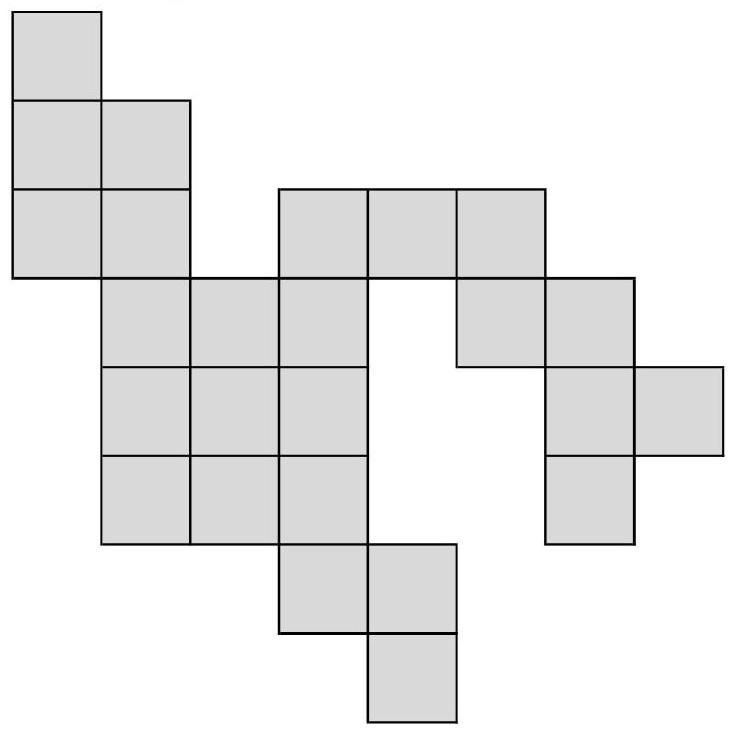 | Answer: It is possible.
Solution: An example of cutting:
 | Itispossible | Logic and Puzzles | math-word-problem | Incomplete | Yes | olympiads | false |
Tim is thinking of a positive integer between $2$ and $15,$ inclusive, and Ted is trying to guess the integer. Tim tells Ted how many factors his integer has, and Ted is then able to be certain of what Tim's integer is. What is Tim's integer? | 1. We need to determine the number of factors for each integer between $2$ and $15$.
2. The number of factors of a number $n$ can be determined by its prime factorization. If $n = p_1^{e_1} p_2^{e_2} \cdots p_k^{e_k}$, then the number of factors of $n$ is given by $(e_1 + 1)(e_2 + 1) \cdots (e_k + 1)$.
Let's calculate... | 12 | Number Theory | math-word-problem | Yes | Yes | aops_forum | false |
Let $\omega$ be a nonreal root of $z^3 = 1.$ Let $a_1,$ $a_2,$ $\dots,$ $a_n$ be real numbers such that
\[\frac{1}{a_1 + \omega} + \frac{1}{a_2 + \omega} + \dots + \frac{1}{a_n + \omega} = X + 5i.\]Compute
\[\frac{2a_1 - 1}{a_1^2 - a_1 + 1} + \frac{2a_2 - 1}{a_2^2 - a_2 + 1} + \dots + \frac{2a_n - 1}{a_n^2 - a_n + 1}.... | To solve the problem, we start by noting that \(\omega\) is a nonreal root of the equation \(z^3 = 1\). The roots of this equation are \(1, \omega,\) and \(\omega^2\), where \(\omega\) and \(\omega^2\) are complex numbers satisfying the relations \(\omega^2 + \omega + 1 = 0\) and \(\omega^3 = 1\).
Given the equation:
... | 4 | Algebra | math-word-problem | Yes | Yes | metamath | true |
Example 6. There is a rectangular prism with length, width, and height being positive integers $m, n, r (m \leqslant n \leqslant r)$, respectively. The surface of the prism is painted red and then it is cut into unit cubes. It is known that the number of unit cubes without any red color is equal to the number of unit c... | The number is $(n-2)(r-2)$.
According to the problem,
$$
(n-2)(r-2)=1985 \text {. }
$$
Obviously, when $n, r<3$, (1) has no solution.
When $n, r \geqslant 3$,
$$
\because \quad 1 \leqslant n-2 \leqslant r-2 \text {, }
$$
and $1985=1 \times 1985=5 \times 397$,
solving it, we get $n=3, r=1987$ or $n=7, r=399$.
$2^{\ci... | 1, 3, 1987; 1, 7, 399; 5, 5, 1981; 5, 7, 663; 3, 3, 1081 | Geometry | math-word-problem | Yes | Yes | cn_contest | false |
9. (16 points) Let $x \in(0,1]$. Find the range of the function $y=$ $\frac{3 x^{6}+15 x^{2}+2}{2 x^{6}+15 x^{4}+3}$. | Let $x=\tan \frac{\alpha}{2}\left(\alpha \in\left(0, \frac{\pi}{2}\right]\right)$. Then
$$
3 \alpha \in\left(0, \frac{3 \pi}{2}\right], \cos 3 \alpha \in[-1,1) \text {, }
$$
and $\cos \alpha=\frac{1-x^{2}}{1+x^{2}}$.
Thus, $\cos 3 \alpha=4 \cos ^{3} \alpha-3 \cos \alpha$
$$
\begin{array}{l}
=\frac{4\left(1-x^{2}\right... | \left(\frac{2}{3}, \frac{3}{2}\right] | Algebra | math-word-problem | Yes | Yes | cn_contest | false |
Clarissa is responsible for getting some copies of a manuscript printed and having each copy bound. The printers charge $0.05 per page to copy it and $5.00 per manuscript to have it bound. The manuscript is 400 pages. It will cost $250 to have it copied and bound. How many copies does Clarissa need to get printed and b... | First, let's calculate the cost to copy and bind a single manuscript.
The cost to copy one manuscript is $0.05 per page times 400 pages, which equals $20.00.
The cost to bind one manuscript is $5.00.
So, the total cost to copy and bind one manuscript is $20.00 + $5.00 = $25.00.
Now, let's find out how many copies Cl... | 10 | Algebra | math-word-problem | Yes | Yes | orca_math | true |
Given the function $f(x) = a \cdot 2^x + b \cdot 3^x$, where the constants $a$ and $b$ satisfy $ab \neq 0$.
(1) If $ab > 0$, determine the monotonicity of the function $f(x)$;
(2) If $ab f(x)$. | (1) When $a > 0$ and $b > 0$, for any $x_1, x_2 \in \mathbb{R}$, $x_1 0$, it implies $a(2^{x_1} - 2^{x_2}) 0$, it implies $b(3^{x_1} - 3^{x_2}) 0$,
When $a 0$, $2^x > -\frac{a}{2b}$, then $x > \log_{1.5}(-\frac{a}{2b})$;
When $a > 0$ and $b 0$, the function $f(x)$ is either increasing or decreasing on $\mathbb... | null | Algebra | math-word-problem | Yes | Yes | cn_k12 | false |
The derivative of the function $y= \frac{x^2+a^2}{x}$ $(a > 0)$ at $x=x_0$ is $0$. Then, $x_0=$ ( )
A: $a$
B: $±a$
C: $-a$
D: $a^2$ | **Analysis**
First, we calculate the derivative according to the rules of differentiation. Then, we substitute $x_0$ into the derivative and use $f'(x_0)=0$ to find the value of $x_0$.
**Solution**
Given: $y= \frac{x^2+a^2}{x}$,
Therefore, $y'= \frac{2x^2-(x^2+a^2)}{x^2}= \frac{x^2-a^2}{x^2}$,
According to the pro... | \text{B} | Calculus | MCQ | Yes | Yes | cn_k12 | false |
Which of the following sets of equations represents a system of two linear equations?
A: $\left\{\begin{array}{l}x+y=3\\ z+x=5\end{array}\right.$
B: $\left\{\begin{array}{l}x+y=5\\ \frac{1}{y}=x\end{array}\right.$
C: $\left\{\begin{array}{l}{x+y=5}\\{{x}^{2}+y=12}\end{array}\right.$
D: $\left\{\begin{array}{l}x=y+1... | To determine which set of equations represents a system of two linear equations, we must examine each option closely:
**Option A**: $\left\{\begin{array}{l}x+y=3\\ z+x=5\end{array}\right.$
This system involves three variables ($x, y, z$) but only two equations. For a system to be considered a set of two linear equati... | D | Algebra | MCQ | Yes | Yes | cn_k12 | false |
Given that $\{a_n\}$ is a geometric sequence, and $a_2 + a_3 = 1$, $a_3 + a_4 = -2$, then $a_5 + a_6 + a_7 = \_\_\_\_\_\_\_\_$. | From $a_2 + a_3 = 1$ and $a_3 + a_4 = -2$, we get $q = -2$. By substituting into $a_2 + a_2q = 1$, we find $a_2 = -1$. Therefore, $a_5 + a_6 + a_7 = 8 - 16 + 32 = \boxed{24}$. | 24 | Algebra | math-word-problem | Yes | Yes | cn_k12 | false |
If a line $l$ is translated 3 units in the negative direction of the $x$-axis and then 1 unit in the positive direction of the $y$-axis, and then it returns to its original position, what is the slope of line $l$?
**A.** $-1$ **B.** $-3$ **C.** $1$ **D.** $3$ | Let the equation of the line be $y = kx + b$. After translating 3 units to the left and 1 unit up, the equation of the line becomes $y = k(x + 3) + b + 1 = kx + b + 3k + 1$. Since the line returns to its original position, we have $3k + 1 = 0 \Rightarrow k = -1$.
Therefore, the slope of line $l$ is $\boxed{\text{A.} -... | \text{A.} -1 | Algebra | MCQ | Yes | Yes | cn_k12 | false |
Mary is making a spinach quiche. She takes 40 ounces of raw spinach and cooks it until it reaches a certain percentage of its initial volume. She mixes the spinach with 6 ounces of cream cheese and 4 ounces of eggs. The total volume of the quiche is 18 ounces. What percentage of its initial volume is the cooked spinach... | First, let's find the total volume of the other ingredients that Mary mixes with the spinach:
Cream cheese: 6 ounces
Eggs: 4 ounces
Total volume of cream cheese and eggs = 6 ounces + 4 ounces = 10 ounces
Since the total volume of the quiche is 18 ounces, and we know that 10 ounces of that is from the cream cheese an... | 20\% | Algebra | math-word-problem | Yes | Yes | orca_math | true |
5. There are 15 identical chocolate bars, each of which can be divided into at most two smaller pieces (which may not be equal). If these 15 chocolate bars can be evenly distributed among $n$ students, for the following 5 values: $7, 11, 13, 16, 20$, the number of values that $n$ can take is ( ).
(A) 5
(B) 4
(C) 3
(D) ... | 5.A.
Consider each piece of chocolate as 1 unit.
When $n=7$, 4 pieces of chocolate are each divided into $\frac{1}{7}$ and $\frac{6}{7}$, 4 pieces of chocolate are each divided into $\frac{2}{7}$ and $\frac{5}{7}$, 4 pieces of chocolate are each divided into $\frac{3}{7}$ and $\frac{4}{7}$, and another 3 pieces are no... | A | Number Theory | MCQ | Yes | Yes | cn_contest | false |
Patrick intended to multiply a two-digit number by a three-digit number, but mistakenly he left out the multiplication sign and placed the two-digit number to the left of the three-digit number, creating a five-digit number. This new number is exactly eleven times the product he should have obtained. What is the sum of... | Let \( x \) be the two-digit number and \( y \) the three-digit number. According to the problem, placing x to the left of y creates a number which can be expressed as \(1000x + y\). The product of \( x \) and \( y \) multiplied by 11 should equal this five-digit number, so:
\[
1000x + y = 11xy \Longrightarrow 11xy - 1... | 919 | Number Theory | math-word-problem | Yes | Yes | synthetic_math | true |
Given that -1, a, b, -4 form an arithmetic sequence, and -1, c, d, e, -4 form a geometric sequence, find the value of $\frac{b-a}{d}$ = (____).
A. $\frac{1}{2}$
B. $-\frac{1}{2}$
C. $\frac{1}{4}$
D. $\frac{1}{2}$ or $-\frac{1}{2}$ | [Analysis]
This question tests your understanding of the definition and properties of arithmetic and geometric sequences. Using the general term formula for the arithmetic sequence, we can find the common difference $m=b-a$ by solving the equation $-4=-1+3m$. For the geometric sequence, we use its general term formula ... | \frac{1}{2} | Algebra | MCQ | Yes | Yes | cn_k12 | false |
Given three coplanar vectors $\overrightarrow{a}$, $\overrightarrow{b}$, and $\overrightarrow{c}$, where $\overrightarrow{a}=(\sqrt{2}, 2)$, $|\overrightarrow{b}|=2\sqrt{3}$, $|\overrightarrow{c}|=2\sqrt{6}$, and $\overrightarrow{a}$ is parallel to $\overrightarrow{c}$.
1. Find $|\overrightarrow{c}-\overrightarrow{a}|$... | 1. Since $\overrightarrow{a}=(\sqrt{2}, 2)$, we have $|\overrightarrow{a}|=\sqrt{2^2+2^2}=\sqrt{8}=2\sqrt{2}$. As $|\overrightarrow{c}|=2\sqrt{6}$ and $\overrightarrow{a}$ is parallel to $\overrightarrow{c}$, we can calculate $|\overrightarrow{c}-\overrightarrow{a}|$ in two possible ways:
- If $\overrightarrow{a}$ ... | -12 | Algebra | math-word-problem | Yes | Yes | cn_k12 | false |
PROBLEM 3. The set $A$ of natural numbers has the properties:
(i) $2 \in A$;
(ii) if $x \in A$, then $4 x \in A$;
(iii) if $9 x+11 \in A$, then $x \in A$.
Show that $13 \in A$. | PROBLEM 3. The set $A$ of natural numbers has the properties:
(i) $2 \in A$
(ii) if $x \in A$, then $4 x \in A$;
(iii) if $9 x+11 \in A$, then $x \in A$.
Show that $13 \in A$.
## Grading Rubric.
(2p) To obtain $13 \in A$, it is sufficient to show that $9 \cdot 13+11=128 \in A$.
(2p) From the fact that $2 \in A$,... | 13\inA | Number Theory | proof | Yes | Yes | olympiads | false |
Redo's manufacturing costs for sets of horseshoes include a $10,000 initial outlay, $20 per set for the first 300 sets, and $15 per set for each set beyond the first 300. They can sell the sets at $50 each for the first 400 sets, and then $45 for each additional set. If profit is revenue from sales minus manufacturing ... | First, let's calculate the manufacturing costs:
The initial outlay is $10,000.
For the first 300 sets, the cost is $20 per set:
300 sets * $20/set = $6,000
For the remaining 500 sets (since they produce 800 sets in total), the cost is $15 per set:
500 sets * $15/set = $7,500
Total manufacturing cost = Initial outla... | \$14,500 | Algebra | math-word-problem | Yes | Yes | orca_math | true |
Which of the following calculations is correct?
A: $x^{4}\cdot x^{4}=x^{16}$
B: $\left(a^{3}\right)^{2}=a^{5}$
C: $\left(ab^{2}\right)^{3}=ab^{6}$
D: $a+2a=3a$ | To solve this problem, we will evaluate each option step by step to determine which calculation is correct.
**Option A:**
We use the rule of exponents that states when multiplying powers with the same base, we add the exponents. Therefore,
\[x^{4} \cdot x^{4} = x^{4+4} = x^{8}\]
Since the given option suggests $x^{... | \text{D} | Algebra | MCQ | Yes | Yes | cn_k12 | false |
Which of the following events is a certain event?
A: Three points determine a circle
B: A polygon with all sides equal is a regular polygon
C: The diameter perpendicular to the chord bisects the chord
D: The angle subtended by a diameter on the circumference is a right angle | To analyze each option step-by-step:
**A: Three points determine a circle**
- It's true that three points not on the same line determine a circle. However, if the points are collinear, they cannot determine a unique circle. Therefore, this statement is not always true, making it a random event rather than a certain o... | D | Geometry | MCQ | Yes | Yes | cn_k12 | false |
[b]Q[/b] Let $p,q,r$ be non negative reals such that $pqr=1$. Find the maximum value for the expression
$$\sum_{cyc} p[r^{4}+q^{4}-p^{4}-p]$$
[i]Proposed by Aritra12[/i] | 1. Given the problem, we need to find the maximum value of the expression:
\[
\sum_{cyc} p[r^{4} + q^{4} - p^{4} - p]
\]
where \( p, q, r \) are non-negative reals such that \( pqr = 1 \).
2. We will use Schur's Inequality, which states:
\[
\sum_{cyc} p^3(p - q)(p - r) \geq 0
\]
Expanding this ... | null | Inequalities | math-word-problem | Yes | Yes | aops_forum | false |
Find the value of $b$ such that the equation in base $b$ holds true:
$$
\begin{array}{c@{}c@{}c@{}c@{}c@{}c}
&&5&3&2&4_b\\
&+&6&4&7&3_b\\
\cline{2-6}
&1&2&5&3&2_b.\\
\end{array}
$$ | Step 1: Verify last digit addition ($4_b + 3_b$):
- $4 + 3 = 7$. Since the result is 2 and base $b>7$, there must be a carryover of 1 to the next column.
Step 2: Second last digit with carry ($2_b + 7_b + 1$):
- $2 + 7 +1 = 10$. Since the result is 3, $b > 10$, and a carryover of 1.
Step 3: Middle digit with carry ($... | b = 13 | Number Theory | math-word-problem | Yes | Yes | synthetic_math | true |
A worksheet had 4 problems on it. A teacher had some worksheets to grade and had already graded 5 of them. She has 16 more problems to grade. How many worksheets does the teacher have to grade in total? | The teacher has already graded 5 worksheets, each with 4 problems, so she has graded a total of 5 * 4 = 20 problems.
She still has 16 more problems to grade. Since each worksheet has 4 problems, the number of additional worksheets she has to grade is 16 / 4 = 4 worksheets.
Therefore, the total number of worksheets th... | 9 | Logic and Puzzles | math-word-problem | Yes | Yes | orca_math | true |
If Corina had added the numbers $P$ and $Q$ correctly, the answer would have been 16 . By mistake, she subtracted $Q$ from $P$. Her answer was 4 . What is the value of $P$ ?
(A) 4
(B) 5
(C) 8
(D) 10
(E) 16 | Solution 1
From the given information, $P+Q=16$ and $P-Q=4$.
Adding these two equations, we obtain $P+Q+P-Q=16+4$ or $2 P=20$ or $P=10$.
## Solution 2
The value of $P$ is increased by $Q$ to give 16 and decreased by $Q$ to give 4 .
Thus, the difference of 12 between these two answers is twice the value of $Q$, so ... | 10 | Algebra | MCQ | Yes | Yes | olympiads | false |
The beginning two lines of the poem "Ancient Military Expedition" by Tang Dynasty poet Li Yi say: "White day climbing the mountain to watch the beacon fire, yellow dusk drinking horse by the confluence." The poem implicitly contains an interesting mathematical problem - the "General Drinking Horse" problem. That is, af... | Let point A' (a, b) be the symmetric point of point A about the line x+y=3.
The midpoint of AA' is ($\frac {a+b}{2}$, $\frac {b}{2}$), and the slope of AA' is $k_{AA′}= \frac {b}{a-2}$.
Thus, we have the system of equations: $\begin{cases} \frac {b}{a-2}\cdot (-1)=-1 \\ \frac {a+2}{2}+ \frac {b}{2}=3\end{cases}$. Solvi... | \sqrt {10}-1 | Geometry | MCQ | Yes | Yes | cn_k12 | false |
If the function $f(x)$ is defined as follows:
$$f(x) = \begin{cases} f(x+1), & x < 1 \\ 2x-1, & x \geqslant 1 \end{cases}$$
then find the value of $f(- \frac {3}{2})$. | Note that $- \frac {3}{2} < 1$, so we'll use the first part of the function definition.
First, let's apply the function to the input $- \frac {3}{2}$:
$$f(- \frac {3}{2}) = f(- \frac {3}{2} + 1) = f(- \frac {1}{2})$$
Again, $- \frac {1}{2} < 1$, so we'll use the first part of the function definition once more:
$$f(- ... | 2 | Algebra | math-word-problem | Yes | Yes | cn_k12 | false |
Let $ ABCD$ be a rectangle with center $ O$, $ AB\neq BC$. The perpendicular from $ O$ to $ BD$ cuts the lines $ AB$ and $ BC$ in $ E$ and $ F$ respectively. Let $ M,N$ be the midpoints of the segments $ CD,AD$ respectively. Prove that $ FM \perp EN$. | 1. **Identify the key points and properties:**
- Let \( ABCD \) be a rectangle with center \( O \).
- \( E \) and \( F \) are points on \( AB \) and \( BC \) respectively, such that \( O \in EF \) and \( EF \perp BD \).
- \( M \) and \( N \) are the midpoints of \( CD \) and \( AD \) respectively.
2. **Establ... | null | Geometry | proof | Yes | Yes | aops_forum | false |
An arbitrary number of lines divide the plane into regions. Show that the regions can be colored red and blue so that neighboring regions have different colors. | 1. **Graph Construction**:
We start by constructing a graph \( G \) where each vertex represents a region formed by the lines, and an edge exists between two vertices if the corresponding regions are neighboring (i.e., they share a common boundary line).
2. **Bipartite Graph Definition**:
We aim to show that \(... | null | Other | proof | Yes | Yes | aops_forum | false |
A regular hexagon $Q_1 Q_2 \dotsb Q_6$ is drawn in the coordinate plane with $Q_1$ at $(1, 0)$ and $Q_4$ at $(-1, 0)$. If $Q_n$ is the point $(x_n, y_n)$, compute the numerical value of the product
\[
(x_1 + y_1 i)(x_2 + y_2 i)(x_3 + y_3 i) \dotsm (x_6 + y_6 i).
\] | Let $q_k$ denote the complex number corresponding to the point $Q_k$, for $1 \leq k \leq 6$. Since $Q_k$ form a regular hexagon centered at the origin, the $q_k$ are the roots of the equation
\[
z^6 = 1.
\]
The expansion $(z - q_1)(z - q_2)(z - q_3) \dotsm (z - q_6) = z^6 - 1$. By Vieta's formulas and knowing that the ... | 1 | Geometry | math-word-problem | Yes | Yes | synthetic_math | true |
Determine constants $c$ and $d$ such that
\[\sin^3 \theta = c \sin 3 \theta + d \sin \theta\]
for all angles $\theta$. | From the triple angle formula, $\sin 3\theta = 3\sin\theta - 4\sin^3\theta$. Rearranging this gives:
\[\sin^3\theta = \frac{3}{4}\sin\theta - \frac{1}{4}\sin 3\theta\]
Thus, we can write:
\[\sin^3\theta = -\frac{1}{4} \sin 3\theta + \frac{3}{4} \sin \theta\]
So, the constants $c$ and $d$ are:
\[\boxed{(c, d) = \left(... | (c, d) = \left(-\frac{1}{4}, \frac{3}{4}\right) | Algebra | math-word-problem | Yes | Yes | synthetic_math | true |
5. Label the 2014 small squares of a $1 \times 2014$ grid from left to right as $1,2, \cdots, 2014$. Now, use three colors $g, r, y$ to color each small square, such that even-numbered squares can be colored with any of $g, r, y$, while odd-numbered squares can only be colored with $g, y$, and adjacent squares must be ... | 5. $S_{2014}=4 \times 3^{1006}$.
Let $g_{n} 、 r_{n} 、 y_{n}$ represent the number of ways to color the $n$-th cell in a $1 \times n$ grid with colors $g 、 r 、 y$, respectively.
Then $\left\{\begin{array}{l}g_{1}=g_{2}=1, \\ r_{1}=0, r_{2}=2, \\ y_{1}=y_{2}=1,\end{array}\right.$
and $\square$
$\left\{\begin{array}{l}g... | 4 \times 3^{1006} | Combinatorics | math-word-problem | Yes | Yes | cn_contest | false |
5. Let $d_{1}, d_{2}, \ldots, d_{n}$ be all the natural divisors of the number $10!=1 \cdot 2 \cdot \ldots \cdot 10$. Find the sum
$$
\frac{1}{d_{1}+\sqrt{10!}}+\frac{1}{d_{2}+\sqrt{10!}}+\ldots+\frac{1}{d_{n}+\sqrt{10!}}
$$ | Answer: $3 /(16 \sqrt{7})$.
Let's denote the given sum as $S$. Then, since for each $d_{j}$ the number $10!/ d_{j}$ is also a divisor,
$$
S=\sum_{j=1}^{n} \frac{1}{10!/ d_{j}+\sqrt{10!}}=\frac{1}{\sqrt{10!}} \sum_{j=1}^{n} \frac{d_{j}}{\sqrt{10!}+d_{j}}
$$
Therefore, adding the original and the last expression for $... | \frac{270}{2\sqrt{10!}} | Number Theory | math-word-problem | Yes | Yes | olympiads | false |
Subsets and Splits
No community queries yet
The top public SQL queries from the community will appear here once available.