
instruction_seed stringlengths 2 10.7k | solution stringlengths 0 10.8k ⌀ | answer stringlengths 0 575 ⌀ | problem_type stringclasses 9
values | question_type stringclasses 5
values | problem_is_valid stringclasses 5
values | solution_is_valid stringclasses 4
values | source stringclasses 11
values | synthetic bool 2
classes |
|---|---|---|---|---|---|---|---|---|
Circles $O_{1}$ and $O_{2}$ lie inside a triangle and touch each other externally, with circle $O_{1}$ touching two sides of the triangle, and circle $O_{2}$ also touching two sides of the triangle, but not the same ones as $O_{1}$. Prove that the sum of the radii of these circles is greater than the radius of the circ... | Let the circle $O_{1}$ touch the sides $A C$ and $A B$ of triangle $A B C$, and the circle $O_{2}$ touch the sides $B C$ and $A B$. Let $O$ be the inscribed circle. Denote the radii of the circles $O, O_{1}$, and $O_{2}$ by $r, r_{1}$, and $r_{2}$. Suppose triangles $A B_{1} C_{1}$ and $A_{2} B C_{2}$ are similar to tr... | r_{1}+r_{2}>r | Geometry | proof | Yes | Yes | olympiads | false |
The negation of the proposition "$\exists x\in R$, $x^{2}-3x+3 \lt 0$" is ( )
A: $\forall x\in R$, $x^{2}-3x+3 \gt 0$
B: $\forall x\in R$, $x^{2}-3x+3\geqslant 0$
C: $\exists x\in R$, $x^{2}-3x+3 \gt 0$
D: $\exists x\in R$, $x^{2}-3x+3\geqslant 0$ | To find the negation of the given proposition, we start by understanding the original proposition and its structure. The proposition is "$\exists x\in R$, $x^{2}-3x+3 \lt 0$", which asserts that there exists at least one real number $x$ for which the inequality $x^{2}-3x+3 \lt 0$ holds true.
Negating this proposition... | B | Algebra | MCQ | Yes | Yes | cn_k12 | false |
11. A school's eighth grade has 93 students, each participating in math or foreign language courses, or both. It is known that 70 people participate in the math course, and 54 people participate in the foreign language course. Then the number of students who only participate in the math course and not the foreign langu... | 11. D.
Let the number of people who participate in both mathematics and foreign language courses be $x$. By the principle of inclusion-exclusion, we have
$$
70+54-x=93 \Rightarrow x=31 \text {. }
$$
Therefore, the number of people who only participate in the mathematics course is
$$
70-31=39 \text {. }
$$ | 39 | Combinatorics | MCQ | Yes | Yes | olympiads | false |
Consider an infinite grid $\mathcal{G}$ of unit square cells. A chessboard polygon is a simple polygon (i.e. not self-intersecting) whose sides lie along the gridlines of $\mathcal{G}$.
Nikolai chooses a chessboard polygon $F$ and challenges you to paint some cells of $\mathcal{G}$ green, such that any chessboard poly... | The answer is YES, the task can be made impossible.
The solution is split into three parts. First, we describe a "polygon with holes" $F$. In the second part we prove that this $F$ works. Finally, we show how to take care of the holes to obtain a true polygon.
Part 1. Construction. Choose large integers $m \geq 5, n \g... | proof | Combinatorics | proof | Yes | Yes | olympiads | false |
6. [6] Compute the sum of all positive integers $n<2048$ such that $n$ has an even number of 1 's in its binary representation. | Answer: 1048064
Note that the positive integers less than 2047 are those with at most 11 binary digits. Consider the contribution from any one of those digits. If we set that digit to 1 , then the remaining 10 digits can be set in $2^{9}=512$ ways so that the number of 1 's is even. Therefore the answer is
$$
512\left(... | 1048064 | NaN | NaN | NaN | NaN | olympiads | false |
In acute triangle $ABC$, $\angle{A}<\angle{B}$ and $\angle{A}<\angle{C}$. Let $P$ be a variable point on side $BC$. Points $D$ and $E$ lie on sides $AB$ and $AC$, respectively, such that $BP=PD$ and $CP=PE$. Prove that as $P$ moves along side $BC$, the circumcircle of triangle $ADE$ passes through a fixed point other t... | 1. **Define Points and Setup:**
Let \( M \) and \( N \) be the midpoints of \( BD \) and \( CE \) respectively. Let \( H \) be the orthocenter of \( \triangle ABC \), and let \( BH \) and \( CH \) meet \( CA \) and \( AB \) at \( Y \) and \( Z \) respectively. Since \( BP = PD \) and \( CP = PE \), it follows that \... | null | Geometry | proof | Yes | Yes | aops_forum | false |
Sámson writes the number 123456789 on a piece of paper. Then he can insert multiplication signs between any two adjacent digits, at different places, or not at all. The digits between the multiplication signs, when read together, form a number, resulting in an expression that is a product of numbers, for example, 1234$... | Solution. Let's choose the position for the first multiplication sign arbitrarily, thereby dividing the original number into $A$ and $B$. Let $k$ be the length of the number $B$. The value of the original number is $A \cdot 10^{k} + B$, while the value of the product formed by inserting the multiplication sign is $A \c... | 123456789 | Number Theory | math-word-problem | Yes | Yes | olympiads | false |
The domain of the function $f$ is the set of real numbers. For every number $a$, if $a<x<a+100$, then $a \leq f(x) \leq a+100$. Determine the function $f$! | The condition intuitively means that $f$ maps every open interval of length 100 into the same closed interval of length 100. This is clearly satisfied by the function $f(x)=x$, since in this case the image of any set is identical to the set itself.
We will show that there are no other solutions to the problem. If $g(x... | f(x)=x | Algebra | math-word-problem | Yes | Yes | olympiads | false |
(1) Calculate $$(- \frac {27}{8})^{- \frac {2}{3}} + \frac {log_{8}27}{log_{2}3} + (\sqrt {2} - \sqrt {3})^{0} - log_{3}1 + 2lg5 + lg4 - 5^{log_{5}2}$$
(2) Given $$x^{ \frac {1}{2}} + x^{- \frac {1}{2}} = 3$$, find the value of $$x + x^{-1}$$. | (12 points)
Solution:
(1) $$(- \frac {27}{8})^{- \frac {2}{3}} + \frac {log_{8}27}{log_{2}3} + (\sqrt {2} - \sqrt {3})^{0} - log_{3}1 + 2lg5 + lg4 - 5^{log_{5}2}$$
= $$\frac {4}{9} + 1 + 1 - 0 + 2 - 2 = \boxed{\frac {22}{9}}$$
(2) Given $$x^{ \frac {1}{2}} + x^{- \frac {1}{2}} = 3$$, squaring both sides gives: ... | 7 | Algebra | math-word-problem | Yes | Yes | cn_k12 | false |
Given the function $f(x)=a^{x}(a > 0,a\neq 1)$, and $f(2)=4$, then the explicit formula of the function $f(x)$ is $f(x)=$ ______. | Since $f(x)=a^{x}(a > 0,a\neq 1)$ and $f(2)=4$,
we have $f(2)=a^{2}=4$,
which implies $a=2$,
Therefore, the explicit formula of the function $f(x)$ is $f(x)=2^{x}$.
Hence, the answer is: $f(x)=2^{x}$.
By applying the method of undetermined coefficients based on the given conditions, we can easily find the exp... | f(x)=2^{x} | Algebra | math-word-problem | Yes | Yes | cn_k12 | false |
I have three 30-sided dice that each have 6 purple sides, 8 green sides, 10 blue sides, and 6 silver sides. If I roll all three dice, what is the probability that they all show the same color? | For this problem, we need to evaluate the probability of all three dice showing the same result using the new counts and colors. Specifically, we're looking at potential matches in purple, green, blue, or silver outcomes.
- The probability of getting purple on one die is $\frac{6}{30} = \frac{1}{5}$. The probability th... | \frac{2}{25} | Combinatorics | math-word-problem | Yes | Yes | synthetic_math | true |
Let $f(x)$ and $g(x)$ be functions defined on $(0,+\infty)$, and the derivatives of $f(x)$ and $g(x)$ exist. If ${f'}(x)g(x)+f(x){g'}(x) \lt 1$, and $f(1)=2$, $g(1)=1$, then the solution set of $f(x)g(x) \lt x+1$ is:
A: $(1,2)$
B: $(2,+\infty)$
C: $(0,1)$
D: $(1,+\infty)$ | To solve this problem, we first define a new function $\varphi(x) = f(x)g(x) - x - 1$. We are given that the derivative of the product of $f(x)$ and $g(x)$, which is ${f'}(x)g(x) + f(x){g'}(x)$, is less than $1$. This information allows us to find the derivative of $\varphi(x)$ as follows:
\[
\varphi'(x) = {f'}(x)g(x)... | D | Calculus | MCQ | Yes | Yes | cn_k12 | false |
There are 3 people (A, B, and C) who each took 5 tests. If the ranges of their scores in the 5 tests were 15, 25, and 30, and their mean scores are 70, 85, and 95 respectively, what is the minimum possible range in scores of the 3 test-takers? | To find the minimum possible range in scores of the 3 test-takers, we need to find the lowest possible score of the highest scorer and the highest possible score of the lowest scorer.
Let's start with person C, who has the highest mean score of 95. The range of their scores is 30, which means the lowest score they cou... | 3 | Logic and Puzzles | math-word-problem | Yes | Yes | orca_math | true |
## 267. Math Puzzle $8 / 87$
In field $\mathrm{f} 1$, a rook enters an otherwise empty chessboard and exits at e 1. It must visit each square exactly once and pass under the drawn bridge.
What path must it take according to "rook technique" to meet the conditions?
 | notfound | Logic and Puzzles | math-word-problem | Incomplete | Incomplete | olympiads | false |
II. (Full marks 15 points) Now we have three types of salt water, A, B, and C, with concentrations of $5\%, 8\%$, and $9\%$ respectively. They are 60 grams, 60 grams, and 47 grams each. We need to prepare 100 grams of salt water with a concentration of $7\%$. How many grams of type A salt water can be used at most? How... | Let's take $x$ grams, $y$ grams, and $z$ grams of salt water from solutions A, B, and C respectively, to mix a 100-gram salt water solution with a concentration of $7\%$. According to the problem, we have
$$
\left\{\begin{array}{l}
x+y+z=100 \\
5 x+8 y+9 z=700 .
\end{array}\right.
$$
where, $0 \leqslant x \leqslant 60... | 49 \text{ grams (maximum)}, 35 \text{ grams (minimum)} | Algebra | math-word-problem | Yes | Yes | cn_contest | false |
Find all pairs of positive integers \((a,b)\) with the following property: there exists an integer \(N\) such that for any integers \(m\ge N\) and \(n\ge N\), every \(m\times n\) grid of unit squares may be partitioned into \(a\times b\) rectangles and fewer than \(ab\) unit squares.
[i]Proposed by Holden Mui[/i] | To find all pairs of positive integers \((a, b)\) such that there exists an integer \(N\) with the property that for any integers \(m \ge N\) and \(n \ge N\), every \(m \times n\) grid of unit squares can be partitioned into \(a \times b\) rectangles and fewer than \(ab\) unit squares, we need to analyze the possible v... | \{(1, 1), (1, 2), (2, 1), (1, 3), (3, 1), (2, 3), (3, 2)\} | Combinatorics | math-word-problem | Yes | Yes | aops_forum | false |
The equation $\frac {x^2}{4-t}+ \frac {y^2}{t-1}=1$ represents the curve $C$. Consider the following propositions:
$①$ The curve $C$ can never be a circle;
$②$ If $1 4$;
$④$ If the curve $C$ is an ellipse with foci on the y-axis, then $1 < t < \frac {5}{2}$.
Determine which of the above statements are true. Write down... | To analyze the given propositions, we first examine the given equation:
$$\frac {x^2}{4-t}+ \frac {y^2}{t-1}=1$$
For proposition $①$, we notice that if $4-t = t-1$, which simplifies to $t = \frac {5}{2}$, the equation becomes $x^2 + y^2 = \frac {4}{3}$, which indeed represents a circle. Therefore, proposition $①$ is f... | ③ | Algebra | math-word-problem | Yes | Yes | cn_k12 | false |
3. Several equilateral triangles were cut out of a sheet of cardboard. The numbers 1, 2, and 3 are written at the vertices of each. They were then stacked. Could it be that the sum of the numbers along each edge of the stack equals 55? | 74.3. No, it could not. The sum of all numbers should be equal to $6 k$, where $k$ is the number of triangles, and $55 \cdot 3=165$ is odd! | proof | Combinatorics | math-word-problem | Yes | Yes | olympiads | false |
John had a stock of 900 books in his bookshop. He sold 75 on Monday, 50 on Tuesday, 64 on Wednesday, 78 on Thursday, and 135 on Friday. What percentage of the books were not sold? | To find out the percentage of books not sold, we first need to calculate the total number of books sold during the week.
Total books sold = Books sold on Monday + Tuesday + Wednesday + Thursday + Friday
Total books sold = 75 + 50 + 64 + 78 + 135
Total books sold = 402
Now, we subtract the total books sold from the in... | 55.33\% | Other | math-word-problem | Yes | Yes | orca_math | true |
Excluding stoppages, the average speed of a bus is 60 km/hr, and including stoppages, the average speed of the bus is 45 km/hr. For how many minutes does the bus stop per hour? | The difference in speed when including stoppages is 60 km/hr - 45 km/hr = 15 km/hr.
This means that for every hour of travel, the bus is stopped for the amount of time it would take to travel 15 km at its average moving speed of 60 km/hr.
To find out how many minutes the bus stops per hour, we can calculate the time ... | 15 | Algebra | math-word-problem | Yes | Yes | orca_math | true |
Jenna collects stamps, placing the same number of stamps on each page. She then distributes these pages across two stamp books. One stamp book has a total of 960 stamps, while the other contains 1200 stamps. What is the largest number of stamps that Jenna could be putting on each page if each book contains at least two... | 1. To find the largest number of stamps Jenna could be putting on each page, we need to calculate the greatest common divisor (gcd) of 960 and 1200.
2. Using the Euclidean algorithm:
- \(1200 - 960 = 240\)
- \(960 - 4 \times 240 = 0\)
- So, gcd(960, 1200) = 240.
3. Check if each book can have at least 2 pages... | 240 | Number Theory | math-word-problem | Yes | Yes | synthetic_math | true |
Two positive integers have a product of 323 and a difference of 2. What is the smaller number? | Let's call the two positive integers x and y, with x being the larger number and y being the smaller number. We are given that:
x * y = 323 (1)
x - y = 2 (2)
From equation (2), we can express x in terms of y:
x = y + 2
Now we can substitute this expression for x into equation (1):
(y + 2) * y = 323
y^2 + 2y = 323
... | 17 | Algebra | math-word-problem | Yes | Yes | orca_math | true |
Solve the equations:$(1)x^{2}-4x=0$.$(2)x^{2}=-2x+3$. | To solve the given equations step-by-step, we proceed as follows:
**For the first equation: $(1) x^{2}-4x=0$**
1. Factor out the common term, which gives us:
\[x(x-4)=0\]
2. Set each factor equal to zero:
\[x=0 \quad \text{or} \quad x-4=0\]
3. Solve for $x$:
\[x_{1}=0, \quad x_{2}=4\]
Thus, the solutions for the ... | x_{1}=-3, \, x_{2}=1 | Algebra | math-word-problem | Yes | Yes | cn_k12 | false |
8. (1963 24th Putnam Mathematical Competition) Suppose $x^{2}-x+a$ divides $x^{13}+x+90$, determine the value of the positive integer $a$.
untranslated text remains the same as the source text. | 8. Let $x^{13}+x+90=\left(x^{2}-x+a\right) q(x)$, where $a$ is an integer, and $q(x)$ is a polynomial with integer coefficients.
Let $x=-1,0,1$, then
$$
\left\{\begin{array}{l}
(a+2) q(-1)=88, \\
a q(0)=90, \\
a q(1)=92 .
\end{array}\right.
$$
(2)
(3)
From (2) and (3), we get
$a[q(1)-q(0)]=2$, so $a \mid 2$.
Therefore... | 2 | Algebra | math-word-problem | Yes | Yes | olympiads | false |
11.2. Given a rectangle with integer coordinates of vertices on the coordinate plane. Let $\alpha$ be the angle between its diagonals. Is it necessarily a rational number: a) $\cos \alpha ? ;$ b) $\sin \alpha$ ? | Answer: a) yes; b) yes. Solution. a) Let $\boldsymbol{A} \boldsymbol{B C D}$ be the given rectangle and $O$ its center. Then $\alpha=\angle C O D, \frac{\alpha}{2}=\angle C A D$. Since $\cos ^{2} \frac{\alpha}{2}=(A D)^{2} /(A C)^{2}$ is a rational number, then $\cos \alpha=2 \cos ^{2} \frac{\alpha}{2}-1$ is also a rat... | proof | Geometry | math-word-problem | Yes | Yes | olympiads | false |
Find the equation of the directrix of the parabola \( y = \frac{x^2 - 2x + 1}{8} \). | First, we complete the square for the quadratic in the given parabolic equation:
\[ y = \frac{x^2 - 2x + 1}{8} = \frac{(x-1)^2}{8} \]
Now, consider \( y = \frac{1}{8}x^2 \) part of the vertex form \( y = a(x-h)^2 + k \) where \( h = 1 \) and \( k = 0 \). Thus, the directrix of the base parabola \( y = \frac{1}{8}x^2 \... | y = -2 | Algebra | math-word-problem | Yes | Yes | synthetic_math | true |
A point $P$ is randomly selected from the square region with vertices at $(\pm 2, \pm 2)$. What is the probability that $P$ is within two units of the vertex at $(2,2)$? Express your answer as a common fraction in terms of $\pi$. | The probability that $P$ lies within two units of the vertex at $(2,2)$ is given by the probability that $P$ lies inside the circle of radius 2 centered at $(2,2)$.
Since the circle has radius 2 and is centered at $(2,2)$, it will overlap the boundaries of the square. We need to calculate the area of the circular segm... | \frac{\pi}{16} | Geometry | math-word-problem | Yes | Yes | synthetic_math | true |
Evaluate: $\frac{3^{-3}7^0}{3^{-4}}$ | 1. Simplify the expressions using the properties of exponents:
\[
3^{-3} = \frac{1}{3^3}, \quad 7^0 = 1, \quad \text{and} \quad \frac{1}{3^{-4}} = 3^4.
\]
2. Substitute these simplifications into the original expression:
\[
\frac{3^{-3}7^0}{3^{-4}} = \frac{\frac{1}{3^3} \cdot 1}{3^{-4}} = \frac{1}{3^3} \... | 3 | Algebra | math-word-problem | Yes | Yes | synthetic_math | true |
Given the lines $l_{1}$: $\left(3a+2\right)x+\left(a-1\right)y-2=0$ and $l_{2}$: $\left(a-1\right)x+y+1=0$ are perpendicular to each other, then the value of $a$ is ( ).
A: $1$
B: $-1$
C: $\frac{{5±\sqrt{29}}}{2}$
D: $1$ or $-1$ | To determine the value of $a$ for which lines $l_{1}$ and $l_{2}$ are perpendicular, we use the condition that the product of their slopes must equal $-1$. The lines are given by:
- $l_{1}$: $\left(3a+2\right)x+\left(a-1\right)y-2=0$
- $l_{2}$: $\left(a-1\right)x+y+1=0$
The slope of a line in the form $Ax+By+C=0$ is ... | D | Algebra | MCQ | Yes | Yes | cn_k12 | false |
0.8 x q + y q = 0.8 a q + 1.1 b q.
Transform it:
0.8(x + y) + 0.2 y = 0.8(a + b) + 0.3 b
The first terms are equal to each other (since the expenditure remains unchanged), therefore \( b = \frac{2}{3} y \).
This means that \(\frac{1}{3}\) of the daily expenditure needs to be shifted to nighttime. | Answer. $\frac{1}{3}$ part or $33,(3) \%$.
Problem 2 (11th grade).
For the function
$$
f(x)=\sqrt{3 x+\sqrt{2}-1}+x
$$
solve the equation $f(f(f(x)))=f(x)$.
Solution. The function has the form $f(x)=x+\sqrt{a x+b}, a>0$.
It is monotonically increasing, so the equation $f(f(f(x)))=f(x)$ is equivalent to the equati... | notfound | Algebra | math-word-problem | Incomplete | Yes | olympiads | false |
Andrew purchased 6 kg of grapes at the rate of 74 per kg and some kg of mangoes at the rate of 59 per kg. He paid 975 to the shopkeeper. How many kg of mangoes did he purchase? | Let's denote the number of kilograms of mangoes Andrew purchased as \( m \).
The cost of the grapes is:
\( 6 \text{ kg} \times 74 \text{ per kg} = 444 \)
The cost of the mangoes is:
\( m \text{ kg} \times 59 \text{ per kg} = 59m \)
The total amount Andrew paid is the sum of the cost of grapes and mangoes:
\( 444 + 5... | 9 | Algebra | math-word-problem | Yes | Yes | orca_math | true |
In response to the call of "Assist the Travel Development Conference, Sing the Beauty of Chenzhou", a certain school held a choir competition in each grade, stipulating that the final score of each participating team is evaluated based on the song content accounting for $30\%$, singing skills accounting for $50\%$, and... | To calculate the final score of the participating team, we apply the given percentages to the respective scores:
- For song content, which accounts for $30\%$, the score is $90$. Thus, the contribution of song content to the final score is $30\% \times 90 = 0.30 \times 90 = 27$.
- For singing skills, which account fo... | 93 | Algebra | math-word-problem | Yes | Yes | cn_k12 | false |
Given a set $M$ consisting of all functions $f(x)$ that satisfy the following property: there exists a real number $t$ in the domain such that $f(t+2)=f(t)+f(2)$.
$(1)$ Determine whether $f(x)=3x+2$ belongs to set $M$, and explain the reason;
$(2)$ If $f(x)=2^{x}+bx^{2}$, prove that for any real number $b$, $f(x) \in... | Solution:
$(1)$ When $f(x)=3x+2$, the equation $f(t+2)=f(t)+f(2) \Leftrightarrow 3t+8=3t+10$ does not have a solution. Therefore, there does not exist a real number $t$ such that $f(t+2)=f(t)+f(2)$, which means $f(x)=3x+2$ does not belong to set $M$.
$(2)$ When $f(x)=2^{x}+bx^{2}$, the equation $f(x+2)=f(x)+f(2) \Lef... | \text{True} | Algebra | math-word-problem | Yes | Yes | cn_k12 | false |
Gussarov $M$.
There are three piles of stones. It is allowed to add to any of them as many stones as there are in the other two piles, or to throw out of any pile as many stones as there are in the other two piles. For example: $(12,3,5) \rightarrow(12$, 20, 5) (or (4, 3, 5)). Is it possible, starting with piles of 19... | In each of the initial piles, there is an odd number of stones. It is not hard to verify that the allowed operations preserve this property, and the number of stones in each pile remains odd. Therefore, none of the piles can become empty.
## Answer
It is not possible.
Send a comment | proof | Number Theory | math-word-problem | Yes | Yes | olympiads | false |
Given that $l$ is an asymptote of the hyperbola $C$: $\dfrac{x^{2}}{2}- \dfrac{y^{2}}{4}=1$, and $P$ is a point on $l$, $F_{1}$ and $F_{2}$ are the two foci of $C$. If $\overrightarrow{PF_{1}} \cdot \overrightarrow{PF_{2}}=0$, then the distance from $P$ to the $x$-axis is
A: $\dfrac{2\sqrt{3}}{3}$
B: $\sqrt{2}$
C: $... | For the hyperbola $C$: $\dfrac{x^{2}}{2}- \dfrac{y^{2}}{4}=1$, we have $a= \sqrt{2}$, $b=2$,
$c= \sqrt{a^{2}+b^{2}}= \sqrt{6}$,
thus, $F_{1}(-\sqrt{6},0)$, $F_{2}(\sqrt{6},0)$,
Assume the equation of asymptote $l$ is $y= \sqrt{2}x$, and $P(m, \sqrt{2}m)$,
$\overrightarrow{PF_{1}} \cdot \overrightarrow{PF_{2}}=(... | C | Geometry | MCQ | Yes | Yes | cn_k12 | false |
Simplify first and then evaluate: $2\left(2x-3y\right)-\left(3x+2y+1\right)$, where $x=2$ and $y=-0.5$. | To simplify and then evaluate the expression $2\left(2x-3y\right)-\left(3x+2y+1\right)$ given $x=2$ and $y=-0.5$, we proceed as follows:
First, distribute the constants across the terms inside the parentheses:
\begin{align*}
2\left(2x-3y\right)-\left(3x+2y+1\right) &= 4x-6y-3x-2y-1 \\
&= (4x-3x) + (-6y-2y) - 1 \\
&= x... | 5 | Algebra | math-word-problem | Yes | Yes | cn_k12 | false |
Find the point on the line
\[ y = \frac{x + 3}{3} \]
that is closest to the point \((3, 2)\). | First, identify two points on the line \(y = \frac{x + 3}{3}\). Choosing \(x = 0\) and \(x = 3\), we get points \((0, 1)\) and \((3, 2)\) respectively. The direction vector of the line is
\[
\begin{pmatrix} 3 \\ 1 \end{pmatrix} - \begin{pmatrix} 0 \\ 1 \end{pmatrix} = \begin{pmatrix} 3 \\ 0 \end{pmatrix}.
\]
The vecto... | (3, 1) | Algebra | math-word-problem | Yes | Incomplete | synthetic_math | true |
Let $n \in \mathbf{Z}_{+}, n \geqslant 2, x_{1}, x_{2}, \cdots$, $x_{n}$ be distinct positive real numbers. Prove: there exist $a_{1}$, $a_{2}, \cdots, a_{n} \in\{-1,1\}$, such that
$$
\sum_{i=1}^{n} a_{i} x_{i}^{2}>\left(\sum_{i=1}^{n} a_{i} x_{i}\right)^{2} .
$$ | Let's assume $x_{1}>x_{2}>\cdots>x_{n}$. When $n=2 m+1$, take $a_{i}=(-1)^{i+1}$, then
$$
\begin{array}{l}
\sum_{i=1}^{n} a_{i} x_{i}^{2}-\left(\sum_{i=1}^{n} a_{i} x_{i}\right)^{2} \\
=2 \sum_{k=1}^{m} \sum_{l=k}^{m}\left(x_{2 k-1}-x_{2 k}\right)\left(x_{2 l}-x_{2 l+1}\right)>0 .
\end{array}
$$
When $n=2 m+2$, still ... | proof | Inequalities | proof | Yes | Yes | olympiads | false |
Let $b_1, b_2, \dots, b_{2017}$ be the roots of the polynomial
\[x^{2017} - x^{2016} + x^{2015} - \dots - x^2 + x - 1045 = 0.\]
Compute
\[\sum_{n = 1}^{2017} \frac{1}{1 - b_n}.\] | Let $c_n = \frac{1}{1 - b_n}$, then solving for $b_n$, we find
\[b_n = 1 - \frac{1}{c_n} = \frac{c_n - 1}{c_n}.\]
Substituting, we get
\[\left( \frac{c_n - 1}{c_n} \right)^{2017} - \left( \frac{c_n - 1}{c_n} \right)^{2016} + \dots - \left( \frac{c_n - 1}{c_n} \right)^2 + \frac{c_n - 1}{c_n} - 1045 = 0.\]
Expanding and ... | \frac{2017}{-1046} | Algebra | math-word-problem | Yes | Yes | synthetic_math | true |
Let $z=\frac{1}{1+i} +i$ (where $i$ is the imaginary unit), then $|z|=$
A: $\frac{1}{2}$
B: $\frac{\sqrt{2}}{2}$
C: $\frac{\sqrt{3}}{2}$
D: $2$ | **Analysis**
This question examines the rules for complex number operations and the formula for calculating the modulus. It tests reasoning and computational abilities. By using the rules for complex number operations and the formula for calculating the modulus, the answer can be easily found. This is a basic question... | B | Algebra | MCQ | Yes | Yes | cn_k12 | false |
Objects $A$ and $B$ move simultaneously in the coordinate plane via a sequence of steps, each of length one. Object $A$ starts at $(0,0)$ and each of its steps is either right or up, both equally likely. Object $B$ starts at $(5,7)$ and each of its steps is either to the left or down, both equally likely. Which of the ... | If $A$ and $B$ meet, their paths connect $(0,0)$ and $(5,7).$ There are $\binom{12}{5}=792$ such paths. Since the path is $12$ units long, they must meet after each travels $6$ units, so the probability is $\frac{792}{2^{6}\cdot 2^{6}} \approx 0.20 \Rightarrow \boxed{C}$.
Note: The number of paths, $\binom{12}{5}$ come... | C | Combinatorics | MCQ | Yes | Yes | amc_aime | false |
A sphere $O$ is tangent to all faces of a cube $ABCD-A_{1}B_{1}C_{1}D_{1}$ with an edge length of $2$. Point $M$ is the midpoint of edge $DD_{1}$. The area of the section obtained by cutting the sphere $O$ with the plane $ACM$ is ( ).
A: $ \boxed{\dfrac {4\pi}{3}}$
B: $ \boxed{\pi}$
C: $ \boxed{\dfrac {2\pi}{3}}$
D: $ ... | Let's denote the distance from the center of the sphere to the section as $d$, and the radius of the section as $r$.
By the volume relationship $V_{O-ACM}=V_{M-AOC}$, we have $\dfrac {1}{3}S_{\triangle ACM}\cdot d= \dfrac { \sqrt {2}}{3}S_{\triangle AOC}$. Therefore, $d= \dfrac { \sqrt {6}}{3}$.
Since $d^{2}+r^{2}=1$... | \dfrac {\pi}{3} | Geometry | MCQ | Yes | Yes | cn_k12 | false |
Let $y=kx$. Is there a real number $k$ such that the algebraic expression $(x-y)(2x-y)-3x(2x-y)$ can be simplified to $5x^2$? If so, find all such $k$; if not, explain why. | **Solution**: Yes, there is.
Assuming there exists a real number $k$, since $(x-y)(2x-y)-3x(2x-y)=-4x^2+y^2$,
Substituting $y=kx$ into it, the original expression becomes $-4x^2+(kx)^2=(k^2-4)x^2$,
Since $(k^2-4)x^2=5x^2$,
Therefore, $k^2-4=5$, then $k^2=9$,
Solving this gives $k=\pm3$. So, the solution is $\boxed... | k=\pm3 | Algebra | math-word-problem | Yes | Yes | cn_k12 | false |
On a beach, Jason found 49 seashells, 48 starfish, and 35 pieces of coral. He gave 13 of the seashells to Tim and decided to give some of the corals to another friend, Sarah. After that, Jason has _____ seashells and _____ corals. | Jason originally found 49 seashells and gave 13 of them to Tim. To find out how many seashells Jason has left, we subtract the number he gave away from the original number:
49 seashells - 13 seashells = 36 seashells
The problem doesn't specify how many pieces of coral Jason gave to Sarah, so we can't determine the ex... | 36 | Logic and Puzzles | math-word-problem | Yes | Yes | orca_math | true |
5. Given a positive integer $a$ that is not a perfect square. Let
$$
\begin{array}{l}
A=\left\{\left.k=\frac{x^{2}-a}{x^{2}-y^{2}} \right\rvert\, x, y \in \mathbf{Z}, x>\sqrt{a}\right\}, \\
B=\left\{\left.k=\frac{x^{2}-a}{x^{2}-y^{2}} \right\rvert\, x, y \in \mathbf{Z}, 0 \leqslant x<\sqrt{a}\right\} .
\end{array}
$$
... | 5. Let $k=\frac{x^{2}-a}{x^{2}-y^{2}}$.
First, prove a lemma.
Lemma For a fixed positive integer $k$, if integers $x, y$ satisfy equation (1), then
$$
\begin{array}{l}
x_{1}=\frac{1}{2}\left(x-y+\frac{(x-y)^{2}-4 a}{x+y}\right), \\
y_{1}=\frac{1}{2}\left(x-y-\frac{(x-y)^{2}-4 a}{x+y}\right)
\end{array}
$$
are both in... | proof | Number Theory | proof | Yes | Yes | olympiads | false |
Let $x$ be a positive integer, and define the integers $n = x^2 + 4x + 29$ and $d = 4x + 9$. When dividing $n$ by $d$, the quotient is $x$, and the remainder is $13$. Find $x$. | Given the conditions, we start with the equation
\[ \frac{x^2 + 4x + 29}{4x + 9} = x + \frac{13}{4x + 9}. \]
Multiplying through by $4x + 9$ to eliminate the fraction:
\[ x^2 + 4x + 29 = x(4x + 9) + 13, \]
\[ x^2 + 4x + 29 = 4x^2 + 9x + 13. \]
Rearranging everything to one side gives:
\[ 0 = 4x^2 + 9x + 13 - x^2 - 4x -... | 2 | Algebra | math-word-problem | Yes | Yes | synthetic_math | true |
1. (8 points) Calculate: $19 \times 17+29 \times 17+48 \times 25=$ | 【Solution】Solve: $19 \times 17+29 \times 17+48 \times 25$
$$
\begin{array}{l}
=17 \times(19+29)+48 \times 25 \\
=17 \times 48+48 \times 25 \\
=48 \times(17+25) \\
=48 \times 42 \\
=2016
\end{array}
$$
Therefore, the answer is: 2016. | 2016 | Algebra | math-word-problem | Yes | Yes | olympiads | false |
Let $ABCD$ be a square with unit sides. Which interior point $P$ will the expression $\sqrt2 \cdot AP + BP + CP$ have a minimum value, and what is this minimum? | 1. **Reflecting Point $P$**:
- Let $P'$ be the reflection of $P$ along $BC$.
- Let $P''$ be the reflection of $P$ along $AB$.
2. **Transforming the Problem**:
- Notice that the problem of minimizing $\sqrt{2} \cdot AP + BP + CP$ can be transformed into minimizing $AP'' + BP'' + CP'$.
- This transformation ... | 3 | Geometry | math-word-problem | Yes | Yes | aops_forum | false |
The spinner shown is divided into 6 sections of equal size. What is the probability of landing on a section that contains the letter $Q$ using this spinner?
(A) $\frac{3}{6}$
(D) $\frac{2}{6}$
(B) $\frac{4}{6}$
(E) $\frac{1}{6}$
(C) $\frac{5}{6}$
 | \frac{2}{6} | Combinatorics | MCQ | Yes | Yes | olympiads | false |
[Ribakko A.V.
a) A convex pentagon is divided into three triangles by non-intersecting diagonals. Can the points of intersection of the medians of these triangles lie on one straight line?
b) The same question for a non-convex pentagon.
# | Clearly, exactly two diagonals are drawn, and they both emanate from one vertex (let's say from $\$ \mathrm{~A} \$$). Then the specified points of intersection of the medians are obtained by homothety with center $\$ \mathrm{~A} \$$ and coefficient $\$ 2 / 3 \$$ from the midpoints of sides \$BC\$, \$
a) These midpoint... | notfound | Geometry | math-word-problem | Yes | Yes | olympiads | false |
Dona Lígia has a square plot of land. She decides to divide it into five regions, consisting of four rectangles and one square as illustrated in the figure below:
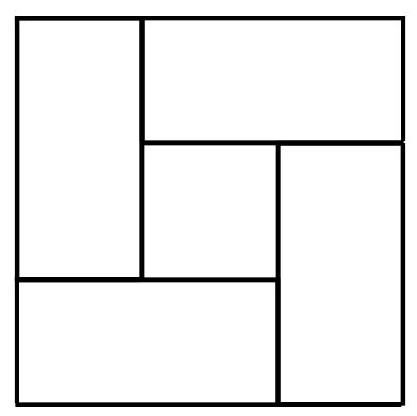
$\mathrm{In}$ the figure ab... | Solution
Since the area of the central square is equal to $64 \mathrm{~m}^{2}$, its side length is $8 \mathrm{~m}$. Since the perimeter of a square is four times the length of its side, we conclude that the perimeter of the central square is equal to $32 \mathrm{~m}$.
Since the five regions have the same perimeter, w... | 256\mathrm{~}^{2} | Geometry | math-word-problem | Yes | Yes | olympiads | false |
Consider two parallel lines $a$ and $b$.
The circles $C,C_1$ are tangent to each other and to the line $a$.
The circles $C,C_2$ are tangent to each other and to the line $b$.
The circles $C_1,C_2$ are tangent to each other, have radii $R_1=9,R_2=16$.
[img]https://services.artofproblemsolving.com/download.php?id=YXR0YWN... | null | null | Geometry | math-word-problem | Yes | Yes | aops_forum | false |
Piazzanos Pizzeria has a buy-1-get-1-free special on triple cheese pizzas, a buy-2-get-1-free special on meat lovers pizzas, a buy-3-get-2-free special on veggie delight pizzas, and a buy-1-22oz-drink-get-1-garlic-bread-free offer. The standard price for a small pizza is $5, medium pizza is $8, and large pizza is $10. ... | Let's calculate the cost step by step:
1. **Triple Cheese Pizzas:**
- You want to buy 6 large triple cheese pizzas with 2 extra toppings each.
- Since there's a buy-1-get-1-free special, you'll only pay for 3 of them.
- The cost of 3 large pizzas: 3 * $10 = $30
- The cost of extra toppings for 6 pizzas: 6 ... | \$185 | Logic and Puzzles | math-word-problem | Yes | Yes | orca_math | true |
Circles $\omega_1$, $\omega_2$, and $\omega_3$ each have radius $5$ and are placed in the plane so that each circle is externally tangent to the other two. Points $Q_1$, $Q_2$, and $Q_3$ lie on $\omega_1$, $\omega_2$, and $\omega_3$ respectively such that $Q_1Q_2=Q_2Q_3=Q_3Q_1$ and line $Q_iQ_{i+1}$ is tangent to $\ome... | Let $O_i$ be the center of circle $\omega_i$ for $i=1,2,3$, and let $L$ be the intersection of lines $O_1Q_1$ and $O_2Q_2$. Since $\angle Q_1Q_2Q_3 = 60^\circ$, $\triangle Q_2LQ_1$ is a $30-60-90^\circ$ triangle. Let $e=Q_1L$; then $Q_2L = 2e$ and $Q_1Q_2 = \sqrt 3e$. The Law of Cosines in $\triangle O_1LO_2$ gives:
\[... | 143.75 + 25\sqrt{19} | Geometry | math-word-problem | Yes | Yes | synthetic_math | true |
Given $A(0,3)$, line $l:y=2x-4$, a circle $C$ with radius $1$ and center on line $l$.$(1)$ If the center of circle $C$ also lies on the line $y=x-1$, find the equation of the tangent line passing through point $A$ to circle $C$;$(2)$ If there exists a point $M$ on circle $C$ such that $|MA|=2|MO|$, find the range of th... | **Solution:**
**(1)** Let's start by finding the center of circle $C$ which lies on both lines $l_1: y = 2x-4$ and $l_2: y = x-1$. Solving the system:
$$
\begin{align*}
y &= 2x - 4 \\
y &= x - 1
\end{align*}
$$
We have:
$$
2x - 4 = x - 1 \Rightarrow x = 3
$$
Substituting $x = 3$ into one of the equations, say $y = x -... | 0 \leqslant a \leqslant \frac{12}{5} | Geometry | math-word-problem | Yes | Yes | cn_k12 | false |
Example 1 Proof: The indeterminate equation $x^{2}+y^{2}-8 z^{3}=6$ has no integer solutions.
---
Translate the above text into English, please retain the original text's line breaks and format, and output the translation result directly. | Prove that $x, y$ have the same parity by modulo 2; modulo 4 shows that $x, y$ are both odd, thus $x^{2} \equiv 1(\bmod 8), y^{2} \equiv 1$ $(\bmod 8)$.
Taking both sides of the equation modulo 8, we have $6 \equiv x^{2}+y^{2}-8 z^{3} \equiv 2(\bmod 8)$, a contradiction. Therefore, the original equation has no integer... | null | Number Theory | proof | Yes | Yes | number_theory | false |
In the Cartesian coordinate system, the quadrant where the point $\left(-2,5\right)$ lies is ( )
A: First quadrant
B: Second quadrant
C: Third quadrant
D: Fourth quadrant | In the Cartesian coordinate system, the location of a point is determined by its x-coordinate (horizontal position) and y-coordinate (vertical position). The system is divided into four quadrants:
- The first quadrant, where both x and y are positive.
- The second quadrant, where x is negative and y is positive.
- The... | \text{B: Second quadrant} | Geometry | MCQ | Yes | Yes | cn_k12 | false |
Given $A=\{1, 2, x^2-5x+9\}$, $B=\{3, x^2+ax+a\}$, if $A=\{1, 2, 3\}$ and $2 \in B$, find the value of the real number $a$. | Since $A=\{1, 2, 3\}$ and $2 \in B$,
we have $x^2-5x+9=3$ and $x^2+ax+a=2$.
Solving these equations, we get:
$$a=- \frac {2}{3}\text{ or }a=- \frac {7}{4}$$
Therefore, the value of the real number $a$ is: $$\boxed{a=- \frac {2}{3}\text{ or }a=- \frac {7}{4}}.$$ | a=- \frac {2}{3}\text{ or }a=- \frac {7}{4} | Algebra | math-word-problem | Yes | Yes | cn_k12 | false |
1.1. (2 points) In a nine-story building, there are 4 apartments on each floor. How many entrances are there in this building if there are a total of 180 apartments? | Answer: 5.
Solution. The number of entrances is $180:(4 \cdot 9)=5$. | 5 | Logic and Puzzles | math-word-problem | Yes | Yes | olympiads | false |
The sum of two fractions is $\frac{5}{6}$ and their product is $\frac{1}{8}$. What is the smaller of the two fractions? Express your answer as a common fraction. | Let's denote the fractions as $x$ and $y$. We know:
1. $x + y = \frac{5}{6}$
2. $xy = \frac{1}{8}$
We can create a quadratic equation whose roots are $x$ and $y$. According to the relationships for the sum and product of the roots of the quadratic equation $ax^2 + bx + c = 0$, we have:
- $-b/a = x + y = \frac{5}{6}$
-... | \frac{5 - \sqrt{7}}{12} | Algebra | math-word-problem | Yes | Yes | synthetic_math | true |
If 3 < x < 6 < y < some number, then the greatest possible positive integer difference of x and y is 6. What is the upper bound for y? | Given that the greatest possible positive integer difference of x and y is 6, we can express this as:
y - x = 6
Since we know that x is less than 6, the largest possible value for x that is still an integer is 5 (because x must be greater than 3 and less than 6). So, we can substitute x with 5:
y - 5 = 6
Now, we ca... | 11 | Inequalities | math-word-problem | Yes | Yes | orca_math | true |
After the ecological system in a desert area has been greatly improved through governance, the population of wild animals has increased. To investigate the population of a certain type of wild animal in this area, it is divided into 200 plots of similar size. From these plots, 20 are randomly selected as sample areas u... | ### Step-by-Step Solution
#### Part (1): Estimating the Population of Wild Animals
Given that the total number of wild animals in the 20 sample areas is $\sum_{i=1}^{20}y_{i}=1200$, we first calculate the average number of wild animals per sample area. This is done by dividing the total number by the number of sample... | 0.94 | Algebra | math-word-problem | Yes | Yes | cn_k12 | false |
Among the following statements, the correct ones are ( )
① Extend the straight line AB ② Extend the line segment AB ③ Extend the ray AB ④ Draw a straight line AB=5cm ⑤ Cut a line segment AC on the ray AB, making AC=5cm
A: 1
B: 2
C: 3
D: 4 | **Analysis:** We can judge by analyzing according to the definitions of line segments, rays, and straight lines in turn.
**Answer:** A straight line has no endpoints and can extend infinitely in both directions, so ① and ④ are incorrect;
A ray has one endpoint and can extend infinitely in one direction, but it is p... | B | Geometry | MCQ | Yes | Yes | cn_k12 | false |
Let $k\ge2$ be an integer. The function $f:\mathbb N\to\mathbb N$ is defined by
$$f(n)=n+\left\lfloor\sqrt[k]{n+\sqrt[k]n}\right\rfloor.$$Determine the set of values taken by the function $f$. | Let \( k \ge 2 \) be an integer. The function \( f: \mathbb{N} \to \mathbb{N} \) is defined by
\[ f(n) = n + \left\lfloor \sqrt[k]{n + \sqrt[k]{n}} \right\rfloor. \]
We need to determine the set of values taken by the function \( f \).
1. Define \( a_m = m^k - m + 1 \), where \( m \) is a positive integer. Note that ... | \mathbb{N} \setminus \{ n^k \mid n \in \mathbb{N} \} | Number Theory | math-word-problem | Yes | Yes | aops_forum | false |
Find $x$ such that $\lceil x \rceil \cdot x = 198$. Express $x$ as a decimal. | First, it is necessary to determine that $x$ must be positive, as the expression $\lceil x \rceil \cdot x$ becomes nonpositive when $x$ is negative or zero. The condition to check is $\lceil x \rceil - 1 198$ to approximate $\lceil x \rceil$.
Calculate $14 \cdot 14 = 196$ and $15 \cdot 15 = 225$. Since $196 < 198 < 2... | 13.2 | Algebra | math-word-problem | Yes | Yes | synthetic_math | true |
At the arcade, Billy had won 48.5 tickets. After buying a yoyo for 11.7 tickets, he had some tickets left. What's the difference between the number of Billy's tickets he won and he had left after buying the yoyo? | Billy started with 48.5 tickets. After buying the yoyo for 11.7 tickets, he would have:
48.5 tickets - 11.7 tickets = 36.8 tickets left.
To find the difference between the number of tickets he won and the number he had left, we subtract the number of tickets left from the number of tickets he won:
48.5 tickets (won)... | 11.7 | Algebra | math-word-problem | Yes | Yes | orca_math | true |
In a school corridor, there is a row of lockers numbered from 1 to 500. Initially, all lockers are closed. A student starts at locker 1, opens it, and then proceeds by skipping one locker and opening the next, continuing this pattern until he reaches the end of the corridor. Upon reaching the end, he turns around, skip... | 1. On the first trip, the student opens all odd-numbered lockers (1, 3, 5, ..., 499).
2. On the second trip, he skips the first closed locker (number 2) then opens every second closed locker starting from locker 4 (4, 8, 12, ..., 500).
3. On successive trips, he reduces the set of the remaining closed lockers, opening ... | 242 | Logic and Puzzles | math-word-problem | Yes | Yes | synthetic_math | true |
A large box contains 20 small boxes and each small box contains a certain number of chocolate bars. There are 500 chocolate bars in the large box. How many chocolate bars are in each small box? | To find out how many chocolate bars are in each small box, you would divide the total number of chocolate bars by the number of small boxes.
So, if there are 500 chocolate bars in the large box and 20 small boxes, you would calculate:
500 chocolate bars ÷ 20 small boxes = 25 chocolate bars per small box
Therefore, e... | 25 | Algebra | math-word-problem | Yes | Yes | orca_math | true |
Problem 6.7. In the magazine "Young Constructor," there is a drawing for assembling a small box, as shown in the figure. The upper rectangle is the lid of the box, the lower one is the bottom of the box, and the other four rectangles are the side walls.
. From the condition, it follows that $a+c=17, a+b=13, c+b+c+b=40$ (the last condition means that $... | 5\times8\times12 | Geometry | math-word-problem | Incomplete | Yes | olympiads | false |
2. Five runners ran a relay. If the first runner ran twice as fast, they would have spent $5 \%$ less time. If the second runner ran twice as fast, they would have spent $10 \%$ less time. If the third runner ran twice as fast, they would have spent $12 \%$ less time. If the fourth runner ran twice as fast, they would ... | Solution: If each ran twice as fast, they would run 50% faster. This means that if the 5th runner ran faster, the time would decrease by $50-5-10-12-15=8 \%$. | 8 | Algebra | math-word-problem | Yes | Yes | olympiads | false |
## Problem Statement
Find the point $M^{\prime}$ symmetric to the point $M$ with respect to the plane.
$M(-1 ; 0 ; 1)$
$2 x+4 y-3=0$ | ## Solution
Let's find the equation of the line that is perpendicular to the given plane and passes through point $M$. Since the line is perpendicular to the given plane, we can take the normal vector of the plane as its direction vector:
$\vec{s}=\vec{n}=\{2 ; 4 ; 0\}$
Then the equation of the desired line is:
$\f... | M^{\}(0;2;1) | Geometry | math-word-problem | Incomplete | Yes | olympiads | false |
Dan has $7. He bought a candy bar for $2 and a chocolate for a certain amount. After buying these items, he has $2 left. How much did the chocolate cost? | Dan started with $7 and ended with $2 after buying the candy bar and the chocolate.
First, let's subtract the cost of the candy bar from his initial amount:
$7 - $2 (candy bar) = $5
Now, we know that after buying the chocolate, he has $2 left. So, the cost of the chocolate is the difference between the $5 he had aft... | \$3 | Algebra | math-word-problem | Yes | Yes | orca_math | true |
The equation of a circle with center at (a, a) (where a ≠ 0) and passing through the origin is ( )
A: $(x-1)^2 + (y-1)^2 = \sqrt{2}$
B: $(x+1)^2 + (y+1)^2 = \sqrt{2}a$
C: $(x+a)^2 + (y+a)^2 = 2a^2$
D: $(x-a)^2 + (y-a)^2 = 2a^2$ | Since the circle passes through the origin, and the distance between the center (a, a) and the origin is $r = \sqrt{2}|a|$, the equation of the circle is:
$$(x-a)^2 + (y-a)^2 = r^2 = (\sqrt{2}|a|)^2 = 2a^2.$$
Therefore, the correct equation is:
$$(x-a)^2 + (y-a)^2 = 2a^2.$$
Hence, the correct answer is:
\[\boxed{D... | D | Geometry | MCQ | Yes | Yes | cn_k12 | false |
48. Prove that seven circles of radius 1 can completely cover a circle of radius 2, but cannot cover a circle of a larger radius. | 62.48. To cover a circle of radius 2, we divide the circumference by points $A, B, C, D, E, F$ into six equal arcs and construct six circles of radius 1 on the diameters $A B, B C, C D, D E, E F$ and $F A$. Adding one circle centered at the center of the larger circle, we obtain seven circles covering the given circle ... | proof | Geometry | proof | Yes | Yes | olympiads | false |
A shop owner professes to sell his articles at a certain cost price, but he uses false weights with which he cheats by 14% while buying and by 20% while selling. What is his percentage profit? | Let's assume the shop owner buys 100 grams of an article for $100 using false weights that are 14% less than the actual weight. This means he actually receives only 86 grams (100 - 14% of 100) for $100.
Now, when he sells these 86 grams, he uses false weights again to cheat by 20%. This means he sells what he claims t... | 7.5\% | Algebra | math-word-problem | Yes | Yes | orca_math | true |
Hannah sold some pieces of cookies for $0.8 each and 30 cupcakes for $2 each. She used the money to buy 2 sets of measuring spoons for $6.5 each and has $79 left. How many pieces of cookies did she sell? | Let's denote the number of pieces of cookies Hannah sold as C.
The total amount of money Hannah made from selling the cookies is $0.8 * C.
The total amount of money Hannah made from selling the cupcakes is $2 * 30 = $60.
The total amount of money Hannah spent on the measuring spoons is $6.5 * 2 = $13.
The total amo... | 40 | Algebra | math-word-problem | Yes | Yes | orca_math | true |
Given ${(1-2x)}^{2023}={a}_{0}+{a}_{1}x+{a}_{2}{x}^{2}+⋅⋅⋅+{a}_{2023}{x}^{2023}$, then ()
A: The sum of the coefficients of all terms in the expansion is $-1$
B: The coefficient of the largest term in the expansion is the $1012$th term
C: $\frac{{a}_{1}}{2}+\frac{{a}_{2}}{{2}^{2}}+\frac{{a}_{3}}{{2}^{3}}+⋅⋅⋅+\frac{{... | To solve the problem and understand why options $A$ and $C$ are correct, let's break down the solution into detailed steps:
**Option A:**
- To determine the sum of the coefficients, we substitute $x=1$ into the given expression: ${(1-2\cdot 1)}^{2023} = {(-1)}^{2023}$.
- Calculating the power gives us: ${(-1)}^{2023}... | C | Algebra | MCQ | Yes | Yes | cn_k12 | false |
The following week, they decided to go to Lake Huron and Lake Michigan. During their stay there, they caught a total of 30 pikes, 40 sturgeons and 75 herrings. How many fishes did they catch from the two lakes? | They caught a total of 30 pikes, 40 sturgeons, and 75 herrings from the two lakes. To find the total number of fish they caught, we simply add these numbers together:
30 pikes + 40 sturgeons + 75 herrings = 145 fishes
So, they caught a total of $\boxed{145}$ fishes from Lake Huron and Lake Michigan. | 145 | Logic and Puzzles | math-word-problem | Yes | Yes | orca_math | true |
4th Putnam 1941 Problem B6 f is a real valued function on [0, 1], continuous on (0, 1). Prove that ∫ x=0 x=1 ∫ y=x y=1 ∫ z=x z=y f(x) f(y) f(z) dz dy dx = 1/6 ( ∫ x=0 x=1 f(x) dx ) 3 . | Let S xyz be the points in the cube for which x ≤ y ≤ z, let S yxz be the points for which y ≤ x ≤ z and so on. Then the union of the six sets is the cube and the intersection of any two has measure zero. Also by changing the variables of integration we see that the integral of f(x) f(y) f(z) over each set is the same.... | proof | Calculus | proof | Yes | Yes | olympiads | false |
\[2012 \cdot \text{Liaoning College Entrance Exam}\] The line that bisects the circle $x^2 + y^2 - 2x - 4y + 1 = 0$ is ( )
A: $x + y - 1 = 0$
B: $x + y + 3 = 0$
C: $x - y + 1 = 0$
D: $x - y + 3 = 0$ | The line passes through the center of the circle $(1,2)$. Option C meets the requirement.
Therefore, the correct answer is $\boxed{\text{C}}$. | \text{C} | Geometry | MCQ | Yes | Yes | cn_k12 | false |
The work team was working at a rate fast enough to process $1250$ items in ten hours. But after working for six hours, the team was given an additional $150$ items to process. By what percent does the team need to increase its rate so that it can still complete its work within the ten hours? | 1. **Calculate the original rate of processing items:**
\[
\text{Original rate} = \frac{1250 \text{ items}}{10 \text{ hours}} = 125 \text{ items per hour}
\]
2. **Determine the number of items processed in the first 6 hours:**
\[
\text{Items processed in 6 hours} = 125 \text{ items/hour} \times 6 \text{... | 30\% | Algebra | math-word-problem | Yes | Yes | aops_forum | false |
【Example 3.22】In $\triangle A B C$, prove:
(1) $A D$ is the angle bisector (Figure 3.30)
$$
\Leftrightarrow \frac{B D}{D C}=\frac{B A}{A C} ;
$$
(2) $t_{a}=\frac{2 b c}{b+c} \cos \frac{A}{2}$. | Proof
$$
\begin{array}{c}
\text { (1) } \because \frac{\frac{1}{2} A B \cdot t_{a} \sin \alpha}{\frac{1}{2} A C \cdot t_{a} \sin \beta}=\frac{\frac{1}{2} B D \cdot t_{a} \sin \angle A D B}{\frac{1}{2} D C \cdot t_{a} \sin \angle A D C}=\frac{B D}{D C}, \\
\therefore \alpha=\beta \Leftrightarrow \frac{A B}{A C}=\frac{B ... | proof | Geometry | proof | Yes | Yes | olympiads | false |
The coefficient of the monomial $-\frac{2x{y}^{2}}{3}$ is ______, and the degree is ______. | To determine the coefficient and the degree of the monomial $-\frac{2x{y}^{2}}{3}$, we break down the monomial into its components.
- **Coefficient**: The coefficient is the numerical part of the monomial, which in this case is $-\frac{2}{3}$. This is because the coefficient is the factor that multiplies the variables... | -\frac{2}{3}, 3 | Algebra | math-word-problem | Yes | Yes | cn_k12 | false |
A circle is inscribed in a rectangle, and then a rectangle is inscribed in this circle. Finally, a circle is inscribed in this second rectangle. If the ratio of the length to the width of the first rectangle is 3:2, what is the ratio of the area of the smaller circle to the area of the original rectangle? | Let the original rectangle have length 3x and width 2x. The diameter of the circle inscribed in the rectangle is 2x (the smaller dimension), so its radius is x. The rectangle inscribed in this circle has diagonal 2x, and since the ratio of the dimensions remains 3:2, these dimensions are \(3k\) and \(2k\) where \(3k^2 ... | \frac{\pi}{30} | Geometry | math-word-problem | Yes | Yes | synthetic_math | true |
Given the function $f(x) = \log_a(a^x - 1)$ where $0 < a < 1$,
(1) Determine the domain of $f(x)$.
(2) Discuss the monotonicity of $f(x)$.
(3) Solve the equation $f(2x) = f^{-1}(x)$. | (1) The condition for the domain is $a^x - 1 > 0$. Thus, we have $a^x > a^0$.
Since $0 0$ for any real $x$ when $a > 0$.
Therefore, the solution to the equation is $\boxed{x = \log_a 2}$. | x = \log_a 2 | Algebra | math-word-problem | Yes | Yes | cn_k12 | false |
Edward bought 79 tickets at the state fair. He spent some tickets at the 'dunk a clown' booth and decided to use the rest on rides. Each ride cost 7 tickets. He could go on 8 rides. How many tickets did Edward spend at the 'dunk a clown' booth? | If Edward could go on 8 rides and each ride cost 7 tickets, then he spent 8 rides * 7 tickets/ride = 56 tickets on rides.
Edward started with 79 tickets and spent 56 tickets on rides, so he spent 79 tickets - 56 tickets = $\boxed{23}$ tickets at the 'dunk a clown' booth. | 23 | Algebra | math-word-problem | Yes | Yes | orca_math | true |
Given the ellipse $C: \frac{x^2}{a^2} + \frac{y^2}{b^2} = 1 (a > b > 0)$, where the lower vertex is $A$, the right vertex is $B$, the eccentricity $e = \frac{\sqrt{3}}{2}$, and the parabola $E: y = \frac{x^2}{8}$ with focus $F$. Let $P$ be a point on the parabola $E$, and the tangent line to $E$ at point $P$ is $l$, wh... | Solution:
$(1)$ Since $e^2 = 1 - \frac{b^2}{a^2} = \frac{3}{4}$, we have $\frac{b}{a} = \frac{1}{2}$, so the slope of $AB$, $k_{AB} = \frac{1}{2}$.
Because $l \parallel AB$, the slope of $l$ is also $\frac{1}{2}$.
Let $P(t, \frac{t^2}{8})$, the tangent line $l$ passing through point $P$ and tangent to $E$, from $... | \frac{x^2}{16} + \frac{y^2}{4} = 1 | Geometry | math-word-problem | Yes | Yes | cn_k12 | false |
Albert is 2 times Mary's age and 4 times as old as Betty. Mary is 14 years younger than Albert. Charlie is 3 times as old as Betty and 10 years older than Mary. How old is Betty? | Let's denote Betty's age as B. According to the information given:
Albert is 4 times as old as Betty, so Albert's age is 4B.
Mary is 14 years younger than Albert, so Mary's age is 4B - 14.
Albert is also 2 times Mary's age, so we can set up the equation 4B = 2(4B - 14).
Now let's solve for B:
4B = 2(4B - 14)
4B = 8B... | 7 | Algebra | math-word-problem | Yes | Yes | orca_math | true |
Let's form a right-angled triangle - with legs $a$ and $b$, and hypotenuse $c$ - by rotating around the lines passing through the vertices and parallel to the opposite sides. Calculate the surface area and volume of the 3 resulting solids of revolution. How do the surface areas and volumes of the 3 solids compare to ea... | Let's denote the surface areas of the resulting solids of revolution as $F_{a}, F_{b}, F_{c}$, and their volumes as $K_{a}, K_{b}, K_{c}$, respectively.
a) When the right-angled triangle is rotated around an axis passing through point $A$ and parallel to the leg $a$, the leg $a$ forms a cylindrical surface, the leg $b... | F_{}:F_{b}:F_{}=1:1:\frac{4+\sqrt{2}}{7}\quad | Geometry | math-word-problem | Yes | Yes | olympiads | false |
In a class of 94 students, 41 are taking French, some are taking German. Of the students taking French or German, 9 are taking both courses. There are 40 students not enrolled in either course. How many students are taking German? | Let's denote the number of students taking German as G.
From the information given, we know that there are 41 students taking French, and 9 of those are also taking German. Therefore, the number of students taking only French is 41 - 9 = 32.
We also know that there are 40 students not taking either French or German, ... | 22 | Combinatorics | math-word-problem | Yes | Yes | orca_math | true |
In Pascal's Triangle, how many rows contain the number 43? | To determine how many rows in Pascal's Triangle contain the number 43, we need to understand the structure of Pascal's Triangle and the properties of binomial coefficients.
Pascal's Triangle is constructed such that the entry in the \(n\)-th row and \(k\)-th column is given by the binomial coefficient \(\binom{n}{k}\)... | 2 | Number Theory | math-word-problem | Yes | Yes | metamath | true |
Let the function $f(x) = e^x - x - 2$. Use the bisection method to find an approximate solution of the equation $e^x - x - 2 = 0$ within the interval $(-1, 3)$. During the process, it is found that $f(-1) 0$, and $f(3) > 0$. Therefore, the equation has at least one root in the interval:
A: $(-1, 0)$
B: $(0, 1)$
C: $(1... | According to the given conditions, we have $f(1) 0$, which implies $f(1)f(2) < 0$.
Based on the theorem for determining the zeros of a function, the function $f(x)$ must have at least one zero in the interval $(1, 2)$.
That is, the equation $e^x - x - 2 = 0$ has at least one root in the interval $(1, 2)$.
Theref... | C | Calculus | MCQ | Incomplete | Yes | cn_k12 | false |
## Task 2 - 340812
A three-digit natural number is called "symmetric" if and only if its hundreds digit is equal to its units digit.
a) Form all those three-digit symmetric numbers in which only the digits $0,1,2$ appear (each possibly multiple times or not at all)! No justification is required.
b) Form all those th... | a) $101,111,121,202,212,222$.
b) I. If a number meets the stated requirements, then:
Since the number is divisible by 6, and thus also by 2, its unit digit must be even, i.e., either 2 or 8. Therefore, only the numbers $222,252,282,828,858,888$ (1) can meet the requirements.
II. These numbers meet the requirements; ... | 49500 | Number Theory | math-word-problem | Yes | Yes | olympiads | false |
Marcel goes to the store with Dale to buy groceries for cooking dinner. Marcel buys 10 ears of corn, and Dale buys half that amount. Dale buys 8 potatoes and Marcel buys some potatoes. How many vegetables did they buy altogether if Marcel bought 4 potatoes? | Marcel bought 10 ears of corn and 4 potatoes. Dale bought half the amount of corn Marcel bought, which is 10/2 = 5 ears of corn, and Dale also bought 8 potatoes.
Adding up the vegetables they bought:
Marcel's vegetables: 10 (corn) + 4 (potatoes) = 14
Dale's vegetables: 5 (corn) + 8 (potatoes) = 13
Altogether, they b... | 27 | Logic and Puzzles | math-word-problem | Yes | Yes | orca_math | true |
14th ASU 1980 Problem 7 There are several settlements around Big Lake. Some pairs of settlements are directly connected by a regular shipping service. For all A ≠ B, settlement A is directly connected to X iff B is not directly connected to Y, where B is the next settlement to A counterclockwise and Y is the next settl... | Suppose there are n settlements A 1 , A 2 , ... , A n in counterclockwise order around the lake. We will use cyclic indices, so that A n+1 means A 1 , and so on. wlog A 1 has a direct service to A 2 . Then it follows that A 2 does not have a direct service to A 3 , so A 3 does have a direct service to A 4 , and so on. ... | proof | Logic and Puzzles | proof | Yes | Yes | olympiads | false |
## Task A-4.4.
Let $a, b$ and $c$ be the lengths of the sides of a triangle with a perimeter of 1. Prove that
$$
\sqrt{a^{2}+b^{2}}+\sqrt{b^{2}+c^{2}}+\sqrt{c^{2}+a^{2}}<1+\frac{\sqrt{2}}{2}
$$ | ## Solution.
Without loss of generality, we can assume $a \geqslant b \geqslant c$.
Then, from the triangle inequality and the equality $a+b+c=1$, it follows that $a < b+c = 1-a$, which means $a < \frac{1}{2}$.
Since $b \leqslant a$, we have $\sqrt{a^{2}+b^{2}} \leqslant \sqrt{2 a^{2}} = a \sqrt{2} < \frac{\sqrt{2}}... | proof | Inequalities | proof | Yes | Yes | olympiads | false |
If $(x + y)^2 = 4$ and $xy = -9$, what is the value of $x^2 + y^2$? | We start with the equation $(x + y)^2 = x^2 + 2xy + y^2$. Given $(x+y)^2 = 4$, we substitute this into the equation:
\[ x^2 + 2xy + y^2 = 4 \]
We are given $xy = -9$, so we substitute $2xy = 2(-9) = -18$ into the equation:
\[ x^2 + y^2 - 18 = 4 \]
Solving for $x^2 + y^2$, we add 18 to both sides:
\[ x^2 + y^2 = 4 + 1... | 22 | Algebra | math-word-problem | Yes | Yes | synthetic_math | true |
Given a sequence $\{a_n\}$ satisfying $a_{n+1} = \frac{1}{2}a_n + t$, with $a_1 = \frac{1}{2}$ (where $t$ is a constant and $t \neq \frac{1}{4}$):
1. Prove that the sequence $\{a_n - 2t\}$ is a geometric sequence.
2. When $t = -\frac{1}{8}$, what is the maximum sum of the first several terms of $\{a_n\}$?
3. When $t = ... | 1. Since the sequence $\{a_n\}$ satisfies $a_{n+1} = \frac{1}{2}a_n + t$ and $a_1 = \frac{1}{2}$ (where $t$ is a constant and $t \neq \frac{1}{4}$), we have:
$$
a_{n+1} - 2t = \frac{1}{2}a_n + t - 2t = \frac{1}{2}(a_n - 2t).
$$
Therefore, the ratio of consecutive terms is:
$$
\frac{a_{n+1} - 2t}{a_n - 2t} = \frac{1}... | k \in \left[\frac{1}{32}, +\infty \right) | Algebra | math-word-problem | Yes | Yes | cn_k12 | false |
If the universal set $U=\mathbb{R}$, and the sets $M=\{x|-2\leq x\leq 2\}$, $N=\{x|x^2-3x\leq 0\}$, then $M\cap (\complement_U N)=$ \_\_\_\_\_\_. | Given the universal set $U=\mathbb{R}$, and the set $M=\{x|-2\leq x\leq 2\}$,
$N=\{x|x^2-3x\leq 0\}=\{x|0\leq x\leq 3\}$,
Therefore, $\complement_U N=\{x|x3\}$,
Thus, $M\cap (\complement_U N)=\{x|-2\leq x<0\}$.
Hence, the answer is $\boxed{\{x|-2\leq x<0\}}$.
By simplifying set $N$ and finding $\complement_U N$, w... | \{x|-2\leq x<0\} | Inequalities | math-word-problem | Yes | Yes | cn_k12 | false |
11. Sides $A B$ and $C D$ of quadrilateral $A B C D$ are perpendicular and are diameters of two equal tangent circles with radius $r$. Find the area of quadrilateral $A B C D$, if $\frac{|B C|}{|A D|}=k$. | 11. Let $M$ be the point of intersection of the lines $A B$ and $C D$, and let $O_{1}$ and $O_{2}$ be the centers of the given circles. Suppose $|B M| = |x|$, $|M C| = |y|$, and choose the signs of $x$ and $y$ such that the following relations hold:
$$
\begin{aligned}
|B C|^{2}= & x^{2}+y^{2}, \quad|A D|^{2}=(x+2 r)^{... | 3r^{2}|\frac{1-k^{2}}{1+k^{2}}| | Geometry | math-word-problem | Yes | Yes | olympiads | false |
Subsets and Splits
No community queries yet
The top public SQL queries from the community will appear here once available.