
instruction_seed stringlengths 2 10.7k | solution stringlengths 0 10.8k ⌀ | answer stringlengths 0 575 ⌀ | problem_type stringclasses 9
values | question_type stringclasses 5
values | problem_is_valid stringclasses 5
values | solution_is_valid stringclasses 4
values | source stringclasses 11
values | synthetic bool 2
classes |
|---|---|---|---|---|---|---|---|---|
5.31. Prove that $[\sqrt{4 n+1}]=[\sqrt{4 n+2}]=[\sqrt{4 n+3}]$ for any natural $n$. | 5.31. Let $k=[\sqrt{4 n+1}]$. Then $k^{2} \leqslant 4 n+1<(k+1)^{2}$. A perfect square when divided by 4 cannot leave a remainder of 2 or 3, therefore the numbers $4 n+2$ and $4 n+3$ cannot coincide with $(k+1)^{2}$. Consequently, both these numbers are less than $(k+1)^{2}$. | proof | Number Theory | proof | Yes | Yes | olympiads | false |
In the arithmetic sequence $\{a\_n\}$, if $a\_3=-5$, $a\_9=1$, then the value of $a\_5$ is $\_\_\_\_\_\_.$ | Given that in the arithmetic sequence $\{a\_n\}$, $a\_3=-5$, and $a\_9=1$,
we can set up the following system of equations:
$$
\begin{cases}
a\_3 = a\_1 + 2d = -5 \\
a\_9 = a\_1 + 8d = 1
\end{cases}
$$
Solving the system of equations, we obtain $a\_1 = -7$, and $d = 1$.
Now, we can find $a\_5$ using the formula for an... | -3 | Algebra | math-word-problem | Yes | Yes | cn_k12 | false |
Proposition \\(p\\): The inequality \\(x^2+2ax+4 > 0\\) holds for all \\(x \in \mathbb{R}\\); Proposition \\(q\\): The function \\(y=-(5-2a)^x\\) is a decreasing function. If \\(p \vee q\\) is a true proposition and \\(p \wedge q\\) is a false proposition, then the range of values for the real number \\(a\\) is \_\_\_\... | **Analysis**
This question examines the application of the truth of composite propositions. From the inequality \\(x^2+2ax+4 > 0\\) always holding for all \\(x \in \mathbb{R}\\), we can derive \\(\Delta = 4a^2-16 1\\) to obtain \\(q\\). If the proposition "\\(p \wedge q\\)" is false and "\\(p \vee q\\)" is true, then... | (-\infty, -2] | Algebra | math-word-problem | Yes | Yes | cn_k12 | false |
If the function $f(x) = x^3 + 2ax^2 + 2bx + 3c$ has two different extreme points $x_1, x_2$, and $f(x_1) = x_1$, then the number of different real roots of the equation $3(f(x))^2 + 4af(x) + 2b = 0$ with respect to $x$ is ___.
A: 3
B: 4
C: 5
D: 6 | To tackle this problem, we begin by analyzing the characteristics of the function $f(x)$, using its derivative to investigate its monotonicity and extreme values, as well as the relationship between the function's zeroes and the roots of the given equation.
To find the derivative of the function $f(x)$, we compute $f'... | A | Algebra | MCQ | Yes | Yes | cn_k12 | false |
Given that the domain of $f(x)$ is $[-1,2)$, determine the domain of $f(|x|)$.
A: $[-1,2)$
B: $[-1,1]$
C: $(-2,2)$
D: $[-2,2)$ | Since the domain of $f(x)$ is $[-1,2)$, we have the condition for $f(|x|)$ as follows:
$-1 \leq |x| < 2$
We break this down into two cases:
1. $|x| \geq -1$
This is always true since the absolute value of any real number is always non-negative.
2. $|x| < 2$
Solving this inequality, we get $-2 < x < 2$
Thus, the doma... | \text{C: } (-2,2) | Algebra | MCQ | Yes | Yes | cn_k12 | false |
Let's construct a triangle, given a vertex $A$, the foot of the altitude $M$, and the midpoint $D$ of side $B C$. | The perpendicular from point $D$ to $AM$ intersects $AM$ at $A_1$, the foot of the altitude from $A$. We find the centroid $S$ of the triangle on $AD$ such that $DS = \frac{1}{3} DA$. Since the center of the circumcircle of the triangle lies on the Euler line (K. M. L. VII. 5. page) and is perpendicular to one of the t... | notfound | Geometry | math-word-problem | Yes | Yes | olympiads | false |
Design an operation: $1 \& 1 = 2$, $m \& n = k$, $m \& (n + 1) = k + 3$ ($m, n, k \in \mathbb{N}^*$), find the output of $1 \& 2004$.
A) $2004$
B) $2006$
C) $4008$
D) $6011$ | According to the given rules:
- $1 \& 1 = 2$
- $m \& n = k$
- $m \& (n + 1) = k + 3$
We can create a recursive relationship for the operation when $m=1$. We want to find the expression for $1 \& n$.
We begin with $1 \& 1 = 2$ as our base case.
Then for $1 \& 2$, we can use the given rule $m \& (n+1) = k+3$ by pluggi... | 6011 | Algebra | MCQ | Yes | Yes | cn_k12 | false |
Let $n$ be a positive integer, and let $x_1, x_2, \dots, x_n$ be distinct positive integers with $x_1 = 1$. Construct an $n \times 3$ table where the entries of the $k$-th row are $x_k, 2x_k, 3x_k$ for $k = 1, 2, \dots, n$. Now follow a procedure where, in each step, two identical entries are removed from the table. Th... | ### Part (a)
1. **Initial Setup**: We start with an \( n \times 3 \) table where the entries of the \( k \)-th row are \( x_k, 2x_k, 3x_k \) for \( k = 1, 2, \dots, n \). Given \( x_1 = 1 \), the first row is \( 1, 2, 3 \).
2. **Identifying Unique Entries**: We need to show that at least three entries remain at the en... | null | Logic and Puzzles | proof | Yes | Yes | aops_forum | false |
Given the function $f(x) = e^x$, its graph at point $P(2, f(2))$ has a tangent line $l$.
(1) Find the volume of the solid formed by rotating the region bounded by $y=f(x)$, the line $x=2$, and the two coordinate axes around the x-axis.
(2) Find the area of the region bounded by $y=f(x)$, the line $l$, and the y-axi... | Solution:
(1) The volume of the solid formed by rotating the region bounded by $f(x) = e^x$, the line $x=2$, and the two coordinate axes around the x-axis is
$$V= \int_{0}^{2} \pi(e^x)^2 dx= \frac{\pi}{2}e^{2x} \Bigg|_{0}^{2}= \frac{\pi}{2}(e^4-1)$$
(2) The function $f(x) = e^x$, and its graph at point $P(2, f(2)... | e^2 - 1 | Calculus | math-word-problem | Yes | Yes | cn_k12 | false |
A number in the set $\{50, 54, 58, \ldots, 998\}$ is randomly selected. What is the probability that it is divisible by 6? | First, identify the number sequence and the total number of terms. The given set is an arithmetic sequence where the first term, $a = 50$, the common difference, $d = 4$, and the nth term, $an = 998$. To find the number of terms $n$, we use the formula for the nth term in an arithmetic sequence:
\[ a_n = a + (n - 1)d \... | \frac{79}{238} | Number Theory | math-word-problem | Yes | Yes | synthetic_math | true |
85. (USA 1) Let $C D$ be a diameter of circle $K$. Let $A B$ be a chord that is parallel to $C D$. The line segment $A E$, with $E$ on $K$, is parallel to $C B ; F$ is the point of intersection of line segments $A B$ and $D E$. The line segment $F G$, with $G$ on $D C$, extended is parallel to $C B$. Is $G A$ tangent t... | None | proof | Geometry | proof | Yes | Problem not solved | olympiads | false |
Russian problems Problem 6 (a) A and B move clockwise with equal angular speed along circles center P and Q respectively. C moves continuously so that AB=BC=CA. Establish C's locus and speed. *(b) ABC is an equilateral triangle and P satisfies AP=2, BP=3. Establish the maximum possible value of CP. Solution (a) Represe... | : 5. P must be the opposite side of AB to C (or we could increase CP, whilst keeping AP and BP the same, by reflecting in AB). Similarly it must be on the same side of AC as B, and on the same side of BC as A. For any P in this region the quadrilateral APBC is convex and hence satisfies Ptolemy's inequality CP.AB= AC.B... | 5 | Geometry | math-word-problem | Incomplete | Yes | olympiads | false |
During the trial of a treasure theft case, the statements of four suspects, A, B, C, and D, were as follows. A said: "The criminal is among B, C, and D"; B said: "I didn't commit the crime, it was C who stole it"; C said: "One of A and B is the thief"; D said: "What B said is true". After investigation, it was verified... | **Solution**: Among the statements made by A, B, C, and D, it can be observed that B and D share the same viewpoint, thus their statements should either both be true or both be false (meaning they are either both telling the truth or both lying; a scenario where one is telling the truth and the other is lying is not po... | \text{B} | Logic and Puzzles | MCQ | Yes | Yes | cn_k12 | false |
5. Emilia wants to estimate the value of the expression $\frac{a}{b}-c$, where $a$, $b$, and $c$ are all large positive integers. She wants to approximate each positive integer, making it easier to calculate the result mentally. Which of the following ( ) will definitely result in an overestimation.
(A) Estimating all ... | 5. D.
The above text has been translated into English, maintaining the original text's line breaks and format. | D | Algebra | MCQ | Yes | Problem not solved | cn_contest | false |
Sixty bricks, each measuring $2''\times6''\times15''$, are to be laid one on top of the other to construct a column. Each brick can be oriented so it contributes $2''$, $6''$, or $15''$ to the total height of the column. Determine how many distinct total heights can be reached using all sixty bricks. | Starting with the smallest possible height:
- Each brick contributes a minimum of $2''$ when placed flat, giving a minimum height of $60 \times 2 = 120''$.
Next, consider the height increments possible by changing the orientation of each brick:
- Switching from $2''$ to $6''$ adds $4''$.
- Switching from $2''$ to $15'... | 781 | Combinatorics | math-word-problem | Yes | Yes | synthetic_math | true |
Example 1. Prove: $C_{n}^{1}+2 C_{n}^{2}+3 C_{n}^{3}+\cdots$ $+n C_{n}^{n}=n \cdot 2^{n-1}$ | Prove that $(1+x)^{n}=C_{n}^{0}+C_{n}^{1} x+C_{n}^{2} x^{2} +\cdots+C_{n}^{n} x$ "Differentiate with respect to $x$ and then set $x=1$"
This can also be used to prove: $1^{2} C_{n}^{1}+2^{2} C_{n}^{2}+\cdots+n^{2} C_{n}^{n} =n(n+1) 2^{n-2}$.
Two, using integration
Translate the above text into English, please retain ... | null | Combinatorics | proof | Yes | Yes | cn_contest | false |
Find all pairs of integers $(m, n)$ which satisfy the equation
\[(2n^2+5m-5n-mn)^2=m^3n\] | null | null | Algebra | math-word-problem | Yes | Yes | aops_forum | false |
Find all angles \( \theta,\) \( 0 \le \theta \le 2\pi,\) such that for all real numbers \( x,\) \( 0 \le x \le 1,\)
\[
x^2 \cos \theta - x(1 - x) + (1 - x)^2 \sin \theta < 0.
\] | 1. Start by checking boundary values of \( x \):
- If \( x = 0 \):
\[
(1-x)^2 \sin \theta = \sin \theta < 0.
\]
Thus \( \sin \theta < 0 \).
- If \( x = 1 \):
\[
x^2 \cos \theta = \cos \theta < 0.
\]
Thus \( \cos \theta < 0 \).
2. Both conditions imply \( \frac{\pi}{2} < \t... | \left( \frac{\pi}{2}, \frac{3\pi}{2} \right) | Inequalities | math-word-problem | Yes | Yes | synthetic_math | true |
;
б) $1,2,3 ?$
# | Consider the remainders modulo 9.
## Solution
a) The sum of the digits of such a number is $110 \equiv 2(\bmod 3)$. However, a square when divided by 3 can only give remainders of 0 and 1.
b) The sum of the digits of such a number is 60. Therefore, the number is divisible by 3 but not by 9.
## Answer
It is not pos... | proof | Number Theory | math-word-problem | Incomplete | Yes | olympiads | false |
if p / q = 4 / 5 , then the value of 25 / 7 + { ( 2 q - p ) / ( 2 q + p ) } is ? | Given that p/q = 4/5, we can use this information to find the value of the expression 25/7 + {(2q - p)/(2q + p)}.
First, let's simplify the expression inside the curly braces:
(2q - p)/(2q + p)
Since p/q = 4/5, we can express p in terms of q as p = 4q/5.
Now, let's substitute p = 4q/5 into the expression:
(2q - (4... | 4 | Algebra | math-word-problem | Yes | Yes | orca_math | true |
In the polar coordinate system Ox, curve $C_1$: $\rho\cos\left(\theta+ \frac{\pi}{4}\right) = \frac{\sqrt{2}}{2}$, curve $C_2$: $\rho=1$ ($0\leq\theta\leq\pi$), and curve $C_3$: $\frac{1}{\rho^2} = \frac{\cos^2\theta}{3}+\sin^2\theta$. Let curve $C_1$ and $C_2$ intersect at point M.
(I) Find the polar coordinates of ... | Solution:
(I) For curve $C_1$: $\rho\cos\left(\theta+ \frac{\pi}{4}\right) = \frac{\sqrt{2}}{2}$, which is equivalent to $x-y=1$. For curve $C_2$: $\rho=1$ ($0\leq\theta\leq\pi$), which is equivalent to $x^2+y^2=1$ ($y\geq0$).
By solving $\begin{cases} x-y=1 \\ x^2+y^2=1 \ (y\geq 0) \end{cases}$, we find the coordi... | \frac{\sqrt{6}}{6} | Geometry | math-word-problem | Yes | Yes | cn_k12 | false |
Drawing 3 balls from a bag containing 5 red balls and 2 black balls, the two mutually exclusive but not opposite events are ( )
A: At least 1 black ball and all red balls
B: Exactly 1 black ball and exactly 2 black balls
C: At least 1 black ball and at least 1 red ball
D: At least 1 black ball and at least 2 black ball... | Since the event of having exactly 1 black ball and the event of having exactly 2 black balls cannot occur at the same time, they are mutually exclusive events.
Furthermore, their union event is not a certain event (it is also possible to have no black balls), hence they are not opposite events.
Therefore, the corre... | \text{B} | Combinatorics | MCQ | Yes | Yes | cn_k12 | false |
4.013. The sum of the first three terms of an increasing arithmetic progression is 15. If 1 is subtracted from the first two terms of this progression, and 1 is added to the third term, the resulting three numbers will form a geometric progression. Find the sum of the first 10 terms of the arithmetic progression. | ## Solution.
From the condition, we have: $a_{1}-1, a_{1}+d-1, a_{1}+2 d+1 \cdots$ - three consecutive terms of a geometric progression. Using formula (4.5), we find $S_{3}=\frac{2 a_{1}+2 d}{2} \cdot 3=15$ or $a_{1}+d=5$. Using formula (4.7), we get $\left(a_{1}+d-1\right)^{2}=\left(a_{1}-1\right)\left(a_{1}+2 d+1\ri... | 120 | Algebra | math-word-problem | Yes | Yes | olympiads | false |
Given vectors $\overrightarrow{a} = (1, 2)$, and $\overrightarrow{b} = (1, -1)$.
(1) If $\theta$ is the angle between the vector $2\overrightarrow{a} + \overrightarrow{b}$ and the vector $\overrightarrow{a} - \overrightarrow{b}$, find the value of $\theta$;
(2) If the vector $2\overrightarrow{a} + \overrightarrow{b}$ i... | (1) Since $\overrightarrow{a} = (1, 2)$ and $\overrightarrow{b} = (1, -1)$, we have
$$
2\overrightarrow{a} + \overrightarrow{b} = (3, 3) \quad \text{and} \quad \overrightarrow{a} - \overrightarrow{b} = (0, 3).
$$
Therefore, the magnitudes are
$$
|2\overrightarrow{a} + \overrightarrow{b}| = 3\sqrt{2} \quad \text{and} \... | k = 0 | Algebra | math-word-problem | Yes | Yes | cn_k12 | false |
A robot's motion equation is $s = t + \frac{3}{t}$ (where $t$ is time, $s$ is displacement). What is the instantaneous velocity of the robot at the moment $t=2$?
A: $ \frac{19}{4} $
B: $ \frac{17}{4} $
C: $ \frac{15}{4} $
D: $ \frac{13}{4} $ | **Analysis**
This question examines the geometric meaning of the derivative, according to which the derivative of displacement is velocity. By finding the derivative of $s$, which is the function of velocity with respect to time, and substituting $2$ into it, we can calculate the object's velocity at the moment $t=2$.... | \text{D} | Calculus | MCQ | Yes | Yes | cn_k12 | false |
Two workers A and B are engaged to do a work. A working alone takes 8 hours more to complete the job than if both worked together. If B worked alone, he would need some hours more to complete the job than they both working together. They take 6 hours to do the work together. How many hours more does B take to complete ... | Let's denote the time it takes for worker A to complete the job alone as \( A \) hours, and the time it takes for worker B to complete the job alone as \( B \) hours. We know that when they work together, they complete the job in 6 hours.
The work done by A in one hour is \( \frac{1}{A} \) and the work done by B in on... | 4.5 | Algebra | math-word-problem | Yes | Yes | orca_math | true |
7,8
Authors: Iennatov Yu., Tokarev S.I.
A cube of size $3 \times 3 \times 3$ consists of 27 unit cubes. Is it possible to visit each cube exactly once, moving in the following way: from a cube, you can move to any cube that shares a face with it, and it is forbidden to move in the same direction twice in a row?
# | Coming out of a corner cube, you will inevitably end up in the center of a face after one move.
## Solution
Suppose it is possible. In a cube, there are 8 corner cubes (painted black in the diagram) and 6 "central" cubes (they are located in the centers of the faces and are shaded in the diagram). It is easy to see t... | proof | Logic and Puzzles | math-word-problem | Yes | Yes | olympiads | false |
6. Nine dots are arranged in the $2 \times 2$ square grid shown. The arrow points north.
Harry and Victoria take it in turns to draw a unit line segment to join two dots in the grid.
Harry is only allowed to draw an east-west line segment, and Victoria is only allowed to draw a north-south line segment. Harry goes firs... | Solution
Victoria can force a win, by adopting the following strategy.
She plays her first four moves on the sides of the grid, as shown alongside (where only Victoria's moves are shown).
Victoria then plays to complete $1 \times 1$ squares.
Why does this strategy work?
If Victoria plays in this way, then Harry is unab... | proof | Logic and Puzzles | math-word-problem | Yes | Yes | olympiads | false |
Given a sequence $\{a_n\}$ where each term is positive, and $S_n$ is the sum of the first $n$ terms of this sequence, with $a_{1}=1$ and $2S_{n}=a_{n}\cdot a_{n+1}$ for $N\in \mathbb{N}^{*}$. Find the minimum value of the positive integer $n$ that satisfies the inequality $$\log_{2}(1+ \frac {1}{a_{1}})+\log_{2}(1+ \fr... | Since $a_{1}=1$ and $2S_{n}=a_{n}\cdot a_{n+1}$ for $N\in \mathbb{N}^{*}$, we have $2\times1=1\times a_{2}$, which gives $a_{2}=2$.
For $n\geq2$, $2a_{n}=2(S_{n}-S_{n-1})=a_{n}(a_{n+1}-a_{n-1})$, and since $a_{n}>0$, we get $a_{n+1}-a_{n-1}=2$.
Therefore, the odd and even terms of the sequence $\{a_n\}$ form arithm... | 32 | Algebra | math-word-problem | Yes | Yes | cn_k12 | false |
Find the smallest positive period $t=$_______ for the function $f(x)= \begin{vmatrix} \begin{matrix}\cos (π-x) & \sin x \\ \sin (π+x) & \cos x\end{matrix} \end{vmatrix} $. | First, expand the determinant of the given function:
$$f(x)= \begin{vmatrix} \begin{matrix}\cos (π-x) & \sin x \\ \sin (π+x) & \cos x\end{matrix} \end{vmatrix} = \cos(π-x)\cos x - \sin(π+x)\sin x.$$
Next, apply trigonometric identities:
$$\cos(π-x) = -\cos x,$$
$$\sin(π+x) = -\sin x.$$
Substitute these identities i... | π | Algebra | math-word-problem | Yes | Yes | cn_k12 | false |
Joy has 180 feet of tape. She wants to wrap the tape around a field that is 35 feet wide and 80 feet long. How much tape will Joy have left over after wrapping tape around the field once? | To find out how much tape Joy will have left over, we first need to calculate the perimeter of the field she wants to wrap the tape around. The perimeter is the total distance around the field.
The field is 35 feet wide and 80 feet long, so the perimeter (P) can be calculated using the formula for the perimeter of a r... | 50 | Geometry | math-word-problem | Yes | Yes | orca_math | true |
The set $A=\{a, b\}$, the number of non-empty proper subsets is ( )
A: 1
B: 2
C: 3
D: 4 | Solution: For the set $A=\{a, b\}$, the non-empty proper subsets are: $\{a\}, \{b\}$.
Therefore, the correct answer is: $\boxed{\text{B}}$.
By directly listing the proper subsets, we can easily find the answer.
This question tests the method of finding proper subsets and is a basic question. | \text{B} | Combinatorics | MCQ | Yes | Yes | cn_k12 | false |
5 Let positive real numbers $a, b, c$ satisfy $ab + bc + ca = \frac{1}{3}$. Prove:
$$\frac{a}{a^{2}-bc+1}+\frac{b}{b^{2}-ca+1}+\frac{c}{c^{2}-ab+1} \geqslant \frac{1}{a+b+c} .$$ | 5. The denominator on the left side of the equation is clearly positive. By the Cauchy-Schwarz inequality, we have
$$\begin{array}{l}
\frac{a}{a^{2}-b c+1}+
\frac{b}{b^{2}-c a+1}+\frac{c}{c^{2}-a b+1}=\frac{a^{2}}{a^{3}-a b c+a}+\frac{b^{2}}{b^{3}-a b c+b}+\frac{c^{2}}{c^{3}-a b c+c} \geqslant \\
\frac{(a+b+c)^{2}}{a^{... | proof | Inequalities | proof | Yes | Yes | inequalities | false |
15. A regular triangle is reflected symmetrically relative to one of its sides. The new triangle is again reflected symmetrically relative to one of its sides. This is repeated several times. It turns out that the triangle obtained in the end coincides with the original one. Prove that an even number of reflections wer... | 68.15. Let the vertices of the triangle be $A, B, C$ and color the plane as shown in Fig. 35, - in black and white colors. Note that with each flip, the color of the plane on which our triangle $A B C$ lies changes from black to white or vice versa. Since in the end the color turned out to be the same as before, it is ... | proof | Geometry | proof | Yes | Yes | olympiads | false |
Let \( b_1, b_2, \dots, b_{15} \) be positive real numbers such that \( b_1 + b_2 + \dots + b_{15} = 1 \). Find the minimum value of
\[
\frac{1}{b_1} + \frac{1}{b_2} + \dots + \frac{1}{b_{15}}.
\] | By applying the Cauchy-Schwarz inequality in the same manner as the original problem:
\[
(b_1 + b_2 + \dots + b_{15}) \left(\frac{1}{b_1} + \frac{1}{b_2} + \dots + \frac{1}{b_{15}}\right) \ge (1 + 1 + \dots + 1)^2 = 15^2 = 225,
\]
we find
\[
\frac{1}{b_1} + \frac{1}{b_2} + \dots + \frac{1}{b_{15}} \ge 225.
\]
Equality... | 225 | Inequalities | math-word-problem | Yes | Yes | synthetic_math | true |
In triangle $ABC$, the sides opposite to the internal angles $A$, $B$, and $C$ are denoted as $a$, $b$, and $c$, respectively. It is given that $a=b\cos C+c\sin B$.
$(1)$ Find $B$;
$(2)$ If $b=2$, find the maximum area of $\triangle ABC$. | Solution:
$(1)$ From the given information and the sine rule, we have: $\sin A=\sin B\cos C+\sin B\sin C \quad (1)$,
Since $\sin A=\sin (B+C)=\sin B\cos C+\cos B\sin C \quad (2)$,
Therefore, $\sin B=\cos B$, which implies $\tan B=1$,
Since $B$ is an internal angle of the triangle,
Therefore, $B= \boxed{\dfrac {\pi... | \sqrt {2}+1 | Geometry | math-word-problem | Yes | Yes | cn_k12 | false |
In the expansion of (2x - $\frac {1}{2}$)$^6$, the term with the largest binomial coefficient is _____. | Solution: Since the expansion of (2x - $\frac {1}{2}$)$^6$ has 7 terms,
the term with the largest binomial coefficient is the middle term, which is the 4th term.
So, the term with the largest binomial coefficient is T$_4$ = $C_{ 6 }^{ 3 }$•(2x)$^3$•$(-\frac {1}{2})^{3}$ = -20x$^3$.
Hence, the answer is $\boxed{-20x^3}$... | -20x^3 | Algebra | math-word-problem | Yes | Yes | cn_k12 | false |
14. If $x, y \in \mathbf{R}$, satisfy $x+y=4, xy=-2$. Then the value of $x+\frac{x^{3}}{y^{2}}+\frac{y^{3}}{x^{2}}+y$ is ( ).
(A) 360
(B) 400
(C) 420
(D) 440
(E) 480 | 14. D.
Notice,
$$
\begin{array}{l}
x^{2}+y^{2}=(x+y)^{2}-2 x y=20, \\
x^{3}+y^{3}=(x+y)\left(x^{2}-x y+y^{2}\right)=88 .
\end{array}
$$
Therefore, $x+\frac{x^{3}}{y^{2}}+\frac{y^{3}}{x^{2}}+y$
$$
\begin{array}{l}
=(x+y)+\left(\frac{x^{3}}{y^{2}}+\frac{y^{3}}{x^{2}}\right)=(x+y)+\frac{x^{5}+y^{5}}{x^{2} y^{2}} \\
=(x+... | 440 | Algebra | MCQ | Yes | Yes | olympiads | false |
Problem 3. All cells of the top row of a $14 \times 14$ square are filled with water, and one cell contains a bag of sand (see figure). In one move, Vasya can place bags of sand in any 3 cells not occupied by water, after which the water fills each of the cells that border the water (by side), if there is no bag of san... | Solution. We will prove that no matter how Vasya acts, the water will fill at least 37 cells.
No matter how Vasya acts on the first move, after it, there will be no more than 3 bags in the second row, which means that the water will fill no fewer than 11 cells in the second row. No matter how Vasya acts on the second ... | 37 | Logic and Puzzles | math-word-problem | Yes | Yes | olympiads | false |
88. Let $n$ be a positive integer, and $\left(x_{1}, x_{2}, \cdots, x_{n}\right) ;\left(y_{1}, y_{2}, \cdots, y_{n}\right)$ be two sequences of positive numbers. Let $\left(z_{1}, z_{2}, \cdots, z_{n}\right)$ be a sequence of positive numbers such that $z_{i+j}^{2} \geq x_{i} y_{j} \quad(1 \leq i, j \leq n)$, and let $... | Proof: Let \( X = \max \left\{x_{1}, x_{2}, \cdots, x_{n}\right\}, Y = \max \left\{y_{1}, y_{2}, \cdots, y_{n}\right\} \). Without loss of generality, we can assume \( X = Y = 1 \) (otherwise, replace \( x_{i} \) with \( \frac{x_{i}}{X} \), \( y_{i} \) with \( \frac{y_{i}}{Y} \), and \( z_{i} \) with \( \frac{z_{i}}{\s... | proof | Inequalities | proof | Yes | Yes | inequalities | false |
$x$ and $y$ are opposite numbers, and $x-y=3$. What is the value of $x^2+2xy+1$? | Since $x$ and $y$ are opposite numbers,
we have $x+y=0$.
Therefore,
\[
\begin{aligned}
&\begin{array}{|c|}
\hline
x+y=0 \\
\hline
x-y=3 \\
\hline
\end{array}
\end{aligned}
\]
Solving this, we get $y=-\frac{3}{2}$ and $x=\frac{3}{2}$.
Therefore, $x^2+2xy+1=\left(\frac{3}{2}\right)^2+2\times\frac{3}{2}\times\left(-\... | -\frac{5}{4} | Algebra | math-word-problem | Yes | Yes | cn_k12 | false |
If James initially has a room that measures 13 feet by 18 feet, and he increases each dimension by 2 feet, and then builds 3 more rooms of the same size and 1 room twice that size, what is the total area of all the rooms combined? | To determine the total area of all the rooms combined, we need to follow these steps:
1. Calculate the area of the original room.
2. Determine the new dimensions of the increased room.
3. Calculate the area of the increased room.
4. Compute the total area of all the rooms.
**Step 1: Calculate the area of the original... | 1734 | Geometry | math-word-problem | Yes | Yes | metamath | true |
A side of beef lost 50 percent of its weight in processing. If the side of beef weighed 750 pounds after processing, how many pounds did it weigh before processing? | If the side of beef weighed 750 pounds after processing and this weight represents 50 percent of its original weight (since it lost 50 percent of its weight in processing), we can calculate the original weight as follows:
Let the original weight be X pounds.
After losing 50 percent of its weight, the side of beef wei... | 1500 | Algebra | math-word-problem | Yes | Yes | orca_math | true |
Use the Horner's rule (also known as Qin Jiushao algorithm in Chinese) to compute the value of the function $f(x) = 2x^4 + 3x^3 + 5x - 4$ when $x = 2$. How many times is the multiplication operation performed?
A: 4
B: 5
C: 6
D: 7 | Horner's rule allows for efficient evaluation of polynomials at a specific point by minimizing the number of multiplication operations. For a polynomial of degree $n$, Horner's rule typically requires $n$ multiplications.
Let's apply Horner's rule to the given polynomial $f(x) = 2x^4 + 3x^3 + 5x - 4$ when $x = 2$ step... | A | Algebra | MCQ | Yes | Yes | cn_k12 | false |
Calculate: $-1^{4}+(-2)^{3}\div 4\times [5-(-3)^{2}]$. | To solve the given expression step-by-step, we proceed as follows:
First, we evaluate each part of the expression according to the order of operations (parentheses, exponents, multiplication and division from left to right, addition and subtraction from left to right):
1. Evaluate the exponent and the expression insi... | 7 | Algebra | math-word-problem | Yes | Yes | cn_k12 | false |
28. In $\triangle A B C$, $A C=B C, D, E$ are points on $B C, A C$ respectively, and $C D=C E, F, G$ are points on $A B$ such that $E F \perp A D, C G \perp A D$. Prove: $G$ is the midpoint of $B F$ if and only if $\triangle A C B$ is a right triangle. | 28. If $H$ is a point on the extension of $A C$, and makes $B H \perp A D$. Assuming $F G=G B$, and $C Y:=C E=$ $C D$. Thus $D H \perp D E$, hence perpendicular to $\triangle B$. This way, $D$ is the circumcenter of $\triangle B A K$. Therefore, $B C \perp A H$. On the other hand, assuming ${ }^{3} C$ is perpendicular ... | proof | Geometry | proof | Yes | Incomplete | cn_contest | false |
Simplify the following expression in \(y\): \[3y + 12y^2 + 18 - (6 - 3y - 12y^2) + 5y^3.\] Express your answer in the form \(ay^3 + by^2 + cy + d\), where \(a\), \(b\), \(c\), and \(d\) are numbers. | The given expression can be rewritten as \(3y + 12y^2 + 18 - 6 + 3y + 12y^2 + 5y^3\).
Grouping like terms, this can be simplified to:
\[ (3y + 3y) + (12y^2 + 12y^2) + (18 - 6) + 5y^3. \]
This simplifies further to:
\[ 6y + 24y^2 + 12 + 5y^3. \]
Thus, the expression simplifies to:
\[ \boxed{5y^3 + 24y^2 + 6y + 12}. \] | 5y^3 + 24y^2 + 6y + 12 | Algebra | math-word-problem | Yes | Yes | synthetic_math | true |
Three boys and three girls are lined up for a photo. Boy A is next to boy B, and exactly two girls are next to each other. How many different ways can they be arranged?
A: 72 ways
B: 108 ways
C: 36 ways
D: 144 ways | To solve this problem, we follow a structured approach:
**Step 1: Arrange Girls and Boys A and B**
First, we need to consider the arrangement of the girls and boys A and B. Since boy A is always next to boy B, we can treat them as a single entity for now. This leaves us with four entities to arrange: the AB pair and ... | D | Combinatorics | MCQ | Yes | Yes | cn_k12 | false |
1.1. Determine whether there exists a positive integer $n$ such that the sum of the digits of $n^{2}$ is 2002 . | 1.1 Take $n=10^{222}-3$. Then
$$
\left(10^{222}-3\right)^{2}=10^{444}-6 \cdot 10^{222}+9=\underbrace{9 \cdots 9}_{221 \text { nines }} 40 \cdots 09 .
$$
The sum of the digits of $n^{2}=222 \times 9+4=2002$. | 2002 | Number Theory | math-word-problem | Yes | Yes | olympiads | false |
Eden's mom is twice as old as Eden, who is twice as old as Devin. If Devin is 12 years old and Eden's grandfather is half the sum of the ages of Devin, Eden, and their mom. Eden's aunt is as old as Eden's mother divided by Devin's age. What's the average age of the five individuals? | Let's start by calculating the ages of each individual:
1. Devin's age is given as 12 years.
2. Eden is twice as old as Devin, so Eden's age is 2 * 12 = 24 years.
3. Eden's mom is twice as old as Eden, so her age is 2 * 24 = 48 years.
4. The sum of the ages of Devin, Eden, and their mom is 12 + 24 + 48 = 84 years.
... | 26 | Algebra | math-word-problem | Yes | Yes | orca_math | true |
Brandon has 96 Skittles, and Bonnie has 4 Skittles. Brandon loses 9 Skittles, but then he and Bonnie decide to combine their remaining Skittles and divide them equally among themselves and two of their friends, Chloe and Dylan. After the division, Chloe gives half of her Skittles to Dylan, who then shares a third of hi... | Let's break this down step by step:
1. Brandon starts with 96 Skittles and loses 9, so he has 96 - 9 = 87 Skittles left.
2. Bonnie starts with 4 Skittles.
3. They combine their Skittles, so together they have 87 (Brandon) + 4 (Bonnie) = 91 Skittles.
4. They decide to divide these 91 Skittles equally among themselves a... | 22 | Logic and Puzzles | math-word-problem | Yes | Yes | orca_math | true |
A water tank, when 40% full, contains 36 liters less than when it is 30% empty. How many liters does the tank hold when it is full? | - Let $C$ be the capacity of the tank in liters.
- Since 30% empty is the same as 70% full, the tank when 40% full is 30% less full than when 70% full.
- The difference of 36 liters represents 30% of the tank's capacity.
Setting up the equation:
\[ 0.70C - 0.40C = 36 \]
\[ 0.30C = 36 \]
\[ C = \frac{36}{0.30} = 120 \]... | 120 \text{ liters} | Algebra | math-word-problem | Yes | Yes | synthetic_math | true |
Find all integers $(x, y)$ such that $x^{2}=2+6 y^{2}+y^{4}$. | As $\left(y^{2}+1\right)^{2}=1+2 y^{2}+y^{4}<2+6 y^{2}+y^{4}<9+6 y^{2}+y^{4}=\left(y^{2}+3\right)^{2}$, and $2+6 y^{2}+y^{4}$ is a perfect square, it must be that $2+6 y^{2}+y^{4}=\left(y^{2}+2\right)^{2}$. We deduce that $2+6 y^{2}+y^{4}=y^{4}+4 y^{2}+4$ which simplifies to $y^{2}=1$ and thus $y= \pm 1$ and $x= \pm\le... | (\3,\1) | Number Theory | math-word-problem | Yes | Yes | olympiads | false |
If the radius of circle $\odot O$ is $3$, and the distance from the center $O$ to the line $l$ is $3$, then the relationship between the line and circle $\odot O$ is:
A: Disjoint
B: Tangent
C: Intersect
D: Cannot be determined | Given that the radius of circle $\odot O$ is $3$, we can denote this as $r = 3$.
Additionally, we are told that the distance from the center $O$ of the circle to the line $l$ is also $3$. This distance can be represented as $d = 3$.
In geometry, if the distance from the center of a circle to a line equals the radiu... | \text{B: Tangent} | Geometry | MCQ | Yes | Yes | cn_k12 | false |
Mohammad has 80 bags of chips. One quarter of the bags of chips are Doritos. If Mohammad wants to split the bags of Doritos into some equal piles, there will be 5 bags of Doritos in each pile. Into how many piles does Mohammad want to split the bags of Doritos? | First, we need to find out how many bags of Doritos Mohammad has. Since one quarter of the bags are Doritos, we calculate:
80 bags * 1/4 = 20 bags of Doritos
Now, Mohammad wants to split these 20 bags of Doritos into equal piles with 5 bags in each pile. To find out how many piles he will have, we divide the total nu... | 4 | Number Theory | math-word-problem | Yes | Yes | orca_math | true |
An acute angle $XAY$ and a point $P$ inside the angle are given. Construct (using a ruler and a compass) a line that passes through $P$ and intersects the rays $AX$ and $AY$ at $B$ and $C$ such that the area of the triangle $ABC$ equals $AP^2$.
[i]Greece[/i] | 1. **Projection and Setup**:
- Given an acute angle \( \angle XAY \) and a point \( P \) inside the angle.
- We need to construct a line through \( P \) that intersects the rays \( AX \) and \( AY \) at points \( B \) and \( C \) such that the area of triangle \( \triangle ABC \) equals \( AP^2 \).
2. **Parallel... | null | Geometry | other | Yes | Yes | aops_forum | false |
[ Angles subtending equal arcs and equal chords ] [ Properties of medians. The centroid of a triangle. ] [ Criteria and properties of tangents $\quad]$ [ Area of a triangle (miscellaneous) $\quad]$
In triangle $A B C$, side $B C$ is equal to half the sum of the other two sides. Through point $A$ and the midpoints $B^{... | Let $O$ be the center of the circumcircle of triangle $ABC$. From problem 78539, it follows that point $I$ lies on the circle with diameter $AO$, that is, on $\Omega$.
By the condition, the perimeter of triangle $ABC$ is equal to $3BC$. Therefore, twice the area of triangle $ABC$ is equal to $3r \cdot BC$ ($r$ - the r... | proof | Geometry | proof | Yes | Yes | olympiads | false |
Shirley sold 54 boxes of Trefoils. She needs to deliver a certain number of cases, each containing a specific number of boxes. If there are 9 cases in total, how many boxes are in each case? | To find out how many boxes are in each case, we need to divide the total number of boxes Shirley sold by the number of cases.
Shirley sold 54 boxes of Trefoils, and there are 9 cases in total.
So, we divide 54 by 9 to find out how many boxes are in each case:
54 ÷ 9 = 6
There are $\boxed{6}$ boxes of Trefoils in e... | 6 | Algebra | math-word-problem | Yes | Yes | orca_math | true |
[b]p1.[/b] Suppose that $a \oplus b = ab - a - b$. Find the value of $$((1 \oplus 2) \oplus (3 \oplus 4)) \oplus 5.$$
[b]p2.[/b] Neethin scores a $59$ on his number theory test. He proceeds to score a $17$, $23$, and $34$ on the next three tests. What score must he achieve on his next test to earn an overall average o... |
To solve the problem \( ((1 \oplus 2) \oplus (3 \oplus 4)) \oplus 5 \) where \( a \oplus b = ab - a - b \), we will break it down step by step.
First, we need to compute \( 1 \oplus 2 \):
\[
1 \oplus 2 = 1 \cdot 2 - 1 - 2 = 2 - 1 - 2 = -1
\]
Next, we compute \( 3 \oplus 4 \):
\[
3 \oplus 4 = 3 \cdot 4 - 3 - 4 = 12 -... | -41 | NaN | NaN | NaN | NaN | aops_forum | false |
Find the general term formula $a_{n}$ for the sequence $2$, $22$, $222$, $2222$,
A: $a_{n}=10^{n}-8$
B: $a_{n}= \frac {10^{n}-1}{9}$
C: $a_{n}=2^{n}-1$
D: $a_{n}= \frac {2(10^{n}-1)}{9}$ | According to the problem, the general term for the sequence $\{c_{n}\}$: $9$, $99$, $999$, $9999$ is $10^{n}-1$.
Each term of the sequence $2$, $22$, $222$, $2222$, $\ldots$ is $\frac {2}{9}$ of the sequence $\{c_{n}\}$.
Therefore, the general term formula for the sequence $2$, $22$, $222$, $2222$, is $a_{n}= \frac {2(... | D | Algebra | MCQ | Yes | Yes | cn_k12 | false |
For every 1 year a human ages, a dog ages 7 years. When Max is 3, how much older, in dog years, will his 3-year-old dog be? | If Max is 3 years old, his dog is also 3 years old in human years. To find out how much older the dog will be in dog years, we need to multiply the dog's age in human years by 7 (since 1 human year is equivalent to 7 dog years).
So, the dog's age in dog years would be 3 (human years) * 7 = 21 (dog years).
Now, to fin... | 3 | Algebra | math-word-problem | Yes | Yes | orca_math | true |
Authors: Shapovalov A.V., Spivak A.V.
The fortification system consists of dugouts. Some of the dugouts are connected by trenches, and from each dugout, one can run to another. A foot soldier is hiding in one of the dugouts. A cannon can cover any dugout with a single shot. In each interval between shots, the foot sol... | a) Let's denote the shelters as shown in the diagram. We will limit the initial positions of the infantryman to shelters $O$, $A_{2}$, $B_{2}$, and $C_{2}$ (we will call these shelters even, and the rest odd). We assume that the infantryman is so lucky that he escapes if it is at all possible.
dx =\left(4x- \frac{1}{3}x^{3}\right) |_{0}^{1} =4- \frac{1}{3} = \frac{11}{3}$.
Therefore, the correct choice is $\boxed{C}... | C | Calculus | MCQ | Yes | Yes | cn_k12 | false |
If (10x + 2) / 4 - (3x - e) / 18 = (2x + 4) / 3, and the value of x is 0.3, what is the value of e? | To find the value of e, we first need to substitute the value of x into the equation and then solve for e.
Given the equation:
(10x + 2) / 4 - (3x - e) / 18 = (2x + 4) / 3
Substitute x = 0.3 into the equation:
(10(0.3) + 2) / 4 - (3(0.3) - e) / 18 = (2(0.3) + 4) / 3
Now, calculate the values:
(3 + 2) / 4 - (0.9 - e)... | 6 | Algebra | math-word-problem | Yes | Yes | orca_math | true |
Last year, Sandy saved 10% of her annual salary. This year, she made a certain percentage more money than last year, and she saved 15% of her salary. The amount saved this year was 165% of the amount she saved last year. What percentage increase in salary did Sandy have this year compared to last year? | Let's denote Sandy's annual salary last year as S and the percentage increase in her salary this year as P%.
This year, Sandy's salary would be S + (P/100)*S = S(1 + P/100).
Last year, she saved 10% of her salary, so the amount saved was 0.10S.
This year, she saved 15% of her new salary, so the amount saved was 0.15... | 10\% | Algebra | math-word-problem | Yes | Yes | orca_math | true |
Given $\tan \alpha = -3$, find the value of the following expressions:
$(1) \frac{\sin \alpha -3\cos \alpha }{\sin \alpha +\cos \alpha }$;
$(2) \sin ^{2}\alpha +\sin \alpha \cos \alpha +2$ | From the given information, we have $\tan \alpha = -3$.
$(1)$ $\frac{\sin \alpha -3\cos \alpha }{\sin \alpha +\cos \alpha } = \frac{\tan \alpha -3}{\tan \alpha +1} = \boxed{3};$
$(2) \sin ^{2}\alpha +\sin \alpha \cos \alpha +2$
$= \sin ^{2}\alpha +\sin \alpha \cos \alpha +2(\cos ^{2}\alpha +\sin ^{2}\alpha)$
$= \... | \frac {13}{5} | Algebra | math-word-problem | Yes | Yes | cn_k12 | false |
The solution set of the inequality $x^2+2x-3>0$ is ( )
A: $\{x|x1\}$
B: $\{x|x3\}$
C: $\{x|-1<x<3\}$
D: $\{x|-3<x<1\}$ | **Solution**: From $x^2+2x-3>0$, we get $(x-1)(x+3)>0$, which leads to $x1$.
Therefore, the solution set of the original inequality is $\{x|x1\}$.
Hence, the correct choice is: $\boxed{A}$.
**Analysis**: By factorizing the quadratic trinomial on the left side of the inequality and finding the roots of the corres... | A | Inequalities | MCQ | Yes | Incomplete | cn_k12 | false |
## Task A-3.5.
In a scalene triangle $ABC$, the lengths of two altitudes are equal to the lengths of two medians. What is the ratio of the lengths of the remaining altitude and the remaining median? | ## Solution.
Let $a, b$ and $c$ be the lengths of the sides $\overline{B C}, \overline{C A}$ and $\overline{A B}$, respectively. Denote by $v_{a}, v_{b}$ and $v_{c}$ the lengths of the altitudes from vertices $A, B$ and $C$, and by $t_{a}$, $t_{b}$ and $t_{c}$ the lengths of the medians from vertices $A, B$ and $C$, r... | \frac{2}{7} | Geometry | math-word-problem | Yes | Yes | olympiads | false |
Evaluate $$125^{1/3} \div 64^{1/2} \cdot 81^{1/4}.$$ | Evaluate each factor separately:
1. $125^{1/3} = (5^3)^{1/3} = 5$,
2. $64^{1/2} = (8^2)^{1/2} = 8$,
3. $81^{1/4} = (3^4)^{1/4} = 3$.
Now perform the operations:
$$125^{1/3} \div 64^{1/2} \cdot 81^{1/4} = 5 \div 8 \cdot 3.$$
Simplify this to:
$$ \frac{5}{8} \cdot 3 = \frac{5 \cdot 3}{8} = \frac{15}{8}.$$
The final ans... | \frac{15}{8} | Algebra | math-word-problem | Yes | Yes | synthetic_math | true |
The monotonic increasing interval of the function $y=\sin (2x-\frac{\pi }{3})$ is $(\quad)$
A: $\left[ k\pi -\frac{\pi }{12},k\pi +\frac{5\pi }{12} \right]$ $k\in \mathbb{Z}$
B: $\left[ 2k\pi -\frac{\pi }{12},2k\pi +\frac{5\pi }{12} \right]$ $k\in \mathbb{Z}$
C: $\left[ k\pi -\frac{\pi }{6},k\pi +\frac{5\pi }{6} \right... | **Analysis**
This question examines the monotonicity of the sine function. The result can be obtained by utilizing the monotonicity of the sine function according to the problem statement.
**Solution**
Solution: From $- \frac{\pi}{2}+2k\pi \leqslant 2x- \frac{\pi}{3} \leqslant \frac{\pi}{2}+2k\pi, k\in \mathbb{Z}$,
... | \text{A} | Calculus | MCQ | Yes | Yes | cn_k12 | false |
In how many ways can a President, a Vice-President, and a Secretary be chosen from a group of 8 people (assuming that all three are distinct individuals)? | 1. Choose the President: There are 8 potential candidates for this role.
2. After choosing the President, 7 people remain for the role of Vice-President.
3. Following the selection of the Vice-President, 6 people remain eligible to become Secretary.
Using the multiplication principle, the total number of ways to selec... | 336 | Combinatorics | math-word-problem | Yes | Yes | synthetic_math | true |
Given that the function $f(x)=\log_{\frac{1}{2}} (x^{2}-ax-a)$ has a range of $\mathbb{R}$, and $f(x)$ is increasing on the interval $(-3,1- \sqrt{3} )$, the range of values for $a$ is \_\_\_\_\_\_\_\_\_\_\_ | **Analysis**
This question mainly examines the monotonicity of composite functions and the properties of quadratic functions, reflecting the mathematical idea of transformation. It is a basic question.
**Solution**
Since the function $f(x)=\log_{\frac{1}{2}}(x^{2}-ax-a)$ has a range of $\mathbb{R}$, the function $t(... | [0,2] | Algebra | math-word-problem | Yes | Yes | cn_k12 | false |
Calculate $\cot 30^\circ.$ | The cotangent of an angle is the reciprocal of the tangent of that angle. Thus, we have:
\[
\cot 30^\circ = \frac{1}{\tan 30^\circ}
\]
The tangent of $30^\circ$ is known and can be derived from a 30-60-90 right triangle or using trigonometric tables:
\[
\tan 30^\circ = \frac{1}{\sqrt{3}}
\]
Therefore, the cotangent... | \sqrt{3} | Geometry | math-word-problem | Yes | Yes | synthetic_math | true |
Given $f(x) = 2f(-x) - x^2 - 12x - 1$ holds for any $x \in \mathbb{R}$,
(1) Find the equation of the tangent line to the curve $y = f(x)$ at the point $(0, f(0))$; (2) Let $g(x) = f(x)e^{-x}$, find the intervals of monotonicity for $g(x)$. | From the given condition, we have $f(-x) = 2f(x) - x^2 + 12x - 1$. Substituting into $f(x) = 2f(-x) - x^2 - 12x - 1$, we get $f(x) = x^2 - 4x + 1$.
(1) The derivative $f'(x) = 2x - 4$, thus $f'(0) = -4$. Therefore, the equation of the tangent line to the curve $y = f(x)$ at the point $(0, f(0))$ is $y = -4x + 1$.
(2)... | (-\infty, 1), (1, 5), (5, +\infty) | Algebra | math-word-problem | Yes | Yes | cn_k12 | false |
Suppose $r^{}_{}$ is a [real number](https://artofproblemsolving.com/wiki/index.php/Real_number) for which
$\left\lfloor r + \frac{19}{100} \right\rfloor + \left\lfloor r + \frac{20}{100} \right\rfloor + \left\lfloor r + \frac{21}{100} \right\rfloor + \cdots + \left\lfloor r + \frac{91}{100} \right\rfloor = 546.$
Find... | THIS SOLUTION IS INCORRECT, PLEASE CORRECT IT IF YOU HAVE TIME!
~Arcticturn | notfound | NaN | NaN | NaN | NaN | amc_aime | false |
Do the empty fields write the numbers $2,4,6,8,12,14$ and 21 so that the three numbers written on one line always give the same product. Write your process.
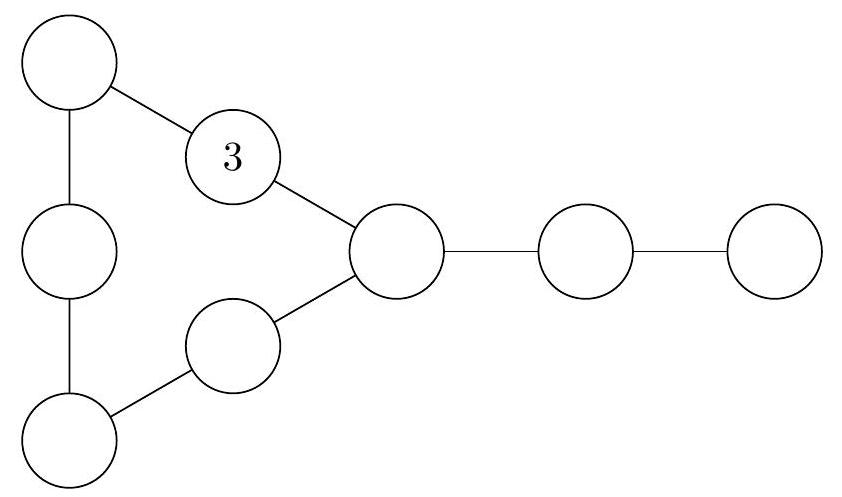 | Let's denote the individual fields with letters $a$ to $h$ as shown in the image (we know that $a=3$):
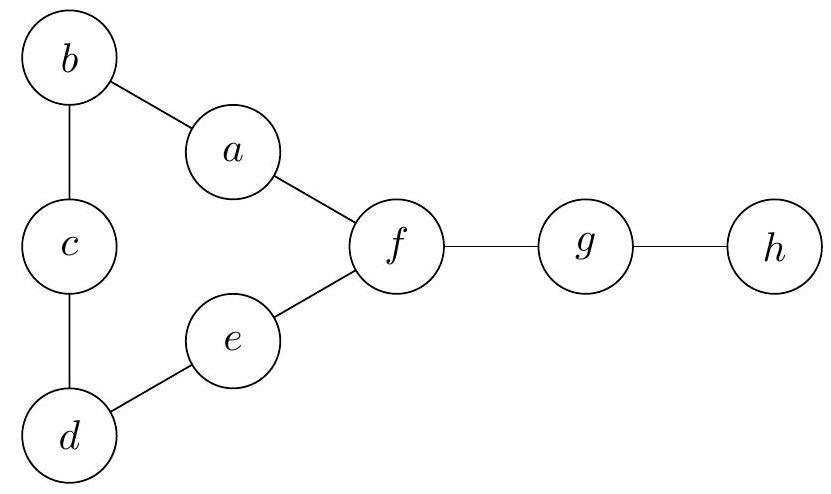
Among the numbers in the problem, there are only two multiples of seven, namely 14 and ... | notfound | Logic and Puzzles | math-word-problem | Incomplete | Yes | olympiads | false |
The equation of the parabola symmetric to the parabola $y^2=2x$ with respect to the point $(-1,0)$ is. | Let the coordinates of a point on the curve be $(x, y)$, and the coordinates of its symmetric point with respect to $(-1, 0)$ be $(x', y')$.
According to the problem, we know that $x' = -x - 2$ and $y' = -y$.
Substituting the point $(x, y)$ into the parabola equation $y^2 = 2x$ gives $(-y)^2 = 2(-x - 2)$, which sim... | y^2 = -2(x + 2) | Algebra | math-word-problem | Yes | Yes | cn_k12 | false |
Mrs. Hilt went to a food festival and bought various food items. She bought 8 hot dogs with the first 3 costing 60 cents each, the next 3 costing 75 cents each, and the last 2 costing 90 cents each. She also purchased 5 ice cream cones with 2 of them costing $1.50 each and 3 of them costing $2.00 each. Lastly, she boug... | To find out how much Mrs. Hilt paid for all the food items, we need to calculate the cost of each type of item and then sum them up.
For the hot dogs:
- The first 3 hot dogs cost 60 cents each, so 3 hot dogs * $0.60 = $1.80
- The next 3 hot dogs cost 75 cents each, so 3 hot dogs * $0.75 = $2.25
- The last 2 hot dogs c... | \$23.85 | Algebra | math-word-problem | Yes | Yes | orca_math | true |
If $a$, $2a+2$, $3a+3$ form a geometric sequence, then $a=\_\_\_\_\_\_$. | **Analysis**
This problem tests the properties of geometric sequences and is a basic question. Pay attention to verifying whether the terms of the geometric sequence are zero.
By the given condition and the properties of geometric sequences, set up an equation, simplify it to find the value of the real number $a$, an... | -4 | Algebra | math-word-problem | Yes | Yes | cn_k12 | false |
Marlon initially has a gift card for $x. He spent half of it on Monday and one-fourth of the remainder on Tuesday. Then, he spends a third of what was left on Wednesday, and one-fifth of the remaining amount on Thursday. What is the equation to represent the balance on his gift card after all these transactions? | Let's break down the transactions step by step:
1. On Monday, Marlon spends half of his gift card, so he has \( \frac{1}{2}x \) left.
2. On Tuesday, he spends one-fourth of the remainder, which is \( \frac{1}{4} \) of \( \frac{1}{2}x \), or \( \frac{1}{4} \times \frac{1}{2}x = \frac{1}{8}x \). So after Tuesday, he ha... | \frac{1}{5}x | Algebra | math-word-problem | Yes | Yes | orca_math | true |
Let $\frac{1}{1-x-x^2-x^3} =\sum^{\infty}_{i=0} a_nx^n$, for what positive integers $n$ does $a_{n-1} = n^2$? | null | null | Combinatorics | math-word-problem | Yes | Yes | aops_forum | false |
The interval that contains the zero of the function $$f(x)=\ln(x+2)- \frac {2}{x}$$ is ( )
A: (3, 4)
B: (2, e)
C: (0, 1)
D: (1, 2) | Since $f(1)=\ln(3)-2\ln(e)-1=0$,
therefore, the interval that contains the zero of the function $f(x)$ is $(1, 2)$,
thus, the correct choice is: $\boxed{D}$.
The interval that contains the zero of the function must satisfy the condition that the function values at the endpoints of the interval have opposite signs... | D | Calculus | MCQ | Yes | Yes | cn_k12 | false |
Let $ p_0,p_1,\ldots$ be a probability distribution on the set of nonnegative integers. Select a number according to this distribution and repeat the selection independently until either a zero or an already selected number is obtained. Write the selected numbers in a row in order of selection without the last one. Bel... | null | null | Combinatorics | proof | Yes | Yes | aops_forum | false |
If \(x\), \(y\), and \(z\) are positive integers such that \(xy = 32\), \(xz = 64\), and \(yz = 96\), determine the value of \(x + y + z\). | Given \(xy = 32\), \(xz = 64\), \(yz = 96\), let's solve for \(x\), \(y\), and \(z\):
1. From \(xy = 32\) and \(xz = 64\), we write \(x = \frac{32}{y}\) and \(x = \frac{64}{z}\). Equating the two expressions gives:
\[
\frac{32}{y} = \frac{64}{z} \implies 32z = 64y \implies z = 2y
\]
2. Substituting \(z = 2y\... | 28 | Algebra | math-word-problem | Yes | Yes | synthetic_math | true |
6. In how many ways can all asterisks be replaced with param1 even and param2 odd digits (not necessarily distinct) in the number param3 so that the resulting number is divisible by 12?
| param1 | param2 | param3 | |
| :---: | :---: | :---: | :---: |
| 3 | 3 | $2017^{*} 7^{* *} 13^{* *} 112^{*}$ | |
| 5 | 2 | $2017^... | 6. In how many ways can all asterisks be replaced with param1 even and param2 odd digits (not necessarily distinct) in the number param3 so that the resulting number is divisible by 12?
| param1 | param2 | param3 | Answer |
| :---: | :---: | :---: | :---: |
| 3 | 3 | $2017^{*} 7^{* *} 13^{* *} 112^{*}$ | 31250 |
| 5 |... | notfound | Combinatorics | math-word-problem | Yes | Yes | olympiads | false |
For two shapes $F_1$ and $F_2$, the minimum distance between any point on shape $F_1$ and any point on shape $F_2$ is called the distance between the two shapes. If the distance between the graphs of two functions is less than 1, the functions are called "reachable". Among the following pairs of functions, the ones tha... | A: For $f(x) = \cos x$ and $g(x) = 2$, at $\cos x = 1$, the distance between the graphs of $f(x)$ and $g(x)$ is equal to $1$, which does not satisfy the condition for being "reachable".
B: Since $y = x^2 - 2x + 5$ is strictly decreasing on $(-\infty, 1)$ and increasing on $(1, +\infty)$, it follows that $f(x)$ is also... | D | Algebra | MCQ | Yes | Yes | cn_k12 | false |
A number $n$ has exactly 5 divisors. How many divisors does $n^3$ have? | If $n$ has exactly 5 divisors, possible scenarios are that either $n$ is a fourth power of a prime (i.e., $n = p^4$) or it is a product of two different prime numbers squared (i.e., $n = pq$ where $p$ and $q$ are primes).
1. For $n = p^4$, raising to the third power gives $n^3 = p^{12}$. The number of divisors of $p^... | 16 | Number Theory | math-word-problem | Yes | Yes | synthetic_math | true |
How many numbers are in the list $ -33, -26, -19, \ldots, 65, 72?$ | First, identify the first term and the common difference of the arithmetic sequence. The sequence begins with $-33$ and the next term is $-26$. The common difference $d$ is $-26 - (-33) = 7$.
Next, determine the last term of the sequence which is 72. To find the number of terms $n$ in the sequence, we use the formula ... | 16 | Algebra | math-word-problem | Yes | Yes | synthetic_math | true |
[ Measurement of segment lengths and angle measures. Adjacent angles.]
Given points $A$ and $B$. Where on the line $A B$ are the points, the distance from which to point $A$
a) is twice as much as to point $B$;
b) is three times less than to point $B$? | Consider all possible cases of the location of the given point relative to the segment $A B$.
## Solution
a) Let the point $M$ lie on the segment $A B$. Since $A M=2 A B$, then $A M: M B=2: 1$.
Let the point $M$ lie outside the segment $A B$. Then the point $B$ lies between $A$ and $M$ (otherwise, the distance from ... | notfound | Geometry | math-word-problem | Yes | Yes | olympiads | false |
Nine circles of radius 1 (instead of diameter 1) are placed in the first quadrant of the coordinate plane, forming a full 3x3 grid. Let region $\mathcal{S}$ be the union of these nine circular regions. A line $m$ with a slope of 2 divides $\mathcal{S}$ into two regions of equal area. Find line $m$'s equation in the for... | 1. **Placement and Touching Points**: Since the radius is 1, the centers of the circles in the first row are at $(1, 1), (3, 1),$ and $(5, 1)$; in the second row at $(1, 3), (3, 3),$ and $(5, 3)$; and in the third row at $(1, 5), (3, 5),$ and $(5, 5)$.
2. **Identifying the Line**: To divide $\mathcal{S}$ into equal ar... | 14 | Geometry | math-word-problem | Yes | Yes | synthetic_math | true |
Example 4 Let integers $x_{1}, x_{2}, \cdots, x_{n}$ and $y_{1}, y_{2}, \cdots, y_{n}$ satisfy
$$\begin{array}{l}
1y_{1}+y_{2}+\cdots+y_{m}
\end{array}$$
Prove: $x_{1} x_{2} \cdots x_{n}>y_{1} y_{2} \cdots y_{m}$. | None
Translate the text above into English, please retain the original text's line breaks and format, and output the translation result directly.
Note: The provided instruction is a meta-instruction and not part of the text to be translated. Since the text to be translated is "None", the translation is also "None". ... | not found | Number Theory | proof | Incomplete | Incomplete | inequalities | false |
76. A class of four-digit numbers, where the sum of any two adjacent digits is a prime number, and the sum of all digits is the square of a prime number. For example, the four-digit number 2020 has such characteristics. Then, the total number of four-digit numbers with such characteristics is $\qquad$ . | answer: 22 | 22 | Number Theory | math-word-problem | Yes | Incomplete | olympiads | false |
Find the sum of the digits in the answer to
$\underbrace{9999\cdots 99}_{94\text{ nines}} \times \underbrace{4444\cdots 44}_{94\text{ fours}}$
where a string of $94$ nines is multiplied by a string of $94$ fours.
$\text{(A)}\ 846 \qquad \text{(B)}\ 855 \qquad \text{(C)}\ 945 \qquad \text{(D)}\ 954 \qquad \text{(E)}\... | null | null | Number Theory | MCQ | Yes | Yes | aops_forum | false |
A bag contains an equal number of one rupee, 50 paise, 25 paise, 10 paise, and 5 paise coins respectively. If the total value is 315 rupees, how many coins of each type are there? | Let's assume the number of coins of each type is x.
The value of one rupee coins will be x rupees.
The value of 50 paise coins will be 0.50x rupees.
The value of 25 paise coins will be 0.25x rupees.
The value of 10 paise coins will be 0.10x rupees.
The value of 5 paise coins will be 0.05x rupees.
The total value of a... | 166 | Algebra | math-word-problem | Yes | Incomplete | orca_math | true |
39th IMO 1998 shortlist Problem N8 The sequence 0 ≤ a 0 < a 1 < a 2 < ... is such that every non-negative integer can be uniquely expressed as a i + 2a j + 4a k (where i, j, k are not necessarily distinct). Find a 1998 . Solution | : So a 1998 = 8 10 + 8 9 + 8 8 + 8 7 + 8 6 + 8 3 + 8 2 + 8 = 1227096648. After a little experimentation we find that the first few terms are 0, 1, 8, 9, 64, 65. This suggests that each term is a sum of distinct powers of 8. If N is any positive integer, then N is a sum of distinct powers of 2: x = b 0 + b 1 2 + b 2 2 2... | 1227096648 | Number Theory | math-word-problem | Yes | Yes | olympiads | false |
In a bag, there are a total of $20$ balls, some red and some white. All the balls are identical except for their colors. The balls in the bag are thoroughly mixed. One ball is randomly drawn from the bag, its color is noted, and then it is placed back into the bag. This process is repeated $100$ times, and it is observ... | To solve this problem, we start by understanding that the probability of drawing a white ball from the bag is proportional to the number of white balls in the bag. Given that there are a total of $20$ balls in the bag and the experiment of drawing a ball, noting its color, and then replacing it, is repeated $100$ times... | B | Combinatorics | MCQ | Yes | Yes | cn_k12 | false |
Given 2000 segments, each of which is at least 1 unit long. No matter which of them we choose, a polygon cannot be constructed from them. Show that the total length of the segments is at least $2^{1999}$. | We can only not construct a polygon from given segments if the length of the largest one is at least as large as the sum of the lengths of all the others.

Let's arrange the 2000 segments in n... | 2^{1999} | Combinatorics | proof | Yes | Yes | olympiads | false |
Among the following expressions, the one that equals $\frac{1}{2}$ is ( )
A: $\sin 15^{\circ}\cos 15^{\circ}$
B: $\cos^{2} \frac{\pi}{12}-\sin^{2} \frac{\pi}{12}$
C: $\sqrt{\frac{1+\cos \frac{\pi}{6}}{2}}$
D: $\frac{\tan 22.5^{\circ}}{1-\tan^{2}22.5^{\circ}}$ | Solution: $\sin 15^{\circ}\cos 15^{\circ}= \frac{1}{2}\sin 30^{\circ}= \frac{1}{4}$, so option A is eliminated.
$\cos^{2} \frac{\pi}{12}-\sin^{2} \frac{\pi}{12}=\cos \frac{\pi}{6}= \frac{\sqrt{3}}{2}$, so option B is eliminated.
$\sqrt{\frac{1+\cos \frac{\pi}{6}}{2}}= \sqrt{\frac{1+ \frac{\sqrt{3}}{2}}{2}}= \frac{\... | D | Algebra | MCQ | Yes | Yes | cn_k12 | false |
Find the compound interest on $1200 for 3 years at a certain interest rate per annum, compounded yearly. The compound interest is $873.60. What is the interest rate per annum? | To find the interest rate per annum, we can use the formula for compound interest:
A = P(1 + r/n)^(nt)
Where:
A = the future value of the investment/loan, including interest
P = the principal investment amount ($1200 in this case)
r = the annual interest rate (decimal)
n = the number of times that interest is compoun... | 20\% | Algebra | math-word-problem | Yes | Yes | orca_math | true |
Let $ x, y, z, w $ be nonzero real numbers such that $ x+y \ne 0$, $ z+w \ne 0 $, and $ xy+zw \ge 0 $. Prove that
\[ \left( \frac{x+y}{z+w} + \frac{z+w}{x+y} \right) ^{-1} + \frac{1}{2} \ge \left( \frac{x}{z} + \frac{z}{x} \right) ^{-1} + \left( \frac{y}{w} + \frac{w}{y} \right) ^{-1}\] | 1. We start with the given inequality:
\[
\left( \frac{x+y}{z+w} + \frac{z+w}{x+y} \right)^{-1} + \frac{1}{2} \ge \left( \frac{x}{z} + \frac{z}{x} \right)^{-1} + \left( \frac{y}{w} + \frac{w}{y} \right)^{-1}
\]
2. Let us denote:
\[
A = \frac{x+y}{z+w} + \frac{z+w}{x+y}
\]
\[
B = \frac{x}{z} + \... | \text{True} | Inequalities | proof | Yes | Yes | aops_forum | false |
Subsets and Splits
No community queries yet
The top public SQL queries from the community will appear here once available.