
instruction_seed stringlengths 2 10.7k | solution stringlengths 0 10.8k ⌀ | answer stringlengths 0 575 ⌀ | problem_type stringclasses 9
values | question_type stringclasses 5
values | problem_is_valid stringclasses 5
values | solution_is_valid stringclasses 4
values | source stringclasses 11
values | synthetic bool 2
classes |
|---|---|---|---|---|---|---|---|---|
Given the proposition $p$: "The eccentricity $e$ of the hyperbola $\frac{x^2}{3} - \frac{y^2}{m} = 1$ belongs to the interval $(\sqrt{2}, +\infty)$", and the proposition $q$: "The equation $\frac{2x^2}{m} + \frac{y^2}{m-2} = 1$ represents an ellipse with foci on the $x$-axis". If the proposition "$p \land q$" is true, ... | If $p$ is true, then $e^2 = \frac{3+m}{3} > 2$,
which implies $m \in A = (3, +\infty)$.
If $q$ is true, then $\frac{m}{2} > m-2 > 0$,
which implies $m \in B = (2,4)$.
Since the proposition "$p \land q$" is true, and because $A \cap B = (3,4)$,
the range of the real number $m$ is $\boxed{(3,4)}$. | (3,4) | Algebra | math-word-problem | Yes | Yes | cn_k12 | false |
Find the product of all integer divisors of $180$ that also divide $30$. (Recall that the divisors of an integer may be positive or negative.) | - First, find the divisors of $180$: $\pm 1, \pm 2, \pm 3, \pm 4, \pm 5, \pm 6, \pm 9, \pm 10, \pm 12, \pm 15, \pm 18, \pm 20, \pm 30, \pm 36, \pm 45, \pm 60, \pm 90, \pm 180$.
- Now, find the divisors of $30$: $\pm 1, \pm 2, \pm 3, \pm 5, \pm 6, \pm 10, \pm 15, \pm 30$.
- Determine which divisors $180$ shares with $30... | 16 \cdot 81 \cdot 625 \cdot 1296 \cdot 10000 \cdot 50625 \cdot 810000 | Number Theory | math-word-problem | Yes | Yes | synthetic_math | true |
Ali had a collection of seashells. He started with 180 seashells, gave away 40 seashells to his friends, and some seashells to his brothers. He sold half of the remaining seashells and had 55 seashells left. How many seashells did Ali give to his brothers? | Let's break down the problem step by step:
1. Ali started with 180 seashells.
2. He gave away 40 seashells to his friends, so he had 180 - 40 = 140 seashells left.
3. He then gave some seashells to his brothers, let's call this number B.
4. After giving B seashells to his brothers, he had 140 - B seashells left.
5. He... | 30 | Algebra | math-word-problem | Yes | Yes | orca_math | true |
Given a triangle $A B C$. On its sides $A B$ and $B C$, squares $A B M N$ and $B C P Q$ are constructed externally.
Prove that the centers of these squares and the midpoints of segments $M Q$ and $A C$ form a square. | Let's introduce the following notations: $\mathbf{a}=\overrightarrow{B M}, \mathbf{b}=\overrightarrow{B C} ; R \mathbf{a}$ and $R \mathbf{b}$ - vectors obtained from vectors $\mathbf{~ a ~ and ~} \mathbf{b}$ by a $90^{\circ}$ rotation: $R \mathbf{a}=\overrightarrow{B A}, R \mathbf{b}=\overrightarrow{B Q} ; O_{1}, O_{2}... | proof | Geometry | proof | Yes | Yes | olympiads | false |
in a covering a distance of 30 km , abhay takes 2 hours more than sameer . if abhay double his speed , then he would take 1 hour less than sammer . abhay ' s speed is ? | Let's denote Abhay's speed as \( A \) km/h and Sameer's speed as \( S \) km/h.
From the first piece of information, we know that Abhay takes 2 hours more than Sameer to cover the same distance of 30 km. So we can write the following equation:
\[
\frac{30}{A} = \frac{30}{S} + 2 \quad \text{(1)}
\]
From the second pie... | 10 | Algebra | math-word-problem | Yes | Yes | orca_math | true |
Given vectors $\overrightarrow{a}=(\lambda, 1)$ and $\overrightarrow{b}=(\lambda + 2, 1)$, find the value of the real number $\lambda$ if $|\overrightarrow{a}+\overrightarrow{b}|=|\overrightarrow{a}-\overrightarrow{b}|$.
( )
A: $1$
B: $-1$
C: $2$
D: $-2$ | This problem involves vector addition and subtraction, and we can use the coordinates to find the length of the vectors.
First, find the vectors $\overrightarrow{a}+\overrightarrow{b}$ and $\overrightarrow{a}-\overrightarrow{b}$:
$$
\overrightarrow{a}+\overrightarrow{b}=(2\lambda+2,2) \quad \text{ and } \quad \overrig... | -1 | Algebra | MCQ | Yes | Yes | cn_k12 | false |
. The plane is referred to a Cartesian coordinate system $(0, \overrightarrow{1}, \vec{\jmath})$. Let $\mathcal{E}$ be the set of points with integer coordinates. Find all functions $f: \mathcal{E} \rightarrow \mathbb{R}$ such that $f(O)=0$ and $f(B)=$ $f(A)+f(C)$ for any rectangle $O A B C$ with $A, B, C \in \mathcal{... | . When $O A B C$ is a rectangle (a parallelogram suffices), we have $\overrightarrow{O B}=\overrightarrow{O A}+\overrightarrow{O C}$. We easily deduce that the coordinate functions are solutions. Moreover, the Pythagorean theorem shows that there is another solution of a different nature: it is the function $M \mapsto ... | proof | Algebra | math-word-problem | Yes | Yes | olympiads | false |
Germann and Chekalinshy laid out 13 different cards on the table. Each card can lie in one of two positions: face up or face down. The players must take turns flipping one card at a time. The player who, after their move, repeats any previous situation (including the initial one) loses. Chekalinshy made the first move.... | Chakalinsky's winning strategy is to flip the same card every time (for example, the Queen of Spades). All possible positions can be divided into pairs that differ only in the location of the Queen of Spades. If, in response to Chakalinsky's move, Hermann also flips the Queen of Spades, the previous position will be re... | Chakalinsky | Logic and Puzzles | math-word-problem | Yes | Yes | olympiads | false |
Find the slope angle of the tangent line to the curve $f(x)=-\frac{\sqrt{3}}{3}{x}^{3}+2$ at $x=1$.
A: $\frac{1}{6}\pi$
B: $\frac{1}{3}\pi$
C: $\frac{5}{6}\pi$
D: $\frac{2}{3}\pi$ | This problem primarily tests knowledge of the slope of a line, the geometric meaning of derivatives, and the ability to find the equation of a tangent line to a curve at a specific point. It is a basic problem that requires computational and problem-solving skills. To determine the slope angle of the tangent line, we n... | \frac{2\pi}{3} | Calculus | MCQ | Yes | Yes | cn_k12 | false |
Find the equations of the asymptotes of the hyperbola $\frac{x^{2}}{4} - \frac{y^{2}}{3} = 1$.
A: $y = ± \frac{1}{2}x$
B: $y = ± \sqrt{3}x$
C: $y = ± \frac{\sqrt{3}}{2}x$
D: $y = ± \frac{\sqrt{3}}{3}x$ | Given the hyperbola $\frac{x^{2}}{4} - \frac{y^{2}}{3} = 1$, we have $a = \sqrt{4} = 2$ and $b = \sqrt{3}$.
Since the hyperbola is horizontally oriented (its major axis lies along the x-axis), the equations of the asymptotes can be found using the formula:
$$y = ± \frac{b}{a}x$$
Substituting the values of $a$ and $b... | y = -\frac{\sqrt{3}}{2}x | Algebra | MCQ | Yes | Yes | cn_k12 | false |
Yoque borrowed money from her sister. She promised to pay it back in 11 months including an additional percentage of the money she borrowed. She pays $15 per month and the total amount she borrowed was $150. What is the percentage of the additional money she has to pay? | To find the percentage of the additional money Yoque has to pay, we first need to calculate the total amount she will pay back over the 11 months.
She pays $15 per month for 11 months, so the total amount paid is:
$15/month * 11 months = $165
The total amount she borrowed was $150, so the additional amount she pays o... | 10\% | Algebra | math-word-problem | Yes | Yes | orca_math | true |
To obtain the graph of the function $y=\cos^2x-\sin^2x$, one only needs to shift the graph of the function $y=\sin 2x$ by ( )
A: Shift left by $\frac{\pi}{2}$ units
B: Shift right by $\frac{\pi}{2}$ units
C: Shift left by $\frac{\pi}{4}$ units
D: Shift right by $\frac{\pi}{4}$ units | Since $y=\cos^2x-\sin^2x=\cos 2x=\sin\left(2x+\frac{\pi}{2}\right)$,
to obtain the graph of the function $y=\sin\left(2x+\frac{\pi}{2}\right)=\cos 2x$, one only needs to shift the graph of the function $y=\sin 2x$ to the left by $\frac{\pi}{4}$ units.
Therefore, the correct answer is: $\boxed{C}$.
First, simplify... | C | Algebra | MCQ | Yes | Yes | cn_k12 | false |
Given that both $α$ and $β$ are acute angles, and $\sin α= \frac {3}{5}$, $\tan (α-β)= \frac {1}{3}$.
(1) Find the value of $\tan β$;
(2) Find the value of $\sin (2α-β)$. | (1) Since $α$ is an acute angle and $\sin α= \frac {3}{5}$, we have $\cos α= \sqrt {1-\sin ^{2}α}= \frac {4}{5}$.
Thus, $\tan α= \frac {\sin α}{\cos α} = \frac {3}{4}$.
Given that $\tan (α-β)= \frac {\tan α-\tan β}{1+\tan α\tan β} = \frac {1}{3}$, we can solve for $\tan β = \frac{1}{3}$.
(2) As $α$ is an acute angle a... | \frac {13 \sqrt {10}}{50} | Algebra | math-word-problem | Yes | Yes | cn_k12 | false |
Prove that if an infinite, noncommutative group $ G$ contains a proper normal subgroup with a commutative factor group, then $ G$ also contains an infinite proper normal subgroup.
[i]B. Csakany[/i] | To prove that if an infinite, noncommutative group \( G \) contains a proper normal subgroup with a commutative factor group, then \( G \) also contains an infinite proper normal subgroup, we will consider two cases based on the commutator subgroup \( G' \) of \( G \).
1. **Case 1: \( G' \) is infinite**
If \( G' ... | null | Logic and Puzzles | proof | Yes | Yes | aops_forum | false |
There are 300 laborers in a crew. On the first day, 150 were present; on the second day, 225 were present; and on the third day, 180 were present. Calculate the average percentage of attendance for these three days (round to the nearest tenth). | To calculate the average percentage of attendance for the three days, we first need to find the percentage of attendance for each day and then find the average of those percentages.
Day 1:
150 laborers were present out of 300.
Percentage of attendance = (150 / 300) * 100
Percentage of attendance = 0.5 * 100
Percentage... | 61.7\% | Algebra | math-word-problem | Yes | Yes | orca_math | true |
Which of the following functions has a range of $\left(0,+\infty \right)$?
A: $y=2^{x-1}$
B: $y=\frac{1}{{x}^{2}}$
C: $y=\ln \left(x+1\right)$
D: $y=|x|$ | To determine which of the given functions has a range of $\left(0,+\infty \right)$, we analyze each option step by step:
**Option A: $y=2^{x-1}$**
- For any real number $x$, $x-1$ is also a real number.
- The exponential function $2^{x}$ is always positive for any real number $x$.
- Therefore, $y=2^{x-1} > 0$ for all... | AB | Algebra | MCQ | Yes | Yes | cn_k12 | false |
A train of a certain length is running with a speed of 60 km/hr. In 5.4995600351971845 seconds, it will pass a trolley that is running with a speed of 12 km/hr in the direction opposite to that in which the train is going. What is the length of the train? | To find the length of the train, we need to calculate the relative speed between the train and the trolley and then use the time it takes for the train to pass the trolley to determine the distance covered, which will be the length of the train.
The train is running at 60 km/hr, and the trolley is running at 12 km/hr ... | 109.99 | Algebra | math-word-problem | Yes | Yes | orca_math | true |
Uki owns a bakery. She sells cupcakes at $1.50 each, cookies at $2 per packet, and biscuits at $1 per packet. In a day, she can bake an average of twenty cupcakes, ten packets of cookies, and twenty packets of biscuits. The cost of baking supplies for each cupcake is $0.75, for each packet of cookies is $1.00, and for ... | First, let's calculate the daily profit for each type of baked good by subtracting the cost of baking supplies from the selling price, and then multiplying by the average number of items sold per day.
For cupcakes:
Selling price per cupcake = $1.50
Cost of baking supplies per cupcake = $0.75
Profit per cupcake = $1.50... | \$175 | Algebra | math-word-problem | Yes | Yes | orca_math | true |
3. Determine all natural numbers $M$ divisible by 240, for which the equation $M = \operatorname{LCM}(x, y)$ with unknowns $x$ and $y$ has exactly 1001 solutions in the domain of natural numbers. (The symbol $\mathrm{LCM}(x, y)$ denotes the least common multiple of the numbers $x$ and $y$.) | SOLUTION. First, let's show that for a number $M$ with prime factorization $M=\prod_{i=1}^{n} p_{i}^{c_{i}}$ (where $p_{i}$ are distinct primes), the number of solutions of the equation $\mathrm{LCM}(x, y)=M$ is equal to $\prod_{i=1}^{n}\left(2 c_{i}+1\right)$. Indeed, each solution $(x, y)$ of the given equation has t... | 2^{5}\cdot3^{3}\cdot5^{6},2^{5}\cdot3^{6}\cdot5^{3},2^{6}\cdot3^{5}\cdot5^{3},2^{6}\cdot3^{3}\cdot5^{5} | Number Theory | math-word-problem | Yes | Yes | olympiads | false |
Let $n \ge 3$ be a positive integer. Determine, in terms of $n$, how many triples of sets $(A,B,C)$ satisfy the conditions:
$\bullet$ $A, B$ and $C$ are pairwise disjoint , that is, $A \cap B = A \cap C= B \cap C= \emptyset$.
$\bullet$ $A \cup B \cup C= \{ 1 , 2 , ... , n \}$.
$\bullet$ The sum of the elements of $... | 1. **Sum of the first \( n \) natural numbers**:
The sum of the first \( n \) natural numbers is given by:
\[
S = \frac{n(n+1)}{2}
\]
We need to consider the remainder of this sum when divided by 3.
2. **Case Analysis Based on \( n \mod 3 \)**:
- **Case 1: \( n \equiv 1 \pmod{3} \)**:
\[
S ... | null | Combinatorics | math-word-problem | Yes | Yes | aops_forum | false |
1. Prove: If $0 < x < y < \frac{\pi}{2}$, then $\frac{x}{\tan x} < \frac{y}{\tan y}$.
$$ | Let $f(x)=\frac{x}{\tan x}=\frac{x \cos x}{\sin x}$, then
$$
f^{\prime}(x)=\frac{\cos x \sin x-x}{\sin ^{2} x}=\frac{\sin 2 x-2 x}{2 \sin ^{2} x}\frac{y}{\tan y}.
$$ | proof | Inequalities | proof | Yes | Incomplete | olympiads | false |
Line $l:ax+by+c=0$, where $a,b,c\in\{-3,-2,-1,0,1,2,3\}$, and $a,b,c$ are different. If the bank angle of $l$ is an acute angle, then the number of such lines is________. | null | null | Geometry | other | Yes | Yes | aops_forum | false |
A salesman bought a case of some backpacks for $576. He sold 17 of them for $18 at the swap meet, 10 were sold to a department store for $25 each, and the remainder were sold for $22 each. The salesman's profit was $442. How many backpacks were in the case? | Let's denote the total number of backpacks in the case as x.
From the information given, we can set up the following equation to represent the total sales:
Total sales = (17 backpacks * $18 each) + (10 backpacks * $25 each) + ((x - 17 - 10) backpacks * $22 each)
This simplifies to:
Total sales = (17 * 18) + (10 * 2... | 48 | Algebra | math-word-problem | Yes | Yes | orca_math | true |
Example 1 As shown in Figure 2.1.1, in square $A B C D$, $E$ is the midpoint of $C D$, and $F$ is the midpoint of $D A$. Connecting $B E$ and $C F$ intersect at $P$, prove that: $A P=A B$. | Think of connecting $B F$. It is easy to prove that $\mathrm{Rt} \triangle B C E \cong \mathrm{Rt} \triangle C D F$, which gives $\angle C F D=\angle A B P$. Therefore, points $F, A, B, P$ are concyclic, so $\angle A F B=\angle A P B$. Given $\mathrm{Rt} \triangle B C E \cong \mathrm{Rt} \triangle B A F$, we have $\ang... | AP=AB | Geometry | proof | Yes | Yes | olympiads | false |
A woman swims downstream 64 km and upstream 24 km, taking 8 hours each time. What is the speed of the current? | Let's denote the woman's swimming speed in still water as \( v \) km/h and the speed of the current as \( c \) km/h.
When the woman swims downstream, the effective speed is \( v + c \), because the current helps her swim faster. When she swims upstream, the effective speed is \( v - c \), because the current opposes h... | 2.5 | Algebra | math-word-problem | Yes | Yes | orca_math | true |
In quadrilateral $ABCD$, $\angle A$ is a right angle, diagonal $\overline{BD}$ is perpendicular to $\overline{BC}$, $AB=15$, $BC=20$, and $CD=9$. Find the perimeter of $ABCD$. | From the problem statement, we visualize $ABCD$ with the modified conditions:
1. Using the Pythagorean theorem on $\triangle ABD$ (since $BD \perp BC$ and $A \perp B$):
\[
(AD)^2 = (AB)^2 + (BD)^2
\]
\[
(BD)^2 = (BC)^2 + (CD)^2
\]
Substituting $(BC)^2 + (CD)^2$ for $(BD)^2$:
\[
(AD)^2 = (AB)^... | 44 + \sqrt{706} | Geometry | math-word-problem | Yes | Yes | synthetic_math | true |
Given that among $a$, $b$, and $c$, there are two odd numbers and one even number, prove that $(a+1)(b+2)(c+3)$ is always an even number. | Let's consider the following cases:
1. Assume $a$ is an odd number. Then, $b$ and $c$ consist of one odd and one even number. Therefore, $(a+1)$ is an even number, which implies that $(a+1)(b+2)(c+3)$ must be an even number.
2. Assume $a$ is an even number. Then, $b$ and $c$ are both odd numbers. Therefore, $(c+3)$ i... | \text{Proven} | Number Theory | proof | Yes | Yes | cn_k12 | false |
If Ella rolls a standard eight-sided die until she rolls the same number on consecutive rolls, what is the probability that her 15th roll is her last roll? Express your answer as a decimal to the nearest thousandth. | For Ella's strategy:
1. The first roll can be any of the 8 sides.
2. Each of the subsequent rolls (from the second to the fourteenth) must be different from the roll immediately preceding it.
3. The fifteenth roll must be the same as the fourteenth roll.
Probability calculations:
- The probability that the second roll... | 0.022 | Combinatorics | math-word-problem | Yes | Yes | synthetic_math | true |
reduces to constructing a triangle given two sides and the angle between them.
# | empty
Translate the text above into English, please retain the original text's line breaks and format, and output the translation result directly.
Note: The note above is a clarification and should not be included in the final translation. The actual translation is:
empty
| notfound | Geometry | math-word-problem | Yes | Problem not solved | olympiads | false |
Given that the volume of a sphere circumscribing a cube is $\frac{32}{3}\pi$, find the length of the edge of the cube. | 1. We know that the volume of a sphere is given by $V = \frac{4}{3}\pi R^3$, where $R$ is the radius. In this case, $V=\frac{32}{3}\pi$. Solving for $R$, we have $R = \sqrt[3]{\frac{3V}{4\pi}} = \sqrt[3]{\frac{3 \cdot \frac{32}{3}\pi}{4\pi}} = 2$.
2. The diameter of the sphere is equal to the length of the space diago... | \text{Hence, the length of the edge of the cube is} \frac{4\sqrt{3}}{3}. | Geometry | math-word-problem | Yes | Yes | cn_k12 | false |
Triangle $XYZ$ is equilateral. Let $\overline{KL}$, $\overline{MN}$, and $\overline{OP}$ be three lines parallel to $\overline{YZ}$, splitting the height of triangle $XYZ$ into four equal segments with points $K$ and $L$ being closest to vertex $X$. If $XK = KM = MN = NP$, calculate the ratio of the area of trapezoid $... | From the given conditions, $XK = KM = MN = NP$ split the height of the equilateral triangle into four equal parts. Thus, $\triangle XOP \sim \triangle XYZ$.
By the segments' setup:
\[
\frac{XP}{XZ} = \frac{3}{4}
\]
Hence, the ratio of the areas of $\triangle XOP$ and $\triangle XYZ$ is:
\[
\left(\frac{3}{4}\right)^2 ... | \frac{7}{16} | Geometry | math-word-problem | Yes | Yes | synthetic_math | true |
Compute
\[\left( X - \frac{1}{\cos 23^\circ} \right) \left( 1 + \frac{1}{\sin 67^\circ} \right) \left( 1 - \frac{1}{\sin 23^\circ} \right) \left( 1 + \frac{1}{\cos 67^\circ} \right).\]
If we know the answer to the above question is 1, what is the value of unknown variable X? | Let's start by simplifying the given expression step by step. The expression is:
\[
\left( X - \frac{1}{\cos 23^\circ} \right) \left( 1 + \frac{1}{\sin 67^\circ} \right) \left( 1 - \frac{1}{\sin 23^\circ} \right) \left( 1 + \frac{1}{\cos 67^\circ} \right).
\]
First, we use the identity \(\sin(90^\circ - \theta) = \co... | 1+\23 | Algebra | math-word-problem | Yes | Yes | metamath | true |
Example 4 Algebraic Expression
$[\sqrt[3]{1 \times 2 \times 3}]+[\sqrt[3]{2 \times 3 \times 4}]+\cdots+$ $[\sqrt[3]{2000 \times 2001 \times 2002}]=(\quad)$.
(A) 2000000
(B) 2001000
(C) 2002000
(D) 2003001
(2000, "Five Sheep Cup" Mathematics Competition (Grade 9))
[Analysis] Notice that each term in the sum can be expre... | Since $k^{3}<k(k+1)(k+2)<(k+1)^{3}$,
thus, $k<\sqrt[3]{k(k+1)(k+2)}<k+1$.
Therefore, $[\sqrt[3]{k(k+1)(k+2)}]=k$.
Hence the original expression $=1+2+\cdots+2000=2001000$. | 2001000 | Algebra | MCQ | Yes | Yes | cn_contest | false |
John is an Uber driver who made a gross income of $30,000 last year. He bought the car he used for Uber for $20,000. During his time as an Uber driver, he did regular maintenance on the vehicle, which cost $300 per month for 12 months, totalling $3,600. His insurance was billed annually and cost him $1,200 for the year... | To calculate John's net profit, we need to subtract all his expenses and taxes from his gross income.
Here's the breakdown:
Gross income: $30,000
Expenses:
- Car maintenance: $3,600 ($300/month × 12 months)
- Car insurance: $1,200
- Car tires: $400
- Car purchase: $20,000
- Taxes: $4,500 (15% of $30,000)
Total expe... | \$6,300 | Algebra | math-word-problem | Yes | Yes | orca_math | true |
In the plane, consider a circle with center $S$ and radius $1.$ Let $ABC$ be an arbitrary triangle having this circle as its incircle, and assume that $SA\leq SB\leq SC.$ Find the locus of
[b]a.)[/b] all vertices $A$ of such triangles;
[b]b.)[/b] all vertices $B$ of such triangles;
[b]c.)[/b] all vertices $C$ ... | To solve this problem, we need to determine the loci of the vertices \(A\), \(B\), and \(C\) of the triangle \(ABC\) given that the circle with center \(S\) and radius 1 is the incircle of the triangle. We are given that \(SA \leq SB \leq SC\).
1. **Understanding the relationship between the triangle and the circle:**... | null | Geometry | math-word-problem | Yes | Yes | aops_forum | false |
The opposite of the real number $-\sqrt{7}$ is
A: $\sqrt{7}$
B: $-\frac{{\sqrt{7}}}{7}$
C: $±\sqrt{7}$
D: $-\sqrt{7}$ | To find the opposite of a real number, we simply change its sign. Therefore, the opposite of $-\sqrt{7}$ is obtained by changing its sign from negative to positive:
\[
-\sqrt{7} \rightarrow +\sqrt{7} = \sqrt{7}
\]
Thus, the correct answer is $\boxed{A: \sqrt{7}}$. | A: \sqrt{7} | Algebra | MCQ | Yes | Yes | cn_k12 | false |
Find the quotient when $x^5 + 7$ is divided by $x + X The answer is 1. What is the value of unknown variable X? | To find the value of the unknown variable \( X \) when \( x^5 + 7 \) is divided by \( x + X \) and the quotient is given as 1, we will follow these steps:
1. **Understand the division process**: When a polynomial \( P(x) \) is divided by another polynomial \( D(x) \), we can express it in the form:
\[
P(x) = D(x... | 0 | Algebra | math-word-problem | Incomplete | Yes | metamath | true |
15. Let the three sides of a triangle be integers $l, m, n$, and $l>m>n$. It is known that $\left\{\frac{3^{l}}{10^{4}}\right\}=\left\{\frac{3^{m}}{10^{4}}\right\}=\left\{\frac{3^{n}}{10^{4}}\right\}$, where $\{x\}=x-[x]$, and $[x]$ represents the greatest integer not exceeding $x$. Find the minimum perimeter of such a... | 15. Given that $3^{l}=3^{m}=3^{n}\left(\bmod 10^{4}\right)$, first propose a lemma;
Let $a \geqslant 2, (a, b)=1$, then (1) there exists a positive integer $d \leqslant a-1$ such that $a \mid b^{d}-1$; (2) Let $d_{0}$ be the smallest positive integer $d$ satisfying (1), then $a\left|b^{h}-1(h \geqslant 1) \Leftrightar... | 3003 | Number Theory | math-word-problem | Yes | Yes | olympiads | false |
Betty ordered 18 items in an online shop via cash on delivery. She ordered some pieces of slippers that cost $2.5 each, 4 pieces of lipstick for $1.25 each, and 8 pieces of hair color for $3 each. Betty paid $44 in total when it was delivered. How many pieces of slippers did she order? | Let's calculate the total cost of the lipsticks and hair colors first.
The cost of 4 lipsticks at $1.25 each is:
4 lipsticks * $1.25/lipstick = $5
The cost of 8 hair colors at $3 each is:
8 hair colors * $3/hair color = $24
Now, let's add the cost of the lipsticks and hair colors to find the total cost of these item... | 6 | Algebra | math-word-problem | Yes | Yes | orca_math | true |
Given a polynomial
\[ ax^4 + bx^3 + cx^2 + dx + e = 0 \]
with integer coefficients, and roots $-3$, $7$, $11$, and $-1/4$. If $e$ is a positive integer, find its smallest possible value. | From Vieta's formulas, we know the product of the roots is equal to $\frac{e}{a}$. Since $a$ is typically 1 for simplest cases in such problems, we assume $a = 1$ here as well. The roots are $-3$, $7$, $11$, and $-1/4$.
Firstly, to ensure integer values, we adjust the root $-1/4$ to an integer-compatible form by mult... | 231 | Algebra | math-word-problem | Yes | Yes | synthetic_math | true |
In a circle \( C \) with centre \( O \) and radius \( r \), let \( C_{1}, C_{2} \) be two circles with centres \( O_{1}, O_{2} \) and radii \( r_{1}, r_{2} \) respectively, so that each circle \( C_{i} \) is internally tangent to \( C \) at \( A_{i} \) and so that \( C_{1}, C_{2} \) are externally tangent to each other... | Because of the tangencies, the following triples of points (two centers and a tangency point) are collinear:
$$
O_{1} ; O_{2} ; A, \quad O ; O_{1} ; A_{1}, \quad O ; O_{2} ; A_{2}
$$
Because of that we can ignore the circles and only draw their centers and tangency points.
 such that there exists a permutation \( a_0, a_1, \ldots, a_k \) of \( 0, 1, \ldots, k \) satisfying:
\[
a_1^2 - a_0^2 \equiv a_2^2 - a_1^2 \equiv \cdots \equiv a_k^2 - a_{k-1}^2 \pmod{n}.
\]
Let \( d ... | n = 3, 5 | Number Theory | math-word-problem | Yes | Yes | aops_forum | false |
Find the equation of the tangent line to the curve $y=2x^{2}+1$ at the point $P(-1,3)$. | Given the curve $y=2x^{2}+1$, we find its derivative with respect to $x$:
$$y' = \frac{dy}{dx} = 4x$$
Now we calculate the slope of the tangent line at $x = -1$:
$$k = f'(-1) = 4 \times (-1) = -4$$
So the slope of the tangent line is $-4$. Now we can find the equation of the tangent line using the point-slope form:... | 4x + y + 1 = 0 | Calculus | math-word-problem | Yes | Yes | cn_k12 | false |
Lizzy has to ship 540 pounds of fish that are packed into two types of crates. The Type A crate has a weight capacity of 30 pounds and costs $1.5 to ship, while the Type B crate has a weight capacity of 50 pounds and costs $2.5 to ship. Additionally, there is a $0.50 surcharge per crate plus a $10 flat fee based on the... | First, let's calculate the total weight that the 6 Type A crates can carry and the cost to ship them.
Weight capacity of Type A crate = 30 pounds
Number of Type A crates = 6
Total weight for Type A crates = 30 pounds/crate * 6 crates = 180 pounds
Cost to ship one Type A crate = $1.5
Surcharge per crate = $0.50
Total ... | \$46.00 | Algebra | math-word-problem | Yes | Yes | orca_math | true |
The graph of $y = \frac{p(x)}{q(x)}$, where $p(x)$ and $q(x)$ are quadratic, is known to have the horizontal asymptote $y = -3$ and the vertical asymptote $x = 3$. The graph also passes through the point $(2,0)$. Find $\frac{p(4)}{q(4)}$. Assume there is a hole at $x = -1$. | Since there is a hole at $x = -1$, both the numerator and the denominator must have a factor of $x + 1$. Given the vertical asymptote at $x = 3$, we can assume that $q(x) = (x + 1)(x - 3)$.
Since the graph passes through $(2,0)$, $p(x) = k(x + 1)(x - 2)$ for some constant $k$. Thus,
\[
\frac{p(x)}{q(x)} = \frac{k(x + ... | -6 | Algebra | math-word-problem | Yes | Yes | synthetic_math | true |
if 9^(y+1) / (1 + 4 / x^2) = 1 , then x and y = ? | To solve for x and y, we need to simplify the given equation:
9^(y+1) / (1 + 4 / x^2) = 1
First, let's simplify the denominator:
1 + 4 / x^2 = (x^2 + 4) / x^2
Now, the equation becomes:
9^(y+1) / ((x^2 + 4) / x^2) = 1
To get rid of the fraction, we can multiply both sides by (x^2 + 4) / x^2:
9^(y+1) = (x^2 + 4) ... | 1 | Algebra | math-word-problem | Yes | Yes | orca_math | true |
$A$ and $B$ together have $5000 \mathrm{~K}$. $A$ placed his money at $x \%$, and $B$ placed his at $x+1 \%$. After one year, $A$ received a total of $2100 \mathrm{~K}$ in capital and interest, and $B$ received a total of $3180 \mathrm{~K}$ in capital and interest. How much money did each originally have? | Originally, $A$ had $y$ koronas, then according to the problem
$$
y+\frac{y x}{100}=2100
$$
and
$$
5000-y+\frac{5000-y}{100}(x+1)=3180
$$
Solving for $x$ from the first equation and substituting it into the second equation, we get
$$
y^{2}+523000 y-1050000000=0
$$
from which the positive value of $y$ is: $y=2000$... | 2000 | Algebra | math-word-problem | Yes | Yes | olympiads | false |
A high school has 9 classes with class numbers ranging from 1 to 9. If 5 classes are randomly selected to participate in an activity, what is the probability that the median class number of the selected classes is 5? | Firstly, we need to count the total number of possible outcomes when selecting 5 classes out of 9. This is a combination problem, and the total number of outcomes is denoted by $n = C(9,5)$, which is the number of ways to choose 5 from 9:
$$ n = \binom{9}{5} $$
Evaluating the combination, we have:
$$ n = \binom{9}{5... | \frac{2}{7} | Combinatorics | math-word-problem | Yes | Yes | cn_k12 | false |
$$
\begin{array}{l}
\text { Find } \sum_{\mathrm{A} \subset \mathrm{S}} E_{\mathrm{A}} \text { and } \sum_{\mathrm{A} \subset \mathrm{S}} F_{\mathrm{A}} \text {. } \\
|A| \geqslant 2 \quad|A| \geqslant 2 \\
\end{array}
$$ | $$
\begin{aligned}
\sum_{A \subset S} E_{\mathrm{A}} & =2^{\mathrm{n}-2} \sum_{1 \leqslant \mathrm{i}<\mathrm{j} \leqslant \mathrm{n}}(j-i) \\
& =2^{\mathrm{n}-2} C_{\mathrm{n}+1}^{\mathbf{3}} . \\
\sum_{\mathrm{A} \in \mathbf{S}} F_{\mathrm{A}} & =2^{\mathrm{n}-2} \sum_{1<j}(i+j) \\
& =2^{\mathrm{n}-3}(n-1) n(n+1) .
\... | 2^{\mathrm{n}-2} C_{\mathrm{n}+1}^{\mathbf{3}} \text{ and } 2^{\mathrm{n}-3}(n-1) n(n+1) | Combinatorics | math-word-problem | Incomplete | Yes | cn_contest | false |
If the even function $f(x)$ is increasing in the interval $[5, 7]$ and its minimum value is 6, then $f(x)$ in the interval $[-7, -5]$ is ( )
A: Increasing function, maximum value is 6
B: Increasing function, minimum value is 6
C: Decreasing function, maximum value is 6
D: Decreasing function, minimum value is 6 | Since $f(x)$ is an even function,
the graph of the function is symmetric about the y-axis.
Since $f(x)$ is increasing in the interval $[5, 7]$ and its minimum value is 6,
$f(x)$ in the interval $[-7, -5]$ is a decreasing function, and its minimum value is 6.
Therefore, the correct answer is $\boxed{\text{D}}$. | \text{D} | Algebra | MCQ | Yes | Yes | cn_k12 | false |
Let $a=\frac{1}{e}$, $b=\frac{{\ln 2}}{2}$, $c=\frac{{\ln 3}}{3}$, then ()
A: $a \lt c \lt b$
B: $a \lt b \lt c$
C: $b \lt a \lt c$
D: $b \lt c \lt a$ | To compare $a$, $b$, and $c$, we define a function $f(x)=\frac{{\ln x}}{x}$ and calculate its derivative to understand its behavior.
1. **Derivative Calculation**:
- The derivative of $f(x)$ is $f'(x)=\frac{d}{dx}\left(\frac{{\ln x}}{x}\right)$.
- Using the quotient rule, we find $f'(x)=\frac{1\cdot x - \ln x \... | D | Inequalities | MCQ | Yes | Yes | cn_k12 | false |
An employee is paid a certain amount per hour for the first 40 hours and $16 for each additional hour. During the first week on the job, the employee's gross pay was $622 and they worked 10.75 hours of overtime. What is the employee's hourly rate for the first 40 hours? | Let's denote the employee's hourly rate for the first 40 hours as \( x \) dollars per hour.
The employee worked 10.75 hours of overtime, which means they worked a total of \( 40 + 10.75 = 50.75 \) hours.
The pay for the overtime hours is $16 per hour, so the total pay for the overtime hours is \( 10.75 \times 16 \).
... | \$11.25 | Algebra | math-word-problem | Yes | Yes | orca_math | true |
At a certain committee meeting only associate professors and assistant professors are present. Each associate professor has brought 2 pencils and 1 chart to the meeting, while each assistant professor has brought 1 pencil and some charts. A total of 10 pencils and 11 charts have been brought to the meeting. There are 7... | Let's denote the number of associate professors as A and the number of assistant professors as B.
From the information given, we have two equations:
1. The total number of pencils brought to the meeting is 10.
Since each associate professor brings 2 pencils, and each assistant professor brings 1 pencil, we can write ... | 2 | Algebra | math-word-problem | Yes | Yes | orca_math | true |
A hay farmer harvested 560 bales of hay from 5 acres of grass per month last year. This year, he planted an additional 7 acres of grass. If the farmer also owns 9 horses and each horse consumes 3 bales of hay a day, how many bales of hay would the farmer have left by the end of December if he starts feeding them this y... | First, let's calculate the total number of bales of hay harvested this year. The farmer had 5 acres last year and harvested 560 bales per month. This year, he added 7 acres, making it a total of 5 + 7 = 12 acres.
If 5 acres produced 560 bales, then 1 acre would produce 560 / 5 = 112 bales per month. Therefore, 12 acre... | 2082 | Algebra | math-word-problem | Yes | Yes | orca_math | true |
Observing that $(x^{2})′=2x$, $(x^{4})′=4x^{3}$, $(\cos x)′=-\sin x$, if the function $f(x)$ defined on $R$ satisfies $f(-x)=f(x)$, and $f′(x)$ is the derivative function of $f(x)$, then $f′(-x)=(\ \ \ )$
A: $f(x)$
B: $-f(x)$
C: $f′(x)$
D: $-f′(x)$ | From $(x^{2})′=2x$, the original function is even, and the derivative function is odd;
From $(x^{4})′=4x^{3}$, the original function is even, and the derivative function is odd;
From $(\cos x)′=-\sin x$, the original function is even, and the derivative function is odd;
We can infer that the derivative of an even func... | D | Calculus | MCQ | Yes | Yes | cn_k12 | false |
A trader sells 85 meters of cloth at the profit of Rs. 20 per meter of cloth. The cost price of one meter of cloth is Rs. 85. What is the total selling price of the cloth? | To calculate the total selling price of the cloth, we first need to determine the profit made on each meter of cloth and then add that to the cost price of each meter.
Profit per meter of cloth = Rs. 20
Cost price per meter of cloth = Rs. 85
Selling price per meter of cloth = Cost price per meter + Profit per meter
S... | 8925 | Algebra | math-word-problem | Yes | Yes | orca_math | true |
Which of the following sets of numbers are in the correct order?
A: $-\frac{1}{6}>-\frac{1}{7}$
B: $-\frac{4}{3}<-\frac{3}{2}$
C: $(-2)^{3}=-2^{3}$
D: $-\left(-4.5\right) \gt |-4.6|$ | To determine which set of numbers is in the correct order, we will evaluate each option step by step.
**Option A: $-\frac{1}{6}>-\frac{1}{7}$**
First, we consider the absolute values of the fractions:
- $|-\frac{1}{6}|=\frac{1}{6}$
- $|-\frac{1}{7}|=\frac{1}{7}$
Since $\frac{1}{6}>\frac{1}{7}$, when we consider the ... | C | Inequalities | MCQ | Yes | Yes | cn_k12 | false |
Given a positive integer $ n $ and positive real numbers $ a $, $ b $. Determine the maximum possible value of the sum
when $ x_{1},\ x_{2},\ \ldots,\ x_{n},\ y_{1},\ y_{2},\ \ldots,\ y_{n} $ are numbers from the interval $ \langle 0;1\rangle $, satisfying the conditions
Note: The original text had sever... | For any numbers $ x_{1},\ x_{2},\ \ldots,\ x_{n},\ y_{1},\ y_{2},\ \ldots,\ y_{n} $ satisfying the conditions of the problem, the following inequalities hold
Thus
We will first show that if $ a,\ b\geq n $ or $ [a]\neq[b] $ (the symbol $ [x] $ denotes the greatest integer not greater than $ x $), then the number ... | A+(-A)(b-A) | Inequalities | math-word-problem | Incomplete | Yes | olympiads | false |
Task 4 - 250914 Three circles with the given radius $r$ may lie in a plane such that each touches the other two. A common tangent is drawn to each pair of these three circles, which does not have any point in common with the third circle. With these three tangents, an equilateral triangle is constructed.
Calculate the... | Let the circles be $h, k, l$ with their centers $P, Q, R$. The common tangents to $k, l$ and to $l, h$ and to $h, k$ are $e$, $f$, and $g$ respectively. The intersection points of $f$ with $g$, $g$ with $e$, and $e$ with $f$ are $A$, $B$, and $C$ respectively. The triangle whose area is to be calculated is then $\trian... | r^2\cdot(4\sqrt{3}+6) | Geometry | math-word-problem | Yes | Yes | olympiads | false |
Example 11 Let $a, b, c$ be positive real numbers. Prove that: $\frac{(2 a+b+c)^{2}}{2 a^{2}+(b+c)^{2}}+$ $\frac{(a+2 b+c)^{2}}{2 b^{2}+(c+a)^{2}}+\frac{(a+b+2 c)^{2}}{2 c^{2}+(a+b)^{2}} \leqslant 8$. (2003 USA Mathematical Olympiad Problem) | None
Translate the text above into English, please retain the original text's line breaks and format, and output the translation result directly.
Note: The provided instruction is a meta-instruction and not part of the text to be translated. Since the text to be translated is "None", the translation is also "None". ... | not found | Inequalities | proof | Yes | Incomplete | inequalities | false |
A polynomial of degree three with leading coefficient 1 and integer coefficients has one real zero, which is an integer. Which of the following can also be a zero of the polynomial?
(A) $\frac{3 + i \sqrt{7}}{2}$
(B) $\frac{1 + i}{2}$
(C) $-1 + i$
(D) $2 + \frac{i}{2}$
(E) $\frac{3 + i \sqrt{15}}{2}$ | Let $r$ be the integer zero of the cubic polynomial $P(x) = (x-r)(x^2 + \alpha x + \beta)$. The coefficients $\alpha$ and $\beta$ must be integers for the polynomial to have integer coefficients.
The remaining zeros are obtained from the quadratic factor $x^2 + \alpha x + \beta$, with zeros given by:
$$x = \frac{-\alp... | \text{(A) } \frac{3 + i \sqrt{7}}{2} | Algebra | MCQ | Yes | Yes | synthetic_math | true |
Pedro and Cecilia play the following game: Pedro chooses a positive integer number $a$ and Cecilia wins if she finds a positive integrer number $b$, prime with $a$, such that, in the factorization of $a^3+b^3$ will appear three different prime numbers. Prove that Cecilia can always win. | 1. **Factorization of \(a^3 + b^3\)**:
We start by using the algebraic identity for the sum of cubes:
\[
a^3 + b^3 = (a + b)(a^2 - ab + b^2)
\]
2. **Choosing \(b\) such that \(a + b\) has three different prime factors**:
Cecilia needs to find a positive integer \(b\) such that \(a + b\) has at least thr... | null | Number Theory | math-word-problem | Yes | Yes | aops_forum | false |
In the Cartesian coordinate system $xOy$, the curve $C_{1}$: $\frac{x^{2}}{3} + \frac{y^{2}}{4} = 1$ is given. Taking the origin $O$ of the Cartesian coordinate system $xOy$ as the pole and the positive half-axis of $x$ as the polar axis, a polar coordinate system is established with the same unit length. It is known t... | Solution:
(Ⅰ) For the curve $C_{1}$: $\frac{x^{2}}{3} + \frac{y^{2}}{4} = 1$,
Let $\theta$ be the parameter, set $x= \sqrt{3}\cos \theta$, $y=2\sin \theta$,
Then the parametric equation of the curve $C_{1}$ is $\begin{cases} x= \sqrt{3}\cos \theta \\ y=2\sin \theta \end{cases}$ ($\theta$ as the parameter);
Also, fo... | 2\sqrt{5} | Geometry | math-word-problem | Yes | Yes | cn_k12 | false |
Find the value of $a$ such that the curve $y=e^{x}+1$ is tangent to the line $y=ax+2$. | Let $P(x\_0, y\_0)$ be the point of tangency, then we have:
1. $y\_0 = ax\_0 + 2$ (since $P$ lies on the line)
2. $y\_0 = e^{x\_0} + 1$ (since $P$ lies on the curve)
Moreover, the slope of the tangent line at $x=x\_0$ is given by the derivative of the curve at that point, which is $e^{x\_0}$. Therefore, we have:
3. ... | B | Calculus | math-word-problem | Yes | Yes | cn_k12 | false |
10. As shown in Figure 2, in the tetrahedron $P-ABC$, $PA \perp$ the base $ABC$, $\angle ACB=90^{\circ}$, $AE \perp PB$ at $E$, $AF \perp PC$ at $F$. If $PA=AB=2$, $\angle BPC=\theta$, then when the area of $\triangle AEF$ is maximized, the value of $\tan \theta$ is ( ).
(A) 2
(B) $\frac{1}{2}$
(C) $\sqrt{2}$
(D) $\fra... | 10.D.
Since $P A \perp$ plane $A B C$, then $P A \perp B C$.
Also, $B C \perp A C$, so $B C \perp$ plane $P A C$.
Therefore, plane $P B C \perp$ plane $P A C$.
Since $A F \perp P C$, then $A F \perp$ plane $P B C$, hence $A F \perp E F$.
Also, $P A=A B=2, A E \perp P B$, so $A E=\sqrt{2}$.
In the right triangle $\tria... | D | Geometry | MCQ | Yes | Yes | cn_contest | false |
List 3. Regardless of the value of the real number $k$, the line $y=2 k x$ $+k^{2}$ is tangent to the parabola $y=a x^{2}+b x+c$. Find the equation of the parabola. | Given $y=2 k x+k^{2}$ and $y=a x^{2}+b x+c$ are combined, we get
$$
a x^{2}+(b-2 k) x+\left(c-k^{2}\right)=0 .
$$
Since the line is tangent to the parabola,
thus $\Delta=(b-2 k)^{2}-4 a\left(c-k^{2}\right)=0$, which means $4(a+1) k^{2}-4 b k+b^{2}-4 a c=0$.
$\because k$ is any real number,
$\therefore$ the above equat... | y=-x^{2} | Algebra | math-word-problem | Yes | Yes | cn_contest | false |
For which values of N is it possible to write numbers from 1 to N in some order so that for any group of two or more consecutive numbers, the arithmetic mean of these numbers is not whole? | To determine for which values of \( N \) it is possible to write the numbers from 1 to \( N \) in some order such that for any group of two or more consecutive numbers, the arithmetic mean of these numbers is not a whole number, we can proceed as follows:
1. **Check if \( N \) must be even:**
- If \( N \) is odd, c... | N | Logic and Puzzles | math-word-problem | Yes | Yes | aops_forum | false |
5. The cells of a $9 \times 9$ board are painted in black and white in a checkerboard pattern. How many ways are there to place 9 rooks on the same-colored cells of the board so that they do not attack each other? (A rook attacks any cell that is in the same row or column as itself.) | Answer: $4!5!=2880$.
Solution. Let the upper left corner of the board be black for definiteness. Note that black cells come in two types: cells with both coordinates even, and cells with both coordinates odd. If a rook is on a black cell with both even coordinates, then all black cells it attacks also have even coordi... | 2880 | Combinatorics | math-word-problem | Yes | Yes | olympiads | false |
A fashion designer sold a pair of jeans to a retail store for 40 percent more than it cost to manufacture the pair of jeans. A customer bought the pair of jeans for 30 percent more than the retailer paid for them, but received a 10 percent discount on the final price. The discounted price that the customer paid was wha... | Let's assume the cost to manufacture the jeans is $100 (using a round number makes the math easier, and we can apply the percentages to any amount).
The fashion designer sold the jeans to the retailer for 40% more than the manufacturing cost. So the selling price to the retailer is:
$100 + ($100 * 40/100) = $100 + $40... | 63.8\% | Algebra | math-word-problem | Yes | Yes | orca_math | true |
How many interior diagonals does a dodecahedron have? (A $\emph{dodecahedron}$ is a 3-dimensional figure with 12 pentagonal faces and 20 vertices, with three faces meeting at each vertex. An $\emph{interior}$ diagonal is a segment connecting two vertices which do not lie on the same face.) | 1. **Total Connections from Each Vertex**: There are 20 vertices in a dodecahedron, and from each vertex, there are potentially 19 other vertices to which we could extend a diagonal.
2. **Edge Connections Per Vertex**: Each vertex is part of 3 faces, connecting directly to 3 other vertices. Therefore, for diagonals, w... | 160 | Geometry | math-word-problem | Yes | Yes | synthetic_math | true |
From a bag containing 2 red balls and 2 white balls, which are identical except for their color, two balls are drawn. The mutually exclusive events are ( )
A: At least one white ball, at least one red ball
B: At least one white ball, both are red balls
C: Exactly one white ball, exactly two white balls
D: At least one... | For option A, when "at least one white ball" occurs, "at least one red ball" can also occur,
for example, exactly one white ball and one red ball, so A is not mutually exclusive;
For option B, "at least one white ball" indicates the presence of white balls, which could be 1 or 2,
while "both are red balls" indica... | \text{B} | Combinatorics | MCQ | Yes | Yes | cn_k12 | false |
If $-1$ is a root of the equation $x^2 - kx + 1 = 0$, then $k = \boxed{-2}$. | Given that $-1$ is a root of the equation, we substitute $x = -1$ into the equation:
\[(-1)^2 - k(-1) + 1 = 0\]
Simplifying, we get:
\[1 + k + 1 = 0\]
\[k + 2 = 0\]
Solving for $k$, we find:
\[k = \boxed{-2}\] | -2 | Algebra | math-word-problem | Yes | Yes | cn_k12 | false |
If the point $(3,4)$ is reflected in the $x$-axis, what are the coordinates of its image?
(A) $(-4,3)$
(B) $(-3,4)$
(C) $(4,3)$
(D) $(3,-4)$
(E) $(-3,-4)$
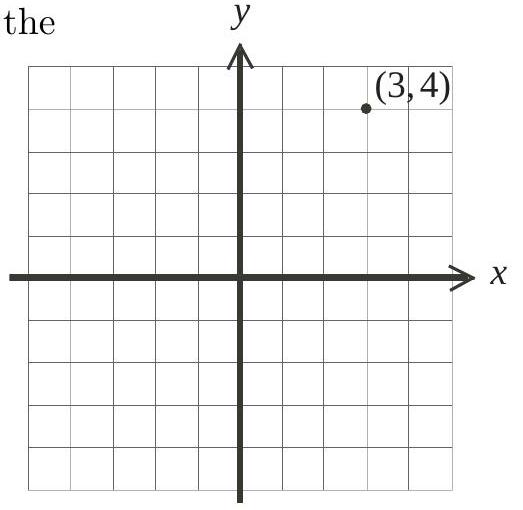 | After reflecting the point $(3,4)$ in the $x$-axis, the $x$-coordinate of the image will be the same as the $x$-coordinate of the original point, $x=3$.
The original point is a distance of 4 from the $x$-axis.
The image will be the same distance from the $x$-axis, but below the $x$-axis.
Thus, the image has $y$-coor... | (3,-4) | NaN | NaN | NaN | NaN | olympiads | false |
Find the number of ordered pairs of real numbers $ (a,b)$ such that $ (a \plus{} bi)^{2002} \equal{} a \minus{} bi$.
$ \textbf{(A)}\ 1001\qquad \textbf{(B)}\ 1002\qquad \textbf{(C)}\ 2001\qquad \textbf{(D)}\ 2002\qquad \textbf{(E)}\ 2004$ | null | null | Algebra | MCQ | Yes | Yes | aops_forum | false |
If $125 + n + 135 + 2n + 145 = 900,$ find $n.$ | null | null | Algebra | math-word-problem | Yes | Yes | aops_forum | false |
Tanks M and B are each in the shape of a right circular cylinder. The interior of tank M has a height of 10 meters and a circumference of 8 meters, and the interior of tank B has a height of 8 meters and a circumference of 10 meters. Tank M is filled with a liquid up to a height of 7 meters, while tank B is filled up t... | First, let's find the volume of the liquid in each tank.
The volume of a cylinder is given by the formula \( V = \pi r^2 h \), where \( r \) is the radius and \( h \) is the height.
To find the radius of each tank, we can use the formula for the circumference of a circle, which is \( C = 2\pi r \).
For tank M:
\( C... | 89.6\% | Geometry | math-word-problem | Yes | Yes | orca_math | true |
A student got 72% in math and 84% in history. The student needs to get 69% in the third subject to achieve a certain overall average. What is the desired overall average percentage? | Let's denote the desired overall average percentage as "A" and the percentage in the third subject as "P3". We know that the student got 72% in math and 84% in history, and needs to get 69% in the third subject to achieve the overall average "A".
The overall average is calculated by adding the percentages of all subje... | 75\% | Algebra | math-word-problem | Yes | Yes | orca_math | true |
4. Let $A$ and $B$ be independent events. In terms of $\mathrm{P}(A)$ and $\mathrm{P}(B)$, express the probabilities of the events consisting in exactly $k$, at least $k$, and at most $k$ of the events $A$ and $B$, $k=0,1,2$. | Solution. For brevity, let $a:=\mathrm{P}(A), b:=\mathrm{P}(B)$, $\xi$ - the number of events that occurred. Then
$$
\mathrm{P}(\xi \leqslant 2)=\mathrm{P}(\xi \geqslant 0)=1 \quad(\text { since for any outcome } 0 \leqslant \xi \leqslant 2) \text {. }
$$
Further,
$$
\begin{aligned}
& p_{0}:=\mathrm{P}(\xi=0)=\mathr... | p_{0}=1--b+,\;p_{1}=+b-2ab,\;p_{2}=,\;\mathrm{P}(\xi\geqslant1)=+b-,\;\mathrm{P}(\xi\leqslant1)=1- | Combinatorics | math-word-problem | Yes | Yes | olympiads | false |
The minimum distance from point P on the curve $y=x^2$ to the line $y=2x-2$ is ______. | To solve this, draw a line parallel to $y=2x-2$ such that this parallel line is tangent to the curve. Therefore, the equation of the tangent line to the curve is of the form $y=2x+m$.
Substituting $y=2x+m$ into the curve equation $y=x^2$ gives $x^2-2x-m=0$. From $\Delta=4+4m=0$, we get $m=-1$.
Thus, the equation of... | \frac{\sqrt{5}}{5} | Calculus | math-word-problem | Yes | Yes | cn_k12 | false |
For what positive integers $k$ there exists a function $f : N \to N$ such that for all $n \in N$ we have
$\underbrace{\hbox{f(f(... f(n)....))}}_{\hbox{k times}} = f(n) + 2$ ? | null | null | Logic and Puzzles | math-word-problem | Yes | Yes | aops_forum | false |
Mid intended to type a 9-digit number, but the three digits he meant to type did not appear. What appeared instead was the 6-digit number 521159. How many different 9-digit numbers could Mid have meant to type? | Since Mid intended to type a 9-digit number but only a 6-digit number appeared, it means that three digits are missing. These three missing digits could be in any of the positions before, after, or between the digits of the 6-digit number that appeared.
Let's denote the missing digits as X, Y, and Z. The 6-digit numbe... | 36,900 | Combinatorics | math-word-problem | Yes | Yes | orca_math | true |
From a group of 4 boys and 2 girls, 3 people are randomly selected to participate in a speech contest. The probability of selecting exactly 2 boys and 1 girl is $\_\_\_\_\_\_$, and the probability of selecting at least 1 girl is $\_\_\_\_\_\_$. | First, let's find the total number of possible outcomes when selecting 3 people from a group of 6. Using the combination formula, we get:
$n = C^{3}_{6} = \frac{6!}{3!(6-3)!} = 20$
Next, let's calculate the number of favorable outcomes for selecting exactly 2 boys and 1 girl:
$m = C^{2}_{4} \cdot C^{1}_{2} = \frac{4!}... | \frac{4}{5} | Combinatorics | math-word-problem | Yes | Yes | cn_k12 | false |
Given lines $m$ and $n$, planes $\alpha$ and $\beta$, the following propositions are provided:① If $m\bot \alpha$, $n\bot \beta$, and $m\bot n$, then $\alpha \bot \beta$② If $m$ is parallel to $\alpha$, $\alpha \cap \beta = n$, then $m$ is parallel to $n$③ If $m\bot \alpha$, $n$ is parallel to $\beta$, and $m\bot n$, t... | Let's analyze each proposition step by step:
$①$ For proposition $①$, we know that if a line is perpendicular to a plane, then it is perpendicular to every line in the plane that it intersects. Given $m\bot \alpha$ and $n\bot \beta$, and also $m\bot n$, this implies that the direction of $n$ (which is within $\beta$) ... | C | Geometry | MCQ | Yes | Yes | cn_k12 | false |
In rectangle $PQRS$, side $PQ$ measures $8$ units and side $QR$ measures $4$ units. Points $V$ and $W$ are on side $RS$ such that segment $RV$ measures $2$ units and segment $WS$ measures $3$ units. Lines $PV$ and $QW$ intersect at point $Z$. What is the area of triangle $PVZ$? | First, find the length of segment $VW$. Since $RS$ has length $8$, and $RV$ and $WS$ measure $2$ and $3$ units respectively, segment $VW$ measures $8 - (2+3) = 3$ units.
Next, observe that $PQ$ is parallel to $RS$, implying that $\angle PVZ \cong \angle QWV$ and $\angle PZV \cong \angle QWV$ as corresponding angles. T... | 16 \text{ square units} | Geometry | math-word-problem | Yes | Yes | synthetic_math | true |
Given a set of several weights, each has a mass written on it. It is known that the set of masses and the set of inscriptions are the same, but some inscriptions may be mixed up. The scales are represented by a horizontal segment fixed at its midpoint. When weighing the weights, they are attached to arbitrary points on... | Let's set aside the lightest weight - with mass . Attach the remaining weights to different points to the left of the center, but in such a way that for each pair of weights, the heavier weight is further from the center. Calculate the point to the right where the weight $m$ should be hung to achieve balance. Show that... | proof | Logic and Puzzles | math-word-problem | Yes | Yes | olympiads | false |
[ Properties and characteristics of an isosceles triangle. ] [ Congruent triangles. Criteria for congruence ]
Triangles $A B C$ and $A B C_{1}$ are isosceles with a common base $A B$. Prove the congruence of triangles $A C C_{1}$ and $B C C_{1}$. | $A C = B C$ and $A C_{1} = B C_{1}$ as the lateral sides of isosceles triangles, $C C_{1}$ - the common side of triangles $A C C_{1}$ and $B C C_{1}$. Therefore, they are equal by three sides.
 \lg \frac{1}{5}\right)^{n} \\ = \\\end{array}$ | $2 \cdot 10^{\mathrm{n}}$ | 2 \cdot 10^{\mathrm{n}} | Algebra | math-word-problem | Incomplete | Incomplete | cn_contest | false |
The number of diagonals of a regular polygon plus twice the number of its sides equals 36. What is the number of sides of this polygon? | Let the polygon have \( n \) sides. The number of diagonals is \( \frac{n(n-3)}{2} \). According to the problem statement, we have:
\[
\frac{n(n-3)}{2} + 2n = 36
\]
Multiplying through by 2 to clear the fraction:
\[
n(n-3) + 4n = 72
\]
Simplify and rearrange the terms:
\[
n^2 + n - 72 = 0
\]
Solving this quadratic equa... | n = 8 | Geometry | math-word-problem | Yes | Yes | synthetic_math | true |
Given the function $f(x)= \sqrt{x-1}$:
(1) Determine the domain of function $f(x)$;
(2) Determine the monotonicity of function $f(x)$ within its domain and prove it using the definition of monotonicity. | (1) For the function $f(x)= \sqrt{x-1}$ to be meaningful, we must have $x \geq 1$.
Thus, the domain of the function $f(x)$ is $[1, +\infty)$.
(2) The function $f(x)= \sqrt{x-1}$ is monotonically increasing on its domain $[1, +\infty)$.
Proof: Let's take any two points $x_1, x_2 \in [1, +\infty)$ such that $x_2 > x_1$... | f(x) \text{ is monotonically increasing on } [1, +\infty) | Algebra | math-word-problem | Yes | Yes | cn_k12 | false |
XXIX OM - I - Problem 4
Let $ Y $ be a figure consisting of closed segments $ \overline{OA} $, $ \overline{OB} $, $ \overline{OC} $, where point O lies inside the triangle $ ABC $. Prove that in no square can one place infinitely many mutually disjoint isometric images of the figure $ Y $. | Let $ d $ be the smallest of the numbers $ OA $, $ OB $, $ OC $. Choose points $ P \in \overline{OA} $, $ Q \in \overline{OB} $, $ R \in \overline{OC} $ such that $ OP= OQ = OR= \frac{d}{2} $ (Fig. 6).
Then $ PQ < OP + OQ = d $ and similarly $ PR < d $ and $ QR < d $. If $ Y $ is a figure consisting of closed segments ... | proof | Geometry | proof | Yes | Yes | olympiads | false |
The square-shaped square is being reconstructed with a side length of 20 meters. If the entire square were to be paved with cheaper light-colored paving stones, the material costs would be 100,000 Kč. If the entire square were to be covered with more expensive dark paving stones, the material costs would be 300,000 Kč.... | a) Light paving is three times cheaper than dark paving. The costs for the light and dark parts of the square are the same, so the light area is three times larger than the dark area. The dark area thus forms one quarter of the square, and the cost for it is 300000 : $4=75000$ (Kč). The costs for the light part are the... | 150000 | Geometry | math-word-problem | Yes | Yes | olympiads | false |
For the nonzero numbers $x$, $y$, and $z$, define $$
\text{K}(x,y,z) = \frac{x}{y} + \frac{y}{z} + \frac{z}{x} + \frac{x+y}{z+y}.
$$ Find $\text{K}(3,18,12)$. | We start by computing each term in the expression for $\text{K}(3,18,12)$:
1. $\frac{3}{18} = \frac{1}{6}$,
2. $\frac{18}{12} = \frac{3}{2}$,
3. $\frac{12}{3} = 4$,
4. $\frac{3+18}{12+18} = \frac{21}{30} = \frac{7}{10}$.
Now summing all these values:
$$ \text{K}(3,18,12) = \frac{1}{6} + \frac{3}{2} + 4 + \frac{7}{10}... | \frac{191}{30} | Algebra | math-word-problem | Yes | Yes | synthetic_math | true |
6. D. Krekov
Prove that there exists a real number $A$, such that the distance from the upper integer part of $A^{n}$ to the nearest square is two for any $n$. | Solution.
Let $t$ be the larger root of the polynomial $x^{2}-10 x+1$, then $t+\frac{1}{t}=10$. We will prove by induction that the number $t^{n}+\frac{1}{t^{n}}$ is an integer for any non-negative integer $n$. Indeed, this is true for $n=0,1$. Moreover,
$$
t^{n+1}+\frac{1}{t^{n+1}}=\left(t^{n}+\frac{1}{t^{n}}\right)... | proof | Number Theory | proof | Yes | Yes | olympiads | false |
Determine the value of $x$ for which $a=49, b=16$, and $x$ form an O'Hara triple $(a, b, x)$ where $\sqrt{a} + \sqrt{b} = x$. | Given the values $a = 49$, $b = 16$, we seek to verify the O'Hara triple by solving $\sqrt{a}+\sqrt{b}=x$.
- First compute the square roots:
\[
\sqrt{49} = 7, \quad \sqrt{16} = 4
\]
- Sum these square roots to find $x$:
\[
x = 7 + 4 = 11
\]
Therefore, $(49, 16, x)$ is an O'Hara triple if $x = \boxed{11}$. | 11 | Algebra | math-word-problem | Yes | Yes | synthetic_math | true |
Among the following sampling methods, the most suitable for systematic sampling is ( )
A: In a city with 4 districts totaling 2000 students, and the ratio of student numbers in the 4 districts is 3:2:8:2, 200 individuals are sampled.
B: Randomly select 5 samples from 2000 electronic components produced by a factory.
C... | **Answer Explanation**: The characteristic of systematic sampling is to extract a certain number of samples from a relatively large and balanced group of individuals, and the extracted samples have certain regularities. Among the four sampling options given, selecting 5 samples randomly from 2000 electronic components ... | C | Combinatorics | MCQ | Yes | Yes | cn_k12 | false |
9. (2005 New Zealand Mathematical Olympiad) Find all integer solutions $(k, l, m, n)$ that satisfy the equation $k^{2}+l^{2}+m^{2}=2^{n}$. | 9. Clearly, $n$ is a non-negative integer. When $k, l, m$ are all multiples of 2, divide both sides of the equation by 2 to the power of some integer, making $k, l, m$ not all even. Therefore, we can assume that $k, l, m$ are not all even.
Since the square of a complete number modulo 4 is 0 or 1, $k^{2}+l^{2}+m^{2}$ mo... | Number Theory | math-word-problem | Yes | Yes | olympiads | false | |
Given that $m$ and $n$ are two different lines, and $\alpha$ and $\beta$ are two different planes, among the following conditions, which one can conclude that $\alpha \perp \beta$? ( )
A: $m \perp n$, $m \perp \alpha$, $n \parallel \beta$
B: $m \parallel n$, $m \perp \alpha$, $n \perp \beta$
C: $m \perp n$, $m \... | Solution:
A. When $m \perp n$ and $m \perp \alpha$, then $n$ is either parallel to $\alpha$ or $n$ is contained in $\alpha$. If $n \parallel \beta$, we cannot conclude that $\alpha \perp \beta$, so option A is incorrect.
B. If $m \parallel n$ and $m \perp \alpha$, then $n \perp \alpha$. If $n \perp \beta$, then $\a... | D | Geometry | MCQ | Yes | Yes | cn_k12 | false |
Given vectors $\overrightarrow{a}=(1,2)$ and $\overrightarrow{b}=(λ,-1)$, if $\overrightarrow{a} \perp \overrightarrow{b}$, find the value of $| \overrightarrow{a}+ \overrightarrow{b}|=$ ( ).
A: $ \sqrt {10}$
B: $4$
C: $ \sqrt {17}$
D: $2 \sqrt {5}$ | Since $\overrightarrow{a}=(1,2)$ and $\overrightarrow{b}=(λ,-1)$ are perpendicular, their dot product is zero. We can write this as:
$$(1,2) \cdot (λ,-1) = 0$$
Expanding the dot product, we obtain:
$$1 \cdot λ + 2 \cdot (-1) = 0$$
Solving for $λ$, we find:
$$λ - 2 = 0$$
$$λ = 2$$
Now, we can find the sum of the vectors... | A | Algebra | MCQ | Yes | Yes | cn_k12 | false |
The maximum and minimum values of $f(x) = -3x + 1$ on the interval $[0, 1]$ are respectively ( )
A: 1, 0
B: 2, 0
C: 2, -1
D: 1, -2 | Since $f(x) = -3x + 1$ is a decreasing function on the interval $[0, 1]$,
the maximum value of $f(x)$ is $f(0) = 1$,
and the minimum value is $f(1) = -2$.
Therefore, the correct choice is $\boxed{\text{D}}$.
Based on the graph and properties of linear functions, it can be determined that $f(x)$ is a decreasing... | \text{D} | Algebra | MCQ | Yes | Yes | cn_k12 | false |
Subsets and Splits
No community queries yet
The top public SQL queries from the community will appear here once available.