
instruction_seed stringlengths 2 10.7k | solution stringlengths 0 10.8k ⌀ | answer stringlengths 0 575 ⌀ | problem_type stringclasses 9
values | question_type stringclasses 5
values | problem_is_valid stringclasses 5
values | solution_is_valid stringclasses 4
values | source stringclasses 11
values | synthetic bool 2
classes |
|---|---|---|---|---|---|---|---|---|
Among the following numbers, the largest one is ( )
A: $85_{(9)}$
B: $210_{(6)}$
C: $1000_{(4)}$
D: $11111_{(2)}$ | First, we convert each number from its given base to decimal (base-10) before comparing their magnitudes.
For $85_{(9)}$, we have:
$$
85_{(9)} = 8 \cdot 9^1 + 5 \cdot 9^0 = 8 \cdot 9 + 5 = 72 + 5 = 77
$$
For $210_{(6)}$, we compute:
$$
210_{(6)} = 2 \cdot 6^2 + 1 \cdot 6^1 + 0 \cdot 6^0 = 2 \cdot 36 + 1 \cdot 6 = 72 ... | B: 210_{(6)} | Number Theory | MCQ | Yes | Yes | cn_k12 | false |
The points M(1, 1) and N(3, 3) are known, then the distance |MN| equals ( )
A: 8
B: 4
C: $$2 \sqrt{2}$$
D: 2 | Given points M(1, 1) and N(3, 3), the distance between two points in the coordinate plane can be found using the distance formula:
$$|MN| = \sqrt{(x_2-x_1)^2 + (y_2-y_1)^2}$$
Substitute the coordinates of points M and N into the formula:
$$|MN| = \sqrt{(3-1)^2 + (3-1)^2}$$
$$|MN| = \sqrt{2^2 + 2^2}$$
$$|MN| = \sqrt{... | C: 2 \sqrt{2} | Geometry | MCQ | Yes | Yes | cn_k12 | false |
Find all integer values can take $n$ such that $$\cos(2x)=\cos^nx - \sin^nx$$ for every real number $x$. | 1. We start with the given equation:
\[
\cos(2x) = \cos^n x - \sin^n x
\]
for every real number \( x \).
2. To find the integer values of \( n \), we first set \( x = -\frac{\pi}{4} \). At this value, we have:
\[
\cos\left(2 \left(-\frac{\pi}{4}\right)\right) = \cos\left(-\frac{\pi}{2}\right) = 0
... | n \in \{2, 4\} | Algebra | math-word-problem | Yes | Yes | aops_forum | false |
Find the number of ordered pairs $(A,B)$ such that the following conditions hold:
$\bullet$ $A$ and $B$ are disjoint subsets of $\{1, 2, . . . , 50\}$.
$\bullet$ $|A| = |B| = 25$
$\bullet$ The median of $B$ is $1$ more than the median of $A$. | null | null | Combinatorics | math-word-problem | Yes | Yes | aops_forum | false |
Evaluate the expression \((a^a - a(a-2)^a)^{a+1}\) when \(a=4\). | 1. **Substitution and Initial Expansion:** Substitute \(a = 4\) in the expression:
\[
\left(4^4 - 4 \cdot (4-2)^4 \right)^{4+1}
\]
2. **Simplify Inside the Parentheses:**
- Calculate \(4-2\) to get \(2\), then raise it to the power \(4\): \(2^4 = 16\).
- Perform the multiplication: \(4 \cdot 16 = 64\).
... | 14889702426 | Algebra | math-word-problem | Yes | Yes | synthetic_math | true |
6.55*. Prove that if in a convex hexagon each of the three segments connecting the midpoints of opposite sides divides the area in half, then these segments intersect at one point.
See also problems $1.45,2.11,2.20,2.47,3.67,4.6,4.28,4.31,5.88,6.95$, 9.45 a), 9.76-9.78, 13.3, 14.6, 18.16, 18.17, 18.24, 18.25, 29.29 a)... | 6.55. Let the midpoints of the sides of the convex hexagon $A B C D E F$ be denoted as shown in Fig. 6.12. Let $O$ be the point of intersection of segments $K M$ and $L N$. The areas of the triangles into which the segments connecting point $O$ with the vertices and midpoints of the sides divide the hexagon are denoted... | proof | Geometry | proof | Yes | Yes | olympiads | false |
## 5.1.
$1_{16}{ }^{\circ}$. Prove that the divisibility of a natural number by 2 is equivalent to the last digit being even.
When in mathematics it is said that one statement is equivalent to another, in this case - one divisibility is equivalent to another, it means the following: from one divisibility follows the ... | $\triangle$ Let's take a natural number $a$. Denote the number of its tens by $b$ (not the digit, but the number of tens; for example, for the number 3258, the number of tens is $325$), and the last digit by $c$. Then
$$
a=10 b+c
$$
The number $10 b$ is always divisible by 2. Therefore, if $c$ is divisible by 2, then... | proof | Number Theory | proof | Yes | Yes | olympiads | false |
Mark has 12 notebooks, each containing 36 sheets, and each sheet holds 8 drawings. Mark decides to reorganize his notebooks such that each sheet now holds 5 drawings, optimizing his space to accommodate more drawings without purchasing additional notebooks. After reorganizing, he fills up 6 complete notebooks, still wi... | 1. Calculate the total number of drawings in the old system:
\[
12 \text{ notebooks} \times 36 \text{ sheets/notebook} \times 8 \text{ drawings/sheet} = 3456 \text{ drawings}.
\]
2. Calculate the number of sheets required in the new system if each sheet holds 5 drawings:
\[
\text{Total drawings} \div 5 \... | 1 | Logic and Puzzles | math-word-problem | Yes | Yes | synthetic_math | true |
How many solutions does the equation \[\frac{(x-1)(x-2)(x-3)\dotsm(x-120)}{(x-2^2)(x-3^2)(x-4^2)\dotsm(x-11^2)} = 0\] have for $x$? | For the given equation to have solutions, $x$ must zero out the numerator without zeroing the denominator. The numerator zeros out for $x = 1, 2, 3, \ldots, 120$. The modified denominator zeros out for $x = 2^2, 3^2, \ldots, 11^2$ (i.e., $x = 4, 9, 16, \ldots, 121$).
Among these, we consider the values from $1$ to $1... | 110 | Algebra | math-word-problem | Yes | Yes | synthetic_math | true |
1. Let $p>3$ be a prime. Find the number of ordered sextuples $(a, b, c, d, e, f)$ of positive integers, whose sum is $3 p$, and all the fractions
$$
\frac{a+b}{c+d}, \quad \frac{b+c}{d+e}, \quad \frac{c+d}{e+f}, \quad \frac{d+e}{f+a}, \quad \frac{e+f}{a+b}
$$
are integers.
(Jaromír Šimša, Jaroslav Švrček)
|
Solution. Taking the product of the 1st, the 3rd and the 5th fractions reveals that their value has to be 1 , that is
$$
a+b=c+d=e+f=p .
$$
the form of the second and of the fourth fraction implies
$$
f+a \mid d+e \text { and } d+e \mid b+c \text {. }
$$
that is first $f+a$ is at most the arithmetic mean of its mu... | p+2ifp=3q+1,p+1ifp=3q+2 | Number Theory | math-word-problem | Yes | Yes | olympiads | false |
Let $n$ be a positive integer, the players A and B play the following game: we have $n$ balls with the numbers of $1, 2, 3, 4,...., n$ this balls will be in two boxes with the symbols $\prod$ and $\sum$.
In your turn, the player can choose one ball and the player will put this ball in some box, in the final all the bal... | To determine the winning strategy for players A and B, we need to analyze the game based on the parity (odd or even nature) of the numbers involved and the final sum \( P + Q \).
### Part (a): \( n = 6 \)
1. **Initial Setup**:
- The numbers are \( 1, 2, 3, 4, 5, 6 \).
- Player A starts the game.
2. **Parity An... | n = 6 | Combinatorics | math-word-problem | Yes | Yes | aops_forum | false |
Find all positive integers $n$ such that $20n+2$ divides $2003n+2002$
Translate the above text into English, please keep the original text's line breaks and format, and output the translation result directly. | Obviously, $21 n$. Let $n=2 m\left(m \in \mathbf{N}^{*}\right)$, then
$(20 m+1) 1(2003 m+1001)$.
Since $2003 m+1001=100(20 m+1)+3 m+901$,
thus $(20 m+1) \mid(3 m+901)$.
It is easy to see that $\frac{3 m+901}{20 m+1}=1,2,3,4$ have no positive integer solutions. Therefore, $\frac{3 m+901}{20 m+1} \geqslant 5$, which impl... | not found | Number Theory | math-word-problem | Yes | Yes | cn_contest | false |
The distance from the foci of the hyperbola $\frac{x^2}{4} - \frac{y^2}{12} = 1$ to its asymptotes is ( ).
A: $2$
B: $\sqrt{3}$
C: $3$
D: $2\sqrt{3}$ | **Analysis**
This question examines the equation of a hyperbola and its asymptotes, as well as the formula for the distance from a point to a line. First, we find the coordinates of the foci and the equation of the asymptotes from the given conditions, then we substitute into the formula for the distance from a point ... | D | Geometry | MCQ | Yes | Yes | cn_k12 | false |
A man traveled a total distance of 1800 km. He traveled some portion of the whole trip by plane and the distance traveled by train is two-thirds of the distance traveled by bus. If he traveled by train, plane, and bus, and he traveled 720 km by bus, what is the ratio of the distance traveled by plane to the whole trip? | Let's denote the distance traveled by train as T, by plane as P, and by bus as B.
According to the problem, we have the following information:
1. The total distance traveled is 1800 km.
2. The distance traveled by train (T) is two-thirds of the distance traveled by bus (B).
3. The distance traveled by bus (B) is 720 ... | 1:3 | Algebra | math-word-problem | Yes | Yes | orca_math | true |
It can be shown that for any positive integer $n$,
\[\begin{pmatrix} 2 & 1 \\ 1 & 1 \end{pmatrix}^n = \begin{pmatrix} L_{n + 1} & L_n \\ L_n & L_{n - 1} \end{pmatrix},\]
where $L_n$ denotes the $n$th Lucas number.
Compute $L_{784} L_{786} - L_{785}^2.$ | Since $\begin{pmatrix} 2 & 1 \\ 1 & 1 \end{pmatrix}^n = \begin{pmatrix} L_{n + 1} & L_n \\ L_n & L_{n - 1} \end{pmatrix},$
\[\det \begin{pmatrix} 2 & 1 \\ 1 & 1 \end{pmatrix}^n = \det \begin{pmatrix} L_{n + 1} & L_n \\ L_n & L_{n - 1} \end{pmatrix}.\]
Now,
\[\det \begin{pmatrix} 2 & 1 \\ 1 & 1 \end{pmatrix}^n = \left( ... | 1 | Number Theory | math-word-problem | Yes | Yes | synthetic_math | true |
Given $f(x)=x^2-2ax+2$, it is known that $f(x)\geqslant a$ always holds true when $x\in[-1,+\infty)$. Determine the range of values for $a$. | Method 1: $f(x)=(x-a)^2+2-a^2$,
The axis of symmetry for this quadratic function is $x=a$.
$\text{(1)}$ When $a\in(-\infty,-1)$, based on the graph ($\text{omitted}$),
$f(x)$ is monotonically increasing on $[-1,+\infty)$,
$f_{min}(x)=f(-1)=2a+3$,
To ensure that $f(x)\geqslant a$ always holds true, it is sufficient... | [-3,1] | Inequalities | math-word-problem | Yes | Yes | cn_k12 | false |
Sadie, Ariana and Sarah are running a relay race. Each part of the race is a different length and covers different terrain. It takes Sadie 2 hours to run through the forest at an average speed of 3 miles per hour. Ariana sprints across the open field on her section at 6 miles per hour for half an hour. If Sarah runs al... | Let's calculate the distance covered by each runner:
Sadie's distance:
Speed = 3 miles per hour
Time = 2 hours
Distance = Speed × Time = 3 miles/hour × 2 hours = 6 miles
Ariana's distance:
Speed = 6 miles per hour
Time = 0.5 hours (half an hour)
Distance = Speed × Time = 6 miles/hour × 0.5 hours = 3 miles
Sarah's di... | 17 | Algebra | math-word-problem | Yes | Yes | orca_math | true |
The height of the wall is some times its width and the length of the wall is 7 times its height. The volume of the wall is 129024 cu. m. Its width is approximately 8. What is the ratio of the height to the width of the wall? | Let's denote the width of the wall as \( w \), the height as \( h \), and the length as \( l \).
According to the problem, we have the following relationships:
1. \( h = x \cdot w \) (where \( x \) is the ratio of the height to the width)
2. \( l = 7 \cdot h \)
The volume of the wall is given by the product of its le... | 6:1 | Algebra | math-word-problem | Yes | Yes | orca_math | true |
The sides of a triangle are 8 cm, 10 cm, and 12 cm. The area of this triangle is 40 cm². Find the length of the longest side of a similar triangle whose perimeter is 120 cm. | Let's denote the ratio of the side lengths between the similar triangle and the given triangle as $k$. Therefore, the sides of the similar triangle are $8k$, $10k$, and $12k$. The perimeter of the similar triangle is given by $8k + 10k + 12k = 120$ cm.
- Solve for $k$:
\[ 8k + 10k + 12k = 120 \]
\[ 30k = 120 \]
\[ k =... | 48 \text{ cm} | Geometry | math-word-problem | Yes | Yes | synthetic_math | true |
We rotate a cyclic quadrilateral within its circumscribed circle by an angle less than $180^{\circ}$, and find the intersection point of each side line with its rotated counterpart. Prove that these four points form a parallelogram! | 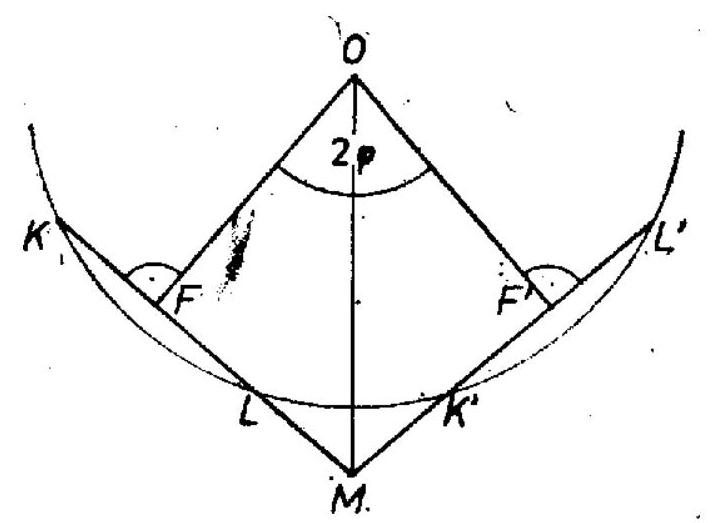
Translate the arbitrary chord $KL$ of the circle centered at $O$ by rotating it around $O$ by $2\varphi$ (i.e., dilation).
According to this, the set of 4 intersection points arises from the ... | proof | Geometry | proof | Yes | Yes | olympiads | false |
In any month with five Tuesdays, a company declares the fifth Tuesday a Terrific Tuesday. The company operates starting from Monday, October 2. What is the date of the first Terrific Tuesday after operations begin? | October has 31 days. October 2 is a Monday, implying October 3 is a Tuesday. Then, counting Tuesdays in October: October 3, 10, 17, 24, and 31. Thus, there are five Tuesdays in October.
Since there are five Tuesdays and the company declares the fifth Tuesday a Terrific Tuesday, the first Terrific Tuesday after operati... | \text{October 31} | Logic and Puzzles | math-word-problem | Yes | Yes | synthetic_math | true |
Let vector $\overrightarrow a=(2\cos\theta,\sin\theta)$, vector $\overrightarrow b=(1,-6)$, and $\overrightarrow a \cdot \overrightarrow b=0$. Then $\frac{{2\cos\theta+\sin\theta}}{{\cos\theta+3\sin\theta}}$ is ____. | Given that $\overrightarrow{a} \cdot \overrightarrow{b}=0$, we can write the dot product of vectors $\overrightarrow{a}$ and $\overrightarrow{b}$ as follows:
\[
2\cos\theta \cdot 1 + \sin\theta \cdot (-6) = 0
\]
Simplifying this equation gives us:
\[
2\cos\theta - 6\sin\theta = 0
\]
From this, we can solve for $\ta... | \frac{7}{6} | Algebra | math-word-problem | Yes | Yes | cn_k12 | false |
3. Calculate the sum of all natural numbers which, when divided by 27, give a quotient equal to twice the remainder.
Daniela Tilincă and Adriana Mihăilă, Brăila | ## Solution:
$n=55r$ and $r<27$
$3 \mathbf{p}$
$S=55 \cdot(1+2+3+\ldots+26)$
$2 p$
$S=19305$
$2 p$ | 19305 | Number Theory | math-word-problem | Yes | Yes | olympiads | false |
For the equations some x + y = 19 and x + 3y = 1, the value of 2x + y is 5. What is the coefficient of x in the first equation? | Let's denote the coefficient of x in the first equation as "a". So the first equation becomes:
ax + y = 19
We are given the second equation:
x + 3y = 1
And we are told that the value of 2x + y is 5. Let's express y from the second equation:
y = (1 - x)/3
Now let's substitute y in the expression 2x + y:
2x + (1 -... | 7 | Algebra | math-word-problem | Incomplete | Yes | orca_math | true |
If the graph of the power function $f(x)$ passes through point A(4, 2), then $f(2) = \_\_\_\_\_\_$. | Since $f(x)$ is a power function, let $f(x) = x^{\alpha}$.
Given that the graph of $f(x)$ passes through point A(4, 2),
we have $4^{\alpha} = 2$, which gives us $\alpha = \frac{1}{2}$.
Therefore, $f(x) = x^{\frac{1}{2}}$.
Then, $f(2) = 2^{\frac{1}{2}} = \sqrt{2}$.
Hence, the answer is $\boxed{\sqrt{2}}$.
Th... | \sqrt{2} | Algebra | math-word-problem | Yes | Yes | cn_k12 | false |
A towel, when bleached, lost some percentage of its length and 20% of its breadth. The percentage decrease in area is 36%. What is the percentage decrease in length? | Let's assume the original length of the towel is L and the original breadth is B. The original area of the towel is A = L * B.
After bleaching, the length becomes L' and the breadth becomes B'. We know that B' is 80% of B because it lost 20% of its breadth. So, B' = 0.8B.
We are given that the percentage decrease in ... | 20\% | Algebra | math-word-problem | Yes | Yes | orca_math | true |
A curve is described parametrically by
\[(x, y) = (3 \cos t + 2 \sin t, 5 \sin t).\]
Determine the constants \(a\), \(b\), and \(c\) such that the graph of the curve can be expressed in the form
\[ax^2 + bxy + cy^2 = 1.\] | Given: \(x = 3 \cos t + 2 \sin t\) and \(y = 5 \sin t\),
\[
ax^2 + bxy + cy^2 = a(3 \cos t + 2 \sin t)^2 + b(3 \cos t + 2 \sin t)(5 \sin t) + c(5 \sin t)^2
\]
\[
= a(9 \cos^2 t + 12 \cos t \sin t + 4 \sin^2 t) + 15b(\cos t \sin t) + 25c \sin^2 t
\]
\[
= 9a \cos^2 t + (12a + 15b) \cos t \sin t + (4a + 25c) \sin^2 t.
\]
... | \left(\frac{1}{9}, -\frac{4}{45}, \frac{1}{45}\right) | Algebra | math-word-problem | Yes | Yes | synthetic_math | true |
10. (1983 AIME, Problem 1) What is the greatest two-digit prime factor of the integer $C_{200}^{100}$? | 10. $n=C_{200}^{100}=\frac{200 \cdot 199 \cdot 198 \cdot \cdots \cdot 102 \cdot 101}{100!}=2^{50} \cdot \frac{199 \cdot 197 \cdot 195 \cdot \cdots \cdot 103 \cdot 101}{50!}$,
This is an integer, and the numerator $199 \cdot 197 \cdot 195 \cdot \cdots \cdot 103 \cdot 101$ is the product of three-digit odd numbers, so t... | 61 | Combinatorics | math-word-problem | Yes | Yes | olympiads | false |
Given $0<x<\frac{1}{3}$, the maximum value of $x(1-3x)$ is ______. | To find the maximum value of the function $f(x) = x(1-3x)$ within the interval $0<x<\frac{1}{3}$, we first express $f(x)$ in a form that makes it easier to analyze its behavior. We can rewrite $f(x)$ as follows:
\[
f(x) = x(1-3x) = -3x^2 + x
\]
Next, we complete the square to transform this expression into a form tha... | \frac{1}{12} | Algebra | math-word-problem | Yes | Yes | cn_k12 | false |
If Reggie's friend initially had 100 marbles and they bet ten marbles per game, and Reggie now has 90 marbles after playing 9 games, how many games has Reggie lost? | Let's start by determining how many marbles Reggie's friend has after playing 9 games. Initially, Reggie's friend had 100 marbles. Since Reggie now has 90 marbles, the total number of marbles transferred from Reggie's friend to Reggie is:
\[ 100 - 90 = 10 \text{ marbles} \]
Since they bet 10 marbles per game, the numb... | 8 | Logic and Puzzles | math-word-problem | Yes | Yes | metamath | true |
9. Use three rectangles to form a larger rectangle (without gaps or overlaps), where two of the rectangles are $3 \mathrm{~cm} \times 8 \mathrm{~cm}$ and $2 \mathrm{~cm} \times 5 \mathrm{~cm}$, respectively. The dimensions of the third rectangle can be $\qquad$ kinds. | 【Answer】4
【Analysis】Exam Point: Figure Cutting and Pasting | 4 | Geometry | math-word-problem | Yes | Yes | olympiads | false |
For a triangle inscribed in a circle of radius $r$, we know that
$$
\operatorname{tg} \alpha=\frac{1}{3} . \quad \sin \beta \sin \gamma=\frac{1}{\sqrt{10}}
$$
Express the radius of the inscribed circle $(g)$ as a function of $r$. (Be careful! This is not the same as problem 737.) | Express the area of a triangle with sides $a, b, c$ first using $\varrho$ and the semiperimeter, then using two sides and the included angle:
$$
T=\varrho \frac{a+b+c}{2}=\frac{b c \sin \alpha}{2}
$$
From this,
$$
\varrho=\frac{b c \sin \alpha}{a+b+c}
$$
It is known that the sides can be expressed using the angles ... | \frac{\sqrt{10}}{(1+\sqrt{2}+\sqrt{5})5}r | Geometry | math-word-problem | Yes | Yes | olympiads | false |
From a bag containing 2 black balls and 2 white balls, 2 balls are drawn. The mutually exclusive but not contradictory events are ( )
A: At least 1 black ball, at least 1 white ball
B: Exactly one black ball, exactly 2 white balls
C: At least one black ball, all black balls
D: At least 1 black ball, all white balls | For option A: The event "at least 1 black ball" and the event "at least 1 white ball" can occur simultaneously, such as drawing one black and one white ball. Therefore, option A does not represent mutually exclusive events.
For option B: The event "exactly one black ball" and the event "exactly 2 white balls" cannot o... | \text{B} | Combinatorics | MCQ | Yes | Yes | cn_k12 | false |
Given that $\{a_{n}\}$ is an increasing geometric sequence, if $a_{2}=3$, $a_{4}-a_{3}=18$, find the value of $a_{5}$ and the sum of the first 5 terms $S_{5}$. | Let the common ratio of the increasing geometric sequence $\{a_{n}\}$ be $q$. Given $a_{2}=3$ and $a_{4}-a_{3}=18$,
We have $a_{1}q=3$ and $a_{1}q^{2}(q-1)=18$. Solving these equations, we get $a_{1}=1$ and $q=3$, or $a_{1}=- \frac {3}{2}$ and $q=-2$ (which is discarded as the sequence is increasing).
Thus, $a_{5}=3^... | 121 | Algebra | math-word-problem | Yes | Yes | cn_k12 | false |
A point $(5\sqrt{2}, d+4)$ is $4d$ units away from the origin. What is the smallest possible value of $d$? | To find the distance from the origin to the point $(5\sqrt{2}, d+4)$, we use the distance formula:
\[ \sqrt{(5\sqrt{2})^2 + (d+4)^2} = 4d \]
Squaring both sides to eliminate the square root gives:
\[ (5\sqrt{2})^2 + (d+4)^2 = 16d^2 \]
\[ 50 + d^2 + 8d + 16 = 16d^2 \]
\[ d^2 + 8d + 66 - 16d^2 = 0 \]
\[ 15d^2 - 8d - 66 =... | 2.38 | Algebra | math-word-problem | Yes | Yes | synthetic_math | true |
Theorem 10.6. Let $b$ be a positive integer. Then a periodic base $b$ expansion represents a rational number. Conversely, the base $b$ expansion of a rational number either terminates or is periodic. Further, if $0<\alpha<1, \alpha=r / s$, where $r$ and $s$ are relatively prime positive integers, and $s=T U$ where ever... | Proof. First, suppose that the base $b$ expansion of $\alpha$ is periodic, so that
where we have used Theorem 10.4 to see that
$$\sum_{j=0}^{\infty} \frac{1}{b^{j k}}=\frac{1}{1-\frac{1}{b^{k}}}=\frac{b^{k}}{b^{k}-1}$$
Since $\alpha$ is the sum of rational numbers, Theorem 10.1 tells us that $\alpha$ is rational. $\sq... | proof | Number Theory | proof | Yes | Incomplete | number_theory | false |
Let the universal set $U=\{1, 3, 5, 7\}$, and the set $M=\{1, a-5\}$, where $M \subseteq U$, and $C_{U}M=\{5, 7\}$. Find the real number $a$. | Given the universal set $U=\{1, 3, 5, 7\}$, and $C_{U}M=\{5, 7\}$,
Therefore, $M=\{1, 3\}$.
Thus, $a-5=3$.
Therefore, $a=8$.
Hence, the answer is $\boxed{8}$. | 8 | Algebra | math-word-problem | Yes | Yes | cn_k12 | false |
In an ellipse, the center is located at $(1, -2)$, one focus is at $(1, -3),$ and one endpoint of a semi-major axis is at $(1, 1)$. Find the semi-minor axis of the ellipse. | - Calculate $c$, the distance from the center $(1, -2)$ to the focus $(1, -3)$. This distance is:
\[
c = \sqrt{(1-1)^2 + (-3 + 2)^2} = \sqrt{0 + 1} = 1
\]
- Calculate $a$, the distance from the center $(1, -2)$ to the endpoint of the semi-major axis $(1, 1)$. This distance is:
\[
a = \sqrt{(1-1)^2 + (1 + 2)^... | 2\sqrt{2} | Geometry | math-word-problem | Yes | Yes | synthetic_math | true |
Problem 16. Prove the inequality for the elements of an arbitrary triangle:
$$
\frac{1}{(p-a)^{2}}+\frac{1}{(p-b)^{2}}+\frac{1}{(p-c)^{2}} \geq \frac{1}{r^{2}}
$$ | Proof. According to the inequality
$$
x^{2}+y^{2}+z^{2} \geq x y+y z+x z
$$
we have:
18
$$
\begin{gathered}
\frac{1}{(p-a)^{2}}+\frac{1}{(p-b)^{2}}+\frac{1}{(p-c)^{2}} \geq \\
\geq \frac{1}{(p-a)(p-b)}+\frac{1}{(p-b)(p-c)}+\frac{1}{(p-a)(p-c)}= \\
=\frac{p-c+p-a+p-b}{(p-a)(p-b)(p-c)}= \\
=\frac{3 p-2 p}{(p-a)(p-b)(... | proof | Inequalities | proof | Yes | Yes | olympiads | false |
The sum of the binomial coefficients in the expansion of $(\sqrt[3]{x}- \frac{1}{x})^{n}$ is $4096$. Find the constant term. | Since the sum of the binomial coefficients in the expansion of $(\sqrt[3]{x}- \frac{1}{x})^{n}$ is $2^{n}=4096$, we have $n=12$.
Therefore, the general term of the expansion of $(\sqrt[3]{x}- \frac{1}{x})^{12}$ is $T_{r+1}= C_{12}^{r} \cdot (-1)^{r} \cdot x^{4- \frac{4r}{3}}$.
Let $4- \frac{4r}{3}=0$, we find $r=3$. ... | -220 | Algebra | math-word-problem | Yes | Yes | cn_k12 | false |
Given $f(x) = e^x - x$, $g(x) = \ln x + x + 1$, let proposition $p$: $\forall x \in \mathbb{R}, f(x) > 0$, and proposition $q$: $\exists x_0 \in (0, +\infty)$, such that $g(x_0) = 0$, then the correct statement is ( )
A: $p$ is true, $\neg p$: $\exists x_0 \in \mathbb{R}, f(x_0) < 0$
B: $p$ is false, $\neg p$: $\exi... | Solution: The derivative of $f(x)$ is $f'(x) = e^x - 1$. From $f'(x) > 0$, we get $x > 0$, and from $f'(x) 0$.
Therefore, $\forall x \in \mathbb{R}, f(x) > 0$ holds, which means proposition $p$ is true.
$g(x) = \ln x + x + 1$ is an increasing function on $(0, +\infty)$. As $x \to 0$, $g(x) 0$.
Thus, $\exists x_0 \... | C | Calculus | MCQ | Yes | Yes | cn_k12 | false |
Let $p$ and $q$ be real numbers. One of the roots of the equation
\[ x^3 + px^2 + qx - 6 = 0 \]
is $2 - i$. Determine the ordered pair $(p, q)$. | Given that one of the roots of the polynomial is $2 - i$, and since the polynomial has real coefficients, the complex conjugate $2 + i$ must also be a root. Let $s$ be the third real root. The polynomial can then be factored as:
\[
(x - (2 - i))(x - (2 + i))(x - s) = (x^2 - 4x + 5)(x - s)
\]
Expanding this, we get:
\[
... | \left(-\frac{26}{5}, \frac{49}{5}\right) | Algebra | math-word-problem | Yes | Yes | synthetic_math | true |
Kirill has $n{}$ identical footballs and two infinite rows of baskets, each numbered with consecutive natural numbers. In one row the baskets are red, in the other they are blue. Kirill puts all the balls into baskets so that the number of balls in the either row of baskets does not increase. Denote by $A{}$ the number... | null | null | Combinatorics | proof | Yes | Yes | aops_forum | false |
The snack machine at Richmond High School has three pricing tiers for candy bars and chips. Candy bars can be bought for $1.50, $2, or $2.50 each, and chips can be bought for $0.75, $1, or $1.25 each. Additionally, the machine also sells cookies for $1.2 each. If 5 students need to buy 1 candy bar, 2 bags of chips, and... | To calculate the total amount of money needed, we need to select one price for each candy bar and two different prices for the chips, as well as the fixed price for the cookies.
Let's choose the middle price for the candy bar to ensure we're not selecting the most expensive or the cheapest option. So, each candy bar w... | \$1.2 | Combinatorics | math-word-problem | Yes | Yes | orca_math | true |
Example 26 (Self-created problem, 2007.07.12) Let $a, b, c \in \overline{\mathbf{R}^{-}}$, and $\sum a^{2}=1$, then
$$\sum \sqrt{1-b c} \geqslant \sqrt{6}$$
Equality in (32) holds if and only if $a=b=c=\frac{\sqrt{3}}{3}$. | By symmetry, without loss of generality, assume $a$ is the largest. Since
$$\begin{aligned}
(\sqrt{1-a b}+\sqrt{1-a c})^{2}= & \frac{1}{2}\left(\sqrt{\sum a^{2}+c^{2}+(a-b)^{2}}+\right. \\
& \left.\sqrt{\sum a^{2}+b^{2}+(a-c)^{2}}\right)^{2} \geqslant \\
& \frac{1}{2}\left[4 \sum a^{2}+(b+c)^{2}+(2 a-b-c)^{2}\right]= \... | proof | Inequalities | proof | Yes | Yes | inequalities | false |
Given that $\tan \alpha$ is a real root of the equation $2x^{2}-x-1=0$, and $\alpha$ is an angle in the third quadrant.
(1) Find the value of $\frac{2\sin \alpha-\cos \alpha}{\sin \alpha+\cos \alpha}$;
(2) Find the value of $\cos \alpha+\sin \alpha$. | Since $2x^{2}-x-1=0$, we have $x_{1}=- \frac {1}{2},x_{2}=1$. Thus, $\tan \alpha=- \frac {1}{2}$ or $\tan \alpha=1$. Given that $\alpha$ is an angle in the third quadrant, we have $\tan \alpha=- \frac {1}{2}$.
(1) We will find the value of $\frac{2\sin \alpha-\cos \alpha}{\sin \alpha+\cos \alpha}$:
$$\frac{2\sin \alph... | -\frac{1}{\sqrt{5}} | Algebra | math-word-problem | Yes | Yes | cn_k12 | false |
Given that $\alpha$, $\beta$, $\gamma$ are non-coincident planes, and $a$, $b$ are non-coincident lines, which of the following statements is correct? ( )
A: "If $a \parallel b$ and $a \perp \alpha$, then $b \perp \alpha$" is a random event.
B: "If $a \parallel b$ and $a \subset \alpha$, then $b \parallel \alpha$"... | For option A, if $a \parallel b$ and $a \perp \alpha$, then it is certain that $b \perp \alpha$. Therefore, this is a certain event, not a random event, making the statement incorrect.
For option B, if $a \parallel b$ and $a \subset \alpha$, it is not necessarily true that $b \parallel \alpha$ because the line could ... | D | Geometry | MCQ | Yes | Yes | cn_k12 | false |
Given $a > 0, b > 0$, the minimum value of the function $f(x)=|x+a|+|x-b|$ is $4$.
(Ⅰ) Find the value of $a+b$;
(Ⅱ) Find the minimum value of $\frac{1}{4}a^{2}+\frac{1}{9}b^{2}$. | Solution:
(Ⅰ) Since $f(x)=|x+a|+|x-b| \geqslant |(x+a)-(x-b)|=|a+b|$,
Equality holds if and only if $-a \leqslant x \leqslant b$,
And since $a > 0$, $b > 0$, we have $|a+b|=a+b$,
Therefore, the minimum value of $f(x)$ is $a+b$,
Thus, $a+b=4$;
(Ⅱ) From (1), we know $a+b=4$. By the Cauchy-Schwarz inequality, w... | \frac{16}{13} | Algebra | math-word-problem | Yes | Yes | cn_k12 | false |
[ Sums of numerical sequences and series of differences ] Pascal's Triangle and the Binomial Theorem Complex numbers help solve tasks_
Using the expansion $(1+i)^{n}$ by the Binomial Theorem, find:
a) $C_{100}^{0}-C_{100}^{2}+C_{100}^{4}-\ldots+C_{100}^{100}$
b) $C_{99}^{1}-C_{99}^{3}+C_{99}^{5}-\ldots-C_{99}^{99}$. | a) The given sum is equal to $\operatorname{Re}(1+i)^{100}$, and $(1+i)^{100}=(2 i)^{50}=-2^{50}$.
b) The sum is equal to $\operatorname{Im}(1+i)^{99}$, and $(1+i)^{99}=(1+i)(2 i)^{49}=(1+i) \cdot 2^{49} i^{49}=(1-i) \cdot 2^{49}$.
## Answer
a) $-2^{50}$;
b) $2^{49}$.
## Problem | -2^{50} | Combinatorics | math-word-problem | Yes | Yes | olympiads | false |
A train 100 meters long completely crosses a 300 meters long bridge in 15 seconds. What is the speed of the train in km/h? | To calculate the speed of the train, we first need to determine the total distance the train travels while crossing the bridge. This distance is the length of the train plus the length of the bridge.
Total distance = Length of train + Length of bridge
Total distance = 100 meters + 300 meters
Total distance = 400 meter... | 96.012 | Algebra | math-word-problem | Yes | Yes | orca_math | true |
Let \( S \) be the set of all real values of \( x \) with \( 0 < x < \pi \) such that \( \sin x \), \( |\cos x| \), and \( |\tan x| \) form the side lengths (in some order) of a right triangle. Compute the sum of \( \tan^2 x \) over all \( x \) in \( S \). | In the range \( 0 < x < \pi \), the functions \( \sin x \) and \( |\cos x| \) are always positive, while \( |\tan x| \) might be positive or negative. The trigonometric identity \( \sin^2 x + \cos^2 x = 1 \) still holds.
1. **If \( |\tan x| \) is the hypotenuse**, this implies:
\[
\tan^2 x = \sin^2 x + \cos^2 x ... | \sqrt{2} | Algebra | math-word-problem | Yes | Yes | synthetic_math | true |
3. If the complex numbers $z_{1}, z_{2}$ satisfy $\left|z_{1}\right|=2,\left|z_{2}\right|=3$, $3 z_{1}-2 z_{2}=\frac{3}{2}-\mathrm{i}$, then $z_{1} z_{2}=$ $\qquad$ . | $3.6\left(-\frac{5}{13}+\frac{12}{13} i\right)$.
Let $3 z_{1}=6(\cos \alpha+i \sin \alpha)$,
$2 z_{2}=6(\cos \beta+i \sin \beta)$.
Then $6(\cos \alpha-\cos \beta)=\frac{3}{2}, 6(\sin \alpha-\sin \beta)=-1$.
Thus $\tan \frac{\alpha+\beta}{2}=\frac{3}{2}, \cos (\alpha+\beta)=-\frac{5}{13}, \sin (\alpha+\beta)=\frac{12}{1... | 6\left(-\frac{5}{13}+\frac{12}{13} i\right) | Algebra | math-word-problem | Yes | Yes | cn_contest | false |
A right triangle has vertices $A$, $B$ (right angle), and $C$. Medians are drawn from points $A$ and $B$ to the midpoints of segments $\overline{BC}$ and $\overline{AC}$, respectively, and the lengths of these medians are given as 5 and $3\sqrt{3}$ units. If the ratio of the side length $AC$ to $BC$ is 3:2, determine t... | Let $M$ and $N$ be the midpoints of $\overline{BC}$ and $\overline{AC}$, respectively. Given the medians $AM = 5$ and $BN = 3\sqrt{3}$, we form the following equations:
1. For the right triangle $ACM$, apply the Pythagorean Theorem:
\[
AC^2 + \left(\frac{1}{2}BC\right)^2 = 25
\]
2. For the right triangle $BCN... | \sqrt{52} = 2\sqrt{13} | Geometry | math-word-problem | Yes | Yes | synthetic_math | true |
15. A total of 99 people participated in a mathematics competition, which was divided into three sessions, testing the contestants' abilities in geometry, number theory, and combinatorics. Xiao Ming ranked 16th in the number theory exam, 30th in the combinatorics exam, and 23rd in the geometry exam, and he did not tie ... | 【Analysis】When $\left\{\begin{array}{l}\text { in the top } 15 \text { in number theory, ranking last in combinatorics and geometry exams } \\ \text { in the top } 22 \text { in geometry, ranking last in number theory and combinatorics exams }\end{array}\right.$
When the top 15 in number theory, the top 29 in combinato... | 167 | Logic and Puzzles | math-word-problem | Yes | Yes | olympiads | false |
In the first round of bowling, Patrick knocked down a total of 70 pins and Richard knocked down 15 more pins than Patrick. In the second round, Patrick knocked down twice as many pins as Richard in the first round and Richard knocked down 3 less than Patrick. How many more pins in total did Richard knock down than Patr... | In the first round, Patrick knocked down 70 pins. Richard knocked down 15 more pins than Patrick, so Richard knocked down 70 + 15 = 85 pins.
In the second round, Patrick knocked down twice as many pins as Richard did in the first round, so Patrick knocked down 2 * 85 = 170 pins. Richard knocked down 3 less than Patric... | 12 | Algebra | math-word-problem | Yes | Yes | orca_math | true |
266. What can be said in advance about the roots of the equation
$$
a x^{2}+b x+a=0 ?
$$ | 266. One root is equal to the reciprocal of the other. | Algebra | math-word-problem | Yes | Yes | olympiads | false | |
In triangle $XYZ$, with $\angle X = 90^\circ$ and $XY = 20$, if $\tan Z = 3\cos Y$, calculate the length $XZ$. | Here $\tan Z = \frac{XZ}{YZ}$ and $\cos Y = \frac{XZ}{XY} = \frac{XZ}{20}$. Therefore $\tan Z = 3\cos Y$ becomes $\frac{XZ}{YZ} = 3 \cdot \frac{XZ}{20}$, leading to $\frac{XZ}{YZ} = \frac{3XZ}{20}$. Simplifying this gives $YZ = \frac{20}{3}$.
Using the Pythagorean theorem in triangle $XYZ$:
\[
XZ^2 = XY^2 - YZ^2 = 20^... | XZ = \frac{40\sqrt{2}}{3} | Geometry | math-word-problem | Yes | Yes | synthetic_math | true |
A regular hexagon with sides of length 6 has an isosceles triangle attached to each side. Each of these triangles has two sides of length 8. The isosceles triangles are folded to make a pyramid with the hexagon as the base of the pyramid. What is the volume of the pyramid?
$\textbf{(A)}\; 18 \qquad\textbf{(B)}\; 162 \q... | The distance from a corner to the center is 6, and from the corner to the top of the pyramid is 8, so the height is $\sqrt{8^2 - 6^2} = \sqrt{64 - 36} = \sqrt{28} = 2\sqrt{7}$.
The area of the hexagon is
\[\frac{3\sqrt{3}}{2} \cdot (\text{side})^2 = \frac{3\sqrt{3}}{2} \cdot 6^2 = 54\sqrt{3}\]
Thus, the volume of the p... | 36\sqrt{21} | Geometry | MCQ | Yes | Yes | amc_aime | false |
Solve the equation $\dfrac{x-3}{x-1}=\dfrac{m}{x-1}$ for $x$ to produce an extraneous root. The value of the constant $m$ is ( )
A: $-2$
B: $-1$
C: $1$
D: $2$ | **Analysis**
This question mainly examines the solution of fractional equations. An extraneous root is a root that makes the denominator of the fractional equation $0$ after the fractional equation is transformed into a polynomial equation. In this question, the extraneous root is $x=1$. By substituting the extraneous... | A | Algebra | MCQ | Yes | Yes | cn_k12 | false |
There are some balls in the ball pit. If a quarter of the balls in the ball pit are red and a fifth of the remaining balls are blue, then 216 of the balls are neither red nor blue. How many balls are there in the ball pit? | Let's denote the total number of balls in the ball pit as B.
According to the problem, a quarter of the balls are red. So, the number of red balls is (1/4)B.
The remaining balls, which are not red, would then be B - (1/4)B = (3/4)B.
Out of these remaining balls, a fifth are blue. So, the number of blue balls is (1/5... | 360 | Algebra | math-word-problem | Yes | Yes | orca_math | true |
4. An observer views the segment $A B$ from two points $C$ and $D$ which are $300 \mathrm{~m}$ apart, at angles of $30^{\circ}$. The lines $A D$ and $B C$ are mutually perpendicular. Determine the length of the segment $A B$. | Solution. Let $O$ be the intersection point of lines $A D$ and $B C$ (see diagram). The right triangles $A C O$ and $B O D$ are halves of equilateral triangles (they have internal angles of $30, 60^{\circ}$, and $90^{\circ}$). If we introduce the notations $O A=x$ and $O B=y$, we get $O C=x \sqrt{3}$
 and the height of the shorter container be \( 4h \). Let the radius of the taller container be \( r \) units. Since both containers have the same volume, the equation for their volumes is:
\[ \pi (10^2) (4h) = \pi (r^2) (h) \]
Simplify and solve for \( r \):
\[ 400 \cdo... | 40 | Algebra | math-word-problem | Yes | Yes | synthetic_math | true |
Susan needs at least 12 cups of olive oil for a large catering event. The store sells olive oil only in 250 milliliter bottles. Given that 1 cup is approximately 0.24 liters, how many bottles does she need to buy? | First, convert the cups of olive oil Susan requires into liters using the conversion factor, $1\ \text{cup} = 0.24\ \text{liters}$.
Calculation:
\[ 12\ \text{cups} \times 0.24 \frac{\text{liters}}{\text{cup}} = 2.88\ \text{liters} \]
Next, there are $1000\ \text{milliliters}$ (mL) in $1\ \text{liter}$, so Susan needs... | 12\ \text{bottles} | Logic and Puzzles | math-word-problem | Yes | Yes | synthetic_math | true |
If the value of the algebraic expression $px^{3}+qx+1$ is $2015$ when $x=3$, then the value of the algebraic expression $px^{3}+qx+1$ when $x=-3$ is _______. | Given that $p \cdot 3^{3}+3q+1=2015$,
This simplifies to $27p+3q+1=2015$,
Further simplifying, we get $27p+3q=2014$,
When $x=-3$,
$px^{3}+qx+1$
becomes $p \cdot (-3)^{3}-3q+1$
which is equal to $-(27p+3q)+1$
substituting the value of $27p+3q$, we get $-2014+1$
This simplifies to $-2013$
So, the answer is $\box... | -2013 | Algebra | math-word-problem | Yes | Yes | cn_k12 | false |
Given the function $f(x) = (x+2)e^{x}$.
(1) Find the intervals where $f(x)$ is monotonically increasing or decreasing.
(2) When $x \geq 0$, the inequality $\frac{f(x) - e^{x}}{ax + 1} \geq 1$ always holds. Find the range of values for the real number $a$. | (1) First, find the first derivative of $f(x)$: $f'(x) = (x+3)e^{x}$.
Now, let's find where $f'(x)$ is positive or negative:
- If $f'(x) > 0$: This implies $x > -3$.
- If $f'(x) -\frac{1}{a}$, then $\frac{x+1}{ax+1}e^{x} 2$, according to part (1), $g'(x)$ is increasing on the interval $[0, +\infty)$. Also, $g'(0) = ... | [0, 2] | Calculus | math-word-problem | Yes | Yes | cn_k12 | false |
3. Let the set $M=\{1,2,3, \cdots, 50\}$, and the positive integer $n$ satisfies: in any 35-element subset of $M$, there exist at least two different elements $a, b$, such that $a+b=n$ or $a-b=n$. Find all such $n$. | None
Translate the text above into English, please retain the original text's line breaks and format, and output the translation result directly.
Note: The provided instruction is a meta-instruction and not part of the text to be translated. Since the text to be translated is "None", the translation is also "None". ... | notfound | Combinatorics | math-word-problem | Yes | Incomplete | olympiads | false |
In a rectangle, let one of the diagonals form angles α and β with the two edges emanating from one of the vertices. It follows that $\cos^2\alpha + \cos^2\beta = 1$. By analogy, in a rectangular solid, if one of the diagonals forms angles α, β, and γ with the three edges emanating from one of the vertices, then the cor... | Consider a rectangular solid ABCDEFGH, where AB = CD = EF = GH = a, BC = AD = FG = EH = b, and AE = BF = CG = DH = c. Without loss of generality, take the diagonal AC as our diagonal in question. Let α, β, and γ be the angles that AC makes with the edges AB, AD, and AE, respectively.
First, we notice that in the right... | \cos^2 \alpha + \cos^2 \beta + \cos^2 \gamma = 1 | Geometry | math-word-problem | Yes | Yes | cn_k12 | false |
A pile of pipes, with 13 on the bottom layer and 3 on the top layer, totaling 11 layers. There are ______ pipes in total. | Solution: $(3 + 13) \times 11 \div 2$
$= 16 \times 11 \div 2$
$= 88$ (pipes)
Answer: There are a total of 88 pipes.
Therefore, the answer is $\boxed{88}$.
According to the problem statement, consider the 3 pipes on the top layer as the upper base of a trapezoid, the 13 pipes on the bottom layer as the lower b... | 88 | Algebra | math-word-problem | Yes | Yes | cn_k12 | false |
$ABCD$ is a parallelogram satisfying $AB = 7$, $BC = 2$, and $\angle DAB = 120^o$. Parallelogram $ECFA$ is contained in $ABCD$ and is similar to it. Find the ratio of the area of $ECFA$ to the area of $ABCD$. | null | null | Geometry | math-word-problem | Yes | Yes | aops_forum | false |
They entered the circus tent and saw that there are 4 sections for the audience. If each section can accommodate 246 people, how many people can the tent accommodate in total? | If each section can accommodate 246 people and there are 4 sections, then the total number of people the tent can accommodate is:
246 people/section * 4 sections = 984 people
So, the tent can accommodate a total of $\boxed{984}$ people. | 984 | Logic and Puzzles | math-word-problem | Yes | Yes | orca_math | true |
A train running at the speed of 120 km/hr crosses another train running in opposite direction at the speed of 80 km/hr in 9 sec. The length of the other train is 280.04 m. What is the length of the first train? | To find the length of the first train, we need to calculate the relative speed at which the two trains cross each other and then use the time taken to cross to find the combined length of the two trains. Since the trains are running in opposite directions, we add their speeds to get the relative speed.
The speed of th... | 220 | Algebra | math-word-problem | Yes | Yes | orca_math | true |
Let \(n \geq 5\) be integer. The convex polygon \(P = A_{1} A_{2} \ldots A_{n}\) is bicentric, that is, it has an inscribed and circumscribed circle. Set \(A_{i+n}=A_{i}\) to every integer \(i\) (that is, all indices are taken modulo \(n\)). Suppose that for all \(i, 1 \leq i \leq n\), the rays \(A_{i-1} A_{i}\) and \(... | null | null | Geometry | proof | Yes | Yes | aops_forum | false |
In the sequence $\{a_n\}$, $a_1=2$, $a_2=1$, and $\frac{1}{a_n} + \frac{1}{a_{n+2}} = \frac{2}{a_{n+1}}$ $(n \in \mathbb{N}^*)$, then $a_6$ equals
A: $-3$
B: $-\frac{1}{3}$
C: $3$
D: $\frac{1}{3}$ | Given $\frac{1}{a_n} + \frac{1}{a_{n+2}} = \frac{2}{a_{n+1}}$ $(n \in \mathbb{N}^*)$,
it follows that $\frac{1}{a_{n+2}} - \frac{1}{a_{n+1}} = \frac{1}{a_{n+1}} - \frac{1}{a_n}$,
which means the sequence $\left\{ \frac{1}{a_{n+1}} - \frac{1}{a_n} \right\}$ is a constant sequence.
The first term is $\frac{1}{a_2} - \... | D | Algebra | MCQ | Yes | Yes | cn_k12 | false |
Given the partial fraction decomposition of
\[
\frac{x^2 - 13}{x^3 - 3x^2 - 4x + 12}
\]
is expressed as
\[
\frac{A}{x-2} + \frac{B}{x+2} + \frac{C}{x-3}.
\]
Find the product $ABC$. | The given function can be rewritten by factoring the denominator as follows:
\[
x^3 - 3x^2 - 4x + 12 = (x-2)(x+2)(x-3).
\]
Thus, the equation becomes:
\[
\frac{x^2 - 13}{(x-2)(x+2)(x-3)} = \frac{A}{x-2} + \frac{B}{x+2} + \frac{C}{x-3}.
\]
Multiplying both sides by $(x-2)(x+2)(x-3)$ results in:
\[
x^2 - 13 = A(x+2)(x-3)... | \frac{81}{100} | Algebra | math-word-problem | Yes | Yes | synthetic_math | true |
If $e_1$ and $e_2$ are a pair of non-collinear vectors in the plane $\alpha$, then among the following four sets of vectors, the one that cannot serve as a basis for all vectors in the plane is ( )
A: $e_1$ and $e_1+e_2$
B: $e_1-2e_2$ and $e_1+2e_2$
C: $e_1+e_2$ and $e_1-e_2$
D: $e_1+3e_2$ and $6e_2+2e_1$ | For option A, let $e_1+e_2=\lambda e_1$, then we have $\begin{cases} 1=\lambda, \\ 1=0, \end{cases}$ which is unsolvable;
For option B, let $e_1-2e_2=\lambda(e_1+2e_2)$, then we have $\begin{cases} 1=\lambda, \\ -2=2\lambda, \end{cases}$ which is unsolvable;
For option C, let $e_1+e_2=\lambda(e_1-e_2)$, then we have ... | \text{D} | Algebra | MCQ | Yes | Yes | cn_k12 | false |
5.7*. In a non-isosceles triangle \(ABC\), a line \(MO\) is drawn through the midpoint \(M\) of side \(BC\) and the center \(O\) of the inscribed circle, intersecting the altitude \(AH\) at point \(E\). Prove that \(AE = r\). | 5.7. Let $P$ be the point of tangency of the inscribed circle with side $B C$, $P Q$ - the diameter of the inscribed circle, $R$ - the point of intersection of the lines $A Q$ and $B C$. Since $C R = B P$ (see problem 19.11, a)) and $M$ is the midpoint of side $B C$, then $R M = P M$. Moreover, $O$ is the midpoint of t... | AE=r | Geometry | proof | Yes | Yes | olympiads | false |
Given $\cos (\alpha+\beta)=-1$ and $\tan \alpha=2$, the value of $\tan \beta$ is __( )__.
A: $2$
B: $\dfrac {1}{2}$
C: $-2$
D: $- \dfrac {1}{2}$ | Since $\cos (\alpha+\beta)=-1$, it follows that $\sin (\alpha+\beta)=0$, and therefore $\tan (\alpha+\beta)=0$. This leads to $\dfrac {\tan \alpha+\tan \beta}{1-\tan \alpha\cdot \tan \beta}=0$.
Given that $\tan \alpha=2$, it follows that $\tan \beta=-2$.
Therefore, the correct choice is $\boxed{C}$.
From the give... | C | Algebra | MCQ | Yes | Yes | cn_k12 | false |
Two cards are dealt at random from a deck consisting of two standard decks of cards (104 cards total). What is the probability that the first card is a $\diamondsuit$ and the second card is an ace? | Here, we have two decks combined, so there are 26 diamonds and 8 aces in total.
We can have two scenarios:
1. The first card is the ace of diamonds (2 possible cards out of 104), and the second card is any other ace (7 remaining aces out of 103 cards):
$$\mathbb{P}(\text{Ace of Diamonds first and another Ace second... | \frac{103}{5356} | Combinatorics | math-word-problem | Yes | Yes | synthetic_math | true |
Julia played tag with 15 kids on Monday, 18 kids on Tuesday, 25 kids on Wednesday, and 30 kids on Thursday. On Friday, she played with 20% more kids than on Thursday, and on Saturday, she played with 30% fewer kids than on Friday. On Sunday, she played with twice as many kids as she played on Monday. Calculate the tota... | Let's calculate the number of kids Julia played with each day:
Monday: 15 kids
Tuesday: 18 kids
Wednesday: 25 kids
Thursday: 30 kids
On Friday, she played with 20% more kids than on Thursday. To find out how many kids that is, we calculate 20% of 30 and add it to 30:
20% of 30 = 0.20 * 30 = 6
So on Friday, she played... | 180 | Algebra | math-word-problem | Yes | Yes | orca_math | true |
A rectangular tank holds 216 cubic feet of water. Determine the volume of this tank in cubic meters, knowing that 1 cubic meter is approximately 35.315 cubic feet. | To solve this problem, we first need to know the conversion factor between cubic feet and cubic meters. It is given that 1 cubic meter equals approximately 35.315 cubic feet. Therefore, to find the volume of the tank in cubic meters, we divide the volume in cubic feet by the conversion factor:
\[ \text{Volume in cubic... | 6.12 | Geometry | math-word-problem | Yes | Yes | synthetic_math | true |
Let $\mathbb{Z}_{>0}$ denote the set of positive integers. Consider a function $f: \mathbb{Z}_{>0} \to \mathbb{Z}_{>0}$. For any $m, n \in \mathbb{Z}_{>0}$ we write $f^n(m) = \underbrace{f(f(\ldots f}_{n}(m)\ldots))$. Suppose that $f$ has the following two properties:
(i) if $m, n \in \mathbb{Z}_{>0}$, then $\frac{f^n... | 1. **Understanding the Problem and Initial Observations:**
- We are given a function \( f: \mathbb{Z}_{>0} \to \mathbb{Z}_{>0} \) with two properties:
1. For any \( m, n \in \mathbb{Z}_{>0} \), \( \frac{f^n(m) - m}{n} \in \mathbb{Z}_{>0} \).
2. The set \( \mathbb{Z}_{>0} \setminus \{f(n) \mid n \in \mathbb... | null | Number Theory | proof | Yes | Yes | aops_forum | false |
Given vectors $\overrightarrow{a} = (1, k)$ and $\overrightarrow{b} = (9, k-6)$, if $\overrightarrow{a} \parallel \overrightarrow{b}$, then the value of the real number $k$ is ( )
A: $-\frac{3}{4}$
B: $\frac{3}{5}$
C: 3
D: $3+3\sqrt{2}$ | Since vectors $\overrightarrow{a} = (1, k)$ and $\overrightarrow{b} = (9, k-6)$, and $\overrightarrow{a} \parallel \overrightarrow{b}$, it follows that $1 \times (k-6) = 9k$. Solving $8k + 6 = 0$, we get $k = -\frac{3}{4}$.
Therefore, the correct choice is: $\boxed{A}$.
This problem tests the understanding of the coo... | A | Algebra | MCQ | Yes | Yes | cn_k12 | false |
Let \( p, q, \) and \( r \) be positive real numbers. Find the minimum value of the expression
\[
\frac{5r}{3p + 2q} + \frac{5p}{2q + 3r} + \frac{2q}{p + r}.
\] | Let \( a = 3p, b = 2q, \) and \( c = 3r \). Then \( p = \frac{a}{3}, q = \frac{b}{2}, \) and \( r = \frac{c}{3} \). The expression becomes:
\[
\frac{5r}{3p + 2q} + \frac{5p}{2q + 3r} + \frac{2q}{p + r} = \frac{5c/3}{a + b} + \frac{5a/3}{b + c} + \frac{2b/2}{a/3 + c/3} = \frac{5c}{3(a + b)} + \frac{5a}{3(b + c)} + \frac... | \frac{151}{18} | Inequalities | math-word-problem | Yes | Yes | synthetic_math | true |
Let the function $f(x)= \frac {1}{3}x^{3}- \frac {a}{2}x^{2}+bx+c$, and the equation of the tangent line to the curve $y=f(x)$ at the point $(0,f(0))$ is $y=1$.
$(1)$ Find the values of $b$ and $c$;
$(2)$ If $a > 0$, determine the intervals of monotonicity for the function $f(x)$;
$(3)$ Let the function $g(x)=f(x... | Solution:
$(1)$ $f′(x)=x^{2}-ax+b$. According to the problem, we have $\begin{cases} f(0)=1 \\ f′(0)=0 \end{cases}$, which means $\begin{cases} c=1 \\ b=0 \end{cases}$.
Therefore, $b=0$, $c=1$.
$(2)$ From $(1)$, we get $f′(x)=x^{2}-ax=x(x-a) \ (a > 0)$.
When $x∈(-∞,0)$, $f′(x) > 0$; when $x∈(0,a)$, $f′(x) 0$, ... | a\leqslant -2 \sqrt {2} | Calculus | math-word-problem | Yes | Yes | cn_k12 | false |
Place 60 identical balls into a tetrahedral stack to minimize the number of leftover balls. How many balls will be leftover? | To solve this problem, we must first understand how balls are arranged in a tetrahedral stack. A tetrahedral stack is composed of layers of balls, with each layer forming an equilateral triangle. The number of balls in each layer forms a sequence of triangular numbers, where the $n$-th triangular number is given by the... | 4 | Combinatorics | math-word-problem | Yes | Yes | cn_k12 | false |
Given vectors $\overrightarrow{a}=(1, \sqrt {3})$ and $\overrightarrow{b}=(-2,0)$, find the magnitude of the vector $\overrightarrow{a}+ \overrightarrow{b}$, denoted as $|\overrightarrow{a}+ \overrightarrow{b}|$. | First, we need to find the sum of the vectors $\overrightarrow{a}$ and $\overrightarrow{b}$. The sum of two vectors is calculated by adding their respective components.
$$\overrightarrow{a}+ \overrightarrow{b} = (1, \sqrt{3}) + (-2, 0) = (1-2, \sqrt{3}+0) = (-1, \sqrt{3})$$
Next, we find the magnitude of the resultin... | 2 | Algebra | math-word-problem | Yes | Yes | cn_k12 | false |
Let $T$ denote the sum of all the four-digit positive integers with four distinct digits. Compute the remainder when $T$ is divided by $1000$. | - **Sum of the Thousands Place**:
The thousands digit can be any of $\{1,2,3,4,5,6,7,8,9\}$, with $9 \cdot 8 \cdot 7 = 504$ choices for the hundreds, tens, and units digits.
Thus, the sum of the thousands place is $(1+2+3+\cdots+9)(504) \times 1000 = 45 \cdot 504 \cdot 1000$.
- **Sum of the Hundreds Place**:
... | 465 | Combinatorics | math-word-problem | Yes | Yes | synthetic_math | true |
What is the sum of the roots of the equation $x^2 - 6x + 8 = 0$? | The sum of the roots of a quadratic equation $ax^2 + bx + c = 0$ is given by $\frac{-b}{a}$. For the equation $x^2 - 6x + 8 = 0$, where $a = 1$ and $b = -6$, the sum of the roots is:
\[
\frac{-(-6)}{1} = \frac{6}{1} = \boxed{6}
\] | 6 | Algebra | math-word-problem | Yes | Yes | synthetic_math | true |
Which of the following ellipses is more circular?\\((\\) \\()\\)
A: $9x^{2}+y^{2}=36$
B: $\dfrac {x^{2}}{16}+ \dfrac {y^{2}}{12}=1$
C: $x^{2}+9y^{2}=36$
D: $\dfrac {x^{2}}{6}+ \dfrac {y^{2}}{10}=1$ | To determine which ellipse is more circular, we need to look at which ellipse's eccentricity $e$ is closer to $0$ based on the geometric properties of ellipses;
A. $\dfrac {y^{2}}{36}+ \dfrac {x^{2}}{4}=1$, $e= \dfrac {2 \sqrt {2}}{3}$
B. $\dfrac {x^{2}}{16}+ \dfrac {y^{2}}{12}=1$, $e= \dfrac {1}{2}$
C. $\dfrac {x^{... | B | Geometry | MCQ | Yes | Yes | cn_k12 | false |
A quadrilateral has all integer sides lengths, a perimeter of $26$, and one side of length $4$. What is the greatest possible length of one side of this quadrilateral?
$\textbf{(A) }9\qquad\textbf{(B) }10\qquad\textbf{(C) }11\qquad\textbf{(D) }12\qquad\textbf{(E) }13$ | Let's use the triangle inequality. We know that for a triangle, the sum of the 2 shorter sides must always be longer than the longest side. This is because if the longest side were to be as long as the sum of the other sides, or longer, we would only have a line.
Similarly, for a convex quadrilateral, the sum of the sh... | 12 | Geometry | MCQ | Yes | Yes | amc_aime | false |
10.2. Solve the equation $\frac{(2 x-1)^{2}}{x^{3}-2 x^{2}+1}+\frac{4 x-4 x^{2}-1}{x^{3}-3 x^{2}+2}=0$. | Answer: $x_{1}=\frac{1}{2}, x_{2}=-1$.
Solution. Rewrite the equation as $\frac{(2 x-1)^{2}}{x^{3}-2 x^{2}+1}=\frac{(2 x-1)^{2}}{x^{3}-3 x^{2}+2}$. Therefore, either $2 x-1=0$, or $\frac{1}{x^{3}-2 x^{2}+1}=\frac{1}{x^{3}-3 x^{2}+2}$. From the first equation, $x=1 / 2$, and for this value, the denominators of the seco... | x_{1}=\frac{1}{2},x_{2}=-1 | Algebra | math-word-problem | Yes | Yes | olympiads | false |
12. The Big Laundry. After seven hours of washing, the length, width, and height of the soap piece were halved. For how many washes will the remaining soap last? | 12. Since the length, width, and height of the soap piece have been halved, its volume has decreased by 8 times, meaning that in 7 hours, the soap piece has decreased by $\frac{7}{8}$ of its volume (by $\frac{1}{8}$ of its volume per hour). Therefore, the soap will last for one more hour of heavy washing. | 1 | Geometry | math-word-problem | Yes | Yes | olympiads | false |
7. As shown in Figure 3, $A B C D$ is a square, and $E$ is a point on $C F$. If DBEF is a rhombus, then $\angle E B C$ equals
(A) $15^{\circ}$
(B) $22.5^{\circ}$
(C) $30^{\circ}$
(D) $25^{\circ}$ | 7.A
Translate the text above into English, please retain the original text's line breaks and format, and output the translation result directly. | null | Geometry | MCQ | Yes | Incomplete | cn_contest | false |
Prove that the perpendiculars, drawn from the midpoints of the edges of the base of a given tetrahedron to the opposite lateral edges, have a common point if and only if the circumcenter of the tetrahedron, the centroid of the base, and the top vertex of the tetrahedron are collinear. | null | null | Geometry | proof | Yes | Yes | aops_forum | false |
Let $r$ and $s$ be the two distinct solutions to the equation $$(x-3)(3x+11) = x^2 - 16x + 52.$$ What is $(r+4)(s+4)$? | First, expand and simplify the left-hand side of the equation:
$$ (x-3)(3x+11) = 3x^2 + 11x - 9x - 33 = 3x^2 + 2x - 33. $$
Now set this equal to the right-hand side and simplify:
$$ 3x^2 + 2x - 33 = x^2 - 16x + 52. $$
$$ 3x^2 + 2x - 33 - x^2 + 16x - 52 = 0. $$
$$ 2x^2 + 18x - 85 = 0. $$
To find the roots $r$ and $s$,... | -62.5 | Algebra | math-word-problem | Yes | Yes | synthetic_math | true |
4. (Mathematics Teaching 2001(5) Mathematics Problem 543) Let \( a, b, c \) be the lengths of the sides of a triangle. Prove that:
\[
\sqrt{\frac{a}{b+c-a}}+\sqrt{\frac{b}{c+a-b}}+\sqrt{\frac{c}{a+b-c}} \geqslant 3 .
\] | 3. Take the positive number $t$ as a parameter, and let the left side of the inequality be $M$. From $a^{2}+(b-1)^{2} t^{2} \leqslant 2 a(b-1) t$ and $b-1>0$, we get $\frac{a^{2}}{b-1} \geqslant 2 a t-(b-1) t^{2}$.
Similarly, $\frac{b^{2}}{c-1} \geqslant 2 b t-(c-1) t^{2}, \frac{c^{2}}{a-1} \geqslant 2 c t-(a-1) t^{2}$... | proof | Inequalities | proof | Yes | Incomplete | olympiads | false |
Assume \(x\), \(y\), and \(z\) are real numbers such that:
\[ \cos x + \cos (y + \frac{\pi}{3}) + \cos (z - \frac{\pi}{3}) = \sin x + \sin (y + \frac{\pi}{3}) + \sin (z - \frac{\pi}{3}) = 0. \]
Determine the sum of all possible values of \(\cos 2x + \cos 2y + \cos 2z\). | Let \( a = e^{ix} \), \( b = e^{i(y + \frac{\pi}{3})} \), \( c = e^{i(z - \frac{\pi}{3})} \). Then:
\[ a + b + c = e^{ix} + e^{i(y + \frac{\pi}{3})} + e^{i(z - \frac{\pi}{3})} = 0. \]
The conjugates will give:
\[ \frac{1}{a} + \frac{1}{b} + \frac{1}{c} = e^{-ix} + e^{-i(y + \frac{\pi}{3})} + e^{-i(z - \frac{\pi}{3})} =... | 0 | Algebra | math-word-problem | Yes | Yes | synthetic_math | true |
Determine the number of real solutions to the equation:
\[
(x^{18} + 1)(x^{16} + x^{14} + x^{12} + \dots + x^2 + 1) = 18x^9.
\] | Let us analyze the given equation. Firstly, note that \( x = 0 \) is not a solution. Also, if \( x < 0 \), then the left-hand side (LHS) is positive, and the right-hand side (RHS) is negative, hence \( x \) must be positive.
Now, dividing both sides by \( x^9 \), we obtain:
\[
\frac{(x^{18} + 1)(x^{16} + x^{14} + x^{... | 1 | Algebra | math-word-problem | Yes | Yes | synthetic_math | true |
Given a sequence $\{a_n\}$ satisfying $a_1=81$ and $a_n= \begin{cases} -1+\log_{3}a_{n-1}, & n=2k \\ 3^{a_{n-1}}, & n=2k+1 \end{cases}$ (where $k\in\mathbb{N}^*$), find the maximum value of the sum of the first $n$ terms of the sequence, $S_n$. | Since the sequence $\{a_n\}$ satisfies $a_1=81$ and $a_n= \begin{cases} -1+\log_{3}a_{n-1}, & n=2k \\ 3^{a_{n-1}}, & n=2k+1 \end{cases}$ (where $k\in\mathbb{N}^*$),
For $n=2k$ (where $k\in\mathbb{N}^*$), we have $a_{2k}=-1+\log_{3}a_{2k-1}$, and $a_2=3$; for $n=2k+1$, we have $a_{2k+1}=3^{a_{2k}}$.
Therefore, $a_{2k+... | 127 | Algebra | math-word-problem | Yes | Yes | cn_k12 | false |
Determine the range of real number $x$ for which the algebraic expression $\sqrt{\frac{x}{x-1}}$ is defined.
(A) $x \neq 1$
(B) $x \geq 0$
(C) $x > 0$
(D) $x \geq 0$ and $x \neq 1$ | 1. First, we need to ensure that the denominator within the square root is not equal to zero, as division by zero is undefined. So, we have:
$$x-1 \neq 0$$
$$x \neq 1$$
2. Next, we need to ensure that the expression inside the square root is non-negative, as the square root of a negative number is not a real number.... | x \geq 0 \text{ and } x \neq 1 | Algebra | MCQ | Yes | Yes | cn_k12 | false |
Subsets and Splits
No community queries yet
The top public SQL queries from the community will appear here once available.