

source stringclasses 1
value | problem stringlengths 53 1.53k | solution stringlengths 449 6.61k | messages listlengths 2 2 |
|---|---|---|---|
olympiads | The diagram shows two circular arcs \( CP \) and \( CQ \) in a right-angled triangle \( ABC \), where \(\angle BCA = 90^\circ\). The centers of the arcs are \( A \) and \( B \). Prove that \(\frac{1}{2} PQ^2 = AP \times BQ\). |
1. **Define Lengths and Apply Pythagoras' Theorem:**
Let the lengths of sides \(BC\), \(CA\), and \(AB\) of the right-angled triangle \(ABC\) be \(a\), \(b\), and \(c\) respectively, meaning:
\[
BC = a, \quad CA = b, \quad AB = c
\]
Given that \(\angle BCA = 90^\circ\), we apply the Pythagorean theo... | [
{
"content": "The diagram shows two circular arcs \\( CP \\) and \\( CQ \\) in a right-angled triangle \\( ABC \\), where \\(\\angle BCA = 90^\\circ\\). The centers of the arcs are \\( A \\) and \\( B \\). Prove that \\(\\frac{1}{2} PQ^2 = AP \\times BQ\\).",
"role": "user"
},
{
"content": "\n1. **D... |
olympiads | In the diagram, a newly built city's roads form a neat grid. There are $n+1$ east-west roads and $m+1$ north-south roads. A person lives at point $A$ in the southwest corner and rides a bicycle to work at point $B$ in the northeast corner every day. To sightsee along the way, this person often changes their route, with... |
To solve the problem, we need to show that the number of different routes from $A$ to $B$, denoted by $f(m, n)$, satisfies the inequality \( f(m, n) \leqslant 2^{mn} \).
1. **Identify Grid Divisions**:
The road system comprises $n+1$ east-west streets and $m+1$ north-south streets, which divide the city into \(... | [
{
"content": "In the diagram, a newly built city's roads form a neat grid. There are $n+1$ east-west roads and $m+1$ north-south roads. A person lives at point $A$ in the southwest corner and rides a bicycle to work at point $B$ in the northeast corner every day. To sightsee along the way, this person often cha... |
olympiads | The diagram shows eight circles of two different sizes. The circles are arranged in concentric pairs so that the centers form a square. Each larger circle touches one other larger circle and two smaller circles. The larger circles have a radius of 1. What is the radius of each smaller circle?
A) \(\frac{1}{3}\)
B) \(\f... |
1. **Identify the setup**:
- Let the centers of the circles be \(P, Q, R,\) and \(S\).
- The larger circles each have a radius of 1.
- Let the radius of the smaller circles be \(r\).
2. **Determine the distances**:
- The distance \(PQ\) is the sum of a larger circle's radius and the smaller circle's ... | [
{
"content": "The diagram shows eight circles of two different sizes. The circles are arranged in concentric pairs so that the centers form a square. Each larger circle touches one other larger circle and two smaller circles. The larger circles have a radius of 1. What is the radius of each smaller circle?\nA) ... |
olympiads | The diagram shows a circle and a trapezium \(ABCD\) in which \(AD\) is parallel to \(BC\) and \(AB = DC\). All four sides of \(ABCD\) are tangents to the circle. The circle has a radius of 4, and the area of \(ABCD\) is 72. What is the length of \(AB\)? |
1. **Understand the Geometry**:
We are given a trapezium \(ABCD\) with \(AD \parallel BC\) and \(AB = DC\). All sides are tangents to a circle with radius \(4\). Hence, the height of the trapezium (distance between parallel sides) is equal to the diameter of the circle, which is \(2 \times 4 = 8\).
2. **Area Calcu... | [
{
"content": "The diagram shows a circle and a trapezium \\(ABCD\\) in which \\(AD\\) is parallel to \\(BC\\) and \\(AB = DC\\). All four sides of \\(ABCD\\) are tangents to the circle. The circle has a radius of 4, and the area of \\(ABCD\\) is 72. What is the length of \\(AB\\)?",
"role": "user"
},
{
... |
olympiads | As shown in the diagram, the distance between any two adjacent points in a row is 1, and the distance between any two adjacent points in a column is also 1. Every second, a green point can turn any point that is at a distance of no more than 1 into green. Given the initial state shown in the diagram, how many red point... | ### Problem:
Given a grid where each point has a distance of 1 from its neighboring points both horizontally and vertically, suppose initially we have some green points. Every second, each green point can spread to points that are at most 1 distance away, converting them to green. Determine how many red points remain a... | [
{
"content": "As shown in the diagram, the distance between any two adjacent points in a row is 1, and the distance between any two adjacent points in a column is also 1. Every second, a green point can turn any point that is at a distance of no more than 1 into green. Given the initial state shown in the diagr... |
olympiads | In the diagram, \( T U \) is parallel to \( P S \) and points \( Q \) and \( R \) lie on \( P S \). Also, \( \angle P Q T = x^{\circ} \), \( \angle R Q T = (x-50)^{\circ} \), and \( \angle T U R = (x+25)^{\circ} \).
What is the measure of \( \angle U R S \) ?
(A) \( 115^{\circ} \)
(B) \( 140^{\circ} \)
(C) \( 135^{\c... | 1. First, we recognize that since $PQR$ forms a straight line, the sum of the angles $\angle P Q T$ and $\angle R Q T$ should give $180^\circ$. Hence,
\[
\angle P Q T + \angle R Q T = 180^\circ.
\]
2. Given the angle measures, we can write:
\[
x^\circ + (x - 50)^\circ = 180^\circ.
\]
3. Simplifyi... | [
{
"content": "In the diagram, \\( T U \\) is parallel to \\( P S \\) and points \\( Q \\) and \\( R \\) lie on \\( P S \\). Also, \\( \\angle P Q T = x^{\\circ} \\), \\( \\angle R Q T = (x-50)^{\\circ} \\), and \\( \\angle T U R = (x+25)^{\\circ} \\).\n\nWhat is the measure of \\( \\angle U R S \\) ?\n(A) \\( 1... |
olympiads | In the diagram, the \(5 \times 6\) grid is made out of thirty \(1 \times 1\) squares. What is the total length of the six solid line segments shown?
(A) 6
(B) 12
(C) 16
(D) 18
(E) 20
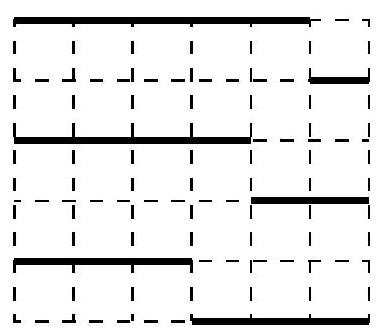 | :
To determine the total length of the six solid line segments shown in the diagram, we follow these steps:
1. **Identify each individual segment length**:
- The lengths of the solid line segments from top to bottom are:
\[
5, 1, 4, 2, 3, \text{and} 3
\]
2. **Sum these lengths**:
\[
5 + 1 + 4... | [
{
"content": "In the diagram, the \\(5 \\times 6\\) grid is made out of thirty \\(1 \\times 1\\) squares. What is the total length of the six solid line segments shown?\n(A) 6\n(B) 12\n(C) 16\n(D) 18\n(E) 20\n\n grid along the dashed line such that each resulting rectangle contains exactly one number, and that number should equal the area of the rectangle. Specifically, it asks us to determine to how many different rectangles each of the 7 small squares in the 4th colum... | [
{
"content": "As shown in the diagram, divide a $7 \\times 7$ grid along the dotted lines into several rectangles such that each rectangle contains exactly one number, and this number equals the area of the rectangle. The seven small squares in the fourth column belong to different rectangles.",
"role": "us... |
olympiads | As shown in the diagram, \( AB \) is the diameter of a semicircle, \( O \) is the center of the circle, \( CD \perp AB \), and \( DE \perp OC \). If the lengths of \( AD \), \( BD \), and \( CD \) are all rational numbers, then among the following three statements:
- Statement 1: The length of \( OE \) is a rational n... | 1. We are given that $AD, BD$ and $CD$ are all rational numbers.
2. Because $O$ is the center of the semicircle and $AB$ is the diameter, we have $OA = OB = \frac{AB}{2}$. Thus, these are also rational numbers.
3. Calculate $OC$. Since $C$ is the midpoint of $AB$, $OC = OA = OB$, which is a rational number.
4. Next, $O... | [
{
"content": "As shown in the diagram, \\( AB \\) is the diameter of a semicircle, \\( O \\) is the center of the circle, \\( CD \\perp AB \\), and \\( DE \\perp OC \\). If the lengths of \\( AD \\), \\( BD \\), and \\( CD \\) are all rational numbers, then among the following three statements:\n\n- Statement 1... |
olympiads | In the diagram, $\triangle PQR$ is right-angled at $P$ and $PR = 12$. If point $S$ is on $PQ$ so that $SQ = 11$ and $SR = 13$, the perimeter of $\triangle QRS$ is
(A) 47
(B) 44
(C) 30
(D) 41
(E) 61 | 1. Let's first determine the length of \( P S \) using the Pythagorean theorem in \( \triangle P R S \):
\[
P S = \sqrt{R S^2 - P R^2} = \sqrt{13^2 - 12^2}
\]
Calculating the squares:
\[
13^2 = 169 \quad \text{and} \quad 12^2 = 144
\]
Subtracting these, we get:
\[
P S = \sqrt{169 - 144} = ... | [
{
"content": "In the diagram, $\\triangle PQR$ is right-angled at $P$ and $PR = 12$. If point $S$ is on $PQ$ so that $SQ = 11$ and $SR = 13$, the perimeter of $\\triangle QRS$ is\n(A) 47\n(B) 44\n(C) 30\n(D) 41\n(E) 61",
"role": "user"
},
{
"content": "1. Let's first determine the length of \\( P S ... |
olympiads | In the diagram, nine identical isosceles trapezoids are connected as shown to form a closed ring. (An isosceles trapezoid is a trapezoid with the properties that one pair of sides is parallel and the other two sides are equal in length.) What is the measure of $\angle ABC$? | ## Solution
1:
1. **Determine the number of sides of the inner polygon**:
The inner polygon formed by the nine trapezoids is a regular nonagon (a 9-sided polygon). This is because:
- All sides of this polygon are equal in length, which is equal to the shorter parallel side of one of the identical trapezoid... | [
{
"content": "In the diagram, nine identical isosceles trapezoids are connected as shown to form a closed ring. (An isosceles trapezoid is a trapezoid with the properties that one pair of sides is parallel and the other two sides are equal in length.) What is the measure of $\\angle ABC$?",
"role": "user"
... |
olympiads | The word "stop" starts in the position shown in the diagram to the right. It is then rotated $180^{\circ}$ clockwise about the origin, $O$, and this result is then reflected in the $x$-axis. Which of the following represents the final image?
(A)

2. **Rotation by $180^\circ$**: Rotating the word $180^\circ$ clockwise abou... | [
{
"content": "The word \"stop\" starts in the position shown in the diagram to the right. It is then rotated $180^{\\circ}$ clockwise about the origin, $O$, and this result is then reflected in the $x$-axis. Which of the following represents the final image?\n(A)\n\n is the region inside the two smaller circles but outside the largest circle. Prove that the area of \( R \) is equal to the area of the triangle. |
1. **Introduce Notations and Definitions**:
Let:
- \(T\) be the area of the triangle,
- \(S_1\) be the area of the semicircle with the hypotenuse as the diameter,
- \(S_2\) and \(S_3\) be the areas of the semicircles with the shorter sides of the triangle as diameters.
2. **Set Up the Equation**:
We ca... | [
{
"content": "The diagram shows a right-angled triangle and three circles. Each side of the triangle is a diameter of one of the circles. The shaded region \\( R \\) is the region inside the two smaller circles but outside the largest circle. Prove that the area of \\( R \\) is equal to the area of the triangle... |
olympiads | The diagram shows a 16 meter by 16 meter wall. Three grey squares are painted on the wall as shown. The two smaller grey squares are equal in size and each makes an angle of \(45^\circ\) with the edge of the wall. The grey squares cover a total area of \(B\) square meters. What is the value of \(B\)? |
1. **Initialize Dimensions and Square Calculations:**
- The wall is 16 metres by 16 metres.
- There are two smaller grey squares and one larger grey square on the wall.
- The diagonal of each smaller grey square is 8 metres since they are tilted at an angle of $45^\circ$ to the edge of the wall.
2. **Usi... | [
{
"content": "The diagram shows a 16 meter by 16 meter wall. Three grey squares are painted on the wall as shown. The two smaller grey squares are equal in size and each makes an angle of \\(45^\\circ\\) with the edge of the wall. The grey squares cover a total area of \\(B\\) square meters. What is the value o... |
olympiads | In the diagram, \(D\) is on side \(AC\) of \(\triangle ABC\) so that \(BD\) is perpendicular to \(AC\). If \(AB = 29\), \(AC = 69\), and \(BD = 20\), what is the length of \(BC\)? | Given a right triangle \( \triangle ABD \) and the values \( AB = 29 \), \( AC = 69 \), and \( BD = 20 \).
1. **Apply the Pythagorean Theorem in \( \triangle ABD \):**
\[
AD^2 + BD^2 = AB^2
\]
Substitute the known values:
\[
AD^2 + 20^2 = 29^2
\]
\[
AD^2 + 400 = 841
\]
\[
AD^2 = 841... | [
{
"content": "In the diagram, \\(D\\) is on side \\(AC\\) of \\(\\triangle ABC\\) so that \\(BD\\) is perpendicular to \\(AC\\). If \\(AB = 29\\), \\(AC = 69\\), and \\(BD = 20\\), what is the length of \\(BC\\)?",
"role": "user"
},
{
"content": "Given a right triangle \\( \\triangle ABD \\) and the... |
olympiads | In the diagram, each scale shows the total mass (weight) of the shapes on that scale. What is the mass (weight) of a $\triangle$?
(A) 3
(B) 5
(C) 12
(D) 6
(E) 5.5 |
1. **Interpret the first scale**:
The first scale shows that a square \( S \) and a circle \( C \) together have a mass of 8.
\[
S + C = 8
\]
2. **Interpret the second scale**:
The second scale shows that a square \( S \) and two circles \( C \) together have a mass of 11.
\[
S + 2C = 11
\]... | [
{
"content": "In the diagram, each scale shows the total mass (weight) of the shapes on that scale. What is the mass (weight) of a $\\triangle$?\n(A) 3\n(B) 5\n(C) 12\n(D) 6\n(E) 5.5",
"role": "user"
},
{
"content": "\n1. **Interpret the first scale**:\n The first scale shows that a square \\( S \... |
olympiads | As shown in the diagram, five equilateral triangles of side length $2\sqrt{3}$ are arranged on the same side of a straight line, such that the midpoint of the base of each triangle is the vertex of the next triangle. What is the area covered by these five triangles in the plane?
(A) 10
(B) 12
(C) 15
(D) $10 \sqrt{3}$
(... |
1. **Understand the Problem:**
We have five equilateral triangles arranged in a line, with each triangle having a side length of \(2\sqrt{3}\). Every middle point of the base of one triangle is the vertex of the next triangle.
2. **Calculate the Area of a Single Equilateral Triangle:**
The area of an equila... | [
{
"content": "As shown in the diagram, five equilateral triangles of side length $2\\sqrt{3}$ are arranged on the same side of a straight line, such that the midpoint of the base of each triangle is the vertex of the next triangle. What is the area covered by these five triangles in the plane?\n(A) 10\n(B) 12\n... |
olympiads | In the cube \(A B C D - A_{1} B_{1} C_{1} D_{1}\), \(E\) is the trisection point of \(A_{1} A\), and \(F\) is the trisection point of \(C_{1} C\). Given that \(A E = 2 A_{1} E\) and \(C F = 2 C_{1} F\), a section is formed through \(B\), \(E\), and \(F\). Among the projection diagrams of this section on the respective ... |
1. **Identifying Points and Division of Line Segments**:
- In the cube \(A B C D - A_1 B_1 C_1 D_1\), point \(E\) is defined as the point that divides segment \(A_1 A\) into three equal parts. This means \(A_1E = \frac{1}{3}A_1A\) and \(AE = \frac{2}{3}A_1A\).
- Similarly, point \(F\) is defined as the point tha... | [
{
"content": "In the cube \\(A B C D - A_{1} B_{1} C_{1} D_{1}\\), \\(E\\) is the trisection point of \\(A_{1} A\\), and \\(F\\) is the trisection point of \\(C_{1} C\\). Given that \\(A E = 2 A_{1} E\\) and \\(C F = 2 C_{1} F\\), a section is formed through \\(B\\), \\(E\\), and \\(F\\). Among the projection d... |
olympiads | In the diagram, \( A M N, A P Q, Q R M \), and \( P R N \) are all straight lines. The value of \( a+b \) is:
(A) 70
(B) 55
(C) 80
(D) 90
(E) 75 | 1. **Identifying angle relationships:**
- We start by noting that $\angle PRM = 125^\circ$.
- Since $QR$ and $RM$ are straight lines, the angles around point $R$ must sum to $360^\circ$. Specifically, $\angle QRP = \angle NRM = 55^\circ$ because $PRM + QRP = 180^\circ$ and $PRM + NRM = 180^\circ$.
This gives... | [
{
"content": "In the diagram, \\( A M N, A P Q, Q R M \\), and \\( P R N \\) are all straight lines. The value of \\( a+b \\) is:\n(A) 70\n(B) 55\n(C) 80\n(D) 90\n(E) 75",
"role": "user"
},
{
"content": "1. **Identifying angle relationships:** \n - We start by noting that $\\angle PRM = 125^\\circ... |
olympiads | As shown in the diagram, quadrilateral \(ABCD\) is inscribed in a circle. The extensions of \(AB\) and \(DC\) intersect at \(E\), and the extensions of \(AD\) and \(BC\) intersect at \(F\). Point \(P\) is an arbitrary point on the circle, and \(PE\) and \(PF\) intersect the circle again at \(R\) and \(S\), respectively... |
1. Extend lines \(AB\) and \(DC\) to meet at point \(E\), and extend lines \(AD\) and \(BC\) to meet at point \(F\). Let \(P\) be any point on the circumcircle, and let \(PE\) and \(PF\) intersect the circle again at points \(R\) and \(S\), respectively. The diagonals \(AC\) and \(BD\) intersect at point \(T\).
2. We... | [
{
"content": "As shown in the diagram, quadrilateral \\(ABCD\\) is inscribed in a circle. The extensions of \\(AB\\) and \\(DC\\) intersect at \\(E\\), and the extensions of \\(AD\\) and \\(BC\\) intersect at \\(F\\). Point \\(P\\) is an arbitrary point on the circle, and \\(PE\\) and \\(PF\\) intersect the cir... |
olympiads | In the diagram, the circle is inscribed in the square. This means that the circle and the square share points \(S, T, U,\) and \(V\), and the width of the square is exactly equal to the diameter of the circle. Rounded to the nearest tenth, what percentage of line segment \(XY\) is outside the circle?
(A) 29.3
(B) 28.3
... | 1. **Assume the Side Length of the Square:**
Suppose the side length of the square is \( 2 \). This assumption doesn't affect the final percentage because the relationship between the circle and the square remains the same regardless of the actual side length.
2. **Determine the Diameter of the Circle:**
Since t... | [
{
"content": "In the diagram, the circle is inscribed in the square. This means that the circle and the square share points \\(S, T, U,\\) and \\(V\\), and the width of the square is exactly equal to the diameter of the circle. Rounded to the nearest tenth, what percentage of line segment \\(XY\\) is outside th... |
olympiads | Four squares with integer side lengths are arranged as shown in the diagram, with three vertices of square \( A \) being the centers of squares \( B \), \( C \), and \( D \). If the total area of the red parts is equal to the area of the green part, what is the minimum side length of square \( A \)? | To find the minimum edge length of the square \( \mathrm{A} \), given the conditions, let's break down the solution step-by-step.
1. **Define Variables:**
- Let the side length of square \( \mathrm{A} \) be denoted by \( a \).
- Let the side lengths of squares \( \mathrm{B}, \mathrm{C}, \) and \( \mathrm{D} \) r... | [
{
"content": "Four squares with integer side lengths are arranged as shown in the diagram, with three vertices of square \\( A \\) being the centers of squares \\( B \\), \\( C \\), and \\( D \\). If the total area of the red parts is equal to the area of the green part, what is the minimum side length of squar... |
olympiads | As shown in the diagram, from a point \( C \) on the semicircle, a perpendicular is drawn to the diameter \( AB \) with foot \( D \). Construct a circle \( \odot O_1 \) that is tangent to \(\overparen{BC}, CD\), and \(DB\) at points \(E, F, G\) respectively. Prove that \(AC = AG\). |
1. Let's denote the center of the semicircle as \( O \). So, we have \( O \), \( O_1 \), and \( E \) collinear.
2. Connect \( O_1F \). Since \( O_1F \perp CD \), it follows that \( O_1F \parallel AB \).
3. Next, connect \( EF \) and \( AE \). Observe that:
\[
\angle FEO_1 = \frac{1}{2} \angle FO_1O = \frac{... | [
{
"content": "As shown in the diagram, from a point \\( C \\) on the semicircle, a perpendicular is drawn to the diameter \\( AB \\) with foot \\( D \\). Construct a circle \\( \\odot O_1 \\) that is tangent to \\(\\overparen{BC}, CD\\), and \\(DB\\) at points \\(E, F, G\\) respectively. Prove that \\(AC = AG\\... |
olympiads | In the diagram, eight circles, each with a radius of 1, are drawn inside a rectangle. Four of the circles are tangent to two sides of the rectangle and to two other circles. The other four circles are tangent to one side of the rectangle and to three other circles. A region has been shaded, consisting of three spaces (... |
1. **Shaded Circles' Areas**:
- Each of the four shaded circles has a radius of $1$.
- The area of one circle is given by:
\[
\text{Area of one circle} = \pi \cdot 1^2 = \pi
\]
- Therefore, the total area of the four shaded circles is:
\[
4 \cdot \pi = 4\pi
\... | [
{
"content": "In the diagram, eight circles, each with a radius of 1, are drawn inside a rectangle. Four of the circles are tangent to two sides of the rectangle and to two other circles. The other four circles are tangent to one side of the rectangle and to three other circles. A region has been shaded, consis... |
olympiads | Sixteen straight segments. A sales agent set out in his car from the point indicated in the diagram, planning to cover a distance of 76 km, which consists of 16 straight segments, without traveling the same segment twice. The dots represent settlements located 1 km apart from each other, and the lines represent the rou... |
To solve this problem, we must determine a route of 76 km composed of 16 straight segments that allows the traveling agent to visit all but exactly 3 inhabited points (cities) when considering the constraints.
Let's devise the method step-by-step to ensure correctness:
1. **Total Distance and Segments Calculation**... | [
{
"content": "Sixteen straight segments. A sales agent set out in his car from the point indicated in the diagram, planning to cover a distance of 76 km, which consists of 16 straight segments, without traveling the same segment twice. The dots represent settlements located 1 km apart from each other, and the l... |
olympiads | In the diagram, \( AB \) is a chord of the circle \(\omega\). \( P \) is a point on the arc \( AB \) inside the circle. Points \( E \) and \( F \) are on the line segment \( AB \), such that \( AE = EF = FB \). Lines \( PE \) and \( PF \) are extended to intersect the circle \(\omega\) at points \( C \) and \( D \) res... |
1. **Identify Given Data and Initial Setup:**
- $AB$ is a chord of circle $\omega$.
- $P$ is a point on the chord $AB$.
- Points $E$ and $F$ lie on the segment $AB$ such that $AE = EF = FB$.
- $PE$ and $PF$, extended, intersect the circle $\omega$ again at points $C$ and $D$, respectively.
2. **Draw C... | [
{
"content": "In the diagram, \\( AB \\) is a chord of the circle \\(\\omega\\). \\( P \\) is a point on the arc \\( AB \\) inside the circle. Points \\( E \\) and \\( F \\) are on the line segment \\( AB \\), such that \\( AE = EF = FB \\). Lines \\( PE \\) and \\( PF \\) are extended to intersect the circle \... |
olympiads |
The centers \( O_1, O_2 \), and \( O_3 \) of three non-intersecting circles of the same radius are located at the vertices of a triangle. From the points \( O_1, O_2 \), and \( O_3 \), tangents are drawn to these circles as shown in the diagram. It is known that these tangents intersect to form a convex hexagon whose ... |
1. Let's denote the points of tangency as \( X_1, X_2, Y_1, Y_2, Z_1, Z_2 \), and the vertices of the hexagon as \( A, B, C, D, E, F \) (see the diagram for reference).
2. Since the radii of all the circles are equal, we have:
\[
X_1O_2 = O_1Y_2, \quad Y_1O_3 = O_2Z_2, \quad Z_1O_1 = O_3X_2
\]
3. Rewrite th... | [
{
"content": "\nThe centers \\( O_1, O_2 \\), and \\( O_3 \\) of three non-intersecting circles of the same radius are located at the vertices of a triangle. From the points \\( O_1, O_2 \\), and \\( O_3 \\), tangents are drawn to these circles as shown in the diagram. It is known that these tangents intersect ... |
olympiads | In the diagram, in the plane Cartesian coordinate system \( XOY \), the rhombus \( ABCD \) has a side length of 4, and \( |OB| = |OD| = 6 \).
1. Prove that \( |OA| \cdot |OC| \) is a constant value.
2. When point \( A \) moves on the semicircle \( (x-2)^{2}+y^{2}=4 \) with \( 2 \leq x \leq 4 \), find the trajectory of ... | ### Problem:
In the plane rectangular coordinate system \(X O Y\), the sides of the rhombus \(ABCD\) are all 4 units long, and \( |OB| = |OD| = 6 \).
1. Prove that the product \( |O A| \cdot |O C| \) is a constant value.
2. When point \( A \) moves on the semicircle \((x-2)^{2} + y^{2} = 4 \) for \(2 \leqslant x \leq... | [
{
"content": "In the diagram, in the plane Cartesian coordinate system \\( XOY \\), the rhombus \\( ABCD \\) has a side length of 4, and \\( |OB| = |OD| = 6 \\).\n1. Prove that \\( |OA| \\cdot |OC| \\) is a constant value.\n2. When point \\( A \\) moves on the semicircle \\( (x-2)^{2}+y^{2}=4 \\) with \\( 2 \\l... |
olympiads | As shown in the diagram above, the vertices of a regular decagon are colored alternately black and white. We would like to draw colored line segments between the points in such a way that:
(a) Every black point is connected to every white point by a line segment.
(b) No two line segments of the same color intersect, ... |
To solve this problem, we need to determine how many colors are required to draw line segments that connect every black point to every white point on a regular decagon, adhering to the conditions mentioned. Let's go through the steps to find the minimum number of colors required:
1. **Identify the constraints**:
... | [
{
"content": "As shown in the diagram above, the vertices of a regular decagon are colored alternately black and white. We would like to draw colored line segments between the points in such a way that:\n\n(a) Every black point is connected to every white point by a line segment.\n\n(b) No two line segments of ... |
olympiads | Using the four 4-square tiles in the bottom left diagram, we created the shape shown in the bottom right diagram. If we fill each of the 16 squares in the right diagram with the numbers 1, 3, 5, and 7 (each number is used once per square), such that each row and each column contains all different numbers, and the four ... |
1. **Understand the Problem Statement:**
- We are given a \(4 \times 4\) grid with 16 squares.
- We need to fill each square with the numbers 1, 3, 5, and 7.
- Each number must be placed such that:
- No row or column contains repeated numbers.
- No 2x2 subgrid (which are the individual pieces of the... | [
{
"content": "Using the four 4-square tiles in the bottom left diagram, we created the shape shown in the bottom right diagram. If we fill each of the 16 squares in the right diagram with the numbers 1, 3, 5, and 7 (each number is used once per square), such that each row and each column contains all different ... |
olympiads | Given three circles of the same radius on a plane, prove that if all of them intersect at a single point (as shown in the diagram), the sum of the marked arcs $AK$, $CK$, and $EK$ is equal to $180^\circ$. |
1. Let's denote the centers of the given circles as \( O_1, O_2, \) and \( O_3 \).
2. Define the angles as follows:
\[
\angle C O_1 K = \alpha, \quad \angle A O_2 K = \beta, \quad \angle E O_3 K = \gamma.
\]
3. Our aim is to prove that \( \alpha + \beta + \gamma = 180^\circ \).
4. Note that the quadrilatera... | [
{
"content": "Given three circles of the same radius on a plane, prove that if all of them intersect at a single point (as shown in the diagram), the sum of the marked arcs $AK$, $CK$, and $EK$ is equal to $180^\\circ$.",
"role": "user"
},
{
"content": "\n1. Let's denote the centers of the given cir... |
olympiads | The diagram shows a rectangle inside an isosceles triangle. The base of the triangle is \( n \) times the base of the rectangle, for some integer \( n \) greater than 1. Prove that the rectangle occupies a fraction \( \frac{2}{n} - \frac{2}{n^{2}} \) of the total area. |
We are given an isosceles triangle with a rectangle inscribed in such a way that the base of the triangle is \( n \) times the base of the rectangle, where \( n \) is an integer greater than 1. We need to find the fraction of the area of the triangle that is occupied by the rectangle.
Let:
- \( AB = b \) be the base ... | [
{
"content": "The diagram shows a rectangle inside an isosceles triangle. The base of the triangle is \\( n \\) times the base of the rectangle, for some integer \\( n \\) greater than 1. Prove that the rectangle occupies a fraction \\( \\frac{2}{n} - \\frac{2}{n^{2}} \\) of the total area.",
"role": "user"... |
olympiads | In the diagram, $\mathrm{ABCD}$ is a right trapezoid with $\angle \mathrm{DAB} = \angle \mathrm{ABC} = 90^\circ$. A rectangle $\mathrm{ADEF}$ is constructed externally along $\mathrm{AD}$, with an area of 6.36 square centimeters. Line $\mathrm{BE}$ intersects $\mathrm{AD}$ at point $\mathrm{P}$, and line $\mathrm{PC}$ ... |
1. **Setup and Given Information:**
- We are given a right-angled trapezoid \( \mathrm{ABCD} \) such that \( \angle \mathrm{DAB} = \angle \mathrm{ABC} = 90^\circ \).
- Extend \( \mathrm{AD} \) to create a rectangle \( \mathrm{ADEF} \) with area \( 6.36 \) square meters.
- Connect \( \mathrm{BE} \), intersecti... | [
{
"content": "In the diagram, $\\mathrm{ABCD}$ is a right trapezoid with $\\angle \\mathrm{DAB} = \\angle \\mathrm{ABC} = 90^\\circ$. A rectangle $\\mathrm{ADEF}$ is constructed externally along $\\mathrm{AD}$, with an area of 6.36 square centimeters. Line $\\mathrm{BE}$ intersects $\\mathrm{AD}$ at point $\\ma... |
olympiads | As shown in the diagram, circles \(\odot \mathrm{O}_{1}, \odot \mathrm{O}_{2}\), and \(\odot \mathrm{O}_{3}\) intersect at point \(P\). A straight line intersects \(\odot \mathrm{O}_{1}\) and \(\odot \mathrm{O}_{2}\) at points \(B\) and \(C\), respectively. The extension of \(\mathrm{AP}\) intersects \(\odot \mathrm{O}... | 1. **Identify Key Points and Relations**
Let $\odot \mathrm{O}_{1}$, $\odot \mathrm{O}_{2}$, and $\odot \mathrm{O}_{3}$ be circles intersecting at point $P$. A line intersects $\odot \mathrm{O}_{1}$ and $\odot \mathrm{O}_{2}$ at points $B$ and $C$ respectively. The extension of $AP$ intersects $\odot \mathrm{O}_{3}$... | [
{
"content": "As shown in the diagram, circles \\(\\odot \\mathrm{O}_{1}, \\odot \\mathrm{O}_{2}\\), and \\(\\odot \\mathrm{O}_{3}\\) intersect at point \\(P\\). A straight line intersects \\(\\odot \\mathrm{O}_{1}\\) and \\(\\odot \\mathrm{O}_{2}\\) at points \\(B\\) and \\(C\\), respectively. The extension of... |
olympiads | Eight paper squares of size $2 \times 2$ were sequentially placed on a table to form a larger square of size $4 \times 4$. The last square placed was square $E$. The diagram shows how the squares are visible: square $E$ is fully visible, while the other squares are partially visible. Which square was placed on the tabl... |
1. **Understanding the Problem:**
We start with the description of the squares and how they were placed. Given the constraints that the square \( E \) was the last to be placed on the table, and all other squares are partially visible, we proceed to determine the order they were laid.
2. **Identification of Squar... | [
{
"content": "Eight paper squares of size $2 \\times 2$ were sequentially placed on a table to form a larger square of size $4 \\times 4$. The last square placed was square $E$. The diagram shows how the squares are visible: square $E$ is fully visible, while the other squares are partially visible. Which squar... |
olympiads | In the given diagram, in the cube \( A B C D - A_{1} B_{1} C_{1} D_{1} \), what is the measure of the dihedral angle \( B - A_{1} C - D \)? |
1. Let's denote the side length of the given cube $ ABCD-A_1B_1C_1D_1 $ as $1$.
2. As shown in Fig. 4, we draw a perpendicular from $B$ to the plane defined by $A_1C$ at point $E$ and connect $D$ to $E$.
3. Due to the properties of the cube, we know that:
\[
\triangle A_{1} D C \cong \triangle A_{1} B C
\]... | [
{
"content": "In the given diagram, in the cube \\( A B C D - A_{1} B_{1} C_{1} D_{1} \\), what is the measure of the dihedral angle \\( B - A_{1} C - D \\)?",
"role": "user"
},
{
"content": "\n1. Let's denote the side length of the given cube $ ABCD-A_1B_1C_1D_1 $ as $1$. \n\n2. As shown in Fig. 4,... |
olympiads | In the diagram, square \(ABCD\) has a side length of 4. What is the total area of the shaded regions?
(A) 4
(B) 8
(C) 9
(D) 12
(E) 16 |
1. **Understand the problem**:
We need to find the total area of the shaded regions in a square \(ABCD\) with a side length of 4 units. The square is divided into four rectangles, and each rectangle is split into two identical triangles, with some triangles being shaded.
2. **Calculate the area of the square**:
... | [
{
"content": "In the diagram, square \\(ABCD\\) has a side length of 4. What is the total area of the shaded regions?\n(A) 4\n(B) 8\n(C) 9\n(D) 12\n(E) 16",
"role": "user"
},
{
"content": "\n1. **Understand the problem**:\n We need to find the total area of the shaded regions in a square \\(ABCD\\... |
olympiads | As shown in the diagram, \( A \) and \( B \) are fixed points on two fixed lines \( AX \) and \( BY \), respectively. Points \( P \) and \( R \) are on ray \( AX \), and points \( Q \) and \( S \) are on ray \( BY \). Given \(\frac{AP}{BQ} = \frac{AR}{BS}\), let \( M \), \( N \), and \( T \) be points on segments \( AB... |
We need to show that the points \(M\), \(N\), and \(T\) are collinear given the conditions:
1. \(\frac{AP}{BQ}=\frac{AR}{BS}\).
2. \(\frac{AM}{MB}=\frac{PN}{NQ}=\frac{RT}{TS}\).
Let's start by using vectors and setting up the given conditions in vector form. Let:
- \(\overrightarrow{AB} = \boldsymbol{a}\)
- \(\overr... | [
{
"content": "As shown in the diagram, \\( A \\) and \\( B \\) are fixed points on two fixed lines \\( AX \\) and \\( BY \\), respectively. Points \\( P \\) and \\( R \\) are on ray \\( AX \\), and points \\( Q \\) and \\( S \\) are on ray \\( BY \\). Given \\(\\frac{AP}{BQ} = \\frac{AR}{BS}\\), let \\( M \\), ... |
olympiads | In the diagram, $\triangle PQR$ is right-angled at $P$ and $\angle PRQ=\theta$. A circle with center $P$ is drawn passing through $Q$. The circle intersects $PR$ at $S$ and $QR$ at $T$. If $QT=8$ and $TR=10$, determine the value of $\cos \theta$. |
1. Note the given information:
- Triangle $PQR$ is right-angled at $P$.
- $\angle PRQ = \theta$.
- A circle with center $P$ passes through $Q$.
- The circle intersects $PR$ at $S$ and $QR$ at $T$.
- $QT = 8$ and $TR = 10$.
- Therefore, $QR = QT + TR = 8 + 10 = 18$.
2. Let the radius of the circle be... | [
{
"content": "In the diagram, $\\triangle PQR$ is right-angled at $P$ and $\\angle PRQ=\\theta$. A circle with center $P$ is drawn passing through $Q$. The circle intersects $PR$ at $S$ and $QR$ at $T$. If $QT=8$ and $TR=10$, determine the value of $\\cos \\theta$.",
"role": "user"
},
{
"content": "... |
olympiads | Thirteen identical metallic rods are connected as shown in the diagram. It is known that the resistance of the entire construction is $R=8$ Ω. Determine the resistance of one rod $R_{0}$, if this construction is connected to a current source at points $A$ and $B$. |
1. **Identify the Problem and Equivalent Resistance**:
We are given a network of 13 identical metal rods connected in a specific manner, and the total resistance of the configuration between points \( A \) and \( B \) is \( R = 8 \Omega \). We need to find the resistance of a single rod, denoted as \( R_0 \).
2. ... | [
{
"content": "Thirteen identical metallic rods are connected as shown in the diagram. It is known that the resistance of the entire construction is $R=8$ Ω. Determine the resistance of one rod $R_{0}$, if this construction is connected to a current source at points $A$ and $B$.",
"role": "user"
},
{
... |
olympiads | In the diagram, \(\triangle PQR\) has \(PQ = QR = RP = 30\). Points \(S\) and \(T\) are on \(PQ\) and \(PR\), respectively, so that \(ST\) is parallel to \(QR\). Points \(V\) and \(U\) are on \(QR\) so that \(TU\) is parallel to \(PQ\) and \(SV\) is parallel to \(PR\). If \(VS + ST + TU = 35\), the length of \(VU\) is:... |
To find the length of $V U$, we will leverage the properties of the equilateral triangles formed within $\triangle PQR$ and the given condition that $VS + ST + TU = 35$.
1. **Identify the type of triangles within $\triangle PQR$:**
Since $P Q = Q R = R P = 30$, $\triangle PQR$ is an equilateral triangle, and each ... | [
{
"content": "In the diagram, \\(\\triangle PQR\\) has \\(PQ = QR = RP = 30\\). Points \\(S\\) and \\(T\\) are on \\(PQ\\) and \\(PR\\), respectively, so that \\(ST\\) is parallel to \\(QR\\). Points \\(V\\) and \\(U\\) are on \\(QR\\) so that \\(TU\\) is parallel to \\(PQ\\) and \\(SV\\) is parallel to \\(PR\\... |
olympiads | There are 16 halls in the museum, arranged as shown in the diagram. Half of these halls exhibit paintings, while the other half exhibit sculptures. From any hall, one can move to any adjacent hall (one with a common wall). During any tour of the museum, the halls alternate: a hall with paintings, a hall with sculptures... |
1. We start by recognizing that there are 16 halls in the museum. Half of them contain pictures, and the other half contain sculptures. This implies:
\[
\text{Number of halls with pictures} = \frac{16}{2} = 8
\]
and
\[
\text{Number of halls with sculptures} = \frac{16}{2} = 8
\]
2. Given that any... | [
{
"content": "There are 16 halls in the museum, arranged as shown in the diagram. Half of these halls exhibit paintings, while the other half exhibit sculptures. From any hall, one can move to any adjacent hall (one with a common wall). During any tour of the museum, the halls alternate: a hall with paintings, ... |
End of preview. Expand in Data Studio
README.md exists but content is empty.
- Downloads last month
- 93