

source stringclasses 1
value | problem stringlengths 38 2.6k | solution stringlengths 449 6.61k | messages stringclasses 1
value | gpt_difficulty stringclasses 15
values | gpt_difficulty_parsed int64 1 10 |
|---|---|---|---|---|---|
olympiads | Consider the following figure:
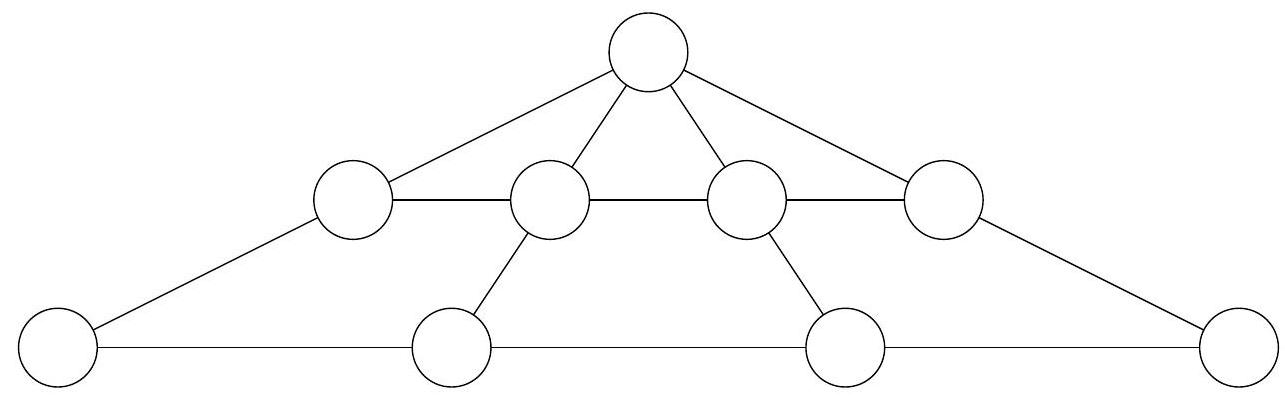
We seek to label the nine fields in the figure with the numbers 1, 2, .., 9, using each number exactly once. Furthermore, the ... |
1. Let's denote the numbers in the fields of the figure as follows:
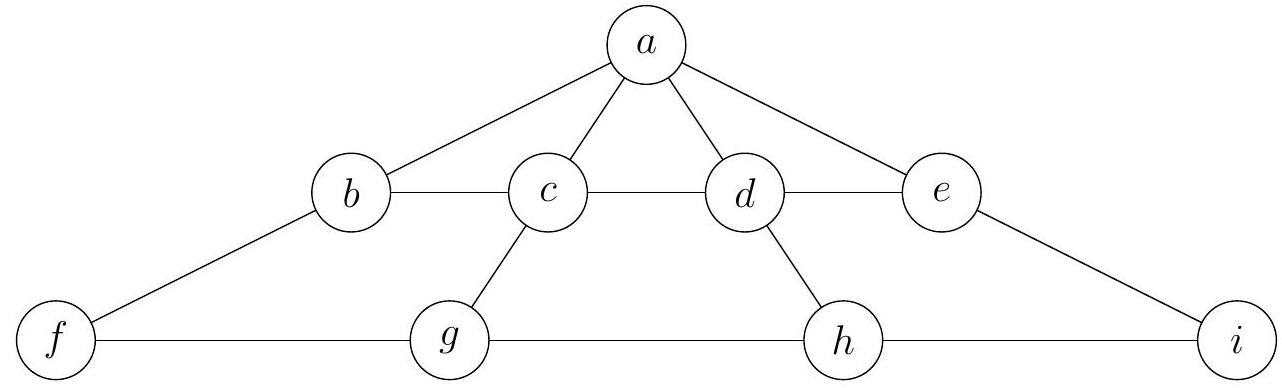
2. If we denote the common value of the six sums by \( s \), we obtain the following equations from the problem ... | [[7]] | 7 | |
olympiads | As shown in the figure, the side length of square $\mathrm{ABCD}$ is $10$, and $O$ is its center. $O E \perp O F$. Find the area of the shaded region. |
**Step 1: Identify Given Data and Notations**
- Given: The square \( \mathrm{ABCD} \) has side length \(10\).
- \( O \) is the center of the square.
- \( O E \perp O F \).
**Step 2: Utilize Symmetry and Properties of Square**
- Since \( O \) is the center of the square, the coordinates of \( A, B, C, D \) are symmetr... | [[3]] | 3 | |
olympiads | In the given figure, semicircles with centers at points \( A \) and \( B \) and radii 2 and 1, respectively, are inscribed in a larger semicircle with diameter \( JK \). The two smaller semicircles are also tangent to each other. \( \odot P \) is a circle that is tangent to both smaller semicircles and inscribed within... | To find the radius \(r\) of \(\odot P\) given the conditions in the problem, we need to apply a theorem known as Stewart's Theorem, which in a triangle \(ABC\) with a cevian \(AD\) (where \(D\) is on \(BC\)), relates the lengths of the sides and the cevian. Here are the steps:
1. **Setting up the problem:**
- The ... | [[6]] | 6 | |
olympiads |
King Arthur wants to order a new knight's shield from the blacksmith according to his sketch. The king used a compass and drew three arcs with a radius of 1 yard, as shown in the figure. What is the area of the shield? Round your answer to two decimal places. Recall that the area of a circle with radius \( r \) is \( ... |
To solve this problem, we need to find the area of the shield depicted in the sketch. According to the sketch, the shield is composed of three equal arcs, each with a radius of 1 yard. Here's a step-by-step breakdown:
1. **Understanding the Shape of the Shield**:
From the sketch, the shield seems to be a sector ... | [[2]] | 2 | |
olympiads | As shown in the figure, $\odot \circ$ is the circumcircle of $\triangle ABC$, $D$ is the midpoint of arc $BAC$, $E$ is the midpoint of arc $BC$, and $CF \perp AB$. |
1. Given the sequence of points: The circumcircle \( \odot \circ \) of \( \triangle ABC \), the midpoint \( D \) of arc \( BAC \) and the midpoint \( E \) of arc \( BC \).
2. Given the points: \( D \), \( C \), and \( F \). We know \( CF \perp AB \).
3. Consider the line segment \( DE \), which intersects \( BC \) a... | [[8]] | 8 | |
olympiads | As shown in the figure, \( AC = BC \). The tangents to the circumcircle of \(\triangle ABC\) at points \(A\) and \(C\) intersect at point \(D\). Line \(BD\) intersects the circle again at point \(E\). Ray \(AE\) intersects \(CD\) at point \(F\). Prove that \(F\) is the midpoint of \(CD\). |
1. We begin by noting from the problem that $AC = BC$ and $ \triangle ABC$ has an external circle, and line $AD$ intersects at point $D$ and line $BD$ intersects the circle at point $E$. The ray $AE$ intersects $CD$ at point $F$.
2. Using the information that $AC = BC$, we know $\triangle ABC$ is isosceles at $C$. Th... | [[7]] | 7 | |
olympiads | We want to create a square-based, open-top box from a circular piece of paper as shown in the figure. Determine the ratio of dimensions \( a \) and \( b \) seen in the figure such that the volume of the box is maximized. |
1. **Given Data**:
We are given that a rectangular box without a top is to be constructed from a circular piece of paper. Let the diameter of the circle be $D$, the side of the square base be $a$, and the height of the box be $b$.
2. **Volume Formula**:
The volume $V$ of the box can be expressed as:
\[
V... | [[5]] | 5 | |
olympiads | As shown in the figure, there is a toy clock. For each full circle that the hour hand makes, the minute hand makes 9 circles. If initially the two hands coincide, what is the degree turned by the hour hand when they next coincide? |
1. **Understanding the Problem:**
- We are given a toy clock where the hour hand and the minute hand coincide at the starting time.
- We need to find the angular movement of the hour hand until it coincides again with the minute hand.
2. **Relative Speeds of the Hands:**
- The hour hand takes \(12\) hours to... | [[2]] | 2 | |
olympiads | The diagram shows two circular arcs \( CP \) and \( CQ \) in a right-angled triangle \( ABC \), where \(\angle BCA = 90^\circ\). The centers of the arcs are \( A \) and \( B \). Prove that \(\frac{1}{2} PQ^2 = AP \times BQ\). |
1. **Define Lengths and Apply Pythagoras' Theorem:**
Let the lengths of sides \(BC\), \(CA\), and \(AB\) of the right-angled triangle \(ABC\) be \(a\), \(b\), and \(c\) respectively, meaning:
\[
BC = a, \quad CA = b, \quad AB = c
\]
Given that \(\angle BCA = 90^\circ\), we apply the Pythagorean theo... | [[8]] | 8 | |
olympiads | Through a point \( P \) three segments parallel to the sides of triangle \( ABC \) are drawn (see figure). Prove that the areas of triangles \( A_{1}B_{1}C_{1} \) and \( A_{2}B_{2}C_{2} \) are equal. |
To prove that the areas of the triangles \( A_1 B_1 C_1 \) and \( A_2 B_2 C_2 \) are equal, let us proceed with detailed steps.
1. **Express areas of larger triangles:**
We start with the triangles \( A_2 B_2 C_2 \) and \( A_1 B_1 C_1 \). Notice the following expressions for the areas:
\[
S_{A_2 B_2 C_2... | [[7]] | 7 | |
olympiads | In the diagram, a newly built city's roads form a neat grid. There are $n+1$ east-west roads and $m+1$ north-south roads. A person lives at point $A$ in the southwest corner and rides a bicycle to work at point $B$ in the northeast corner every day. To sightsee along the way, this person often changes their route, with... |
To solve the problem, we need to show that the number of different routes from $A$ to $B$, denoted by $f(m, n)$, satisfies the inequality \( f(m, n) \leqslant 2^{mn} \).
1. **Identify Grid Divisions**:
The road system comprises $n+1$ east-west streets and $m+1$ north-south streets, which divide the city into \(... | [[6]] | 6 | |
olympiads | Schoolchildren are eating chocolate from their New Year's gifts. Each chocolate bar consists of 12 pieces. It was found that if each girl eats 7 pieces and each boy eats 2 pieces, then three chocolate bars will not be enough. However, if four chocolate bars are taken, each girl will get 8 pieces, each boy 4 pieces, and... | 1. Let the number of boys be \( m \) and the number of girls be \( d \).
2. Each chocolate bar consists of 12 pieces. Suppose the total number of chocolate pieces required is more than the amount provided by 3 chocolate bars when each girl eats 7 pieces and each boy eats 2 pieces.
3. Calculate the total pieces availab... | [[3]] | 3 | |
olympiads | Some Christmas lights are arranged using magical wires. Each light can be either green or yellow. Each wire connects two lights and has a magical property: when someone touches a wire connecting two lights, each light changes color from green to yellow or from yellow to green.
a) In the following arrangement, each poi... |
**(a) Problem:**
Each edge we touch changes exactly the color of two lamps. Since there are 16 yellow lamps, we must touch at least 8 edges.
**1. Understand the mechanism:**
- Touching a wire connecting two lamps changes both lamps' colors.
- Goal is to turn all the lamps from yellow to green.
**2. Fundamental... | [[4]] | 4 | |
olympiads | As shown in the figure, \(AD\) is the angle bisector of \(\triangle ABC\) with \(AB < AC\). On \(AC\), point \(E\) is chosen such that \(CE = AB\). Let \(M\) and \(N\) be the midpoints of \(BC\) and \(AE\), respectively. Prove that \(MN \parallel AD\). |
Given: In $\triangle ABC$, $AD$ is the angle bisector of $\angle BAC$ with $AB < AC$. On $AC$, point $E$ is taken such that $CE = AB$. Points $M$ and $N$ are the midpoints of $BC$ and $AE$ respectively. We are to prove that $MN \parallel AD$.
1. **Join point $B$ to point $E$ and find midpoints**:
- Let $F$ be the ... | [[7]] | 7 | |
olympiads | As shown in Figure 1, $\triangle ABC$ is an inscribed triangle in circle $\odot O$, and $P$ is a point on $\odot O$. Perpendiculars are dropped from $P$ to the three sides of $\triangle ABC$, with the feet of the perpendiculars being $D, E$, and $F$. Prove that these three points are collinear. |
Given: \( \triangle ABC \) is an inscribed triangle in the circle \( \odot O \), with point \( P \) on the circle \( \odot O \). The perpendiculars from \( P \) to the sides \( AB \), \( BC \), and \( CA \) meet the sides at points \( D \), \( E \), and \( F \), respectively.
We want to prove: Points \( D \), \( E \)... | [[8]] | 8 | |
olympiads | As in the figure, an "L" shape composed of three small squares can be taken out. Now, it is required that all the squares taken out are completely white. How many different ways are there to do this (the "L" shape is allowed to rotate)? | Let's analyze the problem step by step.
1. We need to find out how many distinct ways we can choose an all-white "L"-shape consisting of three squares from the given grid.
2. According to the solution, there are 10 prominent "凸" shapes in the grid. Each of these "凸" shapes contains 2 distinct "L" shapes. Let's count ... | [[3]] | 3 | |
olympiads |
Let $\mathrm{ABC}$ be a triangle where the angle bisectors $\mathrm{AL}$ and $\mathrm{BN}$ intersect at the point $\mathrm{O}$. Denote by $h_{a}$ the altitude dropped onto side $a$, and $l_{a}$ the angle bisector on side $a$. (See Figure 1.) | Let's take this systematically and elaborate on each step for both problems provided.
#### Problem 3:
Given:
\[ \left(\ln \frac{5}{4} \vee \frac{1}{5}\right) \Leftrightarrow \left(\frac{5}{4} \vee e^{\frac{1}{5}}\right) \Leftrightarrow \left(\left(\frac{5}{4}\right)^{5} \vee e\right) \Leftrightarrow \left(\frac{3125}{... | [[7]] | 7 | |
olympiads | The diagram shows eight circles of two different sizes. The circles are arranged in concentric pairs so that the centers form a square. Each larger circle touches one other larger circle and two smaller circles. The larger circles have a radius of 1. What is the radius of each smaller circle?
A) \(\frac{1}{3}\)
B) \(\f... |
1. **Identify the setup**:
- Let the centers of the circles be \(P, Q, R,\) and \(S\).
- The larger circles each have a radius of 1.
- Let the radius of the smaller circles be \(r\).
2. **Determine the distances**:
- The distance \(PQ\) is the sum of a larger circle's radius and the smaller circle's ... | [[4]] | 4 | |
olympiads | Calculate the area of the figure bounded by the lines given by the equations:
$$
\begin{aligned}
& \left\{\begin{array}{l}
x=3(t-\sin t) \\
y=3(1-\cos t)
\end{array}\right. \\
& y=3(0<x<6 \pi, y \geq 3)
\end{aligned}
$$ |
1. **Determine the points of intersection:**
The given parametric equations are:
\[
\begin{aligned}
& \left\{
\begin{array}{l}
x = 3(t - \sin t) \\
y = 3(1 - \cos t)
\end{array}
\right. \\
& \text{with } 0 < x < 6\pi \text{ and } y \geq 3
\end{aligned}
\]
We need to find the values of $t$ where $y = 3$.
\begin{ali... | [[6]] | 6 | |
olympiads | Ilse and Else, two elves, along with Bilin and Dilin, two dwarfs, gathered together. Someone among them gave a gift to their mutual friend, a human named Vasily. Afterward, each one made a statement:
- The gift was a sword.
- I didn’t give anything!
- Ilse gave a necklace.
- Bilin gave a sword.
It is known that elves... |
To determine what was gifted and by whom, we need to analyze the statements made and apply the conditions about who lies and who tells the truth.
1. **Statements Analysis:**
- Statement 1: "The gift was a sword."
- Statement 2: "I didn’t give anything!"
- Statement 3: "Ilsa gave a necklace."
- Statement 4... | [[6]] | 6 | |
olympiads | The diagram shows a circle and a trapezium \(ABCD\) in which \(AD\) is parallel to \(BC\) and \(AB = DC\). All four sides of \(ABCD\) are tangents to the circle. The circle has a radius of 4, and the area of \(ABCD\) is 72. What is the length of \(AB\)? |
1. **Understand the Geometry**:
We are given a trapezium \(ABCD\) with \(AD \parallel BC\) and \(AB = DC\). All sides are tangents to a circle with radius \(4\). Hence, the height of the trapezium (distance between parallel sides) is equal to the diameter of the circle, which is \(2 \times 4 = 8\).
2. **Area Calcu... | [[5]] | 5 | |
olympiads | In figure 1, $\triangle ABC$ is an acute triangle with $AB = 15$, $AC = 13$, and its altitude $AD = 12$. If the area of $\triangle ABC$ is $P$, find the value of $P$. |
#### Given:
- \(\triangle ABC\) is an acute triangle.
- \(AB = 15\), \(AC = 13\), and the altitude \(AD = 12\).
#### To find:
- The area \(P\) of \(\triangle ABC\).
We use the formula for the area of a triangle using its base and height:
\[
\text{Area} = \frac{1}{2} \times \text{base} \times \text{height}
\]
1. **C... | [[3]] | 3 | |
olympiads | In addition to using the Gregorian calendar, China also uses the sexagenary cycle for years. Based on the information in Figure 2, what is the sexagenary cycle year for the Gregorian year 1949? |
1. **Understanding the Sexagenary Cycle**:
- The Ganzhi (干支) system, also known as the Sexagenary cycle, is a traditional Chinese calendrical system. It consists of a cycle of 60 years. Therefore, each year in the cycle corresponds to a unique combination of one of the 10 Heavenly Stems (天干) and one of the 12 Eart... | [[1]] | 1 | |
olympiads | Let \( K \) be any arbitrary convex polygon with perimeter \( L \) and area \( S \); \( O_r \) be a circle of radius \( r \). Prove that the length of the curve \( K + O_r \) is \( L + 2\pi r \), and the area of the convex figure bounded by this curve is \( S + Lr + \pi r^2 \). | Let's break down the solution step by step to show that the length of the curve \( K + O_r \) is \( L + 2\pi r \) and the area of the convex figure bounded by this curve is \( S + Lr + \pi r^2 \).
#### Proof that the length of the curve \( K + O_r \) is \( L + 2\pi r \):
1. **Length of the sides of \( K + O_r \)**:
... | [[9]] | 9 | |
olympiads | Eight 2x2 paper squares were laid out sequentially on a table until they formed a large 4x4 square. The last square to be placed on the table was square \( E \). In the figure, square \( E \) is completely visible, while the other squares are partially visible. Which square was placed on the table third? | 1. The problem states that eight paper squares of size \(2 \times 2\) were laid one by one to form a larger \(4 \times 4\) square, with square \(E\) being placed last. Each square is partially visible except \(E\), which is fully visible.
2. Begin by identifying the positions of squares \(A\), \(C\), \(G\), and \(F\), ... | [[2]] | 2 | |
olympiads | As shown in the diagram, the distance between any two adjacent points in a row is 1, and the distance between any two adjacent points in a column is also 1. Every second, a green point can turn any point that is at a distance of no more than 1 into green. Given the initial state shown in the diagram, how many red point... | ### Problem:
Given a grid where each point has a distance of 1 from its neighboring points both horizontally and vertically, suppose initially we have some green points. Every second, each green point can spread to points that are at most 1 distance away, converting them to green. Determine how many red points remain a... | [[2]] | 2 | |
olympiads | Gabrielle has a $3 \times 3$ grid and L-shaped pieces that cover three squares each, as shown below. Can she cover her grid using these pieces?
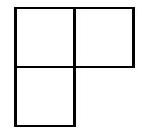 |
1. **Understand the $3 \times 3$ grid and the L-shaped piece:**
- The L-shaped piece covers exactly 3 squares on the grid.
- The grid itself is a $3 \times 3$ matrix, meaning it has a total of $3 \times 3 = 9$ squares.
2. **Consider the full coverage by multiple L-shaped pieces:**
- To cover the entire $3 \t... | [[2]] | 2 | |
olympiads | a) The square $ABCD$ with side length $1 \text{ cm}$ is "flipped" around point $D$ as shown in the following figure. The dotted lines indicate the area occupied by the square during its flipping motion. What is the total area occupied by the square from the beginning to the end of its flipping?
b) Similarly to the squ... |
#### Part a)
1. **Identify regions in the figure**:
The figure can be divided into:
- Two right triangles: $\triangle ABD$ and $\triangle DB'C'$
- One quarter circle sector $DBB'$ with a $90^{\circ}$ central angle.
2. **Calculate the radius of the circular sector using the Pythagorean Theorem**:
\[
R ... | [[3]] | 3 | |
olympiads | In the diagram, \( T U \) is parallel to \( P S \) and points \( Q \) and \( R \) lie on \( P S \). Also, \( \angle P Q T = x^{\circ} \), \( \angle R Q T = (x-50)^{\circ} \), and \( \angle T U R = (x+25)^{\circ} \).
What is the measure of \( \angle U R S \) ?
(A) \( 115^{\circ} \)
(B) \( 140^{\circ} \)
(C) \( 135^{\c... | 1. First, we recognize that since $PQR$ forms a straight line, the sum of the angles $\angle P Q T$ and $\angle R Q T$ should give $180^\circ$. Hence,
\[
\angle P Q T + \angle R Q T = 180^\circ.
\]
2. Given the angle measures, we can write:
\[
x^\circ + (x - 50)^\circ = 180^\circ.
\]
3. Simplifyi... | [[4]] | 4 | |
olympiads | Calculate the areas of the figures bounded by the lines given in polar coordinates.
$$
r=\cos \phi, \quad r=\sin \phi, \quad \left(0 \leq \phi \leq \frac{\pi}{2}\right)
$$ |
1. **Set Up the Problem**:
- We are given the curves in polar coordinates:
\[
r = \cos \phi, \quad r = \sin \phi, \quad (0 \leq \phi \leq \frac{\pi}{2})
\]
- We need to find the area enclosed by these curves.
2. **Understand the Symmetry**:
- Notice that the figure formed by these curves... | [[5]] | 5 | |
olympiads | As shown in the figure, \(ABCD\) is a parallelogram, \(AM = MB\), \(DN = CN\), and \(BE = EF = FC\). The area of quadrilateral \(EFGH\) is 1. Find the area of parallelogram \(ABCD\). |
1. **Step 1: Establish Geometrical Relationships**
Construct lines \(EQ \parallel CD\) and \(FP \parallel CD\), intersecting line \(BN\) at points \(Q\) and \(P\) respectively, as shown in the diagram.
2. **Step 2: Analyze Triangles and Quadrilaterals**
By properties of parallel lines and transversals in the pa... | [[5]] | 5 | |
olympiads | From 24 matches, a figure has been formed in the shape of a $3 \times 3$ square (see the figure), with the side length of each small square equal to the length of a matchstick. What is the minimum number of matchsticks that can be removed so that no whole $1 \times 1$ square formed by the matchsticks remains? |
1. **Understanding the problem:**
We have a figure made up of 24 matches forming a $3 \times 3$ grid of small squares, each with side length equal to the length of one match. The task is to determine the minimum number of matches needed to be removed so that no $1 \times 1$ square remains intact.
2. **Initial obse... | [[3]] | 3 | |
olympiads | In the diagram, the \(5 \times 6\) grid is made out of thirty \(1 \times 1\) squares. What is the total length of the six solid line segments shown?
(A) 6
(B) 12
(C) 16
(D) 18
(E) 20
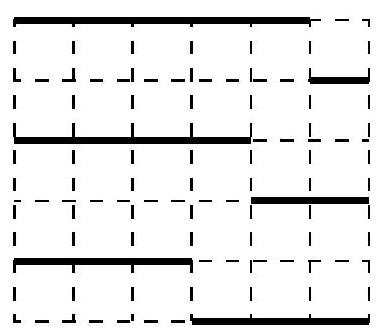 | :
To determine the total length of the six solid line segments shown in the diagram, we follow these steps:
1. **Identify each individual segment length**:
- The lengths of the solid line segments from top to bottom are:
\[
5, 1, 4, 2, 3, \text{and} 3
\]
2. **Sum these lengths**:
\[
5 + 1 + 4... | [[1]] | 1 | |
olympiads | As shown in Figure 3, \(AB\) is the diameter of circle \( \odot O \), and chord \(CD\) intersects \(AB\) at point \(E\). A tangent to the circle is drawn through point \(A\) and intersects the extension of \(CD\) at point \(F\). Given that the ratio \(CE: DE: DF = 4: 3: 3\) and \(AB = 24\), find the length of chord \(A... |
Let's solve this problem step by step:
1. **Establish Variables and Ratios**:
- Let \( CE = 4x \) and \( AE = y \).
- Since we are given \( CE : DE : DF = 4 : 3 : 3 \), it follows that:
\[
DE = 3x \quad \text{and} \quad DF = 3x \implies EF = 6x.
\]
2. **Use Power of a Point Theorem**:
-... | [[7]] | 7 | |
olympiads | In the figure, $AB > AC$, $H$ is the orthocenter of $\triangle ABC$. Points $D$ and $E$ are on sides $AB$ and $AC$, respectively, such that $DE \parallel CH$. If $M$ is the midpoint of $DE$ and $\angle ABM = \angle ACM$, prove that $MH \perp BH$. | 1. **Identify Points and Lines:**
- Let $\triangle ABC$ be given with $AB > AC$.
- Let $H$ be the orthocenter (height intersection) of $\triangle ABC$.
- Points $D$ and $E$ lie on $AB$ and $AC$ respectively such that $DE \parallel CH$.
- Let $M$ be the midpoint of $DE$.
- Provided $\angle ABM = \angle AC... | [[7]] | 7 | |
olympiads | As shown in the diagram, divide a $7 \times 7$ grid along the dotted lines into several rectangles such that each rectangle contains exactly one number, and this number equals the area of the rectangle. The seven small squares in the fourth column belong to different rectangles. |
The given problem requires us to divide a \(7 \times 7\) grid along the dashed line such that each resulting rectangle contains exactly one number, and that number should equal the area of the rectangle. Specifically, it asks us to determine to how many different rectangles each of the 7 small squares in the 4th colum... | [[4]] | 4 | |
olympiads | A small ant will walk from $A$ to $C$, passing through point $B$ exactly once and using only the paths indicated in the figure. How many different ways can the ant walk from $A$ to $C$?
(a) 3
(b) 5
(c) 7
(d) 8
(e) 9 | 1. **Identify the paths:**
- The formiguinha has 3 distinct paths to travel from point $A$ to point $B$.
- Similarly, there are 3 distinct paths to travel from point $B$ to point $C$.
2. **Total Path Calculation:**
- According to the problem, we need to find the total number of different ways the formiguinha ... | [[2]] | 2 | |
olympiads | Along a circle, there are 12 fields. Four consecutive fields contain four different figures: in order, a red one, a yellow one, a green one, and a blue one. Each figure can be moved by jumping across four adjacent fields in either direction to the fifth field, provided that no figure already occupies the destination fi... |
Let's start by simplifying the problem before tackling the original restrictions. We'll disregard for now the rule that a figure cannot pass through a position already occupied by another figure.
#### Step 1: Simplified Scenario without Restrictions
1. Consider the figures moving on the 12 positions without any rest... | [[5]] | 5 | |
olympiads |
Dasha cut a rectangular strip of paper into two rectangles: one white and one gray, both of which have integer side lengths. She noted the areas of these two rectangles in her notebook.
Then she overlaid the rectangles as shown in the figure. Three new rectangles were formed, and Dasha also noted the areas of these t... |
1. Let the shorter side of the original rectangular strip of paper be denoted by \(a\). The longer side of the white rectangle is \(b\) and the longer side of the gray rectangle is \(c\). Initially, Dasha recorded the areas of these two rectangles, which are \(a \cdot b\) and \(a \cdot c\).
2. When Dasha overlaid ... | [[4]] | 4 | |
olympiads | In the figure, the incircle of right triangle \( \triangle ABC \) touches the hypotenuse \( AB \) and the legs \( BC \) and \( CA \) at points \( D \), \( E \), and \( F \) respectively. Lines perpendicular to \( AC \) and \( BC \) are drawn through point \( D \), intersecting \( AC \) and \( BC \) at points \( M \) an... |
1. Given that $Rt \triangle ABC$ is a right triangle with the incircle $\odot O$ touching the hypotenuse $AB$ at point $D$, and the legs $BC$ and $CA$ at points $E$ and $F$ respectively. Additionally, from point $D$, perpendiculars are drawn to $AC$ and $BC$, meeting these sides at points $M$ and $N$ respectively. We ... | [[6]] | 6 | |
olympiads | As shown in the diagram, \( AB \) is the diameter of a semicircle, \( O \) is the center of the circle, \( CD \perp AB \), and \( DE \perp OC \). If the lengths of \( AD \), \( BD \), and \( CD \) are all rational numbers, then among the following three statements:
- Statement 1: The length of \( OE \) is a rational n... | 1. We are given that $AD, BD$ and $CD$ are all rational numbers.
2. Because $O$ is the center of the semicircle and $AB$ is the diameter, we have $OA = OB = \frac{AB}{2}$. Thus, these are also rational numbers.
3. Calculate $OC$. Since $C$ is the midpoint of $AB$, $OC = OA = OB$, which is a rational number.
4. Next, $O... | [[6]] | 6 | |
olympiads | In the diagram, $\triangle PQR$ is right-angled at $P$ and $PR = 12$. If point $S$ is on $PQ$ so that $SQ = 11$ and $SR = 13$, the perimeter of $\triangle QRS$ is
(A) 47
(B) 44
(C) 30
(D) 41
(E) 61 | 1. Let's first determine the length of \( P S \) using the Pythagorean theorem in \( \triangle P R S \):
\[
P S = \sqrt{R S^2 - P R^2} = \sqrt{13^2 - 12^2}
\]
Calculating the squares:
\[
13^2 = 169 \quad \text{and} \quad 12^2 = 144
\]
Subtracting these, we get:
\[
P S = \sqrt{169 - 144} = ... | [[3]] | 3 | |
olympiads | As shown in Figure 5-14, let \( I \) and \( H \) be the incenter and orthocenter of the acute-angled triangle \( \triangle ABC \), respectively. Points \( B_1 \) and \( C_1 \) are the midpoints of sides \( AC \) and \( AB \), respectively. It is known that ray \( B_1I \) intersects side \( AB \) at point \( B_2 \) (whe... |
1. **Show \(S_{\triangle B K B_{2}} = S_{\triangle C K K_{2}} \Leftrightarrow \angle BAC = 60^\circ\)**
Consider the circumradius \(R\) of \(\triangle ABC\). Connect \(IC\) and use the Sine Rule in \(\triangle ACI\) and \(\triangle ABC\).
\[
\frac{AI}{\sin \frac{1}{2} \angle C} = \frac{AC}{\sin \angle AIC} = \... | [[9]] | 9 | |
olympiads | A circle of radius 3 crosses the center of a square of side length 2. Find the difference between the areas of the nonoverlapping portions of the figures. |
To find the difference between the areas of the non-overlapping portions of a circle and a square, let us follow these steps:
1. **Find the area of the square.**
The side length of the square is given as 2 units.
\[
\text{Area of the square}, s = \text{side length}^2 = 2^2 = 4 \, \text{square units}
\]
... | [[3]] | 3 | |
olympiads | As shown in the figure, the sum of the angles $\angle 1 + \angle 2 + \angle 3 + \angle 4 + \angle 5 + \angle 6 + \angle 7$ is
(A) $450^\circ$
(B) $540^\circ$
(C) $630^\circ$
(D) $720^\circ$ |
The problem is to determine the sum of angles labeled as \( \angle 1, \angle 2, \angle 3, \angle 4, \angle 5, \angle 6, \) and \( \angle 7 \). Here is a detailed solution with step-by-step calculations.
#### Approach 1
1. Consider the given diagram with angles \( \angle 1, \angle 2, \angle 3, \angle 4, \angle 5, \ang... | [[2]] | 2 | |
olympiads | Tangents are drawn through the endpoints of a circular arc containing $120^\circ$. A circle is inscribed in the figure bounded by these tangents and the given arc. Prove that the length of the inscribed circle is equal to the length of the original arc. |
Given:
- The radius of the original circle is \( R \).
- The arc subtends an angle of \( 120^{\circ} \) at the center.
- There is a smaller inscribed circle tangent to two tangents on the arc endpoints and the arc itself.
- We need to prove that the length of the smaller circle is equal to the length of the \(120^{\ci... | [[8]] | 8 | |
olympiads | As shown in the figure, \( AB \) is a chord with a slope of 1 in the ellipse \( m x^{2}+n y^{2}=1 \) (where \( m, n>0 \) and \( m \neq n \)). The perpendicular bisector of \( AB \) intersects the major ellipse at two points \( C \) and \( D \). Let \( E \) and \( F \) be the midpoints of \( AB \) and \( CD \), respecti... | :
1. Let's start by considering the diagonal chord \(AB\) of the ellipse given \(mx^2 + ny^2 = 1\) with slope 1. Thus, the equation of \(AB\) can be written as the line \(y = x + b\).
2. We simultaneously solve the equations \(y = x + b\) and the ellipse equation \(mx^2 + ny^2 = 1\):
\[
\begin{cases}
y = x +... | [[8]] | 8 | |
olympiads | In the diagram, nine identical isosceles trapezoids are connected as shown to form a closed ring. (An isosceles trapezoid is a trapezoid with the properties that one pair of sides is parallel and the other two sides are equal in length.) What is the measure of $\angle ABC$? | ## Solution
1:
1. **Determine the number of sides of the inner polygon**:
The inner polygon formed by the nine trapezoids is a regular nonagon (a 9-sided polygon). This is because:
- All sides of this polygon are equal in length, which is equal to the shorter parallel side of one of the identical trapezoid... | [[4]] | 4 | |
olympiads | The word "stop" starts in the position shown in the diagram to the right. It is then rotated $180^{\circ}$ clockwise about the origin, $O$, and this result is then reflected in the $x$-axis. Which of the following represents the final image?
(A)

2. **Rotation by $180^\circ$**: Rotating the word $180^\circ$ clockwise abou... | [[2]] | 2 | |
olympiads | In a $3 \times 3$ table, the numbers from 1 to 9 are placed such that each number appears exactly once. The numbers 1, 2, 3, and 4 are positioned as shown in the figure below. It is also known that the sum of the numbers in the cells adjacent to the cell containing the number 5 is 9. Find the sum of the numbers in the ... |
1. **Placing Digits and Initial Analysis**:
- The digits 1, 2, 3, and 4 are positioned as follows:
\[
\begin{array}{ccc}
1 & & 3 \\
& & \\
2 & & 4 \\
\end{array}
\]
- We are given the constraint that the sum of the digits adjacent to the digit 5 is 9.
2. **D... | [[3]] | 3 | |
olympiads | The diagram shows a right-angled triangle and three circles. Each side of the triangle is a diameter of one of the circles. The shaded region \( R \) is the region inside the two smaller circles but outside the largest circle. Prove that the area of \( R \) is equal to the area of the triangle. |
1. **Introduce Notations and Definitions**:
Let:
- \(T\) be the area of the triangle,
- \(S_1\) be the area of the semicircle with the hypotenuse as the diameter,
- \(S_2\) and \(S_3\) be the areas of the semicircles with the shorter sides of the triangle as diameters.
2. **Set Up the Equation**:
We ca... | [[6]] | 6 | |
olympiads | The diagram shows a 16 meter by 16 meter wall. Three grey squares are painted on the wall as shown. The two smaller grey squares are equal in size and each makes an angle of \(45^\circ\) with the edge of the wall. The grey squares cover a total area of \(B\) square meters. What is the value of \(B\)? |
1. **Initialize Dimensions and Square Calculations:**
- The wall is 16 metres by 16 metres.
- There are two smaller grey squares and one larger grey square on the wall.
- The diagonal of each smaller grey square is 8 metres since they are tilted at an angle of $45^\circ$ to the edge of the wall.
2. **Usi... | [[2]] | 2 | |
olympiads | In the diagram, \(D\) is on side \(AC\) of \(\triangle ABC\) so that \(BD\) is perpendicular to \(AC\). If \(AB = 29\), \(AC = 69\), and \(BD = 20\), what is the length of \(BC\)? | Given a right triangle \( \triangle ABD \) and the values \( AB = 29 \), \( AC = 69 \), and \( BD = 20 \).
1. **Apply the Pythagorean Theorem in \( \triangle ABD \):**
\[
AD^2 + BD^2 = AB^2
\]
Substitute the known values:
\[
AD^2 + 20^2 = 29^2
\]
\[
AD^2 + 400 = 841
\]
\[
AD^2 = 841... | [[3]] | 3 | |
olympiads | The graph of the quadratic function \( f(x) = ax^2 + bx + c \) is shown in Figure 5-16. Define
\[
N = |a + b + c| + |2a - b|, \\
M = |a - b + c| + |2a + b|.
\]
Which of the following is true?
A. \( M > N \)
B. \( M = N \)
C. \( M < N \)
D. The relationship between \( M \) and \( N \) cannot be determined. | The problem involves the quadratic function \( f(x) = ax^2 + bx + c \) and requires comparing the magnitudes of expressions \( N \) and \( M \), where:
\[
N = |a + b + c| + |2a - b|
\]
\[
M = |a - b + c| + |2a + b|
\]
Given the condition \( a > 0 \) and \( -\frac{b}{2a} > 1 \), let's break down the problem step by... | [[5]] | 5 | |
olympiads | The teacher Clotilde drew three figures on the blackboard, all with an area of $108 \mathrm{~cm}^{2}$.
a) The first figure is a rectangle with one side length equal to $12 \mathrm{~cm}$. What is the perimeter of this rectangle?
b) The second figure is a rectangle divided into a white rectangle and a grey square with ... |
#### Part (a)
We begin by determining the perimeter of the rectangle given its area and one side length.
1. Calculate the length of the unknown side:
\[
\text{Area} = \text{Length} \times \text{Width}
\]
Given, \(\text{Area} = 108 \ \text{cm}^2\) and one side (\(\text{Length}\)) \(= 12 \ \text{cm}\), we ... | [[2]] | 2 | |
olympiads | Show two non-congruent polyhedra whose front view and top view are as follows:
(The internal intersection point is the center of the square. All segments of the squares are vis... |
We need to find two non-congruent polyhedra that both have a front view and top view matching the given diagram:

In both these views, the internal intersection point is the center of the squ... | [[9]] | 9 | |
olympiads | Cut the figure into 8 identical parts. | To solve the problem of dividing the figure into 8 identical parts, we can proceed as follows:
1. Identify the shape of the figure and assume it is a cube (as suggested by common geometry problems and the typical folktale context).
2. **Divide using plane cuts:**
**Method 1:**
a. **First Cut:**
Make... | [[2]] | 2 | |
olympiads | Anya arranges pebbles on the sand. First, she placed one pebble, then added pebbles to form a pentagon, then made a larger outer pentagon from pebbles, and then another outer pentagon, and so on, as shown in the figure. The number of pebbles arranged in the first four pictures are: 1, 5, 12, and 22. If she continues to... |
Let's denote the number of pebbles on the \( n \)-th picture by \( P(n) \).
1. For \( n = 1 \):
\[
P(1) = 1
\]
2. For \( n = 2 \):
\[
P(2) = 5
\]
3. To move from the second picture to the third picture:
- We add three edges each containing one corner pebble and two additional pebbles (as each n... | [[2]] | 2 | |
olympiads | In the diagram, each scale shows the total mass (weight) of the shapes on that scale. What is the mass (weight) of a $\triangle$?
(A) 3
(B) 5
(C) 12
(D) 6
(E) 5.5 |
1. **Interpret the first scale**:
The first scale shows that a square \( S \) and a circle \( C \) together have a mass of 8.
\[
S + C = 8
\]
2. **Interpret the second scale**:
The second scale shows that a square \( S \) and two circles \( C \) together have a mass of 11.
\[
S + 2C = 11
\]... | [[1]] | 1 | |
olympiads | Calculate the area of the figure bounded by the curves defined by the equations:
$$
\begin{aligned}
& \left\{\begin{array}{l}
x=4(t-\sin t) \\
y=4(1-\cos t)
\end{array}\right. \\
& y=6 \quad (0<x<8 \pi, \, y \geq 6)
\end{aligned}
$$ |
We begin by finding the points of intersection between the given parametric curve and the horizontal line \( y = 6 \).
1. **Setting up the equations for intersection:**
\[
y = 4(1 - \cos t) = 6
\]
\[
1 - \cos t = \frac{3}{2}
\]
Solving for \(\cos t\):
\[
\cos t = -\frac{1}{2}
\... | [[7]] | 7 | |
olympiads | Does there exist a convex figure that does not have axes of symmetry but is mapped onto itself by some rotation? | :
1. Consider the equilateral triangle \(ABC\).
2. Select points \(C'\), \(A'\), and \(B'\) on the sides \(AB\), \(BC\), and \(CA\), respectively, such that the ratios along the sides are as follows:
\[ \frac{AC'}{BC'} = \frac{BA'}{CA'} = \frac{CB'}{AB'} = \frac{3}{1} \]
This means that \(C'\) divides \(AB\) in... | [[6]] | 6 | |
olympiads | Through the vertex \( A \) of the rectangle \( ABCD \), a line \( \ell \) is drawn, as shown in the figure. From points \( B \) and \( D \), perpendiculars \( BX \) and \( DY \) are dropped onto the line \( \ell \). Find the length of segment \( XY \) if it is known that \( BX = 4 \), \( DY = 10 \), and \( BC = 2 AB \)... | Given:
- \(ABCD\) is a rectangle.
- A line \( \ell \) passes through vertex \( A \).
- Perpendiculars \( BX \) and \( DY \) are drawn from points \( B \) and \( D \) to line \( \ell \) with lengths \( BX = 4 \) and \( DY = 10 \) respectively.
- \( BC = 2 \cdot AB \).
#### Step-by-step solution:
1. **Triangle Similar... | [[3]] | 3 | |
olympiads | As shown in the figure, the coordinates \((x, y)\) of points on lines \(l_1\) and \(l_2\) satisfy the following equation:
(A) \( |x| + |y| = 0 \);
(B) \( |x| + \sqrt{y^{2}} = 1 \);
(C) \( x^{2} - |y| = 1 \);
(D) \( |x| - |y| = 0 \);
(E) \( x - |y| = 0 \).
Answer ( ). |
1. **Identify the requirements for points on the lines $l_1$ and $l_2$:**
- From the problem statement, points on the lines $l_1$ and $l_2$ are described by the Cartesian coordinates \((x, y)\). By interpreting the corresponding image (which we assume shows lines intersecting through the origin and symmetric about ... | [[2]] | 2 | |
olympiads | As shown in Figure 1.5.8, a horizontal line \( m \) passes through the center of circle \( O \). A line \( l \) is perpendicular to \( m \) and intersects \( m \) at point \( M \), which is to the right of the circle's center. Three distinct points \( A \), \( B \), and \( C \) lie on line \( l \) outside the circle an... |
1. **Step 1: Establish Variables**:
Let the radius of the circle \( O \) be \( r \) and the distance from the center \( O \) to the point \( M \) be denoted as \( a \). From the right triangle formed by \( A \), \( M \), and the perpendicular distance from \( M \) to the circle’s circumference:
\[
A M^2 ... | [[9]] | 9 | |
olympiads | Sir Hugh de Fortibus called his chief builder and, pointing to a window in the tower, said:
- It seems to me that the sides of that square window are each one foot, and the sides of the gaps between the bars in it are half a foot (see figure $A$). I want to cut another window a little higher, also with four sides each... | 1. Let's consider the given conditions:
- The original window (Case A) is a square with each side measuring 1 foot.
- The "bars" in the window divide it into smaller square areas, each with a side length of 0.5 feet.
- We need to create another window (Case B) which also has sides 1 foot long and is divi... | [[6]] | 6 | |
olympiads | As shown in the diagram, five equilateral triangles of side length $2\sqrt{3}$ are arranged on the same side of a straight line, such that the midpoint of the base of each triangle is the vertex of the next triangle. What is the area covered by these five triangles in the plane?
(A) 10
(B) 12
(C) 15
(D) $10 \sqrt{3}$
(... |
1. **Understand the Problem:**
We have five equilateral triangles arranged in a line, with each triangle having a side length of \(2\sqrt{3}\). Every middle point of the base of one triangle is the vertex of the next triangle.
2. **Calculate the Area of a Single Equilateral Triangle:**
The area of an equila... | [[2]] | 2 | |
olympiads | In the cube \(A B C D - A_{1} B_{1} C_{1} D_{1}\), \(E\) is the trisection point of \(A_{1} A\), and \(F\) is the trisection point of \(C_{1} C\). Given that \(A E = 2 A_{1} E\) and \(C F = 2 C_{1} F\), a section is formed through \(B\), \(E\), and \(F\). Among the projection diagrams of this section on the respective ... |
1. **Identifying Points and Division of Line Segments**:
- In the cube \(A B C D - A_1 B_1 C_1 D_1\), point \(E\) is defined as the point that divides segment \(A_1 A\) into three equal parts. This means \(A_1E = \frac{1}{3}A_1A\) and \(AE = \frac{2}{3}A_1A\).
- Similarly, point \(F\) is defined as the point tha... | [[8]] | 8 | |
olympiads | As shown in the figure, a grasshopper starts at position 1. For the 1st jump, it jumps 1 step and lands at position 2; for the 2nd jump, it jumps 2 steps and lands at position 4; for the 3rd jump, it jumps 3 steps and lands at position 1, and so on. On the $n$-th jump, it jumps $n$ steps. After jumping 100 times in a c... |
1. **Understand the Problem:**
- The ant starts at position 1.
- In the $n$-th jump, it jumps $n$ steps.
- We need to determine the final position after 100 jumps when the ant moves in a cyclic sequence of 6 positions (positions 1 through 6).
2. **Total Distance Calculation:**
- The total distance the ant... | [[2]] | 2 | |
olympiads | Taoqi cut the largest circle from a square piece of paper (as shown in Diagram A). Xiao Xiao cut seven equal largest circles from a circular piece of paper (as shown in Diagram B). Which cutting method has the highest utilization rate? (Utilization rate refers to the percentage of the area of the cut circles compared t... | To determine which method of cutting the shapes has a higher utilization rate, we need to calculate the area utilization rate for both methods. The utilization rate is defined as the percentage of the area of the cutout circles relative to the area of the original shape.
1. **Calculations for Taobao's Method:**
- ... | [[2]] | 2 | |
olympiads | Figure 3 is a five-ring made up of circles. Fill in the numbers $1, 2, \cdots, 9$ into the 9 blank spaces within the five rings, so that the sum of the numbers in each circle is equal. Find the maximum and minimum values of this equal sum. |
1. **Define the Sum:**
Let the sum of the numbers in each circle be denoted by \( S \).
2. **Write the Equation for Total Sum:**
Since there are 5 circles, we have:
\[
5S = (a+b) + (b+c+d) + (d+e+f) + (f+g+h) + (h+i)
\]
3. **Simplify the Sum:**
By grouping the sums, we get:
\[
5S = (a + b ... | [[4]] | 4 | |
olympiads | In some cells of a $20 \times 20$ square, there is an arrow in one of four directions. On the boundary of the square, all arrows point along the boundary in a clockwise direction (see figure). Additionally, arrows in neighboring cells (including diagonal neighbors) do not point in opposite directions. Prove that there ... |
1. Let's assume, for the sake of contradiction, that every cell of the \(20 \times 20\) square grid contains an arrow.
2. Label all cells with horizontal arrows (pointing left or right) as black, and all cells with vertical arrows (pointing up or down) as white.
3. **Lemma**: Either a "crippled rook" (which moves on... | [[7]] | 7 | |
olympiads | András gives 4 identical toy cars to his friends for Christmas: Bence, Csaba, Dénes, and Elemér. Bence, having less money, buys only 3 sets of stamps and the next day gives them to his friends, including re-gifting the toy car he received. On the third day, Csaba buys 2 chocolates and also re-gifts the gifts he receive... | 1. **Initial setup and understanding the problem**:
- András gives one toy car each to Bence, Csaba, Dénes, and Elemér, making a total of 4 toy cars.
- Each of Bence, Csaba, Dénes, and Elemér re-gift their received toy car while also possibly including additional new gifts they have purchased, making it impossi... | [[3]] | 3 | |
olympiads | A square is divided into five rectangles of equal area, as shown in the figure. The width of one of the rectangles is 5. Find the area of the square. |
1. Let the width of one of the rectangles be 5, as given in the problem. Denote the vertical sides of the central rectangle and the rectangle below it by \( x \), as they share a common horizontal side and therefore have equal heights.
2. For the left bottom rectangle, let the vertical side be \( 2x \) because it occ... | [[3]] | 3 | |
olympiads | In the diagram, \( A M N, A P Q, Q R M \), and \( P R N \) are all straight lines. The value of \( a+b \) is:
(A) 70
(B) 55
(C) 80
(D) 90
(E) 75 | 1. **Identifying angle relationships:**
- We start by noting that $\angle PRM = 125^\circ$.
- Since $QR$ and $RM$ are straight lines, the angles around point $R$ must sum to $360^\circ$. Specifically, $\angle QRP = \angle NRM = 55^\circ$ because $PRM + QRP = 180^\circ$ and $PRM + NRM = 180^\circ$.
This gives... | [[2]] | 2 | |
olympiads | Let $F_{1}$ and $F_{2}$ be the left and right foci of the ellipse $E: \frac{x^{2}}{a^{2}}+\frac{y^{2}}{b^{2}}=1(a>b>0)$. A line passing through point $F_{1}$ intersects the ellipse $E$ at points $A$ and $B$ such that $\left|A F_{1}\right|=3\left|B F_{1}\right|$ and $\cos \angle A F_{2} B=\frac{3}{5}$, as shown in the f... |
1. **Given Data Analysis**:
- Let $F_1$ and $F_2$ be the left and right foci of the ellipse $E$ described by the equation $\frac{x^2}{a^2} + \frac{y^2}{b^2} = 1$ where \(a > b > 0\).
- A line passing through $F_1$ intersects the ellipse $E$ at points $A$ and $B$ with $\left|A F_{1}\right| = 3\left|B F_{1}\right|... | [[8]] | 8 |
End of preview. Expand in Data Studio
README.md exists but content is empty.
- Downloads last month
- 74