

source stringclasses 1
value | problem stringlengths 66 1.41k | solution stringlengths 687 5.01k | messages listlengths 2 2 |
|---|---|---|---|
olympiads |
In a city, there are 10 parallel streets running from north to south, and 10 streets running from west to east, forming a $9 \times 9$ grid. There is a square at each intersection, totaling 100 squares. The distance between any two adjacent squares along a street is 1 km. A walking distance pharmacy is defined as a ph... |
1. **Setup the Problem**:
- We have a grid of $9 \times 9$ formed by $10$ parallel streets running north-south and $10$ parallel streets running west-east.
- Each intersection on the grid corresponds to one of the $100$ squares (intersections) formed.
- The distance between two adjacent intersections is $1... | [
{
"content": "\nIn a city, there are 10 parallel streets running from north to south, and 10 streets running from west to east, forming a $9 \\times 9$ grid. There is a square at each intersection, totaling 100 squares. The distance between any two adjacent squares along a street is 1 km. A walking distance pha... |
olympiads | In the diagram, a newly built city's roads form a neat grid. There are $n+1$ east-west roads and $m+1$ north-south roads. A person lives at point $A$ in the southwest corner and rides a bicycle to work at point $B$ in the northeast corner every day. To sightsee along the way, this person often changes their route, with... |
To solve the problem, we need to show that the number of different routes from $A$ to $B$, denoted by $f(m, n)$, satisfies the inequality \( f(m, n) \leqslant 2^{mn} \).
1. **Identify Grid Divisions**:
The road system comprises $n+1$ east-west streets and $m+1$ north-south streets, which divide the city into \(... | [
{
"content": "In the diagram, a newly built city's roads form a neat grid. There are $n+1$ east-west roads and $m+1$ north-south roads. A person lives at point $A$ in the southwest corner and rides a bicycle to work at point $B$ in the northeast corner every day. To sightsee along the way, this person often cha... |
olympiads | Let \( n \) be a positive even number. Consider an \( n \times n \) grid. Two distinct cells are called adjacent if they share one common edge. Mark \( m \) cells in this grid so that every cell on the board is adjacent to at least one marked cell. Find the minimum value of \( m \). | ### Problem:
Consider an \(n \times n\) checkerboard where \(n\) is an even number. Two cells in the checkerboard are called adjacent if they share a common edge. We need to mark a minimum number \(m\) of cells on the board such that every cell is adjacent to at least one marked cell. Determine the smallest value for \... | [
{
"content": "Let \\( n \\) be a positive even number. Consider an \\( n \\times n \\) grid. Two distinct cells are called adjacent if they share one common edge. Mark \\( m \\) cells in this grid so that every cell on the board is adjacent to at least one marked cell. Find the minimum value of \\( m \\).",
... |
olympiads | Given a $99 \times 99$ grid where each cell is colored either black or white, you are allowed to recolor all the cells of any column or any row simultaneously to the color that is the majority in that column or row before recoloring. Is it always possible to make all the cells of the grid the same color? |
Given a $99 \times 99$ grid where each cell is either black or white, we are allowed to change the color of all cells in a row or column to either black or white, depending on the majority color of that row or column. The question is whether it is always possible to make all the cells in the grid the same color using ... | [
{
"content": "Given a $99 \\times 99$ grid where each cell is colored either black or white, you are allowed to recolor all the cells of any column or any row simultaneously to the color that is the majority in that column or row before recoloring. Is it always possible to make all the cells of the grid the sam... |
olympiads | From 1812 identical squares with a side length of 1 mm, a rectangular frame was made for a group photo. The boundaries of the photo coincide with the inner boundaries of the frame. Then the photo was cut along the millimeter grid line into two rectangular parts. Now, two frames were needed, which used up 2018 of the sa... |
1. **Understanding the problem**: Given 1812 identical squares of sides 1 mm each, a rectangular frame for a photo was created. The photo was then cut into two rectangular parts vertically, and now two such frames are made using 2018 squares of the same size. We need to find the dimensions of the original photograph.
... | [
{
"content": "From 1812 identical squares with a side length of 1 mm, a rectangular frame was made for a group photo. The boundaries of the photo coincide with the inner boundaries of the frame. Then the photo was cut along the millimeter grid line into two rectangular parts. Now, two frames were needed, which ... |
olympiads | On a grid, we have marked \( n \) lattice points. Let's call a segment defined by these points "good" if its midpoint is also a lattice point. What is the minimum number of "good" segments? |
Let's denote the selected $n$ points on a rectangular grid. Hence, the coordinates of these points are integers. Based on the parity of their coordinates, categorize the points into four classes:
1. Both coordinates are even; the number of such points is $n_{1}$.
2. The first coordinate is even, the second is odd; th... | [
{
"content": "On a grid, we have marked \\( n \\) lattice points. Let's call a segment defined by these points \"good\" if its midpoint is also a lattice point. What is the minimum number of \"good\" segments?",
"role": "user"
},
{
"content": "\nLet's denote the selected $n$ points on a rectangular ... |
olympiads | Find all positive integers \( n \) for which it is possible to color some cells of an infinite grid of unit squares red, such that each rectangle consisting of exactly \( n \) cells (and whose edges lie along the lines of the grid) contains an odd number of red cells. | ```markdown
1. **Statement of Claim**:
We claim that it is possible for all positive integers $n$ to color some cells of an infinite grid of unit squares red, such that each rectangle consisting of exactly $n$ cells (and whose edges lie along the lines of the grid) contains an odd number of red cells. We will call ... | [
{
"content": "Find all positive integers \\( n \\) for which it is possible to color some cells of an infinite grid of unit squares red, such that each rectangle consisting of exactly \\( n \\) cells (and whose edges lie along the lines of the grid) contains an odd number of red cells.",
"role": "user"
},... |
olympiads | Given six grid points \( p_{i}(x_{i}, y_{i}) \) for \( i = 1, 2, 3, 4, 5, 6 \) such that:
(1) \( |x_{i}| \leq 2 \) and \( |y_{i}| \leq 2 \) for \( i = 1, 2, 3, 4, 5, 6 \);
(2) No three points are collinear.
Prove that among all triangles with vertices at \( p_{i} \) (for \( i = 1, 2, 3, 4, 5, 6 \)), there exists at le... |
To prove that among the triangles formed by any three vertices from the six given points $p_{i}\left(x_{i}, y_{i}\right)$, there exists at least one triangle whose area is not greater than $2$, we proceed as follows:
1. **Assumptions and Definitions:**
Suppose there exist 6 points \( p_{1}, p_{2}, \cdots, p_{6} \... | [
{
"content": "Given six grid points \\( p_{i}(x_{i}, y_{i}) \\) for \\( i = 1, 2, 3, 4, 5, 6 \\) such that:\n(1) \\( |x_{i}| \\leq 2 \\) and \\( |y_{i}| \\leq 2 \\) for \\( i = 1, 2, 3, 4, 5, 6 \\);\n(2) No three points are collinear.\n\nProve that among all triangles with vertices at \\( p_{i} \\) (for \\( i =... |
olympiads | In a game, two players take turns removing cells from a $5 \times 7$ grid. To remove a cell, a player selects an uneaten cell, places a piece on that cell, and then all cells in the "first quadrant" (the right-angled region created with the lower-left corner of that cell extending upwards and to the right) are removed.... | 1. The problem requires us to find the maximum number of distinct configurations during a game played on a $5 \times 7$ board. Each player's move removes a square along with all those squares in its "first quadrant".
2. According to the game's rules, if a square on the board is removed, all squares above, to the right,... | [
{
"content": "In a game, two players take turns removing cells from a $5 \\times 7$ grid. To remove a cell, a player selects an uneaten cell, places a piece on that cell, and then all cells in the \"first quadrant\" (the right-angled region created with the lower-left corner of that cell extending upwards and t... |
olympiads | A maze is a 10x10 grid square where some pairs of adjacent nodes are connected by a "wall" segment, such that it is possible to visit all grid cells by moving from one cell to an adjacent cell through the sides and without passing through walls. The boundary of the square is also considered to be surrounded by walls. I... |
To ensure that the robot can visit all cells of the grid regardless of the labyrinth configuration and its starting position, we can follow these steps:
1. **Enumerate Initial States:**
Each initial state of the robot is defined by the specific labyrinth and the initial position within that labyrinth. Since the gr... | [
{
"content": "A maze is a 10x10 grid square where some pairs of adjacent nodes are connected by a \"wall\" segment, such that it is possible to visit all grid cells by moving from one cell to an adjacent cell through the sides and without passing through walls. The boundary of the square is also considered to b... |
olympiads | Does there exist a closed broken line with an odd number of segments of equal length, all vertices of which lie at the nodes of an integer grid? | Suppose there is a closed broken line \(A_1 \ldots A_n\) with an odd number of equally long segments, all vertices of which lie in the nodes of the integer grid.
Let \(a_i\) and \(b_i\) be the coordinates of the projections of the vector \(\overrightarrow{A_i A_{i+1}}\) onto the horizontal and vertical axes. Let the ... | [
{
"content": "Does there exist a closed broken line with an odd number of segments of equal length, all vertices of which lie at the nodes of an integer grid?",
"role": "user"
},
{
"content": "Suppose there is a closed broken line \\(A_1 \\ldots A_n\\) with an odd number of equally long segments, al... |
olympiads | There is a 10x10 grid for a game of "Battleship." In this case, the game is played by unusual rules, and you are only allowed to use ships of size 1x2 which can be placed either horizontally or vertically. What is the maximum number of these ships that can be placed on the grid if the ships must not come into contact w... |
1. Consider the given $10 \times 10$ grid and the constraints that ships of size $1 \times 2$ can be placed either horizontally or vertically but cannot touch each other even at a single point.
2. First, we will place the maximum number of possible ships, keeping in mind the constraints. One of the valid configuratio... | [
{
"content": "There is a 10x10 grid for a game of \"Battleship.\" In this case, the game is played by unusual rules, and you are only allowed to use ships of size 1x2 which can be placed either horizontally or vertically. What is the maximum number of these ships that can be placed on the grid if the ships must... |
olympiads | Gabrielle has a $3 \times 3$ grid and L-shaped pieces that cover three squares each, as shown below. Can she cover her grid using these pieces?
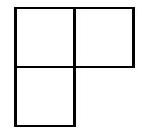 |
1. **Understand the $3 \times 3$ grid and the L-shaped piece:**
- The L-shaped piece covers exactly 3 squares on the grid.
- The grid itself is a $3 \times 3$ matrix, meaning it has a total of $3 \times 3 = 9$ squares.
2. **Consider the full coverage by multiple L-shaped pieces:**
- To cover the entire $3 \t... | [
{
"content": "Gabrielle has a $3 \\times 3$ grid and L-shaped pieces that cover three squares each, as shown below. Can she cover her grid using these pieces?\n\n",
... |
olympiads | Pasha is playing a computer game that takes place on an infinite grid. Each cell of the grid contains either a treasure or a natural number. The number represents the distance to the nearest treasure in terms of cells (if the treasure requires $A$ steps vertically and $B$ steps horizontally, the cell contains the numbe... |
#### Part (a)
To determine the minimum number of additional moves Pasha must make to guarantee finding a treasure when he discovers three cells in a row horizontally, each containing the number 5:
1. **Observation**:
- If Pasha finds any cell with a number \( K \), then all treasure cells must be located on the p... | [
{
"content": "Pasha is playing a computer game that takes place on an infinite grid. Each cell of the grid contains either a treasure or a natural number. The number represents the distance to the nearest treasure in terms of cells (if the treasure requires $A$ steps vertically and $B$ steps horizontally, the c... |
olympiads | On a \(10 \times 10\) grid, a bacterium is located in one of the cells. Each turn, the bacterium moves to an adjacent cell (sharing a side) and divides into two bacteria (both remain in the same cell). After that, one of the bacteria on the board moves to an adjacent cell and divides into two, and so on. Can it happen ... | 1. We begin by coloring the cells of the $10 \times 10$ grid in a checkerboard pattern, alternating between white and black.
2. Let's denote the number of bacteria in white cells at any given time as $B_w$ and those in black cells as $B_b$.
3. Consider the change in the difference $B_w - B_b$ with each move of the... | [
{
"content": "On a \\(10 \\times 10\\) grid, a bacterium is located in one of the cells. Each turn, the bacterium moves to an adjacent cell (sharing a side) and divides into two bacteria (both remain in the same cell). After that, one of the bacteria on the board moves to an adjacent cell and divides into two, ... |
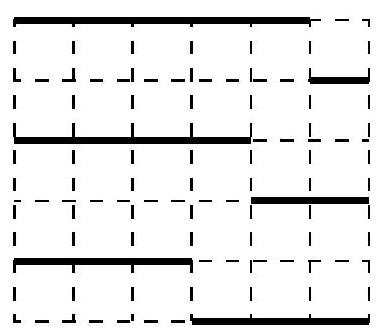
olympiads | In the diagram, the \(5 \times 6\) grid is made out of thirty \(1 \times 1\) squares. What is the total length of the six solid line segments shown?
(A) 6
(B) 12
(C) 16
(D) 18
(E) 20
 | :
To determine the total length of the six solid line segments shown in the diagram, we follow these steps:
1. **Identify each individual segment length**:
- The lengths of the solid line segments from top to bottom are:
\[
5, 1, 4, 2, 3, \text{and} 3
\]
2. **Sum these lengths**:
\[
5 + 1 + 4... | [
{
"content": "In the diagram, the \\(5 \\times 6\\) grid is made out of thirty \\(1 \\times 1\\) squares. What is the total length of the six solid line segments shown?\n(A) 6\n(B) 12\n(C) 16\n(D) 18\n(E) 20\n\n |
We need to assess the maximum number of trees that can be cut down such that no stump is visible from another tree, given that the trees are arranged in a $2001 \times 2001$ grid.
1. **Group the Trees:**
We can divide the $2001 \times 2001$ grid into smaller groups to simplify the problem. The possible groupings ... | [
{
"content": "$2001 \\times 2001$ trees are arranged in a square grid in a park. What is the largest number of trees that can be cut down so that no stump is visible from another tree?\n\n(The trees should have a diameter of 0)",
"role": "user"
},
{
"content": "\nWe need to assess the maximum number... |
olympiads | As shown in the diagram, divide a $7 \times 7$ grid along the dotted lines into several rectangles such that each rectangle contains exactly one number, and this number equals the area of the rectangle. The seven small squares in the fourth column belong to different rectangles. |
The given problem requires us to divide a \(7 \times 7\) grid along the dashed line such that each resulting rectangle contains exactly one number, and that number should equal the area of the rectangle. Specifically, it asks us to determine to how many different rectangles each of the 7 small squares in the 4th colum... | [
{
"content": "As shown in the diagram, divide a $7 \\times 7$ grid along the dotted lines into several rectangles such that each rectangle contains exactly one number, and this number equals the area of the rectangle. The seven small squares in the fourth column belong to different rectangles.",
"role": "us... |
olympiads | Fill the grid with the numbers $1$, $3$, and $5$ so that each row and each column contains exactly the numbers $1$, $3$, and $5$.
\begin{tabular}{|l|l|l|}
\hline 1 & & \\
\hline & 3 & \\
\hline & & 5 \\
\hline
\end{tabular} |
The requirement is to fill the 3x3 grid so that each row and each column contains precisely the numbers 1, 3, and 5.
Given the initial grid with some partially filled cells:
\[
\begin{tabular}{|l|l|l|}
\hline
1 & \, & \, \\
\hline
\, & 3 & \, \\
\hline
\, & \, & 5 \\
\hline
\end{tabular}
\]
We can follow these steps... | [
{
"content": "Fill the grid with the numbers $1$, $3$, and $5$ so that each row and each column contains exactly the numbers $1$, $3$, and $5$.\n\n\\begin{tabular}{|l|l|l|}\n\\hline 1 & & \\\\\n\\hline & 3 & \\\\\n\\hline & & 5 \\\\\n\\hline\n\\end{tabular}",
"role": "user"
},
{
"content": "\nThe re... |
olympiads | There is a $9 \times 2004$ grid, where each integer from 1 to 2004 is filled in 9 times. Additionally, within each column, the count of each number filled does not exceed 3. Find the minimum possible sum of the numbers in the first row. |
To find the smallest possible sum of the numbers in the first row of a $9 \times 2004$ grid, where each integer from 1 to 2004 is filled into the grid exactly 9 times and no integer appears more than 3 times in any column, we proceed as follows:
1. **Understand the Formulation**:
- We need to sum each integer at ... | [
{
"content": "There is a $9 \\times 2004$ grid, where each integer from 1 to 2004 is filled in 9 times. Additionally, within each column, the count of each number filled does not exceed 3. Find the minimum possible sum of the numbers in the first row.",
"role": "user"
},
{
"content": "\nTo find the ... |
olympiads | Each cell of a \(2 \times 5\) grid of unit squares is to be colored white or black. Compute the number of such colorings for which no \(2 \times 2\) square is a single color. |
To determine how many ways we can color each cell of a $2 \times 5$ grid such that no $2 \times 2$ square is a single color, we define the problem using recursion and distinguish between several cases.
1. **Define Variables:**
- Let \( a_n \) be the number of ways to color a $2 \times n$ grid such that no $2 \time... | [
{
"content": "Each cell of a \\(2 \\times 5\\) grid of unit squares is to be colored white or black. Compute the number of such colorings for which no \\(2 \\times 2\\) square is a single color.",
"role": "user"
},
{
"content": "\nTo determine how many ways we can color each cell of a $2 \\times 5$ ... |
olympiads | Place two $a$s and two $b$s into a $4 \times 4$ grid, with at most one letter per cell, such that no two identical letters are in the same row or column. Determine the number of possible arrangements. |
Consider a \(4 \times 4\) grid where we need to place two letters \(a\) and two letters \(b\), with the condition that each letter appears in distinct rows and columns.
1. **Placing the first letter \(a\):**
- There are 16 cells available initially to place the first \(a\).
2. **Placing the second letter \(a\):*... | [
{
"content": "Place two $a$s and two $b$s into a $4 \\times 4$ grid, with at most one letter per cell, such that no two identical letters are in the same row or column. Determine the number of possible arrangements.",
"role": "user"
},
{
"content": "\nConsider a \\(4 \\times 4\\) grid where we need ... |
olympiads | Cut a $6 \times 6$ square grid into "L-shaped" tiles consisting of three cells each, such that no two tiles form a $2 \times 3$ rectangular block. |
1. **Understanding the problem statement**: We need to partition a \(6 \times 6\) grid into shapes called "corner tetriminoes", which are made of 3 cells that form a right-angled corner. Additionally, no two corner tetriminoes should form a \(2 \times 3\) rectangle.
2. **Analyzing the shape requirement**: A corner te... | [
{
"content": "Cut a $6 \\times 6$ square grid into \"L-shaped\" tiles consisting of three cells each, such that no two tiles form a $2 \\times 3$ rectangular block.",
"role": "user"
},
{
"content": "\n1. **Understanding the problem statement**: We need to partition a \\(6 \\times 6\\) grid into shap... |
olympiads | In a grid with an $m \times n$ rectangular section, what is the largest perimeter of a non-self-intersecting lattice polygon if every side of the polygon is either vertical or horizontal? |
1. **Problem Understanding**:
We need to find the perimeter of the largest, non-self-intersecting, grid polygon in an \( m \times n \) grid-rectangle where each side of the polygon is either vertical or horizontal.
2. **Total Number of Lattice Points**:
The total number of lattice points in an \( m \times n \) ... | [
{
"content": "In a grid with an $m \\times n$ rectangular section, what is the largest perimeter of a non-self-intersecting lattice polygon if every side of the polygon is either vertical or horizontal?",
"role": "user"
},
{
"content": "\n1. **Problem Understanding**:\n We need to find the perimet... |
olympiads |
A grid strip of size \(1 \times 1000000\) is divided into 100 segments. An integer is written in each cell, and the numbers in cells lying within the same segment are the same. A token is placed in each cell. Then, an operation is performed where all tokens are simultaneously moved, each token moving to the right by t... |
1. **Define the Route:**
- For each cell in the first segment, define its route—the consecutive sequence of cells traversed by the token on the cell until it returns to the first segment. The cell of "return" does not enter the route again. Let the length of the route be the number of unique cells in it. This repre... | [
{
"content": "\nA grid strip of size \\(1 \\times 1000000\\) is divided into 100 segments. An integer is written in each cell, and the numbers in cells lying within the same segment are the same. A token is placed in each cell. Then, an operation is performed where all tokens are simultaneously moved, each toke... |
olympiads | The integers 1 to 100 are randomly written in a $10 \times 10$ grid, with one number in each cell. In each operation, two numbers can be swapped. Prove that, with only 35 operations, it is possible to achieve the following condition: the sum of the numbers in any two adjacent cells (sharing an edge) is always a composi... |
1. **Divide the grid into two halves**: By drawing a vertical line $m$ down the center of the $10 \times 10$ grid, we divide the grid into two halves—left and right, each consisting of 50 numbers.
2. **Identify parity distribution in the right half**: In this right half, we identify that there are no more than 25 ev... | [
{
"content": "The integers 1 to 100 are randomly written in a $10 \\times 10$ grid, with one number in each cell. In each operation, two numbers can be swapped. Prove that, with only 35 operations, it is possible to achieve the following condition: the sum of the numbers in any two adjacent cells (sharing an ed... |
olympiads | Let $d, r \geq 2$ be integers satisfying $d \geq r^{2r+2}$, and let $G$ be a graph that contains a collection $\mathcal{H}$ of $r^2 - 1$ pairwise disjoint paths and a collection $\mathcal{V} = \{V_1, \ldots, V_d\}$ of $d$ pairwise disjoint paths. Suppose that every path in $\mathcal{V}$ intersects every path in $\mathc... |
1. **Illustrate the problem and initial conditions:**
- Let $d, r \geq 2$ satisfy $d \geq r^{2r+2}$.
- Let $G$ be a graph containing:
- A collection $\mathcal{H}$ of $r^2 - 1$ mutually disjoint paths.
- A collection $\mathcal{V} = \{V_1, \ldots, V_d\}$ of $d$ mutually disjoint paths.
- Each pat... | [
{
"content": "Let $d, r \\geq 2$ be integers satisfying $d \\geq r^{2r+2}$, and let $G$ be a graph that contains a collection $\\mathcal{H}$ of $r^2 - 1$ pairwise disjoint paths and a collection $\\mathcal{V} = \\{V_1, \\ldots, V_d\\}$ of $d$ pairwise disjoint paths. Suppose that every path in $\\mathcal{V}$ in... |
olympiads | Cells of an infinite grid of paper are colored in black and white in a checkerboard pattern. Let $X$ be a triangle with area $S$ and vertices at the grid points. Show that there exists a similar triangle $X$ with vertices at the grid points such that the area of its white part is equal to the area of its black part, ea... | 1. **Consider the transformation and its properties**:
Let us consider a rotational homothety \( F \) with the center at the origin of the coordinate system, a scaling factor of \( \sqrt{2} \), and a rotation angle of \( 45^\circ \). This transformation can be expressed in coordinates as:
\[
F: (x, y) \rightar... | [
{
"content": "Cells of an infinite grid of paper are colored in black and white in a checkerboard pattern. Let $X$ be a triangle with area $S$ and vertices at the grid points. Show that there exists a similar triangle $X$ with vertices at the grid points such that the area of its white part is equal to the area... |
olympiads | Let \( A \) be a \( 3 \times 9 \) grid, with each cell filled with a positive integer. A subgrid \( m \times n \) (\( 1 \leq m \leq 3, 1 \leq n \leq 9 \)) in \( A \) is called a "good rectangle" if the sum of all numbers in it is a multiple of 10. A \( 1 \times 1 \) cell in \( A \) is called a "bad cell" if it is not c... |
1. **Step 1: Define the Problem Constraints and Objective**
We have a $3 \times 9$ grid $A$ filled with integers. A "good rectangle" within $A$ is defined as an $m \times n$ subgrid ($1 \leq m \leq 3, 1 \leq n \leq 9$) whose sum of all elements is a multiple of 10. A "bad cell" is a $1 \times 1$ cell that is not p... | [
{
"content": "Let \\( A \\) be a \\( 3 \\times 9 \\) grid, with each cell filled with a positive integer. A subgrid \\( m \\times n \\) (\\( 1 \\leq m \\leq 3, 1 \\leq n \\leq 9 \\)) in \\( A \\) is called a \"good rectangle\" if the sum of all numbers in it is a multiple of 10. A \\( 1 \\times 1 \\) cell in \\... |
olympiads | What is the minimum number of colors required to paint all the cells of a 6 by 6 square grid such that each row, column, and diagonal of the square has all cells with different colors? Note: A diagonal of the square is defined as all rows of at least two cells going diagonally from one edge of the square to the other a... | 1. **Introduction and Problem Restatement**:
We are given a $6 \times 6$ square grid and need to determine the minimum number of colors required to color the grid such that no two cells in the same row, column, or diagonal (as defined in the problem, these are diagonal lines at 45° and 135° to the horizontal) have ... | [
{
"content": "What is the minimum number of colors required to paint all the cells of a 6 by 6 square grid such that each row, column, and diagonal of the square has all cells with different colors? Note: A diagonal of the square is defined as all rows of at least two cells going diagonally from one edge of the... |
olympiads | A 'long knight' moves on a square grid. A single move consists of moving three squares in one direction (horizontally or vertically) and then one square at right angles to the first direction. What is the smallest number of moves a long knight requires to go from one corner of an \(8 \times 8\) square board to the diag... |
Let's approach this problem step by step.
1. **Understanding the Move of a Long Knight**:
A "long knight" moves in an extended "L" shape on a grid. The knight moves three squares in one direction (either horizontally or vertically) and then one square at a right angle to the first direction. Hence, each move can... | [
{
"content": "A 'long knight' moves on a square grid. A single move consists of moving three squares in one direction (horizontally or vertically) and then one square at right angles to the first direction. What is the smallest number of moves a long knight requires to go from one corner of an \\(8 \\times 8\\)... |
olympiads |
A field is a $41 \times 41$ grid, and a tank is hidden in one of the cells. A fighter plane fires at one cell at a time. If the shot hits, the tank moves to an adjacent cell (sharing a side); if the shot misses, the tank remains in place. After each shot, the pilot does not know if the shot was a hit or miss. To destr... | The problem asks us to find the least number of shots required to guarantee the destruction of a tank hidden on a $41 \times 41$ grid, where a tank hides in one cell and moves to an adjacent cell after being hit once. To destroy the tank, it must be hit twice. Let's go through the solution step by step in detail.
1. *... | [
{
"content": "\nA field is a $41 \\times 41$ grid, and a tank is hidden in one of the cells. A fighter plane fires at one cell at a time. If the shot hits, the tank moves to an adjacent cell (sharing a side); if the shot misses, the tank remains in place. After each shot, the pilot does not know if the shot was... |
olympiads | From a $12 \times 12$ grid, a $4 \times 4$ square is cut out, located at the intersection of the horizontals from the third to the sixth and the same verticals. What is the maximum number of non-attacking rooks that can be placed on this grid, considering that rooks do not attack through the cut-out squares? |
1. We start with a $12 \times 12$ chessboard.
2. A $4 \times 4$ square is cut out from the section intersecting rows 3 to 6 and columns 3 to 6.
3. This leaves the board divided into four separate rectangular regions due to the removed square:
- Top-left: $2 \times 12$ (rows 1-2, columns 1-12)
- Top-right: $2 \... | [
{
"content": "From a $12 \\times 12$ grid, a $4 \\times 4$ square is cut out, located at the intersection of the horizontals from the third to the sixth and the same verticals. What is the maximum number of non-attacking rooks that can be placed on this grid, considering that rooks do not attack through the cut... |
olympiads | What is the minimum number of cells that need to be marked in a $15 \times 15$ grid so that in each vertical or horizontal $1 \times 10$ strip, there is at least one marked cell? |
1. **Understanding the Problem**:
- We need to determine the minimum number of cells that need to be marked in a $15 \times 15$ grid.
- The requirement is that in every vertical or horizontal strip of size $1 \times 10$, at least one cell is marked.
2. **Strategic Division**:
- We can think of the $15 \times... | [
{
"content": "What is the minimum number of cells that need to be marked in a $15 \\times 15$ grid so that in each vertical or horizontal $1 \\times 10$ strip, there is at least one marked cell?",
"role": "user"
},
{
"content": "\n1. **Understanding the Problem**:\n - We need to determine the mini... |
olympiads | In the given $6 \times 6$ grid, each cell must be filled with one of the letters $A, B, C, D, E, F$. The letters in each row, column, and each $2 \times 3$ rectangle defined by bold lines must not repeat. What are the letters in the middle four cells of the third row, in left-to-right order?
Choices:
(A) $E, C, D, F$
... |
1. **Understanding the Problem:**
In the given $6\times6$ grid, each cell must be filled with one of the letters $A, B, C, D, E, F$ such that:
- Every row and every column must contain each letter exactly once.
- Each $2\times3$ rectangle (outlined with bold lines) within the grid must also have each letter... | [
{
"content": "In the given $6 \\times 6$ grid, each cell must be filled with one of the letters $A, B, C, D, E, F$. The letters in each row, column, and each $2 \\times 3$ rectangle defined by bold lines must not repeat. What are the letters in the middle four cells of the third row, in left-to-right order?\n\n... |
End of preview. Expand in Data Studio
README.md exists but content is empty.
- Downloads last month
- 31