
original_problem stringlengths 15 7.47k | original_reasoning_trace stringlengths 71 77.5k | conversations listlengths 2 2 |
|---|---|---|
## Task B-3.2.
The first digit of a four-digit number is one greater than its third digit, and the second digit is equal to the sum of the remaining digits. The last digit of this number is five less than the first digit. Determine this four-digit number. | <think>
Okay, let's see. I need to find a four-digit number based on the given conditions. Let me break down the problem step by step.
First, let's represent the four-digit number as ABCD, where A, B, C, D are its digits. So A is the thousands place, B is the hundreds, C is the tens, and D is the ones place. Each of t... | [
{
"from": "human",
"value": "## Task B-3.2.\n\nThe first digit of a four-digit number is one greater than its third digit, and the second digit is equal to the sum of the remaining digits. The last digit of this number is five less than the first digit. Determine this four-digit number."
},
{
"from"... |
1.91 Find all natural numbers greater than 3, such that $1+C_{n}^{1}+C_{n}^{2}+C_{n}^{3}$ divides $2^{2000}$.
(13th China High School Mathematics Winter Camp, 1998) | <think>
Okay, let me try to work through this problem step by step. The question is asking to find all natural numbers n greater than 3 such that the sum 1 + C(n,1) + C(n,2) + C(n,3) divides 2^2000. Hmm, okay. So first, let me make sure I understand the notation. C(n,k) is the combination formula, which is n choose k, ... | [
{
"from": "human",
"value": "1.91 Find all natural numbers greater than 3, such that $1+C_{n}^{1}+C_{n}^{2}+C_{n}^{3}$ divides $2^{2000}$.\n(13th China High School Mathematics Winter Camp, 1998)"
},
{
"from": "gpt",
"value": "<think>\nOkay, let me try to work through this problem step by step. T... |
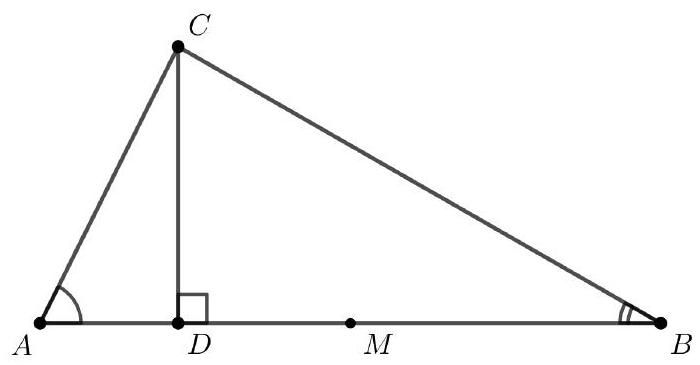
In his triangle $ABC$ Serge made some measurements and informed Ilias about the lengths of median $AD$ and side $AC$. Based on these data Ilias proved the assertion: angle $CAB$ is obtuse, while angle $DAB$ is acute. Determine a ratio $AD/AC$ and prove Ilias' assertion (for any triangle with such a ratio). | <think>
Okay, so the problem is about a triangle ABC where Serge told Ilias the lengths of the median AD and the side AC. Using just these two pieces of information, Ilias was able to prove that angle CAB is obtuse, while angle DAB is acute. We need to determine the ratio AD/AC that allows such a conclusion and prove I... | [
{
"from": "human",
"value": "In his triangle $ABC$ Serge made some measurements and informed Ilias about the lengths of median $AD$ and side $AC$. Based on these data Ilias proved the assertion: angle $CAB$ is obtuse, while angle $DAB$ is acute. Determine a ratio $AD/AC$ and prove Ilias' assertion (for any ... |
4・30 Find all solutions to the equation $x^{2}-8[x]+7=0$. Here, $[x]$ denotes the greatest integer less than or equal to $x$.
保持源文本的换行和格式如下:
4・30 Find all solutions to the equation $x^{2}-8[x]+7=0$. Here, $[x]$ denotes the greatest integer less than or equal to $x$. | <think>
Okay, let's try to solve this equation: \(x^2 - 8[x] + 7 = 0\). The [x] here is the greatest integer less than or equal to x, which is also known as the floor function. So, I need to find all real numbers x that satisfy this equation. Hmm, floor functions can sometimes make equations tricky because they introdu... | [
{
"from": "human",
"value": "4・30 Find all solutions to the equation $x^{2}-8[x]+7=0$. Here, $[x]$ denotes the greatest integer less than or equal to $x$.\n\n保持源文本的换行和格式如下:\n\n4・30 Find all solutions to the equation $x^{2}-8[x]+7=0$. Here, $[x]$ denotes the greatest integer less than or equal to $x$."
},
... |
$\mathrm{Az}$
$$
\frac{x^{2}+p}{x}=-\frac{1}{4}
$$
equation, whose roots are $x_{1}$ and $x_{2}$, determine $p$ such that
a) $\frac{x_{1}}{x_{2}}+\frac{x_{2}}{x_{1}}=-\frac{9}{4}$,
b) one root is 1 less than the square of the other root. | <think>
Okay, let's try to solve part a) of this problem. So, the equation given is (x² + p)/x = -1/4. Hmm, first, maybe I should rewrite this equation in a more standard quadratic form. Let me see. If I multiply both sides by x, assuming x is not zero, right? Because if x is zero, the original equation would be undefi... | [
{
"from": "human",
"value": "$\\mathrm{Az}$\n\n$$\n\\frac{x^{2}+p}{x}=-\\frac{1}{4}\n$$\n\nequation, whose roots are $x_{1}$ and $x_{2}$, determine $p$ such that\na) $\\frac{x_{1}}{x_{2}}+\\frac{x_{2}}{x_{1}}=-\\frac{9}{4}$,\n\nb) one root is 1 less than the square of the other root."
},
{
"from": "... |
10.2. Determine all values of the real parameter $a$ for which the equation
$$
\left|a x^{2}-6\right|=|2 a x|+|3 a| \text { has at least one real solution. }
$$ | <think>
Okay, so I need to find all real values of a for which the equation |a x² - 6| = |2a x| + |3a| has at least one real solution. Hmm, let's start by understanding what this equation is saying. It's an absolute value equation, so maybe I can break it down by considering different cases based on the expressions ins... | [
{
"from": "human",
"value": "10.2. Determine all values of the real parameter $a$ for which the equation\n\n$$\n\\left|a x^{2}-6\\right|=|2 a x|+|3 a| \\text { has at least one real solution. }\n$$"
},
{
"from": "gpt",
"value": "<think>\nOkay, so I need to find all real values of a for which the... |
## Task 5 - 311245
Let $a$ be any real number with $a \geq 2$. Determine all functions that satisfy the following conditions (1), (2), (3) for $a$:
(1) The function $f$ is defined for all non-negative integers $x$; all function values $f(x)$ are real numbers.
(2) For all non-negative integers $x, y$ with $x \geq y$,... | <think>
Okay, let's try to solve this problem. So we need to find all functions f defined on non-negative integers x, with real values, satisfying the functional equation f(x)·f(y) = f(x+y) + f(x−y) whenever x ≥ y, and also f(1) = a where a is at least 2. Alright, let's start by understanding what the functional equati... | [
{
"from": "human",
"value": "## Task 5 - 311245\n\nLet $a$ be any real number with $a \\geq 2$. Determine all functions that satisfy the following conditions (1), (2), (3) for $a$:\n\n(1) The function $f$ is defined for all non-negative integers $x$; all function values $f(x)$ are real numbers.\n\n(2) For a... |
## Task 4 - 140524
Students of a 5th grade class held a 14-day chess tournament. Exactly 6 games were played each of the 14 days.
The number of participating boys was greater than that of the participating girls. Each girl played against every other girl and each boy against every other boy exactly twice. None of the... | <think>
Okay, let's try to figure out how many girls and boys participated in the tournament. Hmm, so the problem says that there are more boys than girls, and each girl played against every other girl exactly twice, and the same for the boys. Also, no games were between girls and boys. The tournament lasted 14 days wi... | [
{
"from": "human",
"value": "## Task 4 - 140524\n\nStudents of a 5th grade class held a 14-day chess tournament. Exactly 6 games were played each of the 14 days.\n\nThe number of participating boys was greater than that of the participating girls. Each girl played against every other girl and each boy again... |
6. As shown in Figure $3, A B$ is the diameter of the semicircle $\odot O$, $C$ is a moving point on the semicircle arc (excluding the midpoint of the semicircle arc and the two endpoints of the diameter), connect $A C, B C$, draw $C D \perp A B$ at point $D$, draw $\odot O_{1}$ tangent to $A D$ at point $E$, tangent t... | <think>
Okay, so I need to figure out the measure of angle ECF in this geometry problem. Let me start by visualizing the figure based on the description.
We have a semicircle with diameter AB, and center O. Point C is moving along the semicircle's arc, but not at the midpoint or the endpoints. Then, we connect AC and... | [
{
"from": "human",
"value": "6. As shown in Figure $3, A B$ is the diameter of the semicircle $\\odot O$, $C$ is a moving point on the semicircle arc (excluding the midpoint of the semicircle arc and the two endpoints of the diameter), connect $A C, B C$, draw $C D \\perp A B$ at point $D$, draw $\\odot O_{... |
A three-digit $\overline{abc}$ number is called [i]Ecuadorian [/i] if it meets the following conditions:
$\bullet$ $\overline{abc}$ does not end in $0$.
$\bullet$ $\overline{abc}$ is a multiple of $36$.
$\bullet$ $\overline{abc} - \overline{cba}$ is positive and a multiple of $36$.
Determine all the Ecuadorian numbers. | <think>
Alright, let's tackle this problem step by step. The goal is to find all three-digit Ecuadorian numbers. Let me first make sure I understand the requirements correctly:
1. The number is three digits, denoted as \(\overline{abc}\), and does not end in 0. So, the units digit \(c \neq 0\).
2. The number itself mu... | [
{
"from": "human",
"value": "A three-digit $\\overline{abc}$ number is called [i]Ecuadorian [/i] if it meets the following conditions:\n$\\bullet$ $\\overline{abc}$ does not end in $0$.\n$\\bullet$ $\\overline{abc}$ is a multiple of $36$.\n$\\bullet$ $\\overline{abc} - \\overline{cba}$ is positive and a mul... |
1. Let $A, B, C, D$ be four points on a circle in that order. Also, $A B=3, B C=5, C D=6$, and $D A=4$. Let diagonals $A C$ and $B D$ intersect at $P$. Compute $\frac{A P}{C P}$. | <think>
Okay, so I have this geometry problem here. There's a circle with four points on it: A, B, C, D in that order. The lengths between them are given: AB is 3 units, BC is 5 units, CD is 6 units, and DA is 4 units. The diagonals AC and BD intersect at point P, and I need to compute the ratio of AP to CP. Hmm, let's... | [
{
"from": "human",
"value": "1. Let $A, B, C, D$ be four points on a circle in that order. Also, $A B=3, B C=5, C D=6$, and $D A=4$. Let diagonals $A C$ and $B D$ intersect at $P$. Compute $\\frac{A P}{C P}$."
},
{
"from": "gpt",
"value": "<think>\nOkay, so I have this geometry problem here. The... |
40. In nature, among metals, the one that is liquid at room temperature is $\qquad$
A. Cesium
B. Mercury
C. Gallium
D. Rubidium | <think>
Okay, so I need to figure out which metal is liquid at room temperature from the given options: Cesium, Mercury, Gallium, and Rubidium. Let me start by recalling what I know about the physical states of these elements.
First, room temperature is typically around 20-25 degrees Celsius, right? So the metal in qu... | [
{
"from": "human",
"value": "40. In nature, among metals, the one that is liquid at room temperature is $\\qquad$\nA. Cesium\nB. Mercury\nC. Gallium\nD. Rubidium"
},
{
"from": "gpt",
"value": "<think>\nOkay, so I need to figure out which metal is liquid at room temperature from the given options... |
In how many ways can 5 identical coins be placed in 3 different pockets? | <think>
Okay, so I need to figure out how many ways I can place 5 identical coins into 3 different pockets. Hmm, let's see. Since the coins are identical, the order in which I place them in the pockets doesn't matter, right? It's just the number of coins in each pocket that's important. And the pockets are different, s... | [
{
"from": "human",
"value": "In how many ways can 5 identical coins be placed in 3 different pockets?"
},
{
"from": "gpt",
"value": "<think>\nOkay, so I need to figure out how many ways I can place 5 identical coins into 3 different pockets. Hmm, let's see. Since the coins are identical, the ord... |
3.32. At the base of a right prism lies a rhombus with an acute angle $\alpha$. The ratio of the height of the prism to the side of the base is $k$. A plane is drawn through the side of the base and the midpoint of the opposite lateral edge. Find the angle between this plane and the plane of the base. | <think>
Okay, let me try to figure out this geometry problem. Hmm, so we have a right prism with a rhombus base. The acute angle of the rhombus is α. The ratio of the prism's height to the side of the base is k. We need to find the angle between a certain plane and the base. The plane is drawn through the side of the b... | [
{
"from": "human",
"value": "3.32. At the base of a right prism lies a rhombus with an acute angle $\\alpha$. The ratio of the height of the prism to the side of the base is $k$. A plane is drawn through the side of the base and the midpoint of the opposite lateral edge. Find the angle between this plane an... |
Task 1. Determine all pairs $(a, b)$ of positive integers for which
$$
a^{2}+b \mid a^{2} b+a \quad \text { and } \quad b^{2}-a \mid a b^{2}+b
$$ | <think>
Alright, so I have this problem where I need to find all pairs of positive integers (a, b) such that two conditions hold:
1. \( a^2 + b \) divides \( a^2 b + a \)
2. \( b^2 - a \) divides \( a b^2 + b \)
Hmm, okay. Let me start by trying to understand what each condition means and maybe find some relationship... | [
{
"from": "human",
"value": "Task 1. Determine all pairs $(a, b)$ of positive integers for which\n\n$$\na^{2}+b \\mid a^{2} b+a \\quad \\text { and } \\quad b^{2}-a \\mid a b^{2}+b\n$$"
},
{
"from": "gpt",
"value": "<think>\nAlright, so I have this problem where I need to find all pairs of posit... |
1. People numbered $1,2, \cdots, 2015$ are arranged in a line, and a position-swapping game is played among them, with the rule that each swap can only occur between adjacent individuals. Now, the person numbered 100 and the person numbered 1000 are to swap positions, with the minimum number of swaps required being $\q... | <think>
Alright, let's tackle this problem step by step. So, we have people numbered from 1 to 2015 arranged in a straight line. The task is to swap the positions of person number 100 and person number 1000 using the minimum number of adjacent swaps. Hmm, okay. Let me think about how adjacent swaps work and how to calc... | [
{
"from": "human",
"value": "1. People numbered $1,2, \\cdots, 2015$ are arranged in a line, and a position-swapping game is played among them, with the rule that each swap can only occur between adjacent individuals. Now, the person numbered 100 and the person numbered 1000 are to swap positions, with the ... |
The line with equation $y=5 x+a$ passes through the point $\left(a, a^{2}\right)$. If $a \neq 0$, what is the value of $a$ ? | <think>
Okay, so I need to find the value of 'a' such that the line y = 5x + a passes through the point (a, a²). Hmm, let's start by understanding what this means.
The line equation is given as y = 5x + a. That's a linear equation in slope-intercept form, where the slope is 5 and the y-intercept is 'a'. The problem s... | [
{
"from": "human",
"value": "The line with equation $y=5 x+a$ passes through the point $\\left(a, a^{2}\\right)$. If $a \\neq 0$, what is the value of $a$ ?"
},
{
"from": "gpt",
"value": "<think>\nOkay, so I need to find the value of 'a' such that the line y = 5x + a passes through the point (a,... |
Solve and discuss the following parametric equation:
$$
\frac{a x-3}{b x+1}=2
$$ | <think>
Okay, so I need to solve this equation: (a x - 3)/(b x + 1) = 2. Hmm, let me think. Alright, parametric equations can be a bit tricky because they involve variables other than x, in this case, a and b. I need to find x in terms of a and b, right?
First, maybe I should cross-multiply to get rid of the denominat... | [
{
"from": "human",
"value": "Solve and discuss the following parametric equation:\n\n$$\n\\frac{a x-3}{b x+1}=2\n$$"
},
{
"from": "gpt",
"value": "<think>\nOkay, so I need to solve this equation: (a x - 3)/(b x + 1) = 2. Hmm, let me think. Alright, parametric equations can be a bit tricky becaus... |
1. In a right-angled triangle, the square of the hypotenuse is exactly equal to twice the product of the two legs. Then, the ratio of the three sides of this triangle is ( ).
(A) $3: 4: 5$
(B) $1: 1: 1$
(C) $2: 3: 4$
(D) $1: 1: \sqrt{2}$ | <think>
Okay, so I have this problem here about a right-angled triangle. The question says that the square of the hypotenuse is exactly equal to twice the product of the two legs. Then, we need to find the ratio of the three sides from the given options. Let me try to work through this step by step.
First, let me reca... | [
{
"from": "human",
"value": "1. In a right-angled triangle, the square of the hypotenuse is exactly equal to twice the product of the two legs. Then, the ratio of the three sides of this triangle is ( ).\n(A) $3: 4: 5$\n(B) $1: 1: 1$\n(C) $2: 3: 4$\n(D) $1: 1: \\sqrt{2}$"
},
{
"from": "gpt",
"va... |
123. How many right-angled triangles are there with sides of integer lengths, if one of the legs of these triangles is equal to 15? | <think>
Okay, so I need to find how many right-angled triangles with integer side lengths have one of the legs equal to 15. Hmm, right-angled triangles with integer sides are called Pythagorean triples. I remember that in a Pythagorean triple, the three sides can be written as \(a\), \(b\), and \(c\), where \(a\) and \... | [
{
"from": "human",
"value": "123. How many right-angled triangles are there with sides of integer lengths, if one of the legs of these triangles is equal to 15?"
},
{
"from": "gpt",
"value": "<think>\nOkay, so I need to find how many right-angled triangles with integer side lengths have one of t... |
There is a four-digit number $\overline{a b c d}, a+b+c+d=26, b \cdot d$'s tens digit equals $a+c$, and $b d-c^{2}$ is an integer power of 2. Try to find this four-digit number (explain the reasoning). | <think>
Okay, so I need to find a four-digit number abcd (where a, b, c, d are digits) such that:
1. The sum of the digits a + b + c + d = 26.
2. The tens digit of the product b·d is equal to a + c.
3. The value of b·d - c² is a power of 2.
First, since it's a four-digit number, a can't be zero. So a is from 1 to 9, ... | [
{
"from": "human",
"value": "There is a four-digit number $\\overline{a b c d}, a+b+c+d=26, b \\cdot d$'s tens digit equals $a+c$, and $b d-c^{2}$ is an integer power of 2. Try to find this four-digit number (explain the reasoning)."
},
{
"from": "gpt",
"value": "<think>\nOkay, so I need to find... |
In the following figure, $\angle C A B=2 \cdot \angle C B A, A D$ is an altitude and $M$ is the midpoint of $A B$. If $A C=2 \text{ cm}$, find the length of the segment $D M$.
# | <think>
Okay, let me try to solve this geometry problem step by step. So, the problem says:
In the following figure, angle CAB is twice angle CBA. AD is an altitude, and M is the midpoint of AB. If AC is 2 cm, find the length of the segment DM.
Hmm, first, I need to visualize the figure. Let me sketch a rough triangl... | [
{
"from": "human",
"value": "In the following figure, $\\angle C A B=2 \\cdot \\angle C B A, A D$ is an altitude and $M$ is the midpoint of $A B$. If $A C=2 \\text{ cm}$, find the length of the segment $D M$.\n\n=f(x)+f(y)+x y \text { for all real numbers } x, y . \\
& f(4)=10
\end{aligned}
$$
Calculate $f(2001)$. | <think>
Alright, let's try to figure out how to solve this problem. The function f has these two properties: first, for all real numbers x and y, f(x + y) = f(x) + f(y) + xy. Second, f(4) = 10. We need to find f(2001). Hmm, functional equations can be tricky, but maybe I can find a pattern or figure out the general for... | [
{
"from": "human",
"value": "2. The function $f$ has the following properties:\n\n$$\n\\begin{aligned}\n& f(x+y)=f(x)+f(y)+x y \\text { for all real numbers } x, y . \\\\\n& f(4)=10\n\\end{aligned}\n$$\n\nCalculate $f(2001)$."
},
{
"from": "gpt",
"value": "<think>\nAlright, let's try to figure o... |
Example. Find the sum of the series
$$
\sum_{n=1}^{\infty} \frac{72}{n^{2}+5 n+4}
$$ | <think>
Okay, so I need to find the sum of the series ∑_{n=1}^∞ 72/(n² + 5n + 4). Hmm, let's see. First, I remember that when dealing with series like this, especially rational functions of n, partial fractions might be useful. The denominator is a quadratic, so maybe I can factor it and split the fraction into simpler... | [
{
"from": "human",
"value": "Example. Find the sum of the series\n\n$$\n\\sum_{n=1}^{\\infty} \\frac{72}{n^{2}+5 n+4}\n$$"
},
{
"from": "gpt",
"value": "<think>\nOkay, so I need to find the sum of the series ∑_{n=1}^∞ 72/(n² + 5n + 4). Hmm, let's see. First, I remember that when dealing with ser... |
Nick is a runner, and his goal is to complete four laps around a circuit at an average speed of $10$ mph. If he completes the first three laps at a constant speed of only $9$ mph, what speed does he need to maintain in miles per hour on the fourth lap to achieve his goal? | <think>
Okay, let's see here. Nick wants to run four laps around a circuit with an average speed of 10 mph. But he did the first three laps at 9 mph. So, he needs to figure out how fast he has to go on the fourth lap to make the overall average speed 10 mph. Hmm, average speed can be tricky because it's not just the av... | [
{
"from": "human",
"value": "Nick is a runner, and his goal is to complete four laps around a circuit at an average speed of $10$ mph. If he completes the first three laps at a constant speed of only $9$ mph, what speed does he need to maintain in miles per hour on the fourth lap to achieve his goal?"
},
... |
5. Find all values of $a$, for each of which the system
$$
\left\{\begin{array}{l}
|y|+|y-x| \leqslant a-|x-1| \\
(y-4)(y+3) \geqslant(4-x)(3+x)
\end{array}\right.
$$
has exactly two solutions. | <think>
Okay, so I need to find all values of a for which the given system of inequalities has exactly two solutions. Let me first try to understand the problem step by step.
The system is:
1. |y| + |y - x| ≤ a - |x - 1|
2. (y - 4)(y + 3) ≥ (4 - x)(3 + x)
I need to visualize these inequalities and find where their i... | [
{
"from": "human",
"value": "5. Find all values of $a$, for each of which the system\n\n$$\n\\left\\{\\begin{array}{l}\n|y|+|y-x| \\leqslant a-|x-1| \\\\\n(y-4)(y+3) \\geqslant(4-x)(3+x)\n\\end{array}\\right.\n$$\n\nhas exactly two solutions."
},
{
"from": "gpt",
"value": "<think>\nOkay, so I ne... |
4. (ROM) Solve the equation
$$ \cos ^{2} x+\cos ^{2} 2 x+\cos ^{2} 3 x=1 . $$ | <think>
Okay, so I have this equation to solve: cos²x + cos²2x + cos²3x = 1. Hmm, interesting. Let me try to figure out how to approach this. I remember that there are some trigonometric identities that relate different powers of cosine, maybe I can use those to simplify the equation. Let me recall... For example, the ... | [
{
"from": "human",
"value": "4. (ROM) Solve the equation \n$$ \\cos ^{2} x+\\cos ^{2} 2 x+\\cos ^{2} 3 x=1 . $$"
},
{
"from": "gpt",
"value": "<think>\nOkay, so I have this equation to solve: cos²x + cos²2x + cos²3x = 1. Hmm, interesting. Let me try to figure out how to approach this. I remembe... |
1. Set $A=\{2,0,1,4\}$,
$$
B=\left\{k \mid k \in \mathbf{R}, k^{2}-2 \in A, k-2 \notin A\right\} \text {. }
$$
Then the product of all elements in set $B$ is $\qquad$ . | <think>
Okay, let's try to tackle this problem step by step. First, let me make sure I understand what's being asked. We have two sets, A and B. Set A is straightforward: {2, 0, 1, 4}. Set B is defined as all real numbers k such that two conditions are satisfied: first, k squared minus 2 is an element of A, and second,... | [
{
"from": "human",
"value": "1. Set $A=\\{2,0,1,4\\}$,\n$$\nB=\\left\\{k \\mid k \\in \\mathbf{R}, k^{2}-2 \\in A, k-2 \\notin A\\right\\} \\text {. }\n$$\n\nThen the product of all elements in set $B$ is $\\qquad$ ."
},
{
"from": "gpt",
"value": "<think>\nOkay, let's try to tackle this problem ... |
2. If $\alpha, \beta \in \mathbf{R}$, then $\alpha+\beta=90^{\circ}$ is a ( ) condition for $\sin \alpha+\sin \beta>1$.
(A) Sufficient but not necessary
(B) Necessary but not sufficient
(C) Sufficient and necessary
(D) Neither sufficient nor necessary | <think>
Okay, so I need to figure out whether the condition α + β = 90° is sufficient, necessary, both, or neither for the inequality sin α + sin β > 1. Let me start by recalling some trigonometric identities and maybe try to visualize this.
First, I know that when two angles add up to 90°, they are complementary. For... | [
{
"from": "human",
"value": "2. If $\\alpha, \\beta \\in \\mathbf{R}$, then $\\alpha+\\beta=90^{\\circ}$ is a ( ) condition for $\\sin \\alpha+\\sin \\beta>1$.\n(A) Sufficient but not necessary\n(B) Necessary but not sufficient\n(C) Sufficient and necessary\n(D) Neither sufficient nor necessary"
},
{
... |
Example 1 (2002 Shanghai High School Mathematics Competition Question) Let real numbers $a, b, c, d$ satisfy $a^{2}+b^{2}+c^{2}+d^{2}=5$. Then the maximum value of $(a-b)^{2}+$ $(a-c)^{2}+(a-d)^{2}+(b-c)^{2}+(b-d)^{2}+(c-d)^{2}$ is $\qquad$. | <think>
Okay, let's try to figure out this problem. So, we have real numbers a, b, c, d such that a² + b² + c² + d² = 5. We need to find the maximum value of the expression: (a - b)² + (a - c)² + (a - d)² + (b - c)² + (b - d)² + (c - d)². Hmm, that's quite a mouthful. Let me break it down step by step.
First, maybe I ... | [
{
"from": "human",
"value": "Example 1 (2002 Shanghai High School Mathematics Competition Question) Let real numbers $a, b, c, d$ satisfy $a^{2}+b^{2}+c^{2}+d^{2}=5$. Then the maximum value of $(a-b)^{2}+$ $(a-c)^{2}+(a-d)^{2}+(b-c)^{2}+(b-d)^{2}+(c-d)^{2}$ is $\\qquad$."
},
{
"from": "gpt",
"va... |
13. As shown in Figure 2, in quadrilateral $ABCD$, $AC = l_{1}, BD = l_{2}$. Then $(\overrightarrow{AB}+\overrightarrow{DC}) \cdot (\overrightarrow{BC}+\overrightarrow{AD})=$ $\qquad$ | <think>
Okay, let's see. I need to find the value of the dot product \((\overrightarrow{AB} + \overrightarrow{DC}) \cdot (\overrightarrow{BC} + \overrightarrow{AD})\) in quadrilateral \(ABCD\) where the diagonals \(AC = l_1\) and \(BD = l_2\). Hmm, dot products can sometimes be tricky because they depend on both magnit... | [
{
"from": "human",
"value": "13. As shown in Figure 2, in quadrilateral $ABCD$, $AC = l_{1}, BD = l_{2}$. Then $(\\overrightarrow{AB}+\\overrightarrow{DC}) \\cdot (\\overrightarrow{BC}+\\overrightarrow{AD})=$ $\\qquad$"
},
{
"from": "gpt",
"value": "<think>\nOkay, let's see. I need to find the v... |
6. We will call a divisor $d$ of a natural number $n>1$ good if $d+1$ is also a divisor of $n$. Find all natural $n$ for which at least half of the divisors are good. | <think>
Okay, so the problem is asking for all natural numbers n > 1 where at least half of their divisors are "good." A "good" divisor d is defined such that d + 1 is also a divisor of n. Let me try to break this down step by step.
First, let's make sure I understand what a divisor is. For a natural number n > 1, the... | [
{
"from": "human",
"value": "6. We will call a divisor $d$ of a natural number $n>1$ good if $d+1$ is also a divisor of $n$. Find all natural $n$ for which at least half of the divisors are good."
},
{
"from": "gpt",
"value": "<think>\nOkay, so the problem is asking for all natural numbers n > 1... |
10,11
The number $N$ is a perfect square and does not end in zero. After erasing the last two digits of this number, another perfect square is obtained. Find the largest number $N$ with this property. | <think>
Okay, so I need to find the largest number N that is a perfect square, doesn't end with zero, and when I erase the last two digits, I get another perfect square. Hmm, let me try to break this down step by step.
First, let's understand the problem. We have a number N which is a perfect square. When we remove th... | [
{
"from": "human",
"value": "10,11\n\nThe number $N$ is a perfect square and does not end in zero. After erasing the last two digits of this number, another perfect square is obtained. Find the largest number $N$ with this property."
},
{
"from": "gpt",
"value": "<think>\nOkay, so I need to find... |
28th Putnam 1967 Problem A6 a i and b i are reals such that a 1 b 2 ≠ a 2 b 1 . What is the maximum number of possible 4-tuples (sign x 1 , sign x 2 , sign x 3 , sign x 4 ) for which all x i are non-zero and x i is a simultaneous solution of a 1 x 1 + a 2 x 2 + a 3 x 3 + a 4 x 4 = 0 and b 1 x 1 + b 2 x 2 + b 3 x 3 + b ... | <think>
Okay, let's try to tackle this problem. So, we have two linear equations with four variables each, and the coefficients are real numbers. The condition given is that a1*b2 ≠ a2*b1. I think that means the two equations are linearly independent when projected onto the first two variables. The question is about fi... | [
{
"from": "human",
"value": "28th Putnam 1967 Problem A6 a i and b i are reals such that a 1 b 2 ≠ a 2 b 1 . What is the maximum number of possible 4-tuples (sign x 1 , sign x 2 , sign x 3 , sign x 4 ) for which all x i are non-zero and x i is a simultaneous solution of a 1 x 1 + a 2 x 2 + a 3 x 3 + a 4 x 4... |
Problem 1. Solve the system of equations in real numbers:
$$
\left\{\begin{array}{l}
(x-1)(y-1)(z-1)=x y z-1 \\
(x-2)(y-2)(z-2)=x y z-2
\end{array}\right.
$$
(Vladimir Bragin)
Answer: $x=1, y=1, z=1$.
| <think>
Okay, let's see. I have this system of equations to solve:
$$
\left\{\begin{array}{l}
(x-1)(y-1)(z-1)=x y z-1 \\
(x-2)(y-2)(z-2)=x y z-2
\end{array}\right.
$$
Hmm, both equations look similar in structure. They both subtract something from the product xyz. The first one subtracts 1, and the second subtracts 2... | [
{
"from": "human",
"value": "\nProblem 1. Solve the system of equations in real numbers:\n\n$$\n\\left\\{\\begin{array}{l}\n(x-1)(y-1)(z-1)=x y z-1 \\\\\n(x-2)(y-2)(z-2)=x y z-2\n\\end{array}\\right.\n$$\n\n(Vladimir Bragin)\n\nAnswer: $x=1, y=1, z=1$.\n"
},
{
"from": "gpt",
"value": "<think>\nO... |
11.5. Find all numbers $a$ such that for any natural $n$ the number $a n(n+2)(n+3)(n+4)$ is an integer.
(O. Podlipsky) | <think>
Okay, so I need to find all numbers \( a \) such that for any natural number \( n \), the product \( a \cdot n(n+2)(n+3)(n+4) \) is an integer. Hmm, let's try to break this down step by step.
First off, the problem says "for any natural \( n \)", which means \( n \) is a positive integer (1, 2, 3, ...). So, wh... | [
{
"from": "human",
"value": "11.5. Find all numbers $a$ such that for any natural $n$ the number $a n(n+2)(n+3)(n+4)$ is an integer.\n\n(O. Podlipsky)"
},
{
"from": "gpt",
"value": "<think>\nOkay, so I need to find all numbers \\( a \\) such that for any natural number \\( n \\), the product \\(... |
2. Given $\sin 2 x=\frac{\sin \theta+\cos \theta}{2}$, $\cos ^{2} x=\sin \theta \cdot \cos \theta$.
Then, the value of $\cos 2 x$ is ( ).
(A) $\frac{-1 \pm \sqrt{33}}{8}$
(B) $\frac{-1+\sqrt{33}}{8}$
(C) $\frac{-1-\sqrt{33}}{8}$
(D) 0 | <think>
Okay, let's see. I need to find the value of cos 2x given these two equations: sin 2x equals (sin θ + cos θ)/2 and cos²x equals sin θ times cos θ. The answer choices are given, so maybe I can manipulate these equations to express everything in terms of sin θ + cos θ or something else and then solve for cos 2x. ... | [
{
"from": "human",
"value": "2. Given $\\sin 2 x=\\frac{\\sin \\theta+\\cos \\theta}{2}$, $\\cos ^{2} x=\\sin \\theta \\cdot \\cos \\theta$.\nThen, the value of $\\cos 2 x$ is ( ).\n(A) $\\frac{-1 \\pm \\sqrt{33}}{8}$\n(B) $\\frac{-1+\\sqrt{33}}{8}$\n(C) $\\frac{-1-\\sqrt{33}}{8}$\n(D) 0"
},
{
"from... |
11. Given the function $f(x)=-x^{2}+x+m+2$, if the solution set of the inequality $f(x) \geqslant|x|$ contains exactly one integer, then the range of the real number $m$ is $\qquad$ . | <think>
Okay, let's tackle this problem step by step. The function given is f(x) = -x² + x + m + 2. We need to find the range of real number m such that the solution set of the inequality f(x) ≥ |x| contains exactly one integer. Hmm, okay. Let's parse this carefully.
First, the inequality is f(x) ≥ |x|. So, substituti... | [
{
"from": "human",
"value": "11. Given the function $f(x)=-x^{2}+x+m+2$, if the solution set of the inequality $f(x) \\geqslant|x|$ contains exactly one integer, then the range of the real number $m$ is $\\qquad$ ."
},
{
"from": "gpt",
"value": "<think>\nOkay, let's tackle this problem step by s... |
7. Let the elements in set $T$ be integers between 1 and $2^{30}$, and their binary representations contain exactly two 1s. If a number is randomly selected from set $T$, then the probability that this number is divisible by 9 is $\qquad$ | <think>
Okay, so I need to find the probability that a randomly selected number from set T is divisible by 9. Set T consists of numbers between 1 and 2^30, and each number in T has exactly two 1s in its binary representation.
First, let me make sure I understand the problem. Numbers in T are integers from 1 up to 2³⁰... | [
{
"from": "human",
"value": "7. Let the elements in set $T$ be integers between 1 and $2^{30}$, and their binary representations contain exactly two 1s. If a number is randomly selected from set $T$, then the probability that this number is divisible by 9 is $\\qquad$"
},
{
"from": "gpt",
"value... |
4. Calculate $\sqrt{3+\sqrt{5}}-\sqrt{3-\sqrt{5}}$. | <think>
Alright, so I need to calculate the expression √(3 + √5) - √(3 - √5). Hmm, okay. Let me think about how to approach this.
First, when I see square roots like this, especially with nested square roots, sometimes it helps to simplify the expression by letting it equal some variable and then squaring both sides ... | [
{
"from": "human",
"value": "4. Calculate $\\sqrt{3+\\sqrt{5}}-\\sqrt{3-\\sqrt{5}}$."
},
{
"from": "gpt",
"value": "<think>\nAlright, so I need to calculate the expression √(3 + √5) - √(3 - √5). Hmm, okay. Let me think about how to approach this. \n\nFirst, when I see square roots like this, esp... |
4. The bases $AB$ and $CD$ of the trapezoid $ABCD$ are extended on both sides. The bisectors of the exterior angles of the trapezoid at vertices $A$ and $D$ intersect at point $M$, and the bisectors of the exterior angles at vertices $B$ and $C$ intersect at point $N$. Determine the perimeter of trapezoid $ABCD$ if $MN... | <think>
Okay, so I have this geometry problem here about a trapezoid. Let me try to visualize it first. The trapezoid is ABCD with bases AB and CD. They're saying that these bases are extended on both sides. Then, the bisectors of the exterior angles at vertices A and D intersect at point M, and similarly, the bisector... | [
{
"from": "human",
"value": "4. The bases $AB$ and $CD$ of the trapezoid $ABCD$ are extended on both sides. The bisectors of the exterior angles of the trapezoid at vertices $A$ and $D$ intersect at point $M$, and the bisectors of the exterior angles at vertices $B$ and $C$ intersect at point $N$. Determine... |
A rectangular garden 60 feet long and 20 feet wide is enclosed by a fence. To make the garden larger, while using the same fence, its shape is changed to a square. By how many square feet does this enlarge the garden?
$\text{(A)}\ 100 \qquad \text{(B)}\ 200 \qquad \text{(C)}\ 300 \qquad \text{(D)}\ 400 \qquad \text{(E)... | <think>
Okay, let's try to figure out this problem step by step. So, there's a rectangular garden that's 60 feet long and 20 feet wide, and it's enclosed by a fence. The plan is to change the shape to a square while using the same fence, which means the perimeter stays the same. We need to find out how much larger the ... | [
{
"from": "human",
"value": "A rectangular garden 60 feet long and 20 feet wide is enclosed by a fence. To make the garden larger, while using the same fence, its shape is changed to a square. By how many square feet does this enlarge the garden?\n$\\text{(A)}\\ 100 \\qquad \\text{(B)}\\ 200 \\qquad \\text{... |
(22) For the sequence $\left\{a_{n}\right\}$, we define $\left\{\Delta a_{n}\right\}$ as the first-order difference sequence of $\left\{a_{n}\right\}$, where $\Delta a_{n} = a_{n+1} - a_{n} \left(n \in \mathbf{N}^{*}\right)$. For a positive integer $k$, we define $\left\{\Delta^{k} a_{n}\right\}$ as the $k$-th order di... | <think>
Okay, so I need to solve this three-part problem about sequences, difference sequences, and then some series. Let me start with part (1).
First, the problem says that for the sequence {a_n}, we have a1 = 1, and it satisfies the equation Δ²a_n - Δa_{n+1} + a_n = -2^n. We need to find the general term of {a_n}.... | [
{
"from": "human",
"value": "(22) For the sequence $\\left\\{a_{n}\\right\\}$, we define $\\left\\{\\Delta a_{n}\\right\\}$ as the first-order difference sequence of $\\left\\{a_{n}\\right\\}$, where $\\Delta a_{n} = a_{n+1} - a_{n} \\left(n \\in \\mathbf{N}^{*}\\right)$. For a positive integer $k$, we defi... |
The first three terms of an arithmetic sequence are $2x - 3$, $5x - 11$, and $3x + 1$ respectively. The $n$th term of the sequence is $2009$. What is $n$?
$\textbf{(A)}\ 255 \qquad \textbf{(B)}\ 502 \qquad \textbf{(C)}\ 1004 \qquad \textbf{(D)}\ 1506 \qquad \textbf{(E)}\ 8037$ | <think>
Okay, so I have this problem here about an arithmetic sequence. The first three terms are given as 2x - 3, 5x - 11, and 3x + 1. And then they say the nth term is 2009, and we need to find n. The answer choices are A through E. Hmm, let's try to work through this step by step.
First, I remember that in an arith... | [
{
"from": "human",
"value": "The first three terms of an arithmetic sequence are $2x - 3$, $5x - 11$, and $3x + 1$ respectively. The $n$th term of the sequence is $2009$. What is $n$?\n$\\textbf{(A)}\\ 255 \\qquad \\textbf{(B)}\\ 502 \\qquad \\textbf{(C)}\\ 1004 \\qquad \\textbf{(D)}\\ 1506 \\qquad \\textbf... |
There are lily pads in a row numbered $0$ to $11$, in that order. There are predators on lily pads $3$ and $6$, and a morsel of food on lily pad $10$. Fiona the frog starts on pad $0$, and from any given lily pad, has a $\frac{1}{2}$ chance to hop to the next pad, and an equal chance to jump $2$ pads. What is the proba... | <think>
Okay, so Fiona the frog starts on lily pad 0, and she wants to get to lily pad 10 without stepping on pads 3 or 6. Each time, she can jump 1 pad or 2 pads, each with a 50% chance. We need to find the probability that she reaches pad 10 without ever landing on 3 or 6. The answer choices are given, so maybe after... | [
{
"from": "human",
"value": "There are lily pads in a row numbered $0$ to $11$, in that order. There are predators on lily pads $3$ and $6$, and a morsel of food on lily pad $10$. Fiona the frog starts on pad $0$, and from any given lily pad, has a $\\frac{1}{2}$ chance to hop to the next pad, and an equal ... |
1. Calculate the sum
$$
S=\frac{1-i}{\sqrt{2}}+\left(\frac{1-i}{\sqrt{2}}\right)^{2}+\left(\frac{1-i}{\sqrt{2}}\right)^{3}+\ldots+\left(\frac{1-i}{\sqrt{2}}\right)^{1987}
$$
where \( i \) is the imaginary unit. | <think>
Okay, let's see. I need to calculate the sum S which is a series of terms from (1 - i)/√2 raised to the power of 1 up to 1987. Hmm, so this looks like a geometric series, right? Each term is the previous term multiplied by the common ratio. Let me recall the formula for the sum of a geometric series. If the fir... | [
{
"from": "human",
"value": "1. Calculate the sum\n\n$$\nS=\\frac{1-i}{\\sqrt{2}}+\\left(\\frac{1-i}{\\sqrt{2}}\\right)^{2}+\\left(\\frac{1-i}{\\sqrt{2}}\\right)^{3}+\\ldots+\\left(\\frac{1-i}{\\sqrt{2}}\\right)^{1987}\n$$\n\nwhere \\( i \\) is the imaginary unit."
},
{
"from": "gpt",
"value": "... |
8. (4 points) Pleasant Goat and Lazy Goat have a total of 70 stamps. Pleasant Goat has 5 more than 4 times the number of stamps Lazy Goat has. Pleasant Goat has $\qquad$ stamps, and Lazy Goat has $\qquad$ stamps. | <think>
Okay, so the problem here is about Pleasant Goat and Lazy Goat having a total of 70 stamps. Pleasant Goat has 5 more than 4 times the number of stamps Lazy Goat has. I need to find out how many stamps each of them has. Hmm, let's break this down step by step.
First, I know that when there are two people involv... | [
{
"from": "human",
"value": "8. (4 points) Pleasant Goat and Lazy Goat have a total of 70 stamps. Pleasant Goat has 5 more than 4 times the number of stamps Lazy Goat has. Pleasant Goat has $\\qquad$ stamps, and Lazy Goat has $\\qquad$ stamps."
},
{
"from": "gpt",
"value": "<think>\nOkay, so the... |
54. A deck of playing cards has 52 cards. By convention, $A, J, Q, K$ are valued as 1 point, 11 points, 12 points, 13 points respectively. If you draw several cards at random, disregarding suits, to ensure that there are three cards with the same point value, you need to draw at least $\qquad$ cards; to ensure that the... | <think>
Okay, so I need to solve this problem about drawing cards from a standard deck. The problem has two parts. First, figuring out the minimum number of cards you need to draw to ensure that there are three with the same point value. Second, determining the minimum number needed to guarantee that two of the cards a... | [
{
"from": "human",
"value": "54. A deck of playing cards has 52 cards. By convention, $A, J, Q, K$ are valued as 1 point, 11 points, 12 points, 13 points respectively. If you draw several cards at random, disregarding suits, to ensure that there are three cards with the same point value, you need to draw at... |
## Task A-1.7.
How many five-digit natural numbers are there whose product of digits is equal to 900? | <think>
Okay, so I need to find how many five-digit natural numbers have a product of digits equal to 900. Let me start by understanding the problem. A five-digit number ranges from 10000 to 99999, right? So each digit can be from 0 to 9, except the first digit, which can't be 0 because then it wouldn't be a five-digit... | [
{
"from": "human",
"value": "## Task A-1.7.\n\nHow many five-digit natural numbers are there whose product of digits is equal to 900?"
},
{
"from": "gpt",
"value": "<think>\nOkay, so I need to find how many five-digit natural numbers have a product of digits equal to 900. Let me start by underst... |
11. (3 points) Xiao Ming goes to school from home for class. If he walks 60 meters per minute, he can arrive 10 minutes early; if he walks 50 meters per minute, he will be 4 minutes late. The distance from Xiao Ming's home to the school is $\qquad$ meters. | <think>
Alright, let's see. The problem is about Xiao Ming going to school and how his walking speed affects whether he arrives early or late. We need to find the distance from his home to school. Hmm. Let me read the problem again carefully to make sure I understand all the details.
Okay, so if he walks at 60 meters ... | [
{
"from": "human",
"value": "11. (3 points) Xiao Ming goes to school from home for class. If he walks 60 meters per minute, he can arrive 10 minutes early; if he walks 50 meters per minute, he will be 4 minutes late. The distance from Xiao Ming's home to the school is $\\qquad$ meters."
},
{
"from":... |
10. If the function $f(x)=-\frac{1}{2} x^{2}+\frac{13}{2}$ has a minimum value of $2a$ and a maximum value of $2b$ on the interval $[a, b]$, find $[a, b]$. | <think>
Okay, so I need to find the interval [a, b] where the function f(x) = -1/2 x² + 13/2 has a minimum value of 2a and a maximum value of 2b on that interval. Hmm, let me start by recalling some calculus concepts here. Since this is a quadratic function, it's a parabola opening downward because the coefficient of x... | [
{
"from": "human",
"value": "10. If the function $f(x)=-\\frac{1}{2} x^{2}+\\frac{13}{2}$ has a minimum value of $2a$ and a maximum value of $2b$ on the interval $[a, b]$, find $[a, b]$."
},
{
"from": "gpt",
"value": "<think>\nOkay, so I need to find the interval [a, b] where the function f(x) =... |
Example 2 Find the maximum positive integer $n$, such that there exist $n$ distinct real numbers $x_{1}, x_{2}, \cdots, x_{n}$ satisfying: for any $1 \leqslant i<$ $j \leqslant n$, we have $\left(1+x_{i} x_{j}\right)^{2} \leqslant 0.99\left(1+x_{i}^{2}\right)\left(1+x_{j}^{2}\right)$. | <think>
Okay, so I need to find the maximum positive integer n such that there exist n distinct real numbers x₁, x₂, ..., xₙ where for any 1 ≤ i < j ≤ n, the inequality (1 + x_i x_j)² ≤ 0.99(1 + x_i²)(1 + x_j²) holds. Hmm, let me think about how to approach this.
First, maybe I should try to simplify the given inequal... | [
{
"from": "human",
"value": "Example 2 Find the maximum positive integer $n$, such that there exist $n$ distinct real numbers $x_{1}, x_{2}, \\cdots, x_{n}$ satisfying: for any $1 \\leqslant i<$ $j \\leqslant n$, we have $\\left(1+x_{i} x_{j}\\right)^{2} \\leqslant 0.99\\left(1+x_{i}^{2}\\right)\\left(1+x_{... |
3.26 How many kilograms of water need to be evaporated from 0.5 t of cellulose mass containing $85 \%$ water to obtain a mass with $75 \%$ water content? | <think>
Okay, so I need to figure out how much water needs to be evaporated from 0.5 tons of cellulose mass that's 85% water to get it down to 75% water content. Hmm, let me start by understanding the problem step by step.
First, the initial mass is 0.5 tons. I should convert that to kilograms since the answer needs t... | [
{
"from": "human",
"value": "3.26 How many kilograms of water need to be evaporated from 0.5 t of cellulose mass containing $85 \\%$ water to obtain a mass with $75 \\%$ water content?"
},
{
"from": "gpt",
"value": "<think>\nOkay, so I need to figure out how much water needs to be evaporated fro... |
1. If on the interval $[2,3]$, the function $f(x)=x^{2}+b x+c$ and $g(x)=x+\frac{6}{x}$ take the same minimum value at the same point, then the maximum value of the function $f(x)$ on $[2,3]$ is | <think>
Okay, let's tackle this problem step by step. So, we have two functions, f(x) = x² + b x + c and g(x) = x + 6/x, both defined on the interval [2,3]. The problem states that they take the same minimum value at the same point. We need to find the maximum value of f(x) on [2,3].
First, I need to recall that the m... | [
{
"from": "human",
"value": "1. If on the interval $[2,3]$, the function $f(x)=x^{2}+b x+c$ and $g(x)=x+\\frac{6}{x}$ take the same minimum value at the same point, then the maximum value of the function $f(x)$ on $[2,3]$ is"
},
{
"from": "gpt",
"value": "<think>\nOkay, let's tackle this problem... |
A triangle has exradii $r_{a}, r_{b}$, and $r_{c}$, and the radius of its circumcircle is $R$. Determine the angles of the triangle if
$$
r_{a}+r_{b}=3 R \quad \text { and } \quad r_{b}+r_{c}=2 R
$$ | <think>
Okay, let's see. I need to find the angles of a triangle given that the sum of two exradii pairs equals multiples of the circumradius R. The problem states:
r_a + r_b = 3R and r_b + r_c = 2R.
First, I should recall what exradii are. From what I remember, the exradius opposite to a vertex (say, opposite to ang... | [
{
"from": "human",
"value": "A triangle has exradii $r_{a}, r_{b}$, and $r_{c}$, and the radius of its circumcircle is $R$. Determine the angles of the triangle if\n\n$$\nr_{a}+r_{b}=3 R \\quad \\text { and } \\quad r_{b}+r_{c}=2 R\n$$"
},
{
"from": "gpt",
"value": "<think>\nOkay, let's see. I n... |
1. Let $-1<a<0, \theta=\arcsin a$, then the solution set of the inequality $\sin x<a$ is
(A) $\{x \mid 2 n \pi+\theta<x<(2 n+1) \pi-\theta, n \in Z\}$;
(B) $\{x \mid 2 n \pi-\theta<x<(2 n+1) \pi+\theta, n \in Z\}$;
(C) $\{x \mid(2 n-1) \pi+\theta<x<2 n \pi-\theta, n \in Z\}$;
(D) $\{x \mid(2 n-1) \pi-\theta<x<2 n \pi+\... | <think>
Alright, so I have this problem here. Let me try to figure it out step by step. The question is about solving the inequality sin x < a, where -1 < a < 0, and theta is given as arcsin a. I need to choose the correct solution set from the four options provided. Hmm.
First, let's recall some basics about the sine... | [
{
"from": "human",
"value": "1. Let $-1<a<0, \\theta=\\arcsin a$, then the solution set of the inequality $\\sin x<a$ is\n(A) $\\{x \\mid 2 n \\pi+\\theta<x<(2 n+1) \\pi-\\theta, n \\in Z\\}$;\n(B) $\\{x \\mid 2 n \\pi-\\theta<x<(2 n+1) \\pi+\\theta, n \\in Z\\}$;\n(C) $\\{x \\mid(2 n-1) \\pi+\\theta<x<2 n ... |
Example 6 Find the value of $\left(\frac{7}{3}\right)^{999} \sqrt{\frac{3^{1998}+15^{1998}}{7^{1998}+35^{1998}}}$. | <think>
Okay, let's see here. I need to find the value of this expression: (7/3)^999 multiplied by the square root of (3^1998 + 15^1998) divided by (7^1998 + 35^1998). Hmm, that looks pretty complicated at first glance, but maybe there's a way to simplify it. Let me start by breaking it down step by step.
First, let's... | [
{
"from": "human",
"value": "Example 6 Find the value of $\\left(\\frac{7}{3}\\right)^{999} \\sqrt{\\frac{3^{1998}+15^{1998}}{7^{1998}+35^{1998}}}$."
},
{
"from": "gpt",
"value": "<think>\nOkay, let's see here. I need to find the value of this expression: (7/3)^999 multiplied by the square root ... |
If $\log_{10}2=a$ and $\log_{10}3=b$, then $\log_{5}12=$?
$\textbf{(A)}\ \frac{a+b}{a+1}\qquad \textbf{(B)}\ \frac{2a+b}{a+1}\qquad \textbf{(C)}\ \frac{a+2b}{1+a}\qquad \textbf{(D)}\ \frac{2a+b}{1-a}\qquad \textbf{(E)}\ \frac{a+2b}{1-a}$ | <think>
Okay, let's see. I need to find log base 5 of 12, given that log base 10 of 2 is a and log base 10 of 3 is b. Hmm. So first, logarithms with different bases. I remember there's a change of base formula that might be useful here. Let me recall: log base c of d can be written as log base k of d divided by log bas... | [
{
"from": "human",
"value": "If $\\log_{10}2=a$ and $\\log_{10}3=b$, then $\\log_{5}12=$?\n$\\textbf{(A)}\\ \\frac{a+b}{a+1}\\qquad \\textbf{(B)}\\ \\frac{2a+b}{a+1}\\qquad \\textbf{(C)}\\ \\frac{a+2b}{1+a}\\qquad \\textbf{(D)}\\ \\frac{2a+b}{1-a}\\qquad \\textbf{(E)}\\ \\frac{a+2b}{1-a}$"
},
{
"fro... |
Find all functions $f\colon \mathbb{R}\to\mathbb{R}$ that satisfy $f(x+y)-f(x-y)=2y(3x^2+y^2)$ for all $x,y{\in}R$
______________________________________
Azerbaijan Land of the Fire :lol: | <think>
Alright, so I need to find all functions f from the real numbers to the real numbers that satisfy the equation f(x + y) - f(x - y) = 2y(3x² + y²) for all real numbers x and y. Hmm, okay. Let me try to think through this step by step.
First, functional equations can sometimes be tricky, but maybe I can find a p... | [
{
"from": "human",
"value": "Find all functions $f\\colon \\mathbb{R}\\to\\mathbb{R}$ that satisfy $f(x+y)-f(x-y)=2y(3x^2+y^2)$ for all $x,y{\\in}R$\n\n\n______________________________________\nAzerbaijan Land of the Fire :lol:"
},
{
"from": "gpt",
"value": "<think>\nAlright, so I need to find ... |
Senderov V.A.
1999 numbers stand in a row. The first number is 1. It is known that each number, except the first and the last, is equal to the sum of its two neighbors.
Find the last number.
# | <think>
Okay, so there are 1999 numbers in a row, and the first one is 1. Each number except the first and last is equal to the sum of its two neighbors. I need to find the last number. Hmm, let's try to figure this out step by step.
First, let me try to write down what's given. Let's denote the numbers as a₁, a₂, a₃,... | [
{
"from": "human",
"value": "Senderov V.A.\n\n1999 numbers stand in a row. The first number is 1. It is known that each number, except the first and the last, is equal to the sum of its two neighbors.\n\nFind the last number.\n\n#"
},
{
"from": "gpt",
"value": "<think>\nOkay, so there are 1999 n... |
2. Find all pairs of real numbers $a$ and $b$ such that for all real numbers $x$ and $y$ the equality
$$
\lfloor a x+b y\rfloor+\lfloor b x+a y\rfloor=(a+b)\lfloor x+y\rfloor \text {. }
$$
holds.
(For a real number $t$, $\lfloor t\rfloor$ denotes the greatest integer not greater than $t$.) | <think>
Okay, so I need to find all pairs of real numbers a and b such that for all real numbers x and y, the equation floor(ax + by) + floor(bx + ay) equals (a + b) times floor(x + y). Hmm, let's start by understanding what this means. The floor function, as given, returns the greatest integer less than or equal to th... | [
{
"from": "human",
"value": "2. Find all pairs of real numbers $a$ and $b$ such that for all real numbers $x$ and $y$ the equality\n\n$$\n\\lfloor a x+b y\\rfloor+\\lfloor b x+a y\\rfloor=(a+b)\\lfloor x+y\\rfloor \\text {. }\n$$\n\nholds.\n\n(For a real number $t$, $\\lfloor t\\rfloor$ denotes the greatest... |
14. (3 points) $A$ and $B$ bought the same number of sheets of letter paper. $A$ put 1 sheet of paper in each envelope, and after using all the envelopes, 40 sheets of paper were left; $B$ put 3 sheets of paper in each envelope, and after using all the sheets of paper, 40 envelopes were left. They both bought $\qquad$ ... | <think>
Okay, so here's the problem again. Both A and B bought the same number of sheets of letter paper. A used 1 sheet per envelope and after using all the envelopes, had 40 sheets left. B used 3 sheets per envelope and after using all the sheets, had 40 envelopes left. We need to find how many sheets they each bough... | [
{
"from": "human",
"value": "14. (3 points) $A$ and $B$ bought the same number of sheets of letter paper. $A$ put 1 sheet of paper in each envelope, and after using all the envelopes, 40 sheets of paper were left; $B$ put 3 sheets of paper in each envelope, and after using all the sheets of paper, 40 envelo... |
N35 (32-3, China) Let $S=\{1,2,3, \cdots, 280\}$, find the smallest positive integer $n$, such that every subset of $S$ with $n$ elements contains 5 pairwise coprime numbers. | <think>
Okay, so I need to find the smallest positive integer n such that every subset of S = {1, 2, 3, ..., 280} with n elements contains 5 numbers that are pairwise coprime. Hmm, pairwise coprime means that any two numbers in the set of 5 share no common divisors other than 1.
First, let me recall that the problem ... | [
{
"from": "human",
"value": "N35 (32-3, China) Let $S=\\{1,2,3, \\cdots, 280\\}$, find the smallest positive integer $n$, such that every subset of $S$ with $n$ elements contains 5 pairwise coprime numbers."
},
{
"from": "gpt",
"value": "<think>\nOkay, so I need to find the smallest positive int... |
1. $\sqrt{ }(\lg 3)^{2}-\lg 9+1$ equals $(\quad)$. (A) $\pm(\lg 3-1)$.
(B) $\lg 3-1$
(C) $1-\lg 3$.
(D) 1. | <think>
Okay, let's tackle this problem step by step. The question is asking to compute the value of the expression √[(lg 3)² - lg 9 + 1] and then choose the correct option among the given choices. Let me first parse the expression correctly to make sure I understand it.
So, the expression inside the square root is (l... | [
{
"from": "human",
"value": "1. $\\sqrt{ }(\\lg 3)^{2}-\\lg 9+1$ equals $(\\quad)$. (A) $\\pm(\\lg 3-1)$.\n(B) $\\lg 3-1$\n(C) $1-\\lg 3$.\n(D) 1."
},
{
"from": "gpt",
"value": "<think>\nOkay, let's tackle this problem step by step. The question is asking to compute the value of the expression √... |
Example I Solve the equation
$\left(x_{1}^{2}+1\right)\left(x_{2}^{2}+2^{2}\right) \cdots\left(x_{n}^{2}+n^{2}\right)=2^{n} \cdot n!x_{1} \cdot x_{2} \cdots x_{n}$, where $n \in \mathbf{N}^{*}, x_{1}, x_{2}, \cdots, x_{n} \in \mathbf{R}$. | <think>
Okay, so I have this equation to solve:
\[
\left(x_{1}^{2}+1\right)\left(x_{2}^{2}+2^{2}\right) \cdots\left(x_{n}^{2}+n^{2}\right) = 2^{n} \cdot n! \cdot x_{1} \cdot x_{2} \cdots x_{n}
\]
Hmm, let me try to make sense of it. It's a product of terms on both sides. Each term on the left is a quadratic expressi... | [
{
"from": "human",
"value": "Example I Solve the equation\n$\\left(x_{1}^{2}+1\\right)\\left(x_{2}^{2}+2^{2}\\right) \\cdots\\left(x_{n}^{2}+n^{2}\\right)=2^{n} \\cdot n!x_{1} \\cdot x_{2} \\cdots x_{n}$, where $n \\in \\mathbf{N}^{*}, x_{1}, x_{2}, \\cdots, x_{n} \\in \\mathbf{R}$."
},
{
"from": "g... |
## Problem Statement
Find the cosine of the angle between vectors $\overrightarrow{A B}$ and $\overrightarrow{A C}$.
$A(-1 ; 2 ;-3), B(0 ; 1 ;-2), C(-3 ; 4 ;-5)$ | <think>
Okay, so I need to find the cosine of the angle between vectors AB and AC. Hmm, let me remember how to do this. I think the formula involves the dot product divided by the product of their magnitudes. Right, the formula is cosθ = (AB · AC) / (|AB| |AC|). But first, I need to find the vectors AB and AC.
Given ... | [
{
"from": "human",
"value": "## Problem Statement\n\nFind the cosine of the angle between vectors $\\overrightarrow{A B}$ and $\\overrightarrow{A C}$.\n\n$A(-1 ; 2 ;-3), B(0 ; 1 ;-2), C(-3 ; 4 ;-5)$"
},
{
"from": "gpt",
"value": "<think>\nOkay, so I need to find the cosine of the angle between v... |
$1 \cdot 24$ Given $\frac{y+z}{x}=\frac{z+x}{y}=\frac{x+y}{z}=k$, then the value of $k$ is
(A) 2 or -1.
(B) 2.
(C) -1.
(D) 2 or 1.
(Anhui Province, Anqing and other counties and cities junior high school mathematics competition, 1991) | <think>
Okay, so I have this problem here where I need to find the value of k given that (y + z)/x = (z + x)/y = (x + y)/z = k. The options are A) 2 or -1, B) 2, C) -1, D) 2 or 1. Hmm, let me think step by step.
First, the problem states that three different fractions are all equal to k. So, (y + z)/x = k, (z + x)/y =... | [
{
"from": "human",
"value": "$1 \\cdot 24$ Given $\\frac{y+z}{x}=\\frac{z+x}{y}=\\frac{x+y}{z}=k$, then the value of $k$ is\n(A) 2 or -1.\n(B) 2.\n(C) -1.\n(D) 2 or 1.\n(Anhui Province, Anqing and other counties and cities junior high school mathematics competition, 1991)"
},
{
"from": "gpt",
"v... |
6. If the sequence $\left\{a_{n}\right\}$ satisfies $a_{0}=0, a_{1}=2$, and
$$
\begin{aligned}
a_{n+2}= & 2(2 n+3)^{2} a_{n+1}- \\
& 4(n+1)^{2}(2 n+1)(2 n+3) a_{n} \\
& (n \geqslant 0),
\end{aligned}
$$
then the general term formula of the sequence $\left\{a_{n}\right\}$ is $\qquad$ . | <think>
Okay, let's try to figure out the general term for this sequence. The problem gives a recurrence relation with initial terms a₀ = 0 and a₁ = 2. The recurrence is:
a_{n+2} = 2(2n + 3)² a_{n+1} - 4(n + 1)²(2n + 1)(2n + 3) a_n for n ≥ 0.
Hmm, that looks pretty complicated. Let me start by writing out the first f... | [
{
"from": "human",
"value": "6. If the sequence $\\left\\{a_{n}\\right\\}$ satisfies $a_{0}=0, a_{1}=2$, and\n$$\n\\begin{aligned}\na_{n+2}= & 2(2 n+3)^{2} a_{n+1}- \\\\\n& 4(n+1)^{2}(2 n+1)(2 n+3) a_{n} \\\\\n& (n \\geqslant 0),\n\\end{aligned}\n$$\n\nthen the general term formula of the sequence $\\left\\... |
2. Determine all functions $f: \mathbb{R} \rightarrow \mathbb{R}$ for which $f(x+y)=f(x-y)+2 f(y) \cos x$ holds for all real numbers $x$ and $y$. | <think>
Okay, so I have this functional equation to solve: find all functions f: R → R such that for all real numbers x and y, f(x + y) = f(x - y) + 2f(y)cosx. Hmm, functional equations can be tricky, but let me try to break this down step by step.
First, I should recall some common techniques for solving functional e... | [
{
"from": "human",
"value": "2. Determine all functions $f: \\mathbb{R} \\rightarrow \\mathbb{R}$ for which $f(x+y)=f(x-y)+2 f(y) \\cos x$ holds for all real numbers $x$ and $y$."
},
{
"from": "gpt",
"value": "<think>\nOkay, so I have this functional equation to solve: find all functions f: R → ... |
20. A barcode of the type shown in the two examples is composed of alternate strips of black and white, where the leftmost and rightmost strips are always black. Each strip (of either colour) has a width of 1 or 2 . The total width of the barcode is 12 . The barcodes are always read from left to right. How many distinc... | <think>
Alright, let's try to figure out how many distinct barcodes there are with the given conditions. The problem states that the barcode is made up of alternating black and white strips, starting and ending with black. Each strip can be 1 or 2 units wide, and the total width has to be 12. Hmm, okay. Let me break th... | [
{
"from": "human",
"value": "20. A barcode of the type shown in the two examples is composed of alternate strips of black and white, where the leftmost and rightmost strips are always black. Each strip (of either colour) has a width of 1 or 2 . The total width of the barcode is 12 . The barcodes are always ... |
Example 2 Given $A=\left\{x \mid x^{2}+p x+q=0, x \in \mathrm{R}\right\}, B=\left\{x \mid x^{2}-3 x+2\right.$ $=0, x \in \mathrm{R}\}$, and $A \cap B=A$, find the values or relationship of $p$ and $q$. | <think>
Okay, let's tackle this problem. So, we have two sets, A and B. Set A consists of real solutions to the quadratic equation x² + p x + q = 0, and set B is the set of real solutions to x² - 3x + 2 = 0. The condition given is that A intersect B equals A. Hmm, that means every element in A must also be in B. So, A ... | [
{
"from": "human",
"value": "Example 2 Given $A=\\left\\{x \\mid x^{2}+p x+q=0, x \\in \\mathrm{R}\\right\\}, B=\\left\\{x \\mid x^{2}-3 x+2\\right.$ $=0, x \\in \\mathrm{R}\\}$, and $A \\cap B=A$, find the values or relationship of $p$ and $q$."
},
{
"from": "gpt",
"value": "<think>\nOkay, let'... |
4. In a vacuum, any body falls freely about $4.9 \mathrm{~m}$ deep in the first second, and in each subsequent second, it falls $9.8 \mathrm{~m}$ more than in the previous one.
(a) How many meters does the body fall freely in a vacuum in the 20th second?
(b) How many meters does this body fall in 20 seconds? | <think>
Okay, let's tackle part (a) first. The problem says that in a vacuum, a body falls 4.9 meters in the first second, and each subsequent second, it falls 9.8 meters more than the previous second. So, I need to find how far it falls in the 20th second.
Hmm, this seems like an arithmetic sequence. In the first ter... | [
{
"from": "human",
"value": "4. In a vacuum, any body falls freely about $4.9 \\mathrm{~m}$ deep in the first second, and in each subsequent second, it falls $9.8 \\mathrm{~m}$ more than in the previous one.\n\n(a) How many meters does the body fall freely in a vacuum in the 20th second?\n\n(b) How many met... |
Example 12 Let $S=\{1,2,3, \cdots, 15\}$, and take $n$ subsets $A_{1}, A_{2}, \cdots, A_{n}$ from $S$ satisfying the following conditions:
(1) $\left|A_{i}\right|=7, i=1,2, \cdots, n$;
(2) $\left|A_{i} \cap A_{j}\right| \leqslant 3(1 \leqslant i<j \leqslant n)$;
(3) For any three-element subset $M$ of $S$, there exists... | <think>
Okay, so I need to find the minimum number of 7-element subsets (let's call them A₁, A₂, ..., Aₙ) of the set S = {1, 2, 3, ..., 15} such that:
1. Each subset has exactly 7 elements.
2. Any two subsets intersect in at most 3 elements.
3. Every possible 3-element subset of S is contained in at least one of these... | [
{
"from": "human",
"value": "Example 12 Let $S=\\{1,2,3, \\cdots, 15\\}$, and take $n$ subsets $A_{1}, A_{2}, \\cdots, A_{n}$ from $S$ satisfying the following conditions:\n(1) $\\left|A_{i}\\right|=7, i=1,2, \\cdots, n$;\n(2) $\\left|A_{i} \\cap A_{j}\\right| \\leqslant 3(1 \\leqslant i<j \\leqslant n)$;\n... |
The number of edges of a convex polyhedron is 99. What is the maximum number of edges that a plane, not passing through its vertices, can intersect?
# | <think>
Okay, so the problem is: A convex polyhedron has 99 edges. What's the maximum number of edges that a plane, not passing through its vertices, can intersect? Hmm, interesting. Let me try to figure this out step by step.
First, I remember that in a convex polyhedron, any plane that intersects the polyhedron will... | [
{
"from": "human",
"value": "The number of edges of a convex polyhedron is 99. What is the maximum number of edges that a plane, not passing through its vertices, can intersect?\n\n#"
},
{
"from": "gpt",
"value": "<think>\nOkay, so the problem is: A convex polyhedron has 99 edges. What's the max... |
5. If $x, y$ satisfy $|y| \leqslant 2-x$, and $x \geqslant-1$, then the minimum value of $2 x+y$ is
A. -7
B. -5
C. 1
D. 4 | <think>
Okay, let me see. The problem is about finding the minimum value of 2x + y given some constraints on x and y. The options are A. -7, B. -5, C. 1, D. 4. Hmm, I need to figure out which one is correct.
First, let me parse the constraints. The problem states that |y| ≤ 2 - x and x ≥ -1. So, the variables x and y ... | [
{
"from": "human",
"value": "5. If $x, y$ satisfy $|y| \\leqslant 2-x$, and $x \\geqslant-1$, then the minimum value of $2 x+y$ is\nA. -7\nB. -5\nC. 1\nD. 4"
},
{
"from": "gpt",
"value": "<think>\nOkay, let me see. The problem is about finding the minimum value of 2x + y given some constraints o... |
4. (7 points) On the board, 45 ones are written. Every minute, Karlson erases two arbitrary numbers and writes their sum on the board, and then eats a number of candies equal to the product of the two erased numbers. What is the maximum number of candies he could have eaten in 45 minutes? | <think>
Okay, let's see. So there's this problem where Karlson starts with 45 ones on the board. Every minute, he erases two numbers, writes their sum, and eats candies equal to the product of the two erased numbers. The question is, what's the maximum number of candies he could have eaten in 45 minutes?
Hmm. So we st... | [
{
"from": "human",
"value": "4. (7 points) On the board, 45 ones are written. Every minute, Karlson erases two arbitrary numbers and writes their sum on the board, and then eats a number of candies equal to the product of the two erased numbers. What is the maximum number of candies he could have eaten in 4... |
3. In the Cartesian coordinate system $x O y$, two point sets $M, N$ satisfy $M=\left\{(x, y) \mid x^{2}+y^{2}=1\right\}$, $N=\{(x, y)|| x-1|+| y-1 \mid=a\}$. If $M \bigcap N=\varnothing$, then the range of the real number $a$ is $\qquad$ | <think>
Okay, so I need to find the range of the real number \( a \) such that the intersection of sets \( M \) and \( N \) is empty. \( M \) is the set of points on the unit circle centered at the origin, and \( N \) is the set of points where the sum of the absolute differences from \( x = 1 \) and \( y = 1 \) is equ... | [
{
"from": "human",
"value": "3. In the Cartesian coordinate system $x O y$, two point sets $M, N$ satisfy $M=\\left\\{(x, y) \\mid x^{2}+y^{2}=1\\right\\}$, $N=\\{(x, y)|| x-1|+| y-1 \\mid=a\\}$. If $M \\bigcap N=\\varnothing$, then the range of the real number $a$ is $\\qquad$"
},
{
"from": "gpt",
... |
Problem 12.4. The point $K$ on the edge $A B$ of the cube $A B C D A_{1} B_{1} C_{1} D_{1}$ is such that the angle between the line $A_{1} B$ and the plane $\left(B_{1} C K\right)$ is equal to $60^{\circ}$. Find $\tan \alpha$, where $\alpha$ is the angle between the planes $\left(B_{1} C K\right)$ and $(A B C)$.
Oleg ... | <think>
Okay, let me try to figure out this geometry problem. So, we have a cube named ABCD A₁B₁C₁D₁. The point K is on the edge AB. The angle between the line A₁B and the plane (B₁CK) is 60 degrees. We need to find tan α, where α is the angle between the planes (B₁CK) and (ABC).
First, let me visualize the cube. Let... | [
{
"from": "human",
"value": "Problem 12.4. The point $K$ on the edge $A B$ of the cube $A B C D A_{1} B_{1} C_{1} D_{1}$ is such that the angle between the line $A_{1} B$ and the plane $\\left(B_{1} C K\\right)$ is equal to $60^{\\circ}$. Find $\\tan \\alpha$, where $\\alpha$ is the angle between the planes... |
7.107 There are two grasshoppers at the two endpoints of the line segment $[0,1]$, and some points are marked within the line segment. Each grasshopper can jump over the marked points such that the positions before and after the jump are symmetric with respect to the marked point, and they must not jump out of the rang... | <think>
Okay, so there's this problem about two grasshoppers on the line segment [0,1]. They start at the endpoints, 0 and 1. There are some marked points within the segment. The grasshoppers can jump over these marked points, with their jumps being symmetric with respect to a marked point. They can't jump outside [0,1... | [
{
"from": "human",
"value": "7.107 There are two grasshoppers at the two endpoints of the line segment $[0,1]$, and some points are marked within the line segment. Each grasshopper can jump over the marked points such that the positions before and after the jump are symmetric with respect to the marked poin... |
Consider a triangle $ABC$ with $\angle ACB=120^\circ$. Let $A’, B’, C’$ be the points of intersection of the angular bisector through $A$, $B$ and $C$ with the opposite side, respectively.
Determine $\angle A’C’B’$. | <think>
Okay, let's see. I need to find the measure of angle A’C’B’ in triangle ABC where angle ACB is 120 degrees, and A’, B’, C’ are the points where the internal angle bisectors from A, B, and C meet the opposite sides, respectively. Hmm, angular bisectors... So these are the internal bisectors, right? Each bisector... | [
{
"from": "human",
"value": "Consider a triangle $ABC$ with $\\angle ACB=120^\\circ$. Let $A’, B’, C’$ be the points of intersection of the angular bisector through $A$, $B$ and $C$ with the opposite side, respectively.\nDetermine $\\angle A’C’B’$."
},
{
"from": "gpt",
"value": "<think>\nOkay, l... |
223. Calculate the area of the figure bounded by the lines $y=$ $=2 x-x^{2}$ and $y=0$ (Fig. 143). | <think>
Okay, so I need to find the area of the figure bounded by the lines y = 2x - x² and y = 0. Hmm, let me think. First, y = 0 is the x-axis, right? So the figure is bounded by the parabola y = 2x - x² and the x-axis.
Wait, let me make sure I understand the problem correctly. The region we're looking at is where ... | [
{
"from": "human",
"value": "223. Calculate the area of the figure bounded by the lines $y=$ $=2 x-x^{2}$ and $y=0$ (Fig. 143)."
},
{
"from": "gpt",
"value": "<think>\nOkay, so I need to find the area of the figure bounded by the lines y = 2x - x² and y = 0. Hmm, let me think. First, y = 0 is th... |
Let $ n$ be an integer greater than $ 3.$ Points $ V_{1},V_{2},...,V_{n},$ with no three collinear, lie on a plane. Some of the segments $ V_{i}V_{j},$ with $ 1 \le i < j \le n,$ are constructed. Points $ V_{i}$ and $ V_{j}$ are [i]neighbors[/i] if $ V_{i}V_{j}$ is constructed. Initially, chess pieces $ C_{1},C_{2},.... | <think>
Okay, so I need to figure out the minimum number of segments required for a harmonic set. Let's start by understanding the problem step by step.
First, we have n points, V1 through Vn, with no three collinear. Some segments between these points are constructed, and two points are neighbors if their segment is ... | [
{
"from": "human",
"value": "Let $ n$ be an integer greater than $ 3.$ Points $ V_{1},V_{2},...,V_{n},$ with no three collinear, lie on a plane. Some of the segments $ V_{i}V_{j},$ with $ 1 \\le i < j \\le n,$ are constructed. Points $ V_{i}$ and $ V_{j}$ are [i]neighbors[/i] if $ V_{i}V_{j}$ is construct... |
Problem 6. Calculate the maximum number of distinct real roots that a polynomial $P$ can have, which satisfies the following property: the product of two distinct roots of $P$ is still a root of $P$. | <think>
Okay, let's see. The problem is asking for the maximum number of distinct real roots a polynomial P can have, given that the product of any two distinct roots is also a root of P. Hmm, interesting. So, I need to find a polynomial where multiplying any two different roots gives another root of the same polynomia... | [
{
"from": "human",
"value": "Problem 6. Calculate the maximum number of distinct real roots that a polynomial $P$ can have, which satisfies the following property: the product of two distinct roots of $P$ is still a root of $P$."
},
{
"from": "gpt",
"value": "<think>\nOkay, let's see. The proble... |
7. Quadrilateral $ABCD$ is inscribed in a circle with center $O$. Two circles $\Omega_{1}$ and $\Omega_{2}$ of equal radii with centers $O_{1}$ and $O_{2}$ are inscribed in angles $ABC$ and $ADC$ respectively, with the first touching side $BC$ at point $F$, and the second touching side $AD$ at point $P$.
a) Find the r... | <think>
Alright, let's tackle part (a) of this problem. So, we have a cyclic quadrilateral ABCD inscribed in a circle with center O. There are two circles, Ω₁ and Ω₂, with equal radii, inscribed in angles ABC and ADC respectively. Ω₁ touches side BC at point F, and Ω₂ touches side AD at point P. We're given BF = 3√2 an... | [
{
"from": "human",
"value": "7. Quadrilateral $ABCD$ is inscribed in a circle with center $O$. Two circles $\\Omega_{1}$ and $\\Omega_{2}$ of equal radii with centers $O_{1}$ and $O_{2}$ are inscribed in angles $ABC$ and $ADC$ respectively, with the first touching side $BC$ at point $F$, and the second touc... |
Example 8. In a Go tournament, ten players participate. Each player competes against the other nine players once. All players have different scores. The first and second place players have never lost a game, and the total score of the first two players is 10 points more than the second place player. The fourth place pl... | <think>
Okay, let's try to tackle this Go tournament problem. Hmm, so there are ten players, each plays against the other nine once. So each player plays 9 games. Since each game gives out a total of 1 point (either 1 for a win, 0 for a loss, or 0.5 each for a draw), the total points distributed in the tournament shoul... | [
{
"from": "human",
"value": "Example 8. In a Go tournament, ten players participate. Each player competes against the other nine players once. All players have different scores. The first and second place players have never lost a game, and the total score of the first two players is 10 points more than the... |
5. Determine the unknown number $x$ and explain.
| 9 | 22 | 13 | 16 |
| :---: | :---: | :---: | :---: |
| 144 | 176 | 143 | 192 |
| 16 | 8 | 11 | $x$ |
Tasks worth 10 points | <think>
Okay, let's see. I have this table with numbers, and I need to figure out what the unknown number x is. Let me look at the problem again.
There are three rows. The first row has 9, 22, 13, 16. The second row has 144, 176, 143, 192. The third row has 16, 8, 11, and then x. So the columns are each three numbers... | [
{
"from": "human",
"value": "5. Determine the unknown number $x$ and explain.\n\n| 9 | 22 | 13 | 16 |\n| :---: | :---: | :---: | :---: |\n| 144 | 176 | 143 | 192 |\n| 16 | 8 | 11 | $x$ |\n\nTasks worth 10 points"
},
{
"from": "gpt",
"value": "<think>\nOkay, let's see. I have this table with numb... |
2. If real numbers $x, y$ satisfy $x^{2}+2 \cos y=1$, then the range of $x-\cos y$ is $\qquad$ | <think>
Okay, so I have this problem here: If real numbers x and y satisfy the equation x² + 2cos y = 1, then I need to find the range of x - cos y. Hmm, let me think about how to approach this.
First, let's parse the given equation. It says x squared plus twice the cosine of y equals 1. So, x² + 2cos y = 1. And we ne... | [
{
"from": "human",
"value": "2. If real numbers $x, y$ satisfy $x^{2}+2 \\cos y=1$, then the range of $x-\\cos y$ is $\\qquad$"
},
{
"from": "gpt",
"value": "<think>\nOkay, so I have this problem here: If real numbers x and y satisfy the equation x² + 2cos y = 1, then I need to find the range of... |
Five students ran a race. Ryan was faster than Henry and Faiz. Henry was slower than Faiz. Toma was faster than Ryan but slower than Omar. Which student finished fourth?
(A) Faiz
(B) Henry
(C) Omar
(D) Ryan
(E) Toma | <think>
Okay, so there's this problem about five students running a race: Ryan, Henry, Faiz, Toma, and Omar. We need to figure out who finished fourth based on the clues given. Let me break it down step by step.
First, let's list all the students: Ryan, Henry, Faiz, Toma, Omar. Five in total. The question is asking wh... | [
{
"from": "human",
"value": "Five students ran a race. Ryan was faster than Henry and Faiz. Henry was slower than Faiz. Toma was faster than Ryan but slower than Omar. Which student finished fourth?\n(A) Faiz\n(B) Henry\n(C) Omar\n(D) Ryan\n(E) Toma"
},
{
"from": "gpt",
"value": "<think>\nOkay, ... |
1. For two consecutive days, Petya went to the store and each time bought buns for exactly 100 rubles. On the second day, the buns were one ruble more expensive than on the first day. The buns always cost an integer number of rubles.
How many buns did Petya buy over the two days? If there are multiple possible answers... | <think>
Okay, so I need to figure out how many buns Petya bought over two days. Let's start by understanding the problem step by step.
First, Petya goes to the store on two consecutive days. Each day, she spends exactly 100 rubles on buns. On the second day, the buns are one ruble more expensive than on the first day... | [
{
"from": "human",
"value": "1. For two consecutive days, Petya went to the store and each time bought buns for exactly 100 rubles. On the second day, the buns were one ruble more expensive than on the first day. The buns always cost an integer number of rubles.\n\nHow many buns did Petya buy over the two d... |
N2. Find the maximum number of natural numbers $x_{1}, x_{2}, \ldots, x_{m}$ satisfying the conditions:
a) No $x_{i}-x_{j}, 1 \leq i<j \leq m$ is divisible by 11 ; and
b) The sum $x_{2} x_{3} \ldots x_{m}+x_{1} x_{3} \ldots x_{m}+\cdots+x_{1} x_{2} \ldots x_{m-1}$ is divisible by 11 .
| <think>
Okay, so I have this problem to solve. Let me read it again to make sure I understand. The task is to find the maximum number of natural numbers \( x_1, x_2, \ldots, x_m \) that satisfy two conditions:
a) No difference \( x_i - x_j \) for \( 1 \leq i < j \leq m \) is divisible by 11.
b) The sum \( x_2 x_3 \ld... | [
{
"from": "human",
"value": "\nN2. Find the maximum number of natural numbers $x_{1}, x_{2}, \\ldots, x_{m}$ satisfying the conditions:\n\na) No $x_{i}-x_{j}, 1 \\leq i<j \\leq m$ is divisible by 11 ; and\n\nb) The sum $x_{2} x_{3} \\ldots x_{m}+x_{1} x_{3} \\ldots x_{m}+\\cdots+x_{1} x_{2} \\ldots x_{m-1}$... |
1. (16 points) The dividend is five times larger than the divisor, and the divisor is four times larger than the quotient. Find the dividend.
# | <think>
Okay, let's see. The problem says that the dividend is five times larger than the divisor, and the divisor is four times larger than the quotient. I need to find the dividend. Hmm. Let me start by recalling the basic division formula here. In a division equation, dividend ÷ divisor = quotient with a remainder, ... | [
{
"from": "human",
"value": "1. (16 points) The dividend is five times larger than the divisor, and the divisor is four times larger than the quotient. Find the dividend.\n\n#"
},
{
"from": "gpt",
"value": "<think>\nOkay, let's see. The problem says that the dividend is five times larger than th... |
# Problem № 7 (10 points)
In the electrical circuit shown in the diagram, the resistances of the resistors are $R_{1}=10$ Ohms and $R_{2}=20$ Ohms. A current source is connected to points A and B in the circuit. When the polarity of its connection is reversed, the ammeter readings change by one and a half times. Deter... | <think>
Okay, so I need to solve this problem where there's an electrical circuit with two resistors, R1 = 10 Ohms and R2 = 20 Ohms. There's a current source connected to points A and B, and when the polarity is reversed, the ammeter readings change by one and a half times. The task is to find the internal resistance o... | [
{
"from": "human",
"value": "# Problem № 7 (10 points)\n\nIn the electrical circuit shown in the diagram, the resistances of the resistors are $R_{1}=10$ Ohms and $R_{2}=20$ Ohms. A current source is connected to points A and B in the circuit. When the polarity of its connection is reversed, the ammeter rea... |
Given a rhombus $ABCD$. A point $M$ is chosen on its side $BC$. The lines, which pass through $M$ and are perpendicular to $BD$ and $AC$, meet line $AD$ in points $P$ and $Q$ respectively. Suppose that the lines $PB,QC,AM$ have a common point. Find all possible values of a ratio $\frac{BM}{MC}$.
[i]S. Berlov, F. Petrov... | <think>
Okay, so I have this problem about a rhombus ABCD. Let me first recall that in a rhombus, all sides are equal, and the opposite sides are parallel. Also, the diagonals bisect each other at right angles. That might be useful. The diagonals in a rhombus also bisect the angles. So, properties related to diagonals ... | [
{
"from": "human",
"value": "Given a rhombus $ABCD$. A point $M$ is chosen on its side $BC$. The lines, which pass through $M$ and are perpendicular to $BD$ and $AC$, meet line $AD$ in points $P$ and $Q$ respectively. Suppose that the lines $PB,QC,AM$ have a common point. Find all possible values of a ratio... |
2.132 The number of real roots of the equation
$$
\sqrt{x^{2}+2 x-63}+\sqrt{x+9}-\sqrt{7-x}+x+13=0
$$
is
(A) 0.
(B) 1.
(C) 2.
(D) More than 2.
(China Beijing High School Mathematics Competition, 1993) | <think>
Okay, let's try to figure out how many real roots this equation has. The equation is:
√(x² + 2x - 63) + √(x + 9) - √(7 - x) + x + 13 = 0
Hmm, first, I need to check the domain of this equation because of the square roots. The expressions inside the square roots must be non-negative.
Starting with the first s... | [
{
"from": "human",
"value": "2.132 The number of real roots of the equation\n$$\n\\sqrt{x^{2}+2 x-63}+\\sqrt{x+9}-\\sqrt{7-x}+x+13=0\n$$\n\nis\n(A) 0.\n(B) 1.\n(C) 2.\n(D) More than 2.\n(China Beijing High School Mathematics Competition, 1993)"
},
{
"from": "gpt",
"value": "<think>\nOkay, let's ... |
4. (2007 Jiangxi Province College Entrance Examination Question) Let the function $f(x)$ be a differentiable even function on $\mathbf{R}$ with a period of 5, then the slope of the tangent line to the curve $y=f(x)$ at $x=5$ is
A. $-\frac{1}{5}$
B. 0
C. $\frac{1}{5}$
D. 5 | <think>
Okay, so I have this problem here from the 2007 Jiangxi Province College Entrance Examination. It's about a function f(x) that's differentiable, even, and has a period of 5. The question is asking for the slope of the tangent line to the curve y = f(x) at x = 5. The options are A. -1/5, B. 0, C. 1/5, D. 5. Hmm,... | [
{
"from": "human",
"value": "4. (2007 Jiangxi Province College Entrance Examination Question) Let the function $f(x)$ be a differentiable even function on $\\mathbf{R}$ with a period of 5, then the slope of the tangent line to the curve $y=f(x)$ at $x=5$ is\nA. $-\\frac{1}{5}$\nB. 0\nC. $\\frac{1}{5}$\nD. 5... |
4. The number of distinct roots of the equation $a x^{2}+b \mid x+c=0(a, b, c \in \mathbf{R}, a \neq 0)$ in the set of complex numbers is ().
A. 2 or 4
B. $1,2,3,4$
C. At most 6
D. Possibly 8 | <think>
Okay, let's try to figure out this problem. So, we have the equation \( a x^{2} + b |x| + c = 0 \), where \( a \), \( b \), and \( c \) are real numbers, and \( a \) is not zero. The question is about the number of distinct complex roots this equation can have. The options are A through D, with A being 2 or 4, ... | [
{
"from": "human",
"value": "4. The number of distinct roots of the equation $a x^{2}+b \\mid x+c=0(a, b, c \\in \\mathbf{R}, a \\neq 0)$ in the set of complex numbers is ().\nA. 2 or 4\nB. $1,2,3,4$\nC. At most 6\nD. Possibly 8"
},
{
"from": "gpt",
"value": "<think>\nOkay, let's try to figure o... |
1. Oleg has 550 rubles, and he wants to give his mother tulips for March 8, and there must be an odd number of them, and no color shade should be repeated. In the store where Oleg came, one tulip costs 49 rubles, and there are eleven shades of flowers available. How many ways are there for Oleg to give his mother flowe... | <think>
Okay, let's try to figure out how Oleg can buy tulips for his mother. So, the problem says he has 550 rubles, each tulip costs 49 rubles, and he needs to buy an odd number of tulips. Also, each tulip must be a different color shade, and there are 11 shades available. We need to find the number of ways he can do... | [
{
"from": "human",
"value": "1. Oleg has 550 rubles, and he wants to give his mother tulips for March 8, and there must be an odd number of them, and no color shade should be repeated. In the store where Oleg came, one tulip costs 49 rubles, and there are eleven shades of flowers available. How many ways ar... |
## Task A-1.1.
Determine all ordered pairs of integers $(x, y)$ for which
$$
x^{2} y+4 x^{2}-3 y=51
$$ | <think>
Okay, let's see. I need to find all ordered pairs of integers (x, y) that satisfy the equation x²y + 4x² - 3y = 51. Hmm, so both x and y are integers. Alright, let's start by trying to rearrange the equation to make it easier to solve for one variable in terms of the other.
First, let me write the equation aga... | [
{
"from": "human",
"value": "## Task A-1.1.\n\nDetermine all ordered pairs of integers $(x, y)$ for which\n\n$$\nx^{2} y+4 x^{2}-3 y=51\n$$"
},
{
"from": "gpt",
"value": "<think>\nOkay, let's see. I need to find all ordered pairs of integers (x, y) that satisfy the equation x²y + 4x² - 3y = 51. ... |
A point object of mass $m$ is connected to a cylinder of radius $R$ via a massless rope. At time $t = 0$ the object is moving with an initial velocity $v_0$ perpendicular to the rope, the rope has a length $L_0$, and the rope has a non-zero tension. All motion occurs on a horizontal frictionless surface. The cylinder r... | <think>
Okay, let's try to figure out this physics problem. So, we have a point mass connected to a cylinder with a massless rope. Initially, the mass is moving with velocity v0 perpendicular to the rope. The rope is winding around the cylinder, and the cylinder isn't moving or rotating. The surface is frictionless, so... | [
{
"from": "human",
"value": "A point object of mass $m$ is connected to a cylinder of radius $R$ via a massless rope. At time $t = 0$ the object is moving with an initial velocity $v_0$ perpendicular to the rope, the rope has a length $L_0$, and the rope has a non-zero tension. All motion occurs on a horizo... |
Example 4 Given a unit cube $A B C D-$ $A_{1} B_{1} C_{1} D_{1}$, $E$ is a moving point on $B C$, and $F$ is the midpoint of $A B$. Determine the position of point $E$ such that $C_{1} F \perp A_{1} E$. | <think>
Okay, so I have this geometry problem here about a unit cube. Let me try to visualize it first. The cube is labeled ABCD-A₁B₁C₁D₁. Since it's a unit cube, all edges are 1 unit long. E is a moving point on BC, and F is the midpoint of AB. I need to find where E should be on BC so that the line C₁F is perpendicul... | [
{
"from": "human",
"value": "Example 4 Given a unit cube $A B C D-$ $A_{1} B_{1} C_{1} D_{1}$, $E$ is a moving point on $B C$, and $F$ is the midpoint of $A B$. Determine the position of point $E$ such that $C_{1} F \\perp A_{1} E$."
},
{
"from": "gpt",
"value": "<think>\nOkay, so I have this ge... |
Subsets and Splits
No community queries yet
The top public SQL queries from the community will appear here once available.