
original_problem stringlengths 15 7.47k | original_reasoning_trace stringlengths 71 77.5k | conversations listlengths 2 2 |
|---|---|---|
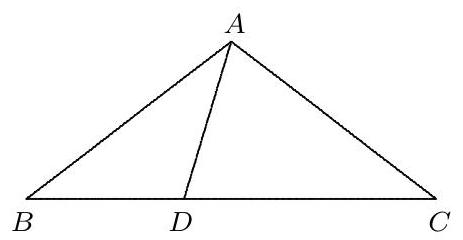
Find the measure of angle $B \widehat{A} D$, knowing that $D \widehat{A} C=39^{\circ}, A B=A C$ and $A D=B D$.
 | <think>
Okay, let me try to figure out the measure of angle BAD. So, the problem says we have triangle ABC where AB equals AC, so that's an isosceles triangle with AB = AC. Then there's a point D such that AD equals BD, and angle DAC is 39 degrees. We need to find the measure of angle BAD. Hmm, let me visualize this.
... | [
{
"from": "human",
"value": "Find the measure of angle $B \\widehat{A} D$, knowing that $D \\widehat{A} C=39^{\\circ}, A B=A C$ and $A D=B D$.\n\n"
},
{
"from": "gpt",
... |
15. Around a $10 \sqrt{2}$ meters $\times 10$ meters rectangular building, there is a large, lush grassland. At a point $5 \sqrt{2}$ meters in front of the midpoint of the longer wall of the building, a wooden stake is driven into the ground. A 20-meter-long rope is then used to tie a goat to the stake. The area of the... | <think>
Okay, let me try to visualize this problem. There's a rectangular building with dimensions 10√2 meters by 10 meters. So, first, I need to figure out which walls are longer. Since 10√2 is approximately 14.14 meters, which is longer than 10 meters, the longer walls are the ones that are 10√2 meters in length. The... | [
{
"from": "human",
"value": "15. Around a $10 \\sqrt{2}$ meters $\\times 10$ meters rectangular building, there is a large, lush grassland. At a point $5 \\sqrt{2}$ meters in front of the midpoint of the longer wall of the building, a wooden stake is driven into the ground. A 20-meter-long rope is then used... |
A cube-shaped container with an edge length of $12 \mathrm{~cm}$ was filled to $\frac{5}{8}$ of its capacity with a liquid, and then it was slightly tilted along one of its edges. The diagram shows the cross-section of the container with the horizontal level of the liquid inside. We know that the length of segment $L C... | <think>
Alright, let me try to figure out this cube container problem. Hmm, okay, so we have a cube with edge length 12 cm. It's filled to 5/8 of its capacity with liquid, and then it's tilted along one edge. The cross-section diagram shows the liquid level, and we know that LC is twice KB. We need to find the length o... | [
{
"from": "human",
"value": "A cube-shaped container with an edge length of $12 \\mathrm{~cm}$ was filled to $\\frac{5}{8}$ of its capacity with a liquid, and then it was slightly tilted along one of its edges. The diagram shows the cross-section of the container with the horizontal level of the liquid insi... |
9.9. Find the largest number $m$ such that for any positive numbers $a, b$, and $c$, the sum of which is 1, the inequality
$$
\sqrt{\frac{a b}{c+a b}}+\sqrt{\frac{b c}{a+b c}}+\sqrt{\frac{c a}{b+c a}} \geqslant m
$$
holds.
(l. Emelyanov) | <think>
Okay, so I need to find the largest number m such that for any positive numbers a, b, c with a + b + c = 1, the inequality √(ab/(c + ab)) + √(bc/(a + bc)) + √(ca/(b + ca)) ≥ m holds. Alright, let's start by understanding the problem.
First, since a, b, c are positive and sum to 1, each of them is between 0 and... | [
{
"from": "human",
"value": "9.9. Find the largest number $m$ such that for any positive numbers $a, b$, and $c$, the sum of which is 1, the inequality\n\n$$\n\\sqrt{\\frac{a b}{c+a b}}+\\sqrt{\\frac{b c}{a+b c}}+\\sqrt{\\frac{c a}{b+c a}} \\geqslant m\n$$\n\nholds.\n\n(l. Emelyanov)"
},
{
"from": "... |
Find the maximal value of the following expression, if $a,b,c$ are nonnegative and $a+b+c=1$.
\[ \frac{1}{a^2 -4a+9} + \frac {1}{b^2 -4b+9} + \frac{1}{c^2 -4c+9} \] | <think>
Okay, so I have this problem here where I need to find the maximal value of the expression:
\[
\frac{1}{a^2 -4a +9} + \frac{1}{b^2 -4b +9} + \frac{1}{c^2 -4c +9}
\]
given that \( a, b, c \) are nonnegative real numbers and \( a + b + c = 1 \).
First, I need to understand what the problem is asking. It's abou... | [
{
"from": "human",
"value": "Find the maximal value of the following expression, if $a,b,c$ are nonnegative and $a+b+c=1$.\n\\[ \\frac{1}{a^2 -4a+9} + \\frac {1}{b^2 -4b+9} + \\frac{1}{c^2 -4c+9} \\]"
},
{
"from": "gpt",
"value": "<think>\nOkay, so I have this problem here where I need to find t... |
21.3.9 $\star \star$ Let $a_{1}, a_{2}, \cdots, a_{n}$ be a permutation of $1,2, \cdots, n$, satisfying $a_{i} \neq i(i=1$, $2, \cdots, n)$, there are $D_{n}$ such groups of $a_{1}, a_{2}, \cdots, a_{n}$, find $D_{n}$. | <think>
Okay, so I have this problem here where I need to find the number of permutations of the numbers 1 through n such that no number is in its original position. These permutations are called derangements, right? The problem mentions they are denoted by D_n. Hmm, I remember hearing about derangements before, but I ... | [
{
"from": "human",
"value": "21.3.9 $\\star \\star$ Let $a_{1}, a_{2}, \\cdots, a_{n}$ be a permutation of $1,2, \\cdots, n$, satisfying $a_{i} \\neq i(i=1$, $2, \\cdots, n)$, there are $D_{n}$ such groups of $a_{1}, a_{2}, \\cdots, a_{n}$, find $D_{n}$."
},
{
"from": "gpt",
"value": "<think>\nO... |
2. There is a sequence of numbers, starting from the 3rd number, each number is the sum of all the numbers before it. If the 1st number of this sequence is 1, and the 2nd number is 2, then the remainder when the 2022nd number is divided by 7 is $\qquad$ - | <think>
Okay, so there's this sequence where starting from the 3rd number, each number is the sum of all the numbers before it. The first two numbers are 1 and 2. I need to find the remainder when the 2022nd number is divided by 7. Hmm, let's break this down.
First, let's make sure I understand the sequence. The first... | [
{
"from": "human",
"value": "2. There is a sequence of numbers, starting from the 3rd number, each number is the sum of all the numbers before it. If the 1st number of this sequence is 1, and the 2nd number is 2, then the remainder when the 2022nd number is divided by 7 is $\\qquad$ -"
},
{
"from": ... |
4. (8 points) Fill the numbers $1-9$ into a $3 \times 3$ table, such that in the same row, the number on the right is greater than the number on the left; and in the same column, the number below is greater than the number above. Given that $1,4,9$ are already filled in, how many different ways can the remaining 6 inte... | <think>
Okay, so I need to fill a 3x3 grid with numbers 1 through 9, each used exactly once. The rules are that in each row, the numbers increase from left to right, and in each column, they increase from top to bottom. Some numbers are already given: 1, 4, and 9. The question is asking how many different ways I can fi... | [
{
"from": "human",
"value": "4. (8 points) Fill the numbers $1-9$ into a $3 \\times 3$ table, such that in the same row, the number on the right is greater than the number on the left; and in the same column, the number below is greater than the number above. Given that $1,4,9$ are already filled in, how ma... |
$A$, $B$, $C$, and $D$ are points on a circle, and segments $\overline{AC}$ and $\overline{BD}$ intersect at $P$, such that $AP=8$, $PC=1$, and $BD=6$. Find $BP$, given that $BP<DP$. | <think>
Okay, so there's this geometry problem here. Let me try to visualize it first. We have a circle with four points on it: A, B, C, and D. The segments AC and BD intersect at point P. We're given that AP is 8 units, PC is 1 unit, and the entire length of BD is 6 units. We need to find the length of BP, and we know... | [
{
"from": "human",
"value": "$A$, $B$, $C$, and $D$ are points on a circle, and segments $\\overline{AC}$ and $\\overline{BD}$ intersect at $P$, such that $AP=8$, $PC=1$, and $BD=6$. Find $BP$, given that $BP<DP$."
},
{
"from": "gpt",
"value": "<think>\nOkay, so there's this geometry problem he... |
14.50. The two players are of equal strength, i.e., they have equal chances of winning each game. They agreed that the prize would go to the one who first wins 6 games. They had to stop the game after the first player won 5 games, and the second player won 3. In what ratio should the prize be fairly divided? | <think>
Alright, so there's this problem where two players of equal strength are trying to win a prize by being the first to win 6 games. They had to stop early because the first player had 5 wins and the second had 3. Now, we need to figure out how to fairly divide the prize between them based on their chances of winn... | [
{
"from": "human",
"value": "14.50. The two players are of equal strength, i.e., they have equal chances of winning each game. They agreed that the prize would go to the one who first wins 6 games. They had to stop the game after the first player won 5 games, and the second player won 3. In what ratio shoul... |
Given the Fibonacci sequence with $f_0=f_1=1$and for $n\geq 1, f_{n+1}=f_n+f_{n-1}$, find all real solutions to the equation: $$x^{2024}=f_{2023}x+f_{2022}.$$ | <think>
Okay, so I need to solve the equation \( x^{2024} = f_{2023}x + f_{2022} \), where \( f_n \) is the Fibonacci sequence starting with \( f_0 = f_1 = 1 \). Hmm, Fibonacci sequence, right? So each term is the sum of the two previous ones. Let me confirm the recurrence relation: for \( n \geq 1 \), \( f_{n+1} = f_n... | [
{
"from": "human",
"value": "Given the Fibonacci sequence with $f_0=f_1=1$and for $n\\geq 1, f_{n+1}=f_n+f_{n-1}$, find all real solutions to the equation: $$x^{2024}=f_{2023}x+f_{2022}.$$"
},
{
"from": "gpt",
"value": "<think>\nOkay, so I need to solve the equation \\( x^{2024} = f_{2023}x + f_... |
A 25-meter long coiled cable is cut into pieces of 2 and 3 meters. In how many ways can this be done if the order of the different sized pieces also matters? | <think>
Okay, so I need to figure out how many ways a 25-meter coiled cable can be cut into pieces of 2 and 3 meters, considering that the order of the different sized pieces matters. Hmm, let me think.
First, the problem is about partitioning a length of 25 meters into combinations of 2m and 3m segments. But since t... | [
{
"from": "human",
"value": "A 25-meter long coiled cable is cut into pieces of 2 and 3 meters. In how many ways can this be done if the order of the different sized pieces also matters?"
},
{
"from": "gpt",
"value": "<think>\nOkay, so I need to figure out how many ways a 25-meter coiled cable c... |
12.006. In a right-angled triangle, the area $S$ and an acute angle $\alpha$ are given. Find the distance from the point of intersection of the medians of the triangle to the hypotenuse. | <think>
Okay, so I need to find the distance from the centroid (that's the point where the medians intersect) of a right-angled triangle to the hypotenuse, given the area S and one of the acute angles α. Let me think step by step how to approach this.
First, let's recall that in a right-angled triangle, the centroid i... | [
{
"from": "human",
"value": "12.006. In a right-angled triangle, the area $S$ and an acute angle $\\alpha$ are given. Find the distance from the point of intersection of the medians of the triangle to the hypotenuse."
},
{
"from": "gpt",
"value": "<think>\nOkay, so I need to find the distance fr... |
764. How should the projection plane lie so that the rectangular projection of a right angle onto it is also a right angle. | <think>
Okay, so the problem is asking: How should the projection plane lie so that the rectangular projection of a right angle onto it is also a right angle. Hmm, right angle projection... I need to figure out under what conditions projecting a right angle orthogonally (rectangular projection) onto a plane will preser... | [
{
"from": "human",
"value": "764. How should the projection plane lie so that the rectangular projection of a right angle onto it is also a right angle."
},
{
"from": "gpt",
"value": "<think>\nOkay, so the problem is asking: How should the projection plane lie so that the rectangular projection ... |
Proivolov V.V.
In an isosceles triangle $ABC (AB = AC)$, the angle $A$ is equal to $\alpha$. On the side $AB$, a point $D$ is taken such that $AD = AB / n$. Find the sum of $n-1$ angles under which the segment $AD$ is seen from the points dividing the side $BC$ into $n$ equal parts:
a) for $n=3$
b) for an arbitrary ... | <think>
Okay, so I have this geometry problem here about an isosceles triangle ABC where AB equals AC, and angle A is alpha. On side AB, there's a point D such that AD is AB divided by n. The question is asking for the sum of n-1 angles from which the segment AD is seen from the points that divide side BC into n equal ... | [
{
"from": "human",
"value": "Proivolov V.V.\n\nIn an isosceles triangle $ABC (AB = AC)$, the angle $A$ is equal to $\\alpha$. On the side $AB$, a point $D$ is taken such that $AD = AB / n$. Find the sum of $n-1$ angles under which the segment $AD$ is seen from the points dividing the side $BC$ into $n$ equa... |
$4 \cdot 206$ There are two forces $f_{1} 、 f_{2}$ acting on the origin $O$ of the coordinate axes,
$$
\begin{array}{l}
\vec{f}_{1}=\overrightarrow{O A}=\sqrt{2}\left(\cos 45^{\circ}+i \sin 45^{\circ}\right), \\
\overrightarrow{f_{2}}=\overrightarrow{O B}=2\left[\cos \left(-30^{\circ}\right)+i \sin \left(-30^{\circ}\ri... | <think>
Okay, so I need to solve this problem where there are two forces, f₁ and f₂, acting on the origin O. The problem has two parts: first, finding the magnitude and direction of their resultant force, and second, finding the distance between points A and B accurate to 0.1. Let me start with part (1).
First, let me... | [
{
"from": "human",
"value": "$4 \\cdot 206$ There are two forces $f_{1} 、 f_{2}$ acting on the origin $O$ of the coordinate axes,\n$$\n\\begin{array}{l}\n\\vec{f}_{1}=\\overrightarrow{O A}=\\sqrt{2}\\left(\\cos 45^{\\circ}+i \\sin 45^{\\circ}\\right), \\\\\n\\overrightarrow{f_{2}}=\\overrightarrow{O B}=2\\l... |
On the coordinate plane, let $C$ be a circle centered $P(0,\ 1)$ with radius 1. let $a$ be a real number $a$ satisfying $0<a<1$. Denote by $Q,\ R$ intersection points of the line $y=a(x+1) $ and $C$.
(1) Find the area $S(a)$ of $\triangle{PQR}$.
(2) When $a$ moves in the range of $0<a<1$, find the value of $a$ for wh... | <think>
Okay, so I need to solve this problem about the circle and the line intersecting it. Let me start by understanding the problem step by step.
First, the circle C is centered at P(0, 1) with radius 1. So its equation should be (x)^2 + (y - 1)^2 = 1. That makes sense because the standard equation for a circle is ... | [
{
"from": "human",
"value": "On the coordinate plane, let $C$ be a circle centered $P(0,\\ 1)$ with radius 1. let $a$ be a real number $a$ satisfying $0<a<1$. Denote by $Q,\\ R$ intersection points of the line $y=a(x+1) $ and $C$.\n\n(1) Find the area $S(a)$ of $\\triangle{PQR}$.\n\n(2) When $a$ moves in th... |
Task 1. Boys and girls formed a circle in such a way that the number of children whose right neighbor is of the same gender is equal to the number of children whose right neighbor is of a different gender. What could be the total number of children in the circle? | <think>
Okay, so there's this problem where boys and girls are arranged in a circle. The condition is that the number of children whose right neighbor is the same gender is equal to the number of children whose right neighbor is a different gender. I need to figure out what the total number of children could be. Hmm, l... | [
{
"from": "human",
"value": "Task 1. Boys and girls formed a circle in such a way that the number of children whose right neighbor is of the same gender is equal to the number of children whose right neighbor is of a different gender. What could be the total number of children in the circle?"
},
{
"... |
8. Given the sequence $\left\{a_{n}\right\}$ with the first term being 2, and satisfying $6 S_{n}=3 a_{n+1}+4^{n}-1$. Then the maximum value of $S_{n}$ is | <think>
Okay, let's try to figure out this problem. We have a sequence {a_n} where the first term is 2. The condition given is 6 S_n = 3 a_{n+1} + 4^n - 1. We need to find the maximum value of S_n, which is the sum of the first n terms of the sequence.
First, let me recall that S_n is the sum of the first n terms, so ... | [
{
"from": "human",
"value": "8. Given the sequence $\\left\\{a_{n}\\right\\}$ with the first term being 2, and satisfying $6 S_{n}=3 a_{n+1}+4^{n}-1$. Then the maximum value of $S_{n}$ is"
},
{
"from": "gpt",
"value": "<think>\nOkay, let's try to figure out this problem. We have a sequence {a_n}... |
1. A commercial lock with 10 buttons, which can be opened by pressing the correct five numbers, regardless of the order. The figure below is an example using $\{1,2,3,6,9\}$ as its combination. If these locks are reprogrammed to allow combinations of one to nine digits, how many additional combinations (i.e., not using... | <think>
Okay, let's try to figure out how to solve this problem. So, we have a commercial lock with 10 buttons, labeled from 0 to 9, I assume. Normally, it's opened by pressing the correct five numbers, and the order doesn't matter. So, the original number of combinations is the number of ways to choose 5 buttons out o... | [
{
"from": "human",
"value": "1. A commercial lock with 10 buttons, which can be opened by pressing the correct five numbers, regardless of the order. The figure below is an example using $\\{1,2,3,6,9\\}$ as its combination. If these locks are reprogrammed to allow combinations of one to nine digits, how ma... |
[Decimal numeral system]
Find all natural numbers that increase by 9 times when a zero is inserted between the units digit and the tens digit.
# | <think>
Okay, so I need to find all natural numbers that become nine times larger when a zero is inserted between the units digit and the tens digit. Hmm, let's break this down.
First, let's understand the problem. Let's say the original number is some number N. When we insert a zero between the units and tens digit,... | [
{
"from": "human",
"value": "[Decimal numeral system]\n\nFind all natural numbers that increase by 9 times when a zero is inserted between the units digit and the tens digit.\n\n#"
},
{
"from": "gpt",
"value": "<think>\nOkay, so I need to find all natural numbers that become nine times larger wh... |
Find all 7-divisible six-digit numbers of the form $\overline{A B C C B A}$, where $\overline{A B C}$ is also divisible by 7. ( $A$, $B, C$ represent different digits.) | <think>
Okay, let's tackle this problem. So, we need to find all six-digit numbers in the form ABC C BA, which are divisible by 7. Additionally, the first three digits, ABC, should also be divisible by 7. And A, B, C must be different digits. Hmm, okay. Let me break this down.
First, the number is a palindrome, meanin... | [
{
"from": "human",
"value": "Find all 7-divisible six-digit numbers of the form $\\overline{A B C C B A}$, where $\\overline{A B C}$ is also divisible by 7. ( $A$, $B, C$ represent different digits.)"
},
{
"from": "gpt",
"value": "<think>\nOkay, let's tackle this problem. So, we need to find all... |
5. Find the number of lattice points in the plane region (excluding the boundary) bounded by the parabola $x^{2}=2 y$, the $x$-axis, and the line $x=21$.
| <think>
Okay, so I need to find the number of lattice points inside the region bounded by the parabola x² = 2y, the x-axis, and the line x = 21. And importantly, we're excluding the boundary points. Let me visualize this first. The parabola x² = 2y opens upwards, right? So, it's symmetric about the y-axis. But since we... | [
{
"from": "human",
"value": "5. Find the number of lattice points in the plane region (excluding the boundary) bounded by the parabola $x^{2}=2 y$, the $x$-axis, and the line $x=21$.\n\n"
},
{
"from": "gpt",
"value": "<think>\nOkay, so I need to find the number of lattice points inside the regio... |
11. (IND $\left.3^{\prime}\right)^{\mathrm{IMO}}$ Given a circle with two chords $A B, C D$ that meet at $E$, let $M$ be a point of chord $A B$ other than $E$. Draw the circle through $D, E$, and $M$. The tangent line to the circle $D E M$ at $E$ meets the lines $B C, A C$ at $F, G$, respectively. Given $\frac{A M}{A B... | <think>
Okay, so I have this geometry problem here from an IMO competition. Let me try to parse it step by step. Let's see... There's a circle with two chords AB and CD that meet at point E. Then there's a point M on chord AB other than E. We need to draw a circle through points D, E, and M. Then, the tangent line to t... | [
{
"from": "human",
"value": "11. (IND $\\left.3^{\\prime}\\right)^{\\mathrm{IMO}}$ Given a circle with two chords $A B, C D$ that meet at $E$, let $M$ be a point of chord $A B$ other than $E$. Draw the circle through $D, E$, and $M$. The tangent line to the circle $D E M$ at $E$ meets the lines $B C, A C$ a... |
5. Planet Beta has seven countries, each of which has exactly four friendly countries and two enemy countries. There are no three countries that are all enemies with each other. For such a planetary situation, the number of possible alliances of three countries that are all friendly with each other is $\qquad$. | <think>
Okay, so I need to figure out the number of possible alliances of three countries that are all friendly with each other on Planet Beta. The planet has seven countries, each with exactly four friendly countries and two enemy countries. Also, there are no three countries that are all enemies with each other. Hmm,... | [
{
"from": "human",
"value": "5. Planet Beta has seven countries, each of which has exactly four friendly countries and two enemy countries. There are no three countries that are all enemies with each other. For such a planetary situation, the number of possible alliances of three countries that are all frie... |
3. If $y=\sqrt{3} \sin \frac{x}{4} \cdot\left(1+\cos \frac{x}{2}\right)(0 \leqslant x \leqslant 2 \pi)$, then the maximum value of $y$ is ( ).
(A) $2 \sqrt{3}$
(B) $\frac{4}{3}$
(C) $\frac{4 \sqrt{3}}{9}$
(D) $\frac{\sqrt{3}}{2}$ | <think>
Okay, so I need to find the maximum value of this function y, which is given by y = sqrt(3) times sin(x/4) multiplied by (1 + cos(x/2)) where x is between 0 and 2π. The options are A through D, and I need to figure out which one is correct. Let me start by understanding the problem step by step.
First, let me ... | [
{
"from": "human",
"value": "3. If $y=\\sqrt{3} \\sin \\frac{x}{4} \\cdot\\left(1+\\cos \\frac{x}{2}\\right)(0 \\leqslant x \\leqslant 2 \\pi)$, then the maximum value of $y$ is ( ).\n(A) $2 \\sqrt{3}$\n(B) $\\frac{4}{3}$\n(C) $\\frac{4 \\sqrt{3}}{9}$\n(D) $\\frac{\\sqrt{3}}{2}$"
},
{
"from": "gpt",... |
1. The complex number $z$ satisfies $|z|=5$, and $(3+4 \mathrm{i}) z$ is a pure imaginary number. Then $\bar{z}=$ $\qquad$ | <think>
Okay, let's try to solve this problem step by step. So, we have a complex number z with |z| = 5, which means its magnitude is 5. Then, when we multiply z by (3 + 4i), the result is a pure imaginary number. We need to find the conjugate of z, denoted as \(\bar{z}\).
First, let me recall some basics about comple... | [
{
"from": "human",
"value": "1. The complex number $z$ satisfies $|z|=5$, and $(3+4 \\mathrm{i}) z$ is a pure imaginary number. Then $\\bar{z}=$ $\\qquad$"
},
{
"from": "gpt",
"value": "<think>\nOkay, let's try to solve this problem step by step. So, we have a complex number z with |z| = 5, whic... |
For which value of $\mathrm{a}$ does the equation
$$
10^{x^{2}+x}=a
$$
have a real solution? | <think>
Okay, so I need to figure out for which value of 'a' the equation \(10^{x^{2}+x} = a\) has a real solution. Hmm, let me start by understanding what the problem is asking. Essentially, they want to know all possible values of 'a' such that there exists at least one real number x that satisfies the equation.
Fi... | [
{
"from": "human",
"value": "For which value of $\\mathrm{a}$ does the equation\n\n$$\n10^{x^{2}+x}=a\n$$\n\nhave a real solution?"
},
{
"from": "gpt",
"value": "<think>\nOkay, so I need to figure out for which value of 'a' the equation \\(10^{x^{2}+x} = a\\) has a real solution. Hmm, let me sta... |
Find all positive integers $(m, n)$ that satisfy $$m^2 =\sqrt{n} +\sqrt{2n + 1}.$$ | <think>
Okay, so I need to find all positive integers (m, n) that satisfy the equation m² = √n + √(2n + 1). Hmm, let me try to figure this out step by step. First, since m and n are positive integers, the right-hand side must also be a positive real number, but more importantly, it must be rational because the left-han... | [
{
"from": "human",
"value": "Find all positive integers $(m, n)$ that satisfy $$m^2 =\\sqrt{n} +\\sqrt{2n + 1}.$$"
},
{
"from": "gpt",
"value": "<think>\nOkay, so I need to find all positive integers (m, n) that satisfy the equation m² = √n + √(2n + 1). Hmm, let me try to figure this out step b... |
1. Given $a, b, c$ are real numbers, and $2a + b + c = 5, b - c = 1$. Then the maximum value of $ab + bc + ca$ is | <think>
Okay, let's see. I need to find the maximum value of ab + bc + ca given the equations 2a + b + c = 5 and b - c = 1. Hmm, so there are three variables here: a, b, and c. But since there are two equations, maybe I can express two variables in terms of the third and substitute them into the expression ab + bc + ca... | [
{
"from": "human",
"value": "1. Given $a, b, c$ are real numbers, and $2a + b + c = 5, b - c = 1$. Then the maximum value of $ab + bc + ca$ is"
},
{
"from": "gpt",
"value": "<think>\nOkay, let's see. I need to find the maximum value of ab + bc + ca given the equations 2a + b + c = 5 and b - c = ... |
16. As shown in the figure, in trapezoid $\mathrm{ABCD}$, $\mathrm{AD}$ is parallel to $\mathrm{BC}$, and $\mathrm{BC}: \mathrm{AD}=5: 7$. Point $\mathrm{F}$ is on segment $\mathrm{AD}$, and point $\mathrm{E}$ is on segment $\mathrm{CD}$, satisfying $\mathrm{AF}: \mathrm{FD}=4: 3, \mathrm{CE}: \mathrm{ED}=2: 3$. If the... | <think>
Okay, so we have this trapezoid ABCD where AD is parallel to BC, and the ratio of BC to AD is 5:7. Points F and E are on AD and CD respectively, with AF:FD being 4:3 and CE:ED being 2:3. The area of quadrilateral ABEF is given as 123, and we need to find the area of the entire trapezoid ABCD. Hmm, trapezoid are... | [
{
"from": "human",
"value": "16. As shown in the figure, in trapezoid $\\mathrm{ABCD}$, $\\mathrm{AD}$ is parallel to $\\mathrm{BC}$, and $\\mathrm{BC}: \\mathrm{AD}=5: 7$. Point $\\mathrm{F}$ is on segment $\\mathrm{AD}$, and point $\\mathrm{E}$ is on segment $\\mathrm{CD}$, satisfying $\\mathrm{AF}: \\mat... |
## Task 2 - 260832
Determine all pairs $(p ; q)$ of prime numbers that satisfy the following conditions (1), (2), (3)!
(1) The difference $q-p$ is greater than 0 and less than 10.
(2) The sum $p+q$ is the square of a natural number $n$.
(3) If you add the number $n$ to the sum of $p$ and $q$, you get 42. | <think>
Okay, let's see. I need to find all pairs of prime numbers (p, q) such that three conditions are satisfied. Let me go through each condition step by step.
First, condition (1) says that the difference q - p is greater than 0 and less than 10. So q is larger than p, and the gap between them is at most 9. Since ... | [
{
"from": "human",
"value": "## Task 2 - 260832\n\nDetermine all pairs $(p ; q)$ of prime numbers that satisfy the following conditions (1), (2), (3)!\n\n(1) The difference $q-p$ is greater than 0 and less than 10.\n\n(2) The sum $p+q$ is the square of a natural number $n$.\n\n(3) If you add the number $n$ ... |
35. The fish soup prepared by the tourists on the seashore after a successful fishing trip was good, but due to lack of culinary experience, they put too little salt in it, so they had to add salt at the table. The next time they made the same amount of fish soup, they put in twice as much salt as the first time, but e... | <think>
Okay, let's see. The problem is about tourists making fish soup twice. Both times, they didn't put enough salt the first time, so they had to add salt at the table. The second time, they used twice as much salt as the first time, but still had to add salt, though only half as much as the first time. We need to ... | [
{
"from": "human",
"value": "35. The fish soup prepared by the tourists on the seashore after a successful fishing trip was good, but due to lack of culinary experience, they put too little salt in it, so they had to add salt at the table. The next time they made the same amount of fish soup, they put in tw... |
6.23 The sum of the first three terms of an increasing arithmetic progression is 21. If 1 is subtracted from the first two terms of this progression, and 2 is added to the third term, the resulting three numbers will form a geometric progression. Find the sum of the first eight terms of the geometric progression. | <think>
Okay, let me try to figure out this problem. So, we have an arithmetic progression (AP) which is increasing. The sum of the first three terms is 21. Then, if we subtract 1 from the first two terms and add 2 to the third term, these three numbers form a geometric progression (GP). We need to find the sum of the ... | [
{
"from": "human",
"value": "6.23 The sum of the first three terms of an increasing arithmetic progression is 21. If 1 is subtracted from the first two terms of this progression, and 2 is added to the third term, the resulting three numbers will form a geometric progression. Find the sum of the first eight ... |
12. Let the set $M=\{1,2, \cdots, 10\}$,
$$
\begin{aligned}
A= & \{(x, y, z) \mid x, y, z \in M, \text { and } \\
& \left.9 \mid\left(x^{3}+y^{3}+z^{3}\right)\right\} .
\end{aligned}
$$
Then the number of elements in set $A$ is $\qquad$ | <think>
Alright, so I need to find the number of ordered triples (x, y, z) where x, y, z are elements of the set M = {1, 2, ..., 10}, and the sum of their cubes is divisible by 9. That is, 9 divides x³ + y³ + z³. The question is asking for the cardinality of set A, which is defined as all such triples.
First, let me ... | [
{
"from": "human",
"value": "12. Let the set $M=\\{1,2, \\cdots, 10\\}$,\n$$\n\\begin{aligned}\nA= & \\{(x, y, z) \\mid x, y, z \\in M, \\text { and } \\\\\n& \\left.9 \\mid\\left(x^{3}+y^{3}+z^{3}\\right)\\right\\} .\n\\end{aligned}\n$$\n\nThen the number of elements in set $A$ is $\\qquad$"
},
{
"... |
1. Before leaving for the store, Mom asked Anya, Varya, and Svetlana to do some work. The girls work with the same productivity. At first, they worked together, but after 20 minutes, Anya had to leave, and Varya and Svetlana continued working alone. After another 15 minutes, Varya also had to leave, and Svetlana finish... | <think>
Okay, let's try to figure out how to divide the apples fairly among Anya, Varya, and Svetlana based on the work they did. Hmm, so the problem says they all have the same productivity, which probably means they each work at the same rate. The key here is to calculate how much each girl contributed to the total w... | [
{
"from": "human",
"value": "1. Before leaving for the store, Mom asked Anya, Varya, and Svetlana to do some work. The girls work with the same productivity. At first, they worked together, but after 20 minutes, Anya had to leave, and Varya and Svetlana continued working alone. After another 15 minutes, Var... |
16(!). Determine \(p\) so that the sum of the absolute values of the roots of the equation \(z^{2}+p z-6=0\) is equal to 5. | <think>
Okay, so I need to find the value of p such that the sum of the absolute values of the roots of the quadratic equation z² + p z - 6 = 0 is equal to 5. Hmm, let's start by recalling some basic properties of quadratic equations and their roots.
First, for a general quadratic equation az² + bz + c = 0, the sum o... | [
{
"from": "human",
"value": "16(!). Determine \\(p\\) so that the sum of the absolute values of the roots of the equation \\(z^{2}+p z-6=0\\) is equal to 5."
},
{
"from": "gpt",
"value": "<think>\nOkay, so I need to find the value of p such that the sum of the absolute values of the roots of the... |
4.58 Find the integers $m$ and $n$ that satisfy the equation $(5+3 \sqrt{2})^{m}=(3+5 \sqrt{2})^{n}$. | <think>
Okay, let's see. I have this equation: (5 + 3√2)^m = (3 + 5√2)^n. I need to find integers m and n that satisfy this. Hmm, interesting. Both sides are expressions with radicals raised to some power. Maybe if I can express both sides in a similar form or find some relationship between the bases?
First, let me re... | [
{
"from": "human",
"value": "4.58 Find the integers $m$ and $n$ that satisfy the equation $(5+3 \\sqrt{2})^{m}=(3+5 \\sqrt{2})^{n}$."
},
{
"from": "gpt",
"value": "<think>\nOkay, let's see. I have this equation: (5 + 3√2)^m = (3 + 5√2)^n. I need to find integers m and n that satisfy this. Hmm, i... |
10. (10 points) As shown in the figure, in triangle $ABC$, $AD=2BD$, $AD=EC$, $BC=18$, the area of triangle $AFC$ is equal to the area of quadrilateral $DBEF$. What is the length of $AB$? | <think>
Alright, so I have this geometry problem here. Let me try to visualize it first. The triangle is ABC. There's a point D on AB such that AD is twice BD, right? So AD = 2BD. Then, AD is also equal to EC. Hmm, EC must be a segment on BC or maybe somewhere else? Wait, the problem says "as shown in the figure," but ... | [
{
"from": "human",
"value": "10. (10 points) As shown in the figure, in triangle $ABC$, $AD=2BD$, $AD=EC$, $BC=18$, the area of triangle $AFC$ is equal to the area of quadrilateral $DBEF$. What is the length of $AB$?"
},
{
"from": "gpt",
"value": "<think>\nAlright, so I have this geometry proble... |
2. a) Calculate
$$
(a-b)\left(a^{4}+a^{3} b+a^{2} b^{2}+a b^{3}+b^{4}\right)
$$
b) Using the equality obtained in a), determine a prime number $p$ such that $2 p^{2}+1=k^{5}$, where $k$ is a natural number. | <think>
Okay, let's tackle part (a) first. The problem asks to calculate the expression (a - b)(a⁴ + a³b + a²b² + ab³ + b⁴). Hmm, this looks familiar. Maybe it's a formula for factoring or expanding something? Let me think.
I remember that when you have a binomial multiplied by a series of terms with descending and a... | [
{
"from": "human",
"value": "2. a) Calculate\n\n$$\n(a-b)\\left(a^{4}+a^{3} b+a^{2} b^{2}+a b^{3}+b^{4}\\right)\n$$\n\nb) Using the equality obtained in a), determine a prime number $p$ such that $2 p^{2}+1=k^{5}$, where $k$ is a natural number."
},
{
"from": "gpt",
"value": "<think>\nOkay, let'... |
(7 Ellipse $\frac{x^{2}}{a^{2}}+\frac{y^{2}}{b^{2}}=1$ has a focal distance of $2 c$, if the three numbers $a$, $b$, $c$ form a geometric sequence in order, then its eccentricity is $\qquad$ . | <think>
Okay, let's try to solve this problem step by step. The problem is about an ellipse with the equation \(\frac{x^2}{a^2} + \frac{y^2}{b^2} = 1\), and it mentions that the focal distance is \(2c\). The numbers \(a\), \(b\), and \(c\) form a geometric sequence in order, and we need to find the eccentricity of the ... | [
{
"from": "human",
"value": "(7 Ellipse $\\frac{x^{2}}{a^{2}}+\\frac{y^{2}}{b^{2}}=1$ has a focal distance of $2 c$, if the three numbers $a$, $b$, $c$ form a geometric sequence in order, then its eccentricity is $\\qquad$ ."
},
{
"from": "gpt",
"value": "<think>\nOkay, let's try to solve this p... |
5 (1246). By what percentage will the area of a rectangle increase if its length is increased by $20 \%$ and its width by $10 \%$? | <think>
Okay, so the problem is asking by what percentage the area of a rectangle will increase if its length is increased by 20% and its width by 10%. Hmm, let me think. I remember that the area of a rectangle is calculated by multiplying its length and width. So, if both dimensions change, the new area will be the pr... | [
{
"from": "human",
"value": "5 (1246). By what percentage will the area of a rectangle increase if its length is increased by $20 \\%$ and its width by $10 \\%$?"
},
{
"from": "gpt",
"value": "<think>\nOkay, so the problem is asking by what percentage the area of a rectangle will increase if its... |
Sally is thinking of a positive four-digit integer. When she divides it by any one-digit integer greater than $1$, the remainder is $1$. How many possible values are there for Sally's four-digit number? | <think>
Okay, so Sally has a four-digit number, right? Let's call her number N. The problem says that when she divides N by any one-digit integer greater than 1, the remainder is 1. Hmm, so the one-digit integers greater than 1 are 2, 3, 4, 5, 6, 7, 8, 9. That means N leaves a remainder of 1 when divided by each of the... | [
{
"from": "human",
"value": "Sally is thinking of a positive four-digit integer. When she divides it by any one-digit integer greater than $1$, the remainder is $1$. How many possible values are there for Sally's four-digit number?"
},
{
"from": "gpt",
"value": "<think>\nOkay, so Sally has a fou... |
18. (12 points) Given vectors $\boldsymbol{m}=(\sin A, \cos A)$, $\boldsymbol{n}=(\cos B, \sin B)$, $\boldsymbol{m} \cdot \boldsymbol{n}=\sin 2 C$, and $\angle A$, $\angle B$, $\angle C$ are the angles opposite to sides $a$, $b$, $c$ of $\triangle ABC$ respectively.
(1) Find the size of $\angle C$;
(2) If $\sin A$, $\s... | <think>
Okay, so I have this problem here with vectors and trigonometry related to a triangle. Let's take it step by step.
First, part (1) asks to find the size of angle C. The given information is vectors m = (sin A, cos A) and n = (cos B, sin B), and their dot product m · n equals sin 2C. Also, angles A, B, C are th... | [
{
"from": "human",
"value": "18. (12 points) Given vectors $\\boldsymbol{m}=(\\sin A, \\cos A)$, $\\boldsymbol{n}=(\\cos B, \\sin B)$, $\\boldsymbol{m} \\cdot \\boldsymbol{n}=\\sin 2 C$, and $\\angle A$, $\\angle B$, $\\angle C$ are the angles opposite to sides $a$, $b$, $c$ of $\\triangle ABC$ respectively... |
$f$ is a function on the set of complex numbers such that $f(z)=1/(z*)$, where $z*$ is the complex conjugate of $z$. $S$ is the set of complex numbers $z$ such that the real part of $f(z)$ lies between $1/2020$ and $1/2018$. If $S$ is treated as a subset of the complex plane, the area of $S$ can be expressed as $m× \pi... | <think>
Okay, so I need to find the area of the set S of complex numbers z where the real part of f(z) is between 1/2020 and 1/2018. The function f(z) is given as 1 divided by the complex conjugate of z. Hmm, let's start by breaking this down step by step.
First, let me recall that for a complex number z = x + yi, whe... | [
{
"from": "human",
"value": "$f$ is a function on the set of complex numbers such that $f(z)=1/(z*)$, where $z*$ is the complex conjugate of $z$. $S$ is the set of complex numbers $z$ such that the real part of $f(z)$ lies between $1/2020$ and $1/2018$. If $S$ is treated as a subset of the complex plane, th... |
## Task Condition
Find the derivative.
$$
y=\frac{(1+x) \operatorname{arctg} \sqrt{x}-\sqrt{x}}{x}
$$ | <think>
Okay, so I need to find the derivative of this function: y equals [(1 + x) arctg(sqrt(x)) minus sqrt(x)] divided by x. Hmm, let's break this down step by step.
First, let me write down the function again to make sure I have it right. The function is y = [ (1 + x) * arctan(sqrt(x)) - sqrt(x) ] / x. Alright, so... | [
{
"from": "human",
"value": "## Task Condition\n\nFind the derivative.\n\n$$\ny=\\frac{(1+x) \\operatorname{arctg} \\sqrt{x}-\\sqrt{x}}{x}\n$$"
},
{
"from": "gpt",
"value": "<think>\nOkay, so I need to find the derivative of this function: y equals [(1 + x) arctg(sqrt(x)) minus sqrt(x)] divided ... |
183. Solve the equation in integers:
$$
7 x+5 y=62
$$ | <think>
Okay, let's see. I need to solve the equation 7x + 5y = 62 where x and y are integers. Hmm, so this is a linear Diophantine equation. I remember that these equations have solutions when the greatest common divisor (gcd) of the coefficients divides the constant term. Let me check the gcd of 7 and 5 first.
7 an... | [
{
"from": "human",
"value": "183. Solve the equation in integers:\n\n$$\n7 x+5 y=62\n$$"
},
{
"from": "gpt",
"value": "<think>\nOkay, let's see. I need to solve the equation 7x + 5y = 62 where x and y are integers. Hmm, so this is a linear Diophantine equation. I remember that these equations ha... |
22. Find the square root of $25 \cdot 26 \cdot 27 \cdot 28+1$. | <think>
Okay, let me try to figure out how to find the square root of 25×26×27×28+1. Hmm, that looks like a big number. I wonder if there's a pattern or a formula that can help simplify this expression instead of multiplying everything out step by step. Let me think...
Sometimes when you have consecutive numbers mult... | [
{
"from": "human",
"value": "22. Find the square root of $25 \\cdot 26 \\cdot 27 \\cdot 28+1$."
},
{
"from": "gpt",
"value": "<think>\nOkay, let me try to figure out how to find the square root of 25×26×27×28+1. Hmm, that looks like a big number. I wonder if there's a pattern or a formula that c... |
4. Given a positive integer $n$, let $a_{1}, a_{2}, \cdots, a_{n}$ be a sequence of non-negative integers. If the arithmetic mean of some consecutive terms (which can be a single term) is not less than 1, then these terms are called a "dragon", where the first term is called the "dragon head" and the last term is calle... | <think>
Okay, let's try to tackle this problem. So, we have a sequence of non-negative integers a₁, a₂, ..., aₙ. The definition of a "dragon" is that there's some consecutive subsequence (could be just one term) where the arithmetic mean of those terms is at least 1. The first term of that subsequence is the dragon hea... | [
{
"from": "human",
"value": "4. Given a positive integer $n$, let $a_{1}, a_{2}, \\cdots, a_{n}$ be a sequence of non-negative integers. If the arithmetic mean of some consecutive terms (which can be a single term) is not less than 1, then these terms are called a \"dragon\", where the first term is called ... |
[Divisibility of numbers. General properties] $[$ Prime numbers and their properties ]
Find all natural numbers $n$ such that the number $(n-1)!$ does not divide $n^2$.
# | <think>
Okay, so I need to find all natural numbers n where (n-1)! doesn't divide n². Hmm. Let me start by recalling some number theory concepts here.
First, I remember that Wilson's theorem says that if p is a prime, then (p-1)! ≡ -1 mod p. Which means that (p-1)! + 1 is divisible by p. So for prime numbers, maybe t... | [
{
"from": "human",
"value": "[Divisibility of numbers. General properties] $[$ Prime numbers and their properties ]\n\nFind all natural numbers $n$ such that the number $(n-1)!$ does not divide $n^2$.\n\n#"
},
{
"from": "gpt",
"value": "<think>\nOkay, so I need to find all natural numbers n whe... |
The positive integer $ n$ has the following property:
if the three last digits of $n$ are removed, the number $\sqrt[3]{n}$ remains.
Find $n$. | <think>
Okay, so the problem says that there's a positive integer n such that if we remove the last three digits, we're left with the cube root of n. In other words, if we take n and chop off the last three digits, what's left is the cube root of n. Hmm, let's try to understand this properly.
Let me rephrase the probl... | [
{
"from": "human",
"value": "The positive integer $ n$ has the following property:\nif the three last digits of $n$ are removed, the number $\\sqrt[3]{n}$ remains. \nFind $n$."
},
{
"from": "gpt",
"value": "<think>\nOkay, so the problem says that there's a positive integer n such that if we remo... |
3. Given that $\triangle A B C$ is an equilateral triangle, the ellipse $\Gamma$ has one focus at $A$, and the other focus $F$ lies on the line segment $B C$. If the ellipse $\Gamma$ passes exactly through points $B$ and $C$, then its eccentricity is $\qquad$. | <think>
Alright, let's see. So we have an equilateral triangle ABC. The ellipse Γ has one focus at A, and the other focus F is on the segment BC. The ellipse passes through B and C. We need to find the eccentricity of the ellipse.
First, I remember that an ellipse is defined as the set of points where the sum of the d... | [
{
"from": "human",
"value": "3. Given that $\\triangle A B C$ is an equilateral triangle, the ellipse $\\Gamma$ has one focus at $A$, and the other focus $F$ lies on the line segment $B C$. If the ellipse $\\Gamma$ passes exactly through points $B$ and $C$, then its eccentricity is $\\qquad$."
},
{
... |
## Task 2
864 Komsomol members came to the GDR. Half of them participated in a Subbotnik for Chilean patriots. The other half helped the FDJ members in setting up playgrounds and green spaces. The next day, the Soviet friends traveled in three equally strong groups to different districts of the GDR.
a) How many Komso... | <think>
Okay, let's see. There are two parts to this problem, a) and b). Let me tackle them one by one.
Starting with part a): "How many Komsomol members participated in the Subbotnik?"
Alright, the problem says that 864 Komsomol members came to the GDR. Half of them participated in a Subbotnik for Chilean patriots... | [
{
"from": "human",
"value": "## Task 2\n\n864 Komsomol members came to the GDR. Half of them participated in a Subbotnik for Chilean patriots. The other half helped the FDJ members in setting up playgrounds and green spaces. The next day, the Soviet friends traveled in three equally strong groups to differe... |
The positive integers $ a$ and $ b$ are such that the numbers $ 15a \plus{} 16b$ and $ 16a \minus{} 15b$ are both squares of positive integers. What is the least possible value that can be taken on by the smaller of these two squares? | <think>
Okay, let me try to work through this problem step by step. The problem says that for positive integers a and b, both 15a + 16b and 16a - 15b are perfect squares. We need to find the smallest possible value of the smaller of these two squares.
First, I need to understand what is being asked here. We have two ... | [
{
"from": "human",
"value": "The positive integers $ a$ and $ b$ are such that the numbers $ 15a \\plus{} 16b$ and $ 16a \\minus{} 15b$ are both squares of positive integers. What is the least possible value that can be taken on by the smaller of these two squares?"
},
{
"from": "gpt",
"value":... |
There are $ n$ sets having $ 4$ elements each. The difference set of any two of the sets is equal to one of the $ n$ sets. $ n$ can be at most ? (A difference set of $A$ and $B$ is $ (A\setminus B)\cup(B\setminus A) $)
$\textbf{(A)}\ 3 \qquad\textbf{(B)}\ 5 \qquad\textbf{(C)}\ 7 \qquad\textbf{(D)}\ 15 \qquad\textb... | <think>
Okay, let's try to tackle this problem. So, the question is about finding the maximum number n of sets, each with 4 elements, such that the difference set of any two of them is equal to one of the n sets. The answer choices are A) 3, B) 5, C) 7, D) 15, E) None.
First, let me make sure I understand the problem... | [
{
"from": "human",
"value": "There are $ n$ sets having $ 4$ elements each. The difference set of any two of the sets is equal to one of the $ n$ sets. $ n$ can be at most ? (A difference set of $A$ and $B$ is $ (A\\setminus B)\\cup(B\\setminus A) $)\n\n$\\textbf{(A)}\\ 3 \\qquad\\textbf{(B)}\\ 5 \\qquad\... |
A circle $\omega$ and a point $P$ not lying on it are given. Let $ABC$ be an arbitrary equilateral triangle inscribed into $\omega$ and $A', B', C'$ be the projections of $P$ to $BC, CA, AB$. Find the locus of centroids of triangles $A' B'C'$. | <think>
Okay, so there's this problem about a circle ω and a point P not on it. Then, for any equilateral triangle ABC inscribed in ω, we need to find the locus of the centroids of triangles A'B'C', where A', B', C' are the projections (orthogonal projections, I assume) of P onto the sides BC, CA, AB respectively. Hmm,... | [
{
"from": "human",
"value": "A circle $\\omega$ and a point $P$ not lying on it are given. Let $ABC$ be an arbitrary equilateral triangle inscribed into $\\omega$ and $A', B', C'$ be the projections of $P$ to $BC, CA, AB$. Find the locus of centroids of triangles $A' B'C'$."
},
{
"from": "gpt",
... |
Five. (12 points) Try to find the largest and smallest seven-digit numbers that can be divided by 165, formed by the 7 digits $0,1,2,3,4,5,6$ without repetition (require the reasoning process to be written out).
Find the largest and smallest seven-digit numbers that can be formed using the digits $0,1,2,3,4,5,6$ witho... | <think>
Okay, so I need to find the largest and smallest seven-digit numbers using the digits 0,1,2,3,4,5,6 without repeating any digit, and these numbers need to be divisible by 165. Hmm, let's start by breaking down the problem.
First, divisibility by 165. I remember that 165 factors into prime numbers as 5 × 33, an... | [
{
"from": "human",
"value": "Five. (12 points) Try to find the largest and smallest seven-digit numbers that can be divided by 165, formed by the 7 digits $0,1,2,3,4,5,6$ without repetition (require the reasoning process to be written out).\n\nFind the largest and smallest seven-digit numbers that can be fo... |
6. In the Lemon Kingdom, there are 2020 villages. Some pairs of villages are directly connected by paved roads. The road network is arranged in such a way that there is exactly one way to travel from any village to any other without passing through the same road twice. Agent Orange wants to fly over as many villages as... | <think>
Okay, let's try to figure out this problem step by step. So, we have 2020 villages in the Lemon Kingdom, connected by roads in such a way that there's exactly one path between any two villages. That means the road network forms a tree structure, right? Because a tree is a connected acyclic graph, and in a tree,... | [
{
"from": "human",
"value": "6. In the Lemon Kingdom, there are 2020 villages. Some pairs of villages are directly connected by paved roads. The road network is arranged in such a way that there is exactly one way to travel from any village to any other without passing through the same road twice. Agent Ora... |
1. Solve the equation $x^{\log _{5}(0.008 x)}=\frac{125}{x^{5}}$. | <think>
Alright, so I have this equation to solve: \( x^{\log _{5}(0.008 x)} = \frac{125}{x^{5}} \). Hmm, looks a bit intimidating at first glance, but let's take it step by step.
First, I need to recall some logarithmic and exponential properties. Maybe taking logarithms on both sides could simplify things? That usu... | [
{
"from": "human",
"value": "1. Solve the equation $x^{\\log _{5}(0.008 x)}=\\frac{125}{x^{5}}$."
},
{
"from": "gpt",
"value": "<think>\nAlright, so I have this equation to solve: \\( x^{\\log _{5}(0.008 x)} = \\frac{125}{x^{5}} \\). Hmm, looks a bit intimidating at first glance, but let's take ... |
2. Given real numbers $a, b, x, y$ satisfy the system of equations:
$$
\left\{\begin{array}{l}
a x+b y=3, \\
a x^{2}+b y^{2}=7, \\
a x^{3}+b y^{3}=16, \\
a x^{4}+b y^{4}=42 .
\end{array}\right.
$$
Find the value of $a x^{5}+b y^{5}$. | <think>
Okay, let's see. I need to find the value of \( a x^5 + b y^5 \) given the system of equations:
\[
\begin{cases}
a x + b y = 3, \\
a x^2 + b y^2 = 7, \\
a x^3 + b y^3 = 16, \\
a x^4 + b y^4 = 42.
\end{cases}
\]
Hmm, this looks like a sequence of equations where each term is a combination of \( a \) and \( b \... | [
{
"from": "human",
"value": "2. Given real numbers $a, b, x, y$ satisfy the system of equations:\n$$\n\\left\\{\\begin{array}{l}\na x+b y=3, \\\\\na x^{2}+b y^{2}=7, \\\\\na x^{3}+b y^{3}=16, \\\\\na x^{4}+b y^{4}=42 .\n\\end{array}\\right.\n$$\n\nFind the value of $a x^{5}+b y^{5}$."
},
{
"from": "... |
7. If the complex numbers $\left|z_{i}\right|=1,(i=1,2,3)$, then $\left|\frac{z_{1} z_{2}+z_{2} z_{3}+z_{3} z_{1}}{z_{1}+z_{2}+z_{3}}\right|=$ | <think>
Okay, so I need to find the modulus of the expression (z₁z₂ + z₂z₃ + z₃z₁)/(z₁ + z₂ + z₃) where each z_i is a complex number with |z_i| = 1. Hmm, all the z_i are on the unit circle. That must be important.
First, I remember that for complex numbers, the modulus of a quotient is the quotient of the moduli. So ... | [
{
"from": "human",
"value": "7. If the complex numbers $\\left|z_{i}\\right|=1,(i=1,2,3)$, then $\\left|\\frac{z_{1} z_{2}+z_{2} z_{3}+z_{3} z_{1}}{z_{1}+z_{2}+z_{3}}\\right|=$"
},
{
"from": "gpt",
"value": "<think>\nOkay, so I need to find the modulus of the expression (z₁z₂ + z₂z₃ + z₃z₁)/(z₁ ... |
1. Which whole numbers from 1 to 80000 (inclusive) are there more of, and by how many: those containing only even digits or those containing only odd digits? | <think>
Okay, so I need to figure out whether there are more numbers from 1 to 80,000 that have only even digits or only odd digits, and by how much. Hmm, let's start by understanding the problem.
First, the numbers range from 1 to 80,000 inclusive. That's 80,000 numbers. But we have to consider two categories: number... | [
{
"from": "human",
"value": "1. Which whole numbers from 1 to 80000 (inclusive) are there more of, and by how many: those containing only even digits or those containing only odd digits?"
},
{
"from": "gpt",
"value": "<think>\nOkay, so I need to figure out whether there are more numbers from 1 t... |
1. Solve the inequality
$$
(2+\sqrt{3})^{x}+2<3(\sqrt{2-\sqrt{3}})^{2 x}
$$
In your answer, specify the sum of all integer values of $x$ that satisfy the given inequality and belong to the interval $(-20 ; 53)$. | <think>
Okay, let's try to solve this inequality: (2 + √3)^x + 2 < 3*(√(2 - √3))^(2x). Hmm, that looks a bit intimidating at first, but maybe I can simplify it by manipulating the expressions.
First, I notice that both sides of the inequality have terms with exponents involving x. The left side is (2 + √3)^x, and the ... | [
{
"from": "human",
"value": "1. Solve the inequality\n\n$$\n(2+\\sqrt{3})^{x}+2<3(\\sqrt{2-\\sqrt{3}})^{2 x}\n$$\n\nIn your answer, specify the sum of all integer values of $x$ that satisfy the given inequality and belong to the interval $(-20 ; 53)$."
},
{
"from": "gpt",
"value": "<think>\nOkay... |
8. Reviews (from 7th grade. 1 point). Angry reviews about the work of an online store are left by $80 \%$ of dissatisfied customers (those who were poorly served in the store). Only $15 \%$ of satisfied customers leave positive reviews. A certain online store has received 60 angry and 20 positive reviews. Using this st... | <think>
Okay, let's see. I need to figure out the probability that the next customer will be satisfied with the service in this online store based on the reviews they've received. The problem says that 80% of dissatisfied customers leave angry reviews, and only 15% of satisfied customers leave positive reviews. The sto... | [
{
"from": "human",
"value": "8. Reviews (from 7th grade. 1 point). Angry reviews about the work of an online store are left by $80 \\%$ of dissatisfied customers (those who were poorly served in the store). Only $15 \\%$ of satisfied customers leave positive reviews. A certain online store has received 60 a... |
The probability of event $A$ occurring is $v=0.1$. We conduct $n=998$ trials. Is it more likely that $A$ occurs 100 times, or 99 times? | <think>
Alright, so I have this probability problem here. It says that the probability of event A occurring is 0.1, and we're doing 998 trials. The question is asking whether it's more likely that A occurs 100 times or 99 times. Hmm, okay, let me think through this step by step.
First, I remember that when dealing wit... | [
{
"from": "human",
"value": "The probability of event $A$ occurring is $v=0.1$. We conduct $n=998$ trials. Is it more likely that $A$ occurs 100 times, or 99 times?"
},
{
"from": "gpt",
"value": "<think>\nAlright, so I have this probability problem here. It says that the probability of event A o... |
Shapovalov A.B.
55 boxers participated in a tournament with a "loser leaves" system. The fights proceeded sequentially. It is known that in each match, the number of previous victories of the participants differed by no more than 1. What is the maximum number of fights the tournament winner could have conducted? | <think>
Alright, so I need to figure out the maximum number of fights the tournament winner could have conducted in a "loser leaves" system with 55 boxers. The key constraint here is that in each match, the number of previous victories of the participants differed by no more than 1. Hmm, okay, let me break this down.
... | [
{
"from": "human",
"value": "Shapovalov A.B.\n\n55 boxers participated in a tournament with a \"loser leaves\" system. The fights proceeded sequentially. It is known that in each match, the number of previous victories of the participants differed by no more than 1. What is the maximum number of fights the ... |
4. Let $S_{n}=1+\frac{1}{1+\frac{1}{3}}+\frac{1}{1+\frac{1}{3}+\frac{1}{6}}+\cdots+$ $\frac{1}{1+\frac{1}{3}+\frac{1}{6}+\cdots+\frac{1}{k_{n}}}$, where $k_{n}=\frac{n(n+1)}{2}$ $\left(n \in \mathbf{N}_{+}\right)$, and let $T_{0}$ be the largest integer $T$ that satisfies the inequality $S_{2006}>T$. Among the followin... | <think>
Okay, so I have this problem here about S_n, which is a sum of reciprocals of other sums. Let me try to parse it step by step.
First, S_n is defined as 1 + 1/(1 + 1/3) + 1/(1 + 1/3 + 1/6) + ... + 1/(1 + 1/3 + 1/6 + ... + 1/k_n), where k_n = n(n+1)/2 for n in natural numbers. Then T_0 is the largest integer T ... | [
{
"from": "human",
"value": "4. Let $S_{n}=1+\\frac{1}{1+\\frac{1}{3}}+\\frac{1}{1+\\frac{1}{3}+\\frac{1}{6}}+\\cdots+$ $\\frac{1}{1+\\frac{1}{3}+\\frac{1}{6}+\\cdots+\\frac{1}{k_{n}}}$, where $k_{n}=\\frac{n(n+1)}{2}$ $\\left(n \\in \\mathbf{N}_{+}\\right)$, and let $T_{0}$ be the largest integer $T$ that ... |
. Some $1 \times 2$ dominoes, each covering two adjacent unit squares, are placed on a board of size $n \times n$ so that no two of them touch (not even at a corner). Given that the total area covered by the dominoes is 2008 , find the least possible value of $n$.
Answer: 77 | <think>
Alright, let me try to figure out this domino problem. So, we have an n x n board, and we're placing 1x2 dominoes on it such that no two dominoes touch, not even at a corner. The total area covered by the dominoes is 2008, and we need to find the smallest possible n. The answer is supposed to be 77, but I need ... | [
{
"from": "human",
"value": ". Some $1 \\times 2$ dominoes, each covering two adjacent unit squares, are placed on a board of size $n \\times n$ so that no two of them touch (not even at a corner). Given that the total area covered by the dominoes is 2008 , find the least possible value of $n$.\n\nAnswer: 7... |
9. If $\sin \theta+\cos \theta$ $=\frac{7}{5}$, and $\tan \theta<1$, then $\sin \theta=$ $\qquad$ | <think>
Okay, so I have this problem where I need to find sinθ given that sinθ + cosθ equals 7/5, and tanθ is less than 1. Hmm, let me think about how to approach this. I remember that when dealing with equations involving sine and cosine, sometimes squaring both sides can help because of the Pythagorean identity. Let ... | [
{
"from": "human",
"value": "9. If $\\sin \\theta+\\cos \\theta$ $=\\frac{7}{5}$, and $\\tan \\theta<1$, then $\\sin \\theta=$ $\\qquad$"
},
{
"from": "gpt",
"value": "<think>\nOkay, so I have this problem where I need to find sinθ given that sinθ + cosθ equals 7/5, and tanθ is less than 1. Hmm,... |
1. Let $x^{2}+y^{2}-2 x-2 y+1=0(x, y \in$
$\mathbf{R})$. Then the minimum value of $F(x, y)=\frac{x+1}{y}$ is $\qquad$ . | <think>
Okay, so I have this problem here: given the equation of a circle, x² + y² - 2x - 2y + 1 = 0, and I need to find the minimum value of F(x, y) = (x + 1)/y. Alright, let me try to figure this out step by step.
First, I remember that equations of circles can usually be rewritten in standard form by completing th... | [
{
"from": "human",
"value": "1. Let $x^{2}+y^{2}-2 x-2 y+1=0(x, y \\in$\n$\\mathbf{R})$. Then the minimum value of $F(x, y)=\\frac{x+1}{y}$ is $\\qquad$ ."
},
{
"from": "gpt",
"value": "<think>\nOkay, so I have this problem here: given the equation of a circle, x² + y² - 2x - 2y + 1 = 0, and I n... |
Rachelle uses 3 pounds of meat to make 8 hamburgers for her family. How many pounds of meat does she need to make 24 hamburgers for a neighbourhood picnic?
$\textbf{(A)}\hspace{.05in}6 \qquad \textbf{(B)}\hspace{.05in}6\dfrac23 \qquad \textbf{(C)}\hspace{.05in}7\dfrac12 \qquad \textbf{(D)}\hspace{.05in}8 \qquad \textbf... | <think>
Okay, let me see. Rachelle uses 3 pounds of meat to make 8 hamburgers. Now, she wants to make 24 hamburgers for a neighborhood picnic. The question is asking how many pounds of meat she needs for that. Alright, so I need to figure out the amount of meat required for 24 hamburgers based on the given ratio of 3 p... | [
{
"from": "human",
"value": "Rachelle uses 3 pounds of meat to make 8 hamburgers for her family. How many pounds of meat does she need to make 24 hamburgers for a neighbourhood picnic?\n$\\textbf{(A)}\\hspace{.05in}6 \\qquad \\textbf{(B)}\\hspace{.05in}6\\dfrac23 \\qquad \\textbf{(C)}\\hspace{.05in}7\\dfrac... |
4. From the numbers $1,2,3,4,5$, select several (at least 2) without repetition and find their sum, the number of different sums that can be obtained is ( ) .
(A) 26
(B) 17
(C) 13
(D) 12 | <think>
Okay, so I need to figure out how many different sums I can get by selecting several numbers from 1, 2, 3, 4, 5. The key points here are that I have to select at least two numbers and can't repeat any. The answer choices are A)26, B)17, C)13, D)12. Let me think through this step by step.
First, let's recall th... | [
{
"from": "human",
"value": "4. From the numbers $1,2,3,4,5$, select several (at least 2) without repetition and find their sum, the number of different sums that can be obtained is ( ) .\n(A) 26\n(B) 17\n(C) 13\n(D) 12"
},
{
"from": "gpt",
"value": "<think>\nOkay, so I need to figure out how ma... |
3. Let the first term and common difference of an arithmetic sequence be non-negative integers, the number of terms be no less than 3, and the sum of all terms be $97^{2}$. Then the number of such sequences is
A. 2
B. 3
C. 4
D. 5 | <think>
Alright, let me try to figure out this problem. So, we have an arithmetic sequence where the first term and common difference are non-negative integers. The number of terms is at least 3, and the sum of all terms is 97 squared. We need to find how many such sequences exist, and the options are from A to D, with... | [
{
"from": "human",
"value": "3. Let the first term and common difference of an arithmetic sequence be non-negative integers, the number of terms be no less than 3, and the sum of all terms be $97^{2}$. Then the number of such sequences is\nA. 2\nB. 3\nC. 4\nD. 5"
},
{
"from": "gpt",
"value": "<t... |
[ Properties of medians. The centroid of a triangle. ] [ The ratio of the areas of triangles with a common angle ]
Given triangle $A B C$, the area of which is 2. On the medians $A K, B L$ and $C N$ of triangle $A B C$, points $P, Q$ and $R$ are taken respectively such that $A P: P K=1, B Q: Q L=1: 2, C R: R N=5: 4$. ... | <think>
Okay, let's see. The problem is about finding the area of triangle PQR, where P, Q, R are points on the medians of triangle ABC. The original triangle ABC has an area of 2. The ratios given are AP:PK = 1:1, BQ:QL = 1:2, and CR:RN = 5:4. Hmm, medians and centroids... I remember that the centroid divides each med... | [
{
"from": "human",
"value": "[ Properties of medians. The centroid of a triangle. ] [ The ratio of the areas of triangles with a common angle ]\n\nGiven triangle $A B C$, the area of which is 2. On the medians $A K, B L$ and $C N$ of triangle $A B C$, points $P, Q$ and $R$ are taken respectively such that $... |
26-40 Given the sets $M=\left\{(x, y) \mid y \geqslant x^{2}\right\}, N=\left\{(x, y) \mid x^{2}+\right.$ $\left.(y-a)^{2} \leqslant 1\right\}$. Then, the necessary and sufficient condition for $M \cap N=N$ to hold is
(A) $a \geqslant 1 \frac{1}{4}$.
(B) $a=1 \frac{1}{4}$.
(C) $a \geqslant 1$.
(D) $0<a<1$.
(China High ... | <think>
Okay, let's try to figure out this problem. We have two sets, M and N. Set M is all the points (x, y) where y is greater than or equal to x squared. So that's the region on or above the parabola y = x². Then set N is the set of points (x, y) where x² + (y - a)² is less than or equal to 1. That's a circle center... | [
{
"from": "human",
"value": "26-40 Given the sets $M=\\left\\{(x, y) \\mid y \\geqslant x^{2}\\right\\}, N=\\left\\{(x, y) \\mid x^{2}+\\right.$ $\\left.(y-a)^{2} \\leqslant 1\\right\\}$. Then, the necessary and sufficient condition for $M \\cap N=N$ to hold is\n(A) $a \\geqslant 1 \\frac{1}{4}$.\n(B) $a=1 ... |
3. Let the function $y=(\sqrt{1+x}+\sqrt{1-x}+2)\left(\sqrt{1-x^{2}}+1\right)(x \in[0,1])$, then the minimum value of $y$ is $\qquad$ | <think>
Okay, let's see. I need to find the minimum value of the function y = (√(1+x) + √(1−x) + 2)(√(1−x²) + 1) for x in [0,1]. Hmm, that looks a bit complicated, but maybe I can simplify it or use calculus to find the minimum. Let me start by understanding the function better.
First, let me note that x is between 0 ... | [
{
"from": "human",
"value": "3. Let the function $y=(\\sqrt{1+x}+\\sqrt{1-x}+2)\\left(\\sqrt{1-x^{2}}+1\\right)(x \\in[0,1])$, then the minimum value of $y$ is $\\qquad$"
},
{
"from": "gpt",
"value": "<think>\nOkay, let's see. I need to find the minimum value of the function y = (√(1+x) + √(1−x)... |
\section*{Problem 4 - 091024}
Which of the following conditions (1), ..., (5) is equivalent to the condition \(3 x^{2}+6 x>9\)?
(1) \(-3-3\)
(3) \(x-3\)
(5) \(x>1\) or \(x<-3\) ) | <think>
Okay, let's see. I need to figure out which of the given conditions (1) to (5) is equivalent to the inequality 3x² + 6x > 9. The options mentioned are (1), (3), and (5), with (5) being "x > 1 or x < -3". Hmm, the problem seems to be missing some details for options (1) and (3), but maybe there was a formatting ... | [
{
"from": "human",
"value": "\\section*{Problem 4 - 091024}\n\nWhich of the following conditions (1), ..., (5) is equivalent to the condition \\(3 x^{2}+6 x>9\\)?\n(1) \\(-3-3\\)\n(3) \\(x-3\\)\n(5) \\(x>1\\) or \\(x<-3\\) )"
},
{
"from": "gpt",
"value": "<think>\nOkay, let's see. I need to figu... |
573. Do there exist natural numbers $a, b$, and $c$ such that the decimal representation of the sum
$$
a^{60}+b^{60}+c^{60}
$$
ends in the digit 9?
574. Prove that the square of a two-digit number $\overline{a b}(b \neq 0)$ ends in $\overline{a b}$ only when $\overline{a b}$ is 25 or 76. | <think>
Okay, let's tackle these two problems one by one. Starting with problem 573: Do there exist natural numbers \(a\), \(b\), and \(c\) such that the decimal representation of the sum \(a^{60} + b^{60} + c^{60}\) ends in the digit 9?
Hmm, so the question is whether the sum of three 60th powers can end with a 9. Le... | [
{
"from": "human",
"value": "573. Do there exist natural numbers $a, b$, and $c$ such that the decimal representation of the sum\n\n$$\na^{60}+b^{60}+c^{60}\n$$\n\nends in the digit 9?\n\n574. Prove that the square of a two-digit number $\\overline{a b}(b \\neq 0)$ ends in $\\overline{a b}$ only when $\\ove... |
1. Let $\triangle A B C$ have interior angles $\angle A, \angle B, \angle C$ with opposite sides of lengths $a, b, c$ respectively. If $c=1$, and the area of $\triangle A B C$ is equal to $\frac{a^{2}+b^{2}-1}{4}$, then the maximum value of the area of $\triangle A B C$ is $\qquad$ | <think>
Alright, so I have this triangle ABC, with sides a, b, c opposite angles A, B, C respectively. They told me that c is 1, and the area of the triangle is given by (a² + b² - 1)/4. I need to find the maximum value of this area. Hmm, okay, let's start breaking this down.
First, I remember that the area of a trian... | [
{
"from": "human",
"value": "1. Let $\\triangle A B C$ have interior angles $\\angle A, \\angle B, \\angle C$ with opposite sides of lengths $a, b, c$ respectively. If $c=1$, and the area of $\\triangle A B C$ is equal to $\\frac{a^{2}+b^{2}-1}{4}$, then the maximum value of the area of $\\triangle A B C$ i... |
The arrows on the two spinners shown below are spun. Let the number $N$ equal $10$ times the number on Spinner $\text{A}$, added to the number on Spinner $\text{B}$. What is the probability that $N$ is a perfect square number?
$\textbf{(A)} ~\dfrac{1}{16}\qquad\textbf{(B)} ~\dfrac{1}{8}\qquad\textbf{(C)} ~\dfrac{1}{4... | <think>
Okay, let's see. So there are two spinners, A and B. When you spin them, you get numbers from each, and then you combine them to make a number N, which is 10 times the number from Spinner A plus the number from Spinner B. We need to find the probability that N is a perfect square. The answer choices are given f... | [
{
"from": "human",
"value": "The arrows on the two spinners shown below are spun. Let the number $N$ equal $10$ times the number on Spinner $\\text{A}$, added to the number on Spinner $\\text{B}$. What is the probability that $N$ is a perfect square number?\n\n$\\textbf{(A)} ~\\dfrac{1}{16}\\qquad\\textbf{... |
How many positive integers less than $1000$ are $6$ times the sum of their digits?
$\textbf{(A)}\ 0 \qquad \textbf{(B)}\ 1 \qquad \textbf{(C)}\ 2 \qquad \textbf{(D)}\ 4 \qquad \textbf{(E)}\ 12$ | <think>
Okay, so I need to figure out how many positive integers less than 1000 are six times the sum of their digits. The answer choices are from 0 to 12, so maybe there are a few such numbers, or maybe none. Let's start by understanding the problem step by step.
First, let's denote the positive integer we're looking... | [
{
"from": "human",
"value": "How many positive integers less than $1000$ are $6$ times the sum of their digits?\n$\\textbf{(A)}\\ 0 \\qquad \\textbf{(B)}\\ 1 \\qquad \\textbf{(C)}\\ 2 \\qquad \\textbf{(D)}\\ 4 \\qquad \\textbf{(E)}\\ 12$"
},
{
"from": "gpt",
"value": "<think>\nOkay, so I need to... |
5. The function $f(x)$ defined on $\mathbf{R}$, for any real number $x$, satisfies
$$
\begin{array}{l}
f(x+3) \leqslant f(x)+3, \\
f(x+2) \geqslant f(x)+2,
\end{array}
$$
and $f(1)=2$. Let $a_{n}=f(n)\left(n \in \mathbf{Z}_{+}\right)$, then
$$
f(2015)=
$$
$\qquad$ | <think>
Okay, so I need to find the value of f(2015) given these inequalities and the initial condition f(1) = 2. Let me try to understand the problem step by step.
First, the function f is defined for all real numbers x, but the question specifically asks about a_n = f(n) where n is a positive integer. So, maybe I ca... | [
{
"from": "human",
"value": "5. The function $f(x)$ defined on $\\mathbf{R}$, for any real number $x$, satisfies\n$$\n\\begin{array}{l}\nf(x+3) \\leqslant f(x)+3, \\\\\nf(x+2) \\geqslant f(x)+2,\n\\end{array}\n$$\n\nand $f(1)=2$. Let $a_{n}=f(n)\\left(n \\in \\mathbf{Z}_{+}\\right)$, then\n$$\nf(2015)=\n$$\... |
Task B-1.2. The sum of the digits of the natural number $x$ is $y$, and the sum of the digits of the number $y$ is $z$. Determine all numbers $x$ for which
$$
x+y+z=60
$$ | <think>
Okay, let's see. I need to find all natural numbers x such that when you add the sum of its digits (which is y) and then the sum of the digits of y (which is z), the total x + y + z equals 60. Hmm, okay. Let me break this down.
First, let's recall that the sum of the digits of a number is called its digit sum.... | [
{
"from": "human",
"value": "Task B-1.2. The sum of the digits of the natural number $x$ is $y$, and the sum of the digits of the number $y$ is $z$. Determine all numbers $x$ for which\n\n$$\nx+y+z=60\n$$"
},
{
"from": "gpt",
"value": "<think>\nOkay, let's see. I need to find all natural numbers... |
## Task 1 - 340831
On 10 cards, the digits 0, 1, 2, 3, 4, 5, 6, 7, 8, 9 are written, each digit on exactly one card. Anna selects three of these cards and lays them out on the table twice, the first time as the representation of the largest number, and the second time as the representation of the second-largest number... | <think>
Okay, so Anna has three cards with digits from 0 to 9, each digit used exactly once. She arranges them first to form the largest possible number and then the second largest, and the sum of these two numbers is 1233. I need to find all possible pairs of numbers she could have laid out.
First, let me make sure I... | [
{
"from": "human",
"value": "## Task 1 - 340831\n\nOn 10 cards, the digits 0, 1, 2, 3, 4, 5, 6, 7, 8, 9 are written, each digit on exactly one card. Anna selects three of these cards and lays them out on the table twice, the first time as the representation of the largest number, and the second time as the ... |
Example 2 Find all solutions to the indeterminate equations
$$x^{2}-8 y^{2}=-1$$
and
$$x^{2}-8 y^{2}=1$$ | <think>
Okay, so I need to solve these two equations: x² - 8y² = -1 and x² - 8y² = 1. Hmm, these look like Pell equations. I remember Pell equations have the form x² - D y² = N, where D is a non-square positive integer and N is an integer. In the first equation, N is -1, and in the second one, N is 1. Pell equations ca... | [
{
"from": "human",
"value": "Example 2 Find all solutions to the indeterminate equations\n$$x^{2}-8 y^{2}=-1$$\n\nand\n$$x^{2}-8 y^{2}=1$$"
},
{
"from": "gpt",
"value": "<think>\nOkay, so I need to solve these two equations: x² - 8y² = -1 and x² - 8y² = 1. Hmm, these look like Pell equations. I ... |
Example 2 Positive numbers $x, y, z$ satisfy the system of equations $\left\{\begin{array}{l}x^{2}+x y+\frac{1}{3} y^{2}=25, \\ \frac{1}{3} y^{2}+z^{2}=9, \\ z^{2}+x z+x^{2}=16 .\end{array}\right.$ Find the value of $x y+2 y z+3 z x$. | <think>
Okay, so I have this system of equations with three variables: x, y, and z. All of them are positive numbers. The equations are:
1. \(x^2 + xy + \frac{1}{3}y^2 = 25\)
2. \(\frac{1}{3}y^2 + z^2 = 9\)
3. \(z^2 + xz + x^2 = 16\)
And I need to find the value of \(xy + 2yz + 3zx\). Hmm, that seems a bit complicate... | [
{
"from": "human",
"value": "Example 2 Positive numbers $x, y, z$ satisfy the system of equations $\\left\\{\\begin{array}{l}x^{2}+x y+\\frac{1}{3} y^{2}=25, \\\\ \\frac{1}{3} y^{2}+z^{2}=9, \\\\ z^{2}+x z+x^{2}=16 .\\end{array}\\right.$ Find the value of $x y+2 y z+3 z x$."
},
{
"from": "gpt",
... |
Find the largest $n$ such that the last nonzero digit of $n!$ is $1$.
| <think>
Okay, so I need to find the largest integer n such that the last nonzero digit of n! (n factorial) is 1. Hmm, interesting problem. Let me try to figure out how to approach this.
First, I know that factorials get really big really quickly, and the trailing zeros come from multiplying factors of 10, which are 2 ... | [
{
"from": "human",
"value": " Find the largest $n$ such that the last nonzero digit of $n!$ is $1$.\n"
},
{
"from": "gpt",
"value": "<think>\nOkay, so I need to find the largest integer n such that the last nonzero digit of n! (n factorial) is 1. Hmm, interesting problem. Let me try to figure ou... |
An ant walks around on the coordinate plane. It moves from the origin to $(3,4)$, then to $(-9, 9)$, then back to the origin. How many units did it walk? Express your answer as a decimal rounded to the nearest tenth. | <think>
Okay, so the problem is about an ant walking around on a coordinate plane. It starts at the origin, then goes to (3,4), then to (-9,9), and then back to the origin. We need to find the total distance the ant walked, and express it as a decimal rounded to the nearest tenth. Alright, let me think through this ste... | [
{
"from": "human",
"value": "An ant walks around on the coordinate plane. It moves from the origin to $(3,4)$, then to $(-9, 9)$, then back to the origin. How many units did it walk? Express your answer as a decimal rounded to the nearest tenth."
},
{
"from": "gpt",
"value": "<think>\nOkay, so t... |
Tadeo draws the rectangle with the largest perimeter that can be divided into $2015$ squares of sidelength $1$ $cm$ and the rectangle with the smallest perimeter that can be divided into $2015$ squares of sidelength $1$ $cm$. What is the difference between the perimeters of the rectangles Tadeo drew? | <think>
Okay, so I need to figure out the difference between the perimeters of two rectangles. One has the largest possible perimeter when divided into 2015 squares of 1 cm each, and the other has the smallest possible perimeter. The question is asking for the difference between these two perimeters. Hmm, let me start ... | [
{
"from": "human",
"value": "Tadeo draws the rectangle with the largest perimeter that can be divided into $2015$ squares of sidelength $1$ $cm$ and the rectangle with the smallest perimeter that can be divided into $2015$ squares of sidelength $1$ $cm$. What is the difference between the perimeters of the ... |
Find maximal value of positive integer $n$ such that there exists subset of $S=\{1,2,...,2001\}$ with $n$ elements, such that equation $y=2x$ does not have solutions in set $S \times S$ | <think>
Okay, so I need to find the maximal value of a positive integer n such that there exists a subset of S = {1, 2, ..., 2001} with n elements where the equation y = 2x doesn't have any solutions. That means, in this subset, there shouldn't be any pair of numbers where one is exactly twice the other. Hmm, interesti... | [
{
"from": "human",
"value": "Find maximal value of positive integer $n$ such that there exists subset of $S=\\{1,2,...,2001\\}$ with $n$ elements, such that equation $y=2x$ does not have solutions in set $S \\times S$"
},
{
"from": "gpt",
"value": "<think>\nOkay, so I need to find the maximal va... |
Find the real numbers $x, y$ and $z$ such that
$$
\left\{\begin{array}{l}
x+y+z=3 \\
x^{2}+y^{2}+z^{2}=3 \\
x^{3}+y^{3}+z^{3}=3
\end{array}\right.
$$ | <think>
Okay, so I need to find real numbers x, y, and z that satisfy these three equations:
1. x + y + z = 3
2. x² + y² + z² = 3
3. x³ + y³ + z³ = 3
Hmm, let me start by recalling some algebraic identities that might help here. I remember that for three variables, there are relations between the sums of powers and t... | [
{
"from": "human",
"value": "Find the real numbers $x, y$ and $z$ such that\n\n$$\n\\left\\{\\begin{array}{l}\nx+y+z=3 \\\\\nx^{2}+y^{2}+z^{2}=3 \\\\\nx^{3}+y^{3}+z^{3}=3\n\\end{array}\\right.\n$$"
},
{
"from": "gpt",
"value": "<think>\nOkay, so I need to find real numbers x, y, and z that satis... |
Example 3.3.2 Let \( S=\{1,2,3,4\}, n \) terms of the sequence \( a_{1}, a_{2}, \cdots, a_{n}\left(a_{i} \in S\right) \) have the following property: for any non-empty subset \( B \) of \( S \), there are adjacent \( |B| \) terms in the sequence that exactly form the set \( B \). Find the minimum value of \( n \). | <think>
Okay, so I have this problem where I need to find the minimum length n of a sequence composed of elements from the set S = {1, 2, 3, 4}. The sequence has to satisfy the condition that for any non-empty subset B of S, there are |B| adjacent terms in the sequence that exactly form the set B. Hmm, that sounds a bi... | [
{
"from": "human",
"value": "Example 3.3.2 Let \\( S=\\{1,2,3,4\\}, n \\) terms of the sequence \\( a_{1}, a_{2}, \\cdots, a_{n}\\left(a_{i} \\in S\\right) \\) have the following property: for any non-empty subset \\( B \\) of \\( S \\), there are adjacent \\( |B| \\) terms in the sequence that exactly form... |
8. A. As shown in Figure 3, in the rhombus $A B C D$ with side length 2, $B D=2, E$ and $F$ are moving points on $A D$ and $C D$ (including endpoints), and $A E+C F=2$. Then the range of the length of line segment $E F$ is $\qquad$ | <think>
Okay, so I have this problem about a rhombus ABCD with side length 2. The diagonal BD is given as 2. Points E and F are moving along AD and CD respectively, and it's stated that AE + CF = 2. I need to find the range of possible lengths for the segment EF. Hmm, let me think through this step by step.
First, let... | [
{
"from": "human",
"value": "8. A. As shown in Figure 3, in the rhombus $A B C D$ with side length 2, $B D=2, E$ and $F$ are moving points on $A D$ and $C D$ (including endpoints), and $A E+C F=2$. Then the range of the length of line segment $E F$ is $\\qquad$"
},
{
"from": "gpt",
"value": "<th... |
3. For sets $A, B$ with union $A \cup B=\left\{a_{1}, a_{2}, a_{3}\right\}$, when $A \neq B$, $(A, B)$ and $(B, A)$ are considered different pairs. The number of such $(A, B)$ pairs is
(A) 8
(B) 9
(C) 26
(D) 27 | <think>
Okay, let's try to figure out this problem. So, we have two sets A and B, and their union is {a₁, a₂, a₃}. Also, when A is not equal to B, the pairs (A, B) and (B, A) are considered different. We need to find the number of such pairs, and the options are given as 8, 9, 26, 27. Hmm.
First, let me recall that th... | [
{
"from": "human",
"value": "3. For sets $A, B$ with union $A \\cup B=\\left\\{a_{1}, a_{2}, a_{3}\\right\\}$, when $A \\neq B$, $(A, B)$ and $(B, A)$ are considered different pairs. The number of such $(A, B)$ pairs is\n(A) 8\n(B) 9\n(C) 26\n(D) 27"
},
{
"from": "gpt",
"value": "<think>\nOkay, ... |
3. (10 points) A barrel of oil, the oil it contains is $\frac{3}{5}$ of the barrel's full capacity. After selling 18 kilograms, 60% of the original oil remains. Therefore, this barrel can hold $\qquad$ kilograms of oil. | <think>
Okay, let me try to figure out this oil barrel problem. So, the problem says that a barrel of oil contains 3/5 of its full capacity. Then, after selling 18 kilograms, 60% of the original oil remains. They want to know the barrel's full capacity. Hmm, okay, let's break this down step by step.
First, let me pars... | [
{
"from": "human",
"value": "3. (10 points) A barrel of oil, the oil it contains is $\\frac{3}{5}$ of the barrel's full capacity. After selling 18 kilograms, 60% of the original oil remains. Therefore, this barrel can hold $\\qquad$ kilograms of oil."
},
{
"from": "gpt",
"value": "<think>\nOkay,... |
(4) Given a regular tetrahedron $P-ABC$ with the side length of the equilateral triangle base being 1, and the center $O$ of its circumscribed sphere satisfies $\overrightarrow{O A}+\overrightarrow{O B}+\overrightarrow{O C}=\overrightarrow{0}$, then the volume of this regular tetrahedron is $\qquad$. | <think>
Okay, so I need to find the volume of a regular tetrahedron P-ABC. The base is an equilateral triangle with side length 1. There's also a condition given about the center O of the circumscribed sphere (circumcenter) such that the vector sum OA + OB + OC equals zero. Hmm, interesting. Let me break this down step... | [
{
"from": "human",
"value": "(4) Given a regular tetrahedron $P-ABC$ with the side length of the equilateral triangle base being 1, and the center $O$ of its circumscribed sphere satisfies $\\overrightarrow{O A}+\\overrightarrow{O B}+\\overrightarrow{O C}=\\overrightarrow{0}$, then the volume of this regula... |
2. If for all $\theta \in \mathbf{R}$, the complex number
$$
z=(a+\cos \theta)+(2 a-\sin \theta) \mathrm{i}
$$
has a modulus not exceeding 2, then the range of the real number $a$ is
$\qquad$. | <think>
Okay, let me try to figure this problem out. So, the question is: if for all θ ∈ ℝ, the complex number z = (a + cosθ) + (2a - sinθ)i has a modulus not exceeding 2, then what is the range of the real number a?
First, I need to recall that the modulus of a complex number z = x + yi is √(x² + y²). So, in this cas... | [
{
"from": "human",
"value": "2. If for all $\\theta \\in \\mathbf{R}$, the complex number\n$$\nz=(a+\\cos \\theta)+(2 a-\\sin \\theta) \\mathrm{i}\n$$\n\nhas a modulus not exceeding 2, then the range of the real number $a$ is\n$\\qquad$."
},
{
"from": "gpt",
"value": "<think>\nOkay, let me try t... |
1. The real number $m=2005^{3}-2005$. Among the following numbers, which one cannot divide $m$? ( ).
(A) 2006
(B) 2005
(C) 2004
(D) 2003 | <think>
Okay, let's see. The problem is about determining which of the given options cannot divide the number m, where m is equal to 2005 cubed minus 2005. The options are 2006, 2005, 2004, and 2003. So, I need to check each one to see if they can divide m, and figure out which one cannot.
First, let's write out what ... | [
{
"from": "human",
"value": "1. The real number $m=2005^{3}-2005$. Among the following numbers, which one cannot divide $m$? ( ).\n(A) 2006\n(B) 2005\n(C) 2004\n(D) 2003"
},
{
"from": "gpt",
"value": "<think>\nOkay, let's see. The problem is about determining which of the given options cannot di... |
Example 4 In $\triangle A B C$, $\angle A B C=50^{\circ}$, $\angle A C B=30^{\circ}$, $Q$ is a point inside the triangle, $\angle Q B A=$ $\angle Q C A=20^{\circ}$. Find the degree measure of $\angle Q A B$. | <think>
Alright, so I've got this geometry problem here. Let me try to visualize it first. In triangle ABC, angle ABC is 50 degrees, angle ACB is 30 degrees. There's a point Q inside the triangle such that angle QBA and angle QCA are both 20 degrees. I need to find the measure of angle QAB. Hmm, okay. Let me break this... | [
{
"from": "human",
"value": "Example 4 In $\\triangle A B C$, $\\angle A B C=50^{\\circ}$, $\\angle A C B=30^{\\circ}$, $Q$ is a point inside the triangle, $\\angle Q B A=$ $\\angle Q C A=20^{\\circ}$. Find the degree measure of $\\angle Q A B$."
},
{
"from": "gpt",
"value": "<think>\nAlright, s... |
10. In the following equation, the sum of 5 consecutive even numbers is exactly equal to the sum of 4 consecutive odd numbers.
$$
4+6+8+10+12=7+9+11+13
$$
Apart from the example given, in other equations that satisfy the condition, what is the smallest sum of 5 consecutive even numbers? | <think>
Okay, let me try to figure out this problem. So, we need to find the smallest sum of 5 consecutive even numbers that equals the sum of 4 consecutive odd numbers. The example given is 4+6+8+10+12 = 7+9+11+13. But we need to find the next one, the smallest one apart from this example. Hmm.
First, let me understa... | [
{
"from": "human",
"value": "10. In the following equation, the sum of 5 consecutive even numbers is exactly equal to the sum of 4 consecutive odd numbers.\n$$\n4+6+8+10+12=7+9+11+13\n$$\n\nApart from the example given, in other equations that satisfy the condition, what is the smallest sum of 5 consecutive... |
Subsets and Splits
No community queries yet
The top public SQL queries from the community will appear here once available.