

The dataset viewer is not available for this subset.
Exception:    SplitsNotFoundError
Message:      The split names could not be parsed from the dataset config.
Traceback:    Traceback (most recent call last):
                File "/usr/local/lib/python3.14/site-packages/datasets/inspect.py", line 286, in get_dataset_config_info
                  for split_generator in builder._split_generators(
                                         ~~~~~~~~~~~~~~~~~~~~~~~~~^
                      StreamingDownloadManager(base_path=builder.base_path, download_config=download_config)
                      ^^^^^^^^^^^^^^^^^^^^^^^^^^^^^^^^^^^^^^^^^^^^^^^^^^^^^^^^^^^^^^^^^^^^^^^^^^^^^^^^^^^^^^
                  )
                  ^
                File "/usr/local/lib/python3.14/site-packages/datasets/packaged_modules/folder_based_builder/folder_based_builder.py", line 212, in _split_generators
                  raise ValueError(
                      f"Metadata files {downloaded_metadata_file} and {features_per_metadata_file[0][0]} have different features: {features_per_metadata_file[0]} != {metadata_features}"
                  )
              ValueError: Metadata files hf://datasets/pictograph/mvtec-ad@7e512d451ec08f1d40530a2b679d7fb2ca6376db/test/metadata.jsonl and hf://datasets/pictograph/mvtec-ad@7e512d451ec08f1d40530a2b679d7fb2ca6376db/train/metadata.jsonl have different features: ('hf://datasets/pictograph/mvtec-ad@7e512d451ec08f1d40530a2b679d7fb2ca6376db/train/metadata.jsonl', {'file_name': Value('string'), 'tags': List(Value('string'))}) != {'file_name': Value('string'), 'objects': {'bbox': List(List(Value('float64'))), 'categories': List(Value('int64')), 'category_names': List(Value('string'))}, 'segmentation': List({'label': Value('string'), 'category': Value('int64'), 'points': List(List(Value('float64')))}), 'tags': List(Value('string'))}

              The above exception was the direct cause of the following exception:

              Traceback (most recent call last):
                File "/src/services/worker/src/worker/job_runners/config/split_names.py", line 68, in compute_split_names_from_streaming_response
                  for split in get_dataset_split_names(
                               ~~~~~~~~~~~~~~~~~~~~~~~^
                      path=dataset,
                      ^^^^^^^^^^^^^
                      config_name=config,
                      ^^^^^^^^^^^^^^^^^^^
                      token=hf_token,
                      ^^^^^^^^^^^^^^^
                  )
                  ^
                File "/usr/local/lib/python3.14/site-packages/datasets/inspect.py", line 340, in get_dataset_split_names
                  info = get_dataset_config_info(
                      path,
                  ...<6 lines>...
                      **config_kwargs,
                  )
                File "/usr/local/lib/python3.14/site-packages/datasets/inspect.py", line 291, in get_dataset_config_info
                  raise SplitsNotFoundError("The split names could not be parsed from the dataset config.") from err
              datasets.inspect.SplitsNotFoundError: The split names could not be parsed from the dataset config.
Need help to make the dataset viewer work? Make sure to review how to configure the dataset viewer, and open a discussion for direct support.




View on Pictograph · Pictograph Research · Creative Commons Attribution-NonCommercial-ShareAlike 4.0
About
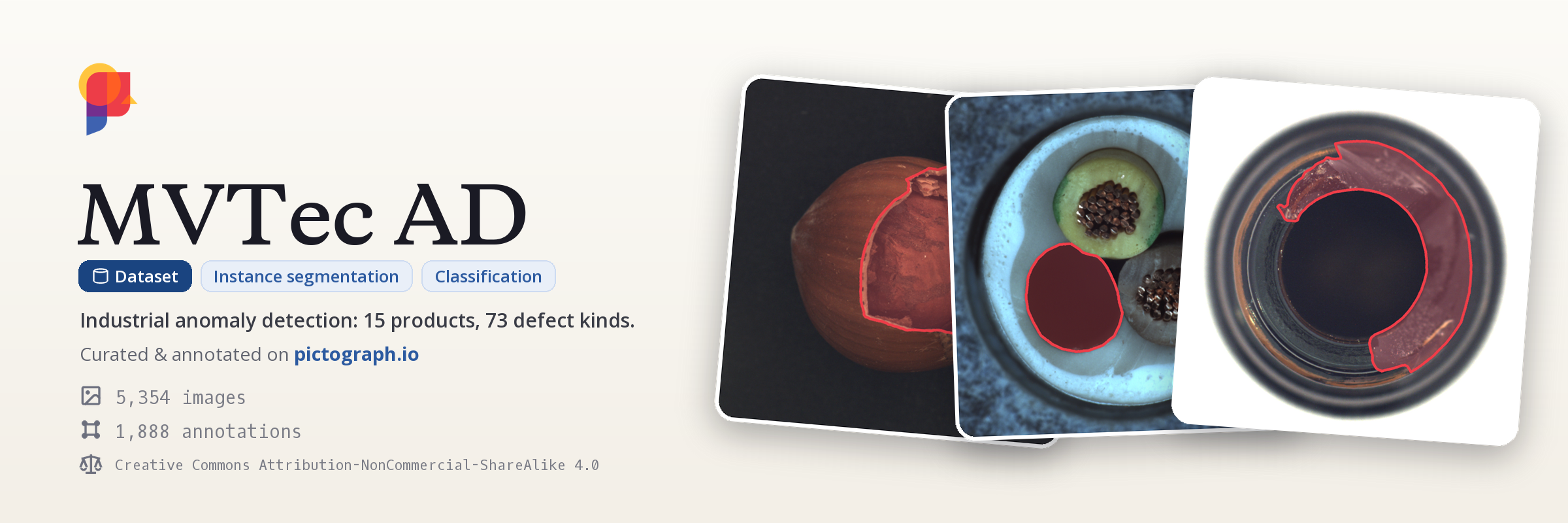
MVTec AD is a computer-vision dataset from MVTec AD, hosted on Pictograph. Industrial anomaly detection: 15 products, 73 defect kinds. The most common detected objects are drill, orange, onion, frisbee, egg, plate. On Pictograph you can browse every annotated image, import it into your own workspace in one click, export it in a dozen formats, or train a model on it directly.
At a glance
| Metric | Value |
|---|---|
| Images | 5,354 |
| Annotations | 1,888 |
| Classes | 1 |
| Image tags | 65 |
| Annotation types | polygon, tag |
| Splits | train, test |
Quick start
Load it in one line with the datasets library, then read each record's boxes and class names:
from datasets import load_dataset
from PIL import ImageDraw

ds = load_dataset("pictograph/mvtec-ad", split="train")
example = ds[0]
image = example["image"]            # a PIL image
objects = example["objects"]        # {bbox, categories, category_names}

# draw every bounding box with its class name
draw = ImageDraw.Draw(image)
for (x, y, w, h), name in zip(objects["bbox"], objects["category_names"]):
    draw.rectangle([x, y, x + w, y + h], outline="red", width=3)
    draw.text((x, y - 12), name, fill="red")

# polygon masks live under example["segmentation"]:
#   [{"label": name, "category": idx, "points": [[x, y], ...]}, ...]
image.show()
Prefer a full annotation editor, one-click import, multi-format export, and one-click training? Open this dataset on Pictograph.
Dataset structure
This dataset uses the Hugging Face imagefolder layout: each split directory holds the images plus a metadata.jsonl that links every image to its annotations by file_name.
| Field | Description |
|---|---|
file_name |
Path to the image within the split directory. |
objects.bbox |
Bounding boxes as [x, y, width, height] (pixels). |
objects.categories |
Integer class index per box (matches the class list below). |
objects.category_names |
Human class name per box. |
segmentation |
List of {label, category, points}; points is a polygon ring [[x, y], ...]. |
tags |
Image-level classification labels, by name (the image tags below). |
Data instance
One record (bounding boxes are [x, y, width, height] in pixels; the class index maps into the class list below):
{
  "image": <PIL.Image (RGB)>,
  "objects": {
    "bbox": [[172.0, 192.0, 249.4, 152.7]],
    "categories": [0],
    "category_names": ["defect"]
  },
  "segmentation": [
    {"label": "defect", "category": 0, "points": [[176.9, 207.2], [259.0, 274.1], ...]}
  ]
}
Classes
Class index matches objects.categories in metadata.jsonl.
| # | Class | Annotations |
|---|---|---|
| 0 | defect | 1,888 |
Image tags
Each record's tags names its image-level labels, from these 65 tags.
| Tag | Images |
|---|---|
| normal | 4,096 |
| anomalous | 1,258 |
| bottle | 292 |
| cable | 374 |
| capsule | 351 |
| carpet | 397 |
| grid | 342 |
| hazelnut | 501 |
| leather | 369 |
| metal_nut | 335 |
| pill | 434 |
| screw | 480 |
| tile | 347 |
| toothbrush | 102 |
| transistor | 313 |
| wood | 326 |
| zipper | 391 |
| bent | 37 |
| bent_lead | 10 |
| bent_wire | 13 |
| broken | 12 |
| broken_large | 20 |
| broken_small | 22 |
| broken_teeth | 19 |
| cable_swap | 12 |
| color | 93 |
| combined | 55 |
| contamination | 42 |
| crack | 84 |
| cut | 53 |
| cut_inner_insulation | 14 |
| cut_lead | 10 |
| cut_outer_insulation | 10 |
| damaged_case | 10 |
| defective | 30 |
| fabric_border | 17 |
| fabric_interior | 16 |
| faulty_imprint | 41 |
| flip | 23 |
| fold | 17 |
| glue | 30 |
| glue_strip | 18 |
| gray_stroke | 16 |
| hole | 45 |
| liquid | 10 |
| manipulated_front | 24 |
| metal_contamination | 28 |
| misplaced | 10 |
| missing_cable | 12 |
| missing_wire | 10 |
| oil | 18 |
| pill_type | 9 |
| poke | 39 |
| poke_insulation | 10 |
| 17 | |
| rough | 32 |
| scratch | 91 |
| scratch_head | 24 |
| scratch_neck | 25 |
| split_teeth | 18 |
| squeeze | 20 |
| squeezed_teeth | 16 |
| thread | 30 |
| thread_side | 23 |
| thread_top | 23 |
License
Released under Creative Commons Attribution-NonCommercial-ShareAlike 4.0. When you use this data, please credit MVTec Software GmbH (Bergmann et al., CVPR 2019).
Source and attribution
The images and annotations come from MVTec AD, created by MVTec Software GmbH (Bergmann et al., CVPR 2019) and released under Creative Commons Attribution-NonCommercial-ShareAlike 4.0. We are grateful to the original authors. If you use this data, please cite the original source above.
Citation
@inproceedings{bergmann2019mvtec,
  title = {{MVTec AD} - A Comprehensive Real-World Dataset for Unsupervised Anomaly Detection},
  author = {Bergmann, Paul and Fauser, Michael and Sattlegger, David and Steger, Carsten},
  booktitle = {2019 IEEE/CVF Conference on Computer Vision and Pattern Recognition (CVPR)},
  pages = {9584--9592},
  year = {2019},
  doi = {10.1109/CVPR.2019.00982}
}

@article{bergmann2021mvtec,
  title = {The {MVTec} Anomaly Detection Dataset: A Comprehensive Real-World Dataset for Unsupervised Anomaly Detection},
  author = {Bergmann, Paul and Batzner, Kilian and Fauser, Michael and Sattlegger, David and Steger, Carsten},
  journal = {International Journal of Computer Vision},
  volume = {129},
  number = {4},
  pages = {1038--1059},
  year = {2021},
  doi = {10.1007/s11263-020-01400-4}
}
Published from Pictograph - annotate, train, and deploy from one API.
- Downloads last month
- 7