

license: cc-by-4.0
task_categories:
  - keypoint-detection
  - image-feature-extraction
language:
  - en
pretty_name: Stabilo Benchmark Data
size_categories:
  - 1K<n<10K
annotations_creators:
  - machine-generated
  - expert-generated
viewer: false
tags:
  - image
  - benchmark
  - image-registration
  - homography-estimation
  - feature-matching
  - video-stabilization
  - ransac
  - aerial-imagery
  - drone
  - uav
  - birds-eye-view
  - oriented-bounding-box
  - ground-control-points
  - urban-traffic
  - songdo
  - stabilo
  - hbb2obb
  - arxiv:2611.17190
Stabilo Benchmark Data: Reference-Based UAV Video Stabilization on Dynamic Urban Scenes






The data and every result of the paper "Consensus Capture in Reference-Based UAV Video Stabilization: A Benchmark on Dynamic Urban Scenes" (arXiv:2611.17190). The benchmark evaluates the complete registration pipeline (detector, descriptor, matcher, robust estimator and object masking) for reference-based stabilization of hovering-drone video, where every frame is registered onto one reference frame. Its question is whether vehicles moving together can capture the robust estimator's consensus: a homography fitted to such a group is internally consistent, so inlier statistics cannot reveal it, and the benchmark measures alignment from outside the estimator.
📦 The data is hosted on Zenodo, not on Hugging Face. This page is a documentation mirror and index card. The full record (≈6.2 GB) lives immutably on Zenodo; this card describes v1, DOI
10.5281/zenodo.23623540. It is read by the stabilo-benchmark software, which downloads, verifies and extracts it in one command (see Access the data).
Data at a glance
| Property | Value |
|---|---|
| Part I (static) | 29 4K aerial frames (3840 × 2160) with vehicle boxes, warped by synthetic homographies that are known exactly |
| Part II (dynamic) | 9 evaluation and 5 tuning cases, each one drone hover: a survey-chosen reference frame and 135 later frames, from 1 frame to two minutes later |
| Frames | 1,933 (29 static, 1,224 evaluation, 680 tuning) |
| Vehicle boxes | 106,921, each as a horizontal and an oriented box with a conversion score (machine-generated with hbb2obb) |
| Ground control points | 15 per reference frame, placed by hand, and 12 to 15 per audited frame, proposed by an image fit and reviewed by eye; eight audited frames per evaluation case |
| Results | Every campaign of the paper: per-trial and per-pair records, manifests, the reference estimator's cache and audit, and the CSV files the paper names |
| Classes | 4: 0 car, 1 bus, 2 truck, 3 motorcycle |
| Acquisition | KAIST–EPFL multi-drone experiment, 10 drones over 20 intersections, 140 to 150 m, 4K at 29.97 FPS |
| Location and dates | Songdo International Business District, South Korea, October 6 and 7, 2022 |
| Total size | ≈6.2 GB in five ZIP archives |
| License | CC BY 4.0 |
The two parts
Part I, static scenes. Each frame is warped by a homography drawn from a known distribution, with photometric degradation, and every pipeline is asked to recover it. The ground truth is exact, and the perturbation of a given trial does not depend on the pipeline, so the comparison is paired. The 29 frames are the first frame of the first hover of every drone-intersection pair in one session, a census rather than a selection, and this record is their first publication. Tuning and evaluation are split by site (9 and 20 frames).
Part II, dynamic cases. Real hovers, selected from the video alone by the amount and the coherence of moving foreground (a 2 × 2 design with two cases per cell, plus a stationary control). Candidates are scored against a pseudo-ground-truth reference estimator whose error is audited with the ground control points, which also score every candidate directly.
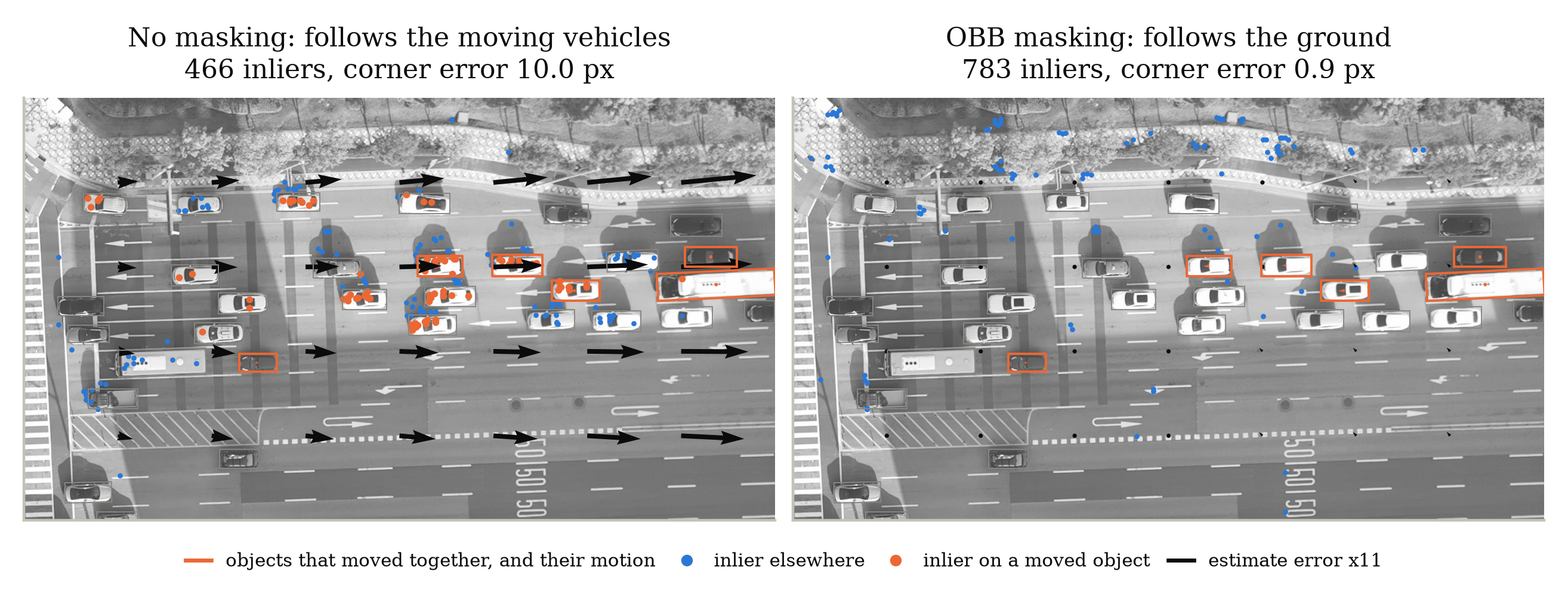
The vehicle boxes are detections, not human annotations: they serve masking and the object-level metrics, where every pipeline receives the identical mask. They are not meant for training or evaluating a detector; for that, see Songdo Vision and Songdo Vision OBB.
Access the data
The record is published and versioned on Zenodo. Please download it from the canonical source; it is not redistributed on Hugging Face:
➡️ v1: DOI 10.5281/zenodo.23623540
With the benchmark software, which also regenerates every benchmark table and figure of the paper from the stored results:
git clone https://github.com/rfonod/stabilo-benchmark.git && cd stabilo-benchmark
python3.11 -m venv .venv && source .venv/bin/activate
pip install -e .
stabilo-benchmark fetch songdo        # downloads, verifies and extracts into data/songdo/
Or with zenodo_get:
pip install zenodo_get
zenodo_get 10.5281/zenodo.23623540
sha256sum -c SHA256SUMS
Files on Zenodo:
| File | Size | Contents |
|---|---|---|
static.zip |
≈0.31 GB | Part I: frames, boxes, provenance and the Part I campaigns |
dynamic.zip |
≈3.72 GB | Part II evaluation cases with ground control points, the reference estimator's audit and campaigns, and the case survey |
dynamic_tuning.zip |
≈2.17 GB | Part II tuning cases with their campaigns, and their survey |
supplementary.zip |
small | The CSV files the paper names, with an index, and the scripts of its side analyses |
configs.zip |
small | The campaign configs, the scene split and the case lists |
README.md |
small | Full documentation of the record |
LICENSE.txt |
small | CC BY 4.0 terms |
SHA256SUMS |
small | SHA-256 of every other file |
The record's README documents the case selection, the directory layout, the annotation commands, the ground control point protocol, the result files and the known limitations.
Related datasets and resources
- stabilo-benchmark: the benchmark software this record accompanies:
github.com/rfonod/stabilo-benchmark · v1.0.0,
10.5281/zenodo.24168256 - Songdo Vision OBB: oriented vehicle boxes for 5,419 frames of the same experiment, introduced by the
same paper, whose grid search selected the conversion settings used here:
HF
rfonod/songdo-vision-obb·10.5281/zenodo.15050578 - Songdo Vision: human-verified horizontal vehicle boxes for the same 5,419 frames:
HF
rfonod/songdo-vision· v2,10.5281/zenodo.21728430 - Songdo Traffic: georeferenced vehicle trajectories from the same experiment, used to check the
case selection: HF
rfonod/songdo-traffic· v2,10.5281/zenodo.17924857 - Stabilo: the stabilization library the pipelines run through: github.com/rfonod/stabilo
- HBB2OBB: the annotation tool: github.com/rfonod/hbb2obb
- Geo-trax detector: the source of the detector weights (CC BY 4.0): HF model
rfonod/geo-trax· github.com/rfonod/geo-trax - Publications: the paper this record accompanies
(arXiv:2611.17190), and the article behind the imagery,
Transportation Research Part C (2025):
10.1016/j.trc.2025.105205· arXiv:2411.02136
Citation
If you use this data, please cite the paper it accompanies (arXiv:2611.17190):
@article{fonod2026benchmark,
  author  = {Fonod, Robert and Geroliminis, Nikolas},
  title   = {Consensus Capture in Reference-Based UAV Video Stabilization: A Benchmark on Dynamic Urban Scenes},
  journal = {arXiv preprint arXiv:2611.17190},
  year    = {2026},
  doi     = {10.48550/arXiv.2611.17190}
}
Please also cite the article behind the imagery:
@article{fonod2025advanced,
  title   = {Advanced computer vision for extracting georeferenced vehicle trajectories from drone imagery},
  author  = {Fonod, Robert and Cho, Haechan and Yeo, Hwasoo and Geroliminis, Nikolas},
  journal = {Transportation Research Part C: Emerging Technologies},
  volume  = {178},
  pages   = {105205},
  year    = {2025},
  doi     = {10.1016/j.trc.2025.105205}
}
License
This record is released under the Creative Commons Attribution 4.0 International (CC BY 4.0) license; see the LICENSE file for the full terms. You are free to share and adapt the material for any purpose, provided you give appropriate credit.